

Federal Court of Australia
Singh v Minister for Immigration, Citizenship, Migrant Services and Multicultural Affairs [2023] FCAFC 123
ORDERS
DATE OF ORDER: |
THE COURT ORDERS THAT:
1. The appeal is dismissed.
Note: Entry of orders is dealt with in Rule 39.32 of the Federal Court Rules 2011.
CHARLESWORTH J
1 The first appellant, Mr Jasbir Singh, is a citizen of India. He is a qualified chef specialising in Indian cuisine. Between 2014 and 2016, Mr Singh worked at a restaurant situated in McLaren Vale in South Australia as the holder of a visa issued under the Migration Act 1958 (Cth). In 2016, the restaurant business was purchased by Harsinco Pty Ltd. Mr Singh entered into an employment contract with Harsinco and on 15 August 2016 he made a valid application under s 45(1) of the Act for a Regional Sponsored Migration Scheme (subclass 187) visa, naming his family members (the second and third appellants) as dependents. As the second and third appellants’ applications depend on the grant of a visa to Mr Singh, I will refer only to Mr Singh’s visa application and associated proceedings in the disposition of this appeal.
2 The power to grant or refuse to grant a visa is conferred on the Minister under s 65(1) of the Act. The same power may be exercised by the Administrative Appeals Tribunal in the performance of its review functions under Pt 5.
3 On the day that Mr Singh’s visa application was made, Harsinco made an application under reg 5.19(1) (as then in force) of the Migration Regulations 1994 (Cth) for approval of its nomination of a position to be occupied by Mr Singh in the restaurant business (nomination application). The power to refuse or approve a nomination application is conferred on the Minister by reg 5.19(4). That power may also be exercised by the Tribunal on an application for review under Pt 5 of the Act.
4 The combined effect of the Act and the Regulations is that it was an essential criterion for the grant of the visa that Harsinco’s nomination application be approved: Act, s 65; Regulations, regs 2.02, 2.03, 5.19(1), 5.19(4), Sch 2, cl 187.233(3). I will refer to that criterion as Criterion 187.233(3).
5 Different delegates of the Minister respectively refused to approve the nomination and to grant the visa.
6 The delegates’ decisions were the subject of separate applications for merits review in the Tribunal, respectively commenced by Harsinco and Mr Singh under Pt 5 of the Act. The Tribunal affirmed the decision not to approve the nomination, albeit for different reasons to those of the relevant delegate (Nomination Decision). A differently constituted Tribunal affirmed the decision not to grant the visa because it was not satisfied that Criterion 187.233(3) was fulfilled (Visa Decision).
7 The Nomination Decision and the Visa Decision were subject to separate applications for judicial review in the then-named Federal Circuit Court of Australia (FCCA) commenced respectively by Harsinco and Mr Singh. As discussed below, the applications proceeded from the premise that it was necessary in each case to show that the decision subject to review was affected by jurisdictional error: Act, s 474; Craig v South Australia (1995) 184 CLR 163, Minister for Immigration and Multicultural Affairs v Yusuf (2001) 206 CLR 323.
8 The primary judge concluded that the Nomination Decision was not affected by the jurisdictional errors alleged by Harsinco and so dismissed its application for judicial review: Harinsco Pty Ltd v Minister for Immigration, Citizenship, Migrant Services and Multicultural Affairs [2021] FCCA 528 (Harsinco FCCA). Mr Singh’s application for judicial review of the Visa Decision was then dismissed on the basis that the Tribunal had not committed jurisdictional error in concluding that Criterion 187.233(3) was not fulfilled: Singh v Minister for Immigration, Citizenship, Migrant Services and Multicultural Affairs [2021] FCCA 529 (Singh FCCA). In Singh FCCA, the primary judge proceeded from the assumption that the reasoning in Harsinco FCCA was correct in its conclusion that the Nomination Decision was validly made.
9 Mr Singh was not a party to Harsinco’s application for judicial review and there is no appeal from the order of the primary judge dismissing that application. This appeal is from the judgment in Singh FCCA dismissing Mr Singh’s application for judicial review of the Visa Decision.
10 The grounds of appeal are those contained in an amended notice of appeal dated 21 September 2022. They are to the effect that the primary judge erred in not finding jurisdictional error affecting the Visa Decision because:
(1) the Visa Decision was founded on an assumption that the Nomination Decision was a valid exercise of the power conferred under reg 5.19(4);
(2) the assumption was incorrect because the Nomination Decision was affected by jurisdictional error and had no legal operation or effect for the purpose of assessing whether Criterion 187.233(3) was met; and
(3) the error was material because it deprived Mr Singh of the possibility of a successful outcome on his application for review of the delegate’s decision to refuse to grant him the visa.
11 Before turning to those grounds it is necessary to address two preliminary issues that arise on the Minister’s submissions.
12 First, it was submitted that Mr Singh was not a person who could commence an action in the FCCA involving any “collateral challenge” to the validity of the Nomination Decision, nor could he apply to the Tribunal for merits review of that decision.
13 Second, it was submitted that Criterion 187.223(3) should be construed so as to require only that the Tribunal be satisfied that there had been a decision “in fact” to refuse Harsinco’s nomination application. In other words it was submitted that the Nomination Decision was legally operative as between the Minister and Mr Singh, whether or not it was affected by jurisdictional error.
14 For the reasons given below:
(1) on his application for judicial review in the FCCA, Mr Singh was entitled to challenge the Tribunal’s conclusion that Criterion 187.223(3) was not satisfied;
(2) in Singh FCCA the primary judge resolved that issue by implicitly adopting the same reasoning he had employed in Harsinco FCCA;
(3) for the purposes of this appeal, Mr Singh is entitled to assert that the primary judge committed appealable error by importing erroneous reasoning from Harsinco FCCA. The grounds of appeal do not involve any impermissible “collateral challenge”;
(4) accordingly, on its proper construction, Criterion 187.233(3) refers to a decision that has been made in the valid exercise of the Minister’s power under reg 5.19(4), that is, a decision unaffected by jurisdictional error.
Standing and collateral challenge
15 The Visa Decision and the Nomination Decision each meet the description of a “migration decision” for the purposes of the Act.
16 Division 2 of Pt 8 of the Act is titled “Jurisdiction and Procedure of Courts”. Subject to exceptions that do not presently apply, the FCCA had the same jurisdiction in relation to migration decisions as the High Court has under s 75(v) the Constitution: Act, s 476(1). The primary judge exercised that jurisdiction in the two judicial review proceedings before him.
17 In this proceeding the Court exercises appellate jurisdiction conferred under s 25 of the Federal Court of Australia Act 1976 (Cth). It does not have original jurisdiction to judicially review the Visa Decision or the Nomination Decision: Act, s 476A(1).
18 At the relevant time, s 486C of the Act was headed “Persons who may commence or continue proceedings in the Federal Circuit Court or the Federal Court”. It relevantly provided:
Persons who may commence or continue proceedings in the Federal Circuit Court or the Federal Court
(1) Only the persons mentioned in this section may commence or continue a proceeding in the Federal Circuit Court or the Federal Court that raises an issue:
(a) in connection with visas (including if a visa is not granted or has been cancelled), deportation, taking, or removal of unlawful non-citizens; and
(b) that relates to the validity, interpretation or effect of a provision of this Act or the regulations;
(whether or not the proceeding raises any other issue).
(2) Those persons are:
(a) a party to a review mentioned in section 479; or
(b) the Attorney-General of the Commonwealth or of a State or a Territory; or
(c) a person who commences or continues the proceeding in performing the person’s statutory functions; or
(d) any other person prescribed by the regulations.
(3) This section applies to proceedings within the Federal Circuit Court’s jurisdiction under section 476 of this Act, section 44 of the Judiciary Act 1903, section 32AB of the Federal Court of Australia Act 1976 or any other law.
(3A) This section applies to proceedings transferred to the Federal Court under section 39 of the Federal Circuit Court of Australia Act 1999 and proceedings in which the Federal Court has jurisdiction under paragraph 476A(1)(b) or (c).
(4) To avoid doubt, nothing in this section allows a person to commence or continue a proceeding that the person could not otherwise commence or continue.
Relationship with other laws
(5) This section has effect despite any other law.
(6) However, subsection (5) does not apply to a provision of an Act if the provision:
(a) commences after this section commences; and
(b) specifically states that it applies despite this section.
19 It is necessary to consider s 486C in its application to the FCCA.
20 Section 479(a) of the Act mentions migration decisions “made on review under Part 5” of the Act. The Visa Decision meets the description of a migration decision made on such a review. Accordingly, Mr Singh was a “party to a review mentioned in s 479” within the meaning of s 486C(2)(a) of the Act. It follows that he is a person who may commence or continue a proceeding in the FCCA that raises an issue in connection with visas and that relates to the interpretation or effect of a provision of the Act or the Regulations. His action at first instance met that description and he plainly had standing to commence and continue it.
21 The Minister submitted that the proceedings commenced by Mr Singh were “in fact about the nomination decision rather than the visa decision”. That submission fails to have proper regard to the breadth of the phrase “in connection with visas”. The phrase does not confine the subject matter of proceedings to specified migration decisions or other decisions.
22 The parties each made submissions comparing s 486C with s 494AB of the Act, but in each case they did little to illuminate how s 486C should be construed and applied.
23 The issue before the primary judge was whether the Visa Decision was affected by jurisdictional error. Mr Singh’s grounds for review alleged that the Tribunal’s conclusion that that Criterion 187.233(3) was not fulfilled involved jurisdictional error. Nothing in s 486C of the Act precluded him from commencing and continuing a proceeding in the FCCA in relation to the question of whether the Visa Decision was affected by jurisdictional error. The provision requires only that the subject matter of the proceeding have some connection with one or more visas. It is difficult to envisage a matter more closely connected to a visa than Mr Singh’s application for judicial review of the Visa Decision.
24 By his originating application at first instance, Mr Singh alleged that the Visa Decision was invalid because the Tribunal erred in proceeding on the mistaken belief that there had been a valid decision to refuse Harsinco’s nomination application. His grounds of review raised issues in connection with a visa (including whether the criterion for the visa were fulfilled), a contention that turned on the interpretation and effect of provisions of both the Act and the Regulations. The circumstance that Harsinco also had standing to commence an application for judicial review did not deprive Mr Singh of the status of “a party to a review mentioned in s 479” of the Act”.
25 Section 478 of the Act relevantly provides:
Persons who may make application
An application referred to in section 477 or 477A may only be made by the Minister, or where appropriate the Secretary or Australian Border Force Commissioner, and:
(a) if the migration decision concerned is made on review under Part 5 … the applicant in the review by the relevant Tribunal; or
(aa) if the migration decision concerned is made on review under Part 7AA —the referred applicant in the review by the Immigration Assessment Authority; or
(b) in any other case —the person who is the subject of the decision; or
(c) in any case —a person prescribed by the regulations.
26 Mr Singh made an application of a kind referred to in s 477 of the Act. The migration decision concerned (the Visa Decision) was made on review under Pt 5 and Mr Singh was a party in the review by the Tribunal with respect to that decision. He had standing to bring his application for judicial review of the Visa Decision in accordance with s 478 of the Act. Notably, the Minister did not contend otherwise in the proceedings before the primary judge.
27 Section 65(1)(a) of the Act relevantly provides that after considering a valid application for a visa, the Minister must grant the visa if the Minister is satisfied that (among other things) the criteria for the visa prescribed in the Act and the Regulations are met. If not so satisfied, the Minister must refuse the visa application: Act, s 65(1)(b).
28 Classes of visas may be prescribed under s 31(1) of the Act. Criteria for visas of specified classes are prescribed in the Regulations: Act, s 31(3). Some of the criteria for the class of visa for which Mr Singh applied are prescribed in cl 187 of Sch 2. At the relevant time, clause 187.233 provided:
(1) The position to which the application relates is the position:
(a) nominated in an application for approval that seeks to meet the requirements of:
(i) subparagraph 5.19(4)(h)(ii); or
(ii) subregulation 5.19(4) as in force before 1 July 2012; and
(b) in relation to which the declaration mentioned in paragraph 1114C(3)(d) of Schedule 1 was made in the application for the grant of the visa.
(2) The person who will employ the applicant is the person who made the nomination.
(3) The Minister has approved the nomination.
(4) The nomination has not subsequently been withdrawn.
(4A) Either:
(a) there is no adverse information known to Immigration about the person who made the nomination or a person associated with that person; or
(b) it is reasonable to disregard any adverse information known to Immigration about the person who made the nomination or a person associated with that person.
(5) The position is still available to the applicant.
(6) The application for the visa is made no more than 6 months after the Minister approved the nomination.
(emphasis added)
29 The “nomination” to which Criterion 187.233(3) refers is the nominated position forming the subject of the “application for approval” expressly referred to in subcl (1). The expression “application for approval” is defined to mean “an application under regulation 5.19 for approval of the nomination of a position”: Regulations, cl 187.111. The nomination application is one that “seeks to meet the requirements of” multiple conditions contained in reg 5.19: see cl 187.233(1)(a). The remainder of cl 187 is directed to prescribing in some detail the conditions for the grant of the relevant visa.
30 Regulation 5.19(1) provides that a person (the nominator) may apply to the Minister for approval of the nomination of a position in Australia. It makes reference to only two types of nomination: a Temporary Residence Transition Nomination and a Direct Entry Nomination. The Minister’s power to approve those nominations are conferred by reg 5.19(3) and reg 5.19(4) respectively. The power exercised in this case was that conferred by reg 5.19(4). It is to the effect that the Minister must approve a Direct Entry Nomination if a detailed raft of conditions are satisfied. As discussed below, the conditions were directed to the economic purposes to be served by the grant of the visa. These included, amongst other things, a requirement for the application to identify:
(1) that the terms of the employment will be no less favourable than the terms that are or would be provided to an Australian citizen fulfilling the same position at the same location (reg 5.19(4)(e));
(2) that the position is located in regional Australia (reg 5.19(4)(h)(ii)(A));
(3) that the nominator genuinely needs to employ a paid employee to work in the position (reg 5.19(4)(h)(ii)(B)); and
(4) that the position cannot be fulfilled by an Australian citizen or permanent resident (reg 5.19(4)(h)(ii)(C)).
31 The Act defines the phrase “Part 5 Reviewable Decision” to include (relevantly) a decision that is prescribed for the purposes of s 338(9). For the purposes of s 338(9), reg 4.02(4) prescribes a decision under reg 5.19 to refuse an application for approval of a nominated position. The effect of s 347(2)(d) of the Act and reg 4.02(5)(d) of the Regulations is that only Harsinco could apply to the Tribunal for merits review of the delegate’s decision to refuse the nomination.
32 These provisions, together with s 478 and s 486C were relied upon by the Minister to support a contention concerning the proper construction of Criterion 187.233(3). The Minister submitted that as between the Minister and Mr Singh, the Nomination Decision was legally operative whether or not it was affected by jurisdictional error. Expressed another way it was submitted that Criterion 187.233(3) cannot be fulfilled if there has been a decision in fact to refuse to approve the nomination of the position. It matters not, the Minister submitted, whether the decision to refuse the nomination is made other than in accordance with requirements of the Act and the Regulations.
33 In Singh FCCA the primary judge said (at [1]) “At the commencement of the hearing of this matter before the Court, the parties agreed that the outcome of the Originating Application for Review filed by the applicant on 24 July 2019 was dependent upon the success of the application for review filed on behalf of Harsinco Pty Ltd in ADG 264 of 2019”. His Honour went on to apply Harsinco FCCA as a necessary step in his conclusion that Mr Singh’s application should be dismissed. It was not suggested that the outcome in Harsinco FCCA was irrelevant in determining Singh FCCA. To the contrary, the primary judge proceeded from the agreed position that identification of jurisdictional error affecting the Nomination Decision was a relevant inquiry in Harsinco FCCA and that the outcome would determine whether Mr Singh’s application for judicial review should be allowed. Implicitly, the primary judge construed Criterion 187.233(3) to refer to a decision made in the valid exercise of the power conferred by reg 5.19(4). Were that not the case it would not have been necessary to await the outcome of Harsinco’s application for judicial review, for it would be sufficient on the Minister’s case to show only that there had been a decision “in fact” to refuse the nomination. Indeed, Harsinco’s application for judicial review would on that construction have no practical or legal utility.
34 It is difficult to resist the conclusion that the position adopted by the Minister on this appeal is inconsistent to that adopted at first instance. Leave is required to raise what is essentially a new argument here, being an argument inconsistent with the agreed position below. Leave has not been sought.
35 There is no notice of contention alleging that the primary judge was entitled to dismiss Mr Singh’s application for judicial review on the basis of the alternative construction of Criterion 187.233(3) now contended for. A notice of contention ought to have been filed if the Minister is seeking for Mr Singh’s appeal to be dismissed on a basis different from that decided below.
36 Notwithstanding the absence of any application for leave and the absence of any notice of contention, having the benefit of full argument, it is appropriate to address the Minister’s remaining submissions with respect to how Criterion 187.233(3) and reg 5.19 should be construed.
37 The Minister’s submissions proceed from the well established principle that the identification of jurisdictional error affecting a decision will not necessarily have the consequence that the decision is void ab initio for any or all purposes. The legal operation and effect of a decision so affected turns on the proper construction of the statute pursuant to which the decision is made or purportedly made. As Gaudron and Gummow JJ said in Minister for Immigration and Multicultural Affairs v Bhardwaj (2002) 209 CLR 597 “an administrative decision has only such force and effect as is given to it by the law pursuant to which it was made” (at [46]) and “the Parliament may give an administrative decision whatever force it wishes” (at [47]).
38 The question before the High Court in Bhardwaj was whether an administrative tribunal, having recognised its own error in failing to afford procedural fairness to a review applicant resulting in an adverse decision could (absent an order quashing the first decision) exercise the same power and arrive at a different and favourable outcome for the review applicant. Gaudron and Gummow JJ undertook the task of construction by first identifying the general law:
51 There is, in our view, no reason in principle why the general law should treat administrative decisions involving jurisdictional error as binding or having legal effect unless and until set aside. A decision that involves jurisdictional error is a decision that lacks legal foundation and is properly regarded, in law, as no decision at all. Further, there is a certain illogicality in the notion that, although a decision involves jurisdictional error, the law requires that, until the decision is set aside, the rights of the individual to whom the decision relates are or, perhaps, are deemed to be other than as recognised by the law that will be applied if and when the decision is challenged. A fortiori in a case in which the decision in question exceeds constitutional power or infringes a constitutional prohibition.
52 The view that a decision involving jurisdictional error does not prevent the decision-maker from correcting that error by making a later decision has been accepted by the Supreme Court of Canada. Thus, in Chandler v Alberta Association of Architects, Sopinka J, with whom Dickson CJ and Wilson J concurred, said:
‘As a general rule, once [an administrative] tribunal has reached a final decision in respect to the matter that is before it in accordance with its enabling statute, that decision cannot be revisited because the tribunal has changed its mind, made an error within jurisdiction or because there has been a change of circumstances …
To this extent, the principle of functus officio applies. It is based, however, on the policy ground which favours finality of proceedings rather than the rule which was developed with respect to formal judgments of a court whose decision was subject to a full appeal. For this reason I am of the opinion that its application must be more flexible and less formalistic in respect to the decisions of administrative tribunals which are subject to appeal only on a point of law.’
In the same case, his Lordship cited with approval a statement by McLachlin J that:
‘as a matter of logic and on the authorities … a tribunal which makes a decision in the purported exercise of its power which is a nullity, may thereafter enter upon a proper hearing and render a valid decision.’
53 In our view, logic and legal principle both direct the conclusion that the approach of the Supreme Court of Canada is correct. As already pointed out, a decision involving jurisdictional error has no legal foundation and is properly to be regarded, in law, as no decision at all. Once that is accepted, it follows that, if the duty of the decision-maker is to make a decision with respect to a person’s rights but, because of jurisdictional error, he or she proceeds to make what is, in law, no decision at all, then, in law, the duty to make a decision remains unperformed. Thus, not only is there no legal impediment under the general law to a decision-maker making such a decision but, as a matter of strict legal principle, he or she is required to do so. And that is so, regardless of s 33(1) of the Acts Interpretation Act.
(citations omitted, emphasis added)
39 Their Honours went on to observe that there was no provision in the Act which expressly gave or purported to give legal effect to decisions of the Tribunal affected by jurisdictional error, and it was therefore necessary to consider whether the Act should be construed as impliedly having that effect (at [54]). The above statement of the general law formed a part of the legal context in which the task of construction was to be performed. The emphasised passage is to be understood in that way.
40 In the result, the plurality in Bhardwaj concluded that, on a proper construction of the Act, the first decision had no legal effect and so did not preclude the Tribunal from exercising its powers of review culminating in the second decision: Gaudron and Gummow JJ at [51] – [60]; McHugh J at [63] and [67]; Hayne J at [153].
41 Similar questions of construction arose in Minister for Immigration, Citizenship, Migrant Services and Multicultural Affairs v Moorcroft (2021) 273 CLR 21, with a different result. In that case, the appellant’s application for a special category visa was refused on the basis that she was a “behaviour concern non-citizen” due to her prior removal from Australia. The prior removal had occurred in circumstances where the appellant’s previous visa had been cancelled. The cancellation decision was affected by jurisdictional error and so of no legal force or effect. An issue arose as to whether the appellant had been “removed from Australia” within the meaning of the relevant special category visa criterion. Kiefel CJ, Keane, Gordon, Steward and Gleeson JJ concluded that the expression “removed from Australia” referred to removal as a factual event, rather than removal based on a valid decision made in accordance with the Act.
42 That construction was found to be consistent with the ordinary meaning of the text of the relevant provision and the statutory definition of the word “remove”. The definition contained no element about the legal basis for removal, so indicating that the fact of removal was a relevant concept in the Act (at [23]). The complex definitions concerning the concept of removal supported a conclusion that the word referred to “events rather than decisions about events” (at [18]).
43 The literal interpretation also avoided the consequence that might undermine the provisions of the Act that contemplated that an application for a special category visa must be made whilst the applicant is in immigration clearance. Delegates would in that context be ill equipped to make the complex, evaluative and time consuming assessment concerning the legal circumstances surrounding a prior removal. The task that would be required on the alternate construction would require the decision-maker to assess the legality of actions undertaken by the governments of other nations. Their Honours said that a court should incline against such a construction if an alternate construction is available (at [26]).
44 The provisions of the Act and the Regulations are to be interpreted having regard to their text, context and purpose: Project Blue Sky Inc v Australian Broadcasting Authority (1998) 194 CLR 355, McHugh, Gummow, Kirby and Hayne JJ (at [69]); SZTAL v Minister for Immigration and Border Protection (2017) 262 CLR 362, Kiefel CJ, Nettle and Gordon JJ (at [14]).
45 Bhardwaj and Moorcroft reinforce that the task of construction may yield different results depending on the provisions to be construed.
46 The Minister’s preliminary arguments turn on the proper construction of Criterion 187.233(3). It is contained in cl 187.233 of Sch 2 to the Regulations, extracted at [28] above.
47 The sole purpose of Harsinco’s nomination application was to obtain approval for a particular position to be occupied by a particular non-citizen (Mr Singh) so as to fulfil only one of the many criteria for the particular subclass of visa for which Mr Singh applied. Those criteria, together with the detailed requirements of reg 5.19, establish a comprehensive regime directed to an essentially practical concern: the employment of non-citizens in sectors and places where they are needed, and (conversely) not in sectors or places where they are not needed.
48 Mention should also be made of cl 186 of Sch 2 to the Regulations. It prescribes (non-exhaustively) the conditions of a Subclass 186 – Employer Nomination Scheme visa. It too refers to an “application for approval”, defined to mean “an application under reg 5.19 for approval of the nomination of a position”: cl 186.111. Clause 186.233(3) is expressed in the same language as Criterion 187.233(3): “the Minister has approved the nomination”. In the case of an application for a Subclass 186 visa, the nomination application is one that “seeks to meet the requirements of” a detailed regime of conditions contained in reg 5.19, directed in their terms to the purpose to be served by the grant of a visa of that subclass. Clause 186 of Sch 2 is the only other provision of the Regulations to make reference to the Minister’s powers under reg 5.19(3) and reg 5.19(4): see respectively cl 186.223(1)(a) and cl 186.233(1). It is significant that the detailed provisions of reg 5.19 serve no purpose in the Act or the Regulations other than to supply answers to questions concerning visa specific criteria prescribed in cl 186 and cl 187 of Sch 2.
49 Unlike the word “removed” (construed by the High Court in Moorcroft) the word “approved” in Criterion 187.233(3) does not refer to a factual event separate and distinct from the concept of the making of an administrative decision. Plainly, the word “approve” in the present context refers to a decision the Minister has power to make under reg 5.19(4).
50 Against that context, and in the absence of an express or implied intention to the contrary, the word “approved” in Criterion 187.233(3) should bear the same meaning as it does in the phrase “approve the nomination” and “refuse to approve the nomination” in reg 5.19(4).
51 A consequence of the Minister’s argument is that the word “approve” in reg 5.19(4) may be taken to require a decision to be made in accordance with the Act and the Regulations in order to be legally operative, and yet the word “approved” in Criterion 187.233(3) means a decision in fact, whether or not the conditions on the power conferred under reg 5.19 are complied with. That construction renders inutile all of the detailed and express constraints on the Minister’s power under reg 5.19, for compliance or non-compliance with them could have no legal consequence in the only statutory contexts where reg 5.19 matters (namely in cl 186 and cl 187 of Sch 2). The Minister’s preferred construction renders the powers under reg 5.19(3) and reg 5.19(4) effectively unconstrained, notwithstanding the express mandatory conditions directed to the fulfilment of the legislative purpose. There is nothing in the provisions themselves to suggest that Parliament could have intended that consequence.
52 In support of the “fact of a decision” construction, the Minister relied on the same provisions referred to earlier in these reasons concerning the jurisdiction of courts and tribunals and the identity of persons who may make applications to them for merits or judicial review. None of those provisions preclude a person having a sufficient interest in the outcome of the nomination application or the visa application from invoking the original jurisdiction of the High Court under s 75(v) of the Constitution. Mr Singh is a person having an obvious interest in the outcome of Harsinco’s nomination application and so is a person who could make such an application to the High Court based on his preferred construction of both reg 5.19 and Criterion 187.233(3).
53 In Bhardwaj, the circumstance that the Federal Court at that time had no jurisdiction to review a migration decision on the grounds of a breach of the rules of procedural fairness was of no relevance to the High Court in determining the question of substance that arose before it. Similarly, in exercising jurisdiction conferred under s 39B of the Judiciary Act 1903 (Cth), this Court would not act on the basis that the substantive law supplying the answer to the controversy is different to that which would be applied by the High Court in proceedings brought under s 75(v) of the Constitution.
54 The same must be said of the proceedings before the FCCA resulting in Harsinco FCCA and Singh FCCA. In all courts having authority to decide the question of construction, the correct answer will be the same as that given by the High Court on an application for judicial review involving the same substantive question. The reasoning of Gaudron and Gummow JJ in Bhardwaj suggests that the High Court would have little regard to the circumstance that a different court may not have authority to decide the question that the same litigant may be precluded from asking the same question of a different court.
55 For similar reasons I reject the Minister’s submission that permitting Mr Singh to raise the issue of whether the Nomination Decision was legally inoperative would undermine prescribed time periods in which merits or judicial review applications must be made. The facts of the present case demonstrate that there has been no undermining of any relevant time limits. Mr Singh complied with the time limits for an application for review to be made under Pt 5 of the Act, he complied with the time limit for the commencement of an application for judicial review of the Visa Decision to the FCCA and then complied with the time limit for the commencement of this appeal. The circumstance that different procedural deadlines might have applied to Harsinco with respect to the exercise of its own rights of review does not answer the substantive question as to how Criterion 187.233(3) should be construed.
56 The Minister further submitted that the Tribunal member who made the Visa Decision was a “second actor” who is not and cannot be obliged to conduct any enquiry into the validity of the Nomination Decision. Rather, it was submitted, the Tribunal should be entitled to proceed on the basis that the fact of the adverse Nomination Decision was fatal to Mr Singh’s application for merits review.
57 As Gageler J observed in Kable v New South Wales (2013) 252 CLR 118 (at [52]) “the exercise of a statutory power might in some circumstances be authorised by statute, even if the repository of the power acted in the mistaken belief that some other, purported but invalid exercise of power is valid”. So much must be accepted. However, to state that a statute may authorise the exercise of a power in that way in some contexts does little to identify whether this is such a context. In Moorcroft, the case was of such a kind because Parliament could not have intended an administrative decision-maker charged with the task of deciding a visa application whilst the applicant was in immigration clearance to conduct an inquiry into the legal validity of the actions of foreign governments. Features of that kind are not present here.
58 In the present case, the second Tribunal member did in fact act on the belief that the Nomination Decision was made in the valid exercise of powers of review by the first Tribunal member, just as the second Minister’s delegate had acted on the belief that the first delegate’s decision to refuse the nomination application was validly made. However, the circumstance that the decisions are defined as separate migration decisions capable of being made by different individuals is not of itself sufficient to warrant the construction for which the Minister contends. It is but one feature to be considered among others in divining the intention of the legislature.
59 It is not at all unusual for the Tribunal to act on the basis that its own actions are legally operative without internally scrutinising them for jurisdictional error. The fact that a court of competent jurisdiction may subsequently determine the first decision-maker’s actions to be invalid may of course introduce an element of uncertainty in the liminal space between the taking of the action in fact and any authoritative and binding decision concerning the validity of the act taken. That is the case here, as it is in the multitude of cases concerning the exercise of powers conferred on the Minister and the Tribunal under the Act.
60 It was expedient for the Tribunal in Mr Singh’s case to assume (whether correctly or incorrectly) the validity of the Nomination Decision without scrutinising it for the existence of jurisdictional error. However, nothing in the Act or Regulations prevented Mr Singh from challenging the correctness of that assumption, as he did in the proceedings culminating in the judgment now appealed from.
61 For completeness, the question asked of this Court is plainly within its appellate jurisdiction. The controversy on the appeal is whether the primary judge committed appealable error by proceeding on the assumption that the previously decided case of Harsinco FCCA was correctly decided. To resolve that issue is not to embark on impermissible judicial review of the Nomination Decision. Nothing in the Act or Regulations precludes this Court in the exercise of its appellate jurisdiction from determining whether the primary judge erred in failing to find that the Visa Decision was affected by jurisdictional error for the reasons Mr Singh had advanced at first instance. An earlier application for summary judgment challenging the competency of the appeal itself was properly withdrawn.
62 I have had the benefit of considering the reasons of Raper J with respect to the merits of the appeal grounds. I agree that the appeal should be dismissed for the reasons given by her Honour.
I certify that the preceding sixty-two (62) numbered paragraphs are a true copy of the Reasons for Judgment of the Honourable Justice Charlesworth. |
Associate:
REASONS FOR JUDGMENT
O’SULLIVAN J:
63 I have had the advantage of considering the draft reasons of both Charlesworth J and Raper J. For the reasons I set out below the appellants do not have standing in this appeal. Accordingly the appeal should be dismissed.
64 Further, the appellants seek to mount an impermissible collateral challenge to Harinsco Pty Ltd [sic Harsinco] v Minister for Immigration, Citizenship, Migrant Services and Multicultural Affairs [2021] FCCA 528 (Harsinco FCCA) as a consequence of which the appeal should also be dismissed.
65 Finally, I agree the appeal should be dismissed for the reasons set out by Raper J.
66 In these reasons I adopt gratefully the background to this matter set out by Raper J, although it is necessary to set out some of the background in these reasons.
Background
67 On 15 August 2016, Harsinco Pty Ltd lodged an “Application for Employer Nomination for a Permanent Appointment” (nomination application) under reg 5.19(1) (as then in force) of the Migration Regulations 1994 (Cth). The first appellant, Mr Singh, was the person nominated by Harsinco in the nomination application.
68 On 19 March 2018, a delegate of the Minister refused the nomination application.
69 On 19 June 2019, the Administrative Appeals Tribunal affirmed the delegate’s decision to refuse the nomination application (Nomination Decision). Harsinco applied for judicial review which was dismissed in Harsinco FCCA.
70 On 15 August 2016, the same day as Harsinco made its’ nomination application, Mr Singh, applied for a “Permanent Employer-Sponsored or Nominated Visa” (Subclass 187) (visa) in the Direct Entry Scheme (visa application). The second and third appellants were listed on the visa application as migrating family members.
71 On 19 March 2018, a delegate refused the visa application on the basis that the Minister had refused the nomination application, such that the criteria for the grant of the visa had not been satisfied. On 28 June 2019, the Tribunal affirmed the delegate’s decision to refuse the visa application (Visa Decision). An application by the appellants for judicial review of the Visa Decision was dismissed in Singh v Minister for Immigration, Citizenship, Migrant Services and Multicultural Affairs [2021] FCCA 529 (Singh FCCA). It is from that decision that the appellants now appeal.
Grounds of appeal
72 The amended grounds of appeal contend the primary judge erred in law in not finding jurisdictional error in the Visa Decision. That error is said to arise on the basis that the Tribunal in the Visa Decision founded its decision on the Tribunal’s Nomination Decision which was in turn affected by jurisdictional error. The particulars to the grounds of appeal contend jurisdictional error by the Tribunal in the Nomination Decision in that the Tribunal:
(i) Asked itself the wrong question, because it considered whether the nomination criteria in reg 5.19(4) were satisfied, on the incorrect assumption that a ‘position’ was confined to a role at a single location;
(ii) Asked itself the wrong question, because it considered whether the nomination criteria in reg 5.19(4) were satisfied, on the incorrect assumption that ‘position’ was constrained by the description given on the visa application form (as opposed to also being informed by the material accompanying the application); and/or
(iii) Failed to consider a claim (or integer of a claim) raised squarely on the nomination application, being that the duties of the position the subject of the nomination were to be performed at the [Harsinco’s] Goolwa, Port Elliott or McLaren Vale restaurants as reasonably directed by [Harsinco].
(Square brackets provided)
Standing
73 The appellants’ submit they have standing to bring this appeal because they are persons directly affected by a decision that affects their interests: Kioa v West [1985] HCA 81; (1985) 159 CLR 550 such that their interests are sufficient to bring proceedings by way of judicial review asserting jurisdictional error. They submit that the provisions governing this appeal permit them to do so because the primary judge’s decision in Singh FCCA incorporated the decision in Harsinco FCCA in which the primary judge had affirmed the Nomination Decision.
74 There is no doubt that the appellants have an interest sufficient to bring proceedings by way of judicial review against the Visa Decision, which is the subject of Singh FCCA, and to appeal against the primary judge’s adverse decision.
75 As to whether in prosecuting this appeal they can challenge the Nomination Decision and Harsinco FCCA, the appellants’ submit that since they were applicants before the Tribunal on the Visa Decision, they meet the requirements of s 486C of the Migration Act 1958 (Cth) as they are “parties to a review” within the meaning of s 479 of the Act. They submit the appeal grounds address directly the reason why the primary judge dismissed the application for judicial review of the Visa Decision which was the decision in Harsinco FCCA.
76 The Minister submits that the appellants have no standing because they are not persons within s 486C(2)(a) of the Act and the appeal seeks to raise an issue about the Nomination Decision.
77 As they stood, as at 1 July 2016, ss 479 and 486C of the Act provided:
The parties to a review of a migration decision resulting from an application referred to in section 477 or 477A are the Minister, or where appropriate the Secretary or Australian Border Force Commissioner, and:
(a) if the migration decision concerned is made on review under Part 5 or 7 or section 500—the applicant in the review by the relevant Tribunal; or
(aa) if the migration decision concerned is made on review under Part 7AA—the referred applicant in the review by the Immigration Assessment Authority; or
(b) in any other case—the person who is the subject of the migration decision; or
(c) in any case—a person prescribed by the regulations.
486C Persons who may commence or continue proceedings in the Federal Circuit Court or the Federal Court
(1) Only the persons mentioned in this section may commence or continue a proceeding in the Federal Circuit Court or the Federal Court that raises an issue:
(a) in connection with visas (including if a visa is not granted or has been cancelled), deportation, taking, or removal of unlawful non-citizens; and
(b) that relates to the validity, interpretation or effect of a provision of this Act or the regulations;
(whether or not the proceeding raises any other issue).
(2) Those persons are:
(a) a party to a review mentioned in section 479; or
(b) the Attorney-General of the Commonwealth or of a State or a Territory; or
(c) a person who commences or continues the proceeding in performing the person’s statutory functions; or
(d) any other person prescribed by the regulations.
(3) This section applies to proceedings within the Federal Circuit Court’s jurisdiction under section 476 of this Act, section 44 of the Judiciary Act 1903, section 32AB of the Federal Court of Australia Act 1976 or any other law.
(3A) This section applies to proceedings transferred to the Federal Court under section 39 of the Federal Circuit Court of Australia Act 1999 and proceedings in which the Federal Court has jurisdiction under paragraph 476A(1)(b) or (c).
(4) To avoid doubt, nothing in this section allows a person to commence or continue a proceeding that the person could not otherwise commence or continue.
Relationship with other laws
(5) This section has effect despite any other law.
(6) However, subsection (5) does not apply to a provision of an Act if the provision:
(a) commences after this section commences; and
(b) specifically states that it applies despite this section.
78 There have been amendments to s 486C since 1 July 2016, however nothing turns on those amendments.
79 It is well-settled that the task of statutory interpretation begins with the text whilst at the same time regard is had to its context and purpose. Context should be regarded at the first stage and not at a later stage and should be regarded in its widest sense. “Considerations of context and purpose simply recognise that understood in its statutory, historical or other context, some other meaning of a word may be suggested, and so too, if its ordinary meaning is not consistent with the statutory purpose, that meaning must be rejected”: SZTAL v Minister for Immigration and Border Protection [2017] HCA 34; (2017) 262 CLR 362, at [14] (Kiefel CJ, Nettle and Gordon JJ); See also Project Blue Sky Inc v Australian Broadcasting Authority [1998] HCA 28; (1998) 194 CLR 355 at [69] (McHugh, Gummow, Kirby and Hayne JJ); Alcan (NT) Alumina Pty Ltd v Commissioner of Territory Revenue (Northern Territory) [2009] HCA 41; (2009) 239 CLR 27 at [47] (Hayne, Haydon, Crennan and Kiefel JJ).
Section 479
80 It may be accepted that on the text of s 479, both the Nomination Decision and the Visa Decision were migration decisions within the meaning of s 5 of the Act. Insofar as the Visa Decision is concerned, the appellants were parties to a review of the Decision in Singh FCCA which resulted from them filing an application in the Federal Circuit Court of Australia (as it then was) (FCCA) pursuant to s 477 of the Act.
81 However, the subject of the migration decision which comprised the Nomination Decision was Harsinco. It was Harsinco that had to satisfy the criteria in reg 5.19 of the Regulations, specifically in this case reg 5.19(4)(h)(ii), before the Minister was required to approve its nomination. I do not consider that under those circumstances the appellants were parties to a review of a migration decision resulting from an application referred to in s 477 insofar as the Nomination Decision is concerned: s 479(a), nor the subject of that migration decision: s 479(b). The fact the appeal grounds identify the basis upon which the primary judge dismissed the application for judicial review of the Visa Decision as being founded on a different FCCA decision affirming the Nomination Decision, does not make the appellants “parties to a review” of the Nomination Decision within the meaning of s 479.
82 Further, reg 5.19(4) of the Regulations sets out the criteria for the Nomination Application which Harsinco had to meet, whereas cl 187 of Schedule 2 to the Regulations set out the criteria for the Direct Entry Scheme which the appellants had to meet. Those clauses provide, respectively:
5.19 Approval of nominated positions (employer nomination)
(1) A person (a nominator) (including a partnership or unincorporated association) may apply to the Minister for approval of the nomination of a position in Australia.
(2) …
…
Direct Entry nomination
(4) The Minister must, in writing, approve a nomination if:
…
(e) the terms and conditions of employment applicable to the position will be no less favourable than the terms and conditions that:
(i) are provided; or
(ii) would be provided;
to an Australian citizen or an Australian permanent resident for performing equivalent work in the same workplace at the same location; and
(h) either:
(i) both of the following apply:
(A) the tasks to be performed in the position will be performed in Australia and correspond to the tasks of an occupation specified by the Minister in an instrument in writing for this sub-subparagraph;
(B) either:
(I) the nominator’s business has operated for at least 12 months, and the nominator meets the requirements for the training of Australian citizens and Australian permanent residents that are specified by the Minister in an instrument in writing for this sub-sub-subparagraph; or
(II) the nominator’s business has operated for less than 12 months, and the nominator has an auditable plan for meeting the requirements specified in the instrument mentioned in sub-sub-subparagraph (I); or
(ii) all of the following apply:
(A) the position is located in regional Australia;
(B) there is a genuine need for the nominator to employ a paid employee to work in the position under the nominator’s direct control;
(C) the position cannot be filled by an Australian citizen or an Australian permanent resident who is living in the same local area as that place;
(D) the tasks to be performed in the position correspond to the tasks of an occupation specified by the Minister in an instrument in writing for this sub-subparagraph;
(E) the business operated by the nominator is located at that place;
(F) a body that is:
(I) specified by the Minister in an instrument in writing for this sub-subparagraph; and
(II) located in the same State or Territory as the location of the position;
has advised the Minister about the matters mentioned in paragraph (e) and sub-subparagraphs (B) and (C).
(5) The Minister must refuse a nomination if neither of subregulations (3) and (4) applies.
(6) As soon as practicable after deciding a nomination, the Minister must give the nominator:
(a) a copy of the written approval or refusal; and
(b) if the Minister refuses the nomination:
(i) a written statement of the reasons why the nomination was refused; and
(ii) a written statement that the decision is a Part 5-reviewable decision.
Note: Division 4.1 deals with review of decisions. Paragraph 4.02(4)(e) provides that a decision under regulation 5.19 to refuse an application is a Part 5-reviewable decision.
(7) In this regulation:
regional Australia means a part of Australia specified by the Minister in an instrument in writing for this definition
187.233
(1) The position to which the application relates is the position:
(a) nominated in an application for approval that seeks to meet the requirements of:
(i) subparagraph 5.19(4)(h)(ii); or
(ii) subregulation 5.19(4) as in force before 1 July 2012; and
(b) in relation to which the declaration mentioned in paragraph 1114C(3)(d) of Schedule 1 was made in the application for the grant of the visa.
(2) The person who will employ the applicant is the person who made the nomination.
(3) The Minister has approved the nomination.
(4) The nomination has not subsequently been withdrawn.
(4A) Either:
(a) there is no adverse information known to Immigration about the person who made the nomination or a person associated with that person; or
(b) it is reasonable to disregard any adverse information known to Immigration about the person who made the nomination or a person associated with that person.
(5) The position is still available to the applicant.
(6) The application for the visa is made no more than 6 months after the Minister approved the nomination.
83 Various subclauses in cl 187.233 assume an existing state of affairs: the Minister has approved the nomination (cl 187.233(3)); the reference to the nomination application has not been withdrawn (cl 187.233(4)); the position is still available to the applicant (cl 187.233(5)); and the six month period following the Minister’s approval of the nomination (cl 187.233(6)) within which the visa application may be made, all indicate that whilst the visa application is dependent on the Minister’s approval, it is, nonetheless, a separate application.
84 I do not consider the use of the present tense in reg 5.19(4) is inconsistent with such a construction. Regulation 5.19(4) proceeds on the basis the Minister is presented with complying criteria. Regulation 187.233 proceeds on the basis the Minister has approved the nomination.
85 The appellants’ contention that they have standing to challenge the Nomination Decision and Harsinco FCCA in this appeal because they are parties to a review within the meaning of s 479 has the consequence that irrespective of whether they make a visa application under cl 187.233, because they are named in the nomination application they are entitled to challenge the Nomination Decision and Harsinco FCCA. That results in a consequence which is not only contrary to the text, it is contrary to the policy behind s 486C of the Act to which I refer below.
86 The Minister submits that the appellants have no standing given first, the alternative view has impracticable consequences in that the later decision-maker may be required to go behind the earlier decision to consider its validity even if no doubt as to its validity has been raised by the party to that decision and that party is entirely content with the position insofar as their rights and duties are concerned. Secondly, the time limits on a merits review by the Tribunal of decisions under the Act (see for example, ss 347, 412) and for judicial review could readily be circumvented (see for example s 477). I accept those submissions. The legislative scheme reflects the necessity for such limits given the time-sensitivity of such applications which include a contemporaneous assessment of employer will, employer suitability and that the prospective applicant’s employment terms and conditions conform with the comparative Australian standards test in reg 5.19(4)(e). I consider this point further at [99] below.
Section 486C
87 Section 486C(2) identifies those parties who may commence or continue a proceeding in, relevantly, the FCCA (now Federal Circuit and Family Courts of Australia (FCFCoA)). It includes at s 486C(2)(a), a party to a review mentioned in s 479.
88 Since the appellants were parties to a review of the Visa Decision, they were entitled to commence or continue those review proceedings: s 486C(1).
89 The phrase in s 486C(1)(a) “in connection with visas”, must be seen in its context. Accepting the description in s 486C(1)(a) is broad, nonetheless all the matters the subject of that subsection relate to a visa holder or an unlawful non-citizen and are linked to s 486C(1)(b), which identifies the required subject matter (noting other issues may be raised).
90 Since the appellants were not parties to a review of the Nomination Decision, they were not entitled to commence or continue proceedings in relation to the Nomination Decision: s 486C(2).
91 Further, s 486C(4) provides that “To avoid doubt, nothing in this section allows a person to commence or continue a proceeding that the person could not otherwise commence or continue.” There is no basis upon which the appellants could otherwise commence or continue review proceedings in relation to the Nomination Decision.
92 Not only does the text support this interpretation of ss 479 and 486C, so too, the text taken in context and the policy behind the section revealed by the Explanatory Memorandum to the Migration Legislation Amendment (Judicial Review) Bill 2001 (Cth) at [65] supports it: s 15AB(1)(a), (2)(e) Acts Interpretation Act 1901 (Cth):
Section 486C imposes standing requirements in relation to the persons who may commence or continue a proceeding in the Federal Court that raises an issue specified in subsection 486C(1). It is primarily directed at collateral challenges to the migration legislation. It ensures that such a challenge, for example, could not be made by a person who did not have a relevant visa decision made about him or her.
93 The appellants refer to the discussion by Gray J in VHAF v Minister for Immigration and Multicultural and Indigenous Affairs [2002] FCA 1243; (2002) 122 FCR 27 at [48]-[53] where his Honour made some observations about s 486C, as it then stood. That was an interlocutory matter in which the Minister did not assert the applicant had no standing to bring the application for an interlocutory injunction releasing the applicant from immigration detention. To that extent, his Honour’s observations are obiter. Further, the issue of the applicant’s standing in VHAF arose because of his Honour’s concern that the applicant did not come within the classes of persons referred to in s 486C(2) given that the section, as it then stood, made it clear that it applied to proceedings within the Court’s jurisdiction under s 39B of the Judiciary Act 1903 (Cth).
94 The appellants submit, incorrectly, that Gray J’s observations in VHAF were cited with approval by the Full Court in Minister for Immigration and Multicultural and Indigenous Affairs v VFAD [2002] FCAFC 390; (2002) 196 ALR 111 at [86]-[90]. VFAD was also a case involving an interlocutory decision as to whether the primary judge had power to grant an injunction restraining the Minister from continuing to detain the respondent in immigration detention pending the final hearing and determination of the proceedings. It was common ground that s 486C did not deprive either the respondent or the Minister of standing. The Full Court merely noted what it described as Gray J’s helpful observations in VHAF: at [90]. There was no argument on the issue and no citing with approval.
95 Neither VHAF or VFAD assist the appellants.
96 The appellants’ final submission on the question of standing is that the effect of the Minister’s construction of s 486C is such that it would prevent the appellants from filing proceedings challenging the Visa Decision until such time as the nominator had obtained final relief to the effect that the Nomination Decision was affected by jurisdictional error. So it is that the appellants’ submit that they would then be out of time to file their own appeal.
97 I do not accept that submission. The submission seeks to advance an interpretation of s 486C by reference to actions taken by the appellants which are solely of their own choosing. There was no need for the appellants to make the visa application at the time they did. Had they not done so, and the nomination application been approved, the appellants had six months within which to apply for their visas after the Minister approved the nomination: cl 187.233(6).
98 Conversely if, as is the case here, the nomination application is refused, there is no need for the appellants to have made an application for a visa until such time as the nomination process had run its course.
99 The existence of the 6 month time limit is material. It illuminates the central issue. A visa applicant may not bring such a visa application after a 6 month period. Although the visa is predicated upon the success of the nomination application, the success of the nomination application itself is predicated on information at a particular point in time. It is evident from the requirements of reg 5.19, extracted at [82], that the nomination application has some time sensitivity: the position is located in regional Australia (reg 5.19(4)(h)(A)); there is a genuine need for the nominator to employ a paid employee to work in the position under the nominator’s direct control (reg 5.19(4)(h)(B)); the position cannot be filled by an Australian citizen (reg 5.19(4)(h)(C)); and the business operated by the nominator is located at that place (reg 5.19(4)(h)(D)). Further, an analysis must have been undertaken to the effect that the terms and conditions of employment applicable to the position will be no less favourable than the terms and conditions that are provided or would be provided to an Australian citizen or an Australian permanent resident for performing equivalent work in the same workplace at the same location (reg 5.19(4)(e)). Industrial legislation and regulations change often. Industrial instruments prescribing minimum entitlements routinely change every year.
100 It is for these reasons that I do not consider the appellants have standing in this appeal to challenge either the Nomination Decision or Harsinco FCCA.
101 Although not binding on a Full Court, I note that in: Patel v Minister for Home Affairs [2019] FCA 1228, Colvin J reached the same conclusion. His Honour was, with respect, correct to do so.
Collateral challenge
102 In view of my finding that the appellants do not have standing, it is not strictly necessary to address this question, however the Minister submits that the effect of ss 479(a) and 486C(2)(a) is not just relevant to the question of standing but also addresses the issue of whether a party can challenge a decision which, properly understood, is a collateral challenge.
103 The appellants’ dispute there is a collateral challenge but even if there is, ss 479 and 486C do not preclude such a challenge.
104 The appellants refer to Minister for Immigration and Multicultural Affairs v Bhardwaj [2002] HCA 11; (2002) 209 CLR 597 in submitting that the primary judge’s refusal to set aside the Nomination Decision does not afford that decision any legal effect it would not otherwise have had.
105 Bhardwaj concerned a decision by the Immigration Review Tribunal which was made at a hearing in the absence of the applicant but in circumstances where a letter by the applicant’s representative to the Tribunal seeking a later hearing date was not brought to the attention of the Tribunal. Once the error had been identified, the Tribunal held a further hearing on the application and made a second decision. The High Court held that the second decision was valid, on the basis that the Tribunal had not given effect to its own intention and had failed to conduct a review in accordance with the legislation: Gleeson CJ at [11], [14]-[15]; and that since the Tribunal’s first decision was made in jurisdictional error it was not binding or having legal effect unless and until set aside. Accordingly it was a decision that lacked legal foundation and is properly regarded in law, as no decision at all: Gummow and Gaudron JJ: at [51],
106 The appellants refer to the passage in Bhardwai at [46] (Gaudron and Gummow JJ):
In our view, it is neither necessary nor helpful to describe erroneous administrative decisions as “void”, “voidable”, “invalid”, “vitiated” or, even, as “nullities”. To categorise decisions in that way tends to ignore the fact that the real issue is whether the rights and liabilities of the individual to whom the decision relates are as specified in that decision. And, perhaps more importantly, it overlooks the fact that an administrative decision has only such force and effect as is given to it by the law pursuant to which it was made. Further, the use of the term “appeal” and the proposition that an administrative decision must have sufficient vitality to provide the subject matter of such a curial proceeding should not obscure the fundamental proposition that such an “appeal” or other proceeding for judicial review is an exercise of original jurisdiction by the court concerned …
(footnotes & citations omitted)
107 The Minister submits that Bhardwaj does not stand for the universal proposition that jurisdictional error on the part of the decision-maker will inevitably lead to that decision having no consequence at all but that ultimately the legal and factual consequences of such a decision depend on the statutory scheme pursuant to which a decision is made: Plaintiff S297 v Minister for Immigration and Border Protection [2015] HCA 3; (2015) 255 CLR 231 at [31]-[33]; Minister for Immigration and Border Protection v CLV16 [2018] FCAFC 80; (2018) 260 FCR 482 at [64]; Jadwan Pty Ltd v Secretary, Department of Health and Aged Care [2003] FCAFC 288; (2003) 145 FCR 1. I accept that submission.
108 The Minister also submits that Bhardwaj concerned the re-exercise of power by the same decision-maker in the particular statutory context then in issue and is not the issue raised in this matter. I accept that submission.
109 The Minister submits that legislation can attach consequences to a decision which is affected by jurisdictional error: Minister for Immigration, Citizenship, Migrant Services and Multicultural Affairs v Moorcroft [2021] HCA 19; (2021) 273 CLR 21 at [18]-[19]. Consequently, the Minister submits the effect of its proposed construction is that the refusal of the nomination application by the delegate and the affirmation of that refusal in the Nomination Decision is required to be considered by the Tribunal deciding the visa application as valid unless and until the side by a court.
110 The appellants submit nothing can be drawn from Moorcroft in the circumstances of this matter.
111 In Moorcroft, the relevant statutory scheme referred to certain acts that the High Court regarded as “decisions” in the sense that they were “legal acts [that] … can be quashed or reversed by a court with the result that there is no decision”: at [17]. These were where a non-citizen: (a) has been convicted of a crime and sentenced to death or to imprisonment for at least one year; or (b) has been convicted of 2 or more crimes and sentenced to imprisonment for periods that add up to at least one year where certain other conditions are met; or (c) has been charged with a crime and certain conditions are met.
112 The High Court also referred to a contrasting category of acts that it described as “events rather than decisions about events” and that removal or deportation from Australia or another country fit within this second category: at [18]. The “historical fact” of removal from Australia in Moorcroft was “a separate event from the event of the purported cancellation decision”: at [19]. Certiorari was not available to the respondent in that case to quash the act of her removal from Australia.
113 The High Court held that this distinction was supported by the “theory of the second actor”, and referred to Gageler J’s reasoning in New South Wales v Kable (2013) 252 CLR 118 at [52] (Kable No 2):
[a] thing done in the purported but invalid exercise of a power conferred by law, … remains at all times a thing in fact. That is so whether or not it has been judicially determined to be invalid. The thing is, as is sometimes said, a “nullity” in the sense that it lacks the legal force it purports to have. But the thing is not a nullity in the sense that it has no existence at all or that it is incapable of having legal consequences. The factual existence of the thing might be the foundation of rights or duties that arise by force of another, valid, law. The factual existence of the thing might have led to the taking of some other action in fact. The action so taken might then have consequences for the creation or extinguishment or alteration of legal rights or legal obligations, which consequences do not depend on the legal force of the thing itself. For example, money might be paid in the purported discharge of an invalid statutory obligation in circumstances which make that money irrecoverable, or the exercise of a statutory power might in some circumstances be authorised by statute, even if the repository of the power acted in the mistaken belief that some other, purported but invalid exercise of power is valid.
114 In Moorcroft the act of removal was an historical fact. The respondent’s case on appeal in that matter was, in effect, to treat that historical fact as a non-fact. The High Court reasoned that on its terms, the definition of “behaviour concern non-citizen” as a whole facilitated what Parliament should be taken to understand would, at least typically, be speedy decision-making by delegates of the Minister at Ports. The interpretation of “removed from Australia” as removed from Australia in fact, promoted the statutory purpose of fast and simple decision-making about whether to grant special category visas.
115 Although the legislative scheme in this matter reveals that the visa criteria (at cl 187.233) speaks to the fact of the decision by the Minister to approve the nomination, nonetheless, it is an administrative decision which only has such force and effect as is given to it by the law pursuant to which it was made: Bhardwaj (supra) at [40] (Gaudron and Gummow JJ). Unlike the fact of removal in Moorcroft, the refusal of the nomination application refers to a decision about an event.
116 I do not consider Moorcroft assists the Minister.
117 Further, whether an administrative decision ought be presumed to be valid until set aside by a court will depend upon the particular case, having regard always to the particular legislation under which the decision was made. The passage from Bhardwaj at [46] which the appellants rely, refers to an administrative decision having only such force and effect as is given to it by the law pursuant to which it was made.
118 However, in Bhardwaj, Gaudron and Gummow JJ continued in relation to the expression “judicial review” at [57]-[58]:
In the context of administrative decisions, the expression “judicial review” tends to obscure the fact that the reviewing court is not simply examining the decision in question to see whether it is affected with error of the kind that requires it to be set aside or varied. Judicial review is an exercise of judicial power. As such, it is an exercise directed to the making of final and binding decisions as to the legal rights and duties of the parties to the review proceedings.
When an administrative decision is challenged in judicial proceedings, the question that is ultimately decided is not whether the decision was affected by error but whether the rights of the party to whom the decision relates are determined by that decision which, they will not be, if the decision must be set aside. And that question is answered by application of the relevant body of law to the decision in issue.
119 The fundamental point is that as at the date of this appeal, the Nomination Decision has been affirmed on judicial review in Harsinco FCCA and until such time as that decision is reversed, it remains final and binding on the parties.
120 Charlesworth J has noted that the Minister did not raise before the primary judge that the Nomination Decision was a decision “in fact” such that the applicant for judicial review in Singh FCCA would have no utility. Given I do not accept that the Nomination Decision was a decision in fact, I need not address that matter further, however I observe that it does not appear that any issue was raised in Singh FCCA that the Nomination Decision was invalid. The focus of the parties was on Harsinco FCCA as primary judge expressly recorded: at [1], [2]
[1] At the commencement of the hearing of this matter before the Court, the parties agreed that the outcome of the Originating Application for Review filed by the applicant on 24 July 2019 in this proceeding was dependent upon the success of the application for review filed on behalf of Harsinco Pty Ltd in ADG 264 of 2019 (being Harsinco FCCA) ... (Brackets provided)
[2] For the reasons given by this Court in its judgment in ADG 264 of 2019 handed down today, the application for review filed in the registry of this Court by Harsinco Pty Ltd was dismissed.
121 It seems the parties proceeded on the basis that Singh FCCA depended on the result of Harsinco FCCA and there was no disagreement on that course. Accordingly, it is not a matter where a different position was adopted by the Minister or the appellants.
122 The grounds of appeal challenge the validity of the Nomination Decision by raising jurisdictional error, notwithstanding Harsinco FCCA and the absence of an appeal against that decision. That challenge is a collateral challenge.
123 That being the case, the issue is whether it should be permitted on this appeal.
124 In Ousley v The Queen [1997] HCA 49; (1997) 192 CLR 69, the High Court considered whether an accused person could challenge the validity of a warrant at a voir dire in their criminal trial. Each of Toohey, Gaudron and Gummow JJ (at pp 85, 95 and 128 respectively) limited a collateral challenge to the warrants to those cases in which jurisdictional error appeared on the face of the warrant. McHugh J held that because the issue of a warrant is an administrative act, the validity of a warrant may be challenged collaterally in the course of the criminal trial: (at p 105).
125 Ousley was considered by Besanko J in Jacobs v OneSteel Manufacturing Pty Ltd [2006] SASC 32; (2006) 93 SASR 568. His Honour was considering the question of whether the South Australian Workers Compensation Tribunal had jurisdiction to consider a collateral challenge to the validity of some of its own rules and if valid, whether those rules were inconsistent with terms of regulations made pursuant to the relevant legislation.
126 At [93] his Honour observed:
I do not think there is any doubt that in some cases there are good reasons to allow a collateral challenge and in other cases there are good reasons to deny it. On occasions there may be cases in which a statutory provision will provide a clear answer to the question whether a collateral challenge is permitted in a particular case. Other possible factors which might be relevant in deciding that question have been discussed in the authorities and in the academic literature. I refer to two articles for a helpful discussion of the relevant factors: M Aronson, “Criteria for Restricting Collateral Challenge” (1998) 9 Public Law Review 237 and Professor Enid Campbell, “Collateral Challenge of the Validity of Governmental Action” (1998) 24 Monash University Law Review 272. The factors identified include the following:
1. Are the grounds of challenge likely to involve the adducing of substantial evidence?
2. If a collateral challenge is permitted, will all proper parties be heard before the court or tribunal in which the collateral challenge is to be heard?
3. In the particular case, does the allowing of a collateral challenge by-pass the protective mechanisms associated with judicial review proceedings such as the rules as to standing, delay and other discretionary considerations?
4. Is there a statutory provision that bears in one way or another on the question of whether a collateral challenge should be permitted?
5. Is the issue raised by the collateral challenge clearly answered by authority?
6. Are there other cases pending which raise the same issue?
7. (Possibly) Is there a more appropriate forum in terms of expertise and perhaps court procedures such that a collateral challenge should not be permitted?
127 When the factors set out by Besanko J in Jacobs, which are not exhaustive, are considered:
(a) All proper parties were not heard on the appeal (Factor 2). That is significant because in the event the appeal was allowed, there is no evidence that Harsinco still has a desire or capability to employ Mr Singh; and
(b) Sections 479 and 486C and the consequent lack of standing on the part of the appellants, is such that those statutory provisions provide a clear answer to the issue as to whether a collateral challenge should be allowed in this matter. Those sections prohibit a collateral challenge of the type sought to be advanced (Factors 3 and 4).
128 It is for these reasons that the appellants should not be permitted to raise a collateral challenge to the Nomination Decision and/or Harsinco FCCA on this appeal.
The primary judge’s decision
129 Separately from the standing and collateral challenge points, I agree that the appeal should be dismissed for the reasons set out by Raper J.
Conclusion
130 The appeal should be dismissed.
I certify that the preceding sixty-eight (68) numbered paragraphs are a true copy of the Reasons for Judgment of the Honourable Justice O'Sullivan. |
Associate:
Dated: 7 August 2023
REASONS FOR JUDGMENT
Raper J
131 This appeal concerns a decision by a delegate of the first respondent (Minister) to refuse to grant Mr Singh (the first appellant) a Regional Employer Nomination (subclass 187) visa (visa application) under s 65 of the Migration Act 1958 (Cth).
132 Mr Singh is a citizen of India and is a “qualified chef specialising in Indian cuisine”. On 15 August 2016, Mr Singh applied for the visa. Mr Singh listed his partner (the second appellant) and his child, (the third appellant) on the visa application as migrating family members. On the same day, Mr Singh’s employer, Harsinco Pty Ltd lodged an “Application for Employer Nomination for a Permanent Appointment” (nomination application). On 19 March 2018, the delegate refused the nomination application. On the same day, the Department refused Mr Singh’s visa application.
133 Both Mr Singh and Harsinco applied unsuccessfully for merits review of the respective refusals of the visa and nomination applications before the Administrative Appeals Tribunal: HARSINCO PTY LTD (Migration) [2019] AATA 6943 (Nomination Decision (ND)); Singh (Migration) [2019] AATA 3391 (Visa Decision (VD)). Both Mr Singh and Harsinco applied unsuccessfully for judicial review of each of the Tribunal’s decisions in the (then) Federal Circuit Court of Australia (FCCA): Singh v Minister for Immigration, Citizenship, Migrant Services and Multicultural Affairs [2021] FCCA 529 (Singh FCCA); Harinsco Pty Ltd v Minister for Immigration, Citizenship, Migrant Services and Multicultural Affairs [2021] FCCA 528 (Harsinco FCCA).
134 Mr Singh and members of his family now appeal to this Court. Leave to file an amended Notice of Appeal was granted on 19 September 2022.
135 For the reasons which follow, Mr Singh’s (and those of his family) grounds of appeal must be dismissed on the basis that there was no error below.
The legislative framework and Mr Singh’s visa application
136 Mr Singh’s visa fell within the Subclass 187 Regional Sponsored Migration Scheme (Direct Entry) stream. As the nomenclature indicates, it is an employment-related visa, requiring employer sponsorship and that the work be permitted in a particular recognised geographical region. Accordingly, the criteria for acceptance of the nomination for sponsorship focus on the nature of the employment “position” to which the visa relates.
137 Clause 187.233 of Sch 2 to the Migration Regulations 1994 (Cth) (as at the time of the visa application) prescribed what the “position” was required to relate to being:
187.233
(1) The position to which the application relates is the position:
(a) nominated in an application for approval that seeks to meet the requirements of:
(i) subparagraph 5.19(4)(h)(ii); or
(ii) subregulation 5.19(4) as in force before 1 July 2012; and
(b) in relation to which the declaration mentioned in paragraph 1114C(3)(d) of Schedule 1 was made in the application for the grant of the visa.
(2) The person who will employ the applicant is the person who made the nomination.
(3) The Minister has approved the nomination.
(4) The nomination has not subsequently been withdrawn.
(4A) Either:
(a) there is no adverse information known to Immigration about the person who made the nomination or a person associated with that person; or
(b) it is reasonable to disregard any adverse information known to Immigration about the person who made the nomination or a person associated with that person.
(5) The position is still available to the applicant.
(6) The application for the visa is made no more than 6 months after the Minister approved the nomination.
138 An “application for approval” is defined in cl 187.111 of Sch 2 to the Regulations to mean “an application under regulation 5.19 for approval of the nomination of a position”, i.e. a nomination application.
139 For the purpose of satisfying cl 187.233(1)(a), the visa application must relate to a “position” in the nomination application which meets the criteria in reg 5.19(4)(h)(ii). Accordingly, in turn, the nomination application has to be applied for first by the “nominator” identifying a “position” comprising a particular role. Regulation 5.19 provided that where an employer (a nominator) applies to the Minister for approval of the nomination of a position in Australia, the Minister must approve such an application where it is made in accordance with the preconditions under reg 5.19(2) and the application conforms with the requirements of regs 5.19(3) or 5.19(4) depending on whether the application was with respect to a Temporary Residence Transition nomination or a Direct Entry nomination.
140 It was common ground that the term “position” is not defined in the Regulations or elsewhere in the Act and must derive its meaning from its context.
141 As essayed by Mortimer J (Jagot and Bromberg JJ agreeing) in Singh v Minister for Immigration & Border Protection [2017] FCAFC 105; 253 FCR 267 at [88] the term “position”, within the meaning of reg 5.19, refers to “a particular job with a particular employer that exists at a particular point in time, and in a particular set of factual circumstances”.
142 It is worthwhile extracting the whole of reg 5.19(4) given the level of particularity of the requirements therein informs how one reads the term “position”.
5.19 Approval of nominated positions (employer nomination)
…
Direct Entry nomination
(4) The Minister must, in writing, approve a nomination if:
(a) the application for approval:
(i) is made in accordance with subregulation (2); and
(ii) identifies a need for the nominator to employ a paid employee to work in the position under the nominator’s direct control; and
(b) the nominator:
(i) is actively and lawfully operating a business in Australia; and
(ii) directly operates the business; and
(c) for a nominator whose business activities include activities relating to the hiring of labour to other unrelated businesses—the position is within the business activities of the nominator and not for hire to other unrelated businesses; and
(d) both of the following apply:
(i) the employee will be employed on a full-time basis in the position for at least 2 years;
(ii) the terms and conditions of the employee’s employment will not include an express exclusion of the possibility of extending the period of employment; and
(e) the terms and conditions of employment applicable to the position will be no less favourable than the terms and conditions that:
(i) are provided; or
(ii) would be provided;
to an Australian citizen or an Australian permanent resident for performing equivalent work in the same workplace at the same location; and
(f) either:
(i) there is no adverse information known to Immigration about the nominator or a person associated with the nominator; or
(ii) it is reasonable to disregard any adverse information known to Immigration about the nominator or a person associated with the nominator; and
(g) the nominator has a satisfactory record of compliance with the laws of the Commonwealth, and of each State or Territory in which the applicant operates a business and employs employees in the business, relating to workplace relations; and
(h) either:
(i) both of the following apply:
(A) the tasks to be performed in the position will be performed in Australia and correspond to the tasks of an occupation specified by the Minister in an instrument in writing for this sub-subparagraph;
(B) either:
(I) the nominator’s business has operated for at least 12 months, and the nominator meets the requirements for the training of Australian citizens and Australian permanent residents that are specified by the Minister in an instrument in writing for this sub-sub-subparagraph; or
(II) the nominator’s business has operated for less than 12 months, and the nominator has an auditable plan for meeting the requirements specified in the instrument mentioned in sub-sub-subparagraph (I); or
(ii) all of the following apply:
(A) the position is located in regional Australia;
(B) there is a genuine need for the nominator to employ a paid employee to work in the position under the nominator’s direct control;
(C) the position cannot be filled by an Australian citizen or an Australian permanent resident who is living in the same local area as that place;
(D) the tasks to be performed in the position correspond to the tasks of an occupation specified by the Minister in an instrument in writing for this sub-subparagraph;
(E) the business operated by the nominator is located at that place;
(F) a body that is:
(I) specified by the Minister in an instrument in writing for this sub-subparagraph; and
(II) located in the same State or Territory as the location of the position;
has advised the Minister about the matters mentioned in paragraph (e) and sub-subparagraphs (B) and (C).
(5) The Minister must refuse a nomination if neither of subregulations (3) and (4) applies.
(6) As soon as practicable after deciding a nomination, the Minister must give the nominator:
(a) a copy of the written approval or refusal; and
(b) if the Minister refuses the nomination:
(i) a written statement of the reasons why the nomination was refused; and
(ii) a written statement that the decision is a Part 5-reviewable decision.
Note: Division 4.1 deals with review of decisions. Paragraph 4.02(4)(e) provides that a decision under regulation 5.19 to refuse an application is a Part 5-reviewable decision.
(7) In this regulation:
regional Australia means a part of Australia specified by the Minister in an instrument in writing for this definition.
(Emphasis in original.)
143 The need for particularity in the nomination application in order to satisfy the requirements of reg 5.19(4) is abundantly clear. As can be seen from the extracted portion of the provision, the Minister must only approve a nomination, where, amongst other things, the terms and conditions of employment applicable to the position are no less favourable than terms and conditions that are provided or would be provided to an Australian citizen or an Australian permanent resident. As part of undertaking this assessment exercise, the geographical location is important: Consideration must be given to the performance of equivalent work “in the same workplace” at the “same location”: reg 5.19(4)(e). In addition, the position must be “located in regional Australia”: reg 5.19(4)(h)(ii)(A). Further, the Minister must be satisfied that position cannot be filled by an Australian citizen or an Australian permanent resident “who is living in the same local area as that place” and the business operated by the nominator must be located at that place: regs 5.19(4)(h)(ii)(C) and (E).
144 Harsinco lodged the nomination application, which listed Mr Singh as the nominated person, identified the position to be filled as “Chef” and the address where Mr Singh would be employed was specified to be 19 Cadell Street, Goolwa SA 5214. The nomination application included a number of documents, including Mr Singh’s letter of engagement, website screenshots of the business, ASIC records, the asset sale agreement by which Harsinco purchased the business and financial documents (including a business plan).
145 An application for a visa is valid where that application relates to a prescribed class of visa and is taken to have been validly made under the Regulations: s 46(2) of the Act. The Regulations required, for the purpose of s 46(2), that an applicant for a regional visa, “declare in the application that the position to which the application relates is a position nominated…under regulation 5.19”: cl 1114C(3)(d)(i) of Sch 1 of the Regulations.
146 Mr Singh declared that the “position” to which the application related was a “position” nominated under reg 5.19 or in accordance with a labour agreement by providing details in his visa application of the nomination that had been lodged. Curiously, an applicant was not required to provide any details of the position per se. Rather, the applicant is only required to declare the following:
Have declared that the position to which the application relates is a position nominated under regulation 5.19 or in accordance with a labour agreement by providing details in this application of a nomination that has been lodged with the Department of Immigration and Border Protection.
(Note: This application will not be valid if the details provided cannot be matched to a nomination that has been lodged with the Department of Immigration and Border Protection.)
147 Regulation 5.19(4)(h)(ii)(F) requires that the Registered Certifying Body (RCB), located in the same State or Territory as the location of the position, must advise the Minister about certain of the matters listed in reg 5.19, namely those in para (e) and sub-sub-paras (h)(ii)(B) and (C).
148 On 12 January 2017, the Department of State Development (South Australia), a RCB, declared to the Minister that it was satisfied that the requirements, for the purposes of reg 5.19(4)(h)(ii)(F), had been met.
149 Prior to receiving any indication from the Minister of the status of the visa or nomination application but after the RCB’s advice, on 1 February 2017, Mr Singh was advised that his position had been transferred to Harsinco’s McLaren Vale restaurant (Ind ‘O’ Mex) at 225 Main Road, McLaren Vale, SA 5171, commencing on 2 February 2017.
150 On or about 28 February 2017, Harsinco advised the Department of Immigration and Border Protection (as it then was) that Mr Singh had been transferred from its restaurant at Goolwa to its restaurant at McLaren Vale.
151 On 19 March 2018, a delegate of the Minister refused the nomination application on the basis that reg 5.19(4)(d)(i) of the Regulations was not satisfied. That part of the Regulations requires a visa applicant to be employed on a full-time basis in the nominated position for a period of no less than two years. The delegate found that, based on the material provided by Harsinco, Harsinco had not demonstrated that it had the financial capacity to support a full-time Chef with an annual salary of $52,000 for a period of no less than two years and not excluding the possibility of extension.
152 Also on 19 March 2018, the Department wrote to Mr Singh informing him given that Harsinco’s nomination application had been refused, as a result his visa application could not be approved. The Department informed Mr Singh that he could withdraw his application, and that if no response to their letter was received within 28 days and the visa application had not been withdrawn, then the visa application would be refused.
153 On 26 April 2018, a delegate of the Minister refused Mr Singh’s visa on the basis he had not satisfied a criterion of the visa, namely that the Minister had not approved his sponsoring business’s nomination: cl 187.233(3) of Sch 2 of the Regulations.
154 Both Harsinco and Mr Singh sought merits review of the delegates’ decisions with respect to the nomination and visa applications respectively.
The Tribunal Nomination Decision
155 On 19 June 2019, the Tribunal affirmed the delegate’s decision to refuse Harsinco’s nomination application. The Tribunal was concerned with determining whether Harsinco met the requirements for approval of the nomination under the Direct Entry nomination stream set out in reg 5.19(4): at ND[8]. The Tribunal’s reasons were different from those of the delegate for refusing the nomination application.
156 The Tribunal accepted that at the time of the hearing Harsinco operated two licenced restaurants at McLaren Vale and Port Elliot but at the time of application it operated a third restaurant at Goolwa (for which Mr Singh’s position related) (at ND[10]) and which had closed in February 2017: at ND[11].
157 The Tribunal found that Mr Singh was already employed as the Chef at the Goolwa restaurant and was “not at all involved” with the McLaren Vale restaurant prior to the permanent closure of the Goolwa restaurant. Accordingly, the Tribunal found that the nominated position ceased to exist and there was no longer a need for Harsinco to employ a paid employee in the nominated position following the Goolwa restaurant’s closure: at ND[12].
158 The Tribunal found that: (a) the nominated position identified on the nomination application was for a full-time position of Chef (ANZSCO 351311) located at 19 Cadell Street, Goolwa, South Australia (at ND[10]) and (b) Harsinco had not identified a need for it to employ a paid employee as a Chef in Goolwa, with the effect that reg 5.19(4)(a) of the Regulations was not satisfied (at ND[12]–[14]). The Tribunal also found that the position of Chef at the Goolwa restaurant no longer existed, and as such the criteria in regs 5.19(4)(h)(ii)(B) and (C) were not satisfied (at ND[20]).
159 Accordingly, the Tribunal found, “considering the scheme as a whole” that “the position is fixed to that nominated at the time of the nomination application, being the full-time Chef position located at Goolwa” and since that position no longer exists, the criteria in reg 5.19(4)(h)(ii) were not met: at ND[20]–[21].
160 The Tribunal concluded that the requirements in reg 5.19(4) were not met and the nomination could not be approved and affirmed the delegate’s decision: at ND[22].
The Tribunal Visa Decision
161 On 28 June 2018, the Tribunal affirmed the delegate’s decision to refuse Mr Singh’s visa application. The Tribunal noted that cl 187.233 of Sch 2 of the Regulations requires that the position to which the application relates be the subject of an application for approval of a nomination in the Direct Entry stream, located in regional Australia, which was the subject of the declaration made in the visa application and identifies the applicant in relation to the position: at VD[10].
162 The Tribunal found that there was no evidence that Mr Singh was the subject of an approved nomination. As such, cl 187.233(3) of Sch 2 of the Regulations was not met. The Tribunal concluded as follows (at VD[19]):
Having considered the available evidence before it, the Tribunal is satisfied that the position of Chef (ANZSCO 351311) is the subject of the relevant r.5.19 nomination application. The Tribunal has no evidence before it that the nomination is approved so as to satisfy the requirement of cl.187.233(3) for the Direct Entry stream. The Tribunal finds that the nomination of the position to which the application relates is not approved.
163 Both Harsinco and Mr Singh and his family members sought judicial review of their respective decisions in the Tribunal, being the Nomination and the Visa Decisions, in the FCCA.
The primary judge’s decisions
The Harsinco FCCA decision
164 Before the FCCA, Harsinco raised two grounds of review that challenged the Tribunal’s construction of the meaning of the word “position” in reg 5.19(4) of the Regulations: Harsinco FCCA at [12].
165 The grounds can be summarised as:
(1) that the Tribunal fell into error by interpreting the term “position” in reg 5.19(4)(h)(ii) narrowly to include a criterion of geographical consistency (such that the Tribunal failed to consider other elements relevant to the term position such as whether the nature of the duties and tasks of the position were ongoing); and
(2) that the Tribunal erred in law by interpreting reg 5.19(4)(a) narrowly to conclude that:
(a) the nominated position “ceased to exist” as a result of the transfer from Goolwa to McLaren Vale; and
(b) there was no longer a need for Harsinco to employ a paid employee.
166 As to the first ground, Harsinco claimed the Tribunal’s interpretation did not consider the practical reality of businesses seeking to access the nomination scheme under reg 5.19(4)(h)(ii). As to the second ground, Harsinco claimed the Tribunal had applied an objective test rather than a subjective test.
167 The primary judge found there was no merit to either ground of review (Harsinco FCCA at [13]) and agreed with the Tribunal’s analysis as follows:
14. The Court agrees with the Tribunal’s analysis of r. 5.19(4) of the Regulations for the reasons given by it. The nomination application for the relevant position could not be approved because the mandatory requirement for certification by the Department of State Development was only in respect of the Goolwa restaurant location, not the McLaren Vale restaurant location. The position the subject of the nomination application was geographically specific. Counsel for the applicant conceded that the nomination application had a geographic requirement attached to it. When read as a whole, so much was made clear in the authorised representative’s Declaration at paragraph 15 of the ‘Regional Certifying Body Advice’ referred to above.
15. In Singh v Minister for Immigration & Border Protection & Anor [2017] FCAFC 105, Mortimer J (with whom Jagot and Bromberg JJ agreed) considered what was meant by the word ‘position’ in r. 5.19, and at [88] – [90] inclusive said as follows:
“[88] That submission should be accepted. In my opinion the criterion imposes a single requirement, which is either fulfilled or not fulfilled at the time of decision. At the time of the delegate’s decision the employer nomination from Harrico had been refused by the Minister. The words in cl 187.233 “position nominated in an application for approval that seeks to meet the requirements of” reg 5.19 refer to a factual event: that is, the words refer to an employer nomination which was in fact made, and about which the visa applicant made the required declaration in the visa application. The “position” referred to is a particular job with a particular employer that exists at a particular point in time, and in a particular set of factual circumstances. The point in time is the point at which the employer nomination is submitted for approval under reg 5.19(1). It is to that act that the visa applicant’s declaration in the visa application is directed.
[89] The structure of reg 5.19 contemplates (whether for sub-reg (3) or (4), although (4) is the relevant sub-regulation in this appeal) that the Minister is obliged to either accept or reject the nomination, depending on whether the matters in the sub-regulation are satisfied. Again, this contemplates an assessment by the Minister at a particular point in time. Thereafter, the only variation to this assessment contemplated by the scheme is review by (now) the Administrative Appeals Tribunal. On merits review there is an opportunity for an employer to adduce new or further material in order to satisfy the Tribunal that the nomination should be approved. It is in this way that the “time of decision” criterion can operate on merits review, as described by the Full Court in Singh at [28], referring to Berenguel v Minister for Immigration and Citizenship [2010] HCA 8; 264 ALR 417 at [24]-[27]. This is the mechanism the scheme contemplates to alter an unsuccessful nomination. It does not contemplate that an employer can file repeated nomination applications in relation to the same visa application and the same visa applicant.”
[90] The identification of this as a criterion for the validity of a visa application is important in the scheme. The appellant’s construction deprives the criterion of its intended operation as a criterion of validity because it contemplates further nominations can be filed and can subsequently satisfy cl 187.233(1). An examination of the nature and range of matters set out in reg 5.19 discloses an intention that only very particular positions of employment, with a specified set of attributes, which are to be verified through the mechanism of a ministerial approval of an employer nomination made at the time of application, are intended to allow a visa applicant to secure a visa of this kind. The scheme intends it to be a “once off” process, so that the visa application is considered against a specific employer nomination and a specific approval of that nomination by the Minister (or his delegate).”
16. The Court finds that the Tribunal did not err in the way in which it performed its statutory task. It correctly identified that the relevant statutory scheme was a one-off process. The position the subject of the nomination application was, factually, one geographically located at Goolwa, not McLaren Vale. It may well have been that the certification by the Department of State Development may not have been forthcoming, for any number of reasons, in respect of a nomination application made for the same position at the applicant’s restaurant at McLaren Vale.
168 The primary judge found that the Tribunal’s reasoning was not illogical or irrational (Harsinco FCCA at [17]) nor legally unreasonable or lacking an evident and intelligible justification (at Harsinco FCCA at [18]) such that no jurisdictional error was established.
The Singh FCCA decision
169 The parties agreed, before the FCCA, that the outcome of the review of the visa application was dependent on the success of Harsinco’s review of the nomination application: Singh FCCA at [1].
170 As Harsinco’s application in the FCCA was dismissed, the primary judge found that because the grant of the nomination application was a pre-condition to the grant of the visa, and because such nomination application was refused, the application for review in this proceeding was without merit and no jurisdictional error was established: Singh FCCA at [4]–[6].
171 It is this decision which is the subject of the present appeal.
The appeal
172 The appellants advanced essentially three grounds of appeal arising from the Tribunal’s Nomination Decision which was said to be affected by jurisdictional error because: (a) the Tribunal had assumed when assessing Mr Singh’s nominated ‘position’, that ‘position’, within the nomination criteria in reg 5.19(4) was confined to a role at a single location and/or (b) the Tribunal, in conducting the same assessment, was constrained by the description given on the nomination application form (as opposed to also being informed by material accompanying the application); and (c) failed to consider a claim within the nomination application that the duties of the nominated position were to be performed at Harinsco’s Goolwa, Port Elliott or McLaren Vale restaurants as reasonably directed by Harsinco.
173 Accordingly, this appeal turns on the correct construction of the term “position” in reg 5.19(4) of the Regulations and whether the Tribunal asked itself wrong question(s) leading to an erroneous finding that there was no position and the nomination application was invalid (causing the visa application to be invalid). Here the Tribunal had determined that there was no position because the Tribunal understood that the nominated position, which was the subject of the application, was located at Goolwa (and not at McLaren Vale). As referred to at [149]–[153] above, by the time of the delegate making their decision with respect to the nomination application, Mr Singh had been informed that he was not to work at Goolwa but rather was being “transferred” to McLaren Vale and Harsinco had informed the Department of the change of circumstances.
Ground 1
174 Mr Singh submits that the Tribunal implicitly applied an erroneous construction of the term “position” in reg 5.19(4), namely that the “position” could only include a role where the work was performed at a single location. For the reasons which follow, I do not accept that this is an accurate characterisation of the Tribunal’s reasons.
175 The Tribunal’s reasons must be read in the context of the case, as presented before it by Harsinco. The Tribunal correctly identified at the outset of its reasons that the case before it was an application for review of the delegate’s decision to refuse the nomination application: at ND[1]. The Tribunal identified the issue requiring resolution to be whether Harsinco had met the requirements for approval of the nomination under the Direct Entry nomination stream as set out in reg 5.19(4): at ND[9]. The Tribunal noted the application must also identify a need for the nominator to employ a paid employee to work in the position under their direct control, at ND[9], as stipulated under reg 5.19(4)(a)(ii).
176 Of some significance, the Tribunal noted that the oral evidence was “broadly consistent with the written submissions provided by…[Harsinco] to the Tribunal before hearing”: at ND[10]. Harsinco advanced a very different case before the Tribunal to the one now being advanced by Mr Singh. Harsinco’s case, before the Tribunal, was seeking to establish by new evidence that its business was a viable one. This was because the delegate had refused Harsinco’s application on the basis that reg 5.19(4)(d)(i) of the Regulations was not satisfied. The delegate had found that, based on the material provided by Harsinco, Harsinco had not demonstrated that it had the financial capacity to support a full-time Chef with an annual salary of $52,000 for a period of no less than two years and not excluding the possibility of extension.
177 Harsinco’s submission before the Tribunal was to the effect that it could establish that there was a “need for the…position” under the nominator’s direct control (in answer to the requirement under reg 5.19(4)(a)) by virtue of its change in circumstances since the nomination application was first made. Harsinco submitted before the Tribunal that it was “currently” running two restaurants on the Fleurieu Peninsula, noting that the Goolwa restaurant had “closed in February 2017”. Harsinco identified the “nominated position” as being “a chef in one of the restaurants, namely in McLaren, regional South Australia”. On the face of Harsinco’s submissions, Harsinco were identifying the new “nominated position” as being in McLaren Vale given they identify the “need to fill the vacancy at McLaren” as coinciding (and therefore crystallising) with the “company’s decision to close their Goolwa restaurant in early 2017 [almost 6 months after Harsinco lodged the nomination application] when the business restructured and consolidated their overall operations”.
178 The content of these submissions reveal the context in which the Tribunal’s decision was made and in particular provide the background for the structure and content of its reasons. What they reveal is that the Tribunal was grappling with what in fact comprised the “nominated position” at the time the application was made rather than considering, by an erroneous narrow interpretation, what “position” constitutes within the meaning of reg 5.19(4).
179 So much of this is clear from the Tribunal’s reasons (at ND[10]–[12]):
10. The oral evidence is broadly consistent with the written submissions provided by the applicant to the Tribunal before the hearing. The Tribunal accepts that the applicant currently operates two licenced restaurants on Flurieau Peninsula [sic] in regional South Australia, one located at McLaren Vale (postcode 5171) and the other at Pt Elliot (postcode 5212). The Tribunal accepts that at the time of application for the nomination, the applicant was operating a third restaurant located at the separate township of Goolwa (postcode 5214). The Tribunal finds that the nominated position identified on the nomination application is for the full-time position of Chef (ANZSCO 351311) located at 19 Cadell St. Goolwa, South Australia.
11. The Tribunal accepts the oral evidence provided by the applicant’s Director that the Goolwa restaurant (trading as Mr India - Goolwa) was closed in February 2017. This was also confirmed in the oral evidence of Mr Prakash Patel who was the applicant’s Restaurant Manager at Goolwa at that time.
12. The written submissions of 12 June 2019 set out that the applicant company was at time of nomination application already operating a small restaurant at another location, in McLaren Vale (with other kitchen staff at that location), but was negotiating to move to larger premises where they are presently located. The submission is that the nominated role was transferred to McLaren Vale on the outskirts of metropolitan Adelaide, which is approximately 45 kilometres away from Goolwa. However, the nominee for the position, Mr Jabir Singh, was already employed as the Chef at the Goolwa restaurant and was not at all involved with the McLaren Vale restaurant prior to the Goolwa restaurant closing down and not re-opening. The Tribunal accepts from this that the nominated position ceased to exist and finds there was no longer a need for the nominator to employ a paid employee to work in the nominated position from the time the Goolwa restaurant closed in February 2017.
180 Relevantly, the Tribunal’s conclusion at the end of ND[12], that the nominated position ceased to exist and there was no longer a need for the nominator to employ a paid employee to work in the nominated position at Goolwa, was a question of fact determined on the basis of what was contained in the nomination application.
181 As to whether the need for particularity means that a “position” must be fixed to one location, will depend on the facts of a particular case. I accept Mr Singh’s submission (noting the Minister agreed) that a “position” does not, under the Regulations, require one fixed location. It may be that the position involves travelling between multiple locations or within a particular region. Regulation 5.19 does not expressly narrow “position” to a particular location. However, the effect of the requirements, identified in the preceding paragraph, may mean that where the “position” does not identify a particular location that the nominator may be unsuccessful in its application because of the inability of the Minister to be satisfied of the requirements of the Regulation.
182 It can be accepted, as Mr Singh submitted, that for the purpose of determining what a “position” comprises, when determining the nomination application, it involves a factual assessment where account will be taken of the contract of employment, as well as other supporting documentation contained within the application.
183 To the extent that the Tribunal thereafter referred to the “position” as being “fixed”, a fair reading of the decision reveals that “fixed” was to convey “position” as identified in the nomination application and not “fixed” in “location” because reg 5.19(4) demands such a narrow reading of the term. This is so given the description of the position being “fixed”, in ND[17], occurs immediately under the heading “Changing positions” and where the Tribunal elaborates in its reasoning as to what “fixed” meant as being:
ie. fixed to the position specified in the application made under r 5.19(2), or whether it can change without being fatal to the criteria under consideration. Position is not defined but the Courts have commented that it refers to the particular role, incorporating the duties and tasks involved in performing that role.
184 This explanation reveals, in contrast to Mr Singh’s submission, that “fixed” is referring to the position “specified in the application”. Further, the Tribunal acknowledges the capacity for a “change” in the position “without being fatal to the criteria” noting the absence of definition and its recognised breadth by reference to “duties” and “tasks”. The Tribunal thereafter continues in the same vein to consider that the nominator is required to specify a particular “position” with some particularity in the application because of the matters which the RCB is required to provide advice to the Minister. Those matters concern whether there is a genuine need for the nominator to employ a paid employee to work in the position and the position cannot be filled by an Australian citizen or an Australian permanent resident who is living in the same local area as that place: reg 5.19(4)(h)(ii)(F). Accordingly, the Tribunal correctly concluded that this position could not change (that is be different in substance from that in the nomination application) after the RCB advice had been given to the Minister. The Tribunal says as much, at ND[20]:
Therefore, considering the scheme as a whole, the Tribunal considers that the position is fixed to that nominated at the time of the nomination application, being the full-time Chef position located at Goolwa…
185 Accordingly, I am of the view that there was no error of the kind articulated by Mr Singh in ground 1 with respect to the Tribunal’s Nomination Decision.
Grounds 2 and 3
186 Grounds 2 and 3 concern whether the Tribunal erred by confining itself to information on the approved nomination application form (and thereby asked itself the wrong question) or overlooked material disclosed in the supporting documents to the nomination application form as to what the position was and as a result failed to deal with a claim raised by the evidence where it would or could be dispositive of the review. It is appropriate to deal with both grounds together given they rise and fall on the particular way in which the “position” was described by Harsinco (to the delegate and the Tribunal) and in fact operated.
187 By ground 2, Mr Singh submits that the Tribunal was constrained by the description on the nomination application form by virtue of it only considering the Goolwa location stated on that form and that it did not consider the letter of offer of employment and other material enclosed with the form. Accordingly, on Mr Singh’s contention, the Tribunal failed to deal with a plainly relevant factor of identifying the position, being Harsinco’s discretion, under contract, to direct Mr Singh to work “elsewhere” i.e. the three restaurant locations.
188 Mr Singh then submits, in support of ground 3, that the Tribunal having regard only to the information on the approved form and not the other material enclosed with it (including especially any contract of employment) would be “wrong in law” as the text of the Regulations should not be read so narrowly and is inconsistent with the Tribunal’s inquisitorial role (referring to NABE v Minister for Immigration and Multicultural and Indigenous Affairs (No 2) [2004] FCAFC 263; 144 FCR 1 at [58]). Mr Singh contends that to confine the term “position” in this way would practically limit the occupations eligible for the visa due to the form’s layout only providing space for a single address to be entered for work address.
189 There is nothing in the Tribunal’s reasons to suggest that it confined its reasoning to the description on the nomination application and failed to consider the other material upon which Mr Singh now urges as being relevant. It is entirely unclear as to how, if at all, Mr Singh’s argument now regarding what in fact the “nomination position” was, or is the same as, the case advanced by Harsinco below. This Court did not have before it the transcript of the Tribunal proceedings. Mr Singh was not present during the Harsinco Tribunal hearing. All that this Court has before it is Harsinco’s written submissions before the Tribunal and understands from the Tribunal’s reasons that the oral evidence was “broadly consistent” with those written submissions.
190 For the reasons given with respect to ground 1, it does appear that Harsinco was not seeking to advance an argument before the Tribunal that the nominated position in the original nomination application included the capacity for Mr Singh to work as directed at other locations in the future. There was nothing before this Court (nor reflected in the Tribunal’s reasons) that Harsinco ever expressly articulated an argument that the “position”, which was the subject of the nomination application, extended to working at McLaren Vale. Rather, it was Harsinco’s argument before the Tribunal that by reason of a change of circumstances, the “nomination position” now was at McLaren Vale. This is apparent from both Harsinco’s submissions before the Tribunal and also from the content of the Change of Circumstances form which stated at Point 14: Details of Change, the following:
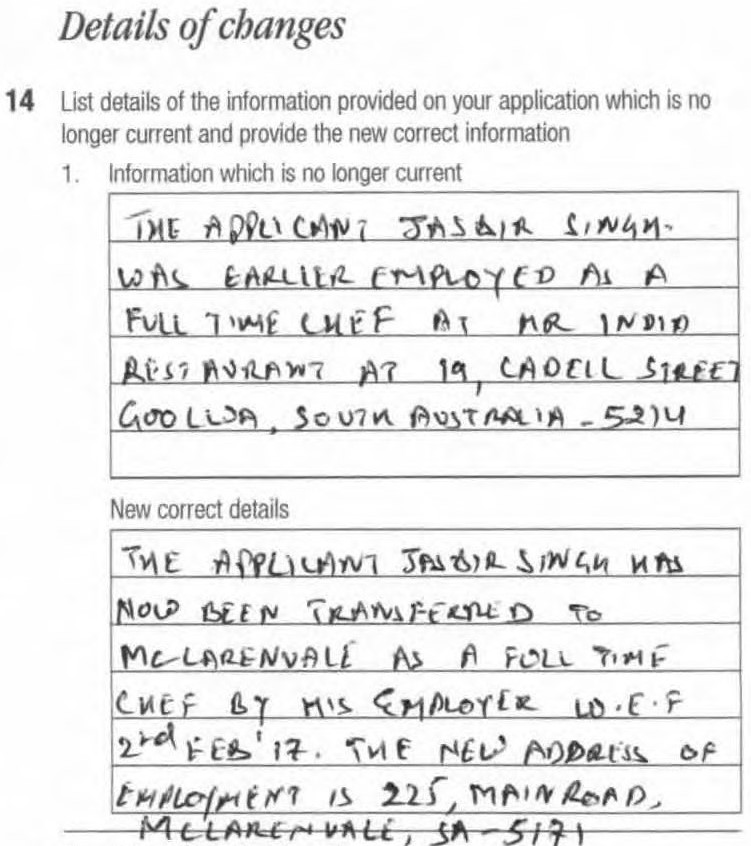
191 Mr Singh has not persuaded me that I am in any position to determine one way or another whether the Tribunal considered all of the supporting material annexed to the nomination application or not, made an error of fact or indeed made a correct factual finding on the available material.
192 Contrary to the assumption underpinning grounds 2 and 3, not only was there no expressly articulated argument that the position extended to McLaren Vale but it was not obvious, on the materials, that the position in fact extended to working at McLaren Vale. The supporting documentation provided with the nomination application does not, in clear terms, identify Mr Singh’s position location as being anything other than at Goolwa and where there was the ability to work as directed.
193 The nomination application form, in response to a specific question as to where the nominated person (Mr Singh) will be employed, stated “19 Cadell Street Goolwa South Australia 5214”. No reference is made in the nomination application form to the McLaren Vale restaurant, or any restaurant operated by Harsinco other than the Goolwa premises.
194 Mr Singh’s reliance on Harsinco’s business plan as evidencing an “integrated business” at three restaurant locations is of limited utility. The business plan was lodged with the nomination application (and dated 8 August 2016) and states that Harsinco operated three restaurants, at McLaren Vale, Goolwa and Port Elliot. However, contrary to Mr Singh’s submission, the plan specifically stated, consistent with what is on the nomination application, that Mr Singh would be working at Goolwa. By contrast, the plan names two other named chefs as working at the McLaren Vale and Port Elliot restaurants.
195 To the extent that Mr Singh relies on what was contained in the employment contract, namely cl 1.4 of the contract that Mr Singh would be required to perform his duties, inter alia, “elsewhere as reasonably directed by the employer” (emphasis added), this submission does not assist. As can be seen from the matters which the Minister is required to be satisfied of, at [143] above, how could the Minister achieve the required state of satisfaction without the identification of a location, locations or a region? Mr Singh’s submission that the use of the expression “elsewhere” in the contract does not give rise to indeterminacy is rejected. The available information could not lead to a construction that it refers to the other restaurant branches (Port Elliot and McLaren Vale).
196 The only document that appeared to identify Mr Singh as working at McLaren Vale was an organisational chart which was contrary in terms to the business plan, Mr Singh’s contact of employment and the nomination form.
197 In this case, it is evident that the RCB advice, dated 12 January 2017, identified the address of Harsinco as the Goolwa address. There was no other reference to any other address connected to Harsinco, let alone the McLaren Vale restaurant address. The RCB could not meaningfully give the advice required by reg 5.19(4)(h)(ii)(F) if it were required to consider locations described as “elsewhere as reasonably directed”.
198 It is apparent, and is accepted by this Court, that the relevant question, is not whether the RCB applied the correct test but whether or not there was certification of the “position” (being at the McLaren Vale address). The Tribunal found there had been no nomination application nor RCB advice with respect to a “position” in McLaren Vale. Nothing in the nomination application, the supporting documents, or the RCB advice detracts from this view.
199 On its face the RCB advice is with respect to Harsinco’s restaurant business in Goolwa. It is noteworthy that the advice states that it is completed by the “relevant certifying body” which “has coverage of the area in which the proposed nominee will work” (emphasis added). The “Details of nominating business/organisation” identify the “Contact address” to be “19 Cadell Street Goolwa, South Australia 5214”. The RCB was required to declare, as a body approved by the Minister that they have “assessed the nomination referred to in this document against the following requirements”:
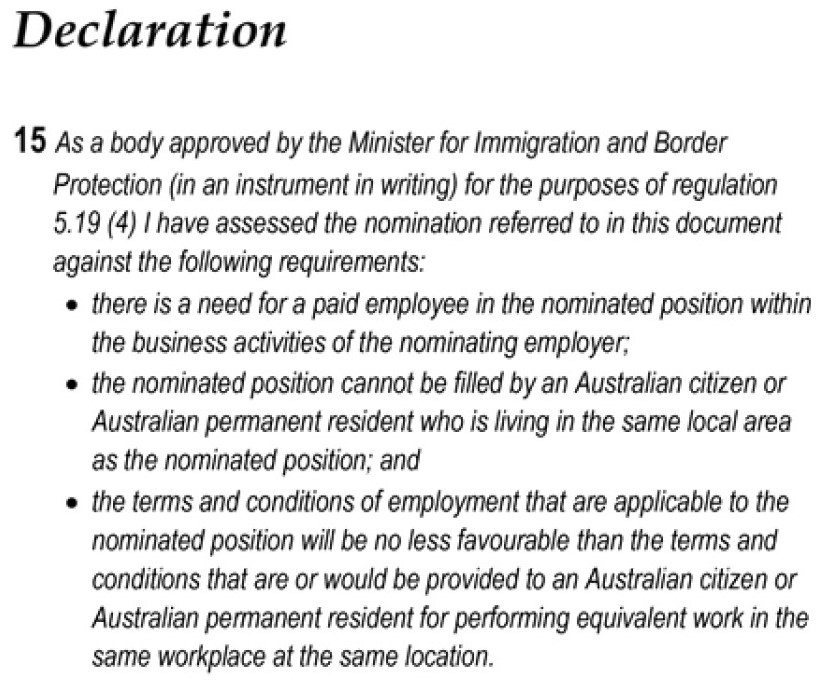
200 Notably, as can be seen from the “Declaration”, the RCB was required to assess whether there was a need for a paid employee in the “nominated position”, that the “nominated position” cannot be filled by an Australian citizen or Australian permanent resident who is living in the same local area as the “nominated position” and the terms and conditions of employment that are applicable to the nominated position will be no less favourable than those terms and conditions that are or would be provided to an Australian citizen or Australian permanent resident for “performing equivalent work in the same workplace at the same location” (emphasis added).
201 Importantly, the advice is dated 12 January 2017 and therefore was prepared before Mr Singh was notified that he was being transferred to work in Harsinco’s McLaren Vale restaurant (1 February 2017, to commence on 2 February 2017). The advice is also before the Department was notified of that change, on 28 February 2017. Accordingly, I accept the submission of the Minister that there is no tenable basis to suggest that the RCB would be giving advice concerning the McLaren Vale restaurant when Mr Singh had not yet been moved there, and the available evidence stated that someone else (not the subject of this nomination application) was in fact working there.
202 There is no evidence that Harsinco obtained a further RCB advice in support of the nomination application after the Goolwa restaurant closed. Accordingly, there was no such advice as required in relation to the matters in regs 5.19(4)(e), 5.19(4)(h)(ii)(B) and (C), and that the Minister had been satisfied of those matters, informed by that advice. All that there was, was an advice with respect to a position in a business, that on Harsinco’s own case, was no longer operational. In the circumstances, an essential condition for the satisfaction of the power to approve the nomination was not made out: as pointed out by the FCCA in Harsinco FCCA at [14] and [16].
203 In the circumstances, I do not accept, as contended by Mr Singh in ground 3, that he has established that the Tribunal overlooked the material enclosed with the nomination application form as to what the position was and as a result failed to deal with a claim raised by the evidence where it would or could be dispositive of the review.
Conclusion
204 For the above reasons, I dismiss the appeal.
205 By reason of the same, there was no need to consider the Minister’s alternative argument which was predicated on the basis of a finding of error. Similarly, I did not consider it necessary to consider the parties’ arguments as to standing and collateral challenge, given neither argument was straightforward. However, in the event that I am wrong in finding that the grounds of appeal must be dismissed on the basis of an absence of error below, I have had the advantage of reading the reasons of Charlesworth and O’Sullivan JJ. I concur with the conclusion and reasons of O’Sullivan J as to why the appellants do not have standing. There is no need to consider the further arguments raised by the parties.
I certify that the preceding seventy-five (75) numbered paragraphs are a true copy of the Reasons for Judgment of the Honourable Justice Raper. |
Associate:
Dated: 7 August 2023


