Federal Court of Australia
Minister for Immigration, Citizenship and Multicultural Affairs v Nguyen [2022] FCAFC 200
ORDERS
MINISTER FOR IMMIGRATION, CITIZENSHIP AND MULTICULTURAL AFFAIRS Appellant | ||
AND: | First Respondent ADMINISTRATIVE APPEALS TRIBUNAL Second Respondent | |
DATE OF ORDER: |
THE COURT ORDERS THAT:
1. The appeal be dismissed with costs.
Note: Entry of orders is dealt with in Rule 39.32 of the Federal Court Rules 2011.
THE COURT:
1 This appeal is against orders made by the primary judge quashing a decision of the Administrative Appeals Tribunal (the Tribunal) to the effect that the Tribunal had no jurisdiction to entertain an application for review on the basis that the application was filed out of time.
2 The appeal should be dismissed on the basis of one of the two foundations of the primary judge’s reasons.
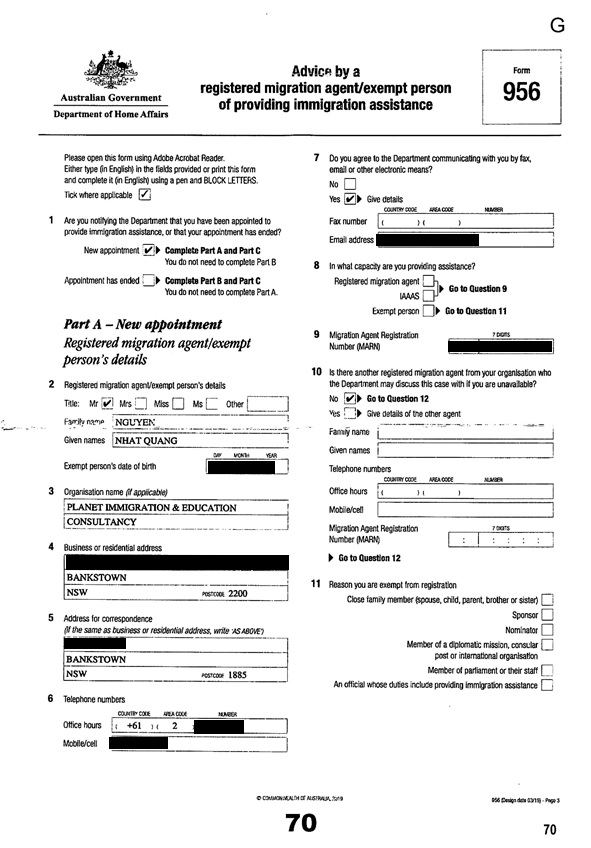
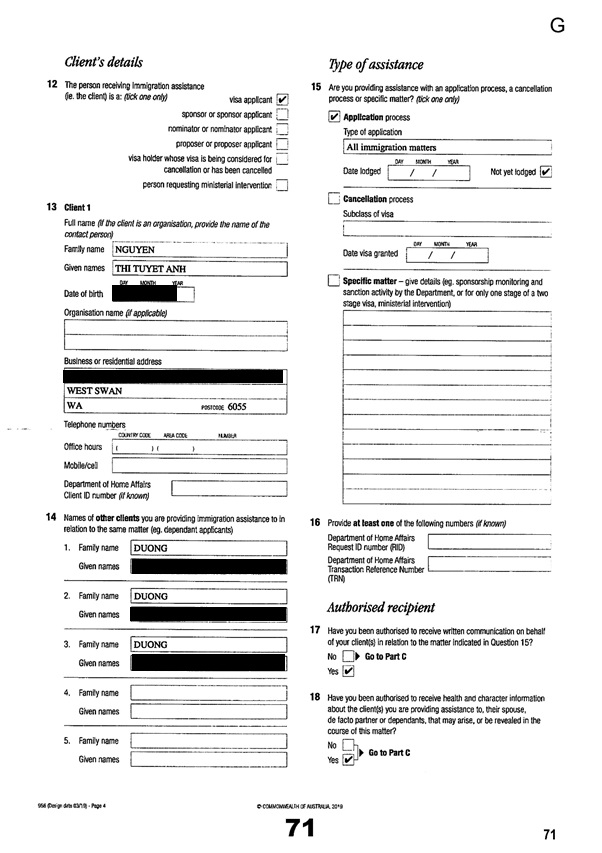
3 On 9 February 2021, Ms Nguyen’s visa was cancelled mandatorily under subs 501(3A) of the Migration Act 1958 (Cth) (the Act) by reason of Ms Nguyen’s substantial criminal record for the purposes of subs 501(7). On 23 November 2021, after representations on behalf of Ms Nguyen by her migration agent and various email communications, including the provision of a completed “Form 956” being an “advice by a registered migration agent / exempt person of providing immigration assistance”, a delegate of the Minister decided under subs 501CA(4) not to revoke the cancellation of the visa under subs 501(3A).
4 The delegate’s decision was open to review by the Tribunal under subs 500(1)(ba), but by reason of subs 500(6B), an application for such review was required to be lodged with the Tribunal within nine days after the day on which the person was notified of the decision in accordance with subs 501G(1). Subsection 501G(1) sets out the required content of the notice. The notice under subs 501G(1) must be given in the prescribed manner: subs 501G(3).
5 What occurred was described by the primary judge at J[2], as follows:
On the day that the delegate’s decision was made, an email notifying the decision was sent to an email address of the migration agent. It was the same email address that had been used by the migration agent in earlier communications with the Minister’s department concerning the visa cancellation. Some 18 days later the migration agent sent an email to the Minister’s department saying: ‘we have just noticed the decision’. Shortly thereafter, an application for review was lodged. If the date of the email notification was the date of notification for the purposes of the time limit in s 501(6B) then the application was lodged some 11 days late.
6 The primary judge succinctly and accurately set out the resulting issues before him at J[8]–[10] as follows:
[8] The issue for determination is whether the application for review was lodged within time. It is accepted that lodgement within nine days of notification of the delegate’s decision was a pre-condition to the Tribunal’s jurisdiction.
[9] Commencement of the review application within the specified time in s 501(6B) is a ‘jurisdictional fact’ in the sense explained in Plaintiff M70/2011 v Minister for Immigration and Citizenship [2011] HCA 32; (2011) 244 CLR 144. The term jurisdictional fact is a label used to describe statutory pre-conditions which much [sic] exist before the repository of power has authority to exercise that power: Southern Han Breakfast Point Pty Ltd (in Liquidation) v Lewence Construction Pty Ltd [2016] HCA 52; (2016) 260 CLR 340 at [47] (Kiefel, Bell, Gageler, Keane and Gordon JJ). Accordingly, a decision-maker does not have authority to finally determine whether a jurisdictional fact exists (noting that in some instances the ‘jurisdictional fact’ may take the form of an opinion or assessment or a state of satisfaction): see authorities collected in Tsvetnenko v United States of America [2019] FCAFC 74; (2019) 269 FCR 255 at [29] (Besanko, Banks-Smith and Colvin JJ). Therefore, in the present case, the findings by the Tribunal concerning whether the migration agent was an authorised recipient are not determinative. Any mistake as to the existence of a fact that is a jurisdictional fact may be corrected by this Court exercising its administrative law jurisdiction. A mistake which has led to error in the assertion or denial of jurisdiction is jurisdictional error.
[10] If the communication to the migration agent’s email address was proper notification in accordance with s 501G(1) then the application was lodged out of time. If not, then the application for review must be upheld on the basis that the Tribunal has denied in error the existence of the review jurisdiction conferred by s 500(1)(b).
7 The Minister relied upon the operation and fulfilment of subs 494D(1) of the Act, which was and is as follows:
If a person (the first person) gives the Minister written notice of the name and address of another person (the authorised recipient) authorised by the first person to receive documents in connection with specified matters arising under this Act or the regulations, the Minister must give the authorised recipient, instead of the first person, any documents in connection with those matters that the Minister would otherwise have given to the first person.
8 It was the proper engagement of subs 494D(1) by the Form 956 in the context of the surrounding documents that was the subject of the proceeding before the primary judge and of the appeal. The primary judge said that subs 494D(1) was not fulfilled or engaged. His Honour was correct to do so for at least one reason. At first instance, reliance was also placed by the Minister upon the fulfilment or engagement of reg 2.55(3) of the Migration Regulations 1994 (Cth). This was also rejected by the primary judge. No complaint was made on appeal in respect of that rejection.
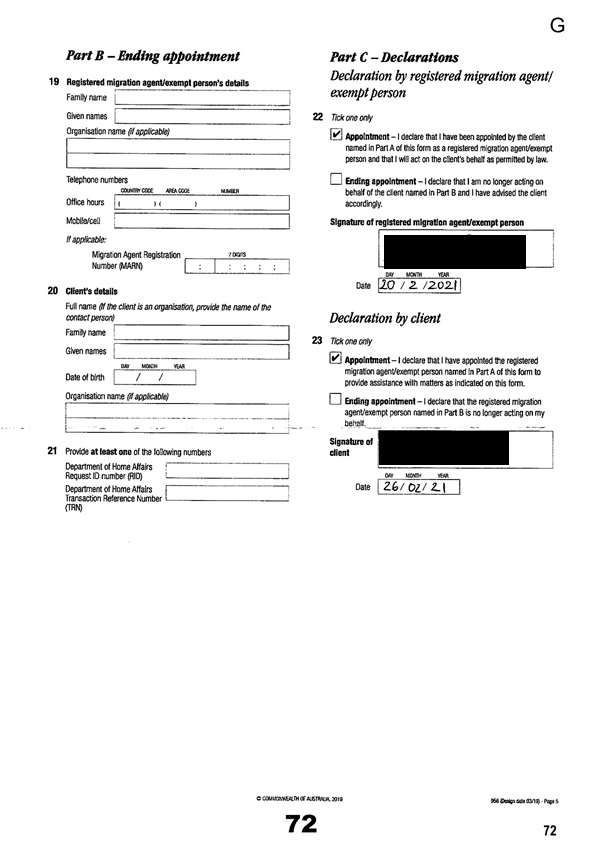
9 It is necessary to set out the communications that occurred between the migration agent and the Department and make comment upon their timing. The primary judge helpfully described the content of the Form 956 at J[14(1)–(8)]. Those paragraphs can be read. However, set out as an annexure to these reasons is a copy of the completed Form 956. These reasons assume a familiarity with J[14] and the annexure.
10 The first ground of the primary judge’s decision and of the appeal concerned and concerns the proper construction of subs 494D(1). The primary judge concluded that written notice given by the first person that is contemplated by and complies with subs 494D(1) must state the name and address of the authorised recipient who is authorised by the first person to receive documents in connection with specified matters arising under the Act instead of the first person: That is, the notice must recognise not only that the other person is authorised to receive the relevant documents, but also that the other person is so authorised to receive them instead of the first person. His Honour’s reasons for this conclusion were set out at J[18]–[23], as follows:
[18] In my view there is much to commend a construction of s 494D which requires the form in which the notice is given to identify the person as being authorised to receive documents in the manner described (that is, instead of the person giving the notice).
[19] When s 494D refers to a notice giving details of another person ‘authorised by the first person to receive documents’ it must be referring to an authority of the kind that is thereafter described, namely an authority to be the sole point at which ‘documents in connection with specified matters arising under this Act’ (that is matters specified in the notice) are to be received. Otherwise, a person who gave an authority to a migration agent (or other person) to receive documents from the Minister thinking that the documents would also be provided to that person would nevertheless be affected by the consequence specified in s 494D, namely that documents must be given to the migration agent and not to the person who gave the notice. In short, a person who did not know of the statutory consequence and gave no authority for it to occur would be treated as having given authority for documents of the specified kind to only be given to the migration agent (or other person).
[20] It is unlikely that it was intended that a person should be treated as having conferred an authority which they did not actually confer. It may be expected that an authority of the kind described with the possibility of very substantial consequences would derive from the person giving the notice and not an unspecified (possibly unexpected) statutory consequence of giving authority to a migration agent (or other person) to receive documents.
[21] It must also be recognised that s 494D may operate to afford a significant protection for those people who have to deal with the Minister concerning migration matters. As was observed in MZZDJ at [23]:
There may be a variety of circumstances (language difficulties, minority, literacy, unfamiliarity with the Australian migration and legal system, other vulnerabilities, no access to a postal address or to email) in which an applicant feels it is more reliable to authorise someone other than himself or herself to be the recipient of communications from the Minister. This may, but need not, coincide with the retention of a migration agent.
[22] However, it is unlikely that such a benefit was to be conferred if it was unintended or there was uncertainty as to what is being authorised. The possibility of vulnerability reinforces the need for certainty as to the authority that is being conferred. Uncertainty may result in a notification that was given by the Minister to the person in accordance with the facilitative provisions of the Migration Act which allows for different means of notification (see, for example, s 494C) operating as notice when the person was acting on the mistaken view that an authority had been given under s 494D. A provision such as s 494D will only operate with fairness to a person dealing with the Minister if there is certainty in the way in any notice is expressed as to the nature of the authority that it confers.
[23] Accordingly, in my view, upon a proper construction of s 494D, a notice which does not state that the authority conferred is for the Minister to give documents to the authorised recipient, instead of the person concerned, is not a notice for the purposes of the provision. A notice which simply specified the name and address of another person would not do so. A notice which also said that the other person was authorised to receive documents would not do so. The notice must say that the person is authorised to receive documents from the Minister instead of the person who is giving the notice.
11 For the reasons later set out, we respectfully disagree with the conclusions of the primary judge in this regard.
12 The second ground of the primary judge’s decision and of the appeal concerned and concerns whether the Form 956 authorised the agent to receive documents in relation to the cancellation process, rather than in respect of all immigration matters where there was an application process. (See, in particular, boxes 12, 15, 17 and 23 of the Form 956.)
13 At J[24(1)], the primary judge concluded that there was an authorisation to receive documents as follows:
The declaration given is that the migration agent is authorised ‘to provide assistance’. There is no statement in the form to the express effect that Ms Nguyen is giving notice of the name and address of a person authorised to receive documents. On the express terms of the form, the statement as to where documents may be sent is given by the migration agent. It may be inferred from the terms of the form as a whole that it is a notice of the name and address (namely the email address at Item 7) of a person authorised by Ms Nguyen to receive documents. However, I am unable to see how it may be considered to be a notice identifying the migration agent as a person who is authorised to receive documents from the Minister instead of Ms Nguyen.
(Emphasis added.)
14 There was no Notice of Contention that the contents of the Form 956 with or without any surrounding communication was not an authorisation to receive documents. It is therefore unnecessary to consider that issue.
The second ground: the nature of the authorisation: Did it encompass documents in relation to the representations to revoke the mandatory cancellation of the visa?
15 By his Notice of Appeal, the Minister contends that the primary judge erred in concluding that Ms Nguyen, by reference to the Form 956, did not provide to the Minister a written notice under s 494D that authorised the migration agent to receive documents in relation to the cancellation process. It is of some significance that, by his Notice of Appeal, the Minister placed reliance on the Form 956 as the means by which Ms Nguyen gave written notice to the Minister for the purposes of s 494D. In the course of argument on the appeal, and in written submissions filed after the hearing of the appeal with the leave of the Court, the Minister also sought to place reliance on certain email communications and other documents sent by the migration agent to the Minister, which communications and documents post-dated the signing of the Form 956 by Ms Nguyen. The basis upon which the Minister relied on the communications and other documents was not entirely clear. At first it was said that the communications and other documents assisted in the interpretation of the Form 956; subsequently, and particularly in the written submissions filed after the hearing of the appeal with the leave of the Court, it was said that the communications and other documents were also evidence of Ms Nguyen having given written notice for the purposes of s 494D.
16 The primary judge’s reasoning in this regard is contained within J[24(2)], [25], [27] and [28], as follows:
[24] The following matters assume particular significance when it comes to the issue whether the form as completed is a ‘written notice’ for the purposes of s 494D:
…
(2) The form differentiates between an application process and a cancellation process and requires only one to be selected. The statement ‘All immigration matters’ is made in respect of an application process. The extent of the authority actually given is to be determined by reference to the form itself. Given the terms of the form, it does not confer authority in respect of any cancellation process.
[25] It was claimed that the form was to be construed having regard to the fact that it was included as an attachment to an email sent to the department on 1 April 2021 by the migration agent. The email attached a revocation submission, supporting documents and ‘956 Agent advice’. However, the inclusion of the form as an attachment to a communication of that kind could not confer authority upon the migration agent if the form itself did not do so. It is not suggested that the email communication of 1 April 2021 was itself given by Ms Nguyen. Further, uncertainty is created by the fact that a different email address to that in the Form 956 was provided in the completed ‘personal circumstances form’ in which Ms Nguyen agrees to the Department communicating with Ms Nguyen by email (albeit to an address that belongs to the domain of the migration agent). The form goes on to inquire expressly whether Ms Nguyen authorises the Department to contact anyone regarding her case. That part of the form is completed with the name of the migration agent and a mobile telephone number but no email address (despite the form requesting ‘Phone number and email address’).
…
[27] In those circumstances, I am unable to find that Ms Nguyen, by the completed Form 956, gave written notice for the purposes of s 494D. It was not a notice that authorised the migration agent to receive documents in relation to the cancellation process (rather, it was a notification only in respect of all immigration matters where there was an application process) and it was not a notice which, by its terms, gave authority to the migration agent to receive documents instead of Ms Nguyen.
[28] It was submitted for the Minister that the manner of completion of the form is explained by the fact that it was to encompass a cancellation revocation process being a process not contemplated by the form. I do not accept that submission. The form refers to a cancellation process and to a visa holder who [sic] visa has been cancelled. There is no real doubt that those descriptions encompass a person whose visa is being considered for cancellation or has been cancelled. A person who obtains immigration assistance with the revocation of a visa cancellation is being given immigration assistance with a cancellation process and not with an application process.
17 To explain why his Honour was correct in the conclusion he reached, and why the Minister’s contentions should not be accepted, it is convenient to say something more about the temporal context of the communications relied on by the Minister.
18 The delegate decided to cancel Ms Nguyen’s visa on 9 February 2021. On the same day the Department sent the notice of cancellation to the Department of Justice of Western Australia to provide the notice by hand to Ms Nguyen, who was in prison. She received it on 4 March 2021.
19 The importance of that date is that it post-dates the signing by Ms Nguyen of the Form 956 on 26 February 2021: see the signature and the date under box 23 in the annexure to these reasons. There was no evidence that either the migration agent or Ms Nguyen was aware of the cancellation decision at the time of the migration agent filling out and signing (on 20 February 2021: see under box 22) the Form 956. It may be, but there was no evidence as to the matter, that the migration agent prepared the Form 956 and had Ms Nguyen sign it in anticipation of the cancellation process.
20 There is thus no basis to infer that at the time the Form 956 was prepared and signed by the migration agent and Ms Nguyen, and, so, at the time Ms Nguyen signed what is her written notice for the purposes of subs 494D(1) of the Act, that it was his or her intention that the Form 956 and the notice within it was to concern any aspect of a process concerning cancellation, as opposed to all immigration matters in an application process (see box 15). So, as at February 2021, one construes the Form 956 in its terms and it is plain that the meaning conveyed by it is that Ms Nguyen has said that she has appointed the agent to provide assistance “with matters as indicated on this form” (box 23). This (on the primary judge’s reasoning in J[24(1)], not challenged by Ms Nguyen on appeal) encompassed an authorisation or recognition of the agent’s statement in box 17 that he had been authorised to receive communications on behalf of Ms Nguyen. However, even accepting this, that authorisation was only “in relation to the matters indicated in Question 15”. This was an application process involving all immigration matters not yet lodged. That this had nothing to do with a “cancellation process” (box 15) is illuminated by the alternatives in box 12 where “visa applicant” was ticked, and “visa holder whose visa is being considered for cancellation or has been cancelled” was not ticked.
21 That the form was prescriptive as to how it was to be filled in, did not otherwise constrain the migration agent in what authority he obtained from Ms Nguyen and expressed in a notice from and of her.
22 The terms of subs 494D(1) require the notice to be in connection with “specified matters”. This is a demand for expressed specificity. To “specify” is to “name expressly, mention definitely (items, details, ingredients etc)”: The Concise Oxford Dictionary (6th ed, 1976): or is “to mention, speak of or name (something) definitely or explicitly; to set down or state categorically or particularly…”: The Shorter Oxford English Dictionary (3rd ed, 1973, reprinted 1986).
23 The Minister sought to have the Form 956 read in the context (the later context) in which it was provided, being the communications concerned with seeking the revocation of the cancellation.
24 On 30 March 2021, a Departmental officer sent an email to the migration agent stating that 23:59 hours on 1 April 2021 (that is, 28 days from 4 March) was the strict statutory time limit. The email used the language of application: “an application must be submitted and received…”. This was in answer to the migration agent’s email of 27 March 2021 asking for an extension of time “to complete the revocation application”. On 1 April 2021 at 19:25 hours, the agent submitted “required forms and documents”. He referred in the covering email to “our revocation application”. The documents included the Form 956.
25 Thus, it was submitted by the Minister that the Form 956 should be read as referable to the application to revoke the cancellation even though the Form 956 did not refer to cancellation process but to application process.
26 There was no basis to view the document signed by Ms Nguyen on 26 February 2021 as meaning and being understood by the Department (its officers knowing that she received the notice on 4 March) to mean other than what it said on its face: that it was an authorisation to receive documents in connection with the matters specified in the Form 956, being all matters concerned with an application process. There was no basis to view the document as an authorisation to receive documents in connection with other matters not specified, but which were able to be specified on the Form 956: “cancellation process” (box 15) or visa cancellation or consideration of visa cancellation (box 12).
27 Subsection 494D(1) requires notice to be in connection with specified matters. Even assuming one can look at the surrounding emails, there was here no express or definite or explicit or categorical or particular mention of authorisation to receive documents in connection with representations or requests or even an application, to revoke the cancellation. Thus, without such, even if it be the case that one possible, or even open, reading of the body of communications in late March and on 1 April was that inferentially the migration agent intended the Form 956 to be read as directed to the request for revocation, there was no express notice by Ms Nguyen or by the migration agent of her authorisation of the agent to receive documents in connection with specified matters. If the notice is equivocal and not clear in express terms that it extends from application process to an application or request as part of the process to have revoked a cancellation of a visa, it is not a notice of the latter application or request that satisfies subs 494D(1).
28 Some attempt was made by the Minister at the end of argument to submit that the notice can in fact be of the agent and in that extended sense of Ms Nguyen. So, it was submitted that the notice should be seen as concerned with the specified matter in the email: the application for revocation and not with what was in the Form 956, understood in the context of the emails in late March and on 1 April. That required an email of the agent to be Ms Nguyen giving to the Minister written notice.
29 One can accept that the normal presumption is that Parliament intends to allow a person to act for the purposes of a statutory provision through an agent: Jalagam v Minister for Immigration & Citizenship [2009] FCA 197 at [18] (citing Christie v Permewan, Wright & Co Ltd (1904) 1 CLR 693 at 700; McRae v Coulton (1986) 7 NSWLR 644 at 663; AB v LB (Mental Health Patient) [1980] 1 WLR 116 at 121, as cited in Bennion FAR, Statutory Interpretation – A Code (2nd ed, Butterworths, 1992)) and [36]. Here, there is a written notice made in February that is limited in scope. The later email provides it in connection with what is said to be a “revocation application”. The agent does not specify or express or state that this is a widening or amendment to any authority in the February document. The submissions of the Minister sought to elevate the totality of the communications to written notice that the agent had authority to receive documents in relation to specified matters, being the application for revocation. The documents do not say this. They do not say it expressly, particularly, or with any clarity. The most that can be said is that it might be open to understand that this is what is to be inferred. This is not, for the purposes of subs 494D(1) written notice in connection with specified matters.
The first ground: the proper construction of subs 494D(1): Does the written notice require expression of “instead of the first person”?
30 By his Notice of Appeal, the Minister contends that the primary judge erred in construing s 494D in concluding that a notice which does not state that the authority conferred is “for the Minister to give documents to the authorised recipient, instead of the person concerned” is not a notice for the purposes of subs 494D(1).
31 The reasoning of the primary judge was set out at [10] above.
32 Subsection 494D(1) should be seen in its context of the whole of s 494D, as follows:
(1) If a person (the first person) gives the Minister written notice of the name and address of another person (the authorised recipient) authorised by the first person to receive documents in connection with specified matters arising under this Act or the regulations, the Minister must give the authorised recipient, instead of the first person, any documents in connection with those matters that the Minister would otherwise have given to the first person.
(2) If the Minister gives a document to the authorised recipient, the Minister is taken to have given the document to the first person. However, this does not prevent the Minister giving the first person a copy of the document.
(3) Subject to subsection (3A), the first person (but not the authorised recipient) may vary or withdraw the notice under subsection (1) at any time, but must not (unless the regulations provide otherwise) vary the notice so that any more than one person becomes the first person’s authorised recipient.
(3A) In addition to the first person being unable to vary the notice under subsection (1) by varying the address of the authorised recipient, that recipient may also vary that notice by varying that address.
(5) The Minister need not comply with subsection (1) if:
(a) the authorised recipient is not a registered migration agent (within the meaning of Part 3); and
(b) the Minister reasonably suspects that the authorised recipient is giving immigration assistance (within the meaning of that Part); and
(c) the Minister has given the first person a notice, by one of the methods specified in section 494B, stating that he or she does not intend to give the authorised recipient documents as mentioned in subsection (1).
33 Importance was placed by the primary judge on the perceived need of fairness for the subsection to operate only where the receipt by the authorised recipient was intended to be to the exclusion of the first person: that is, where the actual authority to that extent reflected the operation of the subsection.
34 Possible unfairness of application of a statute, especially to people who may well be vulnerable, may, in any given circumstances, be a powerful consideration in the statute’s construction and interpretation. That said, here, the context from subs 494D(5) and the existence and operation of Part 3 of the Act concerning migration agents and immigration assistance, is that the authorised recipient will often be a migration agent. That likelihood and the powers or discretions given to the Minister in subss 494D(2) and (5), which one would not construe as intended to be exercised unfairly, means that there is no necessary likely unfairness in subs 494D(1) operating to the exclusion of necessary service on the first person in all cases.
35 One purpose of the whole section, being a purpose taken or divined from the words of the section as a whole, is that in circumstances where the Minister is given written notice of an authorised recipient there will only be one recipient: the authorised recipient, unless subs (2) or subs (5) is applicable. This, of itself, in many cases is likely, as a practical matter, to reduce the possibility of confusion, and, from confusion, error, and, from error, unfairness and hardship.
36 Whilst the approach of the primary judge is open textually, it contains an assumption or premise that the subsection is only intended to operate when the actual authority between the first person and the authorised recipient is reflected by the words “instead of the first person”. That assumption or premise is not, with respect, justified. From the whole of the section one sees the purpose of there being only one recipient: either the first person, if subs 494D(1) is not engaged; or the authorised recipient, if subs 494D(1) is engaged; unless, in the latter case, if the Minister considers it appropriate to give the document to the first person in any event under subs 494D(2).
37 No necessary unfairness is thereby produced. Rather, clarity and efficiency can be seen to be produced and the risk of confusion (that might be produced by the authorised recipient, likely a migration agent, as well as the first person, receiving documents, often documents involving statements as to necessary action) can be seen to be minimised.
38 For these reasons, it is not necessary for written notice contemplated by subs 494D(1) to state that the other person is authorised to receive documents instead of the first person.
Conclusion
39 The appeal should be dismissed with costs.
I certify that the preceding thirty-nine (39) numbered paragraphs are a true copy of the Reasons for Judgment of the Honourable Chief Justice Allsop and Justices O'Bryan and Jackson. |
Associate:
Annexure