

Federal Court of Australia
Pharmacia LLC v Juno Pharmaceuticals Pty Ltd [2022] FCAFC 167
ORDERS
DATE OF ORDER: |
THE COURT ORDERS THAT:
1. The appeal and cross-appeal are dismissed.
2. The appellants pay the respondents’ costs of the appeal.
3. The cross-appellants pay the cross-respondents’ costs of the cross-appeal.
Note: Entry of orders is dealt with in Rule 39.32 of the Federal Court Rules 2011.
THE COURT:
INTRODUCTION
1 Pharmacia LLC and Pfizer Australia Pty Ltd (the appellants and cross-respondents), both related entities of Pfizer Inc., were respectively the owner and exclusive licensee in Australia of the patent (Patent no. 2002256031). The patent relates to the formulation and administration of cyclooxygenase-2 (COX-2) inhibitors.
2 Pharmacia is the developer of products that are marketed in Australia under the Dynastat brand for the management of post-operative pain. Pfizer markets and supplies the Dynastat products in Australia and is the sponsor of the registrations for those products on the Australian Register of Therapeutic Goods (ARTG).
3 The active ingredient in Dynastat is parecoxib, which is a “prodrug”, being a molecule that is converted into a pharmacologically active agent after administration to a patient. Parecoxib converts to the selective COX-2 inhibiting drug valdecoxib following administration to a patient.
4 Juno Pharmaceuticals Pty Ltd offers for sale and supplies parecoxib products in Australia and, until August 2020, Neo Health (Australia) Pty Ltd supplied those products to Juno for sale on the Australian market. Juno has obtained ARTG registration for formulations of parecoxib (as sodium) for the indication “a single peri-operative dose for the management of post-operative pain” (Juno products).
5 In the proceedings below, Pharmacia and Pfizer sought relief from Juno and Neo (the respondents and cross-appellants) for the infringement of the patent. The respondents denied infringement and advanced a cross-claim alleging that the asserted claims in the patent were invalid.
6 The trial proceeded before the primary judge on the basis that issues of pecuniary relief (including liability for and quantum of that relief) would be heard and determined separately from and after the hearing of all other issues in the proceedings.
7 The trial was also conducted by reference to the batch records for six batches of the alleged infringing products (described as the Exemplar Batches).
8 During the course of the trial, the respondents applied for leave to amend their Defence. The primary judge allowed the amendments.
9 On 15 February 2022, the primary judge delivered the reasons for judgment: Pharmacia LLC v Juno Pharmaceuticals Pty Ltd (2022) 165 IPR 200; [2022] FCA 92 (J1) and found at [14] that:
(1) three of the six exemplar batches of the Juno products fell within the scope of claims 1, 4, 5, 11, 14, 15, 17, 18, 19, 20, 21, 24, 34, 35, 36, 37, 38, 39, 40 and 41 but not claims 7, 26, 27, 28, 30 or 42; and
(2) the challenge to the validity of the relevant claims fails;
and made directions inviting the parties to endeavour to agree to the form of short minutes of order giving effect to the reasons.
10 On 11 April 2022, the primary judge delivered a further judgment: Pharmacia LLC v Juno Pharmaceuticals Pty Ltd (No 2) [2022] FCA 369 (J2). Relevantly to this appeal, his Honour declared that:
(1) Exemplar batches 31604, 31605 and 31606 of the respondents’ parecoxib products (the Infringing Exemplar Batches) contain a composition as referred to in claims 1, 4, 5, 11, 14, 15, 17, 18, 19, 20, 21, 24, 34, 35, 36, 37, 38, 39, 40 and 41 of the patent (Order 1).
(2) Exemplar batches 31601, 31602 and 31603 of the respondents’ parecoxib products (the Non-Infringing Exemplar Batches) do not contain a composition as referred to in claims 1, 4, 5, 11, 14, 15, 17, 18, 19, 20, 21, 24, 34, 35, 36, 37, 38, 39, 40 and 41 of the patent (Order 2).
(3) Exemplar batches 31601, 31602, 31603 31604, 31605 and 31606 of the respondents’ parecoxib products do not contain a composition as referred to in claims 7, 26, 27, 28, 30 and 42 of the patent (Order 3).
11 The primary judge declined to make other declarations which were sought by the appellants, refused to grant injunctive orders sought, and deferred the question of costs of the infringement claim until the quantum aspect of the proceedings had been resolved: [28], [30], [36] J2.
12 By Notice of Appeal filed on 16 May 2022, pursuant to leave being granted in response to the appellants’ application for extension of time and leave to appeal, the appellants appeal from:
(1) the order of the primary judge made on 5 May 2021 granting leave to the respondents to file an Amended Defence to the Amended Statement of Claim;
(2) Orders 2 and 3 of the primary judge made on 11 April 2022; and
(3) the primary judge’s refusal to make a costs order in favour of the appellants in relation to the costs of the infringement claim as recorded in [36] J2.
13 By Further Amended Notice of Cross-Appeal and Contention, which was filed during the hearing of the appeal with the leave of the Court, the respondents appeal against Order 1, as well as other orders made by the primary judge on 11 April 2022 that the cross-claim be dismissed, that they pay the appellants’ costs of the cross-claim, and a certification by the primary judge that the validity of certain identified claims was questioned unsuccessfully in the proceeding. The ground relied on for the Notice of Contention is that the primary judge should have found that the Non-Infringing Exemplar Batches did not contain a composition as referred to in claim 1 of the patent (and its dependent claims), for the additional reason that the “composition” of claim 1 (and its dependent claims) should not include any residual water in such composition.
14 The appellants filed a Notice of Contention in the cross-appeal which relevantly asserts that:
(1) the primary judge ought to have rejected the respondents’ challenge to the validity of the patent on the ground of lack of inventive step for the additional reason that the evidence did not establish that the person skilled in the relevant art, before the priority date, could be reasonably expected to have ascertained the information in the prior art documents referred to as Jain and Talley; and
(2) the primary judge ought to have rejected the respondents’ challenge to the validity of the patent on the ground of lack of inventive step for the additional reason that the invention was not obvious at the priority date because the problems addressed by the invention, before the priority date, could not have been identified by the person skilled in the relevant art from the common general knowledge or the information in Jain and/or Talley.
15 For the reasons that follow, we have concluded that the appeal, and the cross-appeal, fail.
THE PATENT
16 The complete specification is entitled “Reconstitutable parenteral composition containing a COX-2 inhibitor”.
17 The patent identifies that the field of the invention is as follows:
The present invention relates to water-soluble selection cyclooxygenase-2 (COX-2) inhibitory drugs and salts and prodrugs thereof and in particular to parecoxib, for example in the form of its sodium salt (parecoxib sodium). Parecoxib is a water-soluble prodrug of the selective COX-2 inhibitory drug valdecoxib. More particularly, the invention relates to parenterally deliverable, for example injectable, formulations of water-soluble selective COX-2 inhibitory drugs and salts and prodrugs thereof. Even more particularly, the invention relates to such formulations that are prepared as powders for reconstitution in an aqueous carrier prior to parenteral administration. The invention also relates to processes for preparing such reconstitutable formulations, to therapeutic methods of use of such formulations and to use of such formulations in manufacture of medicaments.
18 Under the heading “Background of the Invention”, the specification identifies that:
(1) inhibition of COX enzymes is believed to be at least the primary mechanism by which nonsteroidal anti-inflammatory drugs, or NSAIDs, exert their characteristic anti-inflammatory, antipyretic and analgesic effects through inhibition of prostaglandin synthesis;
(2) inhibition of COX-1, which produces prostaglandins that are necessary for normal cell function, appears to account for certain adverse side effects that had been associated with use of conventional NSAIDs. By contrast, selective inhibition of COX-2 without substantial inhibition of COX-1 leads to anti-inflammatory, antipyretic, analgesic and other useful therapeutic effects while minimising or eliminating such adverse side effects;
(3) selective COX-2 inhibitory drugs are formulated in a variety of orally deliverable dosage forms. However, parenteral routes of administration offer numerous benefits over oral delivery for a wide variety of drugs;
(4) relatively few NSAIDs are commercially available in injectable form. It would therefore represent a further significant advance in the art if a parenterally deliverable formulation of a selective COX-2 inhibitory drug could be provided;
(5) it is known to prepare parenteral formulations by a process of lyophilisation (freeze-drying) of an aqueous solution of a therapeutic agent and excipients are often added to the therapeutic agent to increase the amount of solids so that the resulting powder is more readily visible when the amount of therapeutic agent is very small. Amongst the substances found most useful for this purpose is mannitol; and
(6) parecoxib is one of a class of water-soluble prodrugs of selective COX-2 inhibitory drugs which rapidly converts to the substantially water-insoluble selective COX-2 inhibitory drug valdecoxib following administration to a subject. However, there is a problem (described by the primary judge at [228] J1 as the conversion problem) in that parecoxib converts to valdecoxib upon exposure to water, for example upon dissolution in water. There has been interest in developing parecoxib for parenteral use because of its high water solubility. However, no pharmaceutically acceptable injectable formulation of drugs or prodrugs such as parecoxib has hitherto been described and problems have beset the formulator attempting to prepare such a formulation, illustratively of parecoxib. It is said that the present invention provides a solution to these problems.
19 The specification provides a summary of the invention, commencing with the consistory clause for claim 1, namely: in one embodiment, a pharmaceutical composition comprising, in powder form, (a) at least one water-soluble therapeutic agent selected from selective COX-2 inhibitory drugs and prodrugs and salts thereof, in a therapeutically effective total amount constituting about 30% to about 90% by weight, (b) a parenterally acceptable buffering agent in an amount of about 5% to about 60% by weight, and optionally (c) other parenterally acceptable excipient ingredients in a total amount not greater than about 10% by weight, of the composition. The specification states that the composition is reconstitutable in a parenterally acceptable solvent liquid, preferably an aqueous liquid, to form an injectable solution.
20 The specification states that the composition can be prepared by a process comprising a step of lyophilisation of an aqueous solution comprising the therapeutic agent, the buffering agent and optionally other excipient ingredients to form a readily reconstitutable powder; such process representing a further embodiment of the present invention. The specification also describes further embodiments and states that an especially preferred therapeutic agent is a water-soluble salt of parecoxib.
21 The specification identifies a list of selective COX-2 inhibitory drugs or selective COX-2 inhibitor components which includes valdecoxib of which parecoxib is a prodrug.
22 The specification states that one or more therapeutic agents selected from those disclosed in the specification are present in a reconstitutable powder composition of the invention in a total amount of about 30% to about 90%, preferably about 40% to about 85%, and more preferably about 50% to about 80%, by weight of the composition.
23 It further states that the buffering agent, which is present in an amount of about 5% to about 60%, preferably about 10% to about 60%, and more preferably about 20% to about 50%, by weight of the composition, is typically the predominant excipient ingredient. It is stated that the buffering agent is selected to provide a pH of the composition, upon reconstitution in a physiologically acceptable volume of a parenterally acceptable solvent liquid, that (a) is parenterally acceptable, (b) is consistent with the therapeutic agent being entirely in solution in the solvent liquid, and (c) provides a medium wherein the therapeutic agent exhibits acceptable chemical stability for at least about one hour following reconstitution. The specification identifies that preferred buffering agents are dibasic sodium and potassium phosphates and tromethamine. It further states that an especially preferred buffering agent is dibasic sodium phosphate, for example dibasic sodium phosphate anhydrous, heptahydrate, dodecahydrate etc.
24 The specification continues to state that, in one embodiment, the pH of the composition can be at certain levels upon reconstitution and that, if desired, the pH can be adjusted by including, in addition to the buffering agent, a small amount of an acid and/or a base. These were referred to as the pH adjusters in the reasons of the primary judge and they are included to adjust the pH to within an appropriate range.
25 The specification then identifies that excipients other than the buffering agent, if present, constitute not more than about 10%, preferably not more than about 5%, by weight of the composition prior to reconstitution. It states that the term “excipient” embraces all non-therapeutically active components of the composition except for water. It identifies that, in one embodiment of the invention, no excipients other than the buffering agent are substantially present.
26 The specification identifies that there is a further problem to which a solution has been found (which was identified by the primary judge at [228] J1 as the stability problem).
27 The stability problem was stated in the specification in these terms, that is, where the therapeutic agent is parecoxib, for example in the form of parecoxib sodium, partial conversion to valdecoxib can occur in a composition over a period of time. The specification identifies that, as valdecoxib has extremely low solubility in water, it is desirable to minimise such conversion prior to reconstitution so that complete dissolution of the therapeutic agent is assured. It teaches that the presence of particulates, such as would result from the presence of significant quantities of valdecoxib, is generally undesirable in a solution intended for parenteral administration. The specification identifies the solution being that it was surprisingly found that conversion of parecoxib to valdecoxib in a reconstitutable powder composition can be greatly reduced by reduction or preferably elimination from the composition of bulking agents such as mannitol.
28 As to this, the specification notes that, surprisingly, it has been found important to include in the composition no more than about 10% by weight, preferably no more than about 5% by weight, and most preferably substantially no amount, of ingredients commonly used as bulking agents in reconstitutable parenteral formulations, other than buffering agents. It states that, in particular, the widely used bulking agent mannitol is preferably excluded from the composition, or if included, is present at no more than about 10%, preferably no more than about 5%, by weight of the composition. The specification identifies that, by minimising the amount of or excluding such bulking agents, especially mannitol, as components of the composition, acceptable chemical stability of the therapeutic agent can be assured.
29 The specification also identifies that a reconstitutable powder composition of the invention preferably contains less than 5%, more preferably less than 2%, and most preferably less than about 1%, by weight of water and stated that typically, the moisture content is about 0.5% to about 1% by weight. The specification identifies that it is especially important to keep the amount of water to such a low level where the therapeutic agent has a tendency to degrade or convert to a less soluble form in the presence of water.
30 As to the conversion problem, the specification states that, in the form of parecoxib sodium, partial conversion to highly insoluble valdecoxib can occur in an aqueous solution over a period of time, resulting in formation of solid particulates and that, as indicated above, the presence of solid particulates is generally undesirable in injectable formulations. The specification identifies that the rate of conversion of parecoxib to valdecoxib in an aqueous medium can be greatly reduced by maintaining the medium at a pH of about 7 or higher.
31 The final problem the specification identifies as having been solved by the invention is described as the reconstitution problem by the primary judge at [228] J1, being that parecoxib formulations containing mannitol and other excipients do not dissolve instantly. In the specification, it identifies that a powder composition in the invention preferably has sufficient porosity to permit rapid dissolution of the therapeutic agent upon reconstitution in the solvent liquid. It states that a high degree of porosity is available by using a process to prepare the powder as described in the specification, which included identified steps in a lyophilisation cycle and process. Notably, that process or cycle includes reference in the third phase of providing a powder “having a moisture content of less than about 5%, preferably less than about 2%, more preferably less than 1%, by weight”.
32 The specification includes four examples which illustrate aspects of the present invention but it states that they are not to be construed as limitations.
33 The specification states that:
In the claims which follow and the preceding description of the invention, except where the context requires otherwise due to express language or necessary implication, the word “comprise” or variations such as “comprises” or “comprising” is used in an inclusive sense, i.e. to specify the presence of the stated features but not to preclude the presence or addition of further features in various embodiments in the invention.
34 Relevantly to this appeal and cross-appeal, the critical claims defining the invention are as follows:
1. A pharmaceutical composition comprising, in powder form:
(a) at least one water-soluble therapeutic agent selected from selective COX-2 inhibitory drugs and prodrugs and salts thereof, in a therapeutically effective total amount constituting about 30% to about 90% by weight,
(b) a parenterally acceptable buffering agent in an amount of about 5% to about 60% by weight, and
(c) other parenterally acceptable excipient ingredients in a total amount of zero to about 10% by weight of the composition;
said composition being reconstitutable in a parenterally acceptable solvent liquid to form an injectable solution.
…
26. A process for preparing a reconstitutable selective COX-2 inhibitory composition, the process comprising a step of lyophilizing an aqueous solution that comprises:
(a) at least one therapeutic agent selected from selective COX-2 inhibitory drugs and prodrugs and salts thereof, in a therapeutically effective total amount constituting about 30% to about 90% by weight,
(b) a parenterally acceptable buffering agent in an amount of about 5% to about 60% by weight, and
(c) other parenterally acceptable excipient ingredients in a total amount of zero to about 10% by weight of the composition, excluding water;
said lyophilizing step resulting in formation of a readily reconstitutable powder.
…
32. The process of Claim 31, wherein:
(a) in the freezing phase, temperature is lowered to a freezing temperature of about -30°C to about -60°C over a period of about 1 to about 5 hours and is held at the freezing temperature for about 0.5 to about 24 hours;
(b) in the primary drying phase, a vacuum of about 25 to about 500m Hg is drawn, and temperature is raised from the freezing temperature to about 0°C over a period of about 1 to about 5 hours; and
(c) in the secondary drying phase, under vacuum of about 25 to about 500m Hg, temperature is raised from about 0°C to a level above room temperature over a period of about 1 to about 4 hours and is held at the raised level for about 3 to about 12 hours;
to result in a powder having a moisture content of less than about 2% by weight.
…
42. A pharmaceutical composition as defined in Claim 1, an injectable solution prepared by reconstituting said composition, an article of manufacture comprising said composition, a process for preparing a reconstitutable selected COX-2 inhibitory composition, or a method of treating and/or preventing a COX-2 mediated disorder in a subject, substantially as herein described with reference to any one of the Examples.
THE PRIMARY CONTENTIONS
35 The appellants contend that the primary judge erred in three respects, namely:
(1) in his Honour’s construction of the word “about” as used in the claims in the patent and, relatedly, in construing the patent’s omnibus claim (claim 42). They submit that, but for those errors, the primary judge would have held that all, rather than only half, of the Exemplar Batches fell within the claims of the patent;
(2) in allowing the respondents to depart from admissions they had made regarding the composition of their products. In this regard, the appellants complain that the primary judge permitted the respondents to amend their Defence during the course of the trial; and
(3) in failing to make infringement declarations and in failing to order that the respondents pay the appellants’ costs of the infringement claim.
36 By their Further Amended Notice of Cross-Appeal and Contention, the respondents contend that the primary judge erred:
(1) in finding that “residual water” is to be included in the weight of the composition of claim 1 (and its dependent claims) for the purpose of calculating the proportion by weight of the therapeutic agent in para (a) of the claim 1 composition;
(2) in finding that Exemplar Batches 31604, 31605 and 31606 infringed claim 1 (and its dependent claims) by reason of the “residual water” error and, by reason of the same error, not finding that Exemplar Batches 31601, 31602 and 31603 did not infringe those claims;
(3) in failing to find that, if the term “about” in each of the asserted claims has the meaning proposed by the appellants, such term is indefinite, unclear and does not provide a workable standard; and
(4) in finding that the claimed invention in each of the asserted claims involves an inventive step.
37 For the reasons below, we do not accept that the primary judge erred in the manner contended for in the appeal or in the cross-appeal.
ISSUES OF CONSTRUCTION
Whether residual water taken into account in weight calculation
38 As observed by the primary judge at [122] J1, claim 1 is a claim for a “pharmaceutical composition” which comprises, “in powder form” the constituents (a) to (c) within certain percentage ranges, each measured “by weight of the composition”. His Honour also observed that the process of lyophilisation, although designed to remove all water from the composition during the freeze-drying process, in practice will likely leave some residual water in the lyophilisate. These findings are not challenged.
39 There was a dispute before the primary judge as to how to treat the residual water in the lyophilisate in the calculation of the percentages of the constituents by weight as identified. In particular, the appellants contended below that any residual water must be taken into account when calculating the total weight of the composition. The respondents advanced an argument that residual water is an artefact of the lyophilisation process that cannot be controlled and therefore must be excluded from the calculation.
40 The primary judge decided at [124] J1 and [135] J1 that any residual water in the composition must be taken into account when considering the total weight of the composition of claim 1 (and its dependent claims) but not claim 26 (and its dependent claims). By the Further Amended Notice of Cross-Appeal and Contention, the respondents challenge that finding insofar as it relates to claim 1 (and its dependent claims).
41 The reasoning of the primary judge which led to the critical findings at [124] J1 and [135] J1 was broadly as follows:
(1) claim 1 defines a pharmaceutical composition comprising a number of identified components in certain percentage amounts by weight of the total composition. The word “comprising” is understood to allow other unidentified components to be present in the composition, including residual water. There was no language which suggested that “comprising” is not to be understood in an inclusive sense and that, while residual water is not part of any of the constituents identified in (a)–(c), the inclusive definition of the word “comprising” allows for it to form part of the composition in powder form: [125] J1;
(2) the language in the specification supports the view that the person skilled in the art would understand that the composition of the invention is likely to include residual water. It provides that the term “excipient” embraces “all non-therapeutically active components of the composition except for water” (emphasis in the reasons). This indicates that, in the discourse of the specification, water is to be understood to be a non-therapeutically active component of the composition, albeit not an excipient. The primary judge also identified other parts of the specification which supported a conclusion that the person skilled in the art would understand that the composition of the invention is likely to include residual water: [127] and [128] J1;
(3) reading the claims as a whole, it may be seen that claim 26 provides some limited support for this construction because it includes reference to “excluding water” in (c) (which words do not appear in claim 1). Claim 26 excludes all water, including residual water, from its calculation of the weight of the composition which points in favour of the notion that where the patentee excludes water from the weight of the composition (as it does in claim 26), it does so expressly: [130] and [131] J1;
(4) the respondents made submissions below which are maintained in their cross-appeal, including that their construction is to be preferred because infringement may vary from batch to batch, depending on the efficacy of the lyophilisation process to eliminate water. The primary judge rejected these arguments, finding that these points cannot be used to distort the clear language of the claim, when read in the context of the specification as a whole which, for the reasons given above, require residual water to be included. The primary judge also observed that, whilst there may well be variability, that is expected to be within a tight range of variables that the person skilled in the art is able to moderate: [133] J1; and
(5) finally, the respondents advanced an argument to the primary judge by reference to claim 32 on the basis that claim 32 relates to a process which must “result in a powder having a moisture content of less than about 2% by weight”. The primary judge found, however, that claim 32, understood in the context of the claims upon which it is dependent, is to a particular lyophilisation cycle to be performed on an aqueous solution comprising the therapeutic agent, buffering agent and other excipient ingredients. The primary judge considered that the specification also discloses that a lyophilisation cycle can be used to achieve a powder with a low moisture content and that, therefore, claim 32 simply claims one such process. Indeed, the primary judge considered that claim 32 recognised that a powder composition will contain water and that this may be minimised by using a particular process of lyophilisation: [134] J1.
42 The respondents’ primary argument on appeal is that the construction by the primary judge is, in effect, unworkable and uncertain for the following reasons. They submit that the amount of residual water can vary substantially from batch to batch of the resulting pharmaceutical compositions with the consequence that residual water is an “uncontrolled variable in a lyophilised formulation”. The respondents submit that the person skilled in the art would not understand the breadth of a claim for a composition to vary depending upon the efficiency of the manufacturing process (being a process that is not part of the claim). They further submit that, on the primary judge’s construction, infringement of the claim could not be ascertained until after the lyophilisation and testing process. Finally, they submit that claim 26 makes explicit what is implicit to the skilled person in claim 1, relying on Professor Winter’s evidence that, even if claim 26 did not contain an explicit direction to “exclude water”, he would have excluded the water anyway because it would otherwise make claim 26 unworkable.
43 However, for the following reasons, we consider that the primary judge was correct in finding that the total weight of a pharmaceutical composition, including any residual water in the powder, must be used to calculate the percentage, by weight, of the components of the composition in claim 1 (and its dependent claims).
44 First, we agree with the appellants’ submission that, as a matter of plain language, if a composition contains some residual water as one of its components, then the “weight of the composition” includes the weight of that residual water.
45 Second, the specification defines “excipient” to mean “all non-therapeutically active components of the composition except for water”. As found by the primary judge at [126] J1, these words confirm that water is a component of the composition but that it is not an “excipient” for the purposes of the claims.
46 Third, the specification teaches that a powder composition of the invention will likely contain residual water, stating at p 15, lines 14–19:
A reconstitutable powder composition of the invention preferably contains less than about 5%, more preferably less than about 2%, and most preferably less than about 1%, by weight of water. Typically the moisture content is about 0.5% to about 1%, by weight. It is especially important to keep the amount of water to such a low level where the therapeutic agent has a tendency to degrade or convert to a less soluble form in presence of water.
47 Fourth, the explicit direction to “exclude water” in claim 26 supports the appellants’ construction of claim 1, which contains no such explicit direction and so we accept should be construed in a different way from claim 26.
48 Fifth, the respondents have failed to establish any error in the primary judge’s reasons at [133] J1 for rejecting the respondents’ submission that, unless residual water is excluded from the weight of the composition of claim 1, it would not be possible to ascertain whether a formulation infringes until after each batch is made and tested, and that infringement may vary from batch to batch. As the primary judge said at [133] J1, the variability of the water content is “expected to be within a tight range of variables that the person skilled in the art is able to moderate”.
49 Finally, as observed above, the claims are preceded by a paragraph on p 35 of the specification which states as follows:
In the claims which follow and in the preceding description of the invention, except where the context requires otherwise due to express language or necessary implication, the word “comprise” or variations such as “comprises” or “comprising” is used in an inclusive sense, i.e. to specify the presence of the stated features but not to preclude the presence or addition of further features in various embodiments of the invention.
50 For that reason, we agree with the finding of the primary judge that, while residual water is not part of any of the constituents identified in (a)–(c) of claim 1, the inclusive definition of the word “comprising” allows for residual water to form part of the composition in powder form.
51 We do not consider there was any error in the primary judge’s construction of the patent in relation to the issue of residual water. As a consequence, there was also no error in his finding that the Infringing Exemplar Batches fell within certain claims: [216]–[217] J1. Further, there was no error in his failure to find that the Non-Infringing Exemplar Batches did not contain a composition as referred to in claim 1 of the patent for the additional reason that the “composition” of claim 1 (and its dependent claims) should not include any residual water in such composition.
52 It follows that grounds 1 and 2 of the Further Amended Notice of Cross-Appeal and Contention should be rejected. The similar ground relied on for the respondents’ Further Amended Notice of Cross-Appeal and Contention (being ground 5) is also rejected.
Meaning of the word “about” in the claims
53 The next construction question concerns the meaning of “about” as it appears in the context of claimed percentage weight ranges of the components of the claimed compositions.
54 The primary judge accepted at [157] J1 that the word “about” must be understood to extend the ranges set out in the various claims, which conclusion is not challenged.
55 The primary judge concluded that the word “about” should be understood as allowing a small amount of variance from the ranges specified in claim 1 (and each of the other claims), confined to rounding to the nearest whole percentage point: [169] J1. This conclusion is the subject of challenge by the appellants in ground 1 of the Notice of Appeal, with a consequential challenge to the finding that the Non-Infringing Exemplar Batches did not infringe the claims identified in Order 2 (by ground 4(a) of the Notice of Appeal).
56 The position of the parties below and on this appeal is as follows.
57 The appellants submit that the word “about” should be understood to allow for a 5% margin of error, so that “about 90%” in sub-paragraph (a) of claim 1 extends to 94.5% as its upper limit (because 5% of 90% is 4.5%).
58 By contrast, the respondents contend that “about” allows for rounding to the nearest whole number, such that (for example) the words “about 90%” would have 90.49% as its upper limit. However, as we address further below, the repeated use of “about” in the claims is relevant to its proper construction such that it is wrong to focus only on its meaning in the phrase “about 90%”.
59 The first key submission for the appellants is that a construction of “about” that allows for rounding effectively leaves no work for the word “about” to do in circumstances where the relevant figures would be rounded to the nearest whole percentage point in any event, having regard to the evidence of Professor Winter.
60 However, in relation to this argument, the primary judge was not satisfied that the claims would be interpreted in this manner if “about” had been omitted. His Honour stated at [161] J1 that, absent such an approximating term, and where specific ranges are specified within the claim, it is by no means apparent that a variance beyond the claimed range would fall within the scope of the monopoly.
61 The appellants rely on a decision of the English Court of Appeal in Smith & Nephew Plc v ConvaTec Technologies Inc [2015] EWCA Civ 607.
62 In Smith & Nephew, the Court of Appeal considered the meaning of the integer “the agent being present in a concentration between 1% and 25% of the total volume of treatment” in a patent related to antimicrobial materials. Lord Justice Kitchin (with whom Briggs and Christopher Clarke LJJ agreed) observed at [24] that the issue is whether the skilled person would have understood the figures defining the range to have been expressed to a particular degree of exactitude and then stated at [38]:
… the approach to be adopted to the interpretation of claims containing a numerical range is no different from that to be adopted in relation to any other claim. But certain points of particular relevance to claims of this kind do emerge from the authorities to which I have referred and which are worth emphasising. First, the scope of any such claim must be exactly the same whether one is considering infringement or validity. Secondly, there can be no justification for using rounding or any other kind of approximation to change the disclosure of the prior art or to modify the alleged infringement. Thirdly, the meaning and scope of a numerical range in a patent claim must be ascertained in light of the common general knowledge and in the context of the specification as a whole. Fourthly, it may be the case that, in light of the common general knowledge and the teaching of the specification, the skilled person would understand that the patentee has chosen to express the numerals in the claim to a particular but limited degree of precision and so intends the claim to include all values which fall within the claimed range when stated with the same degree of precision. Fifthly, whether that is so or not will depend upon all the circumstances including the number of decimal places or significant figures to which the numerals in the claim appear to have been expressed.
63 At [60] of that decision, Kitchin LJ expressed the view that the expert in that case was “right to say that the skilled person would understand the 1% and 25% limits to have been expressed to the nearest whole number”.
64 However, Smith & Nephew does not assist the appellants. The Court in that case was construing a claim which expressed percentages without an approximating term. Further, that case involved the interpretation of an integer of a claim in a different specification by reference to the expert evidence before it and having regard to what the person skilled in the relevant art in that case would decide that the words used in the patent meant. For these reasons, it would be an error to apply the statements made in Smith & Nephew to the interpretation of the patent in this case or to regard them as stating a rule of law as to how numerical ranges should be interpreted in all cases. Indeed, so much was made clear in the decision of Jushi Group Co Ltd v OCV Intellectual Capital LLC [2018] EWCA Civ 1416 at [36]–[37].
65 We are not persuaded, therefore, that the primary judge erred in rejecting this submission.
66 The second key submission of the appellants on this appeal is encapsulated in [168] J1, which states:
Finally, the applicants contend that the word “about” cannot refer to a simple rounding of figures because otherwise formulation D in example 1 would not fall within the claims. They submit that because formulation D is one example said to fall within the scope of the invention and because formulation D contains around 92.79% of parecoxib sodium, the word “about” cannot be confined to a rounding of figures to the nearest whole number because, if it were so construed, formulation D would fall outside the scope of claim 1, 92.79% being greater than “about 90%”.
67 The appellants rely on the evidence of Professor Winter in order to get to the figure of 92.79%. However, Professor Winter’s calculation was arrived at through an assumption made by him as to the amount of residual water in the powder (namely 1%) and that dibasic sodium phosphate heptahydrate will become anhydrous in the post-lyophilisation composition and be present in the amount of 2.84 mg.
68 Formulation D was part of Example 1 in the specification. It stated that Formulation D (40 mg parecoxib) was tested for pH and residual water content and analysed for parecoxib and valdecoxib when freshly prepared and following 4, 8 and 12 weeks storage at various temperatures. The results of the tests are shown in Table 4 in the specification as follows:
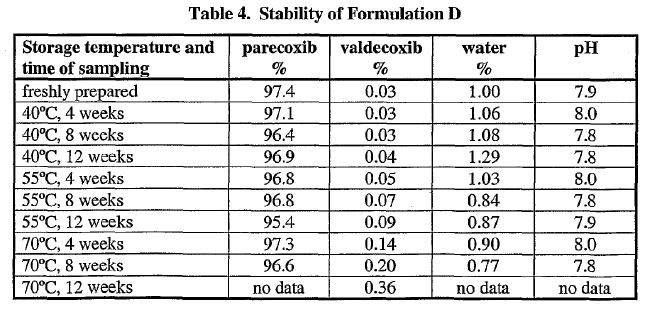
69 The appellants rely upon the decision of Bennett J in Inverness Medical Switzerland GmbH v MDS Diagnostics Pty Limited (2010) 85 IPR 525; [2010] FCA 108 to support the proposition that an embodiment which is included in a patent would be expected to fall within the scope of the claims. On this basis, the appellants submit that there is an available construction of the word “about” in the claim, namely that adopted by Professor Winter, which could accommodate Formulation D as a composition within the scope of claim 1. They submit that, accordingly, the construction proposed by Professor Winter should be preferred over any other construction.
70 However, the appellants failed to demonstrate why a person skilled in the art would look to the formulations in Table 4 of Example 1 of the specification for the purposes of determining the meaning of “about” in the claims. This is particularly so when the appellants also accept that the word “about” is not used as a term of art in the body of the specification or in the claims. As observed by the primary judge at [168] J1, with which observation we respectfully agree:
I do not consider that the inventors intended that the meaning of the word “about” should be mined from the depths of one aspect of an example in the patent, gold only being apparent after digging in such an obscure (and apparently assumption laden and contestable) place. Even if they did so intend, such obscurity provides no sound basis for construing the claim.
71 The appellants’ approach is further complicated by the fact that Professor Winter makes a number of assumptions, which a person skilled in the art might not make. In particular, Professor Winter’s assumption of 1% residual water in the lyophilised powder is not explained.
72 On appeal, the appellants sought to support his assumption on the premise that Table 4 indicated that, in a freshly prepared sample of Formulation D, there was 1.00% residual water. However, this does not assist when regard is had to the other figures contained in the table (which, incidentally, do not add up to 100%). The table provides percentages of parecoxib and valdecoxib which are present in the formulation when it is freshly prepared and which are expressed on an excipient-free basis. However, with respect to the 1% residual water figure, there is no clarification as to whether the 1% figure is also expressed on an excipient-free basis. That is, it is uncertain whether it represents 1% of the weight of the whole formulation including excipients or, alternatively, 1% of the excipient-free formulation constituted by parecoxib and valdecoxib.
73 For these reasons, it does not matter if Professor Winter was not cross-examined about his assumptions or Table 4. Nor does it matter if the clarity of Table 4 was or was not the subject of debate before the primary judge. In his evidence, Professor Winter recognised the obscurities in that table given that the total percentages do not add up to 100%. The issue is one of construction. What matters is that we are not persuaded that the primary judge erred in concluding, in effect, that the person skilled in the art would not resort to Table 4 (which contains some results with respect to the stability testing of Formulation D, presented in a particular way) to construe the meaning of “about” as used in the claims and throughout the specification.
74 For these reasons, we do not accept the appellants’ second key submission that the meaning of “about” should extend the range contained in the patent beyond rounding because, based on Professor Winter’s assumptions and calculations, Formulation D would otherwise fall outside the scope of claim 1.
75 For the following further reasons, we do not consider that the primary judge erred in his construction of the word “about” in the claims.
76 The word “about”, which the parties accepted is not a term of art, should be given its ordinary English meaning read in the context of the specification as a whole.
77 The approach taken by the primary judge was to ascribe the ordinary English dictionary meaning to the word “about” as meaning “near; close to”: [161] J1. His Honour noted, and this is not challenged, that a construction that gives effect to the ordinary English meaning of the word is to be preferred in circumstances where it is not a term of art.
78 Further, for the most part and as observed by the primary judge, the measurements supplied in the patent are expressed to two decimal places, suggesting that it is of utility to the skilled reader to know the amount of a measurement to the hundredth part: [159] J1. We agree with the primary judge that, as the bulk of the measurements given in the examples in the patent are more precise than one decimal place, that provides an insight that the scope for variance in the percentages for the components of claim 1 is not intended to be large.
79 It is also significant that, in addition, the claims themselves provide a range of variance. For example, in claim 1, there is a range of: (a) 30% to 90% for the therapeutic agent; (b) 5% to 60% for the buffering agent; and (c) 0% to 10% for excipients. As submitted by the respondents, the repetitive use of the word “about” in the claim would have the result that there would be multiple different meanings for “about” within claim 1 if the appellants’ construction was to be accepted (as the proposed 5% margin would be applied to different absolute ranges).
80 The respondents also submit, and we agree, that it is axiomatic that a claim term should be construed consistently throughout the claim set of a patent and, as such, the term “about” cannot be considered only in the context of one integer of one claim of a claim set where the term is used across the claim set over 40 times. When one has regard to the number of occasions that the word “about” is used in the specification, this detracts from the construction posited by the appellants.
81 This is especially so when one considers that the word “about” is used in relation to the applicable pH such as in claim 15 which refers to the composition having “a pH of about 7 to about 9”. Similarly, claim 19 refers to a solution as having “pH of about 7.5 to about 8.5”. Similarly, claim 33 refers to a lyophilisation cycle time as being “about 18 to about 24 hours”. The use of the word “about” in this context is plainly intended to be an approximating term and not one which is plus or minus 5% of whichever number is referred to in those claims.
82 It follows that grounds 1 and 4(a) of the Notice of Appeal should be rejected. Ground 4 of the Further Amended Notice of Cross-Appeal and Contention was only advanced in the event that the Court accepted the appellants’ construction of the term “about” in the claims. As that construction has been rejected, ground 4 of the Further Amended Notice of Cross-Appeal and Contention should also be rejected.
CLAIM 42 – THE OMNIBUS CLAIM
83 The next question concerns the alleged infringement of claim 42. This question is raised by grounds 2 and 5 of the Notice of Appeal.
84 As noted, claim 42 is for a “pharmaceutical composition as defined in Claim 1, an injectable solution… an article of manufacture… a process for… or a method of treating and/or preventing a COX-2 mediated disorder in a subject, substantially as herein described with reference to any one of the Examples”.
85 The primary judge referred at [202] J1 to Britax Childcare Pty Ltd v Infa-Secure Pty Ltd [No 3] [2012] FCA 1019 at [29] in which Middleton J identified that the words “substantially as herein described”, which frequently appears in omnibus-style claims, are “typically construed as being more or less limited to the preferred embodiment described in the specification”. The primary judge also referred at [203] J1 to GlaxoSmithKline Australia Pty Ltd v Reckitt Benckiser Healthcare (UK) Ltd (2016) 120 IPR 406; [2016] FCAFC 90 at [69] in which the Full Court said “when an omnibus claim is in issue, greater attention is generally placed by the words of the claim on the body of the specification to provide the necessary definition of the invention as required by s 40(2)(b) of the Act”.
86 While the appellants accepted before the primary judge that there were differences between the Juno products and the composition described in Formulation D in the specification, they contended before his Honour (and contend on the appeal) that infringement of claim 42 has been established: [204] J1. The primary judge rejected this argument. Having noted the differences between the composition described in Formulation D (as to the buffer, the pH, the pH adjusters, and the amount of residual water), the primary judge reasoned at [213] J1 that: (a) the words “as defined in claim 1” in claim 42 make clear that a composition not falling within the scope of claim 1 will not infringe claim 42; (b) it would be inconsistent if one were to take into account residual water as a relevant aspect of the composition for claim 1, and then discount a difference in the amount of residual water between an alleged infringing product, and that specified within Formulation D, when considering dependent claim 42; (c) one of the five specified ingredients, the buffer used in the respective solutions prior to lyophilisation is different in the Juno product, the relevant difference being that the buffer used in Formulation D is dibasic sodium phosphate heptahydrate whereas the buffer added to the Juno product is dibasic sodium phosphate anhydrous; and (d) the evidence that after lyophilisation the composition of the Formulation D will contain the same buffer as that in the Juno products is not persuasive. Contrary to the appellants’ assumptions, the primary judge was not troubled by the differences in pH and pH adjusters because he accepted Professor Winter’s evidence in this respect that these differences were not material.
87 The appellants argue on the appeal that: (a) “substantial” in claim 42 must be given meaning having regard to the context of the specification as a whole and its teachings; (b) the primary judge failed to consider whether the differences were of substance, or a departure from the essential features of the invention, when considered in the context of the specification; (c) the degree of difference in residual water is not a departure from the essential integers of the invention or, put otherwise, a substantial difference, given that the patent teaches at p 15 that a “reconstitutable powder of the invention preferably contains less than about 5%, more preferably less than about 2% and most preferably about 1%, by weight of water”; and (d) as to the buffer, the experts agreed that the difference would not change the amount of buffering agent present in the post-lyophilisation composition of Formulation D and the patent teaches at p 14 that “[s]uitable buffering agents can illustratively be selected from [inter alia] sodium and potassium phosphates … An especially preferred buffering agent is dibasic sodium phosphate, for example dibasic sodium phosphate anhydrous, heptahydrate, dodecahydrate, etc”.
88 The primary judge accepted that the words “substantially as herein described” in claim 42 must be given meaning having regard to the context of the specification as a whole: [203] J1. The primary judge also did not fail to evaluate whether the differences were of substance, or a departure from the essential features of the invention, when considered in the context of the specification. So much is apparent from the fact that this process of evaluation resulted in the primary judge at [213] J1 rejecting two differences (as to pH and pH adjusters) as insubstantial and concluding that two other differences (the amount of residual water and the buffer) took the Juno products outside of claim 42. Whatever criticisms of the respondents’ submissions which the appellants make in the appeal, the relevant point is that no error of construction or principle is apparent in the primary judge’s reasoning.
89 It is not necessary to resolve the respondents’ submissions about the pH and pH adjusters also each involving a material difference. It is sufficient to observe that the primary judge’s reasoning exposes no error.
90 No error is apparent in the primary judge rejecting the appellants’ proposition that the different buffering agents involved a “distinction … without a difference”. It is not to the point that the amount of residual water which may be present in the post-lyophilisation powder does not depend on the form of the buffer used. The point, as exposed at [211] J1, is that: (a) the buffers used are different; (b) while it is possible that the heptahydrate will become anhydrous upon lyophilisation, that possibility depends on the residual water in the composition being bound or adsorbed to the sodium phosphate or parecoxib in the composition, or both, which may not be the case; (c) one could only be confident that the buffer is anhydrous when there is no residual water in the powder form of the composition; (d) if residual water is present in the powder form of the composition, then dibasic sodium phosphate may be present in a number of different hydrated forms; and (e) in these circumstances, it is not possible to say which form of dibasic sodium phosphate will be present in the powder form of the composition, without further analysis. On the evidence before him, the primary judge was not persuaded that, after lyophilisation, the composition of Formulation D (which used dibasic sodium heptahydrate) will contain the same buffer as that in the Juno products (dibasic sodium phosphate anhydrous). We see no error in that conclusion.
91 Further, as the respondents submitted, in a case where the significance of residual water in the composition is in contest, “residual water” is not a matter of mere detail. The appellants do not confront the teaching of the patent at p 15 (after the range to which they refer in support of their case) that it is “especially important to keep the amount of water to such a low level where the therapeutic agent has a tendency to degrade or convert to a less soluble form in presence [sic] of water”. Further, the patent explains at pp 15–16 that where the therapeutic agent is parecoxib, partial conversion to valdecoxib can occur in a composition over a period of time. As valdecoxib has extremely low solubility in water, it is desirable to minimise such conversion prior to reconstitution, so that complete dissolution of the therapeutic agent is assured. In these circumstances, the difference in the amount of residual water in the composition in Formulation D and the Juno products confirms the primary judge’s conclusion at [214] J1 that the composition of the Juno products is not “substantially as herein described” within the scope of claim 42.
92 It follows that grounds 2 and 5 of the Notice of Appeal should be rejected.
AMENDED DEFENCE
93 The next question concerns the decision of the primary judge to permit the respondents to file an Amended Defence to the Amended Statement of Claim during the trial. This question is raised by ground 3 of the Notice of Appeal.
Relevant background
94 By their Amended Statement of Claim filed on 4 November 2020, the appellants pleaded the following at [13]–[15]:
13. Juno offers for sale, and supplies, the Juno Products in Australia for use by persons for the management of post-operative pain, in accordance with the Approved Indication.
14. Neo supplies the Juno Products to Juno for sale on the Australian market.
…
15. Each of the Juno Products [has certain features].
95 By their Defence filed on 6 November 2020, the respondents admitted [13] and [14] and, in response to [15] of the Amended Statement of Claim, pleaded as follows:
They admit that each of the Juno Products is a pharmaceutical composition, comprising in powder form, parecoxib sodium, sodium phosphate-dibasic anhydrous, phosphoric acid and sodium hydroxide, where the composition is re-constitutable in a parenterally acceptable solvent liquid to form an injectable solution, but otherwise deny each of the allegations in paragraph 15 thereof.
96 By letter dated 23 April 2021, after the trial had commenced on 19 April 2021, the respondents’ solicitors provided to the appellants’ solicitors a proposed Amended Defence and stated that the amendments address three substantive matters:
1. The first formalises the position previously indicated by our clients in relation to the pH adjusters [sic] issue (see paragraphs 15 and 30);
2. The second relates to the 2016 batch records provided to you in 2018. As you are aware those 2016 batch records are exhibit batches which were generated for the purposes of obtaining regulatory approval in relation to the Juno Products (as defined in the pleadings) and were not commercial batches. Whilst those 2016 batch records are an acceptable proxy for the commercial batches of the Juno Products sold by the First Respondent those batches were not, themselves, sold or supplied in Australia or ever brought into Australia. The proposed amendments to paragraphs 13 and 14 of the Amended Defence formalises that position.
3. Paragraph 14 also formalises the position with respect to the sale by the Second Respondent to the First Respondent of the whole of its interest in the Juno Products, as notified by you by our letter to you of 24 August 2020.
97 The proposed Amended Defence included these paragraphs which reflect the mark-up as contained in the document handed up during the hearing of the trial on 27 April 2021:
13. They admit paragraph 13 thereof but say for the avoidance of doubt that Juno Products manufactured in 2016 in batch numbers 31601 to 31606 were not sold or supplied in Australia nor brought into Australia at all.
14. They admit paragraph 14 thereof. As to paragraph 14 thereof, they admit that Neo supplied Juno Products to Juno for sale on the Australian market until August 2020 but say for the avoidance of doubt that Juno Products manufactured in 2016 in batch numbers 31601 to 31606 were not supplied for sale in the Australian market nor brought into Australia at all.
15. They admit that each of the Juno Products is a pharmaceutical composition, comprising in powder form, parecoxib sodium, sodium phosphate-dibasic anhydrous, and phosphoric acid or phosphoric acid and sodium hydroxide, in order to adjust the pH where necessary, where the composition is re-constitutable in a parenterally acceptable solvent liquid to form an injectable solution, but otherwise deny each of the allegations in paragraph 15 thereof.
98 At the hearing when the proposed Amended Defence was handed up to the primary judge, Senior Counsel for the appellants submitted as follows:
… Firstly, paragraphs 13 and 14, insofar as they would add the assertion that batch numbers 31601 to 31606 were not sold or supplied, nor brought into Australia, the – the reason for this, your Honour, is our concern here is that those, of course, are the batches which are the subject of the documents that have been provided and the documents have been provided on the basis of admissions in correspondence that they are reflective of or representative of the – the Juno products as pleaded. Now, we accept, if we get to a quantum hearing and the evidence shows that those batches, 31601 to 31606 were not sold, supplied or brought into Australia, we won’t get any relief in relation to them. Our friends have said they weren’t. They’ve said that. We don’t know.
If the evidence showed the contrary we would seek damages in relation to them all on account of profits, but that’s a matter for the quantum hearing. And the concern that we have with these amendments is but that by introducing a pleading of those batches into the defence that they’re not referred to in the statement of claim, that that might create some ambiguity or uncertainty about the position that’s agreed in correspondence that the documents concerning those batches reflect the Juno products as pleaded. And we would respectfully say our friends don’t need to make the amendment. If they want to make that amendment it should be accompanied by a formal admission in the defence that the documents provided for those batches are, nevertheless, reflective of representative of the Juno products as supplied in Australia. So that’s the – that’s the first point. The – the second point, your Honour, relates to paragraphs 15 and 30 which have a – has a similar amendment.
…
The – the concern relates to the wording in the – in order to adjust the pH where necessary. And – and it’s the concern – the concern arises out of the point my friend drew out, which is that that seems to admit of a possibility that neither phosphoric acid plus sodium hydroxide may be added to some cases.
(emphasis added)
99 Leave was granted by the primary judge for the Amended Defence to be filed by the respondents.
100 By their Reply to the Amended Defence filed on 3 May 2021, the appellants pleaded, in reply to [13] and [14] of the Amended Defence, that the respondents had admitted that the information in the documents supplied by them to the appellants in relation to batch numbers 31601 to 31606 was representative of the Juno products offered for sale and supplied in Australia; that the proceeding had been conducted on that basis; and otherwise joined issue with [13] and [14] save insofar as those paragraphs consisted of admissions. In response to [15] and [30], the appellants denied that any batches of the Juno products contained neither phosphoric acid nor sodium hydroxide, and otherwise joined issue with those paragraphs.
101 By letter dated 5 May 2021, the solicitors for the respondents wrote to the appellants’ solicitors referring to the Reply of 3 May 2021. That letter relevantly stated:
Noting that there is no provision for a rejoinder we point out that, whilst the documents supplied in relation to batches 31601 to 31606 are ‘representative’ of the Juno products sold in Australia, there are, as you know, variations in the absolute quantities of the various components of the products, such that the percentage proportions of those components also vary from batch to batch. That means that, whilst batches 31601 to 31606 are a suitable vehicle for deciding the points of contention in the case, such as, what ‘about 90%’ means, whether the therapeutic agent is parecoxib or parecoxib sodium, and whether the weight of the total components for the purposes of claim 1 must include residual water, once those matters are determined, straightforward calculations need to be performed in order to ascertain whether each batch has the relevant claimed percentage proportions of those ingredients. As should be apparent from what our Counsel has already said in Court, we consider this to be a matter for the next part of the case (should there be one).
Amendments to paragraphs 13 and 14 of the Defence
102 The amendments made to [13] and [14] of the Defence relevantly added a plea for the avoidance of doubt that Juno products manufactured in 2016 in batch numbers 31601 to 31606 were not supplied for sale in the Australian market nor brought into Australia at all.
103 The appellants submit that there was an error by the primary judge in permitting the respondents to amend and withdraw the admissions in [13] and [14] of the Defence on the basis that there was no evidence adduced by the respondents explaining why the admissions that the respondents sought to withdraw had been made and no explanation for the delay in seeking leave to amend or why leave could not have been sought before the trial had commenced. The appellants submit that they were prejudiced by the withdrawal of the admissions.
104 However, we do not accept this submission in circumstances where, at the hearing, the submissions made to the primary judge on behalf of the appellants did not make these complaints. Rather, there was only a half-hearted complaint that the amendments to these paragraphs might create some ambiguity or uncertainty about the position that had been agreed in correspondence and a request that, if the amendments were allowed, a further amendment should also be made which would remove the ambiguity.
105 It was also submitted by the appellants below that the respondents did not need to make the amendments, which tells against the proposition that the appellants were prejudiced by the amendments. Further, the oral submissions by Senior Counsel for the appellants to the primary judge appeared to indicate that it was not even an issue at that point as to whether or not the batches had been supplied or brought into Australia but that, rather, this was a matter for the second hearing when determinations were to be made about pecuniary relief.
106 After the amendments to [13] and [14] were allowed, the appellants also did not apply for an adjournment of the trial or for any orders enabling them to adduce any further evidence. Nor did they seek some other form of relief which would enable them to overcome the prejudice about which they now complain.
107 In all of these circumstances, the complaint about the primary judge permitting the amendments to be made to [13] and [14] of the Defence is without substance and is rejected.
Amendment to paragraph 15 of the Defence
108 We turn to the amendment made to [15] of the Defence, which opened up the prospect that neither phosphoric acid nor sodium hydroxide had been added in batches of the Juno products that had been sold or supplied in Australia. The respondents had previously admitted that the Juno products sold or supplied in Australia contained phosphoric acid and sodium hydroxide as pH adjusters.
109 The appellants contend that they relied on the admission that the respondents had made. They say that the withdrawal of that admission caused them prejudice because the amendment was allowed at a point in the trial when it was too late for them to call for further documents from the respondents disclosing the amounts of pH adjusters used in each batch and to have further calculations performed which were based on those records.
110 However, once again, it is relevant to have regard to the submissions which were actually made (and not made) at the hearing below in relation to this amendment. No application was made by the appellants to adjourn the trial or to seek directions to enable the appellants to obtain further documents to address the prejudice about which complaint is made in this appeal.
111 Further, as submitted by the respondents, the amendment brought the Defence into line with the debate which had been happening through the parties’ respective experts, without objection by any party, as to whether any, and if so, which pH adjusters had been added. That debate arose through evidence given in the experts’ affidavits, their joint expert report and in their oral evidence at the trial. In short, irrespective of what the pleadings stated, the parties, through their experts, contemplated that it was an issue in dispute as to whether any pH adjusters had been added at all.
112 In all of these circumstances, the complaint about the primary judge permitting the amendments to be made to [15] of the Defence is without substance and is rejected.
113 It follows that ground 3 of the Notice of Appeal should be rejected.
PH ADJUSTERS
114 Ground 4(b) of the Notice of Appeal contends that the primary judge erred in finding that no weight for pH adjusters should be included in the calculation of the percentages by weight of the composition in the Non-Infringing Exemplar Batches despite accepting that it was likely that one or other of the pH adjusters would be used.
115 The primary judge reached this finding because there was “no evidentiary basis for me [to] arrive, on the balance of probabilities, at a figure as to the amount of pH adjusters used in any of the six batches”, which was a reference to the Exemplar Batches: [196] J1.
116 We see no error in this finding. The evidence before the primary judge did not disclose in respect of any batch whether any pH adjuster had in fact been added and if so, in what amount. The appellants therefore failed on this issue for lack of proof when they bore the onus of proof of infringement.
117 It follows that ground 4(b) of the Notice of Appeal should be rejected.
INVENTIVE STEP
Before the primary judge
118 The respondents contended before the primary judge (and contend on appeal) that the claims lack an inventive step in light of the common general knowledge as at 3 April 2001 considered with the prior art information in the documents referred to as Jain and Talley.
119 As the primary judge explained at [220] and [221] J1, s 7(2) of the Patents Act 1990 (Cth) at the relevant time (the form that the Act took after the Patents Amendment Act 2001 (Cth), but before the Intellectual Property Laws Amendment (Raising the Bar) Act 2012 (Cth)) provided that an invention is taken to involve an inventive step when compared with the prior art base unless the invention would have been obvious to a person skilled in the relevant art in the light of the common general knowledge as it existed in the patent area before the priority date of the relevant claim, whether that knowledge is considered separately or together with the information in s 7(3). Section 7(3) provided that the information for the purposes of subsection (2) is: (a) any single piece of prior art information; or (b) a combination of any 2 or more pieces of prior art information, “being information that the skilled person mentioned in subsection (2) could, before the priority date of the relevant claim, be reasonably expected to have ascertained, understood, regarded as relevant and, in the case of information mentioned in paragraph (b), combined as mentioned in that paragraph”.
120 The primary judge noted (at [223] and [397] J1) that, in closing submissions, the respondents advanced a straightforward “development pathway” of eight steps by which they said a lack of inventive step was demonstrated:
(1) Jain would be identified by a pain specialist such as Professor Scott, who would be a member of the notional formulation team;
(2) Jain would then be supplied to a formulation expert such as Dr Robertson who would obtain Talley, which is footnoted in Jain;
(3) upon reading Jain and Talley, the formulation expert would decide to attempt to formulate parecoxib sodium as an intravenous formulation;
(4) the formulation expert would obtain parecoxib sodium, either from a commercial supplier or by synthesising it;
(5) the formulation expert would then conduct testing on parecoxib sodium and decide to formulate it as a reconstitutable lyophilised powder composition (and not a ready-to-use injectable composition);
(6) the expert would decide upon the composition of the pre-lyophilisation solution;
(7) a routine lyophilisation process would be used to prepare the reconstitutable powder composition; and
(8) the lyophilised drug product would then be reconstituted using a solution of 0.9% sodium chloride.
121 The primary judge undertook a detailed analysis of the evidence at [232]–[392] J1. The primary judge also identified the relevant legal principles in orthodox terms at [393]–[396] J1 and in various other paragraphs of J1. The primary judge concluded that: (a) the hypothetical skilled team would readily navigate each of steps 1, 2 and 3: [397] J1; (b) the respondents’ case (as they had advanced it) failed at step 4, the obtaining of parecoxib sodium: [398] J1; (c) in any event, the respondents’ case failed at each of steps 5 and 6, it being “by no means obvious to select a formulation with [the] minimal components claimed in the patent”, because undertaking these steps involved dead ends and blind alleys which bespeak inventiveness not obviousness: [399]–[403] J1; (d) step 7 was part of the common general knowledge at the priority date: [384] J1; and (e) the respondents’ case also failed at step 8 because “the hypothetical formulator, before April 2001, would most likely have used mannitol in the pre-lyophilisation solution”. However, “if the skilled formulator decided simply to use parecoxib sodium and a phosphate buffer in the formulation at the pre-lyophilisation stage, then it would be straightforward to select 0.9% w/w sodium chloride as the solvent used to reconstitute the lyophilisate to ensure that the final dose had the appropriate tonicity”: [392] J1.
Obtaining parecoxib sodium
122 The respondents’ Further Amended Notice of Cross-Appeal and Contention ground 3(a), concerning step 4 (obtaining parecoxib sodium), is misdirected. The primary judge did find that the respondents failed at step 4, but nevertheless determined the issue of whether the invention involved an inventive step by assuming that his conclusion on step 4 was surmounted: [398] J1.
123 When dealing with step 4, the primary judge was dealing with the case as put by the parties and, in particular, as put by the respondents. As part of their case, the respondents contended that, as a matter of fact, the formulation expert would obtain parecoxib sodium, either from a commercial supplier or by synthesising it. The parties adduced evidence and made submissions about that step, which the respondents maintained was integral to establishing the obviousness of the invention. Given the connected pathway which the respondents had posited, the primary judge could not ignore the case which had been put. It is not apparent how the respondents can, on the one hand, put a case to the primary judge that the invention as claimed was obvious because of a straightforward development pathway involving eight steps including step 4 (that obtaining parecoxib sodium at the priority date would have been routine by purchase or synthesis) and yet, on the other hand, complain, on appeal, that the primary judge’s answer to the question of fact posed by step 4 is infected by legal error because ss 7(2) and (3) involve a hypothetical inquiry only.
124 It may be accepted that the inventive step issue under ss 7(2) and (3) is wholly hypothetical. The analysis which the provisions require posits a notional person possessing notional knowledge. The legal construct does not involve taking into account the kinds of factual contingencies which might be relevant to other forms of legal analysis: AstraZeneca AB v Apotex Pty Ltd (2015) 257 CLR 356; [2015] HCA 30 (Astra HCA) at [23], [46], [69].
125 That said, the primary judge did not err by making a factual finding in respect of step 4. In so doing, his Honour was resolving a factual dispute between the parties, as they had advanced it. He should not be taken as embracing the respondents’ erroneous invitation to deal with the question of inventive step on anything other than a hypothetical basis. It is impossible to attribute that error to the primary judge given that, in the context of another irrelevant issue raised by the appellants (the so-called timing issue, which the primary judge considered as part of his analysis of step 4), his Honour firmly and properly rejected the attempt to “drift from the hypothetical to the practical”: [309]–[321] J1, specifically [318] J1. This explains why, after expressing his conclusion on the factual issue raised by step 4, the primary judge readily moved to consider steps 5 and 6 of the respondents’ posited pathway.
126 Further, any such error (had it been made) would be immaterial and could not affect the primary judge’s conclusions about inventive step. Mylan Health Pty Ltd v Sun Pharma ANZ Pty Ltd (2020) 279 FCR 354; [2020] FCAFC 116 at [168] and Nichia Corporation v Arrow Electronics Australia Pty Ltd [2019] FCAFC 2 at [109] are not authority for the proposition that an immaterial error in an inventive step analysis means that the appellate court must decide the issue of inventive step for itself. If an error is immaterial, then it does not vitiate the ultimate analysis. Additionally, as Mylan at [168] discloses, if there is a material error, other separate findings of fact of a primary judge “should not be ignored, particularly when made with the advantage of witnessing the development of the evidence on this topic through the dynamic process of experts giving their evidence, and exchanging their opinions, concurrently – an advantage not readily enjoyed by simply reading the transcript of the evidence”.
127 These conclusions also explain why the appellants’ Notice of Contention in the cross-appeal, ground 2, is unsustainable. That contention is that the primary judge ought to have rejected the challenge to validity on the ground of lack of inventive step because the problems addressed by the invention could not, before the priority date, have been identified by the person skilled in the art in a timely way.
128 It may be accepted that the state of mind of the skilled addressee before the priority date as to obviousness is the focus. This does not mean that, as a practical matter, it must be determined, as a question of fact, whether the skilled addressee could have taken, within a given period of time, the routine steps required to enable the skilled addressee to confront the problems (such as the conversion problem) that those routine steps would expose. That involves the error of treating the skilled addressee as an actual person or team subject to the realities of time. In the context of the hypothetical construct required for the inventive step analysis, the skilled addressee cannot be treated in that way: Astra HCA at [23].
Steps 5 and 6
129 As we have noted, the primary judge found that the respondents’ case on lack of inventive step failed at steps 5 and 6. Step 5 concerned the question of whether the skilled addressee would, after testing, decide to formulate parecoxib as a reconstitutable lyophilised powder composition and not as a ready-to-use injectable composition. Step 6 involved the question whether, in formulating parecoxib sodium as a lyophilised powder, the person skilled in the art would add a bulking agent to the pre-lyophilisation formulation, in particular mannitol. The respondents’ case, in this regard, was that the person skilled in the art would not use a bulking agent.
130 An element of the respondents’ case on both steps 5 and 6 is that, in formulating the parecoxib sodium composition, the person skilled in the art would try developing formulations “in parallel”.
131 In respect of step 5, the respondents submit that the primary judge found that the skilled addressee would decide to formulate the parecoxib sodium composition as a lyophilised powder (as opposed to a “ready-to-use” injectable) at [348]–[349] J1 and said at [350] J1 that he would “return to this evidence in [his] analysis of the ultimate issue”. The respondents contend that the primary judge did not “return to this evidence” and that his Honour’s failure to do so was an error.
132 This contention (which is not to be found in the grounds of the Further Amended Notice of Cross-Appeal and Contention) cannot be accepted. The respondents’ approach to the primary judge’s reasoning is not sustainable. At [341] J1, the primary judge in fact found that:
… upon encountering the conversion problem the hypothetical formulator reaches a fork in the road. The choice is whether to persist with a “ready to use” approach or move to developing a lyophilised formulation. In advance, neither presents a clear answer.
133 The conversion problem is that parecoxib converts to valdecoxib upon exposure to water (see the patent at p 3).
134 Contrary to the respondents’ contention, the primary judge did, in fact, return to the choice that was presented, when undertaking his analysis of the ultimate issue: [401] J1, quoted below.
135 The respondents’ alternative argument (ground 3(b) of the Further Amended Notice of Cross-Appeal and Contention) is that, if the primary judge did not find that the skilled addressee would have developed a lyophilised formulation, his Honour also erred. We disagree. This ground of the cross-appeal does not engage, adequately, with the primary judge’s findings.
136 As the appellants noted, the determination of the inventive step issue involves a question of fact which depends on an overall evaluation of the relevant evidence. As a kind of “jury question”, the advantages of the primary judge, who has had the benefit of seeing and hearing the evidence unfold, should not be underestimated and is relevant to the determination of error: Lockwood Security Products Pty Ltd v Doric Products Pty Ltd (No 2) (2007) 235 CLR 173; [2007] HCA 21 at [51], Mylan at [168].
137 We also observe that, in presenting this part of their appeal, and in attempting to undermine the primary judge’s conclusions about inventive step, the respondents tended to direct attention, selectively, to only those parts of the evidence that were favourable to their case, without due regard to the context provided by the whole of the evidence.
138 The appellants are correct in contending that the primary judge did not find that the respondents’ proposed development pathway was “straightforward”. Such a finding would be inconsistent with the primary judge’s conclusions about steps 5, 6 and 8. The development pathway was not obvious given the primary judge’s findings that:
(1) it was common general knowledge that it would be preferable to develop an injectable formulation in a ready to use solution: [325] J1;
(2) in so doing, the conversion problem would become apparent: [332] J1.
139 However, this problem would present a choice between persisting with the “ready to use” approach or developing a lyophilised formulation. There was no clear answer to this choice: [341] J1. The primary judge described the choice at [401]–[403] J1 in these terms:
Two routes were available. One involved persisting with a ready to use formulation and dealing with the conversion problem by the use of organic solvents and making adjustments to the pH in the manner described in section 7.8. That itself was fraught with uncertainty. Another approach was to move away from a ready to use formulation to try the well-known technique of lyophilising a parecoxib sodium formulation. I am satisfied that had they moved to lyophilisation the most likely next step would be to use mannitol as part of the formulation. That is also a step away from the invention claimed. It was by no means obvious to select a formulation with minimal components claimed in the patent. As I have set out more fully in section 7.9, the probable course that the formulator would take would be to note that the appropriate amount of parecoxib sodium used to treat acute post-surgical pain was very low such that the rule of thumb, which dictates that the pre-lyophilisation solution should have a solids content of around 10%, would apply. They would turn to mannitol as a suitable bulking agent which had several known formulation advantages. They would expect to succeed in that approach but would be frustrated when they encountered the stability problem and the reconstitution problem. This is precisely the type of blind alley or dead end that bespeaks inventiveness in the solution adopted by the patentee …
Furthermore, having regard to the whole of the evidence, I am not satisfied that even upon encountering problems with the use of mannitol as a bulking agent, the hypothetical skilled formulator would move to the invention claimed. As I have noted, the experts agreed that the formulations of the patent fell outside the rule of thumb because the content of solids in the pre-lyophilisation solution as a percentage of the amount of water added before lyophilisation is less than about 10%. Consequently, were the rule of thumb to be applied, a bulking agent would be required. Yet, upon encountering the stability and reconstitution problems, the hypothetical skilled formulation could have taken a number of alternative routes. One could be to try other bulking agents. Another could be to revert to a ready to use formulation and perhaps struggle on with the use of organic solvents. Another, perhaps, would be to abandon the rule of thumb, but for the reasons given, I am not persuaded that Dr Robertson’s approach as described in his evidence is representative of the hypothetical skilled formulator in this respect.
Accordingly, in my view the notional research group would not be directly led as a matter of course to formulate a lyophilised powder within the relevant claims, or to try the claimed invention with the relevant expectation of success. The hurdles presented by steps 5 and 6 (with or without step 4) to which I have referred demonstrate that the respondents have failed to establish that the invention as claimed is obvious;
140 The primary judge was not bound to accept, as we understand the respondents to contend, that Professor Winter’s evidence (to the effect that, depending on resources, a pharmaceutical research group might have sought to develop ready-to-use and lyophilised formulations in parallel) meant that the invention was obvious. As the primary judge said at [349] J1, even “once the decision is made to move to a formulation that involves lyophilisation, further choices are presented” (as described at [401]–[403] J1, quoted above).
141 Similarly, with respect to step 6, the primary judge was not bound to conclude that the skilled formulator would have tried a lyophilised parecoxib sodium formulation without a bulking agent in parallel with a formulation with a bulking agent (ground 3(c) of the Further Amended Notice of Cross-Appeal and Contention). The primary judge considered Professor Winter’s evidence in this regard at [368] and [373] J1. His Honour’s disposition of this argument at [373] J1 (which does not reveal error) was in these terms:
I accept that at times in his oral evidence Professor Winter accepted after some prompting that he might try to lyophilise a buffered solution containing the active ingredient without a bulking agent, but he was resolute that this was not his preference. His preference was to choose a formulation that he considered was likely to succeed and that would involve applying the rule of thumb such that a bulking agent would be included to bulk out the solid content. Moreover, Professor Winter’s expectation was that if he deviated from that rule he would simply be reiteratively experimenting and going round in circles. I do not accept that this evidence amounts to an acceptance that he would have an expectation of success had he resorted to trying a formulation that did not include a bulking agent.
142 The respondents’ submission that the primary judge “did not address (or correctly address)” the argument about parallel experiments is incorrect. It is not in issue that a skilled addressee may take multiple paths simultaneously, if that is the evidence. But the primary judge heard and saw all of the evidence in this case as it developed. His Honour was not persuaded that Dr Robertson’s evidence (which was to the effect that, in formulating a lyophilised composition of parecoxib sodium, the person skilled in the art would not use a bulking agent) should be accepted ([372] J1). Further, his Honour was not persuaded that Professor Winter’s evidence as a whole should be understood as being that he would try to develop a “parallel” formulation without a bulking agent with an expectation of success: [373] J1. It does not undermine that conclusion for the respondents to point to those aspects of Professor Winter’s evidence they consider helpful to them, which the primary judge must be inferred to have weighed in the context of the evidence overall.
143 The observation in Generic Health Pty Ltd v Bayer Pharma Aktiengesellschaft (2014) 222 FCR 336; [2014] FCAFC 73 at [71] that “[i]t is difficult to think of a case where an expectation that an experiment might well succeed is not implicit in the characterisation of steps as routine and to be tried as a matter of course” does not assist the respondents. The fact that lyophilisation generally is a routine process does not mean that that it was routine to depart from the rule of thumb, which was agreed by the experts, that a “person seeking to make a lyophilised product would likely add a bulking agent at some stage in the development of the freeze dried product; an experienced formulator would make the decision on a rule of thumb that ca. 10% solid material would likely be appropriate”: [359] J1; see also [362] J1. In this regard the primary judge also recognised the significance of the evidence that:
(1) Dr Robertson accepted that “having regard to the rule of thumb, his approach would not likely be the approach taken by other formulators in the field”: [367] and [370] J1;
(2) the common general knowledge pointed to the path of use of mannitol as a bulking agent as being the one with a reasonable prospect of success: [372] J1; and
(3) Professor Winter’s expectation was that “if he deviated from that rule he would simply be reiteratively experimenting and going round in circles”: [373] J1.
144 As the appellants submitted, the primary judge did consider the parallel experimentation argument because his Honour rejected it in finding that a skilled addressee, if they moved to lyophilisation, would first try a formulation with mannitol.
145 The primary judge’s reasoning does not offend any principle about the choices of the skilled addressee. The issue of what choices the skilled addressee would or might be confronted with, and how they would or might respond to those choices, depends on the evidence. There is no rigid legal principle in play. Astra HCA at [115]–[116] and Nichia at [93] citing Brugger v Medic-Aid Ltd [1996] RPC 635 at 661 do not suggest to the contrary. The primary judge characterised the whole of the evidence before him as not establishing that the skilled addressee would do other than use mannitol as a bulking agent. Nor was the primary judge satisfied that, having used mannitol, the problems that would be encountered would be resolved other than by use of a different bulking agent. Abandoning the rule of thumb, and not using a bulking agent all, would be one of a number of possibilities, not one that would be taken as a matter of routine, nor one to which the skilled addressee would be directly led as a matter of course to try.
146 It does not matter that the primary judge was “fortified” in this conclusion by the evidence of what the inventors did. The primary judge had reached his conclusion by [403] J1. What follows is mere reinforcement, unnecessary to the conclusion. In any event, the fact that the inventors did take the course of using mannitol as a bulking agent was capable of reinforcing the conclusions reached. It was no error for the primary judge not to characterise that evidence as supporting the respondents’ case that formulation without using a bulking agent, contrary to the direction the common general knowledge would indicate, was obvious.
147 The primary judge also did not err in not finding that the skilled addressee would have developed a 100mg formulation of parecoxib sodium which would not require a bulking agent due to the high mass of the active pharmaceutical ingredient (ground 3(d) of the Further Amended Notice of Cross-Appeal and Contention). As the appellants submitted, it is not valid for the respondents to rely on fragments of evidence to support their case. The primary judge had the benefit of the whole of the evidence. The primary judge considered the issue at [381]–[382] J1, saying:
The third [point] involves the somewhat convoluted proposition that one of the dosage amounts proposed by Professor Winter in his written evidence (being 100 mg parecoxib for intravenous use) falls outside the rule of thumb, and inside the scope of the asserted claims in the patent. Accordingly, the respondents submit that, taking the applicants’ case at its highest, the skilled worker would not add a bulking agent and that therefore there is no inventive step.
This submission falls at the first hurdle. The evidence given by Professor Winter did not propose a dosage amount for a lyophilised solution. Nor did Dr Robertson. Rather, the amounts proposed were for a ready to use dosage form. As noted above, Professor Winter’s evidence was that it was commonly necessary to change the formulation if a product previously being prepared as a ready to use formulation is instead formulated as a lyophilised product. For example, as I have discussed above, it may be necessary to add a bulking agent to a lyophilised formulation in order to achieve certain objectives not relevant to ready to use formulations.
148 The respondents’ submissions do not confront the force of the primary judge’s reasoning.
149 The primary judge’s conclusions in relation to step 6 took into account other matters not challenged by the respondents. For example, the primary judge said that:
(1) a “debate emerged between the experts as to whether a predicted interaction between mannitol and parecoxib would deter a formulator from taking Professor Winter’s approach of adding mannitol as a bulking agent. I do not consider that the hypothetical skilled formulator would have foreseen in advance that the use of mannitol as a bulking agent (capable of providing the other benefits to which I have referred in [361] above) would have caused difficulties or diminished the likely success of the preferred formulation”: [374] J1;
(2) the “explanation offered by Dr Robertson [for not using mannitol] was plainly given in hindsight, he having had the benefit of the results of the experiments reported in the patent. Furthermore, Professor Winter disagreed with Dr Robertson’s theory that deprotonation would be likely to cause instability at a pH of about 8 and disagreed that other formulators would perceive this to be a cause for instability. Having regard to the hindsight built into Dr Robertson’s analysis, in this regard I prefer the evidence of Professor Winter”: [376] J1; and
(3) “the accepted popularity of mannitol amongst those in the field may be taken to indicate a general positive disposition towards its use in formulating freeze-dried products”: [380] J1.
150 For these reasons, grounds 3(a)–(d) of the Further Amended Notice of Cross-Appeal and Contention must be rejected.
Ascertainment of Jain and Talley
151 In ground 1 of their Notice of Contention in the cross-appeal, the appellants also contend that the primary judge ought to have rejected the respondents’ lack of inventive step claim on the basis that the evidence did not establish that the person skilled in the relevant art could, before the priority date, be reasonably expected to have ascertained the information in the prior art documents referred to as Jain and Talley. Given our conclusions above, it is unnecessary to resolve this issue.
DECLARATIONS
152 In ground 6 of their Notice of Appeal, the appellants contend that the primary judge erred in failing to make declarations of infringement as they had sought.
153 At [217] J1, the primary judge found that:
(1) batches 31601, 31602 and 31603 do not fall within the scope of claim 1 or any of its relevant dependent claims; and
(2) batches 31604, 31605 and 31606 fall within the scope of claim 1 and also claim 11. Having regard to the admissions made by the respondents regarding the features of the Juno products, these three batches also fall within the scope of claims 4, 5, 14, 15, 17, 18, 19, 20, 21, 24, 34, 35, 36, 37, 38, 39, 40 and 41. These batches do not fall within claim 7; and
(3) none of the six representative batches fall within the scope of claim 26 or any of its dependent claims.
154 Having regard to the Amended Defence (discussed above), the primary judge also said at [420] J1:
I have found that certain of six exemplar batches of the Juno products would, had they been made or imported into Australia, have infringed each of claims 1, 4, 5, 11, 14, 15, 17, 18, 19, 20, 21, 24, 34, 35, 36, 37, 38, 39, 40 and 41 but not claims 7, 26, 27, 28, 30 and 42 and that the challenge to the validity of the relevant claims fails. At trial the parties agreed that such findings will be sufficient for them to reach agreement as to the scope of the infringement by the respondents with regard to the Juno products sold in Australia. I will make directions for the parties to endeavour to agree to the form of short minutes of order giving effect to these reasons and list the matter for case management. It is not unusual for cases of this sort to involve a dispute as to the appropriate costs order to make. My preliminary view is that the applicants have succeeded in all but relatively limited respects and that the result should be the respondents pay the applicants’ costs of the claim and the cross-claim. However, the parties may make provision for the filing of short submissions on the subject of costs should they be unable to agree on that subject.
155 To the extent it related to the making of the declarations, but not the issue of costs, the appellants withdrew their contention that, despite these findings, the primary judge in J2 wrongly relied on evidence (an affidavit of Mr Voller of 8 March 2022) that revealed that “none of the Juno products actually imported into Australia infringed the patent having regard to the conclusions on construction reached by the Court in the judgment”: [10] J2.
156 At [15] J2, the primary judge said:
There can be little doubt that in providing the batch records to the applicants together with the correspondence to which I have referred, the respondents admitted that the batch records were representative of the characteristics of the Juno products offered for sale and supplied in Australia (the admission). It is apparent that the applicants proceeded to conduct their case on the basis of the admission in the legitimate expectation that the disputes between the parties concerning questions of infringement could be resolved by reference to them. The experts were shown the batch records and the infringement issues were debated at trial on that basis.
157 Having reviewed the history of the proceeding, the primary judge concluded at [28] J2 that:
… it is appropriate in the present case to make clear that, on the basis of the way that the parties have conducted the case, the applicants have established that three, but not all six, of the exemplar batches the subject of the batch records fall within the scope of certain of the claims of the patent. Accordingly, I will make declarations as set out in proposed Orders 1 and 2. The later proposed declaration 2A falls within the same reasoning. However, having regard to the ambiguous drafting of the declarations set out in proposed Orders 3 and 4, and in particular the reference to “corresponding to”, I do not consider that it is appropriate to make those declarations.
158 Proposed Orders 3 and 4 were that:
3. The First Respondent (Juno) has infringed and threatened to infringe each of claims 1, 4, 5, 11, 14, 15, 17, 18, 19, 20, 21, 24, 34, 35, 36, 37, 38, 39, 40 and 41 of the Patent, including by offering for sale, selling and supplying in Australia, without the licence or authority of the Applicants, parecoxib products corresponding to the Infringing Exemplar Batches.
4. The Second Respondent (Neo) has infringed and threatened to infringe each of claims 1, 4, 5, 11, 14, 15, 17, 18, 19, 20, 21, 24, 34, 35, 36, 37, 38, 39, 40 and 41 of the Patent, including by supplying in Australia, without the licence or authority of the Applicants, parecoxib products corresponding to the Infringing Exemplar Batches.
159 The primary judge had a discretion as to both the making and the terms of the declarations. The primary judge was right that proposed Orders 3 and 4 are ambiguous to the extent they refer to infringement by supply of products “corresponding to” the Infringing Exemplar Batches. Declarations must be clear. The fact that parties have conducted litigation on a particular basis, as in the present case, does not mean that when it comes to the making and framing of final relief, the primary judge’s discretion is confined in the same way. It must be inferred that the parties proceeded in the way they did because it best reflected their obligations under ss 37M and 37N of the Federal Court of Australia Act 1976 (Cth). The fact that the primary judge’s resolution of the legal and factual issues resulted in a perhaps more complex resolution than might have been anticipated (that is, some Exemplar Batches being within the scope of the claims and others not) does not render the hearing or the orders made merely hypothetical or advisory.
160 Further, in our view, the primary judge was right to refrain from making declarations in the terms sought which suffer from ambiguity in circumstances where it is apparent that the manufacturing process meant that some Exemplar Batches infringed and others did not. In this context, declarations as to threatened and actual infringement could not properly be framed by reference to the concept of batches “corresponding to” the Infringing Exemplar Batches. Nor could his Honour frame proper declarations given the circumstances which were apparent (identified at [420] J1 that, irrespective of Mr Voller’s evidence, the scope of infringement had to be determined on the basis of “the Juno products sold in Australia”).
161 The dispute between the parties about their competing understandings of the procedures adopted below is immaterial. What is material is that the primary judge acted properly and well within the scope of his discretion. No error of principle is apparent in his Honour’s reasoning of the kind required to justify appellate intervention in a discretionary decision: House v The King [1936] HCA 40; (1936) 55 CLR 499 at 505–506. The primary judge was not involved in the giving of a mere advisory opinion. He made declarations having utility. The declarations made are not merely advisory or interlocutory. The fact that the appellants have to prove further facts to establish infringement and any right to pecuniary relief does not mean that the primary judge erred in law in making the declarations he did or not making the declarations the appellants sought. Even if that were correct, the consequence would not be the making of the additional declarations the appellants sought, but merely the setting aside of the declarations the appellants complain are advisory or interlocutory. His Honour also has to determine issues of pecuniary relief: [29] J2. No doubt if the evidence adduced in that hearing establishes infringement by sale in Australia, the appellants may seek further declarations.
162 Accordingly, ground 6 of the Notice of Appeal is rejected.
COSTS
163 Ground 7 of the Notice of Appeal alleges that the primary judge erred in refusing to make a costs order in favour of the appellants in relation to the costs of the infringement claim. The primary judge explained at [34]–[36] J2 that:
The respondents submit that the Voller affidavit demonstrates that none of the batches imported and sold infringed. That is a subject that is in contest and cannot be resolved now. However, even if correct, it cannot be said to be irrelevant to the question of costs that the applicants, who accepted the batch records as representing products imported and supplied, were unaware that potentially no batches imported would infringe, even if half of the samples fell within the scope of the claims.
However, the exercise of the discretion as to whether or not to award costs, and the appropriate quantum of such costs if awarded, is broad: Idenix Pharmaceuticals LLC v Gilead Sciences Pty Ltd (No 2) [2018] FCAFC 7 at [3] (Nicholas, Beach and Burley JJ). In that context it also cannot be said to be irrelevant to the exercise of discretion that, in the result, the applicants may fail to establish an entitlement to receive any pecuniary remedy at all.
Accordingly, in my view, it is appropriate that the question of costs of the infringement claim be deferred until the quantum aspect of the proceedings has been resolved and the argument can be considered having regard to the Voller affidavit and any responsive material that the applicants wish to bring forward.
164 The proposition that this involves some error of principle by reference to Nokia Corporation v Liu (2009) 179 FCR 422; [2009] FCAFC 138 is misplaced. In that case, the issue of costs had been determined. In this case, the primary judge merely deferred the issue of costs. The preliminary view given by the primary judge at [420] J1 did not mean he was bound to make an order for costs at this stage. Nor was it an error for the primary judge to merely refer to the Voller affidavit in circumstances where the extent, if any, of sales in Australia had always been in issue. This exercise of discretion to defer the issue of costs was plainly reasonably open to the primary judge. Indeed, it was sensible in all of the circumstances.
165 Ground 7 of the Notice Appeal must be rejected.
ORDERS
166 For these reasons the primary judge did not err and the appeal and cross-appeal must both be dismissed. Costs should follow the event in both appeals.
I certify that the preceding one hundred and sixty-six (166) numbered paragraphs are a true copy of the Reasons for Judgment of the Honourable Justices Jagot, Yates and Downes. |
Associate:
NSD 294 of 2022 | |
NEO HEALTH (AUSTRALIA) PTY LTD ACN 605 322 763 | |
Cross-Respondents | |
Second Cross-Respondent: | PFIZER AUSTRALIA PTY LTD ACN 008 422 348 |


