Federal Court of Australia
Insurance Australia Ltd trading as CGU Insurance v MOS Beverages Pty Ltd (No 2) [2021] FCAFC 192
ORDERS
INSURANCE AUSTRALIA LTD TRADING AS CGU INSURANCE Appellant | ||
AND: | Respondent | |
DATE OF ORDER: |
THE COURT ORDERS THAT:
1. The respondent’s application for indemnity costs be dismissed with no order as to the costs of the application.
Note: Entry of orders is dealt with in Rule 39.32 of the Federal Court Rules 2011.
BESANKO AND MCKERRACHER JJ:
1 On 17 September 2021, the Court delivered judgment dismissing this appeal and ordering that Insurance Australia Ltd trading as CGU Insurance pay MOS Beverages Pty Ltd’s costs. At the delivery of judgment, an order was made that the parties have seven days to submit either consent orders or short written submissions for any different costs order. MOS Beverages submits that CGU should pay its costs from 16 February 2021 on an indemnity basis following CGU’s failure to accept two offers of compromise.
OFFERS
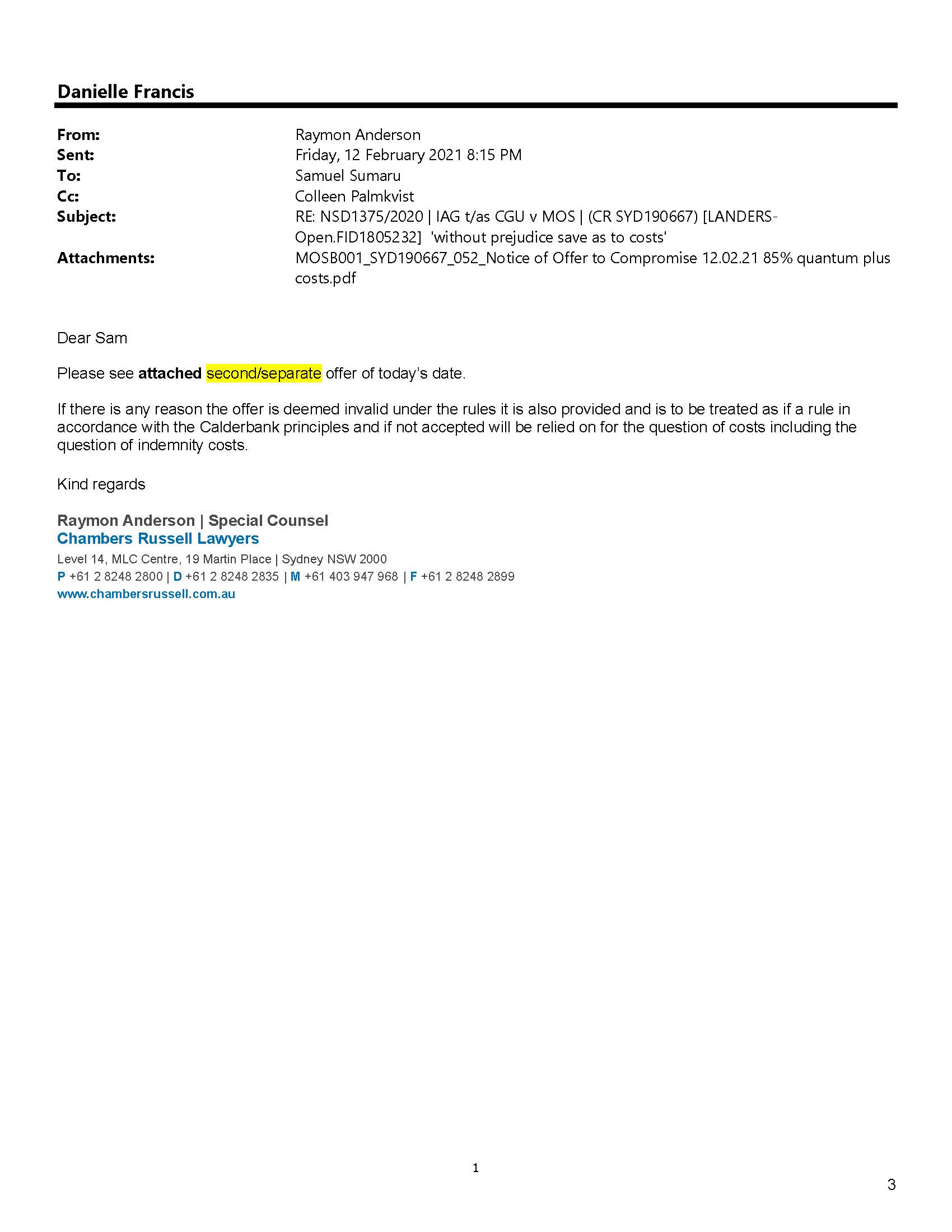
2 On 12 February 2021, after commencement of the appeal, MOS Beverages made two offers to CGU.
3 The first was in these terms:
To [CGU]
[MOS Beverages] offers to compromise the entire appeal.
The offer is for the appeal to be dismissed with each party to bear their own costs of the appeal.
This offer is inclusive of costs, that is, [MOS Beverages] will seek no separate costs order.
This offer of compromise is open to be accepted until 4pm 1 March 2021.
This offer is made without prejudice save as to costs and if this offer is not accepted it may be relied upon in support of an application for costs including an application for indemnity costs.
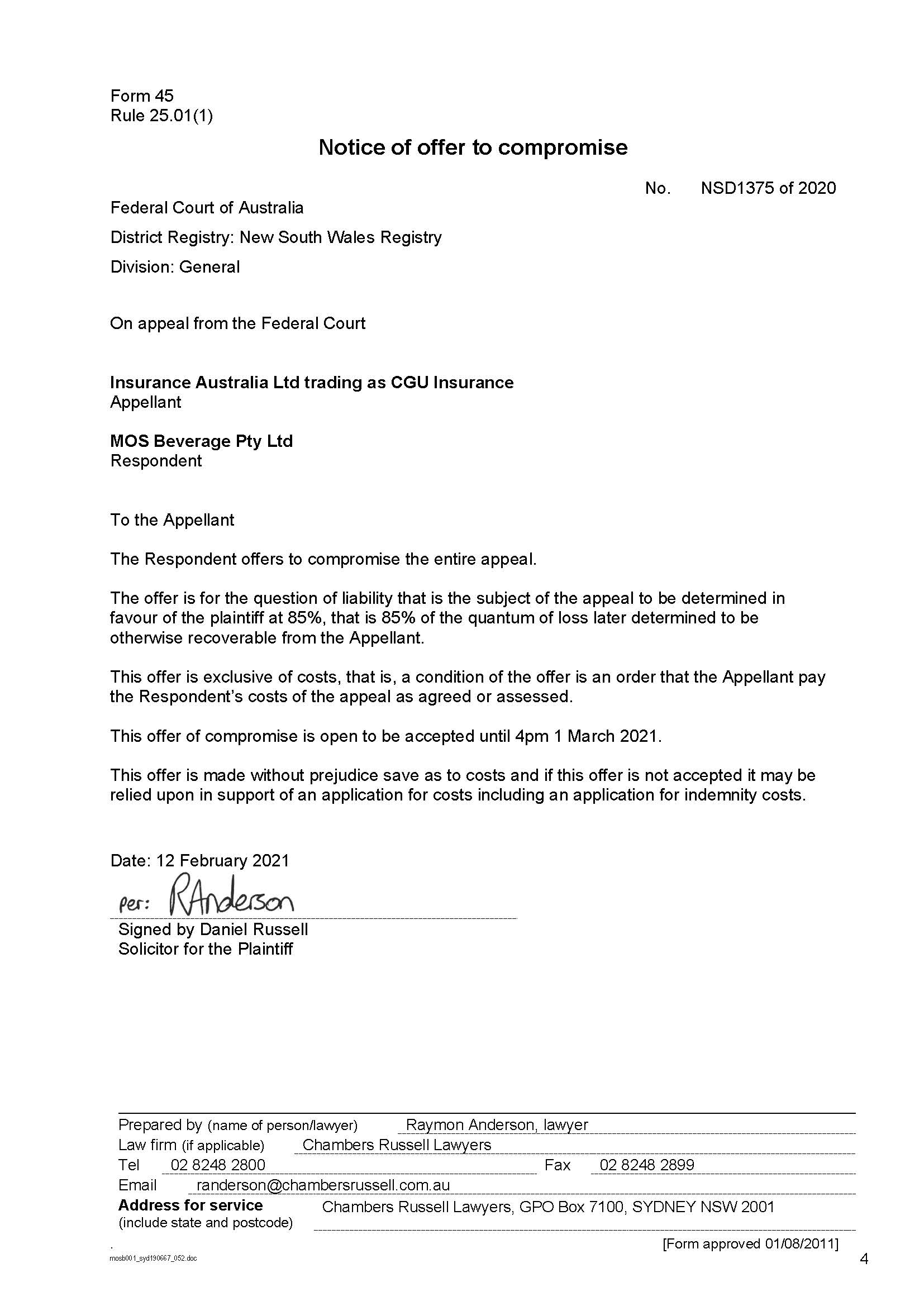
4 The second, on the same day, is attached as Annexure A to these reasons. The offers were made under the Federal Court Rules 2011 (Cth) (FCR) and, in the alternative, as a Calderbank offer.
5 CGU did not accept either offer.
6 MOS Beverages relies on r 25.14(2) of the FCR which provides that where an applicant unreasonably fails to accept an offer and the applicant’s proceedings are dismissed, then the respondent is entitled to orders that the applicant pay its costs:
(a) before 11 am on the second business day after the offer was served, being before 11 am on 16 February 2021, on a party and party basis; and
(b) after the time mentioned in para (a), being after 11 am on 16 February 2021, on an indemnity basis.
7 The first of the three requirements of r 25.14(2) of the FCR is that CGU’s proceedings (the appeal) were dismissed, which occurred on 17 September 2021.
8 The second requirement is that MOS Beverages made an offer, which occurred on 12 February 2021.
9 The third requirement is that CGU must have unreasonably failed to accept an offer.
10 All evidence and documents to be relied upon in the appeal were known at the date the appeal was lodged and well before the date of the offer. CGU’s written submissions on appeal were filed and served on 5 February 2021 and MOS Beverages’ written submissions on appeal were filed and served on 11 February 2021. On that basis, apart from CGU’s own reply submissions filed and served on 16 February 2021, all the written submissions and authorities were also known to CGU at the time MOS Beverages offer was made.
11 MOS Beverages says:
(a) its offer was a genuine and valid offer to compromise the appeal proceedings at a point where all evidence, documents and submissions were known (apart from CGU’s reply submissions) and at a time when CGU was able to assess the relative strength of the arguments; and
(b) in the event the offer is found to have been invalid under the FCR, it was also expressed to operate as a Calderbank offer, referring to the decision in Calderbank v Calderbank [1976] Fam 93; [1975] 3 WLR 586.
12 As the appeal was dismissed, MOS contends that CGU received a less favourable outcome than, at least, the first offer made by MOS Beverages. MOS Beverages submits that CGU unreasonably failed to accept the offer.
CONSIDERATION
13 Neither offer provides a good basis for departing from the usual costs order. The point argued by CGU in the appeal was important, raising issues which could affect other parties with goods stored in the bonded warehouse, but more importantly, CGU’s arguments were certainly not hopeless, as evidenced by the split decision of the Full Court. Thus, the non-acceptance could not be considered to be unreasonable.
14 Difficulties also attend the second offer as it raises implications outside the scope of the appeal.
15 As was noted at the hearing of the appeal, there are other liability issues including other policy interpretation issues which may determine if and how much MOS Beverages can recover. CGU says that the terms in which MOS Beverages framed its offer “bypassed” those important matters.
16 What is relevant is that those issues are the subject of litigation in the Supreme Court of New South Wales. MOS Beverages is, of course, aware of those proceedings (two of its executives having given evidence in them). One of the litigants in the Supreme Court is Admiral International Pty Ltd (the company which operated the bonded warehouse) and another is Brightcity (a customer of Admiral in a similar, but not identical, position to MOS Beverages). Those proceedings raise an issue of fact: whether the fire in the warehouse was deliberately lit by Admiral. Those proceedings also raise issues of policy interpretation, some of which also depend upon whether the fire was deliberately lit by Admiral. The decision in that matter is currently reserved. Another issue which inevitably arises relates to how any proceeds under the policy, which is subject to limits and sub-limits, should be apportioned between potential claimants.
17 As noted in a number of recent cases including J & D Rigging Pty Ltd v Agripower Australia Ltd [2014] QCA 23 per Holmes JA and Applegarth and Boddice JJ (at [5]–[6]); Hadgelias Holdings Pty Ltd v Seirlis [2014] QCA 325 per Holmes JA (at [11]–[12]) with whom Gotterson and Morrison JJA agreed (at [17]–[18]); and Hazeldene’s Chicken Farm Pty Ltd v WorkCover Authority (Vic) (No 2) [2005] VSCA 298; (2005) 13 VR 435 per Warren CJ, Maxwell P and Harper AJA (at [23]–[29]), it is wrong to think that an offeree’s rejection of a Calderbank offer necessarily gives rise to a presumption that the offeree should pay the offeror’s costs on an indemnity basis if the offeree obtains a less favourable result than contained in the offer. Rather, the correct approach is to consider whether the rejection of the Calderbank offer, in all the circumstances, justifies a departure from the usual rule that costs on a party and party basis follow the event. The balance between competing policy considerations of encouraging settlement and of not discouraging potential litigants from bringing their disputes to the courts, is met by applying a test of “reasonableness”.
18 Unsurprisingly, the same test of whether a rejection or non-acceptance of a Calderbank offer should lead to an award of indemnity costs requires similar considerations of reasonableness as those spelt out under r 25.14(2) of the FCR.
19 The determination of reasonableness necessarily involves an evaluation of all the circumstances. We consider that in the circumstances of the present offer, it is not possible to conclude that the non-acceptance was unreasonable. The issue resolved by the Court by a majority was far from straightforward. Further, it was but one separate aspect of a considerably broader issue being considered by another court. It is not possible to reach any conclusion in this Court as to the ultimate outcome of the proceedings in the Supreme Court. The offer sought to embrace a global outcome on a matter on which this Court is not in a position to reach a view. As commendable as it is to make an offer, it cannot be said that its non-acceptance in these circumstances is unreasonable so as to attract an award of indemnity costs under Calderbank principles as applied in Australia or under the FCR.
CONCLUSION
20 It follows that the costs order should be in the usual terms (i.e. unchanged), rather than on an indemnity basis. MOS Beverages’ application for indemnity costs will be dismissed with no order as to the costs of that application.
I certify that the preceding twenty (20) numbered paragraphs are a true copy of the Reasons for Judgment of the Honourable Justices Besanko and McKerracher. |
Associate:
REASONS FOR JUDGMENT
DERRINGTON J:
21 In Insurance Australia Ltd trading as CGU Insurance v MOS Beverages Pty Ltd [2021] FCAFC 165, I concluded that the appeal should be allowed and that the respondent should be ordered to pay the appellant’s costs of the appeal and of the proceedings before the primary judge. By the orders made on 17 September 2021, the parties were permitted to file written submissions if they could not agree on the appropriate order as to costs. Unsurprisingly, the written submissions which each party filed rested upon the conclusion of my learned colleagues that the appeal should be dismissed and identified nothing relevant to the issue in the alternate reality in which I was not in dissent in concluding that the appeal should be allowed. It follows that I am not dissuaded from my earlier conclusion as to the appropriate order. However, were I to have reached the same conclusion as Besanko and McKerracher JJ on the appeal, I would have agreed that there is no basis for ordering that the appellant pay any part of the respondent’s costs of the appeal on an indemnity basis.
I certify that the preceding one (1) numbered paragraph is a true copy of the Reasons for Judgment of the Honourable Justice Derrington. |
Associate:
Dated: 5 November 2021
ANNEXURE A