

FEDERAL COURT OF AUSTRALIA
Sabapathy v Jetstar Airways [2021] FCAFC 25
ORDERS
Applicant | ||
AND: | JETSTAR AIRWAYS ABN 33 069 720 243 First Respondent CAPTAIN PETER TERRILL Second Respondent CAPTAIN DAVID MCCUTCHEON (and others named in the Schedule) Third Respondent | |
DATE OF ORDER: |
THE COURT ORDERS THAT:
1. Leave to appeal be refused.
Note: Entry of orders is dealt with in Rule 39.32 of the Federal Court Rules 2011.
ORDERS
NSD 786 of 2020 | ||
BETWEEN: | RAJESH SABAPATHY Applicant | |
AND: | FEDERAL CIRCUIT COURT OF AUSTRALIA First Respondent JETSTAR AIRWAYS ABN 33 069 720 243 Second Respondent CAPTAIN PETER TERRILL (and others named in the Schedule) | |
order made by: | LOGAN, FLICK, KATZMANN JJ |
DATE OF ORDER: | 4 march 2021 |
THE COURT ORDERS THAT:
1. Orders 2 to 16 made by the Federal Circuit Court of Australia on 15 May 2020 be quashed.
2. The matter be remitted to the Federal Circuit Court.
3. Costs be reserved, to be determined if necessary, on the papers.
4. Any application for costs be filed, together with submissions, within 14 days.
5. Any party opposing such an order file and serve submissions within 14 days thereafter.
6. Any submissions in reply be filed within 7 days after that.
7. No submissions may exceed 4 pages.
Note: Entry of orders is dealt with in Rule 39.32 of the Federal Court Rules 2011.
LOGAN AND KATZMANN JJ:
Introduction
1 Rajesh Sabapathy is an airline pilot formerly employed by Jetstar Airways. In June 2019 his employment was terminated. He lodged a general protections application in the Fair Work Commission (FWC) and on 5 September 2019 he commenced proceedings in the Federal Circuit Court contending that the termination constituted “adverse action” within the meaning of the Fair Work Act 2009 (Cth) (FW Act). He named as respondents Jetstar, Qantas, and 11 pilots, seeking various forms of relief including orders for compensation and pecuniary penalties.
2 Attached to the originating application were a certificate signed by a Deputy President of the FWC under s 368 of the FW Act; a claim form alleging dismissal in contravention of a general protection; Jetstar’s letter of termination dated 13 June 2019; and a schedule purportedly setting out the grounds for the claim but incorporating them in a lengthy account of Mr Sabapathy’s service with Jetstar. Consent orders were made requiring the case to proceed by way of pleadings and Mr Sabapathy filed a statement of claim. Jetstar’s lawyers wrote to Mr Sabapathy’s lawyers complaining about the pleading and Mr Sabapathy filed an amended statement of claim. Amongst other amendments, Qantas and two of the pilots were removed as respondents.
3 The remaining respondents then applied for orders striking out the amended statement of claim and precluding Mr Sabapathy from filing any further amended statement of claim without the leave of the court. They also sought an order for costs.
4 After a short hearing in which judgment was given ex tempore, the primary judge struck out the amended statement of claim, gave the applicant leave to re-plead his case against the first and third respondents and, although no such order had been sought, his Honour also made an order removing the remaining respondents (the removal order). He made no order as to costs.
5 In these proceedings Mr Sabapathy applies for leave to appeal from those orders and, if leave is granted, orders allowing the appeal. It was common ground, however, that s 24(1AA) of the Federal Court of Australia Act 1976 (Cth) precludes an appeal from the Federal Circuit Court from a decision to remove a party. Accordingly, to directly challenge the removal order, the applicant also filed an application under s 39B of the Judiciary Act 1903 (Cth) (s 39B application).
6 The s 39B application named the Federal Circuit Court as the first respondent, and the 10 respondents to the application for leave to appeal as the second to eleventh respondents. That was unwise. Not only did it lead to the potential for confusion but it was inconsistent with both Practice Notes ACLHR-1 and E&IR-1, which stipulate that the tribunal against which a s 39B application is made should be named as the last respondent. Noting that in written and oral submissions neither side used the numbering in the s 39B application and in order to avoid confusion, we have referred to the respondents throughout these reasons in the order in which they were named in the court below and in the application for leave to appeal.
The primary judge’s reasons
7 The primary judge found that the amended statement of claim was embarrassing for several reasons:
(1) it pleaded evidence rather than material facts (at [3], [11]–[15], [28], [30], [31], [33], [36], [37], [38], [39]);
(2) it referred to irrelevant matters, such as whether Mr Sabapathy was a proficient pilot, and the events before the Fair Work Commission (at [4]–[5], [33]);
(3) it referred to an allegation that Mr Sabapathy has a right not to suffer racial discrimination under the Racial Discrimination Act 1975 (Cth), but no cause of action was pleaded under that Act and no steps taken to advance such a claim (at [16], [35]);
(4) it contained a number of broad generalisations (at [9], [17]–[21], [23], [29], [31], [32], [34], [36]) and rolled-up allegations (at [30], [36], [38]);
(5) it did not allege a contravention referrable to the suffering of particular loss, or future loss (at [40]);
(6) it failed to clearly articulate a case that the third respondent, Captain McCutcheon, was knowingly involved in the alleged contraventions by the first respondent, Jetstar (at [7]); and
(7) it did not allege that the remaining respondents (the second and fourth to tenth respondents) had any decision-making role in the termination and the allegations against those respondents that they were liable (as accessories) under s 550 of the FW Act was generalised (at [8]–[9]) and rolled-up (at [36]).
8 His Honour considered other parts of the pleading ambiguous and unintelligible (at [29]).
9 His Honour made the following observations at [25] of his reasons:
If the applicant has a real case against the first respondent, it is difficult to comprehend why the applicant would be advancing a claim against all the other respondents. The first respondent is clearly solvent and capable of meeting any contravention if able to be made out. The joinder of individuals gives rise to a number of consequences in terms of the way in which proceedings can be conducted. Parties should not be lightly joined to proceedings unless there is a real reason for them to be joined. There needs to be a proper basis for the joiner of individuals able to be identified on the pleading.
10 His Honour did not accept that Mr Sabapathy was able to identify “on the pleading” a proper basis to join the second or the fourth to tenth respondents (the removed respondents) as being knowingly involved in the termination by Jetstar “in respect of s 340 of the Act” (at [26]). Nevertheless, the primary judge accepted that Mr Sabapathy may have an arguable case that could be advanced against the third respondent, Captain McCutcheon (at [43]), presumably because he signed the letter of termination.
The application for leave to appeal
11 The application for leave to appeal contained three grounds in the following terms:
1. The Primary Judge erred in the manner outlined in the draft notice of appeal and has seriously compromised the Applicant’s case.
2. The case raises significant issues relevant to:
a. natural justice in the hearing of Interlocutory Applications;
b. the statutory provisions and tests to be applied to strike out Applications concerning pleadings in the Federal Circuit Court;
c. the assessment of accessorial liability for individual respondents in General Protections applications.
3. The accountability of the individual respondents involved in the matter is an important issue going to aviation safety, safety in general, and the health and future career of the Applicant.
12 The application was supported by an affidavit of Amelia Anne Chandler Dowey, a lawyer, affirmed on 29 May 2020. A draft notice of appeal, together with various other documents, was annexed to that affidavit. The draft notice of appeal contained 10 grounds, several of which purported to challenge the removal order. That document was later supplanted by a nine-page draft notice of appeal containing 15 grounds. Several of the grounds in the original draft and three in the later version (13, 14 and 15) were misconceived because they challenged the reasons for the removal order which was not appealable.
13 In summary, the draft notice of appeal alleges that the primary judge erred in the following respects:
(1) applying r 16.02 of the Federal Court Rules 2011 (Cth) (Federal Court Rules or FCR) which does not apply to proceedings in the FCCA;
(2) striking out the amended statement of claim in its entirety when he had pleaded “a reasonable cause of action” and when, in any event, a claim of this kind is not required to be pleaded;
(3) finding that the entire amended statement of claim was incomprehensible;
(4) finding that the entire amended statement of claim would prevent a fair trial and determination from occurring;
(5) failing to take the applicant’s submissions into account;
(6) failing to hold that the amended statement of claim sufficiently disclosed a reasonable cause of action against Jetstar;
(7) holding (at [17] to [19]) that para 20 of the amended statement of claim inappropriately particularised evidence; was broad and sweeping; and/or “was not a pleading of a material fact”;
(8) failing to take into account the originating application;
(9) [this is merely a reiteration of grounds 6 and 8];
(10) holding (at [4] and [27]) that para 25 of the amended statement of claim did not plead a material fact and/or was not an allegation of differential treatment;
(11) holding (at [28]) that the particulars given at para 25 were “impermissible pleadings of evidence”;
(12) holding (at [35]) that para 31 of the amended statement of claim was embarrassing and introduced an irrelevant pleading of statutory provisions;
(13) holding (at [8]) that the test for whether the amended statement of claim should be struck out as against the second and fourth to tenth respondents was whether there was an allegation that identifies some decision-making role in the termination of the applicant’s employment;
(14) taking into account an irrelevant factor, namely “the hypothetical posited at [25] …:[that] ‘if the applicant has a real case against [Jetstar], it is difficult to comprehend why the applicant would be advancing a claim against all the other respondents’”; and
(15) denying the applicant procedural fairness by making the removal order.
14 In general, leave to appeal will only be granted where the decision in question is attended with sufficient doubt to warrant it being reconsidered on appeal and substantial injustice would result if leave were refused supposing the decision were wrong: I Corporation Pty Ltd v Dart Industries Inc (1991) 33 FCR 397 at 399 (Sheppard, Burchett and Heerey JJ). It is true that the Court is given a broad discretion. There are no rigid criteria. Leave may be granted, for example, if the application raises a matter of general importance: Australian Securities & Investment Commission v P Dawson Nominees Pty Ltd (2008) 169 FCR 227 (Heerey, Moore and Tracey JJ), a case in which not only was there a question of general importance but there was also “some divergence of Australian authority at intermediate appellate level” (at [10]).
15 Where, as here, however, the application concerns matters of practice and procedure, appellate courts are particularly cautious about intervening. In Adam P Brown Male Fashions Proprietary Limited v Philip Morris Incorporated (1981) 148 CLR 170 at 177 the High Court endorsed the following statement of Jordan CJ in In re the Will of FB Gilbert (deceased) (1946) 46 SR (NSW) 318 at 323:
[T]here is a material difference between an exercise of discretion on a point of practice or procedure and an exercise of discretion which determines substantive rights. In the former class of case, if a tight rein were not kept upon interference with the orders of Judges of first instance, the result would be disastrous to the proper administration of justice.
16 Notwithstanding the breadth of the discretion, the Court is also constrained by the terms of s 37M of the FCA Act to exercise the power conferred by the civil practice and procedure provisions, which include s 24(1A), in the way that best promotes their overarching purpose, which is to facilitate the just resolution of disputes according to law and as quickly, inexpensively and efficiently as possible. The overarching purpose includes such objectives as “the efficient use of the judicial and administrative resources available for the purposes of the Court”; “the efficient disposal of the Court’s overall caseload”; “the disposal of all proceedings in a timely manner”; and “the resolution of disputes at a cost that is proportionate to the importance and complexity of the matters in dispute”. In these circumstances, it would be rare for leave to be granted where no substantial injustice would arise if leave were refused, no matter that the leave point raises a question of general importance or there is real doubt about the correctness of the decision in question.
17 It should also be noted that the judgment Mr Sabapathy wishes to appeal involved the exercise of discretion. Consequently, the principles in House v The King (1936) 55 CLR 499 at 504–5 apply to the prospective appeal:
It is not enough that the judges composing the appellate court consider that, if they had been in the position of the primary judge, they would have taken a different course. It must appear that some error has been made in exercising the discretion. If the judge acts upon a wrong principle, if he allows extraneous or irrelevant matters to guide or affect him, if he mistakes the facts, if he does not take into account some material consideration, then his determination should be reviewed and the appellate court may exercise its own discretion in substitution for his if it has the materials for doing so. It may not appear how the primary judge has reached the result embodied in his order, but, if upon the facts it is unreasonable or plainly unjust, the appellate court may infer that in some way there has been a failure properly to exercise the discretion which the law reposes in the court of first instance.
18 In effect, Mr Sabapathy contends that two questions of general importance are raised by the proposed appeal. One is the scope of the requirement in s 42 of the Federal Circuit Court of Australia Act 1999 (Cth) (FCCA Act) in proceedings before it, the court “must proceed without undue formality …”. The second relates to the interaction between the Rules of the Circuit Court and those of this Court and, in particular, the operation of para 43(2)(b) of the FCCA Act which provides that in so far as the Federal Circuit Court Rules 2001 (Cth) (Circuit Court Rules or FCCR) are “insufficient”, the Federal Court Rules apply “with necessary modifications …”. This is not a suitable vehicle for resolving those questions, however. On the assumption that the primary judge did make a House v The King error, leave to appeal should still be refused. That is because, having regard to his Honour’s decision to grant Mr Sabapathy leave to re-plead against the first and third respondents, the strike out order causes him no substantial injustice. In these circumstances, it is unnecessary to engage with the draft notice of appeal. Nevertheless, some points should be made.
19 First, some of the primary judge’s remarks were, with respect, either ill-considered or misguided or both, such as his stated inability to understand why Mr Sabapathy would wish to sue anyone but Jetstar when Jetstar is solvent. Section 550 of the FW Act is not intended to apply only in a case where a corporate employer is solvent. Mr Sabapathy is entitled to hold all wrongdoers to account. There is a public interest in doing so. There is also a potential financial benefit in proceeding against the natural persons in that, if he is successful, subject to an exercise in his favour of the discretion conferred by s 546(3), he may recover any civil penalties imposed on them as well as any imposed on Jetstar. It is entirely possible that his Honour’s misguided thinking influenced his decision to make the removal order.
20 Second, the reasons contained a number of sweeping statements, such as “the pleading … does not plead material facts but pleads evidence”. If the primary judge was intending by this statement to refer to every paragraph in the amended statement of claim, then this was an erroneous characterisation of the document. The amended statement of claim did include some material facts.
21 It is apparent from the pleading, however, that the pleader laboured under a misconception of what constitutes a material fact. The expression “material fact(s)” refers to the facts essential to the existence of the cause of action, that is, the fact or combination of facts giving rise to the right to sue the respondents (Do Carmo v Ford Excavation Proprietary Limited (1984) 154 CLR 234 at 245). It does not mean all the relevant facts or circumstances. A fact is material if it is an essential element of the cause of action: Australian Automotive Repairers’ Association (Political Action Committee) Inc. v NRMA Insurance Limited [2002] FCA 1568 at [13] (Lindgren J).
22 The inclusion of a substantial number of purely evidentiary or contextual matters was a distraction. Including some of those matters made the pleading unnecessarily complicated, difficult to understand, and hard to plead to. The myriad allegations of “adverse conduct” (in contradistinction to “adverse action”) were confusing. In their submissions to the Circuit Court, the respondents aptly described them as a jeremiad — a lamentation or catalogue of woes. The only connection they allegedly had to the only adverse action pleaded was that they “culminated” in the termination of Mr Sabapathy’s employment.
23 The rolled-up way in which the cases against the natural respondents were pleaded (in paras 24A and 31A) is indefensible and in this Court Mr Sabapathy made no attempt to defend it. Paragraph 24A read (without alteration):
The Second to Tenth Respondents’ involvement in the First Respondent’s contravention as pleaded at paragraph [24] [which was the contravention of s 340] arises because:
a. each of the Second to Tenth Respondents aided, abetted, counselled or procured the contravention to the extent that they took action to bring the Applicant’s performance into question and raise the issue of his competency to continue in the positions;
b. each of the Second to Tenth Respondents individually received, or had knowledge of, the complaints or inquiries pleaded against them individually in paragraph [20] above;
c. [There was no c.]
d. each of the Second to Tenth Respondents engaged in the Adverse Conduct pleaded above because of the complaints or inquiries about which they had received, or had knowledge, subject to the Applicant not alleging that any Respondent engaged in Adverse Conduct because of the complaints or inquiries if the complaint or inquiry occurred after the Adverse Conduct;
e. each of the Second to Tenth Respondents were practically connected to the events that culminated in the termination of employment, such practical connection arising for each respective Respondent by the facts and circumstances individually alleged against the Second to Tenth Respondents in the preceding paragraphs;
f. each of the Third, Fourth, Fifth, Sixth, Seventh, Eighth, Ninth, Tenth were aware their assessments would be used by the First Respondent to terminate the Applicant’s employment in 2019;
g. none of the Second to Tenth Respondents recommended, or advised, against the termination of the Applicant’s employment in 2019.
Particulars
h. Each of the Second to Tenth Respondents engaged in the conduct and/or Adverse Conduct pleaded and particularised against them individually in paragraphs [20]–[23] above.
24 Similarly, para 31A read (without alteration):
The Second to Tenth Respondents’ involvement in the First Respondent’s contravention as pleaded at paragraph [31(b)] arises because:
a. each of the Second to Tenth Respondents aided, abetted, counselled or procured the contravention to the extent that they took action to bring the Applicant’s performance into question and raise the issue of his competency to continue in the positions;
b. each of the Second to Tenth Respondents individually received, or had knowledge of, the Applicant’s race;
c. each of the Second to Tenth Respondents engaged in the Adverse Conduct pleaded above because of the Applicant’s race;
d. each of the Second to Tenth Respondents were practically connected to the events that culminated in the Applicant’s termination of employment, such practical connection arising for each respective Respondent by the facts and circumstances individually alleged against the Second to Tenth Respondents in the preceding paragraphs;
e. each of the Third, Fourth, Fifth, Sixth, Seventh, Eighth, Ninth, Tenth were aware their assessments would be used by the First Respondent to terminate the Applicant’s employment in 2019; and
f. none of the Second to Tenth Respondents recommended, or advised, against the termination of the Applicant’s employment in 2019.
Particulars
i. Each of the Second to Tenth Respondents engaged in the conduct and/or the Adverse Conduct pleaded and particularised against them individually in paragraphs [20] - [23] above.
g. each of the Second to Tenth Respondents was aware that Australian law prohibited the Applicant being treated adversely because of the Applicant’s race;
h. each of the Second to Tenth Respondents individually had knowledge of the Applicant’s race;
i. each of the Second to Tenth Respondents engaged in the Adverse Conduct pleaded and particularised against them individually in paragraph [23] above;
j. each of the Second to Tenth Respondents engaged in the Adverse Conduct pleaded and particularised against them individually in paragraph [23] above because of the Applicant’s race;
k. each of the Second to Tenth Respondents were aware that the Applicant’s race and the Adverse Conduct culminated in a proposal to terminate the Applicant’s employment; and
l. the Applicant repeats paragraphs [24A(e), (g) and (h)] above.
25 There are numerous difficulties with this form of pleading.
26 The allegations against each respondent should have been pleaded in separate paragraphs. The relationship between some of the “Adverse Conduct” and the termination was obscure. The basis for the allegations that eight of the nine pilots named as respondents were aware that their assessments would be used by Jetstar to terminate Mr Sabapathy’s employment in 2019 was neither pleaded nor particularised. The notion that it was relevant to their liability as accessories that none of them recommended or advised against termination is frankly preposterous. Furthermore, the allegations were made without sufficient attention to the relevant principles.
27 Section 550 relevantly provides that:
(1) A person who is involved in a contravention of a civil remedy provision is taken to have contravened that provision.
(2) A person is involved in a contravention of a civil remedy provision if, and only if, the person:
(a) has aided, abetted, counselled or procured the contravention; or
(b) has induced the contravention, whether by threats or promises or otherwise; or
(c) has been in any way, by act or omission, directly or indirectly, knowingly concerned in or party to the contravention; or
(d) has conspired with others to effect the contravention.
28 The relevant principles were explained by White J in Fair Work Ombudsman v Devine Marine Group Pty Ltd [2014] FCA 1365 at [176]–[178] cited with approval by Flick and Reeves JJ in Fair Work Ombudsman v Hu [2019] FCAFC 133; 289 IR 240 at [15]:
[176] … In order to aid, abet, counsel or procure the relevant contravention, the person must intentionally participate in the contravention with the requisite intention: Yorke v Lucas (1984) 158 CLR 661 at 667. In order to have the requisite intention, the person must have knowledge of “the essential matters” which go to make up the events, whether or not the person knows that those matters amount to a [contravention]: Yorke v Lucas at 667 …
[177] Actual, rather than imputed, knowledge is required. So much was made clear in Giorgianni v The Queen (1985) 156 CLR 473 at 506–7 by Wilson, Deane and Dawson JJ …
[178] The notion of being “knowingly concerned” in a contravention has a different emphasis from that of aiding, abetting, counselling or procuring” a contravention. To be knowingly concerned in a contravention, the person must have engaged in some act or conduct which “implicates or involves him or her” in the contravention so that there be a “practical connection between” the person and the contravention: Construction, Forestry, Mining and Energy Union v Clarke [2007] FCAFC 87; (2007) 164 IR 299 at [26]; Qantas Airways Ltd v Transport Workers’ Union of Australia [2011] FCA 470; (2011) 280 ALR 503; at [324]–[325].
29 One of the essential elements of the cause of action under s 340 was that Jetstar terminated Mr Sabapathy’s employment because he had made one or more of the relevant complaints or inquiries about his workplace rights. Actual knowledge of the “essential matters” which go to make up the events is an essential element of a cause of action based on s 550. That meant that it was a material fact and it had to be pleaded. Yet nowhere in the amended statement of claim is it pleaded that any of the nine pilots alleged to have been accessories to Jetstar’s contravention had actual knowledge that Jetstar terminated Mr Sabapathy’s employment for the reason he alleged.
30 It is no answer to the deficiencies in the pleading that they could have been cured by the provision of particulars if requested, a proposition put to the primary judge on Mr Sabapathy’s behalf.
31 As Lindgren J explained in Australian Automotive Repairers Association (Political Action Committee) Inc v NRMA Insurance Limited at [15]:
The requirement that material facts be stated has two purposes: the natural justice purpose of adequately informing the other party of the nature of the case alleged against that party; and the purpose of providing a basis for determining whether that alleged case, so exposed, constitutes a cause of action cognisable at law. Particulars serve only the former purpose. Consistently with the distinction, a respondent is required to plead to a statement of material facts, but not to particulars (Trade Practices Commission v David Jones (Australia) Pty Ltd (1985) 7 FCR 109 (“David Jones”)) and it is not a function of particulars to remedy an omission of material facts (Oldhams Press, above; Rubenstein v Truth and Sportsman Ltd [1960] VR 473; H 1976 Nominees Pty Ltd v Galli (1979) 40 FLR 242). Particulars have a role to play where all the material facts have been pleaded but leave the other party inadequately informed of the case to be met; cf Oldhams Press, above.
32 One of the main purposes of pleadings is to define the questions for determination with sufficient clarity to enable the opposite party or parties to understand the case they have to meet and to provide them with a fair opportunity to do so: see Dare v Pulham (1982) 148 CLR 658 at 664. The amended statement of claim did not fulfil this purpose. Further, as Mr Sabapathy’s then counsel put it in the written submissions in the court below, a statement of claim “must simply and, as succinctly as possible, state the material facts giving rise to the claim”. The amended statement of claim did not do this.
33 It was open to his Honour to deal with the matter in a piecemeal fashion savaging those paragraphs which did plead material facts and were not embarrassing or ambiguous. It was also open to his Honour to disregard the matters of evidence. But his failure to do either of these things does not give rise to appealable error. In a case such as this, where extensive amendments were required, it was well within his Honour’s discretion to strike out the whole of the pleading: see, for example, Coshott v Kam Tou Mak [1998] FCA 147 in which Wilcox J did just that in analogous circumstances.
34 Second, the complaints Mr Sabapathy makes about the application of the rules of pleading, which underlie a number of the grounds in the draft notice of appeal, are without merit.
35 Take ground 1 for example, which alleges that the primary judge erred because he applied r 16.02 of the Federal Court Rules when that rule did not apply in the Federal Circuit Court. Amongst other things, r 16.02(2) of the Federal Court Rules provides that a pleading must not be “evasive or ambiguous” or be “likely to cause prejudice, embarrassment or delay”. There is no equivalent rule in the Circuit Court Rules.
36 But the primary judge did not apply r 16.02. He applied r 16.21. Rule 1.05 of the Circuit Court Rules allows that court to apply the Federal Court Rules either in whole or in part if its own rules are “insufficient or inappropriate” in a particular case (FCCR 1.05(2)) and, without limiting subrule (2), the provisions of the Federal Court Rules set out in Pt 2 of Schedule 3 (FCCR 1.05(3)). Schedule 3 Pt 2 does not include FCR 16.02(2) but it does include r 16.21. Rule 16.21 relevantly entitles a party to apply to the Court for an order that all or part of a pleading be struck out on the grounds listed in r 16.02(2). Those grounds include that the pleading is “evasive or ambiguous” or that it is “likely to cause prejudice, embarrassment or delay”. In the court below and in correspondence before the strike-out application was filed, the respondents complained that parts of the pleading were ambiguous and embarrassing. In their submissions on the strike out application they referred to r 1.05 and Pt 16 of the Federal Court Rules and also to the substance of r 16.21. In any event, it is difficult to see why, in this particular case where multiple allegations were made against multiple respondents, the Circuit Court Rules were not insufficient or inappropriate.
37 In his submissions in the court below, Mr Sabapathy argued for a more lenient approach to pleading and submitted that “proper regard” needed to be paid to the objects of the FCCA Act and to s 42 of the FCCA Act, which requires the FCCA to “proceed without undue formality and endeavour to ensure that the proceedings are not protracted”. He did not contend that r 16. 21 did not apply. In this Court it was common ground that it did.
38 Grounds 2, 8 and 9 are also flawed. It is true that the Circuit Court Rules do not require pleadings in an application for an order relating to an allegation that an employee was dismissed in contravention of a general protection mentioned in Pt 3-1 of the FW Act. Rather, a claim in the approved form is required to be filed (see FCCR 45.06). But in this case all parties recognised that pleadings were necessary. In his claim form Mr Sabapathy flagged his intention to file a statement of claim and orders were made by consent that the matter proceed by way of pleadings. Consequently, filing of a statement of claim largely rendered the claim form redundant. The respondents were required to plead to the statement of claim, not the claim form.
39 Third, the relief Mr Sabapathy sought in his amended statement of claim included pecuniary penalties. This Court has repeatedly emphasised the need for precision in pleading, regardless of where it is commenced. In Construction, Forestry, Mining and Energy Union v BHP Coal Pty Ltd (2015) 230 FCR 298 at [63]–[65], the Full Court (Logan, Bromberg and Katzmann JJ) observed that:
[A] civil suit for the recovery of a pecuniary penalty is a proceeding of a penal nature: Naismith v McGovern (1953) 90 CLR 336 at 341. In this class of case, it is especially important that those accused of a contravention know with some precision the case to be made against them. Procedural fairness demands no less …
Litigation is not a free for all …
The long and the short of it, then, is that a civil proceeding of a penal nature, a statement of claim must allege a contravention known to law and with a sufficient statement of material facts to alert a respondent to the case to be met.
40 Similar observations were made by the Full Court (Tracey, Reeves and Bromwich JJ) in Australian Building and Construction Commissioner v Hall (2018) 261 FCR 347 at [49]–[50].
41 It is true that the observations in both these judgments were made in the context of a case that was commenced in this Court. But the same point was made in Cleland v Skycity Adelaide Pty Ltd (2017) 256 FCR 306 at [102] in the context of a case commenced in the Circuit Court. There, Bromberg J remarked that “[a]llegations of contravention of the general protections provisions are inherently serious” and that, as a matter of fairness, they should be pleaded “with sufficient precision” to enable a respondent to know the case against it”, citing the observations made in BHP Coal at [63]–[65]. The nature of a proceeding alleging a contravention of a general protection provision and that an individual was a party to such a contravention does not vary according to whether it is instituted in this Court or in the Circuit Court. In each instance, the proceeding is one for the recovery of a pecuniary penalty and thus penal in nature.
42 As the respondents submitted, s 3 of the FCCA Act, upon which Mr Sabapathy relied, provides that the object of the Court is to operate “as informally as possible” (emphasis added). This is a recognition of the fact that the Circuit Court’s jurisdiction is broad and includes proceedings which can fairly be conducted with little formality. Procedural fairness is “not an abstract concept”; it is “essentially practical”: Re Minister for Immigration and Multicultural and Indigenous Affairs: Ex parte Lam (2003) 214 CLR 1 at [37] (Gleeson CJ). While provision might be made for some level of informality in every case in the Circuit Court, in this kind of case where civil penalties are sought and an order has been made for the case to proceed by pleadings, the rules of pleading should be applied.
The s 39B application.
43 The s 39B application was supported by an affidavit of Ms Dowey affirmed on 17 July 2020.
44 This application challenges the removal order. Mr Sabapathy claims that, in making that order, the primary judge fell into jurisdictional error. The alleged error is a denial of procedural fairness. The respondents did not contend that the Court had no power to quash the decision under s 39B for a denial of procedural fairness. Nor did they contend that there was no want of procedural fairness. Rather, they argued that Mr Sabapathy had not established that the denial of procedural fairness was material so that the error was not jurisdictional.
45 There is no dispute that the decision to remove these respondents was made without any notice to Mr Sabapathy so that he was denied an opportunity to be heard on the question. The respondents did not seek such an order and the matter was not raised with counsel during the hearing of their strike out application. It is common ground that the order was made without giving Mr Sabapathy an opportunity to be heard on the matter or to adduce some evidence to show that he had a reasonable cause of action against the removed respondents. The effect of the removal order was to give summary judgment in the removed respondents’ favour. As French CJ and Gummow JJ observed in Spencer v Commonwealth of Australia (2010) 241 CLR 118 at [47], evidence may disclose that a person has or may have a “reasonable cause of action” although the pleading does not. Adapting their Honour’s subsequent observation to the present circumstances, in such a case r 16.21 of the Federal Court Rules, picked up as it was by r 1.05 of the Circuit Court Rules, empowered the court to strike out the pleading; it did not give the court the power to give judgment for the removed respondents against Mr Sabapathy.
Was the denial of procedural fairness material?
46 There was no dispute that to obtain relief under s 39B of the Judiciary Act, Mr Sabapathy had to demonstrate that the primary judge’s decision was affected by a jurisdictional error. On the current state of the law, a denial of procedural fairness is only a jurisdictional error if adherence to the rules of procedural fairness could realistically have resulted in a different decision: Minister for Immigration and Border Protection v SZMTA (2019) 264 CLR 421 at [45] (Bell, Gageler and Keane JJ). The onus of persuading the Court that this is so rests with Mr Sabapathy: SZMTA at [46]. That does not mean, however, that in every case it is necessary to adduce evidence to discharge the onus: Chamoun v Minister for Immigration, Citizenship, Migrant Services and Multicultural Affairs (2020) 276 FCR 75 at [59] (Mortimer and Bromwich JJ). In that case their Honours also observed at [60] that “[w]here what is in issue is a misunderstanding by a decision-maker of the very power she or he is tasked to exercise, it may be that quite specific circumstances would be required before a reviewing court could confidently conclude that an applicant or appellant was not deprived of the possibility of a successful outcome”.
47 In the present case, affording Mr Sabapathy procedural fairness could have made a difference to the outcome. If the primary judge had not made the removal order, the removed respondents would still have been parties and Mr Sabapathy could have approached the Court with a further amended pleading and evidence and tried to persuade the Court to give him leave to re-plead. Since the striking out orders were interlocutory, that course would have been open even though the primary judge did not make an order giving him leave to re-plead against the removed respondents. If his Honour had indicated during argument that he was minded to make such an order or asked Mr Sabapathy’s counsel why he should not do so, counsel could have asked for the opportunity to put on evidence to support his case.
Is there any utility in granting relief?
48 The order Mr Sabapathy seeks is in the nature of a writ of certiorari ancillary to an order in the nature of mandamus. It is beyond doubt that relief of that kind is discretionary and relief will not be granted if to do so would be futile: see, for example, R v Commonwealth Court of Conciliation and Arbitration; Ex parte Ozone Theatres (Aust) Ltd (1949) 78 CLR 389 at 400; Re McBain; Ex parte Australian Catholic Bishops Conference (2002) 209 CLR 372 at 421-422.
49 Annexed to Mr Sabapathy’s submissions was a draft second amended statement of claim (SASOC). The respondents submitted that it would be futile to quash the removal order because the draft SASOC does not disclose any reasonable cause of action against them.
50 It is trite that a statement of claim must disclose “a reasonable cause of action” against the person or persons against whom the cause of action is brought. A “reasonable cause of action” in this context means “one which has some chance of success, having regard to the allegations that are pleaded, even if weak”: Wride v Schulze [2004] FCAFC 216 at [25] (Spender, Tamberlin and Bennett JJ). In Spencer, in the context of the exercise of the power of this Court to give summary judgment for a respondent, which requires the court to be satisfied that the moving party has “no reasonable prospect of successfully prosecuting the proceeding or part of the proceeding”, French CJ and Gummow J said this (at [25]):
Section 31A(2) [of the FCA Act] requires a practical judgment by the Federal Court as to whether the applicant has more than a “fanciful” prospect of success. That may be a judgment of law or fact, or of mixed law and fact. Where there are factual issues capable of being disputed and in dispute, summary dismissal should not be awarded to the respondent simply because the Court has formed the view that the applicant is unlikely to succeed on the factual issue.
51 Section 31A(2) of the FCA Act is in relevantly identical terms to s 17A(2) of the FCCA Act. Having regard to the effect of the removal order, these same principles should condition the determination of the question at hand. In other words, whether or not there is utility in granting relief should turn on whether Mr Sabapathy’s prospects of successfully prosecuting a case against the removed respondents are or are not fanciful. Courts are required to act very cautiously before summarily dismissing a proceeding. This case is no exception.
52 It was difficult to deal with the respondents’ submission because the SASOC is replete with cross-references as a result of which reading it, let alone understanding it, is a herculean task. Navigating it is like trudging through a dense forest in a snowstorm. It is reminiscent of the pleading Perram J so eloquently deprecated in Stewart v Deputy Commissioner of Taxation [2010] FCA 402; 76 ATR 66 at [33] as “more akin to a Chinese puzzle box than a succinct statement of the applicants’ cases”. At the invitation of the Court, the applicant provided an account in narrative form of the case he claimed to have pleaded in the SASOC.
53 Before going further, however, it is useful to review the relevant provisions of the FW Act which give rise to the causes of action invoked by Mr Sabapathy.
54 Section 340 of the FW Act relevantly provides:
(1) A person must not take adverse action against another person:
(a) because the other person:
(i) has a workplace right; or
(ii) has, or has not, exercised a workplace right; or
(iii) proposes or proposes not to, or has at any time proposed or proposed not to, exercise a workplace right; or
(b) to prevent the exercise of a workplace right by the other person.
Note: This subsection is a civil remedy provision (see Part 4-1).
55 An employer takes adverse action against an employee if the employer:
(a) dismisses the employee;
(b) injures the employee in his or her employment;
(c) alters the employee’s position to his or her prejudice; or
(d) discriminates between the employee and other employees of the employer.
See FW Act, s 342(1) item 1.
56 “Workplace right” is defined in s 341 in the following way:
(1) A person has a workplace right if the person:
(a) is entitled to the benefit of, or has a role or responsibility under, a workplace law, workplace instrument or order made by an industrial body; or
(b) is able to initiate, or participate in, a process or proceedings under a workplace law or workplace instrument; or
(c) is able to make a complaint or inquiry:
(i) to a person or body having the capacity under a workplace law to seek compliance with that law or a workplace instrument; or
(ii) if the person is an employee--in relation to his or her employment.
57 A broad interpretation of s 341(1)(c) is required consistent with the reasons of Bromberg J (with whom Mortimer J agreed) in South Pacific Pty Limited v Keenan [2020] FCAFC 204 at [45]. In that case, Bromberg J held that the ability of an employee to complain or inquire within the meaning of s 341(1)(c) need not be underpinned by a right or entitlement held by the employee.
58 Section 351 of the FW Act relevantly provides that a person must not take adverse action against an employee because of his or her race.
59 What follows is a summary, based on the narrative, of the way Mr Sabapathy now puts his case against the removed respondents.
60 Several of the allegations now made involve adverse performance assessments or written or oral warnings to the effect that Mr Sabapathy’s job security was in peril.
61 We start with the first of the removed respondents, the second respondent, Captain Terrill.
62 An adverse performance assessment by Captain Terrill on 3 August 2018 is alleged to amount to adverse action because it undermined the applicant’s security of employment and was made because of his race.
63 The respondents accepted that a negative performance assessment can constitute altering the position of the employee to his or her prejudice because it makes the employee’s position less secure: Construction, Forestry, Mining and Energy Union v Coal and Allied Operations Pty Ltd [1999] FCA 1531; 140 IR 131 at [90]–[96] (Branson J); National Tertiary Education Industry Union v University of Sydney [2020] FCA 1709 at [200] (Thawley J). As Branson J observed in Coal and Allied at [95] in relation to the issuing of a written warning:
Conduct engaged in by an employee who has received such a warning could lead to the termination of his or her employment although the same conduct engaged in by an employee who had not received a warning would not lead to the termination of that employee’s employment. In a sense, written warnings under the respondent’s disciplinary procedures may be regarded as analogous to the receipt of driving demerit points. It seems to me that few holders of driving licences would doubt that the advantage enjoyed by them in holding driving licences is adversely affected by the accumulation of demerit points close to, but less than, the number required to trigger cancellation of their licences.
64 Multiple allegations of adverse action are made against the fourth respondent, Captain Foxley-Conolly who is described in the pleadings as Head of the Training and Checking Department, a managerial position.
65 The first relates to a decision he and Captain Schmidt, the eighth respondent, are alleged to have made in 2014 to refuse a request made on Mr Sabapathy’s behalf that someone other than Captain Dulhunty conduct the Mr Sabapathy’s performance assessment when a complaint had been made by Mr Sabapathy about Dulhunty’s conduct towards him a couple of months earlier. In the context of Jetstar’s obligation under the enterprise agreement to afford procedural fairness to employees in performance assessments, Mr Sabapathy alleges that the decision that the 2014 assessment be conducted by Dulhunty was made because of his complaint. He also alleges that it was made because of his race.
66 The second relates to warnings issued to Mr Sabapathy by Captain Foxley-Conolly in the presence of Captain McCutcheon at two meetings in November 2018 that the applicant was “a poor performer” and his employment might be terminated. The warnings were allegedly issued because of complaints Mr Sabapathy made about Captain Boyd, the seventh respondent, to Foxley-Conolly, and complaints about Foxley-Connolly and McCutcheon made to Captain Schmidt. It seems that both Captain McCutcheon and Captain Schmidt were employed by Jetstar in management positions. Captain Schmidt is the eighth respondent and was described in the amended statement of claim as the Chief Pilot. Captain McCutcheon is the third respondent. He was allegedly employed as Senior Manager, Flying Operations and Chief Pilot (Delegate) and was the person who actually terminated Mr Sabapathy’s employment on behalf of Jetstar a few months later.
67 The third relates to a direction given to Mr Sabapathy by Captain Foxley-Conolly between November 2018 and February 2019 to attend additional training assessments after an incident in September 2018 on a flight with Captain Boyd in which Mr Sabapathy claims Boyd’s conduct posed a safety risk to him and the passengers. The direction is said to amount to adverse action because it discriminated between him and Boyd since, despite his behaviour on the flight, Boyd was not required to undertake additional training. Mr Sabapathy claims that the direction was given because of complaints he had made about both Foxley-Conolly and Boyd about his workplace rights and because of his race.
68 The fourth complaint against Captain Foxley-Conolly is the issuing of a show cause letter in which allegations of under-performance were made. Mr Sabapathy alleges that this was adverse action because it threatened the security of his employment and that it was taken, amongst other reasons, because of his race and the complaints he had made about Captain Foxley-Conolly and Captain Boyd. Mr Sabapathy maintains that, since Captain McCutcheon relied on the show cause letter, he “became a decision maker (that is, part of the decision making chain that culminated in the dismissal decision”.
69 There are two allegations of adverse action against the fifth respondent, Captain Schwarz.
70 The first relates to an encounter in September 2018 after complaints Mr Sabapathy made to him about Captain Terrill’s assessment of his performance on 3 August 2018. Mr Sabapathy claims that Schwarz responded to the complaints by shouting at him and asking him whether he was calling Terrill a liar. Mr Sabapathy alleges that he then complained to Schwarz about his own behaviour, and that when he did Schwarz disbelieved his complaints without affording him procedural fairness. Presumably Mr Sabapathy’s contention is that his position was thereby altered to his prejudice or that he was injured in his employment. The authorities indicate that both these expressions, which appear in the definition of “adverse action” in the FW Act and which formerly appeared in the Workplace Relations Act 1996 (Cth), have a wide meaning and are not confined to financial or legal harm: see, for example, Auimatagi v Australian Building and Construction Commissioner (2018) 267 FCR 268 at [109]–[114] (Allsop CJ, Collier and Rangiah JJ); Squires v Flight Stewards Association of Australia (1982) 2 IR 155 at 164 (Ellicott J); and Maritime Union of Australia v Geraldton Port Authority (1999) 93 FCR 34 at [225]–[233] (RD Nicholson J). Mr Sabapathy claims that Schwarz’s conduct was actuated by his complaints about Terrill and Schwarz himself and also because of his race.
71 The second allegation against Captain Schwarz concerns his behaviour in March 2019 and, in particular, his response to complaints made by Mr Sabapathy about the performance assessment conducted by Captain Wheeler in February 2019. Mr Sabapathy alleges that Schwarz yelled at him “and otherwise behaved aggressively” towards him and that he did so because of his previous complaints and his race.
72 Two allegations of adverse action are also made against the sixth respondent, Captain Wallace, who was apparently Jetstar’s NTL (Newcastle) Base Manager. They are both allegations of racial discrimination.
73 The first was that he required Mr Sabapathy to re-sit a security examination in September 2016 after a security swipe card issue temporarily prevented some Jetstar pilots them from accessing Newcastle airport. This was said to be adverse action because other employees in the same or a similar position were not required to do so and therefore amounted to discrimination between him and other employees. Mr Sabapathy claims it was taken because of his race.
74 The second allegation of adverse action made against Captain Wallace arises out of a conversation Mr Sabapathy had with Captain McCutcheon, the third respondent, in which McCutcheon informed Mr Sabapathy that Captains Wallace and Krausse had said he had “under performed”. Mr Sabapathy alleges that Captain McCutcheon told him that his employment could be “at risk”. The applicant claims that Captain Wallace’s allegation of underperformance was made on the ground of his race. The same allegation is made against Captain Krausse.
75 The allegations against the seventh respondent, Captain Boyd, also involve racial discrimination.
76 Mr Sabapathy claims that Captain Boyd engaged in adverse action on November 2018 by telling Captain Wallace that he (Mr Sabapathy) was a liability. Captain Boyd is described in the pleading as “Line Captain and Company Trust Pilot” at the time. Since Wallace passed on Boyd’s remark to Captain McCutcheon, Mr Sabapathy alleges that Boyd’s statement to Wallace put his employment in jeopardy. Boyd’s statement is said to have been made because of Mr Sabapathy’s race.
77 The eighth respondent is Captain Schmidt. Two allegations are made against him.
78 The first relates to the decision in 2014 to refuse the request that Captain Dulhunty not conduct Mr Sabapathy’s performance assessment, discussed above in the context of the allegations made against Captain Foxley-Conolly, the fourth respondent.
79 The second is action taken by Captain Schmidt to circulate to Captains McCutcheon and Foxley-Conolly a copy of a letter of complaint about them written by Mr Sabapathy to Captain Schmidt on 26 November 2018. This is said to be adverse action as it had the effect of undermining the security of Mr Sabapathy’s employment. Mr Sabapathy claims that the action was taken because of his complaints and his race.
80 One allegation is made against the ninth respondent, Captain Wheeler. It concerns his adverse performance assessment of the applicant on 28 February 2019. This is said to constitute adverse action because it undermined Mr Sabapathy’s security of employment and was ultimately relied upon to terminate his employment. Mr Sabapathy alleges that the adverse assessment was made because of his race.
81 Two allegations are made against the tenth respondent, Captain Krausse.
82 The first concerns an offensive and racially derogatory remark made by Captain Krausse in late 2017 or early 2018 which is said to amount to adverse action because it was inconsistent with Mr Sabapathy right not to be subject to racially offensive remarks (or, presumably, because it was hurtful and therefore injurious or prejudicial to him) and which is said to have been made because of his race.
83 The second concerns the statement Captain Krausse allegedly made to Captain McCutcheon in about November 2018 referred to above at [74].
84 On the basis of the narrative contained in the supplementary submissions, and so much as can be gleaned from the draft SASOC, we are not satisfied that it would be futile to grant relief. The narrative indicates that, although the only adverse action alleged in the amended statement of claim was the termination by Jetstar of Mr Sabapathy’s employment, Mr Sabapathy may have “a reasonable cause of action” against each of the removed respondents for his involvement in other adverse action. In contrast to the allegations in the amended statement of claim, Mr Sabapathy now alleges that the only respondents involved in the termination were the fourth respondent (Captain Foxley-Conolly), the ninth respondent (Captain Wheeler) and the tenth respondent (Captain Krausse). At this point Mr Sabapathy should not be shut out from pleading such a case.
Conclusion
85 Leave to appeal should be refused. But relief should be granted on the s 39B application. Orders 2 to 16 made by the primary judge on 15 May 2020 should be quashed and the matter remitted to the Circuit Court.
86 The absence of any right of appeal against the removal order, even by leave, means that there is no ground for refusing relief based on the existence of an adequate alternative remedy. It is not usually necessary in a case of this kind to also make an order in the nature of mandamus since it is assumed that, jurisdictional error having been revealed, the judges of the court concerned will proceed according to law: Edwards v Santos Ltd (2011) 242 CLR 421. It will be for the Chief Judge of that court, in the ordinary course of judicial administration, to determine which judge constitutes the court for that purpose.
87 Care should be taken to ensure that any further amended pleading avoids the vices of the previous versions and complies with the pleading rules. Each of the respondents is entitled to a pleading in which the case he has to meet is clearly and precisely outlined by reference to material facts only, is not obscured by extraneous evidentiary matters, and does not require an atlas to expose it. If any subsequent pleading does not adhere to these basic principles, Mr Sabapathy risks facing another strike-out application. While we were not persuaded that it would be futile to quash the primary judge’s removal order, before a further amended statement of claim is filed we encourage Mr Sabapathy and his lawyers to carefully consider the strength of the evidence he is likely to be able to marshal against each of the natural person respondents in order to establish his case and exercise judgment about whether all potential actions should be pleaded. Not every reasonable cause of action is worth pursuing.
88 We will hear from the parties on costs. Any application for costs should be filed, together with submissions, within 14 days. Any party opposing such an order should file and serve submissions within 14 days thereafter and any submissions in reply within 7 days after that. No submissions should exceed four pages.
89 There will be orders accordingly.
I certify that the preceding eighty nine (89) numbered paragraphs area true copy of the Reasons for Judgment of the Honourable Justices Logan and Katzmann. |
Associate:
REASONS FOR JUDGMENT
FLICK J:
90 The opportunity has been taken to read the joint reasons of Logan and Katzmann JJ. Gratitude is extended to their Honours for so comprehensively setting out the background facts and issues in need of resolution. That detail need not be repeated. Concurrence is expressed with their Honours’ reasoning and conclusions. It is nevertheless considered prudent to add a few supplementary observations.
91 First, the form of the Statement of Claim and the Amended Statement of Claim as filed in the Federal Circuit Court centred upon a single contravention of the Fair Work Act 2009 (Cth) (“Fair Work Act”), namely the contravention by the First Respondent (Jetstar) of s 340(1) of the Fair Work Act. So much was alleged at para [24] of the pleadings as filed. The “adverse action” relied upon was the termination of Mr Sabapathy’s employment within the meaning of Item 1(a) of s 342 of the Fair Work Act. Which of the remaining nine Respondents was said to have taken that action on behalf of Jetstar was not identified. But each of the remaining nine individual Respondents were said to have been “involved in” Jetstar’s contravention: at para [24A]. Such an allegation presumably sought to invoke s 550 of the Fair Work Act and necessarily required the making of an allegation that each of those remaining Respondents had knowledge of the “essential matters” which went to make up the contravention by Jetstar: Fair Work Ombudsman v Devine Marine Group Pty Ltd [2014] FCA 1365 at [176] per White J. But no such allegations were made. Paragraph [31A] of the Amended Statement of Claim as filed in the Federal Circuit Court sought to invoke s 351 of the Fair Work Act and alleged that “each of the Second to Tenth Respondents aided, abetted, counselled or procured the contravention…”. But, again, there was no allegation against any of these Respondents as to how they were said to “aided, abetted, counselled or procured the contravention”.
92 A decision to strike out such pleadings by the primary Judge would have attracted no criticism. The allegations being made against each of the individual Respondents, it is to be recalled, are “serious” and are “akin to dishonesty”: cf. Stefanovski v Digital Central Australia (Assets) Pty Ltd [2018] FCAFC 31 at [70], (2018) 368 ALR 607 at 627 per McKerracher, Roberston and Derrington JJ; Whitby v ZG Operations Australia Pty Ltd (No 2) [2019] FCA 201 at [29] per Thawley J. It was the decision of the primary Judge to remove the Second and Fourth to Tenth Respondents, however, without affording an opportunity to be heard, which occasioned a denial of procedural fairness and which warrants the intervention of this Court. Whether the primary Judge would have permitted a yet further opportunity to amend is unknown.
93 Second, before this Court limited reliance was sought to be placed upon a form of pleading identified as a Draft Second Amended Statement of Claim and Supplementary Submissions handed up during the course of the hearing. A reading of those two documents together exposed a proposed form of pleading fundamentally different to its forebears. No longer was there alleged to be a single contravention of s 340(1) by Jetstar – that contravention remained, but it was further sought to be alleged that each of the remaining individual Respondents had also engaged in “adverse action” and thereby committed their own contraventions of s 340(1) and/or s 351. One or other of the individual Respondents were then alleged to have been “knowingly concerned in” an identified contravention. Although the form of pleading had progressed from its origins, there remained missing those allegations necessary to establish the liability of one individual Respondent for the contravention of another.
94 Senior Counsel for Mr Sabapathy wisely did not wish to commit his client to the form of pleading in the Draft Second Amended Statement of Claim. Even assuming that any leave to amend could or should be granted by this Court, any application for the opportunity to amend should be made to the Federal Circuit Court. But the form of the Draft Second Amended Statement of Claim and the Supplementary Submissions provided a sufficiently certain basis for concluding that a properly drafted form of pleading could be prepared. The denial of procedural fairness occasioned by the removal of the Second and Fourth to Tenth Respondents had deprived Mr Sabapathy of the prospect of advancing submissions to the primary Judge as to the utility of affording a further opportunity to amend.
95 Third, both the Statement of Claim and Amended Statement of Claim as filed in the Federal Circuit Court bore the following certification:
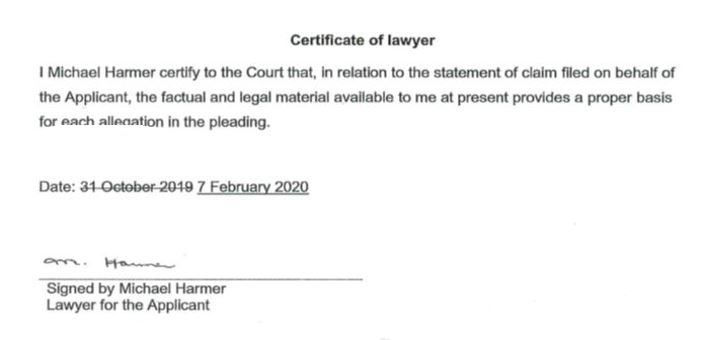
Other than in respect to the date, the certification was the same. It is obviously the person who provided the certification who ultimately bears responsibility for the form of pleading.
96 Although the Federal Circuit Court Rules 2001 (Cth) (“Circuit Court Rules”) do not expressly include a like provision to that set forth in r 16.01(c) of this Court’s Federal Court Rules 2011 (Cth) (“Federal Court Rules”), r 16.01 is nevertheless applicable in the Federal Circuit Court by operation of r 1.05(3)(b) and Sch 3, Pt 2, Item 7 of the Circuit Court Rules. The need to provide such a certification in a pleading in the Federal Circuit Court was not put in issue. A like requirement to that now found in r 16.01(c) of this Court’s current Rules was to be found in Order 11 r 1B of the now-repealed Federal Court Rules 1979 (Cth), as amended in 2004.
97 An object and purpose sought to be achieved by a “certification” requirement is to ensure that a responsible legal practitioner has directed their mind to the question as to whether each of the allegations being made can be – in their opinion – sustained. Allegations for which there is no material available as at the date of filing a pleading should not be made. The requirement to certify a pleading imposes an intellectual discipline upon a legal practitioner to properly consider the basis upon which “each allegation” is being advanced for resolution. A certification, however, does not go beyond that and impose an obligation on the person preparing the pleading to form some assessment as to prospects of success: Optiver Australia Pty Ltd v Tibra Trading Pty Ltd [2008] FCAFC 133, (2008) 169 FCR 435. Heerey, Gyles and Middleton JJ there observed in part (at 442):
[33] …even with this new obligation, a practitioner is not required to make some qualitative assessment of the prospects of success. Providing there is some evidence, and the gist of that evidence is properly pleaded and particularised, the pleading will be not merely “bare”, but proper and adequate.
(emphasis in original).
The provision of a certification, nevertheless, does not “overcome the failure of a proper factual basis to be pleaded or particularised”: Australian Parking and Revenue Control Pty Ltd v Reino International Pty Ltd [2016] FCA 744 at [51] per Perry J.
98 Certification provisions must be seen as forming an important part of the more generally expressed duty to conduct litigation in both the Federal Circuit Court and this Court in a manner that is consistent with the overarching purpose to act “as quickly, inexpensively and efficiently as possible” to facilitate the just resolution of disputes. Unsubstantiated allegations or allegations that are incomplete, and consequential allegations as to the causes of action relied upon, should not be made. Such allegations expose both the opposing parties to unnecessary expense and fail to provide the assistance that the legal advisors properly owe to the Court itself.
99 The provision of a certificate is not a mere formal requirement that must be “ticked off” before filing a pleading.
100 A failure on the part of a legal practitioner to properly turn their mind to whether on the materials then available there is a “proper basis for each allegation”, and the importance of properly directing their mind to the necessity to make all allegations of fact necessary to be established in order to thereafter properly plead a cause of action, may attract an order for costs being directly made against those who provide certifications.
101 Whether an adverse costs order may be appropriate will obviously depend upon the facts and circumstances of each individual case. Deficiencies in pleadings which may only be exposed after argument may well not attract an adverse costs order. But the more fundamentally deficient the allegations of fact, the greater may be the likelihood that attention will be directed to whether a costs order against a legal practitioner should be at least considered. The circumstances of an individual case may also be such that the Court itself may require the practitioner who provided the certification to attend in court and provide an explanation as to how a manifestly deficient pleading came be to be certified. A standard of pleading perfection may not be required; but a standard of professional competence should be the bare minimum.
102 Whether it is appropriate for this Court to make an order for the costs confined to the costs incurred in conducting the proceeding in this Court, and to refrain from making any order in respect to the costs incurred in the earlier Federal Circuit Court proceeding, remains a matter to be addressed in the submissions to be filed by the parties. It is the Federal Circuit Court, of course, which had to deal with (at least initially) the pleadings as certified. In the submissions to be filed the parties may consider it prudent to address the question as to whether any individual legal representative should be the subject of a personal costs order, and whether any such application would be more appropriately made to the Federal Circuit Court.
I certify that the preceding thirteen (13) numbered paragraphs are a true copy of the Reasons for Judgment of the Honourable Justice Flick. |
Associate:
Dated: 4 March 2021
NSD 615 of 2020 | |
CAPTAIN BRETT FOXELY CONOLLY | |
Fifth Respondent: | CAPTAIN PHILIP SCHWARZ |
Sixth Respondent: | CAPTAIN SEAN WALLACE |
Seventh Respondent: | CAPTAIN HAROLD BOYD |
Eighth Respondent: | CAPTAIN JEREMY SCHMIDT |
Ninth Respondent: | CAPTAIN MARK WHEELER |
Tenth Respondent: | CAPTAIN MICHEAL KRAUSSE |
NSD 786 of 2020 | |
Respondents | |
Fourth Respondent: | CAPTAIN DAVID MCCUTCHEON |
Fifth Respondent: | CAPTAIN BRETT FOXELY CONOLLY |
Sixth Respondent: | CAPTAIN PHILLIP SCHWARTZ |
Seventh Respondent: | CAPTAIN SEAN WALLACE |
Eighth Respondent: | CAPTAIN HAROLD BOYD |
Ninth Respondent: | CAPTAIN JEREMY SCHMIDT |
Tenth Respondent: | CAPTAIN MARK WHEELER |
Eleventh Respondent: | CAPTAIN MICHAEL KRAUSSE |


