

FEDERAL COURT OF AUSTRALIA
Meat and Livestock Australia Limited v Branhaven LLC [2020] FCAFC 171
Table of Corrections | |
In Legislation “Federal Court of Australia Act 1976 (Cth) s 158(2)” be deleted and “Patents Act 1990 (Cth)” be amended to read “Patents Act 1990 (Cth) ss 40, 60(4), 102, 105(1A), 112, 112A, 158(2), 160” | |
In paragraph [6] “s 158(2) of the Federal Court of Australia Act 1976 (Cth)” be amended to read “s158(2) of the Act” |
ORDERS
MEAT AND LIVESTOCK AUSTRALIA LIMITED (ACN 081 678 364) Applicant | ||
AND: | First Respondent SELECTRAITS GENOMICS LLC Second Respondent | |
DATE OF ORDER: |
THE COURT ORDERS THAT:
1. The application for leave to appeal be dismissed.
2. The applicant pay the respondents’ costs of the said application.
Note: Entry of orders is dealt with in Rule 39.32 of the Federal Court Rules 2011.
THE COURT:
Introduction
1 Before us is an application for leave to appeal and, if leave to appeal is granted, an appeal from a decision of the primary judge made pursuant to s 105(1A) of the Patents Act 1990 (Cth) (“the Act”) amending claims of the Patent Application No 2010202253 (“the patent application”).
2 The applicant’s opposition to the patent application was unsuccessful except in relation to claim 13 which the delegate of the Commissioner of Patents (“the delegate”) found lacked clarity. The grounds of opposition raised included lack of inventive step, insufficiency, lack of fair basis, and manner of manufacture.
3 The applicant filed an appeal against the delegate’s decision which was heard by the primary judge. His Honour delivered two judgments. The first (“PJ1”) rejected all grounds of opposition relied upon by the applicant except in relation to clarity: Meat & Livestock Australia Limited v Cargill, Inc [2018] FCA 51. His Honour found that claim 1 lacked clarity in two respects but made orders permitting the patent applicants to make an application to amend the claims in order to overcome the lack of clarity. The other grounds of opposition relied upon by the applicant included lack of novelty, lack of inventive step, insufficiency, lack of fair basis and manner of manufacture. The applicant does not challenge any aspect of his Honour’s decision in relation to those matters.
4 His Honour’s second judgment (“PJ2”) deals with an application to amend the patent application that the respondents filed in the proceeding after publication of PJ1: Meat & Livestock Australia Limited v Cargill, Inc (No 2) [2019] FCA 33. On 23 January 2019 his Honour ordered the patent application be amended. The amendments ordered by his Honour included amendments to existing claims, other amendments introducing additional dependent claims, and an amendment deleting claim 13.
5 As his Honour notes in PJ2 in July 2018 one of the patent applicants, Cargill, Inc (“Cargill”) assigned all of it interest in the patent application to SelecTraits Genomics LLC (“SelecTraits”). The respondents to the proposed appeal are one of the two original patent applicants, Branhaven LLC (“Branhaven”) and SelecTraits.
Leave to Appeal
6 Leave to appeal is required by s 158(2) of the Act. The principles guiding the exercise of the Court’s discretion to grant leave to appeal under s 158(2) were considered by the Full Court in Genetics Institute Inc v Kirin-Amgen Inc (1999) 92 FCR 106 at [19]-[23]. Generally speaking, an application for leave to appeal against a judgment allowing a patent application (with or without amendment) to proceed to grant should only be granted where the applicant has demonstrated a clear prima facie case of error in the judgment the subject of the proposed appeal, and where the likely effect of that error would be to allow an invalid patent to proceed to grant.
7 The applicant relied on two matters in support of its application for leave to appeal. The first concerned the proper construction of s 105(1A) of the Act and whether it provided the primary judge with jurisdiction to make the orders amending the claims. The applicant submitted that the scope of s 105(1A) had not been previously considered by the Full Court and that clarification of the operation of that section in relation to the making of amendment applications was desirable.
8 The second matter relied upon by the applicant in support of its application for leave to appeal concerned the application of s 102 of the Act. The applicant submitted that the primary judge made clear errors in his analysis of the complete specification (“the specification”) and the scope of its disclosure, and that he also applied an incorrect legal test in deciding that the relevant amendments meet the requirements of ss 102(1) and (2).
9 The applicant submitted that the primary judge’s decision with respect to both the proper construction of s 105(1A) of the Act, and the allowability of the relevant amendments more generally, was attended by sufficient doubt as to warrant reconsideration by the Full Court.
10 The application for leave to appeal and the proposed grounds of appeal that are to be relied on by the applicant in the event that leave to appeal is granted were fully argued by both sides.
11 The argument in relation to the proper construction of s 105(1A) was essentially confined to a consideration of the primary judge’s reasons, the relevant statutory provisions and some extrinsic material. We do not think the applicant has raised any serious question as to the correctness of the primary judge’s decision in relation to the meaning or operation of s 105(1A).
12 As to the allowability of the amendments, our assessment of the strength of the applicant’s proposed grounds of appeal necessarily involved a consideration of both of the primary judge’s detailed reasons for judgment for the purpose of acquiring an understanding of the relevant technology and what the applicant said were errors made by his Honour when deciding to allow the relevant amendments. For the reasons set out below, we have come to the very clear conclusion that the primary judge did not commit any of the errors that the applicant sought to attribute to him in either the applicant’s proposed grounds of appeal or the applicant’s submissions.
13 In the circumstances, we think it appropriate to order that the application for leave to appeal be dismissed with costs.
Relevant Legislative Provisions
14 Relevant provisions of the Act include ss 102 and 40(3) of the Act in the form they stood prior to the Intellectual Property Laws Amendment (Raising the Bar) Act 2012 (Cth) (“the Raising of the Bar Act”) taking effect.
15 Section 102 of the Act relevantly provided:
102 What amendments are not allowable?
Amendment of complete specification not allowable if amended specification claims or discloses matter extending beyond that disclosed in the filed specification
(1) An amendment of a complete specification is not allowable if, as a result of the amendment, the specification would claim matter not in substance disclosed in the specification as filed.
Certain amendments of complete specification are not allowable after relevant time
(2) An amendment of a complete specification is not allowable after the relevant time if, as a result of the amendment:
(a) a claim of the specification would not in substance fall within the scope of the claims of the specification before amendment; or
(b) the specification would not comply with subsection 40(2) or (3).
Meaning of relevant time
(2A) For the purposes of subsection (2), relevant time means:
(a) in relation to an amendment proposed to a complete specification relating to a standard patent—after the specification has been accepted; or
…
16 Section 40(3) relevantly required that the claims be “fairly based on the matter described in the specification”.
17 Section 105 of the Act provides:
105 Amendments directed by court
Order for amendment during relevant proceedings
(1) In any relevant proceedings in relation to a patent, the court may, on the application of the patentee, by order direct the amendment of the patent request or the complete specification in the manner specified in the order.
Order for amendment during an appeal
(1A) If an appeal is made to the Federal Court against a decision or direction of the Commissioner in relation to a patent application, the Federal Court may, on the application of the applicant for the patent, by order direct the amendment of the patent request or the complete specification in the manner specified in the order.
Orders for amendment generally
(2) An order under subsection (1) or (1A) may be made subject to such terms (if any) as to costs, advertisements or otherwise, as the court thinks fit.
(3) The applicant for an order under subsection (1) or (1A) must give notice of an application for an order to the Commissioner, who is entitled to appear and be heard, and must appear if the court directs.
(4) A court is not to direct an amendment that is not allowable under section 102.
(5) The applicant must file a copy of an order within the prescribed period.
(6) On the filing of a copy of an order, the patent request or complete specification is to be taken to have been amended in the manner specified in the order.
18 Sections 112 and 112A provide:
A complete specification relating to a patent must not be amended, except under section 105, while relevant proceedings in relation to the patent are pending.
A complete specification relating to a patent application must not be amended, except under section 105, if:
(a) an appeal against a decision or direction of the Commissioner has been made to the Federal Court in relation to the specification; and
(b) the appeal, and any proceedings resulting from it, have not been finally determined, withdrawn or otherwise disposed of.
19 The phrase “relevant proceedings” is defined in Sch 1 of the Act to mean:
relevant proceedings, in relation to a patent, means court proceedings:
(a) for infringement of the patent; or
(b) for revocation of the patent; or
(c) in which the validity of the patent, or of a claim, is in dispute.
20 Section 105(1A) and s 112A were introduced into the Act by the Raising of the Bar Act which took effect in 2013. Prior to the introduction of s 105(1A) the Court had no power to direct amendment of a patent application in an appeal brought in respect of a decision by the Commissioner under s 60(4) of the Act.
21 We should also refer to s 160 of the Act which provides as follows:
On hearing an appeal against a decision or direction of the Commissioner, the Federal Court may do any one or more of the following:
(a) admit further evidence orally, or on affidavit or otherwise;
(b) permit the examination and cross-examination of witnesses, including witnesses who gave evidence before the Commissioner;
(c) order an issue of fact to be tried as it directs;
(d) affirm, reverse or vary the Commissioner’s decision or direction;
(e) give any judgment, or make any order, that, in all the circumstances, it thinks fit;
(f) order a party to pay costs to another party.
Scientific Background
22 In eukaryotic cells, genetic information is stored in structures called chromosomes. Each chromosome consists of a complex three-dimensional structure made of deoxyribonucleic acid (“DNA”), which has been coiled around support and scaffold proteins.
23 The basic structural unit of DNA is called a nucleotide. There are four different kinds of nucleotides, each consisting of an identical pentose sugar group, an identical phosphate group (which together form the “sugar-phosphate backbone”), and one of four nitrogenous bases (adenine: A; guanine: G; thymine: T; and cytosine: C). A DNA sequence is an arrangement of unique combinations of these four bases. A DNA sequence can be divided into contigs which are contiguous sequences of DNA created by assembling overlapping fragments of DNA on a chromosome.
24 DNA exists in the form of a double helix comprising two complementary strands which are bound together via hydrogen bonding between specific complementary (base paired) nucleotides (A bonds with T and C bonds with G). As such, each strand provides a complementary template of the other strand.
25 A gene is the basic unit of heredity in organisms. It consists of a contiguous sequence of DNA which encodes for a particular protein. When the code in a gene is read, the DNA comprising that gene unwinds and the two strands separate. An enzyme called RNA allows a complimentary copy of a strand of DNA to be made. The copy is made from RNA nucleotides. The RNA carries the coded genetic information to the protein producing units in the cell. DNA and RNA are both types of nucleic acids.
26 Proteins work together to contribute to traits. A trait can be produced from one gene, but they are usually the result of the activity of a combination of genes.
27 Genes can differ between organisms. Alternative forms of the same gene are referred to as alleles. An allele is a variant of a similar DNA sequence located at the same position on a chromosome. The location of a gene or particular DNA sequence on a chromosome is known as its locus. The term allele can be used to refer to a variant form of a gene (ie. an allele of the gene) or it can refer to a variation at a particular locus.
28 Many genes can be physically clustered together on a single chromosome. Depending upon their proximity to one another, they may have a propensity to be inherited together. This concept is called linkage. Linkage describes the association of genes on the same chromosome.
29 DNA can be duplicated to permit the genetic information to be passed on to daughter cells via a process called mitosis (or alternatively known as cell replication). During this process, the strands of DNA separate and each strand is used as a template to produce a second complementary strand.
30 Cells have extensive proof-reading and error-checking abilities, which ensures that DNA is generally replicated, and passed onto daughter cells, unchanged. However, changes in the DNA sequence, known as mutations, can occur due to errors in the replication of DNA.
31 The simplest form of mutation is called a point mutation. This type of mutation arises when a single nucleotide is substituted by another single nucleotide (eg. A mutates to a G) at a specific locus on the chromosome. An individual carrying this mutation may pass it on to many descendants so that both the original form (A) and the mutated form (G) exist in the population. When there are variants of a particular DNA sequence in the population, they are known as polymorphisms. The most common type of polymorphism involves variation at a single base pair at a specific loci, called a single nucleotide polymorphism (“SNP”). The different variations of the SNPs are called the alleles of the SNP.
32 SNPs can be identified by extracting a sample of DNA from individuals, sequencing the DNA and comparing the sequence from several individuals within the same species. There are many positions at which polymorphisms tend to exist on chromosomes in cattle.
33 Another cause of genetic variation in a population is sexual reproduction. Genetic variation is introduced during a process known as meiosis. The genetic information in cattle is contained in homologous pairs of chromosomes. This means that one chromosome of each homologous pair comes from the mother and one comes from the father. Each chromosome carries the same genes in the same order, but the alleles for each trait may not be the same. During meiosis, the chromosomes in each homologous pair swap genetic material with each other to form new, genetically unique, chromosomes. This process is known as chromosomal recombination. The recombination process is random and can happen at almost any position along the chromosome. Consequently, the likelihood that alleles at two loci on any one chromosome will be inherited together is partly dependent on the distance between the two loci.
The patent application
34 The patent application was filed on 1 June 2010. It is entitled “Compositions, methods and systems for inferring bovine traits” and is concerned with the use of genetics in genetic improvement programs and molecular breeding programs for cattle. The specification describes the field of the invention as generally relating to gene association analyses and, more specifically, to polymorphisms and associated traits of bovine species.
35 The submissions made on behalf of the applicant in support of the proposed appeal related entirely to one of the amendments to claim 1 which introduced into the claim the words “and is in linkage disequilibrium with the SNP at position 300 with an r2 value of ≥0.7”. It was not submitted that, in the event the order amending claim 1 was upheld, any of the other amendments ordered by his Honour should be disallowed. Accordingly, these reasons focus on the relevant amendment to claim 1.
Claim 1
36 Claim 1 before amendment read as follows:
1. A method for identifying a trait of a bovine subject from a nucleic acid sample of the bovine subject, comprising identifying in the nucleic acid sample an occurrence of at least three single nucleotide polymorphisms (SNPs) wherein the at least three SNPs are associated with the trait, and wherein the at least three SNPs occur in more than one gene
and wherein at least one of the SNPs corresponds to position 300 of any one of SEQ ID NOS: 19473 to 21982, or
the SNP is about 500,000 or less nucleotides from position 300 of any one of SEQ ID NOS: 19473 to 21982.
37 Claim 1 after amendment (indicated in strikethrough/underlining) read as follows:
1. A method for identifying a trait of a bovine subject from a nucleic acid sample of the bovine subject, comprising identifying in the nucleic acid sample an occurrence of at least three single nucleotide polymorphisms (SNPs) wherein each of the at least three SNPs are significantly associated with the trait, with the degree of statistical significance being p≤0.05, and wherein the at least three SNPs occur in more than one gene; and wherein
and wherein(a) at least one of the SNPs corresponds to position 300 of any one of SEQ ID NOS: 19473 to 21982, or
(b) the SNP is about 500,000 or less nucleotides from position 300 of any one of SEQ ID NOS: 19473 to 21982 and is in linkage disequilibrium with the SNP at position 300 with an r2 value of ≥0.7.
For convenience we will from time to time refer to para (a) and para (b) in claim 1 as limb (a) and limb (b) and to a “limb (a) SNP” and a “limb (b) SNP”. We will use these descriptors not only to identify relevant requirements of the claim but also when referring to corresponding features of the invention more generally described in the specification.
38 The relevant amendment is the underlined portion in limb (b). As previously mentioned, the applicant’s proposed appeal does not raise any issue in relation to the other amendments made to claim 1.
39 The claim in its amended form is to a method for identifying a trait of a bovine from a sample of its nucleic acid (which could be DNA or RNA) by identifying SNPs in the sample that are associated with the trait. The method involves identifying at least three SNPs, each of which must be “significantly associated” (p-value less than or equal to 0.05) with the trait. At least one of those SNPs must be located at position 300 on one of the relevant contigs or within about 500,000 nucleotides of position 300 on any of the relevant contigs, and in linkage disequilibrium with the SNP at that position with an r2 value of 0.7 or greater.
40 Claim 1 in its amended form involves the following five key concepts:
traits;
SNPs (single nucleotides polymorphisms);
linkage;
linkage disequilibrium; and
the r2 statistic.
We will briefly explain these concepts and their relevance to the specification.
41 A trait, also referred to as a phenotypic trait, is a characteristic of an organism that manifests itself in a phenotype. The appearance of an organism is referred to as its phenotype, whether generally or with respect to a particular trait. A phenotype may be the product of genetics and the environment. The genetic contribution to a phenotype is sometimes referred to as the genotype.
42 A distinction is drawn between qualitative traits and quantitative traits. A qualitative trait is one in which there is a clear difference between the presence of or the absence of a trait. For example, in cattle, horned or polled (no horns) status is a qualitative trait which is usually determined by one or two genes that control that phenotype. Quantitative traits, on the other hand, can vary continuously from animal to animal. Although quantitative traits are sometimes attributed to one gene, they are usually the result of the activity of a combination of genes on different chromosomes.
43 According to the specification at [0090]:
… Traits analyzed in methods of the present invention include, but are not limited to, marbling, tenderness, quality grade, quality yield, muscle content, fat thickness, feed efficiency, red meat yield, average daily weight gain, disease resistance, disease susceptibility, feed intake, protein content, bone content, maintenance energy requirement, mature size, amino acid profile, fatty acid profile, milk production, hide quality, susceptibility to the buller syndrome, stress susceptibility and response, temperament, digestive capacity, production of calpain, calpastatin and myostatin, pattern of fat deposition, ribeye area, fertility, ovulation rate, conception rate, fertility, heat tolerance, environmental adaptability, robustness, susceptibility to infection …
44 Quantitative trait loci (“QTLs”) are stretches of DNA containing or linked to particular genes that correlate with a quantitative trait. In this context, “linked” refers to a quantitative trait that is associated with, or attributable to a QTL.
45 As we have previously mentioned, segments of DNA of one individual at a locus that is different from the DNA at the same locus of another individual are called alleles. The term allele can be used to refer to a variant form of a gene or may refer to a variation at a particular locus. A polymorphism refers to one of two or more variants of a particular DNA sequence.
46 The terms polymorphism and haplotype are defined in the specification at [0076]-[0077]:
[0076] Polymorphisms are allelic variants that occur in a population that can be a single nucleotide difference present at a locus, or can be an insertion or deletion of one, a few or many consecutive nucleotides. As such, a single nucleotide polymorphism (SNP) is characterized by the presence in a population of one or two, three or four nucleotides (i.e., adenosine, cytosine, guanosine or thymidine), typically less than all four nucleotides, at a particular locus in a genome such as the human genome. It will be recognized that, while the methods of the invention are exemplified primarily by the detection of SNPs, the disclosed methods or others known in the art similarly can be used to identify other types of bovine polymorphisms, which typically involve more than one nucleotide.
[0077] The term “haplotypes” as used herein refers to groupings of two or more SNPs that are physically present on the same chromosome which tend to be inherited together except when recombination occurs. The haplotype provides information regarding an allele of the gene, regulatory regions or other genetic sequences affecting a trait The linkage disequilibrium and, thus, association of a SNP or a haplotype allele(s) and a bovine trait can be strong enough to be detected using simple genetic approaches, or can require more sophisticated statistical approaches to be identified.
An SNP is a common type of allelic variant which has a difference in a single nucleotide. For example, an SNP may include the nucleotide cytosine (“C”) with the nucleotide thymine (“T”) instead of the nucleotide glycine (“G”) in a particular DNA sequence. SNPs can act as biological markers that assist in locating genes associated with particular traits.
47 Linkage is the close association of genes or DNA markers on the same chromosome. The closer two genes or markers are to each other, the greater the probability that they will be inherited together.
48 Linkage disequilibrium (“LD”) is a concept used in population genetics to describe a non-random association of alleles at two or more loci on the same chromosome reflecting haplotypes descended from a single ancestral chromosome. LD is a measure of whether an allele at one locus tends to be found more often with an allele at another locus. An SNP that is in linkage disequilibrium with an SNP that is associated with a trait may be used in lieu of that SNP for the purpose of predicting the presence or absence of the trait. The markers in linkage disequilibrium with the SNPs associated with the trait may themselves be used as markers of the trait.
49 LD is influenced by a number of factors. According to the specification of the patent at [0199]: “The degree of LD varies considerably throughout the genome and is a function of time, recombination events, mutation rate and population structure”. In particular, the distance between alleles at different loci influences the LD between them. The closer two alleles are to each other on a chromosome, the greater the probability that they will be closely linked. Furthermore, as recombination happens during meiosis, the chance of alleles at two loci being separated increases for each successive generation. This means that LD between SNPs at two loci decays each generation due to recombination. Finally, the rate of recombination varies throughout the genome. Certain regions of chromosomes have a higher propensity to recombine that other regions.
50 When measuring the LD between two SNPs, the measure is also influenced by the period of time between the respective SNPs arising. The greater the period of time between the SNPs arising in the population, the lower the level of LD on average. If the first SNP arose several thousand years ago in a given population and the second SNP arose in the last decade in that population, then the two SNPs would generally be in very low LD with each other.
51 There are various ways to measure the degree of LD. One measure is the correlation between the alleles at the two loci. Correlation can be measured using the r2 statistic which is derived from an r value which can range from -1 to +1. An r value of 1 indicates a perfect positive linear correlation while an r value of -1 indicates a perfect negative correlation. An r value of 0 indicates that there is no linear correlation. The value of r can be squared to r2 so as to provide a range between 0 and 1 in situations where there is no need to measure negative correlation. The closer the value of r2 to 1 the higher the correlation.
The Description of the Invention
52 The specification contains a summary of the invention extending over eight paragraphs. The specification states at [0023]:
[0023] The present invention provides methods, systems, and compositions that allow the identification and selection of cattle with superior genetic potential for desirable characteristics. Accordingly, the present invention provides methods, compositions, and systems for managing, selecting and mating, breeding, and cloning cattle. These methods for identification and monitoring of key characteristics of individual animals and management of individual animals maximize their individual potential performance and edible meat value. The methods of the invention provide systems to collect, record and store such data by individual animal identification so that it is usable to improve future animals bred by the producer and managed by the feedlot. The methods, compositions, and systems provided herein utilize information regarding genetic diversity among cattle, particularly single nucleotide polymorphisms (SNPs), and the effect of nucleotide occurrences of SNPs on important traits.
And at [0029]-[0030]:
[0029] In another embodiment, the present invention provides a method for identifying a bovine target sequence, such as a gene, associated with a trait, by identifying an open reading frame present in a target region of the bovine genome, wherein the target region is located on the bovine genome less than or equal to about 500,000 nucleotides of a single nucleotide polymorphism (SNP) corresponding to position 300 of any one of SEQ ID NOS:19473 to 21982, and analyzing the open reading frame to determine whether it affects the trait, thereby identifying a bovine gene associated with the trait. In one aspect, the target region is located within about 5000 nucleotides of a single nucleotide polymorphism (SNP) corresponding to position 300 of any one of SEQ ID NOS:19473 to 21982.
[0030] In another embodiment, the present invention provides a method for identifying a bovine single nucleotide polymorphism (SNP) associated with a trait, that includes identifying a test SNP in a target region of a bovine genome, wherein the target region is less than or equal to about 500,000 nucleotides of a SNP position corresponding to position 300 of one of SEQ ID NOS:19473 to 21982, and identifying an association of the test SNP to the trait, thereby identifying the test SNP as associated with the trait In certain aspects, the target region includes at least 20 contiguous nucleotides of SEQ ID NOS:24493 to 64886. In another aspect, for example, the target region includes at least 20 contiguous nucleotides of SEQ ID NOS:19473 to 21982. The present invention also provides isolated polynucleotides that include the identified SNPs.
53 The specification also includes a detailed description of the invention. The specifications states at [0035]:
[0035] In one embodiment, the present invention provides an isolated polynucleotide that includes a fragment of at least 20 contiguous nucleotides of the bovine genome, or a complement thereof, wherein the isolated polynucleotide includes a nucleotide occurrence of a single nucleotide polymorphism (SNP) associated with a trait, wherein the SNP is in disequilibrium with a SNP corresponding to position 300 of any one of SEQ ID NOS:19473 to 21982. In certain aspects, the polynucleotide is located about 500,000 or less nucleotides from position 300 of SEQ ID NOS:19473 to 21982 on the bovine genome. As disclosed in the Examples herein, the linkage disequilibrium for cattle is about 500,000 nucleotides. Therefore, it is expected that other SNPs can be identified that are associated with the same traits based on the fact that these other SNPs are located less than or equal to about 500,000 nucleotides of the identified associated SNP on the bovine genome. In certain aspects, the polynucleotide is from an Angus, Charolais, Limousin, Hereford, Brahman, Simmental or Gelbvieh bovine subject.
None of the claims of the patent application is to an isolated polynucleotide. Nevertheless, the description at [0035] is significant in so far as it describes the relationship between SNPs located at position 300 of SEQ ID NOS: 19473 to 21982 and other SNPs located about 500,000 or less nucleotides from that position. The specification teaches that it is expected that other SNPs can be identified that are associated with the same traits based on the fact that they are located within a certain distance of the SNP located at position 300.
54 The detailed description of the invention also includes the following at [0126]-[0127]:
[0126] In another embodiment of the invention, a method is provided for identifying SNPs that are associated with a trait by using the associated SNPs disclosed herein. The method is based on the fact that other markers in close proximity to the associated SNP marker will also associate with the trait because markers in linkage disequilibrium with the associated SNP marker will also be in linkage disequilibrium with the gene(s) influencing the trait. SNPs in linkage disequilibrium can be used in lieu of determining a SNP or mutation to predict the presence or absence of a phenotypic trait or contributor to a phenotypic trait. Accordingly, in certain embodiments, the present invention provides a method for identifying a SNP associated with a trait, that includes identifying a test SNP that is in disequilibrium with a SNP corresponding to position 300 of SEQ ID NOS:19473 to 21982.
[0127] As illustrated in the Examples section, it has been determined that disequilibrium exists across the region of 500,000 bp from the associated SNP in each direction. Other markers within this 500,000 bp region will also be in disequilibrium with the associated SNP and with the trait of interest, and can be used to infer associations with the trait of interest. Genomic segments containing the markers can be adjacent to the associated SNP marker or contained within a separate island of sequence distant from the associated SNP.
The specification makes clear in paragraph [0127] that there will be other markers within 500,000 base pairs of position 300 of SEQ ID NOS: 19473 to 21982 that will be in linkage disequilibrium with the SNP at position 300 allowing them to be used to predict the presence or absence of a particular trait. It is not suggested that all SNPs within that distance will be in linkage disequilibrium with the SNPs at position 300.
55 The specification includes a number of examples that are used to illustrate the invention.
56 Example 1 is an illustration of the generation of a high density bovine genetic SNP map created through a whole genome sequencing of the bovine genome using the shotgun sequencing approach. Shotgun sequencing is a laboratory technique used for determining the DNA sequence of a genome which involves breaking the genome into a collection of small DNA fragments that are sequenced individually. A computer is then used to identify the overlaps in the DNA sequences and to place individual fragments in their correct order to reconstitute the genome. Each of the overlapping DNA sequences (or “contigs”) is given an identifying number. For example, one of the relevant SNPs discussed in the examples is identified in the specification as SNP3 (SNP MMBT22302) which is located at position 300 on the contig identified as SEQ ID No 19666.
57 Example 2 illustrates how the high density SNP map was used to identify the SNPs associated with a series of bovine traits. These traits include marbling, tenderness, fat thickness, yield, and daily gain. According to the specification there are 2510 SNPs associated with those five traits. These SNPs are identified in electronic files incorporated by reference into the specification. These electronic files include tables that identify the 2510 SNPs and the traits with which they are associated and other SNPs within a distance of 500,000 nucleotides of them.
58 Example 3 is as follows:
Example 3
Determination of the distance of disequilibrium in cattle
[0198] This example utilizes a few of the associated SNPs disclosed in Example 2, to identify additional SNPs that are associated with the same traits, using the physical proximity on the genome of the SNPs. Furthermore, the results are used to calculate a distance of disequilibrium in cattle. In this example, “shear force” is used to refer to tenderness, “vision retail yield” is used to refer to retail yield, and “average daily gain” is used to refer to daily gain.
[0199] In the past 10 years numerous methods have been developed to identify alleles associated with phenotypic effects, traits or diseases. Linkage disequilibrium and measures of linkage disequilibrium have been of particular interest for studies of complex traits or diseases … LD occurs where blocks or regions of neighboring markers are co-inherited from a common ancestor. The degree of LD varies considerably throughout the genome and is a function of time, recombination events, mutation rate and population structure. The extent of LD can vary from a few thousand base pairs to several centimorgans. This has been most extensively documented in human studies … Similar results have been observed in other species including cattle … These studies and others have also shown that a SNP or multiple SNPs associated with a phenotype can be used as predictive of gene(s) causing differences in trait phenotypes within a region of high LD although they may or may not be the precise causative gene … While it has been established that markers can be identified that associate with a specific trait, and, therefore, become diagnostic for the trait, the distance that disequilibrium reaches has not been determined in cattle with a dense marker map. Therefore, an experiment to determine the disequilibrium distance in cattle was performed using the high-density SNP map disclosed in Example 1.
[0200] The high-density SNP map disclosed in Example 1 was used to identify SNPs that are in physical proximity to a few of the associated SNPs disclosed in Example 2. Nucleotide occurrences of the SNPs were determined using the method disclosed in Example 2. A determination of whether on-test SNPs was associated with a trait was performed as disclosed in Example 2.
[0201] As discussed above, the study was performed to verify the assumption that markers that are in close physical proximity on the bovine genome will associate with the same trait(s) because markers in linkage disequilibrium with the associated SNP marker will also be in linkage disequilibrium with the mutation(s) influencing the trait.
[0202] As indicated in Table 2, SNP3 (MMBT22302) is significantly associated with the trait of average daily gain (“ADG” in Table 2). Several SNPs were identified using the high-density SNP map of Example I that are located at various distances from SNP3 on the bovine genome (Table 2). For example, SNP2 is 466,047 nucleotides from SNP3. Furthermore, SNP5 was identified which is 408,732 nucleotides from SNP3. SNP6 was identified which is 1.0 million nucleotides from SNP3. Finally, SNP4 was identified, which is 308,742 nucleotides.
[0203] As illustrated in Table 2, SNPs that were located within 500,000 nucleotides of SNP3 also were associated with average daily gain, whereas those that were located greater than 500,000 nucleotides from SNP3 were not associated with average daily gain. For example, linkage disequilibrium reaches 466,047 bases to SNP2, but not to SNPI at 1.5 Mb; linkage disequilibrium reaches to 408,732 bases to SNP5, but not to SNP6 at 1.0 Mb. SNP4, which is 308,742 nucleotides from SNP3, was discovered by sequencing the contig of DNA that maps to this region in 4 different breeds of cattle. It is also in disequilibrium with average daily gain.
[0204] Table 2. Disequilibrium analysis in relation to SNP distance from MMBT22302.
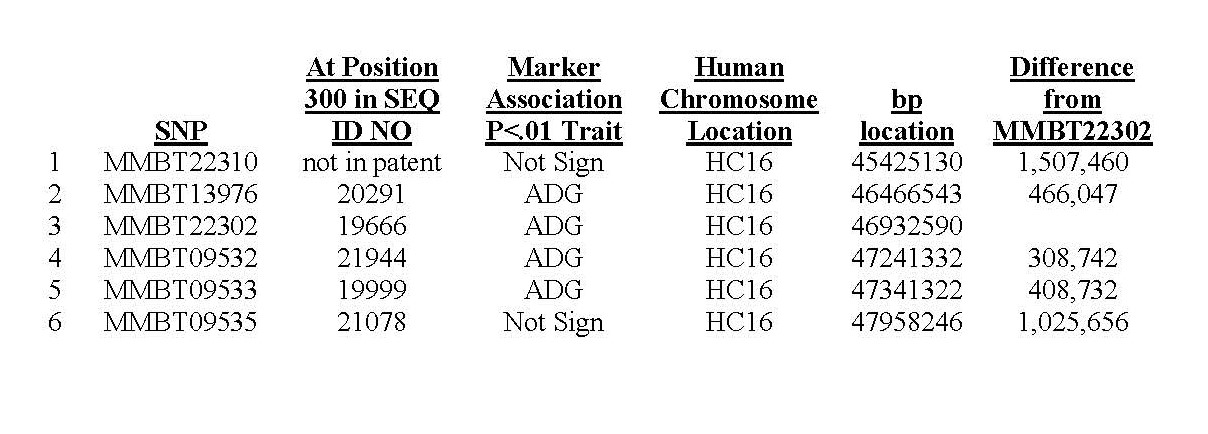
59 The disequilibrium analysis presented in Table 2 shows that the four other SNPs within 500,000 base pairs of SNP3 are also associated with the average daily gain trait with which SNP3 is associated. The remaining two SNPs, neither of which was shown to be associated with that trait, were both located more than 1,000,000 base pairs in either direction of SNP3. A similar analysis appears in Table 3 in relation to SNP9 (MMBT03905) and in Table 4 in relation to SNP16 (MMBT02782).
60 The discussion of Example 3 concludes at [0208]:
[0208] The results of this Example indicate that disequilibrium in cattle exists across the region of 500,000 nucleotides from an associated SNP, in each direction. Therefore, it is expected that when an associated SNP is identified, other markers within this 500,000bp region will also be in disequilibrium with the associated SNP and with the trait of interest, and can be used to infer associations with the trait of interest.
61 There are two points to note about paragraph [0208]. First, the results included in Example 3 are said to indicate that disequilibrium (which in this context we understand to refer to LD) in cattle will exist within a distance of 500,000 nucleotides in either direction from SNP3 (or the other SNPs identified in Example 3 that are shown to be associated with a relevant trait). Secondly, these results are said to give rise to an expectation that other SNPs within the 500,000 base pair region either side of SNP3 will also be in disequilibrium with SNP3. This is said to provide an additional basis for inferring associations between SNPs located within the specified region and the relevant trait.
62 What to our minds is most significant about paragraph [0208] is that it does not expressly or impliedly suggest that every SNP within the 500,000 base pair region of an associated SNP will be in disequilibrium with the associated SNP. Our understanding of this part of the specification is confirmed by statements that appear in other parts of the document, and expert evidence accepted by the primary judge, which shows that the degree of LD between two polymorphisms is influenced by a number of different factors in addition to distance between their loci.
The proposed grounds of appeal
63 Grounds 1, 2 and 3 of the draft notice of appeal contend that the primary judge erred in holding that the Court had jurisdiction or power to hear and determine an amendment application after the Court had finally determined all issues in an appeal from an opposition proceeding. These grounds raise for consideration the proper construction of s 105(1A) of the Act and its operation in the circumstances of the case.
64 Grounds 4 to 8 of the draft notice of appeal concern the question whether the relevant amendment to claim 1 met the requirements of s 102 of the Act.
65 According to grounds 4 to 8 of the draft notice of appeal:
The r2 amendment was not “in substance disclosed” in the ‘253 Application
4. The primary judge erred in finding and holding (judgment at [269] to [281]) that the proposed amended claims claimed matter “in substance disclosed” in the specification as filed, as required by section 102(1) of the Act.
Particulars
a. The primary judge applied the same test to “in substance disclosed” as for “fair basis” (i.e. “real and reasonably clear disclosure”: Lockwood Security Products Pty Ltd v Doric Products Pty Ltd) (judgment at [197]).
b. The primary judge erred in finding and holding that the test for “fair basis” was satisfied.
c. There is no disclosure in the specification at all of a requirement for linkage disequilibrium (LD):
i. measured other than by distance;
ii. measured using an r2 value;
iii. having an r2 value greater than 0.7 or 0.8.
d. The proposed amendments introduced a new and different measure for LD from that described in the specification, and a particular degree of that measure.
5. The primary judge erred in finding and holding that the proposed amended claims claimed matter that was “in substance disclosed” in the specification as filed because:
a. the amendments were merely “narrowing amendments” (judgment at [270]);
b. “the measure of LD and its degree ... are truly limiting features and matters of detail to the LD aspect already disclosed” (judgment at [272]);
c. “Branhaven is narrowing its claims consistently with well understood concepts forming part of the common general knowledge at the priority date” (judgment at [273]);
d. a specific degree for LD could be added as a feature of the invention by way of amendment if it were “consistent” with the disclosure in the specification (judgment at [276], [279], [280], see also judgment [285] and [288]);
e. “all that is being done in the proposed amendments is to use a common general knowledge measure of LD to provide an explicit definition of a feature of the invention that is already disclosed (implicitly or explicitly)” in the specification (judgment at [278]);
f. one of a number of measures of LD that was common general knowledge could be added as a feature of the invention by way of amendment even though not disclosed in the specification (Judgment at [273] to [281]); and
g. it was sufficient that the degree of LD was “objective and clear, and would have been measurable by the skilled person in December 2002” (judgment at [281]).
6. Having found that:
a. the specification only describes that LD is measured by distance from a specified SNP (judgment at [236], referring to principal reasons at [356] to [357], see also judgment at [176], [182], [275] and [409]);
b. there was no requirement in the specification as to degree of LD (judgment at [255]);
c. there was no disclosure of measurement of LD by the r2 measure (judgment at [281]); and
d. there was no disclosure of any particular r2 value, and the r2 value of greater than 0.7 or 0.8 was arbitrary (judgment at [183], [242]-[243], [280] and [283]-[284]):
the primary judge ought to have found and held that the proposed amended claims claimed matter that was not “in substance disclosed” in the specification as filed.
The proposed amended claims lack fair basis and do not define the invention
7. The primary judge erred in finding and holding (judgment at [293]) that the proposed amended claims would be fairly based on the specification and define the invention, as required by section 102(2)(b) of the Act.
Particulars
(a) The Appellant relies on the findings of the primary judge set out in paragraphs 6 a to d.
(b) The requirement for a measurement of LD using an r2 value introduces an “entirely new integer” (judgment at [273]) such that the claims, as a result of the amendment, are to a different invention from the invention described in the specification.
8. Having made the findings set out in paragraphs 6 a to d, the primary judge ought to have found and held that the proposed amended claims would not be fairly based on the specification and would not define the invention.
66 The applicant did not suggest that there was any relevant difference between the requirement that the invention defined by the claim be in substance disclosed in the specification as filed and the requirement that the claim be fairly based on matters described in the specification. The application was conducted on the basis that the question whether the claim extended beyond matter disclosed in the specification as filed and the question whether the claim was fairly based for the purposes of s 40(3) of the Act were for all practical purposes the same, and that both required a consideration of whether there was a real and reasonably clear disclosure in the specification of what is claimed.
67 Further, although the draft notice of appeal asserts that claim 1 does not define the invention, it was not suggested by the applicant that this raised any question different from whether there is a real and reasonably clear disclosure in the specification of what was claimed. So far as we understood it, this was simply another way of putting its principal ground of appeal that the amended claim should not have been allowed because it claims an invention not in substance disclosed in the specification as filed.
68 Although the parties referred in their submissions to relevant parts of his Honour’s reasons in which he summarises some of the expert evidence and makes findings based on it, we were not taken to any of the written or oral expert evidence. The parties’ submissions focused entirely on the specification and his Honour’s reasons. It was not suggested that the primary judge’s summation of the expert evidence was in any relevant respect inaccurate or incomplete.
The Primary Judge’s Reasons
69 The primary judge found that claim 1 in its unamended form lacked clarity in so far as it failed to specify a requirement that, in the case of an SNP about 500,000 or less nucleotides from position 300 on one of the relevant contigs, it must be in linkage disequilibrium with the SNP at that location. His Honour dealt with the matter in PJ1 as follows at [348]-[362]:
[348] The first issue to consider is whether limb (b) is just concerned with the distance of the SNP referred to from a specified SNP (limb (a)) or whether it requires that the two SNPs be in LD with each other. Branhaven contends that the skilled person would understand the claim in the latter sense.
[349] Now in my view it is clear that the claim does not expressly refer to a requirement of LD. Nevertheless, Branhaven contends that the body of the specification makes it clear that this is what is entailed by the provision for the use of other SNPs within the +/- 500,000 nucleotide region. Branhaven says that the specification explains that SNPs within that region may be in LD with the specified SNP, and that where they are, they can be used in lieu of the specified SNP in the method of the invention (see at [0035], [0126], [0127], [0128] and Example 3 at [0198] to [0208]). Branhaven contends that adopting a purposive and common sense construction, the requirement of the claim is that LD is required between the limb (a) SNP and the limb (b) SNP.
[350] Further, Branhaven contends that the weight of the expert evidence supports this construction. It says that each of Dr Sonstegard and Professors Plastow and Taylor understood the claim in this way. Further, it says that Professor Hayes’s response to the expert questions revealed a similar understanding of the claim when read in the light of the description in the body of the specification. Further, it is said that Professor Taylor did not change his view in the course of the hearing. Further, it contends that Professor Visscher read the claim too literally and Professor Goddard refused to engage with it.
[351] Further, Branhaven says that it is an important matter of context that the skilled person would understand that not all SNPs within the region of +/- 500,000 nucleotides would be in LD with the specified SNP. It is said that this was clear on the evidence. It is said that the 253 Application does not say so, and references to the identification of “other markers” within the region being in LD with the specified SNP should be understood accordingly. It is said that there is no statement in the 253 Application that all SNPs within the region are in LD with the specified SNP. It is said that the skilled person simply would not expect this to be so.
[352] Further, Branhaven says that MLA’s contention that the references to “other markers” in the specification should be understood, contrary to the accepted scientific fact, to indicate that all other SNPs within the region are in LD involves misreading the description and interpreting the claim in a vacuum, without regard to the background knowledge and understanding of the skilled person.
[353] On the question of the construction of limb (b) and whether LD is implicit, I would reject Branhaven’s arguments.
[354] I do not accept that there is an additional requirement in the claim with respect to limb (b) that LD must be demonstrated for a SNP within the about +/- 500,000 nucleotide region.
[355] Professor Plastow admitted that there was no reference to LD in the words of the claim. Further, the importation of such a requirement into the claims would be adding an impermissible gloss. The specification does not define the words of the claim to have something other than their plain meaning. If LD had been a requirement, one would have expected express words to that effect.
[356] Moreover, in my view if LD were a requirement of the claim, there would have been no need for the region in which the non-specified SNPs are to be found to be defined in the claim at all. It would mean that those words were redundant. I agree with MLA that a construction that would lead to such redundancy is not to be preferred.
[357] Furthermore, and as MLA correctly pointed out, such a construction would be inconsistent with the specification, which explains that SNPs within +/- about 500,000 nucleotides of the specified SNPs are expected to be associated with the same traits as the specified SNPs. Such an “expectation” avoids or negates the need for SNPs within that region to be shown to be in LD with a specified SNP. Indeed, depending on the parameters by which LD is assessed, including population size, all SNPs in the genome can have some degree of LD with each other SNP, as Professor Goddard explained.
[358] Further, even if there were such an LD requirement, the skilled addressee would not know how to measure it. Neither the claims, nor the specification, provide guidance as to the degree of LD required between a non-specified SNP (limb (b)) and a specified SNP (limb (a)).
[359] As the experts explained to me, LD is determined by measuring the frequency at which the presence of two markers (such as SNPs) are found together within individuals in a population. LD is not an all or nothing concept, but a matter of degree. LD is measured between 0 and 1, with 0 indicating no LD (i.e. the SNPs are only found together in individuals at the expected rate) and 1 indicating perfect LD (i.e. the SNPs are always found together). If the degree of LD between a specified SNP and a non-specified SNP is very low, the non-specified SNP would not be expected to be a useful surrogate for the specified SNP.
[360] In my view, Professor Plastow’s attempt to explain how LD would be assessed showed that it was dependent on what approach and outcome the research team wanted. For example, Professor Plastow said LD did not need to be 100% linkage, but could depend on “how much value you’ve captured”. He later explained that it meant “something that looked pretty in linkage disequilibrium” and “it would be a guess or using my experience to determine”. And he ultimately agreed that someone else might make a different judgment call as to what was in LD.
[361] I quite agree with MLA that such a requirement cannot provide a workable standard by which a third party can assess whether or not a SNP falls within limb (b) of claim 1.
[362] In my view, limb (b) fails for lack of clarity absent amendment. First, the LD requirement should be explicitly stated. Second, a meaningful degree of LD should be explicitly stated, so that a non-specified SNP (limb (b)) can be considered to be a useful surrogate for the specified SNP (limb (a)). I would also note that the limb (b) SNP (after appropriate amendment) would, of course, need to also satisfy the association integer that I have previously discussed.
70 It was the finding of lack of clarity at [362] that led Cargill to make its application to amend claim 1 which was considered by his Honour in PJ2.
71 The evidence relied upon by Cargill in support of its amendment application included evidence from Professor Taylor. His evidence was directed to both of the proposed amendments to claim 1. As we have explained, there is no longer any issue between the parties as to the first amendment relating to the strength of the association between the relevant SNPs and the relevant trait. But his Honour’s analysis of Professor Taylor’s evidence concerning the second amendment relating to the LD requirement is central to the appeal.
Professor Taylor’s Evidence
72 In PJ2 the primary judge referred to evidence given by Professor Taylor, a quantitative geneticist called by the respondents, who gave evidence concerning measures of LD. His Honour said at [138]-[144]:
[138] To recap from my principal reasons and some of the evidence led before me, polymorphisms (such as SNPs) that have alleles that are co-inherited on the same chromosome with a causative polymorphism, that is, a polymorphism that has a direct effect on phenotype, are also referred to as being in potential linkage disequilibrium (LD) with the causative polymorphism. LD is measured as a correlation.
[139] LD between two polymorphisms is influenced by several factors, but can be thought of as a function of the time that the respective polymorphisms arose in a given population and the distance between the polymorphisms on the chromosome.
[140] As Professor Taylor said in terms of time, the greater the period of time between the respective polymorphisms arising, the lower the level of LD in the population, on average. For example, if a first mutation (polymorphism) arose several thousand years ago in a given bovine population, and the second polymorphism arose only ten years ago in that population, then the two polymorphisms would generally be in very low LD with each other because they will differ greatly in their frequency. Conversely, if two mutations arose at the same time (or close in time) in a population, then, subject to the distance between the two polymorphisms, there would generally be far greater LD between the two polymorphisms because they will be similar in frequency. Similar allele frequencies are required for strong LD between two loci but does not ensure that this will always be the case. Conversely, two loci that differ greatly in their allele frequencies cannot be in strong LD.
[141] In terms of distance, the closer the distance between the two polymorphisms on the chromosome the higher will be the LD, on average. This is because the closer together on a chromosome two polymorphisms are, the lower the likelihood of recombination between the sites, and therefore the greater will be the likelihood that allelic combinations on the chromosomes present within the population will be preserved.
[142] As Professor Taylor said, these matters were well understood by those in the field of quantitative genetics well before the priority date. This understanding is consistent with what is said in the specification at [0199]: “The degree of LD varies considerably throughout the genome and is function of time, recombination events, mutation rate and population structure.”
[143] According to Professor Taylor, he and others like him that work in the field of quantitative genetics refer to LD in terms of ‘strong’ or ‘high’ LD. And he said that despite the terms ‘strong’ and ‘high’ being relative descriptors, they convey a meaning and information. He understood ‘strong linkage disequilibrium’ to mean, inter-alia, that inherently the two SNPs have very similar allele frequencies in a given population.
[144] Now LD may be measured. And there were various techniques available to do so before the priority date. The extent of LD could be calculated using algorithms and statistical methods that were well known to Professor Taylor and others in the field of population genetics at the priority date.
73 His Honour then went on to consider techniques referred to by Professor Taylor that were used to measure LD and discussed in relevant scientific literature. Professor Taylor’s evidence indicated there were several statistics used to measure LD as at the priority date. Since the priority date, the r2 statistic had become the more commonly used of these statistics, but it was also used and preferred by some in the quantitative genetics field even before the priority date. His Honour made an explicit finding at [281] that at the relevant date, r2 was a common general knowledge measure of LD.
74 His Honour said at [157]-[163]:
[157] An r2 value of 1.0 is indicative of 100% LD between the polymorphisms. This indicates that knowledge of the allele present at one of the polymorphisms allows you to conclude the presence of the allele at the second polymorphism with 100% accuracy for every chromosome in the population. Consequently, the genotypes of individuals within the given population can be coded in a manner that is identical at both polymorphisms. That is, every animal in the population that is AA, AB or BB, at the first polymorphism will be AA, AB and BB, respectively, at the second polymorphism.
[158] Now as I have said, values of r2 are between 0 and 1 and indicative of the degree of LD between the polymorphisms. Professor Taylor understood ‘medium’ or ‘moderate’ LD to equate to an r2 value between approximately 0.3 and 0.7. He understood ‘low’ or ‘weak’ LD to equate to an r2 value greater than 0 but less than 0.3. Contrastingly, although Professor Visscher agreed that the terms “strong” and “high” were relative descriptors of LD, there was no consensus before the priority date (or indeed now) as to any particular value to be ascribed to these relative terms. And he considered Professor Taylor’s attempt to quantify “low”, “moderate” and “high” LD as arbitrary as there were no generally accepted values described as such in the field.
[159] Now Professor Taylor said that he and others like him that worked in the field of quantitative genetics well understood at the priority date that there was no need for 100% LD between two polymorphisms such as a SNP and a causal polymorphism, which might itself be a SNP or an insertion or deletion event, in order to detect SNPs that are associated with traits in association analyses. For example, in the trait association research that he has done, the SNPs on the BovineSNP50 assay (which queries 54,001 SNP genotypes in an individual) have an average spacing of about 45,000 bases and have an average r2 value of about 0.2. Moreover, he said that polymorphisms that directly cause trait variation in this context could lie no further than 22,500 bases from a tested marker, and the r2 value between the tested marker and causal variant would, on average, be greater than 0.3. He also explained that the BovineSNP50 assay has been extensively used world-wide for association studies in cattle.
[160] Professor Taylor also said that for association studies such as those described in the specification he understood a higher r2 value to be desirable, as the objective of association studies is to generate diagnostic markers that increase the likelihood of correctly identifying the genotype of cattle at polymorphisms that directly cause variation in traits. He said that whilst any degree of LD is better than a random association (i.e. r2 = 0) and is sufficient to improve the accuracy of predictions of cattle genotypes at a polymorphism that directly affects a trait, in practice association studies by their nature and as described in the background section of the specification require higher levels of association to detect causal polymorphisms that might have more modest effect sizes and to increase the degree of predictability of genetic potential in animals for breeding and management decisions.
[161] For these reasons, according to Professor Taylor, in the context of association studies, despite the fact that there is no explicit disclosure in the specification of a particular r2 value, he understood the reference to LD in the specification to be, practically, a reference to a need for ‘high’ or ‘strong’ LD, and for that to equate to an r2 value of 0.7 and above. I must say that I have little reason to doubt his evidence or his understanding, which if necessary I am prepared to accept would be the reading and understanding of a person skilled in the art. Further, in [0201] of the specification, there is a reference to LD between the limb (a) and limb (b) SNPs. Professor Taylor’s understanding of the extent of LD that I have just discussed also applies to the extent of LD between the limb (a) and limb (b) SNPs referred to in [0201].
[162] Further, Professor Taylor noted that the proposed amendments require that the SNPs in both limbs (i.e. limb (a) and limb (b)) must be significantly associated with a trait. He also noted that the limb (b) SNP retains the requirement to be within 500 kb of the limb (a) SNP.
[163] Now Professor Taylor accepted that although the requirement for the respective SNPs to be within 500 kb of each other does not necessarily mean that the two SNPs will be in LD with each other, this distance limitation in the claims, particularly when considered in combination with the requirement that both SNPs must be associated with the same trait, would strongly suggest that the two SNPs were in moderate or strong LD. He pointed out that this is illustrated in Example 3 where the inventors took a sample of the associated SNPs from Example 2 and tested whether additional linked SNPs were associated with the same traits. By analysing the association of SNPs located at varying distances from one of the 2,510 SNPs, the inventors estimated that LD extended about 500 kb. Example 3 provides reasonable (although not conclusive) evidence of LD between the associated SNPs.
Primary Judge’s consideration of “in substance disclosed” and fair basis requirements
75 The primary judge dealt with the “in substance disclosed” and the “fair basis” requirements at PJ2 [267]-[281]. As recorded by his Honour, the applicant’s contention was that the specification did not disclose any particular measure of LD either by metric or value. It followed, according to the applicant, that if no metric or value was “in substance disclosed” by the specification, the relevant amendment introducing such a metric (ie. r2) and value (≥0.7) was not allowable.
76 His Honour considered a number of UK authorities at [269]: see AMP Inc v Hellerman Ltd [1962] RPC 55, Ethyl Corporation’s Patent [1972] RPC 169 and Shionogi & Company Ltd’s Application [1967] RPC 623. His Honour said that these cases turn on the particular specifications and particular amendments that were sought and whether what was introduced by way of the proposed amendments in those cases was a new integer. His Honour said that the UK cases demonstrate “that entirely new integers and new and original additions to the invention are not permitted”.
77 The primary judge continued at [270]-[281]:
[270] Second, the present amendments sought by Branhaven are narrowing amendments. If it is accepted that LD has been disclosed, as it must be, the amendments seek to clarify and narrow how it is to be measured and the degree thereof. Indeed I have already found in substance that there is fair basis with respect thereto.
[271] Third, if it be correct to say, as I think it is, that there is a close relationship between the test for in substance disclosure and the test for fair basis, then the observations of Yates J in DSI Australia (Holdings) Pty Ltd v Garford Pty Ltd (2013) 100 IPR 19 at [240] are useful [which is set out at [103] of our reasons].
[272] It is apparent that there may be no need for explicit disclosure in the specification of truly limiting features; I am not here dealing with the “very general description of the invention” case of the type discussed by the Full Court in AstraZeneca, and in any event that Court expressed itself in terms of “might not contain” (my emphasis). In the present case the measure of LD and its degree which are being added are truly limiting features and matters of detail to the LD aspect already disclosed.
[273] Fourth, MLA as I understood its argument said that you could not just pluck out anything from common general knowledge and add it by way of amendment, in other words r2 and its degree. Of course put so glibly that proposition is correct. But that is not what Branhaven is doing. Branhaven is narrowing its claims consistently with well understood concepts forming part of the common general knowledge as at the priority date. It is not picking an “entirely new integer” for the invention from common general knowledge.
[274] Fifth, there is no dispute that it was well known at the priority date that the degree of LD varied. This understanding is consistent with the specification which, as I have said, describes at [0199]: “The degree of LD varies considerably throughout the genome and is function of time, recombination events, mutation rate and population structure.”
[275] Sixth, the specification indicates that the usefulness of the limb (b) SNPs in identifying traits arises from them being in LD with the limb (a) SNP (at [0035]). In particular, the specification specifies (at [0126]) that:
In another embodiment of the invention, a method is provided for identifying SNPs that are associated with a trait by using the associated SNPs disclosed herein. The method is based on the fact that other markers in close proximity to the associated SNP marker will also associate with the trait because markers in linkage disequilibrium with the associated SNP marker will also be in linkage disequilibrium with the gene(s) influencing the trait. SNPs in linkage disequilibrium can be used in lieu of determining a SNP or mutation to predict the presence or absence phenotypic trait or a contributor to a phenotypic trait. Accordingly, in certain embodiments, the present invention provides a method for identifying a SNP associated with a trait, that includes identifying a test SNP that is in linkage disequilibrium with a [limb (a)] SNP.
[276] In my view in its proper context the skilled addressee would understand that the reference to LD between the limb (a) and (b) SNPs in the specification is, practically, a reference to a need for “high” or “strong” LD. An r2 value of 0.7 and above is consistent with this.
[277] Seventh, MLA’s principal contention is based on the fact that the specification does not explicitly identify any method for measuring LD including the r2 measure. But this ignores that the specification is not to be read in the abstract but in the light of the common general knowledge. The Court is to place itself “in the position of some person acquainted with the surrounding circumstances as to the state of [the] art and manufacture at the time” (Kimberley-Clark Australia Pty Ltd v Arico Trading International Pty Ltd (2001) 207 CLR 1 at [24]).
[278] In that context, all that is being done in the proposed amendments is to use a common general knowledge measure of LD to provide an explicit definition of a feature of the invention that is already disclosed (implicitly and explicitly) in the description of the 253 Application: a requirement for LD between a limb (b) SNP and a limb (a) SNP. This involves merely clarifying or claiming a subset of what is already in substance disclosed, and does not result in any lack of fair basis.
[279] Eighth, the evidence shows that stipulation of a “high” degree of LD as proposed is consistent with the disclosure in the 253 Application in that the usefulness of the limb (b) SNPs arises from them being in LD with a limb (a) SNP. A higher degree of LD directs the method to more useful limb (b) SNPs.
[280] In that context, in my view the skilled addressee would understand that the reference to LD between the limb (a) and (b) SNPs in the specification to be or at least to include a reference to a need for “high” or “strong” LD. An r2 value of 0.7 and above is consistent with this.
[281] Further, it is not to the point that no measurement of LD by the r2 measure is explicitly disclosed in the description. The concept of LD between a limb (b) SNP and a limb (a) SNP is clearly disclosed as a basis for the limb (b) aspect of the invention, as was the fact that LD is a relative concept that can vary. Moreover, as at the priority date, r2 was a common general knowledge measure of LD. Now other measures of LD were available in December 2002 and could have been used. But the r2 measure met that description. Further, the use by Professor Taylor and others of terms such as “high”, “moderate” and “low” LD in different contexts in the literature is not really to the point. The proposed amendments specify a degree of LD in terms of a specific r2 value which is objective and clear, and would have been measurable by the skilled person in December 2002.
The APPLICANT’s submissions
78 The applicant submitted that the primary judge made four significant errors.
79 First, the applicant submitted that the primary judge, having decided that if the patent application was granted, then claim 1 would be invalid for lack of clarity, lacked the power to make an order permitting any amendment to claim 1. In short, the applicant submitted that s 105(1A) does not permit the Court to direct amendments in order to overcome the Court’s decision in an appeal from a decision of the Commissioner.
80 Secondly, the applicant submitted that in his consideration of the effect of the relevant amendment, the primary judge treated the amended claim as claiming matter in substance disclosed merely because the relevant amendment narrowed the claim in a manner that his Honour considered was consistent with concepts forming part of the common general knowledge. It submitted that in approaching the question of “in substance disclosed” in this manner, his Honour applied the wrong test.
81 Thirdly, the applicant submitted that the specification discloses that an SNP within a distance of 500,000 nucleotides in either direction of position 300 on any of the relevant contigs would be in LD with the SNP at that location and that the distance requirement was, in effect, a proxy for LD. According to the applicant, the addition of a requirement that an SNP within that distance be in LD with the SNP at position 300 on the relevant contig was an additional integer that formed part of what was said to be an invention different from, and inconsistent with, that disclosed in the specification.
82 Fourthly, the applicant submitted that the requirement that the relevant SNPs be in LD “with an r2 value of ≥0.7” was another additional integer that formed part of what was said to be an invention different from that disclosed in the specification. It was submitted that there was no disclosure concerning the metric or value that was to be employed in measuring LD and that the references to r2 and 0.7 introduced by the relevant amendment had been plucked from the air.
83 In its submissions, the applicant emphasised that there must be an actual disclosure of the relevant matter, and that it was impermissible to interpret the specification as if it disclosed all or part of the common general knowledge which a skilled addressee brings to his or her reading of the document in the absence of an actual disclosure. It submitted that a claim will not claim matter in substance disclosed in the specification merely because a feature of the claim forms part of the common general knowledge that the skilled addressee would bring to his or her reading of the specification. The applicant submitted that the primary judge erred by finding an implicit disclosure of matter that, although forming part of the common general knowledge, was not the subject of any express or implied disclosure in the specification.
84 We refer to the applicant’s submissions in greater detail in the course of our consideration of them.
Consideration
Section 105(1A)
85 We will begin with our consideration of the applicant’s submission that the primary judge lacked power to make an order permitting any amendment to claim 1. The submission was said to find support in the terms of s 105(1A) of the Act. However, there is nothing in s 105(1A), or any other relevant provision of the Act, which supports the applicant’s submission.
86 The applicant submitted that s 105(1A) does not contemplate the making of amendments in order to overcome the Court’s decision on appeal. In its submissions the applicant was never entirely clear as to whether, for this purpose, the decision on appeal should be understood as referring to the order of the Court disposing of the appeal or whether it should be understood as referring to the reasons published by the Court explaining why a claim included in the patent application the subject of the appeal would be invalid if the application were to proceed to grant. Logically, however, it would seem to be implicit in the applicant’s argument that the appeal came to an end upon publication of his Honour’s first set of reasons (PJ1). That proposition is untenable.
87 The order made by his Honour at the time did not dispose of the appeal but was instead a procedural order requiring the parties to file and serve proposed minutes of order and short submissions to give effect to his Honour’s reasons including in relation to any application to amend the claims of the patent application. There is no substance to the applicant’s submission that either the publication of his Honour’s first set of reasons or the making of that order brought the proceeding to an end.
88 The language of s 105(1A) is clear and, contrary to the applicant’s submission, does not limit the power of the Court to direct amendments to a patent application while an appeal from a decision or direction of the Commissioner in relation to the patent application is on foot.
89 The primary judge understood the submission that the applicant put to him in relation to power as amounting to a contention that he was, in essence, functus officio because, by the time he came to consider the amendment application, he had already made a final decision in the appeal.
90 However, as his Honour correctly observed, the publication of his first set of reasons did not dispose of the appeal since no order to that effect was made. Nor could the publication of his Honour’s first set of reasons amount to an order disposing of the appeal. His Honour made it clear in his reasons that he would refrain from making any such order until any question in relation to amendment had been dealt with.
91 The purpose of s 105(1A) is, plainly enough, to confer power on the Court to deal with an application to direct amendment of a patent application in an appeal under s 60(4) of the Act from a decision of the Commissioner.
92 For the purpose of confirming what we consider to be the clear meaning of s 105(1A), we refer to some of the extrinsic material to which the primary judge also drew attention. For this purpose we think it sufficient to refer only to the explanatory memorandum to the Intellectual Property Laws Amendment (Raising the Bar) Bill 2011 (Cth) which said, in relation to the proposed amendment to s 105, at p 76:
Item 6: Patent opposition – amendments directed by the court
[s 105]
This item amends the Patents Act to provide that a court may consider and decide on amendments to a patent application during an appeal from a decision of the Commissioner.
Currently, during an appeal from a decision of the Commissioner the Court must confine itself to the same subject matter as considered by the Commissioner [New England Biolabs Inc v F Hoffman-La Roche AG (2004) 141 FCR 1]. This means that where an applicant has amended their specification subsequent to the Commissioner’s decision, the Court cannot consider the amended specification, even where the amendments may overcome the grounds on which the decision is being appealed.
This adds complexity to the appeals process and to resolution of opposed patent applications.
The item addresses this problem by giving a court power to consider and decide upon any amendments proposed by the applicant while an appeal is on foot. These amendments would be considered under the existing provisions under which courts may direct amendments [Section 105].
The provision applies only to amendment of patent applications, not to amendment of granted patents.
Existing section 105 applies to amendment of patents. It is expected that in exercising their discretion under new subsection 105(1A), the courts will give account to the different factors that are relevant to applications, in contrast to those applying to patents.
(Emphasis added.)
93 To re-emphasise, we do not think the meaning of the language of s 105(1A) of the Act is open to doubt. Nevertheless, the explanatory memorandum confirms that the purpose of s 105(1A) is to give the Court power to decide upon proposed amendments while the appeal is still on foot: see s 15AB(1) of the Acts Interpretation Act 1901 (Cth). This accords with the ordinary meaning of the language used.
94 We reject the applicant’s submission that the primary judge lacked power to direct the making of any amendment to the complete specification on the ground that he had already decided the appeal or that the appeal was no longer on foot.
Allowability of the amendment
95 It is necessary at the outset of our consideration of this issue to refer to some well-established propositions.
96 First, the complete specification is not to be read in the abstract but is to be construed in light of the common general knowledge and the art before the priority date. The Court is to place itself “in the position of some person acquainted with the surrounding circumstances in the state of [the] art and manufacture at the time”: Kimberly Clark Australia Pty Ltd v Arico Trading International Pty Ltd (2001) 207 CLR 1 at [24].
97 Secondly, the tests for in substance disclosure and fair basis are very similar: Gambro Pty Ltd v Fresenius Medical Care South East Asia Pty Ltd (2000) 49 IPR 321 at [18]; ICI Chemicals & Polymers Ltd v Lubrizol Corporation Inc (2000) 181 ALR 635; 106 FCR 214 at [118]; Pfizer Inc v Commissioner of Patents (2005) 64 IPR 547 at [75]; Bristol-Myers Squibb Co and Another v Apotex Pty Ltd (2010) 87 IPR 516 at [39]; Sigma Pharmaceuticals (Australia) Pty Ltd v Wyeth (2011) 119 IPR 194 at [70], [152]-[155], [210]; AstraZeneca AB v Apotex Pty Ltd (2014) 312 ALR 1 (“AstraZeneca”) at [240].
98 Thirdly, both tests require an assessment based on substance rather than form. An “over meticulous verbal analysis” of the specification is to be avoided. Similarly, it is “wrong to seek to isolate in the body of the specification ‘essential integers’ or ‘essential features’ of an alleged invention and to ask whether they correspond with the essential integers of the claim in question”: Lockwood Security Products Pty Ltd v Doric Products Pty Ltd (No 1) (2004) 217 CLR 274 (“Doric No 1”) at [57], [68]-[69], [91]-[93].
99 Fourthly, the question is whether the invention as claimed “… is broadly, that is to say in a general sense, described in the body of the specification”: Doric No 1 at [69] citing with approval the statement to that effect by Gummow J in Rehm Pty Ltd v Websters Security Systems (International) Pty Ltd (1988) 81 ALR 79 at 95.
100 Fifthly, a claim may be fairly based on the matter described in the specification even though it defines the invention in terms that are narrower than those used to describe the invention in the body of the specification. Conversely, a patent applicant need not confine claims to preferred embodiments and may claim more broadly if there is a real and reasonably clear disclosure in the body of the specification of the invention that is claimed: Kimberly-Clark Australia Pty Limited v Multigate Medical Products Pty Limited (2011) 92 IPR 21 at [44]-[45] per Greenwood and Nicholas JJ.
101 Sixthly, while the language used in the specification is of paramount importance, it is to be read and understood through the eyes of the skilled addressee: Kirin-Amgen Inc v Hoechst Marion Roussel Ltd (2004) 64 IPR 444 at [34] per Lord Hoffmann. However, the proper construction of a patent specification is a matter of law and it is for the Court rather than any expert witness to construe it: Jupiters Ltd v Neurizon Pty Ltd (2005) 22 ALR 155; 65 IPR 86 at [67].
102 The applicant did not dispute the correctness of any of those well-established propositions or that a patent specification may make an implicit disclosure. Nor did the applicant suggest that there was any material difference between the test for “in substance disclosed” and the test for fair basis. It has been suggested that there is no material difference in the test to be applied: see generally, TA Blanco White, Patents for Inventions, 5th ed. Stevens & Sons, London, 1983 at para 6-011. However, some authorities have also suggested that the word “disclosed” as used in s 102(1) is more flexible than the word “described” as used in s 40(3): Multigate Medical Devices Pty Ltd v B Braun Melsungen AG (2016) 117 IPR 1 at [189] per Bennett, Yates and Beach JJ; cf Doric (No 1) at [69] referring to “real and reasonably clear disclosure”. In light of the way in which the appeal was conducted, it is unnecessary for us to express any concluded view on the significance (if any) of the differences in terminology.
103 We have previously set out relevant passages from PJ2 in relation to this issue including, in particular, [271] in which his Honour referred to the decision of Yates J in DSI Australia (Holdings) Pty Ltd v Garford Pty Ltd (2013) 100 IPR 19. Yates J was in that case dealing with a question of fair basis arising under s 40(3) of the Act in the context of a “whole of contents” objection that led the patentee to propound a set of “notional claims”: see E I Du Pont de Nemours and Co v ICI Chemicals and Polymers Ltd (2005) 66 IPR 462 at [81]-[84] per Emmett J and subpara (b)(ii) of the definition of “prior art base” in Sch 1 of the Act. Yates J said at [240]:
In the present case, Garford submitted that the notional claims propounded by the DSI parties were not fairly based on the matter described in the IRF Application. I am of the view that the notional claims, if they were to be claims of the IRF Application, would be fairly based on the matter described in the specification of that application for the purposes of s 40(3) of the Act. I am satisfied that there is real and reasonably clear disclosure in the body of the specification of the invention that is notionally claimed. Importantly, in this connection, the enquiry as to fair basis is directed to the question of claim width: see, for example, Olin Corporation at 240. A claim may be fairly based for the purposes of s 40(3) of the Act where it adds a feature to a combination otherwise described in the specification and, by that addition, limits the described invention, as a matter of definition, to a more restrictive form than that to which the patentee might otherwise be entitled. In short, a claim may be fairly based for the purposes of s 40(3) of the Act even when all the characteristics by which the invention is defined in the claim are not described in the body of the specification itself, provided those characteristics are truly limiting ones in the sense that I have described.
His Honour approached the issue in that case on the basis that a claim to an invention that is broadly described in the specification may be fairly based on that description even though the claim includes a feature not itself described in the body of the specification if the feature is a limiting one.
104 As Yates J noted in the context of s 40(3) of the Act, fair basis is concerned with claim width and the requirement that a claim not travel beyond the matter disclosed in the specification: Olin Corporation v Super Cartridge Co Pty Ltd (1977) 180 CLR 236 at 240 per Barwick CJ. All other things being equal, a claim that defines an invention in terms that are narrower than a more general description in the body of the specification would support is not likely to travel beyond what is more generally described. But there may be some situations in which what is more specifically defined results in a claim that travels beyond what is described in the specification: AstraZeneca at [244] and [285]-[286] where reference is made to Sir Robin Jacob’s judgment in Dr Reddy’s Laboratories (UK) Ltd v Eli Lilly and Co Ltd [2010] RPC 9 at [26] and [28]. In these situations a claim may be invalid if the invention more specifically defined is an invention that is different from the invention described in the specification as opposed to some narrower embodiment of the latter.
105 In circumstances where it can be concluded that there is an implicit disclosure of the relevant feature, it is unnecessary to inquire into whether the feature is truly limiting. But even in the absence of an implicit disclosure, a claim does not necessarily lack fair basis because it includes a matter of detail that is not described in the specification so long as it defines an invention that is not different from the invention described in the specification. The proper characterisation of the invention described in the specification is critical when determining whether the claim is to an invention different from that described in the body of the specification. Each case will depend on its own facts and on the proper characterisation of the invention described in the body of the specification.
106 In this case the specification relates to a highly specialised field of biotechnology. Due to the complexity of this field, expert evidence had an important role to play in enabling the Court to develop a proper understanding of the nature and scope of the invention described in the specification. As previously mentioned, we were not taken to any of the expert evidence that was before the primary judge, but we were referred to those parts of his Honour’s reasons in which the expert evidence was discussed and in which relevant findings based on that evidence were made.
107 The applicant drew attention to what it suggested may be some inconsistent statements in the primary judge’s two judgments in relation to LD. In particular, we were referred to statements made by his Honour in PJ1 when considering Branhaven’s submission that claim 1 in the form it then stood required that there be LD between the limb (a) SNP and the limb (b) SNP: see PJ1 [348]-[362]. As we have previously explained, his Honour rejected that submission. However, it is important to note that his Honour was there construing the claim, admittedly in the context of the specification as a whole, but nevertheless in circumstances where the language of the claim did not itself stipulate that there be LD between the limb (a) SNP and limb (b) SNP. He considered that interpreting the claim in that way would involve adding an impermissible gloss to the language used.
108 His Honour drew attention in PJ1 at [357]-[358] to the “expectation” that the specification refers to which, if correct, would avoid or negate the need to establish whether a limb (b) SNP within the specified distance of the limb (a) SNP was in LD with the limb (a) SNP. But again, his Honour was here dealing with the construction of the claim and whether a purposive construction justified the implication of an LD requirement. Ultimately, his Honour concluded not that the claim did not require that there be LD between the limb (a) SNP and the limb (b) SNP, but that the claim lacked clarity due to the absence of an explicit requirement to that effect or any guidance as to how LD should be measured.
109 That said, we accept that his Honour said at [358] in PJ1 that the specification did not provide guidance as to the degree of LD required between a limb (a) SNP and a limb (b) SNP. But it seems to us his Honour was here referring to the absence of any express reference in the specification to the degree of LD required or the means by which it should be measured. The specification does not discuss the statistical measures of LD that would have been known to the skilled addressee at the priority date. Those measures do not appear to have been the subject of any detailed evidence (as best we can tell from his Honour’s reasons) until Professor Taylor and other expert witnesses gave their evidence in relation to the amendment application.
110 His Honour made two related findings in PJ2 at [255]. His Honour found that the specification disclosed the requirement for LD between a limb (b) SNP and a limb (a) SNP but that “a very high or perfect LD” was not insisted on. Neither of those findings is challenged. His Honour went on to find in PJ2 at [276] that the skilled addressee would understand that the reference to LD between the limb (a) and limb (b) SNPs in the specification “… is, practically, a reference to a need for ‘high’ or ‘strong’ LD”. He also found that an r2 value of 0.7 and above is consistent with the need for “high” or “strong” LD. We will return to consider the r2 issue shortly. For present purposes, what is significant about [276] is that it includes an unchallenged finding that the skilled addressee would understand that the specification requires that there be high or strong LD between the limb (a) SNP and the limb (b) SNP.
111 Given those findings, it seems to us that the invention described in the specification must be understood to be an invention that enables the skilled addressee to test for the presence of a relevant trait in cattle by using either a limb (a) SNP or, alternatively, a limb (b) SNP that is in LD with the limb (a) SNP. In those circumstances, we agree with the primary judge’s conclusion that the amended claim, in so far as it requires that a limb (b) SNP be in LD with the limb (a) SNP, does not claim matter not in substance disclosed in the specification.
112 With regard to the r2 requirement, it is apparent that his Honour was heavily influenced by the evidence of Professor Taylor, evidence he found persuasive, and he preferred over the evidence given by Professor Visscher. Professor Taylor understood the reference to LD in the specification to be “practically” a reference to the need for high or strong LD, which he considered equated to an r2 value of 0.7 and above. This was evidence which his Honour was prepared to accept as reflecting the reading and understanding of a person skilled in the art.
113 The applicant’s submissions placed considerable emphasis on the fact that, as his Honour accepted, the specification does not specify any means for measuring LD and, in particular, makes no reference to the use of the r2 statistic for that purpose. That may be true, but it is important to recognise that the role played by the r2 statistic in claim 1 is merely to act as a measure of LD. On his Honour’s findings, the specification describes an invention that allows a limb (b) SNP to act as a proxy for a limb (a) SNP provided there is a high or strong level of LD between them. Leaving aside the issue of clarity, there could be no valid objection to including in the claim an LD requirement expressed in those terms. The question that then arises is whether the use of an r2 value of 0.7 or more in lieu of some less precise criterion (eg. high LD or strong LD) should give rise to a different conclusion.
114 It is clear from his Honour’s findings, together with his acceptance of Professor Taylor’s evidence, that an r2 value of 0.7 or above is equivalent, or at least broadly equivalent, to an LD value that might fairly be regarded as high or strong. To hold that it is not open to use the r2 statistic or the 0.7 value for the purpose of ascertaining whether there is a high or strong degree of LD between the limb (a) SNP and the limb (b) SNP would involve, in our view, the very kind of over meticulous verbal analysis that should be eschewed when determining whether a proposed amended claim satisfies the requirements of s 102(1) of the Act. This is particularly so in circumstances where the amendment is propounded for the purpose of clarifying an ambiguity that would otherwise prevent the patent application proceeding to grant. In the present case we do not think the use of the r2 statistic in limb (b) results in a claim that defines an invention different from that which is more generally disclosed in the body of the specification as filed.
115 So far as the relevant legal test is concerned, it is true that in considering the proposed amendments, his Honour characterised them as introducing what he described as “truly limiting features and matters of detail … already disclosed”. But that was merely one element in his Honour’s consideration of the topic made relevant by Branhaven’s reliance on Garford. His Honour’s discussion of Professor Taylor’s evidence and findings based upon it demonstrate that his Honour’s consideration of the allowability of the amendments also focused on the question of whether such amendments gave rise to a claim to matter that was not in substance disclosed in the specification as filed. We reject the submission that the primary judge applied the wrong legal test.
Disposition
116 There will be an order dismissing the application for leave to appeal. The applicant must pay the respondents’ costs of the application.
I certify that the preceding one hundred and sixteen (116) numbered paragraphs are a true copy of the Reasons for Judgment herein of the Honourable Justices Kenny, Nicholas and Burley. |
Associate:


