

FEDERAL COURT OF AUSTRALIA
Assistant Minister for Immigration and Border Protection v Splendido [2019] FCAFC 132
ORDERS
ASSISTANT MINISTER FOR IMMIGRATION AND BORDER PROTECTION Appellant | ||
AND: | Respondent | |
DATE OF ORDER: |
THE COURT ORDERS THAT:
2. The appellant pay the respondent’s costs of and incidental to the appeal, to be fixed by way of a lump sum.
3. On or before 30 August 2019 the parties are to file any proposed minute of order as to an agreed lump sum for the respondent’s costs.
4. In the absence of a proposed minute of consent order being filed pursuant to paragraph 3, the matter of an appropriate lump sum for the respondent’s costs be referred to a Registrar for determination.
Note: Entry of orders is dealt with in Rule 39.32 of the Federal Court Rules 2011.
MORTIMER J:
Introduction
1 The respondent, Mr Splendido, was born in Italy and immigrated to Australia in 1967 at the age of two years. He has lived in Australia since then. In 2015, he held a BF Transitional (Permanent) visa. On 2 December 2015, Mr Splendido’s visa was cancelled pursuant to s 501(3A) of the Migration Act 1958 (Cth) on the ground that he had a substantial criminal record and was serving a full-time sentence of imprisonment. Mr Splendido made representations seeking revocation of the cancellation decision pursuant to s 501CA of the Migration Act. On 28 February 2017, the appellant (the Assistant Minister) decided not to revoke the cancellation decision (the non-revocation decision).
2 Mr Splendido commenced a proceeding in this Court seeking judicial review of the non-revocation decision. That application was successful. The primary judge set aside the non-revocation decision, essentially on the basis that there was no evidence for certain findings made by the Assistant Minister, namely findings that there existed a likelihood that Mr Splendido would re-offend and, accordingly, that he represented an unacceptable risk of harm to the Australian community.
3 The Assistant Minister appeals from the judgment of the primary judge. For the reasons I set out below, the appeal should be dismissed.
The legislative provisions
4 Section 501(3A) of the Migration Act provides:
(3A) The Minister must cancel a visa that has been granted to a person if:
(a) the Minister is satisfied that the person does not pass the character test because of the operation of:
(i) paragraph (6)(a) (substantial criminal record), on the basis of paragraph (7)(a), (b) or (c); or
(ii) paragraph (6)(e) (sexually based offences involving a child); and
(b) the person is serving a sentence of imprisonment, on a full-time basis in a custodial institution, for an offence against a law of the Commonwealth, a State or a Territory.
5 Section 501CA of the Migration Act provides:
(1) This section applies if the Minister makes a decision (the original decision) under subsection 501(3A) (person serving sentence of imprisonment) to cancel a visa that has been granted to a person.
(2) For the purposes of this section, relevant information is information (other than non-disclosable information) that the Minister considers:
(a) would be the reason, or a part of the reason, for making the original decision; and
(b) is specifically about the person or another person and is not just about a class of persons of which the person or other person is a member.
(3) As soon as practicable after making the original decision, the Minister must:
(a) give the person, in the way that the Minister considers appropriate in the circumstances:
(i) a written notice that sets out the original decision; and
(ii) particulars of the relevant information; and
(b) invite the person to make representations to the Minister, within the period and in the manner ascertained in accordance with the regulations, about revocation of the original decision.
(4) The Minister may revoke the original decision if:
(a) the person makes representations in accordance with the invitation; and
(b) the Minister is satisfied:
(i) that the person passes the character test (as defined by section 501); or
(ii) that there is another reason why the original decision should be revoked.
(5) If the Minister revokes the original decision, the original decision is taken not to have been made.
(6) Any detention of the person that occurred during any part of the period:
(a) beginning when the original decision was made; and
(b) ending at the time of the revocation of the original decision;
is lawful and the person is not entitled to make any claim against the Commonwealth, an officer or any other person because of the detention.
(7) A decision not to exercise the power conferred by subsection (4) is not reviewable under Part 5 or 7.
Background facts
6 The following statement of the background facts is based on the primary judge’s reasons, supplemented by certain documents in the Appeal Book.
7 Mr Splendido was born in Italy in 1964. He came to Australia in 1967, before he turned three years of age. He was educated at St Anne’s Primary School, East Kew, and subsequently at De La Salle College. Until he was 46 years of age, Mr Splendido led an apparently respectable life pursuing his business of painting and decorating. He had three different relationships that had produced six children, aged, at the date of the Minister’s decision, between two and 24 years old.
8 At the age of 46, for reasons which are unknown, Mr Splendido’s life changed very much for the worse. He was convicted of a series of crimes. The following summary is taken from the National Police Certificate, on which the Assistant Minister relied in making the decision under challenge before the primary judge:
(a) On 11 May 2011, Mr Splendido appeared before the Magistrates’ Court of Victoria at Melbourne and was sentenced to 15 months imprisonment, to be suspended for 24 months on condition of good behaviour, for the following charges:
(i) possess cannabis (3 charges);
(ii) possess amphetamine (3 charges);
(iii) possess methylamphetamine (3 charges);
(iv) possess gamma hydroxybutanoic acid;
(v) possess LSD;
(vi) possess ecstasy (2 charges);
(vii) possess Ghb;
(viii) possess drug of dependence - prescription drug;
(ix) deal in property suspected to be proceeds of crime (4 charges);
(x) fail to answer bail;
(xi) traffick methylamphetamine; and
(xii) possess controlled weapon.
(b) On 13 July 2012 – while serving his suspended sentence – Mr Splendido appeared before the Magistrates’ Court of Victoria at Melbourne and was convicted of the following further charges:
(i) breach of suspended sentence;
(ii) traffick methylamphetamine;
(iii) possess ecstasy;
(iv) possess cannabis;
(v) traffick Ghb;
(vi) possess drug of dependence (2 charges);
(vii) possess methylamphetamine;
(viii) traffick amphetamine;
(ix) recklessly cause injury (3 charges);
(x) threat to inflict serious injury;
(xi) go equipped to steal/cheat;
(xii) retention of stolen goods (4 charges);
(xiii) reckless conduct; and
(xiv) endanger serious injury.
(c) Mr Splendido’s suspended sentence was revoked and he was ordered to serve 15 months imprisonment on all charges. It appears that he served his sentence at the Beechworth Correctional Centre, which is a minimum security prison in Beechworth, Victoria.
(d) On 21 January 2013, Mr Splendido appeared before the Magistrates’ Court of Victoria at Ringwood and was convicted of using a drug of dependence and fined $200.
(e) On 28 July 2014, Mr Splendido appeared before the Magistrates’ Court of Victoria at Melbourne and was convicted of false imprisonment and assault and given a community correction order for 18 months to perform 200 hours of unpaid community work.
(f) On 24 June 2015, Mr Splendido appeared before the Magistrates’ Court of Victoria at Collingwood and was convicted of, and ordered to serve a term of imprisonment for 8 months for, the following further charges:
(i) contravene family violence order;
(ii) contravene conduct condition of bail (harass witness) (2 charges);
(iii) persist contravene family violence order;
(iv) intentionally cause injury (2 charges);
(v) breach of community correction order;
(vi) make threat to kill; and
(vii) unlawful assault.
9 On 2 December 2015, Mr Splendido’s visa was cancelled pursuant to s 501(3A) of the Migration Act. The letter notifying Mr Splendido of the decision to cancel the visa invited Mr Splendido to make representations to the Minister in support of revocation of the cancellation decision, and enclosed copies of documents including a National Police Certificate dated 13 July 2015 in relation to Mr Splendido (the National Police Certificate) and a warning letter dated 2 May 2013 (discussed below). It was indicated that, if Mr Splendido made representations about revocation of the cancellation decision, the enclosed documents would also be taken into account in considering whether or not to revoke the cancellation.
10 Following cancellation of Mr Splendido’s visa in 2015:
(a) Mr Splendido requested the Minister to revoke the cancellation of his visa by completing two Departmental forms entitled “Request for Revocation of a Mandatory Visa Cancellation under S501(3A)” and “Personal Details Form”. Mr Splendido subsequently provided the Department with numerous letters in support of his request, including three letters from Mr Splendido’s parents, four letters from his current partner, three letters from a former partner, two letters from his sister and seven letters from his oldest children. All of these expressed great affection for Mr Splendido and pointed out his disconnection with Italy. Mr Splendido does not speak Italian and has no family left there. Mr Splendido’s family expressed a passionate concern that he not be deported; and
(b) the Department on two occasions wrote to Mr Splendido seeking further information about his four minor children, including information about the nature of Mr Splendido’s relationships and contact with those children. Mr Splendido responded on each occasion.
11 I note that during this period of time, Mr Splendido was not legally represented. He and his family appear themselves to have organised the representations to the Assistant Minister, and the responses to the Department.
12 I note also that several of the representations adopt the same text, or parts of the same text, in asking the Minister to revoke the visa cancellation and allow Mr Splendido to remain in Australia. Other representations use different text and language, and some of the representations are handwritten. At least one is in email form. Some members of Mr Splendido’s family wrote more than once. The Assistant Minister did not draw any adverse inference from the fact that some of the representations adopted the same text, and in my opinion rightly so. There may be any number of reasonable and plausible explanations why members of Mr Splendido’s family, and his friends, felt it was best to use the same text to make the points they wished to make – including, for example, having never participated in such a process before, or not having a level of education or English language skills which made them confident in writing to a federal Minister in person. There may well be other reasons. What matters about these representations, as I note later in these reasons, is that they were accepted by the Minister, and focussed on matters one would expect Mr Splendido’s family and friends to focus on.
The Assistant Minister’s decision
13 On 28 February 2017, the Assistant Minister decided not to revoke the cancellation decision. In the non-revocation decision, the Assistant Minister:
(a) found that Mr Splendido had made representations in accordance with s 501CA(4)(a) of the Migration Act;
(b) found that Mr Splendido did not pass the character test, based on his “substantial criminal record” with the result that s 501CA(4)(b)(i) was not met;
(c) found that it was in the best interests of Mr Splendido’s four minor children, and to a lesser extent, his two nieces or nephews, for the cancellation decision to be revoked;
(d) accepted that members of Mr Splendido’s immediate family, including his two adult children, his elderly parents, sister, former wife and current partner would experience hardship of varying quality and degree if the cancellation decision was not revoked and took this into consideration, along with Mr Splendido’s positive contribution to the community for many years, through his employment;
(e) considered the extent of impediments to Mr Splendido if he was removed from Australia to his home country of Italy and found that, as a result of Mr Splendido’s lengthy residence in Australia, the absence of family support in Italy, his age, his lack of linguistic and cultural knowledge and health issues, a decision not to revoke the cancellation decision would involve significant hardship for Mr Splendido;
(f) had regard to the consideration of the protection of the Australian community and in that context referred to Mr Splendido’s various convictions and sentences that were recorded and handed down in 2011, July 2012, 2014 and June 2015 and found that Mr Splendido’s criminal record was serious;
(g) had regard to the consideration of the risk to the Australian community (discussed in more detail below);
(h) concluded that Mr Splendido represented an unacceptable risk of harm to the Australian community and that the protection of the Australian community outweighed the best interests of Mr Splendido’s children and the other matters identified as weighing in favour of the revocation of the cancellation decision; and
(i) therefore found that he was not satisfied, for the purposes of s 501CA(4)(b)(ii) of the Migration Act, that there was another reason why the original decision to cancel the visa should be revoked.
14 The above summary of the non-revocation decision shows that, in the Assistant Minister’s view, there were factors that strongly supported revocation of the visa cancellation. These included that:
(a) the best interests of Mr Splendido’s minor children were that he should remain in Australia;
(b) Mr Splendido had previously made a positive contribution to Australia;
(c) Mr Splendido’s family, especially his elderly parents and older children, would suffer emotional distress if he were sent to Italy; and
(d) Mr Splendido, himself, would experience significant emotional and financial hardship in re-establishing himself in Italy.
15 The Assistant Minister was nonetheless of the view that Mr Splendido represented an unacceptable risk to the Australian community. In this regard, the Assistant Minister’s reasons contain a section headed “Protecting the Australian Community” ([61]-[83]). In the first part of this section, under the sub-heading “Criminal conduct”, the Assistant Minister set out details of Mr Splendido’s offending, from the National Police Certificate. The Assistant Minister noted at [64] that Mr Splendido had received an eight month prison sentence for various offences. The Assistant Minister noted at [65] that Mr Splendido had also received two six month sentences of imprisonment to be served concurrently for two counts of intentionally cause injury and breach of community correction order and a three month term of imprisonment for make threat to kill and unlawful assault. The Assistant Minister stated at [66] that, despite the absence of sentencing remarks to provide insight into Mr Splendido’s offending, Mr Splendido’s violent and violence-related offending was “serious”. The Assistant Minister referred at [67]-[69] to aspects of the chronology of Mr Splendido’s offending. At [70], the Assistant Minister found that the sentences that Mr Splendido received were a further indication of the seriousness of the offending. The Assistant Minister also stated that dispositions involving incarceration of the offender are the last resort in the sentencing hierarchy and that he therefore considered that the court viewed the offending as “very serious”. The Assistant Minister concluded at [71] that he found that Mr Splendido’s criminal record was “serious”. At first instance, Mr Splendido challenged the Assistant Minister’s findings regarding the seriousness of the offending. The ground was rejected by the primary judge, and Mr Splendido does not contend that the primary judge erred in this respect.
16 In the second part of the section headed “Protecting the Australian community”, the Assistant Minister considered “Risk to the Australian community”. This section, which is central to the grounds of appeal, was in the following terms:
72. I have considered whether Mr SPLENDIDO poses a risk to the Australian community through re-offending by having regard to any mitigating or causal factors in his offending, and giving consideration to the steps Mr SPLENDIDO has undertaken to reform and address his behaviour. I have also taken into account Mr SPLENDIDO’s overall conduct in the custodial and non-custodial environment, and his insight into the offending.
73. Mr SPLENDIDO expresses remorse for his ‘silly conduct’ and advises that his recent actions have been ‘out of character.’
74. I note that Mr SPLENDIDO advises that he has undertaken many programs which have helped him realise his mistakes and he is willing to undertake more programs to ensure that his current circumstances are not repeated. These programs include an anger management program, mood management program, parental guidance course, relapse prevention program, conflict management program, drug and alcohol treatment program and alcohol and other drugs and depression program. Mr SPLENDIDO has not provided further detail of these courses nor evidence of completion. As such I give the rehabilitative impact of these courses less weight than I otherwise would.
75. Mr SPLENDIDO asserts that he is ‘prepared to better [him]self to become reunited with [his] family ... which [he] love[s] with every fibre of [his] being and to become part of our great society once again.’ He states that it is his ‘wish to be here next to [his] family and become a citizen of this country and never break any laws ...’ I note that Mr SPLENDIDO’s family and parental obligations have provided little in the way of protection against his offending since 2011.
76. Mr SPLENDIDO’s children, [names omitted] state that they ‘will do whatever it takes to help him through this period of life and beyond’ and believe that he will ‘embrace [their] support’ as they are a strong family unit.
77. In their letter of support, Mr SPLENDIDO’s parents state that he ‘has put the hard steps forward into rehabilitating himself.’ They have advised that along with the rest of the family, they will support him to ‘ensure he remains in a stable headspace.’
78. I note that Mr SPLENDIDO’s family submit that Mr SPLENDIDO is very remorseful for his past actions. They state that he is ready and willing to undertake any programs that might assist him in refraining from committing any offences in the future.
79. I am aware that on 2 May 2013, Mr SPLENDIDO received a formal warning from the Department. I note that Mr SPLENDIDO has not made any representations about this prior warning. Whilst Mr SPLENDIDO did not acknowledge receipt of this warning, he responded to earlier correspondence and as such was on notice that his criminal conduct was calling his visa status into question. I find that Mr SPLENDIDO’s offending subsequent to receiving this warning is indicative of a disregard for the law.
80. I accept that prior to his first conviction in 2011 at the age of 46, Mr SPLENDIDO was a contributing and law abiding member of society. I note with concern however, the rapid escalation of his offending and the lack of impact of court orders granting Mr SPLENDIDO the opportunity of conditional liberty. In addition I note his disregard of family violence intervention orders, including a conviction for persist contravene family violence order. Mr SPLENDIDO’s history with regards to conditional liberty and court orders gives me pause in unquestionably accepting his remorse and the likelihood of him not reoffending.
81. I infer from the nature of Mr SPLENDIDO’s drug and alcohol treatment program, along with the conditions of the Children’s Court orders relating to exposing [names omitted] to illegal drugs and alcohol that Mr SPLENDIDO has had an issue with either or both drugs and alcohol. To the extent that this issue persists, I note the correlation between substance abuse and criminal behaviour. I accept that Mr SPLENDIDO has attended numerous programs designed to aid rehabilitation however any benefit from such programs is yet to be tested in the community, outside of the restrictive nature of prison and immigration detention.
82. Mr SPLENDIDO has provided no detail on the nature of his offending and sentencing remarks have not been made available to provide context. I note that Mr SPLENDIDO describes his offending as ‘silly’ which would appear to underestimate the seriousness of both his convictions and sentences. In my view this indicates limited insight into Mr SPLENDIDO’s conduct.
83. In light of Mr SPLENDIDO’s sustained offending over the past five years, his proven attitude towards conditional liberty and the untested nature of his rehabilitation such as it is, I find that there is a likelihood that Mr SPLENDIDO will reoffend. I consider that further offending of a similar nature to his previous offending, that being violence related, drug related and property related offences could result in physical harm to a member or members of the Australian community as well as imposing direct and indirect costs to the community.
17 The last section of the Assistant Minister’s reasons ([84]-[93]) is headed “Conclusion”. This section included (relevantly for present purposes) the following:
89. On the other hand, in considering whether I was satisfied that there is another reason why the original decision should be revoked, I gave significant weight to the serious and sustained nature of the crimes committed by Mr SPLENDIDO, including crimes of violence,
90. Further, I find that the Australian community could be exposed to great harm should Mr SPLENDIDO reoffend in a similar fashion. I could not rule out the possibility of further offending by Mr SPLENDIDO.
91. I am cognisant that where harm could be inflicted on the Australian community even other strong countervailing considerations may be insufficient for me to revoke the decision to cancel the visa, even applying a higher tolerance of criminal conduct by Mr SPLENDIDO, than I otherwise would, because he has lived in Australia from a very young age.
92. In reaching my decision about whether I am satisfied that there is another reason why the original decision should be revoked, I concluded that Mr SPLENDIDO represents an unacceptable risk of harm to the Australian community and that the protection of the Australian community outweighed the best interests of his children and other, minor family members, as a primary consideration, and any other considerations as described above. These include his lengthy residence and bonds, employment, and familial ties to Australia, and the hardship Mr SPLENDIDO, his family and social networks will endure in the event the original decision is not revoked.
Further factual matters
18 There are some further factual matters which I wish to address.
19 The first is that this appeal was somewhat unusually conducted without evidence of the briefing materials which were before the Assistant Minister. There was no briefing note included in the evidence before this Court, and although there was material attached to the Assistant Minister’s statement of reasons, there is no evidence whether this was a complete record of the material before the Assistant Minister, nor whether the Assistant Minister received any advice or further information from his Departmental officers.
20 One consequence of this situation is that, in my opinion, this Court on appeal should be careful about drawing inferences from evidence which is on any view incomplete. This is relevant to the points I make below about the apparent absence of any sentencing remarks or other information concerning Mr Splendido’s convictions, and the circumstances surrounding the sending of a “warning” letter to Mr Splendido by correspondence in 2013.
21 Further, there are a number of unsatisfactory matters concerning the conduct of the decision-making process under s 501CA in Mr Splendido’s case which should not pass without comment, even if they are not directly material to the outcome of the appeal. Decisions such as those made under s 501CA affect the liberty of an individual, and the personal circumstances of not just that individual but (as in this case) many family members, including any parents and children of the individual.
22 It is true that individuals such as Mr Splendido must take personal responsibility for the conduct and events which lead to their exposure to a prospect such as visa cancellation under s 501(3A). However, thereafter, the executive arm is responsible for how any decision-making process concerning visa cancellation, or potential revocation of visa cancellation, is conducted. Decisions should be made carefully and considerately, in a timely way, as well as without apparent legal error. There is more to administrative justice than strict legality.
23 I note:
(a) The Assistant Minister’s decision seems to have taken an extraordinarily long time to be made. As a consequence of the mandatory terms in s 501(3A), Mr Splendido’s visa was cancelled on 2 December 2015. He made representations within the prescribed time, and indeed quickly, on 11 December 2015. Material was submitted on behalf of Mr Splendido until about mid-2016, although why so much time passed is not explained by the evidence. In October 2016, Mr Splendido was asked to provide further information, and that information was subsequently provided by Mr Splendido, either directly or through his family. Further information was again sought from Mr Splendido in early 2017, and Mr Splendido responded to that request. Finally, and I infer sometime in February 2017, material was placed before the Assistant Minister to make his decision. Mr Splendido spent over 12 months in immigration detention awaiting that decision.
(b) The Assistant Minister’s decision in respect of Mr Splendido is represented by the circles placed on a document entitled “Submission For Decision”. That evidence shows that the Department did not even take sufficient care to ensure that Mr Splendido’s name was inserted into the obviously pro forma document: see recommendation “3.” in the below extract:
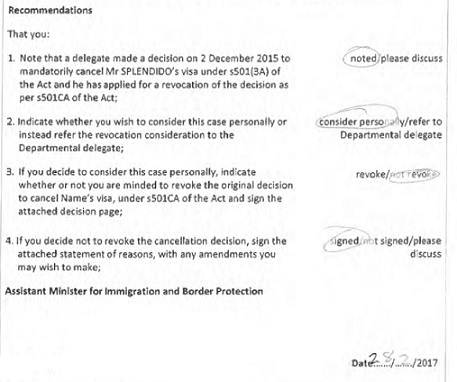
(c) The Assistant Minister’s reasons appear to have been prepared in advance of the exercise of power. They are dated the same day as the circled note indicating the exercise of power (28 February 2017). Their length and content founds an inference that they were drafted and prepared before the Assistant Minister indicated how he proposed to exercise the power. How the reasons came to be drafted, and by whom, or what the Assistant Minister was told in any briefing note from the Department are not matters to which the evidence descends. Of course, one danger with this practice is that the repository of the power is persuaded (one way or the other) not by the material and the representations made by an individual, but by the reasoning and views of her or his officers responsible for drafting the explanation for the conclusion the officers have (apparently) recommended. While it may be accepted that there is nothing necessarily unlawful about a member of the executive such as a Minister or Assistant Minister accepting recommendations made by Departmental officers, and subsequently adopting an explanation for an exercise of power which has been drafted by such officers, there will be a line beyond which this practice may turn into a de facto delegation of decision-making power, with a consequent failure by the repository of the power to consider independently and genuinely the merits of the decision to be made. Since these matters were not part of the grounds of review at first instance or in this appeal, no more need be said, other than to recognise the potential for such an approach to become an unlawful one.
24 It is true that Mr Splendido could have included details of the facts and circumstances of his offences in his “representations” to the Assistant Minister, which may have provided more information about his offending conduct. Nevertheless, there was no onus on Mr Splendido to establish that he posed no risk to the Australian community, or that he posed an “acceptable” risk. That is significant if the Assistant Minister continues to contend (see [103] below) that this matter is not a legally relevant consideration. If the Assistant Minister chose to put that matter at the forefront of his reasoning (despite contending he was not obliged to consider it), then the Assistant Minister was required to have a probative basis to make findings of fact about the existence of any such risk. For example, he could not avoid this requirement by relying on a proposition to the effect that if Mr Splendido wished to submit he posed no risk, he needed to establish that fact positively through documents such as sentencing remarks. That is particularly so where, as I have observed, Mr Splendido was not legally represented during this process. As it turned out, the voluminous and overwhelmingly supportive material Mr Splendido did put before the Assistant Minister did not affect the outcome of the exercise of discretion.
25 At [79] of the Assistant Minister’s reasons, he stated that Mr Splendido was “on notice that his criminal conduct was calling his visa status into question”, and yet still committed further offences. The Assistant Minister’s finding was based in part on a finding (in the first sentence in [79]) that Mr Splendido “received a formal warning from the Department” (my emphasis) on 2 May 2013. The date 2 May 2013 is in fact the date of the warning letter.
26 On the material before the Court, the Assistant Minister did not have any information before him which would support a finding of the kind he made in the first sentence of [79] of his reasons. The warning letter was addressed to Mr Splendido at a private residential address in suburban Melbourne. There is no evidence whether he was living there at that time. There is no evidence whether he received it. The copy of the acknowledgment which the letter instructed Mr Splendido to sign and return is unsigned, and there is no evidence it was returned by Mr Splendido. There is no acknowledgment in the other material submitted by Mr Splendido that he received that warning letter. There is no basis in the evidence for a finding that Mr Splendido received the letter, or (more importantly) that he knew the potential consequences for his ability to remain in Australia if he committed further offences after the notice had been issued. Given Mr Splendido had, on 13 July 2012, been sentenced to a period of 15 months imprisonment to be served concurrently with his (then) restored suspended sentence, it would seem unlikely that in May 2013 he was residing at a private residential address in suburban Melbourne.
27 It is true, as the Assistant Minister’s reasons note, that on an earlier occasion, in approximately August 2012, Mr Splendido had acknowledged receipt of a letter containing a “notice of intention to consider cancelling a visa under subsection 501(2) of the Migration Act 1958”. That notice was not in evidence, nor was there any evidence about the circumstances in which Mr Splendido received the notice, or the circumstances in which he signed the acknowledgment in August 2012, at which point in time it seems likely (for the same reasons I have expressed above) that he was incarcerated. On this occasion in August 2012, he gave his address as Beechworth Correctional Centre in a “Personal Details Form” dated the same date as the signed acknowledgment. Therefore, the circumstances in which he signed the acknowledgment, and what he understood by it, might have called for some examination and reflection.
28 While it might therefore have been open to the Assistant Minister to find that Mr Splendido was “on notice” in August 2012 that his criminal conduct was “calling his visa status into question”, even that finding had the slimmest of probative bases without any evidence (so far as the Court can tell) about the circumstances in which Mr Splendido signed the acknowledgement. Further, certainly on the evidence before the Court, the additional finding by the Assistant Minister about receipt of the 2013 warning letter was not supported by any evidence.
29 In itself, whether or not Mr Splendido received the 2013 warning letter and understood its contents, or had any similar understanding in mid-2012 because of earlier Departmental correspondence, might have been of marginal relevance on judicial review and on this appeal. However, when “facts” to this effect are found by the decision-maker, and then used in a reasoning process to conclude that, in substance, Mr Splendido deliberately chose to contravene the law when he knew his migration status in Australia was at risk, then there must be probative evidence of the underlying fact of receipt, and (by extension) Mr Splendido’s understanding of the letter’s contents.
30 More critically, as I explain in more detail below, I do not see how a bare historical fact of this kind (a signature on a Departmental document in 2012 with no information or material about the context or circumstances of that signature) can contribute in any rationally probative way to a finding there was a likelihood Mr Splendido might, after February 2017 (being the time of the Assistant Minister’s decision), commit further offences of a “similar nature” and in a “similar fashion”. Nor does it provide any probative basis for a finding that the likelihood and risk was of a sufficient quality to justify a characterisation of “unacceptable”. To use the signature in that way required at least some information or material about what Mr Splendido’s circumstances were in August 2012 (where it appears he was in custody) when he signed that acknowledgement, what he was told or understood, and – as I explain below – how he came to commit further offences, in particular in 2012.
The reasons of the primary judge
31 By originating application dated 22 March 2017, Mr Splendido sought judicial review of the non-revocation decision.
32 After setting out the background facts, an outline of the Assistant Minister’s decision and the legislative framework, the primary judge set out Mr Splendido’s grounds of appeal and summarised Mr Splendido’s arguments. The primary judge stated at [12] of the reasons that it was accepted before him that, practically, grounds 1 and 2 were different descriptions of what was, in substance, the same complaint about the findings made by the Assistant Minister:
(a) about the seriousness of the offences committed;
(b) about the likelihood that Mr Splendido would re-offend; and
(c) about the risk of harm to the Australian community if Mr Splendido were to re-offend in a “similar fashion”.
33 The primary judge stated that, in each case, the gravamen of Mr Splendido’s contentions was that the Assistant Minister had limited his consideration of the risk of harm to a reading and analysis of the National Police Certificate, which recorded basal information about each offence for which Mr Splendido was convicted. The Certificate only gave information about the court involved, the date of sentencing, the offence in respect of which Mr Splendido had been charged (described in only a few words) and any resulting term of imprisonment or other “court result”.
34 The primary judge noted at [17] that Mr Splendido placed great reliance on the reasons of North J in Cotterill v Minister for Immigration and Border Protection [2016] FCAFC 61; 240 FCR 29 (Cotterill). The primary judge noted that, in that case, North J decided that the findings made by the Minister that the offending was “serious” were legally unreasonable; they were “without an evident and intelligible justification”.
35 The primary judge noted at [18] that, while relying on Cotterill, Mr Splendido did not put his case on the grounds of illogicality or legal unreasonableness.
36 The primary judge’s reasoning was set out at [21]-[39] of his Honour’s reasons.
37 The primary judge identified the issue for determination as being whether the Assistant Minister’s decision as to whether there was “another reason why the original decision should be revoked” for the purposes of s 501CA(4)(b)(ii) of the Migration Act was infected with jurisdictional error (see [21]). The primary judge referred to a number of authorities regarding the power conferred by s 501CA, including Minister for Immigration and Border Protection v BHA17 [2018] FCAFC 68; 260 FCR 523; BSJ16 v Minister for Immigration and Border Protection [2017] FCAFC 78; 252 FCR 82 and Picard v Minister for Immigration and Border Protection [2015] FCA 1430.
38 At [26], the primary judge reiterated that Mr Splendido’s case eschewed any reliance on grounds relating to irrationality or illogicality or legal unreasonableness; rather, it was contended that the Assistant Minister had either failed to complete his task or had made findings that were not open to him.
39 The primary judge stated at [27] that he would first consider the evidentiary basis for the Assistant Minister’s decision; in other words, Mr Splendido’s second ground of review. His Honour referred to cases concerning the “no evidence” ground of judicial review, including: Australian Retailers Association v Reserve Bank of Australia [2005] FCA 1707; 148 FCR 446 at [575]; and Australian Broadcasting Tribunal v Bond [1990] HCA 33; 170 CLR 321 at 355-356. His Honour summarised the effect of these decisions at [29]:
In determining whether a finding is supported by “some basis” or a “skerrick” of evidence, one should ask whether evidence existed which could rationally affect the assessment of the probability of the existence of a fact (c.f. s 55 of the Evidence Act 1995 (Cth)) or a future fact. If such evidence exists, it is for the decision maker, and not this Court, to determine its probative weight and to decide whether it does, or does not, support a given finding.
40 The primary judge did not accept Mr Splendido’s contention that there was no evidence to support the Assistant Minister’s finding as to the seriousness of the crimes committed (see [30]). The primary judge stated that the Certificate listed offences which, in his view, provided a basis to support the finding. The primary judge noted that the offences on the Certificate included: “Threat to Inflict Serious Injury”; “Endanger Serious Injury”; “Contravene A Conduct Condition Of Bail Harass Witness (2 Charges)”; “Intentionally Cause Injury (2 Charges)”; “Make Threat To Kill”; “Unlawful Assault”; “Breach Of Suspended Sentence Imposed on 11 May 2011”; and “False Imprisonment”. The primary judge held that these descriptions of the offences committed gave the Assistant Minister an evidentiary basis for his finding about the seriousness of the offences. As noted above, Mr Splendido does not contend that his Honour erred in reaching this conclusion.
41 In relation to the other impugned findings, the primary judge reasoned as follows at [31]-[36]:
31 However, after much consideration, I am not satisfied that there existed a “skerrick” of evidence, or “some basis” for the findings reached that there existed a “likelihood” that the applicant would re-offend and, accordingly, that he represented an “unacceptable risk of harm to the Australian community”. Looking at the applicant’s convictions for crimes of violence over a five year period, the Certificate records that he was convicted on two occasions of assault and of two charges of intentionally causing injury. He was also convicted of false imprisonment. Whether these violent acts formed a pattern of behaviour is unknown. Whether they constituted similar acts of violence involving the same or similar victims is unknown. Whether they revealed a trend of increasing or decreasing degrees of violence is unknown. Whether they were the product of, or affected by, the taking of drugs is unknown. Why the applicant at the age of 46 commenced for the first time committing crimes is unknown; at best we know that it started with the possession of prohibited drugs. What mitigating circumstances existed, if any, relating to why the applicant’s life changed, and in relation to each act of violence, is unknown. Upon investigation it may be found that no mitigating circumstances existed and that the Minister’s findings were well justified. But absent a form of investigation into the quality and circumstances of the convictions, the bare recital of their historical existence in the Certificate and the resultant sentence, whether considered individually or in aggregate, did not constitute “some basis” for a prediction about future behaviour. This material was simply too vague to ground rationally findings about the applicant’s future behaviour.
32 For similar reasons, I am not satisfied that the convictions which appear to record an indifference to the rule of law, provide a basis for the finding concerning the “likelihood” that the applicant will re-offend in a way that creates a risk of harm to the Australian community. The applicant was convicted in 2011 of failing to answer bail, in 2012 of being in breach of a suspended sentence and in 2015 of persistent contravention of a family violence order. The applicant also ignored the warning from the Department. These are all very serious matters. But we know nothing about the circumstances leading to each conviction, and as to why the warning was ignored. There may, or may not have been, mitigating circumstances which could have rationally affected the Minister’s decision about the likelihood of harm. Again, the bare recital of conviction and sentence in and of itself, and whether taken individually or cumulatively with the other offences, did not rationally support or not support, the Minister’s finding about the risk of harm.
33 I have reached a similar conclusion concerning the offences relating to the possession and tracking of prohibited drugs.
34 It is true that it was open to the applicant to have produced further information concerning the circumstances of his convictions. After all, the applicant was the best person to know of the mitigating circumstances (if any) associated with the commission of his crimes. …
35 However, it was the Minister who made the finding about the risk of re-offending and of harm to the Australian community. It was incumbent upon him to ensure that his findings were supported by evidence, especially having regard to the strong factors advanced by the Minister which weighed against deportation. I have found this to be an extreme and rare case. In my view, for the foregoing reasons, and with respect, the Minister’s decision must be set aside and the case re-examined.
36 It will be a matter for the Minister to make such enquires as might produce evidence which addresses the likelihood of re-offending and of resultant harm to the community. He might apply to have access to tape recordings of the sentencing remarks made by the sitting magistrates, if these are available. He might be able to ask the applicant himself to obtain these recordings or further information about the circumstances of each offence. Inquiries might be made of the police, and of those who prosecuted the applicant. This is not intended to be an exhaustive list. Following the making of these inquiries, it will then be for the Minister to evaluate and assess the probability of re-offending and the quality of the risk the community may face. That probability and quality will then need to be balanced against the facts against deportation already identified by the Minister. It will be for the Minister to judge how these factors are to be balanced against each other.
42 In light of his conclusion in relation to the second ground of review, the primary judge did not consider it necessary to address the first ground of review: see [37]. The primary judge also indicated, at [38], that it was unnecessary for him to consider the application of Cotterill as the measure of legal unreasonableness found to exist in that case turned upon its particular facts.
43 The primary judge made orders on 8 August 2018 that: the application be allowed; a writ of certiorari issue quashing the decision of the Assistant Minister dated 28 February 2017; a writ of mandamus issue requiring the Assistant Minister to re-determine according to law whether to revoke the cancellation of the visa; and the Assistant Minister pay Mr Splendido’s costs.
The appeal
44 The Assistant Minister appeals from the judgment of the primary judge on the following grounds:
1. The learned primary judge erred in finding that the Assistant Minister’s decision as to whether there was “another reason why the original decision should be revoked” for the purposes of s 501CA(4)(b)(ii) of the Migration Act 1958 (Cth) was infected with jurisdictional error because the Assistant Minister had made findings concerning the “likelihood” that the respondent would re-offend and accordingly, that the respondent represented an unacceptable risk of harm to the Australian community, for which there was no evidentiary basis (Reasons at [31]-[34]). The learned primary judge should have found that there was a “skerrick” of evidence, alternatively, “some basis” for these findings, which evidence was not limited to information recorded in the respondent’s National Police Certificate but comprehended other material that was before the Assistant Minister and referred to in his reasons directed at the consideration of the protection of the Australian community.
2. The learned primary judge erred in finding (in effect) that, in circumstances where there were “strong factors advanced by the Minister which weighed against deportation” (Reasons at [35]) and despite the respondent not providing evidence or material directed at the circumstances of his offending or whether any mitigating circumstances existed, the Assistant Minister was required to undertake a “form of investigation into the quality and circumstances of the convictions” before he could record a finding that there existed a “likelihood” that the applicant would re-offend (Reasons at [31]). The learned primary judge should have found instead, having regard to the nonprescriptive nature of the task of evaluating the risk of harm to the Australian community, that the Assistant Minister’s approach to the evaluation of the likelihood that the respondent would re-offend was open to him, including on the material that was before him.
Ground 1
The Assistant Minister’s arguments
45 The Assistant Minister submits that the primary judge in effect found that the material before the Assistant Minister was incapable of providing a probative basis for the impugned findings concerning the likelihood of Mr Splendido re-offending, and the nature of the harm that would result as a consequence of any such re-offending. The Assistant Minister submits that this conclusion was in error for at least two reasons:
(a) First, the National Police Certificate disclosed information on its face (including the identification of the offences, the court date, and the sentencing disposition or outcome) that was probative material on the question of whether or not Mr Splendido might re-offend and the nature of any re-offending.
(b) For example, beyond the “bare” recitation of each offence and the corresponding sentence, the information disclosed in the National Police Certificate showed that Mr Splendido had offended over a period of five years (hence the Assistant Minister described the offending as “sustained” at [83]), and that the seriousness of the offending had escalated over that period. Such information was capable of supporting an inference (including in combination with other material before the Assistant Minister) that there was a risk or likelihood that the offending would be repeated in the future.
(c) It therefore cannot be said that the information contained in the National Police Certificate does not comprise evidence that is capable of rationally affecting the assessment of the probability of the existence of a fact (assuming for present purposes that this is a correct way of approaching the issue). However, it should be noted that the rules of evidence are not directly applicable to the task undertaken by an administrative decision-maker such as the Assistant Minister. In the present context, the fact is the existence of a chance or likelihood of future re-offending. The information contained in the Certificate is clearly relevant to and probative of the existence of that chance or likelihood, and would be admissible as such, whether or not there were any other evidence to support or deny the existence of the chance or likelihood.
(d) Secondly, it is not the case that the Assistant Minister limited his consideration of the risk of harm to a reading and analysis of the National Police Certificate. The findings about the likelihood and nature of Mr Splendido’s re-offending were based, not only on the Certificate, but on a range of other probative material that was before the Assistant Minister, including:
(i) the explanation offered by Mr Splendido for his (criminal) conduct, which Mr Splendido described as “silly” and “out of character”; the Assistant Minister took this as an indication that Mr Splendido had “limited insight” into his serious criminal conduct (see the Assistant Minister’s reasons, [73], [82]);
(ii) the failure of Mr Splendido to provide detail regarding the rehabilitation programs he had undertaken or to provide evidence of their completion ([74]);
(iii) the fact that Mr Splendido had received a formal warning from the Department, from which the Assistant Minister inferred that Mr Splendido was on notice that his criminal conduct was calling his visa status into question, and yet he continued to offend ([79]); and
(iv) Mr Splendido’s “drug and alcohol treatment program” and “conditions of the Children’s Court orders” (not recorded on the National Police Certificate), from which the Assistant Minister inferred that Mr Splendido had a problem with either or both drugs and alcohol and noted that his capacity to abstain had yet to be tested outside of the custodial environment ([81]).
(e) Further, the primary judge’s conclusions in relation to the adequacy of the evidentiary basis for the Assistant Minister’s findings appear to have been infected by the faulty premise that it was incumbent on the Assistant Minister to undertake further inquiries to obtain evidence to support his findings. However, any postulated obligation to make further enquiries cannot have any bearing on the question whether or not there was some evidence capable of supporting the Assistant Minister’s findings.
46 The Assistant Minister’s arguments emphasise what the National Police Certificate disclosed “on its face”, being matters such as an identification of the offences, the conviction date, and the sentencing outcome. The Assistant Minister contends that, read as a whole, the National Police Certificate also disclosed the length of time over which Mr Splendido had engaged in offending conduct, and its “escalation” over time, although what the term “escalation” means in this context is unclear.
47 The Assistant Minister also relied on other findings made by him, based on other material before him, as contributing in a probative way to the impugned findings. The Assistant Minister identified his finding that Mr Splendido had “limited insight” into the seriousness of his conduct, based on descriptions used by Mr Splendido in his representations about the offending conduct. The Assistant Minister also identified the fact of the delivery of the warning letter and Mr Splendido’s continued offending after receipt of that warning. The Assistant Minister referred to Mr Splendido’s failure to provide details or evidence of completion of any rehabilitation programs he had undertaken. The Assistant Minister also identified the references to Mr Splendido being on a drug and alcohol treatment program, and certain conditions in the Children’s Court orders made in respect of Mr Splendido’s two youngest children, from which the Assistant Minister inferred that Mr Splendido had a drug and/or alcohol problem, which the Assistant Minister found disclosed a link to Mr Splendido’s criminal behaviour. The Assistant Minister further noted that any benefit from the treatment program undertaken by Mr Splendido was yet to be tested in the community.
Resolution of ground 1
48 The Assistant Minister’s submissions at [19] are, in terms of principle, accurate in contending:
Save that the reviewing court must be satisfied that the evidence relied upon achieves at least a threshold probative value, the inquiry is not otherwise concerned with ascertaining the sufficiency or quality (including cogency) of the evidence. The ground necessarily invites and requires a comparison between the material available to the decision-maker and the conclusions drawn from that material.
49 The difficulty is in the application of those propositions. In the circumstances of this appeal, the required comparison reveals the Assistant Minister engaged in nothing more than guesswork or speculation about Mr Splendido’s future conduct, if he were permitted to remain in Australia.
50 I respectfully agree with the primary judge’s reasoning at [31], and emphasise the following matters.
51 At issue on this ground is an important question about what probative basis is required for the repository of a discretionary power such as that contained in s 501CA to be able to make findings of fact which are material, and indeed critical, to the outcome of the exercise of that power. In particular, what material is required for the repository to be able to find, lawfully, that a person represents an “unacceptable risk” to the Australian community because he or she is likely to re-offend in a “similar fashion” to the way she or he has in the past? In other words, where is the boundary between findings based on probative material, and mere speculation?
52 These questions arise in this appeal not because it was argued or determined that the Assistant Minister was obliged to take the question of risk to the Australian community into account, but because in fact he did so. Having decided to place at the forefront of his reasoning a finding that Mr Splendido posed an unacceptable risk to the Australian community because of the likelihood he would re-offend, that finding was required to be based on probative material, and in my respectful opinion the primary judge was correct to find there was none. Instead, the finding involved no more than speculation on the part of the Assistant Minister.
53 I consider it should be emphasised that the Assistant Minister’s finding was not simply about any risk or likelihood of re-offending: it was that, by reason of that risk or likelihood, Mr Splendido posed an “unacceptable” risk to the Australian community. I consider it is appropriate to characterise what appears in [92] of the Assistant Minister’s reasons as a finding, and as a finding of fact. That is clear from the terms of the Assistant Minister’s reasons at [92] where he states that he has “concluded” that Mr Splendido represents an unacceptable risk of harm to the Australian community, and then goes on to make a second finding that the protection of the Australian community “outweighed” the other factors to which he had referred earlier. These are the key aspects of his fact-finding which lead to the way the discretion is exercised.
54 The risk was assessed by the Assistant Minister to be of such a magnitude as to justify, against all of the factors recognised by the Assistant Minister as weighing in favour of revocation, that Mr Splendido should not be able to remain in Australia. Underpinning this was the Assistant Minister’s factual finding about the likelihood Mr Splendido would re-offend, and would do so “in a similar fashion” and commit crimes of a “similar nature”, as he had in the past.
55 I approach my consideration of ground 1 from the understanding of the Assistant Minister’s reasons I have expressed here.
“Likelihood”
56 The primary judge expressed his reasoning at [31] by reference to the concept of “likelihood”. I doubt the use of that term by the primary judge was accidental: it is the term used in [80] and [83] of the Assistant Minister’s reasons, with [83] being a key passage in the Assistant Minister’s reasoning. It is true that at [90] of his reasons the Assistant Minister does refer to the “possibility” of further offending by Mr Splendido, but read in context, as I describe below, it is clear the Assistant Minister must have taken the approach that it was the “likelihood” of further, serious, offending by Mr Splendido which made the risk posed to the Australian community an “unacceptable” one.
57 The terms “likelihood” or “likely” may be understood to refer to a matter being more probable than not: see RJE v Secretary to the Department of Justice [2008] VSCA 265; 21 VR 526 at [26]-[36] (Maxwell P and Weinberg JA) and [97]-[104] (Nettle JA); Christine George & Ors on behalf of the Gurambilbarra People v State of Queensland [2008] FCA 1518 at [43]-[44] (Logan J); Sabourne v State of Western Australia [2010] WASCA 242 at [59]-[66] (Buss JA).
58 The Macquarie Dictionary defines “likelihood” as:
noun 1. the state of being likely or probable; probability.
2. a probability or chance of something: there is a strong likelihood of his succeeding.
59 A number of authorities make it clear, however, that at least in terms of statutory construction, the meaning to be ascribed to the terms “likelihood” or “likely” will be context-dependent: see RJE at [27] (Maxwell P and Weinberg JA) and [98] (Nettle JA); Gurambilbarra at [44] (Logan J); Sabourne at [59] (Buss JA); Hannes v DPP (No 2) [2006] NSWCCA 373; 205 FLR 217 at [522] (Barr and Hall JJ).
60 In this case, the term “likelihood” is not a statutory one; it is a term used by a decision-maker, and some of the analysis in these authorities is not directly applicable.
61 On this appeal, the parties used other terms interchangeably with “likelihood”, such as “chance” (in the Assistant Minister’s submissions) and “risk” (in both parties’ submissions). Mr Splendido’s counsel specifically contended that no distinction should be drawn between the terms “risk” and “likelihood”, which I find a difficult submission to accept.
62 Mr Splendido was informed, as part of the material sent to him regarding the mandatory cancellation of his visa and his ability to request the revocation of that cancellation, about the existence of Direction 65, the then current Ministerial direction made pursuant to s 499 of the Migration Act intended to provide guidance to decision-makers on how to exercise discretions such as that in s 501CA. It was not binding on the Minister or Assistant Minister, as the correspondence to Mr Splendido stated. However, that correspondence also informed Mr Splendido that:
If the Minister personally decides to revoke or not revoke your mandatory cancellation, he/she does not have to use Direction 65 to guide him/her in making his/her decision, though it provides a broad indication of the types of issues he/she may take into account For this reason, you may wish to address the elements of the Direction in your response.
63 Looking at the form and content of the Assistant Minister’s reasons, it is clear that the Assistant Minister in fact did what that correspondence indicated he might do. His reasons are entirely framed around the matters set out in Direction 65. The term “unacceptable risk”, central to the outcome of the Assistant Minister’s exercise of discretion in relation to Mr Splendido, is a term used in Part C of the Direction (which applies to the revocation power in s 501CA). As a concept, it forms part of the guidance given in the Direction about the “primary consideration” of “[p]rotection of the Australian community from criminal or other serious conduct”. For example, at 13.1.2(1) of Direction 65 it is stated that:
In considering whether the non-citizen represents an unacceptable risk of harm to individuals, groups or institutions in the Australian community, decision-makers should have regard to the principle that the Australian community’s tolerance for any risk of future harm becomes lower as the seriousness of the potential harm increases. Some conduct and the harm that would be caused if it were to be repeated, is so serious that any risk that it may be repeated may be unacceptable.
64 At 13.1.2(2), the Direction then lists the matters to which decision-makers must have regard, cumulatively, when determining whether a risk is unacceptable:
a) The nature of the harm to individuals or the Australian community should the non-citizen engage in further criminal or other serious conduct; and
b) The likelihood of the non-citizen engaging in further criminal or other serious conduct, taking into account available information and evidence on the risk of the non-citizen re-offending (noting that decisions should not be delayed in order for rehabilitative courses to be undertaken).
(Emphasis added.)
65 It is the case that in the context of the statutory discretion contained in s 501CA, which is a wide one, the Minister (or Assistant Minister in this case) is not required to adhere to any particular language in her or his reasoning on the factors which lead to the discretion being exercised in a particular way. However, where the Assistant Minister uses particular words, it should be assumed those words were intended to carry a particular meaning so as to explain why the Assistant Minister reached the conclusion he did. That is, after all, the function of reasons.
66 When the Assistant Minister’s reasons are read in context, I consider it is clear he used the term “likelihood” consciously, especially given the terms of Direction 65, which the Assistant Minister clearly followed, even though he was not obliged to do so. In my opinion, the Assistant Minister meant it was probable that Mr Splendido would re-offend in a serious way, sufficiently probable and serious that it was not appropriate to allow him to remain in Australia, despite many considerations tending towards allowing him to remain. That is, on the Assistant Minister’s own reasoning, the re-offending risk posed by Mr Splendido was sufficiently probable and sufficiently “unacceptable” that neither the best interests of his young children, nor the devastation and needs of his elderly parents, nor the absence of a single family member or available support for Mr Splendido in Italy should prevail over the magnitude of the risk he posed. That is the substance and effect of the Assistant Minister’s own reasoning.
67 To interpret the Assistant Minister’s reasons that way is not to characterise what the Assistant Minister did as making a finding on the balance of probabilities, as that term might be understood in the exercise of judicial power, or in some of the statutory contexts in which the term “likelihood” or “likely” has been analysed. That is, it is not the same as “more probable than not” or “more likely than not”. Rather, it is to emphasise that the Assistant Minister’s reasons, reflecting as they do the language and context of Direction 65, recognise that there must be a relationship between the magnitude, nature and quality of a risk and its characterisation as unacceptable, such that the word “likelihood” (signifying some level of probability) is an appropriate standard to apply.
68 If it were not read this way, the Assistant Minister’s reasoning could be characterised as irrational, and probably legally unreasonable. That is because any risk – slight, possible – is not the same as an “unacceptable” risk. The concept of an “unacceptable” risk involves a qualitative judgement, measured against factors which tend in the opposite direction. Assessing the risk to have a character that makes it “unacceptable” involves some notion of proportionality. Given the Assistant Minister’s other favourable findings regarding other factors put before him in the representations made by Mr Splendido and material submitted by Mr Splendido’s family and friends, the only rational way to understand the Assistant Minister’s reasoning is that he decided it was probable Mr Splendido would re-offend, and that it was probable the nature and circumstances of his re-offending would be “serious” and would result in “physical harm” to members of the Australian community (see [83] of the Assistant Minister’s reasons). Accordingly, those considerations outweighed the very significant body of considerations (on the Assistant Minister’s own findings) favouring revocation. In other words, the Assistant Minister’s findings contain a level of assuredness about Mr Splendido’s behaviour in the future if he were to remain in Australia.
69 That is why, in my opinion, the Assistant Minister’s use of the term “likelihood” was not only conscious, but central to his reasoning process, and the primary judge was correct to use it in his own analysis of whether there was any probative material before the Assistant Minister to enable him to make a finding in those terms.
70 The point that I consider essential to the outcome of ground 1, and essential to explaining why the primary judge’s approach was not erroneous, is as follows. The conclusion of fact reached by the Assistant Minister was a qualitative one – that the risk posed by Mr Splendido, from February 2017 onwards, was an “unacceptable” risk, because of the “likelihood” he would commit further offences of a “similar nature” ([83] of the Assistant Minister’s reasons) and would commit them in a “similar fashion” ([90] of the Assistant Minister’s reasons). That approach would be rational and reasonable, if there was a probative basis in the material for such a qualitative assessment, which there was not.
The National Police Certificate
71 The bare descriptive information in the National Police Certificate was not capable of establishing, in and of itself, the qualitative likelihood of Mr Splendido re-offending, or what offences it was likely he might, or might not, commit in the future. Dicta from cases dealing with the question whether inferences can be drawn from a person’s record of criminal offences explain the flaws in such a reasoning process, and why more is needed than the bare facts of past offending.
72 In RJE, in the context of statutory powers authorising the imposition of extended supervision orders on serious sex offenders, Maxwell and Weinberg JJA said at [16]-[17]:
Predicting whether a particular person will commit a criminal offence in the future is notoriously difficult [their Honours cited Fardon v Attorney-General (Qld) (2004) 223 CLR 575, 622-4 [123]-[126] (Kirby J); Attorney-General v David [1992] 2 VR 46, 61-2 (Hedigan J)]. The Monitoring Act recognises that the prediction of future dangerousness, if it is to be attempted at all, is a matter for expert opinion. As the report in the present case illustrates, the making of such a prediction in a particular case requires expertise in observation and assessment of those who commit offences of the particular type, and a detailed knowledge of the types of factors, both personal and environmental, which increase or reduce the risk of further offending. The necessary expertise combines the ability to make a qualitative assessment of an individual and the ability to utilise the available quantitative risk assessment instruments.
One thing is clear. Judges, including experienced criminal judges, have no such expertise. Neither the conduct of criminal trials nor the sentencing of offenders requires judges to have, or equips them with, the ability to assess the likelihood that an offender will re-offend. We express this view fully recognising that a sentencing judge has to consider the need for specific deterrence and the prospects for rehabilitation; that bail decisions often involve predictive considerations; and that assessing dangerousness is the basis of decisions under the Crimes (Mental Impairment and Unfitness to be Tried) Act 1997 (Vic) to impose or vary supervision orders in respect of persons found not guilty of criminal offending by reason of mental impairment.
(Footnotes omitted and emphasis added.)
73 In Hughes v The Queen [2017] HCA 20; 344 ALR 187 at [70]-[72], Gageler J explained the vice in tendency reasoning:
Applied to evidence of past conduct, tendency reasoning is no more sophisticated than: he did it before; he has a propensity to do this sort of thing; the likelihood is that he did it again on the occasion in issue.
…
Tendency reasoning, as courts have long recognised, is not deductive logic. It is a form of inferential or inductive reasoning. What it involves is “admeasuring the probability or improbability of the fact ... in issue ... given the fact or facts sought to be adduced in evidence”. In the admeasurement of that probability or improbability, as courts have again long recognised, there inheres a very real risk of attaching “too much importance” to the tendency evidence—of giving tendency evidence “too much weight”. The common law traditionally took an extremely conservative approach to managing that risk, at least in criminal proceedings.
The problem that inheres in tendency reasoning has come to be exposed by social science research and explained in social science literature in more precise terms. The problem is one of cognitive bias, amounting to an inclination observable on the part of most persons to overvalue dispositional or personality-based explanations for another person’s conduct and to undervalue situational explanations for that conduct. The bias is towards overestimating the probability of another person acting consistently with a tendency that the person is thought to have—of treating the person as more consistent than he or she actually is.
(Footnotes omitted.)
74 Also in Hughes, Nettle J said at [154]:
Evidence that an accused has committed an offence is not, of itself, significantly probative of the accused having committed another offence. Without more, it establishes only that the accused is the kind of person who has committed an offence. To make evidence of previous offending or misconduct significantly probative of a subsequent offence there needs to be something more about the nature of the offences or the circumstances of the offending in each case, or about the victim of each offence, which rationally affects to some significant degree the assessment of the probability that the accused committed the offence, or that the complainant is telling the truth as to the commission of the offence.
(Footnotes omitted.)
75 And at [169], his Honour relevantly stated:
Axiomatically, all criminal behaviour involves risk-taking and sexual offending in particular involves a very great degree of risk-taking. Consequently, to say that evidence of one offence is significantly probative of another simply because each involves risk-taking is facile.
76 Although both Gageler and Nettle JJ were in dissent on the outcome in Hughes, I do not consider that fact affects the weight to be attributed to the passages to which I have referred.
77 The bare recitation of what a person has done in the past, if used as a basis for a positive finding about what she or he may do in the future, is a reasoning process which is rejected by the judicial process in relation to fact-finding about legal responsibility for past events. More than the bare recitation of the past offending is required, and what is required for such evidence to be considered is strictly controlled by reference to the nature and circumstances of the offending, as Hughes and the authorities before it demonstrate. In the sentencing context, or in a context of any further exercise of power to detain a person, where a court is required to address a person’s risk of re-offending in the future, the complexity of that analytical process and the difficulty of judges undertaking that task themselves is judicially acknowledged, as the observations in RJE demonstrate.
78 The nature and circumstances of past offending are integral to any assessment of the risk, or likelihood, of future offending. Also of relevance are a range of other factors about the present circumstances of an individual which may bear on a risk of whether past offending conduct might or might not be repeated. It is these matters, and not the mere specification of a criminal record, which provide the probative basis for an assessment about the nature and extent of any risk of further offending. In these processes, a court acts on more than the bare historical fact of when and where a person committed offences and the legal description of those offences. Otherwise, the prejudicial and impermissible kind of reasoning to which Gageler J referred in Hughes is what can dominate any reasoning process.
79 Although the Assistant Minister’s task in s 501CA is conducted within a statutory process which is procedurally and substantively distinct from the criminal contexts I have discussed above, as this case demonstrates, a person’s criminal history may nonetheless be a significant factor influencing the exercise of that discretionary power. When that is the case, the flaws which have been identified in reasoning processes about past offending are just as likely to arise in the use of a person’s criminal record in the exercise of the s 501CA discretion.
80 I consider this is the point being made by the primary judge at [31] of his reasons, with which I respectfully agree.
81 To take an example pertinent to this appeal, the recitation of offences in the National Police Certificate, taken with the other evidence, reveals a man who had no criminal record until he was aged 46. Other material reveals he had an apparently successful and substantial business. The offences committed by Mr Splendido in May 2011 were either expressly or implicitly related to drugs of dependence. The same is true of the series of offences for which Mr Splendido was convicted in July 2012. It is but a small step to infer that, throughout 2011-2012, and for some (unknown) period prior to these dates, Mr Splendido had a serious drug addiction problem. Why or how that came about is unknown, and was unknown by the Assistant Minister. These facts were critical to any rational, and reasonably based, assessment of whether Mr Splendido was likely to engage, or was at risk of engaging, in that kind of offending conduct again in future. Further, there was a lack of information before the Assistant Minister about whether Mr Splendido still had, at the time of the non-revocation decision, any drug addiction problem. At [74] of his reasons, the Assistant Minister noted the rehabilitative programs Mr Splendido had undertaken, but found Mr Splendido had not “provided further detail of these courses nor evidence of completion”, and therefore gave the “rehabilitative impact” of the courses less weight. However, the Assistant Minister simply did not know whether Mr Splendido had completed the courses or not. He did not know if Mr Splendido still had a drug addiction. He did not know whether Mr Splendido’s drug addiction had, for example, been overcome some years earlier. Yet he went on to make findings which implicitly assumed Mr Splendido would, in the future, commit offences connected to having a drug addiction. In other words, there was an assumption in the Assistant Minister’s reasoning that drug addiction would feature again in Mr Splendido’s life, but there was no probative basis for this assumption. It was sheer speculation, based on the bare fact of Mr Splendido’s convictions for drug-related offences around five years earlier.
82 The absence of anything beyond a recitation of prior convictions also precluded any qualitative assessment by the Assistant Minister of the strength or seriousness of any risk that Mr Splendido would engage in further offending. To find the risk posed by Mr Splendido to the Australian community was an “unacceptable” risk, the Assistant Minister needed to have some information or material which gave him some basis for making such a qualitative assessment, and he had none. He had bare historical facts. What occurred was speculation and guesswork about what those prior convictions indicated about Mr Splendido’s future conduct.
83 The National Police Certificate, and the information it contained, was no more probative of Mr Splendido re-offending than it was of him not re-offending. Insofar as it proved that Mr Splendido engaged in the offending conduct to which it referred, it also proved that he engaged in no offending conduct for 46 years of his life.
84 I consider that, read in context, the Assistant Minister’s finding that Mr Splendido would engage in “offending of a similar nature to his previous offending” (at [83]), read as it needs to be with the further and later finding that Mr Splendido would re-offend “in a similar fashion” (at [90]) (emphasis added) was not a reference simply to the bare description of the offences on the National Police Certificate. Rather, it was a reference to what the Assistant Minister considered was involved in the commission of those offences, although the Assistant Minister knew nothing of those matters. The “nature” of an offence such as “assault” (one of the July 2014 offences) concerns the circumstances of the offence. The “fashion” in which an offence such as assault was committed concerns the facts of an offender’s conduct. That is the ordinary meaning of these phrases, especially in the context of criminal offending. Yet the Assistant Minister had no information about those matters.
85 On the other hand, if the Assistant Minister’s reasons are to be taken as using such phrases to refer to the bare description of the offences in the National Police Certificate, then that would be an irrational foundation for any finding in 2017 about the likelihood of further offending, for reasons I have explained above.
Other matters referred to in the Assistant Minister’s submissions
86 In relation to the matters set out in [45] above, which reflect the Assistant Minister’s submissions, in my opinion none of those matters provide any probative basis for the Assistant Minister’s impugned finding about the “unacceptable risk” posed by Mr Splendido and his likelihood of re-offending.
87 As to [45(b)], the Assistant Minister’s finding that Mr Splendido’s offending had “escalated” was made without probative material. How the Assistant Minister was able to discern from the National Police Certificate whether Mr Splendido’s subsequent offending was an increase in severity from his previous offending is unknown. For example, for the 2014 offences, Mr Splendido received a community correction order and not a sentence of imprisonment. How this can be described, accurately, as an “escalation” without further information, is unclear. In relation to the 2015 offences, which included domestic violence offences, the Assistant Minister had no information about their nature and circumstances. Again, where there was no information about the circumstances of the offending, the Assistant Minister’s “escalation” finding was also speculative and suffers from the same legal problem as the “unacceptable risk” finding.
88 As to [45(d)], again, for the Assistant Minister to find that Mr Splendido’s description of his conduct as “silly” and “out of character” showed “limited insight” is also speculative. The use of a sentencing term of art such as “insight” into a person’s offending, by an administrative decision-maker without expert or other material before him about Mr Splendido’s level of insight into his offending (whilst also choosing to place less weight on the “rehabilitative impact” of Mr Splendido’s participation in rehabilitation programs), again bespeaks speculation and nothing more. Further, and decisively on this issue, the Assistant Minister’s own subjective opinion, formed without any apparent objective information, about the state of Mr Splendido’s “insight” cannot itself be used as probative material on which to base a further finding about likelihood of further offending. This is a “bootstraps” argument, with respect.
89 As to the other factors in [45(d)], an absence of material (whether described as a “failure” by Mr Splendido or otherwise) cannot provide a probative basis for a positive factual finding. While there was certainly material from which the Assistant Minister could lawfully infer that at and before the time of the commission of some of the offences listed on the National Police Certificate, Mr Splendido had a drug addiction, there was again no probative material to suggest he still had a drug addiction in February 2017, when the Assistant Minister made his decision. Yet the Assistant Minister’s reasoning assumed he did.
90 Furthermore, the conditions in the Children’s Court orders were matters of historical record, relating to a period of time where Mr Splendido was in custody and, on the evidence before the Assistant Minister, Mr Splendido’s partner was also unable to care for the children. Again, these matters said nothing about Mr Splendido’s circumstances in February 2017, unless one engaged in assumptions and speculation based on the bare fact of that historical record, which in my opinion is what the Assistant Minister did.
The three matters at [83] of the Assistant Minister’s reasons
91 The Assistant Minister referred to three matters at [83] of his reasons. These were: Mr Splendido’s “sustained offending over the past five years”; his “proven attitude towards conditional liberty”; and what the Assistant Minister described as “the untested nature of his rehabilitation”, adding “such as it is”.
92 These references add nothing by way of a probative basis for the Assistant Minister’s finding. With respect to the first matter, while the adjective “sustained” is certainly a permissible description of the offending as revealed on the National Police Certificate, that adjectival description says nothing about future conduct, without an understanding of why the offences occurred when they did, and the circumstances of that offending. It is a description of past events without any material giving context to why there was a period of “sustained” offending. A person with a single conviction may have a greater risk of re-offending than a person with a string of convictions over a long period of time – all will depend on an assessment of the factual circumstances of the individual and her or his offending, and an assessment of whether she or he is genuinely rehabilitated and no longer exposed to the circumstantial factors which precipitated the previous offending. This is why the sentencing process, where assessment of future risk is traditionally located, is so complex.
93 An administrative decision-maker exercising a power such as that in s 501CA cannot cherry-pick aspects of sentencing jargon (such as “insight”), and isolated aspects of sentencing process (such as risk of re-offending) and apply them without consideration of the contextual material which grounds the assessments in those processes. It is the contextual material which provides the probative basis, and indeed the factual basis, for making distinctions about likelihood of future conduct. Moving from a description of past offending as “sustained” to a conclusion that there is a likelihood of future offending in a “similar fashion” discloses no rational connection between the two. There is no rational connection because there is no probative material to provide such a connection. There is only speculation, and it is speculation of a kind which falls into the irrational and prohibited kinds of reasoning described by the courts in RJE and Hughes.
94 Similarly, in relation to the second matter, the Assistant Minister’s reference to Mr Splendido’s attitude, in 2012, to being subject to a suspended sentence when he engaged in further offending cannot, without more, be probative of what Mr Splendido might do, in terms of his behaviour, from February 2017 onwards. That information (which the Assistant Minister described as being indicative of Mr Splendido’s approach to “conditional liberty”, itself a somewhat unusual turn of phrase), may have been capable of being probative of Mr Splendido’s attitude to the law at the time he breached the suspended sentence. I say “may” because again, all depends on context, of which there was no evidence. Even if that be the case, it is irrational on the bare fact of that breach alone to find that Mr Splendido had the same attitude to the law in 2017, especially given what Mr Splendido was saying in his representations about the very different perspective he had in 2017. The Assistant Minister did not say he did not believe Mr Splendido. Instead, he took a historical fact and made assumptions from it about Mr Splendido’s current attitude.
95 The third matter could not provide a probative basis for the finding of “unacceptable risk”. The reality was, by operation of ss 189 and 196 of the Migration Act and the absence of any executive discretion exercised in Mr Splendido’s favour to release him back into the community pending consideration of the revocation power, Mr Splendido had (through no fault or conduct of his own) no opportunity to demonstrate his rehabilitation in a practical sense. That fact provided no basis for a positive finding that he was likely to re-offend.
An extreme and rare case
96 I agree with the primary judge’s description of this as an “extreme and rare case”. One of the reasons that description is apt is the overwhelming nature of the factors which the Assistant Minister found weighed in favour of revocation. They were of an unusually strong order, if one reads [13]-[60] of the Assistant Minister’s reasons, and the nature of the findings he makes in those paragraphs.
97 Further, it is unusual that in a situation such as this, the repository of the power would not have access to some kind of information to provide a basis for an assessment which was obviously so central to the exercise of power: no sentencing remarks, no police summaries of the offending conduct, no evidence put before any of the courts which convicted Mr Splendido, no reports from Mr Splendido’s time within the correctional system about his behaviour or rehabilitation, no parole records, no reports or correspondence from treating psychiatrists, drug rehabilitation therapists or the like.
98 The absence of such material might be explained in a number of ways and, as I note elsewhere in these reasons, its absence may or may not be something for which some responsibility could be attributed to Mr Splendido. However, there is no evidence Mr Splendido was legally represented during the revocation decision-making process. Indeed, all the evidence suggests he was not – the evidence before the Court includes many letters (including some handwritten) from family and friends, and Mr Splendido himself, but no submissions, no legally based representations or the like.
99 The significance of the material I describe in [97] might now seem obvious, in the context of this litigation and with the benefit of hindsight, but it may well not have been obvious to Mr Splendido and his family at the time they made the representations they did. On the evidence, Mr Splendido and his family placed their hopes in persuading the Assistant Minister at a human level about why he should revoke the visa cancellation. That was a natural approach for people in their circumstances to take, and should not be the subject of any criticism.
100 Attempting to attribute responsibility for the absence of probative material is not the point in a judicial review based on a “no evidence” ground. The question is simply whether, objectively, there was probative material, or there was not. Those exercising powers of this kind must always have a probative basis for the findings of fact which are made. How that probative basis or material is acquired, and from whom, is not the point.
Ground 2
101 Central to ground 2 is a submission by the Assistant Minister that the primary judge’s conclusion was infected by the faulty premise that it was incumbent on the Assistant Minister to undertake further inquiries to obtain further evidence to support his findings. However, I do not read the primary judge’s reasons in this way. The primary judge based his decision on the absence of probative evidence to support the finding as to likelihood of re-offending. The primary judge then went on to observe that, in order to make such a finding in a case such as this, it would be necessary to gather further material. The primary judge was not saying that it was incumbent on the Assistant Minister to make further inquiries. For these reasons, ground 2 proceeds on an incorrect understanding of the primary judge’s reasons. Accordingly, ground 2 should fail.
Miscellaneous matters
102 These observations are not essential to my reasoning on the appeal, but are made out of an abundance of caution, in case silence on them is taken as agreement.
103 In this appeal, the Assistant Minister’s counsel made submissions on the issue of whether protection of the Australian community is or is not a relevant consideration, in the sense described in Minister for Aboriginal Affairs v Peko-Wallsend Ltd [1986] HCA 40; 162 CLR 24, to the exercise of the revocation power in s 501CA. That is a matter about which the Assistant Minister submits there are differing views in this Court. I adhere to the views I expressed in Tanielu v Minister for Immigration and Border Protection [2014] FCA 673; 225 FCR 424, although that case concerned a visa cancellation and not a revocation decision. As acknowledged by counsel for the Assistant Minister, the matter need not be taken any further on this appeal because the Assistant Minister did in fact place protection of the Australian community at the forefront of his reasoning. Submissions made in support of this argument were a distraction.
104 There is discussion in some cases (see, for example, Australian Postal Corporation v D’Rozario [2014] FCAFC 89; 222 FCR 303 at [16], [50]-[67] and [107]-[118]; and SZNKV v Minister for Immigration and Citizenship [2010] FCA 56; 118 ALD 232 at [38]) as to whether an absence of any evidence to support a finding which is material to the exercise of power is an error that is properly characterised as jurisdictional. I have no difficulty in concluding that such an error is likely to be jurisdictional. The clarity of that position is evident from the Full Court’s decision in Hands v Minister for Immigration and Border Protection [2018] FCAFC 225; 364 ALR 423 at [45]-[46] (Allsop CJ, Markovic and Steward JJ agreeing).
105 The circumstances to which the remarks of Gummow and Hayne JJ were directed in Minister for Immigration and Multicultural and Indigenous Affairs v SGLB [2004] HCA 32; 207 ALR 12 at [39] are different. Their Honours’ approach was premised on the nature, content and effect of s 65 of the Migration Act and a decision-maker’s state of satisfaction being a condition precedent to an exercise of power to grant or refuse a visa pursuant to that provision.
106 In the present case, what is in issue is a statutory discretion. In the presence of a privative clause such as s 474, where the supervisory jurisdiction that is invoked is s 39B of the Judiciary Act 1903 (Cth) (deriving from s 75(v) of the Constitution), it remains the case that the exercise of a statutory power of an administrative character, including a power that is discretionary in nature, will be beyond the jurisdiction of the repository if a court determines that Parliament did not intend the exercise to be valid unless certain express or implied conditions on the exercise of that power were complied with. As the High Court made clear in Minister for Immigration and Citizenship v Li [2013] HCA 18; 249 CLR 332 at [23]-[29] (French CJ), [63] (Hayne, Kiefel and Bell JJ), [88]-[92] (Gageler J) and Minister for Immigration and Border Protection v SZVFW [2018] HCA 30; 357 ALR 408 at [4] (Kiefel CJ), [51]-[54] (Gageler J), [80]-[82], [89] (Nettle and Gordon JJ), [131] (Edelman J), in the absence of an express intention to the contrary, those implied conditions will include rationality, reasonableness and fairness.
107 It is also clear that in the absence of an express intention to the contrary (if one could constitutionally be given, which may be doubtful), an exercise of power which depends on the assessment and finding of facts for its exercise requires there to be probative material on which those findings can be made: Minister for Immigration and Citizenship v SZMDS [2010] HCA 16; 240 CLR 611 at [124] (Crennan and Bell JJ); Australian Broadcasting Tribunal v Bond [1990] HCA 33; 170 CLR 321 at 367-368 (Deane J).
108 In Rawson Finances Pty Ltd v Commissioner of Taxation [2013] FCAFC 26; 296 ALR 307 Jessup J said at [62]:
Before turning to those issues, it is necessary to say something about the legal framework within which the tribunal’s fact-finding function was set. The tribunal is not a court, and is not bound by the rules of evidence: s 33(1)(c) of the AAT Act. It must, however, proceed by reference to “rationally probative evidence” rather than on mere “suspicion or speculation”: Minister for Immigration and Ethnic Affairs v Pochi (1980) 31 ALR 666 at 685; 4 ALD 139 at 156; 1A IPR 708 at 724. If it does so, its finding on a question of fact will not be assailable in a proceeding under s 44 of the AAT Act unless that finding was not reasonably open on the evidence. Where the finding has been made by inference, no error of law will have been made so long as there was some basis for the inference: Australian Broadcasting Tribunal v Bond (1990) 170 CLR 321 at 326; 94 ALR 11; 21 ALD 1. The nature and limits of the tribunal’s function in these and allied respects were described in detail by Greenwood J (Weinberg J agreeing) in Wecker v Secretary, Department of Education, Science and Training (2008) 168 FCR 272; 249 ALR 762; [2008] FCAFC 108 at [95]-[112].
109 It is true these observations were made by his Honour about the Administrative Appeals Tribunal, and appeals on questions of law under s 44 of the Administrative Appeals Tribunal Act 1975 (Cth). However, the underlying principle is the same.
Conclusion
110 There is no debate that it is for the Minister to consider whether he or she is satisfied that the person passes the character test or that there is another reason why the cancellation decision should be revoked: see the description of the statutory scheme in Minister for Immigration and Border Protection v Maioha [2018] FCAFC 216 at [48] (Rares and Robertson JJ) and [67] (Flick J).
111 Where it involves findings of fact which are critical or material to the way in which the statutory power is exercised, the Assistant Minister’s consideration and exercise of power must be grounded in probative material, and not in speculation or guesswork, or (worse) assumptions based on material incapable of supporting those assumptions.
112 I would dismiss the appeal, and order the Assistant Minister to pay Mr Splendido’s costs of the appeal, to be fixed by way of a lump sum agreed between the parties, or determined by a Registrar in the absence of agreement.
I certify that the preceding one hundred and twelve (112) numbered paragraphs are a true copy of the Reasons for Judgment herein of the Honourable Justice Mortimer. |
Associate:
REASONS FOR JUDGMENT
MOSHINSKY J:
113 I have had the considerable benefit of reading the draft reasons of Mortimer J. In relation to ground 1, for the reasons given by Mortimer J, and also for the reasons given by the primary judge, I consider that there was no probative basis for the Assistant Minister’s findings (or conclusions) that there was a likelihood that the respondent would re-offend and that he therefore represented an unacceptable risk of harm to the Australian community.
114 I also agree with Mortimer J’s reasons for rejecting ground 2.
I certify that the preceding two (2) numbered paragraphs are a true copy of the Reasons for Judgment herein of the Honourable Justice Moshinsky. |
Associate:
Dated: 16 August 2019
REASONS FOR JUDGMENT
WHEELAHAN J:
115 I have had the advantage of reading in draft the reasons for judgment of Mortimer J and Moshinsky J. I gratefully adopt the summaries in the reasons of Mortimer J of the relevant legislative provisions, the background facts, the reasons of the Assistant Minister for Immigration and Border Protection (Minister), the reasons of the primary judge, and the arguments presented on appeal. I agree that the appeal should be dismissed. I agree with the reasons of Mortimer J for the rejection of ground 2. In relation to ground 1, I shall express my own reasons briefly.
116 In determining whether there was another reason why the decision to cancel the respondent’s visa should be revoked pursuant to s 501CA(4) of the Migration Act 1958 (Cth), the Minister addressed a claim that he correctly imputed to the respondent, namely that the respondent did not pose an unacceptable risk of reoffending. The Minister stated at [61] of his reasons that he assessed this claim in the context of the consideration of the protection of the Australian community from harm as a result of criminal activity by non-citizens.
117 The Minister formed the view that the respondent presented an unacceptable risk to the Australian community. There were three material steps in the Minister’s reasoning. First, the Minister found at [83] that there was “a likelihood that the respondent will reoffend”. The considerations referred to by the Minister to support this finding were: (1) the respondent’s “sustained offending over the previous five years”; (2) his “proven attitude towards conditional liberty”; and (3) the “untested nature of his rehabilitation such as it is”.
118 As to the sustained offending over five years, the Minister referred at [63]-[71] of the reasons to the respondent’s criminal history, and characterised the respondent’s criminal record as serious. The Minister also referred to the fact of incarceration as being indicative of the seriousness of the offending. The primary judge recorded at [13] of his Honour’s reasons that the respondent accepted that it was open to the Minister to infer from the contents of the National Police Certificate that the offences committed by the respondent were of a serious nature. At [30] the primary judge held that the descriptions in the Certificate of the offences committed, including one involving breach of a suspended sentence, gave the Minister an evidentiary basis for his finding about the seriousness of the offences committed.
119 As to the respondent’s proven attitude towards conditional liberty, the Minister referred at [63]-[64] of his reasons to the respondent’s sentence on 24 June 2015 for offences including contravention of a condition of bail, at [68] to the respondent’s breach of a suspended sentence that had been imposed on 11 May 2011, and at [80] to contraventions of family violence orders. The National Police Certificate recorded that the suspended sentence was wholly restored on 13 July 2012. The Minister also referred at [79] of his reasons to a warning letter dated 2 May 2013 that the Minister stated had been received by the respondent, and relied upon this as being indicative of a disregard for the law. The Minister stated that, while the acknowledgement of receipt of that letter had not been signed by the respondent, the respondent had acknowledged receipt of earlier correspondence notifying him that his criminal conduct was calling his visa status into question. While the earlier correspondence was not in the Appeal Book, the respondent’s acknowledgement of receipt of that correspondence was included in the Appeal Book. In that document, which is dated 23 August 2012, the respondent acknowledged receipt of a “Notice of Intention to consider cancelling a visa under subsection 501(2) of the Migration Act 1958”.
120 As to the untested nature of the rehabilitation, at the time of the Minister’s decision on 28 February 2017, the respondent was in detention following completion of the sentences of imprisonment that were imposed on 24 June 2015. At [74] of his reasons, the Minister referred to a number of programs that the respondent stated that he had undertaken. However, the Minister stated that the respondent had not provided further detail of the courses, or evidence of their completion, and the Minister stated that as such he gave the rehabilitation impact of the courses less weight than he otherwise would. The Minister also accepted at [81] of his reasons that the respondent had attended numerous drug and alcohol treatment programs designed to aid rehabilitation, but stated that any benefit from such programs was yet to be tested in the community, outside of the restrictive nature of prison and immigration detention. In addition, the Minister referred at [73] and [82] of the reasons to statements by the respondent in his representations to the Minister in which he described his offending as “silly”, which the Minister stated appeared to underestimate the seriousness of both the convictions and sentences.
121 The second step in the Minister’s reasoning was that the Minister stated at [83] of his reasons that further offending of a similar nature to the respondent’s previous offending could result in physical harm to a member of the Australian community as well as imposing direct and indirect costs upon the community. The reference to further offending “of a similar nature”, is to be understood as being a reference to violence related, drug related, and property related offences.
122 The third step was that the Minister concluded at [92] that the respondent represented an unacceptable risk to the Australian community, and that this outweighed any other considerations, including the best interests of his children and other family members, the length of time the respondent had lived in Australia, which was 49 years, his positive contribution to the Australian community over those years, and the hardship that the respondent, his family, and social networks would endure. In relation to hardship to the respondent, the Minister referred at [58] of the reasons to the difficulties that the respondent would likely face securing employment in Italy, particularly as he is unable to converse in Italian, and has limited knowledge of Italy and its workforce. The Minister found at [60] that a decision not to revoke the cancellation of the respondent’s visa would cause significant hardship for him.
123 The primary judge held at [31] that there was an insufficient basis for the Minister to find that there existed a likelihood that the respondent would reoffend and, accordingly, that he represented an unacceptable risk to the Australian community. For similar reasons, the primary judge at [32] was not satisfied that the convictions which appear to record an indifference to the rule of law provided a basis for the finding concerning the likelihood that the respondent will re-offend in a way that creates a risk of harm to the Australian community. And at [33] the primary judge stated that he had reached a similar conclusion concerning the offences relating to prohibited drugs. In making these findings, the primary judge framed the issue as being whether there was “some basis” or a “skerrick of evidence” to support the findings, citing Australian Retailers Association and Others v Reserve Bank of Australia (2005) 148 FCR 446 at [575] (Weinberg J), and Australian Broadcasting Tribunal v Bond (1990) 170 CLR 321 at 355-356 (Mason CJ). That was because the primary judge considered at [26] that the respondent’s case below eschewed reliance on grounds relating to irrationality or illogicality or legal unreasonableness, and that the respondent had advanced grounds involving complaints that the findings of the Minister lacked an evidentiary basis.
124 It is necessary to understand what the Minister meant in [83] of the reasons by his reference to “a likelihood” that the respondent will reoffend. Counsel for the respondent submitted in the course of argument in response to a question from the Court that the term “a likelihood” meant “a risk”, and did not seek to differentiate between these terms. Counsel for the Minister also equated “likelihood” with “risk”, and in written submissions, equated “likelihood” with “chance”. I do not accept that the Minister used the term “a likelihood” in [83] of his reasons as meaning a mere risk or chance. The meaning of the word “likelihood” is context-sensitive. For instance, for the purposes of s 11(1) of the Serious Sex Offenders Monitoring Act 2005 (Vic), the Victorian Court of Appeal in RJE v Secretary to the Department of Justice (2008) 21 VR 526 construed the word “likely” as meaning “more likely than not”. This is consistent with meaning 2a of the definition of “likelihood” in the Oxford English Dictionary (2nd Edition), which is –
2. a. The quality or fact of being likely or probable; probability; an instance of this. Const. of; †occas. to with inf. †to take likelihood: to infer as a probability.
125 On the other hand, in Sheen v Fields (1984) 51 ALR 345 Gibbs CJ accepted that the term “likelihood of injury” in clause 21(1) of rules made under the Factories and Shops Act 1960 (Qld) meant “something less than probability but more than a remote possibility”, and “a real or not remote chance or possibility regardless of whether it is less or more than 50 per cent”, citing Tillmanns Butcheries Pty Ltd v Australasian Meat Industry Employees Union (1979) 27 ALR 367 at 380 (Deane J).
126 The task in which I am engaged is to determine what the Minister’s reasons mean when they refer to “a likelihood” that the respondent will reoffend. This is not an occasion to apply any principles of beneficial construction such as those referred to in Minister for Immigration and Ethnic Affairs v Wu Shan Liang (1996) 185 CLR 259 at p 271-272. That is because the immediate task is not to identify error, but to ascertain what the Minister’s reasons mean in the context of the far-reaching and permanent consequences of the Minister’s decision: see the comments of the Chief Justice in Hands v Minister for Immigration and Border Protection [2018] FCAFC 225 at [3].
127 The Minister’s reasons should be read fairly, and as a whole. In my view, the Minister’s reference to “a likelihood that [the respondent] will reoffend” is to be understood as stating that the Minister found that there was a probability that the respondent will reoffend, that is, it was more likely than not that the respondent will reoffend. The Minister’s use of the word “will” rather than “may” or “might” in [83] of the reasons indicates that the Minister was not speaking of a mere chance or possibility that the respondent might reoffend, which the Minister otherwise did not quantify. I do not see the Minister’s later reference at [90] of the reasons to being unable to rule out the possibility of further offending by the respondent as affecting my construction of the Minister’s reasons. The reason that the Minister was unable to rule out the possibility of the respondent reoffending was because he had found that there was a likelihood that the respondent will reoffend. As to this last point, Thawley J came to a similar conclusion in Ogbonna v Minister for Immigration and Border Protection [2018] FCA 620; 261 FCR 385 at [31] in relation to a like formula of words that had been employed in the Minister’s reasons in that case.
128 There is a further dimension to the Minister’s finding at [83] that there was a likelihood that the respondent will reoffend, which is that the finding should be read together with the Minister’s reference to the type of offences that were referred to in paragraph [83] of the reasons. The offences were described by the Minister as violence-related, drug-related, and property-related offences that could result in physical harm to a member or members of the Australian community. The Minister characterised the offending as serious. The Minister’s finding at [83] should also be read together with the Minister’s reference at [90] of the reasons to the harm to which the community could be exposed should the respondent reoffend “in a similar fashion”. The finding that there is a likelihood that the respondent will reoffend is therefore to be understood as being a finding that it is probable that the respondent will knowingly take part in serious violence-related, drug-related, and property-related crimes.
129 A statement that there is a likelihood that the respondent will reoffend in a particular way is a statement of estimation as to a future event. In the context of the assessment of damages, the law treats proof of future or hypothetical events differently from proof of events that are alleged to have occurred in the past: Malec v J C Hutton Pty Ltd (1990) 169 CLR 638 at p 643 (Deane, Gaudron and McHugh JJ). In that case, Brennan and Dawson JJ stated at p 639 that an evaluation of lost earning capacity may involve “an evaluation of possibilities” rather than “establishing a fact as a matter of history”. Their Honours then stated at p 639-640 –
Hypothetical situations of the past are analogous to future possibilities: in one case the court must form an estimate of the likelihood that the hypothetical situation would have occurred, in the other the court must form an estimate of the likelihood that the possibility will occur. Both are to be distinguished from events which are alleged to have actually occurred in the past.
130 In a curial context, past events have to be proven on the ordinary standards, whether that be beyond reasonable doubt, or on the balance of probabilities. Where the issue that arises is the evaluation of a chance, prospective or hypothetical events relevant to the evaluation of the chance may not be capable of proof in the ordinary sense, but proof is required of any facts that are relevant to the identification and evaluation of a risk or chance of an event occurring in the future: cf, M v M (1988) 166 CLR 69 at 77. In the context of administrative decision-making the inter-relationship between the establishment of the occurrence of past events and the evaluation of the prospect that an event might occur in the future was referred to in Minister for Immigration and Ethnic Affairs v Guo (1997) 191 CLR 559, where Brennan CJ, Dawson, Toohey, Gaudron, McHugh and Gummow JJ stated at p 574-575 –
The course of the future is not predictable, but the degree of probability that an event will occur is often, perhaps usually, assessable. Past events are not a certain guide to the future, but in many areas of life proof that events have occurred often provides a reliable basis for determining the probability – high or low – of their recurrence. The extent to which past events are a guide to the future depends on the degree of probability that they have occurred, the regularity with which and the conditions under which they have or probably have occurred and the likelihood that the introduction of new or other events may distort the cycle of regularity. In many cases, when the past has been evaluated, the probability that an event will occur may border on certainty. In other cases, the probability that an event will occur may be so low that, for practical purposes, it can be safely disregarded. In between these extremes, there are varying degrees of probability as to whether an event will or will not occur. But unless a person or tribunal attempts to determine what is likely to occur in the future in relation to a relevant field of inquiry, that person or tribunal has no rational basis for determining the chance of an event in that field occurring in the future.
Determining whether there is a real chance that something will occur requires an estimation of the likelihood that one or more events will give rise to the occurrence of that thing. In many, if not most cases, determining what is likely to occur in the future will require findings as to what has occurred in the past because what has occurred in the past is likely to be the most reliable guide as to what will happen in the future. It is therefore ordinarily an integral part of the process of making a determination concerning the chance of something occurring in the future that conclusions are formed concerning past events. …
131 In my view, the Minister’s finding that the respondent will reoffend by committing offences of a similar nature was the product of an evaluation rather than something that was itself to be established by evidence. However, that evaluation had to have an evident, intelligible, and rational foundation: see, eg, Muggeridge v Minister for Immigration and Border Protection [2017] FCAFC 200; 255 FCR 81; Ogbonna v Minister for Immigration and Border Protection [2018] FCA 620; 261 FCR 385; Nguyen v Minister for Immigration and Border Protection [2019] FCAFC 128.
132 Upon the premise that the Minister formed the view that there was a probability that the respondent will reoffend by committing offences of a similar nature to those serious offences that he had committed in the past, I agree generally with the primary judge’s analysis at [31]-[35]. I do not consider that the combination of matters that were before the Minister, and to which I have referred at [117] to [122] above, provided a rational, probative foundation for a conclusion that there is a probability that the respondent will reoffend in the way contemplated by the Minister’s reasons. That conclusion was central to the Minister’s decision that there was not another reason why the cancellation of the respondent’s visa should be revoked, and the absence of a rational, probative basis for that evaluative conclusion was a jurisdictional error.
I certify that the preceding eighteen (18) numbered paragraphs are a true copy of the Reasons for Judgment herein of the Honourable Justice Wheelahan. |
Associate:
Dated: 16 August 2019


