

FEDERAL COURT OF AUSTRALIA
Caratti v Harris & Kirman as Joint Liquidators of GH1 Pty Ltd [2019] FCAFC 124
ORDERS
WAD 403 of 2018 | ||
| ||
BETWEEN: | ALLEN BRUCE CARATTI Appellant | |
AND: | WILLIAM HARRIS & ROBERT KIRMAN AS JOINT LIQUIDATORS OF GH1 PTY LTD (RECEIVER AND MANAGER APPOINTED) (IN LIQ) First Respondent WILLIAM HARRIS & ROBERT KIRMAN AS JOINT LIQUIDATORS OF MNWA PTY LTD (IN LIQ) Second Respondent ZAFRA PTY LTD (ACN 611 458 489) (and others named in the Schedule) Third Respondent | |
DATE OF ORDER: |
THE COURT ORDERS THAT:
1. The appeal is dismissed with costs.
Note: Entry of orders is dealt with in Rule 39.32 of the Federal Court Rules 2011.
THE COURT:
1 This appeal relates to interpleader proceedings commenced by a law firm, Zafra Legal, regarding access to materials provided to it by the Australian Federal Police (AFP), being hard drives containing electronic copies of all documents seized from premises on the execution of a search warrant.
2 The appeal was heard at the same time as an appeal relating to the refusal of an application for injunctive relief by Mr Allen Caratti to prevent access to the documents that were seized by the AFP: Caratti v Commissioner of the Australian Federal Police [2019] FCAFC 123.
3 For convenience, the parties have referred to the respective proceedings as the Interpleader Appeal and the Injunction Appeal, and we will do the same.
4 It is useful to summarise the history of the two appeals, acknowledging that there is some repetition of the history summarised in the Injunction Appeal reasons.
Background
5 On 28-30 January 2015 the AFP executed search warrants at an address in Wickham Street, East Perth, and at Duncraig Road, Applecross. The AFP seized books and records of a group of companies, all of which are now in liquidation. The appellant, Mr Caratti, admits that he was a director (or shadow or ghost director) of those companies at the time of execution of the warrants. The respondents to this appeal comprise, relevantly, the companies and their liquidators (as described more fully by the primary judge at [20]-[25]). Consistent with the approach of the primary judge, we will refer to the sixth respondent (formerly Gucce Holdings Pty Ltd) as GH1 or, where context requires, Gucce Holdings; the seventh respondent (previously Mammoth Nominees Pty Ltd) as MNWA; the eighth respondent (formerly Starbrake Pty Ltd) as IME; the ninth respondent as Mammoth Civil; and the tenth respondent as Whitby.
6 Zafra Legal is also a respondent to the appeal but has indicated that it will abide by the decision of the Court and has taken no active role.
7 On 9 February 2015 Mr Daniel Romano of the law firm Wilson & Atkinson prepared a costs letter addressed to Ms Tina Bazzo and Mr Caratti referring to 'Australian Federal Police Search Warrants' (costs letter).
8 The costs letter described the scope of work as follows:
We understand that the scope of work will comprise the following;
(a) providing assistance in relation to the Australian Federal Police search warrants issued on 27 January 2015;
(b) representing you with the Court proceedings to set aside the warrants;
(c) assisting with negotiations in relation to privileged documents obtained in the Australian Federal Police search warrants; and
(d) liaising with Counsel in relation to the propriety of the Australian Federal Police search warrants issued on 27 January 2015.
9 The costs letter included a signing clause for Ms Bazzo as a director of Gucce Holdings Pty Ltd (now GH1) confirming that she is duly authorised to instruct Wilson & Atkinson on behalf of Gucce Holdings, and a signing clause for Mr Caratti in his personal capacity and in his capacity as a director of MNWA. There is no evidence that the costs letter was signed and returned but it included a clause to the effect that the terms were taken to have been accepted if instructions continued.
10 On around 20 February 2015, Mr Romano of Wilson & Atkinson wrote to the AFP purportedly under s 3N of the Crimes Act 1914 (Cth) requesting copies of the seized material. That letter was written as a communication in the proceedings brought by Mr Caratti to challenge the search warrants (NSD 86 of 2015 and see Caratti v Commissioner of the Australian Federal Police [2017] FCAFC 177; (2017) 257 FCR 166).
11 The relevant part of it reads as follows:
[Employees of Wilson & Atkinson] attended the [AFP] premises on Wednesday 18 February 2015, to begin the process of reviewing the seized hard copy material to assess the legal professional privilege claims.
It has become clear that reviewing the hard copy material will be a very difficult, costly and lengthy process. Notwithstanding the fact that the process of review was new and untested, the combined efforts of [2 Wilson & Atkinson employees and 1 AFP representative] only resulted in a single box of property being reviewed.
It therefore seems more sensible and appropriate that our client obtain copies of all seized material. Please treat this letter as a request pursuant to section 3N of the Crimes Act 1914 for copes [sic] of all seized material to be provided to your [sic] client.
In discussing the matter with our client, he is currently considering engaging a third party support provider to attend to the copying and/or scanning of the hard copy material. We are of the view that this will assist with:
1. speeding up the process of reviewing the hard copy material to assess the legal professional privilege claims;
2. the evidence in the current proceedings in the Federal Court, New South Wales Registry;
3. ensuring that officers of the investigation team of the AFP are not burdened with the task of copying the hard copy material; and
4. obtaining relevant material which our client and his related entities require for various taxation matters that are currently on foot.
The process of considering the third party support provider is ongoing and we expect to be in a position to provide a formal proposal to you by close of business Tuesday 24 February 2015.
12 In July 2015 and August 2015 Wilson & Atkinson received three hard drives from the AFP said to store electronic copies of all the seized documents (Copies). Those hard drives remained with Mr Romano when he ceased working with Wilson & Atkinson and commenced working with Zafra Legal. Zafra Legal subsequently provided the hard drives to the Court. The issue of access by the liquidators to the hard drives and Copies is at the heart of the appeal.
13 On various dates in 2015 the respondent liquidators requested copies of the hard drives and Copies from Mr Caratti by letters issued to Zafra Legal. Those requests were made under s 530B of the Corporations Act 2001 (Cth). Expressed generally, s 530B(1) provides that a person is not entitled as against a liquidator to retain possession of books of the company. Under s 530B(3) a person must not hinder or obstruct a liquidator in obtaining possession of the books although that provision is limited by s 530B(3A) in that it does not apply if the person is entitled as against the liquidator to retain possession of the books.
14 The liquidators also claim to be entitled to the hard drives and Copies under s 530A of the Corporations Act, which provides that an officer of a company must deliver to the liquidator all books in the officer's possession that relate to the company, other than books possession of which the officer is entitled as against the company and the liquidator to retain. It is not necessary under s 530A to make a formal request to an officer in order to trigger the statutory obligation (although formal requests under s 530A that were made to officers of Whitby were before the Court, including a request issued to Mr Caratti).
15 Mr Caratti refused to provide access to the hard drives and Copies and did not authorise Zafra Legal to provide access or copies.
16 In July 2017 Zafra Legal commenced interpleader proceedings seeking orders determining ownership of the hard drives and other relief, and the hard drives were delivered up to the Court.
17 During 2017 the liquidators of the companies also made a series of requests to the AFP purportedly pursuant to s 3N of the Crimes Act for copies of the books and records that had been seized by execution of the warrants. Mr Caratti applied to injunct such access, an application that was refused by the primary judge primarily on the basis of Mr Caratti's lack of standing. The Injunction Appeal is the appeal from that decision, and the appeal was dismissed.
18 In the Injunction Appeal, the Full Court considered the operation of s 3N of the Crimes Act and, contrary to the view of the primary judge, determined that as a matter of statutory construction, whilst a company as a juridical entity can occupy premises, a request under s 3N must be made at the time of execution of the warrant and must be made by an individual. The reference to 'occupier of the premises or another person who apparently represents the occupier and who is present when the warrant is executed' is a reference to an individual who was at the premises during the search (at [20]-[34] of Injunction Appeal reasons).
19 It is therefore apparent that the letter from Wilson & Atkinson to the AFP of 20 February 2015 that purported to be made under s 3N did not fall within the ambit of that provision. However, the veracity of the request by Wilson & Atkinson is not in issue in this appeal. There may be an entitlement to obtain copies regardless: see Injunction Appeal reasons at [34]. This appeal proceeded on the basis that the electronic copies were obtained by Wilson & Atkinson from the AFP by provision of the hard drives, and the relevant issue was access to those hard drives and Copies in the possession of Wilson & Atkinson and later Zafra Legal.
Summary of contentions before the primary judge
20 In short, Mr Caratti contended that:
(a) the request made by Wilson & Atkinson to the AFP under s 3N was a request made on his behalf personally so that he alone is entitled to the hard drives and Copies;
(b) in contrast to the position of each respective company, he was entitled to receive all the documents on the hard drives;
(c) the Copies are subject to his claim to legal professional privilege because he caused them to be created specifically for his lawyers so that they could give him confidential legal advice (whether connected with litigation or not) or for use in existing or anticipated litigation; and
(d) he has a greater right to possession of the hard drives and Copies than the liquidators.
21 The respondents contended that:
(a) the request to the AFP was made by Mr Caratti in his capacity as a director of, and therefore on behalf of, each of the companies so that the companies are entitled to the Copies stored on the hard drives; and
(b) if the request was only made on behalf of Mr Caratti, then it was unlawful as he was not personally an occupier of the relevant premises for the purposes of s 3N and he should not have received the hard drives (this aspect was not pursued on appeal); and
(c) the liquidators are in any event entitled to receive the hard drives and Copies under (relevantly) s 530A and s 530B of the Corporations Act.
Before the primary judge
22 The primary judge found, relevantly, that the request by letter to the AFP was made by Mr Caratti in a dual capacity, that is, on his own behalf but also in his capacity as a director and therefore on behalf of each of the companies. This finding was based on the primary judge's consideration of the purpose of the request. It was not based on the terms of the formal retainer agreement, although the terms of the retainer were considered. In our view it was appropriate that the primary judge consider the purpose of the request in order to determine the matters in issue. The existence of a costs agreement does not negate the need to consider what course in substance was undertaken by a lawyer and for what purpose.
23 Both Mr Caratti and Mr Romano were cross-examined as to the circumstances of the letter from Wilson & Atkinson to the AFP, and with respect to the costs letter. Mr Darryl Kipping was also cross-examined. He is a lawyer who conducted his own legal practice from part of the Wickham Street premises and was instructed from time to time to act for Mr Caratti, Ms Bazzo and their associated companies. It is not necessary to set out all of the evidence in detail, as much of it is set out in the reasons of the primary judge at [114]-[178].
24 In summary, Mr Caratti's position based on the statement of agreed facts and his evidence was as follows:
(a) Mr Caratti admitted that there were books and records of the companies at the Wickham Street premises when the warrant was executed and it was also admitted for the purposes of the proceeding that he was a director or shadow director of the relevant companies at the time;
(b) he said that at the time the warrant was executed he was trying to protect his personal interests but was also seeking to protect the interests of Ms Bazzo;
(c) he was aware that the criminal charges alleged against him referred to in the Wickham Street warrant related to entities including Whitby, GH1, IME and others;
(d) when asked if it did not enter his mind to protect the interests of the companies at that time, he said no and that he was 'more thinking about my own interest';
(e) he knew the AFP were seizing books and records owned by the various companies at the time: he also said they were seizing 'heaps of stuff that wasn't relevant to the warrant';
(f) he denied seeing the costs letter. He did not know why it was addressed to himself and Ms Bazzo, nor why it provided for execution by GH1, MNWA and himself;
(g) he said that he understood Wilson & Atkinson were acting only for him when they sent the letter to the AFP and that it was not sent according to any retainer agreement. He relied on the terms of this letter that (relevantly) referred to the 'client' in the singular;
(h) he understood that his lawyers needed a copy of what was seized in order to assist him in respect of challenging the search warrants and that was the principal reason for wanting copies for his lawyers. He also said reasons for obtaining copies were to commence a privilege review and to advise in tax appeal proceedings that were pending or which in the future could arise and which concerned him or entities associated with him;
(i) he wanted to obtain copies of the materials because he was the subject of the warrants and also because as a director of the companies he wished to ensure he met his obligations as a director under the corporations law and more generally;
(j) to the extent one of the purposes was a privilege review, he was seeking advice from Mr Romano so that he could then advise the company about claiming legal professional privilege, but that he was seeking that advice as a director; and
(k) one of the purposes of the proceedings to set aside the search warrants was to recover seized documents owned by the companies.
25 The following summary of Mr Caratti's evidence set out by the primary judge is particularly relevant:
[125] Mr Caratti was then asked: 'In relation to the companies that you were a director or secretary of, did you instruct Mr Romano to make any claims of privilege for and on behalf of those companies?'. He replied:
I'm not sure whether the privilege was to - that we requested the documents - a copy of all the documents so we could make legal privilege claims or if - or if it was done at the time. I can't quite recall which one it was done.
[126] The question was then asked: 'As a director of those companies, at the time the search is being executed … did you think that it was your obligation, as a director, to make claims of privilege for and on behalf of those companies?'. Mr Caratti responded:
Yes, I would have done.
[127] When the question was pressed: 'Did you make those claims?', he responded: 'I can't recall if we did then or we did later'.
[128] When asked whether he thought there might have been some claim to privilege at the time of the search warrant, he thought so, and when asked on whose behalf those claims were made he said: 'On my behalf and on my behalf as the director of those companies', being Mammoth Nominees and Gucce Holdings. He could not recall which others. He could not remember if the blanket claim was made on behalf of all entities that had holdings at the Wickham Street premises.
[129] He confirmed that one of the reasons for requesting copies of the documents seized subsequently was to enable a privilege review to be conducted. Mr Romano, he said:
He was to conduct a - look at that on behalf of me as director of those entities, and he was taking instructions from me.
[130] When it was put to him that he, as a director, was acting on behalf of the companies in so doing, Mr Caratti responded:
I was taking - seeking advice from Daniel [Romano] to see whether we had - that I could then advise the company which to take legal privilege against.
[131] When further pressed to the effect that one of the purposes for taking legal advice from Mr Romano concerned the preservation of any claims of legal professional privilege the corporations associated with him may have, he responded: 'As a director, I was asking for that - that advice, yes'.
26 The evidence referred to at [131] was revisited in the following exchange with counsel during cross-examination:
Is that right? Now, at paragraph 67(4), you talk there about:
Obtaining a copy so that the lawyers could advise me on legal professional privilege.
Do you see that?---Yes.
Okay. And I think you've agreed with me, haven't you, that when you used the word 'me' you're talking about yourself personally?---Yes.
Tina Basso?---Yes.
And companies, corporate entities?---As the director of those entities, I was asking for advice.
About whether or not those corporate entities would be able to make a successful claim of legal professional privilege?---Yes.
And those companies included GH1?---Yes.
MNWA?---Yes.
I.M.E., Starbrake?---No, I don't think it was at that time. I think that had already gone into a DOCA arrangement.
Mammoth Civil?---No. Again, that - we keep coming back to that same one. I don't recall Civil.
Starbrake Holdings?---Yes.
Sorry, not Starbrake Holdings, Whitby Land Company?---Yes.
Right?---And numerous others.
27 Mr Romano gave evidence that he had acted for Mr Caratti, Ms Bazzo and a number of other corporations associated with them including GH1, MNWA, IME and Starbrake Holdings Pty Ltd. His practice was to bill Gucce Holdings (GH1) for entities associated with Ms Bazzo and to bill MNWA for entities associated with Mr Caratti, irrespective of who or which entity any retainer was with.
28 Mr Romano said that on the day of the execution of the search warrants he attended the Wickham Street premises at Mr Caratti's request and then (or later that day by telephone) made a 'blanket claim of privilege'. He said he made that claim on behalf of Mr Caratti as an individual. He said he did not have any knowledge of the documents that were seized at that time. He said he did not make any other claim for privilege.
29 He was taken to various correspondence from his firm to the AFP that used the singular 'client' and said that it was a reference only to Mr Caratti. We interpose to note that reference to a singular client in the correspondence is not surprising, as the letters were written to the AFP in the proceedings to set aside the warrants in which Mr Caratti was the sole applicant.
30 Under cross-examination Mr Romano was taken to the costs letter and it is apparent that Mr Romano accepted that its terms suggested that Gucce Holdings may have been a client.
31 Mr Romano also claimed that in writing the letter of 20 February 2015 to the AFP he understood that he was acting for Mr Caratti alone. He also said that there were some tax appeals at the time for Mammoth Nominees (now MNWA) and maybe for GH1 and Whitby, and that he was instructed that some of the material that was seized under the warrants was relevant to those proceedings. He said that he applied for a stay of proceedings before the Administrative Appeals Tribunal relating to disputed tax debts on the part of GH1 and Starbrake Holdings Pty Ltd, pending the outcome of the proceedings that had been instituted to challenge the warrants. He accepted that an outcome of successful proceedings to challenge the warrants was that the documents would be returned, and that was one of the purposes in bringing those proceedings.
32 Under cross-examination Mr Romano was asked whether he provided any advice to Mr Caratti about making claims of privilege in relation to the entities that he (Mr Caratti) represented and that he (Mr Romano) had acted for in the past, and he replied that he could not recall.
33 None of the parties suggested that the evidence of Mr Kipping was relevant to the appeal and it is unnecessary to summarise it.
Findings of the primary judge
34 The primary judge was not satisfied that the request to the AFP for copies of the seized documents was made on behalf of Mr Caratti alone. His Honour formed this view on the basis of factual evidence as to the position of the various entities and Mr Caratti's relationship with them, and also on the basis that he found Mr Caratti's evidence to be contrived. His Honour found the request was made on behalf of both Mr Caratti personally and the relevant companies.
35 Relevantly, the primary judge took into account that at the time the warrants were executed, the companies conducted their business operations from Wickham Street; at the time the warrants were executed, the hard copy books and records of GH1, MNWA, IME and Mammoth Civil were located at Wickham Street; the electronic servers for GH1 and MNWA were located at Wickham Street; at the time the warrants were executed Mr Caratti was present and was a person who acted in the position of director of the companies whose documents were seized; Ms Bazzo, a director of GH1, was also present; a director of IME was also present; and Mr Caratti admitted that some of the original seized materials are books and records of one or more of the companies (at [213], referring to [181]-[186]).
36 The primary judge considered Mr Caratti's evidence to be implausible. His reasons are as follows:
[214] I consider in giving his evidence, Mr Caratti was artificially at pains throughout to do two things. One, to keep insisting that Wilson & Atkinson only ever acted for him personally in requesting documents because he was the target of the AFP investigation. The other, to the extent that he had in mind his role as a director of relevant companies, that he was only ever wanting to take steps or get advice that would enable him personally to act as a good director, but never on behalf of the companies at any relevant point in relation to the document seizure matters that arose by virtue of the execution of the warrants.
[215] I do, however, accept that Mr Caratti, at material times, wished to act to protect his own personal interests. I consider the request for copies of the seized documents made by Wilson & Atkinson was, in all the circumstances, made on behalf of Mr Caratti personally but also on behalf of the companies whose documents had been seized pursuant to the warrants.
[216] It is, having regard to all the facts adverted to in the submissions of the companies referred to, difficult to separate out the conduct of Mr Caratti alone, from the conduct I consider Mr Caratti engaged in on behalf of the relevant companies.
[217] In circumstances where the relevant companies operated out of Wickham Street; Mr Caratti was integral to the operation of those companies out of Wickham Street; the documents of the companies were seized from Wickham Street; the relevant companies, in my judgement, were 'occupiers' of Wickham Street for relevant purposes, the request made by Wilson & Atkinson, pursuant to s 3N should be taken to have been made in truth and substance, not only on behalf of Mr Caratti personally (as I accept he personally wanted the documents for his own purposes) but also on behalf of the relevant companies (because the documents were theirs and they wished to have possession of them, including so that Mr Caratti could have access to them or enable other persons, such as his lawyers, to have access to them). As I have suggested, Mr Caratti's testimony was calculated to avoid admitting the dual nature of the request made. I do not accept his testimony to that extent. I consider it implausible.
37 The primary judge did not consider the costs agreement determinative, but found (at [219]) that the evidence supported the view that, taking into account Mr Romano's evidence, the costs letter was received by Mr Caratti. The letter supported the view that GH1 (Gucce Holdings) was to assume liability for the work done by Wilson & Atkinson, which in turn supported the view that Wilson & Atkinson were not intended to act only for Mr Caratti. The primary judge took into account Mr Romano's evidence that he was familiar with acting for Mr Caratti and Ms Bazzo and their associated companies even though a particular entity was responsible for meeting the legal costs incurred.
38 The primary judge then concluded:
[229] Having found that the request for the copy documents that resulted in the hard drives being given by the AFP to Wilson & Atkinson (and later held by Zafra Legal) involved a request under s 3N by both Mr Caratti and the companies, I consider each now has a right to possession of the material supplied; if not to the hard drives themselves, then to the electronic files or materials on the hard drives.
39 The primary judge then considered the s 530B requests and found that the requests issued under s 530B (and in the case of GH1 and MNWA, also by the administrators under s 438C) were effective to require the production of copies of those documents that belong to each of GH1, MNWA, IME, Mammoth Civil and Whitby on the hard drives (at [235]-[237]). His Honour continued:
[238] In those circumstances, the answer to the question posed is, yes, the companies are entitled to demand delivery up to them of the hard drive or the electronic files on the hard drives but not to the exclusion of Mr Caratti's right to possession.
[239] I would, in these circumstances, simply make a declaration that the relevant companies and Mr Caratti are each entitled to possession of the hard drives and order that the hard drives or a copy of the materials thereon be given to each of Mr Caratti and the companies.
…
[241] I consider a declaration and orders to the following effect to be indicated, but before making them I will hear from the parties as to the terms of the relief proposed and, in particular, the practical implementation of the orders as well as on the question of costs:
(1) The Court declares that each of Mr Caratti and the respondents (in relation to those files that belong to each respondent) are entitled to the possession of the hard drives or the electronic files thereon.
(2) The Court orders that:
(a) The hard drives be given to Mr Caratti and those copies of the electronic files thereon belonging to the respective respondent companies be given to the liquidator thereof.
(b) Such other orders as may be appropriate.
40 The primary judge did not specifically address s 530A or its requirement for delivery of books in an officer's possession that relate to (as against belong to) the company.
41 As anticipated at [241] of the reasons, there was a further hearing before the primary judge on 23 July 2018 after the publication of reasons and before formal orders were made. During the hearing there was apparently some discussion of what was intended by the reference in the reasons to access to the hard drives and Copies and whether it was intended that each company have access to materials that relate or belong only to it or whether it was intended that each company have access to the whole.
42 Counsel for Mr Caratti clarified before us that it was conceded at the hearing of 23 July 2018 that the primary judge's reference at [241] to documents belonging to the companies should be taken to extend to books that relate to the company as encompassed by s 530A.
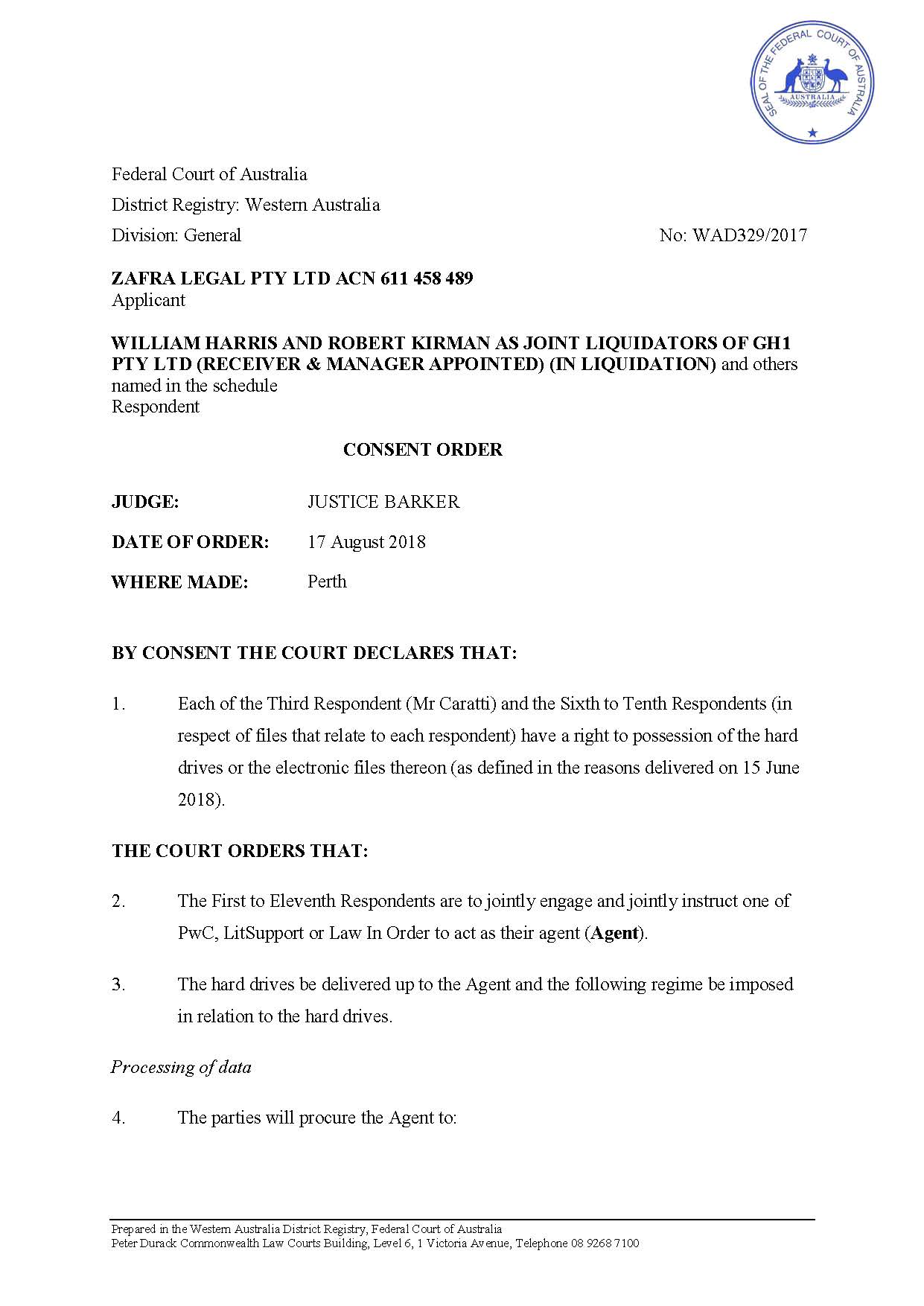
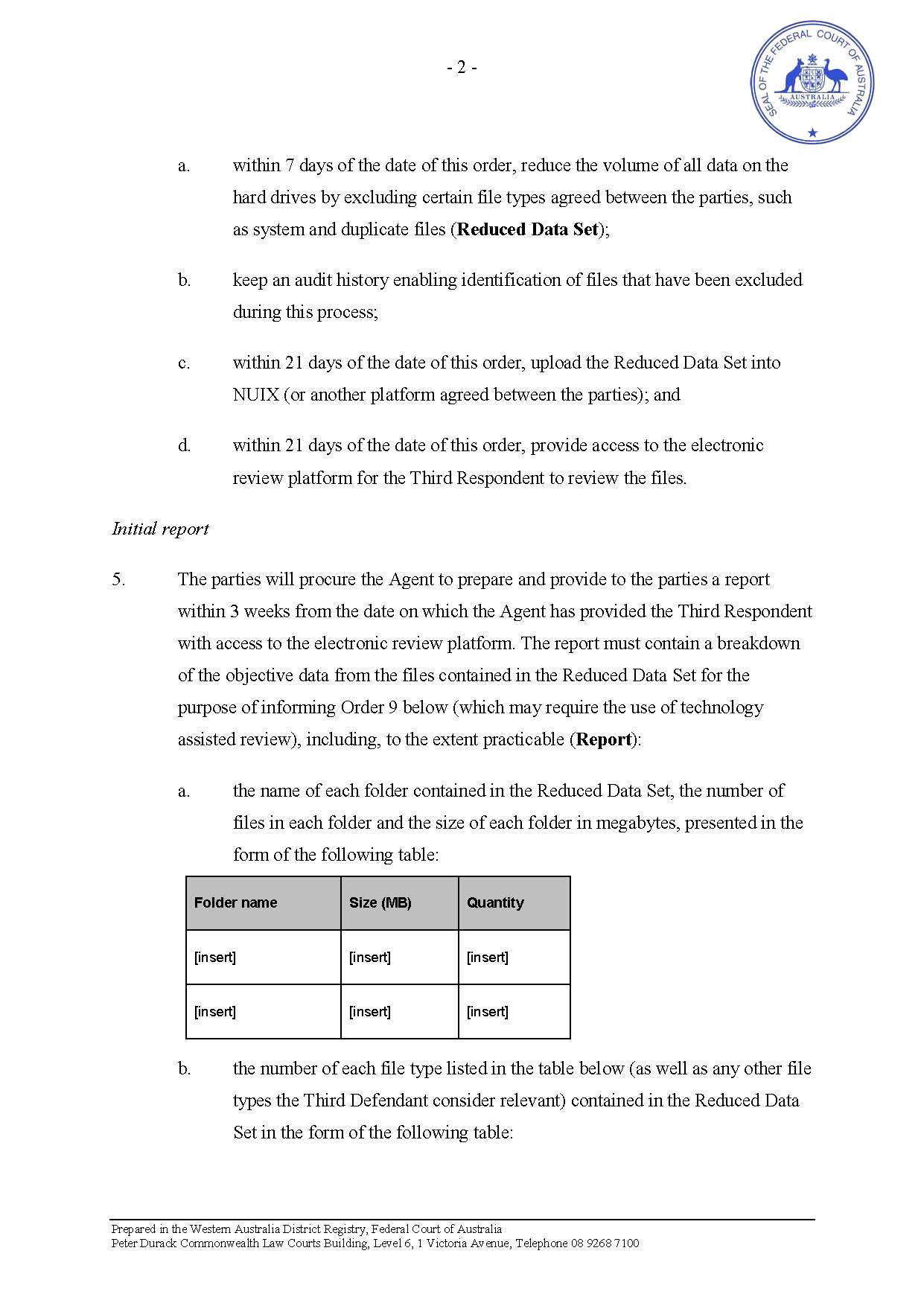
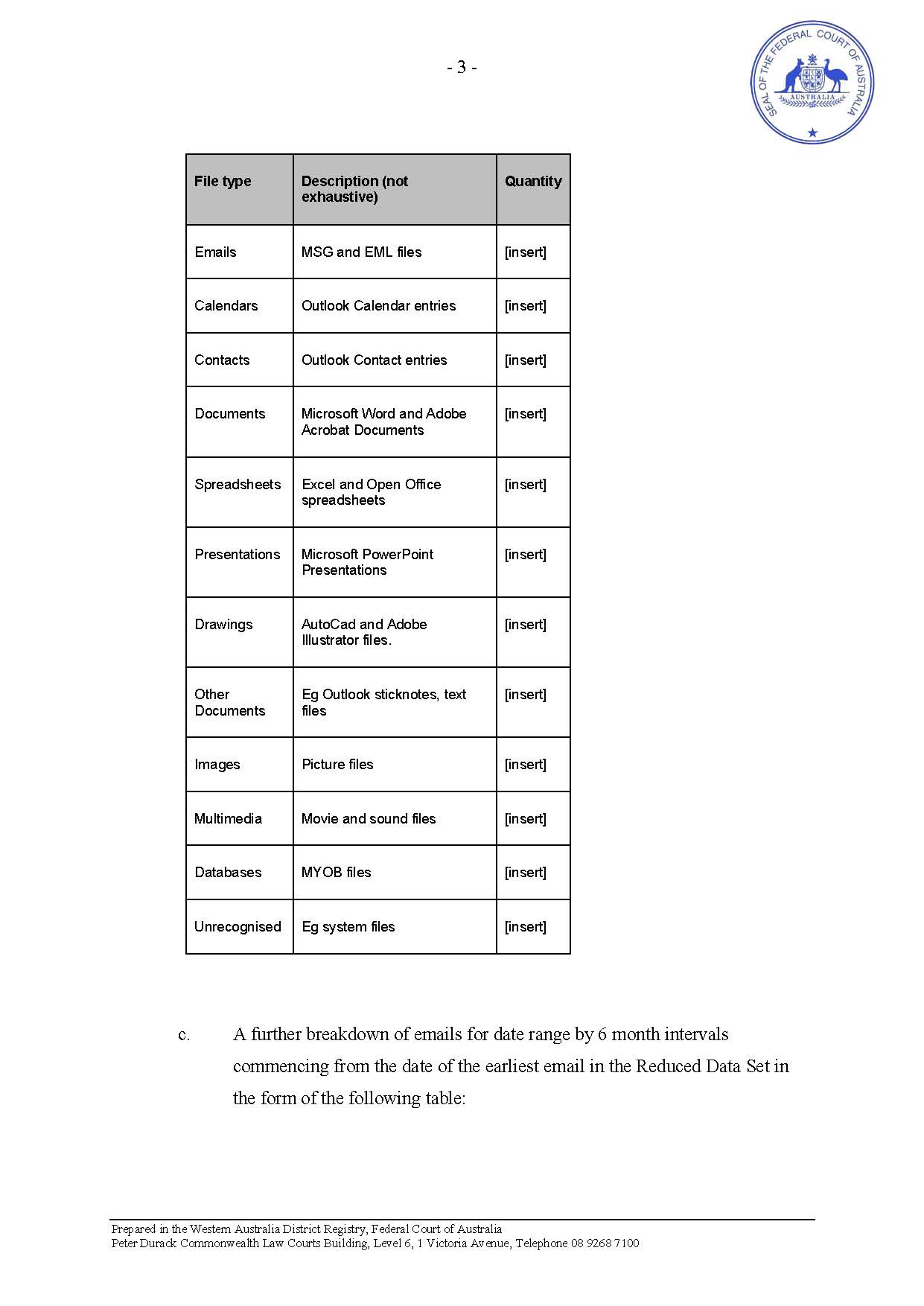
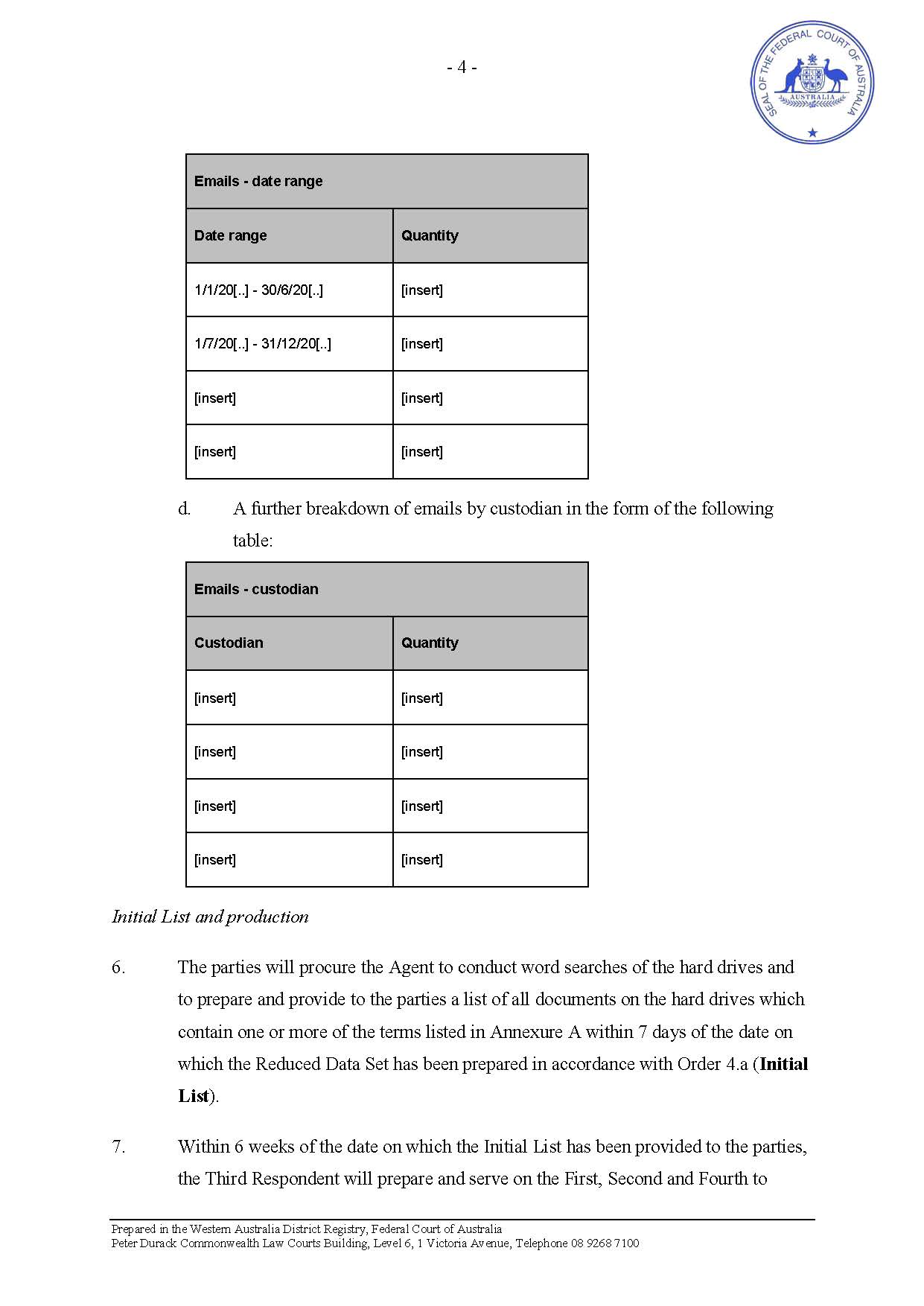
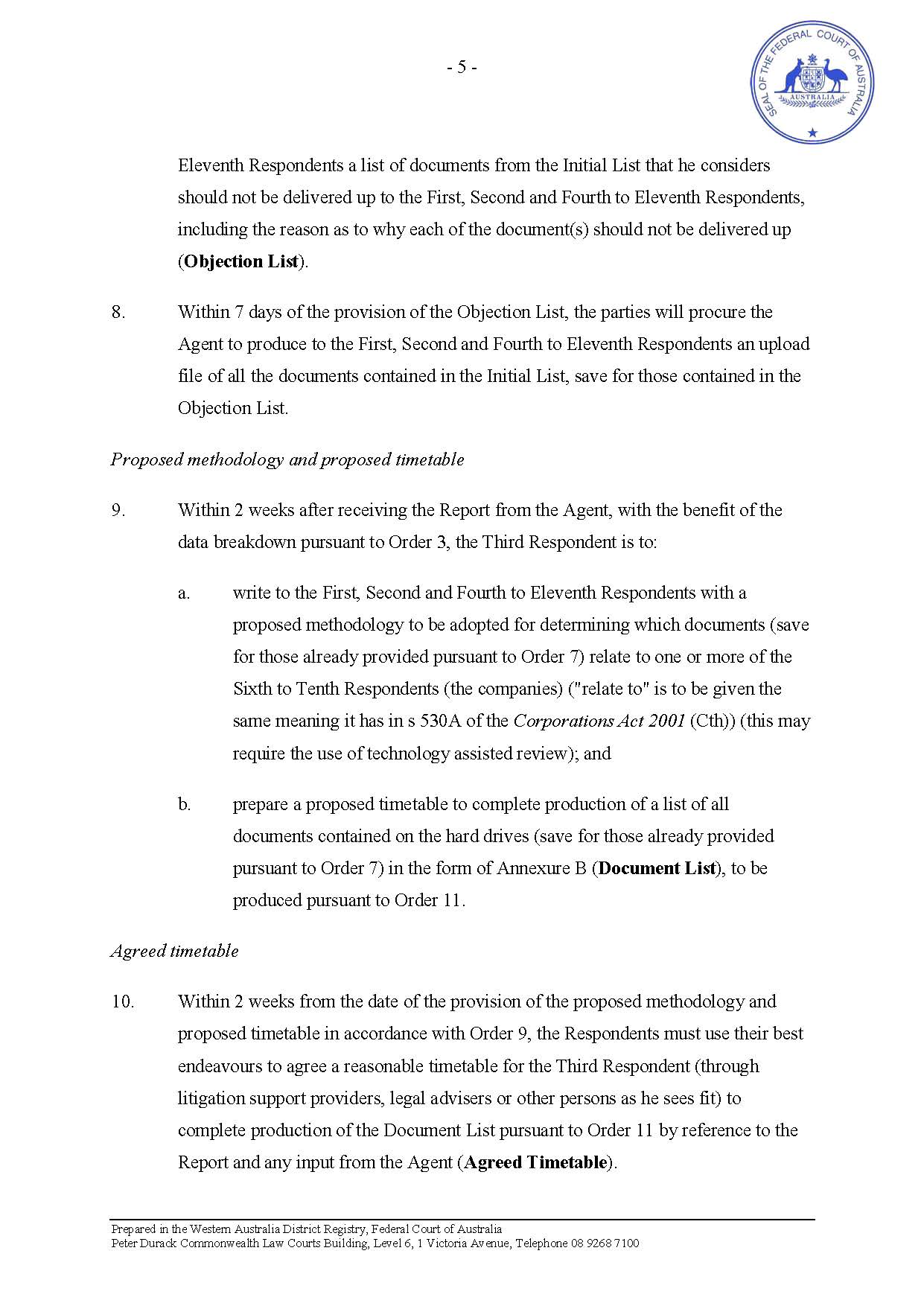
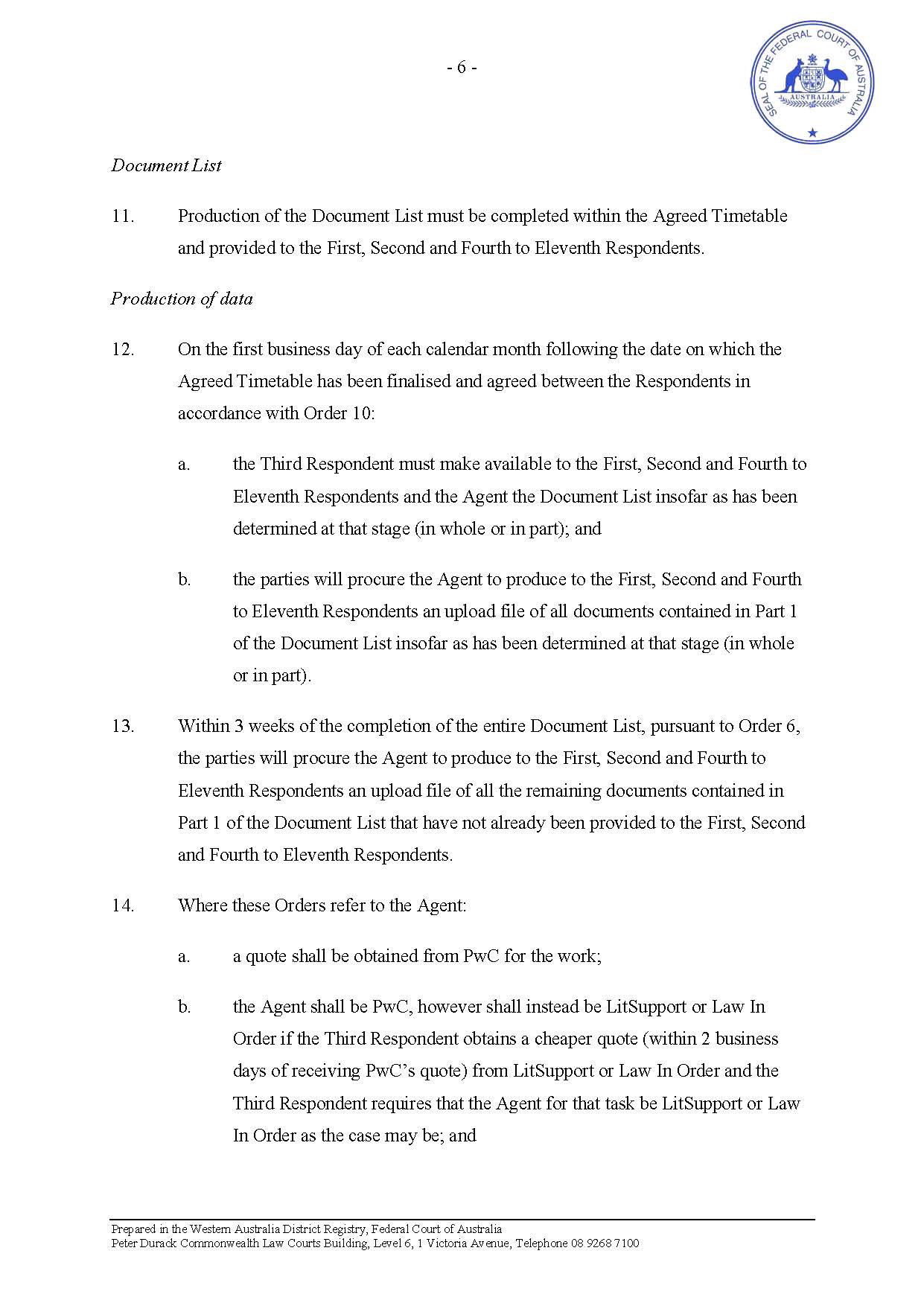
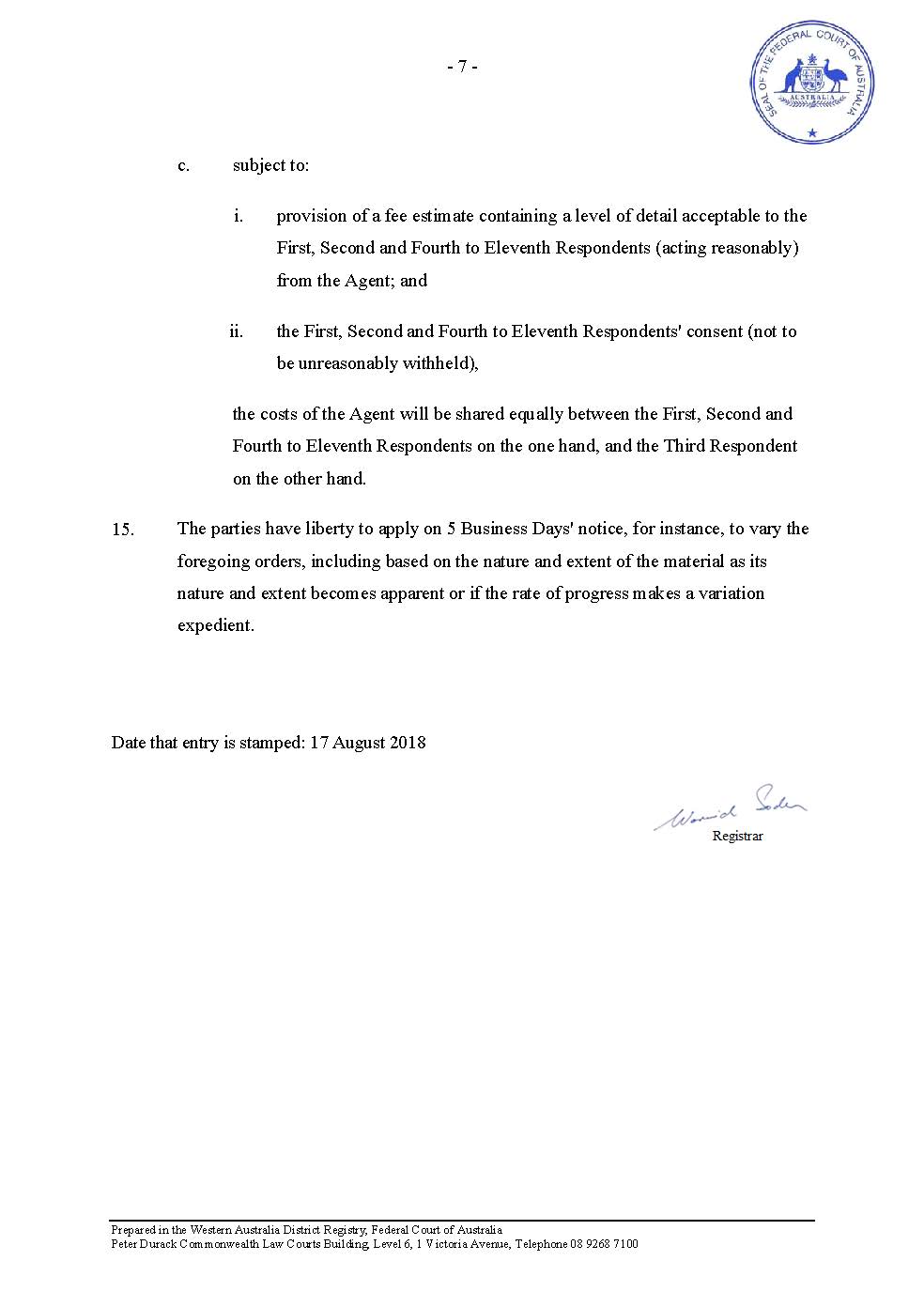
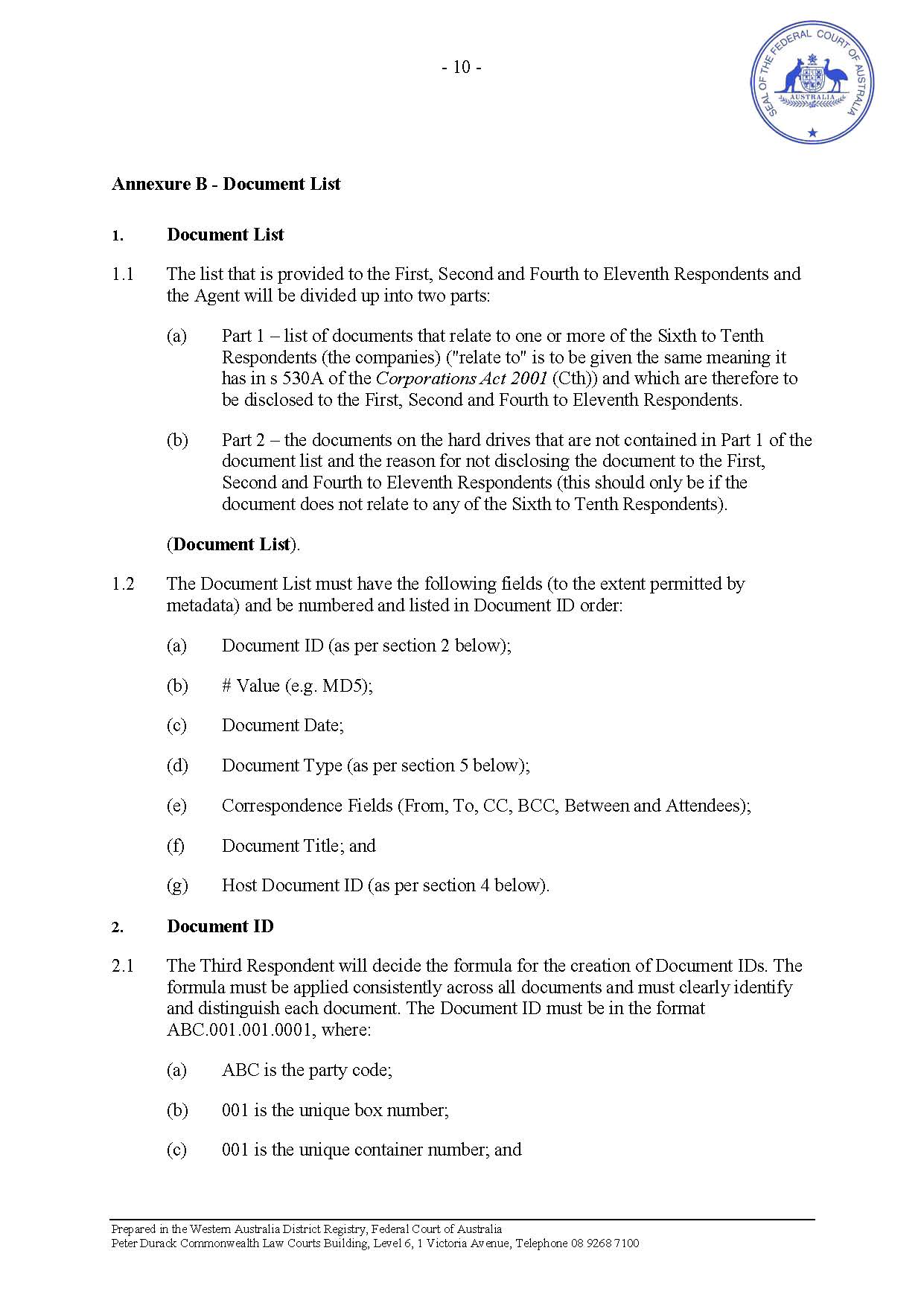
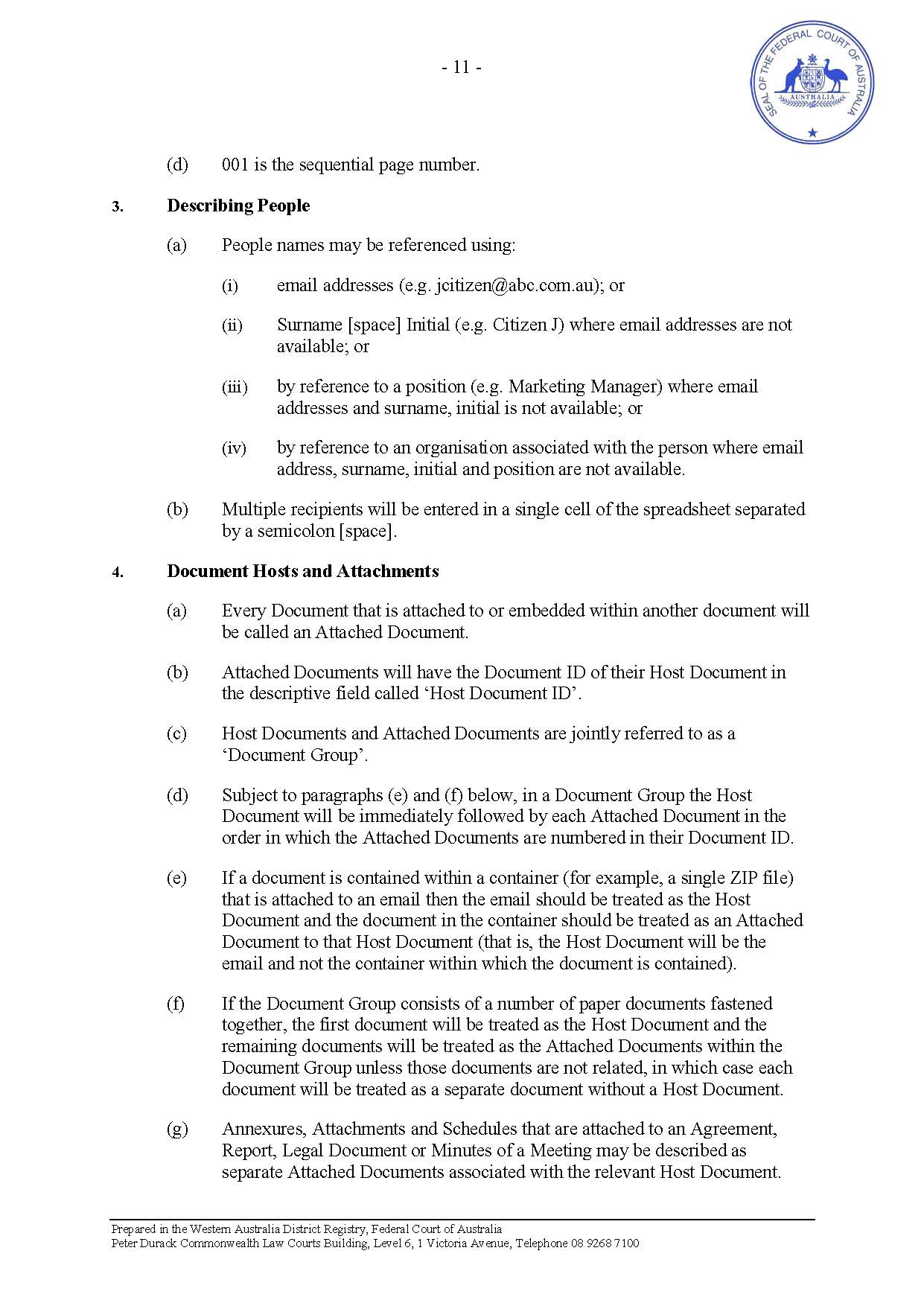
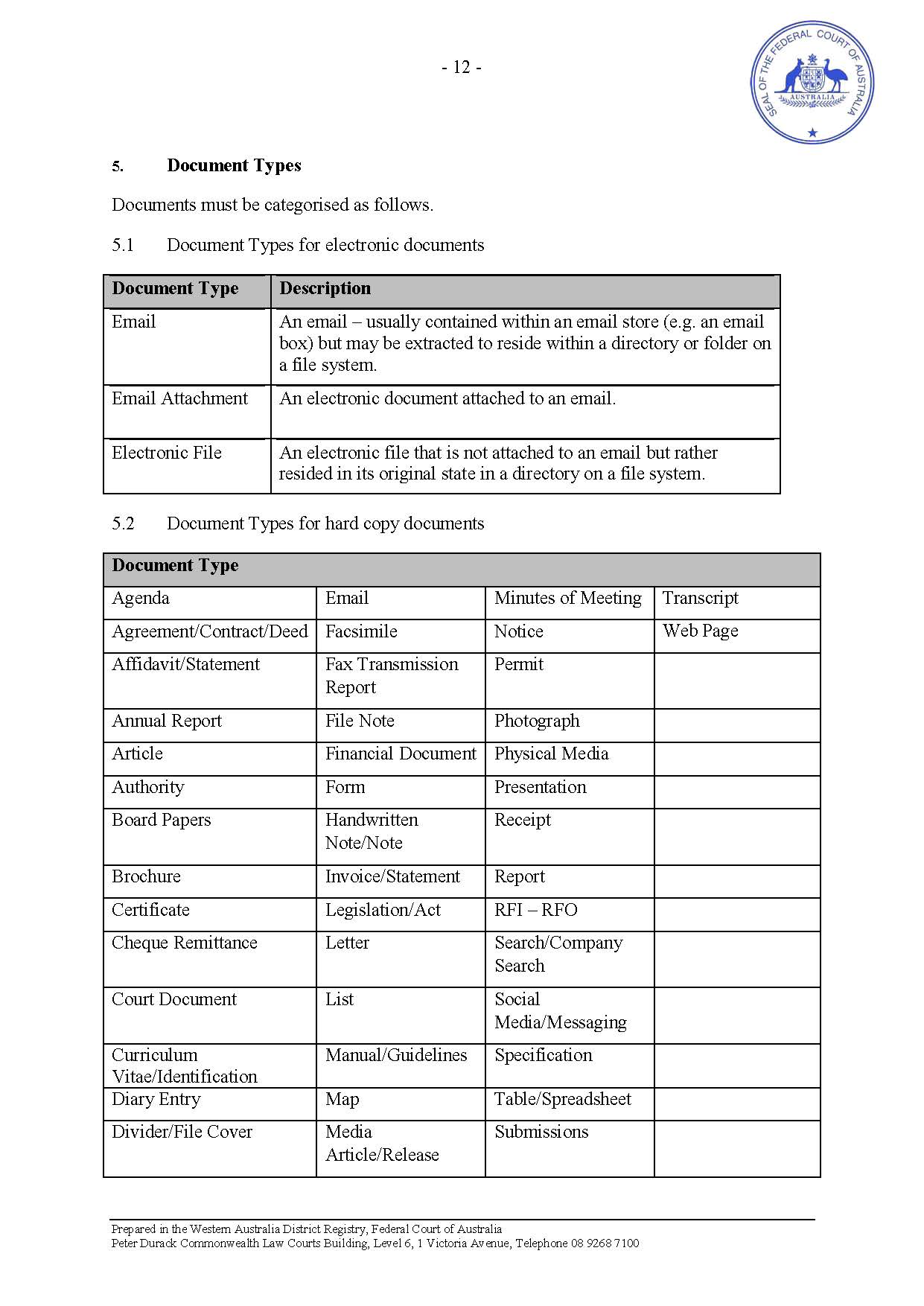
43 Orders were subsequently drafted by the parties and made by consent on 17 August 2018. The orders are annexed to these reasons, and indicate that a regime was agreed for access to all documents by an agent, with preservation of the right to object to inspection of particular documents. Orders 1 and 7 are of particular importance.
44 Order 1 provides:
1. Each of the Third Respondent (Mr Caratti) and the Sixth to Tenth Respondents (in respect of files that relate to each respondent) have a right to possession of the hard drives or the electronic files thereon (as defined in the reasons delivered on 15 June 2018).
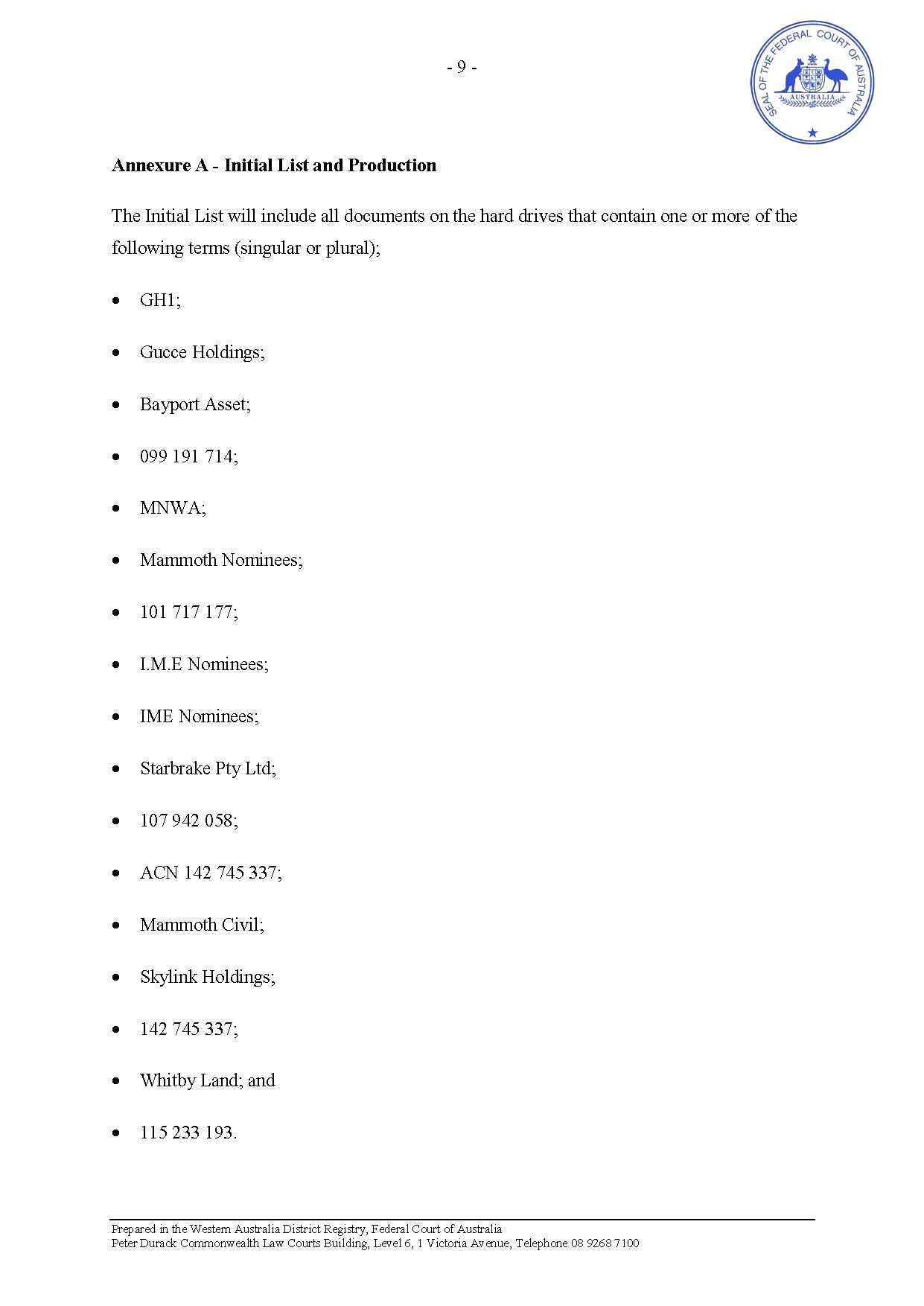
45 The orders then provide for an appointed independent agent to receive the hard drives and provide a report containing a breakdown of the files on the hard drives. The agent is also to provide to the parties an 'Initial List' of all documents on the hard drives that contain identified terms.
46 Order 7 then permits Mr Caratti to identify documents from the Initial List that he says should not be delivered up to the companies and liquidators with reasons for such objections as to inspection. It provides:
7. Within 6 weeks of the date on which the Initial List has been provided to the parties, the Third Respondent will prepare and serve on the First, Second and Fourth to Eleventh Respondents a list of documents from the Initial List that he considers should not be delivered up to the First, Second and Fourth to Eleventh Respondents, including the reason as to why each of the document(s) should not be delivered up (Objection List).
47 We draw attention to those orders because they indicate that despite some suggestion in the reasons that the primary judge found that the companies had an entitlement to possession of the hard drives and Copies as a whole, the formal orders did not provide to that effect but rather anticipate non-exclusive possession of the hard drives for the purpose of obtaining access to or copies of only those electronic files that relate to each company respectively. Further, Mr Caratti is accorded a right to object to inspection of identified documents (including, it can properly be assumed, on the basis of legal professional privilege) and there is generally liberty to apply.
48 It is also readily apparent from the orders that the primary judge had in mind s 530A when making the final orders and using the language of books that relate to the companies.
Appeal grounds
49 There are four grounds of appeal. By ground 1, Mr Caratti contends that the primary judge erred in failing to find that an occupier of premises or another person who apparently represents the occupier and who is present when the warrant is executed within the meaning of s 3N of the Crimes Act cannot be a body corporate.
50 By ground 2, Mr Caratti contends that the primary judge erred in failing to find that the request under s 3N of the Crimes Act was made on behalf of Mr Caratti alone.
51 By ground 3, Mr Caratti asserts that the primary judge erred in failing to find that the copies of the documents seized by the AFP and held on the hard drives provided to Wilson & Atkinson are subject to legal professional privilege.
52 By ground 4, Mr Caratti asserts that the primary judge erred in concluding that the companies are entitled to delivery up of copies of such documents that relate to them within the meaning of s 530A (counsel for Mr Caratti confirmed that the notice of appeal incorrectly referred to s 530B).
53 Mr Caratti seeks an order that the orders of 17 August 2018 be set aside and the matter be remitted for determination according to law.
Ground 1
54 As noted above, the reasons in the Injunction Appeal address this issue: Caratti v Commissioner of the Australian Federal Police [2017] FCAFC 123 at [20]-[34]. Applying those reasons, the primary judge was in error in failing to construe the section such that the reference to 'occupier of the premises or another person who apparently represents the occupier and who is present when the warrant is executed' is a reference to an individual who was at the premises during the search. That error does not affect the orders made by the primary judge in the interpleader proceedings (see [19] above). Appeals are from orders, not reasons, and the orders stand notwithstanding such error.
Ground 2
55 We preface the discussion of ground 2 by noting that in our view, whether the Wilson & Atkinson request to the AFP was made for Mr Caratti solely in his personal capacity or also as director of the companies is not determinative of the application or appeal. In our view, and having regard to our findings as to grounds 3 and 4, even if the request had been made only in his personal capacity, he is an officer of the relevant companies and is in possession of books that relate to the companies within the meaning of s 530A. We do not consider his asserted ownership of the documents comprises a right that would exclude an obligation of production, particularly where it has not been suggested he would be deprived of access to or return of the hard drives once the liquidators have obtained any copies to which they are entitled. Therefore, Mr Caratti remains obliged to produce the hard drives for the purpose of providing copies of the documents that relate to each company to that particular company (or more properly to its liquidator), but noting the express retention under the orders of 17 August 2018 of Mr Caratti's right to object to inspection of identified documents. There is nothing under the regime established by those orders that prevents Mr Caratti from seeking to establish a legitimate claim to legal professional privilege for identified documents.
56 Having said that, as the question occupied considerable time at the hearing, we will consider the primary judge's finding that the request to the AFP was made by Mr Caratti in a dual capacity.
57 Ground 2 involves findings of fact. It must be considered in a way that recognises the advantages of the trial judge in finding the facts after having seen and heard the witnesses, and the challenges for any appellant complaining about credibility-based factual findings.
58 Where a trial judge makes findings of fact based in part at least on the judge's assessment of the credibility of witnesses, those findings will not be reversed on appeal unless it is demonstrated that the findings are flawed by reference to incontrovertible facts or uncontested testimony, or that they are glaringly improbable or contrary to compelling inferences, or that the trial judge has failed to use or has palpably misused their advantage as trial judge: Robinson Helicopter Company Inc v McDermott [2016] HCA 22; (2016) 90 ALJR 679 at [43].
59 In Fox v Percy [2003] HCA 22; (2003) 214 CLR 118, Gleeson CJ, Gummow and Kirby JJ said as follows:
[23] … On the one hand, the appellate court is obliged to 'give the judgment which in its opinion ought to have been given in the first instance'. On the other, it must, of necessity, observe the 'natural limitations' that exist in the case of any appellate court proceeding wholly or substantially on the record. These limitations include the disadvantage that the appellate court has when compared with the trial judge in respect of the evaluation of witnesses' credibility and of the 'feeling' of a case which an appellate court, reading the transcript, cannot always fully share. Furthermore, the appellate court does not typically get taken to, or read, all of the evidence taken at the trial. Commonly, the trial judge therefore has advantages that derive from the obligation at trial to receive and consider the entirety of the evidence and the opportunity, normally over a longer interval, to reflect upon that evidence and to draw conclusions from it, viewed as a whole.
60 The importance of the 'natural limitations' in terms of credibility were reiterated more recently in Minister for Immigration and Border Protection v SZVFW [2018] HCA 30 at [33]. Gageler J noted that the more prominently limitations of that nature feature in a particular appeal, the more difficult it will be for the appellate court to be satisfied that the primary judge was in error (at [35]). See also Commissioner of Taxation v Cassaniti [2018] FCAFC 212 at [35]-[38].
61 Mr Caratti relied on four issues said to arise from the primary judge's finding that Mr Caratti's evidence that he was seeking advice relating to the companies but he was only seeking it so as to be able to provide the companies with advice as a 'good director' about whether to make claims to privilege was implausible:
(a) that Mr Caratti only maintained a position already in his statement of agreed facts and his affidavit and that in any event the finding of implausibility relates to how the case was run, rather than Mr Caratti's evidence, and is not a credibility finding based on viewing the witness;
(b) that the primary judge's finding was improbable in light of the evidence of Mr Caratti and Mr Romano;
(c) that other evidence should have been evaluated in order to assess the implausibility of Mr Caratti's evidence; and
(d) there was a failure to give adequate reasons.
62 The respondents submitted that findings that someone was artificially at pains to give certain evidence and that the evidence was calculated to avoid a particular admission were findings that attacked the credibility of Mr Caratti. We agree, and it follows that this Court's role is limited insofar as such evidence is concerned in the way described in Robinson Helicopter. Mr Caratti was challenged during cross-examination as to his claimed position that his only purpose was to protect himself and it was put to him that he was acting on behalf of the companies.
63 It is not in issue that Mr Caratti sought the documents from the AFP on his own behalf. What is important is his evidence that when he sought them he also had in mind the position of the companies but only to the extent of his own position as a director of those companies and the advice he might give the companies. It is that limitation that Mr Caratti sought to place on his consideration of the position of the companies that the primary judge found implausible. Regardless of the content of his affidavit and the statement of facts, the primary judge was able to observe and assess how Mr Caratti responded to cross-examination on the topic and it is a topic that the cross-examiner returned to.
64 Nor do we consider the primary judge's findings were improbable in that regard, taking into account the other evidence that was before him and his review of that evidence. There was not incontrovertible evidence to the contrary. Mr Caratti accepted that the ultimate objective of the proceedings to set aside the warrant was to get all the seized documents back (and that included documents belonging to the companies). He accepted that he was seeking advice as to privilege that might be asserted by corporations with which he was associated. The letter to the AFP referred to other proceedings including material which was required by Mr Caratti 'and his related entities'. There was no question that Mr Caratti was a director of the relevant companies and there was no question that the seized documents included documents that belonged to the companies. Such evidence was relevant to and not inconsistent with the primary judge's finding that (leaving aside his personal request) Mr Caratti's request for the documents as a director was not made in his limited personal capacity as a director only rather than on behalf of the company.
65 Where a director seeks a review of documents for privilege in his personal capacity for the purpose of assessing whether he or she should advise a company to claim that privilege, there is a certain artificiality in contending that the director is not seeking that advice for the company. That is so particularly in the circumstances of this case where the warrant identified that the alleged offences committed by Mr Caratti (and in one instance, Mr Caratti and Ms Bazzo) related to Mr Caratti's actions with respect to tax liabilities of particular respondent companies (relevantly, Whitby, GH1 and IME). In contrast to other scenarios - for example, advice sought by a director as to personal liability for the debts of a company, advice sought by a director as to rights of indemnity, advice sought as to duties as an officer of a company - it is unclear why advice about privilege over company documents would be for the purposes of the director personally as against for the benefit of the company.
66 It is also surprising, as senior counsel for the respondents submitted, that Mr Caratti, whilst acknowledging his desire for self-preservation, would not seek to use his position to seek to protect the interests of the corporations and thereby potentially also protect his own interests.
67 Nor does the ambiguous costs agreement assist Mr Caratti. It does not establish that he alone was the client of Wilson & Atkinson. It leaves open the argument that Wilson & Atkinson were acting not only for Mr Caratti but also for (at least) GH1. It is not inconsistent with the primary judge's findings, although we agree with the primary judge's conclusion that it is not determinative of the matters in issue.
68 We accept that the primary judge did not state clearly in his reasons whether he accepted or rejected Mr Romano's evidence. However, on a close reading of the reasons, it is apparent that having considered and set out Mr Romano's evidence in some detail, his Honour did not accept Mr Romano's subjective belief that he acted only for Mr Caratti as determinative evidence of that fact. The primary judge recited Mr Romano's evidence that he considered he acted only for Mr Caratti personally, and in that part of his reasons also addressed the terms of the retainer (which suggested the client was not only Mr Caratti) and the terms of the letter Mr Romano drafted to the AFP (with its references to other proceedings, and to material which was required by Mr Caratti 'and his related entities'). The primary judge set out Mr Romano's evidence that at the time of the letter to the AFP there were other taxation proceedings pending for related companies.
69 We do not consider the primary judge in his consideration of Mr Romano's evidence sought to impugn the credit of Mr Romano, but rather it can be inferred that the primary judge was not satisfied as to its reliability, taking into account the other evidence. We would add that there was a proper basis for questioning the reliability of Mr Romano's evidence, taking into account the matters to which the primary judge referred and noting further Mr Caratti's evidence that in addition to seeking advice as to his personal position, he was seeking advice relevant to legal professional privilege that might be claimed by the companies (albeit on the limited basis he propounded). Such evidence went beyond the limited basis upon which Mr Romano said he understood he was acting, casting doubt on whether Mr Romano accurately recalled or was clear as to the basis upon which he was acting.
70 Finally, we note that reliance on the references by Mr Romano in the letter to the AFP to the singular 'client' as evidencing a request made for the sole and personal purposes of Mr Caratti was not compelling in circumstances where the communications were made in the proceedings to challenge the warrants where Mr Caratti was the sole applicant. As a matter of grammar it made sense to refer only to the 'client'. That says nothing about the capacity in which Mr Caratti was seeking documents. Further, the same communication referred to a multi-faceted purpose for seeking the documents.
71 Therefore, we do not accept Mr Caratti's submission that the primary judge's finding was improbable in light of the evidence of Mr Caratti and Mr Romano. Further, we consider that the primary judge evaluated the evidence of both Mr Caratti and Mr Romano in the course of making his findings.
72 We accept that the reasons with respect to Mr Romano's evidence could have been more clearly expressed, but taking into account the reasons as a whole we do not consider the manner in which the reasons were drafted was deficient to an extent that comprises error. Further, we consider that the primary judge provided adequate reasons as to why he formed the view that Mr Caratti's evidence was implausible and that 'in truth and substance' the request to the AFP was also made on behalf of the relevant companies. His Honour considered and accepted the respondents' submissions. His Honour then addressed the manner in which Mr Caratti gave his evidence. He referred to the difficulty in separating the alleged capacities of Mr Caratti. His Honour then listed a number of factual matters that supported his view, including that Mr Caratti was integral to the operations of the relevant companies and that the seized documents included documents of the companies. For completeness, we note that the primary judge also took into account that he considered the relevant companies were 'occupiers' of Wickham Street. As already noted, we do not agree with that view. However, reliance on that matter was but one element in the reasoning process and it does not alter our conclusion. Its inclusion is not such as to undermine the reasoning as a whole.
73 It follows that we would dismiss ground 2. However, as explained, even if we were wrong as to this ground, the outcome would be no different. We do not consider this ground is determinative of the appeal.
Ground 3
74 Ground 3 is premised on a finding that all of the documents on the hard drives (even those that relate to the companies) are the subject of a legitimate claim for legal professional privilege such that there is no obligation to provide copies of any documents to the companies or liquidators.
75 The primary judge summarised Mr Caratti's contentions as to privilege, but did not resolve the question of privilege, although as we have noted the right remains under the regime provided by the formal orders for Mr Caratti to object to inspection.
76 In our view, the primary judge did not err in failing to make a finding that all documents on the hard drives are the subject of a legitimate claim of privilege. His Honour did not dismiss the relevance of such claims or the potential for them to be raised. So much is clear from [211] of the reasons but more to the point, the position is preserved by the formal orders. In any event, had his Honour attempted to undertake that task, it is inevitable that Mr Caratti's generalised and broad claim over all contents of the hard drives would not have succeeded.
77 It is trite that legal professional privilege may take two forms - advice privilege or litigation privilege. Legal advice privilege covers communications between a lawyer in his or her professional capacity and the client if they are confidential and for the dominant purpose of seeking or giving legal advice. Litigation privilege covers confidential communications made after litigation is commenced or contemplated, between a lawyer and his or her client or third parties for the dominant purpose of such litigation, and includes seeking or giving advice in relation to it and obtaining information for the purposes of the litigation.
78 General recitations of privilege claims will not state sufficiently whether the communication in fact discloses or reveals the nature or content of legal advice. Claims for privilege must be made carefully and with particularity. The authorities emphasise the need for focused and specific evidence in order to ground a claim for legal professional privilege. In Kennedy v Wallace [2004] FCAFC 337; (2004) 142 FCR 185 at 189, the Full Court reiterated the principles that verbal formulae and bare conclusory assertions of purpose are not sufficient to make out a claim for privilege. Where possible the Court should be assisted by evidence of the thought processes behind, or the nature and purpose of advice being sought in respect of, each particular document. The fact that generalised evidence is not challenged in cross-examination does not mean that such evidence must be accepted, particularly when it is manifestly inadequate: Barnes v Commissioner of Taxation [2007] FCAFC 88 at [18].
79 Privilege attaches to a communication. It does not necessarily attach to a document as a whole: AWB Limited v Honourable Terence Rhoderic Hudson Cole (No 5) [2006] FCA 1234; (2006) 155 FCR 30 at [44].
80 As to copies, the question is whether the copy itself came into existence for the dominant purpose of obtaining legal advice or assistance: Commissioner of Australian Federal Police v Propend Finance Pty Ltd [1997] HCA 3; (1997) 188 CLR 501 at 508-509, 543-544, 552-553, 569; and Esso Australia Resources Ltd v Commissioner of Taxation (Cth) [1999] HCA 67; (1999) 201 CLR 49 at 65-66. The consequence of this may be that an original document which is not created for the dominant purpose of seeking legal advice and assistance, and thus was not privileged, may become privileged if a copy of it is created for that purpose. On the other hand, for example, where a document is privileged but a copy of it is created for the purpose of commercial negotiation, this may result in the copy not being privileged: Barnes at [11].
81 In this case, Wilson & Atkinson made a global request for all documents seized under the warrants and the AFP responded with (it would seem) a complete set of documents seized. The mere request for a set of documents said to be for the purpose of seeking legal advice does not of itself establish a legitimate claim for privilege over all communications comprised in all such documents. Such a general request for all documents does not tend to disclose the nature of any advice sought. There must be some condescension into detail as to the nature of the documents, the nature of the communications over which the privilege is claimed and why the disclosure of the communication might tend to disclose or reveal the nature or content of legal advice.
82 Mr Caratti's evidence did not provide sufficient information to ground a claim for privilege over all documents. It may be that many of the documents seized were simply not relevant to matters upon which it is alleged Mr Romano was instructed to advise. That a document is being reviewed to assess any claim for privilege does not of itself establish that the document is privileged. It was appropriate, bearing in mind the significance of the right to maintain the privilege, that any question of privilege be deferred until such time as any claim was properly enunciated for each document or (at least) category of document. The orders made below in fact permit and facilitate such process. The regime will also facilitate through the objection process the potential to address joint privilege claims.
83 We would dismiss ground 3.
Ground 4
84 As already addressed, Mr Caratti contends that the hard drive and Copies were obtained by him personally (through his lawyers) and are the subject of privilege. The claim to privilege appears to be the basis upon which Mr Caratti asserts that he is entitled to retain the hard drives and Copies as against the companies and the liquidators within the meaning of s 530A(1)(a).
85 In light of our view as to ground 3, a global and unsubstantiated privilege claim cannot be relied upon in order to deny production of all documents.
86 Regardless of how the Copies came to be in his possession, Mr Caratti received them and it is admitted that the Copies include books that are the books and records of the companies. Those books clearly relate to the respective companies.
87 In our view, Mr Caratti is not relieved of the obligation to produce such documents simply because they are copies rather than originals. Further, even if the copies on the hard drives were established to be the property of Mr Caratti and not the property of the companies, then they are still books that relate to the companies. Whether or not he owns them is not to the point.
88 The term 'books' is defined by s 9 of the Corporations Act to include:
(a) a register;
(b) any other record of information;
(c) financial reports or financial records, however compiled, recorded or stored; and
(d) a document.
89 This is a broad and inclusive definition. Nothing in the definition of 'books' suggests that it is limited to 'original' copies of a record of information or a document.
90 Section 2B of the Acts Interpretation Act 1901 (Cth) defines 'document' to mean:
… any record of information, and includes:
(a) anything on which there is writing; or
(b) anything on which there are marks, figures, symbols or perforations having a meaning for persons qualified to interpret them; or
(c) anything from which sounds, images or writings can be reproduced with or without the aid of anything else; or
(d) a map, plan, drawing or photograph.
91 Further, in Australian Securities and Investments Commission v Rich [2005] NSWSC 417; (2005) 191 FLR 385, Austin J found that copies of the original documents which the Australian Securities and Investments Commission wished to tender were 'documents' within the meaning of para (d) of the definition of 'books' in s 9 of the Corporations Act (at [237]).
92 We respectfully agree and conclude that copies of documents may fall within the definition of 'books'. To hold otherwise would facilitate a regime where original documents might be destroyed but copies obtained by others could be withheld from a liquidator, simply on the basis that they are copies, a notion that would undermine the role of a liquidator in gathering information about a company for the benefit of creditors.
93 Whilst it was not necessary to determine the question in this matter, we note that the nature of electronic information is such that original and copies may be indistinguishable, and so there may be an air of artificiality in maintaining that there is any substantive difference in the nature of such documents: see for example Re Ezyclad Pty Ltd (in liq) [2014] VSC 66 at [76].
94 It is valuable at this point to set out s 530A:
Officers to help liquidator
(1) As soon as practicable after the Court orders that a company be wound up or appoints a provisional liquidator of a company, or a company resolves that it be wound up, each officer of the company must:
(a) deliver to the liquidator appointed for the purposes of the winding up, or to the provisional liquidator, as the case may be, all books in the officer's possession that relate to the company, other than books possession of which the officer is entitled, as against the company and the liquidator or provisional liquidator, to retain; and
(b) if the officer knows where other books relating to the company are - tell the liquidator or provisional liquidator where those books are.
(2) Where a company is being wound up, or a provisional liquidator of a company is acting, an officer of the company must:
(a) attend on the liquidator or provisional liquidator at such times; and
(b) give the liquidator or provisional liquidator such information about the company's business, property, affairs and financial circumstances; and
(c) attend such meetings of the company's creditors or members;
as the liquidator or provisional liquidator reasonably requires.
(3) An officer of a company that is being wound up must do whatever the liquidator reasonably requires the officer to do to help in the winding up.
(4) An officer of a company must do whatever a provisional liquidator of the company reasonably requires the officer to do to help in the performance or exercise of any of the provisional liquidator's functions and powers.
(5) The liquidator or provisional liquidator of a company may require an officer of the company:
(a) to tell the liquidator the officer's residential address and work or business address; or
(b) to keep the liquidator informed of any change in either of those addresses that happens during the winding up.
(6) A person must not fail to comply with subsection (1), (2), (3) or (4), or with a requirement under subsection (5).
(6A) An offence based on subsection (6) is an offence of strict liability.
Note: For strict liability, see section 6.1 of the Criminal Code.
(6B) Subsection (6) does not apply to the extent that the person has a reasonable excuse.
Note: A defendant bears an evidential burden in relation to the matter in subsection (6B), see subsection 13.3(3) of the Criminal Code.
(7) For the purposes of this section, officer includes a former officer.
(9) Nothing in this section limits the generality of anything else in it.
95 It is important to steadily bear in mind the particular terms of s 530A(1) of the Corporations Act and its application to books that 'relate to the company'. Such wording differs from that of other provisions that use expressions including 'books of the company' (for example, s 530B, s 247A) or 'books of the corporation that relate to that property' (s 431). The expression 'books of the corporation' has been held to refer to books owned by the corporation: Hall v Sherman [2001] NSWSC 810; (2001) 40 ACSR 40; Areva NC (Australia) Pty Ltd v Summit Resources (Australia) Pty Ltd [No 2] [2008] WASC 10 at [7]-[9]; Engel v National Biodiesel Limited [2015] FCA 1114; (2015) 245 FCR 436 at [28]-[29].
96 There is no reason to similarly limit the scope of s 530A in circumstances where it expressly uses the broader language of books that 'relate' to the company. It is well established that 'relate to' or 'in relation to' are connecting phrases of broad import, although such phrases indicate there must be a connection between one subject matter and another: see the collection of the authorities in Pearce and Geddes' Statutory Interpretation in Australia at [12.7] and see Joye v Beech Petroleum NL & Cortaus Ltd (in liq) (1996) 67 FCR 275 at 285.
97 As a matter of construction, there is nothing in s 530A that requires a narrow interpretation. The context of the provision, as appears from its heading and expressly by s 530A(3), is that officers are 'to help liquidators'. It is aimed at assisting a liquidator to gather information. The officer must give the liquidator 'such information' as he or she reasonably requires: s 530A(2)(b). The generality of the section is not limited by anything else in it: s 530A(9). To interpret the provision as requiring delivery of books that are not necessarily 'owned' by the company but also those that relate to it is consistent with its terms and also consistent with the clear purpose of the provision.
98 We do not consider that the mere fact that the books might be owned by or in the possession of an officer constitutes a right of possession that the officer is entitled to assert against a liquidator in order to prevent delivery up for the purpose of assisting the liquidator. If ownership or possession alone were sufficient to justify such an assertion, the section might be deprived of utility. It is not suggested that delivery up extinguishes or undermines such rights that the officer may have with respect to the documents. There must be something more to an officer's claim to exclusive possession in order to constitute a right that overrides (as against coexists with) the rights of the liquidator. A source of an entitlement to exclusive possession must be identified.
99 In this case, Mr Caratti relies upon his claim to legal professional privilege to assert that he is not obliged to deliver up the hard drives or Copies, but this argument assumes that where proper claims to legal professional privilege over all documents have not already been established, those claims cannot be preserved in a regime for delivery of documents. That is not the case. As addressed in considering ground 3, we do not consider Mr Caratti's generalised claim to legal professional privilege is sufficient nor established in this case. However, the regime proposed by the orders protects Mr Caratti's ability to object to inspection of particular documents. Therefore, any personal rights to possession or to prevent inspection insofar as they are founded on a legitimate claim to legal professional privilege are protected and do not bar delivery of the hard drives and Copies in accordance with the orders of 17 August 2018.
100 We would dismiss ground 4.
Determination
101 If follows that Mr Caratti's appeal must be dismissed with costs.
I certify that the preceding one hundred and one (101) numbered paragraphs are a true copy of the Reasons for Judgment herein of the Honourable Justices Kerr, Steward and Banks-Smith. |
Associate:
Annexure

WAD 403 of 2018 | |
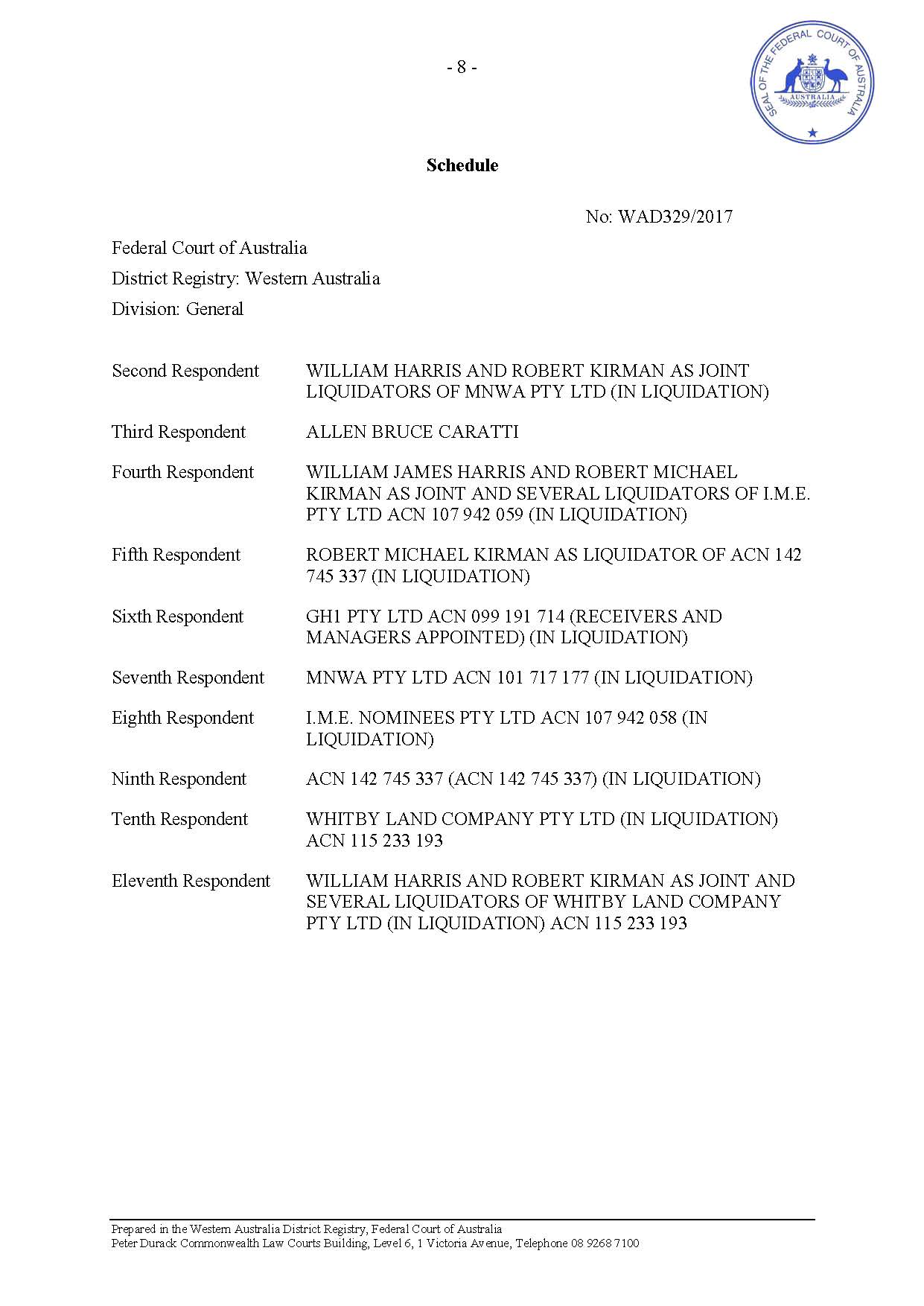
Respondents | |
Fourth Respondent: | WILLIAM JAMES HARRIS & ROBERT MICHAEL KIRMAN AS JOINT AND SEVERAL LIQUIDATORS OF I.M.E. PTY LTD (IN LIQ) (ACN 107 942 059) |
Fifth Respondent: | ROBERT MICHAEL KIRMAN AS LIQUIDATOR OF ACN 142 745 337 PTY LTD (IN LIQ) (ACN 142 745 337) |
Sixth Respondent: | GH1 PTY LTD (IN LIQ) (RECEIVERS AND MANAGERS APPOINTED) (ACN 099 191 714) |
Seventh Respondent: | |
Eighth Respondent: | I.M.E. NOMINEES PTY LTD (IN LIQ) (ACN 107 942 058) |
Ninth Respondent: | ACN 142 745 337 PTY LTD (IN LIQ) (ACN 142 745 337) |
Tenth Respondent: | WHITBY LAND COMPANY PTY LTD (IN LIQ) (ACN 115 233 193) |
Eleventh Respondent: | WILLIAM HARRIS & ROBERT KIRMAN AS JOINT AND SEVERAL LIQUIDATORS OF WHITBY LAND COMPANY PTY LTD (IN LIQ) (ACN 115 233 193) |


