

FEDERAL COURT OF AUSTRALIA
Bluescope Steel (AIS) Pty Ltd v Australian Workers’ Union [2019] FCAFC 84
ORDERS
First Appellant BLUESCOPE STEEL LIMITED Second Appellant | ||
AND: | Respondent | |
Intervener | ||
ALLSOP cJ, COLLIER AND RANGIAH JJ | |
DATE OF ORDER: | 24 MAY 2019 |
THE COURT ORDERS THAT:
1. The parties have 14 days in which to file and serve submissions as to the form of any orders.
Note: Entry of orders is dealt with in Rule 39.32 of the Federal Court Rules 2011.
ALLSOP CJ:
1 This is an appeal by first appellant BlueScope Steel (AIS) Pty Ltd and second appellant BlueScope Steel Limited (together, BlueScope, individually, BlueScope AIS and BlueScope Steel) from the declarations and orders of a judge of this Court delivered on 20 March 2018, giving effect to reasons published on 14 February 2018. In the primary judgment, it was held that the first appellant had contravened item 15 of Schedule 16 of the Fair Work (Transitional Provisions and Consequential Amendments) Act 2009 (Cth) and s 50 of the Fair Work Act 2009 (Cth) by, in broad terms, failing to make appropriate superannuation contributions to its employees.
2 Few facts are contentious. The variety and detail of the industrial awards and agreements applying to BlueScope’s employees and the intricacies of the Commonwealth superannuation framework add some complexity to the matter, but the underlying facts are simple. BlueScope pays some of its employees annualised or aggregate salaries. Employees working under an annualised salary system worked up to 43.5 hours per week (38 hours plus 5.5 “additional hours”) to meet the needs of the business. Further, as well as those engaged under the aggregate salary system, they were rostered to work on public holidays. The employees’ annualised or aggregate salaries included payment for not only the base salary, but also the additional hours and public holidays. The essential difference between the annualised and aggregate salary is that in the former a body of additional hours (5.5 per week) is pre-paid as part of an additional hours component.
3 For the purposes of the proceedings at first instance and on appeal, argument was confined to the employment circumstances of two employees: Mr Storey and Mr Le Clerc. Both were covered by the three relevant industrial instruments: the BlueScope Steel (AIS) Pty Ltd – Port Kembla Works Employees Award 2006 from 2006 to 8 August 2013 (the 2006 Award); the BlueScope Steel Port Kembla Steelworks Agreement 2012 from 9 August 2013 to 24 November 2015; and the BlueScope Steel Port Kembla Steelworks Agreement 2015 from 25 November 2015 to at least the time of the primary proceedings (the 2012 Agreement, the 2015 Agreement, and together, the 2012 and 2015 Agreements). Mr Storey and Mr Le Clerc were covered by different departmental agreements. Mr Storey was covered by the Bulk Operations Enterprise Agreement 2005 from 17 February 2006 to 21 August 2013 and the Bulk Operations Department Agreement 2013 from 21 August 2013 until 16 January 2016. He had an annualised salary until 10 January 2016, after which he had an aggregate salary. Mr Le Clerc always worked for an aggregate salary, pursuant to the Slabmaking – 12 hour Shift Agreement 2004 from April 2004 to 13 January 2013 and the Slab Yard - 12 hour Shift Agreement 2010 from 13 January 2013 to at least the time of the primary proceedings. Relevant provisions in these Awards and Agreements are detailed at [13]-[44] of the primary judgment.
4 In effect, two questions were before the primary judge. First, whether payment for additional hours included in the annualised salary were “ordinary time earnings” for the relevant superannuation legislation. Secondly, whether public holiday payments included in the annualised or aggregate salaries were “ordinary time earnings” for the same legislation.
5 Attention was focused on Mr Storey in relation to the question of whether the “additional hours” and “public holidays” components of the annualised salary fell within ordinary time earnings by reference to his receipt of an annualised salary. In relation to Mr Le Clerc, who was paid an aggregate salary which did not include the “additional hours” element, the question focused solely on the “public holidays” component.
6 Critical to answering these questions is the construction, interpretation and application of the phrase “ordinary time earnings” and “ordinary hours of work” as used in s 6 of the Superannuation Guarantee (Administration) Act 1992 (Cth) ( the SG Administration Act). The application of the phrase involves the correct construction and interpretation of the relevant industrial instruments.
7 For the reasons that follow, subject to giving the parties an opportunity that they sought to be heard on the orders, I would allow the appeal, set aside the orders made by the primary judge, and in lieu thereof dismiss the application.
Threshold questions: Are the instruments relevantly capable of being contravened?
8 The first issue is whether the industrial instruments, insofar as they deal with superannuation contributions, are capable of being contravened. This threshold issue was ground 2 of the Notice of Appeal. The primary judge concluded that the awards (represented by the 2006 Award) were capable of being contravened, and were contravened, for the purposes of Item 15 of Sch 16 to the Fair Work (Transitional Provisions and Consequential Amendments) Act and the enterprise agreements (represented by the 2012 and 2015 Agreements) were capable of being contravened, and were contravened, for the purposes of s 50 of the Fair Work Act.
9 The provisions of the 2006 Award and 2012 and 2015 Agreements, found by the primary judge to have been contravened (cl 7 of the 2006 Award, and cl 7 of the 2012 and 2015 Agreements) are as follows:
7. Superannuation [2006 Award]
7.1 Superannuation Legislation - the Subject of Superannuation is dealt with exhaustively by federal legislation including the Superannuation Guarantee (Administration) Act 1992 (Cth), the Superannuation Industry (Supervision) Act 1993 (Cth), the Superannuation (Resolution of Complaints) Act 1993 (Cth), and section 124 of the Industrial Relations Act 1996. This legislation, as varied from time to time, governs the superannuation rights and obligations of the parties. Subject to this legislation, superannuation is also dealt with by the trust deed and rules of the BlueScope Steel Superannuation Fund and the Superannuation Trust of Australia, and relevant agreements made from time to time between the Company and the unions party to this award, including the BHPSteel - Superannuation Review dated 25 October 1995.
7.2 Salary Sacrifice -
7.2.1 Despite any other provisions of this award, for the purpose of calculating ordinary time earnings, the rate of pay per week prescribed for the purpose of clause 6, Rates of Pay, is reduced by the amount which an employee elects by notice in writing to the Company to sacrifice in order to enable the Company to make a superannuation contribution for the benefit of the employee.
7.2.2 Election Form - For an employee’s election to be valid the employee must complete an election form provided by the Company.
7.2.3 Leave - The reduced rate of pay and the superannuation contributions provided for in this subclause apply for periods of annual leave, long service leave, and other periods of paid leave.
7.2.4 Calculation of other payments - All other award payments, including termination payments, calculated by reference to the employee’s rate of pay will be calculated by reference to the rate of pay per week prescribed for the employee for the purpose of clause 6, Rates of Pay.
7.2.5 Revoking Election - Unless otherwise agreed by the Company, an employee may only revoke or vary his or her election once in each twelve months. Not less than one months’ written notice will be given by an employee of revocation or variation of the employee’s election.
7.2.6 Termination of Scheme - If at any time while an employee’s election is in force, there are changes in taxation or superannuation laws, practice or rulings, that materially alter the benefit to the employee or the cost to the Company of acting in accordance with the election, either the employee or the Company may, upon one months’ notice in writing to the other, terminate the election.
7.2.7 Superannuation Guarantee - The Company will not use any superannuation contribution made in accordance with an employee’s election to meet its minimum employer obligation under the Superannuation Guarantee Administration Act 1992 (Cth) or any legislation which succeeds or replaces it.
…
7. Superannuation [2012 and 2015 Agreements]
7.1 Superannuation arrangements are governed by Federal legislation including the Superannuation Guarantee (Administration) Act 1992 (Cth), the Superannuation Industry (Supervision) Act 1993 (Cth), and the Superannuation (Resolution of Complaints) Act 1993 (Cth).
7.2 The Company will make contributions to an employee’s superannuation account at a minimum in compliance with the Superannuation Guarantee (Administration) Act 1992 (Cth), as varied from time to time. Additionally for permanent employees who are members of the BlueScope Steel Superannuation Fund or Australian Super, subject to these statutory minimum contributions and the Basic Member Contributions an employee makes to their superannuation account, the Company will make contributions into an employee’s superannuation account in accordance with the below scale:
Employee Contribution | Company Contribution |
0 | 9% |
3% | 10% |
4% | 12% |
5% | 14% |
All company contributions are based on an Employee’s Defined Wage, as defined at clause 4 above.
…
7.3.7. Superannuation Guarantee - The Company will not use any superannuation contribution made in accordance with an employee’s election to meet its minimum employer obligation under the Superannuation Guarantee Administration Act 1992 (Cth) or any legislation which succeeds or replaces it.
10 There were two aspects of the primary judge’s approach. First, even if cl 7 of the 2006 Award and cl 7.2 of the 2012 and 2015 Agreements did not contain any binding legal obligation to make superannuation contributions, that did not prevent them being contravened. (His Honour accepted that cl 7 of the 2006 Award was not a binding obligation.) All that was required in this regard was that the provision of the award or enterprise agreement was “a mere acknowledgment of a requirement to make a contribution otherwise imposed by statute and that such a contribution has not been made”: [64] of the primary judge’s reasons. Secondly, the primary judge concluded that cl 7.2 of the 2012 and 2015 Agreements did contain an independent legal obligation to make superannuation contributions.
11 It is necessary to deal with these conclusions at the outset, because if the appellants are correct and neither cl 7 of the 2006 Award nor cl 7.2 of the 2012 and 2015 Agreements contains a legal obligation to make contributions, there can be no relevant contravention.
12 In relation to these threshold questions, my view is that the primary judge was:
(a) correct that cl 7 of the 2006 Award did not contain a legal obligation to make contributions for superannuation;
(b) not correct that cl 7 of the 2006 Award contained an acknowledgment of a requirement to make a contribution;
(c) not correct that to contravene an award or enterprise agreement one needed only to find that there was an acknowledgment of a requirement to make a contribution imposed otherwise and that such had not been made; and
(d) correct that cl 7.2 of the 2012 and 2015 Agreements did contain a legal obligation to make contributions for superannuation.
13 The words of cl 7 of the 2006 Award are entirely free of any text connoting obligation. There is only a recognition that Commonwealth legislation governs the matter of superannuation. Nor does any language acknowledge any requirement to make contributions. The reference to the Commonwealth legislation does not do that. Such lack of acknowledgement of requirement reflects the legislation in which there is no statutory obligation placed on employers to make superannuation contributions on behalf of employees. Rather, the legislation operates as a tax encouraging employers to pay superannuation contributions to avoid a significantly more expensive imposition of a (non-deductible) superannuation guarantee charge, if deductible contributions are not made. In practical parlance it may be said that employers are required to make contributions for superannuation. That is not the legal form or substance. It is unnecessary at this point to explain the precise working of the superannuation legislation.
14 The respondent relied on s 124 of the Industrial Relations Act 1996 (NSW). That section, however, is predicated upon an employer being required by an industrial instrument to pay superannuation contributions to a specified fund. Clause 7 does not require the employer to pay contributions, nor does it require the employer to pay contributions to a particular fund. The provision takes the matter no further.
15 In Parker v Comptroller-General of Customs [2009] HCA 7; 83 ALJR 494 at 501 [29]–[30] French CJ discussed the meaning of the word “contravention”. His Honour first referred to the Oxford English Dictionary meaning as “[t]he action of contravening or going counter to; violation, infringement or transgression”. At [30] French CJ said:
Without essaying an exhaustive definition, the core meaning of “contravention” involves disobedience of a command expressed in a rule of law which may be statutory or non-statutory. It involves doing that which is forbidden by law or failing to do that which is required by law to be done. Mere failure to satisfy a condition necessary for the exercise of a statutory power is not a contravention. Nor would such a failure readily be characterised as “impropriety” although that word does cover a wider range of conduct than the word “contravention”.
16 Whilst the word “contravention” is capable of a wide meaning, in the context of a civil remedy provision which includes the possible imposition of a civil penalty the word includes the notion of violating or infringing a rule or obligation or standard which is required. One would not assume or conclude that Parliament would provide for the imposition of a penalty for doing or not doing something that one was not obliged not to do or not obliged to do. One does not, in my view, contravene a non-obligatory term of an arrangement. Section 51 of the Fair Work Act itself links the imposition of an obligation on a person to a contravention of a term of an enterprise agreement by that person.
17 There can, therefore, be no contravention of cl 7 of the 2006 Award.
18 Clause 7, and in particular cl 7.2 of the 2012 and 2015 Agreements is, however, worded quite differently to cl 7 of the 2006 Award. The clause commences with words which are capable of being understood as words of undertaking and obligation: “The Company will make contributions…” It then proceeds to refer to another additional payment: “Additionally for [certain] employees…the Company will make contributions…” There was little argument but that this was an obligation undertaken. Why would not the similarly worded first sentence also be obligatory?
19 I read cl 7.2 as an undertaking of future conduct by the Company. The difficulty with such cases as Akmeemana v Murray [2009] NSWSC 979; 190 IR 66 and Cook v Chesterton International Pty Ltd [2015] NSWSC 283 is that they proceed on a false assumption. Both Davies J and Young AJA assumed, and expressly stated, that the employer had a duty imposed by law to pay superannuation contributions. That is not so. To the extent that the primary judge appears to have found that it was so, at [61], [64], [71], [73], [90] and [94] of his reasons, I would respectfully disagree. If contributions are not made the employer suffers a tax. This is not an idle distinction, especially in the light of the fact that the superannuation legislation does not confer on an employee any right to require the Commissioner of Taxation to do anything for him or her in respect of superannuation: Kronen v Federal Commissioner of Taxation [2012] FCA 1463; 213 FCR 495 at 505 [50]. There is every reason for those representing employees to include in an enterprise agreement an obligation to pay superannuation at the minimum level that will avoid a charge or tax. That reason is the direct enforceability of the obligation. True it is that if an employer fails to pay the minimum contribution it is then faced with both the imposition of a tax and the possible enforcement of obligations in the enterprise agreement. That problem is easily avoided: comply with the obligations freely entered into in the enterprise agreement. This possible duality of consequences is no reason not to view the enterprise agreement as containing binding obligations which can be enforced on behalf of employees for their protection and proper payment, for instance by seeking relief under civil remedy provisions such as ss 539(2), 540, 545(1), (2)(a) and (b) of the Fair Work Act.
20 It can be accepted that different judges in different factual circumstances when examining contracts of employment and enterprise agreements, including whether or not the former incorporated the latter, have given different weight to factors such as the discernible intention of creation of legal relations, the mere acknowledgement of obligation elsewhere found, the place of aspirational commitment in some industrial instruments, and the like. To the extent that principle from other cases is of assistance in construing cl 7 of the 2012 and 2015 Agreements, I would respectfully adopt what White J said in National Tertiary Education Union v La Trobe University [2015] FCAFC 142; 254 IR 238 at 263–264 [108]:
Although it may be a statement of the obvious, it is appropriate to keep in mind that the document which the Court is asked to construe is an enterprise agreement made pursuant to the regime in Pt 2-4 of the Fair Work Act 2009 (Cth) (the FW Act). It is in the very nature of these agreements that they are intended to establish binding obligations. The manner of making such agreements is subject to detailed prescription and their operation is contingent upon approval by the Fair Work Commission, the obtaining of which is itself a matter of detailed prescription. In my opinion, it is natural to suppose that parties engaging in this detailed process intend that the result should be a binding and enforceable agreement. To my mind, that is an important matter of context when approaching the construction of cl 74.
21 There is nothing aspirational about an employer saying, in language that connotes obligation, that it will make superannuation contributions. Language capable of conveying obligation on the subject of how much employees will receive for their labour is unlikely to be intended as aspirational or non-binding. The superannuation legislation gives no enforceable rights to employees. When they bargain for a form of words that connotes an obligation to pay it at a certain level, I see no reason whatsoever not to accept the words as binding and enforceable.
22 Ground 2 of the Notice of Appeal should allowed as to the 2006 Award and be rejected as to the 2012 and 2015 Agreements.
What were the appellants bound to pay by cl 7.2? Have they contravened the 2012 and 2015 Agreement?
23 The issue then arises as to how one calculates for Messrs Storey and Le Clerc the relevant superannuation contributions. That involves the proper construction of the superannuation legislation and also understanding how the employees were paid. This issue was argued by reference to the structure of the Notice of Appeal. That structure and the approach of the primary judge is better understood if one starts with the central question in the controversy: the proper construction of relevant provisions of the superannuation legislation.
24 Once that task has been essayed, the intricacies of the individual agreements and the arguments on appeal present somewhat less of a challenge.
The proper construction of the superannuation legislation
25 The Superannuation Guarantee Charge Act 1992 (Cth) (the SG Charge Act) and the SG Administration Act are pieces of legislation at the heart of the national economy, of the national arrangements for the financial welfare and financial security of Australian employees and retirees, and Australians generally. As referred to above, an employer in the position of the appellants is under no statutory obligation to make superannuation contributions for the benefit of any employee. The extent to which it does so will affect whether it pays a charge or tax, and if so in what amount. The position was explained by the plurality in Roy Morgan Research Pty Ltd v Commissioner of Taxation [2011] HCA 35; 244 CLR 97 at 101[3]:
Broadly speaking, the effect of the legislation under challenge is that if, as specified in the Administration Act, an employer fails to provide to all employees a prescribed minimum level of superannuation then any shortfall represented by failure to meet that minimum level in full, becomes the Charge. This impost is levied on the employer by the Charge Act. The amount of the Charge is a debt due to the Commonwealth and payable to the respondent, the Commissioner of Taxation: Taxation Administration Act 1953 (Cth), Sch 1, s 255-5. The Charge includes a component for interest and an administration cost. The result is to supply an incentive to employers to make contributions to superannuation for their employees without incurring a liability to the Commissioner for the Charge.
26 Under ss 5 and 6 of the SG Charge Act, a charge is imposed on any superannuation guarantee shortfall of an employer for a quarter (s 5) and the amount of that charge is an amount equal to the amount of the shortfall (s 6). To understand how this works one goes to the SG Administration Act which, by s 3 of the SG Charge Act, is incorporated into, and is to be read as one with, the SG Charge Act.
27 Sections 16 and 17 of the SG Administration Act provide for the charge imposed on the shortfall for the quarter to be payable by the employer and is the total of the individual shortfalls, plus interest, plus an administration component. Section 19 provides for the calculation of an employee’s individual superannuation guarantee shortfall. Relevantly s 19(1) and (2) are in the following terms:
(1) An employer’s individual superannuation guarantee shortfall for an employee for a quarter is the amount worked out using the formula:
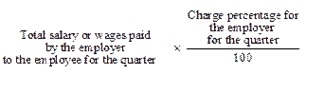
where:
charge percentage, for an employer for a quarter, means:
(a) the number specified in subsection (2) for the quarter (unless paragraph (b) applies); or
(b) if the number specified in subsection (2) for the quarter is reduced in respect of the employee by either or both section 22 and 23 – the number as reduced.
(2) The charge percentage for a quarter in a year described in an item of the table is the number specified in column 2 of the item.
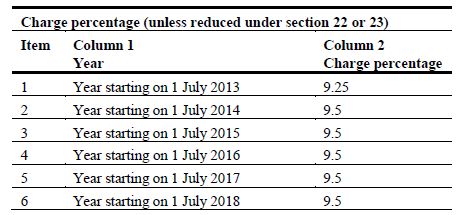
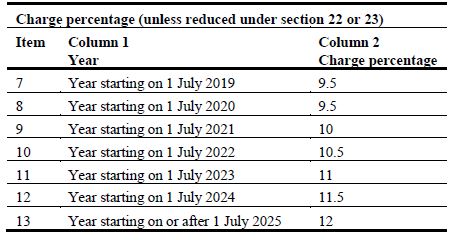
28 It is to be noted that the percentage of the charge is applied to “the total salary or wages paid by the employer to the employee for the quarter”.
29 The charge percentage can be reduced in respect of the employee by various means, here, relevantly, by s 23. Under s 23, if an employer makes a contribution to a Retirement Savings Account (an RSA) there is a reduction in the charge percentage. Section 23(1) and (2) of the SG Administration Act are in the following terms:
23 Reduction of charge percentage if contribution made to RSA or to fund other than defined benefit superannuation scheme
(1) This section applies only in relation to RSAs and to superannuation funds other than defined benefit superannuation schemes.
Reduction of charge percentage where contributions are made by employer
(2) If, in a quarter, an employer contributes for the benefit of an employee to a complying superannuation fund or an RSA, then the charge percentage for the employer (as specified in subsection 19(2)) for the employee for the quarter is reduced by the number worked out using the formula:
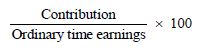
where:
contribution is the number of dollars in the amount of the contribution.
ordinary time earnings is the number of dollars in the ordinary time earnings of the employee for the quarter in respect of the employer.
Example: If the contribution is $60 and the ordinary time earnings are $1,000 then the charge percentage is reduced by 6.
30 The phrase “ordinary time earnings” is defined in s 6 of the SG Administration Act, as follows:
6 Interpretation—general
(1) In this Act, unless the contrary intention appears:
ordinary time earnings, in relation to an employee, means:
(a) the total of:
(i) earnings in respect of ordinary hours of work other than earnings consisting of a lump sum payment of any of the following kinds made to the employee on the termination of his or her employment:
(A) a payment in lieu of unused sick leave;
(B) an unused annual leave payment, or unused long service leave payment, within the meaning of the Income Tax Assessment Act 1997; and
(ii) earnings consisting of over-award payments, shift-loading or commission; or
(b) if the total ascertained in accordance with paragraph (a) would be greater than the maximum contribution base for the quarter—the maximum contribution base.
31 Thus, if the contribution divided by “ordinary time earnings” multiplied by 100 is the equivalent of, or more than, the charge percentage in column 2 in s 19(2), the charge percentage for s 19 and ss 16 and 17 will be zero.
32 It is thus critical to understand the meaning of the phrases “ordinary time earnings” and the otherwise undefined phrase “ordinary hours of work” used in the definition of the former phrase.
33 One can begin this enquiry, as the primary judge did at [55]–[58] and [106]–[113], by considering authorities dealing with the phrase “ordinary hours of work” in various contexts. That enquiry may bring one to the conclusion, as it did the primary judge, that there was a choice between a meaning referrable to standard hours to be paid at ordinary rates, and a meaning referrable to the regular, customary, normal or usual hours worked by each individual employee. That was, in significant part, the field of debate on appeal. Whilst those considerations and the cases epitomising them need to be examined, it is best to recall that the task involves a consideration of the text, context, purpose and history of the legislation: Project Blue Sky Inc v Australian Broadcasting Authority [1998] HCA 28; 194 CLR 355 at 381–382 [69]–[71]; and Thiess v Collector of Customs [2014] HCA 12; 250 CLR 664 at 671–672 [22]–[23].
34 First, the text: The definition turns on the expression “earnings in respect of ordinary hours of work”, not merely the word “ordinary” or the phrase “ordinary hours of work”. It is earnings that are the focus (in the phrase being defined: “ordinary time earnings” and in the terms of the definition (“earnings in respect of ordinary hours of work”). The exclusion of the matters in (i)(A) and (B) and the inclusion of the matters in (ii) tend to indicate that “ordinary hours of work” is something referrable to an objective standard, and not an individual factual enquiry about hours ordinarily or usually worked. If “ordinary hours” meant hours customarily or typically worked the matters in (ii) would likely be covered without need for separate mention. Whereas they would not be if the phrase referred to an objective standard that concerned standard hours and ordinary rates of pay.
35 The language of the definition is to be contrasted with the language of ss 11(1)(ba) and 12(3) as to salary and wages. This language is used in s 19 to calculate the shortfall: “Total salary or wages paid by the employer to the employee for the quarter.” Total salary or wages is an all-encompassing expression concerned with hours actually worked that founds the tax – the superannuation guarantee charge, which is intended to be the incentive that encourages the making of contributions. Thus “total salary or wages” can be seen as a likely higher sum than “earnings in respect of ordinary hours of work”.
36 None of the language leads one, necessarily, as a matter of meaning or logic to hours usually or ordinarily worked.
37 Secondly, the context: This is not a provision directed to compensating an individual for the time of his or her labour, or for loss sustained in not being able to work his or her normal hours; rather it is part of a regime implemented by legislation using the taxation power to encourage and facilitate national savings.
38 The context is the payment of salaries and wages in the workplace. In that context, the word “ordinary” and the phrase “ordinary hours” have assumed different meanings depending on context and circumstance. There are circumstances and contexts where the word and phrase can be seen to refer to regular, normal, customary or usual hours; and there are circumstances or contexts where the word and phrase can be seen to refer to the hours of work referred to in applicable industrial instruments as standard hours to be paid at ordinary rates, as opposed to additional hours (even if required, usual, regular, normal or customary) and paid at a special or higher rate. As such, the word and phrase can be seen to reflect the long-recognised distinction between ordinary hours of work and overtime: cf Thompson v Roche Bros Pty Ltd [2004] WASCA 110 at [31].
39 The notion of standard or ordinary working hours has long had a place in the industrial relations landscape of Australia. The standard working week was once 48 hours (Australian Builders’ Labourers’ Federation v Archer (1913) 7 CAR 210); reduced to 44 hours during the 1920s (Amalgamated Engineering Union v J Alderdice & Co Pty Ltd (1927) 24 CAR 755 (the 44 Hour Week Case)); to 40 hours after the War (Standard Hours Inquiry (1947) 59 CAR 581; and to 38 hours in 1983 (National Wage Case (1983) 4 IR 429). The standard of 38 hours was not departed from by the Australian Industrial Relations Commission in 2002 (Re Working Hours Case July 2002 (2002) 114 IR 390. The standard of 38 hours has not been departed from in the award modernisation process. The notion of “ordinary hours of work” remains a working integer of the modern award system: s 147 of the Fair Work Act.
40 By s 62 of the Fair Work Act, 38 hours remains the maximum number of hours that an employer can request or require of a full time employee, unless the “additional hours” are reasonable. Ordinary hours or some means of determining ordinary hours is a necessary part of an award or enterprise agreement for the better off overall test. Section 20 of the Fair Work Act deals with the meaning of “ordinary hours of work” for “award/agreement free employees”:
20 Meaning of ordinary hours of work for award/agreement free employees
Agreed ordinary hours of work
(1) The ordinary hours of work of an award/agreement free employee are the hours agreed by the employee and his or her national system employer as the employee’s ordinary hours of work.
If there is no agreement
(2) If there is no agreement about ordinary hours of work for an award/agreement free employee, the ordinary hours of work of the employee in a week are:
(a) for a full-time employee—38 hours; or
(b) for an employee who is not a full-time employee—the lesser of:
(i) 38 hours; and
(ii) the employee’s usual weekly hours of work.
If the agreed hours are less than usual weekly hours
(3) If, for an award/agreement free employee who is not a full-time employee, there is an agreement under subsection (1) between the employee and his or her national system employer, but the agreed ordinary hours of work are less than the employee’s usual weekly hours of work, the ordinary hours of work of the employee in a week are the lesser of:
(a) 38 hours; and
(b) the employee’s usual weekly hours of work.
41 By [234]–[235] of the Explanatory Memorandum to the Fair Work Bill 2008 the importance of ordinary hours of work to the National Employment Standards was explained:
234 There are a number of concepts that are used regularly in Part 2-2. These are explained below.
235 Various employee entitlements under the NES are based on the employee’s ordinary hours of work.
• The ordinary hours of work for an employee to whom a modern award applies will be the ordinary hours set out in the modern award (all awards are required to provide ordinary hours, or a means of determining ordinary hours) (see clause 147).
• The ordinary hours of work for an employee to whom an enterprise agreement applies will be the hours identified in the enterprise agreement. (An agreement should identify ordinary hours, or a means of determining ordinary hours, in order for the agreement to pass the better off overall test.)
• The ordinary hours of work for an award/agreement free employee (as defined in clause 12) are calculated in the manner set out in clause 20.
42 Whilst not all of the above can be seen as part of the immediate context of the passing of the superannuation legislation, it illuminates the historical and contemporaneous importance of the phrase “ordinary hours of work”. This assists in understanding the use of the phrase in the definition in 1992, in its continuing utilisation in the legislation, and also in the interpretation of the various relevant industrial agreements here.
43 Thirdly, the purpose: The statutory purpose of the superannuation legislation was to secure for workers a minimum level of superannuation by the incentive of the charge, through an efficient mechanism based on self-assessment by employers and administration by employers and the Australian Tax Office. That simplicity and efficiency of administration is threatened if the necessary calculation for each employee, for each quarter is based on an individual factual enquiry and is not calculated by reference to the standard hours at ordinary rates in relevant industrial instruments. Usual or ordinary hours may well vary from employee to employee, and, over time, for the same employee. What is customary or usual would be a factual assessment over the relevant period (each quarter), referable to individuals, and open to factual and individual debate. The statutory purpose of simplicity and efficiency for a minimum level of superannuation would be undermined by the need to find, factually, usual or normal hours for each employee in each quarter; the purpose would, on the other hand, be supported by an interpretation that looked to the relevant industrial instrument for standard hours at ordinary rates of pay. It is, with respect, overly simplistic to say that the legislation was intended to benefit employees therefore should be construed beneficially in their favour: cf Quest Personnel Temping Pty Ltd v Commissioner of Taxation [2002] FCA 85; 116 FCR 338 at 343 [21]. The legislation has a broader social and economic purpose, and whilst for the benefit of Australian employees generally, should be construed with a view to practical efficiency and overall fairness.
44 Fourthly, the enactment history assists in understanding “ordinary time earnings” as earnings referable to standard hours at ordinary rates of pay. It is not just the number of hours, but also their character as paid at an ordinary rate.
45 The enactment history can be seen as part of the context of the legislation in its widest sense: see CIC Insurance Ltd v Bankstown Football Club Ltd [1997] HCA 2; 187 CLR 384 at 408 [88] and Federal Commissioner of Taxation v Jayasinghe [2016] FCAFC 79; 247 FCR 40 at 43 [6]–[7].
46 The regime of the legislation was introduced against the background of industrial awards and was to be integrated into that system. The Information Paper published by the then Treasurer, the Honourable John Kerin (and referred to in the Second Reading Speech), stated at [3.25]:
“The SGLA will operate independently of, but in conjunction with, the award system.”
47 Until changes made to s 23(2), that took effect in July 2008, to which I refer below, the charge percentage was able to be reduced in a number of ways, including through contribution by employers in accordance with industrial awards and set by reference to an employee’s “notional earnings base”. The way the system operated before the amendments made by Act No 82 of 2005 (that took effect in July 2008), was described in the Explanatory Memorandum to the Superannuation Laws Amendment (2004 Measures No. 2) Bill 2004 (the 2004 EM). The desired simplification was described on pp 5–6 of the 2004 EM as follows:
Schedule 1 to this bill will also amend the Superannuation Guarantee (Administration) Act 1992 to simplify the earnings base of an employee for superannuation guarantee (SG) purposes. Specifically, the amendments will:
• remove provisions which currently allow earnings bases that existed prior to 21 August 1991 to be used to calculate an employer’s SG obligation in respect of an employee;
• remove provisions which currently specify an earnings base for employers to calculate their SG obligation in relation to employee members of the Seafarers’ Retirement Fund;
• remove provisions which currently specify an earnings base for employers to calculate their SG obligation in relation to employee members of the Aberfoyle Award Superannuation Fund;
• remove provisions which allow earnings bases specified in industrial awards, superannuation schemes, occupational superannuation arrangements or a law of the Commonwealth, State or Territory to be used for SG purposes; and
• require all employers to calculate their SG liability against an employee’s ordinary time earnings.
48 The context of the amendments was described in the 2004 EM at pp 21–22 as follows:
4.2 The Treasurer announced in Press Release No. 011 of 25 February 2004 changes to provide a more flexible and adaptable retirement income system. The announcement included the Government’s decision to simplify the earnings base provisions of the SGAA 1992 by removing earnings bases that existed before 21 August 1991.
4.3 The SG arrangements currently require employers to provide a prescribed minimum level of superannuation contributions for their eligible employees. The required minimum rate of superannuation contributions is 9% of an employee’s notional earnings base.
4.4 The SGAA 1992 was developed in the context of the occupational superannuation arrangements that existed in the early 1990s. To minimise the impact on business at that time, the SGAA 1992 recognised earnings base provisions that existed prior to 21 August 1991 and allowed these to be used as the basis for determining an employer’s SG obligation.
4.5 Employers who contribute for the benefit of employees without a pre-21 August 1991 earnings base are subject to different rules. Employees without a pre-21 August 1991 earnings base will generally have an minimum earnings base equal to their ordinary time earnings.
4.6 As pre-21 August 1991 earnings bases are generally less than ordinary time earnings, some employers are currently able to pay lower superannuation contributions for their employees than other employers in the same industry.
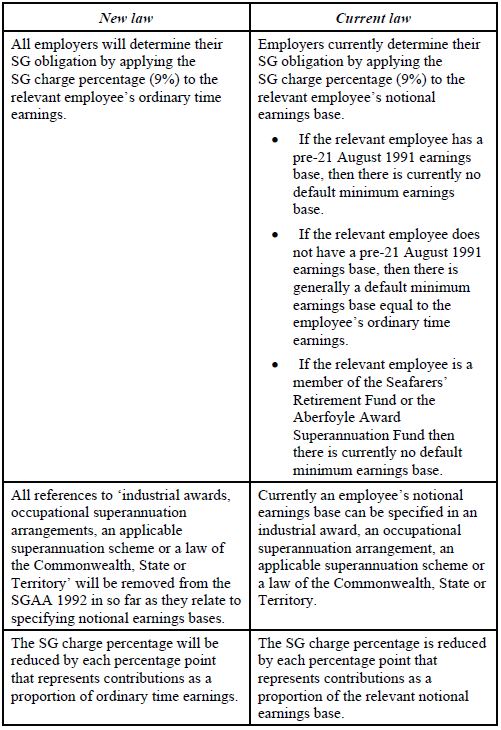
49 The new law was explained in the 2004 EM at pp 22, 23 and 26 as follows:
4.7 The amendments will remove the current earnings base provisions from the SGAA 1992. The effect of these changes is that the amount against which an employer calculates the contribution necessary to meet their SG obligations in respect of an employee is standardised to ordinary time earnings for all employees. Employers could continue to use notional earnings bases specified in legislation or industrial agreements where these are above an employee’s ordinary time earnings; however, any liability to pay the SG charge would only be assessed against ordinary time earnings.
4.8 Standardising the earnings base used to determine SG obligations to ordinary time earnings extends to the removal of references to industrial agreements, laws of the Commonwealth, State or Territory, an applicable superannuation scheme or retirement savings account from the provisions relating to earnings bases. These instruments currently prescribe notional earnings bases for SG purposes.
…
…
Policy objective
4.21 The policy objective is to remove the complexity and inequity present in the current SG notional earnings base arrangements under the SGAA 1992. The basic principle underpinning this objective is that persons on similar overall levels of remuneration should receive similar levels of compulsory employer superannuation contributions.
Implementation options
Retain the current arrangements
4.22 There would be no change to the existing arrangements. That is, some employers could continue to use pre-21 August 1991 earnings bases in respect of their employees. Under the current provisions of the SGAA 1992, employers could potentially reduce their compulsory superannuation contributions through the use of workplace agreements.
Adopting ordinary time earnings as a standardised earnings base
4.23 Remove all references to industrial awards and statutes from the SGAA 1992 and adopt ordinary time earnings as the standard notional earnings base. This option proposes that the minimum notional earnings base of an employee be their ordinary time earnings.
Adopting salary and wages as a standardised earnings base
4.24 Remove all references to industrial awards and statutes from the SGAA 1992 and adopt salary or wages as the standard notional earnings base. This option proposes that the minimum notional earnings base of an employee be the total of their salary and/or wages.
50 The choice of option 2 was recommended for the following reasons explained in the 2004 EM at p 31:
4.48 The preferred option is option 2, which removes all references to industrial awards and statutes from the SGAA 1992 and adopts ordinary time earnings as the standard notional earnings base.
4.49 This option would remove the complexity and inequity present in the current arrangements without imposing the same level of cost on employers and Government as an earnings base, based on total salary and wages’ would.
51 The notion of “ordinary time earnings” existed from the beginning of the operation of the legislation, but it operated in provisions such as s 14(3) of the original SG Administration Act as a floor of a minimum base. The phrase was originally defined in s 6(1) as follows:
“ordinary time earnings”, in relation to an employee, means:
(a) the total of:
(i) earnings in respect of ordinary hours of work; and
(ii) earnings consisting of over-award payments, shift-loading or commission; or
(b) if the total ascertained in accordance with paragraph (a) would be greater than the maximum contribution base for the contribution period–the maximum contribution base;
52 The phrase “ordinary hours of work” was not expressly linked to industrial awards in 1992. But an understanding of the phrase can be seen in the Explanatory Memorandum to the Taxation Laws Amendment Bill (No 4) 1993 at [13.8]–[13.12] (the Explanatory Memorandum to the Bill for the amendment to the definition of “ordinary time earnings” in s 6(1) that inserted the exclusion in (i) from the words, “other than earnings consisting of” to the end of the paragraph now represented by (i)(B)), in an explanation of the definition of “ordinary time earnings” in s 6(1):
13.8 Under the SGAA an employer's contributions are measured against the employee's notional earnings base. The expression notional earnings base is the earnings of the employee by reference to which the employer's superannuation contribution is calculated. Several earnings bases are available for an employer to use, such as the base set out in the superannuation fund deed, industrial award or an agreement with the employee.
13.9 If there is no acceptable earnings base relevant to a particular employee, then the employee's ordinary time earnings are used. The principal reason for adopting ordinary time earnings as a default base was to achieve consistency with the award superannuation system.
13.10 Subsection 6(1) of the SGAA provides that ordinary time earnings, in relation to an employee, means:
(a) the total of:
• earnings in respect of ordinary hours of work; and
• earnings consisting of over-award payments, shift loading or commission; or
(b) if the total ascertained in accordance with paragraph (a) would be greater than the maximum contribution base for the contribution period - the maximum contribution base. The maximum contribution base, which is increased annually by an indexation factor based on movements in Average Weekly Ordinary Time Earnings, is $20 160 per quarter for the 1993-94 income year.
13.11 Ordinary hours of work, as stated above, may be specified in a statute or under an industrial award. If an employee is not covered by an award but has agreed to work a certain number of hours, those hours are the employee's ordinary hours of work. However, if there is no specific agreement, the ordinary hours of work will be the hours actually worked and any hours of paid leave.
13.12 Lump sum payments on termination of employment in respect of accrued long service leave, accrued sick leave and accrued recreation leave are currently included in the definition of ordinary time earnings.
…
13.13
…
• lump sum payments in lieu of unused sick leave;
• lump sum payments in lieu of unused annual leave, within the meaning of subsection 26AC(l) of the Income Tax Assessment Act 1936 (ITAA); and
lump sum payments in lieu of unused long service leave, within the meaning of subsection 26AD(l) of the ITAA.
53 The above material reveals that the removal of “notional earnings base” leaving “ordinary time earnings” as the single measure was for the purposes of removing complexity and securing consistency.
54 The definition of “ordinary time earnings”, including the expression “earnings in respect of ordinary hours of work” was introduced in 1992, not long after the High Court decision in Catlow v Accident Compensation Commission [1989] HCA 43; 167 CLR 543 in which the majority of the Court considered that the phrase “ordinary time rate of pay” meant “ordinary time rate of pay for the worker’s standard or ordinary hours per week as fixed by award, agreement or contract”: 167 CLR at 561. The construction of those cognate words by the High Court in a cognate industrial field is of some assistance in concluding that the legislature was intending to adopt language with a similar effect: see Ex parte Campbell (1870) LR 5 Ch App 703 at 706:
Where once certain words in an Act of Parliament have received a judicial construction in one of the Superior Courts, and the Legislature has repeated them without any alteration in a subsequent statute, I conceive that the Legislature must be taken to have used them according to the meaning which a Court of competent jurisdiction has given them.
55 See the discussion in the cases referred to in Pearce DC and Geddes RS, Statutory Interpretation in Australia (8th ed, Butterworths, 2014) at [3.44] pp 138–139. See in particular Re Alcan Australia Ltd; Ex parte Federation of Industrial, Manufacturing and Engineering Employees [1994] HCA 34; 181 CLR 96 at 106. The strength of the presumption will depend on the circumstances. Here, it provides some support for a conclusion otherwise reached as to meaning.
56 The text, context, purpose and enactment history do not direct one to a meaning constituted solely by hours (factually) usually worked. They tend to a meaning that provides for an objective standard that aids in simplicity and lack of complexity. The use, from 1992, of the relevant phraseology in a context of industrial awards and instruments; the well-known conception contained within industrial awards and instruments of standards hours at ordinary rates of pay, and of overtime; the need for the phraseology to be practical, general and flexible to pick up all circumstances of employment; and the need for the task set for the employer to administer and the ATO to audit, quarter by quarter, individual by individual, to be as simple or non-complex as possible all direct one to a meaning that reflects those considerations. The meaning that best reflects these considerations and the text, context, purpose and history of the provision is earnings in respects of ordinary or standard hours of work at ordinary rates of pay as provided for in a relevant industrial instrument, or contract of employment, but if such does not exist (and there is no distinction between ordinary or standard hours and other hours by reference to rates of pay) earnings in respect of the hours that the employee has agreed to work or, if different, the hours usually or ordinarily worked.
57 This meaning adopts as central (to the extent that it is present) the distinction long familiar in the industrial and employment context, and widely understood, between earnings for ordinary time and earnings for an additional or greater number of hours beyond ordinary or standard hours. If in a particular context such distinction does not exist in the remuneration for the labour provided, the required comprehensiveness and flexibility of the meaning will fix upon the hours agreed to be worked, or the hours normally worked if different. This is not to give a variable meaning to the expression, it is to recognise that the context and particular circumstances will provide by way of factual application, the answer to the reach of the phrase which has a simple meaning by reference to real life.
58 The cases support this interpretation.
59 Catlow 167 CLR 543 was decided three years before the superannuation regime was introduced. The case concerned the construction of s 95(1) of the Accident Compensation Act 1985 (Vic), which relevantly provided:
In sections 93 and 94, 'the worker's pre-injury average weekly earnings' means –
(a) the average weekly earnings during the 12 months preceding the relevant injury if the worker has been employed by the same employer for that period;
…
calculated at the worker's ordinary time rate of pay for the worker's normal number of hours per week.
60 The question before the Court was framed in the leading judgment of McHugh J at 557:
whether, when a standard number of ordinary working hours has been fixed for a worker's employment, his "normal number of hours per week" for the purposes of the Act are those standard hours or the number of hours he usually worked.
61 The Full Court of the Victorian Supreme Court had overturned the decision of the Accident Compensation Tribunal which had found the phrase “normal number of hours per week” to be the number of hours he usually worked including overtime.
62 McHugh J at 560 made the point (equally relevant to understanding the 1992 superannuation legislation) that terms of employment of most workers are governed by industrial awards or agreement that provide for ordinary time rates of pay for standard hours. His Honour said at 560–561:
Against the industrial background of awards and agreements fixing a number of ordinary hours per week, it seems natural to read the expression "calculated at the worker's ordinary time rate of pay for the worker's normal number of hours per week" as a reference to the ordinary time rate of pay for the worker's standard or ordinary hours per week as fixed by award, agreement or contract. While it is true that on any view the "pre-injury average weekly earnings" calculated under s. 95 is a notional and not an actual figure, it would indeed be surprising if the legislature intended that those earnings are to be calculated by multiplying the ordinary time rate by overtime as well as ordinary hours worked. If "normal number of hours" included overtime hours, some other formula to include the overtime rate would surely have been used.
63 McHugh J then examined three decisions: two of the Industrial Commission of New South Wales, and one of the High Court, heavily relied on by the primary judge and the respondent.
64 The two Industrial Commission cases, John A Gilbert Pty Ltd v Irving [1962] AR 307 and Goodyear Tyre & Rubber Co (Aust) Ltd v Robinson [1961] AR 127 dealt with the phrase “normal weekly number of hours” in the Annual Holidays Act 1944 (NSW) and the Long Service Leave Act 1955 (NSW), respectively. The Commission said in John A Gilbert [1962] AR at 318:
The word 'normal' in its ordinary sense may mean regular or usual, or it may mean conforming to standard. We are of the opinion that, in the definition, a worker's normal weekly number of hours is that number of hours which is fixed by the terms of the worker's employment as the standard of ordinary hours, as distinct from overtime hours, which are to be worked in a week. If 'normal' meant regular or usual, a determination of what was regular or usual would depend on the facts of each case in relation to a period of employment long enough to permit an ascertainment of what was regular or usual, but the language of s. 2(2) suggests that terms of employment may fix in advance the weekly hours which are to be normal.
65 The Commission said in Goodyear [1961] AR at 137–138:
Overtime hours are not hours within a worker's normal weekly number of hours of work; they are hours worked over and above his normal weekly number of hours of work, and a payment which is made for overtime hours cannot, in any sense, be said to be remuneration for one's normal weekly number of hours of work.
66 The previous decision of the High Court in Kezich v Leighton Contractors Pty Ltd [1974] HCA 50; 131 CLR 362 was examined and distinguished by McHugh J. The context was a workers compensation statute. The relevant provision was:
For the purposes of this Act, 'weekly earnings' means the amount of the ordinary wage or salary (including any over award payment) the worker would have received for the ordinary hours he would have worked, if he were not incapacitated for work as a result of the injury.
67 The Court (Gibbs J delivering the leading judgment) held that “the ordinary hours he would have worked” meant the hours which he usually worked. Gibbs J said at 131 CLR at 365:
The word 'ordinary' means 'regular, normal, customary, usual'. A man's 'ordinary hours' of work are the hours during which it is usual for him to work. There is nothing in the expression 'ordinary hours' that connotes payment at any particular rate, and to understand the words as meaning 'hours during which work is done for which overtime is not paid' would be to place upon them a meaning which they simply do not bear. The expression 'the ordinary hours he would have worked' in my opinion means the same as 'the hours he would ordinarily have worked' ...
68 McHugh J recognised the force of this approach (and of the similar approach of Mason J in the same case at 131 CLR at 376) but saw the contexts and provisions as different, saying at 167 CLR at 566:
Indeed, the different context and history of the phrase "normal number of hours per week" in s. 95(1) dictate that it be interpreted as meaning the ordinary or standard number of hours worked and not the usual number of hours worked.
Accordingly, in my opinion, in s. 95 "normal number of hours per week" means the ordinary or standard hours fixed by the terms of the employment. The appellant's "pre-injury average weekly earnings" in this case had to be calculated by determining what were his total weekly earnings calculated by reference to the ordinary time rate of pay for the ordinary hours for the relevant period and then obtaining a weekly average of that sum. As the appellant had more than one ordinary time rate of pay during the twelve months period, his earnings for each of the three periods had to be grossed in accordance with that formula and then averaged over the relevant period.
69 Catlow recognised the two different ways of understanding words such as “usual”, “ordinary” or “normal” in the industrial context. In any particular statute, the terms, context, purpose and enactment history will determine the meaning to be ascribed as that intended by Parliament.
70 In Scott v Sun Alliance Australia Ltd [1993] HCA 46; 178 CLR 1 the High Court was concerned with s 69(1) of the Workers Compensation Act 1988 (Tas) that included the phrase “ordinary time rate of pay”. The Court said the following at 5–6:
The expression "ordinary time rate of pay" is well known in the industrial relations field in Australia and New Zealand. It and similar terms have long been used in legislation (See, e.g., Annual Holidays Act (N.S.W.) 1944, s. 2(1); Workers’ Compensation Act 1956 (N.Z), s. 15(1) (now repealed); Accident Compensation Act 1985 (Vict.), s. 95(1) (now repealed)). Unless the context otherwise requires, "ordinary time rate of pay'' means the rate of pay for the standard or ordinary hours of work in contrast to the overtime or penalty rate of pay for hours of work other than the standard or ordinary hours (Catlow v. Accident Compensation Commission (1989), 167 C.LR. 543, at pp. 555-556, 560). When expressed by reference to a week, it refers to the product of multiplying that hourly rate by the standard thirty-five, thirty-eight or forty hour week, as the case may be, fixed by legislation, industrial award or agreement.
The terms of s. 69(1)(a) indicate that the legislature assumed that there is always an ordinary time rate of pay for the worker for the work on which he or she is engaged. No doubt in most cases this is true because when the 1988 Act was enacted the rates of pay of most workers were covered by industrial awards or agreements.
[Reference was made to the judgment of McHugh J in Catlow]
However, it is not always the case that a worker will have an ordinary time rate of pay. There may be no industrial award or agreement regulating his or her employment, and his or her contract of employment may not distinguish between ordinary and other time rates of pay or may provide for remuneration by a formula which has no temporal element – for example, piece work or commission (See, e.g., Goodyear Tyre & Rubber Co. (Australia) Ltd v. Robinson, [1961] AR (N.S.W.) 127, at p. 137.). If the worker has no "ordinary time rate of pay'', the compensation payable to him or her pursuant to s. 69(1)(a) must be calculated by reference to his or her average weekly earnings.
71 Little assistance is given by Australian Communication Exchange Ltd v Deputy Commissioner of Taxation [2003] HCA 55; 201 ALR 271. The case concerned the operation of s 23 of the SG Administration Act before the amendments removing the concept of “notional earnings base” in 2005. It turned, however, upon the specific wording of an award and the relationship between provisions dealing with full time and casual employees and a somewhat extended definition of “ordinary time earnings” and “ordinary hours of work”.
72 Quest Personnel Temping Pty Ltd v Commissioner of Taxation [2002] FCA 85; 116 FCR 338 was concerned with the meaning of “ordinary hours of work” in ss 6 and 23 of the SG Administration Act. The Court (Gray J) dismissed a challenge to a decision of the Administrative Appeals Tribunal that had agreed with the Commissioner’s assessment of the company’s superannuation guarantee shortfall based on “ordinary hours of work” being the normal, regular, customary or usual hours worked by that employee. That conclusion is not contrary to the meaning which I have posited above. The case concerned data entry operators supplied to the Victorian Police. The standard offer of employment referred to a minimum of five standard shifts each fortnight as notified. The pay for all hours worked was at a standard hourly rate with no loading. Some employees worked more than the minimum. There was a variety of requirements on different employees.
73 Gray J rejected the argument that the minimum hours were the ordinary hours of work and that the additional hours were overtime. That rejection (at 342) was in part based on the lack of any higher rates of pay for additional work. His Honour said at 342–343 [19]–[20]:
19 …The offers of employment specified the minimum hours for which an employee could be called upon to work. The clear import of the word "minimum" was that an employee could be expected to be asked to work more than five standard shifts in a fortnight. An industrial award or agreement usually expresses the maximum hours that an employee may be required to work. It is true that provision is often made for work beyond such standard hours, but it is usual for the award or agreement to provide that such additional work is to attract a higher level of remuneration. This is what marks it out as work performed outside ordinary hours.
20 The phrase "ordinary hours of work" in s 6 of the Act must be construed in the context of the Act and in a way which best promotes the underlying object or purpose of the Act. It is plain from the definition of "ordinary time earnings'' in s 6 that, at least in some cases, ordinary hours of work are to be distinguished from actual hours worked. The Act does not require that the relevant percentage of an employee's total earnings for all hours worked must be paid to a superannuation fund in order to avoid the levy. On the other hand, there will be some cases in which the ordinary hours worked by an employee will be the actual hours worked, because no ground will exist for distinction between the two concepts. An example would be an employee whose terms and conditions of employment are covered by an award and who works the maximum standard hours but no overtime.
(Emphasis added.)
74 I respectfully agree. In Quest, there was no distinction between ordinary hours and ordinary rates of pay and additional hours at a higher rate. All hours were at the same rate. There were minimum hours, but possible or likely additional hours, all to be paid at one rate. In such a case there is no ground to distinguish between different hours, and the only way a notion of “ordinary hours” could be understood was by what usually or ordinarily happened.
75 After referring to Kezich and Catlow, Gray J said at 344 [26]:
The distinction between these two cases appears to rest upon the proposition that the fixing by collective means of standard hours of work, coupled with a provision for remuneration at a higher rate of hours worked beyond those standard hours, will usually lead to the conclusion that the standard hours fixed are to be considered as "normal hours" or, perhaps, "ordinary hours". As I have said, that is not the present case. The offers of employment accepted by the employees in the present case did not purport to fix standard hours, with remuneration at a higher rate for hours in excess of them. They fixed only minimum hours, with hours worked beyond the minimum paid at the same rate as those worked within it.
(Emphasis added.)
76 It can be accepted that if the relevant distinction is not made, in the award or industrial instrument or contract of employment, between, on the one hand, standard or ordinary hours and ordinary rates of pay, and on the other, additional hours at higher rates of pay, then the ordinary hours will be the hours agreed to be worked, or the usual or normal hours worked, if they be different.
Conclusion on the meaning of “ordinary time earnings” and “earnings in respect of ordinary hours of work”
77 In my view the text, context, purpose and enactment history point clearly to the meaning that I set out at [56]–[57] above. The decisions of Catlow, Scott, and Quest support that meaning.
78 It is therefore necessary to turn to the various industrial instruments and agreements here to identify the “ordinary time earnings”.
The Relevant Industrial Agreements
79 The primary judge set out the relevant terms of the Departmental Agreements that affected Mr Storey and Mr Le Clerc (in addition to the 2006 Award and the 2012 and 2015 Agreements):
(a) the Bulk Operations Enterprise Agreement 2005 (Mr Storey) at [13]–[15];
(b) the Bulk Operations Departmental Agreement 2013 (Mr Storey) at [41]–[44];
(c) the Slabmaking – 12 hour Shift Agreement 2004 (Mr Le Clerc) at [16]–[22]; and
(d) the Slab Yard – 12 hour Shift Agreement 2010 (Mr Le Clerc) at [23]–[29].
80 The primary judge also referred to relevant provisions of the 2006 Award (referrable to both Mr Storey and Mr Le Clerc) ([30]–[36]), and of the 2012 Agreement ([37]–[40]).
The Bulk Operations Enterprise Agreement 2005
81 From the provisions of this Agreement the following can be stated in respect of Mr Storey. He was remunerated at an annualised salary. That salary was made up of a “base rate” and “a component which absorbed all additional payments such as penalty rates, allowances, shipping shift premiums, public holiday loadings and payouts and payments for additional hours worked outside the normal rostered hours”: cl 6.1 of the Bulk Operations Enterprise Agreement 2005. The salary was expressly calculated in cl 6.2 as “Base Salary” being “Ordinary Stevedoring Hourly Rate *38 hrs * 52 weeks” and “Overtime” as “5.5 hrs overtime per week x 2.1761 x Ordinary Stevedoring Hourly Rate”. This clearly distinguishes between ordinary hours at an ordinary rate and additional (overtime) hours at a higher rate. Those additional hours were to be required: cl 6.3 of the same agreement, which stated:
Employee’s will be required to work additional hours under the annualised salary system established at clause 6.2. Work undertaken on Additional hours will not be the subject of restrictions. All work required by the company on the Bulk Berth either directly or indirectly as part of operations will be required to be undertaken while on additional work hours.
82 Thus, although the normal or usual hours were almost certain to be greater than 38 hours, the additional hours over 38, which were called “overtime” were paid for in the annualised salary at a higher rather than the 38 hours per week that were paid at an “ordinary” hourly rate. Given the meaning of the phrase “ordinary time earnings” it is therefore wrong to conclude, as the primary judge did, that the earnings in respect of ordinary hours of work is other than the earnings in respect of the 38 hours per week in the calculation of the annualised salary.
The Bulk Operations Departmental Agreement 2013
83 The annualised salary for Mr Storey was stated to be calculated under cl 4 as follows:
Base salary = base stevedoring hourly rate *38 hours * 52 weeks
Overtime rate = 5.5hrs overtime per week * 2.1761 * base stevedoring hourly rate
84 Again the clear distinction is made between ordinary rates of pay for what can be taken to be standard hours (38 per week) and a higher rate for additional hours described as “overtime”.
The Slabmaking – 12 hour Shift Agreement 2004
85 Mr Le Clerc worked under a “12 hour Aggregated Salary System”. The primary judge set out the important provisions of the agreement at [17]–[22] of his reasons. Hours of work were 12 hour seven day continuous shift rosters (cl 5). Ordinary (here used in a sense of normal) hours included weekend shifts (cl 2). Standard hours of work were an average of 38 hours per week over the full cycle of the work roster (cl 5). The aggregated salary was paid in 26 equal fortnightly payments comprising “three components” (cl 10). The three components were a “base salary” addressed at cl 10.1; “additional payments” including public holidays addressed at cl 10.2; and “shift work payment and penalties” addressed at cl 10.3.
86 Clause 10.1 “base salary” was as follows:
10.1. BASE SALARY
Payment for the award wage, over award (bonus) payment, tool allowance for tradespersons and electrical licence payments for electrical tradespersons.
Weekly base salary is calculated by multiplying the employee’s hourly rate (including bonus rate, where applicable) by thirty-eight hours. Base salary for each employee is subsequently calculated by multiplying the weekly base salary by fifty-two weeks.
Calculation is therefore: Base salary = Hourly rate x 38 hours x 52 weeks.
87 The additional payments in cl 10.2 included disability allowances and payments for all public holidays (worked and rostered). The provision for public holidays was somewhat intricate in how it came to additional payment for 146 hours per annum for public holidays:
10.2.1. Public Holidays
Payment is based on the average number of public holiday loading hours for each employee across four crews. With reference to the roster pattern above (Figure 1), each employee will work on average 5.425 of the eleven public holidays per annum and be rostered off on the remaining 5.575 days. Of the 5.425 days worked 4.75 incur public holiday loading while 0.675 days per year receive no loading due to their occurrence on the day of the 1st night shift. Six hours is deducted to avoid double payment of weekend penalties and public holiday loading on Easter Saturday. Public holiday loading is therefore based on an extra twelve hours pay for every public holiday falling on a rostered off shift and an extra eighteen hours for every public holiday worked.
i.e. [(5.575 x 12) + (0.675 x 0) + (4.75 x 18)] – Easter Saturday Deduction | = 152.4 – 6 |
Rounding ….. | = 146 hour per annum |
Calculation is therefore: Public holiday payment = Hourly rate x 146 hours.
88 The allowance made for shift work in cl 10.3:
10.3 SHIFT WORK PAYMENTS AND PENALTIES
Payments for all disabilities and disturbances associated with shift work and the working of regularly rostered shifts on weekends.
10.3.1 Weekend Penalties
With reference to the roster pattern above (Figure 1), employees will work on average four-and-a-half of every ten weekends. Penalties are therefore based on an extra six hours pay on Saturday and an extra twelve hours pay on Sunday.
i.e. [4.514 x 6 (Sat)] + [4.514 x 12 (Sun)] = 81.25 hours per ten weeks.
= 8.125 hours per week.
Calculation is therefore: Weekend payment = Hourly rate x 8.125 hours x 52 weeks.
10.3.2 Shift Allowance
The shift allowance used is that amount paid to an employee on the current 8-hour continuous N/A/D roster system. Currently the rate per hour is $1.6253.
Calculation is therefore: Shift allowance payment = $1.6253 x 38 hours x 52 weeks.
89 Clause 10.4 simply stated the aggregate salary in the three components:
10.4. TOTAL (AGGREGATE SALARY)
The total aggregate salary is the sum of the above three components:
i.e. Aggregate Salary | = Base Salary + Public Holiday Payment + Weekend Payment + Shift Allowance Payment. |
90 Overtime was provided for by cl 11 if on any normal workday an employee worked for more than 12 hours and if a shift or part of a shift was done on a day other than a rostered workday. Clause 11 set out the overtime rates.
91 The proper construction of this agreement leaves no room for doubt that there is a clear distinction in the calculation of remuneration between standard or ordinary hours at ordinary rates of pay (38 hours) and a higher rate of pay for additional hours.
The Slab Yard – 12 hour shift Agreement 2010
92 Relevantly the agreement was in the same terms as the Slabmaking - 12 hour Shift Agreement 2004.
The primary judge’s approach and the grounds of appeal
The primary judge’s approach
93 At [96]–[97] of his reasons the primary judge set out the central questions for decision from the detail of the underlying agreements:
96 It was common ground that BlueScope Steel (AIS) Pty Ltd did not make superannuation contributions to the superannuation account of Mr Storey (or Mr Fernandes) in respect of either:
• the “additional hours component”; or
• the “public holidays component”
of the annualised salary paid to them.
97 In very summary form, the two fundamental questions to be resolved in the present proceeding are:
• whether the “additional hours component” of the annualised salaries were “ordinary time earnings”; and (Storey)
• whether the “public holidays component” paid to the employees as a component of either an annualised salary or an aggregate salary were “ordinary time earnings”. (Le Clerc)
94 The primary judge’s essential conclusions were expressed at [103]–[105] of his reasons:
103 The case for the Respondents centred upon a contention that the phrase “additional hours” as employed in the Bulk Berth Operations Departmental Agreement referred to “overtime hours that have been built into the annualised salary” and that “[p]roperly understood, additional hours are … prepaid overtime hours paid at a penalty premium that the employee may be expected to work”. On the Respondent’s case, the fact that employees work beyond “standard working hours” and the fact that “such hours are mandatory, rather than voluntary, does not affect their characterisation as overtime”. The Respondents further contend that the “case law indicates that overtime does not cease to be characterised as ‘overtime’ and thereby become ordinary time earnings because the overtime is mandatory”.
104 The case for the Applicant was (inter alia) that there was no warrant for the approach of the Respondents in seeking the “dissection of fortnightly payments of annualised salary into various ‘components’” where such an approach was “directly contrary to the face of the agreement that the annualised salary would itself ‘absorb’ (or ‘incorporate’) all additional payments”.
105 It is concluded that:
• there is a clear distinction drawn in the authorities, not surprisingly, between the normal (or ordinary) hours of work and “overtime” (or “additional” hours of work);
and that:
• in many cases the terms of an award or an enterprise agreement will themselves identify the normal (or ordinary) hours of work
but that:
• in the circumstances of the present agreements, the “ordinary hours of work” for the purposes of the Superannuation Guarantee (Administration) Act include the “additional hours” and the “public holidays” for which the agreements make provision in respect to an “annualised salary” – and are so included irrespective of whether an employee actually works “additional hours” or “public holidays”.
It is further concluded that, even if the last conclusion be incorrect, the “ordinary hours of work” includes:
• the “additional hours” in fact worked by an employee.
It necessarily follows that the Respondents erred in not making superannuation contributions in respect to that components, being the “additional hours” component.
95 After those conclusions, the primary judge examined the authorities (Kezich, Quest, Thompson v Roche Bros, Catlow and Scott) and identified from propositions or principles as the background against which to construe the industrial instruments. The primary judge had previously (at [45]–[54]) set out and briefly discussed the relevant provisions of the legislation: the definition of “ordinary time earnings” in s 6(1) and ss 19, 23 and 46 of the SG Administration Act. The primary judge then (at [55]–[58]) examined the meaning of the word “ordinary” in industrial agreements and other statutes, referring to Quest and Australian Communication Exchange 201 ALR 271.
96 Nowhere in the judgment does the primary judge examine the whole definition of “ordinary time earnings” and the crucial phrase “ordinary hours of work” by reference to its text, context, purpose and enactment history from 1992. The primary judge focused in particular on the word ordinary as usual and normal hours. He placed some emphasis at [56]–[57] of the reasons on what Gray J had said in Quest when his Honour had, at 116 FCR 344, referred to Kezich. That use by Gray J of Kezich was, of course, in the context of a contract of employment that made no distinction in rates of pay and had no distinction between ordinary hours and additional hours or overtime.
97 To use Quest as authority for the proposition that in the definition of “ordinary time earnings” in s 6(1) the phrase “ordinary hours of work” simply means the ordinary or usual or normal hours worked (as [57] of the reasons does), is both to misunderstand Quest and to misconstrue the definition.
98 This explains why the primary judge, in his analysis thereafter, both of the authorities (at [106]–[112]) and of the industrial instruments (at [114]–[147]), focused, as relevant determinations, upon the hours provided for in the instruments to be worked and paid for as opposed to the correct enquiry being the hours identified in the industrial instruments to be paid for at ordinary rates.
99 If one first focuses upon the proper construction and interpretation of the definition of ordinary time earnings and gives to that meaning the proper weight to the distinction between standard or ordinary paid hours at ordinary rates and additional hours whether overtime or public holidays at higher rates, the debate about the annualisation and aggregation of salary can be settled tolerably straightforwardly. The employees were being required to work a body of hours that enabled the business to operate efficiently. In that sense, the usual hours that they worked exceeded or in any given period were likely to exceed 38 per week. For the purpose of simplicity and consistency they would be paid for those additional hours and public holidays, even if, as a fact, some were not worked. The salaries, unlike in Quest, were, however, made up or calculated of a base rate and additional components. The base rate was expressed as a standard 38 hours at an ordinary rate. The additional sums were added to the base salary for additional hours at a higher rate.
100 The central consideration for the primary judge for identifying “ordinary hours of work” was the usual or normal demands of how long the employees were usually required to work. This is reflected in the primary judge’s reasons at [117]–[121]:
117 Although the manner of calculating the “annualised salary” is more directed to the manner in which employees are to be remunerated for the work they undertake and does not of itself dictate a conclusion that the “ordinary hours of work” includes those components which form part of the calculation, it lends support to the conclusion advanced on behalf of the AWU.
118 The manner in which employees are remunerated, and the fact that the “annualised salary” is recognised as “absorb[ing]” each of the components identified, is some indication of the fact that there is a recognition in the Bulk Operations Enterprise Agreement 2005 that “additional hours” (and “public holidays”) are so routinely worked – or customarily worked – that they do form part of the “ordinary hours of work”. Each of the components identified, it is thus recognised, are so “ordinarily” undertaken that they should be incorporated – or “absorb[ed]” – into the “annualised salary” that is paid.
119 More useful for identifying the “ordinary hours of work” are not those terms identifying the manner in which remuneration is to be determined but rather:
• the fact that the Agreements operate in a working context were employees work shifts and where staff need to be available 24 hours per day, 365 days of the year
and the following terms of (for example) the Bulk Operations Enterprise Agreement 2005:
• clause 2.4, being a clause directed at ensuring that “[o]perational needs [are] met” and providing that one of the “key pillars” that supports the bulk berth “to have an effective and efficient business” is “the guarantee that coverage will be available 365 days per year and 24 hours per day by the Bulk Berth employees”; and
• clause 6.3 and the recognition that employees “will be required to work additional hours under the annualised salary system” and the recognition that “employees will be expected to attend work” even where one hour’s notice is not able to be given of the requirement for an employee to work “additional hours”.
In contrast to a different work context where a distinction (albeit a blurring distinction) may be drawn between the ordinary or standard hours of 38 hours per week and overtime or additional time (even where employees may be required or expected to work additional hours or overtime), the present working context is one in which any distinction between standard or ordinary hours and overtime or additional hours is more theoretical than real.
120 Also of relevance is (for example) the following term of the 2006 Award and the 2012 Agreement:
• clause 17, which provided that employees may be “required to work seven day shift work to meet the needs of the business” and that those employees “will be required to work Sundays and Public Holidays as ordinary working days”.
Again, the distinction in the present working context between work on a public holiday and work on any other day is also more theoretical than real.
121 It is the very fact that the Bulk Operations Enterprise Agreement 2005 (for example) requires employees to work “additional hours” and on “public holidays” as the norm that underpins the recognition that those employees can only fairly be remunerated by reference to an “annualised salary”. Given the manner in which work is performed, and required to be performed, there is no real or practical distinction between (for example) the standard or ordinary hours of work separate from the total number of hours worked, including “additional hours”. Nor is there any real distinction between work on a public holidays and work on any other day.
101 The difficulty with this analysis is that it has not commenced with, and is not structured around, the proper construction of the definition within s 6(1). It can be accepted that BlueScope were calling on these employees to work long hours. They were being remunerated for all those hours, even for public holidays that they may not have worked. That, with respect, is not the point. The phrase “ordinary hours of work” has a statutory meaning in the definition by reference to standard hours at ordinary rates in contradistinction to additional hours at higher rates. That distinction is found as the framework for the construction of the annualised and aggregate salaries in the industrial instruments. The additional hours, as the overtime, are required in the arrangement, and the employees are paid therefore at a higher rate than the base salary. The same applies to public holidays. The superannuation legislation requires a focus (if the distinction is made in the instruments as it is here) upon the standard or ordinary hours at ordinary rates as the basis for the operation of s 23.
The notice of appeal
102 Ground 1 is a conclusory ground requiring success on one or more of the other grounds.
103 I have already dealt with the threshold issue of ground 2.
104 Ground 3 was directed to a complaint about the reference by the primary judge to “components” in the calculation of the salaries. I agree with the submissions of the respondent that this is a distraction.
105 Grounds 4 and 6 lie at the heart of the appeal. These grounds are in the following terms:
4. Further or in the alternative, the primary judge erred in relation to “additional hours” payments in:
a. finding that ordinary hours of work within the meaning of s 6(1) of the SGA Act, and for the purposes of cl 7 of each of the Enterprise Agreements, includes in respect of Matthew Storey the “additional hours” prescribed under the Bulk Operations Enterprise Agreement 2005 and Bulk Operations Department Agreement 2013 (see Reasons [105], [114]-[121]);
b. finding, in the alternative, that ordinary hours of work within the meaning of s 6(1) of the SGA Act, and for the purposes of cl 7 of each of the Enterprise Agreements, includes additional hours in fact worked by Mr Storey (see Reasons [105], [122]-[134]).
…
6. Further or in the alternative, the primary judge erred in finding that ordinary hours of work within the meaning of s 6(1) of the SGA Act, and for the purposes of clause 7 of the Enterprise Agreements, includes the earnings of Mr Storey and Mr Jason Le Clerc in respect of penalty rates on public holidays paid by the first appellant in respect of public holidays not worked by Messrs Storey and Le Clerc (see Reasons [105], [136], [145]-[146]).
106 At the outset, in relation to ground 6 the appellants conceded before the primary judge that “ordinary time earnings” included penalty rates paid in respect of public holidays in fact worked. That concession was not withdrawn before this Court, however it was submitted by the appellant that legally the better view is that they were not required to pay superannuation in respect of any public holidays, whether or not in fact worked. Whilst, in my view, “ordinary hours of work” for the purposes of the definition in s 6(1) does not include earnings in respect of penalty rates on public holidays, whether or not those public holidays were in fact worked, it is only necessary to find for the purposes of this appeal that ordinary hours of work does not include earnings in respect of penalty rates on public holidays not in fact worked.
107 The respondent sought to support the primary judge’s conclusion by a number of propositions. The submissions were put by Mr Taylor with simplicity and elegance. He submitted that the method of calculation and the division into base salary, additional hours and public holidays were matters of form. What was important, he submitted, was the agreement in the instrument as to hours that would be worked when required – additional hours and public holidays. From the agreements it could be concluded that the employees would be paid a uniform amount every fortnight to work the hours that the agreement required them to work. The references to base salary and the additional amounts were a convenient explanation in the agreements for the uniform amounts paid.
108 The submissions of the respondent rested heavily, indeed relied, on a construction of “ordinary hours of work” in the definition in s 6(1) as the hours that any relevant instrument says that the employee is ordinarily to work (irrespective of the basis or bases for the remuneration for such hours, and any differentiation therein). For instance the submission that the phrase “ordinary hours of work” means the hours required to be worked and the amount paid for that time, ignores the clear distinction in the instrument between different rates for the different parts of the required hours. The submissions fail to focus on the meaning of the relevant statutory provision (the definition in s 6(1) of the phrase “ordinary time earnings”), rather they focus on the meaning of the industrial instruments. The former (the meaning of the relevant statutory provision) controls the answer to the controversy.
109 With respect, the definition, including the phrase “earnings in respect of ordinary hours of work” in s 6(1) had (and has) within it the well-known conception of ordinary hours at ordinary rates. That conception founded the calculation of the relief from the charge in the operation of s 23 of the SG Administration Act. That conception founded the calculation of the remuneration here.
110 The respondent first pointed to the obligation of Mr Storey to work additional hours and be available at all times to do so. He could be required to work on public holidays or on the weekends. That is clear; but thereby to conclude that these hours were ordinary, because they were usual and required, is to assume the answer to the question of meaning in the statute. If the phrase “ordinary hours of work” means standard hours calculated and paid at ordinary rates, then what hours one is required to work and to be paid at a higher than ordinary rate is not to the point. “Ordinary hours of work” are standard, 38 hours, at ordinary rates of pay as made clear in all the instruments.
111 It is true that the employee might have worked 38 hours a week, no public holidays; or worked 43.5 hours a week and every public holiday, and received the same remuneration. In practical terms, one would have thought the former to be unlikely. In any event, the employee was being paid an annualised salary calculated with a base rate using standard hours at ordinary rates, plus an additional sum for the right to call upon him or her to work additional hours in the manner prescribed. This did not deny the reality of the 2012 and 2015 Agreements that the annualised salary incorporated a base salary which utilised the well-known and still relevant notion of ordinary hours (38 hours) at ordinary rates.
112 The conclusions that the ordinary hours were what was ordinarily required, and that how overall remuneration was calculated did not affect the meaning of “ordinary hours” fail to give relevance and effect to the meaning of the phrase in the definition; or, perhaps put another way, and in conformity with the approach of the primary judge, assumes “ordinary” in the definition just means usual or normal.
113 The respondent submitted that to give weight to the base salary, based on 38 hours, would be to dissect each fortnightly salary and calculate a notional additional hours. I disagree. The relevant agreements are clear. An annualised salary is paid. It is calculated, and agreed to be calculated, by reference to ordinary hours at ordinary rates, and an agreed additional sum for additional hours that may or may not be required to be worked in full. If the employee was required to work beyond 43.5, he or she would be paid overtime above the annualised salary.
114 It can be accepted that it was no part of the fortnightly lump sum payment that the additional hours be worked, at all, or in full. But payment was made for additional hours for the right to call for them in the manner agreed. None of this affects how the annualised salary is calculated and agreed to be calculated; none of this affects the meaning of the phrase in the definition of s 6(1) which is engaged by, and operates upon, “ordinary hours of work” which are ordinary or standard hours (38 hours) at ordinary rates – which here is the base salary.
115 The base salary was not a “label”. The substance of the agreed calculation of the annualised and aggregate salaries included the base salary.
116 It can be accepted that the additional hours (referred to as “overtime”) are paid for whether worked or not; and that if further additional hours are worked (beyond the 43.5) they are paid as overtime, to the extent worked. Again none of this affects the substantive conclusion that the annualised salary is constituted, and agreed to be constituted, by the base salary, plus a calculation for additional hours, which have to be worked if required in the manner described in the instruments, at a higher rate.
117 It is not to the point that this was a call out system and not one based on voluntary overtime. It can also be accepted that the point of the Bulk Operations Agreement 2005 and the Bulk Berth Agreement 2013 was to guarantee that employees would be available 365 days per year and 24 hours per day to meet operational needs so that there could be an efficient business. Employees were required to work additional hours and public holidays as “normal” days, even at short notice. Employees could be disciplined for not attending work for additional hours. The remuneration and different rates (the ordinary rate for the base salary, and the significantly higher rate for additional hours) no doubt reflected these matters. The relevant question, however, is the operation of the superannuation legislation on this. The annualised salary contains a clear component of ordinary or standard (38) hours at an ordinary rate. That conception is what the term “ordinary time earnings” defined in s 6(1) is directed to. The definition and the phrase “earnings in respect of ordinary hours of work” in it is not directed to additional hours, at a higher rate, whether required or not.
118 This is not to place form over substance. Standard hours still have their place in the Fair Work Act, and the industrial agreements legitimately place emphasis on the traditional conception for the purposes of calculating an overall annualised salary.
119 The same position is reached for the same reasons in relation to Mr Le Clerc under the Slabmaking and Slab Yard Agreements and Mr Storey under the Bulk Operations 2005 and Bulk Operations 2013 Agreements. They were required to work Sundays and public holidays as “ordinary working days” (cl 17 of the Award and cl 17 of the Enterprise Agreements). That was consistent with those days being treated as “normal” working days in the overall arrangement. But Mr Le Clerc’s aggregate salary and Mr Storey’s annualised salary were calculated, as was agreed, in the way set out in the instruments: base salary and a further payment for number of public holidays. The phrase “ordinary working days” is not to be construed as somehow altering the meaning of the statute. In the industrial agreements it meant “normal” or “usual” hours, consistent with the requirements of work in the agreements. It does not affect what the statutory provision means; nor did it affect how the hours to be worked were to be remunerated by reference to different rates of pay.
120 With respect to the primary judge and to the submissions of the respondent, his Honour’s reasons and the submissions fail to have regard to the proper content of the meaning of the phrase “ordinary hours of work” in the definition of “ordinary time earnings” in s 6(1). They focus on the hours required of employees without weight being given to the rate at which standard hours are remunerated. In 1992 and today, standard hours (38) are important to the operation of workplaces. Such hours are generally (as here) paid for at an ordinary rate. Additional hours and work on public holidays are generally (as here) paid at a higher rate. As here, for the more efficient running of a business, industrial arrangements can be agreed whereby employees make themselves available at all hours of the day, on any day, or over public holidays. The remuneration (no doubt, in a context such as the present, the subject of skilled and hard bargaining) reflects this. That remuneration is calculated according to the documentation of the (agreed) industrial arrangements by reference to well-known conceptions (well-known historically and contemporaneously) including standard hours at ordinary rates.
121 The superannuation legislation is structured upon standard hours at ordinary rates, where present in an industrial instrument. That that operation gives a less favourable financial consequence to some employees than calculating superannuation on the whole annualised salary is a consequence of the proper construction of the superannuation legislation. That legislation is not intended to give superannuation benefits for the total salary. It was and is a system to encourage national savings for retirement based on standard hours at ordinary rates.
122 Greater superannuation than this minimum amount encouraged by the superannuation guarantee levy can be bargained for.
Residual grounds of appeal
123 Grounds 5, 7 and 8 of the Notice of Appeal do not require any particular analysis or consideration beyond the matters that have been thus far discussed.
124 Ground 5 was in the following terms:
5. Further or in the alternative, the primary judge erred in not finding that the additional superannuation co-contributions made by the first appellant to Mr Storey in accordance with cl 7.2 of the Enterprise Agreements should be taken into account in complying with any obligation to make minimum superannuation contributions to Mr Storey to avoid a charge under the SGA Act as required by cl 7 of the Enterprise Agreements (see Reasons [135]).
125 The debate in relation to the additional contributions being taken into account if there were otherwise a shortfall need not be decided. Were it necessary to decide, I would be of the view that in its place in cl 7.2 the first sentence provided for an obligation to pay what was required to eliminate the levy. To the extent that the second sentence provided for additional payments, such payments could not be available to satisfy both parts of the obligation in cl 7.2. Clause 7.3.7 of the 2012 and 2015 Agreements was to the following effect:
7.3.7. Superannuation Guarantee - The Company will not use any superannuation contribution made in accordance with an employee’s election to meet its minimum employer obligation under the Superannuation Guarantee Administration Act 1992 (Cth) or any legislation which succeeds or replaces it.
126 This is not limited to the contribution by the employee. It is wide enough to encompass the matching payment by BlueScope. Indeed, properly understood, it could hardly be necessary to say that the company would not use an employee’s money by way of contribution to his or her own fund to avoid a charge based on how much is contributed by the employer. Section 23 uses the expression, “if an employer contributes”. To the extent that the phrase “in accordance with” in cl 7.3.7 might seem slightly opaque, the last sentence of the first paragraph of cl 7.2 of the 2012 and 2015 Agreements perhaps provides the answer: “will make contributions to an employee’s superannuation account in accordance with the below scale:” This is so even if, from the perspective of the operation of the superannuation legislation, the Commissioner would view the payments as available to reduce or eliminate the charge.
127 In any event, because in my view BlueScope has approached its making of contributions in accordance with the definition in s 6(1) to reduce to zero the charge under s 23, this issue does not arise.
128 Grounds 7 and 8 were in the following terms:
7. Further or in the alternative, the primary judge erred in failing to determine that the superannuation contributions made by the first appellant to Messrs Storey and Le Clerc in respect of an “added day” of leave (where the employee is on leave on a public holiday or is on a rostered day off on a public holiday and not required to work that day) is not ordinary time earnings within the meaning of s 6(1) of the SGA Act for the purposes of clause 7 of the Enterprise Agreements.
8. Further or in the alternative, the primary judge erred in failing to determine that the superannuation contributions made by the first appellant to Mr Le Clerc in respect of shift allowances paid on overtime is not included in ordinary time earnings within the meaning of s 6(1) of the SGA Act for the purposes of clause 7 of the Enterprise Agreements.
129 Each ground, whether or not properly raised before the primary judge, is resolved in favour of the appellant by reference to my views and reasons as to the substantive and central issues as to the meaning of the definition in s 6(1), the operation of s 23 and the proper construction of the industrial agreements.
The Notice of Contention
130 The Notice of Contention was based on hypotheses not relevant to my reasons for allowing the appeal. Ground 1 was premised on ground 2 being successful, that is that there was no contravention. The Notice sought declarations that the appellants had not made contributions in accordance with the legislation.
131 The second and third grounds sought declarations at least for additional hours or public holidays that Messrs Storey and Le Clerc actually worked. Again my reasons for the central point mean that those grounds would be dismissed.
Orders
132 Conformably with these reasons, as I would understand the issues, the orders which should be made are:
(a) the appeal be allowed; and
(b) the orders made by the Court on 20 March 2018 be set aside and in lieu thereof the application be dismissed.
133 The respondent sought costs against the intervener for the costs of dealing with its submissions. I would not make that order. The case was not lengthened by the Commissioner’s intervention and the Commissioner’s submissions were valuable and precisely focused on the central question, the proper construction and interpretation of the legislation, and had to be addressed. They did not duplicate the submissions of BlueScope.
134 The parties asked for time to consider the reasons. In these circumstances, the order that I would make is that the parties have 14 days in which to file and serve submissions as to the form of any orders.
I certify that the preceding one hundred and thirty-four (134) numbered paragraphs are a true copy of the Reasons for Judgment herein of the Honourable Chief Justice Allsop. |
Associate:
Dated: 24 May 2019
REASONS FOR JUDGMENT
COLLIER J:
INTRODUCTION
135 This appeal concerns the question whether, in circumstances where employees received earnings referable to the overtime or penalty rates on public holidays they did not necessarily work (and paid as part of an annualised or aggregate salary), clauses in relevant instruments required the employer to make superannuation contributions referable to earnings in respect of those overtime or penalty rates. The respondent (Union) submits that the employer was required to make such contributions, the appellants submitted the employer was not so required.
136 At first instance (Australian Workers’ Union v BlueScope Steel (AIS) Pty Ltd [2018] FCA 80; (2018) 278 IR 170), the primary Judge largely accepted the position advanced by the Union. In particular, his Honour found that, by failing to make certain superannuation contributions, the employer first appellant had contravened Item 15 of Sch 16 to the Fair Work (Transitional Provisions and Consequential Amendments) Act 2009 (Cth) (FW Transitional Act) and s 50 of the Fair Work Act 2009 (Cth) (FW Act). His Honour found further that superannuation contributions were payable in respect of the “additional hours component” and the “public holidays component” of the salaries paid to employees, in accordance with the relevant industrial instruments and the proper interpretation of s 6(1) of the Superannuation Guarantee (Administration) Act 1992 (Cth) (SGA Act).
137 The primary Judge also made orders under s 545 of the FW Act for auditing and, following the audit, for payment of any identified superannuation underpayments into the relevant superannuation fund accounts.
138 The appellants are appealing against the whole of the judgment of the primary Judge. The Union filed a notice of contention, and further the Commissioner of Taxation (the Commissioner) sought leave to intervene in the appeal. The Commissioner’s application was listed for hearing with the substantive appeal.
139 The key issues arising in the appeal are whether the relevant legislation (being the SGA Act or the Superannuation Guarantee Charge Act 1992 (Cth) (SGC Act)), or the relevant industrial instruments (being the applicable awards and/or enterprise agreements) imposed obligations on the appellants to make superannuation contributions for earnings of employees in respect of overtime or penalty rates on public holidays not in fact worked, but for which payments were made as part of an annualised or aggregate salary. His Honour answered this question in the affirmative. If his Honour was correct, the question then arises as to how the applicable contributions are to be calculated by reference to the proper construction of the relevant legislation, and in particular such terms as “ordinary time earnings” and “ordinary hours of work”.
relevant facts and legislation
140 The relevant background facts and applicable legislation are not controversial. The following summary is substantially extracted from his Honour’s judgment.
Regime established by the SGA Act and the SGC Act
141 Section 3 of the SGC Act specifically provides that the SGA Act is incorporated, and is to be read as one, with the SGC Act. The constitutional validity of the regime was upheld by the High Court in Roy Morgan Research Pty Ltd v Commissioner of Taxation [2011] HCA 35; (2011) 244 CLR 97.
142 As the primary Judge observed, Part 3 of the SGA Act deals with the liability of employers (other than Commonwealth and tax-exempt Commonwealth authorities) to pay a superannuation guarantee charge, and Part 6 deals with the collection and recovery of the superannuation guarantee charge.
143 The key legislative provisions are as follows:
Section 5 of the SGC Act provides:
5 Imposition of charge
Charge is imposed on any superannuation guarantee shortfall of an employer for a quarter.
The amount of the charge imposed in respect of a superannuation guarantee shortfall is defined by s 6 of the SGC Act in the following terms:
6 Amount of charge
The amount of superannuation guarantee charge payable on a superannuation guarantee shortfall of an employer for a quarter is an amount equal to the amount of the shortfall.
Section 16 of the SGA Act establishes that the obligation to pay the charge is on the employer. As submitted by the appellants, the superannuation guarantee charge is automatically imposed, with provision made for averaging in ss 23(6)–(8) of the SGA Act. Section 47 of the SGA Act establishes the timing for payment of the charge.
The amount of any charge payable by an employer is determined in accordance with ss 17 and 19 of the SGA Act.
Section 17 provides:
17 Superannuation guarantee shortfall
If an employer has one or more individual superannuation guarantee shortfalls for a quarter, the employer has a superannuation guarantee shortfall for the quarter worked out by adding together:
(a) the total of the employer’s individual superannuation guarantee shortfalls for the quarter; and
(b) the employer’s nominal interest component for the quarter; and
(c) the employer’s administration component for the quarter.
Section 19 provides the meaning of and means of calculating the “individual superannuation guarantee shortfall”, which is as follows:
19 Individual superannuation guarantee shortfalls
(1) An employer’s individual superannuation guarantee shortfall for an employee for a quarter is the amount worked out using the formula:
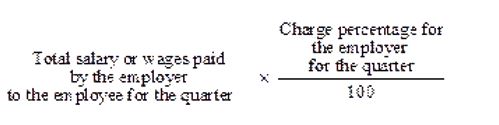
where:
charge percentage, for an employer for a quarter, means:
(a) the number specified in subsection (2) for the quarter (unless paragraph (b) applies); or
(b) if the number specified in subsection (2) for the quarter is reduced in respect of the employee by either or both section 22 and 23 – the number as reduced.
…
Subsection (2) includes a table with the charge percentage applicable during certain time periods.
Section 23 of the SGA Act provides for the reduction of the charge percentage as follows:
23 Reduction of charge percentage if contribution made to RSA or to fund other than defined benefit superannuation scheme
(1) This section applies only in relation to RSAs and to superannuation funds other than defined benefit superannuation schemes.
Reduction of charge percentage where contributions are made by employer
(2) If, in a quarter, an employer contributes for the benefit of an employee to a complying superannuation fund or an RSA, then the charge percentage for the employer (as specified in subsection 19(2)) for the employee for the quarter is reduced by the number worked out using the formula:
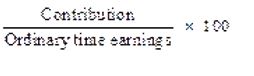
where:
contribution is the number of dollars in the amount of the contribution.
ordinary time earnings is the number of dollars in the ordinary time earnings of the employee for the quarter in respect of the employer.
Example: If the contribution is $60 and the ordinary time earnings are $1,000 then the charge percentage is reduced by 6.
…
It was common ground in the appeal that, to avoid the imposition of a superannuation guarantee charge, an employer is required to make contributions to complying superannuation fund accounts for employees in amounts equal to a minimum prescribed percentage of an employee’s “ordinary time earnings”. For the purposes of s 23 of the SGA Act, “ordinary time earnings” is defined in s 6(1) of the SGA Act as follows:
6 Interpretation-general
(1) In this Act, unless the contrary intention appears:
…
ordinary time earnings, in relation to an employee, means:
(a) the total of:
(i) earnings in respect of ordinary hours of work other than earnings consisting of a lump sum payment of any of the following kinds made to the employee on the termination of his or her employment:
(A) a payment in lieu of unused sick leave;
(B) an unused annual leave payment, or unused long service leave payment, within the meaning of the Income Tax Assessment Act 1997; and
(ii) earnings consisting of over-award payments, shift-loading or commission; or
(b) if the total ascertained in accordance with paragraph (a) would be greater than the maximum contribution base for the quarter—the maximum contribution base.
144 It follows that, by making superannuation contributions in accordance with the formula in s 23(2) of the SGA Act, an employer could effectively reduce the charge percentage to zero, such that the individual superannuation guarantee shortfall under s 19 (and therefore the superannuation guarantee shortfall under s 17) was also zero. The calculation under s 23 relies on the employee’s “ordinary time earnings” as defined in s 6(1). In such circumstances, no superannuation guarantee charge will be payable by the employer under s 5 of the SGC Act and s 16 of the SGA Act.
Relevant facts
145 The Union commenced proceedings against the appellants, alleging that the appellants failed to pay Jimmy Konstandaras, Jason Le Clerc (Mr Le Clerc), Mark Everett, Matthew Storey (Mr Storey), Jose Fernandes and Andrew Miller (together: the Named Employees) superannuation contributions in contravention of the relevant industrial instruments that were applicable to the Named Employees’ employment, and, consequently, s 50 of the FW Act or Item 15 of Sch 16 to the FW Transitional Act as relevant.
146 At all material times, the Named Employees were employed by either the first or the second appellant. Before the primary Judge, it was agreed that the obligations in respect of all of the Named Employees could be determined, for the convenience of the Court and the parties, by reference to two Named Employees, that is Mr Storey and Mr Le Clerc. Mr Storey and Mr Le Clerc were both actually employed by the first appellant, but it is common ground that all findings were equally applicable to the second appellant.
147 The industrial instruments applicable to the Named Employees employed by the first appellant were:
the BlueScope Steel (AIS) Pty Ltd – Port Kembla Steelworks Employees Award 2006 (Port Kembla 2006 Award), which operated from 13 January 2006 to 9 August 2013;
the BlueScope Steel Port Kembla Steelworks Agreement 2012 (Port Kembla 2012 Agreement), which operated from 9 August 2013 to 25 November 2015; and
the BlueScope Steel Port Kembla Steelworks Agreement 2015 (Port Kembla 2015 Agreement), which has operated from 25 November 2015.
148 The industrial instruments applicable to the Named Employees employed by the second appellant were:
the BlueScope Steel Limited – Springhill and CRM Employees Award 2006 (Springhill 2006 Award), which operated from 13 January 2006 to 9 August 2013;
the BlueScope Steel Springhill Workplace Agreement 2012 (Springhill 2012 Agreement), which operated from 9 August 2013 to 25 November 2015; and
the BlueScope Steel Springhill Workplace Agreement 2015 (Springhill 2015 Agreement), which has operated from 25 November 2015.
149 The Port Kembla 2006 Award and the Springhill 2006 Award (collectively: the 2006 Awards) both contained cl 7.1 in substantially the same terms, being:
7.1 Superannuation Legislation – the Subject of Superannuation is dealt with exhaustively by federal legislation including the Superannuation Guarantee (Administration) Act 1992 (Cth), the Superannuation Industry (Supervision) Act 1993 (Cth), the Superannuation (Resolution of Complaints) Act 1993 (Cth), and section 124 of the Industrial Relations Act 1996. This legislation, as varied from time to time, governs the superannuation rights and obligations of the parties. Subject to this legislation, superannuation is also dealt with by the trust deed and rules of the BlueScope Steel Superannuation Fund and the Superannuation Trust of Australia, and relevant agreements made from time to time between the Company and the Unions party to this award, including the BHPSteel – Superannuation Review dated 25 October 1995.
150 The Port Kembla 2012 Agreement, Port Kembla 2015 Agreement, Springhill 2012 Agreement and Springhill 2015 Agreement (collectively: Enterprise Agreements) each contained a cl 7 in the same terms, being:
7.1 Superannuation arrangements are governed by Federal legislation including the Superannuation Guarantee (Administration) Act 1992 (Cth), the Superannuation Industry (Supervision) Act 1993 (Cth), and the Superannuation (Resolution of Complaints) Act 1993 (Cth).
7.2 The Company will make contributions to an employee’s superannuation account at a minimum in compliance with the Superannuation Guarantee (Administration) Act 1992 (Cth), as varied from time to time. Additionally for permanent employees who are members of the BlueScope Steel Superannuation Fund or Australian Super, subject to these statutory minimum contributions and the Basic Member Contributions an employee makes to their superannuation account, the Company will make contributions into an employee’s superannuation account in accordance with the below scale:
Employee Contribution | Company Contribution |
0% | 9.5% |
3% | 10% |
4% | 12% |
5% | 14% |
All company contributions are based on an Employee’s Defined Wage, as defined at clause 4 above.
151 Clause 4.5 of each of the Enterprise Agreements contained the definition of “Defined Wage”, being:
… the basic Agreement rate of pay (as set out in clause 6) any applicable permanent higher duties payments, standard steel industry shift allowances (as set out in clause 15), weekend penalty rates, (which may apply) plus Special Rates, specified in Clause 8 (Special Rates).
152 Various “Departmental Agreements” were made pursuant to the relevant awards or Enterprise Agreements which set out the work arrangements for specific departments or work areas. The relevant departmental agreements for the purposes of this appeal were:
the BlueScope Steel (AIS) Pty Ltd – Port Kembla Bulk Operations Enterprise Agreement 2005 (Bulk Operations Enterprise Agreement);
the Bulk Berth Operations Departmental Agreement 2013 (Bulk Berth Departmental Agreement);
the Slabmaking – 12-hour Shift Agreement 2004 (Slabmaking Agreement); and
the Slab-Yard – 12-hour Shift Agreement 2010 (Slab Yard Agreement).
(I note that the Bulk Operations Enterprise Agreement was not strictly an “enterprise agreement” within the meaning of the FW Act, notwithstanding its title).
153 The Departmental Agreements provided for hours of work and annualised or aggregate salaries.
154 These methods of determining salary were based on a notional roster, which assumed that employees worked a certain number of working days, public holidays and other days, and was calculated to include a certain amount of guaranteed prepaid overtime (which may or may not be required to work) and a certain number of public holidays (regardless of whether or not those public holidays were actually worked). Depending on the relevant industrial instrument, salaries were either “annualised” or “aggregated” according to that notional roster. As such, employees’ salaries were averaged over a 12 month period based on a notional working roster, and not on the days actually worked by the employee.
155 It is not in dispute that the appellants did not pay superannuation contributions in accordance with those that the Union alleged in the originating application and statement of claim were required. The appellants’ position is that there was no such requirement.
Mr Storey
156 Mr Storey commenced working for the first appellant on 20 February 1995. Until 10 January 2016, Mr Storey was paid an annualised salary; after 10 January 2016, he was paid an aggregate salary. Mr Storey was covered by the following award, Enterprise Agreements and departmental agreements:
Port Kembla 2006 Award (from 2006 to 8 August 2013);
Port Kembla 2012 Agreement (from 9 August 2013 to 24 November 2015);
Port Kembla 2015 Agreement (from 25 November 2015 to present);
Bulk Operations Enterprise Agreement (from 17 February 2006 to 21 August 2013); and
Bulk Berth Departmental Agreement (from 21 August 2013 to 16 January 2016).
157 The relevant award and the Enterprise Agreements consistently defined “ordinary hours of work” to be an average of 38 hours per week over the full cycle of the relevant work roster, with maximum hours during any 24 hour period and any 28 day period. Under the Bulk Operations Enterprise Agreement and the Bulk Berth Departmental Agreement, the annualised salary, which was calculated on the basis of a “notional roster”, included a “component” for “additional hours worked”, which was 5.5 overtime hours per week calculated at an overtime rate. In effect, therefore, Mr Storey was treated as working 43.5 hours per week. The Departmental Agreements set out the obligation placed on employees to work additional hours, as well as the period of notice that must be given to employees in respect of those additional hours. It is common ground that an employee was not required to actually work the additional hours, in order to receive the payments for the additional hours. However, the Departmental Agreements also provided for disciplinary procedures where an employee failed to work the additional hours in accordance with their obligation to do so.
158 The relevant provisions of the Bulk Operations Enterprise Agreement and the Bulk Berth Departmental Agreement in relation to additional hours were set out by the primary Judge. In particular I note as follows:
6 CONDITIONS OF EMPLOYMENT
6.1 Annualised Salaries
All employees are remunerated with an annualised salary which provides employees with a secure income whilst ensuring safe, timely and effective operations. The annualised salary is made up of a base rate and a component which absorbs all additional payments such as penalty rates, allowances, shipping shift premiums, public holiday loadings and payouts and payment for additional hours worked outside the normal rostered hours to meet the requirements of the position.
Work allocation will take place across all hours required by employee’s covered by this Enterprise Agreement as per Clause 6.3 [Additional Hours].
6.2 Calculation Formula for Annualised Salary
Annualised Salary = Base Salary + Public Holidays + Shift Penalties + Additional Hours
Base Salary = Ordinary Stevedoring Hourly Rate *38 hrs * 52 weeks
Overtime = 5.5 hrs overtime per week x 2.1761 x Ordinary Stevedoring Hourly Rate
The additional work hours component is not paid during annual leave and is calculated for 47 weeks rather than 52 weeks.
Appendix 1 outlines some of the penalty arrangements currently applying in the Bulk Berth section that have been incorporated in the calculation of the annualised salary. Outlined below are the annualised salaries for each classification.
…
6.3 Additional Work Hours
Employee’s will be required to work additional hours under the annualised salary system established at clause 6.2. Work undertaken on Additional hours will not be the subject of restrictions. All work required by the company on the Bulk Berth either directly or indirectly as part of operations will be required to be undertaken while on additional work hours.
…
6.5 Superannuation Defined Wage for Annualised Salary
The defined wage for the purposes of calculating employee and company contributions will be as appropriate for the following classifications:
…
The superannuation rates will be indexed with wages rises.
The defined wage will be applied for the nominal term of this agreement.
The defined wage for Superannuation purposes is:
the defined wage will be calculated for the relevant classification by using the base rate for that classification and applying the appropriate Steel Industry shift allowances and weekend penalties as prescribed by the BlueScope Steel (AIS) Pty Ltd – Port Kembla Steelworks Employees Award 2004.
159 Relevantly cl 4 of the Bulk Berth Departmental Agreement also provided:
4.0 CONDITIONS OF EMPLOYMENT
4.1 Annualised Salaries
All Bulk Berth Operations employees are remunerated with an annualised salary.
Calculation formula for annualised salary is as follows:
Annualised salary = base salary + public holidays + shift penalties + additional hours
Base salary = base stevedoring hourly rate * 38 hours * 52 weeks
Overtime rate = 5.5 hrs overtime per week * 2.1761 * base stevedoring hourly rate
The additional work hours’ component is not paid during annual leave and is calculated for 47 weeks rather than 52 weeks (5.5 x 47 = 258.5 hours per year)
Table 1 outlines some of the penalty arrangements currently applying in the Bulk Berth section that have been incorporated in the calculation of the annualised salary.
Base and Annualised Salaries for each classification as at 23 October 2012 are outlined below.
…
Mr Le Clerc
160 Mr Le Clerc commenced working for the first appellant on 9 May 2011. His employment was covered by the following agreements:
Port Kembla 2006 Award (from 2006 to 8 August 2013);
Port Kembla 2012 Agreement (from 9 August 2013 to 24 November 2015);
Port Kembla 2015 Agreement (from 25 November 2015 to present);
Slabmaking Agreement (from April 2004 to 13 January 2013); and
Slab Yard Agreement (from 13 January 2013 to present).
161 At all times, Mr Le Clerc was paid an aggregate salary in accordance with the Departmental Agreements referable to Slabmaking. Provision for the payment of an “aggregate salary” is made in both the Slabmaking – 12-hour Shift Agreement (cl 10) and the Slab Yard – 12-hour Shift Agreement (cl 10). Clause 10 of the Slabmaking – 12-hour Shift Agreement materially provided:
10. AGGREGATE SALARY
All salaries will be paid fortnightly by electronic funds transfer directly into an account nominated by the employee with a bank, building society, credit Union or other financial institution recognised by the Company.
The aggregated salary will:
i.) Provide a stable income, with a standard pay on a fortnightly basis for the individual;
ii.) Reduce inefficiencies by building in payment of shift work allowances; and
iii.) Support the team concept.
The aggregate salary will be paid as twenty-six equal fortnightly payments per annum (irrespective of the number of days worked in the pay period), and comprises three components:
…
162 As his Honour explained:
21 ...These “three components” were thereafter addressed as being:
• “Base Salary”;
• “Additional Payments”, which includes “Public Holidays”; and
• “Shift Work Payments and Penalties”.
Clause 10.1 addressed “Base Salary” as follows:
10.1. Base Salary
Payment for the award wage, over award (bonus) payment, tool allowance for tradespersons and electrical licence payments for electrical tradespersons.
Weekly base salary is calculated by multiplying the employee’s hourly rate (including bonus rate, where applicable) by thirty-eight hours. Base salary for each employee is subsequently calculated by multiplying the weekly base salary by fifty-two weeks.
Calculation is therefore: Base salary = Hourly rate x 38 hours x 52 weeks.
Clause 10.2 addressed “Additional Payments” as follows:
10.2. Additional Payments
Payment for disability allowances for tradespersons, payment for all public holidays (worked and rostered). NOTE: Employees will no longer have the option to have a days annual leave added in lieu of a rostered off shift falling on a public holiday.
10.2.1. Public Holidays
Payment is based on the average number of public holiday loading hours for each employee across four crews. With reference to the roster pattern above (Figure 1), each employee will work on average 5.425 of the eleven public holidays per annum and be rostered off on the remaining 5.575 days. Of the 5.425 days worked 4.75 incur public holiday loading while 0.675 days per year receive no loading due to their occurrence on the day of the 1st night shift. Six hours is deducted to avoid double payment of weekend penalties and public holiday loading on Easter Saturday. Public holiday loading is therefore based on an extra twelve hours pay for every public holiday falling on a rostered off shift and an extra eighteen hours for every public holiday worked.
i.e. [(5.575 x 12) + (0.675 x 0) + (4.75 x 18)] = 152.4 – 6
Easter Saturday Deduction
Rounding … = 146 hour per annum
Calculation is therefore: Public holiday payment = Hourly rate x 146 hours.
10.2.2. Annual Leave
Annual leave loading is not paid to shift workers as they have their shift allowance and weekend penalties included in the aggregated salary. The award conditions at the time will apply.
Clause 10.3 addressed “Shift Work Payments and Penalties” and cl 10.4 provided as follows (without alteration):
10.4. Total (Aggregate Salary)
The total aggregate salary is the sum of the above three components:
i.e. Aggregate Salary = Base Salary + Public Holiday Payment + Weekend Payment + Shift Allowance Payment.
Fair Work Legislation
163 The respondent alleged that the failure to make the superannuation payments was a contravention of cl 7 of the Enterprise Agreements, which in turn formed the basis for a contravention of s 50 of the FW Act, which provides:
50 Contravening an enterprise agreement
A person must not contravene a term of an enterprise agreement.
Note 1: This section is a civil remedy provision (see Part 4-1).
Note 2: A person does not contravene a term of an enterprise agreement unless the agreement applies to the person: see subsection 51(1).
164 Further, the respondent alleged a breach of Item 15 to Sch 16 of the FW Transitional Act in respect of the Awards, which were made under the relevant New South Wales legislation and as such are subject to the transitional provisions. Item 15 provides:
15 Continuing Schedule 6 instruments
(1) A person must not contravene a term of a continuing Schedule 6 instrument that applies to the person.
Note 1: This subitem is a civil remedy provision (see item 16, and Part 4-1 of the FW Act).
Note 2: An injunction may not be granted in relation to a contravention of a continuing Schedule 6 instrument (see item 17).
(2) A transitional employer must not contravene subclause 72J(2) or 72K(1), (2) or (3) of continued Schedule 6.
Note: This subitem is a civil remedy provision (see item 16, and Part 4-1 of the FW Act).
165 It is common ground that the relevant awards and Enterprise Agreements are instruments capable of enforcement under the FW Act and related legislation. The awards are transitional instruments, breach of which was a contravention of Item 15 of Sch 16 to the FW Transitional Act. Contravention of terms of the Enterprise Agreements was a breach of s 50 of the FW Act.
The reasons of the primary judge
166 After observing that the claim of the Union concerned the superannuation entitlements of six employees, including Messrs Le Clerc and Storey, his Honour summarised the issue before him as, at its most simple:
6 … whether superannuation contributions are payable by one or other of the Respondents in respect to:
• the “additional hours component”; and/or
• the “public holidays component”
of the salaries payable to the employees. That issue, in turn, depends upon the correct construction and application of the phrases “ordinary time earnings” and “ordinary hours of work” as employed in s 6(1) of the Superannuation Guarantee (Administration) Act 1992 (Cth).
167 His Honour noted the contention of the Union that the additional hours component and the public holidays component formed part of the “ordinary time earnings” and “ordinary hours of work”, following from the terms of the variety of awards and agreements covering Messrs Le Clerc and Storey; or the alternative contention that Messrs Le Clerc and Storey had in fact performed work which fell within those two statutory phrases and for which no contributions had been paid. His Honour noted further the contention of the appellants that the Enterprise Agreements contained no term requiring the payment of superannuation contributions and that no question of a contravention of s 50 of the FW Act arose.
168 As his Honour noted at [10], there was a degree of commonality in the terms of the awards and Enterprise Agreements applying to Messrs Le Clerc and Storey. His Honour set out, in detail, provisions of the industrial instruments applicable to each worker, and from [45] outlined the nature of the superannuation regime under the SGC Act and the SGA Act. His Honour noted at [50] that the phrase “ordinary hours of work” was fundamental to the administration of the SGA Act, and that that phrase was incorporated into “ordinary time earnings” in s 6(1) of the Act. His Honour observed that the expression “ordinary” frequently occurs in industrial agreement, and that the meaning of the term in an industrial agreement was explained by Gray J in Quest Personnel Temping Pty Ltd v Commissioner of Taxation [2002] FCA 85; (2002) 116 FCR 338 in the following terms:
27 As is demonstrated by [Kezich v Leighton Contractors Pty Ltd [1974] HCA 50; 131 CLR 362], there may be cases in which the working of hours beyond fixed standard hours becomes so regular, normal, customary or usual that the additional hours are to be regarded as ordinary hours for a particular employee.
169 As his Honour noted, similar conclusions were reached by the High Court in Australian Communication Exchange Ltd v Deputy Commissioner of Taxation [2003] HCA 55; (2003) 201 ALR 271 in respect of the phrase “ordinary time earnings”.
170 His Honour noted the submission of the current appellants that:
Clauses such as cll 7.1 and 7.2 are not the source of any legal requirement on the part of the current appellants to make contributions to employees’ superannuation accounts;
The sole source of such requirement was to be found in the SGC Act and the SGA Act; and
Unless these clauses were the source of an obligation to make such contributions, there could be no contravention of s 50 of the FW Act.
171 His Honour concluded at [61]–[64]:
The SGC Act and the SGA Act created a statutory regime administered by the Commissioner of Taxation, determining the manner in which minimum superannuation contributions were to be made and calculated.
Extensive statutory powers are conferred to ensure that the requirement to make superannuation contributions is satisfied.
A contravention of a requirement to make minimum superannuation contributions may not be enforceable by contract.
These conclusions said very little about the question in the proceedings, which required:
• An identification of a term of an enterprise agreement;
• A determination as to whether that term had been contravened – in this respect:
• It was not necessary for a Court to conclude that the term was itself the source of any requirement to make a superannuation contribution;
• A contravention of such a term is made out by a finding that the term may be but a mere acknowledgement of a requirement to make a contribution otherwise imposed by statute, and that such a contribution had not been made.
In addressing those matters, no question arose as to whether or not the term was the source of a legal obligation to make a contribution, or was enforceable by an employee whose superannuation contributions may not have been paid by way of (for example) damages or specific performance.
172 The primary Judge rejected the appellants’ argument that there was a preliminary barrier to relief for the respondent, in that there was no binding obligation that could be the subject of a contravention for the purposes of s 50 of the FW Act or Item 15 of Sch 16 to the FW Transitional Act.
173 His Honour held that the appellants were under a binding legal obligation to make the superannuation payments, and found as follows:
70 The obstacle sought to be placed by the Respondents in the path of the Applicant is to be rejected for the simple reason that a contravention of s 50 is made out if a term of an enterprise agreement has not been complied with.
71 Section 50, it is respectfully considered, does not turn upon the identification of the source of the legal requirement to make contributions to an employee’s superannuation account. Whether the source of that legal requirement is to be found in the superannuation legislation or the Enterprise Agreement itself, what cl 7 requires is that such contributions are to be made. If such contributions are not made, the Respondents have failed to comply with the requirements of cl 7 and have thereby contravened a term of an enterprise agreement.
72 Section 50 is not to be construed and confined in its operations to only a contravention of those “terms” which themselves are the source of a legal obligation.
73 Even if it be accepted that the source of the legal requirement to pay superannuation contributions is to be sourced exclusively in the superannuation legislation and not the Enterprise Agreement itself, if payments which are required to be made have not been made, payments have not been made “in accordance with clause 7”.
74 If this conclusion be correct, a contravention of s 50 may be made out and thereafter it remains simply a task of determining what orders (if any) should be made as to the imposition of any penalty and what orders should be made pursuant to s 545.
174 His Honour went on to consider whether there was an independent source of legal obligation under cl 7 of the Awards and Enterprise Agreements:
75 It is nevertheless separately concluded that cll 7.1 and 7.2 of the 2012 Agreement (and other like provisions) are the source of an independent legal obligation to make superannuation contributions, separate and distinct from the obligations imposed by the legislative regime set forth in the Superannuation Guarantee Charge Act and the Superannuation Guarantee (Administration) Act.
76 But such a conclusion has not, it should be expressly recognised, been reached without some degree of diffidence.
77 That diffidence is occasioned by the fact that clauses having some of the hallmarks of cll 7.1 and 7.2 have been repeatedly accepted as but a statement of the law as to an employer’s duty to pay a superannuation levy and not as the source of an independent contractual right.
175 Decisions supporting the proposition that an employer’s duty to pay superannuation contributions is imposed by law – not the relevant employment instrument or contract – were Soliman v University of Technology, Sydney [2008] FCA 1512, (2008) 176 IR 183, Akmeemana v Murray [2009] NSWSC 979; (2009) 190 IR 66 and Gramotnev v Queensland University of Technology [2013] QSC 158. His Honour considered the decision of the Full Court in National Tertiary Education Union v La Trobe University [2015] FCAFC 142; (2015) 254 IR 238 of more immediate assistance, in particular [45] of the judgment where the majority found that the relevant clause in the Agreement did not impose obligations on the employer.
176 At [84] his Honour identified features common to decisions where the Court concluded that the relevant clause was not the source of a legally enforceable obligation to make payments, as including:
• the absence of any discernible intention to create legal obligations;
• the acknowledgement that requirements imposed by legislation may change from time to time and hence lack the certainty of (for example) an enforceable contractual arrangement; and
• the expressions used being more a statement of “aspirational commitment” than being a statement of “contractual stipulation”.
Those authorities also considered terms of industrial agreements having their counterpart in the present Agreements, including (for example):
• “governed” by or “governed exhaustively” by.
177 His Honour concluded:
Such factors are compelling. The present clauses have much in common with the clauses involved in the authorities relied upon by the Respondents.
178 At [86] his Honour then turned to cll 7.1 and 7.2 of the Port Kembla 2012 Agreement, noting that they were expressed in different terms to cl 7.1 of the Port Kembla 2006 Award. In particular, at [87] his Honour noted that cl 7.1 of the 2006 Award was drafted to include:
• the expression that the “Subject of Superannuation is dealt with exhaustively by federal legislation”; and
• a recognition that the “legislation, as varied from time to time, governs the superannuation rights and obligations of the parties”.
179 At [87] his Honour also noted that cll 7.1 and 7.2 of the Port Kembla 2012 Agreement were drafted in terms which included the expressions:
• “Superannuation arrangements are governed by Federal legislation”; and
• “the Superannuation Guarantee (Administration) Act 1992 (Cth), as varied from time to time.”
180 However, his Honour noted at [88] that cl 7.2 also employed the following expressions:
• The Company will make contributions … at a minimum”; and
• “the Company will make contributions into an employee’s superannuation account in accordance with the below scale”.
181 His Honour noted that that which was formerly included within cl 7.1 of the Port Kembla 2006 Award, but which no longer appeared in the Port Kembla 2012 Agreement, were expressions such as:
• the reference to the “Subject of Superannuation” being “dealt with exhaustively by federal legislation”;
• the reference to that legislation “govern[ing] the superannuation rights and obligations of the parties”; and
• the reference to superannuation “also [being] dealt with by the trust deed and rules of the BlueScope Steel Superannuation Fund”.
182 It followed, in his Honour’s view, that the shift in language resulted in cll 7.1 and 7.2 in the Port Kembla 2012 Agreement (and clauses in later Agreements in similar terms) being a source of a legal obligation assumed by the appellants to make contributions.
183 The terms of cl 7.2 required more than the making of such minimum contributions as were otherwise payable pursuant to the SGA Act, by addressing the prospect that a permanent employee could make personal contributions into their superannuation account, and the appellants would make contributions in accordance with a prescribed scale. His Honour continued:
90. … The effect is that where the employee makes a personal contribution, the company will make an additional contribution over and above the minimum contribution required under the Act. The legislation does not provide for additional payments other than the minimum contributions to be made. It would be a curious conclusion to reach if the part of cl 7.2 directed to the making of a “minimum” contribution in accordance with the legislation were to be construed as but a recognition of rights conferred by legislation and thus lacking any discernible expectation of creating contractual rights, but a contrary conclusion was to be reached in respect to that part of cl 7.2 which addresses contributions greater than the minimum. The one clause would, on such an approach, be unenforceable as far as the former contributions were concerned, but enforceable in respect to the latter contributions.
184 His Honour said that these clauses underlay his principal conclusion, being that the object and purpose of provisions such as s 50 of the FW Act were fundamentally different to the object and purpose sought to be achieved by the SGA Act and the manner of administration of that Act by the Commissioner of Taxation.
185 His Honour then turned to the meaning of “ordinary time earnings” and “ordinary hours of work” as incorporated into s 6 of the SGA Act.
186 His Honour noted at [97] that the two fundamental questions to be resolved in the proceeding were:
• whether the “additional hours component” of the annualised salaries were “ordinary time earnings”, and
• whether the “public holidays component” paid to the employees as a component of either an annualised salary or an aggregate salary were “ordinary time earnings”.
187 His Honour observed that the terms “annualised salary” and “aggregate salary” appeared in various agreements to which the current appellants and the respondent were parties. Before his Honour the appellants argued, in summary, that the fact that employees may work beyond “standard working hours” and that such hours were mandatory did not change the characterisation of those hours as “overtime” (and therefore they were not “ordinary time earnings”). The respondent argued that there was no warrant for dissecting fortnightly payments of annualised salary into various components, where that approach was contrary to the agreement between the parties.
188 As to the meaning of “ordinary time earnings” and “ordinary hours worked”, the primary Judge made the following findings:
105. It is concluded that:
• there is a clear distinction drawn in the authorities, not surprisingly, between the normal (or ordinary) hours of work and “overtime” (or “additional” hours of work);
and that:
• in many cases the terms of an award or an enterprise agreement will themselves identify the normal (or ordinary) hours of work
but that:
• in the circumstances of the present agreements, the “ordinary hours of work” for the purposes of the Superannuation Guarantee (Administration) Act include the “additional hours” and the “public holidays” for which the agreements make provision in respect to an “annualised salary” — and are so included irrespective of whether an employee actually works “additional hours” or “public holidays”.
It is further concluded that, even if the last conclusion be incorrect, the “ordinary hours of work” includes:
• the “additional hours” in fact worked by an employee.
It necessarily follows that the Respondents erred in not making superannuation contributions in respect to that components, being the “additional hours” component.
189 In so finding, at [106]–[111] his Honour referred to four propositions, summarised as follows:
(1) The phrase “ordinary hours” refers to that which is “regular, normal, customary, usual”: Kezich v Leighton Contractors Pty Ltd [1974] HCA 50; (1974) 131 CLR 362 at 365. The phrase “ordinary hours of work” should be given a meaning which best promotes the underlying object or purpose of the Act: Quest Personnel [2002] FCA 85; (2002) 116 FCR 338 at [20].
(2) Hours which are worked beyond standard or fixed hours may become the “ordinary hours” of an employee: Quest Personnel at [27].
(3) There is a long-recognised distinction between ordinary hours of work and overtime: Thompson v Roche Bros Pty Ltd [2004] WASCA 110 at [31].
(4) The terms of an industrial instrument may provide an answer to what is meant by the term “overtime” or the phrase “ordinary hours of work”: Catlow v Accident Compensation Commission [1989] HCA 43; (1989) 167 CLR 543 at 560–561.
190 Turning to the terms of the relevant agreements, his Honour said:
114. With reference to the terms of the Agreements in issue in the present proceeding, it is considered that:
• the “Calculation Formula” set forth in cl 6.2 of the Bulk Operations Enterprise Agreement 2005 and its reference to the “annualised salary” being comprised of a “Base Salary”, “Public Holidays”, “Shift Penalties” and “Additional Hours” does not dictate a conclusion that each of those components forms part of the “ordinary hours of work”.
The “Calculation Formula” is no more than a “formula” for calculating the quantum of an “annualised salary”. The reliance placed by the AWU upon that part of cl 6.1 which provides that the “annualised salary” is made up of components “which absorb all additional payments” is, with respect, equally misplaced. The fact that the quantum of a salary may absorb payments made in respect to a number of components says nothing as to whether work has “ordinarily” been performed in respect to any one or other of those components.
115. Nor, with respect, does the reference to (for example):
• “overtime” in cl 6.2 of the Bulk Operations Enterprise Agreement 2005 dictate a conclusion that “overtime” may or may not form part of the “ordinary hours of work”.
116. All such provisions nevertheless form part of the Agreements in question and form part of the matrix against which a conclusion is to be reached as to what are the “ordinary hours of work” performed by an employee with an “annualised salary”.
117. Although the manner of calculating the “annualised salary” is more directed to the manner in which employees are to be remunerated for the work they undertake and does not of itself dictate a conclusion that the “ordinary hours of work” includes those components which form part of the calculation, it lends support to the conclusion advanced on behalf of the AWU.
118. The manner in which employees are remunerated, and the fact that the “annualised salary” is recognised as “absorb[ing]” each of the components identified, is some indication of the fact that there is a recognition in the Bulk Operations Enterprise Agreement 2005 that “additional hours” (and “public holidays”) are so routinely worked — or customarily worked — that they do form part of the “ordinary hours of work”. Each of the components identified, it is thus recognised, are so “ordinarily” undertaken that they should be incorporated — or “absorb[ed]” — into the “annualised salary” that is paid.
119. More useful for identifying the “ordinary hours of work” are not those terms identifying the manner in which remuneration is to be determined but rather:
• the fact that the Agreements operate in a working context were [sic] employees work shifts and where staff need to be available 24 hours per day, 365 days of the year
and the following terms of (for example) the Bulk Operations Enterprise Agreement 2005:
• clause 2.4, being a clause directed at ensuring that “[o]perational needs [are] met” and providing that one of the “key pillars” that supports the bulk berth “to have an effective and efficient business” is “the guarantee that coverage will be available 365 days per year and 24 hours per day by the Bulk Berth employees”; and
• clause 6.3 and the recognition that employees “will be required to work additional hours under the annualised salary system” and the recognition that “employees will be expected to attend work” even where one hour’s notice is not able to be given of the requirement for an employee to work “additional hours”.
In contrast to a different work context where a distinction (albeit a blurring distinction) may be drawn between the ordinary or standard hours of 38 hours per week and overtime or additional time (even where employees may be required or expected to work additional hours or overtime), the present working context is one in which any distinction between standard or ordinary hours and overtime or additional hours is more theoretical than real.
120. Also of relevance is (for example) the following term of the 2006 Award and the 2012 Agreement:
• clause 17, which provided that employees may be “required to work seven day shift work to meet the needs of the business” and that those employees “will be required to work Sundays and Public Holidays as ordinary working days”.
Again, the distinction in the present working context between work on a public holiday and work on any other day is also more theoretical than real.
121. It is the very fact that the Bulk Operations Enterprise Agreement 2005 (for example) requires employees to work “additional hours” and on “public holidays” as the norm that underpins the recognition that those employees can only fairly be remunerated by reference to an “annualised salary”. Given the manner in which work is performed, and required to be performed, there is no real or practical distinction between (for example) the standard or ordinary hours of work separate from the total number of hours worked, including “additional hours”. Nor is there any real distinction between work on a public holidays and work on any other day.
191 Further, his Honour noted that workers who received an “additional hours component” would work additional hours, although the extent to which particular employees worked such hours varied: [122]–[124].
192 In relation to public holidays and aggregate salaries, his Honour observed that the “public holidays component” was included within the statutory phrase “ordinary hours of work”. His Honour noted that the relevant industrial agreements covering Mr Le Clerc’s employment were the Slabmaking Agreement (in force as at the date of the commencement of his employment in May 2011 and in force up to January 2013) (specifically cl 10) and thereafter the Slab Yard Agreement (specifically cl 10). His Honour continued:
139. As with the counterpart conclusion in respect to an “annualised salary”, the concept of an “aggregate salary” as used in the two Agreements does not of itself determine the “ordinary hours of work”. An “aggregate salary” remains but a means of calculating on a fortnightly basis the salary to be paid to an employee. Even though an “aggregate salary” is a recognition that an employee may be called upon to work on “public holidays” and that the “aggregate salary” is a recognition that the salary contains a number of components designed to compensate an employee for having to work – and being required to work – on “public holidays”, that “aggregated salary” remains but a means whereby an employee is to be paid. It says nothing, with respect, as to whether an employee receiving such a salary, “ordinarily” works on a “public holiday” or the number of such days that employee “ordinarily” so works. That remains a question of fact.
140. In determining whether the “public holidays component” forms part of the “ordinary hours of work”, reference may be made initially to the Slabmaking – 12-hour Shift Agreement. Clause 10.4 provides that the “total aggregate salary” is the sum of the base salary, plus additional payments (including public holiday payments) and shift work payment and penalties (including weekend penalties and shift allowances). Clause 10.4 concludes by stating that:
Aggregate Salary = Base Salary + Public Holiday Payment + Weekend Payment + Shift Allowance Payment.
It is cl 10.2.1 which specifically provides for “Public Holidays”. That clause, it is considered, make it apparent that it is expected that employees who are covered by this Agreement may so regularly be called upon to work on public holidays that the Agreement recognises that:
payment is “based on the average number of public holiday loading hours”; and
each employee “will work on average 5.425 of the eleven public holidays per annum and be rostered off on the remaining 5.575 days”.
An “average”, of course, say nothing as to the facts from which the average is calculated. But the “average 5.425 of the eleven public holidays per annum” identified in cl 10.2.1 is, it is considered, a quantification of the “ordinary” hours an employee will be required to work on a public holiday.
141. If attention is thereafter shifted to the Slab Yard – 12-hour Shift Agreement, cl 10.2.1 similarly provides for “Additional Payments” in respect to “Public Holidays” and cl 10.4 again similarly provides for the components going into the calculation of the “aggregate salary”.
142. The same conclusion is reached as to the “public holidays component” of an aggregate salary forming part of the “ordinary hours of work”, irrespective of which of these two Agreements is referred to.
143. Both Agreements provide (in cl 3.1) that they are “to be read in conjunction with the current Award at the time”. In the case of the Slab Yard – 12-hours Shift Agreement, “the Award” is defined to mean the 2006 Award. If recourse is had to cl 17 of that Award, the present conclusion is only further reinforced by cl 17 stating that “employees will be required to work ... Public Holidays as ordinary working days”.
193 Accordingly, his Honour found that the appellants’ obligations to make superannuation contributions should not be confined to the public holidays actually worked by Mr Le Clerc.
194 The primary Judge made declarations of contravention in respect of the appellants’ failure to make the minimum superannuation contributions, which formed the basis for breaches of s 50 of the FW Act and Item 15 of Sch 16 to the FW Transitional Act. The primary Judge made Orders accordingly, which are not the subject of any of the grounds of appeal.
Application for leave to intervene
195 By application dated 29 June 2018, the Commissioner sought leave to intervene in these proceedings pursuant to r 36.32 of the Federal Court Rules 2011 (Cth) (Rules). Rule 36.32 provides:
36.32 Applications to intervene
(1) A person who was not a party to the proceeding in the court appealed from may apply to the Court for leave to intervene in an appeal.
(2) The person must satisfy the Court:
(a) that the intervener’s contribution will be useful and different from the contribution of the parties to the appeal; and
(b) that the intervention would not unreasonably interfere with the ability of the parties to conduct the appeal as they wish; and
(c) of any other matter that the Court considers relevant.
Note 1: The role of the intervener is solely to assist the Court in resolving the issues raised by the parties.
Note 2: The Court may give leave to the intervener to intervene on conditions, and with the rights, privileges and liabilities (including liabilities for costs), determined by the Court.
Note 3: When giving leave, the Court may specify the form of assistance to be given by the intervener and the manner of participation of the intervener and, in particular:
(a) the matters that the intervener may raise; and
(b) whether the intervener’s submissions are to be oral, in writing, or both.
196 The Commissioner submitted that its interests in the appeal related solely to two issues, namely:
whether the SGA Act and SGC Act impose upon an employer a positive statutory requirement to make superannuation contributions, and
the proper construction of the expressions “ordinary time earnings” and “ordinary hours of work” within s 6 of the SGA Act.
197 In support of his application for leave to intervene, the Commissioner submitted that his direct interests in the proceedings were:
The Commissioner is responsible for the general administration of the SGA Act, and in particular, is responsible for the assessment and collection of the superannuation guarantee charge arising in relation to the Full Court’s ruling.
The Commissioner will be bound by the decision of the Full Court and therefore has a direct interest in being heard in relation to it (Hua Wang Bank Berhad v Commissioner of Taxation [2013] FCAFC 28; (2013) 296 ALR 479 at [54]–[57]).
The Commissioner has published a Superannuation Guarantee Ruling SGR 2009/2: Superannuation guarantee: meaning of the terms ‘ordinary time earnings’ and ‘salary or wages’ (SGR 2009/2). This ruling sets out the Commissioner’s views on the meaning of the term ‘ordinary time earnings’ and ‘ordinary hours of work’.
198 In Levy v Victoria [1997] HCA 31; (1997) 189 CLR 579, in relation to this issue of whether a non-party should be permitted to intervene, Brennan J said:
… a non-party whose interest would be affected directly by a decision in the proceeding – that is, one who would be bound by the decision albeit not a party – must be entitled to intervene to protect the interest liable to be affected.
199 The Commissioner also contended that the approach of the primary Judge departed from the proper meaning of the provisions of the SGA Act and that the primary Judge’s approach was inconsistent with the Commissioner’s long-settled and published position on the meaning of “‘ordinary time earnings”‘ and “‘ordinary hours of work”‘. To that extent, the decision of the primary Judge would have widespread and large scale consequences for Australian employees, employers and the Commissioner. The Commissioner submitted that, because s 43 of the SGA Act charged the Commissioner with the administration of the regime, the Commissioner has singular responsibility for the public interests sought to be served by the superannuation guarantee regime. Further, those broader interests could not be privately enforced by employees, either directly or through seeking to compel the Commissioner to do so, which the primary Judge acknowledged at [54] and [62] of his Honour’s reasons.
200 The appropriateness of government regulators being heard in relation to important questions of construction of the legislation which they are required to administer has been recognised in such cases as Kabushiki Kaisha Sony Computer Entertainment v Stevens [2001] FCA 1379; (2001) 116 FCR 490 at [9], [15]–[16] and Sharman Networks Ltd v Universal Music Australia Pty Ltd [2006] FCAFC 178; (2006) 155 FCR 291. I also note the comments of the High Court in Commonwealth v Director, Fair Work Building Industry Inspectorate [2015] HCA 46; (2015) 258 CLR 482 at [13]–[15].
201 As to the specific factors listed in r 36.32, the Commissioner further submitted:
As to whether the Commissioner’s contribution would be useful and different from the contribution of the parties to the appeal – as a consequence of the Commissioner’s administration of the regime, the Commissioner is well-placed to assist the Court in relation to questions of construction in the context of its application to the many and various employers and employees whose interests are affected by the superannuation guarantee regime (see comments of Sackville J in Kabushiki Kaisha Sony Computer Entertainment v Stevens [2001] FCA 1379; (2001) 116 FCR 490 at [16]).
The Commissioner sought to address the Court on broader questions of statutory construction which may have an impact upon significant public interests, whereas the parties had approached the issues by reference to private interests.
The Commissioner’s submissions were not repetitive of the parties’ submissions, but raised additional considerations in relation to the two issues which the Commissioner seeks to address and which, in the Commissioner’s submissions, necessarily informed the Court’s consideration of the proceedings.
The Commissioner’s intervention would not unreasonably interfere with the ability of the parties’ ability to conduct the appeal as they wished, because it was confined to the two issues identified.
202 I was persuaded by the submissions of the Commissioner that he ought be granted leave to intervene in the proceedings, but considered that the Commissioner’s contribution should be confined to the two issues identified by him.
Issues in the appeal
203 The appellants rely on the following eight grounds of appeal:
1. The primary judge erred in finding that the first appellant contravened:
a. item 15 of Sch 16 to the Fair Work (Transitional Provisions and Consequential Amendments) Act 2009 (Cth) (FW Transitional Act), and
b. s 50 of the Fair Work Act 2009 (Cth) (FW Act)
in the manner set out in declarations 1 and 2 of the Orders.
2. The primary judge erred in finding that cl 7 of each of:
a. the BlueScope Steel (AIS) Pty Ltd – Port Kembla Works Employees Award 2006,
b. BlueScope Steel Port Kembla Steelworks Agreement 2012, and
c. the BlueScope Steel Port Kembla Steelworks Agreement 2015
(together the Enterprise Agreements)
constituted a term containing binding legal obligations relating to payment of superannuation payable to avoid a charge under the Superannuation Guarantee (Administration) Act 1992 (Cth) (SGA Act) for the purpose of establishing a contravention of a term of an enterprise agreement under s 50 of the FW Act and item 15 of Sch 16 to the FW Transitional Act (see Reasons [70] – [73], [75] – [94], [105]).
3. Further or in the alternative, the primary judge erred in finding that the first appellant contravened the Enterprise Agreements by not including an “additional hours component” and the “public holidays component” in determining “ordinary hours of work” within the meaning of s 6(1) of the SGA Act for the purposes of clause 7 of the Enterprise Agreements (see Reasons [150], [158]), where in fact the SGA Act does not provide that an employer must make contribution by reference to such “components”, but merely requires that an employer must make certain prescribed quantum of payment calculated by reference to the formula set out in the definition of “ordinary time earnings” to avoid the imposition of a charge under ss 19 and 23 of the SGA Act.
4. Further or in the alternative, the primary judge erred in relation to “additional hours” payments in:
a. finding that ordinary hours of work within the meaning of s 6(1) of the SGA Act, and for the purposes of cl 7 of each of the Enterprise Agreements, includes in respect of Matthew Storey the “additional hours” prescribed under the Bulk Operations Enterprise Agreement 2005 and Bulk Operations Department Agreement 2013 (see Reasons [105], [114] – [121]);
b. finding, in the alternative, that ordinary hours of work within the meaning of s 6(1) of the SGA Act, and for the purposes of cl 7 of each of the Enterprise Agreements, includes additional hours in fact worked by Mr Storey (see Reasons [105], [122] – [134]).
5. Further or in the alternative, the primary judge erred in not finding that the additional superannuation co-contributions made by the first appellant to Mr Storey in accordance with cl 7.2 of the Enterprise Agreements should be taken into account in complying with any obligation to make minimum superannuation contributions to Mr Storey to avoid a charge under the SGA Act as required by cl 7 of the Enterprise Agreements (see Reasons [135]).
6. Further or in the alternative, the primary judge erred in finding that ordinary hours of work within the meaning of s 6(1) of the SGA Act, and for the purposes of clause 7 of the Enterprise Agreements, includes the earnings of Mr Storey and Mr Jason Le Clerc in respect of penalty rates on public holidays paid by the first appellant in respect of public holidays not worked by Messrs Storey and Le Clerc (see Reasons [105], [136], [145] – [146]).
7. Further or in the alternative, the primary judge erred in failing to determine that the superannuation contributions made by the first appellant to Messrs Storey and Le Clerc in respect of an “added day” of leave (where the employee is on leave on a public holiday or is on a rostered day off on a public holiday and not required to work that day) is not ordinary time earnings within the meaning of s 6(1) of the SGA Act for the purposes of clause 7 of the Enterprise Agreements.
8. Further or in the alternative, the primary judge erred in failing to determine that the superannuation contributions made by the first appellant to Mr Le Clerc in respect of shift allowances paid on overtime is not included in ordinary time earnings within the meaning of s 6(1) of the SGA Act for the purposes of clause 7 of the Enterprise Agreements.
204 Further, the Respondent has filed a notice of contention and has argued that, should certain grounds of appeal be successful, the decision of the primary Judge should be upheld on alternative grounds:
1. If, contrary to the respondent’s case, the appellant succeeds on ground 2 of its grounds of appeal, then the decision should be affirmed, in particular at [65] of the decision, on an alternative basis contended for below, namely that the appellant did not make superannuation payments in accordance with section 6(1) of the Superannuation Guarantee (Administration) Act 1992 (Cth), and a declaration or declarations would be made in lieu of Declarations 1 and 2 of the Orders to that effect…
2. In the alternative, the decision should be affirmed on the basis that the relevant workplace instruments at least required superannuation contributions for Matthew Storey and Jason Le Clerc to be calculated based on the additional hours and/or the public holidays they actually worked. …
3. Further in the alternative, the decision should be affirmed on the basis that under the Superannuation Guarantee (Administration) Act 1992 (Cth) the superannuation contributions for Matthew Storey and Jason Le Clerc were to be calculated based on the additional hours and/or the public holidays they actually worked. …
205 The respondent also provided alternative declarations, in the event that the declarations of the primary Judge were overturned.
206 At the hearing of the appeal the parties addressed broad issues, referable to the grounds of appeal, the notice of contention and issues identified by the Commissioner. These issues were, in summary:
Was there a positive legal obligation on the appellants to make superannuation contributions to the employees, and, if so, what was the source of that obligation? (ground of appeal 2)
Did the primary Judge adopt a legitimate approach to finding contraventions by the first respondent? (ground of appeal 3)
If there was a positive legal obligation, what was the content of the obligation? (grounds of appeal 4–8)
Ultimately, did the primary Judge err in finding that the first appellant had contravened Item 15 of Sch 16 to the FW Transitional Act and s 50 of the FW Act in the manner set out in declarations 1 and 2 of the Orders? (ground of appeal 1)
207 It is convenient to commence consideration of the appeal, and the submissions of the parties, by reference to these issues.
Was there a positive legal obligation on the appellants to make superannuation contributions to the employees, and if so, what is the source of that obligation? (ground of appeal 2)
Submissions of the parties
208 In respect of this issue, the appellants submit, in summary, as follows:
The primary Judge found that it was possible for there to be contraventions by the appellants on the basis that first, if cl 7 of the Awards and the Enterprise Agreements contained a mere acknowledgment of a requirement to make a contribution otherwise imposed by the superannuation legislation, then the appellant contravened those terms by not making the requisite contributions; and second, that if contravention of the FW Transitional Act and s 50 of the FW Act required that the term created a binding obligation independent of the statutory superannuation regime, then cl 7 created such an obligation.
His Honour erred in both respects because there can be no contravention of such a term unless the term imposes a legally binding obligation, as opposed to a mere acknowledgement of some other, independent legal obligation; and further, cl 7 did not create a legally binding obligation.
Strictly speaking, there is no statutory obligation placed on employers to make superannuation contributions on behalf of employees under the SGA Act – rather, if an employer wishes to avoid the imposition of the superannuation guarantee charge and reduce the charge percentage to nil, the employer is required to make certain contributions. This reflects the fact that the constitutional foundation of the federal superannuation scheme, as applies to employers, is the taxation power.
His Honour did not explain the rationale for his finding at [64]–[65] that a “term” did not have to create a binding legal obligation to establish a contravention of such a term for the purposes of s 50 of the FW Act and Item 15 of Sch 16 to the FW Transitional Act.
Contrary to his Honour’s finding, in order to establish a contravention of an enterprise agreement, the relevant term of the enterprise agreement must establish a legal norm or obligation with which a party must comply to avoid contravention. The term of the enterprise agreement must itself be the source of the legal norm or obligation, in order to be capable of being contravened.
If the legal norm or obligation is contained in an external source such as another law, and the term of the enterprise agreement merely acknowledges the existence of an obligation under that source, the term of the enterprise agreement is not contravened. To the extent that his Honour found that cl 7 could be contravened even though it only contained an acknowledgement of the existence of another statutory obligation, his Honour erred.
His Honour’s finding that cl 7 created a binding legal obligation requiring the appellants to make contributions to an employee’s superannuation account to avoid the imposition of a charge under the SGA Act is not supported by the text of the clause, particularly because the clause notes that the source of the parties’ superannuation arrangements is the Federal superannuation legislation.
Although his Honour placed emphasis on the change in language between cl 7 of the Awards, and cl 7.2 of the Enterprise Agreements, no evidence was adduced to explain the change in language. The change in language is more readily explicable as separating the minimum contributions made by the appellants in compliance with the SGA Act and the voluntary co-contributions made in accordance with the scale set out in cl 7.2.
As a general proposition, where there is reference to compliance with statutory obligations in a legal instrument, the parties are not generally taken to intend to create fresh legal obligations in addition to existing statutory obligations. There is authority that a statement in a contract of employment that an employer will make superannuation contributions on behalf of an employee in accordance with superannuation legislation does not incorporate that statutory obligation into the contract of employment: Akmeemana v Murray [2009] NSWSC 979; (2009)190 IR 66 at [35], Cook v Chesterton International Pty Ltd [2015] NSWSC 283 at [18], [25]–[26]. This is because it is the relevant superannuation legislation that establishes the statutory obligations and such obligations are not enforceable by private parties to a contract: Kronen v Federal Commissioner of Taxation [2012] FCA 1463; 213 FCR 495 at [50].
If cll 7.1 and 7.2 of the Enterprise Agreements created an enforceable legal obligation then two distinct and potentially inconsistent legal regimes would co-exist.
A construction of cl 7.2 that does not involve creating enforceable legal obligations would reconcile the inconsistency within cl 7.2 between the statements that the appellants’ obligation to make superannuation contributions must be “at the minimum” in accordance with the SGA Act based on ordinary time earnings, and that the appellants’ minimum contribution of 9.5 percent must be calculated based on “defined wage”.
The primary Judge erred in considering individual “components” in determining whether the appellants had made the minimum superannuation contributions in accordance with cl 7 of the relevant awards and Enterprise Agreements, and not making an assessment of whether the relevant amounts had in fact been paid.
209 The Union submitted that the primary Judge was correct in finding that cl 7 in the relevant awards and Enterprise Agreements imposed on the appellants binding legal obligations to pay superannuation. This is because, in summary:
Each clause must be read in its statutory and historical context. It is clear that the legislature intended that the obligation to make superannuation contributions could be dealt with in a binding manner by way of award and enterprise agreement, despite the existence of the SGA Act.
The text of the Enterprise Agreements creates a clear obligation to make superannuation contributions, in particular the expressions “will make” and “at a minimum”. Further, the fact that the Enterprise Agreements could only be approved if they contained conditions that were better off overall than the modern award (which contained a clear obligation to make superannuation contributions) confirms that the enterprise agreement was intended to meet and exceed that minimum obligation, and it could only do so if it was itself creating an obligation.
The awards were made under New South Wales legislation, in particular s 124 of the Industrial Relations Act 1996 (NSW), becoming deemed federal instruments. Clause 7.1 referred to s 124, and to that extent was a powerful indicator of an intent that the clause required the employer to pay contributions.
210 The Commissioner made no submissions concerning the language and purpose of clause 7 of the respective industrial instruments, however submitted that neither the SGA Act nor the SGC Act imposed requirements that an employer make superannuation contributions for the benefit of employees (rather the regime provided an incentive to employers to make such contributions at a minimum level). The Commissioner further submitted that the primary Judge appeared to – incorrectly – understand the legislation as establishing a positive obligation on employers to make certain minimum superannuation contributions, and to that extent the appellants’ submissions in respect of ground 2 correctly reflected the basic operation of the regime.
Consideration
211 In my view the statutory regime created by the SGA Act and the SGC Act do not impose a positive binding obligation on employers to make superannuation contributions for the benefit of employees. The terms of the applicable awards, in particular cl 7, similarly do not create such an obligation. However, the terms of the applicable Enterprise Agreements, in particular cl 7.2, do create such an obligation. My reasons for these conclusions are as follows.
Regime established by the SGA and the SGC Acts
212 Both the appellants and the Commissioner have identified that the primary Judge appears to have understood the obligations under the SGA Act and the SGC Act to impose on employers a positive statutory to make superannuation contributions. In this respect, the appellants and the Commissioner point to the following extracts from the primary Judge’s reasons:
61 It is concluded that the Superannuation Guarantee Charge Act and the Superannuation Guarantee (Administration) Act unquestionably create a statutory regime administered by the Commissioner of Taxation as to the manner in which minimum superannuation contributions are to be made and calculated. Extensive statutory powers are conferred to ensure that the requirement to make superannuation contributions is adhered to.
64 …. On such an approach:
• a contravention of such a term is made out by a finding that the term may be but a mere acknowledgement of a requirement to make a contribution otherwise imposed by a statute and that such a contribution has not been made. …
71 Section 50, it is respectfully considered, does not turn upon the identification of the source of the legal requirement to make contributions to an employee’s superannuation account. Whether the source of that legal requirement is to be found in the superannuation legislation or the Enterprise Agreement itself, what cl 7 requires is that such contributions are to be made. If such contributions are not made, the Respondents have failed to comply with the requirements of cl 7 and have thereby contravened a term of an enterprise agreement.
73 Even if it be accepted that the source of the legal requirement to pay superannuation contributions is to be sourced exclusively in the superannuation legislation and not the Enterprise Agreement itself, if payments which are required to be made have not been made, payments have not been made “in accordance with clause 7”.
90 That conclusion is only further supported by the fact that cl 7.2 goes beyond the making of such minimum contributions as are otherwise payable pursuant to the Superannuation Guarantee (Administration) Act by further addressing the prospect that a permanent employee may make personal contributions into their superannuation account …
94 … The imposition of a penalty, for example, for a contravention of s 50 of the Fair Work Act arising out of the non-payment of a contribution required to be paid pursuant to the superannuation legislation serves a different end than the administration of superannuation rights by the Commissioner.
(Emphasis added.)
213 I accept the submissions of the appellants and the Commissioner that the language used by his Honour denotes a requirement to make superannuation contributions, which can equally be understood as an obligation, and his Honour explicitly refers to that requirement being sourced in statute.
214 Insofar as the judgment below can be read as concluding that the statutory superannuation guarantee regime itself creates a binding obligation to make payments directly to employees, I respectfully disagree with the reasons of the primary Judge. This is a question quite separate from the effect of cl 7 of the various industrial instruments.
215 In my view, the Commissioner and the appellants correctly submitted that the SGC Act and the SGA Act do not impose any obligation on an employer to make superannuation contributions for the benefit of employees – rather, the regime under the SGC Act and the SGA Act creates an incentive or encouragement for employers to pay the minimum superannuation contributions.
216 First, it is clear that, under the regime, the employer may lawfully choose not to make superannuation contributions to the requisite amount, but in such a case, the employer will be liable to pay a charge on the resulting shortfall. This plainly follows from ss 16 and 17 of the SGA Act and ss 5 and 6 of the SGC Act. In particular I note the following observation of the plurality in Roy Morgan Research Pty Ltd v Federal Commissioner of Taxation [2011] HCA 35; (2011) 244 CLR 97:
3 Broadly speaking, the effect of the legislation under challenge is that if, as specified in the Administration Act, an employer fails to provide to all employees a prescribed minimum level of superannuation then any shortfall represented by failure to meet that minimum level in full, becomes the Charge. This impost is levied on the employer by the Charge Act. The amount of the Charge is a debt due to the Commonwealth and payable to the respondent, the Commissioner of Taxation: Taxation Administration Act 1953 (Cth), Sch 1, s 255-5. The Charge includes a component for interest and an administration cost. The result is to supply an incentive to employers to make contributions to superannuation for their employees without incurring a liability to the Commissioner for the Charge.
(Emphasis added.)
217 The point was also made by Heydon J in Roy Morgan in the following terms:
53 There is no general duty on private employers to pay superannuation contributions to superannuation funds for the benefit of their employees. But particular obligations to pay superannuation contributions can arise in various ways. They may be created by an award or certified agreement. They may be created by contract. This appeal concerns the legislative validity of an indirect method of ensuring the payment of superannuation contributions.
…
57 The superannuation guarantee charge provides an incentive to employers to make superannuation contributions at the rate of 9 per cent of employees’ wages. It ensures that in relation to the employees of employers who fail to do so there will be payments into approved superannuation funds equivalent to those which the employers did not make. There are significant factors influencing employers to make superannuation contributions directly to superannuation funds for their employees’ benefit rather than pay the superannuation guarantee charge. Direct superannuation contributions are tax deductible; payments of the superannuation guarantee charge are not. Payments of direct superannuation contributions avoid the nominal interest component and the administration component of the superannuation guarantee shortfall. And in other respects the superannuation guarantee charge may be higher than the corresponding direct superannuation contribution. In a perfect world, no superannuation guarantee charge would be levied at all. But it tends to persuade employers to make direct superannuation contributions. This achieves public purposes quite independently of any revenue collected through it. Those public purposes centre on the encouragement of employers to contribute to superannuation funds so as to meet the needs of aged or infirm employees and to reduce the pension burdens which would otherwise have to be funded by the government.
(Footnotes omitted, emphasis added.)
218 In summary – the superannuation guarantee charge created by the SGA Act and the SGC Act is a tax. Failure to make the minimum superannuation contributions to reduce the chargeable amount to zero in accordance with the statutory framework is not penalised. However, if an employer does choose to make those minimum contributions that employer can essentially reduce its superannuation guarantee shortfall to zero and therefore be subject to no requirement to pay the charge. As I noted earlier in the judgment, there are a number of incentives to do so, including that the contributions made directly to employees will be tax deductible, the relevant calculation in s 23 uses “ordinary time earnings” which may be a lesser amount than the amount of “total salary or wages” for the purposes of determining the shortfall, and the employer will not be required to pay administrative fees or interest associated with the collection of the charge.
219 Second, given that I accept that an employer may lawfully choose not to make superannuation contributions but instead be liable to pay the charge, it would be incongruous to find that such a lawful choice under the statute could also be a breach of an obligation sourced in that statute.
220 Finally, to the extent that the primary Judge states at [71] that s 50 of the FW Act does not turn upon the identification of the source of the legal requirement to make contributions to an employee’s superannuation account, and therefore it is immaterial whether the obligation arises under statute or under the relevant enterprise agreements, I do not accept that proposition. Section 50 of the FW Act, and Item 15 to Sch 16 of the FW Transitional Act apply only to a contravention of a term of an enterprise agreement (or to a continuing Sch 6 instrument, in the case of the FW Transitional Act). It follows that the source of the obligation the subject of that contravention must be the enterprise agreement or award itself. Section 50 of the FW patently does not impose civil liability for the breach of an obligation, for example, under another statute.
Did Cl 7 of the applicable industrial instruments impose a binding obligation for the purposes of establishing a breach of s 50 of the FW Act or Item 15 to Sch 16 of the FW Transitional Act?
221 In ground of appeal 2, the appellants contend that there is no obligation imposed on employers to make superannuation contributions under the relevant awards or Enterprise Agreements, such that failure to do so could form the basis for a contravention of either s 50 or Item 15 to Sch 16 of the FW Transitional Act.
222 Clause 7 of each of the industrial instruments relevant in these proceedings refer to federal superannuation legislation.
223 In the case of the Awards, the provision names the legislation and the states that the payment of superannuation contributions is “dealt with exhaustively by” that legislation:
7.1 Superannuation Legislation – the Subject of Superannuation is dealt with exhaustively by federal legislation including the Superannuation Guarantee (Administration) Act 1992 (Cth), the Superannuation Industry (Supervision) Act 1993 (Cth), the Superannuation (Resolution of Complaints) Act 1993 (Cth), and section 124 of the Industrial Relations Act 1996. This legislation, as varied from time to time, governs the superannuation rights and obligations of the parties. Subject to this legislation, superannuation is also dealt with by the trust deed and rules of the BlueScope Steel Superannuation Fund and the Superannuation Trust of Australia, and relevant agreements made from time to time between the Company and the unions party to this award, including the BHPSteel – Superannuation Review dated 25 October 1995.
224 In the case of the Enterprise Agreements, cl 7 provides:
7.1 Superannuation arrangements are governed by Federal legislation including the Superannuation Guarantee (Administration) Act 1992 (Cth), the Superannuation Industry (Supervision) Act 1993 (Cth), and the Superannuation (Resolution of Complaints) Act 1993 (Cth).
7.2 The Company will make contributions to an employee’s superannuation account at a minimum in compliance with the Superannuation Guarantee (Administration) Act 1992 (Cth), as varied from time to time. Additionally for permanent employees who are members of the BlueScope Steel Superannuation Fund or Australian Super, subject to these statutory minimum contributions and the Basic Member Contributions an employee makes to their superannuation account, the Company will make contributions into an employee’s superannuation account in accordance with the below scale:
…
All company contributions are based on an Employee’s Defined Wages, as defined at clause 4 above.
225 It is evident that the language of the clauses in the awards and the Enterprise Agreements differs significantly. In my view, it is appropriate to consider the effect of the text of each of the clauses independently, notwithstanding the submission of the appellants that the primary Judge erred by focusing too much on the change in language between the awards and the Enterprise Agreements. It is logical that the different language may have different effects.
226 At the hearing there were detailed submissions made by the parties in relation to whether the respective clauses in the awards and the Enterprise Agreements employed “language of recognition” as opposed to “language of obligation”. In relation to this point I note in particular Soliman v University of Technology, Sydney [2008] FCA 1512; (2008) 176 IR 183 (Soliman v UTS), National Tertiary Education Union v La Trobe University [2015] FCAFC 142; (2015) 254 IR 238 (NTEU v La Trobe University), and University of Western Australia v National Tertiary Education Union [2003] FCA 1264; (2003) 129 IR 348 (UWA v NTEU).
227 In Soliman v UTS, the proceedings arose out of disciplinary actions taken by the University against the applicant. Relevantly, a clause in the contract of employment provided that
(e) The appointment will be subject to and governed by the relevant provisions (as in force from time to time) of:—
(i) The University of Technology, Sydney, Act 1987.
(ii) The University of Technology, Sydney, By-Law.
(iii) Conditions of Employment determined by the University under the above Act.
(iv) The Australian Universities Academic Staff (Salaries) Award 1987.
(v) The Australian Universities Academic Staff (Conditions of Employment) Award 1987.
228 The applicant claimed that the taking of the disciplinary action was in breach of the University of Technology, Sydney Academic Staff Agreement 2006. This was because subcll (e)(iv) and (v) of the contract of employment expressly incorporated the agreement into the contract by reference. This submission involved the following steps:
the preamble in cl (e) provided that the applicant’s appointment was subject to and governed by relevant provisions of certain documents;
the preamble also described those relevant provisions of certain documents as “relevant provisions (as in force from time to time)”;
two of the nominated documents were the Australian Universities Academic Staff (Salaries) Award 1987 and the Australian Universities Academic Staff (Conditions of Employment) Award 1987;
the 2006 agreement replaced and was a successor instrument to those awards; and
hence, by the force of cl (e) of the contract, the applicant’s appointment was subject to and governed by the relevant provisions of the agreement.
229 Jagot J rejected the argument that cl (e) expressly incorporated the 2006 Agreement in the applicant’s contract of employment. After finding that the 2006 Agreement was not the successor of the awards referred to in cl (e), her Honour continued:
67 … (4) In any event, the preamble to cl (e) has to be considered in context. The preamble refers to the appointment being “subject to and governed by the relevant provisions (as in force from time to time)” of the nominated documents. The nominated documents could not reasonably have been intended to represent obligations that were contractually binding. The first two documents are the University of Technology, Sydney, Act 1987 (NSW) and the University of Technology, Sydney, By-Law. These are legislative instruments capable of alteration from time to time without any involvement of the applicant. This indicates, as the respondents submitted, that cl (e) identifies relevant information capable of affecting the parties’ contractual relations rather than documents intended to be binding and enforceable as part of their contractual relations. …
(Emphasis added.)
230 In NTEU v La Trobe University the Full Court considered whether the university had contravened s 50 of the FW Act. The relevant clause of the enterprise agreement, namely cl 74, provided:
The University is committed to job security. Wherever possible redundancies are to be avoided and compulsory retrenchment used as a last resort. The University reserves the right to use the agreed redundancy procedures and provisions set out in this Agreement when all reasonable attempts to mitigate against such action to avoid job loss.
231 The Full Court was required to determine whether cl 74 was prescriptive and capable of founding a contravention of s 50 of the FW Act, or simply aspirational. Bromberg and White JJ (Jessup J dissenting) held that the clause, when read as a whole, was prescriptive because the context of the second sentence of the clause was prescriptive, the words “are to be avoided” were not aspirational (nor were the words “as a last resort”), and the third sentence of the clause reflected that the clause contained a limitation upon at least some of the university’s rights which would not have been necessary if the clause simply was aspirational.
232 Similarly to the circumstances in Soliman v UTS, in UWA v NTEU, Carr J considered the interpretation of a clause of an agreement which dealt with termination of employment and disciplinary action. Clause 16 of the Agreement relevantly provided:
(a) Termination of employment at the initiative of the employer is governed exhaustively by Schedule D Unsatisfactory Performance, Schedule E Misconduct, Schedule F Redundancy Provisions and Clause 18 Termination of Employment on the Grounds of Ill Health.
233 Examining the words “governed exhaustively” in the clause his Honour said:
63 I have already held that clause 16 is only concerned with termination of employment at the initiative of the employer. In my opinion, a literal construction of the clause requires that that subject be governed exhaustively by the three schedules and clause 18 of the Agreement. Furthermore, in my view, such a construction is supported by the context to which I have referred immediately above, subject to clause 17 also being applied to confirm the relevant procedures.
64 I think that those words, “governed exhaustively”, expressly exclude the application of what might otherwise have been the applicant’s common law rights of termination. Clause 16(c), in my view, confirms that. The long and the short of it is that if the applicant wishes to terminate an academic’s employment (otherwise than by mutual agreement) it must do so in accordance with clause 16.
(Emphasis added.)
234 Accordingly his Honour declared that the clause, when read with the three schedules and cll 17 and 18 of the agreement, “governed exhaustively” the procedures to be followed in relation to termination of employment at the initiative of the employer.
235 In light of the text of cl 7.1 of the Awards and the authorities I have just examined, it is clear that the language used in cl 7.1 of the Awards is the language of recognition only. The language of that clause does no more than identify the federal legislative instruments that govern the minimum contributions of superannuation by employers. As I have already said, that legislative regime also does not impose a binding obligation of the employer. It follows that, insofar as concerns cl 7.1 of the Awards, a lawful choice is open to an employer not to make a superannuation contribution, but be liable to pay the charge under the statutory regime.
236 In respect of the argument concerning the promulgation of the relevant awards pursuant to the New South Wales legislation, s 124 of the Industrial Relations Act 1996 (NSW) relevantly provided:
(1) If an industrial instrument requires an employer to pay contributions to a specified superannuation fund for the purpose of providing superannuation benefits to or in respect of an employee of the employer, the required contributions may, despite the industrial instrument, be paid to a complying superannuation fund nominated for the time being by the employee and approved by the employer.
The respondent submitted that the specific reference to this section in cl 7.1 of the Awards was “a powerful indicator…that the clause was indeed requiring the employer to pay contributions,” however I reject this submission. At best, in respect of cl 7.1 of the Awards, the reference to s 124(1) is again simply a recognition of the effect of that section, which in turn refers to circumstances where “an industrial instrument requires an employer to pay contributions”. Section 124(1) itself does not impose an obligation to pay superannuation on an employer.
237 The position is, however, different in respect of the relevant clauses in the Enterprise Agreements.
238 Clause 7.2 provides that “The Company will make contributions to an employee’s superannuation account” and “… the Company will make contributions into an employee’s superannuation account in accordance with the below scale…”. This language goes beyond what could be considered as simply the language of recognition, and is classically language of obligation.
239 Second, the inclusion of such imperative expressions as “will make contributions” in cl 7.2 in the Enterprise Agreements makes this clause distinguishable from cases such as Soliman v UTS and UWA v NTEU where no obligation was incorporated and the language of the relevant clause simply recognised an obligation elsewhere.
240 Third, the use of the word “additionally” in cl 7.2 of the Enterprise Agreements indicates that cl 7.2 should be read as a whole, and that the second sentence of cl 7.2 builds on the obligation set out in the first sentence of the clause.
241 Fourth, I reject the appellants’ submission that the primary Judge erred by considering the change in the language used in the Awards and in the Enterprise Agreements. As the respondent correctly submitted, the Enterprise Agreements could only be approved if they contained conditions that were better off overall than the modern award: s 186(2)(d) FW Act; see also ALDI Foods Pty Limited v Shop, Distributive & Allied Employees Association [2017] HCA 53; (2017) 350 ALR 381. To that extent, it is logical to compare the language used in the awards with that in the Enterprise Agreements. Given that no obligation to pay superannuation entitlements was imposed by the awards, it follows that an improvement of conditions in this respect would be achieved by a term in the Enterprise Agreements creating such an obligation.
242 Fifth, while I accept that it is possible, and indeed not uncommon, for employers to include non-binding obligations in Enterprise Agreements for the reasons identified by the appellants, I do not consider that this argument is capable of negating my finding in the present circumstances that cl 7.2 is binding on the appellants.
Conclusion
243 It follows that the appellants are partially successful in respect of ground 2, to the extent that their submissions relate to the Awards. There is no provision in the Awards capable of being breached so as to found a contravention of Item 15 of Sch 16 to the FW Transitional Act. Accordingly, declarations 1a and 2a of the Orders dated 20 March 2018 fall away and it is not necessary to consider the remaining issues in the appeal in respect of the Awards.
244 However, I reject ground of appeal 2 insofar as it contends that cl 7.2 of the Enterprise Agreements does not create a binding obligation. In my view, the language employed in cl 7.2 is sufficient to bind the employer to make contributions to employees and as such is an independent source of legal obligation. Although the appellants would not “contravene” the superannuation regime by failing to make payments directly to employees, the appellants would be in breach of cl 7.2, and in turn of s 50 of the FW Act. His Honour was correct in so finding.
The approach to and content of the obligations IMPosed on the employer by cl 7 of the enterprise agreements (grounds of appeal 3-8)
245 I now turn to the content of the obligations imposed on the appellants by cl 7 of the Enterprise Agreements to make superannuation contributions to Mr Storey and Mr Le Clerc. Pursuant to ss 6(1) and 23 SGA Act the contribution is calculated by reference to the “ordinary time earnings” and “earnings in respect of ordinary hours worked” by each employee.
Approach to grounds of appeal
246 Grounds of appeal 3–8 allege errors by the primary Judge in his interpretation of these phrases, including by itemising the earnings of relevant workers into “components”. I note that, in response to ground 3, the Union conceded that the SGA Act did not provide for superannuation contributions to be made payable by reference to “components”, but rather by reference to the earnings paid for ordinary hours of work. The Union further submitted however that the primary Judge approached the matter by reference to “components” as a practical way to resolve the threshold issues dividing the parties and, in particular, in light of the characterisation of aspects of the earnings of employees as “components” by a witness for the appellants during the hearing at first instance. In this respect, I also note that, although the appellants did not consent to his Honour’s orders, nonetheless the parties agreed that the form of the orders of the primary Judge, referring to the “components”, reflected the reasons for decision of the primary Judge. To that extent, ground of appeal 3 does not raise an appellable error of substance on the part of his Honour.
247 The substantive grievances on the part of the appellants are rather to be found in grounds of appeal 4–8 where they take issue with his Honour’s interpretation of the concept of ordinary time earnings.
248 Grounds of appeal 4, 6 and 7 essentially raise questions in respect of whether “ordinary time earnings” in the context of the superannuation regime is confined to the earnings in respect of ordinary hours identified in the Enterprise Agreements, or if it means actual hours worked and in particular additional hours, public holidays and added days of leave. Grounds of appeal 5 and 8 raise more specific issues relating to the view taken by the primary Judge concerning co-contributions and contributions made in respect of shift allowances paid on overtime.
Approach of the primary Judge
249 As I have already noted, both Mr Storey and Mr Le Clerc are subject to clauses in the respective Enterprise Agreements requiring them to work additional hours in accordance with the operational needs of the appellants. The primary Judge at [97] explained his approach as being to consider whether, in respect of Mr Storey, the “additional hours component’ of the annualised salaries were ‘ordinary time earnings’; and whether ‘the public holidays component’ paid to the employees as a component of either an annualised salary or an aggregate salary were ‘ordinary time earnings’”. In respect of Mr Le Clerc, the primary Judge at [101] explained that the question as to whether the “public holidays component” which had been paid fell within “ordinary time earnings” was to be resolved in the case of Mr Le Clerc by reference to the fact that he received an “aggregate salary”.
250 Section 6(1) of the SGA Act defines the phrase “ordinary time earnings” as follows:
ordinary time earnings, in relation to an employee, means:
(a) the total of:
(i) earnings in respect of ordinary hours of work other than earnings consisting of a lump sum payment of any of the following kinds made to the employee on the termination of his or her employment:
(A) a payment in lieu of unused sick leave;
(B) an unused annual leave payment, or unused long service leave payment, within the meaning of the Income Tax Assessment Act 1997; and
(ii) earnings consisting of over-award payments, shift-loading or commission; or
(b) if the total ascertained in accordance with paragraph (a) would be greater than the maximum contribution base for the quarter—the maximum contribution base.
251 The definition in s 6(1) refers directly to earnings, namely earnings in respect of ordinary hours of work and earnings consisting of over-award payments, shift-loading or commission. The submissions of the parties in the proceedings focused in particular on the words “earnings in respect of ordinary hours of work”.
252 In respect of both Mr Storey and Mr Le Clerc, cl 13.1 of the applicable enterprise agreement provided:
13.1 Full-time Employees – Ordinary working hours will be at an average of 38 hours per week over the full cycle of the relevant work roster. Ordinary working hours will not exceed:
13.1.1 Eight hours during any consecutive 24 hours, or up to twelve hours during any consecutive 24 hours where there is agreement between the Company and the majority of employees concerned in the relevant work area; or
13.1.2 152 in 28 consecutive days;
except in the case of rostering arrangements which provide for the weekly average of 38 ordinary hours to be achieved over a period which exceeds 28 consecutive days.
253 There were also separate provisions for day workers and shift workers.
254 The Commissioner’s position in the appeal was that the primary Judge erred in respect of the meaning of ordinary time earnings and ordinary hours worked. The primary error alleged by the Commissioner was that his Honour, although purporting to do so, did not have regard to the entirety of the complete statutory phrase as it appeared in s 6 of the SGA Act – that is, focused only on the words “ordinary hours of work”, instead of the “earnings in respect of ordinary hours worked”. The Commissioner also submitted that it was relevant to take into consideration the statutory history and purpose of the superannuation regime in interpreting the phrase “ordinary time earnings”.
255 The primary Judge identified two possible meanings arising from the authorities as to the meaning of “ordinary hours of work”, being:
the hours of work to be found in the terms of applicable awards and industrial instruments, namely hours specified as standard hours to be paid at an ordinary time rate as opposed to those specified as additional hours to be paid at a special or higher rate; or
the hours actually worked by each employee on a regular, normal, customary or usual basis.
256 The primary Judge ultimately held that “ordinary hours of work” had the second meaning and referred to hours that were typically or customarily worked. The Commissioner, however, submitted that the phrase “earnings in respect of ordinary hours of work” in the context of s 6(1) SGA Act must be understood as being more so aligned with the first meaning identified by the primary Judge.
257 In the proceedings there were extensive submissions as to the statutory purpose and history of the legislative superannuation regime. It is appropriate that I have regard to that statutory purpose and history, and relevant contextual material, in considering the meaning of “ordinary time earnings” and “earnings in respect of ordinary hours of work”: Project Blue Sky Inc v Australian Broadcasting Authority [1998] HCA 28; (1998) 194 CLR 355, Commissioner of Taxation v Consolidated Media Holdings Ltd [2012] HCA 55; (2012) 250 CLR 503; Thiess v Collector of Customs [2014] HCA 12; (2014) 250 CLR 664.
Ordinary time earnings: statutory purpose and history
258 It is uncontroversial that the purpose of the superannuation regime in the SGA Act and the SGC Act was to secure for Australian workers a minimum level of superannuation by the application of a charge to all employers in respect of their individual employees.
259 Helpful background information is set out in an Information Paper released by the then Treasurer in 1991 (Superannuation Guarantee Levy: An Information Paper Released by The Honourable John Kerin MP, Treasurer of the Commonwealth of Australia, December 1991) (Information Paper). Materially, the policy intent of the Government at the time was explained as follows:
1.1 The Government’s policy is to ensure that all people have an adequate and secure level of income in retirement. To achieve this, the Government is committed to providing a minimum acceptable level of retirement income through the social security system and to encouraging private provision for retirement, for example, through superannuation.
…
1.4 Under the SGLA, the Australian Taxation Office (ATO) will collect revenue where employers do not provide a minimum level of superannuation cover to their employees. These revenues will largely be redistributed in the form of superannuation contributions to complying superannuation schemes in respect of those employees for whom inadequate superannuation support has been provided.
260 The regime proposed in 1991, and eventually enacted, was formulated against the background of the award system covering a large proportion of Australian workers. As stated in the Information Paper:
3.25 The SGLA will operate independently of, but in conjunction with, the award system. Award superannuation support provided by employers will count towards the prescribed level of superannuation support. So long as the total level of employer support in respect of the employee under any complying superannuation scheme(s) meets the prescribed minimum standard, the Levy will not be payable.
3.26 The SGLA will not alter existing award provisions. Employers in default of their award obligations will be subject to existing award compliance mechanisms. Employers may not have satisfied their award obligations even though they have paid the Levy.
261 In the second reading speech to the Superannuation Guarantee Charge Bill 1992 and the Superannuation Guarantee (Administration) Bill 1992, the then Treasurer said, materially, as follows:
The Bill, which applies from 1 July 1992, will encourage employers to provide a minimum level of superannuation support for employees. Where employers provide less than the minimum level of superannuation support, they will be liable for a superannuation guarantee charge. The superannuation guarantee charge—which will not be a deductible expense for employers—will be used to meet the superannuation contribution entitlements of the relevant employee and will be used, as I discuss later, to fund administration costs.
I should stress that this mechanism is not intended to be the principal vehicle for the funding of employee’s superannuation contribution entitlements. It is intended, instead, to be an incentive for employers to meet their own obligations, and to be a support mechanism for employees where those obligations are not met.
In introducing the levy, the Government has been particularly conscious of minimising the labour cost impact of the levy on employers. We have designed the levy to be a floor under existing superannuation arrangements. All existing employer superannuation support that meets the provisions of the levy arrangements will count towards the minimum prescribed level of support.
The level of superannuation support an employer is expected to provide will depend on the employer’s annual payroll. For the 1992-93 year, employers with an annual payroll in excess of $500,000 will be expected to contribute 5 per cent of an employee’s earnings base to a complying superannuation fund. This percentage will increase over the next nine years to 9 per cent. Employers with an annual payroll of $500,000 or less will be required to contribute 3 per cent, increasing on a slower transition schedule to 9 per cent.
An employee’s earnings base will depend on whether the employer was providing superannuation support for employees on 20 August 1991. Employers who, on that date, were contributing to a superannuation scheme which has an earnings base can continue to use that earnings base so long as it is not reduced. This will help minimise compliance costs. In any other case, the employer will be assessed against an earnings base that the employer is required to use under an industrial award or a base not less than ordinary time earnings.
(Emphasis added.)
(Mr Dawkins (Treasurer), Superannuation Guarantee (Administration) Bill 1992 Second Reading Speech, 2 April 1992, Australian Parliamentary Debates House of Representatives p 1763–1764)
262 In 1993 the Taxation Laws Amendment Act (No 4) 1993 (Cth) amended the definition of “ordinary time earnings” in s 6(1) of the SGA Act. Paragraph 13.11 of the Explanatory Memorandum stated as follows:
13.11 Ordinary hours of work, as stated above, may be specified in a statute or under an industrial award. If an employee is not covered by an award but has agreed to work a certain number of hours, those hours are the employee’s ordinary hours of work. However, if there is no specific agreement, the ordinary hours of work will be the hours actually worked and any hours of paid leave.
(Emphasis added.)
263 In 2004 the Superannuation Laws Amendment (2004 Measures No. 2) Act 2004 (Cth) (2004 Act) introduced the formula now found in s 23(2) SGA Act. The 2004 Act commenced on 1 July 2008. Relevantly the Explanatory Memorandum to the Superannuation Laws Amendment (2004 Measures No. 2) Bill 2004 (2004 Bill) stated as follows:
Detailed explanation of new law
4.10 The amendments remove the mechanism for determining the notional earnings base of an employee by repealing sections 13, 13A, 13B and 14 of the SGAA 1992. Standardising the amount against which SG liability should be assessed to ordinary time earnings reduces complexity for employers, ensuring that employers only need consider ordinary time earnings as opposed to potentially multiple earnings bases for a variety of employees. Standardising earnings bases to ordinary time earnings means that where employees perform the same work under the same remuneration arrangements they can expect to receive SG contributions calculated against the same amount. [Schedule 1, item 5]
4.11 To ensure that employers still have a mechanism for reducing their charge percentage, section 23 of the SGAA 1992 will be amended. The amendments will remove subsections 23(2) to (5) and (9). The amendments will insert new subsection 23(2). This new subsection will provide a rule to reduce the charge percentage by a number calculated as: [formula]
(Emphasis added.)
264 I also note the following passages in the Regulatory Impact Statement included in the Explanatory Memorandum to the 2004 Bill:
REGULATION IMPACT STATEMENT
Issue / Background
4.15 The Superannuation Guarantee (Administration) Act 1992 (SGAA 1992) permits the use of reduced notional earnings bases as set out in an industrial award or statute that applied before 21 August 1991. This creates complexities and inequities within the SG system.
4.16 When calculating an employer’s SG liability, complexities arise for both employers and the Australian Taxation Office (ATO) in determining whether employers are entitled to use a reduced notional earnings base for their employees.
4.17 For example, the ATO will need to determine the appropriate notional earnings base for calculating an employer’s liability to the SG charge when auditing compliance with the SG arrangements. This can require determining whether the employer is entitled to use a pre-1991 earnings base and, if so, the nature of that earnings base. Complexities for employers can also arise when businesses change ownership – in particular, the new owners will need to determine the appropriate earnings base to use in calculating the minimum superannuation contributions needed to avoid the SG charge.
4.18 Inequities arise when employees who earn equivalent amounts are entitled to differing levels of compulsory contributions based on their occupation, the composition/structure of their earnings, and/or the operation of an arrangement that commenced prior to them commencing work.
4.19 The interaction of the SGAA 1992 and award and statute provisions more generally also creates complexities around the relevant level of superannuation contributions payable under this Act to reduce or remove an employer’s SG liability.
4.20 As the current arrangements are bound in legislation, addressing the anomalies present in the notional earnings base provisions of the SGAA 1992 requires direct Government intervention.
Policy objective
4.21 The policy objective is to remove the complexity and inequity present in the current SG notional earnings base arrangements under the SGAA 1992. The basic principle underpinning this objective is that persons on similar overall levels of remuneration should receive similar levels of compulsory employer superannuation contributions.
(Emphasis added.)
265 The Explanatory Memorandum noted the recommendation of the adoption of “Option 2”, namely ordinary time earnings as a standardised earnings base, materially as follows:
Employers
Benefits
4.29 Employers will experience reduced complexity in determining the correct earnings base. This will be because all employees will have an earnings base of ordinary time earnings under this option rather than each employee having potentially different earnings bases depending on their industrial award, superannuation fund trust deed or law which may currently prescribe earnings bases.
Cost
4.30 However, some employers will be required to make increased contributions if they are currently using an earnings base less than ordinary time earnings. These employers will also experience some initial administrative costs associated with system adjustments to determine the ordinary time earnings of each employee. The adjustment will only affect employers who need to capture different amounts. For instance an employer who currently does not capture a payment in calculating superannuation contributions that form part of an employee’s ordinary time earnings will have to adjust their systems to capture that payment.
Employees
Benefit
4.31 The inequality in the level of contributions between equivalent employees will be removed, resulting in higher retirement savings for affected employees. Employees who currently have their superannuation calculated on an earnings base less than ordinary time earnings may receive higher contributions.
(Emphasis added.)
Ordinary time earnings: previous authorities
266 During the course of argument, the parties referred to a number of authorities that may have some application to the present case by analogy, namely Kezich v Leighton Contractors Proprietary Limited [1974] HCA 50; (1974) 131 CLR 362 (Kezich), Catlow v Accident Compensation Commissioner [1989] HCA 43; (1989) 167 CLR 543 (Catlow), Scott v Sun Alliance Australia Ltd [1993] HCA 46; (1993) 178 CLR 1 (Scott), Quest Personnel Temping Pty Ltd v Commissioner of Taxation [2002] FCA 85; (2002) 116 FCR 338 (Quest) and Australian Communication Exchange Ltd v Deputy Commissioner of Taxation [2003] HCA 55; (2003) 201 ALR 271 (ACE). It was common ground that none of the authorities were precisely on point, and I note further that all of these decisions predated the legislation currently before the Court. However, there is dicta in each case which is relevant. I now turn to briefly consider these authorities.
267 In Kezich the appellant had applied for compensation under the Workers’ Compensation Act 1912-1973 (WA) after he was totally incapacitated by injury. The relevant legislation provided that he was entitled to be paid compensation for the amount equal to his “weekly earnings” computed in accordance with the legislation. Materially the legislation stated:
For the purposes of this Act, ‘weekly earnings’ means the amount of the ordinary wage or salary (including any over award payment) the worker would have received for the ordinary hours he would have worked, if he were not incapacitated for work as a result of the injury.
268 The appellant’s employment was subject to an award which provided, inter alia, that “the ordinary working hours shall be 40 in a week to be worked in five days”, the award fixed the rates of pay which were to be paid for these “ordinary working hours” and provided an overtime payment at an increased rate for work in excess of those hours. The Court noted that, in fact, the appellant was engaged on the basis that he would normally work sixty hours per week (that is ten hours six days per week). The question for decision was whether the appellant was entitled to an award of $167.50 per week which should for the purpose of his application be taken as the amount which he ordinarily earned prior to the accident, or whether he was not entitled to an award at a higher rate than $91.40 which represented the pay he would have received if he had worked forty hours per week.
269 Gibbs J, with whom the other members of the Court concurred, noted that the legislation dealt with compensation payable to workers generally, and that although most workers were employed in accordance with the terms of an industrial award it was not a condition of the liability to pay compensation and it would not be legitimate to construe the legislation by placing upon the words “ordinary hours” the meaning they happened to bear in an industrial award governing employment of a particular kind. His Honour continued at 364–365:
…What has to be determined is the meaning that those words have in the Act and since the words “ordinary hours” are common English words they should, in accordance with established principles of statutory construction, be understood in their natural meaning unless the context otherwise requires.
The word “ordinary” means “regular, normal, customary, usual”. A man’s “ordinary hours” of work are the hours during which it is usual for him to work. There is nothing in the expression “ordinary hours” that connotes payment at any particular rate, and to understand the words as meaning “hours during which work is done for which overtime is not paid” would be to place upon them a meaning which they simply do not bear. The expression “the ordinary hours he would have worked” in my opinion means the same as “the hours he would ordinarily have worked” and it is of course no reason to depart from the proper meaning of the words because the same meaning could have been achieved by a different form of words; in the collocations to which I have just referred the use of the adjective instead of an adverb does not change the sense of the expression.
With respect, I cannot agree with the suggestion that if the phrase is construed in this way the word “ordinary” would add nothing to its meaning. If the word “ordinary” where it appears before “hours” had been omitted from cl. 2, it would not have been clear whether, in the common case in which a workman’s hours of employment had varied from week to week, depending upon whether he had worked overtime and on how much overtime he had worked, the hours mentioned were to be determined by ascertaining what hours were ordinarily worked or by taking an average or in some other way. As the clause stands, what has to be determined is what were the hours the workman would ordinarily have worked had he not been incapacitated. The workman is then to be paid the wage he would ordinarily have received for working those hours. The clause is not concerned with the question whether the “ordinary wage” included something extra for overtime, but solely with the question what was ordinary for the particular worker concerned.
270 In his judgment, Mason J observed at 368–369:
The respondent’s suggested construction which found favour with the majority in the Full Court produces more formidable problems. According to this view the compensation payable is referable to the ordinary (standard) rate of pay for the ordinary (non-overtime) hours of work in the particular occupation, whether the employment is regulated by an industrial award or not. Where the employment is regulated by such an award it will fix what are the ordinary hours of work and what is the ordinary rate of pay. Where the employment is not so regulated, other evidence will be required to establish what is standard in the relevant occupation.
This approach reads the word “ordinary” in the expression “ordinary hours that he would have worked” as referring to hours which attract no additional payment, i.e. for which overtime is not payable; it thereby avoids the conversion from “ordinary” to “ordinarily”. This approach has the attraction of providing a measure of compensation easily calculated when the worker is working the ordinary hours each week under an industrial award. It is, however, a very different story when one moves away from this routine situation.
Special problems arise in the case of a casual or shift worker whose hours of work are remunerated otherwise than by reference to the ordinary rate of pay. Assuming that such a worker intended to continue casual or shift work it could not be said that, if he were not incapacitated, he would have worked any “ordinary hours” in the sense which the respondent gives to that expression. An endeavour was made to vault this yawning chasm by saying that the hours which would have been worked not exceeding the number in a week stipulated in the award should be treated as ordinary hours. However, there is no warrant for this course in the basic interpretation put forward by the respondent.
Faced with a choice between the two alternatives I prefer that advocated by the applicant. It is subject to grammatical criticism, but this so it seems to me is of less importance than the serious criticism that the competing construction does not enable one to calculate compensation for certain classes of workers, except by deserting that construction when that difficulty arises.
271 In Catlow the appellant was totally incapacitated for work because of a compensable injury. Pursuant to the Accident Compensation Act 1985 (Vic) (AC Act), the appellant was entitled to weekly compensation payments.
272 The amount of the weekly payment was provided for in s 93(4) of the AC Act:
Subject to this section, a weekly payment to a worker shall be an amount equivalent to —
(a) 80 per cent of the worker’s pre-injury average weekly earnings; or
(b) $400 —
whichever is the lesser.
The phrase “worker’s pre-injury average weekly earnings” was defined in s 95(1) of the AC Act as:
(a) the average weekly earnings during the 12 months preceding the relevant injury if the worker has been employed by the same employer for the period; or
(b) the average weekly earnings for the period less than 12 months preceding the relevant injury for which the worker has been continuously employed by the same employer –
calculated at the worker’s ordinary time rate of pay for the worker’s normal number of hours per week.
The phrase “normal number of work hours” was in turn explained in s 95(3) of the AC Act:
For the purposes of sub-section (1) —
…
(ba) if the normal number of work hours per week is fixed in any industrial award applicable to a worker, the worker’s normal number of hours per week in that work shall be deemed to be the number so fixed;
(c) if a normal number of work hours per week is not fixed for the worker’s work under the terms of the worker’s employment, the normal weekly number of hours shall be deemed to be the average weekly number of hours worked by the worker during the relevant period under sub-section (1); …
273 The appellant conceded that the phrase “the worker’s ordinary time rate of pay” in s 95(1) did not include any overtime rate, and that an ordinary time rate of pay was fixed for his work under the terms of his employment. However he contended that the “normal number of hours per week” meant the number of hours usually worked by a worker and that they included any overtime hours usually worked during the week.
274 The leading judgment of the majority was delivered by McHugh J. His Honour found that the appellant’s normal number of hours was fixed by an industrial award and that, where the normal number of hours was fixed, for the purposes of determining the worker’s pre-injury average earnings, they included those standard hours excluding overtime and not the number of hours the appellant usually worked. His Honour formed that view:
Against the industrial background of awards and agreements fixing a number of ordinary hours per week, where it seemed natural to read the expression “calculated at the worker’s ordinary time rate of pay for the worker’s normal number of hours per week” as a reference to the ordinary time rate of pay for the worker’s standard or ordinary hours per week as fixed by award, agreement or contract;
In light of various provisions of the Act which assumed that the “normal number” of hours per week would be fixed by the industrial award or agreement;
Where the general policy of the Act was that hours actually worked were not to be taken into account if they exceeded the prescribed number of hours, being 35 hours per week;
In view of the history of the Act, which supported the view that overtime hours usually worked were not to be taken into account in determining the worker’s “normal number of hours”
275 Scott concerned Tasmanian workers’ compensation legislation. The appellant was engaged as a casual labourer and was paid pursuant to the Tanning Industry Award 1987. As a casual worker, the appellant was paid in accordance with cl 13 of the relevant award:
(a) A casual worker is a worker engaged and paid as such. A casual employee for working ordinary time shall be paid per hour, one thirty-eighth of the weekly rate prescribed by this Award for the work the employee performs plus twenty per cent. The employment of a casual worker may be terminated by the giving of one hour’s notice by either side.
(b) A period of engagement shall not exceed ten working days continuously, provided that the period may extend beyond ten days with the written consent of the Union Branch Secretary.
276 Initially, after being injured and becoming incapacitated for work, the appellant was paid for 38 hours per week, but the respondents later applied to the Workers Compensation Commissioner for review of the payments.
277 Section 69(1) of the Workers Compensation Act 1988 (Tas) provided:
Subject to this section, where total or partial incapacity for work results from an injury suffered by a worker and where the existence of such total or partial incapacity is supported by a certificate in the prescribed form from a medical practitioner, the compensation payable to him under this Act is, in addition to any lump sum that may be payable under section 71 or 72 in respect of that injury —
(a) in the case of the total incapacity of the worker for work, weekly payments equal to —
(i) the average weekly earnings of the worker; or
(ii) the ordinary time rate of pay of the worker (as expressed by reference to a week) for the work in which he was engaged immediately before the period of incapacity,
whichever is the greater.
…
278 The critical phrase to be interpreted in Scott was “ordinary time rate of pay”. Mason CJ, Brennan, Dawson, Toohey and McHugh JJ observed that the expression “ordinary time rate of pay” was well known in industrial relations. Their Honours found at 5—6:
… Unless the context other requires, “ordinary time rate of pay” means the rate of pay for the standard or ordinary hours of work in contrast to the overtime or penalty rate of pay for hours of work other than the standard or ordinary hours…
The terms of s. 69(1)(a) indicate that the legislature assumed that there is always an ordinary time rate of pay for the worker for the work on which he or she is engaged. No doubt in most cases this is true because the 1988 Act was enacted the rates of pay of most workers were covered by industrial awards…
However, it is not always the case that a worker will have an ordinary time rate of pay. There may be no industrial award or agreement regulating his or her employment, and his or her contract may not distinguish between ordinary and other time rates of pay or may provide remuneration by a formula which has no temporal element — for example, piece work or commission. If the worker has no “ordinary time rate of pay”, the compensation payable to him or her pursuant to s. 69(1)(a) must be calculated by reference to his or her average weekly earnings.
(Footnotes omitted.)
279 Their Honours concluded that the use of the expression “ordinary time rate of pay” was intended by the legislature to apply only to rates of pay fixed by industrial awards or agreements, and not by individual employment contracts.
280 The applicant in Quest was contracted by the Victoria Police to provide data entry operators to work in the Central Data Entry Bureau. The employees engaged by Quest to carry out this contract received offers of employment that specified that the hours of work were a minimum of three standard shifts per week, five standard shifts per week (most commonly), or seven hours and 36 minutes per rostered day or between 8.00 am and 4.00 pm. In some cases, the employees were simply required to work “As notified by Quest from time to time”.
281 The Commissioner assessed the employer as having superannuation guarantee shortfalls in the financial years ending 30 June 1997 and 30 June 1998, because superannuation contributions had not been made by Quest in respect of the actual hours worked by its employees. The solicitors for Quest filed a notice of objection to these assessments, which was disallowed by the Commissioner. Quest then applied to the Administrative Appeals Tribunal (Tribunal) for review of that decision.
282 The Tribunal dismissed Quest’s application and found that the assessments were correct because they had calculated the shortfall on the basis of the “ordinary hours of work”, being the actual hours worked by Quest’s employees who were doing work for the Victoria Police.
283 The definition of “ordinary time earnings” as found in s 6 of the SGA Act at that time was as follows:
ordinary time earnings, in relation to an employee, means:
(a) the total of:
(i) earnings in respect of ordinary hours of work other than earnings consisting of a lump sum payment of any of the following kinds made to the employee on the termination of his or her employment:
(A) a payment in lieu of unused sick leave;
(B) a payment in lieu of unused annual leave within the meaning of subsection 26AC(1) of the Income Tax Assessment Act 1936 [(Cth)];
(C) a payment in lieu of unused long service leave within the meaning of subsection 26AD(1) of the Income Tax Assessment Act 1936; and
(ii) earnings consisting of over-award payments, shift-loading or commission; or
(b) if the total ascertained in accordance with paragraph (a) would be greater than the maximum contribution base for the contribution period—the maximum contribution base.
284 For the purposes of the proceeding, the focus was on the phrase “ordinary hours of work” in subpar (a)(i) of that definition.
285 After examining the decision of the Tribunal, Gray J continued:
18 The definition of “ordinary time earnings” in s 6 of the Act is designed to cover all situations of employment. Many employees work on terms and conditions that are specified by awards or industrial agreements. In such cases, it is common for the instrument governing the terms and conditions of employment to specify what are the ordinary hours of work. In some cases, it may be necessary to construe the instrument, for the purposes of determining what earnings can be regarded as ordinary time earnings for the purposes of the Act. An example is to be found in Deputy Commissioner of Taxation v Australian Communication Exchange Ltd (2001) 48 ATR 426, in which the Full Court had to construe a state industrial award for the purpose of determining what were the ordinary time earnings of casual employees.
19 Counsel for the applicant in the present case attempted to equate the offers of employment made to the applicant’s employees with such an industrial award or agreement. He contended that the employees could only be obliged to work the minimum number of standard shifts specified in the offer of employment, so that all work done in excess of these standard shifts should be regarded as overtime, and therefore not as ordinary hours of work. The analogy fails. The offers of employment specified the minimum hours for which an employee could be called upon to work. The clear import of the word “minimum” was that an employee could be expected to be asked to work more than five standard shifts in a fortnight. An industrial award or agreement usually expresses the maximum hours that an employee may be required to work. It is true that provision is often made for work beyond such standard hours, but it is usual for the award or agreement to provide that such additional work is to attract a higher level of remuneration. This is what marks it out as work performed outside ordinary hours.
20 The phrase “ordinary hours of work” in s 6 of the Act must be construed in the context of the Act and in a way which best promotes the underlying object or purpose of the Act. It is plain from the definition of “ordinary time earnings” in s 6 that, at least in some cases, ordinary hours of work are to be distinguished from actual hours worked. The Act does not require that the relevant percentage of an employee’s total earnings for all hours worked must be paid to a superannuation fund in order to avoid the levy. On the other hand, there will be some cases in which the ordinary hours worked by an employee will be the actual hours worked, because no ground will exist for distinction between the two concepts. An example would be an employee whose terms and conditions are covered by an award and who works the maximum standard hours but no overtime.
21 The Act is not a piece of ordinary taxation legislation. Its primary purpose is not the collection of revenue. It is designed to provide a system under which employers are encouraged to make payments to superannuation funds for the benefit of their employees. An employer who fails to make such contributions will be forced to pay an amount equivalent to the shortfall in contributions to the respondent by way of superannuation guarantee charge. The underlying object of the legislation is to benefit employees. The construction that favours this underlying object should be preferred to any that does not. A strict construction, such as might be adopted for ordinary taxation legislation, is inappropriate.
(Emphasis added.)
286 His Honour turned to the decisions of the High Court in Kezich and Catlow, and, after noting that the outcomes in those cases could be contrasted, continued:
26 The distinction between these two cases appears to rest upon the proposition that the fixing by collective means of standard hours of work, coupled with a provision for remuneration at a higher rate of hours worked beyond those standard hours, will usually lead to the conclusion that the standard hours fixed are to be considered as “normal hours” or, perhaps, “ordinary hours”. As I have said, that is not the present case. The offers of employment accepted by the employees in the present case did not purport to fix standard hours, with remuneration at a higher rate for hours in excess of them. They fixed only minimum hours, with hours worked beyond the minimum paid at the same rate as those worked within it.
27 As is demonstrated by Kezich, there may be cases in which the working of hours beyond fixed standard hours becomes so regular, normal, customary or usual that the additional hours are to be regarded as ordinary hours for a particular employee. This may be so notwithstanding that the additional hours are remunerated at overtime rates or penalty rates…
(Emphasis added.)
287 Gray J noted decisions of the Full Court of the Supreme Court of South Australia in Workers Rehabilitation & Compensation Corporation v Harle [1994] SASC 4023; (1994) 61 SASR 507 and Ashford v The Corporation (Halliburton) Geophysical Services Inc (1994) 57 IR 325 where the term “overtime” was considered. His Honour quoted Perry J at Harle, including the following at 519:
…if a particular worker, notwithstanding the terms of the award, is engaged upon the basis that he would normally work a span of hours different from the normal hours of work contemplated by the award. A worker who is engaged on such terms could, in my opinion, successfully contend that, notwithstanding the terms of the award, his normal hours of work were defined specifically by the actual arrangement entered into with the employer.
288 His Honour concluded on the basis of those authorities that the Tribunal had correctly concluded that the “ordinary hours of work” of an employee of Quest in these circumstances were the “normal, regular, customary or usual hours worked by that employee”. It followed that if the normal, regular, customary or usual hours of a particular employee were more than the minimum specified in that employee’s offer of employment, then the actual hours worked were the “ordinary hours of work”, for the purposes of the definition of “ordinary time earnings” in s 6 of the Act. His Honour also considered that this conclusion operated to promote the underlying purpose or object of the Act, and observed:
31 … It would tend to defeat that underlying purpose or object if an employer, by engaging employees on the basis that they would work for a low specified minimum, could avoid the obligation to pay superannuation contributions (or the charge in lieu of those contributions) in respect of much greater hours habitually worked by the employees. … The point is that the fixing of the extent of the obligation to pay superannuation contributions (or the charge in lieu of those contributions) should not be left to the employer concerned. It should depend upon the objective circumstances of the work performed. Otherwise, the underlying purpose or object of the Act will be undermined. …
289 The High Court in ACE considered the meaning of “ordinary time earnings” in the context of an objection to the Deputy Commissioner’s assessment of the appellant’s superannuation guarantee shortfall. The appellant operated a national telephone relay service and engaged casual officers who were covered by the Clerical Employees Award – State (Qld) made under the Industrial Relations Act 1990 (Qld).
290 Clause 3.5 of the award materially provided:
…
(2) Contributions
(a) Amount - Every employer shall contribute on behalf of each eligible employee as from 20 November 1989 an amount calculated at 3% [at the time of the making of the award] of the employee’s ordinary time earnings, into an Approved Fund as defined in this clause. Each such payment of contributions shall be rounded off to the nearest ten (10) cents.
…
(3) Definitions
…
(d) ‘Ordinary time earnings’ shall mean the actual ordinary rate of pay the employee receives for ordinary hours of work including shift loading, skill allowances and supervisory allowances where applicable. The term includes any over-award payment as well as casual rates received for ordinary hours or work. Ordinary time earnings shall not include overtime, disability allowances, commission, bonuses, lump sum payments made as a consequence of the termination of employment, annual leave loading, penalty rates for public holiday work, fares and travelling allowances or any other extraneous payments of a like nature.
(Emphasis added.)
291 Clause 4.1 of the award provided that “The ordinary hours of work prescribed herein” could be worked on not more than five consecutive days in a week, Monday to Saturday inclusive, subject to the following:
(i) Except as otherwise specifically provided herein, ordinary hours may be worked between 6.30 am to 6.30 pm on Mondays to Fridays inclusive, and between 6.30 am and 12.30 pm on Saturdays. Such spread of ordinary daily working hours may be altered as to all or a section of employees provided that there is agreement between the employer and the employee or the majority of employees involved.
(ii) Ordinary hours worked by all employees, excluding casuals, on a Saturday between the hours of 6.30 am and 12.30 pm shall be paid for at the rate of time and a-quarter.
(iii) Any arrangement of hours which includes a Saturday as ordinary hours shall be subject to agreement between the employer and the majority of employees involved.
292 The Deputy Commissioner assessed the appellant as liable to pay a superannuation guarantee charge, on the basis that he considered that the appellant was otherwise required to make superannuation contributions in the amount calculated in respect of all amounts paid to the officers, regardless whether work was done during the defined ordinary hours or not.
293 The task identified by the Court was to construe, in particular, cl 3.5, being the clause that relevantly stated the obligation of the appellant to make a contribution measured by and in respect of an employee’s “ordinary time earnings”.
294 The proceedings were complicated by the different categories of employees, in particular full-time, part-time and casual employees. McHugh, Gummow, Callinan and Heydon JJ accepted at [39] that the Award did not prescribe the ordinary hours which the employer must offer, or a casual employee must work or be willing to work; rather:
…What the award does specify is the spread of hours within which an employee may work for ordinary rates of pay. The fact that no work need necessarily be performed within those hours does not alter their quality as ordinary hours, or the nature of the rates of pay, and therefore earnings that they are to attract.
295 Their Honours continued:
43. We do not accept that it is only the additional entitlement (that is, the difference between the ordinary rate of pay multiplied by the overtime hours worked and the total pay received for overtime work) that is to be regarded as “overtime” within the meaning of cll 3.5, 4.2 and 4.7 of the award. The definition in cl 3.5(3) of “ordinary time earnings” by reference to the actual ordinary rate of pay is intended to be read, and should be read, as the earnings for work done in ordinary time at the ordinary (not overtime) rate of pay. The award itself is the result no doubt of compromises. It is not for this court to reach a compromise of those compromises. The flexibility that casual work offers, and the desire of workers to engage in it, might well have been regarded as recompense for some other advantage forgone, either by the employee or employers or both of them. The casual “loading” of 19% might have been intended to offset all disadvantages, or may be less than it would be, but for the obligations that the appellant owes under the Acts. The framing of the definition of “ordinary hours” in the way that it was might itself have been of importance and advantage to casual employees as well as to the appellant. The Full Court saw as a desirable end, an interpretation of the award which achieved “compatibility between the positions of full-time, part-time and casual employees”. An assumption that compatibility be achieved or should be attempted between different classes of employees can provide no certain or justifiable basis for the construction of the award. And although “means” might conceivably be construed as “includes” such a construction, in a case, as this one is, of a comprehensive definition omitting the word “includes”, is, in our opinion an improbable one. It is not without significance that in adopting the construction that it did, the Full Court said that it was one that might “not readily spring to mind”.
44. The correct approach is not, with respect, that adopted by the Full Court, to search cl 3.5(3)(d) of the award to see whether there is anything in it “which would exclude from ‘ordinary time earnings’ that portion of casual employees’ remuneration for working in overtime periods to which they would have been entitled if they had not worked ‘outside or in excess of’ ordinary working hours.”
(Footnotes omitted, emphasis added.)
296 The majority of the High Court allowed the appeal, in summary finding that the employer was only required to make superannuation contributions in accordance with what was defined in the award as ordinary time earnings and ordinary hours of work in order to avoid the imposition of the superannuation guarantee charge.
Consideration of general principles
297 Brennan and Gaudron JJ pointed out in Catlow at 550 that interpretations placed by tribunals and courts on words found in a different statutory context were of little assistance in the interpretation of the critical phrases before the Court in that case. Similar principles operate in respect of the legislation before this Court. To that extent, observations in respect of concepts of “ordinary hours” made in such cases as Kezich, Catlow, Scott, Quest and ACE must be treated with caution in the present context. However, certain relevant principles can be distilled from those cases and, read with the relevant legislative provisions in the SGA Act and SGC Act, and the extrinsic material to which I referred earlier in this judgment, warrant the following findings.
298 First, as noted by the primary Judge in these proceedings at [55], the term “ordinary” is one which frequently occurs in industrial agreements. I would go further and note that the term “ordinary” is frequently used in industrial agreements, and legislation referable to employment relationships, in respect of earnings and hours worked. In this respect, and notwithstanding the caution with which interpretations accorded to these – or similar – expressions should be treated, I note that in Catlow, Scott and ACE the High Court construed “ordinary time earnings” and “ordinary time rate of pay” as meaning earnings payable for ordinary, not actual, hours as specified in awards. This is not surprising, in the sense that if the legislature had intended the relevant issue for determination in those cases to be the actual hours worked by employees, including any amounts payable for shift work, overtime or other penalties, it would have been a simple measure to legislate so. The same principle applies in this case – if the legislature had intended that “earnings in respect of ordinary hours worked” meant “earnings in respect of actual hours worked”, it could have legislated so.
299 Second, the primary Judge referred to the interpretation of “ordinary hours” in Kezich as a reference to that which is “regular, normal, customary, usual” (at [107]). However, it is evident that the legislation the subject of consideration in Kezich required a determination by the High Court as to the actual hours which the employee would have worked in that case. I note in particular the definition of “weekly earnings” in cl 2 of the first Schedule to the legislation considered in Kezich, namely the amount of the ordinary wage or salary (including any over award payment) “the worker would have received for the ordinary hours he would have worked, if he were not incapacitated for work as a result of the injury.” The legislation there clearly concerned the hours the injured employee would have actually worked – not the standard hours under the award. Kezich was subsequently distinguished in Catlow and Scott for that very reason. As McHugh J said in Catlow at 565–566:
But the question in the present case is what is meant by the phrase “normal number of hours per week” in a context where the pre-injury earnings are to be calculated by multiplying those hours by the ordinary time rate of pay and where the context shows that the legislature assumed that the normal number of hours per week was fixed by industrial awards. It is true that both Gibbs J. (at p 364) and Mason J. (at p 367) also said that the worker in Kezich “would normally work sixty hours per week”. But, as the Industrial Commission of New South Wales pointed out in John A. Gilbert Pty. Ltd. v. Irving ([1962] A.R., at p. 318), “normal” may mean “regular or usual, or it may mean conforming to standard”. Thus, while it was accurate in Kezich to speak of the worker’s usual hours as his normal hours, it does not follow that in s.95(1) “normal number” means “usual number”. Indeed, the different context and history of the phrase “normal number of hours per week” in s.95(1) dictate that it be interpreted as meaning the ordinary or standard number of hours worked and not the usual number of hours worked.
(Emphasis added.)
(See also Scott at 12.)
300 To that extent, I consider Kezich to be distinguishable from the circumstances currently before the Court.
301 Third, the definition of “ordinary time earnings” in s 6(1) of the SGA Act is referable to earnings in respect of ordinary hours of work. By its terms, the section specifically excludes payments in lieu of unused sick leave, unused annual leave and unused long service leave, and accordingly contemplates payments relating to used sick leave, used annual leave and used long service leave. As the Commissioner pointed out in submissions, the reference in s 6(1) to earnings “in respect of ordinary hours of work” reflects entitlements assessed by a consideration of the terms and conditions of employment set out in industrial instruments or agreements, which in turn specify the ordinary hours of work and the ordinary rate of pay for those hours. Such entitlements are not normally assessed by a consideration of the hours employees customarily, typically or routinely work in actual practice.
302 Fourth, the definition of “ordinary time earnings” in s 6(1) of the SGA Act makes separate and express provision for earnings which are not paid at the standard rate for standard hours. In particular, s 6(1)(a)(ii) refers to earnings consisting of over-award payments, shift-loading or commission – these earnings are not included in “earnings in respect of ordinary hours of work” in s 6(1)(a)(i). It follows that if “earnings in respect of ordinary hours of work” were simply earnings for hours actually worked, such earnings would naturally include over-award payments, shift loadings and commissions paid in respect of those hours in appropriate circumstances. An interpretation favouring a construction whereby “earnings in respect of ordinary hours of work” did not include such non-standard payments attributes meaning to s 6(1)(a)(ii). An interpretation of “earnings in respect of ordinary hours of work” in s 6(1)(a)(i) extending to non-standard of hours of work, including overtime payments, would render s 6(1)(a)(ii) otiose, and is therefore not a desirable construction of s 6(1).
303 Fifth, while s 6(1) of the SGA Act refers to “earnings in respect of ordinary hours of work” it may be distinguished from other provisions in the SGA Act which deal with “salary or wages”. I note, for example, s 19(1) of the SGA Act which sets out the formula for calculating an employer’s individual superannuation guarantee shortfall for an employee for a quarter as the amount worked out as being:
Total salary or wages paid by the employer to the employee for the quarter x (Charge percentage for the employer for the quarter divided by 100)
304 “Salary or wages” is defined by s 11(1) of the SGA Act as follows:
(1) In this Act, salary or wages includes:
(a) commission; and
(b) payment for the performance of duties as a member of the executive body (whether described as the board of directors or otherwise) of a body corporate; and
(ba) payments under a contract referred to in subsection 12(3) that are made in respect of the labour of the person working under the contract; and
(c) remuneration of a member of the Parliament of the Commonwealth or a State or the Legislative Assembly of a Territory; and
(d) payments to a person for work referred to in subsection 12(8); and
(e) remuneration of a person referred to in subsection 12(9) or (10).
(Emphasis added.)
305 The definition of “salary or wages” in s 11(1)(ba) appears to include payment to an employee of all amounts they have earned in respect of their labour – apparently unlike “ordinary time earnings” which is not so defined.
306 In relation to this point it is important to note the specific attention given by Parliament to the distinction between “ordinary time earnings” and “salary or wages” as an earnings base referable to the minimum superannuation contribution contemplated by the SGA Act and the SGC Act. In particular, I note the Explanatory Memorandum to the 2004 Bill, and the 2004 Act which introduced s 23(2) of the SGA Act in its current form. The Explanatory Memorandum explained the consideration given by Parliament to retaining the then provisions whereby employers could make superannuation contributions calculated as a percentage of an employee’s “notional earnings base” (by reference to industrial instruments, or salary and wages which included overtime: see Information Paper Appendix C cl 2), or alternatively moving to “option 2” which envisaged ordinary time earnings as the earnings basis for calculation of the minimum superannuation contribution by employers under the regime. Relevantly the Explanatory Memorandum stated:
4.48 The preferred option is option 2, which removes all references to industrial awards and statutes from the SGAA 1992 and adopts ordinary time earnings as the standard notional earnings base.
4.49 This option would remove the complexity and inequity present in the current arrangements without imposing the same level of cost on employers and Government as an earnings base, based on total salary and wages’ would.
(Emphasis added.)
307 To that extent, it appears that in 2004, when the earnings basis in s 23(2) SGA Act was being considered, Parliament rejected the continuation of the inclusion of overtime in the relevant earnings base of workers for that purpose.
308 Sixth, and as is clear from extrinsic material, the superannuation regime was intended to encourage employers to provide a minimum level of superannuation support for employees. However, the introduction of ordinary time earnings as the standard against which the superannuation liability should be assessed was also intended to reduce complexity for employers. The Explanatory Memorandum to the 2004 Bill explained that standardising the earnings base to ordinary time earnings meant that where employees performed the same work under the same remuneration arrangements they could expect to receive superannuation contributions calculated against the same amount.
309 The Commissioner submitted that contributions by employers at a specified level by reference to ordinary time earnings are workable and practical if employers are able to do this by reference to the terms of the awards and instruments which set out the ordinary hours worked at ordinary rates. If ordinary time earnings require an assessment of the earnings in respect of typical or customary hours of work of individual employees – which presumably would vary from employee to employee, and would also fluctuate depending on the amount of overtime worked – the level of contributions necessary to avoid a shortfall for each employee would be uncertain, or potentially so impractical as to be unworkable, or both.
310 The respondent rejected the Commissioner’s submission on this point, arguing in summary that:
Employees are employed on a regular or usual basis under rosters or under arrangements which are known;
The regime operates on a self-assessment basis, and it is unlikely that employers would have difficulty identifying what are the regular or usual hours of their employees;
It is not difficult for the Commissioner to ask for rosters or other material which would demonstrate the usual hours of employees.
311 As a general proposition the workability, practicality or otherwise, of legislation is not determinative of the preferred construction by the Court: Wingecarribee Shire Council v De Angelis [2016] NSWCA 189 at [20], Minister Administering the Water Management Act 2000 v Sharkey [2017] NSWCA 319; (2017) 226 LGERA 322 at [36]. Nonetheless, it is relevant to identifying the intent of Parliament that a particular construction of legislation results in reduced complexity for the body charged with the relevant responsibility: Lord Reid in Gill v Donald Humberstone & Co Ltd [1963] 1 WLR 929 at 934. This is particularly the case in respect of this regime, where a key purpose of the 2004 amendments to the SGA Act was to reduce complexity.
312 Finally, at the hearing there were extensive submissions concerning whether, hypothetically, the meaning of “ordinary time earnings” could vary depending on the source of the employees’ earnings base. In particular, a question arose whether the meaning of “ordinary time earnings” would be different for an employee whose ordinary hours of work were explicitly stated in an industrial instrument or contract, compared with an employee whose relevant working arrangements were not so obviously defined. The Union submitted that the construction of “ordinary time earnings” advanced by the appellants and the Commissioner would lead to different meanings depending on whether or not an employee’s ordinary hours of work were explicitly stated. The Union submitted further that the approach of the primary Judge in construing “ordinary time earnings” by reference to actual hours of work was correct, and would lead to consistency across varying employment arrangements (see WorkPac Pty Ltd v Skene [2018] FCAFC 131; (2018) 362 ALR 311 at [118]–[120]). The Commissioner submitted that the concept of “ordinary time earnings” would not change, irrespective of the source of the employment arrangements, although the manner of determining what a particular employee’s ordinary time earnings were, could vary.
313 While the position advanced by the Union has some force, ultimately I do not accept it. In circumstances where the ordinary hours of an employee are not explicitly defined by an industrial instrument or contract, I accept that some reference to the actual hours worked by the employee would be necessary. However, this would only be to infer what the arrangement was as to the ordinary hours of work of that particular employee. By extension, that does not mean that the meaning of “ordinary time earnings” is different in respect of such employees, or that ordinary time earnings should be determined, for all employees, according to a Kezich style analysis by reference to actual hours worked.
314 In light of these findings, I conclude that the expression “ordinary time earnings” in ss 6(1) and 23(2) of the SGA Act, in the circumstances of the present case where “ordinary hours of work” are defined by the Enterprise Agreements, means earnings in respect of those ordinary hours of work as defined.
Ordinary hours of work: grounds of appeal 4, 6 and 7
Ground of appeal 4
315 In ground of appeal 4 the appellants claimed that the primary Judge erred in finding that, in respect of Mr Storey, the “additional hours” prescribed under the Bulk Operations Enterprise Agreement and Bulk Operations Departmental Agreement were ordinary hours of work within the meaning of s 6(1) of the SGA Act, and/or that ordinary hours of work included additional hours in fact worked by Mr Storey.
316 In the Bulk Operations Enterprise Agreement “additional hours” were defined as follows:
6.3 Additional Work Hours
Employee’s will be required to work additional hours under the annualised salary system established at clause 6.2. Work undertaken on Additional hours will not be the subject of restrictions. All work required by the company on the Bulk Berth either directly or indirectly as part of operations will be required to be undertaken while on additional work hours.
Work undertaken as part of additional hours and credited against additional hours will include training and attending to administrative and improvement activities away from the berth, e.g., involvement on OHS committees, work request meetings, improvement initiatives, etc. These activities will be credited on an hour-for-hour basis as part of the additional hours allocation. All training times will be managed by the Team Leader.
Whenever possible the company will attempt to notify employees of the requirement to work additional hours within 1 hour either side of the nominal shift time. While the company will be mindful of employees work/life balance in calling employees to attend for additional work hours, employees will be expected to attend work in circumstances where one hours notice cannot be given.
…
317 The additional hours of work were “additional” to the base salary, public holidays and shift penalties set out in cl 6.2 of the Bulk Operations Enterprise Agreement. Clauses 6.1 and 6.2 provided:
6.1 Annualised Salaries
All employees are remunerated with an annualised salary which provides employees with a secure income whilst ensuring safe, timely and effective operations. The annualised salary is made up of a base rate and a component which absorbs all additional payments such as penalty rates, allowances, shipping shift premiums, public holiday loadings and payouts and payment for additional hours worked outside the normal rostered hours to meet the requirements of the position.
Work allocation will take place across all hours required by employee’s covered by this Enterprise Agreement as per Clause 6.3 [Additional Hours].
6.2 Calculation Formula for Annualised Salary
Annualised Salary = Base Salary + Public Holidays + Shift Penalties + Additional Hours
Base Salary = Ordinary Stevedoring Hourly Rate *38 hrs * 52 weeks
Overtime = 5.5 hrs overtime per week x 2.1761 x Ordinary Stevedoring Hourly Rate
The additional work hours component is not paid during annual leave and is calculated for 47 weeks rather than 52 weeks…
…
318 The appellant submitted that the primary Judge erred in focusing on the operational justification for the obligation to work additional hours and the payment of what is in essence prepaid overtime. In the appellant’s submission, this focus was misdirected, because the operational justification for the inclusion of provisions concerning the additional hours did not alter the fact that the additional hours were not part of the ordinary hours of work, being the 38 hours referred to in the Enterprise Agreements.
319 In the alternative, the primary Judge found that the additional hours in fact worked by Mr Storey formed part of the ordinary hours of work, and therefore contributed to their ordinary time earnings for the purposes of s 23 of the SGA Act.
320 The respondent submitted in summary that, because of the way in which the relevant salary was structured and administered as a practical reality, none of what the appellants contended was “the additional hours component” was, in reality, a payment for “overtime hours” actually worked. Rather, it was simply “earnings” that were “in respect of” the hours of work the employee was required to perform during the fortnight. The respondent submitted further that there was no proper ground for distinction between earnings “in respect of” actual hours of work and earnings “in respect of” ordinary hours of work in the given fortnightly period, and the label given by the parties to various components of payments was not relevant. The purpose of the Enterprise Agreements was to guarantee that employees would be available 365 days per year and 24 hours per day to meet operational needs so that there could be an effective and efficient business.
321 In my view the “additional hours” prescribed by the relevant Enterprise Agreements did not fall under the rubric of ordinary hours of work – rather they constituted overtime amounts which were distinctly identifiable.
322 First, although his Honour was not persuaded that the labels of “base salary”, “public holidays”, “shift penalties” and “additional hours” were conclusive as to whether they formed part of ordinary hours of work, I consider that the separate salary components were relevant to ascertaining the intent of the parties as to what aspects of salary fell within “ordinary hours of work”. The natural meaning of “additional hours” is: work undertaken outside ordinary hours of work.
323 Second, as the appellants correctly submit, the fact that an employee receives regular overtime payments does not mean that the payments cease to be characterised as being paid in respect of overtime. The words “earnings in respect of” cannot be concerned with simply the hours customarily or typically worked, but is concerned with earnings referable to ordinary hours.
324 Third, for reasons already given in this judgment, the fact that additional hours may have been actually worked on a customary basis is not to the point.
325 Fourth, I note that cl 7.2 of the Bulk Operations Enterprise Agreement referred to “additional work” and “overtime” as separate concepts. However in my view this did not alter the character of “additional hours” as being work performed outside ordinary hours of work, calculated on a penalty premium. It was not controversial that “additional hours” represented:
… prepayment for overtime based on the historical average overtime hours worked in that plant or department… to assist the Company budget overtime hours worked and to enable employees to have some certainty regarding the amount of their salary payments.
(Affidavit of Leanne Noelle Thompson affirmed 11 August 2017)
326 In my view ground of appeal 4 is substantiated.
Ground of appeal 6
327 In ground of appeal 6 the appellants claim error by the primary Judge in finding that ordinary hours of work included earnings of Messrs Storey and Le Clerc in respect of penalty rates on public holidays, paid in relation to public holidays not worked by Messrs Storey and Le Clerc.
328 The appellants conceded before the primary Judge that the ordinary time earnings of Messrs Storey and Le Clerc did include penalty rates paid to them in respect of public holidays that were actually worked by Messrs Storey and Le Clerc. The appellants do not seek to demur from that concession in this appeal; however, the appellants contend that the first appellant was not required to include in the calculation of ordinary time earnings amounts paid in respect of public holidays that Messrs Storey and Le Clerc were not required to work and did not actually work (notwithstanding that this may be somewhat inconsistent with the concession made below).
329 Clause 17 of the Enterprise Agreements provides the following:
Employees may be required to work seven day shift work to meet the needs of the business. These employees will be required to work Sundays and Public Holidays as ordinary working days.
330 The appellants submit that the effect of cl 17 of the Enterprise Agreements is that public holidays which employees are required to work are deemed to be “ordinary working days” for seven-day shift workers. Conversely, the appellants submit that public holidays which seven-day shift workers are not required to work are not “ordinary working days”. The extension of this submission is that the first appellant was not required to make superannuation contributions in respect of public holidays on which Messrs Storey and Le Clerc were not required to work, and did not work, as these are not considered “ordinary hours of work” under the Enterprise Agreements.
331 The affidavit of Mr Fitzgerald of 22 May 2017 indicates that a notional public holiday’s penalty payment was included when calculating aggregate salaries during the relevant period. That notional payment assumed that the employee would be required to be work six out of 12 public holidays. This appears to have been provided for in cl 10.2.1 of the Slabmaking Agreement. However, the evidence of Ms Fitzgerald also indicated that Messrs Storey and Le Clerc did not in practice work six public holidays, meaning that employees may receive a payment for a public holiday even if not required to work that public holiday. In the appellants’ submission, the first appellant is not required to pay superannuation contributions in respect of these particular public holiday payments, since they are not “ordinary hours of work” within the meaning of the Enterprise Agreements.
332 The respondent submits that the primary Judge was correct to find that there was no proper basis to disaggregate from the public holiday payments the specific amounts paid to Messrs Storey and Le Clerc in respect of public holidays on which they were not required to, or did not in fact, work. The agreement with the employees was that they received the public holiday payment effectively in lieu of giving up the right to be paid otherwise for public holidays.
333 In my view, as a result of the definition of Sundays and public holidays as “ordinary working days” in cl 17 of the Enterprise Agreements, such days are “ordinary hours of work” under the Enterprise Agreements. Whether an employee is actually required to work or not on those days, in the context of a seven-day shift, is irrelevant – consistently with my reasons set out earlier in this judgment, I resist the invitation of the appellants to drill down into the actual hours of work of employees in the course of determining “ordinary time earnings”.
334 Ground 6 is not substantiated.
Ground of appeal 7
335 In ground of appeal 7 the appellants claim error by the primary Judge in failing to determine that the superannuation contributions made by the first appellant to Messrs Storey and Le Clerc in respect of an “added day” of leave – where the employee is on leave on a public holiday or is on a rostered day off on a public holiday and not required to work that day – are not ordinary time earnings.
336 Ground of appeal 7 is conceptually linked to ground of appeal 6. For the same reasons as I have found in respect of ground 6, I find that ground 7 is not substantiated.
Ordinary hours of work: grounds of appeal 5 and 8
Ground of appeal 5
337 As previously noted, cl 7.2 of the Enterprise Agreements contained a further promise that the employer would match any voluntary additional superannuation contributions made by employees. It is not in dispute that appellants made such co-contributions in respect of Mr Storey.
338 The appellants contend that they should be able to “set-off” (in a non-technical sense) their employer co-contributions to match the salary sacrifice amounts of employees against their minimum contributions for ordinary time earnings, such that any outstanding contributions required under the first promise in cl 7.2 – that is, the minimum contributions in respect of ordinary time earnings – would be reduced.
339 To this end, the appellants submitted that s 23 of the SGA Act requires a simple arithmetic calculation of all contributions made divided by the correctly calculated ordinary time earnings. For this reasons, the various different aspects of why the contributions were paid are irrelevant and there is no statutory basis for separating them out.
340 However, in my view, for the following reasons, this contention cannot stand.
341 Clause 7.3.7 of the Enterprise Agreements provides as follows:
7.3.7 Superannuation Guarantee – The Company will not use any superannuation contribution made in accordance with an employee’s election to meet its minimum employer obligation under the Superannuation Guarantee Administration Act 1992 (Cth) or any legislation which succeeds or replaces it.
342 With respect to cl 7.3.7, counsel for the appellants contended that the prohibition related only to the amount of the employee’s voluntary contributions and not to the matched contributions made by the employer. However, the terms of cl 7.3.7 are broader than that. The clause refers to “any superannuation made in accordance with an employee’s election”, and is accordingly broad enough to refer to both the employee’s contributions as well as the matched contributions made by the employer, by virtue in particular of the inclusion of the words “any” and “made in accordance with”.
343 Further, that the same term existed in cl 7 of the Awards, despite there being no promise to pay co-contributions as there was in cl 7.2 of the Enterprise Agreements, does not detract from this being the proper construction of those words in the Enterprise Agreement. Importantly, cl 7.2 of the Awards contemplated, but did not oblige, such co-contributions being made by the Company, such that it still made sense to include this prohibition on using employee contributions or co-contributions in determining whether the minimum statutory contributions to avoid the imposition of the charge had been made by the employer.
344 However, I note that “contributions” as referred to in s 23 of the SGA Act contemplate only those that are made in accordance with that Act. The obligation to make co-contributions was sourced in the Enterprise Agreements and there is no such concept in the SGA Act. On this basis, I consider that the appellants’ argument that there is no statutory basis for separating out the contributions and co-contributions has little merit, as the SGA Act involves no concept of the co-contributions.
345 I also consider it of some relevance that by “setting-off” the contributions made under the second promise in cl 7.2 against the contributions required by the first part of cl 7.2, the effect may be that the employer is nonetheless in contravention of the Enterprise Agreement, as the co-contribution obligation would no longer be fulfilled. This, in turn, would still result in the appellants being in breach of s 50 of the FW Act. However, I do note that this may still be more advantageous for the appellants as it would allow them to reduce the amount of the superannuation guarantee shortfall, and therefore the charge.
346 For these reasons, the primary Judge was correct at [135] of the primary judgment in rejecting the contention that the appellants, having made addition co-contributions, could somehow set off any shortfall.
347 Ground of appeal 5 is not substantiated.
Ground of appeal 8
348 The appellants adduced evidence that they had included in the calculation of ordinary time earnings amounts that they did not have a legal obligation to include, which included amounts for shift allowances paid on overtime to Messrs Le Clerc, Konstandaras and Everett.
349 In ground 8, the appellants alleged error by the primary Judge in making declarations that the first appellant had, without taking into account the superannuation contributions made in respect of shift allowances, paid overtime when determining the existence of a shortfall. The appellants submit that these payments did not form part of “ordinary time earnings”, but should be credited in the calculation of any shortfall.
350 Ground 8 bears some similarity to ground 5; however, unlike ground 5, there is no relevant provision in the Enterprise Agreement preventing the superannuation contributions made (incorrectly) by the first appellant in respect of shift allowances from being set off against any shortfall.
351 The respondents submit that this was not an issue before the primary Judge and that, therefore, there was no reason for the primary Judge to make any findings in relation to the allegations the subject of ground 8. The respondents further noted that the sums involved in this respect were so small that there would be no basis to conclude that, had the primary Judge had regard to the precise calculations that arise from a consideration of the issue, it would have led to a conclusion that there had not been contraventions.
352 In circumstances where this issue was not raised before the primary Judge and involved questions of fact, I am not persuaded that it has merit as a ground of appeal.
353 Ground of appeal 8 is not substantiated.
Conclusion
354 For the reasons I have given, the appeal should allowed in part, with respect to grounds of appeal 1(a), 2(a) and 4. Otherwise the appeal should be dismissed.
355 The parties should have 14 days in which to file and serve submissions as to the form of any orders.
I certify that the preceding two hundred and twenty-one (221) numbered paragraphs are a true copy of the Reasons for Judgment herein of the Honourable Justice Collier. |
Associate:
Dated: 24 May 2019
REASONS FOR JUDGMENT
RANGIAH J:
356 I have had the advantage of reading the judgments of the Chief Justice and Collier J in draft. Their Honours are in general concurrence upon the most significant issues in the appeal, but disagree as to the outcome of Grounds 5, 6, 7 and 8 of the Notice of Appeal.
357 The Chief Justice considers that Grounds 5, 6, 7 and 8 should be upheld with the consequence that the appeal should be allowed; whereas Collier J considers that those grounds should be rejected with the consequence that the appeal should be allowed only in part. In respect of those grounds, I respectfully agree with the reasons of the Chief Justice.
358 I otherwise agree with the reasons of both the Chief Justice and Collier J and the order proposed by their Honours.
I certify that the preceding three (3) numbered paragraphs are a true copy of the Reasons for Judgment herein of the Honourable Justice Rangiah. |
Associate:


