FEDERAL COURT OF AUSTRALIA
DFQ17 v Minister for Immigration and Border Protection [2019] FCAFC 64
ORDERS
Appellant | ||
AND: | MINISTER FOR IMMIGRATION AND BORDER PROTECTION First Respondent ADMINISTRATIVE APPEALS TRIBUNAL Second Respondent | |
DATE OF ORDER: |
THE COURT ORDERS THAT:
2. Order 2 made by the Federal Circuit Court on 7 March 2018 be renumbered as Order 4.
3. Order 1 made by the Federal Circuit Court on 7 March 2018 be set aside and in lieu thereof:
1. DECLARE that the Second Respondent has jurisdiction to review the decision of the delegate of the First Respondent dated 3 February 2017.
2. ORDER that the decision of the Second Respondent dated 12 July 2017 be set aside.
3. ORDER that the matter be remitted to the Second Respondent for determination according to law.
4. The First Respondent pay the Appellant’s costs of the appeal as taxed or agreed.
Note: Entry of orders is dealt with in Rule 39.32 of the Federal Court Rules 2011.
RARES J:
1 I have had the privilege of reading the reasons of Perram J and I agree with him that ground two succeeds and the appeal should be allowed. However, I have come to a different conclusion on ground one. In my opinion, the appellant did not specify or nominate her postal address as her “address for service” within the meaning of s 494B(4)(c)(i) of the Migration Act 1958 (Cth).
The structure of the protection visa application form
2 The Minister was responsible for the questions and structure of the application for a protection visa form. It was a complex and somewhat daunting document. It contained numerous warnings to an applicant about providing truthful and complete information.
3 Part B of the application form was headed “Persons included in this application and family composition”. It was part of a much larger document. Only Parts B and C were in the appeal books. These were 36 pages long and had over 100 questions, some requiring direct answers and others allowing the applicant to provide detailed information in response. Perram J has set out some, but not all, relevant parts of the application form in his reasons. The first page of Part B had the following instructions and warnings:
You must answer ALL questions. If any question is not applicable, write N/A. Failure to do so many lead to your application being considered invalid.
[…]
Declaration of Truth
Australians value honesty and fairness. The department is committed to treating you with honesty and fairness and expects in return that you will tell the truth in this application.
As the primary applicant you are required to make a declaration that you will tell the truth in your application.
WARNING: Giving false or misleading information is a serious offence.
Declaration
• I declare that the information I will provide in this application is truthful and honest in every way.
• I understand that if I give false or misleading information, this application may be refused, and any visa granted may be cancelled. (emphases in original)
4 Perram J has reproduced question 10 that appeared on page 10 of Part B (see at [22]). On page 11 of Part B, in question 12, the applicant had to sign her acknowledgement and agreement at the foot of a long series of declarations including:
I undertake to inform the department if I intend to change my address for more than 14 days while my application is being considered.
5 Part C of the application form, headed “Personal details for each person included in this application”, repeated on its first page substantially the same instructions and declaration of truth as those I have set out from Part B as well as the further instruction:
It is important that you include all details as a decision may be taken based on the information provided in your application only. (emphasis added)
6 Questions 37 to 41 (that Perram J has reproduced at [24]) appeared on page 5 of Part C. Question 81 appeared on page 15 of Part C and required the applicant to “Give details of all residential addresses where you have lived in the last 30 years” in or outside Australia in chronological order with no gaps, or if there were gaps “you must provide an explanation”.
7 Question 100 on page 24 of Part C was a statutory declaration that required the applicant to complete his or her name and address and declare to be true a long list of matters including:
• I understand that if I have given false or misleading information, my application may be refused, and any visa issued may be cancelled.
[…]
• I undertake to inform the department if I intend to change my address for more than 14 days while my application is being considered.
Consideration
8 In Sunrise Auto Limited v Commissioner of Taxation (1995) 61 FCR 446 at 455F-G, Beaumont and Beazley JJ (with whom Drummond J agreed on this point at 473D) said that, in its ordinary meaning, “an address for service” could be described “as the place at which a person may be reached for the purpose of making formal delivery of a notice of assessment” under reg 36 of the Income Tax Regulations 1936 (Cth) that provided “Every person who furnishes a return shall, in the return, give an address in Australia for service”.
9 A person may have several addresses, including a residential, business and postal address, perhaps also a holiday home or residential or business addresses in several locations because he or she has family or work that requires him or her to maintain more than one such address. A postal address, such as a post office box, may or may not be an address at which a person wishes to receive documents of a particular kind. However, what s 494B(4)(c) authorised was that the Minister may use a method of service by which he dates and dispatches a document by prepaid post or other prepaid means to “the last address for service provided to the Minister by the recipient for the purposes of receiving documents”.
10 After all, the Act provides that an applicant can also choose to have a migration agent or an authorised representative receive documents on his or her behalf, so that the agent’s or representative’s address will be the address that the applicant provides to the Minister for the purposes of receiving documents. Because the Minister did not ask the appellant the question, what was the address at which she wished to receive documents, he cannot subsequently treat her answer to a different question, such as questions 37 or 38 in the application form (which the Minister framed with full knowledge of s 494B(4)) that did not seek that information, as if it had.
11 If the applicant had a postal address different to his or her residential address, then question 38 made it mandatory for him or her to include it. The appellant’s inclusion of her postal address was not a matter of choice. It was a requirement of the application form that required her emphatically to “answer ALL questions” and warned her that any failure to do so may lead to her application being invalid. The appellant completed questions 81 and 100 in Part C by including her Australian residential address, being the same as that she gave in answer to question 37 in Part C.
12 Question 41 in Part C asked if an applicant agreed to the Department communicating with him or her electronically. However, nothing in Parts B or C of the application form indicated that, where, as here, an applicant did not agree to receiving communications electronically and had not appointed a migration agent or authorised representative, the Minister could or would use any particular address that an application gave in response to questions in the application form as the address for service for the purpose of him or her receiving documents within the meaning of s 494B(4)(c)(i) of the Act.
13 The Minister framed the questions in the application form to elicit information. English will not be the first language of many of the persons who must complete it. The application form did not indicate to the appellant or a reasonable person in the class of applicants who completed the application form themselves, that, by completing question 38 truthfully and in accordance with the mandatory instructions, she intended to convey to the Minister that she was also providing that address as her address for service for the purposes of receiving documents within the meaning of s 494B(4)(c)(i).
14 The ordinary and natural meaning of “for the purposes of receiving documents” in s 494B(4)(c)(i) is the subjective purpose of the recipient communicated to the Minister that he or she wants documents to be served at the given address.
15 The one question that the Minister did not ask in the application form is “what is the address at which you want to receive documents?”. The appellant had no choice but to truthfully answer question 38 with the details of her postal address, because she had one. That did not mean that she wished to receive documents from the Minister or his Department at her postal address, being a post office box, rather than at her residential or some other address. Nor does the fact that an applicant has a residential or business address that he or she includes in truthful answer to questions in the application form communicate that he or she is providing that address “for the purposes of receiving documents” within the meaning of s 494B(4)(c)(ii).
16 In my opinion, the mere fact that the appellant answered questions about what her residential and postal addresses were in Australia, did not convey to a reasonable person that either was her address “for the purposes of receiving documents” under s 494B(4)(c) of the Act in connection with her visa application. Here, s 494B(4)(c)(i) and (ii) fix on an address for service being an address that the visa applicant has provided “for the purposes of receiving documents”. The address that the appellant gave in answer to question 38 in Part C of her application form was not, and could not reasonably be treated as being, an address she gave for that purpose.
Conclusion
17 Unlike Perram J, in allowing the appeal, I would also set aside the order for costs below and order that the Minister pay the appellant’s costs in the Federal Circuit Court.
I certify that the preceding seventeen (17) numbered paragraphs are a true copy of the Reasons for Judgment herein of the Honourable Justice Rares. |
Associate:
Dated: 18 April 2019
REASONS FOR JUDGMENT
PERRAM J:
18 This is an appeal from the Federal Circuit Court. The Appellant proceeded on an amended notice of appeal of which only grounds one and two were pressed at the hearing. Two questions arise: first, what is an address for service for the purposes of s 494B(4)(c)(i) of the Migration Act 1958 (Cth) (‘the Act’); secondly, what does the word ‘state’ mean in s 66(2)(d)(ii) and does a letter sent by a delegate of the Minister ‘state’ the time in which an application for review of the delegate’s decision may be lodged with the Administrative Appeals Tribunal (‘the Tribunal’) in circumstances where:
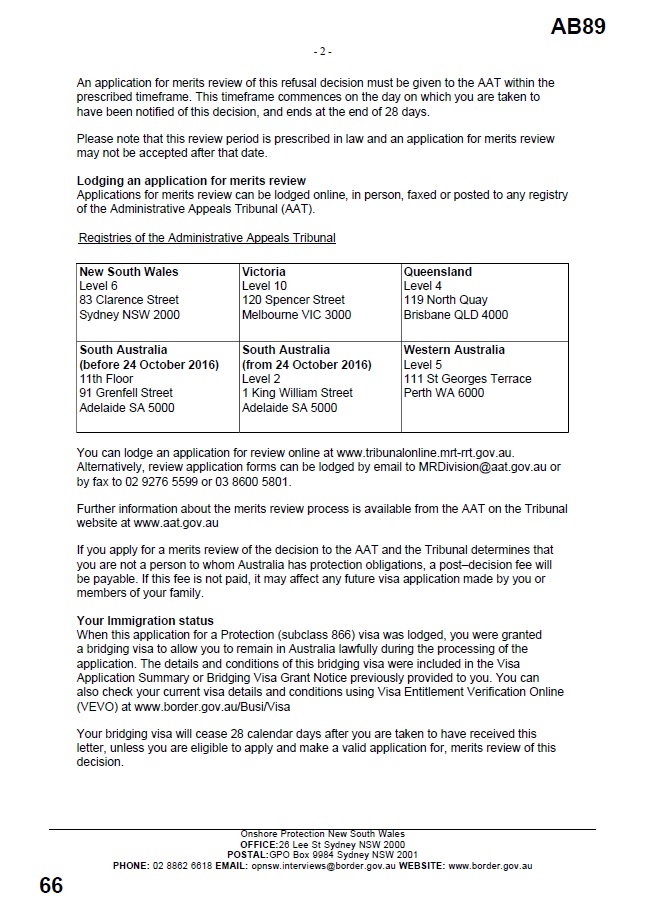
On the second page of the letter under the heading ‘Review Regime’ it says:
‘An application for merits review of this refusal decision must be given to the AAT within the prescribed timeframe. This timeframe commences on the day on which you are taken to have been notified of the decision, and ends at the end of 28 days.’
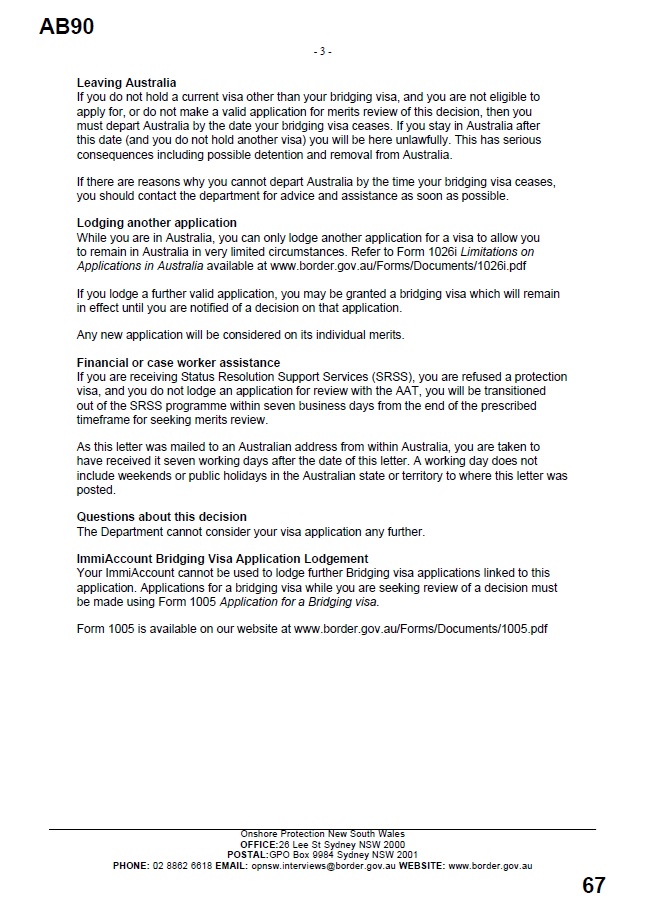
On the third page of the letter under the heading ‘Financial or case worker assistance’ it says this:
‘As this letter was mailed to an Australian address from within Australia, you are taken to have received it seven working days after the date of this letter. A working day does not include weekends or public holidays in the Australian state or territory where this letter was posted.’
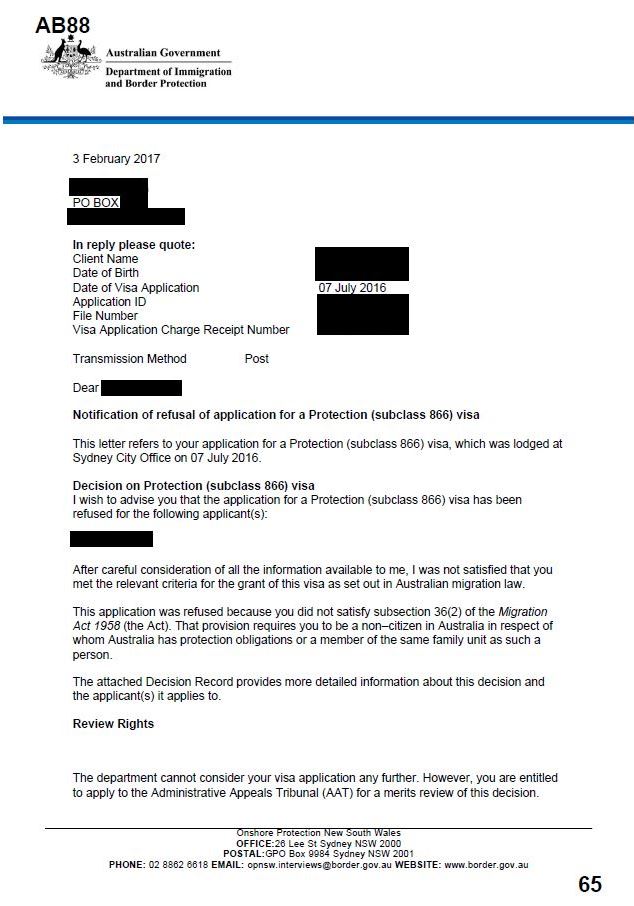
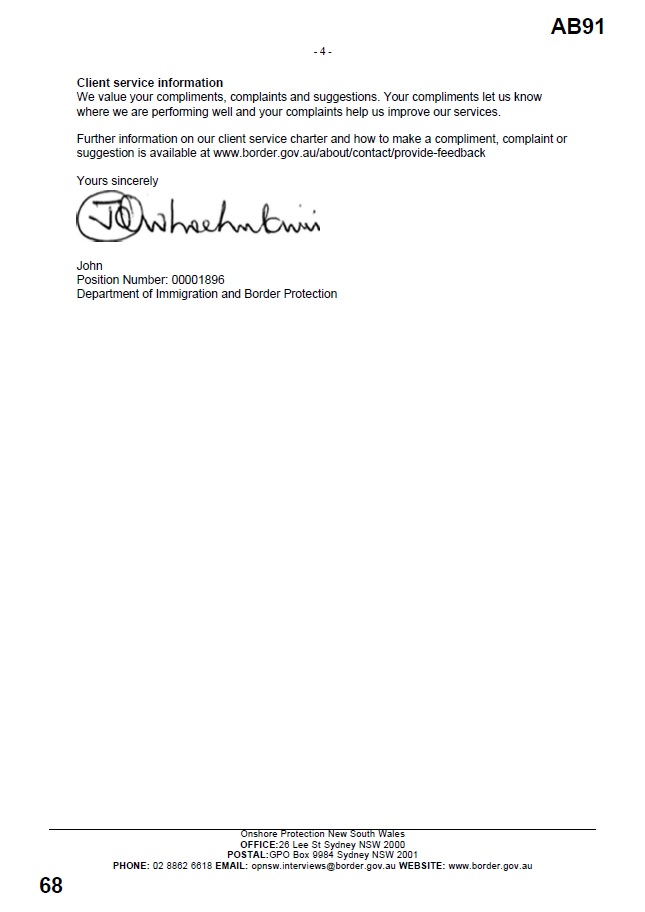
19 These questions arise out of a decision of the delegate to refuse the Appellant’s application for a protection visa. That refusal was communicated to the Appellant by a letter dated 3 February 2017 (annexed to these reasons as Annexure A) which was sent to a post office box address she had provided on her protection visa application. The first question is whether that post office box address is an ‘address for service’ under s 494B(4)(c)(i).
20 The second question arises in this way: an appeal to the Tribunal must be brought within 28 days of the date upon which an applicant is taken to have received notification that the visa application has been refused. The Minister contends that the Appellant was duly notified by the delegate that her application for the visa had been refused by means of the letter dated 3 February 2017. Consequently, for reasons explained below, she needed to lodge any review application by 13 March 2017. She did not do so until 28 March 2017. The Tribunal concluded that her application was out of time and could not be entertained. The question then is whether a letter which explains the date by which a review application must be lodged in the obscure manner set out above ‘states’ the time within which such application must be lodged within the meaning of s 66(2)(d)(ii). If it does not, the Appellant has not been notified of the refusal and the 28 day period in which she may apply for a review has not yet commenced to run.
Ground One: Whether the letter of 3 February 2017 was sent to ‘the last address for service provided to the Minister’
21 The letter of 3 February 2017 was sent to a post office box address. The question is whether the Act permitted this. The letter was a refusal of a visa application. In relation to a visa refusal, reg 2.16(3) of the Migration Regulations 1994 (Cth) (‘the Regulations’) requires the Minister to ‘notify an applicant of a decision to refuse to grant a visa by one of the methods specified in section 494B of the Act’. Section 494B sets out various methods by which the Minister may give a person a document. One of these methods is the sending of the document by pre-paid post. It was this method which was used in the instant case. The method of sending by prepaid post is dealt with by s 494B(4). It provides:
494B Method by which Minister gives documents to a person
…
Dispatch by prepaid post or by other prepaid means
(4) Another method consists of the Minister dating the document, and then dispatching it:
(a) within 3 working days (in the place of dispatch) of the date of the document; and
(b) by prepaid post or by other prepaid means; and
(c) to:
(i) the last address for service provided to the Minister by the recipient for the purposes of receiving documents; or
(ii) the last residential or business address provided to the Minister by the recipient for the purposes of receiving documents; or
(iii) if the recipient is a minor—the last address for a carer of the minor that is known by the Minister.
22 The effect of reg 2.16(3) and s 494B(4) is that if the notification letter was sent by pre-paid post, it had to be sent in compliance with at least one of the subclauses of s 494B(4)(c). When completing her protection visa application the Appellant had provided both her residential address and a postal address which she listed as a post office box address. However, it is necessary to attend to the terms of the form and the questions it posed with some care. Question 10 sought to ascertain from the Appellant where she wished to have written communications about her application sent and she responded that she wished them to be sent to herself. The precise form of question and answer was as follows:
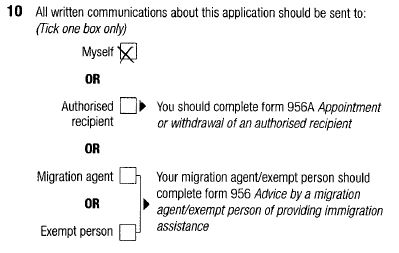
23 No doubt, the author of the form intended that if the person filling it out ticked the ‘myself’ box then they would be indicating that they wished for correspondence to be sent to them personally. It also seems clear to me that a person ticking that box would also understand themselves to be telling the Minister to send any correspondence to them personally. Correspondingly, a reasonable person in the position of the Minister would be entitled to infer from this that the Appellant was communicating that she wished to have written correspondence about her application sent to her directly.
24 Question 10 did not pose the question of where the correspondence should be sent but it dealt with the issue of to whom it should be sent. It was questions 37 to 41 which then dealt with the issue of where communications with the person identified in Question 10 were to be sent and by what method. They were as follows:
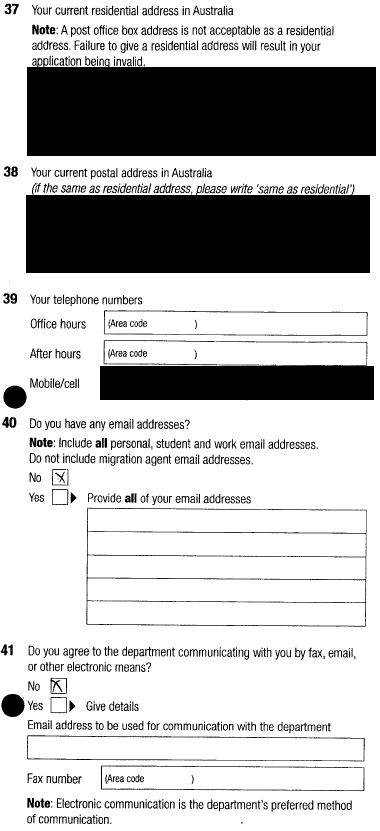
25 With the Appellant having nominated that correspondence about the visa application should be sent to her personally, it seems to me that Questions 37 and 38 must also be taken as an invitation to send correspondence to her to her postal address rather than her residential address. Questions 40 and 41 show that she did not wish to receive correspondence electronically. In my opinion, Question 38 and its answer shows that she did not wish correspondence to be sent to her home address but only to her postal address.
26 The Appellant submitted that Questions 37 and 38 could not objectively be interpreted as involving a request that correspondence be sent to her postal address. This was because all that could inferred from Questions 37 and 38 was that the Appellant had given answers to the Minister which the form required to be supplied. I would reject that submission. It rests on the erroneous premise that once something is characterised as being for one purpose (i.e. providing answers to the questions posed by Questions 38) it cannot also be for another purpose (i.e. providing a postal address). In truth, it is not logically possible to provide the pure piece of information that is one’s postal address without at the same time communicating that one is willing to receive mail at that address. Put another way, it would be gibberish to provide a postal address that is different from one’s residential address whilst in the same breath saying one did not wish to receive postal correspondence at that address. A postal address at which one does not agree to receive postal correspondence is not a postal address in the same way that a sentence without words is not a sentence.
27 As it happens, the letter was sent to the post office box address. It will be observed that her post office box address could not satisfy s 494B(4)(c)(ii) because it was neither a residential address nor a business address. Further, it is obvious that s 494B(4)(c)(iii) could have no application either since there was no suggestion the Appellant was a minor. In order, therefore, for the notification to have been provided to the Appellant it is necessary for the Minister to show that the post office box address was ‘the last address for service provided to the Minister by the recipient for the purposes of receiving documents’: s 494B(4)(c)(i).
28 Beach J considered the operation of s 494B(4)(c) in SZVRO v Minister for Immigration and Border Protection [2017] FCA 421. At [48]-[49] his Honour concluded, correctly with respect, that the question of whether an address had been provided to the Minister by the recipient for the purpose of receiving documents involves an objective assessment of the circumstances in which the Minister received the information. Or, to put it another way: for what purpose or purposes would a reasonable person in the circumstances of the Minister have understood the person to be providing the address? In this case, there is no evidence of what the Appellant’s actual intentions were. Although Beach J thought that this subjective material was relevant to the objective analysis, I would reserve for another occasion whether that is so when there is some such subjective material (without intending either to criticise or promote the proposition).
29 I do not hesitate to conclude that a reasonable person in the position of the Minister would have understood the Appellant to be providing a postal address so that letters could be posted to her. Consequently, I conclude that for the purposes of s 494B(4)(c)(i) the address was provided by the recipient for the purposes of receiving documents.
30 However, that is not sufficient. It is also necessary that the postal address should be able to be characterised as ‘the last address for service’ for it is only such addresses that are captured by the provision. Nothing in this case turns on the word ‘last’ since it is not in dispute that if the post office box address is an address for service then it is the Appellant’s last such address.
31 The issue which therefore arises is the proper construction of the expression ‘address for service’ in s 494B(4)(c)(i). The proper construction is to be determined beginning with the text of the provision itself whilst at the same time having regard to its context and purpose: SZTAL v Minister for Immigration and Border Protection [2017] HCA 34; 347 ALR 405 at 410 [14] per Kiefel CJ, Nettle and Gordon JJ. The same passage also shows that the ordinary meaning of the word is relevant to the process of construction.
32 The expression ‘address for service’ appears in several parts of the Act. It appears in an essentially identical context in ss 332H, 379A, 441A and 473HB, each of which deals with how decision makers other than the Minister may provide documents to persons. Like s 494B(4)(c)(i), these provisions assume, without specifying what it is, that a person may provide the decision maker with an ‘address for service’. Section 473CB(1)(d)(i) sits within the same context. The significance of these provisions is that none requires an address for service to be specified and none explains what an address for service might be.
33 In fact, only two provisions—ss 261D and 261F—require an address for service to be provided. However, these provisions appear in Div 13A of Pt 2 which is entitled ‘Automatic forfeiture of things used in certain offences’. They provide a regime by which a person who wishes to make a claim on an object which has been seized may make that claim. One feature of the regime is the need for a claimant to provide an address for service (see ss 261D(4)(c) and 261F(1)(a)(iii)). None of this is very illuminating.
34 The expression ‘address for service’ has existed in the statute for some time. At the Court’s request the parties provided further submissions on the legislative history of the expression. Largely, that history does not add very much to the debate. Its high point is the passage of the Migration Legislation Amendment (Electronic Transactions and Methods of Notification) Act 2001 (Cth) which introduced the current form of s 494B(4) into the statute. The Bill was accompanied by the circulation of an explanatory memorandum which largely merely paraphrased subsection (4). To my mind, the explanatory memorandum did not really advance matters very far.
35 There are always dangers in reasoning from the meaning of an identical phrase in a different statute. Nevertheless, it is instructive that in the context of a regulation (reg 38) made under the Income Tax Assessment Act 1936 (Cth), the Full Court of this Court concluded that ‘in its ordinary meaning, an address for service may be described for present purposes, as a place where a person may be reached for the purpose of making formal delivery of a notice of assessment’: Sunrise Auto Limited v Commissioner of Taxation [1995] FCA 969; 61 FCR 446 (‘Sunrise Auto’) at 455F-G per Beaumont and Beazley JJ and 473D per Drummond J. One aspect of the Court’s reasoning in that case was that in construing reg 38 it was ‘material to take into account the serious consequences that could follow if a notice of assessment did not come to the attention of a taxpayer’ (at 457B).
36 The same consideration applies in this case. Many of the documents which a decision maker may be obliged to give to persons under the Act are of considerable significance to that person. The notification in this case is an illustration of that proposition. I do not see any reason, therefore, to depart from the Full Court’s conclusion in Sunrise Auto as to the nature of an address for service.
37 For completeness, no argument was advanced upon the basis of s 28A of the Acts Interpretation Act 1901 (Cth) and it is not necessary, therefore, to decide whether it is excluded from application to ss 494A-494B by reason of their detailed machinery: cf Acts Interpretation Act 1901 (Cth) s 2(2); Minister for Immigration and Citizenship v SZMTR [2009] FCAFC 186; 180 FCR 586 at 594 [28]-[29] per Moore, Rares and Flick JJ.
38 Returning to the argument, unless there is some indication to the contrary, a person implicitly consents to being sent documentation at their residential address. But this common-sense presumption may be readily displaced. A person may have had their address suppressed. Alternatively, they may make clear that they do not wish correspondence to be sent to their residential address by indicating instead that they would prefer for it to be sent to a postal address. By providing a postal address at the same time as a residential address, a person is signifying that they do not wish correspondence to be sent to their residential address but instead to their postal address. In other cases, a person may indicate that they do not wish to receive official correspondence at all but would prefer for it to be sent to a person acting on their behalf, for example, a solicitor or migration agent, i.e., the possibility addressed by Question 10 on the form.
39 In this case the Appellant provided both a residential address and a postal address. By providing a postal address she was implicitly indicating that she wished to receive official documentation from the Minister at her postal address. Her residential address was therefore not her address for service but her postal address was. This was where she wished to receive correspondence from the Minister. Consequently, for the purposes of s 494B(4)(c)(i) her post office box address was her address for service.
40 For completeness, it might be noted that whilst it is true that the form could have asked for an address for service but the fact that it did not is not relevant to the legal analysis. The Appellant’s post office box is the place she nominated to receive official correspondence. That was her address for service. Consequently, the Minister was successful in giving her the notification under that provision. Ground One therefore fails.
Ground Two: Whether the time by which the application to Tribunal was to be made was ‘stated’ in the letter of 3 February 2017
41 Section 66 requires the Minister to notify an applicant of a decision to refuse to grant a visa. Section 66(2)(d)(ii) relevantly provides:
66 Notification of decision
…
(2) Notification of a decision to refuse an application for a visa must:
…
(d) if the applicant has a right to have the decision reviewed under Part 5 or 7 or section 500—state:
…
(ii) the time in which the application for review may be made; and
…
42 What is the time in which a review application must be made? If, as here, the applicant is not in immigration detention the issue is governed by reg 4.31(2) of the Regulations which provides:
4.31 Time for lodgement of application with Tribunal
…
(2) For paragraph 412(1)(b) of the Act, if an applicant is not in immigration detention on the day the applicant is notified of a Part 7-reviewable decision, the period in which an application for review of the decision must be given to the Tribunal by or for the applicant is 28 days, commencing on the day the applicant is notified of the decision.
Note: If the Minister gives a person a document by a method specified in section 494B of the Act, the person is taken to have received the document at the time specified in section 494C of the Act in respect of the method.
43 Thus an unsuccessful applicant must make any review application in the Tribunal within 28 days of the day the applicant is notified of the decision or, should that decision fall on a non-working day, the next working day. When is an applicant notified of a refusal decision? The answer to this question turns upon the mode of delivery by which the refusal is communicated. In this case, the decision was sent by pre-paid post. Accordingly, the matter was governed by s 494C(4) which provides:
494C When a person is taken to have received a document from the Minister
…
Dispatch by prepaid post or by other prepaid means
(4) If the Minister gives a document to a person by the method in subsection 494B(4) (which involves dispatching the document by prepaid post or by other prepaid means), the person is taken to have received the document:
(a) if the document was dispatched from a place in Australia to an address in Australia—7 working days (in the place of that address) after the date of the document; or
(b) in any other case—21 days after the date of the document.
…
44 The letter was sent from an address in Sydney to a post office box in Sydney. Consequently, subclause (a) applied and the Appellant was taken to have received the decision on 14 February 2017, that being 7 working days after the date of the letter of 3 February 2017. If the letter of 3 February 2017 was an effective notification of the decision then the effect of reg 4.31(1) was that any review application with the Tribunal had to be made by the Appellant within 28 days, i.e., 13 March 2017.
45 Pausing here, it should be noted that the calculation of 13 March 2017 from 3 February 2017 is not a straightforward exercise. Section 494C(4)(a) uses the expression ‘7 working days… after the date of the document’ whereas reg 4.31(2) stipulates ‘28 days, commencing on the day the applicant is notified of the decision’. Applying s 36(1) of the Acts Interpretation Act 1901 (Cth) (which applies to reg 4.31(2) by virtue of s 13(1)(a) of the Legislation Act 2003 (Cth)) and having regard to the difference between days and working days, the 7-day period is not inclusive of the first day, weekends and public holidays but the 28-day period is inclusive of the first day, weekends and public holidays. Accordingly, 14 February 2017 must be double-counted. Whilst previous decisions of this Court have accepted that the notification letter need not draw attention to the need to double-count the day a person is deemed to have been notified of the decision (see, for example, Cao v Minister for Immigration and Citizenship [2009] FCA 586; 176 FCR 396 per North J; 176 FCR 396; CGJ16 v Minister for Immigration and Border Protection [2018] FCA 1437 per Allsop CJ), it does serve to highlight a certain need for clarity.
46 The first step in the Appellant’s argument is that s 66(2)(d)(ii) requires that a notification of a refusal decision must ‘state… the time in which the application for review may be made’. The second step is the factual contention that the letter annexed below is so obscure it cannot be said to state that time. The final step is that a decision which is sent to an unsuccessful applicant which does not state the time in which a review may be made to the Tribunal, has not been notified within the meaning of reg 4.31(2) so that the 28 day period has not yet begun to run.
47 As the appeal was conducted, this third step was not disputed by the Minister. That position was consistent with two decisions of this Court in which it has been held that a failure to comply with any element of s 66(2) means that there has been no notification of the decision. That approach was taken by Allsop J in Zhan v Minister for Immigration and Multicultural and Indigenous Affairs [2003] FCA 327; 128 FCR 469 at 483 [62] (‘Zhan’) although it is apparent that the contrary was not suggested in that case. Gray J thought that there was ‘a strong case’ for the proposition that non-compliance with an element of s 66(2) meant the duty to notify had not been carried out: Chan v Minister for Immigration and Multicultural and Indigenous Affairs [2003] FCA 1292; 134 FCR 308 at 321 [46]-[47] (‘Chan’). It is evident, however, that Gray J was relying upon Zhan. I will proceed on the same assumption whilst emphasising that that is what it is, an assumption. These reasons should not be taken as expressing a view one way or the other on the issue.
48 Attention may therefore be confined to the first two steps. One starts with the meaning to be given the word ‘state’ in s 66(2)(d)(ii). The relevant principles of statutory construction are set out above at [31]. The legislative context of the word ‘state’ in s 66 was considered by Allsop J in Zhan. In that case Allsop J was concerned with s 66(2)(d)(iv) which required the notification to ‘state... where the application for review can be made’. The letter in Zhan relevantly said:
Your Options:
1. Seek a review of this decision
You can apply to the Migration Review Tribunal for this decision to be reviewed. If you decide to apply for review, you must lodge the review application at a registry of the Tribunal within 21 calendar days plus 7 working days of the date of this letter and pay the prescribed fee.
49 The question in Zhan was whether the letter sufficiently stated where the review application could be made when it did not provide any address for the Tribunal. There was evidence which suggested that it had been intended to include an information pamphlet with the letter but that this had gone astray. At 483 [64]-[66] Allsop J said:
I also base my conclusion upon s 66(2)(d)(iv). That requires the respondent to state where the application for review can be made. The verb “state” not “specify” is used. Nevertheless, the purpose is to give information as to where the applicant can “make the application”, that is, initiate it. The applicant was told that lodgment of documents had to be at “a registry of the Tribunal”. No address was given. A leaflet giving that information was not included with the letter and decision record. Mr Smith says that the applicant only had to look up the white pages of the Sydney phone book to find the entry annexed to these reasons.
However that entry gave no information as to whether level 3, 44 Market St in Sydney was a registry of the Tribunal or its head office or the site of some other activity of the Tribunal. Further inquiry needed to be made.
The scheme of the Act and regulations is such as to place the risk of postal delays on applicants. The consequences of that are reflected in the facts of this case. Neither the Court nor the Tribunal is empowered to give any extension of time. Parliament, as part of this scheme, requires the Minister or his delegate to provide sufficient information to the applicant to facilitate the timeous filing of an application for review directed to the relevant subject matter. One aspect of that is the requirement to tell the applicant where he or she is to go to make an application. If the registries of the Tribunal had been identified in the phone book it may be that the letter was adequate. I have some doubts about that, but, with no assistance given to the applicant as to the location of the registry of the Tribunal in communication or the phone book, I do not think the delegate has stated in the communication “where” the application may be made.
50 He concluded that the letter did not ‘state’ where the review application could be lodged. As his Honour pointed out at [66] the asperity with which the time limits in the Act operate rather suggest that the kind of information to be conveyed in s 66(2) is complete information.
51 It has been said that ‘the evident purpose of the provisions of s 66(2)… is to ensure that the legislative scheme in relation to rights of review of decisions operates fairly’ (Chan at 320 [45] per Gray J). In a sense, that observation mirrors Allsop J’s concern that s 66(2) is be interpreted so that what is conveyed by the notification is complete information.
52 Neither decision quite answers the question which this case presents. Carefully read by a person skilled in reading Commonwealth regulations, the letter does disclose the information that the review application had to be made by Tuesday 13 March 2017. Both Zhan and Chan were cases, in contrast, where the information was not contained within the letter at all. They do establish, however, that the context in which word ‘state’ appears in s 66(2) suggests that it requires the provision of complete information so as to allow a fair, if strict, chance of engaging the review process.
53 The word ‘state’ is an ordinary English word. It is permissible in an enterprise such as the present to consult dictionary definitions but important to keep in mind the limits of the exercise. As Mason P has observed ‘[dictionaries] can illustrate usage in context, but can never enter the particular interpretive task confronting a person required to construe a particular document for a particular purpose’ (House of Peace Pty Ltd v Bankstown City Council [2000] NSWCA 44; 48 NSWLR 498 at 505 [28]). That observation was endorsed by the Full Court of this Court in Polo/Lauren Company LP v Ziliani Holdings Pty Ltd [2008] FCAFC 195; 173 FCR 266 at 273 [24].
54 The online Oxford English Dictionary presently defines the verb ‘state’ in a number of ways. Most relevant seem definitions 9a and 9b:
9.a. To express in speech or writing; to declare clearly, definitely, or formally (that which one believes to be true); to put forward, proclaim, assert.
9.b. To specify or quote (an amount, price, etc.).
55 The online Macquarie Dictionary defines it this way in definitions 18-20:
18. to declare definitely or specifically.
19. to set forth formally in speech or writing.
20. to set forth in proper or definite form.
56 I do not think that the OED’s definition 9b is the sense in which s 66(2) is using the word. It lacks the numerical flavour which this definition suggests. Definition 9a seems closer to the mark. So far as the Macquarie Dictionary definitions are concerned, I do not think s 66(2) is speaking in terms of something to be declared so definition 18 may be put to one side too. The most likely meaning is definition 20 but it could mean definition 19 as well. These are quite close to the OED’s definition 9a.
57 Regardless of which of these three definitions most comfortably fits the language of s 66(2), they all have a flavour of precision, formality or definitiveness. Those meanings are consonant, so it seems to me, with the observations made by Allsop J in Zhan as to how the scheme of the Act operates in relation to time limits. The regime creates a strict review system but requires certain critical information to be provided to an applicant. That scheme would be undermined were the information provided under s 66(2) either less than complete or less than clear.
58 I conclude that when s 66(2) uses the word ‘state’ it means that the notification must set out the information in each of the subsections in a way which is not only complete (as Zhan holds) but clear as well. This required the letter of 3 February 2017 annexed below clearly to convey to the Appellant that the period in which she could seek review ended on 13 March 2017.
59 Turning then to the letter of 3 February 2017, the question is whether it ‘states’ the time within which a review application must be made within the meaning of s 66(2). This is a question of law: Vetter v Lake Macquarie City Council [2001] HCA 12; 202 CLR 439 at 450 [24] per Gleeson CJ, Gummow and Callinan JJ. As I have explained, the question of whether the notification stated ‘the time in which the application for review may be made’ necessarily devolves to an inquiry into whether that information was clearly conveyed.
60 As described above, the letter referred to the time in which the application for review may be made in different sections across different pages. On page 2 of the letter under the heading ‘Review Rights’ the letter referred to the 28-day period during which the Appellant could seek review of the delegate’s refusal decision. The letter then referred to the seven working day period by which the Appellant was taken to have received the notification on page 3 under the heading ‘Financial or Case Worker Assistance’. The date of the letter was on the top left of page 1. It was from these three separate pieces of information across three pages under different headings that the Appellant, whilst remembering to double-count 14 February 2017, was expected to calculate 13 March 2017.
61 The Minister submitted that there was nothing misleading or erroneous about putting the statement as to the date on which the letter was taken to be received on a separate page because the period in which review may be sought was not the only matter in the letter that proceeded by reference to that date. Accordingly, it made logical drafting sense to express the deemed notification period separately from the explanation of the period in which review may be sought. Whilst that may explain the intent behind the drafting choices of the Minister, the present question is whether the letter clearly conveyed that the time in which the application for review may be made ended on 13 March 2017.
62 I have no doubt that in this case the letter of 3 February 2017 failed to convey clearly the information that any review application had to be made by 13 March 2017. It was piecemeal, entirely obscure and essentially incomprehensible. Consequently, the letter did not state the matter in s 66(2)(d)(ii). It was not in dispute that this meant that time had not yet commenced to run. The Tribunal erred in concluding that the review application was out of time and was therefore wrong in thinking it had no jurisdiction to entertain the review application.
63 The Minister submitted that the decision of Allsop CJ in CGJ16 v Minister for Immigration and Border Protection [2018] FCA 1437 was to the contrary. That case also concerned a notification of a decision to refuse to grant a protection visa. The notification letter contained a paragraph in essentially the same form as the paragraph on page two of the notification in this letter. At [5]-[7] the Chief Justice said this:
This led to another communication on 12 May 2016 where a copy of the notification dated 6 April 2016 was sent to the new Lidcombe address. Importantly, the form of that letter did not withdraw the notification of 6 April 2016. Rather, the letter noted that the date of initial notification of the delegate’s decision was 6 April 2016. It is to be noted that the letter of 6 April 2016, under the heading “Review Rights”, stated that:
The department cannot consider your visa application any further. However, you are entitled to apply to the Administrative Appeals Tribunal (AAT) for a merits review of this decision. An application for merits review of this refusal decision must be given to the AAT within the prescribed timeframe. This timeframe commences on the day on which you are taken to have been notified of this decision and ends at the end of 28 days.
The letter is less than precise as to the operation of the Regulations. Nevertheless, the letter indicates that, from a certain date, there is a 28 day period. The letter then goes on in the following paragraph to say:
Please note that this review period is prescribed in law and an application for merits review may not be accepted after that date.
Leaving aside any potential ambiguity by the use of the word “may”, the letter does indicate that there is an important time period. That perhaps is an understatement. On 22 May 2016 (thus tolerably promptly after actual receipt of the refusal), the appellant applied to the Tribunal to review the delegate’s decision. The review application attached various appropriate documents. On 7 June 2016, the Tribunal invited the appellant to comment on the validity of the review application. The letter for the Registrar of the Tribunal stated the following:
I am of the view that your application is not a valid application as it was not lodged within the relevant time limit. The time limit is 28 days from the day on which you are taken to have been notified of the primary decision. The primary decision was posted to you on 6 April 2016 and, on the basis that 15 April 2016 was the date on which you are taken to have been notified, the last day for lodging the application for review was 13 May 2016. As the application was not received until 22 May 2016, it appears to be out of time. However, this is a matter which must be determined by a Member.
64 No argument had been addressed to the Chief Justice that the letter did not ‘state’ the information. The Appellant was unrepresented at the hearing, the issue did not directly arise and, in any event, was not the subject of any argument The Chief Justice did not decide that the letter ‘stated’ the relevant information following argument on the point and I do not regard it as authority to the contrary.
65 The Appellant’s submission about this is therefore to be accepted. It was the subject of Ground Two in the amended notice of appeal. This argument was not put to the primary judge who did not have an opportunity to consider it.
Result
66 The appeal must be allowed with costs. The order made by the Federal Circuit Court on 7 March 2018 dismissing the Appellant’s judicial review proceeding should be set aside and in lieu thereof it should be ordered that the Tribunal now proceed to determine the Appellant’s review application. I would not disturb the primary judge’s costs order, however, as (a) the Appellant has succeeded on a ground in this Court which was not raised before the primary judge and (b) the primary judge did not err on the issue which was pursued before him.
I certify that the preceding forty-nine (49) numbered paragraphs are a true copy of the Reasons for Judgment herein of the Honourable Justice Perram. |
Associate:
REASONS FOR JUDGMENT
FARRELL J:
67 I have had the opportunity to consider the respective draft reasons prepared by Rares and Perram JJ. I would make the orders proposed by Perram J for the reasons that his Honour gives.
I certify that the preceding one (1) numbered paragraph is a true copy of the Reasons for Judgment herein of the Honourable Justice Farrell. |
Associate:
Dated: 18 April 2019
Annexure A