

FEDERAL COURT OF AUSTRALIA
Triabunna Investments Pty Ltd v Minister for Environment and Energy [2019] FCAFC 60
ORDERS
DATE OF ORDER: |
THE COURT ORDERS THAT:
1. The parties submit draft minutes of order reflecting the conclusions set out in the Court’s reasons within 7 days.
Note: Entry of orders is dealt with in Rule 39.32 of the Federal Court Rules 2011.
BESANKO J:
1 I have had the advantage of reading the reasons for judgment of Flick J and of Mortimer J. I agree with their Honours’ respective reasons for dismissing Grounds 2 to 7 of the appellants’ notice of appeal and there is nothing I wish to add to those reasons. I agree with their Honours’ conclusions in relation to the disposition of Ground 1 of the notice of appeal, but wish to explain my own reasons for reaching those conclusions. For that purpose, I gratefully adopt Mortimer J’s comprehensive statement of the facts and identification of the relevant statutory provisions.
2 The appellants put two arguments in the alternative with respect to Ground 1 of the notice of appeal. The first argument is that the primary judge erred in concluding that the delegate had found that the use of K-Grid was an inherent part of Tassal’s proposal and not, as the appellants contended, part of the particular manner in which the proposed action will be taken. The alleged error of the primary judge in relation to the bundled lines was said by the appellants to be a different one. It was that the primary judge had failed to address the bundled lines at all in relation to Ground 1 in the notice of appeal. It seems to me that the delegate treated the bundled lines in the same way as the use of K-Grid.
3 In relation to the use of K-Grid, the appellants’ first argument was, as I understood it, to the effect that the delegate had, in fact, found that the use of K-Grid was part of the particular manner in which the proposed action will be taken. I reject that argument. It seems to me that the argument is inconsistent with the delegate’s reasons and the notice subsequently issued by the delegate under s 77 of the Environment Protection and Biodiversity Conservation Act 1999 (Cth) (the Act).
4 The critical passage in the delegate’s reasons is lengthy, but it is necessary to set it out in full in order to explain my reasoning with respect to both arguments in relation to Ground 1. The delegate said (at [27]–[39]):
27. The proposed action has the potential to impact the species due to vessel strike, entanglement and noise disturbance. Vessel strike and entanglement may result in physical impacts including injury or death. …
28. Entanglement is a key threat to the species, and recorded entanglements have been linked to commercial fishery equipment and marine debris. Entanglements often lead to a prolonged death associated with reduced fitness of the animal. Records of southern right whale entanglements with fishing equipment are mainly attributed to lines and ropes used for crustacean fishing. There is also at least one record of a fatal entanglement with a longline. The whale was found dead at Head of Bight, South Australia in July 2001, although as entanglement deaths are often prolonged, this does not necessarily indicate when or where the whale became entangled. Longline entanglements are likely to be fatal as the small diameter line cuts and injures the animal. However, publicly available papers and reports on southern right whales do not record any deaths dues to entanglement with fish farm infrastructure. Past records of entanglement have involved marine farming actives where equipment such as mussel ropes, lobster pots, and anti-predator nets had either come loose and/or were drifting. The Department’s Conservation Management Plan for the Southern Right Whale notes that one non-fatal entanglement has been recorded in association with a Tasmanian fish farm.
29. Baleen whales have also been recorded as becoming entangled in shellfish equipment such as that used in mussel farming.
30. The mooring and netting design proposed by the proponent aims to minimise loose ropes or netting, to minimise risk to whales, through the use of: taut moorings; bundled feed and servicing lines; and heat and resin treated knotless woven nets (k-grid technology) that eliminate the need for anti-predator nets. The proponent has also committed to a number of mitigation measures (which are included in the particular manner measures summarised below) to minimise marine debris, noise disturbance and vessel strike.
31. GHD stated that the design (k-grid technology) of the proposed action reduces the likelihood of entanglement, and that the proposed mitigation measures for noise attenuation and vessel strike were likely to reduce the risk of disturbance, injury or death to southern right whales to a low level. GHD also stated that the location of the proposed action is unlikely to restrict the species migration movement.
32. The Department’s draft National Strategy for Mitigating Vessel Strike of Marine Megafauna 2016 (draft strategy) notes that “southern right whales are considered vulnerable to vessel strike due to their presence in near shore waters during critical life phases such as breeding, slow swimming behaviour and spending a lot of time on the surface …”.
33. The Department’s draft strategy outlines impacts of vessels strikes, including vessel speed and size of the vehicle. The strategy states that “89% of incidences where a whale was severely hurt or killed occurred at vessel travelling speeds greater than 14 knots and were most serious in large vessels (> 80 m). Furthermore, the chance of an injury being lethal increases substantially, as vessel speed increases up to 15 knots”. The vessel strike measures proposed by the proponent are consistent with the draft strategy and involve reducing vessel speed to 5 knots within the lease area, a requirement for a dedicated person on each vessel to look for and identify whales during daylight hours, and a shutdown procedure if a listed threatened or migratory whale species is observed within one kilometre of the vessel so as to minimise the risk of vessel strike.
Conclusion
34. Given the progressive return of southern right whales to the Mercury Passage, and the likelihood that the area may increase in importance for the recovery of the species, the Department considered, and I agreed, that, by itself, the action will have, or is likely to have, a significant impact on an endangered species and would therefore be a controlled action for the purposes of ss 18 and 18A of the EPBC Act, due to the potential impact from entanglement, vessel strikes and noise disturbance. Specifically, the proposed action could have a significant impact by causing a long term decline in a population of southern right whales, adversely affecting habitat critical (breeding habitat) to the survival of the southern right whale or disrupting the breeding cycle of a population.
35. However, the Department also considered, and I agreed, that the adverse impacts of the action on southern right whales will be reduced below significant if the proposed action is undertaken in the particular manner set out in the decision notice, and summarised below:
a. To reduce the risk of entanglement:
i. Moorings, ropes, nets and lines must be kept taut.
ii. Fish pen nets must be inspected at least daily; and fish pen nets, ropes and lines must be inspected at least weekly below the water line.
iii. Prompt repairs must be made to nets, ropes and lines.
b. In the event of entanglement, Tassal’s Response Protocol For A Whale Sighting, Entanglement or Stranding, April 2017, must be implemented.
c. To reduce the risk of vessel strike and noise disturbance:
i. Vessels must be restricted to 5 knots for vessels within the lease area.
ii. Marine mammal observer responsible for looking for and identifying whales must be on-board vessels whenever in use during daylight hours.
iii. Operations must take place in daylight hours except in emergencies or when security checks are undertaken - in these circumstances and in low visibility, a navigational sonar must be used to detect whales.
iv. Operations (vessel and noise generating activities, as guided by the South Australia Department of Planning, Transport and Infrastructure’s Underwater Piling Noise Guidelines, 2012) must be shut down if a whale is observed within 1 km of vessels.
36. The Department considers that, provided these particular manner requirements are implemented, the likelihood of impacts on the species due to vessel strike, entanglement, or noise disturbance will be very low, and that significant impacts to the species are therefore not likely.
37. These particular manners were proposed by the proponent as part of additional information submitted to the Department during July 2017.
Conclusion
38. For the reasons set out above, the Department considered, and I agreed, that, if not taken in accordance with the specified particular manners, there is a real chance that the action would, or would be likely to, result in a significant impact on the southern right whale and would therefore be a controlled action for the purposes of sections 18 and 18A. In particular, the action could have a significant impact by causing a long term decline in a population of southern right whales, adversely affecting habitat critical (breeding habitat) to the survival of the southern right whale or disrupting the breeding cycle of a population.
39. However, as the discussion above demonstrates, if the proponent takes the action in the particular manners specified in the decision notice, the Department considered, and I agreed, that the action would not be a controlled action for the purposes of sections 18 and 18A because the action will be taken in a manner that will ensure the action will not have, and is not likely to have, a significant impact on the southern right whale, namely: entanglement; noise; and vessel impacts.
5 The notice issued under s 77 substantially reflected the particular manner requirements which the delegate identified in his reasons at [35]. They did not include the use of K-Grid and of bundled lines.
6 The second and alternative argument advanced by the appellants is that although the delegate made all the necessary findings leading to the conclusion that the use of K-Grid and of bundled lines were particular manner requirements, he erred in law in failing to take the final step of concluding that that was the case and that, by reason of the operation of s 77A, the use of K-Grid and of bundled lines needed to be included in the notice issued under s 77. This argument is correct.
7 It is important to note that the approach of the primary judge as to the use of K-Grid, and of the parties on the appeal both as to the use of K-Grid and of bundled lines, involved a recognition of the importance of these matters in the approval of the proposed action. As I read the primary judge’s reasons, his Honour concluded that the delegate proceeded on the basis that the use of the K-Grid was an inherent part of the proposed action and, therefore, not part of the particular manner in which the proposed action will be taken. The essence of his Honour’s reasons on this issue appears in the following passages (at [121]–[123]):
121. No manner provisions were required of the Minister to ensure that Tassal would not exceed the number of smolt it had proposed as part of its action. No manner provisions were required to limit its number of pens to 28. That is because each of those matters were inherent components of the ‘action’ Tassal had advised the Minister it was proposing to take; the ‘action’ which the Minister ultimately concluded was not a controlled action if conducted in a particular manner.
122. In my opinion, the same logic applies with equal force in respect of that component of Tassal’s proposed action as referred to at [2] of the Minister’s summary that its pen nets would be made using K-Grid technology.
123. The Minister’s reasons, properly construed, having regard to those three introductory paragraphs, reveal that the Minister did not purport to require Tassal to use K-Grid technology. Instead, those reasons reveal that the Minister proceeded on the basis of his understanding that the use of K-Grid nets was an inherent part of Tassal’s proposed action. The omission at [35] of the Minister’s reasons (the absence of any reference to that technology when considering appropriate manner provisions) assumes misleading significance if that paragraph is read in isolation from its context as part of the Minister’s reasons understood as a whole. I reject such a reading.
8 I respectfully disagree with this reasoning.
9 In my opinion, there is no a priori distinction between inherent components of the proposed action on the one hand, and particular manner requirements on the other. Nor are they mutually exclusive. Some of the debate before the Court proceeded on the basis that there was such a distinction, or that they were mutually exclusive, including on the respondents’ side, an argument that too wide a definition of particular manner requirements would lead to the cumbersome and unworkable situation that almost all aspects of a proposed action would be particular manner requirements to be included in the notice under s 77 of the Act and, on the appellants’ side, that too narrow an approach to what were particular manner requirements would lead to complicated and difficult enforcement actions where the prosecution would be forced to prove that the action carried out was different from that approved, rather than the simpler procedure envisaged by s 77A(2). That subsection is in the following terms:
(2) A person must not take an action, that is the subject of a notice that includes a particular manner under subsection (1), in a way that is inconsistent with the manner specified in the notice.
Civil penalty:
(a) for an individual—1,000 penalty units, or such lower amount as is prescribed by the regulations;
(b) for a body corporate—10,000 penalty units, or such lower amount as is prescribed by the regulations.
10 In my opinion, the answer does not lie in drawing such a distinction, even if it was possible to draw a logical and convincing distinction between components, even inherent components, of the proposed action on the one hand, and particular manner requirements on the other, which I very much doubt.
11 In my respectful opinion, the answer lies in the facts. The question is whether the particular matters are capable of being characterised as particular manner requirements and then, importantly, whether the Minister believes that Part 3 is not a controlling provision for the action because the action will be taken in accordance with those particular matters. If yes, then those matters must be specified in the notice given under s 77 by reason of s 77A of the Act. Whether the matter is part of the initial proposal or added later by the applicant who identifies it as a mitigating feature is not to the point; it is its significance to the decision-making process which is important.
12 The use of K-Grid and of bundled lines are certainly capable of being particular manner requirements. In my opinion, a close examination of the delegate’s reasons indicates that the use of K-Grid and of bundled lines were reasons the delegate believed that ss 18 and 18A of the Act were not controlling provisions for the proposed action. The delegate made it clear in [34] of his reasons that the risks of entanglement, vessel strikes and noise disturbance would be significant in terms of impact and, therefore, engage ss 18 and 18A of the Act, but for the mitigating measures directed to those matters. In my opinion, [30] and [31] of the delegate’s reasons make it quite clear that the use of K-Grid and of bundled lines were part of the measures which reduced the impacts of the action to a level below significant.
13 It is not clear from the delegate’s reasons why the use of K-Grid and of bundled lines did not find their way into the particular manner requirements. The delegate did not set out his interpretation of “action … taken in a particular manner” in s 77A of the Act. It may be that he did indeed draw the distinction identified by the primary judge between inherent components of the “action” on the one hand, and taking the action in a particular manner on the other. At all events, I conclude that, in view of his findings of fact, the delegate must have erred in law.
14 As I have said, the approach of the primary judge as to the use of K-Grid, and the parties on the appeal both as to the use of K-Grid and of bundled lines, proceeded on that basis that they were important features of the proposed action. In light of the delegate’s reasons, that approach is correct. It means, I think, that there is only one possible outcome in terms of the correct approach to the decision-making process and that is that the use of K-Grid and of bundled lines should be included in particular manner requirements in the notice under s 77 of the Act.
15 I agree with Mortimer J’s approach to the resolution of this appeal. The parties should be given the opportunity to bring in draft minutes of order reflecting the conclusions expressed in these reasons.
I certify that the preceding fifteen (15) numbered paragraphs are a true copy of the Reasons for Judgment herein of the Honourable Justice Besanko. |
Associate:
REASONS FOR JUDGMENT
FLICK J:
16 On 29 May 2017 Tassal Operations Pty Ltd (“Tassal”) wrote to the Director Compliance, Department of the Environment and Energy, advising that it had lodged “an online referral titled Tassal Finfish Aquaculture at Okehampton Bay, Tasmania”. That referral was formally received on 31 May 2017 once a signed version was re-submitted by Tassal. The proposal was (in summary form) to farm Atlantic salmon on an existing marine lease in Okehampton Bay, a stretch of water located northeast of Hobart. The proposed action would replace the existing seaweed and blue mussel farming at the site.
17 The Minister was called upon to make a decision as to whether the proposal was a “controlled action” under the Environment Protection and Biodiversity Conservation Act 1999 (Cth) (the “Environment Protection Act”).
18 Tassal’s referral was published on the Department’s website and the public were invited to comment. Six public submissions were received in relation to the referral, including from the Appellants on 16 June 2017.
19 Additional information was provided also by Tassal to assist in the assessment of the referral.
20 A delegate of the Minister decided on 1 August 2017, as set out in the Notification of Referral Decision (“Notification”), that the “proposed action is not a controlled action provided it is undertaken in the manner set out in this decision”.
21 One aspect of the decision-making process focussed upon the potential effects of the proposal on southern right whales. Of concern (inter alia) was whether those whales could become entangled in loose ropes or netting.
22 On 2 August 2017 Triabunna Investments Pty Ltd (“Triabunna Investments”) requested a statement of reasons for the delegate’s decision pursuant to s 13 of the Administrative Decisions (Judicial Review) Act 1977 (Cth) (“Judicial Review Act”). A Statement of Reasons was provided by the delegate on 13 September 2017.
23 Triabunna Investments (and the two other Appellants) commenced a proceeding in this Court on 7 September 2017 seeking judicial review of the delegate’s decision. The primary Judge dismissed that application on 12 April 2018: Triabunna Investments Pty Ltd v Minister for the Environment and Energy [2018] FCA 486.
24 Triabunna Investments (and the two other Appellants) now appeals from that decision. The Minister has filed a Notice of Contention.
25 The central issue to be resolved in the appeal is whether the Notification made on 1 August 2017, and given pursuant to s 77 of the Environment Protection Act, complied with s 77A of that Act. More specifically, Triabunna Investments contends that the notice given under s 77 did not refer to “bundled feed and servicing lines” or “K-grid technology” and that the primary Judge erred in not finding that s 77A required a reference to those matters in the notice.
26 In providing the present reasons for decision, gratitude must be expressed to Mortimer J for the carefully prepared and more detailed account of the arguments advanced, the statutory provisions and the reasons for decision of the primary Judge set out in her Honour’s reasons. That detailed account greatly assists in the provision of the present more summary account. So, too, has the detailed consideration given by Besanko J to the issues posed for resolution.
27 It is concluded that the appeal should be allowed in part. The Minister’s Notice of Contention is to be dismissed.
28 It may be noted that Tassal has commenced its salmon farming operations at Okehampton Bay.
CONTROLLED ACTION
29 The object of the Environment Protection Act is set forth as follows in s 3(1):
The objects of this Act are:
(a) to provide for the protection of the environment, especially those aspects of the environment that are matters of national environmental significance; and
(b) to promote ecologically sustainable development through the conservation and ecologically sustainable use of natural resources; and
(c) to promote the conservation of biodiversity; and
(ca) to provide for the protection and conservation of heritage; and
(d) to promote a co-operative approach to the protection and management of the environment involving governments, the community, land-holders and indigenous peoples; and
(e) to assist in the co-operative implementation of Australia's international environmental responsibilities; and
(f) to recognise the role of indigenous people in the conservation and ecologically sustainable use of Australia's biodiversity; and
(g) to promote the use of indigenous peoples' knowledge of biodiversity with the involvement of, and in co-operation with, the owners of the knowledge.
30 Chapter 2 of the Environment Protection Act sets out provisions with respect to the protection of the environment.
31 Specifically, Pt 3 within Ch 2 sets forth “Requirements for Environmental Approvals”. Within Pt 3 Div 1, Subdiv C is titled “Listed threatened species and communities”. Within this subdivision, s 18 provides (inter alia) that a person must not take action that “has or will have a significant impact on a listed threatened species”; s 18A provides that a person commits an offence if action is taken and “the action results or will result in a significant impact on: (i) a species; or (ii) an ecological community…”; and s 19 provides that “certain actions” are not prohibited, including s 19(3) which provides in part as follows:
A subsection of section 18 or 18A does not apply to an action if:
(a) …
(b) there is in force a decision of the Minister under Division 2 of Part 7 that the subsection is not a controlling provision for the action and, if the decision was made because the Minister believed the action would be taken in a manner specified in the notice of the decision under section 77, the action is taken in that manner; or
(c) …
Part 3, Div 1, Subdiv D provides for “Listed migratory species”. Within this subdivision, s 20 provides (inter alia) that a person must not take action that “has or will have a significant impact on a listed migratory species”. Section 20A provides (inter alia) that a person commits an offence if action is taken that “results or will result in a significant impact on a species”, where that species is a listed migratory species. Section 20A(4)(c) sets forth a like provision to that found in s 19(3).
32 Part 4 sets forth “Cases in which environmental approvals are not needed”. Chapter 3 relates to “Bilateral agreements”.
33 Chapter 4 of the Environment Protection Act deals with “Environmental assessments and approvals”. Within Ch 4, Pt 7 is titled “Deciding whether approval of actions is needed”. Division 1 within Pt 7 deals with the referral of proposals to take action. Within Div 7, s 67 provides as follows:
What is a controlled action?
An action that a person proposes to take is a controlled action if the taking of the action by the person without approval under Part 9 for the purposes of a provision of Part 3 would be (or would, but for section 25AA or 28AB, be) prohibited by the provision.
The provision is a controlling provision for the action.
Section 67A prohibits a person from taking “controlled action without approval”.
34 Still within Div 1 of Pt 7, s 68 provides (inter alia) for the referral by a person proposing to take action to the Minister for a decision. Section 68(2), the provision invoked by Tassal in the present case, provides as follows:
A person proposing to take an action that the person thinks is not a controlled action may refer the proposal to the Minister for the Minister's decision whether or not the action is a controlled action.
A proposal to take action need not be referred to the Minister by the person proposing to take that action. Section 69 thus provides for a State or Territory to refer a proposal to the Minister and s 71 provides that a Commonwealth agency may refer a proposal to the Minister. Section 72(1) provides that a “referral of a proposal to take an action must be made in a way prescribed by the regulations”.
35 Division 2 within Pt 7, namely the Division referred to in ss 19(3) and 20A(4)(c), deals with the making of a Ministerial decision as to whether action needs approval. Section 75 provides (in part) as follows:
Does the proposed action need approval?
Is the action a controlled action?
(1) The Minister must decide:
(a) whether the action that is the subject of a proposal referred to the Minister is a controlled action; and
(b) which provisions of Part 3 (if any) are controlling provisions for the action.
(1AA) To avoid doubt, the Minister is not permitted to make a decision under subsection (1) in relation to an action that was the subject of a referral that was not accepted under subsection 74A(1).
Minister must consider public comment
(1A) In making a decision under subsection (1) about the action, the Minister must consider the comments (if any) received:
(a) in response to the invitation under subsection 74(3) for anyone to give the Minister comments on whether the action is a controlled action; and
(b) within the period specified in the invitation.
Considerations in decision
(2) If, when the Minister makes a decision under subsection (1), it is relevant for the Minister to consider the impacts of an action:
(a) the Minister must consider all adverse impacts (if any) the action:
(i) has or will have; or
(ii) is likely to have;
on the matter protected by each provision of Part 3; and
(b) must not consider any beneficial impacts the action:
(i) has or will have; or
(ii) is likely to have;
on the matter protected by each provision of Part 3.
(notes omitted)
36 Section 76 provides that the Minister may request further information be provided.
37 Section 77 provides for the giving of a notice. Section 77 (in part) provides as follows:
Notice and reasons for decision
Giving notice
(1) Within 10 business days after deciding whether an action that is the subject of a proposal referred to the Minister is a controlled action or not, the Minister must:
(a) give written notice of the decision to:
(i) the person proposing to take the action; and
(ii) if the Minister has designated as proponent of the action a person who does not propose to take the action — that person; and
(iii) if the Minister decided that the action is a controlled action because of Division 1 of Part 3 (which deals with matters of national environmental significance) — the appropriate Minister of each State or self-governing Territory in which the action is to be taken; and
(b) publish notice of the decision in accordance with the regulations.
38 Section 77A(1) provides as follows:
Action to be taken in a particular manner
(1) If, in deciding whether the action is a controlled action or not, the Minister has made a decision (the component decision) that a particular provision of Part 3 is not a controlling provision for the action because the Minister believes it will be taken in a particular manner, the notice, to be provided under section 77, must set out the component decision, identifying the provision and the manner.
The “Note” to that sub-section provides as follows:
The Minister may decide that a provision of Part 3 is not a controlling provision for an action because he or she believes that the action will be taken in a manner that will ensure the action will not have (and is not likely to have) an adverse impact on the matter protected by the provision.
39 Part 23 of the Environment Protection Act deals with “Definitions”. Within that Part, s 523(1) sets forth a definition of the term “actions” as follows:
Subject to this Subdivision, action includes:
(a) a project; and
(b) a development; and
(c) an undertaking; and
(d) an activity or series of activities; and
(e) an alteration of any of the things mentioned in paragraph (a), (b), (c) or (d).
Section 524 sets forth those matters which are “not actions”.
40 These statutory provisions are supplemented by the Environment Protection and Biodiversity Conservation Regulations 2000 (Cth) (the “Regulations”).
41 Further to s 72 of the Environment Protection Act, reg 4.02 of the Regulations supplements s 68 by providing (in part) as follows:
The way referrals must be made
(1) A referral must:
(a) be given to the Department; and
(b) be made in writing or electronically; and
(c) be of a length, size and form that can readily be:
(i) understood by the public; and
(ii) published on the internet.
42 Regulation 4.03 then provides (in part) as follows:
Information that must be included in referrals
(1) A referral must include the information mentioned in Schedule 2.
(2) However, information does not have to be included if it would, in all the circumstances, be unreasonable to expect the information to be included.
…
Schedule 2 of the Regulations deals with “Referral information” and provides (in part) as follows:
4 Description of the proposal
4.01 A description of the proposed action must include the following:
(a) any alternative locations, timeframes or activities that may be proposed;
(b) details of the location of the project area including a description of the property on which the proposed action is to take place;
Example: A lot number in a registered or deposited plan or similar description
(c) the latitude and longitude of the action;
(d) a description of the property on which the proposed action is to take place;
(e) the timeframe in which the action is proposed to be taken;
(f) activities proposed to be carried out in the action;
(g) an explanation of the context, including any relevant planning framework, in which the action is proposed;
(h) whether the action is related to other actions or proposals in the region;
(i) whether the action is a component of a larger action;
(j) a description of any feasible alternatives to taking the proposed action (including not taking the action) which were considered, but which are not proposed;
(k) details of any environmental assessment of relevant impacts of the action that has been, is being or will be carried out under State, Territory or Commonwealth legislation, including copies of assessment documentation;
(l) a description of any public consultation undertaken or occurring, including with indigenous persons that may be affected by the action, and copies of documents recording the outcomes of any consultations;
(m) if relevant, each of the matters in paragraphs (a) to (i) for each alternative location, time frame, or activity that is identified as part of the description.
43 This referral process and the task of Ministerial decision-making permits flexibility. Changes can thus be made to a “proposed action” as between the time of referral and time of decision: Blue Wedges Inc v Minister for the Environment, Heritage and the Arts [2008] FCA 8; (2008) 165 FCR 211 (“Blue Wedges”). In summarising the provisions of the Act as they were then in force, Heerey J there said (at 216 to 217):
Can changes to a proposed “action” be made between Referral and Approval?
[18] Blue Wedges’ argument is inconsistent with the legislative purpose of the Environment Act. As was said in the Explanatory Memorandum when Div 1A of Pt 11 of Ch 4 was introduced into the Act in 2006:
Most actions are referred to the Minister for assessment and approval during the planning stage of a proposal. It is common for circumstances and priorities to change as a proposal to take an action is refined.
…
[19] It cannot possibly be the case that literally no changes at all can take place in the “action” between referral and approval. …
[20] More importantly, a proposed action may change in a way that is positive for the environment. For example, in the present case there could have been a change in the design of the Project which meant less dredging. In such a case, it would be surprising if no approval decision could be made because the “action” was not the action the subject of the referral.
[21] It is likely that the Environment Act was drafted on the assumption that it would be preferable that proposed actions be referred at an early stage in their development in order that proposals could evolve in a direction that is positive for the environment. If a proposed action can be referred when its details are still being formulated, the Department (the Minister’s advisers) can play a role in the development of the proposal having regard to the principles and objectives of the Environment Act. Referral at an early stage permits, amongst other things, early identification of possible impacts on relevant environmental matters and allows the opportunity to address and possibly avoid those impacts as the proposal is developed.
[22] The function of the referral step is not to fix in stone all the details of a proposed “action” for the subsequent approval process. Rather, this mechanism results in the proposal either being brought within the Environment Act assessment and approval regime, or being exempted from the requirements of assessment and approval under the Environment Act. In Anvil Hill Project Watch Association Inc v Minister for the Environment and Water Resources (2007) 97 ALD 398 at [70], Stone J described the scheme of the Environment Act as providing:
an initial clearing house so that actions that are likely to have a significant impact on the environment are properly assessed and those that do not fall into that category may be identified in a timely way and not impeded.
The referral mechanism operates as a kind of triage system. It is not the function of the triage nurse to make a detailed diagnosis, let alone prescribe treatment.
[23] Since the environmental approval process for a major project can stretch out over years, as witness the present case, it would be a strange result if making an environment positive (or environment neutral but cost positive) change meant proponents were forced to start all over again, with inevitable cost and delay. If Blue Wedges’ argument is correct there would be a strong disincentive for proponents to keep looking for environmentally friendly changes to a project.
[24] The text of the Environment Act does not support Blue Wedges’ construction.
[25] The term “action” is defined in the broadest terms. By s 523 it includes:
(a) a project; and
(b) a development; and
(c) an undertaking; and
(d) an activity or series of activities; and
(e) an alteration of any of the things mentioned in paragraph (a), (b), (c) or (d).
This width of definition is not surprising, given the varied work that the term has to do in the Environment Act, including in the prohibitions in Pt 3, and given the limitless range of possible human conduct which might affect the environment, ranging from major complex operations like the Project to a simple, transient event.
[26] When it comes to particular proposed actions, the Environment Act does not purport to define a particular proposed action by reference to a description of the proposed action given in any document. Further, subject to certain limited exceptions described below, the Environment Act does not require the referral to contain any particular information or to descend to any particular level of detail about the proposed action.
[27] The form and content of referrals are matters left to be prescribed by regulations under the Act...
44 After a matter has been referred, s 75 casts “a duty… to decide whether a proposed action is a controlled action”: Anvil Hill Project Watch Association Inc v Minister for Environment and Water Resources [2008] FCAFC 3; (2008) 166 FCR 54 at 60. Tamberlin, Finn and Mansfield JJ there concluded:
[26] Section 75(1) of the Act imposes a duty on the Minister to decide whether a proposed action is a controlled action. In making this decision, the Minister must take into account the elements of a controlled action as defined by s 67, which in turn involves a determination whether the proposed action would be prohibited by a provision of Pt 3 of the Act, including those provisions which give rise to what the appellant asserts is the condition precedent of s 75(1). The determination of this latter question involves a duty to determine whether there would be a prohibition under Pt 3 of the Act which applies to the proposed action because the action has, will have or is likely to have a significant impact on a relevant aspect of the environment. The duty to make this determination is assigned to the Minister. It is not given to a court or tribunal, and is not expressed as an objective matter. As a result, the performance of this duty is not properly to be regarded as a condition precedent to the exercise of the power in s 75(1).
THE PROPOSAL & THE NOTIFICATION
45 The operation proposed to be undertaken by Tassal in the present proceeding has been variously described.
46 If reference is made to the description of the proposed action set forth in the prescribed form in the online referral made in May 2017, that referral provided in part as follows (without alteration):
1.2 Provide a detailed description of the proposed action, including all proposed activities.
The Proposed Action is to farm Atlantic Salmon on an existing marine lease MF236 in Okehampton Bay, Tasmania. MF236 sits within the Great Oyster Bay and Mercury Passage Marine Farming Development Plan. MF236 (approximately 100 ha lease) is currently utilised by Spring Bay Seafoods for blue mussel ad seaweed farming, and is also licensed for farming of marine finfish. Tassal has entered into an agreement with Spring Bay Seafoods to utilise 86 ha of the existing lease area and integrate salmon farming with the culture of other species, including mussels and seaweed. Tassal intends to stock 86 ha of MF236 with Atlantic salmon for growout. Prior to harvest these fish would potentially occupy a maximum of 28 sea cages or pens. The Okehampton Bay Zone is the only zone (out of 17 zones) within the Great Oyster Bay and Mercury Passage MFDP area that is licensed for farming of finfish – all other zones are specified for either shellfish and or seaweed only.
The proposed action in Okehampton Bay requires the construction and placement of new infrastructure along with the movement of existing infrastructure within the lease area. This infrastructure includes:
• Mooring and grid system – comprising of 1 x 10 pen bay and 1 x 18 pen bay mooring grids to be used in conjunction with existing moorings and longline infrastructure
• Sea pens – 168 m circumference sea pens, of approximately 54 m diameter and 15 m depth will be used at the site. Construction material will be black in colour in order to minimise loss of visual amenity and to comply with regulatory requirements.
• Other supporting infrastructure – existing Spring Bay Seafoods land base; on-water structures (e.g. vessels, permanently moored feed barge).
The description thereafter went on to deal with “Fish size and stocking density”.
47 After seeking and receiving additional information from Tassal, and after considering six public submissions which had been made, the delegate of the Minister made his decision on 1 August 2017. The Notification provided on 1 August 2017 provided in relevant part as follows:
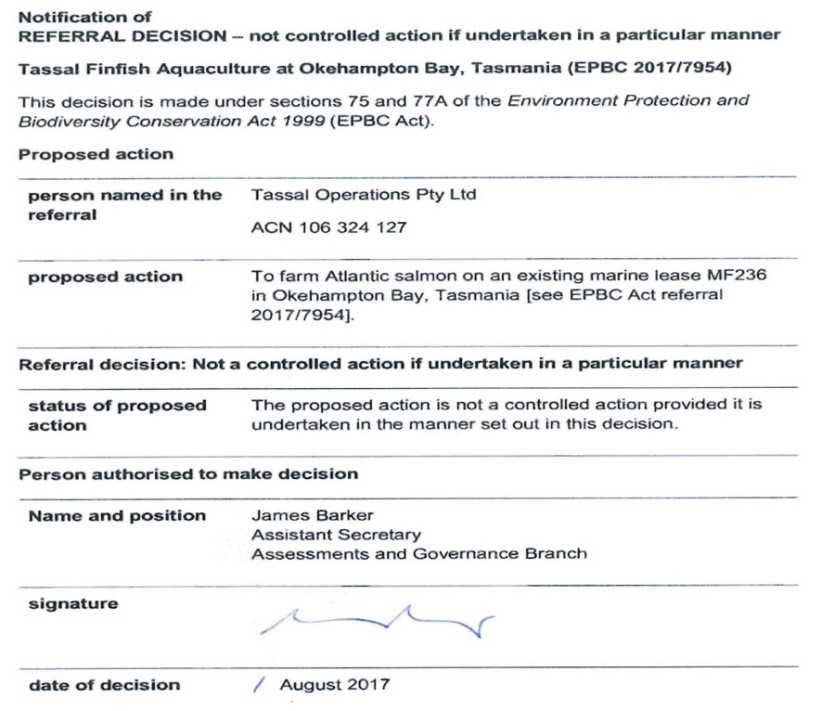
The Notification further provided as follows:
manner in which proposed action must be taken | The following measures must be taken to avoid significant impacts on listed threatened species and communities (sections 18 & 18A) and listed migratory species (sections 20 and 20A), in particular but not limited to the southern right whale (Eubalaena australis): 1. To reduce the risk of vessel strike and noise disturbance: a. vessel speed must not exceed 5 knots within the lease area; b. vessel operations must take place in daylight hours only, except during an emergency or when security checks are being undertaken; c. a marine mammal observer responsible for looking for and identifying whales must be on-board the vessel and during vessel operations in daylight hours; d. navigational sonar must be installed on all vessels and must be in use for vessel operations outside daylight hours and in low visibility; and e. vessel operations and noise generating activity must be shut down if a listed threatened or migratory whale species is observed within one (1) kilometre of the vessel and vessel operations and noise generating activity must not recommence until all listed threatened or migratory whales have moved more than one (1) kilometre away from the vessel. 2. To reduce the risk of entanglement: a. moorings, ropes, nets and lines must be kept taut; b. fish pen nets must be inspected at least daily; c. fish pen nets, ropes and lines must be inspected at least weekly from below the water line when safe to do so; and d. repairs must be made to nets, ropes and lines as soon as it is safe to do so. If additional equipment is required to complete a repair, loose lines, ropes or damaged equipment must be secured to reduce the risk of entanglement until repairs can be completed. 3. In the event of entanglement, implement the Response Protocol. Note: To avoid any doubt, these particular manner requirements are strict requirements to be observed by Tassal including if whales, notably the southern right whale, are more frequently observed in the area. |
The Notification thereafter set forth a series of definitions.
48 The terms in which the Notification is expressed, it is respectfully considered, assumes considerable importance. It is the Notification which (inter alia) provides the public with notice as to the decision made by the Minister (or his delegate) as to whether action is “controlled action” or not and notice as to whether the action proposed to be undertaken is to be carried out in any “particular manner”. Regulation 4.02(1)(c) of the Regulations only serves to underline the legislative objective of ensuring referral information is in a form which “can readily be … understood by the public…”. And para 4.01 of Sch 2 of those Regulations provides that a “description of the proposed action” must include the matters there set forth.
49 The specification or “description” of that “proposed action”, however, must nevertheless be understood by reference to the legislative context in which the entity proposing to undertake that “action” may not necessarily be the entity that causes a referral to be made to the Minister. A referral may be made, it is to be recalled, by not only the “person proposing to take action” (s 68) but also by a State or Territory (s 69) or a Commonwealth agency (s 71). The “description” of the action that is under consideration by the Minister must, accordingly, accommodate the prospect that this “description” of the proposed action may change, not only at the hands of the person proposing to take the “action” but also by entities that may not be in the best position to describe that “action”.
50 It may further be noted at the outset that neither s 77 nor s 77A dictate that any notice given under s 77 expressly requires the notice to set forth the “proposed action”. Any requirement to do so, and any requirement as to the form in which that “proposed action” is to be expressed, is to be found – if at all – in s 77(1)(a) and the requirement to “give written notice of the decision…”. In the absence of some identification in a notice as to the “proposed action”, the legislative objective of providing notice would be frustrated. Any identification of the “manner”, as required under s 77A(1), in which action is to be undertaken would be devoid of meaning if the action itself was not identified with sufficient particularity as to give content to the “decision” made.
51 The absence of any legislative imperative to describe the “proposed action” with particularity is thus only reinforced by both:
the fact that the “description of the proposed action” to be included in a referral to the Minister is expressed in no more specific terms than that it must set forth the “activities proposed to be carried out in the action” (Sch 2, para 4.01(f) of the Regulations) and that such information “does not have to be included if it would, in all the circumstances, be unreasonable to expect the information to be included” (reg 4.03(2)); and
the fact that it need not be the entity proposing to carry out the action (and hence the entity in the best position to describe that action) who occasions the matter to be referred to the Minister (cf: ss 69 and 71 of the Environment Protection Act ).
The “description of the proposed action” need not be fixed at the outset of the referral process and may well evolve and be varied as between that time that a referral is made to the Minister and the time of decision: cf. Blue Wedges [2008] FCA 8, (2008) 165 FCR 211.
52 But, by the time a decision has been made, the description of the proposed action, as set forth in the notice given under s 77, must be sufficiently informative that the legislative objective of public notification is not frustrated by a lack of certainty as to the nature of the action which has been the subject of the Minister’s decision.
The reasons provided
53 Given that the manner in which the delegate approached his task of decision-making self-evidently depends, in large part, upon the reasons provided, and inferences to be drawn from those reasons, it is regrettably necessary to set forth those reasons with some considerable care.
54 The Statement of Reasons provided under s 13 of the Judicial Review Act set forth the background to the decision made as follows:
Description of the proposal
1. The proposed action involves the installation and operation of a finfish (salmon) farm at Okehampton Bay, Tasmania, 65 km northeast of Hobart. The farm will operate in 18 month production cycles to grow up to 800 000 smolt (a fish that is around 1 year old and needs salt water to continue to grow) to harvestable size. The proposed action will replace an existing seaweed and blue mussel farm.
2. Twenty eight pens will be arranged within the lease area, covering 86 ha of the 100 ha lease. Moorings will consist of 120 5 ton concrete mooring blocks, joined with chains kept at high tension and secured with 60 1.5 ton anchors. Pen nets will be made using ‘k-grid’ mesh technology: a high tenacity knotless resin-treated woven net. No anti-predator nets will be used.
3. The referral documentation states that the proposed action includes a permanently moored mobile water barge located on the lease, which will include a desalination function to be used for fish washing purposes. Fish are washed between moving from the hatchery to the sea when the fish are at smolt stage, to prevent gill disease. Waste water will be disposed of at an approved land-based disposal facility.
This description, it will be noted, is different from both that provided by Tassel in the referral documentation and from that set forth in the Notification as published.
55 When addressing ss 18 and 18A of the Act – “Listed threatened species and communities” – the reasons provided for the “Potential impacts, avoidance and mitigation measures” stated as follows:
30. The mooring and netting design proposed by the proponent aims to minimise loose ropes or netting, to minimise risk to whales, through the use of: taut moorings; bundled feed and servicing lines; and heat and resin treated knotless woven nets (k-grid technology) that eliminate the need for anti-predator nets. The proponent has also committed to a number of mitigation measures (which are included in the particular manner measures summarised below) to minimise marine debris, noise disturbance and vessel strike.
31. GHD stated that the design (k-grid technology) of the proposed action reduces the likelihood of entanglement, and that the proposed mitigation measures for noise attenuation and vessel strike were likely to reduce the risk of disturbance, injury or death to southern right whales to a low level. GHD also stated that the location of the proposed action is likely to restrict the species migration movement.
The Conclusion with respect to that part of the reasons was expressed as follows:
Conclusion
34. Given the progressive return of southern right whales to the Mercury Passage, and the likelihood that the area may increase in importance for the recovery of the species, the Department considered, and I agreed, that, by itself, the action will have, or is likely to have, a significant impact on an endangered species and would therefore be a controlled action for the purposes of ss 18 and 18A of the EPBC Act, due to the potential impact from entanglement, vessel strikes and noise disturbance. Specifically, the proposed action could have a significant impact by causing a long term decline in a population of southern right whales, adversely affecting habitat critical (breeding habitat) to the survival of the southern right whale or disrupting the breeding cycle of a population.
35. However, the Department also considered, and I agreed, that the adverse impacts of the action on southern right whales will be reduced below significant if the proposed action is undertaken in the particular manner set out in the decision notice, and summarised below:
a. To reduce the risk of entanglement:
i. Moorings, ropes, nets and lines must be kept taut.
ii. Fish pen nets must be inspected at least daily, and fish pen nets, ropes and lines must be inspected at least weekly below the water line.
iii. Prompt repairs must be made to nets, ropes and lines.
b. In the event of entanglement, Tassal’s Response Protocol For A Whale Sighting, Entanglement or Stranding, April 2017, must be implemented.
c. To reduce the risk of vessel strike and noise disturbance:
i. Vessels must be restricted to 5 knots for vessels within the lease area.
ii. Marine mammal observer responsible for looking for and identifying whales must be on-board vessels whenever in use during daylight hours.
iii. Operations must take place in daylight hours except in emergencies or when security checks are undertaken – in these circumstances and in low visibility, a navigational sonar must be used to detect whales.
iv. Operations (vessel and noise generating activities, as guided by the South Australia Department of Planning, Transport and Infrastructure’s Underwater Piling Noise Guidelines, 2012) must be shut down if a whale is observed within 1 km of vessels.
56 When addressing ss 12 and 15A – “World Heritage properties” – the Statement of Reasons stated in part as follows:
Section 12 and 15A – World Heritage properties
92. Eleven Australian Convict Sites received World Heritage listing in 2010 for the stories that sites, including Darlington Probation Station on Maria Island in the vicinity of the proposed action, tell about the movement of people across the world, and how a new nation is formed from hardship, inequality and adversity. Collectively, the convict sites represent a time of convictism during the 18th and 19th centuries, and form part of the history of global developments in the punishment of crime in modern times.
93. There will be no physical impacts resulting from the proposed action on the Darlington site. The proposed action will not affect the spaces, form or setting of the site’s buildings or structures, or the meaning that can be found in their layout as it applies to its convict past, or the probation system.
94. It is likely that the fish farm will be visible from the Darlington site, and the lease area has been an active commercial operation for seaweed and blue mussels for a number of years prior to this proposal. The Department considers the visual impact from the installation of 28 pens over 7 km distant from the site is unlikely to cause a substantially greater visual effect on the listed site than is already present.
95. The Department notes that the listed values of the site do not include maritime values, such as important naval activity or stories of Australian lives at sea. The listed values also do not include the natural values of the Maria Island Marine Reserve, which runs along the west coast of Maria Island, adjacent to the site.
96. Based on the above, the Department considers the proposed action will not substantially alter the fabric of the World Heritage site, have substantial impacts on the site’s values or make any notable changes to form or setting. Therefore, the Department considered, and I agreed, a significant impact on the World Heritage values of the Darlington Probation Station Australian Convict Site is unlikely.
57 When addressing ss 15B and 15C – the relevant provisions relating to “National Heritage places” – the Statement of Reasons continued on as follows:
Sections 15B and 15C – National Heritage places
97. The Darlington Probation Station on Maria Island is a National Heritage place and is the most outstanding representative example of Tasmania’s 78 probation stations. The site’s isolation and plentiful natural resources made Darlington an excellent location for a probation station from 1842, and previous penal settlement from 1825. Thirteen of the original buildings and structures remain, and together provide unique insight into the philosophy behind the probation system.
98. As mentioned above, the Department considered the values for which the property was listed would not be lost, degraded or altered by the establishment of a finfish farm at Okehampton Bay. While the farm is likely to be visible, the presence of pens low to the water over 7 km distant from the site is unlikely to detract from the meaning derived from the buildings and structures, and what they represent in Australia’s history.
99. The Department considered the proposed action would not substantially alter the fabric of the National Heritage place, have substantial impacts on the site’s values or make any notable changes to form or setting. Therefore, the Department considered, and I agreed, a significant impact on the National Heritage values of the Darlington Probation Station is unlikely.
GROUNDS OF APPEAL
58 The issues which arose on appeal (in very summary form) were as follows:
whether the delegate had properly informed himself as to the nature of the “controlled action” the subject of decision and properly identified those parts of the subject matter that formed the “proposed action” and those parts that formed the “particular manner” in which the operation was to be carried out (Grounds 1, 5 and 6);
whether the delegate had properly taken into account the visual impacts that the “proposed action” would have as viewed from the Darlington Probation Station (Grounds 2 and 3); and
whether the primary Judge had adequately set forth his process of reasoning (Ground 4).
In expressing the issues in this manner it should be expressly acknowledged that the arguments as advanced before this Court were different from those as advanced before the primary Judge and, with respect to Senior Counsel for the Appellants, subject to considerable revision during the course of argument before this Court.
59 Of central importance is the fact that the submission ultimately advanced by Senior Counsel for the Respondent Minister – albeit a position far different to that advanced before the primary Judge – was that the use of the K-grid technology was part of the “proposed action” to be undertaken by Tassal rather than properly characterised as a “manner” of carrying out that operation. That position, as adopted by the Respondent Minister, was the same as that advanced on behalf of Tassal.
60 No party to the appeal advanced any argument that the submissions as now formulated should not be resolved by this Court. The changing position adopted by Senior Counsel for the Respondent Minister and the lack of precision in the submissions advanced on behalf of the Appellants, however, necessarily deprived the primary Judge of as much assistance as would have been desirable.
THE CONTROLLED ACTION & A COMPONENT DECISION – GROUNDS 1, 5 and 6
61 Part 7 of Ch 4 of the Environment Protection Act relevantly provides for the making of two decisions, namely:
a decision as to whether action is “a controlled action” and, if so, which provisions of Pt 3 are controlling provisions for the action (s 75(1)); and
a “component decision”, namely a decision as to whether a “particular provision of Part 3 is not a controlling provision for the action because the Minister believes it will be taken in a particular manner” (s 77A(1)).
62 Section 77 provides for the giving of “notice”. Again that provision has a dual aspect of relevance to the present proceeding, namely:
the giving of notice of the “decision” made under s 75; and
the giving of notice of the “component decision”, as required by s 77A(1).
63 The central argument of relevance to the present proceeding, as set out primarily in Ground 1 of the Notice of Appeal, focussed upon whether the way in which Tassal proposed to carry out its salmon farming by the use of “K-grid technology” and “bundled lines” (which may collectively be described as the technology) was properly to be characterised:
as part of its “proposed action” – in which case the description of the “proposed action” set forth in the Notification was far from a complete description of the “action” proposed to be undertaken; or
as part of the “manner” in which the salmon farming action was to be undertaken – in which case the Notification did not “set out” that “particular manner”.
It was common ground that if the decision of the delegate was not successfully impugned such that the decision remained a lawfully valid determination of the referred proposal, any deficiency in the Notification could be rectified by an order that the delegate publish a further notice.
64 It was also common ground between all parties that there was legitimate scope for argument as to whether an aspect as to the carrying out of the proposed operation was properly characterised as either the “action” or a “manner” of carrying out that operation.
65 Lurking behind the questions to be resolved in the present proceeding were further consequential questions including (for example) the consequences of an operator complying with the particular “manner” of its operations, as “set out” in a s 77 Notification, but departing from the way in which it proposed that its operations would be carried out albeit in a way that still complied with the description of its “proposed action” as “set out” in the Notification. On the facts of the present case, this question would arise if Tassal continued to carry out its operations of salmon farming albeit not using “K-Grid technology”. Such operations would continue to fall both within the description of the “proposed action” and the “particular manner” of carrying out those operations as “set out” in the Notification. But, in such circumstances, questions could arise as to the availability of the “defence” set out in s 19(3) or whether enforcement action would have to take the course of a prosecution.
66 Although the posing of such questions throws light upon the potential difficulties to be confronted by embracing the characterisation of aspects of a proposed operation as either “action” or the “particular manner” in which that “action” is to be undertaken, it is ultimately the terms of s 77A which have to be applied.
67 Of present concern is whether the delegate approached the decision-making task when making the “component decision” under s 77A in a manner consistent with the terms of that provision.
68 When making that “component decision”, the central task required to be undertaken by the delegate is to form a “belief” as to whether a “particular provision of Part 3 is not a controlling provision” if undertaken “in a particular manner”. If such a “belief” is formed – or if the delegate so “believes” – s 77A(1) then requires the notice to be given under s 77 to “identify the provision and the manner”.
69 On the facts of the present case, the Statement of Reasons provided by the delegate clearly disclose the delegate:
forming a “belief” that the action proposed to be undertaken by Tassal would have or would be “likely to have, a significant impact on an endangered species and would therefore be a controlled action for the purposes of ss 18 and 18A … due to the potential impact from entanglement, vessel strikes and noise disturbance” (at para [34]).
More open to argument, however, is the reasoning process whereby the delegate concluded that that impact could be reduced to an acceptable level.
70 On one construction of the delegate’s reasons, the delegate concluded that:
the “adverse impacts” in question could be “reduced below significant” if the action proposed was “undertaken in the particular manner” set out in both the Statement of Reasons (at para [35]) and in the Notification. On such an approach, whatever other matters may have been considered by the delegate, the decision that those “adverse impacts” could be addressed by the “particular manner” of operations specified was a matter within the area of “decisional freedom” entrusted to an administrative decision-maker.
If this construction of the reasoning process prevailed, both the making of the “component decision” and the matters “set out” in the Notification would be valid and within the terms of ss 77 and 77A.
71 Another construction of the delegate’s reasons, however, exposes the delegate as:
giving consideration to the way in which Tassal was proposed to undertake the “action” of farming salmon, including by the proposed use by Tassal of “K-grid technology” and “bundled lines”.
On this reading of the delegate’s reasons, the use of the technology and the way in which Tassal proposed to undertake fish farming was incorporated into the delegate’s assessment of the reason why the “adverse impacts” would be “reduced below significant” by virtue of the delegate’s broad reference (at para [35]) to the “proposed action”.
72 The proposal to use the technology was (on any reading of the Statement of Reasons) a matter of recurring concern to the delegate (e.g., paras [2], [30], [31], [56], and [90]).
73 No construction of the delegate’s reasons, it is respectfully concluded, is open such that the delegate did not consider the use of the technology – i.e., the “K-grid technology” and “bundled lines” – as a matter integral to the formation of the “belief” required in making the component decision under s 77A.
74 Albeit with considerable reservation, it is respectfully concluded that it is the latter construction of the delegate’s reasons which prevails.
75 But that construction exposes legal error as to the manner in which the delegate applied s 77A to the facts presented. That error was either that the delegate erroneously:
characterised the proposed use of “K-grid technology” and “bundled lines” as part of the “proposed action” rather than the particular “manner” in which that “proposed action” was to be undertaken; or
concluded that the use of “K-grid technology” and “bundled lines” was to be taken as a “given” and, accordingly, need not to be included in the Notification given under s 77.
However the error be labelled, the error – it is further concluded – does not vitiate the delegate’s assessment as to how the “significant impact” could be addressed. The error, it is concluded, only leads to the conclusion that the Notification given under s 77 needs to be amended to include a reference to the use of the technology proposed to be (and in fact used) by Tassal, namely the “K-grid technology” and “bundled lines”.
76 Ground 1 of the Notice of Appeal is thus upheld, albeit in part only. It is concluded that no error is exposed in the manner in which the delegate approached his task of making his “component decision” under s 77A(1) in forming a belief that a particular provision of Pt 3 would not be a controlling provision if undertaken in a “particular manner”. The manner in which that “proposed action” could be undertaken, such that the risk otherwise found to constitute “a significant impact on an endangered species” would be reduced below significant, can to be found in both:
the proposed action being undertaken in the way being proposed by Tassal – namely the “mooring and netting design proposed”, including the “k-grid technology” (at paras [30] and [31] of the reasons); and
the “particular manner” of operation set forth in both the reasons (at para [35]) and as reproduced in the Notification itself.
77 The delegate accepted as a “given” that an essential aspect as to the way in which the risk could be addressed was to be found in the manner of operation being proposed by Tassal – so much being an inference which it is respectfully considered flows from the reasons provided (e.g., at paras [30] and [31]). In addition to this proposed method of undertaking the action, the delegate separately considered that it was necessary to provide for the further “particular manner” of operation found in para [35]. The error committed by the delegate is to be found in his conclusion that only the additional manner of operation identified in para [35] need be included in the Notification. That error was an error as to the construction of the phrase “particular manner”, the delegate erroneously concluding that a “particular manner” of operation, namely the use of K-grid technology and bundled lines, being proposed by Tassal fell outside of that expression due to it being a fundamental aspect of the proposed action.
78 The same conclusion applies, with respect, to Grounds 5 and 6 of the Notice of Appeal.
79 This conclusion leaves standing the delegate’s component decision as to the risk being adequately addressed if the action of salmon farming is undertaken in a “particular manner”. Only the Notification, given this conclusion, is impugned.
80 The validity of the delegate’s decision, however, was separately challenged under Grounds 2 and 3.
THE ADVERSE VISUAL IMPACT – GROUNDS 2 AND 3
81 Grounds 2 and 3 of the Notice of Appeal contend that the delegate failed to consider the “visual impact of the action from the National Heritage Site at Darlington Probation Station”. The argument was that the delegate failed to take into account that “visual impact” of two permanently moored barges, as required by s 75(2)(a) of the Environment Protection Act.
82 These Grounds are without substance.
83 Assuming that the “visual impact” was a matter that was required to be taken into account, the delegate in fact did so.
84 The delegate referred throughout the Statement of Reasons to the visual impact that the proposed fish farming would have from the Darlington Probation Station. However, he did so in terms which referred to the fish “pens” (e.g., at paras [94] and [98]) as opposed to the visual impact that the barges would have. Nevertheless, it is respectfully concluded that a fair and balanced reading of the reasons provided exposes a consideration of the visual impact that would be caused by both the pens and the barges: Minister for Immigration and Ethnic Affairs v Liang (1996) 185 CLR 259 at 271 to 272 per Brennan CJ, Toohey, McHugh and Gummow JJ. Any ambiguity as to whether the delegate confined his attention to only the visual impact caused by the fish pens and not the barges is removed by the reference in the reasons to the “fish farm” being “visible from the Darlington site” (at para [94]). If any inference is available, it is that the delegate was extending his consideration beyond the visibility of the pens. The distinction between the “farm” as a whole and the “pens” is only reinforced by the later reference (at para [98]) as follows:
…While the farm is likely to be visible, the presence of pens low to the water over 7 km distant from the site is unlikely to detract from the meaning derived from the buildings and structures, and what they represent in Australia’s history.
CONCLUSIONS
85 The position ultimately adopted by the Respondent Minister, albeit a position far different to that advanced before the primary Judge, was that the use of the K-grid technology was part of the “proposed action” to be undertaken by Tassal.
86 That argument has been rejected.
87 It is thus concluded that the appeal should be allowed – but only on one issue. Importantly, no error has been exposed in the delegate’s conclusion reached on 1 August 2017 that the “proposed action is not a controlled action provided it is undertaken in the manner set out in this decision”. When considering the proposal, the delegate considered (in particular) the use of “K-Grid technology” and “bundled lines” and properly considered how the “significant impact” of the proposal could be addressed. But the notification given under s 77 failed to comply with s 77A(1) of the Environment Protection Act by not referring to the “particular manner” in which the action was to be undertaken.
88 The remaining Grounds of Appeal should be resolved as proposed by Mortimer J and for the reasons given by her Honour.
I certify that the preceding seventy-three (73) numbered paragraphs are a true copy of the Reasons for Judgment herein of the Honourable Justice Flick. |
Associate:
Dated: 15 April 2019
REASONS FOR JUDGMENT
MORTIMER J:
Introduction and summary
89 The subject-matter of this appeal is an exercise of power by a delegate of the first respondent (the Minister) under s 75 of the Environment Protection and Biodiversity Conservation Act 1999 (Cth), which allowed for the establishment and operation of a salmon farm at Okehampton Bay in Tasmania. Okehampton Bay is some 65 km north east of Hobart, not far from Maria Island and located in the Mercury Passage. The second respondent, which I will call Tassal in these reasons, proposed to locate the farm on an existing marine lease (of approximately 100 ha), used for farming blue mussels and seaweed, and to develop the site further for the farming of Atlantic salmon. Later in these reasons it will be necessary to say something more about how the “action” proposed by Tassal was described, for the purposes of the EPBC Act.
90 The three appellants all opposed the establishment and operation of the farm. By the hearing of the appeal, no point was taken by Tassal, or by the Minister, about the standing of any of the appellants to bring a judicial review application about the Minister’s exercises of power.
91 The appellants’ judicial review application, relying on the Administrative Decisions (Judicial Review) Act 1977 (Cth), was dismissed by the primary judge: see Triabunna Investments Pty Ltd v Minister for the Environment and Energy [2018] FCA 486.
92 For the reasons set out below, I consider the appeal should be allowed, on the first ground of appeal identified in the notice of appeal. The remainder of the grounds of appeal should be dismissed. The relief which flows from allowing the appeal is limited, for reasons I explain below at [247]-[249].
Relevant aspects of the legislative scheme
93 I described the scheme of the EPBC Act in Tasmanian Aboriginal Centre Incorporated v Secretary, Department of Primary Industries, Parks, Water and Environment (No 2) [2016] FCA 168; 337 ALR 96 at [19]-[34]. See also: Friends of Leadbeater’s Possum Inc v VicForests [2018] FCA 178; 260 FCR 1, relevantly at [64]-[94].
94 At [19]-[26] of the Tasmanian Aboriginal Centre case, I described a number of key concepts and the general operation of the legislative scheme:
The parts of the EPBC Act relevant in this proceeding operate on conduct identified by the term “action”. That term is central to the resolution of the issues in this proceeding, just as it is central to the regulatory scheme of the Act.
By a series of prohibitions, coupled with a permission regime as well as exclusions and exemptions to the prohibitions, the Act seeks first to prohibit and second to regulate conduct which has, or is likely to have, a “significant impact” on subject matter protected by the Act. The regulatory scheme includes civil penalty and criminal provisions, as well as remedial orders and injunctive relief.
The subject matter protected by the Act can be found in Pt 3. The overarching description of that subject matter is “matters of national environmental significance”. Those matters are then divided into nine specific categories (Subdivs A-FB), together with a category the content of which may be filled by regulatory prescription (see Subdiv G).
The protected subject matter includes matters falling under headings such as “World Heritage”, “National Heritage”, “Wetlands of international importance” and “Listed threatened species and communities”. The protections themselves are directed variously at persons, constitutional corporations, persons engaged in trade or commerce between Australia and another country or between Australian States and Territories, conduct occurring in Commonwealth areas, and conduct that is likely to have a significant impact on subject matter in respect of which Australia has obligations under international agreements including the Biodiversity Convention: see, eg, s 15B. As Kenny J explained in Secretary, Department of Sustainability and Environment (Vic) v Minister for Sustainability, Environment, Water, Population and Communities (Cth) (2013) 209 FCR 215; 299 ALR 301; 132 ALD 366; [2013] FCA 1299 at [123]–[125], this structure is intended to ensure that the protections in the Act are supported by at least one, and preferably multiple, heads of power under the Constitution.
The structure of each of the subject matter prohibitions is substantially the same. I extract s 15B, which is the relevant prohibition, at [36] below. Between each of the nine specific categories, the subject matter protected varies widely and I return to the importance of identifying exactly what is protected at several points in these reasons.
The permission regime comprises a somewhat complex approvals process (see Ch 4) and a series of exemptions from that approvals process (see Pt 4). The prohibitions in respect of each protected subject matter will not operate if a Ch 4 approval has been obtained and any conditions adhered to. Nor will they operate if one of the exemptions in Pt 4 applies.
Conduct which contravenes these civil penalty or criminal provisions not only has the consequences for which those provisions provide, that conduct also becomes, by the operation of s 67 of the Act, a “controlled action”. This is reflected in a further general prohibition in the Act, found in s 67A:
A person must not take a controlled action unless an approval of the taking of the action by the person is in operation under Part 9 for the purposes of the relevant provision of Part 3.
Note: A person can be restrained from contravening this section by an injunction under section 475.
Thus, although the prohibitions may result in a civil penalty or in criminal liability, or in the grant of injunctions, another consequence of the successful invocation of one of the prohibitions in Pt 3 may be that it will trigger an application for approval under Ch 4. In other words, the taking of an impugned action may eventually occur, if approval is granted under Ch 4, although there may be a variety of conditions imposed: see Pt 9. Of course, a grant of approval is far from inevitable under the scheme and depends fundamentally on the assessment of the impact of a proposed action.
95 Although the Full Court allowed an appeal from that decision (see Secretary, Department of Primary Industries, Parks, Water and Environment v Tasmanian Aboriginal Centre Incorporated [2016] FCAFC 129; 244 FCR 21 (Allsop CJ, Griffiths and Moshinsky JJ)), this description of the legislative scheme was not the subject of any criticism.
96 It was not in dispute that ss 18, 18A and 19 of the EPBC Act were correctly identified as potentially relevant Ch 2, Pt 3 prohibitions in relation to Tassal’s proposed action. Those sections provide:
18 Actions with significant impact on listed threatened species or endangered community prohibited without approval
Species that are extinct in the wild
(1) A person must not take an action that:
(a) has or will have a significant impact on a listed threatened species included in the extinct in the wild category; or
(b) is likely to have a significant impact on a listed threatened species included in the extinct in the wild category.
Civil penalty:
(a) for an individual—5,000 penalty units;
(b) for a body corporate—50,000 penalty units.
Critically endangered species
(2) A person must not take an action that:
(a) has or will have a significant impact on a listed threatened species included in the critically endangered category; or
(b) is likely to have a significant impact on a listed threatened species included in the critically endangered category.
Civil penalty:
(a) for an individual—5,000 penalty units;
(b) for a body corporate—50,000 penalty units.
Endangered species
(3) A person must not take an action that:
(a) has or will have a significant impact on a listed threatened species included in the endangered category; or
(b) is likely to have a significant impact on a listed threatened species included in the endangered category.
Civil penalty:
(a) for an individual—5,000 penalty units;
(b) for a body corporate—50,000 penalty units.
Vulnerable species
(4) A person must not take an action that:
(a) has or will have a significant impact on a listed threatened species included in the vulnerable category; or
(b) is likely to have a significant impact on a listed threatened species included in the vulnerable category.
Civil penalty:
(a) for an individual—5,000 penalty units;
(b) for a body corporate—50,000 penalty units.
Critically endangered communities
(5) A person must not take an action that:
(a) has or will have a significant impact on a listed threatened ecological community included in the critically endangered category; or
(b) is likely to have a significant impact on a listed threatened ecological community included in the critically endangered category.
Civil penalty:
(a) for an individual—5,000 penalty units;
(b) for a body corporate—50,000 penalty units.
Endangered communities
(6) A person must not take an action that:
(a) has or will have a significant impact on a listed threatened ecological community included in the endangered category;
or
(b) is likely to have a significant impact on a listed threatened ecological community included in the endangered category.
Civil penalty:
(a) for an individual—5,000 penalty units;
(b) for a body corporate—50,000 penalty units.
18A Offences relating to threatened species etc.
(1) A person commits an offence if:
(a) the person takes an action; and
(b) the action results or will result in a significant impact on:
(i) a species; or
(ii) an ecological community; and
(c) the species is a listed threatened species, or the community is a listed threatened ecological community.
Note: Chapter 2 of the Criminal Code sets out the general principles of criminal responsibility.
(1A) Strict liability applies to paragraph (1)(c).
Note: For strict liability, see section 6.1 of the Criminal Code.
(2) A person commits an offence if:
(a) the person takes an action; and
(b) the action is likely to have a significant impact on:
(i) a species; or
(ii) an ecological community; and
(c) the species is a listed threatened species, or the community is a listed threatened ecological community.
Note: Chapter 2 of the Criminal Code sets out the general principles of criminal responsibility.
(2A) Strict liability applies to paragraph (2)(c).
Note: For strict liability, see section 6.1 of the Criminal Code.
(3) An offence against subsection (1) or (2) is punishable on conviction by imprisonment for a term not more than 7 years, a fine not more than 420 penalty units, or both.
Note 1: Subsection 4B(3) of the Crimes Act 1914 lets a court fine a body corporate up to 5 times the maximum amount the court could fine a person under this subsection.
Note 2: An executive officer of a body corporate convicted of an offence against this section may also commit an offence against section 495.
Note 3: If a person takes an action on land that contravenes this section, a landholder may commit an offence against section 496C.
(4) Subsections (1) and (2) do not apply to an action if:
(a) the listed threatened species subject to the significant impact (or likely to be subject to the significant impact) is:
(i) a species included in the extinct category of the list under section 178; or
(ii) a conservation dependent species; or
(b) the listed threatened ecological community subject to the significant impact (or likely to be subject to the significant impact) is an ecological community included in the vulnerable category of the list under section 181.
Note 1: The defendant bears an evidential burden in relation to the matters in this subsection. See subsection 13.3(3) of the Criminal Code.
Note 2: Section 19 sets out other defences. The defendant bears an evidential burden in relation to the matters in that section too. See subsection 13.3(3) of the Criminal Code.
19 Certain actions relating to listed threatened species and listed threatened ecological communities not prohibited
(1) A subsection of section 18 or 18A relating to a listed threatened species does not apply to an action if an approval of the taking of the action by the person is in operation under Part 9 for the purposes of any subsection of that section that relates to a listed threatened species.
(2) A subsection of section 18 or 18A relating to a listed threatened ecological community does not apply to an action if an approval of the taking of the action by the person is in operation under Part 9 for the purposes of either subsection of that section that relates to a listed threatened ecological community.
(3) A subsection of section 18 or 18A does not apply to an action if:
(a) Part 4 lets the person take the action without an approval under Part 9 for the purposes of the subsection; or
(b) there is in force a decision of the Minister under Division 2 of Part 7 that the subsection is not a controlling provision for the action and, if the decision was made because the Minister believed the action would be taken in a manner specified in the notice of the decision under section 77, the action is taken in that manner; or
(c) the action is an action described in subsection 160(2) (which describes actions whose authorisation is subject to a special environmental assessment process).
(4) A subsection of section 18 or 18A does not apply to an action, to the extent that it is covered by subsection 517A(7).
97 As these provisions demonstrate, the scheme creates prohibitions on conduct with civil law consequences (in this example: s 18), criminal offences for certain conduct, some of which mirror the civil prohibitions (in this example: s 18A), and then exceptions to both the civil and criminal prohibitions (in this example: s 19). The exceptions operate either through an approval having been granted after the action has been declared a “controlled action” and its likely impact assessed (see ss 19(1) and (2), and Ch 4) or because another kind of exception for which the scheme provides (not involving the matter becoming a controlled action and the subject of assessment) is applicable (see s 19(3)). This structure is replicated in similar terms for other matters of national environmental significance, relevantly for the current proceeding in ss 20 and 20A, which are in materially the same form as the threatened species provisions in ss 18 and 19, but concern listed migratory species. Broadly, the listed threatened species and migratory species identified as ones which might experience impact from Tassal’s proposed action were several species of whales, dolphins and sharks.
98 Continuing with ss 18, 18A and 19 as the relevant examples, the delegate’s decision and reliance on s 77A meant that s 19(3)(b) relevantly avoided the operation of ss 18 and 18A (the controlling provisions) on Tassal’s action, subject to the requirement that the action be performed in a particular “manner”. For the purposes of ss 20 and 20A the equivalent provisions were ss 20(2)(c) and 20A(4)(c).
99 Also in issue in relation to Tassal’s proposed action were ss 15B and 15C which deal with actions that have a significant impact on the National Heritage values of a National Heritage place as a matter of national environmental significance. Those provisions are relevant to grounds 2 and 3 of the notice of appeal, relating to the Darlington Probation Station on Maria Island. These grounds did not involve the notice procedure under ss 77 and 77A of the EPBC Act (set out below), but involved a challenge to the delegate’s decision on other bases.
100 It was unclear from the submissions and the delegate’s decision which were said to be the applicable parts of ss 15B and 15C. It seems likely to have been 15B(2) and 15C(3), which provide:
15B Requirement for approval of activities with a significant impact on a National Heritage place
…
(2) A person must not, for the purposes of trade or commerce:
(a) between Australia and another country; or
(b) between 2 States; or
(c) between a State and Territory; or
(d) between 2 Territories;
take an action that has, will have or is likely to have a significant impact on the National Heritage values of a National Heritage place.
Civil Penalty:
(a) for an individual—5,000 penalty units;
(b) for a body corporate—50,000 penalty units.
15C Offences relating to National Heritage places
…
(3) A person commits an offence if:
(a) the person takes an action; and
(b) the action is taken for the purposes of trade or commerce:
(i) between Australia and another country; or
(ii) between 2 States; or
(iii) between a State and Territory; or
(iv) between 2 Territories; and
(c) the action results or will result in a significant impact on the heritage values of a place; and
(d) the heritage values are National Heritage values of the place; and
(e) the place is a National Heritage place.
Note: Chapter 2 of the Criminal Code sets out the general principles of criminal responsibility.
101 The World Heritage values of the Darlington Probation Station were also protected under the EPBC Act, rendering ss 12 and 15A applicable. The appellants’ arguments on grounds 2 and 3 did not focus on these provisions.
102 Finally, the provisions concerning Commonwealth marine areas (ss 23 and 24A) were also seen to be engaged. However, the delegate’s basis for decision on those values is not impugned by the grounds of appeal and no more need be said about them.
103 The delegate’s decision that Tassal’s proposed action was not a controlled action was made under s 75, which provides:
75 Does the proposed action need approval?
Is the action a controlled action?
(1) The Minister must decide:
(a) whether the action that is the subject of a proposal referred to the Minister is a controlled action; and
(b) which provisions of Part 3 (if any) are controlling provisions for the action.
Note: The Minister may revoke a decision made under subsection (1) about an action and substitute a new decision. See section 78.
(1AA) To avoid doubt, the Minister is not permitted to make a decision under subsection (1) in relation to an action that was the subject of a referral that was not accepted under subsection 74A(1).
Minister must consider public comment
(1A) In making a decision under subsection (1) about the action, the Minister must consider the comments (if any) received:
(a) in response to the invitation under subsection 74(3) for anyone to give the Minister comments on whether the action is a controlled action; and
(b) within the period specified in the invitation.
Considerations in decision
(2) If, when the Minister makes a decision under subsection (1), it is relevant for the Minister to consider the impacts of an action:
(a) the Minister must consider all adverse impacts (if any) the action:
(i) has or will have; or
(ii) is likely to have;
on the matter protected by each provision of Part 3; and
(b) must not consider any beneficial impacts the action:
(i) has or will have; or
(ii) is likely to have;
on the matter protected by each provision of Part 3.
Note: Impact is defined in section 527E.
(2A) For the purposes of subsection (2), if the provision of Part 3 is subsection 15B(3), 15C(5), 15C(6), 23(1), 24A(1), 24D(3), 24E(3), 26(1) or 27A(1), then the impacts of the action on the matter protected by that provision are only those impacts that the part of the action that is taken in or on a Commonwealth area, a Territory, a Commonwealth marine area or Commonwealth land:
(a) has or will have; or
(b) is likely to have;
on the matter.
(2AA) For the purposes of subsection (2), if the provision of Part 3 is subsection 24B(1) or 24C(1) or (3), then the impacts of the action on the matter protected by that provision are only those impacts that the part of the action that is taken in the Great Barrier Reef Marine Park:
(a) has or will have; or
(b) is likely to have;
on the matter.
(2B) Without otherwise limiting any adverse impacts that the Minister must consider under paragraph (2)(a), the Minister must not consider any adverse impacts of:
(a) any RFA forestry operation to which, under Division 4 of Part 4, Part 3 does not apply; or
(b) any forestry operations in an RFA region that may, under Division 4 of Part 4, be undertaken without approval under Part 9.
Designating a proponent of the action
(3) If the Minister decides that the action is a controlled action, the Minister must designate a person as proponent of the action.
Consent to designation
(4) The Minister may designate a person who does not propose to take the action only if:
(a) the person agrees to being designated; and
(b) the person proposing to take the action agrees to the designation.
Timing of decision and designation
(5) The Minister must make the decisions under subsection (1) and, if applicable, the designation under subsection (3), within 20 business days after the Minister receives the referral of the proposal to take the action.
Note: If the Minister decides, under subsection 75(1), that the action is a controlled action, the Minister must, unless the Minister has requested more information under subsection 76(3) or section 89, decide on the approach to be used for assessment of the relevant impacts of the action on the same day as the Minister makes the decision under subsection 75(1)—see subsection 88(2).
Time does not run while further information being sought
(6) If the Minister has requested more information under subsection 76(1) or (2) for the purposes of making a decision, a day is not to be counted as a business day for the purposes of subsection (5) if it is:
(a) on or after the day the Minister requested the information; and
(b) on or before the day on which the Minister receives the last of the information requested.
Running of time may be suspended by agreement
(7) The Minister and the person proposing to take the action may agree in writing that days within a period worked out in accordance with the agreement are not to be counted as business days for the purposes of subsection (5). If the agreement is made, those days are not to be counted for the purposes of that subsection.
104 Whichever way the delegate decided, he was required to give notice of his decision.
105 Section 77 provides:
77 Notice and reasons for decision
Giving notice
(1) Within 10 business days after deciding whether an action that is the subject of a proposal referred to the Minister is a controlled action or not, the Minister must:
(a) give written notice of the decision to:
(i) the person proposing to take the action; and
(ii) if the Minister has designated as proponent of the action a person who does not propose to take the action—that person; and
(iii) if the Minister decided that the action is a controlled action because of Division 1 of Part 3 (which deals with matters of national environmental significance)—the appropriate Minister of each State or self-governing Territory in which the action is to be taken; and
(b) publish notice of the decision in accordance with the regulations.
Note 1: Section 156 sets out rules about time limits.
Note 2: Subparagraph (1)(a)(iii) also applies to actions to be taken in an area offshore from a State or the Northern Territory. See section 157.
Notice must identify any applicable controlling provisions
(2) If the decision is that the action is a controlled action, the notice must identify each of the controlling provisions.
Reasons for decision
(4) The Minister must give reasons for the decision to a person who:
(a) has been given the notice; and
(b) within 28 days of being given the notice, has requested the Minister to provide reasons.
The Minister must do so as soon as practicable, and in any case within 28 days of receiving the request.
106 As I have noted, the delegate’s decision relied on the terms of s 77A in respect of the protected matters in ss 18, 18A, 20 and 20A as the explanation for why Tassal’s action was not a controlled action. Section 77A provides:
77A Action to be taken in a particular manner
(1) If, in deciding whether the action is a controlled action or not, the Minister has made a decision (the component decision) that a particular provision of Part 3 is not a controlling provision for the action because the Minister believes it will be taken in a particular manner, the notice, to be provided under section 77, must set out the component decision, identifying the provision and the manner.
Note: The Minister may decide that a provision of Part 3 is not a controlling provision for an action because he or she believes that the action will be taken in a manner that will ensure the action will not have (and is not likely to have) an adverse impact on the matter protected by the provision.
(1A) For the purposes of subsection (1), it does not matter whether or not the Minister believes that the action will be taken in accordance with:
(a) an accredited management arrangement or an accredited authorisation process for the purposes of a declaration under section 33; or
(b) a bioregional plan to which a declaration made under section 37A relates; or
(c) a bilaterally accredited management arrangement or a bilaterally accredited authorisation process for the purposes of a bilateral agreement.
(2) A person must not take an action, that is the subject of a notice that includes a particular manner under subsection (1), in a way that is inconsistent with the manner specified in the notice.
Civil penalty:
(a) for an individual—1,000 penalty units, or such lower amount as is prescribed by the regulations;
(b) for a body corporate—10,000 penalty units, or such lower amount as is prescribed by the regulations.
107 Section 77A was inserted into the EPBC Act in 2003 by the Environment and Heritage Legislation Amendment Act (No. 1) 2003 (Cth). There was some reference to the previous version of the scheme prior to these amendments. In its original form, s 77 provided:
77 Notice and reasons for decision
Giving notice
(1) Within 10 business days after deciding whether an action that is the subject of a proposal referred to the Minister is a controlled action or not, the Minister must:
(a) give written notice of the decision to:
(i) the person proposing to take the action; and
(ii) if the Minister has designated as proponent of the action a person who does not propose to take the action—that person; and
(iii) if the Minister decided that the action is a controlled action because of Division 1 of Part 3 (which deals with matters of national environmental significance)—the appropriate Minister of each State or self-governing Territory in which the action is to be taken; and
(b) publish notice of the decision in accordance with the regulations.
Note 1: Section 156 sets out rules about time limits.
Note 2: Subparagraph (1)(a)(iii) also applies to actions to be taken in an area offshore from a State or the Northern Territory. See section 157.
Notice must identify any applicable controlling provisions
(2) If the decision is that the action is a controlled action, the notice must identify each of the controlling provisions.
Identifying manner of action so it is not caught by provision of Part 3
(3) If, in deciding whether the action is a controlled action or not, the Minister has made a decision (the component decision) that a particular provision of Part 3 is not a controlling provision for the action because the Minister believes it will be taken in a particular manner (whether or not in accordance with an accredited management plan for the purposes of a declaration under section 33 or a bilaterally accredited management plan for the purposes of a bilateral agreement), the notice must set out the component decision, identifying the provision and the manner.
Note: The Minister may decide a provision of Part 3 is not a controlling provision for an action because he or she believes that the action will be taken in a manner that will ensure the action will not have (and is not likely to have) an adverse impact on the matter protected by the provision.
Reasons for decision
(4) The Minister must give reasons for the decision to a person who:
(a) has been given the notice; and
(b) within 28 days of being given the notice, has requested the Minister to provide reasons.
The Minister must do so as soon as practicable, and in any case within 28 days of receiving the request.
Reasons need not be given in some cases
(5) Subsection (4) does not apply in relation to a decision whether or not an action is a controlled action if the person proposing to take the action:
(a) referred the proposal to the Minister; and
(b) stated in the referral that the person thought the action was a controlled action.
108 Thus, several components of the previous s 77(3) were picked up and inserted into the new s 77A, and the prohibition in s 77A(2) was added. In other words, the power to make a “component decision” previously existed (as did the cross-references to the exceptions found in Ch 2, Pt 3 provisions such as s 19(3)), but what was new in 2003 was the enforceability mechanism created by s 77A(2).
A brief summary of Tassal’s proposed salmon farm and its connection to the EPBC Act
109 There are several aspects of Tassal’s salmon farm proposal which, at a factual level, need to be understood to follow the appellants’ judicial review challenge, the primary judge’s reasoning and the issues on this appeal. What follows is taken from Tassal’s referral documentation provided to the Department of the Environment and Energy, and also to the Minister. There is no dispute about the mechanical side of Tassal’s operations, only about their impact.
110 Tassal proposed to install a “mooring and grid system” comprising of 1 x 10 pen bays and 1 x 18 pen bay mooring grids, to be used in conjunction with the existing moorings and longline infrastructure which was already at the site for the existing blue mussel and seaweed farm. The sea pens were to have a circumference of 168 m, and be approximately 54 m in diameter and 15 m in depth. They were to be constructed of black material.
111 Tassal stated there would be “supporting infrastructure” such as the existing land base used by the existing farm, and “on water structures” including vessels and a permanently moored feed barge. There would be multiple movements a day to the sea pens and to the on-site feed barge.
112 The feed barge was to be about 25.5 m long, and grey in colour. There was also to be a mobile water barge, approximately 33.35 m long and in a pontoon style.
113 Feed pipes were to be installed from the feed barge to each of the pens. The feed pipes were to be “bundled” – that is, drawn together instead of floating freely and separately in the water, so that risks of entanglement were reduced. The following diagram illustrates the proposed salmon farm operation:
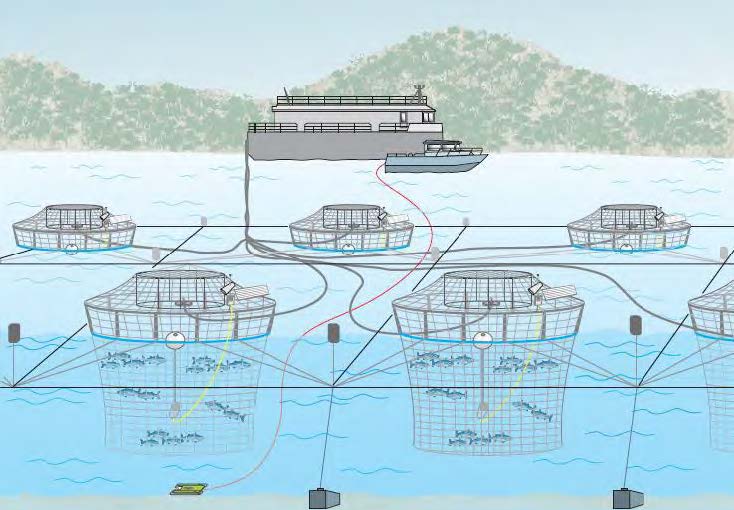
114 The netting sitting around each of the cages is identified by Tassal as “K-Grid”, and Tassal describe it in this way:
K-Grid netting is made of a high strength knotless resin coated weave that is heat treated providing a smooth surface. K-Grid is robust and stiff in construction providing advanced predator exclusion properties
115 It is common ground that the term “K-Grid” is a proprietary name for a brand of netting.
116 Central to the question before the primary judge, and on appeal, was whether Tassal’s proposal was a “controlled action” for the purposes of the EPBC Act, because the establishment and operation of the farm would, or was likely to, have a significant impact on one or more of the matters of national environmental significance set out in Pt 3 of Ch 2 of the EPBC Act. On the basis of its own internal assessment of the potential impacts of its proposed salmon farm, Tassal initially determined that it was not. Nonetheless, it agreed to refer its proposal to the Department of the Environment and Energy for assessment of the potential impact of the proposed farm on matters of national environmental significance. The process in the EPBC Act allowed for public submissions prior to the Minister deciding whether the proposed action was a controlled action: that is how the three appellants became involved.
117 On 1 August 2017, a delegate of the Minister determined that Tassal’s proposed action was not a controlled action provided it was undertaken in a “particular manner” within the meaning of s 77A of the EPBC Act. This was the “component decision”, as s 77A describes it.
The delegate’s exercise of power and Tassal’s commencement of the salmon farm
118 The power under s 75, and the consequent decision under ss 77 and 77A, appears to have been exercised, given the date of the delegate’s signature on the briefing note, on 1 August 2017. There was a briefing note to the delegate, prepared by two officers within the Department of the Environment and Energy.
119 The briefing note identified four “key issues”:
The southern right whale (Eubalaena australis) has been relatively slow to recover from whaling activities undertaken historically during the 19th Century. Recent observations suggest former whaling sites (such as the Mercury Passage) are being increasingly visited by the southern right whale, and may indicate sites of future importance for recovery of the species. As such, particular manner requirements are recommended to avoid the risk of significant impacts to southern right whales.
The Department considers that, if taken not in accordance with the specified particular manners, there is a real chance that the action would, or would be likely to, result in a significant impact on the southern right whale and other migratory whale species. However, the Department also considers that undertaking the action in accordance with the particular manners specified in the proposed decision notice (Attachment J) will ensure that the risk of adverse impacts to the southern right whale and other migratory whale species is reduced to a level below significant.
The Department also considers that the risk of other marine life and seabirds becoming entangled with the farming infrastructure such that a significant impact is unlikely. Impacts to the heritage listed Darlington Probation Station on Maria Island, and the Commonwealth marine environment, are also not considered likely, due to the nature of the action and distance from these matters.
The Department therefore recommends that you decide, under sections 75 and 77A that the action is not a controlled action but only if undertaken in accordance with the particular manners specified in the proposed decision notice (Attachment J).
120 The exercise of power was constituted by the delegate circling a number of words on the first two pages of the briefing note:
121 The briefing note had a number of attachments, including the form of the s 77 notice which was published.
122 Tassal was obviously fully prepared to undertake the action, and must have been confident of the outcome of the EPBC Act process. The evidence of Mr Mark Asman, the Head of Aquaculture at Tassal, was that having received notification of the delegate’s decision on 1 August 2017:
Tassal commenced the placement of salmon in cages within the lease area on 2 August 2017.
123 This proceeding was commenced on 7 September 2017 after the delegate had failed to provide reasons within the timeframe set out in the AD(JR) Act. By this stage, Mr Asman’s evidence discloses that 797,000 smolt had been placed in the pens and the action was fully underway. At the time of his affidavit, Mr Asman estimated harvesting of the salmon would occur in approximately November 2018. The salmon farm has been fully operational since the s 75 decision, and no stay or injunction of that decision was sought or granted in connection with this proceeding.
The delegate’s reasons for the exercise of power
124 On 2 August 2017, the appellants requested a statement of reasons for the delegate’s decision pursuant to the AD(JR) Act. Only the proponent, Tassal, had an entitlement under the EPBC Act to be given reasons and on the evidence it does not appear to have sought such reasons.
125 Reasons were ultimately provided by the delegate on 13 September 2017. In other words, the reasons were provided after these proceedings had commenced. There is no evidence about who drafted the delegate’s reasons.
126 In his reasons the delegate described Tassal’s action in the following terms:
Background
Description of the proposal
1. The proposed action involves the installation and operation of a finfish (salmon) farm at Okehampton Bay, Tasmania, 65 km northeast of Hobart. The farm will operate in 18 month production cycles to grow up to 800 000 smolt (a fish that is around 1 year old and needs salt water to continue to grow) to harvestable size. The proposed action will replace an existing seaweed and blue mussel farm.
2. Twenty eight pens will be arranged within the lease area, covering 86 ha of the 100 ha lease. Moorings will consist of 120 5 ton concrete mooring blocks, joined with chains kept at high tension and secured with 60 1.5 ton anchors. Pen nets will be made using ‘k-grid’ mesh technology: a high tenacity knotless resin-treated woven net. No anti-predator nets will be used.
3. The referral documentation states that the proposed action includes a permanently moored mobile water barge located on the lease, which will include a desalination function to be used for fish washing purposes. Fish are washed between moving from the hatchery to the sea when the fish are at smolt stage, to prevent gill disease. Waste water will be disposed of at an approved land-based disposal facility.
127 At [15] he says:
15. Section 77A allowed me to find that the action is not a controlled action if I believed it will be taken in a particular manner. In order to make such a decision, I was required to decide that a particular provision of Part 3 was not a controlling provision for the action because I believed the action will be taken in a particular manner; that is, because I believed the action will be taken in a manner that will ensure the action will not have, and is not likely to have, an adverse impact on the matter protected by a particular provision of Part 3.
128 At [24]-[33] he says:
Southern right whale (Eubalaena australis) - endangered and listed migratory
Species information
24. The southern right whale is seasonally present along the coast of Australia between late April and November, with calving occurring through winter to mid-spring. Major calving grounds occur off the West and South Australian coastlines, with smaller congregations located along the west coast of Victoria. The Conservation Management Plan for the Southern Right Whale: A Recovery Plan under the EPBC Act 2011-2021 states that additional areas of importance are emerging where small, but growing numbers of whales regularly aggregate for short periods of time, and may represent a separate south east population of the species. These areas include coastal waters along the Bonney Upwelling between Portland and Port Campbell, Victoria, off Eden, NSW and at the Mercury Passage, Tasmania. Mothers with young calves have been sighted at these south east sites; the sites are considered to be biologically important for the south-east population and the recovery of the species.
25. Females exhibit high migration route fidelity, which may be affecting the species’ ability to re-populate following the massive declines of the 19th Century which were the result of whaling activities. A lack of gene flow between global populations suggests the Australian population may be genetically distinct from other populations. The migration patterns of the whale suggest that the species is unlikely to be present in the proposed action area after November each year, and is unlikely to return until May, although where southern right whales travel outside of calving periods is not well known.
Proposed action area
26. The proposed action is within the Mercury Passage. The 28 pens will be distributed across an 86 ha area, between 500 m and 700 m offshore.
Potential impacts, avoidance and mitigation measures
27. The proposed action has the potential to impact the species due to vessel strike, entanglement and noise disturbance. Vessel strike and entanglement may result in physical impacts including injury or death. Noise disturbance can result in the species’ avoidance of an area, as well as behavioural changes such as interruption of feeding, breeding and nursing.
28. Entanglement is a key threat to the species, and recorded entanglements have been linked to commercial fishery equipment and marine debris. Entanglements often lead to a prolonged death associated with reduced fitness of the animal. Records of southern right whale entanglements with fishing equipment are mainly attributed to lines and ropes used for crustacean fishing. There is also at least one record of a fatal entanglement with a longline. The whale was found dead at Head of Bight, South Australia in July 2001, although as entanglement deaths are often prolonged, this does not necessarily indicate when or where the whale became entangled. Longline entanglements are likely to be fatal as the small diameter line cuts and injures the animal. However, publicly available papers and reports on southern right whales do not record any deaths dues to entanglement with fish farm infrastructure. Past records of entanglement have involved marine farming actives where equipment such as mussel ropes, lobster pots, and anti-predator nets had either come loose and/or were drifting. The Department’s Conservation Management Plan for the Southern Right Whale notes that one non-fatal entanglement has been recorded in association with a Tasmanian fish farm.
29. Baleen whales have also been recorded as becoming entangled in shellfish equipment such as that used in mussel farming.
30. The mooring and netting design proposed by the proponent aims to minimise loose ropes or netting, to minimise risk to whales, through the use of: taut moorings; bundled feed and servicing lines; and heat and resin treated knotless woven nets (k-grid technology) that eliminate the need for anti-predator nets. The proponent has also committed to a number of mitigation measures (which are included in the particular manner measures summarised below) to minimise marine debris, noise disturbance and vessel strike.
31. GHD stated that the design (k-grid technology) of the proposed action reduces the likelihood of entanglement, and that the proposed mitigation measures for noise attenuation and vessel strike were likely to reduce the risk of disturbance, injury or death to southern right whales to a low level. GHD also stated that the location of the proposed action is unlikely to restrict the species migration movement.
32. The Department’s draft National Strategy for Mitigating Vessel Strike of Marine Megafauna 2016 (draft strategy) notes that “southern right whales are considered vulnerable to vessel strike due to their presence in near shore waters during critical life phases such as breeding, slow swimming behaviour and spending a lot of time on the surface. Due to their extremely low population estimates, the loss of an individual from the south-east population would be considered an adverse impact to this population while the impact of losing one breeding female would be extremely adverse. Small populations are also more vulnerable to inbreeding and the impacts of stochastic events”.
33. The Department’s draft strategy outlines impacts of vessels strikes, including vessel speed and size of the vehicle. The strategy states that “89% of incidences where a whale was severely hurt or killed occurred at vessel travelling speeds greater than 14 knots and were most serious in large vessels (> 80 m). Furthermore, the chance of an injury being lethal increases substantially, as vessel speed increases up to 15 knots”. The vessel strike measures proposed by the proponent are consistent with the draft strategy and involve reducing vessel speed to 5 knots within the lease area, a requirement for a dedicated person on each vessel to look for and identify whales during daylight hours, and a shutdown procedure if a listed threatened or migratory whale species is observed within one kilometre of the vessel so as to minimise the risk of vessel strike.
129 At [34]-[39] he concludes:
Conclusion
34. Given the progressive return of southern right whales to the Mercury Passage, and the likelihood that the area may increase in importance for the recovery of the species, the Department considered, and I agreed, that, by itself, the action will have, or is likely to have, a significant impact on an endangered species and would therefore be a controlled action for the purposes of ss 18 and 18A of the EPBC Act, due to the potential impact from entanglement, vessel strikes and noise disturbance. Specifically, the proposed action could have a significant impact by causing a long term decline in a population of southern right whales, adversely affecting habitat critical (breeding habitat) to the survival of the southern right whale or disrupting the breeding cycle of a population.
35. However, the Department also considered, and I agreed, that the adverse impacts of the action on southern right whales will be reduced below significant if the proposed action is undertaken in the particular manner set out in the decision notice, and summarised below:
a. To reduce the risk of entanglement:
i. Moorings, ropes, nets and lines must be kept taut.
ii. Fish pen nets must be inspected at least daily; and fish pen nets, ropes and lines must be inspected at least weekly below the water line.
iii. Prompt repairs must be made to nets, ropes and lines.
b. In the event of entanglement, Tassal’s Response Protocol For A Whale Sighting, Entanglement or Stranding, April 2017, must be implemented.
c. To reduce the risk of vessel strike and noise disturbance:
i. Vessels must be restricted to 5 knots for vessels within the lease area.
ii. Marine mammal observer responsible for looking for and identifying whales must be on-board vessels whenever in use during daylight hours.
iii. Operations must take place in daylight hours except in emergencies or when security checks are undertaken - in these circumstances and in low visibility, a navigational sonar must be used to detect whales.
iv. Operations (vessel and noise generating activities, as guided by the South Australia Department of Planning, Transport and Infrastructure’s Underwater Piling Noise Guidelines, 2012) must be shut down if a whale is observed within 1 km of vessels.
36. The Department considers that, provided these particular manner requirements are implemented, the likelihood of impacts on the species due to vessel strike, entanglement, or noise disturbance will be very low, and that significant impacts to the species are therefore not likely.
37. These particular manners were proposed by the proponent as part of additional information submitted to the Department during July 2017.
Conclusion
38. For the reasons set out above, the Department considered, and I agreed, that, if not taken in accordance with the specified particular manners, there is a real chance that the action would, or would be likely to, result in a significant impact on the southern right whale and would therefore be a controlled action for the purposes of sections 18 and 18A. In particular, the action could have a significant impact by causing a long term decline in a population of southern right whales, adversely affecting habitat critical (breeding habitat) to the survival of the southern right whale or disrupting the breeding cycle of a population.
39. However, as the discussion above demonstrates, if the proponent takes the action in the particular manners specified in the decision notice, the Department considered, and I agreed, that the action would not be a controlled action for the purposes of sections 18 and 18A because the action will be taken in a manner that will ensure the action will not have, and is not likely to have, a significant impact on the southern right whale, namely: entanglement; noise; and vessel impacts.
130 There are similar conclusions for other species. At [56]-[58], in relation to the great white shark:
Potential impacts, avoidance and mitigation measures
56. The proposed action may impact the species through potential alteration to foraging behaviour, entanglement and vessel strike. The proponent has stated that they have no records of shark interactions at other Tasmanian marine farming operations. The proponent states:
a. The k-grid net technology that will be used at Okehampton Bay, and regular maintenance of nets and tensioned mooring lines will reduce the likelihood of shark entanglement.
b. Vessel speed management (including low speeds within the lease area) and adherence to Tasmanian marine safety regulations will reduce the risk of vessel strike.
57. GHD agreed with the proponent's assessment that the design of the proposed action, including tensioning of lines and netting material, reduces the risk of entanglement and that speed management and staff training (boat operators) reduces the risk of vessel strike. GHD concluded that the proposed action poses a low risk to the great white shark.
Conclusion
58. Taking into account the information summarised in paragraphs 54 - 57, and given the mitigation measures including design of the moorings and netting and measures to minimise the risk of vessel strike, and based on GHD’s assessment that the proposed action would have low risk to the great white shark, the Department considered, and I agreed, the proposed action will not lead to a long term decrease in the size of an important population, or reduce the area of occupancy of an important population. Therefore, the Department considered, and I agreed, it is unlikely that the proposed action will have a significant impact on the great white shark.
131 At [84]-[87], for other whale species:
84. The Department's Migratory Species Section has noted the site's emerging importance for the recovery of the southern right whale, and the potential risks of entanglement and vessel strike. The Department considered, and I agreed, the particular manner measures specified in the decision notice would be equally effective for migratory whale species other than the southern right whale.
85. For the same reasons as discussed above in relation to southern right whales, the Department considered, and I agreed, that:
a. if taken not in accordance with the specified particular manners, there is a real chance that the action would, or would be likely to, result in a significant impact on migratory whale species and would therefore be a controlled action for the purposes of section 20 and 20A;
b. however, the particular manners specified in the decision are likely to mitigate adverse impacts, including potential entanglement, noise and vessel impacts, of the action on the migratory whale species so as to ensure that the impacts are reduced below a level that is significant.
86. As a result, the Department considered, and I agreed, that there was sufficient evidence for me to be satisfied that the proposed action is unlikely to cause a long term decline in a population of southern right whales, adversely affect habitat critical to the survival of the southern right whale or other migratory whale species or disrupt the breeding cycle of a population, but only if it is undertaken in accordance with the specified particular manners.
87. Therefore, the Department considered, and I agreed, that a significant impact to migratory whale species as a result of the proposed action is unlikely, but only if the action is undertaken in accordance with the particular manner described in the referral decision notice.
132 At [90], for dusky dolphins:
90. Dusky dolphins have been recorded as interacting with salmon farms, including two cases of fatal entanglement in 1999 and 2005 at Marlborough Sounds, New Zealand. In both cases, the dolphin was entangled in an anti-predator net. The proponent has stated that they will not use anti-predator nets at Okehampton Bay. The K-grid netting used is rigid and has predator-exclusion properties without entanglement risk. The Department considered, and I agreed, it is unlikely that the proposed action will have a significant impact on a population of this species.
133 In relation to grounds 2 and 3, and the arguments about likely significant impacts on National Heritage and World Heritage values at Darlington Probation Station, the relevant passages of the delegate’s reasons are:
Section 12 and 15A - World Heritage properties
92. Eleven Australian Convict Sites received World Heritage listing in 2010 for the stories that sites, including Darlington Probation Station on Maria Island in the vicinity of the proposed action, tell about the movement of people across the world, and how a new nation is formed from hardship, inequality and adversity. Collectively, the convict sites represent a time of convictism during the 18th and 19th centuries, and form part of the history of global developments in the punishment of crime in modern times.
93. There will be no physical impacts resulting from the proposed action on the Darlington site. The proposed action will not affect the spaces, form or setting of the site’s buildings or structures, or the meaning that can be found in their layout as it applies to its convict past, or the probation system.
94. It is likely that the fish farm will be visible from the Darlington site, and the lease area has been an active commercial operation for seaweed and blue mussels for a number of years prior to this proposal. The Department considers the visual impact from the installation of 28 pens over 7 km distant from the site is unlikely to cause a substantially greater visual effect on the listed site than is already present.
95. The Department notes that the listed values of the site do not include maritime values, such as important naval activity or stories of Australian lives at sea. The listed values also do not include the natural values of the Maria Island Marine Reserve, which runs along the west coast of Maria Island, adjacent to the site.
96. Based on the above, the Department considers the proposed action will not substantially alter the fabric of the World Heritage site, have substantial impacts on the site's values or make any notable changes to form or setting. Therefore, the Department considered, and I agreed, a significant impact on the World Heritage values of the Darlington Probation Station Australian Convict Site is unlikely.
Sections 15B and 15C - National Heritage places
97. The Darlington Probation Station on Maria Island is a National Heritage place and is the most outstanding representative example of Tasmania’s 78 probation stations. The site’s isolation and plentiful natural resources made Darlington an excellent location for a probation station from 1842, and previous penal settlement from 1825. Thirteen of the original buildings and structures remain, and together provide a unique insight into the philosophy behind the probation system.
98. As mentioned above, the Department considered the values for which the property was listed would not be lost, degraded or altered by the establishment of a finfish farm at Okehampton Bay. While the farm is likely to be visible, the presence of pens low to the water over 7 km distant from the site is unlikely to detract from the meaning derived from the buildings and structures, and what they represent in Australia’s history.
99. The Department considered the proposed action would not substantially alter the fabric of the National Heritage place, have substantial impacts on the site's values or make any notable changes to form or setting. Therefore, the Department considered, and I agreed, a significant impact on the National Heritage values of the Darlington Probation Station is unlikely.
134 The notice under s 77 (intended also to reflect the requirements of ss 75 and 77A), as issued by the delegate, was as follows:
Notification of
REFERRAL DECISION - not controlled action if undertaken in a particular manner
Tassal Finfish Aquaculture at Okehampton Bay, Tasmania (EPBC 2017/7954)
This decision is made under sections 75 and 77A of the Environment Protection and
Biodiversity Conservation Act 1999 (EPBC Act).
proposed action | ||
person named in the referral | Tassal Operations Pty Ltd ACN 106 324 127 | |
Proposed action | To farm Atlantic salmon on an existing marine lease MF236 in Okehampton Bay, Tasmania [see EPBC Act referral 2017/7954]. | |
Referral decision: Not a controlled action if undertaken in a particular manner | ||
status of proposed action | The proposed action is not a controlled action provided it is undertaken in the manner set out in this decision. | |
Person authorised to make decision | ||
Name and position | James Barker Assistant Secretary Assessments and Governance Branch | |
signature |
| |
date of decision | 1 August 2017 | |
manner in which proposed action must be taken | The following measures must be taken to avoid significant impacts on listed threatened species and communities (sections 18 & 18A) and listed migratory species (sections 20 & 20A), in particular but not limited to the southern right whale (Eubalaena australis): 1. To reduce the risk of vessel strike and noise disturbance: a. vessel speed must not exceed 5 knots within the lease area; b. vessel operations must take place in daylight hours only, except during an emergency or when security checks are being undertaken; c. a marine mammal observer responsible for looking for and identifying whales must be on-board the vessel and during vessel operations in daylight hours; d. navigational sonar must be installed on all vessels and must be in use for vessel operations outside daylight hours and in low visibility; and e. vessel operations and noise generating activity must be shut down if a listed threatened or migratory whale species is observed within one (1) kilometre of the vessel and vessel operations and noise generating activity must not recommence until all listed threatened or migratory whales have moved more than one (1) kilometre away from the vessel. 2. To reduce the risk of entanglement: a. moorings, ropes, nets and lines must be kept taut; b. fish pen nets must be inspected at least daily; c. fish pen nets, ropes and lines must be inspected at least weekly from below the water line when safe to do so; and d. repairs must be made to nets, ropes and lines as soon as it is safe to do so. If additional equipment is required to complete a repair, loose lines, ropes or damaged equipment must be secured to reduce the risk of entanglement until repairs can be completed. 3. In the event of entanglement, implement the Response Protocol. Note: To avoid any doubt, these particular manner requirements are strict requirements to be observed by Tassal including if whales, notably the southern right whale, are more frequently observed in the area. | |
Definitions Daylight hours - means the time between sunrise and sunset at the location of the proposed action. Emergency - means where repairs are required as a result of storm damage or as a result of fish health or welfare issues defined as mortality rate exceeding 0.25% per day for three consecutive days. Lease area - means lease number MF236, Zone 4 - Okehampton Bay, as defined in the Great Oyster Bay and Mercury Passage Marine Farming Development Plan. Low visibility - means outside daylight hours and when observations cannot extend to 3 kilometres from the vessel e.g. during fog or periods of high winds. Marine mammal observer - means a suitably trained person who is trained in marine fauna observation, distance estimation and reporting; responsible for looking for and identifying whales immediately prior to and during vessel operations within the lease area during daylight hours except for periods of low visibility. Navigational sonar - means a forward facing navigational sonar that is used in conjunction with a nautical chart; to be installed on all vessels and to be used to identify whales prior to and during vessel operations outside daylight hours and in periods of low visibility. Noise generating activity(ies) - means the use of generators, pumps, vacuums or other boat-mounted apparatus that cause noise exceeding 120dB re 1μPa to travel beyond 1 kilometre underwater from the sound source. Observed - means whales being identified by either (1) the marine mammal observer during daylight hours or by (2) the navigational sonar outside daylight hours or in low visibility. Repair(s) - means the mending or removal of loose lines, ropes or damaged equipment. Response Protocol - means Tassal’s Response Protocol For A Whale Sighting, Entanglement or Stranding April 2017. Security checks - means night safety monitoring, to be undertaken in a vessel of no more than 9 metres in length. Shut down - means noise generating activities cease and the vessel engine is placed in neutral to stop propeller movement. Taut - means pulled tight and not slack with the exception of normal tidal, wind and wave influences. Vessel(s) - means any sea-going vehicle used by the person taking the action to conduct any aspect of the proposed action. Vessel Operations - means any vessel movement activity required to be undertaken at the lease area, including but not limited to inspections, net cleaning vessel movements, monitoring, and transit to and from the lease area. | ||

The appellants’ judicial review application and the primary judge’s reasons
135 The appellants raised three grounds of review before the primary judge. Firstly, they argued that, having formed the belief that Tassal’s proposed action would be undertaken in a way that would minimise the risk to whales through the use of bundled lines and K-Grid technology, the delegate erred by failing to comply with his obligation under s 77A(1) of the EPBC Act to identify this as a “particular manner” in which he believed the action would be taken. Secondly, the appellants argued that the delegate had erred by failing to consider the adverse impact that Tassal’s permanently moored barges would have, or were likely to have, on the National Heritage and World Heritage values of the Darlington Probation Station, thus failing to consider all “adverse impacts” of the action as required by s 75(2). Thirdly, the applicants argued that the Minister had failed to give the appellants and other interested members of the public a fair and reasonable opportunity to be heard in relation to certain information before the delegate and had thus, in making the decision, denied them procedural fairness.
136 The third argument is not pursued before the Full Court, and accordingly I refer only to those parts of the primary judge’s reasons relevant to the issues on the appeal. Given there has been a change of position by the Minister (see below), other parts of the primary judge’s analysis also need not be considered in detail.
137 The primary judge refers to “the Minister” as if the decision had been made by the Minister rather than a delegate, although his Honour noted at [37] of his reasons that the decision was made by a delegate. His Honour notes in the same paragraph that for the purpose of convenience, he uses the term “the Minister” to refer to the repository of the power as set out in the statute. I prefer to use the term “the delegate”.
138 At [38], the primary judge found that the delegate’s notation on the briefing note (see [120] above) signified his agreement with the course of action recommended by the Department, and further that it could be accepted that the delegate therefore decided that neither ss 18 and 18A (threatened species) nor ss 20 and 20A (migratory species) were controlling provisions “because the action proposed by Tassal was to be taken in a particular manner”.
139 At [61]-[62], his Honour noted it appeared to be common ground that any “misstatement” in a s 77 notice would not affect the validity of a s 75 decision. On the appeal, the appellants submitted there was no concession to this effect. It was, however, common ground before the primary judge (see [63] and [64]) and on appeal that orders made under s 16 of the AD(JR) Act were capable of extending to correction of a s 77 notice.
140 Under the heading “What was the ‘action’ originally referred by Tassal?”, the primary judge set out his finding that, from the outset, Tassal had identified that the action it was proposing would involve it using K-Grid nets for its fish pens and therefore the “action” as proposed was the same action considered by the delegate.
141 In other words, at this point in his reasoning, and although contained in a section of the reasons dealing with a description of the delegate’s reasons, the primary judge appeared to see the use of K-Grid technology as part of the “action” proposed by Tassal. This led him to reject (at [110]) the “primary submission” of the appellants based on a different factual premise. At [118], in a key passage, his Honour explained why this factual finding was important to his resolution of the judicial review application: namely that the delegate did not consider it necessary for the use of K-Grid technology to be specified in the s 77 notice because it was a “component” of the proposed action. At [120]-[123], the primary judge repeated this finding that the delegate had determined the use of K-Grid technology was an “inherent part” of the action and therefore did not need to form part of the s 77 notice, which was directed at the “manner” in which the action was to be carried out.
142 I interpolate here that his Honour’s finding, and this aspect of this reasoning, appears to include the K-Grid technology (that is, the kind of nets used), the number of smolt and the number of pens as forming an “inherent part” of the action, but does not appear to include the bundled line method, which I have described above.
143 At [128], the primary judge referred to his conclusion on the argument put on behalf of the Minister at trial that is no longer pressed: namely that the delegate decided, unilaterally and without saying so expressly in his reasons, that Tassal was not required to use K-Grid technology in undertaking the action.
144 After some discussion, and as part of the consideration of alternative arguments if his Honour was wrong on the first conclusion, at [144] his Honour also rejected the notion that the scheme of the EPBC Act would permit some kind of “informal variation” during the referral stage to a proposal to take an action.
145 At [156], the primary judge considered yet another alternative hypothesis:
Having regard to the considerations I have discussed above, if I were to be in error as to the construction of the Minister’s reasons, the Minister must have misconceived his legal duty by purporting unilaterally to exclude the integer of Tassal’s proposed ‘action’ that it use K-Grid technology from the ‘action’ he determined not to be a controlled ‘action’ in making his decision under s 75 of the EPBC Act. Such an error is reviewable under one or more of the provisions of s 5(1)(d), (e) and (f) of the ADJR Act.
146 The breadth of or basis for this finding is, with respect, somewhat unclear, but given the way the arguments were put on appeal, it need not be considered any further.
147 At [158], the primary judge summarised the conclusions he had reached in relation to ground 1 of the judicial review application:
I am satisfied that Ground 1 of the Applicants’ application for review must be rejected for reasons which may be summarised as follows:
(1) Tassal’s proposal to take an ‘action’ from the outset had incorporated the use of K-Grid nets;
(2) Tassal never sought a variation of the ‘action’ it had referred to the Minister; and
(3) properly construed, the Minister’s reasons reveal that the Minister did not, nor did he purport to, unilaterally vary the ‘action’ Tassal hard referred and which he determined to be not a controlled action if undertaken in the manner he specified.
There is therefore no need for submissions addressing the potential issues referred to at [157]. Those issues do not arise.
148 On the appeal, and contrary to the way the Minister’s position was put before the primary judge, the Minister now contends what was said by the primary judge at [158] was the correct approach, and seeks to defend it. It is this change of position which has led to the submissions by the Minister, set out below, about what constitutes “the action” as a matter of construction in Ch 2, Pt 3 of the EPBC Act, and what constituted the action as a matter of fact in Tassal’s proposal.
The issues on the appeal
149 The appellants’ challenge on the appeal falls into two categories.
150 First, the appellants’ challenge focuses on the delegate’s reasoning in relation to the s 75 decision and the consequent s 77 notice (read with the requirements in s 77A), as they affected the likely significant impact of Tassal’s proposed action on the southern right whale, on the great white shark, on other whale species and on dusky dolphins. The southern right whale, the great white shark and some of the relevant species of whales are listed threatened species and therefore protected by ss 18 and 18A, and the southern right whale, the great white shark, dusky dolphins and some of the other relevant whale species are listed migratory species and therefore protected by ss 20 and 20A.
151 Second, the appellants’ challenge focusses on the delegate’s reasoning under s 75 about the likely significant impact of Tassal’s proposed action on the heritage values (both National Heritage and World Heritage) of the Darlington Probation Station. The appellants’ arguments focus on the asserted visual impact of the moored barges used in the operation, and how the visual impact affects the heritage values associated with the Darlington Probation Station. This aspect of the challenge raises issues under s 75, but not ss 77 and 77A.
152 The notice of appeal contains seven grounds:
1. The learned trial judge:
a. erred in finding (contrary to the statement of reasons and/or submissions of the First Respondent Minister) that:
i. the Minister, in making the decision under s 75 of the Environment Protection Biodiversity and Conservation Act 1999 (the Act), “proceeded on the basis of his understanding that the use of K-Grid technology (K-Grid) was an inherent part of Tassal’s proposed action”; and
ii. this was the reason why the use of K-Grid was not specified in the notice under sections 77 and 77A; or
b. if the finding in a. was correct, erred by failing to hold that the Minister erred in his construction or application of sections 68, 75, 77 and 77A, by treating the use of K-Grid as “an inherent part of Tassal’s proposed action”, such that it did not form part of the “particular manner” in which the Minister believed the action would be taken;
c. erred in holding that the Minister was not required to specify, in the notice provided under s 77 of the Act, that the Minister believed the action would be taken in the particular manner of using bundled feed and service lines (bundled lines) and using K-Grid, when the Minister had made a component decision that ss 18 and 18A of the Act were not controlling provisions for the action because the Minister believed it would be taken in a particular manner, and that particular manner, critically to the decision, included the use of bundled lines and the use of K-Grid.
2. The learned trial judge erred in failing to determine that the Minister, in considering the visual impact of the action from the National Heritage Site at Darlington Probation Station (Darlington), failed to consider the adverse visual impact of the two (2) permanently moored barges (barges) at the site of the action.
3. The learned trial judge erred in failing to hold that the Minister had not considered all adverse impacts of the action, as required by s 75(2) of the Act, when the Minister had not considered the adverse visual impact of the proposed moored barges on the National Heritage values of Darlington.
4. In his reasons for dismissing grounds 1 and 2 of the Application, the learned trial judge erred in failing to disclose an adequate path of reasoning to his ultimate conclusion.
5. The learned trial judge erred in failing to determine ground 1 of the Application insofar as that ground concerned bundled lines.
6. In dismissing ground 1 of the Application, the learned trial judge erred in that he wrongly characterised it as premised on the supposed fact that Tassal’s original referral “had not included reference to the use of K-Grid nets”.
7. In dismissing Ground 1 of the Application, the learned trial judge erroneously relied on submissions and concessions purportedly made on behalf of the Appellants that were not made.
PARTICULARS
Reasons for judgment [62], [92], [93], [94] and [96]
153 All parties’ submissions characterise the seven grounds of appeal as involving four issues. Those four issues concern whether the primary judge erred:
(a) in finding the delegate did not err in law in how he identified the “particular manner” requirements, in making his decision under s 75 of the EPBC Act and relying on the terms of s 77A (ground 1);
(b) in finding the delegate did not err by failing to take into account “all” adverse impacts of the proposed action, as s 75(2) requires (grounds 2 and 3);
(c) in failing to deal with the appellants’ argument on judicial review about how the delegate’s decision dealt with the use of bundled lines by Tassal. This is in reality a subset of the first issue, but the error alleged by the appellants is that the primary judge did not deal with this aspect at all, rather than that he dealt with it incorrectly (ground 5); and
(d) in failing to give adequate reasons for his findings, and/or alternatively in mischaracterising and misdescribing some of the arguments put on behalf of the appellants (grounds 4, 6 and 7).
154 Three of the four issues need not presently be explained in any more detail, and I deal with each of them below at [230], [231]-[238] and [239]-[246] respectively in explaining why I consider all of the grounds of appeal relating to those issues should be dismissed.
155 On the first issue, to reflect his changed position since the trial, the Minister also filed a notice of contention. I deal with this under ground 1.
156 The way the appellants put the first issue, and therefore the first ground of appeal, requires some further explanation at this stage.
157 Although the appellants’ submissions were at times a little difficult to follow in terms of how this ground was put, it became clear (and Tassal and the Minister accepted) that there were two distinct limbs to ground 1.
158 The first is what I will call a “factual” limb, focusing on what – on the basis of the reasons as expressed, read fairly and in context – the delegate believed to be the matters which should be included in a notice under s 77 as the “particular manner” requirements to enable the delegate to conclude that Tassal’s action was not a controlled action, and could proceed, subject to the terms of s 77A. Although the language used differs (and this was part of the difficulty in identifying with precision how the argument was put), I consider the first limb reflects what the primary judge set out, by way of a summary of the appellants’ submissions, at [53] of his reasons, reproducing what was then [14] of the submissions made to the primary judge by the appellants:
The applicants submit that the Court should infer that the component decision was that ss 18, 18A, 20 and 20A would not be controlling provisions because the delegate believed, among other things, that the proposed action would use k-grid technology and bundled lines to reduce the risk of entanglement.
159 This correlates, again with some differences in language, to ground 1(a) of the notice of appeal.
160 The second limb of the first ground was described by senior counsel for the appellants in various ways, but I consider it is fair to summarise it as involving an alleged misconstruction or misunderstanding by the delegate, in making his decision under s 75, of the nature and operation of s 77A, in terms of what was required to be included in a notice under s 77 if the delegate decided the action was not a controlled action if it was carried out in a “particular manner”.
161 Again, although the language is different, I consider the second limb reflects what the primary judge set out, by way of a summary of the appellants’ submissions, at [53] of his reasons, reproducing what was then [18] of the submissions made to the primary judge by the appellants:
In failing to set out in the notice important aspects of the particular manner in which the delegate believed the action would be taken, the delegate erred in law, and the decision was made contrary to law, because the delegate misunderstood s 77 A(1). The applicants submit that the proper construction of s 77(A) is that the particular manner which must be set out in the s 77 notice is the complete particular manner on which the delegate forms his or her belief, whether that manner was ascertained from information in the referral itself or otherwise.
(Footnotes omitted.)
162 This correlates, again with some differences in language, to ground 1(b) of the notice of appeal.
The parties’ arguments in summary on the appeal
The appellants
163 In relation to ground 1, on which the most time was spent in written and oral argument, the appellants submit that, in order to make a decision under s 75 in reliance on the terms of s 77A, the Minister must ask herself or himself whether, based on any of the information available to the Minister at the time of exercising the power, there is a “particular manner” (or manners) by which the action may be undertaken which would render the action not a controlled action. The “particular manner”, the appellants submit, must be connected with the reduction or avoidance of impacts on a matter of national environmental significance, that being the purpose of these provisions as an alternative to an action being a controlled action.
164 If the Minister forms such a view, then all of the “particular manner” (or manners) must be specified in a s 77 notice (as required by s 77A), that notice being part of the enforcement mechanisms for which the EPBC Act provides.
165 On the present facts, both the K-Grid netting and the bundled lines, each of which Tassal proposed to use in its salmon farming operation, were a “particular manner” by which the action Tassal proposed was to be undertaken. Therefore, the delegate had to ask himself whether the action carried out in that manner would not be a controlled action.
166 The appellants contend the delegate did not approach the exercise of power in this way. Rather, they contend that the reasons and the contents of the s 77 notice indicate that the delegate only referred to matters he considered to be “additional” mitigation measures, and this was both a misunderstanding of the circumstances in which a decision could be made under s 75 relying on s 77A(1), and a misunderstanding of what needed to be specified in the s 77 notice for it to be an effective enforcement mechanism under s 77A(2).
167 In relation to grounds 2 and 3 (the Darlington grounds), the appellants contend the delegate failed to take into account all adverse impacts of the action on the heritage values of this site, despite being required by s 75(2)(a) of the EPBC Act to do so. The delegate took into account the visual impact of the fish pens, but not the barges, and the visual impact of the latter is contended by the appellants to be quite different. Thus, the appellants contend the delegate failed to take into account mandatory considerations and the exercise of power miscarried.
168 Relying on Nettle J’s observations in DL v The Queen [2018] HCA 26; 356 ALR 197 at [131], by grounds 4, 6 and 7 the appellants contend the primary judge failed to “make apparent the steps” the primary judge had taken to reach his conclusions. They contend the primary judge did not expose his reasoning, and fact-finding, for the following matters:
(a) at [169], that it was not open to the Court to infer the delegate had failed to have regard to the visual impact of the barges;
(b) the “repeated attribution” to the appellants of concessions and submissions not made;
(c) the apparent (and the appellants say incorrect) finding that the delegate had dealt with Tassal’s application as if it had been varied (referring to [124]-[125] of the primary judge’s reasons).
169 Ground 5 is connected to ground 1. The appellants say it is clear they put a particular argument to the primary judge about the errors in the delegate’s reasoning concerning bundled lines, and the primary judge simply did not deal with them. The appellants submit the delegate did not consider the impact of the use of bundled lines, that the use of bundled lines was integral to the functioning of the nets and the avoidance of entanglement by marine life such as whales, sharks and dolphins, and that it was itself a “particular manner” in which the action would be undertaken.
The Minister
170 On ground 1, the Minister submits that, “[u]pon further reflection”, the primary judge was broadly correct to see s 77A as addressed to manners additional to what in any event was part of the action. He submits that all of the steps which Tassal proposed to take to operate the salmon farm as included in its proposal (including using K-Grid technology and bundled lines) were part of the proposed action, and not “additional”. Therefore, there was no need for them to be included in the s 77 notice, nor to be understood as “particular manners” in which the action would be carried out, for the purposes of the decision under s 75 that the action was not a controlled action.
171 This is so, the Minister contends, even if conduct which is inherent in the carrying out of the action is also critical to the Minister’s view that the action would not have a significant impact on a matter of national environmental significance (for example, the southern right whale). Even if the K-Grid technology and bundled lines were critical to the delegate’s view that there was no significant impact, that did not require the delegate to specify them in the s 77 notice, nor did it mean the power had miscarried if they were not specifically identified. However, here the failure to mention these matters suggested, the Minister contends, that the delegate did not see these two features as critical to significant impact. Rather, what he saw as critical is what is set out at [34]-[35] of the delegate’s reasons.
172 On grounds 2 and 3 the Minister submits the evidence does not permit the inference that the delegate failed to consider the visual impact of the barges. The Minister further submits that, in any event, s 75(2)(a) should not be construed so that every matter a Court (or a party) might describe as an “adverse impact” must be considered by the Minister or delegate, and certainly not in the way a party or objector submits they must be considered.
173 The Minister describes the other grounds as “miscellaneous criticisms”, and in relation to the reasons ground expressly submits that it was “unnecessary and inappropriate” to rely on inadequate reasons as a separate ground of appeal, when the real question is the lawfulness of the delegate’s exercise of power. While the Minister accepts there were some parts of the primary judge’s reasons where he had mistakenly attributed a concession to the appellants, or misstated a submission, the Minister submits none of these were material or critical to the primary judge’s conclusions.
Tassal
174 Tassal took broadly the same approach to ground 1 as the Minister, submitting there was no principled basis on which a distinction could be drawn between the “undertaking or project” and the “mitigation measures” which might accompany it. Some mitigation measures might be integral to the action: alternatively, under s 75 read with s 77A(1), the Minister may choose to specify mitigation measures in a s 77 notice. There is, Tassal submits, no bright line between the two categories. The Minister should be taken to have been aware Tassal’s proposal included the use of taut moorings, bundled feed lines and K-Grid technology, and therefore the inference that the primary judge drew at [123] was open on the evidence. The challenges to what needed to be specified in the s 77 notice were, Tassal submits, challenges to the merits of the decision.
175 While Tassal also concedes there may have been some errors in the primary judge’s reasons as the appellants identified, they were minor and not material to the conclusions his Honour reached.
176 As to the Darlington grounds, Tassal submits the delegate was not required to consider adverse impacts as put by any person making a submission in relation to the proposal – the question of what were “adverse impacts” in s 75(2)(a) leaves the matter to the Minister’s opinion. Given the 7 km separation distance between the Island and the salmon farm, it was open to the Minister to conclude as he did that there would be no visual impacts – this included impacts from the barges.
RESOLUTION OF THE ISSUES IN THE APPEAL
Some matters of construction
177 The scheme of the EPBC Act contemplates a number of ways of regulating actions that may have a significant impact on matters of national environmental significance. This may be through methods that include the making of bilateral arrangements with the State, Ministerial declarations, or by the Commonwealth agreeing that the State should investigate and control the undertaking of the action through State processes. A “component decision” is another method.
178 As I have noted above, there was a version of s 77 in the scheme of the EPBC Act from its inception. Until 2003 and the introduction of s 77A, the notice which was required to be published reflected the terms of the decision under s 75 and identified the controlling provisions, but aside from that had no independent role in the enforcement regime under the Act. Rather, a “component decision” could be enforced through the Ch 2, Pt 3 prohibitions (such as s 18) if the proponent’s conduct did not comply with in the terms of the s 77 notice. It was the civil and criminal consequences in those Ch 2, Pt 3 provisions which provided the enforcement mechanism.
(1) With the 2003 amendments, a further compliance mechanism was introduced, by making non-compliance with the “manner” specifications in a s 77 notice subject to separate civil penalty provisions. In that sense, non-compliance with the notice was all that had to be proven to engage the civil penalty provisions in s 77A(2), rather than proof of actual or likely significant impact on a matter of national environmental significance, which would have been required to engage the civil or criminal prohibitions in Ch 2, Pt 3 (such as ss 18 and 18A). The regulatory mechanism has, since 2003, been clearer and more straightforward, by directly enforcing a Minister’s component decision.
179 Nevertheless, the co-location since the start of the EPBC Act of the “particular manner” provisions in the substantive parts of Div 1 of Pt 3 of Ch 2, placing them together with other “exception” provisions capable of avoiding the controlled action regime, indicates Parliament’s intention that the “particular manner” provisions offer yet a further alternative regulatory regime to the assessment and approval regimes in Pts 8 and 9 of Ch 3.
180 Provisions such as s 19(3)(b), being one of the co-located provisions relating to “component decisions”, have several features:
(1) their effect is to “dis-apply” the civil and criminal prohibitions on actions with likely significant impact on matters of national environmental significance;
(2) for their operation they require a decision under s 75 that an action is not a controlled action;
(3) for their operation they require the controlled action decision to have been made for a specified reason: namely the Minister’s belief about the manner in which the action will be undertaken;
(4) for their operation they require the Minister’s belief to have been translated into specifications in a notice under s 77; and
(5) for their immunising effect on the person undertaking the action, they require the action to have been undertaken in the manner specified in the notice under s 77.
181 Thus, provisions such as s 19(3)(b), read with s 77A(1) (which was s 77(3) in the previous version of the EPBC Act), condition the Minister’s power in s 75 to decide that an action is not a controlled action where the basis for that decision is that the action proposed will be undertaken in a particular manner. Their terms must be satisfied if an exercise of power under s 75, relying on them, is to be lawful.
182 The terms of s 19(3)(b) (and similar provisions in other prohibitions in Ch 2, Pt 3) are expressed to provide relief from the relevant prohibition only if:
(a) the Minister’s decision was made for a particular reason; and
(b) that reason was that the Minister believed the action would be undertaken in a manner; and
(c) that manner is specified in a s 77 notice.
183 If there has been no lawful exercise of power under s 75 on the basis of s 77A(1), read with the relevant enforcement provision such as s 19(3)(b), then the person taking the action will remain exposed to the civil and criminal prohibitions in Pt 3 of Ch 2, if their action is likely to have a significant impact on a matter of national environmental significance – a circumstance which will then be decided by a Court on admissible evidence, not by a Minister at an executive level.
184 The adjective “particular” appears in s 77A(1) but not in the Ch 2, Pt 3 exceptions such as s 19(3)(b). Given it appears in s 77A(1) and is read with the need for the manner to be “specified” in a s 77 notice, I consider it is clear that s 19(3)(b) (and comparable provisions) are directed at a “particular manner” (or manners) of undertaking an action.
185 Thus compliance with the limits in s 77A(1), read with s 19(3)(b) (and like provisions dealing with other matters of national environmental significance), goes to the power of the Minister under s 75, and to the validity of a notice issued under s 77. The delegate’s reasons appear to recognise this when he states “Section 77A allowed me to find that the action is not a controlled action if I believed …”, thus appearing to locate the limit imposed by s 77A on his power in s 75 to decide an action is not a controlled action.
186 Three further matters should be noted:
(a) the exercise of the s 75 power to determine that an action is not a controlled action if it is taken in a particular manner operates on the Minister’s belief about the particular manner in which an action will be undertaken;
(b) the scheme identifies the formation of this belief for the purposes of s 75 by describing it as the making of a “component decision”; and
(c) by requiring the s 77 notice to set out the “component decision”, the controlling provision and the “manner”, s 77A(1) is requiring a link to be identified between the manner of undertaking the action and the protection of a particular matter of national environmental significance (which is the purpose the identification of the controlling provision serves).
187 Section 77A(2) contains what I have described as the more straightforward enforcement mechanism. The assessment of contravention will turn on a comparison between what is specified in the s 77 notice and what a person has done, and whether the two are “inconsistent”. The terms and operation of s 77A(2) (and, in the past, s 77(3)), emphasise why the contents of the s 77 notice when there is a “component decision” are so important. The s 77 notice is the chosen regulatory mechanism to protect matters of national environmental significance.
188 That is not to deny that a s 77 notice might itself be unlawful, without that unlawfulness affecting the exercise of power under s 75. Such a situation might arise where the Minister’s belief, lawfully formed, has not been faithfully or completely translated into the terms of the notice. Whether or not that is what has occurred here is part of the appellants’ arguments on ground 1, and I return to it below.
189 It is also necessary to say something of the use by the Parliament of the word “manner” in provisions such as s 19(3)(b) and s 77A. The word signifies the way in which an action is performed or undertaken. The use of the adjective “particular” is designed to connect the assessment of manner to the likelihood of significant impact.
190 This is not a complicated concept, and it is important not to over-complicate the analysis. There is the distinction between:
(a) the key features of what is to be done (the action – which might include such matters as a general description to bring the conduct within s 523, the location and the size); and
(b) how the action is to be undertaken; the measures that are to be used. Much of the “how” may not be relevant to a component decision: this is where, as I emphasise, the focus of the repository’s analysis is on the connection between the “how” and any significant impact on a Ch 2, Pt 3 protected matter.
191 The final issue of construction which should be addressed is the meaning of the word “action”. The word is given a broad definition in s 523:
523 Actions
(1) Subject to this Subdivision, action includes:
(a) a project; and
(b) a development; and
(c) an undertaking; and
(d) an activity or series of activities; and
(e) an alteration of any of the things mentioned in paragraph (a), (b), (c) or (d).
192 In Wilderness Society Inc v Hon Malcolm Turnbull, Minister for the Environment and Water Resources [2007] FCAFC 175; 166 FCR 154 at [1], Branson and Finn JJ described the “action” in that case – a very large project – in terms which directly reflected the breadth of the definition in s 523, and which was not a description disputed by any party in that case:
Gunns Limited proposes to construct and operate a bleached Kraft pulp mill, and ancillary chemical production and infrastructure, (“the pulp mill”) at Bell Bay in northern Tasmania. For the purposes of the Environment Protection and Biodiversity Conservation Act 1999 (Cth) (“the EPBC Act”) the construction and operation of the pulp mill is an “action” (see s 523 of the EPBC Act).
(Emphasis added.)
In some circumstances, as the Full Court in Tasmanian Aboriginal Centre at [77]-[80] made clear, there may be a number of activities, each of which might be identified as a separate “action” for the purposes of s 523, or alternatively which might collectively be seen as a “project” or “undertaking”.
193 The terms of s 523 leave room for some decisional freedom, at least during the process of decision-making for which the Act provides, in how an “action” should be identified. The Minister submitted, both on the appeal and in support of his notice of contention, that the elements of the proposed “action” are objective, and the answer to the question “what is the action?” “does not depend on identifying the understanding of the delegate as to what those elements were.” That may be correct as a general statement. Ultimately, the description identified by a decision-maker as the basis for an exercise of power will be legally correct or legally incorrect, but the term is a deliberately flexible one.
194 In the present case, the decision-maker – the delegate – made a choice to describe the “action” in his reasons in a specific way, and no party submitted that description was legally incorrect. The Minister’s submissions on this issue did not involve – as I understood them – the submission that the way the delegate identified the “action” for the purposes of the exercise of the s 75 power was legally incorrect.
195 I have set out the description of the “action” given by the delegate at [126] above. Read that way, what is set out in those three paragraphs is a description of the “project” Tassal proposed to undertake. It was this description the delegate used to determine whether the action was a controlled action or not, and in turn, whether it would not be a controlled action because he believed the action (as described in those three paragraphs) would be carried out in a “particular manner”.
196 In my opinion the parties’ arguments, especially on ground 1, should be approached on that view of what constituted the “action” proposed by Tassal and assessed by the delegate.
197 For completeness, I note the Court was informed that there had been no other authorities where the proper construction and operation of s 77A had been determined, and that would appear to be the case.
The “manner” argument: ground 1
Findings about the delegate’s reasons
198 At [15] of his reasons the delegate correctly identifies the necessary connection to which I referred previously between the belief that needs to be formed for a component decision, and the avoidance of “adverse impacts” from the project on a Ch 2, Pt 3 protected matter (or, as I consider it should be framed, significant impacts). As the delegate states, if the project is undertaken in a “particular manner”, that:
…will ensure the action will not have, and is not likely to have, an adverse impact…
(Emphasis added.)
199 At [18] the delegate then identifies examples of possible impacts an action is likely to have on a Ch 2, Pt 3 protected matter (relevantly for ground 1):
For critically endangered and endangered species and ecological communities:
• lead to a long-term decrease in the size of a population
• reduce the area of occupancy of the species
• adversely affect habitat critical to the survival of a species
• disrupt the breeding cycle of a population
• modify, destroy, remove, isolate or decrease the availability or quality of habitat to the extent that the species is likely to decline
• result in invasive species that are harmful to a critically endangered or endangered species or ecological community becoming established in the habitat, or
• interfere with the recovery of the species.
For vulnerable species:
• lead to a long-term decrease in the size of an important population of a species
• reduce the area of occupancy of an important population
• adversely affect habitat critical to the survival of a species
• disrupt the breeding cycle of an important population
• modify, destroy, remove or isolate or decrease the availability or quality of habitat to the extent that the species is likely to decline
• result in invasive species that are harmful to a vulnerable species becoming established in the vulnerable species’ habitat, or
• interfere substantially with the recovery of the species.
For migratory species:
• substantially modify, destroy or isolate an area of important habitat for a migratory species
• result in an invasive species that is harmful to the migratory species becoming established in an area of important habitat for the migratory species, or
• seriously disrupt the lifecycle (breeding, feeding, migration or resting behaviour) of an ecologically significant proportion of the population of a migratory species.
200 These were the impacts the delegate was assessing when considering the “particular manner” in which the salmon farm project was to be carried out.
201 Relevantly, the delegate then set out all the attributes or features of each of the species which had been identified as likely to suffer impact from the salmon farm project. The agreed emphasis on the appeal was on the delegate’s reasoning about the southern right whale (see the delegate’s reasons at [24]-[39]), the great white shark (see [54]-[58]), other whale species (see [81]-[87]) and dusky dolphins (see [90]).
202 It is clear, and I find, that the delegate spent a proportionately greater amount of time in his reasons on the impacts on the southern right whale. The reason for that, I find, is because the evidence and material before the delegate prompted closer and more detailed consideration being given to the impacts on that species, and that is what the delegate did.
203 The delegate’s findings reveal:
(1) He accepted the seasonal presence of the southern right whale, including with calves, in the Mercury Passage where the salmon farm project is to be conducted across an 86 ha area.
(2) He accepted that female southern right whales exhibit high migration route fidelity.
(3) He accepted the proposed salmon farm project had “the potential to impact the species due to vessel strike, entanglement and noise disturbance”.
(4) He accepted that entanglement is a key threat to the species.
(5) He found (at [34]) that the Department considered, and he agreed, that the proposed salmon farm project in the Mercury Passage at the size proposed will have, or is likely to have, a significant impact on the southern right whale due to the potential impact from vessel strike, entanglement and noise disturbance.
Having formed that opinion on the material, the delegate also found:
(6) The mooring and netting design proposed by the proponent aims to minimise loose ropes or netting, to minimise risk to whales.
(7) It does so by using taut moorings, bundled feed and servicing lines, and heat and resin treated knotless woven nets (which the delegate specifically identifies as “K-Grid technology”).
(8) Those measures eliminate the need for anti-predator nets.
(9) Tassal also committed to a number of mitigation measures to minimise marine debris, noise disturbance and vessel strike (and it was these measures only that were incorporated into the “particular manner” requirements specified in the s 77 notice).
(10) The delegate focussed especially (at [31]) on what the expert report by GHD had said about the use of K-Grid technology, and how in GHD’s opinion it “reduces the likelihood of entanglement”.
(11) The delegate also relied on the views in the GHD report that the proposed mitigation measures for noise attenuation and vessel strike were “likely to reduce the risk of disturbance, injury or death to southern right whales to a low level”.
(12) These findings led the delegate to conclude (at [35], and again in substance at [39]) that the adverse impacts on southern right whales “will be reduced below significant” if the salmon farm project is undertaken in the particular manner set out in the notice, being confined to the steps set out at [35] of the delegate’s reasons.
204 In relation to great white sharks, at [56] the delegate refers expressly to Tassal’s proposal to use K-Grid technology to reduce the likelihood of shark entanglement, having noted in the same paragraph that the salmon farm project “may impact the species through potential alteration to foraging behaviour, entanglement and vessel strike”. At [58] the delegate takes account of that information and states that “given the mitigation measures including design of the moorings and netting and measures to minimise the risk of vessel strike” it is unlikely there will be a significant impact on the great white shark species from the salmon farming project.
205 The delegate adopts (at [85]) the same approach for other whale species (namely the humpback whale, the blue whale and the pygmy right whale) all of which he found (at [82]) may occur in the Mercury Passage, with cross-references to his findings about the southern right whale.
206 In relation to dusky dolphins, the delegate finds (at [90]) that although there have been interactions recorded between dusky dolphins and salmon farms involving dolphins’ entanglements in anti-predator nets, Tassal does not propose to use anti-predator nets and the K-Grid netting “is rigid and has predator-exclusion properties without entanglement risk”. This is the reason given by the delegate for his conclusion in the next sentence of [90] that it is unlikely the salmon farm project will have a significant impact on dusky dolphins.
207 When read as a whole, fairly and in their context, in my opinion it is not possible to understand the delegate’s reasons as doing anything other than relying heavily on the use of K-Grid technology by Tassal as a core feature of how it proposed to operate its salmon farm, being a measure which would avoid what the delegate had otherwise found to be the likely significant impact of the salmon farm project on several listed threatened species and listed migratory species.
208 The delegate also clearly relied on the proposed use of bundled feed and servicing lines in relation to the southern right whale, and other whale species, as a measure intended to have similar effects.
209 These were matters the delegate used to identify the requisite connection between the manner in which the salmon farm project would be undertaken and the reduction of the risk of significant impact to four species of whales, to great white sharks and to dusky dolphins.
210 Although he mentioned the K-Grid technology in his description of the “action” at the start of his reasons (see [2]), when the reasons are read as a whole it is clear that the delegate believed the use of these nets was a measure that was integral, and essential, to the reduction of impact from the action. That is, in the requisite sense, the identification of a “particular manner” of carrying out the action.
The first factual limb: what did the delegate believe?
211 Based on the findings I have set out above, I accept the appellants’ submissions that the delegate’s reasons disclose he did believe that if the operation of Tassal’s proposed salmon farm was (amongst other measures) undertaken using K-Grid technology and bundled lines it would (consistently with ss 19(3)(b), 20(2)(c), 20A(4)(c) and 77A(1)) not be a controlled action because there were not likely to be any significant impacts on the species protected by (relevantly) ss 18, 18A, 20 and 20A.
212 It is clear the delegate examined and relied on a range of measures aside from the K-Grid technology and the bundled lines, some of which made their way into the s 77 notice.
213 The disconformity between the belief which is revealed by the terms of the delegate’s reasons, and what he says in [35] about the contents of the s 77 notice, together with the terms of the notice itself, is explained by the misunderstanding which forms the second limb of the appellants’ contentions on ground 1. That is, the delegate misunderstood (and appears to have been wrongly instructed about) the effect of the conditioning of his power under s 75 by s 77A and other provisions such as s 19(3)(b), and appeared to confine the notice requirements about “particular manner” to matters which were additional and supplementary to measures that had been proposed by Tassal as part of its initial proposal.
214 It is important to observe, as the delegate’s reasons make clear at [36] and [37], that the measures specified in the s 77 notice were measures that Tassal had proposed during the assessment process:
The Department considers that, provided these particular manner requirements are implemented, the likelihood of impacts on the species due to vessel strike, entanglement, or noise disturbance will be very low, and that significant impacts to the species are therefore not likely.
These particular manners were proposed by the proponent as part of additional information submitted to the Department during July 2017.
(Emphasis added.)
215 It would appear this additional information was provided by Tassal at the request of the Department, for the purpose of informing the report prepared for the Department by GHD.
216 It can be accepted that the additional “mitigation measures” proposed by Tassal were also capable of forming part of the “particular manner” requirements in the s 77 notice. However, the point is that not all the “particular manner” requirements were set out in the notice.
The second limb: did the delegate misunderstand the requirements of s 77A?
217 No point was taken on appeal, nor before the primary judge, about the fact the delegate’s reasons were prepared after the proceedings were issued. The Court has proceeded on the basis that these were the delegate’s true reasons, conformably with s 13 of the AD(JR) Act.
218 I am satisfied that the delegate’s reasons disclose a misunderstanding of the operation of ss 19(3)(b), 20(2)(c), 20A(4)(c) and 77A, in terms of what was required to be specified in the s 77 notice, given the findings the delegate had made.
219 That notice was not to be limited to matters that had arisen as part of discussions between the Department and Tassal during the assessment process. These were not the only measures the delegate relied on to conclude that there was not likely to be any significant impact to the species concerned. Rather, he relied on measures which were set out in Tassal’s original proposal, and his assessment of the effects of those measures, on advice from the Department, and also GHD.
220 His reasons made it clear that without implementation of all the measures to which he referred (including use of K-Grid technology and bundled lines), he was satisfied there would be significant impact to the species concerned. Therefore, he was required by the legislative scheme to set out all the measures he had identified (the Court assumes, at the time of his exercise of power) that would avoid the impact he determined the salmon farm project was otherwise likely to have on species protected by ss 18, 18A, 20 and 20A of the EPBC Act.
221 This error, which is an error of law materially affecting the exercise of power, led to a disconformity between the delegate’s reasons and the form of the s 77 notice.
Any remaining aspects of the respondents’ arguments
222 I have dealt with most of the points made by the respondents in the analysis above. Only one further matter need be addressed.
223 The “difficulty in construing s 77A” identified in [6] of the Minister’s submissions does not exist. From the “great deal of information provided”, part of the task of the Minister, or her or his delegate, is to:
(1) describe the “action” that she or he is assessing; and
(2) having done so, to examine and consider that material to see if there is any connection, or relationship, between how the action is to be carried out, and the likelihood of significant impact on one or more Ch 2, Pt 3 protected matters.
224 Most of the assessment process is factually complex. The scheme is complex, and inherently involves assessment of a great deal of information. That fact is no reason to construe the operation of ss 77A and 75 (and related provisions such as a 19(3)(b)) as limited to matters that arise “in addition” to what was in the original proposal.
Conclusion on ground 1
225 The primary judge erred, in my respectful opinion, in confining the operation of s 77A(1), read with s 19(3)(b) and like provisions, to matters which were “additional” to what was contained in a proponent’s original proposal to take an action. In the ability of the Minister to make a “component decision” as one way of exercising the power under s 75, the scheme does not distinguish between measures which form part of the original referral or proposal and measures which may be raised later in the assessment process and sit outside measures initially put forward by a proponent.
226 If an action is to be determined not to be a controlled action because the belief of the Minister is that the “particular manner” in which it is to be undertaken removes the likelihood of significant impact on a Ch 2, Pt 3 protected matter, then each measure which constitutes that “particular manner” must be specified in the s 77 notice, so that compliance can be monitored and enforced. That is the purpose of the alternative regulatory mechanism established by these provisions.
The Minister’s Notice of Contention
227 It is apparent from my reasoning to this point on ground 1 that the Minister’s notice of contention must be dismissed.
228 The primary judge was correct to see a correlation in the delegate’s reasons between his identification of the K-Grid nets and bundled lines and a reduction in significant impact on Ch 2, Pt 3 protected species, and correct to see the delegate as having relied on this to determine that the significant impact he had identified was reduced below the level of likelihood, provided these measures were employed by Tassal.
229 Insofar as the Minister’s arguments went beyond the approach of the delegate and primary judge in this matter, to more general submissions about what is, and what is not, properly within the concept of an “action” for the purposes of s 523 of the Act, and the use of that definition in the various prohibitions in the EPBC Act, it does not arise given the views I have reached on ground 1, and given the absence of any challenge to the delegate’s description of the proposed action in the s 77 notice.
The bundled lines argument: ground 5
230 It is common ground that the primary judge did not refer to the appellants’ contentions about the delegate’s approach to Tassal’s use of bundled lines. The appellants having succeeded on ground 1, there is nothing to be added by any further consideration of ground 5: on the conclusion I have reached, the use of bundled feed and servicing lines should also be specified in the s 77 notice.
The adverse impacts argument: grounds 2 and 3
231 As ultimately developed in oral argument, these grounds raise a narrow point. The point is that the delegate, having understood the issue was the visual impact of the action on the heritage values of Darlington Probation Station, did not refer to the visual impact of the barges in his reasons and, the appellants submitted, should be taken to have failed to consider the “adverse impacts” of the barges on those heritage values. Grounds 2 and 3 make the same point in different ways and senior counsel for the appellants did not suggest there was any real difference between the two grounds.
232 Just as with the concept of “action”, the requirement in s 75(2) for the Minister to consider all “adverse impacts” is a requirement that is to be determined objectively, in terms of what is capable of being an “adverse impact”. Thereafter, as the Minister and Tassal submit, if the decision-maker proceeds on a correct understanding of the phrase, whether or not an action has, or is likely to have, an “impact” and whether or not that impact is “adverse”, will be a question of fact. In other words, simply because a consequence of an action is described as, or asserted to be, an “adverse impact” will not make it so. However, that contention does not resolve these grounds, because all parties accepted that the visual impacts of the salmon farm on the heritage values of the Darlington Probation Station were properly before the delegate as potential adverse impacts. All parties accepted that the delegate examined some of the visual impacts of the salmon farm: the debate is about whether he examined all the impacts he was required to examine.
233 The delegate’s description of Tassal’s action at [1]-[3] of the reasons, in [3], expressly refers to the mobile water barge:
The referral documentation states that the proposed action includes a permanently moored mobile water barge located on the lease, which will include a desalination function to be used for fish washing purposes.
234 The delegate does not refer to the feed barge.
235 The straightforward answer to the grounds is that supplied by junior counsel for Tassal in her oral submissions, by reference to the first sentence at [94] of the delegate’s reasons, which states:
It is likely that the fish farm will be visible from the Darlington site, and the lease area has been an active commercial operation for seaweed and blue mussels for a number of years prior to this proposal.
236 As junior counsel submitted, the language used expressly indicates the delegate is considering the visual impact of the whole of the farm, not just the pens. A similar reference appears at [98] of the delegate’s reasons, in relation to National Heritage values:
As mentioned above, the Department considered the values for which the property was listed would not be lost, degraded or altered by the establishment of a finfish farm at Okehampton Bay. While the farm is likely to be visible, the presence of pens low to the water over 7 km distant from the site is unlikely to detract from the meaning derived from the buildings and structures, and what they represent in Australia’s history.
237 It is true the emphasis in this paragraph appears to be on the visual effect of the pens. However, as I have noted, the delegate referred to the fact the farm would use a barge at [3] of his reasons, albeit the reference is only to one barge. I do not consider it can be inferred that when looking specifically at visual impacts, the delegate had forgotten or overlooked the fact that Tassal’s farming operations involved the use of barges.
238 The primary judge was correct to find at [169] that the delegate was “well aware” that Tassal’s salmon farming operations included the use of barges as well as stationary pens. There was no error in his Honour inferring the delegate had considered the visual impact of the barges. As I have noted, I consider the delegate’s reasons indicate expressly that he considered it.
The inadequate or mistaken reasons arguments: grounds 4, 6 and 7
239 I accept the Minister’s submissions that arguments directed at the inadequacy of reasoning of a trial judge are misdirected.
240 The centrality of adequate reasons to a proper exercise of judicial power is well-established: see the authorities collected by Griffiths J in COZ16 v Minister for Immigration and Border Protection [2018] FCA 46; 159 ALD 120 at [31]-[46], including this extract from the judgment of Flick J in SZKLO v Minister for Immigration and Citizenship [2008] FCA 735; 102 ALD 115 at [26]:
Whatever the ground of review, however, the reasons of the Federal Magistrates Court must be sufficient to explain to both the litigant and others the basis upon which that Court proceeded and the reasons why the application to review the decision of the Tribunal is either to be dismissed or why the decision is said to be wrong in law. Reasons do not adequately address the grounds of review sought to be resolved if the litigant — or this Court — is left to speculate as to what it was that the Federal Magistrate had in mind when he reached the conclusions that formed the final decision.
241 Statements to similar effect can be found in DAO16 v Minister for Immigration and Border Protection [2018] FCAFC 2; 353 ALR 641 at [48].
242 Further, where the reasons of the Court disclose a failure to deal with the fundamental elements of a party’s case, an appellate court might be persuaded the trial judge constructively failed to exercise the jurisdiction conferred on the Court: see COZ16 at [44]-[45], referring to the New South Wales Court of Appeal’s decision in Goodwin v Commissioner of Police [2012] NSWCA 379.
243 The appellants have not made arguments of this kind on this appeal. Rather, their contentions relate to some of the details of the primary judge’s reasoning.
244 The contention that the primary judge failed to disclose his reasoning for rejecting grounds 1 and 2 of the appellants’ application is not made out. The primary judge’s reasoning is fully disclosed, albeit that he had been confronted with rather a variety of descriptions of how the delegate had erred, which was an experience repeated on the appeal. The appellants’ arguments moved about somewhat, and the primary judge cannot be criticised for the way he expressed his reasoning in those circumstances.
245 As the respondents accept, there are some mistakes in the primary judge’s reasons (as alleged in grounds 6 and 7), in terms of descriptions of some of the appellants’ arguments, or points attributed to them. However:
(1) whether or not his Honour mistakenly attributed a submission to the appellants about what relief would flow from ground 1 is not material where it is the responsibility of this Court on appeal to decide appropriate relief if a ground is made out;
(2) the mistake about the breadth of the appellants’ submissions concerning whether the referral documentation mentioned K-Grid technology was not material to his Honour’s conclusions;
(3) the misunderstanding of the primary judge about whether there was an argument about a variation of Tassal’s proposal again did not materially affect the conclusions he reached; and
(4) there may well have been a misunderstanding by the primary judge when his Honour attributed (at [62]-[63]) a “concession” to the appellants, but since the subject-matter of those paragraphs related to statutory construction, and this Court will determine the appropriate construction, any misattribution is not material on the appeal.
Conclusion and appropriate relief
247 Although I have accepted as part of allowing ground 1 of the notice of appeal that the delegate misunderstood the conditions on his power under s 75, my present view is that the Minister’s submissions on relief should be accepted. My present view is that the appropriate relief is to set aside the notice issued under s 77 of the EPBC Act and to require a fresh notice to be issued which includes in the “particular manner” specifications a specification that in its salmon farming operation Tassal must, first, use K-Grid nets and, second, must employ “bundled feed and servicing line” technology. The parties should, in light of these reasons, be able to agree on appropriate wording.
248 I consider this is the appropriate relief because the delegate’s exercise of power miscarried only insofar as it led to the delegate not specifying in the s 77 notice all of the measures which should have been specified, according to his reasoning. The relief is important and has utility because the notice is a key regulatory mechanism under s 77A(2).
249 The parties should be given an opportunity to agree on an appropriate form of orders in light of these reasons, and to agree on appropriate orders for lump sum costs. Failing agreement on the latter, the parties should file submissions on appropriate orders as to costs, and if they are in dispute as to amounts, the matter should be referred to a Registrar for determination of appropriate lump sums.
I certify that the preceding one hundred and sixty-two (162) numbered paragraphs are a true copy of the Reasons for Judgment herein of the Honourable Justice Mortimer. |
Associate:
Dated: 15 April 2019


