

FEDERAL COURT OF AUSTRALIA
DBB16 v Minister for Immigration and Border Protection [2018] FCAFC 178
ORDERS
Appellant | ||
AND: | MINISTER FOR IMMIGRATION AND BORDER PROTECTION First Respondent IMMIGRATION ASSESSMENT AUTHORITY Second Respondent | |
DATE OF ORDER: |
THE COURT ORDERS THAT:
2. Order 1 made by Judge Driver on 1 March 2017 be set aside and in lieu thereof the following declarations and orders be made:
THE COURT DECLARES THAT:
1. The purported appointment of a port as a proclaimed port, an area of waters within the Territory of Ashmore and Cartier Islands, by notice published in the Commonwealth Gazette No GN 3 on 23 January 2002 is invalid.
2. The applicant is not an “unauthorised maritime arrival” within the meaning of s 5AA of the Migration Act 1958 (Cth).
3. The applicant has not been notified pursuant to s 66 of the Migration Act 1958 (Cth) of the decision of a delegate of the Minister for Immigration and Border Protection dated 12 July 2016.
THE COURT ORDERS THAT:
4. There issue a writ of certiorari quashing the decision of the Second Respondent made on 16 September 2016.
3. The Appellant pay the costs of the appeal of the First Respondent incurred prior to the filing of the amended notice of appeal.
4. The First Respondent pay the Appellant’s costs of the appeal incurred in respect of and subsequent to the filing of the amended notice of appeal.
Note: Entry of orders is dealt with in Rule 39.32 of the Federal Court Rules 2011.
THE COURT:
1. Introduction
1 The Appellant is a Bangladeshi national who on 15 January 2016 applied for the issue to him of a Safe Haven Enterprise Visa, a kind of protection visa. A delegate of the Minister refused that application on 12 July 2016. Until the appeal in this Court both the Minister and the Appellant proceeded on the assumption that the Appellant was a ‘fast track applicant’ to whom applied the abbreviated review process of the delegate’s decision under Part 7AA of the Migration Act 1958 (Cth) (‘Migration Act’). The Appellant now contends, however, that he never was a fast track applicant and therefore was not properly notified, as required by s 66 of the Migration Act, of his right to have the decision reviewed under Part 7 of the Migration Act before the Administrative Appeals Tribunal. In practical terms, therefore, what is at stake in the present appeal is whether the review of the delegate’s decision correctly occurred under the abbreviated auspices of Part 7AA and its designated review body, the Immigration Assessment Authority (‘Authority’), or ought to have proceeded under Part 7 as a full merits review before the Administrative Appeals Tribunal.
2 The Appellant has only recently taken this position. Consequently, his matter has already been reviewed by the Authority under Part 7AA which affirmed the delegate’s decision. This occurred on 16 September 2016. An application by the Appellant for judicial review in the Federal Circuit Court was dismissed: DBB16 v Minister for Immigration [2017] FCCA 375. It is not suggested that that Court erred in the conclusions it reached on the arguments then put to it. Those arguments did not, however, include any suggestion that the Authority lacked jurisdiction and that he was entitled to Part 7 review. The Appellant now argues that he never was a fast track applicant and the Authority, accordingly, had no jurisdiction. Although this is a fresh ground which was not raised in the Court below and, therefore, requires a grant of leave if it is to be pursued in this Court, that leave was not opposed.
2. The West Lagoon of Ashmore Reef
3 Before turning to the legal issues it is necessary to say something of Ashmore Reef and the Appellant’s early morning voyage to its Western Lagoon.
4 The Territory of Ashmore and Cartier Islands is an uninhabited reef system composed of coral and sand lying 110 kilometres south of the Indonesian island of Roti, 840 kilometres west of Darwin and 310 kilometres north of Broome. On Ashmore Reef there are 3 very small vegetated islands, a reef and surrounding waters. There is no electricity or infrastructure apart from fresh water wells which are contaminated by cholera. Cyclones are common and cause large-scale sediment redistribution. Anchorage to Ashmore Reef is offshore. There are, however, a number of moorings in the Western Lagoon. No commerce has been transacted on the islands since the late 19th century when mining activity ceased after the islands’ phosphate deposits were exhausted.
5 A satellite image of the West Lagoon of Ashmore Reef is provided here:
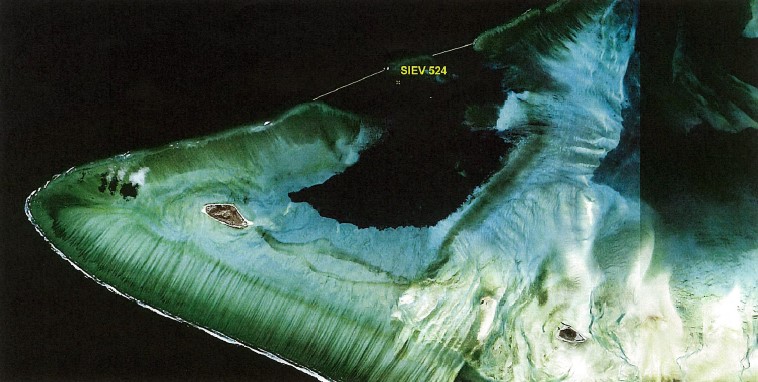
6 Sovereign ownership of the islands were contested during the 19th century between the United Kingdom, United States and the Netherlands. The United Kingdom ultimately prevailed. In 1909, the United Kingdom confirmed British sovereignty over Ashmore Reef and annexed nearby Cartier Island. Alan Kerr’s book A Federation in These Seas: An account of the acquisition by Australia of its external territories (Attorney General’s Department, 2009) (‘A Federation in these Seas’) at p 195 quotes the following account of Commander Fred Pasco on the annexation of Cartier Island:
‘Owing to strong trade wind blowing landing was not possible on that day. On Sunday morning the 16th May the wind was considerably less and landing was effected at 7a.m. Flagstaff erected, and the British Flag hoisted. A copy of the Proclamation, dated 17th May, in a glass jar, was secured to the Staff stating that the British Flag had been hoisted and the Island proclaimed as a part of the British Dominions… The Guard gave the general salute and the ship saluted with 21 guns. Three cheers were then given for the King.’
7 The United Kingdom eventually transferred sovereignty of Ashmore Reef and Cartier Island to Australia in 1932 by Order-in-Council which was accepted by the Commonwealth government under s 5 of the Ashmore and Cartier Island Acceptance Act 1933 (Cth). Under ss 6-8 of that Act, administration of the Territory fell primarily to the Western Australian government, apparently because the primary issue facing the islands concerned fishing and that there was ‘practically no danger’ of prohibited immigration to the islands: see A Federation in These Seas at p 197. Importantly, by s 7 of the Act, no Commonwealth Acts were to have force in the Territory unless expressed to do so.
8 Below the sovereignty disputes and transfers between European powers and Australia, Indonesian fishermen have fished in and around Ashmore Reef since at least the early 18th century. Traditional Indonesian fishing rights have been formally recognised by Australia since 1974 by a Memorandum of Understanding (‘MoU’) between Australia and Indonesia. By Art 3 of the MoU, Indonesian fishermen may fish and take shelter within the island groups, but fishermen may not set foot on the islands unless for the purposes of obtaining supplies of fresh water. These rights are reflected in regs 2.40(1)(t) and 2.40(16) of the Migration Regulations 1994 (Cth) which list these fishermen as persons taken to have special purpose visas for the purposes of s 33(2) of the Migration Act.
9 The Ashmore Islands reef system is also ecologically significant. By proclamation on 16 August 1983 the Commonwealth declared Ashmore Reef the ‘Ashmore Reef National Nature Reserve’ under s 7(2) of the National Parks and Wildlife Conservation Act 1975 (Cth) (‘NPWC Act’). By proclamation on 3 September 1997 pursuant to reg 31(2) of the National Parks and Wildlife Regulations 1977 (Cth), access to most of Ashmore Reef was prohibited to all persons except Commonwealth personnel. That prohibition remained operative when the Environment Protection and Biodiversity Act 1999 (Cth) (‘EPBC Act’) replaced the National Parks and Wildlife Act 1975 (Cth) in 2000. The Environmental Reform (Consequential Provisions) Act 1999 (Cth) repealed the NPWC Act, but preserved the Ashmore Reef National Nature Reserve as if it had been declared under the EPBC Act. Similarly, by reg 20.02 of the Environment Protection and Biodiversity Regulations 2000 (Cth), the delegated instrument of 3 September 1997 under the NPWC Act prohibiting access to Ashmore Reef was made effective under the EPBC Act.
10 The map below illustrates the very limited area which the public is permitted to access on Ashmore Reef:
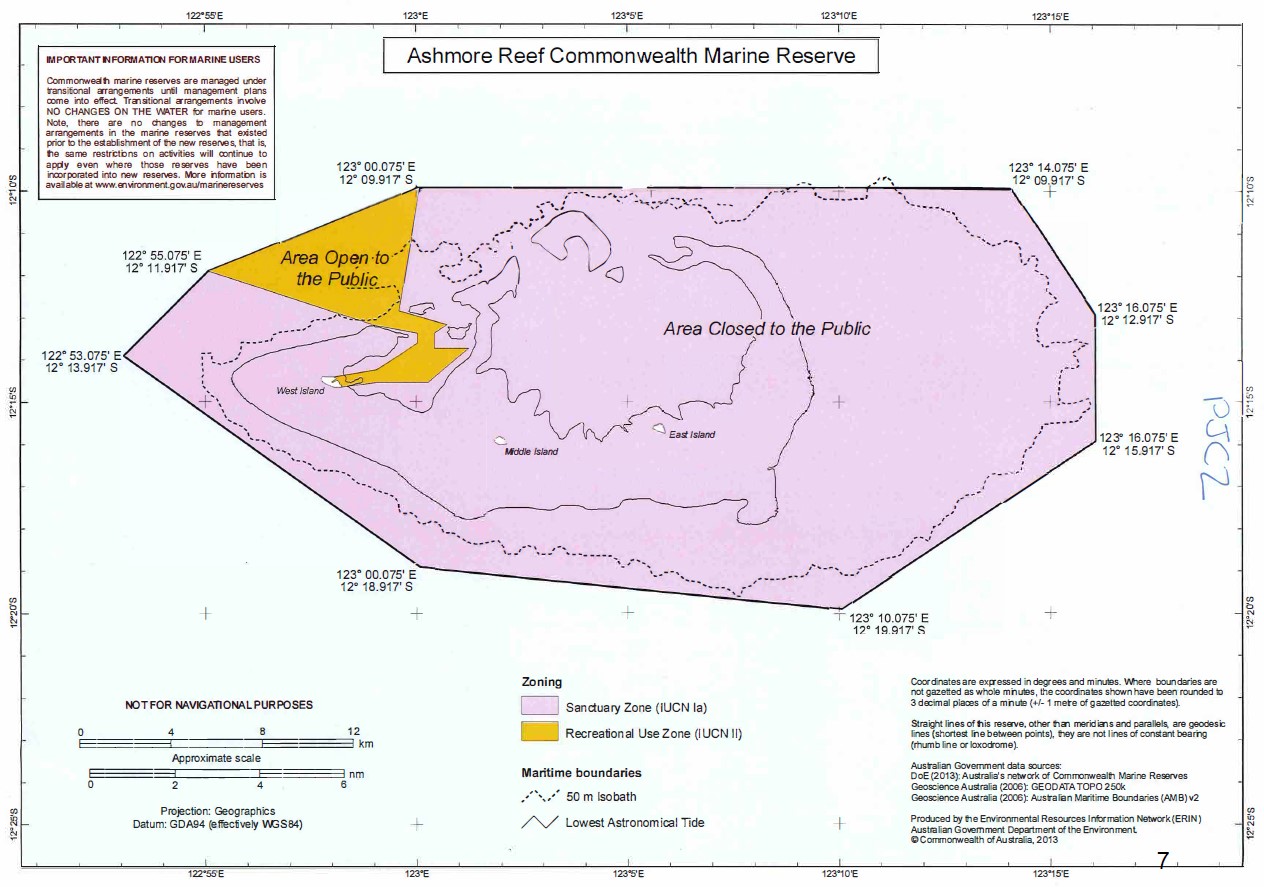
11 It was to this desolate but heavily regulated place that the Appellant was brought early on the morning of 7 November 2012. Having left Bangladesh he arrived in Australia in waters on a vessel known as Cadillac or SIEV524. Cadillac was intercepted about 4 nautical miles east of the reef early on the morning of Wednesday 7 November 2012 by HMAS Bathurst. Because the waters in which the interception occurred had not been surveyed a decision was made by those in charge not to board the Cadillac at that time. Instead, it was escorted to the Western Lagoon within the Ashmore Reef where, at 2.08am local time, it was boarded by a boarding party. The boarding party determined that the Cadillac had on board two Indonesian crew members and 79 passengers amongst whom was the Appellant. Later that day, following processing, the Appellant was disembarked from the Cadillac and embarked on a vessel operated by the Australian Customs and Border Protection Service for passage to Darwin. The Appellant arrived in Darwin on 12 November 2012.
3. Fast track applicants
12 Returning to the question before the Court, it is necessary to consider the statutory scheme that confers jurisdiction on the Authority to review the delegate’s decision under Part 7AA of the Migration Act. The Authority’s jurisdiction is conferred by s 473DB(1) which requires it to ‘review a fast track reviewable decision referred to it under s 473CA’. Section 473CA requires the Minister to refer to the Authority a ‘fast track reviewable decision’ as soon as possible. In practical terms, this means that all fast track reviewable decisions are automatically subject to review without the need for any application for review by the applicant.
13 A ‘fast track reviewable decision’ is defined in s 473BB relevantly as a ‘fast track decision in relation to a fast track applicant’. ‘Fast track decision’ is defined in s 5 to mean relevantly a ‘decision to refuse to grant a protection visa to a fast track applicant’. A ‘fast track applicant’ is in turn defined in s 5 to mean:
‘(a) a person:
(i) who is an unauthorised maritime arrival and who entered Australia on or after 13 August 2012, but before 1 January 2014, and who has not been taken to a regional processing country; and
(ii) to whom the Minister has given a written notice under subsection 46A(2) determining that subsection 46A(1) does not apply to an application by the person for a protection visa; and
(iii) who has made a valid application for a protection visa in accordance with the determination; or
(b) a person who is, or who is included in a class of persons who are, specified by legislative instrument made under paragraph (1AA)(b).’
14 Accordingly, the Authority had jurisdiction to review the delegate’s decision only if the Appellant met the definition of a ‘fast track applicant’. As to (a)(i) of the definition, the Appellant arrived in Australian waters on 7 November 2012 and was taken to the Western Lagoon of Ashmore Reef before being taken to Darwin. The Appellant therefore falls within the limited date range specified in (a)(i). It was not submitted by either party that the matters in (a)(ii) or (iii) were not satisfied. The critical issue which divides the parties, therefore, is whether the Appellant was an ‘unauthorised maritime arrival’ under (a)(i). If he was then he is a fast track applicant but not otherwise.
15 ‘Unauthorised maritime arrival’ is defined in s 5AA(1) in these terms:
‘5AA Meaning of unauthorised maritime arrival
(1) For the purposes of this Act, a person is an unauthorised maritime arrival if:
(a) the person entered Australia by sea:
(i) at an excised offshore place at any time after the excision time for that place; or
(ii) at any other place at any time on or after the commencement of this section; and
(b) the person became an unlawful non‑citizen because of that entry; and
(c) the person is not an excluded maritime arrival.
…’
16 Section 5AA commenced on 1 June 2013 which was after the date of the Appellant’s arrival on 7 December 2012. Accordingly, s 5AA(1)(a)(ii) does not apply and the relevant part of the definition is subs (1)(a)(i). It involves two concepts, that of an ‘excised offshore place’ and that of the ‘excision time’.
17 The resonant expression ‘excised offshore place’ in s 5AA(1)(a)(i) is defined in s 5 to mean:
‘excised offshore place means any of the following:
(a) the Territory of Christmas Island;
(b) the Territory of Ashmore and Cartier Islands;
(c) the Territory of Cocos (Keeling) Islands;
(d) any other external Territory that is prescribed by the regulations for the purposes of this paragraph;
(e) any island that forms part of a State or Territory and is prescribed for the purposes of this paragraph;
(f) an Australian sea installation;
(g) an Australian resources installation.’
18 It will be seen that the Ashmore Islands Territory is an excised offshore place. One must then ask what the excision time for that place is. This is defined in s 5 to be 2 pm on 8 September 2001. It will be observed that the Appellant was certainly at the Western Lagoon of Ashmore Reef within the Territory after that time. However, the requirement of s 5AA(1)(a)(i) is not that he should have been there; rather it is that he should have ‘entered Australia by sea’ there.
19 The expression ‘entered Australia by sea’ is defined in s 5AA(2) relevantly as follows:
‘(2) A person entered Australia by sea if:
(a) the person entered the migration zone except on an aircraft that landed in the migration zone; or
…’
20 So, in order to have entered Australia by sea at the Territory it was necessary for the Appellant to have entered the ‘migration zone’. The ‘migration zone’ is defined in s 5 in these terms:
‘migration zone means the area consisting of the States, the Territories, Australian resource installations and Australian sea installations and, to avoid doubt, includes:
(a) land that is part of a State or Territory at mean low water; and
(b) sea within the limits of both a State or a Territory and a port; and
(c) piers, or similar structures, any part of which is connected to such land or to ground under such sea;
but does not include sea within the limits of a State or Territory but not in a port.’
(emphasis added)
21 The Western Lagoon of Ashmore Island was accepted by both parties to be sea within the limits of the Ashmore Island Territory. It was also accepted that the effect of subclause (b) of the definition and the chaussure was that an area of sea that lay within the Territory would not be part of the migration zone unless the area were also a ‘port’. The expression ‘port’ is defined in s 5 of the Act in these terms:
‘port means:
(a) a proclaimed port; or
(b) a proclaimed airport.’
22 A power to proclaim ports is conferred by s 5(5):
‘(5) The Minister may, by notice published in the Gazette:
(a) appoint ports in an external Territory to which this Act extends as proclaimed ports for the purposes of this Act and fix the limits of those ports; and
(b) appoint airports in an external Territory to which this Act extends as proclaimed airports for the purposes of this Act and fix the limits of those airports.
…’
23 In summary, the Appellant was a ‘fast track applicant’ subject to Part 7AA review only if he entered the migration zone at Ashmore Reef as an excised offshore place, but would not be a ‘fast track applicant’ if he instead entered Australia at Darwin. Since the Appellant did not step foot on land at Ashmore Reef, the Western Lagoon had to have been proclaimed to be a port for him to have entered the migration zone at Ashmore Reef.
24 That was also the conclusion of this Court in Sadiqi v Commonwealth (No 2) [2009] FCA 1117; 181 FCR 1 (‘Sadiqi’). In that case, an asylum seeker had been taken to the Western Lagoon of Ashmore Reef on 8 November 2001 and thereafter departed Ashmore Reef on 11 November 2001 bound for Christmas Island. The parties agreed and McKerracher J found that the plaintiff had not entered Australia on 8 November 2001 on arrival in the Western Lagoon of Ashmore Reef: see 30-32 [108]-[120]. At that time a port had not been proclaimed on Ashmore Reef. The correctness of that conclusion was not challenged in this appeal.
25 On 23 January 2002, however, the then Minister declared an area within the Territory to be a proclaimed port. The declaration was in the following terms:
‘I, PHILIP RUDDOCK, Minister for Immigration and Multicultural and Indigenous Affairs acting under paragraph 5(5)(a) of the Migration Act 1958 (the Act):
APPOINT as a proclaimed port for the purposes of the Act the area of waters within the Territory of Ashmore and Cartier Islands commencing at a point on the Mean Low Water (MLW) line closest to Latitude degree 13.2 minutes 122 degrees 59.0 minutes then following the line of MLW in an anticlockwise direction so as to enclose a bay by bridging across islands of MLW at the entrance to the bay to close back to the point of commencement.’
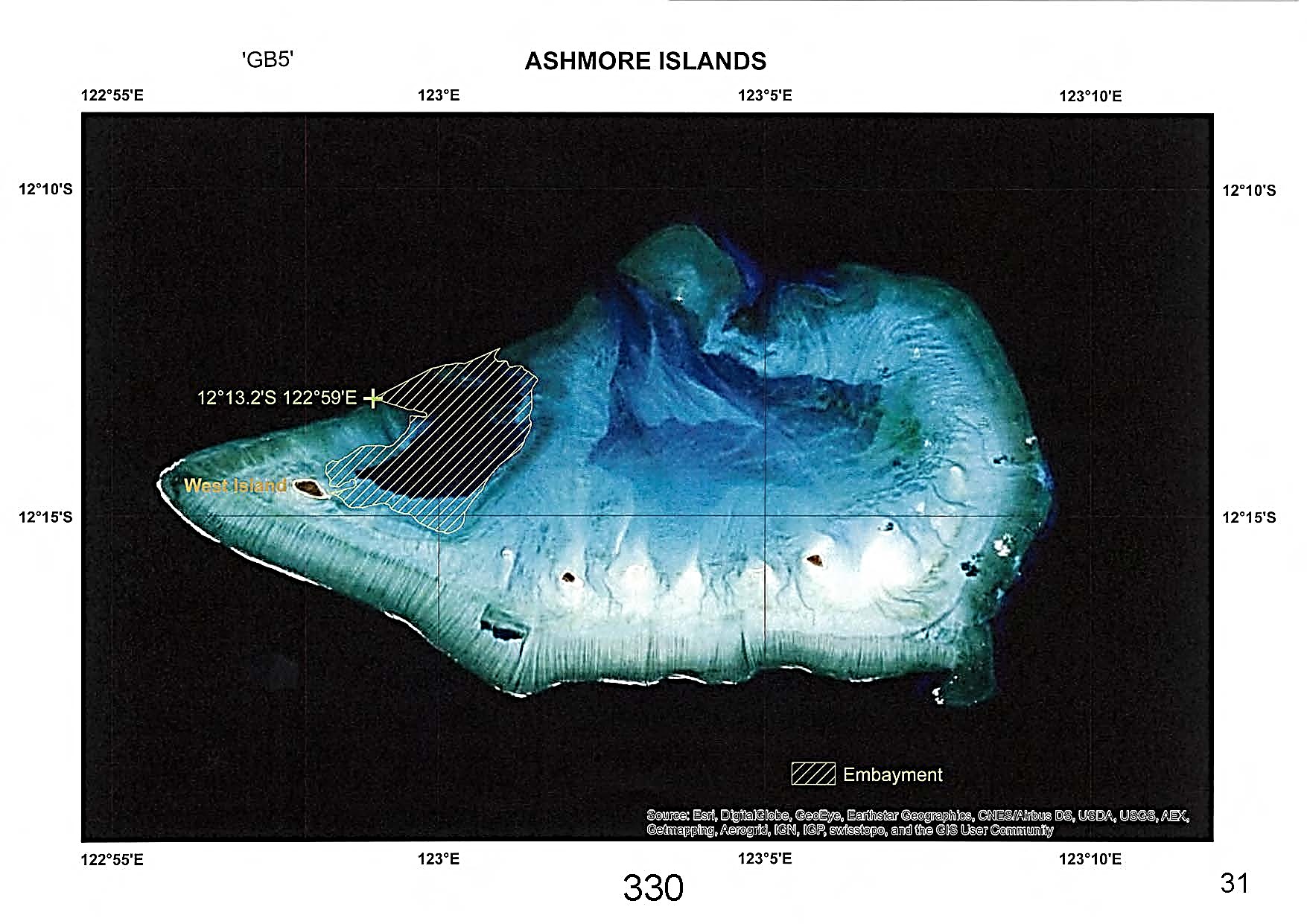
26 This was too late to avoid the result in Sadiqi but not too late for this appeal. Although there is some debate about this, the Minister now submits that this instrument has had the effect of accurately describing the Western Lagoon of Ashmore Reef (at section 9 below we explain why we accept the Minister’s contention in that regard) and purportedly appointing it as a prescribed port under the Migration Act. A map of the Ashmore Islands Territory showing the Western Lagoon and the hatched area purportedly appointed as a proclaimed port look like this:
27 The Appellant now alleges that this instrument of appointment is invalid for three reasons. First, the Minister’s power to appoint a port was limited to physical locations or facilities which could, as a matter of ordinary English, actually be said to be ports. The Western Lagoon was a shallow lagoon on an uninhabited coral and sand reef in the Indian Ocean and was not a port. Secondly, it was said that the Minister, in appointing the Western Lagoon as a port, had been actuated by extraneous purposes so that the exercise of the power was vitiated. Thirdly, it was submitted that the terms of the instrument of appointment contained errors and omissions which rendered it uncertain so that the exercise of the power was again vitiated.
4. Statutory construction
(i) The use of the word ‘port’ in the Migration Act
28 The issue which arises is the meaning of the word ‘port’ in the power to ‘appoint ports in an external Territory as proclaimed ports’ in s 5(5). The Migration Act uses the word ‘port’ in two senses of the word. The first is the prescribed meaning of the word ‘port’ as defined by s 5:
‘port means:
(a) a proclaimed port; or
(b) a proclaimed airport.’
29 The second is the non-prescribed, ordinary meaning of the word ‘port’ used in s 5 as italicised below:
‘(5) The Minister may, by notice published in the Gazette:
(a) appoint ports in an external Territory to which this Act extends as proclaimed ports for the purposes of this Act and fix the limits of those ports; and
(b) appoint airports in an external Territory to which this Act extends as proclaimed airports for the purposes of this Act and fix the limits of those airports.
…’
30 It is clear that the meaning of the word ‘port’ as italicised above is not the prescribed meaning as defined by s 5 because otherwise it would be circular if only proclaimed ports could be proclaimed to be ports. Therefore, the proviso of ‘unless the contrary intention appears’ in s 5 is engaged.
31 The second ordinary meaning of the word ‘port’ is only used in s 5(5); all other references to ‘port’ in the Migration Act are to the first prescribed meaning of the word ‘port’ being a proclaimed port. It is therefore helpful henceforth to refer to proclaimed ports as big-P Ports and ports in the ordinary sense as small-p ports. In other words, the Minister could only appoint ports to be Ports.
32 There were three strands to the Appellant’s argument although they were not all distinct. First, the only Ports which could be appointed by the Minister were places which were, in fact, ports as a matter of ordinary English. The Western Lagoon could not be a port in that sense. Secondly, because a proclaimed Port could be a port proclaimed under the Customs Act 1901 (Cth) (‘Customs Act’) or a port declared under the Migration Act, the same kinds of port must have been in contemplation under both statutes. It was plain that the Western Lagoon could not be a port under the Customs Act, hence, it could not be a port under the Migration Act either. Thirdly it was apparent that certain provisions of the Migration Act did not operate coherently if an empty body of water were to be appointed as a Port.
(ii) Principles of statutory construction
33 The question of what a port is for the purposes of s 5(5) is a question of statutory interpretation. That question to be answered by beginning with a consideration of the text itself: Alcan (NT) Alumina Pty Ltd v Commissioner of Territory Revenue [2009] HCA 41; 239 CLR 27 at 46-47 [47]. If the meaning is clear it cannot be displaced by historical considerations or extrinsic materials. Nevertheless, the meaning of the text may require a consideration of the context in which the text appears which includes the general purpose and policy of the provision as well as any mischief it is seeking to remedy.
34 The ordinary meaning of the word used is part of this analysis. The High Court threw light on that issue in SZTAL v Minister for Immigration and Border Protection [2017] HCA 34 at [14]:
‘14. The starting point for the ascertainment of the meaning of a statutory provision is the text of the statute whilst, at the same time, regard is had to its context and purpose: Project Blue Sky Inc v Australian Broadcasting Authority (1998) 194 CLR 355 at 381-382 [69]-[71]; [1998] HCA 28; Alcan (NT) Alumina Pty Ltd v Commissioner of Territory Revenue (2009) 239 CLR 27 at 46-47 [47]; [2009] HCA 41. Context should be regarded at this first stage and not at some later stage and it should be regarded in its widest sense: CIC Insurance Ltd v Bankstown Football Club Ltd (1997) 187 CLR 384 at 408; [1997] HCA 2. This is not to deny the importance of the natural and ordinary meaning of a word, namely how it is ordinarily understood in discourse, to the process of construction. Considerations of context and purpose simply recognise that, understood in its statutory, historical or other context, some other meaning of a word may be suggested, and so too, if its ordinary meaning is not consistent with the statutory purpose, that meaning must be rejected.’
35 One is not therefore required to ignore the ordinary meaning of a word used by Parliament when construing it. Consequently, the process of construction does not treat the word as a cipher whose meaning is only to be discerned from the surrounding statutory context. The word’s ordinary meaning and the statutory context are both legitimate inputs in the process of construction. SZTAL shows, however, that – if necessary – it is the statutory language which prevails.
36 The question before the Court is not to provide an exhaustive meaning of the word ‘port’ as it appears in s 5(5). Rather, it is whether the Western Lagoon on Ashmore Reef is a ‘port’ in the sense that the word is used in s 5(5). Despite this limited scope, the process of construction in this case is, perhaps, more complex than in most cases. We approach it in the following way:
(a) the statutory context;
(b) judicial consideration of the word ‘port’;
(c) the ordinary meaning of the word ‘port’;
37 The conclusion we reach at the end of that process is that the Western Lagoon of Ashmore Reef was and is not a port as the term is used in s 5(5) of the Migration Act. We then consider the Minister’s additional submission that the extension of the Migration Act to the Territory in 1997 requires the conclusion that the meaning of the word ‘port’ was altered so as to include the state of affairs then obtaining at the Western Lagoon of Ashmore Reef.
5. Text and context
(i) The Statutory Context
38 As noted above at [30], the non-prescribed meaning of ‘port’ is only used once in s 5(5) of the Migration Act; all other references to ‘port’ are to the prescribed term Port as a proclaimed Port. Nevertheless, it is instructive to consider significance of Ports in the scheme of the Migration Act as it was on 23 January 2002 (the date of the Minister purported appointment of a Port on Ashmore Island) in order to determine what kind of places Parliament intended to be proclaimed as Ports.
39 The concept of a Port was and remains significant to the concept of the migration zone and immigration clearance. Under s 5 a person enters Australia by entering the migration zone which includes, inter alia, land within a State or Territory and the sea within a Port but not the sea outside a Port. Leaving aside some other presently immaterial circumstances, s 43 requires a visa holder only to enter Australia at a Port. Once a person enters Australia they are required under s 166 to present themselves for immigration clearance.
40 Section 166 (as at 23 January 2002) provided:
‘166 Persons entering to give certain evidence of identity etc.
(1) Subject to subsections 167(3) and (4), this section and sections 168 and 169, a person, whether a citizen or a non‑citizen, who enters Australia must, without unreasonable delay:
(a) show a clearance officer:
(i) if the person is a citizen (whether or not the person is also the national of a country other than Australia), the person’s Australian passport or prescribed other evidence of the person’s identity and Australian citizenship; and
(ii) if the person is a non‑citizen, evidence of the person’s identity and of a visa that is in effect and is held by the person; and
(b) give the clearance officer any information required to be given by this Act or the regulations.
(2) Subject to section 167, a person is to comply with paragraphs (1)(a) and (b) in a prescribed way.
(3) A person is taken to have complied with subparagraph (1)(a)(i) if a clearance officer knows or reasonably believes that the person is an Australian citizen.’
41 A clearance officer was defined under s 165 to be an officer, or other person, authorised by the Minister to perform duties for the purposes of immigration clearance. Section 166 needed to be complied with at the Port of entry unless an officer otherwise directs:
‘167 When and where evidence to be given
(1) Subject to this section, a person required to comply with section 166 who enters Australia at a port must comply:
(a) if paragraph (b) or (c) does not apply—at that Port; or
(b) if the person is required by an officer to comply at a particular on‑Port—at that on‑Port; or
(c) if the person is allowed by an officer to comply at the Port or a particular on‑Port—at either of them.’
42 A person who arrives at a Port becomes immigration cleared if, and only if, they comply with s 166 and leave the Port with the permission of the clearance officer. That is provided by s 172 which relevantly provided:
‘172 Immigration clearance
(1) A person is immigration cleared if, and only if:
(a) the person:
(i) enters Australia at a Port; and
(ii) complies with section 166; and
(iii) leaves the Port at which the person complied and so leaves with the permission of a clearance officer and otherwise than in immigration detention; or
…’
43 Under ss 173-174, a person’s visa will cease if they fail to enter Australia in accordance with s 43 (i.e. at a Port) or fail to present themselves to an officer at that Port in accordance with s 166. The effect of these provisions in the case of persons not arriving in planes is that a visa holder must enter Australia at a Port and present themselves to a clearance officer to be immigration cleared.
44 These provisions – especially s 166 – suggest that a fundamental feature of a Port is that it is a place where a non-citizen holding a visa can be immigration cleared. The reference in s 172(1)(c)(iii) to a person being immigration cleared if, and only if, they leave the relevant Port with the permission of the clearance authority is important too. It shows that it must be possible to leave the Port to complete the process of immigration clearance. Regardless, the provisions strongly suggest that a Port is where immigration clearance occurs. That understanding is consistent with the explanatory memorandum which accompanied the statute which introduced the concept of the migration zone and immigration clearance into the Migration Act in 1992. This was the Migration Reform Act 1992 (Cth). At [19]-[20] of the explanatory memorandum this was said:
‘19. The Reform Bill will enhance the powers in the Principal Act to control the processing and identification of person arriving in or departing from Australia. At present the Principal Act does not explicitly state the requirement that persons arriving in Australia must undergo immigration clearance. The Reform Bill provides that upon entry, all person, including Australian citizens, will be required to present themselves for immigration clearance.
20. The Reform Bill also provides immigration authorities with the power to identify, and collect information from, persons arriving in or departing from Australia and persons on the domestic sectors of international flights who may have mixed with uncleared international passengers. In relation to persons on domestic sectors this will be a discretionary power which will be applied where necessary.’
45 This confirms that immigration clearance is to occur at a Port. Of course, the question is what kind of place is a ‘port’ which can be appointed under s 5(5) as a proclaimed Port. The answer to that is that a fundamental feature of ports is that they must be reasonably adapted to the process of immigration clearance.
46 On that view, the Western Lagoon cannot be a port. A visa holder who arrived at the Western Lagoon would be entitled to do so but there is no infrastructure there which would permit immigration clearance to occur. Further, it would be unlawful for any such person to leave the ‘port’ because of the environmental regulation of Ashmore Reef. Since leaving a Port is an indispensable part of immigration clearance, the Western Lagoon cannot be used for immigration clearance.
47 The Minister sought to avoid these problems by pointing out that under s 167(1)(b) such a visa holder might be directed to proceed to another Port (an ‘on-Port’) for immigration clearance. However, that could not be so unless an officer so directed and there is no evidence of the presence of any such officers in the Western Lagoon directing arriving visa holders to another port.
48 Further, the importance of immigration clearance at Ports is apparent from the explanatory memorandum to Migration Reform Bill 1992 (Cth) (referred to at [44] above):
‘16. The Principal Act currently provides for a number of different statuses which may be applicable to persons who are in Australia, eg illegal entrants, prohibited entrants, unprocessed persons, designated persons. The proliferation of statuses has resulted in part from the existing definition of entry to Australia which deems some persons not to have entered Australia, for the purposes of the Principal Act, notwithstanding that they are physically present in Australia.
17. The Reform Bill addresses this situation by simplifying the definition of entry to Australia – the Bill redefines “entry” to occur when a person lands in an aircraft in the ‘migration zone’, or, if in a boat, when the boat enters a Port or attaches to land in the ‘migration zone’. The ‘migration zone’ is defined to mean the area consisting of the States, the Territories, Australian resource installations and Australian sea installations. This will eliminate the present distinction between physical arrival in Australia and entry as defined in the Act, which leads to the result that a person can be in Australia for a significant period without legally ‘entering’.
49 It is clear that Parliament considered immigration clearance at airports and Ports to be the solution to the mischief at which the 1992 reforms were directed, namely reducing the complexity of the legal statuses of persons entering Australia. This intention is reflected in s 43 of the Migration Act referred to above. We therefore cannot accept the Minister’s submission that the ability to direct persons to on-Ports renders immigration clearance to be a non-essential feature of a port.
(ii) Judicial consideration of ‘port’
50 The word ‘port’ is a word which has been judicially considered more than once. Save, however, for the observation by Lord Halsbury in Hunter v Northern Marine Insurance Company, Limited (1888) 13 App Cas 717 at 722 that the meaning of the word was ‘undoubtedly ambiguous’, resort to the corpus of this material is not overly helpful as each turns on its own particular context. As Barton J observed in Commonwealth v Huon Channel and Peninsula Steamship Company Limited [1918] HCA 18; 24 CLR 385 at 391, a case concerning the Lighthouses Act 1911 (Cth), the meaning one attributes to the word ‘depends entirely on the sense in which the term is used, and the sense depends largely, perhaps altogether, on the kind of document in which the term is found’. Although interesting, it is therefore not especially useful to know what ‘port’ means in the Hague Convention of 1907 (The Möwe [1915] P 1; The Belgia [1916] 2 AC 183) or in the Immigration Restriction Act 1901 (Cth) (Muller v Dalgety & Co Limited [1909] HCA 67; 9 CLR 693) or under the Marine Act 1976 (Tas) (Switzerland Insurance Australia Limited v Mowie Fisheries Pty Ltd [1997] FCA 231; 74 FCR 205) or the meaning given to it by Sir Matthew Hale in De Portibus Maris in 1787 (‘It is a place for arriving and unlading of ships or vessels’). The question is what meaning best fits the particular statute.
(iii) The dictionary definitions of ‘port’
51 The Minister in his submissions drew the Court’s attention to the dictionary definitions of ‘port’ in the Macquarie Dictionary and Oxford English Dictionary.
52 From the Macquarie Dictionary, the Minister presented two ordinary meanings of ‘port’ in the following terms: a ‘place along the coast where ships may take refuge from storms’; or ‘any place where persons may be allowed to pass into a country’.
53 The actual text Macquarie Dictionary defines ‘port’ as having three meanings:
‘noun. 1. a town or place where ships load or unload.
2. a place along the coast where ships may take refuge from storms.
3. Law. any place where persons and merchandise are allowed to pass (by water, land, or air) into and out of a country and where customs officers are stationed to inspect or appraise imported good; port of entry.’
54 It appears that the Minister relied upon definitions 2 and 3, although the Minister only provided an abridged version of definition 3 by deleting words such as ‘merchandise’, ‘customs officials’ and ‘inspection and appraisal of goods’.
55 With respect to definition 2, we do not accept that the power of the Minister under the Migration Act to appoint a place as a Port is limited to places along the coast where ships may take refuge from storms. This is not consonant with the legislative context in which Port appears as discussed above. Further, as will be seen below, whilst the legislative history of the word ‘port’ in the Migration Act is reasonably complex, not once has it ever been suggested that it has anything to do with sheltering ships from storms.
56 The submission has other problems too. It may be doubted, for example, that the Western Lagoon is ‘a place along the coast’ when it would appear to be a shallow inlet on a sandy coral reef in the Indian Ocean at the edge of the continental shelf. Then there is the not insignificant problem that there is no evidence to suggest that the Western Lagoon is in fact a place where ships take refuge from storms. The Minister was driven to the submission that one could infer that it could be used that way because it was lagoon, a submission itself in a need of a port in this sense of the word. There is the further difficulty that many places where ships take shelter from storms do not lie within the sea of a Territory (the only waters to which the power to appoint ports extends) but instead inside the territorial sea which belongs to the Commonwealth. The argument from definition 2 should be rejected.
57 On its face the Minister’s resort to definition 3 does not appear to help him either. The Western Lagoon is not a place where persons and merchandise are allowed to pass into and out of Australia and where customs officers are stationed to inspect or appraise imported goods. It is instead part of a marine park to which the public largely has no access and into most of which it is an offence to enter. There are no customs officials stationed there and there are no goods being appraised or inspected. The Minister’s submission should be rejected.
58 The word ‘port’ is also defined in the Oxford English Dictionary (‘OED’) to have many meanings. The most apposite are:
‘Meaning 1a:
A town or place possessing a harbour which boats use for loading or unloading, or which forms the starting point or destination of a voyage; spec. such a place where charges may be levied under statute or by prescription on boats making use of the facilities. Now also occasionally: an inland port.
Meaning 1b:
a harbour, airport, or border crossing through which people and goods may enter a country, esp. under customs and immigration supervision
Meaning 3:
A place on a coast or shore which boats use to shelter from storms, or to load and unload; a harbour, a haven.’
59 For reasons already given, this third meaning may be discarded.
60 What resort to these dictionary definition shows is that the word ‘port’ has a variety of meanings. Whilst there is no avoiding the statutory context, it is useful to observe that none of these definitions match the Western Lagoon at Ashmore Reef.
6. Legislative history
61 That would be the end of the matter but the Minister, however, submitted that the extension of the Migration Act to Ashmore Reef in 1997 meant that the Legislature had contemplated that a Port could be declared in that place. The Minister’s submission about this was brief but the legislative history of how the Migration Act came to be extended to the external territories is not. There are six parts to this history:
the Migration Act in its original form;
the extension of the Migration Act to the Territory of Christmas Island in 1980;
the extension of the Migration Act to the Territory of Cocos (Keeling) Islands and the Territory of the Coral Sea in 1986;
the creation of the ‘migration zone’ in 1992;
the extension of the Migration Act (and the migration zone) to Ashmore Reef in 1997; and
the ‘excision’ of the Ashmore Reef from the migration zone in 2001.
(i) Migration Act in its original form
62 In its original form, the Migration Act 1958 had several provisions dealing with Ports. The word ‘Port’ was defined in s 5(1) to be a proclaimed port or a proclaimed airport. But no power was originally given to the Minister to proclaim Ports. Instead ‘proclaimed Port’ was defined in s 5(1) to mean:
‘“proclaimed Port” means a Port established by a Proclamation in force under section fifteen of the Customs Act 1901-1957 or a Port that is continued under section eighteen of that Act as if established under that Act;’
63 Section 15 of the Customs Act 1901 in its original form provided:
‘15. The Governor-General may by proclamation –
(a) Appoint boarding stations for the boarding of ships by officers.
(b) Establish ports and fix their limits.
(c) Appoint wharfs within Ports and fix their limits.’
64 Upon the commencement of that Act the pre-existing regime of Ports under State law existing at Federation was picked up by s 18 which was in these terms:
‘18. All boarding stations Ports wharfs and examination places in actual use by authority at the commencement of this Act shall continue as if established or appointed under this Act.’
65 As originally passed it is clear therefore that what was a port for the purposes of the Migration Act could only be a port under the Customs Act. There were several provisions dealing with ports in that Act:
goods subject to export duty were to be subject to Customs control from the time they were brought to a Port until payment of the duty: s 30;
all goods on board a ship whilst in a Port were subject to Customs control: s 31;
the master of ship was not to enter any place other than a Port unless due to weather or another reasonable cause: s 58;
the master of a ship calling at a Port was to bring the ship for boarding at the boarding station appointed for that Port: s 60; and
the master of a ship departing a Port was required to receive a Certificate of Clearance from the Controller: s 118.
66 The Appellant submitted that these provisions showed that a port for the purposes of the Customs Act in 1901 was a facility from which ships came and went which were involved with the trading of goods. The Minister submitted that whilst that might often be the case it was not inevitably so and the word ‘port’ was not so confined. The Appellant’s submission is to be preferred. It is more consonant with the statutory context of the types of places contemplated to be proclaimed to be Ports.
67 Returning to the original form of the Migration Act, it too contained a number of provisions touching upon Ports. The effect of the definition in s 5(1) was to constrain the Migration Act’s use of the word ‘port’ to the meaning it bore under the Customs Act. Nevertheless, some of its original provisions should be noted:
the master of a vessel, upon arrival in a Port, was to present identification cards of the crew to an officer if requested and was not to depart until doing so: s 23;
the master of a vessel was to provide a list of any deserted crew members to an officer prior to departing a Port: s 24;
boarding stations could be appointed in Ports: s 32;
the master of a ship was to bring the ship to a boarding station upon calling at a Port and was not to leave the boarding station unless permitted by an officer: s 33(2);
a deportee may be kept in custody on board a vessel until its departure from its last Port of call in Australia: s 39(c).
68 These are probably more consistent with the Appellant’s construction of the word ‘port’ but this did not matter when the Migration Act was passed because the concept of ‘port’ was expressly linked to the Customs Act.
(ii) The Extension of the Migration Act to Christmas Island
69 Even though this case is concerned with Territory of Ashmore and Cartier Islands, the history of the legislative treatment of the word ‘port’ in the Migration Act requires an appreciation of the events which occurred on and leading up to the incorporation of Christmas Island into Australia. What is presently the Territory of Christmas Island is located about 350km south of Java and around 1,550km north-west of mainland Australia. It was administered by Imperial authorities as part of the colony of Singapore until 1 October 1958 when it was transferred by an Order-in-Council to Australia. The reasons for the transfer appear to have been related to a desire to preserve the phosphate reserves of the island from Singaporean control in the event of its independence from Imperial influence: see A Federation in these Seas at pp 320-326. In response, the Commonwealth passed the Christmas Island Act 1958 (Cth).
70 As a former part of Singapore, Christmas Island had its own pre-existing system of Singaporean regulation including the Christmas Island Immigration Ordinance 1955 (Imp) which governed migration. Section 5 of the Christmas Island Act 1958 (Cth) created the Territory of Christmas Island. By s 7 as enacted, all the laws in force in Christmas Island immediately before 1 October 1958 continued in force (subject to any Commonwealth legislation). This included the Christmas Island Immigration Ordinance 1955 (Imp). Under s 15, residents of Christmas Island who were British subjects were permitted to become Australian citizens but were not required to do so.
71 Importantly, s 8(1) provided that ‘an Act or the provision of an Act (whether enacted before, on or after the proclaimed date) is not except as otherwise provided by that Act or by another Act, in force, as such, in the Territory, unless expressed to extend to the Territory’. At this time, the Customs Act 1901 was not expressed to extend to Christmas Island so the effect of s 8(1) was that it did not apply. Consequently, the Governor-General could not appoint a place as a proclaimed Port under the Customs Act in Christmas Island. The Migration Act came into force after the Christmas Island Act 1958 (Cth) came into effect. However, when it did so it was not then expressed to extend to Christmas Island either. Consequently, as at 1958 there was no power to proclaim a Port on Christmas Island.
72 In 1980, a decision was made to bring Christmas Island under the Migration Act 1958. The extension of the Migration Act to Christmas Island was done by the Migration Amendment Act (No 2) 1980 (Cth). Section 4 of that Act inserted a new s 5A into the Migration Act 1958 which provided:
‘(1) This Act extends to the Territory of Christmas Island.
(2) Subject to this Act, the Territory of Christmas Island-
(a) shall be deemed to be part of Australia for the purposes of this Act; and
(b) shall be deemed not to be a place outside Australia.’
73 Section 13 provided:
‘(1) Where an overseas vessel (within the meaning of section 12) was in port in the Territory of Christmas Island immediately before the commencement of this section, the Principal Act as amended by this Act applies to and in relation to the vessel and to members of the crew of the vessel as if the vessel had arrived at a port in Australia immediately after the commencement of this section.
(2) Where a member of the crew of an overseas vessel (within the meaning of section 12) that was in port in the Territory of Christmas Island immediately before the commencement of this section was absent from the vessel immediately before the commencement of this section, the Principal Act as amended by this Act applies to and in relation to that member of the crew, and to and in relation to the master of the vessel, as if the member of the crew had entered Australia from the vessel immediately after the commencement of this section.’
74 One immediate difficulty was that the port on Christmas Island could not be appointed as a Port under the Migration Act and the Customs Act because it was part of an external territory to which the Customs Act did not extend. To overcome this problem the Migration Act was amended at the same time so that a Port could be declared under it. It is the need to be able to appoint Ports in places to which the Customs Act did not extend which explains the need for a power to appoint Ports under the Migration Act. Section 3 of the amending Act amended the definition of proclaimed port so that it now read:
‘(a) a Port appointed under section 15 of the Customs Act 1901; or
(b) a Port appointed by the Minister under sub-section (1A).’
75 A new s 5(1A) was also inserted by s 3 in these terms:
‘(1A) the Minister may, by notice published in the Gazette –
(a) appoint ports in the Territory of Christmas Island as proclaimed Ports for the purposes of this Act and fix the limits of those Ports; and
(b) appoint airports in the Territory of Christmas Island as proclaimed airports or the purposes of this Act and fix the limits of those airports.’
76 The Explanatory Memorandum described the amendments this way:
‘Sub-clause 3(2) amends the definitions of “proclaimed airport” and “proclaimed Port”. These terms are defined by section 5 of the Act to mean ports and airports appointed under section 15 of the Customs Act 1901. As the Customs Act does not apply to Christmas Island, it is necessary for the Minister to be empowered to appoint ports and airports on Christmas Island as proclaimed Ports and airports or the purposes of the Migration Act. Paragraph (c) of sub-clause 3(2) provides that the Minister may, by notice published in the Gazette, appoint proclaimed Ports and airports, and their limits, in the Territory of Christmas Island.’
77 It was clear on the passage of the bill that there was a port on Christmas Island. Section 13 specifically referred to people who were in the port on the commencement of the legislation. In relation to that provision the Minister said on the second reading of the Bill:
‘Provision is made in clause 12(4)(b) for visitors to Christmas Island, who are lawfully present on the island on the commencing date, to be granted temporary entry permits permitting them to remain in Australia for the same period for which they had been authorised under the Territory ordinance to remain on the island. Special provision is made in clause 13 to ensure that the normal immigration requirements applicable to vessels and crew members will apply to vessels in port on Christmas Island on the commencing date.’
(emphasis added)
78 The port on Christmas Island was declared a Port on 22 January 1981. Section 3 (which provided the power to proclaim a Port on Christmas Island) came into effect on 23 January 1981. The legal consequences of this timing error may be significant but it is not necessary to consider them for the purposes of these reasons. In any event, these events rather suggest that no change to the meaning of ‘port’ was intended by the creation of the power in the Migration Act to appoint a Port at Christmas Island. The amendments were not to create a new kind of port for the Migration Act but just to overcome the fact that the Customs Act did not apply at Christmas Island.
(iii) The extension of the Migration Act to the Cocos (Keeling) Islands and the Coral Sea
79 In 1986 further amendments were made by the Statute Law (Miscellaneous Provisions) Act (No 2) 1986 (Cth). The effect of this Act was to extend the operation of the Migration Act to the Territory of Cocos (Keeling) Islands and the Coral Sea Islands Territory. This was done by means of a new s 5A:
‘Act to extend to certain Territories
“5A.
(1) In this section ‘prescribed Territory’, means the Coral Sea Islands Territory, the Territory of Cocos (Keeling) Islands and the Territory of Christmas Island.
(2) This Act extends to a prescribed Territory.
(3) Subject to this Act a prescribed Territory –
(a) shall be deemed to be part of Australia for the purposes of this Act; and
(b) shall be deemed not to be a place outside Australia.”’
80 The explanatory memorandum explained these amendments in these terms:
‘Proposed amendment of section 5A will extend the Act to the Territory of the Cocos (Keeling) Islands and to the Coral Sea Islands Territory. The proposed amendments to sub-sections 5(1) and 5(1A) and paragraph 5(4)(b) and section 57 make amendments consequent upon this extension.’
81 The second reading speech contained a small remark to the same effect.
82 A Port was appointed in the Cocos (Keeling) Islands on 17 August 1987. No Port appears to have been appointed for the Coral Sea Islands. This is consistent with the reality that it does not appear to include a physical port. There is no reason to think that these amendments altered the meaning of the word port.
(iv) The Creation of the migration zone in 1992
83 In 1992 a thorough revision of the Migration Act was achieved by means of the Migration Reform Act 1992 (Cth) to which reference has already been made. It replaced the former definition of Australia with a new expression the ‘migration zone’, which is already set out above and significantly amended the concepts of ‘enter Australia’ and ‘immigration clearance’ as set out above in section 5(i). It extended the Migration Act to a ‘Territory’ which was defined to mean an internal territory or an external territory to which the Act extended. By this time, as explained above, s 5A had extended the Migration Act to Christmas Island, Cocos (Keeling) Islands and the Coral Sea Islands. As at 1992, however, the migration zone did not include Ashmore and Cartier Islands, Heard Island and McDonald Islands or the Antarctic Territory. As a result, whilst those places were part of Australia they were not part of the migration zone.
(v) The extension of the Migration Act to Ashmore Reef in 1997
84 At some point the definition of a prescribed territory was moved to s 7. In 1997 cl 48 of Schedule 1 to the Environment, Sport and Territories Legislation Amendment Act 1997 (Cth) added ‘the Territory of Ashmore and Cartier Islands’ to the definition of a prescribed territory in s 7. At the same time the Customs Act was amended to authorise regulations extending its operation to the Territory. No such regulation has, however, been made. On the second reading of the bill the Minister observed:
‘The bill includes minor amendments to extend the Customs Act 1901, the Quarantine Act 1908 and the Migration Act 1958 so that the provisions of those acts may be applied to the Commonwealth Territory of Ashmore and Cartier Islands. There has been an increase in unauthorised arrivals on the Territory of Ashmore and Cartier Islands. The Government proposes to amend these acts to provide a legal basis for border control, including over possible importation of drugs, for control over vermin and the import of diseased wood or fibres. It also provides a sound platform for the orderly management of persons arriving in the Territory.’
85 This suggests that the extension to the Territory was to provide a legal basis for border control including drug control. Prior to the 1997 amendments there had been debate as to whether the people smuggling offence contained in s 233 of the Migration Act extended to Ashmore Reef and therefore whether people smugglers could be prosecuted: see, for example, Rutu v Dalla Costa (1997) 139 FLR 265 (‘Rutu v Dalla Costa’). At the time of the 1997 amendments, s 233 provided:
‘(1) A person shall not take any part in:
(a) the bringing or coming to Australia of a non-citizen under circumstances from which it might reasonably have been inferred that the non-citizen intended to enter Australia in contravention of this Act;
(b) the concealing of a non-citizen with intent to enter Australia in contravention of this Act; or
(c) the concealing of an unlawful non-citizen or a deportee with intent to prevent discovery by an officer.’
86 It is apparent that s 233 does not directly concern ports. The question of whether s 233 actually applied at Ashmore Reef was a significant issue for border control given the increase in unauthorised arrivals to Ashmore Reef as noted in the second reading speech set out above. The 1997 extension of the Migration Act to the Territory resolved this issue. After these changes, and consistent with that view, a report was sent to the presiding offices of Parliament by the Australian National Audit Office dated 17 February 1998 (Commonwealth, The Management of Boat People, Parl Paper No 32 (1998)). It suggested (at [3.16]-[3.31]) that the purpose of the 1997 amendments had been to overcome doubts as to whether the Migration Act had extra-territorial operation at Ashmore Reef (i.e. the point rejected in Rutu v Dalla Costa).
87 In light of the history, we cannot accept the Minister’s submission that the extension of the Migration Act to the Territory in 1997 showed that a port under the Migration Act could include the Western Lagoon. The purpose of the amendment was to provide a legal basis for border control, most likely relating to people smuggling. We do not read the amendments as effecting any change to the meaning of the word ‘port’.
(vi) The ‘excision’ of Ashmore Reef from the Migration Zone
88 On 27 September 2001 there came into effect the Migration Amendment (Excision from the Migration Zone) Act 2001 (Cth). This Act did not amend the definition of the migration zone and did not excise any places from that zone. Its title is therefore a misnomer. What it did instead was to create the concept of the ‘excised offshore place’ in s 5(1) which has already been set out above and which included the Territory of Ashmore and Cartier Islands, together with the concept of the ‘excision time’ (also set out above). A new s 46A was inserted which prevented persons who had arrived at an excised offshore entry place from applying for a visa unless the Minister decided that such an application could be made. It was from these amendments that the problem exposed by Sadiqi arose. Because Mr Sadiqi had failed to enter Australia by sea (because the Western Lagoon was not a Port) he also failed to enter the migration zone at an excised offshore place. This exposed a flaw in the definition of ‘off-shore entry person’ which was defined this way:
‘"offshore entry person" means a person who:
(a) entered Australia at an excised offshore place after the excision time for that offshore place; and
(b) became an unlawful non-citizen because of that entry.’
89 Mr Sadiqi failed to ‘enter Australia’ because it was defined to mean ‘enter the migration zone’ and Mr Sadiqi did not do that because the Western Lagoon was not a Port. This had the unintended consequence that Mr Sadiqi was not an offshore entry person. It was in the context of that drafting error that the Minister declared the Western Lagoon to be a Port.
7. Was the Western Lagoon validly declared to be a Port?
90 It follows from the above matters, that the Minister had no power to appoint the Western Lagoon to be a Port and the instrument doing so is invalid. Consequently the Authority had no jurisdiction to review the delegate’s decision and the appeal must be allowed.
8. Improper purpose
91 The Appellant submitted that the Minister had proclaimed the Port for purposes which were extraneous to the purposes of the Act. Since the power did not arise this issue does not directly arise. In the final form it was pursued it was, in effect, merely a variant of the first argument.
9. The form of the proclamation
92 The proclamation is set out above. The Appellant makes four points. First, it does not specify parallel of latitude. Secondly, it does not specify that the second co-ordinate is a meridian of longitude. Thirdly, the reference to ‘islands’ is obscure since there is only one relevant island. Fourthly, related to the third point, there are two ways of tracing the anti-clockwise path.
93 The first two points are of no merit. The instrument in question is a spatial delimitation. Its intended audience is cartographers and those involved in the reading and drafting of maps. Mr Boyes, a geographer, gave evidence that the absence of the word ‘longitude’ was irrelevant and that there could be no misunderstanding by people familiar with geographical co-ordinates that the second co-ordinate could not be a parallel of latitude.
94 The proclamation is neither an Act nor a legislative instrument so it is an instrument to which applies s 46 of the Acts Interpretation Act 1901 (Cth). The effect of s 46(1) is to require its interpretation to be approached as if it were a statute. A similar provision in the Legislation Act 2003 (Cth) requires subordinate legislation to be approached on the same basis: s 13. The significance of that matter is that it is well-accepted that certain kinds of regulation are addressed to practical people skilled in particular trades or industries and are construed in that practical light: Gill v Donald Humberstone & Co Ltd [1963] 1 WLR 929 at 933-934; Secretary, Department of Health v DLW Health Services Pty Ltd [2016] FCAFC 108; 246 FCR 456 at 471 [93]. We see no reason why the same approach would not be taken to the construction of an instrument to which s 46 applies.
95 It is therefore highly relevant that a geographer says that it would be obvious to anyone familiar with maps that the word ‘longitude’ had been omitted and that the reference to 112 degrees 59 minutes could be a reference to nothing else.
96 The same may be said of the fact that no degree of latitude is specified. Here Mr Boyes said there were only two degrees of latitude which intersected with the Territory and one of these was at sea. The reference could, in that circumstance, only be a reference to 12 degrees latitude.
97 The third and fourth points have marginally more substance. To understand the point it is necessary to have regard to a map of the lagoon (marked as A):
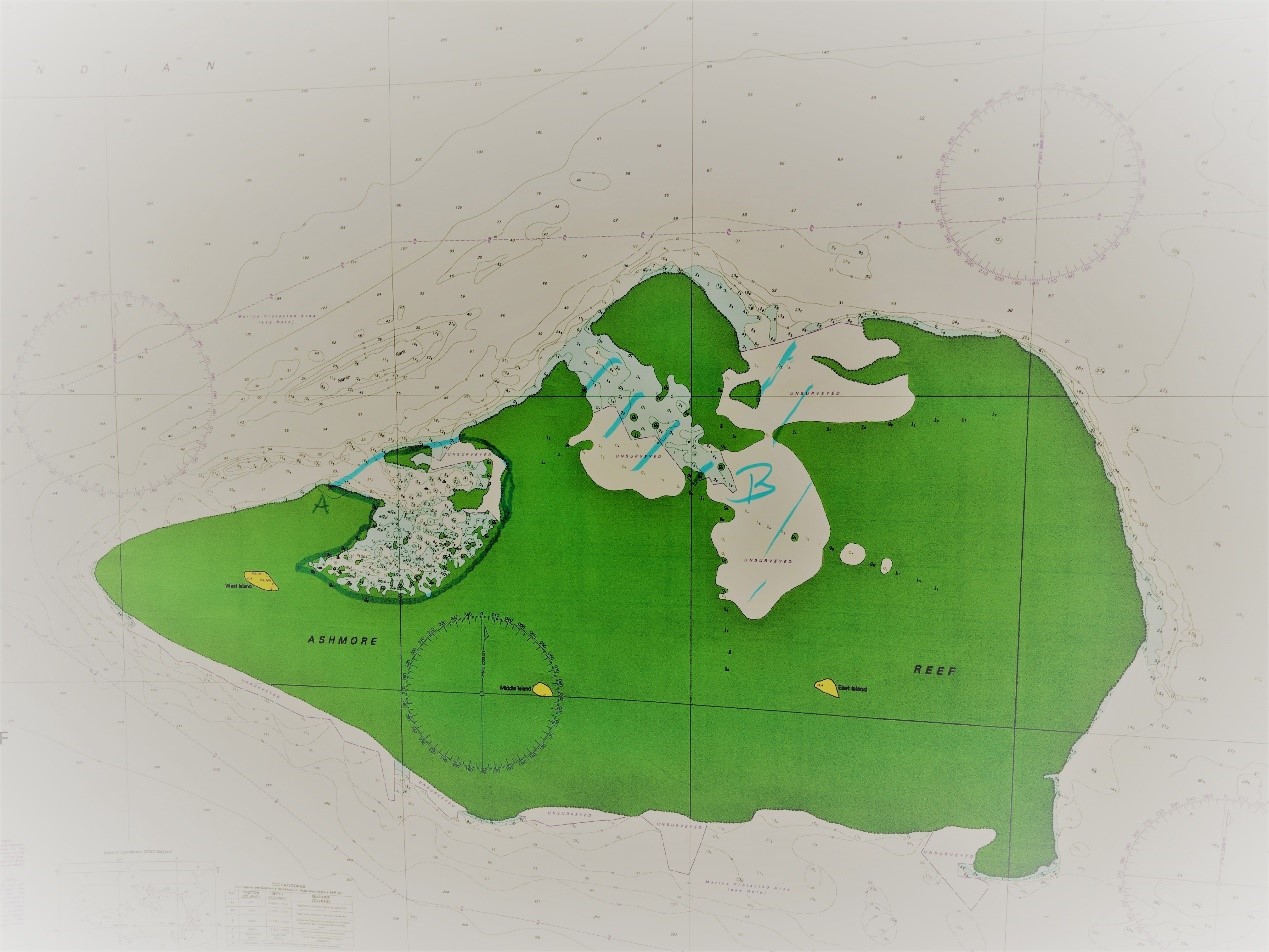
98 The point was that there was only one island within the Western Lagoon for the line to be drawn across whereas the proclamation referred to islands. However, the plural includes the singular: Acts Interpretation Act 1901 (Cth) ss 23(b), 46. The second point was that it was possible to proceed anticlockwise around the entire island rather than around the Western Lagoon, i.e., the description described two potential paths. However, the reference in the instrument to the bay make this an impossible reading.
10. Conclusion
99 The Appellant is entitled to succeed. It was for these reasons we made orders allowing the appeal on 6 August 2018.
I certify that the preceding ninety-nine (99) numbered paragraphs are a true copy of the Reasons for Judgment herein of the Honourable Justices Perram, Wigney and Lee. |


