

FEDERAL COURT OF AUSTRALIA
Stowers v Minister for Immigration and Border Protection [2018] FCAFC 174
ORDERS
Appellant | ||
AND: | MINISTER FOR IMMIGRATION AND BORDER PROTECTION Respondent | |
DATE OF ORDER: |
THE COURT ORDERS THAT:
2. The Court’s orders dated 11 April 2017 be set aside.
3. The appellant’s request for revocation of the decision dated 23 December 2016 be remitted to the respondent for reconsideration according to law.
4. The respondent pay the appellant’s costs of the appeal and of the proceeding below, as agreed or assessed.
Note: Entry of orders is dealt with in Rule 39.32 of the Federal Court Rules 2011.
THE COURT:
1 This appeal raises the question, in the context of the relevant statutory framework and factual circumstances here, whether procedural fairness requirements obliged the then Assistant Minister for Immigration and Border Protection (Assistant Minister) to do more than he did to put the appellant on notice of how material which was disclosed to the appellant might be used by the Assistant Minister in deciding whether or not to revoke a mandatory visa cancellation decision.
2 The appeal is from a decision dated 11 April 2018 by a Judge of this Court. The decision is reported as Stowers v Minister for Immigration and Border Protection [2018] FCA 485. The primary judge dismissed the appellant’s judicial review application and complaint of procedural unfairness in respect of a decision dated 9 August 2017 by the Assistant Minister not to revoke a decision dated 23 December 2016 to cancel the appellant’s Class TY Subclass 444 Special Category (Temporary) visa (the visa). The Assistant Minister’s decision was purportedly made under s 501CA(4) of the Migration Act 1958 (Cth) (the Act).
Summary of background facts
3 The appellant is a citizen of New Zealand. He came to Australia in 2005 when he was 19 years old.
4 The appellant’s visa was mandatorily cancelled under s 501(3A) of the Act because he had a “substantial criminal record” under s 501(7)(c) and consequently did not pass the “character test” in s 501(6)(a). He had a “substantial criminal record” because, on 22 July 2016, he was convicted in the Local Court in Gosford of five offences, including two counts of assault occasioning actual bodily harm for which he was sentenced to a 14 months term of imprisonment. The offences involved domestic violence. The appellant has a long criminal record in Australia dating back to 2008, including break and enter (2008); two convictions for driving while disqualified (for the first, in 2013, Mr Stowers was given a community service order and, for the second conviction, in 2014, he was sentenced to imprisonment for four months), failing to appear in accordance with a bail condition (2013) and driving while his licence was suspended (2010). Mr Stowers also had a criminal record in New Zealand, and was convicted of burglary in 2004 in the Manukau District Court.
5 By a letter dated 23 December 2016, the appellant was notified of the visa cancellation decision. The appellant was incarcerated at the time and he was subsequently taken into immigration detention, where he remains. He was invited under s 501CA(3) to make representations as to whether he passed the character test or whether there was “another reason” why the visa cancellation decision should be revoked. He was provided with a copy of Direction 65 (which contains directions given by the Minister under s 499 of the Act to decision-makers concerning the exercise of power to refuse or cancel a visa on character grounds and the exercise of power to revoke a mandatory cancellation of a visa). He was told that it identified issues that were relevant to the revocation request. The letter clarified that, although Direction 65 was binding on a delegate, if the Minister made a revocation decision personally, he or she was not bound by Direction 65, “although Direction 65 provides a broad indication of the types of issues that the Minister is likely to take into account in deciding whether or not to revoke the decision to cancel your visa”. The letter stated that the appellant “should address each paragraph in PART C of the Direction that is relevant to your circumstances”.
6 Part C of the Direction, which forms approximately 6 of the 33 pages of the document, identifies “primary considerations” to be taken into account in determining whether or not to revoke the mandatory cancellation of a visa. One of three primary considerations is protection of the Australian community from criminal or other “serious conduct”. “Serious conduct” is defined as follows in Annex B of the Direction (emphasis added):
Behaviour or conduct of concern where a conviction may not have been recorded, or where the conduct may not, strictly speaking, have constituted a criminal offence.
Such conduct may include, for example, involvement in activities indicating contempt or disregard for the law or human rights, or a history of serious breaches of immigration law. It also includes conduct which may be considered under s 501(6)(c) and/or s 501(6)(d).
7 Under cl 13.1 of the Direction, decision-makers are told that they should have regard to the principle that the Government is committed to protecting the Australian community from harm “as a result of criminal activity or other serious conduct by non-citizens”. Decision-makers are also required by cl 13.1(2) to give consideration to (emphasis added):
a) The nature and seriousness of the non-citizen’s conduct to date; and
b) The risk to the Australian community should the non-citizen commit further offences or engage in other serious conduct.
8 The Direction contains further information for decision-makers relating to the nature and seriousness of the conduct (cl 13.1.1) and the risk to the Australian community should the non-citizen commit further offences or engage in other serious conduct (cl 13.1.2).
9 The Department’s 23 December 2016 letter attached several documents, including a conviction, sentences and appeals report dated 16 December 2016 from the New South Wales Department of Corrective Services (the State Certificate), which set out details of the appellant’s convictions, sentences and appeals. It should be interpolated at this point that those details were not as comprehensive as the details set out in a National Police Certificate dated 19 December 2016 (i.e. only three days later), a copy of which was provided to Mr Stowers five months after he was given the State Certificate (see [18] below).
10 The State Certificate identified Mr Stowers’ convictions in the Local Court in Gosford on 22 July 2016 and the outcome of his appeal to the District Court on 9 August 2016. The State Certificate did not record Mr Stowers’ convictions in the Liverpool Local Court on 1 April 2010 for multiple traffic offences including using an uninsured motor vehicle, not stopping at a stop line and driving while his licence was suspended. The State Certificate was also silent on such matters as Mr Stowers’ two convictions in 2013 and 2014 for driving while disqualified from holding a licence (see [4] above) and his convictions on 26 June 2013 of common assault (dv), driving while disqualified from holding a licence and “fail to appear in accordance with Bail Granted undertaking”, noting, however, that the State Certificate discloses an entry on 26 June 2013 described simply as “bail at court”.
11 These matters were recorded, however, in the National Police Certificate which was subsequently provided to Mr Stowers. These additional matters were apparently relied upon by the Assistant Minister as demonstrating that Mr Stowers’ prior conduct involving “convictions for breaches of judicial orders and noncustodial dispositions” indicated that he “displays a disregard for judicial orders”, which formed part of his reasoning for not revoking the visa cancellation decision.
12 Another document which was enclosed with the Department’s earlier letter dated 23 December 2016 was a copy of a Departmental File Note dated 23 December 2016. It recorded that Mr Stowers was serving a term of 14 months imprisonment for his convictions in the Local Court at Gosford on 22 July 2016 of Assault Occasioning Actual Bodily Harm and Assault Occasioning Actual Bodily Hard (DV).
13 The Department’s letter dated 23 December 2016 informed Mr Stowers that the basis upon which the decision-maker was satisfied that he did not pass the character test (thereby triggering mandatory cancellation under s 501(3A)) was the information contained in the State Certificate. He was also told that some of the information which was enclosed with the letter was “adverse information that may undermine the possible revocation of the decision to cancel your visa” and that he might wish to “provide specific comments regarding the enclosed information, in particular the adverse information”. The letter did not contain any greater specification of the “adverse information”.
14 In response, on or about 29 December 2016, Mr Stowers completed and returned to the Department a pro forma document which was titled “Request for Revocation of a Mandatory Visa Cancellation under s 501(3A)”.
15 As mentioned above, by a later letter dated 30 May 2017, the Department wrote again to Mr Stowers and invited him to comment on additional information which, he was then told, might be taken into account in making the decision whether to revoke the visa cancellation. The information comprised:
(a) a National Police Certificate dated 19 December 2016;
(b) transcripts of the judgment and/or remarks of both the Gosford Local Court and District Court on 22 July 2016 and 9 August 2016 respectively;
(c) confidential correspondence from the New Zealand Police dated 29 March 2017; and
(d) Incoming Passenger Cards dated 16 September 2005 and 5 August 2006. In respect of these documents, the 30 May 2017 letter specifically stated that the appellant had indicated on those cards that he had no criminal convictions. To that extent, Mr Stowers was given some indication as to why these particular documents contained adverse information that may undermine the possible revocation of the mandatory cancellation decision. No similar specification was provided in respect of the rest of the additional material which was enclosed with the letter dated 30 May 2017.
16 Mr Stowers promptly acknowledged receipt of the 30 May 2017 correspondence. Subsequently, on 9 August 2017, he sent an email to the Department to which he attached what he described as a “letter of response to my criminal offenses” (sic). He said in his letter that this was his “letter of explanation to my past criminal offences and my plea of another chance to stay here in Australia to raise and to be with my young family and loved ones”. He said that he accepted “the facts I’ve committed offences of a serious nature”. He said that he was ashamed of the choices he had made in his past, but that he wished to be given an opportunity to remain in Australia, including to raise his family of three young children. He said nothing specifically about breaches of judicial orders or “noncustodial dispositions”.
17 Given their significance in the appeal, it is desirable to say something more about the National Police Certificate and the remarks of both the Magistrate on 22 July 2016 and the District Court Judge on 9 August 2016 respectively, copies of which were sent to Mr Stowers on 30 May 2017 by the Department.
18 (a) National Police Certificate: The National Police Certificate contained information in relation to what was described as “disclosable court outcomes” relating to Mr Stowers. The information was spread over three pages. As noted in [11] above, it contained additional information to that which was recorded in the State Certificate which had been provided 5 months previously to Mr Stowers. It is well to set out the entirety of the National Police Certificate:
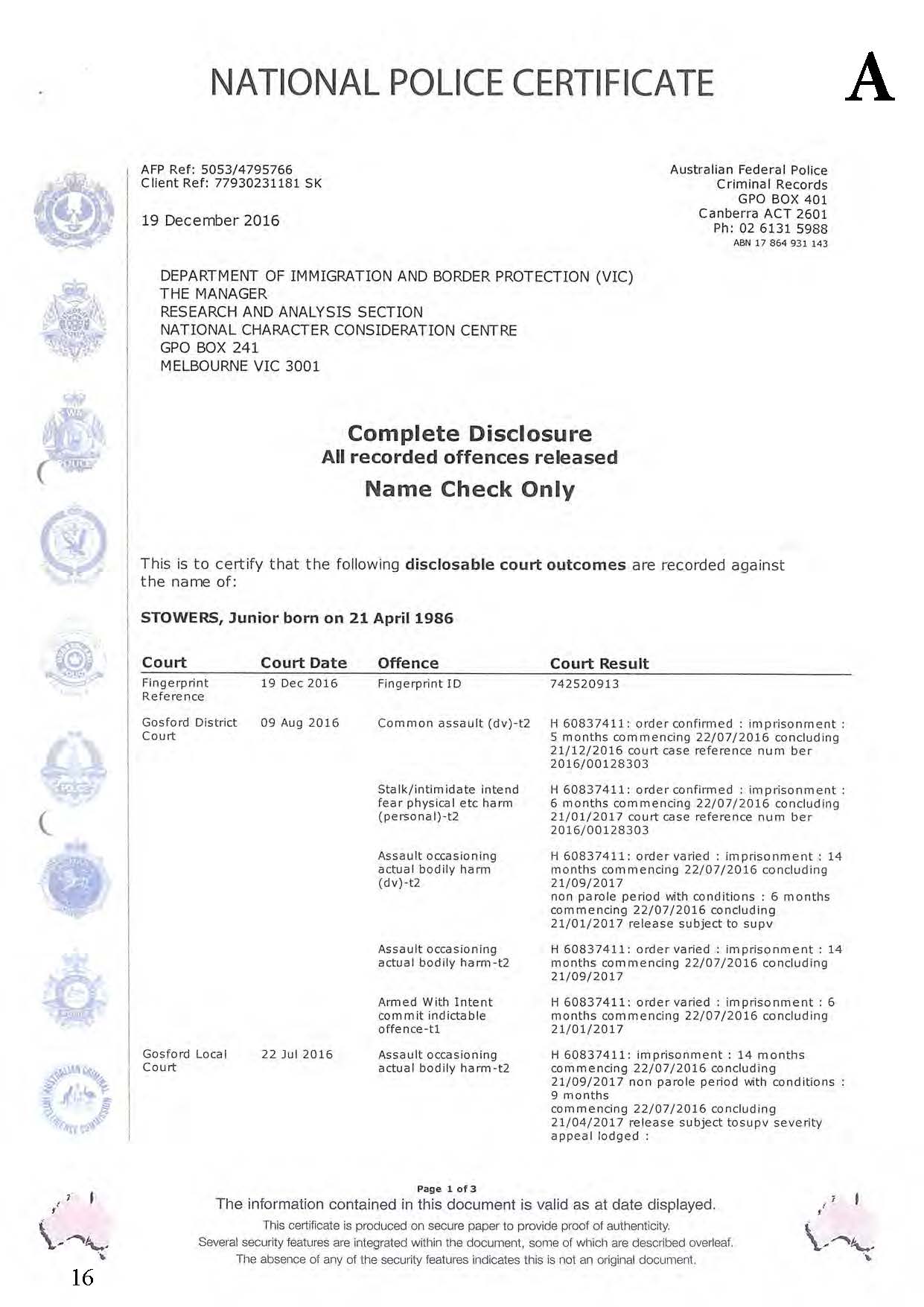
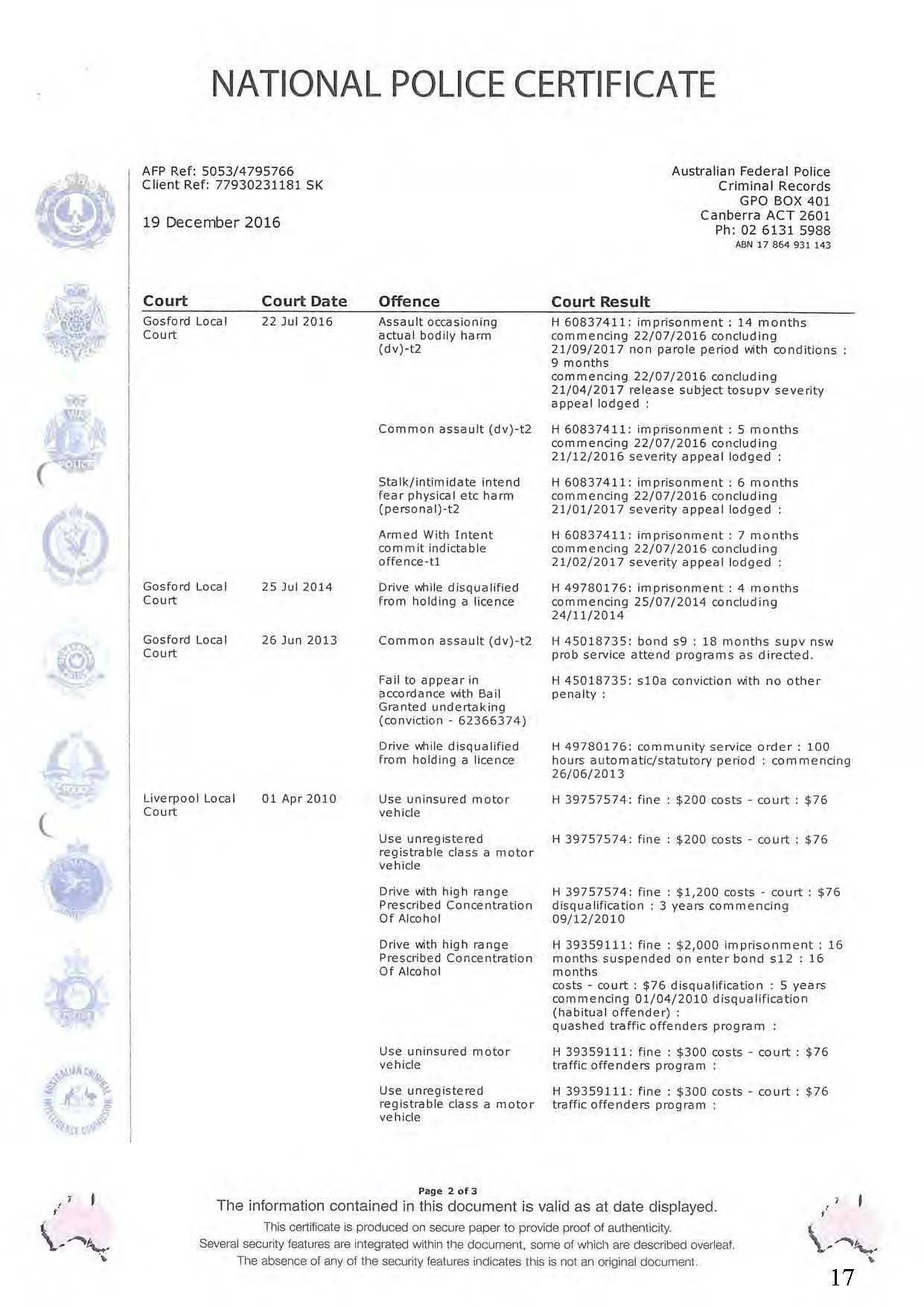
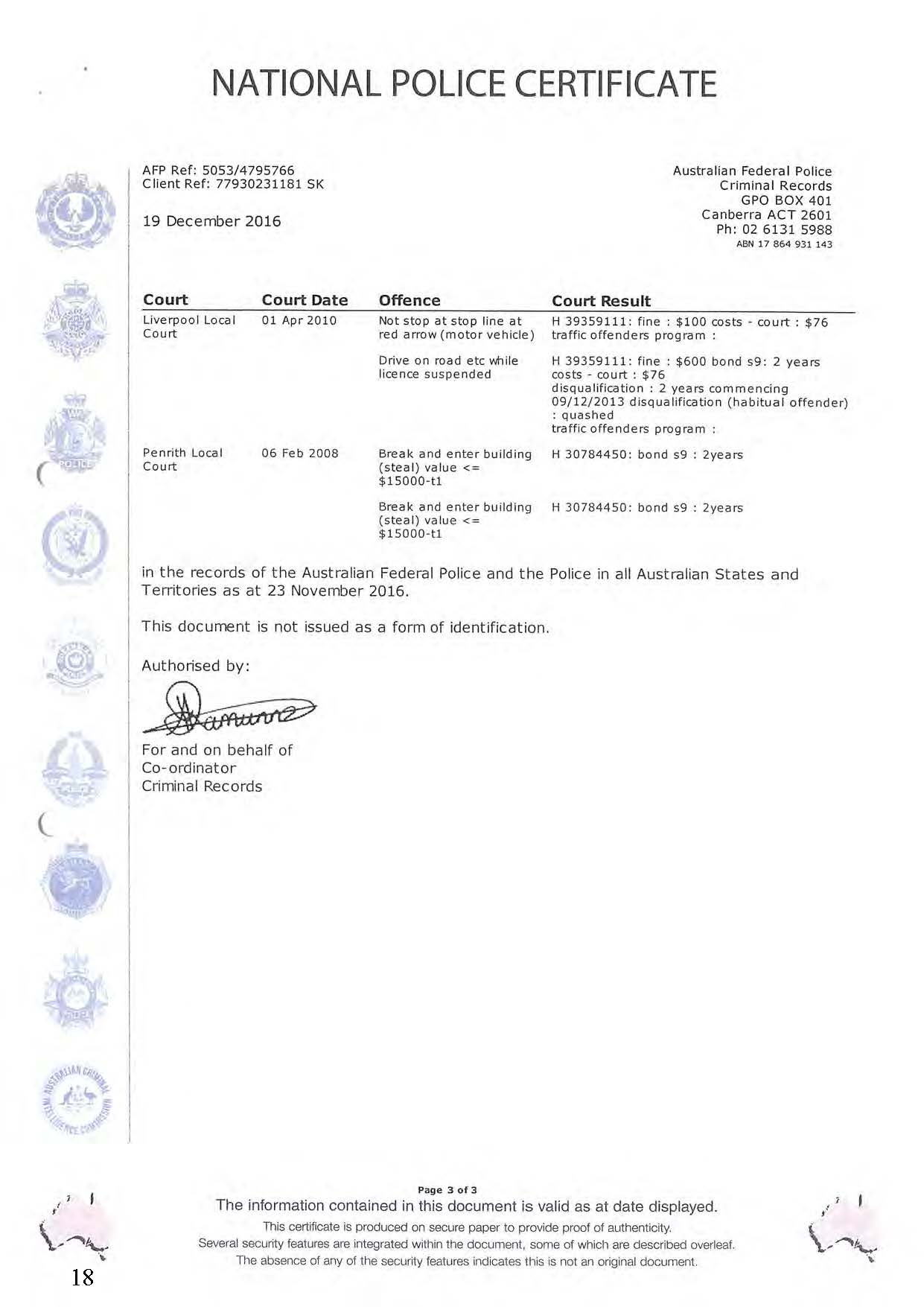
19 (b) Local Court Magistrate’s sentencing remarks: In the course of sentencing Mr Stowers on 22 July 2016, the transcript records the Magistrate as making the following remarks:
The accused is a person who is not unknown to the Court. He has got a history of offending albeit in different matters at some stage; break, enter or steal, driving matters, high range drink driving, driving while suspended. But importantly in 2011, he was put on a good behaviour bond for an assault – a domestic related assault. And now he has these offences. The Court indicated on the last occasion that a gaol term was the appropriate penalty and as a request from the accused, he wished to be assessed for an intensive correction order.
The report reads this way. That his previous community service was revoked for non-completion. He demonstrated..(not transcribable)..getting information in this report. He was telephoned, didn’t turn up, telephoned again, said he could not..(not transcribable)..because he had work commitments. It was 7 July he turned up, this information was given, but he has not been in contact with the community people since that time. And he has understandably been assessed as unsuitable for an intensive correction order. It has been urged on me that I should impose a term of imprisonment, but that should be suspended. Why it should be a suspended, I am not quite sure. I would have thought every indication at the moment if I was to suspend a sentence, he would not comply with, he could not comply with a direction to attend by the Probation and Parole in the past, he has not been able to comply with community service orders he has been given in the past. My view is that a term of full time imprisonment is the only appropriate penalty.
20 The reference to a “report” at the beginning of the second paragraph of the extracts appears to be a reference to some form of sentencing report which was before the Local Court. The precise position is unclear, however, because a copy of the report was not before the Assistant Minister when he made the decision.
21 (c) District Court Judge’s remarks on appeal : As noted above, Mr Stowers appealed against the sentences imposed upon him on 22 July 2016. A District Court Judge reduced the non-parole period from 9 to 6 months which Mr Stowers had to serve but otherwise confirmed the sentences. The transcript records the Judge as saying:
HIS HONOUR: He is now 30 years of age. His record does not have a sense of violence. There is one early matter. He has a couple of drink driving matters which are serious. In 2011 an assault for which he got a s. 9 good behaviour bond. Apparently complied with that. He has had some serious driving matters which resulted in CSO, community service, and now he has come under notice for these matters.
…
… I accept that he will endeavour to get treatment, maintain treatment and try and stay out of trouble in the future.
…
He is to be released to parole at the expiration of the non-parole period and he is then subject to the supervision and guidance of the Parole Authority as provided for in the standard conditions of parole prescribed under the relevant Act. Upon his release to parole it is recommended to the Parole Authority that it direct the offender to accept the supervision and guidance of Community Corrections generally and specifically as to substance and alcohol abuse and relapse prevention, anger management and impulse control, mental health issues and related ongoing treatment and medication including the implementation of a Mental Health Treatment Care Plan as arranged and directed by a general medical practitioner or related health service provider.
22 It is unclear what the Judge relied upon when he referred to Mr Stowers being given a “s 9 good behaviour bond” in 2011. That date does not appear on either the State Certificate or the National Police Certificate (both of which post-date the District Court proceeding but which, presumably, are accurate records as to the matters with which they deal). The National Police Certificate records that, on 26 June 2013, Mr Stowers was given a s 9 bond for his conviction of common assault (dv) and, in relation to the offence of failing to appear in accordance with bail, the National Police Certificate records that, on the same day, he was given a s 10a conviction, with no other penalty. The reference to “s10a” is an apparent reference to s 10A of the Crimes (Sentencing Procedure Act) 1999 (NSW). Under that provision, a Court could enter a conviction against the offender, without imposing any other penalty.
23 It is significant, however, that the District Court Judge took a more favourable view than the Magistrate of Mr Stowers’ past and likely future compliance with judicial orders. The Judge not only reduced the non-parole period, but also made observations and recommendations concerning the future supervision and guidance of Mr Stowers while he was on parole. As noted in the extracts in [21] above, the Judge expressly stated his view that Mr Stowers would get and maintain treatment and would “try and stay out of trouble in the future” and that Mr Stowers had apparently complied with the s 9 good behaviour bond.
The Assistant Minister’s decision and statement of reasons
24 On 9 August 2017, the Assistant Minister decided not to revoke the cancellation decision. The appellant was provided with a statement of reasons for that decision, as required by s 501G(1) of the Act.
25 The statement of reasons is in a familiar form. It broadly reflects the structure and considerations in Direction 65. Part of the statement addresses the topic “Protecting the Australian Community”. This part of the statement is divided into two sections, one dealing with “Criminal conduct” and the other dealing with “Risk to the Australian community”. On the former issue, the Assistant Minister noted that during the eight years in which Mr Stowers offended, “he was convicted of numerous driving related offences, breaking and entering as well as violent offences including common assault (dv), and assault occasioning actual bodily harm (dv)”. The Assistant Minister made reference to the sentencing remarks of the Magistrate and the District Court Judge, the latter of whom described the offences for which Mr Stowers was convicted on 22 July 2016 as “horrendous” and that what had occurred was “an act of unmitigated and continuing violence”.
26 On the issue of risk to the Australian community, the Assistant Minister said that he had considered whether Mr Stowers posed a risk to the Australian community through re-offending by having regard to any mitigating or causal factors in his offending, and also by giving consideration to the steps taken by Mr Stowers to reform and address his behaviour, including the steps he had taken to address his mental health issues. It is in this section of the Assistant Minister’s statement of reasons that reference is made in [44] and [45] to Mr Stowers’ convictions for breaches of judicial orders and noncustodial dispositions.
27 It is desirable to set out those paragraphs of the Assistant Minister’s statement of reasons because they are at the heart of Mr Stowers’ complaint of procedural unfairness (emphasis added):
44. I have considered Mr STOWERS’ convictions for breaches of judicial orders and noncustodial dispositions, as well as his false declaration on an incoming passenger card on which he indicated that he had no criminal convictions at the time when he held a criminal conviction in New Zealand. I find that Mr STOWERS’ prior conduct displays a disregard for judicial orders and gives me pause in accepting unquestioningly that he will not reoffend if returned to the community.
45. I cannot rule out the likelihood of Mr STOWERS reoffending in future, particularly if exposed to external stressors and/or if he neglects to manage his mental health issues. I find that there is an ongoing likelihood that Mr STOWERS will reoffend, albeit it a low one and should he offend in a similar manner, it would result (sic) physical and psychological harm to a member or members of the Australian community.
28 It may be noted that the Assistant Minister did not identify in his statement of reasons the specific “convictions for breaches of judicial orders and non-custodial dispositions” which are referred to at a level of generality in [44].
The primary judgment
29 Only one ground of judicial review was pressed below. It was that the Assistant Minister denied Mr Stowers procedural fairness. The primary judge summarised the particulars of this ground at [8] of her Honour’s reasons for judgment (emphasis in original):
(1) On 30 May 2017, the Minister sent a letter to Mr Stowers informing him that the Minister had information which may be taken into account when making his decision whether to revoke the cancellation decision. That information included a National Police Certificate dated 19 December 2016.
(2) The Minister failed to put Mr Stowers on notice of the potential adverse effect of the National Police Certificate.
(3) At [44] of the decision record, the Minister relied expressly on “convictions for breaches of judicial orders and non-custodial dispositions” in causing him to “pause in accepting unquestioningly that Mr Stowers will not reoffend if returned to the community”.
(4) The adverse inference drawn by the Minister from the information in his possession, including the National Police Certificate, was not an obvious inference or a conclusion obviously open on the known material. Mr Stowers was denied an opportunity to comment on the information in the Minister’s possession. The denial of procedural fairness may have affected the outcome of the Minister’s consideration of the exercise of power under s 501CA(4).
30 The primary judge’s reasons for dismissing the procedural unfairness ground may be summarised as follows. First, the primary judge stated that if the only material provided to the appellant was the 23 December 2016 letter and its attachments, she would have been persuaded that the Assistant Minister’s findings at [44] of the statement of reasons were not “obviously open on the known material”, despite the terms of Direction 65. Her Honour described as “unsurprising” that Mr Stowers’ initial representations did not address his driving offences or his failure to comply with the bail undertaking or community services orders, matters which were raised in the National Police Certificate which he was given on 30 May 2017.
31 Secondly, her Honour did not accept Mr Stowers’ submission that the Assistant Minister’s remarks at [44] of his statement of reasons addressed only the matter of Mr Stowers’ conviction (without penalty) on 23 June 2013 for his failure to comply with a bail undertaking. Her Honour found at [26] that the National Police Certificate, when taken with the sentencing remarks in the Local Court, clearly raised the issue that Mr Stowers had failed to comply not only with the bail undertaking, but also with other noncustodial dispositions of his convictions, an example of which given by the primary judge was driving while disqualified.
32 Thirdly, the essence of the primary judge’s reasons for rejecting Mr Stowers’ complaint of procedural unfairness are captured in [27] of her Honour’s reasons for judgment:
27. I agree that it would have been preferable if the Department had made reference to his failure to company with judicial orders in the 30 May 2017 letter, as was done with the issue concerning the failure of disclosure in the incoming passenger cards. However, it was obvious that the National Police Certificate contained more information than the Conviction, Sentence and Appeals report and File note which had been included with the documents on 23 December 2016. As Counsel for Mr Stowers conceded, it might be presumed that the National Police Certificate contained material adverse to Mr Stowers. The sentencing Judge’s remarks included with the 30 May 2017 letter were plainly critical and directed to the issue of compliance. The relevance of Part C of the Direction had been drawn to his attention in more than one place in the materials given to Mr Stowers on 23 December 2016. It is clear from cl 13.1(2)(b) and 13.1.2(2)(b) of the Direction that the likelihood of re-offending would be taken into account and both the National Police Certificate and the sentencing remarks went to that issue.
33 For these reasons, the primary judge dismissed Mr Stowers’ judicial review application.
The appeal
34 Mr Stowers, who was represented by the same counsel in the appeal as below, contended that the primary judge had erred in rejecting his procedural unfairness case. His sole ground of appeal is as follows (without alteration):
1. The Primary Judge erred in failing to find that the Respondent made a jurisdictional error by denying the Appellant procedural fairness.
Particulars
(i) On 30 May 2017 the Respondent sent to the Appellant a letter informing the Appellant that the Respondent had information which may be taken into account when making the decision whether to revoke the decision to cancel his visa under s.501CA of the Migration Act 1958, including a National Police Certificate dated 19 December 2016. The Respondent invited the Appellant to comment on the information.
(ii) The Respondent failed to put the Appellant on notice of the potential adverse effect of the National Police Certificate.
(iii) The Respondent relied expressly in making the decision on the Appellant’s ‘convictions for breaches of judicial orders and non-custodial dispositions’ in causing the Respondent to ‘pause in accepting unquestioningly that [the Appellant] will not reoffend if returned to the community’: [44] of the Respondent’s decision record.
(iv) The adverse inference drawn by the Respondent from the information in his possession, including the National Police Certificate, was not an obvious inference, or a conclusion obviously open on the known material. The Appellant was denied an opportunity to comment on the information in the Respondent’s possession. The denial of procedural fairness may have affected the outcome of the Respondent’s consideration of the exercise of power under s.501CA(4).
Appellant’s submissions summarised
35 The appellant acknowledged that the Assistant Minister was not obliged to provide a “running commentary” prior to making his non-revocation decision (citing SZBEL v Minister for Immigration and Multicultural and Indigenous Affairs [2006] HCA 63; 228 CLR 152 (SZBEL) at [48]). He submitted, however, that procedural fairness principles obliged the Assistant Minister to put him on notice of the potential adverse effect of the National Police Certificate in relation to the Assistant Minister’s finding at [44] of his statement of reasons that his breaches of judicial orders and noncustodial dispositions displayed a disregard for judicial orders. He emphasised that this amounted to a finding about his personal characteristics, which finding was significant in the Assistant Minister ultimately concluding that there is an ongoing likelihood that the appellant would reoffend. Mr Stowers submitted that it was not obviously open on the materials provided to him (including the National Police Certificate and the remarks of the Local Court and District Court), that the Assistant Minister might make an adverse finding by reference to these materials that he had a “disregard for judicial orders”.
Assistant Minister’s submissions summarised
36 The Assistant Minister defended the primary judge’s decision. He placed particular emphasis on the significance of Direction 65 which, he submitted, made plain that the appellant’s criminal record and his risk of reoffending were critical issues for decision (referring to cll 13(2)(a), 13.1, 13.1.1 and 13.1.2 of the Direction). The Assistant Minister submitted that the appellant had been alerted to the adverse nature of the National Police Certificate by Direction 65, the sentencing remarks in the Local Court and the District Court on appeal, as well as “the apparent nature of the power and common sense”.
Consideration and determination
37 It was common ground that procedural fairness requirements applied to a decision made under s 501CA(4). It was also common ground that the statutory requirement under s 501CA(3)(a)(ii) to provide “particulars of relevant information” only applied to information which the Minister considered was information which would be the reason or part of the reason for making the original decision to refuse to grant or to cancel a visa. It was not disputed that this statutory provision is inapplicable to the separate and subsequent decision under s 501CA(4) whether or not to revoke the original decision. It is appropriate, therefore, to focus on the requirements of procedural fairness in the particular circumstances of this case.
38 There is the following helpful statement of relevant general principles concerning procedural fairness in Snedden v Minister for Justice for the Commonwealth of Australia [2014] FCAFC 156; 230 FCR 82 at [175]-[178] per Middleton and Wigney JJ:
175. There is no dispute that Mr Snedden was entitled to procedural fairness at the s 22 stage of the extradition process: Santhirarajah at [324]. In general terms that means the Minister was relevantly obliged to inform Mr Snedden of the case against him and provide him with a reasonable opportunity to answer it: Minister for Immigration v Bhardwaj (2002) 209 CLR 597 at [40]. Mr Snedden was entitled to be made aware of, and have the opportunity to address, the critical issues or factors on which the decision was likely to turn, as well as any adverse information that was credible, relevant and significant to the decision to be made: Kioa v West (1985) 159 CLR 550 (Kioa) at 587 (Mason J) and 629 (Brennan J); Applicant VEAL/2002 v Minister for Immigration (2005) 225 CLR 88 (VEAL) at [15].
176. That is not to say that a decision-maker is necessarily required to disclose to a person affected by the decision every piece of information that the decision-maker has or might consider: Minister for Immigration and Citizenship v SZQHH (2012) 200 FCR 223 (SZQHH) at [30]. Nor is a decision-maker necessarily required to disclose issues in respect of which the person is already on notice or information the substance of which is already known to the person: SZQHH at [30]; Brock at [22]. Whilst a decision-maker is required to advise of any adverse conclusion which has been arrived at which would not obviously be open on the known material, there is no obligation for the decision-maker to expose mental processes or provisional views: Commissioner of ACT Revenue v Alphaone Pty Ltd (1994) 49 FCR 576 (Alphaone) at 592.
177. The rules of procedural fairness do not have an immutably fixed content: Assistant Commissioner Condon v Pompano Pty Ltd (2013) 295 ALR 638 at [156]. There are no concrete rules as to what procedures a decision-maker must employ to provide procedural fairness in any particular case. What will be both sufficient and necessary to ensure a fair hearing in any given case will depend on, and vary with, the context in which a decision-maker acts, including any statutory or regulatory requirements or considerations: SZBEL v Minister for Immigration and Multicultural and Indigenous Affairs (2006) 228 CLR 152 (SZBEL) at [26], [29]; Saeed v Minister for Immigration and Citizenship (2010) 241 CLR 252 (Saeed) at [19]-[20]; SZQHH at [26]; see too Re Minster for Immigration and Multicultural Affairs; Ex Parte Miah (2001) 206 CLR 57 at [30]-[32]. The content of procedural fairness is flexible and adaptable to the circumstances of the particular case (Saeed at [18]) and must be approached on the basis of what is reasonable (Kioa at 627) and necessary to avoid “practical injustice”: Lam at [37]-[38].
178. As the Full Court (Allsop CJ, Middleton and Foster JJ) in TCL Air Conditioner (Zhongshan) Co Ltd v Castel Electronics Pty Ltd [2014] FCAFC 83 reminded us at [86]:
86. The required content of fairness in any particular case will depend on context: constitutional, statutory and human, on all the circumstances of the case: Salemi v MacKellar (No 2) [1977] HCA 26; 137 CLR 396 at 419. The fairness required relates principally to the procedure employed in dealing with the party in question. That may involve the exercise of state or governmental power over the individual, who may be vulnerable and powerless, or a great corporation. The terms of any statute will be critical. The common element is that, generally speaking, the exercise of power should be fair. That exercise will always have a human context. That is why, as Gleeson CJ said in Re Minister for Immigration and Multicultural and Indigenous Affairs; Ex parte Lam [2003] HCA 6; 214 CLR 1 at 14, fairness is not an abstract concept, but essentially practical. The concern of the law is to avoid practical injustice. Fairness is normative, evaluative, context-specific and relative.
39 Their Honours’ summary of general principles includes a reference to the statement in Alphaone that a decision-maker is required to advise of any adverse conclusion which has been arrived at which would not “obviously be open on the known material”. In the current proceeding, the primary judge referred to that phrase in [23] of her Honour’s reasons for judgment below, which phrase also appeared in the particulars given by the appellant in support of his procedural fairness case. The term “obvious” was also used in [27] of her Honour’s reasons for judgment (see [32] above).
40 It is important to note, however, that in SZBEL, the High Court (Gleeson CJ, Kirby, Hayne, Callinan and Heydon JJ), after referring to that statement in Alphaone, emphasised the danger of a binary approach in applying the “obviously open” test (emphasis added and footnotes omitted):
29. No submission was made on behalf of either the appellant or the Minister that the existence or content of the obligation to accord procedural fairness was directly affected by any provision of the Act. Rather, the argument proceeded, for the most part, by reference to what had been said by the Full Court of the Federal Court in Alphaone. The Full Court (Northrop, Miles and French JJ) said:
Where the exercise of a statutory power attracts the requirement for procedural fairness, a person likely to be affected by the decision is entitled to put information and submissions to the decision‑maker in support of an outcome that supports his or her interests. That entitlement extends to the right to rebut or qualify by further information, and comment by way of submission, upon adverse material from other sources which is put before the decision‑maker. It also extends to require the decision‑maker to identify to the person affected any issue critical to the decision which is not apparent from its nature or the terms of the statute under which it is made. The decision‑maker is required to advise of any adverse conclusion which has been arrived at which would not obviously be open on the known material. Subject to these qualifications however, a decision‑maker is not obliged to expose his or her mental processes or provisional views to comment before making the decision in question. (emphasis added)
30. Particular attention was directed in argument in this Court, as it had been in the courts below, to the Tribunal’s conclusion that the three identified elements of the appellant’s story were not “plausible”. Was that a conclusion “which would not obviously be open on the known material”? Or was it no more than a part of the “mental processes” by which the Tribunal arrived at its decision?
31. Stated in this way, the argument seeks to elucidate the content of the requirements of procedural fairness by setting up a dichotomy. There are two reasons to exercise considerable care in approaching the problem in that way. First, it is far from clear that the two categories that are identified (conclusions not obviously open on the known material, and mental processes of decision‑making) encompass all possible kinds of case that may fall for consideration. Secondly, there is a very real risk that focusing upon these two categories will distract attention from the fundamental principles that are engaged.
32. In Alphaone the Full Court rightly said:
It is a fundamental principle that where the rules of procedural fairness apply to a decision‑making process, the party liable to be directly affected by the decision is to be given the opportunity of being heard. That would ordinarily require the party affected to be given the opportunity of ascertaining the relevant issues and to be informed of the nature and content of adverse material. (emphasis added)
41 In SZBEL, the High Court also emphasised at [25], that what is required by procedural fairness is a fair hearing, not a fair outcome, citing Brennan J in Attorney-General (NSW) v Quin (1990) 170 CLR 1 at 35-36. The Court drew attention to the critical importance of the statutory framework within which a decision-maker exercises statutory power and that “the particular content to be given to the requirement to accord procedural fairness will depend upon the facts and circumstances of the particular case”, citing Mobil Oil Australia Pty Ltd v Federal Commissioner of Taxation (1963) 113 CLR 475 at 503-504.
42 In Re Minister for Immigration and Multicultural and Indigenous Affairs; Ex parte Lam [2003] HCA 6; 214 CLR 1, Gleeson CJ emphasised the central role of the notion of “practical injustice” in procedural fairness principles. His Honour observed at [37] that (emphasis added):
37. A common form of detriment suffered where a decision-maker has failed to take a procedural step is loss of an opportunity to make representations. Attorney-General (Hong Kong) v Ng Yuen Shiu was such a case. So, according to the majority, was Haoucher v Minister for Immigration and Ethnic Affairs. A particular example of such detriment is a case where the statement of intention has been relied upon and, acting on the faith of it, a person has refrained from putting material before a decision-maker. In a case of that particular kind, it is the existence of a subjective expectation, and reliance, that results in unfairness. Fairness is not an abstract concept. It is essentially practical. Whether one talks in terms of procedural fairness or natural justice, the concern of the law is to avoid practical injustice.
Justices Gageler and Gordon supported this approach in Minister for Immigration and Border Protection v WZARH [2015] HCA 40; 256 CLR 326 (WZARH) at [57].
43 As the brief analysis of relevant caselaw above indicates, it is well settled that the statutory context, and the particular facts and circumstances, are important in determining whether or not there has been procedural unfairness. In some instances, procedural fairness does not require a decision-maker to put to an affected person every piece of information the decision-maker will consider. It may be sufficient merely to put the substance of the material to the person (see, for example, Minister for Immigration and Citizenship v SZQHH [2012] FCAFC 45; 200 FCR 223).
44 The underlying purpose of the requirements of notice or disclosure as aspects of procedural fairness is another important consideration. It is to provide an opportunity for meaningful participation by the potentially aggrieved person and to enable the person fairly to respond to adverse matters. As the Full Court observed in Traill v McRae [2002] FCAFC 235; 122 FCR 349 (Sackville, Kenny and Allsop JJ) at [134], what constitutes adequate notice of a matter and when it should be provided is to be decided by reference to the circumstances of the case in question and is directed to enabling the affected person “fairly to respond”. In our view, those observations apply equally to disclosure.
45 It is also important to bear in mind the need for caution in applying statements of general principle in this area. As Katzmann J correctly observed in SZQNO v Minister for Immigration and Citizenship [2012] FCA 326 at [45], the context of the particular case in which such statements are made is critical.
46 The specific issue which arises in this appeal is whether the disclosure to Mr Stowers of the terms of Direction 65 and the provision of the materials described at [15] above (particularly the National Police Certificate and the sentencing remarks in both the Local Court and District Court) were adequate to fulfil procedural fairness requirements, as found by the primary judge.
47 Some guidance on this specific issue is provided by the Full Court’s decision in NBNB v Minister for Immigration and Border Protection [2014] FCAFC 39; 220 FCR 44 (NBNB). There, several applicants for protection visas who were in immigration detention had their visa applications refused because, while in immigration detention, they had participated in a riot and committed a criminal offence. Prior to the Minister refusing the visa applications, the visa applicants had been provided with a copy of a policy document (Direction No 55), which contained the Minister’s directions under s 499 of the Act to decision-makers concerning matters which had to be taken into account in the exercise of powers under s 501 of the Act to refuse to grant a visa to, or to cancel the visa of, a person who does not satisfy the Minister that the person passes the character test. The Direction was substantially silent on the subject of general deterrence to people in immigration detention being a relevant consideration, yet that matter was at the forefront of the Minister’s reasons for refusing the visa applications.
48 Justice Buchanan gave a separate lengthy judgment in NBNB. His Honour observed at [150] that although it may be possible to “tease out” of the text of some parts of Direction 55 a construction which is not inconsistent with a decision-maker taking general deterrence into account, that did not involve a fair reading of the policy document or conform to the likely understanding of a visa applicant. His Honour also rejected the Minister’s contention that diligent research by the visa applicants might have alerted them to the relevance of deterrence to others engaging in criminal conduct while in immigration detention. His Honour said at [156] (emphasis added):
156. In my view, any argument of this kind should be rejected. First, it is an unsatisfactory and unrealistic response to the position of non-English speaking refugees who had been detained for a long time and who, it must be accepted, were each psychologically fragile and anxious about their detention. Secondly, suppositions of this kind are no substitute for practical, direct and honest advice to a visa applicant about the matters which will be relevant to an assessment of their application. There can be no justifiable reason to withhold from a visa applicant in the situation of the applicants a plain statement, which they might understand, of the factors critical to the success or failure of their visa application, and critical to their future.
49 The learned authors of Australia’s leading text, Judicial Review of Administrative Action and Government Liability, 6th ed, state at p 545 that the approach of “practical, direct and honest” advice of the “factors critical” to a decision provides “a useful general guide to disclosure”. We respectfully agree but believe that the word “non-misleading” is more appropriate than the word “honest”, noting that there was no evidence of dishonesty in NBNB or here. “Honesty” on the part of those administering legislation should be assumed.
50 In a separate joint judgment in NBNB, Allsop CJ and Katzmann J expressed agreement with Buchanan J’s reasons for concluding that the visa applicants had been denied procedural fairness. Their Honours stated at [3]:
3. We agree with Buchanan J (and with his reasons) that each applicant was denied procedural fairness. None was told about the central place of deterrence as an issue or likely issue in the decision to be made. Given what each was provided with by way of material as to what he was invited to address, each was, to a degree, led away from, or at least left uninformed about, the likely central consideration of deterrence. In one sense it can be said that each was (no doubt unintentionally) misled. In all the circumstances referred to by Buchanan J, we think that it was unfair on each applicant for the Minister to make the decision for the reasons given without giving each an opportunity to be heard on the question of deterrence.
51 Chief Justice Allsop and Katzmann J made the following additional observations in NBNB which are apposite to this appeal:
5. How unfairness is revealed or demonstrated in any particular case will depend on the circumstances. Generally speaking, if a person is not informed of an important aspect of a case he or she has to meet, subject to considerations of the kind discussed in Stead v State Government Insurance Commission [1986] HCA 54; 161 CLR 141, namely whether the denial of procedural fairness could not possibly have affected the outcome, unfairness and practical injustice will have been demonstrated: Tuncok v Minister [2003] FCA 1069 at [34] (per Hely J) approved in Dagli v Minister for Immigration & Multicultural & Indigenous Affairs [2003] FCAFC 298; 133 FCR 541 at 557 [91]. Here, there is no reason to think that meaningful submissions could not have been put about deterrence, perhaps raising the very kinds of issues to which we referred in NBMZ at [28]-[31]. Further, there is no basis to think that any such submissions could not have been of significance to the Minister’s decision, especially in the case of NBNB...
NBNB turned on the failure to put the applicants on notice that general deterrence was a relevant consideration or issue in determining whether to grant or refuse them a visa. There was no clear or explicit mention of that matter in Direction No 55, nor were the applicants otherwise put on notice of its potential relevance.
52 The relevant issue in the appeal here is different and more nuanced. Mr Stowers was put on notice by the relevant terms in Part C of Direction 65 that any “serious conduct” on his part as defined in the Direction, as well as any criminal conduct, was potentially relevant to the primary consideration of protecting the Australian community. Five months after Mr Stowers’ attention was drawn to the potential relevance of Part C, he was provided with additional documentary material and was told that it might be taken into account. The central issue in this appeal is whether it was procedurally unfair not to give Mr Stowers greater specification of that additional material (apart from that relating to the Incoming Passenger Cards) which put him on notice as to which parts of that material might be relied upon in finding that he had engaged in “serious conduct” and that this might be relied upon in refusing his revocation request.
53 Notwithstanding the different facts and circumstances between NBNB and this proceeding, we respectfully consider that Buchanan J’s approach at [156] of NBNB (with which Allsop CJ and Katzmann J agreed) provides a helpful benchmark for assessing whether there was procedural unfairness here (while also giving effect to the other relevant general principles described above). For the following reasons, we consider that Mr Stowers was not given practical, direct and non-misleading advice about the “factors critical” to the Assistant Minister’s revocation decision.
54 First, in the particular facts and circumstances of this case, more was required of the Assistant Minister to put Mr Stowers on notice of the basis upon which the Assistant Minister might conclude that his “convictions for breaches of judicial orders and noncustodial dispositions” displayed a “disregard for judicial orders” and might be relied upon to refuse his revocation request. It is true that Mr Stowers’ attention was specifically drawn to the relevance of Part C of Direction 65, and that, accordingly, Mr Stowers was on notice that a primary consideration was the protection of the Australian community from criminal or other “serious conduct”. This concept was defined in Annex B as including “involvement in activities indicating contempt or disregard for the law”. Importantly, however, at the same time as he was given a copy of that Direction, Mr Stowers was given the State Certificate which recorded some of his convictions. It contained no information relating to any conduct by Mr Stowers which might be viewed as “involvement in activities indicating contempt or disregard for the law” within the definition of “serious conduct” in the Direction. A person in Mr Stowers’ shoes would, at that time, reasonably infer that no other conduct apart from the convictions recorded in the State Certificate was potentially viewed as being relevant to the risk of him reoffending and the risk he posed to the Australian community.
55 Secondly, five months later (and well after Mr Stowers had responded to the Department’s 23 December 2016 letter to which a copy of Direction 65 and the State Certificate were attached), Mr Stowers was provided with the National Police Certificate and the other material described at [15] above. He was invited at that time to comment on that information. The invitation letter did not make any express reference to Direction 65 generally or to Part C specifically. With one exception, Mr Stowers was not given any specification as to which specific parts of the additional information might be relied upon or any indication as to how that material could be characterised in considering whether to accept or reject his revocation request. The sole exception relates to the Incoming Passenger Cards which were included in the material attached to the 30 May 2017 letter. In relation to that matter, the letter made clear that the matter of potential relevance in relation to those documents was that Mr Stowers had indicated that he had no criminal convictions. Thus Mr Stowers was put on sufficient notice that he should comment on that aspect of that material. The position is different with respect to the other additional information provided to him at this time.
56 Thirdly, it was not reasonably apparent on the face of that other additional information (i.e. the National Police Certificate and the remarks of the Magistrate and District Court Judge) that the contents might be used by the Assistant Minister in the way that he did to refuse Mr Stowers’ revocation request, namely with reference to Mr Stowers’ “convictions for breaches of judicial orders and noncustodial dispositions”. We shall explain why that is so.
(a) As is evident from the extracts of the remarks made by the Magistrate and the District Court Judge, different views were expressed about Mr Stowers’ past conduct concerning compliance with judicial orders and noncustodial dispositions. The District Court Judge said that Mr Stowers had apparently complied with a s 9 good behaviour bond and, after referring to the community service orders arising from Mr Stowers’ “serious driving matters”, his Honour said that he accepted that Mr Stowers would “try and stay out of trouble in the future”. This was the context in which the Judge reduced the non-parole period and made orders and recommendations concerning conditions of parole. With respect, it is difficult to understand the primary judge’s reference at [27] of her Honour’s reasons for judgment to the “sentencing Judge’s remarks” as being “plainly critical and directed to the issue of compliance”. Her Honour’s use of the term “Judge” can only be a reference to the District Court Judge and not the Magistrate. As we have emphasised, the Judge’s remarks were generally favourable to Mr Stowers on the subject of compliance, at least when contrasted with those of the Magistrate.
(b) In circumstances where the Magistrate and the Judge expressed different views on these matters, procedural fairness required the Assistant Minister to put Mr Stowers on sufficient notice as to which remarks might be relied upon by the Assistant Minister as providing a foundation for the findings made in [44] of his statement of reasons. It would have been reasonable for Mr Stowers to have assumed at the relevant time that the Assistant Minister was likely to give more weight to pertinent remarks made by the Judge on appeal if they were inconsistent with those at first instance by the Magistrate. Although the Judge confirmed the Magistrate’s convictions and sentences, his Honour reduced the non-parole period and imposed a series of conditions to help Mr Stowers “work with [his] issues”, both in and out of custody, including that he be of good behaviour when he is conditionally released on parole. These matters, together with the Judge’s remarks outlined in (a) above, reveal that the Judge was less critical and more optimistic than the Magistrate with respect to Mr Stowers’ compliance history and likely future compliance.
(c) In circumstances where the State Certificate contained no information relating to Mr Stowers’ “convictions for breaches of judicial orders and noncustodial dispositions”, the reference to those matters in [44] of the Assistant Minister’s statement of reasons must refer to the contents of the National Police Certificate, presumably including the references to the s 9 bond, the community service order and Mr Stowers’ failure to appear in accordance with bail conditions. In the particular circumstances here, procedural fairness required that Mr Stowers’ attention be drawn specifically to those matters if they were to be relied upon as constituting “serious conduct” to refuse his revocation request because:
(i) the Assistant Minister took a different view of their significance when compared with other remarks of the District Court Judge. It is not suggested that it was not open to the Assistant Minister to take a different view, but the issue here is whether there was compliance with procedural fairness before the Assistant Minister came to that different view;
(ii) the failure to particularise the matters which underpinned the Assistant Minister’s reliance on Mr Stowers’ convictions for breaches of judicial orders and noncustodial dispositions is highlighted by way of contrast with the fact that, at the same time, Mr Stowers was provided with adequate notice as to what inferences could potentially be drawn from the Incoming Passenger Cards, which also formed part of the foundation for the adverse conclusion reached by the Assistant Minister in [44] of his statement of reasons; and
(iii) even to this day, it is unclear which particular “convictions for breaches of judicial orders and noncustodial dispositions” the Assistant Minister had in mind when he adopted [44] of his statement of reasons. Procedural fairness required those matters to be particularised so that Mr Stowers could fairly respond if he wished to do so (see further [58] below).
57 Fourthly, we consider that there was practical injustice in the circumstances here. As Gageler and Gordon JJ stated in WZARH at [60], where the procedure adopted by an administrative decision-maker fails to afford a fair opportunity to be heard, “a denial of procedural fairness is established by nothing more than that failure”, and relief will follow unless it can be shown that the failure did not deprive the person of the possibility of a successful outcome. Their Honours emphasised that the practical injustice in such a case “lies in the denial of an opportunity which in fairness ought to have been given”.
58 If practical, direct and non-misleading advice – or more direct notice – had been given to Mr Stowers about the particulars of the matters referred to by the Assistant Minister in [44] of his statement of reasons, Mr Stowers would have had an opportunity to respond and possibly explain the circumstances relating to each of those matters which may, in turn, have caused the Assistant Minister to give them less or no weight. On the facts presented, no notice – direct or otherwise – had been given to Mr Stowers as to the information provided to him exposing a “disregard for judicial orders”. To give but one example, Mr Stowers may have explained the mitigating circumstances which apparently attached to his conviction on 26 June 2013 of having failed to appear in accordance with bail, which resulted in him being convicted with no other penalty imposed. As Steward J said recently in Splendido v Assistant Minister for Immigration and Border Protection (No 2) [2018] FCA 1158 at [32]:
32. For similar reasons, I am not satisfied that the convictions which appear to record an indifference to the rule of law, provide a basis for the finding concerning the “likelihood” that the applicant will re-offend in a way that creates a risk of harm to the Australian community. The applicant was convicted in 2011 of failing to answer bail, in 2012 of being in breach of a suspended sentence and in 2015 of persistent contravention of a family violence order. The applicant also ignored the warning from the Department. These are all very serious matters. But we know nothing about the circumstances leading to each conviction, and as to why the warning was ignored. There may, or may not have been, mitigating circumstances which could have rationally affected the Minister’s decision about the likelihood of harm. Again, the bare recital of conviction and sentence in and of itself, and whether taken individually or cumulatively with the other offences, did not rationally support or not support, the Minister’s finding about the risk of harm.
His Honour’s observations were not directed to procedural fairness requirements, but rather to other grounds giving rise to jurisdictional error. The observations serve, however, to highlight the materiality of the loss of Mr Stowers’ opportunity to comment on matters which were significant to the Assistant Minister’s decision and about which he had not been given sufficient prior notice.
59 Fifthly, although we have preferred to apply Buchanan J’s approach in NBNB to the particular facts and circumstances here, we consider that the same outcome would be arrived at under the Alphaone “obviously open” test which is summarised in [38]-[40] above, and by reference to the High Court’s observations in SZBEL concerning the danger of a binary approach in applying that test.
60 Finally, an issue was raised by the Court during the hearing as to whether a person’s individual characteristics or personal traits had to be taken into account in determining the proper content of procedural fairness requirements owed in respect of that person. Both parties filed brief supplementary submissions on that issue. It is unnecessary, however, to determine the issue for the purposes of disposing of the appeal. No individual characteristic or personal idiosyncrasy of Mr Stowers has figured in the above analysis as to why, with respect, the primary judge erred in rejecting his procedural unfairness complaint.
Conclusion
61 For these reasons, the appeal should be allowed. The orders made on 11 April 2018 should be set aside. Mr Stowers’ request for revocation should be remitted to the respondent for reconsideration according to law. The respondent must pay the appellant’s costs of the appeal and of the proceeding below, as agreed or assessed.
I certify that the preceding sixty-one (61) numbered paragraphs are a true copy of the Reasons for Judgment herein of the Honourable Justices Flick, Griffiths and Derrington. |


