

FEDERAL COURT OF AUSTRALIA
Commonwealth of Australia v Okwume [2018] FCAFC 69
ORDERS
Appellant | ||
AND: | Respondent | |
DATE OF ORDER: |
THE COURT ORDERS THAT:
2. The parties confer within 7 days about whether they can agree the costs of the appeal or the appropriate order for the disposition of the costs of the appeal.
3. If the parties are unable to agree the costs of the appeal or the order for the disposition of the costs of the appeal, then the respondent is to file and serve written submissions (limited to 4 pages) as to the appropriate order as to costs within 14 days.
4. The appellant is to file and serve written submissions (limited to 4 pages) in response to the respondent’s submissions within 21 days.
Note: Entry of orders is dealt with in Rule 39.32 of the Federal Court Rules 2011.
ORDERS
SAD 317 of 2016 | ||
| ||
BETWEEN: | LIVINUS EMENIKE OKWUME Appellant | |
AND: | COMMONWEALTH OF AUSTRALIA Respondent | |
JUDGES: | BESANKO, MORTIMER AND WHITE JJ |
DATE OF ORDER: | 4 may 2018 |
THE COURT ORDERS THAT:
1. The appeal be dismissed.
2. The parties confer within 7 days about whether they can agree the costs of the appeal or the appropriate order for the disposition of the costs of the appeal.
3. If the parties are unable to agree the costs of the appeal or the order for the disposition of the costs of the appeal, then the respondent is to file and serve written submissions (limited to 4 pages) as to the appropriate order as to costs within 14 days.
4. The appellant is to file and serve written submissions (limited to 4 pages) in response to the respondent’s submissions within 21 days.
Note: Entry of orders is dealt with in Rule 39.32 of the Federal Court Rules 2011.
BESANKO J:
Introduction
1 These are appeals from orders made by a judge of this Court in connection with the detention of Mr Livinus Okwume under the Migration Act 1958 (Cth) (the Act) in 2005 and 2006. Mr Okwume claimed that he was unlawfully detained at the Brisbane International Airport (the Airport) and then at a nearby motel (the Airport 85 Motel), and then at the Baxter Immigration Reception and Processing Centre (Baxter) near Port Augusta in South Australia from 21 July 2005 to 5 April 2006. He claimed damages and other compensation in relation to this detention. Although Mr Okwume claimed that he was detained for 294 days, the primary judge found (and there is no challenge to her Honour’s finding) that the period of detention was 259 days. In addition to his claim that he was unlawfully detained or falsely imprisoned by the Commonwealth, Mr Okwume alleged two other causes of action which he alleged arose during the course of his detention and which caused him to suffer psychiatric harm and a loss of personal property. They were claims for misfeasance in public office and negligence. The Commonwealth denied liability.
2 The primary judge found that Mr Okwume had been unlawfully detained between 2.55 pm on 21 July 2005 and about 8.15 am on 22 July 2005, but that for the remainder of the period he had not established that he had been unlawfully detained. Her Honour rejected the causes of action for misfeasance in public office and negligence. In the circumstances, her Honour allowed the application in part. She ordered that, with respect to the period of unlawful detention, the Commonwealth pay Mr Okwume the amount of $2,000, comprising $1,600 awarded as general damages and the amount of $400 in lieu of pre-judgment interest. She ordered that each party bear their own costs. Both parties appeal.
3 The Commonwealth’s appeal centres on her Honour’s conclusion that the cancellation of a visa held by Mr Okwume shortly before his detention was invalid by reason of two jurisdictional errors. The Commonwealth contends that Mr Okwume’s visa was validly cancelled and that his detention thereafter by officers acting under s 189 of the Act was lawful. The Commonwealth seeks orders that the primary judge’s orders be set aside and that Mr Okwume’s application be dismissed.
4 Mr Okwume’s appeal centres on her Honour’s conclusion that he had not established that he had been unlawfully detained after about 8.15 am on 22 July 2005. He contends that he was unlawfully detained until he was released from Baxter and that he should have been awarded damages on that basis. He seeks an order that his claim for damages be remitted to the primary judge for assessment on the basis that he was falsely imprisoned from 21 July 2005 until his release from Baxter. As I understand it, he also claims on his appeal, in addition or in the alternative, that the amount awarded by the primary judge for the period of detention which her Honour found was unlawful, was manifestly inadequate. Mr Okwume does not appeal against the primary judge’s rejection of his claims for misfeasance in public office and negligence.
THE FACTS
5 Two or possibly more decisions (and it will become clear what I mean by that later in these reasons) were made on 21 July 2005 which are critical to the issues raised on these appeals. They are a decision to cancel a visa held by Mr Okwume and a decision to detain him. The primary judge went through the events on 21 July 2005 in great detail and it is necessary for me to do the same. The following is based on the primary judge’s findings. The controversial aspects of the primary judge’s conclusions relate to the inferences she drew and her characterisation of conduct.
6 Mr Okwume was a citizen of the Federal Republic of Nigeria. He arrived at the Airport on a flight originating from Lagos at 7.00 am on 21 July 2005. He had with him his personal belongings, a passport and a Business (Short Stay) visa which was due to expire one month after his arrival. Mr Okwume is a nurse and he travelled to Australia ostensibly for the purpose of attending an aged care conference in Brisbane.
7 On 21 July 2005, Ms Kay O’Connell was one of the then Department of Immigration and Multicultural and Indigenous Affairs’ (the Department) Duty Managers at the Airport. She was not called to give evidence at the trial. Mr Glenn Andersson was an Immigration Inspector stationed at the Airport and the Minister had delegated certain decision-making powers under the Act to Mr Andersson (s 496(1)). Mr Andersson, as the Minister’s delegate, made the decision under s 116(1)(d) of the Act to cancel Mr Okwume’s visa. Mr Andersson was called to give evidence at the trial, but he had no independent recollection of the events which took place on 21 July 2005. At the time of the relevant events, Mr Andersson prepared what the primary judge described as a Running Sheet entitled “Immigration Inspector’s Report” which recorded events as they occurred. Except for one entry made by Ms O’Connell, the Running Sheet was made by Mr Andersson. On 21 July 2005, Mr Benjamin Kriss was a document examiner at the Airport. He had commenced employment with the Department in 1998. He underwent three years of in-house training, after which he was assigned the title of Forensic Document Examiner. The primary judge found that Mr Kriss was a qualified and experienced document examiner. Mr Kriss gave evidence at the trial and he said in his affidavit, and initially at least in his oral evidence, that he had no independent recollection of his involvement in the events affecting Mr Okwume on 21 July 2005. Ms Lynette Trad was another Duty Manager of the Department at the Airport on 21 July 2005 and she played a role in the relevant events as I will explain. She did not give evidence at the trial.
8 On arriving at the Airport, Mr Okwume presented himself to an officer of the Department who stamped his passport.
9 At approximately 8.55 am, Ms O’Connell examined Mr Okwume’s passport and the professional registration documents which he had in his possession. The passport revealed no obvious signs of being forged or altered, and Ms O’Connell formed the view that Mr Okwume appeared to be a “genuine nurse”. However, she also formed the view that Mr Okwume should be counselled about his visa conditions and the consequences of him staying in Australia beyond the date of the expiration of his visa. At approximately 9.15 am, and at Ms O’Connell’s direction, Mr Andersson went to counsel Mr Okwume. During the discussion, Mr Okwume told Mr Andersson that he did not want to return to Nigeria as he feared that he would be persecuted and killed there. Mr Andersson contacted Ms O’Connell who told him that Mr Okwume should be taken to the interview area. Mr Okwume was placed in an interview room at 9.30 am.
10 At about the same time, Mr Okwume’s passport was provided to Mr Kriss for him to examine. Mr Kriss examined Mr Okwume’s passport over a period of about two hours. Mr Andersson was with Mr Kriss for the first half hour (approximately) and he observed Mr Kriss examining Mr Okwume’s passport. Mr Kriss told Mr Andersson that there were features of Mr Okwume’s passport leading him to believe that the passport was bogus. Those features related to the printing of Mr Okwume’s signature and the method of producing the word “Nigeria” over the photograph.
11 At this point in the examination process, Mr Andersson was told by Ms O’Connell that he should commence what was referred to as a screening interview with Mr Okwume. Mr Andersson commenced the interview at about 10.10 am and it concluded at 11.20 am. At the time the interview commenced, Mr Andersson knew that Mr Kriss’ examination of the passport had not been completed.
12 Her Honour then addressed the examination which Mr Kriss carried out of Mr Okwume’s passport. She was highly critical of that examination and Mr Kriss’ conclusions. However, as far as I can see, those criticisms did not form the basis of her conclusions that there had been jurisdictional error in the cancellation process. Nevertheless, I will summarise what her Honour said as it is part of the context.
13 The primary judge found that Mr Kriss examined Mr Okwume’s passport over a period of about two hours. He formed the opinion that the passport had been tampered with because it had, in his opinion, a “counterfeit laminate”. Mr Kriss set out his opinion in a typewritten report that he prepared and circulated on the following day. Her Honour identified a number of admitted matters that Mr Kriss had not undertaken as part of his examination. It is not necessary for me to set out the details.
14 The primary judge found that Mr Kriss compared Mr Okwume’s passport with a specimen passport provided to the Department by the Federal Republic of Nigeria bearing the date of 23 January 1998. Mr Kriss acknowledged that the specimen passport was a critical document in his examination process. The primary judge said that the specimen passport was not a passport issued in respect of any particular person. It was a sample provided by authorities in Nigeria to the Department to enable its document examiners to identify the features of a genuine Nigerian passport for screening purposes.
15 The primary judge found that the physical properties of a passport include features that are inherent in the manufacturing process and features that are created by the authority issuing the passport to an applicant. The manufactured document is known as the base document and it contains security features, including a laminate coating embossed with a fine pattern which the primary judge said resembled a fingerprint. An authority that issues passports to passport applicants is known as an issuing authority. An issuing authority adds additional features to the base document, such as printed words and images specific to the passport applicant’s identity.
16 The primary judge found that both manufacturing processes and issuing practices may change over time. In addition, issuing authorities may commit faults when dealing with a base document.
17 Mr Kriss explained that if there was a difference between the features of a person’s passport and that of the specimen passport, the difference could well be explained by a change in issuing practices, or a change in manufacturing practices since the creation of the specimen document, or the difference might also be explained by fraud. These alternatives are regarded by the document examiner as a list of hypotheses to be explored.
18 Mr Kriss explained that the document examiner performs research to explore whether the available explanations are soundly based and notes the results of that research. A conclusion may then be reached by excluding possible explanations until only one possible explanation remains.
19 The primary judge said that Mr Kriss concluded with certainty, rather than in terms of a suspicion, that the laminate on Mr Okwume’s passport was “counterfeit”. He reached that conclusion by first observing that the printing on the laminate was “irregular” in comparison with the specimen and that there were differences in the relief pattern on the laminate, also in comparison with the specimen. The primary judge said that in the course of his examination, Mr Kriss noted that these differences might well be explained by a “change in manufacturing process”.
20 The primary judge referred to Mr Kriss’ evidence in cross-examination. Mr Kriss was unable to point to any established system whereby the Department was able to ensure that the specimen passport used for comparison purposes was the most recent model of passport manufactured in, and issued from, Nigeria. Mr Kriss acknowledged that he himself had not made inquiries on 21 July 2005 to determine whether there had been any change in the manufacturing processes or issuing practices since he first obtained the comparator passport. The primary judge noted that that acknowledgement was not readily forthcoming. She said that in the course of his evidence on this, Mr Kriss’ demeanour was evasive and defensive. The primary judge noted that Mr Kriss had said that it was not important if the specimen passport was out of date because it was not the only document he had relied on in forming his conclusion that the laminate on Mr Okwume’s passport was counterfeit. The primary judge said that Mr Kriss did not adequately explain how the additional information bore on the formation of his opinion. Her Honour recorded the fact that the foundation of Mr Kriss’ opinion was that the laminate on Mr Okwume’s passport was different from that on the comparator. He did not give any evidence to the effect that any additional information he had relied upon confirmed one way or the other whether that difference might be explained by a change in manufacturing processes or issuing practices for Nigerian passports.
21 Mr Kriss said that in performing his examination, he referred to a database known as Edison. However, the primary judge said the contemporaneous reports made by Mr Kriss make no mention of him referring to Edison for the purposes of either accessing a more up-to-date specimen passport, or even for the purpose of checking whether a more up-to-date specimen passport had been issued. Had Mr Kriss used Edison for that specific purpose, he could reasonably have been expected to have made reference in his notes and reports to having done so. The primary judge noted that Mr Kriss’ responses in cross-examination also indicated that he had not used Edison for that particular purpose. His demeanour suggested that he had been caught off-guard by questions concerning the longevity of the specimen.
22 The primary judge also noted that the change in the spelling of a word on the passport had prompted Mr Kriss to obtain additional information, but it was not sufficient to cause him to make further inquiries to establish whether the specimen passport relied upon by him might well be outdated and, therefore, an unreliable comparator.
23 The primary judge noted that under re-examination, Mr Kriss offered explanations in support of his opinion in such a way that was inconsistent with his affidavit evidence. The primary judge rejected “particularly” Mr Kriss’ evidence in re-examination concerning a document alert issued by a Canadian authority giving particulars of a fraudulent Nigerian passport that had been presented to the Canadian High Commissioner in Pretoria. It is not necessary for me to set out any further details.
24 The primary judge found that Mr Kriss informed Ms O’Connell of his opinion concerning Mr Okwume’s passport not before 11.20 am and not after 11.45 am on 21 July 2005.
25 Following the screening interview, Mr Andersson contacted Ms O’Connell at about 11.20 am. Mr Andersson expressed the view that it may be appropriate to cancel Mr Okwume’s visa under s 116(1)(a) of the Act because “the circumstances permitting the grant of the visa no longer existed”. The following entry describes the interaction between Mr Andersson and Ms O’Connell at this point:
AT 1120HRS DM CONSULTED. I ADVISED THAT AS PAX PRIMARY PURPOSE IN TRAVELLING TO A/A WAS TO ENGAGE AUSTRALIA’S PROTECTION OBLIGATIONS, THE CIRCUMSTANCES PERMITTING THE GRANT OF THE VISA NO LONGER EXISTED AND THAT S116 (1) (A) MAY BE AN APPROPRIATE SECTION OF THE MA TO CONSIDER VISA CANCELLATION UNDER. DM AGREED AND ASKED IF I HAD TAKEN PAX INTO S192 DETENTION PER NEW AIRPORT POLICY. I ADVISED THAT I HAD NOT BUT WOULD DO SO ASAP.
(Original formatting retained.)
The reference to “DM” is a reference to Ms O’Connell and the reference to “PAX” is a reference to Mr Okwume.
26 Section 192 of the Act provides that where an officer knows or reasonably suspects that a non-citizen holds a visa that may be cancelled under, relevantly, Subdivision D of Division 3 of the Act, the officer may detain the non-citizen for questioning.
27 The primary judge drew the inference from the entry in the Running Sheet that Mr Andersson informed Mr Okwume shortly after 11.20 am on 21 July 2005 that he was detained pursuant to s 192 of the Act.
28 The next event is recorded in the Running Sheet as follows:
1145HRS DM ADVISED THAT IT WAS UNNECESSARY TO CANCEL PAX VISA AS HE DID NOT MEET S166 REQUIREMENTS DUE TO HIS PRESENTING A BOGUS DOC.
AT 1225 HOURS ON ADVICE FROM DM PAX WAS DETAINED IN S189 DETENTION AS HE DID NOT MEET S166 REQUIREMENTS AS HE DID NOT PRESENT A VALID PASSPORT IN CLEARANCE.
(Original formatting retained.)
29 The reference to “S166 requirements” is a reference to the requirements that must be satisfied before the person can be “immigration cleared” for the purposes of the Act and then leave the port of their arrival, in this case the Airport, and enter Australia (see s 172 of the Act).
30 The primary judge drew the inference that Mr Okwume was told by Mr Andersson that he was detained at 12.25 pm purportedly under s 189 of the Act on the basis that he “did not meet s 166 requirements”. Mr Okwume’s visa had not been cancelled at that time.
31 In July 2005, GSL (Australia) Pty Ltd (GSL) provided services to the Department in relation to the detention of persons under the Act. The Villawood Immigration Detention Centre (Villawood) was a detention centre operated by GSL. At 1.00 pm, Ms O’Connell sent a facsimile entitled “Request for Services Form” to the Detention Services General Manager at Villawood. The Form provided that the addressee was requested to detain Mr Okwume on the basis that he was an unlawful non-citizen. The Form contained a request that GSL personnel attend the Airport to keep Mr Okwume under “static guard”. The primary judge said that the Form provided further support for the conclusion that Mr Okwume was detained at around 12.25 pm, purportedly under s 189 of the Act because of Ms O’Connell’s conclusion that he had not met the requirements of s 166 of the Act.
32 The next relevant entry in the Running Sheet is as follows:
LEGAL ADVICE DATED 2003 WAS SUBSEQUENTLY PROVIDED BY ANOTHER INSPECTOR TO DM WHICH INDICATED THEY NEED TO PROCEED WITH VISA CANCELLATION IN THIS CASE. DM REQUESTS THAT WHEN PAX CALMS DOWN, I PURSUE CANCELLATION PROCEDURES UNDER S116 (1) (D) MA.
(Original formatting retained.)
33 The primary judge said that the reference to “Legal Advice Dated 2003” was a reference to legal advice provided to the Department in 2003. The effect of the advice in terms of its application to Mr Okwume was that Mr Okwume could not be detained under s 189 by reason of his non-compliance with the requirements of s 166 of the Act. This advice was provided to Ms O’Connell after she had directed that Mr Okwume be detained and after the request she made to GSL.
34 The primary judge noted the terms of the entry in the Running Sheet and, in particular, the terms of Ms O’Connell requesting Mr Andersson to pursue cancellation procedures under s 116(1)(d) of the Act. As I will explain later, the primary judge placed weight on the terms of the entry in reaching her conclusion concerning the second jurisdictional error attending Mr Andersson’s cancellation decision.
35 I come now to Mr Andersson’s decision to cancel Mr Okwume’s visa (cancellation decision).
36 The Running Sheet contains the following entry:
AT 1435 HRS I INFORMED PAX THAT FROM THE EVIDENCE AVAILABLE THAT THERE MAY BE GROUNDS FOR CANCELLATION OF HIS VISA UNDER S116 (1) (D) – S103 BOGUS DOCUMENT GIVEN.
FOR THE FOLLOWING REASONS:
PAX PRESENTED BOGUS NIGERIAN PASSPORT … ON ENTRY …
(Original formatting retained.)
37 Mr Andersson served on Mr Okwume a document titled “Notice of Intention to Consider Cancellation under section 116 of the Migration Act”. The document consists of three parts, Part A, Part B and Part C. The primary judge described the document as “a standard form apparently designed for officers of the Department to record events and decisions by ticking and completing boxes” (at [69]).
38 Part A is described as “Notice of Intention to Consider Cancelling a Visa” and Section 2 of Part A has provision for a statement of the possible grounds for cancellation. In that section, Mr Andersson wrote the following:
You have presented a bogus document at Brisbane Airport on 21.7.05.
39 The entry in Part A provides that Mr Okwume would be given 10 minutes from 2.35 pm to comment. Section 6 of Part A provides for the recipient to verify that the notice has been received. Mr Okwume signed the document above the date of 21 July 2005 and the time of 2.35 pm.
40 Part B of the Form is entitled, “Record of Decision whether to Cancel Visa”. The particulars inserted in the Form indicate that Mr Okwume was provided with the Notice of Intention to Consider Cancellation at 2.48 pm on 21 July 2005. As recorded by Mr Andersson, the particulars of the reasons Mr Okwume considered that grounds for cancellation did not exist were that the passport was not false and it was legitimately obtained from the Nigerian government. The particulars of the reasons Mr Okwume gave for why his visa should not be cancelled were that it did not matter “as long as protection claims are heard”. The particulars of the evidence and reasons why grounds for cancellation existed were that the Airport document examiner advised that Mr Okwume entered Australia on a bogus document.
41 Mr Andersson proceeded to make the decision to cancel Mr Okwume’s visa. He recorded the fact that Mr Okwume said that his purpose in travelling and staying in Australia was to escape persecution in Nigeria. He recorded the fact that Mr Okwume said that he would not suffer hardship “as regardless protections claims would be heard”. The primary judge found that when Mr Okwume said this he had already been informed that he had been detained under s 189 of the Act, that he had not been informed that his detention some three hours earlier was not lawfully justified and that he was not informed that if his visa was cancelled, his detention was not only legally authorised, but mandated.
42 Mr Andersson recorded the following:
I have taken into account the pax response to the notice of intention to cancel his visa and on balance have decided to cancel his visa.
43 Mr Andersson recorded that he made his decision to cancel Mr Okwume’s visa at 2.55 pm on 21 July 2005.
44 At some time on 21 July 2005, and after Mr Okwume’s visa had been cancelled, Ms O’Connell prepared and signed a document entitled “File Note Re Livenus Okwume DOB: 1.5.63” (File Note). The File Note is in the following terms:
At the end of the screening interview Mr Okwume was advised that he did not meet s166 requirements as he did not present a valid passport for clearance. (Document Examiner, Ben Kriss had identified anomalies with the passport and assessed that it was not a genuinely issued passport). Mr Okwume was subsequently advised that as he did not meet S166 requirements he was not lawful and therefore subject to detention under S189.
However, it came to my attention after the interview that a legal opinion received via Airports Policy Section on 8.12.2003 stated that ‘doubts about the validity of a passport have no effect on a person’s compliance with s166 of the Act … and that … a person who comes to notice in immigration clearance holding a bogus or otherwise invalid passport, visa, or whose visa application contained false information is that the persons visa should be cancelled under s116(1)(d).
To confirm this legal advice I telephone Jamal Houssami, Character and Cancellation Section, CO who also advised that the in these circumstances the visa should be cancelled under s116(1)(d).
I subsequently, advised the Borders Manager, Doug Callaghan of the situation and we determined that we would proceed with the cancellation of the visa as a separate decision to the initial decision of Mr Okwumi not meeting s166 requirements.
As such Mr Okwuma was then taken through the visa cancellation process under s116 ie. he was served the NOIC and advised of the grounds for the intent to cancel his visa, provided 10 mins for his response and then the decision to cancel his visa was made.
(Originating formatting retained.)
45 The primary judge said that this File Note and the entries in the Running Sheet supported an inference that Ms O’Connell (together with another officer of the Department named Mr Doug Callaghan) had formed the view that Mr Okwume’s visa should be cancelled under s 116(1)(d) of the Act and that their conclusions in that regard were communicated to Mr Andersson “in those same terms” (at [77]).
46 Mr Andersson prepared a report entitled “Detention Report” and that report included a statement that he had cancelled Mr Okwume’s visa under s 116(1)(d) of the Act. The Detention Report was emailed to a number of recipients and those recipients included Ms O’Connell and Ms Trad. Ms Trad received the Detention Report by email at 5.39 pm on 21 July 2005.
47 At 5.15 pm, Ms O’Connell sent another facsimile to GSL, again directed to the Detention Services General Manager of Villawood. By that facsimile, Ms O’Connell requested that Mr Okwume be collected from the Airport and held in detention at the Airport 85 Motel until arrangements had been made for his transfer to Baxter. Mr Okwume left the Airport in the custody of GSL personnel at around 5.45 pm.
48 By 6.10 pm, Mr Callaghan had booked a flight to convey Mr Okwume from Brisbane to Adelaide scheduled to depart at 8.15 am the following day.
49 At about 8 pm, Ms Trad sent a facsimile to GSL. She directed GSL personnel to accompany Mr Okwume on a domestic flight on 22 July 2005 from Brisbane to Adelaide and from there, into the custody of the manager of Baxter. The primary judge inferred that Mr Okwume departed Brisbane in the custody of GSL personnel, acting under the instructions of Ms Trad, at the scheduled time of 8.15 am on 22 July 2005.
50 The primary judge said that the communications from Ms O’Connell and Ms Trad to GSL personnel each contained a statement to the effect that Mr Okwume was, or was known to be, or reasonably suspected to be, an unlawful non-citizen. The primary judge said that it may be readily inferred that GSL personnel, who physically restrained Mr Okwume and transferred him to Baxter and thereafter held him in detention, had read and acted upon those statements. There was no reason to question the good faith of the relevant GSL personnel.
The Primary Judge’s Reasons
51 The primary judge said that with respect to Mr Okwume’s claim that he was unlawfully detained or falsely imprisoned by the Commonwealth, Mr Okwume was required to prove the period during which his freedom of physical movement was curtailed. However, it was for the Commonwealth to prove that detention during that period was lawfully justified. The primary judge said that, although Mr Okwume pleaded a number of matters which were relevant to the issue of whether his visa had been validly cancelled, he expressly put the Commonwealth to proof as to the lawfulness of his detention and the trial proceeded on the basis that the inquiry as to the lawfulness of Mr Okwume’s detention was not limited to the allegations he made (at [105]). Her Honour said that ultimately, it is for the Court to determine whether the Commonwealth’s case of lawful detention is made out.
52 The primary judge said that the Commonwealth’s case was that Mr Okwume was detained pursuant to s 189 of the Act and that the duration of the detention was determined by s 196 of the Act.
53 The primary judge summarised Mr Okwume’s detention by different officers for different periods as follows (at [108]):
Mr Okwume was detained or caused to be kept in detention by different officers for different periods, as follows:
(1) the period commencing at about 11:20am on 21 July 2005 when Mr Andersson told Mr Okwume that he was held in detention pursuant to s 192 of the Act (see [61] — [62] above) until;
(2) the period commencing at about 12:25pm when Mr Andersson told Mr Okwume that he was held in detention pursuant to s 189 of the Act by reference to his alleged non-compliance with the requirements of s 166 of the Act (see [65] – [66] above) until;
(3) the period commencing at 2:55pm when Mr Andersson cancelled Mr Okwume’s visa and notified Mr Okwume that he was detained under s 189 of the Act because he was reasonably suspected to be an unlawful non-citizen (see [73] above) until;
(4) the period commencing at about 5:45pm on 21 July 2005 when GSL personnel, acting under the direction of Ms O’Connell, escorted Mr Okwume from Brisbane International Airport to a motel (see [79] above) until;
(5) the period commencing at about 8:15am on 22 July 2005 when GSL personnel, acting under the direction of Ms Trad, escorted Mr Okwume on a flight from Brisbane to Adelaide and from there to Baxter (see [81] above) until Mr Okwume’s eventual release upon being granted a temporary protection visa on 5 April 2006.
54 As I have said, Mr Okwume does not make a claim for his detention prior to 2.55 pm on 21 July 2005.
55 An overview of her Honour’s reasons is as follows. First, she analysed the requirements of s 189 of the Act. Secondly, her Honour addressed whether Mr Andersson’s decision to cancel Mr Okwume’s visa was invalid by reason of jurisdictional error. She held that it was and that there were two jurisdictional errors, either of which, as I read her Honour’s reasons, was sufficient to invalidate the cancellation decision. The first jurisdictional error was a failure by Mr Andersson to comply with s 119(1)(a) of the Act in connection with the cancellation decision. The second jurisdictional error was a failure by Mr Andersson to bring an independent mind to the decision whether to cancel Mr Okwume’s visa. The primary judge found that Mr Andersson had acted at the direction of Ms O’Connell. Thirdly, her Honour addressed whether each of Mr Andersson, Ms O’Connell and Ms Trad had a reasonable suspicion that Mr Okwume was an unlawful non-citizen within s 189 of the Act. She did so on the basis that Mr Okwume’s freedom of physical movement was first restrained by Mr Andersson and then, from late in the afternoon on 21 July 2005, it was restrained by GSL personnel acting under the direction of Ms O’Connell, and then from about 8.15 am on 22 July 2005 by Ms Trad (at [181], [184]). Her Honour found that Mr Andersson and Ms O’Connell had a subjective, but not a reasonable, suspicion that Mr Okwume was an unlawful non-citizen within s 189 of the Act. She found that Ms Trad had a reasonable suspicion that Mr Okwume was an unlawful non-citizen within s 189 of the Act and, therefore, Mr Okwume’s detention was not unlawful after an “undetermined time” on the morning of 22 July 2005. I think that her reasons as a whole make it clear that her Honour found that the time was about 8.15 am.
56 I turn now to the primary judge’s reasons for reaching these conclusions.
57 Section 189 relevantly, provides:
189 Detention of unlawful non-citizens
(1) If an officer knows or reasonably suspects that a person in the migration zone (other than an excised offshore place) is an unlawful non-citizen, the officer must detain the person.
….
58 Her Honour noted that s 189 does not give officers a discretion whether or not to detain a person. It imposes an obligation on an officer in the circumstance identified.
59 Section 13(1) of the Act provides that a person is a lawful non-citizen in the migration zone if he or she holds a visa that is in effect and s 14(1) provides that a non-citizen in the migration zone who is not a lawful non-citizen is an unlawful non-citizen for the purposes of the Act. Section 15 provides that when a visa is cancelled, its former holder (if in the migration zone) becomes on the cancellation, an unlawful non-citizen unless, immediately after the cancellation, he or she holds another visa that is in effect.
60 There is a definition of “detain” in s 5(1) of the Act and it is as follows:
detain means:
(a) take into immigration detention; or
(b) keep, or cause to be kept, in immigration detention;
and includes taking such action and using such force as are reasonably necessary to do so.
Note: This definition extends to persons covered by residence determinations (see section 197AC).
61 There is also a definition in the same subsection of “immigration detention” and it includes being detained in the company of and restrained by an officer or being held by, or on behalf of, an officer in a detention centre established under the Act. At the relevant time, Baxter was a detention centre established under the Act.
62 The word “restrain” is not defined in the Act, but, as the primary judge noted, there was no dispute at trial that Mr Okwume was restrained at the Airport and thereafter (at [115]).
63 Each of Mr Andersson, Ms O’Connell and Ms Trad were officers under the Act.
64 Her Honour considered the meaning of “reasonably suspects” and the interpretation of the phrase in Goldie v Commonwealth of Australia [2002] FCAFC 100; (2002) 117 FCR 566 (Goldie) and by the High Court in Ruddock v Taylor [2005] HCA 48; (2005) 222 CLR 612 (Ruddock v Taylor). The primary judge said (at [119]) that she distilled the following principles from the reasons of Gray and Lee JJ at [4]-[7] in Goldie:
(1) standing alone, the word “suspects”, is capable of being construed to include the formation of an imagined belief, having no basis in fact;
(2) the word “reasonably” conditions the word “suspects” to avoid the arrest of persons on the basis of a suspicion that has been arbitrarily or irrationally formed;
(3) a suspicion that a person is an unlawful non-citizen must be objectively justifiable on the basis of relevant material, including that material which is discoverable by efforts of search and enquiry that are reasonable in the circumstances;
(4) what is reasonable in a particular case depends upon all of the circumstances of that case, including the facts known to the officer at the particular time;
(5) if an officer is aware of conflicting facts, it may not be reasonable to act only on facts capable of supporting a suspicion whilst disregarding facts tending to support against the formation of the suspicion;
(6) the consequences befalling a person detained pursuant to s 189 support a construction that the officer forming the reasonable suspicion is obliged to make due enquiry to obtain material likely to be relevant to the formation of the suspicion;
(7) a suspicion that cannot otherwise be reasonably formed does not become reasonable because of a perceived need to act quickly.
65 Her Honour considered Ruddock v Taylor in detail. She noted that the High Court made it clear that the lawfulness of a decision to cancel a visa and the lawfulness of the detention thereafter were two separate inquiries. Further, the High Court rejected a distinction between a mistake of fact and a mistake of law and said that an officer may have a reasonable suspicion within s 189 of the Act, even though he or she is mistaken in law. Her Honour said that Ruddock v Taylor is authority for the proposition that whether an officer has a reasonable suspicion depends on what was known to the officer and what was reasonably capable of being known. She referred to the following passage in the reasons (at [40]):
The short answer to the contention is that what constitutes reasonable grounds for suspecting a person to be an unlawful non-citizen must be judged against what was known or reasonably capable of being known at the relevant time. …
66 Her Honour said that what was reasonably capable of being known involved an objective assessment and that a suspicion cannot be held to have been reasonably formed if there are matters which would put a reasonable person in the officer’s position on notice that the cancellation decision is irregular or ineffective (at [130]). This is the test of a reasonable suspicion which her Honour applied (at [134]). In addition, her Honour said that as there may be a reasonable suspicion even in the case of a mistake of law, it is appropriate to take into account what the officer ought reasonably have known as to the requirements of the law (at [131]).
67 Her Honour said that she was satisfied that Mr Andersson bona fide suspected that Mr Okwume was an unlawful non-citizen (at [135]).
68 Her Honour said that for the practical purposes of proof, the relevant test may be expressed in the negative as whether the relevant officers did not know and ought not reasonably have known matters that would put a reasonable person in the officer’s position on notice that the decision to cancel Mr Okwume’s visa was irregular or ineffective.
69 Having stated the relevant test, her Honour turned to consider whether Mr Andersson’s decision to cancel Mr Okwume’s visa was vitiated by jurisdictional error.
70 Her Honour set out the sections of the Act which were relevant to Mr Andersson’s decision to cancel Mr Okwume’s visa. Section 116(1) relevantly provides:
116 Power to cancel
(1) Subject to subsections (2) and (3), the Minister may cancel a visa if he or she is satisfied that:
…
(d) if its holder has not entered Australia or has so entered but has not been immigration cleared—it would be liable to be cancelled under Subdivision C (incorrect information given by holder) if its holder had so entered and been immigration cleared; or
…
71 Mr Andersson treated Mr Okwume as not having been immigration cleared and it was not suggested that that was the wrong approach.
72 Her Honour said that the procedural fairness obligations attending the exercise of the power in s 116(1) were those in ss 119 and 120. There is no challenge to that conclusion. Those sections provide:
119 Notice of proposed cancellation
(1) Subject to Subdivision F (non-citizens outside Australia), if the Minister is considering cancelling a visa, whether its holder is in or outside Australia, under section 116, the Minister must notify the holder that there appear to be grounds for cancelling it and:
(a) give particulars of those grounds and of the information (not being non disclosable information) because of which the grounds appear to exist; and
(b) invite the holder to show within a specified time that:
(i) those grounds do not exist; or
(ii) there is a reason why it should not be cancelled.
(2) The holder is to be notified in the prescribed way or, if there is no prescribed way, a way that the Minister considers to be appropriate.
(3) The way of notifying the holder, whether prescribed or considered appropriate, may, without limiting the generality of subsection (2), be orally.
(4) The other provisions of this Subdivision do not apply to a cancellation:
(a) under a provision other than section 116; or
(b) to which Subdivision F applies.
120 Certain information must be given to visa holder
(1) In this section, relevant information means information (other than non—disclosable information) that the Minister considers:
(a) would be the reason, or a part of the reason, for cancelling a visa; and
(b) is specifically about the holder or another person and is not just about a class of persons of which the holder or other person is a member; and
(c) was not given by the holder; and
(d) was not disclosed to the holder in the notification under section 119.
(2) The Minister must:
(a) give particulars of the relevant information to the holder; and
(b) ensure, as far as reasonably practicable, that the holder understands why it is relevant to the cancellation; and
(c) invite the holder to comment on it.
(3) The particulars and invitation are to be given in the way that the Minister considers appropriate in the circumstances.
73 The ground in Subdivision C upon which Mr Andersson relied was that contained in s 103 of the Act which provides as follows:
103 Bogus documents not to be given
A non-citizen must not give an officer, the Minister, or a tribunal performing a function or purpose under this Act, a bogus document or cause such a document to be so given.
The phrase “bogus document” is defined in s 97 of the Act as follows:
bogus document, in relation to a person, means a document that the Minister reasonably suspects is a document that:
(a) purports to have been, but was not, issued in respect of the person; or
(b) is counterfeit or has been altered by a person who does not have authority to do so; or
(c) was obtained because of a false or misleading statement, whether or not made knowingly.
74 A key submission made by the Commonwealth to the primary judge was that a delegate in Mr Andersson’s position may form a reasonable suspicion that a passport is a bogus document by adopting the opinion of a person who is a qualified and experienced document examiner, such as Mr Kriss.
75 In dealing with this submission, the primary judge said that Mr Andersson, in making his decision, could obtain and take into account Mr Kriss’ opinion. However, he was not entitled to form a reasonable suspicion that the document was a bogus document simply on the basis that Mr Kriss had formed the opinion that the document was bogus without knowledge of the facts and assumptions upon which the opinion was based because: first, if it were otherwise, Mr Andersson would be acting at the dictation of Mr Kriss; secondly, Mr Andersson’s suspicion must be reasonable and that means a suspicion formed on the basis of not only what he knew, but also on what he ought reasonably to have known; and, finally, if the position were otherwise, the procedural fairness obligations in s 119(1) would be thwarted or frustrated. In this context, her Honour said that by adopting the opinion of Mr Kriss in relation to Mr Okwume’s passport, Mr Andersson was “to be taken to have made the same assumptions and findings and adopted the same reasoning of Mr Kriss” (at [154]).
76 The primary judge said that Mr Andersson should have advised Mr Okwume of the facts and matters underlying Mr Kriss’ opinion, including information to the effect that the laminate on Mr Okwume’s passport differed in comparison with the specimen passport that had (at least apparently) been issued some seven years previously. His failure to do so was a jurisdictional error.
77 The primary judge held that there was a further related error vitiating Mr Andersson’s decision. He acted in accordance with a perceived responsibility to act in accordance with the preferences of his Duty Manager, Ms O’Connell, and, in so doing, permitted an extraneous circumstance to interfere with his function of making an independent decision. The primary judge said that, expressed in another way, he had a closed mind in connection with the decision he was called upon to make.
78 Her Honour noted that the two jurisdictional errors that she held had been made had not been pleaded by Mr Okwume. Her Honour noted that it had not been put to Mr Andersson in cross-examination that he had failed to observe the requirements of s 119 of the Act and she said that this omission could be explained by counsel for Mr Okwume not having founded a case on a breach of that provision. She addressed the jurisdictional errors which Mr Okwume had pleaded. Other than leaving one undetermined, she held that none of the pleaded errors had been made out. Her Honour said that there was no unfairness in deciding the case on the basis of the two jurisdictional errors she held had been made because the onus was on the Commonwealth to prove lawful justification for Mr Okwume’s detention and Mr Andersson had no independent recollection of the relevant events to rebut inferences. Her Honour said (at [180]):
I am satisfied that there is no unfairness to the respondent in determining that Mr Andersson contravened the Act in the manner I have identified in these reasons. The onus lay upon the respondent to prove that there was lawful justification for Mr Okwume’s detention. Mr Andersson clearly deposed without qualification in his evidence-in-chief that he had no independent recollection of any of the steps taken in cancelling Mr Okwume's visa. Consistent with that evidence, there was no oral evidence Mr Andersson could give to rebut the inferences available to be drawn from the documentary evidence, considered as a whole.
79 The remaining question was whether Mr Okwume’s detention was lawful. With respect to Mr Andersson, the primary judge held that he ought reasonably have known the conditions of the exercise of the power in s 116 (i.e., ss 119 and 120). Mr Andersson knew or ought reasonably have known facts and matters that constituted a departure from the requirements in ss 119 and 120, including the fact that he had not given Mr Okwume particulars of the information upon which there appeared to be grounds for cancelling the visa in accordance with s 119(1)(a). Furthermore, Mr Andersson knew that Ms O’Connell and another officer had, in his mind, determined that Mr Okwume’s visa should be cancelled so as to justify his detention and he knew that he was acting with the intention of achieving that objective. In those circumstances, Mr Andersson did not reasonably suspect Mr Okwume to be an unlawful non-citizen, albeit that, as her Honour said, he did not subjectively appreciate that his decision was irregular or ineffective.
80 With respect to Ms O’Connell, the primary judge found that she directed GSL to restrain Mr Okwume’s freedom of physical movement at about 5.15 pm on 21 July 2005 for the purpose of removing him from the Airport to the Airport 85 Motel. That period of detention ceased when GSL personnel, acting upon Ms Trad’s instruction, conveyed Mr Okwume from the Airport 85 Motel to the Airport and from there to Adelaide. The primary judge found that Ms O’Connell did not reasonably suspect that Mr Okwume was an unlawful non-citizen because of what she knew or ought reasonably have known at the relevant time. Ms O’Connell was an active and direct supervisor of Mr Andersson and she ought reasonably to have known the requirements of the law pursuant to which the visa was cancelled. She gave a “direction” to Mr Andersson that Mr Okwume’s visa should be cancelled. She read the forms completed by Mr Andersson which evidenced the things said and done by him in the course of making the cancellation decision. The primary judge said that even if she is wrong in reaching those conclusions in respect of Ms O’Connell, the Commonwealth has not discharged the onus of proof in relation to Ms O’Connell.
81 With respect to Ms Trad, the primary judge said that she was satisfied that Ms Trad was advised of the cancellation decision and that, having regard to that advice, Ms Trad suspected Mr Okwume to be an unlawful non-citizen. The primary judge found that Ms Trad did not participate in the making of the cancellation decision in any way that might support an inference that she knew, or ought reasonably to have known, facts or matters that would put a reasonable officer in her position on notice that the cancellation decision was irregular or ineffective. Nor was there anything in the information conveyed to her that would or ought to have put her on notice as to any irregularities affecting the cancellation decision. The primary judge concluded that Ms Trad was entitled to proceed on the assumption (albeit mistaken) that the decision was legally effective. In the circumstances, Ms Trad’s detention of Mr Okwume was lawfully justified.
THE APPEAL BY THE COMMONWEALTH
82 The Commonwealth’s Notice of Appeal contains five grounds of appeal. They may be categorised in the following way. Grounds 1, 2, 4 and 5 challenge the primary judge’s conclusion that Mr Andersson committed two jurisdictional errors in connection with his decision to cancel Mr Okwume’s visa. Grounds 1 and 4 relate to the holding that Mr Andersson failed to comply with s 119(1)(a) of the Act. Grounds 2 and 5 relate to the holding that, to put the matter generally at this stage, Mr Andersson failed to bring an independent mind to bear on his decision to cancel Mr Okwume’s visa. As developed in submissions, Ground 3 is to the effect that, even if there were one or more jurisdictional errors in connection with the cancellation decision, the primary judge erred in holding that Mr Andersson and Ms O’Connell did not hold a reasonable suspicion that Mr Okwume was an unlawful non-citizen for the purposes of s 189 of the Act.
The jurisdictional error based on Mr Andersson’s failure to comply with s 119(1)(a) of the Act (Grounds 1 and 4)
83 The Commonwealth submitted that the primary judge erred in holding that Mr Andersson had not complied with s 119(1)(a) of the Act in that he had not notified Mr Okwume of the particulars of the grounds which appeared to be grounds for cancelling Mr Okwume’s visa and the information because of which those grounds appeared to exist. More particularly, as I have said, the primary judge concluded that Mr Andersson should have notified Mr Okwume of the facts and matters which formed the basis of Mr Kriss’ opinion, including the information to the effect that the laminate on Mr Okwume’s passport differed in comparison with the specimen passport that had (at least apparently) been issued some seven years previously (at [159]).
84 The Commonwealth challenged the primary judge’s reasoning on two grounds.
85 First, the Commonwealth submitted that it was not open to the primary judge to hold that Mr Andersson had failed to comply with s 119(1)(a) because that had not been pleaded by Mr Okwume as a jurisdictional error and had not been raised by him during the trial (Ground 1). Mr Okwume had pleaded six alleged jurisdictional errors, but other than leaving one alleged error undetermined, the primary judge held that none of the pleaded jurisdictional errors had been established (at [168]-[173]). In addition to the absence of a pleading, the Commonwealth pointed to the fact that, in an exchange between the primary judge and counsel for Mr Okwume in closing submissions, counsel for Mr Okwume expressly told the Court that he was not relying on an allegation that Mr Andersson had failed to comply with the rules of procedural fairness in connection with the cancellation decision.
86 The Commonwealth submitted that her Honour’s reasons for concluding that there would be no unfairness to the Commonwealth in allowing Mr Okwume to rely on ss 119 and 120 of the Act were erroneous. The Commonwealth submitted that, in the circumstances, it was denied procedural fairness in connection with her Honour’s conclusion that Mr Andersson had failed to comply with s 119(1)(a) of the Act.
87 Secondly, the Commonwealth submitted that, even if the preceding argument fails, the primary judge’s reasoning was erroneous and she erred in holding that Mr Andersson had failed to comply with the requirements of s 119(1)(a) (Ground 4). The elements of this submission as revealed in the Commonwealth’s Notice of Appeal were as follows. First, the primary judge erred in holding that Mr Andersson could not hold an objectively reasonable suspicion that Mr Okwume’s passport was a bogus document within the meaning of s 97 of the Act based solely on the fact that a qualified and experienced document examiner had concluded that the passport was a bogus document. Secondly, the primary judge erred in holding that Mr Andersson “was taken to” have made the same assumptions and findings and adopted the same reasoning as Mr Kriss on whose opinion he relied. Thirdly, the primary judge erred in finding that Mr Kriss had unreasonably failed to satisfy himself that he had compared Mr Okwume’s passport with a current and reliable specimen and thereby erred in inferring that there was any reason for Mr Andersson to doubt Mr Kriss’ conclusions. It is convenient to note at this stage as to this third element that, although the primary judge certainly found that Mr Kriss had unreasonably failed to satisfy himself that he had compared Mr Okwume’s passport with a current and reliable specimen (at [161]), she did not hold that there was jurisdictional error by Mr Andersson on the basis that he could not have reasonably suspected that Mr Okwume’s passport was a bogus document. Her Honour held that there was jurisdictional error on the basis that Mr Andersson had failed to comply with s 119(1)(a). The fourth and final element in the Commonwealth’s submission was that had the primary judge held that Mr Andersson could hold an objectively reasonable suspicion that Mr Okwume’s passport was a bogus document solely on the basis that Mr Kriss had concluded that the passport was a bogus document (as the Commonwealth submitted she should have), then a conclusion that he complied with s 119(1)(a) must follow. In the circumstances, to notify Mr Okwume that he had presented a bogus document at the Airport on 21 July 2005 was sufficient compliance with s 119(1)(a).
88 The Commonwealth directed its written and oral submissions to Ground 4 first and then Ground 1. I will address the submissions in the same order.
89 The Commonwealth accepts that Mr Andersson was required to reasonably suspect that Mr Okwume’s passport was a bogus document. However, the Commonwealth submitted that a suspicion was “a state of conjecture or surmise where proof is lacking” (George v Rockett [1990] HCA 26; (1990) 170 CLR 104 (George v Rockett) at 115). Although there must be an evidential foundation for a suspicion to be “reasonable”, that evidential foundation need not rise to the level of proof of the suspected fact. The Commonwealth submitted that it is commonplace for decision-makers to reach a state of belief based on opinions expressed by persons with greater expertise. The position was even stronger where the belief in issue was suspicion. The analysis which the Commonwealth urges this Court to adopt is as follows. First, s 119(1)(a) required Mr Andersson to give Mr Okwume particulars of the grounds for cancelling the visa and of the information because of which the grounds appear to exist. Secondly, the “grounds” in this case are the presentation of a passport which Mr Andersson reasonably suspected to be a bogus document. Thirdly, because the “grounds” involved Mr Andersson’s suspicion, the particulars of the information because of which the grounds appear to exist were particulars of the information on which Mr Andersson based his suspicion. In this case, that was Mr Kriss’ opinion. Mr Kriss was known to Mr Andersson to be an expert document examiner who had examined Mr Okwume’s passport and concluded that it was a bogus document. The Commonwealth further submitted that the primary judge had not explained the reasons for her conclusion that Mr Andersson was taken to have made the same assumptions and findings and adopted the same reasoning as Mr Kriss.
90 The Commonwealth submitted that in this case, Mr Andersson, in order to perform his function of deciding whether Mr Okwume’s passport should be cancelled, was required to decide if he was satisfied that it was liable to be cancelled because Mr Okwume had given a bogus document (i.e., the passport) to an officer. That required him to reasonably suspect that the passport was a bogus document within s 97 of the Act.
91 Mr Okwume asked this Court to uphold the decision of the primary judge broadly for the reasons her Honour gave.
92 In George v Rockett, the High Court considered the meaning of reasonable grounds for suspecting and reasonable grounds for believing. The Court said (at 115-116):
Suspicion, as Lord Devlin said in Hussien v. Chong Fook Kam, “in its ordinary meaning is a state of conjecture of surmise where proof is lacking: ‘I suspect but I cannot prove.’” The facts which can reasonably ground a suspicion may be quite insufficient reasonably to ground a belief, yet some factual basis for the suspicion must be shown. In Queensland Bacon Pty. Ltd. v. Rees, a question was raised as to whether a payee had reason to suspect that the payer, a debtor, “was unable to pay [its] debts as they became due” as that phrase was used in s. 95(4) of the Bankruptcy Act 1924 (Cth). Kitto J. said (65):
“A suspicion that something exists is more than a mere idle wondering whether it exists or not; it is a positive feeling of actual apprehension or mistrust, amounting to ‘a slight opinion, but without sufficient evidence’, as Chambers’s Dictionary expresses it. Consequently, a reason to suspect that a fact exists is more than a reason to consider or look into the possibility of its existence. The notion which ‘reason to suspect’ expresses in sub-So (4) is, I think, of something which in all the circumstances would create in the mind of a reasonable person in the position of the payee an actual apprehension or fear that the situation of the payer is in actual fact that which the subsection describes - a mistrust of the payer's ability to pay his debts as they become due and of the effect which acceptance of the payment would have as between the payee and the other creditors.”
The objective circumstances sufficient to show a reason to believe something need to point more clearly to the subject matter of the belief, but that is not to say that the objective circumstances must establish on the balance of probabilities that the subject matter in fact occurred or exists: the assent of belief is given on more slender evidence than proof. Belief is an inclination of the mind towards assenting to, rather than rejecting, a proposition and the grounds which can reasonably induce that inclination of the mind may, depending on the circumstances, leave something to surmise or conjecture.
93 As I have said in addressing the primary judge’s reasons, in Ruddock v Taylor the High Court considered the meaning of “reasonably suspects” in s 189 of the Act and said that the matter is to be judged against what was known or reasonably capable of being known at the relevant time.
94 The Commonwealth sought to argue from cases such as George v Rockett that a suspicion was a state of conjecture or surmise (an actual apprehension or fear) with some factual basis and that Mr Andersson was entitled to found his suspicion that a document is a bogus document on the opinion of an experienced and qualified document examiner. If that be so, then the particulars of the grounds and the information for the purposes of s 119(1)(a) are no more than the basis of Mr Kriss’ suspicion, being Mr Kriss’ opinion.
95 I have summarised the primary judge’s approach to this issue above (at [75]). Neither party sought to support her Honour’s statement that Mr Andersson was taken to have made the same assumptions and findings and adopted the same reasoning of Mr Kriss. Both said, in fact, that that proposition was erroneous and Mr Okwume said that, in any event, it was difficult to see how it contributed to the decision. I agree. Neither the basis of the proposition nor its consequences are clear. Neither party sought to support its submission by reference to the doctrine of dictation (i.e., Mr Kriss dictating the outcome to Mr Andersson). Again, I agree that it does not appear to be relevant. In terms of the primary judge’s reasons summarised above (at [75]), that leaves the requirement that Mr Andersson form a reasonable suspicion that the document is a bogus document and the terms of s 119(1)(a) of the Act.
96 In my opinion, there is no precise correlation between what Mr Andersson must have in his mind in order to form a reasonable suspicion and the particulars and information which must be provided under s 119(1)(a) of the Act. It will all depend on the circumstances, including the nature of the expert opinion. For example, if the expert addresses a particularly arcane matter, then the decision-maker may have no alternative but to rely on his opinion without more. However, that would not mean that he was freed from providing any details of the opinion.
97 Due to the importance of the particular circumstances, I propose to restrict my observations, as far as possible, to the circumstances of this case.
98 At a minimum, the decision-maker should know that the expert has addressed the right question and the reasons the document examiner formed the conclusion that the document is bogus or reasonably suspected of being bogus. It is those matters which should be the subject of the notice under s 119(1)(a). It seems to me that, in the present case, the particulars of the grounds for cancelling within s 119(1)(a) are the facts making up the elements of contravention of s 103. For example, that would include when the document was provided and to whom. The information because of which the grounds appear to exist within s 119(1)(a) would include, not only the fact that an expert had formed an opinion, but also a statement (perhaps a broad statement depending on the circumstances) of the reasons for that opinion. Such an approach facilitates the purposes of ss 119 and 120. I agree with the primary judge that the information concerning the laminate on Mr Okwume’s passport should have been the subject of the notice under s 119(1)(a). I do not need to go so far as to say, as the primary judge did, that the facts and matters underlying Mr Kriss’ opinion had to be the subject of notice.
99 During the hearing of the appeal, the Court asked the parties whether there were any authorities dealing with the requirements of s 119(1)(a) at the time of the events in issue in this case. The Court was referred to Zhao v Minister for Immigration & Multicultural Affairs [2000] FCA 1235 (Zhao) where the Full Court said of s 119 the following (at [25]):
Section 119 requires particulars of the grounds relied upon to be included in the notice. The level of particularity is not specified. It must serve the statutory purpose. That is to say it must be sufficient, when read in conjunction with the supporting information, to fairly inform the visa holder of the basis upon which cancellation is being considered so that the visa holder is adequately equipped to provide such relevant information as may be available and to make such submissions as may be open. The supporting information will include a description of any evidence upon which the grounds are based. The grounds, as particularised, may be inferences from the evidence and in that sense conclusionary. …
(see also Tien v Minister for Immigration and Multicultural Affairs [1998] FCA 1552; (1998) 89 FCR 80 at 92 per Golberg J; Minister for Immigration and Citizenship v Brar [2012] FCAFC 30; (2012) 201 FCR 240 at [57].)
100 The approach I have taken to s 119 is consistent with the approach taken by the Full Court in Zhao.
101 Mr Andersson did not comply with s 119(1)(a) because to advise Mr Okwume that he had presented a bogus document at the Airport on 21 July 2005 was not sufficient compliance with the section. He was required to notify Mr Okwume of (at least) the main reason Mr Kriss had reached his opinion and that concerned the laminate on Mr Okwume’s passport.
102 As part of Ground 4, the Commonwealth submitted that this Court should overturn the unfavourable findings the primary judge made about Mr Kriss’ performance of his examination of Mr Okwume’s passport. It is not necessary to address this aspect of the Commonwealth’s appeal because, as I have said, whether or not Mr Kriss carried out his examination in a reasonable fashion, is not relevant to the jurisdictional error found by her Honour.
103 I turn now to Ground 1.
104 It is correct that Mr Okwume did not plead or raise during the trial a failure by Mr Andersson to comply with s 119(1)(a) of the Act and, in fact, such an argument was expressly disclaimed by his counsel.
105 Mr Okwume advanced two arguments in response to the Commonwealth’s submission.
106 First, Mr Okwume contended that the Commonwealth bore the onus of proving the lawful justification for his detention. It followed (so Mr Okwume submitted) that it was for the Commonwealth to exclude a failure to comply with s 119(1)(a) and it failed to do that. It is fair to say, however, that the burden of the oral submissions of counsel for Mr Okwume was on the second argument. In fact, at one point in his oral submissions, counsel for Mr Okwume appeared to accept that Mr Okwume should have pleaded the jurisdictional errors found by the primary judge.
107 I do not think that there is any doubt that it was for the Commonwealth to prove the lawful justification for Mr Okwume’s detention (Trobridge v Hardy [1955] HCA 68; (1955) 94 CLR 147 at 152 per Fullagar J; Watson v Marshall and Cade [1971] HCA 33; (1971) 124 CLR 621 at 626 per Walsh J). However, what was it precisely that the Commonwealth was required to prove? Was it sufficient for the Commonwealth to prove an apparently valid decision to cancel Mr Okwume’s visa and a decision to detain based on that apparently valid decision and then for Mr Okwume to challenge and prove infirmities in the apparently valid decision?
108 The Commonwealth submitted that if a court declares a decision to have been made in excess or want of jurisdiction, the decision-maker will, in conformity with the rule of law, treat the decision as having no legal force or effect. Although the declaration reveals that the decision always lacked any legal effect, the decision-maker was not required to treat it as lacking legal effect until the Court so declared. The Commonwealth submitted that until the Court makes a declaration that the decision is invalid, there is no legal obligation on the decision-maker to treat the decision as legally ineffective and of no consequence.
109 In writing, the Commonwealth put its submission as follows:
The Commonwealth discharged its burden by raising s 189 of the Act and proving its officers held a reasonable suspicion that Mr Okwume was an unlawful non-citizen because of the Visa Cancellation Decision. If Mr Okwume had succeeded on any of the grounds on which he attacked that decision (where he carried the burden), the question would have arisen whether any suspicion based on the invalid decision was objectively reasonable. The Commonwealth would then have needed to prove that the officer’s suspicion was objectively reasonable (as occurred in Ruddock v Taylor).
110 Orally, the Commonwealth’s submission was somewhat bolder. It seemed to suggest that the presumption of validity could be extended to the point that the decision-maker’s suspicion will be reasonable whatever doubts a reasonable person in the officer’s position may have about the efficacy of the decision. I cannot see how that could be if the facts are otherwise, and I reject this submission.
111 I return then to the submission the Commonwealth put in writing. The Commonwealth referred to Ousley v The Queen [1997] HCA 49; (1997) 192 CLR 69 at [130]-[131] where Gummow J said that an administrative decision is presumed regular until set aside. The Commonwealth recognised the effect of Minister for Immigration & Multicultural Affairs v Bhardwaj [2002] HCA 11; (2002) 209 CLR 597 at, for example, [51] per Gaudron and Gummow JJ, but sought to rely on what Hayne J said in the same case at [151] as follows:
In general, judicial orders of superior courts of record are valid until they are set aside on appeal, even if they are made in excess of jurisdiction. By contrast, administrative acts and decisions are subject to challenge in proceedings where the validity of that act or decision is merely an incident in deciding other issues. If there is no challenge to the validity of an administrative act or decision, whether directly by proceedings for judicial review or collaterally in some other proceeding in which its validity is raised incidentally, the act or decision may be presumed to be valid. But again, that is a presumption which operates, chiefly, in circumstances where there is no challenge to the legal effect of what has been done. Where there is a challenge, the presumption may serve only to identify and emphasise the need for proof of some invalidating feature before a conclusion of invalidity may be reached. It is not a presumption which may be understood as affording all administrative acts and decisions validity and binding effect until they are set aside. …
(Emphasis added, citations omitted.)
112 The Commonwealth also relied on the following passages in the reasons for judgment of Moore and Lander JJ in Lansen v Minister for Environment and Heritage [2008] FCAFC 189; (2008) 174 FCR 14 at [164]-[165]:
It would seem that the Full Court was referring to that dicta in Jadwan 145 FCR 1. The courts have always recognised that a decision made by an administrative decision-maker which is ultra vires the power reposing in the decision-maker lacks any legal effectiveness. It was often said that the decision was a nullity or void, although these descriptions are neither necessary nor helpful: Bhardwaj 209 CLR 597 at 613. If the Court declares a decision to have been made in excess or want of jurisdiction, the decision-maker will in conformity with the rule of law treat the decision as having no legal force or effect. Although the decision always lacked any legal effect, the decision-maker was not required to treat it so until the Court so declared. There was no legal obligation on the decision-maker to treat an ultra vires decision as legally ineffective and of no consequence.
In other words, even though a decision infected by jurisdictional error was always of no legal effect, a person affected by the decision could not compel the decision-maker to so treat the decision without the Court’s declaration. In a practical sense, therefore, a person who claims that a decision has no legal effect will usually need the Court’s assistance to require the decision-maker to so treat the decision. But simply because the Court’s assistance is required does not make the decision any more effective.
113 I accept the Commonwealth’s submission that, at least for the purposes of proof, it is for Mr Okwume to identify in his pleading and prove the invalidity of the cancellation decision. This is to be distinguished from proof of a reasonable suspicion within s 189 of the Act where the onus is on (and remains on) the Commonwealth.
114 Mr Okwume’s second argument in response to the Commonwealth’s procedural fairness complaint is that the facts are beyond controversy and, in those circumstances, it is open to this Court to hear and determine what is, in effect, a legal argument. He referred to O’Brien v Komesaroff [1982] HCA 33; (1982) 150 CLR 310 in which Mason J (as his Honour then was) said (at 319):
In some cases when a question of law is raised for the first time in an ultimate court of appeal, as for example upon the construction of a document, or upon facts either admitted or proved beyond controversy, it is expedient in the interests of justice that the question should be argued and decided (Connecticut Fire Insurance Co. v. Kavanagh; Suttor v. Gundowda Pty. Ltd.; Green v. Sommerville). However, this is not such a case. The facts are not admitted nor are they beyond controversy.
The consequence is that the appellants' case fails at the threshold. They cannot argue this point on appeal; it was not pleaded by them nor was it made an issue by the conduct of the parties at the trial.
(Citations omitted.)
(see also Suttor v Gundowda Pty Ltd [1950] HCA 35; (1950) 81 CLR 418 at 438 per Latham CJ, Williams and Fullagar JJ; Green v Sommerville [1979] HCA 60; (1979) 141 CLR 594 at 607-608 per Mason J.)
115 The Commonwealth submitted in writing that, had it been on notice of the alleged argument, it could have led evidence at trial. However, it never identified in a convincing fashion the evidence that might have been adduced. The Commonwealth alluded to the fact that under s 119 information may be provided orally, but there is no suggestion that Mr Andersson orally provided information to Mr Okwume that is not recorded in the forms which Mr Andersson completed. The Commonwealth submitted that the ultimate task in connection with the alleged argument is one of evaluation, rather than the determination of a legal issue. That may be true to a point, but it does not alter the critical circumstance that the facts are beyond controversy.
116 I have decided that Mr Okwume’s submission should be accepted. Mr Andersson had no independent recollection of events and I think the primary judge was correct to conclude that there was no oral evidence that Mr Andersson or, indeed, anybody else could give to rebut the inferences available to be drawn from the documentary evidence considered as a whole (at [180]). Furthermore, as counsel for Mr Okwume put on the appeal, if there was a failure to accord procedural fairness before the primary judge (in terms of hearing argument from the Commonwealth as distinct from the opportunity to adduce evidence), it can and is cured by the Commonwealth’s ability to address the issue on the appeal. I emphasise that it is critical to my conclusion that the relevant facts are beyond controversy (Coulton v Holcombe [1986] HCA 33; (1986) 162 CLR 1 at 7-8).
117 I reject Grounds 1 and 4 of the Notice of Appeal. The primary judge was correct to conclude that Mr Andersson failed to comply with s 119(1)(a) in making his decision to cancel Mr Okwume’s visa and that that failure was a jurisdictional error.
The jurisdictional error based on Mr Andersson failing to bring an independent mind to the decision to cancel Mr Okwume’s visa (Grounds 2 and 5)
118 As I have said, the primary judge found that Mr Andersson embarked on the decision-making process on the pre-determined footing that grounds for cancellation existed. Her Honour found that he was acting in accordance with a perceived responsibility to act in accordance with the preferences of his Duty Manager, Ms O’Connell. Her Honour described that error as allowing an extraneous circumstance to interfere with his function or a denial of procedural fairness in foreclosing his mind to the matters which he was required to consider.
119 I would have been disposed to characterise the error as found by the primary judge as acting at the dictation of another. Neither party paused on the precise characterisation of the error in administrative law terms. The critical matter is the primary judge’s finding as to the error and that was that Mr Andersson had embarked on the decision-making process on the pre-determined footing to cancel the visa. Such an error, if established, is a jurisdictional error.
120 The Commonwealth contends that it was denied procedural fairness in relation to this alleged error which was not pleaded or put to Mr Andersson in cross-examination or otherwise raised by Mr Okwume during the trial (Ground 2). It also contends that, in any event, the finding was erroneous on the evidence.
121 In response to the Commonwealth’s procedural fairness argument, Mr Okwume relied on the same two arguments he relied on in relation to the first jurisdictional error (at [106] and [114]) above. I have already given my reasons for rejecting the first argument.
122 As to the second argument, I think the circumstances are different from what they are in the case of the first jurisdictional error. Not only was the second jurisdictional error not pleaded by Mr Okwume nor raised at trial, but, in addition, I do not think that it can be said that the facts are beyond controversy in the sense that there might not be evidence that the Commonwealth would have adduced had it been on notice of the allegation. It is possible that had the Commonwealth been on notice of the allegation, it might have called Ms O’Connell or adduced evidence from Mr Andersson of his practice. I will identify the evidence which is said to support the second jurisdictional error below. I realise that, in light of that evidence, it is perhaps unlikely that Ms O’Connell or Mr Andersson could have added anything. However, that is not the point. The Commonwealth was entitled to be put on notice before the trial and during the trial of the case being maintained against it and if it was a realistic possibility that evidence might have been adduced then, in my opinion, it cannot be said that the facts are beyond controversy.
123 I uphold Ground 2 and, in the circumstances, it is not strictly necessary to consider Ground 5. However, in case there is a further appeal, I will address the ground.
124 In reaching her conclusion, the primary judge appears to have relied, principally at least, on three pieces of evidence.
125 First, she relied on the comments of Ms O’Connell herself in the File Note she prepared at some time on 21 July 2005. The contents of that File Notice are set out above (at [44]).
126 Secondly, the primary judge relied on evidence from Mr Andersson during his cross-examination on the Running Sheet as follows:
I mean, it says here that she - once Ben [Kriss] had looked at it she referred it back to me to cancel on that ground.
127 Thirdly, the primary judge relied on Mr Andersson’s ignorance of the relevant legislative provisions as evidenced by his acceptance of Ms O’Connell’s instruction that Mr Okwume should be detained because he did not meet s 166 requirements and his ignorance of the requirements of ss 119 and 120 and of the need to give Mr Okwume a “meaningful opportunity to respond to the notice” (at [166]).
128 There are a number of matters on the other side suggesting that, based on Mr Kriss’ opinion, a number of people, including Mr Andersson, had reached the view that Mr Okwume had presented a bogus document. Mr Andersson said that he always accepted the advice of Mr Kriss and formed the view that there were grounds to cancel a visa if Mr Kriss had formed the opinion that a document was a bogus document (Transcript p 41). Furthermore, her Honour found that Mr Andersson had a bona fide belief that the cancellation of Mr Okwume’s visa was regular and effective. Those matters suggest that Mr Andersson made up his own mind relying on Mr Kriss’ opinion. The Commonwealth also submitted that Ms O’Connell’s “direction” to Mr Andersson was as to the procedure to be adopted, not the decision to be made. There is force in this argument to a point.
129 Had I been required to decide this issue, I would have decided that neither inference was more likely than the other, and, in those circumstances, the jurisdictional error was not made out.
Ground 3
130 In this ground, the Commonwealth challenges the primary judge’s finding that, although both Mr Andersson and Ms O’Connell had a subjective suspicion that Mr Okwume was an unlawful non-citizen, their respective suspicions were not reasonable in the circumstances.
131 The two findings made by the primary judge in relation to Mr Andersson’s subjective appreciation were that he had a bona fide suspicion that Mr Okwume was an unlawful citizen (at [135]) and that he did not subjectively appreciate that his cancellation decision was irregular or ineffective (at [178]). I think that in the context in which it is made, it may be expressed positively as a belief on the part of Mr Andersson that the cancellation decision was regular and effective.
132 I say at the outset that I do not think there is any reason to distinguish between Mr Andersson and Ms O’Connell. Her Honour’s findings about Ms O’Connell’s involvement in, and knowledge of, the relevant events, which I respectfully see no reason to doubt, support the conclusion that if Mr Andersson fails in this argument, then so does Ms O’Connell.
133 The primary judge found that Mr Andersson did not have a reasonable suspicion under s 189(1) of the Act because he “ought to have known” that his cancellation of Mr Okwume’s visa was irregular and ineffective (at [177]). The Commonwealth submitted that the primary judge erred in adopting this approach.
134 I would put the correct analysis differently to how the primary judge put it, but perhaps the effect is the same. The starting point is whether the particular officer suspected that a person had a particular status (i.e., was an unlawful non-citizen). If it is found that the particular officer did not have the suspicion, then that is the end of the inquiry and s 189 of the Act was not engaged. If he or she did have the suspicion, then the question is whether a reasonable person in the officer’s position would have entertained a suspicion that the person was an unlawful non-citizen. That will involve, in the first instance, an examination of the circumstances known to the person. If a reasonable person in the officer’s position would have desisted from forming the suspicion or awaited further information or made further inquiries before forming the relevant suspicion, then the actual officer’s suspicion is not reasonable in the circumstances. As I understand the phrase “reasonably capable of being known” as used in Ruddock v Taylor, it includes inquiries a reasonable person in the position of the officer would make before forming the relevant suspicion. The meaning of suspicion is as articulated in George v Rockett (see above at [92]).
135 As I understand the primary judge’s reasoning, it was that Mr Andersson did not reasonably suspect that Mr Okwume was an unlawful non-citizen within s 189 of the Act because a reasonable officer in his position would have known that the cancellation decision was or may well be legally infirm because of non-compliance with s 119(1)(a) of the Act. This means the reasonable officer in Mr Andersson’s position would know of the requirements in s 119 and that they had not been complied with, or may well not have been complied with.
136 The Commonwealth submitted that her Honour’s approach was erroneous because it attributed to the reasonable officer in the position of Mr Andersson (which included his position as the decision-maker with respect to Mr Okwume’s visa) a level of knowledge of what the Commonwealth described as “sophisticated” requirements in administrative law.
137 I reject this submission. I agree with the primary judge that there is no bar to attributing the reasonable officer with certain knowledge of the law as well as of fact. I have little difficulty with the proposition that the reasonable officer exercising a power (in this case, the power to cancel a visa) would know of the statutory conditions attending the exercise of the power, including in a case such as the present, ss 119 and 120. The more contentious question is whether the reasonable officer would know that s 119(1)(a) had not been complied with or may well have not been complied with. I think a reasonable officer would know that s 119 was a natural justice or procedural fairness provision designed to give the visa holder a meaningful opportunity to say, among other things, why the document in issue is not bogus. He cannot do that if all he is told is that the document is bogus, and I think a reasonable officer in Mr Andersson’s position would appreciate that. It follows that if the reasonable officer in Mr Andersson’s position would know that the cancellation decision was, or may well be legally infirm, then the suspicion formed under s 189 of the Act cannot be characterised as reasonable.
138 I would add that I reject the Commonwealth’s argument that because Mr Okwume was able to provide a response to the suggestion that his passport was bogus meant that Mr Andersson was reasonably entitled to assume that s 119 had been complied with. Mr Okwume’s response did not address the particular reason Mr Kriss considered the passport to be bogus.
139 I would uphold the primary judge’s conclusion in this respect.
140 It is not necessary for me to consider the same question in relation to the second jurisdictional error for reasons previously given. I would only say that had I considered that the matter could be raised and that the jurisdictional error had been made out, I would have difficulty upholding the primary judge’s decision. Even on the primary judge’s findings, the error (assuming there is one) involves a sophisticated area of administrative law knowledge of which I would not attribute to the reasonable officer.
Conclusion with respect to the Commonwealth’s appeal
141 Although I have upheld some of the Commonwealth’s submissions, the overall result of my conclusions is that the Commonwealth’s appeal must be dismissed.
Mr Okwume’s Appeal
142 Mr Okwume’s Notice of Appeal contains three grounds of appeal. The first two grounds raise issues which relate to the period during which he was falsely imprisoned. The third ground relates to the quantum of the damages the primary judge awarded for the period she found that he had been detained, being from 2.55 pm on 21 July 2005 to 8.15 am on 22 July 2005.
Grounds 1 and 2
143 Grounds 1 and 2 are closely related and are conveniently dealt with together. Ground 1 is to the effect that the primary judge erred in concluding that an officer in the position of Ms Trad was empowered under s 189 of the Act to detain a person in the position of Mr Okwume without making an independent inquiry as to the relevant facts and circumstances regarding Mr Okwume’s holding of a (cancelled) visa. The contention is that Ms Trad did not independently form a reasonable suspicion and, as a result, there was no “severance” of the original (unlawful) decision by Mr Andersson to detain Mr Okwume. In support of this ground, Mr Okwume contended that Ms Trad had noted “in simple adherence” to the decisions of the officer (Mr Andersson) to cancel Mr Okwume’s visa and to detain him.
144 Ground 2 is to the effect that the primary judge erred in concluding that Ms Trad “performed a detention” of Mr Okwume on the morning of 22 July 2005 which was legally separate from the previous detention which had been held to be unlawful. In support of this ground, Mr Okwume contended that Ms Trad had not performed a detention which was legally separate because the Commonwealth had not shown that Ms Trad was an independent actor “whose actions did not depend for their legality on the unlawful actions which had preceded her involvement”.
145 Before examining the respective submissions of the parties, it is convenient to set out s 196 of the Act:
196 Duration of detention
(1) An unlawful non-citizen detained under section 189 must be kept in immigration detention until he or she is:
(a) removed from Australia under section 198 or 199; or
(b) deported under section 200; or
(c) granted a visa.
(2) To avoid doubt, subsection (1) does not prevent the release from immigration detention of a citizen or a lawful non-citizen.
(3) To avoid doubt, subsection (1) prevents the release, even by a court, of an unlawful non-citizen from detention (otherwise than for removal or deportation) unless the non-citizen has been granted a visa.
(4) Subject to paragraphs (1)(a), (b) and (c), if the person is detained as a result of the cancellation of his or her visa under section 501, the detention is to continue unless a court finally determines that the detention is unlawful, or that the person detained is not an unlawful non-citizen.
(4A) Subject to paragraphs (1)(a), (b) and (c), if the person is detained pending his or her deportation under section 200, the detention is to continue unless a court finally determines that the detention is unlawful.
(5) To avoid doubt, subsection (4) or (4A) applies:
(a) whether or not there is a real likelihood of the person detained being removed from Australia under section 198 or 199, or deported under section 200, in the reasonably foreseeable future; and
(b) whether or not a visa decision relating to the person detained is, or may be, unlawful.
(5A) Subsections (4) and (4A) do not affect by implication the continuation of the detention of a person to whom those subsections do not apply.
(6) This section has effect despite any other law.
(7) In this section:
visa decision means a decision relating to a visa (including a decision not to grant the visa, to cancel the visa or not to reinstate the visa).
146 Mr Okwume developed and perhaps reformulated the first two grounds of appeal in his written and oral submissions.
147 As to the second ground of appeal (which he addressed first), Mr Okwume contended that his detention was complete once Mr Andersson, Ms O’Connell and Mr Callaghan had made their decisions and made orders as to his accommodation and transportation to Baxter, “so that there was no decision making machinery left for [Ms] Trad to perform”.
148 This argument was developed in the following way. First, Mr Okwume was “placed in the status” of “unlawful non-citizen” on the cancellation of his visa by Mr Andersson. He retained that status because there was never any “retraction” of it by Mr Andersson or any other officer of the Department. Secondly, upon Mr Andersson cancelling Mr Okwume’s visa and advising him that he was in detention, he was in “immigration detention” within the meaning of that term in the Act. Thirdly, Ms Trad was exercising power in respect of Mr Okwume in terms of his transportation to a detention centre. However, she was not required to form a state of mind, or take any action under s 189 of the Act. Fourthly, Ms Trad’s decision in organising transportation and placement in detention which was not independent cannot affect the unlawfulness of the actions of Mr Andersson. In connection with this submission, Mr Okwume relied on the decision of the Full Court of this Court in Commonwealth v Fernando [2012] FCAFC 18; (2012) 200 FCR 1 (Fernando). I will return to discuss that decision later in these reasons. Finally, Mr Okwume was not “re-detained” each time he passed from one officer of the Department to another; those officers were mere “functionaries” assisting Mr Andersson. It would be absurd (so the submission went) if the officers actually involved in the restraint of Mr Okwume were required to form a reasonable suspicion at the commencement of every shift to avoid an action in false imprisonment, and s 196 of the Act is designed to avoid that very situation from arising. Ms Trad was, in fact, acting under the protection of s 196 of the Act.
149 As to the first ground of appeal, Mr Okwume contended that if Ms Trad had the power to form a reasonable suspicion under s 189 of the Act and detain him, her actions were based “in” the decision of Mr Andersson, Ms O’Connell and Mr Callaghan and, therefore, tainted with the invalidity of the decisions of Mr Andersson and Ms O’Connell and, therefore, invalid. This argument was developed in the following way. First, the Commonwealth did not discharge its burden of showing that Ms Trad held a reasonable suspicion within s 189 of the Act or, put another way, the Commonwealth had not proved that Ms Trad did not know or was not reasonably capable of knowing the defective circumstances in Mr Andersson’s decision-making. Secondly and I think relatedly, Mr Okwume submitted that Ms Trad did not carry out sufficient inquiries in order to form the requisite state of mind and, therefore, she did not hold a reasonable suspicion within s 189 of the Act. Thirdly, Ms Trad did not form a reasonable suspicion within s 189 of the Act because she did not make an independent decision. Each of Mr Andersson, Ms O’Connell and Mr Callaghan had already decided that Mr Okwume would be taken to Baxter. Finally, Mr Okwume contended that the issue in this case is whether Ms Trad formed the required state of mind not as it was in Ruddock v Taylor what was known or reasonably capable of being known.
150 In response to these submissions, the Commonwealth submitted that Mr Okwume had not submitted at trial that the only relevant detention decision was that made by Mr Andersson, and that Ms Trad was merely giving effect to that decision. Furthermore, Mr Okwume had not submitted that he was not detained by Ms O’Connell on 21 July 2005 which seems to be implicit in the argument that he now advances that there was only one detention of Mr Okwume and that was by Mr Andersson. The Commonwealth referred to the evidence before the primary judge which supported a finding that Ms Trad had detained Mr Okwume: the Direction to Accompany and Restrain Form completed by Ms Trad on 21 July 2005, the Transfer of Custody Form, and a Request for Services Form completed by Ms Trad on 21 July 2005. All of these documents are important, but the most important is the first which I set out below:
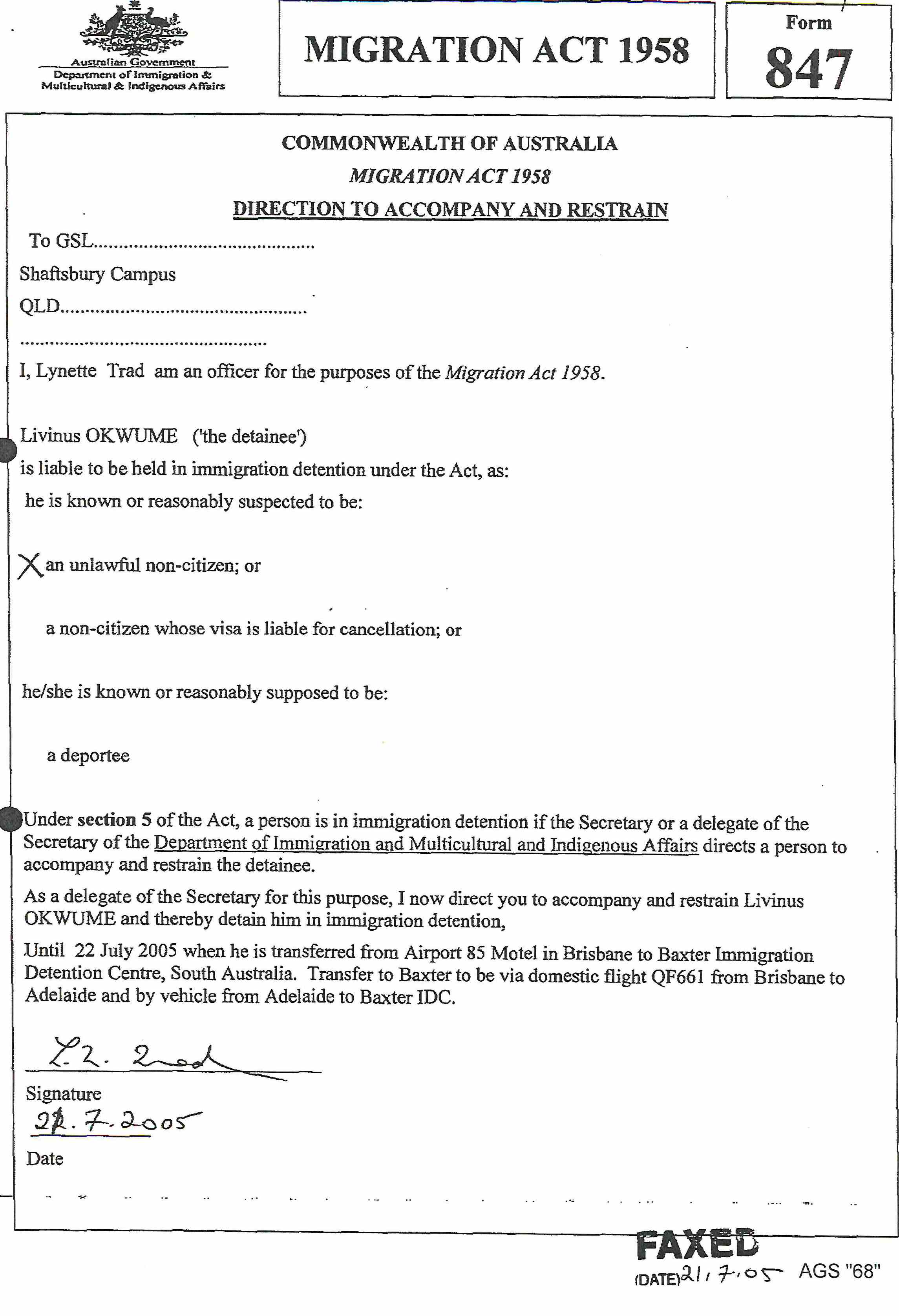
I will return to analyse the contents of these documents later in these reasons.
151 In essence, the Commonwealth submitted that, as a matter of fact, Ms Trad formed the state of mind required by s 189 of the Act and that, as a matter of law, it was open to Ms Trad to detain Mr Okwume even if earlier Mr Okwume had been detained by others. As to the first matter, the Commonwealth relied on the forms completed by Ms Trad to which I have already referred. The Commonwealth made it clear that it was not suggesting that the conduct of an officer who did not hold the requisite suspicion in s 189 of the Act could render Mr Okwume’s detention lawful or “wash clean” (as Mr Okwume put it) the unlawful actions of others. That is not its case. The Commonwealth’s case is that Ms Trad, in fact, held the requisite state of mind. As to the second matter, the Commonwealth submitted that Mr Okwume was not “re-detained” when he was, according to his submissions, “passed from one Departmental officer to another”, but rather that a separate lawful basis for his detention was established each time an officer, on forming the reasonable suspicion referred to in s 189 of the Act, determined to and did detain him. The Commonwealth referred to the terms of s 189 of the Act and submitted that a duty to detain and the lawfulness of the detention “arises” whenever an officer forms the relevant suspicion. In this case, Ms Trad, upon forming a reasonable suspicion that Mr Okwume was an unlawful non-citizen, was lawfully authorised to detain Mr Okwume whether at that time he was in detention, at large or detained unlawfully. The Commonwealth submitted that it is not correct (as Mr Okwume submitted) that Mr Andersson’s detention (and for that matter, Ms O’Connell’s) was not indefinite; he would no longer be subject to detention if the detaining officer no longer held a reasonable suspicion that Mr Okwume was an unlawful non-citizen. Section 196 of the Act does not alter or contradict that conclusion. The section prevents the release of an unlawful non-citizen except in the circumstances specified, but not the release of a lawful non-citizen (s 192(2)). The Commonwealth submitted that a person reasonably suspected by officer A of being an unlawful non-citizen could be detained, but later released if officer A ceased to hold a relevant suspicion. That would not prevent another officer, officer B, shortly afterwards taking the person into detention upon forming the requisite suspicion in s 189 of the Act. The Commonwealth submitted that it makes no difference that the periods of detention are continuous or that the first period of detention was unlawful because the suspicion was formed, but it was not reasonable. The Commonwealth accepts, I think, that in deciding whether officer B formed a reasonable suspicion within s 189 of the Act all the circumstances are to be considered, including, depending on the particular facts, the circumstances surrounding officer A’s belief and the person’s detention. However, ultimately the question is whether officer B formed the relevant suspicion and that, the Commonwealth submitted, is a question of fact.
152 As to the question of fact and Mr Okwume’s submission that the relevant question is whether the Commonwealth had shown that Ms Trad did not know or was not reasonably capable of knowing the defective circumstances of Mr Andersson’s decision-making, the Commonwealth submitted that the issue framed in those terms was, in effect, a misdirection. The question is not one of identifying the matters Ms Trad was reasonably capable of knowing. The correct question is whether the Commonwealth has established that Ms Trad reasonably suspected that Mr Okwume was an unlawful non-citizen. I have already set out what I consider to be the proper approach (at [134]).
153 The Commonwealth submitted that the primary judge’s finding as to Ms Trad’s state of mind and conduct was correct. The Commonwealth was not required to call the officer if the other evidence in the case – i.e., documentary evidence – established the relevant matter (Sadiqi v Commonwealth (No 2) [2009] FCA 1117; (2009) 181 FCR 1 at 35 (Sadiqi) [139]). The Commonwealth submitted that Ruddock v Taylor at [28], [49]-[50] is authority for the proposition that an officer may form a reasonable suspicion that a person is an unlawful non-citizen based on a purported cancellation of a visa which is later declared invalid.
154 The Commonwealth referred to an email Mr Andersson sent to Ms Trad at 5.39 pm on 21 July 2005 in the following terms:
The following person was refused entry today at Brisbane Airport.
OKWUME, Livinus (01May 1963) Nigerian Citizen
A/n presented Nigerian ppt a2888414a which was later identified by the Document Examiner as not a genuine issued Nigerian ppt.
S/c456 visa, canx under S116(1)(d) s103 bogus documentation given. A/n claimed protection at interview and was screened in by the delegate of Onshore Protection Unit.
A/n is to remain in detention overnight at Airport 85 and arrangements currently underway to transfer him to Baxter.
Pls find attacted (sic) the Detention report which has been saved as a case note in ICSE. Referral ID is EA645782.
155 The Detention Report which was attached contained a number of matters, including the following:
… | … |
Verification of identity (incl. docs sighted, persons verified, locations visited, other info) (if identity cannot be confirmed, have all checks in accordance with MSI 405 occurred) | Pax presented Nigerian ppt a2888414a which was later identified by Document Examiner as not a genuine issued Nigerian ppt. Other photo identification sighted included an ID card issued by Enugu State of Nigeria, Ministry of Health and a licence issued by The Nursing and Midwifery Counsel of Nigeria for a/n to practise as a nurse anaesthetist. |
… | … |
Visa status and immigration history | Unlawful Non-Citizen – s189(2) MA – S/C 456 visa canx under S116(1)(d) on the grounds a/n presented a bogus document. A/n admitted at interview his intention to remain in a/a/ permanently and subsequently claimed protection. |
… | … |
156 The Commonwealth submitted that, having regard to this information, the conclusion that Ms Trad reasonably suspected Mr Okwume was an unlawful non-citizen “must, as in Ruddock v Taylor, follow ‘inevitably’”.
157 It seems to me that the submissions with respect to these grounds of Mr Okwume’s appeal raise the following questions:
(1) Did the primary judge err in finding that Ms Trad reasonably suspected Mr Okwume of being an unlawful non-citizen?
(2) Even if the primary judge did not err in finding that Ms Trad reasonably suspected Mr Okwume of being an unlawful non-citizen, did her Honour err in holding that Ms Trad detained him in circumstances where Mr Andersson had detained or purported to detain Mr Okwume?
158 With respect to the first question, there is, of course, no rule of law that an officer’s state of mind can only be established by oral evidence from the officer (Sadiqi at [139]-[140]). In this case, the primary judge drew inferences from documents put in evidence and, in my opinion, she was entitled to do that.
159 Ms Trad received Mr Andersson’s email of 21 July 2005 at 5.59 pm and a copy of Mr Andersson’s Detention Report. Mr Andersson advised of the cancellation of Mr Okwume’s visa and the grounds thereof and the arrangements being made with respect to his detention overnight and his transfer to Baxter. It would have been open to Ms Trad to conclude that Mr Okwume’s visa had been cancelled and that he was, therefore, an unlawful non-citizen. There was nothing in the email or the Detention Report which would raise a query about the cancellation or suggest that it was legally infirm.
160 In the Direction to Accompany and Restrain Form, Ms Trad stated that she was an officer for the purposes of the Act; that Mr Okwume is liable to be held in immigration detention under the Act because he is known or reasonably suspected to be an unlawful non-citizen; acknowledges that under s 5 of the Act a person is in immigration detention if a delegate of the Secretary of the Department directs a person to accompany and restrain the detainee; that she is a delegate of the Secretary for this purpose; that she was directing GSL to accompany and restrain Mr Okwume and thereby detain Mr Okwume in immigration detention; and the direction relates to the transfer from the Airport 85 Motel to Baxter. It is true, as Mr Okwume submitted, that the Form is expressed in the passive voice in that it does not expressly state the person who knows or reasonably suspects Mr Okwume to be an unlawful non-citizen and it does not reveal a decision between known and reasonably suspected. Despite these matters, and in particular the former, I think it was open to her Honour to infer from all of the evidence that Ms Trad formed the requisite suspicion in s 189 of the Act.
161 In the Transfer of Custody Form that was completed by Ms Trad on the same day, there is a statement that GSL currently held Mr Okwume in lawful immigration detention under the Act and it contained an authorisation to GSL to transfer custody of the detainee to the manager of Baxter. The Request for Services Form contains a request that GSL detain Mr Okwume on the basis that he is an unlawful non-citizen and a request that they collect Mr Okwume from Airport 85 Motel and escort and transfer him to Baxter.
162 In my opinion, it is appropriate to draw the inference that Ms Trad believed that Mr Okwume’s visa had been cancelled and suspected that he was an unlawful non-citizen for the purposes of s 189(1) of the Act. Furthermore, a reasonable person in Ms Trad’s circumstances would have formed that suspicion. It does not seem to me correct to conclude that a reasonable person in Ms Trad’s circumstances would have considered it necessary to ask for details of the steps in the cancellation process before forming the suspicion.
163 In Ruddock v Taylor, the plurality in addressing the facts said (at [49]-[50]):
At the trial of these proceedings, those officers who had been responsible for effecting the respondent's detention gave unchallenged evidence of the steps each had taken before detaining the respondent. Each officer had been provided with what, on its face, appeared to be a regular and effective decision of the Minister to cancel the respondent's visa. Each officer checked whether the respondent held any other visa. Upon finding that he did not, the officer concerned detained the respondent.
Plainly, each suspected that the respondent was an unlawful non citizen. It was not suggested that either had acted in bad faith. The conclusion that each reasonably suspected that the respondent was an unlawful non citizen follows inevitably.
164 Although Ms Trad did not give evidence in this case, the documents indicate that she was presented with information, which she would have had no reason to doubt, that there had been a regular and effective cancellation of Mr Okwume’s visa. She then completed documents from which it may be inferred that she reasonably suspected that Mr Okwume was an unlawful non-citizen within the Act and she gave directions as to his detention.
165 With respect to the second question, it may be noted that Mr Okwume did not claim that he was falsely imprisoned before 2.55 pm and yet it would seem to be a consequence of his argument that he was detained unlawfully only once on 21 July 2005 and that was at an earlier stage. In any event, and leaving that to one side, I see no reason to construe s 189 of the Act in such a way that the power in the section is exhausted once the alleged unlawful non-citizen is taken into immigration detention. Section 196 of the Act does not demand such a construction. Section 196(2) makes it clear that there is no obligation to hold a lawful non-citizen in detention. Such a person might be taken into detention by mistake and then, when the mistake is discovered, is entitled to be released. There is also the definition of “detain” which includes not only taking a person into immigration detention, but keeping that person in detention or causing him or her to be kept in detention. Furthermore, the Direction to Accompany and Restrain Form falls within paragraph (a)(ii) of the definition of immigration detention because Ms Trad, as a delegate of the Secretary, has directed GSL to accompany and restrain Mr Okwume who was subsequently in the company of, and restrained by, GSL. I am unable to see any reason why the Commonwealth’s submission that a separate lawful basis for a person’s detention may be established each time an officer, on forming the reasonable suspicion referred to in s 189 of the Act, determined to and did detain the person should not be accepted.
166 Both parties referred to the decision of the Full Court of this Court in Fernando. I do not propose to analyse the decision in detail. Mr Okwume submitted that there is difficulty with some of the reasoning and he referred to [69], [72] and [84]. In my opinion, the Court was not addressing the precise point in issue before this Court. To the extent the decision is of assistance, it favours the Commonwealth because the Court seemed to assume that the state of mind of subsequent officers while Mr Fernando was in detention could be relevant. The Court said (at [100]):
Here, there was no evidence that, at any time during his immigration custody, any officer, as defined, ever took Mr Fernando into detention or kept or caused him to be detained there with any state of mind required in s 189(1). The Commonwealth called no witnesses who were involved in the detention of Mr Fernando other than Ms Lockhart.
167 In my opinion, the question is one of fact and there is no legal bar to a second or subsequent officer engaging s 189(1) of the Act. The check on giving too wide an operation to s 189(1) is the practical one that it will not often be the case that subsequent officers will consider that they are engaging in the process envisaged by s 189(1) and thereafter detaining the person. As it happens in this case, that is precisely what it may be inferred Ms Trad considered she was doing and had done.
Ground 3
168 Ground 3 of Mr Okwume’s Notice of Appeal is that the damages the primary judge awarded for the period of unlawful detention – the period from 2.55 pm on 21 July 2005 to 8.15 am on 22 July 2005 – were manifestly inadequate.
169 Mr Okwume submitted that damages for false imprisonment are calculated irrespective of whether the tort was committed in good faith or not and that they are usually calculated by reference to a large quantum in respect of the initial imprisonment because of the shock of the loss of liberty. Mr Okwume submitted that an appropriate award for his initial wrongful detention was in the order of $10,000.
170 The Commonwealth submitted in answer to these submissions that Mr Okwume had not identified an error of principle in relation to the damages awarded and the notion that an enhanced award for the initial loss of liberty is not appropriate in this case because, in fact, Mr Okwume was first unlawfully detained at 12.25 pm on 21 July 2005 (for which no claim for damages is made). The Commonwealth submits that a comparison with the “daily rate” determined in other unlawful detention or false imprisonment cases reveals that the primary judge’s award was not manifestly inadequate.
171 I should mention that Mr Okwume went on in his written submissions to deal with “aggravated” or “exemplary” damages. That claim seems to relate either to events unrelated to the period of unlawful detention found by her Honour, which I uphold, or to causes of action (i.e., misfeasance in public office and/or negligence) which are not the subject of Mr Okwume’s appeal. In the circumstances the submissions do not need to be addressed.
172 Very little was said in oral submissions about the challenge to the award of damages for the period from 2.55 pm on 21 July 2005 to 8.15 am on 22 July 2005. In written submissions, the Court was referred to awards in other cases, but I do not consider any of these to be of precise assistance.
173 In my opinion, although her Honour might have awarded more by way of general damages by reference to shock associated with the initial deprivation of liberty which began in earnest in mid to late afternoon on 21 July 2005, it cannot be said that the primary judge’s award is manifestly inadequate.
Conclusion with respect to Mr Okwume’s appeal
174 Mr Okwume’s appeal should be dismissed.
Conclusion
175 Both appeals should be dismissed. The parties should be heard as to costs.
I certify that the preceding one hundred and seventy-five (175) numbered paragraphs are a true copy of the Reasons for Judgment herein of the Honourable Justice Besanko. |
Associate:
REASONS FOR JUDGMENT
MORTIMER J:
Introduction and summary
176 I have had the advantage of reading the reasons for judgment of Besanko J and White J. The relevant facts, the sequence of events and the parties’ arguments before the primary judge and before this Court, are set out in the reasons of Besanko J, which I gratefully adopt.
177 The key difference in my approach on the appeal is that I accept the Commonwealth’s submission that it was denied procedural fairness in circumstances where it was deprived of the possibility of a different outcome in the proceeding. I further find that, even if Mr Andersson’s cancellation decision was affected by one or both of the jurisdictional errors identified by the primary judge, the existence of neither of those errors was capable of affecting the reasonableness of Mr Andersson’s suspicion, and therefore did not render the detention of Mr Okwume unlawful. This conclusion means that Mr Okwume’s originating application should be dismissed, and removes the premise for Mr Okwume’s appeal to this court. Inevitably then, on my reasoning, Mr Okwume’s appeal must be dismissed.
178 Accordingly, on the Commonwealth’s first ground of appeal, I disagree with Besanko and White JJ, and would uphold this ground of appeal. I agree with Besanko and White JJ that the Commonwealth’s second ground of appeal should succeed, although my reasoning is somewhat different. I also uphold most but not all of ground 3 of the Commonwealth’s appeal, relating to the reasonableness of Mr Andersson’s suspicion. I do not consider that it is necessary to decide the correctness of the Commonwealth’s fourth ground of appeal in light of my findings in relation to grounds 1 and 3. It is also strictly not necessary to decide the Commonwealth’s fifth ground of appeal, on the approach I have taken, although I am inclined to agree with Besanko J’s analysis on this matter. This reasoning leads me to the conclusion that the Commonwealth’s appeal should be allowed.
179 I agree with Besanko J that the appeal by Mr Okwume against the orders of the primary judge should be dismissed, but again I do so for different reasons.
The Commonwealth’s appeal
180 I accept the Commonwealth’s submissions that the primary judge denied the Commonwealth procedural fairness in reaching conclusions, which became a foundation of her Honour’s orders, on matters not part of Mr Okwume’s case, not raised by any party, and of which the Commonwealth was given no notice.
181 I consider the denial of procedural fairness resulted in the Commonwealth being deprived of the possibility of a successful outcome at trial. I do not agree that, in an exercise of judicial power, and unless there are exceptional circumstances, such a denial of procedural fairness by a judge should be seen as capable of being “cured” by addressing the subject matter of the denial for the first time on appeal. When the subject matter of the denial is the foundation for the Court’s orders, that approach sets the trial process at nought. Further, it is not possible to be confident that the trial would not have been run differently – as to both evidence and argument – had the primary judge put the parties on notice of the errors she herself identified.
182 Although expressed in a different context (namely, raising an argument for the first time on appeal), the observations of Perram J in AAM15 v Minister for Immigration and Border Protection [2015] FCA 804; 231 FCR 452 at [14] are ones with which I would respectfully agree, and which I consider have application to the present situation:
…If this Court, in substance, determines a case at first instance by entertaining fresh grounds and a notice of contention this structure is thwarted because no appeal lies to the High Court other than by special leave which is rarely granted and then only on the grounds set out in s 35A of the Judiciary Act 1903 (Cth). If the matter is effectively tried in this Court then the appellant is denied a layer of appellate scrutiny.
183 As I explain below, I consider it is unnecessary to express a final view on the merits of the two jurisdictional errors identified by the primary judge, because I am satisfied that neither error (even if made out) was capable, in the circumstances, of affecting the reasonableness of Mr Andersson’s suspicion for the purposes of s 189 of the Migration Act 1958 (Cth).
The s 119(1)(a) ground (grounds 1 and 4, and 3)
184 The Commonwealth’s grounds 1 and 4 deal with this matter. Ground 1 alleges denial of procedural fairness by the primary judge in considering and determining the existence of an error, by reference to the terms of s 119(1)(a), in Mr Andersson’s decision to cancel Mr Okwume’s visa. Separately to the alleged denial of procedural fairness, ground 4 challenges the correctness of her Honour’s conclusions. Ground 3 of the Commonwealth’s notice of appeal is also relevant.
185 The lawfulness of Mr Andersson’s cancellation decision under s 116, read with s 119(1)(a) was considered by the primary judge in the context of the false imprisonment claim by Mr Okwume, because if his visa was not lawfully cancelled he would not have been, in law and in fact, an unlawful non-citizen and the only question would be whether and in what circumstances he could have been “reasonably suspected” of being one for the purpose of s 189 of the Migration Act. That, of course, is the point of distinction made by the plurality in Ruddock v Taylor [2005] HCA 48; 222 CLR 612 at [27].
186 In Taylor, the plurality explained at [40] that, in determining whether a suspicion was “reasonable”, the grounds for suspecting a person to be an unlawful non-citizen “must be judged against what was known or reasonably capable of being known at the relevant time” (my emphasis). Their Honours explained at [41] that, in making this determination, there is to be no distinction drawn between what is later discovered to be a mistake of fact and what is later discovered to be a mistake of law. As the following passage from Taylor at [45] reveals, those distinctions are not always clear:
The second reason to reject the contention is that there would be many cases under s 189 in which a distinction between mistake of law and mistake of fact could not readily be drawn, if drawn at all. Reference to cases like Collector of Customs v Agfa-Gevaert Ltd provides ready illustration of the difficulties. Especially is that task difficult where, as here, the subject matter of the relevant suspicion is a statutory status – being an unlawful non-citizen. Errors about the conclusion cannot safely be divided between errors of law and errors of fact. Often, perhaps much more often than not, the error will be one of mixed law and fact.
187 In Taylor, the officers who exercised the power under s 189 to detain Mr Taylor and keep him in detention were not the same individuals as those who had cancelled Mr Taylor’s visa, unlawfully as it turned out. The cancellation decisions were both Ministerial decisions. Mr Taylor’s visa had twice been cancelled on character grounds, and those cancellation decisions had twice been set aside by the High Court. Following each cancellation decision, Mr Taylor was detained under s 189, kept in detention, and then released when the cancellation decision was set aside. It was for those periods he made claims of false imprisonment. At [49]-[50], the plurality dealt shortly and firmly with the submission that on either occasion, the jurisdictional error affecting the cancellation decision flowed through to affect the reasonableness of the officers’ suspicions for the purposes of s 189:
At the trial of these proceedings, those officers who had been responsible for effecting the respondent’s detention gave unchallenged evidence of the steps each had taken before detaining the respondent. Each officer had been provided with what, on its face, appeared to be a regular and effective decision of the Minister to cancel the respondent’s visa. Each officer checked whether the respondent held any other visa. Upon finding that he did not, the officer concerned detained the respondent.
Plainly, each suspected that the respondent was an unlawful non-citizen. It was not suggested that either had acted in bad faith. The conclusion that each reasonably suspected that the respondent was an unlawful non-citizen follows inevitably.
188 The circumstances of Mr Okwume’s visa cancellation by Mr Andersson were different from those in Taylor in one key respect. Mr Andersson was both the officer responsible for cancelling Mr Okwume’s visa and the officer who initially exercised the power in s 189 to detain him. Nevertheless, as I explain below, I do not consider that circumstance permits the Court to attribute to a reasonable officer in the position of Mr Andersson the legal knowledge the primary judge was prepared to attribute.
189 I turn to the relevant findings of the primary judge. Her Honour set out her understanding of the applicable principles, relying on Taylor, and Goldie v Commonwealth of Australia [2002] FCAFC 100; 117 FCR 566. At [119], her Honour set out what she considered could be “distilled” from the reasons of Gray and Lee JJ in Goldie at [4]-[7] about the phrase “reasonably suspects” in s 189. For present purposes, the importance of what Gray and Lee JJ said at [4]-[7] lies, in my opinion, in understanding that their Honours were concentrating on what factual matters might, or might not, be apparent (or should be apparent) to an officer considering exercising the s 189 power. Their Honours said:
4 The definitions of the words “suspect” and “suspicion” in the Macquarie Dictionary make it plain that a suspicion may be formed “with insufficient proof or with no proof”, or “on little or no evidence”, or “on slight evidence or without evidence”. By itself, the word “suspects” would be capable of being construed to include the formation of an imagined belief, having no basis at all in fact, or even conjecture. Plainly, to empower an arrest on the basis of an irrational suspicion would offend the principle of the importance of individual liberty underlying the common law. It would also allow the possibility of arbitrary arrest, with the consequence that Australia would be in breach of its international obligations pursuant to Art 9 of the International Covenant on Civil and Political Rights done at New York on 19 December 1966. To avoid these consequences, the word “reasonably” has been placed before the word “suspects” in s 189(1). The adverb makes it clear that, in order to justify arrest and detention, the suspicion that a person is an unlawful non-citizen must be justifiable upon objective examination of relevant material. Given that deprivation of liberty is at stake such material will include that which is discoverable by efforts of search and inquiry that are reasonable in the circumstances.
5 The phrase “reasonably suspects” is used as an alternative to “knows”. Before an officer could know that a person is an unlawful non-citizen, the officer would have to have reached a level of satisfaction of that fact approaching certainty. If, as in the present case, the person concerned were not an unlawful non-citizen, because he or she was the holder of a visa entitling him or her to be in Australia, it would be impossible for the officer to know the contrary. The context of the phrase “reasonably suspects” suggests that something substantially less than certainty is required. Reasonable suspicion, therefore, lies somewhere on a spectrum between certainty and irrationality. The need to ensure that arrest is not arbitrary suggests that the requirement for a reasonable suspicion should be placed on that spectrum not too close to irrationality.
6 It is trite to say that what is reasonable in a particular case depends upon the circumstances of that case. It is worth remembering, however, that all of the circumstances must be considered. If, as in the present case, an officer is aware of conflicting facts, the reasonableness of any suspicion formed by that officer must be judged in the light of the facts available to him or her at the particular time. It may be that the existence of a particular fact would ground a reasonable suspicion in the mind of the officer if it were the only fact known to him or her. If, at the time of forming the suspicion, the officer is aware of conflicting facts, it may not be reasonable simply to discard those facts and to form a suspicion on the basis of the single fact capable of supporting such a suspicion. That is, the officer is not empowered to act on a suspicion reasonably formed that a person may be an unlawful non-citizen. The officer is to detain a person whom the officer reasonably suspects is an unlawful non-citizen. That, of course, is consonant with the serious act the officer is empowered to carry out. Section 196 operates upon a person detained under s 189 who is an unlawful non-citizen, not upon a person reasonably suspected of being an unlawful non-citizen. The scheme contemplated under the Migration Act is indefinite detention pending removal or deportation under administrative fiat. It is not detention for the purpose of curial review or determination of status. These provisions confirm that the appropriate construction of s 189 is that an officer in forming a reasonable suspicion is obliged to make due inquiry to obtain material likely to be relevant to the formation of that suspicion.
7 One further consideration should be mentioned. A suspicion that is not grounded in fact to the point of becoming reasonable does not become reasonable because of a perceived need to act quickly. In the present case, the fact that Mr Cain knew that the appellant was about to be dismissed from his employment by Fluor Daniel Pty Ltd (Fluor Daniel), and that he would be at the premises of that company at a particular time, did not bear upon the reasonableness of the suspicion. It created precisely the situation in which the need for a suspicion to be grounded in fact to the point of being reasonable became even more acute than normal, so that precipitate action, based on a misapprehension, might be avoided. The fact that the appellant was employed at a significant level with a national employer suggested that the appellant held a visa permitting him to obtain such employment.
190 At [130] of her reasons, the primary judge said:
Where the context is one in which a person is detained by an officer under s 189 of the Act on the basis of a suspicion that the person’s visa has been cancelled, the suspicion will not, in my opinion, be objectively reasonable if the officer at the relevant time knows, or ought reasonably to know, matters that would put a reasonable person in the officer’s position on notice that the cancellation decision is irregular or ineffective.
191 With respect to the primary judge, this approach goes further than the High Court’s decision in Taylor. To ask whether a reasonable person in the officer’s position should have been “put on notice” that a cancellation decision was “irregular or ineffective” is not derived from Taylor. I also consider this approach travels beyond what the Full Court said in Goldie, in particular at [4]-[7], which are the passages identified by the primary judge. The material facts in Goldie concentrated on the nature and extent of searches undertaken by a Departmental officer. The officer looked over computer records relating to the appellant and found no record of the appellant holding a current and valid visa. The Full Court set out the relevant facts at [9]–[11]:
9 The computer record that Mr Cain viewed on 24 February 1998 showed that the last visa issued to the appellant had been issued on 24 November 1995 and had ceased to be in effect on 27 February 1996. Plainly, it was not an up-to-date record. Indeed, the data perused by Mr Cain before he took action was only a partial search of the relevant record, in that the search related to data obtained from immigration cards filled out by the appellant on movements to and from Australia. It did not purport to be a search of a record of visas granted after the appellant entered the country. Furthermore, it was not suggested that Mr Cain made any search of the appellant’s file to ascertain whether visas had been given extended effect by operation of the provisions of the Migration Act or the Migration Regulations 1994 (Cth). Mr Cain had received from the fifth respondent, Mr Gregg, a copy of the file of the Department of Immigration and Multicultural Affairs (the Department) relating to the appellant, a copy of the most recent decision of the Administrative Appeals Tribunal relating to the appellant and a memo suggesting that Mr Cain might consider cancellation of a current visa held by the appellant. Mr Gregg was an officer in the Legal Services and Litigation Branch of the Department in Canberra. As an officer, he was under precisely the same duty to detain a person whom he knew or reasonably suspected to be an unlawful non-citizen as was Mr Cain. Yet he was not instructing Mr Cain to act on such a reasonable suspicion. He was suggesting that Mr Cain might like to consider cancellation of a current visa.
10 The decision of the Administrative Appeals Tribunal had been given on 18 February 1998, six days earlier. It was a decision on the application of the character test, pursuant to s 501 of the Migration Act. It involved the refusal of an application for a permanent resident visa, consequent upon the application of that test.
11 When Mr Cain gave evidence before the learned trial judge, the appellant, who appeared in person, asked him in cross-examination about his understanding of the currency of a bridging visa pending appeal from the Administrative Appeals Tribunal. It was put to him that, following the refusal of a visa under s 501, the applicant was automatically granted a bridging visa pending departure from Australia or an appeal. His response was that if someone was cancelling a visa under s 501, they may also have cancelled the bridging visa under the same section. According to him, his state of mind was:
“As far as I could ascertain, your visa had ceased and my belief was that there had been an error by another office in not either [sic] recording the things correctly before granting you a visa and that you held no visa.”
At the time, Mr Cain had in his possession the very decision of the Administrative Appeals Tribunal, which he could have checked to see if it involved a cancellation of the appellant’s bridging visa B. He also had in his possession the Department’s file relating to the appellant. He had been instructed to consider cancellation of a visa, obviously on the basis that a visa existed that could be cancelled.
192 In Taylor at [144], Kirby J alluded to the difference between the circumstances in Taylor and those in Goldie. Otherwise, the reasons in Taylor do not refer to the Full Court’s approach in Goldie.
193 At [135], the primary judge found:
On the evidence adduced at trial, I am satisfied that Mr Andersson bona fide suspected that Mr Okwume was an unlawful non-citizen. The reasonableness of the suspicion is to be assessed in the context of Mr Andersson having personally made the decision to cancel Mr Okwume’s visa in his capacity as a delegate of the Minister and therefore involves a different kind of factual enquiry than that undertaken at least in the trial stages in Ruddock.
194 I accept it was correct for the primary judge to point out the distinguishing feature of Mr Okwume’s visa cancellation from Taylor. However, her Honour continued at [131]:
It is to be borne in mind that the High Court expressly rejected there being any relevant distinction between mistakes of fact and mistakes of law in assessing the reasonableness of an officer’s suspicion under s 189 of the Act. It follows, in my opinion, that the Court must ascertain the knowledge that the detaining officer had or ought reasonably to have had, not only in respect of the facts, but also in respect of the requirements of the law. Again, the question of whether a detaining officer ought reasonably to have known the requirements of the law will turn on the whole of the legal and factual context in which the impugned act of detention occurs. (emphasis added)
195 It is this passage which causes me some difficulty. In Taylor, the High Court refers to a “mistake of law” but does not describe the approach to the determination of when a suspicion formed for the purposes of s 189 is reasonable in terms of whether an officer “ought reasonably to have known the requirements of the law”. The “law” to which her Honour refers in these paragraphs is the law relating to the making of a cancellation decision without jurisdictional error, including without denial of procedural fairness. It is not simply the express terms of a statute, but what statutory terms (s 119(1)(a) in particular) have been held by courts to require in order for the legal requirements of procedural fairness to be satisfied.
196 Having considered the evidence, and the law concerning cancellation decisions under s 116, where a notice under s 119(1)(a) was required, the primary judge found (at [158]-[159]):
In the statutory context I have described, it was not sufficient that Mr Andersson put to Mr Okwume a bare assertion that a document examiner had “determined” Mr Okwume's passport to be “bogus”. He was required to give Mr Okwume sufficient particulars of the information upon which the document examiner's findings were based. To deny a visa holder the opportunity to comment on the particulars of information relied upon by an expert adviser would be to deny the visa holder the meaningful opportunity to persuade the decision maker that the expert opinion cannot be reasonably relied upon in determining whether grounds for cancellation of the visa exist.
Accordingly, s 119 of the Act required that Mr Okwume be given particulars of the facts and matters underlying Mr Kriss’ opinion, including information to the effect that the laminate on Mr Okwume’s passport differed in comparison with a specimen passport that had (at least apparently) been issued some seven years previously. Whether or not it was reasonable for Mr Andersson to suspect the document to be counterfeit on that basis is a matter in respect of which Mr Okwume was entitled to be meaningfully heard. Mr Andersson did not fulfil the statutory criteria by merely asserting (as he did) that a document examiner had determined the passport to be “bogus”. Mr Okwume could make no meaningful submission in respect to that particularised assertion except to broadly assert (as he did) that the passport was genuine. It is difficult to conceive of a situation in which the mind of a decision-maker would ever be swayed by a broad and unspecific denial of the kind given by Mr Okwume in answer to a broad and unspecific allegation. (emphasis added)
197 When the primary judge uses the term “required” in this passage, I understand this to mean required by s 119 of the Migration Act, read with the authorities which have considered that provision. That is: “required” as a matter of administrative law. From [163] onwards, the primary judge then turns to the dictation argument, which I consider below.
198 Then, at [176], the primary judge states:
I take into account the circumstance that the Minister is not a legal practitioner. The Act nonetheless reposes in the Minister powers to cancel a visa that have the statutory consequence that a person meeting the description of an officer will act upon the assumption that the decision is legally effective, so as to deprive a person of their physical liberty. When exercising the cancellation power under s 116 of the Act pursuant to a delegation under s 496 of the Act, Mr Andersson stood in the shoes of the Minister. A person upon whom a statutory power is conferred ought reasonably to know the conditions of the exercise of the power. More specifically, the Minister may reasonably be expected to know at least the conditions affecting the exercise of the powers conferred under s 116 of the Act, including the requirements to comply with the rules of procedural fairness prescribed in ss 119 and 120. The relevant conditions are expressed on the face of the statute. (emphasis added)
199 Again, I understand the reference by the primary judge to “conditions” of the exercise of power to mean the legal conditions, whether express or as developed by case law. Although it is correct that “on its face” s 119(1)(a) provides that an officer must give a person whose visa is to be cancelled under s 116 “notice” of the “grounds and of the information (not being non-disclosable information) because of which the grounds appear to exist”, the statute says nothing about the nature and level of information that must be provided. The statute itself does not define what a “ground” is and what “information” is. The nature and content of that obligation has been filled out by authorities which have considered the provisions: see, for example: Zhao v Minister for Immigration & Multicultural Affairs [2000] FCA 1235 at [23]–[25]; Tien v Minister for Immigration & Multicultural Affairs [1998] FCA 1552; 89 FCR 80 at 92; Minister for Immigration and Citizenship v Brar [2012] FCAFC 30; 201 FCR 240 at [57].
200 It is correct on the evidence, as Besanko J sets out, that the s 116 notice completed by Mr Andersson identified the “ground” for the cancellation of Mr Okwume’s visa as that he had presented a bogus document at Brisbane Airport, with the effect that he was liable to have his visa cancelled under s 116(1)(d) of the Migration Act. The notice does not identify (in the relevant part of the document) any “information” because of which the ground existed. The only portion of the document which does this is in the actual cancellation decision part of the document – Part B. There, Mr Andersson records the opinion of the document examiner (Mr Kriss) which had been conveyed to Mr Andersson. As Besanko J sets out at [36] of his Honour’s reasons, it appears Mr Okwume was informed by Mr Andersson that it was his Nigerian passport that was considered to be bogus, but as the primary judge found, no further details were provided – such as that Mr Kriss had concluded the printing on the laminate on Mr Okwume’s passport was counterfeit.
201 It can be accepted that the authorities to which I refer in [199] may suggest more information should have been provided for the procedural fairness purpose of s 119(1)(a) to be achieved. Certainly that is what the primary judge found. However, I would respectfully disagree with the primary judge’s characterisation that the conditions on the power, as she found them to exist, are expressed “on the face” of s 119(1)(a). The nature and extent of the information which it is necessary to provide to satisfy the procedural fairness function of s 119(1)(a) is not apparent on the face of the provision: rather, this is what has been developed through the authorities. Further, even if to a lawyer reading the text, a matter might be apparent “on the face” of a legislative provision, in my respectful opinion great care needs to be taken before attributing to a non-legally qualified officer in the position of Mr Andersson an ability to interpret, or understand, a provision as a lawyer might.
202 Although the primary judge recognised her conclusion about Mr Andersson’s exercise of power, and the reasoning to that conclusion which she adopted, were not raised on behalf of Mr Okwume, nor put to Mr Andersson or to the Commonwealth, the primary judge decided that did not preclude the Court making this one of the bases of its decision. The reason her Honour gave is at [179]–[180]:
I am mindful that it was not directly put to Mr Andersson in cross-examination that he had failed to observe the requirements of s 119 of the Act in the manner identified in these reasons. That omission can be explained by Counsel for Mr Okwume not having founded a case on a breach of that provision. Counsel for Mr Okwume did not make any submission as to how the requirements of Subdivs C, D and E of Div 3 of Pt 2 of the Act interrelated when invited to do so by the Court. The respondent, on the other hand, accepted that invitation. Counsel for the respondent correctly submitted that the requirements of Subdiv E applied and that s 119 of Subdiv E had been complied with. I have ultimately accepted the first part of that submission but rejected the latter.
I am satisfied that there is no unfairness to the respondent in determining that Mr Andersson contravened the Act in the manner I have identified in these reasons. The onus lay upon the respondent to prove that there was lawful justification for Mr Okwume’s detention. Mr Andersson clearly deposed without qualification in his evidence-in-chief that he had no independent recollection of any of the steps taken in cancelling Mr Okwume’s visa. Consistent with that evidence, there was no oral evidence Mr Andersson could give to rebut the inferences available to be drawn from the documentary evidence, considered as a whole.
203 It was not disputed on the appeal that her Honour was correct to summarise Mr Andersson’s affidavit evidence as being that he had no independent recollection of any of the steps he took to cancel Mr Okwume’s visa. However, the Commonwealth submitted:
4. Paragraph 10 of Mr Okwume’s Answer asserts that “the facts are beyond controversy” – essentially because Andersson had no recollection of the particular decision, and the Notice of Intention to Consider Cancellation form provided the only evidence of the exchange between Andersson and Mr Okwume. That submission takes too narrow a view of the issue on which the Commonwealth was denied procedural fairness.
4.1 The primary impact on the Commonwealth of Charlesworth J’s denial of procedural fairness was in relation to the finding that Andersson did not hold a reasonable suspicion that the decision was validly made because he knew or ought to have known that he had not given a notice of the kind required by s 119 of the Act.
4.2 Charlesworth J found that Andersson subjectively held a suspicion that Mr Okwume was an unlawful non-citizen. Therefore, the critical issue was whether Andersson’s suspicion that Mr Okwume was an unlawful non-citizen was a reasonable one, in light of the construction of s 119 that Charlesworth J adopted and the error that her Honour found Andersson to have made.
5. That was an evaluative judgment, in respect of which submissions plainly might have made a difference. Had the Commonwealth been on notice of the issue, it could have submitted that it was not unreasonable for Andersson:
(5.1) to fail to appreciate that, by relying on Kriss’ expert opinion, he was “to be taken to have made the same assumptions and findings and adopted the same reasoning [as] Mr Kriss” — that being an apparently novel doctrine finding its first expression in the reasons of Charlesworth J;
(5.2) as a decision-maker, to interpret s 119(1) of the Act as requiring him to provide to Mr Okwume only the information on which he, Andersson, in fact based his finding that a ground for cancellation existed — namely the opinion expressed by a document examiner that the passport was a false passport; and
(5.3) to suspect that the visa cancellation decision would not be affected by his failure to comply with s 119, as that section was later construed by Charlesworth J.
Charlesworth J’s reasons make no reference to those matters, and it is possible that her Honour overlooked them in finding that an officer in Andersson’s position could not reasonably have formed even a suspicion that Mr Okwume was an unlawful non-citizen.
204 I note that none of the parties to the appeal sought to uphold the primary judge’s findings summarised by the Commonwealth in (5.1) above. They conceded it was erroneous, but it does not appear to have been the basis for her Honour’s reasoning supporting the orders made.
205 Thus, the main thrust of the Commonwealth’s submissions, which I accept, is that if it had had an opportunity to put submissions to the primary judge, it may have been able to persuade her Honour that what she sought to impute to Mr Andersson as a reasonable level of knowledge about the legal obligations imposed by s 119(1)(a) was not reasonable. Alternatively, the Commonwealth may have been able to persuade the primary judge that the test she adopted (that a suspicion will not be reasonable for the purposes of s 189 if the exercise of power which has rendered a person without a valid visa is one the detaining officer ought reasonably have known was made in breach of the conditions on that exercise of power) was not the test set out in existing authorities and should not be adopted. I also accept the Commonwealth would have, at least, given consideration to whether any different or additional evidence might have been put forward. I accept on the appeal that no specific example of the kind of evidence that the Commonwealth would have put forward was proffered. However, it seems to me consideration might have been given to adducing evidence about the training afforded to officers in the position of Mr Andersson. What can be attributed to a “reasonable” officer may well, it seems to me, need to be assessed by reference to how officers in the position of Mr Andersson are trained, and what information they are given about their statutory obligations.
206 For my own part and as I explain below, I do not accept that an officer in the position of Mr Andersson “should have known” about the proper construction and operation of s 119(1)(a), and the level of particularisation which was required to make a cancellation decision lawful through compliance with s 119(1)(a).
207 The denial of procedural fairness need only be established to have deprived the Commonwealth of the possibility of a successful outcome: Stead v State Government Insurance Commission [1986] HCA 54; 161 CLR 141 at 147, reaffirmed by members of the High Court in Minister for Immigration and Border Protection v WZARH [2015] HCA 40; 256 CLR 326 at [43], [53] and [60]. In the present circumstances that threshold is comfortably satisfied.
208 The Commonwealth also relied on the following passage from Tocoan Pty Ltd v Commissioner of Police [2013] WASC 318 at [30], where Le Miere J said:
Where there has been a denial of procedural fairness affecting the entitlement of a party to make submissions on issues of fact, or the weight to be given to matters in the exercise of a discretion, or the making of an evaluative judgment, it is difficult for a court of appeal to conclude that compliance with the requirements of procedural fairness could have made no difference to the outcome.
209 I agree with that passage. Especially where, in my respectful opinion, the primary judge’s approach to what is comprehended by a reasonable suspicion for the purposes of s 189 travels beyond the approach set out in Taylor and Goldie.
210 Accordingly, I uphold ground 1 of the Commonwealth’s notice of appeal.
211 Ground 4 of the Commonwealth’s appeal challenges the primary judge’s finding of jurisdictional error in relation to the nature and content of the obligation in s 119(1)(a). I do not consider it is necessary to decide the correctness of the primary judge’s analysis of jurisdictional error. First, as I have explained, that finding involved a denial of procedural fairness to the Commonwealth and is liable to be set aside on that basis. Part of the circumstances of the denial were that the point identified by the primary judge was not only one not raised on behalf of Mr Okwume, it was one which had been positively disavowed. The Court should not compound the denial of procedural fairness by proceeding as if these circumstances are of no consequence.
212 Second, and critically, even if that finding was available as the correct legal conclusion on the evidence, the primary judge erred in finding that the existence of a jurisdictional error of that kind affected the reasonableness of the suspicion formed by Mr Andersson for the purposes of s 189 of the Migration Act. Therefore, it is not necessary for the Court to embark on further consideration of the correctness of the primary judge’s approach to the nature and content of the obligation in s 119(1)(a). What follows are my reasons for this second conclusion.
213 I consider Mr Andersson’s suspicion about Mr Okwume’s status as an unlawful non-citizen was a reasonable one in the circumstances, as the current authorities have explained that concept. That is because:
(a) Mr Andersson had relied on Mr Kriss’ opinion about the falsity of Mr Okwume’s passport. Mr Kriss was an expert document examiner, on whose opinion Mr Andersson had relied on previous occasions, and who explained his opinion about Mr Okwume’s passport to Mr Andersson. This was a sufficient basis for Mr Andersson to reasonably suspect the passport fell within the definition of “bogus document”.
(b) Mr Andersson estimated he had cancelled more than 100 visas, although the largest proportion were on other grounds than the bogus document grounds. However, Mr Andersson gave evidence about his practices dealing with documents he suspected to be bogus, including why he was content to rely on Mr Kriss’ opinion.
(c) The documentary evidence before the primary judge suggested Mr Andersson followed the processes set out in s 119 of the Act, as he understood them. The form he filled in contained an expression of the ground for cancellation, but did not in the appropriate section set out anything about Mr Kriss’ opinion, although this was set out in a subsequent section. The evidence before the primary judge suggests Mr Okwume was not informed about Mr Kriss’ opinion prior to his visa being cancelled.
(d) Mr Andersson subjectively believed Mr Okwume was an unlawful non-citizen because Mr Andersson had cancelled his visa. In circumstances where Mr Andersson was the cancelling officer, and he was able to rely on the processes he had himself undertaken, this provided at least part of the foundation for the reasonableness of his belief.
(e) There was no cross-examination of Mr Andersson about his practice in relation to s 119(1)(a), in terms of how much information he understood that provision required him to supply to a person whose visa was to be cancelled. Obviously that was because this was not an issue at trial. There was however, cross-examination of Mr Andersson about some of his other practices – that is, those relevant to the way the applicant put his case. In those circumstances, there is no positive evidence to support a finding that Mr Andersson’s level of understanding about the requirements in s 119(1)(a) was less than a reasonable officer could or should be expected to understand.
(f) There was no oral evidence given by Mr Andersson or others focussing on the departmental advice or training given to officers about what level of information about cancellation grounds they needed to give to individuals in a position such as Mr Okwume found himself. Nor was there any cross-examination of Mr Andersson about the terms of s 119(1)(a) itself, or the authorities which describe the content of the obligation to provide “information” to support an identified ground of cancellation. There was no evidence from other officers indicating a different practice about the level of information provided to individuals who were being given notice under s 119(1).
(g) The matters to which I have referred in (e) and (f) above mean there is no probative material on which a finding could be made about what it was reasonable (or not reasonable) for an officer in the position of Mr Andersson to know or understand, even if this is the correct approach to take to the terms of s 189 of the Act.
214 Further, as the Commonwealth submitted, the primary judge’s shift in language to asking what an officer “ought reasonably to have known” about “conditions for the exercise of the power” finds no support in the authorities on s 189, principally Taylor and Goldie. The plurality identified the correct question in Taylor at [27] as whether the suspicion, if subjectively held, is reasonably based. There is nothing in Taylor suggesting the Court necessarily intended the question of whether a suspicion was reasonably based to include an inquiry about the level of understanding an officer should have concerning the legal requirements of natural justice, as developed in the authorities. The result in Taylor suggests the opposite, although I accept that the facts in that case involved a cancellation by someone other than the detaining officer.
215 While it might be inferred that in passages such as [7] in Goldie, Gray and Lee JJ were referring to what an officer “ought to have known” the Court is referring to a “fact” that an officer might reasonably have been expected to know, had conscientious and proper searches been undertaken. Naturally enough, where it is alleged an officer “ought to have known” certain facts, that allegation will need to be put to the officer, and a probative basis will need to be established for any finding by the Court that it was reasonable to expect an officer to know such facts.
216 To prove that an officer’s subjective suspicion (based on her or his own conduct in cancelling a visa) is not reasonably based as a matter of law, in the way suggested by the primary judge, may well be difficult without straying into the area of misfeasance. Alternatively, such an approach may amount to an allegation that an officer exercised a statutory power negligently – that is, without regard for the applicable law which (on the primary judge’s approach) a reasonable officer in her or his position would have known. Here, the primary judge had rejected Mr Okwume’s causes of action based on misfeasance and negligence.
217 With respect to the primary judge, I consider her Honour’s description of the requisite knowledge to satisfy the threshold of a “reasonable” suspicion for the purposes of s 189 is an extension of the current law. That extension should not be made in circumstances where the officer concerned has not had an opportunity to deal with the allegations, and the Commonwealth has not had the opportunity to deal with the contentions at trial. The primary judge’s approach required of Mr Andersson that he assess – and impugn – his own decision-making against the legal standards imposed by courts on judicial review. I do not consider an approach such as this is clearly supported by either Goldie or Taylor, and I do not consider it is an extension of the principles set out in those cases which should be accepted by this Court on appeal in the current circumstances, given the denial of procedural fairness to the Commonwealth at trial.
218 Therefore, I respectfully disagree with the approach taken by Besanko J, especially at [137].
219 That is not to gainsay the (hypothetical) proposition that there may be occasions where a legal requirement (or condition on a statutory power) is so plain that there could be no reasonable basis for an officer to suspect a person’s visa had been lawfully cancelled, so as to render her or him an unlawful non-citizen, even if the officer herself or himself had exercised the cancellation power. A hypothetical example might be the failure to provide a notice under s 119 at all, in circumstances where it was clear from the evidence that officers are trained to ensure such a notice is given by filling in a form they are expected to be familiar with, have been instructed about what it needs to contain, and have been told what the purpose of giving notice is. As I have noted above, such situations may either approach misfeasance, or are better seen as an allegation of a negligent exercise of a statutory power. They are quite different from the approach to be taken in deciding what facts it is reasonable for an officer to know, although even that inquiry will have a particular forensic context in each case.
220 There is no such obvious legal error in this case. Mr Andersson provided notice in the correct form. The content of the notice, on its face, set out a ground and (at least in a later part of the notice) set out the information about that ground. As a matter of administrative law, the latter may not have been sufficient to afford procedural fairness to Mr Okwume as the authorities in this Court have interpreted s 119(1)(a): I do not decide that question. However I note that procedural fairness in this context has a qualitative aspect, illustrated by Besanko J’s reference (at [137] of his Honour’s reasons) to a person being given a “meaningful opportunity” to respond to information. While there can be no quarrel with a qualitative approach to procedural fairness in that sense as a matter of administrative law, it is another matter altogether to impose a qualitative obligation on officers in the position of Mr Andersson as a precondition to their suspicion under s 189 being capable of being characterised as “reasonable”. I repeat however, that it seems to me in most cases, cross-examination of the officer concerned will be necessary for such a finding to be made, as well as for procedural fairness to be afforded. I also consider that, in order to establish and identify the requisite standard of how much it is reasonable to expect an officer like Mr Andersson to know about the context of procedural fairness (or any other legal requirement that may condition an exercise of power), evidence may be required. Or, at least, the party with the burden of proving the officer had a reasonable suspicion (the Commonwealth), should be given the opportunity to consider whether to call evidence. An election not to do so may also be forensically significant: but the ability to elect must generally be provided.
221 Accordingly, in addition to upholding ground 1 of the Commonwealth’s notice of appeal, I would also uphold grounds 3.1, 3.2, 3.4 and 3.5 of that notice. Even if (as I have assumed) the primary judge’s finding about the nature and content of the obligation in s 119(1)(a) was available as the correct legal conclusion on the evidence, it was an error for the primary judge to find that a jurisdictional error of this kind affected the reasonableness of Mr Andersson’s suspicion for the purpose of s 189 of the Act. I would not go so far as to uphold the contention in ground 3.3 of the Commonwealth’s notice of appeal in relation to Mr Andersson (namely that “the relevant officers were entitled to presume the visa cancellation decision to be valid, and therefore that their suspicion that the Respondent was an unlawful non-citizen was reasonable”). It is not necessary to go that far to dispose of the appeal.
The dictation point (grounds 2 and 5)
222 The primary judge identified this error at [162]-[167] of her Honour’s reasons. At [163]-[165], her Honour found:
Mr Andersson cancelled the visa after being told by Ms O’Connell that she and another officer had determined the visa should be cancelled pursuant to s 116. It is to be recalled that Ms O’Connell had by that time come to realise that Mr Okwume had been purportedly (and wrongly) informed, at her direction, that he was detained under s 189 of Act because of his perceived non-compliance with s 166 of the Act.
On that topic, in cross-examination, Mr Andersson referred to his Running Sheet and said:
I mean, it says here that she - once Ben [Kriss] had looked at it she referred it back to me to cancel on that ground.
Against that background, Mr Andersson not only failed to give Mr Okwume the prescribed information, he embarked on the decision-making process on the predetermined footing that grounds for the cancellation of the visa existed. He was, I find, acting in accordance with a perceived responsibility to act in accordance with the preferences of his Duty Manager Ms O’Connell and, to that extent, permitted an extraneous circumstance to interfere with his function of independently determining, in accordance with the prescribed statutory procedures, that grounds for cancellation of the visa existed. Expressed another way, he denied Mr Okwume procedural fairness by foreclosing his mind to matters that the Act required him to determine.
223 At [166], her Honour also found that:
The evidence is such that he [Mr Andersson] did not avert to or comply with the requirements of the Act in other respects, but instead had a practice of acting on Ms O’Connell’s instructions in respect of all matters affecting Mr Okwume’s interests.
224 There was a concession by senior counsel on behalf of Mr Okwume, as I understood it, that there was a denial of procedural fairness to the Commonwealth in the primary judge finding that Mr Andersson had been acting under dictation of Ms O’Connell, without that matter having been put to Mr Andersson, or raised with the Commonwealth. It is clear there is likely to have been, as the Commonwealth submits, additional evidence from Mr Andersson both in chief and in cross-examination had this allegation been in issue at trial. It is clearly also possible the Commonwealth’s decision not to call Ms O’Connell as a witness may have been affected.
225 Adopting the approach I took on the s 119(1)(a) issue, I am satisfied that this denial of procedural fairness meant the Commonwealth was deprived of the possibility of a successful outcome on this alleged jurisdictional error, as framed by the primary judge. Ground 2 of the Commonwealth’s notice of appeal should be upheld.
226 Aronson, Grove and Weekes in Judicial Review of Administrative Action and Government Liability (6th ed, Thompson Reuters, 2017) note at [5.420]-[5.430] that describing this kind of error as “acting under dictation” might be too strong a term to apply in all cases. Nevertheless, an error of this kind – however described – involves determining whether, in the particular statutory context, there is an intention that the repository of the power exercise that power independently, allowing for the repository of the power to take into account, for example, the government policy or the views of her or his superiors, the latter consideration not being one which can rise as high as simply carrying out the instructions of those superiors, if the statutory context suggests that is not the nature of the power conferred: see Nashua Australia Pty Ltd v Channon (1981) 58 FLR 325 at 341-343 (Lee J); R v Anderson; Ex parte Ipec-Air Pty Ltd [1965] HCA 27; 113 CLR 177 at 192 (Kitto J), 202 (Menzies J), although their Honours were in dissent on this point. Notwithstanding that fact (of dissent), the reasons for judgment of Kitto J in particular are often cited as authority for this proposition. If there is such a statutory intention, and it can be established the power was not exercised independently, then the exercise of power will miscarry and will be liable to be set aside.
227 In CPCF v Minister for Immigration and Border Protection [2015] HCA 1; 255 CLR 514 at [37], and after referring in a footnote to Ipec-Air amongst other authorities, French CJ said:
The question whether, absent express power to do so, a Minister can direct a public official, for whom he or she is responsible, in the exercise of a statutory discretion has been the subject of different approaches in this Court from time to time. The answer depends upon a variety of considerations including the particular statutory function, the nature of the question to be decided, the character of the decision-maker and the way in which the statutory provisions may bear upon the relationship between the Minister and the decision-maker.
(citations omitted)
228 CPCF is an example of a case where the High Court found, unanimously, that the statutory context meant that an individual officer exercising a power conferred in apparently discretionary terms (by the word “may”) to “take” a person to a place outside the migration zone was, in law, required to exercise that power in accordance with directions given to the officer by her or his superiors. The majority in Ipec-Air (Taylor, Owens and Windeyer JJ) reached a similar conclusion, in a very different statutory context (in that case, a power under the Customs Act 1901 (Cth)).
229 Channon is an example of where the repository of the power was cross-examined and maintained that he did exercise the power independently, but his evidence was not accepted. It is illustrative of the materiality of the denial of procedural fairness to the Commonwealth here. It is also illustrative of the fact that, with an error of this kind, what might be established through cross-examination is that the repository of the power knew he or she was acting on instructions rather than independently (assuming the latter is what the statute required).
230 Senior counsel for Mr Okwume submitted that the Court could be comfortably satisfied there could not have been any relevant evidence from Mr Andersson, because he gave evidence that he had no independent recollection of cancelling Mr Okwume’s visa. Thus, any findings about whether he exercised the discretion independently or not would need to be made on the basis of the contemporaneous documentary evidence. As senior counsel later acknowledged, that submission overlooks the proposition that the officer whose decision was being impugned on what is usually described as an “improper purpose” ground was not entitled to have his failures squarely put to him so that he was able, if he wished, to deny such a suggestion. In my opinion, it would be a rare case where that should not occur. A “dictation” argument impugns, as is its nature, the independence of the repository of the power. The officer concerned should almost invariably be given a chance to deal with such a suggestion, especially where the officer is otherwise being called to give evidence. Alternatively, and consistently with what I have said above about the s 119(1)(a) ground, the party concerned should be given the forensic choice about whether to have the officer confronted with this allegation.
231 Accordingly, I reject the submissions of Mr Okwume that the Court can be confident no different forensic approach would have been taken. As I noted, the other forensic difference might have been that the Commonwealth might have decided to call Ms O’Connell, or might have adduced other evidence about the policies and practices of visa cancellation processes.
232 The next question is whether such an error, even if made after further evidence and argument, was capable of affecting the reasonableness of the suspicion formed by Mr Andersson. If the answer to that question is “no”, as I have found it to be in relation to the s 119(1)(a) error, then there would be no utility in remitting the proceeding. In that circumstance, the appropriate relief would be that Mr Okwume’s application at first instance should be dismissed, as the Commonwealth submitted, because neither the s 119(1)(a) error or the “dictation” error could affect Mr Andersson’s exercise of power under s 189.
233 That outcome is not affected by what I find in relation to Mr Okwume’s appeal, because Mr Okwume’s appeal starts from a premise, for his claim of false imprisonment, that the exercise of power in s 189 of the Act has been found to be without a lawful basis as Mr Andersson’s suspicion was not reasonably formed. Mr Okwume’s grounds of appeal then concern the period of detention for which damages are payable, and the amount of damages. Allowing the Commonwealth’s appeal and dismissing Mr Okwume’s application at first instance removes the premise in his grounds of appeal, and would mean Mr Okwume’s appeal must also necessarily be dismissed. Senior counsel for Mr Okwume accepted as much during oral submissions.
234 In theory it might be possible to postulate situations where the exercise of a visa cancellation power is grounded so obviously in an improper purpose that it could be said no officer acting reasonably would have formed the requisite suspicion for s 189. As I noted earlier, these examples come close to allegations of misfeasance or negligence.
235 In this case however, it is clear that the second jurisdictional error, like the first, and even if one assumes (without deciding) the errors were correctly identified, could not have affected the reasonableness of Mr Andersson’s suspicion.
236 A principal basis for my conclusion is reflected in her Honour’s finding (at [178] and [289]) that Mr Andersson subjectively held a suspicion that Mr Okwume was an unlawful non-citizen. At [178] the primary judge found that:
It matters not that Mr Andersson did not subjectively appreciate that his decision was irregular or ineffective.
237 Implicit in this finding is a finding that Mr Andersson held a subjective belief that Mr Okwume did not hold a valid visa. At [289], dealing with the claim for exemplary damages, her Honour made a more express finding:
I have found that Mr Andersson subjectively held a suspicion that Mr Okwume was an unlawful non-citizen. Although I have determined that his suspicion was not objectively reasonable within the meaning of s 189 of the Act, I do not consider there to be a proper factual basis for an award of exemplary damages in respect of his acts or omissions. The fact that Mr Andersson detained Mr Okwume without lawful justification does not, of itself, evidence that he consciously or recklessly disregarded Mr Okwume’s rights.
238 How that is to be reconciled with her Honour’s finding that Mr Andersson exercised the cancellation power under dictation, or on the instructions of, Ms O’Connell, is unclear. I see no basis to infer her Honour proceeded on the basis Mr Andersson did not understand the cancellation discretion was to be exercised independently, as the Commonwealth properly conceded it was. Indeed, as the Commonwealth submitted, there was clear documentary evidence that Mr Andersson understood this, from Mr Andersson’s “running sheet”, which expressly referred to him “weighing up” considerations for and against the cancellation of the visa, and the cancellation form which referred to him deciding “on balance” to cancel: see [73] of the primary judge’s reasons.
239 Rather, as the Commonwealth submitted and the extract I have set out at [222]-[223] above shows, the primary judge’s “dictation” finding was based on her view that Mr Andersson had done what Ms O’Connell told him to do at the first stage of the cancellation process by concluding that there were grounds for cancellation because Mr Okwume had presented a bogus document. Yet, it is clear from the cancellation form itself, filled in by Mr Andersson, that he found there were grounds for cancellation because Mr Kriss told him Mr Okwume’s passport was, in Mr Kriss’ opinion, a false or forged passport. Ms O’Connell’s document – concerning a direction to Mr Andersson to proceed with the cancellation process was about the process, and the legal steps to be taken, not about the outcome of the exercise of the cancellation power. In my opinion the evidence extracted by the primary judge at [76] of her Honour’s reasons demonstrates just that.
240 This leads me to two conclusions. First, if necessary (which I consider it is not), I would be prepared to find there was no basis in the evidence for the primary judge’s “dictation” finding. To that extent, but by a different reasoning process, I agree with Besanko J ([128]-[129]) that Mr Andersson did bring an independent mind to the decision whether to cancel Mr Okwume’s visa.
241 Second – and more critically to the appeal – putting to one side that Mr Andersson was denied an opportunity to deal with these matters, in my opinion a finding that his suspicion was not reasonably formed because he was simply acting on Ms O’Connell’s instructions could not stand with the primary judge’s finding that Mr Andersson subjectively believed Mr Okwume was an unlawful non-citizen. This factual finding by the primary judge was not impugned by either party on the appeal, and there is no reason on the evidence on the appeal to find it is incorrect.
242 It follows that if Mr Andersson did not, in fact, exercise the discretion independently and instead did what Ms O’Connell told him to do (as the primary judge found), then in the circumstances of a cancellation decision such as this one – at the airport with only a few officers and Mr Okwume involved, all present in person – it seems the only inference could be that Mr Andersson must have been conscious this was what he was doing. He must have realised he was only doing Ms O’Connell’s bidding and not exercising an independent discretion. Again, this is approaching an allegation of misfeasance at worst, negligence at the least. None of this can be reconciled with the primary judge’s clear finding (not impugned on the appeal and which I consider to be correct), that Mr Andersson held a subjective (and thus genuine) belief Mr Okwume was an unlawful non-citizen because his visa had been cancelled (by Mr Andersson himself). In those circumstances, the primary judge’s (correct) finding about Mr Andersson’s subjective belief precludes a conclusion that his suspicion was not reasonably formed.
Ms O’Connell’s role
243 Senior counsel for the Commonwealth informed the Court that the reason the role played by Ms O’Connell and Ms Trad came to be considered in the primary judge’s reasons at all was because the Commonwealth identified each of those individuals as persons who had exercised the power under s 189 of the Act in relation to Mr Okwume, although there were no pleadings about their role.
244 The Commonwealth contended on the appeal, and particularly in answer to Mr Okwume’s appeal, that Ms O’Connell and Ms Trad exercised powers under s 189, in a series, so to speak. Thus, the Commonwealth submitted Mr Okwume was detained under an exercise of power by Mr Andersson from 2.55 pm to 5.15 pm, then this was “superseded” by an exercise of power under s 189 by Ms O’Connell at 5.15 pm, which continued overnight until around 8.15 am the following day, when Ms Trad exercised the s 189 power, to again “supersede” the power exercised by Ms O’Connell. The Commonwealth submissions refer to different times, but for the purpose of this point the precise times are not material.
245 At [279], the primary judge summarised her findings on Mr Okwume’s unlawful detention, by stating that she had:
…determined that Mr Okwume was detained by Mr Andersson and then caused to be kept in detention by Ms O’Connell between 2:55pm on 21 July 2005 and about 8:15am on 22 July 2005, and that his detention over that period was not lawfully justified.
246 The reference to “caused to be kept in detention” by the primary judge in this passage is a reference, I infer, to the second limb of the statutory definition of “detain” in s 5 of the Act. That is, her Honour accepted that Ms O’Connell had exercised the power under s 189 of the Act. The primary judge’s approach to whether Ms O’Connell had a reasonable suspicion was the same as that taken by her Honour to Mr Andersson. At [182], her Honour noted Ms O’Connell was not called as a witness, but accepted her subjective state of mind was that she suspected Mr Okwume was an unlawful non-citizen.
247 The primary judge then relevantly found:
Her [Ms O’Connell’s] role as an active and direct supervisor of Mr Andersson is such that she ought reasonably to have known the requirements of the law pursuant to which the visa was cancelled.
248 The primary judge then set out the evidence which she considered demonstrated there was no objectively reasonable basis for Ms O’Connell’s suspicion, despite Ms O’Connell’s subjective state of mind, concluding (still at [182]):
In light of the evidence to which I have referred, I am satisfied that Ms O’Connell either knew or ought reasonably to have known all of the facts and circumstances pertaining to the decision to cancel the visa. The facts and circumstances known or reasonably capable of being known by Ms O’Connell are sufficient to put a reasonable officer in her position on notice that the cancellation decision was irregular or ineffective. It follows that I am not satisfied on the evidence before me that Ms O’Connell reasonably suspected Mr Okwume to be an unlawful non-citizen. (emphasis added)
249 The emphasised passage is expressed in almost identical terms to the primary judge’s finding about Mr Andersson.
250 There is no direct challenge by the Commonwealth to the primary judge’s findings about Ms O’Connell. It may be that the primary judge’s finding (at [182]-[183]) cannot be sustained if the Commonwealth’s arguments succeed about Mr Andersson’s suspicion under s 189, as I have held they should. I cannot locate a direct submission by the Commonwealth to that effect, nor a direct submission on behalf of Mr Okwume to any contrary effect. However, it seems to me the error I have identified in the primary judge’s reasoning about Mr Andersson’s suspicion must flow through to her Honour’s reasoning about Ms O’Connell.
251 Accordingly, my conclusion is that there was no basis to impugn the formulation of Ms O’Connell’s suspicion for the purposes of an exercise of power under s 189 of the Act in relation to Mr Okwume. That conclusion is however, subject to what I say below about the dispute between the parties over whether Ms O’Connell (and Ms Trad) are properly treated as officers who did, in fact and law, exercise a power under s 189 of the Act. As I explain below, the question whether Ms O’Connell exercised the s 189 power at all is a complex one, and one I consider need not be determined.
252 I deal with the situation about Ms Trad below, in the context of Mr Okwume’s appeal.
Mr OKWUME’s appeal concerning his ongoing detention, and damages
253 Mr Okwume’s appeal must be dismissed, for the reasons I have given at [232]-[233] above. The premise for his arguments on the appeal no longer exists.
254 Alternatively, if it is necessary to consider his appeal grounds in detail, my conclusions are as follows.
255 There are some complexities to the legal and factual issues raised in Mr Okwume’s appeal, and the primary judge’s reasons are very extensive in their analysis of the sequence of officers, and their conduct, in relation to Mr Okwume’s detention after Mr Andersson made his cancellation decision and his detention decision.
256 As Besanko J sets out, grounds 1 and 2 of Mr Okwume’s notice of appeal concern whether the conduct of Ms Trad constituted a separate exercise of power under s 189 (as the primary judge found) or simply a continuation of the detention required under s 196 of the Act because of an exercise of power of Mr Andersson under s 189. If the latter, then Mr Okwume submitted he was entitled to damages for false imprisonment for a much larger period of his detention than found by the primary judge.
257 On the conclusion of the majority in this appeal, because both Besanko and White JJ have found the Commonwealth’s appeal should fail, and the primary judge’s finding about the failure of Mr Andersson to hold a reasonable suspicion for the purposes of s 189 of the Act should be upheld, the question whether Ms Trad exercised a power under s 189 or not is relevant to the period for which Mr Okwume can recover damages for false imprisonment.
258 As I understand their Honours’ reasons on Mr Okwume’s appeal, Besanko J upholds the Commonwealth’s contention that Ms Trad did exercise the power under s 189 of the Act to detain Mr Okwume, whereas White J has found that it cannot be inferred that Ms Trad was “acting pursuant to s 189 to effect a fresh detention on Mr Okwume” and thus appears to have accepted (as at least one of two possibilities, see [310] of his Honour’s reasons) Mr Okwume’s argument that Ms Trad may have been acting under s 196.
259 I do not consider it is appropriate to determine on this appeal the debate about the scope and operation of s 189 and s 196 of the Act in relation to Mr Okwume’s detention, and I turn to explain why I have reached that conclusion. That means, as I understand their Honours’ reasons, there is no majority of this Court in favour of either Mr Okwume’s contentions, or the Commonwealth’s on this point.
260 The primary judge’s findings about Ms Trad are at [185] of her Honour’s reasons:
Ms Trad was not called to give evidence. I am satisfied that Ms Trad was advised of the cancellation decision and that, in reliance upon that advice, Ms Trad suspected Mr Okwume to be an unlawful non-citizen. I am also satisfied that Ms Trad did not participate in the making of the visa cancellation decision in any way that might support an inference that she knew, or ought reasonably to have known, facts or matters that would put a reasonable officer in her position on notice that the cancellation decision was irregular or ineffective. There was nothing in the information conveyed to her that would or ought to have put her on notice as to any irregularities affecting the cancellation decision. She was entitled to proceed on the assumption (albeit mistaken) that the decision was legally effective. It follows that Ms Trad was lawfully justified in detaining Mr Okwume pursuant to s 189 of the Act by causing him to be escorted by GSL personnel from the airport to Baxter on 22 July 2005 and to be held in immigration detention there.
261 It is clear there is an assumption by the primary judge that Ms Trad did detain Mr Okwume by an exercise of power under s 189. In this paragraph, her Honour’s focus is on whether Ms Trad’s suspicion was a reasonable one, taking the same approach her Honour had taken to Ms O’Connell and Mr Andersson.
262 The primary judge’s assumption about Ms Trad exercising the s 189 power flows from her Honour’s earlier approach to the terms of s 189, at [110] to [118] of her reasons. At [118], the primary judge said:
The effect of all of the above is that Mr Okwume’s detention under s 189 of the Act would be lawful provided that the officers who detained him or kept or caused him to be kept in detention reasonably suspected that he was a non-citizen in the migration zone who did not hold a visa. (emphasis added)
263 As I have noted earlier, it appears the part I have emphasised is taken from the language of the definition of “detain” in s 5 of the Act, to which her Honour had referred at [113]. Although later in the primary judge’s reasons, there is a section about s 196, that discussion is directed at Mr Okwume’s (unsuccessful) claim that the subsequent forensic report by Mr Alt (which came to a different view to Mr Kriss about the genuineness of Mr Okwume’s passport) should have had an effect on the “continuing detention” of Mr Okwume. In other words, her Honour does not discuss s 196 in the context of the conduct of Ms Trad (or Ms O’Connell, or Mr Callaghan).
264 The primary judge’s assumption is explained, as the Commonwealth submitted on this appeal, because Mr Okwume did not submit at trial that the Court should find that Mr Andersson’s decision to detain was the only relevant exercise of power under s 189, to which Ms Trad was merely giving effect. To be clear, Mr Okwume presents a new argument on appeal. However neither in its written submissions, nor in its oral argument, did the Commonwealth object to Mr Okwume taking this course. Instead, the appeal proceeded by way of senior counsel for Mr Okwume making this argument in the main plank of his oral submissions.
265 As I have noted, the clear forensic purpose for Mr Okwume’s case in making this argument is to take advantage of the primary judge’s finding of unlawful detention by reason of the exercise of power of Mr Andersson, and to have that unlawfulness flow through to all or most of Mr Okwume’s time in detention. That is, the forensic decision on this appeal to run this argument about the differential operation of s 189 and s 196 turns on the primary judge’s finding of unlawful detention being upheld. Senior counsel for Mr Okwume frankly acknowledged as much.
266 Although Mr Okwume had two grounds of appeal concerning Mr Trad’s conduct, it was clear during oral submissions that the focus of the argument was on ground 2: namely, that Mr Okwume’s detention was “complete” once Mr Andersson, (and, possibly, Ms O’Connell and Mr Callaghan – this was only clarified in oral argument) had made their decisions. Senior counsel for Mr Okwume put it this way in oral submissions:
There was no 189 detention by her, any more than there was a 189 detention by every other person notified of the anterior detention who was responsible for the physical custody and restraint of Mr Okwume for the months to come. And the reason, quite simply, is section 196. Section 196, which as you will recall, is one of the more rebarbative provisions in the statute books, says, deliberately to this court, among other actors, “You can’t let them out.” So once you’ve been detained under 189, section 196 is the only way you will cease to be so. Now, the definition in section 5 of “detain” and the related definition of “immigration detention” means that, amongst other thing[s], keep or causing to be kept in detention is a means of detaining.
And so the question would arise does that mean that everybody who was aware from the file that Mr Okwume has had a visa cancelled so as to become – have the statutory status that justified the 189 detention by Mr Andersson, themselves is under an obligation to consider the 189 question and then to act in response to 189. The short answer is no, because 196 operates thereafter. And that’s an answer to a tort. It is not unlawful imprisonment that one has continued to detain a person that Parliament says must be detained until certain events. And that’s the proper analysis. You do not have 189 applying day-by-day as shifts change at Baxter. That is absurd. Or would lead, at the worst, to be the most cynical form of lip-service whereby somebody just has to make sure that they look at the file every day, at the right page that says Mr Okwume had a visa cancelled.
267 Senior counsel then added that, in any event on the evidence, Ms Trad did not ever turn her mind to s 189, because she was “carrying out arrangements” for a person already detained. Later in his oral argument, senior counsel confirmed, in answer to a question, that on Mr Okwume’s argument on appeal the person who exercised the power under s 189 was Mr Andersson and the other officers (Ms O’Connell and Mr Callaghan) were also acting under s 196, as was Ms Trad. This is somewhat contrary to Mr Okwume’s written submissions, although no point need be made of this other than to observe the fact. There was no doubt in oral argument how the submission was put.
268 In contrast, the Commonwealth adhered to the position it took (and indeed volunteered) before the primary judge. Relying on the extended definition of “detain” in s 5 of the Act (which includes “to keep or cause to be kept in immigration detention” as an alternative “to take into immigration detention”), senior counsel submitted there “was room for a series of decisions, free standing”, under s 189, and that s 196 did not exclude this possibility. Senior counsel submitted that the form filled in by Ms Trad was evidence of the exercise of power under s 189, which might distinguish what Ms Trad did from other officers who fill in similar forms but might not (at a hypothetical level) be said to be exercising any power under s 189. Senior counsel resisted the proposition that situations outside the evidence about what Ms Trad did should be explored. He submitted:
So it may mean, for example, under a first paragraph of the definition it may mean take the person into immigration detention, but it may also mean keep or cause to be kept the person in immigration detention. And that very definition, in our submission, your Honour, makes it clear that this is not a once and for all process, that there are – there can be a series of decisions, detention decisions, a series of discharge of the obligation in 189 over time in relation to the same person.
This Court should not determine the nature and scope of s 189 and s 196 of the Migration Act in the context of this appeal
269 I refrain from expressing any concluded view on the merits of the parties’ arguments, beyond the observation that I consider that what is contended on behalf of Mr Okwume, is not without substance.
270 On the view I have taken of the Commonwealth’s appeal, and the consequences of accepting the Commonwealth’s argument, the debate about the scope and operation of s 189 and s 196 does not arise for consideration. I prefer not to determine it if it does not need to be determined in the context of this appeal. In reaching that position, I have taken into account the following factors:
(a) The way this argument has arisen for the first time on appeal means the Court is deprived of any consideration by the primary judge in a trial context of the competing arguments which, particularly on the Commonwealth’s contentions, involve close consideration of the evidence, in circumstances where Ms Trad in particular was not called as a witness.
(b) The Court has not been referred to a number of authorities I consider would need to be examined to determine the issue.
(c) There is an insufficient evidentiary basis for the argument, in part no doubt because the matter was not agitated at trial, but at least on the Commonwealth’s side, because of a view taken that there is no need to examine the circumstances of each and every officer who was involved in Mr Okwume’s detention. That view may or may not be correct: as I apprehend it, Mr Okwume’s argument would suggest it is not correct.
(d) The interrelationship between s 189 and s 196 of the Migration Act, and the implications for the lawfulness of an individual’s immigration detention, is a large and important question. It has not been expressly considered by the High Court in a context such as the present case. The only full Federal Court decision which has directly considered it is Commonwealth of Australia v Fernando [2012] FCAFC 18; 200 FCR 1 and there are passages in that case which the parties recognised may be attended by some difficulty. Unless it is necessary, this Court should not embark on a close consideration of Fernando either. However, there are a great many obiter statements about both provisions, but this Court was not taken to them. The determination of this issue should await an appropriate case, and I do not consider this is it.
271 The Court has not been referred to a number of cases which consider, to varying degrees, the relationship between s 189 and s 196. See for example: NAMU of 2002 v Minister for Immigration & Multicultural & Indigenous Affairs [2002] FCAFC 401; 124 FCR 589 at 597 (the whole case concerned s 196); Minister for Immigration & Multicultural & Indigenous Affairs v VFAD of 2002 [2002] FCAFC 390; 125 FCR 249 at [24], [152]-[153] (although again the whole case was about s 196, although principally s 196(3) as it existed at the time); WAIS v Minister for Immigration & Multicultural & Indigenous Affairs [2002] FCA 1625 at [46]-[47] (French J); Al-Kateb v Godwin [2004] HCA 37; 219 CLR 562 at [8]-[14], [31], [33]-[35], [48], [112]-[117], [199], [221]-[226], [236]-[237]; Behrooz v Secretary, Department of Immigration and Multicultural and Indigenous Affairs [2004] HCA 36; 219 CLR 486 at [18]-[22], [41]-[42], [45]-[48]; Re Woolley; Ex parte Applicants M276/2003 [2004] HCA 49; 225 CLR 1 at [81]-[86], [99], [224]; Plaintiff M47/2012 v Director-General of Security [2012] HCA 46; 251 CLR 1 at [110]-[120], [177], [268], [333]-[336], [530]-[533]; Plaintiff M76/2013 v Minister for Immigration, Multicultural Affairs and Citizenship [2013] HCA 53; 251 CLR 322 at (for example) [52], [117]-[118], [126]-[127], [182]-[183]; ASP15 v Commonwealth of Australia [2016] FCAFC 145; 248 FCR 372 at [26]-[27], [40]; Plaintiff M96A/2016 v Commonwealth of Australia [2017] HCA 16; 343 ALR 362 at [11], [19], [27], [43]-[45]; Falzon v Minister for Immigration and Border Protection [2018] HCA 2; 351 ALR 61 at [96]-[98].
272 Most of these references are obiter remarks, often in other contexts, such as challenges to what is sometimes described as “indefinite detention” under the regime established by the Migration Act. Nevertheless, they are all informative of the approach taken to the respective functions and purposes of s 189 and s 196, without which the constructional debate between the parties in the present case cannot be adequately resolved. What can be said about many of them is that the Commonwealth’s approach – that there can be a “series” of exercises of power under s 189 after an individual is “taken into detention” under s 189 – is not apparent from most of the references in these cases to the interrelationship between s 189 and s 196, and in many references the characterisation of the relationship between the two powers might be said to be contrary to the Commonwealth’s submissions on this appeal. I am not to be taken as finding that any or all of these cases are determinative of the issue, or necessarily even central, but I am troubled that there are a great many other authorities concerning the relationship between s 189 and s 196 to which this Court has not been referred.
273 It is true, as the Commonwealth submits, that in Taylor there are passages in the plurality judgment referring to “those officers who had been responsible” for Mr Taylor’s detention, indicating there could be more than one. One explanation for the use of the plural is that there were at least two entirely separate occasions for Mr Taylor’s detention, following on two separate cancellation decisions. In contrast, in Mr Okwume’s situation there was one relevant cancellation (putting to one side the ineffective steps taken under a misapprehension about the operation of s 166 of the Act), one exercise of power by Mr Andersson, and then a series of steps by other officers, but all sequentially after Mr Andersson. It is quite distinct from the situation in Taylor. That is not, again, to express any definitive conclusion on the overall issue, but rather to point out the answer is not easily supplied out of a few passages in Taylor.
274 Another factor is that much of the evidence and argument of the Commonwealth proceeds on the basis of internal documents, created by those responsible for administering the immigration detention system. None of these documents have any statutory basis in the Act. Indeed, the Act is delphic about the details of immigration detention. There is, for example, no concept of a “responsible officer” for a person’s detention in the Act, despite the Commonwealth’s submissions using that term as if it came from the statutory framework about s 189 and s 196.
275 There was no real exploration of how parts of the form filled out by Ms Trad, on which the Commonwealth relied, and which referred to Ms Trad having a delegation from the Secretary for the purposes of an aspect of the definition of “immigration detention” in s 5 of the Act, related to an exercise of power under s 189 of the Act. Obviously Ms Trad herself had not been asked about it as she was not called as a witness. Nor was any departmental officer called to explain why the form (headed “DIRECTION TO ACCOMPANY AND RESTRAIN”) was constructed in this way. This Court’s attention was not drawn to any evidence about how the documents filled out by Ms Trad were drafted and prepared, nor how they were intended to fit with the scheme of the Act, so as to support the Commonwealth’s contention that there was a series of exercises of power under s 189. I am reluctant to determine these kinds of matters by looking at documents without adequate context, especially where the issue was not one run at trial. Indeed there was no evidence at trial about the administrative arrangements by which these forms came to be filled out: the absence of such evidence was confirmed by senior counsel for the Commonwealth in answer to a question from the Court.
276 There was no exploration of how many officers were subject to the s 189 duty in relation to Mr Okwume. For example (and as senior counsel for Mr Okwume submitted), every officer of GSL (Australia) Pty Ltd who came into contact with Mr Okwume was an “officer” for the purposes of the definition in s 5 of the Act and therefore – in principle – was fixed with the same kind of duty under s 189 as Ms Trad. The Commonwealth submitted the Court should not inquire into such matters but should focus on the evidence about Ms Trad. In my respectful opinion this begs, and obscures, the legal question. While of course, the interrelationship between s 189 and s 196 is a question of statutory construction, the working out of how a person is deprived of her or his liberty and by whom it occurs arises in a wholly practical context. The practical context needs to be fully explored and understood.
277 Outside the interests of Mr Okwume, and of the Commonwealth in relation to its liability in this proceeding, there is a wider public interest in the determination of how these two provisions interact, because the liberty of other individuals in immigration detention may depend on that interaction.
278 I accept that leaves the question of the interrelationship between s 189 and s 196 in relation to the period of Mr Okwume’s detention undetermined, even though I have accepted that interrelationship – at a level of general principle – is a question of importance, and indeed of public importance. I accept that state of affairs may be seen as unsatisfactory. In part, that is because of the several somewhat unusual courses this proceeding has taken. It illustrates the difficulties of important questions arising for the first time in the Court’s judgment, and then for the first time on appeal. I note the different positions taken by Besanko and White JJ. However, since neither of their Honours have allowed the Commonwealth’s appeal, it was necessary for each of them to determine this question, so as to decide the scope of Mr Okwume’s damages claim. My position arises as a consequence of the views I have reached on what I consider to be the material questions on the appeal, and in particular that I would allow the Commonwealth’s appeal. For the reasons I have given, I am not prepared to go beyond those questions.
Mr Okwume’s grounds concerning damages
279 It follows from my conclusions on the Commonwealth’s appeal that Mr Okwume’s grounds of appeal concerning the sum of damages awarded should be dismissed, because I consider the primary judge’s findings on unlawful detention cannot stand.
Conclusion
280 To recap, in what has been a complicated sequence of proceedings and arguments, I would allow the Commonwealth’s appeal, on the grounds of denial of procedural fairness in relation to both the jurisdictional errors identified by the primary judge (Grounds 1 and 2). I do not consider it necessary to decide if the primary judge was correct to identify the two jurisdictional errors she did, and so I do not decide ground 4 of the Commonwealth’s appeal. I have not decided ground 5 of the Commonwealth’s appeal, although I have expressed my agreement with Besanko J’s reasoning on this ground. It is not necessary to decide those grounds because, even if the primary judge unilaterally, but correctly, identified one, or two, jurisdictional errors affecting the validity of Mr Andersson’s cancellation decision, those errors were incapable in the circumstances of affecting the reasonableness of the suspicion formed by Mr Andersson, and (by extension) Ms O’Connell. For this reason, I would allow the Commonwealth’s appeal on grounds 3.1, 3.2, 3.4 and 3.5.
281 Mr Okwume’s appeal must be dismissed because the premise on which it is based (that Mr Okwume was unlawfully detained) does not exist. Further, for the reasons I have given it is inappropriate for this Court to embark on any substantive consideration of the interrelationship between s 189 and s 196 of the Migration Act for the purposes of determining grounds 1 and 2 of Mr Okwume’s appeal. Ground 3 must fail because in my opinion Mr Okwume was not unlawfully detained and is not entitled to any damages for false imprisonment.
282 Therefore the orders I consider appropriate are:
(a) The Commonwealth’s appeal is allowed
(b) The orders of the primary judge are set aside, and in lieu thereof, Mr Okwume’s originating application is dismissed.
(c) The appeal by Mr Okwume is dismissed.
I certify that the preceding one hundred and seven (107) numbered paragraphs are a true copy of the Reasons for Judgment herein of the Honourable Justice Mortimer. |
Associate:
Dated: 4 May 2018
REASONS FOR JUDGMENT
WHITE J:
283 The circumstances giving rise to these appeals are set out in the reasons of Besanko J and the full detail of them need not be repeated.
284 With respect to the appeal by the Commonwealth, I agree with the order proposed by Besanko J. I also agree with his reasons, and do not wish to add to them.
285 Mr Okwume’s appeal concerns the primary Judge’s finding that he had been lawfully detained by the action of Ms Trad taken late on 21 July or early on 22 July 2005. At the time, Ms Trad was an immigration officer in the position of Duty Manager at Brisbane International Airport. She appears to have held a position similar to that of Ms O’Connell and to have come on shift late on 21 July 2005.
286 The primary Judge found that Ms Trad’s consideration of Mr Okwume’s circumstances had not been affected by the matters which made ineffective the actions of Mr Andersson and Ms O’Connell under s 189 of the Migration Act 1958 (Cth). That was because there had been nothing in the information conveyed to her concerning Mr Okwume which had, or ought to have, put her on notice as to the existence of irregularities affecting the visa cancellation. The Judge concluded:
[Ms Trad] was entitled to proceed on the assumption (albeit mistaken) that the decision was legally effective. It follows that Ms Trad was lawfully justified in detaining Mr Okwume pursuant to s 189 of the Act by causing him to be escorted by GSL personnel from the airport to Baxter on 22 July 2005 and to be held in immigration detention there.
287 In reasoning in this way, it is apparent that the primary Judge adopted as an assumption that Ms Trad had herself detained Mr Okwume pursuant to s 189 of the Migration Act. Her Honour’s finding was that Ms Trad had been “lawfully justified” in doing so. The Judge did not address the antecedent question of whether Ms Trad had in fact detained Mr Okwume pursuant to s 189 or otherwise. It is that question which is the subject of the first two grounds in Mr Okwume’s amended notice of appeal. The third ground concerns the assessment of damages.
Background
288 The relevant sequence of events for the purposes of Mr Okwume’s appeal commenced at 2.55 pm on 21 July 2005. It was at that time that Mr Andersson informed Mr Okwume that he was detained under s 189 of the Migration Act as an unlawful non-citizen.
289 On the Judge’s findings, at [65], Mr Okwume was already in immigration detention at 2.55 pm, as he had been detained by Mr Andersson pursuant to s 189 at 12.55 pm that same day on the basis of his non-compliance with s 166. Further, at 1 pm, Departmental officers had contacted GSL Australia Pty Ltd (GSL) with a request that they take Mr Okwume to Airport 85 to be detained overnight. The Judge found that at that time GSL provided services to the Department in relation to those taken into immigration detention. The Departmental record showed that in response to the request for services, GSL personnel attended at Brisbane Airport at 1.45 pm. It seems, however, that they did not assume responsibility for Mr Okwume at that stage.
290 At some stage before 5.15 pm, Ms O’Connell signed a two page “Request for Services Form” addressed to GSL. It is apparent that this was a Departmental form capable for use for the variety of purposes for which the Department may request services by GSL. Under the heading “Requested Action”, Ms O’Connell stated:
You are requested to detain the following person on the basis that they are an unlawful non-citizen.
291 The document then gave details concerning Mr Okwume and continued:
I am requesting you, or another Detention Services employee who is also an officer under section 5 of the Migration Act 1958, to:
• Collect located detainee from: Brisbane International Airport – Level 2
• Admit and hold in detention (place): Airport 85 Motel
Transfer detainee to:
Escort detainee to (location):
…
(Bold font in the original)
292 It is not necessary to set out the remaining alternatives available to Ms O’Connell. She did not tick the boxes for any of those alternatives.
293 An entry on this document shows that it was faxed at 5.15 pm. A facsimile transmission report with respect to the same document shows that it was also sent by facsimile at 5.32 pm. The evidence did not indicate whether these were in fact the same transmission nor whether they were to the same addressee. It was not suggested that anything turned on this difference in transmission times.
294 At 5.45 pm, Mr Okwume departed the Airport in the custody of the GSL officers.
295 Just before his departure (and seemingly unrelated to the timing of that departure), Mr Andersson at 5.39 pm sent an email to 10 persons, including Ms Trad, with the subject heading “Detention Report”. Mr Andersson referred in the email to Mr Okwume having been refused entry earlier that day at Brisbane Airport. He described him as a person who had presented a passport “which was later identified by the Document Examiner as not a genuine issued Nigerian PPT”. His email continued:
S/c 456 Visa, canx under s 116(1)(d) S103 bogus documentation given. A/n claimed protection at interview and was screened in by the delegate of Onshore Protection Unit.
A/n is to remain in detention overnight at Airport 85 and arrangements currently underway to transfer him to Baxter.
Pls find attached the Detention Report which has been saved as case note in ICSE. Referral ID is …
(Emphasis added)
296 In fact, Mr Andersson did not attach the Detention Report. That was provided by an email apparently emanating from Ms Trad at 6.01 pm. The evidence did not identify the author of the Detention Report. Its contents included the following:
Visa status and immigration history | Unlawful Non-Citizen – s 189(2) MA – S/C 456 Visa canx under s 116(1)(d) on the grounds A/n presented a bogus document. … |
Circumstances of unlawful status (evidence and reasons why consider person is unlawful) | Attempted to enter Australia on bogus document at BIAP on 21/07/05. Visa cancelled under section 116(1)(d) on 21/07/05. |
… | |
Visa or detention options explored (why Bv or other visas not eligible and why needs to be detained) | Ineligible for Border visa grant. A/n screened in by the delegate of Onshore Protection Unit. A/n to be transferred to Baxter. |
Detention/Removal Plan (Length of detention, place of detention, eg Ppt. held ready for immediate removal or requires transfer to interstate IDF alternative detention options explored) | Pax is protection claimant. A/n to remain in detention overnight at Airport 85; arrangements are underway to transfer A/n to Baxter on Friday 22 Jul05. |
297 In effect, the Detention Report recorded details relating to Mr Okwume and his detention. In particular, it informed the addressees that Mr Okwume was in detention and gave a short statement of the basis for that detention. It said that he was being held at Airport 85 Motel overnight and that arrangements were underway to transfer him to the Baxter Detention Centre (Baxter) on the following day.
298 On the evidence at trial, this was the only “Detention Report” prepared in relation to Mr Okwume. It is apparent that it was not prepared by Ms Trad.
299 Mr Callaghan sent a further email concerning Mr Okwume at 8.14 pm on 21 July 2005. Ms Trad was one of five recipients of this email. In the email, Mr Callaghan said:
All
Below message contains the detention report for Livinus OKWUME.
Following discussions with J Toohey and Helen Dell arrangements have been made for Okwume to be transferred to Baxter tomorrow, 22 July.
We have been unable to contact O’Connor Airways to request uplift approval so the two GSL escorts will drive from Adelaide to Baxter. Qantas have approved uplift for the Brisbane Adelaide flight which arrives in Adelaide at 10.30 am.
The fraudulent Nigerian passport used by Okwume has been retained by Ben Kriss the Document Examiner at BAP.
Lyn Trad will send copies of the custody docs to Baxter later tonight
Do let me know if this information covers all your needs
(Emphasis added)
300 Relevantly, this email informed its recipients that arrangements had been made for Mr Okwume’s transfer to Baxter on 22 July.
301 At 10.06 pm on 21 July, Ms Trad sent another “Request for Services Form” to GSL concerning Mr Okwume. On the evidence, apart from the email at 6.10 pm, the sending of this request was the first act by way of positive intervention by Ms Trad in relation to Mr Okwume. Ms Trad made the request using the same printed form as had been used by Ms O’Connell earlier. It stated (relevantly):
You are requested to detain the following person on the basis that they are an unlawful non-citizen.
…
I am requesting you, or another Detention Services employee who is also an officer under section 5 of the Migration Act 1958 to:
• Collect located detainee from: Airport 85 Motel,
• Admit and hold in detention (place):
• Transfer detainee to: Baxter Immigration Detention Centre
• Escort detainee to (location): Baxter Immigration Detention Centre, South Australia.
...
Whereas Ms O’Connell’s request had related to the movement of Mr Okwume from Brisbane Airport to the Airport 85 Motel, this request related to the movement of Mr Okwume from the Motel to Baxter.
302 A second facsimile transmission report shows that this document was sent again at 10.29 pm to the same recipient. The circumstances in which that occurred were not explained in the evidence.
303 Both facsimile transmission reports show that four pages were sent with the requested services form. The evidence did not identify the four pages but it can be inferred that two of them were documents which, it was common ground, had also been prepared and signed by Ms Trad. The full text of the first is set out in the reasons of Besanko J at [150].
304 The second document was as follows:
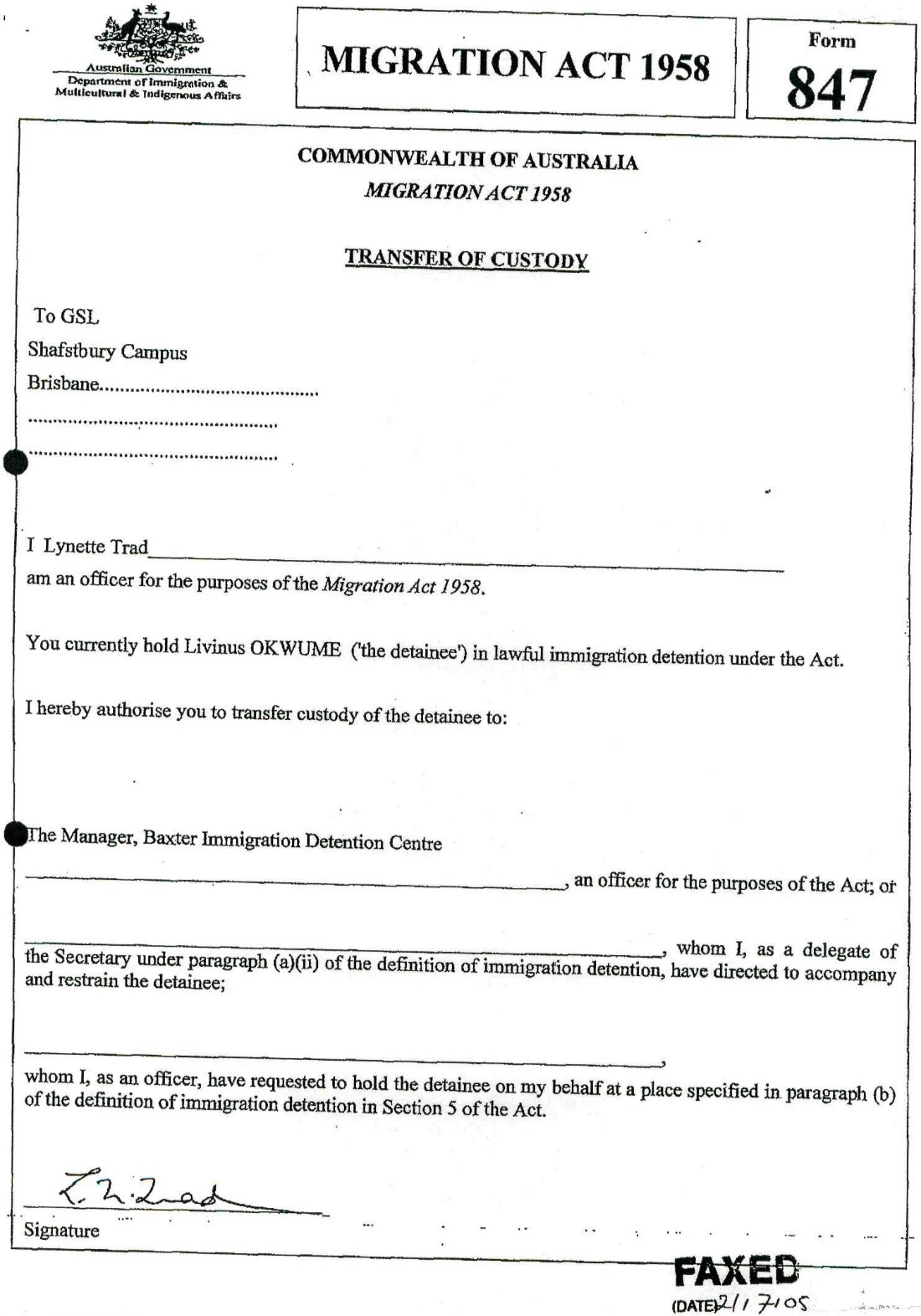
305 Both these documents are shown as having been prepared on “Form 847”. This appears to be a general purpose Departmental Form without any prescribed content or regulatory status. It also appears that Ms Trad was able to select for herself the content to be included in the form for its different uses and that, for that purpose, she used Departmental templates which contemplated the selection of alternatives. Having made use of those templates, Ms Trad marked or completed only the alternative which she thought applicable. Both documents are marked as having been “FAXED” on 21 July 2005.
306 The inference that the document headed “Direction to Accompany and Restrain” was sent after 8.14 pm is confirmed by its final paragraph by which Ms Trad directed that the transfer from Adelaide to Baxter be by vehicle. This was the information which Mr Callaghan had communicated to the five Immigration Officers in his email at 8.14 pm.
307 On the morning of 22 July 2005, Ms Trad prepared a handwritten file note. It appears to be in the nature of a “handover note” to another immigration officer. Ms Trad recorded that Mr Okwume was to be transferred to Baxter, being transported there by plane and car, and continued:
Detention docs with GSL; also request for services. Copies faxed to GSL Villawood and Baxter.
Detention advice sent to appropriate recipients.
Email to Baxter re details of transfer.
308 The Judge was satisfied that Mr Okwume did depart Brisbane in the custody of GSL personnel, acting under Ms Trad’s instructions, at 8.15 am on 22 July 2005.
309 As already noted, the primary Judge found that Ms Trad did not know, and could not reasonably have known, any matters which would have put a reasonable officer in her position on notice that the visa cancellation decision was irregular or ineffective, at [185]. That being so, Ms Trad had been entitled to proceed on the assumption, although mistaken, that the visa cancellation decision was legally effective. The Judge concluded that that in turn meant that Ms Trad had been “lawfully justified” in detaining Mr Okwume pursuant to s 189 of the Migration Act by causing him to be escorted by GSL personnel from the Airport to Baxter and to be held in immigration detention there, at [185].
Consideration
310 There was some divergence between Mr Okwume’s written outline of argument on the appeal and the first two grounds stated in his amended notice of appeal and, again, some divergence between the written outline of argument and the oral submissions. The contentions on which I understood Mr Okwume to rely ultimately were those stated by senior counsel in the oral argument. Senior counsel contended that, in the actions relied upon by the Commonwealth, Ms Trad had not effected a detention of Mr Okwume under s 189. Instead, she had been acting under s 196, or perhaps s 189, to implement the detention effected by Mr Andersson at 2.55 pm on 21 July 2005.
311 Senior counsel’s alternative submission was that, if Ms Trad has effected a detention of Mr Okwume under s 189, the Commonwealth had not established that she had known or reasonably suspected that Mr Okwume was an unlawful non-citizen.
312 It was common ground that the Commonwealth had the onus at trial of justifying the legality of the detention of Mr Okwume.
313 Section 189 of the Migration Act provides (relevantly):
(1) If an officer knows or reasonably suspects that a person in the migration zone (other than an excised offshore place) is an unlawful non-citizen, the officer must detain the person.
…
314 Section 196 provides (relevantly):
(1) An unlawful non-citizen detained under section 189 must be kept in immigration detention until:
(a) he or she is removed from Australia under section 198 or 199; or
(aa) an officer begins to deal with the non-citizen under subsection 198AD(3); or
(b) he or she is deported under section 200; or
(c) he or she is granted a visa.
(2) To avoid doubt, subsection (1) does not prevent the release from immigration detention of a citizen or a lawful non-citizen.
(3) To avoid doubt, subsection (1) prevents the release, even by a court, of an unlawful non-citizen from detention (otherwise than as referred to in paragraph (1)(a), (aa) or (b)) unless the non-citizen has been granted a visa.
…
315 The term “detain” is defined in s 5(1) of the Migration Act:
detain means:
(a) take into immigration detention; or
(b) keep, or cause to be kept, in immigration detention;
and includes taking such action and using such force as are reasonably necessary to do so.
Note: This definition extends to persons covered by residence determinations (see section 197AC).
316 The term “immigration detention” used in s 196 and in the definition of “detain” is defined in s 5(1):
immigration detention means:
(a) being in the company of, and restrained by:
(i) an officer; or
(ii) in relation to a particular detainee—another person directed by the Secretary or Australian Border Force Commissioner to accompany and restrain the detainee; or
(b) being held by, or on behalf of, an officer:
(i) in a detention centre established under this Act; or
(ii) in a prison or remand centre of the Commonwealth, a State or a Territory; or
(iii) in a police station or watch house; or
(iv) in relation to a non-citizen who is prevented, under section 249, from leaving a vessel—on that vessel; or
(v) in another place approved by the Minister in writing;
but does not include being restrained as described in subsection 245F(8A), or being dealt with under paragraph 245F(9)(b).
Note 1: Subsection 198AD(11) provides that being dealt with under subsection 198AD(3) does not amount to immigration detention.
Note 2: This definition extends to persons covered by residence determinations (see section 197AC).
317 A number of features of the operation of s 189 were discussed by the Full Court in Commonwealth v Fernando [2012] FCAFC 18; (2012) 200 FCR 1. It is not necessary, however, for the resolution of this appeal to refer to the reasons in Fernando in any detail.
318 Section 189(1) operates to impose a positive obligation on an “officer” to take into immigration detention a person in the migration zone who the officer knows or reasonably suspects is an unlawful non-citizen, and then to keep, or cause to be kept, the person in detention. The effect of s 196(1) is that (subject to the operation of ss 190 and 191) an unlawful non-citizen detained under s 189 must be kept in immigration detention until one or other of four specified events occurs. That is to say, the detained unlawful non-citizen must be kept in the company of, and restrained by, one or other of the persons mentioned in subpara (a) of the definition of immigration detention or be held by, or, on behalf of, an officer in one or other of the places specified in subpara (b) of the definition.
319 Whereas the subject matter of s 189 is the imposition of an obligation on an officer to take known or reasonably suspected unlawful non-citizens into detention, and to keep them there, the subject matter of s 196, at least primarily, is directed to the duration of the detention: Al-Kateb v Godwin [2004] HCA 37; (2004) 219 CLR 562 at [11] (Gleeson CJ), [112] (Gummow J), and [224] (Hayne J). Perhaps for this reason, s 196 does not identify the persons who must give effect to the obligation, it being implicit that it is those who have detained the unlawful non-citizen or those whom the detaining officer has caused to detain the person.
320 Given the definition of “immigration detention”, the subject matter of s 196(1) extends also to aspects of the manner and location of the detention.
321 Read together, ss 189 and 196 require the initial detaining of a known or reasonably suspected unlawful non-citizen and the continuation of that detention until one of the events specified in s 196(1) has occurred. As seen earlier, an officer may detain a person under s 189 either by taking the person into immigration detention or by keeping or causing the person to be kept in immigration detention. In respect of this feature of the legislation, the Full Court said in Fernando at [72]:
[Section] 189(1) also required other officers to keep the person detained, or cause him or her to be kept in immigration detention when they had one of the requisite states of mind. It follows that an officer with the necessary state of mind could detain a person by causing him or her to be kept in immigration detention because the first officer caused another officer to take the person into immigration detention and then keep the detainee there.
322 Some of the submissions of senior counsel for Mr Okwume were to the effect that the “scheme” of ss 189 and 196 contemplated only a single detention pursuant to s 189. On that basis, there could not be a second independent detention pursuant to s 189 while a person remained so detained. The Commonwealth disputed the correctness of that understanding of the “scheme” and contended that s 189 permitted a detention to be effected by more than one immigration officer. In my view, it is not necessary to express a view on this question, as Mr Okwume’s appeal can be determined on the construction advanced by the Commonwealth. On that construction, there remains the question of whether there had been a later detention of Mr Okwume by Ms Trad.
323 On my understanding, the obligations imposed by ss 189 and 196 allow for at least these possibilities:
(1) an officer with the requisite state of mind may detain an unlawful non-citizen;
(2) an officer with the requisite state of mind may keep, or cause another to keep, the unlawful non-citizen detained; and
(3) an officer, caused to do so by another, may keep a detained unlawful non-citizen in detention. Such an officer need not have the requisite state of mind.
Each of these alternatives seems to involve implicitly the officer making decisions as to the location of the detention which conform with subpara (b) of the definition of immigration detention and decisions concerning the transfer of the detainee to the location.
324 The character of Ms Trad’s actions should be assessed having regard to these possibilities.
325 Unlike the circumstances considered in Ruddock v Taylor (2005) HCA 48; (2005) 222 CLR 612, the Commonwealth did not adduce any evidence at trial from Ms Trad. This meant that inferences as to the character of her actions and of her state of mind have to be drawn from the documents, to the extent that that is possible: Sadiqi v Commonwealth (No 2) [2009] FCA 1117; (2009) 181 FCR 1 at [139].
326 Senior counsel for Mr Okwume submitted that a number of circumstances indicated that Ms Trad had not effected a detention under s 189. Instead, her actions on 21 and 22 July 2005 were to be understood as giving effect to the earlier detention of Mr Okwume by Mr Andersson and/or Ms O’Connell or, alternatively, giving effect to the obligation imposed by s 196(1), that is, the third of the possibilities identified earlier.
327 Counsel noted first that it had not been necessary for Ms Trad to effect a new detention under s 189 in order to have Mr Okwume detained at the motel overnight and then taken on 22 July 2005 to Baxter. As contemplated by the passage in Fernando quoted earlier, one means by which an officer may discharge the obligation imposed by s 189 is to cause another person to keep the detainee in an authorised location and to accompany the detainee until he or she reaches that location. This meant in the present circumstances (counsel submitted) that Ms Trad could not be understood as necessarily having effected a detention under s 189(1). She could instead be understood as having acted at relevant times to give effect to the detention by Mr Andersson. Counsel noted in this respect that, before going off shift, Mr Andersson had, by his email at 5.39 pm on 21 July, informed various immigration officers of his detention of Mr Okwume, that Mr Okwume was to remain in detention overnight at Airport 85, and that he was then to be transferred to Baxter.
328 Alternatively, counsel submitted, Ms Trad could be understood to have been discharging the responsibility imposed by s 196(1). In doing so, her position was no different from the many other officers who had acted in some way to effect Mr Okwume’s detention, including the GSL officers who had accompanied him at the Airport Motel and then escorted him to Baxter, and the manager of Baxter.
329 In either circumstance, counsel submitted, Ms Trad’s involvement was directed to the implementation of the detention effected by Mr Andersson at 2.55 pm on 21 July 2005. That meant that she need not have formed either of the states of mind required by s 189.
330 The Commonwealth’s submissions emphasised the words “I now direct you to accompany and restrain Livinus Okwume and thereby detain him in immigration detention” contained in Ms Trad’s “Direction to Accompany and Restrain”. It submitted that that direction was to be understood as a freestanding direction for the detention of Mr Okwume.
331 Counsel for Mr Okwume submitted that, properly understood, the document did not have the effect for which the Commonwealth contended. In particular, he submitted that the passage relied upon by the Commonwealth had to be read in full and understood in its context. Counsel noted in this respect that the sentence upon which the Commonwealth relied continued “[u]ntil 22 July 2005 when he is transferred from Airport 85 Motel in Brisbane to Baxter Immigration Detention Centre, South Australia”. That is, Ms Trad’s direction to the GSL officers related to the detention of Mr Okwume for a finite period and place.
332 Counsel also noted the absence of any express reference to s 189 in the Direction to Accompany and Restrain and the manner of expression which Ms Trad used. In particular, counsel referred to Ms Trad’s statement that Mr Okwume is “known or reasonably suspected to be … an unlawful non-citizen”. He submitted that both Ms Trad’s use of the passive voice and the reference to two different states of mind were suggestive of Ms Trad referring to the states of mind of others. Had Ms Trad been describing her own state of mind, it is much more likely that she would have said positively either that she knew that Mr Okwume was an unlawful non-citizen or that she suspected on reasonable grounds that he was such a person.
333 Counsel also submitted that regard had to be had to an important element of context, namely, that to the knowledge of both Ms Trad and the GSL officers to whom the form was directed, Mr Okwume was already in immigration detention. This was made explicit by the “Transfer of Custody” which Ms Trad provided to GSL at the same time as the Direction to Accompany and Restrain, in which she stated expressly “You currently hold Livinus OKWUME (‘the detainee’) in lawful immigration detention under the Act”. In these circumstances, it is improbable, counsel submitted, that Ms Trad would have thought it necessary to exercise again the obligation imposed by s 189.
334 In my opinion, the submissions of senior counsel for Mr Okwume have considerable force and should be accepted. Mr Andersson’s email of 5.39 pm on 21 July appears to be in the nature of a “hand over” document, by which he was informing others of the detention of Mr Okwume and that arrangements were underway as to the means by which he was to be held in detention. The documents in evidence did not disclose what discussions or directions had been given within the Department with respect to those arrangements (although Mr Callaghan’s email at 8.14 pm suggests that J Toohey and Ms Dell were involved). In context (it appearing that Mr Andersson was going off-shift), it seems that Mr Andersson was, in the terminology of the definition of “detain”, causing others to take the further necessary action to keep Mr Okwume in detention.
335 I also consider it pertinent that the Direction to Accompany and Restrain was for a finite period only. A detention specified to be of limited duration is not the form of detention contemplated by ss 189 and 190. At the least, it would be an unusual form of detention given that the detention’s duration is governed by s 196(1). In my opinion, the fact that Ms Trad’s direction was for detention for a finite period only makes it natural to understand it as a direction giving effect to the detention earlier made by Mr Andersson.
336 The title selected by Ms Trad for the document also seems pertinent. It was not a direction to detain. In context, the document appears to be more in the nature of an authority to GSL for the action required of it in relation to Mr Okwume that a document effecting, in a primary way, his detention.
337 It may also be pertinent that the evidence at trial did not include any documents which may have been consequential upon a detention by Ms Trad, had that occurred. There were, for example, no documents similar to those which followed the detention by Mr Andersson. In particular, Ms Trad did not record her action in a running sheet or prepare a further detention report. However, the significance of these matters is unclear as there was no evidence led at trial of the Departmental practices or requirements in relation to the making of records of this kind.
338 Next, I consider it pertinent that the focus of Ms Trad’s actions was on the “transfer” of Mr Okwume to Baxter. That is to say, the focus of Ms Trad’s interventions seems to have concerned the place at which Mr Okwume was to be held, rather than his detention per se.
339 All these matters suggest, or at least are consistent with, Ms Trad having entered the mark against the unlawful non-citizen alternative in the Direction to Accompany and Restrain as a record of her understanding of the basis for the earlier detention of Mr Okwume pursuant to s 189 and on which GSL was to act.
340 In these circumstances, I do not consider that it can be inferred that Ms Trad was acting pursuant to s 189 to effect a fresh detention of Mr Okwume. At the least, the matters to which counsel for Mr Okwume referred indicate that the Court cannot be satisfied on the evidence presented at the trial that Ms Trad was effecting a separate detention of Mr Okwume under s 189. It is at least equally plausible that she was acting to implement in a practical way the detention effected earlier by Mr Andersson without herself forming the state of mind required by s 189. That being so, the Commonwealth should have been held not to have discharged the onus lying on it in respect of its reliance upon Ms Trad’s action.
341 The alternative submission on Mr Okwume’s behalf was that, if Ms Trad was the detainer, the Commonwealth had not established that she had had the requisite state of mind required by s 189. Counsel based this submission on the following passage in Fernando:
[84] The Commonwealth’s argument did not exhaust or exclude the application of s 189(1) to the persons who actually took Mr Fernando into immigration detention. The individual who physically takes a person into immigration detention must have at that time one of the two states of mind prescribed by s 189(1) so as to justify him or her in the act of depriving or interfering with the liberty of another … It is not enough for the actual person effecting that deprivation or interference to think that someone else knows or believes the detainee is an unlawful non-citizen. …
(Citation omitted)
342 Counsel acknowledged that there may be some difficulties with this passage. That being so, and because it is not necessary in the view I take of the matter to express a conclusion regarding the alternative submission, I will refrain from doing so.
Conclusion
343 The result is that I would uphold Mr Okwume’s appeal. It also means that the Judge’s assessment of Mr Okwume’s damages should be set aside and those damages reassessed. That makes it unnecessary to consider Ground 3 in Mr Okwume’s amended notice of appeal. This Court is not in a position to make the assessment of damages. Amongst other things, it has not been provided with the evidence presented at trial bearing upon the assessment for the period of unlawful detention of 255 days. Nor did the Court hear submissions as to the effect of Fernando v Commonwealth [2014] FCAFC 181; (2014) 231 FCR 251.
344 That being so, I would make the following orders:
(1) The appeal by the Commonwealth is dismissed.
(2) The appeal by Mr Okwume is allowed.
(3) The matter is remitted to the primary Judge for assessment of Mr Okwume’s damages.
I certify that the preceding sixty-two (62) numbered paragraphs are a true copy of the Reasons for Judgment herein of the Honourable Justice White. |
Associate:
Dated: 4 May 2018


