

FEDERAL COURT OF AUSTRALIA
Folau v Minister for Immigration and Border Protection [2017] FCAFC 214
ORDERS
Appellant | ||
AND: | MINISTER FOR IMMIGRATION AND BORDER PROTECTION Respondent | |
DATE OF ORDER: | 18 December 2017 |
THE COURT ORDERS THAT:
1. The appeal be dismissed with costs.
Note: Entry of orders is dealt with in Rule 39.32 of the Federal Court Rules 2011.
COLLIER J:
1 In this proceeding the appellant, Mr Folau, appeals a decision of 22 September 2016, wherein the primary Judge dismissed an application under s 476A of the Migration Act 1958 (Cth) (the Act) for review of a decision of the Minister for Immigration and Border Protection (the Minister). In his decision the Minister cancelled Mr Folau’s visa pursuant to s 501(2) of the Act.
2 Mr Folau seeks the following orders:
(1) The appeal be allowed with costs.
(2) The orders of the Court on 22 September 2016 be set aside.
(3) In lieu thereof, an order setting aside the decision of the respondent to cancel the appellant’s visa.
(4) Such other orders as the Court thinks fit.
3 Before turning to consideration of Mr Folau’s grounds of appeal, it is useful to examine the background facts and his Honour’s decision.
Background
4 Mr Folau was born on 29 October 1984 and is a New Zealand citizen. He arrived in Australia in 1990. As a New Zealand citizen Mr Folau was granted a Class TY, Subclass 444 Special Category (Temporary) visa on arrival. He has spent most of his life in Australia, with intermittent travel overseas.
5 In 2013, the appellant was convicted in the County Court of Victoria of “intentionally cause injury”. The sentencing judge characterised the attack upon the complainant in that case as being “as ferocious as it was cowardly.” The appellant was sentenced to imprisonment for 25 months and 15 days, with a non-parole period of 14 and a half months. The offence occurred while Mr Folau was already serving a suspended sentence of imprisonment relating to earlier convictions for assault in 2010. Mr Folau had previously received convictions between 2007 and 2010 for violent offences including common law assault on a minor, unlawful assault and damaging property.
6 On 7 August 2015, the Department of Immigration and Border Protection (the Department) sent Mr Folau a Notice of Intention to Consider Cancellation of his visa under s 501(2) of the Act.
7 Section 501(2) of the Act relevantly provides:
(2) The Minister may cancel a visa that has been granted to a person if:
(a) the Minister reasonably suspects that the person does not pass the character test; and
(b) the person does not satisfy the Minister that the person passes the character test.
8 In subsequent letters to Mr Folau dated 12 August 2015 and 25 September 2015, the Department provided further information relating to possible cancellation of Mr Folau’s visa.
9 By a lengthy letter to the Department dated 2 September 2015, Mr Folau’s lawyers responded to the Notice of Intention to Consider Cancellation. The letter detailed Mr Folau’s troubled personal history, alcohol and drug abuse, criminal record, remorse and his attempts to rehabilitate. In conclusion, Mr Folau put to the Department that while he was unable to pass the character test prescribed by s 501 of the Act due to his criminal record, there were compelling reasons for the Minister not to cancel his visa. These reasons were:
The extremely negative impact which cancellation of his visa would have on Mr Folau’s de facto partner Ms Harvey, his family members and his son, all of whom were Australian citizens or residents;
The fact that Mr Folau did not present an ongoing risk to the Australian community, as was apparent from letters of support from his family, friends and work associates;
Mr Folau’s commitment to his sobriety, family, relationship with Ms Harvey and his future; and
Mr Folau’s desire to be involved in community groups to help mentor youth and guide them along better paths than those he had chosen to follow.
10 The Minister’s decision, dated 17 March 2016, was as follows:
I reasonably suspect that Mr FOLAU does not pass the character test and Mr FOLAU has not satisfied me that he passes the character test. I have decided to exercise my discretion under s501(2) of the Migration Act to cancel Mr FOLAU’S visa. I hereby cancel Mr FOLAU’S Class TY, Subclass 444 Special Category (Temporary) visa. My reasons for this decision are set out in the attached Statement of Reasons.
The Minister’s reasons
11 The Minister commenced his Statement of Reasons noting that he was entitled to cancel a visa under s 501(2) of the Act if he reasonably suspected that the visa-holder did not pass the character test, and if the person did not satisfy the Minister that they passed the character test. The Minister relied on s 501(6)(a) of the Act, which provides:
(6) For the purposes of this section, a person does not pass the character test if:
(a) the person has a substantial criminal record (as defined by subsection (7));
12 Relevantly s 501(7) of the Act provides:
(7) For the purposes of the character test, a person has a substantial criminal record if:
(a) the person has been sentenced to death; or
(b) the person has been sentenced to imprisonment for life; or
(c) the person has been sentenced to a term of imprisonment of 12 months or more; or
(d) the person has been sentenced to 2 or more terms of imprisonment, where the total of those terms is 12 months or more; or
(e) the person has been acquitted of an offence on the grounds of unsoundness of mind or insanity, and as a result the person has been detained in a facility or institution; or
(f) the person has:
(i) been found by a court to not be fit to plead, in relation to an offence; and
(ii) the court has nonetheless found that on the evidence available the person committed the offence; and
(iii) as a result, the person has been detained in a facility or institution.
13 The Minister noted the concession by Mr Folau that he had failed the character test pursuant to ss 501(6)(a) and 501(7)(c) of the Act, in light of his prison sentence following conviction in 2013. The key issue was whether the Minister should exercise his discretion to cancel Mr Folau’s visa, taking into account factors weighing in favour of and against such cancellation. The Minister noted:
10. In making my decision I was mindful that Australia has a sovereign right to determine whether non-citizens who are of character concern are allowed to remain in Australia.
14 Under the heading “Discretion”, the Minister had regard to the following considerations:
The Government’s commitment to protecting the Australian community from harm as a result of criminal activity by non-citizens. In this respect the Minister noted:
○ Mr Folau’s history of criminal conduct;
○ The serious physical injuries to the victim of Mr Folau’s criminal conduct for which he was sentenced by the County Court of Victoria in 2013. That Mr Folau’s sentence of 25 and a half months imprisonment with a non-parole period of 14 and a half months was indicative of the seriousness of his offending;
○ The fact that Mr Folau was earlier convicted in 2010 in the County Court of Victoria of two counts of common law assault, at a time when he was serving a suspended prison sentence;
○ The Minister’s view that Mr Folau’s offending involved a pattern of violent conduct; and
○ The Minister’s view that Mr Folau’s violent offending had escalated in seriousness over time.
The risk to the Australian community posed by Mr Folau. In this regard the Minister noted, in summary, that:
○ Mr Folau had appeared before the courts on multiple occasions for violent offending;
○ Alcohol abuse, drug addiction and family history had played a part in Mr Folau’s offending;
○ There were signs that Mr Folau had prospects of rehabilitation, including his completion of drug and alcohol rehabilitation courses, his attendance at counselling, and his employment record after release from prison;
○ Mr Folau had, however, indicated disregard for Australian laws by his completion of false declarations on incoming passenger cards in 2009 and 2010, commission of offences while on suspended prison sentences and failure to comply with community-based orders in 2008;
○ Judge Ryan of the County Court of Victoria in 2013 was guarded in his comments concerning Mr Folau’s prospects of rehabilitation;
○ The absence of criminal convictions concerning Mr Folau since 2013 coincided with time he had been subject to criminal custody or parole orders since 2013; and
○ Overall, Mr Folau represented an ongoing likelihood of reoffending, and if he did reoffend similarly to his prior conduct, he could cause serious physical injuries or psychological harm to members of the Australian community.
The best interests of minor children who would be affected by the cancellation of Mr Folau’s visa, particularly Mr Folau’s 10 year old son. The Minister noted Mr Folau’s son might experience severe emotional hardship if Mr Folau were removed from Australia as this could prevent him from further developing a relationship with his father. The Minister also noted the possible financial hardship Mr Folau’s son could experience if Mr Folau’s visa were cancelled, in light of the financial support provided by Mr Folau. In summary, the Minister found that it was in the best interests of Mr Folau’s son that the visa not be cancelled. The Minister also considered that, in view of Mr Folau’s relationship with his extended family of nieces and nephews, it was in their best interests that his visa not be cancelled;
The expectation of the Australian community that non-citizens who commit serious crimes in Australia can and should have their visas cancelled;
The fact that Mr Folau had resided in Australia since he arrived as a young child, such that the Australian community could accord him a higher tolerance for his criminal conduct. The Minister gave weight to Mr Folau’s strong emotional ties to his mother, his de facto partner and his extended family, and the effect visa cancellation would have on them; and
The likelihood that Mr Folau could re-establish himself in New Zealand over time given his age, education, consistent employment record, ability to form extended social networks and relatively good health.
15 The Minister concluded:
60. I considered all relevant matters including (1) an assessment against the character test as defined by s501(6) of the Migration Act and (2) all other evidence available to me, including evidence provided by, or on behalf of Mr FOLAU.
61. Mr FOLAU has committed a very serious crime, that of intentionally cause injury, which is of a violent nature, and Mr FOLAU should expect to forfeit the privilege of staying in Australia.
62. I find that the Australian community could be exposed to harm should Mr FOLAU reoffend in a similar fashion. I could not rule out the possibility of further offending by Mr FOLAU. The Australian community should not tolerate any further risk of harm.
63. I found the above consideration outweighed the countervailing considerations in Mr FOLAU’S case, including the best interests of Kaizes Folau and his nieces and nephews, the impact on family members including his de facto partner Ms Victoria Harvey and his mother Mrs Isapela Folau. I have also considered the length of time Mr FOLAU has made a positive contribution to the Australian community, noting his consistent employment history, volunteer efforts and extended social and professional ties in the community.
64. I am cognisant that were great harm could be inflicted on the Australian community even strong countervailing considerations are insufficient for me not to cancel the visa. This is the case even applying a higher tolerance of criminal conduct by Mr FOLAU, than I otherwise would, because he has lived in Australia for most of his life.
65. In reaching my decision I concluded that Mr FOLAU represents an unacceptable risk of harm to the Australian community and that the protection of the Australian community outweighed any countervailing considerations above.
Application for judicial review
16 Mr Folau sought judicial review of the decision of the Minister on the following grounds:
(1) The Minister, in exercising his discretion, was required to grapple with the central issue of the likelihood that the Applicant would reoffend. The Minister failed to do so and thereby failed to discharge his statutory task; alternatively, his decision was legally unreasonable.
(2) The Minister, in exercising his discretion, had regard to Australia’s “sovereign right to determine whether non-citizens who are of character concern are allowed to remain in Australia”. This was an irrelevant consideration. Further and alternatively, it demonstrates that the Minister misapprehended the limits of his power.
(3) The Minister, in exercising his discretion, had regard to the punitive effect of visa cancellation, which was an irrelevant consideration
(4) The Minister, in exercising his discretion, did not give proper, genuine and realistic consideration to the merits of the case.
17 The primary Judge dismissed Mr Folau’s application.
18 In relation to the first ground, his Honour held that the Minister’s consideration of the likelihood of harm if Mr Folau were to reoffend did not require the Minister to undertake the assessment or analysis submitted by Mr Folau. The Minister was required to consider the risk of harm to the Australian community posed by Mr Folau remaining in Australia if Mr Folau were to reoffend, but the Minister was not obliged by the authorities to evaluate the risk of harm in a particular way.
19 As to the second ground, his Honour held that it was not legally impermissible for the Minister to consider the sovereign right of Australia to determine whether Mr Folau ought be allowed to remain in Australia. In any event, taking the sovereign right of Australia into account would not give rise to jurisdictional error even if it were an irrelevant consideration. This is because it was not that consideration that led to the Minister’s decision under s 501(2) of the Act.
20 With respect to the third ground, his Honour held that the Minister’s assessment of the expectation of the Australian community, and the Minister’s consideration of Mr Folau’s past conduct, were not viewed by the Minister as a form of additional punishment of Mr Folau. The Minister’s exercise of the discretion in s 501(2) of the Act was based, rather, upon both an assessment of the exposure to harm to the Australian community if Mr Folau re-offended in a similar fashion, and the Minister’s conclusion that the exposure to harm in the future outweighed countervailing considerations in Mr Folau’s favour.
21 In relation to the fourth ground, his Honour held that while it was true that the draft reasons contained normative statements, and expressed reasoning of the author of the draft, this did not alter the fact that the actual decision was made by the Minister and that the Minister adopted the draft reasons as his own.
Grounds of appeal
22 Mr Folau appealed the decision of the primary Judge on the following grounds:
1. The Court erred, at [3]-[7], in failing to find that the Minister committed jurisdictional error by cancelling the Appellant’s visa without making a finding as to the likelihood of him reoffending or a finding that any possibility of reoffending was unacceptable.
2. The Court erred, at [8]-[10], in failing to find that the Minister misapprehended the limits of his power when he had regard to “Australia’s Sovereign right to determine whether non-citizens who are of character concern are allowed to remain in Australia”.
3. The Court erred, at [11]-[13], in failing to find that the Minister fell into jurisdictional error by having regard to an irrelevant consideration in the punitive effect of visa cancellation.
4. The Court erred, at [14]-[18], in failing to find that the Minister had not given proper, genuine and realistic consideration to the merits of the Appellant’s case. In particular:
a. The Court found for the purposes of the proceeding, at [14]-[15], that the Minister adopted, without amendment, draft statements of reasons prepared by others in respect of all visa cancellation and refusal decisions made by him from the date he became the Minister until 17 March 2016 (the date of his decision to cancel the decision).
b. Having so found, the Court erred in failing to find that the Minister’s adoption of a draft set of reasons prepared by someone else was indicative of a failure to give proper, genuine and realistic consideration to the merits of the Appellant’s case.
Submissions of the parties
23 In summary Mr Folau submitted as follows:
The Minister is required to assess the risk of harm to the Australian community. There are a finite number of ways the Minister can reason logically to a conclusion as to whether that risk is acceptable or unacceptable. It was insufficient that the Minister merely found that there was “a” likelihood that Mr Folau would reoffend. To cancel the visa the Minister was required to find that any likelihood of harm was unacceptable. The Minister did not comply with the logical framework imposed upon him by the Act, which was an error going to jurisdiction;
The primary Judge failed to consider Mr Folau’s submissions concerning the component integers of “risk of harm”;
References by the Minister to Australia’s “sovereign right” to determine whether non-citizens who are of character concern are allowed to remain in Australia bore no sensible relationship to the Minister’s statutory task, which was to consider visa cancellation in accordance with the scheme imposed by the Act. The primary Judge erred at [9] in suggesting that the Minister’s remarks concerning that sovereign right were not dispositive of the exercise of discretion under s 501(2) of the Act;
The Minister was advised in an Issues Paper prepared by an officer of the Department that it could be appropriate to cancel a visa of a non-citizen who had breached, or there was an unacceptable risk that they would breach, Australian laws, or where the non-citizen had been convicted of offences in Australia or elsewhere. The Minister had regard to “backward-looking” community expectations in relation to non-citizens who had broken the law. These were irrelevant considerations. The primary Judge erred in relying on Djalic v Minister for Immigration [2004] FCAFC 151; (2004) 139 FCR 292 in failing to find that they were irrelevant considerations; and
The Minister clearly did not make the decision personally in circumstances where he simply adopted the draft Statement of Reasons provided to him without making or requesting any amendments.
24 The Minister submitted that the grounds of appeal did not disclose jurisdictional error in the decision of the Minister, or error in the primary judgment, because in summary:
The Minister was not bound to consider factors personal to the visa-holder regarding the offences, nor conduct an evaluation in any particular manner of the likelihood of Mr Folau engaging in future conduct. The extent of the risk of a visa-holder reoffending is a matter for the Minister. There is no basis in the text of s 501(2) of the Act for the imposition of the logical framework contended by Mr Folau;
In any event, the Minister did consider and assess both the seriousness and likelihood of Mr Folau reoffending;
Australia’s sovereign right to determine whether non-citizens who are of character concerns are allowed to remain in Australia is not an irrelevant consideration in terms of the object and structure of the Act. The primary Judge was correct to identify this sovereign right as the jurisprudential foundation of s 501 of the Act, and to reason that it was not an impermissible factor for the Minister to consider;
It is clear from a fair reading of the Minister’s reasons that he did not take into account the expectations of the Australian community as a form of punishment; and
There is no basis for the appellant’s allegation that the Minister did not make the decision personally or give proper, genuine and realistic consideration to the merits of Mr Folau’s case through the adoption of reasons drafted by an officer of the Department.
Consideration
25 I will consider each ground of appeal in turn.
Ground 1
26 To reiterate, in examining the criminal history of Mr Folau and the risk he posed to the Australian community the Minister found:
The County Court Judge sentencing Mr Folau in 2013 considered that Mr Folau had not learned from his past court appearances;
Mr Folau’s conviction in 2013 was for “intentionally cause injury”, an offence characterised by the County Court Judge as wanton and sustained, and a serious example of the offence;
Mr Folau’s conduct in 2013 was very serious, and his conduct in 2010 involving assault of a minor aged 15 was very serious;
Mr Folau’s offending involved a pattern of violent conduct;
Factors influencing Mr Folau’s conduct included alcohol and drug abuse, as well as the emotional effect on him from the tragic deaths of his father and brother;
Mr Folau had made progress in rehabilitation by way of drug and rehabilitation courses, counselling attendance, involvement in reintegration programmes, educational activities in prison and consistent employment history following release from prison; and
However, Mr Folau’s conduct also demonstrated a disrespect for Australian laws – for example, false declarations, past breaches of judicial orders, and commission of offences whilst serving a suspended sentence.
27 In light of this analysis the Minister concluded that Mr Folau represented an ongoing likelihood of reoffending, and that if he did reoffend he could cause serious physical injuries or psychological harm to a member of the Australian community.
28 In his first ground of appeal, Mr Folau submitted that there was a logical framework in which the Minister could make a decision. He claimed that the Minister was required to either make a finding of the likelihood of Mr Folau reoffending or a finding that any possibility of reoffending was unacceptable. This ground of appeal, and the arguments in support, are in very similar terms to those which were before the Full Court in BSJ16 v Minister for Immigration and Border Protection [2017] FCAFC 78.
29 In BSJ16 [2017] FCAFC 78, an appellant claimed that the Court at first instance had erred:
…in failing to find that the Minister committed jurisdictional error by cancelling the Appellant’s visa without making a finding as to the likelihood of him reoffending or a finding that any possibility of reoffending was unacceptable.
30 The relevant submissions of the appellant in BSJ16 [2017] FCAFC 78 are summarised at [38] of that decision as follows:
• Although the Minister discussed the risk to the Australian community at length, his only findings were that the appellant posed an ongoing likelihood of reoffending and that if he did reoffend in a similar manner it could result in harm to a member of the Australian community.
• The Minister did not identify what the likelihood was of the appellant reoffending (for example, as “low” or otherwise).
• The Minister found that the risk, so assessed, was outweighed by the consequences which could ensue.
• There were only two logical pathways to the Minister concluding that the visa cancellation decision should not be revoked, namely:
• the Minister might assess the possible harm which could result from the appellant reoffending as so serious that any risk of reoffending was unacceptable; or
• the Minister might assess both the seriousness of harm if there was reoffending, and the likelihood of reoffending, permitting him to give weight to the risk of harm, and then weigh that factor in balance against countervailing considerations.
• The reasoning of the Minister as set out in his Statement of Reasons engaged neither pathway, which were the only logical pathways to a non-revocation outcome.
• The Minister cannot balance a risk that he has not weighed against countervailing considerations.
• The Minister’s failure to employ either of the proposed modes of reasoning was legally unreasonable and indicative of him having misunderstood his statutory task.
31 In BSJ16 [2017] FCAFC 78 after considering these submissions, the Full Court observed:
43. The Minister is not under an obligation to evaluate in any particular way the risk of harm to the Australian community of the appellant reoffending. In light of these findings the Minister was not required to make findings matching the appellant’s prescribed formula, namely to find that the potential harm to Australian community of the appellant reoffending was so serious that any likelihood of reoffending was unacceptable.
44. The Minister’s process of reasoning or decision could not be described as one at which no rational or logical decision-maker could have arrived on the same evidence, nor is the decision arbitrary, capricious or lacking an evident and intelligible justification. The appellant submits that the logical framework he advances is imposed on the Minister by s 501CA, and argues that the Minister confused the seriousness of the earlier and later offending by the appellant. We do not accept that argument. As the primary Judge found, correctly, the appellant’s approach is over-prescriptive. In exercising the power conferred by s 501CA(4) the Minister was under no duty to evaluate the risk of harm to the Australian community in any particular way or to ascribe any particular characterisation to the quality of the risk: Moana [2015] FCAFC 54; 230 FCR 367 at [71]; Brown v Minister for Immigration and Border Protection [2015] FCAFC 141; (2015) 235 FCR 88 at [41]; Ayoub v Minister for Immigration and Border Protection [2015] FCAFC 83; (2015) 231 FCR 513 at [44].
32 I consider that the reasoning in BSJ16 [2017] FCAFC 78 is apposite in this case. I consider that the framework submitted by Mr Folau is over-prescriptive, and that the Minister is not under an obligation to evaluate in any particular way the risk of harm to the Australian community of Mr Folau reoffending. The Minister concluded that Mr Folau had demonstrated a pattern of violent offending and that the offences he had committed were serious. Although there were signs of rehabilitation, there were other signs that Mr Folau did not respect the law and had not learned from previous criminal convictions. It was open to the Minister to reach these conclusions, to take the view that the Mr Folau represented an ongoing likelihood of reoffending, and to further conclude that in reoffending Mr Folau could cause serious physical injuries or psychological harm to a member of the Australian community.
33 The reasoning of the primary Judge at [3]-[7] is sound. The first ground of appeal is not substantiated.
Ground 2
34 In ground 2, Mr Folau claimed his Honour erred in failing to find that the Minister misapprehended the limits of his power when he had regard to Australia’s “sovereign right to determine whether non-citizens who are of character concern are allowed to remain in Australia”. In particular, Mr Folau referred to the following statement of the Minister in his reasons:
9. Having found that Mr FOLAU does not pass the character test and having assessed the information set out in the Issues Paper and attachments, I considered whether to exercise my discretion to cancel Mr FOLAU’S visa, taking into account factors that I considered weighed against and in favour of cancelling Mr FOLAU’S visa. In making my decision I was mindful that Australia has a sovereign right to determine whether non-citizens who are of character concern are allowed to remain in Australia.
35 His Honour found that this statement of the Minister was not attended by jurisdictional error because:
As his Honour observed at [9], the sovereign right considered by the Minister in this case was not something which was legally impermissible for the Minister to consider. The sovereign right was the jurisprudential foundation for the validity of the provision under which the Minister was purporting to exercise the statutory power and it was neither impermissible nor irrelevant to commence the consideration of the exercise of a discretion with an observation of the legal foundation upon which the discretion is based; and
In any event, the reference in Mr Folau’s case to the Minister being mindful of Australia’s sovereign right was not dispositive of the exercise of the Minister’s discretion under s 501(2) of the Act.
36 In my view his Honour was correct on both counts.
37 In relation to whether the Minister could take into account Australia’s sovereign right to determine whether non-citizens who are of character concern should be permitted to remain in Australia, Mr Folau did not dispute the existence of that right. He submitted, however, that it was not a relevant consideration in the context of the Minister’s statutory task and the statutory scheme enacted by Parliament.
38 The flaw in this reasoning becomes immediately apparent upon even a cursory examination of the Act. The long title of the Act is:
An Act relating to the entry into, and presence in, Australia of aliens, and the departure or deportation from Australia of aliens and certain other persons.
39 Section 4(1) of the Act sets out the object of the Act as being:
… to regulate, in the national interest, the coming into, and presence in, Australia of non-citizens;
(Emphasis added.)
40 Section 4(2) and (4) provide:
(2) To advance its object, this Act provides for visas permitting non-citizens to enter or remain in Australia and the Parliament intends that this Act be the only source of the right of non-citizens to so enter or remain.
…
(4) To advance its object, this Act provides for the removal or deportation from Australia of non-citizens whose presence in Australia is not permitted by this Act.
(Emphasis added.)
41 The Act and related statutory regulations establish a detailed scheme for the treatment and obligations of non-citizens, assessment of applications by non-citizens to live temporarily or permanently in Australia, and recognition of Australia’s international obligations in relation to certain non-citizens. Section 501 of the Act is an important aspect of this statutory scheme, conferring a largely unfettered discretion on the Minister to cancel the visas of certain non-citizens (subject to an obligation not to act arbitrarily, capriciously or legally unreasonably, and taking account of only relevant considerations: NBMZ v Minister for Immigration and Border Protection [2014] FCAFC 38; (2014) 220 FCR 1 at [6]). It follows that s 501 of the Act facilitates and creates a framework for the exercise of the Australia’s sovereign right to determine whether non-citizens who are character concern should be allowed to remain in Australia. I cannot ascertain the manner in which the Minister’s recognition of this sovereign right is irrelevant in the circumstances.
42 I also note his Honour’s view that the existence of this sovereign right was not dispositive of the exercise of the Minister’s discretion under s 501(2) of the Act. As his Honour observed – and as is plain from the Minister’s Statement of Reasons – the Minister looked beyond the sovereign right and examined the various factors to which I have referred in this judgment. It was as a result of that examination that the Minister reached the conclusion that the risk of harm associated with Mr Folau’s previous conduct and the risk of Mr Folau re-offending outweighed countervailing considerations supporting Mr Folau remaining in Australia.
43 The second ground of appeal is not substantiated.
Ground 3
44 In the third ground of appeal, Mr Folau took issue with [11]-[13] of the primary judgment. In particular, Mr Folau claimed the Minister had regard to an irrelevant consideration, namely the punitive effect of visa cancellation. Mr Folau also referred to the Issues Paper briefing the Minister, community expectations of non-citizens, the allegedly “backward-looking” comments of the Minister, the misplaced reliance of the primary Judge on Djalic [2004] FCAFC 151 and the comment of the Minister that Mr Folau should forfeit the privilege of staying in Australia.
45 Mr Folau points in particular to statements of the Minister at [47]-[48] and [61] of the Statement of Reasons, namely:
47. In making my decision I have been mindful of the principle that the Australian community would expect that non-citizens who commit serious crimes in Australia can and should have their visa cancelled.
48. The Australian community expects that non-citizens obey Australian laws while in Australia. Mr FOLAU has breached this trust and has been convicted of a very serious offence involving violence in Australia and I find it is appropriate to cancel the visa held by such a person.
…
61. Mr FOLAU has committed a very serious crime, that of intentionally cause injury, which is of a violent nature, and Mr FOLAU should expect to forfeit the privilege of staying in Australia.
46 I do not consider that these comments of the Minister evince influence by irrelevant considerations, including further punishment of Mr Folau.
47 First, as the primary Judge correctly noted at [13] of the primary judgment, s 501(2) of the Act is sufficiently broad to allow the Minister to take into account his assessment of the expectations of the Australian community as to whether or not a non-citizen who commits serious criminal offences should be permitted to remain in Australia (see Djalic [2004] FCAFC 151 at [72]). Paragraphs [47] and [48] of the Minister’s reasons reflect this assessment so far as concerned Mr Folau. Merely taking into account those legitimate expectations did not mean that the Minister acted punitively in reaching his decision.
48 Second, I do not understand Mr Folau’s criticism of the Minister’s comments at [47] and [48] as “backward-looking”. Invariably, in considering whether the Australian community would expect that Mr Folau be permitted (or not) to remain in Australia, the Minister would properly have regard to, among other things, Mr Folau’s history and past conduct. As the Full Court observed in Djalic [2004] FCAFC 151 at [74], sometimes this consideration may work in favour of the non-citizen. Indeed, in this case, the Minister accepted that other aspects of Mr Folau’s history weighed in favour of him remaining in Australia.
49 Third, I do not accept that the Minister’s comments relating to Mr Folau “forfeiting the privilege of staying in Australia” reflected a punitive intent – rather these comments were again referable to the expectations of the Australian community in light of Mr Folau’s previous conduct and his visa status.
50 The third ground of appeal is not substantiated.
Ground 4
51 Finally, Mr Folau claimed that, contrary to s 501 of the Act, the Minister did not make a personal decision because his reasons were the same as the draft reasons set out in the briefing Issues Paper prepared by an officer of the Department.
52 The Issues Paper provided to the Minister appears to be undated. Further, there is no evidence before the Court which would assist us to pinpoint with any precision the date on which the Issues Paper was provided to the Minister. The date of the last annexure to the Issues Paper was 27 January 2016. At best, I conclude that the Issues Paper was provided to the Minister sometime between 27 January 2016 and the date of the Minister’s decision (namely, 17 March 2016).
53 In this case, the Minister:
(1) signed a statement that he had considered all relevant matters concerning Mr Folau including an assessment of the character test as defined by s 501(6) of the Act, and all evidence provided by, on behalf of, or in relation to Mr Folau in connection with the possible cancellation of his visa;
(2) made a decision consistent with the draft Statement of Reasons and therefore appeared to make no amendments to that draft; and
(3) signed a statement that he reasonably suspected that Mr Folau did not pass the character test, and that Mr Folau had not satisfied him that he passed the character test.
54 Recently, the Full Court in Carrascalao v Minister for Immigration and Border Protection [2017] FCAFC 107 found that the Minister had not given proper, genuine and realistic consideration to the merits of a case where there was clearly insufficient time for the Minister to engage in the requisite active intellectual process necessary for making a personal decision under s 501(3) of the Act. In that case, the Full Court did not accept that a period of 43 minutes represented adequate time for the Minister to engage with and consider a large volume of material referable to the cancellation of two visas.
55 There is no material upon which I can draw a similar inference in the present case, or conclude that the Minister did not personally engage with the material relevant to Mr Folau’s circumstances. The mere adoption by the Minister of reasons drafted by an officer of the Department without further amendment does not equate to a failure by the Minister to make a personal decision, or failure to give proper, genuine and realistic consideration to the merits of Mr Folau’s case. As the primary Judge observed:
18. The facts that the Minister did not make any changes to the statement of reasons and that he did not make any changes to any of the other statements of reasons do not alter the facts that the decision was made by the Minister and that he adopted the statement of reasons as his own. The fact that the Minister made the decision himself can be seen from the formal selection by the Minister personally of the cancellation outcome option which had been set out as one of the options available to him. The formal decision included the Minister’s selection of the cancellation outcome by circling that option and by the subsequent signing and dating of the formal decision. The adoption of the draft statement of reasons by the Minister can be seen by the Minister having signed and dated the last page of the draft which had been prepared for his consideration. The process adopted in this case is similar to that upheld in Maxwell v Minister for Immigration and Border Protection (2016) 149 ALD 604 and Navarrete v Minister for Immigration and Multicultural and Indigenous Affairs [2004] FCA 1723….
56 His Honour concluded:
18. … It is true, as was submitted for Mr Folau, that the draft reasons contained normative statements and expressed reasoning of the author of the draft. It is also true that a different author might have expressed different normative views or might have expressed the reasons differently or might have considered different matters in reaching the same conclusion. However, that does not alter the fact that the actual decision was made by the Minister and that the Minister adopted the draft reasons as his own in making the decision which he made.
57 I agree with his Honour’s comments.
58 The fourth ground of appeal is not substantiated.
Conclusion
59 The appropriate order is to dismiss the appeal with costs.
I certify that the preceding fifty-nine (59) numbered paragraphs are a true copy of the Reasons for Judgment herein of the Honourable Justice Collier. |
REASONS FOR JUDGMENT
MURPHY and BURLEY JJ:
INTRODUCTION
60 In this matter the appellant, Moses Folau, appeals from a decision of a judge of this Court (Folau v Minister for Immigration and Border Protection [2016] FCA 1149) dismissing his application for review of a decision by the Minister for Immigration and Border Protection (the Minister). On 17 March 2016 the Minister, acting personally, cancelled Mr Folau’s Class TY, Subclass 444 Special Category (Temporary) visa on the basis that he did not pass the “character test” under s 501(2) of the Migration Act 1958 (Cth) (the Act) (the visa cancellation decision).
61 It is uncontroversial that Mr Folau does not pass the character test because, on 30 August 2013, he was convicted of intentionally causing injury and sentenced to 25 ½ months imprisonment. In sentencing Mr Folau, Judge Ryan of the County Court of Victoria said that he initiated a violent assault on 16 April 2011 by setting upon a man and causing him serious physical and psychological injuries. His Honour described Mr Folau’s offending as a serious example of intentionally causing injury and said that the violence was “wanton and sustained”. At the time he committed the offence Mr Folau was serving a suspended sentence of eight months imprisonment on two counts of Common Law Assault. Judge Ryan noted that Mr Folau had 11 findings of guilt or prior convictions from five court appearances between May 2006 and November 2010, four of which concerned crimes of violence.
62 We have had the benefit of reading the draft reasons for judgment of Collier J. We adopt her Honour’s summary of the background facts and of the Minister’s reasons for the visa cancellation decision. We generally agree with her Honour’s reasons for refusing grounds one, two and three of the appeal.
63 We also agree with Collier J that ground four of the appeal should be dismissed, but we consider that it is appropriate to say something further in that regard.
64 In relation to this ground of the appeal, by operation of a notice to admit served by Mr Folau’s lawyers, the Minister is taken to have admitted that in every visa refusal and cancellation decision he has made, acting personally, between his appointment on 23 December 2014 and the date of the decision in the present case (17 March 2016) the Minister signed, without change, the draft reasons for decision prepared by the Department of Immigration and Border Protection (the Department).
65 Having regard to the admitted facts Mr Folau contended that the Minister “unthinkingly adopted” the draft reasons prepared by the Department and did not give proper, genuine and realistic consideration to the merits of his case. For the reasons we explain, while the Minister’s admitted practice is a cause for concern, Mr Folau did not discharge his onus to establish this ground of appeal.
THE PROCEDURAL BACKGROUND
66 Prior to 3 March 2016 the Department provided the Minister with a detailed briefing headed “Issues for consideration of possible visa cancellation under s 501(2) of the Migration Act” (the Issues Paper). The Issues Paper summarised the information relevant to the Minister’s decision, doing so by reference to the considerations identified in a ministerial direction under s 499 of the Act titled “Direction No 65 – Visa refusal and cancellation under s 501 and revocation of a mandatory cancellation of a visa under s 501CA”. It attached all materials relevant to the Minister’s consideration of whether to cancel Mr Folau’s visa including the submissions and materials Mr Folau put forward.
The pro forma decision and draft Statement of Reasons
67 At the same time the Department provided the Minister with a document titled “Submission” which had two attachments:
(a) a pro forma decision; and
(b) a draft Statement of Reasons for decision, if the Minister decided to cancel Mr Folau’s visa (the draft reasons).
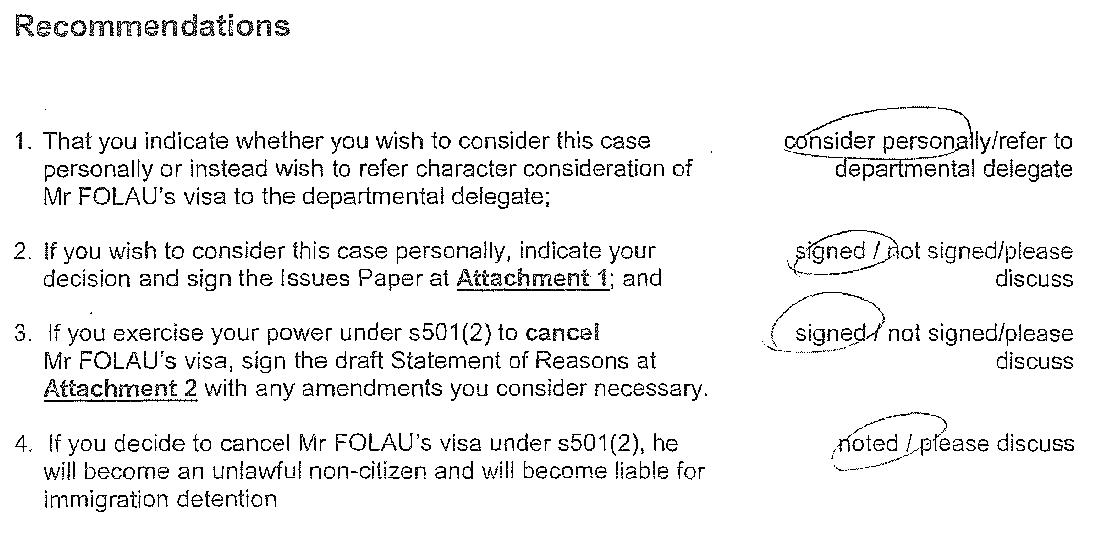
68 The Submission provided for the Minister to select from the options set out. Below is an image of the selections made by the Minister, which he signed and dated 17 March 2016:
69 The pro forma decision also provided for the Minister to select from the options set out. Below is an image of the selections made by the Minister, which he signed and dated:
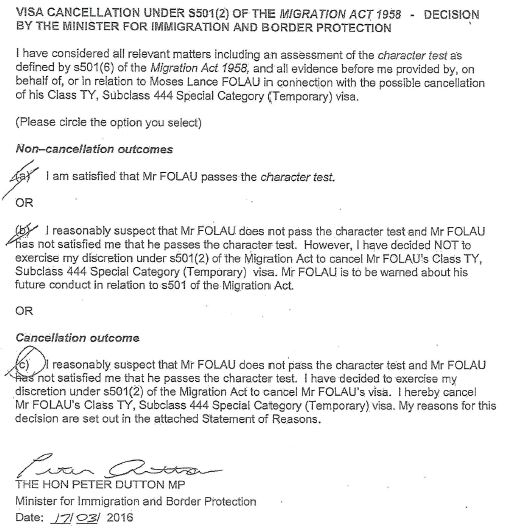
70 The Minister signed and dated the draft reasons without making any change to them.
The notice to admit
71 On 29 August 2016 Mr Folau’s solicitors served a notice to admit under r 22.01 of the Federal Court Rules 2011 (Cth). The notice called on the Minister to admit the truth of five alleged facts, as follows:
1. The Minister was given an “Issues” paper (see p. 2 of the Court Book) and a draft “Statement of Reasons” (see p. 25 of the Court Book) under cover of a “Submission” (see p. 1 of the Court Book).
2. The Minister signed the “Statement of Reasons” without making or requesting any amendments to it.
3. From the date he became the Minister until 17 March 2016, the current Minister for Immigration and Border Protection has made other cancellation and refusal decisions under s 501 of the Act (the other decisions).
4. All of the Statements of Reasons in respect of the other decisions (the other statements) were prepared by somebody else and signed by the Minister.
5. The Minister made or requested no changes to any of the other statements before signing them.
72 Under r 22.02 the Minister had 14 days to serve a notice of dispute in accordance with Form 42 which disputed the truth of any facts alleged in the notice to admit. The Minister did not do so. Instead the Minister’s lawyers served a document purporting to be a notice of dispute, described as a “Notice Disputing Facts”, in which the Minister admitted the first three alleged facts in the notice to admit and purported to respond to the fourth and fifth alleged facts by neither disputing nor admitting their truth.
73 Rule 22.04 provides:
Facts or documents taken to be admitted if not disputed
If the second party does not serve a notice of dispute in accordance with rule 22.02, the second party will be taken to have admitted the truth of each fact or the authenticity of each document specified in the notice to admit.
THE PRIMARY JUDGMENT
74 The primary judge found that the Notice Disputing Facts, which neither disputed nor admitted the alleged facts, was not a notice of dispute under r 22.02. His Honour held (at [17]) that the Minister’s failure to serve a notice of dispute meant that the Minister was taken to have admitted for the purposes of the proceeding that, in every visa cancellation and refusal decision the Minister had made from his appointment until the date of the decision in Mr Folau’s case, his draft reasons were prepared by someone else and he signed those draft reasons without making any change to them.
75 The primary judge however held (at [18]) that this did not alter the fact that the Minister made the decision personally and that he adopted the draft reasons prepared by the Department as his own. His Honour said that the fact that the Minister made the decision himself could be seen from his selection of the “cancellation outcome”, by his signing and dating the decision, and by his signing and dating the last page of the draft reasons. His Honour also noted that the process adopted in Mr Folau’s case was similar to that upheld in Navarrete v Minister for Immigration and Multicultural and Indigenous Affairs [2004] FCA 1723 (Navarrete) (Allsop J, as his Honour then was) and Maxwell v Minister for Immigration and Border Protection [2016] FCA 47 (Maxwell) (Perry J). The primary judge said:
It is true, as was submitted for Mr Folau, that the draft reasons contained normative statements and expressed reasoning of the author of the draft. It is also true that a different author might have expressed different normative views or might have expressed the reasons differently or might have considered different matters in reaching the same conclusion. However, that does not alter the fact that the actual decision was made by the Minister and that the Minister adopted the draft reasons as his own in making the decision which he made.
THE APPEAL
76 Ground four of the appeal alleges as follows:
The Court erred, at [14]-[18], in failing to find that the Minister had not given proper, genuine and realistic consideration to the merits of the Appellant’s case. In particular:
(a) The Court found for the purposes of the proceeding, at [14]-[15], that the Minister adopted, without amendment, draft statements of reasons prepared by others in respect of all visa cancellation and refusal decisions made by him from the date he became the Minister until 17 March 2016 (the date of his decision to cancel the [visa]).
(b) Having so found, the Court erred in failing to find that the Minister’s adoption of a draft set of reasons prepared by someone else was indicative of a failure to give proper, genuine and realistic consideration to the merits of the Appellant’s case.
77 Before us the Minister did not contend that the primary judge erred in finding that the Minister was taken to have admitted that in every visa refusal and cancellation decision he had made from his appointment until 17 March 2016 his draft reasons for decision were prepared by somebody else and he had signed them without alteration.
78 Mr Folau did not contend that the Minister was required to personally prepare his reasons for the decision, but submitted that the Minister may only adopt reasons prepared by someone else if the reasons “actually reflected” the Minister’s own process of reasoning: see Minister for Immigration and Multicultural Affairs v W157/00A (2002) 125 FCR 433; [2002] FCAFC 281 (W157/00A) at [39] (Branson J, with whom Goldberg J and Allsop J (as his Honour then was) agreed).
79 Mr Folau noted that the discretion reposed in the Minister under s 501(2) is broad and substantially unfettered in the sense that there is no express list of factors which the Minister is required to take into account: Minister for Immigration and Border Protection v Stretton (2016) 237 FCR 1; [2016] FCAFC 11 at [64] and [70] (Griffiths J with whom Allsop CJ and Wigney J agreed). He submitted that a personal decision by the Minister to cancel a visa under s 501(2) necessarily involves evaluating many considerations including:
(a) what risk or risks to the Australian community to focus on, what level of specificity or generality to give that focus, the potential consequences for the Australian community of any reoffending, and the evaluation of the seriousness and likelihood of any such risk or risks coming to pass;
(b) what countervailing considerations to have regard to and how to assess them; and
(c) what weight to give the different matters and how much (if any) risk the Australian community should be asked to tolerate.
80 Mr Folau contended that such considerations will involve normative and evaluative judgments upon which reasonable minds will differ and it will usually be open on a given set of materials to reason in numerous different ways. He submitted that, while two different people could arrive at the same decision on a given set of materials, it is highly unlikely that they would make exactly the same value judgments and have regard to exactly the same factors, assessed and weighed in exactly the same way. He argued that it would only be by coincidence if the Department’s draft reasons accurately predicted the Minister’s actual process of reasoning.
81 Putting to one side bad faith, which was not alleged, Mr Folau contended that there were only two possible explanations for the Minister adopting the draft reasons in his case, without making any change:
(a) first, the Minister might have personally decided to cancel Mr Folau’s visa and found, upon examining the draft reasons, that those reasons coincidentally “accurately reflected” his actual process of reasoning in every respect. However, having regard to the admitted facts, Mr Folau submitted that whatever the likelihood in a given case of the draft reasons accurately reflecting the Minister’s own reasoning process, the possibility of that happening in every visa cancellation and refusal decision the Minister made over a 15 month period could safely be discounted. Mr Folau submitted that was quite improbable; or
(b) second, the Minister might not have engaged in a genuine personal exercise of discretion. He may have read the draft reasons and considered those reasons to be reasonable or defensible and decided to exercise his discretion to cancel Mr Folau’s visa. He might have done so because he misunderstood what a personal exercise of the discretion entailed.
Mr Folau contended therefore that the Minister did not give proper, genuine and realistic consideration to the merits of his case.
CONSIDERATION
82 Counsel for the Minister did not submit that the power vested in the Minister to personally decide whether to cancel Mr Folau’s visa under s 501 of the Act could be exercised by a duly authorised departmental officer for and on the Minister’s behalf: see Carltona Ltd v Commissioners of Works [1943] 2 All ER 560 at 563 (Lord Green MR); O’Reilly v State Bank of Victoria Commissioners (1983) 153 CLR 1 at 12–13 per Gibbs CJ and 31 per Wilson J.
83 It is unnecessary to decide, but we would not imply a power under s 501(2) for the Minister to authorise someone else to exercise the Minister’s personal power for and on the Minister’s behalf. The scheme in the Act for cancellation of visas on character grounds distinguishes between decisions made personally by the Minister and decisions made by delegates of the Minister. Some powers, such as those in s 501(3), may only be exercised by the Minister personally: see s 501(4). Other powers, such as those in s 501(2), may be exercised either by the Minister personally or by a delegate. The Minister can decide whether to personally exercise the power or leave the decision to a delegate. Different consequences in terms of review rights flow from whether a decision is made by the Minister personally or by a delegate. A person affected by a delegate’s decision to cancel a visa under s 501(2) is entitled to a merits review by the Administrative Appeals Tribunal, whereas a person affected by a decision by the Minister acting personally is not.
84 The authorities indicate that it is permissible for a Minister, acting personally, to adopt draft reasons prepared by somebody else. The decision in W157/00A was made in circumstances where the Minister failed to comply with the obligation to provide reasons pursuant to s 501G of the Act. Branson J (with whom Goldberg and Allsop JJ agreed) said (at [39]) that “it would be sufficient for the Minister to adopt as his or her own written reasons prepared by a departmental officer provided, of course, that such reasons actually reflected the reasons why the Minister had reached his or her decision.”
85 The decisions in Navarrete and Maxwell are directly on point. They concerned visa cancellation decisions under s 501(2) made by the Minister personally, where the Minister adopted draft reasons prepared by a departmental officer. In Navarrete (at [39]) Allsop J said that his concern was with the legality of decision making, not with whether the Minister’s use of draft reasons was conducive to poor decision-making and he reiterated his approval of Branson J’s view in W157/00A. In Maxwell, Perry J inferred (at [31]) that the Minister adopted the draft reasons prepared by the Department because:
(a) the Department’s brief to the Minister contained all the relevant material for the decision;
(b) in making the visa cancellation decision the Minister signed a statement that he had considered all relevant matters;
(c) the Minister made a decision consistent with the draft reasons prepared by the Department; and by crossing-out the “non-cancellation outcomes” on the Issues Paper and by signing the base of the page, the Minister expressed her intention to select the “cancellation outcome” option which expressly adopted the draft reasons by stating that “[m]y reasons for this decision are set out in the attached Statement of Reasons.”
Her Honour said that in those circumstances the fact that the draft reasons were not prepared by the Minister personally was not relevant.
86 In our view it is open to distinguish Navarrete and Maxwell from the present case because, in both cases, the Court said that there was no evidence pointing to a contrary inference. In Navarrete Allsop J said (at [40]):
If the Minister gave no consideration to the terms of the draft, for instance because the author was known to be reliable and she was prepared to sign a memorandum from that person without giving it consideration, it might be said that there was jurisdictional error for the failure by the Minister to make the decision personally. However, there was no evidence here upon which I could conclude otherwise than that the draft reasons were adopted by the Minister as her own reasons after due consideration and that she made the decision for herself and adopted the draft reasons therefor.
(Emphasis added.)
87 In Maxwell Perry J said (at [32]) that there was “no evidence establishing otherwise than that the Minister made the decision personally in an independent exercise of her discretion.” See also Wozniak v Minister for Immigration and Border Protection [2017] FCA 44 at [74] – [76] (Burley J). However, because of the admitted facts, in the present case there is some evidence pointing the other way.
88 In Lek v Minister for Immigration, Local Government and Ethnic Affairs (1993) 43 FCR 100 at 122 Wilcox J said, and we agree, that:
…the use by decision makers of reasons devised by others is a matter that should excite concern about the possibility that individual decisions were taken in accordance with an overriding rule or policy or at the direction or behest of others.
Such concerns are likely to be deepened by the Minister’s apparent practice of adopting draft reasons prepared by others in every visa cancellation and refusal decision he makes, without amendment.
89 One might reasonably ask why Parliament would provide the Minister for Immigration and Border Protection with a personal power to cancel a visa (as an alternative to having the decision made by a delegate), and oblige the Minister to give reasons for doing so, if Parliament understood or intended that in every case the Minister would adopt, without change, the draft reasons prepared by departmental officers. Such a practice has a tendency to undercut Parliament’s intention to provide a right to merits review where a visa cancellation decision is made by a delegate rather than by the Minister personally.
90 The power for the Minister to personally decide to cancel a visa pursuant to s 501(2), coupled with his obligation to provide reasons for the decision pursuant to s 501G, cannot mean that it is permissible to merely rubber stamp reasons prepared by the Department, and the Minister is required to do more than just review reasons prepared by somebody else. The Minister must engage in an active intellectual process (Carrascalao v Minister for Immigration and Border Protection [2017] FCAFC 107 at [46] (Griffiths, White and Bromwich JJ)) and he must give proper, genuine and realistic consideration to the merits of the particular case: Minister for Immigration and Citizenship v SZJSS (2010) 243 CLR 164; [2010] HCA 48 at [29] (French CJ, Gummow, Hayne, Heydon, Crennan, Kiefel and Bell JJ). Before adopting any draft reasons as his own the Minister must decide that they accurately reflect his own reasons: W157/00A at [39].
91 Whether the Minister gave proper, genuine and realistic consideration to the merits of Mr Folau’s case is one of fact. It was not straightforward for Mr Folau (or indeed any person adversely affected by a visa cancellation decision) to establish that the Minister did not give proper consideration to the merits of the case but that may not be the position in every case. Depending on the case, further evidence adduced through, for example, a more detailed notice to admit or targeted interrogatories may assist an affected person in bridging the evidentiary gap.
92 In the present case the materials show that the Minister:
(a) was provided all the relevant materials to make a personal decision in relation to Mr Folau’s case;
(b) selected the option in the Submission which stated that he wished to consider Mr Folau’s case personally, and signed and dated it;
(c) selected the “cancellation outcome” in the pro forma decision which included statements that the Minister had decided to exercise his discretion to cancel Mr Folau’s visa and that “[m]y reasons for this decision are set out in the attached Statement of Reasons”, and signed and dated it; and
(d) signed and dated the draft reasons.
That provides a strong basis to conclude that the Minister gave proper consideration to the merits of Mr Folau’s case and after doing so adopted the draft reasons as his own reasons. While the admitted facts point to a contrary inference, they are insufficient to outweigh what are, in effect, express statements by the Minister that he personally made the decision for the reasons he signed and dated.
93 In our view Mr Folau did not discharge his onus to show that the Minister made the jurisdictional error alleged, and did not establish that the primary judge erred in reaching the conclusion that he did. We dismiss ground four of the appeal.
I certify that the preceding thirty-four (34) numbered paragraphs are a true copy of the Reasons for Judgment herein of the Honourable Justices Murphy and Burley. |
Associate:
Dated: 18 December 2017


