

FEDERAL COURT OF AUSTRALIA
Minister for Immigration and Border Protection v ARJ17 [2017] FCAFC 125
Table of Corrections | |
22 August 2017 | In paragraph 78, the references to paragraphs [5], [6] and [7] have been replaced with [75], [76] and [77]. |
22 August 2017 | In paragraph 137, the reference to paragraph [48] has been changed to [118]. |
22 August 2017 | In paragraph 154, the reference to paragraph [62] has been changed to [132]. |
22 August 2017 | In paragraph 156, the reference to paragraph [63] has been changed to [133] and the reference to paragraph [22] has been changed to [92]. |
22 August 2017 | In paragraph 157, the references to paragraphs [48]-[57] have been changed to [118]-[127]. |
22 August 2017 | In paragraph 166, the reference to paragraph [78] has been changed to [148]. |
ORDERS
MINISTER FOR IMMIGRATION AND BORDER PROTECTION First Appellant COMMONWEALTH OF AUSTRALIA Second Appellant SECRETARY OF THE DEPARTMENT OF IMMIGRATION AND BORDER PROTECTION Third Appellant | ||
AND: | Respondent | |
DATE OF ORDER: |
THE COURT ORDERS THAT:
2. The appellants pay the respondent’s costs of the appeal, to be taxed in default of agreement.
Note: Entry of orders is dealt with in Rule 39.32 of the Federal Court Rules 2011.
KENNY J:
1 I have had the considerable benefit of reading in draft the reasons for judgment of Flick J and of Kerr J. I agree that the primary judge did not err in holding that the Federal Court of Australia (the Court) has jurisdiction to hear and determine the originating application filed in this matter on 20 February 2017, substantially for the reasons their Honours state. I set out below brief reasons for my concurrence.
2 By an originating application, “ARJ17” sought declarations, injunctions and an order in the nature of certiorari to set aside the decision of the Secretary of the Department of Immigration and Border Protection (the Secretary) to implement a policy that would prevent a person being detained in an immigration detention centre established under s 273 of the Migration Act 1958 (Cth) (Migration Act) from having possession of a mobile phone during his or her detention. “ARJ17”, who was in immigration detention, instituted a proceeding under Pt IVA of the Federal Court of Australia Act 1976 (Cth) (Federal Court Act), as a representative party of a number of detainees (the detainees), claiming that the Secretary did not have the authority asserted under “Chapter 8 of the Detention Services Manual or section 252 of the Migration Act 1958 to confiscate the mobile phones or SIM cards of the Represented Persons”.
3 The primary judge rejected a challenge to the jurisdiction of the Court to grant final relief: see ARJ17 v Minister for Immigration and Border Protection [2017] FCA 263. On 17 March 2017, his Honour ordered that:
1. The question reserved for determination on 2 March 2017 be answered as follows:
Question: Does the Court have jurisdiction to grant final relief to the applicant in these proceedings?
Answer: The Court has original jurisdiction to grant final relief to the applicant on the claims to relief in the originating application.
2. The respondents have leave to appeal in respect of the question and answer in order 1.
4 This is an appeal, with leave, against his Honour’s interlocutory judgment. There is only one ground of appeal, namely:
The primary judge erred in concluding that the definition of “non-privative clause decision” in s 474(6) of the Migration Act 1958 (Cth) is to be construed as limited to decisions of the kind there specified that are valid.
5 On appeal and at first instance, the appellants (who were the respondents at first instance) claimed that they had authority to seize mobile phones and SIM cards belonging to the detainees under s 252 of the Migration Act and Ch 8 of the Detention Services Manual (the Manual) and their challenge to the jurisdiction of the Court was conducted on that basis.
6 Whether or not the Court has jurisdiction to hear and determine the originating application turns on the interaction of provisions of the Migration Act, the Judiciary Act 1903 (Cth) (Judiciary Act) and the Federal Court Act, many of which have been set out by Flick J and Kerr J.
7 The Court is created by the Federal Court Act and it has “such original jurisdiction as is vested in it by laws made by the [Commonwealth] Parliament”: s 19 of the Federal Court Act. Since the inclusion of s 39B(1A)(c) in the Judiciary Act, the Court has been vested with jurisdiction in non-criminal matters arising under any Commonwealth statute. This follows from the terms of s 39B(1A), which provides:
(1A) The original jurisdiction of the Federal Court of Australia also includes jurisdiction in any matter:
(a) in which the Commonwealth is seeking an injunction or a declaration; or
(b) arising under the Constitution, or involving its interpretation; or
(c) arising under any laws made by the Parliament, other than a matter in respect of which a criminal prosecution is instituted or any other criminal matter.
8 Jurisdiction can, of course, be conferred by other Acts of Parliament. For example, s 8(1) of the Administrative Decisions (Judicial Review) Act 1977 (Cth) (ADJR Act) confers jurisdiction on the Court to hear and determine an application for judicial review made to it under that Act. Acts of Parliament can also limit the scope of the jurisdiction that might otherwise arise under other legislation. In this case, but for certain provisions of the Migration Act, the Court would clearly have jurisdiction under s 39B(1A)(c) of the Judiciary Act, to determine whether or not s 252 of the Migration Act, with Ch 8 of the Manual, conferred authority on the Secretary to confiscate the mobile phones and SIM cards of the detainees.
9 Section 476A of the Migration Act operates to prevent jurisdiction arising under s 39B of the Judiciary Act and s 8 of the ADJR Act “in relation to a migration decision”, save in certain limited situations. Section 476A(1) provides that, despite s 39B of the Judiciary Act and s 8 of the ADJR Act, the Court has “original jurisdiction in relation to a migration decision if, and only if” particular circumstances exist (emphasis added). Compared with the Federal Court, the Federal Circuit Court has a broader jurisdiction “in relation to migration decisions”, since, subject to s 476(2)-(4), s 476(1) confers on the Federal Circuit Court the same jurisdiction “in relation to migration decisions” as the High Court enjoys under s 75(v) of the Constitution. This difference was the basis of the appellants’ case that only the Federal Circuit Court has jurisdiction to hear and determine the originating application.
10 Since s 476A(1) limits the Court’s jurisdiction “in relation to a migration decision”, the meaning of that expression is critical. The words “migration decision” are defined in s 5(1) of the Migration Act to mean: (a) a privative clause decision; (b) a purported privative clause decision; (c) a non-privative clause decision; or (d) an AAT Act migration decision (as defined in s 474A). The first three subsets of “migration decision” – a privative clause decision, a purported privative clause decision and a non-privative clause decision – are particularly relevant to the present question.
11 By virtue of ss 5(1) and 474(2) of the Migration Act, a “privative clause decision” is “a decision of an administrative character made, proposed to be made, or required to be made, as the case may be, under [that] Act or under a regulation or other instrument made under [that] Act (whether in the exercise of a discretion or not), other than a decision referred to in subsection (4) or (5)” (emphasis added). Section 474(5) is not presently relevant but s 474(4) is. Section 474(4) provides that, for the purposes of s 474(2), a decision “under a provision ... set out in the following table is not a privative clause decision”. Item 7 of that table nominates s 252 of the Migration Act.
12 By virtue of ss 5(1) and 474(6), a non-privative clause decision is, relevantly, a decision mentioned in s 474(4).
13 The expression “purported privative clause decision” is defined by s 5E(1) of the Migration Act as follows:
In this Act, purported privative clause decision means a decision purportedly made, proposed to be made, or required to be made, under this Act or under a regulation or other instrument made under this Act (whether in purported exercise of a discretion or not), that would be a privative clause decision if there were not:
(a) a failure to exercise jurisdiction; or
(b) an excess of jurisdiction;
in the making of the decision.
Section 5E(2) expands the ordinary meaning of “decision” by reference to s 474(3). Nothing turns on s 5E(2) in this case.
14 Returning to the matter of the originating application, it appears that a decision under s 252 of the Migration Act is neither a privative clause decision nor a “purported privative clause decision”. Rather, a decision made under s 252 of the Migration Act would be a “non-privative clause decision” (see [10] above), assuming it was an effective decision in the sense that it was not vitiated by jurisdictional error or made in excess of jurisdiction. The Court would not have jurisdiction to review that decision unless one of (a)-(d) of s 476A(1) were satisfied.
15 A dilemma arises, however, in classifying a decision that is purportedly made under the Migration Act, where that decision would be a non-privative clause decision if made, but, on account of a failure to exercise jurisdiction or an excess of jurisdiction, was not made. Specifically, how is a decision purportedly made under s 252 of the Migration Act but vitiated on account of jurisdictional error to be regarded in this particular legislative scheme? If there is a relevant difference between a decision made under s 252 (a non-privative clause decision) and a decision purportedly made under s 252 but not made because it is vitiated by jurisdictional error or excess of jurisdiction (purported non-privative clause decision), then this Court’s jurisdiction under s 39B of the Judiciary Act in a matter arising under s 252 of the Migration Act is not diminished by s 476A(1) in respect of a purported non-privative clause decision. This is because a purported non-privative clause decision is neither a “migration decision” (as defined) nor a decision “in relation to a migration decision”. It cannot be construed as “in relation to” a migration decision because no migration decision was ever made. Further, the fact that the Parliament has chosen only to extend the meaning of the expression “migration decision” to embrace a “purported privative clause decision” indicates that it did not intend that expression to extend to a purported non-privative clause decision.
16 As explained below, it seems to me that, properly construed, this legislative scheme operates on the assumption that a non-privative clause decision and a purported non-privative clause decision are relevantly different and that the definition of “migration decision” in s 5(1) of the Migration Act is not intended to include a purported non-privative clause decision. In construing any legislation, the primary focus is the language used in the text of the provisions, acknowledging that the meaning of the text may, and often will, require consideration of the context, including the purpose and policy of a provision: see Alcan (NT) Alumina Pty Ltd v Commissioner of Territory Revenue (Northern Territory) [2009] HCA 41; 239 CLR 27 at [47]. The ascertainment of purpose and policy may sometimes be assisted by reference to the history of a provision and relevant extrinsic materials.
17 In this particular statutory context, the Parliament recognised the significance of the distinction between a decision made in exercise of statutory power and a decision only purporting to be made in exercise of statutory power. This much is evident from the definitions of a “privative clause decision” in ss 5(1) and 474(2) and a “purported privative clause decision” in s 5E(1) of the Migration Act, as well as the use of these expressions in defining a “migration decision” for the purposes of the Migration Act: see s 5(1).
18 Parliamentary recognition of the importance of the distinction between a decision actually made in exercise of a statutory power and a decision purporting to be, though not, made in exercise of the power conforms with the general principle, affirmed by the plurality in Plaintiff S157/2002 v Commonwealth [2003] HCA 2; 211 CLR 476 (Plaintiff S157) at [76], that “ an administrative decision which involves jurisdictional error is ‘regarded, in law, as no decision at all’”, citing Minister for Immigration and Multicultural Affairs v Bhardwaj [2002] HCA 11; 209 CLR 597 at [51], [63] and [152]. The principle is well-established and has general application, with the consequence that the High Court has applied the principle in construing the provisions of State legislation governing the jurisdiction of a State decision-making body: see Kirk v Industrial Court (NSW) [2010] HCA 1; 239 CLR 531 at [104]-[105].
19 With reference to s 474(2) of the Migration Act, the plurality held in Plaintiff S157 (at [76]) that, in referring to “a decision … made under this Act”, the Parliament did not intend to refer to a decision involving jurisdictional error. Section 474(2) is directly connected to s 474(4). Indeed, the former provision expressly refers to the latter and the latter expressly refers back to the former. Section 474(4) uses virtually the same language as in s 474(2), when it refers to “a decision under a provision ...”. The form in which ss 5, 474, 476 and 476A stood at all times relevant to this appeal, which includes the contrast between a “privative clause decision” and a “purported privative clause decision”, indicates that the expression “non-privative clause decision” is not intended to refer what purports to be a decision but is not a decision because attended by jurisdictional error.
20 In this context, “cognate expressions in a statute should be given the same meaning unless the context requires a different result”: see Kline v Official Secretary to the Governor General [2013] HCA 52; 249 CLR 645 at [32], citing Registrar of Titles (WA) v Franzon [1975] HCA 41; 132 CLR 611 at 618. This interpretive principle must have particular strength where these expressions appear in the same statutory provision. Furthermore, it may be accepted that “an interpretation by [the High] Court of a particular provision of an Act is a powerful indicator of the correct interpretation of a provision of the same Act which serves similar purposes and uses identical or substantially similar language”; a fortiori, where the interpretation concerns a virtually identical expression in the same provision: see Commissioner of Taxation v Australian Building Systems Pty Ltd (in liq) [2015] HCA 48; 257 CLR 544 at [27] (French CJ and Kiefel J).
21 The broad jurisdiction of the Court conferred by s 39B of the Judiciary Act, which is the basis for the Court’s continuing role under the High Court, as a Court of general federal civil jurisdiction is not to be taken away by uncertain and obtuse language. If it is to be diminished, that implication must “clearly and unmistakably” appear: see PT Bayan Resources TBK v BCBC Singapore Pte Ltd [2015] HCA 36; 258 CLR 1 at [29] (French CJ, Kiefel, Bell, Gageler and Gordon JJ, Keane and Nettle JJ agreeing) and the cases there cited. I cannot discern any clear and unmistakable implication in s 476A and related provisions to deprive the Court of jurisdiction to hear and determine a matter involving a purported non-privative clause decision. On the contrary, there is, as already indicated, good reason to conclude that the Parliament did not so intend.
22 Further, as Flick J and Kerr J show, the conclusion that s 476A of the Migration Act does not diminish this Court’s jurisdiction under s 39B of the Judiciary Act in respect of a decision purportedly made under s 252 of the Migration Act is the outcome of an interpretative process that is consistent with the legislative history of the relevant statutory provisions.
23 This conclusion does not, moreover, defeat the purpose of the scheme established by Pt 8 of the Migration Act, as the appellants argued. So construed, the Migration Act indeed confers jurisdiction to hear and determine “nearly all migration cases” on the Federal Circuit Court and also gives effect to the decision in Plaintiff S157, which the historical record indicates was in fact the Parliament’s intention: see Explanatory Memorandum, Migration Litigation Reform Bill 2005 (Cth) pp 10-11, items 14 and 17 (emphasis added).
24 The appellants took issue with the unsatisfactory consequences of this construction. The complaint was that it could not be said whether or not the Court had jurisdiction in any particular case until after the issue of jurisdictional error had been decided. Much the same difficulty was acknowledged by the plurality in Plaintiff S157 although it did not deter their Honours from concluding that “a decision … made under this Act” was not intended by Parliament to refer to a decision involving jurisdictional error: see Plaintiff S157 at [88]-[90].
25 It is, it seems to me, also relevant that the class of non-privative clause decisions is, subject to s 474(5), confined by s 474(4) and, speaking very generally, may reasonably be seen as involving decisions likely to affect the rights and freedoms of detainees. Decisions in exercise of s 252 of the Migration Act would indeed almost always be of this kind. It may be that s 474(5) was intended to address the possibility that there would be other statutory provisions, the exercise of which attracted similar considerations. The conclusion that the Court reaches in this appeal is that the Parliament considered that the Court should have jurisdiction to review decisions purportedly made in exercise of these powers but vitiated by jurisdictional error or excess of power. Accordingly, as the primary judge held, the Court has jurisdiction under s 39B of the Judiciary Act to review a decision purportedly made in exercise of s 252 of the Migration Act and therefore to hear and determine the originating application filed in this matter.
26 As indicated earlier, I would dismiss the appeal, with costs.
I certify that the preceding twenty-six (26) numbered paragraphs are a true copy of the Reasons for Judgment herein of the Honourable Justice Kenny. |
Associate:
REASONS FOR JUDGMENT
FLICK J
27 The issue in the matter presently before this Court is whether or not this Court has jurisdiction to entertain a claim that s 252 of the Migration Act 1958 (Cth) (the “Migration Act”) confers no authority to confiscate the mobile phones and SIM cards of persons who are detained in immigration detention centres.
28 The proceeding is a representative proceeding brought on behalf of a group of persons who are in immigration detention and who possess mobile phones and SIM cards, including the present Respondent, ARJ17.
29 As commenced, the then First Respondent was the Minister for Immigration and Border Protection; the Second Respondent was the Commonwealth of Australia; and the Third Respondent was the Secretary of the Department of Immigration and Border Protection.
30 Section 252 authorises the search of a person “and the person’s clothing and any property under the immediate control of the person” for purposes of (inter alia) finding out “whether there is hidden on the person, in the clothing or in the property, a weapon of other thing capable of being used to inflict bodily injury or to help the person to escape from immigration detention”.
31 The authority relied upon to search detained persons and to confiscate mobile phones and SIM cards was said on behalf of the then Respondents to be found in an amendment made in May 2016 to a policy set forth in a Detention Services Manual. In November 2016 the Department announced that it was implementing the May 2016 change in policy.
32 ARJ17 claimed on his own behalf, and on behalf of the group members in a like position, that (inter alia) the Secretary “has no authority under Chapter 8 of the Detention Services Manual or section 252 of the Migration Act 1958 to confiscate the mobile phones or SIM cards of the Represented Persons”.
33 When the matter first came before the primary Judge, it was contended on behalf of the former Respondents that this Court had no jurisdiction to entertain the claim. It was submitted on their behalf that it was only the Federal Circuit Court that had jurisdiction.
34 The primary Judge disagreed: ARJ17 v Minister for Immigration and Border Protection [2017] FCA 263.
35 The former Respondents appealed.
36 It should be noted at the outset that there is nothing more fundamental to the administration of justice by this Court than the ability to clearly identify those matters in respect to which it has jurisdiction.
37 This is more so the case where the jurisdiction of this Court in respect to migration matters is often invoked by those who are unrepresented and who frequently have a limited command of the English language. Even those who command considerable legal skills are often uncertain as to whether a proceeding should be commenced in the High Court of Australia, this Court or the Federal Circuit Court of Australia.
38 The jurisdiction entrusted to one or other of these Courts is a morass of confusion. Left to the consideration of the Legislature is whether the existing legislative allocation of jurisdiction between the Courts can be more simply expressed.
39 The present uncertainty is self-evident from the fact that a decision of a single Judge of this Court has not been accepted by the now-Appellants as resolving the present question as to whether this Court has jurisdiction to entertain the claims sought to be advanced.
40 The decision of the primary Judge concluding that this Court does have jurisdiction is correct. The appeal should be dismissed with costs.
The statutory provisions conferring jurisdiction
41 The statutory provisions which seek to confer upon this Court limited jurisdiction and which seek to entrust to either this Court or the Federal Circuit Court of Australia jurisdiction to review various decisions made under the Migration Act are in the sequential order in which they appear in that statute as follows.
42 Section 5(1), being an interpretation section, provides in part as follows:
In this Act, unless the contrary intention appears:
AAT Act migration decision: see section 474A.
…
migration decision means:
(a) a privative clause decision; or
(b) a purported privative clause decision; or
(c) a non-privative clause decision; or
(d) an AAT Act migration decision.
…
non-privative clause decision has the meaning given by subsection 474(6).
…
privative clause decision has the meaning given by subsection 474(2).
43 Section 5E provides as follows:
Meaning of purported privative clause decision
(1) In this Act, purported privative clause decision means a decision purportedly made, proposed to be made, or required to be made, under this Act or under a regulation or other instrument made under this Act (whether in purported exercise of a discretion or not), that would be a privative clause decision if there were not:
(a) a failure to exercise jurisdiction; or
(b) an excess of jurisdiction;
in the making of the decision.
(2) In this section, decision includes anything listed in subsection 474(3).
44 Part 8 Division 1 of the Migration Act contains within it one section, s 474. It provides as follows:
Part 8—Judicial review
Division 1—Privative clause
474 Decisions under Act are final
(1) A privative clause decision:
(a) is final and conclusive; and
(b) must not be challenged, appealed against, reviewed, quashed or called in question in any court; and
(c) is not subject to prohibition, mandamus, injunction, declaration or certiorari in any court on any account.
(2) In this section:
privative clause decision means a decision of an administrative character made, proposed to be made, or required to be made, as the case may be, under this Act or under a regulation or other instrument made under this Act (whether in the exercise of a discretion or not), other than a decision referred to in subsection (4) or (5).
(3) A reference in this section to a decision includes a reference to the following:
(a) granting, making, varying, suspending, cancelling, revoking or refusing to make an order or determination;
(b) granting, giving, suspending, cancelling, revoking or refusing to give a certificate, direction, approval, consent or permission (including a visa);
(c) granting, issuing, suspending, cancelling, revoking or refusing to issue an authority or other instrument;
(d) imposing, or refusing to remove, a condition or restriction;
(e) making or revoking, or refusing to make or revoke, a declaration, demand or requirement;
(f) retaining, or refusing to deliver up, an article;
(g) doing or refusing to do any other act or thing;
(h) conduct preparatory to the making of a decision, including the taking of evidence or the holding of an inquiry or investigation;
(i) a decision on review of a decision, irrespective of whether the decision on review is taken under this Act or a regulation or other instrument under this Act, or under another Act;
(j) a failure or refusal to make a decision.
(4) For the purposes of subsection (2), a decision under a provision, or under a regulation or other instrument made under a provision, set out in the following table is not a privative clause decision:
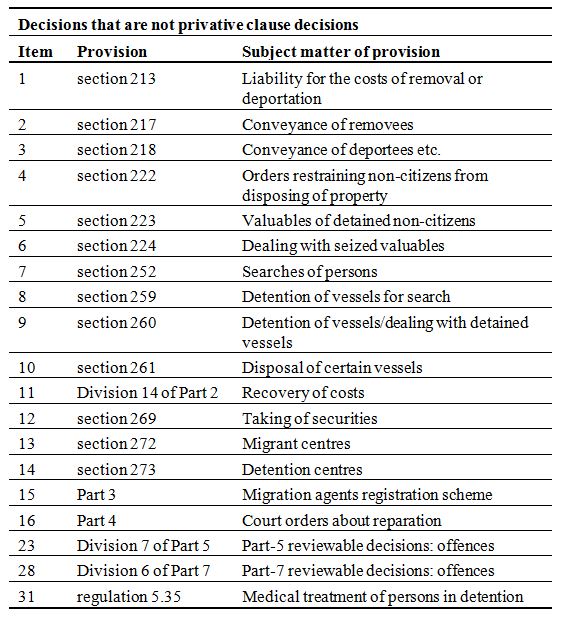
(5) The regulations may specify that a decision, or a decision included in a class of decisions, under this Act, or under regulations or another instrument under this Act, is not a privative clause decision.
(6) A decision mentioned in subsection 474(4), or specified (whether by reference to a particular decision or a class of decisions) in regulations made under subsection 474(5), is a non-privative clause decision.
(7) To avoid doubt, the following decisions are privative clause decisions within the meaning of subsection 474(2):
(a) a decision of the Minister not to exercise, or not to consider the exercise, of the Minister’s power under subsection 37A(2) or (3), section 48B, paragraph 72(1)(c), section 91F, 91L, 91Q, 195A, 197AB, 197AD, 198AE, 351 or 417 or subsection 503A(3);
(d) a decision of the Minister under Division 13A of Part 2 to order that a thing is not to be condemned as forfeited.
45 Section 476, which entrusts jurisdiction to the Federal Circuit Court, provides as follows:
Jurisdiction of the Federal Circuit Court
(1) Subject to this section, the Federal Circuit Court has the same original jurisdiction in relation to migration decisions as the High Court has under paragraph 75(v) of the Constitution.
(2) The Federal Circuit Court has no jurisdiction in relation to the following decisions:
(a) a primary decision;
(b) a privative clause decision, or purported privative clause decision, of the Administrative Appeals Tribunal on review under section 500;
(c) a privative clause decision, or purported privative clause decision, made personally by the Minister under section 501, 501A, 501B, 501BA, 501C or 501CA;
(d) a privative clause decision or purported privative clause decision mentioned in subsection 474(7).
(3) Nothing in this section affects any jurisdiction the Federal Circuit Court may have in relation to non-privative clause decisions under section 8 of the Administrative Decisions (Judicial Review) Act 1977 or section 44AA of the Administrative Appeals Tribunal Act 1975.
(4) In this section:
primary decision means a privative clause decision or purported privative clause decision:
(a) that is reviewable under Part 5 or 7 or section 500 (whether or not it has been reviewed); or
(b) that would have been so reviewable if an application for such review had been made within a specified period; or
(c) that has been, or may be, referred for review under Part 7AA (whether or not it has been reviewed).
46 Section 476A, which entrusts jurisdiction to this Court, provides as follows:
Limited jurisdiction of the Federal Court
(1) Despite any other law, including section 39B of the Judiciary Act 1903 and section 8 of the Administrative Decisions (Judicial Review) Act 1977, the Federal Court has original jurisdiction in relation to a migration decision if, and only if:
(a) the Federal Circuit Court transfers a proceeding pending in that court in relation to the decision to the Federal Court under section 39 of the Federal Circuit Court of Australia Act 1999; or
(b) the decision is a privative clause decision, or a purported privative clause decision, of the Administrative Appeals Tribunal on review under section 500; or
(c) the decision is a privative clause decision, or purported privative clause decision, made personally by the Minister under section 501, 501A, 501B, 501BA, 501C or 501CA; or
(d) the Federal Court has jurisdiction in relation to the decision under subsection 44(3) or 45(2) of the Administrative Appeals Tribunal Act 1975.
(2) Where the Federal Court has jurisdiction in relation to a migration decision under paragraph (1)(a), (b) or (c), that jurisdiction is the same as the jurisdiction of the High Court under paragraph 75(v) of the Constitution.
(3) Despite section 24 of the Federal Court of Australia Act 1976, an appeal may not be brought to the Federal Court from:
(a) a judgment of the Federal Circuit Court that makes an order or refuses to make an order under subsection 477(2); or
(b) a judgment of the Federal Court that makes an order or refuses to make an order under subsection 477A(2).
(4) Despite section 33 of the Federal Court of Australia Act 1976, an appeal may not be brought to the High Court from a judgment of the Federal Court that makes an order or refuses to make an order under subsection 477A(2).
(5) In this section:
judgment has the same meaning as in the Federal Court of Australia Act 1976.
47 Section 476B provides for the remittal of proceedings which have been commenced in the High Court of Australia. That section provides as follows:
Remittal by the High Court
(1) Subject to subsection (3), the High Court must not remit a matter, or any part of a matter, that relates to a migration decision to any court other than the Federal Circuit Court.
(2) The High Court must not remit a matter, or any part of a matter, that relates to a migration decision to the Federal Circuit Court unless that court has jurisdiction in relation to the matter, or that part of the matter, under section 476.
(3) The High Court may remit a matter, or part of a matter, that relates to a migration decision in relation to which the Federal Court has jurisdiction under paragraph 476A(1)(b) or (c) to that court.
(4) Subsection (1) has effect despite section 44 of the Judiciary Act 1903.
The Detention Services Manual
48 The Detention Services Manual was re-issued in July 2016 to incorporate the May 2016 policy change. That Manual provides in part as follows:
Detention Services Manual Chapter 8 - Safety and Security - Items not permitted in immigration detention facilities
Latest changes
…
Policy
This instruction, which is part of the centralised departmental instructions system (CDIS), was re-issued (with a slight change in name) on 1 July 2016 to incorporate amended policy on:
• detainee access to mobile phones and internet enabled devices within IDFs and
• health, safety, security and/or good order of the facility relating to food entering an IDF.
…
Introduction
1 Background
The rationale for preventing some items entering immigration detention facilities (IDF) is a risk mitigation strategy used to manage the good order and security within an IDF and to ensure the health and safety of all persons in any facility. A primary risk mitigation strategy is to place conditions on the entry and use of particular items. Those items may be the property of a detainee, the Facilities and Detention Service Provider (FDSP), departmental officers or visitors. Arrangements for exceptional circumstances are also identified in this instruction.
…
4 Legislative framework
This instruction is based on s252G of the Migration Act (the Act), which outlines the legislative framework for conducting searches and screening procedures in immigration detention centres (IDCs). Section 252 allows for a detainee, and the detainees’ clothing and property whilst in their immediate control, to be screened and searched without a warrant. The power under s252G allow screening of a visitor, and their clothing and property, only on entering an IDC.
Departmental staff and authorised officers have no legislative authority under the Act to screen or search visitors to IRH, ITA and APOD. Under common law, however, the Department is able draw on the powers of an occupier to refuses entry to visitors who do not comply with the specified conditions on entering, such as screening.
5 Screening and searching detainees
All detainees are subject to screening by FDSP personnel. Section 252(2) permits an officer to search a detainee, their clothing and any property under their immediate control, without a warrant, for a weapon or item capable of inflicting injury or of assisting with escape.
Section 252C(1) allows an authorised officer to take possession of and retain items found in the course of screening or the conduct of a strip search under s252A, if the item found may provide evidence of a commission of an offence against the Act or is forfeited or forfeitable to the Commonwealth.
Should a prohibited item be found during a search or a screening procedure of a detainee under s252(1)(a), s252AA(1) or s252A, the item must be dealt with in accordance with established policy and procedures – refer to DSM Chapter 8 - Safety and security - Screening of detainees.
Section 252G of the Migration Act, it may be noted in passing, confers power to make a request upon a person entering a detention centre to (inter alia) “walk through screening equipment” and to “allow things in the person’s possession to pass through screening equipment or to be examined by X-ray”. Chapter 8 of the Manual continues on to provide in part as follows:
11 Controlled items
…
Examples of controlled items are:
• all mobile phones – refer to 13 Mobile phones
• Subscriber Identity Module (SIM) cards for mobile phones and other communication devices
…
13 Mobile phones
For security and safety purposes all mobile phones are classified as controlled items and are not permitted in IDFs, except under conditions specified by the Department. For details on access by detainees to communication services, refer to DSM - Chapter 4: Communication and visits - Access to communication services in IDFs.
All detainees within border screening are not permitted to possess a mobile phone – refer to DSM - Chapter 2: Detainee placement - Border screening detention.
A purported non-privative clause decision
49 It was common ground that any authority to seize mobile phones and SIM cards was to be found (primarily) in s 252 of the Migration Act and Chapter 8 of the Manual. So much would seem to inevitably follow from the reference in that part of the Manual headed “5 Screening and searching detainees” to s 252(2) permitting “an officer to search a detainee, their clothing and any property under their immediate control”.
50 The outline of written submissions filed on behalf of the Respondent contends that the “critical question for present purposes is whether, in determining the present matter, the Federal Court would be exercising jurisdiction ‘in relation to a non-privative clause decision’”. The Respondent contends that the Court would not be doing so but “would be exercising jurisdiction in relation to a purported non-privative clause decision, and a purported non-privative clause decision is not a ‘migration decision’”.
51 To an applicant seeking to invoke the jurisdiction of this Court, especially those not fluent in English, it would be difficult to devise a greater barrier to an informed decision being made as to the selection of the Court with jurisdiction to resolve the claim. The question as formulated by the Respondent, and necessarily so framed by reason of the manner in which the legislation is drafted, is as clear as mud. Even to an experienced migration practitioner, the question is only slightly more comprehensible.
52 If the Commonwealth Legislature by these provisions is seeking to promote access to justice by a readily comprehensible identification of the Court in which a proceeding should be commenced, it has failed.
53 If any distinction between a decision made under s 252 and a decision purportedly made under s 252 is presently left to one side and if attention is focussed solely upon the character of a decision made under s 252, the process for unravelling the legislative provisions of relevance is as follows:
(i) a decision made under s 252 is not a “privative clause decision” (s 474(2) and (4));
(ii) nor would a decision made under s 252 be a “purported privative clause decision” (ss 5(1), 5E and s 474(4)); and
(iii) a decision made under s 252 would be a “non-privative clause decision” (s 5(1) and s 474(6)), such a decision being a “decision” which is “mentioned” in s 474(4).
If attention is next focussed on the question of whether this Court has jurisdiction to review a decision made under s 252, the legislative sequence is as follows:
(iv) this Court does not have jurisdiction to review a decision made under s 252 because it is not a decision falling within s 476A(1)(a), (b), (c) or (d);
and, in the absence of any reason to reach a contrary conclusion:
(v) section 476A only takes away from the jurisdiction otherwise entrusted to this Court by s 39B of the Judiciary Act 1903 (Cth) (the “Judiciary Act”) so much as is expressly or impliedly excluded by that provision.
A decision not made under s 252, but rather a decision purportedly made under s 252, is:
(vi) properly to be characterised in the scheme of the legislative provisions set forth in Pt 8 Divs 1 and 2 of the Migration Act as a “purported non-privative clause decision”; and
(vii) a “purported non-privative clause decision” is not included within the definition of a “migration decision” for the purposes of s 5.
If this sequence be correct, it follows that a decision made in purported exercise of the power conferred by s 252, but not a decision made under s 252, does not fall within the ambit of s 476A. A purported exercise of the power conferred by s 252 is neither a “migration decision” nor a decision “in relation to a migration decision”. Being a decision that falls outside of the legislative regime set forth in Pt 8 Divs 1 and 2 of the Migration Act, it remains a decision which falls within the jurisdiction conferred on this Court by s 39B of the Judiciary Act.
54 Inherent in this sequence of legislative provisions are at least two inter-related propositions.
55 First, and perhaps most centrally relevant, are the distinctions made in the definition of a “migration decision” between a “privative clause decision” and a “purported privative clause decision”. The distinction between a decision made pursuant to statutory authority and a decision purportedly made pursuant to such authority was a distinction to which the Legislature was alert. In including a reference to a “non-privative clause decision” – but not including a reference to a “purported non-privative clause decision” – the Legislature can well be assumed to have had such distinctions at the forefront of its legislative mind.
56 Such a distinction is not only warranted by the terms of the definition of “migration decision”, it is a distinction which is both Constitutionally mandated and one which has been recognised by the High Court in respect to s 474 itself: Plaintiff S157/2002 v Commonwealth [2003] HCA 2, (2003) 211 CLR 476. Gaudron, McHugh, Gummow, Kirby and Hayne JJ there concluded (at 506):
[76] Once it is accepted, as it must be, that s 474 is to be construed conformably with Ch III of the Constitution, specifically, s75, the expression “decision[s] … made under this Act” must be read so as to refer to decisions which involve neither a failure to exercise jurisdiction nor an excess of the jurisdiction conferred by the Act. Indeed so much is required as a matter of general principle. This Court has clearly held that an administrative decision which involves jurisdictional error is “regarded, in law, as no decision at all”. Thus, if there has been jurisdictional error because, for example, of a failure to discharge “imperative duties” or to observe “inviolable limitations or restraints”, the decision in question cannot properly be described in the terms used in s 474(2) as “a decision … made under this Act” and is, thus, not a “privative clause decision” as defined in s 474(2) and (3) of the Act.
[77] To say that a decision that involves jurisdictional error is not “a decision … made under [the] Act” is not to deny that it may be necessary to engage in the reconciliation process earlier discussed to ascertain whether the failure to observe some procedural or other requirement of the Act constitutes an error which has resulted in a failure to exercise jurisdiction or in the decision-maker exceeding its jurisdiction.
(Footnotes omitted)
57 Second, but very much a part of the former proposition, the reference in s 476A(1) to jurisdiction “in relation to a migration decision”, takes the Minister’s argument no further. The phrase “in relation to”, it may be accepted, is a phrase conveying a width of application; but it remains a phrase having application to or reference to “a migration decision”: cf. SZBEL v Minister for Immigration and Multicultural and Indigenous Affairs [2006] HCA 63 at [34], (2006) 228 CLR 152 at 162 to 163 per Gleeson CJ, Kirby, Hayne, Callinan and Heydon JJ. No matter how wide that phrase is to be construed, it is a phrase which applies equally to a “privative clause decision” and a “purported privative clause decision”. But for the inclusion of a “purported privative clause decision” within the definition in s 5(1) of a “migration decision”, the phrase “in relation to” may perhaps have been construed as encompassing both a decision made under statutory authority and a decision purportedly made under such authority. But the inclusion within that definition of a “purported privative clause decision” necessarily means that the phrase “in relation to” need not be invoked to extend the meaning of the phrase “privative clause decision” to encompass a “purported” decision. Nor could it be invoked to extend the meaning of “privative clause decision”. It would be an odd result if the phrase “in relation to” had greater work to do in respect to one category of decision over another.
58 If the phrase “in relation to” is not to be construed as extending the Federal Court’s jurisdiction beyond a decision made under statutory authority in respect to a “privative clause decision”, there is no reason to construe the same phrase in the same section as extending the Court’s jurisdiction beyond a “non-privative clause decision” to encompass a “purported non-privative clause decision”.
59 Both of these propositions are only re-enforced by the Explanatory Memorandum to the Migration Litigation Reform Bill. It was the Migration Litigation Reform Act 2005 (Cth) which (inter alia) repealed the then ss 475A and 476 and introduced ss 5E, 476, 476A and 476B into the Migration Act. The Explanatory Memorandum states in part as follows:
Item 14 After section 5D
45. This item inserts a new section 5E. Section 5E provides that a purported privative clause decision is a decision that would have been classified as a privative clause decision, as defined in subsection 474(2) of the Migration Act, but is not because the decision involves a failure to exercise jurisdiction or an excess of jurisdiction in the making of the decision.
46. The definition of ‘purported privative clause decision’ in section 5E reflects the terminology used by the High Court in Plaintiff S157 v Commonwealth of Australia (2003) 211 CLR 476 (S157). In S157, the High Court held that a ‘decision… made under [the Migration] Act’ does not include a decision which involves a failure to exercise jurisdiction or an excess of jurisdiction. The Court referred to such decisions infected by jurisdictional error as ‘decisions purportedly made under the Act’. As such, these decisions were not privative clause decisions.
47. The expression ‘migration decision’ (inserted by item 11, schedule 1) means a privative clause decision, a purported privative clause decision or a non-privative clause decision. The use of this expression in Parts 8 and 8A of the Migration Act ensures that provisions in these Parts apply to purported privative clause decisions as well as privative clause decisions.
48. Subsection 5E(2) provides that the reference to ‘decision’ in section 5E includes anything listed in subsection 474(3) of the Migration Act.
Conspicuously absent from the explanation provided is any discernible legislative intent to extend the reach of that which is excluded from the jurisdiction of the Federal Court to exclude a “purported non-privative clause decision”. Being alerted to the distinction made by the High Court in Plaintiff S157, the Legislature presumably (and deliberately) shunned any desire to include a “purported non-privative clause decision” within the scheme of the Migration Act. Such was also the like conclusion reached by the primary Judge: [2017] FCA 263 at [70].
60 The conclusion that the Federal Court retains jurisdiction to review a decision “purportedly” made under the authority conferred by s 252 does not “defeat”, as the Appellants would have it, “the purpose of the scheme established by Pt 8”. That “scheme”, according to the Appellants’ written Submissions in Reply, “was to channel all migration cases to the Federal Circuit Court”. There can be no doubt that it was the intention of the Commonwealth Legislature to “direct nearly all migration cases” to what was then the Federal Magistrates Court. So much is apparent from the following statement in the Explanatory Memorandum:
Item 17 Section 475A and 476
3. This item repeals sections 475A and 476 and inserts new sections 476, 476A and 746B. The effect of these items is to direct nearly all migration cases to the [Federal Magistrates Court], to limit the Federal Court’s original jurisdiction in relation to migration cases, and to direct migration cases remitted by the High Court to the appropriate lower court.
But, as submitted, the Appellant’s contention both overstates the legislative intention and (with respect) fails to grapple with the fact that a legislative objective was to address the decision of the High Court in Plaintiff S157 and the distinction between decisions and “purported” decisions.
61 Nor can any relevant distinction be founded on the basis that the decision in Plaintiff S157 is confined to the meaning of the expression “privative clause decision” and “decision” as used in s 474(1) and (2) as those provisions were in force as at the time of the decision of the High Court. There is much merit in the conclusion of the primary Judge that the word “decision” and the phrase “decision … made under” or “decision under” each bear the same meaning as that given in Plaintiff S157, namely a “valid decision made in accordance with the Act”: [2017] FCA 263 at [65].
62 The submission advanced on behalf of the Appellants as to the consequences flowing from the present conclusion has greater merit. It is hardly a desirable conclusion that this Court has jurisdiction in respect to those decisions that are made “purportedly” in excess of the authority conferred by s 252 but no jurisdiction in respect to those decisions made within such authority. It may equally be accepted that a construction which avoids undesirable consequences is to be preferred to one which only perpetuates those consequences.
63 But at least three things may be noted.
64 First, the consequences flowing from a particular construction of a statutory provision remain a matter for the Legislature itself to address and remedy if it sees fit. And undesirable consequences cannot be remedied by this Court giving to a statutory provision a construction contrary to the proper meaning of the words employed solely to avoid a perceived undesirable consequences: cf. Plaintiff S157/2002 v Commonwealth [2003] HCA 2, (2003) 211 CLR 476. When considering the proper construction to be given to s 486A of the Migration Act there in question, and separate from any consideration as to the Constitutional validity of that provision, the undesirable consequences of one construction of that section as opposed to another construction did not deter Gaudron, McHugh, Gummow, Kirby and Hayne JJ from concluding that such a prospect would have flowed from the statutory words employed. Their Honours thus concluded as follows (at 509 to 510):
Construction of s 486A of the Act
[86] Before turning to the constitutional validity of s 486A, it is important to note that it applies only to a “privative clause decision”, which is defined in s 5(1) of the Act, unless the contrary intention appears, to have “the meaning given by subsection 474(2)”. As already indicated, s 474(2) of the Act requires that the decision in question be “made under [the] Act”, and, thus, a decision involving jurisdictional error is not a privative clause decision for the purposes of that sub-section.
[87] If the expression “privative clause decision” in s 486A is given the meaning assigned by s 474(2) of the Act, it follows from what has been said earlier that s 486A will not apply to a “decision” when there has been jurisdictional error. That “decision” would not be a decision “made under [the] Act”. On that construction of s 486A, no question of constitutional validity would arise in relation to applications for prohibition, mandamus or certiorari in respect of “decisions” where there has been jurisdictional error. Those applications would not be applications “in respect of a privative clause decision”. Of course, that may not be so if injunctive relief is sought on the grounds of fraud, dishonesty or other improper purpose.
[88] It must be recognised that a consequence of adopting this construction would be that it would be impossible to determine whether s 486A had operation in any particular case until it had been decided whether or not the decision in question involved jurisdictional error. Further, not only would the operation of s 486A depend upon the outcome of the application for relief, s 486A would, on this construction of its reference to privative clause decision, serve no useful purpose. If the decision did involve jurisdictional error s 486A would not apply; if it did not, s 474 would prevent the grant of relief.
[89] Even so, s 486A should not be read as revealing an intention contrary to the requirement of s 5 of the Act that “privative clause decision” has the meaning given by s 474(2). In particular, s 486A should not be read as using “privative clause decision” with a meaning that extends to decisions apparently or purportedly made under the Act other than those which are the subject of s 474(4) or (5).
[90] As was said in Project Blue Sky Inc v Australian Broadcasting Authority [[1998] HCA 28 at [78], (1998) 194 CLR 355 at 384 per McHugh, Gummow, Kirby and Hayne JJ], “the duty of a court is to give the words of a statutory provision the meaning that the legislature is taken to have intended them to have”. Seldom will a construction that gives a provision no useful work to do achieve that end.
(Footnotes omitted)
65 Second, the category of those decisions of present relevance – namely “purported non-privative clause decisions” – is not large. Albeit for a reason not exposed by the Explanatory Memorandum, s 474(4) identifies a limited number of statutory provisions which authorise the making of administrative decisions. Each of those decisions may very loosely be characterised as decisions affecting the liberty or property of persons detained. Presumably there may well be other statutory provisions that may be likewise characterised that are not included within the list of those sections “mentioned” in s 474(4). Perhaps that was the very reason that s 474(5) permits the Governor-General to make regulations specifying other decisions which would not be considered a “privative clause decision”. Whatever may be the Legislative motivation for listing the sections “mentioned” in s 474(4), decisions made under s 252 unquestionably affect the liberty, privacy and property of those persons falling within its reach.
66 Third, there perhaps may be discerned some legislative logic in leaving decisions only purportedly made in exercise of the power conferred by s 252 to this Court. Such decisions as are only purportedly cloaked with authority would hopefully be rare and not the norm. Those decisions which are made pursuant to the authority conferred by s 252, being the anticipated normal cases, would remain reviewable by the Federal Circuit Court and not this Court.
CONCLUSIONS
67 The Federal Court retains jurisdiction to review a decision purportedly made in exercise of the power conferred by s 252 of the Migration Act. Decisions made pursuant to s 252 remain reviewable by the Federal Circuit Court.
68 Although the jurisdiction of this Court forever remains a jurisdiction conferred by statute, the jurisdiction otherwise entrusted to this Court pursuant to s 39B of the Judiciary Act is not to be excluded or diminished except by clear words or by necessary implication. The distinction drawn by the Legislature itself as between decisions and “purported” decisions, it is respectfully considered, dictates a conclusion that there has been no constraint imposed by the Legislature upon the jurisdiction of this Court to review a “purported non-privative clause decision” or – more specifically – a decision purportedly cloaked with the authority conferred by s 252 of the Migration Act. There is certainly no clearly expressed legislative intent, discernible by reference to either the text of the legislation itself or by reference to the Explanatory Memorandum, which evidences any intent to exclude the jurisdiction of this Court to review decisions purportedly made under s 252.
69 The decision of the primary Judge should be affirmed.
70 Costs should follow the event.
I certify that the preceding forty-four (44) numbered paragraphs are a true copy of the Reasons for Judgment herein of the Honourable Justice Flick. |
Associate:
Dated: 9 August 2017
REASONS FOR JUDGMENT
KERR J:
71 This appeal concerns whether the primary judge was correct to hold that this Court has original jurisdiction to hear and determine an application challenging what would otherwise be a ‘non-privative clause decision’ within the meaning of s 474(6) of the Migration Act 1958 (the Migration Act) if it is alleged to be merely a purported decision and invalid by reason of jurisdictional error.
72 Section 474(6) of the Migration Act defines a ‘non-privative clause decision’ as a decision mentioned in s 474(4) or specified in regulations made under s 474(5) of the Act.
73 Amendments to the Judiciary Act 1903 (the Judiciary Act) in 1997 transformed the Federal Court of Australia from a court whose jurisdiction was required to be identified by reference to individually named subject matters, into a court of broader general civil jurisdiction. The original jurisdiction of the Federal Court, being statutorily conferred, is capable of being statutorily restricted by clear words or necessary intendment, but unless so restricted, extends, inter-alia, to any matter arising under any laws made by the Parliament, other than a matter in respect of which a criminal prosecution is instituted or any other criminal matter: s 39B(1A)(c).
74 It is uncontentious that as the Migration Act stood prior to the enactment of the Migration Litigation Reform Act 2005 (the Reform Act), the Federal Court of Australia would have had original jurisdiction in a matter involving a decision either made or purportedly made as mentioned in s 474(4) or as specified pursuant to s 474(5): see then s 475A.
75 However, the Appellants submit that in consequence of the amendments made by the Reform Act a ‘non-privative clause decision’ defined by s 474(6) as a ‘decision mentioned in subsection 474(4) or specified…in regulations made under subsection 474(5)’ properly construed should be understood to include a purported decision of that kind invalid by reason of jurisdictional error.
76 Such a purported decision, it is submitted, accordingly is a decision within the meaning of a ‘migration decision’ as defined by s 5(1) of the Migration Act.
77 On that premise the Appellants submit that s 476, as amended by the Reform Act, removed the jurisdiction of the Federal Court in respect of such a matter as from that time.
78 Assuming the proposition submitted for on behalf of the Appellants in [75] is correct, the further conclusions submitted for on the Minister’s behalf at [76] and [77] must follow. However, if that primary submission is unsound, it is uncontentious that, having regard to s 39B of the Judiciary Act the Federal Court has original jurisdiction in respect of a matter involving a non-colourable claim that a decision purported to have been made under a provision set out in the table in s 474(4) of the Migration Act was flawed by jurisdictional error. As the reasons of Flick J illustrate that was the nature of the matter before the primary judge.
79 The critical question is therefore, whether, properly construed, a ‘decision mentioned in subsection 474(4) or specified…in regulations made under subsection 474(5)’ as referred to in s 474(6) includes a purported decision infected by jurisdictional error.
80 It is trite law that because of the protean nature of language the task of statutory construction cannot be assigned to a dictionary. Many words are capable of conveying two or more shades of meaning, or even entirely a different meaning, depending on their context. The term ‘decision’ is such a word. As the Appellants correctly submit, it is not unusual for statutory language referring to a ‘decision’ to have construed that term to extend to a purported decision which in law is no decision at all.
81 Thus a ‘decision’ in the Administrative Decisions Judicial Review Act (ADJR Act) has been held to extend to a purported but invalid decision. In the context of the ADJR Act, the contrary intention was untenable. If such a decision were not covered the grounds of review in s 5, which go to power, would be nugatory (Blurton v Minister for Aboriginal Affairs (1991) 29 FCR 442 at 448 (French J); Seventh Mingcourt Pty Ltd v Lawrence (1996) 64 FCR 367 at 375 (Branson J)). It would have been absurd to exclude from review a class of decision to which the grounds of review set out in the Act were directed. The interpretation of ‘decision made under an enactment’ adopted in those cases, was demanded by the text and the objects of the ADJR Act.
82 Similarly it has been held that a decision of the Administrative Appeals Tribunal challenged for error of law pursuant to s 44 of the Administrative Appeals Tribunal Act 1975 can be either a valid or a purported decision; Collector of Customs (NSW) v Brian Lawlor Automotive Pty Ltd (1979) 41 FLR 338 (Lawlor).
83 And, as the Appellants contend in their written submissions at [8], when the context and purpose of the relevant provisions have required a similar construction and no constitutional reasons have intruded, a similar conclusion was reached with respect to the decisions referred to in reg 2.08F(3) made under the Migration Act: Plaintiff S297/2013 v Minister for Immigration and Border Protection [2015] HCA 3; (2015) 255 CLR 231 (Plaintiff S297) [at 32].
84 However, s 474(6) cannot be construed in the abstract. It is part of a complex web of defined terms which require attention to be given, inter-alia to the other provisions of s 474 and in particular those of s 474(2) and ss 474(4) and (5). A ‘decision mentioned in subsection 474(4) or specified…in regulations made under subsection 474(5)’ must be construed as part of the Migration Act as a whole. Such a reading in turn must be informed by its context, legislative history and constitutional principles as determined by the High Court of Australia in Plaintiff S157/2002 v Commonwealth (2003) 211 CLR 476 (Plaintiff S157).
85 For the reasons that follow his Honour was correct, in its specific context, to have accepted the Respondent’s submission that the ‘decision’ referred to in s 474(6) as a ‘decision mentioned in subsection 474(4) or specified…in regulations made under subsection 474(5)’ does not include a purported decision invalid by reason of jurisdictional error. It follows that his Honour was also correct to hold that the Federal Court of Australia had jurisdiction in respect of the matter before him.
86 Because the resolution of this appeal requires analysis of some of the less intuitively comprehensible expressions of statutory drafting to be found in Australian law it is essential to begin by referring to the legislative and constitutional background relevant to the construction of this provision of the Migration Act.
A privative clause introduced into the Migration Act
87 In 2001 the federal Parliament passed a package of migration measures including the Migration Legislation Amendment (Judicial Review) Act 2001 (the Judicial Review Act). The Judicial Review Act repealed and replaced Part 8 of the Migration Act.
88 A privative clause, stated by the then Minister in his Second Reading Speech to have been enacted in reliance upon the ‘Hickman principle’ was introduced into the Act.
89 A privative clause decision was defined by s 474(2) thus:
In this section:
privative clause decision means a decision of an administrative character made, proposed to be made, or required to be made, as the case may be, under this Act or under a regulation or other instrument made under this Act (whether in the exercise of a discretion or not), other than a decision referred to in subsection (4) or (5).
90 Section 474(3) gave a wide meaning to that which constituted a decision for the purpose of s 474 thus:
A reference in this section to a decision includes a reference to the following:
(a) granting, making, suspending, cancelling, revoking or refusing to make an order or determination;
(b) granting, giving, suspending, cancelling, revoking or refusing to give a certificate, direction, approval, consent or permission (including a visa);
(c) granting, issuing, suspending, cancelling, revoking or refusing to issue an authority or other instrument;
(d) imposing, or refusing to remove, a condition or restriction;
(e) making or revoking, or refusing to make or revoke, a declaration, demand or requirement;
(f) retaining, or refusing to deliver up, an article;
(g) doing or refusing to do any other act or thing;
(h) conduct preparatory to the making of a decision, including the taking of evidence or the holding of an inquiry or investigation;
(i) a decision on review of a decision, irrespective of whether the decision on review is taken under this Act or a regulation or other instrument under this Act, or under another Act;
(j) a failure or refusal to make a decision.
91 Section 474(4) then identified ‘for the purposes of subsection (2)’ certain decisions which would not be a privative clause decision. Such a decision was ‘a decision under a provision, or under a regulation or other instrument made under a provision’, as listed in the table that in that subsection.
92 Those listed were as follows:
Decisions that are not privative clause decisions | ||
Item | Provision | Subject matter of provision |
1 | section 213 | Liability for the costs of detention, removal or deportation |
2 | section 217 | Conveyance of removees |
3 | section 218 | Conveyance of deportees etc. |
4 | section 222 | Orders restraining non-citizens from disposing of property |
5 | section 223 | Valuables of detained non-citizens |
6 | section 224 | Dealing with seized valuables |
7 | section 252 | Searches of persons |
8 | section 259 | Detention of vessels for search |
9 | section 260 | Detention of vessels/dealing with detained vessels |
10 | section 261 | Disposal of certain vessels |
11 | Division 14 of Part 2 | Recovery of costs |
12 | section 269 | Taking of securities |
13 | section 272 | Migrant centres |
14 | section 273 | Detention centres |
15 | Part 3 | Migration agents registration scheme |
16 | Part 4 | Court orders about reparation |
17 | section 353A | Directions by Principal Member |
18 | section 354 | Constitution of Migration Review Tribunal |
19 | section 355 | Reconstitution of Migration Review Tribunal |
20 | section 355A | Reconstitution of Migration Review Tribunal for efficient conduct of review |
21 | section 356 | Exercise of powers of Migration Review Tribunal |
22 | section 357 | Presiding member |
23 | Division 7 of Part 5 | Offences |
24 | Part 6 | Establishment and membership of Migration Review Tribunal |
25 | section 421 | Constitution of Refugee Review Tribunal |
26 | section 422 | Reconstitution of Refugee Review Tribunal |
27 | section 422A | Reconstitution of Refugee Review Tribunal for efficient conduct of review |
28 | Division 6 of Part 7 | Offences |
29 | Division 9 of Part 7 | Establishment and membership of Refugee Review Tribunal |
30 | Division 10 of Part 7 | Registry and officers |
31 | regulation 5.35 | Medical treatment of persons in detention |
93 As is relevant to this appeal, a decision under a provision as listed at Item 7 (a decision under s 252 Searches of persons) and a decision under a provision as listed at Item 14 (a decision under s 273 Detention centres) was not a privative clause decision.
94 Section 474(5) (then the concluding subsection of s 474) additionally provided that regulations could specify that a ‘decision, or decision included in a class of decisions, under this Act, or under regulations or another instrument under this Act’ not be a privative clause decision.
95 Section 474(1) was the sole operative provision of s 474. It stated:
A privative clause decision:
(a) is final and conclusive; and
(b) must not be challenged, appealed against, reviewed, quashed or called in question in any court; and
(c) is not subject to prohibition, mandamus, injunction, declaration or certiorari in any court on any account.
Section 474 constituted Division 1 of Part 8.
96 Division 2 comprised ss 475 to 484 inclusive. Section 475 stated that Division 2 was not to be taken to limit the scope or operation of s 474.
97 Section 475A, as also came into force on 2 October 2001 as part of a package of legislation including the Judicial Review Act, assumed the continued underlying existence both of the Federal Court’s jurisdiction under s 39B and s 44 of the Judiciary Act and that of the then Federal Magistrates Court under s 39 of the Federal Magistrates Act 1999. The drafting of s 474 was undertaken on the assumption that s 474(1) would be interpreted upon the ‘Hickman principle’ rather than as it being an ouster clause—such that at least some residue of judicial review would remain available.
98 Section 475A provided:
Section 476 does not affect the jurisdiction of the Federal Court under section 39B or 44 of the Judiciary Act 1903 or section 39 of the Federal Magistrates Act 1999, or the jurisdiction of the Federal Magistrates Court under section 483A of this Act, section 44 of the Judiciary Act 1903 or section 32AB of the Federal Court of Australia Act 1976, in relation to:
(a) a privative clause decision that is a decision made on a review by a Tribunal under Part 5 or 7 or section 500; or
(b) any other decision in respect of which the court's jurisdiction is not excluded by section 476.
99 The reference in s 475A to s 39B of the Judiciary Act was a reference to this Court’s general original jurisdiction as conferred in the following terms:
39B Original jurisdiction of Federal Court of Australia
(1) Subject to subsections (1B) and (1C), the original jurisdiction of the Federal Court of Australia includes jurisdiction with respect to any matter in which a writ of mandamus or prohibition or an injunction is sought against an officer or officers of the Commonwealth.
(1A) The original jurisdiction of the Federal Court of Australia also includes jurisdiction in any matter:
(a) in which the Commonwealth is seeking an injunction or a declaration; or
(b) arising under the Constitution, or involving its interpretation; or
(c) arising under any laws made by the Parliament, other than a matter in respect of which a criminal prosecution is instituted or any other criminal matter.
100 Section 476 of the Migration Act as amended then removed from the Federal Court’s general jurisdiction certain specific jurisdiction with respect to matters involving a ‘primary decision’ and certain other particular decisions. A ‘primary decision’ was a privative clause decision that was reviewable or had been reviewed under Part 5 or Part 7 of the Migration Act or under s 500 or that would have been so reviewable if the relevant application had been made within the specified time (s 475(6)). It is not necessary to further refer to the scope of that removal—no party submits it to be relevant.
101 The jurisdiction of the Federal Court and the Federal Magistrates Court in relation to a privative clause decision was then made exclusive of the jurisdiction of all other courts other than the jurisdiction of the High Court under s 75 of the Constitution (s 484(1)).
102 In NAAV v Minister for Immigration and Multicultural and Indigenous Affairs (2002) 123 FCR 228 an augmented Full Court of the Federal Court was constituted hear and determine a number of appeals in which the scope of available review for matters subject to the privative clause had been in issue.
103 However, in a parallel proceeding, Plaintiff S157, the constitutional capacity of the Commonwealth Parliament to enact s 474 came before the High Court of Australia.
The construction of s 474 by the High Court in Plaintiff S157
104 In Plaintiff S157 the High Court held that its jurisdiction to grant relief pursuant to s 75(v) of the Constitution in respect of a matter involving a claim that there had been jurisdictional error by an officer of the Commonwealth was constitutionally entrenched. The validity of the privative clause as introduced into the Migration Act in 2001 was therefore necessarily contingent upon s 474 being read as not attempting to oust the jurisdiction of the High Court.
105 Section 474 was held to be valid only because, on its proper construction, it did not apply to applications made under s 75(v) for the issue of constitutional writs in respect of a decision affected by jurisdictional error. In joint reasons the plurality (Gaudron, McHugh, Gummow, Kirby and Hayne JJ) stated (at [76]):
Once it is accepted, as it must be, that s 474 is to be construed conformably with Ch III of the Constitution, specifically s 75, the expression “decision[s] … made under this Act” must be read so as to refer to decisions which involve neither a failure to exercise jurisdiction nor an excess of the jurisdiction conferred by the Act.
106 The answer given by the Court to Question 2 of the Stated Case at [178] makes explicit that the alternative construction would have resulted in the invalidity of s 474:
Section 474 would be invalid if, on its proper construction, it attempted to oust the jurisdiction conferred on the High Court by s 75(v) of the Constitution. However, on its proper construction, it does not attempt to do so. Section 474 is valid but does not apply to the proceedings for mandamus or prohibition that the plaintiff would initiate.
107 The Appellants do not dispute that the High Court’s decision in Plaintiff S157 crystallised and fixed the legal meaning required to be given to the expression a ‘decision made under [the Migration] Act’ for the purposes of the privative clause.
The meaning of ‘decision’ in ss 474 (4) and (5) prior to the passage of the Reform Act
108 The Appellants however contend that the ratio of Plaintiff S 157 was limited to that required to fix the meaning of that expression as it appears in subsections (1), (2) and (3) of section 474.
109 The Appellants submit that the constitutional imperative that required the High Court to give a particular meaning to the expression ‘decision under this [Migration] Act’ in subsections (1), (2) and (3) do not apply in the case of subsections (4) and (5).
110 On that foundation, having regard to cases such as Lawlor and Plaintiff S297, the Appellants submit that the ordinary meaning of that expression comprehends not only valid but also invalid decisions. In the absence of such a constitutional imperative it should be construed with its ordinary meaning in subsections (4) and (5).
111 Plaintiff S157, they submit, had nothing to say as to the meaning of the expression ‘decision under a provision, or under a regulation or other instrument made under a provision [of the Migration Act] set out in the following table’ in s 474(4).
112 That may be doubted. The observations of the plurality at [49] which the Applicants rely on for their submissions at [9] that it was common ground in Plaintiff S157 that ss 474(4) and (5) were not relevant to those proceedings may be thought to read more into their Honours’ remarks than is warranted. What was referred to by the plurality as common ground in that passage was that neither subsections (4) or (5) operated to take the decision outside of the definition of the privative clause in subsections (2) and (3) of s 474.
113 The Appellants do not otherwise identify anything in the reasoning of the plurality nor in the concurring judgements of Gleeson CJ and Callinan J to suggest that that their Honours intended to leave open the possibility that that expression might have a different meaning for the purposes of the other subsections of s 474 in which that concept had been incorporated. To the contrary, there are many occasions throughout their respective reasons in which their Honours referred in an undifferentiated way to the provisions of s 474 as a whole.
114 However, whether the ratio of Plaintiff S157 itself would have compelled a conclusion adverse to that now submitted for by the Appellants prior to the passage of the further amendments brought into force by the Reform Act need not be decided. Orthodox principles of statutory interpretation also stand strongly against a different construction having been capable of being given to those provisions prior to the passage of those amendments.
115 It will be recalled that s 474(2) provided that ‘in this section’ [thus expressly applying to every subsection of s 474 including subsections (4) and (5)]:
privative clause decision means a decision of an administrative character made, proposed to be made, or required to be made, as the case may be, under this Act or under a regulation or other instrument made under this Act (whether in the exercise of a discretion or not), other than a decision referred to in subsection (4) or (5) (emphasis added).
116 Consistently with what Plaintiff S157 determined, s 474 was valid if and only if a ‘decision…made under this Act’ as defined by s 474(2) was to be read as referring exclusively to a decision which involved neither a failure to exercise jurisdiction nor an excess of jurisdiction.
117 Importing into the definition (as indicated by the text in square brackets below) the words of conditionality which the plurality at [76] had held was essential for its validity, s 474(2) reads as follows:
In this section:
privative clause decision means a decision of an administrative character made, proposed to be made, or required to be made, as the case may be, under this Act or under a regulation or other instrument made under this Act (whether in the exercise of a discretion or not) [involving neither a failure to exercise jurisdiction nor an excess of jurisdiction], other than a decision referred to in subsection (4) or (5).
118 It is settled law that if a statute states that a defined term ‘means’ that which it then defines there is no occasion to have regard to the ordinary meaning of the term it defines: Owners of Ship Shin Kobe Maru v Empire Shipping Co Inc (1994) 181 CLR 404 at 419 (Shin Kobe Maru); Esso Australia Resources Pty Ltd v Federal Commissioner of Taxation (2011) 199 FCR 226 (Esso) at [101]-[107].
119 The disjunctive the Parliament chose in s 474(2) in order to distinguish a privative clause decision from one referred to in subsection (4) or (5) was the expression ‘other than’.
120 The underlying structure and logic of the English language entitles the reader to proceed on the basis that, with respect to a statement ‘x other than y’, that ‘y’ is a subset of ‘x’.
121 A phrase such as ‘books other than paperbacks’ follows that structure and hence can be readily understood. By contrast a statement such as ‘sheep other than houses’ which does not is unintelligible. Given that s 474(2) must be understood to refer to a decision of an administrative character made, proposed to be made, or required to be made, as the case may be, involving neither a failure to exercise jurisdiction nor an excess of jurisdiction, then as a matter or ordinary English, a decision that is other than such a decision must be understood as one which would, save for those words of disjunction, have been a privative clause decision.
122 As the primary judge acutely observed at [74]:
…the Commonwealth’s arguments seek to give a different meaning to the word “decision” as last used in s 474(2) when to do so would make no textual sense. That is because a “decision” in the excepted class is necessarily one that, but for the exception, must already be within the general class of a privative clause decision, with all of the attributes of that class, including that it is a decision made under the Act. The exception operates to remove from the general class, a class of decision that is identified by reference the particular sources of power, specified in s 474(4) and (5), that authorise its making under the Act.
123 That the definition was to be understood in that way is reinforced by the prefatory words of s 474(4) which refer to the decisions listed in subsection (4) as having been set out ‘for the purposes of subsection (2)…’
124 Additionally, as the Applicants concede in their submissions at [12], there is at least a weak presumption of general application that words will be used with a consistent meaning throughout a section in an Act.
125 Thus even if the Applicants are correct that the ratio of Plaintiff S157 would not necessarily have controlled the meaning of what was a decision for the purposes of s 474(4) and s 474(5) prior to the passage of the Reform Act, an identical outcome nonetheless would have been reached.
126 The issues of context and inconvenience the Appellants submit at [16]-[27] now weigh in favour of construing the word ‘decision’ in s 474(4) as embracing both valid and invalid decisions became relevant only after the enactment of the Reform Act.
127 There was no inconvenience arising by reason of overlap between a decision which, because of jurisdictional error was ‘no decision at all’ and a privative clause decision within the meaning of s 474(2).
128 That issue had been settled shortly after the decision in Plaintiff S157 when the High Court had refused special leave to appeal in Minister for Immigration and Multicultural and Indigenous Affairs v Scargill, Minister for Immigration and Multicultural and Indigenous Affairs v Lobo & Ors [2004] HCATrans 021 (Scargill). In those proceedings it was submitted on the Minister’s behalf that s 474(1) might still have some work to do in respect of a decision prima facie affected by a failure to exercise jurisdiction or in excess of jurisdiction because the privative clause was capable of ‘curing’ what otherwise would be jurisdictional error.
129 The Minister’s contention was held to be inconsistent with the joint reasons in Plaintiff S157 at [76]. In the course of submissions an illuminating discussion between the bench and counsel is worth noting:
Hayne J: You seek to say, as I understand it, that 474 somehow tells you something different about what is either failure to exercise or excess of jurisdiction from what otherwise would be the case:
Mr Cavanough: Yes, your Honour. We say that is the conventional understanding of the privative clause.
Hayne J: Conventional, after S 157?
Mr Cavanough: Well, 157 does not in terms overrule Hickman or—
Hayne J: No, 157 deals with the effect of this clause, 474, and it does so by reference to the expression “decision under this Act” and it says that a decision make in excess of jurisdiction or by “failure to exercise jurisdiction” is not a decision under the Act.
Mr Cavanough: Yes
Gummow J: It is really quite simple, at the end of the day.
Hayne J: Not nearly as Gothic as you would have it.
Gummow J: It is a neat Bauhaus construction and you want to start building a Gothic cathedral.
130 Contrary to the Appellants’ submissions, I am satisfied that, prior to the passage of the Reform Act there was no basis for a court to construe the word ‘decision’ in s 474(4) as conveying a meaning other that which the Appellants accept it then had and still retains in ss 474(1), (2) and (3).
The Reform Act
131 As the primary judge noted at [68], it was upon the existing underlying statutory legal architecture introduced by the Judicial Review Act as construed by the High Court in Plaintiff S157 that the definitions and operative provisions introduced by the Reform Act, intended to stream certain matters either to the Federal Court or the (then) Federal Magistrates Court, was superimposed.
132 The Reform Act applied new definitions and operative provisions upon that pre-existing language. The Explanatory Memorandum, as cited by his Honour at [31], confirms that which would, in any event, have been self-evident from the terms of the amending act:
46. The definition of ‘purported privative clause decision’ in section 5E reflects the terminology used by the High Court in Plaintiff S157 v Commonwealth of Australia (2003) 211 CLR 476 (S157). In S157, the High Court held that a ‘decision…made under [the Migration] Act’ does not include a decision which involves a failure to exercise jurisdiction or an excess of jurisdiction. The Court referred to such decisions infected by jurisdictional error as ‘decisions purportedly made under the Act’. As such, these decisions were not privative clause decisions.
47. The expression ‘migration decision’ (inserted by item 11, schedule 1) means a privative clause decision, a purported privative clause decision or a non-privative clause decision. The use of this expression in Parts 8 and 8A of the Migration Act ensures that provisions in these Parts apply to purported privative clause decisions as well as privative clause decisions.
…
50. Subsection 476(6) defines non-privative clause decisions as those decisions mentioned in subsection 474(4) or specified in regulations made under subsection 474(5). This does not create a new class of decisions under the Migration Act. The definition of non-privative clause decisions is included to direct these migration cases to the FMC and not the Federal Court (see item 17, Schedule 1). This is consistent with the key objective of directing migration cases to the FMC. (emphasis by the primary judge)
133 Section 474(1), (2), and (3) were not amended. Nor was the manner in which ss 474(4) and (5) were expressed. The only changes to those subsections were minor alterations to the list of decisions in the table in s 474(4).
134 However a new definition was introduced by s 474(6) in the following terms:
A decision mentioned in subsection 474(4), or specified (whether by reference to a particular decision or class of decisions) in regulations made under subsection 474(5), is a non-privative clause decision.
135 Much of the jurisdiction of the Federal Court of Australia was removed by the enactment of s 476A. As is relevant to these proceedings, s 476A provides:
Despite any other law, including s 39B of the Judiciary Act 1903…the Federal Court has original jurisdiction in relation to a migration decision, if and only if:
(a) the Federal Magistrates Court transfers a proceeding pending in that court in relation to the decision to the Federal Court under section 39 of the Federal Magistrates Act 1999; or
(b) the decision is a privative clause decision, or a purported privative clause decision, of the Administrative Appeals Tribunal on review under section 500; or
(c) the decision is a privative clause decision, or purported privative clause decision, made personally by the Minister under section 501, 501A, 501B or 501C; or
(d) the Federal Court has jurisdiction in relation to the decision under subsection 44(3) or 45(2) of the Administrative Appeals Tribunal Act 1975.
(emphasis added)
136 Thus, as the primary judge noted, the removal of the Federal Court of Australia’s jurisdiction given effect to by s 476A applied only in respect of a ‘migration decision’. Section 5(1) of the Migration Act as amended defined a ‘migration decision’ to mean (emphasis added):
(a) A privative clause decision; or
(b) A purported privative clause decision; or
(c) A non-privative clause decision.
A later amendment has added ‘(d) an AAT migration decision.’
137 As referred to at [118] above, when a statute states that a defined term ‘means’ that which it defines there can be no occasion to have regard to the ordinary meaning of the term it defines: Shin Kobe Maru at 419; Esso at [101]-[107].
138 Neither the Appellants nor the Respondent contend that an invalid decision purportedly made under s 252 or s 273 comes within subclauses (a), (b) or (d) of the definition of a ‘migration decision’. As explained below that must be correct.
The meaning of s 5(1) migration decision (a)
139 Any decision made under either s 252 or s 273 which is not affected by jurisdictional error is not a ‘privative clause decision’ as defined by s 474(2). On any construction of the statute, a decision validly made under a provision listed in s 474(4) was and remains expressly excluded from the definition of a ‘privative clause decision’ having regard to the terms of s 474(2). Nor can an invalid decision subject to jurisdictional error purportedly made under either s 252 or s 273 be a ‘privative clause decision’. That is because the unamended meaning of s 474(1) and (2) as construed by the High Court in Plaintiff S157 confines the meaning of the expression ‘decision made under [the Migration] Act’ to be a decision validly made.
The meaning of s 5(1) migration decision (b)
140 Any decision made or purported to be made under a provision listed in s 474(4) cannot be a ‘purported privative clause decision’ as defined by s 5(1) of the Migration Act. That term applies only to a decision purportedly made:
…that would be a privative clause decision if there were not:
(a) a failure to exercise jurisdiction; or
(b) an excess of jurisdiction;
in the making of the decision.
141 If there has been neither failure to exercise jurisdiction nor an excess of jurisdiction in the making of a decision under s 252 or s 273 of the Act, such a decision would not be a ‘privative clause decision’. It would be a valid decision. A decision validly made under a provision listed in s 474(4) is excluded expressly from the definition of a ‘privative clause decision’ having regard to the terms of s 474(2). Such a valid decision therefore cannot be a ‘purported privative clause decision’ as defined by s 5E of the Migration Act.
The meaning of s 5(1) migration decision (d)
142 Self-evidently such a decision is not ‘an AAT migration decision’ within the meaning of s 474A of the Migration Act.
The disputed issue: the meaning of s 5(1) migration decision (c)
143 The critical issue between the parties in this appeal therefore is whether a decision made under a provision of s 474(4) of the Migration Act is ‘a non-privative clause decision’.
144 If a purported decision comes within that statutory language, properly construed, both the Appellants and the Respondent accept that would be a ‘migration decision’. In consequence of s 476A(1), the Federal Court would be dispossessed of jurisdiction ‘in relation’ to such a decision. For the reasons set out above the starting position for analysis must be that prior to the passage of the Reform Act there was no basis to construe the word ‘decision’ in s 474(4) as conveying a meaning other that which the Appellants accept it then had, and retains, for the purposes of ss 474(1), (2) and (3) of the Migration Act.
Did the Reform Act effect a change in the meaning of a decision as referred to in subsections 474(4) and 474(5) of the Migration Act?
145 The Appellants submit that by reason of the amendments introduced by the Reform Act that while the text of s 474(4) and s 474(5) remained substantively unaltered, the meaning of what is a ‘decision’ therein should be taken to have changed.
146 It is common ground that when an Act is amended both the Act which is amended and the amending Act are to be read together as a coherent statement of the will of the legislature. It is therefore possible that the effect of an amending Act will be to alter the meaning which the former provisions of the amended Act bore before the amendment: Commissioner of Stamps v Telegraph Investment Company Pty Ltd (1995) 184 CLR 453 (Telegraph Investment) per Brennan CJ, Dawson and Toohey JJ at 463.
147 The Appellants submit, on the authority of Telegraph Investments, that a different construction is now required by necessary intendment if the Migration Act as amended is read as a whole:
17. The 2005 Amending Act put Pt 8 into substantially its present form. Significantly for present purposes, the jurisdiction of the Federal Circuit Court is now conferred by s 476(1) by reference to a “migration decision”, which is defined in s 5 in a way that leads back to s 474(2) and (through s 474(6), also inserted in 2005) to s 474(4). The result is that the construction of s 474(4) now directly affects the jurisdiction of the Federal Circuit Court. This is the context in which s 474(4) is now to be understood.
18. A construction which makes the jurisdiction of the Federal Circuit Court under s 476(1) comprehensive in relation to matters arising under the Act (subject to the express exclusions in s 476), and correspondingly narrows the jurisdiction of this Court pursuant to s 476A(1), is consistent with the scheme of the provisions for the Federal Circuit Court to be, except in the limited cases specified in s 476A(1), the court of first instance for migration decisions.
148 The Appellants then identify as set out at [25] of their written submissions a number of particular inconveniences they assert would flow if that submission is not accepted:
25. Finally, consistent with ordinary principle (sic), the Court should prefer a construction that avoids the following absurdities which result from the applicant’s construction:
(a) In relation to s 476, as noted above, the Federal Circuit Court would have no jurisdiction under s 476(1) to review an invalid non-privative clause decision, but would have jurisdiction if the decision were valid. Where such a decision were impugned, whether the Court had or did not have jurisdiction would be impossible to know until the merits of the case were determined – and if the decision were invalid, no relief could be granted under s 476(1).
(b) Conversely, in relation to s 476A, if a non-privative clause decision were impugned in this Court, whether the Court had jurisdiction would be unknown until the merits of the case were determined. If the decision were valid, this Court would not have jurisdiction.
(c) In relation to s 476B, the High Court may remit a matter “in relation to a migration decision” only to the Federal Circuit Court (s 476B(1)) but only if that Court has jurisdiction (s 476B(2)). If the Federal Circuit Court did not have jurisdiction over invalid non-privative clause decisions, but this Court did, the High Court would be unable to determine to which Court to remit a matter in which a non-privative clause decision was impugned without resolving the validity of the impugned decision.
(d) The time limits prescribed by ss 477 and 477A would not apply to a challenge to a non-privative clause decision if the decision is invalid. Whether the time limits applied could not be determined until the merits of the action were tried – and then they would not apply to an invalid decision. This would defeat their purpose.
(e) The restrictions on who may make an application and who may be parties to proceedings in relation to migration decisions in ss 478 and 479 would not apply in cases involving an invalid non-privative clause decision. Again, whether the restrictions apply would be impossible to know until after the trial of the action.
(f) The power of the Attorney-General to intervene conferred by s 480 would not apply to a challenge to a non-privative clause decision where the decision is invalid. Again, whether the Attorney-General had power would be impossible to know until after the trial of the action.
(g) Finally, s 484 would not make the jurisdiction of the High Court, this Court and the Federal Circuit Court exclusive in relation to invalid non-privative clause decisions. Accordingly, the Supreme Courts of the States and Territories would have jurisdiction but only in relation to invalid non-privative clause decisions. Again, whether a court had jurisdiction would be impossible to know until after the trial of the action.
Discussion
149 However, as the primary judge noted (at [54]) with respect to the new definition introduced into the Migration Act in s 474(6):
[i]mportantly, s 474(6) simply defined, by giving the name “non-privative clause decision”, those decisions that s 474(4) and (5) had already identified as ones to which s 474(1) did not apply. The new definition in s 474(6) did not affect the substance of the exceptions that s 474(4) and (5) created.
150 His Honour’s observations undoubtedly reflect the ordinary grammatical meaning conveyed by the text of that definition.
151 The flaw in the Appellants’ argument is that it would require this Court to give preference to an unarticulated policy over the text of the statute as the touchstone for its construction. The Appellants point to nothing in the language of the amendments introduced by the Reform Act that can provide explicit support for their submission.
152 Moreover there is nothing in the extrinsic materials (including the Minister’s Second Reading Speech and the Explanatory Memorandum) as referred to the Court by the Appellants that clearly evidences the supposed legislative intention.
153 While it may be accepted that there is nothing in the Minister’s Second Reading Speech or the Explanatory Memorandum which accompanied the Bill to reveal a conscious intention on the Minister’s part to carve out of the definition of a ‘migration decision’ a category of decisions purportedly made under s 474(4), equally there is no explicit statement in either that speech or the Explanatory Memorandum accompanying the Bill to show that it was the intention of the amendments to wholly remove the Federal Court’s original jurisdiction in respect of all matters arising under the Migration Act, subject only to the exceptions in s 476A(1).
154 The terms of the Explanatory Memorandum (see at [132] above) refer at paragraph [50] to the definition of non-privative clause decisions being included in the Bill ‘to direct these migration cases to the FMC and not the Federal Court’ (which outcome it may be accepted the Reform Act achieved) but the Explanatory Memorandum says nothing at all about a purported non-privative clause decision.
155 The Appellants submit that all they want is for the Court to adopt a construction of the statute that will facilitate the amendments introduced by the Reform Act ‘hitting the target’ identified in the Minister’s Second Reading Speech. However, assuming, for the sake of argument, that the Minister had wanted the target as submitted for by the Appellants to be hit, that objective was never articulated.
156 As noted above at [133] the amendments introduced by the Reform Act made no changes to ss 474(1), (2), and (3) of the Migration Act. Nor were any changes made to the manner in which ss 474(4) and (5) had been expressed. The only difference was that the list of decisions referable to subsection (4) underwent minor alterations which are not relevant to these proceedings. That the list remains substantively in the same terms can be seen by contrasting the text of the former provision set out at [92] above with the table as is currently in force as set out below:
Decisions that are not privative clause decisions | ||
Item | Provision | Subject matter of provision |
1 | section 213 | Liability for the costs of removal or deportation |
2 | section 217 | Conveyance of removees |
3 | section 218 | Conveyance of deportees etc. |
4 | section 222 | Orders restraining non-citizens from disposing of property |
5 | section 223 | Valuables of detained non-citizens |
6 | section 224 | Dealing with seized valuables |
7 | section 252 | Searches of persons |
8 | section 259 | Detention of vessels for search |
9 | section 260 | Detention of vessels/dealing with detained vessels |
10 | section 261 | Disposal of certain vessels |
11 | Division 14 of Part 2 | Recovery of costs |
12 | section 269 | Taking of securities |
13 | section 272 | Migrant centres |
14 | section 273 | Detention centres |
15 | Part 3 | Migration agents registration scheme |
16 | Part 4 | Court orders about reparation |
23 | Division 7 of Part 5 | Part-5 reviewable decisions: offences |
28 | Division 6 of Part 7 | Part-7 reviewable decisions: offences |
31 | regulation 5.35 | Medical treatment of persons in detention |
157 Accordingly the orthodox rules of statutory interpretation referred to at [118]-[127] remain unsurmountable obstacles to this Court accepting the construction now submitted for by the Appellants.
158 I am unpersuaded that anything in the extrinsic materials or arising from supposed ‘absurdities’ justifies departing from the controlling language of the text.
159 In my opinion the primary judge did not err at [61]-[64] in concluding to that effect. I respectfully adopt his Honour’s reasoning summarised at [72] and [92]:
72. The role of the Court is to construe and apply the language in which the Parliament expressed what it made as a law. The Court cannot substitute the Minister’s or anyone else’s perceived or expressed intentions for the language of the Act...
92. The Commonwealth’s submission that such a construction of the Migration Act would lead to its suggested absurdities presupposed that its construction of the word ‘decision’ in s 474(4) and as it was last used in s 474(2) reflected the Parliament’s intention as contained in some, but not all, of the extrinsic material, rather than the text of the Act read as a whole.
160 The Appellants’ submissions themselves accept that the process of statutory interpretation must lead back to s 474(2) through s 474(6) to s 474(4).
161 As the primary judge observed, s 474(4) remains, save for changes in the list of decisions therein referred to, in the same terms as it was when it was originally enacted. His Honour noted at [70]:
What is notable in all of the extrinsic material, and replicated in the text of the Act after the 2005 amendments, is the absence of any reference to an intention to make any provision for a decision involving jurisdictional error that would have been a non-privative clause decision but for that error.
162 Because the text of s 474(6) simply picks up and refers to subsections (4) and (5) without alteration, there is an insurmountable obstacle to the proposition that a ‘decision mentioned’ in s 474(4) or 474(5) should be understood as conveying a different meaning to that which those words conveyed before the amendments introduced by the Reform Act.
163 It may also be observed that when the Parliament intended that a reference to a ‘decision’ include a purported decision it did so expressly in other parts of the tranche of amendments introduced by the Reform Act.
164 As the primary judge referred to at [73] the amendments introduced by the Reform Act used the device of deeming a ‘purported privative clause decision’ (defined in s 5E) to be a decision included in the definition of a ‘migration decision’, but did not adopt a similar device with respect to a purported, but invalid, ‘non privative clause decision’. The Appellants’ argument that all of the relevant original jurisdiction of this Court was removed having regard to the principles established in Telegraph Investment necessarily was premised on giving the word ‘decision’ therein a meaning that could easily have been, but was not, used by the Parliament. That the Parliament did not do so in this particular instance, when it had done so elsewhere in the same set of amendments weighs against that submission.
165 Equally, as the Appellants’ own submissions at [17]-[18] highlight, the Parliament might easily have, but did not, use the expression ‘all matters arising under the Migration Act’ to carve out and remove, subject to exceptions in s 476A(1), the general original jurisdiction of the Federal Court otherwise conferred by the Judiciary Act. Instead the Parliament opted to use the term ‘migration decision’ as defined in s 5 in order to identify the scope of this Court’s removed jurisdiction.
166 Nor is it possible to accept that there is a proper reason to reach a contrary conclusion on the basis of the Appellants’ objections based on the asserted absurdity of the outcomes (see submissions cited at [148]).
167 As a matter of principle, where the text is controlling, as I have accepted it to be in this instance, that must be the end of the matter. Moreover it may be doubted that a number of the cited 'absurdities’ referred to by the Appellants properly merit that description.
168 As the recent decision of the High Court in Rizeq v Western Australia [2017] HCA 23 makes clear, jurisdiction, for the purposes of Ch III and the Judiciary Act, is authority to adjudicate. It is the assertion of the issue, not its disposition, nor its ultimate merit, which attracts a court’s authority to decide; Miller v Haweis (1907) 5 CLR 89 at 93; Felton v Mulligan (1971) 124 CLR 367 at 412-3; Hooper v Kirella (1999) 96 FCR 1 at 55. Jurisdiction, in that sense, remains even if ultimately the issue is decided against the party raising it.
169 The primary judge reasoned at [41] that, should the Federal Court ultimately decide that a claim upon which its jurisdiction was sourced had not been made out, then that finding would create an issue estoppel. Such a finding finally determines the controversy between the parties with respect to that ‘matter’ subject only to appeal. His Honour’s reasoning in that respect was not challenged by the Appellants. It plainly is correct.
170 On that understanding, the Appellants’ submissions which posit that there would be great difficulties for the Federal Circuit Court, the Federal Court and the High Court on remitter, in the exercise of their several jurisdictions would fall away in most instances. They would give rise to few if any practical concerns.
171 The non-applicability of the time-limits and restrictions on those who might make an application for judicial review of a purported non-privative clause decision in the Federal Court flows naturally in consequence of the substantive difference in the right asserted. That cannot be ‘absurd.’ Nor would the difference be greatly consequential. In Plaintiff S157 the High Court held that constitutional reasons precluded a time incapable of extension applying in respect of matters involving its supervision of the conduct of officers of the Commonwealth. For that reason the Parliament has ensured that the Federal Circuit Court has power to extend time in respect of a ‘migration decision’. The position regarding the rules applying to applications for extension of time is not so greatly different as to be described as ‘absurd’.
172 As to the absence of an express power of the Attorney-General to intervene, the rules of the Federal Court (r 9.12) make available an alternative path should the Attorney-General want to press submissions differently premised to those that advanced by the Minister. And, in respect of constitutional issues, s 78A of the Judiciary Act provides a distinct and separate statutory right to intervene in the Attorney. It is difficult to apprehend any material disadvantage, let alone absurdity, in those circumstances.
173 Finally, while it may be accepted that the construction advanced by the Appellants would avoid the consequence of a court in which a proceeding has been initiated having to give attention to the nature of a proceeding at an early stage, the self-same issue also arose in Plaintiff S157.
174 As Kenny J explains in her Honour’s reasons, and as the Appellants accept (at footnote 27 of their written submissions), the High Court when construing s 486A of the Migration Act held that that section applied only to valid decisions notwithstanding it would then be required to deal with such consequences. Those consequences could not be avoided. Having regard to the text of the statutory provisions which apply, neither can they be in this instance. Accepting that a sometimes challenging outcome may be compelled by law does not justify that outcome being described as an absurdity.
Conclusion
175 Even if it may have been the Minister’s (unarticulated) ‘target’ that the amendments introduced by the Reform Act would require this matter to be heard in the Federal Magistrates Court (now the Federal Circuit Court) the drafting of the Reform Act inherently risked that that target might not be hit.
176 The definitions and operative provisions which the Reform Act introduced were superimposed upon what was already an existing complex underlying statutory and constitutional architecture as introduced into the Migration Act by the Judicial Review Act and construed by the High Court in Plaintiff S157.
177 In consequence a number of the key provisions of the Migration Act have become impenetrably dense. Definitions have been built on definitions. Core concepts such as what is meant by a purported privative clause decision defy the understanding of any ordinary reader. I respectfully endorse Flick J’s concerns regarding the problems that that must present for unrepresented litigants.
178 This decision will not lessen those complexities. However, those complexities are a product of the intersection of legislative choices with constitutional principles, both of which this Court must respect.
179 The appeal must be dismissed.
I certify that the preceding one hundred and nine (109) numbered paragraphs are a true copy of the Reasons for Judgment herein of the Honourable Justice Kerr. |
Associate:
Dated: 8 August 2017


