

FEDERAL COURT OF AUSTRALIA
Mineralogy Pty Ltd v Sino Iron Pty Ltd [2017] FCAFC 55
ORDERS
DATE OF ORDER: |
THE COURT ORDERS THAT:
2. The appellant pay the first to fourth respondents’ costs of and incidental to the appeal including any reserved costs.
Note: Entry of orders is dealt with in Rule 39.32 of the Federal Court Rules 2011.
THE COURT:
Introduction
1 This is an appeal by Mineralogy Pty Ltd (“Mineralogy”) from orders made by this Court. The Court made an order that the application brought by Mineralogy against Sino Iron Pty Ltd (“Sino Iron”), Korean Steel Pty Ltd (“Korean Steel”), CITIC Pacific Ltd (now CITIC Ltd) and CITIC Pacific Mining Management Pty Ltd (“CPMM”) be dismissed. Where it is convenient to refer to the first to fourth respondents to this appeal as a group, we will refer to them as the CITIC parties. Sino Iron and Korean Steel also brought a cross-claim against Mineralogy and two orders were made on that cross-claim. First, an order was made that Mineralogy be permanently restrained from acting upon the Termination Notices it issued to Sino Iron and Korean Steel on 25 November 2014. Secondly, an order was made that the cross-claim be otherwise dismissed (Mineralogy Pty Ltd v Sino Iron Pty Ltd (No 6) (2016) 329 ALR 1; [2015] FCA 825).
2 Mineralogy relies on 17 grounds of appeal in its Notice of Appeal. The CITIC parties have brought a Notice of Contention and in it they contend that the judgment of the primary judge should be affirmed on three principal grounds in addition to those relied on by him.
3 The primary judge described the primary issue at the trial as being whether Mineralogy had terminated certain agreements called Facilities Deeds which it had with each of Sino Iron and Korean Steel. Sino Iron and Korean Steel entered into Facilities Deeds with Mineralogy while they were subsidiaries of Mineralogy. Subsequently, CITIC Ltd (then CITIC Pacific Ltd), through various intermediate holding companies, acquired all of the shares in Sino Iron and Korean Steel. CPMM is an Australian wholly owned subsidiary of CITIC Ltd. The primary judge said that if the Facilities Deeds had been terminated as alleged by Mineralogy, then the multi-billion project established by the CITIC parties would come to an end.
4 Before proceeding further, we would note that the fifth respondent to this appeal is the Attorney-General of Western Australia. The primary judge gave the Attorney leave to intervene in the proceedings below (Mineralogy Pty Ltd v Sino Iron Pty Ltd (No 3) [2015] FCA 542). Accordingly, the Attorney was made a party to the present appeal, although neither the Attorney nor the State of Western Australia (the “State”) were parties below. We will say something further about this later as well as addressing some of the Attorney’s submissions to the extent necessary.
5 For the reasons that we have set out below, we would dismiss Mineralogy’s appeal. Many of Mineralogy’s contentions depended upon us accepting its construction of cl 24(a1) and cl 24(b) of the Facilities Deeds that we, like the primary judge, have rejected. Moreover, the Termination Notices issued by it were invalid or insubstantial as his Honour correctly held.
The Primary Judge’s Overview of the Issues and his Reasons
6 A convenient starting point is the primary judge’s concise overview of the issues and his reasons. It will be necessary for us to examine the primary judge’s reasons in detail in relation to particular matters when dealing with particular grounds of appeal.
7 In 2001, a number of companies, including Sino Iron and Korean Steel, separately entered into Subleases and Facilities Deeds with their then parent company, Mineralogy. The transactions concerned areas of land, including areas within a future port in the West Pilbara region of Western Australia, approximately 100 km to the southwest of Karratha.
8 Between 2006 and 2008, the CITIC parties took over Sino Iron and Korean Steel and paid $415 million as part of the takeover process. The CITIC parties obtained relevant government approvals and then commenced constructing facilities and preparing for the mining and export of magnetite ore under revised agreements with Mineralogy. Those revised agreements included both Mining Right and Site Lease Agreements (MRSLAs) which had replaced the Subleases and variations to the Facilities Deeds.
9 The CITIC parties built facilities, including port facilities. The primary judge described the facilities as a fully integrated mining and export project (“Sino Iron Project”). The primary judge went on a view of the Sino Iron Project and he said that the integration of the Project was such that the cessation of operations in relation to any significant aspect of the Project would bring the entire project to a halt.
10 The primary judge said that the CITIC parties have spent billions of dollars constructing the facilities. He noted that the CITIC parties have always controlled and operated the facilities, although there is, what he called, some ambiguity in the Facilities Deeds concerning the party who is obliged to operate the facilities. Some of the facilities are contained in an area of the Port of Cape Preston described in the pleadings as the Circled Area. His Honour noted that construction work in the port area at Cape Preston began as early as August 2008.
11 His Honour said that from February 2008 and before construction of the facilities, Mineralogy and Sino Iron or Korean Steel submitted a series of development proposals to the State. His Honour noted that on at least 29 occasions in those proposals, Mineralogy, expressly or impliedly represented that CPMM would be the operator of the Port. This was a matter of importance to the State.
12 On 23 March 2010, Mineralogy and the CITIC parties reached an agreement embodied in a letter that, whilst the Port was a single-user port, CPMM would perform the role of Terminal Operator in respect of the facilities to be developed for and on behalf of the CITIC parties, which included the facilities in the Circled Area, and that Mineralogy would be responsible for the Harbour Master role. This agreement is described by the primary judge as the Port Terminal Operator Agreement. Under the agreement, CPMM was required to pay the amount of $3 million to Mineralogy which it duly did.
13 By September 2010, the CITIC parties had spent $6 billion on the Sino Iron Project. At that time, Mineralogy confirmed that it did “not plan to get involved in [CPMM’s] operations”.
14 In 2012, after the CITIC parties had spent billions more dollars on the Sino Iron Project, Mineralogy had a change of heart. It brought proceedings in this Court seeking, among other forms of relief, a declaration that it had an entitlement to possession and control of the Port and the Facilities within the Circled Area “within the terms of the Project agreements” and that the “Facilities” had “vested in” Mineralogy; we will put to one side for the moment what was embraced by Mineralogy’s use of the phrase “vested in”.
15 The primary judge said that the litigation had been underway for some time when Mineralogy amended its claim to bring a new claim which became the primary relief it sought. The circumstances were as follows. During the litigation, Mineralogy issued four Termination Notices on the CITIC parties on 25 November 2014. Its primary claim for relief then became a declaration that the four Termination Notices were valid and a declaration that the Facilities Deeds had terminated (paragraph 4A).
16 The primary judge said that it was surprising that Mineralogy sent the Termination Notices while the litigation was on foot and that when the terms of the Termination Notices were considered, it was astonishing that they were issued because many aspects of them were “farcical” to use his Honour’s description (at [18]).
17 The primary judge summarised his reasons for holding that the Termination Notices were not valid and effective.
18 The First Termination Notice asserted that the CITIC parties had committed a serious and persistent breach of the Facilities Deeds by filing a defence in this proceeding (at [22]-[23]). The primary judge rejected this assertion and said that Mineralogy had failed to identify any express or implied obligation in the Facilities Deeds which prohibited the CITIC parties from defending legal proceedings brought against them. There was no such obligation and there was no breach. Furthermore, a number of arguments advanced by the CITIC parties concerning implication and interpretation, far from being a breach as asserted by Mineralogy, were, in fact, correct.
19 The Second Termination Notice asserted that the CITIC parties had committed a serious and persistent breach of the Facilities Deeds simply by refusing to “acknowledge the validity” of draft “by-laws”. These draft by-laws had not been promulgated, a circumstance known to Mineralogy and admitted by it in the proceeding. The primary judge rejected the assertion in the Notice and held that there was no obligation to acknowledge the validity of the “by-laws”, the “by-laws” had not been promulgated and the statement made by the solicitors for the CITIC parties, which was said to constitute the alleged breach, was accepted by Mineralogy as being true (at [19]-[21]). Mineralogy does not now press before us any challenge to his Honour’s determination concerning the Second Termination Notice.
20 The Third Termination Notice asserted that the CITIC parties had committed a serious and persistent breach of the Facilities Deeds in disputing the legal validity of a notice issued by Mineralogy in which Mineralogy claimed it had approved Australian Resources Limited (“ARL”) to use facilities at the Port of Cape Preston. The primary judge rejected the assertion and said that there was no clause in the Facilities Deeds which prevented the CITIC parties from disputing the validity of such a notice. In any event, the challenge to the validity of the notice was correct because the power to approve another user was conditional on the fact there must be spare capacity in the facilities. That, in turn, required an estimate of the extent to which the facilities would be used and Mineralogy had provided no such estimate (at [24]-[25]).
21 The Fourth Termination Notice asserted that the CITIC parties had committed a serious and persistent breach of the Facilities Deeds by failing to provide Mineralogy with “shipping schedules”. The primary judge rejected this assertion on the grounds that there was no obligation on the CITIC parties to advise Mineralogy of the proposed shipping schedules, the conduct of the CITIC parties which was complained of did not involve a renunciation of any duty by the CITIC parties to provide shipping schedules and any breach said to be constituted by failing or refusing to provide proposed shipping schedules was waived by Mineralogy (at [26], [871], [880] and [887]).
22 In addition or in the alternative to the primary judge’s conclusion that there were no breaches or no serious or persistent breaches of the Facilities Deeds, his Honour held that the Termination Notices did not provide a reasonable time to rectify any breach. His Honour also said that although no obligation of good faith was to be implied in the Facilities Deeds, the Termination Notices were issued as a lever for future commercial negotiations and that they were not issued in good faith. His Honour’s precise reasoning in relation to the alleged obligation of good faith is detailed later in these reasons (at [27], [994]).
23 The primary judge rejected Mineralogy’s primary claim for relief. He also considered and rejected its alternative claim for relief which was as follows:
1. A declaration that, pursuant to the project agreements pleaded in paragraphs 6 to 9 of the Statement of Claim [Facilities Deeds; Consolidation Agreement; State Agreement] (Project Agreements), the Facilities contained in the Circled Area have vested in the Applicant.
2. A declaration that the Applicant has an entitlement to possession and control of the Port and an entitlement to possession, control and ownership of the Facilities thereon within the Circled Area in accordance with the terms of the Project Agreements.
3. Alternatively to paragraph 4A and 4B, an injunction that the Respondents, their employees, directors and/or agents and servants be restrained from:
(a) obstructing the Applicant from operating the Port and carrying out and discharging its responsibilities pleaded in paragraphs 18 to 19 of the Statement of Claim;
(b) obstructing the Applicant from exercising its rights of ownership in relation to the Facilities, subject to the terms of the Project Agreements; and
(c) occupying the Port to the exclusion of the Applicant.
4B. An order that the Respondents vacate the Preston Area other than those parts of the Preston Area which are the subject of the grant of Site Leases pursuant to the Mining Right & Site Lease Agreements between the Applicant and the First and Second Respondents.
24 The primary judge held that Mineralogy’s alternative claim for relief failed on a number of grounds. He noted that the “essence” of Mineralogy’s alternative case as described by it was that the Facilities Deeds gave it control of the operation of the Port “so that a number of entities could use the port in a coordinated way” and, quoting from Mineralogy’s closing submissions, noted its contention that the CITIC parties had set out to “stymie the inception and operation of other projects by blocking access to the port and by asserting control over it”.
25 The primary judge said that the premise of Mineralogy’s alternative claims was misconceived in that it was common ground that the facilities with which the litigation was concerned were not Shared Facilities as defined by the Facilities Deeds. But if some or all of them were to become Shared Facilities, then different issues might arise, including the extent to which later agreements had varied the operation of the Facilities Deeds in relation to the Shared Facilities and that these issues would need to be considered separately.
26 The primary judge held that Mineralogy’s alternative claims failed, most fundamentally because not only did Mineralogy not have rights to possess, control, own, operate or manage the port terminal facility, but the CITIC parties were under a duty to operate and maintain them by the operation of the provisions in later agreements.
27 The primary judge summarised his reasons for rejecting Mineralogy’s alternative claims as follows. First, the alternative relief could not be ordered in the absence of a directly interested party, being the State. Secondly, the alternative relief could not be granted due to the abstract nature of Mineralogy’s claims, including restating contractual relief in terms which did not resolve the factual controversy. Thirdly, significant parts of the alternative relief were unavailable in light of the proper concession in closing oral submissions by Mineralogy that private parties could not, by private agreement, vary or alter a regime of public law legislation and regulation. Fourthly, the alternative relief was based upon a construction of the Facilities Deeds which was not correct. Fifthly, even if Mineralogy’s construction of the Facilities Deeds was correct, the rights and the alternative relief based upon them could not be asserted due to the following “as independent and separate matters”:
(1) the State Agreement and Approved Proposals;
(2) the MRSLAs;
(3) the Fortescue Coordination Deed; and
(4) the Port Terminal Operator Agreement.
28 The “State Agreement” was a reference to an agreement entered into by a number of parties, including Mineralogy, Sino Iron and Korean Steel on 5 December 2001. On 24 September 2002, the State Agreement was ratified by the Parliament of the State of Western Australia as the Iron Ore Processing (Mineralogy Pty Ltd) Agreement Act 2002 (WA) (“Agreement Act”) and varied in 2008 by the Iron Ore Processing (Mineralogy Pty Ltd) Agreement Amendment Act 2008 (WA). Ratification by Parliament of the State Agreement was necessary because dealings in Crown land, including minerals, can only be authorised and supported by statute: Western Australian Constitution Act 1890 (Imp). The State Agreement made provision for Proposals to be approved by the State and five Proposals were approved over the period from February 2008 and January 2010. The primary judge held that the Facilities Deeds did not give Mineralogy any right to operate any of the Company Facilities. He went on to hold that if that was wrong, nevertheless cl 7(6) of the State Agreement would have varied any such right in the Facilities Deeds so that Mineralogy no longer had a right to operate Company Facilities of Sino Iron and Korean Steel (at [577]).
29 On 8 January 2008 and 22 October 2008 respectively, Mineralogy entered into MRSLAs with Sino Iron and Korean Steel respectively. These MRSLAs substantially revised and restated the terms of the Sublease agreements which had been entered into contemporaneously with the Facilities Deeds while Sino Iron and Korean Streel were subsidiaries of Mineralogy. The primary judge held that if, contrary to his primary holding, the Facilities Deeds did confer on Mineralogy a right or obligation to possess, operate or maintain Company Facilities, then that right was varied by the MRSLAs to require that Sino Iron and Korean Steel became the parties obliged to operate and to maintain the port terminal facilities (at [617]).
30 On 22 October 2008, Mineralogy entered into the Fortescue Coordination Dead with Sino Iron, Korean Streel, and CITIC Pacific Ltd. The primary judge said that following the takeover by CITIC Pacific Ltd of Sino Iron and Korean Steel, there was a transfer of rights and responsibilities from Mineralogy to Sino Iron and Korean Steel for the Sino Iron Project. He said that the Fortescue Coordination Deed was the culmination of that process of transfer of rights and duties from Mineralogy to the CITIC parties. As with the State Agreement and Approved Proposals and the MRSLAs, the primary judge said that if, contrary to his principal holding, Mineralogy did in fact have the right or the obligation to possess, operate or maintain the port terminal facilities whilst they were Company Facilities, then the Fortescue Coordination Deed would have varied that right or obligation by providing that CITIC Pacific Ltd or its nominee was solely responsible for the planning and conduct of activities, including the use of the port terminal facilities (at [664]).
31 Further and as previously noted, the CITIC parties claimed that on or about 23 March 2010, Mineralogy and the CITIC parties agreed, whilst the Port was a single-user port, that CPMM would perform the role of Terminal Operator (in respect of the facilities to be developed for or on behalf of the CITIC parties which included the facilities in the Circled Area) and that Mineralogy would be responsible for the Harbour Master role in the Port. The primary judge found that this agreement, the Port Terminal Operator Agreement, was binding (at [750]).
32 Finally, the primary judge held that if, contrary to his principal holding, Mineralogy did in fact, have rights to possess, operate or maintain Company Facilities, and if, contrary to his further holdings, those rights had not been varied by subsequent contractual arrangements, then an estoppel by convention arose (at [757]).
33 It remains for us to note by way of introduction, that the primary judge identified a number of unpleaded allegations by Mineralogy which were raised during the course of the trial. It is not necessary for us to discuss these matters at this point in our reasons.
Chronology of Events
34 The primary judge provided a helpful chronology of events which we do not understand to be in dispute on the appeal. We set it out and we attach to our reasons Annexures 1 to 4 referred to in the chronology. They are the same as the four annexures attached to the primary judge’s reasons. We also attach as Annexure 5 a plan attached to Mineralogy’s Second Further Amended Statement of Claim and showing the Circled Area.
83. On 12 December 1990, Exploration Licences 08/117 and 08/118 were transferred to Mineralogy. These exploration licences are within a location described as Bilanoo. They can be seen in Annexure 1 to these reasons.
84. On 28 September 1992, Mining Leases 08/118 to 08/128 were issued to Mineralogy. Their commencement date was 23 June 1993. These mining leases can be seen in Annexures 1 and 2 to these reasons. They are described as the “Balmoral tenements”.
85. The Balmoral tenements run in a corridor which is approximately 5km wide and 30km long in a northerly direction. As can be seen in Annexure 1 to these reasons, the Balmoral tenements are divided into Balmoral North, Balmoral Central (including the George Palmer Deposit), and Balmoral South.
86. The Sino Iron Project Area, as it later became, includes the Balmoral Central tenements (08/123 to 08/125) from this corridor. Mineralogy holds a number of nearby tenements including other mining leases in this corridor. Mineralogy also holds General Purposes Leases 08/63 (from 27 August 2009) and 08/74 (from 24 September 2009) and Miscellaneous Licence 08/20 (from 5 March 2004). These leases and licences can be seen in Annexures 1 and 2 to these reasons.
87. 23 June 1993 was the commencement date of Exploration Licence 08/636 granted to Mineralogy by the State of Western Australia. The area of Exploration Licence 08/636 can be seen in Annexure 3 to these reasons. The importance of this area of Exploration Licence 08/636 is that it includes the area of the port terminal facilities (which are part of the Sino Iron Project) which are at the heart of this dispute. In the Facilities Deeds, the area of Exploration Licence 08/636 is defined as the Preston Area. Clause 33(h) of the Facilities Deeds requires that on termination of the Facilities Deeds, Sino Iron and Korean Steel (in each case) “shall vacate the Preston Area”.
88. On 14 February 2001, Mineralogy obtained Mining Leases 08/264, 08/265, and 08/266. As can be seen from Annexure 2 to these reasons, these later formed part of the Sino Iron Project Area.
89. On 25 October 2001, Mineralogy entered into Sublease Agreements with (i) Sino Iron (by its former name, Bellswater), and (ii) Korean Steel. The Sublease Agreements recited that Mineralogy was the holder of Mining Leases 08/118 to 08/130 and Exploration Licence 08/636, and that each of Sino Iron and Korean Steel wished to acquire a right to mine in the Project Area, which is part of the mining leases, to enable the company to mine iron ore.
90. On 26 October 2001, Mineralogy entered into Facilities Deeds with six companies:
(1) Bellswater Pty Ltd (subsequently Sino Iron);
(2) Korean Steel Pty Ltd;
(3) Brunei Steel Pty Ltd;
(4) International Minerals Pty Ltd;
(5) Austeel Pty Ltd; and
(6) Balmoral Iron Pty Ltd.
91. The terms of the Facilities Deeds are considered at length later in these reasons. In very broad terms, and as amended, they relate to the construction, operation, maintenance, and use of facilities for the extraction, processing, transport, and export operations in a project for the export of magnetite ore.
92. On 26 October 2001, Mineralogy, Korean Steel, Sino Iron, and others entered into the Fortescue Projects Consolidation Agreement.
93. On 5 December 2001, Mineralogy entered into the Iron Ore Processing (Mineralogy Pty Ltd) Agreement (the State Agreement) with companies including Korean Steel, Sino Iron, and the State of Western Australia.
94. The recitals to the State Agreement, in broad terms, described how Mineralogy is the holder of mining tenements in the Pilbara region and has granted various rights in relation to certain of the mining tenements to the Co-Proponents (including Sino Iron and Korean Steel) and that Mineralogy (by itself or with a Co-Proponent) wishes to develop projects incorporating the mining, processing, transport and shipping of iron ore, including the establishment of new port facilities in the Pilbara region.
95. On 14 December 2007, the parties agreed on certain variations to the State Agreement.
96. On 24 September 2002, the Iron Ore Processing (Mineralogy Pty Ltd) Agreement Act 2002 (WA) (Agreement Act) came into operation with Royal Assent. This had the effect of bringing the State Agreement into force.
97. On 20 October 2003, Ministerial Statement 635 issued to Mineralogy, under the Environment Protection Act 1986 (WA). In that Ministerial Statement, Mineralogy was the Proponent, with responsibility “for the implementation of the proposal” which was described in Schedule 1 as being “to establish and operate an iron ore mine, process plant (pelletising, direct reduced iron and hot-briquetted iron), accommodation and port facility in the Cape Preston area”. The Proposal was described as including “stockpiling, seawater desalination plant and port facilities at Cape Preston and off Preston Island”.
98. 10 December 2003 was the commencement date for General Purpose Lease 08/52. As I have explained, this is the general purpose lease which covers the area of the port facilities which are in dispute.
99. Mineralogy pleads, and the CITIC parties admit, that the Facilities that Sino Iron and Korean Steel have constructed are located within General Purpose Lease 08/52 and are in the area comprising the Preston Area (as defined in the Facilities Deeds).
100. In April 2004, ARH submitted its first Project Proposal under the State Agreement.
101. 30 April 2004 was the commencement date for General Purpose Lease 08/51. As can be seen in Annexure 2 to these reasons, this is the general purpose lease which covers the area of water seaward of the port facilities which are in dispute.
102. On 12 March 2005, Mineralogy and Mineralogy Mine Management Pty Ltd entered into a Joint Development Agreement with three Co-Proponents, including Sino Iron but not Korean Steel.
103. On 21 March 2006, Mineralogy and Sino Iron, and Mineralogy and Korean Steel, varied and re-stated the terms of their respective (amended) Subleases. The new agreements became the Sino Iron MRSLA and Korean Steel MRSLA. Mineralogy also entered into MRSLAs with Brunei Steel, Balmoral Iron, and International Minerals.
104. The Sino Iron MRSLA and the Korean Steel MRSLA were both concerned with matters arising from the Balmoral Central tenements (Mining Leases 08/123 to 08/125). They provided for a total extraction limit of 1 billion tonnes and an annual extraction limit sufficient to produce 12 mtpa.
105. On 8 January 2008, Mineralogy and Sino Iron entered into a deed amending the Sino Iron MRSLA.
106. On 21 March 2006, Mineralogy and Sino Iron, and Mineralogy and Korean Steel amended the terms of their Facilities Deeds.
107. On 31 March 2006, Mineralogy, Sino Iron, Sino Iron Holdings Pty Ltd, and CITIC Pacific Ltd entered into a Takeover Agreement by which Sino Iron Holdings Pty Ltd (a company controlled by CITIC Pacific Ltd) agreed to acquire all of the issued share capital of Sino Iron for US $215 million.
108. On 8 May 2006, CITIC Pacific Ltd became the ultimate holding company of Sino Iron.
109. On 6 July 2006, Sino Iron Holdings completed the acquisition of Sino Iron pursuant to the terms of the Sino Iron Takeover Agreement.
110. In November 2007, Mineralogy and Sino Iron prepared the February 2008 Sino Iron Pellet Project Proposal for the Balmoral Central tenements (Mining Leases 08/123, 08/124, and 08/125).
111. On 1 November 2007, Mr Palmer, Mineralogy, Balmoral Iron Holdings Pty Ltd, Korean Steel, CITIC Pacific Ltd, and Sino Iron entered into a Takeover Agreement pursuant to which Balmoral Iron Holdings agreed to acquire all of the issued share capital of Korean Steel for a consideration of US $200 million, subject to certain adjustments.
112. On 19 November 2007, Sino Iron and Mineralogy as Co-Proponents submitted a compliant Proposal to the State under cl 6(1) and cl 6(2) of the State Agreement.
113. On 29 February 2008, an amended version of this Proposal was submitted (the February 2008 Sino Iron Pellet Proposal).
114. On 2 May 2008, the February 2008 Sino Iron Pellet Proposal was approved. In a later publication by the CITIC parties, this was described as a “major milestone” [tb 10223].
115. In August 2008, CPMM mobilised its construction team to commence work at Cape Preston.
116. It is also admitted on the pleadings that the CITIC parties have constructed at least the following facilities in the Preston Area with the exception of the facilities at (q), (r), and (bb) which the CITIC parties deny having completely built at the time these proceedings were commenced and which I do not accept to have been proved to have been entirely completed at the time of these proceedings:
(a) Causeway;
(b) Breakwater;
(c) Causeway Conveyor;
(d) Barge Loader;
(e) Iron Ore Wharves;
(f) Materials Offloading Facility (MOF) Wharf;
(g) Service Wharf;
(h) Laydown Area (including any materials or stock piles to be used to construct further Facilities at the Port);
(i) Boat Ramps;
(j) Tug pens;
(k) Navigational Aid;
(l) Can buoys for vessel mooring;
(m) Port Workshop and Site Offices;
(n) Security Gate and Fencing;
(o) Security Office located adjacent to the Security Gate;
(p) Lighting System;
(q) CCTV System;
(r) Site Offices located next to the MOF used for Port Communications and Scheduling;
(s) Communications Tower;
(t) Fibre optic communications cable network (underground);
(u) Power Distribution System (underground transmission lines and surface transmission lines running along the Causeway Conveyor);
(v) Corrosion Protection System, made up of: Cathodic protection systems for the Service Wharf, MOF Wharf and Desalination Plant Outfall Pipe; and Anodic protection system for the stiff leg and to stop dolphins at the Iron Ore Wharves;
(w) Potable Water System (underground);
(x) Raw Water System (underground);
(y) Fire Water System (underground pipes and above ground pipes running along length of the Breakwater and hydrants on the Causeway and the access ramps to the Service Wharf and MOF Wharf);
(z) Waste Water/Sewage System (underground);
(aa) Desalination Plant Inlet Pump and Outfall Pipe (and all associated underground pipelines within the Circled Area); and
(bb) Roads within the Circled Area (being the roads running along the Causeway on either side of the Causeway Conveyor, the access road to the MOF Wharf, the access road to the Service Wharf and the road along the Breakwater).
117. On 6 March 2008, Exploration Licence 08/1414 commenced.
118. On 22 April 2008, Exploration Licence 08/1451 commenced.
119. On 22 July 2008, Mineralogy, Sino Iron, Korean Steel, and the State agreed to amendments to the State Agreement.
120. On 23 September 2008, the Minister declared the Port of Cape Preston was subject to the Occupational Safety and Health Act 1984 (WA).
121. On 22 October 2008, completion of the acquisition of Korean Steel by Balmoral Iron Holdings pursuant to the Korean Takeover Agreement. CITIC Pacific Ltd became the ultimate holding company of Korean Steel. On the same day Mineralogy and Korean Steel entered into a deed amending the Korean Steel MRSLA.
122. On 22 October 2008, Mineralogy, CITIC Pacific Ltd, Sino Iron, and Korean Steel entered into the Fortescue Coordination Deed.
123. The Fortescue Coordination Deed included provisions requiring the transfer of Mineralogy’s status as Proponent under Ministerial Statement 635. The Fortescue Coordination Deed also provided that unless the Joint Development Agreement is reinstated as a result of the CITIC Option lapsing, “CITIC or its nominee will be solely responsible for the planning and conduct of Mining Operations by each of the Mining Right Holders”: cl 2.4(c).
124. On 14 November 2008, Mineralogy, Korean Steel, Sino Iron, and the State executed an amendment to the State Agreement. That amendment took effect when legislated on 10 December 2008 in the Iron Ore Processing (Mineralogy Pty Ltd) Agreement Amendment Act 2008 (WA).
125. In February 2009, CPMM commenced construction of the causeway at Cape Preston.
126. On 30 March 2009, Mineralogy and Korean Steel submitted the Korean Steel Concentrate Project Proposal for Mining Leases M08/123, M08/124, and M08/125.
127. On 22 April 2009, the Sino Iron Concentrate Proposal submitted to the State under cl 8(1) of the State Agreement.
128. On 22 April 2009, Korean Steel Concentrate Proposal submitted to the State under cl 6 of the State Agreement.
129. On 20 May 2009, the Minister for State Development consented for the Korean Steel Project to use facilities constructed as part of the Sino Iron Project in the conduct of its proposed project.
130. In June 2009, CPMM commended construction of the breakwater at Cape Preston.
131. On 11 June 2009, the Korean Steel Concentrate Proposal was approved by the State (the April 2009 Korean Steel Concentrate Project Proposal). As explained, as part of the Korean Steel Concentrate Proposal, Korean Steel had obtained consent to use Sino Iron’s facilities.
132. On 22 June 2009, the Minister for State Development approved the Sino Iron Concentrate Project – Additional Project Proposal (the April 2009 Sino Iron Concentrate Proposal), regarding production and export overseas of iron ore concentrates.
133. On 3 July 2009, State environmental approval was granted permitting the production of iron ore concentrate to be increased from 19.6 mtpa to 27.6 mtpa.
134. This approval was significant to the CITIC parties. In the CITIC annual report for 2009 [tb 4403] it was said:
All major approvals for the construction and operation of the project have now been received. In 2009, we obtained approval under the Western Australian Government’s Environmental Protection Act and Iron Ore Processing (Mineralogy Pty Ltd) Agreement Act to build our port and expand the project to export 28 mtpa of concentrate product.
135 The 2009 CITIC annual report also explained that once “the project goes into operation, product ready for export will be moved from land to vessels berthed at sea via transshipment. Transshippers, barges and tugs are now under construction in China” [tb 4406].
136. In July 2009, Sino Iron submitted a development proposal to Mineralogy under the Sino Iron Facilities Deed. The proposal was for the “construction of a port” for the Sino Iron Pellet Project.
137. In October 2009, a further Amended Port Construction Proposal was submitted by Sino Iron and Korean Steel to Mineralogy.
138. In November 2009, construction of a barge loader for the Project commenced in China.
139. On 10 November 2009, the Second Sino Iron Concentrate Proposal submitted to the State under cl 8(1) of the State Agreement.
140. On 10 November 2009, the Second Korean Steel Concentrate Proposal submitted to the State under cl 8(1) of the State Agreement.
141. In December 2009, a Further Amended Port Construction Proposal was submitted by Sino Iron and Korean Steel to Mineralogy. The construction of the permanent causeway at Cape Preston was completed.
142. On 15 December 2009, ProMet Engineers advised Mineralogy on quality of amended Port Proposal.
143. On 17 December 2009, Commonwealth Environmental Approval EPBC 2008/4236 decision.
144. On 23 December 2009, Ministerial Statement 822 was published 23 December 2009 (varying Ministerial Statement 635). Ministerial Statement 823 was published in relation to the Balmoral South Project.
145. On 6 January 2010, the Second Sino Iron Concentrate Proposal (the November 2009 Second Sino Iron Concentrate Proposal) and the Second Korean Steel Concentrate Proposal (the November 2009 Second Korean Steel Concentrate Proposal) were approved by the State.
146. These additional Project Proposal approvals authorised the expansion of the Sino Iron Project and the Korean Steel Project to support production and export of 27.6 mtpa of iron ore concentrate in addition to the 6 mtpa of pellets for the Sino Iron project, with Sino Iron and Korean Steel each being permitted to produce and export 13.8 mtpa of iron ore concentrates.
147. On or about 1 March 2010, Mineralogy established an Administration Fund under the Facilities Deeds [sic, should read Administrative Fund].
148. In March 2010, the first ball mill was installed at the processing plant.
149. On 9 March 2010, Ministerial Statement 827 was published (varying Ministerial Statement 823).
150. On 23 March 2010, Mineralogy and the CITIC parties entered into the Port Terminal Operator Agreement.
151. In May 2010, the first autogenous grinding mill was installed at the processing plant.
152. In June 2010, construction of the barge loader was completed in China and construction of the barge loading facility commenced at Cape Preston.
153. In August 2010, construction of the barge loading facility at Cape Preston was completed.
154. On 2 November 2010, the Minister declared the Port was subject to the Mining Act 1978 (WA).
155. In January 2011, the construction of the breakwater at Cape Preston was completed.
156. In March 2011, installation of the barge loader was completed and installation of conveyors along the breakwater commenced.
157. In September 2011, the barges and transshipper were delivered to the Port area.
158. On 22 November 2011, the Minister declared the Port was subject to the Mining Safety and Inspection Regulations 1995 (WA).
159. On 23 November 2011, the last version of Port Construction Proposal was submitted by Sino Iron and Korean Steel to Mineralogy.
160. On 22 March 2012, Mineralogy was granted a non-exclusive Jetty Licence by the Manager, Property Services Coastal Facilities of the Western Australian Department of Transport.
161. On 11 May 2012, Mr Sharma, the Managing Director for Mineralogy in Western Australia, wrote to the CITIC parties, asserting Mineralogy’s ownership of “our port facilities” and saying that Mineralogy needed time to recruit operating personnel for equipment including the dewatering plant, the stackers and reclaimers, all pumping equipment in the Port area, all conveyors in the Port area, the barge loader, the water intake and outlet for the desalination plant, and all other equipment installed in the Port area. Mr Sharma also urgently sought information for the operation of the port terminal facilities and stressed the urgency of obtaining that information “prior to taking over operation”.
162. In June 2012, dry commissioning of the barge loader, conveyor and transshipment fleet for the Project was in progress.
163. In November 2012, Sino Iron and Korean Steel commenced trial production.
164. On 31 January 2013, the Commonwealth Department of Infrastructure and Regional Development Office of Transport Security declared the Port of Cape Preston to be a security regulated port and designated Mineralogy as Port Operator under the MTOFS Act.
165. On 27 February 2013, the CITIC parties sent a three page letter to Mineralogy saying that the “by-laws” attached to the Facilities Deeds were not approved by the relevant government agencies of the State of Western Australia (as was correct).
166. Mineralogy later relied on this letter as the basis for termination notices which it purported to issue under the Facilities Deeds.
167. On 18 March 2013, Mineralogy commenced Federal Court of Australia Proceeding WAD 83 of 2013.
168. On 2 April 2013, HopgoodGanim, the solicitors for Mineralogy, sent a letter to Allens, solicitors for the CITIC parties, demanding handover of, and control of, the Port Facilities.
169. On 5 April 2013, Mineralogy served a notice of demand on CITIC Pacific Ltd, Sino Iron, and Korean Steel requesting that they hand over possession of the Port.
170. On 12 April 2013, the solicitors for the CITIC parties sent a five page letter to the solicitors for Mineralogy responding to various allegations made by Mineralogy including allegations concerning the Port.
171. Mineralogy later relied on this letter as a basis for Termination Notices which they purported to issue under the Facilities Deeds.
172. On 15 April 2013, Mineralogy withdrew Federal Court of Australia Proceeding WAD 83 of 2013.
173. On 16 April 2013, Mineralogy commenced this proceeding.
174. On 19 April 2013, CITIC Pacific announced that the first shipment of iron ore concentrate was expected to be in the second half of May 2013.
175. On 22 April 2013, Mineralogy wrote to Sino Iron and Korean Steel referring to CITIC Pacific Ltd’s recent announcement stating that the first shipment of iron ore concentrate is expected to be in the second half of May 2013, and alleging that cl 25 of the Facilities Deeds says that Mineralogy is responsible for all scheduling and that Sino and Korean shall advise Mineralogy of all proposed shipping schedules. Mineralogy said that it looked “forward to receiving your schedules without further delay” [tb 9653].
176. On 3 May 2013, CPMM responded to Mineralogy’s 22 April 2013 letter and said that “once our shipping schedule is firm and we have a vessel committed for first shipment we will provide you a copy of the shipping schedule” [tb 9799A]. CPMM also said that it did “not expect Mineralogy to make any amendments to the shipping schedule when it is issued” because cl 25(b) of the Facilities Deeds permits Mineralogy to amend CITIC’s shipping schedules only “for good cause” [tb 9799A]. CPMM asserted that CITIC has priority rights to access and use the Facilities it has constructed and that no scheduling conflicts should arise as CITIC is currently the only authorised user of the Port. CPMM asked Mineralogy to “please let us know if Mineralogy insists on a formal consultation process in relation to the shipping schedule” [tb 9799A].
177. This letter from CPMM later formed the basis for termination notices which Mineralogy purported to issue under the Facilities Deeds.
178. On 17 September 2013, CPMM wrote to the Department of Mines and Petroleum in respect of a notification under s 4(3) of the Mine Safety and Inspection Act 1994 (WA).
179. On 29 September 2013, the Department of Mines and Petroleum, together with the State Mining Engineer, notified CPMM pursuant to s 4(3) of the Mine Safety and Inspection Act.
180. On 11 November 2013, the Commonwealth Department of Infrastructure and Regional Development Office of Transport Security approved CPPC's Maritime Security Plan for a Port Facility Operator pursuant to the MTOFS Act.
181. On 29 November 2013, Mineralogy replied to CPMM’s letter of 28 November 2013 advising that as the port owner and operator, the purported proposed shipping schedule was not approved and that CPPC should not undertake any operations at the Port of Cape Preston.
182. On 2 December 2013, CPMM issued a press release announcing that the first shipment of magnetite ore was being loaded before it set sail for China. The press announcement explained that the first concentrator line was operational and that the second was in process. The critical components surrounding the concentrator line were also operational. These are the power plant, slurry pipeline, desalination plant, and Port Facilities [tb 10371].
183. On 13 February 2014, the CITIC parties’ Further Amended Defence was filed in these proceedings. Mineralogy later alleged that filing this defence was a serious breach of the Facilities Deeds in a Termination Notice that Mineralogy issued, purportedly under the Facilities Deeds.
184. On 3 June 2014, Mineralogy wrote to Sino Iron and Korean Steel giving notice that it approved the use of the Facilities by ARH. Mineralogy said that it would “determine pursuant to Clause 8.7(a) the amount that [ARH] will pay to your companies, based on tonnage of products to be shipped from time to time prior to [ARH] commencing such shipments” [tb 10859].
185. On 12 June 2014, CPMM wrote to Mineralogy denying the validity of the notice by Mineralogy that ARH had been given approval to use the facilities and saying that ARH “has made no announcement to the market that it has made a decision to mine. In the context of a listed company that has a market capitalisation of less than $10 million dollars, it is inconceivable that such a decision would not require disclosure in accordance with its continuous disclosure obligations” [tb 10920].
186. This response later formed the basis for Termination Notices issued by Mineralogy purportedly under the Facilities Deeds.
187. On 20 August 2014, the Full Court of the Federal Court set aside the decision to designate Mineralogy as Port Operator for Cape Preston.
188. On 26 September 2014, in the Supreme Court of Western Australia, I granted an interim injunction restraining Mineralogy from issuing default notices and termination notices under the MRSLAs.
189. On 25 November 2014, Mineralogy issued Termination Notices to Sino Iron and Korean Steel under the Facilities Deeds. These Termination Notices became the basis for Mineralogy’s primary relief in this action.
190. On 6 February 2015, in the Supreme Court of Western Australia, I made a declaration that Mineralogy was obliged by cl 20.1(a) of the Fortescue Coordination Deed to make an application to the Western Australian Minister for the Environment for the transfer to Sino Iron and Korean Steel of the status of proponent under Ministerial Statement 635 (as amended) and Ministerial Statement 822.
Particular Findings and Admissibility Rulings
35 Most of Mineralogy’s grounds of appeal raise issues of construction concerning the Facilities Deeds and the other agreements. In addition, there are grounds raising issues as to the pleadings in which Mineralogy complains that the primary judge allowed arguments to be advanced by the CITIC parties which were not pleaded or did not allow arguments to be put by it on the basis that they had not been pleaded when, in fact, they had been pleaded. There are some grounds of appeal which complain about the primary judge’s characterisation of issues. There are very few grounds challenging his Honour’s findings of fact. There is one ground challenging a ruling on the admissibility of evidence. We mention these matters because, although his Honour as the trial judge quite appropriately, with respect, engaged in a lengthy analysis of the witnesses called before him, we need to refer to that analysis only to the extent that it is relevant to issues raised on the appeal.
36 Mineralogy called three witnesses: Mr JD Cribbes, Mr PE Robinson and Mr A van der Heyden. The primary judge ruled that the whole of Mr van der Heyden’s evidence was inadmissible. The CITIC parties called the following witnesses: Mr RB Holtshausen, Mr BN Rayson, Mr DJ Mason, Mr MJ Northey and Mr BN Watson.
37 Mr Holtshausen, who his Honour found to be an extremely impressive witness, was the managing director of Cape Preston Port Company Pty Ltd (“CPPC”) which is a member of the CITIC group of companies. CPPC manages the port infrastructure and marine operations at the Port of Cape Preston. His evidence addressed two issues which were either not relevant at trial or are not now relevant on the appeal: the extent of production by the Sino Iron Project and the Commissioning Phase of the project. Mr Holtshausen gave evidence about the scheduling of the arrival of vessels in connection with his evidence. The primary judge accepted “in the abstract” that an email saying that a ship will arrive tomorrow could not be described as a shipping schedule (at [217]).
38 Mr Robinson was employed by Mineralogy as Chief Executive Officer, Cape Preston Port Operations and was responsible, according to his evidence, for operational issues at the Port of Cape Preston. The primary judge did not think Mr Robinson’s evidence was sufficiently reliable to be accepted and that included his evidence concerning requirements for shipping schedules and his assertion that Mineralogy had not received any shipping schedules from the CITIC parties (at [251]). However, he was prepared to rely on concessions or acknowledgements made by Mr Robinson.
39 In considering whether there had been any breach by the CITIC parties of their obligation to provide shipping schedules to Mineralogy, his Honour referred to Mr Robinson’s evidence that CPMM’s response to Mineralogy’s letter dated 22 April 2013 was fair and reasonable (at [885]). He also relied on Mr Robinson’s concession that Mineralogy’s reply to a message from the CITIC parties on 28 November 2013 was based on a misunderstanding of the Marine Transport and Offshore Facilities Security Act 2003 (Cth) (“the MTOFS Act”). Mr Robinson never complained that what he was being sent were not shipping schedules (at [886]).
40 In considering whether any breach was serious or persistent, his Honour relied on Mr Robinson’s concessions or acknowledgements to the effect that:
(1) none of the four companies with Facilities Deeds with Mineralogy (other than the CITIC parties) was even “remotely close” to having shipping operations and Mineralogy had no need to manage competing shipping schedules;
(2) there were no shipments other than those managed by the CITIC parties, and in that sense, no “practical reason” for Mineralogy to require shipping schedules; and
(3) in the case of the only occasion Mineralogy objected to an emailed notification of shipping details, the objection was based on a misunderstanding of the operation of the MTOFS Act.
(at [911]-[912]).
41 Mr van der Heyden was a geologist who was called by Mineralogy as an expert. He was the managing director of a geological consulting company, H & S Consultants, which was used by Mineralogy to provide geological services between 2001 and 2012. Mr van der Heyden had over 30 years of experience as a geologist. As the primary judge noted, the central conclusion which Mineralogy sought to draw from Mr van der Heyden’s evidence was that Mineralogy’s tenements contain magnetite mineralisation of between 60 and 160 billion tonnes. The legal relevance of that assertion was to the characterisation of whether any breaches of the Facilities Deeds were not serious or persistent because they did not result in any damage to Mineralogy.
42 The primary judge ruled that Mr van der Heyden’s evidence was inadmissible because its probative value was substantially outweighed by the danger that the evidence might: (a) be unfairly prejudicial to a party; or (b) be misleading or confusing (s 135(a) and (b) of the Evidence Act 1995 (Cth)). The primary judge held that Mineralogy had not established the damage it claimed to have suffered as a result of the alleged breaches of the Facilities Deeds by Sino Iron and Korean Steel (at [914] and [916]).
43 Mineralogy challenged the ruling as to admissibility and the conclusion in its Notice of Appeal (Ground 1(l)(ii) and (iii)). It is convenient to deal with Mineralogy’s challenge to the ruling as to admissibility at this point in our reasons.
44 The primary judge summarised his reasons for excluding Mr van der Heyden’s evidence in the following way (at [235]):
I conclude that the whole of Mr van der Heyden’s evidence should be excluded under s 135(a) and s 135(b) of the Evidence Act for three reasons in combination. These reasons are (i) the defects in Mr van der Heyden’s 2004 Report, (ii) the unexplained, and sometimes bizarre, nature of the additional six reports, and (iii) my assessment of Mr van der Heyden during cross-examination. Overall, the probative value of his evidence was substantially outweighed by the unfair prejudice that it would cause to the CITIC parties if it were admitted. The probative value of his evidence would also be substantially outweighed by its misleading and confusing nature. The evidence cannot be saved in part. For the reasons below, I consider that the appropriate exercise of discretion is to exclude Mr van der Heyden’s evidence in its entirety.
45 Mineralogy submitted that the primary judge erred in two respects. First, his Honour erred in relying on the misleading nature of one set of reports to rule out all of Mr van der Heyden’s reports, including those which were not in any way “infected”. Secondly, his Honour erred in not explaining his assessment of Mr van der Heyden and that, in fact, no valid criticism could be made of Mr van der Heyden’s expertise, honesty or credibility.
46 In order to succeed in challenging the primary judge’s decision, Mineralogy must establish an error of the type identified in House v The King (1936) 55 CLR 499 (La Trobe Capital & Mortgage Corporation Ltd v Hay Property Consultants Pty Ltd [2011] FCAFC 4; (2011) 190 FCR 299 at [62] and [106]).
47 Mineralogy’s two submissions must be rejected. Mr van der Heyden produced three reports which the primary judge designated as the 2004 Report, the 2005 Report and the 2011 Report.
48 It is true that the bulk of the primary judge’s concerns related to the 2004 Report, but his Honour also criticised the 2005 Report (at [241]-[243]) and the 2011 Report (at [244]-[245], [247]) and he referred to the interrelationship between the 2004 Report and the 2005 Report (at [241]). It is not correct to say that there were aspects of Mr van der Heyden’s evidence which were not “infected”.
49 Furthermore, it is not correct to say that the primary judge did not explain his assessment of Mr van der Heyden. The primary judge said that he was unimpressed by Mr van der Heyden’s evidence in cross-examination in the following respects: evidence as to the date upon which he produced the 2004 Report (at [236]); evidence as to the reasons he made changes to the 2004 Report (at [240]); and “a complete lack of concern” about the provenance of his 2004 Report and whether it was complete, or whether it had been properly updated (at [237]).
50 We reject Mineralogy’s challenge to the trial judge’s ruling that the evidence of Mr van der Heyden was not admissible. It is appropriate to return to other aspects of his Honour’s reasons.
51 The primary judge identified the following different concepts as relevant, or particularly relevant:
(1) The Port;
(2) The port;
(3) The port facilities operator (or port terminal facilities operator);
(4) The Port Operator; and
(5) The Harbour Master.
52 The Port is a defined term in the Facilities Deeds and means the Port to be located at Cape Preston, Western Australia, the limits of which may be laid down in accordance with s 10(1) of the Shipping and Pilotage Act 1967 (WA).
53 Section 10 of the Shipping and Pilotage Act is in the following terms:
(1) The regulations may declare an area of water, or land and water, intended for use either wholly or partly in connection with the movement, loading, unloading, maintenance or provisioning of vessels to be a port for the purposes of this Act.
(1a) A port is to be —
(a) known by the name; and
(b) bounded by the limits,
specified in the regulations in relation to that port.
(1b) A port named in the Port Authorities Act 1999 Schedule 1 is not a port for the purposes of this Act and a declaration under subsection (1) cannot relate to a port so named.
(1c) The regulations may declare an area of water outside a port to be an area in which pilotage services are to be used.
(2) The Governor may by proclamation —
(a) declare any place described in the proclamation to be a fishing boat harbour or mooring control area for the purposes of this Act; or
(b) vary the boundaries of a place declared to be a fishing boat harbour or mooring control area under this subsection, or declare a fishing boat harbour or mooring control area to be no longer a fishing boat harbour or mooring control area, as the case may be, for the purposes of this Act; or
(ba) in relation to a fishing boat harbour or mooring control area, specify a body corporate or the Department as the controlling authority of the fishing boat harbour or mooring control area; or
(c) vary or revoke any proclamation made under this section.
(3) In subsections (4) and (5) —
existing port means a port specified in the Schedule repealed by the Shipping and Pilotage Amendment Act 2006 section 14;
regulations means regulations made for the purposes of subsection (1).
(4) An area declared to be a port by the initial regulations is taken to be the same port as an existing port of the same name even if it is bounded by different limits.
(5) If —
(a) the initial regulations divide an existing port into 2 or more ports; or
(b) subsequent regulations divide a port into 2 or more ports,
the regulations may contain any transitional provisions that are necessary or convenient in relation to the division.
54 On 4 June 2010, the Port of Cape Preston was declared a Port under the Shipping and Pilotage Act and the Shipping and Pilotage (Ports and Harbours) Regulations 1966 (WA) by the insertion of a new Schedule 1A into the Shipping and Pilotage (Ports and Harbours) Amendment Regulations 2010 (WA).
55 The primary judge noted the following about the geographical area of the declared Port:
(1) it is not coterminous with General Purpose Leases 08/51 and 08/52 (see Annexure 2) or the Circled Area as identified in the Second Further Amended Statement of Claim (see Annexure 5) or the Preston Areas as defined in the Facilities Deeds (the area of Exploration Licence 08/636) (see Annexure 3);
(2) it includes areas of open water over which no tenure exists; and
(3) it includes an area known as “Cape Preston East” with respect to which Iron Ore Holdings Limited has approval, as Proponent, for the construction and operation of an iron ore export facility, which will be multi-user and open access.
56 On 31 January 2013, the Commonwealth Department of Infrastructure and Regional Development Office of Transport Security declared the Port to be a security regulated port under s 14 of the MTOFS Act. The Commonwealth declaration of the Port provided that it had the same limits as the declared Port under the Shipping and Pilotage Act.
57 The primary judge identified other legislative instruments which also affected various port operations as follows:
(1) the Marine and Harbours Act 1981 (WA);
(2) the Mining Act 1978 (WA);
(3) the Mines Safety and Inspection Act 1994 (WA);
(4) the Environmental Protection Act 1986 (WA);
(5) the Jetties Act 1926 (WA); and
(6) the Customs Act 1981 (Cth).
58 The MTOFS Act provides for the designation by gazettal of a person as a “Port Operator” for a security regulated port (s 14(1)). There is no legislation in Western Australia which provides for the role of a Port Operator.
59 The Maritime Transport and Offshore Facilities Security Regulations 2003 (Cth) (the “MTOFS Regulations”) contain a statement of the duties of a Port Operator. The primary judge summarised the matter as follows (at [278]):
The duties include:
(1) a requirement to have a maritime security plan (s 42(1) of the MTOFS Act) which contains details provided in Pt 3, Div 3.2 of the MTOFS Regulations;
(2) a strict liability duty to monitor and control access to any land-side restricted zone in the security regulated port in which the zone is established: r 6.33 of the MTOFS Regulations;
(3) a duty where a water-side restricted zone is established to give notice of the establishment and the boundaries of the water-side restricted zone by: (a) water-based identification measures (such as buoys, picket boats and booms); or (b) land-side signs; or (c) posting, publishing or broadcasting notices; or (d) using any other means that have the effect of informing persons in or in the vicinity of the security regulated port about the establishment of the zone and its boundaries: r 6.65 of the MTOFS Regulations; and
(4) an obligation where the Secretary gives notice of the establishment of a ship security zone in a security regulated port, to ensure that persons who are in, or in the vicinity of, the port are informed, in accordance with the operator's maritime security plan, that: (a) access to the zone is controlled, and (b) any unauthorised entry into the zone is an offence under the Regulations: r 6.95 of the MTOFS Regulations.
60 On 31 January 2013 when the Port was declared a security regulated port, Mineralogy was designated as Port Operator under the MTOFS Act. That decision was quashed by the Full Court of this Court on 20 August 2014 (Sino Iron Pty Ltd v Secretary of the Department of Infrastructure and Transport [2014] FCAFC 103; (2014) 225 FCR 22).
61 In May 2015, the Director General of the Western Australian Department of Transport was designated as the Port Operator under the MTOFS Act.
62 It is appropriate to now address the concept of a Harbour Master. The State Minister may, in writing, appoint any person to be the Harbour Master of a port under s 4 of the Shipping and Pilotage Act. Section 5(1) provides that the Harbour Master may:
(a) control the entry and departure of vessels into and from the port;
(b) control the berthing, mooring and moving of vessels within the port;
(c) exercise such other powers relating to the control and the direction of vessels and persons within the port and the maintaining of good order within the port, as are prescribed;
(d) remove any wreckage that is within, or in or about the approaches to, the waters of the port and is obstructing or likely to obstruct the safe movement of vessels therein; and
(e) control the movement of vessels in a prescribed control area outside the port.
63 Regulation 19(2) of the Shipping and Pilotage (Ports and Harbours) Regulations confers on the Harbour Master:
the entire control of the anchoring, mooring, berthing and movement of all vessels within the port, and [to] appoint the place where any vessel is to anchor, moor or lie in the port and the berth that any vessel is to occupy.
64 It is an offence to fail to comply with an order or direction given by a Harbour Master (s 11(a)).
65 On 16 January 2013, Captain Gooderham was appointed Harbour Master of the Port of Cape Preston and on 15 February 2013 he issued Operating Requirements for the Port covering matters such as vessel movements, pilotage, anchoring, and good order within the Port.
66 On 19 July 2014, Captain Gooderham was replaced by Captain Wenban.
67 Captain Wenban and the two deputy Harbour Masters are employees of the Western Australian Department of Transport.
68 CPPC is a Port Facility Operator at the Port of Cape Preston within s 10 of the MTOFS Act and it has a maritime security plan as required by the Act (s 42(1)(b)). It is also a “Terminal Operator” and a “transhipment Operator” within the meaning of the Operating Requirements established by the Harbour Master.
69 Finally, in terms of our summary to this point, the primary judge described the Sino Iron Project as fully integrated “from the point at which the ore is removed from the ground, through to be points where it is taken through primary crushers at the mine and then conveyed, processed, stockpiled, reclaimed, and ultimately moved to the transhipper which delivers it to ocean going vessels”. He said that it would be a commercial and logistical nonsense to suggest that, with the way the Project has been designed, any part of the Project could currently be operated or managed independently from any other part (at [312]-[313]).
The Relief Sought by Mineralogy
70 We have already identified the primary relief sought by Mineralogy in paragraph 4A of its Second Further Amended Originating Application and that is a declaration that the Termination Notices are valid and effective and that the Facilities Deeds had terminated. That relief is sought on the appeal. Mineralogy relies on the First, Third and Fourth Termination Notices to support those claims, but no longer relies on the Second Termination Notice. Mineralogy also seeks the relief in paragraph 4B, although it concedes that it cannot obtain this relief if it fails in respect of paragraph 4A (see [21] above).
71 In its Notice of Appeal, Mineralogy seeks a declaration that it is the owner of the Facilities in the Circled Area (paragraph 3 of the Orders sought). We understood counsel for Mineralogy to say that this was the only relief sought in addition to the primary relief. In other words, Mineralogy was not pressing paragraphs 1, 2 and 3 of what the primary judge described as Mineralogy’s claim for alternative relief. This would mean that the issue of whether Mineralogy is the operator of the Port would be relevant only to the extent that it bears upon the validity and effectiveness of the First Termination Notice.
72 As these reasons will make clear, the claims in paragraphs 1, 2 and 3 of the claim for alternative relief (to the extent that they are pursued) must be rejected.
73 The issues on the appeal, including those raised in the CITIC parties’ Notice of Contention, were accurately summarised by the CITIC parties as follows:
(a) whether, on the proper construction of cl. 24(a1) of the Facilities Deeds, Mineralogy had, as between it and Sino Iron/Korean Steel, the right to operate the Port;
(b) whether, on the proper construction of cl. 24(b) of the Facilities Deeds, Mineralogy owned and/or had the right to possess, operate and maintain the Facilities in the Circled Area;
(c) on the assumption that the Facilities Deeds did confer on Mineralogy rights of the kind referred to in (a) and/or (b), whether such rights have been superseded (or alternatively the Facilities Deeds varied) because the parties subsequently agreed to confer inconsistent rights through:
(i) the State Agreement and the Approved Proposals;
(ii) the MRSLAs;
(iii) the Fortescue Coordination Deed;
(iv) the Port Terminal Operator Agreement;
(d) on the assumption that the Facilities Deeds did confer on Mineralogy rights of the kind referred to in (a) and/or (b), whether Mineralogy is estopped from asserting such rights by reason of a conventional estoppel;
(e) whether Mineralogy is entitled to terminate the Facilities Deeds on the basis of the First Termination Notice, the Third Termination Notice or the Fourth Termination Notice;
(f) whether Mineralogy was subject to an implied duty to act reasonably and in good faith in exercising the power under cl. 33(c) of the Facilities Deeds;
(g) whether, on the assumption that Mineralogy was otherwise entitled to terminate the Facilities Deeds:
(i) the CITIC respondents are entitled to relief against forfeiture; and
(ii) Mineralogy should be restrained from acting on the Termination Notices because to do so would be contrary to the State Agreement;
(h) the consequences of Mineralogy having chosen not to join the State of Western Australia as a party.
74 We turn now to examine the Facilities Deeds. They are critical documents.
The Facilities Deeds
General
75 On 26 October 2001, Mineralogy executed Facilities Deeds with six companies, including Sino Iron (then called Bellswater), Korean Steel, and International Minerals. The previous day, Mineralogy had entered into Sublease agreements with Sino Iron and Korean Steel respectively. The Facilities Deeds refer to the relevant company which is party to the Deed with Mineralogy as the Company.
76 As at the date of the execution of the Facilities Deeds, Mineralogy held the Balmoral tenements, being Mining Leases 08/118 to 08/130 and Exploration Licence 08/636 (see Annexures 2 and 3). It had limited rights to the area covered by the Exploration Licence which was described in the Facilities Deeds as the Preston Area. On 10 December 2003, Mineralogy’s rights in relation to the Preston Area were granted to it by General Purpose Leases.
77 The subject matter of the Facilities Deeds is the development of Approved Facilities in the Preston Area. The definition of Facilities is important. The Deeds adopt the technique in defining terms of moving from the general to the specific, that is to say, a general term is defined in a way which, in turn, refers to specifically defined terms.
78 “Facilities” is defined to mean any one or more of the Marine Facilities, Transport Facilities and Preston Facilities or other Facilities approved by Mineralogy from time to time. Each of the terms, Marine Facilities, Transport Facilities and Preston Facilities is defined in the Deeds, but there is no need for us to set out those definitions. It is sufficient to say that they include substantial infrastructure for the transport of the Company’s product from its mine to the port to be developed at Cape Preston and the loading of the Company’s product on vessels leaving the port. The recitals to the Facilities Deeds indicate that for the purpose of exporting its product, the Company sought from Mineralogy access to the Preston Area in order to develop and utilise Company Facilities in the Preston Area and to develop and utilise New and Existing Shared Facilities in the Preston Area.
79 One of Mineralogy’s important obligations under the Facilities Deeds was to provide the Company with access to sufficient land in the Preston Area in which to Develop Approved Facilities, and to apply for such leases and licences and other titles as appropriate to enable the Company to Develop Approved facilities (subcl 2.2).
80 The following findings by the primary judge were justified, having regard to the terms of the Facilities Deeds:
363. At the time Mineralogy entered the Facilities Deeds, on 26 October 2001, it had limited rights in relation to the Preston Area. Mineralogy’s rights in relation to the Preston Area were granted by the general purpose leases on 10 December 2003. However, it was contemplated by the agreement in the Facilities Deeds that:
(1) Mineralogy would become the holder of rights including general purposes leases to enable the development of facilities in the Preston Area (see cl 2.2); and
(2) if the project or projects proceeded, Sino Iron and Korean Steel would invest vast sums of money (which could easily have been anticipated to be, at least, in the region of hundreds of millions of dollars) to develop “Transport Facilities” (cl 1.1) to export iron ore products from their mining operation (recital B(c), and cl 1.1 definition of “Company Products”).
81 The scheme of the Facilities Deeds contemplates that the Company will formulate a Development Proposal for the development of Facilities in the Preston Area. The Company is required to provide certain details of a Development Proposal to Mineralogy (subcl 3.1) and Mineralogy is to approve the Development Proposal or propose an Alternative Development Proposal (subcl 3.2). Facilities which are Company Facilities in a Development Proposal may be subject to a condition that provides that they are suitable for expansion and for the use of Third Parties and/or Mineralogy as New Shared Facilities, that the Company may be required to amend and resubmit its proposal to ensure it contains provision for use by Third Parties of the relevant Company Facilities and, finally, that it shall be a condition of any approval by Mineralogy that the Company Facilities may be used by Mineralogy or Third Parties from time to time in accordance with the terms of the Facilities Deed (subcl 3.3). “Third Party” is defined to mean a person other than the Company or Mineralogy.
82 “Company Facilities” is defined to mean any one or more of the Facilities described in the Company Development Proposal from time to time to enable the Company to export its Product for the purposes of the Company Project.
83 “Shared Facilities” is defined to mean Facilities identified by Mineralogy from time to time in the Shared Facilities Register as facilities which may service more than one User. The “Shared Facilities Register” is the register of Shared Facilities adopted and maintained by Mineralogy according to cl 21 and “User” means a user of Shared Facilities.
84 In addition to obtaining Mineralogy’s approval for a Development Proposal, the Company must obtain either itself or through Mineralogy, all necessary consents and Government Approvals (cl 4). “Approved Facilities” and its various subclasses are Facilities approved under cl 3 (Mineralogy’s Approval) and cl 4 (Government Approvals).
85 There is a distinction between “Approved Existing Shared Facilities” and “Approved New Shared Facilities”, but it is not necessary to detail that distinction.
86 The Facilities Deeds provide that Mineralogy may establish an Administrative Fund (cl 5) and a Sinking Fund (cl 6).
87 The Administrative Fund may only be used for three purposes.
88 First, it may be used to pay Administration Costs and the day to day expenses of operating, maintaining and repairing Approved Facilities. “Administration Costs” is defined to mean fees and costs associated with insurance, management, accountancy, stationery and postage and then as follows:
(g) any other costs incurred by Mineralogy which are not costs for Shared Facilities according to clause 17.1 and the Shared Facilities Register.
The reference to subcl 17.1 is an obvious mistake in the Facilities Deeds and the reference should be to subcl 18.1.
89 Secondly, the Administrative Fund may be used for reimbursing the Company or Third Parties for operational, maintenance and repair work they have carried out to Approved Facilities which is approved by Mineralogy.
90 Thirdly, the Administrative Fund may be used for any other matter needed to establish, maintain and operate Approved Facilities for the Company, Mineralogy and/or Third Parties.
91 The Sinking Fund is a fund established for capital works and replacements of Approved Shared Facilities. The Sinking Fund is not used in any way for Company Facilities.
92 Clause 7 requires Mineralogy to prepare budgets for Administration Costs and for the costs to be met from the Sinking Fund. The matters which must be included in the budgets suggest that they relate only to Approved Shared Facilities, although Mineralogy advances an argument to the contrary based on paragraph (g) of the definition of Administration Costs.
93 Subclause 8.1 gives Mineralogy the power to levy the Company for contributions to the Administrative Fund and the Sinking Fund. The mathematical formula for determining the levy indicates that it plainly relates to Approved Shared Facilities. A necessary integer for use in the formula to calculate Administration Costs is the integer “TV”, which is described as meaning “the aggregate volume of Company Products and all products allocated to other users of the Approved Shared Facility for the Production Year” (subcl 8.2). Subclause 8.5 requires the Company to keep records in relation to Company Facilities so that should they become Approved Shared Facilities, Third Parties may be required to contribute to the Company’s sunk costs.
94 Subclause 8.7 gives Mineralogy the power to approve any Third Party use of Approved Facilities subject to two conditions. First, the Facilities must retain the capacity to export the Company’s Product. Secondly, the Third Party must refund the pro rata capital costs of establishing the Approved Facilities to the Company and/or the parties who have established the Approved Facilities.
95 Subclause 9.1 provides that Mineralogy may make payments for Administration Costs from the Administrative Fund and payments for Approved Shared Facilities from the Administrative Fund and the Sinking Fund in accordance with the relevant budgets. Subclause 9.2 requires Mineralogy to keep separate records and account separately at the Company’s cost for Administration Costs and each Approved Shared Facility. Unless Administration Costs includes costs for Company Facilities, and we do not think they do for reasons we will give, there is no accounting requirement for Company Facilities. Subclause 9.2(b) provides that Mineralogy shall be entitled to charge a fee of 5% over and above all costs in keeping such accounts.
96 Clause 10 is directed to ensuring that the Company does not, in the result, pay more than the appropriate proportion of its actual use of a Shared Facility. It requires Mineralogy to carry out a reconciliation after the end of each Production Year and to refund any overpayments made by the Company.
97 Clause 12 deals with the Company’s payment of contributions to the Administrative Fund and the Sinking Fund. Clause 13 deals with Mineralogy’s obligations to deposit contributions into bank accounts. Clause 14 addresses the Company’s obligation to pay interest on monies payable to Mineralogy, but not paid on the due date. Clause 15 deals with unspent monies in the Administrative Fund or the Sinking Fund and Mineralogy’s obligation in the circumstances defined in the clause to repay the monies to the Company and any other contributors to the Funds. Clause 16 deals with the treatment of refunds made by a service provider, Government Authority or other party. Clause 17, in effect, prevents the Company from refusing to pay contributions to the Funds on the basis that it is in dispute with Mineralogy. The dispute is to be resolved by arbitration and, thereafter, the necessary adjustments are to be made.
98 The Facilities Deeds then contain six clauses (cll 18 to 23) whose subject matter is undoubtedly Shared Facilities and those clauses do not extend to Company Facilities.
99 Subclause 18.1 identifies equipment and property which are Approved Shared Facilities and activities, purchases, labour and other costs associated with Shared Facilities which are costs for Shared Facilities. The definition is not exhaustive. This is the subclause which is referred to in paragraph (g) of the definition of Administration Costs. The fact that the definition of the costs for Shared Facilities in subcl 18.1 is not exhaustive is important. It means that paragraph (g) of the definition of Administration Costs is capable of being read as applying to other costs of Shared Facilities not expressly mentioned in subcl 18.1 or the Shared Facilities Register. It means that Mineralogy’s submission that paragraph (g) is meaningless unless it is read as referring to Company Facilities must be rejected. Other clauses in the Facilities Deeds suggest that paragraph (g) relates to Shared Facilities. It would place weight on paragraph (g) which it cannot reasonably bear to hold that it was intended to include costs in relation to Company Facilities.
100 Subclause 18.2 provides that the Shared Facilities Register regulates who may use shared facilities and that the Company must use Shared Facilities only according to the Shared Facilities Register.
101 Subclause 18.3 is important because it deals with the entity which owns the Shared Facilities. The heading is “Who owns shared facilities?”, but the Facilities Deeds provide (subcl 1.3) that the headings are for convenience only and shall not affect the interpretation or construction of the Deeds. In any event, the subclause itself is clear enough. It provides as follows:
Shared Facilities (or parts of them) which are structures, plant, equipment, pipes, wires, cables or ducts and similar assets are owned by the holder of the land on which they are located.
102 Subclause 19.1 gives the Company the right to use the Shared Facilities subject to the Shared Facilities Register and certain other conditions. Subclause 19.3 provides that the Company has the right to use the Shared Facilities whenever it seeks access for the purposes of exporting Company Products on the terms in the Deed.
103 Clause 20 deals with Mineralogy’s power and limitations on that power to approve a New Shared Facility, changing or relocating an Existing Shared Facility, changing the existing users of a Shared Facility and reviewing and updating the apportionment of costs set out in the Shared Facilities Register.
104 Subclause 21.1 sets out the matters which must appear in the Shared Facilities Register.
105 Subclause 22.1 provides that Mineralogy must operate and maintain Shared Facilities on behalf of the users and that it may subcontract any of its obligations. The rest of the subclauses of cl 22 (i.e., subcll 22.2 to 22.6 inclusive) deal with circumstances in which the Company may carry out urgent repairs, maintenance or other works to an Approved Shared Facility.
106 Clause 23 gives Mineralogy the power to appoint contractors to perform its obligations for Approved Shared Facilities, being its obligations of repair and maintenance.
107 The key provision in terms of the present dispute between the parties concerns cl 24 and the proper construction of subcll 24(a1) and 24(b). Clause 24 provides as follows:
24 Facilities Operation
(a1) (a) Mineralogy or its contractor shall be the operator of the Port. Company shall be responsible for the payment of US$2,600,000 per annum to Andhika as provided in the Port Agreement or such lesser amounts that Mineralogy may determine each Production Year when payments are required to be made to Andhika under the provisions of the “Port Agreement”. Mineralogy or its sub-contractor shall be the operator of the Port. The Company shall be responsible for paying to Andhika, as provided in the Port Agreement, that proportion of the US $2,600,000 per annum fee payable under the Port Agreement that the Company’s contribution to the Port’s operating costs bear to the total operating costs of the Port in the most recent Production Year, or such lesser amounts that Mineralogy may determine each Production Year when payments are required to be made to Andhika under the provisions of the Port Agreement.
(a2) Mineralogy must reconcile the contributions of all Users to the fees payable by Andhika under the Port Agreement at the end of each Production Year and the use of the Port by each User and make adjustments between the Users on the basis set out in clause 10.
(b) The parties acknowledge that the Facilities, the Facilities operation and maintenance shall vest in Mineralogy.
(c) Company may at its own costs register the terms and conditions of this Deed with the West Australian Department of Mines and lodge a caveat over any title to which Company’s rights may be affected under this Deed.
(d) Company agrees to comply with the By-Laws as amended from time to time by Mineralogy and any other procedure or rules adopted by Mineralogy for the safe and orderly operation of the Facilities Mineralogy or the State may impose.
(e) Company shall be responsible for all operational costs and maintenance of the Facilities in direct proportional to Company’s Product capacity as represented over the total amount of nominal product (being five million tonnes) or as Mineralogy may determine in the event of an increase in Company Production Plans.
108 The word “Port” is defined (subcl 1.1) to mean the Port to be located at Cape Preston, Western Australia, the limits of which may be laid down in accordance with s 10(1) of the Shipping and Pilotage Act.
109 Clause 25 provides that Mineralogy shall be responsible for the scheduling of all Company’s transport, shipments, movements and operations “in accordance with any of Company’s operations”. The parties are to consult as to the movement of Company’s Product and the export of Company’s Product through the Facilities. The clause further provides that the Company shall advise Mineralogy of all the proposed shipping schedules and the circumstances in which Mineralogy may amend or alter such schedules. The term “shipping schedule” is not defined the Facilities Deeds.
110 Clause 26 (access and confidentiality), cl 27 (arbitration), cl 28 (assignment by Mineralogy), cl 29 (assignment and delegation by Company), cl 30 (Force Majeure) and cl 31 (Notices) do not call for any particular comment.
111 Clause 32 deals with a variety of topics. The Court’s attention was drawn to paragraph 32.2(b) which is in the following terms:
Company shall execute and deliver all documents and do all things reasonably required by Mineralogy to ensure that the Facilities operate and exist for the beneficial use of all Users.
112 This was an example, so it was said, of the parties not being careful in their use of defined terms because plainly, Facilities in paragraph 32.2(b) means Shared Facilities.
113 The final clause (cl 33) in the Facilities Deeds deals with the termination of the Deeds. It provides relevantly:
…
(c) If Company commits any serious or persistent breach of this Agreement, Mineralogy may give notice to Company:
(i) specifying the breach; and
(ii) if remediable, requiring Company to remedy the same within a specified reasonable time; or
(iii) if not remediable, requiring Company to pay reasonable compensation to Mineralogy within ninety days of the giving of the notice, and, if Company shall fail to remedy the breach or pay compensation as aforesaid, this Agreement shall terminate on the expiration of the period specified in that notice.
…
(h) On termination of this Agreement Company shall vacate the Preston Area (but subject to it first complying with clause 3) and at that time, Mineralogy may exercise on its own behalf all the rights and privileges conferred by the Tenements or any of them.
The Proper Construction of cl 24(a1) of the Facilities Deeds
114 The primary judge said that almost all of the content of cl 24(a1) is redundant. Other than the first sentence, the rest of the clause is concerned with the Port Agreement, Andhika and the Company’s contributions.
115 The Port Agreement is defined as the agreement between Andhika Shipping Management Pte Ltd and Mineralogy dated 20 August 1998 which deals with management of the Port at Cape Preston. The primary judge noted that there was no evidence that Andhika played any role in relation to the Port or that the Port Agreement was in force. Andhika was renamed on 21 April 2004 as Altus Maritime Service Pte Ltd (“Altus”). Altus currently holds US $77,640 of assets and has accumulated losses of US $3,558,468. Mr Richardson’s evidence was that it was gazetted to be struck off. It seems Andhika was a company which was contemplated would be the subcontractor to operate the Port at an early stage, but that fell by the wayside and Andhika was not replaced by any other subcontractor because an impasse was reached.
116 The primary judge held that the statement that Mineralogy or its subcontractor shall be the operator of the Port was, at best, aspirational and it imposed no duties and conferred no rights (at [819]).
117 In its written submissions, Mineralogy submitted that the primary judge reached his conclusion on three grounds and that none of those grounds could be sustained.
118 First, Mineralogy submitted that the primary judge decided that it was not open to the parties to agree that Mineralogy would be the operator of the Port because that would be inconsistent with the power of the State to appoint a Harbour Master under the Shipping and Pilotage Act. Mineralogy submitted that this reason was erroneous because there was no inconsistency as the appointment of a Harbour Master under s 4 of the Shipping and Pilotage Act did not make the Harbour Master the operator of the Port or prevent another person from performing a role properly described as operator of the Port.
119 Secondly, Mineralogy submitted that the primary judge relied on the fact that the area of land and water declared to be the Port under s 10(1) of the Shipping and Pilotage Act included areas over which Mineralogy had no rights. Mineralogy submitted that assuming this was a reason the primary judge held that cl 24(a1) was, at best, aspirational, it involved an uncommercial construction of cl 24(a1) and that the clause plainly contemplated that Mineralogy would be the operator of those parts of the area of the Port over which it had rights.
120 Thirdly, Mineralogy submitted that the primary judge relied on the fact that the parties could not, by private agreement, fetter the Commonwealth from selecting a Port operator under the MTOFS Act. Mineralogy submitted that, contrary to the primary judge’s construction, the clause did not fetter the Commonwealth’s choice, but provided that, as between Mineralogy on the one hand, and Sino Iron and Korean Steel on the other hand, Mineralogy had the right to be the operator of the Port. Mineralogy submitted that, although the Commonwealth was free to make its choice under the MTOFS Act, that did not mean that the clause did not have the effect of (by way of example) precluding Sino Iron and Korean Steel from objecting to the appointment of Mineralogy as Port operator under the MTOFS Act.
121 Mineralogy also submitted that the “operator of the Port” within cl 24(a1) did not mean the person appointed under one or more of the statutory regimes to be the Port operator. The full role of operator of the Port may be constrained by the statutory schemes, but the role under the Facilities Deeds was not the same as the roles under the statutory schemes.
122 In oral submissions, Mineralogy submitted that if his Honour’s reasoning was that the appointment of a Harbour Master under the Shipping and Pilotage Act and the appointment of a Port operator under the MTOFS Act would mean that there were, in effect, no other functions or duties for a Port operator to perform, then this reasoning was erroneous. There were, in fact, “residual” functions and duties and this could be seen in various clauses in the Service Level Agreement between CPMM and CPPC whereby CPMM engaged CPPC to manage both land and marine based assets at the Port. The Court was taken to CPPC’s primary obligations under subcl 3.1 of the Service Level Agreement, including the definition of Port Terminal and Marine Services and a non-exhaustive statement of CPPC port and facilities management activities at the Port in Schedule 2 to the Agreement.
123 Mineralogy’s submissions reflect the way it put its challenge to the primary judge’s conclusions in its Notice of Appeal in that it asserted in Ground 1(a) that the correct construction of cl 24(a1) was that as between Mineralogy on the one hand, and Sino Iron and Korean Steel on the other hand, Mineralogy has the right to operate the Port at Cape Preston, subject to any statutory limitation or, alternatively, the Facilities therein.
124 The CITIC parties made a number of submissions in response to Mineralogy’s submissions.
125 First, they pointed to the fact that the effect of cl 24(a1) which Mineralogy advances in its Notice of Appeal does not support a declaration that Mineralogy is the operator of the Port or a declaration that Mineralogy is entitled to possession and control of the Port. They submitted that a declaration that Mineralogy is the operator of the Port has never been sought by Mineralogy and a declaration that Mineralogy is entitled to possession and control of the Port is not sought by Mineralogy on the appeal.
126 Secondly, the CITIC parties submitted that the primary judge correctly concluded that two parties cannot by private agreement effectively agree that one of them shall have the status of “Port operator” in circumstances where the Port (as defined in the Facilities Deeds) includes areas over which neither party had any rights and where the operation of the Port was a matter of statutory regulation and appointment (at [396]-[410], [34], [270]-[297], [360]-[395], [818]-[822] and [1049]). They submitted that Mineralogy’s modified claim appears to accept this proposition to some extent and that its argument about the construction of cl 24(a1) “leads nowhere”.
127 Thirdly, the CITIC parties submitted that by reason of the Shipping and Pilotage Act, the Harbour Master is the operator of any port declared as such by that Act. They submit that cl 24(a1) was either no more than aspirational or it was misconceived by the drafter of the Facilities Deeds. The CITIC parties submitted that, in fact, the claim Mineralogy now advances in its Notice of Appeal has “shades” of the unpleaded allegation which the primary judge ruled could not be raised (at [43]):
Fifthly, another unpleaded case that Mineralogy sought to run in closing written and oral submissions was that Sino Iron and Korean Steel had breached the Facilities Deeds by objecting to the designation of Mineralogy as the Port Operator under the MTOFS Act: [4.1.19]-[4.1.20], (ts 593-594). Again, this matter was not contained in any termination notice expressly. For the same reasons as the alleged implications concerning refusal to supply information, it is too late to raise this unpleaded allegation of implication.
128 The CITIC parties submitted that cl 24(a1) of the Facilities Deeds was dealing with the public law concept of Port, that is to say the geographical area, and of Port operator, that is to say Harbour Master under the Shipping and Pilotage Act and possibly the security function under the MTOFS Act. They submitted that one cannot reduce the concept to those parts of the Port over which Mineralogy has some rights. They submitted that the Service Level Agreement (on which Mineralogy relied) did not relate to operating the Port, but rather to using the Port.
129 It seems to us that the primary judge approached the proper construction of cl 24(a1) on two bases.
130 First, he approached the construction of the clause on the basis that it is intended to mean what it says, namely, that Mineralogy shall be the operator of the Port. The primary judge held that it is impossible for the parties to agree this state of affairs. That is because the subject matter of the alleged promise – operations of the Port and Port operator – is the subject of State and Commonwealth legislation. The definition of Port in the Facilities Deeds and the reference to the Shipping and Pilotage Act links the statement in cl 24(a1) with the Shipping and Pilotage Act. In our opinion, when the wide powers of Harbour Master under s 5 of the Shipping and Pilotage Act and reg 19(2) of the Shipping and Pilotage (Ports and Harbours) Regulations and of a Port operator, port facility operator and port terminal operator under the MTOFS Act and MTOFS Regulations are considered, the primary judge was clearly right to conclude that it was not possible for the parties to agree that Mineralogy be the operator of the Port. The primary judge’s reference to the area of the Port, including areas over which Mineralogy had no rights, was not so much a statement that he would not read the clause down (as Mineralogy argued that he should have), but as a statement further emphasising the statutory nature of what the parties had attempted to agree. The effect of what the parties had attempted to agree was not materially different from an agreement that Mineralogy shall be the Harbour Master of the Port under the Shipping and Pilotage Act. This was a state of affairs regulated by public law and it was simply not possible for the parties to agree this state of affairs. Mineralogy’s attempt to show that there was a role for a Port operator outside the statutory regimes by reference to the Service Level Agreement between CPMM and CPPC dated 1 September 2011 must be rejected because as the CITIC parties submitted, the agreement related to using the Port, not operating the Port as such.
131 The second basis related to Mineralogy’s alternative construction of cl 24(a1). There seems to be two variations of this alternative construction.
132 The first is that if there is a choice as to who is to be the operator of the Port within the constraints imposed by State and Commonwealth legislation and regulations, it is Mineralogy. The primary judge interpreted this to mean that, in effect, in a choice between Mineralogy on the one hand, and Sino Iron and Korean Steel on the other hand, the choice must be Mineralogy. He held, correctly in our view, that in view of the fact that the operator of the Port was governed by public law, the parties could not agree that as between Mineralogy on the one hand, and Sino Iron and Korean Steel on the other hand, the statutory decision maker must choose Mineralogy. Quite simply, it is not possible for the parties to agree this state of affairs.
133 The second variation of the alternative construction is one where the clause is not intended to have any direct operation on the decision to be made by a statutory decision maker at all. It is that, strictly as between the parties, Mineralogy is to be the operator of the Port. To give the clause any tangible content one needs to go further than this bare statement. One needs to import a duty of the type discussed in Secured Income Real Estate (Australia) Ltd v St Martins Investments Pty Ltd (1979) 144 CLR 596, namely, an implied term not to prevent or impede the realisation or enjoyment of a contractual right.
134 There are a number of reasons why this argument must be rejected. The first and most obvious is that it is not what the clause says. Secondly, the suggested construction and, insofar as it involves an implied term, is not pleaded. This is an important point. Mineralogy sought to raise a number of allegations which had not been pleaded and which the primary judge said could not be raised. The most relevant in terms of the present context is the allegation described in [127] above. Thirdly, the suggested construction is not linked to any of the relief claimed by Mineralogy. It is true that the First Termination Notice relies, in part, on the obligation in cl 24(a1), but the alleged breach has little to do with Sino Iron or Korean Steel doing anything tangible to prevent or impede the realisation or enjoyment by Mineralogy of a contractual right. Furthermore, even if the alternative relief sought below is sought on appeal, the obligation as construed in the present submission could not lead to the alternative relief.
135 By reason of the extensive statutory regime regulating the operation of the Port, it was not possible for the parties to agree that Mineralogy would be the operator of the Port. The statement in cl 24(a1) had no content and it was not promissory. As the primary judge said, it was, at best, aspirational.
The Proper Construction of cl 24(b) of the Facilities Deeds
136 By way of background, we note that Mineralogy accepts the primary judge’s conclusion that the Facilities did not become fixtures and that they remained personalty (TEC Desert Pty Ltd and Another v Commissioner of State Revenue (Western Australia) [2010] HCA 49; (2010) 241 CLR 576).
137 The primary judge took the view that cl 24(b) was a linguistic nonsense and could not be read literally. He said that it was a nonsense to speak in terms of an obligation to operate and an obligation to maintain “vesting” in Mineralogy. Mineralogy did not challenge his conclusion concerning an obligation to maintain “vesting”, but it did submit that he erred in viewing the function of operating as an obligation. We will return to this submission, but it is sufficient for us to indicate at this point that in the context of the Facilities Deeds we think the primary judge was correct.
138 The primary judge noted that cl 24(b) applied to Facilities and Facilities included both Shared Facilities and Company Facilities. But the primary judge said that cl 24(b) could not be construed as applying to existing facilities because there were no Facilities at the time the Facilities Deeds were executed.
139 The primary judge considered that there were three possible constructions of cl 24(b).
140 First, and this was close to the construction advanced by Mineralogy, cl 24(b) meant that the parties acknowledged that ownership of all future Facilities will vest in Mineralogy and that Mineralogy has the future right to operate and maintain all those Facilities (“first possible construction”).
141 Secondly, and this was close to the construction advanced by the CITIC parties, cl 24(b) meant that the parties acknowledged that the possession of all future Facilities will vest in Mineralogy as needed for the discharge of its obligations to operate and maintain Shared Facilities (“second possible construction”).
142 Thirdly, cl 24(b) meant that the parties acknowledged that the possession of all future Facilities will vest in Mineralogy as needed for the discharge of its obligations of operating and maintaining the Facilities which it is obliged to operate (“third possible construction”).
143 The primary judge held that the first possible construction was the least plausible for eight reasons. A summary of his reasons is as follows:
(1) The second and third possible constructions are the closest to the actual language of the clause.
(2) If Mineralogy had the right to operate and maintain all Facilities, the scheme of the Facilities Deeds would leave significant gaps in relation to matters concerning the funding of expenses for the operation and maintenance of Company Facilities.
(3) If Mineralogy had the right to operate and maintain all Facilities, the scheme of the Facilities Deeds would leave significant gaps in relation to matters concerning access for emergency works and access to information.
(4) Clause 24(b) is expressed as an acknowledgement, rather than a clause creating rights.
(5) It makes no sense for the parties to acknowledge that Mineralogy has ownership of all the Facilities and for both parties to acknowledge that Mineralogy has a right to operate and maintain the Facilities.
(6) There would be considerable uncertainty if cl 24(b) meant that ownership of the Company Facilities transferred from the CITIC parties to Mineralogy in circumstances where there is no provision which establishes when ownership of Company Facilities would pass to Mineralogy.
(7) The place in the Facilities Deeds in which cl 24 appears, and the regime for the funding of the operations of Shared Facilities, militates against Mineralogy’s construction.
(8) A construction which recognises the nature of cl 24(b) as acknowledging an obligation upon Mineralogy (to be found elsewhere in the Facilities Deeds), but not creating a right, is also consistent with the structure of the Facilities Deeds in relation to Shared Facilities.
144 As to the second and third possible constructions, the primary judge considered the third possible construction to be the best construction. He acknowledged that there were significant indicators in the Facilities Deeds that the use of the defined term “Facilities” in cl 24(b) might not be decisive and that the Facilities Deeds did not always employ a careful technique of exclusive use of defined terms. He said that although it was possible to construe the word “Facilities” as meaning only “Shared Facilities”, it was still a significant step to take in the construction of a legally drafted instrument to give one defined term a meaning as if it were a different defined term.
145 The primary judge referred to the use of the word “acknowledge” in cl 24(b) and said that there were at least three different circumstances in which the cl 24(b) acknowledgement will relevantly operate to recognise Mineralogy’s right to possess the Facilities for the purposes of other clauses. He said that two of the three circumstances involved Company Facilities which are as follows:
(1) Where the Company (at the time of the Facilities Deeds a subsidiary of Mineralogy) develops Company Facilities and Mineralogy agrees to operate and manage them for the subsidiary or where the Company’s rights have been suspended under subcl 14.5 of the Facilities Deeds.
(2) Mineralogy may need an acknowledgement that it has possession of the Facilities in circumstances in which all buildings and structures must be removed from the site at the completion of operations under the mining lease.
146 Mineralogy challenged these two circumstances. It submitted that they were not made out and that the choice for the primary judge was between the first and second possible constructions, and that he should have chosen the first possible construction because the second possible construction would mean that, having regard to other clauses in the Facilities Deeds, cl 24(b) was otiose. In their Notice of Contention, the CITIC parties also attacked the primary judge’s preference for the third possible construction. Their case was that the best construction was the second possible construction.
147 Before indicating our views as to the proper construction of cl 24(b), it is convenient to summarise the respective submissions of the parties.
148 First, Mineralogy submitted that when construing cl 24(b), the primary judge erred in not taking into account “relevant background”. The “relevant background” consisted of factual matters which established (so Mineralogy argued) that the obvious commercial intent of Mineralogy and, therefore, its subsidiaries at the time of entry into the Facilities Deeds was to ensure that Mineralogy could best realise the value of its assets by being able to offer guaranteed and effective access to the Port to third parties, regardless of the timing and sequence of the sale of interests and the construction of facilities. Mineralogy submitted that it could objectively be expected that the subsidiaries, or the rights which they held, would be sold to third parties. The submission was that given that there were six possible producers and exporters of iron ore products, it was commercially sensible that there was a single owner and a single operator of the Port Facilities when constructed. The effect of the Facilities Deeds (so it was argued) was that Mineralogy was to be that owner and operator. To support these submissions, Mineralogy relied on the evidence of Mr Robinson (affidavit sworn on 17 April 2015 paragraphs 9-35), and Mr Cribbes (affidavit sworn on 17 April 2015 paragraphs 10-43). We can indicate at this stage that we have considered that material. It does not seem to us to go beyond findings made by the primary judge and a good deal of it addresses events after the Facilities Deeds were entered into. We do not think that the material assists in resolving the issue of construction. We note, for what it is worth, that the primary judge did take into account as part of one of his eight reasons, the fact that it must have been contemplated at the time of the Facilities Deeds that the cost of building the Facilities would be hundreds of millions of dollars (at [429]).
149 Secondly, Mineralogy submitted that the Facilities Deeds addressed Shared Facilities in cll 18 to 23 and it addressed Company Facilities in cl 24. It submitted that the proper construction of cl 24(b) is that the ownership of the Facilities vested in Mineralogy and that the right to operate the Facilities (with the right to possession to enable that right to be exercised) and the concomitant obligation to maintain the Facilities vested in Mineralogy. Mineralogy submitted that such an interpretation is consistent with the background context and commercial purpose of the Facilities Deeds.
150 Mineralogy submitted that the primary judge’s construction of cl 24(b) was erroneous for three reasons. First, it submitted that his Honour’s construction (i.e., the third possible construction) involved reading words into the clause. Secondly, the primary judge’s construction meant that the clause had no work to do because it depended on an obligation to operate and maintain arising elsewhere under the Facilities Deeds and no such obligation was to be found. Thirdly, Mineralogy submitted that his Honour’s construction effectively removed the words “the Facilities … vest” from cl 24(b).
151 In addition to these general submissions, Mineralogy attacked a number of the primary judge’s eight reasons.
152 Mineralogy submitted that the primary judge’s second reason for adopting the construction he did, that is to say, that if Mineralogy had the right to operate and maintain all Facilities, the scheme of the Facilities Deeds would leave significant gaps in relation to matters concerning the funding of expenses for the operation and maintenance of Company Facilities, was erroneous because it did not take into account cll 5, 7, 8, 9, 15 and 24(e) of the Deeds. Mineralogy submitted that these clauses provide for the entitlement of Mineralogy to require payment of Administration Costs, for budgeting and for repayment of surplus funds. Furthermore, it is said that his Honour did not have regard to paragraph (g) of the “Administration Costs”. Mineralogy submitted that the “funding regime is practical and workable on the basis that Mineralogy is to operate all Facilities”. We have already rejected Mineralogy’s submission about paragraph (g) of the definition of Administration Costs.
153 Mineralogy submitted that the primary judge’s fourth and fifth reasons for the construction he adopted, that is to say, that cl 24(b) is expressed as an acknowledgement rather than a clause creating rights and that Mineralogy’s construction should be rejected because there would be no need for both parties to acknowledge Mineralogy’s rights, involved error because those reasons rely on the word “acknowledge” and that word does not speak against Mineralogy’s construction of cl 24(b).
154 Mineralogy submitted that the primary judge’s sixth reason, that is to say, that there would be considerable uncertainty if cl 24(b) meant that ownership of Company Facilities transferred from the CITIC parties to Mineralogy, raises a difficulty which is more apparent than real. Mineralogy submitted that at the latest at a time when the Facilities are ready to be operated in any fashion, the ownership of them will have vested in it as well as the right to operate the Facilities.
155 Mineralogy submitted that the primary judge’s seventh reason, being the place where cl 24(b) appears in the Facilities Deeds, is of no moment and the related matter of the scheme of funding as set out in the Facilities Deeds had already been addressed.
156 Mineralogy submitted that the primary judge’s eighth reason, that is to say, to construe cl 24(b) as referring to an obligation to operate in certain circumstances because that is consistent with Mineralogy’s obligation to operate the Shared Facilities, does not withstand scrutiny because the “right” to operate the Facilities can be characterised as a right even if it is subject to an obligation to operate the Facilities efficiently and with reasonable care.
157 Mineralogy submitted that the terms of cl 25 support its construction of cl 24(b) insofar as it deals with the “right” to operate the Facilities. We can say at this stage that we reject this submission. If anything, cl 25 might be taken to support the assumption that the Companies are operating the Company Facilities. It is consistent with the notion that Mineralogy would be operating the Port which is the subject of the aspirational statement in cl 24(a1), and where the Port was in essence a multi-user facility.
158 The CITIC parties made a number of submissions in response to Mineralogy’s submissions. By way of background, they asked the Court to note that the primary judge held that there is “considerable ambiguity” in the Facilities Deeds, “particularly in crucial subclauses of cl 24” (at [365]) and that it was common ground at trial that the Facilities in issue (i.e., those in the Circled Area) were not Shared Facilities (at [32]).
159 The CITIC parties submitted that the primary judge did not ignore considerations of commercial inconvenience. He took into account the fact that Facilities could move from being Company Facilities to be Shared Facilities (at [465]-[467]). The CITIC parties submitted that Mineralogy’s construction would lead to the highly uncommercial result that Company Facilities costing billions of dollars would come into the ownership and exclusive operation of Mineralogy, even though fully paid for by Sino Iron and Korean Steel, in consequence of a clause which is at the very least ambiguously worded and which involves the linguistic nonsense of the “vesting” of “operations and maintenance”.
160 The CITIC parties submitted that all three possible constructions of cl 24(b) involved reading words into the clause and submitted that the primary judge was, in fact, correct in concluding that Mineralogy’s construction involved doing the greatest violence to the language of the clause.
161 The CITIC parties submitted that Mineralogy had provided no answer to the primary judge’s third reason and that its response to the primary judge’s fourth and fifth reasons was “exiguous in the extreme”. They pointed out, correctly in our view, that in relation to the Shared Facilities the drafters of the Facilities Deeds used clear and unmistakeable language when addressing issues of ownership on the one hand, and operation and maintenance on the other hand. Subclause 18.3 addressed the issue of the ownership of Shared Facilities directly and subcl 22.1 addressed the issue of the operation and maintenance of the Shared Facilities, again, directly. Furthermore, in addressing the topic of Mineralogy securing title, the Facilities Deeds use the words “owned” and “ownership” (subcll 2.2 and 2.3) when that was the concept which the parties had in mind.
162 The CITIC parties submitted that the primary judge’s seventh reason could not be swept aside as being of no real consequence because the point in time at which ownership passed was highly significant for the purposes of insurance and legal liability. Nor was the primary judge wrong to consider the position or place of cl 24 in the Facilities Deed; that was an entirely orthodox approach. Furthermore, the primary judge was correct to rely on the gaps in the funding regime if cl 24(b) was construed so as to give Mineralogy the right to operate (and obligation to maintain) Company Facilities. Those gaps were as follows:
(1) the Sinking Fund established pursuant to cl 6 may only be used for Shared Facilities;
(2) the budget for Administration Costs must include the proportion and amount of proportion of the contribution of Companies and Third Parties for the next Production Year (subcll 7.2(d) and 7.2(e));
(3) the formula for determining the contributions to the Administrative Fund and the Sinking Fund set out in subcl 8.2 only applied on the basis that the Facilities are Shared Facilities as indicated by the variable TV and its definition; and
(4) refunds of overpayments are expressly dealt with in the Facilities Deeds but only in relation to Shared Facilities (cl 10).
163 In addition to these matters, counsel for the CITIC parties made the following points in the course of his oral submissions. First, where a clause or provision in a contract is poorly drafted as in this case, a court will pay rather less attention to the precise words of the clause or provision (BS & N Ltd (BVI) v Micado Shipping Ltd (Malta) (The ‘Seaflower’) [2001] CLC 421 at [82] per Jonathan Parker LJ). Secondly, cl 24(b) contains an acknowledgement by the parties and does not operate “by way of a contractual promissory provision”. The clause does not create any new or different rights. Thirdly, cl 24(b) is concerned with vesting in possession, not ownership, and it is related (inevitably) to the particular purpose of operation and maintenance. The possession is co-extensive in amplitude and temporal dimension with the function of operation and maintenance. The obligation to operate and maintain Shared Facilities is contained in subcl 22.1. Fourthly, the function of operation may be an obligation in the sense of being more burdensome than advantageous, and in fact is expressed in that way in subcl 22.1 and cl 23. Fifthly, cl 24(e) refers to “Facilities” but this must mean “Shared Facilities” having regard to the subject matter of the clause. Subclause 32.2(b) is another example of the use of the word “Facilities” when plainly (having regard to the definition of User) what is meant is “Shared Facilities”. Clause 24(a2) appears to be directed to Shared Facilities, although it may be accepted that cl 24(d) may apply to Company Facilities. Sixthly, the Facilities Deeds provide for circumstances where “Company Facilities” may become “Shared Facilities” (subcll 3.3(c), 8.7) and this may account for the use of the word “Facilities” when, in fact, “Shared Facilities” is meant. Seventhly, cl 25 far from supporting Mineralogy’s submission that it has the right to operate and maintain the Port or facilities at the Port supports the conclusion that the Company operates and maintains the Company Facilities. The reference to “Scheduling” relates to water movements, not, it seems, to terminal activities on land. Moreover, it connotes more of the scenario where the Port is a multi-user facility. Eighthly, the Facilities Deeds in subcl 19.1 confers a right on the Company to use the Shared Facilities. It is significant there is no such express right in the case of Company Facilities, which would be necessary if Mineralogy’s construction was correct. The reason that there is no need for an express right is because the ownership and right to operate Company Facilities remained with the Company. Ninthly, cll 5 to 25 of the Facilities Deeds all relate to Shared Facilities. It is true that there are some clauses or subclauses within that group which are capable of applying to both (e.g., cl 5), but read in context, the clauses are, in fact, restricted to Shared Facilities. Finally, the CITIC parties submitted that it is telling that the Facilities Deeds deal expressly with express rights and obligations with respect to Shared Facilities (subcl 19.2 provision of information; subcl 22.3 Company performing urgent repairs), but not Company Facilities.
164 These then were the respective submissions of the parties.
165 In our opinion, the primary judge was correct to conclude that cl 24(b) was a linguistic nonsense and could not be given its literal meaning. It is true, as counsel for the CITIC parties appeared to accept, that the function of operating will not always be characterised as an obligation. There may be cases in which it is more properly seen as a right. However, this is not such a case. The function of operating is clearly an obligation in the case of Shared Facilities (see cll 22 and 23), and as Company Facilities may become Shared Facilities there is no reason to think that the parties contemplated that Mineralogy would have a right to operate Company Facilities, but not an obligation to do so when the same Facilities became Shared Facilities. We agree with the primary judge that it does not make sense to speak in terms of obligations vesting in another party when one would more naturally say that they were imposed on the other party. In those circumstances, we think the primary judge was correct to consider the non-literal senses in which cl 24(b) might be read.
166 We think the primary judge identified the three possible constructions of cl 24(b). The parties to the appeal have not suggested any further possible construction.
167 In our opinion, the primary judge was correct to conclude that the first possible construction required the greatest degree of change to the language of the clause. It is not simply a matter, as Mineralogy argued, of adding the word “and” between “the Facilities [and] the Facilities operation and maintenance”. That still leaves problems. It is, as we have previously said, a nonsense to speak in terms of the vesting of an obligation to operate and maintain Facilities, so the clause has to be read as involving a right. And there also needs to be an explication of the meaning of the vesting of the Facilities to mean ownership. By contrast, there is relatively little change required to give effect to the second and third possible constructions. As the primary judge said, what is required is a little punctuation and a coordinating conjunction: “The parties acknowledge that the Facilities, for the Facilities[’] operation and maintenance[,] shall vest in Mineralogy”.
168 The primary judge’s first reason supported his conclusion that the first possible construction was the least plausible.
169 The primary judge’s second reason for concluding that the first possible construction of cl 24(b) was the least plausible was that if Mineralogy had the right to operate and maintain all Facilities, the scheme of the Facilities Deeds would leave significant gaps in relation to matters concerning the funding of expenses for the operation and maintenance of Company Facilities. We agree with the two examples given by the primary judge. They are first, that if Mineralogy had the right to operate Company Facilities one would expect that it would have the right to recover for the costs of doing so and that would bring with it an obligation to keep separate records and to account, as it does in the case of Approved Shared Facilities. There is no obligation to keep separate records and account in the case of Company Facilities. Secondly, there is no obligation on Mineralogy to refund overpayments in the case of Company Facilities.
170 The primary judge’s third reason for concluding that the first possible construction was the least plausible is a similar point to the second reason but dealing with different subject matter, namely, the obligation on the Company to provide necessary information to Mineralogy about the use of a Facility (subcl 19.2) and the Company’s ability to carry out emergency repairs to a Facility (subcl 22.3). Both these matters are dealt with expressly in the case of Shared Facilities, but are not addressed in the case of Company Facilities. We think that these are relevant considerations in favour of the primary judge’s conclusion.
171 The primary judge’s fourth reason placed considerable weight on the fact that cl 24(b) used the words acknowledge and vest. In our respectful opinion, he was correct to do so and this is a powerful reason in favour of his conclusion. We start with the word, vest.
172 The word vest is a word of elastic import as Williams J said in The City of Perth v Crystal Park Limited and Another (1940) 64 CLR 153 (“The City of Perth v Crystal Park Limited”). As an examination of the judicial dictionaries and the authorities show, the word takes its meaning from the context in which it appears and may mean no more than conferring such rights as may be necessary to perform a duty (Saunders JB, Words and Phrases Legally Defined (3rd ed, Butterworths, 1990) Vol 4, pp 389-391; James JS, Stroud’s Judicial Dictionary of Words and Phrases (5th ed, Sweet & Maxwell Limited, 1986) Vol 5 pp 2791-2794; Bradford v Mayor &c of Eastbourne [1896] 2 QB 205 at 211 per Lord Russell CJ and at 215 per Wills J; The City of Perth v Crystal Park Limited at 168 per Williams J; Marks v Trustees Executors and Agency Company Limited and Others (1948) 77 CLR 497 at 507 per Williams J).
173 The word acknowledge would ordinarily mean to recognise a matter otherwise established. As the primary judge said, there are good reasons to think that that is how it is used in cl 24(b) and that it was not used to confer rights on Mineralogy to the Company Facilities either of a right to operate or the right to ownership. The Company’s right to use Shared Facilities is expressly conferred in the Facilities Deeds (cl 19). The right to ownership of the Shared Facilities is expressly conferred by the Facilities Deeds (subcl 18.3). The Company Facilities were likely to cost a Company billions of dollars and if the parties intended ownership of the Company Facilities, then one would have expected the parties to expressly say so.
174 The primary judge’s fifth reason is that if the clause was intended to confer the right of ownership on Mineralogy and the right to operate the Company Facilities, there would have been no need for both parties, and, in particular, Mineralogy to acknowledge that fact. We agree that that is a consideration, although we do not think that it is a particularly strong one.
175 We reject Mineralogy’s criticism of the primary judge’s sixth reason. It would be important to know precisely when ownership in the Company Facilities passed to Mineralogy (assuming it did pass). The Company Facilities would be very valuable assets and one would expect the parties to wish to avoid disputes and to know where they stood for the purposes of legal liability, insurance, accounting purposes and taxation, including depreciation, capital gains tax and the like. The matter is not addressed in the Facilities Deed. By contrast, the position with Shared Facilities is clear. Shared Facilities are Facilities identified in the Shared Facilities Register.
176 We reject Mineralogy’s criticism of the primary judge’s seventh reason. That reason has two aspects, namely, the place of cl 24 in the Facilities Deeds, and the regime for funding the operations of Shared Facilities.
177 When the primary judge refers to the place of cl 24 in the Facilities Deeds, he is referring not only to its physical place in the Facilities Deeds, but also to what it appears to deal with compared with the comprehensive provisions addressing Shared Facilities. Clause 24 appears to deal with a number of somewhat disparate matters broadly related to the topic of the operation of the Facilities; we would note though that we have put the heading to one side given subcl 1.3. Clauses 24(a1) and (a2) address the operation of the Port and contributions for the operation and then there is the clause in issue. Clause 24(c) makes it clear that the Company can register the Facilities Deeds and lodge a caveat to protect its interest. Clause 24(d) is a promise by the Company to comply with the By-Laws for the operation of the Cape Preston Port. Clause 24(e) addresses the Company’s liability for operation and maintenance costs and the subject matter makes it clear that it relates to Shared Facilities.
178 By contrast with the one clause in cl 24 (i.e., cl 24(b)), the group of clauses, being cll 18 to 23, deals comprehensively with Shared Facilities, including the costs of Shared Facilities (subcl 18.1), the ownership of Shared Facilities (subcl 18.3), the Company’s right to use Shared Facilities (cl 19) and Mineralogy’s obligation to operate and maintain Shared Facilities (cl 22). One would expect a similar regime adapted to Company Facilities if the parties contemplated that Mineralogy both owned and had the right to operate and maintain Company Facilities. For example, it would be a singular omission that there was no clause conferring on the Company a right to use the Company Facilities if Mineralogy both owned and had the right to operate and maintain Company Facilities.
179 We are not disposed to accept the submission of the CITIC parties that every aspect of cll 5 to 25 relates to Shared Facilities only. But we accept the primary judge’s analysis of the scheme of funding for the Facilities. The key points made by the primary judge were as follows. First, the funding regime neither requires nor presupposes that Mineralogy will improve, operate or maintain any Company Facilities, and the assumption is that Mineralogy will not operate the Company Facilities. Secondly, although budgets are required for Approved Shared Facilities, there is no budget required or even contemplated for the costs of operating and maintaining a Company Facility. Thirdly, there is no provision for Mineralogy to recover costs spent on Company Facilities or to recover any deficiency in costs arising from Company Facilities operation. Finally, the proper construction of cl 24(e) is that the clause is simply to establish the ultimate responsibility of each Company under the provisions of the particular Facilities Deed for all operational costs and maintenance by reference to that Company’s product capacity.
180 We reject Mineralogy’s criticism of the primary judge’s eighth reason. We agree that it is consistent with the provisions (cll 22.1 and 23) dealing with Mineralogy’s obligation to operate and maintain Shared Facilities to construe cl 24(b) as referring to an obligation to operate and maintain, rather than a right to operate with a corresponding obligation to maintain.
181 One final submission of Mineralogy should be addressed. It overlaps with one of the grounds the CITIC parties raised in their Notice of Contention. Mineralogy submitted that the third possible construction of cl 24(b) is not open because there are no provisions in the other clauses of the Facilities Deeds which require Mineralogy to operate and maintain Company Facilities. It contends that the primary judge’s examples of such other provisions are erroneous. Mineralogy submitted that if that be correct, then the choice is between the first and second possible constructions. It is said that the first possible construction is to be preferred because the second possible construction results in a clause which is otiose. Contrastingly, it is said that there is no need for a clause vesting possession of Shared Facilities in Mineralogy for the purposes of operating and maintaining Shared Facilities because there is an express clause requiring Mineralogy to operate and maintain the Shared Facilities and that obligation would carry with it a right to possession to carry it out.
182 We agree with the submission that Mineralogy’s obligation to operate and maintain the Shared Facilities carries with it the right to possess such Facilities for those purposes and that the second possible construction results in cl 24(b) being confirmatory of a right inherent in other clauses of the Facilities Deeds. Nevertheless, such an approach by parties to significant commercial transactions is not unknown and, in our opinion, it is far from axiomatic that the parties would not take the opportunity to make express or, at least confirm, that Mineralogy had the right to possession of the Shared Facilities for the purpose of carrying out its obligations of operation and maintenance of those Facilities. In any event, the primary judge’s conclusion (with which we agree) was, for the reasons he gave, that the first possible construction was less plausible than the second possible construction.
183 Mineralogy can only succeed on this aspect of its appeal if it can establish that the first possible construction of cl 24(b) is the proper construction of the clause. For reasons we have given, it cannot do that.
184 In the circumstances, it is not strictly necessary for us to consider whether the primary judge was correct in preferring the third possible construction over the second possible construction. However, the matter was argued and, as we have said, it was a ground in the Notice of Contention of the CITIC parties. In our view, contrary to the primary judge’s conclusion, the second possible construction should be preferred over the third possible construction. We will address why we have taken this view.
185 First, the primary judge’s starting point is that the parties have used the word, Facilities, which includes both Shared Facilities and Company Facilities. But in our view, the force of this point is weakened somewhat by the fact that the parties have not always used defined terms correctly. For example, it seems to us that in subcl 32.2(b), “Facilities” means Shared Facilities. That is well apparent from the subject matter of the clause.
186 Secondly, the primary judge said that the third possible construction would have work to do where Mineralogy and the Company subsequently agreed that Mineralogy would operate and maintain Company Facilities. Now it is certainly possible that Mineralogy and the Company could so agree, but we would be disposed to think that the right to possession for that purpose would result from any such subsequent agreement.
187 Thirdly, the primary judge said that the third possible construction would have work to do where the Company’s rights have been suspended. He referred to subcl 14.5 of the Facilities Deeds which is in the following terms:
If Company fails to pay any amount to Mineralogy as required under this Deed, Company rights under this Deed shall be suspended and shall remain suspended for as long as such payments remain unpaid.
But we agree with the submission of the CITIC parties that in the case of a suspension of rights the operation of cl 24(b) would be altered by a subsequent event in any event.
188 Fourthly, the primary judge said that the third possible construction would have work to do if Mineralogy was required to remove a Company Facility in accordance with the obligation common in a mining lease and in s 114 of the Mining Act 1978 (WA) to remove all buildings and structures from the site at the completion of operations under the mining lease. If Mineralogy was required to remove a Company Facility, then this obligation would carry with it a concomitant right of possession to operate the Facility for that purpose. But there are two difficulties with this argument. First, if Mineralogy was required to remove a Company Facility, then the right to possession would seem to be inherent in the requirement without the need for the parties to address it in the Facilities Deed. Secondly, even if there was a need to operate a Company Facility as part of its removal, it would seem to be quite subsidiary to the act of removal. It is difficult to see that in any meaningful sense it involves an obligation to operate and maintain.
189 In the circumstances, we are of the opinion that of the second and third possible constructions, the second is the preferable construction. However, as we have said, a concluded view on this matter is nevertheless not strictly necessary, as we have found that the first possible construction, which was advanced by Mineralogy, should not be accepted in any event.
190 In summary, this aspect of Mineralogy’s appeal must fail. It is not entitled to a declaration that it is the owner of the Facilities in the Circled Area. Further, insofar as the other alternative relief pursued in the Court below is pursued on appeal, it too must fail. The First Termination Notice is ineffective because it is based on obligations which do not exist. It is also ineffective for other independent reasons which we will set out when dealing with the Termination Notices.
THE STATE AGREEMENT AND THE APPROVED PROPOSALS
An alternative ground
191 Mineralogy appeals the primary judge’s conclusions that if, contrary to his Honour’s finding, Mineralogy enjoyed any of the rights under cl 24(b) of the Facilities Deeds, for which it contends, the rights were varied or superseded by inconsistent terms of:
(1) the State Agreement and the Approved Proposals;
(2) the MRSLAs;
(3) the Fortescue Coordination Deed; and
(4) the Port Terminal Operator Agreement.
192 Mineralogy also appeals the primary judge’s conclusion that an estoppel by convention precludes Mineralogy from exercising any of the rights referred to in the previous paragraph. We will address the estoppel by convention argument in a later section of our reasons after we have addressed the above agreements and instruments and their significance to the grounds of appeal.
Specific contentions
193 Specifically, Mineralogy claims that the primary judge erred:
(1) by taking into account as terms of the proposals which varied the Facilities Deeds, parts of the proposals which were not pleaded by the CITIC parties;
(2) by misconstruing cl 6(2) of the State Agreement as requiring the identification of those agents or subcontractors of the proponent or co-proponent which would be responsible for conduct of operations;
(3) by misconstruing the proposals in:
(a) treating references to the responsibility of CPMM, a subsidiary of CITIC, as provisions which varied the Facilities Deeds by removing Mineralogy’s right to operate and maintain the facilities at the port;
(b) treating silence in the proposals as to Mineralogy's role in the operation as a basis for holding that Mineralogy had agreed to surrender its rights under the Facilities Deeds to operate and maintain the facilities at the port;
(4) by wrongly characterising the relevant issue as being whether there was any representation in the proposals by the parties to the State, and to each other, concerning the management by the CITIC parties of the export parts of the Sino Iron Project or the use of facilities in the port area;
(5) by treating Mineralogy as proceeding on the basis at the time of submission of the proposals that it was obliged to transfer the environmental approval comprised in Ministerial Statement 635 to Sino Iron when this proposition formed no part of the CITIC parties’ pleaded case and there was no evidence to support it (at [530] to [533], [546] to [547]);
(6) by misconstruing cl 29 of the State Agreement;
(7) and in relation to the estoppel, which we will deal with later, by finding that the parties proceeded on the basis that no amendment to the Facilities Deeds was required because they reasonably assumed that the Facilities Deeds did not give Mineralogy any right to own, operate or maintain the relevant facilities, in circumstances where there was no evidence to support that finding and there was evidence to the contrary (at [588]).
194 Most of these points were separately addressed in submissions by Mineralogy, but some such as the Ministerial Statement 635 point (examined by the primary judge at [530]-[533]; [559]; [650]-[652]) and the cl 29 point (examined by the primary judge at [579]-[592]) raise no new considerations beyond those arising in the other points. No separate argument was raised by Mineralogy in relation to those points. Thus, these two points fail or succeed with the other points on the appeal.
195 It is common ground that on 5 December 2001, Mineralogy, the State and a number of other companies, including Sino Iron (then known as Bellswater Pty Ltd) and Korean Steel, executed, what has been described as the State Agreement. The State Agreement was then ratified by the Parliament of the State of Western Australia in the Iron Ore Processing (Mineralogy Pty Ltd) Agreement Act 2002 (WA) which we have previously defined as the Agreement Act. Ratification by Parliament of the State Agreement was necessary because dealing in Crown land, including minerals, can only be authorised and supported by Statute: Western Australian Constitution Act 1890 (Imp).
196 The State Agreement was further varied by agreement in November 2008. In its original form, the State Agreement provided a mechanism for Mineralogy to propose (with or without another party to the State Agreement as Co-Proponent), the undertaking of a Project of one or more of the types then defined as Projects 1, 2 or 3 and for the State by the responsible minister to consider and approve the implementation of such a proposal. In the varied agreement, the parties included a Project 4. The variation agreement was also ratified by Parliament in 2008 by the Iron Ore Processing (Mineralogy Pty Ltd) Agreement Amendment Act 2008 (WA). It came into operation on 11 December 2008.
The primary judge’s treatment of the State Agreement
197 The primary judge noted that the State Agreement fell within the definition of “Government Agreement” in s 2 of the Government Agreements Act 1979 (WA). Section 3(a) of the Government Agreements Act provides that each provision of a government agreement will take effect, notwithstanding any other Act or law. It follows, the primary judge held, that the various proposals made by Mineralogy, Sino Iron and Korean Steel, which became approved documents, took effect, according to their terms and notwithstanding any other Act or law (at [497]). State agreements take effect between the parties as a commercial contract with the usual principles of contractual construction being applicable (Hancock Prospecting Pty Ltd v Wright Prospecting Pty Ltd (2012) 45 WAR 29). This includes the interpretation of terms of a commercial contract in accordance with what reasonable business persons would have understood those terms to mean, having regard to the language, surrounding circumstances and the commercial purpose or objects to be secured by the contract against a background “of the genesis of the transaction, the background, the context and the market in which the parties are operating” and so as to avoid the agreement making “commercial nonsense” (Electricity Generation Corporation t/as Verve Energy v Woodside Energy Ltd (2014) 251 CLR 640 (at 656-657)).
Terms of the State Agreement
198 In relation to the terms of the State Agreement, the primary judge noted that a Project was defined in the State Agreement (cl 1) as the export of iron ore concentrates to overseas purchasers. The Project Proponents were defined as Mineralogy and any Co-Proponent with whom Mineralogy submitted a proposal. As discussed, the State Agreement contemplated four different types of Projects. There were Projects 1 to 4, being for the production of:
pellets;
Direct Reduced Iron (“DRI”);
steel; and/or
iron ore concentrate.
199 The Projects were also defined, as the primary judge noted, so they may include a port “and any other necessary facilities to enable [product] to be produced, transported and shipped”.
200 The preamble to the State Agreement provides as follows:
WHEREAS:
(a) [Mineralogy] is the holder of mining tenements in the Pilbara region;
(b) [Mineralogy] has granted various rights in relation to certain of the said mining tenements to the Co-Proponents as set out in the Subsidiary agreements (as hereinafter defined);
(c) [Mineralogy] by itself or in conjunction with one or more of the Co-Proponents wishes to develop projects incorporating –
(i) the mining and concentration of iron ore in Area A (as hereinafter defined);
(ii) the processing of that iron ore predominantly as magnetite in Area A or elsewhere in the Pilbara region principally for the production and sale of high grade pellets, direct reduced iron and/or hot briquetted iron or steel;
(iii) the transport of magnetite concentrates and processed iron ore within the Pilbara region;
(iv) the establishment of new port facilities in the Pilbara region; and
(v) the shipping of processed iron ore through such port facilities;
(d) The State, for the purpose of promoting employment opportunity and industrial development in Western Australia, has agreed to assist the establishment of the proposed projects upon and subject to the terms of this Agreement.
201 The primary judge had regard to cl 6, which dealt with project proposals and provided that Mineralogy could submit a project proposal for one or more types of projects, either alone or with a co-proponent.
202 In relation to operations and management, being the key issues in dispute, the State Agreement makes clear that any proposal is to contain to the fullest extent reasonably practicable, detailed proposals, including plans where practical and specifications were reasonably required concerning the establishment and operation of any particular project (cl 6(2)). The primary judge held (at [507]) (contrary to Mineralogy’s submission), that the requirements of detail in a proposal concerning operations of a project are comprehensive and are to include matters relating to the management and operation of the project.
203 In particular, the parties debated the terms and effect of cl 7(6) of the State Agreement which provided as follows:
Implementation of proposals
(6) In respect of each proposal hereunder the Project Proponents in relation thereto shall subject to and in accordance with the EP Act and any approvals and licences required under that Act implement the approved proposals in respect of the Project in accordance with the terms thereof and subject to marketing arrangements and reasonable maintenance and operational shut down requirements the Project Proponents shall ensure continuous operation of the Project.
(emphasis added)
204 In relation to cl 7(6) of the State Agreement, Mineralogy argued before the primary judge and argues on appeal that the only terms of any Proposal are those matters which are required to be contained in the Proposal by cl 6(2) and cl 6(6), which are as follows:
(2) Each Project proposal shall address the establishment and operation of the project concerned and make provision where appropriate for the Company’s workforce required to enable the Project Proponents to mine, recover, concentrate and (if applicable) process or blend iron ore and shall include the location, area, lay-out, design, quantities, materials and time programme for commencement and completion of construction or provision (as the case may be) of each of the following matters, if and as they are applicable to the project namely -
(a) (i) the mining and recovery of iron ore and any other minerals necessary for use in the project, including mining crushing screening concentration handling transport and storage of iron ore and plant facilities; and
(ii) any portion of Area A that the Project Proponents wish to be included in a mining lease to be issued to the Company pursuant to Clause 10 in respect of the project;
(iii) any existing mining lease or leases, further mining leases or leases or or other mining leases comprising part of Area A, or part thereof, from which the Project Proponents propose iron ore be mined as part of and for the purposes of the project and the amount of iron ore from such mining lease or leases to be assigned to the project; and
(iv) any Ancillary Tenement or part thereof which the Project Proponents propose be used for the purposes of the project;
(b) the plant or plants comprising the project the subject of the Project proposal for producing iron ore concentrates and for processing or blending of iron ore concentrates and the estimated capital cost of the project;
(c) accommodation and ancillary facilities for the Company’s workforce;
(d) temporary accommodation and ancillary facilities for the construction workforce for the project;
(e) water supply for process and other uses including water intake to and discharge from any desalination plant and process plants;
(f) electricity and gas supply and transmission;
(g) transportation of iron ore concentrates (including as part of a blended product) and/or products of iron ore concentrates;
(h) dewatering of slurry and re-use of water;
(i) disposal of waste rock and tailings;
(j) Plant areas and construction lay-down areas;
(k) Common Use Land;
(l) production of iron ore concentrates (including for sale within Australia or for export to overseas purchasers) and final products from iron ore concentrates by pelletising and/or direct reduction and/or steel making or, subject to subclause (7) of Clause 11, by blending and disposal of residues;
(m) port development works including wharf, jetty and causeway works, dredging and dredge spoil disposal and storage and ship loading of iron ore concentrates and the final products;
(n) proposed infrastructure including causeways, roads, railway (if applicable), pipelines, transmission lines and conveyors;
(o) any other works, services or facilities desired by the Project Proponents;
(p) use of local labour professional services manufacturers suppliers contractors and materials and measures to be taken with respect to the engagement and training of employees by the Project Proponents and their agents and contractors; and
(q) any leases, licences or other tenures of land in favour of the Company required from the State in respect of the project or for Common Use land.
…
(6) At the time when Project Proponents submit each Project proposal pursuant to this Clause they shall –
(a) submit to the Minister details of any services (including any elements of the project investigations design and management) and any works materials plant equipment and supplies that they propose to consider obtaining from or having carried out or permitting to be obtained from or carried out outside Australia together with their reasons therefor and shall, if required by the Minister, consult with the Minister with respect thereto; and
(b) subject to subclause (7), demonstrate to the Minister’s satisfaction –
(i) the availability of finance necessary to carry out and complete the project the subject of the Project proposal; and
(ii) the readiness of the Project Proponents in all other respects to commence complete and thereafter operate the project the subject of the Project proposal.
…
205 The primary judge noted (at [506]) that Mineralogy argued that none of those matters is concerned with the internal contracting or subcontracting arrangements as between the Proponent and the Co-Proponents with respect to the entity which had particular responsibility for the operation of an aspect of the Project. Mineralogy argued, but the primary judge disagreed, that by cl 7(6), the Proponents and Co-Proponents had the responsibility to the State to ensure the implementation of the proposed Project or Projects, but the content of the Proposals which refer to the entity which was to operate the Project were matters of information, but did not form terms of the Proposal.
206 The primary judge also rejected Mineralogy’s submission that the State was not particularly concerned about the identity of the manager and operator of the Project. The primary judge held (at [508]) that the operator of the Project including the Port Facilities would be of significant concern to the State as would management and operation of the Project generally. Several reasons were given for this by the primary judge, including the fact that the operator of the Project, (including the Port Facilities), would be the party who would generate the royalties and would also be the employer of potentially thousands of Western Australians. The manner of the operation of the Project would directly affect those royalties and that prospective employment, thus cl 6(2) concerned “operation of the project”, including matters relating to the commencement and construction of the Project or the provision of various matters where applicable to the Project, including, the primary judge found (at [508]):
(1) transportation of iron ore concentrates and/or products of iron ore concentrates (including as part of a blended product): cl 6(2)(g);
(2) production of final products from iron ore concentrates (including for sale within Australia or for export to overseas purchasers): cl 6(2)(l);
(3) proposed infrastructure including causeways, roads, railway (if applicable), pipelines, transmission lines, and conveyors: cl 6(2)(n);
(4) use of local labour professional services manufacturers suppliers contractors and materials and measures to be taken with respect to the engagement and training of employees by the Project Proponents and their agents and contractors: cl 6(2)(p); and
(5) port development works including wharf, jetty and causeway works, dredging and dredge spoil disposal, storage and ship loading of iron ore concentrates and the final products: cl 6(2)(m).
207 The primary judge referred to cl 6(6) of the State Agreement which required that Project Proponents demonstrate to the Minister’s satisfaction that there was finance available to carry out and complete the Project the subject of the Project Proposal, and the “readiness of the Project Proponents in all other respects to commence, complete and thereafter operate the Project, the subject of the Project Proposal”. The primary judge emphasised the reference to operation in cl 6(6).
208 The primary judge also referred to other aspects of the State Agreement which emphasised the importance of the identity of the party implementing the Proposal (at [511]). An example was cl 31(1), which provided that Mineralogy or a Co-Proponent could only assign or encumber its rights with the consent of the Minister, and an assignment would also require execution of a Deed “to comply with, observe and perform the provision hereof on the part of [Mineralogy] or the Co-Proponent”.
209 Reference was also made to cl 8 of the State Agreement, which further reinforced the detail of a proposal concerning the operation of the Project in that it required consent from the Minister following another “detailed proposal” if the Project Proponents “at any time during the continuance of this Agreement desire to significantly modify expand or otherwise vary their activities carried on pursuant to this Agreement”.
210 The notion of continuous operation where required by cl 7(6) was emphasised by the primary judge (at [514]) as being of obvious concern to the State. The clause set up two obligations, according to the primary judge, one being to implement the Approved Proposals “in accordance with their terms” and the other, being to ensure “continuous operation of the Project”.
211 The primary judge rejected (at [517]) a submission that cl 7(6) must be understood in the context of cl 35(1)(a)(i), a clause concerned with default by Mineralogy or a Project Proponent, which the State considers material. Mineralogy submitted that the effect of this provision was that if there was a breach of cl 7(6), then no immediate rights of the State would arise. The primary judge held that the effect of cl 35(1)(a)(i), which is confined to material breaches, does not extinguish the primary obligation for any period before termination, saying nothing of any obligation to pay damages or the right to specific performance or an injunction.
The State’s observations on appeal
212 Before resolving the debate between Mineralogy and the CITIC parties, it is appropriate to examine the overview advanced by the Attorney General for the State on this aspect of the appeal.
213 The State contends that a Proposal, where referred to in cl 7(6), is not simply a document for informing the State of the Proposals. Rather, it is the basis for an approval under the State Agreement. It has significant effect. The State Agreement does not provide for the Minister to refuse to approve a Project Proposal which is validly submitted to him or her in accordance with the State Agreement. The Minister may only:
(a) approve without qualification or reservation;
(b) defer consideration or decision under the Project Proposal until the Project Proposal addresses all required matters; or
(c) require alteration or compliance with conditions considered reasonable by the Minister as a condition precedent to the giving of his or her approval; this is made clear by cl 7(1) of the State Agreement as examined in Mineralogy Pty Ltd v Western Australia [2005] WASCA 69 at [58].
214 The State submits that the benefits and obligations that arise by reason of the Minister’s approval of a Proposal mean that the Proposal is more than a “non-contractual document”. Rather, it is a document with legal effect. It is a representation to the State that the parties are ready and able to implement the Proposal and to continuously operate that which is approved, particularly given the fact that the submitting parties appreciate that the Minister cannot reject the Proposal. It defines the obligations to which the parties are then obliged to implement under cl 7(6). The State submits that departures from a Proposal may have consequences as potential breaches of the State Agreement. Because of the requirement at law for both the approval from the State in relation to the various Proposals and the ratification by Parliament, obligations are necessarily owed, not only by one party to the other, but also to the State.
215 The State contends that once approved, the Project Proponents acquire rights and assume obligations in relation to the Approved Project. The obligation in cl 7(6) in requiring that the Proponents “implement the Approved Proposals in respect of the Project in accordance with the terms hereof”, subject to specified limited exceptions which are not presently pertinent, also requires the Proponents to “ensure continuous operation of the Project”. Those two key obligations under the State Agreement apply equally to Approved Additional Proposals through cl 8(2) of the State Agreement.
216 The State argues that, as the primary judge found, cl 7(6) means what it says, namely, that “The Project must be operated in accordance with the approved proposal”. Contrary to Mineralogy’s argument on appeal, the State says that because the State Agreement gives an approved Proposal legal effect, the terms of the Proposal should include the identification of the agents or subcontractors of the Proponent who will be responsible for the conduct of operations. The State supports the primary judge’s conclusion that cl 6 of the State Agreement places importance on identifying the party implementing the Proposal. The State says that a specification of how a project is to be undertaken necessarily involves an understanding of who might be doing that work. It argues that in the absence of the who and the how, the Minister is not provided with the “detailed Proposals” referred to in cl 6(1).
217 When having regard to the matters listed in cl 6(2), precision and technical information in fulsome detail must be provided on a great number of things from the “establishment and operation of the Project” generally to: the workforce; the location; area, layout, design, quantities, material and time program for the commencement and completion of construction of mining; the tenements to be used; the plant to be used; the transportation of concentrates, production of concentrates (including for export); and Port development including ship loading of products, amongst other matters. It would be impossible, the State says, to provide this level of precision and detail without identifying the persons performing the various tasks to give effect to the Project. This argument must be accepted.
218 Next, the State submits that regard should also be had to the fact that the Minister must be able to determine from the Proposal whether it is a proposal in respect of which cl 7 applies, that is, whether it can be characterised as a Proposal for a new Project 1 to 4 or a combination of Projects 1 to 3. The Minister must also be able to determine which of the options, in cl 7 he or she may pursue in respect of a Project Proposal. In this regard, a Project without sufficient details as required by cl 6(2) may cause the Minister to exercise his or her powers under cl (7)(1)(b) and cl 7(1)(c) to remedy the defects in a Proposal. There must also be sufficient detail for the Minister to determine from the Proposal whether to require any changes to be made to it before its approval and what the parties respective obligations will be so that he or she may understand when and what he or she is approving and how the Proposals ought be undertaken under cl 7(6) and when a breach may occur.
219 The State submits that it is central to the State’s interests and to the Minister’s functions under the Agreement to know who is implementing the operation and maintenance of any aspect of the Project. As the Sino Iron Project can produce product for export and may include facilities to enable the product to be shipped, the Minister, in reviewing Proposals, has an interest in knowing the purpose of the Project, the intended market for sale, and the proposed method of shipment and transport to the market, whether it be overseas or local. The Minister would want to know whether the Project, which he or she is asked to approve, is for the export of product and in those circumstances, whether the proposed method of shipment is adequate. Again, this argument is clearly correct.
220 Clause 6(6) directly raises, the State submits, the Minister’s interest in knowing who will be doing what part of the Project because of the need for the Project Proponents to demonstrate their readiness in all respects (other than finance, which is subject to its own demonstration of capacity and validity) to commence, complete and thereafter operate the Project. There may be different Project Proponents, with different skills and different capacities. The need to know the detail is, so it is said, obvious in those circumstances. The Project Proponents must identify who is responsible for what part of the Project and their capacity to perform because without an exploration of who and how, the Minister cannot be satisfied as to readiness. We would agree.
221 The State says that a further consideration in construing the State Agreement is that the commercial agreements between Proponents can be varied by the effect of a State Agreement. Given the legal effect of an Approved Proposal, if there is inconsistency between a commercial agreement between the parties and the State Agreement or an Approved Proposal, the State Agreement and the Approval Proposal must take effect in accordance with their terms. The State, of course, needs to deal with Mineralogy and the Co-Proponents without regard to subsidiary agreements.
222 In our opinion, the State’s arguments as to the proper construction of the State Agreement must be accepted. The commercial and legal reality is that the State Agreement lies at the apex of a suite of agreements pertaining to the Sino Iron Project. The State Agreement is between Mineralogy, Sino Iron, Korean Steel, other subsidiaries or related companies of Mineralogy and the State. Even if the construction of cl 24(a1) or cl 24(b) of the Facilities Deeds were as Mineralogy contended, (which we reject), it would still be necessary for meaning to be given to the subsequent agreements entered into under the apex of the State Agreement. Those subsequent agreements were relevantly inconsistent with and had the effect of varying or replacing any provisions of the Facilities Deeds that gave Mineralogy any or all of the contended ownership, possession, operation or rights or responsibilities in relation to the Facilities. The breadth of that conclusion disposes of Mineralogy’s central argument on this aspect of the appeal, but in deference to those arguments, we will address their detail further.
Mineralogy’s contentions on the State Agreement
223 Mineralogy argues that the relevant question is whether, by the submissions of the Proposals jointly to the State, Mineralogy and the CITIC parties agreed to vary the Facilities Deeds. Mineralogy argues that the question is not properly characterised, as the primary judge did, as being whether there was any representation in those Proposals by the parties to the State and to each other concerning the management by the CITIC parties of the export parts of the Sino Iron Project or the use of the Facilities in the Port area.
224 Mineralogy submits that the CITIC parties’ case, in effect, was that the conduct of the parties in submitting the Proposals was conduct amounting to the formation of a contract pursuant to which Mineralogy relinquished its rights under cl 24(b) of the Facilities Deeds to operate the Port Facilities. This is the wrong question, according to Mineralogy. Mineralogy says the question should be whether the parties intended that Mineralogy would relinquish its rights under the Facilities Deeds.
225 It is said that part of the relevant context is the Facilities Deeds themselves which are referred to and identified as subsidiary agreements in the State Agreement. But Mineralogy points out that the Proposals themselves make no reference to the Facilities Deeds and cl 21(1) of the State Agreement relevantly provides that “[Mineralogy] shall develop port facilities for the Projects in accordance with the approved proposals …”
226 From this it follows, Mineralogy says, that if the terms of the Proposals were construed to mean that CPMM, as agent of the CITIC parties, was responsible for the implementation and operation of all aspects of the Projects, including the construction and operation of the Port Facilities, to the exclusion of Mineralogy, this would have the result that the Proposals had brought about a variation of the State Agreement itself in two respects. The first would be that if this was the true construction of the Proposals, Mineralogy was relieved of the obligation under cl 21(1) to develop Port Facilities for these projects. Secondly, if the Proposal by its terms meant that Mineralogy had no role to play in the implementation or operation of the approved Projects, then those terms were agreed by the State with the result that cl 7(6) was amended to remove Mineralogy’s obligation as a Project Proponent to implement the approval of Proposals in accordance with their terms and to ensure continuous operation of the Project.
227 It is said that such terms would vary the State Agreement itself as well as the Facilities Deeds, which Mineralogy says would require very clear words which are entirely absent from the Proposals.
Consideration
228 Mineralogy’s framing of the relevant question does not reflect the pleading advanced by the CITIC parties and the supporting argument as assessed by the primary judge. The relevant question on the pleading and argument advanced by the CITIC parties was whether the rights created and the obligations imposed on the parties by the State Agreement were relevantly inconsistent with the proposition that Mineralogy had the right to own or manage or operate the Facilities in the Circled Area. It was that question the primary judge answered. The primary judge’s conclusion, consistent with argument advanced by the CITIC parties, was that, to the extent of any inconsistency, any previously existing arrangements under the Facilities Deeds were superseded. In doing so, his Honour followed Tallerman & Co Pty Ltd v Nathan’s Merchandise (Vic) Pty Ltd (1957) 98 CLR 93 (at 128).
229 Clause 7(6) of the State Agreement requires the Project Proponents to “implement the approved proposals in respect of the Project in accordance with the terms thereof”. Clause 7(6) necessarily requires the identification of the “terms” of the Approved Proposals. There is no justification for Mineralogy’s attempts to limit “terms” only to those matters required to be contained in a proposal by cl 6(2) and cl 6(6) of the State Agreement. Such an approach would give rise to substantial uncertainty about the parties’ obligations flowing from the Approved Proposals. There is no reason why “terms” in cl 7(6) of the State Agreement should not be given its natural and ordinary meaning such that the contents of the Proposals as approved are the “terms” which must be implemented.
230 Mineralogy’s argument that the contents of the Approved Proposals identifying which party would be responsible for operating and managing Facilities were matters outside the scope of cl 6(2) and cl 6(6) of the State Agreement is manifestly unsustainable. The identity of the operator and manager would inevitably be a matter of primary and substantial interest to the State. Identity is capable of being directly relevant to capacity to perform. For the reasons given by the primary judge, the State, as the counterparty to the State Agreement and the body providing approval through the Minister, has a close concern with the details of proposals concerning management and operation, including, necessarily, the identity of the party responsible for such management and operation. There is no doubt that those parts of the Approved Proposals that describe who is responsible for management and operation of the Project and its Facilities are “terms” of the Proposals for the purpose of cl 7(6) of the State Agreement. Such information is central to the ability of all parties to approve key arrangements and work together.
231 The primary judge gave meticulous attention to the contents of the Approved Proposals and found in the Proposals a collection of 29 references, which made it clear that the Project, including relevantly the operation and maintenance of the Facilities within the Circled Area, would be carried out and managed by CPMM on behalf of Sino Iron and by necessary implication would not be carried out by Mineralogy. Even without that implication, there is not the slightest suggestion in all of the Proposals that Mineralogy would be carrying out the operation and maintenance of the Facilities.
232 In oral argument, senior counsel for Mineralogy sought to challenge the primary judge’s observation on those 29 references. Further attention is given to the detail of the Proposals shortly, but for present purposes, it is sufficient to say that whether there are 29 indications or some lesser number of indications, it is abundantly clear, taking the State Agreement and the Proposals together, that no intention whatsoever was manifested that Mineralogy would operate and manage the Facilities. The only indication was that one or more of the CITIC parties would do so. These were not simply mere “indications”, as suggested by Mineralogy, but rather, were terms of the Proposals, in turn, constituting terms as used in cl 7(6) of the State Agreement. As the respondents submit, the clear and correct effect of the findings reached by the primary judge was that Mineralogy, Sino Iron and Korean Steel were legally obliged under cl 7(6) of the State Agreement to implement the Approved Proposals in accordance with terms which relevantly included that CPMM and not Mineralogy would be carrying out the operation and maintenance of the Facilities within the Circled Area.
233 Finally, on this topic, Mineralogy challenged the primary judge’s conclusion that the apparent reason why any required amendments to the Facilities Deeds was not made expressly, was because the parties had proceeded on the basis that no amendment was required. His Honour said “They reasonably assumed that the Facilities Deeds did not give Mineralogy any right to own, operate or maintain company facilities”. This, in turn, invites consideration of the proper terms and effect of the Facilities Deeds, which have already been addressed. But, over and above that, Mineralogy complains that there was no evidence that any parties to the Facilities Deeds made such an assumption.
234 There was an abundance of evidence, Mineralogy says, that the parties regarded Mineralogy as having at least some rights to operate the Facilities. Mineralogy says that the explanation given by the primary judge for the absence of an express variation of the Facilities Deeds was factually incorrect.
235 More importantly, Mineralogy argues that the subjective views of the parties were irrelevant in construction of the terms of the Proposals. The true question was whether, viewed objectively, the Proposals constituted an agreement to vary the Facilities Deeds. The absence of any reference to the Facilities Deeds, let alone any variation of them, according to Mineralogy, is a telling indication that there was no such intention. In any event, Mineralogy argues, there was no variation as to ownership, even on the primary judge’s findings, but only as to operation and maintenance of the Facilities.
236 This submission cannot be accepted. Objectively viewed there was a clear indication of the parties’ intentions as expressed through the terms of the State Agreement itself. The parties expressly agreed that it would prevail over the Facilities Deeds to the extent of any inconsistency. That is the effect of cl 28(l) of the State Agreement, which provides:
28. (1) The provisions of this Agreement shall take effect notwithstanding the provisions of the Subsidiary agreements.
(2) The Company and the Co-Proponents hereby agree with the State that the Subsidiary agreements and any tenures licences titles authorities and other permission now or hereafter granted to them or any of them under those agreements or any of them shall be subject to the provisions of this Agreement except that, without affecting the provisions of subclause (2) of Clause 31, the consent of the Minister under subclause (1) of Clause 31 shall not be required in respect of the matters effected by the Subsidiary agreements as advised to the State before the date hereof that would otherwise have required that consent and the Company and the Co-Proponents further agree with the State that the State may deal with the Company pursuant to this Agreement without regard to the provisions of the Subsidiary agreements.
(3) (a) For the purpose of this subclause (3) the “State” includes the Minister, the Minister for Mines, any other Minister for the time being in the Government of the State, any department for the time being of the Government of the State, any governmental or semi-governmental body, any statutory authority or agency and the agents, servants, employees and contractors from time to time of each of them.
(b) Except as otherwise provided in this Agreement, the State may in respect of a Project or proposed Project communicate directly with any Project Proponent or proposed Project Proponent for that Project without involving any other Project Proponent or proposed Project Proponent for that Project. However, such communication shall not bind such other Project Proponent or proposed Project Proponent.
237 Clause 1 of the State Agreement provides that “Subsidiary agreements” means the deeds in the First Schedule to the State Agreement. The Facilities Deeds are listed in the First Schedule. It was unnecessary to search beyond the plain terms for any other evidence of the intentions of the parties.
238 In relation to the submission that the State Agreement does not affect any provision pertaining to ownership under the Facilities Deeds, rather than operation and maintenance, the construction Mineralogy seeks to advance concerning cl 24(b) of the Facilities Deed has varied from time to time. This is not surprising considering its terms are most unusual. But either construction advanced by Mineralogy is inconsistent with the terms and effect under the State Agreement. At its simplest, to the extent that State Agreement exclusively provides for control for operation and maintenance in the CITIC parties, any notion of residual ownership under the Facilities Deeds, which could impinge in any practical way on these rights, could not be available to Mineralogy as it would be quite inconsistent with the State Agreement.
Approved Proposals
239 The observation should be repeated that there is no suggestion in any of the Proposals that ownership, operation or maintenance of the Facilities will relevantly vest in Mineralogy. It is convenient at this point in our reasons to expand further on our reasons for that observation.
240 The primary judge was correct to conclude (at [520]) that the terms of the five Project Proposals illustrated that there were numerous representations that the Projects as proposed were concerned with operations (including the use of Facilities in the Port Area) and that CPMM would act as the agent of Sino Iron and Korean Steel. Contrary to the Mineralogy submission, statements on these matters were central and fundamental to the Proposals and are in contrast to the absence of any reference to Mineralogy being manager or operator of the Project. It is true that on occasion Mineralogy is described as the owner of the tenements and while this description is correct, it stands in contrast to the references to Sino Iron and CPMM as operators and managers.
241 It is also a central feature of these Proposals that, on numerous occasions, the Project is described as being “fully integrated”. The Projects are also described as including the “export facilities”. It cannot seriously be argued, as Mineralogy does, that this was an incidental or unimportant feature. The primary judge was correct on all the information to infer that an important feature of the design and maintenance of the operations by the CITIC parties was that those parties would retain operation and maintenance throughout the facility up to and including export at the Port Facilities for the obvious reason that all parties concerned were interested in achieving efficient export of the product. Part of this efficiency required control over all steps in the process, including the final export at the Port. The benefits from this efficiency were not insubstantial. The State government royalty was estimated at AUD32 million per annum. The investment by the CITIC parties in the construction of the Facilities was several billions of dollars and the income to Mineralogy from efficient operations and exploitation of the tenements would also be enhanced.
242 All of this was reinforced by the content and structure of the various Proposals. As indicated, it is unnecessary to examine all 29 points raised by the primary judge in respect of the Proposals. It is sufficient to reiterate that there is not a single indication in all of the detail of the Proposals that Mineralogy would retain ownership, occupation or management of the Facilities. All indications are to the contrary.
243 The suggestion that the primary judge should not have relied upon parts of the Proposals that had not been pleaded cannot be sustained. The terms and effect of the agreements were all very much live issues in the proceedings. There would be no realistic basis for Mineralogy to be taken by surprise. The substantive effect of those agreements was at the heart of the issues between the parties. That the primary judge found numerous instances within those documents which supported the arguments advanced by the CITIC parties was always a possibility and is no more than a reflection of his close scrutiny of the agreements which were at issue.
244 A smaller sample than examined at first instance will suffice to make that point good. Turning first to the February 2008 Sino Iron Pellet Proposal, the Executive Summary referred to the substantial cost in the billions of dollars and employment prospects in the thousands in Western Australia while saying that Sino Iron “will conduct extensive training for all parts of the Project for its [that is, Sino Iron] employees prior to the operational phase of the Project”, emphasising as the primary judge correctly found, the managerial role of Sino Iron in relation to matters including the Port operations. This is reinforced in the same background section on page 1 in which the Proposal records:
CPMM was established to manage the development and ongoing operation of the Sino Iron Pellet Project … and all future potential projects
245 It makes the point that Mineralogy remains the tenement holder and CPMM will be responsible for all aspects of implementation of the Project. In the plain words of the text, taken with the context and purpose of the communication, there can be no doubt as to what is being conveyed on this important topic at the commencement of this Proposal. The fact that it is in a background section by no means detracts from the importance. Rather, it emphasises the message conveyed at the commencement of the Proposal.
246 Again, in the figure shown underneath and immediately following those words, CPMM is described as the “management company” and “operational vehicle” of Sino Iron.
247 In the context of finance there is reinforcement on page 39 of the Proposal that Project funding was approved by the Board of Directors of Sino Iron and that CPMM had been appointed to “manage the design, construction and operation of the Project on behalf of Sino Iron”.
248 In an attempt to detract from the overwhelming reference to management being under the control of CPMM, Mineralogy referred to the passage on page 42 of the Proposal which referred to Altus Shipping being contracted. The relevant sentence read “The shipping management and ship loading will be managed by Altus Shipping and Logistics Pty Ltd who has specific expertise in this area”.
249 But this does not detract from operations and maintenance being under the control of CPMM. The clause specifically opens with the words “management of operations will be by CPMM on behalf of Sino Iron, who is continuing to recruit experienced personnel in management and operational positions”. It goes on to explain that a number of contract operations will be set up to provide site services, but the core operations will be by employees of CPMM. It is clear that the meaning conveyed by this section of the Proposal is that CPMM will subcontract the ship management and ship loading to Altus Shipping and Logistics Pty Ltd. Taken in context, it is clear that CPMM is the party who remains responsible. There is certainly no suggestion that the management of operations was to be by Mineralogy or that CPMM was no longer responsible for this part of the operations.
250 The April 2009 Korean Steel Concentrate Proposal, again, explained that it should be read together with the Sino Iron Concentrate Proposal, which is discussed below, as well as the February 2008 Sino Iron Pellet Proposal discussed above. There was no suggestion that the 2009 Proposal required any adjustment relevant to the issues presently under consideration. Certainly, there was no suggestion of a departure from the repeated representations in the Sino Iron Pellet Proposal to the effect that CPMM would manage and operate the Port Facilities. Indeed, in the Executive Summary of this 2009 Proposal, there was reinforcement that Sino Iron and Korean Steel “have sought to export concentrate and pellets from Mining Leases”. Also on the first page Mineralogy and Korean Steel represented to the State that the Proposal was one for mining, processing and exporting of six mtpa of concentrate “using the Sino Iron Facilities, equipment and services” established by Sino Iron. It also specified that Sino Iron would “construct and operate all of the necessary infrastructure to produce 19.6 mtpa “as described and consistent with the Sino Iron Pellet approval”. This message was repeated throughout this Proposal.
251 Once again, there was not the slightest suggestion that Mineralogy would be involved in the activities of operation and maintenance of the Facilities.
252 There was further reinforcement of the operation being “a single seamless mining, processing and export project (under the name the Sino Iron Project)”. As previously noted, the reference to the “single seamless mining, processing and export project” is a constant theme in the Proposals and with or without subjective evidence, was a feature, as objectively viewed, central to the investment being made by all parties.
253 At the same time, the April 2009 Sino Iron Concentrate Proposal was approved by the State under cl 6 of the State Agreement. This Proposal also recorded again that the Parliament of Western Australia had amended the State Agreement to allow the production and export of iron ore concentrate and the purpose of the Proposal was to increase the concentrate plant capacity from 13.6 mtpa to 19.6 mtpa.
254 Without focussing on the detail to the same extent as the primary judge, it is clear that repeated representations were made by Mineralogy and Sino Iron to the State that the Project, including the export Facilities would be managed and operated by Sino Iron. In particular, this is made abundantly clear from the terminology at the commencement of the Proposal to the effect that it was to “allow for sharing of Sino Iron’s infrastructure with Mineralogy and Korean Steel” and that a separate Project Proposal would be submitted by Mineralogy and Korean Steel to produce and export concentrate “using Sino Iron’s infrastructure”. This was the Proposal discussed above.
255 Finally, there was the “January 2010 Second Sino Iron Concentrate Proposal approved” by the State (approved by the Premier on 6 January 2010, having been submitted on 10 November 2009). In its Executive Summary the January 2010 Proposal referred to the three earlier Proposals. Mineralogy and Sino Iron also explained that the Minister for the Environment had approved an application to expand mining and processing rates from 19.6 mtpa to 27.6 mtpa and that the purpose of the January 2010 Proposal was “to increase the mining, processing and operational areas to be capable of producing 27.6 mtpa of concentrate”. There were the repeated representations by Mineralogy and Sino Iron to the State that the Project, including the export Facilities would be managed and operated by Sino Iron. These representations were contained in the background to the Proposal, on page 1, reconfirming that CPMM, again described as having been established to manage and implement the Sino Iron and Korean Steel Proposals and on page 2, that Sino Iron had approved or requested approval to construct all the Facilities described in the Proposal and would operate the Facilities described in each section of the Proposal. The Proposal included a section entitled “Transport”, which includes the Port Facilities.
256 Further, there was a Second Korean Steel Concentrate Proposal whose purpose was to expand the April 2009 Korean Steel Concentrate Proposal. It is clear that in a similar fashion, Mineralogy and Korean Steel represented and maintained the representations from the previous Proposals that the Project, including the export Facilities would be managed and operated by Sino Iron. That is reflected in similar locations to those discussed above. Additionally, on page 15 of this Proposal, when dealing with the topic of Port Facilities, Mineralogy and Korean Steel represented that “[n]o change is required to the Port Facilities to accommodate the increase through Port” because there is sufficient room under the Approved Proposals. By implication, at least, this was to suggest that there was no change in the method of operation discussed in the previous Proposals.
257 Generally, the submission by Mineralogy that the Proposals were not concerned with any matters involving the operation of the Port Facilities or the identity of the operator of the Facilities at the Port must be rejected. The content of the Proposals is manifestly to the contrary. This also accords with the commercial context and the governmental context in that the importance of the Port Facilities and their operation, including the identity of the operator, was central to the State’s interests in approving the Proposals. The State’s interest, quite apart from reputational factors, was financial in that the efficiency of the operation affected the income to the State in the form of royalties. The State was also interested in the support the Project could give to local employment of thousands of Western Australian people. All of this is reflected in the recitals to the State Agreement. This factor, together with others, is collected in the list of factors militating against the construction advanced by Mineralogy, as articulated by the primary judge (at [583]):
(1) the State had an obvious and direct interest that the Project be operated efficiently and continuously, due to matters including royalties and employment of thousands of Western Australians;
(2) the recitals to the State Agreement had described the importance of the facilities at the port;
(3) the definition of Project in the State Agreement also made reference to a port “and any other necessary facilities to enable [product] to be produced transported and shipped”;
(4) clause 6 had expressly required considerable detail in the Proposal. It could hardly be supposed that this wealth of detail must be provided but that matters such as the person with responsibility for essential aspects of the management and operation of the Project could be omitted;
(5) clause 6(6) required that the Project Proponents demonstrate to the Minister’s satisfaction that there is finance available to carry out and complete the project the subject of the Project Proposal which indicates the importance of the identity of the person carrying out the Proposal;
(6) clause 6(6) also referred to “the readiness of the Project Proponents in all other respects to commence, complete and thereafter operate the project the subject of the Project proposal” (italics added). As counsel for the State submitted, the Minister could not be satisfied about readiness without an explanation of who and how the Proposal would be carried out;
(7) clause 8 focused upon the activities carried out under the State Agreement; and
(8) clause 21 included an obligation on Mineralogy to develop port facilities for the Projects in accordance with Approved Proposals.
State Agreement – conclusion
258 The argument for the State and the CITIC parties must be accepted. The primary judge was correct in concluding that there was no doubt under the State Agreement (and Proposals to which it refers) that the CITIC parties, not Mineralogy, were solely responsible for the operation and maintenance in the Circled Area.
MRSLAs
259 Mineralogy entered into MRSLAs with Sino Iron on 8 January 2008 and Korean Steel on 22 October 2008. The MRSLAs in essence revised and restated the Subleases, which were entered into around the time of the Facilities Deeds.
260 Before the primary judge, the CITIC parties contended that the MRSLAs established an agreement(s) between Mineralogy and each of Sino Iron and Korean Steel to the effect that Sino Iron and Korean Steel would operate and maintain the Port Terminal Facilities. Moreover, such agreement(s) post-dated the Facilities Deeds. Accordingly, it was argued that if the Facilities Deeds provided either a right or an obligation for Mineralogy to possess, operate and maintain the Port Terminal Facilities, contrary to the CITIC parties’ principal contention before his Honour and before us, then the Facilities Deeds were accordingly varied by the MRSLAs such that Sino Iron and Korean Steel became the parties with the right and the obligation to operate and to maintain the Port Terminal Facilities.
261 His Honour upheld that alternative contention by the CITIC parties (at [597] to [617] and [1069] to [1072]). Strictly, however, his Honour did not need to decide that point given his primary construction of cl 24 of the Facilities Deeds. Likewise, we do not need to decide this question either, given that we have upheld his Honour’s conclusion that Mineralogy’s construction of cl 24 is to be rejected and that the second possible construction that we have discussed earlier is to be preferred. But given that the primary judge dealt with the argument concerning the MRSLAs and in case we are wrong in our construction of cl 24 of the Facilities Deeds, we are content to deal with the corresponding grounds 1(e)(i)2 and 1(g) in the Notice of Appeal.
262 Mineralogy has contended the following.
263 First, it was said that the variation point was not expressly pleaded. But nothing seems to turn on this. The issue was a legal question which before his Honour and before us the parties seemed able to deal with. In any event, we note that [32(f)] and [32(j)] of the Third Further Amended Defence in substance embraced the point.
264 Secondly, it was said that his Honour failed to address the significance of cl 6.2(c) of the MRSLAs which was in the following terms:
Compliance with contractual and legal requirements
In implementing [the Project], and in the conduct of all of its activities under this Agreement, [Korean Steel/Sino Iron] agrees to observe, perform and comply with the provisions of:
(a) this Agreement;
(b) the State Agreement, and Project Proposals approved under the State Agreement;
(c) the Facilities Deed;
(d) the Mining Leases; and
(e) applicable Legal Requirements.
265 But we would note, as his Honour did, that cl 38.7 of the MRSLAs was clear in its terms. The generality of cl 6.2 had to be read in its context as well as subject to other provisions such as cl 38.7. We would make the same point concerning cl 4.3 and its reference to the Facilities Deeds in cl 4.3(c). Relatedly, it seems to have been suggested by Mineralogy that as the Facilities Deeds were expressly varied at the same time as the MRSLAs were entered into, that if the MRSLAs were intended to also vary the Facilities Deeds further, that somehow this would have been manifested. But again, no further indication was strictly necessary given the terms of cl 38.7.
266 Thirdly, Mineralogy took issue with his Honour’s reasons concerning cl 16.2, which clause was in the following terms:
Maintenance of Sino’s Project Facilities
(a) At all times during the Term of this Agreement, [Korean Steel/Sino Iron] will, as often as is needed, carry out such Maintenance on [the] Project Facilities as is necessary to maintain the same in a safe and workable condition and in accordance with Legal Requirements.
(b) [Korean Steel/Sino Iron] will give to Mineralogy prompt notice in writing of any accident to or defect or want of repair to the structure of [the] Project Facilities and of any circumstances likely to be or cause any danger risk or hazard to [the] Project Facilities or any person therein.
267 His Honour at [602] to [605] discussed what was meant by “Sino’s Project Facilities” (cl 1.1) (and also “Korean’s Project Facilities”), “Site Lease Area” (cl 4.1), “Access Area” (cl 1.1) and “Project Area” (cl 1.1). His Honour noted the breadth of “Sino’s Project Facilities”, noted that the Site Lease Area included facilities operated by the CITIC parties including the desalination plant, the dewatering facility and the concentrate stockyards, noted that the “Access Area” including the area on which the Port Terminal facilities came to be located and noted that given the definition of “Project Area”, as his Honour described it at [605], “all of the terminal facilities were constructed by the CITIC parties in the Access Areas or elsewhere within the Project Area” and that all fell within the definition of “Sino’s Project Facilities” (or “Korean’s Project Facilities”). Indeed, his Honour said that it is “very difficult to see how Mineralogy could maintain that there is any part of the Preston Area involving facilities operated by Sino Iron or Korean Steel that does not fall within the MRSLAs”. We would agree with that observation.
268 Mineralogy does not directly challenge such an analysis made by his Honour except to make the obvious point that “Sino’s Project Facilities” includes “some facilities in the Port area and some facilities outside the Port area”.
269 His Honour, after laying the above foundation, then said at [606] and [607]:
If Mineralogy had a right “to operate and maintain” (which Mineralogy submitted was a composite expression) the port terminal facilities, and to exclude the CITIC parties from operating and maintaining them, then this right would be inconsistent with cl 16.2(a) of the MRSLAs. That clause provides that “[a]t all times during the Term of this Agreement, [Sino Iron and Korean Steel respectively] will, as often as is needed, carry out such Maintenance on [Sino Iron’s and Korean Steel’s] Project Facilities as is necessary to maintain the same in a safe and workable condition and in accordance with Legal Requirements”. “Maintenance” is defined in cl 1.1 as including “maintenance, repairs, remedial work, cleaning, replacement of damaged items and the rectification of defects”.
The MRSLAs do not limit the obligations imposed on the CITIC parties to maintenance. Instead, the obligations imposed also extend to operations. For instance, cl 15.1(a) of each MRSLA provides that Sino Iron or Korean Steel will be responsible for obtaining all Government Approvals required to implement their Activities. Their Activities are defined as “all activities and operations undertaken by [Sino Iron or Korean Steel] pursuant to [the MRSLA], including without limitation ... all activities and operations associated with Sino Iron’s use of the Access Areas” (emphasis added). In other words, the assumption of cl 15.1 is that Sino Iron and Korean Steel are obliged to obtain Government Approvals for all of the operations conducted by them in the area. There is no provision for them to obtain Government Approvals for operations conducted by Mineralogy in the area.
270 His Honour then reasoned that a similar pattern could be seen in numerous other clauses, viz, cll 12.1(e), 12.1(f), 15.2(a), 16.1 and 18.1. We would respectfully agree.
271 Mineralogy contends that the underlying premise of the primary judge’s reasoning was to the effect that one should find an inconsistency between the Facilities Deeds and the MRSLAs so that an obligation under cl 16.2(a) of the MRSLAs to maintain Project Facilities as is necessary varies by necessary inconsistency the right of Mineralogy to operate the Port Facilities. But Mineralogy says that the proper approach is to consider whether the Facilities Deeds and cl 16.2(a) can be reconciled in a workable and businesslike manner. Mineralogy says that the clause is concerned with maintenance. It asserts that the straightforward reconciliation is that the CITIC parties are not obliged to maintain Facilities in the Port area where Mineralogy is obliged under the terms of cl 24(b) of the Facilities Deeds to maintain those Facilities. It places emphasis on the words “as is necessary”. It says that this reconciliation leaves ample scope for an obligation cast on the CITIC parties to maintain all of the other Project Facilities. It says that another way of approaching the clauses which eliminates any inconsistency is to note that under the Facilities Deeds, the CITIC parties are obliged to pay to Mineralogy the cost of maintenance of the facilities. It is said that an obligation to maintain under the MRSLAs is consistent with an obligation to pay the cost of maintenance to Mineralogy.
272 It also says that there is no necessary inconsistency between the right of Mineralogy to operate the Facilities and any obligation upon the CITIC parties to maintain the Facilities, if such obligation existed. It says that however one construes cl 16.2(a) it does not lead to the conclusion that Mineralogy has agreed to vary the Facilities Deeds by relinquishing its right to operate the Facilities.
273 As to cl 12.1(e) which provided that the CITIC parties “must comply with the terms of the Facilities Deeds in relation to facilities and improvements within the Access Areas”, it is said that his Honour formed the incorrect view that this clause indicated that Sino Iron and Korean Steel would operate and maintain the Facilities and that this was the effect of the Facilities Deeds.
274 It is then said that his Honour’s consideration of the clauses of the MRSLAs to which he referred was based upon a misunderstanding of the definitions of “Sino’s Activities” and “Sino’s Project”. The definition of “Sino’s Activities” in cl 1.1 is in the following terms:
Sino’s Activities means all activities and operations undertaken by Sino pursuant to this Agreement, including without limitation:
(a) all activities and operations within the Site Lease Area; and
(b) all activities and operations associated with Sino’s use of Access Areas.
275 It is said that that definition does not extend to activities carried out by Mineralogy under the Facilities Deeds, including operation of the Port Facilities. It is said that his Honour’s approach to construction of the clauses of the MRSLAs involved assuming that which is to be proved, namely that Sino’s activities extended to the operation of the Port Facilities.
276 Mineralogy also made reference to “Sino’s Project”. The description in the Schedule to the relevant MRSLA is in the following terms:
1. SINO’S PROJECT
The mining and extraction of Magnetite Ore from the Mine Operations Area and the processing of that Magnetite Ore, through Sino’s Processing Facilities within the Site Lease Area, into Products as provided in this Agreement.
277 It is said that Sino’s Project does not include the export of the product or the operation of the Port.
278 Finally, Mineralogy made reference to his Honour’s point that none of the provisions to which he referred described any of the activities as being undertaken by Mineralogy. But it is said that given the definitions, this is hardly surprising and does not suggest that the provisions of the MRSLAs, somehow, by implication, vary the provisions of the Facilities Deeds, particularly in circumstances where under cl 6.2(c) Sino Iron and Korean Steel agreed to be bound by the provisions of the Facilities Deeds.
279 We reject Mineralogy’s contentions.
280 First, we agree with his Honour’s analysis as to the construction and scope of cl 16.2(a). Mineralogy’s contentions are based upon the incorrect premise that his Honour had to reconcile the provisions of the MRSLAs and the Facilities Deeds in a “workable and businesslike manner”. But this is to assume that the parties did not intend the MRSLAs to prevail over the Facilities Deeds in any respect. There is no warrant for that assumption. Mineralogy’s flawed assumption is that because the parties recognised the ongoing operation of the Facilities Deeds and did not expressly allude to the Facilities Deeds being superseded or varied specifically in relation to the operation and maintenance of the Facilities within the Circled Area, then that could not be the legal effect of the MRSLAs. But cl 38.7 indicates the opposite. The MRSLAs had the effect of giving Sino Iron and Korean Steel the right and imposing the obligation to operate and maintain the Port Terminal Facilities. That superseded any inconsistent operation of cl 24(b) of the Facilities Deeds (if the first possible construction was to apply).
281 Mineralogy also placed emphasis on the words “as is necessary” in cl 16.2(a) to suggest somehow that it could be read in such a way as to limit the obligation of Sino such that it would not be inconsistent with the first possible construction of cl 24(b) of the Facilities Deeds. But in our view, such words do not qualify or read down the obligation of Sino, but rather deal with the quality of performance of the obligation set out in cl 16.2(a).
282 Secondly, in relation to the provisions of the MRSLAs, Mineralogy sought to argue that references in the MRSLAs to “Sino’s Activities” and “Sino’s Project” should be understood as not including any activities carried out by Mineralogy under the Facilities Deeds. But there is nothing in the MRSLAs to support such an interpretation. Mineralogy’s construction assumes that which is to be proved, that is, that Mineralogy would be operating and maintaining the Facilities within the Circled Area, irrespective of any subsequent agreement to the contrary. But the primary judge approached the issue correctly by asking what meaning should be attached to the relevant terms of the MRSLAs, in particular Sino Iron’s “Activities”. Those words encompass the activities and operations of Sino Iron “using” the Facilities within the Circled Area. Each MRSLA had to be read as a whole.
283 Further, cl 12 Mineralogy granted Sino Iron and Korean Steel a non-exclusive access licence to access the Circled Area for purposes “necessary or incidental to the development and operation of Sino’s Project”. That right of access is consistent with cl 2.1 of the Facilities Deeds. The definition of “Sino’s Project Facilities” in the MRSLAs expressly includes all facilities “constructed or installed by Sino pursuant to its rights under this Agreement within the Mine Area, Site Lease Area or under the Facilities Deed in the Access Areas or elsewhere within the Project Area”; we would also note that “Sino’s Project Facilities” is broader than “Processing Facilities”. We agree with the CITIC parties that it is inapposite to then read references in the MRSLAs to “activities and operations associated with Sino’s use of Access Areas” as not including activities and operations associated with use of the Facilities constructed by Sino Iron within the Access Areas for use by Sino Iron. The Facilities within the Access Areas are used by Sino Iron. Clause 8.7(c) of the Facilities Deed to which Sino Iron is a party expressly confers on Sino Iron the right to use such Facilities.
284 Finally, we do not consider that cl 4.7 by necessary implication says anything concerning the proper construction of cl 16.2(a).
285 In summary, the MRSLAs had the effect of varying cl 24(b) of the Facilities Deeds (assuming the first possible construction of cl 24(b) was otherwise correct). Moreover, the variation in the present case resulted in “two sets of contracts [being] on foot” (Tallerman & Co Pty Ltd v Nathan’s Merchandise (Vic) Pty Ltd (1957) 98 CLR 93 at 127-128 per Williams J and at 144 per Taylor J (approved in Commissioner of Taxation v Sara Lee Household & Body Care (Aust) Pty Ltd (2000) 201 CLR 520 at [23] and [24])).
fortescuE coordination deed
286 The Fortescue Coordination Deed was entered into on 22 October 2008 between Mineralogy, Sino Iron, Korean Steel and CITIC Pacific Ltd. Essentially, it was entered into following CITIC Pacific Ltd’s takeover of Sino Iron and Korean Steel and involved the transfer of rights and responsibilities from Mineralogy to Sino Iron and Korean Steel. The primary judge held (see at [618] to [664] and [1073] to [1077]) that even if Mineralogy had been correct concerning its construction of cl 24 of the Facilities Deeds that nevertheless the Fortescue Coordination Deed varied cl 24 such that CITIC Pacific Ltd or its nominee was solely responsible for the planning and conduct of activities including the use of the Port Terminal Facilities to the extent that they were Company Facilities.
287 The key provisions analysed by the primary judge were cll 1.1, 1.2, 2.4, 17.7 and cll 1 and 4 of Annexure 1 (although there was a debate as to whether just cl 4.2 was relevant or whether consideration should also be given to cl 4.1). It is appropriate to set out cl 2.4 and 17.7 of the Fortescue Coordination Deed and cl 4 of Annexure 1:
2.4 Mining Operations and Mine Costs
Unless the Joint Development Agreement is reinstated as a result of the CITIC Option lapsing:
(a) CITIC or its nominee will be solely responsible for the planning and conduct of Mining Operations by each of the Mining Right Holders.
(b) CITIC or its nominee will be responsible for carrying out all of those functions and responsibilities that were, under the Joint Development Agreement, to have been carried out by the Manager thereunder, including without limitation the engagement of a mining contractor and the giving of directions and instructions to the mining contractor.
(c) CITIC or its nominee will be responsible for coordinating the activities of the Mining Right Holders.
(d) CITIC and the Mining Right Holders will be solely responsible for all Mine Costs incurred on the Mining Leases and will indemnify Mineralogy against all such Mine Costs.
17.7 Entire agreement
This Deed constitutes the entire agreement of the parties about its subject matter and supersedes all previous agreements, understandings and negotiations on that subject matter.
4 MINING OPERATIONS
4.1 Mining Operations
This Annexure 1 exclusively sets out the manner in which Mining Operations may be conducted within the Mine Area, and the terms on which each Mining Right Holder may participate in such Mining Operations. The scope of this Annexure 1 does not extend beyond Mining Operations.
4.2 Scope of Mining Operations
Mining Operations include all activities in connection with:
(a) development of one or more Mines within the Mine Area in accordance with the Mine Plan;
(b) mining of Magnetite Ore from the Mine;
(c) establishment and operation of Mine Facilities as necessary to support mining operations;
(d) creation and operation of all necessary stockpiles and waste dumps;
(e) applying for and obtaining necessary Government Approvals associated with mining operations;
(f) acquiring power, water and other services and utilities as required for mining operations; and
(g) all activities incidental to the foregoing.
288 His Honour reasoned as follows in relation to the operation of cl 2.4, and particularly cl 2.4(a).
289 First, by references to cll 1.1 and 1.2 of the Fortescue Coordination Deed and cl 1 of Annexure 1, his Honour considered that he should only use cl 4.2 of Annexure 1 for the purpose of ascertaining the scope of “Mining Operations” as used in cl 2.4. In other words, he should put to one side cl 4.1 of Annexure 1 and its limitation to operations “conducted within the Mine Area”. The “Mine Area” as referred to in cl 4.1 excludes the Port (see cll 1 and 3.2 of Annexure 1).
290 Secondly, he considered that the definition of “Mining Operations” in cl 4.2, apart from cl 4.2(a), did not have a geographical limitation. Accordingly, and contrary to Mineralogy’s contention, he held that on its face cl 4.2 was not confined to the Mine Area.
291 Thirdly, given the absence of geographic limitation in cl 4.2 of Annexure 1, he considered that the definition of “Mining Operations” when taken with other parts of the Fortescue Coordination Deed was sufficiently broad to include the operation of the Port Terminal Facilities. He also gave emphasis to the prefatory words of cl 4.2.
292 Fourthly and accordingly, in his Honour’s view cl 2.4(a) provided in effect that CITIC Pacific Ltd or its nominee would be solely responsible for the planning and conduct of, inter alia, the Port Terminal Facilities. Accordingly, so his Honour held, this effected a variation to cl 24 of the Facilities Deeds if Mineralogy’s construction of the latter, being the first possible construction, was otherwise to be accepted.
293 We must say at the outset that his Honour’s construction is not free of difficulties. First, it arguably requires cl 4.2 to be decontextualised from cl 4.1 of Annexure 1. Secondly, it may be said to require reading cl 4.2 and broad language used in subparagraphs thereof removed from their context and the objectively ascertained commercial purpose for which they were included. Thirdly, it arguably requires cl 2.4(a) to be read without considering the context of cll 2.4(b) to 2.4(d). Fourthly, it may be said that it does not have proper regard to the context of what the Fortescue Coordination Deed was replacing, namely the Joint Development Agreement.
294 Mineralogy has contended the following.
295 First, it says that cl 3.3(c) of the Fortescue Coordination Deed expressly varies the Facilities Deeds. Items of plant and equipment which would have been Shared Facilities under the Facilities Deeds and therefore owned by Mineralogy are the subject of an agreement that they will not be Shared Facilities and that the title remains with either Sino Iron or Korean Steel. In other words, where a variation was intended it was expressly made. More generally, Mineralogy says that the Facilities Deeds are explicitly dealt with elsewhere in the Fortescue Coordination Deed in a way which shows they were regarded by the parties as remaining on foot and relevant to the rights of the parties. It is said that this can be seen in cll 7.1(a) and 7.1(g). Clause 7.1(a) refers to the operation and non-exclusive use in accordance with the Facilities Deeds of the port layout. It is said that this is an explicit recognition that the Facilities Deeds govern the operation and use of the facilities at the port. It is said that the primary judge made no reference to cl 7.1(a). It is said that all of these matters are pointers against the variation found by his Honour. We would agree that these arguments have considerable force.
296 Secondly, it says that the primary judge misconstrued cl 2.4 of the Fortescue Coordination Deed. Emphasis was placed on cl 2.4(a) which provided that “CITIC or its nominee will be solely responsible for the planning and conduct of Mining Operations by each of the Mining Right Holders”. The mining right holders were Sino Iron and Korean Steel. The Fortescue Coordination Deed suspended and replaced in part an agreement called the Joint Development Agreement. Pursuant to the Joint Development Agreement, responsibility for the planning and conduct of all mining operations, including those by Sino Iron and Korean Steel, was to be by a manager, which was a company associated with Mineralogy. Upon CITIC Pacific Ltd acquiring Sino Iron and Korean Steel, the Fortescue Coordination Deed was entered into for the purposes which included providing, by cl 2.4, that CITIC Pacific Ltd would be responsible for those matters which had previously been the responsibility of the manager under the Joint Development Agreement. There is some force in this analysis.
297 Generally, Mineralogy says that nothing in cl 2.4 on its face at least suggests that it was intended to effect a variation in the respective rights and obligations of Mineralogy on the one hand and Sino Iron and Korean Steel on the other hand with respect to matters dealt with under the Facilities Deeds. We would tend to agree with that contention, but it is not dispositive of the matter.
298 Thirdly, Mineralogy says that his Honour should not have rejected the relevance of cl 4.1 of Annexure 1. Clause 4.1 explains the function of Annexure 1 as a whole. It makes it clear that whatever Mining Operations may mean, they are confined to operations in the Mine Area, which excludes the Port Area. Clauses 1 and 3.2 of Annexure 1 make this plain. Clause 4.1 makes it clear that the parties were not dealing with the operation of the Port. There is some force in Mineralogy’s contention that cl 4.2 should not have been decontextualised from cl 4.1 when considering the operation of cl 2.4(a).
299 Fourthly, Mineralogy says that the activities in relation to the Project can be broken down into mining, processing and export. It is said that none of the activities listed in subparagraphs (a) to (f) of cl 4.2 of Annexure 1 concern processing. None of them concern export. The primary judge’s construction in effect was that the transport and shipping of processed product at the Port were activities incidental (subparagraph (g)) to activities in connection with those matters which were actually aspects of mining set out in subparagraphs (a) to (f). Mineralogy contended that this is an unattractive construction of the provision. In effect, it takes the literal language of sub-paragraph (g) and gives it a breadth which it is said is not warranted. These submissions are also not without force.
300 Further, it is said that the primary judge referred (at [643] and [644]) to the definition of “Project” in the Fortescue Coordination Deed as including a materials handling facility and then used evidence given in a different context to support the view that the reference to a materials handling facility must have been a reference to the Port. His Honour had rejected this type of attempted use of evidence to construe a document (at [217]). We would agree that such evidence cannot directly assist on construction.
301 Fifthly, the primary judge relied (at [650] to [652]) on what his Honour had found to be an obligation to transfer the status of proponent under Ministerial Statement 635. It is said that his Honour’s process of reasoning was in error. Clause 20.1(a) of the Fortescue Coordination Deed required Mineralogy to transfer to Sino Iron and Korean Steel the environmental approval “as those benefits may apply to the Project”. Because his Honour took the view that the scope of the environmental approval contained in Ministerial Statement 635 extended to include matters concerning the Port, the process of reasoning appears to have been that therefore cl 20.1(a) implicitly varied the Facilities Deeds by abrogating Mineralogy’s right to operate the Port Facilities. It is said that that approach necessarily involves ignoring cl 7.1(a) of the Fortescue Coordination Deed. Again, these contentions are not without merit.
302 More generally, it is said that his Honour held (at [656]) that the assumption that Mineralogy had no rights to own or operate in relation to the Company Facilities was the basis upon which the Fortescue Coordination Deed was drafted. It is said that there was no evidence to support that conclusion. It is said that his Honour’s reference to cl 3.3(c) should have led to the opposite conclusion. We do not consider that these submissions have the same force as some of the earlier points discussed.
303 The CITIC parties contend the following.
304 First, they contend that Mineralogy’s arguments involve a misreading of, in particular, cl 2.4 of the Fortescue Coordination Deed. It says that under cl 2.4(a), CITIC or its nominee is agreed to be “solely responsible for the planning and conduct of Mining Operations by each of the Mining Right Holders”, but Mineralogy construes that clause as if it read “planning and conduct of Mining Operations [within the Mine Area].” It is said that there is no warrant for importing such a limitation. We accept that this is literally correct, although cl 2.4(a) does not on its face and adopting a commercial construction seem to be addressing Port activities as such.
305 Mineralogy seeks to rely on the terms of the Joint Development Agreement (which was superseded by the Fortescue Coordination Deed) as supporting an argument that cl 2.4 is limited to those matters which had previously been the responsibility of the manager under the Joint Development Agreement. But it is said that that submission overlooks the “critical” point addressed at [657]-[663]. There was a deliberate change in arrangements between the Joint Development Agreement (cf cl 5.3(a) thereof) and the Fortescue Coordination Deed, the effect of which was that “Mining Operations” no longer stopped at a designated “Delivery Point”. Instead, the definition of “Mining Operations” was unconstrained. We agree that strictly this seems to be so.
306 Further, it is said that Mineralogy adopts the wrong approach in arguing that the interpretation of the Fortescue Coordination Deed should have been constrained by an a priori assumption that the parties did not intend to alter any existing arrangements under the Facilities Deeds. It is said that there is no basis for such an approach, particularly given the terms of cl 17.7 of the Fortescue Coordination Deed. We would agree.
307 Further, it is said that his Honour did not dismiss “out of hand” the “relevance” of cl 4.1 of Annexure 1 to the Fortescue Coordination Deed. His Honour properly recognised that cl 4.1, in clear terms, is limited to the particular subject matter of regulating the way in which Mining Operations may be conducted “within the Mine Area”. It is said that the key point not addressed by Mineralogy is that there is no equivalent geographic restriction in cl 2.4 of the Fortescue Coordination Deed. Now we accept that this is literally true, although cl 2.4 cannot be divorced from its context. In one sense it is an arguably unattractive proposition to construe “Mining Operations” by “Mining Right Holders” to bring within them, by a textual literal approach, substantial Port activities. Now it is said that for the reasons given by the primary judge at [629]-[649], the operation of the Facilities within the Circled Area comes within the definition of “Mining Operations” in cl 4.2 of Annexure 1 to the Fortescue Coordination Deed. Now this may be literally correct. It is also said that the primary judge was entitled to rely on the clear evidence of Mr Cribbes to the effect that the port terminal facilities were part of a “materials handling facility”. But in our view such evidence does not greatly assist on questions of construction.
308 Before us, much was made about the definition of “Project”. Of course, this is used in other parts of the Fortescue Coordination Deed, but not cl 2.4(a). In any event, “Project” does not expressly incorporate substantial Port activities unless one decontextualises the phrase “materials handling facility” in the definition of “Project”. Moreover, although “Project Area” refers to some aspects in red on the plan on the relevant annexure which may be at the Port, it is not substantially the Port. We do not consider that these definitions greatly assist.
309 Finally, it is said that his Honour was entitled in construing the Fortescue Coordination Deed to have regard to the fact that one of its features was that Mineralogy agreed to transfer to Sino Iron and Korean Steel Ministerial Statement 635 (at [648]-[652]). It is said that an agreement to transfer the status of proponent for the key environmental approval which authorised the carrying out of operations using the Facilities within the Circled Area was highly significant in confirming an intention that pursuant to the Fortescue Coordination Deed, Sino Iron and Korean Steel would be carrying out such operations. It is said that Ministerial Statement 635 was adequately pleaded. But we tend to agree with Mineralogy that this ignored provisions such as cl 7.1(a).
310 In summary, the construction questions concerning the Fortescue Coordination Deed are finely balanced. But ultimately we are not persuaded that his Honour erred in his conclusion that the Fortescue Coordination Deed varied cl 24(b) of the Facilities Deeds if the first possible construction of cl 24(b) of the Facilities Deeds had otherwise been accepted. His Honour’s construction is more consistent with the text of cl 2.4(a) and cl 4.2 of Annexure 1 particularly the ambit of the prefatory words to cl 4.2 and subparagraph (g) of cl 4.2. We also cannot say that the commercial purpose of these provisions is necessarily at odds with his Honour’s textual reading.
PORT TERMINAL OPERATor AGREEMENT
311 The primary judge held (at [655] to [755], [1078] and [1079]) that the Port Terminal Operator Agreement was a binding agreement made on 23 March 2010 between Mineralogy on the one hand and CPMM, Sino Iron and Korean Steal on the other hand that, inter alia, CPMM would perform the role of Terminal Operator whilst the Port was a single user port. As his Honour found (at [1079]):
(1) This necessarily varied any asserted right that Mineralogy had to possession of the Port Terminal Facilities.
(2) Any “right” to possession of the Port Terminal Facilities would be held by CPMM as the party obliged to undertake the obligations of Terminal Operator under the Port Terminal Operator Agreement.
312 We agree with his Honour’s conclusions on this aspect of the case. Before discussing the parties’ contentions, it is convenient to set out certain matters.
313 The Port Terminal Operator Agreement was said to be constituted by a letter dated 23 March 2010 on the letterhead of Mineralogy sent by Paul Robinson of Mineralogy to Gordon Lam of CPMM and a signed copy thereof by Barry Fitzgerald of CPMM sent back to Mineralogy with the words “Acknowledged and Agreed” above Mr Fitzgerald’s signature.
314 The letter, authored by Mineralogy, stated: “MIN and CPM agree that MIN will perform the role of Harbour Master and CPM will perform the role of Terminal Operator whilst the port is a single user port”. We would note at this point that these words, drafted by Mineralogy, were not in our view ambiguous. Moreover, in our view the role of Terminal Operator with that role to be performed by CPMM is inconsistent with Mineralogy’s contentions concerning cl 24 of the Facilities Deeds.
315 The following ought be noted concerning the arguments advanced by Mineralogy before his Honour in the context of the pleaded case (as his Honour discussed in his reasons at [669] to [675]):
(1) First, Mineralogy did not plead that the Port Terminal Operator Agreement contained different terms to those in the 23 March 2010 letter or that the letter was an incomplete reflection of the agreement (assuming there to be such an agreement).
(2) Secondly, Mineralogy applied to the primary judge to amend its pleading to raise six grounds (see at [670]), but abandoned that amendment application. Those grounds included that the Port Terminal Operator Agreement was too uncertain, had been “abandoned”, was not an agreement to which Sino Iron and Korean Steel were parties, was not performed and did not permit CPMM to subcontract out the role of terminal operator. In this context it was also said by Mineralogy to us on appeal that his Honour had not allowed it to run a case that the Port Terminal Operator Agreement could not vary the Facilities Deeds. Whether or not this last aspect was correct, we have entertained such an argument from Mineralogy on the appeal.
(3) Thirdly, his Honour refused to permit Mineralogy to run a case that CPMM had never carried out the role of terminal operator and refused to permit it to run a case that CPPC could not be described as CPMM’s agent. His Honour held that such a new case would have required substantial evidence and submissions (see [673] and [674]).
(4) Fourthly, so far as his Honour was concerned, the only issue for his determination was whether the Port Terminal Operator Agreement was an agreement of the third type described in Masters v Cameron (1954) 91 CLR 353. It will be recalled that the third type deals with the scenario where the parties do not intend to be bound until a formal agreement has been executed. The CITIC parties drew to our attention the concession made by Mineralogy’s senior counsel to his Honour that the substantial basis of Mineralogy’s pleaded denial of the existence of the Port Terminal Operator Agreement was the alleged failure of a condition precedent.
316 Before us, Mineralogy contends the following.
317 First, as to the pleading questions, Mineralogy says that in [24] of the Third Further Amended Defence, it is pleaded that Mineralogy sent a letter dated 23 March 2010 to the CITIC parties which provided, inter alia, that CPMM would perform the role of Terminal Operator whilst Mineralogy would be responsible for the role of Harbour Master in the Port. Mineralogy responded to this allegation in [15] of its Reply in which it denied the existence of the Port Terminal Operator Agreement and also contended that any agreement was contingent on agreeing a set of protocols, which it said never happened. It is said that his Honour erred in failing to allow its arguments to be agitated that the agreement was too uncertain and, further, could not vary the Facilities Deeds. We are inclined to agree with Mineralogy on this last aspect and have allowed it to put the point on appeal. But the uncertainty argument was not properly pleaded below and we will not permit it to be raised before us.
318 Secondly, Mineralogy contends that the Port Terminal Operator Agreement was not made and that it was implausible that documents as important to the parties as the Facilities Deeds would be altered by sending a letter to the Business Development Manager for CPMM. We disagree. These are assertions with little substance to support them.
319 Thirdly, Mineralogy contends that whilst the effect of the alleged agreement was that CPMM was to carry out the role of Terminal Operator, CPMM had in fact never carried out that role (or sought to carry out that role) and, given its agreement with CPPC, it would never do so. This argument hardly bears on the existence of the Port Terminal Operator Agreement and in any event ignores the agency role of CPPC. In any event, we agree with the CITIC parties that this argument should not be permitted on appeal as it would be contrary to the interests of justice. No proper excuse was advanced by Mineralogy before us as to why we should entertain this argument. Moreover, some aspects would require consideration of and a change to the evidentiary landscape that was before his Honour.
320 Fourthly, Mineralogy also says that any contract was contingent on certain protocols being concluded, but that never happened. But whether this was so does not necessarily entail that one has the third type of scenario referred to in Masters v Cameron.
321 Fifthly, it is said that the 23 March 2010 letter makes clear that the “PPO” will consist of 11.3 people and that, whilst Mineralogy is to perform the role of Harbour Master, CPMM will perform the role of Terminal Operator whilst the port is a single user port. It is said that there is an immediate difficulty in knowing how these terms have been used (and if the parties themselves knew how they were used) and that the primary judge erred in holding that it was impermissible to have regard to context for that purpose. This argument is really no more than the uncertainty argument that we have not permitted to be run before us given that it was not run below.
322 Sixthly, it is said that there was no binding agreement. It is said that in an email of 16 February 2010, Mr Lam for the CITIC parties wrote about the need, in relation to the Port, to “review existing agreements to identify any necessary clarifications and amendments to align with discussions held and the roles and responsibilities of each party carrying forward”. Mineralogy wrote back on the following day that “We are happy to resolve matters but you and CITIC need to understand we cannot amend agreements as this would impact on third parties”. By a letter dated 17 March 2010, Mr Robinson for Mineralogy confirmed that an Operations Level Agreement pertaining to the Terminal Operator role was yet to be negotiated. It is said that it was in this context that Mr Robinson wrote on 23 March 2010 that Mineralogy would perform the role of Harbour Master while CPMM would perform the role of Terminal Operator. It is said that the correspondence showed that there were ongoing negotiations about the “appropriate Port operation activities” and that there were continuing discussions about “delineating the respective roles and responsibilities” of the parties. It is said that the correspondence shows that Mineralogy reserved to itself at all times the position of Port Operator. Whereas the correspondence shows negotiations about the positions of Port Operator, Terminal Operator and Harbour Master at Cape Preston, it was never made clear what roles attached to those positions, or how they interacted with each other. It is also submitted that his Honour erred (particularly at [700] and [701]) in failing to appreciate that, where the Reply made reference to the “port operating protocols”, it was a reference to roles and responsibilities that might attach to the three broad positions identified above (which positions were acknowledged at [691]). It is said that the absence of any binding agreement is demonstrated by the correspondence post-dating 23 March 2010, to which we have been referred but which it is unnecessary to set out; see for example Mr Lam’s email of 29 March 2010 to Mr Robinson and Mr Webb, the notes of a 5 May 2010 meeting at CPMM’s office between Mr Lam, Mr Robinson and others, Mineralogy’s letter to CPMM of 24 May 2010, and Mineralogy’s letter to the CITIC parties of 5 August 2010.
323 But in our view, there is no substance in these criticisms. The primary judge properly considered the material before him.
324 Seventhly, Mineralogy contends that the primary judge (at [699] to [715]) appears to have found that the effect of the alleged Port Terminal Operator Agreement was that, until there was a second user of the Port Facilities, Mineralogy had no role. It is said that the correspondence makes clear that the discussions concerned the role of the CITIC parties as a Terminal Operator rather than as the Port Operator for Cape Preston. The effect of the correspondence is that, even if there had been some concluded agreement as to the roles attaching to the positions of Terminal Operator and Harbour Master, the evidence does not allow for the conclusion that Mineralogy surrendered its role as Port Operator. It is said that by a letter dated 8 July 2011, Mr Thompson of the CITIC parties wrote, inter alia, that “We note that the precise scope of Mineralogy’s role as Port Operator under clause 24 of the Facilities Deed is yet to be determined or agreed between the parties”. We consider that this is only a selective aspect of the evidence before his Honour.
325 Finally, Mineralogy contends that the primary judge (at [741] to [745]) considered the 5 August 2010 letter and concluded that there was no suggestion in that correspondence that the Port Terminal Operator Agreement was not binding. But it is said that the letter of 5 August 2010 is part of a chain of correspondence where the parties’ respective responsibilities in the Port operations were being negotiated. Mineralogy contends that it is inconsistent with a finding that an agreement had already been concluded. We disagree and see no error in his Honour’s analysis.
326 Generally, Mineralogy’s submissions give little if any weight to the language of “agreement” employed by the parties in the 23 March 2010 letter, which was a matter properly emphasised by the primary judge at [705].
327 Further, Mineralogy’s submissions incorrectly attribute to the primary judge a holding in relation to the use of context in the circumstances. All that he did was to refer to the well-established Codelfa distinction between context and antecedent negotiations.
328 Further, Mineralogy’s submissions selectively quote pre-contractual correspondence, omitting correspondence properly emphasised by the primary judge (see at [679] to [695] and [697]). More generally, Mineralogy has said little in the way of seeking to undermine his Honour’s detailed seven point analysis at [703]-[715]. Further, Mineralogy has sought to re-agitate arguments based upon subsequent conduct but has not undermined his Honour’s reasons for rejecting such arguments (see at [716]-[749]).
329 In summary, in our view the Port Terminal Operator Agreement varied cl 24(b) of the Facilities Deeds if it was otherwise to be construed in the manner contended for by Mineralogy; the variation was of a type of the “two sets of contracts” scenario.
ESTOPPEL BY CONVENTION
330 By way of a further alternative, the primary judge also concluded that if Mineralogy had the rights it asserted under the Facilities Deeds to process, operate or maintain the Port Terminal Facilities (being Company Facilities under the Facilities Deeds), then an estoppel by convention would preclude Mineralogy from exercising those rights.
331 The estoppel by convention was said to arise because Mineralogy, by its approval and submission of the Approved Proposals under the State Agreement adopted a common position with the CITIC parties that the Sino Iron Project would operate in the manner set out in the Approved Proposals in various respects.
332 The primary judge, after considering the observations of the High Court in Con-Stan Industries of Australia Pty Ltd v Norwich Winterthur Insurance (Australia) Ltd (1986) 160 CLR 226 (at 244) as well as Eslea Holdings Ltd (formerly Ipec Holdings Ltd) v Butts (1986) 6 NSWLR 175 per Samuels JA, Kirby P agreeing, (at 185-189) and various other cases, as well as the decision of Brereton J in Moratic Pty Ltd v Gordon [2007] NSWSC 5 (at [31]-[33]) and various other cases which have followed it, set out the five elements to be satisfied before an estoppel by convention can arise to preclude a denial of the assumed state of affairs (at [760]):
(1) the plaintiff has adopted an assumption as to the terms of its legal relationship with the defendant;
(2) the defendant has adopted the same assumption;
(3) both parties have conducted their relationship on the basis of that mutual assumption;
(4) each party knows or intends that the other will act on that basis; and
(5) departure from the assumption will cause detriment to one of them.
333 His Honour also expressed certain points of clarification in relation to those requirements. It is unnecessary to examine these aspects in detail. No issue has been taken by either party with the primary judge’s approach to the law. Mineralogy simply challenges his Honour’s application of the law to the facts.
334 The primary judge was satisfied that the requirements for estoppel by convention were established. The plea advanced by the CITIC parties was that they and Mineralogy had both adopted a common position (or assumption) that the Sino Iron Project would operate in the manner set out in the Approved Proposals, including:
(1) CPMM being responsible for all aspects of implementation of the Project described in the Proposals;
(2) management of all operations would be by CPMM; and
(3) Mineralogy was to have no implementation or operational role in the Sino Iron Project.
335 His Honour considered that point (3) was the essential point for this litigation, but the same result would be reached by the assumptions in (1) and (2). If management of all operations was to be by CPMM, then there would be no scope for an implementation or operational role for Mineralogy. This would be particularly so in a fully integrated, single, seamless mining processing and export operation.
336 The primary judge treated the common assumptions (at [334] above) as being formed while the Facilities were Company Facilities under the Facilities Deeds. As he considered that such Facilities were not Shared Facilities, it was not necessary for him to consider the extent to which the common assumption would or could operate if the Facilities became Shared Facilities. What is the extent to which the common assumption would or could operate in those circumstances? In short, does the characterisation of the Facilities affect the estoppel argument and, if so, how? The short response is that it does not. The common position either existed or did not regardless of the characterisation of the Facilities. The assumption went to the issue of who would be doing what in the Circled Area.
337 The pleading relied upon by the CITIC parties at trial was that, on the basis of the common assumption, they commenced and continued the construction of the entire Sino Iron Project. It would be unconscionable, they contended, to allow Mineralogy to depart from the common assumption since:
(1) Mineralogy jointly approved and submitted the Proposals to the State; and
(2) the CITIC parties, as Mineralogy knew, had incurred vast expense in the construction of the Project in reliance upon the Approved Proposals.
338 Lest there be any doubt about it, we reject Mineralogy’s submission that detriment in the form found by his Honour was not pleaded. The pleading was in the following form:
(b) further or in the alternative that:
(i) Mineralogy, by its approval and submission of the Approved State Agreement Proposals, adopted a common position with the CITIC Parties that the Sino Iron Project would operate in the manner set out in the Approved State Agreement Proposals, including as referred to at paragraph 14(l) above;
(ii) on the basis of the common position adopted in relation to the operation of the Sino Iron Project as stated in the Approved State Agreement Proposals, the CITIC Parties commenced and continued the construction of the entire Sino Iron Project;
(iii) it would be unconscionable in all the circumstances to permit Mineralogy to resile from the common position referred to in (i) above; and
Particulars
The CITIC Parties rely on the following circumstances to say it would be unconscionable to permit Mineralogy to resile from the common position alleged in 31(b)(i)
(A) Mineralogy together with Sino Iron and Korean Steel as Co-Proponents approved and submitted the Approved State Agreement Proposals in circumstances where Mineralogy knew the terms of the State Agreement;
(B) Mineralogy knew that the Approved State Agreement Proposals which had been developed by Sino Iron and Korean Steel provided the basis and framework for the Project, and that construction of the mine and facilities was to proceed on the basis of what was set out in the Approved State Agreement Proposals;
(C) construction did so proceed in reliance on the Approved State Agreement Proposals at vast expense to the CITIC Parties; and
(D) the position advanced by Mineralogy in these proceedings and the rights asserted by it are inconsistent with the common position of the parties and the jointly submitted Approved State Agreement Proposals.
(iv) Mineralogy is thereby estopped from asserting any right, whether based on a construction of the Facilities Deeds or otherwise, which is inconsistent with the common position referred to in (i) above and making the claims set out in paragraph 20 of the Second Further Amended Statement of Claim.
339 In short, the primary judge concluded that if, for some reason, the terms of the Approved Proposals did not have contractual effect (by virtue of cl 7(6) of the State Agreement), then they represented a common position adopted by Mineralogy, Sino Iron and Korean Steel, each of them being aware of the importance of the wording of the Proposals, each being aware that the State Agreement required the Sino Iron Project to be implemented in accordance with the Proposals and that the Approved Proposals took precedence over other Project agreements.
340 His Honour concluded that it did not matter which CITIC entity was to be responsible for implementation and management of the Project operations because the effect of the estoppel depended on the common assumption that Mineralogy was to have no implementation or operational role in the Sino Iron Project. The primary judge was satisfied that there were many indicators that the CITIC parties acted upon the assumption from the Approved Proposals that their entity would operate and manage all of the Project and that Mineralogy would not operate or manage any part of the Project. As an example, he pointed to a project information booklet describing major milestones, one of which was to be in May 2008, where the CITIC parties described “Government approval to start construction”. A construction team was mobilised to the site within months of the approval of the first Proposal.
341 There were other examples, revealing the assumption of the CITIC parties that their expenditure on construction was associated with the Project that they would operate. His Honour pointed to an annual report discussing the high costs of operating a magnetite mine in 2010, a June 2011 project booklet describing the operations employing more than 800 people and the evidence of Mr Holtshausen to the effect that the Sino Iron Project would be so tightly integrated that operations would eventually be able to be managed from Perth.
342 Evidence was also given by Mr Malcolm Northey that the design of the Port Facilities would have been quite different if the assumption had been changed. The primary judge, as he was entitled to do, found Mr Northey’s evidence compelling and, in particular, accepted his explanation that if he had been told of the possibility of third party operation of the Facilities he would have sought clear instructions from Mineralogy as to how it intended to operate the export Facilities that CPMM was designing and constructing and that these instructions would have caused a different design.
343 The primary judge was satisfied that:
(1) first, the parties had adopted the common assumption based on the Approved Proposals from 2 May 2008 that CPMM would be responsible for implementing and operating the Project, while the Company Facilities were not Shared Facilities and that Mineralogy would have no role in operating and managing the Company Facilities;
(2) secondly, that as a party to the Approved Proposals in the State Agreement, Mineralogy knew that the CITIC parties would proceed on the basis that the Project would be implemented according to the Approved Proposals;
(3) thirdly, the common assumption was a significant factor in the CITIC parties commencing and continuing construction of the Facilities, including the Port Terminal Facilities in the manner in which they were constructed; and
(4) fourthly, the CITIC parties would suffer detriment if that common assumption was departed from because they spent at least hundreds of millions of dollars upon a design that would have been different. But for the assumption they made, there would have been occasioned considerable disruption and massive cost and delay to put the matter at its very lowest if part of the Project were operated by a different operator.
344 The primary judge concluded that by its letter of 11 May 2012, Mineralogy sought to resile from the common assumption. That letter asserted that it required information to recruit personnel to operate many of the Port Terminal Facilities. It stressed the urgency of Mineralogy obtaining information “prior to taking over operation”. The primary judge concluded that if Mineralogy were not contractually precluded from so resiling from the common assumption, then estoppel by convention would have precluded it from doing so.
Mineralogy’s appeal arguments on estoppel
345 Mineralogy contends that none of the five elements (set out at [332]) was satisfied on the evidence.
346 Mineralogy argues that if, contrary to the primary judge’s conclusion, none of the matters referred to in the Approved Proposals constitute terms of any agreement, then, not only can they not constitute contractually binding and enforceable agreements, but they cannot amount to assumptions commonly shared. Mineralogy argues that logically, if the terms do not mean that CPMM was to operate the Port Facilities to the exclusion of Mineralogy, then there can be no adoption of an assumption that they do. That is the end of the estoppel by convention case, Mineralogy argues. This may be so, but the converse equally applies. The terms for which CPMM contend in the Approved Proposals, which we have found to have contractual force, are equally and sufficiently clear, at least, to be identified as the basis of a common assumption for an estoppel.
347 Mineralogy’s main attack was on detriment. In oral submissions, senior counsel for Mineralogy focussed on the uncertainty about the detriment said to be suffered. Mineralogy contended that no one from the CITIC parties gave any evidence that those parties chose to have the Project built as a single seamless operation because of their understanding that Mineralogy would have no role in it. To the extent that Mineralogy submits that there was no evidence that the CITIC parties adopted the pleaded assumptions, we would disagree for the same reasons that we concluded that the clear content of the Approved Proposals constituted terms of the State Agreement. The Approved Proposals made it abundantly clear that CPMM would be responsible for the implementation and operation of the entire Project and that Mineralogy would have no implementation or operational role in the Project.
348 Mineralogy points to certain factors it says demonstrate there was no common assumption. Mineralogy argues that the fact that at the time of submitting Approved Proposals, Sino Iron was submitting development proposals to Mineralogy under the Sino Iron Facilities Deed for approval is irreconcilable with the notion that Mineralogy had relinquished any role with respect to the implementation and operation of the Project. This submission cannot be accepted. The act of providing development proposals to Mineralogy does not detract from the pleaded assumptions. Doing so does not in itself suggest that Mineralogy was to play an active role in operation and maintenance.
349 Mineralogy also relies on the fact that it established an Administrative Fund under the Facilities Deeds, the sole purpose of which was to have the CITIC parties pay Mineralogy for its cost of operating and maintaining the Facilities. This, Mineralogy says, was conduct inconsistent with the common assumption.
350 Next, reference was made to correspondence in March 2010, in which the parties were negotiating the roles that they would play. A further factor referred to by Mineralogy was the awaiting of approval before commencing construction.
351 The real question is whether these isolated references properly understood and taken in context detract from all that appears in the Approved Proposals. First, it is necessary to examine the relevant documents. We were taken to these in argument and of course the analysis by the primary judge (from [687]-[715]) is a convenient starting point for consideration of that question. When this material is examined it is seen that it is relevant to the Port Terminal Operator Agreement argument that we have discussed earlier, but more importantly goes nowhere to support the argument Mineralogy advances that these events detract from any common assumption. It is apparent that on 26 February 2010, Mr Robinson for Mineralogy provided CITIC with an invoice for more than $5 million. In an email later that day to Mr Lam for CPMM, Mr Robinson said that the invoice was “based on a revised organisation structure and salary budget taking into account [CPMM] will be operating and maintaining the shared facilities”. The invoice was expressed to be for “the contribution to Mineralogy’s Administration Fund, pursuant to the terms of the Facilities Deed as amended”. On 4 March 2010, Mr Robinson emailed Mr Law requesting that the invoices for January and February be paid by the close of business on 10 March 2010. This was described as a “critical issue”. Also on that day, Mr Robinson, Mr Webb, and Ms Wilson for Mineralogy met with Mr Lam, Mr Kirke, and Ms Dillon for CPMM. Agenda items included the resolution of which roles and functions CPMM and Mineralogy would be performing for the Port Operations and the Administrative Fund. The meeting summary that was produced after the meeting described how Mineralogy had outlined the core functions of Port Palmer Operations and how Mineralogy had cut back its estimates to 19 full-time employees.
352 On 9 March 2010, Mr Lam emailed Mr Robinson in response to the summary of the meeting on 4 March 2010. Mr Lam explained that the summary omitted the “mutual understanding that [CPMM] will be the terminal operator at Cape Preston and Mineralogy would fulfil the Harbor Master role”. On 15 March 2010, Mr Lam sent an email to Mr Robinson attaching a marked up version of the meeting summary notes from 4 March 2010. Mr Lam observed that the discussions with Mr Webb and Mr Robinson had been meaningful. One of those matters was that “Mineralogy [will] confirm in letter that [CPMM] will be the Terminal Operator running day to day operations and maintenance of the facilities … [and that] Mineralogy will retain the Harbour Master role”. Mr Lam said that “[Mineralogy] will further expand on what are the roles of Terminal Operator for [CPMM’s] consideration to avoid misunderstanding”.
353 The primary judge noted (at [693]) that the meeting summary, which was marked up, notes a “clarifying discussion was entered in regards to the Port Operator role” and that Mr Robinson “advised that [Mineralogy] were approaching this as they [Mineralogy] were responsible for the Harbour Master role and that [CPMM] were responsible for the Terminal Operations”. The marked up document also said that Mineralogy and CPMM agreed with this description. On 17 March 2010, Mr Robinson wrote to Mr Lam clarifying issues that had been resolved. One of the issues resolved was that CPMM would be responsible for the Terminal Operator role and that Mineralogy will be responsible for the Harbour Master role. Mr Robinson observed that an operations level agreement “pertaining to the Terminal Operator role is yet to be negotiated”.
354 However as noted (at [694]) by the primary judge, on 18 March 2010, version 2 of the 2010 budget for the Administration Fund was prepared. The budget provided that the scope of Port Palmer Operations’ engagement was for the Operations Level Team to (i) manage the safe operations of the Port, (ii) plan for the future development of the Port to meeting user needs, (iii) facilitate trade in the Port, (iv) manage the environment within the Port, and (v) maintain security within the Port. Accompanying the budget was an appendix describing an 11 person structure for the Port Palmer Operations Organisation. The invoice (version 2) to CPMM for its contribution to the Administrative Fund had been reduced to $3 million.
355 On 19 March 2010, Mr Lam sent to Mr Robinson a memorandum negotiating various matters raised in the budget and the appendix. Mr Lam said that CPMM “maintained that some of the roles identified in the eleven person structure would only be partially needed and engaged on matters for which we will receive direct benefit”. Mr Lam also observed that “[CPMM] is not aware of a requirement to establish an Operations Level Agreement” and that [CPMM] does not “agree that the Administrative Fund will be subject to it”. Mr Lam also said that the $3 million should be all inclusive and he requested that Mineralogy refrain from employing any new persons in April 2010 who had not been employed in the existing Port Palmer Operations because those people were not required in April 2010.
356 As we have already discussed, on 23 March 2010, the parties entered the Port Terminal Operator Agreement by a letter signed by both parties. The Port Terminal Operator Agreement was signed “Acknowledged and Agreed” by Mr Fitzgerald. The letter attached an invoice (version 3) for CPMM’s Administrative Fund contribution for 2010 for $3 million.
357 Apart from the clear support in these exchanges for the terms as they appeared in the Proposals, other courtesies extended, such as consultation or advice, were all simply minor matters of cooperation. The force of the Proposals discussed at great length by the primary judge far outweigh other limited forms of conduct which, in isolation, may not support the same assumption(s).
358 Mineralogy also submit that correspondence which it had sent on 5 August 2010 is inconsistent with the common adoption of the assumption(s) in that the letter of that date recorded:
The core commercial principles we have agreed that will inform the preparation of a detailed protocol (Protocol) delineating the respective roles and responsibilities of CITIC and [Mineralogy] in connection with the operation of the Port at Cape Preston (Port).
359 Mineralogy’s submission that this is inconsistent with the notion that Mineralogy would have no role to play in the operation at the Port or the Port Facilities cannot be accepted. The idea that Mineralogy would be informed as to the progress of the operational functions is by no means inconsistent with the common assumption that it would not itself be managing and operating the Port Facilities.
360 Mineralogy suggests that Mr Northey was not sufficiently senior to warrant the inference that the CITIC partes acted to their detriment in design of the Project in a single seamless mining, processing and export operation. We reject that contention.
361 There is no doubt that the substance of Mr Northey’s evidence was advanced as being part of the estoppel case advanced by the CITIC parties. That was clear on the pleadings and in the opening and closing. Mr Northey explained the obvious expenditure required to achieve a single seamless operation, an objective that would be undermined, the CITIC parties said, if Mineralogy controlled the Port. This was also made clear by Mr Holtshausen and Mr Mason highlighting the connection between the efficient running of the integrated system on the one hand, with an interruption to that integrated system, which would be detrimental. Mr Northey’s cross-examination reinforced the evidence of detriment on which the primary judge relied. Mr Holtshausen referred in his witness statement to the need for efficient loading and transhipment, as did Mr Mason, who highlighted the interconnection between the efficient running of the Port Terminal Facilities and the ability of the whole mining operation to continue to function. The integrated nature of the operations was evident from the plan to ultimately control operations from Perth.
362 Mr Northey was the Project Director for CPMM, responsible for developing the entire Sino Iron Project during its critical design and early construction phases. His evidence was that the supply chain was designed as a fully integrated supply chain from the mine to the loading of the Ocean Going Vessels and was designed to be operated and used only by CPMM (or a contractor under the direction and control of CPMM). Features of that design included the fact that the entire Project, including key Facilities at the terminal such as the barge loader and reclaimer were capable of being controlled from the central control room. As Mr Northey stressed, the supply chain for the Sino Iron Project, including the terminal Facilities, was not designed for shared use by third parties or with a view to operation by a party such as Mineralogy who would be outside of the CITIC parties’ control.
363 His evidence was entirely accepted by the primary judge, as his Honour was entitled to do. It also accorded with common sense in the commercial context.
364 The Mineralogy suggestion that Mr Northey was not sufficiently senior must be rejected. He made it clear he worked closely with the chief executive officer and was the person in charge of design of the entire Project.
365 But even if there were no direct evidence of this nature, it would be open for the primary judge to infer, as he also did, that there would be substantial cost delay to the CITIC parties if it were no longer able to carry out operations in the intended manner, but instead had to have part of the Project operated by a different operator. The primary judge noted on more than one occasion that the Sino Iron Project was fully integrated and seamless. Any suggestion that by subcontracting to an expert subcontractor, CPMM was in the same position as if Mineralogy had run the Port, is quite unrealistic.
366 Finally, in relation to the argument concerning the establishment of the Administrative Fund, even if it be assumed for the sake of argument that it was set up and invoices rendered, it would seem that this was for costs anticipated for Shared Facilities. But even if it was for any other costs, that was not inconsistent with the common assumption.
367 For the foregoing reasons, were it necessary for his Honour to rely on the alternative estoppel argument, he was entitled to do so. This ground of appeal cannot succeed.
termination notices
368 His Honour addressed the validity and efficacy of four Termination Notices (see at [795] to [970]) and whether Mineralogy was entitled to the primary relief.
369 In summary, his Honour held the following (at [798]):
(1) First, none of the Termination Notices involved any breach of the Facilities Deeds.
(2) Secondly, any such breach(es) alleged in the Termination Notices, even if established, could not have been “serious or persistent” whether separately or collectively.
(3) Thirdly, the Termination Notices were invalid in any event as a reasonable time had not been provided to remedy any breach.
(4) Fourthly, no relief ought be granted as the State had not been joined as a party.
370 We should say at the outset that we agree with his Honour’s conclusions on the first, second and fourth points. It is appropriate to begin with the question of the validity and efficacy of the First, Third and Fourth Termination Notices. Mineralogy has not pressed its case concerning the Second Termination Notice and we will put it to one side.
The First Termination Notice
371 The First Termination Notice alleged two breaches, viz:
(1) Sino Iron and Korean Steel “persistently refus[ed] to acknowledge Mineralogy’s right to be operator of the Port and by preventing or impeding Mineralogy’s exercise of the right to operate the Port”.
(2) Sino Iron and Korean Steel had denied (by their Further Amended Defence filed in the proceedings below) that “the facilities are vested in or owned by Mineralogy and by preventing or impeding Mineralogy from exercising its right as party [sic] in whom the facilities are vested and as owner”.
372 As to the first asserted breach, this was based on Mineralogy’s construction of cl 24(a1) of the Facilities Deeds. But that construction was flawed as his Honour so held and as we have also held. There is no reason to doubt his Honour’s analysis at [817] to [822]. We do not need to trouble ourselves with his Honour’s further arguments, save to say that we, like his Honour, reject Mineralogy’s attempt to construct an obligation, which is said to have been breached, from an implied term that was not identified in the First Termination Notice and, in our view, was not established.
373 As to the second asserted breach, this was based on the first possible construction of cl 24(b) of the Facilities Deeds contended by Mineralogy. But again, that construction was also flawed as his Honour so held (at [835] to [837]) and as we have also so held.
374 We would make some further observations concerning the second asserted breach.
375 First, it was also not sustainable given the preclusion effected by the State Agreement and Approved Proposals in their “overriding” of cl 24(b) (assuming the first possible construction) as his Honour found, which finding we have also upheld.
376 Secondly, it was also not sustainable given the variation to cl 24(b) (assuming the first possible construction) of the Facilities Deeds constituted by the MRSLAs and the Port Terminal Operator Agreement as his Honour found, which findings we have also upheld.
377 Thirdly, it was also not sustainable given the operation of an estoppel by convention, as his Honour found, which finding we have also upheld.
378 Fourthly, we consider the second asserted breach to be flawed for another reason. The particulars of breach were said to be constituted by the filing of the Further Amended Defence in the proceedings below. But we consider the assertion to be misconceived for at least the reason given by the primary judge (at [836]) which was that even if the asserted obligation contended for by Mineralogy had been created by cl 24(b), that obligation was a right for Mineralogy to operate and maintain the port facilities. It was not an obligation upon the CITIC parties to refrain from “denying that the facilities are vested in or owned by Mineralogy”. Indeed, it is specious to suggest in the present context that there could be “a serious and persistent breach of the Facilities Deed” by the mere filing of a defence, particularly where it otherwise has no operative consequences.
379 Finally, Mineralogy has criticised the second sentence of his Honour’s reasons at [836] (see [117] of its written submissions in chief). But we do not need to trouble ourselves further given our views on cl 24(b) and that on any view the mere filing of a defence could not of itself prevent or impede any right of Mineralogy (if it otherwise had any under cl 24(b)).
380 In summary, the First Termination Notice was not valid and had no operative effect.
The Third Termination Notice
381 The Third Termination Notice (using the form sent to Sino Iron as an example) recited the following:
1. Clause 8.7(a) of the Facilities Deed provides that Mineralogy may at any time approve any Third Party use of the Approved Facilities.
2. By letter dated 3 June 2014 to Sino Iron, Mineralogy gave notice that it approved the use of the Approved Facilities by Australasian Resources Limited.
3. By letter dated 12 June 2014 by CITIC Pacific Mining Management Pty Ltd on behalf of Sino Iron, Sino Iron denied the validity of the said Notice and expressed an intention to refuse to comply with its obligations pursuant to the said Notice.
4. Sino Iron thereby committed a serious breach of the Facilities Deed.
382 Clause 8.7(a) of the Facilities Deeds was in the following form:
8.7 Third Party use
(a) Mineralogy may at any time approve any Third Party use of the Approved Facilities or any expansion of any Approved Facilities provided such Approved Facilities shall after the addition of such use by Third Parties and/or expansion by Third Parties, still retain the capacity to export Company’s Product and further provided the parties who shall participate in any further development or use shall either refund the pro rata capital costs of establishing the Approved Facilities to Company and/or the parties who have established the Approved facilities as determined by Mineralogy provided always instead of such refund or in addition to such refund referred to in this clause Mineralogy may determine that any user of the Facilities pay an amount to Company based on the tonnage of Product to be shipped from time to time as Mineralogy may determine appropriate.
383 The 3 June 2014 letter from Mineralogy to CITIC Pacific Ltd, Sino Iron and Korean Steel stated:
I refer to Clause 8.7(a) of the Facilities Deed and I provide you notice by this letter that Mineralogy Pty Ltd has this day approved the use of approved facilities developed at Cape Preston Port for the use of Australasian Resources Ltd. Mineralogy will determine pursuant to Clause 8.7(a) the amount that Australasian Resources Limited will pay to your companies, based on tonnage of products to be shipped from time to time prior to Australian Resources Ltd commencing such shipments.
384 The primary judge found that there was no breach of cl 8.7(a) for four reasons (at [864] to [867]):
(1) First, the ambit and effect of cl 8.7(a) had been misrepresented. Mineralogy could only give the relevant approval provided various conditions had been satisfied.
(2) Secondly, cl 8.7(a) did not contain any obligation on the CITIC parties to refrain from making an allegation that a notice was invalid.
(3) Thirdly and relatedly, there could not be an obligation on the CITIC parties to acknowledge the validity of an invalid notice.
(4) Fourthly, the purported notice under cl 8.7(a) was in any event invalid.
385 Mineralogy contended the following.
386 First, it is said that his Honour erred in construing cl 8.7(a) by proceeding on the implicit basis that matters of capacity referred to in the clause had to be explicitly dealt with and determined for Mineralogy’s approval of third party use to be valid. Secondly, the response to Mineralogy’s letter dated 3 June 2014 informing Sino Iron and Korean Steel of the approval was a letter of 12 June 2014 unequivocally denying that the Notice was a valid notice, which response it is said impeded Mineralogy’s exercise of its rights pursuant to the Facilities Deeds. Mineralogy contends that this constituted some sort of breach of an implied duty of co-operation. Generally, it is said that the primary judge should have found that the Termination Notice was a valid notice.
387 In our view, these arguments are flawed.
388 First, the arguments do not engage with the second and third reasons given by the primary judge. Relatedly, no implied “duty of co-operation” (if it existed) or a breach thereof was referred to or identified in the Notice. Even accepting that the Notice, objectively construed, should be interpreted as a reasonable commercial recipient would construe it (Mannai Investment Co Ltd v Eagle Star Life Assurance Co Ltd [1997] AC 749 at 767, 768 and 771 per Lord Steyn and at 782 per Lord Clyde), that does not avail Mineralogy. No such implied term or its breach was asserted or could be gleaned from the terms thereof. In any event, we doubt that the conduct identified in the Notice could be considered to be a substantial breach of that implied term anyway.
389 Secondly, Mineralogy’s assertions of “commercial practicality” in relation to how cl 8.7(a) ought be construed does not justify the issuing of a cl 8.7(a) notice which deals with third party access on an unspecified date and for an unspecified volume.
390 Thirdly, there were little if any consequences for non-compliance with the Notice as his Honour so held (at [908]).
391 In summary, the Third Termination Notice was not valid and had no operative effect.
The Fourth Termination Notice
392 The Fourth Termination Notice concerned shipping schedules. Its genesis is a letter dated 22 April 2013 forwarded by Mineralogy to CPMM stating:
Further to CITIC Pacific Ltd’s recent announcement stating that the first shipment of iron ore concentrate is expected to be in the second half of May 2013, we remind you of the obligations that Sino Iron Pty Ltd (Sino) and Korean Steel Pty Ltd (Korean) have under clause 25 of the Facilities Deeds as amended. This states that Mineralogy is responsible for all scheduling and that Sino and Korean shall advise Mineralogy of all proposed shipping schedules. We must point out that if you do not keep Mineralogy fully informed, delays will be inevitable.
We look forward to receiving your schedules without further delay.
393 On 3 May 2013, CPMM responded in the following terms:
We refer to your letter dated 22 April 2013.
At this time our first shipment schedule is still to be finalised as we are still considering a number of different vessels and shipment dates to suit our operational requirements. However, once our shipping schedule is firm and we have a vessel committed for first shipment we will provide you a copy of the shipping schedule.
We do not expect Mineralogy to make any amendments to the shipping schedule when it is issued. As you are no doubt aware, clause 25(b) of the Facilities Deed permits Mineralogy to amend CITIC’s shipping schedules only ‘for good cause’ and requires Mineralogy to ‘use its best endeavours to accommodate Company’s requirements’. As stated in our previous correspondence dated 27 February 2013 and 12 April 2013:
(a) CITIC has priority rights to access and use the Facilities it has constructed and
(b) no scheduling conflicts should arise as CITIC is currently the only authorised user of the Port.
Therefore, we can see no basis on which Mineralogy would have ‘good cause’ to amend our shipping schedule after using its ‘best endeavours’ to accommodate our requirements. However, please let us know if Mineralogy insists on a formal consultation process in relation to the shipping schedule.
394 On 28 November 2013, CPPC sent a letter to Mineralogy referring inter alia to cl 25(b) of the Facilities Deeds and attaching a shipping schedule on behalf of Sino Iron and Korean Steel (see the attached email of that date (10.00am)).
395 On 29 November 2013, Mineralogy sent a letter to CPPC in response saying:
We acknowledge receipt of your letter dated 28 November 2013 with an attached shipping schedule. Mineralogy Pty Ltd (Mineralogy) as the port owner and operator do not approve this shipping schedule. Further to this:
1. Your letter fails to recognize clause 25(a) of the Facilities Deed about Mineralogy being responsible for all scheduling; and,
2. Mineralogy, as gazetted port operator under MTOFSA, has not authorized any person or vessel to enter any water-side restricted zones. Therefore entry into a water-side restricted zone by any person or vessel will be an offence under MTOFSR 6.75 and 6.95.
Mineralogy request that CPPC do not undertake any operations at the port of Cape Preston.
396 Contrary to Mineralogy’s case before his Honour (and before us), it seems well apparent from this chronology that Mineralogy agreed or at least accepted that it had received a “shipping schedule” in accordance with cl 25, but disputed its substance.
397 Clause 25 to the Facilities Deeds provided:
25 Scheduling operations
(a) Mineralogy shall be responsible for the scheduling of all Company’s transport, shipments, movements and operations in accordance with any of Company’s operations. The parties shall consult from time to time and endeavour to ensure a mutually acceptable formula for the movement of Company’s Product and the export of Company's product through the Facilities.
(b) Company shall advise Mineralogy of all the proposed shipping schedules. Such schedules may be amended or altered for good cause by Mineralogy on suitable notice to Company, provided always that Mineralogy shall use its best endeavours to accommodate Company’s requirements subject to the other operational and contractual constraints in operating the Port.
398 On 25 November 2014, the Fourth Termination Notice (using the form sent to Korean Steel as an example) was given by Mineralogy in the following, inter alia, terms:
1. By clause 25(b) of the Facilities Deed, Korean Steel is required to advise Mineralogy of all proposed shipping schedules in respect of Korean Steel’s operations.
2. Korean Steel has committed a serious and persistent breach of the Facilities Deed by failing or refusing to advise Mineralogy of its proposed shipping schedules.
Particulars
By letter dated 22 April 2013 Mineralogy requested all proposed shipping schedules. Korean Steel has persistently refused to provide shipping schedules.
3. Korean Steel is required to remedy the said breach by:
(a) unequivocally undertaking in writing on or before 24 February 2015 to provide to Mineralogy all proposed shipping schedules; and
(b) thereafter provide to Mineralogy all proposed shipping schedules.
399 The primary judge (at [869] to [888]) held the Fourth Termination Notice to be invalid for three reasons.
400 First, cl 25(b) of the Facilities Deeds did not impose any obligation on the CITIC parties to advise Mineralogy of the proposed shipping schedules while the Port was a single user port and while the port facilities were being operated by the CITIC parties.
401 Secondly, the conduct of which Mineralogy complained did not involve a renunciation of any duty by the CITIC parties to provide shipping schedules.
402 In elaboration, his Honour at [881] and [882] said the following:
Unless the fourth Termination Notice were alleging a complete renunciation of any cl 25(b) obligation by the CITIC parties, the fourth Termination Notice would be a nonsense. The breach alleged was a refusal or failure to advise of proposed shipping schedules in the past. If the breach were not alleging a renunciation by the CITIC parties of their obligations then that breach would be remediable by the provision of those schedules (in which case a reasonable time was required for the CITIC parties to remedy it). But Mineralogy’s proposed remedy included the provision by the CITIC parties of all proposed shipping schedules in the future.
In other words, the remedy demanded by Mineralogy could only be responding to a circumstance in which the CITIC parties had refused to provide any shipping schedules. The demanded remedy was not a response to a failure to provide some shipping schedules or to a breach that involved the provision of defective shipping schedules.
403 After considering some of the correspondence we have set out earlier, his Honour then concluded at [885] that there had been no such renunciation.
404 Thirdly, his Honour concluded at [887] and [888] that there had been a waiver of any such breach, again by reference to some of the material that we have set out earlier.
405 Mineralogy has asserted that the primary judge was in error as to the proper construction of cl 25(b) and in particular his finding that any entitlement to receive shipping schedules was premised on Mineralogy being the Port Operator of a multi-user port. But we agree with his Honour’s analysis. As Mineralogy had not occupied such a position or been the operator of the Port within the meaning of cl 25(b), the obligation at the relevant time had no meaningful content.
406 Mineralogy has also challenged his Honour’s waiver finding on the basis that it had not been pleaded. But in our view his Honour’s waiver finding was well within the pleaded defence and the ambit of the issues litigated before his Honour.
407 Further, Mineralogy submitted at [122] of their written submissions in chief that:
His Honour next held that the validity of the Termination Notice depended upon a complete renunciation by the respondents of their obligation. This was an error as a matter of construction of clause 33(c). His Honour also erred in finding that if that was required, the evidence did not show that the respondents completely disregarded the obligation to provide proposed shipping schedules.
408 But we agree with the CITIC parties that this misunderstands his Honour’s reasons at [880] to [886]. The Fourth Termination Notice was alleging that Sino Iron and Korean Steel had breached the Facilities Deeds by not supplying and refusing to supply any shipping schedules. But as his Honour said (at [882]), “the remedy demanded by Mineralogy could only be responding to a circumstance in which the CITIC parties had refused to provide any shipping schedules.” His Honour then (at [883] to [886]) analysed Sino Iron’s and Korean Steel’s response to the 22 April 2013 letter and concluded that no renunciation of any obligation was made out. Indeed, the response letter of 3 May 2013 that we have set out earlier indicated the contrary (see at [885]); see also CPPC’s communication of 28 November 2013 and Mineralogy’s response on 29 November 2013 that we have set out earlier. This was the basis of his Honour’s conclusion that there was no relevant breach established. The final sentence of [122] of Mineralogy’s written submissions in chief is also contradicted by the primary judge’s others findings in [887] which have not in any way been impugned.
409 In summary, in our view, the Fourth Termination Notice was not valid and had no operative effect.
Other matters
410 The primary judge considered whether the relevant breach(es), if they had otherwise been made out, were “serious or persistent” within the meaning of cl 33(c) of the Facilities Deeds which provided:
33 Termination
…
(c) If Company commits any serious or persistent breach of this Agreement, Mineralogy may give notice to Company:
(i) specifying the breach; and
(ii) if remediable, requiring Company to remedy the same within a specified reasonable time; or
(iii) if not remediable, requiring Company to pay reasonable compensation to Mineralogy within ninety days of the giving of the notice, and, if Company shall fail to remedy the breach or pay compensation as aforesaid, this Agreement shall terminate on the expiration of the period specified in that notice.
411 In terms of the proper construction of that phrase, his Honour concluded at [895]:
A serious single breach will be a “serious or persistent” breach. Or a series of trivial breaches that are continuing and, owing to their continuing nature, have serious consequences will be a “serious or persistent” breach. But a series of trivial breaches which have no serious consequence, individually or collectively, will not be a “serious or persistent” breach.
412 We are inclined to agree with Mineralogy that the last sentence of [895] may be expressed too strongly, in the sense that a series of trivial breaches which have no serious consequences may in some circumstances amount to a “persistent breach” within the ambit of cl 33(c). Further, we also accept that a breach may be taken to be “serious” if it is a breach of an essential term. But so to accept such theoretical possibilities does not avail Mineralogy in the present case.
413 No compelling reason has been advanced by Mineralogy to throw doubt on the following conclusions drawn by the primary judge that:
(1) In relation to the First Termination Notice, the amending of a defence and the sending of a private letter did not have and could not have had any serious consequences for Mineralogy (at [900]).
(2) In relation to the Third Termination Notice, there were no serious consequences flowing from CPMM’s letter sent to Mineralogy (at [906] and [907]) and any breach was not serious (at [908]).
(3) In relation to the Fourth Termination Notice, the breaches were not serious and did not have serious consequences (at [909] to [912]).
414 And if it is necessary to say so, we do not consider that any breach, if made out, was of an essential term as such, save in relation to cl 24(b) if it had otherwise been construed in the manner contended for by Mineralogy (and assuming also that there had been no variation or overriding by later instruments and that there was no estoppel by convention). Moreover, we do not consider that there has been demonstrated to be any “persistent breach” within our alternative formulation set out at [410] above.
415 Now the primary judge dealt with an argument of Mineralogy that the alleged breaches had serious consequences because Mineralogy was prevented “from being able to take any practical commercial advantage of its ownership of the Port, the vesting of the facilities in it, and its right to operate the Port and the facilities” (at [913]). But to the extent that this was a serious argument advanced by Mineralogy, his Honour correctly disposed of it on the facts (at [914] to [925]). Mineralogy sought to challenge his Honour’s findings by seeking to resurrect the evidence of Mr van der Heyden that his Honour had already ruled to be inadmissible. But no error has been shown in that ruling. Moreover, Mineralogy has not meaningfully challenged his Honour’s analysis of the other evidence before him.
416 Finally, as to the Termination Notices, the primary judge held that the Termination Notices were all invalid because a reasonable time was not provided to remedy any breach (at [926] to [935]). Now Mineralogy’s pleading argument was dealt with by the primary judge at [929] and, for the reasons he gave, is without merit. No prejudice is suggested. But as to the point of substance, the primary judge said at [933] to [935]:
In summary, Mineralogy submits that it was reasonable for it to require Sino Iron and Korean Steel to remedy breaches which they disputed in good faith in a period which Mineralogy expected would conclude a month before a scheduled court hearing to determine whether the events alleged in the Termination Notices were breaches.
The question of reasonableness of the time prescription is an objective question. Nevertheless, both parties knew that it was nonsensical for the CITIC parties to “rectify” the alleged breaches when (i) litigation was to address those questions within weeks and, (ii) in circumstances in which there were no immediate consequences for Mineralogy.
The period for any remedy was unreasonable. At the time of the 25 November 2014 letter, there would have been no prejudice to Mineralogy if it had demanded that the alleged breaches be remedied within a short period after the litigation had concluded. It was unreasonable for Mineralogy to demand that alleged breaches be remedied one month before the date when it expected that the very validity of those breaches was to be heard. It was unreasonable for Mineralogy to expect that Sino Iron and Korean Steel should capitulate in their good faith defences of very significant matters which were to be heard by a court only a month later than the date provided.
417 We must say that we find some aspects of his Honour’s reasoning problematic. We do not agree that a “reasonable time” was in context “within a short period after the litigation had concluded”. If there were breaches otherwise triggering the contractual entitlement to give a termination notice, which breaches were then capable of being remedied, such a lengthy and open-ended period was not necessary or justified; in our view the fact that litigation was on foot does not of itself justify or require the open-ended and longer time frame for the period of remedying the breaches. But we need not elaborate further given our other findings.
implied duty to act reasonably and in good faith
418 It is convenient at this point to deal with an argument raised by the CITIC parties in their notice of contention. The primary judge rejected the CITIC parties’ argument that there was an implied term in the Facilities Deeds requiring Mineralogy to act reasonably and in good faith in issuing a purported termination notice. His Honour said (at [994] to [995] and [1025]) that a reason for not drawing the implication was that cl 33(c) did not permit a termination notice to be issued in respect of a breach that is “persistent” but not “serious”.
419 But on the assumption that cl 33(c) authorised Mineralogy to issue a termination notice in respect of a trivial breach that was “persistent” but not “serious”, the CITIC parties contend that the arguments in favour of an implied term requiring Mineralogy to act reasonably and in good faith are compelling. It is said that given the scale of the investment, the periods of time and the complexity of operations involved in projects governed by the Facilities Deeds, business efficacy required an implied constraint on the discretionary power conferred by cl 33(c). We disagree. Such commercial matters do not in and of themselves justify the existence of such an implied term. But we do accept the proposition that a discretionary contractual power ought be exercised for the purpose for which it has been conferred. In other words, the contractual power has within it that implicit constraint.
420 Finally on this aspect of the case, his Honour said that if he had found an implied term of the type contended for by the CITIC parties, then he would have concluded that the Termination Notices had not been issued “reasonably” or in “good faith” (at [996]). His Honour advanced six reasons for that conclusion (at [1031] to [1037]). In oral reply submissions, Mineralogy challenged those six reasons, but in light of our other conclusions we do not need to address such matters further. If it had been necessary to say so, we consider his Honour’s reasons (save for the fourth reason) to have considerable force.
relief against forfeiture
421 The CITIC parties have raised a further issue in their notice of contention. They say that they would be entitled to relief against forfeiture if Mineralogy were otherwise entitled to terminate. Now the primary judge found that there could be no relief from forfeiture if there had been a serious breach and the serious breach had not been remedied (at [991]). But for the reasons set out by the primary judge at [978] to [988], relief against forfeiture may be taken to be available in principle. But his Honour did not consider, given his other conclusions, whether such relief ought go if a termination notice could issue under cl 33(c) in respect of non-serious, persistent breaches (at [991] and [992]).
422 The CITIC parties have contended that on this latter hypothesis, the unconscionability requirement would be satisfied because Mineralogy would be able to exact a harsh and grossly disproportionate consequence for trivial breaches. It is said that it would be unconscionable for Mineralogy to insist on its strict legal rights in circumstances where the CITIC parties would be required to vacate the Preston Area (cl 33(h)). It is said that this would jeopardise the entire Sino Iron Project because of its integrated nature (at [312] to [344]), deprive the CITIC parties of the benefit of their vast financial investment in the Project and prevent the implementation of the approved proposals under the State Agreement.
423 It is said that the hardship would not be outweighed by the benefits foregone by Mineralogy. It is said that no damages are sought and no loss can credibly be said to have been suffered by Mineralogy from the alleged breaches. Accordingly, any possible prejudice to Mineralogy may be alleviated by granting other relief. It is also said that termination and orders requiring vacation of the Preston Area would also deliver to Mineralogy a grossly disproportionate benefit in the form of the facilities that were constructed entirely at the CITIC parties’ expense.
424 Moreover, it is also said that the same considerations also justify relief against forfeiture even on the assumption that termination is otherwise found to be justified by reference to serious breaches. It is said that the primary judge at [992] considered the large financial consequences but erred in not addressing other significant factors bearing on the analysis of unconscionability, including the disproportionate consequences to the parties if relief against forfeiture were refused, Mineralogy’s failure to respond constructively to the matters said to constitute breaches, the absence of any damage to Mineralogy and the adequacy of alternative relief.
425 In our view, there is considerable force in the submissions advanced by the CITIC parties, but in the circumstances we do not consider that we need to or should rule on them. First, given our primary findings, it is unnecessary to so rule. Arguments concerning relief against forfeiture only arise on multiple hypothetical contingencies. Secondly, if such relief was ever to become necessary to consider, evidence would also need to be considered concerning the present circumstances of the parties and the present status of the Project.
Consequences of Mineralogy having chosen not to join the State
426 The primary judge held (at [941] to [970]) that if Mineralogy had otherwise established any rights, it was not entitled to any relief because the State had not been joined as a party.
427 Mineralogy referred to the relevant test as that referred to by the Full Court of the Federal Court in News Limited v Australian Rugby Football League Limited (1996) 64 FCR 410 at 525 where the Court said:
Where, before trial, a question arises whether a necessary party has been joined, attention should be directed to the orders sought in the proceedings. It is the effect of the orders upon the third party that must be determined. The test is not whether the conduct of the third party is raised in the pleadings between the existing parties, or whether the third party is a party to a contract, the meaning or effect of which is pleaded as a matter relevant to the ascertainment of the rights between those parties. Where the question arises after final orders have been made in the proceedings, the enquiry must be directed to orders actually made, or which, on appeal it is contended should be made…
428 The Full Court referred with approval (at 524) to the following test in Pegang Mining Co Ltd v Choong Sam [1969] 2 MLJ 52 (at 55-56):
A better way of expressing the test is: will his rights against or liabilities to any parties to the action in respect of the subject matter of the action be directly affected by any order which may be made in the action?
429 We accept those principles as so enunciated.
430 Mineralogy contends that the orders sought by it did not directly affect the rights of the State. It said that for example, if it was held that Mineralogy had validly terminated the Facilities Deeds, with the consequence that the CITIC parties were required to vacate the Port, then that would create a factual situation vis-à-vis the State, in which the State would consider the exercise of its rights arising from those facts. It is said, somewhat surprisingly, that this does not mean that the order directly affected the rights of the State.
431 The rights of the State were or were likely to be directly affected by any of the orders sought by Mineralogy. Mineralogy sought to terminate the Facilities Deeds and obtain an order requiring the CITIC parties to vacate areas forming an important part of the Sino Iron Project. On any view of the Approved Proposals under the State Agreement, that position was incompatible with the State’s rights under the State Agreement to ongoing, continuous implementation of the Sino Iron Project.
432 Alternatively, Mineralogy accepted that his Honour correctly held at [945] and [946] that a decision whether to grant or refuse declaratory relief in the absence of a necessary party is a matter of discretion, but asserted that there was no good discretionary reason to refuse the relief sought by Mineralogy. It was said that the State had become an intervener on its own application and that it had made the submissions which it wished to make about the operation and effect of the State Agreement.
433 Now Mineralogy accepts that a decision whether to grant or refuse declaratory relief in the absence of a necessary party is a matter of discretion. Accordingly, Mineralogy needs to demonstrate that the primary judge’s discretion miscarried in a House v The King sense. But for the reasons given by the primary judge at [941] to [957], the exercise of the discretion was open to the primary judge. No error has been demonstrated.
434 We note that before us the Attorney did not make submissions as to whether or not Mineralogy ought to be prevented from obtaining its relief because the State had not been joined. It was the Attorney’s position that the proper constitution of the proceedings was a matter for the principal parties. But the Attorney did make submissions as to Mineralogy’s argument that there was no good discretionary reason to refuse the relief sought by Mineralogy because the State had become an intervener on its own application. It contended that if by this submission Mineralogy was saying that the State ought to have applied for itself to be joined, then it was not an answer to the improper constitution of the proceedings to say that the State only chose to intervene in the proceedings. It was not for the State to regularise the proceedings so as to protect Mineralogy’s entitlement to obtain relief, should the elements of its relevant causes of action have been proven. In any event, it was Mineralogy’s decision not to join the State and to oppose the Attorney’s intervention. We do not need to trouble ourselves further with this aspect.
CONCLUSION
435 Although we have upheld some limited aspects of Mineralogy’s challenge to the primary judge’s decision, the appeal must be dismissed.
436 In our view, there is no good reason why costs should not follow the event, save that we will not make any order for costs in favour of the fifth respondent given that the Attorney expressly eschewed seeking such an order.
I certify that the preceding four hundred and thirty-six (436) numbered paragraphs are a true copy of the Reasons for Judgment herein of the Honourable Justices Besanko, McKerracher and Beach. |
Associate:
ANNEXURE 1: MINING LEASES, EXPLORATION LICENCES AND GENERAL PURPOSE LEASES
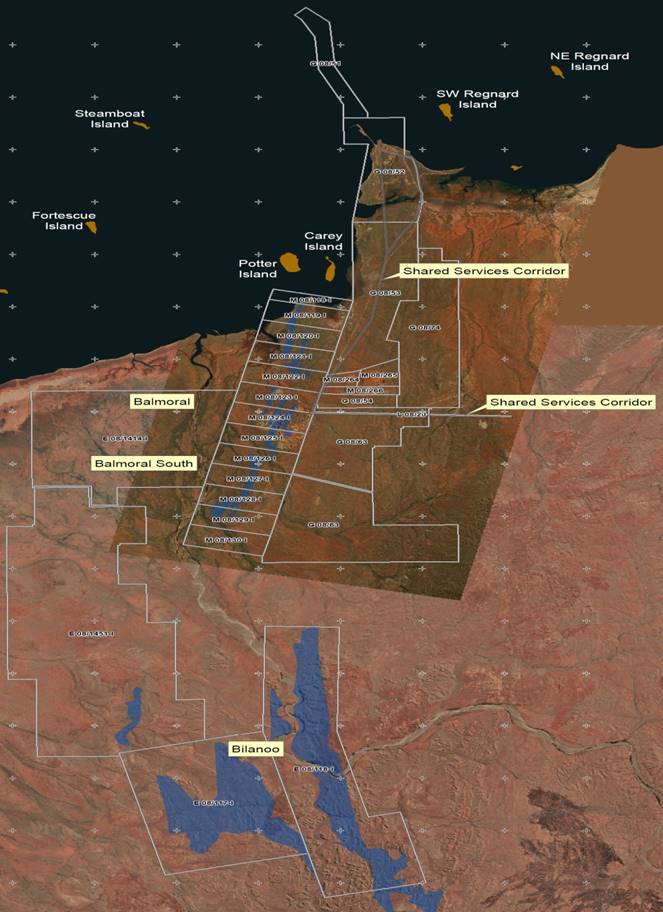
ANNEXURE 2: MRSLA SITE LEASE AREA AND PROJECT AREA
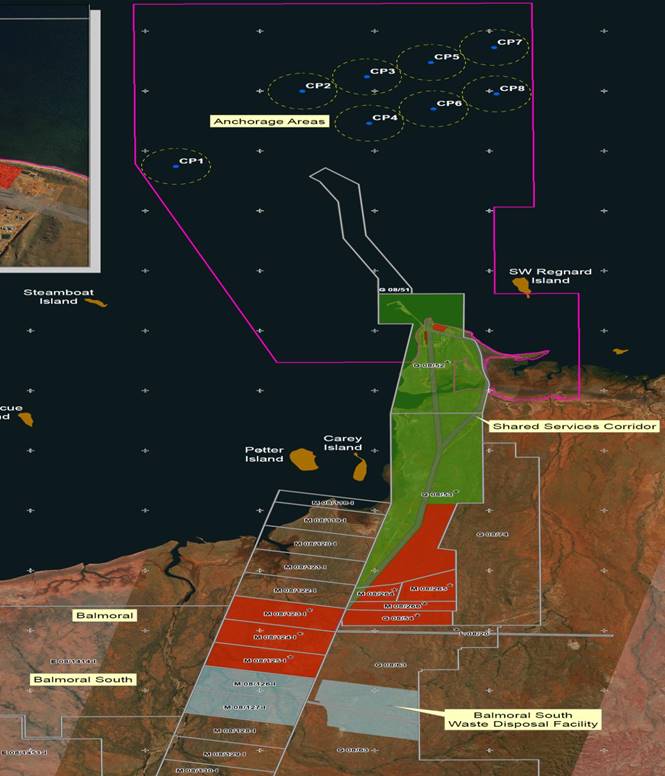
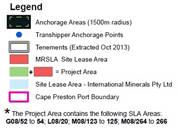
ANNEXURE 3: THE AREA OF EXPLORATION LICENCE 08/636
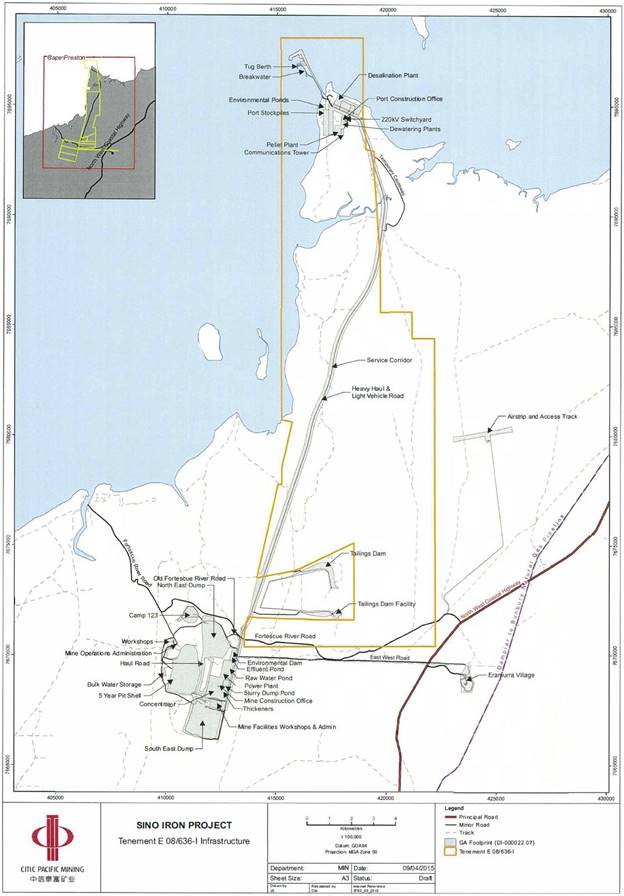
ANNEXURE 4: LOCATION OF VARIOUS PORT TERMINAL FACILITIES IN THE AREA OF GENERAL PURPOSE LEASE 08/52
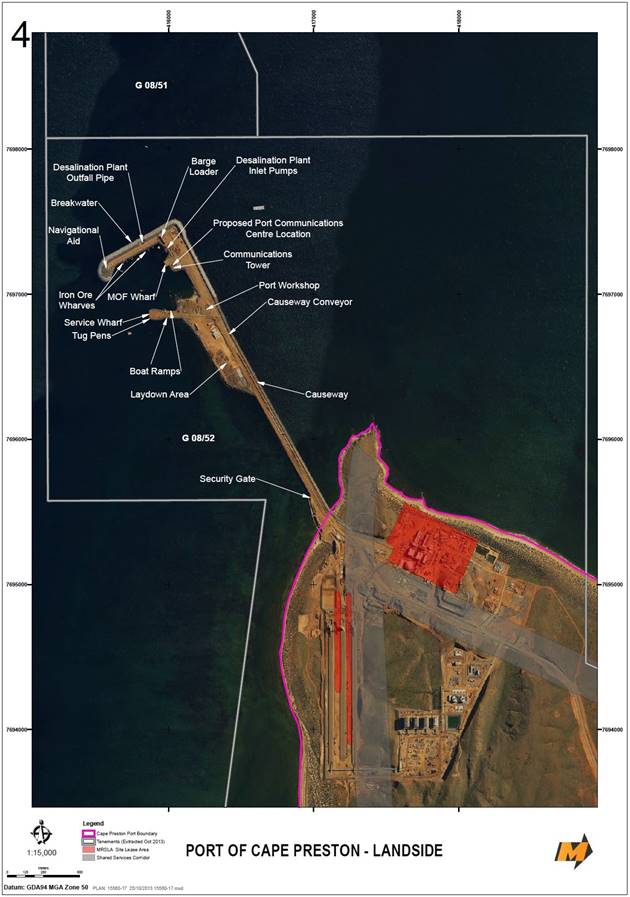
ANNEXURE 5: THE CIRCLED AREA
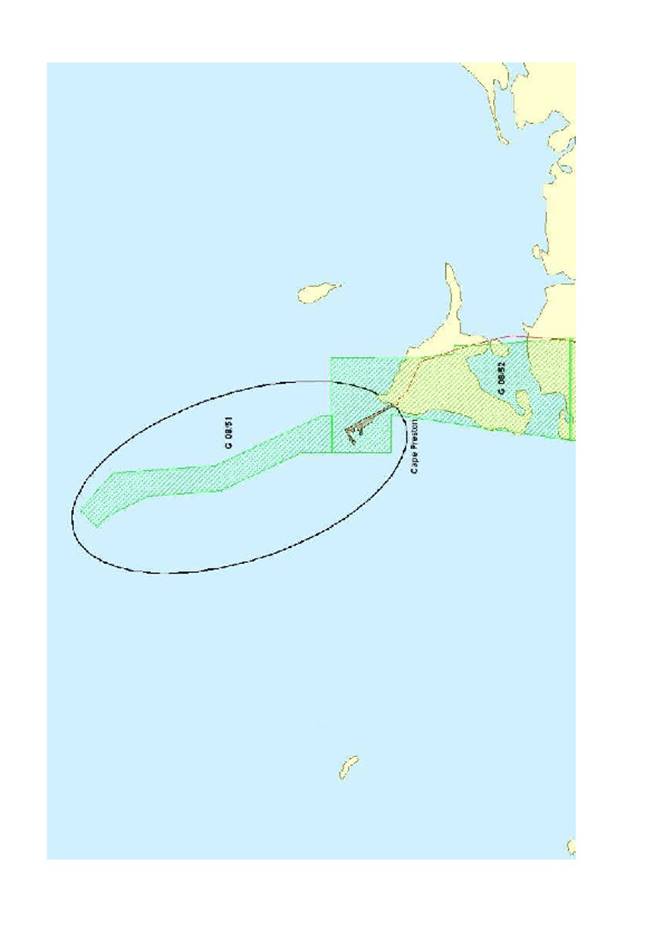
WAD 495 of 2015 | |
CITIC PACIFIC MINING MANAGEMENT PTY LTD ACN 119 578 371 | |
Fifth Respondent: | ATTORNEY GENERAL OF WESTERN AUSTRALIA |


