

FEDERAL COURT OF AUSTRALIA
Konami Australia Pty Ltd v Aristocrat Technologies Australia Pty Ltd [2016] FCAFC 103
ORDERS
KONAMI AUSTRALIA PTY LTD ACN 076 298 158 Appellant/Cross-Respondent | ||
AND: | ARISTOCRAT TECHNOLOGIES AUSTRALIA PTY LTD ACN 001 660 715 Respondent/Cross-Appellant | |
DATE OF ORDER: |
THE COURT ORDERS THAT:
2. The appellant pay the respondent’s costs of the appeal as taxed or agreed.
3. The cross-appeal be dismissed.
4. The cross-appellant pay the cross-respondent’s costs as taxed or agreed.
Note: Entry of orders is dealt with in Rule 39.32 of the Federal Court Rules 2011.
BESANKO J:
1 I have had the advantage of reading the reasons of Perram J. I agree with those reasons and the orders which his Honour proposes.
I certify that the preceding one (1) numbered paragraph is a true copy of the Reasons for Judgment herein of the Honourable Justice Besanko. |
Associate:
Dated: 12 August 2016
REASONS FOR JUDGMENT
PERRAM J:
1. Introduction
2 This appeal concerns patents in respect of the processes by which jackpots and bonus features are triggered in gaming machines, such as (although not limited to) poker machines. By the time the matter reached the Full Court only two patents remained in dispute: Australian patent number 754689 (‘the 689 Patent’) and Australian patent number 771847 (‘the 847 Patent’). These patents are owned by the respondent (‘Aristocrat’). At trial, Aristocrat sued the appellant (‘Konami’) for infringing both patents with a number of poker machine products which Konami manufactures. For the purposes of this appeal it is necessary to focus on only two: the machine entitled Dreaming Orcas Free Spin Dragons (‘the Dreaming Orcas machine’) which was said to infringe the 689 Patent and Jumpin’ Jalapenos Prize Plus (‘the Jumpin Jalapenos machine’) which was said to infringe the 847 Patent. The trial judge rejected Konami’s claim that the 689 Patent was invalid and found that the Dreaming Orcas machine, specifically the ‘Free Spin Dragons’ feature game, infringed it. On the other hand, his Honour found that the 847 Patent was invalid because it lacked an inventive step and therefore rejected Aristocrat’s claim for infringement.
3 Both parties have appealed. In Konami’s appeal the issues are: first, the proper construction of the 689 Patent; secondly, whether it lacked an inventive step; thirdly, whether it had a fair basis in the specification; and, fourthly, whether infringement was established. In Aristocrat’s cross-appeal the issues are whether the 847 Patent lacked an inventive step and, if it did not, whether it had been infringed by the Jumpin’ Jalapenos machine.
2. The 689 Patent
2.1 Jackpots
4 The principles involved in Konami’s appeal apply to a broad range of gaming machines, but it is useful to confine the treatment in these reasons to poker machines. All poker machines operate on the same broad principle that, in the long run, they give back less money than the players put into them. It is useful to refer to this gap as the ‘take-out’. The take-out is generally fixed as a proportion of average turnover. Thus, the profits of the machine’s operator are directly linked to the amount players wager on the machine. It is, therefore, in the interests of an operator that players play as much as possible. In practical terms, this means keeping players at the machines playing.
5 Considerable human ingenuity has been applied to this objective. Apart from exotic themes such as Dreaming Orcas and colourful displays, one way of encouraging players to keep playing a machine is the concept of a jackpot which is a prize awarded randomly as an apparent bonus outside the ordinary course of play. Since the jackpot might (apparently) go off at any time the player feels encouraged to stay at the machine on the off chance that they might win it.
6 There are a variety of jackpot mechanisms. One is the progressive jackpot. One type of progressive jackpot works by the machine selecting (and keeping to itself) a random number in a given range, say 0-999, incrementing a counter by 1 each time a game is played and at the same time crediting a fixed amount to a jackpot fund. When the random number is reached the amount in the jackpot fund is awarded and the process then repeats.
7 There are thought to be some problems with progressive jackpots. To begin with, as a measure to ensure that the jackpot is sufficiently large to be enticing very often the machine is set so that the jackpot cannot go off for a pre-determined number of games after it has last gone off. This is achieved by ensuring that the random number is generated within a range which starts at a higher number, e.g., 49-999. On such a machine, the jackpot cannot go off until it has been played at least 50 times. This initial period is sometimes referred to as the ‘dead zone’. The enticement of a decent sized jackpot, however, contains within it the seeds of discontentment too. Players who are playing for the jackpot are all too prone to reason that once the machine has gone off it will not go off again for some time (while the machine traverses the dead zone) and hence that there is no point playing. Correlatively, once a machine has not gone off for a while a similar class of player tends to ‘swamp’ the machine. This problem is known as the ‘swamping’ problem.
8 Another problem is that the players who are playing for the jackpot have no rational incentive to bet more than the minimum amount on each game because the counter is increased by only one no matter what the size of the bet. Mention of the ‘take out’ has been made above. As the trial judge explained (at [45]), each machine is set to return on average over time a specified percentage of credits bet back to the players and, indeed, this is required by law. So, for example, a machine may be set to return, on average, 80% of the money which is wagered upon it. The converse of that is, of course, that the machine keeps the other 20%. It follows, in a straightforward fashion, that the profits of the operator are a linear function of the amount which is wagered on the machine. The progressive jackpot, therefore, provides an incentive for players to act in a way which diminishes the potential profits of the operator.
9 A third difficulty is, perhaps, more controversial and is regulatory in origin. Because the State is concerned with the equality of its subjects, the regulators who watch over this industry insist that the machines treat all players equally by guaranteeing that the statistically certain rate at which each player on average inevitably loses is the same. It is thought that progressive jackpots do not achieve that end. I discuss this issue more fully below. For now it suffices to observe that players who are playing whilst the machine is in the dead zone have no chance of winning the jackpot whilst those outside it do. A more complex proposition involves the idea that even outside the dead zone the probability of winning the jackpot increases as each incremental addition to the counter brings it closer to the pre-determined random number. This proposition is, as I later discuss, not free from controversy.
10 The 689 Patent is said by Aristocrat to redress the first two of these three problems. The proposed solution is to make the probability of the jackpot going off a function both of the long run average turnover the operator wishes to see put through the machine between jackpots and the actual amount wagered by the player. It will be seen there are two aspects to the solution. The first has the consequence that the jackpot can go off at any time but, in the long run, will occur on average at a time after which the operator’s selected amount of turnover has gone through the machine. This is thought to solve the swamping problem because the jackpot can go off at any time. It also solves the regulators’ supposed concern that all players should have the same chance of winning.
11 The second idea provides players with a rationale to wager larger amounts as they play so as to increase their chances of winning the jackpot.
12 Together these two ideas mean that the 689 Patent is designed to keep players at the machine longer and betting more. I return to the issues arising from these matters after dealing first with the construction issues.
2.2 Construction: ‘Combination Trigger’
13 Konami submitted that, on its proper construction, the 689 Patent did not apply to a machine when the jackpot was triggered by the occurrence within the player’s screen of a particular combination of symbols, e.g., five aces. Such triggering events are called ‘combination triggers’. Konami’s argument was that, properly construed, the 689 Patent did not apply to combination triggers.
14 This debate centred upon the meaning to be afforded to claim 1 of the 689 Patent. It is in these terms:
1. A random prize awarding feature to selectively provide a feature outcome on a gaming console, the console being arranged to offer a feature outcome when a game has achieved a trigger condition, the console including trigger means arranged to test for the trigger condition and to initiate the feature outcome when the trigger condition occurs, the trigger condition being determined by an event having a probability related to desired average turnover between successive occurrences of the trigger conditions on the console.
15 This refers only to a ‘trigger condition’ which on its face would be likely to include any kind of trigger whether combination or otherwise. Konami submitted that this was not so because the expression ‘trigger condition’ had a particular meaning and would be understood by the notional skilled addressee with the common general knowledge to mean something determined by an event related to turnover which was not a combination of a game appearing on the console.
16 There were said to be a number of reasons why this was so. First, in the description of the prior art in the 689 Patent it was submitted by Konami that combination triggers were discussed but the expression ‘trigger condition’ was not used to describe them. This appeared in a section headed ‘Background of the Invention’ on page 1 of the 689 Patent:
Many schemes have been devised in the past to induce players to play slot machines including schemes such as specifying periods during which jackpot prizes are increased or bonus jackpots paid. Other schemes involve awarding an additional prize to a first player to achieve a predetermined combination on a poker machine. These methods, while effective, add to club overheads because of the need for additional staff to ensure that the scheme is operated smoothly.
More recently, with the advent of poker machines linked through electrical networks it has been possible to automatically generate jackpot prizes on the basis of information received from the machines being played which are connected to the system and one such prior art arrangement, commonly known as “Cashcade™”, counts turnover on all machines in the network, increments a prize value in accordance with the turnover and pays the jackpot prize when the count reaches some predetermined and randomly selected number. In a more recent prior art arrangement, each game played on each machine in a gaming system is allocated a randomly selected number and the prize is awarded to a machine when the game number it is allocated matches a preselected random number.
In another recent prior art arrangement, the winning machine is selected by randomly selecting a number at a point in time and decrementing the number as games played on the system are counted until the number is decremented to zero at which time the game (or associated machine) causing the final decrement is awarded the jackpot.
With some prior art combination based trigger arrangements there is a serious disadvantage in that the player betting a single token per line, is just as likely to achieve a jackpot as the player playing multiple tokens per line. This has the effect of encouraging players playing for the bonus jackpot to bet in single tokens, rather than betting multiple tokens per game.
Jackpot games have traditionally been popular in Casinos. However, in their conventional format these games have inherent limitations:
(i) Games which use specific combinations of symbols to trigger jackpots are perceived by many players as being unwinnable. The games are typically designed in such a way that the big jackpots should not be won until large amounts are accumulated. With such low frequency the jackpots are never seen to be won by most players. Anecdotal evidence suggests that many players have learnt to disregard the chance of winning the major jackpots and are realistically playing for the lesser jackpots (ie the minor and mini jackpots). The increasing popularity of small mystery jackpots with higher frequencies of occurrence tends to support this argument;
(ii) Due to the increasing demand of players for a more complex and diverse game range, conventional jackpot games with combination triggers have become superseded. However, it is extremely complex to develop a wide variety of combinations which support both a feature game and mathematically exact jackpot triggers;
(iii) Typically, it would be expected that the game return (RTP) is independent of the number of coins bet per line. With conventional progressive jackpot games though, increasing the credits bet per line creates a relative disadvantage as far as RTP is concerned. Lets say the start-up amount for a feature jackpot is $10000. A player who is playing 1 credit per line has a chance for $10000 for each credit played, whereas a player playing 5 credits per line only has a chance for $2000 for each credit played. This creates a scale of diminishing returns. The smart player who gambles for the feature jackpot only, will always cover all playlines, but will only bet 1 credit per line because the prize paid for the feature jackpot is the same irrespective of the bet. This is supported by data collected from casinos,
(iv) Typical combination triggered progressive jackpots have fixed hit rates which removes from the operator’s control the ability to vary jackpot frequency.
These arrangements have been in use in the State of New South Wales and in other jurisdictions for a considerable period of time, however, as with other aspects of slot machine games, players become bored with such arrangements and new and more innovative schemes become necessary in order to stimulate player interest.
In this specification, the term “combinations” will be used to refer to the mathematical definition of a particular game. That is to say, the combinations of a game are the probabilities of each possible outcome for that game.
17 It is true that the expression ‘trigger condition’ is not used in this section. On the other hand, it is clear that what is being discussed is a variety of jackpots having quite different trigger mechanisms. The following triggers are mentioned:
page 1 line 11: a jackpot triggered by a predetermined combination on a poker machine;
page 1 lines 15-25: a jackpot triggered by an incremental counter reaching a predetermined but randomly selected number; and
page 1 lines 26-30: a jackpot triggered by a decrementing counter reaching zero with a count down from a predetermined but randomly selected number.
18 So it is clear that a variety of trigger mechanisms is under discussion. At paragraph (ii) (page 2 line 13) there is a discussion of the deficiencies perceived in what the patent refers to as ‘conventional jackpot games with combination triggers’. It is reasonably clear that the kind of trigger being discussed in both is the same. And what is being discussed is a jackpot trigger consisting of specific combinations in the game. It is this which is the ‘conventional jackpot game with combination triggers’.
19 By itself, this would not suggest that the expression ‘trigger condition’ could not include a combination trigger. No doubt, the description of the prior art was explaining deficiencies in ‘conventional jackpot games with combination triggers’ (page 2 lines 3-16) but this does not mean that it was the combinations themselves which were the problem being addressed.
20 This view is supported by the formal definition of ‘combinations’ which appears at page 3 lines 1-4 which reminds one that all that is intended is the outcome of a game. So it is no particular surprise that in the consistory clauses at page 3 one finds only the expression ‘trigger condition’:
According to a first aspect the present invention provides a random prize awarding feature to selectively provide a feature outcome on a gaming console, the console being arranged to offer the feature outcome when a game has achieved a trigger condition, the console including trigger means arranged to test for a trigger condition and to initiate the feature outcome when the trigger condition occurs, the trigger condition being determined by an event having a probability related to credits bet per game on the console.
According to a second aspect, the present invention provides a random prize awarding system associated with a network of gaming consoles, the system being arranged to offer a feature outcome on a particular console when a trigger condition occurs as a result of a game being played on the respective console the prize awarding system including trigger means arranged to test for a trigger condition and to initiate the feature outcome on the respective console when the trigger condition occurs, the trigger condition being determined by an event having a probability related to credits bet per game on the respective console.
According to a third aspect, the present invention provides a gaming console including a random prize awarding feature to produce a feature outcome, the gaming console being arranged to offer the feature outcome when a game has achieved a trigger condition, the console including trigger means arranged to test for the trigger condition and to initiate the feature outcome when the trigger condition occurs, the trigger condition being determined by an event having a probability related to credits bet per game on the console.
21 It is true, as Konami submits, that it is only in these clauses that the expression first appears but this does not seem to me to be material. The nature of the aspects being described is one in which the significance of the trigger condition is its relation to an event having a probability defined in various ways. There is nothing in that concept which is inconsistent with the trigger being a combination (i.e. the outcome of a game).
22 Next, Konami placed reliance upon a preferred embodiment described at page 6 line 1 – page 7 line 2:
In a preferred embodiment of the invention, a new jackpot trigger mechanism provides the Casino operator with a far higher degree of flexibility. Unlike conventional combination triggered jackpots, the jackpots here are won from a feature game. The feature game is triggered randomly as a function of credits bet per game. When a feature is triggered, a feature game appears. Each jackpot can only be won from this feature game. During the feature game a second set of reel strips appears and a “spin and hold” feature game commences. The feature prize score is calculated by the total of the points appearing on the centre line of all 5 reels.
Feature jackpots in this format exhibit significant differences over previous jackpot systems:
(i) A jackpot game is provided which is compatible with any existing game combination within an installation independent of the platform, denomination or type of game (eg. slot machines, cards, keno, bingo or pachinko). This will allow for the linking of combinations between game type, platform type and denomination. Using this system, jackpot games can now be developed using specific combinations for the base game which were previously unsuitable for Link Progressive Systems. These games will compete with the appeal of the latest games on the market.
(ii) There is no longer a need to develop mathematically exact combinations in the base game.
(iii) Unlike the multiplier game in combination triggered jackpot embodiments, the present invention provides a direct relationship between the number of credits bet and the probability of winning the jackpot feature game on any one bought game. Betting 10 credits per line will produce ten times as many hits into the feature game than betting 1 credit per line. This is achieved by using a jackpot trigger which is directly related to the wager bet on a respective game and the turnover, instead of using conventional combination triggers.
(iv) Jackpot hit rates can now be changed without making changes to the base game. This was previously not possible using combination triggered jackpots.
(v) The jackpot feature system can be used across a wide-area-network (WAN), local-area-network (LAN), used as a stand-alone game independent of a network or used with a mystery jackpot. Flexibility is available to change combinations at will.
23 Attention was particularly focussed on the phrase ‘Unlike conventional combination triggered jackpots’ and the references to ‘conventional combination triggered jackpots’. But far from assisting Konami, these clauses prove that its argument is unsound. The comparison being drawn is indeed with conventional combination triggers but this does not rule out all combination triggers. And, indeed, (i) and (ii) accept that the mechanism can be used on combinations.
24 This theme is borne out in another part of the preferred embodiment upon which Konami also relies. It is at page 7 line 3 – page 9 line 7. Although quite long, it is worth setting out in full because it shows that the issue of combinations is irrelevant to this patent:
Referring to Figure 1 a plurality of electronic gaming consoles 10 are connected to a network 11, to which a feature jackpot controller 12 and display means 13 are also connected.
Each of the electronic gaming consoles 10 are provided with a network interface arranged to provide a signal onto the network 11 on each occurrence of an operation of a respective console and the jackpot controller 12 is arranged to receive each of the console operation signals and to increment the value of a random jackpot prize on the occurrence of each of these operation signals.
A flow chart for a prize awarding algorithm is illustrated in Figure 2.
Referring to the algorithm of Figure 2, machine contributions go into the prize pool as with known prior art jackpot systems, while the overhead display shows the incrementing prize value.
In the EGM, an average value of machine turnover between jackpot hits, is programmed and is used to randomly generate trigger data for the jackpot feature games. In step 20 of the algorithm of Figure 2, the actual number range and therefore probability of a feature jackpot game being awarded will depend upon the value of a credit in the particular machine and is calculated by dividing the turnover value by the value of a credit (eg., $5000/$0.05 = 100,000). The average turnover value is fixed for the EGMs and the random number generator is initialised (see step 20) at startup to generate numbers from the preprogrammed range determined from that value.
For every game that is played, a random trigger value is selected (see step 21) in the preprogrammed range as determined from the average turnover value. When the game is commenced, it is then reported (see step 22) to the controller, which allocates a contribution to the prize pool. Each game is also allotted (see step 23) numbers from the same number range that from which the random number was selected, one number in the range being allotted for each credit bet such that the player’s probability of being awarded a jackpot feature game is proportional to the bet.
The previously selected random number is then used as a trigger value and compared with the values allotted to the player, if there is a match (see step 24) between the trigger value and the player values, the player is given an opportunity to play a jackpot feature game (see step 25). Alternatively, at step 23, a number is allocated which is equal to, or proportional to the number of credits bet in the respective game and in step 24, the trigger value is compared with the single player value and a jackpot feature awarded if the trigger value is less than or equal to the player value. It will be appreciated that this alternative arrangement is mathematically equivalent to the previously described arrangement, the range of numbers below the allotted number in the alternative arrangement being equivalent to the set of allotted numbers in the previously described arrangement.
In the preferred embodiment, a prize is always awarded in the jackpot feature game, the feature game being used to determine the size of the prize to be awarded (see step 27). The winning machine is then locked up (see step 28) and the controller awaits an indication that the prize has been paid before allowing the machine to be unlocked (see step 29). In some embodiments, the machine will not be locked up in steps 28 and 19, but instead the prize will simply be paid and the program will return to step 21. The machine then returns to step (see step 21) and commences a new game. If the trigger value does not match (see step 27) then there is no feature game awarded for that bought game and the machine returns to step (see step 22) and waits for the next game to commence.
By way of example, a feature game might be triggered by an EGM every $5000 of turnover played, which is equivalent to 100,000 credits on a $0.05 machine. This is referred to as the jackpot feature game hit rate in credits. A random number is generated within a prescribed range of numbers at the EGM at the commencement of each bought game. The prescribed range of numbers is determined by the jackpot feature game hit rate which has been determined previously, from typical values of casino turnover, expected jackpot amounts and jackpot frequencies. The prescribed range in this example is therefore 1 to 100,000 and before the commencement of each bought game a random number is generated within this range.
A bet of 20 credits will result in the numbers between 1 and 20 (inclusive) being allotted to the game (note that statistically it does not matter if the numbers are randomly selected or not or allotted as a block or scattered, the probability of a feature game being awarded is unchanged). If the number 7 is produced by the random number generator, then the feature game will be triggered. If any number between 21 and 100,000 is produced by the random number generator, the feature game will not be triggered. Similarly, a bet of 200 credits will result in the numbers between 1 and 200 (inclusive) being allotted to the game. If any number between 1 and 200 is produced by the random number generator, then the feature game will be triggered. If any number between 201 and 100,000 is produced by the random number generator, the feature game will not be triggered.
25 The emphasis here is certainly on the trigger event but the critical aspect is not whether it happens inside or outside the game but rather on the fixing of the probability of the trigger event in a very particular fashion. That process is wholly agnostic to the nature of the event itself.
26 There is, therefore, no reason to think that ‘trigger condition’ in claim 1 means anything more than ‘trigger condition’. It does not say that combination triggers are excluded; such an exclusion has nothing to do with the subject matter of the patent; and, the skilled addressee with the common general knowledge would not think otherwise.
27 The trial judge was correct to reject Konami’s construction of claim 1.
2.3 Construction: ‘Direct’
28 Claim 1 is set out above. Konami submitted that the relationship between the probability that the trigger condition would occur and the desired average turnover between successive occurrences of the trigger condition had to be ‘direct’ or, as it was expressed elsewhere, ‘linear’. Further, this linearity was to be ‘mathematically exact’.
29 These propositions have their origins in the evidence given by Konami’s expert, Mr de Bruin. He thought that the probability of a trigger condition occurring must have some relationship to turnover otherwise the game would not be profitable. But he went further and said that ‘in the 689 Patent … that probability must be a direct relationship’. He based this view on two passages at page 6 lines 22-30 and page 10, lines 28-31 which were, respectively as follows:
Unlike the multiplier game in combination triggered jackpot embodiments, the present invention provides a direct relationship between the number of credits bet and the probability of winning the jackpot feature game on any one bought game. Betting 10 credits bet per line will produce ten times as many hits into the feature game than betting 1 credit per line. This is achieved by using a jackpot trigger which is directly related to the wager bet on a respective game and the turnover, instead of using conventional combination triggers.
…
As the time between jackpot game awards is related to turnover, the number of jackpot games played by a player between feature games and hence their chance of winning is directly related to the size of each bet on each game played.
30 Aristocrat resisted this proposition at trial arguing that the words of claim 1 were clear and unambiguous. This the trial judge rejected for, as his Honour with respect correctly observed, the claim if read literally could lead to the result that the probability of the trigger condition could be negatively related to the average turnover between trigger events (which would guarantee that the machine would lose to the players in the long run). Ultimately, his Honour’s interpretation was that the relationship required by the patent was one of positive correlation:
75 In my view, when the relevant claims are read in the context of the specification as a whole, what is described is a relationship in which the probability of a trigger condition occurring is positively correlated to desired average (or expected) turnover between successive occurrences of the trigger condition on the console and the amount wagered by the player on the game.
31 The concept of a positive correlation is in all likelihood used in contrast to the concept of the negative correlation which his Honour did not think (at [73]) claim 1 meant. ‘Correlation’ in a mathematical sense just means any statistical relation between two sets of data but it is doubtful, I think, that his Honour intended anything as broad as that. However, little is to be gained by seeking to interpret the trial judge’s interpretation. The actual question is the meaning of claim 1. The points made by Mr de Bruin are sound. In the context of the other passages it is clear that the relationship contemplated is a ‘direct’ one.
32 ‘Direct’, however, is not a mathematical term. What seems to be involved is the idea that the two concepts move in the same direction although not necessarily at the same rate. There are, of course, an infinite number of ways this might be done. One such ‘direct’ relation would be provided by making the probability of the trigger event a function of the amount wagered, e.g.:
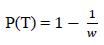
where P(T) is the probability of the trigger event and w is the credits bid such that w ≥ 1.
33 However, there are an infinite number of other relations which might also produce the result that the probability of the trigger event and the size of the wager were directly related. For example,
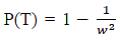
will also achieve this outcome. In my opinion, ‘direct’ covers all such circumstances. It may be that this corresponds to the trial judge’s view that there needed to be ‘positive correlation’.
34 From Konami’s perspective, the difficulties arose at [76] of the trial judge’s reasons where his Honour concluded that the relationship of positive correlation he had determined needed to exist did not need to be one of ‘mathematical exactness’:
76 However, I do not accept that the relationship must be mathematically exact. There is nothing in the body of the specification to justify Mr de Bruin’s insistence that the probability relationship be exactly proportionate to desired average turnover. The skilled addressee would not expect very slight variations in the relative probabilities to produce different outcomes. I will return to this issue when considering the differences in the relative probabilities relied upon by Mr de Bruin in support of his opinion on the question of infringement.
35 This was in response to Konami’s submission that ‘mathematical exactness’ was the consequence of ‘directness’. However, no support for a requirement of ‘mathematical exactness’ is to be found in the text of claim 1. Instead, all claim 1 requires is a direct relationship. I would not conclude that ‘mathematical exactness’ (whatever that is) is a requirement of claim 1. The relationship disclosed is either direct or it is not. ‘Mathematical exactness’ adds nothing to the analysis.
36 There is also no substance in Konami’s related submission that his Honour erred because he had merged claims 1 and 2 together in his consideration of this issue. Claim 1 is set out above. Claim 2 is as follows:
2. The prize awarding feature of claim 1, wherein the trigger condition is determined by an event having a probability related both to expected turnover between successive occurrences of the trigger conditions on the console and the credits bet on the respective game.
37 Konami’s point was that claim 1 deals with a relationship between the probability of the trigger event and the desired average turnover whereas claim 2 deals with the probability of the trigger event and the credits wagered by the player. However, the ‘directness’ issue is the same under both and treating them together results in no interpretative error.
2.4 Infringement
38 There were two aspects to the infringement case. First, did Konami’s machine infringe when the jackpot was triggered by a combination of symbols appearing on the console (a second superimposed set of spinning reels)? Since I would conclude that ‘trigger condition’ in claim 1 includes combination triggers this aspect of Aristocrat’s infringement case is made out and the answer is ‘yes’.
39 The second aspect was the requirement that the probability of the trigger condition should be directly related both to the desired average turnover between trigger events and the amount wagered per game.
40 Konami submitted that the requirement of a direct relationship had not been satisfied because the evidence about it showed that the relationship was not ‘mathematically exact.’ Since this is not a requirement of the 689 Patent strictly this issue does not arise. It was, in any event, without merit. The alleged lack of ‘mathematical exactness’ was unpersuasive for the reasons which follow.
41 In the course of the appeal this Court was taken to Confidential Exhibit BJE-17 which contains the relevant probability figures for the Konami game ‘Cash Carriage’. It was accepted for the purposes of the appeal that the Cash Carriage game could serve as the relevant example of the supposed problem and, indeed, the Court was given the distinct advantage of being shown, during what was otherwise a slow afternoon, a diverting audio-visual display of the jackpot actually going off on that machine.
42 Exhibit BJE-17 contains Excel spreadsheets. The probabilities expressed in it are the result of the application of Excel formulas in particular cells. There is no doubt that the relationship disclosed by the formulas is one in which there is a direct, as it happens linear, relationship between the probability specified and the desired average turnover between trigger events as well as the amount wagered per game.
43 In the spreadsheet, however, the execution of the formulas has been set to produce probabilities specified to seven decimal places. This has led to rounding fluctuations in the seventh decimal place depending on the eighth.
44 It was Konami’s argument that these extremely minor fluctuations meant that the relationship was not ‘mathematically exact’. This submission is without merit. The relationship disclosed in the formulas is direct. That the spreadsheet itself has been set to seven decimal places and therefore results in minute rounding adjustments does not alter the nature of the relationship.
45 The trial judge was, therefore, correct to conclude that the 689 Patent had been infringed.
2.5 Obviousness
46 The way the case was developed in this Court the issue which arises under this heading is the extent to which the 689 Patent was anticipated by solutions to jackpot-related problems being discussed in various quarters in 1992. The step in the 689 Patent which is said to have been anticipated is the setting of the probability of a trigger event as a function of the desired average turnover between jackpots and the amount wagered on each game.
47 Section 7(1) of the Patents Act 1990 (Cth) provides:
7 Novelty, inventive step and innovative step
Novelty
(1) For the purposes of this Act, an invention is to be taken to be novel when compared with the prior art base unless it is not novel in the light of any one of the following kinds of information, each of which must be considered separately:
(a) prior art information (other than that mentioned in paragraph (c)) made publicly available in a single document or through doing a single act;
(b) prior art information (other than that mentioned in paragraph (c)) made publicly available in 2 or more related documents, or through doing 2 or more related acts, if the relationship between the documents or acts is such that a person skilled in the relevant art would treat them as a single source of that information;
(c) prior art information contained in a single specification of the kind mentioned in subparagraph (b)(ii) of the definition of prior art base in Schedule 1.
48 No reliance was placed by Konami on s 7(1)(b). As the trial judge correctly noted this meant that each documentary disclosure relied upon was to be considered separately and as a single source of information. The trial judge then uncontroversially applied the reverse infringement test enunciated by the English Court of Appeal in General Tire & Rubber Co Ltd v Firestone Tyre & Rubber Co Ltd [1972] RPC 457 at 485-486 (does the prior inventor’s publication contain ‘a clear description of, or clear instructions to do or make, something that would infringe the patentee’s claim…’). Two sets of documents were relied upon, both originating in 1992.
49 Before turning to these documents it is useful to note that the evidence in this case disclosed that there were perceived to be three problems with the classical progressive jackpot. These were discussed briefly in the introductory section above but it is now useful to explain them more fully.
(a) The Equal Probability Problem. This was the apparent problem that players did not have the same probability of winning the jackpot. There were two elements to this. First, those players who fell in the dead zone during which the jackpot could not go off could not win and hence were in a different probabilistic position to those who were playing the machine outside the dead zone. Secondly, it was accepted by both parties that even outside the dead zone the probability of players winning was not the same. There were two competing reasons why this was so between which this Court is not called upon to choose. One is the view that as the counter incrementally increases towards the pre-determined random number the probability of a player winning also increases. The other view is that since the number was pre-determined all players, other than the winning player, had no chance of winning. On this latter view, there was a differential treatment of the losing players (who had a probability of zero of winning) and the winning player (who had a probability of one of winning). It seems to me that it is the former view which is correct. If the random number is selected in the range of 0-999 and the counter has reached 996 then, in the long run, the player next playing has a ⅓ chance of winning. When the counter is at 998 the next player in the long run has a ½ chance of winning. The latter, or deterministic, view that the probability is zero may rest on an erroneous consideration of what happens in just one game rather than what happens in the long run. In any event, this issue does not matter because on both views the probabilities are not the same for all players.
(b) The Swamping Problem. This consisted of two related phenomena. The first of these was the tendency of players to leave machines on which the jackpot had just been awarded because of a perception that a jackpot would not soon been awarded again. That perception was correct because of the existence of the dead zone. The second phenomenon was the corresponding habit of players swamping machines when it was perceived by players that a jackpot had not been awarded for some time.
(c) The Minimum Wager Problem. This was the problem in a progressive jackpot that because the counter was only increased by one for each game played it was in the economic interest of players pursuing the jackpot to place the minimum wager.
50 One available view may be that the Equal Probability Problem and the Swamping Problem are the same problem. The phenomenon of players departing from a machine after a particular event and not returning until the non-occurrence of that event for a substantial period of time reflects an understanding on the players’ parts that the probability of their winning depends on when they play, that is to say, the probability of winning the jackpot is not the same for all players. I did not apprehend, however, Konami to submit that the Swamping Problem and the Equal Probability Problem were the same problem.
51 It will be observed that the 689 Patent puts itself forward as a solution to the Swamping Problem and the Minimum Wager Problem but not as a solution to the Equal Probability Problem.
Queensland
52 Turning then to the two documents relied upon, the Equal Probability Problem was a concern of at least the Queensland regulators in 1992. Speaking of a poker machine called ‘Surprize’ which involved a progressive jackpot without a dead zone (that is to say, the jackpot could be won at any time) the Queensland regulator appears in 1992 to have had the second concern outlined above in relation to the Equal Probability Problem, i.e., as the counter is augmented by one it gets progressively closer to the pre-selected number and it becomes more likely that a player will win. A letter of 17 November 1992 from the Queensland regulator to Aristocrat read relevantly:
While evaluating the mathematical calculations for the game “Surprise” it has been noticed that a “random” surprise pay between 100 and 200 coins can be won at any time.
Random prizes are regulated by section 12.13.1 of Tender C566:
“A game may offer random prizes. The likelihood of obtaining a random prize must be independent of the previous game outcome. The magnitude of all random prizes must be displayed on the artwork. The random prizes contribution is not to contribute greater than 10% of the overall return”.
It appears that in this game the machine selects a random number. Successively for each coin bet a counter is appropriately incremented until the value stored in such counter reaches the previously selected number, and this is when the prize is awarded. From this implementation it can be concluded that the probability of triggering the feature is not constant during the game as a player who does not win the “surprise prize” feature the first hit, will have a greater probability of winning it in the successive hits and sooner or later the prize must be won.
There are many methods to implement the random prize feature (in a way that the probability of triggering the feature is independent of the previous game), one of which includes choosing a random number each game.
In conclusion the present implementation of the random prizes/features of the game “Surprise” is unacceptable.
53 Before this Court the parties to the appeal were in agreement that this perception is wrong and that all players (except the winning player) had a probability of winning of 0. This was said to be the deterministic view of the machine’s operation. As I have explained above, this appears to me to be controversial but there is no need to express a concluded view on it. The critical matter is that the perception existed within the regulator.
54 The Queensland regulator’s solution involved the addition of a second random number generator to take the place of the progressive counter. However, that solution says nothing about using the second random number generator in such a way as to ensure that the probability of a jackpot event is made a function of the desired average turnover between jackpots and the amount wagered. No doubt (as the 689 Patent shows) one may, by a judicious selection of an appropriate range of numbers from which the random number is to be selected by the random number generator, ensure outcomes with the desired probabilistic qualities. But the mere use of a second random number generator does not achieve that by itself; rather that outcome is achieved by its application to the selected ranges.
55 This evidence did not show, therefore, that the 689 Patent had been anticipated by this letter. Furthermore, the trial judge was right to observe that this evidence was not, in any event, sufficient to establish that a person skilled in the art armed with the common general knowledge would have known of this method of achieving the desired probabilistic outcomes.
Holland
56 Another solution to the Equal Probability Problem was also known in Holland in 1992. The trial judge proceeded on the basis that it was known to the Dutch regulator but the evidence does not support that proposition. The evidence is complex and it is necessary to attend to it in some detail.
57 The evidence about the regulator was indirect. It appears that Aristocrat (or a related entity) was attempting to obtain approval from the Dutch regulator for the ‘Surprize’ machine. The Dutch regulator appears to have been called NMI. The evidence consisted of several faxes between the period 28 April 1992 and 22 July 1993.
58 The first was a fax from a Mr Stephen Ainsworth at Aristocrat (UK) to Mr Mark Ainsworth. It is reasonable to infer that the latter was at Aristocrat in Australia. The fax was dated 28 April 1992. The subject line indicated that it was about ‘Holland-Surprize Machine’.
59 The text is as follows:
The NMI have looked at your new combination and still aren’t happy.
They are saying that still not every player has the same chance of winning the mystery prize.
Leo has spoken to them and a suggested fix is attached.
Can we do it?
Is there an easier way to get the same result?
Please advise.
Regards
60 Some aspects of this deserve emphasis. First, I propose to infer that the NMI is the Dutch gaming regulator; it was not suggested that it was not. Secondly, there is a distinction between the NMI which is subsequently described as ‘them’ and the person described as Leo. ‘Leo’ is Mr Leo Sekreve. It is clear that Mr Sekreve does not work at the NMI. Thirdly, the ‘fix’ referred to appears to be Mr Sekreve’s fix but it could also be the NMI’s.
61 Mr Sekreve’s attachment is a letter and is as follows (the English is not perfect and has not been corrected):
Dear Stephen,
With reference to our phonecall about MV2030, surprize.
According Mark, with a start out of 50 and a max of 100, the average of 75 represent 4,3%.
This means that with:
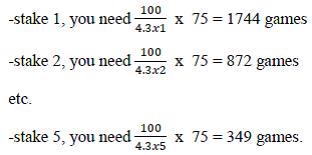
To give every player the same chance, according the dutch gaming law, you had to do the following:
A. a random generator has choosen the amount to win (between 50 and 100).
B. a second random generator had to choose for every game a game number between:
- for stake 1 between 0 - 1743
- for stake 2 between 0 - 871
etc.
- for stake 5 between 0 - 348
C. every player which random generator has choosen a fixed number, for instance 0, will get the amount choosen by the first random generator.
Please tell me if this is possible. According NMI it must be asimple change.
Awaiting your reply.
Best regards,
Leo J Sekreve
President
62 The trial judge characterised this at [199] as a letter from the Dutch regulator but it will be apparent from what I have just said that this is not correct.
63 The contents of this letter are very dense. With the aid of the subsequent correspondence (which I set out below), its meaning can be ascertained. This correspondence suggests that the 4.3% is the turnover contributed to the jackpot. The range of 50-100 is the range from which the desired jackpot size is randomly chosen. The average, in the long run, of a set of random numbers selected in the range 50 to 100 is 75. What the first calculation shows is that with turnover being contributed at the rate of 4.3% it will take 1744 games for the average jackpot amount of 75 to be reached i.e.:
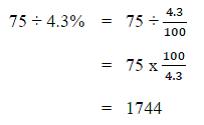
64 What this reveals is a mechanism fixing the probability of winning the jackpot (1/1744) by references to the desired average turnover between jackpots.
65 Further, the letter also reveals that the solution related the probability to the amount wagered. This emerges from the passages at A, B and C. Passage A recites the initial procedure for fixing the probability of a jackpot to the desired average turnover (just discussed). Passages B and C link it to the amount wagered too.
66 The first calculation at Passage A is done with a stake of 1. With a stake of 1 the calculation shows that it will require, on average, 1744 games to reach the average jackpot figure of 75. Put another way, there is for a person betting a stake of 1 a 1/1744 chance of winning a jackpot of 75.
67 The second calculation reveals that a person who wagers 2 (i.e. double) waits an average of 872 games before winning a jackpot of 75 (872 is half of 1744). The calculation is:
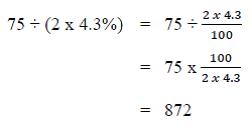
68 The third calculation is the same but uses a stake of 5 to derive the result of 349 games (approximately 1744/5).
69 The second part of the letter describes how those results could be achieved with a second random number generator. The random number generator is to be set so that those probabilistic outcomes are achieved.
70 If a stake of 1 is wagered the random number range is set at 0-1743 and a number selected. When the player plays a number in that range is selected. There is a 1/1744 chance of the player’s number being that selected by the machine. This produces an outcome which ensures that with a stake of 1 the player will, on average, win a jackpot of 75 after 1744 plays.
71 If a stake of 2 is selected, the range in Passage B is halved and the probability doubled to 1/872. If a stake of 5 is selected the probability is multiplied by 5 to 1/349. What is disclosed by this is the setting of the probability of a player winning the jackpot as a function of the desired average turnover between jackpots and the amount wagered.
72 The correspondence which surrounds this letter suggests that the concern which was being addressed was to ensure that all players had the same chance of winning the jackpot. An internal Aristocrat letter of 30 April 1992 said this:
The NMI understands exactly how the Surprize machine works and is not happy with it and won’t approve it. They are very strict in their application of the law which states that every player must have the same opportunity of winning.
Their reasoning is that, for example, if a prize of 80 coins is randomly selected then someone playing the machine while the machine is accumulating from the low point of 50 clearly doesn’t have the same chance of winning as someone who plays the machine when it has already accumulated to, say, 70.
They have no problem with the machine randomly selecting a prize between 50 and 100. What they say is that everyone should have the same chance of winning that prize every time they play the machine.
Clearly the chance of winning a prize as it currently stands is dependant on how much play he machine has previously had i.e., how much has accumulated before a hit.
That is why they are suggesting a second random number generator to give every player an equal and independent chance of winning the random prize.
I trust that this is clear now and that a machine programme can be submitted which meets the necessary criteria.
73 I would accept, therefore, that this material does disclose the existence of a machine, a Dutch version of the Surprize game, in which the probability of a jackpot event occurring was made a function of the desired average turnover between jackpots and the amount being wagered.
74 I need not determine whether novelty is lost where the inventive step has been pre-empted in the form of a solution to a different problem. Nor, as I have said, do I need to consider whether the Equal Probability Problem and the Swamping Problem are just the same problem described differently. This is because, assuming all of those matters in Konami’s favour, the evidence only shows that a man from Holland, Mr Sekreve, had thought of creating a machine where the probability of a jackpot event was determined in the same way subsequently applied in the 689 Patent. But the evidence does not show that the Dutch regulators were aware of Mr Sekreve’s solution or even who Mr Sekreve was. At the times relevant to this litigation, the common general knowledge was limited, in substance, to Australia: see ss 7(2) and (4) as they were prior to 15 April 2013. Subsequently, by reason of the Intellectual Property Laws Amendment (Raising the Bar) Act 2012 (Cth), from 15 April 2013 this geographical limitation was removed. Prior to those amendments, the position of Mr Sekreve was therefore irrelevant. Quite apart from that, I do not think that this correspondence reveals the state of the common general knowledge on a worldwide basis. More importantly, it shows nothing about the state of the common general knowledge in Australia. Consequently, the trial judge was correct to conclude that this material did not establish obviousness.
75 The claim that the 689 Patent lacks an inventive step fails.
2.6 Fair Basis
76 Although this issue was raised in Konami’s notice of appeal it was not the subject of Konami’s written or oral submissions. Section 40(3) of the Patents Act provides:
The claim or claims must be clear and succinct and supported by matter disclosed in the specification.
77 This has been held to require a real and reasonably clear disclosure of what is claimed: cf. Lockwood Security Products Pty Ltd v Doric Products Pty Ltd (2004) 217 CLR 274 at [69] applying Rehm Pty Ltd v Websters Security Systems (International) Pty Ltd (1988) 81 ALR 79 at 95 per Gummow J.
78 Konami lost each of the construction arguments. Its fair basis arguments were in the alternative, i.e.:
if on its proper construction ‘trigger condition’ was sufficiently broad to encompass any trigger condition and was not limited only to combination triggers then it travelled beyond what was disclosed in the specification;
if on its proper construction the relationship between a jackpot trigger event and turnover and/or credits bet did not have to be direct then this travelled beyond what was disclosed in the specification; and
if on its proper construction trigger conditions could be determined by an event having a probability related to turnover and/or credits bet other than per game on the console then this travelled beyond what was disclosed in the specification.
79 His Honour discussed each of these three matters at [119]-[133]. Not having had my attention drawn to any part of this which was said to be in error it seems to me that I should observe that I agree with his Honour’s reasons for rejecting the argument. In my opinion, it is clear that what was being claimed in the specification was a jackpot mechanism where the probability of a jackpot event was directly related to the desired turnover between jackpots and the amount wagered.
3. The 847 Patent
80 The 847 Patent is entitled ‘Gaming machine with buy feature games’ and has an asserted priority date of 25 August 1999. At page 1 the specification said:
…
Certain types of these machines have a series of rotatable reels, each of which displays a series of symbols or a video simulation of such a mechanism while other types of machines are arranged to play video simulations of card games or other types of wagering games, such as bingo or keno. The invention has particular application to an improved game played on such a machine.
Background to the Invention
Players regularly playing gaming machines need to have their interests maintained. Therefore, it is necessary for manufacturers of these machines to develop inventive game features which add interest to the games provided on such machines in order to keep the players entertained and willing to continue to play the games.
There is a continuous trade-off between what the players of the machines want and what the operators of the machines want from the machines. Naturally, operators want the players to stake more money per game so that the overall turnover is higher. Conversely, players will not do this unless they feel that they are getting more for the extra money that they are betting.
Further, as the range of machines and games increases, it is becoming increasingly important to offer more options to the players. The more options that are available in one machine, the easier it is to maintain the player’s interest and the easier it is for players to be able to gain access to a machine that will offer them exactly the game that they want.
To date, most types of video gaming machines which are available to players offer limited options. At best, a range of bet sizes and paylines upon which the players can bet are offered. Certain machines also offer a double-up option available after a win while other machines have various ranges of paytables particularly for higher bets.
81 This was followed by some consistory clauses.
82 The claims in dispute are claims 1, 19 and 56. These are as follows:
1. A gaming machine adapted to play a base game in which a player stakes a wager on an outcome of the base game, and if a winning outcome occurs, the gaming machine awards that player a prize, the gaming machine including: a display means including a plurality of display positions for displaying combinations of symbols; a control means for controlling operation of the gaming machine, the control means including a processing means for processing data and displaying selected images on the display means; and a selecting means operable by a player of the gaming machine to enable the player to select at least one feature which can be added to the base game, wherein the gaming machine requires the player to stake an additional wager in order to be eligible for the selected feature, wherein there is no guarantee that the selected feature will eventuate merely by having staked the additional wager, and wherein when the selected feature eventuates, it includes the award of a series of game events from which a prize provided by the feature may be won.
19. A gaming machine which includes a display means including a plurality of display positions for displaying combinations of symbols; a control means for controlling operation of the machine, the control means including a processing means for processing data and displaying selected data on the display means; and a selecting means operable by a player of the machine for enabling the player to select at least one feature which can be added to a base game played on the machine, an additional wager being staked by the player in order to be eligible for said at least one feature being a fixed amount multiplied by a bet wagered per line or per draw, there being no guarantee that a benefit provided by the feature will eventuate merely by having staked the additional wager.
56. A gaming machine adapted to play a base game in which a player stakes a wager on an outcome of the base game, and if a winning outcome occurs, the gaming machine awards that player a prize, the gaming machine including: a display means including a plurality of display positions for displaying combinations of symbols; a control means for controlling operation of the gaming machine, the control means including a processing means for processing data and displaying selected images on the display means; and a selecting means operable by a player of the gaming machine to enable the player to select at least one feature which can be added to the base game, wherein the gaming machine requires the player to stake an additional wager in order to be eligible for the selected feature, wherein the selected feature only eventuates on the occurrence of a trigger event in a game play of the base game when the additional wager has been staked, and wherein when the selected feature eventuates, at least one additional game event is played that provides a chance for the player to win a prize.
83 The trial judge analysed these three claims in a way which was not suggested to have been in error and which it is convenient to adopt (at [247]-[249]):
247 In essence, claim 1 is to an electronic gaming machine that includes a particular feature which may be engaged by a player for an additional wager. The feature is one in which the player may win an additional series of games from which a prize may then be won. The feature may (as in Konami’s Prize Plus) be nothing more than a series of “free spins”.
248 Claim 19 is to a gaming machine that has certain characteristics which appear to me to be essentially the same as those referred to in claim 1 except for in the following respects. First, in claim 1, if the feature eventuates (ie. if it is triggered), then it will include the award of a series of game events (eg. free games) from which a prize may then be won. This is not a requirement of claim 19. Secondly, unlike claim 1, it is a requirement of claim 19 that an additional wager being staked by the player be a fixed amount multiplied by a bet wagered per line or per draw.
249 Claim 56 replicates claim 1 except in so far as it defines a gaming machine that has the following additional elements:
• a feature may consist of at least one additional game (as opposed to a “series of game events”) in which the player has a chance to win a prize; and
• the trigger for the award of the additional game must be a trigger event in the base game in which the additional wager has been staked.
84 Aristocrat alleged that a feature of Konami’s game Jumpin’ Jalapenos infringed claims 1, 19 and 56. The feature was called ‘Prize Plus’. A player of Jumpin’ Jalapenos is eligible for the Prize Plus feature by placing an additional wager in the base game. If the player does so and a ‘scatter’ win occurs then the player is awarded 24 free spins. Without the placing of the additional wager (and the enlivenment of the Prize Plus feature) the player is awarded only 12 free spins.
85 There were two sets of issues on the cross-appeal: inventive step and infringement.
3.1 Infringement
86 There were two aspects to the infringement case. These were:
(a) whether Prize Plus was part of the base game. This issue arose from the language of each of claims 1, 19 and 56 all of which referred to the feature being ‘added to the base game’. Aristocrat submitted, and Konami denied, that Prize Plus was an addition to the base game in Jumpin’ Jalapenos. Konami’s argument was that Prize Plus merely increased the prize awarded in the base game (i.e. 24 free spins rather than 12 free spins). As an increase in the prize awarded it submitted that the base game was not changed and hence it could not be seen as a feature ‘added’ to the base game. It is useful to refer to this as the Base Game Infringement Issue.
(b) whether Prize Plus could be said in terms of claim 1 to be such that, in terms of claims 1 and 19 ‘there was no guarantee that the selected feature will eventuate merely by having stated the additional wager’. It is useful to refer to this as the Guarantee Infringement Issue.
87 The trial judge did not resolve the infringement issues because he was of the view that the patent lacked an inventive step. As will be shortly seen, this is a view which I share. For completeness, however, it is useful to record my conclusion that if the issue arose infringement would have been established.
88 As to the Base Game Infringement Issue, the critical words of claim 1 (which are relevantly substantially the same in claims 19 and 56) are:
…to enable the player to select at least one feature which can be added to the base game, wherein the gaming machine requires the player to stake an additional wager in order to be eligible for the selected feature,…
89 Konami’s argument, supported by the views of Mr de Bruin, was that the additional 12 free spins (on top of the usual 12 free spins making for a total of 24 free spins) awarded in Prize Plus was not something which was added to the base game but merely an increase in the prize awarded. However, I do not accept that its characterization as an increase in the prize awarded logically denies its character as an additional feature. In any event, it is not an increase in the prize but rather an increase in the number of free spins which may (or may not) result in a prize. In my view, the Prize Plus feature is a feature added to the base game.
90 As to the Guarantee Infringement Issue, there is no guarantee when the additional wager is placed that the ‘scatter’ win will occur. Hence there can be no guarantee that a prize will be awarded.
91 In both cases, if the patent were valid, infringement would have been established.
3.2 Inventive Step
92 The 689 Patent involves a combination of integers. Whatever inventive step it involved was to be found in the arrangement of those integers. Whilst the trial judge accepted that the particular combination of integers revealed in the 689 Patent was novel in the sense that it had not been seen before, his Honour was entirely unpersuaded that there was anything inventive about this admittedly novel combination. At [250] he said:
250 In my opinion, none of claims 1, 19 and 56 involve a scintilla of inventiveness. There was no difficulty overcome or barrier crossed by these alleged inventions. Each of the combinations defined in these claims is obvious and could be arrived at by a person skilled in the relevant art (however unimaginative he or she might be) armed only with the common general knowledge as it stood at the priority date.
93 In this Court there was something of a false debate as to whether Konami had to prove that each of the integers in the 689 Patent was part of the common general knowledge. But where the argument was that it was the combination of those integers which involved the inventive step, whether those integers were part of the common general knowledge was irrelevant.
94 As an aspect to this irrelevant debate, Aristocrat in its written submission on the appeal made detailed submissions about which integers of the 689 Patent were part of the common general knowledge and which were not. One of the features to which it pointed consisted of ‘electronic gaming machines which have games, and games, that require the player to stake an additional wager in order to obtain, or be eligible for, a feature’. It was submitted in writing by Aristocrat that Konami had not proved that this feature was part of the common general knowledge.
95 This provoked a detailed submission from Konami that there was such evidence. At the hearing of the appeal, Senior Counsel for Aristocrat accepted that it was irrelevant whether the integers of the 689 Patent were part of the common general knowledge. Senior Counsel for Aristocrat said:
Mr Bannon: But in any event, that submission of ours attracted – which effectively is saying that the particular feature wasn’t part of the common general knowledge – that attracted a response from our learned friends which is at 18A.4 in paragraph 15. It says:
Aristocrat suggested in order to succeed it was necessary to prove that each of the integers was itself common general knowledge.
Well, we don’t suggest that but, of course, if they are, then you’re dead in the water anyway ….
(Bold emphasis added.)
96 As will be seen, this effectively left no part of Aristocrat’s written submissions on the 689 Patent in play. At the hearing of the appeal Senior Counsel advanced what was left of Aristocrat’s argument this way. He quoted from a passage of Konami’s written submissions dealing with whether the feature referred to in paragraph [94] above was part of the common general knowledge and proceeded to comment upon that submission in these terms:
And they give two references to that. I wasn’t going to go – trouble your Honours to go that. But if you do go to that evidence, what you won’t find is a reference to that – this particular feature, and there’s no reference to it requiring an additional wager, and we say the evidence doesn’t support that submission. And we’ve responded to that in our reply submission at paragraph 8, which is 18A.6, which I – if I can just leave your Honours to look at those submissions. So what we say is the relevant starting point doesn’t include, as they suggest or invite this court to find, that feature was part of the common general knowledge. So the starting point is a combination of features, some of which are known, plainly, but not this feature. We say this is the correct approach.
97 This was a curious submission. Having accepted the irrelevancy of the debate which its own written submissions had engendered (that is, whether all of the integers had to form part of the common general knowledge), the first sentence of this oral submission proceeds by means of an argument that there was no reference in the evidence to a feature involving an additional wager. But that evidence was only concerned with the question of whether the additional wager feature formed part of the common general knowledge. That is to say, it was the assertion of the very point which Senior Counsel had only moments before indicated was not being advanced. The mystery is deepened further by the reference in the next sentence of the transcript to paragraph 8 of Aristocrat’s submissions in reply. Recourse to this paragraph reveals a paragraph solely directed to criticising Konami’s evidence that the identified feature formed part of the common general knowledge.
98 It follows that Aristocrat’s position on the appeal makes no sense. The critical question was, what was the inventive step which this particular combination of features involved. On that topic Senior Counsel went on to say only this:
Mr Bannon: Not that you would need an expert, but, I mean, there has got to be some process of reasoning, we say, which would – I accept – we accept you don’t need an expert, but you need some sort of process of reasoning to say why it is that this combination would have been obvious to anybody when it had never been done before. I mean, that’s our very short point, and our submissions on that address the matter in 15 to 16 and also in our submissions in reply at paragraph 5, and they’re in writing.’
99 The submissions at paragraphs 15 and 16 were not about that question at all, but rather dealt with the correctly abandoned argument as to whether the specified feature was part of the common general knowledge. Paragraph 5 of the reply submissions was in these terms:
5. Second, Aristocrat does not seek to apply the modified Cripps question in Alphapharm in an inflexible and formulaic way, which appears to be Konami’s contention: KSA [6(b)]. Konami makes no criticism in respect of Aristocrat’s formulation of the relevant question at AOS [19]. That formulation adopts the language regarded as appropriate by the Full Court in Dynamite Games Pty Ltd v Aruze Gaming Australia Pty Ltd (2013) 103 IPR 373 at 381 [25] (lines 15-22) for an application of the obviousness test where the invention is in the field of game machine design.
100 This submission refers back to Aristocrat’s submission in chief at paragraph 18
18. Since the evidence at trial did not support the primary judge’s observation that the ‘847 Claims were “for combinations” of features that were known at the Priority date (J [245], [250]), his Honour’s analysis which followed, and which depended on the application of principles enunciated in respect of combination patents, proceeded on an incorrect foundation. The primary judge ought to have proceeded on the basis that the onus borne by Konami was to establish that the invention as claimed in each of the ‘847 Claims was obvious in light of the common general knowledge applying the modified Cripps question in Aktiebolaget Hassle v Alphapharm Pty Ltd (2002) 212 CLR 411 at [53].
101 The first sentence of this was the submission expressly abandoned. The second and third sentences go nowhere.
102 The appropriate conclusion from this examination of Aristocrat’s submissions is that, despite an appearance to the contrary, it did not in fact advance any argument, or certainly any coherent argument, against the trial judge’s conclusions on the issue. Those conclusions (set out above) were shortly expressed, no doubt. But this reflected the hopelessness of Aristocrat’s case on inventive step. The 847 Patent involved a number of features in combination in a poker machine game. The combination of features was not said to solve any particular problem. I can discern in the combinations no problem solved or frontier crossed. There was, in that circumstance, nothing remotely inventive about the 847 Patent and the trial judge was correct so to conclude.
4. Conclusion
103 Both the appeal and cross-appeal should be dismissed with costs.
I certify that the preceding one hundred and two (102) numbered paragraphs are a true copy of the Reasons for Judgment herein of the Honourable Justice Perram. |
REASONS FOR JUDGMENT
JAGOT J:
104 I agree with the reasons of Perram J and the orders he proposes.
I certify that the preceding one (1) numbered paragraph is a true copy of the Reasons for Judgment herein of the Honourable Justice Jagot. |
Associate:
Dated: 12 August 2016


