

FEDERAL COURT OF AUSTRALIA
Nand v Fuji Xerox Australia Pty Ltd [2015] FCAFC 51
IN THE FEDERAL COURT OF AUSTRALIA | |
Appellant | |
AND: | FUJI XEROX AUSTRALIA PTY LIMITED Respondent |
DATE OF ORDER: | |
WHERE MADE: |
THE COURT ORDERS THAT:
1. The appeal be dismissed with costs.
Note: Entry of orders is dealt with in Rule 39.32 of the Federal Court Rules 2011.
NEW SOUTH WALES DISTRICT REGISTRY | |
GENERAL DIVISION | NSD 8 of 2015 |
ON APPEAL FROM THE FEDERAL CIRCUIT COURT OF AUSTRALIA |
BETWEEN: | SHARDA NAND Appellant |
AND: | FUJI XEROX AUSTRALIA PTY LIMITED Respondent |
JUDGES: | RARES, JAGOT AND GLEESON JJ |
DATE: | 16 MARCH 2015 |
PLACE: | SYDNEY |
REASONS FOR JUDGMENT
(REVISED FROM THE TRANSCRIPT)
THE COURT:
1 The sole question in this appeal is whether a failure to specify, or a misstatement of, the statutory provision under which post-judgment interest was claimed in a bankruptcy notice resulted in the invalidity of the notice.
2 A judge of the Federal Circuit Court held that the failure to specify, or misstatement of such a statutory provision in a bankruptcy notice was a formal defect or an irregularity that had not caused any substantial injustice within the meaning of s 306(1) of the Bankruptcy Act 1966 (Cth) and that, accordingly, the bankruptcy notice served on the appellant (the debtor) was valid. His Honour affirmed the Registrar’s decision to make a sequestration order against the estate of the debtor: Fuji Xerox Australia Pty Limited v Nand [2014] FCCA 2793. The debtor contended that his Honour erred in failing to find that the omission or misstatement of the statutory provision of the source of the power to claim post-judgment interest had rendered the notice invalid.
Background
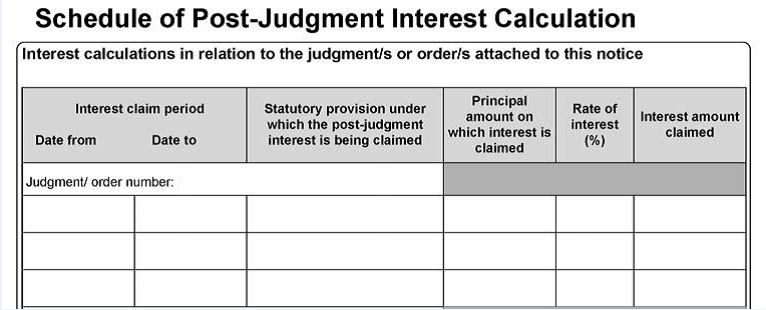
3 On 21 February 2014, Fuji Xerox Australia Pty Limited (the creditor) filed a petition in the Federal Circuit Court seeking a sequestration order against the debtor’s estate. The petition was founded on an act of bankruptcy that consisted of the failure of the debtor to comply with a bankruptcy notice served on her on 16 August 2013. The notice was based on a judgment of the Supreme Court of New South Wales for $265,806.48, given in favour of the creditor against the debtor on 20 August 2012. That judgment was entered on 23 August 2012. The schedule of post-judgment interest calculation that the creditor completed in the prescribed form of bankruptcy notice, under the heading “Statutory provision under which the post-judgment interest is being claimed” stated “Uniform Civil Procedure Rules 2005 Rule 36.7”.
4 It was common ground that, in fact, the creditor’s entitlement to post-judgment interest arose under s 101 of the Civil Procedure Act 2005 (NSW) (Civil Procedure Act), and that r 36.7 of the Uniform Civil Procedure Rules 2005 (NSW) (UCPR) set out the prescribed rate of interest, fixed pursuant to s 101 of the Civil Procedure Act.
5 On 28 April 2014, the Registrar made the sequestration order. The debtor applied to the trial judge for a review of that decision under s 104(3) of the Federal Circuit Court of Australia Act 1999 (Cth). His Honour heard the review as a hearing de novo, and, in a reserved judgment, affirmed the Registrar’s order after rejecting the debtor’s three grounds of opposition, including the sole ground raised in this appeal.
The Legislative Scheme
6 Relevantly, ss 41(1), (2) and (5) and 306(1) of the Bankruptcy Act required that:
41 Bankruptcy notices
(1) An Official Receiver may issue a bankruptcy notice on the application of a creditor who has obtained against a debtor:
(a) a final judgment or final order that:
(i) is of the kind described in paragraph 40(1)(g); and
(ii) is for an amount of at least $5,000; or
….
(2) The notice must be in accordance with the form prescribed by the regulations.
…
(5) A bankruptcy notice is not invalidated by reason only that the sum specified in the notice as the amount due to the creditor exceeds the amount in fact due, unless the debtor, within the time allowed for payment, gives notice to the creditor that he or she disputes the validity of the notice on the ground of the misstatement.
306 Formal defect not to invalidate proceedings
(1) Proceedings under this Act are not invalidated by a formal defect or an irregularity, unless the court before which the objection on that ground is made is of opinion that substantial injustice has been caused by the defect or irregularity and that the injustice cannot be remedied by an order of that court. (emphasis added)
7 Reg 4.02 of the Bankruptcy Regulations 1996 (Cth) prescribed the relevant portion of Form 1 as follows:
8 Section 101(1) and (2) of the Civil Procedure Act relevantly provided:
101 Interest after judgment
(1) Unless the court orders otherwise, interest is payable on so much of the amount of a judgment (exclusive of any order for costs) as is from time to time unpaid.
(2) Interest under subsection (1) is to be calculated, at the prescribed rate or at such other rate as the court may order, as from:
(a) the date on which the judgment takes effect, or
(b) such later date as the court may order.
…
Note. See section 136 in relation to the order in which payments on account of a judgment debt are to be appropriated.
9 Rule 36.7 of the UCPR relevantly provided:
36.7 Payment of interest
(1) The prescribed rate at which interest is payable under section 101 of the Civil Procedure Act 2005 is:
(a) in respect of the period from 1 January to 30 June in any year – the rate that is 6% above the cash rate last published by the Reserve Bank of Australia before that period commenced, and
(b) in respect of the period from 1 July to 31 December in any year – the rate that is 6% above the cash rate last published by the Reserve Bank of Australia before that period commenced.
10 The Interpretation Act 1987 (NSW) provided in s 3 that, in that Act, an “instrument” included a statutory rule made under an Act and s 21 defined a “statutory rule” as meaning a rule of court, as well as a regulation by-law, rule or ordinance that was made by the Governor of the State. The UCPR fall within that latter definition.
The debtor’s submission
11 The debtor argued that the omission of any reference to s 101 of the Civil Procedure Act rendered the notice a nullity on two bases. First, she contended, the prescription of Form 1 by the Regulations made it essential that the statutory source of a claim for post-judgment interest be correctly referred to in the bankruptcy notice itself and that in this matter the notice did not refer to any statute but only, and incorrectly, to a statutory rule under which post-judgment interest was payable. Secondly, she contended, the failure to refer to s 101 in the notice was reasonably capable of misleading her because that section provided the sole legislative basis upon which post-judgment interest was payable.
Consideration
12 The question for decision is whether the notice either failed to meet a requirement made essential by the Bankruptcy Act or could reasonably have misled the debtor as to what was necessary to comply with the notice: Adams v Lambert (2006) 228 CLR 409 at 419 [25] per Gleeson CJ, Gummow, Kirby, Hayne, Callinan, Heydon and Crennan JJ. A bankruptcy notice is a proceeding under the Bankruptcy Act for the purposes of 306: Adams 228 CLR at 415 [17].
13 There are two issues that must be addressed under s 306(1), first, whether a failure to comply is a formal defect or an irregularity and, secondly, if it is, whether substantial injustice has been caused by the defect or irregularity and whether that injustice cannot be remedied by an order of the Court. Only the first issue arises on this appeal.
14 A misdescription of the section number of the Act under which post-judgment interest is claimed is a formal defect or irregularity under s 306(1) that does not invalidate a bankruptcy notice, as is an erroneous statement of the amount of interest owing on a judgment debt: Adams 228 CLR 418 [24]. The Court said in Adams 228 CLR 419 at [27]:
If, as in the present case, what is in question is an error in the form of a misdescription of a statutory provision, then a consideration of the general purpose of the Act, and the particular purpose of the legislative scheme relating to bankruptcy notices, leads readily to a conclusion that if the error could reasonably mislead a debtor as to what is necessary to comply with the notice it is not merely a formal defect or irregularity. Any error is capable of misleading somebody about something. When the respondent saw the bankruptcy notice in this case he may well have concluded that s 83A was the section of the District Court Act dealing with post-judgment interest. In that respect, he would have been misled. When Mr Crowl read the bankruptcy notice in his case, he might have been given the temporary satisfaction of believing that his debt was $23,000 less than was in fact owing. In that respect, he would have been misled. (A debtor who receives a notice involving an overstatement of a kind expressly relieved against by s 41(5) of the Act might receive a very unpleasant surprise.) What this Court regarded as relevant to s 306, however, was misleading a debtor about what is necessary to comply with the notice. That kind of misleading, the Court said, takes an error outside the concept of a formal defect or irregularity. However, that is not the full extent of the exclusion. (emphasis added)
15 They concluded that the misdescription of s 83A instead of s 85 of the District Court Act 1973 (NSW) under which interest was claimed was not capable of misleading the debtor as to what he had to do to comply with the notice. However, that was not determinative of whether the Bankruptcy Act or Regulations made it essential that there be no such misdescription: Adams 228 CLR at 420 [30]. A substantial misstatement of an amount of money may be covered by s 306(1). That is because it was the legislative intention, as found in s 41(5), that a substantial understatement of the amount should not necessarily invalidate the notice: Kleinwort Benson Australia Limited v Crowl (1988) 165 CLR 71; Adams 228 CLR at 420-421 [31]. The debtor argued that the issue that the Court described in rejecting part of the appellant creditor’s argument in Adams 228 CLR at 417-418 [22] was distinguishable from the situation in this appeal when it said:
The entire District Court Act is not a “provision”. The requirement of Note 2 would not be satisfied by referring merely to the District Court Act. The drafter of the notice was right to suppose that reference to a section of the District Court Act was required. The problem is that the wrong section was identified. Next, it was argued that s 41(2) of the Act is to be read in the light of s 25C of the Acts Interpretation Act 1901 (Cth); that substantial compliance with requirements as to a form is all that is necessary; and that here there was substantial compliance. The difficulty is that in a case such as the present, where there is a specific requirement to state a provision, it is not substantial compliance to state a different provision. In such a case, the problem cannot be avoided by looking at the form as a whole and observing that, like the curate's egg, it is bad only in part. At the same time, the kind and degree of error involved is relevant to a consideration of s 306. (emphasis added)
16 Nonetheless, their Honours allowed the appeal. They said (Adams 228 CLR at 420 [31]):
The practical significance of an error or deficiency could vary according to the circumstances of each particular case. Errors or deficiencies in compliance with requirements as to form may involve questions of degree as well as of kind.
17 The Court held that the Parliament did not intend that a mistaken citation of the source of entitlement to claim interest would be a substantive defect or irregularity in a bankruptcy notice so as to exclude the operation of s 306. The Court also held that form did not necessarily prevail over substance in the preparation of bankruptcy notices, given that s 306(1) relieved against the invalidating consequences of some mistakes in that preparation process: Adams 228 CLR at 421-422 [32]-[34].
18 Here, the reference in the notice to r 36.7, as opposed to s 101, could not have misled the debtor as to what was necessary for her to do to comply with the notice. In any event, had she referred to that rule, she would have seen that the calculation of post-judgment interest in the notice was justified by the rule and that it was based on s 101 of the Civil Procedure Act. The omission of the correct statutory source, namely, a reference to s 101 of the Civil Procedure Act, in the circumstances, was not a failure to comply with an essential requirement prescribed in Form 1. It was a formal defect or irregularity of the kind contemplated by s 306(1) and its omission was not reasonably capable of misleading the debtor in relation to what she had to do in order to comply with the notice.
19 North J arrived at this construction in McKean Park (a firm) v Lawrence (2011) 199 FCR 514. The debtor argued that that decision, that the trial judge followed, was wrong and that instead the decision of the Federal Magistrates Court in Jones v Verity [2007] FMCA 1108, which North J overruled, should be preferred. We are unable to identify any error in North J’s reasoning that the debtor before him had been correctly informed of the rate of interest and the statutory source of that rate, even though the notice in that case failed to refer directly to the equivalent of s 101 and referred instead to another statute that, like r 36.7, operated in respect of the source of power in the correct statute: McKean Park 199 FCR at 518 [22].
20 Here, the debtor was correctly informed of the rate of interest and that the rate was calculated by force of r 36.7. The omission of the reference to s 101 of the Civil Procedure Act could not reasonably have misled her as to what was necessary to comply with the notice.
21 Last, the debtor argued that a copy of the judgment of the Supreme Court attached to the notice recorded that the judgment was made on 20 August 2012 but entered on 23 August 2012, and that the difference between those two dates was capable of misleading her, in the absence of a reference to s 101 of the Civil Procedure Act. We are unable to understand how that could be so. The judgment was effective from the date it was made, namely, 20 August 2012, as provided in s 101(2)(a) of the Civil Procedure Act and the calculations in the bankruptcy notice proceeded from that date.
Conclusion
22 The appeal must be dismissed with costs.
I certify that the preceding twenty-two (22) numbered paragraphs are a true copy of the Reasons for Judgment herein of the Honourable Justices Rares, Jagot and Gleeson. |
Associate:


