FEDERAL COURT OF AUSTRALIA
Garford Pty Ltd v Dywidag Systems International Pty Ltd [2015] FCAFC 6
IN THE FEDERAL COURT OF AUSTRALIA | |
Appellant | |
AND: | DYWIDAG SYSTEMS INTERNATIONAL PTY LTD First Respondent DSI AUSTRALIA (HOLDINGS) PTY LTD Second Respondent |
DATE OF ORDER: | |
WHERE MADE: |
THE COURT ORDERS THAT:
2. The appellant pay 80% of the respondents’ costs of the appeal.
3. Order 2 is suspended for 14 days.
4. Any party seeking any different costs order is to file and serve a written submission (limited to 2 pages in length) within 7 days.
Note: Entry of orders is dealt with in Rule 39.32 of the Federal Court Rules 2011.
NEW SOUTH WALES DISTRICT REGISTRY | |
GENERAL DIVISION | NSD 680 of 2013 |
ON APPEAL FROM THE FEDERAL COURT OF AUSTRALIA |
BETWEEN: | GARFORD PTY LTD Appellant |
AND: | DYWIDAG SYSTEMS INTERNATIONAL PTY LTD First Respondent DSI AUSTRALIA (HOLDINGS) PTY LTD Second Respondent |
JUDGES: | DOWSETT, MCKERRACHER AND NICHOLAS JJ |
DATE: | 30 january 2015 |
PLACE: | SYDNEY |
REASONS FOR JUDGMENT
THE court
INTRODUCTION
1 This is an appeal from a judgment of a Judge of the Court revoking claims 1 and 5 to 14 (inclusive) of Australian Patent No 770594 (the patent) and granting related declaratory and injunctive relief for unjustified threats. The primary judge held that each of these claims was invalid for lack of inventive step, that each of claims 12 to 14 was invalid for secret use, and that claim 12 was invalid for lack of novelty. There is no appeal against the order revoking claims 12 to 14.
2 The patent is for an apparatus and a method for manufacturing bulbed, multi-strand rock bolts. The appellant (Garford) is the patentee. The respondents to the appeal (the DSI parties) were the applicants in the proceeding heard by the primary judge. They commenced a proceeding against Garford for relief in respect of what they alleged were unjustified threats pursuant to s 128(1) of the Patents Act 1990 (Cth) (the Act). In response, Garford filed a cross-claim for infringement of various claims of the patent which the DSI parties then sought to have revoked as invalid.
3 The particular claims which Garford alleged the DSI parties infringed were claims 1 and 5 to 14. The primary judge found that the DSI parties’ apparatus (the DSI apparatus) would have infringed claims 1 and 7 to 10 of the patent if these claims were valid, but not claims 5, 6 or 11. Garford challenges the findings that claims 5 and 6 would not have been infringed if they were found valid. Garford no longer contends that claim 11, if valid, is infringed by the DSI apparatus.
4 The DSI parties have filed a notice of contention seeking to rely upon a number of arguments that they relied upon below which were rejected by the primary judge. These arguments relate to the issue of infringement and also raise a number of additional grounds of invalidity that were rejected by the primary judge.
5 The DSI parties seek to uphold the primary judge’s findings that claims 5 and 6 would not have been infringed if valid and also contend that his Honour erred in finding that claim 1 and claims 7 to 10 would have been infringed if valid. They also contend that the primary judge should have found that claims 1, 5, 6 and 7 were invalid for lack of novelty and that claims 1 and 7 to 10 were invalid for secret use. The DSI parties also contend that if, contrary to the primary judge’s findings, any of claims 1 and 5 to 11 involved an inventive step, then such claim was invalid for failing to describe the invention fully including the best method known to the appellant of performing the invention.
BACKGROUND
6 It is common ground that, as found by the primary judge, the priority date of the patent is 13 September 1999 (the priority date) and the notional person skilled in the art to whom the patent is directed is an engineer working in the field of cable bolts.
7 It is useful to refer to some evidence given by the inventor, Mr Hedrick, that explains what a bulbed multi-strand cable bolt is before examining the patent in more detail. His evidence, which was not disputed by the DSI parties, and which was accepted by the primary judge, was as follows (at [21]):
Bulbed cable bolts are rock anchors comprising steel tendons with bulbs, which are inserted into bore holes in the roofs and walls of mines and rock tunnels to help prevent cave-ins and rock falls. Typically, such tendons are of steel cable having a central or “king wire” around which further – usually six – steel wires are wound. The bulbed cable bolts are inserted into the bore holes and grout is pumped in under pressure. The grout fills the bore holes and fills the bulbs and also enters any gaps or fissures in the surrounding rock. The force caused by the bulbs against the grout, wedges them into the bore holes. Once set in place, a plate is put over the protruding end of the strand and against the rock and a barrel and wedges are used to hold the strand against the plate and are tensioned.
THE PATENT SPECIFICATION
8 The patent is in the customary form. It begins with a description of the field of the invention which is said to relate to the manufacture of rock bolts. This is followed by a discussion of prior art.
9 The discussion of prior art is brief. Reference is made to Australian Patent No 640906 which is said to describe and claim (at p 1, lines 10-12):
an apparatus for the manufacture of a multi-strand rock bolt which is formed with bulbs or expanded portions in which a king wire is disposed at the periphery of the bulb.
Australian Patent No 640906 was another patent (Garford No 1) previously granted to Garford that expired in 2009.
10 The discussion of prior art is followed by a description of the invention. According to the patent specification (at p 1, lines 16-25):
The present invention provides an apparatus which is for the manufacture of multi-strand rock bolts formed with bulbs in which the feed material is fed from a rotatable reel.
In accordance with one aspect of the present invention there is provided an apparatus for manufacturing multi-strand rock bolts having spaced apart bulbs formed therein, characterised by a feed means for supplying a multi-strand cable from a rotatable supply reel, a means for forming the cable with bulbs at spaced intervals and a means for determining the position of the cable to stop operation of the feed means to enable a further bulb to be formed.
11 The specification then describes a number of preferred features of the apparatus. The specification continues (at p 2, lines 23-28):
In accordance with a further aspect of the present invention there is provided a method of manufacturing a multi strand rock bolt having spaced apart bulbs formed therein characterised by feeding a multi strand cable from a rotatable supply reel, sensing when the cable has reached a certain position and stopping movement of the cable, forming a bulb in the stopped cable, recommencing movement of the cable and repeating the sequence.
12 This is followed by a detailed description of a preferred embodiment of the invention with reference to two drawings which we have reproduced in Appendix A to these reasons. The first (Fig 1) is a plan view and the second (Fig 2) an elevation view of the apparatus.
13 The apparatus draws multi-strand cable (11) from a supply reel (13) through a pair of guide wheels (14). A hydraulic brake (16) is used to arrest the movement of the cable by means of hydraulic members (18). A counter (19) monitors the amount of cable drawn from the supply reel. After passing through the guide wheels the cable is drawn between two pairs of rollers, an upper pair (22), and a lower pair (24). One of the lower rollers is driven by a chain or belt (26) from a drive wheel (28).
14 To the left of the rollers are two pairs of serrated jaws (30, 32) which are activated by hydraulic rams (34, 36). One pair of jaws (32) is arranged so that they may be moved longitudinally in the direction of the cable. This longitudinal movement is made possible by the use of a ram (38) which, when activated, forms what is described as a bulb or expanded portion (12) in the multi-strand cable. The bulb then passes through a sensor means (40) consisting of a pair of rollers (50) and a switch (52).
15 The cable, now with bulb, next passes through a pair of guide wheels (42) followed by a bail arm (44) which feeds the cable across the width of a take-up reel (46). The take-up reel is driven by a motor (47) and coupled belt (47a).
16 The apparatus also includes what is described as a bail arm timer (48) as shown in Fig 1. The bail arm timer is contacted by a trip member (49) with each revolution of the take-up reel which causes a motor (58) to operate for a pre-determined period of time. This allows the bail arm to distribute cable across the width of the take-up reel at a greater or lesser distance relative to the motor’s operation.
17 The specification then describes the bulb forming process in more detail. The jaws (30, 32) are said to form spaced bulbs in the multi-strand cable in a manner similar to that described in Garford No 1, such that the “king wire” of the multi-strand cable is disposed around the periphery of each bulb. The specification states (at p 5, line 23 – p 6, line 9):
The bulb forming process is commenced by a previously formed bulb 12 encountering the sensor means 40. When this happens a pair of rollers 50 of the sensor means 40 are forced apart by the previously formed bulb 12. This causes a signal to be sent from a switch 52 to the drive wheel 28 to stop drive to the rollers 24. Also, the brake 16 is hydraulically activated to arrest movement of the multi strand cable 11. Further, a signal is sent to the motor 47 to stop drive to the takeup reel 46.
When the multi strand cable 11 is stationary the pair of jaws 30 and 32 are activated by the rams 34 and 36 so as to grip the multi strand cable 11 at spaced locations. Then the pair of jaws 32 is pushed by the ram 38 towards the pair of jaws 30. As the multi strand cable 11 is gripped by the pair of jaws 30 and 32 the multi strand cable 11 is forced to expand laterally to form a bulb 12. Once formation of a bulb is completed the pairs of jaws 30 and 32 are withdrawn from the multi strand cable 11 by the rams 34 and 36 and the pair of jaws 32 is pulled away from the pair of jaws 30 by the ram 38.
Further, the rollers 22 and 24 are caused to rotate again, the brake 16 is released and the takeup reel 46 is caused to rotate again. The multi strand cable 11 is then moved along longitudinally until the newly formed bulb 12 encounters the switch means 40 and the cycle is repeated.
18 The specification states (at p 6, lines 24-25) that “[a]fter formation of a bulb apparatus is started again by any convenient means such as manually, by means of relays with timers, or by computer timing control.”
19 There are a number of advantages of the invention referred to in the specification. According to the specification (at p 6, line 24 – p 7, line 8) the invention:
provides a continuous means for the manufacture of multi-strand rock bolts with bulbs formed at spaced intervals;
provides a more efficient means for manufacturing the multi-strand rock bolts with bulbs than prior art methods;
allows the spacing of the bulbs to be varied to suit different applications.
20 The specification states (at p 7, lines 10-11) that “[m]odifications and variations as would be apparent to a skilled addressee are deemed to be within the scope of the present invention.”
THE CLAIMS
21 The patent has 14 claims. Of the claims that are in issue in the appeal, each of claims 1 and 5 to 11 is to an apparatus for use in the manufacture of bulbed, multi-strand rock bolts. Claims 5 to 11 are all, directly or indirectly, dependent on claim 1.
22 Claims 1 and 5 to 11 are in the following terms:
1. An apparatus for manufacturing multi-strand rock bolts having spaced apart bulbs formed therein, characterised by a feed means for supplying a multi-strand cable from a rotatable supply reel, a means for forming the cable with bulbs at spaced intervals and a means for determining the position of the cable to stop operation of the feed means to enable a further bulb to be formed.
…
5. An apparatus according to any one of the preceding claims, characterised in that the feed means has a plurality of rollers which clamp the multi stand [sic] cable to cause it to be fed from the supply reel.
6. An apparatus according to Claim 5, characterised in that at least one of the rollers of the feed means is rotatably driven by a drive means.
7. An apparatus according to any one of the preceding claims, characterised in that the means for forming a bulb has pairs of opposed jaws which are initially spaced apart by a first distance, the jaws of each pair being arranged to be brought together to clamp the multi strand cable and the pairs of jaws being subsequently arranged to be moved closer together to be spaced apart by a second smaller distance so as to form a bulb in the multi strand cable, and the pairs of jaws being arranged to subsequently release the multi strand cable an [sic] to be moved back to the position in which they are spaced apart by the first distance
8. An apparatus according to any one of the preceding claims, characterised in that means is provided for collecting the multi strand cable formed with bulbs at spaced intervals on a take up reel.
9. An apparatus according to Claim 8, characterised in that there is provided an axially rotatable bail arm having a bail member which guides the multi strand cable onto the take up reel.
10. An apparatus according to Claim 9, characterised in that the bail arm has a axially rotatable threaded shaft and the bail member is threadedly engaged with the threaded shaft such that the bail member can travel along the shaft as the latter rotates.
11. An apparatus according to Claim 10, characterised in that a bail arm timer is provided which cooperates with a trip member associated with the take up reel, such that engagement of the trip member with the timer causes the threaded shaft of the bail arm to be rotated for a predetermined time thus causing the bail member to travel along the bail arm for a predetermined distance.
…
THE COMMON GENERAL KNOWLEDGE
23 The primary judge made specific findings as to the common general knowledge as at the priority date. His Honour found (at [255]) that the common general knowledge included the following matters:
Cable bolts could be made from multi-strand cable.
Bulbs could be formed in multi-strand cable by applying forces acting coaxially with the axis of the cable, to compress it (ie. by axial compression).
Cable bolts, in the form of bulbed cable, could be supplied in precut lengths or in continuous lengths of cable (including lengths of up to 1,300 metres) in the form of a coil.
These coils could be used in dispensers at mining sites.
Continuous bulbed cable supplied by Garford could be used in a Tamrock Cabolter.
24 The primary judge found (at [257]) that the following matters were also common general knowledge:
Multi-strand cable, including that suitable for use as cable bolts, could be supplied from a rotatable supply reel as well as by other means such as drawing the cable from a coil.
Pinch roller arrangements could be used as part of an apparatus to advance material for processing by that apparatus.
Position and location sensor devices in a variety of forms, including in the form of counter wheels and programmable logic controllers, could be used as part of an apparatus, to determine the position of material within that apparatus and to control the sequence of processing or manufacturing steps to be carried out by that apparatus.
Bail-like devices, in various configurations, including those employing axially rotating bail arms, could be used as part of an apparatus to ensure that material, such as cable, is evenly wound around a take-up device, such as a reel.
25 Significantly, the primary judge did not accept that any of the bulb-forming machines disclosed in Garford No 1 were part of the common general knowledge. His Honour added (at [261]) that this:
in no way detracts from [his] earlier finding that, before the priority date, the person skilled in the art would know that bulbs could be formed in multi-strand cable by compressing the cable axially.
THE PRIMARY JUDGE’S CONSIDERATION OF INVENTIVE STEP
26 The primary judge made the following additional findings with respect to claim 1 of the patent.
27 First, the invention, as claimed, was to an apparatus for manufacturing a product (continuous bulbed cable) that was commonly known.
28 Secondly, the product (continuous bulbed cable) was also supplied in a commonly known form (a coil) for a commonly known application (use as cable bolts).
29 Thirdly, the general manner in which bulbs were formed in the cable (ie. by axial compression) was “both a matter of ordinary perception for the person skilled in the art and a matter of common general knowledge”.
30 Fourthly, it would have been readily apparent to the person skilled in the art that continuous bulbed cable was manufactured by some industrial process involving the use of an apparatus to form the bulbs and that, at the commencement of that process, the product was in the form of a continuous length of plain strand cable.
31 Fifthly, (at [270]):
the perception or recognition that there could be a combination of integers that would interact to provide an apparatus for processing the continuous length of plain strand cable to form a continuous length of bulbed cable could not have been a matter involving an exercise of inventive ingenuity at the priority date.
32 The primary judge’s principal findings on the issue of inventive step appear at [274]-[278] of his Honour’s reasons. After referring in [271]-[273] to various authorities including Lockwood Security Products Pty Ltd v Doric Products Pty Ltd [No. 2] (2007) 235 CLR 173 (Doric No 2) at [52], Allsop Inc v Bintang Ltd (1989) 15 IPR 686 and Elconnex Pty Limited v Gerard Industries Pty Limited (1991) 32 FCR 491 (Elconnex) the primary judge said:
[274] Here, the enquiry must be directed to whether the separate combinations by which the apparatus is characterised and defined in the relevant claims were obvious. It is only within these combinations that an inventive step might lie. Was the invention, as so claimed, obvious in light of the common general knowledge before the priority date? In my view, it was.
[275] The combination claimed in claim 1 of the patent, albeit evidencing a working interrelationship of components, is no more than an assemblage of functionally-described components, which have been selected to fulfil well-known and well-understood processing steps. Considered at the priority date, the selection of those components, and their combination, were matters within the ordinary perception and competence of the person skilled in the art seeking to process a continuous length of cable to form bulbs in it. The evidence makes clear that there could be no invention in simply taking cable from a reel for processing or in advancing its movement by a feed means. There could be no invention in simply specifying the presence of “means for forming the cable with bulbs at spaced intervals”. To characterise the apparatus in that way is to do no more than identify the need for an apparatus feature to carry out the very function that the apparatus is to perform. Furthermore, there could be no invention in simply specifying the presence of “means for determining the position of the cable” so as to “stop operation of the feed means to enable a further bulb to be formed”. The claimed combination is no more than the sum of its individual functionally-described components, providing an apparatus that carries out a sequence of ordinary and readily-perceived processing steps to achieve the output of bulbed cable according to a known physical operation (axial compression of the cable).
33 The primary judge then turned to the dependent claims. Of these, only claims 5 to 11 are of relevance. His Honour said:
[276] Claims 5–11 elaborate on the mechanical attributes of the apparatus, but this elaboration does not provide any inventive step. Claims 5 and 6 characterise the feed means by reference to no more than a well-known and well-understood pinch roller arrangement. The fact that the arrangement should be configured to cause cable to be fed from the supply reel speaks of no more than a particular, desired design feature. Moreover, it would have been a matter of ordinary perception for the person skilled in the art at the priority date that one of the rollers could be driven by “a drive means”.
[277] Claim 7 characterises the “means for forming a bulb” but, in doing so, it merely describes mechanical features that are apt to carry out that processing step. The cable is clamped securely by two pairs of jaws which, by relative movement towards each other, exert axial compression on the cable in the region between the clamps. The jaws thereafter release the cable and the clamps are returned to their starting position so that the process can be repeated. There is, however, nothing in those mechanical features that would have been outside the ordinary perception and competence of the person skilled in the art seeking to make bulbed cable at the priority date. They simply speak of ordinary means by which an apparatus can grip and compress a section of cable.
[278] Claims 8–11 concern a means for collecting the bulbed cable on a take-up reel. This means is exemplified by the operation of a bail which guides the bulbed cable onto the take-up reel. Although the claims deal with an increasing characterisation of the mechanical features and operation of the bail, there is nothing in the evidence before me to suggest that any of these features, either alone or in combination, involves any invention or adds an inventive step to any of the other combinations earlier claimed.
34 So far as claim 1 is concerned, it is clear that the primary judge rejected the suggestion that there was an inventive step involved in perceiving that an apparatus might be constructed which would process a continuous length of multi-strand cable into a continuous length of bulbed cable suitable for use, after cutting, as bulbed cable bolts.
35 Having found that there was no inventive step in perceiving that such an apparatus might be constructed, the primary judge then considered whether there was an inventive step involved in the design of the particular apparatus the subject of each of the relevant claims.
36 The primary judge found that the design of the apparatus the subject of each of the relevant claims reflected the use of well-known and well-understood processing steps performed by components which, either alone or in combination, performed well-known and well-understood functions. These processing steps included axial compression of multi-strand cable, described by the primary judge as a “known physical operation” to create a bulb.
THE RELEVANT STATUTORY PROVISIONS
37 The validity of the claims of the patent is to be determined in light of the relevant provisions of the Act as it stood immediately prior to its amendment by the Patents Amendment Act 2001 (Cth) including, in particular, s 18(1)(b)(ii), s 7(2), s 7(3), para (a) of the Sch 1 definition of “prior art base” and para (b) of the Sch 1 definition of “prior art information”.
38 Section 18(1)(b)(ii) of the Act provides that an invention is a patentable invention for the purposes of a standard patent if the invention, so far as claimed in any claim, involves an inventive step when compared with the prior art base as it existed before the priority date of that claim. At the relevant times subs 7(2) and (3) of the Act provided:
(2) For the purposes of this Act, an invention is to be taken to involve an inventive step when compared with the prior art base unless the invention would have been obvious to a person skilled in the relevant art in the light of the common general knowledge as it existed in the patent area before the priority date of the relevant claim, whether that knowledge is considered separately or together with either of the kinds of information mentioned in subsection (3), each of which must be considered separately.
(3) For the purposes of subsection (2), the kinds of information are:
(a) prior art information made publicly available in a single document or through doing a single act; and
(b) prior art information made publicly available in 2 or more related documents, or through doing 2 or more related acts, if the relationship between the documents or acts is such that a person skilled in the relevant art in the patent area would treat them as a single source of that information;
being information that the skilled person mentioned in subsection (2) could, before the priority date of the relevant claim, be reasonably expected to have ascertained, understood and regarded as relevant to work in the relevant art in the patent area.
39 The expression “patent area” is relevantly defined in Sch 1 to mean Australia. The expression “prior art information” is relevantly defined to mean information that is part of the prior art base for the purposes of subs 7(3) in relation to deciding whether an invention does or does not involve an inventive step. At the relevant times the expression “prior art base” was defined in para (a) of the definition as:
in relation to deciding whether an invention does or does not involve an inventive step or an innovative step:
(i) information in a document that is publicly available, whether in or out of the patent area; and
(ii) information made publicly available through doing an act in the patent area.
40 The recent decision of the Full Court in AstraZeneca AB v Apotex Pty Ltd (2014) 312 ALR 1 (AstraZeneca) contains a detailed exposition of the effect of the relevant provisions. In particular, the plurality (Besanko, Foster, Nicholas and Yates JJ) explained the interrelationship between the relevant provisions in the context of what was referred to in that case as the “starting point” issue. Their Honours said at [200]-[203]:
[200] To be patentable, an invention, so far as claimed, must involve an inventive step when compared with the prior art base as it existed before the priority date: s 18(1)(b)(ii). Section 7(2) requires that the question whether the invention involves an inventive step be assessed by reference to the common general knowledge as it existed in Australia before the priority date of the claim supplemented by the prior art information (if any) available for that purpose in accordance with s 7(3) (s 7(3) information). In particular, s 7(2) requires that an invention be taken to involve an inventive step when compared with the prior art base unless it would be obvious to the hypothetical person skilled in the relevant art in light of the common general knowledge and any s 7(3) information. Put another way, the invention is deemed to involve an inventive step when compared with the prior art base unless it would be obvious to the hypothetical skilled addressee having regard to such knowledge and information.
[201] Except to the extent that any two or more documents or acts may be treated as a single source of information pursuant to s 7(3)(b), the combining of individual documents or acts that constitute s 7(3) information is prohibited. There may be many documents and acts that qualify as s 7(3) information in any particular case. However, unless s 7(3)(b) is engaged, the question arising under s 7(2) must be addressed by reference to the common general knowledge considered separately from, or together with, what will necessarily be a single piece of prior art information.
[202] Accordingly, whether a claim of a patent is invalid for lack of inventive step is to be determined by comparing the invention, so far as claimed, against the common general knowledge and any s 7(3) information. The question is then whether the invention would have been obvious to the hypothetical person skilled in the art in light of that knowledge considered separately from, or together with, the s 7(3) information. So understood, it is apparent that the relevant provisions of the Act do not expressly or impliedly contemplate that the body of knowledge and information against which the question whether or not an invention, so far as claimed, involves an inventive step is to be determined may be enlarged by reference to the inventor’s (or patent applicant’s) description in the complete specification of the invention including, in particular, any problem that the invention is explicitly or implicitly directed at solving.
[203] If the problem addressed by a patent specification is itself common general knowledge, or if knowledge of the problem is s 7(3) information, then such knowledge or information will be attributed to the hypothetical person skilled in the art for the purpose of assessing obviousness. But if the problem cannot be attributed to the hypothetical person skilled in the art in either of these ways then it is not permissible to attribute a knowledge of the problem on the basis of the inventor’s “starting point” such as might be gleaned from a reading of the complete specification as a whole. There are a number of reasons why this should be so.
41 In The Wellcome Foundation Limited v V.R. Laboratories (Aust.) Proprietary Limited (1981) 148 CLR 262 (Wellcome) Aickin J (with whom Gibbs ACJ and Stephen, Mason and Wilson JJ agreed) referred to the need for a valid patent to “involve an inventive step” (language which appears in ss 7(2) and 18(1)(b)(ii) of the Act). His Honour said at 286:
The test is whether the hypothetical addressee faced with the same problem would have taken as a matter of routine whatever steps might have led from the prior art to the invention, whether they be the steps of the inventor or not.
This test of obviousness was cited with approval by the plurality in Aktiebolaget Hässle v Alphapharm Pty Limited (2002) 212 CLR 411 (Alphapharm) at [50]. As to what “a matter of routine” means in this context, the plurality stated at [53] that the reformulation of the “Cripps question” by Graham J in Olin Mathieson Chemical Corporation v Biorex Laboratories Ltd [1970] RPC 157 is an approach that should be accepted. Of course, this statement should be read in the context of the facts of the case (including the nature and field of the invention) and in light of the emphasis given by the plurality in an earlier passage (at [37]) to an observation of Diplock LJ (as he then was) in Johns-Manville Corporation’s Patent [1967] RPC 479 at 493-494 in which his Lordship expressed “doubt whether there is any verbal formula which is appropriate to all classes of claims.”
42 It will not always be appropriate to confine the question of obviousness to a problem and solution analysis. Referring to the previous discussion concerning the problem and solution approach in Alphapharm at [38]-[40] the High Court observed in Doric No 2 at [65]:
…This Court rejected confining the question of obviousness to a “problem and solution” approach, particularly with a combination patent. This should not be misconstrued. The “problem and solution” approach may overcome the difficulties of an ex post facto analysis of an invention, which may be unhelpful in resolving the question of obviousness. However, it is worth repeating that the “problem and solution” approach may be particularly unfair to an inventor of a combination, or to an inventor of a simple solution, especially as a small amount of ingenuity can sustain a patent in Australia. Ingenuity may lie in an idea for overcoming a practical difficulty in circumstances where a difficulty with a product consisting of a known set of integers is common general knowledge. This is a narrow but critical point if, as here, the circumstances are that no skilled person in the art called to give evidence had thought of a general idea or general method of solving a known difficulty with respect to a known product, as at the priority date.
(citations omitted)
43 It follows that even though a problem and situation approach may point to an invention being obvious, other factors may tell against that conclusion such as where the claimed invention is shown to have overcome a known problem or difficulty which others in the art had not thought to solve. But if the problem and solution approach is applied, it is important that the problem not be formulated in a manner that is unfair to the inventor. This may be difficult in circumstances where the problem is being formulated with prior knowledge of the solution.
44 There are three other matters of importance in relation to the question of obviousness:
The Court must be wary of the misuse of hindsight or ex post facto analysis in deciding whether a claimed invention lacks an inventive step. There are many authoritative warnings to this effect including those of Aickin J in Minnesota Mining and Manufacturing Company v Beiersdorf (Australia) Limited (1980) 144 CLR 253 (3M) at 293-294 and Wellcome at 286. In Alphapharm the plurality said at [21]:
The defendant to an infringement action who cross-claims for revocation on the ground of obviousness bears the onus of establishing that case. This obliges the defendant to lead evidence looking back to the priority date, sometimes, as here, many years before trial. In those circumstances, the warnings in the authorities against the misuse of hindsight are not to be repeated as but prefatory averments and statements of trite law. The danger of such misuse will be particularly acute where what is claimed is a new and inventive combination for the interaction of integers, some or all of which are known. It is worth repeating what was said by Lord Diplock in Technograph Printed Circuits Ltd v Mills & Rockley (Electronics) Ltd [[1972] RPC 346 at 362]:
Once an invention has been made it is generally possible to postulate a combination of steps by which the inventor might have arrived at the invention that he claims in his specification if he started from something that was already known. But it is only because the invention has been made and has proved successful that it is possible to postulate from what starting point and by what particular combination of steps the inventor could have arrived at his invention. It may be that taken in isolation none of the steps which it is now possible to postulate, if taken in isolation, appears to call for any inventive ingenuity. It is improbable that this reconstruction a posteriori represents the mental process by which the inventor in fact arrived at his invention, but, even if it were, inventive ingenuity lay in perceiving that the final result which it was the object of the inventor to achieve was attainable from the particular starting point and in his selection of the particular combination of steps which would lead to that result.
Whether an invention is obvious is a question of fact or, as it is sometimes described, “a kind of jury question”. However, the question is not whether the claimed invention is obvious to the Court, but whether it would be obvious to the hypothetical person skilled in the relevant art: Doric No 2 at [51].
The inventiveness required to sustain a patent for a claimed invention is quite small. A “scintilla” of inventiveness is all that is required: Alphapharm at [195]. However, there must still be “some difficulty overcome, some barrier crossed” (per Lockhart J in RD Werner & Co Inc v Bailey Aluminium Products Pty Ltd (1989) 25 FCR 565 at 574) or some contribution to the art “beyond the skill of the calling” (Allsop Inc v Bintang Ltd (1989) 15 IPR 686 at 701).
THE GROUNDS OF APPEAL
Ground 1
45 The first substantive ground of appeal (ground 2 in the amended notice of appeal) asserts that the primary judge erred in his approach to the issue of obviousness by:
… considering each integer separately and asking whether it was obvious to select or try that integer, rather than the interaction between them in common.
46 Garford submitted that the primary judge focused on the individual integers of each claim, and considered whether each of the integers was obvious, rather than whether the combination of integers was obvious.
Ground 2
47 The second ground of appeal (ground 3) asserts that the primary judge erred when assessing obviousness by taking as the “starting point” the assumed result, namely, that there could be a combination of integers that would interact to provide an apparatus that manufactured continuous bulbed cable. Garford submitted that, in this respect, the primary judge’s decision was affected by hindsight.
Ground 3
48 The third ground of appeal (ground 4) is to the effect that the primary judge erred in failing to have any, or sufficient, regard to secondary indicia of inventiveness. In particular, Garford submitted that the primary judge failed to have regard to evidence of “copying” of Garford’s apparatus, evidence of the commercial success of Garford’s apparatus, or Mr Hedrick’s evidence of “unfelt want”.
Ground 4
49 The fourth ground of appeal (ground 5) relates to the primary judge’s findings as to the common general knowledge. The relevant ground of appeal is expressed in vague terms referring to [255] and [257] of the primary judge’s reasons generally. During submissions it became apparent that Garford challenged the primary judge’s finding that continuous bulbed cable bolt in continuous lengths was common general knowledge as at the priority date and the primary judge’s findings that the following matters were also common general knowledge as at the priority date:
bulbed cable could be formed by axially compressing a plain multi-strand cable;
plain multi-strand cable was available in continuous form on a rotatable wheel;
continuous lengths of bulbed cable could be used in a Tamrock Cabolter.
Ground 5
50 The fifth ground of appeal (ground 6) challenges the primary judge’s assessment of Dr Fuller’s evidence. In particular, Garford submitted that the primary judge erred in giving any weight to Dr Fuller’s evidence in circumstances where he was approached by the DSI parties’ solicitors and asked to design an apparatus to manufacture bulbed cable for use as rock bolts in continuous form suitable for loading onto a reel.
Ground 6
51 The sixth ground of appeal (ground 8) challenges the primary judge’s finding that the DSI apparatus was outside claims 5 and 6 of the patent.
CONSIDERATION
Ground 1
52 In support of ground 1 Garford focused on [275] of the primary judge’s reasons. It was submitted that this paragraph showed that the primary judge placed undue emphasis on the fact that the apparatus described in the claims was constructed from known integers that were used to perform their known functions. In particular, Garford directed attention to the primary judge’s description of the combination as an assemblage of functionally-described components, which had been selected to fulfil well-known and well-understood processing steps.
53 It is clear that each of the product claims is for a combination. In particular, each claim is for what Garford submits is a new and inventive mechanical apparatus made up of known integers which interact to produce a new product (see 3M at 266) ie. an apparatus for manufacturing continuous multi-strand rock bolts.
54 That being so, the question to be addressed in relation to inventive step is directed to the combination. The combination will be taken to involve an inventive step unless it is established that it would be obvious to the notional person skilled in the art in light of the common general knowledge considered separately from, or together with, any available s 7(3) information. As Aickin J observed in 3M at 293:
In the case of a combination patent the invention will lie in the selection of integers, a process which will necessarily involve rejection of other possible integers… It is the selection of the integers out, of perhaps many possibilities, which must be shown to be obvious.
55 In Elconnex Pty Ltd v Gerard Industries Pty Ltd (1992) 25 IPR 173 (Elconnex FC) Lockhart J (with whom Sheppard and Wilcox JJ agreed) referred to this observation of Aickin J and added (at 184) that in the case of a combination “it is impermissible to determine inventiveness by a piecemeal examination integer by integer”.
56 While that is plainly correct, it is important to recognise that in assessing the inventiveness of a combination of integers it is necessary for the Court to proceed with a clear understanding of the integers that make up the combination and their working interrelationship. What is essential is that, equipped with an understanding of the way in which the combination works, the Court asks not whether the function performed by each individual integer is obvious, but whether the whole of the combination of which they form part is obvious.
57 We think it is clear from [274]-[275] of the reasons that the primary judge addressed the correct question. In particular his Honour recognised at [274] that the question was whether the combination defined in each of the relevant claims involved an inventive step. It was on that basis his Honour found that each of the claimed combinations was obvious in light of the common general knowledge as it stood prior to the priority date.
58 We accept that the primary judge addressed the obviousness of the claimed combinations from the perspective of a person skilled in the art with a specific design goal in mind, namely, to construct a machine which could be used to manufacture continuous multi-strand rock bolts. This raises a separate issue concerning the “starting point” that is to be adopted in the obviousness analysis to which we will return. Irrespective of how that issue is resolved, we are satisfied that the primary judge did direct his attention, as required, to each of the claimed combinations, with a view to determining whether the combination (as opposed to its individual integers) was obvious.
Ground 2
59 The continuous bulbed cable supplied by Garford (the Garford bulb) was a successful product and (as discussed below) was common general knowledge as at the priority date. However, Garford submitted that there were a number of other “cablebolt” products available for use in the mining and construction industry at that time, including swaged/buttoned, expoxy coated, birdcage and nutcage stranded products.
60 Garford submitted that the primary judge’s approach to “starting point” was incorrect. It referred, in particular, to the following passage appearing in the primary judge’s reasons at [252]:
There must, of course, be a starting point in order to carry out the evaluation required by s 7(2) of the Act. In the present case, that starting point can only be the invention as claimed. I would accept that, on that approach, the conception that there could be a combination of integers that would interact to provide an apparatus that manufactured continuous bulbed cable might be capable of providing an inventive step …
61 Garford submitted that in considering the matter of inventive step the primary judge should have looked to some other cablebolt products for the purpose of assessing inventive step. In oral submissions Senior Counsel for Garford put the argument in this way (T 4 and 11):
… [O]ne of the criticisms that we have of his Honour’s approach to the question … is that it focused rather narrowly on the Garford products and no other product, and it’s clear … that there were a number of other ways of modifying strand that would have been available to the skilled person, including … swaged anchors and internal double-acting barrel and wedge anchors.
… [W]e say that his Honour’s statement of the task to be undertaken by the skilled addressee was too narrowly focused on bulb strand in a context where there are all of these other ways of modifying strands. So that by stating the task to be undertaken by the skilled addressee at the priority date as making continuous bulb strand was already way too narrow and there is no reason why people in the area couldn’t have been working on modifying another strand including nut cage or bird cage or any of the other forms of modification available …
62 We do not accept Garford’s submission.
63 His Honour adopted a two-step approach in his obviousness analysis. First, his Honour asked whether there could be any inventiveness in the idea of constructing an apparatus that could be used to manufacture continuous bulbed cable. Secondly, his Honour asked whether a hypothetical skilled worker in the field (a notional person without any imagination or inventiveness), armed only with the common general knowledge, could design a suitable apparatus with which to manufacture continuous bulbed cable that was within each of the relevant claims.
64 The first step in the primary judge’s analysis recognises that the inventiveness required to obtain a valid patent may reside in the idea of constructing an apparatus suitable for making a particular product. In the present case, assuming (contrary to his Honour’s findings) that continuous bulbed cable was not common general knowledge, and that it was itself a new and inventive product, then a claim to an apparatus suitable for making continuous bulbed cable may well be valid even though any reasonably competent mechanical engineer could make it without any inventive ingenuity. In such a case the inventive step may be involved in both the product and the apparatus used to make the product. Lord Hoffman observed in Biogen Inc v Medeva Plc [1997] RPC 1 at 34:
Whenever anything inventive is done for the first time it is the result of the addition of a new idea to the existing stock of knowledge. Sometimes, it is the idea of using established techniques to do something which no one had previously thought of doing. In that case, the inventive idea will be doing the new thing. Sometimes, it is finding a way of doing something which people had wanted to do but could not think how. The inventive idea would be the way of achieving the goal. In yet other cases, many people may have a general idea of how they might achieve a goal but not know how to solve a particular problem which stands in their way. If someone devises a way of solving the problem, his inventive step will be that solution, but not the goal itself or the general method of achieving it.
The validity of a method or process claim may in some cases be sustained solely by the inventive step involved in conceiving what it is that the method or process will produce. Hence, the question that the primary judge addressed in the first step of his obviousness analysis was whether the idea of designing a machine to make continuous bulbed cable was obvious. If this was not obvious, it would have been open to his Honour to find that the apparatus defined by each of the relevant claims was also not obvious.
65 The primary judge found that there could be no inventive step involved in conceiving the idea of an apparatus for use in the manufacture of such a product. There is no reason to doubt the correctness of that finding. Continuous bulbed cable was common general knowledge at the priority date. There could not be any inventive step merely in conceiving the idea of designing a machine to make it.
66 The primary judge then asked whether it would have been obvious to the person skilled in the art who wanted to construct an apparatus to make continuous bulbed cable as at the priority date to construct an apparatus within each of the relevant claims. He concluded that it would have been obvious to construct such an apparatus. Again, we see no reason to doubt the correctness of that finding.
67 We think this is a case where it was appropriate to apply a problem and solution analysis when determining whether the claims were obvious. It is true that the patent does not in terms describe any problem to which the invention provided a solution. However, the apparatus described in the specification and the claims is properly seen as a solution to the problem of how to manufacture continuous bulbed cable. We do not think that there could be anything inventive in perceiving that it might be useful or desirable to design such an apparatus. Nor do we see any element of unfairness in formulating the problem in these terms.
Ground 3(a)
68 Garford submitted that the primary judge gave insufficient weight to what it referred to as copying by the DSI parties which it said was an important secondary indicium of non-obviousness. The relevant ground of appeal asserts that the primary judge failed to apply Doric No 2 (in particular [115]-[116] of the High Court’s judgment) in so far as it held that secondary considerations of non-obviousness must be taken into account.
69 Copying may provide some evidence of inventiveness. What weight, if any, proof of copying should be given for the purpose of assessing obviousness depends upon the circumstances in which it occurred and other evidence relevant to the issue of obviousness. In Doric No 2 the High Court stated that there was no error shown in the trial judge’s reliance in that case on evidence of copying the “bare idea” of the inclusion of a certain lock release means and that the trial judge was entitled to give it such weight as was appropriate in all the circumstances. The High Court said at [116]:
An Australian court should be slow to ignore secondary evidence or to rely on its own assumed technical expertise to reach conclusions contrary to such evidence. Australian courts have long recognised that the importance of such evidence and its weight will vary from case to case; it will not necessarily be determinative.
(citations omitted)
70 It is clear that the copying that occurred in that case was only one of a number of factors which, taken together, provided evidence of inventiveness. The High Court summarised this evidence at [119]:
In summary, despite some obscurities as analysed by the primary judge, the evidence showed a felt want, the failure of others (including the inventive Mr Garland) to come up with the same solution as Lockwood, and the copying of Lockwood’s “bare idea” by Doric. When skilled, non-inventive persons, and in this case also a skilled inventive person (Mr Garland), looking for improvements, fail to arrive at the invention, it is impossible to suggest that it would have been obvious to the skilled and not necessarily inventive person. The evidence supports the primary judge’s findings.
(citation omitted)
71 It is necessary to say more about the “copying” relied upon by Garford. The issue was considered by the primary judge at [311]-[314] of his reasons. The following brief statement of the facts, as found by the primary judge, is drawn from those paragraphs.
72 Camada Technology International Pty Ltd (Camada), an Australian company, entered into a joint venture agreement with Thiessen Equipment Ltd (Thiessen), for the manufacture and supply of Garford’s cable bolts to certain distributors in Canada and the United States of America. Garford previously appointed Camada as its licencee, and for this purpose, built and supplied Thiessen with a machine for making continuous bulbed cable which was used by Thiessen in Canada.
73 In March 2004, Mr Hedrick was informed by one of Camada’s directors that Camada had terminated its joint venture arrangement with Thiessen and was proposing to enter into a sub-licence with a DSI Canadian company, most likely DSI Canada, which subsequently purchased either Thiessen’s assets or its shares and gained possession of the machine that Garford had supplied to Thiessen.
74 After gaining possession of the machine, DSI Canada used it to manufacture and supply continuous bulbed cable, and paid royalities to Camada which in turn paid royalties to Garford. After DSI Canada’s licence with Camada expired, DSI Canada commenced negotiations for a further licence. These negotiations did not result in a licence. DSI Canada then made an offer to buy Garford’s assets. That offer was rejected. In the meantime, DSI Canada continued to make continuous bulbed cable. Garford subsequently sued DSI Canada for infringement of Garford’s Canadian patent rights.
75 Referring to the evidence that led to these findings the primary judge said at [314]:
Garford sought to use this evidence in various ways, including in relation to its case on infringement. This evidence is plainly not relevant to that question. But evidence of this nature can be relevant to the issue of obviousness. Its probative value, however, depends on the facts of the particular case. For example, if a rival has sought to solve a problem for some time and, upon publication of a patent, copies the alleged invention that is disclosed, the inference might be irresistible that the disclosure is truly inventive: see the discussion in Elconnex at FCR 510–11; ALR 266; IPR 573. Those are not the facts in the present case. The more likely complexion to be placed on the facts of the present case is that, after manufacturing continuous bulbed cable in Canada, and after having failed to reach appropriate commercial arrangements with Garford in respect of the continued use of the machine that had originally been supplied to Thiessen, DSI Canada simply decided to continue to engage in manufacture. The evidence does not establish what machine was used for that purpose. If it was the original machine supplied by Garford, the evidence does not enable me to conclude that it had the features of the invention as claimed. I am not prepared to speculate on that matter. In any event, no relationship between the features of that particular machine and the features of the DSI apparatus, the subject of the present infringement proceeding, has been established. In the end result, I would not infer from these facts that the invention, as claimed in the challenged claims, possesses an inventive step.
76 It seems to us that the primary judge has discounted the evidence of copying relied upon by Garford on two different grounds.
77 First, his Honour recognised that copying may be relevant to the issue of inventive step. He referred to what was said on this topic in Elconnex concerning the circumstances in which copying by a trade rival might give rise to an inference that what was copied was inventive. As we read his Honour’s reasons, he was seeking to contrast the facts of this case with those referred to in Elconnex. He did not consider the copying relied on by Garford could be likened to what was postulated in that case.
78 Secondly, the primary judge was not satisfied on the evidence what machine was used by DSI Canada for the purpose of manufacturing the continuous bulbed cable or whether the machine that was used had the features of the invention as claimed.
79 It is convenient to first consider the second of these reasons. It seems to us that there is considerable force in Garford’s submission that the primary judge should have drawn the inference that the machine used by DSI Canada to manufacture continuous bulbed cable was in fact the same machine that had been supplied by Garford to Thiessen and that the machine had the features of the invention claimed in the patent, at least as claimed in claim 1.
80 Evidence from Mr Hedricks on this issue, though expressed in somewhat conclusory language, called for some reply by the DSI parties, who instead did not call any evidence on the issue. It was, in our view, open to the primary judge given his other conclusions as to DSI Canada’s acquisition of the machine from Thiessen, the dealings between Garford and the DSI parties, and the absence of any countervailing evidence from the DSI parties, to infer that the machine used by DSI Canada was the same machine that was originally supplied by Garford to Thiessen, and that it possessed the features of claim 1 of the patent. But even if this inference is drawn we do not think it advances Garford’s case.
81 Although in this case the primary judge accepted that copying may be relevant to the issue of inventive step, he did not think it had any probative value. We think what Garford called “copying” was a matter to which the primary judge was entitled to give no weight when assessing inventive step. This was not a case in which a trade rival of the patentee had unsuccessfully sought to solve a problem for some time and, upon publication of a patent specification or the release of the patentee’s patented product, only then produced an infringing article: cf. the observations of Lockhart J in Elconnex FC at 183. In the present case there was no evidence to indicate that the claimed invention constituted a solution to a long-standing problem that others producing cable bolts had been trying to solve. Here, the DSI parties, or at least a related entity, had been using the patented machine under licence, and when the licence under which the machine was being used expired and negotiations to obtain a new licence failed, the decision was made to continue using the machine. Presumably that decision was taken on the basis that, if sued for patent infringement, the DSI parties would seek to argue that, if the patent was infringed, then it was invalid for lack of inventive step. That scenario is quite unlike the situation described by Lockhart J in Elconnex FC or by the High Court in Doric No 2 and does not support an inference that the invention described and claimed in the patent was not obvious.
82 Garford also complained that the primary judge wrongly rejected various documents that formed part of Exhibit K (tabs 2-12, 14, 31 and 33-35). It should be noted that the documents were not rejected in limine, but only after being admitted by the primary judge provisionally. His Honour ultimately held (at [342]) that the documents were not relevant and excluded them from evidence on that basis.
83 Broadly speaking, the excluded documents fall within the following categories:
draft licence agreements and other documents evidencing licence negotiations between Garford and the DSI parties;
a draft letter of intent and other documents evidencing a proposal for the acquisition of the Garford business by the DSI parties;
correspondence exchanged between the parties or their lawyers after cessation of licence/acquisition negotiations.
84 It is apparent that the primary judge concluded that none of this material, either alone or in combination with other evidence, was probative on the issue of inventive step. Having received the material provisionally, and having considered it in light of all the other evidence, it was open to the primary judge to reject it on the basis he did. We do not see how the excluded documents, whether alone or in combination with other evidence, assisted Garford in showing that the claimed invention was not obvious. We are mindful that it was for the DSI parties to establish that the claimed invention was obvious, but if a patentee relies upon secondary considerations such as commercial success or copying as an indicium of inventive merit, then it must bear the evidentiary onus of showing that the secondary considerations relied upon support the inference that the claimed invention was not obvious.
Ground 3(b)
85 The primary judge correctly emphasised at [306] of his reasons that it was important to distinguish between the commercial success of Garford’s continuous bulbed cable and the commercial success of the invention as claimed. As his Honour said at [309]:
Importantly, in the present case, there is no evidence that Garford is in the business of manufacturing and supplying apparatus to manufacture continuous bulbed cable. Thus, there is no measure of the commercial success of the invention that is claimed, beyond the recognition that it allows for better commercial production of an apparently successful, and possibly increasingly successful, product. That certainly signifies that its new apparatus is useful to that end. It does not follow, however, that the invention as claimed (which should not be confused with a particular working embodiment of the invention) possesses the necessary quality of inventiveness to support the grant of a patent.
86 In oral submissions made in relation to “commercial success” Garford conceded that it could not point to any error in the primary judge’s reasoning in relation to the matter of commercial success.
87 Commercial success, in the relevant sense, is often difficult to prove because it is necessary for the patentee to show that such success was due to the success of the invention (as reflected in the claims) as opposed to other factors (eg. the quality of other attributes, scale of advertising, market or brand power) which have nothing to do with the technical contribution that justified the grant of the patent.
88 We agree with the reasoning of the primary judge which was that one cannot infer from the fact that the Garford bulb was a successful product that the patented apparatus used to make it had inventive merit. This must be so in circumstances where the Garford bulb was common general knowledge as at the priority date.
Ground 3(c)
89 Garford submitted that the primary judge failed to take account of what it asserted was a strong case of “unfelt want”. His Honour dealt with Garford’s submission in relation to unfelt want at [310] of his reasons as follows:
Garford’s assertion of “unfelt” want, and the absence of evidence of others seeking to design a machine for making continuous bulbed cable, must be seen in a similar light. The existence of the first Garford patent may well have been a deterrent to others to attempt to enter the field. Indeed, the mere existence of the subject patent may itself have been a deterrent. There may be other explanations of a commercial nature which acted as a disincentive to others to attempt to enter the field. Thus, Garford’s reliance on these two matters provides a fragile basis to suggest, contrary to the other evidence to which I have referred, that the invention as claimed possesses an inventive step.
90 Again, the submission made on appeal was not so much that the primary judge made an error of principle, but merely that he gave the matter of “unfelt want” insufficient weight.
91 In Wellcome, Aickin J referred to the well-known concept of “long felt want” and the admissibility of evidence aimed at showing that skilled workers in the field had, before the priority date, tried and failed to solve the problem to which the claimed invention provides a solution. His Honour also said at 287 that not all inventions are to be classified as fulfilling a long felt want, and that:
“[t]hose which reveal an “unfelt want” are as likely, or sometimes more likely, to involve an inventive step.”
92 The term “unfelt want” refers to what is sometimes described as “inarticulate” demand: see TA Blanco White, Patents for Inventions (5th ed. Stevens & Sons, London, 1983) para 4-222. Neither label satisfactorily captures what we think is probably no more than a common sense recognition that there are some new and successful products not the subject of any long felt want that have inventive merit. In this sense “unfelt want” is very closely tied to the commercial success that comes with creating and satisfying the demand for a product the usefulness or desirability of which was not generally appreciated before its conception.
93 In the present case we do not think Garford’s reliance upon the asserted “unfelt want” can rise any higher than its reliance upon commercial success. In the absence of evidence that the claimed invention was commercially successful, we do not think it is open to infer that the claimed invention satisfied an “unfelt want”.
Ground 4
94 The notion of common general knowledge was explained by Aickin J in 3M. His Honour said at 292:
The notion of common general knowledge itself involves the use of that which is known or used by those in the relevant trade. It forms the background knowledge and experience which is available to all in the trade in considering the making of new products, or the making of improvements in old, and it must be treated as being used by an individual as a general body of knowledge.
As Emmett J emphasised in ICI Chemicals & Polymers Ltd v Lubrizol Corporation Inc (1999) 45 IPR 577 at [112], common general knowledge may include publications which the hypothetical skilled worker in the relevant art knows exists, containing information not committed to memory, but which he or she would refer to as a matter of course. It is important to recall that the patent specification indicates that the field of the invention relates to the manufacture of rock bolts and that, as the primary judge found, the notional person skilled in the art to whom the patent is directed is an engineer working in the field of cable bolts.
95 The first of Garford’s challenges to the primary judge’s common general knowledge findings concerns continuous lengths of bulbed cable. Garford contended that the evidence did not establish that this product was common general knowledge as at the priority date.
96 We do not accept this submission. The primary judge found that continuous lengths of bulbed cable bolt had been supplied by Garford on a “significant commercial scale” before the priority date. The DSI parties submitted that approximately 700 coils of bulbed cable bolt product were sold. Garford submitted that this number may not be correct but it accords with the figure of 686 from Mr Hedrick’s third affidavit (paragraphs [40]-[44]) in which he explained what he contended to be shown by the documents discovered by Garford. According to the relevant paragraphs of Mr Hedrick’s affidavit, 686 coils were sold from 1995 to August 1999, with another 39 coils sold in September 1999. There was also expert evidence directly relevant to this matter. Dr Fuller, an engineer called by the DSI parties, gave evidence that the cable bolt product manufactured by Garford, the so-called “Garford Bulb”, was widely known and used in the mining industry. Moreover, it is clear from Dr Fuller’s affidavit that he was referring to what was known and used as at the priority date. Dr Fuller’s evidence also referred to a text by Hutchinson & Diederichs entitled “Cable Bolting in Underground Mines” published in 1996. He described this as the leading text on cable bolting in mining which he regularly referred to and discussed with other engineers during mine site visits. It states that a section of bulbed strand cable bolt “[c]an be shipped in continuous reel”.
97 Against this background we are satisfied that the primary judge’s finding that continuous lengths of bulbed cable was common general knowledge at the priority date was plainly correct.
98 The next challenge to the primary judge’s common general knowledge findings concerns axial compression and, in particular, the primary judge’s finding that the person skilled in the art would know that bulbs could be formed in multi-strand cable by compressing the cable axially.
99 There is ample evidence to support the primary judge’s finding. Hutchinson & Diederichs states:
“…the bulbed strand (Garford Pty. Ltd., 1990; Bawden and Hyett, 1994) is formed by clamping a section of plain strand between two hydraulic grips and crimping the intervening section to create a deformed bulb.”
A statement to the same effect appears in a paper written in 1992 by Mr Windsor, a witness called by Garford, whose evidence on this topic was referred to by the primary judge in some detail at [262]-[266]. There is yet another statement to the same general effect in a paper published in 1994 by Dr Fuller, a witness called by the DSI parties. According to that paper:
The “Garford Bulb Anchor” is manufactured by the patented process of gripping the strand at two points and forcing them together to form the bulb. Variable sized bulbs may be placed at varying intervals along the strand.
Against this background it would appear to us that the primary judge’s finding that it was common general knowledge that bulbs could be formed in cable by way of axial compression is unassailable.
100 Garford also challenges the primary judge’s finding that it was common general knowledge, as at the priority date, that multi-strand cable, including that suitable for use as cable bolts, could be supplied from a rotatable wheel.
101 The primary judge’s finding on this topic is also unassailable. It finds support in the evidence of all of the expert witnesses (in particular Mr Windsor, Mr Wightley and Dr Fuller) as well as in Hutchinson & Diederichs which states that coils containing complete uncut lengths of cable bolt strand are often the cheapest and most convenient way to purchase the strand.
102 In its written submissions Garford also challenged the primary judge’s finding that pinch roller arrangements, location sensor devices and bail like devices were common general knowledge. Garford submitted that the primary judge did not take into account Mr Hedrick’s evidence that pinch roller arrangements were not well-known. The challenge to the primary judge’s findings on this topic must also fail. The evidence of Mr Walton, Mr Wightley and Dr Fuller supported the findings that each of these matters was common general knowledge as at the priority date.
103 The final challenge raised by Garford to the primary judge’s findings as to the common general knowledge concerned the Tamrock Cabolter machine (a cable bolt installing device that (inter alia) cuts continuous cable into suitable lengths) and, in particular, his Honour’s finding that continuous bulbed cable supplied by Garford was suitable for use in that machine. The point Garford seeks to make about the primary judge’s finding on this issue is that the Garford product could only be used with Tamrock Cabolters that had been modified for that purpose and that modified versions of these machines were in use at 10 mines.
104 We are not persuaded that his Honour erred in making the finding that he did. More importantly perhaps, we accept the submission made by the DSI parties that his Honour’s finding played no role in his obviousness analysis and that the finding made, even if in error, was wholly inconsequential.
Ground 5
105 Ground 5 is somewhat perplexing given that, as Garford’s written submissions expressly acknowledge, the primary judge largely put Dr Fuller’s evidence of his own design aside. As the primary judge explained in his reasons at [300]:
Dr Fuller’s evidence does not stand as the reason why I regard the invention, as claimed in the challenged claims, to be obvious. I regard the invention, as so claimed, to be obvious in light of the common general knowledge, for the reasons I have given above. I have reached that conclusion independently of Dr Fuller’s evidence. Nevertheless, the way in which Dr Fuller was readily able to describe the components and working of an apparatus that would function to manufacture bulbed cable in continuous form suitable for use as rock bolts – being the apparatus I have discussed above – supports my conclusion that, before the priority date, the invention, as claimed, was obvious.
106 Dr Fuller was approached by the solicitors for the DSI parties to design an apparatus to manufacture bulbed cable for use as rock bolts in continuous form suitable for loading onto a reel but using only such knowledge as was known to him at the priority date. The primary judge accepted Dr Fuller’s evidence that he had not previously designed or seen such an apparatus before the priority date.
107 Garford raised numerous criticisms of Dr Fuller’s evidence. In substance, there were three main criticisms advanced. First, it was suggested that Dr Fuller was led to the solution he arrived at as a result of discussions he had with the DSI parties’ legal representatives. Secondly, it was submitted that Dr Fuller’s solution did not result in a simple working apparatus but a series of alternative mechanical arrangements. Thirdly, it was submitted that Dr Fuller was not a non-inventive worker. The first two of these criticisms was expressly addressed by the primary judge. The primary judge was satisfied that Dr Fuller’s design was entirely his own, unaided by others. That finding was open to the primary judge and we see no reason to doubt its correctness. His Honour also recognised that Dr Fuller’s design included a number of alternatives, but found that this did not detract from the significance of his evidence. Again, we are not persuaded that this involved any error.
108 As to the submission that Dr Fuller was not non-inventive, we see no reason to doubt that the primary judge understood that, unlike the hypothetical non-inventive worker in the art, Dr Fuller possessed the capacity for invention. In para [13] of his reasons the primary judge correctly describes Dr Fuller as a research scientist employed by CSIRO in the Division of Applied Geomechanics. Dr Fuller has a Ph.D. in the field of materials engineering coupled with extensive industry experience. These are qualifications which the primary judge is unlikely to have overlooked. It would be nonsense to suggest that Dr Fuller did not have some capacity for invention. The real question is whether he exercised it in the course of arriving at his design. Dr Fuller did not consider his design to be inventive and this assessment of his own work is born out by other evidence relied upon by the primary judge when concluding, independently of Dr Fuller’s evidence, that the invention claimed in each of the relevant claims was obvious.
109 The primary judge was satisfied that Dr Fuller’s design was characterised by “a substantial number of the features identified in the challenged claims.” Counsel for the DSI parties referred us to Dr Fuller’s evidence on this topic which clearly indicates that the apparatus designed by him possessed all the features of claims 1 and 5 to 10 but not (as Dr Fuller himself acknowledged) claims 2, 3 or 11. We regard this evidence as providing strong support for the primary judge’s obviousness finding.
Ground 6
110 In light of our conclusion on the issue of obviousness it is unnecessary for us to deal with Garford’s criticism of the primary judge’s finding that claims 5 and 6, if valid, were not infringed. However, we will briefly explain why we would reject this ground of appeal. The same point arises in relation to both claims 5 and 6 because claim 6 is dependent on claim 5.
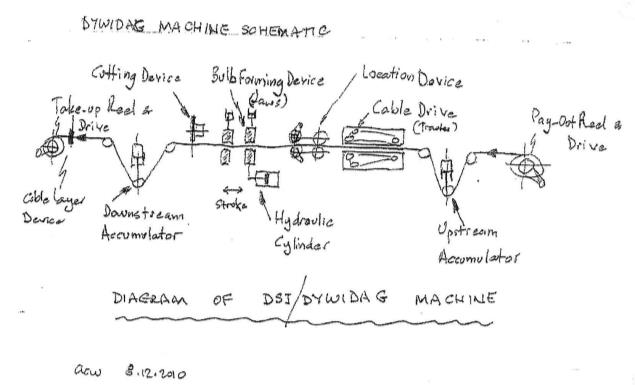
111 The primary judge noted that claim 5 requires the apparatus to have a feed means characterised by a plurality of rollers which clamp the cable to cause it to be fed from the supply reel. Garford submitted that the caterpillar drive or “Cable Drive” identified in Mr Wightley’s handwritten drawing (reproduced in Appendix B to these reasons) satisfied this requirement of the claim. The DSI parties submitted that the drive unit referred to as the “Pay-out Reel Drive” in Mr Wightley’s drawing performs this function since it causes the cable to be fed from the supply reel. The primary judge accepted the DSI parties’ submission.
112 Claim 5 identifies the plurality of rollers as that which causes the cable to be fed from the supply reel. It is apparent from Mr Wightley’s drawing that the caterpillar drive causes the cable to be fed from the “Upstream Accumulator” and that it is the drive unit attached to the supply reel that causes the cable to be fed from the supply reel. We think the primary judge’s decision on this point was correct.
The Notice of Contention
113 The DSI parties raised five contentions. In light of our conclusions on obviousness we propose to deal with these contentions relatively briefly.
Contention 1: Infringement
114 The DSI parties contended that they did not infringe claims 1 and 7 to 11 of the patent because, contrary to the primary judge’s holding at [89], those claims require that the apparatus have a feed means that supplies (or is capable of supplying) cable from a rotatable supply reel and stops operation during each cycle to enable a bulb to be formed. The primary judge found (at [98]) that the DSI apparatus does not have that feature.
115 It is common ground that claim 1 requires that the apparatus include:
(a) a feed means for supplying a multi-strand cable from a rotatable supply reel;
(b) a means for forming the cable with bulbs at spaced intervals; and
(c) a means for determining the position of the cable to stop operation of the feed means to enable a further bulb to be formed.
The DSI parties contended that the drive unit constitutes the feed means in the DSI apparatus because it causes the cable to be fed, and that since it operates continuously, requirement (c) is not satisfied. As previously discussed, Garford submitted that the Cable Drive identified in Mr Wightley’s drawing constituted the feed means.
116 The language of claim 1 requires that there be a “feed means for supplying cable from a rotatable supply reel.” There is no requirement in claim 1 that the feed means be directly associated with the supply reel or that it cause the cable to be fed from the supply reel. In our view the Cable Drive is a “feed means for supplying a multi-strand cable from a rotatable supply reel”.
117 We agree with the primary judge that if claims 1 and 7 to 11 of the patent were valid then they were infringed.
Contentions 2 and 3: Novelty
118 The DSI parties contended that the primary judge erred in holding that claims 1, 5, 6 and 7 were not anticipated by Garford No 1 in the form it took prior to grant (the Garford No 1 application) and by Australian Patent Publication No AU-A-53892/98 (Rock Engineering No 2).
119 The primary judge found that the Garford No 1 application would have anticipated claim 1 (and also dependent claims 5, 6 and 7) but for the fact that it does not disclose the presence and use of a rotatable supply reel as part of the apparatus described. His Honour said at [200]:
I am not persuaded that the Garford No 1 Application discloses the apparatus claimed in claim 1 of the patent. Significantly, the apparatus does not disclose the presence and use of a rotatable supply reel as part of the apparatus that is described. Mr Walton’s evidence was that the tendon displacement means (as I have described it) would be capable of supplying cable from a supply reel. In cross-examination, Mr Wightley agreed. But the Garford No 1 application does not disclose the source of the cable supplied to the described apparatus, let alone that it is supplied from a rotatable supply reel. For example, the described apparatus could equally operate using cable that has been cut to fixed lengths. Indeed, the evidence established that, for the purpose of forming bulbs, the multi-strand cable could be supplied by a variety of different means, including being pulled from the centre of a coil or from a fixed or rotating dispenser in which a coil of cable is housed, or even from a coil of cable suspended from the tines of a forklift. The fact that, under certain instances of commercial operation, it might be convenient, or even a good idea, to use a rotatable supply reel is not to the point.
120 In challenging the correctness of the primary judge’s conclusion on this issue, the DSI parties submitted that the language of claim 1 does not require that the apparatus have a supply reel and that claim 1 will be satisfied if the feed means is suitable for the purpose of supplying cable from a rotatable supply reel. The DSI parties also submitted that the experts were agreed that the Garford No 1 application disclosed a feed means (the tension displacement means) that is suitable for supplying cable from a rotatable supply reel.
121 The question is whether claim 1 requires that the apparatus have a rotatable supply reel or that it merely be capable of receiving cable from a rotatable supply reel. It is true that the description of the invention in the body of the patent specification (including the drawings) discloses the presence of a cable being fed from a rotatable supply reel. However, we think this is because the patent specification not only describes the relevant components that make up the combination of the claimed invention but also how it operates. In these circumstances, we do not think the description of the invention in the patent specification advances the matter.
122 A claim to an apparatus for a particular purpose is a claim to an apparatus that is suitable for that purpose: see, for example, Bühler AG v Satake UK Ltd [1997] RPC 232 (Jacob J); Insituform Technical Services Ltd v Inliner UK Plc [1992] RPC 83 at 102 (Aldous J). To establish infringement of such a claim it is not necessary for the patentee to establish that the apparatus is intended to be used for that purpose. The patentee need only show that the apparatus is suitable for that purpose. The fact that the apparatus could be modified to make it suitable for a specified purpose does not put it within the scope of the claim unless it has been so modified.
123 We are satisfied (as was the primary judge) that the evidence established that the apparatus described in the Garford No 1 application was suitable for use with a rotatable supply reel.
124 The word “for” appears in claim 1 in four places. In our opinion it is used on each of these occasions in the sense we have identified. If the apparatus and each of the relevant means is suitable for its specified purpose then the requirements of claim 1 will be satisfied. In particular, if the apparatus described in the Garford No 1 application has a feed means suitable for supplying multi-strand cable from a rotatable supply reel then this requirement of the claim will be satisfied. We respectfully disagree with the primary judge in so far as he was of a different opinion.
125 However, it does not follow that the Garford No 1 application is an anticipation. The Garford No 1 application will anticipate claim 1 if it contains a clear description of, or clear instructions to make, an apparatus as described in the claim or, at least, if it directs, recommends or suggests to the skilled addressee that such an apparatus be made: The General Tire & Rubber Company v The Firestone Tyre and Rubber Company Limited [1972] RPC 457 at 485-486; Bristol-Myers Squibb Company v F H Faulding & Co Limited (2000) 97 FCR 524 at [67].
126 Mr Walton gave evidence that the Garford No 1 application disclosed a means for determining the position of the cable to stop operation of the feed means to enable a further bulb to be formed. He explained that the description of the second and third embodiments in the Garford No 1 application indicate that, after a bulb is formed, the rock anchor is moved a distance equal to the spacing between the adjacent bulbous portions at which point the rams that cause the movement are “deactivated”. He noted that in the description of the second embodiment, it is stated that this deactivation is “to prevent any further movement of the tendon” (ie. the cable) after which the bulb forming process is repeated. Mr Walton said that the apparatus thus described incorporates a means by which it determines when the rock anchor has moved the distance specified and then stops it. He added that such means must be present for the apparatus to work as described.
127 Mr Wightley did not read the specification this way. In his opinion, the Garford No 1 application does not provide any disclosure concerning the “means for determining the position of the cable.”
128 It is apparent that the primary judge preferred the evidence of Mr Walton. His Honour accepted that the relevant means was disclosed by the description of the operation of the hydraulic timer. Referring to the second embodiment described in the Garford No 1 application the primary judge said at [202]:
In the arrangement there described, the timer coordinates (among other things) the operation of the tendon displacement means to ensure that it moves the cable a distance that equates with the desired spacing of the bulbs that are to be formed and to then stop operation of the tendon displacement means to enable bulb formation to occur in the portion of the cable that has been presented for that purpose.
His Honour also indicated at [204] that there was an “explicit” disclosure of the means for determining the position of the cable.
129 In its written submissions Garford argued that the value of Mr Walton’s evidence was diminished because he was “looking for integers”, the suggestion being, as we understood it, that he was searching for a disclosure of the relevant integer in the prior publication with an intensity and purpose that one would not ordinarily expect from a skilled addressee examining a prior disclosure. We were not referred by counsel to any cross-examination relevant to this submission or any other evidence that would suggest the primary judge should have preferred the evidence of Mr Wightley on this issue.
130 We are not persuaded that the primary judge erred in finding the Garford No 1 application disclosed a means for determining the position of the cable to stop the operation of the feed means to enable a further bulb to be formed. No other arguments were addressed to us as to why, if claim 1 was anticipated by the Garford No 1 application, claim 5, 6 and 7 were not also anticipated by that publication.
131 The primary judge found that Rock Engineering No 2 disclosed the apparatus described in claims 1, 5 and 6 save for the rotatable supply reel. As previously discussed, these claims do not require that there be a rotatable supply reel, only that the apparatus include a feed means that is suitable for supplying multi-strand cable from a rotatable supply reel. In this respect claims 1, 5 and 6 raise the same point already considered by us in relation to the Garford No 1 application.
132 There is one other point that arises in relation to claim 7. His Honour rejected the DSI parties argument that claim 7 was anticipated by Rock Engineering No 2 on two grounds. The first was that which we have already addressed in relation to claims 1, 5 and 6 about which nothing more need be said. However, the primary judge also found that Rock Engineering No 2 did not disclose the bulb forming means referred to in claim 7 because the second set of jaws in the apparatus described in Rock Engineering No 2 has three opposing jaw elements.
133 The DSI parties submitted that there is nothing in either the claim or the specification of the patent that excludes from the scope of claim 7 embodiments which use three opposing jaw elements rather than two. We do not accept this submission.
134 The clamping means used in the apparatus described in Rock Engineering No 2 consists of (page 7, lines 3-6):
“…a collet type jaw which comprises an externally cone-shaped sleeve which is divided into three separable segments… which are housed within an internally cone-shaped sleeve…”
We do not think the collet type jaw described in Rock Engineering No 2 has “pairs of opposed jaws… arranged to be brought together” as described in claim 7. In particular the collet type jaw does not consist of a pair of opposing jaws. We therefore agree that claim 7 was not anticipated by Rock Engineering No 2.
135 In the result, we are satisfied that claims 1, 5, 6 and 7 were anticipated by the Garford No 1 application and that claims 1, 5 and 6 were also anticipated by Rock Engineering No 2.
Contention 4: Secret Use
136 The primary judge rejected the DSI parties’ contention that Garford’s use of its old apparatus amounted to the secret use of the invention claimed in claims 1 and 7 to 10 of the patent solely on the basis that the “stop marker” of the old apparatus was not a “means for determining the position of the cable to stop operation of the feed means to enable a further bulb to be formed” as required by claim 1.
137 When using the old apparatus one operator visually lined up the last bulb to be formed in the cable with a positional marker (the so-called “stop marker”) so that he or she could then tell the other operator to stop the electric motor that drove the take-up reel. The primary judge rejected the DSI parties’ submission that the stop marker constituted the relevant means. His Honour said at [161] that “means for determining the position of the cable to stop operation [etc]” refers to “apparatus” means by which we understand his Honour to refer to mechanical or electronic means as opposed to those dependent upon human intervention. His Honour added that the claim:
“…requires an interrelationship in which the means both determines the position of the cable and functions to stop operation of the feed means.”
The DSI parties submitted that the primary judge thereby imported a limitation that is not supported by the language of the claims when read in light of the specification as a whole.
138 We accept the DSI parties’ submission on this issue.
139 The language of the claim is in our view ambiguous, but the specification does not provide any real assistance in resolving the ambiguity.
140 It seems to us that the words “to stop operation of the feed means [etc]” describe the purpose of the relevant means in the sense that they are to determine the position of the cable so that the operation of the feed means may be stopped at an appropriate point. The relevant means need not be capable of stopping operation of the feed means. The position would be different if the claim referred to “a means for determining the position of the cable and to stop the operation of the feed means...”. However that is not what the claim says. We think this interpretation of the claim also draws support from the presence of claim 3 which plainly describes a means that both determines the position of the cable and stops operation of the feed means. This is an additional requirement not present in claim 1.
141 Having regard to the primary judge’s other unchallenged findings relevant to this issue, we think claims 1 and 7 to 10 are also invalid for secret use.
Contention 5: Insufficiency
142 The DSI parties informed the Court that this contention was only pressed if the primary judge’s findings on obviousness were overturned. In the circumstances, we do not propose to address this contention.
disposition
143 The appeal must be dismissed.
144 In relation to costs, Garford was wholly unsuccessful in its appeal, while the DSI parties enjoyed mixed results on their notice of contention. In the circumstances, we propose to order that Garford pay 80% of the DSI parties’ costs of the appeal. However, we will suspend the operation of the costs order for a period of 14 days to provide any party who wishes to argue for a different order with an opportunity to inform the Court of the order it seeks. That should be done by way of a brief written submission (limited to 2 pages). The Court can make further directions in relation to submissions in reply at a later date should it be necessary to do so.
145 There will be orders accordingly.
I certify that the preceding one hundred and forty-five (145) numbered paragraphs are a true copy of the Reasons for Judgment herein of the Honourable Justices Dowsett, McKerracher and Nicholas. |
Associate:
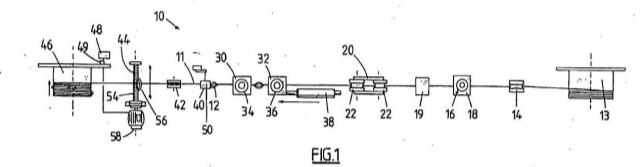
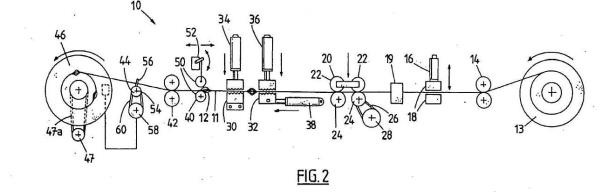
Appendix B