

FEDERAL COURT OF AUSTRALIA
IOOF Holdings Limited v Commissioner of Taxation [2014] FCAFC 91
| IN THE FEDERAL COURT OF AUSTRALIA | |
| Appellant | |
| AND: | First Respondent ADMINISTRATIVE APPEALS TRIBUNAL Second Respondent |
| DATE OF ORDER: | |
| WHERE MADE: |
THE COURT ORDERS THAT:
2. The appellant pay the first respondent’s costs of the appeal.
Note: Entry of orders is dealt with in Rule 39.32 of the Federal Court Rules 2011.
| VICTORIA DISTRICT REGISTRY | |
| GENERAL DIVISION | VID 1310 of 2013 |
| ON APPEAL FROM THE FEDERAL COURT OF AUSTRALIA |
| BETWEEN: | IOOF HOLDINGS LIMITED Appellant |
| AND: | COMMISSIONER OF TAXATION First Respondent ADMINISTRATIVE APPEALS TRIBUNAL Second Respondent |
| JUDGES: | JESSUP, ROBERTSON & DAVIES JJ |
| DATE: | 24 JULY 2014 |
| PLACE: | MELBOURNE |
REASONS FOR JUDGMENT
Jessup J
1 I have had the benefit of reading the reasons of Robertson J in draft. I agree that the orders proposed by his Honour should be made, but I would take a somewhat different approach to the determination of the issues which arise for consideration from that taken by his Honour. In what I have written below, I assume an acquaintance with his Honour’s reasons.
2 In the Administrative Appeals Tribunal (“the Tribunal”), the appellant contended that its application for a review of the Commissioner of Taxation’s (“the Commissioner”) (deemed) disallowance of its objection to the Commissioner’s failure to give the ruling which it sought on 30 December 2010 had to be decided by reference to the provisions of the Income Tax Assessment Act 1997 (Cth) (“the 1997 Act”) before the amendments effected by the Tax Laws Amendment (2012 Measures No 2) Act 2012 (Cth) (“the 2012 Act”). That contention became the subject of the preliminary question which the Tribunal answered in the negative. In this Court, the primary judge held that the Tribunal had not erred in law in giving that answer.
3 In support of its challenge to that holding, the appellant submitted that the case involved two questions: first, whether, when it applied for the ruling on 30 December 2010, or when it applied for a review of the Commissioner’s disallowance of 21 December 2011, or at both such times, the appellant had an accrued right within the terms of s 7(2)(c) and (e) of the Acts Interpretation Act 1901 (Cth) (“the Acts Interpretation Act”), and, secondly, if there were such a right, whether the application of s 7(2)(c) and (e) was subject to a contrary intention, within the meaning of s 2(2) of that Act, conveyed by the relevant terms of the 2012 Act.
4 Both at first instance and now on appeal, the “right” for which the appellant contended was a right to a ruling based on the taxing rules which were operative before 31 March 2011. The primary judge was prepared to assume that the appellant had an accrued right, within the terms of s 7(2)(c) of the Acts Interpretation Act, to a ruling based on the taxing rules operative before 31 March 2011. His Honour then moved to the question which arose under s 2(2) of the Acts Interpretation Act, namely, whether the application of s 7(2)(c) was “subject to a contrary intention”. On appeal, the Commissioner put both questions in play, and the appellant accepted that it was obliged to deal with the first question, notwithstanding that an answer which was favourable to it had been assumed by the primary judge. In the circumstances, I take the view that we are not entitled to follow the course adopted by his Honour, but must decide the first question for ourselves.
5 The right upon which the appellant relied would arise in the following way. Under s 359-10(1) of Sch 1 (“the Schedule”) to the Taxation Administration Act 1953 (Cth) (“the Administration Act”), a taxpayer may apply to the Commissioner for a “private ruling”, that is to say, for a “written ruling on the way in which the Commissioner considers a relevant provision applies or would apply to you in relation to a specified scheme” (s 359-5(1) of the Schedule). In the present case, the “relevant provision” (s 357-55 of the Schedule) was s 716-405 of the 1997 Act. In its amended objection of 20 October 2011, the applicant sought a “conclusion” – and thereby, as I understand it, a ruling – that “the tax cost setting amounts attributable to the Contractual Rights are deductible over 10 years in accordance with section 716-405, commencing in the year ended on 30 June 2009”.
6 The appellant’s application for a ruling having been made, the Commissioner was obliged to comply with it and to make the ruling: s 359-35(1) of the Schedule. There was, however, no time specified within which the ruling had to be made. Rather, if the ruling had not been made within 60 days, the taxpayer was entitled to give the Commissioner a written notice under s 359-50(1) of the Schedule requiring him to make the ruling. In the present case, that provision was activated, the appellant’s notice having been given on 19 August 2011. If the ruling had still not been given within a further 30 days, the taxpayer was entitled to object, in the manner set out in Pt IVC of the Administration Act, against the failure to make the ruling: s 359-50(3) of the Schedule. Again, in the present case, these provisions were activated, the appellant having lodged an objection on 29 September 2011 and a revised objection on 20 October 2011. Thenceforth, the matter proceeded under Pt IVC. The Commissioner did not make a private ruling within the period of 60 days for which s 14ZYB(1) of the Administration Act provides, and the objection was, therefore, taken to have been disallowed by the operation of subs (2) of that section. Finally, under s 14ZZ(a)(i) of the Administration Act, the appellant was entitled to apply, and on 15 February 2012 it did apply, to the Tribunal for review of the s 14ZYB disallowance.
7 Pursuant to the provisions referred to above, the appellant had, and exercised, certain rights: the right to apply for a private ruling under s 359-10(1) of the Schedule, the right to give a notice under s 359-50(1) of the Schedule, the right to object under s 359-50(3) of the Schedule, and the right to apply for review to the Tribunal under s 14ZZ(a)(i) of the Administration Act. These provisions founded the submission made on behalf of the appellant that it had a right to receive a ruling, a submission which, having regard to s 359-35(1) of the Schedule, could not seriously be disputed. Understood at this level, the appellant’s case identified, and relied on, a right which arose under the Administration Act.
8 The appellant invoked the provisions of paras (c) and (e) of s 7(2) of the Acts Interpretation Act, which I set out below (together with those of para (b) which, for reasons which will appear presently, must now also be considered):
If an Act, or an instrument under an Act, repeals or amends an Act (the affected Act) or a part of an Act, then the repeal or amendment does not:
…
(b) affect the previous operation of the affected Act or part (including any amendment made by the affected Act or part), or anything duly done or suffered under the affected Act or part; or
(c) affect any right, privilege, obligation or liability acquired, accrued or incurred under the affected Act or part; or
…
(e) affect any investigation, legal proceeding or remedy in respect of any such right, privilege, obligation, liability, penalty, forfeiture or punishment.
Any such investigation, legal proceeding or remedy may be instituted, continued or enforced, and any such penalty, forfeiture or punishment may be imposed, as if the affected Act or part had not been repealed or amended.
Note: The Act that makes the repeal or amendment, or provides for the instrument to make the repeal or amendment, may be different from, or the same as, the affected Act or the Act containing the part repealed or amended.
Each of these provisions of s 7(2) operates with respect to “the affected Act or part”, that is to say, the Act or part which has presumptively been repealed or amended.
9 Looking only at the plain words of s 7(2), the appellant’s argument would seem to encounter an insuperable difficulty, which ought to have been recognised both in the Tribunal and before the primary judge. In the facts of the present case, the 2012 Act is the “Act” first mentioned in s 7(2), and the 1997 Act is the “Act” there second mentioned, that is, the “affected Act”. The Administration Act was not amended in any respect which is relevant to the present appeal. But the “right” upon which the appellant relied was one which arose under the Administration Act. It did not arise under the 1997 Act. It may be that the content of the ruling applied for was given by a provision of the 1997 Act, but the right to the ruling did not arise under that Act. It did not arise under the Act which was amended.
10 When this difficulty was drawn to the attention of the appellant in correspondence from the Court after we had reserved judgment, it took the opportunity to file a written submission which dealt with the point. It is with that submission that the balance of these reasons is concerned.
11 The appellant first submitted that the rights upon which it relied were not confined to the right to receive a private ruling. They included the right, under its objection, to require the Commissioner to make a ruling in accordance with the draft which had been lodged with the objection, or to make “a different ruling”. They included also the right to have the Commissioner’s disallowance of the objection reviewed by the Tribunal. All this may be granted, but the rights relied on, to the extent that they arose at all, arose under the Administration Act.
12 The appellant also submitted that each of these rights was a right to have the ruling made, the objection considered and the disallowance reviewed “according to law”. This too may be granted, but the conclusion does not, in the unelaborated terms in which it was expressed, take the matter any further: even rights so described would arise under the Administration Act, not the 1997 Act.
13 I consider next so much of the appellant’s submissions as invoked the terms of paras (c) and (e) of s 7(2) of the Acts Interpretation Act. The availability of para (e) depends, of course, upon a finding that there was a right (etc) of the kind referred to in para (c), and it is convenient to address those submissions by reference to that paragraph.
14 It is said that the provisions of the 1997 Act “are expressly incorporated in” the Administration Act, reference being made in this respect to subss (2) and (3) of s 3AA of the latter. I would not accept that these provisions are to the effect submitted. They are both interpretation provisions only. They do not produce the result that the Administration Act is the same Act as the 1997 Act for the purposes of the application of s 7(2) of the Acts Interpretation Act.
15 The appellant next relied on para 7.23 of Pearce, DC and Geddes, RS, Statutory Interpretation in Australia, 7th ed, 2011, for the proposition that “courts look at the effect of a provision rather than its form to determine whether it amends an earlier statute”, and that, “[i]f the court is satisfied that the intended effect of the later Act is to bring about an alteration in the operation of the earlier Act, the later Act will be regarded as an amending Act”. Although not articulated in the appellant’s written submission, I gather that the point being made here was that the Administration Act was, as a matter of substance if not form, amended by the 2012 Act because there was an alteration in the operation of it. I would not accept such a submission. Relevantly to the present issue, the “operation” of the Administration Act was, and remained, by way of enabling a taxpayer to obtain the view of the Commissioner about how certain laws (including the 1997 Act) applied to him or her. An amendment to one of those laws did not amend the Act that provided the machinery for such a view to be obtained, and for the consequences of the expression of such a view. No more so did it do that than an amendment to the 1997 Act, for example, would ipso facto also amend the provisions of the Administration Act that provide for appeals and reviews or, for that matter, the Administrative Appeals Tribunal Act 1975 (Cth) (“the AAT Act”) or the Federal Court of Australia Act 1976 (Cth).
16 It was next submitted on behalf of the appellant that it was an object of the Administration Act to confer entitlements on taxpayers in respect of other enactments, including the 1997 Act. This was achieved by the procedure for obtaining the view of the Commissioner under the system of private rulings, and by provisions which made such an opinion binding on the Commissioner if the 1997 Act would otherwise have ordained a result which was less favourable for the taxpayer. It was pointed out that, under s 357-85, a private ruling ceases to be binding if the provision to which the law relates is amended, unless the new provision expresses the same ideas as the old provision. “Therefore”, it was said, “an amendment to a provision which is the subject of a private ruling ... may, through the operation of s 357-85, affect an entitlement arising under” the Administration Act.
17 The appellant’s submission appears to involve the proposition that an amendment of the 1997 Act would, in a case such as the present was said to be, change what would otherwise be the presumptively correct, or lawful, content of a ruling given under the Administration Act, and thus affect entitlements (in the language of s 7(2) of the Acts Interpretation Act, “rights”) arising under the Administration Act. I would accept that an amendment of the 1997 Act would have the potential to affect the content of a private ruling for which a taxpayer had applied before the amendment, and thus, in appropriate circumstances, the taxable income which would be the outcome of the Commissioner’s assessment. However, accepting everything that the appellant has here submitted, the fact remains that the right referred to would be one which arose “under” the Administration Act rather than under the Act which was amended. This way of expressing the appellant’s position gets it no closer to overcoming the problem to which I have referred in para 10 above.
18 Finally with respect to para (c) of s 7(2) of the Acts Interpretation Act, the appellant pointed to the occasion when Part 5-5 was introduced into the Schedule by an amendment made by the A New Tax System (Tax Administration) Act 1999 (Cth) (“the 1999 Act”). Previously, provisions to substantially the same effect were to be found in ss 170BA – 170BI of the Income Tax Assessment Act 1936 (Cth) (“the 1936 Act”). Absent any indication of an intention to effect substantive law reform at this time, it was said that it would be “anomalous” if the removal of provisions which previously would have given a taxpayer a “right” of the kind recognised by s 7(2)(c) into a separate Act were to be held to deprive him or her of that right.
19 I would accept that, in some situations, the fact that a particular construction of a statutory provision would give rise to anomalies might properly be taken into account in the course of identifying the intention of the legislature. But the issue which presently confronts the Court is not one of construction. No part of the appellant’s submissions points to any provision which is said to be unclear, or of uncertain meaning, such that a construction which would not produce an anomalous result should be preferred. In these circumstances, it is not sufficient, and does not lead anywhere as a matter of legal analysis, for the appellant merely to propose that it would be anomalous for a taxpayer in its position to be denied the benefit of s 7(2)(c), whereas before the amendment made by the 1999 Act it would have had the benefit of that provision.
20 It may be that, when the amendment made by the 1999 Act was made, the legislature did not turn its mind to the consequences of the amendment to the operation of the Acts Interpretation Act apropos the position of a taxpayer who applied for a ruling before an amendment to the 1936 Act or the 1997 Act but who did not receive that ruling until after such an amendment. If so, it is not obvious how the legislature would have resolved that question had it thought about it. It could not be said that it would necessarily have done so by providing, for example, that, for the purposes of s 7(2) of the Acts Interpretation Act, the 1936 Act, the 1997 Act and the Administration Act were to be treated as the same Act. It is, however sufficient for present purposes to note that there is nothing in the terms of the relevant legislation, and nothing in the materials which are conventionally available as aids to construction, which points towards an intention to that effect.
21 As mentioned above, in its submissions recently filed the appellant relied also on para (b) of s 7(2) of the Acts Interpretation Act. It was said that its application for a private ruling “concerned the operation” of the 1997 Act, even though the right to a ruling as such did not arise under that Act. I would accept, of course, that s 7(2)(b) applied to the amendments to the 1997 Act effected by the 2012 Act. At that level, however, there could not be any doubt about the existence of a contrary intention within the meaning of s 2(2) of the Acts Interpretation Act. The provisions of the 2012 Act that dealt with the dates of application of the various amendments which were then made to the 1997 Act did affect, and were unambiguously intended to affect, the “previous operation” of the 1997 Act.
22 The appellant relied also on the second limb of s 7(2)(b) of the Acts Interpretation Act in submitting that the 2012 amendment to the 1997 Act had “the potential to affect something done ([the appellant’s] ruling application) before the amendment” under the 1997 Act. In this part of its argument, however, the appellant has invoked a formula which finds no place in para (b). The question is not whether there was anything done before the amendment. It is whether there was anything done under the affected Act. In the present case, the thing referred to, the appellant’s application for a private ruling, was done under the Administration Act, not under the affected Act.
23 Finally, the appellant submitted that, even if it were unable to rely on s 7(2) of the Acts Interpretation Act, the correct application of the common law presumption against the retrospective operation of legislation would produce the result for which it contended before the Tribunal. In this area of the case, it is sufficient to note the terms in which the presumption was articulated by Dixon CJ in Maxwell v Murphy (1957) 96 CLR 261, 267:
The general rule of the common law is that a statute changing the law ought not, unless the intention appears with reasonable certainty, to be understood as applying to facts or events that have already occurred in such a way as to confer or impose or otherwise affect rights or liabilities which the law had defined by reference to the past events.
It was submitted that, under this principle, the rights referred to are not limited to rights arising under the statute that has been amended. This submission must be accepted so far as it goes, since the rule referred to by Dixon CJ applies generally to new legislation, even in situations in which there was no amendment of an existing Act. Legislation by way of law reform which prohibited some previously unregulated activity, for example, would attract the operation of the rule.
24 When it comes to the application of the rule to the facts of the present case, however, it is not apparent that a result different from that which obtains under s 7(2) of the Acts Interpretation Act would be yielded. The rule takes as its starting point facts or events which have already occurred and in relation to which the law has defined rights or liabilities. The rule is then concerned with the application of the statute which changes the law to those facts or events. In the present case, the statute which changed the law was the 2012 Act, and the previous facts to which it applied were the taxable incomes of those who were subject to the 1997 Act. At this level, I do not understand it to be suggested on behalf of the appellant that the retrospective application of the 2012 Act did not, “with reasonable certainty”, appear from the terms of that Act itself.
25 Although, in its written submissions recently filed, the appellant did not make it entirely clear where its common law argument would proceed from there, I am prepared to assume that its point is that the right which the law had defined by reference to past events was not the right to have its taxable income assessed in accordance with the pre-existing law but the right to which I referred in para 7 above, namely, the right to receive a private ruling in accordance with law. Immediately before the commencement of the 2012 Act, the appellant had a right to have its application for a review of the Commissioner’s deemed disallowance dealt with by the Tribunal. That right was unaffected by that commencement. It may be that the content of any ruling made by the Tribunal would stand to be affected by the commencement, but, once one moves to outcome as distinct from process, one is back in the area of the 1997 Act and its clear intention of retrospective application with which I have dealt in the previous paragraph. Maxwell v Murphy is not authority for the proposition that a taxpayer in the position of the appellant in the present case may call upon the Tribunal to apply substantive assessment provisions which have been repealed, and contrary to clear indications as to the timing of the application of that repeal, purely on the basis that it had a procedure pending which would give it the benefit of the Tribunal’s opinion (that is, on a review of the Commissioner’s disallowance of an objection against his failure to provide his own opinion). At the point of providing that opinion, and subject, of course, to such operation as s 7(2) of the Acts Interpretation Act may have in the circumstances, the Tribunal would be bound by the law as it then knows it to be, including so much of it as lays down the timing of the application of recent changes to the law.
26 The only other matter which should be mentioned is the appellant’s conditional reliance on s 43(6) of the AAT Act, to which Robertson and Davies JJ have referred in their reasons. On the hearing of the appeal, counsel for the appellant made it clear that, if their client were unsuccessful on the main points in the case – the existence of an accrued right under s 7(2) of the Acts Interpretation Act and the absence of a contrary intention under s 2(2) of that Act – it could not succeed under s 43(6). In the circumstances, I would say nothing about the operation of that subsection.
27 For the above reasons, the Tribunal was, as a matter of law, bound to answer the separate question in the negative. I would dismiss the appeal.
| I certify that the preceding twenty-seven (27) numbered paragraphs are a true copy of the Reasons for Judgment herein of the Honourable Justice Jessup. |
Associate:
| IN THE FEDERAL COURT OF AUSTRALIA | |
| VICTORIA DISTRICT REGISTRY | |
| GENERAL DIVISION | VID 1310 of 2013 |
| ON APPEAL FROM THE FEDERAL COURT OF AUSTRALIA |
| BETWEEN: | IOOF HOLDINGS LIMITED Appellant |
| AND: | COMMISSIONER OF TAXATION First Respondent ADMINISTRATIVE APPEALS TRIBUNAL Second Respondent |
| JUDGES: | JESSUP, ROBERTSON & DAVIES JJ |
| DATE: | 24 JULY 2014 |
| PLACE: | MELBOURNE |
REASONS FOR JUDGMENT
robertson J
Introduction
28 This appeal is from the judgment of a judge of this Court, given on 15 November 2013, dismissing an application for judicial review of the decision of the Administrative Appeals Tribunal (the Tribunal): Re IOOF Holdings Limited and Commissioner of Taxation [2013] AATA 239. The question before the primary judge was whether the Tribunal erred in law in deciding that the following preliminary question should be answered ‘no’:
For the purposes of undertaking its review of the Respondent’s deemed disallowance of the Applicant’s objection against the Respondent’s failure to make a private ruling concerning its claim for a deduction under section 716-405 in Part 3-90 of the Income Tax Assessment Act 1997 (Cth) (1997 Act), is it open to the Tribunal to apply the provisions of Part 3-90 of the 1997 Act before the amendments contained in the Tax Laws Amendment (2012 Measures No 2) Act 2012 (Cth)?
29 As stated by the Tribunal, the subject matter of the private ruling application was the applicability of s 716-405 of the Income Tax Assessment Act 1997 (Cth) (the 1997 Act) upon the appellant’s (IOOF’s) purchase of shares in Australian Wealth Management Limited on 30 April 2009 and whether or not rights pursuant to a variety of contracts were rights to future income in respect of which deductions were allowable over time.
Chronology
30 IOOF applied for the private ruling under s 359-10 of Sch 1 to the Taxation Administration Act 1953 (Cth) (the Administration Act) on 30 December 2010. The question posed in the application was:
Are the contractual rights of the members of the Australian Wealth Management Limited (“AWM”) tax consolidated group under contracts existing as at 30 April 2009 between those members and their customers (“Contractual Rights”), ‘rights to future amounts’ as defined in section 716-405 of the Income Tax Assessment Act 1997 (“ITAA 1997”), such that the tax cost setting amounts attributable to the Contractual Rights are deductible in accordance with section 716-405 of the ITAA 1997?
31 The tax law then in effect, and on which IOOF sought the ruling, was the law introduced by the Tax Laws Amendment (2010 Measures No 1) Act 2010 (Cth) (the 2010 Act), which relevantly took effect on 3 June 2010. Relevantly, it introduced into the 1997 Act an entitlement to a deduction for rights to future income under s 716-405, with retrospective effect from 1 July 2002, being the date that the tax consolidation regime took effect: see the New Business Tax System (Consolidation) Act (No 1) 2002 (Cth) (the 2002 Act).
32 The Commissioner of Taxation (the Commissioner) said in a letter dated 13 January 2011 that IOOF’s application for a private ruling was received by the Australian Taxation Office (ATO) on 10 January 2011.
33 The Commissioner had not made a ruling on the application by 19 August 2011 and on that date IOOF gave the Commissioner written notice under s 359-50(1) of Sch 1 to the Administration Act requiring him to make the private ruling, following the expiry of the 60 day period, specified in that section, after the application was made.
34 The Commissioner failed to make a ruling and by email dated 20 October 2011 IOOF objected under s 359-50(3) of Sch 1 to the Administration Act to the Commissioner’s failure to make the private ruling. As required by s 359-50(4), it lodged a draft private ruling with the objection.
35 As the Commissioner did not provide a private ruling within 60 days of receipt of the objection against the failure to make a ruling, on 19 December 2011 IOOF’s objection was deemed to be disallowed under s 14ZYB of the Administration Act.
36 On 15 February 2012 IOOF applied to the Tribunal for review of the deemed disallowance of its objection to the Commissioner’s failure to make a private ruling.
37 As may be seen, no private ruling had been issued before 31 March 2011 or before 29 June 2012. The significance of those dates to the parties’ submissions appears from the following chronology of the relevant legislative provisions. It will be noted that the date on which IOOF applied to the Tribunal, 15 February 2012, preceded the date on which the relevant provisions of the Tax Laws Amendment (2012 Measures No 2) Act 2012 (Cth) (the 2012 Act) commenced, 29 June 2012.
Chronology of the tax legislation
38 I set out the following dates on the basis that they may assist in understanding the statutory history and, more significantly, why certain dates are specified in the 2012 Act.
39 On 1 July 2002, the tax consolidation regime took effect: see the 2002 Act.
40 On 3 June 2010, the 2010 Act received Royal Assent. It was passed by both Houses of Parliament on 12 May 2010. Relevantly, it introduced an entitlement to a deduction for rights to future income under s 716-405 into the 1997 Act with retrospective effect from 1 July 2002.
41 On 30 March 2011, the Assistant Treasurer and Minister for Financial Services and Superannuation announced that the government had asked the Board of Taxation to review the consolidation rights to future income and residual tax cost setting rules.
42 In a media release dated 25 November 2011, the Assistant Treasurer and Minister for Financial Services and Superannuation stated that the government would introduce changes to income tax law affecting consolidated groups, relating to the way a consolidated group could deduct the costs allocated to some assets following a corporate acquisition. The Minister said the changes implemented the recommendations of the Board of Taxation for future consolidations and sought to ensure that companies inside corporate groups did not receive tax benefits which corporates outside consolidated groups were unable to receive.
43 On 29 June 2012, the 2012 Act received Royal Assent.
44 Item 50 of Sch 3 to the 2012 Act referred to the “pre rules, interim rules or prospective rules” which respectively apply to an assessment of the head company of a consolidated group for an income year in respect of an entity that becomes a member of the group primarily by reference to whether: the joining time was before 12 May 2010 (the date the 2010 Act was passed by the Parliament); the joining time was on or after 12 May 2010 and on or before 30 March 2011 (the date the government had asked the Board of Taxation to review the consolidation rights to future income and residual tax cost setting rules); or the joining time was on or after 31 March 2011.
45 Item 51 applied in terms, relevantly, to a private ruling issued before 31 March 2011.
46 These provisions are set out more fully below.
Other statutory provisions
47 As already indicated, the ultimate legal question is whether it is open to the Tribunal to apply the provisions of Part 3-90 of the 1997 Act before the amendments contained in the 2012 Act.
48 IOOF submitted that in the events which happened it had one or more accrued rights which had the result that it was so open to the Tribunal.
49 Sections 2 and 7 of the Acts Interpretation Act 1901 (Cth) (the Acts Interpretation Act) provided, relevantly:
(1) This Act applies to all Acts (including this Act).
(2) However, the application of this Act or a provision of this Act to an Act or a provision of an Act is subject to a contrary intention.
7 Effect of repeal or amendment of Act
…
No effect on previous operation of Act or part
(2) If an Act, or an instrument under an Act, repeals or amends an Act (the affected Act) or a part of an Act, then the repeal or amendment does not:
(a) …; or
(b) affect the previous operation of the affected Act or part (including any amendment made by the affected Act or part), or anything duly done or suffered under the affected Act or part; or
(c) affect any right, privilege, obligation or liability acquired, accrued or incurred under the affected Act or part; or
(d) …; or
(e) affect any investigation, legal proceeding or remedy in respect of any such right, privilege, obligation, liability, penalty, forfeiture or punishment.
Any such investigation, legal proceeding or remedy may be instituted, continued or enforced, and any such penalty, forfeiture or punishment may be imposed, as if the affected Act or part had not been repealed or amended.
Note: The Act that makes the repeal or amendment, or provides for the instrument to make the repeal or amendment, may be different from, or the same as, the affected Act or the Act containing the part repealed or amended.
Interpretation
(3) A reference in subsection (1) or (2) to the repeal or amendment of an Act or of a part of an Act includes a reference to:
(a) a repeal or amendment effected by implication; and
(b) the expiry, lapsing or cessation of effect of the Act or part; and
(c) the abrogation or limitation of the effect of the Act or part; and
(d) the exclusion of the application of the Act or part to any person, subject-matter or circumstance.
(4) A reference in this section to a part of an Act includes a reference to any provision of, or words, figures, drawings or symbols in, an Act.
The reasoning of the primary judge
50 The primary judge assumed that IOOF had an “accrued right” to a ruling based on the taxing rules operative before 31 March 2011, as seemed to be accepted by the Tribunal. His Honour then reasoned, considering the operation of the 2012 Act having regard to its purpose and context, that a contrary intention was clearly disclosed to displace the continuation of that accrued right. His Honour held that the application provisions in the 2012 Act were intended to deal exhaustively with which version of the 1997 Act applied in respect of all acquisitions made by consolidated groups from 1 July 2002 and retrospectively amended the 2010 Act. His Honour reasoned that the “main application” provision, in item 50 of Pt 4 of Sch 3 to the 2012 Act, subject to item 51, established an exhaustive set of provisions for the purposes of determining which of the “original 2002 law”, the “pre rules”, the “interim rules” and the “prospective rules” applied to an assessment of the head company for an income year in respect of a joining entity in a given year of income. His Honour said the form and content of the 2012 Act was of significance, particularly when read in light of the same structure adopted in the 2010 Act, itself operating retrospectively.
51 His Honour held at [37] that, given the way in which item 51 of Pt 4 of Sch 3 to the 2012 Act was expressed, the presence of item 51 did not reveal, as was suggested by IOOF, a “legislative intent to preserve the rights of taxpayers who applied for private rulings” but, read in context with item 50, was intended to preserve the rights of taxpayers who had been issued with a private ruling before 31 March 2011, consistent with its express terms.
52 At [38] his Honour said that to the extent that resort to extrinsic materials was necessary or desirable, the explanatory memorandum to the Tax Laws Amendment (2012 Measures No 2) Bill 2012 (Cth) indicated that the purpose of the 2012 Act was to remove retrospectively the operation of provisions introduced by the 2010 Act that permitted consolidated groups to access deductions not available to taxpayers outside the consolidation regime. Further, the explanatory memorandum stated that the question of which law was to apply, out of the pre rules, the interim rules, the prospective rules and the original 2002 law, would be determined by reference to when the corporate acquisition to which the tax cost setting process was being applied took place. The only exception contemplated by the explanatory memorandum to the 2012 Act rectifying the amendments made by the 2010 Act with retrospective effect was where, relevantly, a claim was covered by a private ruling issued before 31 March 2011.
53 At [39] his Honour rejected the submission by IOOF that it was significant that item 51 did not refer to taxpayers who had appeals on foot.
The Notice of Appeal
54 The grounds of appeal were in the following terms:
1. The trial judge erred in finding that the Appellant’s right to a deduction under s 716-405 of the Income Tax Assessment Act 1997 was abrogated by the Tax Laws Amendment (2012 Measures No. 2) Act 2012 (the 2012 Amending Act).
2. The trial judge ought to have held:
a. The Appellant had acquired or accrued a right or privilege under subsection 7(2) of the Acts Interpretation Act 1901 to have its appeal from the deemed disallowance of its objection to the First Respondent's failure to provide a private ruling heard and determined in accordance with the law as it stood prior to the enactment of the 2012 Amending Act.
b. There was no contrary intention to the survival of that right or privilege.
c. The transitional provisions contained in the 2012 Amending Act were not exhaustive in the sense described in GF Heublein and Bro Inc v Continental Liqueurs Pty Ltd (1962) 109 CLR 153 and therefore did not abrogate the Appellant's accrued right.
3. The trial judge further erred in finding that if the Second Respondent were to find that the First Respondent should have made a favourable private ruling, it was not possible for the Applicant [sic] to satisfy the requirements of Item 51 of Sch. 3 of the 2012 Amending Act.
4. The trial judge ought to have held:
a. that if the Second Respondent was to ultimately find in favour of the Applicant and exercise its power under section 43(6) of the Administrative Appeals Tribunal Act 1975 to deem the decision to take effect before 30 March 2011, that decision could satisfy the requirements of Item 51 of Sch. 3 of the 2012 Amending Act.
b. Subsection 43(1) and 43(6) operate together and the legislation does not presuppose the exercise of subsection 43(1) before the operation of section 43(6).
c. If a decision is given effect from an earlier date in accordance with section 43(6), the law to be applied must be the law as at the date the order takes effect.
The issues
55 IOOF submitted there were two essential questions of law. First, whether IOOF had accrued rights to have its private ruling application determined according to the law as it stood prior to the 2012 Act, first by the Commissioner and subsequently by the Tribunal. If there were such accrued rights, the second question was whether those rights were abrogated by the 2012 Act. In particular, insofar as the 2012 Act contained any transitional provisions, the question was whether they were exhaustive so as to negate IOOF’s accrued rights.
56 IOOF contended for a series of accrued rights involving: (1) applying for a private ruling (which it did on 30 December 2010); (2) giving the Commissioner written notice requiring him to make the ruling (which it did on 19 August 2011); (3) objecting to the Commissioner's failure to make the private ruling (which it did by email dated 20 October 2011); and (4) seeking review in the Tribunal (which it did on 15 February 2012).
57 IOOF submitted that it had that progressive series of rights before the commencement of the 2012 Act. IOOF’s accrued right, it was submitted, was to have its application for a private ruling as to the application of the law as it stood in 2010 and 2011 decided according to law, being the law as it stood prior to the commencement of the 2012 Act: that is, the rights and obligations under the 2010 Act as unaffected by the 2012 Act. If IOOF obtained a private ruling to that effect, in the terms sought, that would bind the Commissioner to apply the law as it stood in 2010 and 2011 to the transaction outlined in the private ruling application, unaffected by the later 2012 amendments to that law made by the 2012 Act. It was argued that IOOF would be placed in the same position, effectively, as if it had a private ruling issued before 31 March 2011, which would fall squarely within item 51 of Pt 4 of Sch 3 to the 2012 Act.
58 The Commissioner submitted that the main issue was whether IOOF remained entitled to a private ruling on the law as it stood before the 2012 retrospective amendments, on the basis that the original 2010 law was the law when it made its application for a private ruling on 30 December 2010, and when it applied to the Tribunal for review on 15 February 2012.
59 On the question of accrued rights, the Commissioner submitted that the question was whether IOOF could assert a right to have a ruling made on the basis of the law that was in force at the time it applied for its ruling or applied for review to the Tribunal. That then led to the question whether an asserted right of that type was one that was capable of constituting an accrued right for the purposes of s 7 of the Acts Interpretation Act. The Commissioner submitted that because of the nature of the private ruling regime itself, the nature of the asserted right fell outside the realm of an accrued right. The Commissioner submitted that as a private ruling expresses the Commissioner’s opinion on the way in which a relevant provision applies to the taxpayer in relation to a specified scheme (Administration Act s 359-5), the Commissioner would apply the law at the time that he comes to make the private ruling. The Commissioner submitted it was in the nature of things that the law might change between those two points in time and, therefore, there was a fluidity inherent in the private ruling regime. The Commissioner referred by way of analogy to Attorney-General (Qld) v Australian Industrial Relations Commission (2002) 213 CLR 485; [2002] HCA 42 (AIRC) at [40].
The relevant provisions of the Administration Act
60 In order to assess the nature of the rights contended for by IOOF it is necessary to consider the provisions under which the application for a private ruling was made.
61 The relevant sections of the Administration Act provided as follows as at 10 January 2011, the date the application for a private ruling was received:
Subdivision 357-B—Common rules for rulings
…
Rules for all rulings
357-50 Scope of Division
This Division applies to *public rulings, *private rulings and *oral rulings.
…
357-60 When rulings are binding on the Commissioner
(1) Subject to subsection (5), a ruling binds the Commissioner in relation to you (whether or not you are aware of the ruling) if:
(a) the ruling applies to you; and
(b) you rely on the ruling by acting (or omitting to act) in accordance with the ruling.
…
Note 1: A ruling about the amount of tax payable that binds the Commissioner provides protection in relation to that amount. There is no shortfall interest charge or tax shortfall penalty payable in respect of that amount as there can be no shortfall in tax payable.
Note 2: A ruling about the operation of a provision would stop applying to you if the provision is repealed, or is amended to have a different effect. However, if the provision is re-enacted and expresses the same ideas as the old provision, the ruling would still apply: see section 357-85.
(2) You may rely on the ruling at any time unless prevented from doing so by a time limit imposed by a *taxation law. It is not necessary to do so at the first opportunity.
…
357-85 Effect on ruling if relevant provision re-enacted
If:
(a) the Commissioner makes a ruling about a relevant provision (the old provision); and
(b) that provision is re-enacted or remade (with or without modifications, and whether or not the old provision is repealed);
the ruling is taken also to be a ruling about that provision as re-enacted or remade (the new provision), but only so far as the new provision expresses the same ideas as the old provision.
Note 1: Section 357-55 specifies the relevant provisions.
Note 2: Ideas in taxation provisions are not necessarily different just because different forms of words are used: see section 15AC of the Acts Interpretation Act 1901 and section 1-3 of the Income Tax Assessment Act 1997.
(Emphasis added.)
…
357-125 Applications and objections not to affect obligations and powers
The fact that you have applied for a *private ruling or an *oral ruling, or have made an objection against a private ruling, does not affect:
(a) your obligation to lodge a return or do anything else; or
(b) the Commissioner’s power to make or amend an assessment or do anything else.
…
Private rulings
359-5 Private rulings
(1) The Commissioner may, on application, make a written ruling on the way in which the Commissioner considers a relevant provision applies or would apply to you in relation to a specified *scheme. Such a ruling is called a private ruling.
Note: Section 357-55 specifies the relevant provisions.
(2) A *private ruling may cover any matter involved in the application of the provision.
(Emphasis added.)
359-10 Applying for a private ruling
(1) You, your *agent or your *legal personal representative may apply to the Commissioner for a *private ruling.
(2) An application for a *private ruling must be made in the *approved form.
(3) You, your *agent or your *legal personal representative may withdraw the application at any time before the ruling is made. The Commissioner must confirm the withdrawal in writing.
…
359‑20 Private rulings must contain certain details
(1) A *private ruling must state that it is a private ruling.
(2) A *private ruling must identify the entity to whom it applies and specify the relevant *scheme and the relevant provision to which it relates.
Note 1: The Commissioner must tell the applicant which assumptions the Commissioner made in making the ruling: see section 357-110.
Note 2: Section 357-55 specifies the relevant provisions.
(Emphasis added.)
359-25 Time of application of private rulings
(1) A *private ruling may specify the time from which it begins to apply and the time at which it ceases to apply.
(2) The specified start time, or end time, may be before, when, or after the *private ruling is made and may be determined by reference to a specified event.
(3) A *private ruling that does not specify a start time applies from the time when it is made.
(4) A *private ruling, other than an *indirect tax or excise ruling, that does not specify an end time ceases to apply at the end of the income year or other accounting period in which it started to apply.
…
359-35 Dealing with applications
(1) The Commissioner must comply with an application for a *private ruling and make the ruling. However, this obligation is subject to subsections (2) and (3).
(2) The Commissioner may decline to make a *private ruling if:
(a) the Commissioner considers that making the ruling would prejudice or unduly restrict the administration of a *taxation law; or
(b) the matter sought to be ruled on is already being, or has been, considered by the Commissioner for you.
(3) The Commissioner may also decline to make a *private ruling if the matter sought to be ruled on is how the Commissioner would exercise a power under a relevant provision and the Commissioner has decided or decides whether or not to exercise the power.
…
(4) The Commissioner must give the applicant written reasons for declining to make a *private ruling.
…
359-50 Delays in making private rulings
(1) The applicant for a *private ruling may give the Commissioner a written notice requiring him or her to make the ruling if, at the end of 60 days after the application was made, the Commissioner has neither:
(a) made the ruling; nor
(b) told the applicant that the Commissioner has declined to make the ruling.
…
(3) The applicant may object, in the manner set out in Part IVC, against the Commissioner’s failure to make the ruling if the Commissioner:
(a) does not make the ruling within 30 days of the notice under subsection (1) being given; and
(b) has not otherwise declined to make the ruling by the end of that period.
(4) The applicant must lodge with the objection a draft *private ruling.
…
359-70 Successful objection decision alters ruling
A *private ruling has effect as altered by an objection decision (within the meaning of Part IVC) made by the Commissioner if:
(a) the Commissioner made the decision allowing, wholly or in part, a taxation objection (within the meaning of that Part) against the ruling; and
(b) the period in which an appeal against, or an application for the review of, the decision may be made has ended without such an appeal or application being made.
Note: See sections 14ZZC and 14ZZN for the time limits.
The 2012 Act
62 I next set out the relevant provisions of the 2012 Act.
63 By s 2(1), the commencement of the relevant provisions was as follows, the day the 2012 Act received Royal Assent being 29 June 2012:
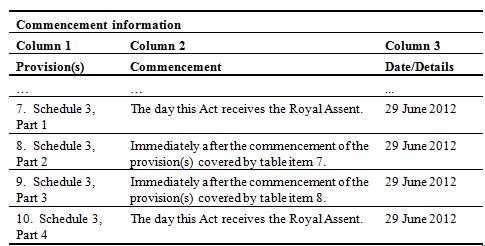
64 By s 3:
Each Act that is specified in a Schedule to this Act is amended or repealed as set out in the applicable items in the Schedule concerned, and any other item in a Schedule to this Act has effect according to its terms.
65 By s 4:
Section 170 of the Income Tax Assessment Act 1936 does not prevent the amendment of an assessment if:
(a) the assessment was made before the commencement of this section; and
(b) the amendment is made within 2 years after that commencement; and
(c) the amendment is made for the purpose of giving effect to Schedule 2 or 3 to this Act.
66 Schedule 3 Pt 1 is entitled “pre rules”; Sch 3 Pt 2 “interim rules”; and Sch 3 Pt 3 “prospective rules”. Each of those parts amends the 1997 Act. For example each repeals s 701-55(5C) and substitutes a different provision. As will be seen from the interpretation provisions of Pt 4 which I next set out, the “pre rules” means the amendments made by Pt 1; the “interim rules” means the amendments made by Pts 1 and 2; and the “prospective rules” means the amendments made by Pts 1, 2 and 3.
67 Schedule 3 Pt 4 was in the following terms, as originally enacted:
49 Interpretation
In this Part:
2010 Act means the Tax Laws Amendment (2010 Measures No. 1) Act 2010.
interim rules means the amendments made by Parts 1 and 2 of this Schedule.
original 2002 law means the Income Tax Assessment Act 1997 (disregarding amendments to that Act made by Division 1 of Part 1 and Division 2 of Part 11 of Schedule 5 to the 2010 Act and by this Schedule).
original 2010 law means the Income Tax Assessment Act 1997 (as amended by the 2010 Act, but disregarding amendments made by this Schedule).
pre rules means the amendments made by Part 1 of this Schedule.
prospective rules means the amendments made by Parts 1, 2 and 3 of this Schedule.
50 Main application rules
(1) The pre rules, interim rules or prospective rules apply to an assessment of the head company of a consolidated group or MEC group for an income year in respect of an entity (the joining entity) that becomes a member of the group at a time (the joining time), in accordance with subitems (2), (3), (4) and (5).
(2) The pre rules apply, for the income year in respect of the joining entity, if:
(a) the joining time is before 12 May 2010; or
(b) the arrangement under which the joining entity joined the group commenced (see item 52) before 10 February 2010.
(3) Despite subitem (2), the interim rules apply, for the income year in respect of the joining entity, if:
(a) both of these conditions are satisfied:
(i) apart from this subitem, the pre rules would apply, for the income year in respect of the joining entity, in accordance with subitem (2);
(ii) the head company’s latest notice of assessment, for the income year, that relates to the application of the original 2010 law in respect of the joining entity, was served on the head company by the Commissioner on or after 12 May 2010 and on or before 30 March 2011; or
(b) both of these conditions are satisfied:
(i) the joining time is on or after 12 May 2010;
(ii) the arrangement under which the joining entity joined the group commenced (see item 52) on or after 10 February 2010 and on or before 30 March 2011.
(4) The prospective rules apply, for the income year in respect of the joining entity, if:
(a) the joining time is on or after 31 March 2011; and
(b) neither subitem (2) nor (3) applies.
(5) Despite subitems (2) and (3), the original 2002 law applies, for the income year in respect of the joining entity, if the head company’s latest notice of assessment, for the income year, that relates to the application of subsection 701-55(6) of the original 2002 law in respect of the joining entity, was served on the head company by the Commissioner before 12 May 2010.
(6) Subitem (5) does not apply if:
(a) the head company requests an amendment of the assessment and the amendment relates to the application of subsection 701-55(6) of the original 2002 law in respect of the joining entity; or
(b) the amendment of the assessment, if made:
(i) would relate to an asset of a kind mentioned in paragraph 701-63(3)(b) of the original 2010 law as amended by the pre rules; and
(ii) would not be consistent with the outcome that arises under the pre rules for assets of that kind.
51 Special rule for private rulings etc.
(1) This item applies to:
(a) a private ruling issued before 31 March 2011; or
(b) a written advice given by the Commissioner before 31 March 2011 under an Annual Compliance Arrangement;
to the extent that the ruling or advice has effect in relation to the application of subsection 701-55(5C) or (6) of the original 2010 law in respect of the joining entity mentioned in item 50.
(2) Item 50 does not affect that effect of the ruling or advice.
(3) However, if the head company requests an amendment of the assessment mentioned in item 50 after the issue of the ruling or the giving of the advice, this item does not apply to the extent that the request is inconsistent with or contrary to the ruling or advice.
52 Commencement of arrangement
(1) Subitems (2), (3) and (4) specify, for the purpose of this Part, the time of commencement of the arrangement under which the joining entity mentioned in item 50 joined the group.
(2) If the arrangement is or relates to a takeover bid (within the meaning of the Corporations Act 2001) the time is when:
(a) for an off-market bid (within the meaning of that Act)—step 4 of the table in subsection 633(1) of that Act is completed; or
(b) for a market bid (within the meaning of that Act)—step 2 of the table in subsection 635(1) of that Act is completed.
(3) If a court orders, under subsection 411(1) of the Corporations Act 2001:
(a) a meeting or meetings of a company’s members about the arrangement; or
(b) a meeting or meetings of one or more classes of a company’s members about the arrangement;
the time is when the application for the order was made.
(4) If subitem (2) or (3) does not apply, the time is when the decision to enter into the arrangement was made.
68 By way of example, immediately before the commencement of the 2012 Act, in relation to rights to future income, ss 701-55(1) and 701-55(5C) of the 1997 Act provided:
701-55 Setting the tax cost of an asset
(1) This section states the meaning of the expression an asset’s tax cost is set at a particular time at the asset’s *tax cost setting amount.
…
Rights to future amounts to be included in assessable income of head company
(5C) If section 716-410 (rights to future amounts that are expected to be included in assessable income) covers the asset at the particular time, the expression means that section 716-405 may apply in relation to the asset after the particular time.
Section 716-405 applied where the joining entity became a subsidiary member of a consolidated group at a time (the joining time) and where s 701-55(5C) applied in relation to the asset at the joining time. By s 716-405(2), an entity qualified under s 716-405(5) for a deduction for an income year was entitled to deduct for that income year the amount determined under s 716-405(3A) or, if it was reasonable to expect that no amount would be included in the assessable income of an entity so qualified for the asset for any later income year, the unexpended tax cost setting amount for the asset for that income year.
69 On the commencement of the 2012 Act, under the pre rules, s 701-55(5C) read:
Rights to future amounts
(5C) If:
(a) the asset’s tax cost is set because an entity becomes a *subsidiary member of a *consolidated group at the particular time; and
(b) section 716-410 (rights to amounts that are expected to be included in assessable income) covers the asset at the particular time; and
(c) the asset is not a *non-deductible right to future income;
the expression means that section 716-405 may apply in relation to the asset after the particular time.
The expression “non-deductible right to future income” was defined by s 701-63(4) as follows: “[a] non-deductible right to future income is a *right to future income that is not an *unbilled income asset.” The expression “right to future income” was defined by s 701-63(5). Thus the pre rules limit deductions for rights to future income to unbilled income assets. Section 716-405 was repealed and a new s 716-405 substituted.
70 Under the interim rules, by s 705-56A, those rules have the effect that no value is attributed to certain contractual rights to future income arising from an asset where just before the joining time the joining entity held the asset; under the terms of a contract the joining entity held a right to future income arising from the asset; and the right to future income was not a non-deductible right to future income in relation to the joining entity.
71 Under the prospective rules s 701-55(5C) read:
WIP amount assets
(5C) If:
(a) the asset’s tax cost is set because an entity becomes a *subsidiary member of a *consolidated group at the particular time; and
(b) the asset is a *WIP amount asset;
the expression means that section 25-95 applies as if the *head company had paid a *work in progress amount for the income year in which the particular time occurs equal to the *tax cost setting amount of the asset.
Section 701-63 was repealed and the following substituted:
701-63 Right to future income and WIP amount asset
(5) A right to future income is a valuable right (including a contingent right) to receive an amount if:
(a) the valuable right forms part of a contract or agreement; and
(b) the *market value of the valuable right (taking into account all the obligations and conditions relating to the right) is greater than nil; and
(c) the valuable right is neither a *Division 230 financial arrangement nor a part of a Division 230 financial arrangement; and
(d) it is reasonable to expect that an amount attributable to the right will be included in the assessable income of any entity at a later time.
(6) WIP amount asset means an asset that is in respect of work (but not goods) that has been partially performed by a recipient mentioned in paragraph 25-95(3)(b) for a third entity but not yet completed to the stage where a recoverable debt has arisen in respect of the completion or partial completion of the work.
It appears that the intention of the prospective rules is that the reset tax costs for rights to future income that are, relevantly, WIP amount assets are deductible. By s 705-25(5)(d), a right to future income other than a WIP amount asset will be a retained cost base asset.
Administrative Appeals Tribunal Act provision
72 IOOF also placed reliance on s 43(6) of the Administrative Appeals Tribunal Act 1975 (Cth) (the AAT Act), which was in the following terms:
Tribunal’s decision taken to be decision of decision-maker
(6) A decision of a person as varied by the Tribunal, or a decision made by the Tribunal in substitution for the decision of a person, shall, for all purposes (other than the purposes of applications to the Tribunal for a review or of appeals in accordance with section 44), be deemed to be a decision of that person and, upon the coming into operation of the decision of the Tribunal, unless the Tribunal otherwise orders, has effect, or shall be deemed to have had effect, on and from the day on which the decision under review has or had effect.
73 IOOF accepted that if it did not succeed on its submissions as to its accrued rights and the non-displacement of those accrued rights by the 2012 Act, it could not succeed on s 43(6) of the AAT Act alone, but submitted that it was relevant to those submissions that it would be open to the Tribunal to make an order that the decision of the Tribunal had effect or was deemed to have had effect, for example, from the date of IOOF’s application for a private ruling.
The party’s submissions in more detail
74 IOOF submitted that it was entitled to a favourable private ruling before the enactment of the 2012 Act. This outcome, IOOF submitted, was still open to it because under s 43(6) of the AAT Act, the Tribunal had the power to order that a decision was to take effect from a date other than the date of the original decision, including a date before the original decision. IOOF contended that pursuant to s 43(6), it was open to the Tribunal to deem that a favourable private ruling took effect from a date before 31 March 2011.
75 IOOF submitted it had an accrued right to have the ruling determined under the 2010 Act before the 2012 Act. IOOF referred primarily to Esber v Commonwealth (1992) 174 CLR 430 (Esber) at 440; Lee v Secretary, Department of Social Security (1996) 68 FCR 491 (Lee); and Repatriation Commission v Keeley (2000) 98 FCR 108; [2000] FCA 532 (Keeley).
76 IOOF contended that, consistently with the view of the majority in Esber, its right to have the Tribunal determine its application for a private ruling in accordance with the law before the passage of the 2012 Act was a substantive right, not a mere matter of procedure. It was put that item 50 of Pt 4 of Sch 3 to the 2012 Act did not express a contrary intention, for the following reasons. On its face, item 50 did not deal with the right being asserted by IOOF. It did not deal with the law to be applied in determining an application to the Tribunal for review of an objection decision relating to private rulings. Item 50 was less extensive and less comprehensive than the transitional rules considered in Esber. The transitional rules did not deal with the obvious case of taxpayers who had pending appeals to the Tribunal or to the Court. The inclusion of a provision protecting the rights of taxpayers who received the ruling should not be read as impliedly removing the rights of those taxpayers who did not. There were a number of examples of situations not covered by item 50 and these examples illustrated how implausible it was that Parliament intended the transitional rules to be exhaustive. One example was that a taxpayer might have received an unfavourable ruling before 31 March 2011 and might also have commenced legal proceedings to challenge the ruling before that date. If the Court or Tribunal ultimately found in their favour, would their entitlement to the deductions be preserved?
77 IOOF submitted that even if the Court decided that it was not open to the Tribunal to find that the appellant had accrued rights to have the application determined in accordance with the law before the enactment of the 2012 Act, the Court should find that it was open to the Tribunal to find that IOOF came within item 51, in which case it would be entitled to have the objection to the failure to provide a private ruling determined in accordance with the law before the 2012 Act.
78 The Commissioner submitted that the issue before the primary judge was not whether IOOF’s right to a deduction under s 716-405 of the 1997 Act was abrogated by the 2012 Act but, rather, whether IOOF had a right to a private ruling dealing with s 716-405 of the 1997 Act as it stood when the appellant applied for a private ruling or applied to the Tribunal for review, where the ruling would bind the Commissioner until 30 June 2018, the end of the ten year period referred to in the application for a ruling.
79 As to whether IOOF had any accrued right to a deduction arising under the 2010 Act, unaffected by the 2012 Act, by virtue of its application for a private ruling or application to the Tribunal for review, the Commissioner submitted that the nature of a private ruling was such that it did not necessarily involve “real” facts but rather the Commissioner stating how he considered that the law applied to a “specified scheme”, which was a set of assumed facts defined by the applicant for the private ruling. It could not therefore be said that the amendments made by the 2012 Act had affected a right to a deduction, or anything else, that had vested in or accrued to IOOF by reference to actual past events. And even if the transaction described in the private ruling application accurately described the relevant past events, it was material that the 2010 Act was yet to be enacted at the time of those events. The 2010 Act was itself a retrospective amendment. IOOF’s reliance on that retrospective law highlighted that, subject only to express provisions such as item 51 of Pt 4 of Sch 3 to the 2012 Act, the private rulings regime did not protect against the retrospective operation of an amendment to the underlying tax law considered in a ruling unless the re-enacted or remade provision “expresses the same ideas as the old provision”: s 357-85 of Sch 1 to the Administration Act. In applying to the Tribunal for review of the deemed disallowance of its objection, IOOF sought administrative review in the same private rulings setting. The Commissioner submitted, therefore, that IOOF’s application to the Tribunal did not give rise to any right that was vested or had accrued, which was affected by the 2012 Act. At best, it was submitted, IOOF had a hope or expectation of receiving a favourable private ruling, which would bind the Commissioner only insofar as the facts described in the ruling were reflective of actual facts.
80 As to the question of accrued rights and contrary intention, the Commissioner submitted that the primary judge correctly held that any accrued right had been displaced by a contrary legislative intention. The primary judge correctly concluded that the application provisions in the 2012 Act were intended to deal exhaustively with which version of the 1997 Act applied in respect of all acquisitions made by consolidated groups from 1 July 2002. The “main application” provision in item 50 was extensive and, subject only to item 51, established a code for the purposes of determining which law applied to an assessment of the head company for an income year in respect of a joining entity in a given year of income. Item 50 was more extensive than the provisions under consideration in Esber. It was of no consequence that the application provisions of the 2012 Act did not expressly refer to pending appeals or applications for review in respect of the failure to issue private rulings as it was clear that, unless a taxpayer could bring itself within item 51, item 50 applied. The two items together covered all possibilities.
81 The Commissioner submitted that the intention that the amendments made by the 2012 Act apply to past as well as future years, subject only to the limited exception in item 51, was clear from the structure of the provisions themselves. The inclusion of item 51 as the sole exception to the main application provision clearly indicated that it was the only circumstance in which the legislature intended to preserve the provisions of Pt 3-90 of the 1997 Act as they stood immediately before they were amended by the 2012 Act.
82 The Commissioner submitted that the extrinsic materials supported the legislative intention that the amendments made by the 2012 Act applied to past and future years of income, subject only to the limited exception in item 51.
83 In reply, IOOF submitted that it was contending that, as a result of appealing to the Tribunal from the deemed disallowance of its objection, it acquired a right to have the Tribunal determine its application for a private ruling in accordance with the law before the enactment of the 2012 Act.
84 IOOF submitted: it was irrelevant whether the private ruling dealt with “real” as opposed to “hypothetical” facts; it was immaterial that the 2010 Act was yet to be enacted during the income year when the right to the deductions arose; there was no reason in principle why accrued rights could not arise in respect of retrospective legislation; and s 357-85 of Sch 1 to the Administration Act had a different field of operation to s 7(2) of the Acts Interpretation Act, the former being concerned with preserving rights acquired under Div 357 of Sch 1 to the Administration Act as a result of obtaining a private ruling and the latter being concerned with preserving rights of taxpayers acquired under legislation.
85 IOOF acknowledged that item 50 of Pt 4 of Sch 3 to the 2012 Act was extensive but submitted that this did not mean that it was exhaustive. The decisions in Keeley and Esber indicated that the contrary intention must be directed at the accrued right in question. It was insufficient that the legislation altered rights that were not the same as the accrued rights being asserted. Item 50 was not exhaustive because it failed to deal with taxpayers with pending private ruling applications who had taken steps to enforce their rights, such as by appealing an objection decision to the Tribunal or to a Court. IOOF referred also to Donovan v Repatriation Commission (1985) 58 ALR 634 (Donovan) and submitted that because items 50 and 51 did not enter the field of appeals or pending matters they should not be construed as being exhaustive and thus displacing the accrued right of a taxpayer who has appealed from the disallowance of an objection.
86 Under the heading “Extrinsic material irrelevant”, IOOF submitted that the extrinsic material did not evince an intention that a taxpayer’s accrued rights in relation to pending private rulings were to be abrogated and that the Commissioner had failed to satisfy his onus of showing that there was clear evidence of Parliament’s intent to displace accrued rights in respect of pending appeals in relation to private ruling applications.
Consideration
87 So far as concerns item 51, the issue is whether the item applies. The item applies to a private ruling issued before 31 March 2011. No such private ruling has issued with the result that, on the face of it, item 51 does not apply. Are there any other statutory provisions which affect this conclusion? IOOF relied on s 43(6) of the AAT Act, which I have set out above. Relevantly, a ruling decision of the Commissioner as varied by the Tribunal, or a ruling decision made by the Tribunal in substitution for the ruling decision of the Commissioner would be deemed to be a decision of the Commissioner and, upon the coming into operation of the decision of the Tribunal, unless the Tribunal otherwise ordered, would have effect, or would be deemed to have had effect, on and from the day on which the decision under review has or had effect.
88 In my opinion, this would not mean that any such private ruling made by the Tribunal in the future, say on the matter being remitted to the Tribunal by this Court, would be issued before 31 March 2011 within the meaning of item 51.
89 The position may be otherwise where the Tribunal is reviewing, or the Court is hearing an appeal in respect of, a private ruling which had issued before 31 March 2011. In those circumstances it may be, depending on the circumstances and on the form of the order, that the decision of the Tribunal or the Court would be one correcting the private ruling which had issued before that date.
90 Further, the existence of any accrued right or rights, either at a procedural level or at a substantive level, would not mean that any private ruling made in the future would be issued before 31 March 2011 within the meaning of item 51. By “at a procedural level” I mean a right to have a ruling made on its ruling application. By “at a substantive level” I mean a right to have a ruling made on its ruling application by reference to the law as it stood either at the date of application, or at the earliest date by reference to which the Commissioner’s ruling could have taken effect, or at the date of the application to the Tribunal, or at the earliest date by reference to which the Tribunal’s decision could have taken effect, or at some date between those dates.
91 Still further, if it could be established that there was a breach by the Commissioner of an obligation to make a ruling before 31 March 2011 on an application received by him on 10 January 2011, this would not have the result that the private ruling applied for was issued before 31 March 2011.
92 It follows that IOOF does not succeed in the appeal by virtue of item 51 of Pt 4 of Sch 3 to the 2012 Act.
93 This, however, does not dispose of the appeal. The question remains whether, assuming the matter to be remitted to the Tribunal, it would be open to the Tribunal to apply the 2010 Act unaffected by the amendments made by the 2012 Act.
94 The answer to this question depends on the proper construction of the 2012 Act, in particular the balance of Sch 3 to that Act. So much may be seen from the recent decision of the High Court in ADCO Constructions Pty Ltd v Goudappel (2014) 308 ALR 213; [2014] HCA 18 (ADCO Constructions).
95 Everything depends on the substantive operation of the provisions. This is because, by s 2 of the Acts Interpretation Act, the savings of accrued rights otherwise effected by s 7 of that Act are subject to a contrary intention which may be found, with sufficient clarity, from the language used by the Parliament. It is therefore relevant, but by no means conclusive, to observe that the 2012 Act does not in terms refer, other than in item 51, to rulings or applications for rulings, or at all to pending proceedings in the Tribunal: ADCO Constructions at [28]. Similarly, it is not conclusive that the 2012 Act does not refer in Sch 3 to those provisions being “transitional” or “savings”.
96 In this analysis it may be a distraction to pose as a test words used by the High Court in GF Heublein & Bro Inc v Continental Liqueurs Pty Ltd (1962) 109 CLR 153 (GF Heublein) at 161–162 where the Court said that the express provision the legislation made with respect to applications pending under the earlier Act must be read as “exhaustive and that there is, therefore, no room for the application of s 8 of the Acts Interpretation Act, even if it were otherwise possible to bring the case within its terms”. The reason why, in my opinion, such an approach may be a distraction is that the ultimate question is whether there is a contrary intention within the meaning of s 2 of the Acts Interpretation Act. To illustrate the point, it does not appear that in ADCO Constructions the judgments proceeded by reference to GF Heublein or to whether the provisions were exhaustive but by reference to whether the contrary intention appeared with the requisite degree of certainty, being reasonable certainty: see the judgment of French CJ, Crennan, Kiefel and Keane JJ at [27] and [29], and the judgment of Gageler J at [51]–[52].
97 In my opinion, to describe a provision as “exhaustive” is but another way of expressing the degree of certainty with which the contrary intention may appear from the text and context of the legislation.
98 It is next necessary to consider the authorities on which IOOF relied.
99 Esber concerned s 49 of the Compensation (Commonwealth Government Employees) Act 1971 (Cth) (the 1971 Act), the pre-existing provision, and s 129 of the Commonwealth Employees' Rehabilitation and Compensation Act 1988 (Cth) (the 1988 Act). The appellant had made a request to the Commissioner, before the enactment of the 1988 Act, that the Commonwealth’s liability to make further payments of compensation to him be redeemed pursuant to s 49 of the 1971 Act. The Commissioner determined that the liability of the Commonwealth should not be redeemed and the appellant applied for a review of that determination to the Tribunal. Before any hearing by the Tribunal, the 1971 Act was repealed.
100 Section 129 of the 1988 Act provided that where the Commonwealth was a party to any proceedings relating to any matter arising under, relevantly, the 1971 Act, being proceedings instituted but not completed before the commencing day, those proceedings could be continued on and after that day and set out that the relevant authority and the Commonwealth should be parties to those proceedings. The majority concluded that s 129(2) of the 1988 Act had to be given the effect which its language indicated, there being nothing in the Act standing in the way of that approach. That subsection ensured the continuance of the application to the Tribunal and the resolution of the entitlement to redeem in accordance with the 1971 Act.
101 That conclusion, the majority said, was enough to dispose of the appeal in favour of the appellant. However, the majority went on to deal with the submission based on s 8 of the Acts Interpretation Act and concluded that once the appellant lodged an application to the Tribunal to review the Commissioner’s decision, the appellant had a right to have the decision of the Commissioner reconsidered and determined by the Tribunal. That right was not merely “a power to take advantage of an enactment” nor was it a mere matter of procedure. It was a substantive right. Section 8 protected anything that may truly be described as a right although, as in that case, the right might fairly be called inchoate or contingent. It was a right in existence at the time the 1971 Act was repealed. That being so, and in the absence of a contrary intention, the right was protected by s 8 and was not affected by the repeal of the 1971 Act.
102 Lee concerned whether the applicant had a right to have a refusal to waive a debt reviewed by reference to the power conferred by s 1237 of the Social Security Act 1991 (Cth) in its unamended form, the decision to recover overpayments having been made on 13 December 1993 and the applicant’s appeal to a review officer having been made one day prior to the commencement, on 24 December 1993, of amendments which replaced the previously unfettered discretion to waive debts pursuant to s 1237. The majority held, following Esber, that the applicant did have such a right and the amending Act did not reveal an intention to operate so as to modify the rights of review under the Act invoked prior to the amendments taking effect. The relevant application provision was s 1236A, which provided that the new s 1237 applied to all debts, whenever incurred, owed to the Commonwealth and arising under the Social Security Act 1991 or under the Social Security Act 1947 (Cth). Justice Cooper held the new sections upon their commencement did not have a retrospective operation but created a new, albeit limited, power in the Secretary to waive in whole or in part the Commonwealth’s right to recover debts due to it but the new sections did not purport to deal with past decisions as to waiver of debts due to the Commonwealth under those Acts. Justice Moore, at 517–518 of the report reasoned similarly. Justice Davies dissented.
103 In Keeley, a new Statement of Principles under the Veterans’ Entitlements Act 1986 (Cth) was made after the respondent had lodged an application for review of the delegate’s decision refusing her claim and after that decision was affirmed by the Veterans’ Review Board. The Tribunal affirmed the refusal of pension after deciding that the new Statement of Principles was to be applied. The decision of the Tribunal was set aside on appeal at first instance and the Full Court unanimously dismissed the appeal from that decision. Justices Lee and Cooper held, at [35], that when the respondent lodged a claim for a pension under the Act, she obtained a right to have that claim determined under the Act according to law. The right that accrued was a right to which s 50 of the Acts Interpretation Act applied. Applying Esber, Lee and Cooper JJ referred to s 120A(2) which showed a clear intention by Parliament that a new Statement of Principles was to affect the accrued right obtained by the lodgement of a claim under the Act to have the claim decided by the Commission but that circumstance did not apply after a claim had been determined and the right that had accrued under the Act was a right to have the determination reviewed. A contrary intention was not clearly disclosed so it was to be presumed that accrued rights were determined under the law as it stood when the right accrued. Justice Kiefel, in applying s 50 of the Acts Interpretation Act, did not find it necessary to consider the nature of the respondent’s rights to review as “rights” which had “accrued” but agreed with the primary judge that a contrary intention could not be derived from the later Statement of Principles.
104 In Donovan, Toohey J did not accept that the Repatriation Legislation Amendment Act 1984 (Cth) had made provision for matters pending before the Commission under s 31 in such a way as to indicate an intention to be exhaustive. So far as s 31 was concerned, the only reference was in s 53 of the 1984 amendments. That made it clear that s 31(6) and (7) of the new s 31 (which limited the scope for review of a refusal or failure by the Commission to review a decision) applied only to, and in relation to, a refusal or failure of the Commission to review a decision in relation to pension that occurred on or after the commencing day and a decision made by the Commission on or after the commencing day upon its review of a decision in relation to pension, neither of which was applicable.
105 These decisions establish that close attention must be paid to the text and context of the legislative provision when considering whether or not a contrary intention sufficiently appears. It is not, however, useful to compare the language of one provision which may be described as “transitional” or “saving” with another without close regard to the subject-matter and nature of the rights in question.
106 AIRC, relied on by the Commissioner, concerned s 111AAA which was inserted into the Industrial Relations Act 1988 (Cth) by the Workplace Relations and Other Legislation Amendment Act 1996 (Cth). The issue was the effect of that provision on s 104 of the Industrial Relations Act which, immediately before the amendment, provided relevantly as follows:
(1) When a conciliation proceeding before a member of the Commission in relation to an industrial dispute is completed but the industrial dispute has not been fully settled, the Commission shall proceed to deal with the industrial dispute, or the matters remaining in dispute, by arbitration.
Certain proceedings were pending before the Australian Industrial Relation Commission when the amending provision took effect on 1 January 1997. Section 111AAA provided:
(1) If the Commission is satisfied that a State award or State employment agreement governs the wages and conditions of employment of particular employees whose wages and conditions of employment are the subject of an industrial dispute, the Commission must cease dealing with the industrial dispute in relation to those employees, unless the Commission is satisfied that ceasing would not be in the public interest.
…
(4) In this section:
cease dealing, in relation to an industrial dispute, means:
(a) to dismiss the whole or a part of a matter to which the industrial dispute relates; or
(b) to refrain from further hearing or from determining the industrial dispute or part of the industrial dispute.
107 Chief Justice Gleeson said at [11]–[13] that there was much argument about whether the parties to the industrial disputes in question had rights within the meaning of s 8(c) of the Acts Interpretation Act. On the assumption that they had rights, the Chief Justice said that such rights flowed from the provisions of Pt VI of the Act, and Pt VI determined their nature. The words “by arbitration” in s 104 could only mean “by arbitration in accordance with this Act”. The amending provision, s 111AAA, was expressed in terms that were attached directly to, and qualified, the claimed right. If the parties to the disputes in question, by virtue in particular of s 104, had a right, then there was manifested plainly a legislative intention to affect that right. The right was to have the Commission deal with the disputes by arbitration, in accordance with the Act. The legislature amended the Act by directing the Commission to cease dealing with the disputes.
108 In a joint judgment, Gaudron, McHugh, Gummow and Hayne JJ said at [29] that in order to understand the effect of the enactment of s 111AAA it was necessary to outline the operation of the relevant provisions of the 1988 Act as they existed immediately before 1 January 1997. Their Honours first established that s 111AAA effected a “repeal” of parts of the 1988 Act for the purposes of s 8 of the Acts Interpretation Act (by virtue also of s 8A of that Act) and then said it was necessary to ascertain whether the respondent unions had acquired or accrued a “right” of the type that s 8 preserved.
109 At [40] their Honours said the right acquired or accrued by the respondent unions was more accurately described as a public law right to require the Commission to observe its duty to comply with the law as it existed from time to time. A right of that nature, where it exists, was a right to have a claim or application considered in accordance with the statute that governed its determination. At [43] their Honours said it was apparent that the “right” which was “accrued” was reflective of the susceptibility of the Commission to mandamus under s 75(v) of the Constitution but the tenor of the writ required the hearing and determination of the matter, and not the decision of the matter in any particular manner, citing R v Commonwealth Court of Conciliation and Arbitration; Ex parte Ozone Theatres (Aust) Ltd (1949) 78 CLR 389 at 399. At [45] their Honours said that the arbitrator under the legislation was empowered to make a determination not of existing legal rights and liabilities, but as to the conditions to prevail in the future between the parties to the dispute; statute gave to the terms of the determination the character of legal rights and obligations. Their Honours continued, at [46]–[47]:
The requirement, enforced by mandamus, that the arbitrator hear and determine a matter according to law allowed for changes in the content of that law which founded the duty which attracted the remedy. If before the making of the award prescribing rules of conduct for the future, the law was changed to place additional restraints or conditions upon the exercise of the power to make the award, then the obligation to make a determination according to law was correspondingly modified. In this way, the content of the public duty and correlative right to its discharge was fluid rather than fixed and notions of “accrued” rights in the law as it stood at any particular stage in the arbitral processes had no place.
Section 111AAA(1) enjoins the Commission, with effect from 1 January 1997, to cease dealing with certain industrial disputes, if it were satisfied of the matters stated therein, unless the Commission were satisfied that to do so would not be in the public interest. Parties to industrial disputes with which the Commission was dealing, according to Pt VI of the 1988 Act, before that date had no “accrued” rights in the path of changes to Pt VI such as those effected by s 111AAA.
110 Their Honours then distinguished Esber, in part on the basis that the “right” said to flow from the duty imposed upon the Commission by s 104(1) of the 1988 Act was of a different nature to the “accrued right” at stake in Esber, but then went on to explain, from [51] onwards, that in any event, even if there had been “accrued rights” subsisting at 1 January 1997, s 111AAA itself and together with other provisions of Sch 5 to the Workplace Relations and Other Legislation Amendment Act evinced a contrary intention to the saving operation of s 8 of the Acts Interpretation Act.
111 At [65] their Honours said:
Item 55 is the only provision in Pt 2 of Sch 5 that expressly provides for the continued operation of a provision repealed by that Schedule. The Item provides that:
The repeal of subsection 111(1A) of the Principal Act does not apply to any proceedings before the Commission that commenced before the commencement of the repeal.
This express transitional provision is properly to be regarded as exhaustive in respect of the transitional application of Sch 5 to existing proceedings. An exhaustive express transitional provision of this nature leaves no room for s 8 of the Interpretation Act to operate. Indeed, Item 55 reflects a legislative assumption that the other provisions of Sch 5, including s 111AAA, will apply to proceedings commenced before 1 January 1997. This legislative assumption is made particularly clear by Items 50 and 51, the effect of which is to require awards made before that date to be reviewed by the Commission to ensure that they deal only with the matters prescribed by s 89A. (footnotes omitted)
112 Justice Kirby also held, at [133], that once the conclusion was reached that s 111AAA constituted a valid parliamentary command to the Commission in respect of all proceedings before it, the requisite contrary intention was manifest. The assertion of surviving rights that would contradict the primary instructions of the Parliament could not prevail.
113 Justice Callinan said, at [159], that the absence of express reference in s 111AAA to the effect of the pre-existing legislation in the Workplace Relations Act and its effects was for good reason, which was that s 111AAA manifested a clear, contrary intention that it was to operate on pending proceedings. His Honour said at [161] it was unnecessary therefore to give any further consideration to the Acts Interpretation Act.
114 I now turn to give closer attention to the application provisions of the 2012 Act.
115 Item 50(1) of Pt 4 of Sch 3 is, in my opinion, the governing provision and its states that the “pre rules, interim rules or prospective rules apply to an assessment of the head company of a consolidated group … for an income year in respect of an entity (the joining entity) that becomes a member of the group at a time (the joining time) in accordance with subitems (2), (3), (4) and (5).”
116 As I have said, it is the text and context of the “application rules” which is all important. It does not matter whether or not the provisions are called “transitional” or “application” if the contrary intention to affect the accrued right appears with the requisite certainty. Once the application rules are construed and given effect to, it may be found that it was unnecessary for the Parliament expressly to deal with pending applications or pending proceedings in order for the contrary intention to appear.
117 Item 50, in stating which of the rules (by which is meant amendments made by Sch 3 to the 2012 Act) applied, proceeds by reference: first, to the assessment of the head company; secondly, by reference to the assessment of that head company for an income year in respect of an entity that becomes a member of the group; and thirdly, and most importantly for present purposes, by reference to the time at which the joining entity becomes a member of the group (the joining time).
118 Item 50 then makes provision largely by reference to: whether the joining time is before 12 May 2010 (the date the Bill for the 2010 Act went through the Parliament); whether the joining time is on or after 12 May 2010 but on or before 30 March 2011 (when the Board of Taxation was asked to review the rules); or whether the joining time is on or after 31 March 2011.
119 Where the joining time is before 12 May 2010, which is the position in respect of IOOF, then, subject to subitem (3), the pre rules apply, that is, the amendments made by Pt 1 of Sch 3 to the 2012 Act. Although it does not matter for the purposes of the present issue, that means that the form of the legislation as it was before the 2010 Act largely applies and applies to an assessment of the head company for an income year in respect of the joining entity. If an assessment was made before 29 June 2012, then by s 4 of the 2012 Act, s 170 of the Income Tax Assessment Act 1936 (Cth) does not prevent the amendment of that assessment before 29 June 2014 for the purpose of giving effect to Sch 3 of the 2012 Act. This provision would permit the amendment of assessments made before 29 June 2008 where the four years referred to in s 170 would otherwise have elapsed.
120 It was common ground that subitem (3) does apply to IOOF in respect of one year. The result is that the interim rules apply for that income year in respect of the joining entity. The Court was told that subitem (3) applied because, within subitem (3)(a)(ii), the head company’s latest notice of assessment, for the income year, that relates to the application of the original 2010 law in respect of the joining entity, was served on the head company by the Commissioner on or after 12 May 2010 and on or before 30 March 2011.
121 A similar saving to subitems (2) and (3) is made by subitem (5): if the head company’s latest notice of assessment, for the income year, that relates to the application of s 701-55(6) of the original 2002 law in respect of the joining entity, was served on the head company by the Commissioner before 12 May 2010, the original 2002 law applies. It was not suggested that such a notice of assessment was so served before 12 May 2010 but subitem (5) further illustrates what otherwise is the width of subitems (2) and (3).
122 Item 51, the special saving rule as to the effect of certain private rulings, is necessary by virtue of the comprehensive nature of item 50 and by virtue of the effect of private rulings which is otherwise limited to the Commissioner’s opinion on the relevant law as at the date of the ruling. As to the former of these matters, item 51 confirms that comprehensive nature, as did item 55 in Pt 2 of Sch 5 to the Workplace Relations and Other Legislation Amendment Act referred to by Gaudron, McHugh, Gummow and Hayne JJ at [65] in AIRC, which I have set out above.
123 Another parallel with AIRC stems from the nature of the right in question. A private ruling is an expression of the Commissioner’s opinion on a particular question about the application of a tax law and, subject s 357-85 of Sch 1 to the Administration Act, if that tax law changes the ruling does not survive a change in that relevant law: Pratt Holdings Pty Ltd v Federal Commissioner of Taxation (2012) 216 FCR 258; [2012] FCA 1075 at [129]–[131], [165]. By s 357-85, if the Commissioner makes a private ruling about a tax law and the tax law “is re-enacted or remade” the ruling is taken also to be a ruling about the tax law as re-enacted or remade but only in so far as the new law expresses the same ideas as the old law. The evident legislative purpose of s 357-85 is to enable taxpayers to continue to rely on a private ruling given before a change in the tax law in so far as the new tax law is substantively the same as the old tax law ruled upon. In the present case, it cannot be said that the provisions of the 2012 Act merely expressed “the same ideas” as the 2010 Act. The 2012 Act effected a substantive change to the law. Thus, in the absence of item 51, the Commissioner would not be legally bound by a private ruling issued before the change in law. The effect of item 51 is to preserve the legally binding nature of a private ruling issued under the original 2010 law which otherwise would not be preserved by s 357-85 of the Administration Act. As the explanatory memorandum makes clear at [3.127] in stating: “[i]n these circumstances, if the ruling or written advice was issued under the original 2010 law, that law will apply to the transaction”, item 51 is a “special rule” for private rulings issued under the original 2010 law and it is in that limited circumstance that the original 2010 law will continue to apply.
124 It follows, in my view, that no denial of or qualification to the conclusion that item 50, in context, clearly discloses a contrary intention to the survival of the appellant’s alleged accrued right or rights flows from the absence of reference in item 50 to pending applications for private rulings or from the limited provision in item 51 saving the effect of certain private rulings, that is those issued before 31 March 2011. As the primary judge said at [37], the presence of item 51 does not reveal, as suggested by IOOF, a “legislative intent to preserve the rights of taxpayers who applied for private rulings”. To the contrary, the legislative intention was to preserve the rights of taxpayers who had been issued with a private ruling before 31 March 2011 and, I would add, not otherwise.
125 In my opinion, IOOF did have an accrued procedural right but it asserts a substantive right to the application of the relevant law, the tax law, to the scheme. However, there was no accrued right to a ruling so as to bind the Commissioner to the law in the form it took before the 2012 Act since a private ruling is only binding up to a change in the law and, apart from a statutory provision providing otherwise, a ruling and therefore an application for a ruling or any accrued rights thereunder does not survive a change in the law.
126 It is artificial to separate out the accrued right from the substance of the right said to be accrued and, therefore, in this appeal, to separate out the bare accrued right to a ruling from what the appellant contends for, which is for it to be open to the Tribunal to hear and determine its application for review on the basis that the appellant has an accrued right to a ruling under the law as it stood before the 2012 Act.
127 Against that background, that a ruling is limited to the law at the time of the ruling being made, subject to a contrary provision, it is evident that item 51 only extends the operation of certain rulings and it cannot be said that it leaves other ruling applications as amenable to s 7 of the Acts Interpretation Act: IOOF does not have an accrued right to have the law applied as it was before the 2012 Act. Absent a specific legislative provision, such as item 51, a ruling, let alone an application for a ruling, does not have the effect or character of a right to the application of substantive law (a relevant provision) which could endure or accrue beyond amendment or repeal of the relevant provision ruled on.
128 In the events that happened, therefore, in my opinion it would not be open to the Tribunal, for the purposes of undertaking its review of the Commissioner’s deemed disallowance of IOOF’s objection, to apply the provisions of Part 3-90 of the 1997 Act before the amendments contained in the 2012 Act.
Orders
129 The appeal should be dismissed, with costs.
| I certify that the preceding one hundred and two (102) numbered paragraphs are a true copy of the Reasons for Judgment herein of the Honourable Justice Robertson. |
Associate:
Dated: 24 July 2014
| IN THE FEDERAL COURT OF AUSTRALIA | |
| VICTORIA DISTRICT REGISTRY | |
| GENERAL DIVISION | VID 1310 of 2013 |
| BETWEEN: | IOOF HOLDINGS LIMITED Appellant |
| AND: | COMMISSIONER OF TAXATION First Respondent ADMINISTRATIVE APPEALS TRIBUNAL Second Respondent |
| JUDGES: | JESSUP, ROBERTSON & DAVIES JJ |
| DATE: | 24 july 2014 |
| PLACE: | MELBOURNE |
REASONS FOR JUDGMENT
DAVIES J
Introduction
130 I have had the advantage of reading a draft of the judgment of Robertson J and agree with His Honour’s reasons and conclusion. However, I would dismiss the appeal on the basis that the appellant, IOOF Holdings Limited, (the appellant) did not have an accrued right for the purposes of s 7(2) of the Acts Interpretation Act 1901 (Cth) (the Acts Interpretation Act) to have its ruling application determined in accordance with the law as it stood prior to amendment by the Tax Laws Amendment (2012 Measures No. 2) Act 2012 (Cth) (the 2012 Act).
The appeal
131 The appellant has appealed the decision of the primary judge that the Administrative Appeals Tribunal (the Tribunal) was correct to answer “no” to the following question:
For the purposes of undertaking its review of the Respondent’s deemed disallowance of the [Appellant’s] objection against the Respondent’s failure to make a private ruling concerning its claim for a deduction under section 716-405 in Part 3-90 of the Income Tax Assessment Act 1997 (Cth) (1997 Act), is it open to the Tribunal to apply the provisions of Part 3-90 of the 1997 Act before the amendments contained in the Tax Laws Amendment (2012 Measures No 2) Act 2012 (Cth)?
132 The grounds of appeal raise three issues for determination:
1. whether the appellant has an accrued right for the purposes of s 7(2) of the Acts Interpretation Act to have its private ruling application determined by the Tribunal in accordance with the law as it stood prior to amendment by the 2012 Act;
2. whether that accrued right is displaced by a contrary intention shown in the 2012 Act; and
3. if the appellant does not have such an accrued right, whether it is open to the Tribunal exercising its power under s 43(6) of the Administrative Appeals Tribunal Act 1975 (Cth) (the AAT Act) to apply the law as it stood prior to amendment by the 2012 Act.
The ruling request
133 The appellant is the head company of the IOOF tax consolidated group. In April 2009, the appellant acquired 100% of the membership interests in, and all the assets and liabilities of, another company (the joining entity), including contractual rights to receive future income. In December 2010 the appellant applied to the Commissioner of Taxation (the Commissioner) for a private ruling in relation to its right to deduct the tax cost setting amount attributable to those contractual rights.
The applicable law
134 The relevant tax law then in effect, and on which the appellant sought the ruling, was the tax law enacted by the Tax Laws Amendment (2010 Measures No. 1) Act 2010 (Cth) (the 2010 Act) on 3 June 2010 with retrospective operation from 1 July 2002, being the date that the tax consolidation regime took effect.
135 On 29 June 2012, the 2012 Act was enacted. The 2012 Act amended the right to future income deduction rules prescribed by the 2010 Act. In broad compass new rules apply according to whether the joining entity became a member of the consolidated group: (1) before 12 May 2010 (the pre rules); (2) on or after 12 May 2010 and on or before 30 March 2011 (the interim rules); and (3) on or after 31 March 2011 (the prospective rules): item 50 of the 2012 Act. 12 May 2010 is the date that the 2010 Act was passed by the Parliament. 30 March 2011 is the date that the Assistant Treasurer announced that the government had asked the Board of Taxation to review the rules in the 2010 Act, which were thought to be broader in scope than what was originally intended. It is sufficient to observe, without going into the detail of the new rules, that the new rules under the 2012 Act have changed the law retrospectively.
136 The application of the new rules under the 2012 Act is subject, however, to item 51 of Sch 3 to the 2012 Act which provides that the new rules do not “affect [the] effect of” a relevant private ruling issued before 31 March 2011.
The application to the Tribunal
137 The appellant did not have a ruling issued to it before 31 March 2011. Indeed, the Commissioner never made a ruling on the application. The matter came before the Tribunal by way of the appellant exercising its statutory rights under s 359-50 of Sch 1 to the Taxation Administration Act 1953 (Cth) (the Tax Administration Act) to require the Commissioner to make a ruling and, when the Commissioner failed to make a ruling, to lodge an objection against the Commissioner’s failure to make the ruling. As the Commissioner did not make a decision on the objection, the Commissioner was taken to have disallowed that objection: s 14ZYB of the Tax Administration Act. In February 2012 the appellant exercised its statutory right under s 14ZZ of the Tax Administration Act, to apply to the Tribunal for review of the deemed disallowance of its objection.
138 The position, thus, is that the relevant law in effect when the appellant sought the ruling and later when it applied to the Tribunal for review of the deemed disallowance of its objection was the tax law under the 2010 Act. By the time the matter came on for hearing before the Tribunal, the 2012 Act law had changed the law retrospectively.
No accrued right
139 The decisions below both proceeded on the assumption that the appellant has the accrued right to a determination of its ruling on the basis of the law before amendment by the 2012 Act. For the reasons that follow, I do not consider that it was correct to make that assumption.
140 A private ruling is an expression of the Commissioner’s opinion of the way in which a tax law or tax laws apply, or would apply, to the taxpayer in relation to given facts and circumstances: ss 357-5 and 359-5 of Sch 1 to the Tax Administration Act. Private rulings are only issued by the Commissioner upon application by a taxpayer (s 359-10) and a taxpayer has the right to challenge a ruling given by the Commissioner, or the failure of the Commissioner to make a ruling on the application, through the Pt IVC objection and review process: s 359-60 of the Tax Administration Act.
141 The statutory force of a private ruling is that it binds the Commissioner in relation to a taxpayer to apply the tax provision in accordance with his ruling, if the ruling applies to the taxpayer and the taxpayer relies on the ruling by acting in accordance with the ruling: s 357-60 of Sch 1 to the Tax Administration Act. A ruling is only binding on the Commissioner if the actual facts and circumstances are not materially different from the facts and circumstances on which the private ruling was given, and the tax law on which the ruling is given remains the law to be applied or, by and under s 357-85 of Sch 1 to the Tax Administration Act, if the law is amended and the new law expresses the same ideas as the old provision. If there is a retrospective change in the tax law on which the ruling is given, the ruling ceases to be binding on the Commissioner: Pratt Holdings Pty Ltd v Federal Commissioner of Taxation; (2012) 216 FCR 258; [2012] FCA 1075 at [141]-[144]. The reason is that the ruling is no longer a ruling on the way in which the tax law applies, or would apply, in relation to an arrangement as the applicable tax law is different and the ruling on the old law could not preclude the Commissioner from applying the operative law under the legislation.
142 The Commissioner must observe the law in making a ruling. That is to say, he must act according to law by applying the law imposed by the Act: Macquarie Bank Ltd v Commissioner of Taxation [2013] FCAFC 119 at [11]. He has the same duty to apply the law that governs the subject matter of the ruling application as he has as if he were raising an assessment in relation to the matter ruled on. His duty, therefore, is to apply the law as it is in force from time to time. It must therefore follow that the law that must apply to a ruling application is the law as it is in force from time to time. If there is a change in the applicable law before a ruling is made by the Commissioner, the duty on the Commissioner is to act in accordance with the law by applying the law as amended. It therefore follows that an applicant for a ruling is only ever entitled to a ruling determined in accordance with the law as it is in force from time to time. Thus, the right acquired by the appellant in relation to obtaining a ruling on its ruling application was a right to require the Commissioner “to observe [his] duty to comply with the law as it exists from time to time”: Attorney-General (Qld) v Australian Industrial Relations Commission (2002) 213 CLR 485; [2002] HCA 42 at [40] per Gaudron, McHugh, Gummow and Hayne JJ. Their Honours described such a right as “fluid rather than fixed”: at [46].
143 Section 7(2) of the Acts Interpretation Act applies to the extent that there is a “right” under an Act which has been affected by an amending Act, subject to a contrary intention being shown: s 2(2) of the Acts Interpretation Act. The “rights” that the appellant acquired through making its ruling request, and exercising its statutory rights of objection and review, were only ever rights to have the ruling request determined in accordance with the law as it is in force from time to time. Therefore, as the 2012 Act amended the 2010 Act retrospectively, the appellant has no right to the determination of its ruling based on the 2010 Act, unless the exception in item 51 of the 2012 Act applies. In this regard I agree with the reasons of Robertson J that the exception in item 51 of the 2012 Act does not apply. It may be thought that there is some unfairness to the appellant by reason that it had a ruling application on foot before 31 March 2011 but the plain legislative intention underlying item 51, as Robertson J observes, is only to preserve the rights of taxpayers who had been issued with a private ruling before 31 March 2011. There is no exception where a ruling application is on foot but no ruling made. Moreover, it could not be said that the appellant had any accrued right to a ruling by 31 March 2011. It had the right to have its ruling request dealt with in accordance with Div 359 of the Tax Administration Act, but that process did not require the Commissioner to have made a ruling by 31 March 2011.
Tribunal’s power under s 43(6) of the AAT Act
144 The appellant’s argument based on s 43(6) of the AAT Act must also fail for the reason that the Tribunal is in no different position to the Commissioner. The Tribunal cannot through the exercise of its power under s 43(6) of the AAT Act dispense with the operation of the law.
Conclusion
145 I would accordingly dismiss the appeal.
| I certify that the preceding sixteen (16) numbered paragraphs are a true copy of the Reasons for Judgment herein of the Honourable Justice Davies. |
Associate:
Dated: 24 July 2014


