FEDERAL COURT OF AUSTRALIA
Budby on behalf of the Barada Barna People v State of Queensland [2013] FCAFC 149
IN THE FEDERAL COURT OF AUSTRALIA | |
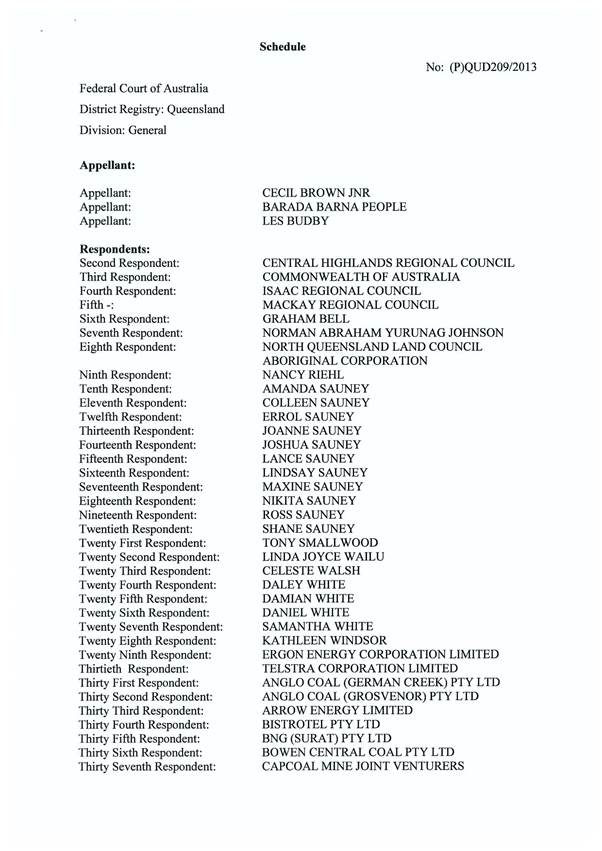
FRANK BUDBY, LES BUDBY AND CECIL BROWN JNR ON BEHALF OF THE BARADA BARNA PEOPLE Appellant | |
AND: | STATE OF QUEENSLAND AND OTHER RESPONDENTS NAMED IN THE SCHEDULE Respondent |
DATE OF ORDER: | |
WHERE MADE: |
THE COURT ORDERS THAT:
2. The orders of 10 April 2013 dismissing the application be set aside.
3. Each party pay its own costs of the appeal.
Note: Entry of orders is dealt with in Rule 39.32 of the Federal Court Rules 2011.
NEW SOUTH WALES DISTRICT REGISTRY | |
GENERAL DIVISION | QUD 209 of 2013 |
ON APPEAL FROM THE FEDERAL COURT OF AUSTRALIA |
BETWEEN: | FRANK BUDBY, LES BUDBY AND CECIL BROWN JNR ON BEHALF OF THE BARADA BARNA PEOPLE Appellant
|
AND: | STATE OF QUEENSLAND AND OTHER RESPONDENTS NAMED IN THE SCHEDULE Respondent
|
JUDGES: | MANSFIELD, DOWSETT AND JAGOT JJ |
DATE: | 6 DECEMBER 2013 |
PLACE: | BRISBANE |
REASONS FOR JUDGMENT
MANSFIELD & JAGOT JJ
The appeal
1 This is an appeal against orders the primary judge made on 10 April 2013 dismissing the appellant’s native title determination application.
2 The dismissal was on a summary basis consequential on an order the primary judge made on 13 September 2012 to show cause why the native title application should not be dismissed. The order for summary dismissal resulted from two conclusions of the primary judge explained in the reasons for judgment (Budby on behalf of the Barada Barna People v State of Queensland (No 2) [2013] FCA 314).
3 The primary judge concluded, first, that the application lacked reasonable prospects of success and, second, that the maintenance of the application constituted an abuse of process.
4 The appellant contends that the primary judge erred in respect of both conclusions, in substance, by reason of a failure to consider relevant matters.
5 The State of Queensland (the State), the first respondent, contends that the order for summary dismissal should stand because the primary judge’s conclusion that the maintenance of the proceeding would constitute an abuse of process was correct. The State makes no submission that the proceeding lacked reasonable prospects of success, consistent with its position before the primary judge. The Wiri People, also a respondent, contend that the appeal should be dismissed because both of the primary judge’s conclusions were correct.
6 Leave to appeal, which was required given that the dismissal of the proceedings was on a summary basis, was granted on 31 May 2013.
Discussion
No reasonable prospect of success?
7 The first conclusion of the primary judge – that the appellant had no reasonable prospect of successfully prosecuting the proceedings – cannot be sustained.
8 The primary judge reasoned that, because the appellant had indicated that it wished to have the opportunity to obtain new anthropological research, it followed that the appellant had no current supportable basis for its claim (at [25]). This lack of any supportable basis was said to be apparent despite the appellant having been granted previous indulgences by the Court including indulgences to obtain anthropological reports initially from Dr Lee Sackett and then from Ms Karen McFadden and Dr Paul Gorecki and Mr Tony Jefferies and Professor Bruce Rigby.
9 As the primary judge put it at [25] to [27]:
It is clear that the reports of Ms McFadden and Dr Gorecki, and Mr Jefferies and Professor Rigby, do not adequately support the applicant’s native title claim because the applicant seeks new anthropological research. Dr Sackett’s reports clearly do not support the claim. It is, in my view, dubious whether the applicant would achieve any more success from the further anthropological report they seek to procure from the UQ Culture & Heritage Unit.
Further, as submitted – in my view accurately – by the State of Queensland in this proceeding, the applicant’s case is “a moving feast”. On 30 May 2012 and 26 July 2012 the applicant informed the Court that it recognised the conclusions reached by Dr Sackett concerning the wider formulation of the claim group and that, if it could reach an accommodation with other native title groups, it would “also go along with Dr Sackett’s opinion” (transcript 26 July 2012 p 45 l 30). However the applicant has now informed the Court that it has reconsidered its position and is now fully committed to progressing its current claim rather than becoming part of a larger regional claim. A reasonable inference which can be drawn from this vacillation on the part of the applicant is the existence of serious flaws in the native title application which remain unresolved.
…
The apparent inability of the applicant to adduce evidence to support the native title application in its current form – despite repeated attempts over a number of years – is, in my view, a proper basis for the Court to conclude that the applicant lacks reasonable prospects of successfully prosecuting its claim.
10 While it is easy to understand the primary judge’s frustration with the appellant’s dilatory conduct and lack of real progress over a substantial period of time, the discretion to summarily dismiss a proceeding on the basis that it lacks reasonable prospects of success requires not only caution (because a party is thereby deprived of its opportunity for a hearing on the merits) but also an assessment of the substance of the native title claim having regard to the material both available and likely to be adduced. If it appears from that material that there is a real basis for the claim then the mere fact that the claim is in dispute, or that contrary material is available, or that the existing material is preliminary or incomplete is not a proper basis for the exercise of the power of summary dismissal on the ground of lack of reasonable prospects of success. It thus follows that the process of reasoning which the primary judge adopted cannot be sustained. The fact that the appellant wished to receive another indulgence to obtain further anthropological material undoubtedly raised a case management issue. It was also relevant to the abuse of process issue. However, it did not follow from that request that the existing material (or, for that matter, the material likely to be available at trial) did not “adequately support the … native title claim” (at [25]). This reasoning does not reflect the essential distinction between the sufficiency of material necessary for a party to succeed at trial (on the one hand) and to show the existence of a real or genuine case (on the other hand).
11 In the present case there was existing material showing a real and genuine basis for the appellant’s case. Contrary to the effect of the submissions of the Wiri People, the issue of the identification of the proper native title claim group does not stand outside the principles applicable to summary dismissal. The existence of material sufficient to show a real or genuine dispute, even about that fundamental issue, would preclude summary dismissal on the basis of the lack of reasonable prospects of success.
12 The material which existed, specifically the reports of Ms McFadden and Dr Gorecki and Mr Jefferies and Professor Rigby, undoubtedly supported the appellant’s claim, including the constitution of the native title claim group. The fact that Dr Sackett’s provisional report is to the contrary is immaterial. This difference of opinion merely discloses the existence of a real and genuine dispute. As explained by Gilmour J in a useful summary of the applicable principles in Dandaven v Harbeth Holdings Pty Ltd [2008] FCA 955 at [6]:
(d) it is not Parliament's intention to require the Court to engage in lengthy and elaborate trials on an interlocutory basis for the purposes of determining whether or not a proceeding has no reasonable prospects of success. It may be necessary for the opposing party to provide no more than an outline of evidence, sufficient to show that there is a genuine dispute, to prevent the summary application becoming a trial;
(e) if there is a real issue of fact or law to be decided, and the rights of the parties depend upon it, it is obviously appropriate that the matter goes to trial. It cannot be said that where there is a real factual dispute and that factual dispute must be resolved to determine whether the claim succeeds that there is ‘no reasonable prospect of success’;
…
(h) evidence of an ambivalent character will usually be sufficient to amount to reasonable prospects;
(i) in determining if there are real issues of fact in issue so as to preclude summary judgment the courts must draw all reasonable inferences in favour of the non-moving party.
13 The primary judge’s first conclusion does not fit conformably with these principles.
14 To the extent that the Wiri People sought to raise another argument during the hearing of the appeal – that the evidence of the appellant (Frank Budby) was itself inconsistent with the constitution of the native title claim group – a number of responses are open. First, the point was not put to the primary judge. Accordingly, it was not dealt with in the primary judge’s reasons. Second, the Wiri People had not filed a notice of contention, which would have been required: Federal Court Rules 2011 (Cth), r 36.24 Third, and most importantly, the point is without merit. The existence of conflicting material, whether the conflict be by reason of evidence of respondents or of one of the persons constituting the applicant under s 61 of the Native Title Act 1993 (Cth) (the Act) (now the appellant), does not negative the existence of a reasonable prospect of success. The conflict is simply a matter for resolution at trial.
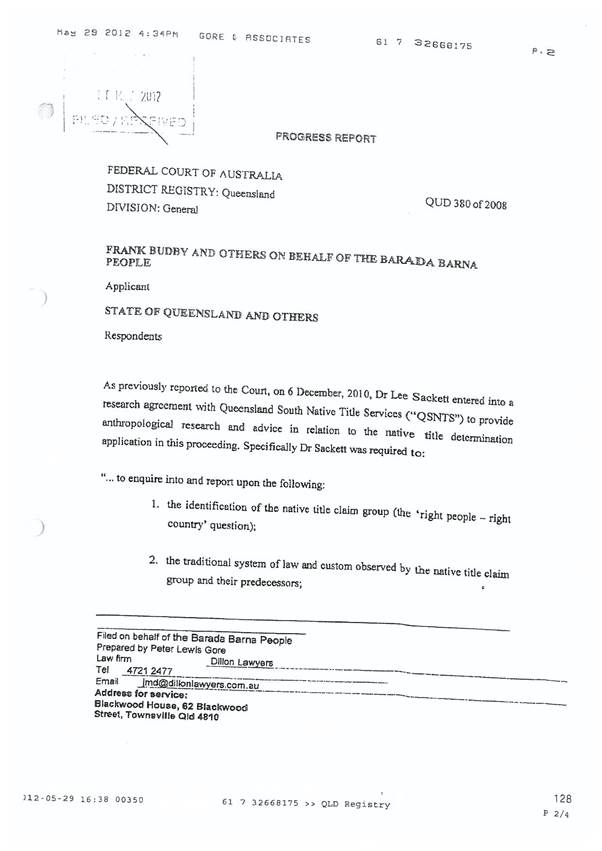
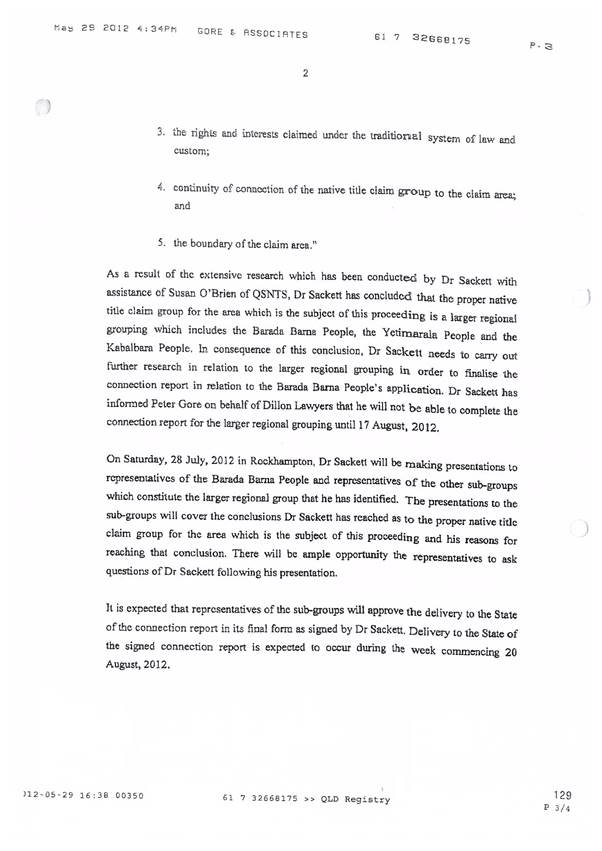
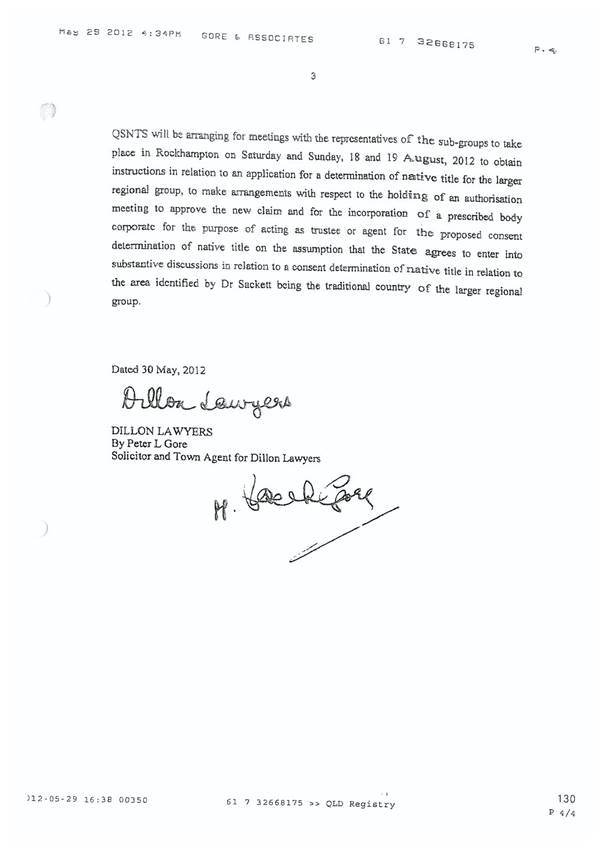
Abuse of process
15 The second conclusion of the primary judge – that the maintenance of the proceeding was an abuse of process – involves more finely balanced considerations. The inescapable fact, and one which no doubt properly exercised the mind of the primary judge, is that the appellant had not yet filed a statement of claim despite four years having passed. In this sense, the primary judge was correct to conclude that “notwithstanding the passage of four years, the respondents are as yet not in a position to know the case they are to meet” (at [37]).
16 Despite this, the conclusion as to abuse of process is also not sustainable.
17 Insofar as the primary judge relied on the notion that the existing material did not support the appellant’s case (for example, at [37]), the conclusions above apply. The appellant had material available supporting the claim. The appellant’s request for yet further time to file additional supporting material was relevant to the abuse of process questions. However, it was not open to the primary judge to find that “the evidence it [the appellant] has gathered does not support the case it seeks to prosecute” (at [37]). Despite the State’s best efforts to submit to the contrary, it is apparent that the primary judge’s conclusion of abuse of process was partly based on the erroneous conclusion of the lack of reasonable prospects of success. Hence, the abuse of process conclusion cannot stand.
18 The application under s 61 of the Native Title Act 1993 (Cth) (the Act) commenced on 12 November 2008. It is made on behalf of a claim group identified as the Barada Barna group. It was not until 29 March 2010 that the registration and notification processes undertaken by the Native Title Registrar under Pt 7 and s 66 of the Act respectively had been completed, so that those who wished to become parties to the application under s 84(3) could be identified. The Court then made orders on 8 July 2010 to progress the matter. The "show cause" hearing was on 17 October 2012 leading to the judgment appealed from, so there is a period of some 2 ¼ years to be accounted for.
19 On 8 July 2010, the Court relevantly to the present appeal:
(a) directed two named persons by 8 September 2010 to indicate if they are members of the Barada Barna claim group;
(b) directed the appellant also by 8 September 2010 to show the funding available for a connection report, the steps taken to engage an anthropologist to complete a connection report, and the timeframe for the draft and final connection reports;
(c) directed the appellant 14 days before the next directions hearing to provide a detailed timetable to progress the matter, including any possible mediation, and including explanations for any delays in complying with (2) above; and
(d) directed the appellant also by 8 September 2010 to identify the representative body which would be representing the appellant.
20 The next directions hearing was listed for 3 December 2010.
21 Those directions indicate that the Court was endeavouring to progress the application in an efficient and expeditious and appropriate manner. Its awareness of the background to this application also indicates why that was appropriate.
22 There have been six previous applications under s 61 in respect of the claim area, or areas which either partly or wholly include the claim area. They are adverted to at [6] in the primary reasons. The detail of those six earlier applications is set out in [3(a)] of the written submissions of the Wiri respondents on this appeal. Those submissions show the issue as to which group holds native title over the claim area or nearby areas has been a live one from 1997.
23 The directions of 8 July 2010 also addressed the proper status of some of the persons who had, under s 84, become parties to the application. That focus was maintained at the directions hearing on 3 December 2010 when a date was fixed in 2011 for certain respondents to show cause why they should not be removed as respondent parties under s 84(8) of the Act.
24 In the period up to 3 December 2010, the relevant representative body had not been resolved. The State accepts that the applicant and Queensland South Native Title Services (QSNTS) met on 4 August 2010 and on 13 September 2010, and that on the latter date QSNTS indicated that it had a conflict of interest between the Barada Barna claim group and others so that it could not act. It proposed that Dr Sackett should conduct research with a view to providing an anthropological report which would resolve the appropriate claim group or groups for a wider area including the claim area.
25 At that point in time, there were apparently other groups - perhaps overlapping in membership - identified as potential native title claim groups who held native title interests in the general area, or parts of it, including the claim area. They included the Kabalbara People and the Yetimarala People (both recognised in the directions given on 3 December 2010) and the Wiri People. The Wiri People, represented by particular individuals, are respondent parties to the application.
26 In the light of the matters referred to above, it is important to note the significant role of representative bodies under the Act in relation to claims under s 61. Once recognised, a representative body has facilitation and assistance functions including research and preparation of applications under s 61: ss 203BB(1) and 203BC, including assisting in the conduct of such claims. A representative body may certify an application if it is satisfied that it has been properly authorised and properly identifies the relevant claim group: s 203BE(1) and (2). In the case of overlapping applications, the representative body must make all reasonable efforts to get agreement between the competing claim groups and to minimise the number of applications: s 203BE(3). Particularly relevant to the present application (and the appeal) is that a representative body has "dispute resolution functions" to assist in promoting agreement between indigenous people in the area for which it is responsible including about applications: s 203BF. Section 203BD deals with the circumstance where a claim area extends over the areas of responsibility of two representative bodies. That, too, has some significance because the North Queensland Land Council (NQLC) asserts that the claim area extends into the geographical area of its responsibility. NQLC is conducting the Wiri People's response to this application.
27 Given those responsibilities, it was appropriate for QSNTS to seek a resolution of the competing or potentially competing interests over the claim area by engaging Dr Sackett's assistance. The lengthy history of related claims going back to 1997 also warrants such an approach.
28 It was also appropriate for the appellant to acquiesce in, and cooperate in, those endeavours.
29 At the directions hearing on 3 December 2010, directions were given requiring the appellant, by affidavit by 23 February 2011, to explain how the current Barada Barna group was identified, and how it compared to the earlier Barada Barna, Kabalbara and Yetimarala claim groups and the reasons for the differences between those groups. The Wiri People also raised the question whether one of the asserted apical ancestors of the Barada Barna claim group, Maggie Barker, was in fact a Wiri person and not a Barada Barna person, so the explanatory affidavit was to address that issue also. The Court also expressed concern about the time required for Dr Sackett to report. The next directions hearing, among other things, was to address that concern.
30 The appellant, in compliance with that order, filed the affirmation of Dr Pawel Gorecki on 22 February 2011. At least by about this time, Dr Sackett had been engaged by QSNTS and had indicated he would be able to report by June 2012.
31 On 4 March 2011, a Registrar made an order for NQLC to file material in relation to earlier material. It appears from the submissions of the Wiri People on this appeal that NQLC is representing them.
32 In June 2011, Dr Sackett had apparently progressed his work sufficiently to express the view that the "soundest claim" would be a combined claim of Barada Barna, Kabalbara and Yetimarala People over an area which included, and extended beyond, the present claim area. That is, he proposed a regional claim with a composite claim group. If acceptable to all the then competing claim groups, or potential claim groups, and to the State, that would involve procedurally a fresh application in substitution for other existing applications.
33 On 24 June 2011, the Court gave directions for further material to be filed by the appellant relating to the several apparently competing claim groups and to the status of Maggie Barker by 11 July 2011. Dr Gorecki's further affidavit of 7 July 2011 was to comply with that direction.
34 On 15 July 2011, a Registrar directed the appellant to settle the terms of reference for Dr Sackett (to reflect the matters identified in the orders of 3 December 2010) and to file Dr Sackett's report by 30 September 2011, later extended to 31 January 2012.
35 Dr Sackett's report was filed on 1 February 2012, and a response of Dr Gorecki by affidavit filed on 9 March 2012. Dr Sackett's report is entitled "Maggie: Wiri or Barada". He said he was "inclined to the view" that Maggie Barker was Wiri, and he said the Barada Barna area did not extend as far north as Nebo and associated areas. Those conclusions were contested by Dr Gorecki (noted above) and by a preliminary report of Mr Tony Jefferies of 29 May 2012 and a further report of Professor Bruce Rigsby and Mr Jefferies of 24 July 2012.
36 In addition, the appellant by a Progress Report to the Court of 30 May 2012 reported Dr Sackett's view that a claim by a larger regional grouping was appropriate, but that Dr Sackett needed to do further research to be able to produce a report supporting such a claim. His report was then anticipated on 17 August 2012. The appellant indicated that the subgroup meetings were to occur in late July 2012, and that “it is expected” that the subgroups would adopt his views and jointly present his anticipated connection report to the State on the last week of August 2012. Formal authorisation meetings of the subgroups had been scheduled for 18 and 19 August 2012. Consistently with that position, the appellant at a directions hearing on 16 August 2012 adhered to that position, and suggested a four month period after the imminent meetings to allow for the engagement of the State, if the subgroups agreed to act on Dr Sackett's views, leading to a consent determination. The appellant confirmed that, "in principle", the views of Dr Sackett were acceptable.
37 The material to which attention was drawn does not show whether any meetings were held on 18 and 19 August 2012. But it shows that the Rigsby/Jefferies report was not seen by Dr Sackett before 24 August 2012 (the circumstances are unclear: it was either accidentally not sent promptly, or it was sent but did not come to his attention) when he left for overseas. Dr Sackett said he could not consider it again until about February 2013.
38 QSNTS then, in about late August 2012, developed concerns which led to the non-occurrence of a proposed series of "intramural" sub-group meetings extending to a final authorisation meeting in December 2012. As QSNTS thought there were some conflicts between the views of Dr Sackett and the Rigsby/Jefferies views, and it did not know if the appellant was prepared to proceed on the basis of Dr Sackett's views (despite what had been said at the directions hearing on 16 August 2012), it drew its concern to the attention of the Court.
39 On 13 September 2012, at the commencement of the next directions hearing, the primary judge asked counsel for the appellant why, on the Court's motion, the appellant should not be required to show cause why the application should not be dismissed. In the course of submissions, the appellant referred to seeking further opinion to see if the claim area proposed should be extended northwards. Counsel adhered to the position supporting the overall larger claim area, with a wider claim group, but wished to explore having a more northerly boundary for that area. Counsel for the QSNTS, on the other hand, said that the reports of the appellant "diametrically oppose" some of the significant conclusions of Dr Sackett. Counsel for the Wiri respondents, like counsel for the appellant, said the residual dispute was about the boundary and should not impede the proposed meetings. The "show cause" order was then made, and heard on 17 October 2012. The sequence of proposed meetings did not therefore take place.
40 It has been desirable to set out that history in some detail (based largely on the State's helpful chronology) to illustrate:
(a) the appellant has throughout evidenced an intention to proceed with the claim;
(b) the appellant has complied with the directions of the Court in a timely manner;
(c) when the prospect of a wider resolution was canvassed, the appellant supported the appointment of Dr Sackett and was, at least subject to the appropriate meetings, prepared to act on his views (subject to exploring further the expansion of the proposed larger claim area to the north);
(d) the appellant had not actively further investigated the more confined claim made (that is the smaller area claimed by the Barada Barna People only) from about mid to late 2011 because of the reference of the issues between potentially competing claimants to Dr Sackett for his opinion at the instigation of QSNTS.
41 In those circumstances, there is nothing to suggest that the appellant's conduct of its claim suggested any abuse of process on its part. When the prospect of a wider inter-group resolution was proposed, the appellant supported the proposal in principle. It was proper to explore that prospect. It was not suggested that it was inappropriate to do so whilst putting the preparation of its claim on hold. Indeed, the response of QSNTS to the Rigsby/Jefferies report (which addressed Dr Sackett's views in some respects) show why the main focus should have been on the regional solution.
42 One of the procedural premises in the Act is that it is desirable for applications to be resolved by negotiation if possible. Hence, from its inception the Act, until 2009, included as the mechanism for determining claims to native title (s 3(a)) the referral of all claims to mediation to the National Native Title Tribunal: s 72 as amended by the Native Title Amendment Act 1998 (Cth) until repealed by the Native Title Amendment Act 2009 (Cth) and the amendments to ss 86A, 87 and 87A by the latter amending Act. See for example: Hunter v State of Western Australia [2009] FCA 654 at [16]-[17]; Adnyamathanha No 1 Native Title Claim Group v State of South Australia (No 2) [2009] FCA 359; Eringa, Eringa No 2, Wangkangurru/Yarluyandi and Irrwanyere Mt Dare Native Title Claims Groups v State of South Australia [2008] FCA 1370 and Hayes on behalf of the Thalanyji People v State of Western Australia [2008] FCA 1487. That is also consistent with the obligations of all litigants under ss 37M and 37N of the Federal Court of Australia Act 1976 (Cth).
43 The aim of an agreed outcome in claims such as the present applies equally, if not more forcefully having regard to s 68 of the Act, where there is a dispute between competing claim groups, as where there is a dispute between a claim group not respondent parties. The primary judge appropriately allowed for that process to be pursued. It is not entirely clear to us why that process was not maintained. The primary judge seems to have been presented with an ultimatum by the QSNTS. The "final straw" appears to have been the perceived late receipt of the Rigsby/Jefferies report. As there may be relevant material to that view which is not directly relevant to the appeal, and so not brought to the Court's attention, it is not appropriate to say more about that; our comments are not intended to direct criticism at those representing the appellant, the potentially competing claim groups or QSNTS. However, if there are no prospects of a "regional" claim being revived, then this claim should be heard as soon as practicable (together with any competing claims). We note that the Court was told that the Barada Kabalbara and Yetimarala Peoples claim (QUD 439/2013) and the Wiri Peoples claim (QUD 492/2013) do not overlap with this claim area.
44 On this application, the appellant had not sought to reformulate the claim, apart from being prepared to participate in a possible regional claim for a wider area and a larger claim group including the present claim group. There is no significant delay in the appellant progressing the claim. The appellant has complied with the directions of the Court from time to time about the filing of particular material. As noted, the appellant has evidence which, if uncontradicted, is capable of supporting the claim. As to the progress of the claim, if the prospect of a regional alternative is no longer pursued, the appellant (the Court was told on the hearing of the appeal) will be in a position to complete its anthropological connection report by December 2013 and to progress to a hearing.
45 For these reasons, the dismissal of the claim on the basis of it being an abuse or process cannot be maintained.
Conclusion
46 For the reasons set out above, the appeal should be allowed and the order for summary dismissal set aside. Having regard to s 85A of the Act, each party should pay its own costs of the appeal.
I certify that the preceding forty-six (46) numbered paragraphs are a true copy of the Reasons for Judgment herein of the Honourable Justices Mansfield and Jagot. |
Associate:
IN THE FEDERAL COURT OF AUSTRALIA | |
QUEENSLAND DISTRICT REGISTRY | |
GENERAL DIVISION | QUD 209 of 2013 |
ON APPEAL FROM THE FEDERAL COURT OF AUSTRALIA |
BETWEEN: | FRANK BUDBY, LES BUDBY AND CECIL BROWN JNR ON BEHALF OF THE BARADA BARNA PEOPLE Appellant
|
AND: | STATE OF QUEENSLAND AND OTHER RESPONDENTS NAMED IN THE SCHEDULE Respondent
|
JUDGES: | MANSFIELD, DOWSETT AND JAGOT JJ |
DATE: | 6 DECEMBER 2013 |
PLACE: | BRISBANE |
REASONS FOR JUDGMENT
DOWSETT J:
47 I have read the reasons prepared by Mansfield and Jagot JJ. I shall not repeat the facts of the case.
48 The primary Judge was prompted to consider the future conduct of this case by reference to the appellant’s past conduct over a considerable period of time. In particular it had failed to resolve, in a timely way questions going to the description of the claim group. In December 2010 and subsequently, her Honour ordered that information be provided concerning that matter, in particular the status of Maggie Barker as an apical ancestor. The appellant did not comply with those orders. At some time prior to June 2011 it was decided that an anthropologist, Dr Sackett should conduct research into the matter. In June 2011 Dr Sackett suggested that the “soundest claim” would be by an extended claim group over an extended area, possibly involving the identification of sub-groups having special interests in particular parts of the extended claim area. The appellant accepted that proposal, subject to there being agreement amongst the various groups which would comprise the extended claim group. Dr Sackett provided his report in January 2012. He was inclined to the view that Maggie Barker was not a Barada Barna woman, and that she had not been connected, during her lifetime, with locations within Barada Barna country. That view was potentially damaging to the appellant’s case.
49 On 30 May 2012 the appellant’s solicitors reported to the Court (the “May report”). I attach a copy of that report. I infer that it was written on instructions from the appellant. It demonstrates a clear intention to proceed in accordance with Dr Sackett’s advice. This intention seems to have been inconsistent with any intention further to prosecute the existing application. Even at that stage it may have been appropriate to call on the appellant to show cause why the existing application should not be dismissed.
50 Notwithstanding the appellant’s statements of intention, it seems that it had already commissioned other reports from Dr Gorecki, Mr Jefferies and Professor Rigsby which, according to the appellant’s submissions, it received between 9 March and 24 July 2012. Two of the reports are dated March and May 2012, suggesting that they were probably received prior to the May report. The other report was dated July 2012. On 26 July 2012, the appellant’s solicitor again informed the Court that the appellant proposed to proceed with negotiation of the extended claim in accordance with Dr Sackett’s advice. On 13 September 2012 the appellant’s solicitor again told her Honour that the appellant was willing to continue with those negotiations. On that date her Honour called on the appellant to show cause. However, on 17 October 2012, when the show cause proceedings were heard, the appellant apparently indicated its intention to prosecute the existing application. The appellant suggests that QSNTS had indicated that it would no longer facilitate negotiations within the larger group, and that this decision led the appellant to abandon that option. I suspect that her Honour’s notice to show cause was at least one reason for the appellant’s doing so.
51 It appears that, at the hearing, Her Honour understood that the appellant proposed to prosecute the existing application. However she inferred from its prior conduct in seeking further evidence and pursuing Dr Sackett’s alternative solution, that it considered that it could not successfully do so on the available evidence. Her Honour appears to have understood that the appellant was looking around for evidence which might support its case, however she doubted whether it would be successful.
52 Before considering the correctness or otherwise of the primary Judge’s reasons, it is appropriate that I say something about case management generally, and in Native Title cases. Case management may take many forms. In some cases, it may deal with the well-established process for bringing matters to trial, which process has been in place in most common law jurisdictions since the adoption of the Judicature Act reforms in the late nineteenth century. That process involves various recognized procedural steps such as delivery of pleadings, discovery and the delivery of interrogatories. In more recent times, other steps have been incorporated into case management, including mediation, conferences between or amongst expert witnesses and the exchange of witness statements. Many Judges have developed other routine or bespoke case management techniques. In all such cases, the aim is to ensure that the case progresses towards trial whilst, at the same time, encouraging discussion and co-operation amongst the parties so as to maximize the exploitation of opportunities for settlement and/or narrowing of the issues. In that model of case management, the threat of a credible trial date is frequently used to encourage appropriate discussion and co-operation.
53 In Native Title matters case management generally takes a somewhat different form, because:
the cases are frequently launched without sufficient prior preparation;
there are difficulties inherent in conducting litigation which is effectively representative in nature;
there are difficulties inherent in proving the factual issues which typically arise in such cases; and
there are inadequate resources.
54 Such resources as are available may often be better utilized in investigation and seeking agreement than in preparing for trial. However the absence of credible, or any trial dates may result in there being insufficient motivation for the efficient and timely conduct of the case. Experience suggests that practitioners and expert witnesses involved in Native Title cases sometimes lose sight of the fact that claim groups are generally anxious to attain recognition of their claims. Non-government respondents are also frequently anxious to have the certainty which only the final resolution of a Native Title claim offers.
55 Since about 2003 in Queensland, the approach to case management has been to encourage clarification of issues and resolution by agreement, initially without the threat of a trial and frequently, without compelling parties to take steps which are designed to lead to a trial. In adopting this approach the Court allows the parties time in which to focus on investigation and negotiation. However that method of case management is frequently too open-ended. Even the most indulgent case manager must insist on measurable progress. In order to ensure such progress, the Court may allow limited time for investigation and negotiation, in conjunction with a timetable for advancing the matter towards trial. Thus a failure to reach agreement on a particular aspect may result in a requirement that a procedural step be taken within a prescribed time. The Court cannot compel parties to agree, and so the sanction for failure to agree cannot properly be dismissal of the proceedings. However failure to comply with an order to take a recognized step towards trial may properly be dealt with as failure to comply with a Court order, with whatever consequences may follow.
56 In general litigation, case management occurs in the context set by the pleadings. In Native Title cases, case management regularly occurs in a less clearly defined context. The statutory form of application is generally an unsatisfactory combination of application and statement of claim, frequently involving the indiscriminate use of language borrowed from the Native Title Act 1993 (Cth) and/or the cases. It frequently reflects inadequate research and undue haste, often brought about by awareness of a proposed development about which the claim group wishes to negotiate. There is virtually never a defence. The common expectation is that, over time, negotiations will lead to agreement. My own view is that a more rigorous insistence on pleadings would bring about quicker and less expensive resolution of Native Title claims. However that view is not directly relevant for present purposes.
57 The Court cannot allow the parties to investigate and/or negotiate indefinitely, and without any progress towards trial. Eventually, in the absence of agreement, preparation for trial must become the dominant aim of case management. In some cases, that point may be reached because the parties have simply been unable to agree. In others it may be that the parties have not really tried. In either case the Court will generally adopt a more prescriptive approach to case management, perhaps by fixing a timetable designed to bring the matter to trial, or by fixing time limits within which particular steps are to be taken. In some cases, the parties may find it difficult to respond to a sudden change in the case management goals. To some extent, the Court will have to accommodate that difficulty. After all, it will, in part be the product of the way in which the Court has previously managed the case. In some cases, it may be necessary to allow the parties a significant period of time in which to adapt to the new case management regime. The prior history of the matter will generally be relevant to the length of time which the Court allows for that purpose.
58 This case seems to have reached the point at which the primary Judge decided that more prescriptive case management was necessary. However, no doubt because of her views as to the appellant’s prior conduct of the case and perhaps, the view that the appellant had effectively abandoned the existing application, the primary Judge considered that she should address the viability of the proceedings. That approach may have been appropriate, but it required that her Honour consider carefully the history of the matter, and the opportunities for rectifying any past shortcomings. In this case, primary considerations were the appellant’s failure to address the problems with the claim group description and the difficulties created by differing anthropological evidence.
59 If the primary Judge considered, as I suspect she did, that the appellant had effectively abandoned the existing application, then that proposition should have been put to it for comment. The same purpose might have been served by asking why the appellant had departed from the course proposed in the May report. These matters seem to have been the immediate cause of her Honour’s concern and ought to have been the basis upon which she ordered the appellant to show cause. Had that approach been taken, the primary Judge would have had to consider whether the appellant had abandoned the existing application and, if so whether it should be allowed to depart from such abandonment. If the appellant asserted that it had not abandoned the existing application, and her Honour accepted that assertion, then the question would have been whether to exercise the discretion summarily to dismiss the proceedings on the ground that they had no reasonable prospects of success. That process would necessarily have involved an examination of the case as it appears in the application, and of such evidence as was available, or which the appellant reasonably hoped to obtain. If the appellant conceded, or her Honour found that the existing application had been abandoned, but the appellant wished to depart from that abandonment, then her Honour would have had to consider whether to permit that course. Again, the prospects of success would be a relevant consideration, as would be the history of the matter.
60 A third possibility is that the appellant accepted that it had abandoned the existing application, stood by that decision and wished to investigate a possible alternative case. It may, nonetheless, have wished to keep the existing application on foot in order to maintain existing negotiating rights. In that case her Honour would have had to consider whether to allow the existing proceedings to remain on foot, pending the commencement of new proceedings.
61 In all of these possible approaches to the problem, prospects of success and/or possible abuse of process may have arisen. Whether the primary Judge was considering summary dismissal on the ground that the existing claim lacked reasonable prospects of success or dismissal as an abuse of process, her decision would necessarily involve the exercise of a discretion. Thus the approach prescribed in House v The King (1936) 55 CLR 499 would apply to any appeal, at least with respect to some aspects of the case.
62 Whilst the primary Judge may have had reason to believe that the appellant was concerned about the adequacy of its evidence to prove the existing claim, the discretion to dismiss for want of reasonable prospects of success would only arise if her Honour were satisfied that there were no reasonable prospects of success. The appellant’s apparent lack of confidence was not a proper basis for reaching that conclusion. The desire to find further evidence in support of the claim did not necessarily show that the presently available evidence was insufficient. Her Honour was obliged to consider the available evidence, as well as any suggestion by the appellant that other evidence might reasonably be available. Given the history of the matter her Honour might reasonably have refused any request by the appellant for more time in which to find evidence. However, to the extent that it relied on available evidence, such evidence had to be examined and any inadequacy identified. Her Honour seems not to have performed this function. The second respondent submits that the appellant’s case would have failed because of the difficulties with identification of the claim group. That matter was certainly of concern, but it is not clear to me that the appellant would have failed because of its inability to support it on the available evidence. In any event, it is clear that her Honour did not approach the matter in that way.
63 As to abuse of process, her Honour’s decision appears to have been based on the fact that the appellant had again sought to re-formulate its claim. That may have been the case as at 13 September 2012. However, by 17 October 2012, the date of hearing, it had committed itself to the existing application. As I have said, her Honour had to decide whether it was open to the appellant to take that course. She seems to have accepted that it could.
64 Her Honour found abuse of process on the basis that the appellant’s evidence did not support the existing application. As I have demonstrated, such a view could only be justified by reference to the evidence, a step which her Honour did not take. Thus I conclude that her Honour’s exercise of the discretion miscarried in that she chose to rely on an inference which she considered was available from the appellant’s conduct in seeking further evidence, and without regard to evidence which seems to have offered at least some support for its case.
65 I agree that the appeal should be allowed. The orders made below should be set aside. I would make no order as to costs.
66 I add two further comments. I do not accept that proceedings in this Court should necessarily be delayed in order to accommodate discussions between, or the resolution of differences between Native Title representative bodies. I also doubt whether statutory exhortations concerning negotiated settlements have much relevance to a Native Title case which has, in one form or another, been in the offing since 1997.
I certify that the preceding twenty (20) numbered paragraphs are a true copy of the Reasons for Judgment herein of the Honourable Justice Dowsett. |
Associate:
Dated: 6 December 2013