

FEDERAL COURT OF AUSTRALIA
BHP Coal Pty Ltd v Construction, Forestry, Mining and Energy Union [2013] FCAFC 132
FEDERAL COURT OF AUSTRALIA
BHP Coal Pty Ltd v Construction, Forestry, Mining and Energy Union [2013] FCAFC 132
CORRIGENDUM
1. In paragraph 5 of the Reasons for Judgment, in the fifth sentence, the reference “s 347(a)(iii)” should read “s 347(b)(iii)”.
| I certify that the preceding one (1) numbered paragraph is a true copy of the Corrigendum to the Reasons for Judgment herein of the Honourable Justice Dowsett. |
Associate:
Dated: 22 July 2014
| IN THE FEDERAL COURT OF AUSTRALIA | |
| Appellant | |
| AND: | CONSTRUCTION, FORESTRY, MINING AND ENERGY UNION Respondent |
| DATE OF ORDER: | |
| WHERE MADE: |
THE COURT ORDERS THAT:
2. The order made on 7 November 2012 reinstating Mr Henk Doevendans to the position he occupied prior to the termination of his employment on 21 May 2012 is set aside.
3. The order made on 21 December 2012 that a payment of a pecuniary penalty in the amount of $7,500 in respect to a contravention of s 346 of the Fair Work Act 2009 (Cth) be set aside.
4. The parties exchange submissions as to costs and file such submissions on or before 31 January 2014.
Note: Entry of orders is dealt with in Rule 39.32 of the Federal Court Rules 2011.
| QUEENSLAND DISTRICT REGISTRY | |
| FAIR WORK DIVISION | QUD 637 of 2012 |
| ON APPEAL FROM THE FEDERAL COURT OF AUSTRALIA |
| BETWEEN: | BHP COAL PTY LTD Appellant |
| AND: | CONSTRUCTION, FORESTRY, MINING AND ENERGY UNION Respondent |
| JUDGES: | DOWSETT, KENNY AND FLICK JJ |
| DATE: | 13 DECEMBER 2013 |
| PLACE: | BRISBANE |
REASONS FOR JUDGMENT
DOWSETT J:
1 I have read the separate reasons prepared by Kenny and Flick JJ. I agree with the reasons of Flick J and concur in the orders which his Honour proposes. Their Honours disagree concerning the aspect of the case which depends upon s 347(b)(v) of the Fair Work Act 2009 (Cth) (the “Act”). I should state my reasons for agreeing with Flick J. Their Honours have set out the facts of the case. I need not repeat them.
2 Although it may not be immediately obvious from the reasoning of the High Court in Board of Bendigo Regional Institute of Technology and Further Education v Barclay [2012] 86 ALJR 1044, the case concerned both s 347(b)(iii) and s 347(b)(v). See the reasons of French CJ and Crennan J at [19] and the decision at first instance, reported at (2010) 193 IR 251 at [10]. The following extracts from the evidence appear at [26]-[28] in the reasons of French CJ and Crennan J:
26 Dr Harvey then described her concerns after considering the contents of Mr Barclay’s email:
“I had a number of very serious concerns about the Email and Mr Barclay’s related conduct. My concerns were that:
(a) the allegations of fraudulent conduct were made without any complaint or report of conduct of that kind being raised with me or any other member of senior management;
(b) the language used in the Email was bound to cause distress to members of staff, bring the reputation of [the college] into question and undermine staff confidence in the Audit process; and
(c) I was also concerned that Mr Barclay was employed in the Unit responsible for overseeing the preparation for the Audit process.”
27 Dr Harvey also gave evidence in her affidavit of her reasons for taking adverse action against Mr Barclay:
“I considered the investigation into Mr Barclay’s actions necessary because it appeared to me that he had failed to notify either me or his direct manager of very serious allegations, being allegations of fraudulent conduct in the workplace, which were material to the Audit process. Instead, he proceeded to cast aspersions and innuendo upon his colleagues by way of a widely circulated email. I regarded this as prima facie evidence of a breach of the Code of Conduct and his obligations as a [the college] employee.
I made the decision to investigate Mr Barclay’s conduct in sending the Email on the basis that he is an employee of [the college] who is required to adhere to policy and procedures that govern his employment, not because of his membership of or role in the AEU ...
I made the decision to suspend Mr Barclay because I was of the view that the allegations against him were serious and I was concerned that if Mr Barclay was not suspended he might cause further damage to the reputation of [the college] and of the staff [of the college].”
28 Dr Harvey stated that she would have taken the same action in similar circumstances against a person who was neither a member nor an officer of the AEU.
3 At [30] French CJ and Crennan J observed that:
It was not disputed before the primary judge that the AEU is an “industrial association” or that Mr Barclay is an “officer” of the AEU within the meaning of those terms in s 12 of the Fair Work Act. It was also common ground before the primary judge that Mr Barclay “had the right (and probably the duty) to discuss workplace issues of concern to members with those members and to advise them” and that Mr Barclay was “bound to respect confidences”.
4 At [59]-[63] their Honours said:
59 Despite the change to a civil penalty regime effected in 1996, s 361 does not differ in relevant respects from its legislative predecessors and Bowling remains authoritative in relation to a number of the arguments raised on the appeal.
60 First, it is erroneous to treat the onus imposed on an employer by s 361 as being made heavier (or rendered impossible to discharge) because an employee affected by adverse action happens to be an officer of an industrial association. Further, the history of the relevant legislative provisions reveals no reason why the onus must now be different if adverse action is taken while an employee engages in industrial activity – like a person who happens to be an officer of an industrial association, a person who happens to be engaged in industrial activity should not have an advantage not enjoyed by other workers.
61 Central to the respondents' argument on this appeal was the contrary and incorrect view that Mr Barclay's status as an officer of an industrial association engaged in lawful industrial activity at the time that Dr Harvey took adverse action against him meant that Mr Barclay's union position and activities were inextricably entwined with the adverse action, and that Mr Barclay was therefore immune, and protected, from the adverse action. If accepted, such a position would destroy the balance between employers and employees central to the operation of s 361, a balance which Parliament has chosen to maintain irrespective of the fact that the protection in s 346(b) has a shorter history than the protection in s 346(a). That balance, once the reflex of criminal sanctions in the legislation, now reflects the serious nature of the civil penalty regime. Speaking more generally, that balance is a specific example of the balance of which Alfred Deakin spoke as being necessary for an effective conciliation and arbitration system.
62 Secondly, it is a related error to treat an employee's union position and activity as necessarily being a factor which must have something to do with adverse action, or which can never be dissociated from adverse action. It is a misunderstanding of, and contrary to, Bowling to require that the establishment of the reason for adverse action must be entirely dissociated from an employee's union position or activities. Such reasoning effectively institutes an interpretation of the relevant provisions indistinguishable from that of Isaacs J in Pearce, which was rejected in Bowling. The onus of proving that an employee's union position and activity was not an operative factor in taking adverse action is to be discharged on the balance of probabilities in the light of all the established evidence.
63 Thirdly, it is appropriate for a decision-maker to give positive evidence comparing the position of the employee affected by the adverse action with that of an employee who has no union involvement.
5 In the present case, the respondent sought to establish breach of s 346 of the Act, relying upon s 361. The primary Judge dismissed the claim to the extent that it was based on s 346(a) but upheld the claim based on s 346(b). The respondent’s case was that the relevant industrial activity was that identified in either s 347(b)(iii) or s 347(b)(v). His Honour upheld the claim on both bases. Concerning the case based on s 347(a)(iii), the primary Judge concluded at [114] that a protest had been organized by the union, and that the employee had participated in it by “holding and waving of the scabs sign”. His Honour then concluded that:
Since a reason for his dismissal was that he did so hold and wave the sign, it follows that his dismissal was done in contravention of s 346(b) of the [Act].
6 This conclusion was based upon s 347(b)(iii) of the Act. His Honour then went on to consider the case based on s 347(b)(v). At [116] he said:
The first issue to be resolved under s 347(b)(v) is the identification of the specific conduct on the part of [the employee] which would constitute engagement in industrial activity. For the [union] to succeed, the conduct so identified must be that for which he was dismissed: that is to say, there must be an identity between the reason for his dismissal and the specific industrial action in which he engaged. Here, [the employee] was dismissed for holding and waiving the scab sign. He was not dismissed for taking part in the protest in other respects. That his participation in the protest may have constituted the representation or advancement, by him, of the views, claims or interests of an industrial association is, therefore, not presently to the point. The only question is whether the holding and waving of the scabs sign had that character.
7 His Honour concluded that:
121 … it is [the respondent’s] view, or at least the view of the Branch, that workers who continue to work during a strike that has been endorsed by a collective of their fellows were scabs, and should be castigated as such.
122 I also consider that, in displaying the scab sign at the protest, [the employee] was representing and advancing the interests of the branch, and therefore of an industrial association, in relation to its negotiations with the [employer] over the proposed new enterprise agreement. … By doing his part in prevailing upon workers at the Siraji Mine not to continue working, thereby compromising, to some extent at least, the effectiveness of the industrial action, [the employee] was representing and advancing the interests of the branch in its negotiations with the respondent.
123 For these reasons, I take the view that in displaying the scabs sign at the protest, [the employee] was representing and advancing the views and interests of an industrial association. Since he was dismissed for that conduct, it follows that the dismissal was done in contravention of s 346(b) of the [Act].
8 I have some difficulty in accepting that the so-called “scabs sign” can be accurately described as the representation or advancement of the views, claims or interests of an industrial association. It seems to me rather more like common abuse. However I do not understand the appellant to challenge his Honour’s conclusions in that regard. In any event it is clear that his Honour’s decision was based on his view that holding and waving the sign constituted:
participation in a lawful activity organized by the respondent; and
the representation or advancement of the views, claims or interests of the respondent.
9 Thus, in his Honour’s view, the adverse action was taken because of the holding and waving of the sign. However at [36]-[41] his Honour accepted evidence from the decision-maker, Mr Brick as to his reasons for taking adverse action against the employee. That evidence appears at [30]-[32]. In particular, at [30] Mr Brick said that neither the employee’s position in the respondent union nor his engagement in industrial action or activity played any part in his decision-making process.
10 In my view the High Court’s decision in Barclay applies to any attempt to enforce the prohibitions contained in s 346, relying upon s 361. That decision establishes that the fact that the employee participated in such an activity or represented or advanced such views, claims or interests does not necessarily lead to the conclusion that adverse action was taken because of such engagement. Barclay establishes that engagement in industrial activity may be closely related to a decision to take adverse action, without necessarily being the cause of such decision.
11 Omitting inevitable diversions to deal with particular submissions which are not presently relevant, his Honour’s reasoning in connection with s 347(b)(iii) appears at [30], [36], [41], [83] and [114]. At [30], [36] and [41] his Honour records and accepts that the appellant’s reasons for taking action against the employee did not include his engagement in industrial action or activity. At [83] his Honour identifies the respondent’s case, namely that if the employee was dismissed for displaying the sign, then he was dismissed for participating in a lawful activity, namely the protest. As I have said his Honour had already accepted that the employee had not been dismissed for engaging in industrial action or activity. Nonetheless his Honour concluded at [114] that the employee was dismissed for holding and waving the sign, which conduct constituted participation in a lawful activity organized by the union. Similar reasoning seems to have led to his Honour’s finding concerning s 347(b)(v).
12 His Honour’s reasons are both careful and comprehensive but, with all respect, I find it impossible to reconcile his findings and conclusions with the High Court’s decision in Barclay. That decision applies to proceedings which rely upon either s 346(a) or s 346(b). In the latter case it applies to each of the forms of engagement in industrial activity identified in s 347. Clearly, holding and waving the sign comprised part of the reason for the adverse action as did, in Barclay, the sending of the relevant email. Although Mr Barclay’s conduct was in discharge of his union duties, and may have involved his representing or advancing the views, claims or interests of the union, such characterization did not mean that the adverse action was because of his engagement in industrial activity. Rather, it was the content of the email, the circumstances in which it was sent and the likely effects on the Institute’s operations which caused the adverse action. In other words, an employee may act in a way which falls within ss 346 and/or s 347, but may do so in a way, or in circumstances which cause the employer to act adversely, not because of the employee’s engagement in industrial activity, but because of other concerns.
13 In my view the primary Judge’s finding that the employee’s engagement in industrial action or activity played no part in the employer’s decision-making process disposed of the matter. That the impugned conduct may have fallen within any of the categories of conduct identified in s 347 was irrelevant.
14 To some extent, this case has been flavoured by the use of the word “scab”. As the evidence discloses, it is a word which has a particular meaning and resonance in the world of industrial relations. However the word has no legal significance or standing. Unions and union members have no inalienable right to use the word in the course of industrial action. Employers have no inalienable right to prevent its use. However employers may regulate the way in which employees treat one another. Indeed, an employer has a duty to do so. At some points in this case, there seems to have been a suggestion that it raises a question about the employer’s right to regulate employees’ conduct, particularly when not on duty. There was also a suggestion that an employer has no right to demand that an employee comply with its rules of conduct when engaged in industrial activity. Such issues may be relevant in proceedings for unfair or unlawful dismissal, but they are not relevant in these proceedings.
| I certify that the preceding fourteen (14) numbered paragraphs are a true copy of the Reasons for Judgment herein of the Honourable Justice Dowsett. |
Associate:
| IN THE FEDERAL COURT OF AUSTRALIA | |
| QUEENSLAND DISTRICT REGISTRY | |
| FAIR WORK DIVISION | QUD 637 of 2012 |
| ON APPEAL FROM THE FEDERAL COURT OF AUSTRALIA |
| BETWEEN: | BHP COAL PTY LTD Appellant |
| AND: | CONSTRUCTION, FORESTRY, MINING AND ENERGY UNION Respondent |
| JUDGES: | DOWSETT, KENNY AND FLICK JJ |
| DATE: | 13 DECEMBER 2013 |
| PLACE: | BRISBANE |
REASONS FOR JUDGMENT
KENNY J:
15 I have had the advantage of reading in draft the reasons for judgment prepared by Flick J and by Dowsett J. I respectfully take a different view from their Honours on part of the principal issue arising on this appeal; and, for the reasons stated below, I would dismiss the appeal.
16 The appellant, BHP Coal Pty Ltd (‘BHP Coal’), employed workers such as Mr Henk Doevendans at the Saraji Mine (‘the mine’). The mine is owned by BHP Billiton Mitsubishi Alliance (‘BMA’).
17 The proceedings arise out of a decision made on 21 May 2012 by the General Manager of the mine, Mr Geoff Brick, to terminate Mr Doevendans’ employment. Prior to 21 May 2012, Mr Doevendans was a machinery operator at the mine. Mr Doevendans was also a member of the respondent union (‘CFMEU’). The CFMEU is registered as an industrial association under the Fair Work (Registered Organisations) Act 2009 (Cth).
18 Section 340 of the Fair Work Act 2009 (Cth) (‘Fair Work Act’) prohibits an employer from taking adverse action against an employee because that employee has exercised a workplace right, as defined in s 341: see Fair Work Act s 340(1)(a)(ii). Section 346 of the Fair Work Act prohibits an employer from taking adverse action against an employee because that employee is an officer or member of an industrial association (s 346(a)), or because the employee engages or proposes to engage in particular kinds of industrial activity as defined in s 347(a) or (b) (s 346(b)). Relevantly for these purposes, an employee “engages in industrial activity” when that employee “encourage[s], or participate[s] in, a lawful activity organised or promoted by an industrial association” or “represent[s] or advance[s] the views, claims or interests of an industrial association”: see s 347(b)(iii) and (v) of the Fair Work Act. An employer will take “adverse action” against an employee if the employer dismisses the employee: see s 342(1). An employer will take action for a particular reason “if the reasons for the action include that reason”: s 360. Under s 361, adverse action taken against an employee will be presumed to be action taken for a prohibited reason unless the employer responsible for taking the adverse action proves otherwise.
19 Following Mr Doevendans’ dismissal, the CFMEU applied to this Court under s 539 of the Fair Work Act for a declaration that BHP Coal had contravened ss 340 and/or 346 of the Fair Work Act by impermissibly taking adverse action against Mr Doevendans because, amongst other things, he had exercised a workplace right and/or engaged in industrial activity of the kind described in s 347(b)(iii) and (v) of the Fair Work Act. Orders were also sought, including for reinstatement, compensation and the imposition of civil penalties.
20 The primary judge ordered that BHP Coal reinstate Mr Doevendans to the position in which he was employed before being dismissed on 21 May 2012; and made further orders for the filing of submissions as to penalties and other remedial and consequential matters. Whilst the primary judge accepted the evidence given by Mr Brick as to his reasons for terminating Mr Doevendans’ employment and that he acted for these reasons, his Honour nonetheless upheld the CFMEU’s claim that BHP Coal had dismissed Mr Doevendans because he had engaged in the industrial activities of: (1) participating in a lawful activity organised or promoted by an industrial association (s 347(b)(iii)); and (2) representing and advancing the views, claims or interests of an industrial association (s 347(b)(v)).
21 BHP Coal successfully sought leave to appeal: see BHP Coal Pty Ltd v Construction, Forestry, Mining and Energy Union [2012] FCA 1495. BHP Coal’s principal ground of appeal was that the reasoning of the primary judge was erroneous because it was contrary to that approved in Board of Bendigo Regional Institute of Technical and Further Education v Barclay (2012) 86 ALJR 1044; 290 ALR 647 (‘Barclay’). As explained below, I accept this submission in part only.
What did Barclay decide?
22 I turn first to the decision in Barclay. As in the present case, the outcome in Barclay turned on the application of s 346 of the Fair Work Act to an employer’s decision constituting adverse action against an employee. The decision was taken by the employer’s Chief Executive Officer (‘CEO’) to suspend Mr Barclay from duty and to request him to show cause why he should not be disciplined for sending an email that the CEO considered contravened the Code of Conduct for Victorian Public Sector Employees (‘Employees’ Code of Conduct’). The email was sent by Mr Barclay in his capacity as President of a sub-branch of the Australian Education Union (‘AEU’) and warned against “agree[ing] to be part of any attempt to create false/fraudulent [sic] documentation” in the lead-up to an accreditation review at the Bendigo Regional Institute of Technical and Further Education. The case against the employer was “founded on the close relationship between the reasons for Mr Barclay’s dismissal and his role as an AEU officer”: see Barclay at [23] (French CJ and Crennan J; Gummow and Hayne JJ agreeing and jointly stating additional reasons).
23 The primary judge accepted the CEO’s evidence as to her reasons for suspending Mr Barclay and was satisfied that she had acted for the reasons stated, and had not acted for any reason prohibited by the Fair Work Act: see Barclay v Board of Bendigo Regional Institute of Technical and Further Education (2010) 193 IR 251 at 264 [54]. In particular, the primary judge held that the CEO had not taken adverse action against Mr Barclay for any reasons associated with his position as an officer of the AEU or with his engagement in industrial activity within the meaning of the Fair Work Act, and that the employer had therefore not contravened s 346 of the Fair Work Act: Barclay v Board of Bendigo Regional Institute of Technical and Further Education (2010) 193 IR 251 at 264 [54], 265 [59].
24 A majority of a Full Court of this Court upheld an appeal against his Honour’s judgment, noting, amongst other things, that “[a]ll of the relevant conduct … involved Mr Barclay in his union capacity”: see Barclay v Board of Bendigo Regional Institute of Technical and Further Education (2011) 191 FCR 212 at 233 [73].
25 In the High Court, French CJ and Crennan J subsequently stated that “[t]heir Honours [in the Full Court of the Federal Court] treated [the CEO’s] sworn evidence about her reasons for taking adverse action as leaving uncontroverted the possibility that [the CEO] had taken action for an unconscious reason or a reason which was not appreciated or understood by her which was prohibited”: see Barclay at [37]. French CJ and Crennan J continued (at [37]-[38]):
In essence, their Honours reasoned that, because the sending of the email on 29 January 2010 amounted to engagement in industrial activity, and because Dr Harvey’s reasons for taking adverse action against Mr Barclay were ‘founded upon’ the sending of the email, the reasons why Dr Harvey had taken adverse action against Mr Barclay ‘included the fact that he was an officer of the AEU and the fact that he had engaged in industrial activity’. On this basis their Honours held that BRIT had contravened both s 346(a) and (b) of the Fair Work Act.
In dissent, Lander J agreed with reasoning of the primary judge. His Honour said that the word ‘because’ in s 346 directs an investigation into the reason actuating the person who took the adverse action and that contravention of s 346(b) is not made out ‘by simply establishing that adverse action was taken whilst the union official was engaged in industrial activity’.
26 In Barclay, the High Court was required to determine the correct approach to the statutory task created by s 346 of the Fair Work Act. The Court rejected a submission to the effect that a proceeding involving s 346 would be resolved in an employer’s favour only if “the evidence … objectively establishes that the employer’s reason for taking adverse action was dissociated from any reason prohibited by s 346”: Barclay at [6].
27 The rejection of this submission was entirely consistent with the High Court’s earlier decision in General Motors Holden Pty Ltd v Bowling (1976) 12 ALR 605; 51 ALJR 235 (‘Bowling’). That is to say, Bowling specifically rejected the interpretation favoured by Isaacs J, in dissent, in Pearce v W D Peacock & Co Ltd (1917) 23 CLR 199 (‘Pearce’) that the effect of the then applicable legislative predecessor to s 361 of the Fair Work Act (casting the onus on the employer) was that “the fact that the dismissed employee was a member of an organisation must not enter in any way into the reason of the defendant, if he desires exculpation” (emphasis added): see Pearce at 205.
28 In Bowling, in relation to Isaacs J’s interpretation, Mason J (Stephen and Jacobs JJ agreeing) said (at 616; 241):
The protection of trade unions and their representatives from discrimination and victimisation by employers does not require an interpretation as extreme as that favoured by Isaacs J. It would unduly and unfairly inhibit the dismissal of a union representative in circumstances where other employees would be dismissed and thereby confer on the union representative an advantage not enjoyed by other workers, to penalise a dismissal merely because the prohibited factor entered into the employer’s reasons for dismissal though it was not a substantial and operative factor in those reasons.
(Emphasis added.)
29 Also in Bowling, Gibbs J in a concurring judgment said (at 612; 239):
The onus of proving that the fact that the employee held the position was not a substantial and operative factor in the dismissal is to be discharged according to the balance of probabilities and is not to be made heavier by any presumption that if an employee who is dismissed for disruptive activities happens to be a shop steward the latter circumstance must have had something to do with his dismissal.
(Emphasis added.)
30 After discussing Pearce and Bowling, French CJ and Crennan J relevantly stated (at [60]-[63]):
1. The onus imposed on an employer by s 361 of the Fair Work Act was not made heavier or impossible to discharge because an employee “happens to be” an officer of an industrial association. Further, the onus is not affected by the fact that “adverse action is taken while an employee engages in industrial activity”: see Barclay at [60]-[61].
2. The onus of proving that an employee’s union position and activity was not “an operative factor” in the adverse action was to be discharged “on the balance of probabilities in the light of all the established evidence”. An employee’s union position and activity is not “necessarily” a factor bearing on the adverse action or a factor that can never be dissociated from it. Rather “[i]t is a misunderstanding of, and contrary to, Bowling to require that the establishment of the reason for adverse action must be entirely dissociated from an employee’s union position or activities”. See Barclay at [62].
3. It is “appropriate for a decision-maker to give positive evidence comparing the position of the employee affected by the adverse action with that of an employee who has no union involvement”: see Barclay at [63].
31 Applying this approach, French CJ and Crennan J held (at [65]) that the primary judge had adopted the correct approach to the application of the relevant provisions. The primary judge in that instance took account of and accepted the decision-maker’s evidence as to her reasons for taking adverse action against Mr Barclay and her positive evidence that this action was not taken for a prohibited reason. Since the findings of the primary judge had not been challenged, the High Court held that the employer had discharged the burden cast upon it of showing that the reason for the adverse action was not a prohibited reason.
32 In their additional joint reasons, Gummow and Hayne JJ specifically stated (at [104]) that:
In light of the legislative history of s 346 and the intention of parliament outlined above, the reasoning of Mason J in Bowling is to be applied to s 346. An employer contravenes s 346 if it can be said that engagement by the employee in an industrial activity comprised “a substantial and operative” reason, or reasons including the reason, for the employer’s action and this action constitutes an “adverse action” within the meaning of s 342.
Their Honours continued (at [127]-[128]):
In determining an application under s 346 the Federal Court was to assess whether the engagement of an employee in an industrial activity was a “substantial and operative factor” as to constitute a “reason”, potentially amongst many reasons, for adverse action to be taken against that employee. In assessing the evidence led to discharge the onus upon the employer under s 361(1), the reliability and weight of such evidence was to be balanced against evidence adduced by the employee and the overall facts and circumstances of each case; but it was the reasons of the decision-maker at the time the adverse action was taken which was the focus of the inquiry.
While it is true to say, as do the respondents, that there is a distinction between discharging the onus of proof and establishing that the reason for taking adverse action was not a proscribed reason, there is nothing to suggest that the conclusions drawn by the primary judge, and the findings and reasons upon which these were based, did not take this into consideration. As Lander J concluded, if the reasons for the conclusions and the facts for which they were formulated are not challenged, then the contravention of s 346 cannot be made out. This proposition should be accepted. To hold otherwise would be to endorse the view that the imposition of an onus of proof on the employer under s 361(1) creates an irrebutable presumption at law in favour of the employee.
The reasoning of the primary judge
33 It is necessary to keep Barclay in mind when considering whether or not the primary judge in the present case erred as the appellant maintains.
34 The primary judge’s findings can only be understood in the context of the circumstances of the case. His Honour set out the background to the events that led to Mr Doevendans’ dismissal in the following three paragraphs: see Construction, Forestry, Mining and Energy Union v BHP Coal Pty Ltd (No 3) [2012] FCA 1218 (‘Primary Judgment’) at [9]-[11].
In 2011 and 2012, [BHP Coal] and its employees were engaged in negotiations for the making of a new enterprise agreement to apply to [BHP Coal’s] operations at seven coal mines in Queensland. In about mid-2011, the employees commenced to take protected industrial action in support of their position in these negotiations. … At the Saraji mine, the protected action was in the form of stoppages of work and overtime bans. Between 1 July 2011 and 6 May 2012, there were 15 whole-shift stoppages and one half-shift stoppage in which Mr Doevendans participated. He also participated in the imposition of overtime bans on a number of occasions from July 2011 to the date of the termination of his employment. Additionally, and of particular relevance to the present proceeding, there was a seven-day stoppage of work from 15 to 22 February 2012. However, Mr Doevendans himself was not rostered for work at that time.
From August 2011, during the longer stoppages at the Saraji mine the committee of the Lodge organised for members employed at the mine, and supporting members of the community, to participate in protests near the entrance to the mine. The protesters usually stood on one or both sides of the entrance road to the mine, along which BMA had set up water barriers about three metres back from the road. The protesters stood behind these barriers, and, by the display of signs and other means, conveyed to those who passed along the road various indications of their position in the negotiations. …
The present case is concerned with such a protest which occurred during the stoppage of work over the period 15-22 February 2012. The equipment and paraphernalia required by the protesters was taken to the protest site in a trailer purchased some time previously by the Lodge. That included tents, barbeques and signs. There were two sizes of signs: 10.9 m x 1.2 m, and 1.2 m x 1.6 m. The wording on the various signs included “Families together families forever”; “This is a community not a camp”; “BMA Charter Values Profits before people”; “BHP throwing women and children overboard for FIFO rosters = profit”; “No 7 On 7 Off”; and “BHP destroying communities and families for FIFO roster = profit”. The signs also included one as follows:
No principles
SCABS
No guts
The writing on this sign (“the scabs sign”) was in black on a white background, save that the word “SCABS” was in red. At the protest in February, there were four signs with this wording on them. According to the evidence of Mr Doevendans, the signs were usually held up by those participating in the protest whenever a car passed along the entrance road. The protesters made sure that the signs were being used, such that, if one of them put a sign down, someone else would pick it up.
35 In March 2012, Mr Greg Hamilton, the Manager – Human Resources, at the mine investigated an allegation that Mr Doevendans had displayed and waved the scabs sign whilst participating in the protest between 15 and 22 February 2012: Primary Judgment at [13]. As a result of the investigation, Mr Hamilton considered that “he had sufficient information to place before Mr Doevendans allegations that he had, at various times on 16, 17 and 19 February 2012, held up and waved the scabs sign at vehicles passing along the entrance road to the mine”; and he informed Mr Brick of this in late March 2012: Primary Judgment at [14]. A letter was sent to Mr Doevendans, signed by Mr Brick, setting out various allegations against him and concluding that “[i]t is alleged that the conduct described above breaches the BMA Workplace Conduct Policy, BMA’s Charter Values and expected workplace behaviours”: Primary Judgment at [15].
36 Mr Doevendans, his union representative, Mr Brick and Mr Hamilton met on 12 April 2012 and twice on 4 May 2012: Primary Judgment at [16], [19] and [24]. The primary judge stated that Mr Doevendans’ unchallenged evidence was that, when they first met on 4 May 2012, he said that “he had attended the protest in late February 2012, and that it was likely that he had held up the scabs sign”; and that his employer “was not permitted to take disciplinary action against him for his conduct at the protest”: Primary Judgment at [19].
37 Mr Brick took time to consider the matter, including Mr Doevendans’ responses to the allegations against him. According to the primary judge (at [22]):
Mr Brick was satisfied that Mr Doevendans’ conduct was connected with work, intentional, deliberate, repeated, “deviant” (in the sense that Mr Doevendans admitted that he knew that the word “scab” was inappropriate in the workplace, but nevertheless deliberately and repeatedly held and waved the scabs sign), offensive, humiliating, harassing and intimidating, unacceptable as an employee of the respondent, flagrantly in violation of the charter and conduct policy of [BHP Coal] and contrary to, and not tolerated in, the culture that he (Brick) had developed at the Saraji mine. Mr Brick asked himself whether an individual that had displayed “such deliberate, intentional, repeated and blatant disregard for the charter and conduct policy could be rehabilitated into the culture” that he was developing at the mine. Mr Brick “feared that Henk Doevendans’ employment would not be able to be salvaged”.
A further letter, signed by Mr Brick, was handed to Mr Doevendans at the later meeting on 4 May 2012. Mr Doevendans handed Mr Brick a letter to him from the relevant Lodge of the CFMEU over the hand of Mr KB Ingrey, Vice-President: Primary Judgment at [24]. Mr Ingrey sent Mr Brick a further letter on 11 May 2012. In this letter, Mr Ingrey noted that Mr Doevendans denied “that he was engaged in any conduct which constitute[d] misconduct making him liable for disciplinary action”.
38 At this point, it is most useful to set out the primary judge’s own account and findings. His Honour wrote (at [28]):
In the days which followed, Mr Brick gave consideration to Mr Ingrey’s letter of 11 May 2012, and to Mr Doevendans’ situation generally. On 17 May 2012, Mr Hamilton advised him that he could not postpone a decision on the matter any longer. Mr Brick agreed that that was the case. Under the agreement which then existed, there were four steps, of increasing severity, that might be taken in relation to an employee for conduct which required disciplinary action. The third step was a final warning, and the fourth step was “disciplinary action, which is commensurate with the severity and/or frequency” of the conduct in question. Mr Hamilton expressed the view to Mr Brick that it was appropriate to terminate Mr Doevendans’ employment. Mr Brick, however, was also giving serious consideration to action under the third step of the disciplinary process, that is to say, to the issuing of a final warning. Referring to the respondent’s “just culture decision tree” as the “JCDT”, in his affidavit read in the present case, Mr Brick said:
As I went through the JCDT, the only considerations that were in my mind as reasons why I might land on Step 4 were as follows:
(a) Henk Doevendans had held and waved a sign with the word ‘scab’;
(b) This was not an isolated incident, as he had held and waved the Scab Sign on four occasions over three days;
(c) He had a choice of signs in the protest area, but deliberately and repeatedly held and waved the Scab Sign;
(d) He admitted to the allegations about his conduct;
(e) He acknowledged that he knew his conduct was inappropriate and contrary to the Charter and Conduct Policy;
(f) I understood that he did not accept that he had done anything wrong; and
(g) I doubted whether he was capable of being rehabilitated to the just culture I was developing and had developed at the Saraji Mine.
These considerations left me with the powerful impression that that termination was the only appropriate outcome. I asked myself ‘do I want an individual at Saraji Mine who has demonstrated a lack of contrition, low potential to change or modify his behaviour and who is unwilling to learn any lesson from this incident?’. My answer was ‘no’. This confirmed to me that Step 4 termination rather than a Step 3 was the appropriate disciplinary outcome.
....
My decision depended on my assessment that all of the following factors were present:
(a) Connection with work;
(b) Use of the word ‘scab’;
(c) Intentional behaviour. This was not an isolated case where he had accidentally picked up the Scab Sign on one occasion;
(d) Deliberate behaviour, as he chose to hold and wave the Scab Sign in circumstances where a range of signs were available;
(e) Repeated behaviour, as he had held and waved the Scab Sign on four occasions over each of 16, 17 and 19 February 2012;
(f) Deviant behaviour, as he admitted that he knew the word ‘scab’ was inappropriate in the workplace but nevertheless deliberately and repeatedly held and waved the Scab Sign;
(g) Offensive, humiliating, harassing and intimidating behaviour;
(h) Behaviour that was unacceptable in the workplace and not tolerated by [BHP Coal];
(i) Flagrant violation of the Charter and Conduct Policy;
(j) Completely contrary to the culture I had developed and was continuing to develop at the Saraji Mine;
(k) No contrition or acknowledgement that his behaviour was inappropriate;
(l) His behaviour was unlikely to change and he was unlikely to be able to be rehabilitated to the culture I had developed and was continuing to develop at the Saraji Mine;
(m) His defensive and arrogant demeanour during my meetings with him on 12 April 2012 and 4 May 2012; and
(n) The fact that I had personally heard him admit to the allegations about his conduct. This made a powerful impression on my final decision.
If any one or more of these factors had not been present, I may have come to a different decision. For example, if it had been an isolated occasion of having held the Scab Sign on a single occasion, even if the employee had not of shown any contrition, I may not have landed on a Step 4. However, this was not the case here, as Henk Doevendans had not only failed to demonstrate any contrition, but also, his conduct was repeated and deliberate. This was not a case of mistake or accident.
(Emphasis added.)
39 The upshot was that Mr Brick decided that Mr Doevendans’ employment should be terminated and he gave effect to that decision by letter to Mr Doevendans dated 21 May 2012: Primary Judgment at [29]. The primary judge specifically noted (at [30]) that:
Mr Brick said that, in his decision to dismiss Mr Doevendans, the fact that he was a health and safety representative, and the Vice-President of the Lodge, “entered and operated in my mind only to the extent that I was conscious that because of his standing in these positions, any decision I made to take any disciplinary action against him would be controversial”. In other respects, he said that Mr Doevendans’ occupation of those positions, and the fact that he was engaged in industrial action or activity, did not play any part in his decision-making process.
As the surrounding context of the primary judge’s remarks make clear, Mr Brick’s statement that Mr Doevendan’s engagement in industrial activity did not play a part in his decision, related to the stop-work, overtime bans and protest activity then taking place in support of the union’s position in the negotiations for a new enterprise agreement.
40 The primary judge noted and accepted that “[o]ne of the circumstances which influenced Mr Brick’s decision to terminate Mr Doevendans’ employment was that referred to in item (m) in the list of factors upon which his decision depended …, namely, that he (Doevendans) displayed a “defensive and arrogant demeanour” in the meetings on 12 April and 4 May 2012.” Primary Judgment at [31].
41 It is clear that the primary judge accepted Mr Brick’s evidence as to why he decided to terminate the employment of Mr Doevendans. His Honour expressly stated that he accepted that evidence. In particular at [36], the primary judge said:
I accept the evidence of Mr Brick as to why he decided to terminate the employment of Mr Doevendans – see paras 28-31 above. His reasons, broadly, were that Mr Doevendans had held up, and waved at passing motorists, the scabs sign, which he, Brick, regarded as having the unacceptable attributes to which I have referred in para 22 above, that this was in contravention of the respondent’s policy, the provisions of which Mr Doevendans was aware, and that Mr Doevendans had demonstrated arrogance when confronted with the objections to his conduct. Having engaged in conduct which Mr Brick regarded not only as contrary to the policy, but as antagonistic to the culture which he was seeking to develop at the mine, Mr Brick ultimately came to the view that he had to dismiss Mr Doevendans. The dismissal was not a spur-of-the-moment reaction, as some dismissals are. It followed an investigation by Mr Hamilton, and a systematic consideration of the facts, organised by reference to the respondent’s procedure in such matters. Further, each stage of the procedure was substantially documented by correspondence. In all of this, there is nothing which provides a basis for doubting that Mr Brick’s reasons for acting were just as he said they were.
42 The primary judge clearly and specifically dismissed various of the CFMEU’s allegations as to Mr Brick’s unlawful motivations. At [37]-[41], the primary judge stated:
Neither is there anything in the background to the events of 15-22 February 2012 that would justify the inference that the respondent wanted to be rid of Mr Doevendans on account of his membership of the applicant, his position on the Lodge committee, or his history of union activity. There was no evidence that Mr Doevendans had been an especially troublesome union representative, for example. I accept that he was well-known to BMA management because of his position on the Lodge committee, but there was nothing in the evidence to suggest that the respondent did not accept Mr Doevendans’ role as a conventional one, representing, along with others on the committee, the applicant’s members at the mine. The mine was a heavily, and traditionally, unionised workplace, and there was no suggestion that the respondent was not content with the representative role which Mr Doevendans, and others in like positions, performed in that regard.
The applicant’s case that Mr Brick’s real reasons for dismissing Mr Doevendans were not as he stated was a highly inferential one. The truth of the matter was, however, that the primary facts did not favour the inference which I was invited to draw over Mr Brick’s denials. So far as I can gather from the cross-examination of Mr Brick and Mr Hamilton, the applicant would have it that Mr Brick dismissed Mr Doevendans because he wanted to make an example of him as an official of the Lodge in an environment in which the respondent was in earnest disputation with its workforce over the terms of the new enterprise agreement. Mr Brick denied that suggestion, as did Mr Hamilton. Their denials were unhesitating and convincing; and they were consistent with the evidence generally. I accept those denials.
The applicant also submitted that I should be reluctant to accept Mr Brick’s evidence for two particular reasons. The first was that the respondent appeared to have no difficulty with the visible presence of the scabs sign at the protest, so long as no-one was holding it, such as when it was propped against the barriers behind which the protesters were standing. I would not accept that premise: on an earlier occasion when the scabs sign had been in use, the respondent had made it clear to the Lodge or the Branch that the message conveyed by the words on the sign was not such as should be conveyed in the circumstances obtaining. The applicant’s officials concerned had made it clear that they considered that their members had the right, outside the mine lease, to convey such messages as they chose. So the matter was not resolved: the respondent objected to the scabs sign, and the Lodge knew that, while the Lodge asserted the right to use the scabs sign, and the respondent knew that. What the respondent should have done about the appearance of the scabs sign at the protest, absent a situation in which someone was actually holding it, was not the subject of attention in the applicant’s submissions. The fact that the respondent did nothing about it does not, in my view, reflect adversely upon Mr Brick’s credibility insofar as he stated his reasons for acting against a particular employee who was known to have held, and waved, the sign.
The second reason was that, according to written records of observations made by solicitors engaged by the respondent, the respondent did know that, in the period 15-22 February 2012, the scabs sign had been held up by other people on the protest, yet no disciplinary action had been taken against them. It was submitted on behalf of the applicant that this showed that Mr Doevendans had been selected for dismissal, the reason for which must have been something other than the mere fact that he held up the sign. However, as Mr Hamilton pointed out in his evidence, it had not been possible for the respondent to identify the other people who had held up the sign. They were identified in the solicitors’ reports by reference to their clothing (eg “a man in a straw hat”), and this was found to be insufficient to place names beside the people concerned. In this respect, it is not irrelevant that the protest was not confined to employees of the respondent. The evidence was that, over the whole of the relevant period, the only protester established to have held up the scabs sign and positively identified was Mr Doevendans. He was not, therefore, selected from a range of known people who had been observed to hold up the sign.
For the above reasons, I reject the applicant’s case that Mr Brick dismissed Mr Doevendans for reasons other than those given by him in his evidence. There was no inferential case, based on the objective facts as a whole, that was to any extent inconsistent with that evidence.
43 The primary judge also accepted Mr Hamilton’s evidence as to his reasons for advising Mr Brick that it was appropriate to terminate the employment of Mr Doevendans. At [42] of the Primary Judgment, his Honour also said:
The applicant’s inferential case against Mr Hamilton was really the same as its case against Mr Brick, and I would reach the same conclusion in respect of it. There is nothing in the evidence that would provide a basis for doubting that Mr Hamilton’s reasons were as he said they were.
44 Having made these factual findings, his Honour turned to the question whether they “provide[d] a basis for the [CFMEU’s] case that Mr Doevendans’ dismissal was done in contravention of ss 340 or 346 of the [Fair Work Act]”. The case sought to be made by reference to s 340 was shortly rejected (at [45]-[49]) and is of no present concern.
45 The primary judge also rejected the case sought to be made by reference to s 346(a) of the Fair Work Act in terms consistent with Barclay and Bowling, both discussed above. In particular, at ([54]), his Honour said:
In the present case, Mr Doevendans’ display of the scabs sign had a connection with his membership of the applicant in the sense that, absent that membership, Mr Doevendans may not have displayed the sign. Indeed, he may not have been on the protest at all. Displaying the sign was not a necessary incident of his membership, but there is a sense in which he chose to make it such an incident. That, however, is not the realm of s 346(a). I find nothing in the facts of the present case to justify, or even to provide any support for, the inference that, because Mr Doevendans displayed the scabs sign, his membership of the applicant was a reason for his dismissal. In the mind of Mr Brick (and, to the extent relevant, of Mr Hamilton), Mr Doevendans’ use of the scabs sign, as such, was objectionable. That circumstance did not feed back into some train of thought by him which was based on Mr Doevendans’ membership of the applicant. The fact of that membership was no part of Mr Brick’s reasons for dismissing Mr Doevendans.
See also [79]. His Honour went on to find (at [59]-[76]) that Mr Doevendans was neither an officer of the CFMEU, nor of the Branch; and further the Lodge (of which he might be said to be an officer holder) was not an industrial association.
46 The primary judge did not, however, reject the case sought to be made by reference to s 346(b) of the Fair Work Act: see Primary Judgment at [114]-[115]; [123]-[124]. Instead his Honour held (at [115]) that:
Mr Doevendans’ holding and waving of the scabs sign was conduct by way of participation in a lawful activity organised by an industrial association. Since a reason for his dismissal was that he did so hold and wave the sign, it follows that his dismissal was done in contravention of s 346(b) of the FW Act.
Further, his Honour held (at [124]) that:
[I]n displaying the scabs sign at the protest, Mr Doevendans was representing and advancing the views and interests of an industrial association. Since he was dismissed for that conduct, it follows that the dismissal was done in contravention of s 346(b) of the FW Act.
The critical question is whether these findings involved a course of reasoning precluded by the High Court in Barclay and Bowling.
47 As his Honour noted, the first limb of the CFMEU’s case under s 346(b) was that Mr Doevendans was dismissed because he participated in a lawful activity organised or promoted by an industrial association (s 347(b)(iii)). As his Honour noted, it was common ground that the CFMEU was an industrial association and that Mr Doevendans was a member of it: Primary Judgment at [50]. Rejecting a submission made by BHP Coal to the effect that the “activity” for this purpose was the display of the scabs sign, the primary judge held that “the general protest was … an activity in the statutory sense”: Primary Judgment at [85]. His Honour continued (at [85]):
If there is a reasonably available characterisation of the events which falls within the statute, the respondent’s reason for dismissing Mr Doevendans must be considered by reference to that characterisation. On the facts of the present case, I would hold that the protest was the relevant activity, and that Mr Doevendans’ display of the scabs sign was conduct on his part by way of participation in that activity.
48 The primary judge next considered and accepted the CFMEU’s submission that the protection of s 346 would cover Mr Doevendans in participating in the protest, even if the form of his participation (displaying the scabs sign) was unlawful: see Primary Judgment at [86]-[90]. This was notwithstanding that predecessor provisions to s 347(b)(ii) and (iii), such as s 793(1)(o) of the Workplace Relations Act 1996 (Cth), required that the ‘act or thing’ for which the employee was dismissed was lawful: Primary Judgment at [87]. His Honour held that “the protest at the entrance to the Saraji mine” was lawful and that the display of the scabs sign was not unlawful (as contrary to s 6(2)(a)(ii) of the Summary Offences Act 2005 (Qld) or for the purposes of s 346(b) of the Fair Work Act): Primary Judgment at [90], [96], [103]-[104], [106]-[108]. His Honour also held that the organization and promotion of the protest was the doing of an industrial association – the CFMEU: see Primary Judgment at [114]. Having reached this point, his Honour concluded that Mr Doevendans’ dismissal was in breach of s 346(b) of the Fair Work Act (as set out at [115] and reproduced at [31] above).
49 The second limb of the CFMEU’s case under s 346(b) was that Mr Doevendans was dismissed because he represented or advanced the views, claims or interests of an industrial association (within s 347(b)(v)). In order to succeed on this limb, his Honour observed (at [117]):
For the applicant to succeed, the conduct so identified must be that for which he was dismissed: that is to say, there must be an identity between the reason for his dismissal and the specific industrial activity in which he engaged. Here, Mr Doevendans was dismissed for holding and waving the scabs sign. He was not dismissed for taking part in the protest in other respects. That his participation in the protest may have constituted the representation or advancement, by him, of the views, claims or interests of an industrial association is, therefore, not presently to the point. The only question is whether the holding and waving of the scabs sign had that character.
50 His Honour concluded that, in displaying the scabs sign at the protest, Mr Doedevans was representing and advancing the interests of the Branch, and therefore of an industrial association, in relation to its negotiations with the respondent over the proposed new enterprise agreement: Primary Judgment at [122]-[124]. The primary judge concluded (at 123]):
[T]he Branch had the conduct of the negotiations, and had a direct and obvious interest in their prosecution to a successful conclusion. It could scarcely be gainsaid that it was in the interests of the Branch that such industrial action as was taken in support of its position in the negotiations should be as effective as possible. By doing his part in prevailing upon workers at the Saraji mine not to continue working, thereby compromising, to some extent at least, the effectiveness of the industrial action, Mr Doevendans was representing and advancing the interests of the Branch in its negotiations with the respondent.
51 Accordingly, his Honour found that, because Mr Doevendans was dismissed for displaying the scabs sign at the protest, Mr Doevendans’ dismissal contravened s 346(b) of the Fair Work Act.
52 As French CJ and Crennan J said in Barclay at [5], the task of the court in such a case as this is “to determine, on the balance of probabilities, why the employer took adverse action against the employee, and to ask whether it was for a prohibited reason or reasons which included a prohibited reason”. As the reasons of the primary judge indicate, this task is far from straightforward.
53 In this case, in conformity with Barclay and Bowling, the primary judge had regard to the evidence of the decision-maker, Mr Brick, and, as stated earlier, accepted the evidence that Mr Brick gave about the reasons for his decision to dismiss Mr Doevendans. These reasons are set out at [24] above.
54 In the circumstances of this case, s 346(b), read with s 347(b)(iii), applied to prohibit BHP Coal from dismissing Mr Doevendans ‘because’ he participated in a lawful activity organised or promoted by the CFMEU. In the circumstances of the case, the primary judge held, correctly in my view, that the ‘activity’ to which s 347(b)(iii) referred was “the general protest” (i.e., the “protest which occurred during the stoppage of work over the period 15-22 February 2012”: Primary Judgment at [85], reproduced at [32] above). It was apparently undisputed that Mr Doevendans had participated in the general protest, because although he had not been rostered on for work at the relevant time, his unchallenged evidence was to the effect that he admitted (at the meeting on 4 May 2012) having attended the protest. Further, as the primary judge held the protest was a “lawful activity” (within the meaning of s 347(b)(iii)) in the circumstances as they existed at the time.
55 The question that the primary judge should have asked at this point was whether BHP Coal had discharged the onus of proof that, on the balance of probabilities, Mr Doevendans’ participation in the general protest was not a substantial and operative reason (whether alone or with other reasons) for his dismissal. If his Honour had asked this question at this point, he would have been obliged to consider all the relevant evidence, especially that of Mr Brick as to why he decided to terminate Mr Doevendans’ employment (which the primary judge had accepted without qualification). This evidence showed clearly Mr Brick’s reasons for dismissing Mr Doevendans did not include Mr Doevendans’ participation in the general protest. The evidence as to the substantial and operative reasons for Mr Brick’s decision to dismiss Mr Doevendans can be summarised as: (1) choosing to hold and wave the scabs sign on a number of occasions over a number of days; (2) violation of BHP Coal’s Charter and Conduct Policy and the culture that Mr Brick was seeking to develop at the mine; and (3) Mr Doevendans’ lack of contrition and defensive and arrogant attitude.
56 Mr Brick’s evidence (accepted without qualification by the primary judge) ruled out the possibility that Mr Doevendans was dismissed ‘because’ he participated in the ‘general protest’ organised by the CFMEU. Rather, Mr Brick’s evidence was that Mr Doevendans was dismissed because of what he did in the course of participating in the protest. This was not equivalent to dismissing him ‘because’ he participated in the protest. Indeed, it can be inferred from Mr Brick’s evidence that he accepted that the protest was lawful and that an employee’s participation in it per se could not justify dismissal or any other form of adverse action.
57 In my view the primary judge’s error was to treat Mr Doevendans’ display of the scabs sign as synonymous with his participation in a lawful activity organized by the CFMEU. That is, whilst Mr Brick’s evidence was that Mr Doevendans was dismissed for holding and waving the scabs sign because of its unacceptable attributes, he was not dismissed for participating in the protest. As we have seen, Barclay (and Bowling) rejected the proposition that, to exculpate itself, an employer must establish that the reasons for adverse action were entirely dissociated from the employee’s union activities. An activity is not insulated from adverse action by an employer because it “happens to be” done in the course of otherwise lawful industrial activity. The approach taken by his Honour was, so it seems to me, redolent of this kind of error. That is, his Honour has treated the employee’s dismissal because of waving the scabs sign in the course of the employee’s union activities as tantamount to dismissal because he participated in those activities. His Honour’s justification for so doing led to error: Primary Judgment at [85], set out at [33] above.
58 The present case can be compared with Pearce (referred earlier), in which it was alleged that the employer had dismissed the employee because he was a member of a union. The employee, who was the only one of the employer’s employees to be a union member, refused to sign a paper stating his satisfaction with his working conditions and wages. Had he signed as requested, the Arbitration Court would have had no jurisdiction to include the employer in the relevant award. The employee was dismissed after he declined to sign the paper. In Pearce, however, it may be recalled that a director of the employer company gave evidence that the employee was not dismissed “because of being in a union” (which was unlawful under a predecessor to s 346(a) of the Fair Work Act) but because he was dissatisfied with his wages and conditions. The Police Magistrate dismissed the information against the employer company on the basis of the director’s evidence, the Police Magistrate stating that he had “no reason to doubt his testimony”. In the High Court the majority held that the acceptance of the director’s evidence was sufficient to exculpate the employer. Similarly, in the present case, the primary judge did not discern any contrary inference that might be available on the facts to qualify his acceptance of Mr Brick’s evidence. Rather, he gave it unqualified acceptance. As in Pearce, there was in this case no basis to attribute to Mr Brick an operative reason that did not form part of his own statement of his reasons for the dismissal.
59 Accordingly, I agree with Flick and Dowsett JJ that his Honour erred in holding that Mr Doevendans’ dismissal was in contravention of s 346(b) of the Fair Work Act because he was dismissed for participating in a lawful activity organised by an industrial association. Mr Doevendans was not dismissed for this reason.
60 I am, however, unable to agree that the primary judge’s consideration of the second limb of the CFMEU’s case under s 346(b) disclosed error. In the circumstances of the case, s 346(b), read with s 347(b)(v), applied to preclude BHP Coal from dismissing Mr Doevendans ‘because’ (in the Bowling sense) he represented or advanced the views, claims or interests of the CFMEU. The question for the primary judge was whether BHP Coal had discharged the onus of proof that, on the balance of probabilities, a substantial and operative reason for Mr Doevendans’ dismissal was not that he had represented or advanced the views, claims or interests of an industrial association – here the CFMEU.
61 In substance the primary judge held that BHP Coal had not discharged this onus of proof; and his Honour did so by reference to all the evidence, particularly that of Mr Brick and Mr Andrew Vickers, the General Secretary of the relevant Division of the CFMEU, who had considerable experience in the mining industry in Queensland: Primary Judgment at [93]. When this evidence was considered, it was, plainly enough, open to his Honour to conclude that this onus of proof had not been discharged.
62 As already indicated, Mr Brick’s evidence as to why he dismissed Mr Doevendans showed that there were a number of substantial and operative reasons for Mr Brick’s decision, including that Mr Doevendans held up and waved the scabs sign on a number of occasions over a number of days. Section 360 of the Fair Work Act expressly acknowledges that there can be multiple reasons for action of this kind, only one of which need be proscribed to render the decision unlawful. In holding up the sign at the protest site, Mr Doevendans was without doubt expressing a view about those of his fellow-workers who continued to work during the stoppage of work over the period 15-22 February 2012. That view was one of the strongest disapproval.
63 I agree with the primary judge too that the scabs sign can also be taken as representing an interest, in that the sign expressed disapproval of workers who undermined the efficacy of collective industrial action by declining to engage in it (in this instance, by continuing to work during the work stoppage); and, by vehemently expressing disapproval, the scabs sign also sought to discourage workers from not joining in collective action.
64 Having regard to all the evidence, it was self-evidently open to the primary judge to hold that the views and interest being represented by Mr Doevendans in holding up the sign were those of an industrial association, namely, the CFMEU. The sign read ‘No principles’ – being the principles of the union, which Mr Doevendans advanced when he held up and waved the sign at passing motorists and their passengers. In this regard, his Honour referred to the evidence of Mr Vickers, who gave evidence that “[f]or as long as [he] could remember, the applicant, and its predecessors, had encouraged members to criticise those who went to work whilst others were on strike, the most common term used being ‘scab’”: Primary Judgment at [121]. Indeed, at this point, it is helpful to set out his Honour’s description of Mr Vickers’ evidence and the use made of it. His Honour said (at [120]-[121]):
The applicant called Mr Vickers to give evidence as to the views of the applicant itself, and of the Branch. This evidence was objected to on the ground that Mr Vickers was in no position to state what other peoples’ views were. In the absence of any rule or resolution of the applicant, much of Mr Vickers’ evidence amounted to his recollections, over many years, of the views which others held, and of the conclusions which he drew about the views of others from the general tenor of conversations and interactions in meetings of various collective bodies within the applicant which he attended. These objections were, for the most part, based on the hearsay rule and, to that extent, I would uphold them. However, much of Mr Vickers’ evidence related to what had in fact happened when he was present, or in relation to events in which he was involved, and to his observations of the way the applicant conducted itself in various respects. I would admit that evidence. What I say in the following paragraph is confined to it.
Mr Vickers said that the most common word used within the applicant to describe members who worked whilst other members were on strike was “scab”. For as long as Mr Vickers could remember, the applicant, and its predecessors, had encouraged members to criticise those who went to work whilst others were on strike, the most common term used being “scab”. The applicant had produced material, including posters, stickers, clothing and signs, conveying the view that those who worked during a strike were scabs. The applicant encouraged its members to display those stickers and posters, and to wear that clothing, as often as possible. Such material was usually produced at a central location, and then posted to various regional offices and lodge offices for distribution to members. The material was also distributed directly to members at meetings and by post to their homes. Mr Vickers frequently encouraged members to display this material and to provide copies to other members at their mines; and he witnessed other officials of the applicant acting likewise. An example of the posters produced by the applicant was the Jack London poem to which I have referred … . The applicant also paid for, and authorized the production of, stickers to be placed at various locations, such as on the hard hats of workers, on workers’ cars, and around various mine sites. Such stickers included the phrases “I would never scab Australia needs good unions”; “It takes guts to stay collective”; “No principles scabs no guts”; and “Warning scabs undermine working conditions”.
65 Mr Vickers’ evidence threw light on other evidence that the scabs sign was amongst the signs and paraphernalia conveyed by the Lodge to the protest site and made available to protesters there to display whenever a car passed along the entrance road: Primary Judgment at [11]. The point of displaying the sign was to convey the message put on it by the union to passing motorists and their passengers. From this evidence and that of Mr Vickers, the primary judge was entitled to infer that the scabs sign represented the view of the CFMEU, or at least the Branch, that “workers who continue to work during a strike that has been endorsed by a collective of their fellows were scabs, and should be castigated as such”; and that, in this context, in displaying the scabs sign, Mr Doevendans was representing and advancing the view of the CFMEU or Branch and therefore of an industrial association: Primary Judgment at [122]-[123]. At the same time, on the evidence before his Honour, it was also open to him to hold that, by displaying the scabs sign, Mr Doevendans was prevailing on workers at the mine, by way of a negative strategy, not to continue to work and thereby compromise the efficacy of the on-going industrial action; and, in this sense too, Mr Doevendans was advancing the interests of the Branch in its negotiations with BHP Coal: see [123]. That Mr Doevendans was dismissed for representing these interests in the context of a work stoppage and protest is irrelevant to the operation of s 346 and s 347(b)(v), because Mr Doevendans would enjoy the same statutory protection if he had driven to work with one of the stickers to which Mr Vickers referred stuck to his back window, whether or not negotiations for a new enterprise agreement were on foot.
66 At one stage, BHP’s submission seemed to be that an employer will only contravene s 346 of the Fair Work Act where the employer dismisses an employee ‘because’ he represented ‘union’ views, but not where the employer dismisses the employee ‘because’ he represented views that are in fact the views of the union. On this basis, BHP Coal apparently contended that Mr Doevendans was dismissed because he represented and advanced ‘an anti-scabs; pro-strike’ view and not because he represented or advanced a union view per se. In written submissions, for example, it was contended that Mr Doevendans’ dismissal was not a breach of the protection afforded by s 347(b)(v) because “Mr Brick was [not] actuated by the fact that …the views or interests that [Mr Doevendans] was representing… were those of an industrial association”. I cannot discern any basis for this in the Fair Work Act, read in light of Barclay and Bowling. Section 346 of the Fair Work Act, read with s 347(b)(v), prohibits an employer from dismissing an employee because the employee represents or advances “the views, claims or interests of an industrial association” (emphasis added). The proscribed reason is not that the employee represents ‘union’ views (whatever they may be) but that the employee represents or advances the particular views of an industrial association (in the sense that these views were held by that industrial association at the relevant time). BHP Coal’s argument at this stage involves an unwarranted gloss upon the governing statute.
67 It will be recalled that Mr Brick stated in evidence, and the primary judge accepted, that he might have come to a different conclusion if any one or more of the factors to which he referred in reaching his decision had not been present. This evidence precluded an argument that an operative factor was not the waving of the scabs sign but was instead the infringement of BHP Coal’s Charter and Conduct Policy and/or that fact that Mr Doevendans’ conduct was not in keeping with the culture that Mr Brick was seeking to develop at the mine.
68 In any event, it seems to me some care must be taken in considering alleged breaches of an employer’s good conduct policies. Without re-introducing the chain of reasoning rejected in Barclay and Bowling, it seems to me that, in taking adverse action against an employee, an employer can sometimes, but not always, rely on a contravention of a good conduct policy (and like workplace charters and protocols) as a non-prohibited reason to take adverse action. Thus, in Barclay the primary judge accepted the decision-maker’s evidence that she dismissed Mr Barclay because she took the view that his conduct constituted serious misconduct under the Employees’ Code of Conduct; and the High Court ultimately upheld his Honour’s approach. In that case, Mr Barclay could have complied with this Code of Conduct and discharged his responsibilities to union members. A case could arise, however, where an employee was unable to take industrial action of the kind described in s 347 of the Fair Work Act without contravening an employer’s good conduct policy. In this circumstance, it might well be said that, although the dismissal was founded on a policy breach, the adverse action taken by the decision-maker would also be done for a prohibited reason. In this kind of situation, it does not seem to me that the employer can avoid the prohibitions in s 346 of the Fair Work Act by relying on its own good conduct policy – in effect as a shield to an action such as the present. In such a situation, Gummow and Hayne JJ’s statement that in applying s 346 “contrasting ‘objective’ and ‘subjective’ reasons is to adopt as illusory frame of reference” would be realised: Barclay at [121]. For the reasons stated earlier, this difficulty did not, however, arise in this case.
69 Further, it does not seem to me to matter whether the views expressed in the scabs sign were reasonable or not; or whether, in this case, the scabs sign in fact furthered or might reasonably be expected to be further the interests of the Branch in its negotiations with BHP Coal or its interests in protecting its members’ rights generally. Section 347(b)(v) simply provides that a person engages in industrial action (for the purpose of s 346(b)) where that person represents or advances the views … or interests of an industrial association. The representation or advocacy of the views or interests of an industrial association are all that is required. To introduce any other qualifying element would be, again, to introduce a gloss on s 346(b) that lacks statutory support.
70 Accordingly, for the reasons, stated, I can discern no error in the primary judge’s determination that Mr Doevendans’ dismissal was in contravention of s 346(b) of the Fair Work Act because he was dismissed for representing or advancing the views and interests of an industrial association.
71 In the circumstances, I have not found it necessary to determine other issues that were explored in this appeal, including by way of a notice of contention. It is, for example, unnecessary for me to decide whether the action of Mr Doevendans in holding up and waving the scabs sign was unlawful.
72 For the reasons stated, I would therefore dismiss the appeal.
| I certify that the preceding fifty-eight (58) numbered paragraphs are a true copy of the Reasons for Judgment herein of the Honourable Justice Kenny. |
Associate:
Dated: 17 December 2013
| IN THE FEDERAL COURT OF AUSTRALIA | |
| NEW SOUTH WALES DISTRICT REGISTRY | |
| FAIR WORK DIVISION | QUD 637 of 2012 |
| ON APPEAL FROM THE FEDERAL COURT OF AUSTRALIA |
| BETWEEN: | BHP COAL PTY LTD Appellant |
| AND: | CONSTRUCTION, FORESTRY, MINING AND ENERGY UNION Respondent |
| JUDGES: | DOWSETT, KENNY AND FLICK JJ |
| DATE: | 13 DECEMBER 2013 |
| PLACE: | BRISBANE |
REASONS FOR JUDGMENT
FLICK J
73 Mr Henk Doevendans had been employed by BHP Coal Pty Ltd (“BHP Coal”) at the Saraji Mine in Queensland for about 24 years.
74 On 21 May 2012 BHP Coal terminated his services. At that time Mr Doevendans was a machinery operator.
75 The termination of his services took place against a backdrop of industrial activity. Stoppages of work and overtime bans had been imposed by employees of BHP Coal at seven coal mines in Queensland in support of negotiations for an Enterprise Agreement. Included within that industrial action was a stoppage of work and protests which occurred at the Saraji Mine over the period 15 to 22 February 2012. Mr Doevendans was involved in those protests. He was seen waving a sign. Although somewhat obscured, a photograph of the sign is as follows:
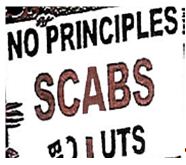
The word “SCABS” was in red and, in its entirety, the sign read:
No principles
SCABS
No guts
76 The primary Judge in the present proceeding accepted the evidence of the general manager of the Saraji Mine (Mr Geoff Brick) as to the reasons for dismissing Mr Doevendans. Those reasons “broadly, were that Mr Doevendans had held up, and waved at passing motorists, the scabs sign, which he, Brick, regarded as having … unacceptable attributes”: [2012] FCA 1218 at [36]. The primary Judge further concluded that there was nothing “in the background to the events of 15-22 February 2012 that would justify the inference that the respondent wanted to be rid of Mr Doevendans on account of his membership of” the Construction, Forestry, Mining and Energy Union (the “CFMEU”): [2012] FCA 1218 at [37].
77 The Amended Originating Application dated 22 June 2012 sought (inter alia) declarations that BHP Coal had contravened ss 340 and 346 of the Fair Work Act 2009 (Cth) (“Fair Work Act”).
78 The primary Judge rejected the claims under ss 340 and 346(a). His Honour, however, concluded that there had been a contravention of s 346(b) of the Fair Work Act. An order was made for the reinstatement of Mr Doevendans and an order for the payment of a pecuniary penalty.
79 Leave to appeal the primary Judge’s decision was granted in November 2012: BHP Coal Pty Ltd v Construction, Forestry, Mining and Energy Union [2012] FCA 1495. The Further Amended Notice of Appeal upon which BHP Coal now relies asserts that the primary Judge erred in concluding that there had been contraventions of ss 346(b) and 347(b)(iii) of the Fair Work Act.
80 The appeal is to be resolved primarily by the application of ss 346 and 347 of the Fair Work Act to the facts and the decision of the High Court in Board of Bendigo Regional Institute of Technical and Further Education v Barclay [2012] HCA 32, 86 ALJR 1044.
81 The appeal is to be allowed.
SECTIONS 346 AND 347
82 Statutory provisions have long existed which seek to promote stable industrial relations and which seek, in particular, to balance the right of an employer to dismiss an employee as against the right of employees to pursue legitimate industrial demands.
83 These provisions are presently found in Part 3.1 of the Fair Work Act, and in particular ss 346 and 347 together with ss 360 and 361 of that Act. Like its predecessor statutory provisions, s 346 (in summary form) provides that an employer must not take “adverse action” against another person “because the other person” is an officer or member of an “industrial association” or because he engages in or does not engage in an “industrial activity…”.
84 Sections 360 and 361 address those circumstances where an employer may have multiple reasons for taking action.
85 Section 346 in its entirety provides as follows:
Protection
A person must not take adverse action against another person because the other person:
(a) is or is not, or was or was not, an officer or member of an industrial association; or
(b) engages, or has at any time engaged or proposed to engage, in industrial activity within the meaning of paragraph 347(a) or (b); or
(c) does not engage, or has at any time not engaged or proposed to not engage, in industrial activity within the meaning of paragraphs 347(c) to (g).
86 Section 347 provides as follows:
Meaning of engages in industrial activity
A person engages in industrial activity if the person:
(a) becomes or does not become, or remains or ceases to be, an officer or member of an industrial association; or
(b) does, or does not:
(i) become involved in establishing an industrial association; or
(ii) organise or promote a lawful activity for, or on behalf of, an industrial association; or
(iii) encourage, or participate in, a lawful activity organised or promoted by an industrial association; or
(iv) comply with a lawful request made by, or requirement of, an industrial association; or
(v) represent or advance the views, claims or interests of an industrial association; or
(vi) pay a fee (however described) to an industrial association, or to someone in lieu of an industrial association; or
(vii) seek to be represented by an industrial association; or
(c) organises or promotes an unlawful activity for, or on behalf of, an industrial association; or
(d) encourages, or participates in, an unlawful activity organised or promoted by an industrial association; or
(e) complies with an unlawful request made by, or requirement of, an industrial association; or
(f) takes part in industrial action; or
(g) makes a payment:
(i) that, because of Division 9 of Part 3-3 (which deals with payments relating to periods of industrial action), an employer must not pay; or
(ii) to which an employee is not entitled because of that Division.
87 Section 360 provides as follows:
Multiple reasons for action
For the purposes of this Part, a person takes action for a particular reason if the reasons for the action include that reason.
And s 361 provides as follows:
Reason for action to be presumed unless proved otherwise
(1) If:
(a) in an application in relation to a contravention of this Part, it is alleged that a person took, or is taking, action for a particular reason or with a particular intent; and
(b) taking that action for that reason or with that intent would constitute a contravention of this Part;
it is presumed, in proceedings arising from the application, that the action was, or is being, taken for that reason or with that intent, unless the person proves otherwise.
(2) Subsection (1) does not apply in relation to orders for an interim injunction.
88 Whether consideration is given to the terms of s 346 – or one of its predecessor provisions – the judicial task has been to identify those factual situations where an employer has taken action “because” of conduct of an employee which is sought to be protected by the legislature.
89 At one stage the view was expressed that membership of an industrial organisation was not a matter which could in any way enter into an employer’s decision-making processes: Pearce v W D Peacock & Co Ltd (1917) 23 CLR 199. Then under consideration was s 9(1) of the Commonwealth Conciliation and Arbitration Act 1904 (Cth) which provided as follows:
No employer shall dismiss any employee from his employment by reason merely of the fact that the employee is an officer or member of an organization or is entitled to the benefit of an industrial agreement or award.
Isaacs J said of this provision that:
… it is designed, among other things, to preserve organisations, so that the method selected by Parliament for settling disputes shall not be thwarted. The provision casting the onus on the defendant employer means that the fact that the dismissed employee was a member of an organisation must not enter in any way into the reason of the defendant, if he desires exculpation. Otherwise he might add any other reason whatever to the membership of a union, and break down the whole structure of the Act, so far as he is concerned, as the defendant has, in fact, done in this case: (1917) 23 CLR at 205.
Isaacs J, however, was there in dissent.
90 The view expressed by Isaacs J in Pearce has subsequently been rejected as “extreme”: General Motors Holden Pty Ltd v Bowling (1976) 51 ALJR 235. Mason J (with whom Stephen and Jacobs JJ agreed) there observed:
The protection of trade unions and their representatives from discrimination and victimisation by employers does not require an interpretation as extreme as that favoured by Isaacs J [in Pearce]. It would unduly and unfairly inhibit the dismissal of a union representative in circumstances where other employees would be dismissed and thereby confer on the union representative an advantage not enjoyed by other workers, to penalise a dismissal merely because the prohibited factor entered into the employer's reasons for dismissal though it was not a substantial and operative factor in those reasons: (1976) 51 ALJR at 241.
Mason J went on to further observe:
[The Act] does not proscribe the circumstances which it lists as the sole or predominant reasons for dismissal. It is sufficient if the circumstance is a substantial and operative factor. And it does not cease to be such a factor because it is coupled with other circumstances or because regard is had to it in association with other circumstances not mentioned in the section: (1976) 51 ALJR at 242.
His Honour also went on to comment upon the equivalent provisions now found in ss 360 and 361.
91 The views of Mason J in Bowling were subsequently endorsed by the High Court in Board of Bendigo Regional Institute of Technical and Further Education v Barclay [2012] HCA 32, 86 ALJR 1044.
92 In the Board of Bendigo case, Mr Barclay had been dismissed. At first instance, the person who made the decision to dismiss Mr Barclay, Dr Harvey, gave evidence and was cross-examined as to her reasons for making that decision. Dr Harvey maintained that she dismissed Mr Barclay for a number of reasons, including the fact that she considered that an email forwarded by Mr Barclay to fellow workers contained complaints that should have been raised with either herself or other members of senior management and because the language used in the e-mail was bound to cause distress to members of staff. Dr Harvey maintained that she would have taken the same action in similar circumstances against a person who was not a member of the union of which Mr Barclay was an officer.
93 The primary Judge in the Board of Bendigo case accepted this evidence and concluded that Dr Harvey had not taken adverse action for any reason associated with Mr Barclay’s position within the union and that there had been no contravention of s 346: Barclay v Board of Bendigo Regional Institute of Technical and Further Education (2010) 193 IR 251. By a majority, that decision was reversed on appeal to a Full Court of this Court: Barclay v Board of Bendigo Regional Institute of Technical and Further Education (2011) 191 FCR 212. The majority concluded that all of the relevant conduct involved Mr Barclay in his union capacity and that none of it involved him in his capacity as an employee. In his dissenting judgment, being the conclusion subsequently reached on appeal to the High Court, Lander J concluded:
[227] It is not enough as the appellants have contended that a union official can make out a contravention by simply establishing that adverse action was taken whilst the union official was engaged in industrial activity. That is not enough to establish the contravention. The contravention is only established if in fact that is the reason for the taking of the adverse action.
94 An appeal to the High Court was allowed. In allowing the appeal, French CJ and Crennan J emphasised that the question as to why action has been taken against an employee is one of fact. In doing so their Honours looked to the text of the statutory provision and stated:
[42] Determining why a defendant employer took adverse action against an employee involves consideration of the decision-maker's “particular reason” for taking adverse action (s 361(1)), and consideration of the employee's position as an officer or member of an industrial association and engagement in industrial activity (union position and activity) at the time the adverse action was taken (ss 342, 346(a), 346(b), 347 and 361(1)).
…..
[44] There is no warrant to be derived from the text of the relevant provisions of the Fair Work Act for treating the statutory expression “because” in s 346, or the statutory presumption in s 361, as requiring only an objective inquiry into a defendant employer's reason, including any unconscious reason, for taking adverse action. The imposition of the statutory presumption in s 361, and the correlative onus on employers, naturally and ordinarily mean that direct evidence of a decision-maker as to state of mind, intent or purpose will bear upon the question of why adverse action was taken, although the central question remains “why was the adverse action taken?”.
[45] This question is one of fact, which must be answered in the light of all the facts established in the proceeding. Generally, it will be extremely difficult to displace the statutory presumption in s 361 if no direct testimony is given by the decision-maker acting on behalf of the employer. Direct evidence of the reason why a decision-maker took adverse action, which may include positive evidence that the action was not taken for a prohibited reason, may be unreliable because of other contradictory evidence given by the decision-maker or because other objective facts are proven which contradict the decision-maker’s evidence. However, direct testimony from the decision-maker which is accepted as reliable is capable of discharging the burden upon an employer even though an employee may be an officer or member of an industrial association and engage in industrial activity.
Gummow and Hayne JJ commented upon the terms of s 346 as follows:
[100] The application of s 346 turns on the term “because”. This term is not defined. The term is not unique to s 346. It appears in s 340 (regarding workplace rights), s 351 (regarding discrimination), s 352 (regarding temporary absence in relation to illness or injury) and s 354 (regarding coverage by particular instruments, including provisions of the National Employment Standards).
[101] The use in s 346(b) of the term “because” in the expression “because the other person engages ... in industrial activity”, invites attention to the reasons why the decision-maker so acted. Section 360 stipulates that, for the purposes of provisions including s 346, whilst there may be multiple reasons for a particular action “a person takes action for a particular reason if the reasons for the action include that reason”. These provisions presented an issue of fact for decision by the primary judge.
Their Honours then went on to conclude that it was the approach of Mason J in Bowling that was to be applied to s 346 and continued:
[104] … An employer contravenes s 346 if it can be said that engagement by the employee in an industrial activity comprised “a substantial and operative” reason, or reasons including the reason, for the employer's action and that this action constitutes an “adverse action” within the meaning of s 342.
95 Contrary to the approach of Isaacs J in Pearce, a factor that may “enter … into the reason[ing]” process of an employer does not constitute a “reason” for the purposes of s 360 if that factor does not amount to “a substantial and operative reason” for the taking of adverse action. The fact-finding task imposed by s 346 is to filter out those factors that may have passed through the mind of an employer and to determine what was the “substantial and operative” reason or reasons for taking adverse action. If any one of those “substantial and operative” reasons was a proscribed reason, s 360 operates to confirm that the taking of action for that reason is prohibited.
96 Section 361 casts upon an employer the onus of proving (on the balance of probabilities) that it did not take adverse action for a proscribed reason because an employee cannot be expected to know what was in the employer’s mind when the action was taken: Construction, Forestry, Mining and Energy Union v BHP Coal Pty Ltd [2012] FCA 1201 at [204] per Lander J. See also: Jones v Queensland Tertiary Admissions Centre Ltd (No 2) [2010] FCA 399 at [127], 186 FCR 22 at 55 per Collier J; Construction, Forestry, Mining and Energy Union v McCorkell Constructions Pty Ltd (No 2) [2013] FCA 446 at [155] to [158] per Bromberg J; Fair Work Ombudsman v AJR Nominees Pty Ltd [2013] FCA 467 at [34] to [39] per Gilmour J.
PARTICIPATION IN A LAWFUL ACTIVITY
97 The case advanced on behalf of Mr Doevendans was that he was dismissed “because” he participated in a lawful activity organised or promoted by an industrial association. A dismissal for that reason, it was said, contravened s 346(b) because Mr Doevendans engaged in an “industrial activity” as defined by s 347(b)(iii) or (v).
98 The resolution of these questions involved the application of those statutory provisions to the facts.
99 Language or signs describing employees who continue to work contrary to industrial action being taken as “scabs” have, not surprisingly, long attracted attention: e.g., Voigt v Loveridge; Ex parte Loveridge [1938] St R Qd 303; Murphy v Plasterers Society [1949] SASR 98; Barloworld Coatings (Aust) Pty Ltd v Australian Liquor, Hospitality & Miscellaneous Workers’ Union [2001] NSWSC 826; Construction, Forestry, Mining and Energy Union v BHP Coal Pty Ltd [2012] FCA 1201. Before the primary Judge evidence was nevertheless adduced as to the meaning of the term.
100 In the present proceeding, the waving of the sign by Mr Doevendans and his attendance at the site of the industrial action being taken was not put in issue.
101 The primary Judge accepted the evidence of Mr Brick as to his reasons for dismissing Mr Doevendans. The explanation provided by Mr Brick set forth both his reasons why he took that decision and exposed what was not part of his decision-making process. The primary Judge thus accepted the following explanation provided by Mr Brick for his decision as set forth in his affidavit, namely:
As I went through the JCDT, the only considerations that were in my mind as reasons why I might land on Step 4 [disciplinary action] were as follows:
(a) Henk Doevendans had held and waved a sign with the word “scab”;
(b) This was not an isolated incident, as he had held and waved the Scab Sign on four occasions over three days;
(c) He had a choice of signs in the protest area, but deliberately and repeatedly held and waved the Scab Sign;
(d) He admitted to the allegations about his conduct;
(e) He acknowledged that he knew his conduct was inappropriate and contrary to the Charter and Conduct Policy;
(f) I understood that he did not accept that he had done anything wrong; and
(g) I doubted whether he was capable of being rehabilitated to the just culture I was developing and had developed at the Saraji Mine.
These considerations left me with the powerful impression that that [sic] termination was the only appropriate outcome. I asked myself “do I want an individual at Saraji Mine who has demonstrated a lack of contrition, low potential to change or modify his behaviour and who is unwilling to learn any lesson from this incident?”. My answer was “no”. …
102 Senior Counsel for BHP Coal placed emphasis upon the statement that the affidavit set forth “the only considerations” that were in the mind of Mr Brick. Such a statement, it was submitted, excluded any prospect that the decision to dismiss Mr Doevendans was taken because Mr Doevendans had engaged in “industrial activity”. The affidavit provided by Mr Brick, however, went on to further state:
My decision depended on my assessment that all of the following factors were present:
(a) Connection with work;
(b) Use of the word “scab”;
(c) Intentional behaviour. This was not an isolated case where he had accidentally picked up the Scab Sign on one occasion;
(d) Deliberate behaviour, as he chose to hold and wave the Scab Sign in circumstances where a range of signs were available;
(e) Repeated behaviour, as he had held and waved the Scab Sign on four occasions over each of 16, 17 and 19 February 2012;
(f) Deviant behaviour, as he admitted that he knew the word “scab” was inappropriate in the workplace but nevertheless deliberately and repeatedly held and waved the Scab Sign;
(g) Offensive, humiliating, harassing and intimidating behaviour;
(h) Behaviour that was unacceptable in the workplace and not tolerated by the Respondent;
(i) Flagrant violation of the Charter and Conduct Policy;
(j) Completely contrary to the culture I had developed and was continuing to develop at the Saraji Mine;
(k) No contrition or acknowledgement that his behaviour was inappropriate;
(l) His behaviour was unlikely to change and he was unlikely to be able to be rehabilitated to the culture I had developed and was continuing to develop at the Saraji Mine;
(m) His defensive and arrogant demeanour during my meetings with him on 12 April 2012 and 4 May 2012; and
(n) The fact that I had personally heard him admit to the allegations about his conduct. This made a powerful impression on my final decision.
If any one or more of these factors had not been present, I may have come to a different decision. For example, if it had been an isolated occasion of having held the Scab Sign on a single occasion, even if the employee had not of shown any contrition, I may not have landed on a Step 4. However, this was not the case here, as Henk Doevendans had not only failed to demonstrate any contrition, but also, his conduct was repeated and deliberate. This was not a case of mistake or accident.
Senior Counsel for the CFMEU placed emphasis upon the acknowledgment on the part of Mr Brick that had one or other of the facts mentioned not been present, he “may have come to a different conclusion”. Such an acknowledgment, so it was submitted, went a considerable way to establishing that one or other of those factors – including those facts which brought Mr Doevendans’ conduct within s 347(b)(iii) or (v) – was a “substantial and operative factor” in the decision to take “adverse action”, namely to dismiss Mr Doevendans.
103 In addition to accepting the reasons provided by Mr Brick as to why he decided to dismiss Mr Doevendans, the learned primary Judge also found as a fact that Mr Doevendans occupying a position within the CFMEU “and the fact that he was engaged in industrial action or activity, did not play any part in [Mr Brick’s] decision-making process”: [2012] FCA 1218 at [30]. His Honour accepted Mr Brick’s evidence that Mr Doevendans was dismissed because he had “demonstrated arrogance when confronted with the objections to his conduct” and engaged in conduct that was regarded as “not only contrary to [BHP Coal’s] policy, but as antagonistic to the culture which [Mr Brick] was seeking to develop at the mine…”: [2012] FCA 1218 at [36]. His Honour also found that there was nothing “in the background to the events of 15-22 February 2012 that would justify the inference that the respondent wanted to be rid of Mr Doevendans on account of his membership of the applicant, his position on the Lodge Committee, or his history of union activity…”: [2012] FCA 1218 at [37].
104 Notwithstanding the acceptance of the evidence of Mr Brick and the findings of fact that he made, the learned primary Judge ultimately concluded:
[114] For the above reasons, I take the view that Mr Doevendans’ holding and waving of the scabs sign was conduct by way of participation in a lawful activity organised by an industrial association. Since a reason for his dismissal was that he did so hold and wave the sign, it follows that his dismissal was done in contravention of s 346(b) of the FW Act.
His Honour also concluded:
[123] For these reasons, I take the view that, in displaying the scabs sign at the protest, Mr Doevendans was representing and advancing the views and interests of an industrial association. Since he was dismissed for that conduct, it follows that the dismissal was done in contravention of s 346(b) of the FW Act.
105 The error said to have been committed by the primary Judge on behalf of BHP Coal is in concluding that it necessarily followed that an employee is “immune” from dismissal once it is found that an employee’s conduct falls within s 347. To so conclude, it is urged on behalf of BHP Coal in its written outline of submissions, “is that employees are immunised from discipline for any misconduct, no matter how serious, if that misconduct is part of an activity organised or promoted by an industrial association, or represents or advances the views or interests of an industrial association”.
106 With great respect to the primary Judge, it is respectfully considered that he did err in reaching the conclusions expressed at paragraphs [114] and [123] of his reasons.
107 The reasons for the dismissal of Mr Doevendans extended beyond the mere fact that he waved the scabs sign and had “deliberately and repeatedly held and waved” that sign. As explained by Mr Brick in his affidavit, and – more importantly – as found by the primary Judge, the reasons for the dismissal were far more extensive and included (for example):
his arrogance when confronted;
the fact that the waving of the sign was contrary to the policy of BHP Coal; and
the fact that Mr Doevendans’ conduct was antagonistic to the culture sought to be developed at the mine by Mr Brick.
And, as again found by the primary Judge, “the fact that he was engaged in industrial action or activity, did not play any part in his decision-making process”: [2012] FCA 1218 at [30].
108 The error which it is respectfully considered that was made by the learned trial Judge was to:
conclude that there had been a contravention of s 346(b) in circumstances where the evidence that had been accepted and the findings of fact made by his Honour excluded any prospect that the decision to dismiss Mr Doevendans was taken “because” he had engaged in “industrial activity”. The onus imposed by s 361, it should have been concluded, had been discharged.
An alternative manner in which the same error can be expressed is to conclude that his Honour erred in:
seizing upon one aspect of the conduct engaged in by Mr Doevendans, namely his participation in the protest or his advancing the views of the union, and placing to one side the reasoning process of Mr Brick. In doing so, his Honour erred by not making any ultimate finding of fact as to what was – or what was not – a “substantial and operative” reason for the dismissal of Mr Doevendans. As emphasised by French CJ and Crennan J in the Board of Bendigo decision, this “question is one of fact, which must be answered in the light of all the facts established in the proceeding”: [2012] HCA 32 at [45].
To reach the conclusion in fact reached by the primary Judge would be to:
conclude that once it is found that an employee is engaging in a lawful activity organised or promoted by an industrial association for the purposes of s 347(b)(iii) or was advancing the views of an industrial association for the purposes of s 347(b)(v), such an employee cannot be dismissed for any conduct relating to these activities. It would be to conclude that the task imposed by s 346 and the need to determine the reason or reasons for a decision as explained by the Board of Bendigo decision need not be undertaken.
109 The conclusions at paragraph [114] and [123], with respect, improperly focus attention upon a resolution as to whether conduct can properly be characterised as protected “industrial activity” and diverts attention away from the factual inquiry as to the reasons why an employer has dismissed an employee. Section 346 only precludes an employer from taking “adverse action” against an employee “because” (for example) the employee has “engaged … in industrial activity…”. It was that factual inquiry which was not addressed by the learned primary Judge.
110 It has never been the case that an employer has been prevented, by federal industrial legislation, from taking prejudicial action against an employee who happened to be a union member or a union official: Cuevas v Freeman Motors Ltd (1975) 25 FLR 67 at 78 per Smithers and Evatt JJ. A union official, it has long been recognised, is “given no immunity from normal constraints of behaviour, nor any licence to act in a manner which would not be tolerated in another employee”: Automotive, Foods, Metals, Engineering, Printing and Kindred Industries Union v Australian Health and Nutrition Association Ltd [2003] FCA 590 at [3], 147 IR 380 at 381 per Gyles J; Cicciarelli v Qantas Airways Ltd [2012] FCA 56 at [260] per Kenny J. The fact that an employee may be a union member or representative and “thus possibly having a greater potential to be troublemaker, does not confer on that employee an immunity from dismissal by reason of the circumstance that he is a delegate of an organisation”: Hyde v Chrysler (Australia) Ltd (1977) 30 FLR 318 at 332 per Northrop J. Nor has it ever been the case that an employer has been prevented, by federal industrial legislation, from taking prejudicial against an employee because the conduct of the employee may objectively (and correctly) be characterised as conduct that falls within s 347. That which must always be established to attract the protection afforded by the Fair Work Act is the causal connection between such conduct and the taking of the “adverse action”. To fall within the protection afforded by s 346, it is necessary to establish – with the benefit of ss 360 and 361 – that “adverse action” has been taken “because” (for example) the employee engaged in “industrial activity”. If this were not the case, the High Court could not have reached the conclusion it did in fact reach in the Board of Bendigo case. See also: Harrison v P & T Tube Mills Pty Ltd [2009] FCAFC 102, 188 IR 270.
CONCLUSIONS
111 The conclusion that the primary Judge erred in respect to his conclusions as to the application of ss 346 and 347 to the facts, necessarily means that the appeal must be allowed. It becomes unnecessary to resolve the balance of BHP Coal’s argument directed to whether the conduct engaged in during the protest was “unlawful” by reason of either s 6 of the Summary Offences Act 2005 (Qld) or s 346(c) of the Fair Work Act. It is equally unnecessary to resolve the Amended Notice of Contention as filed on behalf of the CFMEU at the outset of the hearing of the appeal.
112 The appeal is to be allowed.
ORDERS:
1. The appeal is allowed.
2. The order made on 7 November 2012 reinstating Mr Henk Doevendans to the position he occupied prior to the termination of his employment on 21 May 2012 is set aside.
3. The order made on 21 December 2012 that a payment of a pecuniary penalty in the amount of $7,500 in respect to a contravention of s 346 of the Fair Work Act 2009 (Cth) be set aside.
4. The parties exchange submissions as to costs and file such submissions on or before 31 January 2014.
| I certify that the preceding forty (40) numbered paragraphs are a true copy of the Reasons for Judgment herein of the Honourable Justice Flick. |
Associate:
Dated: 17 December 2013


