

FEDERAL COURT OF AUSTRALIA
GlaxoSmithKline Australia Pty Ltd v Reckitt Benckiser Healthcare (UK) Limited [2013] FCAFC 102
| IN THE FEDERAL COURT OF AUSTRALIA | |
| DATE OF ORDER: | |
| WHERE MADE: |
THE COURT ORDERS THAT:
1. The applicant have leave to appeal from the interlocutory judgment given on 17 July 2013 and the orders made by his Honour on 8 July and 17 July 2013.
2. The draft notice of appeal filed on 22 July 2013 stand as the appellant’s notice of appeal.
3. The appeal be allowed.
4. The interlocutory injunction granted on 17 July 2013 be immediately discharged.
5. Paragraphs 1(b) and (c) of the orders made on 8 July 2013 be set aside.
6. The respondents pay the appellant’s costs of and incidental to the application for leave to appeal and the appeal.
7. As soon as practicable, the proceedings be listed for directions before the docket judge by arrangement with the docket judge.
Note: Entry of orders is dealt with in Rule 39.32 of the Federal Court Rules 2011.
| NEW SOUTH WALES DISTRICT REGISTRY | |
| GENERAL DIVISION | NSD 1436 of 2013 |
| ON APPEAL FROM THE FEDERAL COURT OF AUSTRALIA |
| BETWEEN: | GLAXOSMITHKLINE AUSTRALIA PTY LTD (ABN 47 100 162 481) Appellant |
| AND: | RECKITT BENCKISER HEALTHCARE (UK) LIMITED First Respondent RECKITT BENCKISER (AUSTRALIA) LIMITED (ABN 17 003 274 655) Second Respondent |
| JUDGES: | BENNETT, JAGOT AND GRIFFITHS JJ |
| DATE: | 2 SEPTEMBER 2013 |
| PLACE: | SYDNEY |
REASONS FOR JUDGMENT
THE COURT:
introduction
1 The applicant, GlaxoSmithKline Australia Pty Ltd (GSK) seeks leave to appeal from an interlocutory judgment restraining it from exploiting its proposed liquid dispensing apparatus consisting of a bottle, a bottle neck liner and a syringe. The apparatus was to be used in conjunction with a leading paediatric analgesic known as Children’s Panadol 1-5 years. The Court ordered that the application for leave to appeal be heard by the Full Court together with the appeal. The primary judge accepted the submissions of the respondents (Reckitt) that there was a sufficiently strong prima facie case that GSK’s apparatus infringed claim 1 of Australian Patent No. 2003283537 (the Patent) and that the balance of convenience favoured the grant of interlocutory injunctive relief. His Honour delivered ex tempore reasons on 17 July 2013 and ordered that GSK be restrained from exploiting this apparatus with regard to its Children’s Panadol 1-5 years product (Reckitt Benckiser Healthcare (UK) Ltd v GlaxoSmithKline Australia Pty Ltd (No 2) [2013] FCA 736 (Reasons 2)).
2 This syringe is referred to as GSK’s “new” or “alternative” syringe which GSK agrees is a “design-around” the apparatus in claim 1 of the Patent. This followed the grant on 28 May 2013 of an earlier interlocutory injunction to Reckitt concerning GSK’s original syringe (Reckitt Benckiser Healthcare (UK) Ltd v GlaxoSmithKline Australia Pty Ltd [2013] FCA 583 (Reasons 1)).
3 Although GSK’s application for leave to appeal is directed to the second interlocutory injunction and some related procedural orders made by the primary judge on 8 July 2013 – and not to the first interlocutory injunction – Reasons 2 should be read alongside Reasons 1, because they overlap.
4 Accordingly, it is convenient to summarise the background giving rise to both Reasons 1 and Reasons 2.
BACKGROUND
5 Reckitt has relied on the Patent since 2004 in supplying in Australia a product with the brand Nurofen for Children. The product has been supplied with a dosing system comprising a bottle, bottle neck liner and flat-nosed syringe. The active ingredient of Nurofen is ibuprofen, whereas for Panadol it is paracetamol.
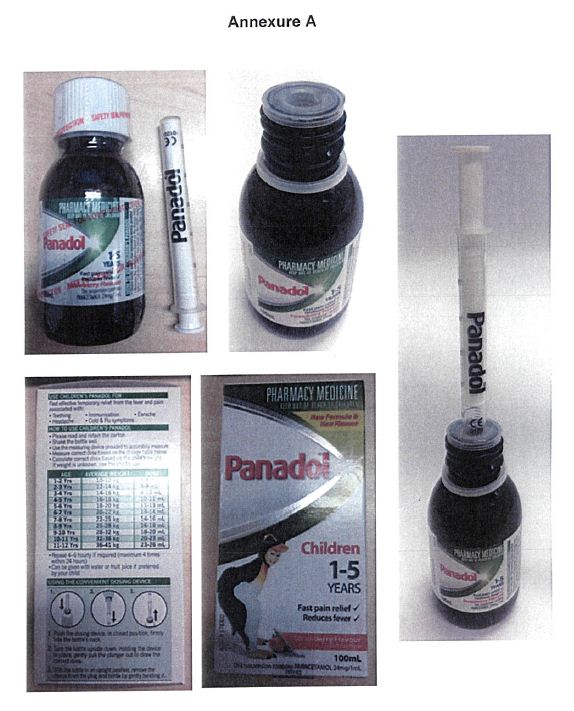
6 On 2 May 2013, Reckitt commenced proceedings against GSK alleging that its supply of Children’s Panadol 1-5 years with the original syringe infringed Reckitt’s Patent. Reckitt sought interlocutory injunctive relief. That application was heard on 27 and 28 May 2013. On 28 May 2013, the primary judge ordered that GSK be restrained from exploiting its product known as Children’s Panadol 1-5 years (of any flavour or size) which incorporated a liquid dispensing apparatus, comprising a bottle, a bottle neck liner and a flat-nosed syringe (the Original Syringe) as depicted in Annexure A below (which was attached to the orders made on 28 May 2013):
7 Reasons 1 were delivered ex tempore and may be summarised as follows:
(a) Reckitt had established a relatively strong prima facie case on infringement;
(b) GSK had not established a sufficiently strong argument based on its attack on novelty of the invention to warrant any displacement of Reckitt’s prima facie case of infringement;
(c) GSK’s lack of entitlement defence was weak on a prima facie basis;
(d) GSK should not be permitted to rely on its own ignorance of the Patent so as to create a situation in which it would not be commercially inconvenienced by an interlocutory injunction (citing Interpharma Pty Ltd v Commissioner of Patents (2008) 79 IPR 261 at [78] per Jessup J);
(e) it would be relatively easy for GSK to make arrangements to market its new range of Children’s Panadol 1-5 years by removing the bottle neck liner and making slight modifications to its packaging;
(f) GSK will be able to use the currently available formula in, and its existing approvals for, plastic bottles that do not have the bottle neck liner;
(g) if any further approval were needed from the Therapeutic Goods Administration (the TGA) it would be relatively simple for GSK to obtain it;
(h) significantly, GSK led no evidence of any contingency plans it had made in the event that interlocutory relief were granted; and
(i) having regard to the relative strength of Reckitt’s case on infringement (on the evidence and material available to the primary judge) and the apparent weakness (on that same evidence and material) of the two alleged grounds of invalidity, the balance of convenience weighed in favour of granting interlocutory relief.
8 On the issue of balance of convenience at the first hearing, GSK relied on an affidavit in chief sworn 16 May 2013 by Ms Karyn Tomkins, GSK’s Marketing Director (Ms Tomkins’ first affidavit). Ms Tomkins’ evidence did not address any contingency plans under consideration by GSK in the event that GSK was restrained from using the liquid dispensing apparatus for Children’s Panadol 1-5 years. The affidavit did deal at some length with the alleged adverse consequences for GSK and the public if GSK was so restrained. Ms Tomkins’ evidence was that it was not possible to sell the product without the syringe and neck liner. That was because further approval would be required from the TGA and, even if such approval could be obtained, she said that it was not feasible to remove the neck liner. That was because damage could be caused to the bottles and, moreover, in order to repackage the stock, the bottles would have to be opened to remove the neck liners which would break their tamper evidence seals and prevent their subsequent sale.
9 At the first hearing, Reckitt relied on two affidavits by Mr Stuart Witherby (the Marketing Manager for Nurofen) on the issue of balance of convenience. The second of these affidavits was in reply to Ms Tomkins’ first affidavit. In it, Mr Witherby described several possible options which he said GSK could reasonably adopt to ensure that its Children’s Panadol 1-5 years did not infringe the Patent. One of those options was that GSK could continue to market Children’s Panadol 1-5 years without the bottle neck liner and with other minor modifications. In Reasons 1 the primary judge accepted that this option was readily available to GSK.
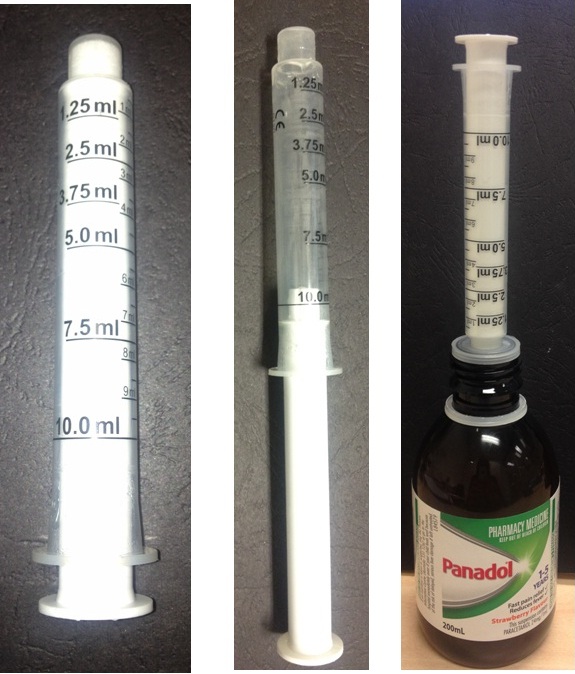
10 Soon after interlocutory injunctive relief was granted against GSK on 28 May 2013, GSK informed Reckitt that it proposed to go to market with a new form of syringe to be inserted into a bottle with a bottle neck liner which had the same characteristics as the one described in Reasons 1. The new alternative syringe had a tip or nozzle that fitted into the bottle neck liner, with the barrel of the syringe being wider than the tip (the Alternative Syringe).
11 Reckitt sought further interlocutory injunctive relief to restrain GSK from marketing Children’s Panadol 1-5 years with the Alternative Syringe. As noted above, GSK acknowledged that the Alternative Syringe is a “design-around” the product which was the subject of the first interlocutory injunction.
12 After a directions hearing on 14 June 2013, directions were made for the filing of evidence in respect of Reckitt’s second application for interlocutory injunctive relief and the application was set down for hearing on 17 July 2013. Reckitt’s view was that the only question for determination at the second hearing was whether or not Reckitt had a sufficient prima facie case of infringement in respect of the Alternative Syringe and whether, taking into account the primary judge’s findings on validity and balance of convenience in Reasons 1, an injunction should be granted in respect of the Alternative Syringe. However, GSK filed evidence which addressed various issues going beyond Reckitt’s understanding of the scope of the second hearing, including a second affidavit sworn 2 July 2013 by Ms Tomkins relating to the balance of convenience (Ms Tomkins’ second affidavit). GSK indicated that it would also rely inter alia upon Ms Tomkins’ first affidavit which had been read at the previous hearing on the balance of convenience.
13 At a further directions hearing held on 5 July 2013, which was instigated at Reckitt’s request to clarify the issues to be determined and evidence permitted to be relied upon at the second hearing, the primary judge ruled inter alia that GSK could not rely upon either of Ms Tomkins’ two affidavits. This ruling, which is recorded in the orders made on 8 July 2013, was made by his Honour on the basis that the balance of convenience issues were either addressed in evidence or could have been addressed in evidence at the previous hearing. Parts of Ms Tomkins’ second affidavit responded to Mr Witherby’s affidavit sworn 21 May 2013. Other parts dealt with matters such as the impact of the first interlocutory injunction, GSK’s evaluation of alternative options (including the option of continuing to use the Original Syringe without the bottle neck liner as suggested by the primary judge) and the importance of Children’s Panadol to the Panadol brand. We will return to deal with these matters at greater length below.
14 At that directions hearing, his Honour indicated that the only issue to be decided at the second hearing was whether Reckitt had a sufficient prima facie case of infringement in respect of the Alternative Syringe such that, taking into account the previous findings in Reasons 1 on validity and balance of convenience, a further interlocutory injunction should be granted in respect of the Alternative Syringe in combination with the bottle neck liner and bottle.
15 On 17 July 2013, the primary judge delivered Reasons 2 and ordered that GSK be restrained from exploiting Children’s Panadol 1-5 years (of any flavour or size) incorporating a liquid dispensing apparatus, comprising a bottle, a bottle neck liner and the Alternative Syringe. Set out immediately below is Annexure B to these orders which identifies the Alternative Syringe.
ANNEXURE B
16 The essence of his Honour’s reasoning in Reasons 2 may be summarised as follows:
(a) while the evidence of GSK’s expert (Mr Hunter) had some weight, his views were not sufficiently strong to displace those of Reckitt’s expert (Mr Tiller) that no assistance was to be gained from an Australian Standard relied upon by Mr Hunter in support of his construction of the syringe in claim 1 of the Patent;
(b) a reader skilled in the art would understand the Patent to be referring to a cylindrical object when it used the word “barrel”, but the ordinary meaning of “barrel” did not support the construction of claim 1 of the Patent contended for by GSK, i.e. that the barrel had to have a cylindrical shape which was uniform throughout;
(c) reading the Patent as a whole, for the purposes of understanding claim 1 and using the principles identified in Reasons 1 at [43]-[47], the substance of the invention in claim 1 appears to be the combination of the bottle, the bottle neck liner and the flat-nosed syringe, with the syringe having both a plunger and a barrel, and where the function of the distal end of the syringe is to create the sealing engagement through which liquid may be drawn;
(d) applying the High Court’s decision in Radiation Limited v Galliers & Klaerr Pty Limited (1938) 60 CLR 36 at [18] per Dixon J, the relevant question is “whether the substantial idea disclosed by the specification and made the subject of a definite claim has been taken and embodied in the infringing thing”. His Honour found that the substantial idea disclosed by the invention was the subject of claim 1 and was embodied in the Alternative Syringe;
(e) the High Court’s decision in Shave v H V McKay Massey Harris Pty Ltd (1935) 52 CLR 701 at 709-710 establishes the need for precision in stating a claim and the strictness with which it must be construed;
(f) reading claim 1, and having regard to the specification as a whole for the purposes of evaluating the prima facie case put forward by Reckitt, there is a sufficiently strong argument that the words in claim 1 “having a diameter corresponding to the diameter of the syringe barrel and being perpendicular to the longitudinal access of the barrel” would be understood by a reader skilled in the art at the priority date of the Patent to apply to the distal end of the barrel;
(g) GSK’s argument was not sufficiently strong to warrant a conclusion that what claim 1 of the Patent was really doing was delineating all of the requisite characteristics that the syringe had to possess beyond those at its distal end. His Honour found at [21] that the critical feature of the invention was the description of how to achieve the interaction between the distal end of the syringe and the bottle neck liner;
(h) there was a sufficiently strong prima facie case to suggest that the words of qualification at the commencement of claim 1, read in the context of the Patent as a whole – including in particular the concluding words of claim 1 – are intended to identify a diameter at the distal end that will ensure the sealing engagement;
(i) Reckitt had established a sufficiently strong prima facie case that the Alternative Syringe had all of the essential integers of the syringe the subject of the invention in claim 1 in the way it co-operates with the other parts of the apparatus;
(j) there was a sufficiently strong prima facie case that the Alternative Syringe could be found at trial to be an infringement to warrant the grant of interlocutory relief; and
(k) the balance of convenience warranted the grant of further interlocutory relief, noting that this conclusion flowed from his Honour’s earlier ruling that the balance of convenience should be ascertained on the evidence which the parties chose to deploy in the first hearing.
The parties’ submissions on the application for leave to appeal/appeal summarised
17 GSK identified the following ten proposed grounds of appeal:
1. The primary judge erred in determining the interlocutory application on the basis of his assessment of the balance of convenience as at 28 May 2013 in a judgment given on that date in respect of an earlier application between the parties.
2. The primary judge erred in determining the application on the basis that the issues were limited to a consideration of the strength of the prima facie case of infringement of the Patent and its impact on the balance of convenience as determined by him at an earlier point in time in the context of a different allegation of patent infringement.
3. The primary judge erred in ruling that the appellant could not rely on material relevant to the balance of convenience, including Ms Tomkins second affidavit, in relation to the balance of convenience at the date of the hearing.
4. The primary judge erred in ruling the appellant could not rely on the said material because to do so was contrary to the overarching purpose in s 37M of the Federal Court Act of Australia 1976 (Cth).
5. The primary judge erred in ruling that, as a condition of maintaining the hearing date, the appellant was not entitled to rely on an argument that, if the respondent’s product was found on a prima facie basis to infringe claim 1, then there was a prima facie case that claim 1 of the Patent was invalid for lack of fair basis.
6. The primary judge erred in ruling the appellant could not rely on the material marked MFI 1 as relevant to the assessment of the weight of the evidence of Mr Tiller, adduced by the respondent.
7. The primary judge erred in rejecting the tender of an item of prior art cited in the specification of the Patent on the question of construction before him.
8. The primary judge erred in failing to read claim 1 of the Patent as would the skilled addressee.
9. The primary judge erred in proceeding on the basis that the word “barrel” was not a term of art in the relevant field of the Patent.
10. The primary judge erred in construing the Patent, and in particular claim 1, so as to extend it to products which perform the same functions as the apparatus of the claim, without proper regard to the words of the claim.
18 It is convenient to outline the parties’ respective submissions by reference to the following four broad categories of alleged error:
(a) misconstruction of the Patent (grounds 7, 8, 9 and 10 of the draft notice of appeal) in finding a prima facie case of infringement;
(b) wrongly excluding evidence (grounds 6 and 7 of the draft notice of appeal);
(c) wrongly preventing GSK from being allowed to argue that claim 1 is invalid for lack of fair basis (ground 5 of the draft notice of appeal); and
(d) on the issue of balance of convenience, wrongly confining the parties to their evidence at the first hearing (grounds 1 to 4 of the draft notice of appeal).
(a) Construction and infringement
19 GSK argues that the learned primary judge erred in his construction of claim 1 in the following ways:
(i) his Honour did not give effect to the singularity of expression in the wording of claim 1 and its reference to a “flat-nosed syringe” with “a plunger and a barrel”. GSK contends that the claim refers to “the barrel” of the syringe that terminates at “its distal end in a generally flat face having a diameter corresponding to the diameter of the syringe barrel”. Further, the claim refers to “the distal end of the syringe barrel” which passes into the flared portion of the bottle neck liner which, when in place, means that the inward step of the bottle neck liner “prevents the syringe barrel from protruding past the step”;
[emphasis added by GSK]
(ii) Radiation is distinguishable because the words of the claim in that case dictated the need to determine the “substance of the invention” as disclosed by the specification whereas, here, there was no basis to ignore the plain language of claim 1, which was for a syringe with particular characteristics that included a barrel with a single diameter;
(iii) the patentee should be held to the limitations in claim 1 relating to a syringe with the particular characteristics described and the barrel diameter was an essential integer to the claim;
(iv) his Honour erred in identifying what he considered to be the “substance of the invention”, because he engaged in a process of reasoning that sought to extend the patentee’s monopoly to the “ideas” disclosed in the specification, which is contrary to the Full Court’s decision in Australian Mud Company Pty Ltd v Coretell Pty Ltd (2011) 93 IPR 188 at [64]-[69]; and
(v) in any event, his Honour’s identification of the “substance of the invention” as the “sealing engagement” was in error, as also was his rejection of GSK’s tender of another patent in the name of Comar, which was relevant to the identification of the prior art.
20 Reckitt’s primary contentions on the issues of construction and infringement may be summarised as follows:
(i) the primary judge’s approach to construction of the word “barrel” of a “flat-nosed syringe” in claim 1 of the Patent was correct and his Honour did not ignore the plain language of the claims when he construed the term “barrel”. Indeed, there was no limitation in claim 1 which required the barrel to have a single diameter;
(ii) the primary judge did not construe claim 1 so as to extend it to products which perform the same functions as the apparatus in claim 1 without proper regard to the words of the claim – rather his Honour correctly construed the claim in the context of the specification as a whole;
(iii) the primary judge did not characterise the substance of the invention as only being the “sealing engagement” because he clearly stated at [17] of Reasons 2 that the substance of the invention is the combination of “the bottle, the bottle neck liner and the flat-nosed syringe, with the syringe having both a plunger and a barrel, and where the function of the distal end of the syringe is to create the sealing engagement through which liquid may be drawn”;
(iv) the primary judge correctly rejected Mr Hunter’s use of the Australian Standard as an aid to construction; and
(v) the primary judge properly rejected the tender of the Comar patent on the question of construction and, in any event, it could not have assisted as it was not part of the common general knowledge.
(b) Evidence wrongly excluded
21 GSK’s arguments on this topic may be summarised as follows:
(i) the primary judge erred in not admitting into evidence for the purposes of the second hearing evidence given at the first hearing by Reckitt’s expert (Mr Tiller) in which he expressed opinions as to whether particular syringes in the prior art were “flat-nosed syringes”. That earlier evidence included evidence with respect to the Comar patent, in respect of which Mr Tiller had said that the Comar syringe was not a “flat-nosed syringe” within the meaning of claim 1 because it did not have a syringe of uniform diameter along its length. Moreover, Mr Tiller had said previously that a syringe is not a “flat-nosed syringe” if it “has the feature of a protrusion at its tip (nozzle) to engage with the open bore of the insert”;
(ii) hearing as going to the question whether there was a prima facie case of infringement in resisting an argument of lack of novelty. Accordingly, that evidence was highly relevant to show that, as patentee, Reckitt was seeking to pursue one construction to avoid invalidity and another to succeed in infringement; and
(iii) the evidence was also admissible as evidence of the understanding of a skilled addressee.
22 Reckitt’s contentions on this topic may be summarised as follows:
(i) the primary judge was correct to reject GSK’s tender for the three reasons which he gave, namely:
the decontextualised extracts of Mr Tiller’s affidavit would be misleading because they did not say what GSK alleged they said;
the experts did not have an opportunity to consider and address the issue and any relevant material for the purposes of the joint expert’s report; and
the extracts were of questionable admissibility because, even if Mr Tiller’s evidence was characterised as alleged by GSK, the extracts could not be tendered as an admission against Reckitt and Mr Tiller had not been given a reasonable opportunity to respond to the allegation of a prior inconsistent statement; and
(ii) in any event, Mr Tiller’s earlier evidence does not assist GSK because it is not relevant to the issue of construction of claim 1 of the Patent and whether the Alternative Syringe falls within the scope of claim 1.
(c) Preventing GSK from arguing invalidity for lack of fair basis
23 GSK’s submissions may be summarised as follows:
(i) if, contrary to GSK’s primary submission, claim 1 is construed as encompassing a syringe which has a barrel and a nozzle or tip (as does the Alternative Syringe), there is a strong prima facie argument that the claim lacks any fair basis and GSK was wrongly prevented from running this argument as a condition of maintaining the hearing date; and
(ii) GSK could not raise the fair basis argument until after Reckitt produced its amended pleadings following the determination of the first interlocutory application, which then led to GSK raising the issue in its amended particulars of invalidity filed in accordance with the primary judge’s directions.
24 Reckitt’s contentions on this issue may be summarised as follows:
(i) the primary judge correctly required GSK to choose whether it wished to run its fair basis claim, in which case there would have to be a short adjournment;
(ii) GSK’s lack of fair basis pleading was not confined to the Alternative Syringe and Reckitt may have wanted to adduce further expert evidence on construction if GSK was permitted to raise the fair basis argument; and
(iii) in any event, there is no lack of fair basis because there was a real and reasonably clear disclosure in the specification of what is claimed, consistently with the principles in Lockwood Security Products Pty Ltd v Doric Products Pty Ltd (2004) 217 CLR 274.
(d) Evidence on the balance of convenience
25 GSK raises the following primary arguments in challenging the primary judge’s ruling that the issue of balance of convenience at the second hearing should be determined on the evidence which the parties chose to deploy at the first hearing:
(i) Ms Tomkins’ second affidavit, which was excluded by his Honour, described GSK’s evaluation of various options available to it arising from the grant of the first injunction. It also described why the Alternative Syringe was the most effective means of bringing Children’s Panadol 1-5 years to market, in comparison with the other options;
(ii) the exclusion of this evidence denied GSK the opportunity of adducing evidence on the question of the balance of convenience going to the state of affairs as it existed at the date of the second hearing and s 37M of the Federal Court of Australia Act 1976 (Cth) (FCA Act) did not justify its exclusion;
(iii) the evidence should have been admitted so that the Court could properly weigh the strength of Reckitt’s prima facie case in respect of the Alternative Syringe against the balance of convenience which was being considered some six weeks after the first hearing and in circumstances where the cold and flu season was still progressing; and
(iv) the evidence was also relevant to the evaluation of the impact that the grant or refusal of a further interlocutory injunction would have on third persons and the public generally.
26 Reckitt’s submissions on this matter may be summarised as follows:
(i) the primary judge correctly excluded GSK’s evidence on balance of convenience on the basis that it should not be allowed to adduce evidence that it could have put on at the first hearing;
(ii) GSK conceded at the directions hearing held on 5 July 2013 that the options canvassed in Ms Tomkins’ second affidavit were considered before the first hearing;
(iii) his Honour’s ruling is consistent with s 37M of the FCA Act and the principles concerning case management outlined in Aon Risk Services Australia Ltd v Australian National University (2009) 239 CLR 175 at [90]-[103]; and
(iv) in any event, even if Ms Tomkins’ evidence was admitted, it would not have led to a different outcome.
Consideration
Should leave to appeal be granted?
27 It is now well established that the relevant test for whether leave to appeal from an interlocutory judgment will be granted is whether:
(a) in all the circumstances of the case, the decision is attended by sufficient doubt to warrant it being reconsidered by the Full Court; and
(b) substantial injustice would result if leave were refused supposing the decision to be wrong (see DÉcor Corporation Pty Ltd v Dart Industries Inc (1991) 33 FCR 397 at 398-400 and Samsung Electronics Co Ltd v Apple Inc (2011) 286 ALR 257 at [26]).
28 There is a lengthy discussion of the test in Samsung Electronics at [26] to [35], the essence of which may be summarised as follows:
(a) the DÉcor test is appropriate for the general run of cases but each case must be considered on its merits;
(b) the discretion to grant leave should be informed by the underlying policy of the requirement to obtain leave: a relevant factor is whether the interlocutory order the subject of the leave application deals with the mechanics of case management and pretrial preparation or is likely to have a significant impact upon the scope and outcome of the proceedings (citing Johnson Tiles Pty Ltd v Esso Australia Pty Ltd (2000) 104 FCR 564 at [43]-[44] per French J (as his Honour then was) (with whom Beaumont and Finkelstein JJ agreed);
(c) the grant or refusal of an interlocutory injunction may have a significant impact upon the scope and outcome of the proceedings and, if the practical effect of that relief is to finally determine the rights of the parties, a prima facie case exists to grant leave to appeal (citing Ex parte Bucknell (1936) 56 CLR 221 at 225-227 per Latham CJ, Rich, Dixon, Evatt and McTiernan JJ); and
(d) although the grant of an interlocutory injunction is a matter of practice and procedure, where matters of principle are involved an appeal “stands somewhat above the ordinary appeal in a matter of practice and procedure” (citing Australian Broadcasting Corporation v O’Neill (2006) 227 CLR 57 at [53] per Gummow and Hayne JJ).
29 For the reasons which are set out below (it is convenient to deal together with the alleged errors underpinning the application for leave to appeal and the grounds of appeal), we consider that there are two aspects of the primary judgment which are attended by sufficient doubt to warrant the matters being reconsidered by the Full Court. The two matters relate to the primary judge’s construction of claim 1 of the Patent and the evidentiary basis upon which his Honour assessed the issue of balance of convenience.
30 We also consider that, if the primary judge’s decision is wrong, substantial injustice would result if leave were refused because its consequences are so significant for GSK.
31 Our reasons on the substantial injustice question are as follows. First, but for the second interlocutory injunction, GSK could have released stock to the market immediately and achieved good national coverage in a short period of time. Instead, the second interlocutory injunction places GSK at risk of missing not only the 2013 winter flu season, but also a longer period taking into account the fact that the final hearing is not scheduled to commence until June 2014.
32 Secondly, supposing the primary judgment to be wrong, GSK would suffer substantial injustice in not being able to supply Children’s Panadol 1-5 years with the Alternative Syringe. That apparatus offers significant public benefits to parents and children by facilitating a more accurate dosage of medicine to children within the relevant age group.
33 Finally, we cannot accept Reckitt’s contention that no substantial injustice will result if leave to appeal is refused because GSK is able to sell Children’s Panadol 1-5 years with a medicinal cup. The evidence strongly indicates that there are significant benefits for consumers in being able to use a syringe to facilitate the more accurate dosage of liquid medicine to children.
34 For these reasons, we consider that leave to appeal should be granted in accordance with the draft notice of appeal.
The appeal
35 In proceeding now to determine the appeal, we acknowledge that, in the light of the discretionary nature of the decision, it is insufficient that we might have made a different decision had we been in the position of the primary judge (see House v The King (1936) 55 CLR 499 at 504-505 per Dixon, Evatt and McTiernan JJ). And as the Full Court also emphasised in Samsung Electronics at [39], in appeals against decisions involving discretionary judgment, there is a strong presumption in favour of the correctness of the decision appealed from and that it should be affirmed unless the appeal court is satisfied that it is clearly wrong.
36 In applying these principles to the circumstances here, it is convenient to use the same broad headings as above.
(a) Construction and infringement
37 The Patent is entitled “Improvements in and relating to liquid dispensing” and relates to bottle neck liners, bottles, liquid dispensing apparatus and methods of dispensing liquids.
38 In that context, which is explained in the Patent as involving the dispensing of medicine in very accurate millilitre amounts, it is said to be normally necessary for an accurate subsidiary measuring device to be used, such as a graduated syringe or pipette. The specification then describes a syringe assembly from the prior art (the Comar patent), as follows:
WO 02/085429 describes a syringe assembly comprising an elongated tubular barrel having a discharge opening, and an elongated hollow tubular plunger member having a closed spherical tip. The assembly seats [sic] at its tip portion in an insert which fits in the neck of a container.
[emphasis added]
39 The Patent describes conventional methods of withdrawing liquids from bottles using a syringe and the problems with such methods, including the difficulty of accurately determining how much has been withdrawn, particularly when using a coloured glass bottles, and the increased likelihood of contamination using these conventional methods.
40 The Patent states that it would be advantageous to provide an apparatus with all of the following features:
A dispensing apparatus allowing a syringe to withdraw a liquid from a bottle, but such that the graduations on the syringe are visible to the user without occlusion by the bottle.
A minimum surface area of the syringe in contact with the liquid in the bottle, to minimise contamination and spillages.
The ability to pour from the bottle in a conventional manner (without undue obstruction) if it is desired not to use a syringe.
41 The invention consists of a bottle, a bottle neck liner and a flat-nosed syringe. “Syringe”, “sealingly” and “flat-nosed syringe” are defined in the specification (at 4):
By “syringe” we mean a syringe comprising a hollow syringe barrel in which is located, or arranged to be located, a reciprocating plunger, the syringe barrel having a dispensing aperture, through which a liquid may be drawn, then discharged.
By “flat-nosed syringe” we mean a syringe whose barrel ends in a generally flat distal end which is perpendicular to the barrel axis, and in which the dispensing aperture is formed. Preferably there is no part of the distal end which extends beyond the bore.
By “sealingly” we mean that under conditions of normal use liquid cannot flow or leak between the respective parts, that is, between the bottle neck and the bottle neck liner, and between the bore and a syringe barrel.
Preferably the syringe has no formation or fitment at its distal end, such as would create or spread open an aperture within the liner.
[emphasis added]
42 It is not in dispute that the “bore” refers to the bore of the sleeve, not of the syringe. The specification describes variations in the tapering of the bore, but does not describe variations to the width of the syringe. There may be an “inward step” or flared portion into the bore in order to aid engagement of the syringe barrel into the through bore. The specification also states that “preferably the syringe has no formation or fitment at its distal end, such as would create or spread open an aperture within the liner”.
43 In use, a syringe barrel is inserted into the liner, is sealingly received within the sleeve and is preferably prevented from moving past the bottle neck into the body of the bottle. In one embodiment, which reflects claim 7, the syringe can be sealingly inserted into the liner until the distal end of the syringe barrel abuts the inward step of the sleeve. The specification explains (at 13) that the use of a flat-nosed syringe and an inward step in the bottle liner minimises the contact of the liquid with the syringe barrel, thereby minimising the scope for contamination of the liquid from micro-organisms on the syringe barrel.
44 The flat-nosed syringe is depicted in Figure 4 and is said to illustrate a flat-nosed syringe for use in the bottle neck liner:
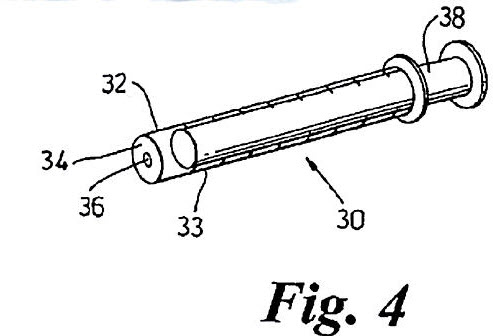
45 It is described (at 16) as follows:
… The flat-nosed syringe 30 includes a hollow circularly cylindrical syringe barrel 32 having a distal end region 33 to be received in the liner, and terminating in a perpendicular, circular face at its distal end 34, formed with a centrally located dispensing aperture 36. The syringe 30 also includes a plunger 38 arranged to move under reciprocal motion within the syringe barrel 32.
[emphasis added]
46 Also of some relevance is Figure 6:
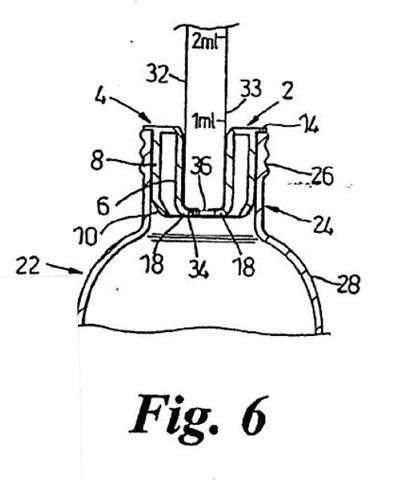
47 The description in the specification of Figure 6 is, relevantly, that ‘the distal end region of the barrel is inserted into the bottle neck liner’ and that the cross-section of the bore of the sleeve is slightly smaller than the cross-section of the barrel of the syringe. The specification provides that the distal end region of the syringe barrel is a tight sealing fit within the sleeve, but “the rest of the syringe barrel – the larger part – is not; it stands outside the bottle” and “thus, graduations on the syringe barrel can still be seen by a user”. That is, it reinforces the earlier described importance of ensuring accurate measurements. The description continues by stating that only “a small portion of the distal end of the syringe barrel” is exposed to liquid on inversion or tilting of the bottle, which reduces the risk of contamination of the liquid.
48 Claim 1, the claim said to be infringed, is as follows:
A liquid dispensing apparatus comprising a bottle, a bottle neck liner and a flat-nosed syringe having a plunger and a barrel, the barrel terminating at its distal end in a generally flat face having a diameter corresponding to the diameter of the syringe barrel and being perpendicular to the longitudinal axis of the barrel, the bottle having a bottle neck in which is located the bottle neck liner having a cylindrical body sealingly engaged inside the bottle neck such that liquid cannot flow between the bottle neck liner and the bottle neck, the bottle neck liner comprising a sleeve comprising at its lower end an inward step located within the bottle neck, an aperture being defined inwardly of the inward step, wherein the cylindrical body and the sleeve are connected together with a web of material only at the upper end of the cylindrical body and of the sleeve, wherein the sleeve is formed with a flared portion at its upper end into which the distal end of the syringe barrel passes; wherein when the syringe barrel is inserted into the sleeve the inward step prevents the syringe barrel from protruding past the step and liquid cannot flow between the sleeve and the barrel, but can leave the bottle only via the aperture and thence the syringe.
[relevant parts emphasised]
49 In summary, there is no extensive description of the flat-nosed syringe or the barrel of that syringe other than in the definitions above. However, the description and the Figures are of a single barrel of uniform diameter along the length of the barrel.
50 It is appropriate to expand now upon the earlier discussion of the primary judge’s reasoning for concluding that, based on his Honour’s construction of claim 1 of the Patent, there was a “sufficiently strong” prima facie case of infringement.
51 In essence, GSK submitted that claim 1 required that the barrel of the syringe have a uniform diameter from its distal end to its other end. As noted by his Honour (at Reasons 2 [14]), GSK said that the Alternative Syringe does not have such a uniform diameter because of the “tip” at the distal end, and therefore that it does not have a barrel in the specific form of claim 1 because the tip was part of the barrel and had a different diameter.
52 As noted above, one of the grounds of appeal in GSK’s draft notice of appeal is that the primary judge erred in proceeding on the basis that the term “barrel” (of a syringe) was not a term of art in the relevant field of the Patent. GSK’s expert witness, Mr Hunter, gave evidence that “barrel” was a term of art. This was not responded to by Reckitt’s expert witness, Mr Tiller. It was not accepted by the primary judge.
53 The primary judge (at Reasons 2 [16]) said that the reader skilled in the art would understand the word “barrel” as used in the Patent to be referring to a cylindrical object due to the definition of syringe within the Patent as comprising a hollow syringe barrel in which there is located, or arranged to be located, a reciprocating plunger. His Honour added that the ordinary meaning of “barrel” does not require the cylindrical shape to be uniform throughout, citing the meanings of the word as set out in the online versions of the Macquarie Dictionary and Oxford English Dictionary.
54 Despite not accepting that “barrel” was a term of art, the primary judge accepted the evidence of Mr Tiller, who stated that he did not believe that claim 1 of the Patent required the “barrel to be of uniform circumference (diameter) from the top of the syringe through to the flat face at the distal end”.
55 His Honour then (at Reasons 2 [17]) identified what he characterised as “the substance of the invention” claimed in claim 1. This was said to be the combination of claim 1 where ‘the function of the distal end of the syringe is to create the sealing engagement through which liquid may be drawn’. His Honour continued:
… However, the question is whether that function is captured by, and delineated expressly in, the terms of claim 1, or whether, as Glaxo contends, claim 1 defines an invention that requires a barrel of uniform diameter at every point so that the new syringe is outside the specific scope of the claim.
56 After citing Dixon J’s statements in Radiation at 51-52 with respect to the taking of the substance of the invention and Rich, Dixon, Evatt and McTiernan JJ in Shave at 709-710 with respect to the principle that what is outside the claim is left unclaimed, the primary judge said (at Reasons 2 [20]):
Reading claim 1, and having regard to the specification as a whole for the purposes of evaluating the prima facie case made out by Reckitt, I think there is a sufficiently strong argument that the words “having a diameter corresponding to the diameter of the syringe barrel and being perpendicular to the longitudinal access of the barrel” would be understood by an addressee skilled in the art at the time of the patent to apply to the distal end of the barrel. The use of the syringe’s distal end was specified at the end of claim 1. The substance of the invention was the apparatus or combination that enabled liquid to be drawn from a bottle by a flat-nosed syringe using the bottle neck liner and its interfacing with the distal end in a way that produced a sufficient seal to enable only liquid to be drawn from the bottle into the body of the syringe, when the generally flat face of the syringe was inserted into the bottle neck liner.
57 His Honour concluded (at Reasons 2 [21]) that:
… I am of opinion that the substance of the invention in claim 1 was the combination creating the interface of the distal end of a syringe with the bottle neck liner to produce the sealingly engaged characteristic that was the hallmark of the invention. The way in which the rest of the syringe functioned as a syringe was not an essential integer in itself of the invention, any more than the particular shape of any bottle was. … The critical feature of the invention, as it seems to me on a prima facie reading for the purposes of considering the strength of Reckitt’s prima facie case, is the description of how to achieve the interaction between the distal end of the syringe and the bottle neck liner.
58 The primary judge held (at Reasons 2 [22]) that GSK’s argument was not sufficiently strong and that Reckitt had:
… a sufficiently strong prima facie case to suggest that the words of qualification at the commencement of claim 1, read in the context of the patent as a whole, including particularly the concluding words of claim 1, are intended to identify a diameter of the distal end that will ensure the sealing engagement rather than, as Glaxo contended, to define as an essential integer that the whole body of the syringe be of the kind in the preferred embodiment illustrated in figure 4 in the patent. …
59 Accordingly, his Honour held (at Reasons 2 [23]) that Reckitt had established a sufficiently strong prima facie case of infringement on the basis that the Alternative Syringe had all of the essential integers of the claim including, relevantly, a generally flat face at the distal end. His Honour observed that, in one sense, two possible barrels can be seen in the shape of the Alternative Syringe and that whatever is above the part of the syringe barrel required to engage with the bottle neck liner is not made essential by claim 1.
60 The principles of construction are well-known and do not need to be restated. However, some matters should, relevantly, be borne in mind. In construing a claim, the Court should disregard the alleged infringing article: one does not construe a patent claim with an eye to the alleged infringement (Bitech Engineering v Garth Living (2010) 86 IPR 468 at [26]). Further, the patentee frames the claim and fixes the boundary of the monopoly in words of its own choosing (Fresenius Medical Care Australia Pty Ltd v Gambro (2005) 67 IPR 230 at [45]). In a claim such as the one presently under consideration, namely an apparatus consisting of a combination of integers, the question is not of the taking of the “substantial idea” or “substance” of the invention. This is in contrast to Radiation, where the claim itself included the claimed integers “substantially as described”. To give a purposive construction to a patent specification and its claims is not to extend the patentee’s monopoly to the “ideas” disclosed in the specification (Australian Mud Company at [69]). The correct question to be asked is whether the patentee can demonstrate that the defendant ‘has taken each and every one of the essential integers of the claim’. If it can, there is infringement. If all of the essential integers of the claim are not taken, there is no infringement (Populin v HB Nominees Pty Ltd (1982) 41 ALR 471 at 475; Fresenius at [49]). What is left unclaimed, by the wording of the claim properly construed, is not within the patentee’s monopoly.
61 The primary judge found that Reckitt had a sufficiently strong prima facie case that warranted the grant of an injunction. We do not agree that the prima facie case of infringement warrants that characterisation.
62 To the extent that the primary judge’s conclusion on infringement depended on the taking of the substance of, or the idea of, the invention, such a conclusion is not available if there has not been a taking of the essential integers of the claim. Reckitt submits that the proper construction of claim 1, as accepted by the primary judge, imports within the wording of the claim the words or understanding that the flat face of the syringe have “a diameter corresponding to the diameter of the syringe barrel at its distal end” (emphasis added). The latter words do not appear in claim 1. Reckitt submits, as it says it did to the primary judge, that expansion of the size of the syringe barrel above the part that inserts into the bottle neck liner does not matter and that “you could do anything with the diameter” of the syringe barrel above that part, providing that the user could still operate the plunger in the way required by claim 1.
63 In our view, the strength of Reckitt’s case is diminished by the fact that the construction it advanced, as accepted by the primary judge, involved adding words to claim 1, which could be viewed as adding an impermissible gloss on the wording of the claim (Welch Perrin and Company Proprietary Limited v Worrel (1961) 106 CLR 588 at 610; Fresenius at [44]). It also necessitated acceptance of a construction that “a diameter corresponding to the diameter of the syringe barrel” meant a diameter that corresponded to the diameter of part of the syringe barrel, or the diameter of one of two syringe barrels or, alternatively, acceptance of a submission that despite the absence of all of the essential integers of the claim, GSK had taken the substance or the idea of the invention as claimed in claim 1. The latter submission is based on the wording of the last part of the claim, which founds Reckitt’s position that there is no functional difference between the apparatus of claim 1 and the Alternative Syringe.
64 We accept that Reckitt has advanced an arguable case. We do not accept that it can be characterised as a strong case. The contrary case advances a construction consistent with the wording of claim 1, the description in the specification and the Figures of the Patent, namely that the diameter of the flat face at the distal end of the single barrel corresponds with the diameter of that barrel. On the basis of the evidence and submissions presently advanced, the case advanced by GSK based on this construction is a strong case. In our view, it is presently stronger than that advanced by Reckitt and we consider that the primary judge erred in coming to the opposite conclusion. If GSK’s construction is ultimately accepted (which does not arise for determination at this stage of the proceedings), the Alternative Syringe, which does not have a constant diameter of the syringe barrel from the flat face at its distal end and extending along the length of the barrel, does not infringe.
(b) Evidence wrongly excluded
65 We are not persuaded that the primary judge erred in rejecting GSK’s attempt to tender extracts from Mr Tiller’s previous evidence and some associated documents. Any one of the three reasons given by the primary judge for rejecting the proposed tender (see [22] above) provides a sufficient basis for his Honour’s ruling.
66 Furthermore, we also accept Reckitt’s alternative submission to the effect that Mr Tiller’s earlier evidence did not assist GSK on the second interlocutory application because the primary issue there was whether the Alternative Syringe fell within the scope of claim 1. Mr Tiller’s evidence simply did not address that issue. Rather, it addressed the separate issue of whether the Original Syringe fell within the scope of claim 1.
(c) Preventing GSK from arguing invalidity for lack of fair basis
67 For the following reasons, we do not consider that the primary judge’s ruling on this matter discloses appellable error. Even if GSK’s explanation for why it did not previously raise any claim of fair basis is accepted, it was not wrong of the primary judge to require GSK to elect whether or not it wished to proceed with the second hearing which was scheduled to take place on 17 July 2013. In our view, the primary judge correctly appreciated that if GSK elected to run the claim, an adjournment would be required to enable Reckitt to adduce evidence in respect of the claim, as it was being raised for the first time. GSK made an informed decision not to run any argument of fair basis at the interlocutory stage in order to preserve the scheduled date for hearing the second interlocutory application. We can see no error in the approach taken by the primary judge.
(d) Evidence on the balance of convenience
68 For the following reasons, we consider that the primary judge erred in not allowing GSK to rely on Ms Tomkins’ second affidavit and in confining the parties to the evidence on the issue of balance of convenience adduced by them at the previous hearing.
69 First, it is important to emphasise the relevant background. In Reasons 1, the primary judge assessed the balance of convenience as weighing in Reckitt’s favour by reference inter alia to the following matters:
(a) his Honour’s conclusion at Reasons 1 [59] that it would be “relatively easy” for GSK to adopt the option of supplying Children’s Panadol 1-5 years by removing the bottle neck liner and making other minor modifications. That conclusion was based on the following findings made by the primary judge at [39] and [59] of Reasons 1:
(i) “the only necessary change that Glaxo would need to make would be not to use the bottle neck liner in future packaging”;
(ii) relying on Mr Witherby’s evidence, this “would be a minor matter”;
(iii) some “minor revisions” to the packaging may also be required to remove any references to the syringe being placed in the neck of the bottle;
(iv) “other materials used in the approved bottle for the new product would all be available to be used without the bottle neck liner with no apparent difficulty”;
(v) GSK could use the currently available formula for the product and approvals in plastic bottles that do not have the bottle neck liner; and
(vi) if further TGA approval is needed, it would be “relatively simple” to obtain;
(b) although GSK did not produce any evidence of any contingency plans after it was put on notice of Reckitt’s claim for patent infringement, there was evidence that “it managed to cope with the recall of the product in 2003… within a reasonably short time and without a significant impact on its brands” (Reasons 1 [42]); and
(c) the significance of GSK having led no evidence of any contingency plan was again emphasised by the primary judge in Reasons 1 [59], where his Honour described GSK’s evidence on the issue of balance of convenience as being limited to “the difficulties it would face were an injunction granted”.
70 Despite these findings, it is evident that the primary judge saw the balance of convenience at the first hearing as “a matter of some nicety” (see Reasons 1 [57]). By that expression, we understand that the primary judge regarded the issue of balance of convenience as finely poised in relation to the exercise of the discretion to grant interlocutory injunctive relief. We consider that this was a relevant matter which ought to have been taken into account in determining what evidence should be admitted on the issue of balance of convenience at the second hearing.
71 Secondly, it is not easy to understand the primary judge’s characterisation of GSK’s evidence at the first hearing on the balance of convenience as being confined to the difficulties which GSK would face if an injunction were granted. Ms Tomkins’ first affidavit certainly described those difficulties, but it went beyond that. In particular, her affidavit described in some detail why it was not possible for GSK to sell Children’s Panadol 1-5 years without the Original Syringe and neck liner (see [8] above). She pointed to the likely delay in obtaining TGA approval to any new configuration (which she estimated could take between one month and two years to obtain). She also highlighted several significant practical difficulties with the option of selling the product without the neck liner. Those problems included likely damage to the bottles and the necessity to open the bottles in order to remove the neck liners, which would break their tamper evidence seals and prevent their subsequent sale. She said that the bottles could not be resealed as that would introduce a risk that they could be contaminated with micro-organisms. Thus her evidence highlighted some significant public health and safety issues in implementing the option which was endorsed by the primary judge in Reasons 1.
72 It is evident that the primary judge preferred Mr Witherby’s evidence in concluding that GSK had the option of continuing to sell its product without the bottle neck liner and with some other minor modifications. In Reasons 1 [39], immediately after the primary judge had summarised Ms Tomkins’s first affidavit, his Honour made the following findings:
In my opinion, if an injunction were granted, the only necessary change that Glaxo would need to make would be not to use the bottle neck liner in future packaging. That would be a minor matter which, on the evidence of Stuart Witherby, who is a category manager employed by Reckitt Australia, relatively simple to achieve. There may also need to be some minor revisions to the packaging for the Panadol for children one to five years to remove references to placing the syringe in the bottle's neck, since there would be no bottle neck liner or inward step to stop its descent into the liquid, but that would appear to be all that would be needed. The other materials used in the approved bottle for the new product would all be available to be used without the bottle neck liner with no apparent difficulty.
73 It was, of course, a matter for the primary judge to make findings of fact based on the evidence before him. But having made strong findings of fact, which were directly contrary to Ms Tomkins’ first affidavit, in the context of assessing the balance of convenience at the first hearing, it is difficult to understand why GSK should be prevented at the second hearing from relying upon additional evidence from Ms Tomkins in the form of her second affidavit which expanded upon the reasons why the primary judge’s suggested option was impracticable and posed public health and safety risks (see further below). All the more so in circumstances where the second hearing took place more than six weeks after the first hearing and related to an allegation of patent infringement in respect of a different apparatus. These considerations are not displaced or diminished by s 37M of the FCA Act.
74 Thirdly, as noted above, the possibility of removing the neck liner was one of three options raised by Mr Witherby in his affidavit sworn 21 May 2013 and prior to the first hearing. That was an affidavit in reply which was made available to GSK less than a week before the first hearing began on 27 May 2013. In those circumstances, we do not consider that much, if any, weight should attach to the fact that GSK did not adduce evidence in direct response to that evidence in reply. In any event, as we have noted above, the option of supplying the product without the bottle neck liner was addressed in Ms Tomkins’ first affidavit.
75 Fourthly, Ms Tomkins’ second affidavit dealt with two issues which, on their face, were important to an assessment of the balance of convenience at the second hearing. First, Ms Tomkins explained why GSK had decided around 29 May 2013 to pursue the option of using the Alternative Syringe with the existing neck liner and bottle. Secondly, she also explained at some length GSK’s reasons for not pursuing the option suggested by the primary judge in Reasons 1. It is convenient to say a little more about her evidence on those two important matters.
76 Ms Tomkins’ explanation as to why GSK decided to use the Alternative Syringe included GSK’s view that this was the safest option for consumers because:
(a) the stability of the existing neck liner and new suspension formulation had already been tested; and
(b) the dosing system is appropriate for the new suspension formulation in circumstances where other options could result in inaccurate dosing or contamination.
77 On the separate matter of why GSK had not adopted the option suggested by the primary judge in Reasons 1, Ms Tomkins explained in her second affidavit that GSK’s evaluation of various options (which she said occurred both prior to and after the first interlocutory injunction was granted), had revealed that the viscosity of the suspension formulation used in Children’s Panadol 1-5 years may cause safety concerns if a syringe was used without the neck liner. This was because, when dipping the syringe into the bottle containing the thicker suspension formulation, a large amount of product remained attached to the outside of the syringe. This meant that the measurement scale on the outside of the syringe could be obscured and potentially result in inaccurate dosing as well as contamination. Moreover, the large amount of product which remains attached to the exterior of the syringe might result in a child receiving more than the recommended dose.
78 In our view, Ms Tomkins’ second affidavit was plainly relevant to the issue of balance of convenience at the second hearing and it ought to have been admitted into evidence for that purpose. It was wrong to exclude the evidence on the basis that GSK had failed to adduce evidence of any contingency plans it had at the first hearing. As Ms Tomkins’ second affidavit made clear, GSK’s evaluations of various options which would enable it to continue to sell Children’s Panadol 1-5 years occurred both prior to and after the grant of the first interlocutory on 28 May 2013. It is apparent from that affidavit that the process of evaluation was complex, extensive and ongoing. Patient safety was one of the important matters which was considered as part of those evaluations. The evaluations included a detailed consideration of the primary judge’s suggested option of removing the neck liner. GSK’s reasons for rejecting that option are summarised in [77] above. Although Ms Tomkins had also sought to explain in her first affidavit why an option along those lines was not feasible, her second affidavit explored that issue at much greater length and depth, which perhaps reflects the more extensive evaluations carried out by GSK after the first hearing.
79 Fifthly, after noting in Reasons 2 [25] that, on the issue of the balance of convenience, he had confined the parties to the evidence they had chosen to deploy at the first hearing, the primary judge made clear in Reasons 2 [26] that, also having found that Reckitt had a “sufficiently strong” prima facie case, the balance of convenience warranted the grant of a further interlocutory injunction for the same reasons as his Honour had given on the balance of convenience in Reasons 1. By adopting the same reasons as his Honour had given in Reasons 1, this approach necessarily indicates that, in Reasons 2, the primary judge remained of the view that GSK had readily available to it the option of supplying Children’s Panadol 1-5 years without the neck liner and by making other minor modifications. His Honour’s exclusion of Ms Tomkins’ second affidavit meant that no account was taken of the further detailed reasons why that option was unacceptable, including the public health and safety issues it raised. In our view, that evidence was important and plainly relevant and ought to have been admitted at the second hearing. The evidence was relevant to a proper assessment at the second hearing of the impact not only on GSK but also on third parties (i.e. consumers of paediatric analgesics) as elements of the balance of convenience. That evidence cast serious doubt on the correctness of the primary judge’s view that GSK had the option of supplying the product in the manner suggested by his Honour. That was a key element of the primary judge’s assessment of the balance of convenience.
DISPOSITIon of the appeal
80 Reckitt did not suggest that the matter should be remitted to the primary judge for reconsideration of the issue whether a further interlocutory injunction should be granted in respect of the Alternative Syringe. In our view, this is an appropriate case for the discretion to be exercised by the Full Court. The matter has some urgency about it and we consider that there is sufficient material before us (including Ms Tomkins’ second affidavit) to inform the exercise of that discretion.
81 The principles guiding the exercise of the discretion were recently described in Samsung Electronics at [44]-[74]. The relevant principles may be summarised as follows:
(a) the court’s power to grant injunctive relief under either s 122 of the Patents Act 1990 (Cth) or s 23 of the FCA Act is expressed in very general terms, but the power to grant interlocutory relief is limited by the purpose for which it is conferred;
(b) it is relevant to take into account the specific statutory context in which interlocutory injunctive relief is sought;
(c) where the merits and the question of balance of convenience are fairly evenly balanced, there will be no injustice in requiring the party seeking interlocutory injunctive relief to demonstrate good prospects of success before imposing almost certain prejudice on the other side;
(d) where an interlocutory injunction is sought in respect of private rights, it is necessary to identify the legal or equitable rights which are to be determined at the trial and in respect of which the final relief is sought;
(e) in a case such of this, involving an application for interlocutory injunctive relief based on an infringement allegation, an assessment needs to be made of the strength of the probability of that claim succeeding at trial so as to preserve the status quo;
(f) in considering an application for an interlocutory injunction, the court must address itself to two main inquiries, namely whether the applicant has established a prima facie case in the sense explained in Beecham Group Ltd v Bristol Laboratories Pty Ltd (1968) 118 CLR 618 and where the balance of convenience lies;
(g) the strength of the probability of ultimate success by the applicant at trial depends upon the nature of the rights asserted and the practical consequences likely to flow from the grant of the injunction which is sought. The extent of the strength required will vary from case to case;
(h) whether or not the applicant will suffer irreparable injury or harm for which damages will not be adequate compensation is one of the matters to be addressed in the court’s consideration of the balance of convenience and justice rather than as a distinct and antecedent consideration;
(i) the court should assess and compare the prejudice and hardship likely to be suffered by the respondent, third persons and the public generally if an injunction is granted, with that which is likely to be suffered by the applicant if no injunction is granted; and
(j) the question of whether there is a serious question or a prima facie case should not be considered in isolation from the balance of convenience because they involve related inquiries and the apparent strength of the parties’ substantive cases will often be an important consideration to be weighed in the balance.
82 Applying those general principles here we consider that, for the following reasons, this is not an appropriate case to grant interlocutory injunctive relief.
83 First, for reasons given above, while we consider that Reckitt has an arguable case of infringement, it is not a strong case and, on the basis of the existing evidence and submissions, GSK’s case is stronger. The relative weakness of Reckitt’s case is a relevant and important factor in weighing the balance of convenience.
84 Secondly, as to other factors which are relevant to the balance of convenience, we respectfully agree with and adopt the primary judge’s assessment apart from the following three significant matters. In our view, the balance of convenience is tilted further in favour of GSK because:
(a) contrary the primary judge’s finding, there is no reasonable option available to GSK of continuing to supply the relevant product without the bottle neck liner;
(b) having regard to Ms Tomkins’ second affidavit, GSK provided an adequate explanation and justification for its decision to pursue the option of using the Alternative Syringe with the existing neck liner and bottle, which included an explanation why that option was the safest option for consumers; and
(c) there is a strong public interest in having available to consumers the option of being able to choose between Children’s Panadol 1-5 years with a safe dispensing system and other paediatric analgesics.
conclusion
85 For these reasons, we consider that GSK should have leave to appeal from the judgment given on 17 July 2013 and from the orders made by the primary judge on 8 and 17 July 2013. The appeal will be allowed. The interlocutory injunction granted on 17 July 2013 will be discharged. GSK should have its costs of its application for leave to appeal and the appeal. We note that the costs of the second hearing below were reserved. Accordingly, we will make no order in respect of those costs. They should be determined in due course in the light of our reasons. There should be an early directions hearing before the docket judge to deal with issues such as the keeping of accounts pending the determination of the proceedings (we were told during the course of the hearing that GSK had offered to keep accounts).
86 There will be orders accordingly.
| I certify that the preceding eighty-six (86) numbered paragraphs are a true copy of the Reasons for Judgment herein of the Honourable Justices Bennett, Jagot and Griffiths. |
Associate:


