FEDERAL COURT OF AUSTRALIA
Dynamite Games Pty Limited v Aruze Gaming Australia Pty Limited [2013] FCAFC 96
| IN THE FEDERAL COURT OF AUSTRALIA | |
| DYNAMITE GAMES PTY LTD (ACN 102 269 732) Appellant | |
| AND: | ARUZE GAMING AUSTRALIA PTY LTD (ACN 002907 851) First Respondent ARUZE GAMING AMERICA INC Second Respondent |
| DATE OF ORDER: | |
| WHERE MADE: |
THE COURT ORDERS THAT:
2. The appellant pay the respondents’ costs of the appeal as agreed or taxed.
Note: Entry of orders is dealt with in Rule 39.32 of the Federal Court Rules 2011.
| NEW SOUTH WALES DISTRICT REGISTRY | |
| GENERAL DIVISION | NSD 533 of 2013 |
| ON APPEAL FROM THE FEDERAL COURT OF AUSTRALIA |
| BETWEEN: | DYNAMITE GAMES PTY LTD (ACN 102 269 732) Appellant |
| AND: | ARUZE GAMING AUSTRALIA PTY LTD (ACN 002907 851) First Respondent ARUZE GAMING AMERICA INC Second Respondent |
| JUDGES: | BENNETT, JAGOT AND ROBERTSON JJ |
| DATE: | 23 AUGUST 2013 |
| PLACE: | SYDNEY |
REASONS FOR JUDGMENT
1. ISSUES
1 This appeal concerns the validity and infringement of a standard patent and an innovation patent relating to electronic gaming machines.
2 The primary judge found the claims of both patents invalid in that they did not contain any inventive or innovative step (as applicable to the patent). As a result, the primary judge discussed but did not decide the other issues in the matter which were rendered hypothetical by his conclusions about lack of any inventive or innovative step. See Dynamite Games Pty Limited v Aruze Gaming Australia Pty Limited [2013] FCA 163; (2013) 100 IPR 86.
3 The appellant, Dynamite Games Pty Ltd (Dynamite), contends that the primary judge erred in concluding that the patents lacked any inventive or innovative step as required. According to Dynamite, as the primary judge had not determined any of the other issues, including infringement, the appeal should be allowed and the matter remitted for determination in accordance with law.
4 The respondents, Aruze Gaming Australia Pty Ltd and related entities (Aruze), contend that the primary judge’s conclusions about lack of inventive and innovative step, as required, are correct. Aruze also contends, by notice of contention, that the primary judge’s orders may be sustained on the other grounds which were discussed by the primary judge including that, even if valid, there was no infringement of the patents.
5 It follows that if Dynamite’s appeal, which raises only the issues of lack of inventive and innovative step, is unsuccessful, the orders of the primary judge must stand.
2. THE PATENTS
6 The patents are Australian standard patent No. 2004281073 (the standard patent) and Australian innovation patent No. 2009101338 (the innovation patent). The innovation patent is a divisional patent of the standard patent. The claimed invention of both patents is for “gaming apparatus and systems”. Dynamite is registered as the owner of both patents.
7 The primary judge described the specification for the standard patent at [6] – [28]. The parties took no issue with this description. Key components of the specification, as described by the primary judge, include the following:
[6] The Specification states that the claimed invention relates to electronic gaming machines and to networked gaming systems, such as internet-based gaming systems… The player will win or lose, based upon the gaming machine’s play algorithm and random number generator.
[7] The Specification says that an aim of the claimed invention is to provide gaming apparatus having novel features for enhancing gameplay interest. The Specification states that, viewed from one aspect, the claimed invention provides gaming apparatus, including:
• a component for monitoring game play;
• a component for monitoring the occurrence of a game event; and
• an event guarantee component for guaranteeing that a game event will trigger within a set amount of gameplay, such component to include:
• a trigger component for triggering a game event when the set guarantee gameplay amount is reached without the monitored event having been triggered; and
• an indicator component for indicating the amount of gameplay remaining to be played before a guaranteed game event will trigger.
[8] The Specification states that gameplay measurement can be based on:
• the number of games played, such as the number of spins of a slot machine or the number of hands of a card game played; or
• the amount of bets laid, such as the amount of credits laid, the amount of lines or hands played; or
• some other parameter indicative of an amount of gameplay.
A game event may be of any suitable kind: it may be a type of win event or a type of feature event.
[9] A win event may relate to a win of a particular amount, such as a set amount. Alternatively, a win event could relate to a win under a particular circumstance, such as a flush or the like at poker, or a set combination of slot machine reel symbols. A win event could also relate to a jackpot, which could be, for example, a stand-alone or linked jackpot system. The jackpot win could be of a fixed or progressive kind.
[10] A feature event could relate to the occurrence of a particularly valuable play element, such as a wild card or wild symbol. A feature event could further relate to a bonus or extra event that provides some added benefit to the player. For example, it could be a free play scenario, a re-spin, a pick‘n’win, or a game play that returns higher than usual wins. It may be a second-screen type feature, which may involve a play that is extraneous to a main or basic game. The feature event could be a luck or skills based feature.
[11] The Specification asserts that the claimed invention provides a way of increasing the interest of a game. It says that the claimed invention provides a guarantee feature that can be of benefit to a gaming machine operator, in that it promotes the use of the operator’s machine, and can be of benefit to players, who can thereby know that an event of benefit to the player will certainly occur within an indicated amount of gameplay.
[12] The monitored event and the guaranteed event are preferably the same type of event, so that a player knows that, for example, if a “4 of a kind” does not occur normally within a set time, it will definitely occur at the end of the set amount of gameplay… However, the monitored event and the guaranteed event do not have to be the same event and a specific event need not be specified…
[13] …The Specification states that the indicator component may take any suitable form. It may be a numerical display that provides a countdown from an initial gameplay amount. Alternatively, it may take the form of a gauge, for example, with a pointer and a scale. It may specify the specific event that is guaranteed or the type of event that is guaranteed. The amount of gameplay required for the guarantee to trigger may be determined in any suitable manner.
…
[16] The Specification asserts that the claimed invention may be applied to any suitable type of gaming system or platform….
[17] The Specification asserts that the claimed invention may be applied to gaming apparatus that plays any suitable game, for example, slot machine-type games, poker, keno, blackjack, bingo, roulette, pachinko, and the like. When part of a network, the guarantee feature of a particular gaming device may be based on gameplay only of that particular device or may be based on the gameplay of other linked devices as well. The Specification asserts that the claimed invention extends to central controls or servers and to remote terminals or clients that are configured to carry out the feature guarantee of the claimed invention.
…
[21] The Specification states that, in order to increase interest, a game will often include feature events that may or may not relate directly to the game being played. Such feature events generally provide a bonus of some sort…
…
[28] The Specification provides that the play parameters may be chosen in any desired manner and may be fixed or may be randomly generated within certain ranges…
(bold type in original)
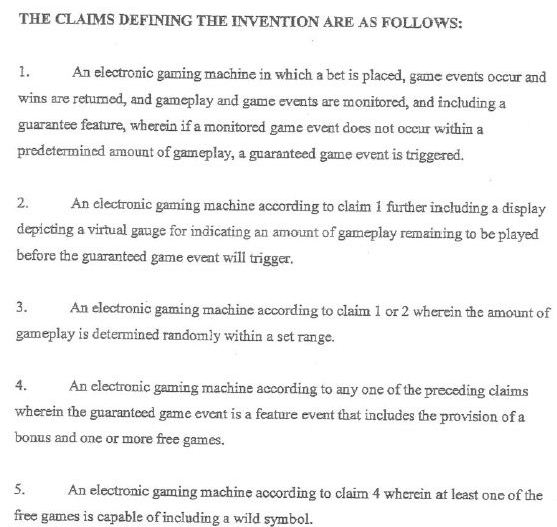
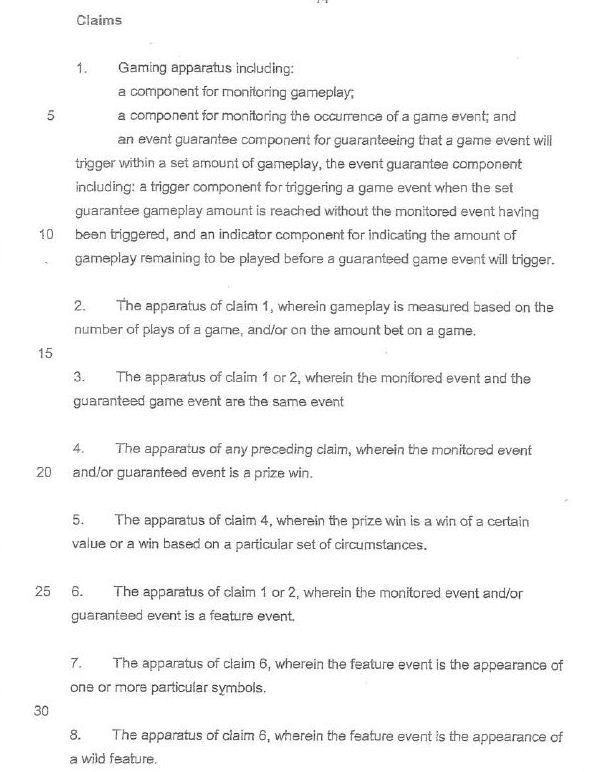
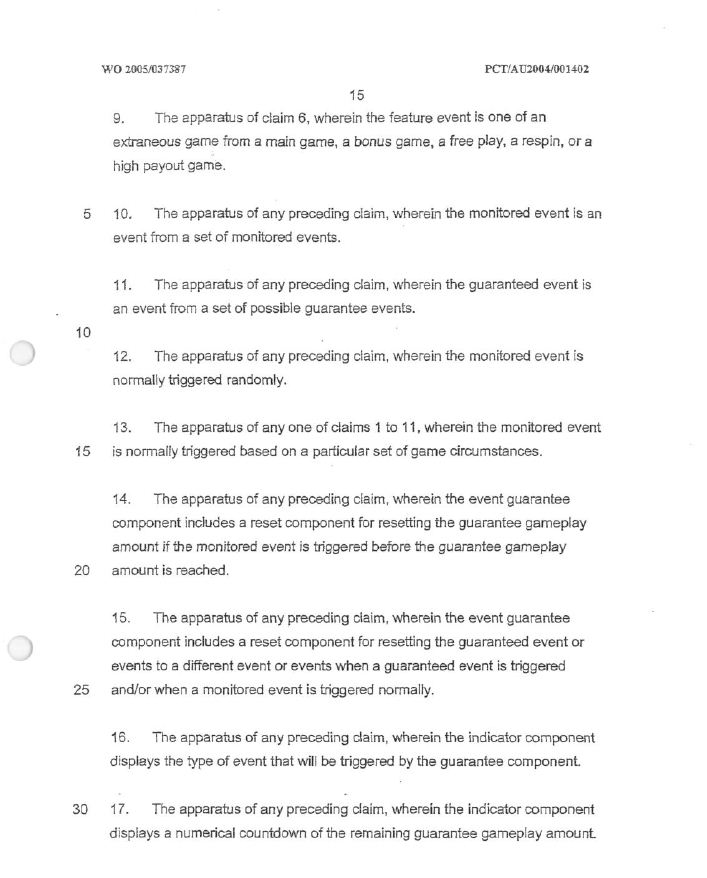
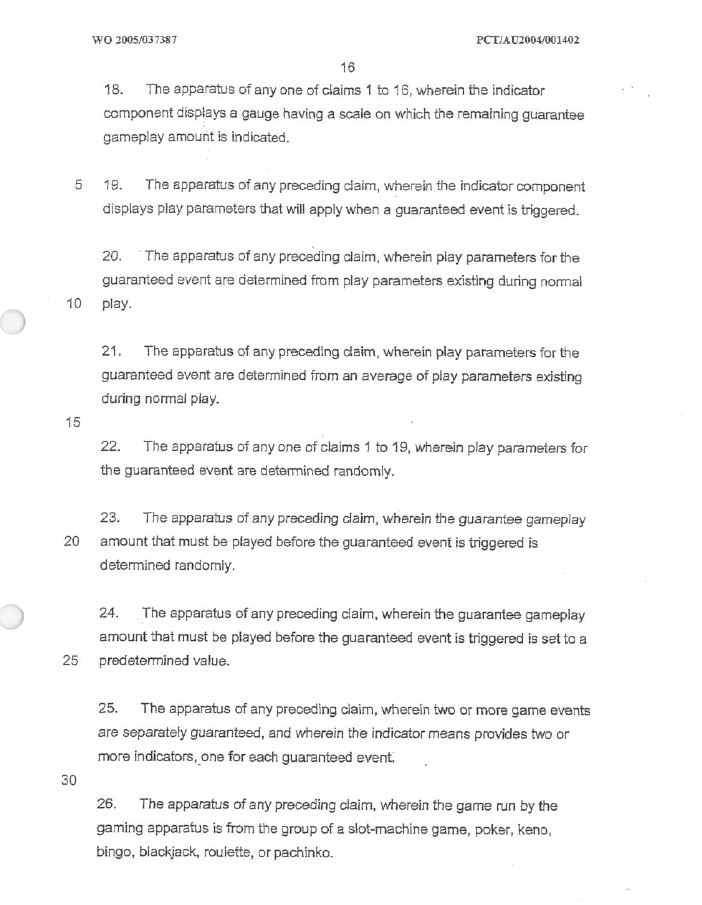
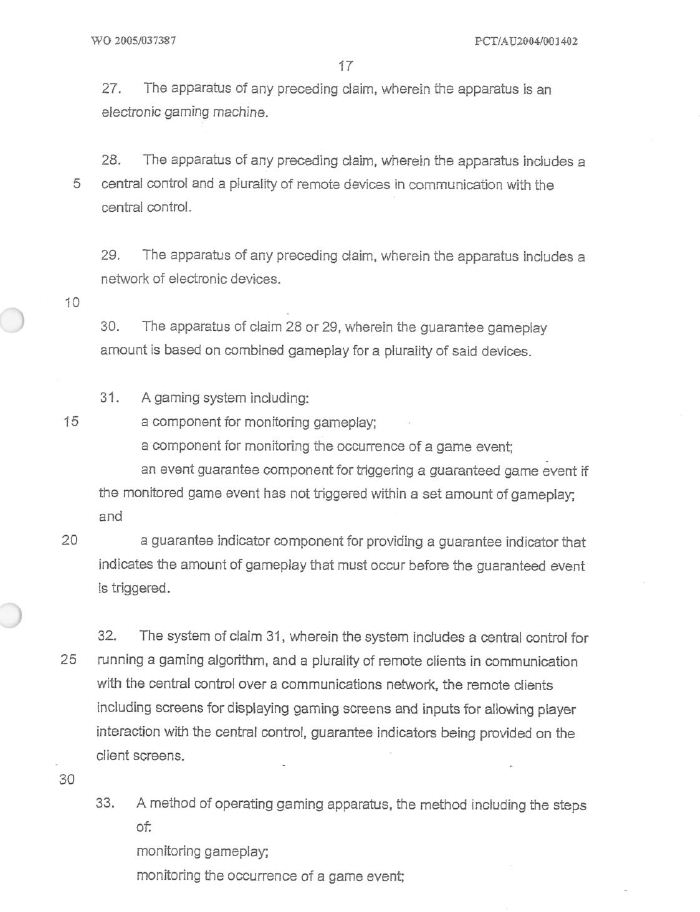
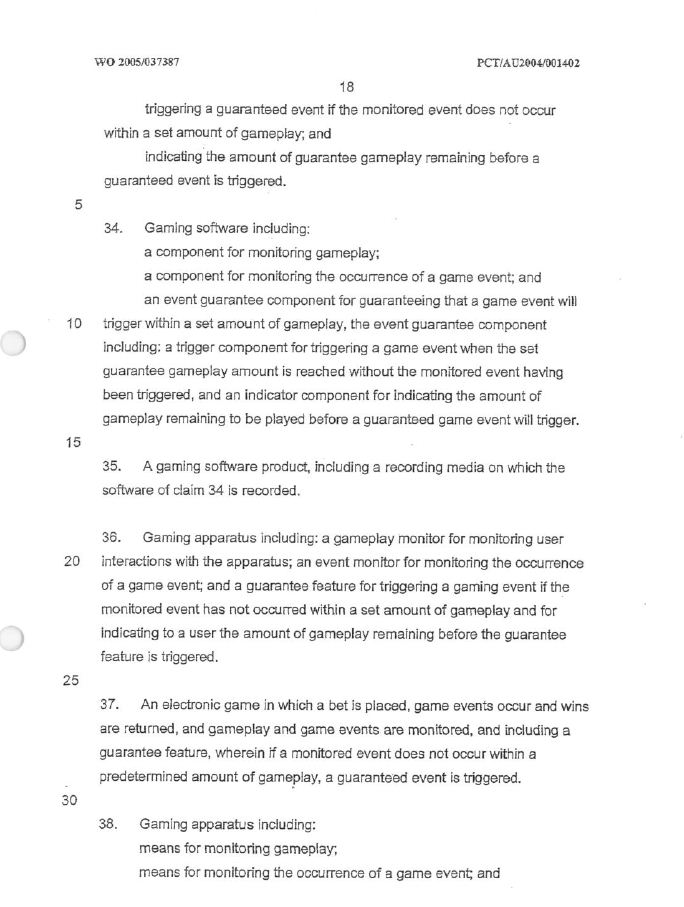
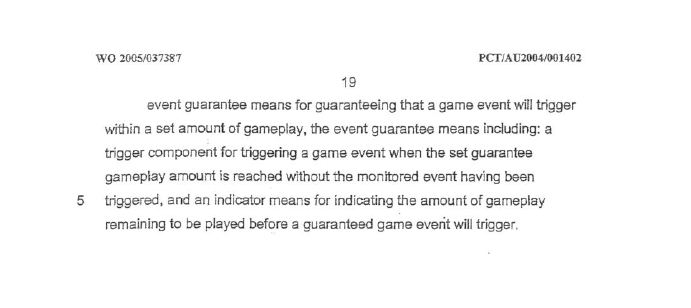
8 The primary judge noted that “Dynamite has confined its allegations of infringement to some only of the claims of the Standard Patent and the Innovation Patent. It alleges infringement of claims 6, 9, 12, 13, 14, 18, 20, 21, 23, 26 and 27 of the Standard Patent and claims 4 and 5 of the Innovation Patent” (at [30]). Further, that there are seven “independent claims of the Standard Patent of a total of 38 claims. Claims 1, 31, 33, 34, 36, 37 and 38 of the Standard Patent are independent claims” (at [31]) and “[t]here is one independent claim of the Innovation Patent of a total of 5 claims, being claim 1, which is expressed more generally than claim 1 of the Standard Patent” (at [32]).
9 The primary judge annexed the claims of the patents to his reasons for judgment as Appendices 1 and 2. We adopt the same course for convenience.
3. PRIMARY JUDGE’S REASONS AND DYNAMITE’s CHALLENGES
10 After a detailed examination of the evidence (at [38] – [89]) the primary judge dealt with the issues of inventive step and innovative step at [95] – [150].
11 There is no issue with respect to the primary judge’s description of the applicable statutory provisions. Accordingly, we set out what the primary judge said:
[90] Section 18(1) of the Act [Patents Act 1990 (Cth)] relevantly provides that an invention is a patentable invention for the purposes of a standard patent if the invention, so far as claimed in any claim:
(a) is a manner of manufacture; and
(b) when compared with the prior art base as it existed before the priority date of that claim:
(i) is novel; and
(ii) involves an inventive step.
[91] Under s 18(1A), an invention is a patentable invention for the purposes of an innovation patent if the invention, so far as claimed in any claim:
(a) is a manner of manufacture; and
(b) when compared with the prior art base as it existed before the priority date of that claim:
(i) is novel; and
(ii) involves an innovative step.
[92] Section 7 provides, relevantly, that an invention is to be taken to be novel when compared with the prior art base unless it is not novel in the light of any one of certain kinds of prior art information. Under s 7(2), an invention is to be taken to involve an inventive step when compared with the prior art base unless the invention would have been obvious to a person skilled in the relevant art in light of the common general knowledge as it existed in the patent area before the priority date of the relevant claim. Under s 7(3), the information for the purposes of s 7(2) is any single piece of prior art information or combination of any 2 or more pieces thereof, being information that a person skilled in the relevant art could, before the priority date of the relevant claim, be reasonably expected to have ascertained, understood and regarded as relevant. Under s 7(4), an invention is to be taken to involve an innovative step when compared with the prior art base unless the invention would, to a person skilled in the relevant art, in the light of the common general knowledge as it existed in the patent area before the priority date of the relevant claim, only vary from the prior art information in ways that make no substantial contribution to the working of the invention.
12 Nor is there any issue with respect to the primary judge’s description of the principles applicable to innovation patents. At [96] the primary judge said:
In determining whether a claimed invention involves an innovative step, the Court must consider and, where necessary, identify the invention, so far as claimed in any claim, the person skilled in the relevant art and the common general knowledge as it existed in Australia before the priority date. The Court must then ask whether the claimed invention only varied from the kinds of information referred to in s 7(5) in ways that make no substantial contribution to the working of the invention. The person skilled in the art must identify and assess the variations between the invention as claimed in each claim and the prior art and determine whether or not those variations make a substantial contribution to the working of the invention as claimed in each claim. Substantial contribution in the context of s 7(4) means real or of substance. Section 7(4) contemplates that, in performing that task, a person skilled in the art has certain background knowledge that that person uses in identifying and assessing such variations (Dura-Post (Aust) Pty Limited v Delnorth Pty Limited (2009) 177 FCR 239 at [54], [74]).
13 At [95], [97] and [101] the primary judge made the following observations about inventive step:
[95] For there to be an inventive step, there must be some difficulty overcome or some barrier crossed. The question is whether the claimed invention would have been obvious to a non-inventive worker in the field, equipped with the common general knowledge in that field, without regard to documents in existence but not part of common general knowledge (Lockwood Security Products Pty Limited v Doric Products Pty Limited (2007) 235 CLR 173; [[2007] HCA 21] at [51]-[56]) (Lockwood).
…
[97] In order to establish lack of inventive step, it is necessary to identify properly and to prove precisely what is said to constitute the common general knowledge. The impugned invention must be compared with the prior art base to determine whether there is an inventive step. There is no onus on a patentee to prove an inventive step. Dynamite contends that Aruze has failed to identify the step that is said to lack inventiveness. It complains that there is no reasoned comparison between the claimed invention and the common general knowledge to determine whether the claimed invention would have been obvious, in the light of common general knowledge, to a person skilled in the art.
…
[101] In considering inventive step, all that is required to maintain validity is that there be no more than a scintilla of invention (Lockwood at [52]). The question of whether an invention is obvious is a matter of fact. The evidentiary burden of establishing obviousness is to be borne by the party impugning the validity of the patent. The essential point is whether the evidence, as a whole, supports the inventiveness of what is claimed (Lockwood at [51]).
14 Dynamite contends that the primary judge’s error of principle is disclosed at [102] where the primary judge said:
Dynamite contends that the question is whether the person skilled in the art, in all of the circumstances, which include a knowledge of all relevant prior art, would be led directly, as a matter of course, in designing a gaming apparatus, to try an event guarantee component as described in Claim 1 (Aktiebolaget Hassle v Alphapharm Pty Limited (2002) 212 CLR 411). Such a formulation, however, is somewhat inapt in the case of the design of a gaming machine. That question may be appropriate where a chemical compound is being sought that might have a particular effect. The question in the present case is better formulated as whether the event guarantee component described in the Specification and Claim 1 was obvious to try in order to produce an enhancement of gameplay interest.
15 According to Dynamite the primary judge thus adopted an “obvious to try” approach to inventive step which the High Court had expressly disapproved in Aktiebolaget Hassle v Alphapharm Pty Limited [2002] HCA 59; (2002) 212 CLR 411 (Alphapharm). This error, said Dynamite, infects the balance of the primary judge’s reasoning about inventive step.
16 Dynamite also contended that the primary judge made findings, including about the common general knowledge, which were not supported by any evidence and/or were contrary to the evidence and otherwise failed to disclose any reasoning capable of supporting his overall conclusion at [150], which was as follows:
I do not consider that the claims of the Standard Patent involve any inventive step. They do no more than represent the application of existing ideas. There is no barrier crossed. Further, the claims of the Innovation Patent do not vary from the prior art in any way that makes a substantial contribution to the working of the claimed invention. I accept the contention of Aruze that the features of the claims of both of the Patents were all matters of common general knowledge, including in combination, before the priority date. The claimed invention of the Patents does not satisfy the requirement for an inventive step or an innovative step.
17 Further, according to Dynamite, the primary judge erred in analysing each of the claims because, in so doing, it is apparent that the primary judge failed to consider the combination of features of each claim. This is said to be disclosed by the terms in which the primary judge reached his conclusions about each of the claims at [114] – [149] of the reasons for judgment.
18 As Dynamite put it about the issue of principle:
…in stating his preferred formulation of the “question in the present case” as being whether the step was “obvious to try” (at J [102]) the judge erred in limiting it to one particular feature of claim 1 (the event guarantee component), whereas the correct approach should have been to consider whether the skilled addressee would have been directly led as a matter of course to try the whole combination of the integers (in each particular claim) in the expectation that it would produce a useful alternative for the stated purpose of enhancing gameplay interest.
The error referred to …above is repeated in each case when the primary judge found lack of inventive step in relation to each claim, including the dependent claims. The approach taken by the primary judge was to refer to the individual integer introduced by each dependent claim and to reject it as, for example, being common general knowledge or lacking inventiveness … This was a clear error. As the High Court stated in Lockwood No. 2 (at [69]) “it is not permissible to treat [the individual] integer in isolation, since inventiveness has to be determined by considering the combination as a whole ...”.
Further, it is submitted that in stating the test in Alphapharm (the “Cripps question”), the High Court did not suggest that the test was to be re-formulated, or approached differently, depending on the nature or field of the invention. It is a unifying formulation intended to be applied across all inventive contexts. The primary judge erred by approaching the question in a contrary manner, and assumed erroneously that the High Court’s formulation of the Cripps question did not apply to the present case.
In light of these principle observations, the primary judge’s evaluation of obviousness was irretrievably infected.
19 As to the common general knowledge, Dynamite said:
The primary judge discussed common general knowledge in ten paragraphs at J [103][112]. In doing so, the primary judge made no findings as to the identity or qualifications of the skilled addressee. The parties’ expert witnesses had been generally described at J [38]-[53], but no view was expressed by the primary judge as to whether any witness (or witnesses) was to be preferred. The identity and qualifications of the person skilled in the art were left unprescribed.
20 As to the primary judge’s analysis of the individual claims, Dynamite submitted:
Although no evidence was led by the Respondents regarding how the reformulated Cripps question was to be answered in the affirmative in respect of each of the thirty seven (37) claims in the Standard Patent, the primary judge nevertheless considered and evaluated each claim in brief fashion, one by one, concluding in each case that the invention claimed was obvious in light of the common general knowledge: J [114]-[144]. The ultimate conclusion (J [150]) was that the claims of the Standard Patent do not involve an inventive step because:
“They do no more than represent the application of existing ideas. There is no
barrier crossed.”
This conclusion is based upon the primary judge’s claim by claim analysis. In that analysis the approach taken by the primary judge was not consistent. Having (incorrectly) held that the relevant question was whether a particular feature was “obvious to try”, the primary judge, in the briefest of fashions, evaluated each claim. Untutored and unguided by expert evidence, the judge made conclusions, without identifying any evidentiary basis for the conclusion. In none of these conclusions is the question whether the combination of integers comprised in each claim would be “obvious to try” (on the judge’s wrong test) or whether the skilled person would be directly led as a matter of course to try that combination in the expectation that it might produce a useful alternative to enhance gameplay interest:
…
The primary judge did not address why, in each case, the particular combination of features as claimed (which become more complex and prescriptive as one proceeds through the dependent claims) was obvious. Further, at no stage in the analysis did the primary judge apply his formulation of the ‘obvious to try’ test articulated at J [102] in any reasoned analysis, let alone address, in each case, the reformulated Cripps question.
The Appellant further contends that the approach taken by the primary judge to evaluating the inventive merit of each of the claims constitutes an analysis infected by hindsight.
21 In respect of the innovation patent, according to Dynamite:
The primary judge’s analysis with respect to innovative step is confined to reviewing individually the five (5) claims (at J [145]-[149]) together with the observations regarding common general knowledge (J [103]-[112]) and statements as to legal principle (at J [92], [96]). The Appellant submits that the analysis of the claims at J [145]-[149] does not comprise an assessment consistent with the statement of principles at J [96].
Despite conceding that “the person skilled in the art must identify and assess the variations between the invention as claimed in each claim and the prior art and determine whether or not these variations make a substantial contribution to the working of the invention as claimed in each claim” the Respondents led no such evidence. In failing to do so no attempt is made to satisfy any of the relevant principles in Dura-Post (Aust) Pty Ltd v Delnorth Pty Ltd (2009) 177 FCR 239 at 250 [54].
As a consequence, the exercise that the primary judge undertook at J [145]-[149] occurred in an evidentiary vacuum. It constitutes an evaluation impermissibly infected by supposition.
4. DISCUSSION
Obvious to try?
22 The problem with Dynamite’s first proposition is that it involves accepting that, despite having referred to Alphapharm and not having either referred to the doctrine of precedent or provided any reasons in support, the primary judge applied to the question of obviousness the very test which the High Court had expressly rejected. The sheer unlikelihood that this might be so suggests Dynamite’s submission warrants scrutiny – and a moment’s scrutiny reveals that the primary judge was not doing anything of the kind.
23 First, a key part of the context of the observation at [102] is the undisputed fact that, as the primary judge put it at [105]:
Once the features of a game have been chosen by a game designer, the embodiment of that game in a gaming apparatus having the necessary hardware and software required is effectively a well-known mechanical and electronic exercise.
24 In other words, on no view of the invention could it be said that once the inventor had identified a feature which would enhance gameplay interest there was some doubt that the feature would be able to be implemented in the anticipated manner. In this sense, the invention was about as far from a chemical patent as one could imagine. Accordingly, the element of the test of obviousness expressed in Alphapharm at [53] concerning the necessary expectation that the invention might well produce a useful result, on the facts of the present case, was always a non-issue. Every feature enhancing gameplay interest would, without doubt, produce a useful result in this field. It is this which the primary judge must have had in mind when, in [102], he refers to the reformulated Cripps question approved in Alphapharm being “somewhat inapt in the case of the design of a gaming machine”. It is somewhat inapt because, unlike the field of chemistry, the inventor need only identify a feature capable of enhancing gameplay interest to know that such a feature will be able to be implemented and will be capable of working exactly as expected through the application of well-known mechanical and electronic technology. In the field of chemistry, by contrast, an inventor might expect a particular effect but, absent experiment, can never know that the anticipated effect will result.
25 Second, it must be recognised that in [102] the primary judge’s entire mode of expression is condensed. In the first sentence the primary judge is providing a condensed version of Dynamite’s own submission. It is condensed because the primary judge, no doubt because of the fact that once the feature has been selected it can be implemented exactly as required, has not added that part of Dynamite’s submission which emphasised the necessary expectation of a useful result. In the second sentence the primary judge is noting that the reformulated Cripps question is “somewhat inapt” (and note that the primary judge does not say simply “inapt”, and still less “inapplicable”). In the third sentence the primary judge is explaining that this is because the field of chemistry is one where a chemical only “might” have a particular effect. In keeping with the summary nature of the paragraph, the primary judge is taking it as given (as indeed it was on the facts) that “[o]nce the features of a game have been chosen by a game designer, the embodiment of that game in a gaming apparatus having the necessary hardware and software required is effectively a well-known mechanical and electronic exercise”. Hence the contrast which the primary judge had in mind in [102] is implied rather than express (but, nevertheless, still obvious to the reasonable reader). In the final sentence of [102] the primary judge is articulating the same point by reworking Dynamite’s submission so as to emphasise that in the field of gaming machines, the issue is not so much one of expectation (which was exercising the mind of the High Court in Alphapharm) – that a particular effect might be produced (or might not) – but of obviousness of selection of the invention “in order to produce an enhancement of gameplay interest”.
26 Dynamite’s submission overlooks all of these matters and instead focuses on the words “obvious to try” in the last sentence of [102]. This is said to evidence the primary judge’s rejection of the reformulated Cripps question in Alphapharm. But Alphapharm was concerned with the question whether a series of experimental steps to formulate an unstable compound were obvious to try in the sense of being routine – steps that might have led from the prior art to the invention, steps that an uninventive worker in the field would try as a matter of course. What is required is a step, or series of steps, obvious to try (in the requisite sense) in the expectation of a useful result. And it is that expectation of the useful result that, in this field of endeavour of gaming machines, the primary judge was saying could be effectively assumed in the inventor’s favour. Far from applying an incorrect test to the detriment of Dynamite, the primary judge was in fact explaining why one aspect of the Alphapharm approach was not even in dispute in this case given the nature of the invention claimed.
27 That this is so is shown by the fact that the words “to try” appear in the primary judge’s recording of Dynamite’s submission in the first sentence, as well as in the reformulated version in the last sentence. Moreover, this was an accurate summary of Dynamite’s submission. The primary judge was using “obvious to try” in the last sentence as a convenient shorthand for the lengthier “directly be led as a matter of course” collocation of words which appears in Alphapharm. He was using “in order to produce an enhancement of gameplay interest” as a more apt descriptor for this field of invention than the required “expectation that the invention might well produce a useful result” also derived from Alphapharm. That is, the primary judge was not reformulating the obvious to try aspect that related to the steps taken, but rather the reason for, or hoped for outcome of, those steps. As the majority recognised in Alphapharm at [37], citing Diplock LJ in Johns-Manville Corporation’s Patent [1967] RPC 479 at 493-4, there is no verbal formula which is appropriate to all classes of claims.
28 Once this is recognised Dynamite’s submission that the primary judge was adopting an “obvious to try” test irrespective of the expectation of a useful result, contrary to Alphapharm, falls away. Properly analysed, it is apparent that the primary judge was doing no more than making the point, which operates in Dynamite’s favour, that the entire discourse in the authorities about the need for an expectation of a useful result is beside the point. A game designer never has to worry that the selected feature might not be able to be implemented or, if implemented, might not result in the desired effect. The software and hardware to incorporate the feature is well-known.
Event guarantee component only?
29 The problem with Dynamite’s second proposition is equally apparent on a reasonable analysis of [102]. Dynamite contended that the primary judge focused in [102] on one feature of the claimed invention only, the event guarantee component, and disregarded all other features. Again, the context and actual text of [102] do not support the proposition. Dynamite’s own submission was that the reformulated Cripps question had to be asked in relation to the person skilled in the art being directly led as a matter of course to try an event guarantee component. It is true that Dynamite’s version then described the event guarantee component as including both the trigger component and the indicator component. It is equally true that the primary judge in [102] did not refer to the event guarantee component as including both the trigger component and the indicator component. But then again, before [102], the primary judge had spent [6] – [37] of the reasons for judgment describing the invention as claimed, focussing on the event guarantee component including the trigger component and the indicator component (for example, at [7], [12], [13], [14], [15], [18], [23], [24], [25], [26], [27], [28], [29], [31] and [37]). The idea that when he referred to event guarantee component in [102] the primary judge meant some other form of event guarantee component, which did not include the trigger component and the indicator component as described in the specification and recorded throughout the analysis at [6] – [37], is unrealistic and unsustainable.
30 For these reasons nothing in [102] indicates any error by the primary judge. The primary judge knew that the event guarantee component included the trigger component and the indicator component. It could hardly be otherwise when he had spent more than 30 paragraphs making that fact plain. Equally, when he came to deal with the question of obviousness of the invention as claimed in each claim he knew that the event guarantee component included the trigger component and the indicator component in addition to whatever other features appeared in the claims.
Common general knowledge
31 Dynamite’s submissions about the primary judge’s errors in respect of the common general knowledge are equally ill-founded.
32 Dynamite’s first focus in this regard was [112] of the reasons of the primary judge. It is necessary to set the out the paragraph in full to understand the lack of substance in the complaint. The primary judge said:
Aruze contends that it was well known to game designers as at the priority date that bonus features of gaming machines could be influenced by parameters applied in the ordinary run of play. In the case of multipliers, which are applied to a win amount to increase the player’s win, they were generally calculated by averaging the play parameters from the main game. In support of that assertion, Aruze points to a game called Two-up from the 1980s, which triggered a free game bonus called “Hold and Spin” if a certain non-paying combination was obtained, and Dolphin Treasure, from about 1994, which offered fifteen free games if certain combinations of scattered treasure symbols were obtained. Aruze also relies on a metamorphic game called Scatter Rug as being part the common general knowledge. In that game, if one of a range of scattered rug symbol combinations was obtained, one of four lights on the machine was illuminated. Consecutive plays resulting in the relevant combinations caused the other lights to illuminate and, if all four lights were illuminated following a four play sequence of obtaining the relevant combinations, the player was guaranteed the total of the wager made over the four game sequence. If a play occurred whereby the combination did not appear, all illuminated lights were extinguished and the sequence was cancelled. Notwithstanding Dynamite’s contention to the contrary, I am satisfied by the evidence of Mr Daley that each of Scatter Rug, Two-up and Dolphin Treasure was part of common general knowledge. The games were available in Australia prior to the priority date and I am satisfied that game designers were familiar with the products of their competitors.
(bold type in original)
33 Dynamite said it was important to understand that the primary judge was merely recording Aruze’s submission that “[i]n the case of multipliers, which are applied to a win amount to increase the player’s win, they were generally calculated by averaging the play parameters from the main game” and had not made any finding to that effect. Alternatively, if the primary judge had made any such finding Dynamite said there was no evidence to support it and the finding was contrary to the evidence.
34 Both aspects of this submission must be rejected.
35 Read reasonably in context it is apparent that the primary judge accepted all of Aruze’s submissions as recorded at [112], including that “[i]n the case of multipliers, which are applied to a win amount to increase the player’s win, they were generally calculated by averaging the play parameters from the main game”.
36 This finding, moreover, was amply supported by the evidence which the primary judge identified. One critical matter Dynamite appears to be overlooking is that there was no dispute on the evidence that every gaming machine in Australia has to provide a minimum return to player (or RTP) which is worked out on the basis of averages. The primary judge explained this in the reasons for judgment including:
• At [44] when referring to Mr Olive’s evidence that:
Once the rules of the game have been decided, the probability calculations of each winning combination applicable in the game, that is, the win frequency, need to be worked out. Where gaming machines are operated in a regulated environment, the probability calculations are restricted as each game must provide a specific minimum theoretical return to the player. The play table is then developed. That is dependent on the game probability calculations and is also directly influenced by any required theoretical return to the player in a regulated environment.
• At [109] when referring to the Australian/New Zealand Gaming Machine National Standard (the Standard), the contents of which the primary judge found were “background knowledge available to all in the trade in considering the making of new games, or the making of improvements to old games”. It was not in dispute that the Standard required a minimum RTP which depended on all features of gameplay being monitored and the average overall return to players to meet the required minimum.
37 In this context, the evidence of Mr Daley on which the primary judge relied at [112] did not call for further explanation. The simple point is that, on the evidence, there was no dispute about the fact that every aspect of the operation of a gaming machine was “generally calculated by averaging the play parameters from the main game”. Mr Causley, who was called by Dynamite, acknowledged this as a proposition fundamental to how gaming machines operate. As he put it, while a player could not observe that the functioning of the machine was based on an average, he knew that was what “it [the gaming machine] must be doing” as “that’s the only way that would keep the percentage linear and hence, for the game to be approvable”. In the applicable regulatory environment in Australia, accordingly, everything has to be “generally calculated by averaging the play parameters from the main game”. Without doing this, there would be no way to maintain the average RTP required by the Standard for the gaming machine to be able to be approved. Dynamite’s unstated assumption appears to be that multipliers somehow operate outside the fundamental RTP requirements and thus might not be “generally calculated by averaging the play parameters from the main game”. That assumption is contrary to the evidence. It follows that all of Dynamite’s submissions that the other well-known games which the primary judge found to be part of the common general knowledge (findings which Dynamite does not challenge) were somehow not based on “averaging” are misconceived. It also follows that equally misconceived are all of Dynamite’s complaints about the lack of any evidentiary foundation to support the primary judge’s findings, as well as Dynamite’s complaints about a lack of analysis of that evidence by the primary judge. The complaints pay no regard to the detailed identification of the evidence and reasons cross-referring to that evidence which the primary judge provided.
38 For these reasons the attack on the primary judge’s approach to the common general knowledge in [112] must fail.
39 Dynamite’s other focus was [114]. Again, the whole paragraph should be set out so that the lack of substance in Dynamite’s complaints can be understood.
40 The primary judge said at [114]:
Claim 1 is for gaming apparatus having components for monitoring gameplay and the occurrence of game events and for guaranteeing that a game event will trigger within a set amount of gameplay. Money Back and Cashcade were both part of the common general knowledge. The Standard prescribed the rules for metamorphic games and token accumulation games, including that the number of tokens accumulated and the number needed to trigger a bonus feature be displayed. Thus, not only was each integer of claim 1 within the common general knowledge, but the combination was also part of the common general knowledge. Any gaming apparatus will have components for monitoring gameplay and the occurrence of game events. Guaranteed events in the nature of awards, where other events, such as wins, did not occur, were part of the common general knowledge. Similarly, indicator requirements were part of the common general knowledge. The idea that a gaming apparatus could be designed to enhance player interest by guaranteeing an award to a player if another event did not occur within a set time was known to a person of ordinary skill in the art. The Standard required that there be an indication to players how far a metamorphic sequence had progressed and the total number of games in the sequence. That is to say, the Standard required that games indicate to players the amount of gameplay remaining before the guaranteed event occurred.
(bold type in original)
41 Dynamite contended that the key finding in [114] that “not only was each integer of claim 1 within the common general knowledge, but the combination was also part of the common general knowledge” was unsupported by any evidence and unexplained by the primary judge in [114]. Neither contention carries weight.
42 Consistent with its general approach, Dynamite has failed to recognise the fact that the primary judge has found three things to be part of the common general knowledge – the Standard, the game Money Back and the game Cashcade. The RTP requirement of the Standard has been referred to above. At [110] the primary judge had also explained that:
According to the Standard, metamorphic games must display to the player sufficient information to indicate the current status towards the triggering of the next metamorphosis of the game.
43 In addition, the primary judge had explained at some length at [77] – [82] the features of Money Back and Cashcade all of which, he found, formed part of the common general knowledge. Hence, he recorded that, amongst other things:
• Money Back required that the machine’s microprocessor would monitor the state of the series of games played by the player and the amount wagered over that series. During the operation of the sequence, the machine separately displayed the current length of the sequence and the current value of the sequence (at [77]).
• The distinguishing feature of Cashcade was that the bonus jackpot was guaranteed to be won when the accumulated money value achieved a randomly chosen value between the fixed minimum and maximum. The players could see the accumulated total increase each time a linked machine was played. The Cashcade system was “deterministic” in that, as play occurred and the incrementing value of the proportion sent to the controller approached the win value, a win was guaranteed to occur when the two values were equal. That is to say, a win was determined to occur within a set range of units wagered (at [82]).
44 These findings set the context for the conclusions in [114] that every integer of claim 1, whether considered in isolation or in combination, formed part of the common general knowledge. In light of the earlier findings about the Standard, Money Back and Cashcade, the conclusions are unassailable. Dynamite’s submissions amount to no more than mere repeated assertion irrespective of the evidence on which the primary judge expressly relied and the primary findings he made, none of which are challenged. The assertions of error, both of reasoning and lack of reasoning on the part of the primary judge, simply cannot stand. Indeed, it is difficult to know what more the primary judge could have said to make the point that there was nothing inventive at all about claim 1 not only because there was no inventive step but also because there was actually no step at all. Every aspect of claim 1 was a mere re-hash of known things in known combinations. That is the point the primary judge was making and it is one amply supported by the evidence.
45 The same conclusions undermine each of Dynamite’s complaints about the manner in which the primary judge dealt with every one of the other claims. The essence of the complaint is that the primary judge failed to consider the particular combination in each case and that the overall conclusion in [150], which expressly refers to the combinations of every claim, was unsupportable by the evidence and unsupported any reasoning. Both aspects of the complaint fail for the same reasons. The point the primary judge was repeatedly making, by describing the claims as not inventive, well-known, in the Standard or otherwise, was the lack of any step at all, let alone an inventive step, in the claims. In this regard, none of the claims fares any better than the other. For example claim 9, which Dynamite emphasised, as Aruze put it, involved “mere fiddling with a known combination of known integers”. The evidence supports this, and thus also supports the primary judge’s conclusion that claim 9 is in no different position from any other claim. The same might be (and, by the primary judge, was) said of claim 21 and, indeed, all of the other claims.
46 Against this background, the primary judge’s conclusion at [150], that “the features of the claims of both of the Patents were all matters of common general knowledge, including in combination, before the priority date” is unassailable. As the primary judge put it in [150], nothing claimed, looked at in isolation or as a combination, involved anything more than the “application of existing ideas”, there being “no barrier crossed” and thus no “inventive step”. It is true that the primary judge, if he had been so minded, could have laboured the point by repeating factual findings made in earlier parts of the judgment when dealing with each individual claim or by identifying yet further authorities explaining that to be inventive a combination must itself result in something new (for example, Fallshaw Holdings Pty Limited v Flexello Castors and Wheels PLC (1993) 26 IPR 565 and Elconnex v Gerard Industries Pty Ltd (1992) 25 IPR 173). But the primary judge certainly did not need to do so to adequately explain his reasons. Nor, in the circumstances, was it even desirable for the primary judge to do so. The reasons are perfectly intelligible on a reasonable reading of the whole.
47 Dynamite’s other complaints used to shore up its case warrant equal short-shrift.
48 There is simply no basis for the submission that the primary judge impermissibly used hindsight to reach his conclusions. Nothing in the reasons suggests this. It seems to be a submission based on misplaced hope rather than the reality of the primary judge’s reasons.
49 Claim 6, as described by the primary judge at [119], is:
for the apparatus of claim 1 or claim 2, wherein the monitored event or guaranteed event is a feature event. The Standard includes bonus prizes in its list of features. That indicates that prize wins and feature events are not mutually exclusive. In any event, feature events other than prize wins were plainly part of the common general knowledge and were used to enhance player interest as at the priority date.
50 Dynamite alleged error on the basis that, in context, feature events cannot be prize wins. Assume this is so. The reasoning in [119] still stands. As the primary judge said “feature events other than prize wins were plainly part of the common general knowledge and were used to enhance player interest as at the priority date” and, in combination, claim 6 involves no inventive step (at [150]).
51 Dynamite’s complaint regarding the lack of findings about the person skilled in the art is also ill-founded. The answer to the complaint is that the matter was never in issue. Both parties called game designers to give evidence. No-one put in issue that the person skilled in the art was a game designer who was aware of the Standard and other games in the industry.
52 The notion that there was no evidence from a person skilled in the art which supported the primary judge’s findings is incorrect, as explained above. In any event, as Azure pointed out, questions of obviousness are ultimately a matter for the court “irrespective of the opinion expressed by any number of experts” (Minnesota Mining and Manufacturing Co v Tyco Electronics Pty Ltd [2002] FCAFC 315; (2002) 56 IPR 248 at [50]).
53 To the extent that Dynamite submitted that the primary judge’s observations in dealing with individual claims that certain matters were “assumed” to be part of the common general knowledge (for example, at [115], [116]) it is apparent that the primary judge meant only that the claims themselves assumed the existence of certain things as common general knowledge. The point being made is that the inventions as claimed say nothing about how the features are to be implemented because, as found at [105], the software and hardware components are all well-known.
54 In respect of the innovation patent, the same challenges are made (that is, conclusions said not to be supported by evidence and no reasoned analysis) and the same answers should be given. The primary judge identified the correct test (as Dynamite acknowledged) at [96] and then applied it in conventional terms, based on the evidence and the earlier findings, at [145] – [149]. The failure to repeat the earlier findings to drive home the lack of any, let alone substantial, contribution to the working of the invention, is no failure at all.
5. INFRINGEMENT
55 Although, in common with the position of the primary judge, it is unnecessary to say anything about infringement it is convenient to do so. The primary judge rightly said at [197]:
There will be no infringement of any of the claims of the Standard Patent that are dependent on claim 1 unless the progress bar of the Impugned Products is an indicator component for indicating the amount of gameplay remaining to be played before a guaranteed game event will trigger. That requires examination of the operation of the rescue spin feature of the Impugned Products.
56 The primary judge also rightly recognised that the concept of an indicator component depends on the context in which the expression is used (at [202]). Dynamite’s complaint is that the primary judge should have concluded that a general, as opposed to a specific, indicator was sufficient to constitute an indicator component. But the issue is first and last one of construction of the claims in context. And the process by which the primary judge construed the claims, in context, as requiring an accurate indicator in some form of the amount of gameplay remaining seems to us to be impeccable. In the alleged infringing products a player “will never know the player’s current position or the target” (at [201]). Yet the indicator component claimed, as the primary judge put it, is to indicate the amount of gameplay remaining in circumstances where:
• Gameplay must be something that is capable of measurement (at [206]).
• The claimed invention is said to be of benefit to players who can know that an event of benefit to the player will indeed occur within an indicated amount of gameplay. Thus, the benefit to the player mentioned in the Specification relates to a degree of certainty in the indicated amount. The role of the indicator component is to provide that certainty (at [213]).
• The examples given, of countdown and a pointer with scale, would indicate the games remaining with precision (at [213]).
• There is no disclosure of a non-specific inaccurate type of indicator (at [213]).
57 Dynamite’s submission amounts to no more than assertion that a “non-specific inaccurate type of indicator” is sufficient to satisfy the indicator component of the claims said to be infringed. Yet the assertion is not supported by the kind of detailed contextual analysis which led the primary judge to the conclusion that what was required was an accurate indicator of the amount of gameplay remaining – an integer not satisfied by the inconsistent and randomised operation of the progress bar in the products said to infringe.
58 The primary judge’s conclusion in this regard is unaffected by the observation he made at [211] and [212] that a “monitored event” might include a loss. In common with the feature event and prize win point of construction dealt with above, the point, even if right, is simply immaterial to the result.
6. CONCLUSION
59 The challenges to the primary judge’s conclusions about obviousness fail. It follows that the appeal must be dismissed. In the circumstances saying anything more about the notice of contention, other than the observations above that we agree with the primary judge’s conclusions about there being no infringement, is inappropriate.
| I certify that the preceding fifty-nine (59) numbered paragraphs are a true copy of the Reasons for Judgment herein of the Honourable Justices Bennett, Jagot and Robertson. |
Associate:
APPENDIX 1: Claims of the Standard Patent
The claims of the Standard Patent are as follows:
APPENDIX 2: Claims of the Innovation Patent
The claims of the Innovation Patent are as follows: