FEDERAL COURT OF AUSTRALIA
Wenkart v Pantzer [2013] FCAFC 81
| IN THE FEDERAL COURT OF AUSTRALIA | |
| BETWEEN: | THOMAS RICHARD WENKART Appellant |
| AND: | WARREN PANTZER - FORMER TRUSTEE OF THE ESTATE OF THOMAS RICHARD WENKART First Respondent HAPDAY HOLDINGS PTY LIMITED (ACN 001 185 253) Second Respondent |
| AND BETWEEN: | WARREN PANTZER – FORMER TRUSTEE OF THE ESTATE OF THOMAS RICHARD WENKART Cross-Appellant in the First Cross-Appeal |
| AND: | THOMAS RICHARD WENKART First Cross-Respondent in the First Cross-Appeal HAPDAY HOLDINGS PTY LIMITED (ACN 001 185 253) Second Cross-Respondent in the First Cross-Appeal |
| AND BETWEEN: | HAPDAY HOLDINGS PTY LIMITED (ACN 001 185 253) Cross-Appellant in the Second Cross-Appeal |
| AND: | THOMAS RICHARD WENKART First Cross-Respondent in the Second Cross-Appeal WARREN PANTZER – FORMER TRUSTEE OF THE ESTATE OF THOMAS RICHARD WENKART Second Cross-Respondent in the Second Cross-Appeal |
| DATE OF ORDER: | |
| WHERE MADE: |
THE COURT ORDERS THAT:
1. By 9 August 2013, Warren Pantzer file and serve Short Minutes of Declarations and Orders which he proposes in order to give effect to the Reasons for Judgment of the Full Court published this day together with a Written Submission of no more than six (6) pages in length in which he explains the basis for his proposed declarations and orders (including all necessary calculations) and supports that proposal to the extent that he may be advised.
2. By 23 August 2013, Dr Wenkart and Hapday Holdings Pty Limited (Hapday) each file and serve a Written Submission of no more than six (6) pages in length in which they make such submissions as they may be advised in answer to Mr Pantzer’s submissions and proposed declarations and orders.
3. By 27 August 2013, Mr Pantzer file such Reply Submission (if any) as he may be advised to make in answer to Dr Wenkart’s and Hapday’s submissions, such submission not to exceed three (3) pages in length.
4. Thereafter, the form of Declarations and Orders is to be determined on the papers.
Note: Entry of orders is dealt with in Rule 39.32 of the Federal Court Rules 2011.
| NEW SOUTH WALES DISTRICT REGISTRY | |
| GENERAL DIVISION | NSD 26 of 2011 |
| ON APPEAL FROM THE FEDERAL COURT OF AUSTRALIA |
| BETWEEN: | THOMAS RICHARD WENKART Appellant |
| AND: | WARREN PANTZER - FORMER TRUSTEE OF THE ESTATE OF THOMAS RICHARD WENKART First Respondent HAPDAY HOLDINGS PTY LIMITED (ACN 001 185 253) Second Respondent |
| AND BETWEEN: | WARREN PANTZER – FORMER TRUSTEE OF THE ESTATE OF THOMAS RICHARD WENKART Cross-Appellant in the First Cross-Appeal |
| AND: | THOMAS RICHARD WENKART First Cross-Respondent in the First Cross-Appeal HAPDAY HOLDINGS PTY LIMITED (ACN 001 185 253) Second Cross-Respondent in the First Cross-Appeal |
| AND BETWEEN: | HAPDAY HOLDINGS PTY LIMITED (ACN 001 185 253) Cross-Appellant in the Second Cross-Appeal |
| AND: | THOMAS RICHARD WENKART First Cross-Respondent in the Second Cross-Appeal WARREN PANTZER – FORMER TRUSTEE OF THE ESTATE OF THOMAS RICHARD WENKART Second Cross-Respondent in the Second Cross-Appeal |
| JUDGES: | DOWSETT, MCKERRACHER AND FOSTER JJ |
| DATE: | 30 JULY 2013 |
| PLACE: | SYDNEY |
TABLE OF CONTENTS
| [1] | |
| THE SETTING FOR THE PROCEEDINGS BELOW (NSD 7051 OF 2002) | [23] |
| A BRIEF HISTORY OF THE PROCEEDINGS BELOW (NSD 7051 OF 2002) | [47] |
| The Early Period | [47] |
| The Trustee’s Motion to Enforce the Charge over the Paddington Property and the Subsequent Applications | [71] |
| THE RELEVANT JUDGMENTS OF BRANSON J | [120] |
| Branson No 1 | [120] |
| Branson No 2 | [129] |
| Branson No 3 | [148] |
| THE JUDGMENTS OF FLICK J | [156] |
| Flick No 1 | [156] |
| Flick No 2 | [160] |
| Flick No 3 | [183] |
| Flick No 4 | [193] |
| THE ISSUES IN THE APPEAL AND THE CROSS-APPEALS | [194] |
| Dr Wenkart’s Appeal | [194] |
| The Trustee’s Cross-Appeal | [198] |
| Hapday’s Cross-Appeal | [206] |
| THE MEANING AND EFFECT OF THE CONSENT ORDERS DATED 11 MARCH 2002 | [211] |
| DR WENKART’S APPEAL | [242] |
| Issue 1—No Debt to Support an Order for the Appointment of a Trustee for Sale | [242] |
| Dr Wenkart’s Submissions | [242] |
| Hapday’s Submissions | [252] |
| The Trustee’s Submissions | [253] |
| Discussion | [256] |
| Issue 2—Was the Trustee’s Remuneration Finally Fixed at the Annulment Meeting | [294] |
| Issue 3—The Trustee’s Entitlement to Post-Annulment Remuneration and Expenses | [303] |
| Issue 4—Unreasonable Conduct | [310] |
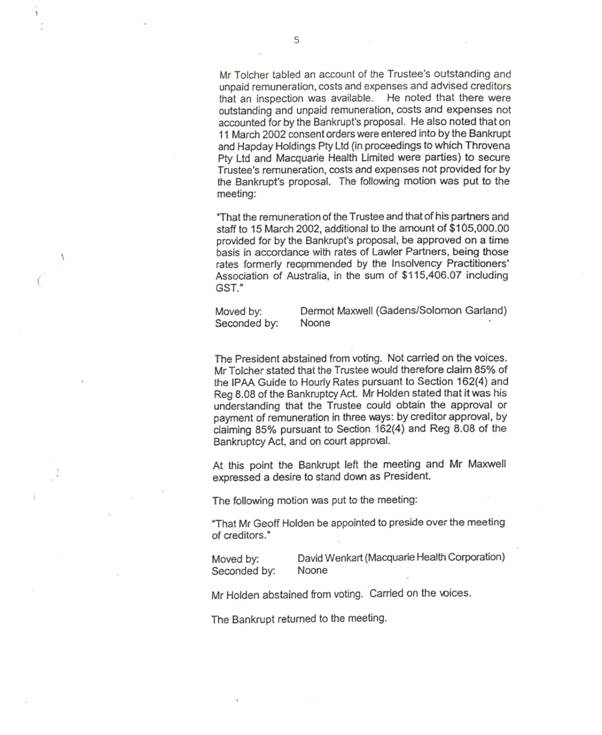
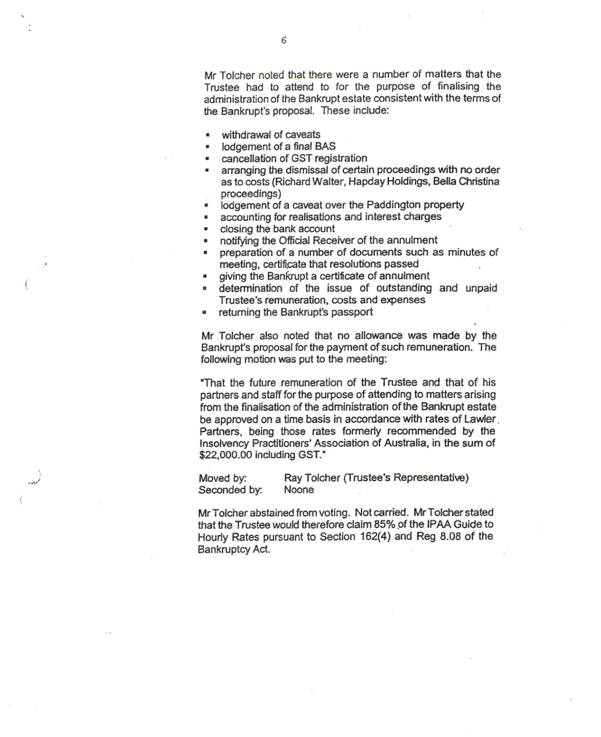
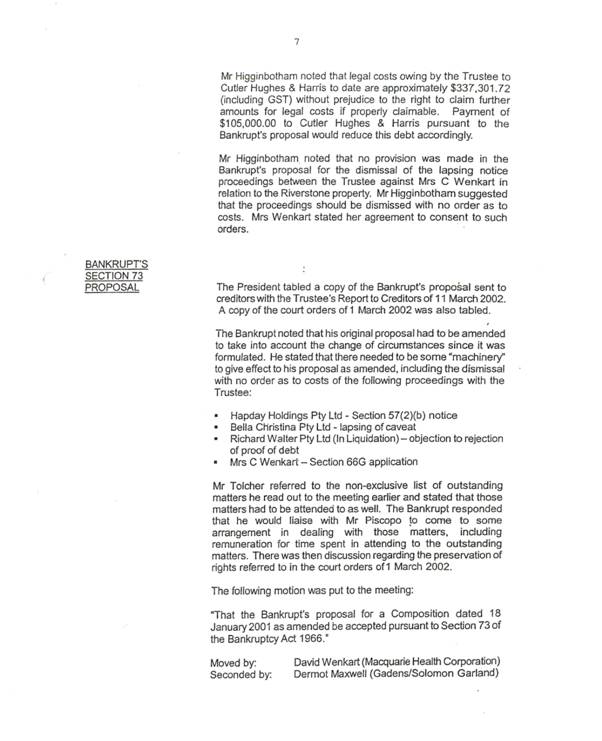
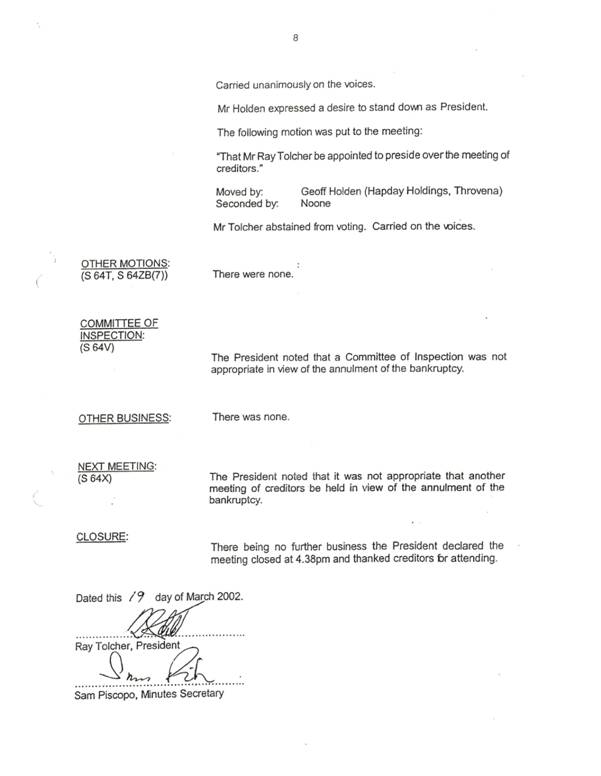
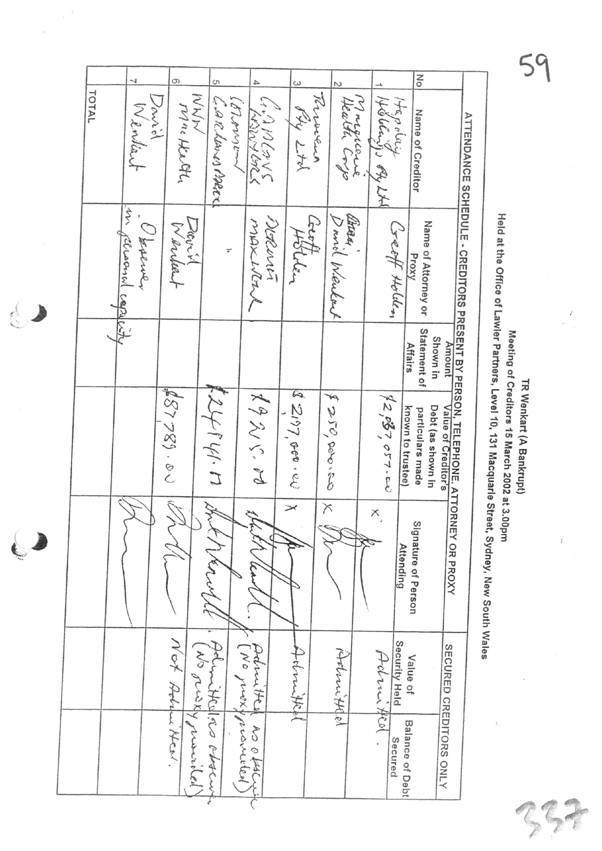
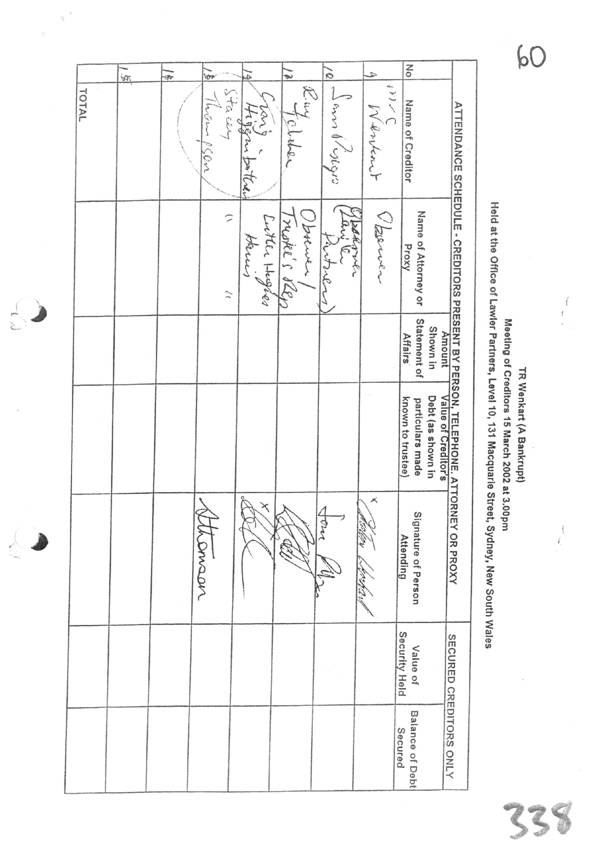
| Issue 5—The Trustee’s Failure to Prove his Entitlements | [312] |
| Issue 6—The Procedural Errors and Delays | [332] |
| Issue 7—Declaratory Relief | [340] |
| THE TRUSTEE’S APPLICATION TO REOPEN | [345] |
| OTHER MATTERS | [347] |
| Interest | [347] |
| Costs | [351] |
| The Proceeds of Sale Issue | [356] |
| CONCLUSIONS | [359] |
REASONS FOR JUDGMENT
THE COURT:
Introduction
1 The estate of Dr Thomas Richard Wenkart, who is the appellant in the present Appeal (NSD 26 of 2011) and the first cross-respondent in both of the Cross-Appeals, was sequestrated on 28 October 1999 by order of this Court.
2 Warren Pantzer, a Chartered Accountant, was appointed as Dr Wenkart’s trustee in bankruptcy. Mr Pantzer is the first respondent in Dr Wenkart’s Appeal, the cross-appellant in the First Cross-Appeal and the second cross-respondent in the Second Cross-Appeal. We shall hereinafter refer to Mr Pantzer as the trustee.
3 The other party to the matters presently before this Full Court is Hapday Holdings Pty Limited (Hapday). Hapday is a corporation associated with Dr Wenkart. At all relevant times, Hapday held a first registered mortgage over a residential property known as “47 Union Street, Paddington, NSW” (the Paddington property). At all relevant times, Dr Wenkart was the registered proprietor of the Paddington property. The Paddington property was charged by Dr Wenkart in favour of the trustee in order to secure Dr Wenkart’s obligations under an arrangement reached with the trustee on 11 March 2002.
4 Hapday is the second respondent in the appeal, the second cross-respondent in the First Cross-Appeal and is the cross-appellant in the Second Cross-Appeal. As already mentioned, the cross-respondents in the Second Cross-Appeal are Dr Wenkart and the trustee.
5 Dr Wenkart’s bankruptcy was annulled on 15 March 2002 (the annulment date) by resolution of his creditors passed on that day (see s 73(4) and s 74(5) of the Bankruptcy Act 1966 (Cth) (the Bankruptcy Act)).
6 During Dr Wenkart’s bankruptcy, the trustee was involved in litigation concerning several proofs of debt which he had rejected and the recovery of payments made by Dr Wenkart which the trustee contended were preferences. Throughout the bankruptcy, the trustee was advised and represented by the law firm, Cutler Hughes & Harris (CHH). CHH ceased acting for the trustee immediately after the annulment meeting. For some time thereafter, Sally Nash & Co acted for the trustee.
7 As at the annulment date, the trustee claimed:
(a) Approximately $220,000 as unpaid trustee’s remuneration. In the period up to late December 2000, the trustee had already paid various amounts to himself and to the firm of accountants with which he was associated out of the bankrupt estate of Dr Wenkart. The total of those amounts was $226,454.70.
(b) Approximately $260,000 as unpaid trustee’s costs, charges and expenses. We shall refer to these types of outlays as trustee’s expenses. The amount of $260,000 (approx) was claimed as unpaid fees and disbursements due to CHH. As was the case in respect of the trustee’s own remuneration, in the period up to late December 2000, the trustee had made a number of payments to CHH and to Counsel retained by CHH on his behalf. Those payments totalled $249,942.29.
8 By late December 2001, Dr Wenkart was very keen to have his bankruptcy annulled. On 18 January 2001, he had submitted a concrete compromise proposal to the trustee pursuant to s 73 of the Bankruptcy Act. This followed an earlier proposal which he had submitted on 9 March 2000. By late December 2001, he had settled with his creditors but had not accepted the trustee’s claims concerning the trustee’s unpaid remuneration and expenses. In the period from late October 2001 to early March 2002, CHH and Hunt & Hunt, the law firm retained by Dr Wenkart and his corporate associates, had exchanged correspondence and had had discussions in an endeavour to resolve the trustee’s claims. Those exchanges and discussions had not produced an agreement.
9 As at early March 2002, Dr Wenkart and his corporate associates were well aware that the trustee had no funds in his hands with which to pay his unpaid remuneration and expenses.
10 On 15 February 2002, Dr Wenkart wrote directly to Beaumont J requesting that his Honour compel the trustee to call a meeting of his creditors for the purpose of considering his annulment proposal. His Honour treated this correspondence from Dr Wenkart as the filing of an initiating process. The proceeding thereby commenced was allocated plaint No. NSD 7051 of 2002. Proceeding NSD 7051 of 2002 (the proceedings below) is the proceeding in which all of the orders which are challenged in the present Appeal and in the two Cross-Appeals were made.
11 On 1 March 2002, Beaumont J made orders requiring the trustee to convene a meeting of Dr Wenkart’s creditors by no later than 15 March 2002.
12 On 11 March 2002, Beaumont J noted an agreement which had, by then, been reached among Dr Wenkart, Hapday and the trustee. That agreement provided that, post-annulment, Dr Wenkart would assume personal responsibility for the payment of the trustee’s lawful entitlement to remuneration and expenses and that Dr Wenkart’s obligation to do so would be secured by an equitable charge granted by him over the Paddington property.
13 At noted at [5] above, on 15 March 2002, by resolution of his creditors, Dr Wenkart’s bankruptcy was annulled.
14 The annulment of Dr Wenkart’s bankruptcy triggered a series of disputes between Dr Wenkart and the trustee concerning the trustee’s conduct in administering Dr Wenkart’s estate and the remuneration and expenses which he claimed for administering that estate. Those disputes have been ongoing since 2002. The litigation between Dr Wenkart and the trustee since 2002 has been confined to attempts by the trustee to be paid his remuneration and expenses (both in respect of his administration of the estate during the period of the bankruptcy and in respect of his recovery attempts post-annulment) and Dr Wenkart’s unwavering resistance by any and all means available to him (whether reasonable or not) to making any payments whatsoever to the trustee. Despite its confined scope and subject matter, the litigation between Dr Wenkart and the trustee post-annulment has so far led to the delivery of 19 judgments by single judges of this Court, three judgments by Full Courts of this Court and one set of reasons and a Certificate by a Registrar of this Court. There have been two applications to the High Court for special leave to appeal, one of which was discontinued and the other of which was refused. This litigation was justifiably described as “scandalous” by Flick J at 642–643 [5]–[6] in his judgment delivered on 13 August 2010 (Wenkart v Pantzer (2010) 269 ALR 641; [2010] FCA 866).
15 Dr Wenkart has taken every point available to him to challenge the trustee’s claims for remuneration and expenses. He has attempted to compel the trustee to tax his remuneration under the Bankruptcy Act and the Bankruptcy Regulations 1996 (Cth) (the Bankruptcy Regulations) and to require CHH to tax its unpaid fees and disbursements pursuant to s 167 of the Bankruptcy Act.
16 On 31 October 2002, having not received satisfaction from Dr Wenkart, the trustee filed a Notice of Motion in the proceedings below. By that Notice of Motion, the trustee sought the appointment of himself as trustee for the sale of the Paddington property and ancillary relief. That Notice of Motion was subsequently ordered to stand as a Cross-Claim for substantive relief in the proceedings below.
17 The filing of the trustee’s Cross-Claim spawned a plethora of litigation. In three judgments delivered in 2007 and 2008, Branson J endeavoured to bring this unfortunate litigation to an end. Her Honour did not succeed in doing so.
18 By four judgments delivered in 2009 and 2010, Flick J brought the proceedings below to an end. On 24 December 2010, his Honour made the following orders:
THE COURT:
1. Declares that the First Respondent is lawfully entitled to be paid the sum of $173,079.71 by the Applicant.
2. Orders that the Applicant pay interest on the sum of $173,079.71 from 16 September 2008 pursuant to section 51A of the Federal Court of Australia Act 1976 (Cth), such interest calculated as $32,682.75.
3. Subject to the order made in paragraph 11 of these orders, orders that the Applicant pay 90% of the First Respondent’s costs of these proceedings as taxed on a party/party basis (noting that this order does not vary existing orders of this Court as to costs).
4. Orders that judgment be entered for the First Respondent against the Applicant in the sum of $205,762.46, including interest.
5. Declares that upon the issue of a certificate of taxation by a taxing officer under section 167 of the Bankruptcy Act 1966 and/or Bankruptcy Regulation 8.09 in respect of any claim for remuneration in relation to the estate in bankruptcy of the Applicant for the period after 21 October 2003, the First Respondent will be lawfully entitled to payment of such amounts.
6. Declares that upon the issue of a certificate of taxation by a taxing officer under section 167 of the Bankruptcy Act 1966 and/or Bankruptcy Regulation 8.09 in respect of legal services provided by Cutler Hughes & Harris to the First Respondent in relation to the estate in bankruptcy of the Applicant (such legal services not being the subject of the certificate of taxation issued on 17 February 2003), the First Respondent will be lawfully entitled to payment of such amounts.
7. Declares that upon the issue of a certificate of taxation by a taxing officer under section 167 of the Bankruptcy Act 1966 and/or Bankruptcy Regulation 8.09 in respect of legal costs and other expenses incurred by the First Respondent in relation to the estate in bankruptcy of the Applicant since 21 October 2003 not covered by the orders in paragraphs 3 and 11 of these orders, the First Respondent will be lawfully entitled to payment of such amounts.
8. Orders pursuant to Order 37 of the Federal Court Rules and section 30 of the Bankruptcy Act 1966, as amended, in aid of the order and agreement made on 11 March 2002 in these proceedings, that if the judgment entered pursuant to the order in paragraph 4 of these orders is not satisfied within 28 days of entry:
8.1 David Young, official liquidator be appointed as trustee (“the trustee”) for sale of the whole of the land and improvements in certificate of title folio identifier G/33817 known as 47 Union Street, Paddington (“the property”) for the purpose of realising the property to enable payment to the First Respondent of the amounts to which the First Respondent is lawfully entitled to payment or becomes lawfully entitled on the issue of certificates of taxation.
8.2 Directs that the Second Respondent and the Applicant forthwith deliver to the trustee for the purpose of the sale of the property certificate of title folio identifier G/33817 and a discharge of mortgage 3965299 in registrable form.
8.3 Orders that the Applicant forthwith give the trustee vacant possession of the property.
8.4 Orders that a writ of possession of the property issue 28 days after the date of this order.
8.5 Orders that the trustee have the following powers:
(a) To sell the property by public auction after marketing it for not less than 4 weeks in a manner recommended by a real estate agent retained by the trustee to procure the sale of the property.
(b) To set a reserve.
(c) To negotiate with the two highest bidders if the property is passed in at the public auction.
(d) To sell by private treaty (or public auction again) if the property is passed in and there is no negotiated sale.
(e) To act and do all things in a manner appropriate to a trustee for sale in the marketing and sale of the property.
(f) To sign a transfer and all other documents required to convey good title to the property.
(g) To forthwith deduct and pay from the proceeds of sale:
(i) the commission and other expense of any real estate agent retained by the trustee to procure the sale of the property;
(ii) the legal expenses of the trustee in respect of the sale of the property;
(iii) the other costs, expenses and outgoings (including rates and taxes charged on the property) of transferring the property to the purchaser; and
(iv) the remuneration and expenses of the trustee and his employees incurred in relation to the sale of the property;
8.6 Directs that the trustee pay any surplus to the Second Respondent after he has accounted for all of the monies referred to in these orders.
8.7 Directs that the trustee file with the Court and serve on the Applicant and the Second Respondent an affidavit deposing to his receipts and payments as trustee for sale of the property on or before the later of 60 days from completion of the sale of the property and the date of payment of the surplus pursuant to the direction in paragraph 8.6 of these orders.
9. Orders that the Notice of Motion filed by the First Respondent on 23 November 2010 is dismissed.
10. Orders that the Notice of Motion filed by the Applicant on 23 November 2010 is dismissed.
11. Orders that there be no order as to costs in respect of the issues canvassed during the hearings on 28 October, 18 November and 23 November 2010.
12. Orders that the Second Respondents (Hapday Holdings Pty Ltd, Macquarie Health Corporation Ltd and Throvena Pty Ltd) bear their own costs of the proceedings.
19 Dr Wenkart appealed from those orders. Each of the trustee and Hapday filed a Cross-Appeal from those orders. In addition, the trustee sought to challenge an earlier order made by Branson J on 16 September 2008.
20 In January 2011, Dr Wenkart paid the judgment debt of $205,762.46 to the trustee. For that reason, Order 8 made by Flick J on 24 December 2010 has not been activated. In his Appeal, Dr Wenkart seeks an order for the refund of that amount.
21 To some extent, the reasons which Flick J gave for making the final orders incorporate reasons given by Branson J in the judgments which her Honour delivered in 2007 and 2008. In this way, there are challenges in the present Appeal and Cross-Appeals to her Honour’s reasoning in those judgments even though the relief which is under attack is, with one exception, the relief granted by Flick J on 24 December 2010.
22 Before we explain the judgments appealed from and set out the issues which arise for determination in the Appeal and in the Cross-Appeals, it is necessary to provide a chronological account of the parties’ relevant dealings and of the important milestones in the proceedings below. We now turn to provide that account.
The Setting for the Proceedings Below (NSD 7051 of 2002)
23 On 9 March 2000, Dr Wenkart lodged with the trustee a composition proposal pursuant to s 73 of the Bankruptcy Act. That proposal was not progressed at that time.
24 In the period from early December 1999 to 31 July 2000, the trustee made four Reports to Creditors.
25 At the first meeting of creditors, which was held on 13 December 1999, the creditors approved remuneration for the trustee as follows:
(a) $60,744.30 in respect of the period from 28 October 1999 to 10 December 1999; and
(b) Future anticipated remuneration of $80,000.
26 On 1 February 2000, the trustee paid the first tax invoice rendered to him by CHH.
27 As at 17 March 2000, the trustee had been paid $136,672.80 by way of remuneration and $4,474.05 as expenses. In addition, legal fees totalling $15,868.48 had been paid to CHH.
28 At the third meeting of creditors, which was held on 29 March 2000, the creditors approved remuneration for the trustee as follows:
(a) $11,811.40 in respect of the period from 11 March 2000 to 28 March 2000; and
(b) Future remuneration of $68,188.60.
29 On 18 August 2000, Alan Pitman, who claimed to be a creditor of Dr Wenkart, commenced proceeding NSD 7752 of 2000 against the trustee seeking, pursuant to s 104 of the Bankruptcy Act, review of the trustee’s decision to reject part of the Proof of Debt lodged by Mr Pitman against the estate of Dr Wenkart.
30 As at 19 December 2000, the trustee had received $528,216.75 and paid out $504,674.11 in his capacity as trustee of Dr Wenkart’s bankrupt estate. Included within the total paid by the trustee were the following expenses:
| (a) | General legal fees (paid to CHH) | $223,945.54 |
| (b) | Litigation (legal) fees (paid to CHH) | $25,996.75 |
| (c) | Trustee’s remuneration (paid to the trustee) | $220,744.30 |
| TOTAL | $470,686.59 |
Included within the total amount received by the trustee were three non-recourse litigation loans totalling $345,000 and a preference recovery of $150,000.
31 As at 19 December 2000, the trustee held the amount of $23,542.84 as surplus funds in Dr Wenkart’s estate.
32 In late December 2000, the amount of total receipts, details of payments made by the trustee and the quantum of surplus funds held by the trustee were conveyed to Dr Wenkart and those creditor corporations associated with him (Throvena Pty Ltd (Throvena), Hapday and Macquarie Health Corporation Limited (MHC)).
33 On 22 December 2000, the Petitioning Creditors who had filed the Creditor’s Petition pursuant to which Dr Wenkart had been made bankrupt (G Abignano and Genallco Pty Limited) Hapday, Throvena and MHC, entered into an arrangement whereby the claims of the Petitioning Creditors were resolved on a final basis. The consequence of these arrangements was that Mr Pitman was released by G Abignano and Genallco Pty Limited from any liability which he had to them under complex indemnity arrangements involving Dr Wenkart, Mr Pitman, those corporations and others. That release resulted in Mr Pitman no longer being a creditor of Dr Wenkart, if he ever had been. He was thereafter not entitled to prove in Dr Wenkart’s bankruptcy.
34 Proceeding NSD 7752 of 2000 was, for all practical purposes, finally determined on 21 February 2002 when Beaumont J made a declaration that Mr Pitman had been effectively released from any liability which he might have had to Mr Abignano and Genallco Pty Limited. That release was the consequence of the settlement arrangements reached on 22 December 2000 and consummated in 2001. Between 18 August 2000 and 21 February 2002, proceeding NSD 7752 of 2000 had been used as the vehicle for resolving a number of issues concerning Dr Wenkart’s bankruptcy.
35 On 18 January 2001, Dr Wenkart submitted a revised proposal to the trustee for an arrangement pursuant to s 73 of the Bankruptcy Act. That proposal involved the payment in full of those creditors of Dr Wenkart who were not associated with or related to him and agreements to pay related creditors a relatively small proportion of the total sums due to them. All of the related creditors consented to the proposal then being advanced by Dr Wenkart.
36 The s 73 proposal propounded by Dr Wenkart in his letter dated 18 January 2001 required that two bank cheques, each in the amount of $105,000, be given to the trustee at or immediately before the creditors’ meeting contemplated by the proposal. It was intended at that time that there be a meeting of Dr Wenkart’s creditors on 31 January 2001. The first of those cheques was described as covering the balance of the trustee’s remuneration up to the conclusion of the creditors’ meeting to be called to consider Dr Wenkart’s s 73 proposal and its implementation. The second amount, less the cash then held by the trustee at that time (estimated to be $24,000), was required to be used to discharge the trustee’s liability to CHH for legal fees up to and including the conclusion of the s 73 meeting and its implementation. Additional bank cheques were to be made available in order to discharge the commitments to most of Dr Wenkart’s remaining creditors made by Dr Wenkart in his proposal. At that time, it was expected that the s 73 meeting would be held on 31 January 2001 and that the resolutions passed at that meeting would be implemented shortly thereafter.
37 The trustee was unable to put Dr Wenkart’s s 73 proposal to Dr Wenkart’s creditors in January 2001 because Mr Pitman had obtained an interlocutory injunction restraining the trustee from putting that proposal to Dr Wenkart’s creditors pending the determination of his (Mr Pitman’s) appeal against the trustee’s rejection of part of his proof of debt.
38 By letter dated 30 November 2001, Hunt & Hunt Lawyers, who were then acting on behalf of Dr Wenkart and his associates, requested CHH to provide to them details of the trustee’s costs in respect of the proceedings which had been brought against him by Mr Pitman (NSD 7752 of 2000).
39 By letter dated 4 December 2001, CHH informed Hunt & Hunt that the trustee’s unpaid remuneration and expenses were as follows:
| A. | Trustee’s remuneration These figures do not include any realisations and interest charges or GST payable that may become due or other possible liabilities such as insurance | $183,875.11 |
| B. | Anticipated Trustee Costs and Expenses – to finalise all matters in the bankrupt estate in the event that all costs, expenses and remuneration are paid as at 30 November 2001 | $8,600.00 |
| C. | Trustee’s Legal Fees and Disbursements – as at 30 November 2001 | $247,103.62 |
| D. | Total Further Anticipated Legal Fees and Disbursements – depending on terms of s73 proposal and date of acceptance | $3,000 to unknown $ |
| Total Costs of Administration | $442,578.73 | |
| – in the event that a s 73 proposal goes ahead which excludes any dispute as to the trustee’s entitlement for full remuneration and payment of his full costs and expenses as set out above. | ||
40 CHH made clear in its letter dated 4 December 2001 that the total of the unpaid costs of the administration up to and including the anticipated finalisation of the s 73 proposal advanced by Dr Wenkart was likely to be $442,578.73. That figure included the trustee’s remuneration and all legal fees and disbursements actually incurred by him in the administration of Dr Wenkart’s bankrupt estate up to 30 November 2001 which remained unpaid as at that date. The letter was not concerned with the trustee’s remuneration and expenses which had already been paid.
41 Between 4 December 2001 and 25 January 2002, CHH and Hunt & Hunt corresponded concerning the costs of administration claimed by the trustee in CHH’s letter dated 4 December 2001. No agreement was reached in that period between the Wenkart interests and the trustee in respect of the claims for remuneration and expenses made by the trustee in CHH’s letter dated 4 December 2001. However, one matter was quite clear: As at 8 January 2002, neither Dr Wenkart nor his creditors had requested the trustee to require CHH to tax its fees and disbursements. In their letter to CHH dated 8 January 2002, Hunt & Hunt requested one or more itemised Bills of Costs from CHH so that their clients could decide whether to press their request for taxation. On the last page of that letter, in par 3, Hunt & Hunt said:
Once we have received an itemised bill, the creditors will decide whether to proceed to a taxation of the Bill of Costs.
42 However, by letter dated 16 January 2002 from the trustee to Hunt & Hunt, the trustee said (omitting formal parts):
Re: Warren Pantzer as Trustee of the Bankrupt Estate of
Dr Thomas Richard Wenkart ats Pitman
I refer to your facsimile sent to Ms Gibson at Cutler Hughes and Harris dated 8 January 2002. I do not propose, in this facsimile, to address the baseless allegations made by you in relation to the administration of the bankrupt’s estate other than to deny them.
However, and in relation to the issue of any remuneration and costs and expenses, I make the following comments:
1. I agree that my remuneration shall be fixed in accordance with regulation 8.08 of the Bankruptcy Regulations;
2. My solicitors did not state in their facsimile to you of 11 December 2001 that an itemised Bill of Costs had been provided by it to the creditors. My solicitor’s statement was that the Trustee
“… will provide an itemised Bill of Costs (as provided by Cutler Hughes and Harris) to the Creditors; …”
I have been issued with legal Bills of Costs in relation to the estate for work up to November 2001. My solicitors are currently preparing Memoranda of Fees in relation to the work done since that date. The Bill of Costs which I have received, are of course, available for inspection by the creditors at any time.
Please find enclosed copies of the bills with which have already been issued. Upon receipt of the Bills of Costs from Cutler Hughes and Harris relating to work done from November 2011 I will provide you with those copies.
As previously offered by my solicitors, all files are available for inspection. Please make any arrangement for inspection of the files with Mr Higginbotham of Cutler Hughes and Harris. Any inspection would of course at this stage by [sic] subject to the contents of any legal advice not being disclosed.
Would you please confirm that your clients still require a taxation of those bills.
In the event that your clients require taxation of the bills, would you please indicate:
(a) Which creditor will provide me with the costs of making an application for taxation of the bills; and
(b) Which creditor will undertake to provide payment of those costs or provide me with security for the payment of those costs.
by return letter.
43 The copy Bills of Costs rendered by CHH referred to in this letter were not, in fact, enclosed with the letter.
44 On 25 January 2002, CHH sent a letter to Hunt & Hunt. This letter is not yet in evidence. The trustee sought to tender it before Branson J but her Honour rejected it. The trustee complains about this in his Cross-Appeal and seeks leave to reopen in order to have this letter and two other documents admitted into evidence. In his submissions in support of his application to reopen, the trustee confined himself to the tender of the letter dated 25 January 2002. We intend to admit that letter into evidence and will explain why later in these Reasons. It is appropriate to refer to the 25 January 2002 letter at this point in the chronology. Omitting formal parts, that letter was in the following terms:
We refer to the writer’s discussions with Ms Leis on Friday, 18 January 2002.
On 24 October 2001 your clients made an open offer in relation to security for the Trustee’s remuneration and costs. The terms of that offer were refined by our client in our facsimile to you of 11 December 2001.
We note that despite further facsimiles from us, no final offer has been agreed or accepted by your clients or the Bankrupt.
After the Court hearing on Monday, 21 January 2002 Mr Robb, QC (appearing on behalf of our client) spoke directly with Mr Chippendall who appeared on behalf of your clients. It was agreed between Counsel that they would speak again within the next few days with a view to resolving the issue as to payment of a portion of the Trustee’s remuneration, costs and expenses and the granting of security to the Trustee by the Bankrupt for the balance of the Trustee’s remuneration, costs and expenses.
Mr Robb, QC then spoke with Dr Wenkart. During that conversation Mr Robb, QC expressed a view there had developed a considerable misunderstanding between Dr Wenkart, his associated entities and the Trustee in relation to the Pitman proceedings and the administration of the estate. Mr Robb, QC told Dr Wenkart of his arrangement with Mr Chippendall to discuss the matter in the next few days. During that discussion Dr Wenkart stated that he was agreeable to moving forward in trying to resolve the remuneration and costs issue.
Accordingly, our client had instructed us to restate the following offer to your clients subject to the Bankrupt’s written agreement:
1. the Trustee will accept the sum of $105,000 for his remuneration for work completed up to 31 December 2000;
2. the Trustee will accept the sum of $105,000 for costs and expenses incurred by him up to 31 December 2000;
3. from 1 January 2001 the Trustee’s remuneration to date is approximately $75,000 exclusive of GST and realisation charges. The Trustee will accept, in accordance with the Bankruptcy Regulations, 85% of his remuneration for work undertaken from 1 January 2001 to the date of any resolution passing a s.73 Proposal (exclusive of any GST or realisation charges);
4. the Trustee will accept 100% of those costs and expenses incurred by him from 1 January 2001 up to the date of the resolution passing a s.73 Proposal.
5. the costs and expenses referred to in point 4 above will, if your clients elect, be subject to a solicitor/client taxation unless agreement can otherwise be reached. The requesting creditor(s) is/are to fund the Trustee for such taxation prior to the Trustee commencing the taxation.
6. Dr Wenkart will provide the Trustee at the proposed Creditors’ Meeting immediately upon the passing of any s.73 Proposal, a mortgage in registrable form (prepared by the Trustee) over the property at 47 Union Street, Paddington as security for the amounts referred to in points 3 and 4 above. Any prior mortgagors or other holders of any interest in the property will grant the Trustee all necessary deeds in registrable form to the effect that the mortgage granted to the Trustee will have first priority over all interests in the property. The mortgage referred to will remain on the title to the property until payment of the amount determined to be payable under a certificate of taxation or of another amount agreed upon between the Trustee and Dr Wenkart.
7. In relation to the payments referred to in points 1 and 2, the Trustee must receive the said amount of $210,000 by bank cheque prior to the commencement of any meeting to consider a s.73 Proposal.
8. Dr Wenkart, the Intervenors and the Trustee agree to dismiss all current Court proceedings relating to the Bankrupt estate with no order as to costs.
9. Dr Wenkart, the Intervenors and the Trustee, subject to any agreement between those parties, agree to be bound by a taxation judgment and Dr Wenkart agrees to pay the amount owing under the Certificate(s) of Taxation failing which Dr Wenkart will permit the Trustee to sell the property at 47 Union Street, Paddington and apply the proceeds of sale in satisfaction of the remuneration, costs and expenses.
10. The Intervenors, Dr Wenkart and the Trustee each agree to enter into a deed comprising all of the above terms prior to the convening of a meeting to consider a s.73 Proposal.
We note your request for us to include in this letter details of our client’s proposed course should this agreement not be accepted. We do not wish to be provocative or difficult but we are obliged to inform you that should we be unable to reach agreement as to orders relating to the above, or execute a final written agreement between the Trustee, your clients and the Bankrupt, then the Trustee will be forced to lodge caveats and charges over all of the Bankrupt’s assets. Such caveats will secure his right to a full indemnity out of the assets of the estate and will remain in existence so long as any monies are outstanding to the Trustee. The Trustee will sell the properties to satisfy any outstanding amounts owed to the Trustee.
If it is necessary to proceed upon this course, Cutler Hughes & Hughes will not grant the Trustee a discount for legal costs and expenses and such costs and expenses will be subject to interest. From 1 January 2001 the Trustee has incurred legal costs and expenses of approximately $160,000.
So that there is no misunderstanding, our client is confident that any taxation would justify the costs and expenses incurred and we repeat the Trustee’s offer for your clients to review the work carried out on behalf of the Trustee (subject to the usual claims for privilege).
Accordingly, it seems to be in all parties’ interests that this matter be resolved as soon as practicable.
We confirm that this offer will remain open until 5.00pm Thursday, 31 January 2002.
45 The following observations may be made in respect of CHH’s letter dated 25 January 2002:
(a) As at 25 January 2002, no agreement had been reached among Dr Wenkart, his associated corporations and the trustee concerning the trustee’s claims for additional remuneration and reimbursement of expenses.
(b) Since at least 24 October 2001, Dr Wenkart had been prepared to provide security for the trustee’s remuneration and expenses provided that a settlement could be reached. This security was to take the form of a satisfactory charge or mortgage over the Paddington property.
(c) The proposal set out in CHH’s letter concerning the trustee’s remuneration was:
In respect of work done in the period up to 31 December 2000 for which the trustee had not yet been remunerated, the trustee would accept $105,000. This is completely consistent with the state of affairs known to both parties as at the end of 2000, namely, that, as at that date, a substantial sum of the order of $105,000 by way of trustee’s remuneration had been earned but remained unpaid.
In respect of work done in the period from 1 January 2001 to 25 January 2002, the trustee claimed to be entitled to $75,000 exclusive of GST and realisation charges. He said that he would accept 85% of that amount of $75,000 (exclusive of GST and realisation charges) and 85% of his remuneration from 25 January 2002 to the date of any resolution passing a s 73 proposal (exclusive of GST and realisation charges).
(d) The proposal set out in CHH’s letter concerning CHH’s fees and disbursements was:
In respect of work done in the period up to 31 December 2000 for which CHH had not yet been paid, the trustee would accept $105,000.
In respect of the trustee’s additional expenses (being CHH’s fees and disbursements), the trustee would accept 100% of those expenses incurred by him for work done in the period from 1 January 2001 to the date of any resolution passing Dr Wenkart’s s 73 proposal. In respect of expenses incurred after 1 January 2001 (and only in respect of such expenses), the trustee would, if required to do so by the Wenkart interests, require a taxation as between solicitor/client of CHH’s fees and disbursements unless agreement could otherwise be reached.
(e) The two amounts of $105,000 each were not intended to cover all amounts due to the trustee and CHH up to the date of any resolution passing Dr Wenkart’s s 73 proposal. Those amounts were expressed to relate to work done by the trustee and by CHH up to 31 December 2000 which had not been the subject of payment as at 25 January 2002. The offer by the trustee that he would require CHH to tax its fees and disbursements related only to fees and disbursements rendered for work done in the period after 1 January 2001 and not to paid costs which had been paid prior to 31 December 2000 and not to unpaid costs in respect of work done up to 31 December 2000 for which the amount of $105,000 was intended to constitute payment.
(f) The figures for the unpaid trustee’s remuneration ($105,000 plus $75,000) and for unpaid CHH’s fees and disbursements ($105,000 plus $155,000) as at 25 January 2002 were entirely consistent with the figures for unpaid trustee’s remuneration and unpaid CHH fees and disbursements provided by CHH in its letter to Hunt & Hunt dated 4 December 2001 – $183,875.11 for the trustee’s unpaid remuneration and $247,103.62 for CHH’s unpaid fees and disbursements.
46 Dr Wenkart and his corporate associates did not embrace the trustee’s offer made in CHH’s letter dated 25 January 2002. Instead Dr Wenkart applied to the Court for an order requiring the trustee to convene a meeting of creditors for the purpose of considering his annulment proposal. The taking of that step led to the commencement of the proceedings below.
A Brief History of the Proceedings Below (NSD 7051 of 2002)
The Early Period
47 By a document headed “Application” dated 15 February 2002 and signed by Dr Wenkart, which was transmitted by facsimile transmission by Dr Wenkart to Beaumont J on 15 February 2002, Dr Wenkart claimed the following:
Pursuant to Order 4 of Your Honour’s decision of the 8th February 2002, I request that you order the first respondent to call a meeting of creditors pursuant to s 73(2) of the Bankruptcy Act 1966.
Reasons
• My amended submission dated 30 January 2002 is attached and makes clear that unless the Court orders I will remain in bankruptcy indefinitely even though all eligible voting creditors and myself wish to have it determined urgently.
• Additionally, it is unjust and a denial of natural justice for this matter to continue to my detriment. Should any party to these proceedings wish to continue them, there is no reason to keep me captive to its conclusion.
48 Dr Wenkart’s additional submission dated 30 January 2002 referred to at the first dot point in his Application claimed an order requiring the trustee to call a meeting of his creditors in order to consider his s 73 proposal. In that submission, Dr Wenkart complained to the Court that the trustee had claimed that he was entitled to remuneration of $100,000 for work done by him in the twelve month period ending on 30 January 2002, excluding legal fees and disbursements. Dr Wenkart complained that the trustee had informed him that he (the trustee) would not convene a meeting of Dr Wenkart’s creditors until Dr Wenkart had agreed to accept the total amount claimed by the trustee for his remuneration and expenses.
49 Beaumont J treated the communication from Dr Wenkart which we have described at [47] above as the commencement of a fresh proceeding. The proceeding was allocated the plaint number NSD 7051 of 2002 although Dr Wenkart’s “Application” appears to have been originally filed in the proceeding commenced by Mr Pitman in August 2000 (NSD 7752 of 2000).
50 On 1 March 2002, Beaumont J made orders by consent requiring the trustee to convene a meeting of creditors within 14 days thereafter in order to consider Dr Wenkart’s s 73 proposal. One of the orders which Beaumont J made on 1 March 2002 was an order requiring Dr Wenkart to deliver to the trustee certain bank cheques (including a bank cheque for $105,000 drawn in favour of the trustee and a second bank cheque for $105,000 drawn in favour of CHH) without prejudice to the trustee’s rights to claim and to recover under the Bankruptcy Act all remuneration and expenses to which he was lawfully entitled under that Act in respect of the administration of Dr Wenkart’s bankrupt estate and also without prejudice to the rights of Dr Wenkart and Hapday to have the trustee’s remuneration and expenses determined in accordance with the Bankruptcy Act and Bankruptcy Regulations. The terms of these orders reflected the fact that, as at 1 March 2002, no agreement had been reached between Dr Wenkart and his associates, on the one hand, and the trustee, on the other hand, as to the amount which should be paid to the trustee in respect of his unpaid claim for remuneration and in respect of the amount of CHH’s fees and disbursements which were still unpaid as at that date.
51 On 11 March 2002, Beaumont J made the following consent orders in the proceedings below (the Consent Orders):
BY CONSENT THE COURT ORDERS AND NOTES THE AGREEMENT OF THE PARTIES AS FOLLOWS:
1. Warren Pantzer as Trustee of the Estate of Thomas Richard Wenkart may recover his remuneration, costs, charges and expenses to which he is lawfully entitled or may become lawfully entitled from Thomas Richard Wenkart and Thomas Richard Wenkart agrees to pay the same within 28 days of determination of the quantum of the same or at such other time as the parties may agree.
2. Thomas Richard Wenkart forthwith charges the land and improvements in folio identifier G/33817 and known as 47 Union Street, Paddington in favour of Warren Pantzer to secure the amount in paragraph 1.
3. Hapday Holdings Pty Ltd ACN 001 185 253 hereby postpones mortgage 3965299 over the land in paragraph 2 in favour of the interest of Warren Pantzer pursuant to the charge in paragraph 2.
4. The orders and agreements in paragraphs 1, 2 and 3 are only to have effect if the bankruptcy of Thomas Richard Wenkart is annulled pursuant to s 74 of the Bankruptcy Act on 15 March 2002.
5. Thomas Richard Wenkart consents to Warren Pantzer lodging a Caveat over the property in paragraph 2 for the purpose of securing the charge in paragraph 2 and Warren Pantzer will upon payment of the remuneration, costs, charges and expenses in paragraph 1 provide a Withdrawal of Caveat forthwith.
52 Those orders and notes were formally entered in the records of the Court on 19 March 2002.
53 At the time when the Consent Orders were made, the only parties to the proceedings below were Dr Wenkart, as applicant, and the trustee, as respondent. Nonetheless Hapday consented to the postponement of its mortgage as noted in paragraph 3 of the Consent Orders. Counsel who appeared before us at the hearing of the Appeal and the Cross-Appeals on behalf of Hapday accepted that Hapday had so consented.
54 As required by the orders of the Court, on 1 March 2002, the trustee convened a meeting of Dr Wenkart’s creditors for 15 March 2002. For the purposes of that meeting, the trustee made a report to the creditors dated 11 March 2002. By that report, the trustee updated creditors as to developments in the proceeding brought by Mr Pitman against the trustee and noted that the Court had directed that the trustee convene a meeting of creditors for a date which was to be no later than 15 March 2002 for the purpose of considering Dr Wenkart’s s 73 proposal. The trustee noted in his report dated 11 March 2002 that the Court had ordered Dr Wenkart to deliver to the trustee immediately before the s 73 meeting the following bank cheques:
(a) $105,000 drawn in favour of Warren Pantzer as trustee of the bankrupt estate of Thomas Richard Wenkart; and
(b) $105,000 drawn in favour of CHH.
55 After drawing the attention of the creditors to various inconsequential changes in relevant circumstances which had occurred between the date of Dr Wenkart’s most recent s 73 proposal (18 January 2001) and 1 March 2002, the trustee said (on p 2 of his report):
The following remuneration, costs and expenses remain outstanding and unpaid as at the date of this report (figures include GST):
| Warren Pantzer, Trustee (as at 4 March 2002) | $70,830.76 |
| Lawler Partners (as at 4 March 2002) | $136,506.27 |
| Cutler Hughes & Harris (approximate as at 27 February 2002) | $260,000.00 |
Outstanding remuneration and outstanding costs and expenses were the subject of consent orders made today, the effect of which is to secure payment of these outstanding amounts by first equitable mortgage over the Union Street Paddington property. Notwithstanding this, creditors will be asked at the meeting to approve my outstanding remuneration and outstanding costs and expenses. As creditors are aware my remuneration is calculated on a time basis in accordance with the rates formerly recommended by the Insolvency Practitioners Association of Australia. I attach a copy of the former IPAA scale for your information.
Updated figures will be provided at the meeting. It is anticipated that the above mentioned amounts will be reduced by the two bank cheques for $105,000.00 each referred to earlier herein.
I stated in my report accompanying the s 73 meeting convened for 31 January 2001 that I was of the view that there is a benefit to creditors in bringing certainty and finality to this administration. My view remains unaltered especially as the vast majority, if not all the creditors, support the bankrupt’s proposal.
I attach a notice of the meeting to be held on Friday, 15 March 2002 at 3.00 pm to consider the bankrupt’s proposal. I realise that this is short notice. However, the remaining creditors have indicated to me that they do not have any objection to short notice making the notice given reasonable in the circumstances.
56 Lawler Partners was the firm of accountants with which the trustee was professionally associated at all relevant times.
57 The total of the two amounts remaining due to the trustee and to Lawler Partners respectively set out in the trustee’s report dated 11 March 2002 was $207,337.03.
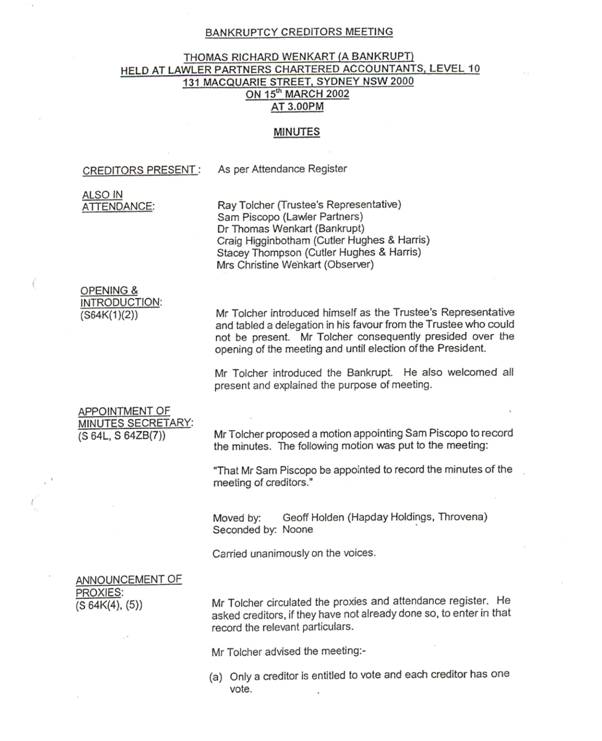
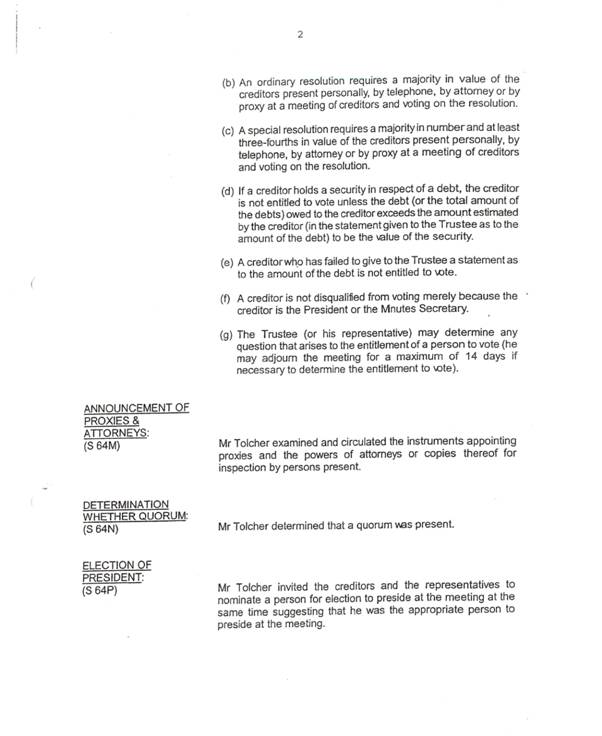
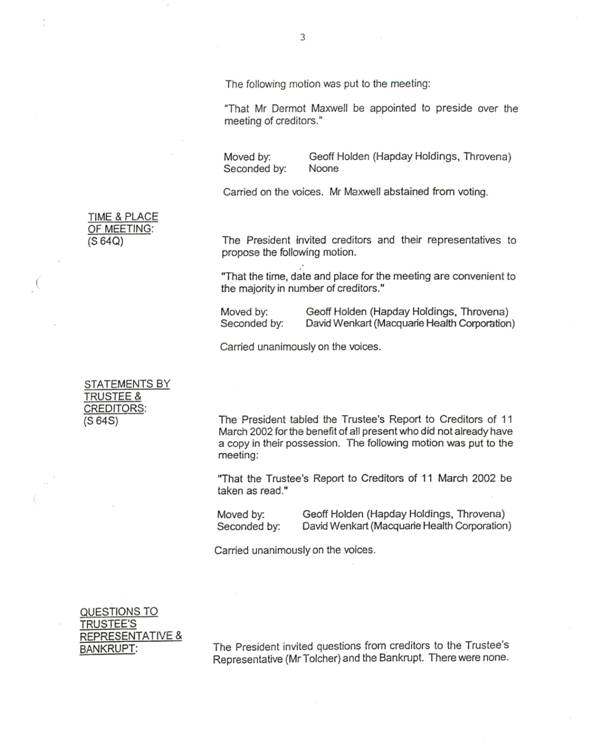
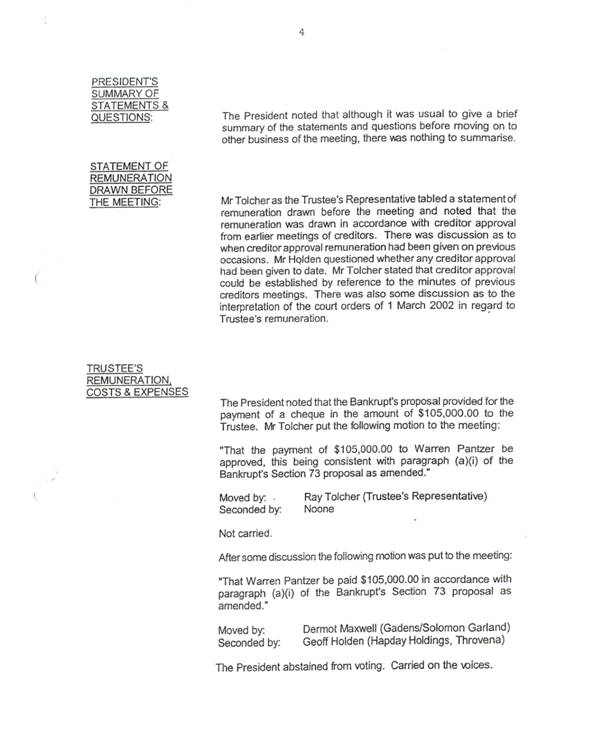
58 The creditors’ meeting convened for 15 March 2002 took place on that day. Attached to these Reasons for Judgment is a copy of the Minutes of that meeting. Those Minutes were dated and signed on 19 March 2002 by the trustee’s representative who attended the Meeting, Mr Ray Tolcher. Mr Tolcher presided over the meeting at one point but was not president at all times during that meeting. He was, however, present throughout the meeting.
59 According to the Minutes of the 15 March 2002 meeting, the creditors resolved to approve the payment to the trustee of $105,000 “… in accordance with paragraph (a)(i) of the bankrupt’s s 73 proposal as amended”.
60 An additional resolution in respect of the trustee’s remuneration recorded on p 5 of the Minutes of the meeting was put to the creditors but was not carried.
61 It is apparent from the Minutes of the meeting that, at the point in the meeting when the trustee’s remuneration was under discussion, Mr Maxwell, who was then acting as president, stood down as president and was replaced by Mr Holden. Mr Holden was in attendance at the meeting as a representative of Hapday and Throvena.
62 Thereafter, Mr Tolcher sought to have a modified resolution concerning the trustee’s remuneration passed by the creditors. That resolution was not carried.
63 At that point, Mr Tolcher stated that, in light of the failure of the creditors to approve the specific amounts claimed by the trustee for approval at the meeting, the trustee would claim 85% of the IPAA Guide to Hourly Rates pursuant to s 162(4) of the Bankruptcy Act and reg 8.08 of the Bankruptcy Regulations.
64 One of the representatives of CHH at the meeting (Mr Higginbotham) noted that the total amount for legal costs and disbursements owed by the trustee to CHH as at 1 March 2002 was approximately $337,301.72 (including GST) without prejudice to the right of CHH to claim further amounts for legal costs if properly claimable. This was a higher figure than the approximate figure previously indicated by the trustee as moneys due to CHH ($260,000).
65 Ultimately, as recorded in the Minutes, the bankrupt’s proposal for a composition dated 18 January 2001 as amended was accepted and approved by the creditors pursuant to s 73 of the Bankruptcy Act. The two bank cheques in favour of the trustee and CHH of $105,000 each referred to at [54] above were handed over to the trustee at the meeting. Those cheques were not cleared until some days later.
66 By letter dated 22 April 2002, relying upon the terms of the Consent Orders, the trustee demanded of Dr Wenkart that he pay to the trustee the sum of $98,095.16, being 85% of the remuneration claimed by the trustee as outstanding as at that point in time (viz $115,406.07). $115,406.07 was the balance of remuneration ultimately claimed by the trustee as outstanding as at 15 March 2002 ($220,406.07) less the amount of $105,000 paid to the trustee by Dr Wenkart on 15 March 2002. The trustee demanded payment within 28 days of receipt of the letter, failing which he said that he would proceed to enforce the charge which he held over the Paddington property. Omitting formal parts, this letter was in the following terms:
Re: Your Former Bankrupt Estate
I refer to previous communications.
I enclose a copy of the fee reconciliation entitled “Outstanding Remuneration as at 15 March 2002” (with annexures) tabled at your Section 73 meeting held on 15 March 2002 showing my outstanding remuneration. I also attach a copy of the consent orders made on 11 March 2002 by the Federal Court by which you agreed to pay my remuneration, costs, charges and expenses to which I am lawfully entitled or may become lawfully entitled within 28 days of determination of the quantum.
You have been sent a copy of the minutes of the Section 73 meeting. A motion was put at the Section 73 meeting to pay my outstanding remuneration in the amount of $115,406.07 (including GST) to 15 March 202, which was additional to the amount of $105,000.00 provided by your proposal. That motion was not passed and Mr Tolcher, as my representative, claimed 85% of that amount pursuant to Section 162(4) and Reg 8.08 of the Bankruptcy Act. You are therefore required to pay me $98,095.16 (including GST) within 28 days of receipt of this letter, failing which I will proceed to enforce the charge I have over the Paddington property and reserve any rights I may have to claim full remuneration of $115,406.07 to 15 March 2002 (these amounts do not include the outstanding and unpaid legal costs of Cutler Hughes Harris which will be taxed). I will also then reserve any rights I may have to remuneration beyond 15 March 2002.
Should you have any questions please contact Sam Piscopo of this office.
67 The fee reconciliation forwarded with the trustee’s letter dated 22 April 2002 was in the following terms:
Thomas Richard Wenkart
(Bankrupt)
Outstanding Remuneration as at 15 March 2002
| 4069 | 5147 | 5150 | TOTAL | ||
| Entered WIP | 122,379.25 | 69,073.50 | 2,645.40 | 194,098.15 | |
| Unentered March time for WP (130 units) | 4,901.00 | 4,901.00 | |||
| Unentered March time for SP (40 units) | 616.00 | 616.00 | |||
| Unentered March time for RT (20 units) | 754.00 | 754.00 | |||
| 128,650.25 | 69,073.50 | 2,645.40 | 200,369.15 | ||
| GST | 12,865.03 | 6,907.35 | 264.54 | 20,036.92 | |
| Total | 141,515.28 | 75,980.85 | 2,909.94 | 220,406,07 | |
| Less $105,000.00 as per bankrupt’s proposal | 105,000.00 | ||||
| Balance (including GST) | 115,406.07 |
68 By facsimile transmission dated 24 April 2002 sent to the trustee’s new solicitors, Sally Nash & Company, Hunt & Hunt requested the trustee to require CHH to tax their costs. In that facsimile, Hunt & Hunt said:
We refer to your client’s letter of 22 April 2002 to Dr Wenkart. In relation to your client’s claim for remuneration we have forwarded the claim to the taxing officer in accordance with regulation 8.09(1) of the Bankruptcy Regulations requesting the taxing officer to tax the claim.
Accordingly contrary to your client’s claim, in accordance with the Consent Orders the determination of the quantum of your client’s claim has not yet been determined and therefore the 28 days has not commenced.
Although your client has indicated he has asked Cutler Hughes & Harris to tax their costs, for abundant caution we request that those costs be taxed in accordance with section 167 of the Bankruptcy Act.
69 In May 2002, correspondence was exchanged between Dr Wenkart’s lawyers and the Official Receiver and between the trustee and the Official Receiver. Ultimately, ITSA informed Dr Wenkart that, from an inspection of the files, it appeared to ITSA that the remuneration claimed by the trustee had been properly approved and that the work done by him had not been carried out unnecessarily.
70 On 6 August 2002, the Official Receiver appointed Ms Ann Sexton to tax the Bill of Costs of CHH on the basis of a solicitor/client retainer for services provided to the trustee as trustee of Dr Wenkart’s bankrupt estate. The instrument of appointment did not make clear which costs and disbursements claimed by CHH were to be taxed. It simply referred to “… the bill of costs …” of CHH.
The Trustee’s Motion to Enforce the Charge over the Paddington Property and the Subsequent Applications
71 By late October 2002, the trustee had not received satisfaction in respect of his demand for payment of remuneration and expenses (including fees and disbursements payable to CHH) as the former trustee of Dr Wenkart’s bankrupt estate.
72 By Notice of Motion filed in the proceedings below on 31 October 2002, the trustee sought to enforce the charge which he held over the Paddington property. He claimed an order that he be appointed as trustee for sale of that property with power to deduct from the proceeds of sale thereof the amount of his outstanding remuneration, the amount of CHH’s unpaid fees and disbursements and all expenses of sale. The trustee did not seek a money judgment. He did seek his costs of the Motion on an indemnity basis.
73 On 18 November 2002, Dr Wenkart filed in the proceedings below a lengthy Notice of Intention to Oppose Application. In that document, Dr Wenkart set out the grounds and reasons upon which he intended to rely for resisting the orders sought by the trustee in the Notice of Motion filed by the trustee on 31 October 2002. In that document, Dr Wenkart contended that, because his bankruptcy had been annulled, the trustee no longer had any right to claim remuneration or expenses as the former trustee of his bankrupt estate. He also argued that the effect of the creditors’ resolutions concerning remuneration and expenses of the trustee which had been passed on 15 March 2002 was that the trustee would only be entitled to the total amount of $210,000 (the total of the two bank cheques of $105,000 payable to the trustee and to CHH) and that the said sum of $210,000 had been paid in full on 15 March 2002 thereby discharging the total liability undertaken by Dr Wenkart to pay to the trustee the remuneration and expenses to which he was lawfully entitled. In addition, Dr Wenkart contended that the trustee was not entitled to any remuneration or expenses incurred in respect of litigation in the period after he submitted his original s 73 proposal, ie in the period after 9 March 2000. The proposition was that most, if not all, work done by the trustee in the 2000, 2001 and 2002 calendar years should not be the subject of any remuneration or payment on account of expenses.
74 On 12 December 2002, Dr Wenkart filed a Notice of Motion in the proceedings below seeking declaratory relief in relation to the trustee’s entitlement to remuneration and expenses and an injunction restraining the sale of the Paddington property.
75 On 17 February 2003, Ms Sexton issued a Certificate of Taxation in respect of some of CHH’s fees and disbursements. That Certificate comprised Schedule A – Paid Costs and Schedule B – Unpaid Costs. Ms Sexton certified the amount of $88,042.24 in respect of paid costs covering some work during the period from 24 January 2000 to 19 March 2002. The Bills of Costs or Memoranda of Fees which were taxed by Ms Sexton on this occasion as “paid” costs were those bills which were paid when the bank cheque in favour of CHH for $105,000 was handed over on 15 March 2002. In other words, the only “paid” costs which were taxed by Ms Sexton were those which were paid by the tender of that bank cheque. These were fees and disbursements rendered in the period up to 31 December 2000 which were still unpaid as at the date of the annulment meeting. CHH fees and disbursements which had been paid earlier (i.e. in the period prior to the annulment meeting) were not taxed by Ms Sexton.
76 Ms Sexton certified $180,435.30 in respect of unpaid costs for work done in the period from 27 July 2000 to 15 March 2002. Thus, the total amount certified by Ms Sexton was $268,477.54. It is necessary to remember that, as at the annulment date, CHH had been paid fees and disbursements which totalled $380,225.51 (including the $105,000 paid on 15 March 2002) and claimed at that time a further amount of approximately $232,301.72. Therefore, as at 15 March 2002, the total fees and disbursements claimed by CHH both paid and unpaid was slightly more than $612,000. That amount included fees paid to various Counsel from time to time. In effect, Ms Sexton taxed the amount of approximately $232,301.72 (including GST) down to $180,435.30 (including GST).
77 On 9 April 2003, Beaumont J ruled that paragraphs 1–20 of Dr Wenkart’s Notice of Intention to Oppose Application filed on 18 November 2002 did not constitute an answer to the trustee’s application to enforce the charge granted to him pursuant to the Consent Orders.
78 In his Reasons for Judgment delivered on 9 April 2003 (Wenkart v Pantzer [2003] FCA 315), Beaumont J said (at [19]–[21]):
It must follow, in my opinion, that although the agreement evidenced in the consent orders was made during the bankruptcy, it had no dispositive effect until the annulment occurred by force of s 74(5) on 15 March 2002. In any event, even if the consent orders had some inchoate or quasi-dispositive effect, their operation was both validated and sanctioned by virtue of the provisions of s 74(6), whereby, as has been noted, (1) “all ... dispositions of property ... by ... the trustee ... or the Court before the annulment shall be deemed to have been validly made”; but (2) whilst the property of the bankrupt still vested in the trustee “vests in such person as the Court appoints or, in default of appointment, reverts to the bankrupt for all his ... estate or interest in it, on such terms and subject to such conditions (if any) as the Court orders”.
The effect of the consent orders (doubtless made with a view to achieving acceptance of the applicant’s s 73 proposal) was to defer the resolution of any dispute as to the amount of the respondent’s remuneration, but upon terms that the respondent would receive security for that amount. The Court sanctioned that arrangement in the form of an order made under the reservation reserved by the concluding words of s 74(6) – “reverts ... on such terms and subject to such conditions ... as the Court orders”.
Given that conclusion, it must follow, in my opinion, that the consent orders were within power and operate to vest in the respondent the charge created by par 2 thereof.
79 In a further judgment delivered on 14 April 2003 (Wenkart v Pantzer [2003] FCA 364), Beaumont J held that, having regard to the provisions of the Consent Orders and to the annulment of Dr Wenkart’s bankruptcy on 15 March 2002, the provisions of s 167 of the Bankruptcy Act continued to apply in accordance with their terms. At [5]–[7] of his Honour’s Reasons for Judgment delivered on 14 April 2003, his Honour said:
It will be recalled that par 1 of the consent order made on 11 March 2002 provided specifically that the respondent, as trustee of the applicant’s bankrupt estate, “may recover his remuneration, costs, charges and expenses to which he is lawfully entitled or may become lawfully entitled from Thomas Richard Wenkart and Thomas Richard Wenkart agrees to pay the same within 28 days of determination of the quantum of the same or at such other time as the parties may agree”. There was no other provision made in the consent order for the laying down of any procedural mechanism for the determination of the quantum. At the same time, as I indicated in my judgment on 9 April 2003, the inference should be drawn, as I mentioned in par 20 of that judgment, that the parties had agreed to defer the resolution of any dispute as to the amount of the respondent’s entitlement, but upon terms that the respondent would receive security for that amount.
In my opinion, the provisions of the consent order should be interpreted as “holding” or preserving the status quo regime. That is to say, in order to expedite the processing of the annulment procedure that was then contemplated, the applicant and the respondent, not at that stage being in agreement on the amount of the respondent’s entitlement, deferred the implementation of any process in that area, in the absence of any agreement by way of ultimate determination. It would, in my opinion, be quite perverse to attribute to either the applicant or the respondent, in the framing of the terms of the consent order, any objective of eliminating any of the machinery provisions that would have been available for the determination of the respondent’s entitlement. Such machinery was, of course, plainly available during the course of administration of the bankrupt estate.
Essentially, for the reasons I gave in the judgment published on 9 April 2003, and in particular, having regard to the provisions of s 74(6), I am of the view that, so far only as the matters mentioned in par 1 of the consent order made on 11 March 2002, the machinery provisions of the Act, in all their relevant application, remained in force so as to protect all parties concerned; that is to say, relevantly, both the applicant and the respondent. Those machinery provisions must, in my view, clearly include s 167 and for those reasons I answer the separate question.
80 The judgments delivered by Beaumont J in April 2003 did not finally determine the matters then before the Court.
81 As a result of those judgments, on 28 April 2003, Dr Wenkart amended his Notice of Intention to Oppose Application.
82 In Reasons for Judgment delivered on 1 May 2003 (Wenkart v Pantzer (2003) 1 ABC(NS) 236; [2003] FCA 432), Beaumont J determined that the trustee’s failure to put Dr Wenkart’s 9 March 2000 s 73 proposal to creditors did not constitute an answer to the trustee’s Cross-Claim.
83 On 5 May 2003, in Wenkart v Pantzer [2003] FCA 456, Beaumont J decided that, at the meeting of his creditors held on 15 March 2002, Dr Wenkart had not been notified in writing of the amount of the trustee’s claim for remuneration and expenses as required by reg 8.09(1) of the Bankruptcy Regulations (in the form in which it then stood) so as to trigger the 14 day period in which a taxing officer may tax a claim.
84 On 6 May 2003, Beaumont J delivered further Reasons for Judgment (Wenkart v Pantzer [2003] FCA 471) in which his Honour held that the trustee was entitled to be reimbursed by Dr Wenkart for the total amount certified by Ms Sexton in her Certificate of Taxation dated 17 February 2003 as well as an additional sum of $20,000 for which he (the trustee) was liable to the Commonwealth pursuant to the Bankruptcy (Estate Charges) Act 1997 (Cth).
85 On 29 August 2003, the Full Court overturned Beaumont J’s decision given on 5 May 2003 (Wenkart v Pantzer (2003) 132 FCR 204; [2003] FCAFC 210).
86 After referring briefly to the history of the disputes between Dr Wenkart and the trustee concerning the trustee’s remuneration, at 206 [5]–[8], the Full Court said:
One question which the judge determined was whether “[h]aving regard to the provisions of the consent order … and to the annulment of the [appellant’s] bankruptcy … do the provisions of s 167 of the Bankruptcy Act continue to apply in accordance with their terms?” The judge gave an affirmative answer to this question. The correctness of this answer is the subject of the first appeal.
Section 167(1) of the Bankruptcy Act 1966 (Cth) confers upon a trustee of a bankrupt’s estate the power to require the taxation of a bill of costs for services provided by any person in relation to the administration of the estate. The trustee may require the taxation on his own initiative, or at the request of the bankrupt or a creditor of the bankrupt’s estate.
The judge found that the consent orders did not have as their object the “eliminat[ion] of any of the machinery provisions that would have been available for the determination of the [trustee’s] entitlement [to costs]”. The judge said that “the machinery provisions of the [Bankruptcy] Act [in which he included s 167] in all their relevant application, remained in force so as to protect all parties concerned; that is to say, relevantly, both the [former bankrupt] and the [former trustee].” The judge did not err in this result, though we reach that result by a different route.
The appellant’s challenge to the judge’s decision is founded on two underlying assumptions. First, that neither the agreement nor the consent orders picked up s 167 (and if either purported to do so that is beyond the power of the parties). The second assumption is that following the annulment, s 167 had no independent application to a third parties’ bill. It is not necessary to consider the correctness of the first assumption, though for present purposes it may be accepted as correct. We are of the clear view, however, that the second assumption is misplaced. Division 2 of Pt VIII of the Bankruptcy Act (comprising ss 161B to 167) deals generally with the remuneration and costs which may be charged against a bankrupt’s estate. Thus, ss 161B and 162 allow the trustee to charge remuneration; ss 163 and 163A regulates the remuneration, costs and expenses of the official trustee; s 164 deals with the situation where two or more trustees act in succession; s 165 contains prohibitions against the receipt of outside benefits; and finally s 167 deals with the taxation of third party costs. Each of ss 162, 165 and 167 regulate the claims and entitlements of the trustee while he was acting in that capacity in relation to the appellant’s estate. The sections operate by force of the Bankruptcy Act and not because of any agreement between the parties or order of the court. Moreover, lest there be any doubt about the matter, we wish to make it clear that these provisions have effect notwithstanding the annulment of the bankruptcy. It could hardly be supposed that a trustee’s right to remuneration, the manner in which that remuneration is to be determined and the trustee’s right to require a third party’s bill of costs to be taxed is lost upon an annulment.
87 In the same set of Reasons, the Full Court rejected Dr Wenkart’s challenge to the decision of Beaumont J to the effect that the trustee was entitled to remuneration and expenses incurred after 9 March 2000.
88 In the last part of its Reasons, the Full Court dealt with the judgment delivered by Beaumont J on 5 May 2003 (Wenkart v Pantzer [2003] FCA 456). The Full Court disagreed with the conclusion reached by Beaumont J in that judgment. The Full Court held that, at the annulment meeting, both the bankrupt and his creditors had before them the precise amount of the trustee’s remuneration which was claimed but unpaid as at that date. When the resolutions put to the meeting did not pass, the trustee made clear that he would pursue a claim for 85% of the IPAA rate insofar as his remuneration was concerned. This had the consequence of causing time to run under reg 8.09(1) of the Bankruptcy Regulations. Under that regulation, Dr Wenkart was obliged to request any taxation pursuant to that regulation within 28 days of being notified in writing or becoming aware of the amount of the claim. Dr Wenkart was made aware of the amount of the claim on 15 March 2002 and should have lodged any request for taxation within 28 days thereafter, ie by 15 April 2002. He did not do so by that date. For that reason, Dr Wenkart lost his right to require the trustee to tax his claims for remuneration earned in the period up to and including 15 March 2002.
89 On 21 October 2003, Lindgren J, who by then had taken over the management of the proceedings below, made the following orders by consent:
THE COURT ORDERS THAT:
1. In respect of services provided by any person with respect to the estate in bankruptcy of the applicant, whether those services were provided before or after annulment of the applicant’s bankruptcy on 15 March 2002, the respondent by 22 October 2003 require such person to supply a Bill of Costs for such services pursuant to Section 167 of the Bankruptcy Act, 1966 (Cth) provided that this order does not extend to legal services provided by Cutler Hughes and Harris.
2. The respondent notify the applicant in writing by 23 October 2003 of his claim for remuneration in respect of services provided after the annulment of the applicant’s bankruptcy on 12 March 2002.
THE COURT NOTES THAT:
3. The applicant concedes that upon completion of taxation of the claims for costs and remuneration referred to in Orders 1 and 2, the amount taxed will be an amount within the following expression within Order 1 of the Orders made by Beaumont J on 9 April 2003 in this proceeding.
“remuneration, costs, charges and expenses to which [the respondent, Warren Pantzer, as trustee of the estate of the applicant, Thomas Richard Wenkart] is lawfully entitled or may become lawfully entitled from Thomas Richard Wenkart”.
4. The Commonwealth produces an invoice from Anne Sexton dated 14 October 2002 and inspection access to the invoice is granted to both parties.
5. The parties are agreed that Lindgren J should continue with the hearing of the respondent’s motion brought by notice of motion filed on 31 October 2002 and the applicant’s motion brought by notice of motion filed on 12 December 2002 as if Lindgren J stood in the shoes of Beaumont J in all respects including the respect that all evidence given before His Honour should be taken to have been given before Lindgren J and that Lindgren J should be part-heard on the motion.
90 The date in Order 2 made by Lindgren J on 21 October 2003, “12 March 2002”, is obviously incorrect. The date there referred to should have been “15 March 2002”. Further, the date in Order 3 made by Lindgren J on 21 October 2003, “9 April 2003”, should have been “11 March 2002”.
91 Order 1 made by Lindgren J on 21 October 2003 expressly excluded CHH’s fees and disbursements from its operation. Order 2 was intended to require the trustee to bring forward his claims for remuneration in the period commencing with the date of the annulment of Dr Wenkart’s bankruptcy and ending at 21 October 2003. The language of Order 3 reflected the parties’ expectation that the trustee would be required by Dr Wenkart to tax his claims for remuneration in respect of the period from 16 March 2002 to 21 October 2003 pursuant to the Bankruptcy Act and the Bankruptcy Regulations.
92 On 29 October 2003, Lindgren J declined to grant to Dr Wenkart an extension of time within which he might seek to require the trustee to tax his remuneration earned in the period from 30 January 2001 to 15 March 2002 (Wenkart v Pantzer (No 6) [2003] FCA 1210).
93 On 30 October 2003, Lindgren J held that the realisations charge set out in s 6(1)(a) of the Bankruptcy (Estate Charges) Act 1997 (Cth) did not apply to any amounts received by the trustee after the annulment of Dr Wenkart’s bankruptcy on 15 March 2002 (Wenkart v Pantzer (No 7) (2003) 132 FCR 273; (2003) 1 ABC(NS) 483; [2003] FCA 1211).
94 In a judgment delivered on 22 March 2004 (Wenkart v Pantzer (No 3, formerly No 8) (2004) 135 FCR 422, (2004) 1 ABC(NS) 490; [2004] FCA 280) Lindgren J held that this Court had jurisdiction to hear and determine the application brought by the trustee to enforce the charge granted to him by Dr Wenkart on 11 March 2002 by means of the Notice of Motion filed by the trustee in the proceedings below on 31 October 2002.
95 Subsequently, on 31 March 2004, Lindgren J made the following orders “regularising” the proceedings below and programming the hearing of the substantive issues remaining for disposition by the Court:
THE COURT ORDERS THAT
1. The applicant’s letter dated 15 February 2002 to Beaumont J (and attachments) requesting him to order the first respondent to convene a meeting of creditors be taken to be the application by which this proceeding was commenced, and be now placed on the Court file accordingly, but be taken to have been filed on 21 February 2002, and that to the extent necessary, compliance with the Rules be, and be taken to have been, dispensed with.
2. Any filing fee that would otherwise be payable on the application be, and be taken to have been, waived.
3. The first respondent’s motion brought by notice of motion filed on 31 October 2002 be taken to be, and to have been, a cross-claim seeking final relief, and that to the extent necessary, compliance with the Rules be, and be taken to have been, dispensed with.
4. Any filing fee that would otherwise be payable on the cross-claim be, and be taken to have been, waived.
5. The first respondent as cross-claimant file and serve by 23 April 2004 points of claim outlining his claim for final relief including quantification.
6. The applicant as cross-respondent file and serve by 14 May 2004 points in reply.
7. The proceeding be stood over to Wednesday 19 May 2004 at 9.30 am for directions.
96 On 23 April 2004, the trustee filed Points of Claim (the trustee’s Cross-Claim) as directed by Lindgren J on 31 March 2004. The money claim which he made at that time was quantified in par 45 of his Points of Claim in the following terms:
45. Pantzer claims as against Wenkart pursuant to the terms of paragraph 1 of the orders made on 12 March 2000 to the following monies:
| 1. | Cutler Hughes and Harris (including GST) plus interest accruing from 07.05.03 inclusive at a daily rate of $36.99 | $168,137.79 |
| 2. | Costs of Taxation of Anne Sexton in relation to Cutler Hughes and Harris Bill of Costs | $15,061.75 |
| 3. | Estate Realisation Charge (plus statutory interest accruing from 01.07.03) | $20,000.00 |
| 4. | Trustee’s remuneration and disbursements (pre bankruptcy) plus interest to be estimated | $98,095.16 |
| 5. | Trustee’s post bankruptcy remuneration and disbursements (post bankruptcy) subject to taxation estimated from 15.03.03 to 02.04.04 | $140,707.09 |
| 6. | Trustee’s solicitor’s costs and disbursements of these proceedings (subject to assessment or taxation) | $122,718.30 |
| 7. | Trustee’s solicitor’s costs and disbursements relevant to Full Court Appeal in proceedings: 633 of 2003 | $31,290.00 |
| 8. | Trustee’s solicitor’s costs and disbursements of High Court Special Leave (subject to order and taxation) estimated | $20,000.00 |
| 9. | Trustee’s solicitor’s costs and disbursements of separate question (subject to agreement or taxation) estimated | $10,733.00 |
| 10. | Interest claim | $unknown |
| TOTAL PAYABLE | $626,743.09 | |
97 In his Defence to the trustee’s Points of Claim (filed on 17 May 2004), Dr Wenkart, amongst other things:
(a) Admitted that Ms Sexton issued a Certificate of Taxation dated 17 February 2003 in respect of the trustee’s paid and unpaid legal expenses in the amount of $268,477.54; and
(b) Claimed that, upon a proper accounting for all credits and payments made during the trustee’s trusteeship of Dr Wenkart’s bankrupt estate, the trustee was obliged to account to Dr Wenkart for a surplus of funds, said to be $277,920.30. This was the first time that Dr Wenkart had made such an assertion.
98 The basis for Dr Wenkart’s assertion that there was a surplus in the hands of the trustee was explained in Particulars provided by Dr Wenkart to par 19(e) of his Defence. Those Particulars were in the following terms:
Particulars
| Dr | Cr | |
| Credits due to the Applicant by way of payment from all sources paid to the Respondent. | $747,473.95 | |
| Respondent’s remuneration approved by creditors on 13.12.99 | $60,744.30 | |
| Respondent’s remuneration approved by creditors on 29.03.00 | $11,811.40 | |
| Respondent’s remuneration fixed pursuant to Section 162 (and as confirmed by judgment of Full Federal Court). | $98,095.16 | |
| Bankruptcy Estate charges. | $20,000.00 | |
| Legal Expenses paid and unpaid fixed by Taxation officer pursuant to Section 167 Certificate | $268,477.54 | |
| Taxation officer’s fees | $10,425.25 | |
| BALANCE OWING TO APPLICANT (Dr Wenkart): | $277,920.30 Cr |
99 In his Defence, Dr Wenkart also pleaded that the trustee was not entitled to any remuneration or expenses incurred or paid after 15 March 2002. The proposition was that the trustee was not entitled to be paid or reimbursed after Dr Wenkart’s bankruptcy was annulled.
100 The contentions embedded in the particulars of par 19(e) of Dr Wenkart’s Defence seem to be:
(a) The only remuneration to which the trustee was entitled as at the annulment date was remuneration which Dr Wenkart’s creditors had specifically approved or fixed. It was said that the first two items set out in the particulars ($60,744.30 and $11,811.40) had been approved by the creditors and the third ($98,095.16) was fixed by them at the annulment meeting. Therefore, the total remuneration to which the trustee was entitled as at the date when the annulment resolution was passed was the total of:
$60,744.30
$11,811.40
$98,095.16
namely $170,650.86. These contentions ignored the fact that, by late December 2000, the trustee had actually paid himself and his assistants amounts totalling $226,454.70 and that, by the annulment date, the trustee had received a further $109,022.84 by way of remuneration. This latter amount included the bank cheque for $105,000 handed to the trustee or his representative immediately before the meeting. As at the date of the meeting, after all of the amounts specified earlier in this subparagraph were taken into account, the trustee claimed a further $98,095.16 for remuneration up to 15 March 2002 (being 85% of $115,406.07). This last amount was the amount claimed by the trustee in his letter to Dr Wenkart dated 22 April 2002.
(b) The full extent of the trustee’s entitlement to be reimbursed for fees and disbursements paid to CHH in respect of work done by CHH and Counsel retained by it up to the date of annulment is reflected in Ms Sexton’s Certificate of Taxation dated 17 February 2003. This contention ignored the fact that, as at 15 March 2002, the trustee had paid to CHH and Counsel retained by them amounts which totalled $380,225.51 (including the bank cheque for $105,000 handed to the trustee or his representative immediately before the annulment meeting) and also ignored the fact that, as at 15 March 2002, the trustee was aware that CHH was claiming a further $232,301.72 (approximately) for work done up to that date.
101 These fundamental contentions advanced by Dr Wenkart which were embedded in his Defence are contested in the Appeal and in the Cross-Appeals. They were also contested in the proceedings below. They are at the heart of the issues raised in the Appeal and in the Cross-Appeals.
102 On 1 October 2004, Dr Wenkart filed a Notice of Motion in the proceedings below in which he sought the following relief:
1. That the Respondent comply with Section 170 of the Bankruptcy Act 1966 and give an accounting for all monies received and for all monies expended in the former bankrupt estate of the Applicant within seven (7) days of being ordered to do so.
2. That the Respondent pay:
a. The sum of $277,920.30 to the Applicant being the surplus moneys from the administration of the Applicant’s estate in bankruptcy; and
b. Such other amounts as disclosed by reason of the Respondent’s compliance with Section 170 of the Bankruptcy Act 1966.
3. That all previous Orders for costs in these proceedings be vacated.
Particulars
Order of Beaumont J dated 9 April 2003
Order of Lindgren J dated 30 October 2003
Order of Lindgren J dated 22 March 2004
4. That the Respondent pay interest:
a. On the amount of $277,920.30 from 15 March 2002 to the date of judgment at the rate set out pursuant to the section 51A of the Federal Court of Australia Act 1976.
b. On such other amounts as disclosed by reason of the Respondent’s compliance with Section 170 of the Bankruptcy Act 1966 pursuant to section 51A of the Federal Court of Australia Act 1976.
5. That the Respondent’s Amended Notice of Motion dated 23 September 2003 be dismissed.
6. That the Respondent pay the costs of the Applicant including the costs of any motion brought by the Respondent on an indemnity basis.
103 On 7 October 2004, the trustee’s solicitors provided to Dr Wenkart’s solicitors a copy of a complete listing of cash receipts and cash payments made during the period of Dr Wenkart’s bankruptcy, that is to say, in the period from 28 October 1999 to 15 March 2002. Although one or two receipts came in shortly after 15 March 2002 and some payments were actually made shortly after that date, the listing plainly relates to the period of the bankruptcy. The total amount received was $769,191.66 as was the total amount paid out. Included within the total amount received were various sums lent to the trustee in order to fund meetings and litigation. Those loans totalled $345,000. They were non-recourse loans. The amount of $150,000 was also included. This was a preference repaid to the trustee. This listing is accepted by all parties presently before the Court as an accurate record of moneys received by the trustee and of payments made by the trustee during the period of Dr Wenkart’s bankruptcy.
104 The listing makes clear that, during the 2001 calendar year and the first 2½ months of the 2002 calendar year, the only receipts in Dr Wenkart’s estate were the rental payments made by Dr Wenkart’s daughter to the trustee in respect of the Paddington property and several small miscellaneous items. These amounted to $30,874.91 in total. The only substantial receipts after December 2000 were the two bank cheques of $105,000 each delivered on 15 March 2002 at or just before the annulment meeting. On the payments side, approximately $30,000 was the total amount paid out before receipt of the two bank cheques.
105 The receipts and payments listing established that, as at the annulment date, the trustee held no funds on behalf of Dr Wenkart’s estate.
106 On 13 December 2004, Ms Sexton issued a Certificate of Taxation in relation to remuneration and expenses claimed by the trustee for the period 15 March 2002 to 21 October 2003. Ms Sexton certified the amount of $169,955.94 as the amount due and payable. That amount comprised $83,219.82 in remuneration, $2,562.02 in disbursements and $57,613.09 in legal fees in respect of the proceedings below and $26,561.01 in respect of the proceedings in the Full Court.
107 On 24 December 2004, Dr Wenkart commenced a new proceeding (NSD 1973 of 2004) in which he sought to appeal from Ms Sexton’s Certificate of Taxation issued on 13 December 2004.
108 On 12 January 2005, Ms Sexton issued yet another Certificate of Taxation. On this occasion, the Certificate was issued in respect of certain High Court proceedings. By that Certificate, Ms Sexton allowed the amount of $33,295.95, being legal fees and disbursements incurred by the trustee.
109 In yet a further proceeding commenced on 9 February 2005 (NSD 181 of 2005), Dr Wenkart appealed from the Certificate of Taxation issued by Ms Sexton on 12 January 2005.
110 On 23 February 2005, the trustee filed an Amended Cross-Claim in the proceedings below. By that document, the trustee sought the additional amounts as certified by Ms Sexton in her Certificates dated 13 December 2004 and 12 January 2005. He also joined as party respondents to the Cross-Claim, Hapday, Throvena and MHC.
111 On 8 November 2005, Branson J delivered judgment (Wenkart v Pantzer (2005) 223 ALR 384, [2005] FCA 1572). In that judgment, her Honour found that each of the Certificates of Taxation issued by Ms Sexton should be set aside.
112 On 28 September 2006, the Full Court allowed an appeal from the decision of Branson J made on 8 November 2005 (Pantzer v Wenkart (2006) 153 FCR 466; (2006) 4 ABC(NS) 607; [2006] FCAFC 140). The Full Court found that the remuneration and expenses claimed by the trustee after 11 March 2002 (including those associated with litigation that flowed from the trustee’s application made on 31 October 2002) were comprehended by Order 1 of the Consent Orders and that consequently the trustee was “lawfully entitled” to be paid the amount thereof within the terms of those Consent Orders. The Full Court noted that the effect of allowing the appeal from the decision of Branson J was to restore the full force of the Certificates of Taxation dated 13 December 2004 and 12 January 2005. An application to the High Court for special leave to appeal from this decision was refused on 2 March 2007. It follows that Dr Wenkart became liable to pay to the trustee the total of the amounts certified by Ms Sexton under the two Certificates of Taxation dated 13 December 2004 and 12 January 2005 viz $203,251.89.
113 On 17 January 2007, the trustee advised Dr Wenkart of a claim for remuneration and expenses (excluding legal costs) in respect of the period from 22 October 2003 to 31 December 2006 in the amount of $159,192.82. Two days later, on 19 January 2007, the trustee advised Dr Wenkart of a claim in respect of legal costs incurred in the same period totalling $302,682.97.
114 On 14 February 2007, Dr Wenkart filed a Notice of Motion in the proceedings below seeking orders requiring the trustee to withdraw his claims for remuneration and expenses in respect of the period after 21 October 2003.
115 On 13 March 2007, an application by Dr Wenkart to the Full Court to vary its orders made as a consequence of its judgment delivered on 28 September 2006 (Pantzer v Wenkart (2006) 153 FCR 466; (2006) 4 ABC(NS) 607; [2006] FCAFC 140) was dismissed.
116 In three judgments delivered on 16 October 2007, 11 April 2008 and 16 September 2008 (Wenkart v Pantzer (No 10) (2007) 5 ABC(NS) 642; [2007] FCA 1589; Wenkart v Pantzer (2008) 6 ABC(NS) 37; [2008] FCA 478; and Wenkart v Pantzer [2008] FCA 1387), Branson J dealt with various matters which her Honour considered were outstanding in the proceedings below. Ultimately, on 16 September 2008, her Honour ordered that:
2. A Registrar conduct an inquiry to determine the date, if any, on which 28 days had passed from the determination of the quantum of an amount by way of remuneration, costs, charges and expenses to which Mr Pantzer is lawfully entitled from Dr Wenkart that resulted in the aggregate of such determinations exceeding $769,191.66.
117 On 28 May 2009, Deputy District Registrar Hannigan delivered the result of the inquiry ordered by Branson J on 16 September 2008. The Deputy District Registrar found that the relevant date on which 28 days had passed from the determination of the quantum of an amount by way of remuneration and expenses to which the trustee was lawfully entitled from Dr Wenkart that resulted in the aggregate of such determinations exceeding $769,191.66 was 28 days after 13 December 2004, viz 10 January 2005.
118 Upon Branson J’s retirement from the Court, the proceedings below were allocated to the docket of Flick J. In a series of judgments delivered in the period from 25 September 2009 to 24 December 2010, Flick J took steps to finalise the proceedings below and did so.
119 The present Appeal directly concerns the following judgments:
(i) Wenkart v Pantzer (No 10) (2007) 5 ABC(NS) 642; [2007] FCA 1589 (Branson J) (Branson No 1);
(ii) Wenkart v Pantzer (2008) 6 ABC(NS) 37; [2008] FCA 478 (Branson J) (Branson No 2);
(iii) Wenkart v Pantzer [2008] FCA 1387 (Branson J) (Branson No 3);
(iv) Wenkart v Pantzer [2009] FCA 1086 (Flick No 1)
(v) Wenkart v Pantzer (2010) 269 ALR 641; [2010] FCA 866 (Flick J) (Flick No 2);
(vi) Wenkart v Pantzer (No 2) [2010] FCA 1408 (Flick J) (Flick No 3); and
(vii) Wenkart v Pantzer (No 3) [2010] FCA 1423 (Flick J) (Flick No 4).
We intend no disrespect to either Branson J or Flick J by referring to their judgments by means of the above abbreviations. Our only purpose in doing so is to avoid unnecessary repetition of longer and, in the circumstances of the present case, confusing references to judgments.
The Relevant Judgments of Branson J
Branson No 1
120 At 652 [35], Branson J set out the principal issues that required determination in Branson No 1. Not all of those issues are currently relevant.
121 At 653 [37], after referring to the 2006 Full Court decision (Pantzer v Wenkart (2006) 153 FCR 466; (2006) 4 ABC(NS) 607; [2006] FCAFC 140), Branson J said:
It is no longer open to Dr Wenkart to argue in this Court that Mr Pantzer cannot claim any entitlement as the trustee of Dr Wenkart’s bankrupt estate beyond 15 March 2002, the date of the annulment of Dr Wenkart’s bankruptcy.
122 At 653–654 [38]–[39], Branson J considered an argument advanced by Dr Wenkart that the orders made by Lindgren J on 21 October 2003 required the trustee to make his claim for remuneration and expenses “once and for all”. Branson J rejected that argument.
123 At 654–655 [43], Branson J accepted the proposition that amounts claimed by the trustee as remuneration and expenses incurred by him for the purpose of giving practical effect to the consent orders and, more generally, administering Dr Wenkart’s bankrupt estate were amounts to which the trustee was prima facie “lawfully entitled”, within the meaning of order 1 of the consent orders.
124 At 658 [62] and again at 663 [88], Branson J recorded the fact that she had assumed that there were no surplus monies in the hands of the trustee from the administration of Dr Wenkart’s estate. In light of that circumstance, and having decided all other questions, Branson J took the view that, subject to giving the parties an opportunity to test her assumption concerning surplus funds, she should make the orders claimed by the trustee in the trustee’s Cross-Claim.
125 At 662 [83], her Honour said:
In Wenkart v Pantzer (No 3) at [66] Lindgren J noted that Mr Pantzer’s claim to enforce the charge referred to in order 2 of the consent orders made on 11 March 2002 is a claim to enforce proprietary rights springing out of a contract. After referring to s 22 of the Federal Court of Australia Act 1976 (Cth) and s 79 of the Judiciary Act 1903 (Cth) his Honour at [101]-[103] observed:
Under the law of the State of New South Wales, a charge of the kind given by Dr Wenkart to Mr Pantzer is an equitable charge enforceable in the equitable jurisdiction of the Supreme Court of New South Wales by the appointment of a trustee for sale on the application of the chargee: Tennant v Trenchard (1869) LR 4 Ch App 537; and cf Fine Real Estate Network Pty Ltd v Howell (unreported, Supreme Court of NSW, 4767 of 1994, Young J, 4 December 1997). In my opinion, the law providing for the enforcement of an equitable charge by the appointment of a trustee for sale is a law relating to procedure within s 79 of the Judiciary Act. This Court was created as a ‘court of law and equity’: FCA Act, s 5(2). It has power to appoint a trustee for sale of the Property.
The claim to enforce the charge was ‘properly brought forward’ by Mr Pantzer for the purposes of s 22 of the FCA Act, in a matter in respect of which the Court had jurisdiction under s 39B(1A)(c) of the Judiciary Act.
Enforcing the charge by the appointment of a trustee for sale falls within s 22 of the FCA Act and s 79 of the Judiciary Act.
126 Her Honour went on to hold (at 662–663 [84]) that s 111 of the Conveyancing Act 1919 (NSW) (the Conveyancing Act) did not apply to the equitable charge granted by Dr Wenkart in the present case.
127 At 663 [88], her Honour said:
Subject to my being satisfied that Mr Pantzer does not hold surplus moneys from the administration of Dr Wenkart’s estate in bankruptcy in an amount that exceeds the amount to which he is “lawfully entitled” within the meaning of order 1 of the consent orders made on 11 March 2002, I conclude that the Court should make “orders in aid” of the kind sought by the cross-claim. The parties will be given an opportunity to make submissions on the terms of the order or orders appropriate to be made and as to whether the realisation of the charge should be deferred – whether to allow Dr Wenkart to pay to Mr Pantzer the amount to which he is lawfully entitled, to allow the total amount to which Mr Pantzer is legally entitled to be further clarified or for any other reason. My present view, however, is that to reduce the risk of yet further litigation between the parties, an independent person, rather than Mr Pantzer, should be appointed as trustee for the sale of the Paddington property (see Guardian Mortgages Pty Ltd v Miller (2004) 12 BPR 22,833; [2004] NSWSC 1236 at [122]).
128 Her Honour did not make any orders to give effect to her reasons in Branson No 1. Ultimately, her Honour ordered an inquiry under the Federal Court Rules. But this was done only after her Honour entertained further submissions and delivered Branson No 2.
Branson No 2
129 At 39–40 [5], Branson J recorded Dr Wenkart’s submission that the trustee had never been justified in filing the trustee’s Cross-Claim because he had sufficient funds in the estate at all relevant times to meet his lawful entitlements. Branson J noted that Senior Counsel for Dr Wenkart had submitted that if the trustee was unable to establish that, when he initiated his Cross-Claim he required the aid of the Court because he was out-of-pocket, the Cross-Claim should simply be dismissed with costs.
130 At 40 [7], her Honour accepted that the issue of whether the trustee had surplus funds in his hands as at 15 March 2002 and also as at 31 October 2002 were both live issues in the proceedings. At 44–48 [17]–[34], Branson J discussed the resolutions passed by Dr Wenkart’s creditors from time to time concerning the trustee’s remuneration and reimbursement or payment of the trustee’s expenses. After reviewing the terms of resolutions passed at several meetings of Dr Wenkart’s creditors, at 47 [32], her Honour said:
I conclude that on the proper construction of the above resolution [referring to a resolution passed at the meeting of Dr Wenkart’s creditors held on 29 March 2000], the creditors purportedly approved Mr Pantzer’s remuneration as follows:
(a) $60,744.70 for the period from 28 October – 10 December 1999;
(b) $80,000 for future remuneration from 13 December 1999;
(c) $11,811.40 for the period from 11 March – 28 March 2000;
(d) $68,188.60 for future remuneration from 29 March 2000; and
(e) $105,000.00 in accordance with para (a)(i) of the s 73 proposal.
These amounts are reflected in the first eleven payment items shown on Mr Pantzer’s schedule (see [9] above).
131 Her Honour went on to say at 47–48 [33]:
Additionally, as I noted in [Branson No 1] at [64], Mr Pantzer’s claim for 85% of the sum of $115,406.07 (ie $98,095.16) has been the subject of litigation in other proceedings. In Wenkart v Pantzer (No 6) [2003] FCA 1210 published on 29 October 2003, Lindgren J dismissed a motion by Dr Wenkart for an extension of time within which to request that this claim be taxed. On that day Mr Pantzer’s claim to be lawfully entitled to that sum was rendered effectively beyond challenge. The date upon which he is to be regarded as becoming lawfully entitled to the sum is, in my view, 14 days after Dr Wenkart became aware of the amount of the claim, namely 29 March 2002 (reg 8.09(1) of the Bankruptcy Regulations 1996 as then in force). This amount is reflected in the second unpaid amount listed in Mr Pantzer’s schedule.
132 At 48–52 [35]–[55], Branson J discussed the issue raised by the trustee’s claim to be reimbursed for amounts paid to Lawler Davidson Partners and Lawler Partners. After discussing two authorities relevant to the topic, her Honour said at 49 [39]:
Considering it appropriate to follow the approach adopted by Drummond J in In Re Dare, I reject the submission that Mr Pantzer’s arrangements concerning his remuneration as trustee of Dr Wenkart’s bankrupt estate contravened s 165(1)(b) of the Act. I also reject the alternative submissions that to the extent to which Mr Pantzer was paid remuneration in excess of the amount that he actually received from the Partnership he is liable to Dr Wenkart as the residuary beneficiary of the trust estate in respect of that amount.
133 At 49 [40]–[43], her Honour discussed the question of whether the trustee’s claim for remuneration and payment of expenses in the present case infringed s 64U(5) of the Bankruptcy Act. Her Honour held that it did not. The proposition being advanced by Dr Wenkart with which her Honour dealt, was that the trustee had misdescribed those staff at Lawler Davidson Partners and at Lawler Partners who had assisted or were to assist him in the administration of Dr Wenkart’s bankruptcy and had failed to disclose adequately the basis upon which those persons would be remunerated. Her Honour also rejected the proposition that any failure to comply with s 64U rendered the relevant resolutions ineffective. Finally, her Honour held that any defects in the relevant resolutions were cured by s 306(1) of the Bankruptcy Act.
134 At 52 [54]–[55], her Honour held that the practice of creditors approving future remuneration of a trustee in bankruptcy by reference to time charging at the recommended rate set out in the IPAA guidelines is well established and should not now be regarded by the Court as infringing the Bankruptcy Act.
135 At 52–58 [56]–[82], her Honour dealt with the claims by the trustee for reimbursement in respect of amounts of legal costs paid to CHH.
136 At 52–53 [56]–[59], her Honour said:
Mr Pantzer’s schedule shows an amount of $380,225.51 paid to Cutler Hughes & Harris (including disbursements for counsel) and further taxed unpaid costs of the same firm of $163,477.54. Dr Wenkart submitted that these items involve double counting. He further submitted that no amount has been shown to be due and payable to Cutler Hughes & Harris as at 31 October 2002, the date that Mr Pantzer’s cross-claim is deemed to have been filed.
The accuracy of Mr Pantzer’s schedule so far as it concerns payments made to Cutler Hughes & Harris is not challenged by Dr Wenkart. Payments by Mr Pantzer to Cutler Hughes & Harris in the aggregate amount of $380,225 are evidenced by a list of cash payments (“the Cash Payments List”) made during the period of the administration by Dr Wenkart’s bankrupt estate provided to Dr Wenkart’s then solicitors (Bruce & Stewart) by Mr Pantzer’s then solicitors (Sally Nash & Co) under cover of a letter dated 7 October 2004 and placed in evidence by Dr Wenkart. At the heart of the dispute between Dr Wenkart and Mr Pantzer concerning the costs of Cutler Hughes & Harris is the question of whether all of the bills of costs of Cutler Hughes & Harris are required to be taxed to determine the total quantum of the costs that Mr Pantzer is entitled to recover from Dr Wenkart (see order 1 of the consent orders made on 11 March 2002 which are reproduced in [Branson No 1] at [15]).
Mr Pantzer’s case is that there was no request for any of the amounts paid to Cutler Hughes & Harris to be taxed under s 167 of the Act other than the amount of $105,000 paid on the date that Dr Wenkart’s bankruptcy was annulled. Robert Gorczyca of Bruce & Stewart, as the firm was then known, gave evidence that the first occasion on which he was provided with an accounting of the former bankrupt estate of Dr Wenkart was when he received the Cash Payments List (see [57] above). Before being retained by Dr Wenkart, Bruce & Stewart acted for creditors of Dr Wenkart’s bankrupt estate. The evidence suggests that the only advice given by Mr Pantzer to Dr Wenkart and the creditors of his estate during the course of Dr Wenkart’s bankruptcy is that referred to in [22] and [24] above. I therefore accept the accuracy of Mr Gorczyca’s evidence in this regard.
However, Dr Wenkart’s primary submission concerning the costs of Cutler Hughes & Harris is that this proceeding has been conducted on the basis of an agreement by Mr Pantzer to have the bills of costs of Cutler Hughes & Harris taxed, and that this agreement is reflected in the orders made by Lindgren J on 21 October 2003. Those orders are reproduced in [Branson No 1] at [22]. It is therefore necessary to review the history of the dealings between Mr Pantzer and Dr Wenkart so far as they touch on the legal costs of Cutler Hughes & Harris.
137 Her Honour then reviewed the course of dealings between the parties concerning CHH’s fees and disbursements. Her Honour referred to the correspondence passing between the parties and their lawyers dated 18 January 2001, 4 December 2001, 11 December 2001, 12 December 2001, 8 January 2002 and 16 January 2002.
138 After describing to some extent the subject matter of the taxation conducted by Ms Sexton in late 2002 and early 2003, Branson J concluded that Ms Sexton did not conduct a taxation in respect of all of the work undertaken by CHH for the trustee in his capacity as trustee of Dr Wenkart’s bankrupt estate (56 [75]).
139 At 54–55 [65]–[66], her Honour said:
By a memorandum dated 8 January 2002 Hunt & Hunt repeated their request to Cutler Hughes & Harris for an itemised account of their costs.
By a letter dated 16 January 2002 Mr Pantzer advised Hunt & Hunt:
My solicitors did not state in their facsimile to you of 11 December 2001 that an itemised Bill of Costs had been provided by it to the creditors. My solicitor’s statement was that the Trustee:
‘…will provide an itemised Bill of Costs (as provided by Cutler Hughes & Harris) to the Creditors;…’
I have been issued with legal Bills of Costs in relation to the estate for work up to November 2001. My solicitors are currently preparing Memoranda of Fees in relation to the work done since that date. The Bill of Costs which I have received, are of course, available for inspection by the creditors at any time.
Please find enclosed copies of the bills with which [I] have already been issued. Upon receipt of the Bills of Costs from Cutler Hughes and Harris relating to work done from November 2001 I will provide you with those copies.
…
Would you please confirm that your clients still require a taxation of those bills.
In the event that your clients require taxation of the bills, would you please indicate:
(a) Which creditor will provide me with the costs of making an application for taxation of the bills; and
(b) Which creditor will undertake to provide payment of those costs or provide me with security for the payment of those costs
by return letter.
The evidence does not identify the copy bills apparently enclosed with the above letter.
140 At 56–57 [76]–[78], her Honour said:
I reject Mr Pantzer’s contention that there was no request for any of the amounts paid to Cutler Hughes & Harris to be taxed under s 167 of the Act other than in respect of the amount of $105,000 paid on the day that Dr Wenkart’s bankruptcy was annulled. In my view the correspondence exchanged between the date of Dr Wenkart’s s 73 proposal and the date that his bankruptcy was annulled makes plain that Dr Wenkart, by his solicitor, requested a taxation of all of Cutler Hughes & Harris’ costs for services provided to Mr Pantzer as trustee of Dr Wenkart’s bankrupt estate. The terms of Ms Sexton’s appointment tend to confirm this understanding of the taxation request made by Dr Wenkart.
Moreover, for the reasons set out below, I accept that this proceeding has been conducted on the basis that Mr Pantzer agreed to have the bills of costs of Cutler Hughes & Harris taxed. In particular, I accept that the orders made by Lindgren J on 21 October 2003 were formulated as they were because it was understood by those who respectively acted for Mr Pantzer and Dr Wenkart that Mr Pantzer so agreed.
The context in which Lindgren J came to make orders in this matter on 21 October 2003 was that the docket judge, who was then Beaumont J, was unwell. Lindgren J was thus more than usually dependent on information provided to him by the parties’ respective legal representatives. On 11 March 2002 Beaumont J had made the consent orders that are set out in [Branson No 1] at [15]. Those orders provided, in effect, that Dr Wenkart charged the Paddington property to secure the remuneration, costs, charges and expenses to which Mr Pantzer was, or might become, lawfully entitled as trustee of his bankrupt estate and recorded that Dr Wenkart “agreed to pay the same within 28 days of determination of the quantum of the same or at such other time as the parties may agree”. I observe, incidentally, that there is no suggestion that the parties have agreed another time.
141 The conclusions expressed by her Honour at 56–57 [76]–[78] are fundamental to the conclusion which her Honour later reached concerning the state of the accounts as between Dr Wenkart and the trustee as at 15 March 2002.
142 At 57–58 [80]–[82], Branson J addressed the significance of remarks made to Lindgren J at a directions hearing on 21 October 2003 by Counsel then retained by the trustee. Her Honour placed some significance upon Counsel’s confirmation to Lindgren J that the fees and disbursements due to CHH were already subject to the existing taxation rÉgime. If Counsel’s remarks were to be interpreted in the way in which her Honour interpreted them, they conveyed an erroneous impression to his Honour.
143 At 58 [82], her Honour said:
For the reasons given above, it appears that Mr Johnson’s understanding on 21 October 2003 of the ambit of Ms Sexton’s taxation was erroneous. However, I see no reason to conclude that Dr Wenkart’s legal representatives were aware of Mr Johnson’s error; Dr Wenkart’s solicitors had requested a comprehensive taxation of the costs of Cutler Hughes & Harris. I conclude that it is not now open to Mr Pantzer in this proceeding to adopt an approach that is inconsistent with the basis upon which Lindgren J was invited to make the orders dated 21 October 2003.
144 Her Honour then went on to consider legal costs payable to other service providers. At 58 [83] her Honour said:
The transcript of the hearing before Lindgren J on 21 October 2003 also reveals that on that day Mr Johnson accepted that the orders that Lindgren J was being invited to make would extend to other legal services provided to Mr Pantzer, including by him and his instructing solicitors, Sally Nash & Co. Nonetheless, Mr Pantzer now submits that the amounts paid by him to Mr Johnson, Sally Nash & Co and Mr P Walsh of counsel are all amounts to which he is lawfully entitled from Dr Wenkart because Dr Wenkart made no request for the relevant bills of costs to be taxed pursuant to s 167 of the Act. Again, I take the view that it is not now open to Mr Pantzer in this proceeding to adopt an approach that is inconsistent with the basis upon which Lindgren J was invited to make the orders dated 21 October 2003. The bill of costs of Sally Nash & Co was certified by a taxing officer on 13 December 2004. The respective bills of costs of Mr Johnson and Mr Walsh were certified by a taxing officer on 12 January 2005. The quantum of Mr Pantzer’s costs in respect of the legal services provided by those legal representatives was determined within the meaning of order 1 of the orders of 11 March 2002 by the respective certificates of taxation.
145 Applying the conclusions to which her Honour came concerning the consequences of the trustee’s conduct, at 58–59 [84]–[89] her Honour determined that the trustee had not established that, as at 31 October 2002, the quantum of the remuneration and expenses to which he was then lawfully entitled had been determined in an amount in excess of the amount of his receipts as trustee of Dr Wenkart’s bankrupt estate. At those paragraphs, her Honour said:
As mentioned above, the significance of the date 31 October 2002 is that it is the date of the filing of Mr Pantzer’s deemed cross-claim seeking “an order in aid of [the Court’s] order made on 11 March 2002 by appointing Warren Pantzer as Trustee for Sale of the [Paddington property]” (see [Branson No 1] at [17]).
As noted in [Branson No 1] at [39]–[44], the Full Court disagreed with the construction initially given by me to the orders made on 11 March 2002 and 21 October 2003. Nonetheless it is, I think, uncontroversial that Dr Wenkart’s agreements to pay the remuneration, costs, charges and expenses to which Mr Pantzer is “lawfully entitled” from him is an agreement to pay within 28 days of the determination of the quantum of “the same”. The charge over the Paddington property secures the payments by him of the relevant amount within that period of time. That is, Mr Pantzer is not entitled to exercise rights under the charge created by order 2 of the consent orders until Dr Wenkart defaults on his agreement to pay. By filing his cross-claim Mr Pantzer sought to exercise rights in reliance on that charge.
There is no dispute between the parties that the total amount received by Mr Pantzer as trustee of Dr Wenkart’s bankrupt estate was $769,191.66. It is the payments made by Mr Pantzer that are controversial – or perhaps, more accurately, the identification of the date or dates upon which the quantum of the amount or amounts to which Mr Pantzer is lawfully entitled was determined.
As indicated above, I accept that the creditors of Dr Wenkart’s bankrupt estate authorised Mr Pantzer’s remuneration in an aggregate amount of $325,744.30. Mr Pantzer’s schedule reveals that between 13 December 1999 and 10 March 2000 he paid himself 30 cents more than the creditors had authorised. This may be ignored on the de minimis principle. The total amount of authorised payments made by Mr Pantzer to himself by way of remuneration earlier than 31 October 2002 was thus $325,744.60.
As I have already mentioned, on 24 April 2002 (ie earlier than the filing of the cross-claim) Hunt & Hunt formally requested that the costs of Cutler Hughes & Harris be taxed and Ms Sexton was appointed Taxing Officer on 6 August 2002. However, as at 31 October 2003 Ms Sexton had not completed her taxation. For the reasons given above, it seems to me that on 21 October 2003, if not before, Mr Pantzer effectively conceded that he had filed his cross-claim before the quantum of the amount of the costs to which he was legally entitled from Dr Wenkart in respect of the costs of Cutler Hughes & Harris had been determined. Indeed, it appears that a significant portion of the costs of Cutler Hughes & Harris have not been taxed even today. The dates of taxation of the bills of costs of Mr Johnson, Sally Nash & Co and Mr Walsh respectively are also later than the date on which the cross-claim was filed.
If the amounts shown by Mr Pantzer’s schedule to have been paid to Cutler Hughes & Harris are disregarded, the schedule does not suggest that Dr Wenkart’s bankrupt estate was in deficit on 31 October 2002. If the amounts paid to Mr Johnson, Sally Nash & Co and Mr Walsh are also disregarded the position is even clearer. I conclude that Mr Pantzer has not established that as at 31 October 2002 the quantum of the remuneration, costs, charges and expenses to which he was lawfully entitled had been determined in an amount in excess of the amount of his receipts as trustee of Dr Wenkart’s bankrupt estate (see [9] above).
146 The total of the amounts listed at 47 [32] of her Honour’s reasons is $325,744.70. We take it that the references at 59 [87] of her Honour’s reasons are references to that sum.
147 Nonetheless, her Honour did not dismiss the trustee’s Cross-Claim. Her Honour saw no point in taking that course when it would be open to the trustee to bring a fresh Cross-Claim once the taxation of his remuneration and expenses was complete. Her Honour then ordered an inquiry which is the inquiry ultimately carried out by Deputy District Registrar Hannigan in 2008 and 2009.
Branson No 3
148 In a third judgment delivered on 16 September 2008, Branson J refused to reconsider her Reasons for Judgment published on 11 April 2008 [Branson No 2]. Both parties had asked her to do so. Dr Wenkart wanted her Honour to dismiss the trustee’s Cross-Claim with costs. The trustee, on the other hand, wanted her Honour to reconsider her earlier decision because, so it was submitted, her Honour had misapprehended the facts. In support of his application, the trustee sought to tender further evidence.
149 Her Honour refused both applications.
150 It is not necessary to discuss in any detail the reasons which her Honour gave for refusing Dr Wenkart’s application.
151 In his Cross-Appeal before this Full Court, the trustee has sought to overturn the decision which her Honour made in respect of his application that she reconsider her Reasons for Judgment. For that reason, it is necessary to say a little more as to the basis upon which her Honour refused the trustee’s application. At [24] of her Honour’s Reasons, her Honour said:
Mr Pantzer has now submitted that [82]–[83] of the reasons for judgment of 11 April 2008 [Branson No 2] determined an issue on a basis which either had not been contended for by Dr Wenkart or which ought not to have been entertained without Mr Pantzer being given an opportunity to respond including by leading additional evidence. The issue identified by Mr Pantzer is whether, as at the date of the filing of his cross-claim, he had a lawful entitlement to be reimbursed from the bankrupt estate in respect of monies paid to the legal firm of Cutler Hughes & Harris.
152 Her Honour rejected that submission.
153 Her Honour was not satisfied that the evidence sought to be tendered by the trustee would alter the result, in any event.
154 Her Honour said that one of the issues which had been before her for determination in Branson No 2 was whether the proceeding below had been conducted by the parties on the basis of an agreement by the trustee to have all of the bills of costs of CHH taxed and, if so, whether that agreement was reflected in the orders made by Lindgren J on 21 October 2003. In respect of that matter, at [28] in Branson No 3, her Honour said:
I discussed the above issue in [Branson No 2] at [59]–[82]. As is there made plain, I am satisfied that Lindgren J made the orders dated 21 October 2003 in the terms that he did in the belief that certain advice given to him by Mr Pantzer’s then counsel was accurate (see [80]–[81] of the reasons for judgment of 11 April 2008). Evidence tending to establish that the advice given to Lindgren J was inaccurate might provide a basis for the variation of the orders made by Lindgren J. In earlier reasons for judgment I have drawn attention to the importance in this proceeding of the effect of the orders made by Lindgren J and to the possibility of an application being made for those orders to be varied (see, for example, [Branson No 1] at [27]–28]). No such application has been made. Evidence of the kind that Mr Pantzer now seeks leave to adduce would not impact on the proper construction of the orders made by his Honour. The true meaning of the orders made by his Honour is to be determined by reference to the meaning that his Honour intended the orders to have. His Honour’s intention can be ascertained by reference to the transcript of the hearing before him.
155 Her Honour then determined that she would not withdraw or reconsider her Reasons for Judgment in Branson No 2.
The Judgments of Flick J
Flick No 1
156 In this judgment, Flick J considered the status of the certificate issued by Deputy District Registrar Hannigan on 28 May 2009.
157 After considering submissions made on behalf of both Dr Wenkart and the trustee, his Honour concluded (at [58]) that the Deputy District Registrar had correctly determined that the date, if any, on which 28 days had passed from the determination of the quantum of an amount by way of remuneration, costs, charges and expenses to which the trustee was lawfully entitled from Dr Wenkart resulted in the aggregate of such determinations exceeding $769,191.66 was 10 January 2005.
158 At [59]–[62], his Honour said:
For the purposes of O 39 rule 10(4) of the Federal Court Rules, it is thus concluded that the “weight” to be given to the Certificate of the Deputy Registrar dated 28 May 2009 is such that a finding should be made, consistent with the terms of the order for referral, that the date on which 28 days has passed from the determination of the quantum of an amount by way of remuneration, costs and charges and expenses to which Mr Pantzer is lawfully entitled that resulted in the aggregate of such determinations exceeding $769,191.66 is 10 January 2005.
That is the finding that is now made.
Orders should now be made (if necessary) which give effect to the prior decisions of Her Honour Justice Branson, the Certificate as issued by the Deputy District Registrar on 28 May 2009 and the present reasons for decision. As previously contemplated by Her Honour in her reasons for decision as published in September 2008, it is appropriate that the parties have a further opportunity to make submissions as to the appropriate orders to be made — should that be necessary.
It is to be hoped that no further hearing will be necessary and that the parties will be able by agreement to draft appropriate orders disposing of the proceeding. It is a hope, however, which it is expected will remain unfulfilled.
159 His Honour then made an order adjourning the proceedings with a view to making final orders or fixing a further date for hearing of submissions, should such a fixture become necessary.
Flick No 2
160 After briefly adverting to the fact that the parties to the present litigation seemed to be incapable of resolving the issues raised thereby, at [7]–[9], his Honour said:
The present chapter in this sorry tale opens with a hearing on 23 March 2010. No certainty then prevailed that the issues to be resolved were the entirety of all outstanding issues. In order to ensure as far as possible that this would be the last forensic stoush between the parties, as opposed to yet further forensic foreplay preceding yet further issues to be later identified, directions were then made that the parties were to exchange a draft statement of what they each perceived to be the outstanding issues to be determined by the Court. The draft was intended to be of assistance to the later provision of an identified set of issues for final resolution. The task of preparing a draft, and then a final version, was intended to minimise the prospect of further “wriggle room” during the course of oral submissions. Such delay as was necessarily occasioned by such an exercise was considered preferable to a course which had the potential to only resolve some – but not all – of the issues dividing the parties. Such a course is also now expressly sanctioned by s 37M of the Federal Court of Australia Act 1976 (Cth) and the stated purpose of resolving disputes “as quickly, inexpensively and efficiently as possible”.
Short Minutes of Orders giving effect to these directions were made on 24 March 2010.
To unravel the outstanding dispute it is perhaps not surprising that it is, regrettably, necessary to revisit many of the earlier decisions given by other Judges of this Court. Indeed, the occasion to revisit those decisions is becoming an exercise in legal history. Reproduction of extracts from those earlier judgments may, however, make the task of those who will inevitably be invited to review the present reasons for decision less cumbersome than may otherwise be the case. All three of the former Judges to whom this proceeding has been docketed – namely, Justices Beaumont, Lindgren and Branson – are no longer Judges of this Court.
161 At [10]–[14], his Honour set out the issues which his Honour understood the parties wished to have determined by the Court before final orders were made.
162 At [12] and [13], his Honour said:
On the part of Dr Wenkart, his written statement of issues dated 6 May 2010 provides as follows:
Dr Wenkart contends that the following issues remain for the Court’s determination at the hearing listed for 7 and 8 June 2010.
1. Whether, Mr Pantzer having had no claim to relief when these proceedings commenced on 31 October 2002 (as held by Branson J on 11 April 2008), is nevertheless entitled to relief in respect of matters occurring after 31 October 2002.
2. Whether the commencement and conduct by Mr Pantzer of the proceedings has not been reasonable in the circumstances upon the principles stated in Adsett v Berlouis (1992) 37 FCR 201.
3. Whether Mr Pantzer may receive moneys from Dr Wenkart without first paying to Dr Wenkart moneys owing to Dr. Wenkart as at 15 March 2002 (annulment of the bankruptcy) together with interest.
4. Whether Dr Wenkart is entitled to interest on the moneys payable by Mr Pantzer to him as the annulment of the bankruptcy.
5. Costs.
Dr Wenkart seeks an order that Mr Pantzer pay him the sum of $240,352.20.
On the part of Mr Pantzer, the written Outline of Submissions as filed on his behalf on 14 May 2010 provide as follows (without alteration):
Those issues are as follows:
(a) the proper construction of the orders by Beaumont J on 11 March 2002;
(b) whether Mr Pantzer was liable as at the date of annulment of Dr Wenkart’s bankruptcy to pay monies to Dr Wenkart;
(c) whether Mr Pantzer was lawfully entitled or may become lawfully entitled as at 31 October 2002 to recover from Dr Wenkart any remuneration, costs, charges and expenses;
(d) whether Mr Pantzer is presently lawfully entitled to recover from Dr Wenkart any remuneration, costs, charge and expenses;
(e) whether Mr Pantzer is entitled to declaratory relief in respect of remuneration, costs, charges and expenses which he may become lawfully entitled to recover from Dr Wenkart;
(f) what is the proper exercise of the Court’s discretion in relation to the costs of these proceedings;
(g) whether any party to the proceedings has an entitlement to interest.
In contrast to the orders sought by Dr Wenkart, and perhaps not surprisingly, Mr Pantzer, in his written submissions dated 14 May 2010, seeks (inter alia) an order that Dr Wenkart is to pay him the sum of $193,531.18 plus interest in the amount of $476,938.01.
163 In an endeavour to organise the issues raised by the parties into a sensible order, his Honour reformulated those issues at [16] in the following way:
A convenient starting point for the resolution of the competing positions is:
• the events of March 2002.
Thereafter, it is convenient to then consider:
• the effect of the agreement recorded in the March 2002 orders;
• the filing of the “cross-claim” by Mr Pantzer in October 2002 and the identification of the relief then claimed;
• the ambit of the disputes to be resolved;
• the table which was prepared by a Deputy District Registrar of this Court in May 2009 recording the receipts and payments made by Mr Pantzer;
• whether there was a “surplus” of moneys in the hands of Mr Pantzer as at 15 March 2002 such as to preclude Mr Pantzer making any claim without first accounting for that “surplus”;
• whether the “inchoate” nature of the “cross-claim” as at October 2002 precludes the granting of relief;
• the reasonableness of the course pursued by Mr Pantzer;
• the manner in which Mr Pantzer claims an entitlement to $193,531.18; and
• the entitlement of Mr Pantzer to further declaratory relief.
There then remains the necessity to consider:
• whether any order should be made as to the payment of interest pursuant to s 51A of the Federal Court of Australia Act 1976 (Cth); and
• the appropriate order to be made as to costs, including submissions in respect to the award of indemnity costs.
164 At [29]–[48], his Honour considered the circumstances in which the trustee’s Cross-Claim had come to be filed on 31 October 2002. In the course of addressing that matter, his Honour referred to a number of the findings made by Branson J in Branson No 2. In particular, his Honour referred to [84], [85], [90], [91] and [92] in her Honour’s reasons.
165 At [36], his Honour said:
But whatever the date may have been as to when “28 days had passed”, there is no doubt that the remuneration, costs, charges and expenses being claimed by Mr Pantzer otherwise fell within Order 1 of the 11 March 2002 orders. That was the conclusion of the Full Court in Pantzer v Wenkart [2006] FCAFC 140, 153 FCR 466. Black CJ, Ryan and Moore JJ there concluded:
[40] In our opinion, the remuneration, costs, charges and expenses claimed by Mr Pantzer after 11 March 2002 and, in particular, those associated with the litigation that flowed from Mr Pantzer’s application of 31 October 2002 and for which each taxation certificate issued, were comprehended by order 1 of the consent orders of 11 March 2002. The application on 31 October 2002 was for an order appointing Mr Pantzer as trustee for sale of the property secured by the charge that had been agreed to and embodied in the orders of 11 March 2002. The 31 October 2002 application was instituted to give practical effect to a benefit that flowed naturally and directly to Mr Pantzer from the orders of 11 March 2002.
166 At [43], his Honour rejected an argument advanced on behalf of Dr Wenkart that the trustee could only press the claims for relief made in the trustee’s Cross-Claim and could not subsequently bring forward claims which were sourced in the Consent Orders themselves which had not been specifically articulated in the trustee’s Cross-Claim.
167 At [54], his Honour said:
The decision of Branson J in September 2008 and the table prepared by the Deputy District Registrar are a convenient starting point to resolve two of the submissions now advanced on behalf of Dr Wenkart, namely:
• whether Mr Pantzer may receive moneys from Dr Wenkart without first paying Dr Wenkart the balance of $240,352.20 outstanding as at 15 March 2002. This submission invoked “the rule in Cherry v Boultbee”; and
• whether as at 31 October 2002 Mr Panzter had any cause of action when he filed his Notice of Motion. This submission invoked the New South Wales Court of Appeal decision in Baldry v Jackson [1976] NSWLR 415.
If neither of these submissions precludes Mr Pantzer now seeking the relief claimed, there remains to be resolved:
• the entitlement of Mr Pantzer to the sum of $193,531.18 and his entitlement to declaratory relief.
The first two submissions are rejected. The remaining matter therefore arises for resolution.
168 At [65]–[67], his Honour said:
Rejected is a submission advanced by Counsel on behalf of Mr Pantzer that as at 15 March 2002 there was in fact no “surplus”. The “table of receipts and payments”, it was submitted, did not conclusively resolve whether or not there was in fact a “surplus” as at 15 March 2002. The table, it was understood from the submission, may have been conclusive as to the date at which the 28 day period had expired – so as to inform Branson J as to a fact relevant to a future exercise of a discretion as to costs – but it was not conclusive as to the state of receipts over payments as at 15 March 2002.
But it is now considered to be far too late for Counsel on behalf of Mr Pantzer to seek to advance any factual material or submission seeking to challenge any of the factual findings set forth in the “table of receipts and payments”.
Although the focus of earlier decisions may have been, for whatever reason, upon when a period of 28 days had expired when amounts exceeded $769,191.66, the fact is that the dates upon which payments were made by Mr Pantzer have received repeated attention in:
• the decision of Branson J in April 2008;
• the decision of Branson J in September 2008 when Her Honour declined to “reconsider” or “withdraw” paragraphs of her earlier decision;
and in:
• the inquiry conducted by the Deputy District Registrar.
Moreover, little constraint was imposed upon the litigants when:
• the hearing was held to resolve objections which were taken to the Certificate of the Deputy District Registrar – that hearing being a “rehearing” ([2009] FCA 1086 at [23]).
It is thus concluded that it is not now open for Mr Pantzer to seek to place reliance upon factual material seeking to question the factual account now set forth in the table.
169 His Honour held (at [69]) that, as at 15 March 2002, it was expressly contemplated by the parties to the Consent Orders that the trustee was both obliged to pay expenses which had not been paid as at that date and also recognised that he was entitled to claim further expenses. At [75], his Honour observed that it was a mistake to characterise the so-called “balance” recorded in the table of receipts and payments as a “surplus”. The so-called surplus comprised moneys that were available to meet the claims then being made by the trustee.
170 At [81]–[93], Flick J considered whether the trustee’s Cross-Claim brought forward a complete cause of action as at 31 October 2002.
171 At [83], his Honour summarised the argument then being advanced by Dr Wenkart in the following way:
The argument now sought to be advanced on behalf of Dr Wenkart is that Her Honour Justice Branson has “held that Mr Pantzer had no entitlement to relief when he first brought his Cross-Claim on 31 October 2002” and that “the Court has definitively determined that Mr Pantzer had no entitlement to relief (and thus, in essence no ‘cause of action’) when his proceeding commenced”. Relying upon the decision in Baldry v Jackson [1976] 2 NSWLR 415, the submission is that “where there was no extant cause of action at the date of commencement of the proceedings, it is not open to a claimant to support those proceedings by recourse to after-occurring events or entitlements”.
172 At [86]–[88], Flick J said:
In the present proceeding, Her Honour Justice Branson clearly regarded the Notice of Motion as filed by Mr Pantzer on 31 October 2002 as “premature”. Given the construction of Orders 1 and 2 as made on 11 March 2002, and the subsequent certification of the date after which “28 days had passed”, that conclusion of Her Honour was clearly correct. Her Honour was also very conscious of the “regrettably long and complex history of this matter”: [2008] FCA 478 at 92, 6 ABC(NS) 37 at 60.
But the conclusion of Her Honour, with respect, says nothing as to either:
• the entitlement of Mr Pantzer to claim at some time in the future amounts for costs, expenses and remuneration; or
• the reasonableness of either filing the Notice of Motion on 31 October 2002 or his subsequent efforts to recover the amounts to which he claimed he has a lawful entitlement.
Indeed, it was presumably the very ability of Mr Pantzer to make such claims that may have led Her Honour not to simply dismiss the “Cross-Claim” – as was the order previously sought by Dr Wenkart: [2008] FCA 478 at [92].
Notwithstanding the “premature” filing of the Notice of Motion on the part of Mr Pantzer, it is not considered that the filing of that Motion on 31 October 2002 precludes Mr Pantzer from now obtaining the relief he seeks.
173 His Honour took the view that the findings of Branson J to the effect that the trustee’s Cross-Claim was “prematurely filed” said nothing as to whether as at some date other than October 2002 the trustee might become lawfully entitled to future payments in accordance with the Consent Orders. After all, as at 31 October 2002, there were unpaid and untaxed legal costs incurred by CHH and there was also an outstanding claim made by the trustee for his own remuneration. His Honour was of the view that, as at 31 October 2002, the trustee had a complete cause of action for remuneration and legal costs when regard is properly had to the obligation which Dr Wenkart undertook in par 1 of the Consent Orders. The words “… may become lawfully entitled …” were more than adequate to cover claimed and unpaid remuneration and expenses which had not yet been taxed even if such remuneration and expenses were required to be taxed.
174 At [90]–[92], his Honour said:
As at 31 October 2002 there were unpaid – and untaxed – legal costs incurred by Cutler Hughes and Harris in the sum of $163,477.54. There was also the outstanding claim for remuneration of $98,095.16. The order made by the Full Court in Wenkart v Pantzer [2003] FCAFC 210, 132 FCR 204 was that Mr Pantzer became entitled to payment of $98,095.16 pursuant to Regulation 8.08 of the Bankruptcy Regulations 1996 (Cth) in April 2002.
As at October 2002, it is not possible to characterise the amount of $163,477.54 as anything other than an amount to which Mr Pantzer “may become lawfully entitled”. The same conclusion may be reached in respect to those other amounts found payable by the Deputy District Registrar. And it is not possible to conclude that the cause of action for the payment of $98,095.16 was not complete as at October 2002.
The conclusiveness or finality of the finding made by Branson J that the Notice of Motion as filed on 31 October 2002 was “premature”, with respect, says nothing as to the future ability of Mr Pantzer to recover his entitlements or the reasonableness of his seeking to recover those entitlements. Mr Pantzer’s entitlement to seek these moneys, albeit at a future date, arose by reference to the agreement reached in March 2002.
175 His Honour went on to hold that the rule in Baldry v Jackson [1976] 2 NSWLR 415 did not preclude the granting of the relief which was then being sought by the trustee before his Honour.
176 At [94]–[100], his Honour considered whether the conduct of the trustee in filing the trustee’s Cross-Claim and subsequent conduct in pursuing the relief sought in that Cross-Claim was reasonable. At [97], his Honour expressed the view that the argument then being advanced by Dr Wenkart was largely answered by the Full Court decision in Pantzer v Wenkart (2006) 153 FCR 466; (2006) 4 ABC(NS) 607; [2006] FCAFC 140.
177 At [100], his Honour concluded:
But none of the factors now relied upon by Dr Wenkart lead to any different conclusion being reached. The simple fact is that Mr Pantzer is entitled to payment of an outstanding claim for remuneration, costs charges and expenses. Dr Wenkart has wrongly refused to pay. Although the claim as made on 31 October 2002 was “premature”, there were at that date moneys to which he “may become lawfully entitled”. Given the refusal to pay, and even though the claim as at 31 October 2002 was “premature”, it is not considered that Mr Pantzer at any point of time acted unreasonably in seeking to recover the moneys he claimed. Even the letter dated 13 March 2003 does not lead to any different conclusion. And, even if it were open for a single Judge to reach any contrary conclusion than that previously reached by the Full Court, there is considered to be no reason to do so.
178 His Honour then proceeded to calculate the amount which his Honour ultimately held was due from Dr Wenkart to the trustee. His Honour recorded at [102] that the trustee’s claim before his Honour was for an amount of $193,531.18. At [104], his Honour explained the process of reasoning that underpinned the trustee’s claim.
179 His Honour disallowed $20,451.47 and otherwise upheld the trustee’s claim. His Honour concluded that the trustee was entitled to $173,079.71.
180 His Honour also decided that he would make declarations in respect of remuneration and expenses to which the trustee might in the future become lawfully entitled. His Honour also concluded that the trustee was entitled to an award of interest pursuant to s 51A of the Federal Court of Australia Act 1976 (Cth).
181 At [134]–[152], his Honour addressed the question of costs. He decided that Dr Wenkart should pay 90% of the trustee’s costs.
182 At [155]–[157], his Honour summarised his conclusions by reference to the issues raised by the parties. These were the issues identified by his Honour at [12] and [13] of his reasons (as to which see [162] above). At [155]–[157], his Honour said:
For the reasons expressed, it is thus considered that the issues as formulated by Dr Wenkart may in summary form be answered as follows:
1. Yes;
2. The commencement and conduct of the proceeding by Mr Pantzer has been reasonable in all the circumstances;
3. Yes;
4. The question does not arise; and
5. Dr Wenkart should pay 90% of the costs of Mr Pantzer.
The issues as formulated on behalf of Mr Pantzer are not as readily susceptible of answers being provided in the same format, but for the reasons expressed above, it is considered that:
(a) The consent orders as made by Beaumont J on 11 March 2002 are to be construed in the manner indicated by the Full Court in Pantzer v Wenkart [2006] FCAFC 140 at [40], 153 FCR 466 at 476;
(b) No;
(c) Yes;
(d) Yes;
(e) Yes;
(f) Mr Pantzer is entitled to an order that Dr Wenkart pay 90% of his costs;
(g) Mr Pantzer is entitled to an order for interest pursuant to s 51A of the Federal Court of Australia Act 1976 (Cth).
The parties are to prepare Short Minutes of Orders which give effect to these reasons and conclusions. Should it be necessary to address any further outstanding issue still dividing the parties, a short note identifying any such issue should be exchanged between the parties and forwarded to Chambers.
Flick No 3
183 After Flick J published Flick No 2, the parties (including Hapday) addressed further submissions to his Honour in relation to a number of issues.
184 At [17], his Honour said that he would not depart from the conclusions which he had reached in Flick No 2.
185 His Honour then considered an argument advanced by Dr Wenkart that Dr Wenkart should not be subjected to the costs and remuneration orders proposed by his Honour in Flick No 2 because there had been significant delays attributable to the conduct of the trustee and the Court itself. His Honour rejected these submissions.
186 At [29], his Honour said:
It is not considered that any orders should be made of the kind now submitted on behalf of Dr Wenkart – be they orders imposed by way of “sanction” or otherwise. The manner in which the present proceeding has progressed through the Court and the manner in which both parties have pursued their competing claims is a matter that has been taken into account when concluding that Mr Pantzer should be entitled to 90% of his costs: Wenkart v Pantzer [2010] FCA 866 at [134] to [152]. Reference was there expressly made to consideration being given to the consequences that should follow from the premature filing of the Cross-Claim: at [138]. Consideration was also there given to whether there should be any order for costs on an indemnity basis: at [152]. The conclusion that no costs should be ordered on an indemnity basis was part of the more general decision to assess Mr Pantzer’s entitlement at 90%.
187 His Honour went on to conclude that there was no element of “windfall” in the orders which his Honour proposed in Flick No 2.
188 His Honour then addressed arguments being advanced by Dr Wenkart that there had been mathematical errors in Flick No 2. His Honour rejected that argument.
189 His Honour ordered that interest should run from 16 September 2008 rather than from any earlier date.
190 At [54]–[58], his Honour considered submissions made on behalf of the trustee that certain additional declarations should be made. His Honour acceded to those submissions.
191 His Honour then moved on to consider a submission made on behalf of Dr Wenkart and Hapday to the effect that no order for sale should be made until all outstanding claims had been quantified. His Honour rejected that submission.
192 At [69], his Honour expressed his conclusions, in very summary form, as follows:
In very summary form, it follows that:
• a declaration should be made as to the entitlement of Mr Pantzer to be paid the sum of $173,079.71 and that further declaratory relief should now be granted;
• an order should be made for the payment of interest on that sum as from 16 September 2008 and an order made that that interest is calculated in a particular amount;
• judgment should be entered in favour of Mr Pantzer in a sum yet to be calculated; and
• orders in accordance with the orders proposed by Mr Pantzer should be made in respect to the sale of the Paddington property, but not orders 9.5(g)(v) or (vi), 9.6 or order 10.
Flick No 4
193 In this judgment, his Honour declined to make a lump sum costs order in favour of the trustee. His Honour also dismissed an application by Dr Wenkart seeking to vary the costs order proposed by his Honour in Flick No 2.
The Issues in the Appeal and the Cross-Appeals
Dr Wenkart’s Appeal
194 In his Further Amended Notice of Appeal filed on 1 August 2011, Dr Wenkart specified 17 separate grounds of appeal. Despite its length, this iteration of Dr Wenkart’s grounds of appeal was more focussed than earlier versions of that document.
195 In Written Submissions filed in support of his Appeal, Senior Counsel for Dr Wenkart confined himself to seven grounds of appeal. Senior Counsel for Dr Wenkart argued the case by reference to those seven grounds.
196 We consider that it is appropriate for the Court to address Dr Wenkart’s appeal by reference to the seven grounds of appeal ultimately relied upon by him. Those grounds are specified in par 16 of his Written Submissions dated 20 July 2011. That paragraph is in the following terms:
16. The First Appellant’s challenge to [the] orders [made by Flick J on 24 December 2010] can conveniently be divided under the following headings:
(a) There was no debt to support Mr Pantzer’s application for the appointment of a trustee for sale, and the “cross-claim” ought to have been promptly dismissed.
(b) The resolution at the s 73 meeting fixing the trustee’s remuneration for further work up to and including implementation of the scheme, concluded all rights to remuneration.
(c) Any entitlement to statutory remuneration ends with annulment, or at least, is not self-perpetuating.
(d) In any event, a former trustee cannot earn remuneration or recoup expenses in the course of unreasonable conduct.
(e) In any event, Mr Pantzer failed to prove that there was a net amount due to him, whether when the action was commenced or at any later date.
(f) The proceedings were affected by serious procedural errors which resulted in a substantial miscarriage of justice. There are four types of procedural error which Dr Wenkart submits occurred in the present case:
(i) the splintering of a simple trial into a series of separate questions and hearings over many years, against the wishes of the parties (or at least the expressed wishes of Dr Wenkart);
(ii) extended delays in delivering reasons after hearings and then failing to make orders;
(iii) ultimately making orders outside those sought and litigated over many years on the points of claim;
(iv) departing from prior rulings and allowing Mr Pantzer to depart from a stated position, on the basis of which the parties conducted the litigation.
(g) The declaratory orders as to future entitlement were not open.
197 In light of the seven grounds ultimately relied upon, Dr Wenkart sought relief in the following terms, namely:
(1) An order allowing the appeal.
(2) An order dismissing the trustee’s Cross-Claim.
(3) An order for repayment of the amount which he paid to the trustee in early 2011 pursuant to par 2 and par 4 of the Orders made by Flick J on 24 December 2010.
(4) An order that Dr Wenkart’s costs of the proceedings below and of the appeal be paid by the trustee.
The Trustee’s Cross-Appeal
198 The trustee appealed from the order made by Branson J on 16 September 2008 dismissing the trustee’s motion dated 5 June 2008 that her Honour reconsider certain portions of her judgment delivered on 11 April 2008 (Branson No 2). He also cross-appealed from orders 1 to 4, 6 to 8 and 11 of the orders made by Flick J on 24 December 2010.
199 The grounds relied upon by the trustee in his Amended Notice of Cross-Appeal filed on 28 July 2011 may be summarised as follows:
(a) Branson J erred in declining to allow the trustee to reopen his case in light of her Honour’s decision in Branson No 2 and should not have proceeded to determine the issue of whether there was a “surplus” in the hands of the trustee as at the date of annulment of Dr Wenkart’s bankruptcy without first giving the trustee an opportunity to lead further evidence directed to that issue (grounds 1 and 2);
(b) Branson J erred in rejecting the trustee’s contention that Dr Wenkart had never requested the trustee to require CHH to tax its costs and disbursements which had been paid prior to 15 March 2002 pursuant to s 167 of the Bankruptcy Act (ground 3);
(c) Branson J erred in finding that the proceedings below were conducted on the basis that the trustee had agreed to have all of the bills of costs of CHH taxed (grounds 4 and 6);
(d) Branson J erred in finding that the orders made by Lindgren J on 21 October 2003 had been formulated in the form that they were because it was understood by the parties that the trustee had agreed to have all of the bills of costs of CHH taxed (ground 5);
(e) Both Branson J and Flick J erred in finding that, as at 31 October 2002, the trustee, in his capacity as trustee of Dr Wenkart’s bankrupt estate, had received a larger amount by way of receipts than the determined quantum of the remuneration, costs, charges and expenses to which he was then lawfully entitled within the meaning of the Consent Orders (ground 7);
(f) Both Branson J and Flick J erred in finding that all bills of costs for legal services provided to the trustee in respect of Dr Wenkart’s bankrupt estate which related to services provided after 21 October 2003 were to be taxed (ground 8);
(g) Branson J erred in finding that, as at 31 October 2002, the trustee was not entitled to orders in aid of the Consent Orders (ground 9);
(h) Flick J erred in the orders for costs and interest which he made. Flick J should have ordered that Dr Wenkart pay 100% of the trustee’s costs and should have ordered interest from a date much earlier than 16 September 2008. Flick J also erred in finding that there ought to be no order as to costs in respect of the issues canvassed during the hearings which took place on 28 October 2010, 18 November 2010 and 23 November 2010 (grounds 10, 11 and 13);
(i) Both Branson J and Flick J erred in finding that the trustee will not be “lawfully entitled” to payment in respect of legal services provided by CHH to the trustee until the costs and disbursements of CHH for providing such services are taxed under the Bankruptcy Act (ground 12); and
(j) Flick J erred in declining to make orders allowing the trustee to retain the proceeds of sale of the Paddington property pending the determination of further amounts to which the trustee claims to be lawfully entitled (grounds 15 and 16).
200 The grounds summarised at subpars (b) to (g) and (i) of [198] are all issues that will be addressed as part of our consideration of the meaning and effect of the Consent Orders (as to which, see [211]–[241] below) and our determination of Issue 1 raised by Dr Wenkart’s Appeal (as to which, see [242]–[293] below).
201 The grounds summarised at subpars (a), (h) and (j) and the questions raised by the trustee concerning appropriate relief (including costs) require separate treatment.
202 By way of relief, the trustee seeks an order permitting him to reopen his case in order to adduce the following documents:
(a) A copy of an affidavit sworn by Geoffrey Albert Holden on 5 December 2001 in proceedings in the Supreme Court of New South Wales Plaint No 5137 of 2001;
(b) The copy bills of costs referred to at 54–55 [66] of Branson No 2; and
(c) A copy of the facsimile transmission dated 25 January 2002 from CHH to Hunt & Hunt.
203 In addition, the trustee seeks payment of the amount of $767,056.09 together with interest. That amount includes the amount for which Flick J gave judgment on 24 December 2010 (viz $205,762.46) which was paid by Dr Wenkart to the trustee in January 2011. The trustee’s complaint is that Flick J should have awarded a much higher sum.
204 In addition, the trustee seeks declarations in the following terms:
10. In lieu of order 6 made on 24 December 2010, there be a declaration that the amounts paid in respect of legal services provided by Cutler Hughes & Harris to the cross appellant in relation to the administration of the appellant’s bankrupt estate (such legal services not being the subject of the certificate of taxation issued on 17 February 2003) are amounts to which the cross appellant is “lawfully entitled”.
11. In lieu of order 7 made on 24 December 2010, there be a declaration that amounts paid or incurred in respect of legal costs and other expenses by the cross appellant in relation to the administration of the appellant’s bankrupt estate since 21 October 2003 are amounts to which the cross appellant is “lawfully entitled”.
205 The trustee also seeks a variation of order 8 made on 24 December 2010 so as to add orders in the following terms:
8.5(g)(v) The amount of the judgment entered pursuant to the order in paragraph 4 of these orders and any further amount to which the first respondent has become “lawfully entitled”.
8.6 Directs the trustee hold in trust the balance of the proceeds of sale of the property pending determination of any further amounts to which the first respondent becomes “lawfully entitled” which have not been determined at the date of completion of the sale of the property by the trustee.
Hapday’s Cross-Appeal
206 In its Amended Notice of Cross-Appeal filed on 28 July 2011, Hapday relies upon the following grounds:
1. The trial judge erred in finding that the second cross appellant agreed to postponing its interest in the property at 47 Union Street Paddington (“the Property”) beyond the remuneration, costs, charges and expenses incurred by the third cross respondent in his capacity as trustee of the appellant’s bankrupt estate to which he was lawfully entitled to from the appellant (“Trustee entitlements”) as at 15 March 2002 (“Bankruptcy Annulment Date”).
2. The trial judge ought to have found that the correct construction of the agreement noted in the Consent Orders made on 11 March 2002 (“Consent Orders”) was that:
(a) the appellant was agreeing to a charge for the benefit of the third cross respondent for the amount of his Trustee entitlements until the Bankruptcy Annulment Date and not beyond;
(b) the second cross appellant agreed to postpone its interest in the Property only to the amount of the Trustee entitlements at the Bankruptcy Annulment Date.
207 By way of relief, Hapday claims to have the orders made by Flick J on 24 December 2010 set aside. In addition, it seeks two declarations in the following terms:
3. A declaration that to the extent the charge granted by the appellant is valid, it is limited to Trustee entitlements quantified in excess of the amount held by the estate at the Bankruptcy Annulment Date.
4. A declaration that the second cross appellant’s interest in 47 Union Street Paddington NSW is postponed only to the extent of the amount of the Trustee entitlements in excess of the amount held by the estate at the bankruptcy Annulment Date.
208 For reasons which we give in the next section of these Reasons for Judgment, we are of the opinion that the charge given by Dr Wenkart over the Paddington property was not restricted to securing the trustee’s lawful entitlements to remuneration earned and reimbursement of expenses incurred prior to 15 March 2002. Further, the postponement to which Hapday agreed on 11 March 2002 when it agreed to the Consent Orders was not confined to those amounts to which the trustee was lawfully entitled as at the annulment date.
209 These conclusions dispose of Hapday’s Cross-Appeal. That Cross-Appeal will therefore be dismissed with costs.
210 At the hearing, Counsel for Hapday put additional arguments as to the correct interpretation of the Consent Orders. We also reject those arguments for the reasons explained in the next section of these Reasons.
The Meaning and Effect of the Consent Orders dated 11 March 2002
211 We have set out the Consent Orders at [51] above.
212 Although expressed to be orders of the Court, the Consent Orders are, in truth, the formal record of an agreement reached on 11 March 2002 among Dr Wenkart, the trustee and Hapday. They do not qualify in any sense as orders or pronouncements of the Court.
213 The promises and commitments set out in paragraphs 1 and 3 of those Orders and the grant of the equitable charge in paragraph 2 thereof were only to have effect in the event that Dr Wenkart’s bankruptcy was annulled on 15 March 2002 pursuant to s 74 of the Bankruptcy Act. As Beaumont J held at [19] in Wenkart v Pantzer [2003] FCA 315, although the agreement evidenced in the Consent Orders was made during the bankruptcy, it had no dispositive effect until the annulment occurred on 15 March 2002 by force of s 74(5) of the Bankruptcy Act. The intention of the parties was to defer to the post-annulment period the resolution of all disputes between Dr Wenkart and the trustee concerning the trustee’s entitlement to be paid remuneration and to be reimbursed for his expenses but to do so upon terms that the trustee would be given security for the amount to which he was or might become entitled (see Wenkart v Pantzer [2003] FCA 315 at [20] per Beaumont J). No doubt this was done in order to ensure acceptance of Dr Wenkart’s s 73 proposal and thus to ensure the annulment of his bankruptcy.
214 The terms of the agreement evidenced by the Consent Orders were:
(a) In return for the trustee’s co-operation in bringing about the annulment of Dr Wenkart’s bankruptcy on 15 March 2002 and having regard to the consequences of annulment (as to which see s 74(6) of the Bankruptcy Act), Dr Wenkart promised to pay and thereupon became liable to pay to the trustee his remuneration as trustee of Dr Wenkart’s bankrupt estate and to reimburse the trustee for his expenses paid or incurred in that capacity. This was a personal obligation undertaken by Dr Wenkart and came into effect immediately upon annulment of Dr Wenkart’s bankruptcy. The quantum of remuneration and expenses which Dr Wenkart became liable to pay was such amount or amounts to which the trustee was, as at 11 March 2002, lawfully entitled and such amount or amounts to which the trustee might thereafter become lawfully entitled. These observations are consistent with the reasoning of the Full Court in Pantzer v Wenkart (2006) 153 FCR 466; (2006) 4 ABC(NS) 607; [2006] FCAFC 140.
(b) The mechanisms for determining the quantum of those amounts to which the trustee was lawfully entitled as at the date of the annulment of Dr Wenkart’s bankruptcy, or to which the trustee might thereafter become lawfully entitled, were not specified in the Consent Orders. Absent agreement among the parties, the mechanisms available to the parties for the determination of the quantum of the trustee’s entitlements were and are those available under the Bankruptcy Act and the Bankruptcy Regulations, including s 167 of the Bankruptcy Act. Beaumont J reached the same conclusions in Wenkart v Pantzer [2003] FCA 364 at [5]–[7] as did the Full Court in Wenkart v Pantzer (2003) 132 FCR 204; [2003] FCA 210 at 206 [8].
(c) Dr Wenkart agreed to pay to the trustee his entitlements within 28 days of the determination of the quantum of the same or at such other time as the parties might agree. He would not be in default of his obligation to pay until the expiration of that 28 day period. Although Dr Wenkart’s liability under paragraph 1 of the Consent Orders arose immediately upon the annulment of his bankruptcy, his obligation to make payment would not be enlivened until the quantum of the trustee’s entitlements had been determined.
(d) Paragraph 2 of the Consent Orders effected the immediate grant of an equitable charge over the Paddington property. This charge was to come into effect once Dr Wenkart’s bankruptcy was annulled. The charge was expressed to secure the amount or amounts for which Dr Wenkart became liable pursuant to paragraph 1 of the Consent Orders. The charge secures the payment to the trustee of such remuneration and expenses to which, as at 11 March 2002, he was lawfully entitled and to which he might thereafter become lawfully entitled. The charge is protected by the lodgement of a caveat against the title to the Paddington property.
(e) Hapday postponed its registered mortgage over the Paddington property in favour of the trustee’s interest under the charge granted under paragraph 2 of the Consent Orders. This postponement was also only to come into effect if and when Dr Wenkart’s bankruptcy was annulled. The annulment was expected to occur on 15 March 2002.
215 Counsel for Hapday submitted that the charge would only become operative if, as at the annulment date, the funds in the hands of the trustee were insufficient to meet his lawful entitlements to remuneration and reimbursement of expenses as at that date. She went on to submit that, as a matter of fact, the trustee had a surplus of funds in his hands as at that date. Because the charge had not been enlivened as at the annulment date, the postponement to which Hapday agreed had not been enlivened either. That postponement could not be subsequently reactivated. Counsel submitted that, as at 31 October 2002, when the trustee filed his Notice of Motion, there was no work for the charge to do.
216 We reject these submissions.
217 As we have already explained, the charge granted by Dr Wenkart took effect immediately upon the annulment of Dr Wenkart’s bankruptcy. The postponement of Hapday’s interest as mortgagee of the Paddington property in favour of the trustee’s interest under the charge took effect at the same time. In any event, for reasons which we shall explain below, in respect of Issue 1 raised by Dr Wenkart in his Appeal, the trustee’s legitimate claims for remuneration and reimbursement of expenses as at the annulment date exceeded the total amount available to him from Dr Wenkart’s bankrupt estate as at that date even after the two payments of $105,000 each are taken into account.
218 We agree with the observations made by Lindgren J in Wenkart v Pantzer (No 3, formerly No 8) (2004) 135 FCR 422; (2004) 1 ABC(NS) 490; [2004] FCA 280 which Branson J extracted at 662 [83] of Branson No 1 (as to which see [125] above).
219 We wish to add some remarks of our own.
220 According to Professor Sykes and Ms Walker, the learned authors of The Law of Securities (5th ed, Law Book Co of Australasia, 1993) (Sykes) at p 196:
The only actual requirements of the equitable charge seem to be, first, intention; secondly, if over land, the presence of writing; thirdly, the existence of definite ascertainable property, even though future, over which it is contemplated that the charge shall exist; and lastly, in a few exceptional cases the presence of consideration; consideration would not save a purely oral agreement.
We have omitted the footnotes from the above extract. See also Tyler ELG, Young PW, Croft C, Fisher and Lightwood’s Law of Mortgage (2nd Australian edn, LexisNexis Butterworths, 2005) at [1.36] (pp 37–38), at [2.3] (pp 49–50) and at [2.7] (pp 52–53).
221 All of these requirements are satisfied in the present case.
222 The nature of an equitable charge was explained by Buckley LJ (with whom Brandon LJ agreed) in the English Court of Appeal in Swiss Bank Corporation v Lloyds Bank Ltd [1982] AC 584 at 594–596 in the following way:
An equitable charge may, it is said, take the form either of an equitable mortgage or of an equitable charge not by way of mortgage. An equitable mortgage is created when the legal owner of the property constituting the security enters into some instrument or does some act which, though insufficient to confer a legal estate or title in the subject matter upon the mortgagee, nevertheless demonstrates a binding intention to create a security in favour of the mortgagee, or in other words evidences a contract to do so: see Fisher and Lightwood’s Law of Mortgage, 9th ed. (1977), p. 13. An equitable charge which is not an equitable mortgage is said to be created when property is expressly or constructively made liable, or specially appropriated, to the discharge of a debt or some other obligation, and confers on the chargee a right of realisation by judicial process, that is to say, by the appointment of a receiver or an order for sale: see Fisher and Lightwood, p. 14. It is not, I think, necessary to determine in the present case in what circumstances there is a true distinction between these two types of charge or precisely where it lies. From the way in which the judge dealt with the matter in his judgment it is, I think, clear that he was applying his mind to the question whether the circumstances of the case gave rise to an equitable charge by way of mortgage. The argument in this court has also proceeded upon the same lines, but I must not overlook the possibility of the existence of an equitable charge which is not of the nature of a mortgage.
The essence of any transaction by way of mortgage is that a debtor confers upon his creditor a proprietary interest in property of the debtor, or undertakes in a binding manner to do so, by the realisation or appropriation of which the creditor can procure the discharge of the debtor’s liability to him, and that the proprietary interest is redeemable, or the obligation to create it is defeasible, in the event of the debtor discharging his liability. If there has been no legal transfer of a proprietary interest but merely a binding undertaking to confer such an interest, that obligation, if specifically enforceable, will confer a proprietary interest in the subject matter in equity. The obligation will be specifically enforceable if it is an obligation for the breach of which damages would be an inadequate remedy. A contract to mortgage property, real or personal, will, normally at least, be specifically enforceable, for a mere claim to damages or repayment is obviously less valuable than a security in the event of the debtor's insolvency. If it is specifically enforceable, the obligation to confer the proprietary interest will give rise to an equitable charge upon the subject matter by way of mortgage.
It follows that whether a particular transaction gives rise to an equitable charge of this nature must depend upon the intention of the parties ascertained from what they have done in the then existing circumstances. The intention may be expressed or it may be inferred. If the debtor undertakes to segregate a particular fund or asset and to pay the debt out of that fund or asset, the inference may be drawn, in the absence of any contra indication, that the parties’ intention is that the creditor should have such a proprietary interest in the segregated fund or asset as will enable him to realise out of it the amount owed to him by the debtor: compare In re Nanwa Gold Mines Ltd. [1955] 1 W.L.R. 1080 and contrast Moseley v. Cressey’s Co. (1865) L.R. 1 Eq. 405 where there was no obligation to segregate the deposits. But notwithstanding that the matter depends upon the intention of the parties, if upon the true construction of the relevant documents in the light of any admissible evidence as to surrounding circumstances the parties have entered into a transaction the legal effect of which is to give rise to an equitable charge in favour of one of them over property of the other, the fact that they may not have realised this consequence will not mean that there is no charge. They must be presumed to intend the consequence of their acts.
223 The House of Lords dismissed an appeal from the decision of the Court of Appeal in Swiss Bank Corporation v Lloyds Bank Ltd.
224 To similar effect is the decision of Young J in Cadorange Pty Ltd (In Liq) v Tanga Holdings Pty Ltd (1990) 20 NSWLR 26 at 35–36.
225 The remedies available to an equitable chargee are judicial sale and the appointment of a receiver. Both of these remedies require an order from the Court (see Matthews v Goodday (1861) 31 LJ Ch 282 and Tennant v Trenchard (1869) LR 4 ChApp 537). The making of an order for sale is of right and is not regarded as a matter of discretion (Sykes at p 198). The order is made in the exercise of the Court’s equitable jurisdiction (see the discussion of this by Young J in Yarrangah Pty Ltd v National Australia Bank Ltd [1999] NSWSC 97; (1999) 9 BPR 17,061 at [17]–[34]). According to Sykes (at p 198):
The statute law of all the States prescribes machinery whereby, through the notion of a trust being created, the legal title can be passed to a purchaser by vesting order. The court has a discretion whether to give the conduct of the sale to the encumbrancer or chargee.
By their contract, the parties may add other remedies.
226 The relevant provision in NSW which the authors of Sykes had in mind in the passages at p 198 to which we have referred at [225] above is s 76 of the Trustee Act 1925 (NSW).
227 The remedy of foreclosure is not available to an equitable chargee.
228 It was submitted on behalf of both Dr Wenkart and Hapday that, upon the true construction of the Consent Orders, the equitable charge granted by Dr Wenkart to the trustee would only be “enlivened” if and when Dr Wenkart failed to pay the amounts which he was required to pay within the agreed period allowed for payment. It was said that the charge became operative only when the trustee’s lawful entitlements had been determined and 28 days thereafter had passed. It was also put that, either by reason of an agreement between Dr Wenkart and the trustee or by reason of the trustee’s conduct in connection with the proceedings below, after 21 October 2003, when the proceedings below were listed before Lindgren J, the only way in which the trustee’s entitlements could have been “determined” for this purpose was through a taxation of his remuneration and expenses. These submissions culminated in the proposition that, as at 31 October 2002, the trustee had no entitlement to any of the relief claimed by him in the Notice of Motion filed by him on that day because he could not establish that he was entitled to any moneys which had been the subject of a valid certificate of taxation and which had remained unpaid for 28 days after certification.
229 But, as we have held, the charge secured the promises made by Dr Wenkart in paragraph 1 of the Consent Orders and was effective to do so from the moment when the consent Orders were agreed and became operative upon the annulment of Dr Wenkart’s bankruptcy. The charge is to remain in place until all of the trustee’s entitlements are paid. It is the payment of the amount or amounts described in the first three lines of paragraph 1 of the Consent Orders that is secured by the charge.
230 We reject the submissions made on behalf of Dr Wenkart and Hapday to which we have referred at [228] above.
231 In order to obtain a judicial order for the sale of the Paddington property, all that the trustee has to show is that he is lawfully entitled to some monies by way of remuneration and/or expenses or that he might become lawfully entitled to such monies. It is not necessary that the trustee establish at the time that he applies to the Court as well as at the hearing of his application that his entitlements have been finally quantified or that Dr Wenkart has defaulted in making payment. Of course, after the sale, the trustee would be required to account to both Dr Wenkart and Hapday. A final account cannot be prepared until the trustee’s entitlements have been quantified.
232 As the plurality (Gaudron, McHugh, Gummow and Hayne JJ) observed in Associated Alloys Pty Limited v ACN 001 452 106 Pty Ltd (In Liq) (2000) 202 CLR 588 at 595–596 [6], the proprietary interest created by the grant of an equitable charge is held by the chargee by way of security so that the chargee may resort to the charged asset only for the purpose of satisfying some liability due to the chargee.
233 Counsel for Hapday also submitted that the postponement to which Hapday agreed could not be operative in respect of claims by the trustee in relation to litigation between Dr Wenkart and him in the period between 31 October 2002 and January 2005 because Hapday was not a party to the proceedings below at any time in that period.
234 We reject this contention.
235 The postponement to which Hapday agreed was a postponement in favour of the equitable interest which the trustee acquired pursuant to the charge. That interest is a proprietary interest by way of security over the Paddington property which secures for the trustee the benefit of Dr Wenkart’s promises in paragraph 1 of the Consent Orders. It does not matter that Hapday was not a party to some of the litigation which gave rise to the trustee’s entitlements to be paid remuneration and expenses.
236 During the course of argument, a question arose as to whether the trustee’s claim for an order for the sale of the Paddington property was truly sourced in general equitable principles or whether it was founded upon s 103 of the Conveyancing Act.
237 Counsel addressed the point at the hearing and supplemented their submissions by Written Submissions filed after the hearing.
238 Counsel for Hapday submitted that s 103 of the Conveyancing Act did not apply to land under the Real Property Act 1900 (NSW) and, for that reason, had no application in the present case.
239 Counsel for Hapday submitted that s 90 of the Conveyancing Act relevantly provided that Pt 7, Div 1 of that Act (in which s 103 is found) only applies to charges “… to the extent specified in those provisions”. Section 103(7) provides that, except as provided by s 101, the section applies only to charges created pursuant to s 88F. Section 88F creates a statutory charge in favour of a prescribed authority (such as a local Council) where that authority obtains a judgment for an amount payable to it for a failure to comply with a public positive covenant imposed on land under s 88D or s 88E. Counsel for Hapday submitted that s 88F is not engaged in the present case. Nor is s 101.
240 These submissions were supported by a number of authorities (Yarrangah Pty Ltd v National Australia Bank Ltd; New Beach Apartments Pty Ltd v Epic Hotels Pty Ltd (2007) 2 BFRA 257; [2007] NSWSC 474 at [290] per White J; King Investment Solutions v Hussain (2005) 64 NSWLR 441; (2005) 1 BFRA 577; [2005] NSWSC 1076 at [38] and at [72]–[77] per Campbell J; Westpac Banking Corporation v Ollis [2008] NSWSC 281 at [26] per Einstein J; Spendright v Classfact [2009] NSWSC 317 at [11] per White J) and were accepted by the trustee as correctly stating the law.
241 The submissions made on behalf of Hapday concerning s 103 of the Conveyancing Act are correct and we accept them. Section 103 has no application in the present case. The source of the Court’s power to grant the relief claimed by the trustee in his Cross-Claim is the Court’s general equitable jurisdiction.
Dr Wenkart’s Appeal
Issue 1—No Debt to Support an Order for the Appointment of a Trustee for Sale
Dr Wenkart’s Submissions
242 Dr Wenkart’s argument in support of his contention that, as at 31 October 2002, there was no debt to support an order for the appointment of a trustee for sale of the Paddington property proceeded as follows:
(a) At 58–60 [84]–[91] of Branson No 2, Branson J found that, as at 31 October 2002, the trustee had received a larger sum by way of receipts than the determined quantity of his remuneration and expenses to which he was then lawfully entitled.
(b) That being so, there was no debt owed by Dr Wenkart to the trustee as at 31 October 2002 which was secured by the charge granted by the Consent Orders and no basis to appoint a trustee for sale.
(c) The only claim which the trustee made in the trustee’s Cross-Claim was an order for the appointment of himself as trustee for sale of the Paddington property with power to apply the proceeds of the sale of that property in discharge of the debt secured by means of the equitable charge which he held. Once it was established that no debt was due to the trustee as at 31 October 2002, the trustee’s Cross-Claim and thus the whole of the proceedings below should have been dismissed. There was no complete cause of action upon which the trustee was entitled to sue as at 31 October 2002.
243 In order to support these submissions, Senior Counsel for Dr Wenkart provided to the Court a Table in which was set out what he described as “determined” amounts showing all relevant disputes by reference to Dr Wenkart’s Written Submissions-in-Chief in support of his Appeal. That Table replicated to a substantial degree a similar table prepared by the Deputy District Registrar in the Reasons for Decision delivered by her in support of the conclusion to which she came having conducted the inquiry ordered by Branson J in 2008.
244 We now reproduce below the Table provided by Senior Counsel for Dr Wenkart at the hearing of the Appeal:
Amended Appendix 1 – Table of determined amounts showing disputes
| Item | Date | Description | Status | Amount | Balance |
| 1 | Total receipts by Trustee | Agreed | $769,191.66 | $769,191.66 | |
| Less Payments made | |||||
| 2 | 10.Dec.99 | Trustee remuneration | Agreed | $60,744.30 | $708,447.36 |
| 3 | 10.Dec.99 | Future trustee remuneration | Dispute E | $80,000.00 | $628,447.36 |
| 4 | 28.Mar.00 | Trustee remuneration | Agreed | $11,811.40 | $616,635.96 |
| 5 | 29.Mar.00 | Future trustee remuneration | Dispute E | $68,188.60 | $548,447.36 |
| 6 | 15.Mar.02 | Trustee remuneration as approved at annulment meeting | Agreed | $105,000.00 | $443,447.36 |
| 7 | 15.Mar.02 | $105,000 is received on account of CHH entitlements (included in total receipts at item 1) | Agreed | ||
| 8 | 15.Mar.02 | “Further” trustee remuneration as at annulment meeting | Disputes B & E | $98,095.16 | $345,352.20 |
| 31.Oct.02 | Trustee commences proceedings for an order for sale | $345,352.20 | |||
| 9 | 17.Feb.03 | Certificate of Taxation for Cutler Hughes and Harris pre and post annulment work | Agreed, but still dispute A | $268,477.54 | $76,874.66 |
| 10 | 13.Dec.04 | Certificate of Taxation for remuneration from annulment to 21.10.03 | Disputes A, C, D & E | $83,219.82 | -$6,345.16 |
| 11 | 13.Dec.04 | Certificate of Taxation for legal fees from annulment to 21.10.03 | Disputes A & D | $86,736.12 | -$93,081.28 |
| 12 | 12.Jan.05 | Certificate of Taxation for further legal fees (all post annulment except $3327.50) | Disputes A & D | $33,295.95 | -$126.377.23 |
245 We note that a number of the items listed in the above table remained in dispute although, for the purposes of addressing Issue 1, the items can be regarded as not being in dispute.
246 The above Table was prepared upon the following assumptions:
(a) As at 15 March 2002, the trustee had received the total amount of $769,191.66. That fact is not in dispute.
(b) Items 2 to 8 were specifically approved by Dr Wenkart’s creditors. That proposition is not agreed in respect of all of those items.
(c) As at 31 October 2002, the trustee held a “surplus” of $345,352.20. This contention subsumed a further contention to the following effect: Notwithstanding that the trustee had made claims for sums substantially in excess of the total amounts received by him and notwithstanding that a substantial portion of those claims related to work done prior to the annulment of Dr Wenkart’s bankruptcy, the claims made by the trustee should not be recognised and brought to account until they were taxed.
(d) Items 10, 11 and 12 in the Table relate substantially to work done by the trustee post-annulment. That work related solely to the trustee’s endeavours to recover his remuneration and expenses incurred pre-annulment.
247 Senior Counsel for Dr Wenkart went on to submit that the trustee had ultimately agreed to tax all of his remuneration and all of his expenses no matter when they were incurred.
248 Dr Wenkart relied upon the findings made by Branson J in Branson No 2 the substance of which we have noted at [242(a)] and [242(b)] above. Dr Wenkart’s present complaint is that her Honour erred in not dismissing the trustee’s Cross-Claim once she had made those findings.
249 Dr Wenkart accepted that he had not sought leave to appeal from the order made by Branson J that there be an inquiry but he contended that he is at liberty to seek leave to appeal from that decision now if leave to appeal is required.
250 It was further submitted on behalf of Dr Wenkart that the trustee would be entitled to enforce the equitable charge only after he has taxed all of his remuneration and all of his expenses and after all surplus funds held by him have been exhausted. Senior Counsel for Dr Wenkart submitted that, upon the true construction of the Consent Orders, moneys only became due and payable to the trustee when they had been certified as such pursuant to the taxation process. It was further submitted that the trustee had no cause of action when he initiated the trustee’s Cross-Claim on 31 October 2002 because there were no moneys due to him as at that date (whether by way of remuneration or expenses) which had been taxed and which remained unpaid. He went on to submit that all of the trustee’s remuneration and expenses incurred thereafter related to the supervision of the proceedings below and should never have been incurred because no moneys were due and payable as at the date when the trustee’s Cross-Claim was filed. He submitted that the trustee’s conduct in filing and pressing his Cross-Claim was unreasonable within the principles adumbrated in Adsett v Berlouis (1992) 37 FCR 201 at 209, 210 and 212.
251 Senior Counsel for Dr Wenkart also submitted that Branson J erred by not reconsidering her judgment in Branson No 2 and dismissing the proceedings below when asked to do so in light of Branson No 2. He went on to submit that Flick J also erred when, at [75]–[93] of Flick No 2 (esp at [88]), his Honour concluded that the trustee was entitled to the relief which he sought even if the filing of his Notice of Motion on 31 October 2002 had been “premature”. Flick J held that, upon the true interpretation of the Consent Orders, as at 31 October 2002, the trustee had a complete cause of action for his unpaid remuneration and legal costs. Ultimately, Senior Counsel for Dr Wenkart conceded that the charge which his client had granted to the trustee would have remained in place even if Branson J had dismissed the trustee’s Cross-Claim as he submitted her Honour should have done. This concession highlights the difficulties inherent in Senior Counsel’s submissions in respect of Issue 1.
Hapday’s Submissions
252 Counsel for Hapday made submissions in relation to Issue 1 substantially to the same effect as those advanced on behalf of Dr Wenkart. She noted that the findings of Branson J to which we have referred at [120]–[155] above were adopted by Flick J in Flick No 1 at [59]–[62] and again in Flick No 2 at [65]–[67].
The Trustee’s Submissions
253 Senior Counsel for the trustee submitted that it was open to her client to seek leave to appeal from Branson No 2 and Branson No 3. Strictly speaking, leave to appeal may not be necessary since Flick J adopted the critical findings made by Branson J concerning the state of the accounts of the bankrupt estate of Dr Wenkart as at 15 March 2002 and as at 31 October 2002 which had been made by Branson J in Branson No 2.
254 Senior Counsel for the trustee made a wholesale attack upon the analysis of the relevant facts and upon the reasoning of Branson J which led to those findings. Senior Counsel addressed the Court in detail as to the facts and matters upon which she relied in support of three broad propositions which she advanced. Those propositions were:
(a) As at 15 March 2002, the trustee had no funds in his hands. By then, he had paid out either to himself or to CHH or to other third parties all of the funds which he had received.
(b) As at 15 March 2002, before account is taken of the two cheques for $105,000, the trustee had actually paid out over $500,000 by way of remuneration to himself and payment of his expenses being legal fees paid to CHH. As at the same date, he had extant claims for remuneration of approximately $183,000 and an extant claim for payment of trustee’s expenses of a little over $337,000.
(c) The trustee never agreed to, nor was he otherwise obliged to, tax all of his remuneration and expenses.
255 Senior Counsel for the trustee submitted that, as at both 15 March 2002 and as at 31 October 2002, the trustee was lawfully entitled to sums of money by way of remuneration and trustee’s expenses or might become so lawfully entitled. She submitted that, if Branson J misapprehended the facts, then, by adopting her Honour’s reasons and conclusions to the extent that he did, Flick J did the same.
Discussion
256 With great respect to Branson J and Flick J, we have come to the conclusion that the trustee’s submissions in respect of Issue 1 should be accepted.
257 Our reasons are as follows.
258 At all times relevant to the current Appeal and Cross-Appeals, s 109(1) of the Bankruptcy Act provided that a trustee must apply the proceeds of the property of the bankrupt in the order prescribed in the Bankruptcy Regulations, in payment of the taxed costs of the petitioning creditor, and the costs, charges and expenses of the administration of the bankruptcy. Regulation 6.01 of the Bankruptcy Regulations specified that the payment of proceeds was to be in the order specified in Sch 3 to those Regulations. That Schedule gave priority to expenses reasonably incurred by the trustee in carrying out certain functions and other fees, costs, charges and expenses payable by the trustee in administering the bankrupt’s estate.
259 The Bankruptcy Act and Regulations also provided that, where a trustee claimed remuneration, the bankrupt or a creditor who was dissatisfied with the amount of that claim might, within 14 days after receiving notice of that claim, request a taxing officer to tax the claim. Upon the receipt of such a request, the taxing officer was required to give notice to the trustee to lodge a detailed Bill of Costs, hence triggering the taxation of the claim for remuneration. This was the effect of s 162 of the Bankruptcy Act and reg 8.09(1) of the Bankruptcy Regulations.
260 The bankruptcy legislation did not confer a right on the bankrupt or a creditor to compel a taxation of a Bill of Costs for services provided to the trustee by a third party, including legal services. Section 167(1) of the Bankruptcy Act provided that the trustee may require a Bill of Costs for services provided by a person in relation to the administration of the estate to be taxed by a taxing officer, on the trustee’s own initiative or at the request of the bankrupt or a creditor.
261 The legislation imposed an obligation on the person requesting taxation to pay for it.
262 Immediately after his appointment as trustee of Dr Wenkart’s bankrupt estate, the trustee notified Dr Wenkart and his creditors that he wished to be remunerated on a time-cost basis at the scale of fees recommended by the IPAA. From time to time, thereafter, Dr Wenkart’s creditors approved specific claims for remuneration and expenses made by the trustee. Those claims were quantified in accordance with the IPAA scale.
263 At 206 [5]–[8] in Wenkart v Pantzer (2003) 132 FCR 204; [2003] FCAFC 210, the Full Court discussed and explained the way in which the Bankruptcy Act and Bankruptcy Regulations regulated and controlled a trustee’s right to remuneration and expenses.
264 Section 162(1) provided that the remuneration of the trustee might be fixed, from time to time, by resolution of the creditors or, if the creditors so resolve, by the committee of inspection. Section 162(4) provided that, if the remuneration of the trustee is not fixed by the creditors or the committee of inspection, the trustee is to be remunerated as prescribed by the Bankruptcy Regulations (Doolan v Dare (2005) 142 FCR 287 at 292–293 [19]–[22] per Lee, Merkel and Hely JJ). The default position under the Bankruptcy Regulations was that the remuneration of the trustee was to be at the level of 85% of the IPAA Guide to Hourly Rates.
265 In the present case, the creditors approved certain claims by the trustee in the early period. These amounts are set out at Items 2, 3, 4 and 5 of the Table provided to the Court by Senior Counsel for Dr Wenkart. They are also referred to at [25]–[28] above.
266 The trustee had remunerated himself and paid legal fees to CHH and to Counsel totalling $504,674.11 in the period up to 19 December 2000. The largest components of this amount are set out at [30] above.
267 Towards the end of December 2000, the amount of total receipts, details of payments made by the trustee and the quantum of surplus funds held by the trustee were conveyed to Dr Wenkart and to Throvena, Hapday and MHC.
268 Neither Dr Wenkart nor any of his creditors requested the trustee at any time in 1999 or 2000 to require CHH to tax its costs pursuant to s 167 of the Bankruptcy Act nor, in that period, did Dr Wenkart or any of his creditors require the trustee to tax his remuneration.
269 In the last few months of 2001 and in the early part of 2002, CHH and Hunt & Hunt were engaged in correspondence which traversed in detail the unresolved claims then being advanced by the trustee for remuneration and payment of expenses. The facts concerning these communications are set out in detail at [38]–[46] above. They may be summarised as follows:
(a) As at 4 December 2001, the trustee was claiming unpaid remuneration of $183,875.11 and expenses of $247,103.62 with estimated future remuneration and expenses up to the date of the annulment meeting of approximately $11,600. It is quite clear that the figures referred to in CHH’s letter dated 4 December 2001 related to work done up to 30 November 2001 which had not yet been paid for. All relevant parties well appreciated as at that date that, by the end of 2000, the trustee had paid out in excess of $500,000.
(b) As at 25 January 2002, the trustee had indicated a willingness to accept $105,000 on account of unpaid remuneration for the period up to 31 December 2000 and a further $105,000 on account of CHH’s unpaid fees and disbursements incurred by him up to 31 December 2000. In respect of work referable to the period from 1 January 2001 to 25 January 2002, the trustee claimed $75,000 plus GST and realisation charges by way of remuneration and a further sum of approximately $155,000 on account of expenses payable to CHH.
270 The correspondence between CHH and Hunt & Hunt in late 2001 and early 2002 makes perfectly clear that, at no time up to late January 2002, had either Dr Wenkart or his creditors required the trustee to tax any of his claimed remuneration (whether paid or unpaid) or requested the trustee to require CHH to tax any of their fees and disbursements (whether paid or unpaid).
271 The events leading up to the annulment meeting are addressed in detail at [47]–[57] above.
272 As at the annulment date, the trustee had propounded a claim for remuneration which was then outstanding totalling $220,406.07 and a claim for payment of expenses (CHH’s legal fees and disbursements) of $337,301.72 (including GST).
273 For reasons which we shall explain below, the creditors did not fix the trustee’s remuneration and expenses within the meaning of s 162(4) of the Bankruptcy Act at the annulment meeting on 15 March 2002.
274 That being so, the default position under the Bankruptcy Act and the Bankruptcy Regulations governed the assessment and quantification of the trustee’s remuneration.
275 Further, it is quite clear that the two amounts of $105,000 paid on behalf of Dr Wenkart at the annulment meeting were regarded by all concerned as partial payments of the outstanding remuneration and expenses then claimed by the trustee.
276 There is no evidence that, at the annulment meeting, either Dr Wenkart or his creditors required the trustee to tax his remuneration or requested the trustee to require CHH to tax their costs and disbursements.
277 In any event, in Wenkart v Pantzer (2003) 132 FCR 204; [2003] FCAFC 210, the Full Court held that Dr Wenkart had lost his right to require the trustee to tax his claims for remuneration in respect of the period up to and including 15 March 2002 because he had failed to require the trustee to tax his remuneration after having been informed of the detail of the trustee’s claim. That decision binds all parties to this litigation. Dr Wenkart’s subsequent attempt to obtain an extension of time so that he could compel the trustee to tax his remuneration failed (see Wenkart v Pantzer (No 6) [2003] FCA 1210).
278 As at 15 March 2002, when the payment of $105,000 to the trustee on account of his remuneration is taken into account, the trustee had an outstanding claim for remuneration in the amount of $98,095.16 (including GST), the basis for which was set forth in his letter to Dr Wenkart dated 22 April 2002. The letter is described in detail at [66]–[67] above. In addition, the trustee was asserting an entitlement to be paid by way of expenses the outstanding amount remaining due to CHH, being $337,301.72 (including GST).
279 In their letter dated 24 April 2002 to Sally Nash & Co, Hunt & Hunt requested the trustee to require CHH to tax their costs and also attempted to compel the trustee to tax his own remuneration. As we have already noted, by that date, Dr Wenkart and his creditors had lost the right to compel the trustee to tax his claim for remuneration. Of course, they had no right to compel the trustee to require CHH to tax its fees and disbursements. They could only request the trustee to exercise his discretion under s 167(1) of the Bankruptcy Act.
280 The trustee never accepted that he was obliged to require CHH to tax its fees and disbursements and did not require CHH to do so prior to 6 August 2002 when the Official Receiver appointed Ms Sexton to tax some of CHH’s fees and disbursements. At and after that time, the trustee acquiesced in the taxation of those fees and disbursements claimed by CHH which remained unpaid as at the end of the annulment meeting (after deducting the $105,000 paid on that day on account of CHH’s fees and disbursements) being approximately $232,301.72 (including GST) and those fees and disbursements of CHH which had been paid by means of the cheque for $105,000 delivered on that day.
281 Having paid close attention to what actually occurred, we have no doubt that the “paid” costs which Ms Sexton taxed in her Certificate dated 17 February 2003 related to those claims which were satisfied by the payment of $105,000 made to CHH on 15 March 2002 at the behest of Dr Wenkart and that the amount of unpaid costs taxed by Ms Sexton related to claims for fees and disbursements made by CHH which were unpaid as at 15 March 2002.
282 Although Ms Sexton’s Certificate was issued on 17 February 2003, she nonetheless certified that, as at 15 March 2002, CHH was entitled to $180,435.30 by way of unpaid costs and disbursements.
283 Therefore, as at 15 March 2002, the trustee was lawfully entitled to:
(a) $98,095.16 on account of his own remuneration which had been earned but not paid as at that date and which was not required to be taxed; and
(b) $163,477.54, being the amount of legal fees and disbursements ultimately certified by Ms Sexton as due to CHH. This figure is arrived at by taking the amount certified by Ms Sexton in respect of unpaid fees and disbursements (viz $180,435.30) and subtracting from that amount the difference between $105,000, being the amount paid to CHH on 15 March 2002, and the amount of paid costs certified by Ms Sexton (viz $88,042.24).
284 Dr Wenkart did not pay any monies to the trustee between 15 March 2002 and 31 October 2002.
285 It follows that, as at 31 October 2002, $98,095.16 was due to the trustee on account of his own remuneration and a further sum ultimately quantified at $163,477.54 was due to him on account of CHH’s legal fees and disbursements.
286 Subsequently, of course, further amounts fell due from time to time as discussed at [96]–[110] above.
287 At 57–58 [80]–[82] of Branson No 2, her Honour placed considerable significance on remarks made by Counsel then appearing for the trustee at a directions hearing before Lindgren J on 21 October 2003. Her Honour relied upon those remarks and other matters in support of a finding that the trustee had agreed to tax all of CHH’s fees and disbursements. Her Honour came to that conclusion notwithstanding the fact that she also concluded (correctly) that Ms Sexton had not, in fact, taxed all of CHH’s fees and disbursements.
288 Because we have concluded that, on any view of matters, the amount of $98,095.16 by way of trustee’s remuneration was due to the trustee at all times from 15 March 2002 until quite recently, it is strictly speaking not necessary to address the question of whether the trustee had ever agreed to require CHH to tax all of their costs and disbursements. However, in deference to the careful arguments advanced by Senior Counsel for the trustee, we shall address this point, albeit briefly.
289 The orders made by Lindgren J on 21 October 2003 were made by consent. They are set out at [89] above. In our view, it is quite clear that the agreement which the trustee made which is recorded in par 1 of those orders was an agreement to require third party suppliers, other than CHH, to tax their claims for fees and disbursements. With great respect to Branson J, it is not to the point that Counsel for the trustee may have erroneously conveyed to his Honour that there was some other agreement in place as at 21 October 2003 pursuant to which the trustee had already required CHH to tax all of their fees and disbursements. Lindgren J was not led into making any order which he would not otherwise have made. The order which he made simply reflected the actual agreement between the parties. No actionable estoppel arose in favour of Dr Wenkart based upon the content of the remarks made by Counsel for the trustee to Lindgren J on 21 October 2003 or as a result of the conduct of the parties. There was no clear representation made by or on behalf of the trustee that could conceivably operate as the foundation of an estoppel by representation. There was no evidence that Dr Wenkart interpreted any particular statement made by or on behalf of the trustee as a commitment on the part of the trustee to require CHH to tax all of its fees and disbursements whenever incurred whether paid or not nor is there any evidence that Dr Wenkart acted to his detriment by relying upon such a statement. There was no evidence to support an estoppel by convention.
290 Nor is it correct to say that the proceedings were thereafter conducted upon the basis that all of the fees and disbursements rendered by CHH would be taxed. This is not what happened and this is not what the parties expected would happen. With great respect to Branson J, we think that her Honour erred when she found that, at all times after 21 October 2003, the proceedings below had been conducted upon the basis that the trustee had agreed to have all of CHH’s Bills of Costs taxed (as to which see 56 [77] of Branson No 2). There was no evidence of any such agreement before her Honour. The only matter relied upon by her Honour to support the finding which she made consisted of the somewhat ambiguous (and inaccurate) remarks of Counsel for the trustee made to Lindgren J on 21 October 2003 to which her Honour referred at 56–58 [77]–[82] of Branson No 2. Those remarks did not justify the finding which her Honour made.
291 The trustee has sought leave before us to reopen in order to tender the letter dated 25 January 2002 which we have extracted at [44] above. For reasons which we shall explain below, we think that the trustee should have that leave.
292 In respect of Issue 1, we find that both Branson J and Flick J, to the extent that he adopted the conclusions and reasoning of Branson J, erred and that there was no surplus in the hands of the trustee as at 15 March 2002. Rather, the trustee was lawfully entitled to at least $98,095.16 as at that date and remained so entitled continuously up to and including 31 October 2002. In our view, he was also entitled to the additional amount of $163,477.54 on account of CHH’s fees and disbursements as ultimately certified by Ms Sexton.
293 In those circumstances, there is no warrant for revisiting the decisions of Branson J and Flick J not to dismiss the trustee’s Cross-Claim. Further, Dr Wenkart has failed to establish that there was no cause of action available to the trustee as at 31 October 2002 when he filed his Cross-Claim. As at 31 October 2002, the trustee was entitled to the amounts to which we have referred at [292] above and was therefore entitled to seek the assistance of the Court to enforce the equitable charge which he held.
Issue 2—Was the Trustee’s Remuneration Finally Fixed at the Annulment Meeting
294 We have attached a copy of the Minutes of the Annulment Meeting held on 15 March 2002.
295 In our judgment, it is quite clear that the creditors did not pass any resolution in respect of the trustee’s remuneration and expenses which remained unpaid as at the date of that meeting other than to authorise the payment on account of both items of the two cheques for $105,000 to which we have made reference above.
296 According to the Minutes of the Annulment Meeting, discussion about the trustee’s remuneration and claims for reimbursement of expenses began shortly after the then president of the meeting, Mr Maxwell, had asked those present whether any of them had questions for the trustee.
297 A specific resolution approving the payment of $105,000 to the trustee on account of remuneration due to him was then passed. The terms of that resolution are set out in the last six lines on p 4 of the Minutes.
298 Those present then moved on to discuss the trustee’s claims for unpaid remuneration and expenses. An account in respect of those items was tabled at the meeting.
299 A resolution seeking the approval of the meeting for the payment of an additional $115,406.07 (including GST) as remuneration to the trustee was moved, not seconded and not passed. In light of that state of affairs, Mr Tolcher said that the trustee would claim remuneration in accordance with the default position under the Bankruptcy Act and the Bankruptcy Regulations. His remarks are recorded in the second half of p 5 of the Minutes. Mr Maxwell was then replaced by Mr Holden as president of the meeting.
300 Further discussion ensued concerning the trustee’s remuneration. A resolution in respect of the trustee’s future remuneration was moved by Mr Tolcher, not seconded and not passed. This resolution was moved after some discussion had taken place concerning the activities already undertaken and to be undertaken by the trustee in the course of administering Dr Wenkart’s bankrupt estate. These matters are recorded on p 6 of the Minutes.
301 At the top of p 7 of the Minutes, there is a note that Mr Higginbotham, of CHH, then raised the question of the outstanding fees and disbursements due to CHH. He noted that the figure was $337,301.72 (including GST) although he said that that was not a final figure. He noted that the cheque for $105,000 payable to CHH which was to be handed over at the Annulment Meeting would, of course, reduce the amount due.
302 The balance of the outstanding claims then being agitated by the trustee were left unresolved at the conclusion of the meeting and fell to be determined in accordance with the Consent Orders, the Bankruptcy Act and the Bankruptcy Regulations. We reject Dr Wenkart’s contention that Dr Wenkart’s creditors fixed the trustee’s remuneration and expenses at this meeting.
Issue 3—The Trustee’s Entitlement to Post-Annulment Remuneration and Expenses
303 The relevant principle was explained by the Full Court in Pantzer v Wenkart (2006) 153 FCR 466; (2006) 4 ABC(NS) 607; [2006] FCAFC 140 in a fashion which is binding upon the parties to the present litigation. In that judgment, the Full Court held that the litigation conducted by the trustee post-annulment which was under consideration in that case had been made necessary by the conduct of Dr Wenkart in resisting payment of the trustee’s remuneration and expenses and that, therefore, the trustee could recover as part of his remuneration and expenses of administering Dr Wenkart’s bankrupt estate remuneration earned and some legal fees and disbursements incurred in connection with that post-annulment litigation. At 476 [40], the Court said:
In our opinion, the remuneration, costs, charges and expenses claimed by Mr Pantzer after 11 March 2002 and, in particular, those associated with the litigation that flowed from Mr Pantzer’s application of 31 October 2002 and for which each taxation certificate issued, were comprehended by order 1 of the consent orders of 11 March 2002. The application on 31 October 2002 was for an order appointing Mr Pantzer as trustee for sale of the property secured by the charge that had been agreed to and embodied in the orders of 11 March 2002. The 31 October 2002 application was instituted to give practical effect to a benefit that flowed naturally and directly to Mr Pantzer from the orders of 11 March 2002.
304 At 476 [41], the Full Court set out the issues which the litigation between Dr Wenkart and the trustee had resolved. At 476 [42], the Full Court observed that each of these issues had to be determined because Dr Wenkart had contested the trustee’s entitlement to the remuneration and expenses which he had claimed and revisited his right to secure payment by seeking an order for the sale of the Paddington property.
305 At 476–477 [42]–[45], the Full Court said:
The finding of the Full Court that Dr Wenkart had, in fact, been given notice is significant. That is because, while Mr Pantzer was entitled to make the claim, Dr Wenkart had had a right to have the claimed remuneration, costs, charges and expenses taxed within a specified time of being given notice, but had not exercised the right within time. Thereafter, it had always been open for Dr Wenkart to seek an extension of that time by Court order, but an application to that effect was not made until December 2002, and it was not successful.
It may be accepted that a trustee’s right to remuneration is restricted to work reasonably and bona fide undertaken for the purpose of administering the estate or performing a statutory public duty with reasonable care and skill and in an efficient and economical way: see Adsett v Berlouis (1992) 37 FCR 201. In the present matter however, the litigation in which Mr Pantzer became involved after Dr Wenkart’s bankruptcy had been annulled was to defend, successfully, in the face of sustained opposition from Dr Wenkart, the remuneration, costs, charges and expenses he had claimed at the time of the annulment. From Mr Pantzer’s viewpoint, such a course was unavoidable, in a practical sense, if he was to maintain and realise his entitlements.
It was in his capacity as a former trustee that Mr Pantzer was drawn into the litigation to assert a right to be paid a claimed amount which Dr Wenkart had not challenged by seeking taxation in the way provided for by the Regulations, and to exercise an implied right of sale arising from the consent orders and the failure of Dr Wenkart to comply with them. It is true, in a sense, that the litigation was undertaken by Mr Pantzer for his benefit, as the primary judge observed. In the same sense, any litigation into which a trustee might be drawn concerning remuneration, disbursements and expenses is litigation for the trustee’s benefit. But to characterise it this way does not necessarily answer the question whether the trustee (or former trustee) has been properly involved in the litigation as an incident of having acted as a trustee charged with the responsibility of administering the bankrupt’s estate. In our view, the facts in the present case compel the conclusion that the remuneration, costs, charges and expenses incurred after the annulment of the bankruptcy were so incurred for the purpose of giving practical effect to the 11 March 2002 consent orders and, more generally, administering the estate. Consequently, Mr Pantzer was “lawfully entitled” to them within the terms of the consent orders.
The conclusion of the primary judge (in the passage set out at [34] above) was based, in part, on the reasoning of the Full Court in Symes v Holbrook [2005] FCAFC 219. However, in our view, it was the very fact that the costs order in that matter had been made, not against the former bankrupt, but against the former trustee personally, which made it unnecessary for the Full Court to consider whether liability for those costs had been incurred in the capacity of a trustee or former trustee. Ex hypothesi there was no fund or asset other than his own personal resources to which the former trustee could have had recourse in order to pay the costs. Nor does it appear that, in making any of the earlier costs orders against Dr Wenkart, this Court was called on to consider the capacity in which the former trustee was to receive those costs.
306 At [100] of Flick No 2, his Honour made a finding that the trustee had not acted unreasonably at any point in the long history of the litigation in seeking to recover the monies due to him. The amount due to the trustee has increased because the trustee was entitled to pursue Dr Wenkart for the amounts initially claimed and thus to earn remuneration and incur recoverable costs in doing so.
307 Having reviewed the history of the matter in considerable detail, we see no reason to depart from his Honour’s finding.
308 It must be said that, over many years, Dr Wenkart stubbornly and steadfastly refused to pay that which was properly due to the trustee as at 15 March 2002 with the inevitable consequence that, should the trustee pursue Dr Wenkart as he was entitled to do, the costs of that exercise would ultimately fall on Dr Wenkart.
309 We are not prepared to overturn the finding of Flick J on this point.
Issue 4—Unreasonable Conduct
310 We have largely addressed this matter when dealing with Issue 3.
311 We reject Dr Wenkart’s claim that the trustee should be denied some part of his claim on account of alleged unreasonable conduct.
Issue 5—The Trustee’s Failure to Prove his Entitlements
312 Dr Wenkart submitted that the trustee bore the onus of proving that he had a legal entitlement to remuneration and/or trustee’s expenses in excess of the estate funds which he held. He argued that only by proving the existence of a deficiency would the trustee ever be entitled to an order for sale of the charged property. Dr Wenkart pointed to four errors of principle in the amounts to which Branson J held the trustee would be entitled and which Flick J adopted in making final orders.
313 The first error is said to be that there was no evidence of work actually having been done by the trustee within the approvals by creditors of hourly rates up to the specified monetary limits. It was argued that the evidence before Branson J did not prove that any work had been done within the creditors’ approvals of rates of remuneration to the limits of $80,000 as to the future from 13 December 1999 and $68,188 as to the future from 29 March 2000. No taxation has occurred to justify the two amounts and no approval for any work between 10 December 1999 and 11 March 2000 has been given. Dr Wenkart complained that it was not possible to ascertain from the material provided by the trustee any of the four key integers which were required to be proven, namely:
(a) The hours worked by a particular person, (the documents showing no more than that drawings and particular lump sum amounts had been taken by Lawler Partners rather than demonstrating the basis of the calculation of remuneration and accumulated entitlements);
(b) The applicable rates;
(c) The application of those rates to particular persons in respect of whom the trustee was claiming; and
(d) What that person did in relation to the estate to justify the sum claimed.
314 There is a detailed client report but Dr Wenkart argued that Branson J was in error to the extent she accepted that the detailed client report was capable of proving the matters set out above. Dr Wenkart complained that her Honour did not expressly refer to the objections forming part of Dr Wenkart’s submissions and that her Honour should have held that the trustee had not proven that he had earned his “future remuneration claims”. He submitted that her Honour should have held that the amounts totalling $148,188.60 (namely, the sum of $80,000 and $68,188.60) should have been deducted from the lawful entitlements to which the trustee was held to be entitled.
315 The second error is said to be that the trustee had failed to establish that he was bound to pay the $20,000 bankruptcy estate charges. Dr Wenkart argued that the evidence showed that the obligation to pay that $20,000 was satisfied by a third party to whom the trustee owed no obligation of reimbursement or otherwise to make good. However, her Honour considered that she was bound by Beaumont J’s ruling that the trustee was entitled to be reimbursed for expenses incurred under the Bankruptcy (Estate Charges) Act 1997 (Cth). Dr Wenkart submitted, however, that there was no notion of reimbursement because the entitlement was incurred by a third party to whom there was no obligation to make good. This sum was paid by Lawler Partners of which the trustee was neither partner nor employee. There was no evidence to support her Honour’s finding (at 657 [56] in Branson No 1) that the trustee acknowledged that he was “under an obligation to pay that amount to Lawler Partners”.
316 The third error is said to be that the treatment in the final orders of the $105,000 in fact paid by Dr Wenkart is incorrect. Dr Wenkart submitted that if, contrary to his submission that reg 8.08 of the Bankruptcy Regulations was not enlivened, the trustee was entitled to remuneration under the Bankruptcy Regulations at a rate of 85% of the IPAA scale, the rate should be applied to the total of the extant claim crediting the $105,000 against that sum. Breaking that down, Dr Wenkart argued that the trustee’s total claim as at the annulment date according to the IPAA scale was $220,406.07. If the Bankruptcy Regulations entitled him to 85%, his claim would be $187,345.16 less a credit of $105,000, leaving a balance of $82,345.16. However, the orders applied the $105,000 credit (as the trustee did) against the claimed figure of $220,406.07, leaving $115,406.07 to which the 85% rate should be applied producing a net sum due of $98,096.16. The entitlement should not be that sum but rather the sum of $82,345.16.
317 The fourth error is said to be that no amount at all should be allowed to be charged to the bankrupt estate as remuneration or expenses in respect to the partners and/or staff of Lawler Davidson, later Lawler Partners. The evidence was that the trustee was neither a partner nor an employee of the firm nor was he the employer of any of the Lawler staff. Dr Wenkart contended that the work that the Lawler staff undertook was not work on behalf of the trustee and that the allowance as an expense against the bankrupt estate for the fees paid to the Lawler staff for work done by them was prohibited under s 162(6) of the Bankruptcy Act as the work undertaken by the Lawler staff were duties required by the Bankruptcy Act ordinarily to be performed by the trustee personally.
318 Section 162(6) of Bankruptcy Act provides as follows:
162 Trustee’s remuneration—general [see Table B]
…
(6) Where a trustee receives remuneration for his or her services, a payment in respect of the performance by another person of the ordinary duties that are required by this Act to be performed by the trustee shall not be allowed in his or her accounts unless the payment was authorized by resolution of the creditors or by the committee of inspection.
319 It was submitted that the Bankruptcy Act and the Bankruptcy Regulations authorise remuneration only for the work of the trustee or his servants and agents into which category the Lawler staff did not fit. Dr Wenkart also relied upon s 165(1)(b) of the Bankruptcy Act which expressly prohibited any arrangement by which a trustee gave up all or part of his or her remuneration to any person. It provided
165 Trustee not to accept extra benefit etc.
(1) A trustee of the estate of a bankrupt shall not:
(a) make an arrangement for receiving, or accept, from the bankrupt or any other person, in connexion with the bankruptcy, any gift, remuneration or pecuniary or other consideration or benefit beyond the remuneration fixed in accordance with this Act;
(b) make an arrangement for giving up, or give up, a part of his or her remuneration to the bankrupt or any other person; [emphasis added]
(c) except as provided by this Act, directly or indirectly derive any profit or advantage from a transaction, sale or purchase for or on account of the estate or any gift, profit or advantage from a creditor; or
(d) except with the leave of the Court, directly or indirectly become the purchaser of any part of the estate.
(2) A trustee who contravenes subsection (1) is guilty of contempt of court.
(3) This section has effect subject to section 161B.
320 It is to be noted in relation to all of these contentions that there is a threshold issue as to whether or not the trustee actually carried an evidentiary burden in respect of the amounts the subject of the four alleged errors. Under the Bankruptcy Act, the fixing or determination of a trustee’s remuneration is to be made by the creditors, a committee of inspection or by reference to the scale. By the first report to creditors, the trustee advised that his remuneration was to be calculated on a time basis in accordance with the scale. He provided the creditors with a copy of the scale. The Minutes of the meeting record a copy of the scale and the Minutes of the meeting record the then current rates of the partners and staff assisting the trustee. The relevant resolution fixed the further remuneration of the trustee on a time basis at the IPAA scale to a limit of $80,000. From that record it is clear that the creditors understood the rates to be used and the persons that it was proposed would perform the work.
321 At the meeting of creditors held on 2 February 2000, there is a record that Mr Dunn requested the tabling of the trustee’s time costs and that the trustee complied with that request. At the meeting of creditors held on 29 March 2000, the creditors approved remuneration in respect of a period from 11 March 2000 to 28 March 2000. Additionally, they fixed the trustee’s further remuneration from 29 March 2000 on a time basis at the scale of fees recommended by IPAA to a limit of $68,188.60. There is no reason to think that this figure was plucked “out of the air”. It is a reasonable inference, as the trustee contends, that the trustee’s time costs tabled at the meeting on 2 February 2000 demonstrated to the satisfaction of creditors that work had been performed to or close to the previously approved limit of $80,000. This is consistent with the finding of Branson J (at 47 [31] of Branson No 2). It also accords with logic. There is no reason why creditors would have otherwise passed two remuneration resolutions at the meeting on 29 March 2000.
322 As to the future remuneration approved at the meeting on 29 March 2000, there was an account tabled on 15 March 2002 recording that this amount was drawn down in three instalments of $19,335 on 10 April 2000; $25,000 on 19 May 2000; and $23,853.60 on 31 May 2000.
323 The relevant business records pointing to these accounts, while not necessarily comprehensive in all periods of the bankruptcy, nevertheless indicated with a realistic degree of precision, the category of tasks performed, who performed them and the hours spent by those persons. Over and above this, there was evidence that Lawler Partners held systems in place to record work in progress in respect of Dr Wenkart’s estate. The charges so recorded were computed on the basis of the IPAA scale. The trustee gave evidence (which was accepted) that “all of the fees charged during the administration were charged by him and those under his direct supervision and control” which is directly relevant to the agency question discussed below.
324 Additionally, at the 15 March 2002 meeting, a breakdown document setting out the outstanding remuneration claim of $220,406.07 was tabled. This related to the period after 31 May 2000 dealing with the time spent by the trustee, Mr Piscopo and other staff of Lawler Partners. Again, her Honour accepted Mr Tolcher’s evidence that during the meeting of 15 March 2002 he tabled a printout of the Lawler Partner’s detailed work in progress report and a summary IPAA fee reconciliation.
325 It was open to her Honour to infer on those grounds that it was on that basis that a resolution was passed by creditors that the trustee be paid $105,000.
326 As to the second complaint, namely, the complaint that her Honour ought have denied the trustee’s claim in respect of the bankruptcy estate charge of $20,000 should also fail. The charge of $20,000 was payable by the trustee to ITSA. That charge was paid by Lawler Partners which was the firm to which the trustee consulted. It was the computerised system of Lawler Partners which was used to record WIP in relation to Dr Wenkart’s estate at any given point in time. The evidence given by the trustee was, as Dr Wenkart contends, that he had made no specific promise to repay the $20,000 to Lawler Partners. Nevertheless, it was open to her Honour to conclude that the trustee had acknowledged that, when he received the amount of $20,000 from Dr Wenkart, he would be obliged to pay that amount to Lawler Partners. While Dr Wenkart argued that there was no evidence to support that finding, that argument is artificial and unreasonable. In accordance with the responsibilities which would be expected of him, the trustee would have failed to meet those expectations if he had retained the $20,000. If he had personally retained the $20,000 when he had not personally incurred the expense, Dr Wenkart would have been entitled to claim, the return of those funds as monies had and received. Her Honour’s conclusion that the reimbursement of Lawler Partners was proper was entirely open to her and, we think, correct.
327 As to the third complaint that the treatment in the final orders of the $105,000 was wrong, this in turn rests on the contention that the creditors did not specifically approve any part of the trustee’s remuneration under s 162 of the Bankruptcy Act at the 15 March 2002 meeting. This contention is incorrect. That resolution fixed part of that remuneration by resolving to pay the trustee $105,000. Once that conclusion is recognised, the third suggested error falls away.
328 The fourth suggested error was that certain amounts deducted from the estate as remuneration should not have been so deducted as the amounts were paid to Lawler Partners in respect of work performed by various members of the firm’s staff. Although those amounts are not specifically identified, we do not accept this contention. In our view, once again, there is a contrived artificiality about the argument that because the trustee ceased to be a partner of the firm to which he consulted, the partners and employees of that firm whom he supervised, were no longer carrying out work as his agents.
329 The trustee gave evidence before Branson J that his practice was to supervise the work of staff who were at a lower charge out rate than him and to treat those staff as being his own, although he accepted that they were in fact no longer his employees. This was in a context in which the creditors were entitled at any creditors’ meeting to examine the trustee and request inspection of records. In fact, during this particular bankruptcy they took advantage of that entitlement and did question the trustee. (This occurred in the meeting held on 2 February 2000, for example.) The fact that there might be an onus to provide evidence of the charges, does not mean that it is necessary to go back and call as witnesses some 10 people who worked under the supervision of the trustee during the administration given that the creditors had approved the method of charging. It was perfectly plain from the cash book that the trustee had paid out all of the monies which he had received.
330 The trustee gave evidence (accepted by her Honour) of supervising the staff’s work and treating them as his own even though they were not. There is no basis for a valid distinction between this practice and the practice of supervising one’s own employees. The logical consequence in the circumstance of this case, if that were so, would be that the trustee would have to do all the work himself at a much higher rate than the work of the staff whom he supervised. That cannot have been the legislative intention. The legislative purpose is to proscribe receipt of remuneration for unsupervised persons carrying out work in lieu of a trustee and to prevent duplication of claims. The analysis by Branson J was entirely correct when her Honour said (at [69]–[71] in Wenkart v Pantzer (2005) 223 ALR 384; [2005] FCA 1572):
I agree with his Honour that the intended purpose of subs 162(6) of the Act is principally to prevent multiple claims being made against an estate in respect of the same work. Thus, where a trustee receives remuneration for his or her services (ie in respect of the ordinary duties required to be performed under the Act) the authorisation of creditors is required before the trustee can claim in his or her accounts a payment in respect of the performance by another person of those same duties. So, for example, if the remuneration of a trustee is fixed under subs 162(2) as a commission upon moneys received by the trustee, subs 162(6) will operate to prevent the trustee from receiving that commission and also receiving payment in respect of the performance by another person of the ordinary duties required by the Act to be performed by the trustee.
Subsection 162(6) does not operate, in my view, to prevent a trustee whose remuneration is fixed, for example, on a time-spent basis, from causing some of the ordinary duties required by the Act to be performed by the trustee to be undertaken, in whole or in part, by persons under the trustee’s supervision and control. If the subsection were to so operate it could be expected significantly to increase the costs of the administration of estates by rendering it impractical for a trustee to instruct less highly remunerated personnel to undertake aspects of the trustee’s duties under the trustee’s supervision.
I conclude that subs 162(6) does not operate to require a taxing officer to disallow claims for remuneration by Mr Pantzer where the ordinary duties required by the Act to be performed by the trustee were performed by a person acting on behalf of Mr Pantzer and under his supervision and control. This view is consistent with the view expressed by Rogerson J in Re Ladyman (1981) 38 ALR 631 at 644 that a trustee can claim to be reimbursed for the cost of services rendered by persons employed exclusively by him or her. I also note that the Guide to Hourly Rates published by the Insolvency Practitioners Association of Australia, which is recognised by reg 8.08, assumes that work will be undertaken by persons other than the trustee himself or herself.
331 The four arguments raised by Dr Wenkart in respect of Issue 5 should be rejected.
Issue 6—The Procedural Errors and Delays
332 Counsel for Dr Wenkart, in a separate and very detailed Submission, submitted that the ultimate financial burden to be imposed upon Dr Wenkart had been increased by delays caused by the case management directions made by the Court over the years and by the conduct of the trustee.
333 We do not propose to traverse that submission in any detail.
334 In the early years, as is apparent from our account of events in that period, Beaumont J endeavoured to resolve a number of particular points that had arisen during the course of Dr Wenkart’s bankruptcy in order to assist the parties expeditiously to resolve their differences.
335 For example, most of the decisions made in 2003 were useful in clearing the way for a more focussed and streamlined consideration of the issues ultimately to be raised by the parties.
336 In our judgment, it is quite clear that the person most responsible for the way in which this litigation has developed is Dr Wenkart. As we have already mentioned, he has consistently and persistently refused to pay that which was properly due to the trustee over many years. He has taken every point imaginable, most of which have proven to be without merit. His conduct has prolonged the litigation and increased the cost of that litigation.
337 Ultimately, the point which has caused the most grief to the trustee and occupied the greatest time in the Court is Dr Wenkart’s assertion that no debt was due from him to the trustee at any time in the period between 15 March 2002 and 31 October 2002.
338 That assertion was first raised very late in the piece (in 2004) and has turned out to be without merit. The advancing of that contention has been the main reason for this litigation continuing to have life 11½ years after its birth. Responsibility for propounding this argument rests entirely with Dr Wenkart.
339 For these reasons, we reject the submission embedded in Issue 6.
Issue 7—Declaratory Relief
340 Dr Wenkart challenged the making of the declarations which Flick J made in pars 5, 6 and 7 of the orders which his Honour made on 24 December 2010. He also challenged the declaration made by Flick J in par 1 upon the basis that he was never liable to the trustee for the amount specified in that declaration. By his Cross-Appeal, the trustee also sought orders setting aside declarations 6 and 7 made by Flick J. Declarations 5, 6 and 7 made by Flick J require Dr Wenkart to pay to the trustee such sums as may be certified in the future under Certificates of Taxation to be procured by the trustee in respect of the trustee’s remuneration and expenses some of which will only be incurred in the future. The trustee’s proposed alternative declarations 6 and 7 do the same. Although the declarations made by Flick J apply also to the past in that they apply to the period after 21 October 2003, only some of the trustee’s remuneration earned and expenses incurred in respect of that period have so far been taxed.
341 We think that there is difficulty in making declarations of the kind made by Flick J in pars 5, 6 and 7 of the Orders which his Honour made on 24 December 2010 and in making declarations in the form now sought by the trustee. There is good reason for the Court not to make declarations in respect of remuneration which has not yet been earned (let alone taxed) and in respect of expenses which have not yet been incurred or taxed.
342 We think that declarations 5, 6 and 7 made by Flick J on 24 December 2010 should be set aside. We decline to make declarations in the form sought by the trustee.
343 However, we think that the trustee is entitled to appropriate declarations and an order for payment in respect of his remuneration earned and expenses incurred by him prior to the annulment date (viz $98,095.16 and $163,477.54) and interest thereon and also in respect of the amounts subsequently certified by Ms Sexton under the Certificates of Taxation issued by her on 13 December 2004 and 12 January 2005 (viz $169,955.94 and $33,295.95 respectively) (as to which see [106] and [108] above). The trustee is also entitled to be reimbursed for the fees which he has paid or incurred to Ms Sexton for performing her taxations and for the Estate Realisations Charge claimed by him.
344 For these reasons, Dr Wenkart’s appeal should be allowed in part in order to make clear that the declarations to which the trustee was entitled as at 24 December 2010 and the consequential order for payment based upon those declarations should be confined to the amounts specified at [343] above. These are the amounts which had become due and payable by Dr Wenkart to the trustee as at 24 December 2010 pursuant to the contract which Dr Wenkart and the trustee had made on 11 March 2002 as recorded in the Consent Orders.
The Trustee’s Application to ReOpen
345 Leave to reopen should be granted if it is in the interests of justice to permit reopening (Aristocrat Technologies Australia Pty Ltd v IGT (Australia) Pty Ltd (2007) 73 IPR 545 at 547 [8]–[9] per Allsop J (as his Honour then was)).
346 The trustee submitted that Branson J misapprehended the facts in that she concluded that the trustee had a “surplus” of funds in his hands when, in truth, he did not. This erroneous conclusion was the foundation for her Honour’s refusal to allow the trustee to reopen and to tender (inter alia) the letter dated 25 January 2002 from CHH to Hunt & Hunt (as to which see [44]–[46] above). That letter was crucial in placing the events of late 2001 and early 2002 into a proper context so that, when the Court came to consider the state of the accounts in Dr Wenkart’s bankruptcy and the parties’ knowledge of those accounts as at the annulment date and subsequently, an accurate picture was obtained. Her Honour should have admitted the letter into evidence. We propose to give the trustee leave to reopen for the purpose of tendering that letter. We will admit the letter as Exhibit “A” in the trustee’s Cross-Appeal and in the Appeal.
Other Matters
Interest
347 In Flick No 3, at [53], Flick J set out his reasons for awarding interest pursuant to s 51A of the Federal Court of Australia Act 1976 (Cth), thus:
Although there is no certainty in the fixing of any particular date, it is considered that interest should be ordered on the sum of $173,079.71 for only “part of the period”, that period commencing on 16 September 2008. That was the date of judgment of Branson J resolving an application made by Dr Wenkart to reconsider part of Her Honour’s reasons for decision published in April 2008 and the date when Her Honour resolved an application by Mr Pantzer that she withdraw and reconsider part of those same April 2008 reasons: Wenkart v Pantzer, in the matter of Wenkart [2008] FCA 1387. Interest from that date, it is considered, affects [sic] an exercise of discretion having regard to two fundamental factors, namely:
• the fact that there has been a long-running dispute as to the entitlement of Mr Pantzer to monies and the time taken to resolve those claims; and
• the fact that the resolution of the claims in the present proceeding has not been free of difficulty.
Also taken into account is a third factor, namely:
• the fact that the Cross-Claim was filed prematurely.
348 The reasons which Flick J gave for selecting 16 September 2008 as the date from which interest should begin to run are, with great respect to his Honour, unpersuasive. We think that the true complexion on events is that, at all times until January 2011, the trustee was kept out of his entitlements and has been compelled to incur further costs and expense in seeking to recover that money ever since. We think that interest should run on the amount of the trustee’s remuneration which remained unpaid as at 15 March 2002 (viz $98,095.16) from 1 June 2002, which is approximately 39 days after receipt by Dr Wenkart of the trustee’s letter of demand dated 22 April 2002, and that interest should run on the net amount of CHH’s fees and disbursements which remained unpaid as at 15 March 2002 as certified by Ms Sexton in her Certificate of Taxation dated 17 February 2003 (viz $163,477.54) from a date which is 28 days after the date of that Certificate (17 February 2003).
349 Interest should run on the amount certified by Ms Sexton on 13 December 2004 (viz $169,955.94) from a date which is 28 days after 13 December 2004. Interest should run on the amount certified by Ms Sexton on 12 January 2005 (viz $33,295.95) from a date which is 28 days after 12 January 2005.
350 Interest should run on the other amounts which we consider should be made the subject of declarations and the order for payment from a date which is 28 days after each such amount was quantified and demanded.
Costs
351 The trustee has appealed from the costs orders made by Flick J. The trustee complained that, in awarding only 90% of some of the costs incurred by the trustee, his Honour erred. The trustee submitted that the reasons given by Flick J for that discretionary outcome will fall away if Dr Wenkart loses on the main issue in the Appeal and if this Full Court decides that the trustee was entitled to commence the trustee’s Cross-Claim at the time when he did. In addition, the trustee submitted that he was entitled to a full indemnity, as a matter of bankruptcy law, unless the Court holds that he behaved unreasonably in incurring some or all of those costs. The trustee submitted that, absent any unreasonable conduct on his part, there was no proper basis for limiting him to his costs as taxed on the party/party basis.
352 We agree with the submissions made by the trustee.
353 We have confirmed Flick J’s finding that the trustee has not behaved unreasonably throughout this saga. For that reason, we see no basis for doing other than allowing the trustee to recover in full measure his costs of the litigation to date. The costs order made by Flick J should be set aside. The correct costs order in the present case as between the trustee and Dr Wenkart is that the trustee’s costs of and incidental to the Appeal and both Cross-Appeals and of the proceedings below be paid by Dr Wenkart on the trustee basis as taxed or agreed. We intend that the taxation of costs on the trustee basis be carried out upon the basis that no costs shall be disallowed, except insofar as those costs, or part thereof, should not, in accordance with the duty of the trustee (or quasi trustee) or personal representative as such, have been incurred or paid (EMI Records Ltd v Ian Cameron Wallace Ltd [1983] Ch 59 at 64 per Sir Robert Megarry VC). The emphasis is on what is to be excluded rather than on what is to be included.
354 When the taxing officer comes to tax the amount which Dr Wenkart will be obliged to pay in due course, that officer will need to take account of the fact that several specific amounts on account of the trustee’s remuneration and expenses have already been taxed and will be the subject of declarations and an order for payment. Care will need to be taken to ensure that the costs order recognises this circumstance and does not result in any double recovery. The costs order which we have in mind should also make clear that the Court does not intend to interfere with any of the costs orders previously made in the proceedings below with the exception of the general costs order made by Flick J on 24 December 2010.
355 As noted earlier (at [209] above), Hapday’s Cross-Appeal should be dismissed with costs. Hapday should pay the costs of that Cross-Appeal (the Second Cross-Appeal). Flick J ordered that there should be no order as to costs as between the trustee and Hapday, Throvena and MHC in the proceedings below. We do not think that we should disturb that order. He also exempted from the order for costs which he made the costs of the listings before him on 28 October 2010, 18 November 2010 and 23 November 2010 because those listings related exclusively or substantially to the trustee’s claim for a lump sum costs order, a claim which was rejected by his Honour. We think that we should not disturb that particular costs order.
The Proceeds of Sale Issue
356 The trustee also complained that Flick J erred when he declined to permit the trustee for sale to retain the proceeds of sale of the Paddington property in order to satisfy the orders for payment which his Honour made on 24 December 2010 and any other amounts that may become due from Dr Wenkart to the trustee.
357 In our judgment, for the reasons which we explained at [231]–[232] above, the trustee for sale should be entitled to retain the proceeds of sale of the Paddington property for a reasonable time after sale in order to satisfy the trustee’s entitlements as already quantified or to be quantified. The Court retains a supervisory power over the disposition of those proceeds. However, the trustee must act expeditiously to quantify his entitlements.
358 We think that the powers given to the trustee for sale should make these matters clear.
Conclusions
359 We have allowed Dr Wenkart’s Appeal in part so as to accommodate the difficulty caused by the form of declarations made by Flick J in that those declarations went further than was appropriate. This was a small victory indeed given the length and breadth of the arguments raised by Dr Wenkart on appeal and below.
360 The trustee, on the other hand, has succeeded in most of the contentions raised by him in his Cross-Appeal with the consequence that he has succeeded in establishing that a much larger sum is due to him pursuant to the Consent Orders. It is fair to say that the trustee has had substantial success in his Cross-Appeal.
361 Hapday has failed entirely in its Cross-Appeal.
362 Therefore, subject to the observations made below concerning the form of the declarations and orders to be made, the orders which we have in mind making are:
THE COURT ORDERS THAT:
1. The appeal be allowed in part only.
2. The First Cross-Appeal be allowed.
3. The Second Cross-Appeal be dismissed.
4. The order made on 16 September 2008 whereby the Court dismissed the Notice of Motion filed on 5 June 2008 by the cross-appellant in the First Cross-Appeal (Warren Pantzer) (Mr Pantzer) be set aside.
5. The orders and declarations made by Flick J in paragraphs 1, 2, 3, 4, 5, 6, 7 and 8 on 24 December 2010 be set aside.
In lieu of the said orders and declarations made by Flick J, THE COURT:
6. ORDERS that the trustee have leave to reopen his case in order to tender in evidence the letter dated 25 January 2002 from Cutler Hughes & Harris to Hunt & Hunt.
7. ORDERS that a true copy of the said letter be marked as Exhibit “A” in the Cross-Appeal.
8. DECLARES that, as at 24 December 2010, the following sums were monies to which Mr Pantzer was lawfully entitled within the meaning of paragraph 1 of certain Consent Orders and Notes made by Beaumont J on 11 March 2002 in the proceedings below (Consent Orders):
(a) The sum of $98,095.16, being remuneration earned by Mr Pantzer in the period ending on 15 March 2002 in his capacity as trustee of the bankrupt estate of Dr Wenkart;
(b) The sum of $163,477.54, being the net amount due to Mr Pantzer as at 15 March 2002 as expenses to be reimbursed to him on account of fees and disbursements rendered to him by his lawyers, Cutler Hughes & Harris, in his capacity as trustee of Dr Wenkart’s bankrupt estate;
(c) The sum of $169,955.94 certified by Ms Anne Sexton by Certificate of Taxation dated 13 December 2004 as being due and payable by Dr Wenkart to Mr Pantzer, being remuneration earned and expenses incurred by him in the period from 15 March 2002 to 21 October 2003 in his capacity as trustee of Dr Wenkart’s bankrupt estate;
(d) The sum of $33,295.95 certified by Ms Anne Sexton by Certificate of Taxation dated 12 January 2005 as being due and payable by Dr Wenkart to Mr Pantzer, being further expenses incurred by him in his capacity as trustee of Dr Wenkart’s bankrupt estate;
(e) The sum of [to be precisely quantified], being the fees rendered by Ms Anne Sexton to the trustee for carrying out several taxations of Mr Pantzer’s remuneration earned and expenses incurred in his capacity as trustee of Dr Wenkart’s bankrupt estate; and
(f) [In this and succeeding subparagraphs, insert such other claims as had been made and quantified as at 24 December 2010.]
9. DECLARES that Mr Pantzer is entitled to interest on each of the sums specified in the declaration made in paragraph 8 above pursuant to s 51A of the Federal Court of Australia Act 1976 (Cth) assessed as at the date of these declarations and orders [to be precisely quantified].
10. ORDERS that Dr Wenkart pay to Mr Pantzer [the amount is to be precisely quantified], being the total of the amounts specified in the declarations made in paragraphs 8 and 9 above.
11. Pursuant to O 37 of the Federal Court Rules and s 30 of the Bankruptcy Act 1966, as amended, in aid of the Consent Orders, if the order for payment made in paragraph 10 of these Orders is not satisfied within 28 days of the date of these declarations and orders:
11.1 ORDERS that David Young, official liquidator, be appointed as trustee (the trustee) for sale of the whole of the land and improvements in Certificate of Title Folio Identifier G/33817 known as 47 Union Street, Paddington (the property) for the purpose of realising the property to enable payment to the trustee of the amounts to which the trustee is or may become lawfully entitled.
11.2 DIRECTS Hapday Holdings Pty Ltd (Hapday) and the applicant (Dr Wenkart) forthwith to deliver to the trustee for the purpose of the sale of the property Certificate of Title Folio Identifier G/33817 and a Discharge of Mortgage No 3965299 in registrable form.
11.3 ORDERS Dr Wenkart forthwith to give vacant possession of the property to the trustee.
11.4 ORDERS that a writ of possession of the property issue at the expiration of 28 days after the date of these declarations and orders.
11.5 ORDERS that the trustee have the following powers:
(a) To sell the property by public auction after marketing it for not less than four (4) weeks in a manner recommended by a real estate agent retained by the trustee to procure the sale of the property.
(b) To set a reserve.
(c) To negotiate with the two highest bidders if the property is passed in at the public auction.
(d) To sell by private treaty (or public auction again) if the property is passed in and there is no negotiated sale.
(e) To act and do all things in a manner appropriate to a trustee for sale in the marketing and sale of the property.
(f) To sign a transfer and all other documents required to convey good title to the property.
(g) To forthwith deduct and pay from the proceeds of sale:
(i) the commission and other expense of any real estate agent retained by the trustee to procure the sale of the property;
(ii) the legal expenses of the trustee in respect of the sale of the property;
(iii) the other costs, expenses and outgoings (including rates and taxes charged on the property) incurred by the trustee in transferring the property to the purchaser;
(iv) the remuneration and expenses of the trustee and his agents and employees incurred in relation to the sale of the property;
(v) all other amounts by way of remuneration or reimbursement of expenses to which Mr Pantzer is or may become lawfully entitled which have not been paid (including the amounts ordered to be paid pursuant to Orders 8, 9 and 10 above).
11.6 DIRECTS that the trustee hold in trust the balance of the proceeds of sale of the property for 60 days after completion of the sale of the property pending determination of any further amounts to which Mr Pantzer may become lawfully entitled within the meaning of the Consent Orders which have not been determined as at the date of completion of the said sale;
11.7 DIRECTS the trustee to pay any surplus to Hapday after he has accounted for all of the monies referred to in these orders.
11.8 DIRECTS the trustee to file with the Court and serve on Dr Wenkart, on Hapday and on Mr Pantzer an affidavit deposing to his receipts and payments as trustee for sale of the property on or before the later of 120 days after completion of the sale of the property and the date of payment of the surplus pursuant to the direction in paragraph 11.7 of these Orders.
363 It is our intention that the declaration specified in par 8 of the draft declarations and orders set out at [362] above should cover all outstanding claims for remuneration and expenses made by the trustee against Dr Wenkart which, by 24 December 2010, had been taxed and which thereafter were, by that date, not the subject of any unresolved appeal. In addition, it is our intention that fees paid to Ms Sexton and the Estate Realisations Charge be included within the scope of that declaration. It is also our intention that interest pursuant to s 51A of the Federal Court of Australia Act 1976 (Cth) be levied on the amounts which fell due from time to time in accordance with our reasons in respect of interest (as to which see [347]–[350] above) at the rates applicable from time to time under that Act and under the relevant rules of Court. Interest should be calculated up to and including 31 August 2013.
364 Finally, in arriving at the amount which is to be the subject of the order for payment in par 10 of the draft declarations and orders set out at [362] above, account needs to be taken of the payment which Dr Wenkart made in January 2011 in discharge of the judgment ordered by Flick J.
365 It will be apparent from the remarks we have made at [363]–[364] above that the principal area to be addressed by the trustee and, if necessary, Dr Wenkart, is the quantification of the trustee’s entitlements as at 24 December 2010, the calculation of interest in accordance with our reasons in respect of interest and the form of the costs order which we have indicated we have in mind. We have otherwise indicated the orders and declarations which we propose for the disposition of the Appeal and the Cross-Appeals in the draft declarations and orders set out at [362] above.
366 We will not make orders today. Rather, we will direct the trustee to bring in Short Minutes of Declarations and Orders in order to give effect to these Reasons for Judgment. We will allow Dr Wenkart and Hapday a reasonable opportunity to make submissions about the trustee’s suggested declarations and orders and thereafter deal with the matter on the papers.
| I certify that the preceding three-hundred and sixty-six (366) numbered paragraphs are a true copy of the Reasons for Judgment herein of the Honourable Justices Dowsett, McKerracher and Foster. |
Associate:
Attachment