FEDERAL COURT OF AUSTRALIA
Ferella v Official Trustee in Bankruptcy [2013] FCAFC 43
|
IN THE FEDERAL COURT OF AUSTRALIA |
|
|
First Appellant GUSTAVO FERELLA Second Appellant | |
|
AND: |
OFFICIAL TRUSTEE IN BANKRUPTCY Respondent |
|
DATE OF ORDER: |
|
|
WHERE MADE: |
THE COURT ORDERS THAT:
1. The time in which the applicants may apply for leave to appeal against the orders of Yates J made on 6 June 2011 be extended until 7 March 2012;
2. The appellants have leave to appeal accordingly;
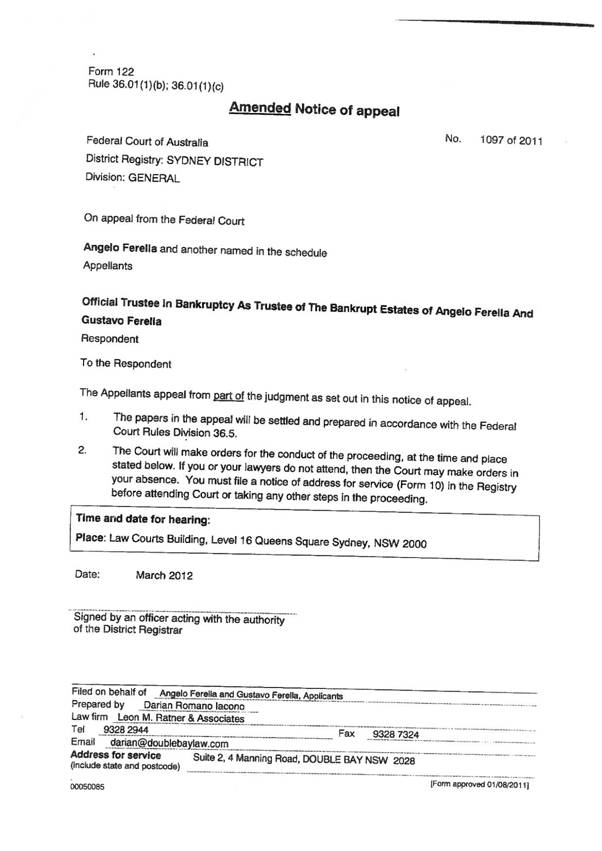
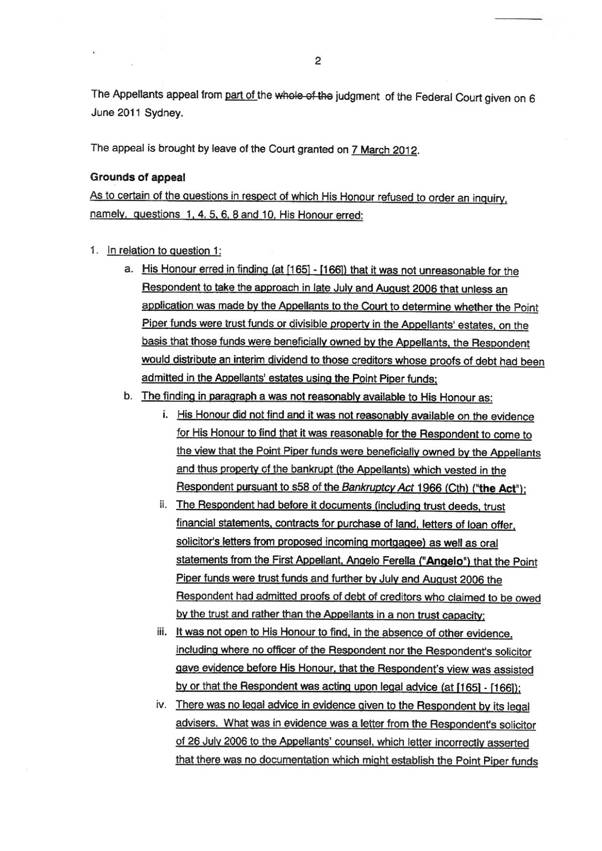
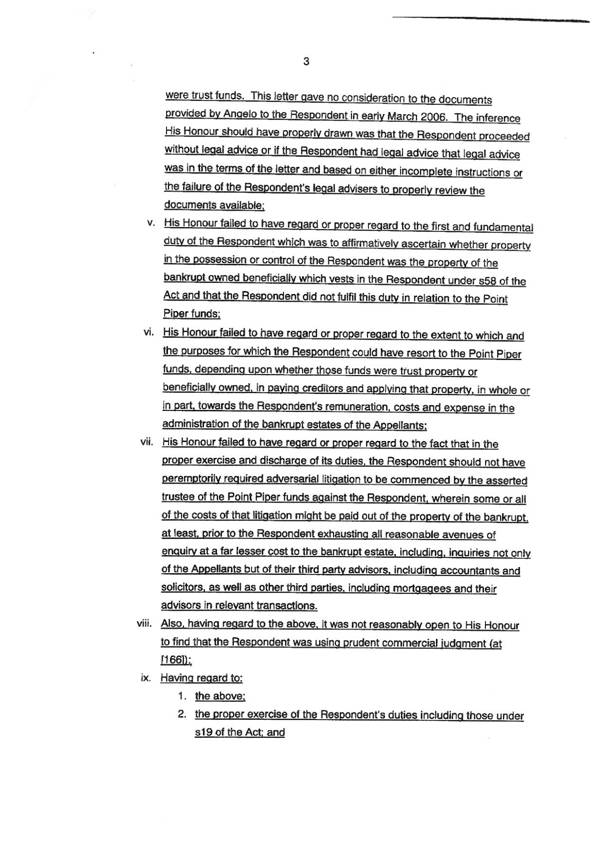
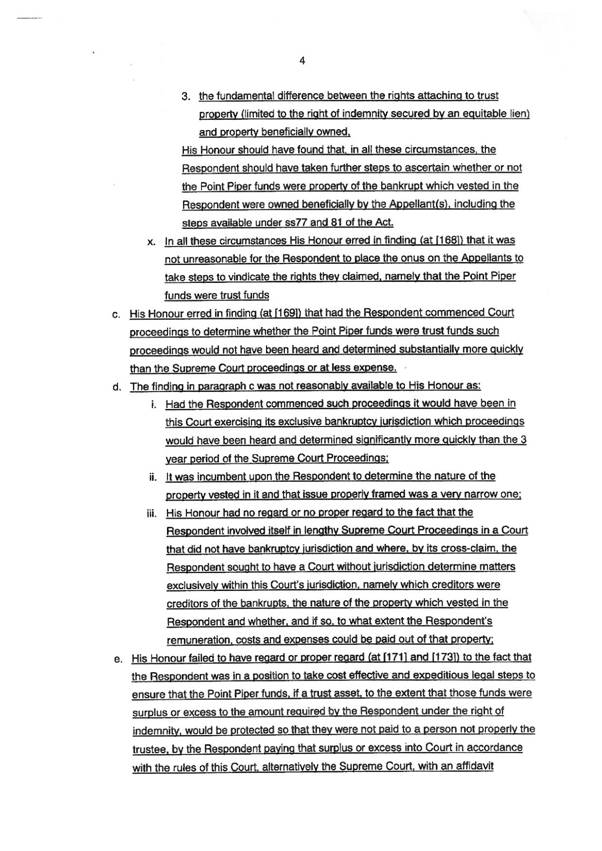
3. The appellants file within seven days of the delivery of these reasons, a notice of appeal in the form annexed to these reasons, excluding paras 1c, 1d, 1f and 1g thereof;
4. The appeal be dismissed; and
5. The appellants pay the respondent’s costs of the appeal and associated applications.
Note: Entry of orders is dealt with in Rule 39.32 of the Federal Court Rules 2011.
|
NEW SOUTH WALES DISTRICT REGISTRY |
|
|
GENERAL DIVISION |
NSD 1097 of 2011 |
|
ON APPEAL FROM THE FEDERAL COURT OF AUSTRALIA |
|
BETWEEN: |
ANGELO FERELLA First Appellant GUSTAVO FERELLA Second Appellant |
|
AND: |
OFFICIAL TRUSTEE IN BANKRUPTCY Respondent |
|
JUDGES: |
DOWSETT, FOSTER AND NICHOLAS JJ |
|
DATE: |
7 MAY 2013 |
|
PLACE: |
SYDNEY |
REASONS FOR JUDGMENT
LEAVE TO APPEAL
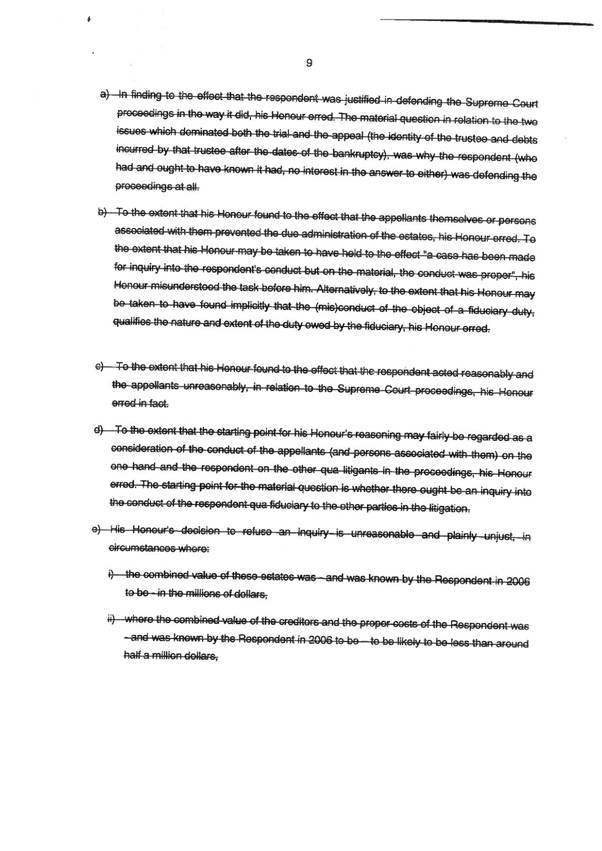
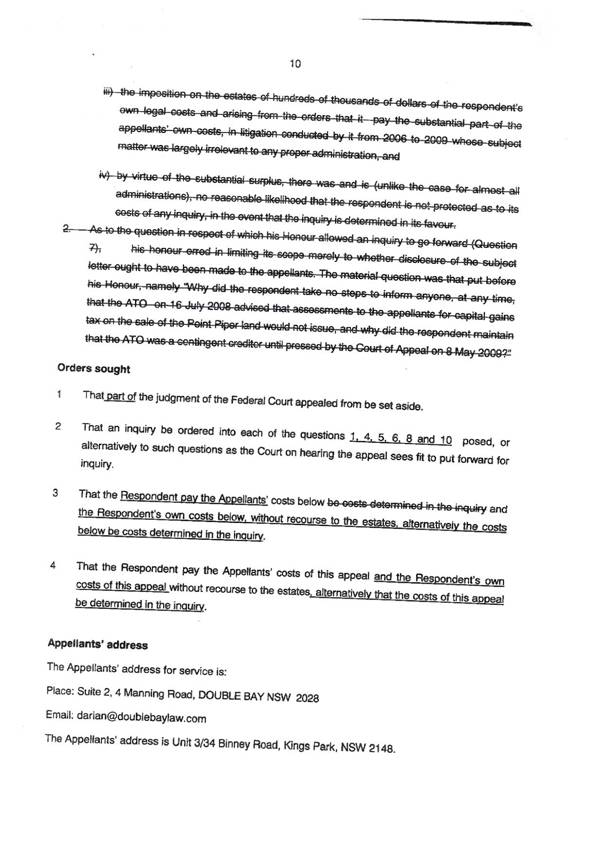
1 The judgment under appeal is, in form, interlocutory. Because of a misunderstanding as to the nature of the judgment, the applicants failed to lodge their notice of appeal within the prescribed time. They now apply for leave to appeal out of time. The application is not opposed. We are inclined to grant leave and, on that basis, have heard argument on the merits. The applicants had, prior to the hearing of their application for leave, delivered a draft notice of appeal. After the applicants’ submissions and in the course of the respondent’s submissions, a member of the Court observed that the draft grounds of appeal had little relationship to the applicants’ actual submissions, suggesting that the Court might direct them to file grounds of appeal which reflected their submissions. Following submissions in reply, the Court asked counsel for the appellants whether he stood by the draft notice of appeal. Counsel responded that he did not stand by it, and that he wished to adopt the approach suggested, namely to provide grounds of appeal which reflected his submissions. He sought leave accordingly. The appellants were given seven days in which to serve their proposed grounds on the respondent. In the event that the respondent had no objection, a notice of appeal was to be filed within a further two days. A draft amended notice of appeal was subsequently served on the respondent. The respondent objected to certain of the grounds, asserting that they went beyond the applicants’ submissions. The parties have supplied written submissions on the point. Consideration of such submissions necessitates a detailed consideration of the issues and the submissions made at the hearing of the appeal. For that reason we will consider the respondent’s objections to the proposed grounds of appeal after we have considered the substantive submissions. In those circumstances we will, hereafter, refer to the applicants as the “appellants”. As the draft notice of appeal was delivered after the hearing, it has not been formally incorporated into the record. We will attach it to these reasons.
BACKGROUND
2 On 14 October 2005 a Federal Magistrate made sequestration orders pursuant to the Bankruptcy Act 1966 (Cth) (the “Bankruptcy Act”) against the estates of the appellants. Gustavo Ferella is Angelo Ferella’s father. The respondent became the trustee of each bankrupt estate. On 3 December 2008 the appellants were discharged from bankruptcy by operation of law. On 11 November 2009 the appellants applied pursuant to s 179 of the Bankruptcy Act for orders that there be inquiries into the respondent’s conduct in relation to both bankrupt estates. On 6 June 2011 the primary Judge ordered that there be a limited inquiry into such conduct. The appellants now appeal against his Honour’s orders, effectively asking that this Court extend the ambit of the proposed inquiry.
3 Proceedings at first instance were commenced by application. Pleadings were exchanged. The relief claimed in the amended application was as follows:
pursuant to section 179 of the Bankruptcy Act, … an order that an inquiry be made by the Court into the conduct of the respondent in relation to the bankruptcies and for consequential orders.
A. DETAILS OF CLAIM
2. Pursuant to section 179, an order that an inquiry be made by the Court into the conduct of the respondent in relation to the bankruptcies, with a view to consequential orders effecting:
(a) Removal of the respondent from office and the appointment of a registered trustee either nominated by the applicants or directed the Court.
(b) A declaration to the effect that neither the costs incurred by the respondent, nor those costs of the applicants (and others) ordered to be paid by the respondent in Supreme Court proceedings 4820 of 2006 and 40326 of 2008 on appeal, are proper costs of the administrations and are not to be borne by either estate, save and except the sum referred to in order 5(m) made by that Court on 24 July 2008 and varied by it on 17 July 2009.
(c) A declaration to the effect that, in the circumstances of the case, any remuneration to which the respondent would otherwise be entitled to from March 2006, be withheld permanently.
(d) To the extent the Court thinks proper, an order that the respondent make good any loss to the estates occasioned by its conduct, including but not limited to:
(i) an order that the respondent pay an amount equivalent to interest at the Court rate on any funds held by it in the Common Fund from March 2006; and
(ii) an order that the respondent reimburse the estates for any interest which may be payable to creditors of the estates from March 2006.
(e) Subject to order (d), an order that the respondent release to the first applicant and the second applicant the funds deposited with or received by the respondent on or about 1 December 2005 and 13 March 2006 totalling $323,977.54 whether held in the Common Fund or otherwise.
(f) An order that the respondent release to the first applicant and the second applicant all other funds held by it in connection with the estates of the first applicant and the second applicant, whether held in the Common Fund or otherwise.
3. Such further or other orders as the Court deems appropriate.
4. Costs together with any interest thereon, including an order that the respondent pay the applicants’ costs of and incidental to the application, without recourse to the funds of the bankrupt estates of the applicants, as agreed or taxed.
4 In the course of the hearing at first instance, the appellants produced a document entitled “The Eleven Grounds Upon Which An Inquiry Is Sought” (the “eleven grounds document”). As we understand it, the document did not take the place of, or extend the ambit of the pleadings. Rather, the document seems to have been designed to summarize the appellants’ case. The primary Judge based his reasons upon that document. The appellants’ written submissions were similarly structured. We will deal with the appeal on the same basis.
THE REQUESTED INQUIRY
5 The “eleven questions” are set out in his Honour’s reasons at [155] as follows:
1. From the commencement of the Supreme Court proceedings in [September] 2006 until [their] final resolution in August 2009, has the respondent engaged in litigation on a substantially misconceived basis and in a manner which was unnecessary and extravagant?
2. Has the respondent unduly delayed the administration of the two estates?
3. Has the respondent, contrary to section 140(1) of the [Bankruptcy] Act, failed to pay dividends with all convenient speed, despite there being large surpluses in the estates?
4. Has the respondent become preoccupied with and intermeddled with the affairs of the Ferella family trust [i.e. the Cavallino Unit Trust]?
5. Agusta Pty Ltd having commenced the proceedings as trustee of the trust to recover funds held by the respondent, was the respondent’s defence inappropriate, in circumstances where it knew of the trust and was uncertain only as to the identity of the trustee, and in circumstances where it could have, at the least, interpleaded or sought judicial advice pursuant to section 134(4) of the [Bankruptcy] Act?
6. Did the respondent understand the nature and extent – and limit – of the bankrupt trustees’ right of indemnity which had vested in it?
7. Why did the respondent take no steps to inform anyone, at any time, that the ATO on [16 July 2008] advised that assessments to the bankrupts for [capital gains tax] on the sale of the Point Piper [land] would not issue, and why did the respondents maintain that the ATO was a contingent creditor until pressed by the Court of Appeal on [8 May 2009]?
8. Why did the respondent ever assert a right over the funds held by it in relation to a debt allegedly owed by the trustee to the ATO?
9. Why did the respondent assert wrongly that the Ferella family trust funds held by it, did not bear interest? (Alternatively, why, on the assumption that the assertion was correct, did the respondent not take steps to ensure that the funds were put in an interest bearing account?)
10. Whether by reason of the foregoing matters: (a) the bankrupt estates remain unadministered; (b) interest has not yet been paid to creditors; and (c) the respondent has incurred unnecessary costs, expenses and remuneration, including its own costs in the Supreme Court and Court of Appeal and the costs of the Ferella family (including the applicants) that it was ordered to pay?
11. Whether the administration of the estates and the conduct of the Supreme Court proceedings and these proceedings, have been marked by unnecessary aggression and obstruction by the respondent?
THE PRIMARY JUDGE’S ORDERS
6 His Honour ordered an inquiry into the matters raised in question 7 as follows:
Pursuant to s 179(1) of the Bankruptcy Act 1966 (Cth) an inquiry (the inquiry) be held into the conduct of the respondent as trustee in bankruptcy of the [appellants] in relation to the following matters:
(a) In the course of administering the applicants’ bankrupt estates, was the respondent justified in not disclosing the letter dated 16 July 2008 from the Australian Taxation Office (a copy of which is at page 380 of Exhibit B) or its contents (the letter) to the applicants in proceedings SC 4820/06 in the Supreme Court of New South Wales or in proceedings CA 40326/08 in the Court of Appeal of the Supreme Court of New South Wales?
(b) If the respondent was not justified in not disclosing the letter to the applicants as aforesaid:-
(i) what consequence, if any, did that non-disclosure have for the orderly administration of the applicants’ bankrupt estates?
(ii) what relief, if any, should be granted pursuant to s 179(1) of the Bankruptcy Act 1966 (Cth)?
7 In his reasons at [224] the primary Judge noted that question 10 effectively sought an inquiry into the consequences of the various matters raised by other questions, observing that:
The [appellants] raise this question as “a conclusion upon the other grounds each and together”. I will treat the matter accordingly. The question calls for no separate response, other than to say that the issue of whether unnecessary costs were incurred in the Supreme Court and Court of Appeal proceedings, on and after 16 July 2008, in relation to the question of capital gains tax, is a matter that should be answered in the context of the inquiry I propose to order.
8 In other words, there was to be an inquiry into the matters raised in question 7 and the consequences thereof (pursuant to question 10), but not as to any of the other matters identified in the eleven grounds document. On appeal the appellants press only their application for an inquiry into the matters raised in questions 1, 4, 5, 6 and 8 and into the consequences thereof pursuant to question 10.
THE ADMINISTRATION OF THE BANKRUPT ESTATES
9 The administrations commenced on 14 October 2005. Although the appellants were discharged on 3 December 2008, the administrations have not yet been completed. Over that period, the appellants and associated persons and corporations have been involved in quite an acrimonious dispute with the respondent. The primary subject of dispute has been the beneficial ownership of real property at Point Piper in Sydney’s eastern suburbs (the “Point Piper land”) and the proceeds of its eventual sale. At one stage the land was said to have an estimated value of $9 million. At the date upon which the sequestration orders were made, the appellants were the registered proprietors of the Point Piper land. They had previously been involved in substantial litigation with members of the Otvosis family (the “Otvosis family”) concerning the proposed development of that land. The Otvosis family owned neighbouring land. On 27 April 2005 the Otvosis family obtained orders for costs against the appellants in the sum of $74,656. The sequestration orders were based upon bankruptcy notices demanding payment of that judgment debt.
10 At the date of the sequestration orders the Point Piper land was mortgaged to Key Nominees Pty Ltd (“Key Nominees”). In May 2006 Key Nominees sold the land (presumably as mortgagee in possession) for about $7.95 million, of which sum the respondent received $1,788,532 (the “Point Piper funds”), representing the excess of the sale price over the amount of Key Nominees’ debt and associated expenses.
11 In the original statement of affairs in each bankruptcy, the Point Piper land was shown as being held by the appellants as trustees of the Cavallino Unit Trust. However, in late 2005 and early 2006 the respondent came into possession of information which caused it to doubt that proposition. As a result, it placed a caveat on the Point Piper land. On 4 March 2006 Angelo Ferella, purportedly on behalf of the Cavallino Unit Trust, wrote to the respondent, asserting that the Cavallino Unit Trust had been prejudiced by the lodgement of the caveat. The alleged prejudice was said to be delay in re-financing the Point Piper land. The primary Judge understood that the purpose of the proposed re-financing was to facilitate annulment of the bankruptcies. It is not clear whether this proposed use of allegedly trust assets was one of the bases for the respondent’s concern as to the beneficial ownership of the Point Piper land at the time at which the sequestration orders were made. Mr Ferella asserted that the respondent knew that he and his father had not been trustees of the trust for almost two years. Mr Ferella produced to the respondent certain documents said to show that the Point Piper land was a trust asset. The documents included:
a letter from the Commonwealth Bank addressed to the appellants as “trustee for the Ferella Unit Trust”;
a contract for the sale of the Point Piper land which indicated that the appellants had purchased the property as trustees for a trust called the Modena Unit Trust;
a letter from Suncorp Metway to Angelo Ferella setting out the terms of an offer of a loan in the amount of $6.3 million for the purpose of assisting with the refinancing of the Point Piper land and the development of two luxury villas on that property, the borrower being described as Angelo Ferella and Gustavo Ferella as trustees for the Cavallino Unit Trust;
a deed of trust for the Ferella Unit Trust dated 10 January 1995, identifying the appellants as trustees; and
financial reports of the Cavallino Unit Trust for the years ended 30 June 2001 and 30 June 2005 recording the existence of fixed assets comprising unidentified land,
12 The appellants seem to assert that these documents should have led the respondent to accept their assertion that the Point Piper land was held by them as trustees of the Cavallino Unit Trust. We are inclined to think that the documents raised more questions than they answered.
13 On 27 March 2006 the appellants’ barrister advised the respondent that Agusta Pty Ltd (“Agusta”) was the new trustee of the Cavallino Unit Trust. He also noted that there was a dispute as to the beneficial ownership of the Point Piper property. On 26 July 2006 the respondent’s solicitors wrote to the appellants’ barrister as follows:
Finally we are instructed that you have spoken to Philip Madden, our client’s manager of each of the bankrupt estates and advise that in your opinion the net proceeds of sale of (the Point Piper land) was trust money and did not vest in the Official Trustee in Bankruptcy. Other than advising of this fact orally, there does not appear to be any documentation to support this fact and, as we understand it, in the equity proceedings with Mr and Mrs Otvosis there was no mention made of the alleged trust. Further, as we understand it, the Common Law Duty Judge found in an application for stay of the possession proceedings by [Key Nominees] that there was no trust. We have also read the 3 reported judgments between Otvosis and the bankrupts being:
(a) Hamilton J 23 September 2005;
(b) Gzell J 31 March 2004; and
(c) Hamilton J 5 July 2005.
There is no mention of a trust in those judgments. If there is or if it is in any Affidavit filed in any of those proceedings please let us know and provide to us a copy.
This letter is to serve as notice of the Official Trustee’s intention to make distribution from the moneys held by it in each bankrupt estate.
14 Concerning this letter the primary Judge said at [78]:
In the course of submissions the [appellants] criticized this letter for stating that there did not appear to be any documentation to support the fact that the Point Piper funds were a trust asset. It is true that the letter of 26 July 2006 overstates the position in that regard. Some documentation seeking to establish that the Point Piper land was a trust asset had been handed to Mr Madden by [the first appellant] in March 2006, and forwarded by Mr Madden to the respondent’s solicitors for review. However, as I have stated, that documentation presented a confusing picture. This was even more so in circumstances where the [appellants] had provided plainly contradictory information relating to the identity of the trustee or trustees of the trust they were asserting. Moreover, as I have noted, there was other information available to the respondent at the time which would cause it to doubt, on reasonable grounds, that the Point Piper land was a trust asset. The 26 July letter made clear the respondent’s then view that, unless further information was forthcoming, he proposed to treat the Point Piper funds as divisible property in the bankrupt estates and to pay dividends from those funds.
THE SUPREME COURT PROCEEDINGS
15 On 16 August 2006 the respondent again advised the appellants that unless an application was made to “the Court” within 14 days to determine the beneficial ownership of the Point Piper funds, it intended to make an interim distribution to creditors. On 11 September 2006 Agusta commenced proceedings in the Supreme Court of New South Wales. The first (and only) defendant was said to be the “Insolvency and Trustee Service Australia in the Estate of Angelo Ferella and Gustavo Ferella”. At a later stage the name of the defendant was changed to “Official Trustee in Bankruptcy as trustee of the bankrupt estates of Gustavo Ferella and Angelo Ferella”. The summons commencing the proceedings was signed by Nida Ferella who is the wife of Gustavo Ferella. Tiziana Ferella, Angelo Ferella’s sister was also described in the summons as an “authorized person”. In the proceedings Agusta sought declarations that:
it was the trustee of the Cavallino Unit Trust;
the Point Piper land was held pursuant to that trust;
the Point Piper funds were held on trust for the Cavallino Unit Trust; and
“all funds” held by the respondent were held on trust for the Cavallino Unit Trust.
16 Such relief appears to be of the kind referred to in s 31(1)(f) of the Bankruptcy Act. If so, then the matter was within the bankruptcy jurisdiction conferred exclusively on this Court and the Federal Magistrates Court, subject only to the jurisdiction of the High Court. That point was not taken at first instance in the Supreme Court or in the Court of Appeal. At first instance in this Court, the appellants submitted that the respondent should have resolved the case other than by participation in the litigation which in fact took place. The primary Judge concluded that there was no reason to believe that the proceedings would have been disposed of more quickly, or with less expense, had they been conducted in some other forum. The appellants did not complain that the respondent had allowed the proceedings to be conducted in a court other than a court having jurisdiction in bankruptcy. In the draft amended notice of appeal the appellants now seek to rely upon the fact that the respondent did not identify any lack of jurisdiction in the Supreme Court and take steps to resolve the dispute between the parties in a way which did not involve litigation in a court which lacked the necessary jurisdiction. The respondent submits that the question cannot be raised at this stage as it was not raised by the appellants in their submissions. We will return to this question.
17 In the Supreme Court proceedings Agusta claimed all funds held by the respondent, including the Point Piper funds and other funds, particularly a sum of $323,977.54 paid to the respondent in March 2006, apparently by the appellants or on their behalf. Of that amount $74,656 was the amount payable pursuant to a bank cheque delivered by the appellants to the Otvosis family in discharge of the costs order upon which the bankruptcy notices were based. This tender was presumably a step taken in anticipation of applications to annul the bankruptcies. Instead of presenting the cheque for payment, the Otvosis family sent it to the respondent, perhaps for fear that any payment would be a preference. On 13 March 2006 Mr Angelo Ferella delivered bank cheques to the respondent in the further amount of $249,321.54, so that the respondent held funds totalling $323,972.54. The respondent had previously estimated that the creditors’ claims, fees and costs of the bankruptcy administrations totalled that amount. A possible source of the amount of $249,321.54 was the sale of a Ferrari motor vehicle by Gustavo Ferella on 24 November 2005. However, at a later date, Nida Ferella claimed that she had supplied the money for the purpose of securing annulments of the bankruptcies. In any event, in the Supreme Court proceedings, Agusta appears to have claimed, as trustee of the Cavallino Unit Trust, all amounts in the respondent’s hands, including these amounts and the Point Piper funds. At about this time the appellants complained to the Insolvency and Trustee Service Australia (“ITSA”) concerning the respondent’s administration of the bankrupt estates.
18 On 29 September 2006, in the Supreme Court proceedings, Mr Madden, an officer of the respondent deposed to the fact that it was holding the sum of $889,856.44 in connection with Gustavo Ferella’s estate, and $1,176,899.53 in respect of Angelo Ferella’s estate. At that time the amounts required to satisfy the claims of creditors and costs of the administrations were, as to Gustavo Ferella’s estate $184,335.32 and, as to Angelo Ferella’s estate $365,551.17. A further sum was required to meet the legal costs incurred by a creditor, AMT Engineering Pty Ltd, which costs were the subject of an order in the Federal Magistrates Court. Mr Madden claimed that the Supreme Court proceedings were delaying the payment of creditors.
19 In November 2006 the respondent sought to have the Supreme Court proceedings dismissed on a number of grounds, one or more of which may have been somewhat technical. By this stage Agusta was alleging that it had been appointed as trustee of the Cavallino Unit Trust in place of a company called Riva Industries Pty Ltd (“Riva”). There had been previous dealings between Riva and the appellants, each of whom claimed that it owed him the sum of $140,000. Agusta asserted that in April 2005, Riva had been appointed as trustee in place of the appellants, and that it had succeeded Riva. Agusta also contended that the Cavallino Unit Trust was the same as the Ferella Unit Trust and the Modena Unit Trust. In its summary dismissal application the respondent submitted that the purported appointments of trustees other than the appellants were not valid. This submission may have been based on the assumption that all purported appointments had occurred after the sequestration orders. The respondent also asserted that there was no triable issue raised in the proceedings. It submitted that even if Agusta were the trustee of the Cavallino Unit Trust, the Court would not disturb the respondent’s possession of the trust funds because they were subject to a lien to secure the trustees’ indemnity in respect of debts incurred by the appellants as trustees, to which indemnity and lien the respondent was now entitled. The application for summary dismissal was refused.
THE RESPONDENT AND THE TRUST
20 The allegation that the Point Piper land was held on trust raised several complications for the respondent. On the face of it, the land was held beneficially by the appellants and was available to meet proven debts, the costs and expenses incurred in the bankruptcies and the respondent’s remuneration. If the land was a trust asset, and the appellants were, or had been the trustees, then some of the debts may have been incurred in that capacity. If so, the appellants were entitled to indemnity out of the trust assets and a lien over those assets to support such indemnity, to which indemnity and lien the respondent was now entitled. There was also a question as to whether the appellants were beneficiaries of the trust and, if so, whether any such entitlements had passed to the respondent.
21 In those circumstances, on 6 February 2007, the respondent filed a cross-claim in the Supreme Court claiming declarations that:
it was entitled to be indemnified from the proceeds of sale of the Point Piper property with respect to proofs of debt or claims as to amounts due by Gustavo and/or Angelo Ferella;
it was entitled to be indemnified from the Point Piper funds for its proper remuneration and expenses;
such right of indemnity was secured by a charge over the Point Piper funds; and
the respondent was not required to pay any part of the Point Piper funds to Agusta until the debts and claims referred to in the earlier declarations, together with costs, expenses and remuneration, including the costs of the proceedings had been paid in full.
22 The difficulty with these claims was that they seem to have been based on the assumption that all of the appellants’ debts in their bankruptcies were incurred by them as trustees. On the other hand, the appellants appear to have asserted, until some point just before, or at the trial that the respondent was not entitled to use the trust assets to pay any of their debts, regardless of whether they were trust debts or not. The appellants were, it seems, unaware of the law relating to the trustee’s indemnity and lien.
23 Alternatively, the respondent sought orders that:
the Point Piper funds be distributed as to 50% to it and Nida Ferella and, as to the balance, to the Ferella Staff Superannuation Fund; and
with respect to the 50% paid to the respondent and Nida Ferella, the sum be distributed as to 33.34% to it as trustee of the estate of Angelo Ferella, as to 33.33% to it as trustee of the estate of Gustavo Ferella, and as to 33.33% to Nida Ferella.
24 This proposed division seems to have reflected the respondent’s understanding of the beneficial ownership of the trust property. The respondent also sought further directions as to the distribution of the Point Piper funds, further or other relief and payment of its remuneration, costs and expenses on an indemnity basis.
25 On 7 May 2007 the respondent wrote to the appellants, seeking to explore the possibility of settlement. It proposed that all of Gustavo Ferella’s proven debts be treated as trust debts and discharged from the Point Piper funds, and that all but one of Angelo Ferella’s debts be so treated and discharged. The one exception was a debt owed to the Deputy Commissioner of Taxation. The respondent also proposed that his costs, remuneration and expenses be paid. The proposal was not accepted.
26 On 7 June 2007 Nida Ferella asserted that she was entitled to the sum of $249,321.54 paid to the respondent by Angelo Ferella on 13 March 2006. She claimed that she had provided the money for the purpose of securing annulments of the bankruptcies and that, as there had been no annulments, she should have the money back. However no recovery action was commenced. On 29 July 2007 Tiziana Ferella made a complaint to the Inspector General in Bankruptcy about the administration of the estate, particularly concerning this claimed right to a refund. Correspondence concerning these complaints continued for some time. In early 2008 the respondent raised the possible liability of the estates for capital gains tax in relation to the sale of the Point Piper land. At one stage the respondent estimated that liability to be in the amount of $1,000,025 and sought information from the appellants concerning it. In December 2007 and February 2008, there were some attempts to narrow the issues in dispute in the Supreme Court proceedings.
THE TRIAL
27 The Supreme Court proceedings were heard in February, March, May and June of 2008. At the commencement of the hearing the appellants and Riva were joined as additional plaintiffs, claiming the same relief as was claimed by Agusta. This step suggests that even at that late stage, the appellants, Agusta and Riva were uncertain as to the true identity of the trustee of the Cavallino Unit Trust. Hereafter, we will refer to the plaintiffs in those proceedings as the “plaintiffs”, which term includes the appellants.
28 On 6 May 2008 the respondent wrote to the Australian Taxation Office (the “ATO”) asking that it issue an assessment of liability for capital gains tax, apparently for the purposes of the Supreme Court proceeding. On 7 May 2008 the ATO indicated that notices of assessment would issue in the near future, addressed to each appellant. The ATO suggested that the respondent “withhold an amount of $1,052,972 to reflect the amounts of these potential assessments …”. On 4 June 2008, in the Supreme Court, counsel for the respondent sought to reopen its case in order to tender the letter from the ATO. The application was opposed by the plaintiffs and refused.
29 On 8 July 2008 judgment was given in the Supreme Court proceedings (Agusta Pty Ltd v The Official Trustee in Bankruptcy [2008] NSWSC 685). Nicholas J found that the Point Piper land had been an asset of the Cavallino Unit Trust, and that the Point Piper funds were, therefore, an asset of that trust. This left for determination questions concerning the identity of the trustee, the existence of any indemnity or lien over the Point Piper funds in favour of the respondent and the extent thereof. Nicholas J observed at [23] of his reasons:
Initially, the plaintiffs contended that the Ferellas had been replaced as trustees by Agusta, alternatively, by Riva. However during the course of submissions the case for Agusta was not pressed and the preference for Riva was stated … . I was left with the impression that the plaintiffs accepted the indubitably correct situation that upon the bankruptcy of the Ferellas [the Bankruptcy Act] operated to vest the rights and powers attached to their units in [the respondent] so that they became unable to vote for, or to otherwise approve, a change to Agusta under … the trust deed. … Accordingly, I have proceeded on the basis that it was Riva which the plaintiffs finally claimed to be the trustee at the relevant time … .
30 His Honour concluded that Riva had, on 19 April 2005, been appointed to be trustee of the trust. Such appointment preceded the sequestration orders and was therefore valid. His Honour also found that no steps had been taken to vest the Point Piper land in Riva, as required by the terms of the trust deed. Thus legal title to the assets of the trust, including the Point Piper land was legally vested in the appellants at the time of their bankruptcy. Nicholas J observed that the plaintiffs had accepted that the respondent was entitled to a lien over the Point Piper funds in respect of a number of debts for which proofs had been lodged and admitted in the bankruptcies, presumably because those debts were incurred by the appellants in administering the trust. The respondent had not pressed its claims for indemnity in respect of two other debts. A number of claims remained in dispute. Nicholas J found that the respondent was entitled to be indemnified in respect of some of them. These included the alleged liability for capital gains tax and claims which were later described in the Court of Appeal as the “bankruptcy litigation costs” and the “cross claim costs” (Agusta Pty Ltd v Official Trustee in Bankruptcy [2009] NSWCA 129). The precise meaning of each term is a little unclear. At [14] Tobias JA set out the claims which, as Nicholas J had held, were secured by the lien. Tobias JA referred to three of those claims as being the “bankruptcy litigation costs”. They were:
the amount of $3,990, being the amount of costs incurred by the Otvosis family in resisting applications for stays of the sequestration orders;
the amount of $2,651.25, being the amount of costs incurred by the Otvosis family in opposing applications to annul the bankruptcies; and
the amount of $114,258.61 being a contingent liability for the costs incurred by the Otvosis family in a cross-claim in other proceedings in the Supreme Court to which the appellants were parties.
31 At [17] of his Honour’s reasons, Tobias JA refers to the third claim as being the “cross-claim costs”. It seems that in the proceedings in which the costs were incurred, no order was made concerning them, apparently because the appellants were, by that time, bankrupt. The Judge in those proceedings indicated that had the appellants not been bankrupt, he would have made a costs order against them and in favour of the Otvosis family.
32 Before Nicholas J, the plaintiffs argued that the bankruptcy litigation costs, (not including the cross-claim costs), were not connected to the Cavallino Unit Trust and arose out of attempts by the bankrupts to escape from bankruptcy. With respect to the cross-claim costs, the plaintiffs argued that the lien would only secure a liability which was “actual nor contingent”, and that this liability was neither actual nor contingent. Nicholas J upheld the respondent’s claim to a lien to secure payment of the bankruptcy litigation costs and the cross-claim costs. As to the capital gains tax liability, the appellants submitted that the possibility of any liability was too remote to be supported by the lien. His Honour upheld the claim to a lien in respect of such contingent liability.
33 Having delivered his reasons, Nicholas J made formal orders at a later date. Before such orders were made, the ATO withdrew its request that the respondent withhold funds against any possible liability for capital gains tax. This withdrawal apparently reflected a decision that there was no liability. The respondent did not inform Nicholas J, the Court of Appeal or the appellants of the change in the ATO’s position.
34 On 24 July 2008 Nicholas J made formal orders as to amounts which were secured by the lien “in accordance with paragraph 67 of the Court’s reasons published on 8 July 2008”. The respondent was also awarded its costs of the proceedings “on the trustee basis”. Nicholas J effectively ordered that the respondent pay into Court the Point Piper funds, together with interest, less the various amounts which, pursuant to his reasons, it was entitled to withhold.
IN THE COURT OF APPEAL
35 By September 2008 the bulk of the creditors had been paid and, on 3 December 2008 the appellants were discharged from bankruptcy by operation of law. On 8 October 2008 the plaintiffs appealed against the orders made by Nicholas J. The notice of appeal challenged his Honour’s findings or conclusions that:
Agusta had not succeeded Riva as trustee of the Cavallino Unit Trust;
the trust property had not vested in Riva;
the respondent was entitled to assert a lien in respect of the disputed claims;
such lien was possessory, entitling the respondent to retain trust property; and
the trustee of the Cavallino Unit Trust was not entitled to interest at court rates (as opposed to the rate of interest prescribed by the Bankruptcy Act).
36 The respondent filed a notice of cross-appeal and a notice of contention, both of which asserted that Nicholas J had erred in finding that Riva became trustee of the Cavallino Unit Trust, and that his Honour ought to have found that the appellants had not been validly replaced as trustees of the trust. At the hearing of the appeal, these matters were abandoned. At that hearing counsel for the respondent conceded that it was not entitled to any indemnity in respect of the bankruptcy litigation costs, the cross-claim costs or the capital gains tax liability, given that all such “debts” had arisen after the date of the sequestration orders. The parties agreed that the primary Judge had mistaken the position taken by the parties in connection with the respondent’s claim to an indemnity for its costs and expenses incurred in connection with the administration of the trust. This matter was referred back to the primary Judge for further consideration.
37 Finally, the question of costs at first instance was remitted to Nicholas J, the Court of Appeal indicating that any order in favour of the respondent should not be on the trustee basis. In the end Nicholas J ordered that the respondent pay 80% of the appellants’ costs of the proceedings (Agusta Pty Ltd & Ors as trustees for the Cavallino Unit Trust v The Official Trustee in Bankruptcy as trusee of the bankrupt estates of Gustavo Ferella and Angelo Ferella (Unreported, Sup Ct, NSW, Nicholas J, 28 August 2009)), observing at [18]-[20]:
18 Having regard to the reasons of the Court of Appeal, and to the submissions and analyses put together by the parties as to the outcome of the proceedings, it must be recognized that the plaintiffs succeeded in the proceedings overall. However, in my opinion, justice requires departure from the ordinary rule that costs follow the event.
19 The identification issue was one squarely raised by the plaintiffs, the determination of which was necessary for them to obtain an order that the [respondent] pay the fund it held to the trustee. The issue took up a not insignificant amount of time and, in my assessment, the [respondent] had a substantial measure of success. Allowance in the [respondent’s] favour should be made for the [various identified claims] eventually made by consent. I accept the [respondent’s] submission that account should be taken of the situation that it was not until the hearing began that the plaintiffs modified their firm denial of entitlement to any claim for indemnity or lien. On the other hand, in my opinion, the consequence of acceptance of some of the [respondent’s] claims, and the abandonment by the [respondent] of others should be seen as simply incidental to the litigation. In my opinion a valuation of these factors supports the conclusion that there should be some departure from the ordinary rule.
20 My task is to make an order which, doing the best I can by way of overall assessment, is a fair one. In my opinion, the fair order to make is to order the [respondent] to pay 80% of the plaintiffs’ costs of the proceedings. I so order.
AN APPEAL AGAINST THE EXERCISE OF A DISCRETION
38 We are presently considering an appeal against an order made pursuant to s 179 of the Bankruptcy Act. That section provides:
(1) The Court may, on the application of the Inspector General, a creditor or the bankrupt, inquire into the conduct of a trustee in relation to a bankruptcy and may do one or both of the following:
(a) remove the trustee from office; and
(b) make such order as it thinks proper.
(2) The Inspector General of a creditor may at any time require a trustee to answer an inquiry in relation to the bankrupt’s estate or affairs.
39 The cases concerning s 179 were summarized by French J (as his Honour then was) in Macchia v Nilant (2001) 110 FCR 101 at [49]-[50] as follows:
49 As appears from the language of s 179 it invites first a consideration, albeit upon application by a person with standing, of whether the Court should inquire into the conduct of the trustee. If inquiry is undertaken, the next question is whether the trustee should be removed from office and/or any other order made. The first question requires the Court to consider whether on the grounds and facts before it, a case has been made for an inquiry … . The application of s 179 to that first step involves a broad discretion as to whether or not there is sufficient grounds to make an inquiry appropriate: Turner v Official Trustee in Bankruptcy (unreported, Federal Court, Full Court, No 8 of 1998, 27 November 1998). The Full Court there quoted with approval the observation of Ellicott J in Re Gault that (at 173):
“… the Court should be loath to order an inquiry unless it considers that on the evidence before it there are substantial grounds for believing that the trustee erred in his administration. If the Court considers that an inquiry is unlikely to reveal misconduct it should not make an order and put the respondent and possibly the creditors to the expense and trouble involved.”
The policy consideration referred to by Deane J in Re Tyndall that “the Court should not unduly interfere with the day-to-day administration of a bankrupt’s estate by a trustee” applies also to the operation of s 179: Turner at 2-3.
50 Section 179 operates in aid of the Court’s supervision of trustees who are its officers. That operation, however, is subject to restraint against undue interference and to discretionary considerations including the practical benefit likely to be derived from the conduct of any inquiry. Like s 178, it may be invoked by a bankrupt after discharge and in part for the same reason, namely that the trustee’s powers continue in the various ways referred to by Merkel J at first instance in Cheesman. It may also be the case that the trustee should be held to account for conduct in the administration of the estate which has affected the bankrupt in some way. As is the case with s 178, it is not a vehicle for pressing claims for common law damages under the general law. That is a matter for a court of appropriate jurisdiction. In addition the Court will also have in such cases the discretion to determine the utility of an inquiry and its likely outcomes. For “although the Court is given a broad discretion under s 179 of the Act, that discretion must be exercised in the interests of the orderly administration of a bankrupt’s estate”: Re Challon (A Bankrupt); Ex parte Brown v Bendeich (unreported, Federal Court, Beaumont J, No QB 1548 of 1993, 23 April 1996) cited with approval by Merkel J in Cheesman at first instance, at p 114.
40 As the decision is discretionary any appeal must be dealt with in the way prescribed by the High Court in House v The King (1936) 55 CLR 499 at 504-505 as follows:
But the judgment complained of, namely, sentence to a term of imprisonment, depends upon the exercise of a judicial discretion by the court imposing it. The manner in which an appeal against an exercise of discretion should be determined is governed by established principles. It is not enough that the Judges composing the appellate court consider that, if they had been in the position of the primary Judge, they would have taken a different course. It must appear that some error has been made in exercising the discretion. If the Judge acts upon a wrong principle, if he allows extraneous or irrelevant matters to guide or affect him, if he mistakes the facts, if he does not take into account some material consideration, then his determination should be reviewed and the appellate court may exercise its own discretion in substitution for his if it has the materials for doing so. It may not appear how the primary Judge has reached the result embodied in his order, but, if upon the facts it is unreasonable or plainly unjust, the appellate court may infer that in some way there has been a failure properly to exercise the discretion which the law opposes in the court of first instance. In such a case, although the nature of the error may not be discoverable, the exercise of the discretion is reviewed on the ground that a substantial wrong has in fact occurred.
QUESTION 1
41 Question 1 deals with the respondent’s conduct of the proceedings in the Supreme Court. The appellants submitted that the respondent ought not to have engaged in adversarial litigation, and that such proceedings were made necessary “only by the respondent’s insistence that the Ferella family prove the provenance of the Point Piper (funds)”. This seems to have meant that the respondent required the plaintiffs to prove that the Point Piper land was trust property and to identify the trust and trustee. At [158] the primary Judge observed:
In this connection the [appellants] submit that, when the respondent received and banked the Point Piper funds in June 2006, there were only three reasonable positions for it to adopt. First, if it was of the view that the Point Piper land had been beneficially owned by the [appellants], the respondent was under a duty to administer the [appellants’] bankrupt estates “with alacrity”, knowing that the undoubted surplus assets would bear interest for the Crown but not for the [appellants]: s 20J(1) of the Bankruptcy Act. Secondly, if the respondent was of the view that the Point Piper funds were a trust asset, with the respondent’s only interest being a right of indemnity supported by a charge or right of lien over those funds, it should have retained a sum sufficient to cover the indemnity and paid the surplus to the trustee. Thirdly, if the respondent was of the view that the Point Piper funds were a trust asset, but was in doubt about the identity of the trustee, it should have paid the surplus into court or otherwise approached the Court for directions as to how to distribute the Point Piper funds. The [appellants] submit that the respondent did none of these things.
42 His Honour concluded that:
In the early stages of the bankruptcies, the appellants were anxious to seek annulments, using funds to be derived from re-financing of the Point Piper land to pay creditors.
When the re-financing did not proceed, the Point Piper land was sold. The appellants asserted that the Point Piper funds comprised trust property which could not be used to pay any of their debts, apparently not accepting that trust debts were provable in the bankruptcies, or that the trust assets were available to meet such debts by virtue of the trustees’ indemnities and liens.
The respondent received conflicting evidence as to whether the Point Piper land had been a trust asset, as to the identity of any such trust and as to the identity of any trustee. Hence it was not satisfied that the Point Piper funds were trust assets. The respondent therefore called upon those asserting the trust to prove its existence, its terms and the identity of the trustee. That position was reasonable in the circumstances.
Agusta sought to respond to this position by commencing proceedings in the Supreme Court. Whilst there were other avenues for achieving the desired outcome (such as proceedings under the Bankruptcy Act) there was no reason to believe that such alternatives would have been quicker or cheaper than the course chosen by Agusta.
Agusta claimed all funds held by the respondent, not merely the Point Piper funds and, after December 2006, damages.
In those circumstances, the respondent was justified in adopting the course which it did.
The respondent had a clear interest in ensuring that the Point Piper funds were paid to the proper recipient, given that the appellants’ interests in the trust had passed to the respondent and Agusta’s claim for damages. Its view that Agusta was not the trustee was, in the end, shown to be correct.
In any event, the respondent held the benefit of the appellants’ indemnities and liens. The appellants did not accept this proposition until shortly before the trial and, even then, continued to dispute that particular debts were trust debts. It is true that the respondent was not entitled to an indemnity or lien which it claimed in respect of some debts, but it was successful at first instance and lost on appeal on a basis which was different from the position adopted by the appellants at trial.
In view of the fact that Agusta was claiming all funds held by the respondent and claiming damages, it is unrealistic to suggest that the respondent should have formed a view as to the particular amount which would satisfy its claims and pay the balance into court. Further, such a course would not have led to the respondent’s being able to pay creditors, given the plaintiffs’ opposition to that course, evidenced by the commencement of the Supreme Court proceedings and the threat of injunctive relief.
The unreality of the approach urged by the appellants is further highlighted by the fact that the respondent had sought a rather similar resolution of the matter on 2 February 2007 but received no response from the appellants. Further, on 7 May 2007 a more detailed proposal was advanced but not accepted.
On 4 December 2007 the appellants advanced a proposal which seems to have required that the respondent estimate the amount necessary to pay debts and costs and pay the balance to Agusta or into court. No mention was made of remuneration or the outstanding damages claim which, the appellants suggested, should be “set to one side, pending the outcome of the primary claims”. (We note also that on 5 February 2008, the appellants indicated that the damages claim would not be pursued “in these proceedings”, leaving open the possibility of its being pursued in other proceedings.)
43 In those circumstances, the primary Judge concluded that the respondent was justified in defending the Supreme Court proceedings in the way that it did, and in prosecuting its claim to indemnity out of the Point Piper funds.
44 As appears from the appellants’ written submissions, the grounds upon which they attack his Honour’s decision concerning question 1 are that:
his Honour “failed to give proper regard” to certain evidence;
there was no evidence that the respondent had explored its concerns about the trust with the appellants;
the respondent effectively provoked “bitterly contested inter parties litigation” by implicitly rejecting the appellants’ account (concerning the trust) and did so knowing that all costs, expenses and remuneration would come out of the bankrupt estates;
the respondent need not have engaged in contested litigation in the Supreme Court in order to identify the current trustee of the Cavallino Unit Trust, the only relevant question being whether or not the appellants had continued to act as trustees de son tort prior to becoming bankrupt;
the respondent ought not to have engaged in litigation asserting that documents had been backdated and ought not to have made those allegations;
the respondent should not have filed the notice of cross appeal in the Court of Appeal in order to overturn the finding that there was no such backdating;
the respondent ought to have withheld the amount of the admitted debts as at the date of bankruptcy, together with a “reasoned estimate for other debts encompassed by the right of indemnity”, paying the balance into court and providing to the Supreme Court such information as it had as to claims upon the balance, and indicating that it would abide the order of the Court; and
the understanding of the “Ferella interests” as to the respondent’s right of indemnity was irrelevant to the question of whether there should be an inquiry, although it may have arisen relevantly in the course of any such inquiry.
45 The appellants’ submissions are discursive and, to some extent, argumentative. With the exception of the first, second and last of these “grounds”, they do no more than assert alternative approaches which the respondent might have taken, or make broad criticisms of the merits of its conduct. As to the first ground, the relevant evidence to which it refers is that concerning the existence of the trust and the identity of the trustee. Much of this evidence was referred to in the primary Judge’s reasons. The other matters include an assertion by Mr Angelo Ferella, made after the sequestration orders, and various documents created after that time. Given the ambiguous nature of the pre-sequestration documents, it is difficult to see any reason for assuming that such documents were necessarily reliable to the extent that they indicated the beneficial ownership of the Point Piper land or the identity of the relevant trust and trustee. The respondent had reason to doubt the appellants’ claims concerning those questions. Further, one class of documents upon which the appellants rely comprises proofs of debt which allege that the appellants were, as trustees, indebted to the respective claimants. This was the very point of the respondent’s assertion of its own right to an indemnity and a lien. There can be no serious suggestion that the respondent failed to give appropriate weight to this evidence.
46 As to the second ground, the respondent clearly invited the appellants to prove their claims concerning the Point Piper land and any associated trust, including the identity of any trustee. Having made it clear that it doubted the appellants’ assertions, the respondent was entitled to call upon them and any associated or interested person or entity to demonstrate a claim better than its own prima facie claim, derived from the appellants. The appellants seem to assert that they could have done more to assist the respondent in resolving the matter without the respondent’s resorting to litigation, if only they had been asked to do so. They had a duty to assist the respondent. Clearly, they were given every opportunity to do so.
47 As to the final ground, the conduct of the Ferella “interests” concerning the right of indemnity was a relevant consideration in the assessment of any criticism of the respondent’s conduct of the administrations. The plaintiffs’ refusal to accept that there was such an indemnity led (in part) to the commencement of proceedings in the Supreme Court and to the respondent’s cross-claim. It may be technically correct to say that the plaintiffs’ subjective understanding of the indemnity was irrelevant to the question as to whether there should be an inquiry. However their misunderstanding seems to have led to conduct in the Supreme Court proceedings which inevitably affected the way in which the respondent proceeded.
48 The other grounds raised in connection with question 1 are simply criticisms based upon opinion rather than principle. They constitute an invitation to this Court to revisit the factual findings and conclusions reached by the primary Judge without pointing to any basis for doing so.
49 We see no valid reason for an inquiry into the matters raised in question 1.
QUESTION 4
50 The fourth question was:
Has the respondent become preoccupied with and intermeddled with the affairs of the Ferella Family Trust (ie the Cavallino Unit Trust)?
51 The primary Judge considered that this question was closely associated with questions 1 and 2. In effect the appellants submit that the respondent’s alleged pre-occupation with the affairs of the trust led to the Supreme Court litigation and delay in administration of the bankrupt estates. However the primary Judge held at [196] that the appellants had not shown any significant neglect or delay. That finding is not challenged on appeal. His Honour considered that it disposed of any possible reason for an inquiry into the respondent’s concerns about the trust. We have already dealt with the appellants’ criticisms of the respondent’s conduct of the Supreme Court proceedings.
52 On appeal the appellants placed much emphasis upon the alternative relief sought by the respondent in its cross-claim in the Supreme Court, namely orders for the distribution of the Point Piper funds. However, as far as we can see, the prayer for such relief was not a significant matter in the Supreme Court proceedings. The respondent held the interests in the trust previously held by the appellants. The respondent may have over-estimated the extent of the appellants’ interests in the trust property, but it did so in the course of seeking to protect the interest which it had acquired. In the absence of any reason to believe that its conduct delayed the administrations, we see no reason to doubt the correctness of the primary Judge’s conclusion that there should be no inquiry into the matters raised in question 4.
QUESTION 5
53 Question 5 asks:
Agusta Pty Ltd having commenced the proceedings as trustee of the trust to recover trust funds held by the respondent, was the respondent’s defence inappropriate, in circumstances where it knew of the trust and was uncertain only as to the identity of the trustee, and in circumstances where it could have, at the least, interpleaded or sought judicial advice pursuant to section 134(4) of the Act?
54 The primary Judge said that this question was “a more specific iteration” of the issues raised by question 1. For the reasons given in relation to question 1, his Honour concluded that no inquiry was warranted.
55 The question impliedly asserts that the only uncertainty was as to the identity of the trustee. However, as we have demonstrated, the respondent had reason to doubt numerous aspects of the plaintiffs’ claims, particularly having regard to the fact that the plaintiffs sought to prevent the payment of any amounts to creditors, and the plaintiffs’ claim for damages. That claim related to the respondent’s withdrawal of its consent to Agusta’s becoming registered proprietor of the Point Piper land in place of the appellants. Such withdrawal was in exercise of residual powers incidental to the appellants’ position as bare trustees of the land. If the respondent, standing in place of the appellants, was to consent to such transfer, it was obliged to ensure that the proposed transferee had a good claim to the title. Presumably, the respondent would have been entitled to an indemnity and supporting lien arising out of any refusal to consent which was later found to be wrong, assuming that it had acted reasonably.
56 The appellants’ position in this regard is particularly audacious given that Agusta was wrong in its claim that it was trustee of the Point Piper land.
57 To the extent that question 5 addresses the respondent’s conduct of the Supreme Court proceedings, we consider that the primary Judge correctly decided that his reasons for refusing an inquiry into the issues raised by questions 1 and 2 led to the conclusion that there should be no inquiry into the matters raised in question 5. On appeal, the appellants sought to merge this question with question 6 which deals with the respondent’s understanding of the indemnity. We see no purpose in confusing the two questions.
58 The primary Judge correctly concluded that there should be no inquiry into the matters raised in question 5.
QUESTION 6
59 Question 6 asks:
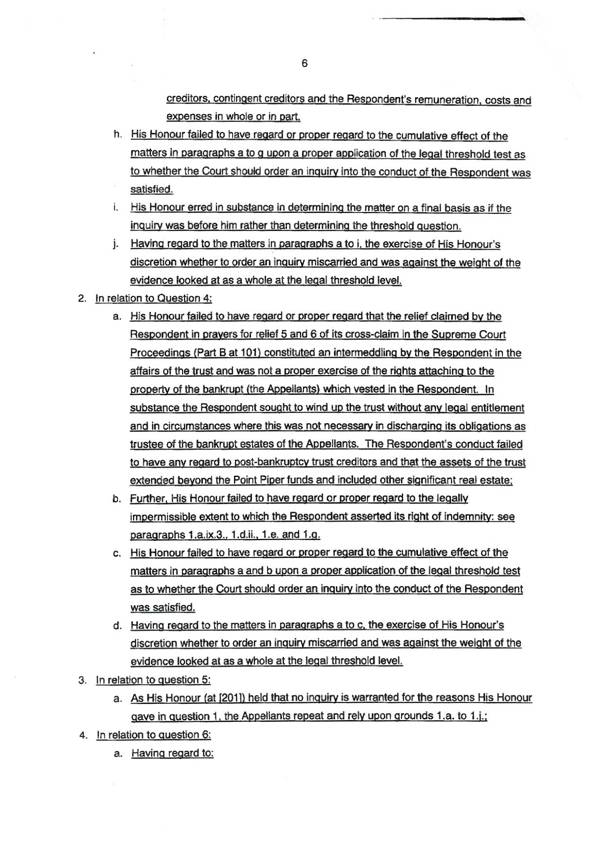
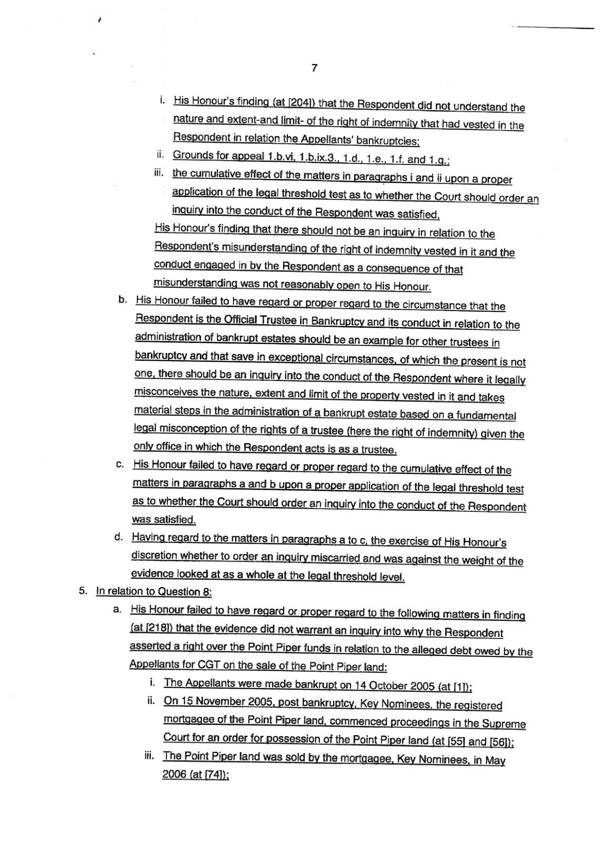
Did the respondent understand the nature and extent – and limit – of the bankrupt trustees’ right of indemnity which had vested in it?
60 One basis for the appellants’ proposition that there be an inquiry in this respect was expressed in the eleven grounds document as follows:
22 On 7 May 2009, almost three years after the respondent received almost $2 million of the third party’s money, the respondent by senior counsel conceded before the Court of Appeal that its legal claim to hold the whole fund was wrong.
23 As to an inquiry into the reasonableness of the respondent’s view, the respondent relies on the holding by a Supreme Court Judge in June 2008 as to the CGT. This overlooks the fact that no assertion as to CGT was ever made prior to 5 February 2008. Put another way, the respondent prior to 5 February 2008 must have thought that it was entitled to hold on to well over $1 million of someone else’s money when they had no basis for thinking any claim would be made.
24 As to an inquiry into the honesty of the respondent’s view, ground 7 provides a basis for asserting that there should be an inquiry.
61 The question is closely associated with questions 7 and 8. Question 7 dealt with the respondent’s failure to disclose the fact that the ATO had withdrawn the request that funds be retained by the respondent against a possible capital gains tax liability. Question 8 asked why the respondent had ever asserted a right over the funds which it held in respect of any such liability.
62 In the eleven grounds document the thrust of the appellants’ argument was that the respondent’s reliance upon the purported contingent liability for capital gains tax did not justify the retention of any sum prior to February 2008. They also submitted that the matters raised in question 7 offered a basis for doubting the honesty of the respondent’s claim to believe that there might have been such a tax liability.
63 The primary Judge concluded that the respondent did not understand the nature, extent and limitations of the indemnity. This conclusion was based largely upon the respondent’s concession, in the Court of Appeal, that some of the claims to indemnity, on which it succeeded at trial, could not be supported. However the respondent was entitled to an indemnity in respect of some trust debts, and the lien attached to all trust property. Thus, it was incorrect to assert, as the appellants did, that the respondent conceded that it had no right to an indemnity or supporting lien. Further, the basis of the respondent’s concession was that certain liabilities arose after the sequestration orders. Thus the debts were not provable in the bankruptcies, and the indemnities in respect of such debts did not vest in the respondent. This ground had not been raised at first instance. The plaintiffs had there unsuccessfully opposed the respondent’s claims on different grounds.
64 Concerning the possible capital gains tax liability, the primary Judge concluded that the respondent’s conduct was both honest and reasonable, save for the matters raised by question 7. See [207]-[209] and [216]-[217]. In particular, his Honour found that the question of such liability had first emerged shortly after the sale of the Point Piper land. As to the claims to indemnity in connection with the bankruptcy litigation costs and cross-claim costs, the primary Judge considered that such claims were incidents of the Supreme Court litigation, the respondent’s conduct of which was justified. We take that to mean that there was no significant adverse consequence for the administration of the bankrupt estates flowing from the making of such claims.
65 The appellants advanced no reasoned basis for concluding that any unfavourable consequences arose out of the respondent’s misunderstanding of its rights under the indemnity. In those circumstances the primary Judge correctly refused to order an inquiry into this question.
QUESTION 8
66 Question 8 asks:
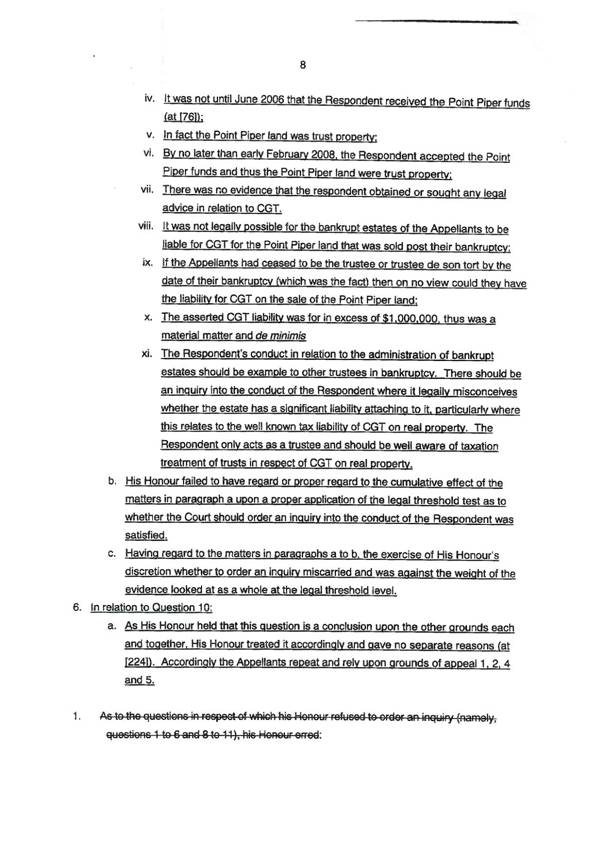
Why did the respondent ever assert a right over the funds held by it in relation to a debt allegedly owed by the trustee to the ATO?
67 As we have observed the primary Judge found that the respondent genuinely believed, from an early stage, that the bankrupt estates might have a liability for capital gains tax. The appellants have laid no basis for alleging that this honest belief was unreasonable.
68 As no error has been shown in connection with questions 1, 4, 5, 6 or 8, it follows that there should be no inquiry beyond that ordered at first instance.
THE DRAFT AMENDED NOTICE OF APPEAL
69 We return to the proposed grounds of appeal and the objections raised by the respondent to paras 1c, 1d, 1f and 1g of those proposed grounds. As we have said the appellants were invited to prepare an amended notice of appeal which reflected their submissions. See ts 54 l 43 and ts 92 ll 17-25. No provision was made for further submissions by either side. Clearly, the Court and the parties were proceeding on the basis that submissions had been completed. We do not understand the appellants to submit otherwise. In those circumstances, there can be no justification for allowing the appellants to raise issues going beyond their submissions. They have already been afforded considerable latitude. It is therefore necessary that we determine whether the paragraphs in question go beyond the appellants’ oral and written submissions.
70 Paragraph 1a of the draft asserts that the primary Judge erred in finding that it was not unreasonable for the respondent to require the plaintiffs to commence proceedings in order to determine ownership of the Point Piper funds. This is broadly the matter addressed in question 1 in the eleven grounds document. Paragraphs 1b-1h of the draft outline the bases upon which that general assertion is said to be based. Paragraphs 1c and 1d assert that, in relation to question 1:
c His Honour erred in finding (at [169]) that had the Respondent commenced Court proceedings to determine whether the Point Piper funds were trust funds such proceedings would not have been heard and determined substantially more quickly than the Supreme Court proceedings or at less expense.
d The finding in paragraph (d) was not reasonably available to His Honour as:
i. had the respondent commenced such proceedings it would have been in this Court exercising its exclusive bankruptcy jurisdiction which proceedings would have been heard and determined significantly more quickly than the three year period of the Supreme Court Proceedings;
ii. It was incumbent upon the Respondent to determine the nature of the property vested in it and the issue properly framed was a very narrow one;
iii. His Honour had no regard or no proper regard to the fact that the Respondent involved itself in lengthy Supreme Court Proceedings in a Court that did not have bankruptcy jurisdiction and where, by its cross-claim, the Respondent sought to have a Court without jurisdiction determine matters exclusively within this Court’s jurisdiction, namely which creditors were creditors of the bankrupts, the nature of the property which vested in the Respondent and whether, and if so, to what extent the Respondent’s remuneration, costs and the expenses could be paid out of that property … .
71 At [169] the primary Judge observed that:
… there is no reason to think that, in light of the history of the Supreme Court proceedings, the issues that would have been raised in those other modes of judicial determination would have differed in any substantial way from the issues raised in the Supreme Court proceedings, or to think that the other possible proceedings would have been heard and determined substantially more quickly than the Supreme Court proceedings, or with less expense. Indeed, as the moving party in the Supreme Court proceedings, Agusta had chosen its preferred forum for litigating its claims and was in a position to exert some measure of influence over when those proceedings were made ready for hearing.
72 In effect his Honour held that there was no evidence that the conduct of the proceedings in the Supreme Court had been slower or more expensive than would have been any attempt to resolve the dispute in proceedings contemplated by the Bankruptcy Act. Agusta chose its preferred forum, and the other plaintiffs were apparently content to adopt that choice. It seems that in the Supreme Court proceedings no party ever addressed the question of jurisdiction. It was not raised in the Court of Appeal or in the eleven grounds document. However the primary Judge obviously understood the appellants to have raised some question as to alternative procedures for resolving the dispute, leading to the findings set out above. The question seems not to have concerned the jurisdiction of the Supreme Court.
73 No complaint concerning the conduct of proceedings in the Supreme Court rather than in a bankruptcy court was raised in the original draft notice of appeal or in the appellants’ written submissions. The appellants’ case seems to have been simply that the respondent ought not to have insisted on the commencement of such proceedings or participated in them. In the course of argument on appeal, Foster J raised the question of jurisdiction at ts 23 ll 15-18. Counsel indicated that his submission was simply that the respondent should have dealt with the matter “differently”. At ts 85 ll 27-30, in submissions in reply, counsel for the appellants said that the respondent should have brought proceedings in this Court. Even at that stage, there was no reference to want of jurisdiction in the Supreme Court.
74 Although the question of jurisdiction was raised in argument, we do not accept that it formed any part of the appellants’ case. That case was a general assertion that the respondent ought to have avoided the litigation which in fact occurred, perhaps contemplating the possibility that proceedings might have been commenced in a court having jurisdiction in bankruptcy. Neither counsel for the appellants nor counsel for the respondent advanced any reasoned argument as to the jurisdiction question. Counsel for the appellants simply accepted the observation made by Foster J and proceeded with his argument. Counsel for the respondent conceded that there may have been a problem as to jurisdiction but went no further. He suggested that a previously understanding as to the jurisdiction of the Supreme Court may have been called into question by a decision of this Court. Clearly, it was not submitted before the primary Judge that the proceedings in the Supreme Court were beyond jurisdiction.
75 In the course of argument, Dowsett J observed that proceedings in a bankruptcy court may have proceeded more quickly than had the Supreme Court proceedings. The appellants seek to adopt this observation. However there is no evidence that these proceedings would have been disposed of more quickly or more cheaply had they been conducted in a bankruptcy court. The primary Judge concluded that no such delay or additional expense had been incurred. At no stage prior to the delivery of the proposed draft amended notice of appeal was there any indication of a challenge to that finding. Indeed, we see no basis upon which it could be challenged.
76 We will not permit the appellants to raise the matters alleged in paras 1c and 1d of the draft amended statement of claim.
77 Paragraph 1f and 1g assert that, with regard to question 1:
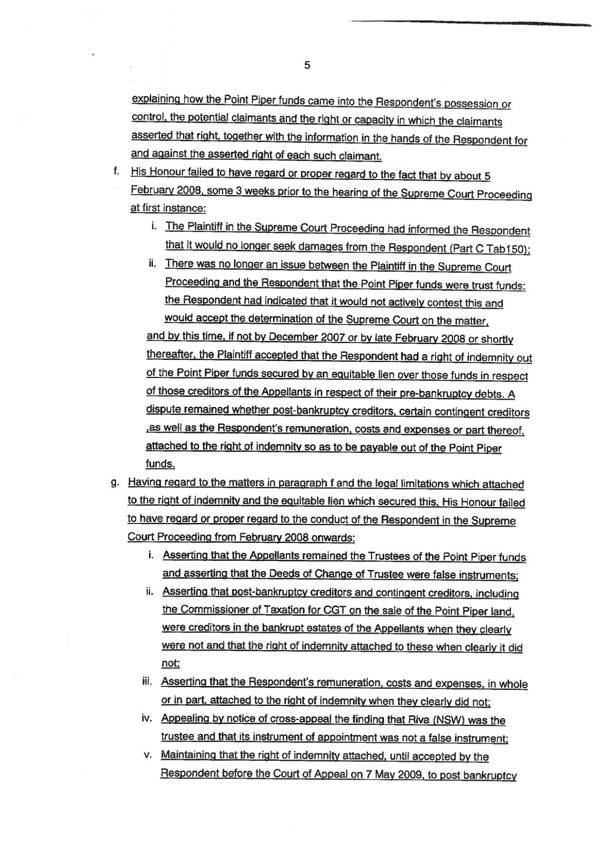
f. His Honour failed to have regard or proper regard to the fact that by about 5 February 2008, some 3 weeks prior to the hearing of the Supreme Court Proceeding at first instance:
i. The Plaintiff in the Supreme Court Proceeding had informed the Respondent that it would no longer seek damages from the Respondent (Part C Tab150);
ii. There was no longer an issue between the Plaintiff in the Supreme Court Proceeding and the Respondent that the Point Piper funds were trust funds: the Respondent had indicated that it would not actively contest this and would accept the determination of the Supreme Court on the matter,
and by this time, if not by December 2007 or by later February 2008 or shortly thereafter, the Plaintiff accepted that the Respondent had a right of indemnity out of the Point Piper funds secured by an equitable lien over those funds in respect of those creditors of the Appellants in respect of their pre-bankruptcy debts. A dispute remained whether post-bankruptcy creditors, certain contingent creditors as well as the Respondent’s remuneration, costs and expenses or part thereof, attached to the right of indemnity so as to be payable out of the Point Piper funds.
g. Having regard to the matters in paragraph f and the legal limitations which attached to the right of indemnity and the equitable lien which secured this, His Honour failed to have regard or proper regard to the conduct of the Respondent in the Supreme Court Proceeding from February 2008 onwards:
i. Asserting that the Appellants remained the Trustees of the Point Piper funds and asserting that the Deeds of Change of Trustee were false instruments;
ii. Asserting that post-bankruptcy creditors and contingent creditors, including the Commissioner of Taxation for CGT on the sale of the Point Piper land, were creditors in the bankrupt estates of the Appellants when they clearly were not and that the right of indemnity attached to these when clearly it did not;
iii. Asserting that the Respondent’s remuneration, costs and expenses, in whole or in part, attached to the right of indemnity when they clearly did not;
iv. Appealing by notice of cross-appeal the finding that Riva (NSW) was the trustee and that its instrument of appointment was not a false instrument;
v. Maintaining that the right of indemnity attached, until accepted by the respondent before the Court of Appeal on 7 May 2009, to post bankruptcy creditors, contingent creditors and the Respondent’s remuneration, costs and expenses in whole or in part.
78 It is difficult to identify any substance in these paragraphs. It seems to be suggested that evidence concerning events in early or late February 2008 or “shortly thereafter” should have led the primary Judge to a different conclusion concerning question 1, presumably as to the reasonableness of the respondent’s conduct of the Supreme Court proceedings after those dates. This claim seems not to have been raised in the appellants’ amended statement of claim in which there is no reference to the matters identified in subparas 1f(i) and (ii), and only an indirect reference to the matters referred to in the balance of para 1f. At [184] the primary Judge refers to events in February 2008, without identifying them, but otherwise does not deal with any submission reflecting the matters raised in para 1f. There is no such submission in the appellants’ written submissions. Counsel did not make any oral submission to that effect.
79 The factual assertions made in subparas 1f(i) and (ii) are, in any event problematic. We do not understand the plaintiffs to have indicated that they would no longer seek damages from the respondent. They rather indicated that they would not do so in the Supreme Court proceedings. The assertion that there was no longer an issue between the plaintiffs and the respondent as to whether the Point Piper funds were trust funds seems to be an overstatement. The respondent indicated that it would not actively contest the matter and would accept the Court decision, clearly putting the plaintiffs to proof.
80 Paragraph 1g identifies the respondent’s conduct from February 2008 onwards. It is, in effect, a particularization of the complaint made in para 1f. We will not permit the appellants to raise the matters contained in paras 1f or 1g.
81 The appellants will have leave to file the proposed notice of appeal, excluding paras 1c, 1d, 1f and 1g.
ORDERS
82 We order that:
the time in which the applicants may apply for leave to appeal against the orders of Yates J made on 6 June 2011 be extended until 7 March 2012;
the appellants have leave to appeal accordingly;
the appellants file, within seven days of the delivery of these reasons, a notice of appeal in the form annexed to these reasons, excluding paras 1c, 1d, 1f and 1g thereof;
the appeal be dismissed; and
the appellants pay the respondent’s costs of the appeal and associated applications.
|
I certify that the preceding eighty-two (82) numbered paragraphs are a true copy of the Reasons for Judgment herein of the Honourable Justices Dowsett, Foster and Nicholas. |
Associate: