

FEDERAL COURT OF AUSTRALIA
Minister for Immigration and Citizenship v SZQRB [2013] FCAFC 33
FEDERAL COURT OF AUSTRALIA
Minister for Immigration and Citizenship v SZQRB [2013] FCAFC 33
CORRIGENDUM
1 In paragraphs 213 and 220 of the Reasons for Judgment, the references to “Sri Lanka” should read “Afghanistan”.
I certify that the preceding one (1) numbered paragraph is a true copy of the Corrigendum to the Reasons for Judgment herein of the Honourable Justices Lander and Gordon. |
Associate:
Dated: 22 March 2013
IN THE FEDERAL COURT OF AUSTRALIA | |
MINISTER FOR IMMIGRATION AND CITIZENSHIP Applicant | |
AND: | Respondent |
LANDER, BESANKO, GORDON, FLICK & jagot JJ | |
DATE OF ORDER: | |
WHERE MADE: |
THE COURT ORDERS THAT:
1. SZQRB provide written submissions in relation to the declaration and injunction to be made not exceeding three pages and short minutes of order, reflecting these reasons, within three business days.
2. The Minister for Immigration and Citizenship provide written submissions in relation to the declaration and injunction to be made not exceeding three pages and short minutes of order, reflecting these reasons, within six business days.
Note: Entry of orders is dealt with in Rule 39.32 of the Federal Court Rules 2011.
IN THE FEDERAL COURT OF AUSTRALIA | |
VICTORIA DISTRICT REGISTRY | |
GENERAL DIVISION | VID 763 of 2012 |
BETWEEN: | SZQRB Applicant |
AND: | MINISTER FOR IMMIGRATION AND CITIZENSHIP Respondent |
JUDGES: | LANDER, BESANKO, GORDON, FLICK & jagot JJ |
DATE OF ORDER: | 20 MARCH 2013 |
WHERE MADE: | MELBOURNE |
THE COURT ORDERS THAT:
1. SZQRB provide written submissions in relation to the declaration and injunction to be made not exceeding three pages and short minutes of order, reflecting these reasons, within three business days.
2. The Minister for Immigration and Citizenship provide written submissions in relation to the declaration and injunction to be made not exceeding three pages and short minutes of order, reflecting these reasons, within six business days.
Note: Entry of orders is dealt with in Rule 39.32 of the Federal Court Rules 2011.
VICTORIA DISTRICT REGISTRY | |
GENERAL DIVISION | VID 712 of 2012 |
BETWEEN: | MINISTER FOR IMMIGRATION AND CITIZENSHIP Applicant
|
AND: | SZQRB Respondent |
JUDGES: | LANDER, BESANKO, GORDON, FLICK & jagot JJ |
DATE: | 20 MARCH 2013 |
PLACE: | MELBOURNE |
IN THE FEDERAL COURT OF AUSTRALIA | |
VICTORIA DISTRICT REGISTRY | |
GENERAL DIVISION | VID 763 of 2012 |
BETWEEN: | SZQRB Applicant
|
AND: | MINISTER FOR IMMIGRATION AND CITIZENSHIP Respondent
|
JUDGES: | LANDER, BESANKO, GORDON, FLICK & jagot JJ |
DATE: | 20 MARCH 2013 |
PLACE: | MELBOURNE |
REASONS FOR JUDGMENT
LANDER AND GORDON JJ:
Introduction
1 There are two applications before the Court; an application by the Minister for Immigration and Citizenship (the Minister) for leave to appeal from an interlocutory injunction, granted by a Federal Magistrate restraining the Minister from removing SZQRB from Australia before the hearing and determination of a proceeding brought by SZQRB seeking, inter alia, an order quashing a decision of the Minister made on 21 September 2012 (the application for leave); and the proceeding in which the interlocutory injunction was granted, which began as an application by SZQRB in the Federal Magistrates Court for, as we have said, an order quashing a decision of the Minister made on 21 September 2012; a writ of mandamus requiring SZQRB’s application for protection to be determined according to law; a declaration that the Minister’s decision made on 21 September 2012 was not made in accordance with law; an injunction restraining the Minister from relying upon an International Treaties Obligations Assessment (ITOA); and interlocutory relief being the injunction that was granted (the substantive proceeding).
2 The grounds of the application for relief in the substantive proceeding were:
1. The Minister erred by making his decision “on the basis of” an “International Treaties Obligations Assessment” because that Assessment applied the wrong standard of proof when assessing whether the Minister could have “substantial grounds for believing” that the Applicant would be arbitrarily deprived of his life.
2. The Minister’s decision was in error because it is not and can never be in the public interest, nor can it be thought to be in the public interest, to send a person to a place where there are substantial grounds for believing that they will be subject to arbitrary deprivation of life, torture, cruel, inhuman or degrading treatment.
The Applicant reserves the right to rely upon additional grounds or amend the existing grounds of this application.
3 The relief sought and the grounds for the relief have changed since the proceeding was started. The changes will need to be identified.
4 The application for leave to appeal comes to this Court under s 24(1A) of the Federal Court of Australia Act 1976 (Cth) (Federal Court Act).
5 The substantive proceeding was brought in the Federal Magistrates Court but was removed into this Court by an order made by a Federal Magistrate on 3 October 2012, pursuant to s 39 of the Federal Magistrates Act 1999 (Cth) (FM Act). On the same day, the Federal Magistrate gave leave for SZQRB to file an amended originating application by 10.00am on 4 October 2012. On 4 October 2012, in accordance with the leave given by the Federal Magistrate, SZQRB filed in the Federal Court an amended originating application.
6 In that amended originating application, SZQRB sought wider relief:
 An order that the decision of the Minister be quashed.
A writ of mandamus directed to the tribunal or Minister, requiring themhim to determineconsider the applicant’s application according to law.
…
(state precisely each other order sought by way of final relief)
1. A declaration that the Minister’s decision dated 21 September 2012 was not made in accordance with law, by reason of any or all of the grounds of this application.
2. An injunction restraining the Minister, by himself or by his Department, officers, delegates or agents, from relyingacting upon the International Treaties Obligations Assessment and/ or the Independent Merits Review.
3. The Respondent pay the Applicant’s costs of this proceeding.
4. Such other orders as the Court deems fit.
7 The grounds for the relief were:
1. The Minister erred by making his decision “on the basis of” an:
a. the “International Treaties Obligations Assessment” because:
1.i. that Assessment applied the wrong standard of proof when assessing whether the Minister could have “substantial grounds for believing” that the Applicant would be arbitrarily deprived of his life. and/or
ii. it was made by a process that denied the Applicant procedural fairness in that he was not given any opportunity to:
1. be heard in person on the questions relevant to the Assessment; and/or
2. respond to the substance and source of information that the Assessor relied upon as being credible, relevant and significant in making that Assessment including:
a. the report referred to in footnote 33 and 35 and quoted on p 10 of the Assessment (which post-dates the Applicant’s submission to the Assessor);
b. the report referred to in footnote 46 and quoted on p 13 of the Assessment (which also post-dates the Applicant’s submission to the Assessor); and
c. the Memoranda of Understanding between Australia, Afghanistan and UNHCR referred to on pp 5, 6 and 8 of the Assessment.
b. the Independent Merits Review because it denied the Applicant procedural fairness in reaching its conclusion in relation to “persecution into the reasonably foreseeable future” on the basis of “ethnicity/race and religion” by relying on information about the conditions of withdrawal of “Western powers” from Afghanistan which was not put to the Applicant in form or in substance but which was regarded as credible, relevant and significant to that recommendation.
2. The Minister’s decision was in error because it is not and can never be in the public interest, nor can it be thought to be in the public interest, to-:
2.a. send a person to a place where there are substantial grounds for believing that they will be subject to arbitrary deprivation of life, torture, cruel, inhuman or degrading treatment. and/or
The Applicant reserves the right to rely upon additional grounds or amend the existing grounds of this application.
b. make a decision that does not have regard to a statutory provision relevant to the subject of that decision, namely s 36(2)(aa) of the Migration Act 1958 (Cth).
8 We think it was inappropriate for the Federal Magistrate to give SZQRB leave to file an amended originating application without knowing the amendments that were to be made and the relief that was to be sought. There are circumstances when it might be appropriate to grant leave in advance of sighting a proposed amendment to an originating application or a pleading, but this was not such a case. In this case, the grant of leave allowed SZQRB to introduce a new ground, ground 1.b., to which the Minister later objected.
9 On 4 October 2012, Tracey J gave directions for the hearing of both the application for leave to appeal and the substantive proceeding and vacated the previous directions made by the Federal Magistrate. He ordered, pursuant to s 25(2)(e) of the Federal Court Act, that the application for leave to appeal be heard by a Full Court, and that the application for leave to appeal and any appeal be heard concurrently. He made a further order that:
The Minister be restrained, by himself or his Department, officers, delegates or agents from removing SZQRB from Australia before the hearing and determination of these proceedings.
10 It is not clear why that further order was made, but no complaint, surprisingly, has been made by the Minister.
11 Subsequently, on 10 October 2012, the Chief Justice issued a direction pursuant to s 20(1A) of the Federal Court Act that the substantive proceeding be heard by the Full Court in the original jurisdiction of this Court.
The hearing of the appeal
12 The applications were heard over two days; 2 November 2012 and 7 December 2012. On the first day, the Court was constituted by Lander, Besanko and Flick JJ when SZQRB’s counsel, Ms Mortimer SC, submitted that a decision of the Full Court of the Federal Court, SZQDZ v Minister for Immigration and Citizenship (2012) 200 FCR 207 given on 13 March 2012 (“SZQDZ”), should not be followed because it was plainly wrong. Ms Mortimer completed her submissions on SZQRB’s claim for relief in the substantive proceeding and the hearing was adjourned to the next available date, being 7 December 2012. In the meantime, having regard to the submission made, consideration was given to whether the Court should be reconstituted by five judges.
13 On 26 November 2012, a directions hearing was held, during which the parties did not object to the Court being reconstituted as a court of five judges. Ms Mortimer agreed that the two further judges who were to join the Court could rely upon her written submissions and the transcript of the hearing on the first day without her needing to put her argument in the substantive proceeding again.
14 That course was adopted. Justices Gordon and Jagot joined the Court for the second day of the hearing.
The history
15 SZQRB is a national of Afghanistan of Hazara ethnicity and an adherent of the Shia Muslim religion. He was born in 1978 and lived in Chill Bakhto in Jaghori District in Ghazni Province until he left for Australia in February 2010.
16 SZQRB claimed that he left Afghanistan because it is an unsafe place and the Taliban catch Hazaras and kill them because of their ethnicity and their practise of religion. He initially said he left Afghanistan for no other reasons apart from his ethnicity and religion. He later claimed to the Independent Merits Reviewer (IM Reviewer) that he would be also persecuted for his imputed political opinion. His case was that if he were to return to Afghanistan, the Taliban would kill him.
17 He left Afghanistan by driving to Quetta where he met a people smuggler. He flew from Karachi to Kuala Lumpur and then to Jakarta where he stayed for about three months. He boarded a boat in Makassar in Indonesia and sailed for Australia. He was arrested in Koepang. However, he paid a bribe and sailed in another boat designated “SIEV 151 (NAKARA)”, which was intercepted on its way to Australia, and on 23 May 2010, he was taken to Christmas Island. The cost of his travel to Australia was US$16,000.
18 He was detained at Christmas Island under s 189(3) of the Migration Act 1958 (Cth) (Migration Act), which provides that an officer (as defined in the Migration Act) must detain an unlawful non-citizen in an excised offshore place.
19 SZQRB was first interviewed on 30 June 2010. On 2 August 2010, SZQRB was transferred to the Australian mainland where he was detained under s 189(1) of the Migration Act, which provides that an officer must detain an unlawful non-citizen in the migration zone.
20 On 30 October 2010, SZQRB, who claims to be a refugee and thus a person to whom Australia has protection obligations, requested an assessment by the Department of Immigration and Citizenship (the Department) of his refugee status under the Refugee Status Assessment (RSA) process. On 17 February 2011, a delegate of the Minister completed the RSA and rejected SZQRB’s application for protection. SZQRB was advised the same day. On 9 March 2011, SZQRB requested an Independent Merits Review (IMR). On 15 August 2011, the IM Reviewer affirmed the decision made by the delegate and recommended that SZQRB not be recognised as a person to whom Australia owes protection obligations under the 1951 Convention relating to the Status of Refugees as amended by the 1967 Protocol relating to the Status of Refugees (Refugees Convention). On 18 August 2011, SZQRB was advised of the recommendation of the IM Reviewer.
21 On 20 September 2011, SZQRB applied in the Federal Magistrates Court for judicial review of the decision of the IM Reviewer seeking a declaration that the decision was not made in accordance with law because it was affected by legal error. On 3 February 2012, Federal Magistrate Cameron dismissed SZQRB’s application: SZQRB v Minister for Immigration & Anor [2012] FMCA 75. No appeal was brought at that time from the order dismissing SZQRB’s application.
22 On 28 February 2012, the Minister, on his own motion, granted SZQRB a temporary safe haven (subclass 449) visa, which was valid until 6 March 2012 and a bridging E (subclass 050) visa (bridging visa), which was valid until 28 August 2012. Because the grant of these visas made SZQRB a lawful non-citizen, SZQRB was released from detention.
23 On 22 March 2012, an ITOA was completed in relation to SZQRB by officers of the Department, which concluded that if SZQRB were removed to Afghanistan, that removal would not be in breach of Australia’s non-refoulement obligations under the Convention Against Torture and Other Cruel, Inhuman or Degrading Treatment or Punishment (CAT) and the International Covenant on Civil and Political Rights (ICCPR).
24 That same day, SZQRB was notified by the Department that the Department had not found any international obligations owing to SZQRB, or unique and exceptional circumstances in his case and, as a result, his case had not been referred to the Minister for the Minister’s consideration.
25 He was told in that notification:
This means that, if there are no outstanding matters, the department will make arrangements for your removal to Kabul. A removals officer will provide you with information about this process.
Should you decide to depart Australia voluntarily, please speak with your case manager or the International Organization for Migration. You may be able to receive assistance, including help following your return to re-establish yourself in your home country. You should do this before your removal arrangements are finalised.
26 On 23 August 2012, the Victorian Onshore Protection Director of the Department completed a Pre-removal clearance in relation to SZQRB concluding that there was no indication that SZQRB’s removal from Australia to Afghanistan would attract the adverse attention of the Afghan Government or that SZQRB would attract adverse attention during entry procedures in Afghanistan. The Pre-removal clearance concluded that SZQRB’s removal to Afghanistan did not raise concerns relating to Australia’s non-refoulement obligations and that SZQRB’s removal did not warrant any departmental protection assessment.
27 On 28 August 2012, SZQRB’s bridging visa expired and, as a consequence, SZQRB again became an unlawful non-citizen in the migration zone and liable to be detained: s 189(1).
28 On 29 August 2012, SZQRB was detained in Maribyrnong Immigration Detention Centre. On the same day, the Department issued SZQRB with a notice of intention for his removal from Australia, which advised SZQRB that it expected that he would be removed to Afghanistan on 23 September 2012.
29 On 31 August 2012, SZQRB’s present lawyers, Russell Kennedy, commenced to act for SZQRB.
30 On 20 September 2012, SZQRB filed an application for an extension of time within which to appeal from the order of the Federal Magistrate made on 3 February 2012 that dismissed SZQRB’s application for judicial review of the decision of the IM Reviewer.
The decision of which complaint is made
31 On 21 September 2012, the Department provided a submission to the Minister for the purpose of the Minister making a decision. The submission included the following information:
1. On 23 May 2010, [SZQRB] arrived as an irregular maritime arrival (IMA) on a boat codenamed Nakara.
2. On 30 October 2010 a request for a Refugee Status Assessment was received from [SZQRB] with a statement of claims for protection. This was followed by an RSA interview on 2 November 2010.
3. [SZQRB] was found not to engage Australia’s protection obligations under the Convention Relating to the Status of Refugees (as amended by the 1967 Protocol) by an officer of the Department on 17 February 2011.
4. [SZQRB] subsequently applied for an Independent Merits Review on 9 March 2011 and was interviewed on 21 July 2011.
5. The IMR Reviewer subsequently found [SZQRB] not to engage Australia’s protection obligations under the Convention Relating to the Status of Refugees (as amended by the 1967 Protocol) on 15 August 2011.
6. Subsequent to this decision, a submission to inform an International Treaties Obligations Assessment (ITAO) (sic) was received from [SZQRB] on 3 October 2011.
7. This submission was assessed by an officer of the Department against the Convention against Torture and Other Cruel, Inhuman or Degrading Treatment or Punishment (CAT) and the International Covenant on Civil and Political Rights (ICCPR) and its Second Optional Protocol.
8. As a result of this assessment, the officer was satisfied that there was no new information before them that would change the client’s previous assessment against the Convention Relating to the Status of Refugees (as amended by the 1967 Protocol). In addition, having reviewed the client’s claims and the relevant information put forward, as well as key country information, the officer found that there were no substantial grounds for believing that [SZQRB] would be arbitrarily deprived of his life, have the death penalty carried out on him, be tortured or subject to cruel, inhuman or degrading treatment or publishment as a necessary and foreseeable consequence of return to Afghanistan.
9. The officer concluded that [SZQRB’s] removal to Afghanistan would not breach Australia’s non-refoulement obligations under the CAT or ICCPR.
10. [SZQRB] is scheduled for removal from Australia to Afghanistan on Sunday, 23 September 2012.
32 On the same day, the Minister made the decision of which complaint is made. That decision has been reduced to writing:
Decision record relating to the exercise of the Minister’s non-compellable powers – [SZQRB]
On the basis of:
(1) the recommendation by the Independent Merits Reviewer dated 15 August 2011 that [SZQRB] not be recognised as a person to whom Australia has protection obligations under the 1951 Convention relating to the Status of Refugees as amended by the 1967 Protocol relating to the Status of Refugees;
(2) the International Treaties Obligation Assessment dated 22 March 2012 with respect to [SZQRB]; and
(3) the Pre-removal clearance dated 23 August 2012 with respect to [SZQRB];
I think that the return of [SZQRB] to Afghanistan is consistent with Australia’s international obligations (including, but not limited to, Australia’s obligations under the Refugees Convention, the International Covenant on Civil and Political Rights, and the Convention Against Torture and Other Cruel, Inhuman or Degrading Treatment or Punishment).
However, whether or not that view is correct, and irrespective of:
(1) whether or not any legal or factual error was made by the Independent Merits Reviewer;
(2) whether or not any legal or factual error was made by the officers who undertook the International Treaties Obligation Assessment or the Pre-removal clearance; or
(3) any other circumstance;
I have decided not to consider, or not to further consider, the exercise of any of my personal non-compellable public interest powers under the Act with respect to [SZQRB] (including, without limitation, my powers under ss 91L and 195A of the Act).
33 As item 10 of the Department’s submission shows, the Minister made that decision in the knowledge that it was intended that SZQRB would be removed from Australia on Sunday, 23 September 2012.
34 Also on 21 September 2012, SZQRB filed an application seeking an injunction restraining the Minister from removing SZQRB from Australia until the application for an extension of time within which to appeal, and any subsequent appeal, had been dealt with. The application for an extension of time, and the application for an injunction, were heard by Buchanan J on 21 September 2012, and both applications were rejected by Buchanan J later that evening. Immediately after judgment had been delivered, counsel for SZQRB made an oral application for an interim injunction to preserve the subject matter of any appeal to be made either to a Full Court of this Court, or to the High Court. Justice Buchanan decided that the Court lacked jurisdiction to make the order sought and dismissed the oral application for an interim injunction: SZQRB v Minister for Immigration and Citizenship [2012] FCA 1053.
35 On 22 September 2012, SZQRB brought the substantive proceeding in the Federal Magistrates Court, mentioned in [1] of these reasons.
The interlocutory injunction
36 The interlocutory relief sought by SZQRB in the substantive proceeding was an:
Interlocutory injunction restraining the Minister, by himself or his Department, officers, delegates or agents from removing the Applicant from Australia before the hearing and determination of these proceedings, and expiration of any period in which an appeal can be lodged.
37 On 22 September 2012, Federal Magistrate Riley heard the application for an interlocutory injunction and made an order that:
The Minister be restrained, by himself or his Department, officers, delegates or agents from removing the applicant from Australia before the hearing and determination of these proceedings.
38 It is that order which is the subject of the Minister’s application for leave to appeal.
39 The Federal Magistrate also made a series of directions which are not relevant on this appeal.
40 In her ex tempore reasons, the Federal Magistrate referred to the history leading up to the Minister’s decision on 21 September 2012. She referred to the decision of the Full Court of this Court in SZQDZ, upon which the Minister relied in opposition to the grant of the injunction. She referred to Plaintiff S10/2011 v Minister for Immigration and Citizenship (2012) 290 ALR 616 (“Plaintiff S10”) at [59], which SZQRB said stood for the proposition that “procedural fairness must attend the consideration by the Minister of whether to exercise his power under s.46A(2) to determine that s.46A(1) of the Act did not apply”.
41 She said at [20]-[22]:
20. In all circumstances of this case, I consider that the injunction ought to be granted. It seems to me that there are strong reasons indicating that the balance of convenience favours the applicant. It seems to me that there is a real issue about whether the power of the Minister under s.46A is completely unfettered, as the Minister argues, or whether the apparent rider contained in Plaintiff S10 at [59] applies as broadly as the applicant in this case contends. It seems to me that these are questions that need to be considered fully. If the applicant were deported now, it would prevent those questions being fully considered in this case.
21. I note that the Minister’s decision that he would not further consider anything in relation to this matter was made yesterday, and the intention is that the applicant be deported tomorrow. It has not been explained to me why there is any particular urgency in the applicant being returned to Afghanistan.
22. I accept that, until only a few days ago, the applicant did nothing after Cameron FM handed down his decision in February this year. However, in all the circumstances of this case, it seems to me the proper course is to issue the injunction and allow this matter to be dealt with more carefully and fully than can be done at the moment.
The applications to amend the originating application in the substantive proceeding
42 SZQRB made a further application to this Court to further amend the originating application in the substantive proceeding, in accordance with a proposed amended originating application, which was attached to SZQRB’s submissions in the substantive proceeding.
43 The interlocutory relief sought was the same. The final relief sought was different. An order quashing the Minister’s decision was sought. The writ of mandamus sought in the original application was no longer sought. The relief sought was:
An order that the decision of the Minister be quashed.
…
A declaration that the recommendation of the Independent Protection Assessment Merits Reviewer was not made in accordance with law, by reason of the ground/s of this application.
An injunction restraining the Minister, by himself or by his Department, officers, delegates or agents, from acting or relying upon the recommendation of the Independent Protection Assessment Merits Reviewer.
(state precisely each other order sought by way of final relief)
1. A declaration that the Minister’s decision dated 21 September 2012 was not made in accordance with law, by reason of any or all of the grounds of this application.
2. A declaration that the International Treaties Obligations Assessment was not made in accordance with law.
3. An injunction restraining the Minister, by himself or by his Department, officers, delegates or agents, from acting or relying upon the International Treaties Obligations Assessment and/ or the Independent Merits Review.
4. An injunction restraining the Minister, by himself or his Department, officers, delegates or agents from removing the Applicant from Australia.
5. The Respondent pay the Applicant’s costs of this proceeding.
6. Such other orders as the Court deems fit.
44 The grounds of the application were sought to be enlarged:
1. The Minister’s decision is affected by jurisdictional error, in that:
a. it misconceives the Minister’s task by asserting expressly that the decision can be made:
i. without regard to recommendations produced through the two processes established by the Minister to inform his decision; and/or
ii. on the basis of legal or factual error of any kind
iii. ‘irrespective of any other circumstance’, including a change in law or fact applicable to the claimant;
b. it was subject to prejudgment, alternatively made for an extraneous purpose, in that well prior to 21 September 2012, the Applicant had been identified as subject for removal and arrangements had been made to that effect.
2. The Minister erred by making his decision ‘on the basis of’:
a. the ‘International Treaties Obligations Assessment’ because:
i. that Assessment applied the wrong standard of proof when assessing whether the Minister could have ‘substantial grounds for believing’ that the Applicant would be arbitrarily deprived of his life and/or
ii. it was made by a process that denied the Applicant procedural fairness in that he was not given any opportunity to:
1. be heard in person on the questions relevant to the Assessment; and/or
2. respond to the substance and source of information that the Assessor relied upon as being credible, relevant and significant in making that Assessment including:
a. the report referred to in footnote 33 and 35 and quoted on p 10 of the Assessment (which post-dates the Applicant’s submission to the Assessor);
b. the report referred to in footnote 46 and quoted on p 13 of the Assessment (which also post-dates the Applicant’s submission to the Assessor); and
c. the Memoranda of Understanding between Australia, Afghanistan and UNHCR referred to on pp 5, 6 and 8 of the Assessment.
b. the Independent Merits Review because:
i. it denied the Applicant procedural fairness in reaching its conclusion in relation to ‘persecution into the reasonably foreseeable future’ on the basis of ‘ethnicity/race and religion’ by relying on information about the conditions of withdrawal of ‘Western powers’ from Afghanistan which was not put to the Applicant in form or in substance but which was regarded as credible, relevant and significant to that recommendation; and/or
ii. the Applicant was denied a fair hearing in that the Reviewer gave him no meaningful or real opportunity to understand or respond to the country information the Reviewer proposed to rely upon.
45 SZQRB did not provide any written submissions in support of the application for leave to amend the originating application merely annexing a copy of the proposed amended originating application to his submissions in the substantive proceeding.
46 The Minister, both in his written and oral submissions, opposed the application to amend insofar as the application sought to raise grounds for review that were not before the Federal Magistrate except for one ground, ground 1.a., which the Minister said reflects the dispute between the parties and underscores the Federal Magistrate’s reasons for the grant of the interlocutory injunction, even though it was not a ground before the Federal Magistrate.
47 The application to this Court was to include new grounds 1.a., 1.b. and 2.b.ii. The proposed amended originating application relabelled the former ground 1.a. as ground 2.a. It relabelled the former ground 1.b. as ground 2.b.i. and introduced a new ground 2.b.ii. It abandoned the former ground 2.
48 In his oral submissions, the Minister not only opposed the introduction of ground 2.b.ii., but also contended that this Court should not consider ground 2.b.i. Both grounds relied upon claims that the IMR was infected by jurisdictional error.
49 Ground 2.b.i. had been included in the amended originating application filed on 4 October 2012 by leave granted by Federal Magistrate Riley on 3 October 2012. At the hearing before this Court, the Minister argued that ground 2.b. should not be allowed in its entirety. Whether he was arguing that ground 2.b.i. should be struck out and ground 2.b.ii. not permitted to be included does not matter much. The parties addressed ground 2.b. as the one ground with two particulars, which was sensible having regard that it related to the same IMR which had already been reviewed.
50 As we have said, the Minister does not object to SZQRB amending to introduce ground 1.a.. We would therefore allow that amendment.
51 Ground 1.b. was abandoned by SZQRB on the first day of the hearing, and nothing further need be said in relation to that ground.
52 Ground 2.a. relates to the ITOA, which had not been completed when SZQRB applied to Federal Magistrate Cameron for a judicial review and when Federal Magistrate Cameron made his decision on 3 February 2012.
53 SZQRB’s original originating application complained of the Minister relying upon the ITOA which, it was said, applied the wrong standard of proof. SZQRB sought in that original application an injunction restraining the Minister from relying upon the ITOA. In the amended originating application filed pursuant to leave given by Federal Magistrate Riley, ground 2.a. was, as we have said, included as ground 1.a. There is no good reason why SZQRB cannot now seek judicial review of the ITOA for the purpose of seeking a declaration from this Court in respect of it.
54 The Minister referred to the procedural history of the substantive proceeding and the directions made by Tracey J on 4 October 2012. The application to amend the originating application in this Court followed Federal Magistrate Riley’s orders that SZQRB file an amended originating application by 10.00am on 4 October 2012. However, those orders did not mean that SZQRB could not make a further application for leave to amend the originating application. The substantive proceeding is not an appeal. It is an application being heard in the original jurisdiction of the Court for the reasons earlier described. The fact that it is being heard by the Full Court should not circumscribe SZQRB’s rights to amend the originating application to better express the grounds upon which the application for judicial review is sought and the relief sought.
55 The Minister contended that leave should not be granted to amend the originating application to include ground 2.b.ii. or to allow SZQRB to maintain ground 2.b.i. for two reasons. First, because the grant of leave would require this Court to consider in detail the conduct of the IM Reviewer, which would require an inordinate amount of judicial time having regard to the time available. That ground of opposition should be rejected. If SZQRB is entitled to make a claim of the kind in ground 2.b., this Court would not refuse to hear him because it would take up the Court’s time. This proceeding is important to SZQRB and this Court should hear his proceeding if in law he is entitled to bring it.
56 The Minister’s second ground for objection was that the IMR had been the subject of an application for judicial review in the Federal Magistrates Court, which was, as we have said, dismissed by Federal Magistrate Cameron on 3 February 2012: SZQRB v Minister for Immigration & Anor [2012] FMCA 75. Moreover, as has already been noted, on 21 September 2012, SZQRB sought an extension of time to appeal from Federal Magistrate Cameron’s order dismissing the application for judicial review, and also sought an injunction restraining the Minister from removing SZQRB from Australia, but those applications were dismissed by Buchanan J on that evening: SZQRB v Minister for Immigration and Citizenship [2012] FCA 1053.
57 The Minister’s second ground of objection is, in our opinion, compelling. If SZQRB were to be allowed to raise ground 2.b.ii. by way of amendment and to pursue ground 2.b.i., it would allow SZQRB to argue again the same ground that had been argued before Federal Magistrate Cameron in a proceeding which was dismissed; and for which an extension of time to appeal from that dismissal has been dismissed. SZQRB has previously challenged the IM Reviewer’s recommendation and failed. He has been refused an extension of time to appeal. He has exhausted his claims for judicial review of that decision at least in this Court. We would, therefore, refuse to allow the amendment to include ground 2.b.ii. Insofar as it is necessary, we would strike out ground 2.b.i., which, as we have said, was ground 1.b. in the amended originating application filed by leave of Federal Magistrate Riley.
58 There is one further argument which was put by the Minister that should be addressed. The Minister argued that because SZQRB did not seek a permanent injunction in the substantive proceeding in the Federal Magistrates Court and before that proceeding was removed to this Court, he could not seek such relief in this Court. The Minister argued that this Court’s jurisdiction is limited by s 476A of the Migration Act. The Federal Magistrates Court has jurisdiction, so the argument went, to hear applications for judicial review subject to the limitations in s 476 of the Migration Act. That being the case, SZQRB cannot seek a permanent injunction in this Court when no injunction was sought in the Federal Magistrates Court.
59 That argument should be rejected. The order made by the Federal Magistrate on 3 October 2012 was to remove the proceeding into this Court for hearing and determination. The order for removal did not limit the relief that SZQRB could seek to that which he had sought prior to the order. SZQRB was entitled to seek in this Court any relief that he could have obtained in the Federal Magistrates Court. It was not the relief sought in the substantive proceeding that was removed into this Court, but the substantive proceeding itself.
60 SZQRB should be entitled to amend his originating application limited to grounds 1.a. and 2.a. of the proposed amended originating application.
61 During the hearing, SZQRB handed up a document “Final orders sought by SZQRB” (the Final Orders). The permanent injunction sought in the Final Orders was in a different form to that sought in the proposed amended originating application:
7. An injunction restraining the Minister, by himself or his Department, officers, delegates or agents from removing the Applicant from Australia. An injunction restraining the Minister, by himself or by his Department, officers, delegates or agents, from removing, taking steps or giving any direction to remove the Applicant until each of the following events has occurred:
i) the Minister decides afresh whether or not to permit the Applicant to make a valid visa application under the Migration Act, or whether or not to grant the Applicant a substantive visa under s 195A of the Act; and
ii) the Applicant is notified of the Minister’s decision; and
iii) 35 days have passed from the date of the Minister’s decision; and
iv) no proceeding challenging the validity of that decision has been initiated by or on behalf of the Applicant.
62 For the reasons that follow, an order in the nature of the injunction in the form of paragraph 7 would not be appropriate.
63 Whilst SZQRB would be entitled to an injunction, for the reasons that follow, that entitlement relates to his threatened removal from Australia.
The legislative scheme
64 Both the substantive proceeding and the application for leave require an understanding of the legislative scheme and its application to SZQRB. It is also necessary to understand the decision that the Minister made.
65 The Migration Act provides for the circumstances in which a person who is not a citizen of Australia (a non-citizen) may enter Australia.
66 It provides, subject to certain exceptions that are not here relevant, that a non-citizen must not travel to Australia without a visa that is in effect: s 42(1).
67 The Act provides for classes of visas: s 31. Visas may be permanent or temporary: s 30. One class of visa is a protection visa: s 36(1). The criterion for a protection visa is provided for in s 36(2). It relevantly provides:
(2) A criterion for a protection visa is that the applicant for the visa is:
(a) a non-citizen in Australia in respect of whom the Minister is satisfied Australia has protection obligations under the Refugees Convention as amended by the Refugees Protocol; or
(aa) a non-citizen in Australia (other than a non-citizen mentioned in paragraph (a)) in respect of whom the Minister is satisfied Australia has protection obligations because the Minister has substantial grounds for believing that, as a necessary and foreseeable consequence of the non-citizen being removed from Australia to a receiving country, there is a real risk that the non-citizen will suffer significant harm; …
68 Section 36(2)(a) relates to a claim for protection by a non-citizen relying upon Article 1A(2) of the Refugees Convention, which defines a refugee as a person who:
… owing to well-founded fear of being persecuted for reasons of race, religion, nationality, membership of a political social group or political opinion, is outside the country of his nationality and is unable or, owing to such fear, is unwilling to avail himself of the protection of that country; or who, not having a nationality and being outside the country of his former habitual residence, is unable or, owing to such fear, is unwilling to return to it.
69 If a non-citizen is a person who has a well-founded fear of persecution for a Convention reason and satisfies the other criteria of Article 1A(2) of the Refugees Convention, that non-citizen will be entitled to a protection visa and therefore to remain in Australia as a lawful non-citizen.
70 Section 36(2)(aa) was first introduced into the Migration Act on 24 March 2012. It recognises that a non-citizen, who is not entitled to a protection visa because the non-citizen cannot satisfy the criteria in Article 1A(2) of the Refugees Convention, may be entitled to a protection visa because of Australia’s other protection obligations under the CAT or the ICCPR.
71 If a non-citizen makes a valid application for a protection visa, s 36(2) envisages the Minister will proceed in the following order. First, the Minister will consider whether the non-citizen is a person to whom Australia has protection obligations under the Refugees Convention. If the Minister is so satisfied, the Minister will grant the non-citizen a protection visa. If the Minister is not so satisfied, the Minister will consider whether the non-citizen is a person to whom Australia has protection obligations because the Minister has substantial grounds for believing that, as a necessary and foreseeable consequence of the non-citizen’s removal from Australia to a receiving country, there is a real risk that the non-citizen will suffer significant harm. If the Minister is so satisfied, the Minister will grant the non-citizen a protection visa. If the Minister is not so satisfied, the non-citizen, subject to any rights of review, will have exhausted the non-citizen’s rights to obtain the grant of a protection visa.
72 Paragraphs (a) and (aa) of s 36(2) recognise that Australia has obligations to any non-citizen who satisfies one of those paragraphs to allow those non-citizens to remain in Australia free from the persecution or the harm that they would suffer by being returned to their country of nationality or any receiving country.
73 The Migration Act contemplates that non-citizens will seek to enter Australia unlawfully, including by boat.
74 Christmas Island is an “excised offshore place” as defined in s 5 of the Migration Act. Because SZQRB was taken to Christmas Island before reaching the Australian mainland, SZQRB entered Australia at an “excised offshore place”: s 5. He entered an excised offshore place after the “excision time” within the meaning of that definition: s 5. SZQRB was an unlawful non-citizen because of his entry into Australia at an excised offshore place. Those circumstances made SZQRB an “offshore entry person” within the meaning of that definition: s 5.
75 An “officer”, as that term is defined in s 5 and s 189(5) of the Migration Act, had to detain SZQRB because he was an unlawful non-citizen in an offshore excised place. Section 189(3) provides:
(3) If an officer knows or reasonably suspects that a person (other than a person referred to in subsection (3A)) in an excised offshore place is an unlawful non-citizen, the officer must detain the person.
76 Because he was an offshore entry person, s 46A of the Migration Act applied. Section 46A relevantly provides:
(1) An application for a visa is not a valid application if it is made by an offshore entry person who:
(a) is in Australia; and
(b) is an unlawful non-citizen.
(2) If the Minister thinks that it is in the public interest to do so, the Minister may, by written notice given to an offshore entry person, determine that subsection (1) does not apply to an application by the person for a visa of a class specified in the determination.
(3) The power under subsection (2) may only be exercised by the Minister personally.
…
(7) The Minister does not have a duty to consider whether to exercise the power under subsection (2) in respect of any offshore entry person whether the Minister is requested to do so by the offshore entry person or by any other person, or in any other circumstances.
77 The effect of s 46A(1) is that an offshore entry person cannot make a valid application for a protection visa unless, pursuant to s 46A(2), the Minister, in the exercise of the Minister’s discretion, thinks that it is in the public interest to determine in writing that s 46A(1) does not apply to an application by the unlawful non-citizen. The Minister can only consider an application for a visa that is a valid application: s 47(3). Therefore, an offshore entry person, who is in Australia and is an unlawful non-citizen, can only make a valid application if the Minister makes a determination under s 46A(2). The Minister must “lift the bar” in s 46A(1). The power is personal to the Minister: s 46A(3). It is a non-compellable power: s 46A(7).
78 In SZQRB’s case, the Minister did not make a determination under s 46A(2) that s 46A(1) did not apply to an application by SZQRB. SZQRB could not, therefore, make a valid application for a protection visa, even though his application for a protection visa would have relied upon Australia’s international obligations under the Refugees Convention: s 36(2)(a).
79 Because SZQRB did not have a visa of any kind and, when he entered Australia, he was in the migration zone, that meant that s 189(1) of the Migration Act applied. Section 189(1) provides:
(1) If an officer knows or reasonably suspects that a person in the migration zone (other than an excised offshore place) is an unlawful non-citizen, the officer must detain the person.
80 An officer therefore had to detain SZQRB, because being an offshore entry person SZQRB was also an unlawful non-citizen.
81 An unlawful non-citizen who is detained under s 189 must be kept in immigration detention until certain circumstances occur and, in SZQRB’s case, until he is removed from Australia under s 198 or he is granted a visa: s 196(1)(a) and (c).
82 Whilst a non-citizen is in detention under s 189, s 195A applies. That section relevantly provides:
(1) This section applies to a person who is in detention under section 189.
(2) If the Minister thinks that it is in the public interest to do so, the Minister may grant a person to whom this section applies a visa of a particular class (whether or not the person has applied for the visa).
…
(4) The Minister does not have a duty to consider whether to exercise the power under subsection (2), whether he or she is requested to do so by any person, or in any other circumstances.
(5) The power under subsection (2) may only be exercised by the Minister personally.
83 As we have said, that section only applies to a person who is in detention under s 189: s 195A(1). Only persons who are unlawful non-citizens or who might become unlawful non-citizens can be detained under s 189; s 189(2), (4). Section 195A(2) empowers the Minister to grant an unlawful non-citizen in detention a visa of any class, whether the unlawful non-citizen has applied for that visa or any visa. The power, like the previous power referred to under s 46A(2), is a power personal to the Minister: s 195A(5). The power is non-compellable: s 195A(4).
84 On 28 February 2012, the Minister, on his own motion, exercised the power given to him under s 195A of the Migration Act to grant SZQRB a temporary safe haven visa which, as we have said, expired on 6 March 2012, and a bridging visa, which expired on 28 August 2012.
85 Section 37A of the Migration Act provides for a class of visas to be known as temporary safe haven visas “to travel to, enter and remain in Australia”. Section 37 provides for classes of temporary visas to be known as bridging visas that are granted under Subdivision AF.
86 Section 31(3) of the Migration Act provides that the Migration Regulations 1994 (Cth) (the Regulations) may prescribe the criteria for a visa or class of visa, including a visa provided for in ss 37 and 37A. In the case of a temporary safe haven visa (subclass 449), which was granted to SZQRB, the criteria are provided for in Schedule 2 of the Regulations.
87 A non-citizen in the migration zone who holds a visa that is in effect is a lawful non-citizen: s 13(1). The grant of those visas to SZQRB meant that SZQRB was, during the currency of those visas, a lawful non-citizen and, as a consequence, he was released from detention: s 196(1)(c).
88 When SZQRB became a lawful non-citizen by reason of the grant of the visas, s 46A ceased to apply to him and therefore did not prevent him from making a valid application for a visa. However, Subdivision AJ of Division 3 of Part 2 applied because the Minister had granted SZQRB a temporary safe haven visa. Section 91H explains the reason for Subdivision AJ:
This Subdivision is enacted because the Parliament considers that a non-citizen who holds a temporary safe haven visa, or who has not left Australia since ceasing to hold such a visa, should not be allowed to apply for a visa other than another temporary safe haven visa. Any such non-citizen who ceases to hold a visa will be subject to removal under Division 8.
89 The subdivision applied to SZQRB because of s 91J, which provides:
This Subdivision applies to a non-citizen in Australia at a particular time if, at that time, the non-citizen:
(a) holds a temporary safe haven visa; or
(b) has not left Australia since ceasing to hold a temporary safe haven visa.
90 Subdivision AJ applies to SZQRB because he has not left Australia since ceasing to hold a temporary safe haven visa: s 91J(b).
91 Section 91K provides:
Despite any other provision of this Act but subject to section 91L, if this Subdivision applies to a non-citizen at a particular time and, at that time, the non-citizen applies, or purports to apply, for a visa (other than a temporary safe haven visa), then that application is not a valid application.
92 Section 91K prevented SZQRB from making a valid application for a visa (other than a temporary safe haven visa), even though he was a lawful non-citizen and s 46A had ceased to apply. The grant therefore by the Minister, on the Minister’s own motion, of the temporary safe haven visa had the effect of preventing SZQRB from making a valid application for any other visa.
93 However, the Minister is given a power in s 91L to determine that s 91K should not apply to an application by a non-citizen. It relevantly provides:
(1) If the Minister thinks that it is in the public interest to do so, the Minister may, by written notice given to a particular non-citizen, determine that section 91K does not apply to an application for a visa made by the non-citizen in the period starting when the notice is given and ending at the end of the seventh working day after the day that the notice is given.
(2) The power under subsection (1) may only be exercised by the Minister personally.
…
(6) The Minister does not have a duty to consider whether to exercise the power under subsection (1) in respect of any non-citizen, whether he or she is requested to do so by the non-citizen or by any other person, or in any other circumstances.
94 Section 91L(1), like s 46A(2), allows the Minister, if the Minister is of the opinion that it is in the public interest so to do, to determine that the prohibition against making a valid application for a visa does not apply to an application for a visa by a non-citizen in the period mentioned in the subsection. It is not in the same terms, but it is in similar terms to s 46A(2). Under s 91L(1), like s 46A(2), the Minister has the power to “lift the bar”. The power, like the s 46A(2) power, is personal to the Minister: s 91L(2). The power, like the s 46A(2) power, is a non-compellable power: s 91L(6).
95 Sections 46A, 91L and 195A (and incidentally ss 48B, 351 and 417) are dispensing powers that stand apart from the Migration Act scheme, which provides for controlled powers and discretions: Plaintiff S10 at [30].
96 On 24 March 2012, s 36(2)(aa) and s 36(2A), and other subsections of s 36, which are not relevant to these applications, were enacted. Section 36(2)(aa), reproduced earlier in these reasons, provides for a criterion for the grant of a protection visa that there is a “real risk” that a non-citizen will suffer “significant harm”.
97 Section 36(2A) provides:
(2A) A non-citizen will suffer significant harm if:
(a) the non-citizen will be arbitrarily deprived of his or her life; or
(b) the death penalty will be carried out on the non-citizen; or
(c) the non-citizen will be subjected to torture; or
(d) the non-citizen will be subjected to cruel or inhuman treatment or punishment; or
(e) the non-citizen will be subjected to degrading treatment or punishment.
98 Section 36(2A) recognises the type of harm from which the CAT and ICCPR seek to protect protection seekers.
99 Section 36(2)(aa) introduced a new and separate criterion to that mentioned in s 36(2)(a) which relied upon the Refugees Convention which, if satisfied, entitled the applicant to a protection visa. Previously, the Migration Act only recognised Australia’s obligations for protection under the Refugees Convention. After the introduction of s 36(2)(aa), the Migration Act recognised Australia’s wider obligations under the CAT and ICCPR.
100 The introduction of s 36(2)(aa) on 24 March 2012 is further evidence of Australia’s recognition of its international obligations to provide protection to those non-citizens who enter Australia and are entitled to protection. It is consistent with the scheme of the Migration Act generally, which is to recognise Australia’s international obligations and to afford protection to those entitled to protection under the Refugees Convention, the CAT or the ICCPR.
101 The Minister did not exercise the power given to him in s 91L during the period that SZQRB was a lawful non-citizen. Therefore, SZQRB could not, during that time, make a valid application for a visa other than for another temporary safe haven visa, because Subdivision AJ of Division 3 of Part 2 continued to apply to SZQRB. Specifically, he could not apply for a protection visa.
102 When the bridging visa expired on 28 August 2012, SZQRB again became an unlawful non-citizen. A non-citizen in the migration zone who is not a lawful non-citizen is an unlawful non-citizen: s 14(1). Section 189(1) of the Migration Act was again engaged. On 29 August 2010, SZQRB was again taken into detention. Section 195A of the Migration Act would have allowed the Minister to again exercise the power given under subsection (2). However, the Minister did not grant SZQRB a further visa under s 195A(2) and, as a consequence, s 198 was engaged. Section 198 addresses the removal of unlawful non-citizens from Australia. Relevantly, s 198(2) and (8) provide:
(2) An officer must remove as soon as reasonably practicable an unlawful non-citizen:
(a) who is covered by subparagraph 193(1)(a)(i), (ii) or (iii) or paragraph 193(1)(b), (c) or (d); and
(b) who has not subsequently been immigration cleared; and
(c) who either:
(i) has not made a valid application for a substantive visa that can be granted when the applicant is in the migration zone; or
(ii) has made a valid application for a substantive visa, that can be granted when the applicant is in the migration zone, that has been finally determined.
…
(8) An officer must remove as soon as reasonably practicable an unlawful non-citizen if:
(a) the non-citizen is a detainee; and
(b) Subdivision AJ of Division 3 of this Part applies to the non-citizen; and
(c) either:
(i) the Minister has not given a notice under subsection 91L(1) to the non-citizen; or
(ii) the Minister has given such a notice but the period mentioned in that subsection has ended and the non-citizen has not, during that period, made a valid application for a substantive visa that can be granted when the applicant is in the migration zone.
103 We will address s 198(8) first. Because SZQRB had been again detained and remained in detention, the condition in s 198(8)(a) was satisfied. So also was s 198(8)(b) satisfied in that Subdivision AJ applied, because the Minister had on 28 February 2012, of his own motion, granted SZQRB a temporary safe haven visa and SZQRB had not left Australia since ceasing to hold that visa. Section 198(8)(c) also applied because the Minister had not given a notice under s 91L(1) to SZQRB.
104 Although each of those paragraphs was apparently satisfied, SZQRB argued that the Minister had exercised the power to grant SZQRB a temporary safe haven visa for an improper purpose; the improper purpose being to engage Subdivision AJ. Engaging Subdivision AJ had two consequences adverse to SZQRB: first, he could not make a valid application for any visa except a temporary safe haven visa unless the Minister lifted the bar by exercising the power given to the Minister in s 91L(1); secondly, it meant that the criterion in s 198(8)(b) was satisfied and if the Minister did not exercise the power under s 91L(1) after SZQRB was taken into custody, SZQRB was liable to be removed under s 198(8). It was contended that the Minister had exercised the power of his own motion under s 195A to grant SZQRB a temporary safe haven visa for both those collateral purposes. Therefore, it was contended, SZQRB could not be removed from Australia by exercise of the power under s 198(8) because Subdivision AJ was improperly engaged.
105 The Minister demurred but also relied upon the power given in s 198(2) for SZQRB’s removal, the criteria for which the Minister contended had been met. The criteria in that subsection had been met when the Minister made his decision in that SZQRB was covered by s 193(1)(b): (s 198(2)(a)); had not subsequently been immigration cleared (s 198(2)(b)); and had not made a valid application for a substantive visa that could be granted when SZQRB was in the migration zone (s 198(2)(c)).
106 Because of the conditions that needed to be satisfied in s 198(2) for SZQRB’s removal from Australia had been met when the Minister made his decision on 21 September 2012, the Minister’s contention that SZQRB was liable to be removed under s 198(2) should be accepted.
107 Because s 198(2) would apply, this Court does not need to decide whether SZQRB was liable to be removed under s 198(8) or whether, as SQZRB contended, such a removal would be unlawful because of the Minister’s alleged improper exercise of power under s 195A to grant SZQRB a temporary safe haven visa, therefore engaging Subdivision AJ. The Court does not need to decide whether both subsections apply to SZQRB. It is enough for the purpose of a consideration of both applications that s 198(2) applies. This Court has been told that the issue of the Minister’s alleged improper exercise of power under s 195A is to be considered in another application by the High Court of Australia in early 2013.
The Minister’s decision on 21 September 2012
108 On 21 September 2012, the Minister made the decision of which complaint is made. That decision is identified in [32]. There are in reality two decisions.
109 The first decision was that the Minister considered that on the basis of the recommendation made by the IM Reviewer on 15 August 2011 that SZQRB should not be recognised as a person to whom Australia owes protection obligations under the Refugees Convention, the ITOA dated 22 March 2012, and the Pre-removal clearance dated 23 August 2012, the return of SZQRB to Afghanistan was consistent with Australia’s international obligations under the two separate conventions and the covenant. That decision by itself has no effect except that it was made in the knowledge that SZQRB was to be removed to Afghanistan two days later. If that had been the only decision made and there had been no intervention by the Federal Magistrates Court, then SZQRB’s removal would have occurred without more being done.
110 However, the Minister also made a second decision, which was that, whether or not the first decision was correct, and irrespective of whether or not there was any legal or factual error made by the IM Reviewer or by the officers who undertook the ITOA and Pre-removal clearance, and irrespective of any other circumstances, the Minister would not consider, or further consider, the exercise of any of his personal non-compellable powers under the Migration Act, including, but not limited to, those powers under s 91L and s 195A.
111 In a practical sense, that decision did not have to be made because without that decision SZQRB would have been removed from Australia. However, if nothing had been done it would have been inferred that the Minister must have decided not to exercise his personal non-compellable powers. The document records what must have been the case and that is the decision not to consider, or further consider, the exercise of those powers. However, the Minister has, by making this decision, informed SZQRB that he will not consider, or further consider, the exercise of those powers, even if the assessments of SZQRB’s claims for protection contain factual errors or are infected by jurisdictional error, and, therefore, even if SZQRB is a person to whom Australia owes protection obligations.
112 As we have already said, on the same day, SZQRB made an application for an extension of time within which to appeal from the decision of Federal Magistrate Cameron and for an injunction restraining his removal from Australia, both of which were dismissed by Buchanan J that evening.
113 On Saturday, 22 September 2012, the date after the Minister’s decision was made and the day before SZQRB was scheduled to be removed from Australia, SZQRB commenced the substantive proceeding in the Federal Magistrates Court challenging, as we have said, the Minister’s decision of 21 September 2012 and seeking an interlocutory injunction restraining his removal from Australia pending the hearing and determination of that proceeding.
114 On the same day, the Federal Magistrate granted the interlocutory injunction concluding, as we have said, that there was a “real issue as to whether the power of the Minister under s 46A is completely unfettered” and that the balance of convenience favoured the grant of the interlocutory injunction sought.
115 SZQRB claims that the Minister’s decision made on 21 September 2012 ought to be quashed, because the IM Reviewer’s recommendation of 15 August 2011 and the ITOA decision of 22 March 2012 were affected by jurisdictional error and could not lawfully have been relied upon by the Minister for the purpose of the Minister’s decision on 21 September 2012. That contention, insofar as it relies upon the IMR, has been previously dealt with and is not available to SZQRB on this application. Although SZQRB did not appeal from Federal Magistrate Cameron’s order dismissing his application within time, he sought an application for an extension of time to appeal from Federal Magistrate Cameron’s order dismissing his appeal, but that application was refused by Buchanan J. When Buchanan J made that order, SZQRB had exhausted his rights in this Court to challenge the IM Reviewer’s decision on jurisdictional grounds. His only right to challenge the IM Reviewer’s decision on jurisdictional grounds and thus obtain a declaration that the IMR was flawed so that he might not be taken into detention and removed from Australia, lies in seeking leave to appeal to the High Court from Buchanan J’s order.
116 However, SZQRB is entitled to seek jurisdictional review of the ITOA assessment, which was made after Federal Magistrate Cameron had ruled on the application for judicial review of the IM Reviewer’s recommendation. That is ground 2.a. of the amended originating application in the substantive proceeding.
117 SZQRB also argued that the Minister could not, as he did, make the decision not to exercise his personal non-compellable powers irrespective of whether there was any legal or factual error made by the IM Reviewer or by the officers who undertook the ITOA and the Pre-removal clearance. That argument engages ground 1.a. of the amended originating application in the substantive proceeding.
The Executive’s processes
118 It is necessary to have an understanding of the way in which the Executive has used the processes, which are under attack, for the purpose of the Minister making decisions under ss 46A(2), 91L(1) and 195A(2).
119 Section 46A, Subdivision AJ of Division 3 of Part 2, s 195A and s 198A, were enacted in a series of Acts from 1999 to 2005. Relevantly, the Migration Amendment (Excision from Migration Zone) Act 2001 (Cth) excised certain Australian territory, including Christmas Island, from the migration zone. The legislation described the excised territory as “excised offshore place[s]” and anyone who entered that territory unlawfully after the “excision time” became an “offshore entry person”. We have explained that legislation at [74].
120 Section 46A was introduced to address and to prevent offshore entry persons making a valid application for a visa unless the Minister lifted the bar.
121 Section 198A was included for the purpose of removing offshore entry persons to a country in respect of which the Minister has made a declaration under s 198A(3).
122 Section 198A(1) and (3) provided:
(1) An officer may take an offshore entry person from Australia to a country in respect of which a declaration is in force under subsection (3).
…
(3) The Minister may:
(a) declare in writing that a specified country:
(i) provides access, for persons seeking asylum, to effective procedures for assessing their need for protection; and
(ii) provides protection for persons seeking asylum, pending determination of their refugee status; and
(iii) provides protection to persons who are given refugee status, pending their voluntary repatriation to their country of origin or resettlement in another country; and
(iv) meets relevant human rights standards in providing that protection; and
(b) in writing, revoke a declaration made under paragraph (a).
123 Section 198A was introduced into the Migration Act by Schedule 1 of the Migration Amendment (Excision from Migration Zone) (Consequential Provisions) Act 2001 (Cth), which commenced on 27 September 2001. Section 198A was repealed by Schedule 1 of the Migration Legislation Amendment (Regional Processing and Other Measures) Act 2012 (Cth), which commenced on 18 August 2012.
124 The Minister, in making a s 198A(3) declaration, needed to address the matters in subparagraph (a), failing which it would be said there was no valid declaration under that subsection.
125 It is instructive to observe the declaration requires the Minister to concentrate on whether the country under consideration has the processes that enable a person claiming protection to have those claims assessed and, if made out, addressed.
126 The Government of the day adopted a process which the Department described as the “Pacific Strategy”. Nauru and Papua New Guinea were declared countries under s 198A(3). Persons who tried to enter Australia, but were detained in Nauru and Papua New Guinea, were not subject to the restrictions in s 46A and thus s 46A did not prevent their making a valid application for a visa. However, because those persons were outside Australia, they could not apply for a protection visa. It is part of the criterion under s 36(2)(a) (and incidentally under s 36(2)(aa)) that the applicant for a protection visa is in Australia. Their claims were assessed by the Department which recognised in its processes Australia’s protection obligations under the Refugees Convention to those persons who entered Australia’s territorial seas.
127 The High Court said of the legislation in Plaintiff M61/2010E v The Commonwealth of Australia (2010) 243 CLR 319 (“Plaintiff M61”) (sometimes called “The Offshore Processing Case”) at [34]:
What is presently important is that the changes to the Migration Act that were worked by inserting s 46A and, in consequence, inserting s 198A, are to be seen as reflecting a legislative intention to adhere to that understanding of Australia’s obligations under the Refugees Convention and the Refugees Protocol that informed other provisions made by the Act.
128 With a change of government, the Pacific Strategy was abandoned. On 29 July 2008, the Government announced that in future, people who attempted to enter Australia by unauthorised boats would have their asylum claims processed on Christmas Island and for that purpose the RSA process would be strengthened. At the same time, the Department introduced RSA and IMR manuals. The IMRs were to be conducted by an independent contractor’s employees. The High Court said of that announcement and the procedures at [40]:
The adoption of these procedures, and their application in these particular cases, can only be understood as implementing the announcements that have been mentioned: one that the Pacific Strategy would no longer be followed; the other that steps of the kind ultimately recorded in the RSA Manual and the IMR Manual would be undertaken as the means of meeting Australia’s obligations under the Refugees Convention and Refugees Protocol, instead of following the Pacific Strategy. And if the power to remove offshore entry persons from Australia under s 198A was not to be used, the only statutory powers that could be engaged to avoid breaching Australia’s international obligations were the powers under ss 46A and 195A.
129 In Plaintiff M61 the High Court described the RSA manual at [41]-[44] and the IMR manual at [45]-[49]. It addressed the process of review by an independent contractor at [50]-[52]. It is not necessary to repeat what was said.
Plaintiff M61/2010E v The Commonwealth of Australia
130 For the determination of the issues in the substantive application it is necessary to have a comprehensive understanding of three decisions; the High Court’s decision in Plaintiff M61; the Full Court’s decision in SZQDZ; and the High Court’s decision in Plaintiff M70/2011 v Minister for Immigration and Citizenship; Plaintiff M106/2011 v Minister for Immigration and Citizenship (2011) 244 CLR 144 (sometimes called “The Malaysian Declaration Case”) (“Plaintiff M70”).
131 Two plaintiffs brought proceedings in the High Court in Plaintiff M61. Both plaintiffs argued that the persons who conducted the RSAs and the IMRs made errors of law, by not applying the Migration Act and the appropriate law as to the way in which the criterion, of being a person to whom Australia owes protection obligations, must be understood and applied. Plaintiff M69, who was the second plaintiff, argued that s 46A was invalid. The lawfulness of the plaintiffs’ detention was not in issue. However, the plaintiffs and the Minister assigned quite different reasons for why the plaintiffs were lawfully detained. The plaintiffs contended that their detention was lawful, while the Minister was taking steps to consider their claim to be refugees because those steps were being taken under, and for the purposes of, the Migration Act. The Minister argued that the plaintiffs were lawfully detained while the Minister made inquiries that had no statutory foundation, but that might, but need not, lead to an exercise of powers under the Migration Act. The Minister argued that the assessments and the reviews were the non-statutory inquiries which were being undertaken in the exercise of a non-statutory executive power under s 61 of the Constitution. The High Court said that the resolution of that issue was critical to the outcome of the proceedings in the Court: [4].
132 The plaintiffs argued that the inquiries were being undertaken in furtherance of the Minister’s statutory powers under s 46A and s 195A, or for the purpose of informing the Minister whether the plaintiffs enjoyed refugee status. Section 91L was not considered in Plaintiff M61 because neither plaintiff was granted a temporary safe haven visa and Subdivision AJ, and therefore s 91L, were never engaged.
133 The High Court rejected the Minister’s argument on that issue and held that the continued detention of persons who are unlawful non-citizens can be explained by the need to inquire into their eligibility for a protection visa. Thus it was not unlawful to detain those persons during that time: [25]. The High Court held that the words in s 198(2), “as soon as reasonably practicable”, do not mean that a person cannot be lawfully detained whilst the Department conducts inquiries about that person’s refugee status. The High Court said that paragraph (2)(c) supports that conclusion, because it contemplates a person making a valid application for a visa.
134 The High Court then considered the contextual reasons in the Migration Act for the conclusion reached.
135 In [26] and [27] of the joint judgment, the High Court said:
There are also contextual reasons that point to the conclusion that detention while steps are taken to determine whether the detainee should be permitted to make a valid application for a visa is lawful.
First and foremost among those contextual reasons is that, read as a whole, the Migration Act contains an elaborated and interconnected set of statutory provisions directed to the purpose of responding to the international obligations which Australia has undertaken in the Refugees Convention and the Refugees Protocol. In some respects, as was explained in NAGV and NAGW of 2002 v Minister for Immigration and Multicultural and Indigenous Affairs, the provisions of the Migration Act may, at times, have gone beyond what would be required to respond to those obligations. It is not necessary to explore those issues here. Rather, what is presently significant is that the Migration Act proceeds, in important respects, from the assumption that Australia has protection obligations to individuals. Consistent with that assumption, the text and structure of the Act proceed on the footing that the Act provides power to respond to Australia’s international obligations by granting a protection visa in an appropriate case and by not returning that person, directly or indirectly, to a country where he or she has a well-founded fear of persecution for a Convention reason.
(Footnotes omitted)
136 The Migration Act must therefore be understood as empowering and enabling the Minister and the Department to respond to Australia’s protection obligations, including its non-refoulement obligation under the Refugees Convention.
137 The High Court said at [33]:
While the so-called Pacific Strategy was operating, claims by offshore entry persons taken to a declared country that they were owed protection obligations were assessed according to procedures specified by the Department. The document that recorded those procedures began by stating Australia’s international obligations in the following terms:
“Australia’s primary obligation under the Refugees Convention is not to refoule (return) a refugee, either directly or indirectly, to a country where they have a well-founded fear of persecution for a Convention ground. Australia’s protection obligations extend to refugees who have entered Australia’s territorial seas. The Pacific strategy in no way detracts from these obligations.”
Because persons dealt with under these procedures were not in Australia, but were in either Nauru or Papua New Guinea, s 46A of the Migration Act did not apply to prevent their making a valid application for a visa. But being outside Australia, and in a declared country, such persons could apply for only certain classes of visa and, in particular, could not apply for a Protection (Class XA) visa.
138 The High Court said that by inserting s 46A and s 198A, the legislature had expressed an intention “to adhere to that understanding of Australia’s obligations under the Refugees Convention and the Refugees Protocol that informed other provisions made by the Act”: [34].
139 Thus the High Court concluded that s 198(2), which provides for the removal of an unlawful citizen, should be understood as accommodating inquiries to inform the Minister of relevant matters that might bear upon the exercise of the Minister’s powers under s 46A and s 195A.
140 The High Court considered and rejected Plaintiff M69’s argument that s 46A was invalid because there can be no valid grant of power “on terms that consideration of the exercise of that power cannot be enforced”. In particular, it rejected Plaintiff M69’s contention that s 46A(7) was invalid. The High Court stated that, because the Minister does not have a duty to exercise the s 46A power, mandamus cannot be granted. The High Court addressed the power being exercised when RSAs and IMRs were conducted because, as already noted, the Minister argued that the power being exercised was the non-statutory executive power to inquire, whilst the plaintiffs argued it was an exercise of power under s 46A or s 195A.
141 The High Court said at [62]-[63]:
The following six considerations bear upon the issue. First, the powers under ss 46A and 195A may only be exercised by the Minister personally. Secondly, the assessment and review were made in consequence of a ministerial direction. Thirdly, in the circumstances of these cases, the continued detention of an offshore entry person, while an assessment and review were conducted, was lawful only because the relevant assessment and review were directed to whether powers under either s 46A or s 195A could or should be exercised. Fourthly, if, on assessment or subsequent review, it was decided that Australia did have protection obligations to the claimant, a submission concerning the exercise of power under s 46A would be made to the Minister. Fifthly, the plaintiffs submitted that a favourable assessment always or, as the plaintiffs put it, “automatically” led to the Minister exercising power under s 46A. Sixthly, if, on assessment or subsequent review, it was decided that Australia did not have protection obligations to the claimant, no submission would be made to the Minister.
Of these six considerations, it is the first three that are most important. They are the most important because they present not only an apparent tension between considerations, but also the means of resolving that tension. There is an appearance of tension between the first consideration (that the statute requires that the relevant powers to lift the bar under s 46A, or grant a visa under s 195A, can only be exercised by the Minister personally) and the third (the lawfulness of continued detention for the purposes of inquiry). There is the appearance of tension between those considerations because together they invite the question: how could continued detention under the Migration Act be lawful if what prolongs the detention (the Department making inquiries) has no statutory footing? Yet a central contention of the Commonwealth and the Minister was that the inquiries which were made, and which necessarily prolonged each plaintiff's detention, were not made under statute.
(Footnotes omitted)
142 The High Court rejected the Minister’s contention that an offshore entry person could be lawfully detained at the discretion of the executive while the officer detaining the person awaited the possibility of the Minister’s exercise of power under s 46A or s 195A.
143 The High Court said that the inquiries that are made for both the RSAs and IMRs are a consequence of the Government’s announcement on 29 July 2008. There is no tension then in understanding the statutory power:
… if the decision to establish and implement the RSA and IMR procedures, announced by the Minister, is understood not just as a direction to provide the Minister with advice about whether power under s 46A or s 195A can or should be exercised, but as a decision by the Minister to consider whether to exercise either of those powers in respect of any offshore entry person who makes a claim that Australia owes the claimant protection obligations: at [66].
144 The High Court reasoned that the Minister has begun the task of considering whether to exercise power under either s 46A or s 195A and that that was shown by reference to the first three propositions in [62] of the High Court’s reasons.
145 The High Court said that the exercise by the Minister of the power in both ss 46A and 195A involved two distinct steps: first, a decision to consider exercising the power under s 46A(2) or s 195A(2) to lift the bar in the case of s 46A(2), or grant a visa in the case of s 195A(2); and secondly, a decision whether to lift the bar or grant the visa.
146 The Minister does not have to take either step. The powers in s 46A and s 195A are, as we have said, personal to the Minister, and non-compellable. Only the Minister may decide if and when the Minister will exercise the powers given the Minister in ss 46A(2) and 195A(2).
147 The effect of the announcement on 29 July 2008, the strengthening of the processes of RSAs, and the introduction of IMRs was a decision by the Minister that the Minister would consider exercising the powers in the case of all offshore entry persons. In other words, the Minister has taken the first step in respect of all those persons. That decision means that all offshore entry persons can expect that the Minister will consider exercising the power in s 46A or, if relevant, s 195A. The High Court said, at [70]:
But in order that Australia not breach the international obligations it had undertaken in the Refugees Convention and Refugees Protocol, consideration would be given, in every case, to the exercise of the only statutory powers available when the Pacific Strategy was no longer to be pursued: the powers given by ss 46A and 195A. Having decided that he should consider the exercise of power under s 46A or s 195A with respect to every offshore entry person who thereafter claimed that Australia owed that person protection obligations, the Minister required his Department to undertake the inquiries necessary to make an assessment and, if needs be, review the conclusion reached.
148 So it follows the Government’s announcement on 29 July 2008 was made in furtherance of Australia’s international obligations in the Refugees Convention, which is also recognised in the Migration Act itself.
149 The High Court rejected the Minister’s contention that the Minister’s decision to consider whether to exercise the power in s 46A and s 195A did not affect the rights and interests of those who were subject to an assessment or review. The contention was rejected because the decision to consider the exercise of those powers required inquiries, which prolonged the detention of those about whom the inquiries were being made.
150 The High Court said that s 46A and s 195A do not require the Minister to exercise the power or, if the assessment or review were favourable, “to have the Minister exercise one of the relevant powers in [the offshore entry person’s] favour”: [77].
151 However, because these enquiries are conducted for the purpose of the Minister deciding in a particular case whether to lift the bar (s 46A), or to grant a visa (s 195A), and the claimant’s liberty is curtailed as detention is prolonged during the enquiries, the rights and interests of the person who is the subject of the assessment (RSA) or review (IMR) are directly affected. For that reason, the High Court said the assessment or review must be procedurally fair and must address the relevant legal question. Therefore, the statutory powers given in the sections, including the power to consider the exercise of the powers, must be understood as “conditioned on the observance of the principles of natural justice”: [78]. In that regard, the High Court relied upon Brennan J’s dicta in Kioa v West (1985) 159 CLR 550 at 615.
152 The High Court concluded at [78]:
Consideration of the exercise of the power must be procedurally fair to the persons in respect of whom that consideration is being given. And likewise, the consideration must proceed by reference to correct legal principles, correctly applied.
153 The High Court then considered the separate complaints made by Plaintiff M61 and Plaintiff M69 of procedural unfairness and errors of law in the RSAs and IMRs.
154 In the case of Plaintiff M61, the High Court observed that the reviewer wrongly approached the task as not being bound by Australian law, but on the basis that it would be appropriate to have regard to Australian legislation and relevant case law as an aid to the interpretation of the Refugees Convention. The reviewer had before him two claims, but again, in error, only addressed one of those claims. The High Court noted that the reviewer had been provided with country information that the reviewer had not put to Plaintiff M61.
155 The High Court addressed Plaintiff M69’s complaints and concluded, for the same reasons that related to Plaintiff M61, that an error of law had been established by the reviewer treating the Migration Act and the authorities as no more than a guide. It also held that the reviewer had failed to accord Plaintiff M69 procedural fairness in not putting the substance of the country information to Plaintiff M69.
156 The High Court concluded that each aspect of the reviewer’s reasons that was noted showed error. It said at [87]-[91]:
First, the determination of whether Australia had protection obligations to the plaintiff was to be made according to law. It is an essential characteristic of the judicature established by Ch III that it declares and determines the limits of power conferred by statute upon decision-makers. The various legislative powers for which the Constitution provides are expressed as being “subject to” the Constitution and thus to the operation of Ch III, in particular to the exercise of jurisdiction conferred by s 75. The reasoning supporting decisions made in particular controversies acquires a permanent, larger and general dimension as an aspect of the rule of law under the Constitution.
One of the powers whose exercise was being considered was the power to lift the bar under s 46A and permit the plaintiff to make a valid application for a protection visa. Exercise of that power on the footing that Australia owed protection obligations to the plaintiff would be pointless unless that determination was made according to the criteria and principles identified in the Migration Act, as construed and applied by the courts of Australia. For the purposes of the Minister considering the exercise of power under s 46A, what the RSA Manual and the IMR Manual both referred to as “Australian legislation and relevant case law” had, therefore, to be treated as binding upon those who made the assessments and those who reviewed those assessments, not just as “aid[s] to the interpretation of the Refugees Convention”.
…
Secondly, failing to address one of the claimed bases for the plaintiff’s fear of persecution meant that the Minister was not informed about a matter that bore upon the question that the Minister had asked to be considered: whether Australia owed the plaintiff protection obligations. The failure to deal with the claim was a denial of procedural fairness.
Thirdly, procedural fairness required the reviewer to put before the plaintiff the substance of matters that the reviewer knew of and considered may bear upon whether to accept the plaintiff’s claims. The Migration Act makes special provision about how the Refugee Review Tribunal is to conduct its reviews. It provides (s 424A(1)) that the Tribunal must give an applicant “clear particulars of any information that the Tribunal considers would be the reason, or a part of the reason, for affirming the decision that is under review”. But that obligation is subject to qualifications. In particular, it does not extend (s 424A(3)(a)) to information “that is not specifically about the applicant or another person and is just about a class of persons of which the applicant or other person is a member”. Hence country information is treated as a class of information which need not be drawn to the attention of applicants for review by the Refugee Review Tribunal. But those provisions were not engaged in respect of Independent Merits Reviews of the kind now under consideration or, we would add, in respect of the initial Refugee Status Assessments. The reviewer should have put to the plaintiff for his consideration and comment those aspects of country information known to the reviewer which the reviewer considered may bear upon the claims the plaintiff made. He did not. (Footnotes omitted)
157 The High Court’s decision means the procedural fairness obligations for RSAs and IMRs are not informed by those that the Migration Act specifically requires of the Refugee Review Tribunal, but by the common law. In that regard, the assessor or the reviewer is under more onerous obligations in relation to the provision of country information.
158 That then led the High Court to consider what relief would be available if those conducting the RSAs or IMRs do not satisfy that test.
159 Earlier in its reasons, the High Court had noted that because there was no present threat to remove Plaintiff M61 or Plaintiff M69 “without a further RSA being undertaken, in which the law would be correctly applied and procedural fairness afforded, it is not now necessary to consider granting an injunction”: [8].
160 The High Court said that mandamus was not available because the Minister does not have a duty to consider whether to exercise the powers in ss 46A and 195A. Because the Minister previously decided to consider exercising the powers does not mean that the Minister can be compelled to do so again if the process of inquiry was flawed: [99].
161 The High Court said, relying upon Re Minister for Immigration and Multicultural and Indigenous Affairs; Ex parte Applicants S134/2002 (2003) 211 CLR 441 at [48], that because mandamus was unavailable there was no utility in granting certiorari to quash the decision. Because there was no utility in granting certiorari, the High Court did not consider whether, as the Minister contended, certiorari would not lie when the decision under consideration is antecedent to the final exercise of a discretion that affects legal rights, unless that decision must be taken into account by the ultimate decision-maker.
162 The High Court’s reasons in relation to this issue are important. The High Court said at [100]:
As was explained in Re Minister for Immigration and Multicultural and Indigenous Affairs; Ex parte Applicants S134/2002, the unavailability of mandamus entails that there is no utility in granting certiorari to quash the recommendation which the reviewer made in each of these matters. It is thus not necessary to consider whether certiorari to quash the recommendations would lie. More particularly, it is not necessary to examine whether, as was submitted on behalf of the Commonwealth and the Minister, certiorari will not go to quash a decision or recommendation prior to the final exercise of a discretion that directly affects legal rights unless that decision or recommendation must be taken into account by the ultimate decision-maker. (In considering the exercise of power under either s 46A or s 195A, the Minister might, but need not, take account of the recommendations made by those who had conducted an assessment or review of an assessment of an offshore entry person’s claim that Australia owes that person protection obligations.) Nor is it necessary to examine whether, or how, the proposition advanced on behalf of the Commonwealth and the Minister, expressed as it is in absolute terms, might permit or require modification to accommodate cases such as the present, where the right that is affected by conducting the impugned process of decision making is a right to liberty. The claims to certiorari and mandamus must be refused.
163 Although certiorari and mandamus were not available, the High Court held that a declaration should be made to the effect that the processes undertaken, which led to the reviewer’s recommendations, were flawed. Declarations were made because the inquiries were conducted for the purpose of informing the Minister of relevant matters that bore upon the exercise of power by the Minister taken to avoid a breach by Australia of its international obligations.
164 Declarations were also made because of the “considerable public interest in the observance of the requirements of procedural fairness in the exercise of the relevant powers”: [103].
SZQDZ v Minister for Immigration and Citizenship
165 The second decision to which regard must be made is SZQDZ, because that is the decision which Ms Mortimer has invited this Court not to follow and to overrule.
166 In that case, a judge of this Court stated five questions for the consideration of the Full Court. The principal question was whether s 477 of the Migration Act applied to recommendations by an IM Reviewer, to which the Full Court answered “No”.
167 Section 477 of the Migration Act requires an application to the Federal Magistrates Court for a remedy in relation to a migration decision to be made within 35 days of the date of the migration decision: s 477(1). The Federal Magistrates Court’s jurisdiction in that regard is given to it by s 476 of the Migration Act.
168 There were five proceedings before the Full Court in which each of the applicants had commenced their proceeding outside the 35 day limit for commencing proceedings, and each of the applicants had failed to persuade the Federal Magistrates Court to extend the 35 day limit, a power which reposed in the Federal Magistrates Court under s 477(2).
169 The applicants sought leave to appeal from the Federal Magistrates Court, which gave rise to the primary judge stating the five questions for answer by the Full Court.
170 The Full Court noted that the reviews that were conducted by the IM Reviewers arose out of administrative arrangements as described in Plaintiff M61.
171 In [10] of the Full Court’s reasons, the Full Court said:
By virtue of s 46A(7) of the Act, the Minister was not obliged to take the reviewer’s assessment or recommendation into account in deciding whether or not to lift the s 46A(1) bar.
172 The Full Court said at [29]:
Each reviewer’s recommendation was not a decision upon an application for a visa. Indeed, it is not even a step required by the Act in the Minister’s decision making process under s 46A. If the Minister makes that decision, that will be the only decision which has any legal effect under the Act.
173 At [30], the Full Court said:
Even if the reviewer’s assessment or recommendation can be regarded as a “decision” in some extended sense of the term by virtue of the extended meaning of that term under s 474(3)(h) of the Act, the application for injunctive relief is not for a remedy in relation to a decision because the Minister is not obliged to take it into account at all.
174 At [34], the Full Court said:
The Minister, as the only person with power to make a decision under ss 46A and 195A, is not bound by anything in the reviewer’s assessment or recommendation. The Minister has no obligation to exercise the powers under ss 46A or 195A. Nor does he have any obligation to take the reviewer’s assessment or recommendation into account in deciding whether, and if so how, to exercise those powers. In other words, the Minister is entitled to make, or not make, a decision regardless of the reviewer’s assessment or recommendation.
175 The Full Court said at [36]:
In Plaintff M61 at 353 [77] and 358-359 [100] the Court concluded that it was unnecessary to consider whether certiorari could be granted to quash a recommendation made by a reviewer. That was because, it held, in considering the exercise of power under either s 46A or s 195A “the Minister might, but need not, take account of the recommendations” made by a reviewer: at 359 [100].
176 At [39], the Full Court said:
A reviewer’s assessment and recommendation have no statutory or other legal force. They came into existence because the Minister sought that information to inform his consideration of the exercise of his powers. The Minister was not bound to act on the assessment or recommendation; he did not even have to take them into account at any stage of his consideration, and he did not have to make a decision even if the recommendations had been favourable to the applicants.
177 Lastly, the Full Court said at [44]:
The Minister can ignore entirely a reviewer’s assessment and recommendation. However, as in Plaintiff M61 at 358-360 [99]-[104], declaratory relief and, perhaps, an injunction would be an appropriate remedy to ensure that the Minister understands that a (sic) assessment or recommendation is affected by demonstrable error if he or she were otherwise minded to act upon them.
178 It is that dicta that SZQRB contends wrongly applies Plaintiff M61. SZQRB submitted that Plaintiff M61 should not be understood as standing for the proposition that the Minister does not have to have regard to, or take into account, an RSA or IMR in deciding whether to exercise the Minister’s personal non-compellable powers given to the Minister by ss 46A and 195A. It was contended that the Minister was obliged to have regard to an RSA and IMR when addressing Australia’s protection obligations under the Refugees Convention.
179 The Minister took issue with those contentions. He argued that in the alternative SZQDZ could not be said to be plainly wrong, and should be followed by this Court.
180 For the reasons that follow, SZQDZ is not determinative of the issues on this appeal.
Plaintiff M70/2011 v Minister for Immigration & Citizenship & Another
181 The third decision to which reference needs to be made is a decision of the High Court in Plaintiff M70, which was delivered after Plaintiff M61, but before the Full Court delivered SZQDZ.
182 That case was concerned with s 198A which, as we earlier mentioned, has since been repealed.
183 On 25 July 2011, Australia and Malaysia entered into an arrangement whereby Australia would transfer to Malaysia up to 800 asylum seekers who had arrived in Australia irregularly by sea after that date.
184 On the same day as the arrangement was made, the Minister made a declaration under s 198A(3) of the Migration Act that Malaysia was a specified country.
185 Two citizens of Afghanistan, Plaintiff M70 and Plaintiff M106, entered Australia at Christmas Island without a visa and were detained under s 189(3). Plaintiff M106 was an unaccompanied minor.
186 An officer of the Department determined that Plaintiff M70 was liable for removal from Australia pursuant to the arrangement with Malaysia, and should be taken to Malaysia. An officer of the Department determined that the only impediment to Plaintiff M106’s removal was the establishment in Malaysia of relevant support services for unaccompanied minors pursuant to the arrangement.
187 Separate judgments were given by French CJ; and Gummow, Hayne, Crennan and Bell JJ; and Heydon J; and Kiefel J. The High Court held (Heydon J not deciding) that s 198A of the Migration Act was the only source of power to take persons seeking asylum to another country for the determination of their refugee status.
188 The High Court (Heydon J dissenting) held that the Minister’s declaration that Malaysia met the criteria in s 198A(3)(a) was ultra vires. The plaintiffs could not therefore be removed to Malaysia under s 198A.
189 The High Court considered the circumstances in which an offshore entry person could be removed from Australia without that offshore entry person’s claims for protection being first assessed and, in particular, whether s 198 would allow for that removal.
190 In respect of Plaintiff M106, the High Court held (Heydon J dissenting) that the taking of a non-citizen child, within the meaning of the Immigration (Guardianship of Children) Act 1946 (Cth), to another country under s 198A could not be effected without the consent in writing of the Minister, which had not been given.
191 However, the High Court dealt with the broader issue. In the course of his reasons, French CJ said at [54]-[55]:
The plaintiffs’ submissions should be accepted. The scheme of the 2001 Excision Act and the 2001 Excision Consequential Provisions Act is clear. An offshore entry person, claiming to be a refugee, and detained under s 189(3), cannot be taken from Australia other than pursuant to s 198A unless that person’s claim for protection is assessed within Australia. Absent the possibility of removal to a declared country, the person cannot be removed from Australia before there has been an assessment of his or her claim to be a refugee. If the person is found to be a refugee, then removal under s 198(2) will necessarily have to accord with Australia’s non-refoulement obligation. If the person is found not to be a refugee, then removal to his or her country of origin is open, or removal to some other country willing to accept the person.
Absent any assessment of their claims for protection as refugees, the plaintiffs can only be taken to Malaysia pursuant to s 198A and only if there has been a valid declaration made in relation to Malaysia under s 198A(3).
192 The plurality, Gummow, Hayne, Crennan and Bell JJ, said at [90]:
The ambit of the duty and power to remove unlawful non-citizens from Australia under s 198, when it is read with, and in the light of, s 198A, must be understood in a context provided by two considerations. First, as this Court said in Plaintiff M61/2010E v The Commonwealth (“Offshore Processing Case”):
“[R]ead as a whole, the Migration Act contains an elaborated and interconnected set of statutory provisions directed to the purpose of responding to the international obligations which Australia has undertaken in the Refugees Convention and the Refugees Protocol.”
As the Court pointed out in the Offshore Processing Case, it may be that at times the Act goes beyond what is necessary to respond to Australia’s international obligations. But whether or not that is so, the Act:
“proceeds, in important respects, from the assumption that Australia has protection obligations to individuals. Consistent with that assumption, the text and structure of the Act proceed on the footing that the Act provides power to respond to Australia’s international obligations by granting a protection visa in an appropriate case and by not returning that person, directly or indirectly, to a country where he or she has a well-founded fear of persecution for a Convention reason.”
(Footnotes omitted)
193 They said further at [94]-[96]:
The second and more relevant qualification is that Australia (and any other party to the Refugees Convention and the Refugees Protocol) would act in breach of its international obligations under those instruments if it were to expel or return “in any manner whatsoever” a person with a well-founded fear of persecution “to the frontiers of territories where his life or freedom would be threatened on account of his race, religion, nationality, membership of a particular social group or political opinion”. Accordingly, for Australia to remove a person from its territory, whether to the person’s country of nationality or to some third country willing to receive the person, without Australia first having decided whether the person concerned has a well-founded fear of persecution for a Convention reason may put Australia in breach of the obligations it undertook as party to the Refugees Convention and the Refugees Protocol, in particular the non-refoulement obligations undertaken in Art 33(1) of the Refugees Convention.
When it is observed that s 198A is directed to taking persons to a country which provides the access and protections identified in s 198A(3), including “access, for persons seeking asylum, to effective procedures for assessing their need for protection”, it becomes evident that s 198 should not be construed as requiring or permitting the removal from Australia of those described in s 198A as “persons seeking asylum” before there has been what the same section calls a “determination of their refugee status”. Such persons can be taken to another country only in accordance with s 198A. The Act confers only one power to take that action: the power given by s 198A. Section 198A deals with a subset of those to whom it is said s 198 applies. The generality of the power apparently conferred by s 198 must be confined by reference to the restrictions set out in s 198A.
That this is the proper construction of the relevant provisions is reinforced by consideration of the legislative history of ss 198 and 198A. Both of these provisions of the Act came into what is substantially the form in which they now stand as a result of the enactment in 2001 of six Acts which affected the entry into, and remaining in, Australia by aliens. As is recorded in the Offshore Processing Case, those six Acts were all assented to, and for the most part came into operation, on the same day. As is also recorded in the Offshore Processing Case, two of those Acts, the Migration Amendment (Excision from Migration Zone) Act 2001 (Cth) and the Migration Amendment (Excision from Migration Zone) (Consequential Provisions) Act 2001 (Cth), provided for the excision of certain Australian territory (including Christmas Island) from the migration zone and contemplated what became known in the Department as the “Pacific Strategy”: processes by which offshore entry persons would have their claims for protection determined in a country declared under s 198A but according to procedures specified by the Department. As was said in the Offshore Processing Case, “the changes to the Migration Act that were worked by inserting s 46A and, in consequence, inserting s 198A, are to be seen as reflecting a legislative intention to adhere to that understanding of Australia’s obligations under the Refugees Convention and the Refugees Protocol that informed other provisions made by the Act”.
(Footnotes omitted)
194 Their Honours held that s 198 did not provide a power to remove a person from Australia, who claims to be a person to whom Australia owes protection obligations but whose claims have not been assessed, to any country willing to receive that person.
195 Their Honours addressed s 198A and said at [118]-[119]:
The references in s 198A(3)(a)(i) - (iii) to a country that provides access to certain procedures and provides protections of certain kinds must be understood as referring to access and protections of the kinds that Australia undertook to provide by signing the Refugees Convention and the Refugees Protocol. In that sense the criteria stated in s 198A(3)(a)(i) - (iii) are to be understood as a reflex of Australia’s obligations.
This is most clearly evident from consideration of the requirement of s 198A(3)(a)(iii): that the country in question “provides protection to persons who are given refugee status, pending their voluntary repatriation to their country of origin or resettlement in another country”. As already noted, Australia, as a party to the Refugees Convention and the Refugees Protocol, is bound to accord to “persons who are given refugee status” the rights there identified. Those rights include, but are by no means limited to, rights relating to education, the practice of religion, employment, housing and access to the courts. If, as the Minister and the Commonwealth submitted, the only relevant inquiry presented by s 198A(3)(a)(iii) is whether, as a matter of fact and regardless of legal obligation, there is a real risk that a person who is given refugee status in the country to which he or she is taken will be expelled or returned to the frontiers of a territory where that person’s life or freedom would be threatened on account of a Convention reason, that person may have none of the other rights which Australia is bound to accord to persons found to be refugees. Moreover, the person concerned would have no right to resist (no protection against) refoulement by the country to which he or she is taken. Thus when s 198A(3)(a)(iii) speaks of a country that “provides protection to persons who are given refugee status, pending their voluntary repatriation to their country of origin or resettlement in another country” it refers to provision of protections of all of the kinds which parties to the Refugees Convention and the Refugees Protocol are bound to provide to such persons. Those protections include, but are not limited to, protection against refoulement. And because the protections contained in the Refugees Convention and the Refugees Protocol include according certain rights to those who are found to be refugees, the protections must be provided pursuant to a legal obligation to provide them. This construction is confirmed by consideration of the reference in s 198A(3)(a)(iv) to the country concerned meeting relevant human rights standards in providing “that protection”: the protection mentioned in both sub-par (ii) and sub-par (iii). To confine “that protection” to the obligation of non-refoulement would give little or no practical operation to s 198A(3)(a)(iv).
196 They said at [125]-[126]:
A country “provides access” to effective procedures for assessing the need for protection of persons seeking asylum of the kind described in s 198A(3)(a)(i) if its domestic law provides for such procedures or if it is bound, as a matter of international obligation, to allow some third party (such as the United Nations High Commissioner for Refugees – UNHCR) to undertake such procedures or to do so itself. A country does not provide access to effective procedures if, having no obligation to provide the procedures, all that is seen is that it has permitted a body such as UNHCR to undertake that body’s own procedures for assessing the needs for protection of persons seeking asylum.
A country does not provide protections of the kind described in s 198A(3)(a)(ii) or (iii) unless its domestic law deals expressly with the classes of persons mentioned in those sub-paragraphs or it is internationally obliged to provide the particular protections. In particular, a country does not provide protection to persons who are given refugee status, pending their voluntary repatriation to their country of origin or resettlement in another country, unless the country in question provides to persons who have been given refugee status rights of the kind mentioned in the Refugees Convention. Not only did the Arrangement not oblige Malaysia to provide any of those rights, no provision was made in the Arrangement that (if carried out) would provide any of those rights.
197 Justice Kiefel said at [212]:
In Plaintiff M61/2010E v The Commonwealth this Court said that the provisions of the Migration Act, read as a whole, are directed to the purpose of responding to Australia’s obligations under the Convention. The Migration Act provides power to respond to those obligations “by granting a protection visa in an appropriate case and by not returning [a] person, directly or indirectly, to a country where he or she has a well-founded fear of persecution for a Convention reason.” The Court also observed in that case that changes which had been made to the Migration Act in 2001, which included the insertion of s 198A, were to be seen as reflecting a legislative intention to adhere to Australia’s obligations under the Convention. It may be observed that at the time the legislative amendments were proposed in 2001 the relevant Minister said that “Australia will continue to honour our international protection obligations.”
(Footnotes omitted)
198 Like the plurality, she said that s 198(2) could not have been intended to be a source of power to effect the removal of asylum seekers to a country before their claims for refugee status were assessed, because that would involve Australia in a breach of its obligations under the Refugees Convention. She said at [239]:
It follows that removal under s 198(2) is not an option, unless each plaintiff’s status as a refugee is considered and rejected. Such assessments as have been undertaken of the plaintiffs, preparatory to their removal, were not determinative of that status. They were not directed to the question whether Australia owed protection obligations to them as refugees, such as would be considered in connection with an application for a protection visa.
199 She was of the opinion that s 198A(3)(a) could not be invoked, unless the country to which the person who claimed refugee status which had not been assessed was to be sent had laws providing for recognition and protection of refugees, which were effective. She said at [243]-[246]:
The requirement that the declared country itself undertake the determination of refugee status has an important consequence, namely, that it is bound to that outcome. It necessarily implies that the country recognises the status of refugee and gives effect to it. The requirement is consistent with the characteristics of a country to which s 198A(3)(a) refers. It refers to a country which recognises the status of refugees, for that country is to provide protection to persons claiming that status or who are determined to have that status. The objective of the provision, that protection be provided to asylum-seekers or refugees, can only be achieved if the country declared recognises the status of refugee and provides protection against refoulement and persecution. It is to be inferred, by reference to Australia’s obligations under the Convention to which s 198A(3) is directed, that it is intended that the Minister have this level of assurance before a declaration is made.
The recognition and protection of refugees by a country is effected by its laws. It is a country’s laws to which regard is had by other countries in determining the extent to which recognition and protection of refugees might be provided. In terms of ordinary language it is difficult to see how it can be said that a country provides protection, in a concrete sense, if its laws contain no such provisions. It may not be necessary that a country be a party to the Convention in order that it recognise and protect refugees, although it is more likely that a country’s domestic laws will provide for that recognition and protection if they are a Contracting State. Section 198A(3)(a) must be taken to require that a country “provide” the necessary recognition and protection pursuant to its laws. It is by reference to its laws that a country may be taken to be under an obligation to provide that recognition and protection.
A country’s practices which affect refugees may also be relevant to the enquiry under s 198A(3)(a). The Minister may, in accordance with s 198A(3)(a), scrutinise what is done in practice to ensure that the country’s laws are carried into effect and to ensure that the country can be relied upon to recognise refugee status and provide the necessary protections. Such an assessment may extend to whether the country meets relevant human rights standards whilst providing asylum-seekers and refugees with protection against persecution and non-refoulement, as well as to whether the country’s laws regarding refugees are carried into effect. Such assessments may be based upon information from a number of sources and require the formation of an opinion on the part of the Minister. If the country’s laws providing for recognition and protection of refugees are not carried into effect, the Minister may well conclude that the necessary protections are not in fact provided as required by s 198A(3)(a). However, a positive assessment of the practical provisions which are made for refugees in a country cannot replace the requirement that the country has obliged itself, through its laws, to provide the necessary recognition and protection. That legal obligation is the minimum requirement of a country which may continue to fulfil the content of the Convention obligations earlier mentioned, of the protection of refugees from non-refoulement and from persecution.
This construction of s 198A(3)(a) most closely accords with the fulfilment of Australia’s Convention obligations and it is to be preferred to one which does not.
(Footnotes omitted)
Propositions from the High Court authorities
200 The propositions that may be derived from Plaintiff M61 and Plaintiff M70 appear to be:
1. The enactment of ss 46A and 198A reflects Parliament’s intention to adhere to Australia’s international obligations under the Refugees Convention: Plaintiff M61 at [34].
2. Section 189 is a valid exercise of power, which is given to allow detention for a person seeking refugee status whilst that person’s claims are assessed and, if that person is found not to be entitled to Australia’s protection obligations under the Refugees Convention, pending removal: Plaintiff M61 at [25]-[27].
3. Section 198 should be understood as accommodating the Department to make inquiries concerning the unlawful non-citizen’s claim for protection to inform the Minister of relevant matters that might bear upon the Minister’s exercise of powers under s 46A and s 195A: Plaintiff M61 at [35].
4. Section 46A (and s 195A) is a valid enactment: Plaintiff M61 at [60].
5. Section 46A (and s 195A) is a non-compellable personal power given to the Minister: Plaintiff M61 at [62], [70].
6. The RSAs and IMRs are conducted as a consequence of a Ministerial direction: Plaintiff M61 at [62].
7. Continued detention of an offshore entry person is lawful only because the RSA and IMR are taken to determine whether the powers under s 46A (and s 195A) could or should be exercised: Plaintiff M61 at [62].
8. The exercise of the Minister’s powers under s 46A (and s 195A) is a two-step process, the first of which is taken in every case as a result of the announcement of the introduction of RSAs and IMRs on 29 July 2008: Plaintiff M61 at [70].
9. The second step, being the decision whether to so lift the bar (or grant a visa), will depend upon the outcome of the RSA or IMR: Plaintiff M61 at [70].
10. Because there has been a decision to consider to exercise the powers “in the present and other similar cases”, the detention during the conduct of the RSA and IMR processes was and is lawful: Plaintiff M61 at [71].
11. The Minister is not bound to exercise the power under s 46A (or s 195A) whatever be the outcome of the RSA or IMR and even if the outcome of the RSA or IMR is favourable to the offshore entry person: Plaintiff M61 at [77].
12. Because the Minister took the first step on 29 July 2008 and set in motion the RSA and IMR processes for the purpose of considering the exercise of the powers under s 46A (or s 195A), the consequence was that the RSA and IMR must be both procedurally fair and address the relevant legal questions and apply the correct legal principles: Plaintiff M61 at [77]-[78].
13. To accord an offshore entry person procedural fairness, country information known to the IM Reviewer, which the IM Reviewer considers may bear upon the claims under consideration, must be provided to that person to allow the person to comment: Plaintiff M61 at [91].
14. The Courts will not grant the constitutional writ of mandamus to direct the Minister to exercise a power which is non-compellable. Therefore, a writ of mandamus will not issue to require the Minister to exercise the power in s 46A (and s 195A): Plaintiff M61 at [99].
15. Because mandamus does not lie, the Courts will not issue a writ of certiorari to quash a decision of the Minister not to exercise the powers given in s 46A (and s 195A): Plaintiff M61 at [100].
16. The question whether an RSA or IMR might be quashed is an open question and still to be decided: Plaintiff M61 at [100].
17. The Court may grant a declaration that an RSA or IMR is flawed because that declaration may be relied upon by the Minister who has set the procedures in place to avoid Australia breaching its international obligations: Plaintiff M61 at [103].
18. A declaration in those terms does not require the Minister to exercise the powers under ss 46A or 195A.
19. A declaration in those terms does not require the Minister to exercise any power.
20. An unlawful non-citizen who claims to be a refugee within the meaning of Article 1A of the Refugees Convention may be taken into detention so that those claims may be assessed according to law and, if assessed according to law and found wanting, so that the unlawful non-citizen may be removed from Australia as soon as practicable: Plaintiff M61 at [35], [71].
21. An offshore entry person or an unlawful non-citizen may only be removed from Australia pursuant to the provisions of s 198A or s 198: Plaintiff M70 at [54]; [94]-[96]; [228]-[237].
21.1 If the power is to be exercised under s 198A the Minister must have first made a valid declaration under s 198A(3): Plaintiff M70 at [55]; s 198A of the Migration Act.
21.2 The country to be the subject of the declaration must itself have effective procedures for assessing a person’s claim for protection and have a domestic policy that will not allow refoulement: Plaintiff M70 at [118]-[119]; [125]-[126]; [243]-[246].
[As noted earlier s 198A has since been repealed.]
21.3 If the power is to be exercised under s 198, the offshore entry person or unlawful non-citizen who has claimed that he or she is entitled to Australia’s protection under Australia’s international obligations by reason of the Refugees Convention, the CAT or ICCPR, cannot be removed from Australia under s 198 without that person’s claim being assessed and, if necessary, reviewed in a process which accords that person procedural fairness and addresses the correct question by reference to Australia law: Plaintiff M70 at [95]-[98]; [239].
Was SZQDZ v Minister for Immigration and Citizenship correctly decided?
201 This Court is not bound by its previous decisions, but will only depart from its previous decisions in rare circumstances: Nguyen v Nguyen (1990) 169 CLR 245 at 268-269. In particular, the Court will follow its previous decisions unless convinced that the previous decision is clearly or plainly wrong: Chamberlain v R (1983) 72 FLR 1 at 8-9; Perrett v Commissioner for Superannuation (1991) 29 FCR 581 at 592. In Transurban City Link Ltd v Allan (1999) 95 FCR 553, a Full Court of five judges restated the test, observing that the second Full Court would not refuse to follow a previous decision if only upon the basis that the matter was one on which minds might differ. The second Full Court, in that circumstance, would not have been persuaded that the earlier decision was clearly or plainly wrong.
202 In our opinion, SZQRB has not established that SZQDZ was plainly wrong or, indeed, wrong. Unlike on this appeal, the issues in SZQDZ did not raise for consideration the High Court’s decision in Plaintiff M70.
203 The dicta in SZQDZ to which the Court was referred is consistent with the High Court’s reasons in Plaintiff M61. The decision in SZQDZ is an orthodox application of the reasons and decision of the High Court in Plaintiff M61.
204 The Full Court decision is consistent with what the High Court said at [77] in Plaintiff M61. The High Court plainly said the Minister is not bound to exercise the powers, whatever the result of the RSA or IMR. The offshore entry person has no right to have the Minister exercise the powers in that person’s favour.
205 The dicta at [100] in Plaintiff M61 is also consistent with the propositions stated by the Full Court in SZQDZ. We reject Ms Mortimer’s argument that the High Court was there simply reciting the Minister’s argument. The dicta in [100] is consistent with [77] and the High Court’s decision that mandamus did not lie and, therefore, that certiorari should not issue.
206 The powers given to the Minister in s 46A and s 195A are, as we have said, personal and non-compellable. The Minister cannot be compelled by the Courts to exercise the powers by mandamus and so the Minister’s decision to refuse to lift the bar (s 46A) or not grant a visa (s 195A) cannot be quashed. The decision cannot be quashed because there is no utility in doing so when the Courts cannot thereafter compel the Minister to exercise the powers.
207 If the Minister is considering exercising the powers under s 46A and s 195A, the Minister cannot be compelled to have regard to an RSA or an IM Reviewer’s recommendation. Because the powers are not compellable, it cannot be said that the Minister must have regard to an RSA or an IM Reviewer’s recommendation. If the Court cannot compel the Minister to have regard to the RSA or the IM Reviewer’s recommendation, then it cannot be said that the Minister must in law have to have regard to those assessments. As the High Court said, he might take them into account but that is in circumstances where the power is not compellable.
208 It would be expected, of course, that the Minister would have regard to an RSA or IM Reviewer’s recommendation because the Migration Act recognises Australia’s international obligations. But if the Minister elects not to have regard to an RSA or an IM Reviewer’s recommendation, the unlawful non-citizen has no recourse in respect of the failure or refusal to exercise the powers under s 46A or s 195A.
The effect of the decision in SZQDZ v Minister for Immigration and Citizenship
209 SZQDZ is not dispositive of either the substantive application or the application for leave to appeal, because neither Plaintiff M61 nor SZQDZ had to consider a case where the Minister refused or decided not to exercise his powers under s 46A, s 91L or s 195A and decided that the offshore entry person could be removed without first having an RSA, IMR, and ITOA, that had been made in accordance with Australian law. Neither Plaintiff M61 nor SZQDZ had to address the issue whether the Minister could remove an offshore entry person, who had been held in detention whilst his claims to be entitled to Australia’s protection obligations were assessed, without first obtaining an assessment that was carried out according to Australian law.
210 In relation to the substantive application, SZQRB has claimed that the High Court in Plaintiff M70 decided that an offshore entry person may not be removed from Australia without that person’s claims for protection being assessed.
211 It is therefore necessary to have regard to the ITOA because, if SZQRB were to succeed on that issue, SZQRB would be entitled to a declaration, so that the Minister may be informed as to whether SZQRB’s claims have been properly assessed. SZQRB might also be entitled to injunctive relief.
Ground 1.a.
212 Ground 1.a. attacks the Minister’s decision insofar as the Minister decided not to consider, or further consider, the exercise of any of the Minister’s personal non-compellable public interest powers whether or not he was right that, on the basis of the IM Reviewer’s recommendation, the ITOA, and the Pre-removal clearance, SZQRB’s return to Afghanistan was consistent with Australia’s obligations under the Refugees Convention, the ICCPR and the CAT.
213 As we have said, the Minister made two decisions: first, that SZQRB’s return to Afghanistan was consistent with Australia’s international obligations. In making that decision, the Minister must have been satisfied that SZQRB was not entitled to refugee status; SZQRB was not a person who had a well-founded fear of persecution for a reason mentioned in the Refugee’s Convention; and that if SZQRB were to be returned to Sri Lanka he would not suffer significant harm as defined in s 36(2)(aa).
214 He must have reached that state of satisfaction to have decided that Australia did not owe SZQRB any protection obligations under the three separate treaties. He must, therefore, have been satisfied that it would not be appropriate to lower the bar pursuant to s 46A(2), because it would be pointless because SZQRB would not be entitled to a protection visa, and not be appropriate to grant SZQRB a protection visa pursuant to s 195A because SZQRB was not entitled to be granted a visa of that kind.
215 In making those judgments and the first decision, the Minister relied upon the IM Reviewer’s recommendation, the ITOA, and the Pre-removal clearance dated 23 August 2012.
216 Insofar as he formed a judgment that SZQRB was not a person to whom Australia owed protection obligations under the Refugees Convention, that judgment cannot now be questioned for the reasons already given. SZQRB does not seek to question the Minister’s reliance upon the Pre-removal clearance.
217 However, SZQRB contends that the Minister was wrong to rely upon the ITOA for the decision that SZQRB was not a person to whom Australia owed protection obligations under the CAT or the ICCPR. SZQRB contends that the ITOA was arrived at in circumstances of jurisdictional error; SZQRB was not accorded procedural fairness; and the assessment was not made according to law because the wrong standard of satisfaction was applied. The Minister’s decision therefore, it is contended, ought to be set aside because it relied upon a flawed ITOA. That argument will be addressed under ground 2.a.
218 The Minister had the foresight to expect the challenge that SZQRB made to the IMR and ITOA, and therefore made a second decision, which was that, whether or not the IMR or the ITOA, and incidentally the Pre-removal clearance, were made in circumstances where that review and those assessments contained legal or factual error, he would not consider, or further consider, the exercise of his personal non-compellable public interest powers under s 91L and s 195A.
219 At the time when the Minister made the decisions, SZQRB was in detention so that the Minister could have exercised the power under s 91L(1) to lift the bar, or exercised the power under s 195A(2) to grant a visa, but he chose not to do so whether or not SZQRB’s claims for protection had been assessed according to law by according SZQRB procedural fairness and making the ITOA in accordance with Australian law.
220 The Minister decided not to consider, or further consider, the exercise of his personal non-compellable powers, whether or not SZQRB was a refugee and a person to whom Australia owed protection obligations, and whether or not a review or an assessment made according to Australian law would show that SZQRB had a well-founded fear of persecution for a Refugees Convention reason, or there would be a real chance that if he were returned to Sri Lanka SZQRB would suffer significant harm and, in his case, as SZQRB claimed, the loss of his life. The decision was taken irrespective of whether SZQRB had been treated procedurally fairly or had had his claims assessed according to law.
221 The Minister says that the second decision made, irrespective of the merits of SZQRB’s right to Australia’s protection obligations, must be allowed to stand. However, that does not mean that SZQRB is necessarily without a remedy in the substantive proceeding.
222 The powers given to the Minister under s 46A and s 195A (and incidentally s 91L) do not relate to the detention and removal of an unlawful non-citizen. They are powers either to lower the bar to allow a person seeking refugee status to make a valid application for a visa or the power to grant a visa, including a protection visa.
223 The Minister’s non-exercise of those powers does not address the question whether SZQRB can be lawfully removed from Australia. It also does not address the question whether SZQRB is presently lawfully detained, but that is not an issue in the substantive proceeding.
224 In this case, the Minister has decided not to exercise the powers given to him under s 91L and s 195A, whether or not SZQRB is a person to whom Australia has protection obligations. That decision is for the Minister. As Plaintiff M61 shows, it is not possible for a person who claims refugee status, but for whom the Minister will not exercise his powers, to obtain the Court’s assistance to compel the exercise of those powers.
225 Section 189 requires an officer to take an unlawful non-citizen into detention, but only, of course, when detention would be lawful.
226 As we have said, Plaintiff M61 shows that if the offshore entry unlawful non-citizen, who claims to be entitled to Australia’s international obligations under the Refugees Convention, is detained in order that his or her claims can be assessed according to Australian law, the detention would be lawful whilst those claims are being assessed.
227 If that same offshore entry person or unlawful non-citizen is detained for the purposes of his or her removal, that detention would also be lawful provided that the unlawful non-citizen is to be removed from Australia as soon as practicable and provided that his or her removal is also lawful.
228 As Plaintiff M70 shows, an unlawful non-citizen’s removal would not be lawful if that person’s claims for protection have not been assessed when it is sought to exercise the power of removal. It follows, therefore, that an unlawful non-citizen who seeks Australia’s protection obligations under the Refugees Convention can only be taken into detention whilst that unlawful non-citizen’s claims for protection are being assessed, or after they have been assessed and found wanting.
229 SZQRB cannot be removed from Australia under the powers given in s 198 until his claims to be entitled to protection under Australia’s international obligations have been assessed. Those claims will only have been assessed according to law if, in assessing those claims, SZQRB has been afforded procedural fairness and the assessment has been in accordance with Australian law. The question whether SZQRB can be lawfully taken into detention for the purpose of removal will be answered by reference to the assessment of his claims for refugee status. If that assessment has proceeded according to law, his detention and any subsequent removal will be lawful.
230 If on judicial review a Court determines that in the assessment of a non-citizen’s claims the assessor or reviewer did not accord the person procedural fairness, or proceeded on an error of law, the Court will grant a declaration to that effect. That declaration will warn the Minister that the Minister should not take the person into detention (if not already in detention) for the purpose of removing that person from Australia, or attempting to remove the person from Australia, until a lawful assessment is made.
231 If the Minister proceeded to remove the unlawful non-citizen without obtaining a further RSA or IMR, the Minister would be liable to be restrained by the Court granting an injunction, not because the Minister will not exercise his powers under s 46A, s 91L, or s 195A, but because the Minister would be removing that non-citizen in breach of Australia’s international obligations to accord protection to those who are entitled to protection under the Refugees Convention, the CAT or the ICCPR. Whether SZQRB is entitled to any injunctive relief will depend upon SZQRB making out his claim that the ITOA is infected with jurisdictional error.
Ground 2.a.
232 For the reasons already given, SZQRB is entitled to seek judicial review of the ITOA. He seeks a declaration that the ITOA was not made in accordance with law. He seeks an injunction restraining the Minister, or the Department, or its officers, from acting upon or relying upon the ITOA. The grounds upon which he seeks that relief are contained in ground 2.a.
233 SZQRB would be entitled to a declaration that the ITOA was not made according to law if SZQRB was denied procedural fairness or the assessment was made otherwise than according to law.
234 He would not be entitled to the injunctive relief sought for the reasons given by the High Court in Plaintiff M61. The injunction sought would also not be granted directed to the Department and its officers, because the Department and the officers do not exercise the powers under s 46A or s 195A. The injunction would not be granted directed to the Minister because the exercise of the non-compellable personal powers given to the Minister by s 46A and s 195A do not admit of supervision by mandamus or by an order in the nature of an injunction.
235 If the ITOA is flawed, in that it is a decision made in circumstances of jurisdictional error, SZQRB will be entitled to a declaration, if there be any utility in making a declaration. We do not think there can be any argument that, if the question of making a declaration arises, the discretion to make the declaration will be informed to an important degree by the Minister’s stated position that he intends to remove SZQRB, even if SZQRB’s claims for refugee status have not been assessed according to law.
236 There are two separate claims that the ITOA was infected with jurisdictional error.
237 SZQRB claimed that he was at a real risk of being arbitrarily deprived of his life.
238 The purpose therefore of the ITOA was to determine whether SZQRB was a person to whom Australia had protection obligations by reason of Australia being a party to the CAT and the ICCPR. The ITOA noted that Article 3 of the CAT required Australia not to “expel, return (‘refouler’) or extradite a person to another State where there are substantial grounds for believing that he would be in danger of being subjected to torture” as defined in Article 1 of the CAT. Article 3 is in terms similar to s 36(2)(aa) of the Migration Act. The ITOA noted that Article 6 of the ICCPR states that “every human being has the inherent right to life, [a right] protected by law and no-one shall be arbitrarily deprived of his life”. The ITOA also noted that Article 7 of the ICCPR states that “no one shall be subjected to torture or to cruel, inhuman or degrading treatment or punishment”. It also noted that Australia is a party to the Second Optional Protocol to the ICCPR, which aims at the abolition of the death penalty.
239 Section 36(2A), which addresses “significant harm”, and is the touchstone of s 36(2)(aa), includes as significant harm that the non-citizen will be arbitrarily deprived of his or her life or be subjected to the death penalty, or torture or cruel or inhuman treatment or punishment.
240 It was not suggested that the ITOA was not properly focussed upon the issue that needed to be resolved. In addressing that issue, the ITOA stated:
… there is a real risk that they will be arbitrarily deprived of life, will have the death penalty carried out on him or her or be subjected to torture or to cruel, inhuman or degrading treatment or punishment.
Departmental policy is that this should be interpreted as meaning that the necessary chance of the harm occurring is balance of probabilities, but that this should not be construed too narrowly in cases which are very close to that threshold. That is, the possibility must be more likely than not, which is a higher threshold than the real chance test used in the Refugees Convention under Australian law.
241 SZQRB contended that the reference to Departmental policy was a gloss on the standard of proof required by the CAT and ICCPR. The gloss, it was claimed, does not recognise the law in Australia “about the assessment of Australia’s non refoulement obligations under both CAT and the ICCPR”.
242 The proper test, SZQRB contended, is whether there is a real risk that if SZQRB were to be returned to Afghanistan he would be arbitrarily deprived of his life. The question of “real chance” is, of course, the test to be applied on an application for a protection visa under s 36(2)(a) when considering whether the applicant has a well-founded fear that the applicant will face persecution for a Convention reason if returned to the applicant’s country of nationality: Chan v Minister for Immigration and Ethnic Affairs (1989) 169 CLR 379 per McHugh J at 429 and Mason CJ at 389, Dawson J at 398, and Toohey J at 407.
243 In Minister for Immigration and Citizenship v MZYYL [2012] FCAFC 147 (“MZYYL”), the question of the appropriate standard was raised by the Minister in his notice of appeal, in circumstances when the Refugee Review Tribunal said that in assessing a non-citizen’s risk of suffering significant harm for the purpose of s 36(2)(aa), the Tribunal should consider whether there is a “real chance”. However, at the hearing, the Minister did not pursue that challenge and accepted in that appeal that the test was whether there is a “real chance”: MZYYL at [31].
244 SZQRB also argued that the Department had made a similar concession in Santhirarajah v Attorney-General for the Commonwealth of Australia [2012] FCA 940. In that case, which was an extradition case, the Department had advised the Minister that the appropriate test was whether there was a real risk that Mr Santhirarajah would be subject to torture if returned to Sri Lanka, which the Department compared to the United States test of “more likely than not”.
245 In that case, we did not understand the Minister to argue contrary to Ms Mortimer’s submission that the test in considering whether a non-citizen was entitled to Australia’s protection obligations identified in s 36(2)(aa) was whether there was “a real chance that SZQRB would suffer significant harm” if he were to be returned to Sri Lanka.
246 In our opinion, the test is as for s 36(2)(a) and as stated by SZQRB – is there a real chance that SZQRB will suffer significant harm (as that is defined in s 36(2A)) were he to be returned to Afghanistan.
247 That being the case, the ITOA applied the wrong test in considering SZQRB’s entitlement for Australia’s protection obligations under the CAT and ICCPR as defined in s 36(2)(aa) and s 36(2A). The ITOA assessed SZQRB’s claims as against whether it was “more likely than not” that SZQRB would suffer significant harm, which was not the appropriate standard. The “Departmental policy”, if the ITOA was right to describe it that way, was not in accordance with Australian law.
248 SZQRB’s contention that the ITOA was not carried out according to law must be accepted on that ground alone.
249 The second ground that is identified in ground 2.a.ii. was that SZQRB was denied procedural fairness.
250 SZQRB made a written submission through his solicitor and registered migration agent at the time, on 3 October 2011, which was made “to provide additional information that we submit supports that he will be subject to a violation of human rights under the treaties to which Australia is a party and which is recognised by international law to engage an obligation on signatory countries to non-refoulement”.
251 The written submission addressed Australia’s obligations under the CAT and ICCPR. It addressed the Taliban’s influence in Afghanistan and, in particular, with reference to Hazaras in Hazarajat; the situation in Kabul; SZQRB’s “personal profile”; his circumstances as a failed asylum seeker; and relocation.
252 The ITOA records that the submission was received on 3 October 2011. The ITOA also records that it was in possession of Country Information that included the United Nations High Commissioner for Refugees Handbook on Procedures and Criteria for Determining Refugee Status (UNHCR Handbook).
253 The ITOA relied upon Country Information, including the UNHCR Handbook and other Country Information, which it footnoted.
254 It also had regard to a Memorandum of Understanding (MOU) apparently reached in January 2011 between Australia, the Islamic Republic of Afghanistan and the United Nations High Commissioner for Refugees. The MOU addresses returning Afghans who have been unsuccessful in their claims for refugee status, and those failed asylum seekers’ integration in Afghanistan society.
255 The ITOA also addressed a housing project near Kabul financed by Australia. The ITOA recorded:
[SZQRB] comes from a rural (or possibly semi-urban) environment so relocating to Kabul would pose some challenges. Given his relatively limited period of time outside of Afghanistan, with the support systems as outlined in the MOU and with a cohesive and substantial population of Hazaras, I do not however find that he will have significant problems readjusting to a lifestyle in Kabul.
256 The ITOA had regard to a number of publications that provided Country Information in regard to basic infrastructure and access for failed asylum seekers to essential services.
257 The ITOA addressed the ability of returning asylum seekers to sustain themselves, and said:
As country information indicates that there is a large and cohesive Hazara community in Kabul, I find it very likely that [SZQRB] would be able to find work in the burgeoning construction industry in Kabul. [SZQRB] could alternatively take the opportunity to reskill in a different field of employment through the availability of vocational training.
In this regard I note that there is credible evidence that returnees to Kabul have only half the unemployment rate of the local population and nearly half are willing to undertake vocational training to improve their means.
(Footnotes omitted)
258 In regard to “Criminality and security”, the ITOA recorded:
One of the aims of the Finnish Immigration Service was developing a country of origin information system on Afghanistan to ensure conditions were safe for return to Afghanistan. The fact finding mission reported that 200,000 to 300,000 people return to Afghanistan annually. The report discusses the security situation in various Afghan provinces and states that Kabul is “safe for Afghans”.
259 The ITOA also relied upon other Country Information for concluding that Kabul is safe for Afghans.
260 The ITOA addressed the “Scale of displacement” and recorded:
Country information states that conditions facing Hazara returnees vary according to circumstance. Returning to their areas of origin is more difficult if they have been out of Afghanistan for years and have no networks there. But interlocutors did not believe Hazaras would be targeted because they had sought asylum in the west. Whether returnees would have a social network in Kabul if they moved there would depend on which province and district they came from, and the part of Kabul they were located in.
…
DFAT was advised in September 2010 by the UNHCR office in Peshawar, which is responsible for returns to Afghanistan, that around 300 Hazara families had been repatriated so far that year. They indicated that the largest numbers of families (around 150) were repatriated to Wardak province. Kabul and Bamayan were the second and third most popular destinations. According to UNHCR, Hazaras are native to both Wardak and Bamayan provinces and Kabul, as a large city, is attractive to Hazara families, which often run small businesses.
(Footnotes omitted)
261 In assessing SZQRB’s claims against the ICCPR, the ITOA recorded:
Country information identifies potential risk profiles and indicates that people who have a profile and are of interest to criminal, state and non-state agents to include; judges, prosecutors, persons working for the government or perceived as supportive of the government and international community, young people using high tech gadgets, journalists, music promoters, people behaving in violation of Sharia law, women working outside the home, foreign aid workers, (NGO) workers, businessmen and their children, persons at risk of becoming victims of blood feuds, and for acts deemed to risk public and state security. As noted above, I find no information to suggest that [SZQRB] will fit into any of these categories and therefore does not have a profile that would make him a target of adverse attention to government and non-government agents.
After considering the available country information and [SZQRB’s] individual circumstances, I find that there are no substantial grounds for believing that [SZQRB] would face a real risk of being arbitrarily deprived of his life, or being subjected to the death penalty, torture or other cruel, inhuman or degrading treatment or punishment that would give rise to a non-refoulement obligation under Articles 6 or 7 of the ICCPR.
(Footnotes omitted)
262 The ITOA was completed after SZQRB made his written submission and before the Country Information that was relied upon was put to SZQRB. SZQRB was never asked to comment upon the MOU or its effectiveness. Some of the Country Information was published after SZQRB’s written submission. The process that led to the ITOA was flawed in that the assessor failed to accord SZQRB procedural fairness by bringing to his attention information that the ITOA might rely upon for concluding that returning SZQRB would not breach Australia’s non-refoulement obligations under the CAT or ICCPR.
263 For both reasons advanced by SZQRB, SZQRB is entitled to a declaration that the ITOA was not carried out according to law.
Relief on the substantive application
264 We would make a declaration:
The assessment made in the ITOA dated 22 March 2012 was not made according to law in that the applicant was not accorded procedural fairness and the ITOA proceeded upon an error of law in that the ITOA did not consider the applicant’s claims against the level of satisfaction required by Australian law.
265 It follows that SZQRB is a non-citizen whose claims for protection under the CAT or ICCPR, as defined in s 36(2)(aa), have not been considered according to law.
266 In Plaintiff M61, the High Court said that because there was no present threat to remove either plaintiff from Australia without a further RSA being undertaken according to law, it was unnecessary to consider whether an injunction should be granted.
267 On this appeal, the Minister does intend to remove SZQRB from Australia without necessarily first obtaining an ITOA which would be conducted procedurally fairly and in which the law would be correctly applied. The Minister’s decision of 21 September 2012 unambiguously is that he will allow SZQRB to be removed from Australia whether the ITOA with which he was provided was factually or legally correct and even if his view that SZQRB is not a person to whom Australia owes protection obligations is not correct.
268 In other words, the Minister threatens to remove SZQRB from Australia even if SZQRB is a person to whom Australia owes protection obligations and in contravention of Australia’s international obligations.
269 As we have said earlier, the Migration Act assumes that unlawful non-citizens, who claim to be entitled to Australia’s protection obligations, may be lawfully detained whilst these claims are assessed. If during that assessment, the unlawful non-citizen is accorded procedural fairness, and if in the assessment the law is correctly applied, and the claims are rejected, the unlawful non-citizen may be removed from Australia. The Migration Act does not authorise the detention of an unlawful non-citizen for the purpose of an assessment of that kind which is then abandoned and the unlawful non-citizen is then removed.
270 Once the Minister has detained an unlawful non-citizen for the purpose of assessing that unlawful non-citizen’s claims for protection, the Minister must complete that assessment before the Minister removes that non-citizen from Australia. The Migration Act assumes that the Minister will comply with Australia’s international obligations under the Refugees Convention, the CAT and the ICCPR, before the Minister allows a non-citizen to be returned to the country of his nationality, in circumstances where the non-citizen claims that there is a real risk that he will be persecuted or suffer substantial harm.
271 That is not to compel the Minister to exercise any of the powers under s 46A, s 91L or s 195A. It is to simply require the Minister to comply with the Migration Act, which makes detention lawful for the purpose of assessing an unlawful non-citizen’s claims for protection.
272 In addition to the declaration, we would make an order:
That the Minister for Immigration and Citizenship be restrained and an injunction is hereby granted restraining the Minister from removing SZQRB, or causing or allowing SZQRB to be removed, from Australia:
(a) until SZQRB’s claims for protection under the CAT and ICCPR as expressed in s 36(2)(aa) of the Migration Act have been assessed according to law; and
(b) until the Minister has decided that SZQRB is not a person to whom Australia owes protection obligations under s 36(2)(aa) of the Migration Act.
Interlocutory injunction
273 The Minister has applied for leave to appeal from the order made by the Federal Magistrate restraining the Minister from removing SZQRB from Australia before the hearing and determination of the substantive proceeding.
274 The test for granting leave to appeal is well known: Decor Corporation Pty Ltd v Dart Industries Inc (1991) 33 FCR 397 (“Decor Corporation”). The applicant must establish that the judgment or order complained of is attended by sufficient doubt to warrant the attention of the Full Court and that the applicant would suffer substantial injustice assuming the decision to be wrong and leave not be granted.
275 The Minister cannot satisfy the second limb of Decor Corporation, even if the Federal Magistrate erred in making the injunction, because the Federal Magistrate’s order will expire when the Court makes its order on the substantive proceeding. The Minister cannot contend that there will be any injustice if the order were allowed to stand. Moreover, the Court will make an order which has the same effect as the Federal Magistrate’s order. However, we will address the first limb in Decor Corporation.
276 The originating application that was before the Federal Magistrate when she made the injunction did not seek an injunction of the kind made as a final order. When the Federal Magistrate heard the application for the interlocutory judgment, the relief sought was as we have stated in [1] of these reasons. The Minister contends that where no final order in the nature of an injunction of the kind made is sought, an interlocutory order for an injunction of that kind cannot be made. We think that contention is too widely expressed to be accepted, but before addressing that contention we should address the Federal Magistrate’s reasons for granting the injunction.
277 Although the Federal Magistrate did not say so, it would appear that the Federal Magistrate granted the injunction because she was not persuaded that SZQDZ was correctly decided. She was not, at her level, entitled to question that decision. She was obliged to faithfully follow a decision of the Full Court of the Federal Court. That decision stood for the proposition contended for by the Minister that the Minister does not, in considering to exercise the powers given him by s 46A, s 91L and s 195A, have to have regard to an IMR or an ITOA.
278 The reference to [59] in Plaintiff S10 did not throw any doubt upon the correctness of SZQDZ. We think the Federal Magistrate was in error to grant an injunction for the reasons given.
279 There are circumstances where it would be appropriate to make an interlocutory injunction where no final order of that kind is sought. An interlocutory injunction could be made to preserve the subject matter of the proceeding pending the hearing of the proceeding.
280 The jurisdiction to make such an order derives from the Court’s inherent or implied jurisdiction to enable it to discharge its duties as a Court by preserving its processes and by preserving the subject matter of the proceeding before the Court. It is a power usually exercised by the grant of a stay pending the hearing of an appeal: Tait v The Queen (1962) 108 CLR 620 at 623-4; Re Marks and Federated Ironworkers’ Association (1981) 34 ALR 208.
281 In Williams v Minister for the Environment and Heritage (2003) 74 ALD 111, the Court was concerned with an application for an injunction to restrain a successful party at trial carrying out works that it was entitled to do by reason of the trial verdict pending appeal. Justice Lindgren said that the Court had inherent or implied power to grant an interlocutory injunction in order to enable it to perform its function as a Court and that includes the power to grant an injunction to preserve the subject matter of the litigation so as to preserve its processes and prevent a proceeding being rendered nugatory.
282 A superior court of record has power to grant an injunction to preserve the subject matter of a proceeding until the proceeding is heard: Re Minister for Immigration and Multicultural Affairs; Ex parte Fejzullahu and Others (2000) 171 ALR 341. In that decision, Gleeson CJ said at [7]:
The proceedings presently before the court, that is to say, the applications for urgent injunctions, invoke the court's power, in an appropriate case, to make an interim order which will, in practical effect, preserve the subject matter of a dispute pending its final resolution, or otherwise maintain the status quo so as to enable a court to do justice between the parties. The principles according to which such a power will be exercised are well established. As Mason ACJ pointed out in Castlemaine Tooheys Ltd v South Australia, the principles which are to be applied in the exercise of the discretionary power to grant or refuse an interlocutory injunction in private law cases are also applied in public law cases, notwithstanding that different factors may arise for consideration in giving practical effect to those principles. The applicants must show that there is a serious question to be tried in the principal proceedings, and that the balance of convenience favours the granting of an injunction.
(Footnotes omitted)
283 On this appeal, SZQRB sought to justify the injunction on this ground.
284 However, the parties in their submissions did not address the Federal Magistrates Court’s jurisdiction to make such an order, except in passing. The Federal Magistrates Court is a court of record and a court of law and equity: s 8(3) of the FM Act. It may be that even though it is not a superior court it has the same inherent powers to protect its processes as a superior court: “The Inherent Jurisdiction of the Court”, Keith Mason (1983) 57 ALJ 449 at 456. We would not therefore decide the question on that ground.
285 We think that the Federal Magistrate erred in granting the injunction for the reasons she gave. On the evidence before the Federal Magistrate and the submissions put, the Federal Magistrate could not have expected that in due course the Federal Magistrates Court would, in granting relief in the proceeding, grant a permanent injunction to restrain SZQRB’s removal from Australia. The material before the Federal Magistrate did not authorise the grant of an injunction for the reasons given by the Federal Magistrate.
286 However, we would refuse the Minister’s application for leave to appeal because, as our reasons show, we think SZQRB was entitled to an injunction of the kind ordered, but for different reasons. The injunction made by the Federal Magistrate will expire because the decision of this Court will finally dispose of the substantive proceeding. There is no point, therefore, in granting leave.
287 There is no need to make any order in relation to the order made by Tracey J on 4 October 2012. That order will also expire on the determination of the application for leave and the substantive proceeding.
Costs
288 The Minister has successfully argued that the Federal Magistrate should not have granted the injunction for the reasons given. However, we would refuse leave to appeal for the reasons given.
289 SZQRB has been successful in the substantive proceeding by establishing that the ITOA was not carried out according to law and obtaining a declaration to that effect.
290 SZQRB has also obtained an injunction in similar form to that made by the Federal Magistrate, but founded upon different considerations than appealed to the Federal Magistrate.
291 SZQRB’s success on the substantive proceeding has the practical effect of nullifying the Minister’s limited success on the application for leave to appeal.
292 We can see no reason why SZQRB should not have his costs on both applications.
Disposition
293 We have indicated the declaration that we would make and the injunction that we would grant. We think, however, the parties ought to be allowed to be heard on the form of both.
294 We would therefore allow SZQRB to make written submissions within 3 working days not exceeding 3 pages on the form of both, but only if SZQRB contends for the declaration and order to be in different form. SZQRB should lodge short minutes of order with those submissions that will include the order giving SZQRB leave to amend.
295 We would allow the Minister to reply in written submissions within 6 working days of the same length, again only if the Minister contends that the declaration and order sought ought to be in different form from either those proposed in these reasons or those proposed by SZQRB. In those circumstances, the Minister should also provide short minutes of order.
I certify that the preceding two hundred and ninety-five (295) numbered paragraphs are a true copy of the Reasons for Judgment herein of the Honourable Justices Lander and Gordon. |
Associate:
IN THE FEDERAL COURT OF AUSTRALIA | |
victoria DISTRICT REGISTRY | |
GENERAL DIVISION | vid 712 of 2012 |
BETWEEN: | MINISTER FOR IMMIGRATION AND CITIZENSHIP Applicant
|
AND: | SZQRB Respondent |
JUDGE: | LANDER, BESANKO, GORDON, FLICK & jagot JJ |
DATE: | 20 MARCH 2013 |
PLACE: | MELBOURNE |
IN THE FEDERAL COURT OF AUSTRALIA | |
VICTORIA DISTRICT REGISTRY | |
GENERAL DIVISION | VID 763 of 2012 |
BETWEEN: | SZQRB Applicant
|
AND: | MINISTER FOR IMMIGRATION AND CITIZENSHIP Respondent
|
JUDGES: | LANDER, BESANKO, GORDON, FLICK & jagot JJ |
DATE: | 20 MARCH 2013 |
PLACE: | MELBOURNE |
REASONS FOR JUDGMENT
BESANKO and JAGOT JJ:
296 We have had the advantage of reading the reasons for judgment of Lander and Gordon JJ. Their Honours set out the facts in detail. As far as the substantive proceeding is concerned, we agree that the applicant (SZQRB) is entitled to a declaration and an injunction. We think the parties should be heard as to the precise terms of the orders. We also agree that the Minister should pay the applicant’s costs of the substantive proceeding.
297 The declaration which should be made relates to the International Treaties Obligations Assessment dated 22 March 2012 (ITOA). The ITOA contains an assessment that the applicant’s removal to Afghanistan will not breach Australia’s non-refoulement obligations under the Convention against Torture and Other Cruel, Inhumane or Degrading Treatment or Punishment (CAT) and the International Covenant on Civil and Political Rights (ICCPR). For the reasons given by Lander and Gordon JJ, that assessment was not made in accordance with law because the assessor failed to apply the correct standard of proof to the issue of whether there was a real risk that the applicant would suffer significant harm and because the assessor failed to observe the requirements of procedural fairness.
298 The applicant also contended that the Independent Merits Review dated 15 August 2011 (IMR) was not made in accordance with law and that a declaration to that effect should be made. It is unnecessary to consider the merits of this contention because we do not think the applicant should be permitted to raise it. The applicant previously challenged the IMR in the Federal Magistrates Court and he was unsuccessful: SZQRB v Minister for Immigration & anor [2012] FMCA 75. An application by the applicant for an extension of time within which to appeal from the decision of the Federal Magistrates Court was refused (SZQRB v Minister for Immigration & Citizenship & anor [2012] FCA 1053). The challenge to the legality of the IMR having been previously raised and rejected, the applicant should not be permitted to raise it again.
299 The applicant first included his challenge to the IMR in the amended application dated 4 October 2012. That application appears to have been filed pursuant to a grant of leave to amend generally given by the Federal Magistrates Court on 3 October 2012. In those circumstances, the Minister should not be precluded from contending that leave to amend to challenge the IMR should not be granted. In view of the unsuccessful prior challenge, we would refuse leave to amend to raise a challenge to the IMR as a matter of discretion. In the circumstances, it is unnecessary to examine the application of the doctrines of res judicata and issue estoppel in the context of applications for judicial review (Taylor v Ansett Transport Industries Ltd (1987) 18 FCR 342).
300 The applicant is entitled to an injunction restraining his removal from Australia because the Minister is proposing to remove him without first assessing his claims (in accordance with law) to protection under the CAT and ICCPR as now embodied in ss 36(2)(aa), (2A), (2B) and (2C) of the Migration Act 1958 (Cth). This, the Minister or any officer as defined in the Migration Act, may not lawfully do.
301 Our reasons for reaching this conclusion do not involve an acceptance of a number of submissions advanced by the applicant. For this reason, and in deference to the careful and detailed submissions made by both parties, we will state our reasons for reaching this conclusion. In addition, we will state our reasons for rejecting the applicant’s application for certiorari to quash the Minister’s decision dated 21 September 2012.
302 Before addressing these matters, there are two preliminary matters which must be considered.
303 First, there is an issue as to whether this Court has jurisdiction to grant an injunction restraining the applicant’s removal from Australia. The Federal Court’s jurisdiction in relation to migration decisions is limited by s 476A of the Migration Act. The Minister’s contention was that while the Federal Magistrates Court had jurisdiction to grant an injunction, this Court did not.
304 The applicant issued his application in the Federal Magistrates Court on 22 September 2012. He sought interlocutory injunctive relief restraining his removal from Australia until the determination of the proceeding and any appeal. He did not seek final injunctive relief restraining his removal from Australia. At the time the Federal Magistrates Court granted interlocutory injunctive relief (ie. 22 September 2012), the applicant was given leave to file an amended application. On 3 October 2012, the Federal Magistrates Court made an order pursuant to s 39(1) of the Federal Magistrates Court Act 1999 (Cth) transferring the substantive proceeding to this Court. The applicant filed an amended application on 4 October 2012. As with the original application, in the amended application the applicant claimed interlocutory injunctive relief against his removal from Australia, but he did not claim final injunctive relief restraining his removal from Australia. It follows that at the time of the transfer of the proceeding to this Court there was no claim by the applicant for final injunctive relief restraining his removal from Australia.
305 The Minister contended that in these circumstances, the applicant should not be given leave to amend his application in terms of the document dated 22 October 2012 so as to claim final injunctive relief restraining his removal from Australia because this Court has no jurisdiction to grant such relief. Under s 476 of the Migration Act, the Federal Magistrates Court has the same original jurisdiction in relation to migration decisions as the High Court has under paragraph 75(v) of the Constitution. The original jurisdiction of the High Court under that paragraph includes jurisdiction in all matters in which an injunction is sought against an officer of the Commonwealth. As we have said, this Court’s jurisdiction in relation to migration decisions is defined in s 476A. By reason of subsection (1)(a), this Court’s jurisdiction includes jurisdiction in relation to a migration decision where the Federal Magistrates Court transfers a proceeding pending in that Court in relation to the decision to this Court under s 39 of the Federal Magistrates Court Act.
306 We reject the Minister’s contention. Whilst it may well be the case that this Court, but for the transfer, did not have jurisdiction over the matters which were the subject of the proceeding in the Federal Magistrates Court (Beyazkilinc v Manager, Baxter Immigration Centre (2006) 155 FCR 465 at 478-480, [48]-[54]), the conferral of jurisdiction in connection with a proceeding transferred to this Court, in accordance with the general principle that grants of jurisdiction are construed broadly, should be taken to mean that this Court may exercise all its powers in relation to the proceeding including its power to make orders of such kinds as it thinks appropriate (Federal Court of Australia Act 1976 (Cth) s 23). That includes the power to grant an injunction.
307 The second preliminary matter arises because it seemed to us that the articulation of the precise basis upon which we would grant an injunction against the applicant’s removal did not emerge until relatively late in the course of these proceedings. In those circumstances, we have considered whether the Minister was on notice of the contention and had a sufficient opportunity to address it.
308 It was not until the first day of the hearing that the applicant applied to amend his application in order to claim final injunctive relief against his removal from Australia. The Court reserved its decision on that application. On his application for leave to appeal from the interlocutory injunction granted by the Federal Magistrates Court, the Minister submitted that that Court erred in granting interlocutory relief of a nature which not had been claimed by way of final relief. The Minister also submitted, with force, on the substantive application that even though the applicant had applied for leave to amend his claim for relief to seek final interlocutory relief against his removal, there were still no grounds in the application asserting that the power of removal under s 198 of the Migration Act had not arisen. Despite these matters, we think that on the second day of the hearing (ie. 7 December 2012) the applicant’s counsel made it clear that the applicant was contending that he could not be removed from Australia until his claims for protection had been assessed in accordance with law and that that had not been done because of flaws in the IMR and the ITOA. In support of her propositions, the applicant’s counsel referred to certain passages in Plaintiff M70/2011 v Minister for Immigration and Citizenship; Plaintiff M106/2011 v Minister for Immigration & Citizenship (2011) 244 CLR 144 (Malaysian Declaration Case). In those circumstances, we think that the Minister had an adequate opportunity to address the contention.
309 We turn now to the basis upon which we would grant an injunction restraining the applicant’s removal from Australia in the terms indicated earlier in these reasons.
310 One of the issues considered by the High Court in Plaintiff M61/2010E v The Commonwealth of Australia & ors; Plaintiff M69/2010 v Commonwealth of Australia & ors (2010) 243 CLR 319 (Offshore Processing Case) was whether the plaintiff’s detention was lawful while the Refugee Status Assessment and the IMR were being undertaken. The High Court said that it was and one of the contextual reasons for that conclusion was that the Migration Act contained “an elaborated and interconnected set of statutory provisions directed to the purpose of responding to the international obligations which Australia has undertaken in the Refugees Convention and the Refugees Protocol” and that “the Migration Act proceeds, in important respects, from the assumption that Australia has protection obligations to individuals” (at 339 [27], see also 314 [34]).
311 The protection obligations owed by Australia and reflected in the Migration Act now include the complementary protection regime identified in ss 36(2)(aa), (2A), (2B) and (2C): Minister for Immigration and Citizenship v MZYYL [2012] FCAFC 147.
312 One of the issues in the Malaysian Declaration Case was whether an offshore entry person could be removed from Australia pursuant to s 198 of the Migration Act without their claim to refugee status first being determined. The Court held that that could not occur: French CJ at 178 [54]; Gummow, Hayne, Crennan and Bell at 191 [95] and 192 [98]; Kiefel J at 231-232 [237]-[238].
313 Australia also owes protection obligations by reason of the embodiment in ss 36(2)(aa), (2A), (2B) and (2C) of the Migration Act of aspects of the CAT and the ICCPR. For similar reasons to those given by the High Court in the Offshore Processing Case and the Malaysian Declaration Case, an unlawful non-citizen may not be removed from Australia under s 198 without his or her claims for protection under, among other things, the complementary protection regime being determined in accordance with law.
314 The applicant advanced a number of submissions in support of his challenge to the Minister’s decision of 21 September 2012, including a submission that certiorari to quash the Minister’s decision should be granted. The decision record is set out in paragraph 32 of the reasons for judgment of Lander and Gordon JJ.
315 The applicant submitted that, in considering the exercise of his powers under s 46A or s 91L or s 195A of the Migration Act, the Minister could not act simply by reference to any circumstance. Nor could he rely on an IMR or an ITOA which were not carried out in accordance with law or proceed without regard to a favourable IMR or ITOA. The applicant contended that to do any of these things would “risk breach of Australia’s Convention obligations and … create an ‘island of power’, contrary to the Act and to s 75(v) of the Constitution”.
316 At the outset, it is necessary to determine what the Minister did on 21 September 2012. It seems to us that on that day he formed an opinion that the return of the applicant to Afghanistan would be consistent with Australia’s international obligations and that he did so on the basis of the IMR, the ITOA and the Pre-removal clearance. As we have said, the ITOA is flawed and a declaration to that effect should be made.
317 Next, the Minister decided not to consider, or not to consider further, the exercise of any of his personal non-compellable public interest powers under the Migration Act irrespective of whether his opinion is correct or incorrect and irrespective of whether there was any legal or factual error in any of the three reports he relied upon and irrespective of any other circumstance. In our opinion, a fair reading of the decision record with respect to this aspect of the matter is that the Minister decided not to consider or not to consider further the exercise of his powers whether or not the applicant’s return to Afghanistan would breach Australia’s international obligations, and regardless of any other circumstance. In other words, the Minister claims that he can cease any further consideration of the relevant powers in the various statutory provisions for no stated reason. We should add that we reject the contention, if it was made by the applicant, that absent a stated reason the Court should infer that the Minister in fact made his decision not to consider further the exercise of powers relying on the three documents identified in the decision record. There is no reason not to read the decision record according to its terms. The Minister made his decision not to proceed further irrespective of whether the return of the applicant to Afghanistan was consistent with Australia’s protection obligations. Plainly, the Minister considered that he had a legal entitlement to do that.
318 In the Offshore Processing Case, the High Court said that the exercise of the powers given by ss 46A and 195A of the Migration Act is constituted by two distinct steps, being first, “the decision to consider exercising the power to lift the bar or grant a visa”, and, second, the decision to “lift the bar or grant a visa” (at [70]). A similar analysis applies to s 91L if that be the relevant section. The High Court said that the Minister was not obliged to take either step. The Minister’s announcement referred to in the Offshore Processing Case meant that the Minister would consider the exercise of the relevant statutory powers in the case of every offshore entry person who claimed that Australia owed them protection obligations (at 350-351 [70]). We do not think there can be any doubt that in this case the Minister commenced his consideration of the exercise of the power to lift the bar or grant a visa. Indeed, one might say that in practical terms, on the basis that the Minister believed the IMR and ITOA to be free of legal or factual error, it is difficult to know what further information he required before moving to the second step of deciding whether to lift the bar or grant a visa. In any event, our conclusions do not depend on whether, on 21 September 2012, the Minister was part way through the first step or at the beginning of the second step. We proceed on the basis that he decided not to consider further the exercise of any of his personal non-compellable public interest powers under the Act.
319 We return to the matters the applicant identified as being qualifications on the Minister’s personal non-compellable public interest powers (paragraph 315 above). Expressed positively, they are as follows:
(1) The Minister’s consideration of the exercise of the power in, for example, s 46A of the Migration Act cannot be by reference to any circumstance and must be by reference to certain relevant considerations. The only relevant considerations identified by the applicant in his submissions were an IMR and an ITOA; and
(2) The Minister must have regard to an IMR and an ITOA and it is not open to him to ignore a favourable IMR and ITOA, or to rely on an IMR or an ITOA which was not completed in accordance with law. We did not understand the applicant to go so far as to say that the Minister must exercise the power in a particular way if there was a favourable IMR and ITOA, but such an argument would in any event inevitably fail should the appellant’s argument that the Minister must have regard to an IMR and an ITOA fail.
320 In SZQDZ v Minister for Immigration and Citizenship (2012) 200 FCR 207 (SZQDZ), this Court held that the Minister, in considering the exercise of the powers in s 46A and 195A of the Migration Act, was not bound to take an IM reviewer’s assessment or recommendation into account in deciding whether, and if so how, to exercise those powers (at 216-217 [34]; see also 218 [39] and 219 [44]). Similar reasoning would apply in the case of an ITOA. The applicant argued that the Court’s statements were obiter dicta and ought not to be followed. We do not think the Court’s statements were obiter dicta. They formed part of the ratio decidendi of the case, even if they related to one of two reasons for the Court’s decision (at 216 [31] and 220 [46]).
321 In making the statements it did, the Full Court considered that it was following the High Court in the Offshore Processing Case. We do not think the Full Court erred in this respect.
322 In the context of determining whether a consideration of the exercise of the power in s 46A and s 195A directly affected the rights and interests of those who were the subject of the assessment or review, the High Court in the Offshore Processing Case said that the Minister was not bound to exercise power under either s 46A or s 195A, no matter what conclusion was reached in the assessment or review and, further, that an offshore entry person had no right to have the Minister decide to exercise the power, or, if the assessment or review were favourable, to have the Minister exercise one of the relevant powers in his or her favour (at 353 [77]). A little later, the Court said (at 353-354 [78]):
The Minister having decided to consider the exercise of power under either or both ss 46A and 195A, the steps that are taken to inform that consideration are steps towards the exercise of those statutory powers. That the steps taken to inform the consideration of exercise of power may lead at some point to the result that further consideration of exercise of the power is stopped does not deny that the steps that were taken were taken towards the possible exercise of those powers.
323 For the purpose of the point presently under consideration, the High Court made a number of important observations in considering the relief that could be granted to the plaintiffs (at 358-359 [99] and [100]).
324 First, the Court said that the express terms of subsections 46A(7) and 195A(4) (and, it may be assumed, s 91L(6)) of the Migration Act mean that the Court will not issue mandamus to compel the Minister to consider or reconsider exercising the power and the fact that the Minister decided to consider exercising the power and, for that purpose, took certain steps does not mean that, if the process of enquiry miscarried, the Minister can be compelled again to consider exercising the power.
325 Secondly, the Court said that the unavailability of mandamus means that there was no utility in granting certiorari to quash the reviewer’s recommendation. The Court referred to its previous decision in Re Minister for Immigration and Multicultural and Indigenous Affairs; Ex parte Applicants S134/2002 (2003) 211 CLR 441 where the Court said (at 461 [48]):
In the express absence of a duty, mandamus would not issue without an order that the earlier decision of the minister be set aside. Further, in that regard, there would be no utility in granting relief to set aside that earlier decision where mandamus could not then issue.
326 Thirdly, the Court noted a submission made by the Commonwealth and the Minister and said that it did not need to consider the submission in view of its conclusion that there was no utility in granting certiorari. The submission was that certiorari would not go to quash a recommendation prior to the final exercise of a discretion that directly affects legal decision or rights unless that decision or recommendation must be taken into account by the ultimate decision maker. There then follows the following passage in brackets:
In considering the exercise of power under either ss 46A or 195A, the minister might, but need not take account of the recommendations made by those who had conducted an assessment or review of an assessment of an offshore entry persons claim that Australia owes that person protection obligations.
327 The applicant contended that this passage was no more than a summary of part of the submission made by the Commonwealth and the Minister. It seems that the Full Court in SZQDZ considered the passage to be part of the High Court’s reasons (at 217 [36]).
328 The High Court went on to say that it was not necessary for it to consider whether the submission of the Commonwealth and the Minister might permit or require modification “to accommodate cases such as the present, where the right that is affected by conducting the impugned process of decision making is a right to liberty”.
329 In our opinion, in these passages the High Court was proceeding on the basis that the Minister might, but need not, take account of the recommendations of the assessors or reviewers. That is consistent with the earlier passages we have identified (at paragraph 322), although we acknowledge that those passages are not decisive. Importantly, the High Court gave extensive consideration to the sections and if the Court had been of the view that the Minister was bound to take into account the recommendations of the assessors or reviewers, then that would have been a short and direct answer to the submission of the Commonwealth and the Minister. Finally, and in any event, it seems to us that an unresolved aspect of the applicant’s contention that there is a duty to take the recommendation of an assessor or IM reviewer into account is the question of the means by which such a duty could be enforced bearing in mind the unavailability of mandamus and the consequential lack of utility in certiorari. The remedies were not available in the Offshore Processing Case even where the process of inquiry miscarried. We see no relevant distinction between a case where the process miscarries because an IMR or an ITOA is flawed and a case where it miscarries because the Minister fails to take into account an IMR or an ITOA.
330 In our opinion, the decision of this Court in SZQDZ to the effect that the Minister had no obligation to take a reviewer’s assessment or recommendation into account in deciding whether, and if so how, to exercise the powers in s 46A or s 91L or s 195A is correct.
331 It follows that we reject the contentions of the applicant summarised in paragraph 319 above. Furthermore, the applicant’s claim for certiorari in relation to the Minister’s decision of 21 September 2012 must also be rejected. In the same way as the Minister cannot be required to enter into a consideration of the exercise of power, we do not think that he can be required to complete his consideration of an exercise of the power. He is, in effect, free to stop his consideration at any time and that is so irrespective of the Minister’s announcement of 29 July 2008 (see the Offshore Processing Case at 342 [37] and following for details of the announcement).
332 In conclusion, in relation to the substantive application, the terms of the personal non-compellable public interest powers of the Minister and the interpretation by the High Court in the Offshore Processing Case and by the Full Court of this Court in SZQDZ mean that the only remedy that can be granted is a declaration in the terms we have indicated. However, the applicant cannot be removed from Australia before an assessment of Australia’s protection obligations (in this case, the obligations under the complementary protection regime) is carried out in accordance with law. How that is done and the basis of any continuing detention of the applicant are matters for the Minister and his Department.
333 As to the Minister’s application for leave to appeal in relation to the interlocutory order made by the Federal Magistrates Court, we would refuse leave on the basis that the second limb of the test in Decor Corporation Pty Limited v Dart Industries Inc (1991) 33 FCR 397 is not satisfied. However, we would make no order for costs on the application because, absent the determination of the substantive proceedings, the application and resulting appeal may well have been successful and because of the evolving nature of the applicant’s claims and submissions in the substantive proceeding.
I certify that the preceding thirty-eight (38) numbered paragraphs are a true copy of the Reasons for Judgment herein of the Honourable Justices Besanko and Jagot. |
Associate:
Dated: 20 March 2013
IN THE FEDERAL COURT OF AUSTRALIA | |
VICTORIA DISTRICT REGISTRY | |
GENERAL DIVISION | VID 712 of 2012 |
BETWEEN: | MINISTER FOR IMMIGRATION AND CITIZENSHIP Applicant
|
AND: | SZQRB Respondent
|
JUDGE: | LANDER, BESANKO, GORDON, FLICK & jagot JJ |
DATE: | 20 MARCH 2013 |
PLACE: | MELBOURNE |
IN THE FEDERAL COURT OF AUSTRALIA | |
VICTORIA DISTRICT REGISTRY | |
GENERAL DIVISION | VID 763 of 2012 |
BETWEEN: | SZQRB Applicant |
AND: | MINISTER FOR IMMIGRATION AND CITIZENSHIP Respondent |
JUDGE: | LANDER, BESANKO, GORDON, FLICK & jagot JJ |
DATE: | 20 MARCH 2013 |
PLACE: | MELBOURNE |
REASONS FOR JUDGMENT
FLICK J
334 SZQRB is an Afghan national of Hazara ethnicity and of the Muslim Shia religion. He arrived in Australia from Afghanistan on 23 May 2010. He arrived on an unauthorised vessel which was intercepted and taken to Christmas Island. He claimed protection under the 1951 Convention Relating to the Status of Refugees as amended by the 1967 Protocol Relating to the Status of Refugees (‘Refugees Convention’).
335 On 30 October 2010 he requested an assessment of his refugee status under the Refugee Status Assessment process. In February 2011 he was found not to be a refugee. In March 2011 he requested an Independent Merits Review of the Refugee Status Assessment. That review was undertaken. An interview was conducted in July 2011 and in August 2011 the Independent Merits Reviewer concluded that SZQRB did not meet the criteria for a protection visa as set forth in s 36(2) of the Migration Act 1958 (Cth) (‘Migration Act’). Whilst at Christmas Island, SZQRB was detained pursuant to s 189 of the Migration Act.
336 In September 2011 SZQRB sought judicial review of the recommendation made by the Independent Merits Reviewer. That application was dismissed in February 2012: SZQRB v Minister for Immigration and Citizenship [2012] FMCA 75. An application was made in September 2012 for an extension of time in which to appeal the February 2012 decision. But that application was unsuccessful: SZQRB v Minister for Immigration and Citizenship [2012] FCA 1053.
337 Subsequent to the decision of the Federal Magistrate, an International Treaties Obligations Assessment was completed in relation to SZQRB in March 2012. That Assessment concluded that the return of SZQRB to Afghanistan would not be in breach of Australia’s non-refoulement obligations under the Convention against Torture and Other Cruel, Inhuman or Degrading Treatment or Punishment and the International Covenant on Civil and Political Rights.
338 In the absence of Ministerial intervention, s 198 of the Migration Act required the removal of SZQRB from Australia. On 21 September 2012 the Minister decided not to consider, or not to further consider, the exercise of any of his “non-compellable” powers in relation to SZQRB. Relevantly, the Minister decided not to exercise the powers conferred by ss 91L and 195A of the Migration Act.
339 On 22 September 2012 a Federal Magistrate granted interlocutory relief restraining the Minister from removing SZQRB from Australia: SZQRB v Minister for Immigration and Citizenship [2012] FMCA 892.
340 There are now two proceedings before this Court. In one, the Minister for Immigration and Citizenship seeks leave to appeal from the interlocutory order of a Federal Magistrate restraining him from removing SZQRB from Australia: SZQRB v Minister for Immigration and Citizenship [2012] FMCA 892. In the other proceeding, SZQRB seeks judicial review of the Minister’s decision made on 21 September 2012.
341 The grounds upon which the Minister seeks leave to appeal and the grounds upon which SZQRB seeks judicial review of the Minister’s decision have been set forth in the joint judgment of Lander and Gordon JJ and need not be repeated. The statutory provisions of relevance have also been set forth by their Honours.
342 Concurrence is expressed with the reasons of Lander and Gordon JJ and with the orders proposed by their Honours. The Minister’s application for leave to appeal should be dismissed. SZQRB should be granted leave to amend his Application to include those grounds identified by their Honours. The amendments allowed do not permit SZQRB to re-agitate issues which were resolved by the Federal Magistrate’s decision given in February 2012 and which were not the subject of any appeal. The Federal Magistrate’s decision did not, of course, touch upon any consequences which may flow from any invalidity in respect to the International Treaties Obligations Assessment completed in March 2012. Their Honours Justices Lander and Gordon have concluded that that Assessment was vitiated by jurisdictional error by reason of both:
(i) the application of an erroneous test (at paras [247] to [248]); and
(ii) a denial of procedural fairness (at paras [262] to [263]).
Concurrence is expressed with their Honours’ reasons and conclusions and with the grant of declaratory and injunctive relief proposed.
343 Separate from any conclusion as to the errors that vitiate the International Treaties Obligations Assessment, however, is a further conclusion that the manner in which the Minister approached his decision-making function on 21 September 2012 was itself vitiated by jurisdictional error. This further conclusion is that the manner in which the Minister proceeded to make his decision on that day was not a course available to him and is a conclusion reached irrespective of any consideration of any error that may be found in the materials placed before the Minister.
344 The written submissions filed on behalf of SZQRB contend that “the Minister’s decision is entirely arbitrary”. This submission was advanced as part of the argument of SZQRB pursuant to what has been described by Lander and Gordon JJ as “ground 1.a”. The term “arbitrary” is to be understood as a reference to the manner in which that term is used in the context of judicial review of administrative decision-making. It is that submission which founds the further conclusion as to the invalidity of the Minister’s decision.
345 Even though certiorari should not be granted for the reasons given by Lander and Gordon JJ quashing the decision of the Minister, it is respectfully concluded that declaratory relief as to the invalidity of the Minister’s decision should be granted. It is considered to be of importance to grant such additional relief so that there is certainty in identifying both the errors that emerge from the International Treaties Obligations Assessment and also from the manner in which the Minister sought to make his decision. The jurisdictional errors that emerge from the Assessment need to be addressed; so too, does the Minister need thereafter to make his own decision in a lawfully permissible manner.
346 The reasons for accepting this further submission may be briefly expressed.
THE MINISTER’s DECISION
347 On 21 September 2012 a recommendation was forwarded to the Minister. Deleting those references which identify SZQRB by name, the issues the subject of the recommendation and the Minister’s response took the following format:
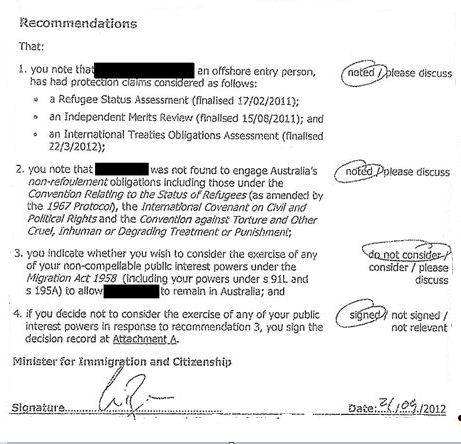
348 The Minister on the same day made his decision not to consider exercising his powers under ss 91L and 195A. His reasons for doing so were expressed as follows:
Decision record relating to the exercise of the Minister’s non-compellable powers –
[SZQRB]
On the basis of:
(1) the recommendation by the Independent Merits Reviewer dated 15 August 2011 that [SZQRB] not be recognised as a person to whom Australia has protection obligations under the 1951 Convention relating to the Status of Refugees as amended by the 1967 Protocol relating to the Status of Refugees;
(2) the International Treaties Obligation Assessment dated 22 March 2012 with respect to [SZQRB]; and
(3) the Pre-removal clearance dated 23 August 2012 with respect to [SZQRB];
I think that the return of [SZQRB] to Afghanistan is consistent with Australia’s international obligations (including, but not limited to, Australia’s obligations under the Refugees Convention, the International Covenant on Civil and Political Rights, and the Convention Against Torture and Other Cruel, Inhuman or Degrading Treatment or Punishment).
However, whether or not that view is correct, and irrespective of:
(1) whether or not any legal or factual error was made by the Independent Merits Reviewer;
(2) whether or not any legal or factual error was made by the officers who undertook the International Treaties Obligation Assessment or the Pre-removal clearance; or
(3) any other circumstance;
I have decided not to consider, or not to further consider, the exercise of any of my personal non-compellable public interest powers under the Act with respect to [SZQRB] (including, without limitation, my powers under ss 91L and 195A of the Act).
DISTURBING UNDERCURRENTS?
349 On behalf of the Minister a number of submissions were advanced which should be expressly set forth.
350 One submission was that the Minister could decide never to exercise the power conferred by s 91L or could decide to never exercise the power in respect to persons from particular countries. Irrespective of the facts and circumstances prevailing in a particular country and even in the face of accepted torture and/or persecution, the Minister (it was submitted) could decide never to exercise the power in respect to persons from such a country.
351 In advancing that submission, Senior Counsel on behalf of the Minister accepted that the Minister would not be accountable to Parliament by reason of the operation of s 91L. That section, it was accepted, only required the Minister to lay before Parliament the “reasons for thinking that his or her actions are in the public interest” for making a determination that s 91K “does not apply to an application” for a visa; a course whereby the Minister did not make a determination did not attract such a requirement.
352 Nor, on the approach of the Minister, would the Minister be accountable to a superior court. It is unnecessary for present purposes to resolve such a disturbing submission. The prospect that a Minister could refuse to exercise the power, perhaps for a reason as stark as that proposed during the course of submission, may well be remote. It is only to be expected that no Minister, for example, would refuse to even consider exercising the power because the applicant came from a country or region which was personally and unjustifiably disliked by the Minister. But the proposition that in doing so he would be totally free of any accountability to a superior court may be seriously questioned.
353 When considering whether a decision of the Attorney-General to refuse to grant his fiat to a private prosecution, Lord Denning MR in Gouriet v Union of Post Office Workers [1977] QB 729 at 761-762 concluded that the law provided a remedy when an office holder refused to enforce a law and observed :
What then does it all come to? If the contention of the Attorney-General is correct, it means he is the final arbiter as to whether the law should be enforced or not. If he does not act himself – or refuses to give his consent to his name being used – then the law will not be enforced. If one Attorney-General after another does this, if each in his turn declines to take action against those who break the law – then the law becomes a dead letter. It may be that each Attorney-General would have good reason of his own for not intervening. He may fear the repercussions if he lends the weight of his authority to proceedings against the infringers. But as one like situation follows another – as it does here – it means that a powerful trade union will feel that it can repeat its performance with impunity. It will be above the law. That cannot be.
…
Mercifully our constitution has, I believe, provided a remedy. It is what I have said already: if the Attorney-General refuses to give his consent to the enforcement of the criminal law, then any citizen in the land can come to the courts and ask that the law be enforced. This is an essential safeguard: for were it not so, the Attorney-General could, by his veto, saying "I do not consent”, make the criminal law of no effect. Confronted with a powerful subject whom he feared to offend, he could refuse his consent time and time again. Then that subject could disregard the law with impunity. It would indeed be above the law. This cannot be permitted. To every subject in this land, no matter how powerful, I would use Thomas Fuller's words over 300 years ago: "Be you ever so high, the law is above you”.
There may well be legitimate differences between a decision not to enforce the law as opposed to a decision not to allow an unlawful non-citizen to make an application which is otherwise prohibited by law. But a conclusion that anyone is “above the law” is not a conclusion to be too readily reached.
354 It may readily be accepted that by reason of s 91L(6) of the Migration Act, the Minister in the present proceedings cannot be subject to an order in the nature of mandamus. That provision certainly negates any implication that may otherwise have arisen that, coupled with the power, there may be a corresponding duty “to exercise the power when called upon to do so”: cf. Julius v Lord Bishop of Oxford (1880) 5 App Cas 214 at 222-223 per Earl Cairns LC. The Minister’s accountability to a superior court, however, is a different matter.
355 The concept of an “unfettered discretion”, however, has long been judicially resisted. Thus, for example, in Padfield v Minister of Agriculture, Fisheries and Food [1968] AC 997 the Minister argued that his statutory discretion conferred by s 19 of the Agricultural Marketing Act 1958 to refer a complaint to a committee of investigation was “unfettered”. The argument was rejected. In doing so, Lord Reid (for example) observed at 1030:
It is implicit in the argument for the Minister that there are only two possible interpretations of this provision - either he must refer every complaint or he has an unfettered discretion to refuse to refer in any case. I do not think that is right. Parliament must have conferred the discretion with the intention that it should be used to promote the policy and objects of the Act; the policy and objects of the Act must be determined by construing the Act as a whole and construction is always a matter of law for the court. In a matter of this kind it is not possible to draw a hard and fast line, but if the Minister, by reason of his having misconstrued the Act or for any other reason, so uses his discretion as to thwart or run counter to the policy and objects of the Act, then our law would be very defective if persons aggrieved were not entitled to the protection of the court. So it is necessary first to construe the Act.
Lord Upjohn expressed the same disquiet in respect to the Minister’s argument when he said at 1060:
My Lords, I believe that the introduction of the adjective "unfettered" and its reliance thereon as an answer to the appellants' claim is one of the fundamental matters confounding the Minister's attitude, bona fide though it be. First, the adjective nowhere appears in section 19, it is an unauthorised gloss by the Minister. Secondly, even if the section did contain that adjective I doubt if it would make any difference in law to his powers, save to emphasise what he has already, namely that acting lawfully he has a power of decision which cannot be controlled by the courts; it is unfettered. But the use of that adjective, even in an Act of Parliament, can do nothing to unfetter the control which the judiciary have over the executive, namely that in exercising their powers the latter must act lawfully and that is a matter to be determined by looking at the Act and its scope and object in conferring a discretion upon the Minister rather than by the use of adjectives.
Notwithstanding these statements, it is important to recall that arguments were also there rejected that the Minister’s duty was “to refer every genuine and substantial complaint” (see [1968] AC at 1029 (per Lord Reid)) or that an aggrieved person had an “absolute right to an enquiry”: at 1045–1046 (per Lord Hodson). See also Lord Upjohn at 1057–1058. Similarly, in FAI Insurances Ltd v Winneke (1982) 151 CLR 342 at 368 Mason J observed that the “court will not ordinarily regard a statutory discretion the exercise of which will affect the rights of a citizen as absolute and unfettered”.
356 Any attempt to confer an unconfined discretion upon a Minister, or a discretionary power to be exercised or not exercised at the mere personal whim of a Minister, may lack the hallmark of a lawful exercise of Commonwealth legislative power, namely a legislative determination of “the content of a law as a rule of conduct”: cf. Commonwealth of Australia v Grunseit (1943) 67 CLR 58 at 82 per Lathan CJ; Plaintiff S157/2002 v Commonwealth of Australia [2003] HCA 2 at [102], 211 CLR 476 at 513 per Gaudron, McHugh, Gummow, Kirby and Hayne JJ.
357 The Minister’s proposition that his decision not to exercise his power under s 91L is not one for which he may be held accountable by the Parliament or a superior court is truly disturbing. On the approach of the Minister, and as s 91L is presently drafted, no legislative requirement is imposed upon the Minister to keep the Parliament informed as to whether or not he has been called upon to exercise the power and (if so) the basis upon which he has decided not to exercise the power or not to exercise the power in respect to particular applicants or classes of applicants. Subject only to questions being asked of the Minister, all such information can be withheld from Parliamentary scrutiny or supervision.
358 Also disturbing is the manner in which the Minister has approached his decision-making processes in the present proceedings.
359 It is one thing for the Commonwealth legislature to pass a law to restrict or even exclude – or attempt to restrict or exclude – the scope of judicial review of administrative decision-making. So long as any such restriction or exclusion of judicial review is consistent with the Commonwealth Constitution – and, in particular, s 75(v) – such laws are within the legislative competence of the Commonwealth Parliament. It is thereafter the duty of the courts to apply the law to the matters that come before it.
360 It is an entirely a different thing for a Minister of the Crown to attempt to administer legislative powers entrusted to him in a manner which further attempts to exclude from judicial scrutiny the decisions he has made. No inference is perhaps open from the manner in which the present Minister has approached his task other than that he was prepared to allow a reviewing court the opportunity to scrutinise his decision-making – but only up to a point. If he had made a legally correct decision based on the materials identified, he was prepared to take the benefit of that scrutiny; but, if his decision-making was found to be flawed, he thereafter sought to pursue a course which took refuge in what he believed was the exercise of an unaccountable a power.
361 And, even then, the course pursued by the Minister is far from self-evident. It is manifestly apparent that the Minister was attempting to make a decision “irrespective” of certain matters. There is no ambiguity in the phrase “irrespective of…”. The natural and ordinary meaning of the term “irrespective” is:
… Without regard to or consideration of something else; independently (The New Shorter Oxford English Dictionary (Oxford University Press, 4th Ed, 1993) 1420.
But there is uncertainty as to what was not considered and what was taken into account by the Minister, and it remains unclear whether or not the Minister took into account (for example) the recommendation and the Assessment. On one approach, he took the Independent Merits Review and the International Treaties Obligations Assessment into account and he did so “irrespective of whether or not [there was] any legal or factual error …”. Ambiguity may have been removed had the Minister said that he proceeded “irrespective of” the documents recording the recommendation and the Assessment and the contents of those documents. That could have conveyed the meaning that he left those two documents entirely to one side. But that is not what he has said.
362 All such questions, however, may be left to one side. The disturbing undercurrents on the Minister’s approach to the present decision can be left unresolved. So, too, can his reasons for adopting the course he did when making his decision.
A DECISION TAKEN ON NO BASIS WHERE ADVICE IS READILY TO HAND
363 Whatever may be the result confronting other claimants who seek to have the Minister determine that s 91K is not to apply to them, the facts in the present proceeding are perhaps unique.
364 In March 2012, SZQRB was advised that the Department had “found no international obligations issues or unique and exceptional circumstances in your case”. He was further advised that “your case has not been referred to the Minister for his consideration…”. There the matter may have rested. But it did not. Thereafter, in August 2012 the Victorian Onshore Protection Director again considered SZQRB’s circumstances for the purpose of securing “pre-removal clearance”. Before her were the March 2012 International Treaties Obligations Assessment and a series of more recent reports including an Amnesty International Annual Report on Afghanistan.
365 Most importantly, SZQRB’s circumstances were brought to the attention of the Minister in the September 2012 Submission. The Minister had available to him:
a series of recommendations, which he “circled” to indicate his decision;
a summary of prior reports considering SZQRB’s circumstances.
It is unclear whether the Minister also had available to him copies of the:
the recommendation of the Independent Merits Reviewer;
the International Treaties Obligation Assessment; and
the “pre-removal clearance” signed by the Victorian Onshore Protection Director.
These three documents are not expressly listed as “Attachments” to the Submission to the Minister. The Minister’s decision is – at least in part – expressed to have been made “on the basis of” the recommendation (the text of which is summarised), the International Treaties Obligation Assessment and the “pre-removal clearance”. It would only provide further reason to question the process pursued by the Minister if it were to be the case that he had expressed his decision to be on “the basis” of identified documents if those documents were not in fact before him when he made his decision.
366 Having been so informed, the course pursued by the Minister of going on to make apparently a further decision “irrespective of” information readily to hand was in any event one not open to him. The course of seeking to put aside both:
all of the material available to him; and
“any other circumstances”
was a course not lawfully open to the Minister. Adapting that which Brutus said of Caesar, the Minister has climbed the ladder of reasoning, but when he “attained the utmost round” the Minister then “unto the ladder turned his back, Looks in the clouds scorning the base degrees by which he did ascend…” : Shakespeare, Julius Caesar Act II Sc 1.
367 The account of the review process set forth in Plaintiff M61/2010E v Commonwealth of Australia [2010] HCA 41, 243 CLR 319 (“Plaintiff M61”) unquestionably acknowledges that consideration of a claimant’s case may cease and may cease without it ever coming to the Minister’s personal attention. Thus, their Honours there summarised the sequence of events as they may unfold in respect to the Refugee Status Assessment process as follows :
[44] If, at the end of the RSA process, an offshore entry person was found to be owed protection obligations, the [RSA] Manual described the consequence as being that a submission would be prepared by the Department for the Minister "advising the Minister that Australia's protection obligations are engaged and seeking his/her agreement to lift the bar under s 46A of the Act". By contrast, if the officer making the assessment determined that the person was not a person to whom Australia has protection obligations, no submission would go to the Minister. Instead, an opportunity would be given to seek the review of the decision under the IMR process. If the outcome of the review was negative, an opportunity would be given to the person to provide any new or additional information which he or she wished the Department to take into consideration. A further assessment would be undertaken by the Department of whether any other international treaty obligation was engaged in the particular case. If no other international obligation was engaged, the process for removal of the person from Australia would begin.
A similar sequence of events could unfold in respect to the independent merits review: [2010] HCA 41 at [49], 243 CLR 319 at 344.
368 But the fact that a particular individual’s claim may never come to the attention of the Minister says nothing of those cases where an individual’s claim does in fact come to the personal attention of the Minister. The High Court in Plaintiff M61 also recognised that further consideration of a claim may at some point be “stopped”: [2010] HCA 41 at [78]; 243 CLR 319 at 354. But the processes previously undertaken were undertaken for the very purpose of informing any ultimate exercise of the Minister’s powers. Although their Honours were more concerned with the reasons why the requirements of procedural fairness were attracted to the steps being undertaken for the purpose of informing the Minister, their Honours obviously envisaged cases progressing through to the Minister and “further consideration” being given to a claim when they said :
[78] The Minister having decided to consider the exercise of power under either or both of ss 46A and 195A, the steps that are taken to inform that consideration are steps towards the exercise of those statutory powers. That the steps taken to inform the consideration of exercise of power may lead at some point to the result that further consideration of exercise of the power is stopped does not deny that the steps that were taken were taken towards the possible exercise of those powers. Nor does it deny that taking the steps that were taken directly affected the claimant's liberty. There being no exclusion by plain words of necessary intendment, the statutory conferral of the powers given by ss 46A and 195A, including the power to decide to consider the exercise of power, is to be understood as "conditioned on the observance of the principles of natural justice” ….. . Consideration of the exercise of the power must be procedurally fair to the persons in respect of whom that consideration is being given. And likewise, the consideration must proceed by reference to correct legal principles, correctly applied.
The focus that was given in the present proceedings to the earlier “steps” undertaken for the purpose of considering a claim perhaps tended to distract attention from the requirements to be met when a case did in fact receive the personal attention of the Minister.
369 The proper characterisation of what the Minister has done in these proceedings is to not merely make a decision to not exercise the powers conferred by s 91L. It was a decision to not exercise those powers where he had readily available to him the materials upon which an informed decision on the merits could be made (and was in fact made) and to thereafter make a further decision purportedly “irrespective of” the “view” that he had previously formed. On any approach, it was a decision “not to consider, or not to further consider, the exercise of” the “non-compellable public interest powers” notwithstanding the “view” that had been formed as to whether SZQRB should be returned to Afghanistan. On another approach, the manner in which the decision was expressed was an attempt on the Minister’s part to avoid the prospect of jurisdictional error vitiating his decision.
370 Irrespective of any requirement to proceed to make a decision upon the basis of the facts peculiar to SZQRB when those facts have been brought to his attention and when they have in fact been assessed, the Minister could also not make a decision free of considering “any other circumstances”. A decision divorced from any circumstances peculiar to a claimant and divorced from “any other circumstances” is properly to be characterised as a decision based upon nothing – other than, perhaps, personal whim.
371 The source of the constraint on the power conferred upon the Minister by s 91L in the present proceeding is ultimately to be found in the Migration Act itself and (particularly) in the terms of s 91L and also in the common law requirements of procedural fairness. These constraints are such that he cannot decide “not to consider, or not to further consider, the exercise of any of” his personal “non-compellable public interest powers” free of a consideration of materials placed before him and in fact considered or free from a consideration of “any other circumstances”.
372 An exercise of the power “irrespective of” relevant material which has in fact been considered would be an “arbitrary or fanciful” exercise of power: Hughes and Vale Pty Ltd v State of New South Wales (1953) 87 CLR 49 at 68 per Dixon CJ. It would also be an exercise of power which would not promote the objects and purposes of the Act and an exercise of power without regard to Australia’s international obligations or the “public interest”.
373 It is respectfully concluded that the Minister’s decision in the present proceedings not to exercise the power conferred by ss 91L and 195A and to do so irrespective of SZQRB’s known personal circumstances was “arbitrary”. The weight to be given to the claims being made and the account provided by a claimant, it may be accepted, is a matter for the Minister alone to consider. But the Minister could not make a decision in the present proceeding “irrespective of” that which is relevant and considered by the Minister to be relevant.
374 In so concluding it is recognised that there is a tension between the present conclusion and the decision of the Full Court in SZQDZ v Minister for Immigration and Citizenship, [2012] FCAFC 26, and, in particular, the Full Court’s conclusions that the Minister did not “have any obligation to take the reviewer’s assessment or recommendation into account” and its conclusion that the Minister “was not bound to act on the assessment or recommendation”: [2012] FCAFC 26 at [34] to [39]. The Full Court also concluded that the Minister “can ignore entirely a reviewer’s assessment and recommendation”: [2012] FCAFC 26 at [44]. But such conclusions of the Full Court, it is respectfully considered, do not address those circumstances where the Minister has in fact taken into account an assessment and recommendation and has not “ignored” the assessment and recommendation.
375 It could hardly be anticipated that Parliament could have intended to vest in the Minister a power to be exercised without regard to relevant matters which have in fact been expressly brought to his attention and considered. Having been informed of matters relevant to the power to be exercised and having formed a “view” founded upon those materials, the power is thereafter to be exercised “according to the rules of reason and justice, not according to private opinion; according to law, and not humour”: Sharp v Wakefield [1891] AC 173 at 179 per Lord Halsbury LC. See also: Othman v Minister for Immigration, Local Government and Ethnic Affairs (1991) 24 ALD 707 at 711 per French J (as his Honour then was); Re Minister for Immigration and Multicultural Affairs; Ex parte Applicant S20/2002; Appellant S106/2002 v Minister for Immigration and Multicultural Affairs [2003] HCA 30 at [9], 198 ALR 59 at 62 per Gleeson CJ; Homebush Abattoir Corporation v Bermria Pty Ltd (1991) 22 NSWLR 605 at 609 per Clarke, Meagher and Handley JJA. The power conferred is a power to be exercised where the Minister thinks “that it is in the public interest to do so”. The Minister cannot resolve that matter “by ‘tossing a coin’ or by making a ‘snap decision’ or by acting on instinct, a ‘hunch’ or a ‘gut feeling’”: cf. WAIJ v Minister for Immigration and Multicultural and Indigenous Affairs [2004] FCAFC 74 at [21], 80 ALD 568 at 573 per Lee and Moore JJ.
376 It is of importance in the present proceedings to recall that what was in issue was a claim of persecution. The fundamental rights of individuals, and the discharge by Australia of its international obligations, were the very matters that the Minister was saying he did not need to consider.
377 Whatever may be the result where the Minister has not embarked upon a consideration of the merits of a claimant’s application, once the Minister has in fact considered the merits of that application and formed a “view” as to those merits he cannot thereafter proceed to ignore the merits of the case before him. He certainly is not “bound to act on the assessment or recommendation” ([2012] FCAFC 26 at [39]); but he cannot “ignore” the “view” he has formed. When presented with sufficient information to inform the exercise of his power, as in the present case, the Minister cannot form a “view” that the return of SZQRB to Afghanistan “is consistent with Australia’s international obligations” and then turn his back on the “view” he has formed. It matters not what the “view” of the Minister may be. It matters not that the Minister may form a “view” that the removal of a claimant from Australia would not be consistent with Australia’s international obligations, or form a contrary “view”, and then thereafter put that “view” to one side. Whatever may be the “view” which is formed, it is that “view” which must then inform the exercise of power.
378 Although the Minister may not be compelled to exercise the powers conferred by s 91L or s 195A, where he does in fact turn his mind to whether or not those powers should be exercised in a particular case, he must at least give consideration to Australia’s international obligations as embraced by the Migration Act. Although the focus of attention in Plaintiff M61 was upon reasons supporting the detention of an individual who was being investigated, the Court also emphasised the interrelationship between the powers conferred by the Migration Act and Australia’s international obligations as follows :
[27] First and foremost among those contextual reasons is that, read as a whole, the Migration Act contains an elaborated and interconnected set of statutory provisions directed to the purpose of responding to the international obligations which Australia has undertaken in the Refugees Convention and the Refugees Protocol. In some respects, as was explained in NAGV and NAGW of 2002 v Minister for Immigration and Multicultural and Indigenous Affairs ….. the provisions of the Migration Act may, at times, have gone beyond what would be required to respond to those obligations. It is not necessary to explore those issues here. Rather, what is presently significant is that the Migration Act proceeds, in important respects, from the assumption that Australia has protection obligations to individuals. Consistent with that assumption, the text and structure of the Act proceed on the footing that the Act provides power to respond to Australia’s international obligations by granting a protection visa in an appropriate case and by not returning that person, directly or indirectly, to a country where he or she has a well-founded fear of persecution for a Convention reason.
379 In those cases where the Minister does in fact address his mind to a particular case, he must also consider “the public interest”. That is the very subject-matter of the power conferred by s 91L(1) and the very subject matter to be addressed in the reasons to be laid before each House of Parliament when he decides to allow an application to be made.
380 Even if there may be some reservation in characterising the decision of the Minister as “arbitrary” (as that term is used in judicial review proceedings), there is no such reservation in insisting upon the Minister making a decision which takes into account both Australia’s international obligations and the “public interest”.
381 There can be gleaned from neither the Migration Act as a whole nor from those provisions of relevance to the operation of s 46A and s 91L any legislative intent to confer upon the Minister an unfettered power to decide as he will and by reference to such arbitrary considerations as his “humour” may take him. However the decision may be made, it must remain a decision which promotes the objects and purposes of the Act. All that can be gleaned from the Act and the provisions of immediate relevance to the exercise – or non-exercise of the power conferred by s 91L – is that the Minister cannot be compelled to exercise the power. Perhaps an exercise – or non-exercise – of the power attracts no duty to explain why a particular course has been taken.
382 There is no general duty to provide reasons in the absence of a statutory requirement to do so: Public Service Board (NSW) v Osmond (1986) 159 CLR 656. It may be that “the law has moved on in the decade since Osmond” (Cypressvale Pty Ltd v Retail Shop Lease Tribunal [1996] 2 Qd R 462 at 475 per Fitzgerald P (diss)) and it may be that a duty to provide reasons should be implied where an administrative decision affects the liberty of an individual : cf. R v Secretary of State for Transport, Ex parte Richmond-Upon-Thames London Borough Council (No 4), [1996] 1 WLR 1460 at 1475 per Brooke LJ. However those matters may ultimately be resolved, when reasons have been given - as in the present proceedings - those reasons are open to scrutiny: East Melbourne Group Inc v Minister for Planning [2008] VSCA 217 at [228], 23 VR 605 at 661-662 per Ashley and Redlich JJA. The entirety of the Minister’s reasoning process may not be apparent; but that which has been revealed exposes jurisdictional error.
383 It must be recognised that an exercise of statutory discretion or power conferred by a Commonwealth legislative provision cannot generally be conferred free from all judicial scrutiny.
384 There have, for example, long been circumstances in which the legislature has thought it appropriate to confer a power to exempt a person from a particular constraint and to confer such a power free of express constraints on the exercise of the power. But where such powers are conferred it is nevertheless necessary for those exercising the power to do so by reference to the objects and purposes of the Act: Swan Hill Corporation v Bradbury (1937) 56 CLR 746 at 757-758. Dixon J there observed:
… In the course of the modern attempt by provisions of a legislative nature to reconcile the exercise and enjoyment of proprietary and other private rights with the conflicting considerations which are found to attend the pursuit of the common good, it has often been thought necessary to arm some public authority with a discretionary power to allow or disallow the action of the individual, notwithstanding that it has been found impossible to lay down for the guidance of the individual, or of the public authority itself, any definite rule for the exercise of the discretion. The reason for leaving the ambit of the discretion undefined may be that legislative foresight cannot trust itself to formulate in advance standards that will prove apt and sufficient in all the infinite variety of facts which may present themselves. On the other hand, it may be because no general principles or policy for governing the particular matter it is desired to control are discoverable, or, if discovered, command general agreement. Whatever may be the cause, the not infrequent result has been a general embargo or fetter upon the exercise of the individual's private or proprietary rights unless he obtains the sanction of the public authority. When a provision of this kind is made, it is incumbent upon the public authority in whom the discretion is vested not only to enter upon the consideration of applications for its exercise but to decide them bona fide and not with a view of achieving ends or objects outside the purpose for which the discretion is conferred. The duty may be enforced by mandamus. But courts of law have no source whence they may ascertain what is the purpose of the discretion except the terms and subject matter of the statutory instrument. They must, therefore, concede to the authority a discretion unlimited by anything but the scope and object of the instrument conferring it. This means that only a negative definition of the grounds governing the discretion may be given. It may be possible to say that this or that consideration is extraneous to the power, but it must always be impracticable in such cases to make more than the most general positive statement of the permissible limits within which the discretion is exercisable and is beyond legal control …
385 Whether an order may be made compelling an exercise of discretion or power is one thing; judicial scrutiny of a discretion or power in fact exercised is quite another. Thus, for example, in Shrimpton v Commonwealth (1945) 69 CLR 613 Latham CJ observed:
The discretion which the Treasurer is entitled to exercise, though described as absolute, is, in my opinion, not arbitrary and unlimited; it must be exercised bona fide and for the purposes of the Regulations: (1945) 69 CLR at 619-620.
Dixon J similarly observed:
… I think the word "absolute" is actually concerned, not with insuring that the purposes for which the Treasurer may use his discretion are unlimited, but rather with the finality or conclusiveness of his decision. But finality, in the sense of complete freedom from legal control, is a quality which cannot, I think, be given under our Constitution to a discretion, if, as would be the case, it is capable of being exercised for purposes, or given an operation, which would or might go outside the power from which the law or regulation conferring the discretion derives its force. An exercise of a power, whether legislative or administrative, cannot rise higher than its source, viz., the power itself, and an attempt under the power to make unexaminable what is done in ostensible pursuance of a further delegation of authority must, to that extent, fail. …: (1945) 69 CLR at 629-630.
There in question was the validity of a condition imposed by the Treasurer upon the giving of his consent to the purchase of land pursuant to the National Security (Economic Organization) Regulations 1944 (Cth). Regulation 9(2) provided that “… the Treasurer may, in his absolute discretion, grant the consent, either unconditionally or subject to such conditions as he thinks fit, or refuse to grant the consent”. See also: Wotton v Queensland [2012] HCA 2 at [23], 246 CLR 1 at 14 per French CJ, Gummow, Hayne, Crennan and Bell JJ.
386 The power conferred by s 91L and s 195A in the present case may not be able to be enforced by way of mandamus. That, however, says nothing as to the necessity for the exercise of the power – as with all exercises of statutory power - to be by reference to the objects and purposes of the legislation. No legislative intent can be discerned in the present case to confer upon the Minister a power to be exercised in disregard of – or “irrespective of” – the merits of a particular case and “irrespective of” Australia’s international obligations or the “public interest”.
387 Having been informed of the circumstances peculiar to SZQRB and to an assessment of Australia’s international obligations, the Minister in the present proceedings could not simply put them to one side. In so concluding, it is not necessary to link that decision-making process with whatever objectives the Minister may have had in mind in proceeding to decide “not to consider, or not to further consider, the exercise of any of my personal non-compellable public interest powers”. It is, in particular, not necessary to link that decision-making process necessarily to a desire on the part of the Minister to insulate his decision from judicial scrutiny. It is sufficient to conclude that the Minister’s decision may properly be regarded either as “arbitrary” or as a decision which is not made in accordance with a proper consideration of the objects and purposes of the Migration Act. On either approach, the Minister’s decision is affected by jurisdictional error.
388 The conclusion that the Minister had at one stage considered the legal and factual merit of the claim being made by SZQRB, and thereafter purported to make a decision completely free of any consideration of such matters necessarily follows from both :-
1. the natural and ordinary meaning of the phrase “irrespective of”; and
2. the context in which that phrase was employed – that context being a manifest attempt on the part of the Minister to divorce himself from any “legal or factual error” that may be sought to be relied upon to impugn his decision and free from any “other circumstance”.
389 Senior Counsel on behalf of the Minister also accepted that the person undertaking the Independent Merits Review had to act in a procedurally fair manner. So much was recognised by the High Court in Plaintiff M61 where it was said:
[77] Because the Minister was not bound to exercise power under either s 46A or s 195A, no matter what conclusion was reached in the assessment or review, it cannot be said that a decision to consider exercising the power affected some right of the offshore entry person to a particular outcome. The offshore entry person had no right to have the Minister decide to exercise the power or, if the assessment or review were favourable, to have the Minister exercise one of the relevant powers in his or her favour. Nonetheless, once it is decided that the assessment and review processes were undertaken for the purpose of the Minister considering whether to exercise power under either s 46A or s 195A, it follows from the consequence upon the claimant's liberty that the assessment and review must be procedurally fair and must address the relevant legal question or questions. The right of a claimant to liberty from restraint at the behest of the Australian Executive is directly affected. The claimant is detained for the purposes of permitting the Minister to be informed of matters that the Minister has required to be examined as bearing upon whether the power will be exercised.
The very reason why an obligation of procedural fairness is required is so that those affected by the review have an opportunity to be heard in respect to that which may affect their interests. The requirements of procedural fairness, however, extend beyond affording a claimant an opportunity to be heard. The opportunity extends to requiring a decision-maker to hear and genuinely take into account what he has been told. An opportunity to speak to a decision-maker who does not listen is no opportunity at all. Never has it been suggested that an opportunity to be heard is satisfied by an opportunity to speak to an unhearing and disinterested decision-maker. On one view, the opportunity is no opportunity at all; on another view, a decision-maker who is unwilling to listen is a decision-maker who displays actual bias, prejudice and prejudgment.
390 In some circumstances it may be open to conclude that a decision-maker who makes a decision “irrespective” of submissions advanced has in fact taken those submissions into account but nevertheless decides as he does. In other circumstances, it may be open to conclude that a decision-maker has decided to make a particular decision “irrespective” of and without even considering submissions which have been advanced. In the circumstances of the present proceedings, it is concluded that the Minister when making his decision “irrespective” of the material before him has purported to make a decision without even entertaining those materials. To so proceed is to deny SZQRB procedural fairness in the most fundamental way.
391 It is inexplicable why the Minister accepts that the processes he has put in place must accord with procedural fairness and yet rejects the necessity for him to consider (and to genuinely take into account) the recommendations and assessments made when making a decision. The requirements of procedural fairness are not satisfied by giving a person an opportunity to be heard but thereafter permitting a decision-maker to ignore all that has been said and permitting a decision-maker to proceed “irrespective of” everything that has been said.
CONCLUSIONS
392 In addition to the declaratory and injunction relief proposed by Lander and Gordon JJ, it is further concluded that an order should be made declaring invalid the Minister’s decision taken on 21 September 2012.
393 Concurrence is otherwise expressed with the reasons and orders proposed by Lander and Gordon JJ.
I certify that the preceding sixty (60) numbered paragraphs are a true copy of the Reasons for Judgment herein of the Honourable Justice Flick. |
Associate:
Dated: 20 March 2013


