FEDERAL COURT OF AUSTRALIA
Brown (on behalf of the Ngarla People) v State of Western Australia [2012] FCAFC 154
IN THE FEDERAL COURT OF AUSTRALIA | |
DATE OF ORDER: | |
WHERE MADE: |
THE COURT ORDERS THAT:
2. The cross-appeal by the State and the joint venturers be dismissed.
3. The parties to submit proposed forms of final orders within 30 days.
4. The parties to make further submissions on the question of costs.
Note: Entry of orders is dealt with in Rule 39.32 of the Federal Court Rules 2011
WESTERN AUSTRALIA DISTRICT REGISTRY | |
GENERAL DIVISION | WAD 225 of 2010 |
ON APPEAL FROM THE FEDERAL COURT OF AUSTRALIA |
BETWEEN: | ALEXANDER BROWN, JEFFREY BROWN, CLINTON COOKE AND CHARLIE COPPIN (ON BEHALF OF THE NGARLA PEOPLE) Appellants
|
AND: | STATE OF WESTERN AUSTRALIA First Respondent BHP BILLITON MINERALS PTY LTD, ITOCHU MINERALS & ENERGY OF AUSTRALIA PTY LTD AND MITSUI IRON ORE CORPORATION PTY LTD Second Respondents
|
JUDGES: | MANSFIELD, GREENWOOD & BARKER JJ |
DATE: | 5 NOVEMBER 2012 |
PLACE: | PERTH |
REASONS FOR JUDGMENT
MANSFIELD J
INTRODUCTION
1 The issues in this proceeding both at first instance and on appeal concern the extinguishing effect at common law on native title rights and interest of Mining Leases ML235SA and ML249SA (the Mt Goldsworthy Leases) which were granted pursuant to an agreement (the Mt Goldsworthy Agreement) amended and ratified by the Iron Ore (Mt Goldsworthy) Agreement Act 1964 (WA) (the Mt Goldsworthy Agreement Act).
2 The second respondents BHP Billiton Minerals Pty Ltd, Itochu Minerals & Energy of Australia Pty Ltd and Mitsui Iron Ore Corporation Pty Ltd are the current Joint Venturers and the current lessees under the Mt Goldsworthy Agreement. They are the current participants in the Mt Goldsworthy Mining Associates Joint Venture which was formed, originally in 1960. BHP Billiton Iron Ore Pty Ltd is the current manager of the MGMA Joint Venture.
3 The appellants on behalf of the Ngarla People claim native title over certain land in Western Australia under the Native Title Act 1993 (Cth) (the NT Act). A consent determination was made in respect of part of the land over which the Ngarla People claim native title on 30 May 2007: Brown (on behalf of the Ngarla People) v State of Western Australia [2007] FCA 1025 (Brown No 1). Excluded from that consent determination was an area designated Determination Area B. The following order was made:
The parties have agreed that in respect of the balance of the land and waters the subject of the Ngarla Applications, which the parties have designated “Determination Area B”, no determination be made at present and mediation continue in relation to these areas. Determination Area B is described in the Second Schedule to the Determination and comprises the areas covered by mineral leases ML235SA and ML249SA and the areas of the Warrarn Application which geographically overlap the Application Area.
4 The parties to the Ngarla People’s application agreed that the native title rights determined in Brown No 1 also existed over the land and waters of the Determination Area A unless those native title rights and interests had been extinguished. Relevantly, those are non-exclusive rights to:
access, and to camp on, the land and waters;
take flora, fauna, fish, water and other traditional resources (excluding minerals) from the land and waters;
engage in ritual and ceremony; and
care for, maintain and protect from physical harm particular sites and areas of significance to the common law holders.
5 Those native title rights, which were recognised by the determination with respect to Determination A in Brown No 1, did not extend to possession, occupation, use and enjoyment on the Ngarla People to the exclusion of all others, nor a right to control the access of others to the land and waters of the claim area.
6 In relation to Determination Area B, with the consent of the parties, the primary judge ordered that five preliminary questions be determined pursuant to O 29 r 2 of the Federal Court Rules 1976 (Cth) as then in force. The five questions related to the extinguishing effect of the Mt Goldsworthy Leases on the appellants’ native title rights with respect to those parts of Determination Area B which was an area subject to the two Mt Goldsworthy Leases. The remainder of Determination Area B, being those areas which are not subject to the Mt Goldsworthy Leases, was dealt with in separate proceedings known as the “Ngarla Overlap proceeding” as there were overlapping native title claims over those areas.
7 The issues concerning the existence or otherwise of the native title rights of the Ngarla People over that part of Determination Area B covered by the Mt Goldsworthy Leases were addressed by consideration of the five preliminary questions. They were restated and answered at the conclusion of the judgment in these terms: Brown (on behalf of the Ngarla People) v State of Western Australia (No 2) [2010] FCA 498 (Brown No 2) at [229]-[233]:
Question 1 is:
Did the grant of the Mt Goldsworthy Leases pursuant to the Mt Goldsworthy State Agreement confer on the holders of those Leases a right of exclusive possession such that any native title rights and interests were wholly extinguished?
The answer to question 1 is: “No”.
Question 2 is:
If the grant of the Mt Goldsworthy Leases did not confer exclusive possession so as to extinguish any native title rights and interests, are the rights granted pursuant to the Mt Goldsworthy Leases and the Mt Goldsworthy State Agreement inconsistent with any or all of the bundle of native title rights and interests recognised in [5] of Annexure A of the determination of native title in Brown No 1? If the answer is “yes”, which ones?
The answer to question 2 is: “Yes”. The rights granted pursuant to the Mt Goldsworthy Leases and the Agreement are inconsistent with the continued existence of any of the determined native title rights in the area where the mines, the town sites and associated infrastructure were constructed. The granted rights are not inconsistent with the continued existence of any of the determined native title rights in those parts of the relevant claim area which have not been developed in exercise of the rights under the Leases and the Agreement.
Question 3 is:
If the answer to (2) is “yes”, in relation to any and each of such native title rights which are inconsistent, are these rights wholly extinguished?
Question 4 is:
Was native title wholly extinguished to the area (or part of the area) of the Mt Goldsworthy Leases through the rights as exercised under the Mt Goldsworthy Leases and the Mt Goldsworthy State Agreement?
The answer to question 4 is: “Yes”.
Question 5 is:
If the answer to (4) is “yes”, in which areas has native title been wholly extinguished?
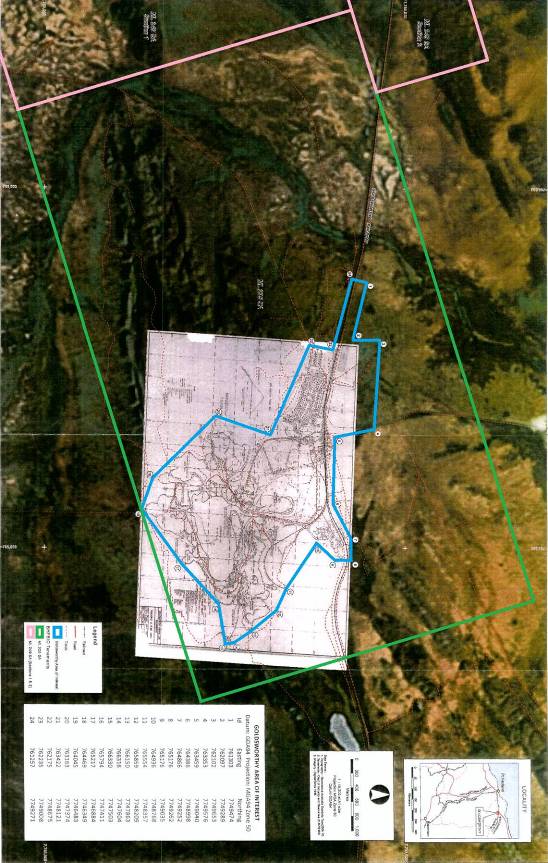
The answer to question 5 is: the areas of the mine, the town sites and associated infrastructure, which is the Goldsworthy Area of Interest as described in Exhibit C-M3.
8 The primary judge delivered her reasons for those answers on 21 May 2010: Brown No 2. Those reasons can be separated broadly speaking into two parts. The first part concerns whether the Mt Goldsworthy leases granted over the whole of the leased areas extinguish native title rights over the whole of the leased areas. The second part concerns whether, by reason of the inconsistency of incidents test laid down by the High Court in State of Western Australia v Ward (2002) 213 CLR 1 (Ward HC), any native title rights over those parts of the leased areas on which mining and related activities had taken place have been extinguished or whether their enjoyment was simply suspended whilst those activities were and continued to be carried out.
9 By way of explanation, as to the significance of the second issue, it may be noted that certain mining activities ceased some years ago and the leased area in part has been, or is being, repatriated so that – in a practical sense at least – those who held native title rights over that area before the grant of the Mt Goldsworthy Leases could resume enjoyment of those rights (or could do so until the second respondents decided to undertake further mining activity on those areas or part of them).
10 On the issue of exclusive possession, namely question 1, the primary judge held (at [185]):
…in terms of the lease area as a whole, while it was the intention that the Joint Venturers could decide where in the leased area they would locate mines and associated infrastructure, it could not have been the intention that they would exert their rights over the whole of the leased area.
11 Her Honour found that the terms of the Mt Goldsworthy Leases did not operate so as to exclude absolutely access to the entirety of the leased areas, but that the right of exclusive possession was confined to exclusive possession for mining purposes (at [184]). The Agreement and the Mt Goldsworthy Leases did not confer a right of exclusive possession on the Joint Venturers such as to extinguish all native title rights over the whole of the leased area.
12 On the issue of inconsistency, encompassing questions 2 to 5, the primary judge determined (at [201]) that none of the determined native title rights could co-exist with the rights of the Joint Venturers to construct and work the developed areas of the Leases. The rights granted under the Mt Goldsworthy Leases to carry out the mining and related activities that the Joint Venturers were entitled to undertake are inconsistent with the continued existence of any native title rights over the areas where those activities are carried out. The rights exercised within the developed areas were analogous to rights of exclusive possession.
13 In doing so, her Honour followed the Full Court decision in De Rose v South Australia (No 2) (2005) 145 FCR 290 (De Rose No 2), where it was held at [157] in relation to pastoral leases that the rights under a pastoral lease to construct improvements were inconsistent with and extinguished native title but had that effect only where improvements were actually constructed.
14 Her Honour found that the areas in which extinguishment occurred was limited to the developed area of the Mt Goldsworthy Leases (at [208]):
As in De Rose, the grant of the rights under the Mt Goldsworthy Leases became operative to extinguish native title rights on particular parts of the leased area when the granted rights were exercised, because it was only then that the precise areas of land affected by the right could be identified.
ISSUES ON THE APPEALS
15 There are three matters which are before the Court in these appeals. It should be noted that the respondents do not otherwise challenge the primary judge’s conclusion that native title subsists within the leased areas.
16 The first of those three matters is the contention that her Honour was wrong in concluding that the two Mt Goldsworthy Leases did not confer a right of exclusive possession, and thereby extinguish all native title rights, over that part of Determination Area B which they covered. That is the first ground of cross appeal.
17 The legal principles informing the concept of exclusive possession are largely uncontentious; rather it is the application of those principles to the interpretation of the Mt Goldsworthy Agreement Act and terms of the Mt Goldsworthy Leases which is to be considered. The exclusive possession issue is to be dealt with first, as it has long been accepted that if a title confers a right of exclusive possession that extinguishes native title then that is the end of the inquiry.
18 The second matter is the appellant’s contention that her Honour was incorrect to conclude that the rights granted under the Mt Goldsworthy Leases were inconsistent with all native title rights, and thereby extinguished them, in the developed areas of the mining leases – that is where the mining lease rights were exercised within the greater leased areas. The contention of the respondents on the cross-appeal is that her Honour, having correctly concluded that the rights granted under the mining leases were inconsistent with all native title rights, erred in not then finding that the native title was extinguished over the whole of the mining leased areas. That is the second ground of the cross appeal.
19 With respect to the second matter, there is no issue as to the proper test to apply – that is the inconsistency of incidents test as approved in Ward HC (at [79]):
The inconsistency of incidents test requires a comparison between the legal nature and incidents of the statutory right which has been granted and the native title rights being asserted. The question is whether the statutory right is inconsistent with the continuance of native title rights and interests
20 However, it is the application of test which requires consideration.
21 The third, and related matter, was referred to as the De Rose issue. Her Honour followed the Full Court decision in De Rose No 2. The appellants contend that, while the primary judge was bound by that decision, that decision is plainly wrong when considered in the context of the extinguishment principles enunciated in Ward HC. It was recognised at trial, and on the appeal, that there was difficulty in reconciling De Rose No 2 with the High Court decision in Ward HC, where it was held at [78] in the majority judgment of Gleeson CJ, Gaudron, Gummow and Hayne JJ that:
…the question is whether the rights are inconsistent with the alleged native title rights and interests. That is an objective inquiry which requires identification of and comparison between the two sets of rights. Reference to activities on land or how land has been used is relevant only to the extent that it focuses attention upon the right pursuant to which the land is used.
22 The asserted ambiguity in this area of the law is said to arise from the inconsistent application of the principles in Ward HC.
THE APPLICATION OF THE NATIVE TITLE ACT
23 It was common ground between the parties that the Mt Goldsworthy Leases did not come within the specific definitions in the NT Act of past acts, intermediate period acts or previous exclusive possession acts under s 23B, so the issue of whether there was extinguishment, and if so its extent, was to be resolved at common law
24 The primary judge explained in detail the scope and operation of the NT Act and its interplay with the common law, and its relevance to the facts in the proceeding. I respectfully adopt those observations of her Honour in Brown No 2 at [58]-[62]:
Part 2 Division 2 of the Native Title Act 1993 (Cth) is concerned with the validation of past acts which, were it not for the NTA, would be invalid. Section 228 defines a “past act” as an act that took place before 1 January 1994 (or 1 July 1993 in the case of legislation) which is invalid, but would have been valid but for native title. Invalidity would have arisen by reason of the Racial Discrimination Act 1975 (Cth) (the RDA). Where an act took place before the commencement of the RDA on 31 October 1975, the act would not have been rendered invalid by reason of the RDA. Hence, it is not a “past act” under s 228 for which it is necessary to have regard to Pt 2 Div 2.
Pt 2 Div 2 of the NTA provides not only for the validation of past acts but also for the extinguishing effect of those acts. Some past acts extinguish native title (see also ss 229 to 232). Relevantly, Pt 2 Div 2B confirms the extinguishing effect of “previous exclusive possession acts” and “previous non-exclusive possession acts”, which are not confined to “past acts”. If Pt 2 Div 2B of the NTA applies to a particular act, the extinguishment regime of Pt 2 Div 2 is put aside and any overlap between the two extinguishment regimes is resolved in favour of Pt 2 Div 2B and its corresponding State and Territory provisions (State of Western Australia v Ward (2002) 213 CLR 1 at [10]). Accordingly, Pt 2 Div 2B provides the analytical starting point. If an act extinguishes native title under Pt 2 Div 2B, it is unnecessary for the Court otherwise to examine extinguishment under the NTA (ss 23C(3), 23G(3)).
Nonetheless, acts that do not fall within either category of “previous exclusive possession acts” and “previous non-exclusive possession acts” may still extinguish native title apart from the provisions of Pt 2 Div 2B. The NTA does not constitute a comprehensive code of extinguishment (see, for example s 23B(9C)(a)) and an act to which Pt 2 Divs 2, 2A or 2B of the NTA do not apply may still have been effective to extinguish native title under the common law.
Where the act is the act of the State of Western Australia and a “previous exclusive possession act” within s 23B of the NTA, it only extinguishes native title if it is also a “relevant act” under s 12I of the TVA [Titles (Validation) and Native Title (Effect of Past Acts) Act 1995 (WA)], which is, relevantly, a freehold grant whenever made and whether or not still in force, and Scheduled interests and leases when the interest created remained in force on 23 December 1996.
The question of extinguishment is not wholly determined by the characterisation of the relevant grant as conferring exclusive possession. As the applicants point out, the NTA recognises “previous exclusive possession acts” (s 23B) and “previous non-exclusive possession acts” (s 23F). The former wholly extinguish native title (s 23C), the latter generally partially extinguish native title (s 23G). What is described as a “lease” under the NTA may or may not confer a right of exclusive possession (Wilson v Anderson (2002) 213 CLR 401 at [59] per Gaudron, Gummow and Hayne JJ). Pt 2 Div 2B of the NTA expressly declines to provide for extinguishment, under that division, of native title by the grant of a mining lease, whether or not it confers a right of exclusive possession over land (ss 23B(2)(c)(viii), 249C(1)(a)). Further, certain Scheduled interests extinguish native title, without regard to whether, as drafted, they confer exclusive tenure.
25 Her Honour considered the treatment of mining leases in the NT Act at [63]-[64]:
A mining lease, for the purposes of extinguishment of native title under the NTA, may be dissected into separate leases in relation to those parts upon which particular construction has occurred (s 23B(2)(c)(vii) and s 245(3)(a); Ward at [302]). The remainder of the mining lease is excluded from the definition of “previous exclusive possession act”, even if the lease in fact confers exclusive possession (s 23B(2)(c)(viii)). A mining lease cannot be a “previous non-exclusive possession act”, which acts are limited to agricultural and pastoral leases (s 23F).
The applicants point out that the NTA does not evince any intention that mining leases extinguish native title. Rather, mining leases are generally excluded from having such an effect (ss 231 and 232D; ss 15(1)(d) and 22B(d); s 238; s 21(3)(a); s 24MD(3); s 24GA(2)). “Intention” does not mean the state of mind of the legislators but intention as manifested by the legislation (Wik at 168-169 per Gummow J; Ward at [78]).
26 The primary judge then summarised the application of the NT Act in the present case to conclude that the provisions were not applicable, and in their absence the common law principles of extinguishment were to be applied. She said at [65]-[66]:
As to the application of the NTA in the present case:
• The Mt Goldsworthy Leases preceded the commencement of the RDA on 31 October 1975 and are not thereby rendered invalid by that Act (Ward at [135] and [139]). There is no dispute that the grant of the Mt Goldsworthy Leases was not a “past act” under s 228. Therefore, it is not necessary to have regard to the “past act” provisions of Pt 2 Div 2 of the NTA.
• The grant of the Mt Goldsworthy Leases was not a “previous exclusive possession act” as defined in s 23B.
• The Mt Goldsworthy Leases are “mining leases” as defined in s 245. The Mt Goldsworthy Leases are thereby excluded from the definition of previous exclusive possession act in s 23B(2)(c)(viii). As mining leases, they are also excluded from the definition of a “Scheduled interest” in s 249C and therefore do not fall within s 23B(2)(c)(i).
• The grant of the Mt Goldsworthy Leases was not a “previous non-exclusive possession act” as defined in s 23F.
• The grant of the Mt Goldsworthy Leases was not a “previous exclusive possession act” or a “previous non-exclusive possession act” to which Pt 2 Div 2B applies.
No party contends that any of Pt 2 Divs 2, 2A or 2B of the NTA applies to the grant of the Mt Goldsworthy Leases. All parties agree that the preliminary questions are to be addressed by reference to common law extinguishment of native title and that, even though the NTA deals expressly with issues of extinguishment, these express mechanisms presuppose that extinguishment can occur apart from their operation. There is no dispute that extinguishment can occur at common law and that common law extinguishment is not contrary to the NTA.
27 The appeal to this Court proceeded upon the same basis, namely that mechanisms for statutory extinguishment under the NT Act were not applicable, but that common law extinguishment informed the correct outcome of the issues.
CONSIDERATION
(1) Did the Mt Goldsworthy Leases extinguish native title rights over the whole of the leased areas
28 It is convenient at this point to consider the relevant provisions of the Mt Goldsworthy Agreement Act and the terms of the Mt Goldsworthy Leases. It is the content of these instruments by which the respondents seek to establish that the terms of the Mt Goldsworthy Leases extinguish any native title over the area the subject of the leases. As the relevant material is largely non-contentious, the following is taken largely from the reasons of the primary judge.
29 The Mining Act 1904 (WA) (the 1904 Mining Act) gave rise to three forms of mining leases: goldmining leases, mineral leases, and leases of reserves which were referred to as leases as authorised holdings. In addition to those forms of statutory leases under the 1904 Mining Act, there was a separate form of tenure that was referred to as a “right of occupancy”. There was no indication within the legislation itself, nor any authority since then, that rights of occupancy on temporary reserves as a matter of law conferred exclusive possession. In Ward HC at [290] the majority observed that the genesis of the repeal of the 1904 Mining Act and its replacement by the Mining Act 1978 (WA) (the 1978 Mining Act) was the abandonment of these different sorts of leases to instead have one standard mining lease. A right of occupancy could only be granted over an area of land that was the subject of what is referred to as a “temporary reserve”: ss 276 and 277 of the 1904 Mining Act. All of the large iron ore interests in Western Australia which were created prior to 1978 were created pursuant to the rights of occupancy on temporary reserve land, including the interests of the original Joint Venturers.
30 Section 5 of the 1978 Mining Act is a saving provision which has the effect of keeping alive the 1904 Mining Act for the purpose of State Agreements which were entered into prior to 1978. It provides at sub (1):
Nothing in this Act shall affect the provisions of any Act in force on the commencing date that approves or ratifies any agreement to which the State is a party and under which a party to the agreement is authorised or required to carry out any mining operations pursuant to the agreement.
31 As mentioned those rights of interest were surrendered when the mineral leases were granted pursuant to the State Agreement.
32 The iron ore industry in Western Australia was developed pursuant to State Agreements, of which the Mt Goldsworthy Agreement was one. The Agreement was brought into force as the operative schedule to the Mt Goldsworthy Agreement Act.
33 The Mt Goldsworthy Agreement is a “Government agreement” for the purposes of the Government Agreements Act 1979 (WA) (the Government Agreements Act). It provides that a Government agreement operates and takes effect from inception according to its terms, notwithstanding any other Act or law (s 3). Relevantly, Determination Area B is “subject land” for the purposes of the Government Agreements Act. Section 4 of the Government Agreements Act provides for offences where a person remains on subject land without lawful authority after having been warned to leave it and where a person prevents, obstructs or hinders any activity carried on pursuant to a Government agreement.
34 The second respondents said that the structure of the Mt Goldsworthy Agreement involved a reservation of land and a grant of a “right of occupancy” under the 1904 Mining Act, and then the Mt Goldsworthy Leases became operative when the Agreement was ratified by statute.
35 By s 4 of the Mt Goldsworthy Agreement Act, the second respondents were permitted to enter upon the leased lands to the extent and for the purposes provided under the Mt Goldsworthy Agreement. Clause 2 of the Agreement sets out the obligations of the State during Phase 1. This included, on application prior to 31 March 1965, an obligation to “cause to be granted to the Joint Venturers and to the Joint Venturers alone rights of occupancy for the purposes of this Agreement (including the sole right to search and prospect for iron ore)” over the whole area of a wide area including the area granted by the Mt Goldsworthy Leases. Clause 2(a) also provided for an obligation to cause to be granted as may be necessary successive renewals of such rights of occupancy. This obligation was to expire on one of a series of dates, whichever shall first happen, including the date of application for a mineral lease by the Joint Venturers under either cl 8(1) or cl 8(2)(a) of the Agreement.
36 Clause 5 provided for proposals by the second respondents for, inter alia, transport and shipment of the iron ore to a harbour to be developed, transport by railway between the mining area and the wharf, town sites on the mining area and near the harbour, housing, water supply, roads and any other works or facilities proposed or desired by the second respondents. Provision was made for consultation on the proposals between them and the Minister within fixed time frames and for arbitration of any disputes. It should be noted that all of the development carried out by the second respondents was carried out lawfully.
37 Clause 8(2) provided that, as soon as convenient after the commencement date, the second respondents may apply and the State shall cause to be granted a mineral lease of any part or parts (not exceeding 300 square miles) of the proposed Mining Area, relevantly for present purposes including Determination Area B, the mineral lease being granted to the second respondents “as tenants in common in equal shares…for iron ore in form of the Schedule hereto” for 21 years subject to rental payment and performance and observance by them of obligations under the mineral lease, with the right to successive renewals of 21 years.
38 By and under the Mt Goldsworthy Agreement, rather than the 1904 Mining Act, the State granted the Mt Goldsworthy Leases for iron ore over the Mt Goldsworthy Lease area. As the primary judge noted, the Mt Goldsworthy Leases contained specific provisions and were in a form different to those granted under the 1904 Mining Act, including that:
(1) they were expressed to be granted under the terms of the Mt Goldsworthy Agreement;
(2) the lease instruments provided for the grant to the second respondents as tenants in common in equal shares the land and the mines and deposits of iron ore in or under the said land together with all rights, liberties, easements, belonging or appertaining to a lessee of a mineral lease under the 1904 Mining Act to hold the land and mine;
(3) clause 1 provided that the second respondents shall and will use the land bona fide exclusively for the purposes of the Agreement extending to the construction of roads, railways, an airstrip and towns and schools;
(4) clause 2 provided for compliance with the Mines Regulation Act 1846 (WA) and the 1904 Mining Act, subject to and as modified by the Agreement;
(5) they may only be terminated by the lessor as a consequence of the default of the leaseholders as provided by the Agreement;
(6) they provide the leaseholders with the rights contemplated by the Agreement as well as the rights available for a mineral lease under the 1904 Mining Act.
39 Under the Mt Goldsworthy Agreement, the lease holders could be granted additional tenure for specific purposes and further rights pursuant to legislation other than the 1904 Mining Act. They could seek grants of fee simple titles or other required titles for town site lots and special leases within town sites and railways. After approval or determination of the second respondents’ proposals, the State was obliged to grant to the Joint Venturers “as tenants in common in equal shares in fee simple or for such terms or periods and on such terms and conditions (including renewal rights) as subject to the proposals…shall be reasonable having regard to the requirements of the Joint Venturers” (cl 8(2)(b)) including for townsite lots, special leases of Crown lands within the harbour area, townsites and the railways and for leases, rights, mining tenements, easements, reserves and licences in, on or under Crown lands.
40 The second respondents also had the right under cl 8(2)(c) to have granted to them, on application, such machinery and tailings leases and such other leases, licences, reserves and tenements as they may reasonably require and request for their purposes under the Agreement on or near the mineral lease. Similarly, the State had the obligation to grant or assist in granting prospecting rights and mining leases with respect to limestone, dolomite and other minerals reasonably required for the Joint Venturers’ purposes under the Agreement (cl 8(5)(e)).
41 The second respondents were obliged under the Mt Goldsworthy Agreement to construct, inter alia, mining plant and equipment, railways, roads and a wharf (cl 9). Further, in accordance with proposals as finally approved or determined, they had obligations to dredge the berth at the wharf and the channel, to lay out and develop town sites with adequate suitable housing, recreational and other facilities and to construct and provide roads, housing, a school, water and power supplies and to construct and provide an airstrip.
42 In relation to what has been described as Phase 2 obligations, the Mt Goldsworthy Agreement provided in cl 9(1) that within three or five years following the commencement date, the second respondents were obliged carry out substantial work in relation to infrastructure, the mining operations and the transport of ore. Clause 9(2) provides, inter alia, that they were obliged to:
(1) except to the extent provided under the proposals as finally approved or determined, allow the public to use free of charge any roads constructed or upgraded under the Agreement (cl 9(2)(b)); and
(2) allow the State and third parties to have access over the mineral lease (by separate route, road or railway)
so long as such use and access shall not unduly prejudice or interfere with the Joint Venturers’ operations thereunder, that is, under the Agreement.
43 The second respondents did not rely on the activities undertaken on the Mt Goldsworthy Leases themselves as extinguishing native title, because they accepted that to do so would fall into the category of operational inconsistency which was discussed in Ward HC at [149]. They emphasised that it was the rights that were able to be exercised under the Mt Goldsworthy Leases which were relevant for the purpose of determining whether the grant of title gave rise to a right of exclusive possession or, if not, whether it was otherwise inconsistent with the determined native title rights. They submit that because those rights could have been exercised over the entirety of the Mt Goldsworthy Lease area, they therefore extinguished native title over that entire area, as the continued exercise of native title rights would have been and is inconsistent with the rights able to be exercised under the two Leases.
44 It is clear that, pursuant to the rights exercisable under the Mt Goldsworthy Leases to do what was needed under the Mt Goldsworthy Agreement, the second respondents proceeded to build towns, build facilities to service the town, store material, extract minerals, quarry, use explosives and the like. The work carried out and the activities undertaken were extensive, as evident from the development of Port Hedland and the port at Finucane Island, the dimensions of the mine and the quantity of material taken from it. The scale of the work at Mt Goldsworthy was, as described by them, to “transform a mountain into a deep gorge” by extracting tens of millions of tonnes of material from an area.
45 Pursuant to clause 8(2)(b) of the Mt Goldsworthy Agreement special leases have been granted as required, concurrent in time and at the request of the second respondents, over land outside the Mt Goldsworthy Leases area. For example, special leases were granted for the town of Shay Gap, the Finucane Island town site (Port Hedland) and the Mt Goldsworthy water supply, which were all outside the Mt Goldsworthy Lease area. It is agreed that these special leases gave rise to exclusive possession and therefore extinguishment of native title.
46 There were no separate titles applied for or granted for the Mt Goldsworthy town site as it was built pursuant to ML235SA and within the area of that Lease. There are areas within the Mt Goldsworthy Leases which were subject to a special lease for the railway. The parties accept that those overlapping areas are excluded from the relevant claim area. The second respondents acknowledge that this special lease was obtained because the railway goes across and beyond the Mt Goldsworthy Leases area. Apart from this special lease, there were no other special leases granted within the Mt Goldsworthy Leases area.
47 The second respondents also rely on the fact that future mining may be carried out in parts of the Mt Goldsworthy Leases area not previously mined or developed. On the evidence there is, at least a real prospect that that will occur.
48 In Wik Peoples v State of Queensland (1996) 187 CLR 1 (Wik), Gummow J at 194-195 considered the meaning of the expression “exclusive possession”. His Honour said:
… at common law the term “exclusive possession” is used as a touchstone for the differentiation between the interest of a lessee and that of a licensee, who has no interest in the premises.
“Exclusive possession” serves to identify the nature of the interest conferred upon the lessee as one authorising the exclusion from the demised premises (by ejectment and, after entry by the lessee, by trespass) not only of strangers but also, subject to the reservation of any limited right of entry, of the landlord. As Windeyer J put it, a tenant cannot be deprived of the rights of a tenant by being called a licensee.
49 Following the decision in Wik, it is appropriate to regard the term “exclusive possession” as meaning “possession exclusive of all third parties, including native title holders exercising their rights under traditional law” (Wilson v Anderson (2002) 213 CLR 401 (Wilson v Anderson) at [461] per Kirby J).
50 It is clear, that there is no magic to the notion of exclusive possession, other than a characterisation of exclusive possession which requires an analysis of the rights over the land which is the subject of the title said to confer exclusive possession. In Ward HC (at [177]), the majority judgment endorsed the comments of Toohey J in Wik (at 108) where his Honour suggested that at the heart of the argument “is the proposition that such a grant conferred exclusive possession of the land on the grantee, and that entitlement to exclusive possession is inconsistent with the continuance of native title rights.” This, as his Honour explained, involves a two-step process:
Expressed with that generality, the proposition tends to conceal the nuances that are involved. The first step is to consider whether the relevant grants did in truth confer possession of the land on the grantees to the exclusion of all others including the holders of native title rights. That question is not answered by reference only to general concepts of what is involved in a grant of leasehold. The language of the statute authorising the grant and the terms of the grant are all important. The second step is to determine whether, if such a grant did confer exclusive possession, native title rights were necessarily extinguished. This second step has within it two elements. The first looks at inconsistency, that is, whether and to what extent native title rights are inconsistent with the exclusive possession which the grant of a pastoral lease is said to carry. The second asks whether native title rights are thereby truly extinguished or whether they are simply unenforceable while exclusive possession vests in the holder of the pastoral lease.
51 The second respondents asserted at trial, and on appeal, that they hold rights of “exclusive possession” so as to extinguish all of the determined native title rights and interests over the area of the Mt Goldsworthy Leases. As noted above, Toohey J in Wik cautions against the use of that expression in the abstract. Its meaning, and the legal consequences of a finding of exclusive possession, are not removed from the analysis required by the test of inconsistency of incidents. To do otherwise, would be to stop at step one as Toohey J described above. However, it is recognised that whether the grant of exclusive possession, that is the right to exclude all others, extinguishes native title, is generally subsumed in a single step of ascertaining whether there was a true legal inconsistency.
52 In Fejo v Northern Territory of Australia (1998) 195 CLR 96 (Fejo), the High Court held a grant in fee simple extinguishes all native title rights and interests in the land, because of the particular characteristics such title possesses (at [43]):
Native title is extinguished by a grant in fee simple. And it is extinguished because the rights that are given by a grant in fee simple are rights that are inconsistent with the native title holders continuing to hold any of the rights to interest which together make up native title. An estate in fee simply is “for almost all practical purposes, the equivalent of full ownership of the land’ and confers ‘the lawful right to exercise over, upon, and in respect to, the land, every act of ownership which can enter into the imagination’. It simply does not permit of the enjoyment by anyone else of any right or interest in respect of the land unless conferred by statute, by the owner of the fee simple or by a predecessor in title’.
53 If the grant is not of fee simple but of rights that have the same effect in that they enable the holder of those rights to use the land as he or she sees fit and to exclude any and everyone from access to the land, those rights are inconsistent with native title rights and native title is extinguished (Fejo at [47]). Put another way, if the granted rights amount to a title to land which gives rise to or creates a right to exclude for any reason, or for no reason at all, then native title rights and interests will be extinguished and not merely suspended, regardless of whether the expected use of the land could be compatible with the continued exercise of native title rights (Fejo at [46]; Ward HC at [370]). In the passage referred to above, the analysis of their Honours in Fejo requires one to look at the rights which comprise the non-native title rights, and ask whether those rights are capable of co-existing with the native title rights.
54 In Ward HC, the majority judgment undertook such a task, by considering various forms of title to land. In particular their Honours referred to leases granted under the Land Act 1933 (WA). While not of direct relevance to the particular facts of this matter, their Honour’s discussion suggests that a finding of exclusive possession requires an analysis of the rights to the land conferred, not on the particular or proposed uses of the land to be exercised (at [368]-[370]):
The lease, granted on 29 September 1977, was said, in its heading, to be under ss 32 and 116 of the Land Act 1933. The reference to s 116 was, for the reasons just given, inapposite. The term of the lease was one year, renewable from year to year, but determinable, after the first year, on three months' notice. The term was said to commence on 1 October 1966 but that does not mean that the grant was made then. Having regard to the requirements of the Land Act 1933 (including s 13 with its provision that leases be signed and s 7(2) with its provision that “grants and other instruments” are “valid and effectual in law” to vest an interest) the grant of a lease occurred on 29 September 1977. The lease was for the purpose of grazing. The lease provided that the Crown might resume and enter upon possession of part of the lands for various purposes in the nature of public works. Power was given to the Crown to take timber, quarry, search for minerals and the like. Minerals and petroleum were reserved to the Crown. There was a proviso for re-entry. The lease recorded that it was issued subject to the condition that the public should have “free and uninterrupted use of the roads or tracks” on the land and that the lessee not destroy timber or scrub.
The lease that was granted was not a statutory interest in land. The features of the interest granted were not prescribed by the Act but were determined by the nature of the agreement reached and the grant made. The rights thus granted to Ivanhoe were, therefore, rights as lessee of the land, as that term is understood in the general law. Ivanhoe was thus granted a right of exclusive possession of the land.
That being so it is not to the point to inquire, as the majority of the Full Court did, how it would be expected that the lessee would use the land or whether that use could be compatible with the continued exercise of native title rights or interests. The lessee having been granted a right of exclusive possession, the right thus granted was inconsistent with the continued existence of native title rights and interests and, subject to the operation of the RDA and the NTA, those latter rights were extinguished.
55 If the grant is not of exclusive possession, then it may be the case that the rights granted extinguish native title, or do not extinguish native title rights but simply prevail over them. It is a matter of comparing the rights. Here, the question on the cross appeal, is whether the grant of the Mt Goldsworthy Leases amounted to “exclusive possession” in the sense described in Fejo above. In order for the Mt Goldsworthy Leases to wholly extinguish native title, one must analyse the grant and the legislation to consider whether the rights conferred upon the second respondents to exclude access were legally inconsistent with each and every right which the native title holders held under their traditional laws and customs in relation to the land.
56 On that question, I have reached the same view as the primary judge, and for much the same reasons.
57 There is no doubt that the second respondents under the Mt Goldsworthy Leases could undertake in the area extensive open pit mining, which changed the landscape. They could construct a town in the leased area. The Leases envisaged railways, roads and other construction. Extensive construction was in fact carried out pursuant to authorisation by the State. Tenure in the form of a demise from the Crown creating the interest in the land was granted by the Agreement and the Mt Goldsworthy Leases.
58 The second respondents were entitled to select where to mine in the leased area and where to construct such infrastructure as considered necessary for that purpose and indeed where to construct infrastructure not directly associated with mining activities but extending to the town and associated activities and structures.
59 However, as the primary judge found, while it was the intention that the second respondents could decide where in the leased area they would locate mines and associated infrastructure, it was not the intention that they would exert their rights over the whole of the leased area. Even with the extensive mining activity and development already undertaken, only about one third of the leased area has been the subject of the exercise of those granted rights.
60 The terms of the Mt Goldsworthy Agreement contemplate third party rights of access in and through the leased area, provided they do not interfere with the operations of the second respondents. This recognition that the operations will not encompass the whole of the leased area so that those parts of the leased area that are not part of the mining operations and associated development may be accessible to third parties indicates that the Mt Goldsworthy Leases were not intended to grant to the second respondents rights to exclude all and any persons from all and any area of the Leases, irrespective of where the mining and other activities were in fact carried on. Indeed, it may fairly be observed that the rights so granted were not necessarily fully exercised, and need not have been exercised at all. The scale of the contemplated mining and associated activities was not known at the time of the Leases. Where such activities were not undertaken within the leased area, there is no reason to conclude in particular that those who had held native title rights and interests over the leased area, at least since settlement, and continued to do so, should have those rights extinguished entirely irrespective of the extent to which (if at all) the Joint Venturers exercised those rights.
61 In that regard, it is worth recalling that Kirby J in Wilson v Anderson said at [139] that native title rights should not be extinguished by legislative or executive grant unless there is a clear and plain intention to do so. See also Ward HC at [78]; Western Australia v Commonwealth (1995) 183 CLR 373 at 422-423.
62 It is accepted that the second respondents had the right to preclude access by the native title holders to, at least, the mine or other areas the subject of mining or mining exploration and to areas and buildings within the town site during those activities and their enjoyment. They did not extend, and were not intended to extend, to exclude all persons, but in particular those who to that time held native title rights in the leased areas, from continuing to enjoy those rights anywhere in the Leased area from the time of the Mt Goldsworthy Leases.
63 The native title rights were, of course, subject to the grants to the second respondents so that (subject to consideration on this appeal) they could and would be adversely affected by the valid exercise of those rights for mining and related purposes. But, in my view, that did not mean that the Mt Goldsworthy Leases necessarily precluded the exercise and enjoyment of native title rights over the whole of the leased areas from the time of the grant of the Mt Goldsworthy Leases. To adopt the expression used in Ward HC at [78], it was not contemplated that all the leased areas would be the subject of mining and related activities. The activities undertaken indicate the nature and extent of the rights granted. They were granted in respect of the leased areas only to the extent that the second respondents determined that mining and related activities would be carried out within the leased areas.
64 The second respondents also rely on the 2007 renewals of each of the Mt Goldsworthy Leases to submit that, if native title were not extinguished by the grant of the Mt Goldsworthy Leases, the renewals had the effect of wholly extinguishing native title pursuant to s 24IB of the NT Act.
65 Section 24IB relevantly provides:
A future act is a pre existing right based act if it takes place:
(a) in exercise of a legally enforceable right created by any act done on or before 23 December 1996 that is valid (including because of Division 2 or 2A); or
(b) in good faith in giving effect to, or otherwise because of, an offer, commitment, arrangement or undertaking made or given in good faith on or before 23 December 1996, and of which there is written evidence created at or about the time the offer, commitment, arrangement or undertaking was made.
66 The argument runs that the renewal of the Mt Goldsworthy Leases in 2007 would have constituted a “future act” as defined in s 233 of the NT Act.
67 The bases on which a future act can be validly done are set out in subs 24AA(3) and 24AA(4) of the NT Act. Section 24AB(2) relevantly determines which provisions apply to the doing of a particular future act. The renewal of the Mt Goldsworthy Leases would fall within the definition of a “pre-existing right based act” under s 24IB which covers acts that take place in exercise of a legally enforceable right created by any act done on or before 23 December 1996 that is valid. Section 24ID(1)(b) sets out the effect of the application of s 24IB to an act. It provides that if the act consists of the conferral of a right of exclusive possession over particular land or waters, the act extinguishes any native title in relation to the land or waters.
68 The appellants successfully resisted that contention at first instance. Their position was that, because the renewals did not confer rights additional to those conferred by the original leases, those sections were not enlivened. At first instance, the State also submitted that s 24IB did not apply to the renewal of grants of exclusive possession leases because the NT Act assumes that such grants will have already extinguished native title. It follows that the renewal will not affect native title.
69 The finding that the grant of the Mt Goldsworthy Leases does not confer a right of exclusive possession over the whole of the area the subject of the leases means that their renewal similarly does not have that effect. Hence, in my view, the renewal of the Mt Goldsworthy Leases would not have conferred a right of exclusive possession for the purposes of s 24ID of the NT Act.
70 In my view, the inconsistency of incidents test, when applied to the particular circumstances, does not support the conclusion that, at least to the present time, the rights granted to the second respondents under the Mt Goldsworthy Leases included the right to exclusive possession over the entirety of the leased areas as against the persons who, at the time of the grant of those leases, held native title rights. One illustration may be given, based on an argument of the second respondents. Reference was made above to the offence created by s 4 of the Government Agreements Act. The rights granted by the Mt Goldsworthy Leases would not, in my view, have entitled the second respondents immediately from the time of the grant of those leases to give a warning to a native title holder not to remain on any part of the leased areas, as the second respondent’s rights are defined by reference to its mining and related activities; the holder of the native title rights would have a lawful entitlement (and excuse) to be on that land until the identification of the mining and related activities. At that point, when the nature of the right was clearly identified, it would be apparent whether there was conflict between the two rights.
71 It follows that the cross appeal should be dismissed, and the answer to question 1 given by the primary judge is correct.
(2) Did the mining and related activities undertaken extinguish native title rights over the areas on which those activities were undertaken?
72 The next step is to address the correctness of the answer to the second question answered by the primary judge. Incidentally, that will require consideration of the third issue raised on the appeal, namely the status of De Rose No 2.
73 I am not persuaded that the decision of the Full Court in De Rose No 2 is plainly wrong. It is a carefully considered decision. It, in turn, carefully considered and followed the decision of another Full Court in Northern Territory of Australia v Alyawarr, Kaytetye, Warumungu, Wakaya Native Title Claim Group (2005) 145 FCR 442 (Alyawarr). Each of those decisions, in their particular circumstances, gave effect to the decision in Ward HC.
74 There may be some scope for identifying the nature of the rights granted under a lease (whether a pastoral lease or a mining lease or some other kind of lease) as confined to rights granted to particular persons, so that upon the expiration of the lease (or the cessation of the exercise of rights under that lease), although any native title rights to exclusive possession have been extinguished, non-exclusive native title rights (which would have been also extinguished against the lessee and the lessees licences) continue to be enjoyed, save that during the period when the lessee’s rights are exercised, the native title rights must be subordinated. Such an approach was not approved in Alyawarr at [148].
75 However, in relation to this appeal, the Court’s function is to apply the inconsistency of incidents test to the particular circumstances. That test is prescribed in Ward HC.
76 It is correct to say, as the appellants agreed, that Ward HC at [308] contemplated the circumstance where the exercise of rights by a mining lessee or a pastoral lessee may inhibit or prevent the enjoyment of particular native title rights, or may do so in relation to a particular geographical area, but leaving other native title rights available to be enjoyed. As was said in Ward HC at [308], the particular circumstances need to be specifically addressed. In Alyawarr at [131], the Full Court applied that approach in deciding the pastoral lessees’ rights were not inconsistent with non-exclusive native title rights, but that the lessees’ rights prevailed over the native title rights. That reflects a concept now embedded in s 23G(1)(a) of the NT Act.
77 It is also correct to say that there have been a range of decisions in particular circumstances in which the application of the inconsistency of incidents test in relation to the rights of a mining or pastoral lessee against non-exclusive native title rights has been a complex exercise. Examples where there has been found to be co-existing native title rights with rights under a mining lease include Daniel v Western Australia [2003] FCA 1425 (Daniel) at [10]-[25], [102]-[104] and [746]-[848]; Rubibi v State of Western Australia (No 7) [2006] FCA 459 at[63]-[67]; Neowarra v State of Western Australia [2003] FCA 1402 at [601]-[616]; and Hayes v Northern Territory (1999) 97 CLR 32 at [91] and [116]. In Daniel at [845]-[847] a particular form of mining lease was found to extinguish native title rights. Reference may also be made to the decision in Sampi v Western Australia (No 2) [2005] FCA 1567; (2005) 224 ALR 358 at [1139]-[1143].
78 The consideration of the Full Court in De Rose No 2 shows, there have also been a number of decisions addressing the relationship between certain rights granted under pastoral leases and native title rights.
79 As Ward HC indicated, the application of the inconsistency of incidents test may not be an easy one. To some extent, where it directly applies, the NT Act attempts to strike the balance by preserving as much as possible existing native title rights: see s 23B defining “previous exclusive possession act”, and ss 21(3)(a), 24MD(3), 24GA(2), 231 and 232D. However, those provisions do not apply to the present appeal.
80 Indeed, the State’s submission on this appeal is that Ward HC does not “provide clear guidance as to how ‘inconsistency’ is to be identified and applied”, and that there are a series of decisions of this Court which, at least at first instance, appear to apply the test in an inconsistent manner.
81 As I have indicated, Ward HC stressed the need to address the particular terms of the rights granted under the legal instrument relied upon, and to test inconsistency carefully against the particular native title rights which exist, or exist subject to their extinguishment. That is what the primary judge did. That, too, is what the Full Court did in De Rose No 2. It is not surprising that, by doing so, different cases produce different and at one level apparently inconsistent results. That is the consequence of the careful consideration of the particular circumstances.
82 I am not persuaded that De Rose No 2 departed from the approach prescribed by the High Court in Ward HC. As here, the rights of the pastoral lessee there under consideration – at the time of the grant – were not necessarily inconsistent with the native title rights found to exist. The manner of the exercise of those rights by the pastoral lessee from time to time was found to affect the full enjoyment of the native title rights which continued to exist, and so took priority over them whilst the pastoral lessee exercised those rights in that way. But the identified rights of the pastoral lessee to do so were not necessarily, from the time of the grant, inconsistent with the native title rights. When exercised, they demonstrated the extent to which the granted rights were inconsistent with the native title rights.
83 In this matter, as the primary judge did, I have reached the conclusion that the granted rights under the Mt Goldsworthy Leases were not necessarily inconsistent with the continued enjoyment of non-exclusive native title rights over the leased areas. However, also as the primary judge found, the rights under the Mt Goldsworthy Leases were capable of exercise in relation to parts of the leased area, and when so exercised were so extensive as to be inconsistent with the continued existence of native title rights over those parts of the leased areas where mining and associated activities were in fact undertaken. The identification of those areas, by the actions of the lessees, therefore indicated the extent to which the rights granted were inconsistent with the continued enjoyment of the native title rights. That is a different thing from what has sometimes been called operational inconsistency; it is identification of the nature and extent of the rights granted which – until the mining and related activities were undertaken – did not indicate the extent to which, if at all, they were inconsistent with the native title rights.
84 In my view, the primary judge did not fall into error in her application of the inconsistency of incidents test.
85 Her Honour made a comparison of the legal nature of the rights granted in accordance with the Mt Goldsworthy Leases with the native title rights of the appellants recognised in Determination Area A, and which, but for the issues of extinguishment, would exist in Determination Area B.
86 The primary judge considered that the rights exercised within the mining development areas were analogous to rights of exclusive possession, noting the grant of a special lease for the construction of Shay Gap town site outside the leased area which confers rights of exclusive possession. Coexistence of native title rights with rights granted pursuant to the Mt Goldsworthy Leases, as demonstrated by the work carried out, and the extensive and pervasive nature of that work, was in her Honour’s view not possible. She said at [201]-[203]:
I accept the submissions of the Joint Venturers that the granted rights to construct the mine and the town site, together with the associated infrastructure, and to work and utilise those entities and the land on which they stand, are inconsistent with the continued existence of any of determined native title rights within the areas on which the mines, town sites and associated infrastructure have been constructed (the developed areas). In my view, none of the determined native title rights can co-exist with the rights of the Joint Venturers to construct and work the developed areas of the Leases. The Leases are not pastoral leases; they are mineral leases that were the subject of a special agreement and statute. The rights granted under those Leases to carry out the activities described therein, including the activities that the Joint Venturers were obliged to undertake, are inconsistent with the continued existence of any native title rights over the areas where those activities are carried out. The rights exercised within the developed areas are analogous to rights of exclusive possession. The rights to construct the town site included the right to construct housing and associated buildings and construction necessary for the reasonable use of the town site by the Joint Venturers and their employees. There was no need for a special lease to effect that construction as the town of Goldsworthy was constructed on the mineral lease area. Where a similar town site, Shay Gap, was constructed outside the leased area, separate tenure by way of special lease was granted.
It is not a question of possible co-existence as may be the case with a pastoral lease when comparing the right to hunt and the right to graze cattle, or the right to camp and the right to construct yards to contain stock, or the right to drive down a road. The work carried out on the Leases, accepted as lawful and within the rights granted under the Leases, assists in demonstrating the extent of those granted rights. It is, for example, inconceivable how the Joint Venturers’ rights to excavate an open pit mine which has so dramatically changed the landscape, and to control access to the mining area, are consistent with the native holders having a right to camp, take flora and fauna, or engage in ritual and ceremony on the mining area. The Joint Venturers have the right to deny access to third parties over the mineral lease where such access would unduly prejudice or interfere with their operations under the Agreement (cl 9(2)(g)). The rights granted to the Joint Venturers to conduct their operations pursuant to the Agreement were such that they were inconsistent with native title rights existing over the land where the operations occurred.
Although the grant of the Mt Goldsworthy Leases did not confer exclusive possession over the whole of the land, the grant conferred rights to construct the mine and the town on the leased areas, as well as the extensive and varied infrastructure detailed above. Such construction of the town would, if not within the leased area, have likely attracted a special lease, as did Shay Gap, which confers a right of exclusive possession. The nature, extent and reasonable use of the town site were inconsistent with the continued existence of the determined native title rights over the town area.
87 Her Honour considered that the approach adopted, that is by finding extinguishment of native title rights in the developed areas pursuant to those rights granted, remained consistent with the High Court’s rejection of operational inconsistency and represented endorsement of the view that inconsistency occurs at the time of grant, not at the time of exercise of rights. Her Honour added at [204]:
It is worth repeating that the High Court in Ward rejected the notion of extinguishment by operational inconsistency by having regard to what actually occurred over time. Inconsistency is determined as at the grant, which is the extinguishing event relied on. This, in turn, involves an examination of the nature of the rights that are able to be exercised pursuant to the grant. In this context, regard can be had to what actually happened on the leased area as an understanding of the rights can properly be informed by evidence of usage (Daniel No 1 at [847] citing Ward at [215]). It is possible that some native title rights may continue to be able to be exercised while others may not (as recognised in Ward at [308]). However, the evidence of Mr Coppin and Mr Brown, as native title holders, of their continued use of the land for certain of the determined native title rights is not relevant with respect to the land on which native title rights have been extinguished. That native title holders, on the facts were, or now are, able to continue to exercise their native title rights does not derogate from the conclusion that a grant has extinguished the native title rights if it is, by its nature, inconsistent with such rights (Ward at [21]). Further, once native title rights are extinguished, they cannot be revived by, for example, discontinuance of usage by the tenure holders or a return of the land to its original state. It is not to the point that the town has now been abandoned. Once extinguished, the native title rights cannot be resurrected.
88 Hence, the primary judge rejected the appellants’ contention that the common law contemplates a concept of a statutory rights prevailing over native title rights during the course of their exercise, as a competing an alternative enquiry to that of extinguishment by inconsistency at [205]:
In my view, the [appellant’s] reasoning seeks to enlarge the concept of prevailing rights to such an extent that most granted rights would not operate to extinguish native title rights on the basis that they can merely prevail over those native title rights. It is important to note that the fundamental question is whether the granted rights and the native title rights are inconsistent and not whether one can prevail over another. A reverse analysis may result in every possibility of inconsistency between two sets of rights being answered by the fact that the granted rights can merely prevail over the native title rights.
89 Accordingly, her Honour concluded that native title had been extinguished over the whole of the area of the mines and any area over which infrastructure and town sites have been constructed together with any buffer zones over which exclusive use is necessary for or incidental to the operation of enjoyment of the improvements (at [228]). The lack of permanence of the mine and the return of the mining development areas to their natural state were not relevant as where the second respondents had exercised their rights under the Mt Goldsworthy Leases, those rights could not co-exist with native title, which was therefore extinguished).
90 The conclusion of the primary judge is at [206]-[207]:
I do not accept the [appellants’] submission that the rights granted by Mt Goldsworthy Leases did not extinguish native title rights because of the lack of permanence of the mine and the town site works and the fact that the developed areas have been returned to their natural state. In the developed areas where the Joint Venturers have exercised their rights, it is their rights which cannot co-exist with the determined native title rights. Once such inconsistency occurs so as to extinguish the native title rights, it is not relevant that the resources being mined are finite or that the mine and the town are later abandoned.
Further, for the [appellants] to submit that a special lease for quarrying extinguishes native title because the special lease entitles the leaseholder to exclude native title holders from the land irrespective of the transience of the activity or the length of the lease but then to rely on the “impermanent nature of mining leases” as a reason for the “suppression” (or “yielding”) of native title only for as long as the lessees continue their activities is not, in my view, logical. This is particularly so as the distinction ignores the permanent nature of the effect of open pit mining and the High Court’s clear statement that, once extinguished for inconsistency, native rights cannot be revived. This also applies to the applicants’ submission that native title rights over the town site can be revived, even if they were directly in conflict with the rights pursuant to which the town was built. In any event, the fact that the town site has been abandoned is not evidence as to the intention or likelihood of its permanence on construction.
91 Her Honour did not consider that the rights granted by the Mt Goldsworthy Leases are inconsistent with the continued existence of the determined native title rights in those parts of the Leases which were not affected by the developments carried out pursuant to the Leases and the Agreement.
92 In my view, that reasoning is consistent with and applied the reasoning in De Rose No 2. That adopted approach is analogous to that taken in De Rose No 2 in relation to pastoral leases where it was held that the right of a pastoral lessee to construct improvements was inconsistent with, and extinguished native title but had that effect only when improvements were actually constructed. That left unaffected the exercise of the determined native title rights in those parts of the Leases which were not affected by the developments carried out pursuant to the Mt Goldsworthy Leases and the Mt Goldsworthy Agreement.
93 Her Honour at [209] considered that the Joint Venturers rights which remain for the duration of the life of the leases to make for further exploration and development of the area, contemplates that further extinguishment in undeveloped areas could occur in the future. In the event of the Joint Venturers, after exploration, developing new mines and infrastructure. native title will have been extinguished once the land on which that development occurs is identified.
CONCLUSION
94 For those reasons, in my judgment, the decision of the primary judge is correct, and the answers which her Honour provided to the five questions are correct.
95 It follows that I would dismiss both the appeal and the cross appeal.
96 In the circumstances, I would make no order as to the costs of the appeal or the cross appeals. They were heard together, and the contentions had a considerable degree of overlap in consideration of both the factual material and the authorities.
97 I appreciate that my view differs from the conclusion of Greenwood and Barker JJ on the second of the two issues to be decided. There is much to be said for the conclusion they have reached on the second issue, but I have felt constrained by the decision of the Full Court in De Rose No 2 to respectfully differ from their conclusion.
I certify that the preceding ninety-seven (97) numbered paragraphs are a true copy of the Reasons for Judgment herein of the Honourable Justice Mansfield. |
Associate:
IN THE FEDERAL COURT OF AUSTRALIA | |
WESTERN AUSTRALIA DISTRICT REGISTRY | |
GENERAL DIVISION | WAD 225 of 2010 |
BETWEEN: | ALEXANDER BROWN, JEFFREY BROWN, CLINTON COOKE AND CHARLIE COPPIN (ON BEHALF OF THE NGARLA PEOPLE) Appellant
|
AND: | STATE OF WESTERN AUSTRALIA First Respondent BHP BILLITON MINERALS PTY LTD, ITOCHU MINERALS & ENERGY OF AUSTRALIA PTY LTD AND MITSUI IRON ORE CORPORATION PTY LTD Second Respondent
|
JUDGES: | MANSFIELD, GREENWOOD & BARKER JJ |
DATE: | 5 NOVEMBER 2012 |
PLACE: | PERTH |
REASONS FOR JUDGMENT
GREENWOOD J
Introduction
98 I have had the benefit of reading the reasons for judgment of Mansfield J in draft. However, because I take the view that many of the features of the bespoke Mount Goldsworthy arrangements made between the State of Western Australia and the joint venturers in 1964, 1966 and 1973 confer exclusive possession (for the purposes of the relevant agreement) of the lease areas in the joint venturers, subject however, to the proper construction of the grant in the context of all of the reservations from the grant, I have examined aspects of those matters in some detail together with other questions going to the “inconsistency of incidents” issue.
Background and context
99 On 30 May 2007, the Court made a consent determination under the provisions of the Native Title Act 1993 (Cth) that native title rights and interests subsist in the Ngarla People in relation to an area of land and mainland waters within the Pilbara region of Western Australia defined as “Determination Area A” within a broader application area (comprising two determination applications on behalf of the Ngarla People) of land and waters: Brown (on behalf of the Ngarla People) v State of Western Australia [2007] FCA 1025 (the “Consent Determination”).
100 An area of land and waters called “Unclaimed Areas” was excised from Determination Area A. That area is not presently relevant.
101 Also excised from Determination Area A was an area of land and waters described as “Determination Area B” defined in the Consent Determination by reference to a map (described as Attachment 1) and Second Schedule. Determination Area B comprises, as defined in Second Schedule, the “land and waters the subject of Mineral Lease (Special Agreement) ML235SA [“ML 235”] and sections 1, 2, 7, 8 and 9 of Mineral Lease (Special Agreement) ML249SA [“ML 249”] and land and waters [bounded and contained within particular coordinates recited in Second Schedule]”, within the broader application area.
102 One part therefore, the presently relevant part, of Determination Area B is the area the subject of ML 235 and ML 249. Unless otherwise stated, a reference to ML 249 is always a reference to the identified sections of ML 249 falling within the claim area.
103 The leases are jointly referred to as the “Mount Goldsworthy Leases”.
104 These leases were granted by the State of Western Australia to particular joint venturers in 1966 (ML 235) and 1973 (ML 249) pursuant to the terms of an agreement called the Iron Ore (Mount Goldsworthy) Agreement (the “Agreement”) made on 15 October 1964 between the State of Western Australia and the joint venturers. The Agreement was approved and given effect by s 4(1) of the Iron Ore (Mount Goldsworthy) Agreement Act 1964 (WA) (the “1964 Act”).
105 The principal proceeding out of which this appeal arises concerned a separate determination (pursuant to O 29 r 2 of the earlier Federal Court Rules) of whether those parts of Determination Area B comprising the land and waters the subject of the Mount Goldsworthy Leases are subject to communal or group native title rights and interests for the purposes of s 223 of the Native Title Act subsisting in the Ngarla People or whether each of the native title rights and interests in the bundle of rights and interests have been extinguished by the rights granted to the joint venturers in 1964, 1966 and 1973 as an exercise of sovereign executive and legislative power of the State of Western Australia. The answer to that question was determined by the primary judge by framing the controversy between the parties in a way that required the Court to answer and the parties to address, relevantly, five questions capturing the range of circumstances relevant to the central question.
106 Before turning to those questions and the all important findings and questions of construction upon which the answers to the questions turn, it is important to note that at [2] of the primary judgment from which this appeal arises (Brown (on behalf of the Ngarla People) v State of Western Australia (No. 2) 2010 FCA 498 (“Brown No. 2”)), the primary judge notes the agreement of the parties that the native title rights and interests recognised at [5] of Annexure A of the Consent Determination also subsist in the Ngarla People (subject to the extinguishment question) in relation to the area the subject of the Mount Goldsworthy Leases.
107 Paragraph 5 of the Orders, Declarations and Determinations making up the Consent Determination is in these terms:
5. Subject to paragraphs 6, 7, 8 and 9:
(1) [T]he nature and extent of the native title rights and interests held by the common law holders are non-exclusive rights to:
(a) access, and to camp on, the land and waters;
(b) take flora, fauna, fish, water and other traditional resources (excluding minerals) from the land and waters;
(c) engage in ritual and ceremony; and
(d) care for, maintain and protect from physical harm, particular sites and areas of significance to the common law holders.
(2) The native title rights and interests set out in sub-paragraph (1) are exercisable in accordance with the traditional laws and customs of the common law holders for personal, domestic and non-commercial communal purposes (including social, cultural, religious, spiritual and ceremonial purposes).
(3) The native title rights and interests set out in sub-paragraph (1) do not confer:
(a) possession, occupation, use and enjoyment on the common law holders to the exclusion of all others; nor
(b) the right to control the access of others to the land and waters of Determination Area A.
108 The reference to Determination Area A in Order 5(3)(b) is, for the purposes of the questions concerning the like application of the native title rights and interests to the Mount Goldsworthy Leases, to be understood as a reference to the Mount Goldsworthy Leases.
109 Order 6 of the Consent Determination is in these terms:
6. Notwithstanding anything in this determination the native title rights and interests include the right to take and use ochre to the extent that ochre is not a mineral pursuant to the Mining Act 1904 (WA), but not other minerals and petroleum as defined in the Mining Act 1904 (WA), Mining Act 1978 (WA), the Petroleum Act 1936 (WA) and the Petroleum Act 1967 (WA).
110 Four things should be noted immediately.
111 First, the communal or group native title rights and interests of the Ngarla People are non-exclusive native title interests. Second, the rights and interests do not include the right to control the access of others to the land and waters of the Mount Goldsworthy Leases. Third, the content of the identified native title rights and interests derives from the traditional laws and customs of the Ngarla People (s 223(1)(a)) who have a connection with the land and waters of the Mount Goldsworthy Leases (s 223(1)(b)) and the question is whether each of those rights and interests so identified continue to be recognised, in the circumstances of the case, by the common law of Australia (s 223(1)(c)) or whether each of the rights have been extinguished at common law. Fourth, the rights granted by the State of Western Australia to the joint venturers in 1964, 1966 and 1973 all pre-date 31 October 1975, the date of the commencement of the Racial Discrimination Act 1975 (Cth). It will be necessary later in these reasons to note the position adopted by the parties at trial and on appeal concerning the relevance and application of those provisions of the Native Title Act which address the validation of past acts and the extinguishing effects of particular acts.
112 The questions framed by the primary judge were these.
(1) Did the grant of [the Mount Goldsworthy Leases] pursuant to the Agreement confer on the holders of those Leases (“the Tenement Holders”) a right of exclusive possession such that any native title rights and interests were wholly extinguished?
(2) If the grant of the Mount Goldsworthy Leases did not confer exclusive possession so as to extinguish any native title rights and interests, are the rights granted pursuant to the Mount Goldsworthy Leases and the Agreement inconsistent with any or all of the bundle of native title rights and interests? If the answer is “yes” which ones?
(3) If the answer to (2) is “yes”, in relation to any and each of such native title rights which are inconsistent, are the rights wholly extinguished?
(4) Was native title wholly extinguished to the area (or part of the area) of the Mt Goldsworthy Leases through the rights as exercised under the Mount Goldsworthy Leases and the Agreement?
(5) If the answer to (4) is “yes”, in which areas has native title been wholly extinguished?
[emphasis in italics]
113 The primary judge at [229] to [233] having regard to the exposed reasons answered those questions in this way. As to question (1), “No”. As to question (2), “Yes”. At [230], the primary judge said this as to (2):
The rights granted pursuant to the Mt Goldsworthy Leases and the Agreement are inconsistent with the continued existence of any of the determined native title rights in the area where the mines, the town sites and associated infrastructure were constructed. The granted rights are not inconsistent with the continued existence of any of the determined native title rights in those parts of the relevant claim area [the area of the Mount Goldsworthy Leases] which have not been developed in exercise of the rights under the Leases and the Agreement.
114 As to question (3), the primary judge said this at [231]: “All of the determined native title rights in respect of the developed areas are wholly extinguished” [emphasis added]. As to question (4), “Yes”. As to question (5), the primary judge said this at [233]: “The answer to question 5 is: the areas of the mine, the town sites and associated infrastructure, which is the Goldsworthy Area of Interest as described in Exhibit C-M3”. The reasoning of the primary judge leading to those answers will be examined later in these reasons.
Statement of Agreed Facts concerning the history of the Agreement and the granting of the Mount Goldsworthy Leases
115 The parties filed a Statement of Agreed Relevant Facts concerning the history of the Agreement and the granting of the Mount Goldsworthy Leases, among other matters. Many of the facts reflected in that statement are recited in the reasons of the primary judge.
116 Some of the facts relevant at this point are these.
117 In 1960, a joint venture was established called the Mount Goldsworthy Mining Associates Joint Venture (“MGMAJV”). The joint venture was formed to develop significant iron ore deposits at Mount Goldsworthy. The joint venture participants were three particular companies sufficiently described for present purposes as Consolidated Gold Fields, Cypress Mining and Utah Mining. These joint venturers submitted a tender to the State of Western Australia (the “State”) for the mining, transport and shipment of iron ore deposits at Mount Goldsworthy. In February 1962, the Western Australian government announced that the joint venturers’ tender to develop the deposits had been successful. A feasibility study was commenced in 1963 by the joint venturers. Goldsworthy Mining Limited (“GML”) was formed in 1965 as the operating company for the joint venture.
118 On 27 February 1962, the State and the joint venturers executed an agreement (the “1962 Agreement”) for the development of the iron ore deposits at Mount Goldsworthy. Under this agreement, the State was required, on the application of the original joint venturers to grant them a “temporary reserve” under the Mining Act 1904 (WA) in respect of a “mining area” identified in the 1962 Agreement as an area at and surrounding Mount Goldsworthy. The 1962 Agreement also contained a term providing for the grant of a mineral lease over the “mining area” in terms of a lease contained in a schedule to the 1962 Agreement. That agreement was adopted and given effect by the Iron Ore (Mount Goldsworthy) Agreement Act 1962 (WA) (the “1962 Act”) which came into force on 27 September 1962. The 1962 Agreement was varied by a variation agreement in 1963 which, in turn, was adopted and given effect by the Iron Ore (Mount Goldsworthy) Agreement Act Amendment Act 1963 (WA) (the “1963 Amending Act”) which came into force on 17 December 1963.
119 On 15 October 1964, the State and the joint venturers executed the Agreement (earlier mentioned) which was adopted and given effect by the 1964 Act. That Act came into force on 23 December 1964. The 1964 Act, by s 2(1), repealed the 1962 Act and the 1963 Amending Act. No party contends that the 1962 Agreement or the 1963 variation of it as ratified by legislation, or otherwise, had the effect of extinguishing the native title rights and interests of the Ngarla People. The question of extinguishment in these proceedings is said to arise out of the proper construction to be attributed to the Agreement, the 1964 Act and the granting of the Mount Goldsworthy Leases under the 1964 Act and Agreement, as the source of the grant of rights to the joint venturers. Extinguishment is said to arise either because the grant of rights to the joint venturers represents a grant of exclusive possession or, alternatively, a proper comparison of the rights granted to the joint venturers, with the native title rights and interests of the Ngarla People, leads to a conclusion of necessary inconsistency of rights and thus extinguishment of the native title rights and interests.
120 The Agreement has been varied four times.
121 The first variation occurred on 26 August 1971. It was adopted and given effect by the Iron Ore (Mount Goldsworthy) Agreement Act Amendment Act 1971 (WA) (the 1971 Amendment Act) which came into force on 15 December 1971. The second variation occurred on 31 March 1994 and was adopted and given effect by the Acts Amendment (Mount Goldsworthy, McCamey’s Monster and Marillana Creek Iron Ore Agreements) Act 1994 (WA) which came into effect on 8 July 1994. The third variation occurred on 11 April 2000 and was adopted and given effect by the Acts Amendment (Iron Ore Agreements) Act 2000 (WA) which came into force on 7 December 2000. The fourth variation occurred on 17 November 2010. That variation forms the Fifth Schedule to the consolidated Iron Ore (Mount Goldsworthy) Agreement Act 1964 (WA).
122 The 1964 Agreement and the variations of 26 August 1971, 31 March 1994 and 11 April 2000 now form Schedules 1, 2, 3 and 4 to the consolidated Iron Ore (Mount Goldsworthy) Agreement Act 1964 (WA).
123 The variations of 31 March 1994, 11 April 2000 and 17 November 2010 and the enactment of the ratifying State legislation post-date the commencement of the Racial Discrimination Act 1975 (Cth).
124 The foundation agreement, however, is the Agreement of 15 October 1964 adopted and given effect by the 1964 Act.
125 The joint venturers to the MGMAJV and the participants under the Agreement are now, by assignment, BHP Billiton Minerals Pty Ltd, Itochu Minerals & Energy of Australia Pty Ltd and Mitsui Iron Ore Corporation Pty Ltd. These joint venturers are the lessees, by assignment, of the Mount Goldsworthy Leases. The operator or current manager of the joint venture is BHP Billiton Iron Ore Pty Ltd. The appellant is Alexander Brown and Others on behalf of the Ngarla People, the applicant in the principal proceeding. The first respondent and cross-appellant is the State of Western Australia. The second respondents and cross-appellants are the joint venturers. The scope of the issues raised by the Notice of Appeal and Cross Appeals will be discussed later in these reasons.
Aspects of the Agreement
126 The Agreement was approved under s 4(1) of the 1964 Act.
127 Section 4(2) provides that notwithstanding any other Act or law, and without limiting the effect of s 4(1):
(a) the Joint Venturers shall be permitted to enter upon the lands mentioned in paragraph (c) of clause 2 of the Agreement, to the extent, and for the purposes, by that paragraph provided; and
(b) the provisions of subclause (2) of clause 3 of the Agreement shall take effect.
128 Section 4(1) of the 1964 Act gave general legislative approval to the agreement made by the Executive and s 4(2)(b), without limiting the scope of that approval, gave immediate effect to clause 3(2) of the Agreement. Clause 3(2)(a) provides that upon enactment of the 1964 Act ratifying the Agreement clause 8 (which makes provision for the grant of mineral leases before and after the commencement date of the Agreement and makes modifications to the Land Act 1933 (WA) among other things), and other nominated clauses of the Agreement, shall take effect as though those clauses had been enacted by the ratifying 1964 Act.
129 Section 4(3) provides that the provisions of s 96 of the Public Works Act 1902 (WA) do not apply to any railway constructed pursuant to the Agreement and s 4(4) provides that s 277(5) of the Mining Act 1904 (WA) does “not apply to any renewal of the rights of occupancy granted pursuant to [clause 2(a)] of the Agreement”. Section 96(1) of the Public Works Act provided that every railway could only be made under the authority of a special Act which was required to address particular requirements. That provision was displaced by s 4(3). By s 4(4), the renewal of any right of occupancy granted under clause 2(a) of the Agreement was to be determined by the terms of the Agreement, not the Mining Act 1904. Section 5 of the 1964 Act made provision for the making of by-laws “for the purposes of, and in accordance with, the Agreement”.
130 By the recitals to the Agreement, the joint venturers recite that they are satisfied that an area called “mining area ‘A’” contains iron ore of tonnages and grades sufficient to warrant economic recovery and marketing. They also recite that they have carried out particular investigations relating to mining from that mining area of iron ore and the transport by rail and shipment of that ore for export sale. The joint venturers also recite that they have agreed to investigate the feasibility of beneficiation of ore from the mining areas described in the Agreement and of establishing within the State an industry for the upgrading of beneficiated iron ore.
131 Although the immediate question is whether each of the native title rights and interests of the Ngarla People in relation to the land and waters bounded by the Mount Goldsworthy Leases have been extinguished by the relevant grant, the particular framework of the Agreement adopted by the 1964 Act and the mineral leases issued under the Agreement with the statutory force of the 1964 Act should be noted.
132 In Western Australia v Ward (2002) 213 CLR 1 at [147], Gleeson CJ, Gaudron, Gummow and Hayne JJ recognised that some legislation conferring particular grants upon parties such as joint venturers might be regarded as “bespoke” legislation enacted for the particular purpose of establishing an enterprise identified as a particular project. At [144], their Honours recognised that the Iron Ore (Mount Goldsworthy) Agreement Act 1964 (WA) is an example of the implementation of an agreement between the State and particular corporations for the development and operation of infrastructure where the adopting legislation specifically modifies a range of general legislation so as to vest the land and mineral interests necessary for the particular project in the way determined by the agreement for the purposes of the particular project.
133 Other examples of bespoke legislation of this kind mentioned at [144] are the Iron Ore (Hamersley Range) Agreement Act 1963 (WA) and the Iron Ore (Mount Newman) Agreement Act 1964 (WA). The bundle of rights, obligations, activities, benefits and burdens comprised in the Mount Goldsworthy Agreement and those further grants contemplated by it (including the leases) represent what might be described as the bespoke Mount Goldsworthy Project or as clause 5(2)(b) and 5(3) describes it, the “iron ore export Project”. At [144], the majority observed that the Mount Goldsworthy Project “had a defined statutory content, beyond the identification of a particular geographical area or particular economic activities conducted there”.
134 Under the Agreement, the parties contemplated that mining area A (as defined) contained iron ore tonnages and grades sufficient to warrant economic recovery; further, mining areas B and C might well be developed; rights of occupancy and ultimately a mineral lease might be granted over land and waters the subject of mining areas A; mineral leases might be granted over the land and waters of mining areas B and C; the joint venturers would conduct mining operations in mining area A and, in all probability, mining areas B and C, with a view to extracting ore; in order to exploit the iron ore, the joint venturers would establish the infrastructure to transport the iron ore or iron ore concentrates from the mining areas to a port to be properly developed by the joint venturers, by rail to be built by the joint venturers; the joint venturers would establish townsites at the port and on the mining leases; and finally, the joint venturers would investigate and take steps towards establishing an industry in the State for the beneficiation of ore mined from mining areas A, B and C and the upgrading of beneficiated ore.
135 Many of these activities involve the exercise of rights granted to the joint venturers which go beyond mining areas A, B and C and, more particularly, beyond the Mount Goldsworthy Leases which comprise mining areas A and B. Nevertheless, the grant of rights in respect of the Mount Goldsworthy Leases has a context within a bespoke statutory environment reflecting adoption of the Agreement which required the joint venturers to discharge a wide range of obligations and conferred upon them grants of rights necessary for the discharge of those obligations.
136 The particular rights granted in connection with the Mount Goldsworthy Leases are not properly understood by ignoring the broader context within which those rights were granted.
The provisions of the Agreement, the Mining Act 1904 (WA) and the Mining Act 1978 (WA)
137 Clause 2(a) provides that the State shall upon application by the joint venturers at any time prior to a 31 March 1965 “cause to be granted to the Joint Venturers and to the Joint Venturers alone rights of occupancy for the purposes of this Agreement (including the sole right to search and prospect for iron ore) over the whole of mining area ‘A’ under section 276 of the Mining Act” [emphasis added] at a rental based upon an amount per square mile per annum payable quarterly in advance. The grant of any such right of occupancy to the joint venturers alone for the purposes of the Agreement, involved the surrender of any then existing rights of occupancy in respect of any portion of mining area A already granted to them under the earlier agreements repealed by the 1964 Act.
138 The second limb of clause 2(a) involved a commitment on the part of the State, after the grant of a right of occupancy under clause 2(a) of the Agreement and s 276 of the Mining Act, to:
… cause to be granted to the Joint Venturers as may be necessary successive renewals of such last-mentioned rights of occupancy (each renewal for a period of twelve (12) months at the same rental on the same terms) the last of which renewals notwithstanding its currency shall expire -
(i) on the date of application for a mineral lease by the Joint Venturers under either clause 8(1) or clause 8(2)(a) hereof;
(ii) at the expiration of one month from the commencement date;
(iii) on the determination of this Agreement pursuant to its terms; or
(iv) on the day of the receipt by the State of a notice from the Joint Venturers to the effect that the Joint Venturers abandon and cancel this Agreement,
whichever shall first happen …
[emphasis added]
139 This part of clause 2(a) displaces s 277(5) by operation of s 4(4) of the 1964 Act.
140 The reference to Mining Act in the Agreement is defined by clause 1 as a reference to the Mining Act 1904 (WA).
141 At the time of entry into the Agreement (and also entry into ML 235 concerning mining area A) s 276 of the Mining Act conferred power on the State Minister to temporarily reserve any Crown land from occupation and, with the approval of the Governor, “authorise any person to temporarily occupy any such reserve on such terms as he [or she] may think fit”, but subject to s 277 of the Mining Act. A “reserve”, by s 3 of the Mining Act 1904, is any land set apart for any public purpose or which is a reserve within the meaning of any Act relating to Crown lands, and any land which for the time being [falls within provisions relating to occupation for mining purposes under the provisions of the Mining Act 1904].
142 Although s 277 is predominantly concerned with limitations upon rights of occupancy for the purpose of prospecting for gold, s 277(3) provides that a right of occupancy might be granted for a fixed period in excess of twelve months provided the terms are laid before the Parliament and s 277(4) contemplates that a right of occupancy for any fixed period might be renewed for multiple terms exceeding twelve months subject to the tabling of the terms before the Parliament.
143 Clause 2(a) of the Agreement cast an obligation on the State (triggered by due application by the joint venturers), to cause the Minister to grant under s 276 of the Mining Act rights of occupancy over temporarily reserved Crown land (mining area A) to the joint venturers alone for the purposes of the Agreement (and those purposes are described as including the sole right to search and prospect for iron ore, not simply purposes confined to the right to prospect for iron ore), and thereafter to cause successive renewals of the rights of occupancy so granted for periods of twelve months expiring on the date of application for a mining lease by the joint venturers under clause 8(1) or clause 8(2)(a) of the Agreement.
144 Sections 276 and 277 of the Mining Act fall within Part XI entitled “General Provisions”.
145 Neither section describes rights of occupancy over temporary Crown reserves as a right of “exclusive possession” although s 276 expressly recognises that such rights of occupancy may be authorised by the Minister on “such terms as he may think fit [but subject to s 277]”. Those terms find expression in clause 2(a) of the Agreement as rights of occupancy granted to the joint venturers alone for the purposes of the Agreement over the whole of mining area A (including the sole right to search and prospect for iron ore). Those rights so described came to an end upon the joint venturers applying for ML 235 over mining area A under clause 8(2)(a).
146 Mineral Lease 249 was granted on 21 August 1973 under clause 11(6) of the Agreement over mining area B.
147 The Mining Act 1904 (at the date of grant of the Mount Goldsworthy Leases) contemplated the grant of a number of interests.
148 First, a lease of any non-exempted Crown land for the mining of gold (s 42) for a term of 21 years with the lessee having a right of renewal (s 45) with the grant conferred being described as “the exclusive right of mining for gold and other minerals in and on the land demised and every part thereof” (s 47).
149 Second, a lease of any non-exempted Crown land for mining, and for all purposes necessary to effectually carry on mining operations in or on the land for any mineral other than gold (s 48). Every mineral lease was to be granted “for the working of some mineral or combination of minerals to be specified [with a reservation of all gold]” (s 51). The term was to be 21 years with a right of renewal (s 53). The mining lease is confined to mining for the specified mineral unless the Minister otherwise agrees and sets new terms (s 59).
150 Third, at s 61, a mining lease (defined as a gold mining or mineral lease, s 3) of any land comprised in a townsite, suburban area, other reserve or any authorised holding (defined as any “mining tenement” other than a lease, and an application for lease or a “claim”, s 3, and including a tailings lease as described for the purposes of s 65(1)). Every such lease conferred the limited “powers and authorities” at s 63 and was susceptible of the rights of action at s 64.
151 None of the provisions of the Mining Act relating to these three classes of lease provide for a grant of exclusive possession. The Mining Act also provides for the grant of a “miner’s right” (which includes particular forms of mining licences) and by s 26, the holder of a miner’s right is entitled to take possession of, mine, and occupy Crown land for mining purposes and to take possession of and occupy Crown land as an authorised holding. Various other entitlements are set out at s 26. Section 28 contemplates that particular Crown lands will be exempt from occupation by the holder of a miner’s right. Section 30 contemplates that the Governor may authorise any holder of a miner’s right to occupy exempted Crown land for mining and to mine. If a lease is ultimately granted to the holder of a miner’s right, the miner’s right merges in the lease by operation of s 66.
152 The Mining Act also makes reference to a “mining tenement” which is any land applied for, held, occupied, used or enjoyed under a lease or an application for a lease or as a “claim”, among other things including entitlements under a miner’s right. Although the references to a miner’s right and a mining tenement contemplate “occupation”, the provisions clearly contemplate occupation or possession for the purposes of mining or so as to enable a right’s holder to “mine”. These provisions to not expressly contemplate a grant of exclusive possession.
153 It is important to remember that the Mount Goldsworthy Leases were not granted under the Mining Act 1904. They were granted, as appears later in these reasons, under clauses 8(2)(a) and 11(6) of the Agreement (together with renewal entitlements) given force by the 1964 Act. The Mining Act remains relevant however because the grant conferred under each mining lease, apart from rights conferred under the Agreement (and each lease), carried with it “all rights, liberties, easements, advantages and appurtenances thereto belonging or appertaining to a lessee of a mineral lease under the Mining Act 1904 …”.
154 The Mining Act 1904 was repealed by s 3(1)(a) of the Mining Act 1978 (WA).
155 Part IV of the Mining Act 1978 provides for prospecting and exploration licences. Divisions 3 and 4 of Part IV provide for the grant of a single form of mining lease and the grant of a general purpose lease, respectively. However, rights accrued at the “commencing date” of the Mining Act 1978 (WA) by the joint venturers under the Agreement, the 1964 Act and the mineral leases granted under the statutory authority given to the Agreement by the 1964 Act were preserved by s 5 of the Mining Act 1978. The “commencing date” of that Act for the purposes of s 5 (the “savings” provision) and the repeal of the Mining Act 1904 by s 3(1)(a) of the Mining Act 1978, is 1 January 1982 as determined by s 2(2) and the Gazette of 11 December 1981 at p 5085.
156 Section 5(1) provides:
Nothing in this Act shall affect the provisions of any Act in force on the commencing date that approves or ratifies any agreement to which the State is a party and under which a party to the agreement is authorised or required to carry out any mining operations pursuant to the agreement.
157 Section 5(2) provides:
[A] party to an arrangement referred to in subsection (1) … who is the holder of an existing mining tenement pursuant to the agreement make continue, subject to the agreement, to exercise the rights conferred by the existing mining tenement … as though the repealed Act had not been repealed.
158 A “mining tenement” in s 5(2) includes a “mineral lease” granted under the repealed Mining Act 1904 (s 8(1)).
Further aspects of the provisions of the Agreement
159 Clause 2(c) provides that, to the extent reasonably necessary for the purposes of clauses 4, 5 and 11 of the Agreement, the State shall allow the joint venturers to enter upon Crown lands (including land the subject of a pastoral lease) and survey possible sites for a harbour, wharf, railway, townsite (both in or near the harbour) and on or near mining area A or mining areas B and C.
160 By clause 4(1)(a) to (f), the joint venturers agreed to complete by the relevant date detailed proposals for the purposes of clause 5(2)(a) of the Agreement concerning a geological and geophysical investigation of the iron ore deposits in mining area A; an assessment of the various sites of proposed operations under the Agreement; an engineering investigation of the route for a railway from mining area A to the harbour; an engineering investigation of a harbour site at or near Port Hedland; an investigation of suitable water supplies for the townsites and harbour services; and the planning of suitable townsites in consultation with the State “having due regard to the general development of the port townsite and (if and to the extent applicable) the deposits townsite for use by others as well as the Joint Venturers” (clause 4(1)(f)).
161 Clause 5(2)(a) provides that subject to agreement being reached with the Minister by a relevant date as to the site for the harbour, the joint venturers were required to submit to the Minister:
(a) to the fullest extent reasonably practicable their detailed proposals … with respect so far as relevant -
(A) to the mining area “A” (or so much thereof as shall be comprised within the mineral lease) by the Joint Venturers during the three (3) years next following the commencement of such mining with a view to the transport and shipment of the iron ore mined and their outline proposals with respect to such mining during the next following seven (7) years]; and
(B) [proposals concerning the shipment of mined iron ore during the operation of what is described as Phase 2 of the Agreement]
162 By clause 5(2)(a), the proposals of the joint venturers were to include the location, area, layout and construction program for the development of the harbour; the railway between mining area A and the joint venturers’ wharf; townsites on mining area A and also near the harbour development; housing; water supply; roads and any other works proposed by the joint venturers. The Agreement contains mechanisms at clause 5(2)(b), the remainder of clause 5 and clauses 6 and 7 for caucusing between the joint venturers and the Minister about those works, extensions of time for completing particular things and the commencement date for particular works. The “commencement date” is the date determined under clause 7(3) which provides that the commencement date is the date upon which the last of the proposals submitted under clause 5(2) shall have been approved by the Minister (or otherwise determined by an arbitration process).
163 Clause 8(1) casts an obligation upon the State, in the relevant circumstances, to grant a mineral lease to the joint venturers over all or parts of mining area A as tenants in common in equal shares during a period from application made by the joint venturers to the State, to the commencement date.
164 Clause 8(1) is relevantly in these terms:
(1) As soon as conveniently may be before the commencement date the State shall after application is made by the Joint Venturers for a mineral lease of any part or parts (not exceeding in total area 300 square miles …) of mining area “A” cause any necessary survey to be made of the lands applied for … and shall cause to be granted to the Joint Venturers as tenants in common in equal shares a mineral lease thereof for iron ore in the form of the Schedule hereto for a term which subject to the payment of rental … and to the performance and observance by the Joint Venturers of their obligations under the mineral lease and otherwise under this Agreement shall be for a period commencing from the date of issue of the mineral lease and expiring on the commencement date but subject to earlier determination upon the cessation or determination of this Agreement.
[emphasis added]
165 Clause 8(2) deals with the period from the commencement date for a period of 21 years thereafter and successive renewals. Clause 8(2)(a) is relevantly in these terms:
(2) As soon as conveniently may be after the commencement date the State shall -
(a) after application is made by the Joint Venturers for a mineral lease of any part or parts (not exceeding in total area (300) square miles …) of mining area “A” in conformity with the Joint Venturers’ detailed proposals under clause 5(2)(a)(A) … as finally approved … cause to be granted to the Joint Venturers as tenants in common in equal shares a mineral lease … for iron ore in the form of the Schedule … for a term [subject to payment of rent, royalties, the performance and observance by the Joint Venturers of their obligations under the mineral lease and under the Agreement which] shall be for a period of twenty-one (21) years commencing from the commencement date with rights to successive renewals of twenty-one (21) years upon the same terms and conditions but subject to earlier determination upon the cessation or determination of this Agreement PROVIDED HOWEVER that the Joint Venturers may from time to time … surrender to the State all or any portion or portions … of the mineral lease …
[emphasis added]
166 By clause 8(2)(b), the State assumed an obligation to grant, in accordance with the joint venturers’ proposals as finally approved by the Minister under clause 6 of the Agreement, to the joint venturers as tenants in common in equal shares:
(i) … in fee simple or for such terms or periods and on such terms and conditions (including renewal rights) as … shall be reasonable having regard to the requirements of the Joint Venturers hereunder and to the overall development of the harbour and access to and use by others of lands the subject of any grant to the Joint Venturers and of services and facilities provided by the Joint Venturers -
for nominal consideration – townsite lots;
at peppercorn rental – special leases of Crown lands within the harbour area the townsites and the railways; and
at rentals as prescribed by law or are otherwise reasonable – leases rights mining tenements easements reserves and licenses in or under Crown lands
under the Mining Act the Jetties Act 1926 or under the provisions of the Land Act modified [as contemplated by clause 8(2)] as the Joint Venturers reasonably require for their works and operations hereunder including the construction or provision of the railway wharf roads airstrip water supplies and stone and soil for construction purposes …
[emphasis added]
167 The obligations reflected in clause 8(2) are subject to such further terms and conditions “as may be finally approved or determined as aforesaid [that is, in accordance with the protocols governing approval of proposals]” and in particular the payment of a further amount per tonne on all iron ore and iron ore concentrates in respect of which a royalty is payable under clause 9(2)(j) of the Agreement.
168 Clause 8(2)(c) casts an obligation upon the State to grant to the joint venturers on application by them, such machinery and tailings leases (including leases for the dumping of overburden) and such other leases, licences, reserves and tenements under the Mining Act or under the provisions of the Land Act (as modified by clause 8(2)), as the joint venturers may reasonably require and request for their purposes under the Agreement on or near the mineral lease.
169 Clause 8(5)(a) provides that the State:
(a) shall not during the currency of this Agreement register any claim or grant any lease or other mining tenement under the Mining Act or otherwise by which any person other than the Joint Venturers or an associated company will obtain under the laws relating to mining or otherwise any rights to mine or take the natural substances … within the mineral lease unless the Minister reasonably determines that it is not likely to unduly prejudice or to interfere with the operations of the Joint Venturers hereunder assuming the taking by the Joint Venturers of all reasonable steps to avoid the interference ...
[emphasis added]
170 Clause 8(5)(b) provides that the State:
(b) subject to the performance by the Joint Venturers of their obligations under this Agreement shall not during the currency hereof without the consent of the Joint Venturers resume … nor permit to be resumed by any State instrumentality or by any local or other authority of the … State any of the works installations plant equipment or other property for the time being belonging to the Joint Venturers and the subject of or used for the purposes of this Agreement nor any of the lands the subject of any lease or licence granted to the Joint Venturers in terms of this Agreement AND without such consent (which shall not be unreasonably withheld) the State will not create or grant … any road right-of-way or easement of any nature or kind whatsoever over or in respect of any such lands, which may unduly prejudice or interfere with the Joint Venturers’ operations hereunder ...
[emphasis added]
171 Clause 8(5)(e) provides that the State shall assist the joint venturers in obtaining a grant of prospecting rights and mining leases with respect to limestone, dolomite and other minerals reasonably required by the joint venturers for their purposes under the Agreement.
172 Clause 8(5)(f) provides that the State shall as and when required by the joint venturers, consent in writing, to the extent that the Minister considers reasonably justified, to the joint venturers making improvements for the purposes of the Agreement “on the land comprised in any lease granted by the State to the Joint Venturers pursuant to this Agreement”. By clause 8(6), the joint venturers shall not have any tenant rights in improvements made by the joint venturers on the land comprised in any lease granted by the State to the joint venturers under the Agreement.
173 As already mentioned the Agreement recognises that the joint venturers were satisfied that mining area A contained iron ore of tonnages and grades sufficient to warrant economic recovery and marketing. The Agreement also recognised that the joint venturers desired to have the rights set out in the Agreement with respect to mining areas B and C as defined. Mining areas A, B and C are each defined by clause 1 by reference to areas marked A, B and C respectively on separate plans. Mining area A became the subject of Mineral Lease 235 and mining area B became the subject of Mineral Lease 249. The area bounded by each mineral lease is 10,235 acres (ML 235) and 17,223 hectares (ML 249). A “mineral lease” is defined to mean the mineral lease referred to in clause 8(1) or clause 8(2)(a) of the Agreement “and includes any renewal thereof” and includes any lease granted under clause 11(6) of the Agreement and any renewal of such a lease.
174 As to definitional matters, the reference to “townsite” when used in relation to mining areas A, B and C (such as in clause 5(2)(a); clause 8(2)(b)) means “such a townsite or townsites which is or are established by the Joint Venturers for the purposes of their operations and employees on or near [mining areas A, B and C] or any one or more of them in lieu of a townsite constructed and defined under section 10 of the Land Act”.
175 The mineral lease contemplated by clause 11(6) is a lease granted by the State of mineral area B or C or any part of those areas. On the assumption that the joint venturers have complied with relevant obligations, clause 11(6) provides that the State shall cause a mineral lease to issue to the joint venturers “as tenants in common in equal shares … for iron ore in the form of the lease in the Schedule” [emphasis added]. The initial term of that lease is the period from grant to the expiration of the term of the original lease of mining area A under clause 8(2)(a) of the Agreement.
176 Although “obligations” cast upon a party under an agreement are not the same thing as “rights” granted to a party under that agreement, the nature of the obligations cast upon or assumed by a party are likely to reflect, in part at least, upon the rights a party might be required to correspondingly exercise so as to be able to discharge those obligations. An examination of the obligations is not simply an assessment of the scope of the “operations” a party might undertake but an examination of the extent to which the obligations might give expression to the scope of the rights granted to the joint venturers.
177 By clause 9 of the Agreement, the joint venturers were required within a particular period of time (three years or as might be extended by a further two years) to expend not less than 20 million pounds to construct, install and do all things necessary to enable the joint venturers “to mine from the mineral lease [which contemplated a mineral lease of mining area A at the outset]”; to transport ore by rail to the wharf; and to commence shipment of commercial quantities of ore at an annual rate of not less than 1 million tons and without lessening the generality of that obligation, the joint venturers were required to:
(a) construct install and provide upon the mineral lease or in the vicinity thereof mining plant and equipment crushing screening stockpiling and car loading plant and facilities power house workshop and other things of a design and capacity adequate to enable the Joint Venturers to meet and discharge their obligations …;
(b) actually commence to mine transport by rail and ship from the Joint Venturers’ wharf iron ore from the mineral lease so that the average annual rate during the first two years shall not be less than one million (1,000,000) tons;
(c) subject to the State [granting] all necessary rights in or over Crown lands available for the purpose construct … railways …;
(d) subject to the State [granting] all necessary rights in or over Crown lands or reserves available for the purpose construct … such new roads as the Joint Venturers reasonably require for their purposes hereunder …;
…
178 Clause 9(2)(b) provides that except to the extent that the joint venturers’ proposals as finally approved under the Agreement otherwise provide, the joint venturers shall allow the public to use free of charge any roads (to the extent that it is reasonable and practicable so to do) constructed (or upgraded) under clause 9 provided that such use does not unduly prejudice or interfere with the joint venturers’ operations under the Agreement.
179 Clause 9(2)(c) provides that the joint venturers shall in the construction, operation, maintenance and use of any work, installation, plant, machinery, equipment, service or facility, provided or controlled by the joint venturers, comply with and observe the provisions of the Agreement and, subject to the Agreement, comply with and observe “the laws for the time being in force in the said State”. The laws for the time being in force in the State of Western Australia relating to the use of any work, installation, plant, machinery, equipment, service or facility, provided or controlled by the joint venturers on the Mount Goldsworthy Leases, include the laws of the State of Western Australia, the laws of the Commonwealth of Australia and the common law of Australia.
180 Clause 9(2)(g) provides that the joint venturers shall allow the State and third parties to have access (with or without stock, vehicles and rolling stock) over the mineral lease (by separate route road or railway) provided that such access over the lease shall not unduly prejudice or interfere with the joint venturers’ operations under the Agreement.
181 Clause 10(d) provides that on the cessation or determination of the Agreement:
(i) except as otherwise agreed by the Minister the rights of the Joint Venturers to in or under this Agreement and the rights of the Joint Venturers or of any assignee of the Joint Venturers or any mortgagee to in or under the mineral lease and any other lease, licence, easement or right granted hereunder or pursuant hereto shall thereupon cease and determine but without prejudice to the liability of either of the parties … AND the Joint Venturers will … surrender to the State … all land the subject of any Crown Grant under the Land Act pursuant to this Agreement ...
182 Clause 11 contemplates the submission of a proposal to the Minister for a mineral lease of mining areas B and C and the taking up of a mineral lease for each such area. The proposals were required to address the development of a townsite on mining area B; the extension of the existing townsite established on mining area A; housing on mining area B; extension of existing housing accommodation on mining area A; a townsite on mining area C and the development of relevant facilities; housing on mining area C; and other things. Subject to the Minister’s acceptance of those proposals, a mining lease was to be granted for the mining of iron ore in either mining area B or mining area C or both.
183 The Agreement contemplated, by clause 20, assignment of the rights grated to the joint venturers, the possibility of extensions of time for compliance and other machinery provisions.
ML 235 and ML 249
184 In 1964 and 1965, the joint venturers submitted proposals for the conduct of particular works and mining activity. Those proposals were finally approved on 4 August 1965. Various other proposals were submitted to the State which were ultimately approved on 22 September 1971.
185 ML 235 was granted by the State on 17 February 1966 pursuant to clause 8(2)(a) of the Agreement. The term of the mineral lease commenced on 5 August 1965. It was renewed in 1985 and 2006 on each occasion for a further 21 years. The current term expires on 4 August 2028.
186 ML 249 was granted on 21 August 1973 by the State under clause 11(6) of the Agreement. ML 249 covers 21 non-contiguous areas of land otherwise known as 21 sections. Only sections 1, 2, 7, 8 and 9 of ML 249 are within the claim area and are the subject of these proceedings. The term commenced on 8 May 1974. It was renewed in 1985 and 2006 on each occasion for a further 21 years. The current term expires on 4 August 2028.
187 ML 235 recites elements of the Agreement and recites the obligation of the State under the Agreement to grant the joint venturers a mineral lease of lands referred to in the Agreement as mining areas A, B and C. The lease recites the ratification of the Agreement by the 1964 Act and recites the authorisation contained in the Act to grant a mineral lease to the joint venturers.
188 The lease then provides, in one continuous block of text in the old form of such documents (which I have separated out for the sake of ease of reading), as follows:
[I]n consideration of the rents and royalties reserved by and of the provisions of the said Agreement and in pursuance of the said Act
[WE] DO BY THESE PRESENTS GRANT AND DEMISE unto the JOINT VENTURERS as tenants in common in equal shares subject to the said provisions ALL THAT piece or parcel of land comprised in Mining Area “A” and situated in the Pilbara Goldfield [having an area of approximately 10 235 acres as delineated on the relevant plan] and all those mines veins seams lodes and deposits of iron ore in on or under the said land (hereinafter called “the said mine”)
together with all rights, liberties, easements, advantages and appurtances thereto belonging or appertaining to a lessee of a mineral lease under the MINING ACT, 1904, including all amendments thereof for the time being in force and all regulations made thereunder for the time being in force … or to which the JOINT VENTURERS are entitled under the said Agreement
TO HOLD the said land and mine and all and singular the premises hereby demised for the full term of twenty one years from [5 August 1965] with the right to renew the same from time to time for further periods each of twenty one years as provided in but subject to the said Agreement for the purposes but upon and subject to the terms, covenants and conditions set out in the said Agreement and to the Mining Act (as modified by the said Agreement)
YIELDING and paying therefore the rent and royalties as set out in the said Agreement.
[emphasis added]
189 This language of the lease represents the language of the common law lease: Western Australia v Ward at [164].
190 The lease then provides that the grant is also subject to the observance and performance by the joint venturers of these conditions:
1. The JOINT VENTURERS shall and will use the land bona fide exclusively for the purposes of the said Agreement.
2. Subject to the provisions of the said Agreement [the joint venturers shall observe, perform and carry out the provisions of the Mines Regulation Act 1946 (WA)].
[emphasis added]
191 The lease then sets out a proviso in these terms:
PROVIDED THAT this lease and any renewal thereof shall not be determined or forfeited otherwise than under and in accordance with the provisions of the said Agreement.
192 The lease contains a reservation to the Crown in respect of the right to search for and obtain petroleum.
193 ML 249 also recites the Agreement (called the First Agreement), the first variation to the Agreement (called the first Variation Agreement), the adoption of those arrangements by the First and Second Schedules to the 1964 Act (described as the Iron Ore (Mount Goldsworthy) Agreement Act, 1964-1971) and the commitment of the State under the Agreement to grant the joint venturers a mineral lease of the lands referred to as mining area B.
194 The lease recites that in consideration of the rents and royalties reserved by the provisions of the Agreement (as varied) and in furtherance of the adopting legislation, the State makes a “grant and demise” to the joint venturers as tenants in common in equal shares of all of the parcel of land comprised in mining area B (containing approximately 17,223 hectares) and “all those mines, veins, seams, lodes and deposits of iron ore in, on or under the said land (called “the said mine”) together with all rights, liberties, easements, advantages and appurtances thereto belonging or appertaining to a lessee of a mineral lease under the [Mining Act 1904] including [all amendments to the Act and Regulations for the time being in force] or to which the Joint Venturers are entitled under the [First Agreement as amended by the first Variation Agreement]” [emphasis added].
195 The lease provides that the joint venturers hold the “land and mine and all and singular the premises hereby demised from the date of grant to [4 August 1986] with the right to renew the same from time to time for further periods each of twenty one years as provided in but subject to the said Agreements for the purposes but upon and subject to the terms, covenants and conditions set out in the said Agreements and to the Mining Act …” [emphasis added].
196 The lease then provides that the grant is also subject to the observance and performance by the joint venturers of these conditions:
1. The JOINT VENTURERS shall and will use the land bona fide exclusively for the purposes of the said Agreements.
2. Subject to the provisions of the said Agreements [the joint venturers shall observe, perform and carry out the provisions of the Mines Regulation Act 1946 (WA)].
[emphasis added]
197 The lease contains the same proviso as ML 235 that the lease and any renewal shall not be determined or forfeited otherwise than under and in accordance with the provisions of the Agreements. The lease also contains the petroleum reservation.
Government Agreements Act 1979 (WA) (the “GA Act”)
198 By s 2 of the GA Act, the Agreement is a “Government agreement”. So too is each variation of the Agreement and any grant, lease or right made, issued or obtained for the purposes of the Agreement or its implementation. The term “subject land” means:
(a) land that is set aside, or is being used, for the purposes of or incidental to implementing a Government agreement; or
(b) land where activity is being, or is about to be, carried on pursuant to, or for the purposes of or incidental to, implementing, a Government agreement.
199 The land and waters of ML 235 and ML 249 are “subject land”.
200 Section 3(a) of the GA Act declares that each provision of a Government agreement is deemed to have operated and taken effect from its inception according to its terms notwithstanding any other Act or law. It follows that each provision of the Agreement and any rights granted under the Agreement or the Mount Goldsworthy Leases took effect (according to their terms) from inception and any rights so accrued at the commencing date of s 5 of the Mining Act 1978 were saved.
201 Section 4 of the GA Act is said by the joint venturers to have particular resonance in demonstrating the exclusive nature of the possessory grant arising under the Government agreements in issue (the Agreement and the leases) as each lease provides, it is said, for a right to exclude third parties; each lease is “subject land”; and s 4(1) renders a person who remains on subject land, without lawful authority, after being warned to leave it by, relevantly, the owner or occupier, guilty of an offence. Section 4(2) renders a person who hinders or prevents, without lawful authority, the carrying on of any activity under or incidental to implementing a Government agreement, guilty of an offence.
202 These provisions are predicated upon a person engaging in particular conduct without lawful authority and the appellants contend that the exercise of subsisting native title rights and interests is the source of that authority.
Some further facts drawn from the Statements of Agreed Facts and the Judgment
203 Some further facts drawn from the Statements of Agreed Facts are these.
204 Construction of the town site, and mine operations at Goldsworthy on ML 235, began in 1965. The first cargo of iron ore was shipped on 3 June 1966. The mine site infrastructure included open cut pits; waste dumps and stock piles; iron ore crushing and screening facilities; ore handling operations; power station; roads; and, many other activities reflected at [13] of the primary judgment. The town at its peak included over 200 houses; a shopping centre; a school; social and sporting facilities; an airport; and many other facilities.
205 The mine at Goldsworthy was closed on 22 December 1982 following the cessation of mining operations. The mine is closed and subject to controls over access exercised by the managing entity for the joint venturers. There is fencing around several sections of the mine and a locked gate across the only vehicle entry point to the main pit. The town of Goldsworthy was closed in 1992. The total area of the Goldsworthy mine and township was approximately 3.2 square kms and occupied about one third of the area of ML 235. Mining at Goldsworthy was conducted using open pit mining. Mining commenced in 1966. By the time mining operations stopped in 1982, Mount Goldsworthy had been transformed into an open pit approximately 135 metres below sea level.
206 Attached to these reasons as Schedule 1 is a map showing an image of ML 235. The principal large rectangular area occupying most of the image is ML 235 and within it there is a smaller white rectangular area and almost entirely within that area is a further area showing the area of actual mining activity on that lease.
207 By the end of the mining operations there were nine waste dumps around Mount Goldsworthy each approximately 35 metres high. At [21]-[36] the primary judge sets out a wide range of activities undertaken by the joint venturers said to reflect the exercise of rights conferred under the Agreement and, in particular, ML 235. From May 1992 to February 1993 the managing entity for the joint venture carried out a rehabilitation programme at Goldsworthy relying on and exercising rights (and discharging obligations) under ML 235. The rehabilitation of the mine and township areas involved removing all remaining “rubbish” and noxious exotic plants; re-profiling all overburdened dump areas to blend with surrounding natural land forms; contouring all final services to produce stable erosion resistant land forms so as to enhance harvesting of water, seed and seed bed material; and, applying seed to produce revegetation over a total of 300 hectares. During the period 1982 and 1983 all infrastructure, equipment and stock piles were removed from the town site and mine. Substantial rehabilitation occurred and the pit at Mount Goldsworthy remains filled with water. The waste dumps from mining operations remain part of the landscape.
208 Within sections 7, 8 and 9 of ML 249 (being 3 of the 5 sections falling within the claim area out of 21 sections comprising ML 249) lies 10 target iron ore deposits described as the Ord Ridley deposits. These deposits are known as the Ord Prospect, the Ridley Prospect, and a deposit called F13 North. None of these areas are currently the subject of any permanent construction works or productive mining operations.
209 An exploration programme is however proposed that involves extensive drilling. The reserves are said to be 62 million tonnes of mineralisation. Any future mining operations will involve the construction of a range of infrastructure and administrative facilities.
210 Sections 1 and 2 of ML 249 (the remaining two sections of ML 249 within the claim area) are not the subject of permanent construction works or mining operations. However, sections 1 and 2 together with ML 235 are thought to contain 2.7 billion tonnes of magnetite which might be the subject of open-pit mining with several pits to a depth of 200 metres. At [55] and [56] the primary judge notes the analogical references by the joint venturers to the extensive range of activities involved in the development and exploitation of iron ore mineralisation at Shay Gap in section 3 (not within the claim area) of ML 249 as illustrative of the field of rights exercised by the joint venturers sourced in the Agreement and ML 249 issued under the Agreement.
Some amendments made to the Agreement after 15 October 1964 and the enactment of the 1964 Act
211 The Agreement was amended on 11 April 2000 to provide for further differentiating treatment by inserting clauses 8B and 8C(2). Clause 8B provides for applications by the joint venturers to the Minister for the grant of general purpose leases for the purposes of its operations under the Agreement in respect of areas of land greater than the maximum area provided for under the Mining Act 1978. Clause 8C(2) casts an obligation on the State to ensure that sufficient reserves of water are available to meet the requirements of the joint venturers for at least 60 years under the Agreement at Port Hedland.
212 The Agreement was further amended on 17 November 2010 to introduce clauses 7A, 7B and 7C. Those clauses contemplate that should the joint venturers desire to significantly modify, expand or otherwise vary their activities carried on under the Agreement beyond the activities specified in the approved proposals under clause 6, further detailed proposals would need to be put to the Minister under clause 7A addressing the considerations mentioned in clause 5(2)(a) of the Agreement. The Minister is to consider under clause 7B those proposals and may, upon the identified considerations, refuse the application, approve it with or without qualification or reservation, defer it pending the submission of further material or require alterations to the proposal as a condition precedent to approval. Particular statutory matters must be taken into account as set out at clause 7B. Clause 7C sets out other protocols by which the joint venturers might give the Minister notice of a possible application for approval of a proposal arising out of any pre-feasibility study undertaken by them concerning any matter that might require the approval of the Minister to a proposal put under clause 7A.
213 These new provisions contemplate amendments to the Agreement so as to bring within it a significant modification, expansion or other variation of activities to be carried on under the Agreement beyond the approved proposals.
214 It may be that the joint venturers either have obtained the Minister’s approval to vary the Agreement to mine for magnetite on ML 235 or propose to apply under clause 7A for an approval to bring that activity within the scope of the Agreement. However, that activity does not fall within clause 8 or the rights to further minerals contemplated by clause 8(5)(e). To the extent that the joint venturers rely upon their prospective activity in ML 235 as the continuing commitment to the expression of the grant of rights under the Agreement and ML 235, it seems that prospecting and mining for iron ore on ML 235 so far as the evidence before the primary judge is concerned, is not the present focus of activity of the joint venturers on that lease. The 10 target iron ore deposits described in the reasons of the primary judge are the focus of activity on sections 7, 8 and 9 of ML 249. Sections 1 and 2 of ML 249 fall into the same focus of interest for the joint venturers as ML 235, that is, prospective mining for magnetite.
215 If the Agreement is to be significantly amended to bring the new activity of magnetite mining within the scope of the contended grant under the Agreement and the leases, that act of variation by an exercise of executive and legislative power may well require a consideration of the intersection between those actions and the Racial Discrimination Act 1975 (Cth) and the Native Title Act 1993 (Cth). Those matters however were not alive between the parties before the primary judge and are not in issue before the Full Court.
The conclusions of the primary judge
216 At [161], the primary judge notes the common position of the parties that the common law test for extinguishment of native title, rights and interests is an “inconsistency of incidents” test; the essential difference between the joint venturers (and the State) and the Ngarla People was whether each of the native title rights were extinguished or whether the rights granted to the joint venturers simply prevail over or suspend the exercise of each native title right during the period of the grant; and whether extinguishment, if it arises, is confined to parts of the Mount Goldsworthy Leases or all of the leased area.
217 At [163], in reliance upon Western Australia v Ward at [370] and Fejo v Northern Territory of Australia (1998) 195 CLR 96 at [46] the primary judge observes that if the grant of rights to the joint venturers in fact amounts to a grant of exclusive possession, the native title rights and interests will be extinguished and not merely suspended, but that, if the grant is not one of exclusive possession, it may be that a comparison of the rights results in a conclusion that the rights granted simply prevail during the period of the grant.
218 Having extensively set out the competing contentions of the parties, the primary judge at [181] concluded that the right to occupy granted to the joint venturers alone for the purposes of the Agreement, does not amount to the grant of a right of exclusive possession and that a mining lease, of its very nature, grants a right to “exclude other miners from exercising mining rights but does not necessarily entail a right to exclude all others”. At [181], the primary judge concluded that even if the GA Act conferred a right to prevent persons remaining on the Mount Goldsworthy Leases without lawful authority, that right “cannot apply to people exercising native title rights and interests if those rights have not been extinguished”.
219 Section 4 of the GA Act, of course, creates offences in terms of conduct engaging the integers of s 4(1) or s 4(2) of that Act. Section 4 is not a source of rights in the joint venturers. Those rights must be found in the grant although the grant may give rise to remedial entitlements (such as injunctions) in respect of conduct of the kind described in s 4 of the GA Act. If however a remedial entitlement is dependent upon proof of no lawful entitlement in a particular person (or group) to be on or remain on the Mount Goldsworthy Leases, the question remains whether the grant extinguishes, or removes in a temporal way, the exercise of any of the native title rights.
220 At [182], the primary judge observes, as to the incidents of the mining right conferred on the joint venturers, as follows:
The nature of the mining included extensive open pit mining which changed the landscape. The Joint Venturers were granted the right to construct a town in the leased area. The Leases envisaged railways, roads and other construction. While construction was carried out pursuant to authorisation by the State of submitted proposals, the right to carry out that construction, subject to the authorisation, was granted by the Agreement. Tenure in the form of a demise from the Crown creating the interest in the land was granted by the Agreement and the Mt Goldsworthy Leases.
221 At [183], the primary judge concludes that the right to mine in the leased area and to construct infrastructure necessary for that purpose is not restricted to infrastructure “directly associated with mining activities” but extends to “town and associated activities and structures”. At [183], the primary judge concludes:
… [I]n terms of the leased area as a whole, while it was the intention that the Joint Venturers could decide where in the leased area they would locate mines and associated infrastructure, it could not have been the intention that they would exert their rights over the whole of the leased area. This has been borne out by the fact that, even with the extensive mining activity and development undertaken, only approximately one third of the leased area has been the subject of the exercise of those granted rights. There is no suggestion that the proposed future mining sites would extend over all of the remaining area.
[emphasis added]
222 As to further aspects of the intention of the State and the joint venturers derived from the Agreement, the primary judge said this at [184]:
It could not have been intended, nor was it feasible, to assume a grant to the Joint Venturers of exclusive possession of the whole of the leased area. The terms of the Agreement provide for third party rights of access which do not interfere with the operations of the Joint Venturers. This recognition that the operations will not encompass the whole of the leased area is consistent with the recognition that those parts of the leased area that are not part of the mining operations and associated development are accessible to third parties, which would include native title holders.
[emphasis added]
223 The primary judge also said this at [184]:
I accept that the Joint Venturers had the right to restrict access by the native title holders to, at least, the mine or other areas the subject of mining or mining exploration and to areas and buildings within the town site. The rights to exclude access are thereby linked to the area of operations rather than the whole of the leased area. … There is no good reason, however, to presuppose that it was intended that the Joint Venturers had the right to exclude access by native title holders seeking to exert the determined native title rights over those parts of the leased area that were left untouched by the Joint Venturers.
[emphasis added]
224 At [184], the primary judge observes that clause 9 of the Agreement obliged the joint venturers to allow the State and third parties to “use or have access to the land the subject of the mineral leases and the infrastructure there constructed, such as roads …” and concluded:
I accept that the provision of specified rights of access by third parties to roads and routes may be said to be consistent with the fact that otherwise there would be no right of access. However, it is also consistent with an expectation that the specified sites, but not the whole of the leased area, would have access to them restricted or denied by the tenement holders.
[emphasis added]
225 At [185], the primary judge concluded:
The Agreement and the Mt Goldsworthy Leases did not confer a right of exclusive possession on the Joint Venturers such as to extinguish all native title rights over the whole of the leased area.
226 At [186], the primary judge concluded that since the Mount Goldsworthy Leases did not confer a right of exclusive possession upon the joint venturers as against all others, the renewal of the leases in 2006/2007 did not consist of the conferral of a right of exclusive possession for the purposes of s 24IB and s 24ID(1)(b) of the Native Title Act and thus the Act of renewal did not extinguish the native title rights in the land or waters of the Mount Goldsworthy Leases.
227 As to inconsistency of rights, the primary judge recites at [190] the portfolio of activities (described as “what actually happened”) undertaken by the joint venturers in the area of the leases, said by them to be the expression or illustration of the true scope of the rights granted by the Agreement and the Mount Goldsworthy Leases. They included exploration for minerals exercised over a large area of the leases (and to be exercised); drilling; setting up exploration camps; conducting open-cut mining; dumping extracted non-saleable ore or refuse on site (that is, two tonnes of waste for every tonne of ore); the use of over-sized mining machinery on the leases; conducting crushing, screening, stockpiling and blending; undertaking improvements (such as railways, roads, power stations and sub-stations; communications facilities; water wells; sewerage pumping and treatment plant; workshops; and the construction of a town site exhibiting a diversified range of facilities for the population).
228 At [190], the primary judge describes as “dramatic” the effect of those mining activities in converting a mountain of 132 metres, above sea level, to a pit 135 metres below sea level.
229 At [192], the primary judge notes the central contention of the joint venturers that it is inconceivable that the right to construct such infrastructure is consistent with any of the determined native title rights. The diversity, scale and intensity of the permitted activities as an expression of the rights granted, and the improvements undertaken, strongly suggest, it is said, inconsistency between the granted rights and each of the native title rights and interests.
230 Having extensively examined the submissions of the parties on inconsistency at [193] to [200] in relation to each of the native title rights comprised in the bundle, the primary judge reached the following conclusions.
231 The rights granted to the joint venturers to construct the mine and town site together with associated infrastructure and to work the mine, operate the town and use the infrastructure, are rights inconsistent with the continued existence of any of the determined native title rights and interests within the areas of the mine, town site and places where infrastructure has been constructed. The primary judge described these areas as the “developed areas” of the Mount Goldsworthy Leases. At [201], the primary judge said this:
In my view, none of the determined native title rights can co-exist with the rights of the Joint Venturers to construct and work the developed areas of the Leases. The Leases are not pastoral leases; they are mineral leases that were the subject of a special agreement and statute. … The rights exercised within the developed areas are analogous to rights of exclusive possession. The rights to construct the town site included the right to construct housing and associated buildings and construction necessary for the reasonable use of the town site by the tenement holders and their employees. There was no need for a special lease to effect that construction as the town of Goldsworthy was constructed on the mineral lease area.
[emphasis added]
232 At [202], the primary judge explained that conclusion in this way:
It is not a question of possible co-existence as may be the case with a pastoral lease when comparing the right to hunt and the right to graze cattle, or the right to camp and the right to construct yards to contain stock, or the right to drive down a road. The work carried out on the Leases, accepted as lawful and within the rights granted under the Leases, assists in demonstrating the extent of those granted rights. It is, for example, inconceivable how the Joint Venturers’ rights to excavate an open pit mine which has so dramatically changed the landscape, and to control access to the mining area, are consistent with the native holders having a right to camp, take flora and fauna, or engage in ritual and ceremony on the mining area. The Joint Venturers have the right to deny access to third parties over the mineral lease where such access would unduly prejudice or interfere with their operations under the Agreement (cl 9(2)(g)). The rights granted to the Joint Venturers to conduct their operations pursuant to the Agreement were such that they were inconsistent with native title rights existing over the land where the operations occurred.
[emphasis added]
233 And at [203]:
The nature, extent and reasonable use of the town site were inconsistent with the continued existence of the determined native title rights over the town area.
234 At [204], the primary judge emphasised that the conclusions her Honour had reached expressly recognised that inconsistency is determined by examining the rights granted at the date of grant and making the relevant comparison rather than engaging in an analysis of operational inconsistency, although “an understanding of the rights [granted] can properly be informed by evidence of usage”.
235 As to the contention of the Ngarla People that the rights granted and exercised by the joint venturers in the developed areas so described (or the grant of rights generally) merely “prevailed” over each of the native title rights and interests, the primary judge at [205] considered that such reasoning improperly enlarged the concept of “prevailing rights” and the “fundamental question” is one of “inconsistency” by comparison of rights not whether one right prevails over another, and at [207], once inconsistency brings about extinguishment, the native title rights and interests cannot be revived.
236 However, at [208], the primary judge found no inconsistency in the rights to this extent:
Nonetheless, I do not consider that the rights granted by the Mt Goldsworthy Leases are inconsistent with the continued existence of the determined native title rights in those parts of the Leases which are not affected by the developments carried out pursuant to the Leases and the Agreement. … [T]he Mt Goldsworthy Leases did not confer exclusive possession on the Joint Venturers but gave them rights to conduct certain activities on the leased area. I have found that these rights are inconsistent with the continued existence of the determined native title rights in the areas where they have been exercised … the developed areas. However, the fact that the Joint Venturers have a choice about where on the leased area to exercise their rights does not mean that such rights are necessarily inconsistent with the existence of the determined native title rights over the whole of the leased area.
[emphasis added]
237 And, at [209]:
In my view, the tenement holders continue to have the rights as provided for in the agreement to explore and ascertain appropriate sites for new mines and infrastructure. If such development occurs, native title will have been extinguished once the land on which the development occurs is identified … If [a] decision is made to proceed with … new mines and is permitted under the terms of the Agreement, there would be the relevant inconsistency and the determined native title rights would be extinguished over the land so developed.
[emphasis added]
238 At [209], the primary judge, however, added this qualification:
It would remain for determination if any of the rights as exercised pursuant to the Agreement in relation to parts of any new development were such as to merely prevail over native title rights.
[emphasis added]
239 It followed for the primary judge at [210] and [212] that each of the determined native title rights and interests had been wholly extinguished in the “developed areas” upon exercise of the granted rights. At [217] and [219], the primary judge said this:
217. The determined native title rights were wholly extinguished by the rights as granted under the Mt Goldsworthy Leases, over the areas on which the rights were exercised. Those affected areas within the leased area were not identified in the Mt Goldsworthy Leases or the State Agreement but, on exercise, could be identified.
219. The relevant area [of extinguishment] is the whole of the area of the mines, any area on which infrastructure has been constructed and the town sites.
[emphasis added]
240 At [225], the primary judge concluded that because the rights as granted are inconsistent with each of the native title rights and therefore extinguished those native title rights when exercised by the joint venturers over the developed areas of the leases, it is not relevant to the question of extinguishment whether the construction works or improvements on the leases were permanent or whether the native title holders might be able to use those works after the leases cease.
241 Although the joint venturers contended that because the portfolio of substantial rights granted to them could have been exercised anywhere on mining areas A or B with the result that each of the native title rights had been wholly extinguished on grant, they also contended, in the alternative (and the primary judge accepted, at [226] applying in particular the Full Court authority of De Rose v South Australia (No. 2) (2005) 145 FCR 290), that:
… [N]ative title has been extinguished over the whole of the area of mines and any area on which infrastructure and town sites have been constructed, together with any buffer zones over which exclusive use is necessary for or incidental to the operation or enjoyment of the improvements ...
[emphasis added]
The intersection with the Native Title Act 1993 (Cth)
242 The Mount Goldsworthy Leases were granted on 17 February 1966 and 21 August 1973, prior to the commencement of the Racial Discrimination Act 1975 (Cth) (the “RD Act”) on 31 October 1975. The parties accepted that the leases as granted were not rendered invalid by the RD Act and that the grant of the leases was not a “past act” under s 228 of the Native Title Act because the grant occurred under the Agreement before 1 January 1994 (s 228(2)(a)(i)) (and to the extent that the grant is authorised by the 1964 Act, that Act was, plainly enough, made before 1 July 1993 (s 228(2)(a)(ii)), and as the RD Act did not apply, the grant was “valid” when made and thus s 228(2)(b) is not satisfied.
243 Because the grant of the leases is not a “past act” for the purposes of s 228, Division 2 of Part 2 of the Native Title Act so far as it addresses the validation of past acts is not engaged as it operates, by s 13A(2), only upon past acts as defined by s 228.
244 Division 2 of Part 2 also “covers” acts done after 1 January 1994 consisting of “an extension or renewal etc. of an act [that is, a past act] done before [1 January 1994]”. Division 2 also sets out the effect of “such a validation” as provided for by Division 2 of Part 2 on native title depending upon whether the past act is a category A, B, C or D past act according to ss 229 to 232 of the Native Title Act.
245 Division 2B of Part 2 (as explained by s 23A(2) of that Act) provides for the “complete extinguishment” of native title by operation of s 23C by acts called previous exclusive possession acts which are defined by s 23B as a valid act that took place on or before 23 December 1996 and consists of the grant or vesting of an interest described at s 23B(2)(c)(i) to (viii). Those interests include a range of particular leasehold interests not relevant for present purposes, a “Scheduled interest” under s 249C and any lease that confers a right of exclusive possession over particular land or waters “other than a mining lease” [emphasis added]. The statutory extinguishment effected by s 23C in respect of interests recited in s 23B(2)(c) is not engaged as the grant of the Mt Goldsworthy Leases, as a defined mineral lease (under s 245), exclusive or otherwise, is expressly excluded from the definition of a “Scheduled interest” by s 249C(1)(a) and falls outside a lease contemplated by s 23B(2)(c)(viii).
246 Thus, the grant of the mineral leases is not a previous exclusive possession act.
247 Section 24B(2)(c)(vii) and s 245(3)(a) recognise the statutory construct of what is taken to be a “separate lease” of those parts of the land or waters upon which particular construction has occurred, and the grant of that separate constructive lease is taken to be a previous exclusive possession act. The remaining parts of the mining lease whether exclusive or not, are excluded by s 23B(2)(c)(viii).
248 Division 2B of Part 2 (as explained by s 23A(3) of that Act) also provides for the extinguishment of native title rights and interests by acts called previous non-exclusive possession acts consisting of grants of non-exclusive agricultural leases or non-exclusive pastoral leases, to the extent of any inconsistency between the grant and the native title rights. The grant of the Mount Goldsworthy mineral leases was not a grant of a previous non-exclusive possession act as defined by s 23F.
249 It follows that the grant of the Mount Goldsworthy Leases was not an act falling within the definition of either a previous exclusive possession act or a previous non-exclusive possession act.
250 Division 2B of Part 2 does not apply to the grant of the leases.
251 At the trial of the separate questions and in this appeal, no party contended that any of the provisions of Divisions 2, 2A or 2B of Part 2 applied to the grant of the leases and at [66] the primary judge said this:
All parties agree that the preliminary questions are to be addressed by reference to common law extinguishment of native title and that, even though the [Native Title Act] deals expressly with issues of extinguishment, these express mechanisms presuppose that extinguishment can occur apart from their operation. There is no dispute that extinguishment can occur at common law and that common law extinguishment is not contrary to the [Native Title Act].
The Orders made on 6 August 2010
252 On 6 August 2010, the primary judge ordered, declared and determined that subject to paras 3, 6, 7 and 10 of the Minute of Determination, native title exists in the land and waters the subject of ML 235 and sections 1, 2, 7, 8 and 9 of ML 249 as so described, and as depicted on maps at Attachment 1 to the First Schedule of the Minute. The native title rights and interests are those non-exclusive rights and interests described at para 5 of the Minute which, for the sake of ease of reference, are these:
(a) access, and to camp on, the land and waters;
(b) take flora, fauna, fish, water and other traditional resources (excluding minerals) from the land and waters;
(c) engage in ritual and ceremony; and
(d) care for, maintain and protect from physical harm, particular sites and areas of significance to the Native Title Holders [being the persons more particularly described in the Fifth Schedule to the Minute].
253 Paragraph 3 of the Minute provides that native title does not exist in relation to land and waters forming part of ML 235 and ML 249 described in the Third Schedule to the Minute and more particularly depicted as areas shaded in green on the maps at Attachment 1 to the Minute. Those areas reflect the areas described by the primary judge as the “developed areas” in the reasons for judgment.
254 Paragraph 6 recognises that the native title rights and interests are exercisable in accordance with the traditional laws and customs of the Native Title Holders for their personal, domestic and non-commercial communal purposes including cultural or spiritual purposes.
255 Paragraph 7 of the Minute recognises that the native title rights do not confer on the Native Title Holders’ possession, occupation, use and enjoyment to the exclusion of all others nor a right to control the access to, or use of, the land and waters bounded by ML 235 and ML 249.
256 Paragraph 10 recites the relationship between the native title rights and interests and “Other Interests” as defined. Those other interests are set out in four clauses in the Fourth Schedule to the Minute and concern Reserves; Pastoral Leases; the Agreement and ML 235 and ML 249 (collectively described as the “clause 3 interests” in the Fourth Schedule); and rights and interests set out at clause 4(a) to (f) of the Fourth Schedule. Paragraph 10 of the Minute provides, except as otherwise provided by law, “including any further extinguishing effect of the granted rights, when exercised, under the ‘Other Interests’ in clause 3 of the Fourth Schedule”, that the relationship between the native title rights and interests and the “Other Interests” so defined is:
(a) to the extent that any of the Other Interests are inconsistent with the continued existence, enjoyment or exercise of the native title rights and interests, the native title rights and interests continue to exist in their entirety, but the native title rights and interests have no effect in relation to the Other Interests to the extent of the inconsistency during the currency of the Other Interests; and otherwise
(b) the existence and exercise of the native title rights and interests do not prevent the doing of any activity required or permitted to be done by or under the Other Interests, and the Other Interests, and the doing of any activity required or permitted to be done by or under the Other Interests, prevail over the native title rights and interests and any exercise of the native title rights and interests but do not extinguish them.
The Notice of Appeal
257 By the Minute of Amended Notice of Appeal, the Ngarla People appeal from those orders of the primary judge that reflect the primary judge’s decision that the native title rights and interests were extinguished by the construction and development of a mine, town site and associated infrastructure under rights granted to the joint venturers. The Ngarla People seek orders that the appeal be allowed; para 3 of the Minute described above be deleted from the Determination entirely; the words set out in quotes above taken from para 10 of the Minute be deleted from para 10; the maps forming part of Attachment 1 to the Minute be amended so as to delete those areas highlighted in green and marked as areas where native title does not exist; and the Third Schedule describing those areas where native title does not exist be deleted entirely from the Minute.
258 The Ngarla People contend that the primary judge erred in holding that the rights granted to the joint venturers to construct and develop a mine, town site and associated infrastructure were inconsistent with the native title rights and interests and had the effect, when exercised, of wholly extinguishing each native title right in the bundle. They contend that the primary judge ought to have found that each native title right co-exists with the grant, and the grant merely prevails over the native title rights in the areas of the Third Schedule to the Minute (namely, the “developed area”) for the term of the Mount Goldsworthy Leases.
The cross-appeal by the joint venturers
259 The joint venturers’ cross-appeal from that part of the primary judge’s orders and determination to the effect that the Mount Goldsworthy Leases issued under the Agreement did not wholly extinguish native title. They contend that the primary judge ought to have found that each of the native title rights and interests were wholly extinguished over the entirety of the leases because the grant of the leases under the Agreement conferred a right of exclusive possession, or alternatively, the rights granted were inconsistent with each of the native title rights and interests thus extinguishing all of the native title rights over the entirety of the area of the leases. They seek a variation of the orders to provide that native title does not exist in the Ngarla People in the area of the Mount Goldsworthy Leases.
The cross-appeal by the State
260 The State of Western Australia also cross-appeals on the same grounds as the joint venturers from that part of the judgment and orders determining that native title was not wholly extinguished by the grant in favour of the joint venturers by the State over the entirety of the leases.
261 The State of Western Australia says that each native title right and interest of the Ngarla People in the area of land and waters bounded by the Mount Goldsworthy Leases was forever extinguished on grant, on the footing that the grant of rights by the State was a grant of exclusive possession. In the alternative, the State contends for extinguishment by inconsistency of rights.
Consideration of the issues on appeal
262 The possessory interest (exclusive or otherwise) of the grant to the joint venturers can be summarised in this way, leaving aside for the moment any relevant reservations reflected in the terms of the grant:
agreement between the State and joint venturers on 27 February 1962 (the “1962 Agreement”) directed to the prospect of mining, transport and shipment of up to 15 million tonnes of iron ore from the Mount Goldsworthy iron ore deposits comprised within an area of 16 square miles approximately 62 miles east of Port Hedland with mining at a rate of approximately one million tonnes per annum |
↓
approval of the 1962 Agreement by the 1962 Act |
↓
State causes a “temporary reserve” under the Mining Act 1904 to be granted under clause 2(1) of the 1962 Agreement to the joint venturers for 18 months |
↓
clause 2(1) describes the grant of the temporary reserve as a grant to the joint venturers of “the sole and exclusive right to prospect for and obtain for testing purposes iron ore minerals and other iron-bearing substances” |
↓
clause 4(a) of the 1962 Agreement contemplates the grant to the joint venturers of a mineral lease of a mining area described as the area at Mount Goldsworthy marked on a plan |
↓
1962 Agreement varied by a 1963 Agreement the subject of the 1963 Amending Act |
↓
the Agreement of 15 October 1964 |
↓
the adoption of the Agreement by the 1964 Act repealing the 1962 Act and 1963 Amending Act |
↓
the grant to the joint venturers alone of a right of occupancy of the temporary reserve for the purposes of the Agreement together with successive renewals as may be necessary over the whole of mining area A under s 276 of the Mining Act 1904 and surrender of any existing right of occupancy |
↓
rights of renewal governed by the Agreement not the Mining Act 1904 |
↓
provision under the Agreement for the grant to the joint venturers of a right to obtain mining leases under clauses 8(2)(a) and 11(6) of the Agreement in terms of a lease contained in the schedule to the Agreement |
↓
the grant of the Mount Goldsworthy Leases under the Agreement on 17 February 1966 and 21 August 1973 conferring on the joint venturers a demise as tenants in common in equal shares of mining areas A and B respectively together with all rights belonging to a lessee of a mineral lease under the Mining Act 1904 or to which the joint venturers are entitled under the Agreement, to “hold the … land and mine and all and singular premises for the purposes and subject to the terms set out in the Agreement and the Mining Act”, and subject to the observance by the joint venturers of an obligation to “use the land bona fide exclusively for the purposes of the said Agreement” |
↓
enactment of Mining Act 1978 |
↓
commencing date for repeal of the Mining Act 1904 and the savings provision, s 5, 1 January 1982 |
263 The first question to be determined is whether the rights granted to the joint venturers under the Agreement and the mineral leases ultimately granted in furtherance of the Agreement as approved by the 1964 Act conferred, according to their terms, a right of exclusive possession in the joint venturers in mining areas A and B as against all others, with the result that the subsistence of any of the native title rights and interests in the Ngarla People in respect of that land is inconsistent with the grant and thereby extinguished.
264 To the extent that the long accepted nature or character of a “mining lease” or a “mineral lease” at common law (issued under Mining Acts or mineral resource legislation) informs an answer to that question, it should be noted that in Wade v New South Wales Rutile Mining Company Pty Ltd & Ors (1970) 121 CLR 177, Windeyer J in construing the New South Wales Mining Act 1906-1964 (an analogue of the Mining Act 1904 (WA)) observed at 195 that the policy of that legislation was to “encourage mining”, that is, the particular activities associated with mining. At 192, Windeyer J observed that a mining lease is really a sale by the Crown of minerals reserved to the Crown to be taken by the lessee at a price payable over a period of years as royalties. At 193, his Honour affirmed the notion that a mining lease, in principle, is “really, in its essence, rather a sale at a price payable by instalments than a demise properly so called” [emphasis added] and observed that “[i]t is thus in accordance with usage to describe a right given by the Crown to extract minerals belonging to the Crown as a lease – a term used in the statutes since 1894” [emphasis added]. Sir Victor Windeyer made these remarks in the context of mineral leases of private land for mining minerals belonging to the Crown. See also Newcrest Mining (WA) Ltd v The Commonwealth (1997) 190 CLR 513 at 616 and Western Australia v Ward (2002) 213 CLR 1 at [285]. The leases in issue in these proceedings were leases of temporarily reserved Crown land the subject of a previous right of occupancy under s 276 of the Mining Act 1904 leading up to the grant of the leases to the joint venturers under the Agreement.
265 The essential nature of the rights granted under the gold mining or mining leases provided for by ss 42, 48 and 61 of the Mining Act 1904 fundamentally serves this conception of a mining lease within the framework of legislation serving the purpose of seeking to encourage the production of mining, the working of specified minerals, mining for gold and the effectual carrying on of mining operations by lessees.
266 The Mount Goldsworthy mineral leases, of course, were not granted under the authority or provisions of the Mining Act 1904. The leases were granted under the Agreement, for the purposes of the Agreement, on the particular terms, under the authority of the 1964 Act. In construing the nature of the grant under these bespoke contractual and statutory arrangements, a question arises of whether the understanding of the limitations in the grant of a mining lease issued under an Act such as the Mining Act 1904 (as the relevant subject specific Act concerned with the granting of a mining lease at the time of the Agreement and the 1964 Act) as described by Windeyer J is to be applied to the Agreement (and the leases granted under it), under the authority of the 1964 Act, or whether the language of the grant conferred by the Agreement and the terms of the leases, is a grant of exclusive possession as against all others.
267 Secondly, if not a grant of exclusive possession capable of being asserted against all others, or alternatively, if a grant of exclusive possession limited only to a particular purpose, are the rights the subject of the grant necessarily inconsistent with the exercise by the native title holders of each of the native title rights and interests?
268 As to the nature of the “enjoyment” conferred at common law by the grant of an interest in land described as “exclusive possession”, Gummow J said this in Wik Peoples v Queensland (1996) 187 CLR 1 (“Wik”) at 194 and 195:
On the other hand, at common law the term “exclusive possession” is used as a touchstone for the differentiation between the interest of a lessee and that of a licensee, who has no interest in the premises. “Exclusive possession” serves to identify the nature of the interest conferred upon the lessee as one authorising the exclusion from the demised premises (by ejectment and, after entry by the lessee, by trespass) not only of strangers but also, subject to the reservation of any limited right of entry, of the landlord ... As Windeyer J put it, a tenant cannot be deprived of the rights of a tenant by being called a licensee ...
269 In Wik, Toohey J observed that in determining whether a lease confers a right of exclusive possession (or in determining the scope of a grant of exclusive possession) the first step is to determine whether the grant confers possession of the land on the grantee “to the exclusion of all others” including the native title holders, and that question can only be answered by examining the “all-important terms” of the grant and the language of the authorising statute, not by reference to “general concepts of what is involved in the grant of a leasehold” (at 108).
270 In these proceedings, it is important to remember as already mentioned that the rights granted to the joint venturers are not simply silo grants of rights under two mining leases issued under the provisions of an Act directed to, relevantly, mining for minerals such as the Mining Act 1904.
271 In other words, the rights granted are not just rights arising under mining leases in a conventional sense.
272 The appellants place considerable reliance upon the point of principle they seek to derive from the observations of the majority in Western Australia v Ward at [308]. That point, they say, is that the majority recognise at [308] a distinction between inconsistency of legal rights (between the grant and each of the native title rights) called “legal inconsistency” giving rise to extinguishment on the one hand, and “practical inconsistency”, on the other hand, in the operation or exercise of the granted rights and each of the native title rights which are said to be co-existing rights. In cases of “practical inconsistency”, the granted rights, it is said, will “prevail” over the exercise of native title rights but will not extinguish them. The appellants say that since the High Court has recognised a distinction between inconsistency of rights which extinguish native title, and granted non-extinguishing rights that merely prevail over native title, the primary judge fell into error in holding that the rights granted to the joint venturers gave rise to legal inconsistency in the “developed area”. The appellants say that the rights granted to the joint venturers merely prevail over the native title rights and interests in the developed area in accordance with the distinction recognised by the High Court.
273 In Western Australia v Ward, Gleeson CJ, Gaudron, Gummow and Hayne JJ (referred to as the “majority” or the “majority judgment”) considered, among other interests, the extinguishing effects of mining leases granted under the provisions of the Mining Act 1978 in the context of s 85 of that Act which confers an entitlement on the lessee to use, occupy and enjoy the land the subject of the mining lease “for mining purposes” and which recognises that the rights so conferred are “exclusive rights for mining purposes in relation to the land in respect of which the mining lease was granted”. The Full Court of the Federal Court had given emphasis to the limitation reflected in the phrase “for mining purposes” as suggesting that although the scope of the lessee’s entitlements might be so limited, possession nevertheless could not be granted to another person and thus this limited, yet exclusive possession for the relevant purpose, necessarily extinguished the native title rights and interests in issue. At [308], after emphasising the methodological point made at [78] and [234] concerning the need for a close identification of each of the native title rights and an objective comparison of those rights with the relevant grant of rights, their Honours observed that the grant of exclusive possession for mining purposes is directed “at preventing others from carrying out mining and related activities on the relevant land” [emphasis added] and although the lessee could prevent anyone else seeking to use the land for mining purposes, it did not follow that “all others were necessarily excluded from all parts of the lease area” [emphasis added].
274 The majority observed at [308] that understanding the notion of a lessee “carrying out mining and related activities on the relevant land” or using the land for “mining purposes” is assisted by an examination of those authorities construing the term “mining operations” as it appears in legislation giving favourable treatment to taxpayers engaged in that activity. That term goes beyond extraction of minerals from the land and is described as “a very large expression” in the authorities. Moreover, the majority at [308] observe that the grant of a right to mine encompasses a grant of those rights “necessary for its meaningful exercise”. Having made those observations about the proper understanding of the scope of a grant for “mining purposes” or the grant of a right “to mine”, the majority illustrated the principal point made at [308] (the grant of exclusive possession for mining purposes is directed at preventing others from carrying out mining and related activities on the relevant land) by then observing that the holder of a mining lease, having a right to exclude others for the specified purposes may exercise that right “in a way which would prevent the exercise of some relevant native title right or interest for so long as the holder of the mining lease carries on that activity” [emphasis added]. Thus, an objective comparative analysis of the competing rights may show that the grant of rights (properly construed) to the lessee would entitle the grantee to exercise rights, as granted, in a way that would prevent the exercise of a particular determined native title right for so long as the grantee continues to carry on the preventative activity, that is, to exercise the conflicting right the subject of the grant.
275 An illustration of that notion is put in these terms by the majority at [308]:
Just as the erection by a pastoral lease holder of some shed or other structure on the land may prevent native title holders gathering certain foods in that place, so too the use of land for mining purposes may prevent the exercise of native title rights and interests on some parts (even, in some cases, perhaps the whole) of the leased area.
[emphasis added]
276 And at [308], the majority then added:
That is not to say, however, that the grant of a mining lease is necessarily inconsistent with all native title.
277 The focus of the discussion at [308] seems to be directed to first identifying the intersection between the true scope of the grant there described (for “mining purposes”; “to mine”) and “some relevant native title right or interest” (undefined due to the limitations in the primary findings) and second, at recognising, by reason of that intersection, the exercise of the granted right would prevent the exercise of the intersecting hypothetical relevant native title right in question. That prevention is said to arise, in practical effect, because the exercise of the grant may, in a sense, cover the field of the intersecting hypothetical native title right, or put another way, the exercise of the native title right is inconsistent or in conflict with the exercise of the intersecting grant. More accurately however, the right, as granted by the exercise of executive or statutory power, is inconsistent with the subsisting intersecting hypothetical native title right under examination. That the discussion at [308] is concerned with “inconsistency” although the language of the discussion is “prevention” is revealed by the important qualification to the intersecting effect of the grant properly construed and the relevant native title right, to the effect that the grant is not “necessarily inconsistent” with all native title rights and interests.
278 However, one aspect of the inconsistency discussed at [308] giving rise to the prevention of the native title right seems to have a temporal dimension to it rather than the absolutism of true inconsistency because the postulated prevention upon the exercise of the conflicting relevant native title right or interest is engaged “for so long as” the holder of the right granted by executive or legislative action “carries on that activity”.
279 This seems to suggest that once the activity which is the expression of the grant validly conferred, ceases, for one reason or another, the decisive factor is no longer engaged and the native title right or interest might then be exercised again. In this sense, “prevention” (due to the impossibility of joint exercise) is inconsistent with inconsistency giving rise to extinguishment or falls short of that particular kind of inconsistency. Inconsistency giving rise to a temporal prevention of the exercise of a native title right is said to be regarded as temporal inconsistency or, to use the term of the appellants, “practical inconsistency”.
280 However, at [308] and [309] the majority made further observations which suggest that the discussion of prevention derived from intersecting rights as earlier discussed in [308] is essentially a discussion about inconsistency in the true sense of the word, that is, the two rights are incapable of joint exercise. In those paragraphs, the majority observe that due to the generality of the primary findings concerning the content of the native title rights (but for one native title right) “it is not possible to accurately determine the native title rights and interests that have been extinguished or those that remain” [emphasis added]. The one right that the majority found could clearly be said to have been extinguished by the statutory grant was the native title right to control access to the land. The majority observe at [309] that this right is “inconsistent with the rights of access arising under the mining leases” [emphasis added]. This observation seems to be a conclusionary one about inconsistency leading to extinguishment as compared with working or practical inconsistency giving rise to temporal prevention.
281 As to limitations on the scope of the grant, a similar question arose in Western Australia v Ward in connection with the assessment of the particular legislative and contractual arrangements arising under the Diamond (Argyle Diamond Mines Joint Venture) Agreement Act 1981 and the Argyle mining lease granted under the Mining Act 1981. In that example, the adopting Act ratifying the contractual arrangements between the State and the relevant participant provided by s 8 of the ratifying Act that, without limiting any other right, title or interest the participant might have in respect of the subject land or any minerals found upon that land, on and from commencement of the ratifying Act, the participant enjoyed “exclusive possession of the subject land for the purposes of the Mining Act 1904 [and the Mining Act] …”. The Full Court in considering the limitation of exclusive possession “for the specific purposes only”, and the limitation that the lease is a lease of land “for all minerals”, concluded that it does not follow from the circumstance that “a lessee is granted exclusive possession of land for a nominated purpose, that others may possess the leased premises for other purposes” [emphasis added].
282 At [331], the majority reasserted the point made earlier in the majority reasons, described at [273] of these reasons, and said this:
… [It] is not to the point to say that the land could not be leased to a third party for a different purpose. Native title rights and interests are allodial and do not depend upon, and do not derive from, any kind of grant attributable to the Commonwealth or the State. It should be apparent that the incidents of native title that may be described as usufructuary in nature, such as the right to hunt, may be able to be exercised over part or all of the land the subject of the relevant mining lease.
283 Further, in addressing the notion that there is a substantial element of permanence in the mining use authorised under the Argyle contractual and statutory arrangements of a scale and dimension sufficient to extinguish the native title rights and interests, the majority observed that such a conclusion should not be accepted and that the provisions of the ratifying Act conferring a right of exclusive possession did not require a conclusion that the Argyle mining lease was necessarily inconsistent with all native title. At [333], the majority then observed: “Exclusive possession was granted for mining purposes only” [emphasis added].
284 It will be necessary to return to the Agreement and instruments made under it that both conferred rights on the joint venturers and reserved entitlements to others, in determining whether the rights granted constitute a right to exclude all others from the area of each lease as the joint venturers and the State contend, or whether inconsistency of rights otherwise arises as each of those parties also contend.
285 Before doing so and before further examining the contentions of the parties (and particularly the reliance placed by the appellants on Ward and other authorities), these statements of principle derived from the majority judgment in Western Australia v Ward (leaving aside for the moment the question of whether particular observations of their Honours might in a formal sense be obiter dicta) and the authorities more generally, ought to be noted.
286 In Mabo v Queensland [No. 2] (1992) 175 CLR 1 at 64 (“Mabo (No. 2)”), Brennan J observed (Mason CJ and McHugh J agreeing) that the seriousness of the consequences to indigenous inhabitants of extinguishing their traditional rights and interests in land has led courts to repeatedly emphasise that the exercise of a power by executive or legislative action to extinguish native title must reveal a “clear and plain intention” to do so. In Mabo No. 2, Brennan J at 64 described this principle as “patently the right rule”. It has however another dimension. In Mabo No. 2, Brennan J at 64 observed that a clear and plain intention to extinguish native title is not revealed by a law which “merely regulates the enjoyment of native title or which creates a regime of control that is consistent with the continued enjoyment of native title”. The references by Brennan J to “native title” must be taken to be references to each of the native title rights and interests comprising the bundle of rights collectively called, for ease of reference, native title.
287 A law “merely regulating” the enjoyment of native title rights and interests is a law falling short of a prohibition upon the exercise of native title rights and the notion of the creation of a regime of control (by executive and legislative action) consistent with the “continued enjoyment of native title” suggests co-existence. In Wik, Toohey J observed at 126 that the emphasis on inconsistency between rights granted by legislation or an administrative act authorised by legislation, and native title rights, is an emphasis upon the “inability of the two to co-exist” and “it is that inconsistency that renders the native title rights unenforceable at law and, in that sense, extinguished” [emphasis added].
288 In Mabo No. 2, Deane and Gaudron JJ, at 111, said that legislation is not to be construed, in the absence of “clear and unambiguous words” as intended to “extinguish or diminish” rights under common law native title and Toohey J at 196 in Mabo No. 2 said the statutory intention (under which executive power is exercised) to extinguish traditional title must appear “plainly and with clarity”. Toohey J at 196 also observed however that this principle or rule does not require the legislature to “identify with specificity particular interests to be extinguished if the legislative intention is otherwise clear”.
289 These remarks are directed to orthodox principles of statutory construction in objectively determining, from the text, the statutory intention.
290 In the present case, the question is not simply one of construing an Act such as the Mining Act 1904 which makes provision for particular kinds of leases relating to mining according to the applicable statutory provisions (and on the terms of a particular form of identified lease) but rather a case of construing the terms of an agreement made between the executive and joint venturers and given legislative authority by the 1964 Act adopting the agreement and ratifying all the grants made under it.
291 In Wik at 85, Brennan CJ observed that a law or executive act which, though it creates no rights inconsistent with native title, is said to have the purpose of extinguishing native title, does not have that effect unless there be a “clear and plain” intention to do so objectively derived from the words of the relevant law (or the nature of the executive act and the power supporting it). The state of mind of the legislators is irrelevant to that assessment. Brennan CJ at 85 also observed that a law or executive act may however create rights in third parties inconsistent with a continued right to enjoy native title which extinguishes native title to the extent of the inconsistency “irrespective of the intention of the legislature or the executive and whether or not [either branch] adverted to the existence of native title”. As to the extinguishment of native title rights and interests by the creation of inconsistent rights, Gleeson CJ, Gaudron, Kirby and Hayne JJ observed in Yanner v Eaton (1999) 201 CLR 351 at [35] that native title is extinguished by the creation of third party rights inconsistent with the native title holders continuing to hold their rights and interests, and the “extinguishment of such rights must, by conventional theory, be clearly established”.
292 The emblematic example of the creation of rights in third parties extinguishing native title rights and interests in land is the grant of a fee simple estate in that land. Extinguishment arises because such a grant is inconsistent with the native title holders continuing to hold any of the rights or interests that collectively make up native title in connection with that land: Fejo at [43], Gleeson CJ, Gaudron, McHugh, Gummow, Hayne and Callinan JJ.
293 In these proceedings, the State and the joint venturers contend that the third party rights created by the executive and legislative action of the State is a right of exclusive possession as against others and if not that, a grant of rights necessarily inconsistent as a matter of objective comparison with each of the determined native title rights. In Wik, Toohey J at 130 in the context of the creation of third party rights by the grant of a pastoral lease made under the relevant Act, looked to identify the “necessary implication of a clear and plain intention [to extinguish]”. The Agreement, the leases made under it and the 1964 Act in providing for the grant of third party rights must, in order to extinguish or impair native title manifest a clear and plain intention to do so: Western Australia v The Commonwealth (Native Title Act Case) (1995) 183 CLR 373 at 423; Wik, Gummow J, at 168.
294 As to inconsistency of rights, Gummow J in Wik at 185 observed that the test of extinguishment is a comparison of the “legal nature and incidents” of the statutory right and the native title rights. The question is whether the respective incidents of each are such that the existing native title right “cannot be exercised without abrogating the statutory right”. If it cannot, then by necessary implication, the legislative Act extinguishes the existing native title right. Extinguishment is a question of law and the inquiry turns on the “legal criterion” of inconsistency. Three years before the decision in Western Australia v Ward, Gummow J (who was a member of the majority in Ward) in Yanner v Eaton at 395, observed that the continued subsistence of native title rights and interests will turn on the “extent” of the inconsistency in question, except that examining the extent of any inconsistency will not be necessary where the grant is fee simple or “a leasehold interest known to the common law” (a true demise) because the comprehensiveness of the grant in such cases “precludes any question of partial inconsistency”. Gummow J seems to be using the term “partial inconsistency” as a reference to one or more but not all incidents of the native title rights being inconsistent with the statutory grant in which case some of the native title rights comprised in the bundle may continue to subsist after grant.
295 At [109] and [110] in Yanner v Eaton, Gummow J also made these observations.
296 First, the question to be asked in objectively comparing the intersection between the statutory rights with the content of the native title rights is whether the statutory rights “necessarily curtail” the “exercise” of the native title rights such that “abrogation” of the native title right is “compelled” or whether to some extent the native title right survives or whether no inconsistency arises at all.
297 Second, a statute may “regulate” the exercise of native title without “in any degree” abrogating it.
298 Third, in Wik, the subsistence of native title rights was not abrogated by “the mere existence of unperformed conditions in the grant of the pastoral leases” [emphasis added]. Justice Gummow noted that in Wik the circumstances were that the statutory grant did not clearly, plainly and distinctly authorise enjoyment of the land in a way “necessarily inconsistent” with some incidents of the native title.
299 Fourth, the existence of unperformed conditions in the grant in Wik had “no immediate legal effect, in terms of inconsistency, whilst unperformed” [emphasis added].
300 Fifth, if performance of the unperformed conditions of the grant “had occurred, questions would have arisen respecting operational inconsistency between the performed conditions and the continued exercise of native title rights” [emphasis added]. By operational inconsistency, Gummow J seems to be referring in that passage at least, to the question of whether inconsistency would emerge in the working intersection of the two sets of rights in an analogous sense to the way in which a question of inconsistency arises under s 109 of the Commonwealth Constitution in examining the field of operation of the relevant Commonwealth and State law.
301 In Western Australia v Ward, the majority made these important observations.
302 At [78], the majority observe that some authorities suggest that those who contend for extinguishment of native title rights and interests are required to demonstrate a “clear and plain intention” in the relevant act, to do so. At [78], the majority observe that the expression “clear and plain intention” must not be misunderstood, and the majority make these observations:
The subjective thought processes of those whose act is alleged to have extinguished native title are irrelevant. Nor is it relevant to consider whether, at the time of the act alleged to extinguish native title, the existence of, or the fact of exercise of, native title rights and interests were present in the minds of those whose act is alleged to have extinguished native title. It follows that referring to an “expression of intention” is apt to mislead in these respects. As Wik and Fejo reveal, where, pursuant to statute, be it Commonwealth, State or Territory, there has been a grant of rights to third parties, the question is whether the rights are inconsistent with the alleged native title rights and interests.
[emphasis added]
303 At [78], the majority observe that the question put in that paragraph is to be answered by this method:
[inconsistency] is an objective inquiry which requires identification of and comparison between the two sets of rights. Reference to activities on the land or how land has been used is relevant only to the extent that it focuses attention upon the right pursuant to which the land is used. Any particular use of land is lawful or not lawful. If lawful, the question is what is the right which the user has. If it is not lawful, the use is not relevant to the issues with which we must deal in these matters [that is, relevant to the question of extinguishment].
[emphasis added]
304 As to the question of activities conducted on the land or the use to which the land has been put, the majority reasserted at [215] in these terms, the point made at [78]:
The reference … to use of the land that is reserved, may distract attention from the relevant inquiries. They are, as we have said, whether rights have been created in others that are rights inconsistent with the native title rights and interests, and whether the Crown has asserted rights over the land that are inconsistent with native title rights and interests. Use of the land may suggest, it may even demonstrate, that such rights have been created or asserted, but the basic inquiry is about inconsistency of rights, not inconsistency of use. Further, as has already been pointed out, it is often necessary to examine inconsistency by reference to the particular native title right and interest concerned.
[emphasis added]
305 And, as to the importance of focusing upon a rights analysis, the majority said this at [234]:
… [W]e consider that looking to the use that has actually been made of land distracts attention from the central inquiry which is an inquiry about rights created in others or asserted by the executive, not the way in which they may have been exercised at any time …
306 Although the grant of an interest in land in fee simple is inconsistent with the continuing subsistence of native title rights and interests in that land and thus extinguishes the latter rights (Fejo), their Honours observe at [80] that it remains “plain that rights held under at least some grants of interests in land less than a fee simple are inconsistent with the continued existence of native title rights”.
307 At [82], their Honours rejected the notion that there “can be degrees of inconsistency of rights” and said this:
Two rights are inconsistent or they are not. If they are inconsistent, there will be extinguishment to the extent of the inconsistency; if they are not, there will not be extinguishment. Absent particular statutory provision to the contrary, questions of suspension of one set of rights in favour of another do not arise.
308 At [82], their Honours also observe that it is a mistake to assume that native title rights and interests might be understood as a single set of rights relating to land analogous to fee simple. At [82], it is essential to identify the rights deriving from the exercise of the “new sovereign authority that came with the settlement”, and each and every right comprised in the native title rights and interests deriving from the traditional law and custom of the native title holders. At [95], their Honours observe that the metaphor of “bundle of rights” is useful as it draws attention to the fact that there “may be more than one right or interest and secondly … there may be several kinds of rights and interests in relation to land that exist under traditional law and custom”.
309 The majority also considered the extinguishing effects or otherwise of the grant of pastoral leases under a range of statutory instruments including the Land Act 1898 (WA), the Land Act 1933 (WA) and amendments to that Act, and other instruments. Observations about those matters are only presently relevant in terms of the analogical methodology applied to determining whether the grant of the lease had the effect of conferring a right of exclusive possession in the grantee and thus extinguishment of the yielding native title rights. As to the methodology, the majority examined the nature of the grant and the scope of the reservations affecting the grant and at [178] their Honours observed that on no view did a pastoral lease granted under the relevant provisions give the holder a right to exclusive possession of the land. At [178], their Honours explained that conclusion this way:
… There were extensive reservations permitting entry not only on behalf of the Crown but also by others in many different circumstances and for many different purposes. It is enough to notice the widest of these, reserving a right to any person “to enter, pass over, through, and out of any [unenclosed or enclosed but otherwise unimproved part of the land] while passing from one part of the country to another, with or without horses, stock, teams or other conveyances, on all necessary occasions.
[emphasis added apart from the word “any”]
310 At [180], the majority set out a summary of the factors supporting the conclusion at [178] including the reservations earlier mentioned, the conferral of the grant being limited to purposes referred to as “pastoral purposes”, the pastoral leases representing but one of several forms of interest and other factors. At [180], the majority also observed that the fact that the instrument by which a pastoral lease was granted (under the provisions of the relevant Act) used language derived from the common law typically seen in leases (a demise) between private individuals concerning land, “does not conclusively demonstrate that the holder of a pastoral lease was granted a right to exclusive possession in the land”.
311 Five other matters relating to Ward should be mentioned.
312 First, the majority at [179] noted that in pastoral leases issued under the Land Act 1898 or previous “Land Regulations” and s 106(2) of the Land Act 1933 (concerning post-1934 pastoral leases), each lease contained a reservation in favour of “Aboriginal natives” at all times to enter upon unimproved (unenclosed or enclosed) land “for the purpose of seeking their subsistence in their accustomed manner”. At [179] together with [185] the majority found that such a reservation should not be read as prohibiting access by native title holders in all other circumstances. The failure to impose an express reservation in favour of Aboriginal people in the Agreement, the Mount Goldsworthy Leases or in the adopting 1964 Act, ought not to be construed as conferring an express prohibition upon the exercise of the demonstrated native title rights and interests of the native title rights holders. The true extinguishment inquiry is an objective comparison of the two sets of rights.
313 Second, the adoption of successive penal provisions prohibiting unlawful or unauthorised use or occupation of Crown lands the subject of pastoral leases ought not to be understood as “working an extinguishment of native title”.
314 Third, at [26] and [29], the majority recognised that Yanner v Eaton is an illustration, having regard to the findings of fact at trial, of circumstances where a statute might regulate the exercise of the native title right without abrogating that right. As to the regulation of a native title right without abrogating that right, Gleeson CJ, Gaudron, Kirby and Hayne JJ said this at [37] and [38] in Yanner:
37. … [R]egulating the way in which rights and interests may be exercised is not inconsistent with their continued existence. Indeed, regulating the way in which a right may be exercised pre-supposes that the right exists. No doubt, of course, regulation may shade into prohibition and the line between the two may be difficult to discern ...
38. Regulating particular aspects of the usufructuary relationship with traditional land does not sever the connection of the Aboriginal peoples concerned with that land (whether or not prohibiting the exercise of that relationship altogether might, or might to some extent). That is, saying to a group of Aboriginal peoples, “You may not hunt or fish without a permit” does not sever their connection with the land concerned and does not deny the continued exercise of the rights and interests that Aboriginal law and custom recognises them as possessing.
[original emphasis]
315 In Yanner, the Aboriginal appellant had taken two juvenile estuarine crocodiles by traditional means on his traditional land. The Fauna Conservation Act 1974 (Qld) (the “Fauna Act”) prohibited a person (any person) from taking fauna of any kind unless holding a particular licence, permit or other authority issued under the Fauna Act. Mr Yanner did not hold such a licence, permit or authority. However, the taking of the estuarine crocodiles fell within ss 211(2) and (3) of the Native Title Act. Section 7(1) of the Queensland Act rendered all fauna the property of the Crown, subject to particular qualifications, by vesting title to fauna in the Crown. At [36] and [37] of the reasons in Yanner, the majority identified the relevant statutory “regulation” of the way in which native title rights might have been thought to be extinguished was the vesting effected by the Fauna Act not any anterior prohibition upon the unlicensed taking of fauna. In Commonwealth of Australia v Akiba on behalf of the Torres Strait Islanders of the Regional Seas Claim Group [2012] FCAFC 25; (2012) 289 ALR 400, Keane CJ and Dowsett J said this at 430 and 431 at [81] and [82] of Yanner and Ward:
81. It may also be noted that the High Court in Yanner did not decide, or suggest by way of obiter dicta, that only legislation which expressly purported to extinguish native title rights in those terms would be effective to foreclose the continued recognition by the common law of those rights. Nothing in Yanner denies that legislation which was necessarily inconsistent with the continued enjoyment of native title rights extinguished those rights. The contrary view is difficult to reconcile with the approach taken in Ward.
82. The Seas Claim Group’s argument is flawed by the failure to appreciate that Yanner does not support the general proposition that a legislated prohibition upon an activity, save subject to a licence, is to be understood as having effect merely to regulate the exercise of an underlying right to carry out that activity. In Yanner, the provisions of the Queensland legislation which ex facie purported to prohibit the activity of taking native fauna without a licence were denied that effect by s 211(2) of the [Native Title Act 1993 (Cth)].
316 Fourth, as to operational inconsistency, the majority emphasise at [143] and [147] to [149] that the fundamental analysis remains one of examining the “legal effect” of particular grants (especially in the case of bespoke legislation) enacted for the particular purposes of establishing the enterprise comprising the project and at [143] attention must be directed to the “legal effect of particular dealings with land”. At [149], the majority observe that although the term “operational inconsistency” may provide some analogical assistance in the field of analysis of inconsistency giving rise to extinguishment (or not), the analogy “cannot be carried too far” and that is especially so where the grant does not carry a right of exclusive possession against all others and each right within the grant must then be compared with each of the native title rights to determine which of them, as may have existed, have been necessarily extinguished by the scope of the grant.
317 Fifth, the use of the term “grant” in the analysis of the extinguishing effects, as a matter of law, of rights conferred by executive or legislative action, is apt to mislead because, first, the term derives from old system conveyancing including the creation and transfer of rights by the Crown to subjects which may not reflect the correct contextual setting and second, as to that setting, the grant of rights may expressly be conditional or incapable of identification without some other act or event occurring.
318 As already mentioned, the appellants’ central contention is that the primary judge failed to recognise the High Court’s contended acceptance of the distinction between “legal inconsistency” resulting in extinguishment of native title and “practical inconsistency” resulting in a statutory grant of rights that merely prevails over native title rather than extinguishing those rights. This distinction is said to be recognised in the discussion in Ward at [308] of an inability of rights holders to exercise rights in the “same place at the same time” resulting in the prevention of the exercise of the native title rights for so long as the grantee carries on the preventative activity.
319 The appellants say the primary judge applied an extinguishment principle said to be derived from the Full Court’s decision in De Rose v South Australia (No. 2) (2005) 145 FCR 290 (“De Rose (No. 2)”) of, in effect, crystallising extinguishment, which is that once the granted right, inconsistent with the relevant native title right (or perhaps all rights in the bundle), is actually exercised by the construction of a mine and the carrying on of the meaningful activities connected with mining so as to identify the place of those activities on the leases, the grant becomes operatively engaged at that place and the inconsistent native title right at that place is forever extinguished. The appellants say that in light of the distinction recognised in Western Australia v Ward, the principle said to be derived from De Rose (No. 2) (which is directed to the question of the extinguishing effects of improvements on pastoral leases by the construction of improvements on those leases), ought not to have been applied so as to extinguish native title rights and interests in the developed area because the grantees’ rights simply prevail over the native title rights and interests.
320 The appellants say that extinguishment by legal inconsistency is based on the notion of “inability to co-exist” reminiscent of the observations of Toohey J in Wik at 126 or, put another way, inconsistency resulting in extinguishment must be “inevitable” as suggested in Northern Territory v Alyawarr, Kaytetye, Warumungu, Wakaye, Native Title Claim Group (2005) 145 FCR 442 at [131] (“Northern Territory v Alyawarr”).
321 The appellants say the primary judge correctly concluded that the 1964 Act and the Mount Goldsworthy Leases do not reveal a clear, plain and manifest intention to extinguish native title throughout the whole of the lease area. The appellants say, however, that contrary to the primary judge’s finding, neither do those instruments reveal such an intention in relation to any part of the areas bounded by ML 235 or ML 249.
322 Moreover, the appellants say that the Mount Goldsworthy Leases merely regulate the exercise of each of the determined native title rights and the method of regulation is that, upon exercise of the granted rights, those rights (which reflect the exercise of preventative activity) prevail over the exercise of the determined native title rights “but are not inconsistent with them”. The prevailing grant is said to prevent the native title rights being exercised “in a way that might hinder or prevent the exercise of the granted rights” but does not extinguish the native title rights. Apart from the discussion of prevention at [308] in Ward, the appellants say that these conclusions follow from the references by Gummow J to the requirement of “inevitability of inconsistency” at [110] and [111] in Yanner v Eaton. Although Gummow J did not use that language, his Honour observed that extinguishment can only occur where the two sets of rights are “necessarily inconsistent”. As already mentioned, Gummow J at [109] in Yanner framed the question as whether the statutory right “necessarily curtails” the exercise of the native title right such that “abrogation” of it is “compelled” and at [110], Gummow J applied the Wik test of whether the statutory grant clearly, plainly and distinctly authorised use “necessarily inconsistent” with the continued subsistence of any incidents of native title.
323 The appellants say that these observations suggest an “inevitability test” which is not met in respect of the Agreement, the leases and the 1964 Act.
324 The appellants also rely on a statement of principle drawn from Northern Territory v Alyawarr. In that case, the Full Court of this Court considered whether a pastoral leaseholder’s rights “inevitably conflicted” with the native title right of the Neowarra People to live on the relevant land, in determining whether the two sets of rights were inconsistent in a way which gave rise to extinguishment. The Full Court concluded that a native title right to live permanently on the leasehold land did not involve a right to live permanently at a particular place on that land and thus no inconsistency necessarily or inevitably arose. That followed because the native title right to live permanently on the land and erect structures did not preclude a pastoralist’s right to require the removal of the structure at a particular place in the event that the pastoralist proposed to exercise a right under the lease at that place. Therefore, it could not be said to be “inevitable” that a conflict would arise constituting a necessary inconsistency of rights giving rise to extinguishment.
325 The appellants say that the same principle applies in this case with the result that mining rights when exercised by the joint venturers prevail over the determined native title rights which cannot then be exercised at the place of exercise of the joint venturers’ rights for the period of the exercise of those rights. The appellants say that prior to the exercise by the joint venturers of their rights (that is, “before the mining works actually commence”) the native title holders could exercise each of the native title rights in the developed area and once the mining works cease in the developed area, the native title holders again enjoy the right to exercise each of the determined non-exclusive native title rights in the developed area.
326 The appellants say that “potential practical inconsistency in the simultaneous exercise” of the granted rights and the native title rights at the same time and place does not engage “legal inconsistency” or “inconsistency of legal incidents”.
327 The State contends that the Full Court of this Court in De Rose (No. 2) introduced into the test for inconsistency elements which cannot be reconciled with the principles established in Ward by determining the question of inconsistency in the following manner. Whilst the Full Court accepted that native title rights and interests could not co-exist with a pastoralist’s right to construct and reside in a dwelling house, or to construct and use a storage shed, the Full Court concluded that these rights are only inconsistent with the relevant native title rights and interests when the grant holder exercises the granted rights, and inconsistency only arises when, and at the place where, the grantee’s (lessee’s) rights are exercised. Until that moment in time coupled with the selection of the place on the land where the grantee’s rights to construct improvements are to be exercised, the grantee’s rights are simply “potentially” but not “actually” inconsistent with the rights of the native title holders.
328 The State contends that this notion is simply “operational inconsistency” by another name which was rejected by the High Court in Ward.
329 It follows for the State that the primary judge fell into error (or if bound to apply the “potential inconsistency” approach adopted in De Rose (No. 2) the primary judge nevertheless reached a result contrary to Ward) by concluding that De Rose (No. 2) ought to be applied in an analogous way so as to find, as a matter of law, that the grant of the Mount Goldsworthy Leases extinguished native title only in the developed area upon exercise in the developed area of rights granted to the lessees.
330 The State contends that since De Rose (No. 2) in 2005, and a decision of this Court in King v Northern Territory (2007) 162 FCR 89 (a single judge decision), rights granted by the Crown inconsistent with native title rights and interests have been construed and applied in a way which fails to reflect fidelity to the tests laid down in Ward. The State supports the conclusion of the primary judge that the rights granted to the joint venturers are “analogous to rights of exclusive possession” [emphasis added] and the rights are inconsistent with all of the determined native title rights which cannot co-exist with the grant under the Mount Goldsworthy Leases, except that, the State contends that these conclusions of the primary judge necessarily require a further conclusion that all of the native title rights and interests have been extinguished over the whole of the lease area not just the “developed area”.
331 The State contends that the rights granted by the Agreement and the Mount Goldsworthy Leases, properly construed, are a grant of exclusive possession conferring a right to exclude all others but, in any event, the bundle of rights granted to the joint venturers is necessarily inconsistent with each of the native title rights and interests in the native title bundle, over the whole of the lease area.
332 As to the contended distinction between “legal inconsistency” amounting to extinguishment and “practical inconsistency” falling short of legal inconsistency but nevertheless reflecting a conflict of entitlements should each rights holder seek to exercise what are otherwise said to be co-existing rights, “at the same time and place”, the State contends, first, that the primary judge correctly found at [207] that the contended distinction fails to recognise the fundamental test of whether the rights, as granted, are inconsistent with each of the native title rights, not whether one prevails over the other and, second, such a distinction impermissibly enlarges the notion of “prevailing rights” to such an extent that most conflicting sets of rights would be characterised, under such a test, as giving rise to granted rights that merely prevail over rather than extinguish native title rights even though, once it is established that the two sets of rights conflict, the rights are, in substance and in truth, inconsistent.
333 The joint venturers contend that the Agreement and the leases issued under it, under the authority of the 1964 Act, confer possession of the leased land on the grantee to the exclusion of all others including the native title holders. That result is said to follow from an analysis of the language of the grant, the terms of the leases, the statutory authority given to those instruments, the nature of the tenure conferred by the Agreement and the leases (a true demise) and the role of the GA Act. The joint venturers contend that no reservation of a specified and limited right of third party access over the land diminishes the scope of the grant as one of possession to the exclusion of all others.
334 Moreover, the joint venturers say that the particular reservations relied upon by the primary judge at [185] do not imply a material narrowing of the underlying right conferred by each lease and further, the notion that although the reservations restrict the use to which the joint venturers might put the land, the reservations are not inconsistent with a right of exclusive possession in the joint venturers, is a notion accepted by Mason J in respect of similar reservations in Goldsworthy Mining Ltd v Commissioner of Taxation of the Commonwealth of Australia (1973) 128 CLR 199 at 213.
335 As to inconsistency of legal incidents, on the assumption that the nature of the tenure is not a grant of exclusive possession, the joint venturers say that extinguishing inconsistency by reason of a comparison of the two sets of rights is not confined to those parts of the leases where developments have been carried out under the Agreement and the leases (being the “developed area” as described by the primary judge) but gives rise to extinguishment over the whole of the lease area because the two sets of rights are, as found, truly inconsistent. The joint venturers say that native title, as acknowledged in Fejo at 150 and 151, is inherently fragile and susceptible to extinguishment or defeasance.
Exclusive possession
336 There are many factors reflected in the Mount Goldsworthy bespoke arrangements made between the State and the joint venturers that suggest an intention to grant by an exercise of executive and legislative power possession of the lands, ultimately the subject of the leases, to the joint venturers to the exclusion of others.
337 The factors are these.
338 The rights granted to the joint venturers derive from an agreement made with the State which contains a bundle of rights and obligations assumed by the parties in furtherance of the purposes or “desires” recited in the agreement and given particular expression in the various clauses. The State sought to serve the public interest in encouraging the extraction from initially mining area A (and also later in time mining areas B and C) of iron ore tonnages of sufficient volume and grades to warrant economic recovery and export sale; the development of a new port; the development of rail transport infrastructure from the mining areas to the port; the development of town sites on the mining areas and at the port; the investigation of the feasibility of establishing within the State the beneficiation of iron ore from the mining areas; the investigation of the feasibility of establishing a new industry within the State for the “additional upgrading” of beneficiated ore; and, arrangements for the derivation of State revenue, over the life of the arrangements, in the form of royalties, fees and other charges connected with the tonnages extracted and related activities undertaken by the joint venturers.
339 The joint venturers recited their satisfaction that mining area A contained iron ore of sufficient volume and grade to warrant economic recovery and recited their desire to enter into export sales contracts and, apart from obtaining the rights granted in relation to mining area A, recited their desire to have the rights conferred under the Agreement for mining areas B and C. The Agreement serving these mutual purposes was approved by the 1964 Act. The Agreement contains the mechanisms by which possessory rights (among other rights) were to be conferred on the joint venturers for the purposes of the Agreement.
340 The joint venturers rightly say that context matters. They rightly contend that these bespoke arrangements, serving these purposes, go well beyond the conferring of rights under a discrete pastoral lease issued under an empowering Act such as the Land Act 1898 or the Land Act 1933 or a discrete mining lease issued under the powers conferred by the Mining Act 1904 or the Mining Act 1978.
341 Although much attention is directed to the rights conferred by the mineral leases as if they were leases granted under an Act expressly directed to addressing the grant of various classes of mineral lease, the starting point is to properly recognise that the source of the granted rights lies in the Agreement. The leases were issued by the State under the Agreement as approved by the 1964 Act. The land the subject of the leases is to be used by the joint venturers bona fide for the purposes of the Agreement. The possessory interest of the joint venturers in the relevant land began with an exclusive (by the use of the word “alone” (see [137] of these reasons)) right of occupancy under s 276 of the Mining Act 1904 of temporarily reserved Crown land “for the purposes of the Agreement” which by clause 2(a) of the Agreement was expressed to include the sole right to search and prospect for iron ore over the whole of mining area A.
342 Detailed proposals for mining area A were to be put to the Minister under clause 5(2)(a) of the Agreement (see [161] and [162] of these reasons as to the diversified content of the proposals required). Those proposals were to include proposals for the development of a town site on mining area A, housing, water supply and all other works proposed by the joint venturers, among other proposals serving the purposes described at [270].
343 Clause 8(2)(a) contemplated not just an application by the joint venturers for a mineral lease, but an application by them for a mineral lease of mining area A “in conformity with the [joint venturers] detailed [approved] proposals under clause 5(2)(a)(A)” of the Agreement. Clause 8(2)(a) obliged the State to cause such a lease for iron ore to be granted to the joint venturers as tenants in common in equal shares in the form of the lease in the schedule to the Agreement.
344 The terms of that lease are not the same as the form of lease attached to the Mining Act 1904. First, the mineral lease recites that the lease is granted under the Agreement established between the State and the participants to the joint venture in discharge of the State’s obligation under the Agreement and under the authority of the 1964 Act. A transactional lease issued under the Mining Act 1904 on the other hand recites s 48 of that Act as the source of authority to issue consequent upon an application for a lease “for the purpose of mining thereon”.
345 Second, the lease granted under the Agreement is “for the purposes [and] upon and subject to the terms … set out in the said agreement”.
346 Third, the mineral lease to be granted by the State under clause 8(2)(a) is a lease for a period of 21 years commencing from the defined date “with rights to successive renewals of [21] years upon the same terms and conditions but subject to earlier determination upon the cessation or determination of [the Agreement]”. The term of the grant together with the right to successive renewals is subject to the payment by the joint venturers of rents and royalties and the performance and observance by them of their obligations under the contemplated mineral lease and the Agreement. The term and successive renewals are subject to any surrender to the State of any or all portions of the mineral leases granted under the clause.
347 Fourth, the conditions recited in the lease issued under the Agreement require use of the land exclusively for the purposes of the Agreement; subject to the terms of the Agreement, the joint venturers are to comply with the provisions of the Mines Regulation Act 1946 (WA); and, any renewal of the lease is to be determined under the Agreement. On the other hand, a lease issued under the Mining Act 1904 is granted on terms that the lessee comply with the Mining Act 1904; the lessee use and work the land continuously and exclusively for the purpose for which it is demised (that is, mining purposes); and the lessee not assign, under-let or part with possession of the land or mine any part of it without the prior consent of the Minister.
348 The lease of mining area B was granted under clause 11(6) of the Agreement. That clause provides for the grant of a mineral lease in the same terms as clause 8(2)(a) subject to the harmonisation of the initial term with the lease of mining area A and thereafter with “rights to successive renewal for 21 years upon the same terms”.
349 It follows that the rights conferred on the joint venturers are not simply rights conferred under a mineral lease under and subject to an Act such as the Mining Act 1904 or the Mining Act 1978. The rights under the Mining Act are expressly supplemental to the primary grant under the Agreement. The joint venturers enjoy the rights under the Agreement “together with” all rights a lessee of a mineral lease would enjoy under the Mining Act. The leases issued under the Agreement described as “Special Agreement” mineral leases ML 235 and ML 249 are in the nature of the special leases described in Ward at [356] and [357]. The position of the joint venturers under the Agreement and the Mount Goldsworthy leases is different to that of the project proponents in the Argyle Diamond Mine joint venture where the mineral lease was to be granted under and subject to the Mining Act 1978, except as otherwise provided for in the State Agreement in that case. The Mount Goldsworthy Leases were granted under the Agreement itself with the authority of the 1964 adopting Act.
350 Each lease provides for a “grant and demise” to the joint venturers in the terms of the language of clauses 8(2)(a) and 11(6) taken together with the Schedule (that is, a grant and demise as tenants in common in equal shares) subject to the provisions of the Agreement, of all that piece or parcel of land comprised in each mining area and, put simply, all mineralisation in, on or under the land containing iron ore (that is, “all those mines, veins, seams, lodes and deposits of iron ore”). These rights are supplemented by the addition of all rights enjoyed by a lessee of a mineral lease under the Mining Act 1904 (as that Act might be amended). The grant and demise so framed entitles the grantee (or lessee) to “hold the said land and mine” and to hold the premises “all and singular hereby demised” for a term of 21 years with a right to successive renewals as earlier mentioned. The entitlement to hold the leasehold land in the way just described is then said to be “for the purposes but upon and subject to the terms … set out in the Agreement and the Mining Act (as modified by the said Agreement)”. The grant is also subject to the condition that the joint venturers use the land “exclusively for the purposes of the said Agreement”.
351 Although the use of the word “grant” may be apt, in the relevant context, to mislead for the reasons set out in Ward, and the use of the language of the common law phrase “grant and demise” is not determinative of the nature of the interest conferred upon the grantee, the interest conferred on the joint venturers exhibits as a matter of construction of the instruments many fundamental characteristics of a common law tenure conferred by a true demise rather than some other lesser taxonomic understanding.
352 The grant is tied to the purposes of the Agreement and not simply in terms such as “for mining purposes” or “to mine”. The Agreement has a much more expansive bespoke operation and serves the purposes earlier mentioned and those described below. The grant talks of a demise, so-called, to “tenants in common”. The grant confers a right to hold the premises all and singular. It is true that the grant also talks in terms of the lessee having a right to hold the said land and mine. The joint venturers seek to draw support for their position by emphasising the conjunction of the two as recognising two different rights. The first is said to be a right to hold the land (as lessee as against all others) and the second is a right to mine on that land as so held. I do not regard the use of the phrase “to hold the said land and mine” as necessarily recognising by itself a grant of two sets of rights as the joint venturers suggest although the proper construction of the instruments overall suggests a true demise.
353 As already mentioned, the grant contemplates a lease for an initial term with successive renewals each of 21 years. Subject to the joint venturers performing their obligations under the Agreement and the leases, each lease is renewable at the election of the joint venturers. Although the grant of a right to successive renewal, like all aspects of the grant, is tied to use of the land for the purposes of the Agreement, the right to successive renewal in the joint venturers is, in effect, an indefinite right of renewal (subject to the considerations below) of the interest for so long as the joint venturers perform their obligations and use the land in furtherance of the purposes embodied in the arrangements. Under the Mining Act 1904 and the Mining Act 1978 a mineral lease is granted for an initial term of 21 years with one right of renewal.
354 The precise basis upon which each lease might be terminated by the State (or cease to operate) is this.
355 The mineral lease (or any portion of it) granted under clause 8(2)(a) might be surrendered to the State.
356 Under clause 10(l) the State may by notice to the joint venturers determine the Agreement and any rights of the joint venturers under any lease in these circumstances: first, the joint venturers make default in the performance (ultimately unremedied) of obligations cast upon them under the Agreement or the leases; second, the joint venturers “abandon or repudiate operations” under the Agreement; and, third, if any of the joint venturers should go into liquidation and the remaining joint venturers fail within three months to “acquire absolutely the share, estate and interest of the Joint Venturer (in liquidation)” conferred under the Agreement or any mineral lease granted under it.
357 The rights of the joint venturers under the Agreement or any lease cease under clause 10(l) should the joint venturers surrender the mineral lease as permitted under clause 8(2)(a).
358 In the event that the joint venturers fail to remedy any default, the State, instead of determining the Agreement, may itself remedy the default and in that circumstance the State by its “agents, workmen or otherwise shall have full power to enter upon the lands occupied by the Joint Venturers and to make use of all plant, machinery, equipment and installations thereon”.
359 Under clause 11(7), should the joint venturers not apply for a mineral lease of mining areas B or C within six years of commencement of the Agreement, any “rights or interests” in those areas cease in which event the Agreement continues for 21 years or until all available iron ore is mined from mining area A or until the Agreement is determined. However, in any financial year after the six year period, should the tonnage of iron ore mined from the mineral lease and shipped be less than one million tons, the State might take steps to invoke a possible termination of the Agreement and any lease in the event that in the next two succeeding financial years following the year of exports less than one million tons, the tonnage of iron ore shipped is less than three million tons.
360 Clause 12 is concerned with one of the important purposes of the Agreement and also addresses a further ground of termination by the State.
361 Clause 12 concerns the investigation by the joint venturers of the feasibility of establishing plant for “secondary processing” by the joint venturers within the State of iron ore extracted from mineral leases granted under the Agreement with a view to the joint venturers by year eight submitting a detailed proposal to the State for establishing plant ultimately capable of treating not less than two million tons of ore per annum. Clause 12(1) sets out some of the elements the detailed proposal will need to address about incremental increases in plant capacity and a likely capital cost of the plant of not less than eight million pounds. Should the volume of ore mined not be sufficient to support secondary processing at a rate of two million tons, adjustments might be made in discussions with the Minister with a view to establishing treatment facilities processing not less than one million tonnes per annum with progressive increases to two million tons per annum.
362 Clause 12(2) contains protocols for the submission of proposals to the Minister by year eight and steps to be taken by the State for the approval or otherwise of those proposals.
363 Clause 12(3) contains a further third party mechanism linked to cessation of the Agreement to the effect that if the joint venturers fail to comply with their obligations and, if by the end of year 11, the State gives the joint venturers notice that some other company or party has agreed to establish plant for secondary processing within the State of iron ore from the mineral leases on terms no more favourable to the third party than those proposed by or available to be taken up by the joint venturers, the Agreement will cease and determine at the end of year 21 or at a date by which the third party has substantially established plant for secondary processing.
364 Clause 13 is also concerned with another of the important purposes of the Agreement.
365 It concerns the obligation of the joint venturers to investigate the feasibility of establishing within the State an industry for additional upgrading of beneficiated ore from the mineral leases by a “reduction process” or other agreed process. Like clause 12, clause 13 sets out protocols for the time periods within which proposals must be submitted to the Minister. Clause 13 sets out the elements that must be addressed in the proposals with a view to being in a position by year 17 to put forward a detailed proposal for the production of one million tons of upgraded ore. The clause sets out the incremental volumes and contemplates a capital cost of not less than 20 million pounds on the assumption that the joint venturers have proceeded to establish plant for secondary processing within the terms of clause 12 but if not, the anticipated capital cost for this purpose is not less than 30 million pounds.
366 Like clause 12, clause 13 addresses the possibility that the volume of ore mined from the leases may not be sufficient to support treatment at the relevant rate per annum on an economic basis. If so, discussions with the Minister might result in reduction of the volume to 500,000 tons of upgraded ore with incremental increases to the preferred figure of one million tons.
367 Clause 13(4) contains a further third party mechanism linked to cessation of the Agreement to the effect that if the joint venturers fail to submit proposals by year 17 or fail to secure the approval of the Minister or, if by year 20, the State gives the joint venturers notice that some other company or party has agreed to establish either secondary processing plant within the State (on the terms relevant to clause 13(4)(a)) or establish an industry for the additional upgrading of beneficiated ore within the State (on the terms relevant to clause 13(4)(b)) then, in either case, the Agreement will cease and determine subject to clauses 10(d) and (e).
368 Clause 10(d) provides that on the cessation or determination of the Agreement, the rights of the joint venturers (or assignees) under the Agreement or under any mineral lease granted under it, cease and determine and by clause 10(e), upon the cessation or determination of any lease of land granted under the Agreement, the improvements (other than plant, equipment and removable buildings erected on the land) remain or become the absolute property of the State.
369 It follows that at grant the interest conveyed to the joint venturers under the Agreement and the leases was capable of indefinite renewal (within the limits of clauses 8(2)(a), 10(l), 11(6), 11(7), 12(3)(b), 13(4), 10(d) and 10(e)) so long as the joint venturers continued to discharge their obligations under the Agreement and the leases. The joint venturers correctly say that the right of successive renewal of the leases granted under clauses 8(2)(a) and 11(6) as distinct from renewal rights under the Mining Act 1904 or the Mining Act 1978, is an important point of distinction that suggests a “greater stability of title” consistent with an expansive field of operations (or at least enduring operations over successive terms of 21 years each as a measure of the long term expectation of the parties at grant). Subject to the question of the role the reservations play in properly construing the scope of the grant, I accept the submissions of the respondents in this regard.
370 The Mount Goldsworthy Leases were granted and held “for the purposes of the Agreement”. Some of those purposes have already been identified in detail but the Agreement contemplates many purposes including the following:
securing the economic recovery and export sale of iron ore from mining areas A, B and C through State engagement with joint venture participants;
securing agreement as to the site for the proposed new harbour by 31 December 1964;
making provision for the joint venturers to undertake the Phase 1 investigations of sites for proposed operations, engineering investigations for the route for a railway from mining area A to the proposed harbour and wharf installation, engineering investigations for the harbour site at or near Port Hedland, investigation of suitable water supplies for the proposed port town site and the deposits town site on mining area A;
securing the submission to the State of detailed proposals for mining area A setting out the seven year horizon for iron ore mining on the proposed lease and the transport and shipment proposal for that period;
securing detailed proposals for the design, construction program and start and end dates for the harbour development, wharf, berths and vessel capacity; the railway between the mining lease and the wharf; town sites on mining area A; housing, water supply and other works;
the submission to the State of “satisfactory evidence” to support the “likelihood” of the joint venturers making contracts for the export sale of 10 million tons of iron ore from the mineral lease of mining area A including not less than 2 million tons in the aggregate in the first two years next following the “export date” (as defined) and not less than one million tons per annum in each succeeding year;
the submission to the State of satisfactory evidence of the availability of finance to the joint venturers to enable them to undertake what is described as the “iron ore export project the subject of Phase 2 of this agreement” (clause 5(2)(b)) together with evidence of the grant of the relevant Commonwealth export licences;
the evaluation of the proposals of the joint venturers by the State and mechanisms for addressing reasonable changes required by the State, the imposition of reasonable conditions, and approval and disapproval protocols by the State;
making provision for the grant of a mining lease under clause 8(1)(b) leading up to the “commencement date” under clause 7(3) as earlier discussed and the grant of a lease under clause 8(2)(a);
making provision for the grant to the joint venturers “as tenants in common in equal shares in fee simple” or otherwise on such terms as shall be reasonable having regard to the approved proposals (subject to considerations to be mentioned shortly), of interests in land consisting of the township lots; special leases of Crown land within the harbour area, town sites and railways; and leases, rights, mining tenements, easements, reserves and licences of Crown land under the Mining Act 1904, the Jetties Act 1926 (WA) and the Land Act 1933, as the joint venturers might reasonably require to enable works and operations to occur including the construction of the railway infrastructure, wharf, airstrip, water supplies and other activities;
making provision for the payment to the State (after either the 12th or the 15th anniversary of the “export date”) of rentals in addition to royalties, based on ore or concentrates shipped of not less than particular thresholds;
making provision for the grant of machinery and tailings leases including leases for the dumping of overburden and such other leases under the Mining Act or Land Act as the joint ventures might require;
making provision for the modification of the Land Act 1933 and the Mining Act 1904;
making provision for obligations to be discharged by the joint venturers in furtherance of the “Iron Ore Export Project” the subject of Phase 2. That project, as already mentioned, obliged the joint venturers within three years of the commencement date (or as might be extended by two years) to incur a cost of not less than 20 million pounds to construct, install and do all things necessary to mine from the mineral lease, transport by rail to the wharf and ship not less than one million tons of iron ore. The specific content of that general obligation is set out at clauses 9(1)(a) to (f) and includes so far as mining area A is concerned, the infrastructure required on that land, and as to other matters, an obligation to “actually commence” to mine, transport by rail and ship from the joint venturers’ wharf, iron ore from the mineral lease (area A) at an annual average rate during the first two years of not less than one million tons. That clause sets out other obligations relating to the construction of the railway, roads and the wharf;
making provision throughout the currency of the Agreement for operational requirements and particularly the payment of royalties;
making provision for the expansion of mining into areas B and C and the grant of a lease under clause 11(6);
making provision for the investigation and determination of the feasibility of establishing secondary processing activities at particular levels and engaging capital costs as already discussed, and similarly, an industry for the upgrading of beneficiated ore also engaging significant capital costs.
371 It follows from an examination of these integrated purposes served by the Agreement that the grant of the leases formed one part of a much broader more expansive project. The grant of the leases under the Agreement must be understood and construed in this context.
372 When the question to be examined is the second question of the “extent” of the inconsistency of incidents rather than the first question of whether the grant, as Gummow J observed in Yanner v Eaton at [108], is one of fee simple or a leasehold known to the common law conferring a true demise (making the second question unnecessary to ask), the nature of the activities or operations or the use of the leased land together with other integrated activities on or off the land is only relevant to the extent that those matters help to explain or make clear elements of the rights granted leading to an objective comparison of the intersection of those rights with each of the native title rights. As French J observed in Sampi v State of Western Australia [2005] FCA 777 at [1139] on the question of the scope of extinguishment having regard to the nature of the rights there in issue relating to a pearl oyster farm lease prior to 23 December 1996 (and the intersection of those interests with the relevant legislation under discussion), “it is not to the point that there is a substantial infrastructure involved …”.
373 However, when the question is the first question of whether the true character of the bespoke grant is in the nature of a lease known to the common law (a true demise) or a grant of exclusive possession of the land to the exclusion of others, the true nature of the grant must be assessed in the context of the content and scale of the integrated activities that represent the expression of the purposes to which the grant and each lease is expressly subject.
374 Subject to the question of the reservations from the grant discussed at [375] and following, it seems to me having regard to all of the matters discussed at [338] to [370], that the plain intention to be derived from the 1964 Act giving legislative approval to the provisions of the Agreement struck between the Executive and the joint venturers in 1964 and the leases to be issued under it (as were ultimately issued in 1966 and 1973) is that the State conferred on the joint venturers a grant of an estate or interest in the whole of the leased areas of exclusive possession to the exclusion of others as a facilitative grant to enable the iron ore export project and the suite of integrated activities to be undertaken with the time frames contemplated by the Agreement and in a way engaging a commitment by the joint venturers to the substantial activities already described at the minimum levels of significant capital costs recited in the Agreement.
The reservations
375 The reservations from such a grant may however be decisive.
376 In the arrangements with the joint venturers there are a number of reservations and they are as follows.
377 Clause 4 of the Agreement addresses the preliminary or Phase 1 investigations already discussed. Clause 4(1)(f) contemplates investigations leading to detailed proposals to be put before the Minister concerning the planning of a suitable port town site and deposits town site “for use by others as well as the Joint Venturers”. Clearly, third parties would enjoy access to the town sites and particularly the deposits town site. Many of those persons would presumably be employees of or otherwise engaged in the activities of the joint venturers at each site. Others may not. Each town site, from the outset, was to be the subject of detailed proposals recognising use by others as well as the joint venturers.
378 Clause 6 of the Agreement addresses the protocols for the Minister’s consideration of the joint venturers’ proposals under clause 5(2)(a). Those proposals were required to address, as already mentioned, the harbour development, the railway link to the wharf, town sites, housing, water supply, roads and other works. Under clause 6(1), the Minister might make reasonable alterations to or impose reasonable conditions on the approval of the proposals, as thought fit, having regard to the circumstances “including the overall development and use (subject to clause 8(5)(a) and (b) hereof) by others as well as the Joint Venturers”. The joint venturers might object to those conditions and take that matter to arbitration.
379 Clause 8(2)(b) provides for grants to the joint venturers of particular interests in land as described in that clause. The nature of the interest granted by the State might be on reasonable terms or conditions “having regard to the requirements of the Joint Venturers” and to “access to and use by others of lands the subject of any grant to the Joint Venturers”. The grants as earlier mentioned for the purposes of that clause might be fee simple for the town sites, special leases or other leases.
380 Clause 8(5)(a) contains a prohibition upon the State registering any claim or granting any lease or other mining tenement by which any other person might obtain any right to mine or take mineral substances (other than petroleum) within the mineral lease. The prohibition is qualified to the extent that the Minister “reasonably determines” that registering a claim or granting such an interest “is not likely to unduly prejudice or to interfere with the operations of the Joint Venturers”. That reasonable determination is to be made “assuming the taking by the Joint Venturers of all reasonable steps to avoid the interference”. The clause contemplates the possibility of an application to the State for registration of a claim under any relevant law including the Mining Act or the grant of a lease or other mining tenement under which an applicant might obtain a right to mine or take natural substances from within the mineral leases.
381 The clause recognises that although the starting position is a prohibition upon the State creating such an interest, the Minister may do so if he or she makes a reasonable determination concerning the identified factor, that is, that registering the claim or granting the interest is either, “not likely” to “unduly” prejudice the operation of the joint venturers or, alternatively, “not likely to interfere with” those operations. A reasonable determination on either limb might reasonably be reached on the nominated assumption that the joint venturers are taking “all reasonable steps to avoid the interference”. The question of whether no such application has been made or no such application has been granted is not relevant. What is relevant in terms of the scope of the grant is that the exclusive use of the land for the purposes of the Agreement recognises the possibility of a grant of a claim, lease or mining tenement to a third party conferring a right to mine or take natural substances within the leases, along with the rights granted to the joint venturers provided the carve-out from the prohibition properly arises.
382 Clause 9(1)(c) provides that as part of the Phase 2 obligations, the joint venturers shall construct the railway contemplated by the Agreement and clause 9(1)(d) provides that the joint venturers shall construct new roads as they may require for the purposes of the Agreement with such “materials, gates, crossings and passovers for cattle and for sheep” as may be agreed.
383 Clause 9(2)(a) casts an obligation on the joint venturers to operate the railway safely and “where and to the extent that they can do so without unduly prejudicing or interfering with their operations” under the Agreement, “allow crossing places for roads stock and other railways” and also transport the passengers and freight of the State and third parties subject to particular matters.
384 Clause 9(2)(b) provides that except as the approved proposals of the joint venturers otherwise provide under clause 6, the joint venturers shall allow the public to use free of charge any roads (to the extent that it is reasonable and practicable to do so) constructed or upgraded by them under clause 9 provided that use by any member of the public shall not unduly prejudice or interfere with the operations of the joint venturers under the Agreement.
385 Clause 9(2)(f) contemplates that upon reasonable terms (or as the By-laws might provide) and at reasonable charge, the joint venturers shall allow the State and third parties to use the joint venturers’ wharf and harbour installations, wharf machinery and equipment and wharf and labour services subject to the usual formulation that such use shall not unduly prejudice or interfere with the operations of the joint venturers under the Agreement. As to the service, the entire control of those services remains with the joint venturers and such third party use shall be provided with the approval of the joint venturers.
386 Some of these reservations such as clause 9(2)(f) and reservations in relation to the use of the railway concern the potential use by third parties (or the State) at points outside the mineral leases. Since the character or quality of the estate or interest granted by the State to the joint venturers ought to take account contextually of the integrated purposes addressed by the Agreement on the footing that the leases are not simply orthodox mining leases and each lease is granted for the purposes of the Agreement, it follows that the provisions of the Agreement overall which set out the field of reservations touching upon all aspects of those purposes are relevant to the question of whether the reservations diminish the scope of the grant otherwise apparent from the Agreement as previously construed.
387 Clearly, the most important and critical reservations concern each of the leases but other reservations remain relevant in understanding the nature of the grant overall in the context of the Agreement.
388 As to the mineral lease, clause 9(2)(g) provides that the joint venturers shall “allow the State and third parties to have access (with or without stock, vehicles and rolling stock) over the mineral lease (by separate route road or railway)” provided that “such access over shall not unduly prejudice or interfere with the joint venturers’ operations hereunder”.
389 Clause 9(2)(h) contemplates that inhabitants of the port town site (in particular capacities) shall be allowed to make use of the water, power, recreational, health and other facilities controlled by the joint venturers.
The emphasis placed by the joint venturers upon the observations of Mason J Goldsworthy Mining Limited v Commissioner of Taxation of the Commonwealth of Australia of Taxation (1973) 128 CLR 199
390 As to the proper construction of the grant in the context of the reservations, the joint venturers contend that these reservations assume the existence of a grant of exclusive possession as against all others which made it necessary for the State to incorporate particular “restrictions” in the Agreement upon the joint venturers’ use of the land so as to enable third party passage over the land (and other reservations) but that these restrictions are not inconsistent with a primary grant of exclusive possession.
391 Rather, the reservations, they say, reinforce the primary grant.
392 The joint venturers say that authority, at least as a matter of principle, for that proposition can be found in the reasons for judgment of Mason J in Goldsworthy Mining Limited v Commissioner of Taxation of the Commonwealth of Australia. That case concerned aspects of the rights and obligations of the joint venturers and the State under the 1964 Act and the Mount Goldsworthy Agreement in issue in these proceedings. The particular question before Mason J arose as an appeal under s 187 of the Income Tax Assessment Act 1936 (Cth) (the “ITA Act 1936”) before a single Justice of the High Court on the question of whether the taxpayer Goldsworthy Mining Limited (“GML”) as operating entity for the joint venture was entitled to deductions from revenue for expenditures in undertaking dredging work (widening and deepening works) in the channel leading into Port Hedland and an area adjacent to the wharf.
393 GML was a lessee under a dredging lease of part of the sea-bed of the harbour and the channel.
394 One of the integers of s 88(2) of the ITA Act 1936 under which the deduction was claimed contemplated expenditure incurred by a taxpayer in making improvements to land “as lessee” of that land. Having noted the statutory approval of the Agreement by the 1964 Act and the operation of clause 3(2)(a) in giving statutory force (together with s 4(2)(b) of the 1964 Act) to clause 8, Mason J observed at 208 and 209 that the “primary obligation” of the State to grant a lease of the relevant parts of the harbour and channel sea-bed arose under clause 8(2)(b) of the Agreement and at 210 his Honour observed that the formulation of the terms of that lease (ultimately issued under s 116 of the Land Act 1933 as modified by the Agreement and the 1964 Act) was an event contemplated by clause 9(4)(h).
395 The Commissioner contended, among other things, that the dredging lease was merely a licence because the rights conferred by the instrument did not amount to a “right to exclusive possession” of the relevant areas of the sea-bed land. As to that, Mason J observed at 212 that the instrument recited, as the source of authority for its issue, s 116 of the Land Act as modified by the 1964 Act. His Honour observed that the original form of s 116 authorised the grant of a lease not a licence and conformably with that authority, the instrument used the language of a lease in all material parts. His Honour observed that the lease granted a “demise and lease” to the joint venturers of a portion of the sea-bed and appurtenances for a defined term by reference to a particular yearly rent. His Honour construed the terms of the particular dredging lease as consistent with the “enjoyment, by virtue of the instrument, of the right to exclusive possession”.
396 Although Mason J reached that view according to the construction to be given to the orthodoxy of the language of the lease, his Honour also placed weight upon particular covenants to the effect that the joint venturers would not assign, mortgage, charge, sublet or dispose of the “demised premises” and that they would “yield up possession” at the expiration or sooner determination of the lease. His Honour also noted that the lease instrument obliged the joint venturers to permit the Minister to enter upon the demised premises for certain purposes such as to inspect and execute works in circumstances where the joint venturers had failed to discharge their obligations and to use on the demised premises equipment connected with the safe operation of the harbour.
397 At 213, Mason J made these observations in relation to the question of the reservations relevant to the particular instrument:
However, it is argued by the Solicitor-General that, although the language of the instrument, viewed in isolation, may indicate an intention to grant exclusive possession, an examination of the limited rights conferred on [GML] by the instrument shows that they fall short of a grant of that right. He pointed to the reservations. There is reserved to the Crown, its agents, invitees and licensees the right and liberty to pass and repass and to navigate vessels in or over the demised premises. There is, also, reserved in favour of the Crown all minerals and petroleum on or below the surface of the demised premises. In addition, the joint venturers are required by cl. 1(14) to permit the Crown and any vessel to use any part of the demised premises for navigation, anchorage or other purpose incidental to shipping. The joint venturers are required to consent to the granting of easements or rights in or over the demised premises as may from time to time be reasonably necessary for the overall development or use of the harbour of Port Hedland (cl. 3(5)).
Although these provisions restrict the use to which the joint venturers may put the premises and impose obligations of an important kind, in my view they are not inconsistent with existence of a right of exclusive possession in the joint venturers. Indeed, the provisions assume the existence of that right. Some of the provisions are novel but their introduction is explicable by reference to the relationship of the premises to the navigable channel which it underlies and to the harbour of Port Hedland.
398 Having emphasised those matters, Mason J at 213 further emphasised the language of the instrument and said:
And, although the parties could well have made provision of a licence, rather than a lease, they have expressed their arrangement in the language of lease.
399 The joint venturers say that the reservations relevant to the mineral leases contained in the Agreement (or for that matter reservations that serve the field of purposes of the Agreement to which each lease is subject) do not rise above provisions that merely restrict the use to which the joint venturers may put the land and thus the reservations are not inconsistent with a grant of exclusive possession. The question of the scope of the grant under the sea-bed lease arose, of course, before Mason J in a revenue context and concerned a sea-bed lease of areas of the harbour and channel. In other words, the lease was concerned with the only point of access to the wharf for shipping capable of serving the purposes of the Agreement.
400 Although clause 8(2)(b) was the source of the primary obligation to grant a channel and harbour sea-bed lease, the instrument containing the relevant terms was issued s 116 of the Land Act (not the Agreement) as modified and the lease conformed to that Act as modified.
401 However, the decision gives emphasis to the importance that reservations may play in aiding a proper contextual construction of the scope of the grant. As to the reservations in issue before Mason J, the first concerned a reservation confined to the Crown, its agents, invitees and licensees of the right to pass and re-pass and to navigate vessels over the relevant areas of sea-bed, rather than a reservation to “the State and third parties” (any third parties) as contemplated by clause 9(2)(g) of the Agreement, of access over the mineral leases. The sea-bed pass-over and navigation reservation to the Crown is more confined and less diminishing of the scope of the primary grant than is clause 9(2)(g).
402 The second reservation identified by Mason J concerned a reservation of minerals and petroleum from the demised land which, in the circumstances of the grant and the subject matter of the grant, did not suggest a diminished grant short of exclusive possession of land containing mineralisation that might be otherwise exploited. The leases granted under clauses 8(2)(a) and 11(6) are mineral leases, the true scope of which has already been described having regard to the purposes of the Agreement, but the grant further reserves the possibility of third parties also exploiting from within the same leases other mineralisation. Even within the field of mineral exploitation, notwithstanding that the grant and demise made by each mineral lease is expressly made for the purposes of the Agreement (that is, all of the purposes), a reservation exists in the Minister, in terms, to enable third parties onto the leases to mine for minerals.
403 The third reservation identified by Mason J contemplates a permission given to the Crown “and any vessel” to use any part of the demised premises for navigation, anchorage or other purpose incidental to shipping. The third reservation presumably contemplates use by any vessel owned by any party. Nevertheless, the reservation concerns passage over relevant areas of the sea-bed which represent the only method of access to the wharf through the channel and into the harbour.
404 Having regard to these considerations, it seems to me that the factors surrounding the particular lease of the particular sea-bed land in issue in Goldsworthy Mining Limited v Commissioner of Taxation of the Commonwealth of Australia do not provide, ultimately, any determinative guidance of whether the particular terms of the particular reservations contained in the Agreement as they relate to the primary grant of rights under the Agreement and the mineral leases for the purposes of the Agreement, diminishes the scope of the grant. I have given some detailed attention to this decision due to the emphasis placed upon it by the joint venturers in their submissions, its relationship with the Mount Goldsworthy project and the possible application of principles discussed by Mason J in the present context. Ultimately however, the particular decision turns upon revenue questions in the particular context of the legislation in issue.
405 Six things follow from these reservations described at [375] to [389].
406 First, some of the reservations contemplate use of facilities (town sites, roads, railway, wharf) by persons other than the joint venturers, and the Minister is given power to impose reasonable alterations to or reasonable conditions upon the approval of the joint venturers’ proposals which contemplate use by others as well as the joint venturers.
407 Second, particular grants under clause 8(2)(b) (see [263] of these reasons) also recognise the need to balance the interests of the joint venturers with access to and use by others of the lands the subject of any grant to the joint ventures.
408 Third, clause 8(5)(a) (see [266] of these reasons) expressly recognises the matters described at [381] and [382], that is, the scope of the grant to the joint venturers to use the land for the purposes of the Agreement does not exclude the possibility of a grant of a claim, lease or mining tenement to a third party conferring a right to mine or take natural substances within the leases during the period of the rights granted to the joint venturers. Although such a possibility is a qualification upon what is otherwise a prohibition upon the State for the purposes of reinforcing the nature of the grant to the joint venturers under the Agreement and the leases, the grant nevertheless contemplates the possibility just described.
409 Fourth, other reservations contemplate the provision of crossing places for roads and stock and the use by the public free of charge of roads. Other reservations contemplate the use by the State and third parties of wharf facilities and services. Although not all of these reservations relate to the mineral leases, the provisions are consistent with the notion that the rights of the joint venturers need to be balanced with the possible use in different ways of particular facilities and the land, qualified by the consideration that such use ought not to unduly prejudice or interfere with the operations of the joint venturers under the Agreement.
410 Fifth, clause 9(2)(g) (see [277] of these reasons) recognises an obligation in the joint venturers to allow the State and third parties to have access over the mineral lease. This provision is in substantially similar terms to the provision described at [406] of these reasons concerning the reservation discussed at [178] of the majority judgment in Ward. The reservation of a right in favour of any person to enter, pass over, through and out of the land while passing from one part of the country to another with or without horses, stock, teams or other conveyances on all necessary occasions was described, in Ward, as the widest of the reservations in issue in that case in the circumstances there in issue concerning passage over a pastoral lease. Clause 9(2)(g) of the Agreement contains a reservation in similar terms in favour of not only the State but third parties which must necessarily mean any third parties (as emphasised in Ward at [178]). Having regard to the emphasis attributed by the High Court to that reservation in the context of whether the pastoral lease in issue conferred a right of exclusive possession, particular analogical attention needs to be given to a clause, in substance in very similar terms, in construing the scope of the grant conferred by the Agreement and the mineral leases.
411 Sixth, clause 8(5)(e) (see [268] of these reasons) provides for an obligation cast upon the State to grant (upon an application being made by the joint venturers) or assist in obtaining the grant to the joint venturers of prospecting rights and mining leases with respect to limestone, dolomite and other minerals reasonably required by the joint venturers “for their purposes under the Agreement”. In other words, the mineralisation to be exploited by the joint venturers under the Agreement and the leases is iron ore and potentially limestone, dolomite or any other minerals reasonably required by them so as to give effect to the purposes under the Agreement, at least in terms of the rights as granted under the Agreement, in 1964 and the leases in 1966 and 1973. Other rights concerning other minerals may have been or might be granted at other times. The rights to other minerals, as granted under the Agreement, are not rights to any other minerals which, in part perhaps, explains the possibility that rights in relation to other minerals might be granted to others as reflected in clause 8(5)(a).
412 Having regard to these reservations, it follows that the grant of rights to the joint venturers under the Agreement and the leases as approved by the 1964 Act falls short of a grant of exclusive possession to exclude all others for all purposes which would extinguish the native title rights and interests of the Ngarla People. The reservations reflect the possibility that others might exercise rights in relation to many of the purposes described in the Agreement and, in particular, in respect of the lands the subject of the mineral leases.
413 The second question therefore arises of whether the extent of the inconsistency is such that the grant of rights to the joint venturers necessarily extinguishes each of the native title rights and interests of the Ngarla People.
Inconsistency of incidents
414 Although the joint venturers do not enjoy exclusive possession of the land as against all others for all purposes, there can be no doubt that the grant conferred on the joint venturers by the Agreement, the leases and the 1964 Act was a grant of exclusive possession of the whole of the land, that is, the entire area of land bounded by the leases, for the purposes of the Agreement.
415 The Agreement and the leases plainly contemplate a grant of rights capable of being exercised or asserted over any part or all of the lease area at any time during the currency of the Agreement and the dependent leases. No doubt, the expression of that grant might take many forms expansive or constrained as may be thought necessary or desirable or of utility at any given time having regard to all the relevant circumstances within which the purposes of the Agreement might be served by the exercise of the rights conferred upon the joint venturers.
416 Importantly, the scope of the rights conferred by the grant, as a matter of law, is not constrained by elections made by the joint venturers at any moment in time or from time to time to exercise the granted rights on part only of the land rather than over the whole of the land or in a way that reflects a lesser level of commercial intensity than might be the case at other moments in time depending upon the way in which the purposes of the Agreement might be served by an exercise of the granted rights or by reason of the steps the joint venturers might be required to take at any point in time to discharge obligations under the Agreement.
417 Where, as here, there has been a grant of rights to third parties by an exercise of executive and legislative power, the question is whether the rights as granted are inconsistent with each of the determined native title rights and interests and that question is answered by making an objective comparison of the two sets of rights. An examination of the use of the land or the scale or scope of the activity conducted on the land is likely to distract attention from whether rights have been created in the joint venturers that are inconsistent with each of the determined native title rights. The basic inquiry is about inconsistency of rights not inconsistency of use. It is also important to remember that the rights granted to the joint venturers are either inconsistent with one or more of the determined native title rights or they are not. If inconsistency arises, there will be extinguishment to the extent of the inconsistency and if not, there is no extinguishment. Absent particular statutory intervention, no question arises of suspension of native title rights in favour of the rights granted to the joint venturers. Moreover, whilst the notion of “operational inconsistency” may provide some analogical assistance in the field of analysis of inconsistency giving rise to extinguishment, the analogy cannot be taken too far because the basic inquiry is about inconsistency of rights and not use or operational inconsistency.
418 There is no analytical foundation in the observations of the majority in Western Australia v Ward consistent with these principles drawn from Ward to the effect that there can be, by reason of inconsistency of rights between the rights granted to the joint venturers and each of the native title rights, partial extinguishment of native title rights at a place on the mineral lease where the joint venturers have chosen to use that part of the land (for any particular period during the currency of the rights), as the place at which the rights might be exercised at that time and place, and, as to other places on the mineral lease where those particular activities are not being undertaken, the inconsistent native title rights are not extinguished. In principle, rights are either inconsistent giving rise to extinguishment or they are not. There is no sound foundation for “bits” of extinguishment at particular places where rights inconsistent with native title rights might find particular physical expression on the mineral lease but as to other parts of the lease the inconsistency does not give rise to extinguishment.
419 There may be “partial inconsistency” in the sense that some but not all of the native title rights and interests comprising the bundle of rights and interests are extinguished by the particular grant of rights in the exercise of executive and legislative power. In this case, the question is whether each of the native title rights and interests are extinguished by reason of an inconsistent grant to the joint venturers of exclusive possession over the whole of the lease areas, for the purposes of the Agreement. One possible result of such an analysis is that some but not all of the native title rights and interests described at [107] of these reasons are extinguished over the whole of the lease area. Another result is that each of the native title rights at [107] are extinguished by reason of inconsistency of rights over the whole of the lease area.
420 However, there is no proper foundation, for example, for a finding of inconsistency of rights that gives rise to extinguishment on part of the land of any or all of the native title rights and interests over the area either marked as the white rectangle on the image at Schedule 1 or the land bounded by the irregular boundary marked on Schedule 1 largely overlapping the white area (on the footing that that is where the mining and related activities occurred) but as to the remaining area of land within the large rectangle (being the remainder of ML 235) the inconsistency of rights so found does not give rise to extinguishment.
421 To the extent that any intermediate Full Court decision of this Court suggests that a grant of exclusive possession over the whole of the relevant land for the purposes of the grant, shown to be inconsistent with the native title rights and interests in issue, results in partial extinguishment over a section of the land where operations under the grant have occurred, but non-extinguishment in other parts of the land, such a view is inconsistent with the statements of principle in Western Australia v Ward.
422 Rights have been created in the grantee and those rights subsist in the joint venturers in possession for all parts of the lease area for the purposes of the Agreement throughout the currency of the Agreement. The grant of the right to hold the land and the iron ore mineralisation within it (and mine the premises all and singular) and to hold it together with all rights conferred on the joint venturers under the Agreement for the purposes of the Agreement is a subsisting third party right created in the joint venturers which is exercised over the whole of the lease area even though particular activity at any moment in time occurs at a selected place within the lease area.
423 In this case, there is no sense in which the native title rights and interests of the Ngarla People are merely regulated as discussed in Yanner v Eaton.
424 Having regard to the rights granted to the joint venturers in relation to the land in the context of the Agreement, the purposes of the Agreement, the way in which the leases are framed and the 1964 Act giving legislative force to the arrangements, it seems to me that each of the determined native title rights and interests set out at [107] of these reasons is necessarily inconsistent with those rights granted to the joint venturers over the whole of the land, subject to what follows.
425 The qualification is this.
426 The grant of rights to the joint venturers for the purposes of the Agreement of exclusive possession of the land with which the Ngarla People have a demonstrated connection of the spiritual kind inherent in traditional custom and law has a temporal element to the grant. Although the term of the grant is 21 years and the right to successive renewal is in the nature of an indefinite right of renewal, the renewal of the leases might not be exercised. The joint venturers might fail to discharge their obligations in a way that gives rise to termination of the Agreement or the leases. They might surrender the leases. They might simply abandon the leases and elect to no longer carry on the project. They might exhaust the iron ore mineralisation and not secure the right to mine other minerals under the Agreement or find that such a grant offends the Racial Discrimination Act 1975 (Cth). For one reason or another, the subsisting grant of rights might come to an end.
427 It follows that although there is inconsistency in the two sets of rights, the inconsistency is such that, as contemplated at [308] in Ward, the grantee as holder of the right to exclusive possession for the purposes of the Agreement may exercise the granted rights in a way that would prevent the exercise of each of the native title rights and interests for so long as the grantee carries on the activities contemplated by the Agreement and the leases (that is, exercises the rights conferred by the grant). Once the joint venturers cease to engage with the rights the subject of the grant (in the broadest sense of the notion of “exercise”, “engage” or “carry on”), the decisive preventative factor no longer subsists and each of the native title rights and interests which continue to subsist, might then be exercised by the Ngarla People.
428 The rights do not “spring” back into existence because in such a case they have never been extinguished.
429 The notion of the granted rights being “exercised” by the grantee in a way which would prevent the exercise of one or more of the native title rights or interests for so long as the holder of the rights “carries on” the activity the subject of the grant, must be understood, in the context of this case having regard to the scope of the grant, as the joint venturers taking any step consistent with the continuing subsistence of the grant. Such a step might involve analytical steps in relation to particular things that might be done concerning the land or feasibility assessments or other administrative arrangements in relation to possible steps to be taken under the Agreement in relation to the land.
430 Such a step does not simply involve the exercise of the granted right by carrying on extraction and processing activities. The true measure is simply whether the joint venturers continue to hold the rights according to the terms of the Agreement and the leases.
431 It follows that although each of the native title rights and interests of the Ngarla People are inconsistent with the rights granted to the joint venturers under the bespoke arrangements reflected in the Agreement and the leases as ratified and approved by the 1964 Act, the native title rights are not extinguished but the rights holders are merely prevented, for so long as the joint venturers continue to hold the granted rights, from exercising the native title rights and interests over the whole of the lease area.
432 It follows that the appeal ought to be upheld.
433 An order ought to be made deleting paragraph 3 from the “Minute of Determination of Native Title” attached to the orders of the primary judge made on 6 August 2010. A further order ought to be made deleting from paragraph 10 of the Minute the words “including any further extinguishing effect of the granted rights, when exercised, under the ‘Other Interests’ in clause 3 of the Fourth Schedule”.
434 A further declaration ought to be made that the rights granted to the joint venturers (being the present assignees) under the Agreement, and the Mount Goldsworthy Leases issued under the Agreement, approved under the 1964 Act, prevent the exercise of any of the determined native title rights and interests of the Ngarla People on the land the subject of Mineral Leases 235 and 249, during the currency of the Agreement and the leases issued under it for so long as the joint venturers continue to hold the rights granted to them under the Agreement and leases made under it as ratified by the 1964 Act. The terms of the declaration need to be formulated precisely to ensure that the declaration does not go beyond rights conferred at grant and that the preventative effect of those rights are contingent upon the continued subsistence in the joint venturers of the granted rights.
435 The cross-appeal by the State and the joint venturers ought to be dismissed.
436 The parties ought to be heard further on the question of costs.
I certify that the preceding three hundred and thirty-nine (339) numbered paragraphs are a true copy of the Reasons for Judgment herein of the Honourable Justice Greenwood |
Associate:
Dated: 5 November 2012
IN THE FEDERAL COURT OF AUSTRALIA | |
WESTERN AUSTRALIA DISTRICT REGISTRY | |
GENERAL DIVISION | WAD 225 of 2010 |
ON APPEAL FROM THE FEDERAL COURT OF AUSTRALIA |
BETWEEN: | ALEXANDER BROWN, JEFFREY BROWN, CLINTON COOKE AND CHARLIE COPPIN (ON BEHALF OF THE NGARLA PEOPLE) Appellants
|
AND: | STATE OF WESTERN AUSTRALIA First Respondent BHP BILLITON MINERALS PTY LTD, ITOCHU MINERALS & ENERGY OF AUSTRALIA PTY LTD AND MITSUI IRON ORE CORPORATION PTY LTD Second Respondents
|
JUDGES: | MANSFIELD, GREENWOOD & BARKER JJ |
DATE: | 5 NOVEMBER 2012 |
PLACE: | PERTH |
REASONS FOR JUDGMENT
BARKER j:
437 I have had the advantage of reading in draft the judgments of Mansfield J and Greenwood J. I agree with the orders proposed by Greenwood J that will result in the appeal of the appellants (the Ngarla People) being allowed and the cross-appeals of the first respondent (State of Western Australia) and the second respondents (joint venture parties) being dismissed and the parties being heard on the question of costs.
438 In his judgment, Greenwood J identifies the issues raised on this appeal and the legislative and executive acts that describe the Mt Goldsworthy project and I need not repeat them here.
439 His Honour also identifies by reference to leading authority the principles of law that govern the circumstances in which native title rights and interests may be extinguished by a legislative or executive act. In this regard, his Honour pays particular attention to such decisions of the High Court as The Wik Peoples v The State of Queensland (1996) 187 CLR 1 (Wik), Fejo v Northern Territory of Australia [1998] HCA 58; (1998) 195 CLR 96, Yanner v Eaton [1999] HCA 69; (1999) 201 CLR 351 and The State of Western Australia v Ward [2002] HCA 28; (2002) 213 CLR 1 (Ward).
440 The legal principles relating to the extinguishment of native title rights and interests are complex. There are different considerations that apply depending on the period in which a legislative or executive act that is said to have caused extinguishment occurred and the nature of the act in question. First, there is the period prior to the commencement of operation of the Racial Discrimination Act 1975 (Cth) (RD Act) on 31 October 1975, when only general law principles governed the question of extinguishment. Secondly, there is the period after the RD Act commenced, which is affected both by the general law and the operation of the RD Act. Thirdly, there is a separate question whether the provisions of the Native Title Act 1993 (Cth) (NT Act) operate to validate “past acts”, as defined in the NT Act, regardless of the time when the alleged extinguishing act occurred.
441 For the reasons explained by Greenwood J at [242]-[251] the legislative and executive acts that describe the Mt Goldsworthy project and are said by the State and the joint venture parties to have effected total or partial extinguishment of native title in the project area in this case do not fall into the RD Act period and are not, so far as the NT Act is concerned, “past acts” as defined. Rather, the sole question is whether the legislative and executive acts in question caused any extinguishment under the general law.
442 Mabo v The State of Queensland (No 2) (1992) 175 CLR 1 (Mabo (No 2)) spoke to the need to discover a clear and plain intent to extinguish before extinguishment is found. But Mabo (No 2) did not deal with particular acts of alleged extinguishment of the type dealt with in later decisions of the High Court, and focussed primarily on the question whether native title survived the coming of the new British sovereign in Australia. As to how clear and plain intent is to be discovered is a matter of construction of a statutory provision or an executive act and not an exercise in discovering the subjective legislative or executive intent (as explained in Wik and more recently in Project Blue Sky Inc v Australian Broadcasting Authority [1998] HCA 28; (1998) 194 CLR 355). Given that prior to Mabo (No 2) it can reasonably be assumed that no Australian legislature or public official considered that indigenous native title rights and interests existed (let alone subsisted), a search for subjective intention would in any event be in vain (see, for example, Gummow J at 184-185 in Wik). In Wik, when faced with a question whether particular Queensland pastoral leases necessarily extinguished all native title rights and interests, the High Court, by a majority, found they did not. The test the Court used in so finding has been described as the “inconsistency of rights” test or “inconsistency of incidents” test, namely that if the legal rights or incidents of an instrument such as a pastoral lease are necessarily inconsistent with an indigenous right or interest exercisable under native title then the latter will be taken to be extinguished, but not otherwise.
443 At a certain factual or practical level the finding made in Wik can easily be appreciated. For example, a right under the types of pastoral leases considered in Wik to run sheep over a certain terrain, in respect of which to the time of the grant of the pastoral lease native title included an exclusive right of the native title holders to control access to that terrain and to use the land and other resources on it and to protect spiritual sites to be found there, would remove at least the exclusivity of the right of the native title holders to control access; the pastoral lease holder would not need to ask the native title holders’ permission to operate the pastoral enterprise under the pastoral lease. But the right to run sheep would leave open the question whether any other native title rights of the types mentioned would necessarily be extinguished, because it is not obvious that the right to do those other things under native title would necessarily conflict with the right to run sheep. The right to run sheep on the terrain, for example, as a more abstract legal right, would not necessarily be in conflict with an indigenous usufructuary native title right to hunt, spear and carry away a kangaroo on and from that terrain. The exercise of each such right is, on the face of it, able to accommodate the exercise of the other. There would be, in the language of the majority in Wik, no “necessary” inconsistency between the grant of the statutory right and the exercise of the indigenous right. Thus the grant of the right to run sheep would not extinguish any native title, save for the native title right to control access to the subject terrain. However, in Wik the majority said that while there may be no necessary inconsistency in such a case, in the event of actual conflict, that is to say where the exercise of two such rights comes into conflict, then the grant of the right under the pastoral lease will “prevail over” the exercise of the indigenous right.
444 In Wik, Gummow J, at 202-203, having considered each of what were referred to as the Mitchellton pastoral lease and the Holroyd River pastoral lease, concluded that, despite some differences between the two relevant statutory regimes at material times in Queensland, and subject to one qualification, in neither case was there “clear, plain and distinct authorisation” by the relevant grant of acts necessarily inconsistent with all species of native title which might have existed. His Honour stated that it did not appear that the statutory interests could be enjoyed only with the “full abrogation” of any such native title. Justice Gummow then added the qualification:
that the later but not the earlier grants were subject to conditions requiring improvements to the land. It may be that the enjoyment of some or all native title rights with respect to particular portions of the 2,830 km² of the Holroyd River Pastoral Lease would be excluded by construction of the airstrip and dams and by compliance with other conditions. But that would present particular issues of fact for decision. The performance of the conditions, rather than their imposition by the grant, would have brought about the relevant abrogation of native title.
445 By this qualification, Gummow J raised the possibility (without deciding) that where certain types of works are carried out pursuant to an enforceable obligation, there might be “abrogation” of native title. The concept of abrogation in such circumstances was not further developed by his Honour in Wik. It appears, however, as expressed, to be a proposition that owes itself to an enforceable requirement to carry out certain types of works. It also appears to suggest a concept of law that depends upon the works carried out having a particular factual characteristic – given that his Honour noted that the question of abrogation “would present particular issues of fact for decision”. While it is not stated expressly by his Honour what those issues of fact might be, it may be that his Honour had in mind that depending on the nature of the works, and their permanency perhaps, the construction of an airstrip and dams in compliance with the pastoral lease conditions in that case might lead to an abrogation of all native title rights and interests.
446 Justice Gaudron also dealt with the conditions for the construction of buildings and improvements required by the Holroyd River pastoral lease, although her Honour did not enter into the potential abrogation by performance analysis suggested by Gummow J. Instead, at 166, Gaudron J considered that the relevant improvement and developmental conditions in question “might suggest a right of exclusive possession”. Her Honour then observed that:
And as there is no basis for distinguishing as to the estate or interest granted with respect to that part of the land to be improved and that to be left unimproved, conditions of that kind might suggest a right of exclusive possession over the whole land. Similarly, as there is no statutory basis for distinguishing between pastoral holdings made subject to improvement or developmental conditions and those not subject to conditions of that kind, the possibility that such conditions might be imposed is capable of suggesting that all pastoral leases conferred a right of exclusive possession.
447 Justice Gaudron immediately went on, at 166, however, to say it would be wrong to place great weight on the provisions of the 1962 pastoral legislation in Queensland authorising the imposition of improvement and developmental conditions, especially as they may be deleted, varied or amended. Her Honour also stated:
Moreover, it cannot be said that the conditions which might be imposed were of such a nature that they necessitated a right of exclusive possession.
448 Her Honour further added, at 166, that in light of the principle of construction identified and explained in Mabo (No 2) and “in light of the long statutory history of pastoral leases”, clear words were plainly required before the provisions of the Land Act 1962 (Qld) dealing with pastoral tenures could be construed as “changing the essential nature of pastoral leases by the introduction, under the same name, of a different tenure conferring a right of exclusive possession”. The matters to which reference had been made were considered by Gaudron J to “fall short of a clear indication” of an intention to that effect.
449 In other words, on the approach taken by Gaudron J, the fact that an airstrip and dams might be constructed in accordance with conditions was not sufficient to establish the clear and plain intent that native title over the whole of the land the subject of the relevant pastoral lease was extinguished by something approaching an exclusive possession act. As noted, her Honour did not adopt or discuss the potential abrogation by performance analysis suggested by Gummow J.
450 Justice Kirby concluded in a manner similar to both Gaudron J and Gummow J. His Honour considered the argument of the appellants in Wik to be “simple and correct”, which he summarised, at 242-243, to be as follows:
Pastoral leases give rise to statutory interests in land which are sui generis. Being creatures of Australian statutes, their character and incidents must be derived from the statute. Neither of the Acts in question here expressly extinguishes native title. To do so very clear statutory language would, by conventional theory, be required. When the Acts are examined, clear language of extinguishment is simply missing. On the contrary, there are several indications which support the contention of the Wik and the Thayorre that the interest in land which was granted to the pastoralist was a limited one: for ‘grazing purposes only’, as the leases stated. Such an interest could, in law, be exercised and enjoyed to the full without necessarily extinguishing native title interests. The extent to which the two interests could operate together is a matter for further evidence and legal analysis. Only if there is inconsistency between the legal interests of the lessee (as defined by the instrument of lease and the legislation under which it was granted) and the native title (as established by evidence), will such native title, to the extent of the inconsistency, be extinguished.
451 Justice Kirby, at 250, found that the rights of pastoral lease holders “will prevail, to the extent of any inconsistency with native title”. His Honour did not appear to place any particular emphasis on circumstances where improvements had been made in consequence of a pastoral lease condition requiring them.
452 Justice Toohey, the fourth member of the majority in Wik, took the same view that the pastoral leases in question did not necessarily wholly extinguish native title in the areas concerned. His Honour also noted the terms of the second Holroyd River lease that required improvements and development to be undertaken. His Honour noted, at 115, that while the lease was not expressed to be for pastoral purposes only, no other activity was authorised. In the result Toohey J did not consider that the pastoral leases in question conferred on the grantee rights of exclusive possession. At 122, his Honour said that was nothing in the statute which authorised the lease, or in the lease itself, which conferred on the grantee rights to exclusive possession, in particular possession exclusive of all rights and interests of the indigenous inhabitants whose occupation derived from their traditional title.
453 Justice Toohey, at 126, then concluded that inconsistency could only be determined by identifying what native title rights in the system of rights and interests upon which the appellants rely are asserted in relation to the land contained in the pastoral leases. He said this cannot be done by some general statement but must focus specifically on the traditions, customs and practices of the particular aboriginal group claiming the right. Those rights must then be measured against the rights conferred on the grantees of the pastoral leases. His Honour then added, at 126, “to the extent of any inconsistency the latter prevail”.
454 Again, Toohey J did not consider possible extinguishment by reference to the carrying out of improvements or works pursuant to a condition requiring such works. Rather his Honour appears to have taken the approach, consistent with that of Gaudron J and Kirby J, and the primary approach of Gummow J, that the terms of the pastoral leases did not indicate that native title had been generally extinguished, but that the rights granted to the lessee, if they were inconsistent in their performance with those of the native title holders, would “prevail”.
455 In a “postscript”, Toohey J stated what the consequences were of the majority position, something he did with the concurrence of the other three judges. At 133, Toohey J stated:
So far as the extinguishment of native title rights is concerned, the answer given is that there was no necessary extinguishment of those rights by reason of the grant of pastoral leases under the Acts in question. Whether there was extinguishment can only be determined by reference to such particular rights and interests as may be asserted and established. If inconsistency is held to exist between the rights and interests conferred by native title and the rights conferred under the statutory grants, those rights and interests must yield, to that extent, to the rights of the grantees. Once the conclusion is reached that there is no necessary extinguishment by reason of the grants, the possibility of the existence of concurrent rights precludes any further question arising in the appeals as to the suspension of any native title rights during the currency of the grants.
456 The language employed by the four judges in the majority in Wik is that the native title rights must “yield” where there is conflict in their exercise with the exercise of the statutory rights under the pastoral lease. This is not the language of extinguishment; rather it is the language of prevention during any period of inconsistency.
457 The dicta of Gummow J in Wik therefore concerning improvements carried out pursuant to conditions requiring them, possibly bringing about the abrogation of native title rights and interests, is not a proposition that the other three majority judges in Wik discussed or adopted. Rather, it would appear, with respect, that the other three judges in the majority in Wik did not adopt that analysis but rather treated the performance of conditions requiring improvements no differently from the other terms of the pastoral leases that enabled or permitted the pastoral lease holder to carry out improvements in a discretionary way. Where exercised and where a conflict with indigenous rights arises, the statutory rights so exercised will prevail over the indigenous rights, and the indigenous rights to that extent “must yield”, though as a matter of law they continue to subsist. If, later, conflict is removed by the cessation of the exercise of the statutory right under the pastoral lease, the native title right may be exercised again without inhibition.
458 This latter point is confirmed by the example proffered in the joint judgment in Ward (Gleeson CJ, Gaudron, Gummow and Hayne JJ) where, at [308], in the course of determining whether the grant of a mining lease under Western Australian legislation extinguished all native title, their Honours observed:
The holder of a mining lease having a right to exclude for the specified purposes, the holder may exercise that right in a way which would prevent the exercise of some relevant native title right or interest for so long as the holder of the mining lease carries on that activity. Just as the erection by a pastoral lease holder of some shed or other structure on the land may prevent native title holders gathering certain foods in that place, so too the use of land for mining purposes may prevent the exercise of native title rights and interests on some parts (even, in some cases, perhaps the whole) of the leased area. That is not to say, however, that the grant of a mining lease is necessarily inconsistent with all native title. (Emphasis added.)
459 In the joint judgment in Ward, at [308]-[309], their Honours considered (despite a full account by the primary judge of the extensive range of rights and interests actually exercised by members of the applicant group: Ward and others (on behalf of the Miriuwung and Gajerrong People) v State of Western Australia (1998) 159 ALR 483 at 538-539, 542 (34-48), 639-640) that because there was no enumerated list of specific rights or activities that made up the “bundle of rights” comprising the native title the subject of the final determination made by the primary judge, it was not possible to accurately determine the extent to which native title rights and interests may have been extinguished by the rights created by the grant of a mining lease, with one exception, being that the native title right to control access to land was necessarily extinguished by the grant of mining leases.
460 The general question of how rights granted by a statutory instrument might, when exercised, affect native title rights and interests was also considered earlier in the joint judgment in Ward at [149]-[151]. At [149], the term “operational inconsistency” was used to describe the clash of indigenous and statutory rights upon their exercise. The term owed itself to the majority judgment in the Full Federal Court on the appeal in Western Australia v Ward [2000] FCA 191; (2000) 99 FCR 316 (FC Ward). It was suggested in the joint judgment in Ward that this term may provide some assistance “by way of analogy” but that the analogy cannot be carried too far. It was noted at [149] that the term “operational inconsistency” was not used in Wik by either Gaudron J or Gummow J.
461 At [150] in the joint judgment their Honours added:
Further, the use in this universe of discourse of the term ‘grant’, derived from old system conveyancing, including the creation and transfer of rights by the Crown in favour of subjects, is apt to mislead. The operation of a grant of rights may be subjected to conditions precedent or subsequent. The rights themselves may be incapable of identification in law without the performance of a further act or the taking of some further step beyond that otherwise said to constitute the grant.
(Emphasis added.)
462 This latter observation obviously relates to the proposition suggested by Gummow J in Wik concerning the consequences of the performance of a requirement in something like a pastoral lease to make an improvement. But it falls far short of suggesting that every time there is a condition that requires the performance or a term permitting of some act (let alone a mere power or entitlement to do an act), the performance of the act only then identifies the right granted or that it then causes the extinguishment of all native title or some particular native title right. Plainly careful consideration has to be given to the entire statutory scheme in which rights are created by statute (including rights dependent upon performance). Nothing said by Gummow J in Wik, for example, or in the joint judgment in Ward suggests extinguishment follows from the exercise of general rights in a pastoral lease or a mining lease to conduct activities or make improvements. The particular findings made in Ward concerning the non-extinguishing effect of the pastoral leases and mining leases in question also establish this proposition.
463 Finally, in the joint judgment in Ward, at [151], their Honours noted that:
it may be that the assertion or exercise of some rights in relation to land which fall short of the taking of full title to it, may have some relevant effect on native title rights and interests. (Emphasis added.)
This observation, in my view, confirms the discussion above, namely that the exercise of statutory rights inconsistently with the enjoyment of native title rights and interests, may well have a relevant effect, in that while the statutory right is exercised in an inconsistent way with a native title right, the exercise of the statutory right will prevent the exercise of native title right or interest and so the statutory right will prevail over the native title right where the former is exercised in the event of inconsistency with the exercise of the latter.
464 It follows that the use of the expression “operational inconsistency” is more than problematical. There is no general doctrine of operational inconsistency that leads to extinguishment, in whole in or in part, of native title rights and interests where they intersect with the exercise of statutory rights which do not themselves necessarily extinguish native title. Where there is no actual conflict of rights, for example because the native title right has not been exercised to produce actual conflict, why should the question of inconsistency or extinguishment arise at all? In my view, it does not. The most that can be said is what was said at [150] in Ward in the joint judgment, that in some circumstances statutory rights may be “incapable of identification in law without the performance of a further act or the taking of some further step beyond that otherwise said to constitute the grant”, and that may well need to be regarded in identifying the rights created by statute said to be inconsistent with a native title right or interest. However the issue may be considered to be an exceptional one.
465 Subsequently, in Daniel v State of Western Australia [2003] FCA 666 (3 July 2003) at [596] and [1110] Nicholson J, having regard to what was said by the majority in Ward at [308] considered that the existence of enclosures and improvements was not relevant to the question of extinguishment.
466 However, in De Rose v South Australia (No 2) [2005] FCAFC 110; (2005) 145 FCR 290 (De Rose (No 2)) a Full Court of this Court (Wilcox, Sackville and Merkel JJ), at [149]-[158] considered this “operational” extinguishment issue. The Court considered, at [149], that the right to construct and implicitly to use improvements on a pastoral lease such as a dwelling house or storage sheds, when exercised, “is clearly inconsistent with the native title rights and interests”. Their Honours stated that until the pastoral lease holders choose to exercise any of these rights the precise location of the improvements cannot be known. Their Honours noted that in Ward the critical question was identified as to whether the “two sets of right are inconsistent”. The Full Court then demanded an answer to a question it considered relevant:
Yet unless attention is paid to the actual use of land, how is the Court to ascertain the precise sites over which native title holders might seek to exercise their traditional rights?
467 The Full Court, having referred to what was said in the joint judgment in Ward at [149]-[150] and [308], then stated the following at [154]-[156]:
154 The bolded words in the last passage suggest that a mining lessee might exercise a right to exclude from land in a way which prevents the exercise of a native title right or interest for a limited period. This is, perhaps, not altogether easy to reconcile with the insistence in Ward (HC) on the comparison between two sets of rights being the test for inconsistency and therefore for determining whether native title rights and interests have been extinguished. Nor is it easy to reconcile with the High Court’s rejection, in the case of inconsistency of rights, of the concept of suspension of native title rights and interests, except where mandated by statute. It may be that their Honours were referring in the quoted passage to situations where the rights in question are not necessarily inconsistent rights.
155 Each lease in the present case granted the lessee the right to erect improvements on the leasehold land. From the outset, this right was potentially inconsistent, to a greater or lesser extent, with native title rights and interests in respect of the land. For example, when the right to construct a dwelling house on part of the land was exercised, the right was necessarily inconsistent with all native title rights and interests in respect of the land on which the dwelling house was constructed. However, it was only after the construction of the dwelling house that the precise area of land affected by the lessees’ right to construct a dwelling house could be ascertained.
156 In Ward (HC), the joint judgment observed that the operation of a grant may be subject to a condition precedent or a condition subsequent. In the circumstances of the present case, the ‘operation of a grant of [the right to conduct and use improvements]’ should be regarded, in effect, as subject to a condition precedent. The grant of the right could become operative in relation to a particular area of the leasehold land only when the right was exercised. The grant of the right could have an extinguishing effect only when the right was exercised, since it was only then that the precise area or areas of land affected by the right could be identified.
468 The Full Court concluded, at [157], that when the various improvements were constructed (apart from the operation of the Native Title (South Australia) Act 1994 (SA)) “the grant of the leases operated to extinguish the native title rights and interests in respect of those areas of land”.
469 In my view, the analysis of the Full Court in De Rose (No 2) does not accord with what the joint judgment in Ward said and should not be relied on in the resolution of the issues raised on this appeal. First, Ward found that the grant of the right in a pastoral lease to make improvements does not necessarily extinguish native title. If there is no current attempt to exercise a relevant native title right the most that can be said is that there is a potential conflict of rights once an improvement like a dwelling house is made. Secondly, it is not open to conclude from Ward that the improvement clauses of the pastoral leases and the relevant clauses of the mining leases discussed by their Honours in Ward should relevantly be treated as conditions precedent to the identification of rights which extinguish native title (in whole or in part) when improvements are actually carried out. The actual findings in Wik and Ward in fact and law deny any such conclusion.
470 Rather, I consider that the clash of a statutory right, upon exercise, with the exercise of an indigenous right simply means that the exercise of the statutory right (in the event of actual conflict) has the effect of preventing and prevails over the native title right to the extent of the conflict, but only for so long as the exercise of the statutory right in fact prevents the enjoyment of the native title; and so there is no extinguishment of any relevant native title right upon the exercise of the statutory right in such a case.
471 While De Rose (No 2) has been regarded and apparently applied in other contexts, I am of the view it does not accord with the reasoning in Ward and should not be relied on in the resolution of the issues raised on this appeal. In so finding, I recognise that this Court should follow an earlier Full Court decision where it is relevant unless the Court considers it is plainly wrong.
472 In Ward the joint judgment also rejected the finding by the majority in FC Ward that the statutory scheme of the Mining Act 1978 (WA) and Mining Regulations 1981 (WA) established a regime which had an intended operation inconsistent with the use or occupation of lands leased by any other person. At [306] in the joint judgment in Ward their Honours said that the majority judgment in FC Ward “misconstrues the principles respecting extinguishment by grant of inconsistent right”.
473 In Ward, the joint judgment also considered the Argyle mining lease at [322] and following. That lease was the subject of a Diamond (Argyle Diamond Mines Joint Venture) Agreement Act 1981 (WA) (Ratifying Act) of the Western Australian Parliament, as Greenwood J has explained in his judgment. The majority in FC Ward concluded native title was extinguished entirely in respect of that part of the claim area covered by the Argyle mining lease, because of the “very size of the infrastructure of such a major project as the Argyle Venture, when coupled with the nature and intensity of the large range of activities contemplated in its execution” (emphasis added): see Ward at [330].
474 In the joint judgment in Ward, at [331], their Honours pointed out that:
it is not to the point to say that the land could not be leased to a third party for a different purpose. Native title rights and interests are allodial and do not depend upon, and do not derive from, any kind of grant attributable to the Commonwealth or the State. It should be apparent that incidents of native title that may be described as usufructuary in nature, such as the right to hunt, may be able to be exercised over part or all of the land the subject of the relevant mining lease.
475 In the joint judgment their Honours also rejected the conclusion of the majority in FC Ward that because there was a substantial element of permanence in the mining use authorised, the scale and dimension of the project were sufficient to extinguish the native title rights entirely. At [333], their Honours said that the provisions of the Ratifying Act and of the agreement to which it related did not require the conclusion that the grant of the Argyle mining lease was necessarily inconsistent with all native title. Their Honours emphasised that:
Exclusive possession was granted for mining purposes only. (Emphasis added.)
476 In my view, for the successive reasons given by Greenwood J in his judgment, and accepting, as his Honour’s analysis discloses, that there exist a number of clear indications that the joint venture parties were intended by the agreement Acts, the agreement and the Mt Goldsworthy leases to receive a secure title in respect of a very large mining project, the same conclusion as that reached in relation to the Argyle mining project at [333] of Ward should be reached here in relation to the Mt Goldsworthy project. Just as Windeyer J in Wade v New South Wales Rutile Mining Company Pty Ltd (1969) 121 CLR 177 at 192 described the term “mining lease” as used in the Mining Act 1906 (NSW) as “really a sale by the Crown of minerals reserved to the Crown to be taken by the lessee at a price payable over a period of years as royalties”, the same should be said of the substance of the various legislative and executive acts that conveyed rights to the joint venture parties in respect of the Mt Goldsworthy project. The purpose of the legislative and executive acts so involved was to provide the joint venture parties with the degree of security that they required before proceeding to complete operations necessary to win from the project area the desired minerals at the agreed price and on the agreed conditions. As part of that bargain the State of Western Australia ensured the joint venture parties should meet certain related infrastructure obligations (for example, as to the construction of a town), not be able to exclude the broader public in particular areas and to rehabilitate the project site before they finally left. To the extent that the arrangements so concluded between the parties involved the facilitation of the construction of a town and other forms of associated development, they were subsidiary to and served the purpose of the principal or dominant purpose of the agreed arrangement, namely, to facilitate the sale of the minerals by the State to the joint venture parties on the agreed terms.
477 The legislative and executive acts in question were in substance for the purposes of the agreed mining operations, and nothing else. The tenure obtained, while subject to potential renewal, was limited. Sight should not be lost of the obligation assumed by the joint venture parties to rehabilitate the project site upon the cessation of the mining operations. Thus, it was agreed the joint venture parties could come, mine, take the agreed mineral resources, pay the price for doing so, then leave, but rehabilitating the project area before finally doing so; which is in fact what happened.
478 In all of those circumstances, just as the joint judgment in Ward rejected as irrelevant considerations of the permanence of the mining use authorised, its nature and intensity and the large range of activities contemplated in its execution in the application of the inconsistency of incidents test in respect of the Argyle mining project, those same factors are also irrelevant to the application of the inconsistency of incidents test in relation to the Mt Goldsworthy project under consideration in this appeal.
479 In the result, the legislative and executive acts describing the Mt Goldsworthy project do not reveal a clear and plain intent to extinguish all native title rights. To the extent that, in the exercise of statutory rights so created, native title rights and interests in the project area could not be exercised or enjoyed by reason of the incompatibility of activities conducted by the joint venture parties under the rights they held, the exercise of native title rights and interests were prevented by and yielded to the joint venture parties’ exercised rights, but were not thereby extinguished. The result is that upon the cessation of the activities of the joint venture parties, as has occurred, the native title holders are free again to exercise their unextinguished native title rights and interests in the project area.
I certify that the preceding forty-three (43) numbered paragraphs are a true copy of the Reasons for Judgment herein of the Honourable Justice Barker. |
Associate:
Dated: 5 November 2012
Schedule 1