

FEDERAL COURT OF AUSTRALIA
SZABO v COMCARE [2012] FCAFC 129
IN THE FEDERAL COURT OF AUSTRALIA | |
| Appellant | |
AND: | Respondent |
DATE OF ORDER: | |
WHERE MADE: |
THE COURT ORDERS THAT:
1. The appeal be dismissed with costs.
Note: Entry of orders is dealt with in Rule 39.32 of the Federal Court Rules 2011
NEW SOUTH WALES DISTRICT REGISTRY | |
GENERAL DIVISION | NSD 259 of 2012 |
ON APPEAL FROM THE FEDERAL COURT OF AUSTRALIA |
BETWEEN: | LAZLO SZABO Appellant
|
AND: | COMCARE Respondent
|
JUDGES: | EMMETT, BENNETT AND GREENWOOD JJ |
DATE: | 7 September 2012 |
PLACE: | SYDNEY |
REASONS FOR JUDGMENT
EMMETT AND GREENWOOD JJ
1 This appeal is concerned with the question of whether the Administrative Appeals Tribunal (the Tribunal) misconceived its jurisdiction in determining a proceeding before it. The proceeding related to a claim by the appellant, Mr Lazlo Szabo, for compensation under the Safety, Rehabilitation and Compensation Act 1988 (Cth) (the Compensation Act). Mr Szabo contends that the Tribunal erred in affirming a review decision made by the respondent, Comcare, in which Comcare affirmed a determination that Mr Szabo is no longer entitled to further compensation under the Compensation Act. This appeal is from an order made by a judge of the Court dismissing an appeal by Mr Szabo under s 44(1) of the Administrative Appeals Tribunal Act 1975 (Cth) (the Tribunal Act). An appeal under s 44(1) is limited to a question of law.
RELEVANT PROVISIONS OF THE COMPENSATION ACT
2 Section 14(1) of the Compensation Act provides that Comcare is liable to pay compensation in accordance with the Act in respect of an injury suffered by an employee if the injury results in incapacity for work or impairment. Under s 7(4), an employee is to be taken to have sustained an injury, being a disease, or an aggravation of a disease, on the day when the disease or aggravation first results in incapacity for work or impairment of the employee.
3 Under s 4(1), various terms are defined for the purposes of the Compensation Act. Thus, injury means a disease suffered by an employee, or an injury, other than a disease, suffered by an employee, being a physical or mental injury, or the aggravation of such an injury, arising out of, or in the course of, the employee’s employment by the Commonwealth. Disease means, relevantly, the aggravation of any ailment suffered by an employee that was contributed to, to a significant degree, by the employee’s employment. Ailment means any physical ailment, disorder, defect or morbid condition, whether of sudden onset or gradual development. Impairment means the loss of the use, or the damage or malfunction, of any part of the body or of any bodily system or function or part of such system or function.
4 Under s 16, where an employee suffers an injury, Comcare is liable to pay, in respect of the cost of medical treatment obtained in relation to the injury, compensation of such amount as Comcare determines is appropriate to that medical treatment. Section 19 provides that Comcare is liable to pay compensation to an employee in respect of injury for the period, and of an amount, calculated under the formula specified in s 19. Section 24 provides that, where an injury to an employee results in a permanent impairment, Comcare is liable to pay compensation to the employee in respect of the injury. Section 27 provides that, where an injury results in a permanent impairment and compensation is payable under s 24, Comcare is liable to pay additional compensation for any non-economic loss suffered by the employee as a result of the injury or impairment. Finally, s 29 provides that where, as a result of an injury to an employee, the employee obtains household services that he or she reasonably requires, Comcare is liable to pay compensation of such amount per week as Comcare considers reasonable in the circumstances.
5 Under s 53, the Compensation Act does not apply in relation to an injury to an employee unless notice in writing of the injury is given to the relevant authority as soon as practicable after the employee becomes aware of the injury. Section 54 provides that compensation is not payable to a person unless a claim for compensation is made by or on behalf of the person under that section. A claim must be made by giving the relevant employer a written claim in accordance with the form approved by Comcare. However, strict compliance with an approved form is not required and substantial compliance is sufficient.
6 Section 61 provides that, as soon as practicable after Comcare makes a determination, it must serve on the claimant a notice in writing setting out the terms of the determination and the reasons for the determination, together with a statement to the effect that the claimant may request a reconsideration of the determination under s 62(2). Section 60(1) provides that determination relevantly includes a determination, decision or requirement by Comcare under ss 14, 16, 19, 24, 27 and 29.
7 Section 62(2) provides that a claimant may request Comcare to reconsider a determination made by it. Under s 63, as soon as practicable after a person makes a decision under s 62, the person must cause to be served on the claimant a notice in writing setting out the terms of the decision, the reasons for the decision and a statement to the effect that application may be made to the Tribunal for review of the decision. Section 64 then provides that an application may be made to the Tribunal by a claimant for review of a decision made under s 62.
8 Section 69 provides that, in addition to its other functions under the Compensation Act, Comcare has the function of making determinations accurately and quickly in relation to claims and requests made to Comcare under the Compensation Act. Under s 72, in performing that function, Comcare is to be guided by equity, good conscience and the substantial merits of the case, without regard to technicalities.
MR SZABO’S CLAIM
9 Between 17 December 1979 and 30 September 1988, Mr Szabo was employed as a meat inspector with the Victorian Department of Agriculture and Rural Affairs. He was based at various premises of MC Herd Pty Limited (MC Herd), including its Geelong lease abattoir. On 24 September 1985, Mr Szabo suffered an injury to his lower back (the 1985 Injury) and was hospitalised for a week. He was admitted to hospital again in December 1985 and remained off work until May 1986. On 4 July 1986, Mr Szabo commenced a proceeding against MC Herd and the State of Victoria, claiming damages for the 1985 Injury. That proceeding was settled on 4 February 1992 when Mr Szabo was paid compensation of $115,000.
10 In the meantime, after he had been cleared to return to fulltime work, Mr Szabo was employed, from 30 September 1988, as a meat inspector, initially with the Commonwealth Department of Primary Industry and Energy and later with the Australian Quarantine and Inspection Services (AQIS), which assumed responsibility for meat inspection nationally. On 20 June 1989, Mr Szabo suffered an injury to his lower back. A document entitled “Accident/Injury/Disease Report” completed by or on behalf of Mr Szabo on 20 June 1989 described how the “accident” happened, in the following terms:
Constant lifting and bending whilst carrying out inspection duties on mutton chain (lifting front legs to inspect under necks)
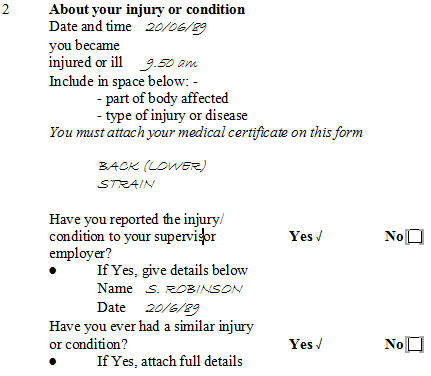
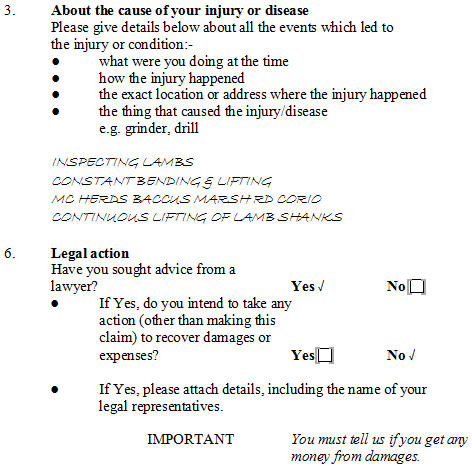
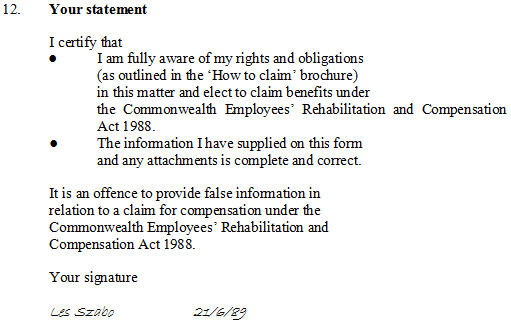
On 21 June 1989, Mr Szabo signed a claim form under the Compensation Act. The relevant parts of the claim form are set out in the Schedule to these reasons.
11 Mr Szabo’s doctor issued a medical certificate which certified that he would be fit to resume normal duties on 10 July 1989. On 3 August 1989, Comcare wrote to the Department of Primary Industries and Energy, saying that “liability had been found” for “aggravation of pre-existing lower back strain”. Thereafter, treatment of Mr Szabo included an intra-disc steroid injection in May 1990 and a spinal fusion in February 1991. In succeeding years, Comcare made many determinations under the Compensation Act in favour of Mr Szabo, awarding him medical expenses under s 16 and household assistance under s 29.
12 However, on 22 February 2008, Comcare wrote to Mr Szabo referring to his claim for “aggravation of pre-existing lower back degenerative disease, sustained on 20 June 1989”. The letter asserted that current medical evidence indicated that Mr Szabo was not presently suffering from the effects of his “compensable injury”. A report of an orthopaedic surgeon in that regard was attached. The letter invited Mr Szabo to present further medical evidence supporting his claims for compensation under ss 16 and 29 of the Compensation Act. The letter said that Comcare would issue a determination in accordance with the Compensation Act on 26 March 2008. Comcare subsequently received further reports and submissions on behalf of Mr Szabo.
13 On 13 June 2008, Comcare wrote to Mr Szabo again, saying that, based on the evidence then available, Comcare had decided that Mr Szabo was not then suffering from the effects of his compensable injury of 20 June 1989 and had determined, in accordance with the Compensation Act, that, with effect from 30 June 2008, compensation was not payable under ss 16 or 29 of the Compensation Act. Reasons for those decisions were attached to the letter. The reasons set out extracts from the medical reports that had been received by Comcare.
14 On 1 July 2008, Mr Szabo requested review of the decision of 13 June 2008. On 8 December 2008, Mr Szabo wrote to Comcare in relation to the review. In his letter, Mr Szabo said that the evidence demonstrated that, when he had returned to work to perform even modified duties, “the injury was quite quickly aggravated”. He said that, while there was no longer any work-related aggravation to the injury, the stresses and strain of normal day-to-day living were more than enough “to continually aggravate my back”. He asserted that the accident injury reports on his file showed that, upon returning to work, “the added strain to my spine was exacerbated by the constant bending, twisting and lifting of sheep carcasses”.
15 On 7 January 2009, Comcare affirmed the decision of 13 June 2008. In the reasons given for affirming the decision, reference was made to medical evidence to the effect that Mr Szabo’s then current condition was the result primarily of his pre-existing degenerative condition, which was made symptomatic as a result of the 1985 Injury. Medical evidence indicated that there were further aggravations of the 1985 Injury but no specific further injury. The reasons said that any aggravation incurred in employment was a temporary aggravation and that Mr Szabo’s current condition was a result of the progression of his degenerative disc disease.
THE TRIBUNAL’S DECISION
16 On 12 February 2009, Mr Szabo filed an application for a review by the Tribunal of the decision of 7 January 2009. Mr Szabo’s statement of facts, issues and contentions filed with the Tribunal on 8 June 2010, relevantly for present purposes, said as follows:
FACTS
3. Mr Szabo first injured his back on 24 September 1985.
5. Mr Szabo commenced work with AQIS on 30 September 1988.
7. Mr Szabo suffered a strain to his spine on 20 June 1989.
8. A determination was made on 3 August 1989 accepting liability for aggravation of a pre-existing lower back strain.
12. A determination was made on 13 June 2008 that compensation was not payable pursuant to ss 16 and 29 of the Compensation Act.
ISSUES
Mr Szabo was fit for normal duties as at 3 October 1988.
Mr Szabo suffered a further injury to his spine on 20 June 1990.
Mr Szabo underwent a lumbar discogram on 16 October 1990 and a spinal fusion on 4 February 1991.
Mr Szabo’s current work and domestic restrictions are causally related to his injury on 20 June 1989 and subsequent surgery.
17 Comcare’s amended statement of facts, issues and contentions filed with the Tribunal on 6 October 2010 (Comcare’s Statement) described the nature of Mr Szabo’s application to the Tribunal as concerning a claim for compensation for a lower back injury that Mr Szabo alleged was caused while working for the Victorian Department of Agriculture and Rural Affairs at the premises of MC Herd on 24 September 1985, which was aggravated while working for AQIS on 20 June 1989. Comcare’s Statement asserted that Mr Szabo did not claim that his current symptoms commenced de novo on or about 20 June 1989 but that they constituted an aggravation of the 1985 Injury.
18 Comcare’s Statement set out in some considerable detail the medical history on the files of Comcare. It asserted that there was little, if any, evidence to support Mr Szabo’s claim that he had suffered anything more than a minor aggravation to his back condition on 20 June 1989 and that, in any event, he had been compensated for his back injury, the subsequent surgery and any residual symptoms in the settlement of 4 February 1992. Comcare’s Statement asserted that Mr Szabo had recovered state workers’ compensation in respect of his entire lower back injury and that compensation was no longer payable. Comcare’s Statement contended that, in the alternative, the medical reports and correspondence regarding the settlement indicated that Mr Szabo recovered compensation for the entire effect of the 1985 Injury, which included any aggravation leading up to the settlement and the subsequent surgery in 1991.
19 In further alternative, Comcare’s statement asserted, Mr Szabo no longer suffered from the effects of the aggravation of his pre-existing lower back degenerative disease sustained on 20 June 1989 and that the Tribunal should be persuaded by the medical evidence in that regard. It asserted that Mr Szabo relied on the evidence of Dr Evans, whose opinion was based on an incorrect history. Finally, Comcare’s Statement asserted that a significant proportion of Mr Szabo’s current requirement for household services and attendant care services and medical treatment was consequent upon medical conditions that were not related to his aggravation of pre-existing lower back degenerative disease sustained on 20 June 1989.
20 On 22 February 2011, the Tribunal made a decision that the decision of 7 January 2009 under review be affirmed. The Tribunal was satisfied that the incident of 20 June 1989 was an aggravation of the 1985 Injury but that, as from 13 June 2008, there was no present liability for compensation. The Tribunal was satisfied that Mr Szabo did not continue to suffer from the effects of the aggravation of his pre-existing lower back degenerative disease injury sustained on 20 June 1989. The Tribunal was satisfied that any back pain from which Mr Szabo suffered was as a result of the 1985 Injury, for which he was compensated by the State of Victoria.
21 The Tribunal formulated the issues before it as follows:
whether, at 13 June 2008, Mr Szabo continued to suffer from the effects of the aggravation of his pre-existing lower back degenerative disease injury sustained on 20 June 1989; and
whether, at 13 June 2008, Mr Szabo was entitled to compensation under ss 16 and 29 of the Compensation Act for medical expenses and household services reasonably required as a result of the incident on 20 June 1989.
Relevantly for present purposes, the Tribunal said that, in coming to the correct or preferable decision, it must consider whether the matter before the Tribunal could be considered to be a “nature and conditions” claim. In addressing the question of whether or not the claim before it was a “nature and conditions” claim, the Tribunal observed that Comcare’s determination of 13 June 2008, affirmed on 7 January 2009, was the source of the Tribunal’s jurisdiction in reviewing Mr Szabo’s claim.
22 The Tribunal referred to contentions advanced by counsel for Mr Szabo that not only the accident report of 20 June 1989 but all other accident reports submitted by Mr Szabo over the period October 1988 to March 1990 when he worked for AQIS, were in terms of “the nature and conditions of the work he performed”. It was contended that those reports indicated repetitive bending and lifting or continuous lifting of heavy loads and that Comcare had always accepted those reports and, at times, claims for compensation, on the basis of “nature and conditions of work”. The submissions on behalf of Mr Szabo emphasised that Comcare had accepted liability for claims that, it was said, clearly indicated that the “nature and conditions” of Mr Szabo’s work were the cause of his condition over many years. The contention was that, having accepted liability for a period of many years, it would be unconscionable for Comcare to assert that the incident on 20 June 1989 was an isolated incident for which liability would be denied as from 13 June 2008. It was contended that the medical evidence showed that the heavy work undertaken by Mr Szabo contributed to his pain, his time off work and, ultimately, the need to have surgery, which, it was said, was due to “the nature and conditions” of the work that he performed.
23 Mr Szabo asserted that various doctors consulted by him had opined that “the nature and conditions” of the heavy duties in his job contributed to his condition. The Tribunal referred specifically to a report from a Dr O’Brien that, while the original disc injury dated from 1985, Mr Szabo’s symptoms had been subsequently aggravated by persistent employment and that there was no doubt that that had been “the factor” in his persistent symptoms since April 1988. Dr O’Brien expressed the opinion that that did not represent a progression of a pre-existing disease nor the natural history of degeneration of the lumbo- sacral motion segment.
24 The Tribunal also referred to other medical opinions that Mr Szabo’s occupation had aggravated his pre-existing degeneration and that it was probable that his lower back symptoms were related to his employment. The Tribunal referred specifically to a medical opinion from a Dr Evans that Mr Szabo did not suffer a specific injury on 20 June 1989 that caused aggravation; rather, his condition was the result of the nature and conditions of his work. Dr Evans conceded that Mr Szabo suffered an aggravation sometime in the early half of 1989 due to “the nature and conditions of his work”, but not specifically on 20 June 1989. Finally, the Tribunal referred to the opinion of a Dr Ashwell that Mr Szabo’s current condition was more likely a result of pre-existing degenerative disc disease in the lumbo- sacral spine, rather than due to any aggravation that occurred in June 1989 and that the incident of 20 June 1989 was a temporary aggravation.
25 The Tribunal concluded as follows:
Mr Szabo’s claims were not nature and conditions claims even though they may appear to have been worded in that way. No accident report or claim was specifically made for the nature and conditions of work as is required by the legislation. There was no appropriate determination by Comcare, and no reviewable decision relating to nature and conditions of work against which Mr Szabo could appeal to this Tribunal. Accordingly, the Tribunal cannot therefore … make a decision on nature and conditions.
26 Later in its reasons, the Tribunal observed that no formal application by Mr Szabo, regarding an injury arising out of the nature and conditions of work, had been made; as a result, neither had any determination been made by Comcare in relation to any such application. Accordingly, the Tribunal considered, there was no reviewable decision regarding nature and conditions of work from which Mr Szabo could appeal. The Tribunal concluded that it had no jurisdiction “to entertain a claim for nature and conditions”.
THE DECISION OF THE PRIMARY JUDGE
27 On 22 March 2011, Mr Szabo filed a notice of appeal to the Federal Court, under s 44(1) of the Tribunal Act, from the decision of the Tribunal of 22 February 2011. The notice of appeal purported to raise five questions of law and six grounds of appeal. Ultimately, the alleged errors of law related to the Tribunal’s rejection of a “nature and conditions” claim. Mr Szabo contended that, in finding that he had claimed compensation for an injury arising out of a specific incident, the Tribunal had applied an overly technical and literal test. He asserted that the Tribunal’s view was that only a claim that used some verbal formula such as “nature and conditions” could be treated as such a claim and that the Tribunal should have considered the substance of the claim and interpreted it beneficially, broadly and practically, rather than in an overly technical and literal way.
28 Mr Szabo also contended that he had been denied procedural fairness. He contended that the jurisdictional issue arising from the characterisation of his claim had been raised for the first time orally at the hearing before the Tribunal. He said that that issue fundamentally changed the nature of the case, with no prior notice to him, and that it would be “unconscionable” for the Tribunal to allow the jurisdictional point to be taken.
29 Comcare took issue with Mr Szabo’s contention that it was not until the hearing before the Tribunal that his claim had been limited to an injury that occurred on 20 June 1989. Comcare asserted that the original injury report of 20 June 1989 and the original and subsequent claims, as well as the entire decision-making process of Comcare prior to the Tribunal hearing, either referred to a specific injury that occurred on 20 June 1989 or clearly related to a claim in which that date was identified as the date of a relevant injury.
30 The primary judge considered that the transcript of the hearing before the Tribunal bore out Comcare’s account of how the jurisdictional issue arose. The transcript showed that, at the commencement of the hearing, counsel for Mr Szabo advised that Dr Evans was not available to give evidence. Comcare informed the Tribunal that it would not take issue with the unavailability of Dr Evans since, from a jurisdictional perspective, his evidence would be of little value, as he gave an opinion on a nature and conditions claim, without regard to the injury date of 20 June 1989. At that point, counsel for Mr Szabo objected vigorously to the Tribunal entertaining the jurisdictional issue. Her Honour concluded that each side had assumed that its own interpretation was non-contentious, and that each was taken by surprise when the competing constructions of Mr Szabo’s claim were raised before the Tribunal. Her Honour concluded that there was no denial of procedural fairness and that each party had proceeded on its own construction of the claim. That being so, the only question was, as Mr Szabo contended, how the existing claim should be interpreted.
31 The primary judge considered that, if Comcare’s construction of the claim were correct, it must follow that the Tribunal was correct in concluding that it had no jurisdiction to consider a nature and conditions claim, since the conditions for enlivening such jurisdiction had not been met. In relation to an injury arising from the nature and conditions of Mr Szabo’s employment, there had been no notice under s 53, no determination under s 60, no reviewable decision under s 62 and no application under s 64. It followed that, if Comcare’s construction of the claim were correct, Mr Szabo’s claim to have been denied procedural fairness had to fail.
32 The primary judge observed that Mr Szabo did not take issue with those consequences of the Tribunal’s characterisation of the claim, but confined himself to maintaining that, when the claim was considered in all the circumstances that were known at the time, it was clear that Mr Szabo was not claiming compensation for a specific injury that occurred on 20 June 1989, but for the consequences of the cumulative result of repetitive work or a series of recurring injuries, arising out of the bending, lifting and twisting required in his work as a meat inspector.
33 Mr Szabo contends that, in construing a document purporting to be a notice of injury under the Compensation Act, a broad, generous and practical interpretation must be adopted, consistent with both the beneficial purposes of the Compensation Act and the likelihood that lay people of differing levels of education, differing levels of medical advice and differing levels of legal advice would be giving the notice. In deciding what the injury is, of which a claimant has given notice, the purposes of giving notice must be borne in mind. Those purposes include enabling Comcare, with the aid of the relevant employing agency, to determine whether the claim should be met. In construing a notice of injury or notice of claim, consideration of the purpose of giving notice of injury and of enabling the decision- maker to have a fair opportunity to investigate the claim properly are paramount (see Abrahams v Comcare (2006) 93 ALD 147 at [18]). Comcare did not take issue with that formulation of the approach that should be adopted in construing notice of a claim.
34 There may be a real question whether the jurisdiction of the Tribunal is confined by the particular description of the cause of an otherwise compensable injury given by an employee. While it is necessary that an injury, in order to found a claim for compensation, arise out of, or in the course of, employment, it may not be necessary in every case that absolute precision be applied if it is otherwise clear that a sufficient connection with employment exists (Sellick v Australian Postal Corporation (2009) 113 ALD 58 at [23]).
35 After referring to the manner in which Mr Szabo had completed the accident report and his claim for compensation forms in June 1989, the primary judge observed that, although the documents mentioned constant bending and lifting, the identified subject matter of the claim was a specific injury that had been suffered at a specific time, namely 9.50 am, on 20 June 1989. Her Honour considered that it was the reference to “constant bending and lifting” that the Tribunal had in mind when it commented that Mr Szabo’s claims “may appear to have been worded” as a nature and conditions claim. Her Honour observed that it would have been preferable for the Tribunal to have been explicit on the point. However, in accordance with the principle that the reasons of an administrative tribunal should not be subjected to overzealous scrutiny, her Honour did not regard that as being indicative of reviewable error.
36 Mr Szabo contended that the Tribunal had failed to take account of four additional incident reports lodged by him, all of which referred to strains to the back arising out of repeated lifting, bending and twisting. He pointed to the fact that, when he took time off after some of those incidents, he was paid compensation. Further, Comcare also paid for his spinal fusion surgery that was carried out in 1991. Mr Szabo contended that those facts indicated that the additional accident reports and the spinal injury were treated as extensions or amplification of his earlier claim.
37 The primary judge considered that Mr Szabo’s contention that Comcare had treated the additional accident reports and his need for spinal surgery as extensions of his earlier claim was not consistent with the findings of fact made by the Tribunal. The Tribunal found that the 1985 Injury was a significant injury, which continued to cause Mr Szabo pain. However, Mr Szabo had been compensated for that injury. Her Honour considered that there were three additional findings of fact made by the Tribunal that were crucial. First, the 1985 Injury was followed by further incidents causing back and leg pain, including the incident on 20 June 1989, which were short-term aggravations of the 1985 Injury. Secondly, the injury in 1989 had resolved after a short time and Mr Szabo no longer suffered from that injury. Thirdly, the back pain from which Mr Szabo presently suffered was the result of the injury in 1985. Consequently, the Tribunal concluded that Mr Szabo had already been compensated for the 1985 injury and that the injury in 1989 had resolved such that no compensation was payable.
38 Comcare contended before the primary judge that there was no confusion as to Mr Szabo’s description of his injury or as to the cause of the injury. Counsel said that the jurisdictional question was whether the Tribunal could consider and determine specific incidents that were not the subject of a claim under s 54 of the Compensation Act, in circumstances where Mr Szabo had not sought determination under s 60 in respect of those incidents. Those other incidents occurred after the date specified in Mr Szabo’s claim as the date on which the injury in respect of which the claim was made had occurred. While the symptoms to which they referred might have been understood as following from the injury in 1989, the findings of fact made by the Tribunal included the finding that the injury suffered in 1989 had resolved by 13 June 2008.
39 The primary judge considered that the Tribunal’s reasons indicated that careful consideration had been given to the medical evidence presented to it. The Tribunal’s finding of fact was based on medical evidence before it that it was entitled to accept. The finding involved the rejection of medical evidence that the Tribunal was entitled to reject. The Tribunal was satisfied that there was no present liability for compensation from 13 June 2008, and that Mr Szabo did not continue to suffer from the effects of the aggravation of his pre-existing lower back degenerative disease injury sustained on 20 June 1989. The Tribunal concluded that the back pain from which he suffered was a result of the significant injury he suffered in 1985, for which he had been compensated. Her Honour concluded that there was no error on the part of the Tribunal in making those findings and ordered that Mr Szabo’s appeal under s 44 be dismissed with costs.
THE APPEAL
40 On 20 February 2012, Mr Szabo filed a notice of appeal to the Full Court from the order made by the primary judge on 30 January 2012. The notice of appeal contains three grounds as follows:
1. The primary judge erred in holding that the Tribunal had not misconceived the limits of its jurisdiction.
2. The primary judge erred in holding that Mr Szabo’s contention, that Comcare had treated the additional accident reports as extensions of the earlier claim, was not consistent with findings of fact made by the Tribunal.
3. The primary judge erred in failing to find that Mr Szabo was denied procedural fairness as a result of the Tribunal permitting Comcare to contend, and then accepting, more than 20 years after the event, that Comcare had paid compensation to Mr Szabo only in relation to a specific incident and did not treat the claim made by him in June 1989 and the subsequent incident reports as amounting in substance to a single nature and conditions claim.
41 It is not possible to find, in the documents completed by or on behalf of Mr Szabo immediately following the incident of 20 June 1989, a claim in respect of some injury or disease arising from the nature and conditions of his employment. The extract set out in the Schedule to these reasons makes clear that Mr Szabo gave specific responses to specific questions. Thus he says:
The injury occurred at 9.50 am on 20 June 1989.
The part of his body affected was back (lower).
The type of injury or disease suffered was strain.
At the time of the injury, he was inspecting lambs.
The injury happened because of constant bending and lifting.
The thing that caused the injury or disease was continuous lifting of lamb shanks.
Those answers do not amount to a claim for a disease or injury that was aggravated or contributed to in a material degree by the nature and conditions of Mr Szabo’s employment.
42 That is not to say that it would not now be open to him to make a claim. However, until such a claim is made, and has been determined by Comcare, there can be no decision that could be the subject of review by the Tribunal. There was no error on the part of the Tribunal.
43 The contention based on denial of procedural fairness is misconceived. Mr Szabo eschewed any reliance upon the doctrine of estoppel or any similar doctrine. The contention appears to be no more than that the Tribunal erred in concluding that there had been no decision by Comcare on a “nature and conditions” claim that could be the subject of review by the Tribunal.
44 Mr Szabo has not established any error in the reasoning of the primary judge in reaching the conclusion that there was no error of law on the part of the Tribunal. It follows that this appeal should be dismissed with costs.
THE SCHEDULE
I certify that the preceding forty-four (44) numbered paragraphs are a true copy of the Reasons for Judgment herein of the Honourable Justices Emmett and Greenwood. |
Associate:
IN THE FEDERAL COURT OF AUSTRALIA | |
NEW SOUTH WALES DISTRICT REGISTRY | |
GENERAL DIVISION | NSD 259 of 2012 |
ON APPEAL FROM THE FEDERAL COURT OF AUSTRALIA |
BETWEEN: | LAZLO SZABO Appellant
|
AND: | COMCARE Respondent
|
JUDGES: | EMMETT, BENNETT AND GREENWOOD JJ |
DATE: | 7 september 2012 |
PLACE: | SYDNEY |
REASONS FOR JUDGMENT
Bennett J
45 I have read in draft the reasons of Emmett and Greenwood JJ. I agree generally with their Honour’s conclusions and reasons. I will not restate the history of the matter or the legislative context, as there set out, which I gratefully adopt.
46 Mr Szabo submits that the decision of the Tribunal was infected by jurisdictional error because of a failure on the part of the Tribunal properly to consider the facts and construe the claim. Mr Szabo further submits that the Tribunal had denied him procedural fairness. There is no dispute that if the Tribunal misconstrued the claim, or failed to consider the claim, or failed to take account of relevant considerations, there is a question of law for the purposes of the Administrative Appeals Tribunal Act 1975 (Cth).
47 Mr Szabo completed a claim form, pursuant to s 54 of the Safety, Rehabilitation and Compensation Act 1988 (Cth) (the SRC Act), after incurring an injury on 20 June 1989. Before submitting the claim form, Mr Szabo had completed a notice of injury pursuant to s 53 of the SRC Act, which contained the following relevant information:
Accident/Injury/Disease Report
Date of Accident: 20/06/89
Time of Accident: 9:50 am
Description of Accident: CONSTANT LIFTING & BENDING WHILST CARRYING OUT INSPECTION DUTIES ON MUTTON CHAIN (LIFT?ING FRONT LEGS TO INSPECT UNDER NECKS)
48 The claim form, a pro forma document completed by Mr Szabo, contains the following relevant information:
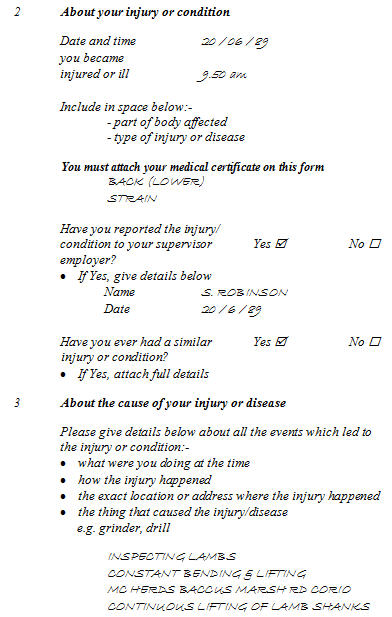
49 In addition, under the heading “Legal action”, question 6 asks whether Mr Szabo had sought advice from a lawyer, to which he answered “yes’, and whether he intends to take other action, to which he answered “no”.
50 Ultimately, both parties accepted that this appeal turns on the construction of the claim form. There is no dispute as to the applicable legal principles as to the approach to the construction of the claim form. These are as outlined in Abrahams v Comcare (2006) 93 ALD 147 by Madgwick J at [18], namely:
1. In construing a document purporting to be a notice of injury under the Act, a broad, generous and practical interpretation should be made, consistent with both the beneficial purposes of the Act and the likelihood that laypeople of differing levels of education, differing levels of medical advice and differing levels of legal advice (indeed in most cases they would not have any) will be giving the notice.
2. In deciding what injury it is, as to which a claimant has given notice, the purposes of giving notice must be borne in mind. These are to enable Comcare, with the aid of the relevant employing agency, to determine whether the claim should be met.
3. The powers of an original decision-maker would extend to regarding informal notice as having been given in amplification of a notice formally given.
4. Those powers would further extend to enabling a consideration of a claim better explaining, or better justifying, a claim in respect of an injury in respect of which notice had been fairly given.
5. There is not always a bright dividing line available to assist in the decision whether powers of the kinds mentioned are being exercised in aid of a better understanding of a claim made in respect of an injury of which notice has been given, or whether the changed notice is sufficiently fundamental as to indicate that a different injury is being asserted, which will require a different decision from a decision in respect of the originally claimed injury under consideration. In determining that matter, considerations of the purpose of giving notice of injury, and more generally of enabling the decision-maker to have a fair opportunity to investigate the claim properly, are paramount.
51 The issue is whether the claim was for an injury that occurred on a specific date, namely 20 June 1989, being lower back strain arising from the constant bending and lifting resulting from continuous lifting of lamb shanks at M.C. Herds, or whether it was a claim for injury arising from the general nature of the work undertaken by Mr Szabo in the course of his employment, referred to by the parties as a “nature and conditions” claim. If the latter, Mr Szabo says that injuries arising before and after the event of 20 June 1989 should have been considered by the Tribunal in order to determine the scope of his claim.
52 This is not a case, like Sellick v Australian Postal Corporation (2009) 113 ALD 58, where very different causes of injury or injuries, have been stated. The other injuries sought to be relied on by Mr Szabo in the Tribunal, as set out at [27] of the Tribunal’s reasons are:
• accident report dated 20 June 1989, constant lifting & bending whilst carrying out inspection duties on mutton chain;
• accident report dated 24 October 1989, constant lifting & twisting … repetitive work;
• accident report dated 25 October 1989, constant lifting, bending & twisting whilst lifting lamb shanks to inspect under necks for contamination. Repetitive action;
• accident report dated 8 February 1990, continuous bending across belt;
• accident report dated 13 February 1990, repetitive action due to the lifting of hocks …aggravation of existing injury.
53 There is no dispute that the injury of 20 June 1989 was an aggravation of a pre-existing lower back strain.
The Tribunal decision
54 The Tribunal said at [24] that Comcare’s determination, the reviewable decision, relevantly stated:
… deny present liability for compensation in respect of aggravation of pre-existing lower back degenerative disease injury (sustained on 20 June 1989) pursuant to sections 16 and 29 of the Safety Rehabilitation and Compensation Act 1988 …
55 The relevant conclusions in the Tribunal’s reasoning are set out at [41] and [107]:
41. In conclusion, I prefer the Respondent’s argument. Mr Szabo’s claims were not nature and conditions claims even though they may appear to have been worded in that way. No accident report or claim was specifically made for the nature and conditions of work as is required by the legislation. There was no appropriate determination by Comcare, and no reviewable decision relating to nature and conditions of work against which Mr Szabo could appeal to this Tribunal. Accordingly this Tribunal cannot therefore, pursuant to Bennett J in Sellick, make a decision on nature and conditions.
…
107. No formal application by Mr Szabo, nor a determination by the Respondent regarding an injury arising out of the nature and conditions of work was made. Accordingly there is no reviewable decision regarding nature and conditions of work from which Mr Szabo can, or has, appealed. There is no jurisdiction in this Tribunal to entertain a claim for nature and conditions (Sellick).
56 The explanation for the position taken by the Tribunal is, in isolation, somewhat cryptic. It is apparent that the Tribunal construed the claim form, taken in its entirety, as not extending to a nature and conditions claim. The Tribunal noted that Comcare had not treated it this way and that there was no reviewable decision relating to such a nature and conditions claim.
The decision of the primary judge
57 The primary judge restated the effect of [41] of the Tribunal decision at [26]:
If the respondent’s construction of the claim is correct then it must follow that the Tribunal was correct in concluding that it had no jurisdiction to consider a nature and conditions claim because the conditions for enlivening that jurisdiction had not been met. In relation to any injury arising from the nature and conditions of the applicant’s employment, there had been no notice under s 53; no determination under s 60; no reviewable decision under s 62; and no application under s 64. It would follow from this that the applicant’s claim to have been denied procedural fairness must fail.
58 Her Honour noted (at [27]) that Mr Szabo’s contention was that his claim, properly construed in the context of circumstances known at the time, was not for a specific injury that occurred on 20 June 1989 but for the consequences of the cumulative result of repetitive work or a series of recurring injuries arising out of his work as a meat inspector. Mr Szabo had asserted that the Tribunal, in error, failed to take account of subsequent incident reports and the fact of subsequent spinal surgery. Mr Szabo contended that these additional accident reports and the spinal surgery were treated by Comcare as extensions of his earlier claim.
59 The primary judge considered that, although the claim form mentioned constant bending and lifting, it identified the subject matter of the claim as a specific injury, occurring on 20 June 1989. This injury, as with others that had occurred after a significant injury to Mr Szabo in 1985, were short term aggravations of that 1985 injury. Her Honour accepted that the evidence was that the 1989 injury had resolved after a short time and that Mr Szabo no longer suffered from this injury.
60 The further back pain suffered by Mr Szabo was, as the Tribunal found and her Honour accepted, a result of the earlier 1985 injury, for which he had already been compensated.
Consideration
61 I agree with the reasoning of the primary judge as to the construction of the claim form. I am not satisfied that the claim form, properly understood, extends beyond a claim for a specific injury that occurred on 20 June 1989, which injury was caused by the actions set out in answer to question 3 of the claim form. It is a claim for an injury that occurred on that date.
62 It follows that previous and subsequent events and injuries were not relevant to the Tribunal’s consideration of the reviewable decision. I accept that Mr Szabo was not legally qualified and that the claim form should be construed beneficially to him, but he had received legal advice before completing the claim form. The questions and answers in the claim form are clear and consistent with the injury report that he had earlier completed and submitted.
63 I agree with Emmett and Greenwood JJ’s conclusion that Mr Szabo’s contention that the Tribunal denied him procedural fairness is misconceived.
64 The Tribunal did not misconceive its jurisdiction, nor did it deny Mr Szabo procedural fairness. The primary judge was not in error.
65 I agree with the orders proposed by Emmett and Greenwood JJ.
I certify that the preceding twenty-one (21) numbered paragraphs are a true copy of the Reasons for Judgment herein of the Honourable Justice Bennett. |
Associate:
Dated: 7 September 2012


