

FEDERAL COURT OF AUSTRALIA
Parker v Minister for Sustainability, Environment, Water, Population and Communities [2012] FCAFC 94
IN THE FEDERAL COURT OF AUSTRALIA | |
| First Appellant CARLY PARKER Second Appellant GARRY LOPATTA Third Appellant CLAY HUNTER Fourth Appellant | |
AND: | MINISTER FOR SUSTAINABILITY, ENVIRONMENT, WATER, POPULATION AND COMMUNITIES Respondent |
DATE OF ORDER: | |
WHERE MADE: |
THE COURT ORDERS THAT:
2. The appellants to pay the respondent’s costs of the appeal.
Note: Entry of orders is dealt with in Rule 39.32 of the Federal Court Rules 2011.
VICTORIA DISTRICT REGISTRY | |
GENERAL DIVISION | VID 1428 of 2011 |
ON APPEAL FROM THE FEDERAL COURT OF AUSTRALIA |
BETWEEN: | GLENN PARKER First Appellant CARLY PARKER Second Appellant GARRY LOPATTA Third Appellant CLAY HUNTER Fourth Appellant
|
AND: | MINISTER FOR SUSTAINABILITY, ENVIRONMENT, WATER, POPULATION AND COMMUNITIES Respondent
|
JUDGES: | JACOBSON, BENNETT AND COWDROY JJ |
DATE: | 29 June 2012 |
PLACE: | MELBOURNE |
REASONS FOR JUDGMENT
Introduction:
1 The appellants are cat breeders who wish to import into Australia for the purposes of breeding and sale the fifth generation (F5) of a species known as the Savannah Cat.
2 The Savannah Cat is a hybrid cross developed in the United States of America in the mid 1980s. It is a cross between a medium-sized African wild cat known as Felis serval and a domestic cat, known as Felis catus.
3 The Minister maintains a list of specimens suitable for live import into Australia. The list is maintained under s 303EB of the Environment Protection and Biodiversity Conservation Act 1999 (Cth) (“the EP Act”). Unless the species is included in the list, its importation is prohibited. The Minister has power under s 303EC of the EP Act to amend the list by, inter alia, including or deleting items from the list.
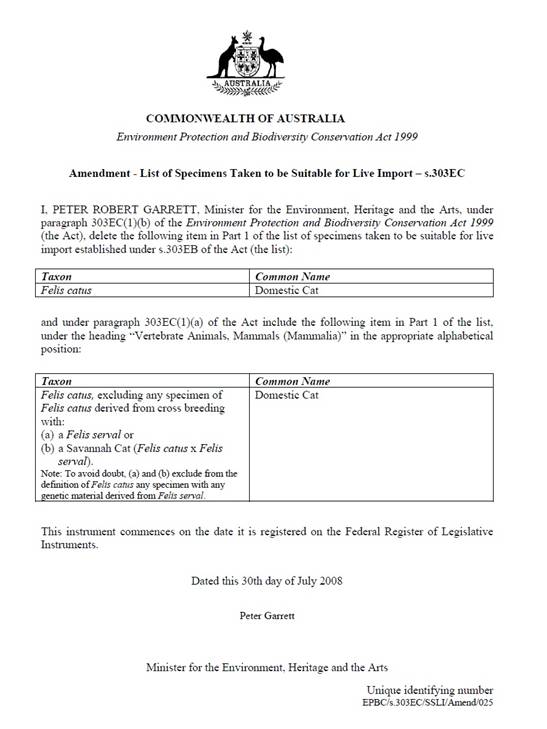
4 By a legislative instrument made on 30 July 2008 (the instrument), the then Minister, Mr Peter Robert Garrett, amended the list so as to exclude the F5 Savannah Cat from the list of specimens suitable for live import into Australia. As a consequence, the F5 Savannah Cat became a prohibited import.
5 The Minister’s power to amend the list by inclusion of an item is conditioned upon the Minister first considering a report assessing the potential impact on the environment of the proposed amendment. By contrast, the power to amend by deleting an item is not conditioned upon the Minister obtaining such a report: see 303EC(5).
6 In the present case, the instrument stated that the amendment was made to delete from the list the Felis catus and to include on the list the Felis catus excluding any specimen of Felis catus derived from cross breeding with a Felis serval or a Savannah Cat. The instrument thereby effectively eliminated the possibility of importation of the Savannah Cat or its derivations.
7 Notwithstanding the form of the legislative instrument, the primary judge held that the effect of the instrument was not to include an item on the list and, accordingly, that the exercise of the power was not conditioned on the preparation and consideration of a relevant report. This was because his Honour held that the effect of the instrument was to delete an item from the description of domestic cat.
8 In any event, the Minister did obtain an environmental assessment report prior to signing the legislative instrument. The appellants (who were the applicants at first instance) contended before the primary judge that the report was not a report that was prepared in accordance with the relevant provisions of the EP Act. However, the primary judge rejected that contention.
9 The primary judge also rejected a further contention made by the appellants that the instrument was invalid on the ground that it was an unreasonable expression of the power of amendment.
10 The appellants raise what are, in effect, the same grounds as were agitated below as the grounds of appeal. Thus, the appeal raises two issues of construction of the instrument, namely whether it constituted an inclusion on the list, and whether the terms of the instrument were unreasonable in the light of the test stated in the authorities which address the ground of unreasonableness.
11 The appeal also raises a third issue, namely whether even if the instrument constituted an inclusion on the list, the amendment was valid upon the ground that the Minister obtained and considered “a relevant report”: see s 303EC(5).
The legislative scheme
12 Part 13A of the EP Act was inserted in 2001. It incorporates a previous enactment known as the Wildlife Protection (Regulation of Exports and Imports) Act 1982 (Cth).
13 The objects of Part 13A are set out in s 303BA. They include:
to ensure that Australia complies with its obligations under the Convention on International Trade in Endangered Species (the CITES) and another international convention known as the Biodiversity Convention: see s 303BA(1)(a);
to protect wildlife that may be adversely affected by trade: see s 303BA(1)(b);
to promote the conservation of biodiversity in Australia and other countries: see s 303BA(1)(c); and
to ensure that the “precautionary principle” is taken into account in making decisions relating to the utilisation of wildlife: see s 303BA(1)(h).
14 Section 303BA(2) continues the exposition of the objects by stating that in order to achieve its objects, Part 13A includes special provisions to conserve the biodiversity of Australian native wildlife.
15 Division 4 of Part 13A regulates the importation of live specimens. It does so by establishing a regime for the listing of specimens suitable for live import. The regime established under Division 4 is to be read in light of the object of giving effect to Australia’s obligations under the Biodiversity Convention. Under Article 8(h) of the Biodiversity Convention, Australia is obliged so far as possible to:
(p)revent the introduction of …. alien species which threaten ecosystems, habitats or species.
16 Section 303EB(1) provides that the Minister must, by instrument published in the Gazette, establish a list of specimens that are taken to be suitable for live import (the live import list). That list is to be divided into two parts, namely Part 1 which is a list of unregulated specimens, and Part 2, a list of allowable regulated specimens.
17 The effect of the distinction drawn between the separate Parts of the list is that an animal (or plant) which is listed in Part 1 may be imported without the need for a permit, whereas those which are listed in Part 2 may only be imported pursuant to a permit issued to the importer: see s 303EK.
18 Importantly, a live animal not listed in either Part 1 or Part 2 of the list may not be imported into Australia. That is to say, the default position which applies to any live animal not included in either Part of the list is that the importation of the animal into Australia is prohibited.
19 The Minister’s power of amendment is conferred by s 303EC of the EP Act. That section provides relevantly:
(1) The Minister may, by instrument published in the Gazette, amend the list referred to in section 303EB by:
(a) including items in a particular part of the list; or
(b) deleting items from a particular part of the list; or
(c) correcting an inaccuracy or updating the name of a species; or
(d) imposing a restriction or condition to which the inclusion of a specimen in Part 2 of the list is subject; or
(e) varying or revoking a restriction or condition to which the inclusion of a specimen in Part 2 of the list is subject.
…
(3) Before amending the list referred to in section 303EB as mentioned in paragraph (1)(a), (b), (d) or (e) of this section, the Minister:
(a) must consult such other Minister or Ministers as the Minister considers appropriate; and
(b) must consult such other Minister or Ministers of each State and self‑governing Territory as the Minister considers appropriate; and
(c) may consult such other persons and organisations as the Minister considers appropriate.
…
(5) The Minister must not amend the list referred to in section 303EB by including an item in the list, unless:
(a) the amendment is made following consideration of a relevant report under section 303ED or 303EE; or
(b) the amendment is made following consideration of a relevant review under section 303EJ.
20 Section 303EC(5) is a pivotal provision in the present case because the effect of it is to permit the Minister to amend the list by deleting an item without consideration of a relevant report but to condition the power of amendment by including an item on the list upon the consideration of a relevant report under s 303ED.
21 The relevant report is specified in s 303ED(2). It is that the Minister must cause to be conducted:
an assessment of the potential impacts on the environment of the proposed amendment.
22 Further requirements for the process of assessment are stated in s 303EF. That section provides for the preparation by the Minister of terms of reference for a report and for the preparation of a draft report prior to the finalisation of the report, taking into account the comments (if any) received after the publication of the draft.
23 The provisions of Part 13A to which we referred above are contained in Chapter 5 of the EP Act. The “precautionary principle”, which is one of the objects of Part 13A, is stated in s 391. That section is found in Chapter 6, Part 16.
24 Section 391(1) provides that the Minister must take account of the precautionary principle in making a decision listed in the table in s 391(3) to the extent that he or she can do so consistently with other provisions of the EP Act.
25 The table in s 391(3) includes a decision made under s 303EC:
about including an item in the list referred to in section 303EB.
26 The precautionary principle is defined in s 391(2) as follows:
… lack of full scientific certainty should not be used as a reason for postponing a measure to prevent degradation of the environment where there are threats of serious or irreversible environmental damage.
The Instrument
27 The full text of the instrument in question in the present case is as follows:
The Report
28 The Minister established terms of reference for an environmental assessment of the suitability of the import of the Savannah Cat into Australia. The other steps taken by the Minister are referred to in [14] – [15] of the primary judgment.
29 On 19 June 2008, the Department published a draft report and, after receiving a large number of comments, published the environmental assessment report in its final form on 24 July 2008 (the Report).
30 In the background and summary section of the Report, the authors stated that their findings indicated that the risk of the Savannah Cat becoming established and integrated into the feral cat population in Australia is extreme. The authors also stated that the pest potential of the Savannah Cat is extreme.
31 The authors acknowledged that the domestic cat and other hybrids are already in Australia so that it could be argued that the importation of more varieties may not create further problems than those which already exist. They continued their summary by stating:
However, the Savannah Cat is genetically different to both the Domestic Cat and the Bengal Cat. Therefore, the Savannah Cat may have the potential to impact differently and more substantially on the Australian environment than those Domestic Cats already in Australia. Additionally, introducing new stock such as the Savannah Cat may increase the risk of reversion to the wild type (due to being few generations away from the wild Serval) or may enhance phenotypes further suited to Australian conditions. Hence, importation has clear potential to hasten and increase the likelihood of further establishment in the wild.
32 The taxonomy of the Savannah Cat was described at page 5 of the Report. The authors stated that, in the USA, a Serval must be on both sides of the pedigree to be considered a Savannah Cat. They continued by stating that in Australia, to be considered an F5, a domestic cat must be used in all generations on one side of the pedigree.
33 In the conclusion at section 13 of the Report, the authors repeated the conclusion that, on the available information, there is an extreme risk of the Savannah Cat establishing and becoming a pest.
34 The authors stated that if Savannah Cats were to become established in the wild, the possibility for increase in size and hunting prowess due to inheritance of Serval genes would mean that they are likely to cause at least the same amount of damage as that of the established feral domestic cat.
35 The final paragraph of the conclusions was as follows:
There are currently no reported or recorded instances of Savannah Cats escaping to the wild and joining feral Domestic Cat populations in other countries where Savannah Cats have been kept as companion animals. Savannah Cats have been reported to breed with Domestic Cats naturally, without human intervention. Although there is a lack of scientific certainty, given the biological similarities between the Savannah Cat and the Domestic Cat, and applying the precautionary principle, it is considered reasonable to suggest that the Savannah Cat if established in the feral Domestic Cat population in Australia, would increase the hunting success of feral cats. Additionally, taking into account natural selection and hybrid vigour, over time with the introduction of Serval genes into the population, feral cats may increase in size and potentially expand the range of prey hunted. Feral Domestic Cat controls are very expensive and have been proved to work unsuccessfully on the mainland. As such, the importation of Savannah Cats at any generation could exacerbate and increase the threat to the Australian environment.
36 There are other important parts of the Report which we address in more detail under Issue 3 below.
Issue 1 – Did the instrument amend the list by inclusion?
37 This question turns largely on the proper construction of the instrument signed by the Minister, but it is to be informed by the proper construction of the power of amendment conferred by s 303EC of the EP Act.
38 There is no escape from the proposition that, read literally, the instrument constituted a deletion of one item and the inclusion of another. In particular, the Minister invoked the power under s 303EC(1)(b) to delete the Felis catus and then the power under s 303EC(1)(a) to include the Felis catus excluding any specimen derived from cross breeding with the F5.
39 Indeed, there can be no real doubt that the Minister believed that he was adopting the power to amend by way of inclusion because he fulfilled the conditions necessary for the exercise of the power of amendment under s 303EC(1)(a). These conditions were the establishment of the terms of reference for an assessment and the conduct and consideration of an assessment of the potential impact on the environment: see ss 303EC(5), 303ED(2) and 303EF.
40 In our opinion, it follows from the approach adopted by the Minister that the issue of construction of the instrument is essentially academic. This is because we are of the view that even if the Minister exercised the power to amend the list by including an item on it, he did so in a manner which satisfied the necessary conditions for the exercise of the power.
41 Nevertheless, in our opinion, the better view of the construction of the instrument is that it constituted an exercise of the power to delete an item from the list under s 303EC(1)(b). Thus the Minister was not required to satisfy the condition of first considering an assessment of the environmental impact of the deletion, notwithstanding that he took that course.
42 The reason why we consider that the instrument was an exercise of the power to delete is that this was in substance what the Minister did. Looked at as a matter of substance, what the Minister did was to adopt a legislative drafting approach under which he removed the entirety of a particular specimen from the list and immediately thereafter replaced it with a smaller category of that specimen. This amounts to a deletion of part of the item rather than the inclusion of a new one.
43 This was the approach which the primary judge adopted and which he supported by reference to the purpose and object of the amendment power. His Honour said at [28] that the rationale for requiring an environmental assessment report where the list is amended to include an item is that such an amendment permits the importation of a specimen that was previously prohibited; no such purpose exists where a specimen that is previously permitted for import is deleted from the list.
44 The primary judge went on to say at [33] that the effect of the instrument was to exclude the specimen of F5 Savannah Cat from the extant listing of the domestic cat species.
45 For reasons given above, we agree with this approach.
46 It seems to us that the item, domestic cat, as included in the initial live imports list in the legislative instrument published in 2002 constituted a wide category of specimens which may have included the Savannah Cat, or at least the fifth generation of such cats. Generations 1 to 4 of the Savannah Cat were not contained in the list because they were covered by the CITES and were not included in Part 1 of the list established under s 303EB of the EP Act: see s 303EB(5).
47 The instrument addressed concerns which had been raised as to the effect on the environment of the potential importation of the F5 Savannah Cat. It did so by deleting altogether the item of Felis catus or domestic cat and replacing it with a new item consisting of Felis catus excluding any species of Felis catus derived from cross-breeding with a Felis serval, or an F5 Savannah Cat.
48 As we said earlier, the better view of this is that the instrument constituted the deletion of a specimen derived from cross breeding with the Serval, or an F5, from the wider category of specimens that come within the description of domestic cat.
49 In our view, nothing turns on the tabular form of the entry. We agree with the primary judge that the word “item” in s 303EC(1)(a) and (b) is to be read as meaning a specimen, species or sub-species. This is supported by the terms of s 303EB(1) which requires the Minister to establish a list of specimens, and by the reference to “species” and “specimen” in ss 303EC(1)(c)-(e). It is also supported, as the primary judge observed at [29], by the Revised Explanatory Memorandum to the EPBC Amendment (Wildlife Protection) Bill 2001.
50 We do not consider that our view of the proper construction of the instrument is affected by the fact that the Minister adopted a different source of power. The Minister’s mistake as to the source of power does not affect the validity of his action in the circumstances of the present case.
51 Authority for the last mentioned proposition may be found in the principle stated by the High Court in Brown v West (1990) 169 CLR 195 at 203, to which the primary judge referred.
52 We reject the submission made by the appellants that this principle is inapplicable where two sources of power have different preconditions to their exercise. In our view, the correct principle is that if a decision-maker purports to act under one head of power which does not exist, but there is another source of power available and the conditions antecedent to the valid exercise of that power have been satisfied, the decision-maker is entitled to rely on that source of power despite his or her purported reliance on the unavailable head of power: Eastman v Director of Public Prosecutions (ACT) (2003) 214 CLR 318 at [124] per Heydon J.
53 The authorities to which his Honour referred in support of that statement of principle included Brown v West at 203 and R v Bevan; Ex parte Elias & Gordon (1942) 66 CLR 452 at 487.
54 In our opinion, that principle supports the conclusion that even if the Minister purported to rely upon the power contained in s 303EC(1)(a) it was open to him to rely on the power of deletion conferred by s 303EC(1)(b) because that source of power could be exercised without the need to obtain an environmental assessment report. Thus, the condition for the exercise of the power which, according to the appellants was necessary to be satisfied, was not in fact a necessary pre-condition. Accordingly, even if the Report failed to satisfy the terms of s 303ED(2) the Minister validly exercised the power to delete the impugned item from the list.
Issue 2 – Did the Report constitute an assessment of the “potential impacts”?
55 If the Minister wished to rely upon the power to amend the list by including an item on it, he was required to conduct and consider an assessment of “the potential impacts on the environment of the proposed amendment”: see ss 303EC(5) and 303ED(2)(a).
56 Here, the question which arises is what constituted the item that was included in Part 1 of the list so as to require the conduct of an assessment that addressed the impact of the inclusion. The difficulty in answering this question is that the inclusion was expressed in the instrument as domestic cats excluding those of a particular type.
57 There are a number of possibilities as to what was required in the assessment of the impact of such an inclusion. On one view, what was required was an assessment of the impact of continuing to permit the import of domestic cats other than those derived from cross-breeding with the Felis serval. On another view, what was required was an assessment of the impact of excluding the F5 Savannah Cat.
58 The effect of the submission of the appellants was that the Report was deficient because it merely addressed the effect of the exclusion of the F5 without considering the impact of the broader nature of the “inclusion”, that is to say, the inclusion on the list of domestic cats other than those derived from cross-breeding with the F5.
59 For reasons set out in addressing “Issue 3”, we are of the view that the scope of the exclusion or carve out from the category of domestic cats is broad. But even on that view of the amendment, the Report assessed the potential “impacts” on the environment of the proposed amendment.
60 In short, the passages in the Report which we set out at [31] and [35] as well as those portions of the Report discussed under “Issue 3”, indicate that the Report assessed the potential impact on the environment, not only of the exclusion of cats derived from Felis serval, including the F5, but also of the continued importation of domestic cats other than the Savannah Cat and cats with Serval traits.
61 This can be seen most clearly in the observation at page 4 of the Report that the Savannah Cat may have the potential to impact more substantially on the environment than those domestic cats already in Australia. It can also be seen in the conclusion at page 33 that the Savannah Cat, if established in the feral domestic cat population, would increase the hunting success of feral cats.
Issue 3 – Unreasonableness
62 The principles upon which the appellant relied to support the submission that the instrument is unreasonable are well settled. The authorities were summarised by the primary judge at [61]ff. In essence, what is required to satisfy the test of invalidity on this ground is that there is no real connection between the legislative instrument and the purpose for which the regulation making power was conferred on the Minister: Clements v Bull (1953) 88 CLR 572 at 577; Minister for Primary Industries and Energy v Austral Fisheries Pty Ltd (1993) 40 FCR 381 at 383-384; Minister of State for Resources v Dover Fisheries Pty Ltd (1993) 43 FCR 565 at 577.
63 The question of whether the instrument in the present case is unreasonable therefore turns upon the proper construction of the effect of the amendment and, in particular, the scope of the exclusion or carve out of certain specimens from the category of domestic cats.
64 The new item set out in the instrument is Felis catus excluding any specimen derived from cross breeding with either a Felis serval or a Savannah Cat, which is designated Felis catus x Felis serval. This is, in our view, quite clear. The word derived, as defined in the Macquarie Dictionary, means received or obtained from a source or origin or traced, as from a source or origin. This means what it says: the excluded category is one that can be traced to Felis serval, that is, a cat that has been ultimately obtained from a Felis serval, by way of cross breeding.
65 We differ from the primary judge as to the extent of the exclusion. In our view, it extends to any cat that is derived from cross-breeding with a Felis serval. The excluded class is not limited to a specific generation of cross-bred cats. It is not confined to the hybrid commonly known as the Savannah Cat because the exclusion is stated in the instrument to be of specimens derived from cross-breeding with either (a) or (b), that is to say either a Felis serval or a Savannah cat. It does extend to any cat that, genetically, derives from Felis serval including cats that have been the result of cross breeding with other cats. That includes Savannah Cats, which are a class of cats that have been bred originally from a Felis serval.
66 The Note in the instrument is consistent with this approach to the construction of the exclusion. Although it says that “to avoid doubt”, (a) and (b) exclude any specimen with any genetic material derived from Felis serval, this must be read as describing any cross-bred cat with genetic material derived from a Felis serval. This is because the Note can rise no higher than the described class which is expressly predicated upon cross-breeding with either (a) or (b). This conclusion follows whether the Note is treated as an aid to interpretation by reason of s 13(1)(a) of the Legislative Instruments Act 2003 (Cth), or as part of the instrument by reason of the amendments to the Acts Interpretation Act 1901 (Cth) introduced by the Acts Interpretation Amendment Act 2011 (Cth).
67 The Explanatory Statement that accompanied the instrument also said, relevantly:
The new item will define Felis catus (Domestic Cat) to exclude any hybrid cross of Felis catus (Domestic Cat) and Felis serval (Serval). The hybrid derived from Felis catus (Domestic Cat) and Felis serval (Serval) is commonly known as the Savannah Cat. The inclusion of the item in the list will prohibit the import of live specimens of Felis catus (Domestic Cat) and Felis serval (Serval) hybrids and any reproductive material. This means that any specimen with genetic material derived from the Serval will be a prohibited specimen unless it has been lawfully imported prior to the instrument taking effect, or if the specimen is Felis serval (Serval), listed under Part 2 of the list, imported in accordance with a permit granted under the Act.
This confirms the intention to exclude any cross-bred specimen with genetic material derived from a Felis serval. However, in light of the matters set out in the Report, we do not consider that our view of the construction of the instrument produces a result that the instrument is unreasonable.
68 As the primary judge said at [61] and discussed at [62] to [69], whether the exclusion of this class is challenged as unreasonable or lacking in proportionality, the question is whether the delegated legislation is within the power conferred by the legislation. As his Honour observed at [69], the power conferred by s 303EC as part of the scheme established by Division 4 of Part 13A of the EP Act to regulate the import of live specimens into Australia is in wide terms. It must be exercised, inter alia, to conserve the biodiversity of Australian native wildlife.
69 We note that the objects of Part 13A of the EP Act, as set out in s 303BA, include the protection of wildlife that may be adversely affected by trade, the promotion of the conservation of biodiversity in Australia and to ensure that the precautionary principle is taken into account in making decisions relating to the utilisation of wildlife. The precautionary principle is that lack of full scientific certainty should not be used as a reason for postponing a measure to prevent degradation of the environment where there are threats of serious or irreversible damage: see s 391(2) of the EP Act. The Minister must take into account the precautionary principle when making a decision under s 303EC about including an item in the list referred to in section 303EB: see ss 391(1) and (3) of the EP Act). The precautionary principle is also noted, in similar terms, in the preamble to the Biodiversity Convention.
70 Section 527E of the EP Act provides that an impact of an action may be the direct or indirect consequences of it. As set out in the Revised Explanatory Memorandum for the EP Act, Part 13A enhances the protection of Australia’s biodiversity, inter alia by requiring that before approving the introduction of any new live species to Australia, an assessment is undertaken of the potential impacts of that species on the Australian environment.
71 We do not agree with the primary judge that the exclusion of domestic cats with any genetic material from a Felis serval constitutes a disproportionate act. The Report describes in some detail the risk that Felis serval traits and in particular Savannah Cats pose for Australia. They include a summary finding that the indicated risk is that Savannah Cats will eventually establish and become integrated into the feral domestic cat population which “is extreme and their pest potential is also extreme”.
72 The Report discusses the taxonomy of the Savannah Cat. The Savannah Cat is not a species in itself but is an experimental breed of cat classified in the United States in 2000. It does not occur naturally in the wild, as it is a hybrid that is the result of selective breeding in captivity. The Report states that there are no Savannah Cats known to have been imported into Australia. The Felis serval is one of seven species of small to medium-sized African wild cats. As stated earlier a Felis serval must be on both sides of the pedigree to be considered an F5 Savannah Cat in the USA. In Australia, a domestic cat must be used in all generations on one side of the pedigree. The Report states that although an F5 may no longer be considered genetically close enough to the original species to require regulation for protection as a threatened species under the CITES, this does not indicate suitability for import or domestication. The Report states:
There is no generational distance that provides blanket reassurance that a wild-domestic hybrid is no longer ‘wild’.
73 The Report discusses in some detail the retention of, and factors that may influence the retention of, Serval genes in cross breeding. It points out that, in breeding for a particular phenotype or “look” of a cat, the breeding is not by random selection and the likely percentage of Felis serval genes in the F5 Savannah Cat may be considerably higher due to phenotypic selection. Because of the linkage of genes on chromosomes, the Report concludes that blocks of genes from the Felis serval will have segregated together in the next generation when particular traits are selected for and so it can be assumed that if a selected trait was from a Serval, that a significant amount of Serval genes would be passed onto the next generation.
74 In examining the consequences to the environment of a release of the Savannah Cat from human control, the Report says that one example is that genes for increased hearing ability from a larger ear size may expand the prey species of feral cats to underground animals such as burrowing wombats, bandicoots and marsupial moles. Another is the potential to expand the range of preferred habitats of feral domestic cats into arid zones. The Savannah Cat markings may also act as an effective camouflage in the Australian bush landscape, giving the animal a competitive advantage over feral cats and prey species. The Report also observes that there is in Australia a lack of competition and presence of large native predators for the feral domestic cats.
75 The Report concludes that “Savannah Cats are rated as an extreme risk of establishing and also an extreme risk of becoming a pest should they establish” and that:
[i]f Savannah Cats were to become established in the wild, the possibility for the increase in size and hunting prowess due to inheritance of Serval genes would mean that they are likely to cause at least the same amount or more damage as that of the established feral Domestic Cat.
76 This is in a context where, at present, Servals are only maintained in zoos or equivalent bodies in Australia under high security facilities, although there is no reported or recorded instances of Savannah Cats escaping to the wild and joining feral domestic cat populations in other countries where they have been kept as companion animals.
77 The Report concludes that although there is a lack of scientific certainty, applying the precautionary principle, it is considered reasonable to suggest that the Savannah Cat if established in the feral domestic cat population in Australia would increase the hunting success of feral cats and that over time the introduction of Serval genes may result in an expansion of prey hunted.
78 We mention these examples because the Report does consider the consequences of the importation of Savannah Cats in the context of the possession of Serval genes.
79 The appellants contend that the excluded category is not able to be ascertained as there is no way to determine if a cat possesses the genetic material of Felis serval. It is not in dispute that there is no genetic test presently available to make that determination. That does not, however, render the excluded category unreasonable or unworkable. Savannah Cats are recognisable and subject to a breeding program which identifies the genetic source. There are some readily observable characteristics of a Serval that would indicate that the cat possessed those genes. It must be accepted that there may be cats that have some of the excluded genetic material that would not be able to be determined but that does not render the class unreasonable or unworkable or lacking in utility.
80 Further, as the primary judge pointed out at [83], difficulties in enforcement do not undermine the connection between the conferral of power and its exercise. If the making of the instrument was within power, it is not ultra vires because in some circumstances it will produce results which are considered unreasonable: Clements v Bull at 577.
81 In short, it is our opinion that, even on the broad view we have taken of the scope of the exclusion, there is a real connection between the terms of the exclusion and the purpose for which the power was conferred on the Minister. This is because, as can be seen from the parts of the Report to which we have referred, there is a real connection between excluding the importation of cats with Serval genes and the protection of the environment by conserving the biodiversity of Australian native wildlife and protecting wildlife that may be adversely affected by trade. In addition, there is a real connection with Australia’s obligations under the Biodiversity Convention of preventing the introduction of other species which threaten ecosystems, habitats or species.
Conclusion
82 The appeal must be dismissed with costs.
I certify that the preceding eighty-two (82) numbered paragraphs are a true copy of the Reasons for Judgment herein of the Honourable Justices Jacobson, Bennett and Cowdroy. |
Associate:


