FEDERAL COURT OF AUSTRALIA
Australian Competition and Consumer Commission v Google Inc [2012] FCAFC 49
IN THE FEDERAL COURT OF AUSTRALIA | |
AUSTRALIAN COMPETITION AND CONSUMER COMMISSION Appellant | |
AND: | Respondent |
DATE OF ORDER: | 3 April 2012 |
WHERE MADE: |
THE COURT ORDERS THAT:
1. The appeal be allowed;
2. Order 3 made by the primary judge on 22 September 2011 be set aside. In lieu thereof, the Court declare in accordance with paras 2(i) to (iv) of the Notice of Appeal;
i. that Google Inc. by publishing, or causing to be published, on results pages on the Google Australia website on 29 May 2007, 18 July 2007, 24 October 2007 and 17 April 2008, results which were advertisements for STA Travel’s business and website with the headline including “Harvey World Travel” or “Harvey World”, in trade or commerce represented, contrary to the fact, that:
a. there was an association between STA Travel and Harvey World Travel businesses;
b. there was an affiliation between STA Travel and Harvey World Travel businesses;
c. information regarding the Harvey World Travel businesses could be found at STA Travel’s website;
d. information regarding the travel services provided by the businesses associated with the name “Harvey World Travel” could be found at STA Travel’s website;
and thereby engaged in conduct that was misleading or deceptive or likely to mislead or deceive in contravention of section 52 of the TPA;
ii. that Google Inc. by publishing, or causing to be published, on results pages on the Google Australia website between March 2006 and July 2007, results which were advertisements for CarSales’ business and website with the headline including “Honda.com.au”, in trade or commerce, represented, contrary to the fact, that by clicking on the headline to the advertisement users of the website would be taken to the Honda Australia website and thereby engaged in conduct that was misleading or deceptive or likely to mislead or deceive in contravention of section 52 of the TPA;
iii. that Google Inc. by publishing, or causing to be published, on results pages on the Google Australia website on 27 March 2008, results which were advertisements for The Dog Trainer Pty Limited (Ausdog’s) business and website with the headline being “Apha Dog Training” (the Alpha Dog Training Advertisement), in trade or commerce represented, contrary to the fact, that:
a. there was an association between Ausdog and Alpha Dog Training’s business;
b. by clicking on the Alpha Dog Training Advertisement users of the website would be taken to a website associated with the business carried on under the name Alpha Dog Training or a website at which they could find information concerning that business;
and thereby engaged in conduct that was misleading or deceptive or likely to mislead or deceive in contravention of section 52 of the TPA;
iv. that Google Inc. by publishing, or causing to be published, on results pages on the Google Australia website on 29 May 2007, results which were advertisements for The Trading Post’s business and website with the headline being “Just 4x4s Magazine”, in trade or commerce represented, contrary to the fact, that:
a. there was a commercial association between Trading Post and Just 4x4s Magazine;
b. that information regarding Just 4x4s Magazine could be found at the Trading Post website;
and thereby engaged in conduct that was misleading or deceptive or likely to mislead or deceive in contravention of section 52 of the TPA;
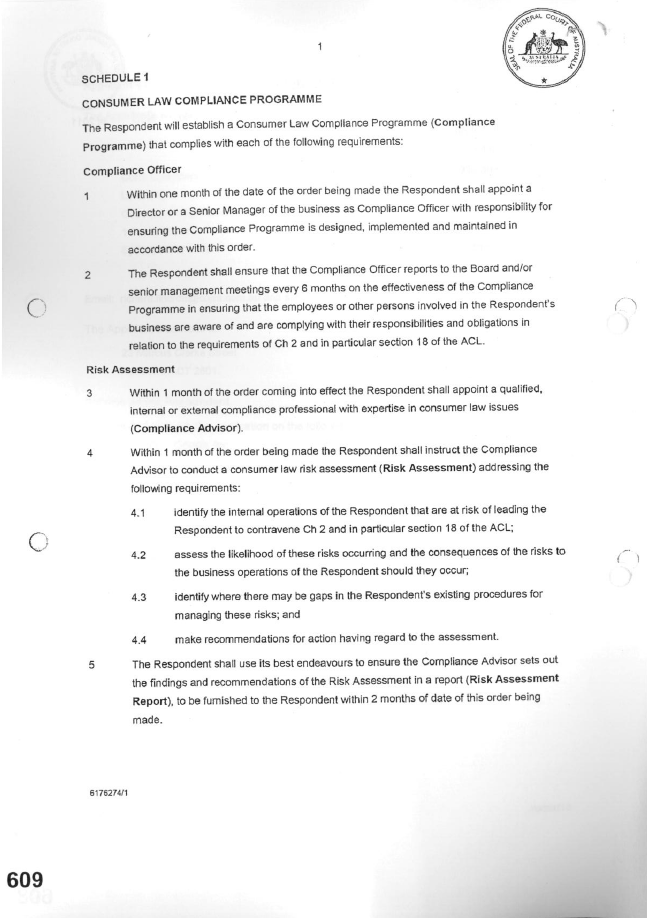
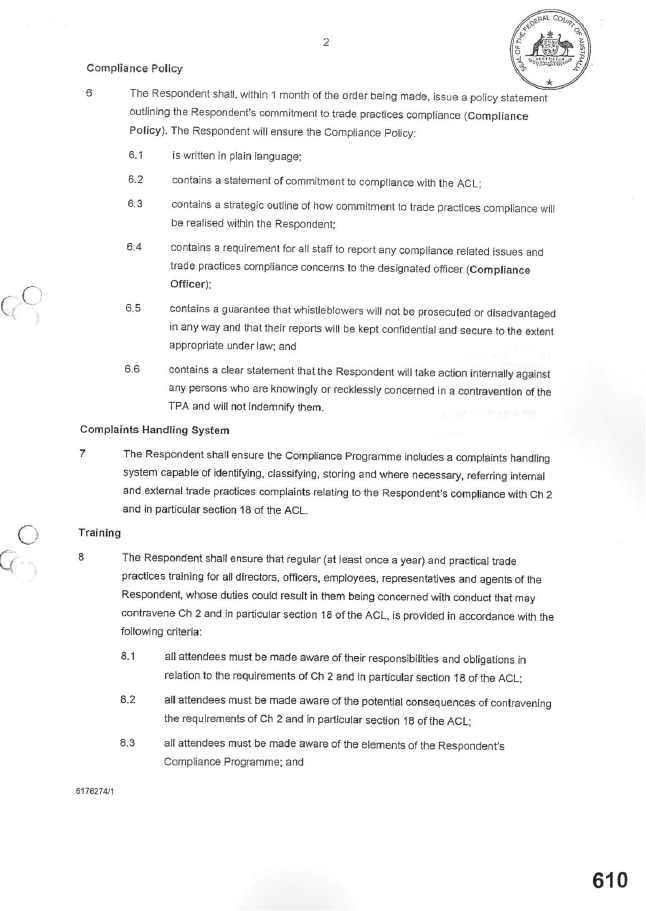
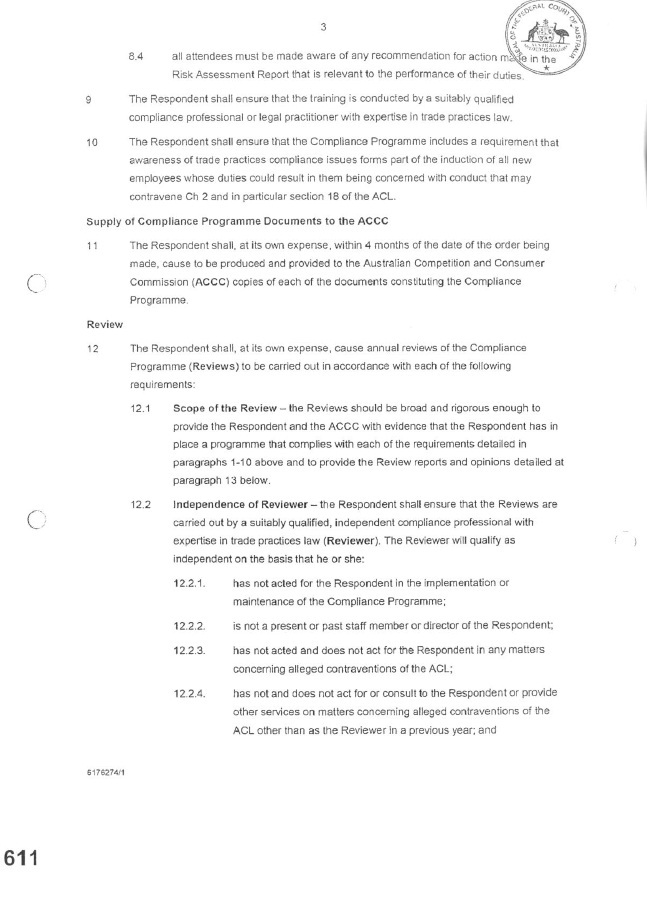
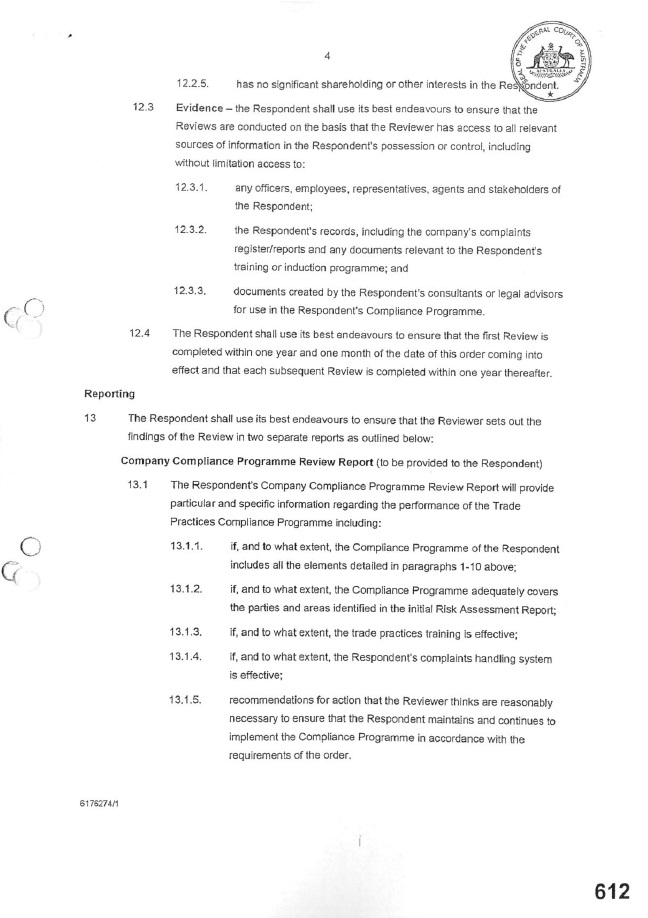
3. Pursuant to s 246(2)(b)(i) of the Australian Consumer Law, Google must establish and implement a compliance program as provided for in Schedule 1 of the Notice of Appeal which is annexure A to reasons;
4. Order 5 made by the primary judge on 22 September 2011 be set aside (in part). In lieu thereof Google pay the ACCC’s costs of the trial in relation to the Harvey World Travel, Honda.com.au, Alpha Dog Training and Just 4x4s Magazine advertisements;
5. Google pay the ACCC’s costs of the appeal to be taxed if not earlier agreed.
Note: Entry of orders is dealt with in Rule 39.32 of the Federal Court Rules 2011.
NEW SOUTH WALES DISTRICT REGISTRY | |
GENERAL DIVISION | NSD 1759 of 2011 |
ON APPEAL FROM THE FEDERAL COURT OF AUSTRALIA |
BETWEEN: | AUSTRALIAN COMPETITION AND CONSUMER COMMISSION Appellant
|
AND: | GOOGLE INC Respondent
|
JUDGES: | KEANE CJ, JACOBSON & LANDER JJ |
DATE: | 3 april 2012 |
PLACE: | SYDNEY |
REASONS FOR JUDGMENT
THE COURT
1 Google Inc (Google) is a corporation which provides access to the well-known search engine “Google search”. During the period relevant to these proceedings, a search of the google.com or google.com.au websites could produce two types of results: “organic” search results and “sponsored links”. Organic search results are information displayed free of charge; sponsored links are advertisements that include a headline incorporating a link to a website address displayed beneath the headline. The advertiser pays a fee to Google if its link is clicked on by a user. Most of Google’s revenue is derived through its advertising business.
2 The principal issue on this appeal is whether Google has engaged in misleading and deceptive conduct as a result of displaying an advertiser’s web address, or Uniform Resource Locator (URL), in the sponsored link which appears in response to an enquiry made of the Google search engine by search terms which consist of or include the name of a competitor of the advertiser. This conduct is said to amount to a misrepresentation of a commercial affiliation between the advertiser and its competitor by displaying the advertiser’s web address in collocation with information concerning the competitor.
3 Google’s primary position is that, Google is not responsible for the misleading effect of the displayed response because it is apparent to the user that Google is no more than a conduit for the advertiser.
THE PROCEEDINGS
4 The Australian Competition and Consumer Commission (the ACCC) initiated proceedings against Google. One aspect of the ACCC’s case was that Google, in failing sufficiently to distinguish between “organic” and “sponsored” results relating to advertisers engaged in misleading and deceptive conduct contrary to s 52 of the Trade Practices Act 1974 (the Act). This aspect of the ACCC’s case failed at trial. The primary judge held that Google had not engaged in misleading or deceptive conduct through the use of AdWords or sponsored links, because ordinary and reasonable users would know that the sponsored links were advertisements. See Australian Competition and Consumer Commission v Trading Post Australia Pty Ltd [2011] FCA 1086. This aspect of the ACCC’s case is not pursued on appeal.
5 The other aspect of the ACCC’s case at trial raised what is now the principal issue on the appeal. The primary judge held that in four instances relied on by the ACCC an advertiser had engaged in misleading and deceptive conduct by falsely representing that there was a commercial association or affiliation with its competitor, and that information regarding the competitor could be found by clicking on to what was, in fact, the advertiser’s web address. These instances concerned sponsored links triggered by the insertion of key words relating to “Harvey World Travel”, “Honda.com.au”, “Alpha Dog Training”, and “Just 4x4s Magazine”.
6 His Honour held, however, that Google did not make the representations contained in these sponsored links. His Honour held that Google did not endorse or adopt the advertisement but did no more than represent that the advertisements were advertisements.
7 The ACCC contends in its appeal to this Court that, given Google’s involvement in the process of displaying the sponsored links in response to a user’s search, the primary judge should have held that Google had engaged in misleading conduct.
8 Google supports the decision of the primary judge. It also contends that it was entitled to succeed on other grounds not accepted by his Honour. In this latter regard, it contends that each of the advertisements in question either was not misleading or that Google was entitled to rely upon the defence afforded by s 85(3) of the Act.
9 Before we consider the arguments agitated by the parties on the appeal, we will set out the relevant legislative provisions and factual background. We will then set out a summary of the reasoning of the primary judge.
THE LEGISLATION
10 The Act has now been replaced by the introduction of the Competition and Consumer Act 2010 (CCA). The conduct in question occurred before the introduction of the CCA. Accordingly, the provisions of the Act are applicable.
11 Section 52(1) of the Act provided:
A corporation shall not, in trade or commerce, engage in conduct that is misleading or deceptive or is likely to mislead or deceive.
12 A defence referred to as “the publisher’s defence” was provided by s 85(3) of the Act. It stated relevantly:
In a proceeding in relation to a contravention of a provision of Part V or VC committed by the publication of an advertisement, it is a defence if the defendant establishes that he or she is a person whose business it is to publish or arrange for the publication of advertisements and that he or she received the advertisement for publication in the ordinary course of business and did not know and had no reason to suspect that its publication would amount to a contravention of a provision of that Part.
FACTUAL BACKGROUND
The sponsored links
13 The Google search engine enables users to search on-line for information. Upon the users entering a search term, Google’s search engine returns a list of matching webpages ranked in order of relevance. The results of this process are called organic search results. A complex algorithm has been developed by Google to cause the results to be displayed in the order of relevance.
14 Each of the four sponsored links in question appeared above the organic search results, or to the right of them in a yellow shaded box, although at the time of the conduct in question, the colour was blue. The shaded boxes are marked “sponsored links”. They are therefore distinguished visually from the organic links.
15 The boxes in which the sponsored links appear are, in some instances, located above the organic search results. These are sometimes referred to as “top-left sponsored links”. Others are located to the far right of the organic search results. They are sometimes called “right-side sponsored links”.
16 The Harvey World Travel sponsored link appears in one instance as a top-left sponsored link and in others as a right-side sponsored link. The terms of the top-left sponsored link for Harvey World Travel and the right-side sponsored link are almost identical, the only difference being the description of the search term. The colours of the text are the same in each instance but their appearance is slightly different depending upon whether the link is on the top-left or the right-side. We will set out the terms of the sponsored link but it is important to bear in mind that the text appears in different colours. The headline, which corresponds to the search term appears in blue, whereas the advertiser’s message appears in black and the URL appears in green.
17 The top-left sponsored link is as follows:-
Harvey World Travel
www.statravel.com.au Unbeatable deals on flights, Hotels & Pkg’s Search, Book & Pack Now!
18 The only substantive difference in the right-side sponsored link is that in one instance the search term is “Harvey Travel”. In the other, it is “Harveyworld Travel”.
19 The Honda sponsored link is described at [243] of the primary judge’s reasons. We do not need to repeat it. As with each of the four sponsored links in this proceeding, the search term appears in blue, the advertiser’s message in black and the web address in green.
20 The Alpha Dog Training sponsored link is described at [304] of his Honour’s reasons. The same observations apply to the colours of the search term, the message and the URL.
21 The Just 4 x 4’s Magazine sponsored link is described at [332]. The same observations apply.
Google’s search engine
22 The primary judge’s description of the Google search engine was largely based on the evidence of Mr Daniel Dulitz, the Senior Product Manager of Google Inc in California. We will refer only to the salient aspects of that evidence.
23 Web search engines such as Google are information retrieval systems designed to navigate the voluminous information across the web using keywords or queries. They typically deliver links to other locations on the web that the search engine has indexed. The Google search engine allows users to search for web pages on the web by entering search terms into the search engine’s search bar and clicking the search button. A person wishing to make available documents on the world wide web specifies a web address or URL, which appears on the address window of a browser at the top of the screen.
24 When a Google user enters a search term and clicks on the search button, Google returns a list of organic search results. These are matching web pages ranked in order of relevance determined by a complex algorithm developed by Google. The formula is based not only on the content of the web pages but on many other factors.
25 The process of producing sponsored links on a web page is not determined by Google’s algorithm for organic search results. Rather, the display and location of a sponsored link is determined through Google’s AdWords program.
The AdWords program
26 His Honour’s findings in relation to Google’s AdWords program were also drawn essentially from Mr Dulitz’s evidence. Once again we will refer only to the salient aspects of that evidence.
27 Sponsored links are advertisements created by, or at the direction of advertisers who are willing to pay Google for text which directs user traffic to their web pages. This process is carried out through Google’s AdWords program which allows advertisers to create, change and monitor the performance of their sponsored links.
28 Google has hundreds of thousands of AdWords customers worldwide, ranging from large multinational businesses to small local ones. Mr Dulitz says that AdWords, and a companion service for publishers, reaches more than 78% of worldwide internet users and reaches more internet users worldwide than any other “web property” or advertising text network.
29 When a user enters a query into the Google search engine, an “auction” is triggered that determines which sponsored links to show, in which order to show them and how much Google charges the advertisers whose advertisements are displayed when the user clicks on the advertisement.
30 An AdWords customer may elect to trigger advertisements (or participate in an auction that will determine which advertising text will be displayed as a sponsored link) by choosing three different types of keyword. These are exact match, phrase match or broad match. Exact match will trigger a sponsored link only if the query or keyword entered by the user is the exact keyword chosen by the AdWords customer. Phrase match will trigger a sponsored link if the user enters any word in the phrase chosen by the AdWords customer. Broad match triggers sponsored links based on known associations determined by Google’s proprietary algorithms.
31 Mr Dulitz said that every auction is potentially unique and the factors that influence it change throughout a day. Google determines the eligibility of each advertiser’s text to participate in the auction by a number of factors that determine the “quality score” of the advertisement. The quality score:-
“takes into account factors such as the relevance of the advertisement to the query…” Reasons [56].
32 As the primary judge observed at Reasons [57]:-
“The sponsored links which do appear are generated by the AdWords system, not the system that generates organic search results. Each sponsored link generated by the AdWords system consists of a clickable headline that appears in blue, some text that appears in black, and a URL for the webpage to which the user will be taken if he or she clicks on the headline that appears in green.”
33 His Honour went on to observe that top left sponsored links occupy the most prominent position on the search results page because testing shows that users of the Google search engine are more likely to look first at that part of the webpage.
34 Participation in the AdWords program is subject to the agreement of the advertisers to be bound by Google’s AdWords Program Terms. The most important terms for present purposes are:-
• the customer is solely responsible for all advertising targeting options and keywords and all advertising content, advertising information, and advertising URLs.
• the advertiser’s advertisements and keywords must “directly relate” to the content on the landing page for the customer’s advertisement.
THE REASONS OF THE PRIMARY JUDGE
General Approach
35 The primary judge concluded that an ordinary and reasonable user would understand that Google was a commercial enterprise separate and distinct from the advertisers who make use of it, and that the term “sponsored” conveys that the links are paid for by the sponsors. An ordinary and reasonable reader would, therefore, distinguish between organic search results and sponsored links: Reasons [168] – [170].
36 His Honour concluded that Google had merely communicated what the advertisers’ represented without adopting or endorsing it. While advertisers may have engaged in misleading and deceptive conduct through representing a non-existent affiliation or association with a competitor, Google itself had not made the misleading representations conveyed by the advertisements.
37 His Honour concluded at [188] that ordinary and reasonable users would understand that the advertiser determines the content of an advertisement, and “the message being conveyed to them by the publication of such an advertisement was one from the advertiser rather than the publisher”. His Honour reasoned that even though the hypothetical users would also know that publishers sometimes provide assistance to advertisers in the composition or production of advertisements, they would have understood that the message being conveyed to them by the publication of such an advertisement was one from the advertiser rather than the publisher.
38 The ACCC relied upon Universal Telecasters (Qld) v Guthrie (1978) 18 ALR 531 (Guthrie). In that case it was held that a television broadcaster was liable under s 53(e) of the Act for making false or misleading statements concerning the existence or amount of an advertiser’s price reduction. In that case, Franki J, speaking of s 53(e) of the Act (which concerned the making of false or misleading statements) said at 547:
…Although the phrase “make false or misleading statements” rather suggests that there may very well be a difference between making a statement and publishing the statement of somebody else, I have come to the conclusion that, in general, where a television station telecasts an advertisement that contains certain spoken words, it is proper to hold that the television station has made a statement. Section 85(3) of the Act also points in the same direction. I consider that by telecasting the advertisement the appellant made the statements alleged.
39 In Guthrie, Bowen CJ who agreed with Franki J said at 533:
But it is argued that where it appears that the statement is put forth by or on behalf of another and not by or on behalf of the television station, the station does not "make" the statement.
The argument was illustrated by supposing a case where the television station broadcast a statement by an individual along the following lines—"Today the Federal Treasurer said "Sales tax on all motor vehicles will be reduced by twenty-five per cent as from 1st July next"". It was argued that the television station in this instance should be held to make the statement about the Treasurer and his announcement but should not be held to make the statement regarding sales tax. Where there are express words such as those in the illustration or where there are express words of adoption or exclusion, this may, perhaps, be a proper line to draw. If so, then logically it would seem difficult to distinguish the case where, by necessary implication the statement was made for or on behalf of another. These will be matters for decision when an appropriate case arises. In the fields of consumer protection legislation and television broadcasting, it appears to me that any doctrine of necessary implication, if it is proper to import it at all, will have to be closely confined.
…The relevant provisions of the Trade Practices Act 1974 are directed to protecting all viewers including those who are particularly susceptible to the influence of persuasion by advertisement. The fact that a statement is clearly an advertisement for a particular advertiser would not seem to constitute a sufficient basis in the circumstances to justify a holding that the statement was not made by the television station.
While the terms of the advertisement in the present case may fairly raise the inference that the statement in it is the statement of [the advertiser], there is insufficient material in it to raise the inference that it is not also the statement of [the television broadcaster]. Even if it be proper to distinguish statements on the basis they are expressly or by necessary implication statements of the advertiser and not of the television station, the statement in this case is not seen to be such a statement.
It may be suggested that this interpretation places a heavy burden upon television stations. However, it is no doubt because of this burden that the defences in s 85 are provided.
40 The primary judge referred particularly to the decisions of the High Court Butcher v Lachlan Elder Realty Pty Ltd (2004) 218 CLR 592 (Butcher) and ACCC v Channel Seven Brisbane Pty Ltd (2009) 239 CLR 305 (ACCC v Channel Seven). His Honour summarized the relevant passages from those decisions. Because his Honour’s summary collects most of the authoritative statements of principle which bear on the present issue, it is convenient to set it out at length. His Honour said at [176]-[178]:
176 In Butcher v Lachlan Elder Realty Pty Ltd (2004) 218 CLR 592 the High Court held (by majority) that a real estate agent which produced a brochure that it provided to the purchaser had not contravened s 52(1) of the Act by making representations that were misleading or deceptive. The brochure reproduced a survey diagram of land and thereby misrepresented the location of a swimming pool relative to the boundaries of the land. It was held that the agent had done no more than communicate what the vendor was representing without either adopting or endorsing it. The majority (Gleeson CJ, Hayne and Heydon JJ) said (at [38]-[40]):
38. … In Yorke v Lucas [(1985) 158 CLR 661 at 666], Mason A-CJ, Wilson, Deane and Dawson JJ said that a corporation could contravene s 52 even though it acted honestly and reasonably:
“That does not, however, mean that a corporation which purports to do no more than pass on information supplied by another must nevertheless be engaging in misleading or deceptive conduct if the information turns out to be false. If the circumstances are such as to make it apparent that the corporation is not the source of the information and that it expressly or impliedly disclaims any belief in its truth or falsity, merely passing it on for what it is worth, we very much doubt that the corporation can properly be said to be itself engaging in conduct that is misleading or deceptive.”
39. In applying those principles, it is important that the agent’s conduct be viewed as a whole. It is not right to characterise the problem as one of analysing the effect of its “conduct” divorced from “disclaimers” about that “conduct” and divorced from other circumstances which might qualify its character. Everything relevant the agent did up to the time when the purchasers contracted to buy the Rednal land must be taken into account. It is also important to remember that the relevant question must not be reduced to a crude inquiry: “Did the agent realise the purchasers were relying on the diagram?” To do that would be impermissibly to dilute the strict liability which s 52 imposes.
40. For the following reasons, the agent did not engage in conduct towards the purchasers which was misleading. Whatever representation the vendor made to the purchasers by authorising the agent to issue the brochure, it was not made by the agent to the purchasers. The agent did no more than communicate what the vendor was representing, without adopting it or endorsing it. That conclusion flows from the nature of the parties, the character of the transaction contemplated, and the contents of the brochure itself.
177 After referring to the particular circumstances of the case before them – including the nature of the parties and the character of the transaction – the majority concluded (at [51]):
51. Hence it would have been plain to a reasonable purchaser that the agent was not the source of the information which was said to be misleading. The agent did not purport to do anything more than pass on information supplied by another or others. It both expressly and implicitly disclaimed any belief in the truth or falsity of that information. It did no more than state a belief in the reliability of the sources.
178 The decision in Butcher was referred to by French CJ and Kiefel J in Australian Competition and Consumer Commission v Channel Seven Brisbane Pty Ltd (2009) 239 CLR 305. In that case the High Court was required to interpret s 65A(1) of the Act. In the course of considering the scope of the exemption arising under s 65A(1) French CJ and Kiefel J stated (at [43]):
43. The rationale for limits upon the exemption should be understood in the light of conditions that must be satisfied before an information provider is liable in respect of misleading or deceptive representations made by a third party and published by the information provider. The publication, by an information provider, of third party statements about goods or services, does not, without more, amount to the adoption or making of those statements by the information provider.
In support of the latter proposition their Honours cited the passage appearing in the majority judgment in Butcher (at [38]-[40]) which I set out above. Gummow J said (at [57]):
57. … following the decision of Toohey J in Australian Ocean Line Pty Ltd v West Australian Newspapers Ltd [(1985) 58 ALR 549 at 586-587], it has become well established that, for the broadcasts in question here to give rise to contraventions of s 52 by Channel Seven, it was necessary at least for some “endorsement” or “adoption” of what was represented on the programs by the relevant third parties, Ms Forster and Ms Boholt. The point, with particular reference to s 53 of the Act (which deals with certain false or misleading representations), was made as follows by French J in Gardam v George Wills & Co Ltd [(1988) 82 ALR 415 at 427]:
“The innocent carriage of a false representation from one person to another in circumstances where the carrier is and is seen to be a mere conduit, does not involve him in making that representation ... When, however, a representation is conveyed in circumstances in which the carrier would be regarded by the relevant section of the public as adopting it, then he makes that representation. It will be a question of fact in each case.”
41 The primary judge considered that the law relating to s 52 and s 53 of the Act had developed since Guthrie. His Honour said at [185]:
The reality is that the law relating to s 52 and s 53 of the Act has developed considerably since Guthrie and has reached the point where it is hard to see how the Full Court’s reasoning in that case can provide any assistance in determining whether or not the operator of a television station or the publisher of a newspaper will have contravened s 52 or s 53 by making representations conveyed by advertisements which they have transmitted or published.
42 His Honour summarized the factual circumstances which led to his conclusion. He said at [187]:
187 Whether or not Google made the representations depends upon all the circumstances including those which were the subject of my earlier findings. In particular, the question should be addressed in the knowledge that ordinary and reasonable members of the class would have understood that:
• a sponsored link is an advertisement that includes a headline incorporating a link to a website address displayed beneath the headline;
• if a person clicks on the headline they will be taken to the website address displayed beneath the headline;
• the website address displayed beneath the headline will usually be the website address of the advertiser;
• the identity of the advertiser will usually be apparent from the website address displayed beneath the headline.
43 The ACCC argues that the primary judge failed to have regard, in his listing of the relevant circumstances, to the significant facts that the keyword insertion facility provided by Google to the advertiser, operating via Google’s auction and quality score processes, caused the headline featuring a competitor’s name to be displayed in collocation with the advertiser’s URL and that the display published by Google featured a clickable link which would take the user directly to the advertiser’s URL.
44 The primary judge, having thus articulated his broad approach, went on to deal specifically with each of the four sponsored links the subject of the appeal
The Harvey World Travel advertisements
45 On 29 May 2007, 18 July 2007, 24 October 2007 and 17 April 2007 advertisements for Harvey World Travel, a major travel agency, appeared as sponsored links amid a number of organic search results. A number of sponsored links feature the words “Harvey World” or “Harvey World Travel”. The link in contention was that of STA Travel, a significant competitor of Harvey World Travel in the travel industry. Both Harvey World Travel and STA Travel had AdWords accounts with Google.
46 STA Travel entered into the AdWords Service Agreement on 22 March 2006. It appears from the findings of the primary judge that Ms Alice Wood, an account manager for Google, played a role in the selection of the keywords ultimately chosen by STA and CarSales. On 7 June 2006 Mr Goudsblom of STA Travel sent to Ms Wood a document which referred to the “top-200 key phrases in May” which included the keywords “Harvey World Travel” and “Harvey Travel”. On 3 July 2006 Mr Goudsblom sent another email to Ms Wood containing 199 keywords including those terms and “requesting that Ms Wood adjust our categories to contain all these phrases” (at [219]). Accordingly, on 10 August 2006 those terms were uploaded into STA Travel’s “generic travel” AdWords campaign. And, on 5 July 2006 Ms Wood sent to Mr Goudsblom an email with electronic worksheets containing the keywords “Harvey travel” and “Harvey World Travel”. In particular, the primary judge said at [221] that Ms Wood’s email to Mr Goudsblom of STA attached an electronic worksheet that specified keywords and advertising text to be used in STA’s proposed advertisements. The worksheet contained 17 keywords which were to be added to the Generic Travel<Competitor AdGroup. Mr Goudsblom replied to the effect that he wanted the keywords uploaded as soon as possible.
47 The primary judge found at [222] that, on 10 August 2006, Google’s automatic systems approved the 17 keywords added by Ms Wood to the AdGroup mentioned above. This group included the keywords “Harvey World Travel” and “Harvey Travel” for use in STA’s AdWords advertising campaign.
48 In March 2007 an online marketing agency, Clear Light Digital assumed responsibility for the management of the STA Travel account and entered into a new agreement with Google on behalf of STA Travel. Five AdWords campaigns were created by or on behalf of STA Travel between 10 August 2006 and 20 September 2007. All of the campaigns contained the keywords “Harvey World Travel” and a number of variations on those words.
49 On 18 May 2006 Mr James Brodie, Head of Marketing for Harvey World Travel Franchises Pty Ltd, lodged a trade mark complaint through Google’s online system and received an email in reply from Google notifying him that in order for his complaint to be reviewed the letter must be mailed or faxed to the relevant address.
50 On 21 May 2007 Harvey World Travel sent an email to Google’s trademarks division requesting worldwide protection for Harvey World Travel. On 7 June 2007 Google confirmed that the ads in question no longer included the trademark “Harvey World Travel” in the headline for their sponsored links.
51 The primary judge summarized the eight representations alleged by the ACCC to have been made by Google at [228]:
• by clicking on the Harvey World Travel advertisement a person would be taken to a website associated with the Harvey World Travel Businesses or any of them (representation A);
• there was an association between STA Travel and Harvey World Travel Businesses or any of them (representation B);
• there was an affiliation between STA Travel and Harvey World Travel Businesses or any of them (representation C);
• the Harvey World Travel Businesses or any of them approved of the link between the name “Harvey World Travel” and the STA Site; (representation D);
• the Harvey World Travel Businesses or any of them had paid for the link between the name “Harvey World Travel” and the STA Site (representation E);
• the Harvey World Travel Businesses or any of them were sponsors of the STA Site (representation F);
• information regarding the Harvey World Travel Businesses or any of them could be found at the STA Site (representation G); and
• information regarding the travel services provided by the businesses associated with the name “Harvey World Travel” could be found at the STA Site (representation H).
52 His Honour was satisfied that “none of representations A, D, E or F was made by the publication of the Harvey World Travel advertisements” at [229]. His Honour was satisfied that representations B, C, G and H were made solely by STA Travel at [237]. In particular, his Honour found that a representation had been made that STA Travel was commercially associated with Harvey World Travel.
53 As to whether the representations were made by Google, the primary judge held that they were not. In this regard, his Honour said at [241]:
…[T]here was nothing about the way in which the Harvey World Travel advertisements were presented on results pages to suggest that Google had endorsed or adopted any of the representations which I previously found to have been conveyed and I do not think that it did so. Accordingly, I find that the representations conveyed by the Harvey World Travel advertisements were not made by Google.
54 On the other hand, his Honour said that, if he had concluded that Google had made the representations, he would not have held that a defence under s 85(3) was available to Google. This was due to his Honour’s finding (at [242]) that:
[It] has not been established to my satisfaction that Google did not have any reason to suspect that the publication of the Harvey World Travel advertisements was likely to mislead or deceive. Ms Wood knew that Harvey World Travel was a well known competitor of STA Travel and it is very likely that she knew that these names were within the AdGroup which she created. A reasonable person in her position would have appreciated that the use of a well known competitor’s name such as “Harvey World Travel” as a keyword triggering an advertisement for STA Travel with a matching headline gave rise to a significant risk that people searching for “Harvey World Travel” would be lead [sic] to believe that there was, contrary to the fact, an association of the kind I previously identified.
The Honda advertisements
55 Honda Australia is a subsidiary of the well known car manufacturer Honda. It has a domain name www.honda.com.au. It seems that the keyword “Honda.com.au” was used by CarSales in its advertising with Google as early as March 2006 and ran until July 2007.
56 The primary judge referred at [248] to an email sent by Ms Wood to Mr Daniel Johnson of CarSales on 6 December 2006. The email included Ms Wood’s suggestions for “maximising” the CarSales account. His Honour referred elsewhere to Ms Wood’s description of the position she held in Google as a “creative maximiser”. (See at [221]). The email of 6 December 2006 to Mr Johnson attached a spreadsheet in which Ms Wood highlighted certain keywords which she described as “the best converting terms for [CarSales].” The keywords included the name of a well known car manufacturer followed by a space and the familiar suffix, namely .com.au.
57 The advertisement in question was described by his Honour at [243]:
The Honda.com.au advertisement is a top left sponsored link that appeared on 28 May 2007 (see Schedule 2) and at various other times …It is an advertisement for a business known as CarSales in the following terms:
Honda .com.au
www.carsales.com.au/Honda-Cars Buy/Sell Your Civic The Fast Way on Australia’s No.1 Auto Website
Immediately below the sponsored link is the first of the organic search results which consists of a link to the website www.honda.com.au which is a domain name registered to Honda Australia Pty Ltd (Honda Australia). Honda Australia is a subsidiary of the well known car manufacturer.
58 The primary judge summarized the particular representations alleged by the ACCC to have been made by the publication of the “Honda.com.au” advertisement at [246]:
• by clicking on the Honda.com.au Advertisement, a person would be taken to the Honda Australia Site or an official website operated by Honda Australia;
• there was an association between the Honda Australia Site and the Carsales site;
• Honda Australia approved of the link between the domain name “honda.com.au” and the Carsales Site;
• Honda Australia had paid for the link between the domain name “honda.com.au” and the Carsales Site;
• Honda Australia was a sponsor of the Carsales Site.
59 The primary judge noted at [249] the use of the website address in the headline was itself “likely to mislead a significant number of people into believing that it links to that website address.”
60 His Honour was not satisfied that the representation had been made by Google, concluding at [251]:
I am satisfied that the Honda.com.au advertisement was likely to mislead or deceive ordinary and reasonable members of the relevant class into thinking that by clicking on the headline to the advertisement they would be taken to the Honda Australia website. In my opinion the advertisement conveyed a representation to that effect. I am therefore satisfied that the advertisement conveyed a representation that was likely to mislead. I am not satisfied that any of the other representations alleged to have been made were conveyed by the advertisement. And, for reasons previously stated in relation to other advertisements published by Google, I am satisfied that the representation conveyed by the Honda.com.au advertisement was not made by Google.
61 In relation to s 85(3) of the Act, Google submitted that neither Ms Wood nor Mr Bayley were aware of the Honda .com.au advertisement, and that no complaint of a trademark infringement had been received in respect of the keyword or variant. The primary judge rejected this submission. He said at [256] – [257]:
256 In the absence of evidence to the contrary, I infer that Mr Bayley knew that the additional 46 keywords which he added to the account on 17 March 2006 included the keyword “Honda .com.au” and that it would therefore be made to appear as the headline for a CarSales advertisement generated in response to a Google search for that term. I am also satisfied, in the absence of evidence to the contrary, that Mr Bayley would have known, or at least suspected, that the use of this keyword in such circumstances would be likely to mislead in the manner I have previously described.
257 In the circumstances, I am not satisfied that Google had no reason to suspect that the publication of the Honda.com.au advertisement was likely to amount to a contravention of s 52 of the Act. If I had concluded that the representation conveyed by the Honda.com.au advertisement was made by Google then I would have held that Google had not satisfied the requirements of s 85(3) of the Act.
The Alpha Dog Training advertisements
62 Alpha Dog is a dog training business conducted in Victoria by Mr Gregory Fontana. It had been in operation for approximately 12 years by the time The Dog Trainer Pty Ltd’s (Ausdog) AdWords account was established. Alpha Dog has a website using the domain name alphadogtraining.com.au. Ausdog is a competitor of Alpha Dog Training. Ausdog operates in Melbourne. On 16 December 2007 Agency XYZ, who operates Audog’s Adwords account on its behalf, uploaded 3 text ads and 239 keywords including the 15 “alpha dog” keywords.
63 On 12 March 2008 Mr Fontana conducted a Google search of “Alpha Dog Training” which produced a sponsored link to DogTrainingAustralia.com.au, which is Ausdog’s web address. Accordingly, on 13 March 2008 Mr Fontana sent an email to Google making a complaint about the “fraudulent use of our business name”. Ms Atherton of Google replied that advertisers are responsible for the keywords and text they include in their advertisements and recommended that Mr Fontana get in touch with the business owner or trademark the business name.
64 On 1 April 2008 Mr Fontana contacted Mr Harkin of Ausdog and complained to him. On 12 April 2008 Agency XYZ deleted all “alpha dog” keywords from the account.
65 The advertisement in question was described by his Honour at [305]:
On 12 March 2008 Mr Fontana conducted a Google search of “Alpha Dog Training”. The results page produced in response to that search contained numerous sponsored links. The top left sponsored link was in these terms:
Alpha Dog Training
DogTrainingAustralia.com.au All Breeds. We come to you. No dog that can’t be trained.
Immediately below this sponsored link was the first of the organic search results. It referred to Mr Fontana’s business and was in the following terms:
Alpha Dog Training
www.alphadogtraining.com.au/ - 5K – Cached – Similar pages
Alpha Dog Training
Welcome to Alpha Dog Training’s informative website. Take your time and thoroughly explore what our dog training has to offer you and see why so …
www.alphdogtraining.com.au/index.asp?Pageld=1&MenuSection=Home - 22k –
Cached – Similar pages
More results from www.alphadogtraining.com.au »
66 The ACCC’s allegations that Google made representations by publishing the Alpha Dog training advertisement were summarized by the primary judge at [312]:
by clicking on the Alpha Dog Training Advertisement a person would be taken to a website associated with the Alpha Dog Training Business;
there was an association between the Alpha Dog Training Business and the Ausdog Site;
information regarding the Alpha Dog Training Business could be found at the Ausdog Site;
67 The primary judge did not consider that the terms “alpha dog” and “alpha dog training” were descriptive phrases (at [315]). In his Honour’s view the advertisement was likely to mislead or deceive people in Victoria who knew of Mr Fontana’s business or believed that by clicking on the link they would be directed to a site containing information about that business, or having an association with that business (at [317]). His Honour did not consider that Google had engaged in this misleading conduct. His Honour said at [318]:
Accordingly, I am satisfied that the Alpha Dog Training advertisement was in these respects misleading or deceptive or likely to mislead or deceive ordinary and reasonable members of the relevant class. I am not satisfied that any of the other representations relied upon by the ACCC were conveyed by the Alpha Dog Training advertisement. Nor am I satisfied, for reasons which I have already explained, that any of the representations that were conveyed were made by Google.
68 His Honour held that a defence was not available to Google under s 85(3) of the Act. His Honour said at [319]:
By the time the Alpha Dog advertisement appeared on 27 March 2008, Ms Atherton had received and responded to Mr Fontana’s e-mail of 13 March 2008. In those circumstances I am satisfied that Google had reason to suspect that the publication of the Alpha Dog advertisement from on or about 13 March 2008 would amount to a contravention of s 52(1) of the Act. It follows that if I had found that the misleading and deceptive representation conveyed by the Alpha Dog advertisement had been made by Google, I would have rejected Google’s defence based upon s 85(3) of the Act.
The “Just 4x4s Magazine” advertisement
69 Just Magazines Pty Ltd (Just Magazines) publishes throughout Australia a number of magazines including one titled “Just 4x4s”. On 26 December 2006 Mr Wan from the Trading Post uploaded the keyword “just 4x4s magazine” to the Trading Post (TP Autos 2) account in a batch of 246 keywords. The account had been opened by Sensis on 21 November 2006.
70 As at 29 May 2007 the headline “Just 4x4s Magazine” appeared as a headline as a sponsored top left link advertised by the Trading Post. The Trading Post is a competitor of Just 4x4s Magazine and has never had any affiliation or association with that magazine. On 3 December 2007 the trade mark “Just 4x4s” was registered by Just Magazines and the evidence at the time of registration suggested that the trademark had been used by Just Magazines since at least 19 October 2005.
71 The advertisement in question was described by his Honour at [332]:
The Just 4 x 4s Magazine advertisement as it appeared on 29 May 2007 (Schedule 4) was a top left sponsored link. There were two top left sponsored links and a larger number of right side sponsored links on the results page. The Just 4 x 4s Magazine advertisement, and the other top left sponsored link immediately above it, were in the following terms:
Just Car Insurance
www.justcarinsurance.com.au Competitive car insurance for young drivers. Check out our new web site
Just 4x4s Magazine
www.tradingpost.com.au New & Used 4WD Cars – See 90,000+ Auto Ads Online. Great Finds Daily!
The evidence established that the Just 4 x 4s Magazine advertisement appeared in answer to a search query for “just 4x4s magazine” and that this name appeared in the headline of the Just 4 x 4s Magazine advertisement by reason of keyword insertion. Curiously, while it is alleged that the Just 4 x 4s Magazine advertisement was published by Google, no such allegation is made against Trading Post even though it is clear that Trading Post was the advertiser.
72 The primary judge concluded that an ordinary and reasonable consumer interested in four wheel drives would be aware of the Just 4x4s Magazine. His Honour found that the representations had been breached by the Trading Post. Once again, however, his Honour concluded that Google had not engaged in this misleading and deceptive conduct. His Honour said at [341] – [342]:
341 I am also satisfied that by the publication of the Just 4 x 4s Magazine advertisement Trading Post made a representation that there was a commercial association between the Just 4 x 4s Magazine and Trading Post and a representation that information regarding Just 4 x 4s Magazine could be found at the Trading Post website. The precise nature of the commercial association represented to exist hardly matters because, as Mr Hunter’s evidence made clear, Just Magazines and Trading Post are competitors which have never shared any commercial relationship. From this evidence I also infer that a person visiting the Trading Post website would be unlikely to find any information at that site regarding the Just 4 x 4s Magazine.
342 In the circumstances, I am satisfied that representations conveyed by the Just 4 x 4s Magazine, being those I have identified, were misleading or deceptive or likely to mislead or deceive. However, I am not satisfied that any of the other representations relied upon by the ACCC were conveyed by the Just 4 x 4s Magazine advertisement. Nor am I satisfied that any of the representations said by the ACCC to have been conveyed by the Just 4 x 4s Magazine advertisement were made by Google.
73 His Honour considered that the defence under s 85(3) of the Act was not available to Google. The ACCC’s initial statement of claim was served on Google on 11 July 2007 and the advertisement was still being displayed on 18 July 2007. While his Honour noted at [344] that the evidence did not demonstrate that Google was actually aware of the original statement of claim, he was not satisfied that “Google had no reason to suspect that the publication of the Just 4x4s Magazine advertisement on 18 July 2007 would amount to a contravention of s 52(1) of the Act”.
THE ARGUMENTS IN THIS COURT
The ACCC
74 The ACCC argues, following Guthrie, that, where a publisher communicates or “passes on” advertising material, for example, where a newspaper publishes advertisements produced by the advertiser, the publisher may be said to have made the representation concurrently with the advertiser unless the surrounding circumstances displace that conclusion. Alternatively, if the publisher does not merely “pass on” the advertisement, but engages in acts to prepare, create or approve the advertisement, then the publisher makes the relevant representations.
75 In relation to the alternative argument, the ACCC contends that Google took an active role in the preparation, dissemination and publication of advertisements with the consequence that Google made the relevant representations in the case at hand. The ACCC points to three facts which support that contention: first, Google tightly controls the content of results generated by a search as well as the way in which these results are presented; secondly, Google’s AdWords program permits advertisers to target their advertisements; and thirdly, Google’s internal processes serve to closely supervise the available keywords for an advertisement.
76 Google contends that neither of the ACCC’s arguments can be sustained. With respect to the ACCC’s first argument, Google submits that the ACCC’s proposition that a publisher which publishes an advertisement makes representations concurrently with an advertiser is no longer a correct statement of the law. Google argues that its position is analogous to that of the owner of a billboard or a telephone network in that advertisements carried on in such media will readily be understood as a statement by the advertiser.
77 Google submits that the alternative argument, viz that Google does more than merely passing on the advertisements is not available to the ACCC in terms of the case advanced at trial. It is said that the case that Google came to meet was that Google made the representations by publishing the material, no other conduct by Google being pleaded as the basis for any contravention. Google further submits that, even if this argument is open on appeal, it does not displace the decisive and unchallenged finding that the ordinary and reasonable user would recognise that the sponsored links were advertisements made by the advertiser rather than search results published by Google.
78 In relation to the particular advertisements, Google contends that, even if the advertisements were published by Google, the Honda, Alpha Dog and Just 4x4s advertisements were not misleading or deceptive or likely to mislead or deceive. Further, in relation to the Harvey World Travel and Just 4x4s advertisements, Google contends that it is entitled to the benefit of the defence provided by s 85(3) of the Act.
CONSIDERATION
Did Google engage in misleading conduct?
79 At the outset of a consideration of Google’s responsibility for the advertisements, it is as well to recall that a party may engage in misleading conduct so as to contravene s 52 of the Act without an intention to mislead or deceive. The question is whether Google “engaged in conduct” that was likely to mislead or deceive.
80 The second point to be made is that whether a corporation has engaged in misleading conduct or has merely acted as a conduit for another is a question of fact. In that regard, the case law subsequent to the decision in Guthrie has not altered the legal operation of s 52 of the Act as it was explained by Bowen CJ in the passage from Guthrie set out above at [39].
81 Bowen CJ observed that the fact that a statement is clearly an advertisement for a particular advertiser was not a sufficient basis, in the circumstances of that case, to justify a finding that the statement was not made by the television station. His Honour expressly left open the possibility of a finding that, by necessary implication, the statement would not be seen as that of the television station. The later authorities may have allowed greater scope for the operation of necessary implication than was apparent in the decision in Guthrie. But otherwise there is no tension between the remarks of Bowen CJ and the principles stated by the High Court in the authorities referred to above. The effect of the authorities is that the intermediary’s conduct must be considered as a whole to determine whether the intermediary was merely passing on the information. Whether or not there is an implied disclaimer or an implied adoption or endorsement is a conclusion of fact which follows from a determination based on all the circumstances of the case.
82 In ACCC v Channel Seven Brisbane Pty Ltd (2009) 239 CLR 305 at [57], Gummow J quoted French J in Gardam v George Wills & Co Ltd (1988) 82 ALR 415, in the passage cited by the primary judge, explaining that the issue is whether -
[t]he innocent carriage of a false representation from one person to another [occurs] in circumstances where the carrier is and is seen to be a mere conduit … It will be a question of fact in each case.
83 In Yorke v Lucas (1985) 158 CLR 661 at 666 (Yorke v Lucas), Mason CJ, Wilcox, Deane and Dawson JJ doubted whether a corporation could be said to have engaged in conduct that was misleading or deceptive if it is apparent that the “corporation is not the source of the information and that it expressly or impliedly disclaims any belief in its truth or falsity, merely passing it on for what it is worth”. The principle to be drawn from this statement is that if a corporation passes on information supplied by another, which information subsequently turns out to have been false, the corporation does not engage in misleading conduct where the circumstances make it apparent that the corporation was merely passing on information supplied by another for what it was worth.
84 In Butcher at [40], in the passage cited by the primary judge, the majority of the High Court said: “The agent did no more than communicate what the vendor was representing, without adopting it or endorsing it”. It would be wrong to suggest that there is a tension between this statement and the statement from Yorke v Lucas. Neither side suggested that there was any such tension, and the passage cited from Yorke v Lucas was set out with evident approval in Butcher at [38] by Gleeson CJ, Hayne and Heydon JJ.
85 In Yorke v Lucas and in Butcher, their Honours were endeavouring to explain that a party whose conduct consists of the repetition of a misleading statement is not conduct which is misleading and deceptive on the part of the intermediary if it sufficiently appears that the intermediary is merely passing on the fact that the statement has been made by another. The observations in Yorke v Lucas were not suggesting that a statement by an intermediary will always be attributed to him or her for the purposes of s 52 in the absence of an express disclaimer of personal responsibility. Nor is the passage from Butcher suggesting that express adoption or endorsement is essential to liability under s 52 of the Act. Neither statement was purporting to add a gloss to the language of s 52. The same observation applies to McHugh J’s synthesis of the effect of the authorities in Butcher at [123].
86 It is also worth noting that in neither Yorke v Lucas, Butcher nor in ACCC v Channel Seven, was Guthrie disapproved. Further, the observations made by French CJ and Kiefel J in ACCC v Channel Seven at [43] and by Gummow J in that case at [57] are not inconsistent with the view we have expressed about disclaimer, adoption and endorsement.
87 The actual decision of the High Court in Butcher does not assist Google. Butcher was a case where a real estate agent passed on to purchasers a brochure prepared by the agent’s principal containing inaccurate statements about the property the subject of the brochure. It was held that it was apparent from all the circumstances in that case that the agent was merely passing on those statements as statements by the vendor for what they were worth. No user of Google’s search engine presented by Google with a sponsored link in response to a search query would regard the sponsored link displayed by Google with a clickable link to the sponsor’s URL as conveying the message that the sponsored link is a statement by an advertiser which Google is merely passing on. What appears on Google’s webpage is Google’s response to the user’s query. That it happens to headline a keyword chosen by the advertiser does not make it any the less Google’s response. And even that occurs pursuant to the AdWords facility made available to the advertiser by Google. Google’s conduct cannot fairly be described as merely passing on the statements of the advertiser for what they are worth. In those circumstances, it is an error to conclude that Google has not engaged in the conduct of publishing the sponsored links because it has not adopted or endorsed the message conveyed by its response to the user’s query.
88 It is necessary to be clear as to what it is about Google’s conduct that is said to be misleading or deceptive on its part. Google’s conduct consists relevantly of the display of the sponsored link in response to the entry of the user’s search term in collocation with the advertiser’s URL. The display of the sponsored link is effected by Google’s engine as Google’s response to a user’s search. That which is displayed by Google is called up by Google’s facility as Google’s response to the user’s search. The clickable link, when clicked, takes the user directly to the advertiser’s URL.
89 An ordinary and reasonable user would conclude from these circumstances that it was Google who was displaying the sponsored link in collocation with the sponsor’s URL in response to the user’s search. Even if all these circumstances would not be apparent to ordinary and reasonable users, so that Google could not be “seen” by them to be more than a mere conduit, these circumstances show that Google is, in fact, much more than a mere conduit. The reaction of the ordinary and reasonable member of the class is not solely determinative of the issue. As Gummow J said in ACCC v Channel Seven the question is whether the “carrier is and is seen to be a mere conduit”; and as the primary judge acknowledged, the fact that a representation is not understood by the audience to be an advertisement for another person will not necessarily exclude Google from the scope of s 52 of the Act. His Honour said at [186]:
The mere fact that the relevant class may not have understood the representations to have been made by Google cannot be determinative of the question: Cassidy v Saatchi & Saatchi (2004) 134 FCR 585 per Moore and Mansfield JJ at [28].
90 Critical to this conclusion is the fact that the sponsored link is displayed on the screen in response to the user’s query which is made by the entry of selected key words. Thus, the user asks a question of Google and obtains Google’s response. Several features of the overall process indicate that Google engages in misleading conduct.
91 First, the response shows, in large blue font, as part of the sponsored link, the keyword entered by the user. The advertiser’s message in black font and the URL in green, appear immediately below the keyword and as part of the response. What the user is therefore told is that the advertiser’s message and the advertiser’s URL are an answer to the user’s query about the subject matter of the keyword which includes the identification of a competitor of the advertiser. The falsity of the conduct involved in the four responses in the present case is that the advertiser’s URL misrepresents a connection between the searched term identifying the competitor and the URL of the advertiser.
92 The conduct is Google’s because Google is responding to the query and providing the URL. It is not merely passing on the URL as a statement made by the advertiser for what the statement is worth. Rather, Google informs the user, by its response to the query, that the content of the sponsored link is responsive to the user’s query about the subject matter of the keyword.
93 The most obvious example of the falsity of the response and of the fact that it is Google’s conduct, is the Harvey World Travel sponsored link. The user enters that keyword because the user is seeking information about Harvey World Travel. Instead, the user is given the URL of one of Harvey World Travel’s competitors. In this example, the user is not told merely that the advertiser has provided Google with this URL. Rather, Google tells the user that the URL provided below is the contact address for information about Harvey World Travel. The whole purpose of the user’s inquiry, to which Google responds by providing organic links and sponsored links, is to answer the user’s query. The enquiry is made of Google and it is Google’s response which is misleading.
94 This conclusion is reinforced by a consideration of the nature of Google’s search engine, and the AdWords program. Google’s search engine is the information retrieval system which the user employs to navigate his or her way through the web using keywords that deliver links to other locations on the web. Google supplies its advertising customers with the ability to select keywords which are expected to be used by persons making enquiries through Google’s search engine. The ability of advertisers to select “broad match” keywords enables them to trigger sponsored links through Google’s search engine based on known associations which are determined by Google’s proprietary algorithms. Although the keywords are selected by the advertiser, perhaps with input from Google, what is critical to the process is the triggering of the link by Google using its algorithms. That is a further reason to conclude that it is Google’s conduct as a principal, not merely as a conduit, which is involved in each of the four instances that form the subject matter of this appeal.
95 The circumstance that the sponsored link is displayed as Google’s response to a user’s insertion of a search term into Google’s search engine prevents any analogy between this case and the case of the bill-board owner or the owner of a telephone network or the publisher of a newspaper or a telecaster who simply displays an advertisement of another. In those cases the medium is not concerned with the content of the advertiser’s message: in the four instances in question here Google created the message which it presents. Google’s search engine calls up and displays the response to the user’s enquiry. It is Google’s technology which creates that which is displayed. Google did not merely repeat or pass on a statement by the advertiser: what is displayed in response to the user’s search query is not the equivalent of Google saying here is a statement by an advertiser which is passed on for what it is worth.
96 It is no answer to the ACCC’s case to say that it is apparent that the sponsored links were advertisements for persons other than Google. The question is not whether the advertisement was an advertisement for Google or for a third party, but whether Google’s conduct in response to the user’s interaction with Google’s search engine was misleading. As an issue of fact, that question reasonably admits of only one answer.
97 It has been noted that the terms of Google’s AdWords Program Terms state that the customer is solely responsible for all advertising, keywords and URLs. The terms also state that the advertisements and keywords chosen by the advertisers must “directly relate” to the content on the landing page of the advertisement. In each of the four instances in question, the advertiser appears to be in breach of the terms by providing keywords and URLs that do not directly relate to the content of the landing page. But it does not follow from this that, as between Google and the user or Google and the advertiser’s competitor, the conduct in question is solely that of the advertiser. The matters to which we referred above indicate that Google’s conduct is also misleading.
98 The role of “creative maximisers” and other Google personnel who liaise with customers is a feature of the process by which advertisers participate in the AdWords program. This feature would have been relevant to a claim under s 75B of the Act if that had been made. It may also be relevant to the defence under s 85(3), but we have not taken it into account in the conclusion that we have reached that the conduct in question is Google’s conduct as a principal, and not as a mere intermediary, which is misleading.
99 As we have mentioned, Google complains that, at trial, the ACCC did not seek to make a case that Google’s control of the presentation of sponsored links was such as to make Google the publisher of the sponsored links, either exclusively or concurrently with the advertiser. Google objects that it would be unfair to allow the ACCC to advance this case for the first time on appeal. This objection is without substance.
100 It is apparent from the primary judge’s reasons that the circumstances of Google’s role in the display of a sponsored link in response to a search query were drawn to his Honour’s attention. His Honour said at [52]-[56]:
52 Google’s revenues are derived primarily from advertising through its program called AdWords. AdWords advertising appears on the google.com and google.com.au websites as “Sponsored Links” which, when they appear, are located above the organic search results or to the right hand side of them. Hundreds of thousands of AdWords customers advertise through the AdWords program.
53 A sponsored link is a form of advertisement. Sponsored links are created by advertisers who are willing to pay for advertising text which incorporates a link that directs a user to a webpage of the advertiser’s choosing. Goggle [sic] provides its advertisers with access to the AdWords program which allows them to create, change and monitor the performance of their advertisements.
54 When a user enters a query into the Google search engine, an “auction” occurs that determines which sponsored links to show, in which order to show them, and how much to charge the advertisers whose advertisements are displayed and clicked on by the user.
55 An AdWords customer may elect to trigger advertisements (or participate in an auction that may have that result) by exact match, phrase match or broad match. Exact match will trigger sponsored links only if the query entered by the user is exactly the keyword chosen by the AdWords customer. Phrase match will trigger sponsored links based on any word in the phrase. Broad match triggers sponsored links based on known associations determined by Google’s search algorithms.
56 The factors that influence an auction include which AdWords customers have a sufficient budget to participate and the quality of the advertisement they have created. Google first determines whether the advertisement is eligible to participate in the auction. Eligibility is a function of several factors that determine the “Quality Score” of the advertisement. The Quality Score takes into account factors such as the relevance of the advertisement to the query and the historical user experience of the page associated with that advertisement when it appears as a sponsored link. The advertisements which are deemed eligible according to their Quality Score are subsequently ranked by virtue of the auction process.
101 Further in this regard, at [192] his Honour said:
The ACCC’s argument for holding that the relevant representations were made by Google…depended to a considerable extent upon the proposition that ordinary and reasonable members of the relevant class would not have understood that sponsored links were advertisements. However, the ACCC also relied upon Google’s use of keyword insertion to generate headlines that matched the terms of the search queries exactly. The ACCC argued that “[i]n a very real sense Google itself is making the representations. It cannot, particularly given keyword insertion, be regarded simply as adopting them and it is very far from ‘passing them on for what they are worth’”.
102 His Honour went on, in similar vein, at [226]:
I have set out the facts relating to the involvement of Ms Wood in the STA Travel account in some detail first, because it is said by the ACCC to bear upon whether any of the representations that may have been conveyed by the Harvey World Travel advertisements were made by Google and secondly, because of its obvious relevance to Google’s pleaded defence based upon s 85(3) of the Act. For the moment it is sufficient to say that the evidence disclosed that employees of Google Australia played a much more substantial role in the management of the STA Travel account than they did in relation to the Trading Post account as to which there is no evidence of any similar involvement on the part of Ms Wood or her colleagues at Google Australia. Before I consider the implications of Ms Wood’s involvement it is necessary for me to ascertain which, if any, of the ACCC’s pleaded representations were actually conveyed by the Harvey World Travel advertisements.
103 There can be no dispute that the ranking of the sponsored links on the results page displayed in response to a search query by a user is determined by Google not its advertiser. In Google’s own filed defence, it pleaded:
… the position and order on the results page of the sponsored links is determined by the AdRank of the sponsored link, which is calculated by multiplying the price per click that the third party has agreed to pay by a “quality score” for the sponsored link, which is based on the click-through rate for the sponsored link, the relevance of the sponsored link to the search query, and other factors.
104 For these reasons, we conclude that the primary judge erred in failing to conclude that Google engaged in misleading and deceptive conduct.
Google’s Notice of Contention
105 As to the Honda, Alpha Dog and Just 4x4s advertisements, Google argues that the sponsored links were not apt to mislead or deceive for two broad reasons. First, it is said that the advertisements were no more than invitations to seek further information on the subject matter of the user’s query. This contention is belied by considerations of commercial reality.
106 It may readily be inferred that the result which each advertiser was paying Google to achieve was the leading of users searching for the competitor to the advertiser. Each advertiser can be taken to know the market in which it carries on its business. It tests credulity altogether too far to suggest that the use of a competitor’s name in the clickable headline was not apt to achieve the result of diverting business from the competitor to the advertiser. At least one purpose of the advertisement was to draw the user into the advertiser’s “marketing web”: Trade Practices Commission v Optus Communications Pty Ltd (1996) 64 FCR 326 at 340.
107 The more remarkable submission made on Google’s behalf is that there was no evidence that Just 4x4s Magazine or Alpha Dog were sufficiently well known that users of Google’s search engine would be misled by sponsored links which headlined the names of these businesses. This submission is belied by the very fact that the advertisers in question chose as keywords the business names of their competitors. These advertisers were prepared to pay for the click that took users from their competitor’s name to their website. There can be no doubt that the advertisers were prepared to pay to ride on the coat-tails of a competitor’s business because it had a reputation in the market place. As Lord Hoffman said in OBG Ltd v Allan [2008] 1 AC 1 at 47:
Provided that one keeps one’s eye firmly on the money and why it was paid, the case is…quite straightforward.
108 Further, in relation to Alpha Dog, Mr Fontana gave evidence that he had operated the business in Victoria since 1996. Even if there is a similarity between the names used by Mr Fontana and other business names, the primary judge was entitled to find that the business name Alpha Dog Training was apt to distinguish Mr Fontana’s business rather than merely to describe certain types of dog.
109 Google also contends that the name “Just 4x4s Magazine” is a descriptive name not apt to distinguish a specific business so as to mislead or deceive. But as the primary judge observed, the name “Just 4x4s” was shown to be sufficiently distinctive of the particular publication that the term was used by the advertiser, the Trading Post, in the headline of its advertisement to refer not to the Trading Post’s publication but to a magazine published under that name by its competitor. The advertisement was apt to represent an association between Just 4x4s Magazine and Trading Post and that information regarding Just 4x4s Magazine could be found at the Trading Post website. That is so even if the user happens to notice that the advertisement also relates to the Trading Post.
110 Google contends that the proximity of the clickable headline “Honda.com.au” to the smaller address “www.carsales.com.au/Honda-Cars” was sufficient to dispel a belief in a user of Google that clicking on “Honda.com.au” would take the user to the website of Honda Australia. But a user who sees the search term “Honda.com.au” appear as a clickable headline is likely to act upon the casual intuition that clicking on “Honda.com.au” would take him or her to the Honda Australia website. Many users can be expected to click on the sponsored link without pausing to analyse and reflect upon the information presented by the sponsored link.
111 In relation to the Harvey World Travel and Just 4x4s advertisements, and Google’s reliance on s 85(3) of the Act, Google bore the onus of establishing that Google received the advertisement for publication in the ordinary course of business and did not know and had no reason to suspect that its publication would amount to a contravention of s 52 of the Act. The primary judge held that Google had not discharged its burden of proof in this regard.
112 The primary judge was bound to come to that conclusion in relation to the Harvey World Travel advertisements. Harvey World Travel was also a client of Google. No reasonable person in Google’s position could have failed to suspect that the use by an advertiser of a competitor’s name as a keyword triggering an advertisement for the advertiser with a matching headline was likely to mislead or deceive a consumer searching for information on the competitor.
113 Google argues that the primary judge ought to have upheld the s 85(3) defence because Ms Wood did not know that the Harvey World Travel advertisements were likely to mislead. That argument is beside the point for two reasons: first, his Honour held at [242] that a reasonable person in Ms Wood’s position who knew that Harvey World Travel was a competitor of STA Travel “would have appreciated that the use of a well known competitor’s name…as a keyword triggering an advertisement for STA Travel with a matching headline [would give]… rise to a significant risk that people searching for “Harvey World Travel” would be [led] to believe that there was, contrary to the fact, an association” between Harvey World Travel and STA Travel; and, secondly, whatever Ms Wood’s subjective state of knowledge may have been, the onus was upon Google to show that Google had no reason to suspect that its advertisements were not misleading and it failed to discharge that onus.
114 In relation to the Just 4x4s advertisement, Google argues that the primary judge erred in finding that Google was put on notice by the service of the original statement of claim because it did not allege specifically the contravention ultimately alleged. But whatever reasonable suspicions the statement of claim might have engendered, the onus of proof of the absence of knowledge or reasonable grounds for suspicion was upon Google. It called no evidence with a view to discharging that onus. The primary judge’s conclusion was correct.
115 The ACCC also advanced an argument that Google could not avail itself of the defence under s 85(3) unless it showed that it had set up a system of controls which would prevent the publication of misleading advertisements. The primary judge rejected that argument at [204]. Since we agree with the primary judge’s reasons for concluding that Google was not entitled to rely on s 85(3) of the Act, it is not necessary to address this further argument.
CONCLUSION
116 In our respectful opinion, the primary judge erred in failing to conclude that Google engaged in misleading and deceptive conduct in the four cases discussed above.
117 We would order that:
1. The appeal be allowed;
2. Order 3 made by the primary judge on 22 September 2011 be set aside. In lieu thereof, the Court declare in accordance with paras 2(i) to (iv) of the Notice of Appeal;
i. That Google Inc. by publishing, or causing to be published, on results pages on the Google Australia website on 29 May 2007, 18 July 2007, 24 October 2007 and 17 April 2008, results which were advertisements for STA Travel’s business and website with the headline including “Harvey World Travel” or “Harvey World”, in trade or commerce represented, contrary to the fact, that:
a. there was an association between STA Travel and Harvey World Travel businesses;
b. there was an affiliation between STA Travel and Harvey World Travel businesses;
c. information regarding the Harvey World Travel businesses could be found at STA Travel’s website;
d. information regarding the travel services provided by the businesses associated with the name “Harvey World Travel” could be found at STA Travel’s website;
and thereby engaged in conduct that was misleading or deceptive or likely to mislead or deceive in contravention of section 52 of the TPA;
ii. that Google Inc. by publishing, or causing to be published, on results pages on the Google Australia website between March 2006 and July 2007, results which were advertisements for CarSales’ business and website with the headline including “Honda.com.au”, in trade or commerce, represented, contrary to the fact, that by clicking on the headline to the advertisement users of the website would be taken to the Honda Australia website and thereby engaged in conduct that was misleading or deceptive or likely to mislead or deceive in contravention of section 52 of the TPA;
iii. that Google Inc. by publishing, or causing to be published, on results pages on the Google Australia website on 27 March 2008, results which were advertisements for The Dog Trainer Pty Limited (Ausdog’s) business and website with the headline being “Apha Dog Training” (the Alpha Dog Training Advertisement), in trade or commerce represented, contrary to the fact, that:
a. there was an association between Ausdog and Alpha Dog Training’s business;
b. by clicking on the Alpha Dog Training Advertisement users of the website would be taken to a website associated with the business carried on under the name Alpha Dog Training or a website at which they could find information concerning that business;
and thereby engaged in conduct that was misleading or deceptive or likely to mislead or deceive in contravention of section 52 of the TPA;
iv. that Google Inc. by publishing, or causing to be published, on results pages on the Google Australia website on 29 May 2007, results which were advertisements for The Trading Post’s business and website with the headline being “Just 4x4s Magazine”, in trade or commerce represented, contrary to the fact, that:
a. there was a commercial association between Trading Post and Just 4x4s Magazine;
b. that information regarding Just 4x4s Magazine could be found at the Trading Post website;
and thereby engaged in conduct that was misleading or deceptive or likely to mislead or deceive in contravention of section 52 of the TPA;
3. Pursuant to s 246(2)(b)(i) of the Australian Consumer Law, Google must establish and implement a compliance program as provided for in Schedule 1 of the Notice of Appeal which is annexure A to the reasons;
4. Order 5 made by the primary judge on 22 September 2011 be set aside (in part). In lieu thereof Google pay the ACCC’s costs of the trial in relation to the Harvey World Travel, Honda.com.au, Alpha Dog Training and Just 4x4s Magazine advertisements;
5. Google pay the ACCC’s costs of the appeal to be taxed if not earlier agreed.
I certify that the preceding one hundred and seventeen (117) numbered paragraphs are a true copy of the Reasons for Judgment herein of the Honourable Justices Keane CJ, Jacobson & Lander J. |
Associate:
Annexure A