

FEDERAL COURT OF AUSTRALIA
Commonwealth of Australia v Fernando [2012] FCAFC 18
IN THE FEDERAL COURT OF AUSTRALIA | |
DATE OF ORDER: | |
WHERE MADE: | PERTH |
THE COURT ORDERS THAT:
1. The appeal be allowed in part.
2. The cross-appeal be allowed in part.
3. Order 1 made by the trial judge on 21 July 2010 be set aside.
4. Order 1 made by the trial judge on 24 December 2010 be set aside.
5. The proceeding be remitted to the trial judge to assess damages on the basis that the respondent (cross-appellant) was falsely imprisoned by the first appellant between 5 October 2003 and 18 January 2007.
6. The appellants pay 85 per cent of the respondent’s costs of the appeal and his cross-appeal.
Note: Entry of orders is dealt with in Rule 39.32 of the Federal Court Rules 2011.
VICTORIA DISTRICT REGISTRY | |
GENERAL DIVISION | WAD 37 of 2011 |
ON APPEAL FROM THE FEDERAL COURT OF AUSTRALIA |
BETWEEN: | COMMONWEALTH OF AUSTRALIA First Appellant THE HONOURABLE GARY HARDGRAVE, FORMERLY ACTING MINISTER FOR IMMIGRATION AND MULTICULTURAL AND INDIGENOUS AFFAIRS Second Appellant
|
AND: | WANNAKUWATTEMITIWADUGE LLOYD NORMALEEN FERNANDO Respondent
|
JUDGES: | GRAY, RARES AND TRACEY JJ |
DATE: | 8 March 2012 |
PLACE: | PERTH |
REASONS FOR JUDGMENT
1 From time to time public officials deem it necessary to cut corners when confronted with deadlines. In doing so they sometimes circumvent statutory requirements and deny procedural fairness to those whose interests are affected by their decisions. This case provides another illustration of the need for public officials strictly to observe legal requirements especially when they are dealing with the liberty of individuals.
2 The respondent to this appeal, Mr Lloyd Fernando, was detained under the Migration Act 1958 (Cth) (“the Act”) for 1203 days. He claimed that this detention was unlawful. Upon his release he commenced a proceeding in this Court seeking damages for what he alleged was tortious conduct on the part of those responsible for his detention. He was partially successful at trial. The appellants on this appeal seek to set aside the orders made by the trial judge to the extent that they were favourable to Mr Fernando. Mr Fernando has cross-appealed seeking to establish that the trial judge should have accepted that additional bases of liability existed and that he was entitled to a higher award of damages than that which he had obtained.
THE FACTS
3 The findings of fact made by the trial judge were not disputed on appeal. The following summary is based on the trial judge’s account of relevant events.
4 Mr Fernando is a citizen of Sri Lanka. He came to Australia in 1989. In 1995 he was granted a permanent residency visa.
5 In July 1998 Mr Fernando was convicted in the Western Australian District Court on three counts of sexual assault. Shortly afterwards he was sentenced to eight years imprisonment. An appeal against his convictions was dismissed by the Western Australian Court of Criminal Appeal. The sentence imposed on Mr Fernando meant that he did not pass the character test imposed by s 501(6)(a) and (7) of the Act. In these circumstances the Minister was empowered, by s 501(2), to cancel Mr Fernando’s visa. In November 2001 the then Minister determined to cancel Mr Fernando’s visa. Mr Fernando sought judicial review of the Minister’s decision in this Court. On 16 September 2003 Carr J set aside the Minister’s decision: see Fernando v Minister for Immigration and Multicultural and Indigenous Affairs [2003] FCA 975. His Honour did so because the departmental submission on which the Minister acted included material in an attachment (Annexure L) which contained serious allegations against Mr Fernando about which he had not been given the opportunity to make submissions.
6 Mr Fernando was due for release on parole on 5 October 2003. Officers of the Minister’s department were aware of this and promptly set in train procedures which were intended to facilitate a fresh ministerial decision to cancel Mr Fernando’s visa before he was released from prison. Were such a decision to be made prior to his release he could be transferred directly from prison into immigration detention and thereafter deported.
7 The major temporal problem which confronted the departmental officers was that departmental practice at the time required that a person who held a visa, which it was proposed should be cancelled under s 501(2), should be given notice of the Minister’s intention to consider such cancellation and then provided with fourteen (14) days within which to provide the Minister with any submissions which might persuade him that he ought not cancel the visa. No decision could be made by the Minister until the 14 day period had expired.
8 On the day on which Carr J’s decision was handed down a departmental officer based in Canberra, Mr Vincent Guica, advised an officer in the department’s Western Australian office, Mr Colin Drysdale, that a new visa cancellation process should be commenced as soon as possible. Mr Guica said that:
“I understand Fernando is coming out of prison on the 5th of October. In a notice to cancell [sic] we need to give him 14 days to respond. If one of your officers could hand deliver a notice of intention to cancel tomorrow, and gave him 14 days to respond, an assessment and decision could be finalised before he is released.”
9 Mr Drysdale arranged for a member of his staff, Ms Rebecca Chow, to draft a notice of intention to consider the cancellation of Mr Fernando’s visa. The notice required that Mr Fernando should provide any submissions which he wished the Minister to take into account to the Perth office of the Department by 1 October 2003. The notice was served on Mr Fernando in prison on either 17 or 18 September 2003.
10 By 26 September 2003 departmental officers had established that the then Minister was overseas and would not be returning to Australia before 3 October 2003. As a result arrangements were put in place to have a decision made by the acting Minister Mr Gary Hardgrave, the second appellant.
11 Towards the end of September Mr Fernando telephoned the Acting Minister’s office in Canberra and spoke to a member of the Minister’s staff, Mr Charles Wann. Mr Fernando asked for an extension of the 1 October 2003 deadline for providing the submissions. Mr Wann told him that he did not have authority to give such an extension. He said that he would pass Mr Fernando’s request on to the Department.
12 On 25 September 2003, Ms Chow sent an e-mail to Mr Giuca. It read:
“I refer to your direction of 16 September 2003 that a decision be finalised before Mr Fernando’s release on 5 October 2003 (Sunday).
The Notice was hand delivered to Mr Fernando on 17 September 2003. He has until 1 October 2003 to respond.
I will complete the submission, and hopefully – have it cleared by this office at the end of 2 October (Thursday). I will send you an electronic copy of the submission, including the annexures which will give the Minister Friday (3 October) to make his decision.
I understand the Minister is overseas. Will this affect if a decision can be made before 5 October? Or is there some other Minister or person that will be making the decision on his behalf?
Please liaise with Kevin O’Connor (Acting Manager) regarding the receipt of the Minister’s decision in the event that the decision is not finalised before close of this office on 3 October.”
13 In Mr Guica’s absence another officer in the Department’s Canberra office, Mr Kevin Pullen responded to Ms Chow on 26 September 2003 saying:
“I have discussed the Fernando matter with Avenish Chan in the Minister’s office and he supports your proposal that this matter be put for [sic] Mr Hardgrave in his capacity as Acting Minister. Avenish will alert Mr Hardgraves [sic] office that the submission is likely to be ready for his signature next Friday. You will therefore need to get the submission and all associated attachments to us by Friday morning. We will then arrange to personally deliver to Minister Hardgrave’s office.”
14 On 29 September 2003, Mr Chan sent an email to Ms Chow. It read:
“I have talked to Minister Hardgrave’s office re the Cancellation sub that will be coming their way.
Is it possible for the submission to be ready for [indistinguishable]. I note that Mr Fernando would be due for release on the weekend - if he is to be taken into immigration detention straight away, the sub would need to be signed and returned to Perth before the weekend?
Also note that Minister Hardgrave is in Brisbane, so his office would need to send it there for signature – and that his acting period will end on the weekend. Further complication being that there will be a new Minister for Immigration on Tuesday. Best if the sub was signed before Friday to ensure that everything goes smoothly.”
15 Meanwhile Mr Fernando had been working on his written submissions. By 29 September 2003 they were extensive but incomplete. The 1 October 2003 deadline was approaching and Mr Fernando had not had any response to his verbal request for an extension of time. He did not wish to send the submissions to the Department. He arranged for the prison authorities to forward the first tranche of his submissions directly to the Minister’s office. The submissions were despatched by post on that day.
16 On 30 September 2003, Mr Fernando sent a facsimile message to the Perth office of the Department advising that the submissions had been posted to the Minister’s office in Canberra. Mr Fernando also referred to the fact that he had received no response to his request for an extension of time.
17 On 30 September 2003, Ms Chow sent an email to Ms Vicki Tumini at the Canberra office of the Department. This email stated:
“I require some further advice regarding Mr Fernando.
We have just received a response from Mr Fernando regarding the Notice of 17 September 2003 (see attachment). The Notice directed him to submit comments by 1 October to the Perth office. However, he states that he has sent his submission to [sic] directly to Minister Hardgrave. Clearly, we will not be receiving those comments in the Perth office tomorrow. Are we bound to consider those comments?
Also note that his submission is apparently, 256 pages long. In light of the strict time frame we have set for an assessment and finalised decision - and the volume of Mr Fernando’s response, Kevin O’Connor is concerned as to whether the Minister will be seen to have properly considered all of his comments.”
18 Later that day Ms Chow sent another email to Ms Tumini. The email referred to Ms Chow’s earlier email request for advice and then stated:
In a telephone conversation Mr Fernando told our office that the submission sent to Minister Hardgrave was a “work in progress”, that it is substantially the same as those documents filed in the Federal Court but that he had made some amendments. He told an officer that due to privacy concerns his submission had been referred to the Minister personally and would not release “Volume 4” to Perth DIMIA officers for collection by 1 October 2003.
I understand that Minister Hardgrave’s office has not received a copy of Mr Fernando’s original submission – only a fax that indicated that he had sent the submission contained in 2 envelopes today.
19 Also on 30 September 2003, Ms Chow received an email from Ms Suzanne Tatam, a departmental officer in Canberra advising that Mr Niall Stoddart, another departmental officer, would prepare the submission to be forwarded to the Acting Minister to facilitate the making of the cancellation decision. The email included the following statement:
Charles Wann from Mr Hargraves [sic] office has advised that: Amanda Lynch is travelling up Thurs afternoon, so the submission will either have to get to this office by then, or go up by bag on Friday. Amanda will need to be briefed beforehand about the submission, as well as what the Minsiter [sic] needs to do in terms of signing then faxing the decision record to Perth on the Saturday. I’m assuming in all this that Minister Hardgrave is acting Minister Ruddock up to and including Saturday.
Charles: I have received yr fax. Would you (or Avinesh) be able to confirm the acting Minister’s arrangements pls? (Original emphasis.)
20 On 2 October 2003, Ms Chow and another officer from the Department in Perth visited Mr Fernando in prison.
21 Mr Fernando advised the two officers that he had not sent his written submissions to the Perth office of the Department for reasons of confidentiality. He said that his submissions consisted of four volumes and that the submissions were more extensive and more complex than the material filed in his application before Carr J. He also said that he could not give them further copies because the Acacia prison copying facilities were not available. The departmental officers told him that the Minister had not yet received the submissions.
22 On 2 October 2003, Mr Fernando filed in the Court, by facsimile from the prison, application WAD 207 of 2003. The application sought to review the decision and conduct of the Visa Cancellation Unit of the Perth office of the Department.
23 On 3 October 2003 the District Registry sent a copy of Mr Fernando’s application for review to the Department in Canberra and provided details of the time and place of the first directions hearing.
24 By 3 October 2003, departmental officers in Canberra had prepared a minute and an issues paper to facilitate the making of the decision by the Acting Minister on whether to cancel Mr Fernando’s visa. The minute was signed by the Assistant Secretary, Compliance and Analysis Branch of the Department and forwarded to the Acting Minister on that day.
25 The minute advised the Minister about the orders made by Carr J and the reasons for them.
26 The accompanying issues paper was headed:
Issues for consideration of possible cancellation of visa under s 501(2) of the Migration Act 1958.
27 The purpose of the issues paper was described as follows:
1. To seek your decisions on:
• Whether Mr FERNANDO passes the character test in s 501(6) of the Migration Act; and
• If not, whether to cancel his visa pursuant to s 501(2) of the Migration Act.
2. Should you choose to make a cancellation decision the draft statement of reasons at part E should set out correctly your reasons for doing so. If it fails to do this a revised statement of reasons that includes your required amendments will be prepared.
28 The issues paper advised that Mr Fernando was currently held in custody at Acacia prison and that he was due to be released from prison on 5 October 2003. It also stated that Mr Fernando had been served with a notice inviting him to submit in writing any comments which he believed to be relevant to the consideration of the question of whether his visa should be cancelled. The issues paper went on to say that Mr Fernando was given until 1 October 2003 to respond to the notice and that Mr Fernando had sent his submissions directly to the Minister’s office in Canberra, and that the submissions had not yet been received. A copy of the notice of 17 September 2003 was annexed to the issues paper. The Acting Minister was advised that Mr Fernando had sought an extension of 28 days within which to respond to the notice. The issues paper also stated that Mr Fernando had advised the two departmental officers who had visited him in Acacia prison on 2 October 2003, that the submissions were more extensive than the information already before the department, and that he had refused to give further copies of the submissions to the officers. The issues paper included a section headed: “Statement of Reasons”, which anticipated the Acting Minister making a decision to cancel Mr Fernando’s visa.
29 Paragraphs 9 and 10 of the minute read:
“On 16 September 2003, the Federal Court quashed the Minister’s [earlier decision to cancel Mr Fernando’s visa] on the basis that Mr Fernando was denied procedural fairness. Certain non-disclosable information was provided to Mr Ruddock before he decided to cancel Mr Fernando’s visa and Mr Fernando was not provided with that information or given an opportunity to comment upon the substance of it.
The Department requests that you consider whether to cancel Mr Fernando’s visa under s 501(2). However, the non-disclosable information, previously put to Mr Ruddock, will not be put to you.”
30 On 3 October 2003, Mr Hardgrave made the decision to cancel Mr Fernando’s permanent residency visa. The decision was made without reference to the content of the submissions which had been posted from the prison on 29 September 2003. The submissions arrived at the Minister’s Canberra office on 7 October 2003.
31 In the afternoon of 3 October 2003, Ms Chow received a facsimile from the Acting Minister’s office. Among the documents comprising the facsimile transmission were the minute, the issues paper (which included Part E entitled “Statement of Reasons”) which had been prepared by the departmental officers and forwarded to the Acting Minister to facilitate the making of the decision whether to cancel Mr Fernando’s visa. The facsimile transmission disclosed that, in deciding to cancel the visa, the Acting Minister had adopted, without amendment, the statement of reasons for decision prepared by the departmental officers.
32 After receiving the facsimile transmission, Ms Chow prepared a letter dated 3 October 2003, advising Mr Fernando that his visa had been cancelled. This letter was served on Mr Fernando in the prison on 4 October 2003.
33 Ms Chow said that she did not recall informing anybody in the Removals Team in the Compliance Section of the Perth office of the Department that a decision had been made to cancel Mr Fernando’s visa, but that it was her standard practice in October 2003 to do so.
34 Ms Lorilee Lockhart was a removal officer in the Removals Team in the Compliance Section of the Perth office of the Department. On 3 October 2003 she signed a document headed “Transfer of Custody”, which was addressed to the superintendent of the prison. The document read:
You currently hold [Mr Fernando] (the detainee) in lawful immigration detention under the Act.
I hereby authorise you to transfer custody of the detainee to The Officer in Charge, Australasian Correction Management (ACM), who is an officer for the purposes of the Act, on the morning of Sunday 5th October 2003, at 1100 hours. (Original emphasis.)
35 The document was forwarded on that day to the superintendent of the prison. A copy was sent to “Aaron Sun – ACM”.
36 A second document signed by Ms Lockhart and dated 3 October 2003, was headed “Request for Officer to Hold in Immigration Detention” (“the detention request”). It was addressed to Mr Aaron Sun. It was sent by facsimile on that day. The document (with formal parts omitted) was in the following form:
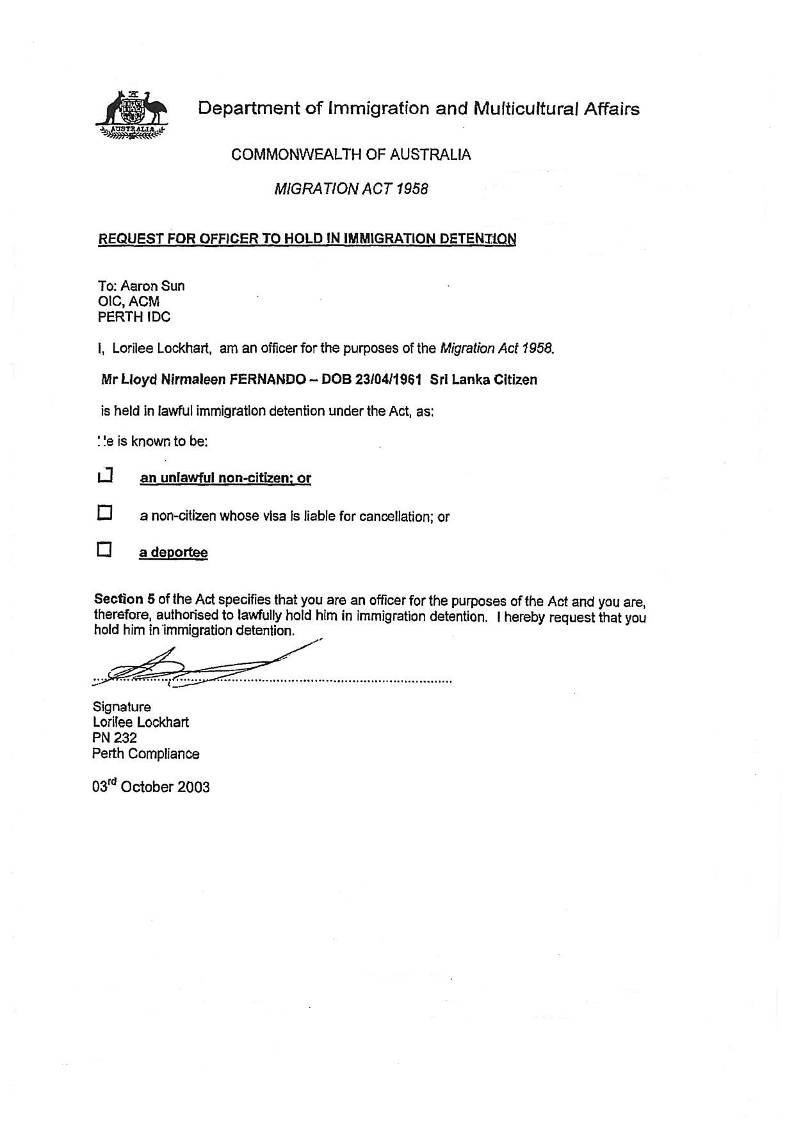
37 As can be seen this document appears to be a standard form used by the Department. Ms Lockhart has filled in parts identifying the addressee, her status as an officer for the purposes of the Act and Mr Fernando as the person who is to be held in detention. Rather than ticking one or more of the boxes, Ms Lockhart chose to underline the first and third options.
38 Ms Lockhart completed and signed a third document on 3 October 2003. This document was headed “DIMA Request for Detention Services”, and was addressed to Mr Aaron Sun - on this occasion spelt “Araon Sun”, “Organisation: ACM”, “Location: Perth IDC”. The document refers to Mr Fernando under the heading “Detainee Details”. These words followed:
“In relation to the detainee(s) above, I am requesting you, or another employee of your organisation who is an officer under the Migration Act 1958 to:”
39 The document then made provision for the person completing it to identify which service was required by ticking a box. The service which was identified was, “Escort detainee to…Perth Immigration Detention Centre from Acacia Prison”. The other potential services which were not sought by Ms Lockhart, included “hold detainee”, “release detainee” and “transfer custody of the detainee”. There was also the heading, “Other Services” on the document. Under that heading Ms Lockhart wrote:
“Please pick up prisoner from Acacia Prison at 1100 hours on 5/10/03 and take to Perth Immigration Detention Centre.”
40 On 5 October 2003, Mr Fernando was released from prison on parole. On his release, he was immediately taken into immigration detention by two employees of ACM and driven to the Perth Immigration Detention Centre at the Perth Airport.
41 On the day after he was taken into detention at the Perth Immigration Detention Centre, two departmental officers interviewed Mr Fernando at the Centre. The departmental officers told Mr Fernando that, as he had no outstanding matters before the Court, he would be removed from Australia within a few days. Mr Fernando advised the officers that he had an application pending in this Court which had been filed the previous week. That application, he told them, sought to challenge the conduct of departmental officers which preceded the Acting Minister’s decision to cancel his visa. Later on 6 October 2003 Mr Fernando told the ACM supervisor of the detention centre that he had commenced the proceeding to challenge the legality of the process which led to the cancellation of his visa.
42 Mr Fernando remained in the Perth Immigration Detention Centre until 27 January 2005. He was then transferred to the Baxter Immigration Detention Centre in South Australia. During the time that Mr Fernando was held at the Baxter Centre it was operated by a contractor other than ACM.
43 Whilst Mr Fernando was in immigration detention, he was given leave to amend application WAD 207 of 2003, to challenge the lawfulness of the Acting Minister’s decision made on 3 October 2003. One of the grounds relied on by Mr Fernando was the failure to afford him procedural fairness in relation to the making of the decision to cancel his visa.
44 On 20 December 2006, and whilst Mr Fernando’s application for judicial review of the Minister’s decision was still pending, the Court’s judgment in the case of Sales v Minister for Immigration and Multicultural Affairs [2006] FCA 1807 was delivered. Allsop J held that the 14 day period which the Department routinely allowed for submissions to be provided to the Minister when decisions under s 501(2) of the Act were in contemplation could, in certain circumstances, be inadequate for the purposes of providing procedural fairness to a visa holder.
45 On 18 January 2007 Mr Fernando was advised that his case had been identified as one to which the Sales decision might apply and that, as a result, he was to be released from detention. He was released later that day.
THE PROCEEDING
46 Following his release Mr Fernando, acting by a tutor, commenced the present proceeding. He sought damages from the appellants in relation to his period in immigration detention. He pleaded four causes of action: false imprisonment, negligence, breach of statutory duty and misfeasance in a public office.
47 At trial Mr Fernando gave evidence in support of his application. The only witnesses who were called on behalf of the respondents (the present appellants) were Ms Lockhart and Ms Chow. Notably, no evidence was called from any of the employees of ACM who were involved in detaining Mr Fernando.
48 The primary judge held that each of the appellants was liable in damages to Mr Fernando for false imprisonment but only in respect of the first of the 1203 days during which he was held in custody. General damages of $3,000 were awarded to Mr Fernando.
49 The primary judge also found that Mr Hardgrave had engaged in misfeasance in his former public office which caused Mr Fernando to be unlawfully detained for one day. He awarded Mr Fernando $3,000 in damages but held that this was a concurrent liability to that in respect of false imprisonment.
50 Following a later hearing the primary judge found that the acting Minister had “acted in conscious and contumelious disregard for the rights of Mr Fernando to procedural fairness and his right not to have his liberty curtailed, save by lawful process” and ordered the Commonwealth to pay Mr Fernando $25,000 by way of exemplary damages in respect of the false imprisonment and misfeasance in public office. He rejected a claim for aggravated damages because there was no evidence that Mr Fernando had been subjected to any indignities on 5 October 2003 and that, thereafter, his detention had been lawful.
51 The trial judge dismissed Mr Fernando’s claims of negligence and breach of statutory duty. These findings have not been challenged on this appeal. It is not, therefore, necessary to examine the primary judge’s reasons for rejecting these claims.
THE PRIMARY JUDGE’S REASONS
False Imprisonment
52 The appellants contended at trial that, at all times, Mr Fernando’s detention was lawful. They relied for this contention on s 189(1) of the Act which provides that an officer who “knows or reasonably suspects that a person in the migration zone … is an unlawful non-citizen”, must detain the person.
53 Their principal argument was that Mr Fernando’s detention had been effected by Ms Lockhart and that, at the relevant time she harboured the necessary state of mind for the purposes of s 189(1).
54 The appellants also submitted at trial that the Court should find that the two ACM officers who detained Mr Fernando at the prison and took him to the detention centre knew or reasonably suspected that he was an unlawful non-citizen. So much was to be inferred from the facts that Ms Lockhart had formed the requisite opinion, that she had instructed Mr Sun to hold Mr Fernando in immigration detention as he was known to be an unlawful non-citizen, that she had requested Mr Sun or another employee of ACM to escort Mr Fernando from the prison to the detention centre and that the two ACM officers acted in accordance with those instructions. For similar reasons it was submitted that Mr Sun had detained Mr Fernando on 5 October 2003 whilst also knowing or reasonably suspecting him to be an unlawful non-citizen.
55 The primary judge held that Ms Lockhart’s state of mind was not relevant because she had not been present when Mr Fernando was detained at the prison on 5 October 2003. His detention had been effected by the two ACM employees.
56 His Honour held that it was for the appellants to establish that the ACM employees who detained Mr Fernando either knew or reasonably suspected that he was an unlawful non-citizen: cf Ruddock v Taylor (2005) 222 CLR 612 at 628, 638; [2005] HCA 48. They had not called any evidence from the ACM employees who had taken Mr Fernando into immigration detention immediately following his release from prison and there was no other evidence which might have supported an inference that those ACM employees had either of the requisite mental states. He was not prepared to infer that the ACM officers (or Mr Sun) had the knowledge or reasonable belief required by s 189(1) on the bases urged by the appellants.
57 The two ACM officers had taken Mr Fernando into their custody and delivered him to the immigration detention centre where he was held for the remainder of 5 October 2003. Detention on that day was, therefore, unlawful.
58 Mr Fernando’s detention had, however, been rendered lawful the following day because, his Honour held, the ACM officer in charge of the detention centre had then been advised by Mr Fernando that he had challenged the acting Minister’s decision to cancel his visa by way of application to the Court. This evidence had been given by Mr Fernando himself and the primary judge held that it supported an inference “that, from that date onwards, officers of the [Commonwealth] knew or reasonably suspected that Mr Fernando was an unlawful non-citizen.” This was because the supervisor “would have concluded that Mr Fernando’s visa had been cancelled; and would have, accordingly, known or suspected that Mr Fernando was an unlawful non-citizen, who was being held in detention pending his deportation to the country of his citizenship.”
Misfeasance in Public Office
59 Mr Fernando contended that the acting Minister either knowingly acted in excess of his power when cancelling his visa or with reckless disregard as to whether he was acting in excess of power: cf Sanders v Snell (1998) 196 CLR 329 at 346-7. The trial judge concluded “that at the time that the acting Minister made the decision to cancel the visa, he knew that Mr Fernando had not been afforded procedural fairness in relation to the decision, and he knew that the failure to afford procedural fairness went to the lawfulness of his exercise of the power to cancel [the] visa.” His Honour held that the Acting Minister had deliberately chosen to make the decision on 3 October 2003 rather than await the arrival of Mr Fernando’s submissions.
60 The acting Minister had not given evidence. Nor had he made any statements in his reasons for decision or otherwise which directly supported these conclusions. The conclusions were drawn from inferences founded on the following circumstances:
• The communications which had passed between the acting Minister’s staff and Departmental officers prior to 3 October 2003 which would have made the acting Minister aware that the Departmental officers considered it desirable that a decision on whether or not to cancel Mr Fernando’s visa should be made prior to 5 October 2003 so that there could be a seamless transition from imprisonment to immigration detention.
• The acting Minister knew that if “the departmental stratagem” was to be implemented a decision had to be made on 3 October 2003. This was because the acting Minister’s appointment was due to expire on 4 October and Mr Fernando was to be released on 5 October 2003.
• The acting Minister knew, when he made his decision, that Mr Fernando had prepared submissions and posted them to the Minister’s office in Canberra. Nonetheless he deliberately chose to proceed to make the decision rather than adjourn doing so until the submissions were received and he had had time to consider them.
• The minute provided by the Department informed the Acting Minister that Carr J had quashed the Minister’s earlier decision because of a failure to accord procedural fairness to Mr Fernando. This had occurred because the Minister had not provided Mr Fernando with an opportunity to comment on adverse information which was before the Minister and was critical and relevant to his decision. As a result it could be concluded that the acting Minister appreciated that a person in Mr Fernando’s position was entitled to have his or her comments taken into account before a decision was made, and that, by proceeding before Mr Fernando’s submissions were received, he was denying Mr Fernando the opportunity to have his comments considered and that any cancellation decision then made was liable to be quashed because of a denial of procedural fairness.
• The Acting Minister was aware of the serious allegations which had been made against him and had chosen not to give evidence thereby suggesting that any such evidence would not have assisted his defence.
61 The trial judge held that the acting Minister’s misfeasance had caused Mr Fernando to have been unlawfully detained for one day.
THE APPEAL
62 The appellants’ grounds of appeal challenged the primary judge’s findings that Mr Fernando had been unlawfully detained on 5 October 2003 and that the Acting Minister had engaged in misfeasance in public office. They also alleged that the primary judge had erred in awarding exemplary damages against the first appellant.
THE CROSS APPEAL
63 Mr Fernando lodged a cross appeal in which he contended that the trial judge had erred in holding that he had only been unlawfully detained for one day. He claimed that he was entitled to general, aggravated and exemplary damages from both appellants for false imprisonment and misfeasance in public office for the entire period of his detention.
THE LEGISLATION
64 At relevant times the Act provided, in s 5, that, unless the contrary intention appeared:
“deportee means a person in respect of whom a deportation order is in force.
detain means:
(a) take into immigration detention; or
(b) keep, or cause to be kept, in immigration detention;
and includes taking such action and using such force as are reasonably necessary to do so.
. . .
immigration detention means:
(a) being in the company of, and restrained by:
(i) an officer; or
(ii) in relation to a particular detainee another person directed by the Secretary to accompany and restrain the detainee; or
(b) being held by, or on behalf of, an officer:
(i) in a detention centre established under this Act; or
. . .
officer means:
(a) an officer of the Department, other than an officer specified by the Minister in writing for the purposes of this paragraph; or
...
(f) a person who is authorised in writing by the Minister to be an officer for the purposes of this Act; or
(g) any person who is included in a class of persons authorised in writing by the Minister to be officers for the purposes of this Act, including a person who becomes a member of the class after the authorisation is given.”
Other relevant provisions were:
(1) A non-citizen in the migration zone who holds a visa that is in effect is a lawful non-citizen:
“14 Unlawful non-citizens
(1) A non-citizen in the migration zone who is not a lawful non-citizen is an unlawful non-citizen.
…
189 Detention of unlawful non-citizens
(1) If an officer knows or reasonably suspects that a person in the migration zone (other than an excised offshore place) is an unlawful non-citizen, the officer must detain the person.
…
193 Application of law to certain non-citizens while they remain in immigration detention
(1) Sections 194 and 195 do not apply to a person:
(a) detained under subsection 189(1)
...
(iv) because of a decision the Minister has made personally under section 501, 501A or 501B to refuse to grant a visa to the person or to cancel a visa that has been granted to the person; or
…
194 Detainee to be told of consequences of detention
As soon as reasonably practicable after an officer detains a person under section 189, the officer must ensure that the person is made aware of:
(a) the provisions of sections 195 and 196; and
(b) …
195 Detainee may apply for visa
(1) A detainee may apply for a visa:
(a) within 2 working days after the day on which section 194 was complied with in relation to his or her detention; or
(b) if he or she informs an officer in writing within those 2 working days of his or her intention to so apply—within the next 5 working days after those 2 working days.
(2) …
…
196 Duration of detention
(1) An unlawful non-citizen detained under section 189 must be kept in immigration detention until he or she is:
(a) removed from Australia under section 198 or 199; or
(b) deported under section 200; or
(c) granted a visa.
…
(4) Subject to paragraphs (1)(a), (b) and (c), if the person is detained as a result of the cancellation of his or her visa under section 501, the detention is to continue unless a court finally determines that the detention is unlawful, or that the person detained is not an unlawful non-citizen.
…
(6) This section has effect despite any other law.”
false imprisonment - liability
65 Mr Fernando pleaded that there was no lawful basis for him being held in immigration detention.
66 The Commonwealth agreed that Mr Fernando had been granted parole and released from prison on 5 October 2003 and asserted that, because of the cancellation of his visa on 3 October 2003, he had been placed in immigration detention. It pleaded positive defences:
“(1) that [Mr Fernando] was placed into immigration detention by employees of Australasian Correction Management, who were officers for the purposes of the Migration Act 1958 (Cth) acting under section 189 of the Act;
(2) those officers then
(i) knew that the [Minister] had made the decision cancelling the [Mr Fernando’s] visa; and
(ii) suspected on the basis of that decision [Mr Fernando] was an unlawful non-citizen
…”
For these reasons, Mr Fernando’s detention by employees of ACM, acting under s 189, was, it was contended, lawful.
67 It is to be observed that these defences focussed attention on the role played by the two ACM officers who had detained Mr Fernando upon his release from prison. It was those officers whom it was said had placed Mr Fernando into immigration detention and it was those officers whom it was contended, at that time, knew or reasonably suspected that Mr Fernando was an unlawful non-citizen. The appellants did not plead that Ms Lockhart had detained Mr Fernando.
68 The Act laid down specific criteria that had to be satisfied before a person such as Mr Fernando could be detained. First, s 189(1) created a statutory duty for an officer (as defined in s 5) to detain a person whom the officer “knows or suspects” was an unlawful non-citizen (as defined in s 14). “Detain” had two senses as defined in s 5, namely to take into, or to keep, or cause to be kept, in immigration detention. Only the first of these senses can be applicable to the initial occasion on which a person is deprived of his or her liberty by being placed into immigration detention or is otherwise held in immigration detention.
69 Nonetheless, s 189(1) operated to require an officer to whom it applied to detain a person in both senses of “detain”, namely it required an officer with the requisite state of mind to take the person into immigration detention either by physically depriving the person of his or her liberty or transforming the nature of the custody or detention in which the person was held, such as serving a term of imprisonment, into immigration detention. Once the person had been detained, by being taken into detention within the meaning of the first sense of “detain”, ss 189(1) and 196(1) required the initial detaining officer and all other officers with the requisite state of mind, to keep the person, or cause him or her to be kept, in immigration detention.
70 The question of whether an officer knows or reasonably suspects that a person is an unlawful non-citizen for the purposes of s 189(1) is judged against what was known or was reasonably capable of being known at the time when the person’s detention was first effected: Ruddock v Taylor at [40] per Gleeson CJ, Gummow, Hayne and Heydon JJ at [221] per Callinan J.
71 The basis of the officer’s state of mind is his or her knowledge or reasonable suspicion. That state must be arrived at on the material available to him or her when the detention is effected, regardless of whether that material is based on errors of fact or law, such as the Minister having made a decision to cancel the person’s visa that was affected by jurisdictional error: Ruddock at [27]-[28], [223]-[224], [228]. In Ruddock at [49]-[50] it is recorded that each of the officers who had been responsible for effecting Mr Taylor’s detention gave evidence of the steps they had taken before detaining him.
72 This construction is reinforced by s 194(1), although, by force of s 193(1)(a)(iv), it did not apply in a case, such as Mr Fernando’s, where the Minister personally had cancelled a person’s visa. Section 194(1) required the officer who detained a person under s 189 to make the detainee aware of his or her right to apply for a visa under s 195(1). It would defeat the purpose of s 195(1) if “detains”, as used in s 194(1) extended to the second sense of the definition, namely to keep or cause to be kept in immigration detention. This is because the Parliament intended that the detainee be made aware of his or her right to apply for a visa only once, namely, as soon as reasonably practicable after he or she was taken into immigration detention. On the other hand, s 189(1) also required other officers to keep the person detained, or cause him or her to be kept in immigration detention when they had one of the requisite states of mind. It follows that an officer with the necessary state of mind could detain a person by causing him or her to be kept in immigration detention because the first officer caused another officer to take the person into immigration detention and then keep the detainee there.
73 The detention request, sent to Mr Sun on 3 October 2003 (see above at [36]), specified three true alternate bases for detention. It said that Mr Fernando:
“Is known to be
□ an unlawful non-citizen; or
□ a non-citizen whose visa is liable for cancellation; or
□ a deportee.” (underlining and bolding in the original)
74 A number of observations may be made about this document. First, the assertion that Mr Fernando “is known to be” one of the three alternate descriptions begs two questions – by whom he was so known, and of which of the three categories was that knowledge held? The detention request as sent to Mr Sun was devoid of intelligible content that could be relied on to justify depriving Mr Fernando of his liberty.
75 Secondly, there was no pleaded defence that Mr Fernando was detained by any particular named employees or officers of either ACM or the Commonwealth who were also officers for the purposes of s 189. The Commonwealth tendered a copy of the Gazette of 26 September 2000 in which the Minister authorised, as officers for the purposes of paragraph (g) of the definition of “officer”, employees of ACM who performed duties under the Act “and who have met character and training requirements as set out in the Detention Services Contract”. There was no evidence that anyone who might have detained Mr Fernando on 5 October 2003 or at any time thereafter satisfied the description of employees of ACM who also met the additional criteria prescribed by the authorisation published in the Gazette.
76 On 21 July 2010, the primary judge delivered his principal reasons for judgment and ordered that Mr Fernando was entitled to $3,000 general damages. His Honour stood over to a later date the questions of aggravated and exemplary damages as well as costs. At the subsequent hearing of those questions on 22 September 2010, Mr Fernando applied to re-open his case, to challenge two of his Honour’s findings, one of which was that the persons responsible for detaining him after 6 October 2003 were officers for the purposes of s 189 of the Act.
77 The primary judge rejected that application and gave ex tempore reasons for doing so. His Honour reasoned that the appellants had run their defence on the basis of the subjective knowledge of the ACM personnel responsible for detaining Mr Fernando. The pleaded defence is set out at [66] above. His Honour observed that, during the trial, Mr Fernando took the point that there was no evidence to show that the ACM personnel responsible for his detention were officers within the meaning of s 189.
78 The appellants’ senior counsel informed the primary judge that the ACM personnel’s status as officers derived from a government notice. Without objection by Mr Fernando, his Honour granted the appellants leave to tender that notice on 22 September 2010, after the conclusion of the trial. That was when the appellants tendered the Gazette of 26 September 2000, referred to in [75] above. The primary judge observed that Mr Fernando did not subsequently argue that a person whom he called “the supervisor”, whom the judge described as “the unnamed supervisor”, to whom Mr Fernando had protested on 6 October 2003 at the Perth detention centre, or anyone else did not satisfy the character and training requirements referred to in the notice in the Gazette. His Honour did not consider that there was any issue on which he had to make a finding on this point. Mr Sun was described in Ms Lockhart’s request set out in [36] above as the “OIC” or officer in charge of the centre. No officer was identified in evidence as the “supervisor” to whom Mr Fernando spoke. His Honour said that, if he had been alerted to this as an issue, he would have drawn the inference that the ACM employee who was the unnamed supervisor met the character and training requirements. In those circumstances his Honour found that any re-opening would have been futile.
79 In our opinion the primary judge erred in concluding that the re-opening would have been futile. His Honour, in effect, treated Mr Fernando as being responsible for giving the appellants ongoing advice as to the evidence they should have led to prove their pleaded positive defences relating to his detention on 5 October 2003. At the time Mr Fernando gave evidence of speaking to the unnamed “supervisor” on 6 October 2003, there was no pleaded or other issue to which that conversation had any relevance except his protest at the loss of his liberty. If the appellants had wanted to prove that this protest somehow created a justification for the subsequent detention of Mr Fernando, they should have done so at the trial. Mr Fernando had no obligation to assist the appellants by pointing to any deficiency in their evidence. The reality was that the appellants failed to prove their case that anyone who detained Mr Fernando acted lawfully. Because his Honour had not made final orders, Mr Fernando was entitled to seek to re-open his case and attempt to correct his Honour’s erroneous finding on this issue because it was a matter calling for review: Smith v New South Wales Bar Association (1992) 176 CLR 256 at 265. The inference the primary judge said he would have drawn as to the qualifications of the unnamed supervisor as an officer for the purposes of s 189 of the Act had no basis in the evidence.
80 Mr Fernando did not have an obligation to keep pointing out during the trial how the appellants’ evidence fell short of proof of their defences, whether they were pleaded or not. All the appellants did to remedy their failure to make out any such case was to tender the notice in the Gazette. Moreover, Mr Fernando was moved to the Baxter detention centre in 2005. That centre was not operated by ACM. The appellants made no attempt to prove the authority or state of mind of anyone at the Baxter detention centre to detain Mr Fernando in the event that his detention at the Perth centre had not been lawful.
81 The appellants never pleaded any issue about the state of mind of anyone after Mr Fernando’s initial detention on 5 October 2003 as justifying his detention. It is hardly the fault of Mr Fernando that he was confronted by a finding in his Honour’s reasons that precluded him recovering damages after 6 October 2003, on the basis that his detention thereafter was lawful, and that this fact also rendered his subsequent detention for over three years lawful. His Honour should have found on Mr Fernando’s re-opening application that the appellants had not proved that his detention was lawful.
82 Ms Lockhart’s detention request was the only document in evidence emanating from the Minister’s Department concerning Mr Fernando’s immigration status. It could not have conveyed to a reader that she entertained either of the requisite states of mind. This is because it asserted that Mr Fernando either was or may have been in one of the three categories described as alternatives. Even if, as Ms Lockhart asserted, she had indicated her state of mind by underlining and bolding two of those alternatives, she still left them open as true alternatives, only one of which, if it existed (an unlawful non-citizen) satisfied the essential requirement that an officer had to know or reasonably suspect in order to enliven his or her power to detain Mr Fernando under s 189(1). No-one reading the detention request, including Mr Sun, could know from it that Mr Fernando was in any or which of the three (or two) alternate categories. Nor could a reader form, based on its contents, a reasonable suspicion that Mr Fernando met one of those descriptions. This was because there was nothing in the detention request to indicate a reasonable basis on which the reader could select between the alternatives that the author had left completely open. Nor did the detention request on its face make apparent whether it was asserting that Mr Fernando was within any of those categories. The incongruity was manifest in its text: how could Mr Fernando be known to be, in effect, fish or fowl or flora. The detention request provided no basis for Mr Sun or anyone acting on his instructions to detain Mr Fernando pursuant to s 189(1).
83 The Commonwealth’s argument that Ms Lockhart was the relevant officer who detained Mr Fernando under s 189(1) must be rejected. First, it argued that she knew that the Minister had cancelled Mr Fernando’s visa under s 501 on 3 October 2003 when she sent the detention request to Mr Sun. It contended that, in doing this, she had caused Mr Fernando to be kept in immigration detention by requesting Mr Sun to arrange for someone to detain Mr Fernando at Acacia Prison on 5 October 2003 as he was being released on parole.
84 The Commonwealth’s argument did not exhaust or exclude the application of s 189(1) to the persons who actually took Mr Fernando into immigration detention. The individual who physically takes a person into immigration detention must have at that time one of the two states of mind prescribed by s 189(1) so as to justify him or her in the act of depriving or interfering with the liberty of another: Ruddock at [40], [221]. It is not enough for the actual person effecting that deprivation or interference to think that someone else knows or believes the detainee is an unlawful non-citizen. As Lord Atkin explained in Liversidge v Anderson [1942] AC 206 at 245 (in his speech that was approved in George v Rockett (1990) 170 CLR 104 at 112, itself a case based on a claim of false imprisonment):
“… the question is whether the words ‘If a man has’ can mean ‘If a man thinks he has.’ I am of opinion that they cannot.”
85 It may have been correct to say that Ms Lockhart intended to cause Mr Fernando to be kept in immigration detention. But she failed. The detention request was the only means by which Ms Lockhart sought to have Mr Fernando detained. It could not have caused anyone reading it to take him into, or keep him or cause him to be kept in, immigration detention because it conveyed no relevant information to a reader about Mr Fernando’s immigration status.
86 Ms Lockhart did not indicate in the detention request on which of the three possible bases she required Mr Fernando to be detained. That was not just sloppy paperwork. It is troubling that she could have sent a document purporting to authorise the deprivation of a person’s liberty that was so obviously incomplete in its critical part without anyone else in the Minister’s department having checked it. It is more troubling that no-one, including Mr Sun, who received this vacuous piece of paper, queried Ms Lockhart and required a properly completed authority to deprive Mr Fernando of his liberty before acting on it.
87 By prescribing conditions governing the circumstances in which an officer can exercise the power to detain an unlawful non-citizen in s 189(1) the Parliament struck a balance between the effective administration of the Act and the need to protect individuals from arbitrary deprivation of their liberty: George v Rockett at 110; Liversidge at 239, 244-245 per Lord Atkin.
88 The Commonwealth also argued that Ms Lockhart had given evidence, in her affidavit, which was sworn about six years after the events of October 2003, that supported its conduct in detaining Mr Fernando. However, Ms Lockhart’s affidavit was prepared without any actual recollection of any of the circumstances on her part. She acknowledged this, but then purported to ascribe why she acted as she did to a reconstruction of her thought processes based on her usual practices.
89 It may well be that she was correct in her reconstruction but that does not entitle the Court to give its imprimatur to what happened. No-one can be deprived of his or her liberty in this nation unless the deprivation is authorised by law: George at 113. As Mason CJ, Brennan, Deane, Dawson, Toohey, Gaudron and McHugh JJ observed, in relation to search warrants, insistence on strict compliance with the statutory conditions governing the use of such powers simply gives effect to the purpose of the legislation: George at 111. Here the power to cause the administrative detention of an individual under ss 189 and 196 of the Act is extraordinary. It is a power that invades an interest, liberty of the person, that the common law has valued highly and has gone to great lengths to protect through the writ of habeas corpus, and the torts of false arrest and false imprisonment.
90 The Court should be slow to condone significant failures by officials to comply with the requirements mandated by the Parliament in order for persons lawfully to exercise power under s 189(1) to deprive a person of his or her liberty.
91 In Plenty v Dillon (1991) 171 CLR 635 at 654 Gaudron and McHugh JJ said, in a passage cited with approval by Mason CJ, Brennan, Gaudron and McHugh JJ in Coco v The Queen (1994) 179 CLR 427 at 436, that:
“[I]nconvenience in carrying out an object authorised by legislation is not a ground for eroding fundamental common law rights.”
92 Despite the fact that the Acting Minister had cancelled Mr Fernando’s visa on 3 October 2003, the Commonwealth failed to prove its pleaded defence, and there was no evidence, that any officer detained Mr Fernando pursuant to s 189(1) on 5 October 2003 or at any time thereafter.
93 For these reasons we would reject the appellant’s appeal against the trial judge’s finding that Mr Fernando was unlawfully detained on 5 October 2003.
False Imprisonment - Damages
94 We turn next to Mr Fernando’s cross-appeal in which he asserts an entitlement to damages for false imprisonment in respect of the additional 1202 days during which he was held in immigration detention.
95 In our respectful opinion the primary judge erred in reasoning that Mr Fernando’s self identification as a person whose visa had been cancelled by the Minister under s 501 to an unnamed supervisor at the detention centre on 6 October 2003 was sufficient to enable him (the judge) to draw an inference that that supervisor then formed one of the states of mind required in s 189(1) to detain Mr Fernando.
96 First, there was no evidence that any of those “officials” was an “officer” for the purposes of s 189(1). Secondly, while Mr Fernando was already in detention, there was no evidence that any of those persons detained him or turned his or her mind to doing so. Thirdly, there was no evidence that any of them evinced a consciousness or intention that what he or she was doing, after hearing what Mr Fernando said, was acting under s 189(1), rather than assuming, as would be natural, that he was already in immigration detention under whatever power was necessary to justify this.
97 In those circumstances, the Court should not draw the serious conclusion that perhaps one of the people connected to ACM or the Department to whom Mr Fernando spoke on 6 October 2003, was an “officer” who also formed the state of mind that he or she knew or reasonably suspected that Mr Fernando was an unlawful non-citizen and he or she was then and there taking him into immigration detention. In any event, this was not a case that the Commonwealth pleaded, let alone proved, to justify its detention of Mr Fernando. Once Mr Fernando had been received into the detention centre, it is unlikely that any official would have turned his or her mind to effecting a fresh act that amounted to detaining him under s 189(1). That exercise was the responsibility of the persons who had detained him on 5 October 2003 at the prison and who processed him on arrival at the detention centre. There was no evidence that they had done so.
98 In the ordinary course the person in charge of a detention centre or jail must satisfy himself or herself that the violation of an individual’s liberty that will occur on receiving him or her into the facility has been authorised according to law. That did not happen in Mr Fernando’s case. The casual attitude exhibited by all the persons concerned in his detention to whether the requirements of s 189(1) had been satisfied is unlikely to have been exceptional.
99 In one sense, with hindsight, it can be argued that Mr Fernando could have been lawfully detained on 5 October 2003 because he was then actually, or at least, able reasonably to be suspected to be, an unlawful non-citizen and so no real harm was done. But, that would make the safeguards that the Parliament enacted to protect individual liberty worthless. If Mr Fernando could be detained for over three years when no-one turned his or her mind to complying with s 189(1), so could anyone else, including Australian citizens. It is not unusual for persons detained by those in authority to be ignored when they protest that the officials had no right to detain them. That is because it is natural to presume that once a person has been detained inside a jail or detention facility, their detention has been authorised by law. That presumption is a natural consequence of our society’s fundamental value of, and belief in, the rule of law and its abhorrence of arbitrary detention or imprisonment.
100 Here, there was no evidence that, at any time during his immigration custody, any officer, as defined, ever took Mr Fernando into detention or kept or caused him to be detained there with any state of mind required in s 189(1). The Commonwealth called no witnesses who were involved in the detention of Mr Fernando other than Ms Lockhart.
101 For these reasons we consider that the Commonwealth failed to prove that its conduct in detaining Mr Fernando on 5 October 2003 or later was lawful. It follows that Mr Fernando’s cross-appeal, to this extent, should be allowed.
102 The proceeding must be remitted to the primary judge to assess the substantial damages, including, if warranted, aggravated and exemplary damages, to which Mr Fernando is entitled because of his unlawful imprisonment for 1203 days.
misfeasance in public office
103 Mr Fernando’s claim that the Acting Minister had engaged in misfeasance in a public office was pleaded in paragraph 49 of his further amended statement of claim. That paragraph read:
“Further or alternatively, the Second Respondent’s actions as pleaded in paragraphs 31 and 33 above constituted a misfeasance by the Second Respondent in his office as Acting Minister.”
For the most part paragraph 31 contained allegations relating to the conduct of departmental officers. The only allegation made in it against the Acting Minister was that he had failed to give Mr Fernando the opportunity to make submissions to him about prejudicial material contained in Annexure L to the submissions considered by the Minister when he had decided, in November 2001, to cancel Mr Fernando’s visa. Annexure L was not placed before the Acting Minister in October 2003. Nor was any other document which contained the same or similar prejudicial material.
104 Paragraph 33 pleaded that:
“By reason of the matters pleaded in paragraph 31 above, when the second respondent decided the Second Cancellation he had no jurisdiction to do so and, accordingly, the Second Cancellation was a nullity and of no effect.”
105 As can be seen paragraphs 31 and 33 go no further than alleging that, because of the actions of departmental officers, the Acting Minister had no jurisdiction to cancel Mr Fernando’s visa. Nowhere in the body of the further amended statement of claim did Mr Fernando deal with the Acting Minister’s state of mind at the time at which he made his decision. That issue was, however, dealt with in particulars sub-joined to paragraph 49.
106 Mr Fernando alleged that the Acting Minister had engaged in misfeasance in his office when he cancelled Mr Fernando’s visa. It was alleged that the Acting Minister knew or ought to have known when he made his decision that he had no jurisdiction to do so or, alternatively, that he made the determination with reckless disregard to the question of whether or not he had the necessary jurisdiction to do so. The alleged lack of jurisdiction was linked, in argument, to the Acting Minister’s determination to proceed to make a decision in the knowledge that Mr Fernando had forwarded written submissions which had yet to be received.
107 The recent history of the development of the tort of misfeasance in public office in Australia can be traced to the High Court’s decision in Northern Territory v Mengel (1995) 185 CLR 307. In their joint judgment (at 345) Mason CJ, Dawson, Toohey, Gaudron and McHugh JJ noted that the weight of authority in Australia and the United Kingdom clearly established that misfeasance in public office was “a deliberate tort”. Their Honours continued (at 347):
“The cases do not establish that misfeasance in public office is constituted simply by an act of a public officer which he or she knows is beyond power and which results in damage. Nor is that required by policy or by principle. Policy and principle both suggest that liability should be more closely confined. So far as policy is concerned, it is to be borne in mind that, although the tort is the tort of a public officer, he or she is liable personally and, unless there is de facto authority, there will ordinarily only be personal liability. And principle suggests that misfeasance in public office is a counterpart to, and should be confined in the same way as, those torts which impose liability on private individuals for the intentional infliction of harm.
…
If misfeasance in public office is viewed as a counterpart to the torts imposing liability on private individuals for the intentional infliction of harm, there is much to be said for the view that, just as with the tort of inducing a breach of contract, misfeasance in public office is not confined to actual knowledge but extends to the situation in which a public officer recklessly disregards the means of ascertaining the extent of his or her power.”
108 Deane J expressed himself somewhat less tentatively than (but not inconsistently with) the plurality. His Honour said (at 370-1) that:
“… the tort of misfeasance in public office is ‘well established’. Its elements are: (i) an invalid or authorised act; (ii) done maliciously; (iii) by a public officer; (iv) in the purported discharge of his or her public duties; (v) which causes loss or harm to the plaintiff. That summary statement of the elements of the tort inevitably fails to disclose some latent ambiguities and qualifications of which account must be taken in determining whether a particular element is present in the circumstances of a particular case. The critical element for present purposes is malice.
In the context of misfeasance in public office, the focus of the requisite element of malice is injury to the plaintiff or injury to some other person through an act which injuriously affects the plaintiff … Such malice will exist if the act was done with an actual intention to cause such injury. The requirement of malice will also be satisfied if the act was done with knowledge of invalidity or lack of power and with knowledge that it would cause or be likely to cause such injury. Finally, malice will exist if the act is done with reckless indifference or deliberate blindness … to that invalidity or lack of power and that likely injury. Absent such an intention, such knowledge and such reckless indifference or deliberate blindness, the requirement of malice will not be satisfied.”
109 In Three Rivers District Council v Governor and Company of the Bank of England (No 3) [2003] 2 AC 1 at 224; [2001] UKHL 16, Lord Hutton said that Deane J’s judgment was important because it emphasised “that the second limb of the tort is a species of malice, and that the requirement for malice is satisfied where the public officer knows that the abuse of power will cause injury, or is recklessly indifferent or deliberately blind to the likely injury.”
110 In dealing with the mental element of the tort Lord Steyn (at 191) observed that:
“The case law reveals two different forms of liability for misfeasance in public office. First there is the case of targeted malice by a public officer, i.e. conduct specifically intended to injury a person or persons. This type of case involves bad faith in the sense of the exercise of public power for an improper or ulterior motive. The second form is where a public officer acts knowing that he has no power to do the act complained of and that the act will probably injure the plaintiff. It involves bad faith inasmuch as the public officer does not have an honest belief that his act is lawful.”
111 In Sanders v Snell (2003) 130 FCR 149; [2003] FCAFC 150 a Full Court of this Court reviewed subsequent Australian authorities. Their Honours said (at 175-6) that:
“[98] Reference should also be made to Australian decisions at first instance decided after Mengel and Sanders v Snell. The first of these, two of them decisions of judges of this court, Martin v Tasmanian Development & Resources (1999) 89 IR 98, involved termination without notice of a contract of employment. An action for misfeasance in public office was brought against the Chief Executive Officer of Tasmanian Development and Resources, which is a public authority. The claim for misfeasance failed because the CEO was found to be acting honestly and on the basis that he was acting within power. Heerey J said (at 119):
This tort is committed where a holder of a public office acts in that capacity either with intention to cause harm or knowingly in excess of his or her power … The public office holder must know that the act is beyond the power and that it involves a foreseeable risk of harm.
His Honour did not advert to recklessness, no doubt because the case was not put on that basis.
[99] The tort was also considered in the context of a pleadings dispute by Weinberg J in McKellar v Container Terminal Management Services Ltd (1999) 165 ALR 409 who, in addition to the elements referred to by Heerey J, adverted to the recklessness element (455). In dealing with the pleading of the cause of action his Honour said (at 459):
Whatever view may be taken of the requisite state of mind on the part of the person said to have committed this tort, it is not sufficient to plead that the minister ought to have known that he was exceeding his powers or contravening designated Commonwealth laws. Northern Territory v Mengel (1995) 185 CLR 307 at 347-348. Mason CJ, Dawson, Toohey, Gaudron and McHugh JJ, in a joint judgment, held that the elements of the tort of misfeasance in public office are the infliction of damage and either an intention, as the actuating motive, to inflict damage or the performance of an act which the public officer knows is beyond power and which involves a foreseeable risk of harm.
His Honour added that at the very least it must be pleaded that the Minister has recklessly disregarded the means of ascertaining the extent of his or her power and not that he has merely acted with reckless indifference to the applicants.
[100] In Rowan v Cornwall (No 5) (2002) 82 SASR 152, Debelle J, after reviewing the authorities observed (at 358):
There are two forms of the tort. The first is where the public officer acts with an intention to injure a person or persons. It is sometimes called acting with targeted malice … The second is where the public officer knowingly acts in excess of his or her power and with knowledge that it would cause or be likely to cause injury, or acts with reckless indifference to possible lack of power or invalidity and likely injury.
That was a case in which the tort was made out against a Minister of the Crown, who without observing procedural fairness, and in the process of denying funding to a women’s shelter, published a report containing unsubstantiated allegations against the shelter operators. This was done, so it was found, with the intention of silencing the shelter operators in any subsequent political debate. Debelle J found that the Minister had acted in an improper way and with an intention to cause harm (at 361).”
112 Although he did not disavow reliance on the first form of the tort, Mr Fernando’s case, as argued, centred on the contention that the Acting Minister knowingly or recklessly exceeded his power by cancelling Mr Fernando’s visa despite being aware that Mr Fernando had forwarded written submissions which, it was to be assumed, sought to persuade the Acting Minister against doing so.
113 Mr Fernando submitted that it was open to the trial judge, on the material summarised above at [60], to “find that, in addition to intending the harm which befell [him] in the form of the loss of his liberty, [the Acting Minister] knew that he had no power to cancel the visa before the arrival of the documents, or alternatively was reckless as to whether he had the power.” The period which had been allowed to Mr Fernando to make submissions was, it was submitted, unreasonably short in the circumstances and there was nothing in the material before the Acting Minister (apart from administrative convenience) which would have precluded a decision being delayed until the submissions had arrived and been considered. Mr Fernando also emphasised the failure of the Acting Minister to give evidence as to his state of mind at relevant times and the absence of any suggestion that he was unable to give such evidence at the time of the trial. On this latter point Mr Fernando invoked the rule in Jones v Dunkel.
114 The Acting Minister contended that an adverse finding was not open on the evidence and complained that the trial judge had failed to pay sufficient regard to the constraint imposed on him by s 140 of the Evidence Act 1995 (Cth).
115 It was for Mr Fernando to adduce sufficient evidence to support, on the balance of probabilities, a finding that the Acting Minister had committed misfeasance in a public office. In the context of the present case this required him to establish that the Acting Minister knowingly acted in excess of his power in the knowledge that the cancellation of Mr Fernando’s visa would cause him injury or would be likely to do so or that the Acting Minister acted with reckless indifference to the possibility that he lacked power to make the cancellation decision when he did. The Acting Minister’s state of mind at the time at which he made his decision was a matter peculiarly within his knowledge. The Acting Minister did not give evidence. In these circumstances it was open for the trial judge more readily to infer, on the evidence, that the Acting Minister had one of the necessary states of mind. It was not, however, open to the trial judge to rely on the Acting Minister’s failure to give evidence to make good a deficiency in Mr Fernando’s case.
116 In Jones v Dunkel at 312 Menzies J said that:
“…(i) that the absence of the defendant … as a witness cannot be used to make up any deficiency of evidence; (ii) that evidence which might have been contradicted by the defendant can be accepted the more readily if the defendant fails to give evidence; (iii) that where an inference is open from facts proved by direct evidence and the question is whether it should be drawn, the circumstance that the defendant disputing it might have proved the contrary had he chosen to give evidence is properly to be taken into account as a circumstance in favour of drawing the inference.”
117 In Lek v Minister for Immigration, Local Government and Ethnic Affairs (1993) 43 FCR 100 at 124; [1993] FCA 297 Wilcox J noted that:
“Jones v Dunkel … is often cited for its statements about the effect of a party failing to call a person with knowledge of the relevant facts; the matters discussed in Menzies J’s second and third propositions. People sometimes overlook that these statements were made against the background of findings by all three majority judges that there was material entitling the jury to infer negligence. In that situation the defendant’s failure to [give evidence] could be taken into account in determining whether the inference should in fact be drawn. The statements in Jones v Dunkel give no support to the proposition that the failure to call a witness may itself provide the basis of an adverse inference. An inference must be founded in evidence. As Menzies J said, the absence of a particular witness ‘cannot be used to make up any deficiency of evidence.’”
See also: Australian Building and Construction Commissioner v Construction, Forestry, Mining and Energy Union (2010) 187 FCR 293 at 300-302 (per Barker J); Qantas Airways Limited v Transport Workers’ Union of Australia (2011) 280 ALR 503 at 511-514 (per Moore J).
118 It is, therefore, necessary to examine with some care the material on which Mr Fernando relied in inviting the trial judge to draw adverse inferences relating to the Acting Minister’s state of mind. That evidence principally included the documents which were placed before the Acting Minister and upon which he determined to cancel Mr Fernando’s visa. Mr Fernando also relied on communications that passed between the Acting Minister’s staff and departmental officers prior to the decision being made and some exchanges which passed between departmental officers but which the evidence did not suggest had come to the attention of the Acting Minister.
119 Carr J’s decision, handed down on 16 September 2003, was the catalyst for a flurry of activity on the part of departmental officers. E-mail exchanges commenced on that day and continued until 3 October 2003 when the Acting Minister made his decision: see above at [8]-[29]. The exchanges included communications, in the last week of September 2003, between departmental officers and the Acting Minister’s office: see above at [11], [13]-[14], [19].
120 There can be no doubt that the departmental officers involved with Mr Fernando’s case thought that it would be desirable for a fresh decision to be made under s 501(2) of the Act before Mr Fernando was released on parole on 5 October 2003. A notice of intention to cancel Mr Fernando’s visa was prepared and served on him within a day or two of Carr J’s decision. The notice required Mr Fernando to provide any submissions which he wished the Minister to consider on or before 1 October 2003. In the meantime enquiries were made and administrative procedures were put in place with a view to ensuring that, no later than 3 October 2003, a ministerial decision would be made on whether or not to cancel Mr Fernando’s visa. Whether or not this activity can properly be characterised as a “Departmental stratagem”, it is clear that the departmental officers involved were anxious to ensure that a further decision was made before Mr Fernando was released from prison. The contacts with the Minister’s office would have ensured that his staff were aware that the departmental officers considered that an urgent decision was needed and that that decision should, ideally, be made before 3 October 2003. The fact that the Acting Minister was prepared to make himself available at short notice in his Brisbane office to make the necessary determination and did so suggests that the sense of urgency which energized the departmental officers was conveyed to the Acting Minister. The Acting Minister was specifically advised, in the issues paper, that Mr Fernando was due for release on 5 October 2003.
121 Whilst the Acting Minister was willing to make a decision in accordance with the Department’s desired timetable, it does not follow that he necessarily did so in a manner which constituted misfeasance in a public office. Mr Fernando’s case was that, on 3 October 2003, the Acting Minister knew or ought to have known that he had no jurisdiction to make the decision. In the alternative he contended that the Acting Minister proceeded to make the decision with reckless disregard to the question of whether or not he had the necessary jurisdiction to do so. The contention that the Acting Minister lacked jurisdiction was, in turn, founded on the assertion that the Minister knew (or recklessly disregarded the possibility) that he would deny Mr Fernando procedural fairness if he made his decision before he received and considered Mr Fernando’s written submissions.
122 The trial judge was prepared to infer that the Acting Minister appreciated that a person in Mr Fernando’s position was entitled to have his or her comments on material matters relating to the proposed cancellation of a visa considered before any decision was made and that, if he did not delay making a decision until Mr Fernando’s submissions were to hand and had been considered, he would be acting unlawfully by proceeding to cancel the visa. These findings assume that the Acting Minister turned his mind to the question of whether it was necessary for him, in order to make a valid decision, to await receipt of the submissions and then made a conscious choice to make a decision on 3 October 2003 without waiting for Mr Fernando’s submissions to arrive.
123 The principal foundation for the drawing of the adverse inference was the fact that the Acting Minister knew that the Minister’s earlier decision had been quashed by Carr J on the ground that Mr Fernando had been denied procedural fairness. The trial judge cast the basis for Carr J’s decision very broadly. He said that Carr J had found that a denial of natural justice had occurred because Mr Fernando was not afforded the opportunity to comment upon “the substance of the information material to the cancellation decision.” The Acting Minister knew this. As a result he knew, his Honour held, that if Mr Fernando was denied “the opportunity of having his comments on matters material to the cancellation decision considered as part of the decision making process”, there would be a further denial of procedural fairness.
124 With respect, we consider that his Honour erred in the way in which he sought to draw inferences based on the Acting Minister’s knowledge of the reasons for the Court’s decision to quash the earlier decision. Whilst it is literally true that Carr J’s decision was made because Mr Fernando had not been given the opportunity of commenting on “matters material” in the making of the earlier decision, it is to be borne in mind that those matters were prejudicial matters which were dealt with in an annexure (Annexure L) to the departmental submission to the Minister. Mr Fernando had not been given access to the Annexure or provided with the substance of its contents.
125 In the present proceeding, Mr Fernando had been provided with all of the material which had been given to the Minister and had been provided with the opportunity (albeit within 14 days) to respond to that material. The Acting Minister had been advised of the true basis of Carr J’s decision and that Annexure L had not been placed before him. The 14 day period which was afforded to Mr Fernando accorded with what was then standard departmental practice. That practice was not called into question until some three years later when Sales was decided. There was nothing in the departmental minute which suggested to the Minister that he might err in law if he proceeded to make the decision before receiving and considering Mr Fernando’s submissions. Indeed, it was implicit in the minute that he was empowered to make a decision as soon as he had received and considered the departmental brief. Moreover, the Acting Minister was aware that Mr Fernando had been given 14 days in which to make his submissions. The Acting Minister had not indicated to Mr Fernando that if the submissions were sent before the 14 days expired but took longer to arrive in the Acting Minister’s office, no decision would be made until they had been received and been considered.
126 A competing inference was, therefore, open. It was that the Acting Minister proceeded on the basis that Mr Fernando had had the opportunity normally accorded persons in his position to make written representations relating to the proposal to cancel his visa and that he had not availed himself of that opportunity in a timely manner. In such circumstances Carr J’s decision did not require the Acting Minister to defer making a decision simply because he had been advised that Mr Fernando’s submissions were “in the mail”. It is one thing to withhold material and prejudicial information from a person whose visa might be cancelled; it is another altogether to proceed to a decision in the knowledge that all prejudicial material has been placed before the visa holder and an opportunity provided to respond but that opportunity has not been availed of within the time allowed.
127 It may well be thought that the better course would have been for the Acting Minister to have deferred a decision until Mr Fernando’s submissions had arrived and been considered. It does not follow, however, that, in deciding to proceed to make a decision on 3 October 2003, the Acting Minister knew that he would be denying Mr Fernando procedural fairness or that he was recklessly indifferent to that possibility.
128 Section 140 of the Evidence Act partly codifies the statements made by Dixon J in Briginshaw v Briginshaw (1938) 60 CLR 336 at 361-2. It provides:
“(1) In a civil proceeding, the court must find the case of a party proved if it is satisfied that the case has been proved on the balance of probabilities.
(2) Without limiting the matters that the court may take into account in deciding whether it is so satisfied, it is to take into account:
(a) the nature of the cause of action or defence; and
(b) the nature of the subject-matter of the proceeding; and
(c) the gravity of the matters alleged.”
129 In Communications, Electrical, Electronic, Energy, Information, Postal, Plumbing and Allied Services Union of Australia v Australian Competition and Consumer Commission (2007) 162 FCR 466; [2007] FCAFC 132, a Full Court of this Court considered the standard of proof required in civil proceedings in the light of Briginshaw and the requirements of s 140. The Court said (at 480 [32]) that:
“The mandatory considerations which s 140(2) specifies reflect a legislative intention that a court must be mindful of the forensic context in forming an opinion as to its satisfaction about matters in evidence. Ordinarily, the more serious the consequences of what is contested in the litigation, the more a court will have regard to the strength and weakness of evidence before it in coming to a conclusion.”
The Full Court continued (at 482 [37]), saying that:
“Ultimately, because this is a civil, not criminal, proceeding the civil standard of proof applies. Thus, the ACCC had to establish that the circumstances appearing in the evidence gave rise to a reasonable and definite inference, not merely to conflicting inferences of equal degrees of probability, that [the impugned conduct had occurred].”
130 A finding that a Commonwealth Government Minister has deliberately exercised an important statutory power knowing that, in doing so, he was acting unlawfully is properly to be characterised as grave. The legal consequences are potentially serious as too is the effect on the Minister’s reputation. In circumstances in which, on the facts found, conflicting inferences are open and one of those inferences is favourable to the respondent, the Court will not be satisfied that the applicant’s case has been proved to the necessary standard. For the reasons which we have explained this is such a case.
131 We therefore consider that the appeal against the awards of damages, both general and exemplary, for misfeasance in a public office should be allowed.
DISPOSITION
132 Both the appeal and the cross-appeal should be allowed in part. The proceeding should be remitted to the trial judge to assess damages on the basis that Mr Fernando was falsely imprisoned between 5 October 2003 and 18 January 2007.
133 The appeal and the cross-appeal were argued together. Mr Fernando has succeeded in his claim to be entitled to damages for false imprisonment for the entire period of his detention. The appellants have been successful in their appeal against the finding that the Acting Minister was liable for misfeasance in a public office.
134 Most of the time in argument was devoted to the false imprisonment issue. In the circumstances we consider that it is appropriate to order that the appellants pay 85 per cent of Mr Fernando’s costs of the appeal and cross-appeal.
I certify that the preceding one hundred and thirty-four (134) numbered paragraphs are a true copy of the Reasons for Judgment herein of the Honourable Justices Gray, Rares and Tracey. |
Associate:


