

FEDERAL COURT OF AUSTRALIA
Mills v Commissioner of Taxation [2011] FCAFC 158
FEDERAL COURT OF AUSTRALIA
Mills v Commissioner of Taxation [2011] FCAFC 158
CORRIGENDUM
1 In the first sentence of para 199 of the reasons of Jessup J given on 8 December 2011, after “para (e)” insert “of subs (3)”.
I certify that the preceding one (1) numbered paragraph is a true copy of the Corrigendum to the Reasons for Judgment herein of the Honourable Justice Jessup. |
Associate:
Dated: 24 February 2012
IN THE FEDERAL COURT OF AUSTRALIA | |
| Appellant | |
AND: | Respondent |
DATE OF ORDER: | |
WHERE MADE: |
THE COURT ORDERS THAT:
2. The appellant pay the respondent’s costs as agreed or taxed.
Note: Entry of orders is dealt with in Rule 39.32 of the Federal Court Rules 2011.
NEW SOUTH WALES DISTRICT REGISTRY | |
GENERAL DIVISION | NSD 379 of 2011 |
ON APPEAL FROM THE FEDERAL COURT OF AUSTRALIA |
BETWEEN: | ANDREW VINCENT MILLS Appellant
|
AND: | COMMISSIONER OF TAXATION Respondent
|
JUDGES: | DOWSETT, EDMONDS AND JESSUP JJ |
DATE: | 8 DECEMBER 2011 |
PLACE: | SYDNEY |
REASONS FOR JUDGMENT
DOWSETT J:
1 I have had the benefit of reading the reasons prepared by Edmonds J and by Jessup J. I agree with the orders proposed by Jessup J and with his Honour’s reasons to which I cannot usefully add.
I certify that the preceding one (1) numbered paragraph is a true copy of the Reasons for Judgment herein of the Honourable Justice Dowsett. |
Associate:
IN THE FEDERAL COURT OF AUSTRALIA | |
NEW SOUTH WALES DISTRICT REGISTRY | |
GENERAL DIVISION | NSD 379 of 2011 |
ON APPEAL FROM THE FEDERAL COURT OF AUSTRALIA |
BETWEEN: | ANDREW VINCENT MILLS Appellant
|
AND: | COMMISSIONER OF TAXATION Respondent
|
JUDGES: | DOWSETT, EDMONDS AND JESSUP JJ |
DATE: | 8 DECEMBER 2011 |
PLACE: | SYDNEY |
REASONS FOR JUDGMENT
Edmonds J:
Introduction
2 This is an appeal from the orders of a judge of the Court dismissing an application by way of appeal, against an objection decision of the respondent (‘the Commissioner’), brought under Part IVC of the Taxation Administration Act 1953 (Cth).
3 The objection decision of the Commissioner disallowed an objection lodged by the appellant against a determination made by the Commissioner pursuant to s 177EA(5)(b) of the Income Tax Assessment Act 1936 (Cth) (‘the 1936 Act’) in respect of a distribution expected to be paid to the appellant by the Commonwealth Bank of Australia (‘the Bank’) on or around 1 February 2010 on Perpetual Exchangeable Resaleable Listed Securities V (‘PERLS V securities’) issued by the Bank and held by the appellant.
The PERLS V Securities and the Prospectus
4 The PERLS V securities were issued by the Bank in accordance with the terms of an offer made in a prospectus issued by the Bank and dated 7 September 2009 (‘the Prospectus’).
5 The learned primary judge, at [2] to [32], of the Reasons for Judgment (‘Reasons’), made a number of findings concerning the PERLS V securities and the contents of the Prospectus, none of which are in dispute. His Honour found that:
1. The PERLS V securities consist of:
(i) An unsecured subordinated note issued by the Bank through its New Zealand branch (‘the Notes’), and
(ii) A preference share issued by the Bank (‘the Preference Shares’).
2. The Notes and the Preference Shares were stapled, in that they could not, ordinarily, be separately traded.
3. The Prospectus began with a number of important notices, including a reference to restrictions on foreign jurisdictions, which is repeated in the body of the Prospectus. That notice stated that the offer made by the Prospectus was available to persons receiving the Prospectus in Australia, and that the invitation to apply for the PERLS V securities was not extended to investors located or resident outside Australia, other than certain institutional investors at the discretion of the Bank. The offer made by the Prospectus was to three classes as follows:
holders of ordinary shares in the Bank, or of certain earlier issues of Perpetual Exchangeable Resalable Listed Securities, who are registered with an Australian address;
Australian residents who are clients of the broker to the offer; and
institutional investors in Australia and in certain overseas jurisdictions.
4. The notice also stated that distribution of the Prospectus in jurisdictions outside Australia may be restricted by law, and that a potential investor in a jurisdiction outside Australia who came into possession of the Prospectus should seek advice on and observe any such restrictions. The offer was to be available to persons within Australia and no action was to be taken to register the Prospectus or otherwise permit a public offering of the PERLS V securities in any jurisdiction outside Australia. The offer was not made to any person in any jurisdiction where the laws of that jurisdiction would require the Prospectus to be registered or other action to be taken by the Bank.
5. The Prospectus stated that distributions would be non-cumulative and that, if a distribution was not paid on a distribution payment date, the holder of the PERLS V securities had no claim or entitlement in respect of non-payment nor any right to receive that distribution at any later time. Finally, the Prospectus stated that distributions are discretionary. However, if distributions on PERLS V securities were not paid, the Bank would be restricted from paying dividends, interest or distributions, or returning capital, on ordinary shares issued by the Bank and certain other securities of the Bank.
6. The Prospectus also stated that PERLS V securities are expected to be exchanged on 31 October 2014 by one of three methods, as follows:
Resale: the Bank may arrange a sale where the purchaser will acquire all PERLS V securities for their face value of $200;
Conversion: if Resale does not occur, the PERLS V securities will convert into a variable number of Bank Ordinary Shares worth approximately $202.02 if certain conditions are satisfied;
Repurchase: if Resale and Conversion have not occurred, the Bank may, subject to the prior written approval of the Australian Prudential Regulation Authority (‘APRA’), elect to repurchase all PERLS V securities for their face value of $200.
If PERLS V securities are not exchanged on 31 October 2014, the same possible outcomes will apply to each subsequent distribution payment date until exchange occurs.
7. The Prospectus said that holders of PERLS V securities do not have a right to request exchange. However, the Bank may, with the written approval of APRA, exchange all PERLS V securities if certain events occur. Those events may be summarised as follows:
A Tax Event: when the Bank receives an opinion that there is a material risk that the Bank would be exposed to an increase in costs, including taxes, in relation to PERLS V securities or that any distribution would not be frankable or franking credits may not be available to holders;
A Regulatory Event: when the Bank receives advice that, as a result of a change or a proposed change of law or regulation, additional requirements would be imposed on the Bank in relation to the Preference Shares or stapled securities that the Bank determines to be unacceptable; or
A NOHC Event: involving a restructuring of the Bank to create a non-operating holding company.
8. In addition, PERLS V securities must, subject to APRA’s approval, be exchanged if an Acquisition Event occurs. An Acquisition Event occurs if a takeover bid is made to acquire Ordinary Shares of the Bank and the offeror’s voting power in the Bank becomes greater than 50 percent, or a court approves a scheme or arrangement that will result in a person having voting power in the Bank of more than 50 percent.
9. An Assignment Event in relation to a Note is the occurrence of one of a number of events described in the Note Terms, including: the Bank ceasing or suspending its business, a winding up proceeding being commenced in respect of the Bank, or regulatory steps being taken by APRA in respect of the Bank. The Bank may also elect that an Assignment Event occur.
10. If an Assignment Event occurs, the Bank may elect for some or all of the Notes to be de-stapled from the Preference Shares and assigned to the Bank. If the Bank makes that election, holders will hold only a Preference Share for each of the PERLS V securities in relation to which the Bank has elected assignment. Thereafter, dividends become payable on the Preference Shares in respect of the PERLS V securities that have had their corresponding Notes assigned. The dividend payable on a Preference Share following an Assignment Event is equivalent to the interest payable on the stapled Note prior to the Assignment Event.
11. The PERLS V securities entitle the holders to quarterly distributions, expected to be fully franked, that are subject to certain payment tests set out in the terms relating to the PERLS V securities. The Prospectus describes distributions as comprising either interest or dividends. Until an Assignment Event, they will comprise interest on Notes, while after an Assignment Event, they will comprise dividends on Preference Shares. Regardless of whether a distribution is paid as interest on Notes or as a dividend on Preference Shares, the amount of the distribution will be calculated on the same basis. Holders will not be entitled to both interest on Notes and dividends on Preference Shares at the same time.
12. The Prospectus stated that the Bank expected that distributions will be fully franked. If distributions are fully franked, holders of PERLS V securities will receive a combination of cash and franking credits. However, if a distribution is unfranked or not fully franked, the cash component will generally be increased to compensate holders for the unfranked portion of the distribution.
13. The Prospectus described in detail how the distribution rate is to be calculated. It states that the distribution rate is a floating rate and would be set on the first business day of each quarterly distribution period by adding the margin of 3.400 percent to the Bank Bill Swap Rate (‘BBSW’) on that date, and multiplying the result by (1 – the Australian corporate tax rate applicable at the relevant distribution payment date and which is currently 30 percent). The Prospectus then gave an example on the assumption that the BBSW for the relevant distribution period was 3.280 percent. On that basis, the distribution rate would be calculated as follows:
Bank Bill Swap Rate: 3.280 percent
Plus margin: 3.400 percent
Equals: 6.680 percent
Multiplied by (1 – the Australian corporate tax rate): 0.700
Distribution Rate: 4.676 percent
The Prospectus then explained the impact of franking credits, which it described as representing the holder’s share of tax paid by the Bank. Thus, if the potential value of the franking credits is taken into account in full, the fully franked distribution rate of 4.676 percent shown in the above example would be equivalent to an unfranked distribution rate of approximately 6.680 percent.
14. The Prospectus provided that the PERLS V securities were to be issued to Macquarie Group Holdings New Zealand Limited, as the initial holder. The initial holder was then to transfer the PERLS V securities to successful applicants under the offer made by the Prospectus. The arrangements with the initial holder were governed by an agreement summarised in the Prospectus.
Procedural background
6 The learned primary judge observed at [33] of the Reasons that the Prospectus made reference to the dispute between the Bank and the Commissioner that gives rise to this proceeding. The Prospectus states that the Bank understands that the Commissioner may form the view that the benefits of the franking credits should be denied to holders of PERLS V securities, even if the Bank has franked the relevant distributions and that, if the Commissioner forms that view, the Bank intends to have that view tested in Court. The Prospectus says that the Bank and the Commissioner had agreed to certain arrangements that will ensure that holders of PERLS V securities will not be impacted by that process.
7 His Honour then went on to detail those arrangements at [34] to [36] of the Reasons, namely, in the form of the terms of a deed dated 27 August 2009 between the Bank and the Commissioner. It is not necessary to repeat or reproduce these terms in these reasons.
8 At [37] to [40] of the Reasons, his Honour then tracked the chronology of relevant procedural events from the date the Commissioner made the s 177EA(5)(b) determination in respect of the distribution to be made on or about 1 February 2010 on the PERLS V securities issued by the Bank to the appellant to the date of the appellant’s application, by way of appeal, to this Court. Again, it is unnecessary to repeat those events.
Prudential Requirements of APRA
9 As the Bank is an authorised deposit taking institution for the purposes of the Banking Act 1959 (Cth), it is required to comply with certain procedural requirements of APRA, including prudential standard APS 110, concerning Capital Adequacy and prudential standard APS 111, concerning Measurement of Capital.
10 The learned primary judge relevantly summarised these requirements at [43] to [54] of the Reasons. His Honour’s summary was not put in issue on appeal and because of the importance of these requirements to a proper understanding of the composition and terms of the PERLS V securities, these paragraphs are reproduced below:
‘[43] The aim of APS 110 is to ensure that authorised deposit taking institutions maintain adequate capital, on both an individual and group basis, to act as a buffer against the risks associated with their activities. APS 110 outlines the overall framework adopted by APRA for the purpose of assessing the capital adequacy of an authorised deposit taking institution. Under clause 6 of APS 110, the board of directors of an authorised deposit taking institution has a duty to ensure that the institution maintains an appropriate level and quality of capital commensurate with the level and extent of risk to which the institution is exposed from its activities. APRA assesses the institution’s financial strength at three levels in order to ensure that the institution is adequately capitalised, both on an individual and a group basis. Those levels are, relevantly:
• Level 1: the institution itself and any subsidiaries of the institution specified in the relevant approval on a consolidated basis.
• Level 2: the consolidation of the institution and all its subsidiary entities other than non-consolidated subsidiaries.
• Level 3: the conglomerate group at the widest level.
[44] Under APS 111, authorised deposit taking institutions must hold a minimum amount of Tier 1 capital, as capital base on both an individual authorised deposit taking institution basis and consolidated banking group basis. That requirement is to ensure capital adequacy. In addition, authorised deposit taking institutions may include an amount of Tier 2 capital as part of their required capital holdings, up to the limits specified in APS 111. Tier 1 capital consists of the highest quality capital components. Tier 2 capital includes other components that, to varying degrees, fall short of the quality of Tier 1 capital. Nonetheless, Tier 2 capital contributes to the overall strength of an institution as a going concern.
[45] Under clause 14 of APS 110, an authorised deposit taking institution is subject to a prudential capital ratio as determined by APRA, being a proportion of its total risk-weighted assets, half of which must be held in the form of Tier 1 capital. An institution must at all times maintain a risk based capital ratio in excess of its prudential capital ratio. Under clause 16, APRA may require an institution to hold more than 50 percent of its required prudential capital ratio in the form of Tier 1 capital. Under clause 19, an institution must obtain APRA’s consent prior to making any planned reduction in its capital, whether at Level 1, Level 2 or Level 3.
[46] Under clause 5 of APS 111, an authorised deposit taking institution must, for capital adequacy purposes, hold the minimal levels of capital required by APS 110. As part of those requirements, an institution must hold Tier 1 capital to the extent required by APS 111. In addition, an institution may include Tier 2 capital as part of its required capital holdings up to the limits specified in APS 111.
[47] Under APS 111, a category of capital is a group of components of capital, namely:
• Fundamental Tier 1 capital
• Residual Tier 1 capital, both non-innovative and innovative
• Upper Tier 2 capital
• Lower Tier 2 capital
[48] Tier 1 capital comprises the highest quality components of capital that fully satisfy all of the following essential characteristics:
• providing a permanent and unrestricted commitment of funds;
• being freely available to absorb losses;
• not imposing any unavoidable servicing charge against earnings;
• ranking behind the claims of depositors and other creditors in the event of winding up.
Tier 1 capital is divided into Fundamental Tier 1 capital and Residual Tier 1 capital.
[49] Fundamental Tier 1 capital is the highest form of capital. It consists of:
• paid up ordinary shares;
• general reserves;
• retained earnings;
• current year earnings;
• foreign currency translation reserves;
• capital profits reserves;
• minority interests arising from consolidation of Tier 1 capital of subsidiaries.
[50] Residual Tier 1 capital consists of all other components of capital qualifying for Tier 1 status. Residual Tier 1 capital is divided into non-innovative capital and innovative capital.
[51] Non-innovative residual Tier 1 capital comprises perpetual non-cumulative preference shares that satisfy the following criteria:
• The instrument is unsecured and paid up.
• The instrument is perpetual, in that it does not have a maturity date, is not redeemable at the option of the holder and has no provision that requires future redemption by the issuer.
• The instrument does not impose any fixed servicing costs on the issuer, such that dividend or interest payments to the holders of the investment are at the discretion of the issuer and any unpaid dividends or interest are non-cumulative.
• The instrument is able to absorb losses incurred by the issuer on a going concern basis and in the winding up of the issuer such that the instrument is treated as a specific class of share capital or members’ interest of the issuer and the issuer does not have any liability to make a dividend or interest payment on the instrument if making the payment would result in the issuer becoming insolvent.
• The instrument is subordinated in right of repayment of principal interest and dividends to all depositors and other creditors of the issuer.
[52] In addition, perpetual non-cumulative preference shares must also satisfy the following criteria in order to qualify as non-innovative residual Tier 1 capital:
• The preference shares have not been issued indirectly through a special purpose vehicle.
• Perpetual non-cumulative preference shares issued through stapled structures are permitted subject to the condition that the preference shares are issued directly by an authorised deposit taking institution and are stapled to securities issued directly by an overseas branch of the institution. The stapled structure must not involve any use of special purpose vehicles and must be simple and transparent.
[53] The capital adequacy requirements of APRA applying to authorised deposit taking institutions such as the Bank include:
• a minimum ratio of total capital to risk weighted assets, the prudential capital ratio, which is 8 percent by default but may be increased by APRA;
• a requirement that at least half of the capital required to meet the prudential capital ratio be Tier 1 capital;
• a limit on Residual Tier 1 capital to 25 percent of the amount of Tier 1 capital, with any excess being treated as Upper Tier 2 capital instead of Tier 1 capital;
• a limit on innovative Residual Tier 1 capital to 15 percent of the amount of Tier 1 capital, with any excess being treated as Upper Tier 2 capital instead of Tier 1 capital.
[54] Those capital adequacy requirements apply at both Level 1 and Level 2. At Level 1, the capital adequacy requirements must be collectively met by the institution and any subsidiaries approved by APRA. At Level 2, the capital adequacy requirements must be collectively met by the institution and all of its subsidiaries, other than subsidiaries involved in certain excluded business activities.’
The Bank’s decision to issue the PERLS V Securities
11 At [55] to [72] of the Reasons, his Honour made a number of findings in relation to various matters going to the Bank’s ultimate decision to issue the PERLS V securities. None of those findings were challenged on appeal. They are important findings by reason of their relevance to the ultimate issue on the appeal and, for that reason, are set out below:
[55] The Bank’s Fundamental Tier 1 capital consists primarily of shareholders’ equity, principally ordinary share capital, reserves and retained earnings. A significant increase in the Bank’s Fundamental Tier 1 capital occurred between 30 June 2008 and 30 June 2009, largely as a result of three issues of ordinary shares. The Bank’s Fundamental Tier 1 capital also increases from time to time through a dividend reinvestment plan, which permits shareholders to receive ordinary shares in the Bank in lieu of their dividend entitlements and through increases in retained earnings as the Bank generally does not distribute all of its profit as dividends.
[56] The Bank’s board of directors determines the Bank’s capital management strategy, based on recommendations from the Bank’s Chief Financial Officer and the Bank’s Group Treasurer. In considering capital strategy, the Chief Financial Officer and Group Treasurer are assisted by the Bank’s capital management division, which is also responsible for executing capital raisings and other capital management initiatives approved by the Bank’s board. Capital management decisions are influenced by reference to a range of factors including the following:
• APRA’s prudential standards;
• directions given to the Bank by APRA;
• market perception of the adequacy of the Bank’s capital levels and the Bank’s position in relation to other major banks;
• market conditions;
• the Bank’s business strategy; and
• the cost of the different types of capital.
[57] On 9 September 2008, the Chief Financial Officer and Group Treasurer presented a paper to the board in which they recommended that the Bank offer to new investors an alternative non-innovative Tier 1 security, being the [PERLS V securities]. The recommendation was given for a number of reasons, as follows:
• There was a substantial capital requirement over the next 12 months due to business growth, potential acquisitions and foreign exchange movements.
• If an earlier issue of securities similar to the [PERLS V securities] were to be redeemed for cash of $750 million in March 2009, the total capital ratio would be reduced and that would necessitate additional Tier 2 to be raised at higher prices.
• The structured transaction would provide a diversified, cheaper source of funding.
• There was a window of opportunity for an issue of Tier 1 capital between two other major banks entering the market, namely ANZ and NAB.
• At that time, the Bank group had hybrid Tier 1 capital, which was ineligible to be included in the Tier 1 ratio, but still contributed to total capital. The [PERLS V securities] would compare favourably to the cost of Tier 2 capital.
[58] The recommendation stated that the Bank currently had $1.35 billion of hybrid Tier 1 securities on issue, which were ineligible to be included in its Tier 1 capital ratio but continued to be included in the group’s Total Capital ratio. Beyond 2010, when the current transition rules were to cease to apply, the older style innovative hybrid securities would be limited to 15% of the Tier 1 capital. The recommendation went on to say that it was proposed that the terms for the [PERLS V securities] would be similar to earlier issues of similar securities, namely, a convertible non-innovative hybrid Tier 1 security with a conversion term of approximately 5 years. The recommendation said that those terms mirrored those for all recent hybrid securities issued by the Bank.
[59] At the meeting of the board of directors of the Bank held on 9 September 2008, the directors decided not to proceed with the issue of the [PERLS V securities] at that time. The main reason discussed for not proceeding with the proposed issue at that stage was that the Bank was, at that time, considering a potential acquisition of BankWest. That was material commercially sensitive information that the Bank was not required to disclose to ASX, because it concerned an incomplete transaction. However, the Bank would have been required to disclose that information in any prospectus for the [PERLS V securities] that was issued at that time.
[60] On 10 February 2009, the Chief Financial Officer and Group Treasurer presented a further paper to the directors of the Bank recommending that the [PERLS V securities] be offered to new investors. They gave the following reasons:
• The current economic environment continued to place pressure on the Tier 1 ratio targets.
• With recent large equity raisings, the [PERLS V securities] would provide a diversified, cost effective way to increase Tier 1 capital.
• The [PERLS V securities] compared favourably with Tier 2 capital.
• With the recent large equity raisings, there was hybrid Tier 1 capacity for up to $900 million to be included in Tier 1 as at June 2009. Additional capacity would also arise from 2010, when capital transition rules ceased to apply, and the older style innovative hybrid style securities would be limited to 15 percent of Tier 1 capital.
• A proposed issue provided greater capital flexibility for market opportunities.
[61] The paper said that it was proposed that the terms for the [PERLS V securities] would be similar to the terms of an earlier issue of similar securities, namely, a convertible non-innovative hybrid Tier 1 security with a conversion term of approximately 5 years. The paper stated that those terms mirrored those for all recent hybrid securities issued by the Bank. The paper described the expected economics of the proposed structure for the [PERLS V securities]. It stated that, assuming an issue price of BBSW + 3.5 to 4.0%, the economics of the [PERLS V securities] compared well to other funding instruments, such as offshore Tier 1, Tier 2 and senior debt. In addition, it would provide diversification of funding, which was said to be a key benefit at that point in time. At the meeting of directors of the Bank held on 10 February 2009, the directors approved the pursuit of a non-innovative residual Tier 1 capital issue offering of the [PERLS V securities] for $500 million with the potential to increase the issue up to $1.5 billion, to be launched when there was sufficient market capacity.
[62] On 14 July 2009 the Chief Financial Officer presented a further paper to the directors of the Bank concerning a proposed capital issue. The paper was prepared by the Chief Financial Officer and the Group Treasurer. The paper reported that, since April 2009, there had been a significant improvement in markets, with secondary trading levels for hybrid securities increasing significantly, and that there had been several hybrid Tier 1 issues completed successfully in offshore markets in recent weeks. The paper indicated that current forecasts suggested that approximately $700 million of additional capital would be required by June 2010 and that the Bank group had non-innovative Tier 1 hybrid capacity of $1.1 billion at June 2009.
[63] A section of the paper described discussions with the Commissioner in relation to the franking of the [PERLS V securities]. The paper said that the Bank had been pursuing a ruling process on the structure of the issue with the Commissioner, and that recent feedback indicated that the Commissioner’s preliminary view was adverse on one issue, as a result of which the Commissioner might deny franking credits to holders of the [PERLS V securities]. The paper said that that would require the Bank to pay cash to holders, to gross up their payments, reflecting the loss of value. The paper said that, under the view indicated by the Commissioner, the Bank would be required to frank the distributions on the [PERLS V securities] because they would be regarded as equity for tax purposes, but that the benefit of those franking credits would be denied to holders. Another section of the paper described the economics of the proposed transaction. The economic cost of the [PERLS V securities] was stated to be 5.58 percent, compared with a cost of 14.20 percent for ordinary shares.
[64] At the meeting of the directors of the Bank held on 14 July 2009, the directors noted that management expected to launch a non-innovative hybrid Tier 1 transaction following the announcement of results in August 2009. The directors also noted the tax issues associated with the proposal.
[65] Further papers prepared by the Chief Financial Officer and the Group Treasurer were presented to the directors of the Bank at their meeting held on 12 August 2009. One paper said that market conditions continued to be strong and that the [PERLS V securities] remained the preferred approach. The paper said that no competing transactions were expected and that a transaction of $1 billion should be achievable with pricing of approximately 36% over BBSW. Another paper said that there had been several discussions with the Commissioner and that an understanding had been reached for the treatment of the [PERLS V securities]. The Commissioner’s view was that the franking credits attached to payments on the [PERLS V securities] should be denied to holders but that the Commissioner would agree to a settlement process on the basis that the question would be tested in Court and, if the Bank lost the proceeding, a cash payment would be made to the Commissioner to settle the tax obligation on behalf of holders. The paper said that, in practice, the franking credits would be allowed to holders and the Bank would make a compensating payment to the Commissioner. In that way, the dispute would not have a material impact on holders and would not require a significant level of disclosure. The paper concluded that, if the Bank were to be successful in the proceeding, the economic cost of the [PERLS V securities] would be 5.86% per annum but if the Bank was unsuccessful, the expected economic cost would be 7.87% per annum.
[66] At the meeting of the directors held on 12 August 2009, the directors approved an offer of the [PERLS V securities] of approximately $600 million, with the ability to issue more or less up to $1.2 billion, subject to all necessary internal and regulatory approvals being obtained. On 14 August 2009, a further paper was provided to the Bank directors by the Chief Financial Officer and the Group Treasurer seeking approval of the prospectus for the [PERLS V securities]. The paper reported that discussions with the Commissioner were close to finalisation with the outcome expected to be as previously described. The paper said that it was expected that the Commissioner would issue an unfavourable determination to an investor nominated by the Bank, which would subsequently be challenged in Court. The Commissioner would enter into an agreement with the Bank such that, if the Commissioner’s view was upheld, the Bank would make a payment to the Commissioner on behalf of holders and there would be no additional impact on the holders.
[67] On 28 August 2009, a prospectus for the [PERLS V securities] was lodged with the Australian Securities Investment Commission (the Commission). However, on 7 September 2009, the approval of the directors of the Bank was sought for an increase in the issue size of the [PERLS V securities]. The Chief Financial Officer and Group Treasurer reported that capital forecasts showed that there was Tier 1 hybrid capacity over the following 12 months for an offer size of up to $1.9 billion. They reported that, if the amount of [PERLS V securities] was $2 billion, there would be an estimated excess of $332 million reclassified as Tier 2 at December 2009, which would decrease to $95 million by June 2010.
[68] At the meeting of the directors of the Bank held on 7 September 2009, the Group Treasurer informed the directors of strong feedback from brokers indicating a likely final demand close to $3 billion. The directors agreed to increase the maximum size of the issue of the [PERLS V securities] to $2.25 billion. They also resolved that the general offer to Australian residents, other than existing shareholders or holders of prior issues of similar securities, be cancelled. Accordingly, on 7 September 2009 a draft replacement prospectus for the [PERLS V securities] was lodged with the Commission.
[69] The [PERLS V securities] were issued on 14 October 2009. A media release dated 15 October 2009 reported that the first Distribution in respect of the [PERLS V securities] would be $3.0657 per security on 1 February 2010, being a Distribution Rate of 5.0862 percent. The press release said that the Distribution was due to be paid on 1 February 2010 with the record date being 25 January 2010. The announcement said that the Distribution would cover a period of 110 days and was expected to be fully franked. The announcement also drew attention to the fact that the Bank had a discretion not to pay the Distribution in full. …
[70] As at 23 April 2010:
• there were 780,156 holders of ordinary shares in the Bank;
• there were 1,548,727,174 ordinary shares in the Bank issued;
• there were 75,507 holders of ordinary shares in the Bank resident outside Australia; and
• the non-resident holders of ordinary shares in the Bank held 22,832,703 ordinary shares.
[71] Two Distributions have so far been made in respect of the [PERLS V securities]. The first was on 1 February 2010 and the second was on 30 April 2010. The total franking credits attached to those Distributions were approximately $24.2 million.
[72] The majority of the funds raised by the issue of [PERLS V securities] were lent by the New Zealand branch of the Bank to ASB Bank Limited, a new Zealand resident subsidiary of the Bank. The remaining proceeds, consisting of $NZ500 million, were obtained by the New Zealand branch of the Bank to fund the business undertaken by that branch. The funds used by the New Zealand branch to pay Distributions on the [PERLS V securities] will be earned from the various business activities of the New Zealand branch, including the loan to ASB Bank Limited.’
12 On the hearing of the appeal, the appellant drew the Court’s attention to certain other findings of the learned primary judge, which were either conceded by the Commissioner below or, at least, not challenged on appeal. Into these categories fall the following:
(1) That the raising of Tier 1 capital was a significant purpose of the Bank in issuing the PERLS V securities: Reasons [92].
(2) That the PERLS V securities are equity interests under Div 974 of the Income Tax Assessment Act 1997 (Cth) (‘the 1997 Act’): Reasons [17]. (The 1936 Act and the 1997 Act being hereinafter collectively called ‘the Acts’.)
(3) Indeed, whichever category of Tier 1 capital is issued by an ADI, it is necessarily characterised for Australian income tax purposes as an ‘equity interest’ and not as a ‘debt interest’. In consequence, for those purposes the return on Tier 1 capital is characterised as dividends (either as dividends at company law, or as ‘non-share dividends’) and is both non-deductible and frankable: Reasons [14].
(4) The Bank has consistently fully franked the dividends paid on its ordinary shares: Reasons [112]. In consequence, it was and is obliged to fully frank the distributions on its other Tier 1 capital: Reasons [79].
13 The appellant submitted that three significant matters emerge from the factual context:
(1) First, the issue of the PERLS V securities was a decision taken in the ordinary course of prudent capital management, and not as part of any scheme of tax avoidance.
The Commissioner’s response was that this assertion tends to distract attention from the statutory question namely, having regard to the relevant circumstances of the scheme, it would be concluded that a purpose of the Bank (not being an incidental purpose) (‘relevant purpose’) was to enable the appellant to obtain an imputation benefit: s 177EA(3)(e) of the 1936 Act. So much must be conceded, but the appellant’s contention nevertheless remains valid: the issue of the PERLS V securities was not part of any scheme of tax avoidance.
(2) Second, the deduction allowed for the distributions on the Notes for New Zealand tax purposes was an inevitable consequence of (i) the requirement that any stapled notes be issued through an overseas branch, and (ii) the deductibility under New Zealand law of the interest on the Notes. The difference between the tax treatment in New Zealand and Australia is a consequence of peculiarities of Australian tax legislation. It is not a matter relevant to the conclusion required by s 177EA(3)(e).
The Commissioner’s response was that the Bank was not in any sense required to issue the PERLS V securities in the form it did, nor did the primary judge so find. The requirement to issue a Note from a foreign branch was a consequence of the Bank’s considered decision to issue non-innovative Tier 1 capital in the form of a stapled security. So much may be accepted, but the appellant’s contention that the deduction allowed for the distribution on the Notes for New Zealand tax purposes was an inevitable consequence of the two matters referred to is self-evident; and, speaking for myself, I am unable to identify the relevance of the New Zealand deduction to the conclusion required to be drawn by s 177EA(3)(e) if s 177EA is to apply.
(3) Third, any Tier 1 issue which met the Bank’s prudential and capital management criteria would necessarily be one the distributions on which would be both frankable, and required to be franked. The Bank was obliged to frank the PERLS V distributions whether or not the holders were entitled to franking credits.
The Commissioner’s response does not, in any direct or meaningful way, answer this assertion; it is, undoubtedly, correct.
Section 177EA and its Construction
14 Section 177EA(3) sets out the elements that must exist for s 177EA to apply. It provides:
‘Application of section
(3) This section applies if:
(a) there is a scheme for a disposition of membership interests, or an interest in membership interests, in a corporate tax entity; and
(b) either:
(i) a frankable distribution has been paid, or is payable or expected to be payable, to a person in respect of the membership interests; or
(ii) a frankable distribution has flowed indirectly, or flows indirectly or is expected to flow indirectly, to a person in respect of the interest in membership interests, as the case may be; and
(c) the distribution was, or is expected to be, a franked distribution or a distribution franked with an exempting credit; and
(d) except for this section, the person (the relevant taxpayer) would receive, or could reasonably be expected to receive, imputation benefits as a result of the distribution; and
(e) having regard to the relevant circumstances of the scheme, it would be concluded that the person, or one of the persons, who entered into or carried out the scheme or any part of the scheme did so for a purpose (whether or not the dominant purpose but not including an incidental purpose) of enabling the relevant taxpayer to obtain an imputation benefit.’
15 It was common ground before the primary judge, as it was on the appeal, that the first four elements exist and that the only issue was whether the fifth element in para (e) existed.
16 It was also common ground that the only person whose purpose was in issue was the Bank.
17 So informed, the first and principal ground of appeal was that the primary judge erred in holding that, having regard to the relevant circumstances of the scheme (being all the steps leading up to the issue of PERLS V securities by the Bank and the implementation of the transactions described in the Prospectus) it would be concluded that the Bank had a relevant purpose: s 177EA(3)(e).
18 The second ground of appeal: that the primary judge erred in deciding that there was no error on the part of the Commissioner in making a determination under s 177EA(5)(b) of the Act rather than a determination under s 177EA(5)(a), was not pressed.
19 Nor were alleged errors on the part of the primary judge as to the specific findings he made that are challenged in paras (j), (k) and (l) of the third ground of the notice of appeal.
20 Section 177EA(17) sets out the circumstances which are relevant in determining whether a person has the requisite purpose under s 177EA(3)(e). It provides:
‘Meaning of relevant circumstances of scheme
(17) The relevant circumstances of a scheme include the following:
(a) the extent and duration of the risks of loss, and the opportunities for profit or gain, from holding membership interests, or having interests in membership interests, in the corporate tax entity that are respectively borne by or accrue to the parties to the scheme, and whether there has been any change in those risks and opportunities for the relevant taxpayer or any other party to the scheme (for example, a change resulting from the making of any contract, the granting of any option or the entering into of any arrangement with respect to any membership interests, or interests in membership interests, in the corporate tax entity);
(b) whether the relevant taxpayer would, in the year of income in which the distribution is made, or if the distribution flows indirectly to the relevant taxpayer, in the year in which the distribution flows indirectly to the relevant taxpayer, derive a greater benefit from franking credits than other entities who hold membership interests, or have interests in membership interests, in the corporate tax entity;
(c) whether, apart from the scheme, the corporate tax entity would have retained the franking credits or exempting credits or would have used the franking credits or exempting credits to pay a franked distribution to another entity referred to in paragraph (b);
(d) whether, apart from the scheme, a franked distribution would have flowed indirectly to another entity referred to in paragraph (b);
(e) if the scheme involves the issue of a non share equity interest to which section 215-10 of the Income Tax Assessment Act 1997 applies—whether the corporate tax entity has issued, or is likely to issue, equity interests in the corporate tax entity:
(i) that are similar, from a commercial point of view, to the non share equity interest; and
(ii) distributions in respect of which are frankable;
(f) whether any consideration paid or given by or on behalf of, or received by or on behalf of, the relevant taxpayer in connection with the scheme (for example, the amount of any interest on a loan) was calculated by reference to the imputation benefits to be received by the relevant taxpayer;
(g) whether a deduction is allowable or a capital loss is incurred in connection with a distribution that is made or that flows indirectly under the scheme;
(ga) whether a distribution that is made or that flows indirectly under the scheme to the relevant taxpayer is sourced, directly or indirectly, from unrealised or untaxed profits;
(h) whether a distribution that is made or that flows indirectly under the scheme to the relevant taxpayer is equivalent to the receipt by the relevant taxpayer of interest or of an amount in the nature of, or similar to, interest;
(i) the period for which the relevant taxpayer held membership interests, or had an interest in membership interests, in the corporate tax entity;
(j) any of the matters referred to in subparagraphs 177D(b)(i) to (viii).’
21 Section 177EA was inserted in the 1936 Act by Taxation Laws Amendment Act (No 3) 1998 (Cth) (No 47 of 1998). It was repealed by New Business Tax System (Consolidation and Other Measures) Act 2003 (Cth) (No 16 of 2003) and a new s 177EA was inserted in the form that it stands in the 1936 Act today save, relevantly, for the addition of s 177EA(17)(ga), which was only inserted by Tax Laws Amendment (2007 Measures No 3) Act 2007 (Cth) (No 79 of 2007). There are textual differences between ss 177EA(3) and 177EA(19) as originally inserted in the 1936 Act and subss (3) and (17) ((17) replaced (19)) of the substituted version as it stands in the 1936 Act today, but they are relevantly immaterial.
22 In Travelex Ltd v Commissioner of Taxation (2010) 241 CLR 510, Crennan and Bell JJ at [82] said:
‘As observed by this Court [Alcan (NT) Alumina Pty Ltd v Commissioner of Territory Revenue (2009) 239 CLR 27 at 47 [47] per Hayne, Heydon, Crennan and Kiefel JJ], the surest guide to legislative intention is the language which has actually been employed in the text of the legislation. A decision on the meaning of the language employed must begin by examining the context [Project Blue Sky Inc v Australian Broadcasting Authority (1988) 194 CLR 355 at 381 [69] per McHugh, Gummow, Kirby and Hayne JJ], considered in its widest sense [CIC Insurance Ltd v Bankstown Football Club Ltd (1997) 187 CLR 384 at 408 per Brennan CJ, Dawson, Toohey and Gummow JJ], which will include the general purpose and policy of the provision [Commissioner for Railways (NSW) v Agalianos (1955) 92 CLR 390 at 397 per Dixon CJ, quoted with approval in Project Blue Sky Inc v Australian Broadcasting Authority (1998) 194 CLR 355 at 381 [69] per McHugh, Gummow, Kirby and Hayne JJ].’
23 The general purpose and policy of s 177EA was explored by the learned primary judge at [80] to [93] of the Reasons by reference to:
(1) The explanatory memorandum for the Bill which, when enacted, inserted s 177EA in the 1936 Act;
(2) A supplementary explanatory memorandum for that Bill (albeit by then known as Taxation Laws Amendment Bill (No 3) 1998 (Cth)) providing further guidance, at the request of tax practitioners, ‘on the operation of the anti-streaming measures and general anti-avoidance rules targeting franking credit trading transactions’;
(3) The submissions of the parties: on behalf of the appellant, that neither of the identified abuses – franking credit trading and dividend streaming – was apparent in the scheme involving the Bank’s issue of the PERLS V securities; on behalf of the Commissioner, that s 177EA was designed to preserve the integrity of the imputation system in Pt 3-6 of the 1997 Act and to prevent abuses to it, by reference to two principles –
that the benefits of imputation should only be available to the true economic owners of shares, and only to the extent that those taxpayers are able to use the franking credits themselves; and
that the tax paid at a company level would be, in broad terms, imputed to shareholders of the company proportionately to their shareholding.
24 His Honour noted the observations in the extrinsic material that franking credit trading schemes undermined the first principle while companies engaging in dividend streaming by distributing franking credits to selected shareholders, generally to taxable residents and away from non-residents and tax-exempt recipients, undermined the second.
25 The learned primary judge, correctly in my view, expressed the view, at [89] of the Reasons, that the fact that the extrinsic material identified schemes of franking credit trading and dividend streaming as being the schemes to which s 177EA was directed, did not warrant an approach to s 177EA that limited its operation only to schemes of those kinds. To do so, would be to allow the words of the extrinsic material to prevail over the text of the statute. On the other hand, the appellant on the appeal did not contend for such an approach. He contended that without confining the application of s 177EA to such schemes, their identification informed or illuminated the mischief or abuse to which the section was directed. I agree.
26 Unfortunately, while the primary judge canvassed the material referred to in [23] above in his search for the object of, or the policy underlying, s 177EA, his Honour did not express any view or conclusion as to whether the scheme involving the Bank’s issue of the PERLS V securities undermined either of the two principles identified in that material as being fundamental to the integrity of the imputation system. Of course, the text of the legislation remains paramount, but the fact that neither his Honour below, nor the Commissioner on appeal, suggested or contended that either of those principles were undermined by the scheme involving the Bank’s issue of the PERLS V securities, informs the conclusion to be drawn under s 177EA(3)(a) in relation to that scheme.
27 The Commissioner on appeal sought to support the learned primary judge’s conclusion that s 177EA(3)(e) was satisfied in respect of the scheme involving the Bank’s issue of the PERLS V securities by reference to matters having nothing to do with the principles underlying the integrity of the imputation system: indeed, his senior counsel conceded that if, instead of a stapled security such as the PERLS V securities, the Bank had only issued the Preference Share component as a stand-alone Tier 1 capital security, then it could not be concluded that the Bank had a relevant purpose within s 177EA(3)(e). In his words: ‘[W]hat was different here was that by doing it through New Zealand the [B]ank enabled [the appellant] to obtain the benefit otherwise than from after-tax profit’, and a little later: ‘[T]he money was paid out of pre-tax earnings, to use a neutral term. We say that’s enough for it to be pre-tax profits but we will come back to that’. He was here alluding to s 177EA(17)(ga), and I too will come back to that but, for present purposes, it suffices to say that, as demonstrated below, there is no tracing requirement in Pt 3-6 of the 1997 Act.
28 In none of the provisions of Div 205 is there a tracing of franking credits to any particular fund of profits or any particular source of profits. The simple requirement is that the balance must not be exceeded. Senior counsel for the appellant gave a simple example of why this was so (T154):
A company which has $10 million of taxable profits in year 1 and incurs a liability to tax of $3 million which it pays, will then have a credit to its franking account of $3 million. It does not pay any dividends. In year 2 it incurs a $10 million loss. That will have the result that at the end of year 2 it has no distributable profits. It still has $3 million credited to its franking account. In year 3 it makes another $10 million profit. That $10 million will not be subject to tax because of the carry forward loss from year 2. On the Commissioner’s argument, a distribution out of the balance of distributable profits at the end of year 3 would be a distribution out of untaxed profits and would not entitle the company to frank the distribution.
29 Moreover, any such tracing requirement would be unworkable. Many companies, and the Bank in particular, have profits from operations world-wide. Some of these are subject to Australian tax. Some of them are subject to tax elsewhere in the world. All of those profits are available for the purpose of paying dividends. The Bank does not, and cannot be required to, and does not need to, separate out the different funds of profits for the purpose of paying dividends. There is nothing in Pt 3-6 which says that the Bank must segregate its profits into those which have been derived in Australia and have borne tax before it pays a dividend in order that it should be entitled to frank the dividend. If the Commissioner’s argument were correct, one would expect that dividends out of profits which had not borne Australian tax would be unfrankable; that they would find a place in the exhaustive list of unfrankable distributions in s 205-45; not for them to be frankable, but with the franking credits to be immediately denied by recourse to a general anti-avoidance provision tucked away outside the provisions of Pt 3-6.
30 As I observed in [26] above, neither his Honour below, nor the Commissioner on appeal, suggested or contended that either of the two principles (see [23(3)] above) identified, in the extrinsic material canvassed by his Honour, as being fundamental to the integrity of the imputation system, were undermined by the scheme involving the Bank’s issue of the PERLS V securities; moreover, those matters to which the Commissioner did point to as supporting satisfaction of the s 177EA(3)(e) requirement, in particular that the distribution is to be paid out of profits which have not borne tax, is not a principle going to the integrity of the imputation system. As no other principle was identified as being undermined, I am of the view that as a matter of ‘general purpose and policy’, s 177EA(3)(e) was not intended to apply to a scheme such as that involving the Bank’s issue of the PERLS V securities. It remains, however, to consider the text of the legislation and, in particular, s 177EA(17) which sets out the circumstances which are relevant in determining whether a person, in this case the Bank, entering into or carrying out that scheme, had a relevant purpose.
31 Before doing so, it is both relevant and helpful to refer to submissions of the appellant going to legislative context, including the general purpose and policy of s 177EA(3)(e), because those submissions independently support the conclusion I have reached in the immediately preceding paragraph in relation to legislative intent.
32 The appellant submitted that, if applied without regard to its context, s 177EA(3)(e) would almost invariably authorise a s 177EA(5) determination in respect of a share issue. Absent that context, having regard only to the ‘relevant circumstances’, and taking the primary judge’s approach of putting to one side those whose factual premises are not attracted (Reasons [108], [114] and [115]), it would ordinarily be concluded that a non-incidental (albeit not dominant) purpose of a share issue is to ‘enable the [allottee] to obtain an imputation benefit’, since the company has no use for franking credits other than to distribute them to its members and must be taken to have a purpose of distributing them to, among others, those who contribute new capital in expectation of receiving franked dividends.
33 On the other hand, the appellant submitted that, construed in the context that it is an anti-avoidance provision, and in the context of the mischief to which it was directed, the subject matter of s 177EA is not arrangements for the franking per se of distributions but arrangements to secure the making of franked distributions by inappropriate means or to inappropriate recipients: the words ‘for a purpose … of enabling the relevant taxpayer to obtain an imputation benefit’ are concerned not with whether a distribution is franked, but with to whom a franked distribution is made.
34 The appellant observed that the amending Act which re-enacted the present s 177EA also re-enacted, in the 1997 Act, the specific anti-streaming provisions introduced with s 177EA in 1998. The new provisions, in Divs 203 – 205 of the 1997 Act, include a requirement (Div 203, especially s 203-25, 203-30 and 203-50(1)(b)) that all frankable distributions be franked at the same ‘benchmark’ rate – in the Bank’s case, 100%. If a distribution is not franked at that rate, a debit at the benchmark rate nonetheless accrues to the company’s franking account. In the present case, the effect of these provisions was that the Bank was effectively compelled to fully frank the distributions on the PERLS V securities: if it did not, its franking account was debited as if it had, and the credits (and their value to security holders) were wasted.
35 According to the appellant, the third portion of the legislative context in which the appeal falls to be considered is the ‘debt/equity’ rules in Div 974, which are expressly imported into the context of the imputation system (Pt 3-6) and s 177EA (s 215-1 of the 1997 Act, and s 177EA(12), respectively). It is common ground, as his Honour found, that (as is the case for any security qualifying as Tier 1 capital ) the PERLS V securities are required to be treated as equity for franking and assessment purposes.
36 The appellant submitted that taking this context as a whole, what appears is that under the combined legislative scheme the Bank could not raise Tier 1 capital save on terms which would result in the securities being ‘equity interests’ for Div 974 purposes; the subscribers for and holders of PERLS V securities were required for tax purposes, and specifically for imputation purposes including s 177EA, to be treated as members and not as creditors of the Bank; and the Bank was required to frank the distributions to the holders of PERLS V securities at the same rate as those to holders of other equity interests. In the event the Bank issued the securities on terms that it would do so (and would compensate holders if they did not receive franking credits), and it franked the distributions accordingly.
37 By way of conclusion, the appellant submitted that there is, in these circumstances, no hint of the ‘contrivances’ or arrangements to which s 177EA is directed. PERLS V securities are freely traded on the Australian Securities Exchange and distributions must be franked regardless of the particular financial or tax position of individual security holders. Imputation credits flow to the economic owners of the securities on which the franked distributions are paid; there is no diversion of franking credits among owners, or among classes of owners, of membership interests; all distributions are franked at the same (full) rate. There is no purpose of obtaining imputation benefits for the holders of PERLS V securities at the expense of the holders of other membership interests, and to the extent that there is a purpose of conferring imputation benefits on holders it is merely ancillary to the purpose of raising Tier 1 capital.
The Application of Section 177EA in the Present Case
Section 177EA(17): The ‘Relevant Circumstances of the Scheme’
38 The conclusion as to purpose required by s 177EA(3)(e) is to be reached ‘having regard to the relevant circumstances of the scheme’; to all of them as a whole, in the context both of the scheme in question and of the purpose of the section.
39 The appellant, in his submissions, was at pains to stress that the relevant circumstances of the scheme identified in the paragraphs of s 177EA(17) do not stand in isolation, either from each other or from the context of the whole section and of the Acts as a whole. According to the appellant, what is required by s 177EA(3)(e) is a conclusion as to a non-incidental purpose of the Bank in issuing the PERLS V securities, not a conclusion as to whether individual paragraphs are satisfied or ‘point one way or the other’, useful as that metaphor may be as a step along the way to the s 177EA(3)(e) conclusion. So much may be accepted.
40 At the time s 177EA was inserted in the 1936 Act, the paragraphs of today’s s 177EA(17) were to be found in s 177EA(19) albeit in different, but immaterial, textual terms, save for para (e) which was inserted as para (da) in s 177EA(19) by New Business Tax System (Debt and Equity) Act 2001 (Cth) (Act No 163 of 2001) and para (ga) which was inserted by Tax Laws Amendment (2007 Measures No 3) Act 2007 (Cth) (Act No 79 of 2007).
41 It should also be noted that the introductory words of s 177EA(17), in particular the words ‘include the following’, suggests that the relevant circumstances of the scheme are not limited to those listed. Indeed, the explanatory memorandum to the Bill which, when enacted, inserted s 177EA in the 1936 Act referred to ‘other factors’ in the following terms (at [8.91]):
‘Other relevant factors include whether the parties to the scheme are associated; whether they are acting at arm’s length; and whether fair value is paid or provided for any shares, other property, or contractual obligations involved in the scheme. It may also be relevant to note whether dealings are in the ordinary course of business, or are conducted on or off market.’
None of these ‘other factors’ were considered by the primary judge, nor were they relied on by either party, but in particular the Commissioner, on the appeal.
42 At the time of the insertion of s 177EA in the 1936 Act the extrinsic materials suggested that the listed relevant circumstances of the scheme (not including those at paras (e) and (ga) subsequently introduced), other than the s 177D matters referred to in what is now para (j), but was then para (i), were specifically relevant to schemes to trade or stream franking credits. The explanatory memorandum relevantly read at [8.79]:
‘Circumstances which are relevant in determining whether any person has the requisite purpose include, but are not limited to, the factors listed in new subsection 177EA(19). These factors include the eight factors which are used to determine purpose under the existing section 177D … To give further guidance to the operation of the new measures, other matters more specifically relevant to schemes to trade or stream franking credits are also included.’
43 In the context of them all, some paragraphs ((a), (f), (g), (h), (i)) may be seen to be directed principally to franking credit trading schemes, while others ((b), (c), (d), (e)) may be seen to be directed principally to streaming arrangements. Paragraph (ga) is directed to devices to release otherwise ‘locked-in’ and wasted franking credits. While it does not follow that any of them are so confined, the mischief to which the provision is directed illuminates the conclusion to be drawn under s 177EA(3)(e) having regard to the relevant circumstances of the scheme.
44 At [94] to [133] of the Reasons, the learned primary judge considered the scheme, involving the Bank’s issue of the PERLS V securities, having regard to each of the relevant circumstances in paras (a) to (j) of s 177EA(17) and came to a summary conclusion about each which he expressed in one of three ways:
(1) I consider the matter or circumstance points towards the relevant purpose.
(2) I consider the matter or circumstance points away from the relevant purpose.
(3) I do not consider the matter or circumstance points towards or away from the relevant purpose.
His Honour found that insofar as the scheme exhibited the relevant circumstances referred to in (b), (f), (ga), (h) and (j), this pointed towards the relevant purpose; his Honour found that insofar as the scheme did not exhibit the relevant circumstances referred to in (g) and (i), this pointed away from the relevant purpose; and his Honour found that the features of the scheme measured against the relevant circumstances referred to in (a), (c), (d) and (e) were neutral: they pointed neither way; some were just not relevant.
45 At [134] his Honour expressed an ‘on balance’ conclusion in the following way:
‘Having regard to all the relevant matters and circumstances, some of which do not point towards the relevant purpose, I consider, on balance, that overall they point towards the purpose of enabling holders of the [PERLS V securities], such as the [appellant], to obtain an imputation benefit.’
46 His Honour then said at [134], as if by way of explanation for his conclusion:
‘That is a basic and fundamentally important aspect of the terms of the Notes. The characteristics of the [PERLS V securities] are much more like those of debt than of equity. By issuing the [PERLS V securities] in New Zealand, the Bank was able to achieve the result that it obtained a deduction in New Zealand in respect of the Distribution on the [PERLS V securities], but had the advantage, in terms of cost, of offering Australian residents the imputation benefit.’
I will return to the matters referred to by his Honour in this short explanation later in these reasons.
47 On the hearing of the appeal, the appellant was critical of the manner in which he perceived the learned primary judge approached and dealt with the relevant circumstances of the scheme, involving the Bank’s issue of the PERLS V securities, as set out in s 177EA(17). On behalf of the appellant, it was suggested that all his Honour did was to make a finding as to whether each relevant circumstance was present in, or absent from, the scheme and then undertook a ‘head count’: if it was present, it was cast into the bin which ‘pointed towards’ the relevant purpose in s 177EA(3)(e); if it was absent, it was cast into the bin which ‘pointed away’ from that purpose or, more critically, into the ‘neutral’ bin; or if the circumstance was not relevant, that was also cast into the ‘neutral’ bin. There were other criticisms, at different levels, but I do not propose to ventilate them. I would not be prepared to find that his Honour merely embarked on a ‘head count’ without any overall process of evaluation; the passage from [134] of the Reasons, reproduced in [45] above, speaks to the contrary.
48 That said, there is certainly a lack of analysis on the face of the Reasons as to why his Honour came to the conclusion he did. The fact that a number of relevant circumstances were found to be present in the scheme involving the Bank’s issue of the PERLS V securities, does not foreclose inquiry as to whether, having regard to their presence, it should be concluded that the Bank had a relevant purpose. The presence of relevant circumstances in the scheme involving the Bank’s issue of the PERLS V securities, may well be explicable by reference to considerations which have nothing whatsoever to do with the Bank having a relevant purpose. On the other hand, if there was no such explication as to the presence of such circumstances from the facts of the scheme, then a conclusion that the Bank had a relevant purpose may well be drawn; in other cases, the presence of such circumstances may make the drawing of such a conclusion inevitable, or at least compelling. It all depends on the facts. In this respect, the approach is no different from that called for by s 177D(b) namely, whether having regard to the eight matters, it would be concluded that a person who entered into or carried out the scheme did so for the dominant purpose of obtaining a tax benefit in connection with the scheme.
49 At the risk of repeating myself, the presence of relevant circumstances in the scheme must, in every case, be related back to the factual context with a view to ascertaining whether those facts lead to a conclusion, objectively drawn, that the Bank had a relevant purpose or whether, by reference to those facts, the presence of such circumstances is explicable by reference to other considerations or matters. Such a process is not apparent on the face of the Reasons, but is the process by which I propose to examine the relevant circumstances of the scheme involving the Bank’s issue of the PERLS V securities.
Section 177EA(17)(a)
50 The first matter to be considered is the extent and duration of the risks of loss and the opportunities for profit or gain, from holding the PERLS V securities, that are respectively borne by or accrue to the parties to the scheme. It is also necessary to have regard to whether there has been any change in those risks and opportunities for the appellant or any other party to the scheme. It is a characteristic exemplified in franking credit trading schemes.
51 At [108] of the Reasons, the learned primary judge concluded:
‘I do not consider that this analysis of risk and opportunity in relation to the holding of the [PERLS V securities] is a relevant matter under s 177EA(17)(a). There is no suggestion that the [appellant] entered into an arrangement that modified his exposure to the risk of loss or the opportunity for gain arising from the holding of the [PERLS V securities]. Nor is there any suggestion that the [appellant] entered into any arrangement that transferred the exposure to risk or the opportunity for gain to a third party.’
His Honour is undoubtedly correct and neither party contended otherwise on the appeal. The absence of this circumstance, if it informs anything, does not inform a conclusion that the Bank’s purpose in issuing the PERLS V securities was to enable the appellant, or other subscribers, to obtain an imputation benefit.
Section 177EA(17)(b)
52 The second matter is whether the appellant would, in the year of income in which the relevant distribution was made, namely the year ending 30 June 2010, derive a greater benefit from franking credits than would other entities who hold membership interests in the Bank.
53 At [111] and [112] of the Reasons, the learned primary judge made a number of observations in relation to this circumstance:
‘[111] The [appellant] points out that the [PERLS V securities] are available for ownership by any person who can be an owner of Ordinary Shares. There is no impediment to an acquisition of [PERLS V securities] by non-resident investors after they have been issued. While the proportion of holders of [PERLS V securities] who are non-resident is low, so is the proportion of holders of Ordinary Shares who are non-resident. The [appellant] says that those circumstances indicate an absence from the arrangement for issue of the [PERLS V securities] of any purpose, collateral or otherwise, of enabling any taxpayer to obtain an imputation benefit.
[112] It is possible that, because of matters relating to the regulation of public offerings, and the cost of satisfying regulatory bodies in other jurisdictions, the [PERLS V securities] were not offered to investors other than Australian residents. However, there was no evidence as to why the [PERLS V securities] were not offered to prospective investors outside Australia. Further, unless the holder can make use of the franking credit, the [PERLS V securities] are not of as great a value. They are of greater value to an Australian resident, who can take advantage of the franking credit. The fact that holders of Ordinary Shares in the Bank are also mostly Australian residents is equivocal in circumstances where all distributions on Ordinary Shares in the Bank have been fully franked.’
54 His Honour then concluded at [112]:
‘I consider that the matter described in s 177EA(17)(b) points to the relevant purpose.’
55 Leaving aside for the moment the appellant’s complaint that this is not the statutory issue under s 177EA(3)(e) – rather, regard is required to be had to all relevant circumstances before drawing the conclusion as to purpose – the difficulty I have with his Honour’s conclusion is that apart from the presence of the circumstance in the scheme, it is not explained, by reference to the facts of the scheme, why his Honour drew this conclusion. It exemplifies the difficulties expressed at [48] and [49] above.
56 This circumstance is a characteristic one finds in dividend streaming schemes. Neither his Honour below, nor the Commissioner on the appeal, suggested that the scheme involving the Bank’s issue of the PERLS V securities was a dividend streaming scheme. That is not surprising because clearly it is not. The Commissioner, on appeal, contended that the circumstance went further than streaming or discrimination but was not able to articulate what else it went to. In the end, his senior counsel had to concede that the Commissioner’s argument was that the scheme exhibited discrimination, in favour of Ordinary Shareholders who could take advantage or better advantage of franking credits than other Ordinary Shareholders, and that the degree of discrimination was not slight. It is necessary to test that proposition.
57 A convenient starting point are two of his Honour’s observations in the passages from the Reasons reproduced in [53] above.
58 First, his Honour said: ‘[T]here was no evidence as to why the [PERLS V securities] were not offered to prospective investors outside Australia’. But there was. Page 69 of the Prospectus reads:
‘Due to regulatory requirements the invitation to apply for [the PERLS V securities] is not extended to investors … located or resident outside Australia.’
59 There was no evidence to suggest that this statement should not be taken at face value. Indeed, it accords with commercial reality; that there can be difficulties, and consequential expense, in registering a prospectus in a foreign country even if it complies with all requirements in Australia. The requirements in the home jurisdiction invariable differ from those in a foreign jurisdiction.
60 Moreover, the offer was open to acceptance by the holders of Ordinary Shares in the Bank provided they had a registered Australian address: page 5 of the Prospectus. This could include persons or entities who were non-residents of Australia with a registered Australian address.
61 The offer was also open to be accepted by those holders of Ordinary Shares in the Bank with a registered Australian address who or which held their shares as nominees for persons or institutions resident or located outside Australia. It was common ground that there was approximately 18% of the ordinary capital of the Bank beneficially owned by non-resident institutions.
62 In the result, the offer was open to acceptance by the holders of 98.5% of the Ordinary Shares in the Bank. Only the holders of 1.5% of the Bank’s Ordinary Shares were disenfranchised by the terms of the offer in the Prospectus because they did not have a registered Australian address; a disqualifying criterion, it may be noted, having nothing to do with their ability to take advantage of franking credits to the same extent as the appellant. There are likely to be many cases where a resident of Australia, during a period of secondment outside Australia, has a registered shareholder address outside Australia.
63 Secondly, his Honour said at [112]: ‘The fact that the holders of Ordinary Shares in the Bank are also mostly Australian residents is equivocal in circumstances where all distributions on Ordinary Shares in the Bank have been fully franked’.
64 I have to confess that I do not understand the import of this observation; let alone its contribution to any conclusion to be drawn as to whether the Bank, in issuing the PERLS V securities, had a relevant purpose such as to satisfy s 177EA(3)(e).
65 In my view, the fact that the Bank’s offer of the PERLS V securities was capable of acceptance by up to 98.5% of the holders of the Bank’s Ordinary Shares demonstrably illustrates that the streaming to, or discrimination in favour of, shareholders who could most benefit by the imputation benefits attaching to the distributions expected to be made on the PERLS V securities, was not a relevant purpose of the Bank in making the offer and, upon its acceptance, the issue of the PERLS V securities.
66 It will always be the case, particularly with large listed public companies such as the Bank, that the tax profiles of their shareholders will differ so that some shareholders will be able to take advantage of imputation benefits not open to, or greater advantage of imputation benefits than can be taken by, other shareholders. But the existence or presence of that circumstance does not, on its own, contribute to or inform a relevant purpose on the part of the Bank. Certainly not here, where the benefit that the appellant can derive from franking credits is the same as the benefit that can be derived by the holders of 80% of the Bank’s Ordinary Shares; where the offer made under the Prospectus was capable of acceptance by the holders of 98.5% of the Bank’s Ordinary Shares; and where the reasons for the offer under the Prospectus not being made to persons and institutions with registered addresses outside Australia is totally explicable on commercial grounds having nothing to do with dividend streaming or discrimination.
67 For those reasons, I am firmly of the view that this circumstance does not contribute to or inform a conclusion that the Bank had a relevant purpose such as to satisfy s 177EA(3)(e).
Section 177EA(17)(c)
68 The third matter is whether, apart from the scheme, the Bank would have retained the franking credits or would have used the franking credits to pay a franked distribution to another entity holding membership interests in the Bank.
69 The learned primary judge at [114] of the Reasons concluded:
‘I do not consider that the matter in s 177EA(17)(c) points towards or away from the relevant purpose.’
70 In the event hypothesised by this paragraph, the appellant contended, both before the learned primary judge and on the appeal, that the Bank would have raised Tier 1 capital in another form, and would have been equally obliged to frank distributions or other securities. To my mind, this would have followed, as night follows day. It was never put in issue, either before the primary judge or on appeal, that the Bank’s dominant purpose was to raise Tier 1 capital. Of course, that is not enough to preclude a finding of a relevant purpose, but it does inform the use to which the franking credits would have otherwise been put had the scheme involving the bank’s issue of the PERLS V securities not taken place.
71 However at [114] of the Reasons, his Honour said:
‘The Bank implemented a scheme whereby investors obtained an imputation benefit. Their return was calculated by reference to that benefit. The payment was nevertheless deductible to the Bank against its New Zealand income. While the fact that the Bank could otherwise have used the franking credits in a different transaction may be relevant, it is far from determinative.’
72 With respect, I have to confess that I do not understand his Honour’s reasoning on this matter. Without drilling down too far, I do not understand why the fact that the Bank obtained a deduction in New Zealand against its New Zealand branch earnings has anything to do with this circumstance.
73 On the appeal, the Commissioner did not seek to disturb his Honour’s conclusion on this circumstance (reproduced at [69] above) but contended, perhaps on the ‘coat tails’ of his Honour’s observations in [71] above, that:
‘The fact that the Bank might otherwise have attached imputation credits to distributions of its taxed profits is of little significance in circumstances where it chose instead to attach them to payments out of untaxed earnings.’
74 As I have endeavoured, albeit perhaps unsuccessfully, to demonstrate at [27] to [29] above, the imputation system does not impose any tracing requirement such that dividends can not be franked unless they are paid out of profits which have borne Australian tax. Apparently, that principle is not accepted or understood by the Commissioner or, at least, by those instructed by him, but whether that is the case or not, what the Commissioner raises has nothing whatsoever to do with this particular circumstance.
Section 177EA(17)(d)
75 The fourth matter is whether, apart from the scheme, a franked distribution would have flowed indirectly to another entity which holds an interest in a membership interest in the Bank.
76 The learned primary judge observed and concluded at [115] of the Reasons:
‘That consideration is relevant to the streaming or deflection of franking credits away from shareholders to whom they are of little value. As with s 177EA(17)(c) the circumstance does not point towards the relevant purpose.’
77 On the appeal, the Commissioner did not put his Honour’s finding in issue.
Section 177EA(17)(e)
78 It was common ground that this circumstance had no application.
Section 177EA(17)(f)
79 The sixth matter is, relevantly, whether any consideration received by the appellant in connection with the scheme was calculated by reference to the imputation benefits to be received by the appellant.
80 The learned primary judge observed at [117] and [118] of the Reasons:
‘[117] … The [appellant] contends that this circumstance is directed to franking credit trading of which there is no element in connection with the issue of the [PERLS V securities]. Distributions on the [PERLS V securities] are calculated on an after tax basis. That is to say, the amount distributable is increased if the Distributions are not franked. He says that that is a normal incident of an investment in a security treated for tax purposes as a preference share, by which the investor is assured of the promised preferential rate of return on the securities. That puts the securities in the same position as was formerly occupied by preference shares, the dividends upon which carried an entitlement to a rebate of tax under s 46 of the 1936 Act. He points out that there is no return to the Bank of the value of the imputation credits.
[118] However, the return to the holder of the [PERLS V securities] is calculated by reference to franking credits. The Bank has an obligation to compensate the holder to the extent that franking credits are unavailable, thus ensuring that the total return to the holder of [PERLS V securities] is always equal to the sum of the Distribution paid together with the financial benefit of the attached franking credit. Thus, the imputation benefit is integral to the return on the Note. The imputation benefit is the very thing that makes an investment in the [PERLS V securities] commercially acceptable.’
81 His Honour then concluded at [118]:
‘I consider that this circumstance points towards the relevant purpose, which was not merely incidental.’
82 The PERLS V securities are preference securities, distributions on which must be franked. They were accordingly offered and issued as yielding franked distributions, with any unfranked distribution being grossed up to compensate for the yield not having the offered quality. According to the Bank, in his public rulings, the Commissioner has accepted, if so correctly in my view, that neither the limited entitlements of preference security holders, nor the entitlement to franked distributions, nor the grossing up of unfranked distributions, of itself attracts the operation of s 177EA. The distribution formula indicates an expectation that PERLS V securities holders would have the benefit of franking credits the Bank was required to attach to distributions, not an intent to divert credits to holders.
83 As his Honour found at [117] of the Reasons, distributions on the PERLS V securities are calculated on an after-tax basis. As indicated in [5(12)] above, if a distribution is unfranked or not fully franked the cash component will generally be increased to compensate holders for the unfranked portion of the distribution. In my view, this feature is sufficient to justify his Honour’s conclusion that the relevant circumstance that is para (f) is present in the scheme involving the Bank’s issue of the PERLS V securities and the distributions proposed to be made on them. But does the presence of that circumstance contribute to or inform a conclusion that the Bank had a relevant purpose? As indicated in [118] of the Reasons, the learned primary judge thought it did.
84 On the other hand, in my view, this particular feature of the PERLS V securities while it informs a conclusion that the Bank has a non-incidental purpose of providing the appellant, and other subscribers for PERLS V securities, with a guaranteed return calculated, inter alia, by reference to imputation benefits, it does not inform a conclusion that it was a non-incidental purpose of the Bank to satisfy that return by enabling the appellant, and other subscribers, to obtain imputation benefits; any more than it informs a conclusion that it was a non-incidental purpose of the Bank to satisfy that return by increasing the cash component. Both are but alternative means to an end, the end being the guaranteed return. They are but incidents of the terms of the PERLS V securities but neither they, nor the end to which they are directed, contribute to or inform a relevant purpose on the part of the Bank.
85 I am unable to agree with the learned primary judge’s conclusion (see [81] above) in relation to this circumstance. In my view, the presence of this circumstance in the scheme involving the Bank’s issue of the PERLS V securities does not, on its own and without more, contribute to or inform a conclusion that the Bank had a relevant purpose.
Section 177EA(17)(g)
86 The seventh matter is whether a deduction is allowable, or a capital loss is incurred, in connection with a distribution that is made or that flows indirectly under the scheme. The circumstance identified in this paragraph is again a characteristic of franking credit trading and, as his Honour correctly found, is absent in this case. The Commissioner did not contend otherwise on the appeal.
Section 177EA(17)(ga)
87 The eighth matter is whether a distribution that is made under the scheme to the appellant is sourced, directly or indirectly, from unrealised or untaxed profits. Not so much at the forefront as at the foundation of the Commissioner’s submissions, both before the learned primary judge and on the appeal, is the contention that the circumstance identified in this paragraph supports the conclusion that the Bank had a relevant purpose.
88 Before considering how the learned primary judge dealt with this circumstance, it is relevant to have regard to the legislative provenance of this provision. As noted in [21] above, para (ga) was not included in s 177EA(19) as originally enacted nor in s 177EA(17) as substituted by Act No 16 of 2003. It was inserted by Act No 79 of 2007. It was inserted to preserve a safeguard formerly in the otiose ‘tainted share capital account’ provisions of the 1936 Act which ‘prevented corporate taxpayers from … transferring franking credits to shareholders by inappropriate means [using] … distributions debited to certain accounts’ ([6.2] of the Explanatory Memorandum to the Bill which became Act No 79 of 2007 (‘2007 EM’)) to which had been credited unrealised or untaxed profits, so that such profits could not be used as a vehicle for releasing franking credits which would otherwise be ‘locked up’ in a company and wasted. Act No 79 of 2007 both inserted para (ga) into s 177EA(17) and repealed the tainted share capital account provisions (ss 46G to 46M), which had become otiose by reason of the removal of the inter-corporate rebate and the introduction of the consolidation regime; and in addition made a consequential amendment to s 202-45 of the 1997 Act, which lists distributions that are unfrankable, to ensure that a distribution that is sourced, directly or indirectly, from a company’s share capital account (including a tainted share capital account) is unfrankable (new para (e)).
89 The 2007 EM contained in [6.6] the following comparative table of the new law and the old law:
Comparison of key features of new law and current law
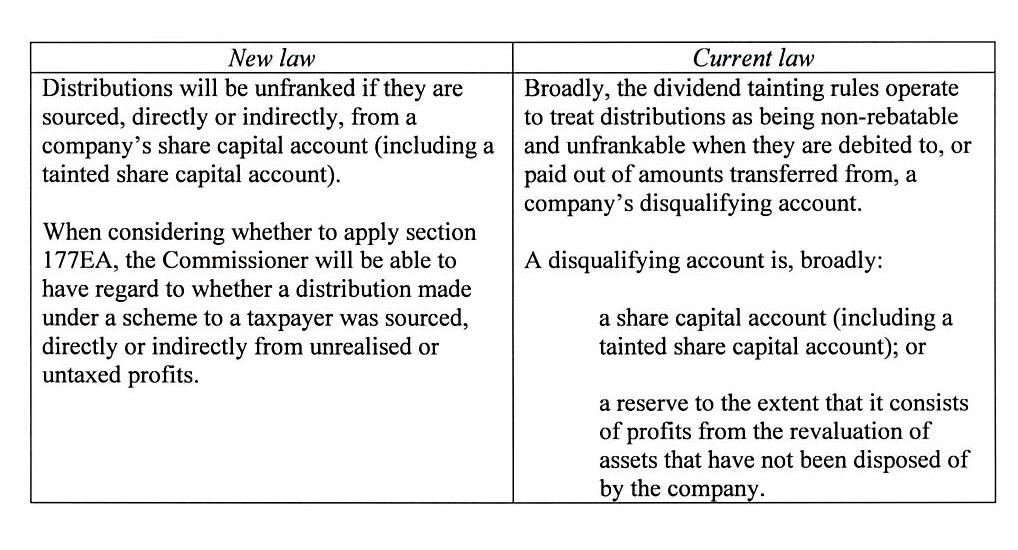
90 The respective submissions of the parties on the appeal were, having regard to the learned primary judge’s observations at [122] to [125] of the Reasons, not dissimilar to those made before his Honour. The appellant’s submissions were grouped under two main heads:
(1) First, that the distributions on the PERLS V securities were not sourced from untaxed profits within the meaning of para (ga); they are outgoings made in earning profits.
(2) Second, even if it were correct to say that the distributions on the PERLS V securities are ‘sourced from untaxed profits’ because the payments are made from New Zealand, that circumstance does not support, or indeed have any logical connection with, the statutory issue posed by s 177EA(3)(e), namely, whether the Bank had a relevant purpose. Where the money comes from, or how the payment is treated in New Zealand, has no bearing on the entitlement of the security holders to franking credits. What para (ga) makes relevant to the s 177EA(3)(e) conclusion is whether franking credits not otherwise available to security holders have been attached to a distribution of untaxed or unrealised profits as a means of releasing them to security holders – the mischief to which the tainted accounts provisions replaced by para (ga) had been directed.
91 While the Commissioner joined issue on the first head of argument, contending, in effect, that the phrase ‘untaxed profits’ was not confined to a distributable fund of profit in the company law sense or a profit account to which the distribution is debited, but was satisfied if the distribution was expensed out of income or earnings of the Bank which have not been taxed in Australia, in reliance on the decision of the Full Court in MacFarlane v Federal Commissioner of Taxation (1986) 13 FCR 356, the Commissioner had no answer to the appellant’s second head of argument. I do not find that surprising because I do not think there is an answer. If, contrary to my view, which is reasoned below, the distributions on the PERLS V securities are to be regarded as ‘sourced from untaxed profits’ because they are expensed out of income or earnings of the Bank which have not been taxed in Australia, then, there is no logical connection between that circumstance and a conclusion that the Bank had a relevant purpose, that is a purpose (not being an incidental purpose) of enabling the appellant to obtain an imputation benefit.
92 There would be no such lack of logical connection if the legislative purpose of para (ga) was to be determined by reference to the legislative context in which it came into the 1936 Act, namely, to deal with transactions designed to release franking credits, otherwise trapped and wasted, by devices such as asset revaluations giving rise to unrealised profits and gifts giving rise to untaxed profits, hitherto dealt with by the tainted share capital account provisions it replaced. Then there would be no impediment to a connection between the presence of the circumstance and a conclusion that the Bank had a relevant purpose, that is a purpose of enabling the appellant to obtain an imputation benefit.
93 At [126] of the Reasons, the learned primary judge said:
‘The conclusion to be drawn from this circumstance is that the Bank had a purpose of providing imputation benefits. The imputation system attempts to align companies and their members for tax purposes, but only those members who are the true economic owners of the company, being members who will ultimately take their share of its taxed income. The fact that the [PERLS V securities] subject the Bank to an expense of deriving profits, from which dividends are paid, to be met from an income source that bears no Australian income tax, indicates that the circumstances of the holders of the [PERLS V securities] are very far removed from those of the real economic owners of the Bank taking their share of its taxed income. I consider that this circumstance points towards the relevant purpose.’
94 Again, I have to confess that I do not understand the relevance of any of the matters to which his Honour refers, either to the circumstance itself or to the conclusion, required to be drawn by s 177EA(3)(e) that the Bank had a relevant purpose.
95 Finally, I am also strongly of the view that the circumstance that is para (ga) is not present in the scheme involving the Bank’s issue of the PERLS V securities and the distributions expected to be made on those securities. Distributions to be expensed by the Bank out of income or earnings of the Bank which have not been taxed in Australia are not ‘sourced, directly or indirectly, from unrealised or untaxed profits’. The reference to a distribution being sourced from unrealised or untaxed profits refers, in my view, to a debit or appropriation to a profit account having that character, such as an asset revaluation reserve, credited with amounts representing unrealised appreciations in the value of assets, or an account credited with an amount or amounts which have not borne tax, in both cases where the amount standing to the credit of the account exceeds the amount of the distribution to be debited or appropriated. Such a view is consistent with the legislative purpose of para (ga) as discerned from the legislative context of its insertion in the 1936 Act as outlined in [92] above; it is also consistent with the terms of the concurrent amendment to para (e) of s 202-45 when it speaks of a distribution that is sourced, directly or indirectly, from a company’s share capital account as being an unfrankable dividend. In the latter case, the 2007 EM provides at [6.10] that a ‘distribution will be sourced directly from a company’s share capital account if an accounting debit is made to the share capital account for the making of the distribution’, while it provides at [6.11] that such a distribution will be sourced indirectly from the share capital account if it originates there but it is first transferred into a distributable profit reserve before being debited to that latter account on distribution.
96 In this legislative context, I gain no assistance from what was said in the case of MacFarlane which was concerned with informal distributions under s 108 of the 1936 Act in a factual context of misappropriations by the shareholders of the company’s funds.
97 Nor do I agree with the submission that s 177EA(12) mandates that para (ga) must apply to all non-share distributions: rather s 177EA(12) makes applicable to non-share distributions, but only so far as the facts attract it, s 177EA as a whole.
98 That the amounts paid on the PERLS V securities are defined to be non-share dividends (s 974-120 of the 1997 Act) does not have the consequence that they are deemed to be – as ordinary dividends are – paid out of profits: the deeming implicit in the definition and in Div 974 goes no further than to declare the distributions to be ‘non-share dividends’. The distributions neither are, nor are deemed to be, ‘sourced from profits’. Non-share dividends are made assessable income without being deemed to be sourced in profits: s 44(1)(a)(ii) of the 1936 Act.
99 It follows, in my view, that the circumstance that is s 177EA(17)(ga) is not present in the scheme that involves the Bank issuing the PERLS V securities and making the expected distributions, and that it cannot contribute to or inform a conclusion that the Bank had a relevant purpose.
Section 177EA(17)(h)
100 The ninth matter is whether the distribution in question is equivalent to the receipt by the appellant of interest or of an amount in the nature of, or similar to, interest.
101 At [127] to [129] of the Reasons, the learned primary judge observed:
‘[127] The [appellant] accepts that, in legal form, the Distributions on the [PERLS V securities] are interest on the Notes component. However, he says, for the purposes of the 1997 Act, they are denied that character and instead, by reference to their economic substance, attributed the character of dividends. In consequence, the Bank is denied a deduction for the interest by s 26-26 and is required to frank the Distributions. Accordingly, he says, the Distribution in question is not in the nature of, or similar to, interest, but is instead a non-share dividend.
[128] The payment of the Distribution is a payment of legal form interest, notwithstanding that it is deemed to be a frankable distribution by reason of the operation of other provisions of the tax legislation. The fact that the payment has a particular character for some purposes does not obviate the need to characterise the payment for the purposes of s 177EA(17)(h). There is no reason why a payment that is deemed to be a distribution on non-share equity, by the operation of Division 974, could not also be treated as being equivalent to a payment of interest for the purposes of s 177EA(17)(h).
[129] The nature of the payment received by the [appellant] that is in question can be described as being similar to interest in numerous respects. The payments are regular and in a fixed amount. They are paid in respect of a specific outlay which, as a matter of commerce, the holders of the [PERLS V securities] expect to be returned to them either in cash or in kind. The rate of the Distribution is variable but is not dependent in any way upon the fortunes of the Bank. Rather, any variation is the result of a variation in the benchmark interest rate, not in the profitability of the Bank. The receipt of a Distribution in question by the [appellant] is equivalent to the receipt of interest or of an amount in the nature of or similar to interest.’
102 His Honour then concludes (at [129]):
‘I consider that this circumstance points towards the existence of the relevant purpose.’
Again, I do not understand how his Honour gets to this conclusion from the anterior finding that the appellant’s receipt of a distribution is equivalent to the receipt of interest or of an amount in the nature of or similar to interest. The Commissioner, on appeal, embraced his Honour’s conclusion, but did not provide any basis for, or connection between, his Honour’s finding that the circumstance was present in the scheme and the conclusion to which his Honour came.
103 Against this, the appellant on appeal submitted that the distributions on the Notes are in form, but not in substance, interest; while they are at a rate fixed by reference to BBSW, they rank behind all creditors, are payable only at the discretion of the Bank, are non-cumulative, and cannot be paid unless the Bank has sufficient profits to meet prudential requirements. More fundamentally, their character as equivalent to dividends is recognised, and they are required to be treated as dividends and not interest, by the Acts, and specifically by s 177EA(12). To treat them, as did the primary judge, as equivalent to interest is, according to the appellant, to invert the scheme of the Acts, and in doing so his Honour fell into error. According to the appellant, this paragraph is directed to schemes whereby franked distributions are sold or streamed at a fixed rate to a recipient who can use the credits in return for a collateral benefit to the company or to a security holder who cannot do so. An example is given at [8.96 – 8.101] of the explanatory memorandum to the Bill that became Act No 47 of 1998. In the Bank’s case, distributions were made fully franked to all security holders, and the circumstances to which this paragraph is directed were absent.
104 In my view, equal minds could come to different conclusions on whether or not this circumstance is present in the scheme involving the Bank’s issue of the PERLS V securities. But even if it is present, and on balance I do not think it is, its presence would not, in my view, lead to the conclusion to which his Honour came and does not contribute to or inform the drawing of a conclusion that the Bank had a relevant purpose.
Section 177EA(17)(i)
105 The tenth matter is the period for which the appellant held the PERLS V securities. His Honour found (at [130]) that there is no arrangement whereby the PERLS V securities should be held only briefly. He found that they were held until sale and were not redeemable. He concluded that this circumstance, presumably he meant the absence of this circumstance, pointed away from the relevant purpose. On the appeal the Commissioner did not contend otherwise.
Section 177EA(17)(j)
106 Finally, any of the matters referred to in s 177D(b)(i) to (viii) is a relevant circumstance. His Honour observed at [131] that many of those matters have no application beyond the extent to which those circumstances have already been taken into account, having regard to the other circumstances in s 177EA(17).
107 His Honour then observed at [132]:
‘Section 177D(b)(ii) refers to the form and substance of the scheme. The Distributions on the Notes take the form of frankable distributions but, in substance, represent a deductible expense to the Bank. The substance of what they achieve for the Bank, namely deductible and frankable capital, points towards the existence of the relevant purpose.’
Why, it may be asked? Why does the fact that the Bank obtains a deduction in New Zealand (not in Australia) for the interest on the Notes component of the PERLS V securities have anything to do with the drawing of a conclusion that the Bank had a relevant purpose? The simple answer is that it does not.
108 His Honour then observed at [133]:
‘Section 177D(b)(iv) refers to the result in relation to the operation of the tax legislation that, but for Part IVA, would be achieved by the scheme. But for the operation of s 177EA, the [PERLS V securities] would deliver imputation benefits on deductible interest payments. The [appellant] says that the result achieved in relation to the operation of the tax legislation is precisely the result mandated by the legislation. He says that the tax character attributed to the [PERLS V securities], and to Distributions upon them, is that directed by the deeming effect of Division 974. That is to say, the Bank is denied a deduction for the interest on the Notes and is obliged to attach franking credits to the payments as non-share dividends, or else it would face losing the imputation credits. The legislation, in accordance with the policy evinced in s 974-5, treats the [PERLS V securities] according to their economic substance, which is equivalent to preference shares. I consider that this matter points towards the relevant purpose.’
As to his Honour’s conclusion in the final sentence of this extract, again his Honour does not explain why it follows. In my view, it does not for the reasons outlined below.
109 As to matter (ii), form and substance, the learned primary judge’s reasoning rests on a false premise: that the PERLS V securities comprise deductible and frankable capital. Under the only relevant tax law, that of Australia, the distributions are not deductible; but even if New Zealand tax treatment were relevant, the only conclusion thence to be drawn is that there was some concurrent purpose of obtaining a deduction against New Zealand assessable income. The Bank’s need for Tier 1 capital, and its concomitant obligation to frank distributions on it, is wholly unaffected by the New Zealand tax treatment, an irrelevant matter which seems to pervade his Honour’s reasoning. As to matter (iv), the result of the issue under the Acts, it is clear that the issue had exactly the result that the Acts mandate: the distributions are treated not as interest but as frankable distributions. There is no such mischief as s 177EA is directed to in that result.
The Section 177EA(3) Conclusion as to Purpose
110 Section 177EA(3)(e) requires an objective conclusion as to purpose, having regard not simply to each individual circumstance specified in s 177EA(17) but to all those circumstances according to their relevance and weight in the instant factual context and to the purpose of the section (and the Acts) as a whole. The mere presence or absence of one or more listed circumstances is not of itself determinative of the conclusion.
111 It is not in contest that the dominant purpose of the Bank in issuing the PERLS V securities was to raise Tier 1 capital. To make an issue of Tier 1 capital the Bank had the option of fundamental Tier 1 capital, viz., ordinary capital (which was rejected because of the amount of such capital already issued and its cost) or non-innovative Tier 1 capital. The Bank chose the latter being less costly.
112 Whatever form of Tier 1 capital was issued, it would necessarily be treated as equity and not as debt; necessarily, both for APRA purposes and for tax purposes it was in substance, whatever its form, equity and all distributions would be either dividends or non-share dividends.
113 Any distribution on the PERLS V securities was effectively required to be franked at the same rate as other distributions by the Bank – which, as the Bank had fully franked other dividends, meant that the distributions on the PERLS V securities were effectively required to be fully franked.
114 The securities were accordingly offered on a basis including a term that the yield on them was a franked yield, and that if that term was not made good in respect of any distribution, the amount would be increased to compensate for the failure.
115 The securities could not be offered to persons in those jurisdictions in which the Prospectus was not registered save where they had a registered Australian address, as 98.5% did.
116 The securities were not redeemable at the instance of the holders, although like any other Tier 1 capital, the Bank could (subject to the assent of APRA) repurchase it; there were no provisions for short term ownership, and there were no schemes for trading in or streaming among classes of members any imputation benefits.
117 The relevant circumstances seem to me to strongly point to the objective conclusion that the issue of the PERLS V securities was simply an issue of Tier 1 capital on terms that it would be franked to the same extent as all other capital of the Bank, unattended by any such device or scheme as it is the purpose of the general anti-avoidance provisions of s 177EA to negate.
118 And, the provision of franking credits to the recipients of the distributions (including the appellant) was at most no more than an incidental purpose of the issue and the subsequent payment of distributions.
119 In my view, the appeal should be allowed and the orders appealed from set aside; in lieu thereof it should be ordered that the appeal from the Commissioner’s objection decision be allowed, the appellant’s objection allowed and the determination under s 177EA(5)(b) be set aside.
I certify that the preceding one hundred and eighteen (118) numbered paragraphs are a true copy of the Reasons for Judgment herein of the Honourable Justice Edmonds. |
Associate:
Dated: 8 December 2011
IN THE FEDERAL COURT OF AUSTRALIA | |
NEW SOUTH WALES DISTRICT REGISTRY | |
GENERAL DIVISION | NSD 379 of 2011 |
ON APPEAL FROM THE FEDERAL COURT OF AUSTRALIA |
BETWEEN: | ANDREW VINCENT MILLS Appellant
|
AND: | COMMISSIONER OF TAXATION Respondent
|
JUDGES: | DOWSETT, EDMONDS AND JESSUP JJ |
DATE: | 8 December 2011 |
PLACE: | SYDNEY |
REASONS FOR JUDGMENT
Jessup J:
120 This is an appeal from a judgment of a single Judge of the court given on 11 March 2011 dismissing an appeal under s 14ZZ of the Taxation Administration Act 1953 (Cth) (“the Administration Act”) from a decision made by the respondent, the Commissioner of Taxation (“the Commissioner”), made on 12 January 2010. In that decision, the Commissioner disallowed the appellant’s objection to a determination made on 15 December 2009 under s 177EA(5)(b) of the Income Tax Assessment Act 1936 (Cth) (“the 1936 Act”). That determination was that no “imputation benefit” was to arise in respect of a “franked distribution” expected to be received by the appellant from the Commonwealth Bank of Australia (“the Bank”) on or about 1 February 2010. That distribution was to have been made with reference to certain securities issued by the Bank, to the details of which I shall refer below. In his reasons of 11 March 2011, the primary Judge accepted that, by reference to the “relevant circumstances” set out in subs (17) of s 177EA, it would be concluded that the Bank entered into or carried out the scheme which involved the design, offering and issue of the securities for a non-incidental purpose of enabling the appellant to obtain an imputation benefit.
121 Section 177EA is to be found amongst the anti-avoidance provisions of Pt IVA of the 1936 Act. It applies, in circumstances set out in subs (3) thereof, as follows:
(3) This section applies if:
(a) there is a scheme for a disposition of membership interests, or an interest in membership interests, in a corporate tax entity; and
(b) either:
(i) a frankable distribution has been paid, or is payable or expected to be payable, to a person in respect of the membership interests; or
(ii) a frankable distribution has flowed indirectly, or flows indirectly or is expected to flow indirectly, to a person in respect of the interest in membership interests, as the case may be; and
(c) the distribution was, or is expected to be, a franked distribution or a distribution franked with an exempting credit; and
(d) except for this section, the person (the relevant taxpayer) would receive, or could reasonably be expected to receive, imputation benefits as a result of the distribution; and
(e) having regard to the relevant circumstances of the scheme, it would be concluded that the person, or one of the persons, who entered into or carried out the scheme or any part of the scheme did so for a purpose (whether or not the dominant purpose but not including an incidental purpose) of enabling the relevant taxpayer to obtain an imputation benefit.
On the facts of the present case, the “corporate entity” referred to in para (a) was the Bank, the person referred to in para (b)(i), and the “relevant taxpayer” referred to in para (d), was the appellant and the “membership interests” referred to in para (a) were the securities to which I have referred.
122 It was uncontroversial before the primary Judge, and on appeal, that the design of, and the arrangements for the issue of, the securities amounted to a scheme for the disposition of them within the terms of s 177EA(1)(a). It was also uncontroversial that a frankable distribution was, at the time the scheme was entered into or carried out, expected to be payable to the appellant in respect of the securities. That distribution was expected to be a franked distribution within the meaning of para (c) of the subsection. Further, the appellant would, as a matter of reasonable expectation, have received “imputation benefits” as a result of the distribution, so para (d) was also satisfied. The only controversial question in the case was, and remains, whether the requirements of para (e) were satisfied. Because he took the view that they were, the Commissioner acted, in relation to the appellant, under para (b) of subs (5), which provides:
The Commissioner may make, in writing, either of the following determinations:
…
(b) a determination that no imputation benefit is to arise in respect of a distribution or a specified part of a distribution that is made, or that flows indirectly, to the relevant taxpayer.
It was the appellant’s appeal against the disallowance of his objection to that determination that the primary Judge dismissed in the proceeding below.
123 The statutory backdrop to the operation of s 177EA is Pt 3-6 of the Income Tax Assessment Act 1997 (Cth) (“the 1997 Act”). Broadly, it provides for an Australian resident taxpayer who holds an equity interest in an Australian corporation (eg a share) to receive a credit, against his or her own tax liability, which corresponds with the tax which the corporation has already paid on the profits from which a distribution to the taxpayer was derived. This broad operation of the Part is reflected in the terms of ss 200-5 and 200-10 of the 1997 Act:
200-5 The imputation system
The imputation system partially integrates the income tax liabilities of an Australian corporate tax entity and its members by:
(a) allowing the entity, when distributing profits to its members, to pass to those members credit for income tax paid by the entity on those profits; and
(b) allowing the entity’s Australian members to claim a tax offset for that credit; and
(c) allowing the entity’s Australian members to claim a refund if they are unable to fully utilise the tax offset in reducing their income tax.
200-10 Franking a distribution
When an Australian corporate tax entity distributes profits to its members, the entity has the option of passing to those members credit for income tax paid by the entity on the profits. This is done by franking the distribution.
Central to the operation of the system thus summarised is that the credit passed down to the member of the corporation should correspond with the tax which the corporation has paid on the relevant profits, and also, of course, that the distribution in question be derived from the profits which the corporation itself has made.
124 The formal means by which the imputation system works is through the device of “franking”. The corporation making a particular distribution may “frank” the distribution if it is a “frankable distribution”. By s 202-40 of the 1997 Act, a distribution is frankable to the extent that it is not “unfrankable” under s 202-45. That section, in turn, provides that “a distribution in respect of a non-equity share” is unfrankable. A “non-equity share”, in the case of a company, is a share that is not an “equity interest” in the company. What constitutes an equity interest is to be worked out under Subdiv 974-C of the 1997 Act, and s 974-70, within that Subdivision, excludes from characterisation as an equity interest an interest that is a “debt interest” under Subdiv 974-B. In the present case, it is not necessary to explore the minutiae of that Subdivision, since it was common ground that the securities issued by the Bank were equity interests and that the distribution was frankable. As will appear, however, the distinction between a distribution in respect of an equity interest and a distribution in respect of a debt interest lay at the centre of the Commissioner’s case below, and on appeal.
125 For the recipient of a franked distribution, the consequences thereof are the subject of s 207-20 of the 1997 Act:
(1) If an entity makes a franked distribution to another entity, the assessable income of the receiving entity, for the income year in which the distribution is made, includes the amount of the franking credit on the distribution. This is in addition to any other amount included in the receiving entity’s assessable income in relation to the distribution under any other provision of this Act.
(2) The receiving entity is entitled to a tax offset for the income year in which the distribution is made. The tax offset is equal to the franking credit on the distribution.
A tax offset reduces the amount of tax that the recipient would otherwise have to pay: s 4-10(3).
126 If a member of a corporation is entitled to a tax offset under Div 207 of the 1997 Act (in which s 207-20 is to be found), he or she is deemed thereby to have received an “imputation benefit” as a result of the distribution in question: s 204-30(6)(a). It is such an imputation which has the potential to be eliminated by a determination of the Commissioner under s 177EA(5)(b) of the 1936 Act. That is what happened in the present case, to the facts of which it is now necessary to turn. In my summary of them below, I rely heavily on the findings of the primary Judge which were not, save as to his Honour’s inferences of purpose, challenged.
127 Under ss 7 and 8 of the Banking Act 1959 (Cth) (“Banking Act”), only a body corporate which is an authorised deposit-taking institution (“ADI”) may carry on a banking business in Australia. The Bank was an ADI, having been granted an authority to carry on banking business in Australia by the Australian Prudential Regulation Authority (“APRA”) under s 9(3) of the Banking Act. Under s 11AF of the Banking Act, APRA is empowered to “determine standards in relation to prudential matters to be complied with by … all ADIs”. Such standards had been determined, and the Bank, as an ADI, was obliged to comply with them. Two such standards which were relevant in the present case were APS 110, concerning capital adequacy, and APS 111, concerning measurement of capital.
128 The primary Judge observed that, under APS 110, the board of directors of an ADI had a duty to ensure that it maintained an appropriate level and quality of capital commensurate with the level and extent of risk to which it was exposed from its activities.
129 APS 111 set out categories of capital, namely, Fundamental Tier 1 capital, Residual Tier 1 capital (both non-innovative and innovative), Upper Tier 2 capital and Lower Tier 2 capital. Tier 1 capital consisted of the highest quality components of capital, which were required to provide a permanent and unrestricted commitment of funds, to be freely available to absorb losses, not to involve the imposition of any unavoidable servicing charge against earnings and to rank behind the claims of depositors and other creditors in the event of a winding up.
130 To ensure capital adequacy, an ADI had to hold a minimum amount of Tier 1 capital. An ADI was subject to a prudential capital ratio as determined by APRA, being a proportion of its total risk-weighted assets, half of which had to be held in the form of Tier 1 capital. APRA might require an ADI to hold more than 50 percent of its required prudential capital ratio in the form of Tier 1 capital. An ADI was obliged at all times to maintain a risk based capital ratio in excess of its prudential capital ratio.
131 Tier 1 capital was divided into Fundamental Tier 1 capital and Residual Tier 1 capital. Fundamental Tier 1 capital consisted of paid up ordinary shares, general reserves, retained earnings, current year earnings, foreign currency translation reserves, capital profits reserves, and minority interests arising from the consolidation of the Tier 1 capital of subsidiaries. The capital adequacy requirements of APRA applying to ADIs such as the Bank included a minimum ratio of total capital to risk-weighted assets, the prudential capital ratio (8% by default, subject to increase by APRA), a requirement that at least half of the capital required to meet the prudential capital ratio be Tier 1 capital, a limit on Residual Tier 1 capital to 25% of the amount of Tier 1 capital, with any excess being treated as Upper Tier 2 capital, and a limit on innovative Residual Tier 1 capital to 15% of the amount of Tier 1 capital, with any excess being treated as Upper Tier 2 capital.
132 Residual Tier 1 capital – the components of capital qualified for Tier 1 status other than Fundamental Tier 1 capital – was divided into non-innovative capital and innovative capital. Non-innovative residual Tier 1 capital comprised perpetual non-cumulative preference shares that –
were unsecured and paid up,
were perpetual (ie did not have a maturity date, were not redeemable at the option of the holder and had no provision that required future redemption by the issuer),
did not impose any fixed servicing costs on the issuer (such that dividend or interest payments to the holders of the investment were at the discretion of the issuer and any unpaid dividends or interest were non-cumulative),
were able to absorb losses incurred by the issuer on a going concern basis and in the winding up of the issuer (such that the shares were treated as a specific class of share capital or members’ interest of the issuer and the issuer did not have any liability to make a dividend or interest payment on the shares if making the payment would result in the issuer becoming insolvent), and
were subordinated in right of repayment of principal interest and dividends to all depositors and other creditors of the issuer.
Perpetual non-cumulative preference shares issued through stapled structures were permitted, subject to the condition that the preference shares were issued directly by the ADI concerned and were stapled to securities issued directly by an overseas branch of the ADI. The stapled structure was not to involve any use of special purpose vehicles, and had to be simple and transparent.
133 On 9 September 2008, the Chief Financial Officer and Group Treasurer of the Bank presented a paper to the Board in which they recommended that the Bank offer to new investors an alternative non-innovative Tier 1 security, in the form of the securities that are presently controversial. The recommendation was based upon the following factors. The Bank had a substantial capital requirement over the ensuing 12 months, due to business growth, potential acquisitions and foreign exchange movements. If an earlier issue of similar securities were to be redeemed for cash of $750m in March 2009, the Bank’s total capital ratio would be reduced, and that would necessitate additional Tier 2 capital to be raised at higher prices. The proposed transaction would provide a diversified, cheaper source of funding. There was a window of opportunity for an issue of Tier 1 capital between two other major banks entering the market, namely ANZ and NAB. At that time, the Bank group had hybrid Tier 1 capital, which was ineligible to be included in the Tier 1 ratio, but still contributed to total capital. The proposed securities would compare favourably with the cost of Tier 2 capital. The Bank currently had $1,350m of hybrid Tier 1 securities on issue, which were ineligible to be included in its Tier 1 capital ratio but continued to be included in the group’s total capital ratio. Beyond 2010, when the current transition rules were to cease to apply, the older style innovative hybrid securities would be limited to 15% of the Tier 1 capital. The terms for the securities proposed would be similar to earlier issues of similar securities, namely, a convertible non-innovative hybrid Tier 1 security with a conversion term of approximately 5 years. The recommendation said that those terms mirrored those for all recent hybrid securities issued by the Bank.
134 The Board decided not to issue the securities on 9 September 2008, largely because the Bank was considering a potential acquisition which did not then have to be disclosed to the stock exchange, but which the Bank would have been required to disclose in any securities prospectus that was issued at that time.
135 The matter was placed before the Board of the Bank again on 10 February 2009. The Chief Financial Officer and Group Treasurer presented a further paper, in which they recommended that the securities be offered to new investors. They did so for the following reasons. The current economic environment continued to place pressure on the Bank’s Tier 1 ratio targets. With recent large equity raisings, the securities would provide a diversified, cost-effective way to increase Tier 1 capital. The securities compared favourably with Tier 2 capital. With recent large equity raisings, there was hybrid Tier 1 capacity for up to $900m to be included in Tier 1 as at June 2009. Additional capacity would also arise from 2010, when capital transition rules ceased to apply, and the older style innovative hybrid style securities would be limited to 15% of Tier 1 capital. The proposed securities would provide greater capital flexibility for market opportunities. In the paper it was proposed that the terms for the securities would be similar to those of an earlier issue of similar securities, namely, a convertible non-innovative hybrid Tier 1 security with a conversion term of approximately 5 years. It was stated that those terms mirrored those for all recent hybrid securities issued by the Bank. The paper stated that, assuming an issue price of 3.5 to 4.0% over the bank bill swap rate, the economics of the proposed securities compared well with those of other funding instruments, such as offshore Tier 1, Tier 2 and senior debt. In addition, the securities would provide diversification of funding, which was said to be a key benefit at that point in time.
136 At its meeting on 10 February 2009, the Board of the Bank approved the issue of the securities, which would involve a non-innovative residual Tier 1 capital issue offering of $500m, with the potential to increase the issue up to $1,500m, to be launched when there was sufficient market capacity.
137 On 14 July 2009, a further paper prepared by the Chief Financial Officer and the Group Treasurer concerning the proposed capital issue was presented to the Board. The paper reported that, since April 2009, there had been a significant improvement in markets, with secondary trading levels for hybrid securities increasing significantly, and that there had been several hybrid Tier 1 issues completed successfully in offshore markets in recent weeks. The paper indicated that current forecasts suggested that approximately $700m of additional capital would be required by June 2010, and that the Bank group had non-innovative Tier 1 hybrid capacity of $1,100m as at June 2009. Another section of the paper described the economics of the proposed transaction. The economic cost of the securities was stated to be 5.58%, compared with a cost of 14.20% for ordinary shares
138 At this time, it appeared that the Bank was well aware of the potential for the taxation treatment of distributions under the proposed securities to be problematic. A section of the paper of 14 July 2009 described discussions with the Commissioner in relation to the franking of such distributions. Apparently the Commissioner’s preliminary view was adverse on one issue, as a result of which he might deny franking credits to holders of the securities. It was said that, if this happened, the Bank would have to pay cash to the holders to gross up their payments in reflection of the loss of value. It was said that, under the view indicated by the Commissioner, the Bank would be required to frank the distributions on the securities because they would be regarded as equity for tax purposes, but that the benefit of those franking credits would be denied to holders.
139 Further papers prepared by the Chief Financial Officer and the Group Treasurer were presented to the Board on 12 August 2009. It was said that market conditions continued to be strong, and that the securities previously discussed remained the preferred approach. It was said that no competing transactions were expected, and that a transaction of $1,000m should be achievable with pricing of approximately 3.6% over the bank bill swap rate.
140 On the tax side, one of the papers stated that there had been several discussions with the Commissioner, pursuant to which an understanding had been reached for the treatment of the securities. The Commissioner’s view was that the franking credits attached to payments on the securities should be denied to holders, but he would agree to a settlement process on the basis that the question would be tested in court and, if the Bank lost the proceeding, a cash payment would be made to the Commissioner to settle the tax obligation on behalf of holders. In that way, the dispute would not have a material impact on holders, and would not require a significant level of disclosure. It was said that, if the Bank were to be successful in the proceeding, the economic cost of the securities would be 5.86% pa, but if the Bank were to be unsuccessful, the expected economic cost would be 7.87% pa.
141 At its meeting on 12 August 2009, the Board approved an offer of the securities in the sum of approximately $600m, with the ability to issue more or less up to $1,200m, subject to all necessary internal and regulatory approvals being obtained.
142 On 14 August 2009, a further paper was provided to the Board by the Chief Financial Officer and the Group Treasurer, this time seeking approval of the prospectus for the proposed securities. It was reported that discussions with the Commissioner were close to finalisation, with the outcome expected to be as previously described. It was expected that the Commissioner would issue an unfavourable determination to an investor nominated by the Bank, which would subsequently be challenged in court. The Commissioner would enter into an agreement with the Bank such that, if the Commissioner’s view was upheld, the Bank would make a payment to the Commissioner on behalf of holders, and there would be no additional impact on the holders. On 28 August 2009, a prospectus was lodged with the Australian Securities and Investments Commission (“ASIC”).
143 On 7 September 2009, the approval of the Board was sought for an increase in the issue size of the securities. The Chief Financial Officer and Group Treasurer reported that capital forecasts showed that there was Tier 1 hybrid capacity over the following 12 months for an offer size of up to $1,900m. The Group Treasurer informed the Board of strong feedback from brokers, indicating a likely final demand close to $3,000m. The Board agreed to increase the maximum size of the issue of the securities to $2,250m. The Board also resolved that the general offer to Australian residents, other than existing shareholders or holders of prior issues of similar securities, be cancelled. Accordingly, on 7 September 2009 a draft replacement prospectus for the securities was lodged with ASIC.
144 The securities were issued on 14 October 2009. A media release dated 15 October 2009 reported that the first distribution in respect of the securities would be $3.0657 per security on 1 February 2010, being a distribution rate of 5.0862%. The announcement stated that the distribution would cover a period of 110 days, and was expected to be fully franked. Attention was also drawn to the fact that the Bank had a discretion not to pay the distribution in full.
145 The prospectus pursuant to which the securities were issued was dated 7 September 2009. In it, the securities were described as Perpetual Exchangeable Resaleable Listed Securities, abbreviated to “PERLS V” (there had been previous similar securities). Each security consisted of an unsecured subordinated note issued by the New Zealand branch of the Bank and a preference share issued by the Bank. The note and the share could not normally be traded separately, and were described as “stapled”. It was stated in the prospectus that the proceeds of the issue of the securities would constitute non-innovative residual Tier 1 capital of the Bank. As it happened, the proceeds were deployed in the New Zealand branch of the Bank, and it seems reasonable to infer that that was the Bank’s intention at the time of the publication of the prospectus.
146 The “key features” of the securities as set out in the prospectus included the following:
• PERLS V entitle Holders to quarterly Distributions, expected to be fully franked, that are subject to the Payment Tests.
• Distributions are expected to compromise Interest on the Notes.
• The Distribution Rate will be calculated each quarter as the Bank Bill Swap Rate plus the Margin of 3.40%, together multiplied by (1 – Tax Rate).
• Assuming the Bank Bill Swap Rate is 3.2800%, the cash Distribution received by a Holder would be 4.6760% per annum (assuming Distributions are fully franked). The fully franked Distribution Rate of 4.6760% per annum would be equivalent to an unfranked Distribution Rate of 6.6800% per annum if the potential value of the franking credits is taken into account in full.
• However, Holders should be aware that the ability of a Holder to use franking credits will depend on their individual position and that the potential value of franking credits does not accrue at the same time as the cash Distribution is received.
• Distributions are non-cumulative. If a Distribution or part of a Distribution is not paid on a Distribution Payment Date, Holders have no claim or entitlement in respect of non-payment nor any right to receive that Distribution at any later time.
• Distributions are discretionary. If Distributions are not paid on PERLS V, a Dividend Stopper will restrict the Bank from paying dividends, interest or distributions or returning capital on Bank Ordinary Shares and certain other securities.
147 For the payment of distributions, the securities would rank ahead of ordinary shares, but behind the Bank’s liabilities to depositors and other creditors. Because an insolvency-related event would, under the prospectus, give rise to a right for the Bank to de-staple the securities, the securities would then become preference shares and would rank as such in a winding-up.
148 The offer to subscribe for the securities was not extended to investors located or resident outside Australia, other than certain institutional investors at the discretion of the Bank. The offer was extended to holders of ordinary shares in the Bank, or of certain earlier issues of PERLS, who were registered with an Australian address, to Australian residents who were clients of the broker to the offer and to institutional investors in Australia and in certain overseas jurisdictions. These limitations, which the primary Judge regarded as of “some significance in relation to the relevant circumstances under s 177EA(17)”, were dealt with in the prospectus as follows:
The Offer is available to persons receiving this Prospectus in Australia. Due to regulatory requirements, the invitation to apply for PERLS V is not extended to investors (including holders of Bank Ordinary Shares, PERLS III or PERLS IV or former holders of PERLS II) located or resident outside Australia, other than certain Institutional Investors outside Australia at the sole discretion of the Bank and the Joint Lead Managers, and in compliance with applicable laws in the relevant jurisdictions.
The prospectus provided that the securities were to be issued to Macquarie Group Holdings New Zealand Limited, as the initial holder, which was then to transfer the securities to successful applicants under the offer. The arrangements with the initial holder were governed by an agreement summarised in the prospectus.
149 According to the prospectus, distributions under the securities would be non-cumulative and, if a distribution were not paid on a distribution payment date, the holder of the securities would have no claim or entitlement in respect of non-payment, nor any right to receive that distribution at any later time. Distributions were discretionary, but, if a distribution on Relevant Securities were not paid, the Bank would be restricted from paying dividends, interest or distributions, or returning capital, on ordinary shares and certain other securities of the Bank.
150 The prospectus stated that the securities were expected to be exchanged on 31 October 2014 by resale, under which the Bank would arrange for a purchaser to acquire all the securities for their face value of $200 each; or, if there were no such resale, by conversion, under which the securities would be converted into a variable number of ordinary shares in the Bank worth approximately $202.02 each if certain conditions are satisfied; or, if there were no such resale or conversion, by repurchase, under which the Bank would, subject to the prior written approval of APRA, repurchase all the securities at their face value of $200 each. If the securities were not exchanged on 31 October 2014, the same possible outcomes would apply at each subsequent distribution payment date.
151 Holders of the securities did not have the right to request exchange. However, the Bank could, with the written approval of APRA, exchange the securities in the event of a “tax event” – when the Bank received an opinion that there was a material risk that the Bank would be exposed to an increase in costs, including taxes, in relation to the securities, that any distribution would not be frankable, or that franking credits may not be available to holders – a “regulatory event” – when the Bank received advice that, as a result of a change or a proposed change of law or regulation, additional requirements would be imposed on the Bank in relation to the preference shares or the securities that the Bank determined to be unacceptable – or a “NOHC Event” – where there was a restructuring of the Bank to create a non-operating holding company.
152 The prospectus gave significance to what it described as an “acquisition event” and as an “assignment event”. An acquisition event would occur if a takeover bid were made to acquire ordinary shares in the Bank and the offeror’s voting power would be greater than 50%, or if a court approved a scheme or arrangement that would result in a person having voting power in the Bank of more than 50%. In any such case, the securities were, subject to APRA’s approval, to be exchanged. An assignment event, in relation to a note stapled to a preference share, was the occurrence of one of a number of events, including: the Bank ceasing or suspending its business, a winding up proceeding being commenced in respect of the Bank, and regulatory steps being taken by APRA in respect of the Bank. Additionally, the Bank might elect that an assignment event occur. If such an event did occur, the Bank might elect for some or all of the notes to be de-stapled from the corresponding preference shares and assigned to the Bank and, in such a case, holders would hold only a preference share for each of the securities which was affected by the election. It was stated in the prospectus as follows:
Distributions will comprise either Interest or Dividends. Until an Assignment Event Date, they will comprise Interest on Notes. After an Assignment Event Date (see Section 1.8.1 “What is an Assignment Event?”), they will comprise Dividends on Preference Shares.
Regardless of whether a Distribution is paid as Interest on Notes or a Dividend on Preference Shares, the amount of the Distribution will be calculated on the same basis. Holders will not be entitled to both Interest on Notes and Dividends on Preference Shares at the same time.
153 Subject to certain payment tests set out in the prospectus, the securities entitled holders thereof to quarterly distributions that were expected to be fully franked. The distribution rate was to be a floating rate, set on the first business day of each quarterly distribution period. A margin of 3.400% would be added to the Bank Bill Swap Rate on that day, and the result would be multiplied by (1 – the Australian corporate tax rate applicable at the relevant distribution payment date). The prospectus gave an example, based on a Bank Bill Swap Rate of 3.280% and the current corporate tax rate of 30%. On that basis, the distribution rate would be calculated as follows:
• Bank Bill Swap Rate: | • 3.280% |
• Plus margin: | • 3.400% |
• Equals: | • 6.680% |
• Multiplied by (1 – 0.300): | • 0.700 |
• Distribution Rate: | • 4.676% |
154 The impact of franking credits, which were said to be the holder’s share of tax paid by the Bank, was explained in the prospectus. If the potential value of the franking credits were to be taken into account, a fully franked distribution rate of 4.676% would be the equivalent of an unfranked distribution rate of approximately 6.680%. That corresponded, of course, to the Bank Bill Swap Rate and the margin, unadjusted by reference to the corporate tax rate. If for any reason a distribution were not fully franked, it would generally be adjusted to compensate holders for the unfranked portion thereof, pursuant to the following provision in the prospectus:
If any interest payment before the application of this clause 4.2:
(1) due to be made on a Note does not have a “franking percentage” of 100% CBA must notify the Holders as soon as practicable and (regardless of whether that notice is actually given) CBA must increase the interest concerned; or
(2) made on a Note is subsequently found not to have, or is treated by the Commissioner as not having, a “franking percentage” of 100% other than as a result of any actions by the Holders, CBA must notify the Holder as soon as practicable and (regardless of whether that notice is actually given) must pay within 30 Business Days of CBA becoming aware of such finding or treatment an amount which represents the difference between the Interest payment made and the increased interest concerned.
so that the additional interest to be paid (the Gross-Up Amount) is the amount calculated in accordance with the following formula as adjusted by clause 4.2(a)(3):
I x T x (1 – f1)
1 – T
where
I = the Interest for the Interest Period calculated, prior to any increase, in accordance with clause 4.1;
T = the Australian corporate tax rate applicable at the relevant Interest Payment Date, expressed as a decimal; and
f1 = the “franking percentage” of the Interest payable (excluding any payment under this clause 4.2) expressed as a decimal to four decimal places,
provided that:
(3) any payment under this clause 4.2 will be adjusted in accordance with the following formula:
Gross-Up Amount x (1 – T)
[1 – T + (T x f2)]
where f2 = the “franking percentage” of the Gross-Up Amount expressed as a decimal to four decimal places.
In this clause 4.2, “franking percentage” has the meaning given by section 203-35 of the Tax Act or any section that replaces or revises that section.
155 The prospect of an adjustment of the kind referred to in the previous paragraph having to be made was in fact the subject of an agreement between the Bank and the Commissioner, the essence of which, and the consequences of the court making a ruling on a challenge to any s 177EA determination which was adverse to a security-holder, were the subject of the following passage in the prospectus:
The Bank expects that Distributions will be fully franked. If Distributions are fully franked, Holders will receive a combination of cash Distributions and franking credits.
However, Distributions payable on PERLS V may be unfranked or not fully franked. If a Distribution is unfranked or not fully franked, the cash Distribution will generally be increased by a cash amount to compensate Holders for the unfranked portion of the Distribution.
The Bank understands that the ATO may form the view that the benefits of the franking credits should be denied to Holders even if the Bank has franked the relevant Distribution. If the ATO forms the view that franking credits should be denied to Holders, the Bank intends to have that view tested in court.
The Bank and the ATO have agreed to certain arrangements that will ensure that Holders will not be impacted by this process. In the event that the ATO view is sustained the Bank has agreed to make a payment to the ATO to compensate it and in practice the benefits of the franking credits will be allowed to Holders.
In the event that the ATO view is sustained, the Bank will elect that an Assignment Event occurs in respect of all Notes, such that Holders will hold the Preference Shares (see Section 1.8.2 “What happens of an Assignment Event occurs?”). The benefits of the franking credits attached to Dividends paid on Preference Shares should not be denied to Holders.
156 On 23 December 2009, the New Zealand branch of the Bank lodged an application for a private binding ruling with the New Zealand Inland Revenue Department. The application sought confirmation that distributions on the notes forming part of the securities would be deductible against the income of the New Zealand branch of the Bank. It is common ground that those distributions were so deductible.
157 This last-mentioned feature of the securities was significant in the case advanced on behalf of the Commissioner. That case was founded upon the perception of a dichotomy as between an equity interest and a debt interest in a company. An equity interest would give rise to a distribution of post-tax profits. As such, the amount of the distribution would not be a tax deduction for the company, but the tax paid by the company on it would be reflected in the franking credit passed down to the interest holder. By contrast, a debt interest would give rise to a distribution on the nature of interest on the debt. The amount of the distribution would be a pre-tax operating expense of the company, and would entitle the company to a tax deduction. But the distribution would not be franked. How the distribution stood in the accounts of the interest holder would be of no concern to the company but, generally speaking, it would count as income under the 1997 Act. What is presently important is that no tax would have been paid by the company on the distribution.
158 Absent his determination under s 177EA of the 1936 Act, the Commissioner submits that the Bank would be getting the best of both worlds in the present case. It is said that the architecture of the securities was such that, because the income out of which interest on the notes was payable had been derived in New Zealand, it was, pursuant to s 23AH of the 1936 Act, excluded from the Bank’s assessable income in Australia. That income would presumably have attracted tax in New Zealand in the normal course, but a deduction was allowed for the interest payments. The amount of the Bank’s income which represented that interest, therefore, was not subject to tax in either country. At the same time, however, the interest-holder – in most cases, by design, an Australian resident – would obtain an imputation credit by reference to the circumstance that, under the 1997 Act, the security was an equity interest rather than a debt interest. The Bank thus achieved, by one and the same outlay, the franking benefit of the equity interest status of the security and the deductibility benefit of the interest payment on the note. On any objective view of the matter, according to the Commissioner, it is likely to have been a purpose of the bank, in designing the securities, to enable the appellant to obtain an imputation benefit.
159 The primary Judge agreed, and I shall turn next to his Honour’s reasoning in that regard. Before doing so, I set out hereunder the provisions of s 177EA which are relevant to the question of purpose as it arises under para (e) of subs (3):
(4) It is not to be concluded for the purposes of paragraph (3)(e) that a person entered into or carried out a scheme for a purpose mentioned in that paragraph merely because the person acquired membership interests, or an interest in membership interests, in the entity.
….
(17) The relevant circumstances of a scheme include the following:
(a) the extent and duration of the risks of loss, and the opportunities for profit or gain, from holding membership interests, or having interests in membership interests, in the corporate tax entity that are respectively borne by or accrue to the parties to the scheme, and whether there has been any change in those risks and opportunities for the relevant taxpayer or any other party to the scheme (for example, a change resulting from the making of any contract, the granting of any option or the entering into of any arrangement with respect to any membership interests, or interests in membership interests, in the corporate tax entity);
(b) whether the relevant taxpayer would, in the year of income in which the distribution is made, or if the distribution flows indirectly to the relevant taxpayer, in the year in which the distribution flows indirectly to the relevant taxpayer, derive a greater benefit from franking credits than other entities who hold membership interests, or have interests in membership interests, in the corporate tax entity;
(c) whether, apart from the scheme, the corporate tax entity would have retained the franking credits or exempting credits or would have used the franking credits or exempting credits to pay a franked distribution to another entity referred to in paragraph (b);
(d) whether, apart from the scheme, a franked distribution would have flowed indirectly to another entity referred to in paragraph (b);
(e) if the scheme involves the issue of a non-share equity interest to which section 215-10 of the Income Tax Assessment Act 1997 applies—whether the corporate tax entity has issued, or is likely to issue, equity interests in the corporate tax entity:
(i) that are similar, from a commercial point of view, to the non-share equity interest; and
(ii) distributions in respect of which are frankable;
(f) whether any consideration paid or given by or on behalf of, or received by or on behalf of, the relevant taxpayer in connection with the scheme (for example, the amount of any interest on a loan) was calculated by reference to the imputation benefits to be received by the relevant taxpayer;
(g) whether a deduction is allowable or a capital loss is incurred in connection with a distribution that is made or that flows indirectly under the scheme;
(ga) whether a distribution that is made or that flows indirectly under the scheme to the relevant taxpayer is sourced, directly or indirectly, from unrealised or untaxed profits;
(h) whether a distribution that is made or that flows indirectly under the scheme to the relevant taxpayer is equivalent to the receipt by the relevant taxpayer of interest or of an amount in the nature of, or similar to, interest;
(i) the period for which the relevant taxpayer held membership interests, or had an interest in membership interests, in the corporate tax entity;
(j) any of the matters referred to in subparagraphs 177D(b)(i) to (viii).
(18) The following subsection lists some of the cases in which a taxpayer to whom a distribution flows indirectly receives a greater benefit from franking credits than an entity referred to in paragraph (17)(b). It is not an exhaustive list.
(19) A taxpayer to whom a distribution flows indirectly receives a greater benefit from franking credits than an entity referred to in paragraph (17)(b) if any of the following circumstances exist in relation to that entity in the year of income in which the distribution giving rise to the benefit is made, and not in relation to the taxpayer if:
(a) the entity is not an Australian resident; or
(b) the entity would not be entitled to any tax offset under Division 207 of the Income Tax Assessment Act 1997 because of the distribution; or
(c) the amount of income tax that would be payable by the entity because of the distribution is less than the tax offset to which the entity would be entitled; or
(d) the entity is a corporate tax entity at the time the distribution is made, but no franking credit arises for the entity as a result of the distribution; or
(e) the entity is a corporate tax entity at the time the distribution is made, but cannot use franking credits received on the distribution to frank distributions to its own members because:
(i) it is not a franking entity; or
(ii) it is unable to make frankable distributions.
Note: Where the distribution is made directly to the taxpayer, see subsections 204-30(7), (8), (9) and (10) of the Income Tax Assessment Act 1997 for a list of circumstances in which the taxpayer will be treated as deriving a greater benefit from franking credits than another entity.
160 As will be seen, para (j) of s 177EA(17) picks up subparas (i)-(viii) of s 177D(b). They read as follows:
(i) [T]he manner in which the scheme was entered into or carried out;
(ii) the form and substance of the scheme;
(iii) the time at which the scheme was entered into and the length of the period during which the scheme was carried out;
(iv) the result in relation to the operation of this Act that, but for this Part, would be achieved by the scheme;
(v) any change in the financial position of the relevant taxpayer that has resulted, will result, or may reasonably be expected to result, from the scheme;
(vi) any change in the financial position of any person who has, or has had, any connection (whether of a business, family or other nature) with the relevant taxpayer, being a change that has resulted, will result or may reasonably be expected to result, from the scheme;
(vii) any other consequence for the relevant taxpayer, or for any person referred to in subparagraph (vi), of the scheme having been entered into or carried out; and
(viii) the nature of any connection (whether of a business, family or other nature) between the relevant taxpayer and any person referred to in subparagraph (vi)….
161 With respect to para (a) of s 177EA(17), the primary Judge referred at some length to the evidence of Prof John Handley, an Associate Professor of Finance at the University of Melbourne called by the appellant. According to his Honour, Prof Handley concluded that the securities had features that exposed investors to equity-like risks in that, as with ordinary shares, payment of the periodic distribution was subject to the discretion of the Bank and to payment tests, including the availability of profits in the current period; and the holders generally ranked behind other creditors of the Bank in a winding up, although they ranked ahead of the holders of ordinary shares. At the same time, the securities had some debt-like features, albeit qualified by the equity-like aspects. Like senior debt, the periodic distribution was based on an external benchmark interest rate, but the significantly higher margin indicated that the market was of the view that the risk of an investment in the securities was greater than the risk of an investment in senior debt of the Bank at the time of issue. Further, like senior debt, the holders of securities expected to have their capital repaid at maturity. However, unlike senior debt, repayment might be in the form of a parcel of ordinary shares rather than cash. That exposed investors to movements in the price of ordinary shares in the Bank around the time of conversion – and beyond, if a holder continued to hold the ordinary shares.
162 The primary Judge regarded the opinions of Prof Handley as unremarkable, observing that his conclusions were derived from the nature of the rights attached to the securities. His Honour said that, ultimately, Prof Handley was “more or less equivocal” as to the extent to which the holder of the securities would be exposed to the risk of loss and have the opportunity for profit or gain. His Honour’s own conclusion with respect to para (a) was as follows:
In any event, the language of s 177EA(17)(a) calls for consideration of the risk of loss or the opportunity for profit from holding … securities that are borne by or accrue to parties to the scheme, and whether there is any change in those risks and opportunities. I do not consider that this analysis of risk and opportunity in relation to the holding of the … securities is a relevant matter under s 177EA(17)(a). There is no suggestion that the [appellant] entered into an arrangement that modified his exposure to the risk of loss or the opportunity for gain arising from the holding of the … securities. Nor is there any suggestion that the [appellant] entered into any arrangement that transferred the exposure to risk or the opportunity for gain to a third party. The terms of the … securities and the rights arising from holding them are stated in the Note Terms and the Preference Share Terms forming part of the Prospectus. While the rights of holders change from time to time, in the circumstances described above, the risk of loss and the opportunity for gain are determined at the time when the … securities are issued. While the … securities have some equity-like aspects, the distribution rights are very similar to rights to receipt of interest. However, those rights remain static from the time of issue.
His Honour did not consider that the relevant matter required to be taken into account under para (a) pointed towards a purpose of enabling the appellant to obtain an imputation benefit. But neither did it point away from such a purpose.
163 The words “derive a greater benefit from franking credits than other entities” in para (b) of s 177EA(17) are given content by subss (18) and (19) of the section. It was para (a) of subs (19) upon which the Commissioner principally relied below, and to which the primary Judge gave his attention. The securities issued by the Bank were, with certain very limited exceptions, offered to Australian residents only. Under the 1997 Act, only security holders in such a situation could take advantage of franking credits. His Honour said that it was possible that, because of matters relating to the regulation of public offerings, and the cost of satisfying regulatory bodies in other jurisdictions, the securities were not offered to investors other than Australian residents. There was, however, “no evidence as to why the … securities were not offered to prospective investors outside Australia”. His Honour observed that, for a holder who could not make use of the franking credit, the securities were “not of as great a value” as they were to an Australian resident, who could take advantage of the franking credit. Dealing with a point made on behalf of the appellant, his Honour said that “the fact that holders of ordinary shares in the Bank are also mostly Australian residents is equivocal in circumstances where all distributions on ordinary shares in the Bank have been fully franked.” His Honour’s conclusion was the matter described in s 177EA(17)(b) pointed to the existence of the purpose referred to in subs (3)(e).
164 With respect to para (c) of s 177EA(17), the primary Judge noted the appellant’s contention that, if the Bank had not issued the securities, it would most likely have satisfied its need for Tier 1 capital by an issue of perpetual non-cumulative preference shares. Such securities, from an investor’s viewpoint, would have had the same characteristics and attraction. Distributions on such a capital raising would have been franked in the same way and to the same extent as were the securities that were issued. His Honour dealt with that submission as follows:
However, even if that were a likely alternative to the … securities, s 177EA(17)(c) requires a judgment about purpose, having regard to all the relevant circumstances, most of which do not depend upon an alternative circumstance. The Bank implemented a scheme whereby investors obtained an imputation benefit. Their return was calculated by reference to that benefit. The payment was nevertheless deductible to the Bank against its New Zealand income. While the fact that the Bank could otherwise have used the franking credits in a different transaction may be relevant, it is far from determinative. I do not consider that the matter in s 177EA(17)(c) points towards or away from the relevant purpose.
165 With respect to para (d) of s 177EA(17), his Honour said that the consideration referred to therein was relevant to the “streaming or deflection” of franking credits away from shareholders to whom they were of little value. His Honour was of the view that the consideration did “not point towards the relevant purpose”.
166 The primary Judge took the view that para (e) of s 177EA(17) was of no relevance to the case before him.
167 With respect to para (f) of s 177EA(17), the primary Judge pointed out that the return to the holders of the securities issued by the Bank in the present case was calculated by reference to franking credits. The Bank was obliged to compensate holders to the extent that franking credits were unavailable, “thus ensuring that the total return to the holder of … securities is always equal to the sum of the distribution paid together with the financial benefit of the attached franking credit’. His Honour considered that the imputation benefit was “integral to the return on the Note”. It was “the very thing that makes an investment in the … securities commercially acceptable”. His Honour considered that the circumstance mentioned in para (f) pointed towards the existence of the non-incidental purpose mentioned in subs (3)(e).
168 With respect to para (g) of s 177EA(17), the primary Judge noted that the Commissioner accepted that there was no deduction available against Australian tax for distributions made by the New Zealand branch of the Bank. His Honour said that para (g) was concerned not with whether a deduction was allowable for, or a capital loss was incurred by, the distribution itself, but with whether the assessable income derived on receipt of the distribution was offset by a loss deductible or allowable to the recipient of the dividend, such as was the position with schemes by way of dividend stripping or franking credit trading. There was no such scheme in the present case, and his Honour concluded that the circumstance referred to in para (g) tended to point away from the existence of the relevant purpose.
169 According to the primary Judge, the Commissioner relied heavily upon para (ga) of s 177EA(17), the construction of which was subject to dispute between the parties. His Honour continued:
The distribution in question is, at least in legal form, a payment of interest on a promissory note. As such, it is not a distribution of, or a payment that is sourced from, profits of the Bank, in the sense in which that expression is used in the context of company law. The reference to profits in the provision must be construed in the context of the provision as a whole, namely as an anti-avoidance provision that applies equally to schemes involving a dividend on shares as well as to schemes in which the distribution is in respect of a non-share dividend, and thus not necessarily involving a distribution of profits in the company law sense. Thus, s 177EA applies, according to s 177EA(12), to a non-share equity interest in the same way as it applies to a membership interest, to an equity holder in the same way as it applies to a member, and to a non-share dividend in the same way as it applies to a distribution.
The distribution in the case below was paid by the New Zealand branch of the Bank, the income of which was exempt from tax in Australia under s 23AH of the 1936 Act. It was accepted by the appellant that the funds used by the Bank’s New Zealand branch to pay the distribution were earned by the branch itself. The distributions were not sourced from the Bank’s share capital account. His Honour observed that it was contended by the Commissioner that, in those circumstances, the distribution was sourced directly or indirectly from untaxed profits of the Bank. His Honour’s own conclusion with respect to para (ga) was as follows:
The conclusion to be drawn from this circumstance is that the Bank had a purpose of providing imputation benefits. The imputation system attempts to align companies and their members for tax purposes, but only those members who are the true economic owners of the company, being members who will ultimately take their share of its taxed income. The fact that the … securities subject the Bank to an expense of deriving profits, from which dividends are paid, to be met from an income source that bears no Australian income tax, indicates that the circumstances of the holders of the … securities are very far removed from those of the real economic owners of the Bank taking their share of its taxed income. I consider that this circumstance points towards the relevant purpose.
170 With respect to para (h) of s 177EA(17), the primary Judge took the view that the payment of the distribution was a payment of interest in point of form, notwithstanding that it was deemed to be a frankable distribution by reason of the operation of other provisions of the legislation. The fact that the payment had a particular character for some purposes did not obviate the need to characterise the payment for the purposes of s 177EA(17)(h). There was no reason why a payment that was deemed to be a distribution on non-share equity, by the operation of Division 974, could not also be treated as being equivalent to a payment of interest for the purposes of s 177EA(17)(h). His Honour continued:
The nature of the payment received by the [appellant] that is in question can be described as being similar to interest in numerous respects. The payments are regular and in a fixed amount. They are paid in respect of a specific outlay which, as a matter of commerce, the holders of the … securities expect to be returned to them either in cash or in kind. The rate of the Distribution is variable but is not dependent in any way upon the fortunes of the Bank. Rather, any variation is the result of a variation in the benchmark interest rate, not in the profitability of the Bank. The receipt of a Distribution in question by the [appellant] is equivalent to the receipt of interest or of an amount in the nature of or similar to interest.
His Honour concluded that this circumstance pointed towards the existence of the relevant purpose.
171 With respect to para (i) of s 177EA(17), the primary noted that there was no arrangement whereby the securities should be held only briefly. They were to be held until sale, and were not redeemable. His Honour considered that this circumstance pointed away from the relevant purpose.
172 As required by para (j) of s 177EA(17), the primary Judge then referred to the matters set out in s 177D(b) of the 1936 Act, noting that many of them had no application beyond the extent to which the corresponding circumstances had already been taken into account. His Honour considered that subparas (ii) and (iv) of s 177D(b) had particular relevance to the facts before him. As to subpara (ii) – form and substance of the scheme – his Honour took the view that the distributions on the notes took the form of frankable distributions, but, in substance, represented a deductible expense to the Bank. The substance of what they achieved for the Bank – deductible and frankable capital – pointed towards the existence of the relevant purpose.
173 As to subpara (iv) of s 177D(b) – the result, in relation to the operation of the tax legislation that, but for Part IVA, would be achieved by the scheme – his Honour noted that, but for the operation of s 177EA, the securities would deliver imputation benefits on deductible interest payments. He referred to the appellant’s argument that the result achieved in relation to the operation of the tax legislation was precisely the result mandated by the legislation. The tax character attributed to the securities, and to distributions upon them, was that directed by the deeming effect of Div 974. That result was that the Bank was denied a deduction for the interest on the notes, and was obliged to attach franking credits to the payments as non-share dividends against the risk of losing the imputation credits. The legislation, in accordance with the policy evinced in s 974-5, treated the securities according to their economic substance, which was the equivalent of preference shares. Notwithstanding those considerations, his Honour expressed the conclusion that the circumstance arising under s 117D(b)(iv) pointed towards the existence of the relevant purpose.
174 The primary Judge expressed his overall conclusion under s 177EA(3)(e) as follows:
Having regard to all the relevant matters and circumstances, some of which do not point towards the relevant purpose, I consider, on balance, that overall they point towards the purpose of enabling holders of … securities, such as the [appellant], to obtain an imputation benefit. That is a basic and fundamentally important aspect of the terms of the Notes. The characteristics of the … securities are much more like those of debt than of equity. By issuing the … securities in New Zealand, the Bank was able to achieve the result that it obtained a deduction in New Zealand in respect of the Distributions on the … securities, but had the advantage, in terms of cost, of offering Australian residents the imputation benefit.
175 Before considering the appellant’s particular challenges to the reasoning of the primary Judge, there are certain general observations which should be made about s 177EA(3)(c). First, unlike other provisions of Pt IVA of the 1936 Act, it is not the person’s dominant purpose which is the subject of inquiry. Rather, it is any purpose for which he or she entered into or carries out the scheme, other than an incidental purpose. That is to say, a non-dominant, non-incidental, purpose will be sufficient. Secondly, the content of the purpose required by the provisions is not that the taxpayer should obtain a benefit or advantage as such, or even a tax benefit. Rather, it is that the “relevant taxpayer” (see para (d) of subs (3)) should be enabled to obtain an “imputation benefit”, ie a tax offset arising by reason that a particular distribution had been franked. Thirdly, unlike s 177D(b), which states exclusively the circumstances to which regard must be had in arriving at a conclusion about purpose, the effect of para (e) of subs (3), of subs (17) and of the definition of “relevant circumstances” in subs (1), of s 177EA, is that the matters listed in subs (3)(e) are not exclusive of the circumstances that may be taken into account. Those matters must be taken into account, but ultimately the question is whether it would be concluded that the person referred to entered into or carried out the scheme for the purpose indicated.
176 My fourth observation relates to the concept of “enabling” around which para (e) of subs (3) is built, and its relationship with subs (4). The sense in which “enabling” is used in para (e), in my view, is that of “supplying with the requisite means or opportunities to an end of for an object”: Oxford English Dictionary, 2nd ed. In the typical case, a scheme for the disposition of membership interests in a company would enable the recipients of the interests to share in the profits of the company by way of dividends. Consistently with the apparent objects of Pt 3-6 of the 1997 Act, such dividends would often be franked. There could be no suggestion that s 177EA was, in effect, intended to strip away from shareholders the benefits which conventionally arise under Pt 3-6. Yet paras (a)-(d) of subs (3) seem to go no further than to describe the characteristics of the typical case in which, for example, membership interests are disposed of on the expectation that distributions will be franked and recipient shareholders will receive corresponding imputation benefits. On one view of the matter, a disposition which had these characteristics would inevitably have the purpose of “enabling” the shareholders to obtain imputation benefits. Yet the Commissioner does not suggest that para (e) should be understood as having application to conventional dispositions such as this, whether the shares in question be ordinary shares or, perhaps, preference shares. These constructional issues are not, at least directly, resolved by subs (4) of s 177EA, which relates only to the purpose of the person by whom the membership interests were acquired. It says nothing about the purpose of the issuer.
177 It seems that the way the legislature is to be understood as addressing this question is in the parenthetical exclusion of “an incidental purpose” in para (e) of subs (3) itself. The Explanatory Memorandum to the Bill which became the Taxation Laws Amendment Act (No 3) 1998 (Cth), by which s 177EA was introduced into the 1936 Act, explained the matter thus:
8.76 A purpose is an incidental purpose when it occurs fortuitously or in a subordinate conjunction with another purpose, or merely follows another purpose as its natural incident. For example, when a taxpayer holds shares in the ordinary way to obtain the benefit of any increase in their share price and the dividend income flowing from the shares, a franking credit benefit is generally no more than a natural incident of holding the shares, and generally the purpose of obtaining the benefit simply follows incidentally a purpose of obtaining the shares: it is therefore merely an incidental purpose.
What this passage described as “a franking credit benefit” is now what para (e) describes as “an imputation benefit”, but (at least relevantly to the present question) the sense is unchanged.
178 In the present appeal, the appellant relied on this understanding of “incidental”. He accepted that, in issuing the securities, the Bank had a purpose of enabling him to obtain imputation benefits. Indeed, as noted above, the prospectus stated that distributions were expected to be franked, and that, in such an event, “holders will receive a combination of cash distributions and franking credits”. However, it was submitted on behalf of the appellant that the imputation benefits were no more than “a natural incident of holding the [securities]” as contemplated by the Explanatory Memorandum. It did not matter that the purpose of enabling the appellant to obtain imputation credits may have been a very real one, and by no means an insignificant one: it was, the appellant contended, an incident of the issue of the securities for which he subscribed and was not, therefore, caught by para (e).
179 The position taken by the appellant has a particular consequence for the way in which the deliberative task required by s 177EA(3)(e) must be approached. We are not required to consider whether the securities were issued for purposes which included that of enabling him to obtain an imputation benefit: so much has been conceded. Rather, we must consider whether that purpose was more than merely incidental to some other purpose. It is in that rather limited context that the circumstances referred to in subs (17) need to be addressed.
180 The appellant’s challenges to the reasoning of the primary Judge were fourfold. First, it was said that a s 177EA was to be found in a series of provisions of the 1936 Act which were concerned with tax avoidance and, in addition to the matters specifically required to be addressed under subs (17), it was necessary that there have been a general purpose of tax avoidance before the Commissioner’s power to make a determination under subs (5) could be invoked. It was said that his Honour did not apply this limitation. Secondly, it was said that his Honour treated subs (17) as involving a kind of head-counting exercise, the result of which was that he decided the case adversely to the appellant without any genuine assessment of the Bank’s purpose from a broad perspective. Thirdly, it was said that his Honour, in several places in his reasons, placed emphasis upon the Bank having obtained a tax deduction in New Zealand in respect of the distributions under the securities, when that circumstance was irrelevant to whether the appellant obtained an imputation benefit, and necessarily to the question whether the Bank had the non-incidental purpose that he should do so. And, fourthly, each of his Honour’s adverse findings under the various paragraphs of subs (17) was challenged.
181 With respect to his first point, the appellant relied on Commissioner of Taxation v Consolidated Press Holdings Ltd (2001) 207 CLR 235, in which it was held that s 177E of the 1936 Act, which concerns the practice known as dividend stripping, was to be read as implicitly limited to schemes which had a tax avoidance purpose. It was submitted that the same limitation should be read into s 177EA. I do not agree. The problem in Consolidated Press was that s 177EA, unlike both s 177D and s 177E, operated without any ostensible requirement of purpose at all. Unless limited as the High Court held it should be, s 177E had the potential to catch corporate reorganisations which were fiscally uncontroversial and benign. By contrast, the purpose by reference to which s 177EA operates is the subject of specific mention in the section. Indeed, it is the fulcrum around which the other provisions of the section turn. It would, in my view, be quite at odds with the express words chosen by the legislature if we were to engraft upon subs (3) an additional requirement as to purpose as proposed by the appellant.
182 With respect to the appellant’s second point, I would reject the contention that the primary Judge approached subs (17) as though it required no more than a head-counting exercise. Unless an entirely cynical approach is to be taken to his Honour’s reasons – an approach which we were not invited to take – his overall conclusion, referred to at para 174 above, is fatal to any such contention. In any event, this aspect of the appellant’s case on appeal is not going to be relevant to my own consideration of the matter since, as will appear, I feel obliged to differ from his Honour in a number of respects under subs (17) of s 177EA. Whatever may have been the shortcomings in the way his Honour drew all the threads together, I shall have to undertake such an exercise for myself, having regard to the view I take about the various subs (17) circumstances.
183 It is likewise with respect to the appellant’s third point. Such contribution as the New Zealand tax deductibility issue may properly make to the determination of purpose is not a matter which can be resolved in isolation. It would be wrong to commence with an a priori view that that circumstance could never be relevant. That tax deductibility was a reality in the scheme which the primary Judge had to consider. It could not be ignored. Whether it properly contributed to the drawing of an inference as to the Bank’s purpose was a question for consideration in the context of all the issues which arose under subs (17). That was the course followed by the primary Judge and, while I do not always agree with his Honour in relevant respects, I do not think that he erred by adopting that approach.
184 That brings me to the major burden of the appellant’s case, which involved a consideration of the circumstances listed in subs (17). Before turning to those circumstances, however, I should say something generally about the structure of subs (17). It will be noted that each of paras (b) – (h) thereof requires an answer to be given to a “whether” question. That is to say, each such question must first be answered yes or no. It seems that the legislature supposed that an affirmative answer would normally count as a factor indicating the existence of the purpose referred to in para (e) of subs (3), but subs (17) does not, at least in the present case, have to be approached on such a categorical basis. It is sufficient to proceed by first obtaining a yes or no answer in each instance, and by then considering how that answer, and the facts which give rise to it, assist in dealing with the issue of non-incidental purpose. It must be said that the primary Judge did not consistently approach the matter in this way (in relation to paras (b)-(h)), but nothing turns on that. In each instance, his Honour did make it clear how each subject contributed to the resolution of the matter of non-incidental purpose.
185 The appellant did not challenge the primary Judge’s reasoning under para (a) of s 177EA(17), save at the point where his Honour concluded that, because there was no change in the risks and opportunities borne by, or available to, the appellant under the scheme, the circumstance pointed neither towards nor away from the existence of the relevant purpose on the part of the Bank. It was submitted that, having found the absence of facts which the legislature contemplated might well be indicative of the existence of such a purpose, his Honour ought to have recognised that his conclusion under para (a) pointed away from it. The Commissioner supported his Honour’s conclusion that the pointer was neither towards nor away from the purpose, but, on the hearing of the appeal, he accepted that there was nothing in the circumstance which tended to indicate the existence of purpose. Apropos s 177EA(3)(e), this circumstance was effectively benign, and provided no basis for a conclusion that the relevant purpose existed.
186 That was effectively the thinking of the primary Judge on the matter. I am not persuaded that it involved an error on his Honour’s part to take the view that the pointer went neither one way nor the other. With respect to the appellant’s criticism of his Honour’s reasoning, I accept the Commissioner’s submission that there was nothing in the circumstance referred to in para (a) which would positively incline one to infer that the relevant purpose did not exist. Put differently, if otherwise the facts of the case provided support for the conclusion that the relevant purpose existed, the facts which related particularly to para (a) were not such as would undermine that support. The para (a) facts as good as made no contribution to the exercise required by para (e) of subs (3), one way or the other. That was the conclusion of the primary Judge, and I agree with it.
187 Under para (b) of s 177EA(17) the first matter to be resolved is whether subs (19) of the section had any part to play in the analysis required by the facts of the present case at all. As is clear from para (b) of subs (3), the section is concerned both with the direct and with the indirect receipt of a frankable distribution. This dichotomy is reflected in para (b) of subs (17). Where the distribution flows directly to the taxpayer, the question posed by para (b) is to be answered with respect to the year in which the distribution is made. Where the distribution so flows indirectly, the question is to be answered with respect to the year in which that flow occurs, which may not be the year in which the distribution is made. It is only the latter circumstance with which subs (19) is concerned. That circumstance, and that subsection, were of no relevance to the present case, since the distribution with which the proceeding was concerned flowed directly to the appellant.
188 As pointed out by counsel for the Commissioner on appeal, in the 1936 Act the expression “greater benefit from franking credits” has a meaning affected by subss (7) and (8) of s 204-30 of the 1997 Act: 1997 Act, s 995-1(1). Those subsections, in turn, provide as follows:
(7) The following subsection lists some of the cases in which a member of an entity derives a greater benefit from franking credits than another member of the entity. It is not an exhaustive list.
(8) A member of an entity derives a greater benefit from franking credits than another member of the entity if any of the following circumstances exist in relation to the other member in the income year in which the distribution giving rise to the benefit is made, and not in relation to the first member:
(a) the other member is a foreign resident;
(b) the other member would not be entitled to any tax offset under Division 207 because of the distribution;
(c) the amount of income tax that, apart from this Division, would be payable by the other member because of the distribution is less than the tax offset to which the other member would be entitled;
(d) the other member is a corporate tax entity at the time the distribution is made, but no franking credit arises for the entity as a result of the distribution;
(e) the other member is a corporate tax entity at the time the distribution is made, but cannot use franking credits received on the distribution to frank distributions to its own members because:
(i) it is not a franking entity; or
(ii) it is unable to make frankable distributions;
(f) the other member is an exempting entity.
These are the provisions which must be read into para (b) of s 177EA(17) of the 1936 Act where the distribution flowed directly to the “relevant taxpayer”, as in the present case.
189 As so understood, the question posed by para (b) would have to be answered in the affirmative. However, merely to do so does not necessarily reflect on the Bank’s inferred purpose. It is in this respect that I cannot find any satisfactory analysis in the reasons given by the primary Judge for opining that the circumstances pointed towards the existence of the purpose to which para (e) of subs (3) refers. His Honour found that only 9.7% of the ordinary shareholders in the Bank, who between them held only 1.5% of the share capital, resided outside Australia. Why the Bank would want to disadvantage them, or to favour the appellant by comparison with them, was never explained. The Commissioner disavowed any suggestion that the scheme in the present case involved anything in the nature of streaming, with which s 204-30 of the 1997 Act is primarily concerned. Given the very substantial predominance of Australian residents amongst the Bank’s ordinary shareholders, if there is some plausible explanation of why the securities were not offered to others, I would view the mere fact that they were not so offered as unhelpful in deciding whether it was a non-incidental purpose of the Bank to enable the appellant to obtain an imputation benefit.
190 As it happens, there was such a plausible explanation. According to the prospectus, which the appellant put into evidence, the securities offer was not made to residents of other countries “due to regulatory requirements”. The passage to which I have referred at para 148 above was set out in terms in the affidavit of the Group Treasurer of the Bank. The primary Judge did not refer directly to this passage, but he may have had it in mind when he said that it was “possible” that, because of matters relating to the regulation of public offerings and the cost of satisfying regulatory bodies in other jurisdictions, the securities were not offered to investors other than Australian residents. That observation was, in my respectful view, an inappropriately limited way in which to deal with a subject which had been covered in the prospectus in the terms I have indicated, although I readily accept that his Honour may not have had his attention drawn to those terms with the emphasis that I have given them here. In the light of those terms, his Honour’s further statement that there was no evidence as to why the securities were not offered to prospective investors outside Australia was not, with respect, correct. I accept that the way the matter was covered in the prospectus was cursory, but I cannot think of any reason why it need have been otherwise. Only with an eye keenly attuned to the operation of s 204-30(8)(a) of the 1997 Act would the significance of residence have been apparent. We were told that the Group Treasurer was not cross-examined below. In those circumstances, the statement in the prospectus was in, in my respectful view, entitled to be taken at face value: it provided a reason why the securities were not offered to prospective investors outside Australia. That reason left little room for the inference that they were offered to the appellant, an Australian resident, for the purpose of enabling him to obtain an imputation benefit.
191 Accordingly, although I would answer “yes” to the question posed by s 177EA(17)(b), I do not consider that that answer points towards the existence of the purpose of enabling the appellant to obtain an imputation benefit. In this respect, I do not agree with the primary Judge.
192 As his Honour pointed out, para (c) of subs (17) requires consideration of what would have happened in the absence of the scheme. The question was whether the Bank would have retained the franking credits or used the franking credits to pay a franked distribution to another entity referred to in para (b). In his Honour’s reasons – paraphrased at para 164 above – these elements of the question which arise under para (c) were not, so far as I can see, directly addressed. His Honour recorded the submission of the appellant – repeated on appeal – that, in the absence of the scheme, the Bank would have raised Tier 1 capital by a conventional share issue, in relation to which the dividends would be franked. His Honour then observed, correctly in my respectful view, that that would, of itself, not be determinative of purpose for the purposes of para (e) of subs (3). This seems to have led to the conclusion that the matter referred to in para (c) of subs (17) pointed neither towards nor away from the relevant purpose.
193 In my opinion, the correct answer to both parts of the question posed by para (c) was, on the facts of the present case, in the negative. That is to say, absent the scheme the Bank would not have retained the franking credits and would not have used them to pay a franked distribution to the non-Australian residents, who were presumptively the “other entities” referred to in para (b). His Honour appeared to accept the appellant’s factual case that the Bank would in other circumstances have raised Tier 1 capital by issuing shares which carried franking entitlements. Whether or not he did so, I would reach that conclusion on the facts of the case. It is a conclusion which should feed into the general analysis required by subs (3)(e) in a way that is favourable to the appellant’s position in the sense that it provides no basis for finding the existence of the relevant purpose. Of itself, it is not fatal to the existence of such a purpose, but the position, in my respectful view, is somewhat more favourable to the appellant than that conveyed by his Honour’s conclusion that the para (c) matter pointed neither towards nor away from the relevant purpose.
194 Likewise, I consider that the question posed by para (d) ought to have been answered in the negative. Absent the scheme, the non-Australian shareholders of the Bank would not have received franked distributions. His Honour seemed to accept that, but his conclusion that the circumstance referred to did “not point towards the relevant purpose” was criticised by the appellant as being, in effect, too tentative. It was said that the circumstance ought to have been perceived as pointing away from the relevant purpose. The Commissioner’s position was that the circumstance was neutral. I would reach the same conclusion with respect to para (d) as I have above under para (c).
195 The appellant did not challenge the primary Judge’s opinion that para (e) of subs (17) was of no relevance in the circumstances of the case.
196 The answer to the question posed by para (f) of subs (17) is self-evidently yes. It was submitted on behalf of the appellant, however, that that answer did not go any distance towards justifying the conclusion that the Bank had the non-incidental purpose of enabling him to obtain an imputation benefit. His submission proceeded along the following lines. The Bank’s dominant purpose was to raise Tier 1 capital. Because of the effect of Div 203 of the 1997 Act, any distributions made on the securities issued pursuant to the scheme would, as a matter of practical necessity if not of hard legal obligation, have to be franked. The franking of those distributions, and the obtaining by the appellant of an imputation benefit, were, therefore, as good as inevitable consequences of the raising of Tier 1 capital. They were no more than incidents of the dominant purpose of raising that capital. This was so regardless of the particular architecture of the securities issued to the appellant: it was the raising of Tier 1 capital as such which brought with it the imputation benefit for the appellant, the purpose of enabling which, on the part of the Bank, could, therefore, be no more than incidental.
197 I have two difficulties with this framework of analysis. First, it tends to disconnect the various elements of the scheme by taking it as a given that the Bank had a dominant purpose – the raising of Tier 1 capital – to which all other purposes associated with the scheme were subordinate. But the inquiry required by subs (3)(e) of s 177EA relates to the purpose or purposes which a person has for entering into or carrying out the scheme as a whole. In the present case, the Bank devised the scheme. It involved the raising of Tier 1 capital and, necessarily, the terms upon which that capital would be raised. In exchange for the contribution of their capital, security-holders were offered the benefits stipulated in the prospectus. The principal benefits were the distributions and, no less importantly as it seems to me, the conditional assurance that they would be franked together with the guarantee that, if they were not, an equivalent adjustment to the distribution rate would be made. The consideration being offered by the Bank thus had two elements, neither of which was merely incidental to the broader purposes of the scheme as a whole. Indeed, as the scheme was devised, each was a central element of what was offered. In my view, the primary Judge was correct to perceive the availability of imputation benefits as amongst those which lay close to the centre of the scheme, and as implying the existence of a non-incidental purpose on the part of the Bank.
198 My other difficulty with the appellant’s framework of analysis is that it tends to shift the focus of inquiry to questions of how else the Bank might have raised Tier 1 capital save by an offering which carried with it the expectation of franking. Much of the appellant’s argument on the hearing of the appeal in effect challenged the Commissioner to identify how Tier 1 capital could have been raised without the Bank being under a practical, if not a legal, obligation to frank the relevant distributions. As mentioned above, Div 203 of the 1997 Act was relied on in this respect. But, whatever might be the case elsewhere in Pt IVA, s 177EA(3)(e) is not concerned with alternative courses or counterfactuals. Rather, to the extent that the paragraph requires one to contemplate different scenarios, it is more in the nature of a “before and after” analysis. The presumptive starting point is that the taxpayer in question is not able to obtain imputation benefits. The question which must be asked about the scheme is whether it was someone’s purpose to “enable” the taxpayer to obtain such benefits. How that person might have proceeded otherwise is not, at least directly, to the point.
199 It does not, in my view, satisfactorily come to grips with the question which arises under para (e) to propose that the Bank could not have raised Tier 1 capital save in a way that carried the consequence that distributions would have to be franked. The existence of such a state of affairs is not inconsistent with the Bank having the non-incidental purpose, in relation to the scheme which was in fact entered into and carried out, of enabling security-holders to receive the benefits which conventionally flow from franking. The facts would, of course, have to be such as would include the existence of that purpose. The primary Judge held that they were: specifically in connection with para (f) of s 177EA(17), his Honour held that the circumstance that the distributions were calculated by reference to the imputation benefits which were to be obtained by the appellant supported the inference that such a non-incidental purpose existed in the present case. For reasons which I have attempted to explain, I agree with that conclusion.
200 The primary Judge held that the circumstance referred to in para (g) of subs (17) pointed away from the existence of the relevant purpose, and no attempt was made on behalf of the Commissioner to persuade the Full Court that his Honour had been in error in relevant respects.
201 Paragraph (ga) of s 177EA(17) was, in the assessment of the primary Judge, an important consideration tending to support the inference that the Bank had the non-incidental purpose of enabling the appellant to obtain an imputation benefit. However, rather than answer directly the question posed by the paragraph, his Honour seems to have been moved by the consideration that the circumstances of the security-holders were “very far removed from those of the real economic owners of the Bank taking their share of its taxed income”. On appeal, the appellant had two points about this paragraph. The first was that para (ga) had no application at all to the kind of situation which was before the primary Judge. The submission was based on the terms of the Tax Laws Amendment (2007 Measures No 3) Act 2007 (Cth), by which para (ga) was inserted into s 177EA(17). That Act repealed ss 46G-46M of the 1936 Act, which contained the so-called “dividend tainting rules”. Relevantly to the present case, those rules included the operation of s 46M, under which a dividend that had been debited against a “disqualifying account” – which included a share capital account and a reserve to the extent that it consisted of profits from the revaluation of assets of the company – was not frankable. Upon that repeal in 2007, these provisions were replaced by a substitute of para (e) in s 202-45 of the 1997 Act, by which a distribution that was “sourced, directly or indirectly, from a company’s share capital account” was brought within the concept of “unfrankable distributions”, and by the insertion of para (ga) into s 177EA(17) of the 1936 Act. The effect of these changes was described by the Explanatory Memorandum as follows:
The dividend tainting rules (sections 46G to 46M of the ITAA 1936) will be repealed. Consequential amendments will:
ensure that distributions from a share capital account (including a tainted share capital account) continue to be unfrankable; and
modify a general anti-avoidance rule (section 177EA of the ITAA 1936) that applies in relation to the imputation system so that, when considering whether to apply the rule, the Commissioner can take into account whether a distribution is sourced directly or indirectly from unrealised or untaxed profits.
The appellant submitted that the 2007 amendments had gone no further than to give different expression to the statutory concepts previously found in the repealed ss 46G-46M.
202 The commissioner resisted that suggestion. It may be, he submitted, that so much of para (ga) as related to “unrealised profits” was a reflection of the previous s 46M, but the part that related to “untaxed profits” was new. This appears to be so, and would, in my view, be enough alone to render unsound the proposition advanced on behalf of the appellant. Further, the application of para (ga) to what the Explanatory Memorandum described as “a general anti-avoidance rule” makes inappropriate an a priori restriction devised by reference to earlier provisions which had specific, not general, application. I would, therefore, reject this aspect of the appellant’s case.
203 The appellant’s second point under para (ga) was that PERLS V distributions were to be sourced from the earnings of the Bank’s New Zealand branch. For the Bank, they would be an expense and thus, in normal terminology, could not be regarded as being sourced from profits, whether directly or indirectly. The Commissioner’s response was to support the reasoning of the primary Judge as set out in the first quoted passage in para 169 above. In the case of the Commissioner, it was critical that s 177EA(12) made the section applicable to a non-share equity interest in the same way as it was to a membership interest, and to a non-share dividend in the same way as it was to a “distribution”. By a series of definitions in the 1997 Act ultimately coming down to s 974-75(1), a non-share equity interest may be an interest which carries the right to a return which will not be, or at least need not be, in the nature of a payment out of profits, as understood in the conventional sense. It follows, according to the Commissioner, that s 177EA extends to distributions which are not made from profits as such, and that para (ga) should be given a meaning which accommodates that situation.
204 Construing para (ga) by reference to considerations internal to s 177EA itself, I could not accept the Commissioner’s submission. Let it be accepted that the section extends to a wide range of distributions, including those which are not made out of profits as conventionally understood. It does not follow that, when the word “profits” is used in the section, it must carry some special meaning. It follows only that, in a scheme which does not involve distributions by way of profits as such, para (ga) will be inapplicable to the matter of purpose, much as para (e) of subs (17) was irrelevant to the facts of the present case. Or, to put it another way, if a scheme involves distributions which are made from unrealised or untaxed profits, para (ga) may have a very useful role to play. In other situations, it may, and presumably would, have no role to play at all. The fact that situations of the latter kind do occur from time to time is no reason to impress upon the words of para (ga) a meaning other than that which they naturally carry.
205 I would add that the circumstances associated with the enactment of para (ga) in 2007, to which I have referred above, also makes some contribution to a consideration of the Commissioner’s argument based on subs (12). Those circumstances show that the concept of “unrealised or untaxed profits” may well have application to a range of situations which do not involve non-share dividends. They tend to support the view that the terms of subs (12) provide no warrant for giving an unconventional interpretation to the words of para (ga) as they appear in the statute.
206 With respect, the difficulty which I have with the reasoning of the primary Judge in relation to para (ga) is that his Honour has provided no clear limit to the reach of the paragraph, if its meaning is not, as he considered, the conventional one. His Honour did refer to the rather unusual nature of the distributions made in the present case, but considerations of that kind were not apt to impress a particular construction on a provision of general application. If one’s lodestar is subs (12), it may be that any distribution by way of non-share dividend should be regarded as having been sourced from unrealised or untaxed profits within the meaning of para (ga). I cannot, with respect, read the paragraph in that way. I am disposed to the view that the primary Judge made rather too much use of the prism provided by the facts of the present case in his search for the true construction of para (ga). I can see no satisfactory reason to depart from the conventional meaning of “profits”.
207 In my view, the question posed by para (ga) should be answered in the negative. It follows that I do not agree with the primary Judge that this circumstance tended to indicate the existence of the purpose referred to in s 177EA(3)(e). More importantly, perhaps, I take the view that the fact that the distribution expected to be made in favour of the appellant was not to be sourced from unrealised or untaxed profits throws no light on the question whether, given that it was a purpose of the Bank to enable him to obtain an imputation benefit, that purpose was other than merely incidental.
208 Turning next to para (h), the appellant challenged the primary Judge’s reasoning that distributions under the PERLS V prospectus were “equivalent to the receipt by the [appellant] of interest or of an amount in the nature of, or similar to, interest”. It was said that, although in form the distributions were interest, they were not so in substance. They ranked behind all creditors, they were payable at the discretion of the Bank, they were non-cumulative, they could not be paid unless the Bank had sufficient profits to meet prudential requirements, and they were required, by the 1997 Act and the 1936 Act, to be treated in the same way as dividends, in that they were not tax-deductible but were both frankable and, as a practical matter, required to be franked. I must say that I regard the last-mentioned characteristic of the distributions as something of a question-begging one in the setting in which para (h) is to be used. The starting point under s 177EA is that a distribution would be frankable and would be, or be expected to be, franked. It is only in such a case that the matter of purpose falls to be examined under para (e) of subs (3). It would seem to be quite unhelpful to attempt to resolve that matter by reference to a circumstance which is taken as a given, namely, that the distributions in question would otherwise be frankable, or even required to be franked, under the legislation.
209 There are two aspects of the wording of para (h) which, in my view, have the potential to be important in the facts of the present case. The first is that the paragraph (unlike perhaps para (c)) does not include an internal alternative. That is to say, the question is not whether the distribution is the equivalent of interest or, alternatively, is the equivalent of a conventional dividend. Rather, the question is whether the distribution is the equivalent of interest (etc) as such. If the answer to that question is in the affirmative, it may not be undermined by the fact, if it be the fact, that the distribution also displays some of the characteristics of a dividend. The second aspect is that it is the character of the distribution as received by the taxpayer, rather than as paid by the company, that must be considered. If what the taxpayer receives is the equivalent of interest, it may not count against an affirmative answer to the question posed by para (h) that the corresponding outgoing, from the perspective of the company concerned, did not clearly present in that way.
210 It is true that the distributions ranked behind creditors, and were payable only at the discretion of the Bank. But para (h) is concerned with a distribution which is in fact received by the relevant taxpayer. In the case of such a distribution, it cannot be gainsaid that the interest-like features referred to by the primary Judge were present under PERLS V. The distribution which, at the time of the institution of the proceeding, was expected to be made on 1 February 2010 would have those features. The amount to be received by the appellant was, in my view, at least “similar to interest” within the meaning of para (h). I agree with the primary Judge that the question posed by that paragraph should be answered in the affirmative.
211 As the appellant submitted, however, it does not follow that it should be considered the more likely that the Bank had the purpose to which s 177EA(3)(e) refers. With respect, I accept the appellant’s submission that the primary Judge took that additional step without any (at least revealed) reasoning as to the existence of the purpose which he inferred. Just what the legislature had in mind in this respect, when it enacted para (h), is not clear on the face of the paragraph, but the relevant provision in the Explanatory Memorandum was in these terms:
8.90 Some dispositions of shares or an interest in shares may cause the character of a dividend or distribution to be equivalent for the relevant taxpayer to interest or a like amount. In these cases, a franking credit benefit is often being provided to allow another party to obtain tax effective finance.
In other words, it was contemplated that the architecture of a scheme might be such as to justify the view that the company concerned clothed what was in reality a debt-finance-raising exercise with the appearance of an equity issue so as to be able to deliver imputation benefits as part of the consideration to be received by lenders. Although I am reluctant to limit the natural wording of a statutory provision by reference to materials such as explanatory memoranda (ie absent circumstances calling for the application of s 15AB of the Acts Interpretation Act 1901 (Cth)), in the present case the Commissioner advanced no argument as to why an affirmative answer to the question posed by para (h) should yield a positive conclusion on the matter of purpose under para (e) of subs (3). Absent some other indication of what the legislature had in mind, we have only the Explanatory Memorandum as a guide.
212 If there is one thing which is abundantly clear in the present case, it is that the Bank was never going to the market for debt finance. It needed to raise Tier 1 capital, and what it did raise was Tier 1 capital, both in substance and in form. PERLS V took the form it did not because the Bank desired to utilise franking credits by making what was in reality a borrowing look like the issue of equity, but because it represented the financial and commercial reality of the capital-raising which the Bank both needed to do and did do. In my opinion, although an affirmative answer was to be given to the question posed by para (h), that answer went no distance towards making good the inferential case that the Bank’s purpose of enabling the appellant to obtain imputation benefits was other than incidental.
213 The primary Judge’s opinion that the matter referred to in para (e) of subs (17) pointed away from the existence of the relevant purpose was not controversial on appeal.
214 Turning to subpara (ii) of s 177D(b) of the 1936 Act, the appellant challenged the premise on which the primary Judge’s consideration of “the form and substance of the scheme” was based, namely, that, in making distributions under PERLS V, the Bank’s outlays would be both “deductible and frankable”. He submitted that, although the distributions were frankable in Australia, they were not deductible here. It was wrong, the appellant contended, for his Honour to have, in effect, assimilated the advantage of tax deductibility in New Zealand to the benefits which the Bank presumptively derived under Australian tax law in relation to the distributions. I would not accept that criticism of the primary Judge’s reasons. While in point of form the scheme involved distributions which were frankable, but not deductible, under Australian law, in point of substance it involved an outlay which reduced the figure by reference to which the Bank’s income tax obligations would be calculated in New Zealand. That was a benefit for the Bank, and none the less so because the deduction arose otherwise than under Australian law. I am disposed to the view that the situation presented by the design of PERLS V is an exemplar of what the legislature had in mind when it posited a distinction between “form” and “substance” in subpara (ii).
215 Frankability of the distributions was a central feature of the securities. It was a conspicuous aspect of the “substance” of the scheme. When the substance of the scheme is looked at as such, the proposition that the Bank’s admitted purpose of enabling the appellant to obtain an imputation benefit was more than merely incidental is, in my view, a rather obvious one. Thus I agree with the primary Judge in relation to the matter required to be considered under s 177D(b)(ii) of the 1936 Act.
216 The appellant’s position with respect to subpara (iv) of s 177D(b) was that the issue of the securities “had exactly the result that the [1936 and 1997] Acts mandate”, that is, that the distributions were franked rather than being treated as interest. I do not consider that to be an entirely satisfactory response to the Commissioner’s case under this subparagraph. The legislature appears to have had it in mind that a taxpayer, or some other relevant person, might well see an advantage in the very way that the Acts do operate, and have it as a purpose to tap into that advantage. Subsections (2) and (2A) of s 177C, which have no application to a s 177EA scheme, are consistent with that perception of s 177D(b)(iv). In a sense, the consideration referred to in this subparagraph informed the whole of the debate in the present case, both before the primary Judge and on appeal. The result mandated by the 1997 Act – that the distributions would be franked – was on any view a central element of the scheme. So the subpara (iv) matter had to be considered. When considered, there is, again, a rather obvious sense in which the obtaining of imputation benefits by the appellant is to be seen as something more than a merely incidental purpose of the Bank. This was the view of the primary Judge, and I agree with it.
217 Although the primary Judge did not consider subpara (vi) of s 177D(b) of the 1936 Act, on appeal it was an element of the Commissioner’s defence of his Honour’s judgment that the scheme delivered a beneficial change in the financial position of the Bank, in that it was able to attract Tier 1 capital, frank the relevant distributions, and secure tax deductions for those same distributions in New Zealand. So much may be granted, but I do not consider that facts of that kind, alone, would justify the conclusion that the financial position of the Bank changed in a particular way. All that can be said without controversy is that, as a result of the scheme, the Bank secured Tier 1 capital which it previously did not have. Because the point was not dealt with by his Honour – and, I would infer, not raised before him – we do not have the advantage of a finding on the question of change of position. In those circumstances, I do not consider that it would be safe for us to rely upon subpara (vi) in the way proposed by the Commissioner.
218 It remains to consider what is the correct inference to draw as to the Bank’s purpose, having regard to such of the circumstances mentioned in subs (17) of s 177EA as, in accordance with my reasons set out above, are of utility in that respect. Here I accept the submission of the appellant that there is but one inference to be drawn, and thus but one decision to be made. In so proceeding, the court must take into account its findings under subs (17), but is not limited to them.
219 As it happens, the circumstance which cuts most strongly in favour of the appellant, and which was front and centre of his case on appeal, is not mentioned in subs (17) at all: the Bank’s need to raise Tier 1 capital and the practical inevitability that any distributions made in consequence of the raising of such capital would be franked. I accept that this circumstance must, in effect, be the starting point for any determination of whether other purposes on the part of the Bank were more than incidental. However, the fact that the appellant would most likely have obtained an imputation benefit as the result of a scheme which did nothing except raise Tier 1 capital does not conclude the matter of purpose adversely to the Commissioner where the actual scheme entered into and carried out by the Bank involved more than merely raising such capital.
220 Under the scheme in the present case, the delivery of imputation benefits to the appellant was not simply something that happened as the natural incident of the capital raising undertaken by the Bank. It was intended by the Bank. The architecture of PERLS V – specifically the rewards made available to the appellant in return for his investment – included the fact of franking as a specific component. Absent franking, the distribution rate would, I infer, be quite unattractive to the appellant. Recognising this, the prospectus provided for a kind of Plan B under which the distribution rate would be adjusted if imputation benefits were denied the security-holders. Any conclusion that the purpose of enabling the appellant to obtain imputation benefits was, on the part of the Bank, only incidental would, in my view, be quite at odds with the important features of PERLS V as I have attempted to explain them.
221 As will now be apparent, I have found the circumstance referred to in para (f) of subs (17) most helpful in providing a conceptual framework for the consideration of the question whether the purpose of enabling the appellant to obtain imputation benefits was for the Bank, more than incidental. I refer to what I have said in paras 196-199 above. As against this, there are several of the circumstances so referred to which do not positively support the Commissioner’s case. However, save to say that circumstances of that character are benign, one would not find in them any clear indication that the Bank’s relevant purpose was only incidental. Indeed, once the appellant’s point that it was a complete answer to the Commissioner’s case that the raising of Tier 1 capital would necessarily have involved him obtaining imputation benefits is rejected, there is nothing in the subs (17) circumstances which is inconsistent with the existence of the non-incidental purpose for which the Commissioner contends.
222 For the reasons set out above, I would dismiss the appeal.
I certify that the preceding one hundred and three (103) numbered paragraphs are a true copy of the Reasons for Judgment herein of the Honourable Justice Jessup. |
Associate:
Dated: 8 December 2011


