

FEDERAL COURT OF AUSTRALIA
Esso Australia Resources Pty Ltd v Commissioner of Taxation [2011] FCAFC 154
FEDERAL COURT OF AUSTRALIA
Esso Australia Resources Pty Ltd v Commissioner of Taxation [2011] FCAFC 154
CORRIGENDUM
1. In paragraph 14 of the Reasons for Judgment, in the second sentence, the word “BHP” should read “BHPBP”.
2. In paragraph 18 of the Reasons for Judgment, in the first sentence, the word “licenses” should read “licences”.
3. In paragraph 38 of the Reasons for Judgment, in sub-section (b) after the semi-colon, the word “or” should be erased.
4. In paragraph 40 of the Reasons for Judgment, in the first sentence, the word “license” should read “licence”.
5. In paragraph 52 of the Reasons for Judgment, in the first line of the quotation, the character “(1)” should be erased.
6. In paragraph 52 of the Reasons for Judgment, after the semi-colon at sub-section (a) and the last semi-colon at sub-section (c), the word “and” should be inserted.
7. In paragraph 106 of the Reasons for Judgment, in the first sentence, third line, the phrase “the word” should read “that word”.
8. In paragraph 110 of the Reasons for Judgment, at bullet point 2 on page 51 in the first sentence, the word “Act” should read “Bill”.
9. In paragraph 138 of the Reasons for Judgment, in the last sentence, the phrase “the 1991 Amendment Act” should read “the Petroleum Resource Rent Legislation Amendment Act 1991 (Cth) (the 1991 Amendment Act)".
10. In paragraph 164 of the Reasons for Judgment, in the first sentence, the word “as” in the sixth line should be erased and the quotation “explained in the Shamrock Case, the payment was not for the gas taken, but for the failing to take the gas” should read “[a]s explained in the Shamrock Case, the payment was not for the gas taken but for the failing to take the gas”.
I certify that the preceding ten (10) numbered paragraphs are a true copy of the Corrigendum to the Reasons for Judgment herein of the Honourable Chief Justice Keane and Justices Edmonds and Perram. |
Associate:
Dated: 20 April 2012
IN THE FEDERAL COURT OF AUSTRALIA | |
VID 480 of 2011 VID 481 of 2011 VID 482 of 2011 VID 483 of 2011 VID 484 of 2011 VID 485 of 2011 VID 486 of 2011 VID 487 of 2011 VID 488 of 2011 VID 489 of 2011 VID 490 of 2011 VID 491 of 2011 VID 492 of 2011 VID 493 of 2011 |
ON APPEAL FROM THE FEDERAL COURT OF AUSTRALIA |
ESSO AUSTRALIA RESOURCES PTY LTD ACN 091 829 819 Appellant | |
AND: | THE COMMISSIONER OF TAXATION OF THE COMMONWEALTH OF AUSTRALIA Respondent |
DATE OF ORDER: | |
WHERE MADE: |
THE COURT ORDERS THAT:
1. The parties confer and thereafter by 4:00 pm on 20 December 2011 file minutes of any further orders (including orders as to costs), and in the event of disagreement, file and serve written submissions as to the contentions of the parties.
Note: Entry of orders is dealt with in Rule 39.32 of the Federal Court Rules 2011.
IN THE FEDERAL COURT OF AUSTRALIA | |
VICTORIA DISTRICT REGISTRY | |
GENERAL DIVISION | VID 536 of 2011 VID 537 of 2011 VID 538 of 2011 VID 539 of 2011 VID 540 of 2011 VID 541 of 2011 VID 542 of 2011 VID 543 of 2011 VID 544 of 2011 VID 545 of 2011 VID 546 of 2011 VID 547 of 2011 VID 548 of 2011 VID 549 of 2011 VID 550 of 2011 VID 551 of 2011 VID 552 of 2011 VID 553 of 2011 VID 554 of 2011 |
ON APPEAL FROM THE FEDERAL COURT OF AUSTRALIA |
BETWEEN: | BHP BILLITON PETROLEUM (BASS STRAIT) PTY LTD ABN 29 004 228 004 Appellant |
AND: | THE COMMISSIONER OF TAXATION OF THE COMMONWEALTH OF AUSTRALIA Respondent |
JUDGE: | KEANE CJ, EDMONDS & PERRAM JJ |
DATE OF ORDER: | 6 december 2011 |
WHERE MADE: | brisbane (heard in MELBOURNE) |
THE COURT ORDERS THAT:
1. The parties confer and thereafter by 4:00 pm on 20 December 2011 file minutes of any further orders (including orders as to costs), and in the event of disagreement, file and serve written submissions as to the contentions of the parties.
Note: Entry of orders is dealt with in Rule 39.32 of the Federal Court Rules 2011.
IN THE FEDERAL COURT OF AUSTRALIA | |
VICTORIA DISTRICT REGISTRY | |
GENERAL DIVISION | VID 560 of 2011 VID 561 of 2011 VID 562 of 2011 VID 563 of 2011 VID 564 of 2011 VID 565 of 2011 VID 566 of 2011 VID 567 of 2011 VID 568 of 2011 VID 569 of 2011 |
ON APPEAL FROM THE FEDERAL COURT OF AUSTRALIA |
BETWEEN: | THE COMMISSIONER OF TAXATION OF THE COMMONWEALTH OF AUSTRALIA Appellant |
AND: | BHP BILLITON PETROLEUM (BASS STRAIT) PTY LTD ABN 29 004 228 004 Respondent |
JUDGE: | KEANE CJ, EDMONDS & PERRAM JJ |
DATE OF ORDER: | 6 december 2011 |
WHERE MADE: | brisbane (heard in MELBOURNE) |
THE COURT ORDERS THAT:
1. The parties confer and thereafter by 4:00 pm on 20 December 2011 file minutes of any further orders (including orders as to costs), and in the event of disagreement, file and serve written submissions as to the contentions of the parties.
Note: Entry of orders is dealt with in Rule 39.32 of the Federal Court Rules 2011.
VICTORIA DISTRICT REGISTRY | |
GENERAL DIVISION | VID 480 of 2011 VID 481 of 2011 VID 482 of 2011 VID 483 of 2011 VID 484 of 2011 VID 485 of 2011 VID 486 of 2011 VID 487 of 2011 VID 488 of 2011 VID 489 of 2011 VID 490 of 2011 VID 491 of 2011 VID 492 of 2011 VID 493 of 2011 |
ON APPEAL FROM THE FEDERAL COURT OF AUSTRALIA |
BETWEEN: | ESSO AUSTRALIA RESOURCES PTY LTD ACN 091 829 819 Appellant
|
AND: | COMMISSIONER OF TAXATION OF THE COMMONWEALTH OF AUSTRALIA Respondent
|
IN THE FEDERAL COURT OF AUSTRALIA | |
VICTORIA DISTRICT REGISTRY | |
GENERAL DIVISION | VID 536 of 2011 VID 537 of 2011 VID 538 of 2011 VID 539 of 2011 VID 540 of 2011 VID 541 of 2011 VID 542 of 2011 VID 543 of 2011 VID 544 of 2011 VID 545 of 2011 VID 546 of 2011 VID 547 of 2011 VID 548 of 2011 VID 549 of 2011 VID 550 of 2011 VID 551 of 2011 VID 552 of 2011 VID 553 of 2011 VID 554 of 2011 |
ON APPEAL FROM THE FEDERAL COURT OF AUSTRALIA |
BETWEEN: | BHP BILLITON PETROLEUM (BASS STRAIT) PTY LTD ABN 29 004 228 004 Appellant
|
AND: | COMMISSIONER OF TAXATION OF THE COMMONWEALTH OF AUSTRALIA Respondent
|
IN THE FEDERAL COURT OF AUSTRALIA | |
VICTORIA DISTRICT REGISTRY | |
GENERAL DIVISION | VID 560 of 2011 VID 561 of 2011 VID 562 of 2011 VID 563 of 2011 VID 564 of 2011 VID 565 of 2011 VID 566 of 2011 VID 567 of 2011 VID 568 of 2011 VID 569 of 2011 |
ON APPEAL FROM THE FEDERAL COURT OF AUSTRALIA |
BETWEEN: | the commissioner of taxation of the commonwealth of australia Appellant
|
AND: | BHP BILLITON PETROLEUM (BASS STRAIT) PTY LTD ABN 29 004 228 004 Respondent
|
JUDGES: | KEANE CJ, EDMONDS & PERRAM JJ |
DATE: | 6 december 2011 |
PLACE: | brisbane (heard in MELBOURNE) |
REASONS FOR JUDGMENT
the court:
1 Esso Australia Resources Pty Ltd (Esso) and BHP Billiton Petroleum (Bass Strait) Pty Ltd (BHPBP) are co-venturers in off-shore petroleum recovery operations in Bass Strait and associated onshore processing and storage facilities at Longford and Long Island Point. Esso is the operator of the joint venture.
2 Each of the co-venturers appealed to the Federal Court of Australia against decisions by the Commissioner disallowing objections to the Commissioner’s assessments of their liability to tax pursuant to the Petroleum Resource Rent Tax Assessment Act 1987 (Cth) (the Act) for the years ended 1 July 1991 to 30 June 2002 (the years of income). The Act provides for the assessment of tax imposed by s 4 of the Petroleum Resource Rent Tax Act 1987 (Cth) “in respect of the taxable profit of a person of a year of tax in relation to a petroleum project”. Under s 5 of that Act, the rate of tax is 40%.
3 The Act commenced operation on 15 January, 1988, but it did not apply to the Bass Strait until 1 July 1991.
4 Orders were made pursuant to O 29 r 2 of the then Federal Court Rules for the separate hearing and determination of 13 questions. Broadly speaking, these questions were concerned with whether certain payments for the products of the joint venture which were treated by the Commissioner as “assessable petroleum receipts”, should be excised from the taxable profit of each of Esso and BHPBP in the relevant years of income.
THE ISSUES
5 We shall refer to the 13 questions addressed to the primary judge and to his Honour’s answers in due course. For the sake of coherence of discussion, however, it is convenient to retain the grouping of the issues raised by these 13 questions into the four categories used by the learned primary judge. These categories of issues are the “taxing point issues”, the “take or pay issues”, the “MLMDQ issue”, and the “surplus electricity generation issue”.
6 The taxing point issues were agitated in Questions 1 to 9. They are concerned with:
whether the assessable petroleum receipts in respect of sales gas produced from petroleum recovered from Bass Strait were to be ascertained by reference to the net sale price received for the gas or the market value of the gas at one or other of a number of earlier points in the production process at each of which points it was possible to identify the presence of hydrocarbons satisfying the definition of “sales gas” in the Act could be identified;
whether the assessable petroleum receipts in respect of liquefied petroleum gas (LPG) produced from petroleum recovered from Bass Strait (but excluding that produced from already taxed sales gas) were to be ascertained by reference to the net sale price received on the sale of the LPG, or the market value of the mixture at the point in the production process at which hydrocarbons satisfying the statutory definition of “LPG” could be identified;
whether ethane and stabilised crude oil produced from petroleum recovered from Bass Strait gave rise to assessable petroleum receipts.
7 The resolution of these issues turned on the interpretation of s 24 of the Act. Because a legislative amendment to the definition of “sales gas” took effect on 1 April 2002, it was necessary for the primary judge to consider the position both before and after the amendment in relation to receipts from sales gas.
8 The take or pay issues were raised by Questions 11 and 12. They concern a payment of $11,753,357.87 by Generation Victoria (Genvic), the successor to the State Electricity Commissioner of Victoria (SECV) to Esso in January 1997 (the 1997 payment). Question 11 was concerned with whether the 1997 payment was an assessable petroleum receipt for the 1997 fiscal year given that Genvic made the payment under a contract with the co-venturers whereby it was obliged to pay an annual minimum amount for gas regardless of the amount of gas it required. Under the contract, if SECV took less than the fixed minimum amount of gas, it was entitled to apply the excess payment to discharge its obligations in respect of the price of extra gas required in succeeding years (Make Up Gas). The 1997 payment was made by Genvic in the final year of the contract, and so Genvic had no opportunity to benefit from that payment by applying it to reduce the cost of Make Up Gas in later years.
9 Question 12 arose if the 1997 payment was truly an assessable income receipt of the 1997 year. The further issue arose in relation to payments returned by the co-venturers as assessable petroleum receipts in the 1991, 1993, 1995 and 1996 years. In these years, SECV or Genvic took Make Up Gas to which the payments related and it was only when the Make Up Gas was taken that the shortfall payments from previous years were brought to account as assessable income receipts. If the payments received by the co-venturers were not returnable when SECV took the Make Up Gas but in the years when the payments were made, then the co-venturers assessable income receipts would need to be adjusted for the 1991, 1993, 1995 and 1996 years.
10 The MLMDQ issue arose in relation to Question 13. It concerns the assessability of payments (the MLMDQ payments) that the co-venturers received from the Gas and Fuel Corporation of Victoria (GFC) and its successor, Gascor, in consequence of a variation of the terms of the supply agreement between the co-venturers and GFC. Under the variation, GFC was obliged to give Esso advance notice of the maximum amount of gas it might require each day under the long-term arrangements between GFC and the co-venturers.
11 The fourth category of issue concerned the sale by Esso of surplus electricity generated at Longford. This category concerned Question 10.
12 The primary judge upheld in Esso Australia Resources Ltd v The Commissioner of Taxation [2011] FCA 360 (Reasons) the Commissioner’s submissions relation to the “taxing point” issues and the “take or pay” issue. On the other hand, the co-venturers succeeded on the MLMDQ issue and the electricity generation gas issue. The questions posed for determination were answered accordingly. The parties accepted that the primary judge’s answers to the questions provided the basis for the determination of the co-venturers’ appeals.
13 The primary judge also made orders in relation to the costs of the proceedings at first instance which were substantially in favour of the Commissioner. An appeal against these orders has not been pressed.
14 Each of the co-venturers has appealed in relation to the taxing point issues and take or pay issues. It is fair to say that, as between the co-venturers, the burden of the argument in this Court was borne by Esso; but as Esso’s arguments were adopted by BHP, it is appropriate to refer to the submissions made by Esso’s counsel as having been made on behalf of the co-venturers.
15 The Commissioner has appealed in relation to the MLMDQ issue but not the electricity generation gas issue.
16 We propose to deal, in turn, with each of the three categories of issues still in dispute. Before turning to a discussion of the issues, however, it is desirable to describe the Bass Strait project, its facilities and processes in an endeavour to make what follows intelligible.
THE PROJECT FACILITIES AND PROCESSES
17 The following description of the project facilities and processes is taken largely from the findings of the primary judge at Reasons [20]–[81]. His Honour’s findings in this regard were based on the evidence of Mr Heath, a director of Esso and a chemical engineer and the contents of the “Esso Manual”, a document which contains information on the recovery and processing of Bass Strait petroleum.
18 Esso and BHPBP each hold a number of production licenses for Bass Strait and its environs which, by virtue of s 19(1A) of the Act, are treated as establishing a single petroleum project for the purposes of the Act. On behalf of the co-venturers, Esso recovers petroleum from wells on a series of offshore platforms in the Bass Strait which are connected to onshore processing storage facilities at the Longford Gas Processing and Crude Stabilisation Plant (Longford) and the Long Island Point Fractionation Plant (LIP) in order to separate the recovered petroleum into a number of hydrocarbon products for sale.
19 Petroleum consists of different kinds of hydrocarbons which are found in naturally occurring underground deposits. In Bass Strait this occurs in petroleum pools about 1, 200 to 2, 500 metres beneath the sea floor.
20 Hydrocarbons are described by the chemical formula CnH2n+2, where C refers to the carbon atom and H refers to the hydrogen. The expression “lighter hydrocarbons” refers to methane, ethane, propane and butane (C1–C4) whereas “heavier hydrocarbons” refers to pentane and hydrocarbons (C+5). Heavier liquid carbons have a range up to C20. A hydrocarbon changes from liquid to gas at boiling point. The boiling point is higher the heavier the hydrocarbon is, and is also dependent on pressure. Increasing pressure increases the boiling point, and vice versa. That different hydrocarbons have different boiling points is important because it allows temperature and pressure to be used to separate different hydrocarbons from a stream of mixed hydrocarbons.
21 The five commercial products which Esso produces from petroleum obtained from Bass Strait are:
Sales gas which is about 85% methane with small amounts of ethane, nitrogen and carbon dioxide.
Commercial ethane which is about 99% ethane.
Commercial propane which is about 97% propane with small amounts of ethane and butane.
Commercial butane which is about 97% butane with small amounts of propane.
Stabilised crude oil which is about 97% pentane and heavier hydrocarbons.
22 The facilities which produce these are:
the platforms in the Bass Strait;
the pipelines linking the Bass Strait platforms to the Longford Plant;
the Longford Plant;
the pipelines linking the Longford Plant to the LIP; and
the LIP.
23 The production process begins with wells in Bass Strait recovering liquid and gaseous raw petroleum from the petroleum pools. A well is a hole drilled from the platform down to the petroleum pool and lined with metal called a casing. Petroleum flows upwards through the well due to the pressure differential, and in the case of gaseous pools through Esso’s processing facilities to the end user, without the use of pumping. One platform normally services a number of wells. By way of example, the Snapper platform hosted 27 wells in its structure which accessed up to 31 petroleum pools at the Snapper field. The “wellhead” is the point at the top of the well where the petroleum exists onto the platform.
24 There are six platforms which recover raw petroleum. They are:
The Barracouta and Marlin platforms, which are two large platforms servicing mainly gas fields;
The Snapper platform, which is a large oil and gas platform; and
The Tuna, West Tuna and Flounder platforms, which are three smaller oil platforms servicing oil fields.
25 Water, in the form of liquid or vapour, is recovered along with the petroleum. After exiting the wellhead the material undergoes partial separation into heavier liquid and lighter gaseous hydrocarbon phases. The expression “phase” is a reference to whether the substance is a solid, liquid or a gas. A device called a “separator” on the platforms performs the task of separation. All well effluent, being the stream of petroleum at the wellhead, from both the gas and oil wells passes through a separator. The composition of the gaseous and liquid phases leaving the separator will vary depending on separator temperature and pressure.
26 On the platforms, the partially separated streams can either be recombined or sent into separate gas and liquid pipelines. The point at which a pipeline departs from the platforms is called the Last Valve Off (LVO). Prior to gas passing through the LVO to exit the platform, glycol is added to the stream to prevent the formation of solids in the stream. Not all of the gaseous phase petroleum stream exiting the separator is sent from the platform; some of it may be used as a source of fuel for the platform or re-injected into oil wells so as to improve the efficiency of recovery from those wells. The volume and source of gaseous petroleum piped to the Longford Plant can fluctuate on a daily basis, as the rate at which gaseous petroleum is extracted from each well is able to be varied according to daily production requirements.
27 In order to bring the partially separated streams of liquid and gaseous petroleum ashore, pipelines are in place linking the Bass Strait platforms to the Longford Plant. There are six pipelines:
Three gas pipelines linking the main gas platforms Barracouta, Marlin and Snapper to Longford;
An oil platform linking Barracouta to Longford; and
Two other oil platforms which service Marlin and Snapper as well as the remaining oil platforms.
28 The material carried in the gas pipelines may consist of “wet gas”, containing heavier hydrocarbons and water, or “dry gas” from which water and heavier hydrocarbons have been removed. “Crude oil” passes through the oil pipelines.
29 At the Longford Plant there is further separation and filtering of the substantially gaseous stream in order to produce the commercial product “sales gas” and a raw LPG stream of propane, butane and ethane. There is also further separation and filtering of the substantially liquid petroleum stream in order to produce the commercial product stabilised crude oil and to remove the raw LPG and gas that is piped to the gas plants. The Longford Plant has two main sections being the Crude Stabilisation Plant, designed to further separate and filter the contents of the three incoming oil pipelines, and the three gas plants.
30 All of the three gas plants further filter and remove impurities, such as hydrogen sulphide and water. As the gas exits the pipelines from the platforms and enters the Longford gas plants high speed liquid materials in the stream called “slugs” enter apparatus called “slug catchers” which slow down the slugs and store them for processing. The incoming gas from the pipelines is separated into three constituent streams: the first stream consists principally of methane and is sold as sales gas to buyers at the exit from Longford; the second stream is “raw LPG” consisting principally of ethane, propane and butane which is piped to LIP in liquid form for further separation and processing, and the third stream consists of heavier liquid hydrocarbons (C5+) which are sent to the Crude Stabilisation Plant to be processed along with the crude oil from the oil platforms. Gas Plant No 1 uses a separation method, known as lean oil absorption, whereas Gas Plants Nos 2 and 3 use cryogenic separation.
31 Not all of the sales gas produced at Longford is sold: some is used as a fuel source for Esso’s own electricity generation; and any excess generation capacity is sold to Genvic for use in the Victorian power grid.
32 Connecting the Longford Plant to LIP are two pipelines that transport the raw stabilised crude oil and raw LPG mixture of ethane, propane and butane. Initially the raw LPG mixture is gaseous. It is converted to a single liquid form, after passing through the plant designed to cool and then compress the substance, for pumping along the pipeline from the Longford Plant to LIP.
33 At LIP the stabilised crude oil is stored for sale, and the raw LPG stream is further separated (fractionated) into the commercial products ethane, propane and butane for sale. The propane and ethane are processed to meet the buyers’ demands and sold in liquid form at LIP. Ethane is not sold at LIP but is transported by pipeline to Altona where it is sold for use in the petrochemical industry. The pipeline is owned and operated by the co-venturers.
34 The sale of the sales gas took place at Longford. The sale of the commercial propane, butane and stabilised crude oil took place at LIP. The sale of commercial ethane occurred at the end of the pipeline to Altona. It was accepted by the co-venturers that at no earlier point in the production process has any commodity been offered for sale or been the subject of an offer to purchase.
35 In relation to the integrated nature of the project the primary judge concluded at Reasons [26]:
In summary, the process is integrated and continuous, involving the following steps:
(a) The use of wells on the Bass Strait platforms to recover liquid and gaseous raw petroleum from the petroleum pools.
(b) Some separation of the recovered petroleum on the platforms into substantially liquid and substantially gaseous streams, which is then piped to shore. In some cases, these streams are recombined prior to being piped to shore.
(c) Further separation and filtering of the substantially gaseous petroleum stream in the gas plants at Longford so as to produce the commercial product ‘sales gas’ and a raw LPG stream (condensate) of propane, butane and ethane. Some liquid petroleum extracted from this stream is added to the stabilised crude oil stream from the Longford [sic]. The sales gas is sold at the exit of the Longford Plant.
(d) Further separation and filtering of the substantially liquid petroleum stream in the Longford Plant so as to produce the commercial product stabilised crude oil and to remove the raw LPG and gas that is piped across to the gas plants.
(e) Transport of the raw LPG and stabilised crude oil by pipeline to the LIP. At that plant the stabilised crude oil is stored for sale while the raw LPG stream is further separated (fractionated) into the commercial products ethane, propane and butane for sale. Ethane is not sold at Long Island Point; it is transported by pipeline to Altona where it is sold.
The “taxing point” issueS
36 The issues of most moment for the parties, and to which most attention was devoted, both before the primary judge and on appeal, are the “taxing point” issues. The co-venturers’ principal submission under this heading focuses upon the definitions of “marketable petroleum commodity” and “excluded commodity” in the Act. The co-venturers’ contention is that any marketable petroleum commodity produced from petroleum recovered from the Bass Strait project became an excluded commodity as defined in the Act before it was sold on behalf of the co-venturers. It is said that the assessable petroleum receipts derived by the co-venturers upon the sale of gas or LPG were not the net consideration receivable on sale of such products, but the market value of the marketable petroleum commodity at the earliest point in the separation and extraction process at which the product became an excluded commodity. This point, so it was said, was the point at which the constituents of the stream being processed conformed to the technical description of one or more of the marketable petroleum commodities referred to in the definition of that expression.
The relevant terms of the Act
37 The term “petroleum” is defined by s 2 of the Act as having the same meaning as the term has in the Petroleum (Submerged Lands) Act 1967 (Cth) (the PSL Act). Throughout both periods, s 5 of that Act defined “petroleum” as follows:
(a) any naturally occurring hydrocarbon, whether in a gaseous, liquid or solid state;
(b) any naturally occurring mixture of hydrocarbons, whether in a gaseous, liquid or solid state;
(c) any naturally occurring mixture of one or more hydrocarbons, whether in a gaseous, liquid or solid state, and one or more of the following, that is to say, hydrogen sulphide, nitrogen, helium and carbon dioxide;
and includes any petroleum as defined by paragraph (a), (b) or (c) that has been returned to a natural reservoir.
38 The expression “excluded commodity” is defined in s 2 of the Act to mean:
… a marketable petroleum commodity that:
(a) has been sold;
(b) after being produced, has been further processed or treated; or
(c) has been moved away from the place of its production other than to a storage site adjacent to that place; or
(d) has been moved away from a storage site adjacent to the place of its production.
39 The expression “marketable petroleum commodity” is defined in s 2 of the Act to mean:
... any of the following products produced from petroleum:
(a) stabilised crude oil;
(b) sales gas;
(c) condensate;
(d) liquefied petroleum gas;
(e) ethane;
(f) any other product declared by the regulations to be a marketable petroleum commodity;
not being a product produced from another product of a kind referred to in paragraphs (a) to (f) (inclusive).
40 Section 19 of the Act establishes that a petroleum project exists by reference to the existence of a production license issued under the PSL Act. It provides relevantly:
(1) Subject to subsection (1A), for the purposes of this Act, where an eligible production licence is in force and is not specified in a project combination certificate that is in force, there shall be taken to be a petroleum project in relation to the eligible production licence.
(1A) For the purposes of this Act, there is taken to be a single petroleum project in relation to all production licences that are related to the Bass Strait exploration permit and that are in force from time to time, unless those licences are specified in a project combination certificate that is in force.
…
(4) For the purposes of this Act, a reference to the operations, facilities and other things comprising a petroleum project is a reference to:
(a) operations and facilities for the recovery of petroleum from the production licence area or production licence areas in relation to the project; and
(b) such of the following as are carried on or provided:
(i) operations and facilities involved in moving petroleum so recovered between any storage or processing facilities prior to the production of any marketable petroleum commodity from the petroleum;
(ii) operations and facilities involved in the storage, processing or treatment of petroleum so recovered to produce any marketable petroleum commodity from the petroleum;
(iii) operations and facilities involved in the moving or storage of any such marketable petroleum commodity before it becomes an excluded commodity;
(iv) services, or facilities for the provision of services, in connection with the operations, facilities, amenities and services referred to in this section;
(v) employee amenities in connection with the operations, facilities and services referred to in this section.
41 Section 21 of the Act creates the liability to pay the tax. It provides:
Subject to this Act, tax imposed in respect of the taxable profit of a person of a year of tax in relation to a petroleum project is payable by the person.
42 The expression “taxable profit” is described in s 22 of the Act:
Where, in relation to a petroleum project and a year of tax, the assessable receipts derived by a person exceed the sum of:
(a) the deductible expenditure incurred by the person; and
(b) the total of the amounts (if any) transferred by the person to the project in relation to the year of tax under section 45A; and
(c) the total of the amounts (if any) transferred by another person to the person in relation to the project and the year of tax under section 45B;
the person is taken for the purposes of this Act to have a taxable profit in relation to the project and the year of tax of an amount equal to the excess.
43 The expression “assessable receipts” is defined in s 23 to mean:
(a) assessable petroleum receipts;
(b) assessable exploration recovery receipts;
(c) assessable property receipts;
(d) assessable miscellaneous compensation receipts;
(e) assessable employee amenities receipts.
44 For the first period, i.e. the period up to 1 April 2002, the expression “assessable petroleum receipts” was explained by s 24 of the Act:
For the purposes of this Act, a reference to assessable petroleum receipts derived by a person in relation to a petroleum project is a reference to:
(a) where any petroleum, or a constituent of petroleum, recovered from the production licence area or areas in relation to the project is or was sold, whether processed or unprocessed, before any marketable petroleum commodity is or was produced from it – the consideration receivable, less any expenses payable, by the person in relation to the sale;
(b) where any marketable petroleum commodity produced from petroleum recovered from the area or areas to which paragraph (a) applies becomes or became an excluded commodity by virtue of being sold – the consideration receivable, less any expenses payable, by the person in relation to the sale; and
(c) where any marketable petroleum commodity produced from petroleum recovered from the area or areas to which paragraph (a) applies becomes or became an excluded commodity otherwise than by virtue of being:
(i) sold; or
(ii) treated or processed, or moved, for re-injection or destruction or for use in carrying on or providing operations, facilities or other things of a kind referred to in section 37, 38 or 39 in relation to the petroleum project;
so much of the market value of the commodity immediately before it becomes or became an excluded commodity, or, where there is insufficient evidence of that market value, of such amount as, in the opinion of the Commissioner, is fair and reasonable, as is taken by section 26 to be derived by the person.
45 Section 26 of the Act, as amended, provides:
Where paragraph 24(1)(c), 24(1)(e) or 25(c) applies in relation to any marketable petroleum commodity, the market value or other amount referred to in that paragraph in relation to the marketable petroleum commodity shall, for the purposes of this Act, be taken to have been derived by the person or persons entitled to receive receipts from the sale of marketable petroleum commodities produced in relation to the project and, where there are 2 or more such persons, in the same respective shares as those persons are or were entitled to receive those receipts.
46 The expression “deductible expenditure” is defined in s 32 of the Act:
For the purposes of this Act, a reference to the deductible expenditure incurred by a person in a financial year in relation to a petroleum project (not being an ineligible project in relation to the financial year) is a reference to the total expenditure of the following kinds incurred by the person in the financial year in relation to the project:
(a) class 1 augmented bond rate general expenditure;
(b) class 1 augmented bond rate exploration expenditure;
(c) class 2 augmented bond rate general expenditure;
(d) class 1 GDP factor expenditure;
(e) class 2 augmented bond rate exploration expenditure;
(f) class 2 GDP factor expenditure;
(g) closing-down expenditure.
47 The expressions listed in sub-paragraphs (a) to (g) of s 32 are defined elsewhere in the Act. The only expression with which one need be concerned here is “general project expenditure” which is defined in s 38:
For the purposes of this Act, a reference to general project expenditure incurred by a person in relation to a petroleum project is a reference to payments (not being excluded expenditure, exploration expenditure or closing-down expenditure), whether of a capital or revenue nature, liable to be made by the person:
(a) in carrying on or providing operations and facilities preparatory to the activities referred to in paragraph (b), including in carrying out any feasibility or environmental study; and
(b) in carrying on or providing the operations, facilities and other things comprising the project;
and includes any production licence or other fee (not being an excluded fee) liable to be paid by the person in relation to the carrying on or providing of any operations, facilities or other things referred to in this section.
48 During the period from 1 July 1990 until 1 April 2002 (the first period), “sales gas” was defined by s 2 of the Act to mean “a mixture that includes methane, where the methane comprises more than 50% by weight of the mixture”. The Taxation Laws Amendment Act (No 6) 2001 (Cth) (the 2001 Amendment Act) amended s 24 of the Act and the definition of “sales gas” in s 2 of the Act. These amendments took effect on 1 April 2002. As a result of these amendments, for the period from 1 April 2002 to 30 June 2002 (the second period), “sales gas” was defined in s 2 of the Act as follows:
sales gas means a substance:
(a) which is in a gaseous state when at the temperature of 15°C and a pressure of one atmosphere; and
(b) which consists of naturally occurring hydrocarbons, or a naturally occurring mixture of hydrocarbons and non-hydrocarbons; and
(c) the principal constituent of which is methane; and
(d) which:
(i) if it is to be used as a feedstock for conversion to another product – has been processed so that it is suitable for that use; or
(ii) in any other case – has been processed so that it is suitable for direct consumption as energy.
49 During the whole of both periods, “LPG” was defined by s 2 of the Act to mean “a mixture that includes propane and butane, where the propane and butane comprise more than 50% by weight of the mixture”.
50 At no time during either period was there a definition of ethane or stabilised crude oil.
51 At no time during the relevant periods was a regulation made declaring any product to be a marketable petroleum commodity or the purposes of the definition of “marketable petroleum commodity”.
52 During the second period, s 24 provided:
(1) For the purposes of this Act, a reference to assessable petroleum receipts derived by a person in relation to a petroleum project is a reference to:
(a) where any petroleum, or a constituent of petroleum, recovered from the production licence area or areas in relation to the project, is or was sold, whether processed or unprocessed, before any marketable petroleum commodity is or was produced from it – the consideration receivable, less any expenses payable, by the person in relation to the sale;
(b) where any marketable petroleum commodity (other than sales gas) produced from petroleum recovered from the area or areas to which paragraph (a) applies becomes or became an excluded commodity by virtue of being sold – the consideration receivable, less any expenses payable, by the person in relation to the sale; and
(c) where any marketable petroleum commodity (other than sales gas) produced from petroleum recovered from the area or areas to which paragraph (a) applies becomes or became an excluded commodity otherwise than by virtue of being:
(i) sold; or
(ii) treated or processed, or moved, for re-injection or destruction or for use in carrying on or providing operations, facilities or other things of a kind referred to in section 37, 38 or 39 in relation to the petroleum project;
so much of the market value of the commodity immediately before it becomes or became an excluded commodity, or, where there is insufficient evidence of that market value, of such amount as, in the opinion of the Commissioner, is fair and reasonable, as is taken by section 26 to be derived by the person;
(d) where any sales gas produced from petroleum recovered from the area or areas to which paragraph (a) applies becomes or became an excluded commodity by virtue of being sold:
(i) if the sale is a non-arm’s length transaction – the amount worked out in accordance with the regulations; and
(ii) in any other case – the consideration receivable, less any expenses payable, by the person in relation to the sale; and
(e) where any sales gas produced from petroleum recovered from the area or areas to which paragraph (a) applies becomes or became an excluded commodity otherwise than by virtue of being:
(i) sold; or
(ii) treated or processed, or moved, for re-injection or destruction or for use in carrying on or providing operations, facilities or other things of a kind referred to in section 37, 38 or 39 in relation to the petroleum project;
the amount worked out in accordance with the regulations.
(2) In this section:
non-arm’s length transaction means a transaction where the Commissioner, having regard to any connection between the parties to the transaction or to any other relevant circumstances, is satisfied that the parties to the transaction are not dealing with each other at arm’s length in relation to the transaction.
53 Regulations were not made under s 24(1) of the Act until 15 December 2005 when the Petroleum Resource Rent Tax Assessment Regulations 2005 came into force.
The primary judge’s approach to construction
54 His Honour saw what is involved in a “petroleum project” as requiring reference to the commercial purpose which informs the integration of the production facilities. The correctness of this approach is disputed; accordingly, it is as well to set out his Honour’s reasons in this regard. His Honour said at Reasons [212] – [215]:
212 …[W]hilst not explicitly defined in the legislation itself, the concept of ‘project’ must envisage a scheme or plan carried out with a particular commercial purpose in mind. Relevantly, in these proceedings, the joint venture.
213 The concept of the petroleum project then combines the various operations, facilities and other things comprising a petroleum project as ‘defined’ in s 19(4), taking into account the overall objective of the joint venturers in the carrying out of the various operations within the Gippsland facilities.
214 As I have found, the joint venturers implemented the plan to recover petroleum and in an integrated process ‘to yield’ (in the words of Mr Heath) the five hydrocarbon products eventually sold. There was a plan to do this in stages, but such stages were not ends in themselves, but necessary to yield or produce the products in fact sold.
215 To interpret the concept of project in this way is not incorporating within s 24 a concept of ‘intention’ or ‘commercial purpose’, which concepts are not there [sic]. However, as s 24 applies not just to Bass Strait, but to other projects of a different nature, one is entitled to look at the objective of the facilities themselves and their overall purpose or object to determine the exact nature and extent of a particular petroleum project for the purposes of the PRRTA Act.
55 His Honour explained the importance of “marketability” to his view of the scheme of the Act, another point which the co-venturers dispute, at Reasons [222]:
As I have stressed, the PRRTA Act imposes a tax on profits, not on production. Section 24 itself focuses on the ‘consideration receivable’ (s 24(a) and (b)) or ‘market value’ (s 24(c)). Whilst s 24 does envisage the possibility of “insufficient evidence of that market value” (s 24(c)), the whole basis of the liability to the tax, and in determining one part of the equation, is based upon determining receipts following a sale or where there is a market. This points to an actual sale or ‘marketability’ being a concept at the heart of the determination of liability under the PRRTA Act.
56 As to when products can be said to have been “produced” from petroleum for the purposes of the definition of “marketable petroleum commodity” and “excluded commodity”, the primary judge reasoned that the Act is concerned to tax the profit relating to the petroleum project realisable in the market for the products produced by the project. The primary judge concluded at Reasons [235] – [239]:
235 In my view, the concept of products ‘produced’ from petroleum (referred to in s 24 and again in the definition of ‘marketable petroleum commodity’), along with the nature of a petroleum project, envisages the bringing into existence of something that is sold or will create value or command a price. As I have already said, the focus of the tax liability in s 24 is upon sale or market value. A factual enquiry is then to be made as to when liability actually arises in any given tax year in relation to a petroleum project, remembering that the tax is not imposed by reference to units of production, but by reference to taxable profit, and then only as defined in the PRRTA Act.
236 The ordinary meaning of ‘produce’ or ‘produced’ in the PRRTA Act should not be read simply to mean ‘derived’, but should be read by reference to its context and the purpose of the petroleum project.
237 According to the Oxford English Dictionary “product” means something “produced by any action, operation or work; a production; the result. Now frequently that which is produced commercially for sale…”. The word “produce” means “To bring forth, bring into being or existence… To bring (a thing) into existence from its raw materials or elements, or as the result of a process”.
238 The chief current meaning of the word “process” is “a continuous and regular action or series of actions, taking place or carried on in a definite manner, and leading to the accomplishment of some result; a continuous operation or series of operations”.
239 The various processes undertaken by Esso are all happening to produce products that are to be sold. There is a production line of considerable size and complexity to produce the sales product. The production phases require the ongoing operation of the Gippsland facilities. In very simple terms, the products sold or to be marketed in the way described by Mr Heath were products of the Bass Strait project. It is these products that the PRRTA Act is primarily focusing upon. In fact, sales occurred in the whole period. If no sale occurs, the legislature has sought to identify a point where the product is in fact marketable or able to be sold, and then determine the ‘market value’ at that point. It may be better to call this point a ‘valuation point’, as distinct from a ‘taxing point’, but whatever term is used, the concept is clear. Even though there may be “insufficient evidence of that market value”, the primary position is that a market can be identified.
57 The primary judge made reference at Reasons [240] to the Explanatory Memorandum (EM) to the 1987 Bill which led to the Act. We mention this reference because Counsel for Esso make the point that his Honour’s reference should have been to the EM to the 1986 Bill. As will be seen, this may have been no more than a typographical error. His Honour said:
240 To the extent that any assistance can be gleaned from the Explanatory Memorandum to the 1987 Bill, the following statement in the Explanatory Memorandum indicates that notwithstanding that otherwise a particular substance may come within the description of one of the products listed in the definition of ‘marketable petroleum commodity’ this is not sufficient:
[the Bill identifies] … in the case of certain petroleum products that have not been sold by the point in the production process at which they become marketable, amounts deemed to be receipts – that are to be assessable for PRRT purposes.
(Emphasis added).
The findings and conclusions of the primary judge: sales gas
58 The primary judge decided Questions 1 to 5 as follows:
Question 1. For what period or periods within each of the tax years during the first period and in what quantities in respect of each tax year did any marketable petroleum commodity, in the form of sales gas within the meaning of the … Act and produced from petroleum recovered from the area or areas to which paragraph (a) of s 24 of the … Act applies, become an excluded commodity (otherwise than by virtue of being sold or treated or processed or moved for re-injection or destruction or for use in carrying on or providing operations facilities or other things of a kind referred to in s 37, s 38 or s 39 in relation to the petroleum project) for the purposes of s 24(c) of the … Act at each of the first period Taxing Points alleged by the applicant?
Answer: None. A single petroleum project existed for the purposes of the Act. Esso and BHPBP recovered petroleum in Bass Strait and in a series of integrated operations that were carried out on the various platforms, and at Longford produced a product from the petroleum for sale. The product so produced was sales gas and was therefore a marketable petroleum commodity. It was sold and as such became an excluded commodity.
Section 24(c) of the Act was not applicable. Section 24(b) applied and the consideration receivable, less expenses payable by Esso in relation to the sale of the gas, constituted the assessable petroleum receipts during the first period.
Question 2. If any quantity of sales gas referred to in question 1 became an excluded commodity, as referred to in question 1, what amounts in respect of the sale of sales gas included by the applicant as assessable petroleum receipts under the … Act during the first period as referred to in paragraph 21 of the applicant’s [contentions] were not assessable petroleum receipts under s 24 of the … Act?
Answer: In light of the answer to question 1, not applicable.
C. SALES GAS – the second period
Question 3. For what period or periods during the second period and in what quantity for the whole of the second period did any marketable petroleum commodity, in the form of sales gas within the meaning of the … Act and produced from petroleum recovered from the area or areas to which paragraph (a) of s 24(1) of the … Act applies, become an excluded commodity (otherwise than by virtue of being sold or treated or processed or moved for re-injection or destruction or for use in carrying on or providing operations facilities or other things of a kind referred to in ss 37, 38 or 39 in relation to the petroleum project) for the purposes of s 24(1)(c) or s 24(1)(e) of the … Act at each of the second period Taxing Points alleged by the applicant?
Answer: None. The same reasons as those in relation to the first period apply.
Question 4. If any quantity of sales gas referred to in question 3 became an excluded commodity, as referred to in question 3, what amounts in respect of the sale of sales gas included by the applicant as assessable petroleum receipts under the … Act during the second period as referred to in paragraph 21 of the applicant’s [contentions] were not assessable petroleum receipts under s 24(1) of the … Act?
Answer: In light of the answer to question 3, not applicable.
Question 5. If any quantity of sales gas referred to in question 3 became an excluded commodity as referred to in question 3, does the fact that no regulations under s 24(1)(e) of the … Act were made during the second period have the consequence that no amount in respect of that quantity of sales gas is to be included in the applicant's assessable petroleum receipts under the … Act in respect of the second period?
Answer: In light of the answer to question 3, not applicable.
59 In reaching these conclusions, the primary judge proceeded on the basis that the relevant petroleum project is comprised by the joint venture in respect of Bass Strait recovery and production. So far as sales gas for the first period (relevant to Questions 1 and 2) his Honour concluded that the sales gas product was not produced until the point of sale at Longford. His Honour’s conclusions were summarised at Reasons [246]-[250]:
246 The Bass Strait production licences give rise to a single petroleum project for the purposes of the PRRTA Act. That petroleum project comprises all of the offshore platforms and all of the onshore facilities and operations involved in the recovery of petroleum and the production of products from that petroleum which are marketable petroleum commodities as defined.
247 As part of the petroleum project, during the first period, Esso and BHPBP recovered petroleum and in a series of integrated operations that were carried out on the various platforms and at Longford produced a product from the petroleum for sale, which it described as sales gas or natural gas. The product so described was sales gas as defined and therefore a marketable petroleum commodity. It was a product produced from petroleum recovered from the production licence areas where the product was a mixture that included methane which comprised more than 50% by weight of the mixture.
248 The product was not one to which the exclusion in the definition of marketable petroleum commodity applied because it was not a product produced from another product of a kind referred to in paragraphs (a) to (f) (inclusive).
249 The sales gas product was sold. By that act of sale the sales gas became an excluded commodity. Accordingly, the consideration receivable less expenses payable by Esso in relation to the sale of the gas constituted assessable petroleum receipts under s 24(b) during the first period. Section 24(c) of the PRRTA Act was not applicable.
250 In the present case, the sales gas product was produced by Esso when the petroleum recovered from the various wellheads on the offshore platforms completed the final processing at Longford. Prior to that point the product was not produced. It was in the course of being produced. The mixture of hydrocarbons on the offshore platforms, in the offshore and onshore pipelines and within the gas plant was committed to and being subjected to a continuous process of separation, filtration and commingling carried out for the purposes of creating an end marketable product. The sales gas obtained at the end of the process at Longford was one of the products that Esso produced from the petroleum it had recovered.
60 In relation to the issue as to sales gas in the first period, the primary judge said at Reasons [252]-[254]:
252 In order to succeed Esso must establish that the hydrocarbon mixtures at the various points on the platforms relied upon comprised more than 50% methane by weight (the ‘50% methane by weight criterion’) from time to time across the first period at the various points alleged by it.
253 In its evidence, Esso identified the points and monthly periods during the first period at which it contended the 50% methane by weight criterion was satisfied, on an average monthly basis. There were periods of time in which the hydrocarbon streams at some of those points on some of the platforms did not meet the 50% methane by weight criterion. This has been accepted by Esso.
254 According to data from a system called the Mass Balance System (‘MBS’), the hydrocarbon streams were more than 50% methane by weight on the main gas platforms (Marlin, Barracouta and Snapper), save for the Whiting gas stream upon entering Snapper, and West Tuna. However, the hydrocarbon streams were not more than 50% methane by weight at all times at Flounder and Tuna. Graphs illustrating the points and times at which Mr Heath in evidence contended that the 50% methane by weight criterion was satisfied for the various taxing points on the platform are contained in various exhibits the detail of which I need not repeat for the purposes of these reasons. In some cases, the methane composition fluctuated between just below and just above 50%.
61 His Honour held at [272] that “if s 24(c) applied [he] would have concluded that there was an ‘excluded commodity’” at points on the wellheads of the three main gas platforms. He declined, however, to reach the same conclusion in relation to the other platforms. His Honour said at Reasons [272]:
If s 24(c) applied I would have concluded that there was an “excluded commodity” within the meaning of the PRRTA Act at each of the wellhead taxing points on the 3 main gas platforms by reason of the facts that:
(a) the gas met the physical properties required to bring it within the term ‘sales gas’, and was accordingly one of the ‘following products’ produced (ie derived) from petroleum contemplated by the definition ‘marketable petroleum commodity’;
(b) upon the sales gas passing through the wing valve, the choke valve and into the production facilities (with consequential changes in pressure), the gas underwent ‘further processing’ or was ‘treated’ as contemplated by paragraph (b) of the definition of ‘excluded commodity’ such that the point immediately before the sales gas became an excluded commodity is at the exit of the wing valve (or at the exit of the choke valve);
(c) alternatively to (b), the passage of the gas through to the choke valve, on the other side of the firewall isolating the wellheads and which formed part of the production facilities, and then onwards into the further processing infrastructure (the production headers) lead to the gas having been moved away from the place of production (i.e. the wellhead) to a place other than an adjacent storage facility, as contemplated by paragraph (c) of the definition of ‘excluded commodity’.
62 In relation to the issue concerning sales gas in the second period (Questions 3, 4 and 5), the primary judge rejected the co-venturers’ contentions that the sales gas sold to customers at the exit of the Longford Plant was not a marketable petroleum commodity because it was a product of another petroleum commodity, namely sales gas, and that it was produced at one of 45 alternative points within each of the three gas plants that form part of the Longford Plant. His Honour said at Reasons [318]:
Esso contended that during the second period the whole, or almost the whole, of the sales gas sold to its customers at the exit of the Longford Plant was not a marketable petroleum commodity. According to Esso, the whole, or almost the whole, of the sales gas that was sold was not a marketable petroleum commodity because it was a product that was produced from another marketable petroleum commodity, namely sales gas, which is said to have been produced before a number of alternative points, 45 in total, within each of the three gas plants that form part of the Longford Plant. Esso further submitted that a relevant act occurred at one or other of those points by which the marketable petroleum commodity became an excluded commodity. I reject Esso’s contentions for the reasons given in relation to the first period. Question 3 would be answered ‘None’. Questions 4 and 5 are not applicable.
63 His Honour went on to make alternative findings based on the assumption that he was in error in his understanding of the operation of the Act. His Honour reviewed the evidence in relation to various alternative taxing points and concluded at Reasons [385]:
I accept that this is a position where satisfaction of the criterion that the stream be gaseous at STP depends on the presence or absence of minute quantities of C11-C14 that are immeasurably small. However, I accept the evidence of Messrs Troupis and Marks as referred to previously, and the evidence given by Mr Henzell, as referred to above, which indicates that I should rely upon the inference sought to be drawn that heavier hydrocarbons were not present from the taxing point 3, which is the separation immediately before the mol sieves. In theses [sic] circumstances, I can be satisfied, that at taxing point 3 and beyond the required gaseous state has been proved as contended for by Esso.
The findings and conclusions of the primary judge: LPG
64 The primary judge answered Questions 6 and 7 as follows:
Question 6. For what period or periods within each of the tax years during the whole period and in what quantities in respect of each tax year did any marketable petroleum commodity, in the form of liquefied petroleum gas within the meaning of the PRRTA Act and produced from petroleum recovered from the area or areas to which paragraph (a) of s 24 or s 24(1) of the PRRTA Act applies, become an excluded commodity (otherwise than by virtue of being sold or treated or processed or moved for re-injection or destruction or for use in carrying on or providing operations facilities or other things of a kind referred to in ss 37, 38 or 39 in relation to the petroleum project) –
(a) for the purposes of s 24(c) of the PRRTA Act during the first period; and
(b) for the purposes of s 24(1)(c) during the second period, at the exit of the Longford Plant?
Answer: None.
The LPG products produced upon completion of the processing at LIP became an excluded commodity by virtue of being sold at the exit of LIP. Accordingly, the assessable petroleum receipts derived by Esso in respect of LPG were the sales consideration receivable, less expenses payable, in relation to the sale of commercial propane and commercial butane pursuant to s 24(b) of the PRRTA Act (for the first period) and s 24(1)(b) (for the second period).
Question 7. If any quantity of sales gas referred to in questions 1 and/or 3 became an excluded commodity as referred to in questions 1 and/or 3, and/or if any quantity of liquefied petroleum gas referred to in question 6 became an excluded commodity, as referred to in question 6, what amounts in respect of the sale of liquefied petroleum gas included by the applicant as assessable petroleum receipts under the PRRTA Act during the whole period as referred to in paragraph 24 and paragraph 26(a) of the applicant’s [contentions] were not assessable petroleum receipts –
(a) under s 24(b) of the PRRTA Act for the first period;
(b) under s 24(1)(b) of the PRRTA Act for the second period?
Answer: In light of the answer to question 6, not applicable.
65 As to LPG (Questions 6 and 7), the primary judge held that Esso produces commercial propane and commercial butane at the completion of the integrated process of separation and filtration at LIP. In this regard, the primary judge said at Reasons [404]:
404 I make the following findings about the liquefied petroleum gas products and the process of their production:
(a) the liquefied petroleum gas products, together with ethane, were three of the five products which Esso recovered from the petroleum for sale;
(b) they were produced as part of the one integrated process that was applied to the whole of the recovered petroleum, which in essence involved separating the petroleum into its constituent components; and
(c) the hydrocarbon stream at the exit of Longford described as “raw LPG” which was subject and dedicated to the ongoing process of producing the products at the exit of LIP and, at the exit of Longford, was not in a marketable state.
66 His Honour’s findings in this regard are supported by reference to Esso’s Manual. His Honour said at Reasons [405]:
405 Esso’s Manual sets out the following description:
The petroleum produced from the Bass Strait project yields five commercial products after it has been recovered at the offshore platforms and processed onshore.
Commercial propane and commercial butane are collectively referred to as LPG, liquefied petroleum gas. Raw LPG is a term used to identify the mixture of ethane, propane and butane that is transported by pipeline from the Longford plant to the Long Island Point plant.
The typical unprocessed gaseous petroleum stream arriving at Longford consisted of components which were further processed into saleable products.
Long Island Point … receives raw LPG (ethane, propane and butane) from Longford via a pipeline dedicated for that purpose. LIP has a fractionation plant which splits the raw LPG into its components, namely, ethane, propane and butane. The fractionation plant would normally be part of the gas processing plant, but for economic reasons, the final separation is made at the shipping point at LIP.
Generally speaking, the objectives of processing the raw natural gas is to recover the natural gas liquids and remove the impurities and to produce sales gas. The sales gas must burn well, not burn too hot. This is achieved by producing a sales gas for customers which meets the technical specifications stipulated in the sales agreement. The predominant component of sales gas is methane. The other components of the raw natural gas are separated and sold as propane, butane, ethane, and stabilised crude.
The raw LPG [from the CSP at Longford] together with raw LPG from the gas plants [at Longford] is piped to Long Island Point for separation into its constituent commercial products.
The raw LPG form Longford is processed at Long Island Point (“LIP”) in three parallel processing plants to separate the raw LPG components and produce three products: commercial ethane, commercial propane and commercial butane.
(Emphasis added).
67 His Honour concluded at Reasons [408] – [409] and [413] – [415]:
408 The liquefied petroleum gas products produced upon completion of the processing at LIP constituted LPG and therefore a marketable petroleum commodity as defined in s 2 of the PRRTA Act. Prior to that, there was no LPG product. The liquefied petroleum gas products were not products to which the exclusion in the definition of marketable petroleum commodity applied because none of them was a product produced from another product of a kind referred to in paragraphs (a) to (f) (inclusive).
409 The liquefied petroleum gas products produced upon completion of the processing at LIP became an excluded commodity by virtue of being sold at the exit of LIP. Accordingly, the assessable petroleum receipts derived by Esso in respect of LPG were the sales consideration receivable, less expenses payable, in relation to the sale of commercial propane and commercial butane pursuant to s 24(b) of the PRRTA Act (for the first period) and s 24(1)(b) (for the second period).
…
413 On the way I have interpreted the PRRTA Act and upon the findings I have made, nothing occurred at or before the exit of Longford that created from a process of production an end product in the form of LPG. The “raw LPG” at that point was and remained committed and dedicated to a process of production designed to create particular products by subjecting the mixture of hydrocarbons to separation, filtration and commingling.
414 Further, the “raw LPG” which left Longford was not a marketable product. It was committed and dedicated to the process of production which commenced on the platforms, continued at Longford and was to be completed at LIP. There were no sales of LPG at the exit of Longford and at that point the “raw LPG” did not meet Esso’s specifications for the commercial propane and commercial butane sold by it. This is not to say that meeting these specifications is necessarily required for a product to be marketable. The fact is that in the relevant tax years the product was not sold or marketed when it left Longford.
415 Esso contended that the processing involving the “raw LPG” is comparable to that concerning stabilised crude oil and hence it would be unremarkable for the “raw LPG” to be taxed at the exit to Longford. However, the stabilised crude oil that exits Longford is the final marketable product and is sellable as such. It is moved to LIP for sale as that is the nearest deepwater port. The “raw LPG” that exits Longford is still only in an intermediate and unmarketable state and will undergo further processing at LIP to produce the three marketable products commercial ethane, commercial propane and commercial butane. Further, any later refining of the crude oil in an oil refinery so as to produce (via both separation and chemical reaction) a large variety of oil products is not comparable to the processing that the “raw LPG” undergoes at LIP. The latter processing is merely the last stage in the ongoing separation and filtration that the raw petroleum undergoes to produce the marketable products.
…
68 His Honour went on to make further findings of fact lest his primary conclusion be wrong. His Honour said, referring to the evidence of Mr Aron at Reasons [421] – [423]:
421 Mr Aron qualified his conclusion by reference to the statement that:
It cannot be discerned from evidence presently on the record as to whether or not there were short-term within-month instances (e.g. operational upsets) when the propane and butane content of the stream flowing through the LPG Taxing Point fell below 50 wt.%, and so I have not been able to conclude my investigations in that regard.
(Emphasis added)
422 I agree with Esso that such qualification does not result in the conclusion that the statutory requirement has not been met if Esso’s contentions were otherwise accepted for the following reasons:
(a) First, it is not disputed that the average composition exceeded 50% propane and butane by weight by a very substantial margin. Given this, the Court can conclude on the balance of probabilities that the requirement was met in the same way it did in relation to the main gas platforms and the 50% methane by weight criterion.
(b) Secondly, there is no factual evidence of any short term operational upsets having occurred save for the Longford fire in 1998 which resulted in production of LPG ceasing.
(c) Thirdly, Mr Heath responded to Mr Aron’s speculation about possible upsets and within-month incidents and referred to the following factors:
(i) the fact that the ninety or so laboratory tests of LPG samples were, in his view, reliable – the samples were consistent with the conclusions drawn from the MBS and in addition the samples were taken from the debutanisers, which are upstream from the surge tanks. In evidence that was again not challenged in cross-examination, Mr Heath explained that the surge tanks had an effect of “damping out” any possible fluctuations in production;
(ii) the fact that Mr Heath was unaware of any operational upsets as contemplated by Mr Aron which would have been sufficient to result in the stream being less than 50% by weight propane and butane. His evidence was that any operational upset necessary to result in the stream being less than 50% propane and butane would be of such a significant magnitude that the production of LPG would cease. The only such incident in the relevant period was the Longford fire in 1998 which resulted in cessation of production of LPG for several months.
423 If Esso’s primary contention was accepted, then when the LPG left the bullets and entered the dedicated LPG pipeline for transport to Long Island Point it would have moved away from the place of its production (either the debutanisers in the Longford Plant or the plant itself) other than to a storage site adjacent to that place, or alternatively would have moved away from a storage site adjacent to the place of production (the “storage site” being the LPG bullets in which LPG is temporarily stored before transport).
The findings and conclusions of the primary judge: ethane and stabilised crude oil
69 The primary judge answered Questions 8 and 9 as follows:
Question 8. If any quantity of sales gas referred to in questions 1 and/or 3 became an excluded commodity as referred to in questions 1 and/or 3, and/or if any quantity of liquefied petroleum gas referred to in question 6 became an excluded commodity as referred to in question 6, what amounts in respect of ethane included by the applicant its assessable petroleum receipts during the whole period as referred to in paragraph 24 and paragraph 26(a) of the applicant’s [contentions] were not assessable petroleum receipts under s 24 of the … Act?
Answer: Does not arise. No quantity of gas became an excluded commodity as referred to in Questions 1 and 3, and no quantity of LPG became an excluded commodity as referred to in Question 6.
Question 9. If any quantity of sales gas referred to in questions 1 and/or 3 became an excluded commodity as referred to in questions 1 and/or 3, what amounts in respect of stabilised crude oil included by the applicant in its assessable petroleum receipts during the whole period as referred to in paragraph 24 of the applicant’s [contentions] were not assessable petroleum receipts under s 24 of the … Act?
Answer: Does not arise, for the same reasons set out above in relation to question 8.
70 As to ethane and stabilised crude oil (Questions 8 and 9), the primary judge concluded at Reasons [426] – [427]:
426 Ethane, as a marketable petroleum commodity, was produced at the LIP from the “raw LPG” stream sent via pipeline from Longford to LIP. From LIP, the ethane was sent via pipeline owned and operated by the joint venturers to Altona where it was sold to Esso’s customers. Title to the ethane transferred close to the customers’ premises at the end of the pipeline. Ethane became an “excluded commodity” by virtue of being moved away from the place of its production at LIP to Altona. The assessable receipts derived by Esso in respect of ethane were thus the market value of the ethane immediately before it was moved away from LIP pursuant to s 24(c) (for the first period) and s 24(1)(c) (for the second period).
427 Stabilised crude oil was produced at Longford and piped to a storage facility (the ‘tank farm’) at LIP, from where it was sold. During the relevant period, Esso sold stabilised crude oil onto ocean going ships at the LIP jetty, for transport to Australian and international refineries, and via a pipeline (known as the WAG pipeline) to refineries in Altona and Geelong. The pipeline is not owned or operated by the joint venturers. Title to the stabilised crude oil passes at the point it is loaded onto the ships or at the exit of LIP into the WAG pipeline. Stabilised crude oil therefore became an ‘excluded commodity’ by virtue of being moved away from the place of its production to the tank farm at LIP. The assessable receipts derived by Esso in respect of stabilised crude oil are thus the market value of that product immediately before it was moved away from Longford pursuant to s 24(c) (for the first period) and s 24(1)(c) (for the second period).
The construction of the Act: the parties’ arguments
71 We turn now to the arguments advanced on the appeal by the parties in relation to the proper approach to the construction of the Act. The co-venturers argue that the primary judge erred in concluding that only at Longford and not prior to that point, was any product of the kinds listed in the definition of marketable petroleum commodity produced. Only at Longford was there a marketable petroleum commodity which, by being sold, became an “excluded commodity”. Accordingly, s 24(b) applied. The co-venturers contend that s 24(c) applies, particularly in light of the trial judge’s findings at [272], [385] and [423] that, were it not for his view that marketability informs the imposition of liability, he would have accepted that s 24(c) applied in respect of sales gas at the well heads in relation to the first period, at the exit from the slug catchers in the second period, and in respect of LPG at a point prior to sale at Longford.
72 The co-venturers argue that the primary judge erred in allowing the concept of “marketability” to deflect him from a literal application of the definitions of “marketable petroleum commodity” and “excluded commodity” for the purposes of s 24 of the Act. The co-venturers argue that, on a literal approach, a “marketable petroleum commodity” may emerge within the production process and become “an excluded commodity” by reason of being further processed or treated or moved before it is sold. They argue that because of these terms having been defined specifically and exhaustively in s 2 of the Act, there is “little or no room for elaboration or development”: see Visa International Service Association v Reserve Bank of Australia (2003) 131 FCR 300 at 369.
73 The co-venturers argue that the primary judge’s construction impermissibly reads into the definition of “marketable petroleum commodity” a proviso that requires the constituents of hydrocarbon streams not only to meet the statutory definition but also to be marketable. It is said that the Act does not enact any criteria of marketability. The circumstance that s 24(c) of the Act contemplates re-injection or destruction of a marketable petroleum commodity is said to be inconsistent with the view that a marketable petroleum commodity must be a product which is intended for sale. The co-venturers argue that his Honour ought to have applied the ordinary and natural meaning of the words used in the relevant provisions of the Act and the definitions contained therein, the statutory language being “the surest guide to legislative intent”: Alcan (NT) Alumina Pty Ltd v Commissioner of Territory Revenue (2009) 239 CLR 27 at [47]. See also: Richardson v Austin (1911) 12 CLR 463 at 470; Spencer v The Commonwealth (2010) 241 CLR 118 at [50] and in the context of the Act: Woodside Energy Ltd v FCT (No 2) (2007) 69 ATR 465 at [205].
74 The co-venturers argue that the word “product” in the definition “of marketable petroleum commodity” is used as a collective noun which refers to the specific things (i.e. products) referred to in sub-paragraphs (a) to (f). The use of the word “following” in the definition of “marketable petroleum commodity” is said to indicate that the legislature was seeking to exclude any concept of marketability as an indication of legislative intention by referring to the technical descriptions of the specific products identified in sub-paragraphs (a) to (e) of the definition of “marketable petroleum commodity”. Accordingly, the co-venturers say that the primary judge erred in proceeding on the footing that to speak of products “produced” from petroleum referred to in s 24 of the Act required the bringing into existence of something that is sold or will create value or command a price.
75 The co-venturers argue that the primary judge erred in proceeding on the footing that a “project” involved a plan carried out in accordance with a particular commercial purpose and that, as such, in determining the nature or extent of any particular petroleum project regard may be had to the objective of the facilities or overall purpose.
76 The co-venturers also argue that his Honour’s approach to construction, and his use of extrinsic material, was contrary to s 15AB of the Acts Interpretation Act 1901 (Cth). The extrinsic material was, they say, not used to confirm that the meaning of the provision “marketable petroleum commodity” is the ordinary meaning conveyed by the text taking into account its context in the Act, but to support a departure from the ordinary meaning of the Act. Further, the co-venturers argue that his Honour erred in having regard to the EM to the Petroleum Resource Rent Tax Assessment Bill 1986 (the 1986 Bill), which he is said to have inaccurately identified as the EM to the Petroleum Resource Rent Tax Assessment Bill 1987 (the 1987 Bill). The phrase “at which they became marketable” was contained in the EM to the 1986 but was not included in the 1987 Bill which was the relevant Bill for the Act.
77 These errors are said to have brought his Honour to the erroneous view that it was not sufficient for a substance to fall within one of the products listed in the definition of “marketable petroleum commodity” unless an additional criterion of “marketability” was satisfied.
78 The parties’ arguments in relation to the operation of the Act may be illustrated by reference to their contentions in relation to LPG, ethane and stabilised crude oil. In this regard, the co-venturers submit that the primary judge erred in holding at [414] that “the raw LPG” which left Longford was not a marketable product as the production process was not complete. They contend that his Honour ought to have held that the “raw LPG” stream leaving the storage tanks at Longford and entering the dedicated liquefied petroleum gas pipeline for transport to LIP was “liquefied petroleum gas” at Longford. The “raw LPG” stream was made up of a mixture that included propane and butane, which was more than 50% of the weight of the mixture by a substantial margin (see Reasons [419] to [420]). Indeed, the mixture of the propane and butane percentage by weight varied from 79.08% to a maximum of 89.81%, therefore meeting the statutory definition of “liquefied petroleum gas”. On this basis they say that by the time the LPG left Longford, the appellant had produced something of considerable value.
79 The co-venturers observe that the circumstance LPG is further refined or processed at LIP to produce propane, ethane and butane marketable as such is likened to the refinement of stabilised crude oil to produce gasoline, diesel, jet fuel and other products. It is noted that stabilised crude oil is brought to account under s 24(c) of the Act by reference to its market value at the exit of the Longford plant and entry of the pipeline to LIP, which is how the co-venturers submit LPG should be taxed.
80 The co-venturers argue that there was no evidence to support the view that the LPG was not “marketable”. To the contrary, the Commissioner’s expert Mr Aron is said to have acknowledged that gas could be sold at many points in a production and transportation chain including at the wellhead and at the LVO on a production platform. The co-venturers refer to the Casino project offshore from Western Victoria whose raw unprocessed gas is sold before it enters the onshore processing plant. Because property in hydrocarbons passes from the Crown to the holder of the relevant product licence upon recovery, gas could be sold at any subsequent stage. That being so, the liquefied petroleum gas upon exiting the storage tanks at Longford and entering the dedicated liquefied petroleum gas pipeline for transport to LIP was, save for such part of it as was produced from sales gas, a marketable petroleum commodity which became an excluded commodity by virtue of being moved away from its place of production (either the debutanisers in the Longford plant or the plant itself) other than to a storage place adjacent to that site. Alternatively, upon leaving the Longford plant the LPG became an excluded commodity as it was moved away from a storage site adjacent to the place of production: the storage site being the LPG bullets in which LPG was temporarily stored before transport.
81 The Commissioner argues that LPG was a product produced only upon completion of the processing at LIP. It was therefore a “marketable petroleum commodity” which became an excluded commodity by virtue of being sold at LIP. The exclusion in the definition of marketable petroleum commodity did not apply because none of the products was “a product produced from another product of a kind referred to in paragraphs (a) to (f) inclusive”. Accordingly, the assessable petroleum receipts derived by Esso in respect of “liquefied petroleum gas” were the sales consideration receivable, less expenses payable, in relation to the sale of commercial propane and commercial butane pursuant to s 24(b) of the Act (for the first period) and s 24(1)(b) (for the second period).
82 The Commissioner says that the raw LPG leaving the storage bullets and entering the pipeline to LIP was not a marketable petroleum commodity because none of the hydrocarbon streams was then a marketable petroleum commodity. The Commissioner argues that the processing of the “raw LPG” stream at LIP is the last stage in the ongoing separation and filtration that the raw petroleum undergoes to produce a marketable product. None of the processing conducted at any stage of the Bass Strait Project involves a chemical reaction.
83 The co-venturers argue that the primary judge, having found that ethane was produced from the raw LPG stream sent via the pipeline from Longford to LIP at [426], ought to have concluded that the ethane was not a marketable petroleum commodity on the basis that it was a “product produced from another product of a kind referred to in paragraphs (a) to (f)” of the definition of marketable petroleum commodity. Accordingly, all amounts returned in respect of ethane produced during the whole period, and (to the extent that stabilised crude oil was derived from sales gas) stabilised crude oil also, were not assessable petroleum receipts.
84 The Commissioner submits that the co-venturers’ criticisms of the primary judge’s conclusions require one to deconstruct the process of production on a particular point or points within the process of production before it is complete. The Act does not contemplate or permit a notional deconstruction of an integrated and continuous process of production by which recovered petroleum is separated into its constituent hydrocarbons to produce saleable products.
85 The Commissioner contends that a “marketable petroleum commodity” is a product that is actually produced from petroleum by the process undertaken in the petroleum project. The Commissioner argues that merely because a substance falling within the definition of “marketable petroleum product” can be discerned as being present at a point in the integrated production process does not mean that it has been “produced”.
86 In addressing the co-venturers’ contention that the primary judge’s use of extrinsic material was not authorised by s 15AB of the Acts Interpretation Act, the Commissioner argues that his Honour was entitled to consider the extrinsic materials to confirm the conclusions he had reached regarding the meaning of the language used.
87 The Commissioner accepts that the EM to the 1986 Bill was incorrectly referred to as the EM to the 1987 Bill, however, this is said to be no more than a typographical error. In any event, the deletion of the words “at which they became marketable” from the EM to the 1987 Bill did not reveal any intention to depart from the position that “marketable petroleum commodities” should indeed be marketable products. Rather, the introduction of the concept of an “excluded commodity” (which did not appear in the original form of the 1986 Bill) ensured that “marketable petroleum commodities” stored in on-site or adjacent storage facilities would be assessable under the Act even if they were not sold, once they were separated from the project.
The construction of the Act: consideration on appeal
88 The primary judge found that the process of petroleum recovery is an integrated project up to the point at which marketable petroleum products, having been produced, are sold. This finding of fact is not disputed. The co-venturers dispute the relevance of this finding of fact as they also dispute his Honour’s view that the commercial purpose of the co-venturers is relevant to the identification of the products produced by the project. The undisputed finding of fact that the project involves an integrated production process supports the view that, as a matter of commercial common sense, a marketable petroleum commodity has not been “produced” at any point before the integrated production process has been completed.
89 There is no suggestion that Esso has ever sought to actually market or to value its products at any of the many taxing points that it urges on the Court. The artificiality of the co-venturers’ argument on this point is also manifest in the multiplicity of alternative taxing points which emerge in the arguments of the co-venturers. The evidentiary difficulties in resolving the issues of fact as to the composition of the hydrocarbon stream at various points in the production process agitated in the arguments of the parties to which we will refer in a moment are a reflection of the impracticality of the co-venturers’ approach. In this respect, it is ironic that an argument which claims the virtue of conceptual certainty should be beset by such practical uncertainties. To say these things is not to deny the possibility that the Parliament has, by the terms of the provisions which it has enacted, legislated for the approach urged by the co-venturers; it is merely to make two points: first, that the co-venturers’ interpretation of the Act is not one which leaps to the eye, and secondly, that it would not be at all surprising if the Parliament has chosen a course which more closely accords with commercial common sense.
90 With those observations, we turn to consider the text of the provisions of the Act on which the co-venturers’ argument is focussed. It may be noted immediately that “taxing point” is an expression which is not mentioned in the Act. While it is, no doubt, a convenient way of framing the co-venturers’ argument, the concept of taxing point may not be used to shift the proper focus of attention from the task of ascertaining the “taxable profit of a person … in relation to a petroleum project”. The Act imposes a tax upon the taxable profit of the project. It does not impose a tax on the value of product at selected points in the processes which comprise the project.
91 The words “products produced” in the definition of “marketable petroleum commodity” are an indication that the definition is speaking of the specified products as a “marketable petroleum commodity” when it has been produced as one of the “following products” specified in the list. A substance which is merely recognisable as such by reference to its chemical and physical characteristics while still in the course of being produced, is not a marketable petroleum commodity of any of the kinds specified.
92 It may also be noted that the co-venturers’ argument misreads the concluding words of the definition of “marketable petroleum commodity”: “not being a product produced from another product of a kind referred to in paragraph (a) to (f) (inclusive)”. The co-venturers read these words as if they referred to a product at each stage of its production: for example, sales gas after the addition of glycol is treated as a product produced from the product sales gas before the addition of glycol. In truth, the words in question are referring to products of the different kinds specified in the list (a) to (f): for example, ethane produced from liquid petroleum gas.
93 It is true, as the co-venturers observe, that the Act does not define the term “project” or “petroleum project”. For the sake of argument it may also be accepted that the primary judge’s findings of fact in relation to the integrated nature of the recovery separation and filtration processes of production are not decisive of the point at which a product of the process becomes an “excluded commodity”. It may be accepted that the decisive question is not a factual one as to the commercial boundaries of the petroleum project, but the point at which a product becomes an “excluded commodity”. It may also be accepted that the Act intends to impose a liability to tax only on the profit derived from receipts relating to “marketable petroleum commodity” of the kinds specified in the definition of that expression.
94 All that having been said, however, a product becomes an “excluded commodity”, only when it is “marketable petroleum commodity” which has either been sold, or having been produced, is further processed or treated or moved away from its place of production other than to a storage site adjacent to the place of production or further moved away from such a storage site. The terms in which the Act describe a “marketable petroleum commodity” becoming an “excluded commodity” indicate that to become an “excluded commodity”, a product must have been separated from the process of production and capable of being sold or moved or stored as a finished product.
95 The argument advanced on behalf of the co-venturers fixes upon the definition of “marketable petroleum commodity”: in emphasising the words “the following”, the argument downplays the significance of the words “products produced from petroleum”. On the co-venturers’ argument the words “products produced from” have little work to do. Moreover, the argument downplays the significance of the context provided by ss 21, 22 and 24 of the Act. These features of the co-venturers’ argument are out of step with the settled approach to statutory interpretation.
96 In Project Blue Sky Inc & Ors v Australian Broadcasting Authority (1998) 194 CLR 355 at [69]-[71] (Project Blue Sky), McHugh, Gummow, Kirby and Hayne JJ said:
The primary object of statutory construction is to construe the relevant provision so that it is consistent with the language and purpose of all the provisions of the statute. The meaning of the provision must be determined “by reference to the language of the instrument viewed as a whole”. In Commissioner for Railways (NSW) v Agalianos, Dixon CJ pointed out that “the context, the general purpose and policy of a provision and its consistency and fairness are surer guides to its meaning than the logic with which it is constructed”. Thus, the process of construction must always begin by examining the context of the provision that is being construed.
A legislative instrument must be construed on the prima facie basis that its provisions are intended to give effect to harmonious goals. Where conflict appears to arise from the language of particular provisions, the conflict must be alleviated, so far as possible, by adjusting the meaning of the competing provisions to achieve that result which will best give effect to the purpose and language of those provisions while maintaining the unity of all the statutory provisions. Reconciling conflicting provisions will often require the court “to determine which is the leading provision and which the subordinate provision, and which must give way to the other”. Only by determining the hierarchy of the provisions will it be possible in many cases to give each provision the meaning which best gives effect to its purpose and language while maintaining the unity of the statutory scheme.
Furthermore, a court construing a statutory provision must strive to give meaning to every word of the provision. In The Commonwealth v Baume Griffith CJ cited R v Berchet to support the proposition that it was “a known rule in the interpretation of Statutes that such a sense is to be made upon the whole as that no clause, sentence, or word shall prove superfluous, void, or insignificant, if by any other construction they may all be useful and pertinent”.
97 The argument advanced for the co-venturers does not accommodate the circumstance that ss 21 and 22 and the introductory part of s 24 as it was (both before and after the amendment) make it clear that the receipts with which the Act is concerned are receipts which have been derived in relation to the petroleum project. One must look to the statutory context in which s 24 operates to see what is the relevant or sufficient relationship for the purpose of the Act between “taxable profit” and the petroleum project: PMT Partners Pty Ltd (In liq) v Australian National Parks and Wildlife Service (1995) 184 CLR 301 at 313; Australian Communications Network Pty Ltd v Australian Competition and Consumer Commission (2005) 146 FCR 413 at [25]-[29].
98 The Act contains no suggestion that the relevant relationship between a receipt and the petroleum project is to be sought by imagining the project as if it were segmented into a series of steps – none of which could sensibly be described as “the project” – and then fixing upon a notional receipt for a “product” which may, in only a technical sense, answer the description of one of the specified marketable petroleum commodities at that segment of the project. The co-venturers’ focus upon the definition of “excluded commodity” leads to a skewed view of the concept of “petroleum project” which sees it as concerned with points in the production process rather than a concept which involves the derivation of profit from the identified products of that process.
99 The Act imposes a tax on profits derived from the project, not upon marketable petroleum commodities which, though discernible as such as a matter of chemical formulae and physical properties, have not emerged from the production process as marketable finished products. Section 24(c) of the Act does not suggest otherwise. It contemplates a receipt of value capable of contributing to the taxable profit of a person in relation to a petroleum project in accordance with ss 21, 22 and the introductory part of s 24. Section 24(c) describes one kind of receipt derived in relation to a project which is to be brought to account in determining the total amount of the assessable receipts of the person: the receipt derived is the market value of a product which has been produced but not sold. Section 24(c) brings into the calculation of taxable profit of a person the market value of a product, recognisable as a product, where that value comes home to the person even though that person has not sold the product. A product with a market value is a marketable product even though it has not been sold. Section 24(c) of the Act does not contemplate an artificial exercise divorced from the exigencies of the project and the market.
100 The burden of the co-venturers’ argument is that the manner in which the expression ‘marketable petroleum commodity’ had been defined means that the petroleum products in question did not need to be ‘marketable’, that is, readily saleable. Because the definition has this consequence, it is illegitimate to have regard to the word ‘marketable’ in construing the definition.
101 One can readily understand that the meaning of a term which is defined is to be ascertained by reference to its definition. But acceptance of that proposition does not entail acceptance of the larger proposition that ambiguity in a definition cannot be resolved by reference to the words selected by Parliament to be the term defined. Given that ambiguity is to be resolved by an examination of the statute as a whole, it is surprising, if the co-venturers be correct, that that statute-wide examination is to have excluded from it the very phrase under consideration.
102 The principle contended for by the co-venturers does, however, appear to be the established law of this country. ‘It would be quite circular to construe the words of a definition by reference to the term defined’: Owners of Shin Kobe Maru v Empire Shipping Co Inc (1994) 181 CLR 404 at 419 (Shink Kobe Maru). For that proposition the High Court cited Wacal Developments Pty Ltd v Realty Developments Pty Ltd (1978) 140 CLR 503 (Wacal). It is true that in Wacal Gibbs J declined to allow the term defined in that case – ‘instalment contract’ – to be used as aid to the construction of the associated definition (“[w]ith all respect it is impermissible to construe a definition by reference to the term defined” (at 507)). But it may be doubted whether Wacal established anything so broad as the larger proposition that the term defined may not be used to resolve antecedent ambiguity in the definition. At least two members of the bench in Wacal thought that there was no ambiguity in the definition at all which required resolution. Stephen J thought that “[n]o doctrine of interpretation justifies, in the present circumstances, any departure from what I regard as the ordinary meaning of the legislature’s words” (at 513) and Murphy J thought that there “hardly seems to be any room for ambiguity” (at 522). It is difficult to discern from Wacal a ratio decidendi that requires abstention from the reference to the term defined as a device for resolving ambiguity in a definition for the case did not present that issue.
103 Nevertheless, Shin Kobe Maru does seem to establish that principle. There the question was whether the expression “a claim… relating to … ownership” in s 4(2)(a) of the Admiralty Act 1988 (Cth) extended to a claim to enforce an agreement that ownership in a vessel be transferred to a third party. The term defined was “proprietary maritime claim”. The passage already cited from Shin Kobe Maru shows that the Court held that the word “proprietary” could not be used as a an interpretative aid in construing the definition (at 419). That would seem to close the question in Australia.
104 Accordingly, this Court is bound to disregard the word “marketable” in resolving ambiguity in the definition of “marketable petroleum commodity”. It may be that this approach is difficult to reconcile with the general approach to interpreting statues which requires that the meaning of a provision be determined “by reference to the language of the instrument as a whole”: Project Blue Sky at [69] and the authorities there cited. The phrase or expression is just as much a part of the statute as any other part.
105 The learned author of Bennion on Statutory Interpretation (5th ed, Lexis Nexus, 2010) instances a number of English decisions where, as he puts it, the ‘potency’ of the term defined has influenced the construction of the definition. In MacDonald (Inspector of Taxes) v Dextra Accessories Ltd [2005] 4 All ER 107 Lord Hoffmann said (at [18]):
“…a definition may give the words a meaning different from their ordinary meaning. But that does not mean that the choice of words adopted by Parliament must be wholly ignored. If the terms of the definition are ambiguous, the choice of the term to be defined may throw some light on what they mean.”
[Emphasis added]
106 A similar result occurred in Delaney v Staples (trading as De Monfort Recruitment) [1992] 1 All ER 944 at 947 where Lord Browne-Wilkinson construed the statutory definition of wages “bearing in mind the normal meaning of the word”. Lord Scott of Foscote, in dissent, did something similar with the expression “town or village green” in Oxfordshire County Council v Oxford City Council [2006] 2 AC 674 at [82]-[83] although it is true that the majority in that appeal did not regard the definition as being sufficiently ambiguous to permit resort to the term defined. The majority included Lord Hoffman.
107 In any event, we proceed on the basis that no regard should be had to the word “marketable” for the balance of these reasons. We conclude that the textual and contextual indications to which we have referred mean that the expression “marketable petroleum commodities” does not apply to commodities which are not are not yet products capable of being marketed.
108 We turn now to consider the extrinsic materials. While reference to extraneous materials such as the EMs is not necessary to make the Commissioner’s case, reference to the totality of the extrinsic materials does confirm the absence of any intention to impose a tax upon the market value of substances which have not become marketable products.
109 The co-venturer’s argument that the primary judge’s reference at [240] to the EM to the 1986 Bill demonstrates significant error on his Honour’s part is not compelling. True it is that the term “marketability” is not used in the EM to the 1987 Bill, but it is used in the EM to the 1986 Bill and there is no indication that the intention of the proponents of the Act relevantly changed between the two EMs. The primary judge canvassed at length and in detail at [143] to [188] the extrinsic materials which preceded the Act and which might arguably be said to shed light on the intention of the legislature.
110 Counsel for Esso, without softening their strict literalist stance, contended that the extrinsic materials put it beyond doubt that the notion of “marketability” of products, as part of the philosophy of the Act, had been deliberately abandoned by the legislature in favour of the technical descriptions deployed in the definition of “marketable petroleum commodity”. Nothing in the extrinsic materials supports that contention. Indeed, reference to them confirms that “marketability” of products remained a constant theme in the thinking of the proponents of the Act over the period of its gestation. In this regard:
A Discussion Paper was released by the Commonwealth Government in December 1983 (the December 1983 Discussion Paper). It discussed the perceived deficiencies of the royalty and excise regime:
[10] … The existing excise arrangements remain deficient in a number of respects. In particular, the excise is based on production rather than profits or capacity to pay and while larger fields tend to be more profitable than small fields this is not always the case. Projects earning comparable profits can pay widely divergent levels of taxation because of their different levels of production or mixes of ‘old’ and ‘new’ oil. Marginal projects which might otherwise have been undertaken can be discouraged and some petroleum that would otherwise be extracted economically is left in the ground.
…
[12] State Government imposts in the petroleum sector are mostly in the form of ad valorem royalties calculated as a percentage of wellhead value. As such they fail to allow adequately for the different characteristics of projects which result in some projects being much more profitable than others…
The December 1983 Discussion Paper gave the following description of the scope of the proposed tax:
[31] It is envisaged that the tax would apply to profits derived from activities within the boundaries of petroleum development projects. The objective would be that only those expenditures necessary to produce a marketable commodity, and so realise the resource rent, would be allowable as deductions against revenue from the sale of that commodity; the RRT is not meant to go beyond this production stage. In applying those boundaries, it would be necessary to accord parallel treatment to income and expenditure items.
The December 1983 Discussion Paper also stated:
[32] The definition of what constitutes a “project” under a project basis of assessment will be an important matter for discussion. The following broad principles appear relevant to the determination of an acceptable definition:
• the project should represent an integrated investment (and could include a number of proximate fields if their development is mutually inter-dependent);
• the output of a project should be a marketable petroleum commodity; and
• the project’s scope could include certain related infrastructure where this was integral to the production of a marketable commodity.
In April 1984, the Treasurer and the Minister for Resources and Energy announced the Government’s intention to introduce a resource rent tax applicable to “greenfields” offshore petroleum projects. Attached to the press release was a paper outlining the operation of the proposed tax (the April 1984 Discussion Paper). The April 1984 Discussion Paper, set out at [148] of the primary judge’s reasons, said:
The RRT will be assessed on a project basis... [T]he basic principles are that:
• the project would represent an integrated investment (and could include a number of proximate fields if their development is mutually inter-dependent). Broadly, an integrated investment would be determined by production licence areas and would also include treatment and other facilities and operations outside licence areas that are integral to the production of a ‘marketable’ petroleum commodity;
• project boundaries would not extend beyond the petroleum production stage to downstream activities such as refineries and facilities for transporting ‘marketable’ products;
• the output of a project would be a ‘marketable’ petroleum product. A product would be treated as ‘marketable’ at the first point in the production process at which it is saleable commercially, even though an actual sale may not have taken place.
There was a further Joint Press Release by the Treasurer and the Minister for Resources in June 1984 (the June 1984 Joint Statement). It stated:
The RRT will be assessed on a project basis... [t]he basic principles are that:
• the project will represent an integrated investment and could include a number of proximate fields. Broadly, the boundaries of an integrated investment will comprise a production licence area and treatment and other facilities and operations outside that area which are integral to the production of a ‘marketable’ petroleum product;
• the taxable output of a project (that is, the ‘marketable’ petroleum product) will be treated as ‘marketable’ for assessment purposes at the first point in the production process at which it is saleable commercially, even though an actual sale may not have taken place at that point;
• if no sale takes place at that point, or where a non-arm’s length sale occurs, an income value will be attributed to the product at the RRT assessment point;
• project boundaries for RRT assessment will not extend beyond the petroleum production stage to downstream activities such as refineries and facilities for transporting ‘marketable’ products. This means that neither expenditure on downstream activities, nor value added to products through those activities, will be taken into account in calculating liability for RRT;
• the scope of the project expenditure and income to be taken into account will encompass certain infrastructure where this is integral to the production of a ‘marketable’ product…
Attachment 1 to the June 1984 Joint Statement stated:
Assessable receipts for RRT purposes will include the following:
• receipts from the sale of a marketable petroleum product (including crude oil, condensate, natural gas, LPG and ethane) derived from the project, where sale occurs at the point at which the product is first marketable commercially and the sale is on an arm’s length basis. If no sale takes place at that point, or where a non-arm’s length sale takes place, a taxable value will be attributed to the product on the basis of its market value having regard to recognized markets;
...
Other deductible project expenditures will generally comprise those in respect of a production licence area and expenditures outside that area necessary to obtain a marketable petroleum product.
Some indicative examples of the kinds of expenditures which will be allowed as deductions are:
• expenditure on production platforms, drilling plant and equipment and overheads at the wellhead;
• expenditure on pipelines and other facilities (including tankers dedicated to the project) for transporting petroleum from the wellhead to a mainland reception point or to a point of further treatment as described hereunder;
• expenditure on plant for use in treatment processes necessary to produce a marketable petroleum product, eg expenditure on a crude oil stabilisation plant, or a gas liquids fractionation plant …
The first draft of a Bill for the Act emerged in early 1985. It required a taxpayer to bring to account “the gross proceeds from marketable prescribed resources of the taxpayer in respect of the prescribed resource project for the year of income” (cl 11(1)(a)). The term “gross proceeds from marketable prescribed resources” was defined in cl 11(2) as follows:
(a) in the case of marketable prescribed resources which have been sold during any year of income being prescribed resources which have been sold at arm’s length at or prior to the point where they were first commercially marketable – the gross proceeds received during the year of income from the sale of those marketable prescribed resources; and
(b) in the case of marketable prescribed resources not included in paragraph (a) which have become marketable prescribed resources during the year of income – the market value of those prescribed resources at the time when they became marketable prescribed resources.
In the first draft of the draft Bill, the term “marketable prescribed resource” was defined in cl 3 as follows:
marketable prescribed resource means a prescribed resource which:–
(a) has been sold at arm’s length for a consideration which, in the opinion of the Commissioner, is the arm’s length consideration of that resource; or
(b) has reached a point in processing where it is first commercially marketable.
The term “prescribed resource” was defined in cl 3 of the draft Bill as follows:
prescribed resource means petroleum, being petroleum obtained from prescribed resource operations, including:
(a) crude oil;
(b) condensate;
(c) natural gas;
(d) liquid petroleum gas; and
(e) ethane.
None of these commodities was separately defined in this draft. The term “prescribed resource operations” was, however, defined as follows:
prescribed resource operations means mining operations for the extraction of one or more prescribed resource from its natural site, being operations carried on within a prescribed area of Australia.
In a letter written to the Department of Resources on 27 November 1984 from Assistant Commissioner Lennon of the Australian Taxation Office (ATO), there is recorded the expectation that the Act will contain a definition of “prescribed resources” referring to specific products. The letter asks whether it is “possible to specify each product which will be subject to RRT” and whether it is “possible to specify the point, in time or processing, at which the product becomes commercially marketable”. A reply to this letter was sent by the Department of Resources and Energy on 21 December 1984. The Department set out the two competing views as to the scope of projects that would come within the RRT tax net. The ATO’s view was “that projects will be defined for RRT purposes in physical terms in relation to technical features of a defined list of petroleum projects, and that such a definition would be applied to all projects.” The Department was concerned not to have “restrictive physical definitions of products and boundaries”. In an attachment to the letter of 21 December 1984, the Department responded to the ATO request to define “petroleum products”. It listed a series of “petroleum products which might be marketed”. This included “unprocessed natural gas (mainly methane, or methane and ethane)”. The attachment records the observation that “[i]t would be difficult to give an exhaustive and technical definition of the petroleum products likely to be marketed from a petroleum project” and suggested “that a general definition of ‘petroleum’ be included”. It is then stated:
Defining a point at which products become marketable would vary from project to project. We are working on some guidelines which attempt to define the maximum acceptable point at which a product may be marketed, however, it is inevitable that a final ‘catch-all’ such as ‘such other point as may need to be determined’ will be necessary.
In January 1985, the ATO sent further drafting instructions to the Office of Parliamentary Counsel (OPC) with a copy to the Department. On page 4 of that letter clarification concerning the criterion for liability by reference to “marketability” was raised. This letter stated:
Another matter which will require clarification is whether there is a need to specify the point at which products become commercially marketable. The draft provisions so far merely refer to a liability arising at the point of sale or the point at which the product first becomes commercially marketable, whichever occurs first … We had it in mind that, if possible, the point at which various products would normally become commercially marketable should be specified in the legislation to create certainty both for taxpayers and the Commissioner … However, in discussions with officers from that Department [of Resources and Energy] it became clear that that ‘point’ was likely to differ from project to project and even over time within a project. It may well be that the provisions already drafted will be the way to go in view of the information provided by Resources and Energy but, in the upshot, it may be necessary to seek further advice from Ministers.
A further draft Bill was prepared by 30 September 1986. In this regard:
(i) Clause 15 provided that:
For the purposes of this Part, a reference to the assessable petroleum receipts of a petroleum project, is a reference to the sum of –
(a) where any petroleum recovered from the production licence area or areas in relation to the project is sold [disposed of? To cover gifts] at or before its first marketable point – the consideration for the sale …
(b) in the case of any other petroleum recovered from the production licence area or areas in relation to the project that reaches its first marketable point – the market value of the petroleum at that point …
(ii) Clause 2 contained these definitions:
“first marketable point”, in relation to petroleum or petroleum of a particular kind, means such point as is declared by regulations for the purposes of this definition to be the first marketable point in relation to petroleum or petroleum of that kind, being –
(a) the point at which the petroleum leaves the well-head [define along lines of s 8 of the Royalty Act?]; or
(b) a point in the processing or treatment of petroleum or petroleum of that kind after it leaves the well-head.
[Should the provision allow any other means of specifying the point eg by reference to ‘transportation, storage or other criteria’ See Notes]
…
“petroleum” has the same meaning as in the [PSLA].
(Emphasis added)
The 1986 Bill was introduced into Parliament in November 1986. The EM to the 1986 Bill stated, amongst other things, that the Bill:
identifies the receipts – or, in the case of certain petroleum products that have not been sold by the point in the production process at which they become marketable, amounts deemed to be receipts – that are to be assessable for PRRT purposes.
The 1986 Bill contained the same definitions of “petroleum”, “marketable petroleum commodity” and “sales gas” as first enacted in the Act. Clause 24 differed in two respects from the form in which it was ultimately enacted. First, cl 24(c) of the 1986 Bill provided that the disposal of petroleum, or a constituent of petroleum, whether processed or unprocessed, otherwise than by sale or destruction, should still give rise to an assessable receipt, calculated by reference to the market value of such petroleum. Secondly, cl 24 did not employ any concept of “excluded commodity”. In so far as cl 24 applied to marketable petroleum commodities, it would have fixed the assessable petroleum receipts derived by a taxpayer from the production of marketable petroleum commodities as follows:
• where any marketable petroleum commodity “is or was sold at or immediately after the point at which it is or was produced – the consideration received by the person for the sale”: see cl 24(b); and
• where any marketable petroleum commodity “is or was not sold at or immediately after the point at which it is or was produced – so much of the market value of the commodity at that point, or, where there is insufficient evidence of that market value, of such amount as, in the opinion of the Commissioner, is fair and reasonable…”: see cl 24(d).
After the 1986 Bill was introduced into Parliament, the Government received submissions from BHPBP and the Australian Petroleum Exploration Association Ltd (APEA) which argued, inter alia, that the Bill as then drafted could have the effect of excluding from the scope of the petroleum project the costs of any on-site storage of a marketable petroleum commodity. In this regard:
(i) BHP stated:
Storage facilities
To be deductible, storage facilities must come under the definition of General Project Expenditure (clause 38) i.e., … expenditure incurred by a person in relation to a petroleum project … clause 19(4) defines the reference to operations facilities and other things and it limits the expenditure to the point at which marketable petroleum is produced. Because of this, costs incurred in storage of product after it reaches a marketable state would not be deductible. Such an interpretation would appear anomalous as the produce in the storage facility (i.e. stock on hand) is to be assessable).
(ii) APEA stated:
9. Allowable Project Expenditure – Clause 19
The definition of a petroleum project in Clause 19 limits the allowable project expenditure to that incurred up to the first point of production of a marketable petroleum commodity. This would exclude any deductions for transport to a point of shipment outside the licence area and of storage and landing facilities at a terminal.
While APEA agrees that downstream activities such as refineries and petrochemical plants should be excluded, activities which are clearly upstream and are essential to the production and storage of marketable petroleum commodities from a particular project should be allowed. Disallowing such deductions is totally inconsistent with the cash flow basis of the tax and the contention that the tax is profit-related.
(iii) The APEA submission also raised a concern that re-injected or flared gas should not be treated as a taxable receipt:
13. Conflict of Definition of ‘Petroleum’ & Clause s 24(c) & 25(c)
There appears to be a conflict between the definition of ‘Petroleum” and Clauses 24(c) and 25(c) of the Bill. The Bill states that ‘Petroleum’ should have the same meaning as that contained in the Petroleum (Submerged Lands) Act. The definition of ‘Petroleum’ in the P(SL) Act includes re-injected gas, liquids, etc.
As Clauses 24(c) and 25(c) deem a sales value for RRT purposes for any ‘Petroleum’ recovered but disposed of ‘otherwise than by sale or destruction’, it is possible that re-injected gas, liquids, flared and own-use product, petroleum recovered and taken for testing, etc. could be subject to RRT upon initial production, and where applicable again on any subsequent production. APEA recommends that the Act be amended to specify that the application of Clauses 24(c) and 25(c) excludes re-injected gas, liquids, flared and own-use product, petroleum recovered and taken for testing, etc.
The ATO agreed that these consequences were unintended and that the Bill should be amended. In a Minute to the Treasurer dated 4 March 1987, Senior Assistant Commissioner of the ATO stated:
Recommendations
It is recommended that you agree to amendments of the Bill to –
…
• provide for the bringing to account of the value of an unsold marketable petroleum commodity stored in an on-site storage facility only after the commodity has left that facility (paragraphs 21 and 22) and for the deductibility of on-site storage facilities and of other costs of selling a marketable petroleum commodity (paragraphs 23 and 24); and
• not bring to account the value of a marketable petroleum commodity that is re-injected, flared-off or provided for own use on the project (paragraphs 33 and 34).
The ATO sent drafting instructions to the OPC for amendments to the 1986 Bill to provide for:
• the bringing to account of the value of an unsold marketable petroleum commodity that is stored in an on-site storage facility, only after the commodity has left that facility; and
• non-assessability of the value of a marketable petroleum commodity that is re-injected, flared-off or provided for own use on the project.
The amendments to the 1986 Bill were subsequently introduced into Parliament. These amendments also introduced the concept of an “excluded commodity” and brought cl 24 into the form in which it was ultimately enacted. In moving the amendments, the Minister said:
Following introduction of this Bill during the 1986 Budget sittings, representations have been made by the petroleum industry seeking various amendments of the Bill. After consideration of those representations, the Government has agreed to certain amendments that will clarify the intended operation of the Bill and ease the administrative burden on the industry…
A further significant amendment to which the Government has agreed is the shift in the point at which the value of a marketable petroleum commodity becomes assessable. This amendment will allow such a commodity to be stored prior to sale in an on-site storage facility without its value being brought to account as an assessable receipt at that point. An assessable receipt will in these circumstances arise only when the commodity is sold or moved from on-site storage, other than for re-injection, destruction or use on the project. Expenditure associated with an on-site storage facility will, by further amendment, qualify for deduction, as will expenses such as freight, insurance and demurrage in relation to the sale of a marketable petroleum commodity.
The amended 1986 Bill subsequently lapsed when Parliament was dissolved for the 1987 federal election. The 1987 Bill was introduced into Parliament in 1987 in the same form as the amended 1986 Bill. The EM to the 1987 Bill stated, in describing the main features of the Bill, that “[u]nlike royalty and excise arrangements, the petroleum resource rent tax is profit-based, rather than being based on production. It will apply only where there is an excess of project-related receipts for a financial year over – project-related expenditure for the year” and other types of expenditure.
In describing the concept of a petroleum project, the EM to the 1987 Bill stated:
Petroleum projects
(Clauses 19 and 20)
The petroleum resource rent tax is to apply to taxable profits from a petroleum project… A petroleum project can only exist when a production licence comes into force and, broadly, will consist of the production licence area, as well as treatment facilities and other facilities and operations outside that area which are integral to the processes for production and initial on-site storage of a marketable petroleum commodity…
The boundaries of a petroleum project will not extend beyond the point at which a marketable petroleum commodity is initially stored after production. That is, the project boundaries will not extend to “downstream activities” such as refineries and facilities for the transport of marketable products from that storage.
…
The Second Reading Speech differed little from the Second Reading Speech for the 1986 Bill (prior to amendment). In the Second Reading Speech, the Minister for Primary Industries and Energy stated:
The Petroleum Resource Rent Tax Assessment Bill is the first in a package of four Bills that will give effect to the Government’s decision to introduce a petroleum resource rent tax on profits from certain off-shore petroleum projects. The proposed tax regime was announced in detail in June 1984, after extensive consultation with the industry and the States. These Bills are now being reintroduced in the same form in which they were before the Senate when Parliament was dissolved for the election and the Bills consequently lapsed.
… The Government believes that a resource rent tax related to achieved profits is a more efficient and equitable secondary taxation regime than the excise and royalty system that it is to replace. I emphasise that the proposed tax replaces the existing system – it is not in addition to it.
… The provisions of the Bill, … follow closely the proposal as announced in June 1984.
…
In broad terms, a petroleum project incorporates the production licence area, and such treatment and other facilities and operations outside that area as are integral to the production and initial on-site storage of marketable petroleum commodities such as stabilised crude oil, condensate and liquefied petroleum gas… The boundaries of a petroleum project will not extend beyond the point at which a marketable petroleum commodity is initially stored after production – that is, the project boundaries will not extend to ‘downstream activities’ such as refineries and facilities for the transport of marketable products from initial storage.
Assessable Receipts
Liability for petroleum resource rent tax is to be assessed on the accruals basis that generally applies in determining income tax liability. Assessable receipts from the project will, therefore, be taken into account in the financial year in which they are receivable. Assessable project receipts will include amounts receivable from the sale of petroleum or of a marketable petroleum commodity. In the event that a marketable petroleum commodity is not sold after the point of initial on-site storage, the market value – or a fair and reasonable value – of the commodity will be treated as an assessable receipt of the project. The need to attribute a value could arise, for example, in the case of an integrated producer which both extracts crude oil and refines it.
Deductible Expenditure
…
General project expenditure comprises expenditure on a production licence area, or combined production licence areas, on the establishment of a project, on recovering and producing a marketable petroleum commodity and on storing that commodity adjacent to the production site. It includes relevant expenditure on storage and processing facilities and employee amenities.
It may be noted that the reference to the announcement made in June 1984 is a reference to the June 1984 Joint Statement by the Treasurer and the Minister for Energy and Resources, referred to above.
The extension of the Act to Bass Strait was announced in the 1990-1991 Budget Statements. A Joint Statement by the Treasurer and the Minister for Resources stated:
The RRT will replace the excise and royalty charges currently levied on petroleum production in Bass Strait. The new tax will be a 40 per cent charge on net revenues after exploration and development costs have been deducted. Excise charges are currently levied on production volumes.
The Ministers noted that the RRT will be more efficient than the excise and royalty arrangements by not distorting production and investment decisions by the industry. Because the tax is based on profits, it will be sensitive to changes in prices and costs. This flexibility will remove the need for continuous changes in excise rates as production declines or market conditions vary.
The EM to the Petroleum Resource Rent Legislation Amendment Bill 1991 (the 1991 Amendment Act) stated that “petroleum project” was to incorporate “the production licence area and such treatment and other facilities and operations outside the area as are integral to the production and initial on site storage of marketable petroleum commodities; which include crude oil, natural gas, condensate, LPG and ethane.” The EM described the effect of the proposed amendments as follows:
The majority of offshore petroleum production in Australia beyond the territorial sea is subject to PRRT. The offshore areas presently excluded from PRRT are the Bass Strait and North West Shelf production licence areas and associated exploration permit areas. Where PRRT applies, it replaces the excise and royalty regime.
…
This Bill will make changes to the Petroleum Resource Rent Tax Assessment Act 1987 … to extend the petroleum resource rent tax (PRRT) to the Bass Strait production licences and the unrelinquished areas of the associated permit VIC/P1.
…
A single project will be taken to exist in respect of all production licences drawn from the Bass Strait exploration permit VIC/P1. This is in contrast to the current rule that each production licence is treated as a single petroleum project.
…
Clause 33(4) was subsequently added to the 1991 Bill in the following terms:
For the purposes of the application of the [Act] as amended by this Act to the Bass Strait project, any consideration received by a person before 1 July 1990 in respect of petroleum recovered on or after that day is taken to be received in the financial year in which the petroleum is recovered.
111 This review of the extrinsic material serves to confirm the view which emerges from a consideration of the language of the Act as a whole. The evolutionary history of the measure reveals an intention to draw a line at which the Act would cease to apply to downstream products of recovered petroleum, but not before the specified products had emerged from the production process. There is no suggestion in the extrinsic materials that the expression “marketable petroleum commodity” should apply to something which is not a marketable product. There is no suggestion in the extrinsic materials that the ascertainment of assessable petroleum receipts should require a notional interruption of a process of production at some point before the emergence of the products of that process. There is no suggestion of a preference for the operation of s 24(c) rather than s 24(b). There is not the faintest hint of a decision by the proponents of the legislation to abandon the philosophy of taxing profit derived from marketable petroleum commodities in favour of an approach of taxing the value of streams of hydrocarbons, still in the process of separation and extraction, at the first point in the production process where the chemical composition of the stream meets the technical description of one of the commodities specified in the definition of the expression “marketable petroleum product”.
112 For all these reasons we concur with the conclusions of the primary judge on the taxing point issues.
Alternative findings of fact: the arguments of the parties
113 It is necessary now to refer to arguments agitated by the parties in relation to some of the primary judge’s findings of fact which were advanced on the basis that his Honour was in error in his interpretation of the Act as it applied to this project.
114 As has been seen, the primary judge found at [273] that in relation to the three main gas platforms, the Barracouta, Snapper and Marlin platforms, the gas which passed through the wellhead taxing points on these platforms met the physical properties (being 50% methane by weight) required to satisfy the definition of “sales gas” within the Act. The co-venturers rely upon his Honour’s finding at [272] that had s 24(c) applied, which the co-venturers contend that it does based on their construction of the provision, then an “excluded commodity” was present at the wellheads on the three main platforms.
115 As to the Tuna, West Tuna and Flounder platforms, the primary judge is said to have erred in finding that the gas on the West Tuna, Tuna and Flounder platforms did not meet the 50% by weight criterion due to the fact that the mass figures relied upon were calculated by reference to monthly averages and there was a theoretical possibility of variations in relation to periods of less than a month (Reasons at [313]). The co-venturers argue that the use of the monthly average stream composition data derived from Esso’s mass balance system was sufficient to establish whether the 50% methane by weight criterion contained in the definition of “sales gas” was met.
116 Although the co-venturers acknowledge that the streams at the Tuna and Flounder platforms met the 50% methane by weight criterion for only part of the period, they contend that, once the gas was co-mingled with the Marlin gas, the combined stream met the criterion before being moved away to Longford from the LVO on the Marlin Platform. They make the same point in respect of the gas from the Whiting platform being co-mingled with the gas from the Snapper field before being transported to Longford.
117 On this basis, the co-venturers say that the gas which passed through the other platforms was “sales gas” and became an “excluded commodity” at the earliest of the taxing points prior to the LVO on the platforms, or at the very least, at the LVO on each of the three main platforms. The co-venturers contend that all the amounts said to be assessable petroleum receipts during the First Period related to the sale of gas which became an excluded commodity by virtue of passing through these earlier taxing points. Accordingly, amounts received upon sale of gas at a later point were not assessable petroleum receipts.
118 The Commissioner supports the primary judge’s finding that the co-venturers did not satisfy the “50% methane by weight” criterion at the various taxing points contended for by them on the three smaller platforms (Tuna, West Tuna and Flounder). The criterion could not be established on the basis that the MBS computer model represented an averaged result over the course of the month and necessarily concealed any variations during the month. The composition sampling had shown a “considerable” or “high degree” of variability in the sampled methane content for some “fullwellstreams” which Esso had simply averaged out. At trial, Mr Heath agreed that a monthly average could not represent the day to day variation. Additional factors relating to the failure of the MBS model to account for the presence of water in the streams, and small changes in the platform operating conditions (pressure, temperature, etc) may produce large changes in pipeline gas flow rate and chemical composition.
119 In a Notice of Contention, the Commissioner challenges the primary judge’s finding of fact in the co-venturers’ favour at [272], which was that if s 24(c) applied he “would have concluded that there was an ‘excluded commodity’ within the meaning of the … Act at each of the wellhead taxing points on the [three] main gas platforms”.
120 The Commissioner submits that the primary judge could not reasonably have been satisfied that throughout the First Period the streams at all of the taxing points on the three main gas platforms were mixtures that comprised more than 50% methane by weight, as required by the definition of “sales gas”, in that the stream at each of the taxing points on the three main platforms comprised, in whole or in part, of streams originating from wells which drew upon any source other than the homogenous free gas pools in the Barracouta, Snapper and Martin fields, or originated from wells served by the Tuna, West Tuna or Flounder platforms.
121 In relation to the second period, the co-venturers contend that they produced sales gas which became an excluded commodity as a consequence of passing through one or more of many possible taxing points prior to sale. It is said that all of these amounts were assessable petroleum receipts, if at all, through the application of s 24(1)(c) or (e) of the Act, and not s 24(1)(b).
122 In reliance upon the primary judge’s findings of fact at [385] that “at taxing point 3 and beyond the required gaseous state ha[d] been proved as contended for by Esso”, the co-venturers contend that all of the gas which passed through the third taxing point at Longford met the physical properties in order to be “sales gas”. Taxing point 3 is the exit of the filter separators, which represents the third filtration process to which the gas was subjected, prior to entering the molecular sieves, in each of the three gas plants. The primary judge found at [385] that heavier hydrocarbons were not present from taxing point 3. The co-venturers submit that the sales gas, by being moved away from taxing point 3, or at the latest by being moved away from the Longford premises to the metering station from which the gas was sold and property passed, became an excluded commodity.
123 In a Notice of Contention, the Commissioner challenges the primary judge’s finding at [385] that the substance passing through the taxing point was gaseous at 15 degrees Celsius and a pressure of one atmosphere. The Commissioner asserts that in addition to finding that the criterion had not been satisfied at taxing points 1 and 2, his Honour ought to have found that it was not satisfied at taxing points 3 – 6 in Gas Plant 1 and taxing points 3 and 4 in Gas Plants 2 and 3 because of the possible presence of smaller quantities of heavier hydrocarbons.
Alternative findings of fact: consideration on appeal
124 These issues of fact are enlivened only if the primary judge’s primary conclusions in relation to the taxing point issues are in error. As we have held that his Honour correctly decided those issues, the issues of fact may be dealt with briefly.
125 It must be borne in mind that, although the appeal to this Court is by way of rehearing and this Court is obliged to “give the judgment which in its opinion ought to have been given in the first instance” (Dearman v Dearman (1908) 7 CLR 549 at 561; Fox v Percy (2003) 214 CLR 118 at [23]) (Fox v Percy), this Court “must, of necessity observe the ‘natural limitations’ that exist in the case of any appellate court proceeding wholly or substantially on the record” (Dearman v Dearman at 561; Fox v Percy at [23]). In Fox v Percy at [23], Gleeson CJ, Gummow and Kirby JJ included among these limitations:
… the disadvantage that the appellate court has…in respect of the evaluation of witnesses’ credibility and of the ‘feeling’ of a case which an appellate court, reading the transcript, cannot always fully share … Commonly, the trial judge … has advantages that derive from the obligation at trial to receive and consider the entirety of the evidence and the opportunity, normally over a longer interval, to reflect upon that evidence and to draw conclusions from it, viewed as a whole.
126 As to sales gas in the first period, the Commissioner’s arguments are not compelling. His Honour considered the evidence given by Mr Heath, who was called by Esso, and by Mr Aron, who was called on behalf of the Commissioner. His Honour preferred that given by Mr Heath. That he did so is hardly surprising: Mr Aron himself appears to have agreed to the possibility that the 50% methane by weight criterion would be met in normal operating conditions. At [291], the primary judge noted that:
In cross-examination, Mr Aron agreed that in normal operating conditions it would be reasonable to assume that the gas derived from the free gas reservoirs on the three main platforms would generally meet the 50% methane by weight criterion.
127 On this basis, we cannot discern any error on the part of the primary judge in his inferring that (Reasons at [286]):
…in relation to Barracouta, Marlin and Snapper that the 50% methane by weight criterion has been satisfied, at least in normal operating conditions. It is more than probable that throughout the whole of the first period, other than on any specific occasions identified by Mr Heath, the 50% methane by weight criterion was met not just month by month, but continuously. This is sufficient to satisfy the burden of proof placed upon Esso.
128 We turn to the issue relating to sales gas. In the second period, in order to establish that gas met the disputed physical requirement of sales gas in the second period, Esso led evidence from Mr Stephen Henzell, a chemical engineer, and from Mr Andrew Troupis, a chemist, and Mr Graeme Marks, a chemist and analyst, to establish that the hydrocarbon stream at the exit of the slug catchers at Longford would have been in a gaseous state when at a temperature of 15 degrees Celsius and at normal atmospheric temperatures. Mr Henzell undertook modelling exercises to test whether the hydrocarbon stream would have been in this state, and Mr Troupis and Mr Marks undertook testing and analysis to determine whether the stream was in fact in this state when passing through various points after the exit from the slug catchers.
129 Mr Henzell opined that, although he could not be definitive, he would expect that the slug catchers would be able to meet the required state for much of the time despite the absence of internal fittings in the gas risers to separate out liquids which were entrained with the gas. Mr Aron, an expert called by the Commissioner, said that his calculations showed that there was no liquid phase in any of the streams when rendered at a temperature of 15 degrees Celsius and a pressure of one atmosphere. This conclusion was also supported by the evidence of the sampling carried out by Mr Troupis and Mr Marks.
130 The advantages enjoyed by the primary judge are especially important for the determination of issues in relation to which the reliability of the witness involves the judgments made by that witness as to the reliability of the sampling or analytical techniques which the witness has employed. It must be borne in mind that the weight of the criticisms made of those techniques may itself depend, to some extent at least, upon the impression made on the judge by the proponent of those criticisms. Where the issue in contest depends so heavily on the reliability of competing expert opinions there is little scope for objective demonstration of undeniable error.
131 Bearing in mind the advantages enjoyed by the primary judge to which we have adverted above, we are unable to say that the inference that the gas after the exit from the slug catchers met the disputed statutory criterion of sales gas was not reasonably open to the primary judge. These questions necessarily fell to be resolved by his Honour upon an evaluation of the relative expertise, experience and reliability of the witnesses called by the parties.
Second Issue: Take or Pay Issue
132 The second issue agitated by the co-venturers’ appeals concerns what is described by the learned primary judge in his Reasons as the ‘take or pay issue’. This issue is raised by questions 11 and 12 of the 13 questions set down by order of the Court for separate hearing and determination.
133 Questions 11 and 12 are as follows:
11. Was all or part, and if so how much, of the amount of $11,753,357.87 referred to in paragraph 9 of the applicant’s [contentions] paid to the applicant by the State Electricity Commission of Victoria pursuant to clause 7.3 of the SECV Agreement an assessable petroleum receipt of the applicant for the purposes of the … Act in the year ended 30 June 1997?
12. Should all or part, and if so how much, of the amounts paid by the State Electricity Commission of Victoria to the applicant pursuant to clause 7.3 of the SECV Agreement (as set out in the table contained in paragraph 10B of the applicant’s [contentions] on the dates set out in the table) be excised from the assessable petroleum receipts of the applicant for the purposes of the … Act in each of the years ended 30 June 1991, 30 June 1993, 30 June 1995 and 30 June 1996?
134 His Honour answered question 11:
The whole of the amount of $11,753,357.87 is an assessable petroleum receipt of the Applicant for the purposes of the … Act in the year ended 30 June 1997.
135 His Honour answered question 12:
The amounts the subject of Question 12 should be treated as follows:
(a) The amounts of $3,550,209 and $4,837,022 included in the Applicant’s assessable receipts in the tax years ended 30 June 1991 and 30 June 1993 respectively were assessable petroleum receipts for the purposes of the Act in those years.
(b) The amounts of $8,436, $1,910,944 and $5,673,019 respectively should be excised from the Applicant’s assessable receipts in the tax years ended 30 June 1993, 30 June 1995 and 30 June 1996.
(c) The amounts of $4,010,448 and $3,581,958 received by the Applicant in the tax years ended 30 June 1992 and 30 June 1994 respectively should be included in the applicant’s assessable receipts for the purposes of the Act in those years.
136 In these answers, references to ‘the Applicant’ or ‘the applicant’ are references to each of the co-venturers.
137 As we mentioned at the outset the amount of $11,753,357.87 referred to in question 11 was actually paid by Generation Victoria (Gen Vic), the successor organisation to the SECV. It was paid by Gen Vic and received by the co-venturers in the calendar year ended 31 December 1996, that is, in the tax year ended 30 June 1997. As the question predicates, it was paid pursuant to cl 7.3 of the SECV Agreement and is referred to by the learned primary judge at [443], and following, as a “Shortfall Payment”. This is better understood by reference to the terms of the SECV Agreement considered below.
The Facts
138 The learned primary judge summarised his findings of fact relevant to the take or pay issue at [440] to [455] of his Reasons. They are not in dispute. It is not necessary to repeat them all but some, such as the relevant terms of the Consolidated Natural Gas Sales Agreement (the SECV Agreement) made on 1 January 1981 between Esso and Hematite Petroleum Proprietary Ltd (which subsequently assigned its rights to BHPBP) (together, the SECV Sellers) and the SECV, whereunder the SECV Sellers agreed to supply natural gas to the SECV, are fundamental to the answer to question 11. The answer to question 11 is fundamental to the answers to question 12, save that the answer to para (a) is also a function of the construction and application of s 33(4) of the 1991 Amendment Act.
The Relevant Provisions of the SECV Agreement
139 The SECV Agreement consisted of two parts. Part A, which is the part relevant to these proceedings and Part B, which sets out the principles to apply if the parties wished to enter into a further agreement for the supply of gas after the expiry of Part A. All references below are to Part A of the agreement.
140 Under cl 2.1 of Article 11 of the SECV Agreement, the agreement expired when the SECV took the Total Contractual Quantity of Gas or on midnight, 31 December 1996, whichever occurred first. Because the SECV did not take the Total Contractual Quantity of Gas, the Agreement expired on midnight, 31 December 1996.
141 Under cl 7.3, it was agreed that if the amount “otherwise paid or payable” by the SECV to the SECV Sellers for gas in any year (excluding certain defined amounts) was less than an amount equal to the Minimum Annual Payment (MAP) (defined in cl 7.1) for that year, the SECV was obliged to pay the difference to the SECV Sellers. The difference between the amounts paid by the SECV under Article XIX and the MAP in a given contract year is referred to as a “Shortfall Payment”.
142 It was further agreed under cl 7.4 of the SECV Agreement that no rights accrued to the SECV by reason of the payment of a Shortfall Payment other than the right to receive Make Up Gas, “upon the conditions in Article VIII”. Clause 8.1 of the SECV Agreement stated that if the amount of gas taken by the SECV in any year was less than the Minimum Annual Quantity (MAQ) for that year (as defined in cl 7.2), the SECV had the right to take the difference between the two quantities, being the Make Up Gas, over the next succeeding four years “provided that in any Year in which Make Up Gas is taken, [the SECV] shall first have taken the Minimum Annual Quantity for that Year”. It was agreed that Make Up Gas, when taken by the SECV, would be free of further payment save in certain defined circumstances (cl 19.6 of the SECV Agreement).
143 Gen Vic took less than half of its MAQ of gas for the 1996 calendar year. There was a shortfall to the MAP, and under cl 7.3 of Article VII of the SECV Agreement, Gen Vic was required to pay the resulting shortfall between the invoiced amounts and its MAP for that year. But no Make Up Gas could be taken by the SECV in the succeeding four years because Part A of the SECV Agreement expired on 31 December 1996 (cl 2.1 of Article II and cl 8.3 of Article VIII of the SECV Agreement).
144 The principal take or pay issue is whether the 1997 payment, which is the amount that Gen Vic paid to satisfy its obligation to make the MAP for the 1996 calendar year under cl 7.3, is an assessable petroleum receipt for the purposes of s 24(b) of the Act in the year of tax ended 30 June 1997. Both before the learned primary judge and on appeal, Esso contended it was not, while the Commissioner contended that it was.
Background to the take or pay issue in the years of tax ended 30 June 1991, 1993, 1995 and 1996
145 Esso returned the Shortfall Payments it received from the SECV as assessable petroleum receipts in the year in which the SECV took the Make Up Gas. Some of the Make Up Gas that the SECV took after 1 July 1990, which was the date when the Petroleum Rent Resources Tax (PRRT) commenced to apply to the Bass Strait, related to Shortfall Payments for the 1987 and 1988 calendar years, which preceded the introduction of PRRT. The SECV also applied the Shortfall Payments in the 1991 and 1993 calendar years to Make Up Gas, which Esso returned progressively as the SECV took the Make Up Gas.
146 If the Commissioner were correct in his contentions that the MAP received on the expiration of Part A of the SECV Agreement is either “for” or, alternatively, “in relation to”, the sale of a marketable petroleum commodity produced from petroleum recovered from the production licence areas recovered from the Bass Strait project in the 1996 calendar year, then there would be an apparent inconsistency in the treatment of those earlier Shortfall Payments. As a result, Esso contended, in the alternative to its position in respect of the year of tax ended 30 June 1997, that these amounts were assessable petroleum receipts in the year in which Esso received the Shortfall Payments, and not in the years in which the SECV took its entitlement to Make Up Gas.
The learned primary judge
Question 11
147 At [499] of his Reasons, the learned primary judge concluded that the 1997 Shortfall Payment of $11,753,357.87 “was consideration for and only for the gas sold and delivered in the year ended 30 June 1997”.
148 His Honour summarised his earlier reasoning leading to this conclusion at [500] in the following terms:
500 As I have indicated, Esso submitted that the 1997 payment was a payment made pursuant to an obligation which arose from the SECV’s failure to take gas during the 1996 contract year and that it was, accordingly, directly related to gas not taken during that year. I accept the Commissioner’s contention that this is an incorrect characterisation of the contractual provisions set out above. The SECV’s obligation to make a Shortfall Payment arose by operation of clauses 7.3 and 19.1 of the SECV Agreement. It arose as a result of the fact that the amounts “otherwise paid” for gas supplied during a contract year were less than the MAP prescribed by clause 7.1. The obligation to make a Shortfall Payment arose not from the failure to take gas, as Esso would have it, but from the failure to make the MAP for the gas taken in a particular contract year.
149 Earlier, his Honour had observed at [496] and [497]:
496 I do not consider that the obligation to pay arises from the failure to take gas as submitted by Esso. There was an obligation to pay at the outset, and it was the consideration that moved the supply of gas actually supplied. This is the effect of clauses 19.1 and 7.3 of the SECV Agreement.
497 The construction of clause 19.1 allows for no other conclusion. This applies whether the gas is still in the ground or not. The consideration for the gas taken in a particular year is a certain sum, no matter how much gas is in fact taken. In fact, if no gas is actually taken, the minimum amount would still need to be paid. This conclusion, whilst Esso contends otherwise, arises from the construction and operation of clause 19.1.
150 And at [498] his Honour made the point that the entitlement to Make Up Gas arose not as a result of making a Shortfall Payment pursuant to cl 7.3, but as a result of the SECV failing to take the MAQ. In a year in which the SECV took its MAQ but nevertheless was required to make a Shortfall Payment, it did not receive any entitlement to Make Up Gas. In his Honour’s words (Reasons at [498]):
498 This occurred in the 1994 and 1995 calendar years. In such circumstances, the 1994 and 1995 Shortfall Payments can only have been consideration for the gas sold and delivered in the calendar years ended 31 December 1994 and 1995. The 1994 and 1995 Shortfall Payments were therefore treated by Esso, correctly, as assessable petroleum receipts for the tax years ended 30 June 1995 and 30 June 1996 and Esso does not seek to excise those amounts from its assessable petroleum receipts for those years.
151 Finally, his Honour made the point at [499] that by reason of the operation of cl 8.3 of the SECV Agreement and the expiry of Part A on 31 December 1996, the 1997 payment did not secure for Gen Vic any entitlement to Make Up Gas.
Question 12
152 For the reasons given in relation to the 1997 payments, the Commissioner agreed that the 1991 and 1993 Shortfall Payments constituted assessable petroleum receipts in the tax years in which they were receivable, namely, the tax years ended 30 June 1992 and 1994.
153 It followed, according to his Honour, that the amounts incorrectly included by Esso in its assessable petroleum receipts in respect of Make Up Gas in the tax years ended 30 June 1993, 1995 and 1996 should be excised from its returns for those years and added back to its assessable petroleum receipts in the tax years ended 30 June 1992 and 1994.
154 However, his Honour came to a different view with respect to the 1987 and 1988 Shortfall Payments made before the date (1 July 1990) from which the Act was to apply to the Bass Strait project.
155 Esso contended that, consistently with the 1991 and 1993 Shortfall Payments, the 1987 and 1988 Shortfall Payments should be treated as consideration for, or in relation to, the gas supplied in those years. His Honour agreed at [509] that if s 33(4) of the 1991 Amendment Act did not exist, that would be the correct treatment.
156 An aspect of the extrinsic materials leading to the enactment of the 1991 Amendment Act is relevant to the take or pay issue. On 4 March 1991, the OPC provided to the ATO a draft of the Bill that became the 1991 Amendment Act. The draft Bill contained a transitional clause relating to the application of the PRRT regime to the Bass Strait project. A note under the draft transitional clause raised the following query:
Could receipts be derived before 1 July 1990 in respect of Bass Strait petroleum recovered after that day? If so, may need a provision taking the receipts to be derived in the financial year in which the petroleum is recovered.
157 In a letter dated 12 March 1991 to the OPC, the Department of Primary Industries and Energy responded to the OPC’s query. It stated:
Discussions with Victorian Government officials confirm that there are instances where Bass Strait petroleum has been paid for but not recovered as of 1 July 1990. The case so far identified relates to commercial gas (natural gas) purchased under a take-or-pay contract between the Bass Strait producers and the State Electricity Commission of Victoria (SECV), under which the SECV has paid for gas that it has not taken (the gas has not been recovered). As the draft Bill now stands this would place the gas paid for but not taken outside the reach of both royalty and RRT.
We are taking up with Victoria whether there might be other instances where Bass Strait petroleum has been paid for but not recovered prior to 1 July 1990.
158 Section 33(4) of the 1991 Amendment Act provided:
For the purposes of the application of the [Act] as amended by this Act to the Bass Strait project, any consideration received by a person before 1 July 1990 in respect of petroleum recovered on or after that day is taken to be received in the financial year in which the petroleum is recovered.
159 His Honour’s relevant process of reasoning is in [507] of his Reasons:
507 The making of the 1987 and 1988 Shortfall Payments entitled the SECV to take Make Up Gas in the succeeding four years subject to the conditions of clause 8.1 of the SECV Agreement. The SECV exercised that entitlement in the tax years ended 30 June 1991 and 1993 by taking sales gas produced from petroleum which, it is to be inferred, was recovered after 1 July 1990 within the meaning of s 33(4) of the 1991 Amendment Act. The 1987 and 1988 Shortfall Payments therefore constituted consideration received by Esso before 1 July 1990 “in respect of petroleum recovered” on or after 1 July 1990 to the extent that Make Up Gas was taken on or after that day. Accordingly, s 33(4) of the 1991 Amendment Act requires that those payments be taken to have been received in the financial year in which the petroleum (from which the sales gas supplied to the buyer was produced) was recovered, namely 1991 and 1993.
Consideration on Appeal
Question 11
160 In relation to the principal take or pay issue raised by question 11 in respect of the 1997 Shortfall Payment, the co-venturers’ contentions were no different from those rejected by his Honour below. They should again be rejected for the same reasons.
161 In our view, it is not possible to construe the relevant provisions of the SECV Agreement, in the context of that agreement, in a way which leads to a characterisation of a Shortfall Payment as being consideration for anything other than the gas supplied in the relevant year. The terms of cll 7.3 and 19.1 of the SECV Agreement make it clear that the MAP for a year is just that, a minimum annual payment for the gas supplied in that year. The Shortfall Payment obligation in cl 7.3 merely complements what is otherwise the consideration for the gas taken in a particular year; a sum certain (the MAP) no matter how much gas is in fact taken.
162 That conclusion is fortified when it is understood that the entitlement to Make Up Gas arises not out of making a Shortfall Payment pursuant to cl 7.3, but as a result of the terms of cl 8.1, namely, the SECV failing to take the MAQ for that year. So much is exemplified in a year, as occurred in the 1994 and 1995 calendar years in which the SECV took its MAQ but nevertheless was required to make a Shortfall Payment, it did not receive any entitlement to Make Up Gas. In such circumstances, the 1994 and 1995 Shortfall Payments can only have been consideration for the gas sold and delivered in the calendar years ended 31 December 1994 and 1995.
163 The description in argument of the relevant provisions of the SECV Agreement as “take or pay” provisions is apt to distract attention from the task of determining whether the Shortfall Payment is “consideration receivable … in relation to the sale”. If the Shortfall Payment is “consideration receivable … in relation to the sale”, that is because it is, in substance, part of the payment for gas supplied by the co-venturers to SECV. The resolution of this issue is not assisted by the invocation of the “take or pay” label, or by reference to authorities concerned with the interpretation of different legal language.
164 The co-venturers, as they did before the primary judge, placed reliance on a decision of the United States Court of Appeal for the Fifth Circuit: Diamond Shamrock Explorations Co v Hodel 853 F.2d 1159 (5th Cir. 1988) referred to with approval by Lander J in Alliance Petroleum Australia NL v Australian Gas Light Co (unreported, Supreme Court of South Australia, Lander J, 23 December 1994) who said (at 12), in relation to a take or pay clause that as “explained in the Shamrock Case, the payment was not for the gas taken, but for the failing to take the gas”. It may be said immediately that those authorities are of no assistance being, as they are, concerned with clauses having different terms and, more importantly, different contractual contexts. The relevant terms and contractual context of the SECV Agreement are not to be construed by reference to conclusions drawn in other cases from decisions about different contracts.
165 In our view, the learned primary judge correctly answered question 11; there is no error to be found in his Honour’s process of reasoning leading to that conclusion.
Question 12
166 On the other hand, there are at least two difficulties with his Honour’s approach and conclusion on the issue raised by this question, insofar as it relates to the 1987 and 1988 Shortfall Payments. The first difficulty has its source in the proper construction of the relevant terms of the SECV Agreement; the second, in the terms of s 33(4) of the 1991 Amendment Act. These difficulties cannot be obviated by reference to the extrinsic materials. The language of s 33(4) is not so obscure or ambiguous that the extrinsic materials can be invoked so as to enable s 33(4) to yield a meaning which accords with the Commissioner’s contention. See s 15AB(1) of the Acts Interpretation Act 1901 (Cth).
167 First, as the learned primary judge found at [498] of his Reasons, the entitlement to Make Up Gas arose, not as a result of making a Shortfall Payment pursuant to cl 7.3 of the SECV Agreement, but as a result of the terms of cl 8.1 and the SECV’s failing to take the MAQ for that year. Thus, in a year in which the SECV took its MAQ but nevertheless was required to make a Shortfall Payment, it did not receive any entitlement to Make Up Gas. Under the terms of the SECV Agreement, the Shortfall Payment in any year, could never be consideration for Make Up Gas taken in a subsequent year. It follows that, if the 1987 and 1988 Shortfall Payments could never be consideration received in respect of Make Up Gas taken in a subsequent year, they could never be consideration receivable in respect of petroleum recovered on or after 1 July 1990, as contemplated by s 33(4) of the 1991 Amendment Act.
168 Second, the 1987 and 1988 Shortfall Payments were not consideration received by the co-venturers before 1 July 1990 in respect of petroleum received on or after that day; they were received by the co-venturers before 1 July 1990 in respect of the sale (not recovery) of gas (not petroleum) in the relevant year. The deeming worked by s 33(4) of the 1991 Amendment Act is simply not apt in its terms to bring the 1987 and 1988 Shortfall Payments into assessable petroleum receipts under either ss 24(a) or (b) of the Act in a tax year commencing on or after 1 July 1990.
169 As we have mentioned, the extrinsic materials referred to at [157] above do not alter this conclusion. At best for the Commissioner, they may be said to identify the mischief at which s 33(4) was aimed; they cannot modify the language in which the Parliament addressed that mischief. That language is simply not apt to modify the operation of the SECV Agreement, an accurate appreciation of which appears in the answer to Question 11.
170 For these reasons, we do not agree with his Honour’s answer in para (a) to question 12. In our view, the answers to paras (a) and (b) should be deleted and replaced by the following:
(a) The amounts of $3,550,209, $4,837,022, $1,910,944 and $5,673,019 respectively should be excised from the Applicant’s assessable petroleum receipts in the years ended 30 June 1991, 1993, 1995 and 1996 respectively.
171 Paragraph (c) should be redenominated para (b).
Third Issue: MLMDQ/MDQ payments Issue
172 The third issue, this time agitated by the Commissioner’s cross-appeal, concerns what is described by the learned primary judge in his Honour’s Reasons as the “MLMDQ issue”. The issue is raised by the last of the 13 questions set down for separate hearing and determination.
173 Question 13 is as follows:
Were all or part, and if so how much, of the amounts received by the applicant from the Gas and Fuel Corporation of Victoria pursuant to the Further GFC Agreement (as set out in the table contained in paragraph 15 of the [contentions]) assessable receipts for the purposes of the … Act in the tax years in which those payments were received?
174 His Honour answered question 13:
The following amounts the subject of Question 13 were not assessable receipts of the Applicant for the purposes of the Act:
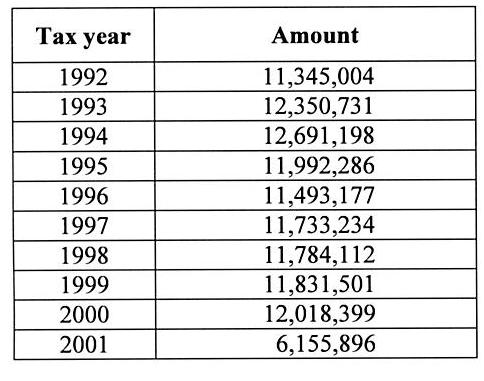
175 In this answer, the reference to ‘the Applicant’ is, again, a reference to both Esso and BHPBP.
The Facts
176 The learned primary judge summarised his findings of fact relevant to the MLMDQ issue at [456] to [471] of his Reasons. Again, they are not in dispute. Again, it is not necessary to repeat them all but some, such as the relevant terms of the Consolidated Natural Gas Sales Agreement (Sales Agreement) made as of 1 January 1975 between Esso and Hematite Petroleum Proprietary Ltd (which subsequently assigned its rights to the entity that is now BHPBP) (together, the sellers) and Gas and Fuel Corporation of Victoria (GFC), whereunder the sellers agreed to sell and deliver natural gas to GFC, are fundamental to the answer to question 13.
177 The MLMDQ payments arose from a variation of the Sales Agreement.
The Terms of the Sales Agreement
178 The Sales Agreement provided for a specified volume of natural gas, sourced from dedicated gas fields, to be sold to GFC. Over the term of the Sales Agreement, the sellers agreed to deliver 50 billion therms of natural gas to GFC.
179 Under cl 5.1 of Article V, the sellers were only required to deliver the quantity of gas required by GFC each day during the term of the Sales Agreement up to an agreed amount (the MDQ). Under cl 4.3(a) of Article IV, GFC was required to inform the sellers of the MDQ to be set for the contract year five years in advance (the MDQ for the years 1975-1979 was pre-determined and set out in Table I to the Sales Agreement). Subject to a minimum requirement, the MDQ nominated by GFC had to be equal to or less than the sellers’ maximum daily supply capacity (described as the maximum limit to MDQ, or MLMDQ) determined in accordance with the Sales Agreement.
180 Table I to the Sales Agreement set out the MLMDQ to apply from 1980 to 1989. Under cl 4.3(b), for the contract years from 1990 the sellers were required to nominate their MLMDQ 10 years in advance. When nominating the MLMDQ 10 years in advance, the sellers were required to use their best endeavours to satisfy GFC’s Maximum Daily Requirement (MDR). Under cl 4.3(c), GFC was required to provide the sellers with its bona fide forecast of MDR 10 years in advance.
181 Importantly, these provisions dealing with the rate at which gas could be taken during any day did not alter the total volume of gas to be acquired by GFC under the Sales Agreement. Nor under the Sales Agreement did GFC pay any specified consideration to Esso under the mechanism by which the parties established the MDQ.
The sellers’ MLMDQ nominations under the Sales Agreement
182 The sellers made the following MLMDQ nominations for the contract years from 1990-2000:
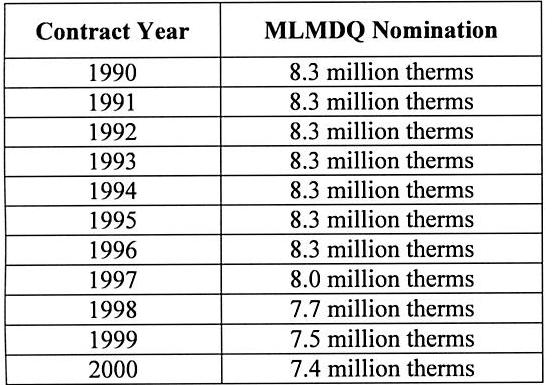
183 By letter dated 7 September 1990, GFC advised the sellers that its forecast requirements were as follows:
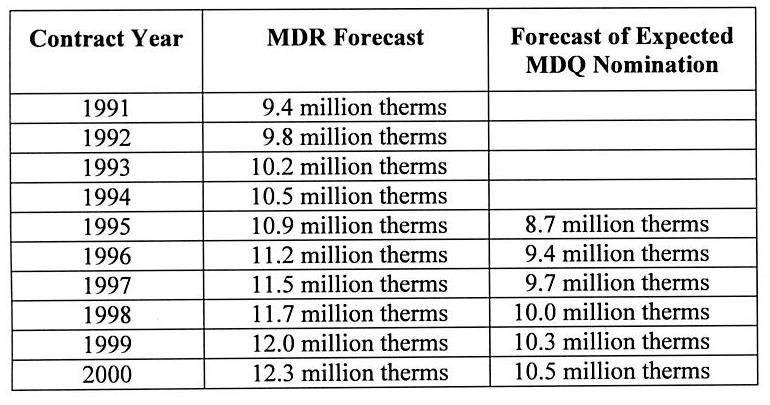
184 In August 1990 the GFC approached the sellers about increasing the MLMDQ levels set under the Sales Agreement so that it could access a higher level of MDQ in 1995-2000 if it was required.
The agreement to increase the MLMDQ levels
185 The parties reached an agreement in mid-1991, which is set out in the letter dated 6 June 1991 (referred to as the Heads of Agreement), and the subsequent letter dated 17 December 1991 as modified by the further letter dated 29 June 1992 (collectively, the MLMDQ Agreement).
186 Although the letter dated 17 December 1991 states that the sellers agreed to revise the MLMDQ advised to GFC over the period from 1991-2000, the MLMDQ was only actually increased in the years from 1995 to 2000:
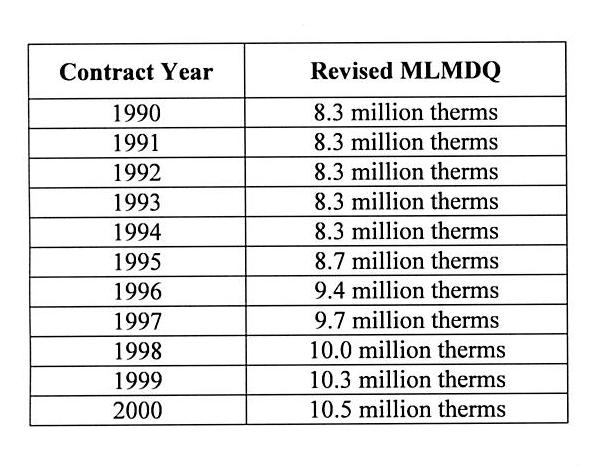
187 Importantly, the increased level of MLMDQ did not increase the amount of gas to be sold. It increased the range in which GFC could nominate the maximum quantity of gas to be delivered on a given day.
188 The terms of the MLMDQ Agreement were incorporated into a new Gas Sales Agreement between the co-venturers and Gascor dated 20 November 1996 (the 1996 Agreement), which superseded the Sales Agreement.
The increased MLMDQ levels
189 GFC agreed to make monthly payments for the period from July 1991 through to December 2000, which consisted of a fixed and a variable component (described in cl 1.3 and cl 1.4 of the document enclosed with the letter of 17 December 1991). The MLMDQ payments invoiced and returned as assessable receipts by Esso were:
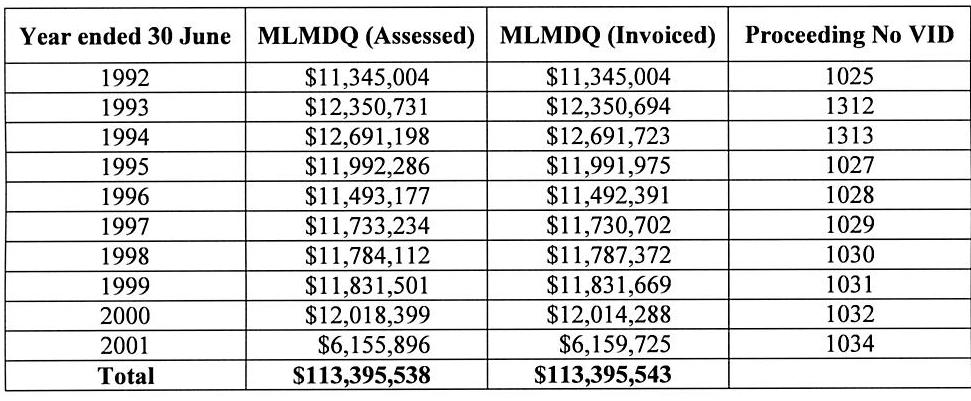
190 The difference between the invoiced amount and the amounts that Esso returned as assessable petroleum receipts was due to the accounting treatment of these amounts.
The learned primary judge
191 The learned primary judge concluded that the MLMDQ payments were not consideration for the sale of gas; they did not move the sale of the gas: Woodside Energy Ltd v Federal Commissioner of Taxation (2009) 174 FCR 91 at [62], [63] (Woodside Energy). No additional gas was recovered, produced or sold for the MLMDQ payments as the variations made by the MLMDQ Agreement did not in any way change the total volume of gas to be sold.
192 His Honour’s conclusion was summed up at [482] to [486] of his Reasons:
482 In my view, in the absence of any additional sale of gas, the MLMDQ payments did not have the relevant and direct nexus with the sales of gas originally agreed in 1975 under the Sales Agreement.
483 The PRRT is relevantly imposed on the sale of gas. The focus is upon that sale and the consideration for the sale. The Commissioner submits that the payments made pursuant to the variations to the Sales Agreement do not stand alone, and make no sense without the Sales Agreement. So much is true. However, the question is to determine, within that context, what the consideration was for the sale of the gas.
484 In my view, it is important to characterise the transactions, and focus upon the operation of the MLMDQ payments as set out in the contractual documents.
485 I accept the characterisation submitted by Esso. The important point is that the sellers were willing to transfer to the buyer the gas for the consideration agreed to in the Sales Agreement excluding the MLMDQ payments. The MLMDQ payments did not move the transfer of the gas, rather they related to a specific variation that did not affect the quantity or quality of the gas sold.
486 On this basis I do not accept the position taken by the Commissioner in relation to the MLMDQ payments.
Consideration on Appeal
193 We agree with his Honour’s conclusion for the reasons his Honour gives.
194 It is apparent that the MLMDQ payments were to be made, not as consideration for the sale of gas but as consideration for the sellers agreeing to revise the MLMDQ previously advised to GFC over the period 1991-2000. So much follows from the relevant clauses in the heads of Agreement that accompanied the letter of 17 December 1991 referred to in [185] above. Under the heading: Revision of MLMDQ Profile for Period 1991-2000, it is provided:
1.0 Sellers agree to revise the MLMDQ advised to Buyer over the period 1991-2000 in exchange for the present value equivalent of 10 annual payments of $25 million (90) escalated at 100% CPI from 1990. The annual payment schedule is based on a 70/30 fixed/variable formulae and is to commence from 1/7/91 in accordance with cl. 1.3 – 1.6.
1.1 In accordance with clause 1.0 Buyer may revise its current delivery nominations to the levels indicated below:
TABLE 1
YEAR | MLMDQ (M Therms) |
1991 | 8.2 |
1992 | 8.3 |
1993 | 8.3 |
1994 | 8.3 |
1995 | 8.7 |
1996 | 8.4 |
1997 | 9.7 |
1998 | 10.0 |
1999 | 10.3 |
2000 | 10.5 |
195 It is clear that this has nothing to do with the price at which gas is sold nor does it in any way vary the terms of Article XII, in particular clause 12.1, of the Sales Agreement.
196 The Commissioner argues that the words of connection “in relation to”, used in s 24(b) of the Act, are broader in scope than, for example, “consideration for the sale”. It is said to be a connection of the latter kind which is reflected by his Honour’s reasoning. Consideration “in relation to” the sale is sufficiently broad to include payments which are the price paid by the buyer for more favourable terms in relation to the timing of delivery of gas.
197 In Woodside Energy, this Court was concerned with whether losses incurred by the taxpayer in connection with hedging transactions it had entered into in relation to anticipated sales of crude oil were “expenses payable … in relation to the sale” of the oil under s 24(b) of the Act. That case is a far cry from the present. The hedging transactions in that case were made with parties other than the buyers of the oil. Nevertheless, the observations of the Full Court, following those of Dixon J in Archibald Howie Pty Ltd v Commissioner of Stamp Duties (NSW) (1948) 77 CLR 143 at 152, are pertinent. The Full Court observed that “consideration” in s 24(b) of the Act “would not encompass a passing of money or value which does not move the relevant sale” (Woodside Energy at [63]).
198 It may be accepted that the connection between the MLMDQ payments and the sale of gas is less remote than the connection between the hedging contracts and the sales considered in Woodside Energy. Nevertheless, the MLMDQ payment was quite evidently not a quid pro for the delivery of gas. Rather, it was a payment for an agreement to an enhancement of the buyer’s rights as to the timing of the delivery of the same quantity of gas.
199 In this regard it is to be noted that s 24(b) of the Act was concerned (as is s 24(1)(b) of the Act after the 2001 amendment), with the consideration receivable in relation to the sale, not the agreement for sale. The ordinary meaning of the word “sale” is a transfer of property in return for a consideration in money or money’s worth: Simpson v Connelly [1953] 1 WLR 911; Robshaw Brothers Ltd v Mayer [1957] 1 Ch 125 at 131-132; Sun World International Inc v Registrar, Plant Breeders’ Rights (1998) 87 FCR 405 at 406, 412.
200 In some legal contexts, it may be unduly pedantic to distinguish an agreement for sale from a sale. But in the context of s 24 of the Act, the term “consideration” is concerned with the money or money’s worth “receivable … in relation to the sale” rather than the consideration moving from each party to the agreement apt to make the agreement for sale binding on the other parties. The focus of s 24 is explicitly upon the consideration receivable by the seller in order to entitle the buyer to a transfer of the agreed quantity of the commodity.
201 Where a long term supply contract obliges the seller to supply a quantity of gas and the buyer to pay an amount for that quantity of gas, the buyer would usually have no entitlement to gas beyond that paid for; and in such a case, the seller would be entitled to recover damages for breach of contract but the seller would not usually be entitled to recover the price payable for the product. Thus, an entitlement in the seller to recover damages for the buyer’s breach of contract would not ordinarily be described as an entitlement to “the consideration receivable … in relation to the sale” for the reason that “the sale” has, ex hypothesi, not occurred.
202 Long term supply contracts can be expected to contain provisions which regulate, over the life of the contract, the rights and obligations of the parties in relation to a broad range of commercial risks attendant upon the relationship between the parties. Many such provisions will not be concerned with the price to be paid for the goods to be delivered. A provision which entitles one party to vary the time of completion would not ordinarily be seen as relating to the payment which is necessary to oblige the vendor to complete the transfer of the goods. Reference to the statutory context confirms that this view applies here.
203 Under the Act, the determination of “assessable petroleum receipts” by reference to “the consideration receivable … by the person in relation to the sale” occurs in the context of a scheme whereby tax is imposed on the profit derived from the commercial exploitation of a natural resource. In this context “the consideration receivable in relation to the sale” is readily seen as payment receivable in return for the successful exploitation of the natural resource. Provisions of an agreement for sale which are not concerned with the quantum of money (or money’s worth) payable to the seller in order for the buyer to become entitled to receive a particular quantity of petroleum or marketable petroleum product do not bear upon the extent of the exploitation of the natural resource or the profits derived from the commercial realisation of its value. The natural resource available for exploitation and profitable realisation has not been relevantly depleted by what has occurred.
204 Finally, we observe that the fact that the parties may have achieved the same commercial or economic result by varying the sale price of gas for the period 1991 to 2000 rather than providing for the MLMDQ payments to be made in accordance with the relevant provisions of the heads of agreement does not provide any assistance in characterising the MLMDQ payments. As was said in the plurality judgment in the High Court in Federal Commissioner of Taxation v Orica Ltd (1998) 194 CLR 500 at [70]:
[L]ittle or no guidance is offered by considering what other transactions the taxpayer might have made to achieve a commercial result substantially the same as the commercial result said to flow from the making of the Principal Assumption Agreement. No doubt the taxpayer might have taken the amount of $62,309,546 which it paid to MMBW and instead of paying it to MMBW under the Principal Assumption Agreement have invested it in Commonwealth Bonds maturing at or about the same time as its debentures were to mature. If it had done that it would have derived income which it might then have applied in satisfaction of most, if not all, of its liabilities to debenture holders. Similarly, it might have invested the same amount as it paid to MMBW on more speculative investments and it might then have obtained returns greater than the amount necessary to pay the debenture holders Examination of those other transactions does not reveal whether or when the taxpayer derived income as a result of the making of the Principal Assumption Agreement. In particular, the characterisation of the gains or receipts obtained in accordance with hypothetical transactions of the kind described is of little, if any, assistance in characterising the nature of the benefits identified as flowing from the making of the Principal Assumption Agreement.
205 For these reasons, the Commissioner’s cross-appeal on the MLMDQ issue should be dismissed.
CONCLUSIONS AND ORDERS
206 After these reasons had been prepared, the Court was informed that the Tax Laws Amendment (2011 Measures No 8) Act 2011 received Royal Assent on 29 November 2011. Schedule 2 of that Act makes amendments to the definition of "marketable petroleum commodity" which appear to be directed to confirming the correctness of the decision of the primary judge on the taxing point issues relating to Questions 1 to 9 inclusive. Whether or not these questions should be determined in accordance with the provisions of the new Act, the outcome could be no different. Accordingly, the co-venturers' appeals in relation to Questions 1 to 9 inclusive should be dismissed.
207 The co-venturers’ appeals should be dismissed save in relation to Question 12. We would amend Question 12 as follows:
(a) The amounts of $3,550,209, $4,837,022, $1,910,944 and $5,673,019 respectively should be excised from the Applicant’s assessable petroleum receipts in the years ended 30 June 1991, 1993, 1995 and 1996 respectively.
208 The Commissioner’s cross-appeal in relation to Question 13 should be dismissed.
I certify that the preceding two hundred and eight (208) numbered paragraphs are a true copy of the Reasons for Judgment herein of the Honourable Chief Justice Keane and Justices Edmonds and Perram. |
Associate:
Note: The orders foreshadowed at the conclusion of the judgment were not made at the request of the parties. The Court directed that the parties confer and thereafter by 4:00 pm on 20 December 2011 file minutes of any further orders (including orders as to costs), and in the event of disagreement, file and serve written submissions as to the contentions of the parties


