

FEDERAL COURT OF AUSTRALIA
Seafood Innovations Pty Ltd v Richard Bass Pty Ltd [2011] FCAFC 83
IN THE FEDERAL COURT OF AUSTRALIA | |
SEAFOOD INNOVATIONS PTY LTD ABN 67 096 070 932 Appellant | |
AND: | RICHARD BASS PTY LTD ACN 010 643 197 First Respondent RICHARD ROBERT BASS Second Respondent |
DATE OF ORDER: | |
WHERE MADE: |
THE COURT ORDERS THAT:
2. the orders and declarations of the primary judge made on 12 July 2010 in proceeding QUD 422 of 2007 be set aside;
3. the first and second respondents whether by themselves, the directors or officers of the first respondent, or by the servants of the agents of either respondent or otherwise howsoever, during the term of Australian Innovation Patent No 2006100980 or Australian Innovation Patent No 2008100126 (the first and second innovation patents respectively) be restrained from:
3.1 making, selling or otherwise disposing of, offering to make, sell or otherwise dispose of, using, importing or exporting into or from Australia or keeping for the purpose of doing any of those things, fish stunning devices manufactured, marketed and sold by the first respondent under the model names of “MT5” and “RB6” or any like machine (the infringing fish stunning machines);
3.2 selling or offering for sale or otherwise disposing of to any person any of the infringing fish stunning machines;
3.3 infringing claims 1 and 5 of the first innovation patent or claims 1, 2, 3 and 4 of the second innovation patent by either doing any of the things described in paragraph 3(a) or doing any of those things in relation to any fish stunning machine otherwise infringing the first or second innovation patent;
4. the first and second respondents themselves, and by the first respondent’s directors and officers, and by the first and second respondents’ respective servants or agents or otherwise howsoever, be restrained from authorising or procuring or acting in a common design with any other person or entity to infringe either the first or second innovation patent by doing any of the acts described in paragraph 3;
5. the first and second respondents deliver up on oath to the appellant or its nominated agent for destruction under the supervision of the appellant or its nominated agent all infringing fish stunning machines and any components thereof in the possession, custody or control of either of the first or second respondents, the exploitation of which by the first or second respondents would be an infringement of these orders;
6. the matter be referred to a Judge of the Court to determine the question of damages;
7. the respondent pay the appellant’s costs of and incidental to this appeal; and
8. the respondent pay the appellant’s costs of the hearing below.
Note: Settlement and entry of orders is dealt with in Order 36 of the Federal Court Rules. The text of entered orders can be located using Federal Law Search on the Court’s website.
QUEENSLAND DISTRICT REGISTRY | |
GENERAL DIVISION | QUD 291 of 2010 |
ON APPEAL FROM THE FEDERAL COURT OF AUSTRALIA |
BETWEEN: | SEAFOOD INNOVATIONS PTY LTD ABN 67 096 070 932 Appellant
|
AND: | RICHARD BASS PTY LTD ACN 010 643 197 First Respondent RICHARD ROBERT BASS Second Respondent
|
JUDGES: | DOWSETT, BENNETT AND GREENWOOD JJ |
DATE: | 30 JUNE 2011 |
PLACE: | BRISBANE |
REASONS FOR JUDGMENT
DOWSETT J:
1 I concur in the orders proposed by Bennett J and generally agree with her Honour’s reasons. I also generally agree with the reasons given by Greenwood J.
I certify that the preceding one (1) numbered paragraph is a true copy of the Reasons for Judgment herein of the Honourable Justice Dowsett. |
Associate:
IN THE FEDERAL COURT OF AUSTRALIA | |
QUEENSLAND DISTRICT REGISTRY | |
GENERAL DIVISION | QUD 291 of 2010 |
ON APPEAL FROM THE FEDERAL COURT OF AUSTRALIA |
BETWEEN: | SEAFOOD INNOVATIONS PTY LTD ABN 67 096 070 932 Appellant
|
AND: | RICHARD BASS PTY LTD ACN 010 643 197 First Respondent RICHARD ROBERT BASS Second Respondent
|
JUDGES: | DOWSETT, BENNETT AND GREENWOOD JJ |
DATE: | 30 june 2011 |
PLACE: | BRISBANE |
REASONS FOR JUDGMENT
BENNETT J:
2 The appeal concerns two innovation patents belonging to the appellant (Seafood Innovations), each entitled “A fish stunning apparatus”. The issues in the appeal concern the alleged infringement of the claims of Australian Innovation Patent No 2006100980 (the first innovation patent) by the apparatuses of the respondents (together Bass) and whether Australian Innovation Patent No 2008100126 (the second innovation patent) is invalid for failure to comply with ss 40(2)(c) and 40(3) of the Patents Act 1990 (Cth) (the Act). The bodies of the specifications of both the first innovation patent and the second innovation patent (the innovation patents) are relevantly the same. The claims are different. Both of the innovation patents claim a priority date of 3 December 2002. There is no contention that either of those priority dates should be deferred.
3 The primary judge found that Bass’ apparatuses (the Bass devices) do not infringe the claims of the first innovation patent and that the claims of the second innovation patent are invalid as they do not define the invention (s 40(2)(c) of the Act). His Honour found that the claims fail to define the invention because they do not disclose elements of the invention that are necessary to make it work. His Honour also, apparently, considered that the claims are not clear and succinct (s 40(3) of the Act) but made no finding under s 40(3). His Honour did not make an explicit finding as to whether, as claimed by Bass, the claims are not fairly based on the specification (s 40(3) of the Act). Bass has filed a Notice of Contention seeking to affirm the decision of the primary judge for lack of fair basis. Seafood Innovations says that the claims of the first innovation patent are infringed and the second innovation patent is valid.
The specification of the INNOVATION patents
4 The field of the invention is described as relating to a fish stunning apparatus, in particular to a fish stunning apparatus including a fish stunning device, a fish guide and/or a fish delivery table.
5 In the background of the invention, reference is made to the stunning of fish by commercial operated fisheries utilising a stunning device, usually by using a pneumatically driven ram. An example of a fish stunning device using a pneumatically driven ram is disclosed by reference to a particular international patent application. The process is described as one in which the fish are grabbed by an operator and stunned using a pneumatically driven stunning device that is mounted to a table. A guide is used to guide the head of the fish into the stunning device to activate a trigger to cause a pneumatic ram to be extended and stun the fish. The fish is then withdrawn from the guide and passed further along the table for other operations, such as bleeding.
6 The specification describes the problem when a large number of fish are pumped onto the table in waves. The operation creates a backlog of fish and a difficulty arises when a fish that has been pushed in a forward manner through the guide for stunning must be removed. It is said that the backlog often hinders, or sometimes prevents, the removal of the fish. Further, the specification says that as there is a passageway that must be provided to allow fish to be passed further along the table, fish that have not been stunned can be passed through this passageway, which is undesirable. It is stated that it is an object of the invention to overcome or alleviate those disadvantages, or to provide the consumer with a useful or commercial choice.
7 As a summary of the invention, a fish stunning apparatus is described as comprising the following integers:
a fish stunning device;
a fish guide; and
a trigger;
wherein a fish is moved unidirectionally from the entrance through the guide to the exit.
8 The integer in issue for both of the innovation patents is the fish guide. The fish stunning apparatus, as broadly described, contains the fish guide ‘having an entrance and an exit; said fish guide guiding a fish below the striker so that the piston contacts said fish when the piston is in the extended position’.
9 This is followed by a description of what the various integers may include. The only further description of the fish guide is:
A fish guide for guiding fish below a stunning device; said fish guide comprising:
an entrance for allowing fish to pass into the device;
an exit to allow fish to pass from the device;
a floor being pivotally movable between a first position and a second position;
wherein the floor moves from the first position to the second position to allow a fish to pass from the entrance to the exit.
10 There is then a brief description of the various drawings of the apparatus, all of which include the fish guide with the pivotally moveable floor. The specification then states that the fish stunning apparatus provides the advantage of quick and efficient stunning of fish with minimal operator input and minimal stoppages.
11 The specification states that the invention is not to be confined by the described embodiments.
THE INFRINGEMENT OF The first innovation patent
The claims
12 The appeal based on the claims of the first innovation patent centres upon the construction of claim 1 which is as follows:
A fish stunning apparatus comprising:
a fish stunning device including a striker; said striker including a cylinder and a piston, said piston movable between a retracted position and an extended position;
a fish guide having an entrance and an exit; said fish guide guiding a fish below the striker so that the piston contacts said fish when the piston is in the extended position;
a trigger to cause the piston to be moved from the retracted position to the extended position when the fish is passed through the fish guide;
wherein the fish guide includes a floor being pivotally movable between a first position and a second position, the floor moving from the first position to the second position to allow a fish to pass unidirectionally from the entrance to the exit (integer 5).
13 The appellant also alleges infringement of claim 5, which states:
A fish guide for guiding fish below a stunning device; said fish guide comprising:
an entrance for allowing fish to pass into the device;
an exit to allow fish to pass from the device;
a floor being pivotally movable between a first position and a second position;
wherein the floor is pivotally moveable between the first position and the second position, the floor moving from the first position to the second position to allow a fish to pass unidirectionally from the entrance to the exit.
14 The fish stunning device and the trigger as claimed in claim 1 are the same as described in the broadest description of the invention. Claim 1 adds further characteristics that are also described in the specification as an embodiment of the invention. The fish guide of claim 1 is narrower than the broadest description of the invention. Two aspects of that limitation are relevant in the appeal. The first is that the fish guide includes a pivotally moveable floor. Claim 1 is not limited to a fish guide that consists only of such a floor. The second is that the claim specifies the floor as being pivotally moveable between the first and second position to allow a fish to pass unidirectionally from the entrance to the exit.
The Bass devices
15 It is not in dispute that, apart from integer 5, the remaining integers of claim 1 are present in the Bass devices. The Bass devices include a pivotally moveable floor which moves from the first position to the second position, described as a chin plate. However, they also includes two other devices, a cheek plate and a top plate. It is those three devices acting together as a sphincter that allow a fish to pass unidirectionally from the entrance to the exit of the fish guide. Bass contends that, as it is not the floor alone that allows the fish to pass, the Bass devices do not infringe claim 1.
16 The question that arises is whether Claim 1 should be construed such that it is only the pivotally moveable floor of the fish guide moving from the first position to the second position that permits, allows or makes possible the passing of the fish unidirectionally from the entrance to the exit of the fish guide.
The decision of the primary judge
17 It is not in dispute that, as the primary judge found in relation to the Bass devices:
If only the chin plate were down, the fish would not pass through (at [69]).
The lowering of the chin plate is necessary to allow the fish to pass unidirectionally from the entrance to the exit (at [76]).
The lowering of the chin plate is not sufficient to allow the fish to pass unidirectionally from the entrance to the exit (at [77]).
The movement of the chin plate from the first position to the second position does not, alone, permit the fish to flow unidirectionally from the front to the exit of the device. It is the joint operation of the cheek plates and the top plate, as well as the chin plate, that is necessary to allow or permit the fish to move unidirectionally from the front to the exit (at [85]).
18 The primary judge accepted that “allow” means “to permit” (at [81]). The primary judge was of the view that the lowering of the chin plate or floor, as a matter of language, does not allow or permit the fish to pass from the front to the exit of the device. His Honour concluded that the mechanism in the Bass devices for achieving a unidirectional flow of fish is a substantially new or different mechanism to that of the first innovation patent (at [87]). As a result, his Honour found that the Bass devices did not infringe claims 1 and 5 of the first innovation patent (at [88]).
Consideration
19 There is no reason why the words “to allow” in integer 5 of Claim 1 should be given anything other than their ordinary and plain meaning. The Macquarie Dictionary (rev 3rd ed, Macquarie, 2003) defines “allow”, inter alia, in terms of ‘permit; make possible’.
20 Bass submits that the use of the word “allow” is exhaustive of what permits the fish to move and that the only feature identified in the claims is the pivotally moveable floor. Bass emphasises that no other component of the invention is identified in the claims or in the specification as requiring any movement “to allow” the passage of the fish. Bass submits that the claims should be construed as referring to the method of propulsion and not to the removal of an impediment. Bass points out that in the Bass devices, the lowering of the floor is of itself insufficient to allow the fish to pass and that “allow” should be understood in the sense of “make possible or permit”.
21 I do not construe integer 5 of claim 1 in such a restrictive fashion. Claim 1 does not so limit the fish guide. It states that the fish guide “includes” the pivotally moveable floor. As the primary judge found, without the movement of the chin plate, the fish in the Bass devices cannot pass, irrespective of the movement of the cheek plates and the top plate. That is, the movement of the floor is necessary to allow the fish to move through.
22 As a matter of common sense and by reference to the diagrams of the specification, the floor may be necessary to achieve the passage of the fish but the mere existence of the floor may not be sufficient for that purpose. For example, if the entire apparatus were tilted backwards, the opening of the floor from the first position to the second position would not necessarily result in the fish moving from the entrance to the exit of the fish guide. A construction that imports a requirement that the floor must be the only means by which the fish are permitted to pass introduces an impermissible gloss on the claim (Welch Perrin & Co Pty Ltd v Worrel (1960) 106 CLR 588 at 610; H Lundbeck A/S v Alphapharm Pty Ltd (2009) 177 FCR 151 at [120]).
23 The fact that additional integers must also be operated in the Bass devices to permit the passage of the fish does not avoid infringement any more than the addition of a further flap downstream of the pivotally moveable floor which needed to be raised could, by adding a further reason why the fish were unable to pass to the exit of the guide, be said to do so. Indeed, when the example of a further flap as an impediment to the movement of the fish was put to counsel for Bass, he contended that such an arrangement would avoid infringement of claim 1. I do not accept this to be the case. Both this example and Bass’ contention show that the construction Bass advances is contrary to a proper construction of the claim. The claim does not refer to an unimpeded mechanism but rather one that is permissive. The claim does not require that the passage of the fish is allowed only by movement of the floor. No such word is included in the claim, nor does the claim say that it is the movement of the floor of itself or by itself that allows the fish to pass.
24 In this case, the fact that the Bass devices utilise additional integers to create the means whereby the fish can pass does not avoid infringement. The claim requires the floor to move in order for that to happen. That is what happens in the Bass devices.
25 There was some evidence before the primary judge as to how the skilled addressee of the first innovation patent would understand the meaning of “allow”. The second respondent, Mr Bass, was questioned about the operation of the Bass devices, for which a patent had been granted. That patent, in describing the chin plate (the pivotal floor), said: ‘To allow passage of the fish past the set point after firing of the gun, the plate can pivot between raised and lowered positions’. In the raised position, the plate supports the chin of the fish, while in the lower position the plate rests flat against the floor of the channel, allowing the fish to be carried on through the channel. It is stated that ‘to allow passage of the fish, the plate can pivot between the raised and lowered positions’. This is not, of course, determinative nor does it constitute an admission of infringement. However, this use of language by a skilled addressee supports, or at least is not inconsistent with, the construction I have found. It recognises that the movement of the floor in the Bass devices is integral to allowing the fish to pass.
26 As was discussed in Sachtler GmbH & Co KG v RE Miller Pty Ltd (2005) 221 ALR 373 at [54] a common sense construction should be adopted. There was evidence from a skilled addressee that the Bass devices and the apparatus of the claims of the first innovation patent operate in the same way and that there is no practical difference in terms of the purpose of the apparatus in this context. It is irrelevant to a determination of infringement that Mr Bass’ own patent used the word “allow” in the context of the description of the Bass devices. This evidence is of relevance as to the construction of that word within the claim of the skilled addressee.
27 It follows that, contrary to the opinion of the primary judge, the Bass devices infringe claims 1 and 5 of the first innovation patent.
The validity of the second innovation patent
28 Bass’ attack on the validity of the second innovation patent is based upon the characterisation of the invention. Section 40(2)(c) of the Act requires that a complete specification of an innovation patent must end with at least one and no more than 5 claims defining the invention. Section 40(3) of the Act requires that the claims must be fairly based on the matter described in the specification. Bass submits that the claims of that patent do not define the invention and are not fairly based upon the invention described in the specification relevantly common to the innovation patents.
29 There is no dispute that the Bass devices infringe the claims of the second innovation patent.
30 It should also be noted that there was no allegation of a lack of fair basis of claim 1 of the first innovation patent.
The claims
31 The claims of the second innovation patent are:
1. A fish stunning apparatus comprising:
a fish stunning device including a striker; said striker including a cylinder and a piston; said piston movable between a retracted position and an extended position;
a fish guide having a front entrance and a rear exit; said fish guide guiding a fish below the striker so that the piston contacts said fish when the piston is in the extended position;
a trigger to cause the piston to be moved from the retracted position to the extended position when the fish is passed through the fish guide;
wherein a fish moves unidirectionally from the front entrance through the guide to the rear exit and the height of the striker is adjustable with respect to the fish guide.
2. The fish stunning device of claim 1 wherein the trigger is activated to allow the fish to move through the guide.
3. The fish stunning apparatus of claim 1 wherein the fish guide includes a floor being pivotally moveable between a first position and a second position.
4. The fish stunning device of claim 3 wherein the trigger is operatively connected to the floor to move the floor from the first position to the second position.
The decision of the primary judge
32 The primary judge held that the claims of the second innovation patent do not define the invention ‘because they do not disclose elements of the invention that are necessary to make it work, principally how it is that the striker operates on the fish so as to stun it (that is, how the fish is stopped, held, and then released). The invention is an apparatus “wherein” (that is, in which) the fish moves from the entrance to the exit, yet how the fish so moves (that is, how it is held for stunning and then released) is not revealed. That is the critical point which the [second innovation patent] must address, but is silent on this point’ (at [116]). His Honour also said at [115] that the ‘claims neglect to articulate any means of achieving a front entrance and rear exit’ and in doing so, the claims omit ‘what must be necessary elements of the invention, including how the fish is held while being stunned, and how it is caused to exit the device’. For these reasons, his Honour found that the second innovation patent was invalid (at [118]).
33 The primary judge seems to have considered the claims of the second innovation patent by reference to the claims of the first innovation patent. That is not relevant either to the ground of failure to define the claim or to an alleged lack of fair basis.
Consideration
34 It can be seen that claim 1 is not limited to an apparatus that includes the pivotally moveable floor. The apparatus of claim 1 mirrors the broadest description of the invention, except for a limitation that the height of the striker is adjustable with respect to the fish guide. Bass does not suggest that that limitation is or renders claim 1 invalid. The substance of the attack on claim 1 is that it does not include a limitation that the fish guide comprises the pivotally moveable floor.
Fair basis
35 Claim 1 is, of course, no broader than the broadest consistory clause but that is not in itself sufficient for fair basis. The first question is whether the claim is fairly based on the description of the invention or, as put by Bass, whether claim 1 ‘travels beyond’ the invention as described. The parties accept that the principles to be applied are found in Lockwood Security Products Pty Ltd v Doric Products Pty Ltd (No 1) (2004) 217 CLR 274, in which the High Court set out the approach to be taken in assessing compliance with the fair basis requirement in s 40(3) of the Act. Their Honours made it clear that s 40(3) does not raise questions that properly arise under s 18 of the Act. That is, a consideration of s 40(3) does not import a consideration of novelty or innovative step. The key to an understanding of the application of s 40(3) is an understanding of the invention described in the specification. It is necessary to examine the body of the specification in order to see what it describes as the invention. In doing so, it is wrong to employ an ‘over meticulous verbal analysis’ or to seek to isolate in the body of the specification “essential integers” or “essential features” of an alleged invention and to ask whether they correspond with the essential integers of the claim in question. The requirement for a real and reasonable clear disclosure does not limit those disclosures to a preferred embodiment.
36 It is therefore necessary to ascertain how the invention is described in the common specification of the innovation patents. The issue that arises is whether the invention as described in the specification necessarily includes a fish guide which “comprises” (in the sense of consists of) a floor being pivotally moveable between the first and second position. Bass contends that the apparatus must include the pivotally moveable floor. Bass submits that the embodiment specifying the pivotally moveable floor on page 3 of the specification is an elaboration of the one invention described in the specification. Bass points out that the pivotally moveable floor is the only description of the fish guide in the specification and that this description does not state that the fish guide includes the floor, but that it “comprises” (in the sense of consists of) the floor. Bass says that that makes the pivotally moveable floor an essential integer of the invention which must, therefore, be included in the claims. On the other hand, Seafood Innovations says that the description of such a fish guide is but one embodiment of the apparatus broadly described, without any such limitation.
37 The invention as described in the body of the specification purports to solve the problem of moving the fish from the table through the device, unidirectionally. The broadest description of the apparatus of the invention (at page 2 of the specification) is the one that comprises (in the sense of consists of):
a fish stunning device;
a fish guide having an entrance and an exit; and
a trigger;
in which the apparatus enables the fish to move unidirectionally from the entrance to the apparatus, through the fish guide, to the exit.
38 As I read the specification, the specific fish guide described, which includes the floor that is pivotally moveable, is one embodiment of that apparatus. As described, that embodiment gives instruction to the reader of a means of constructing a fish guide of the apparatus, which is the invention. The broadest consistory clause is consistent with the solution to the difficulty identified in the background of the invention.
39 While it is the case that an innovation patent can only describe a single invention, which in the second innovation patent is an apparatus whereby fish are moved unidirectionally through that apparatus, this does not mean that variations within an apparatus are impermissible. The specification quite clearly describes an apparatus consisting of defined integers. There may, however, be variation within those integers. A reading of the whole of the specification does not support Bass’ contention that specifically described possible embodiments limit the broader embodiment of the apparatus. Bass’ analysis seeks to isolate essential integers from the body of the specification in understanding the described invention. This is contrary to the approach identified by the High Court in Lockwood (No 1). As is apparent from Lockwood (No 1), a narrow embodiment of a broad claim does not render the claim invalid for lack of fair basis. A claimed invention within the scope of the broadest description of the invention in the specification is fairly based.
40 Although the claims are in what could be described as general terms, this appeal does not concern questions of novelty or innovative step. The only requirement of the fish guide in claim 1 of the second innovation patent is that it have an entrance and an exit and that it guides the fish below the striker so that the piston contacts the fish when the piston is in the extended position. That apparatus, according to the specification, will overcome the identified “difficulty” of the removal of the fish backwards from a stunning apparatus which is hindered by, and sometimes prevented by, the backlog of fish located on the table. As the High Court said in Lockwood (No 1) in relation to the broad claims in that particular patent at [38], ‘nothing in the body of the specification suggests that the description of the invention to be found in the consistory clause is wider than the invention actually was’.
41 Bass submits that Seafood Innovations is not entitled to claim a monopoly for all fish stunning devices in which a fish moves unidirectionally from the front entrance to the rear exit, irrespective of the technical method for achieving that result. However, there is no requirement that the means of achieving that result must be included in the claims, although there is a requirement for sufficient description of the invention, including the best method, in the specification (s 40(2)(a) of the Act). That is not in issue in the appeal. Bass’ submission really involves an attack on the innovative step of the claimed invention and whether or not it is a patentable invention. That might form a basis for an attack on validity for failure to comply with s 18 of the Act but, as emphasised by the High Court in Lockwood (No 1), the inquiry under s 40(3) is a totally different one. The invention consists, in its broadest embodiment, of the three integers set out at [6] above. These integers are included in claim 1. There is no missing essential integer in claim 1. There is no lack of fair basis.
42 Claim 1 (and the dependent claims) of the second innovation patent do not fail to comply with s 40(3) of the Act.
Claims defining the invention
43 Bass submits that, as the primary judge found, the claims of the second innovation patent do not define the invention as is required by s 40(2)(c) of the Act because they fail to disclose the critical and essential aspects of the invention, including how the ‘fish moves unidirectionally from the front entrance through the guide to the rear exit’.
44 The claims are indeed required to define the invention pursuant to s 40(2)(c) of the Act. However, pursuant to s 40(2)(a) of the Act, it is the whole of the specification including the claims that must describe the invention fully, including the best method known to the applicant of performing the invention. There was no pleading of insufficiency of description of the invention of the second innovation patent. There is no dispute that the body of the specification gives sufficient instruction to a person of ordinary skill to work the invention. There is no complaint that the whole of the specification fails to describe the best method of performing the invention. The claims are not required to provide instructions as to how to make the apparatus work. The claims are required to define the invention so as to make clear the monopoly claimed by the patentee. To the extent that Bass submits that the claims claim a narrower embodiment of the invention than that set out in the broadest consistory clause, that is not a basis for invalidity as a failure to define an invention under s 40(2)(c) or as for a lack of fair basis.
45 The monopoly is as set out in the claims. The fact that the claims (in contrast to the specification) do not give instructions for use of the apparatus is not a basis for invalidity for failure to define the invention for the purposes of s 40(2) of the Act. I do not accept Bass’ contention that the claims of the second innovation patent fail to define the invention.
46 Claim 1 (and the dependent claims) of the second innovation patent comply with s 40(2)(c) of the Act.
Conclusion
47 The primary judge’s decision, that the Bass devices do not infringe claims 1 and 5 of the first innovation patent and that the second innovation patent is invalid, should be set aside.
48 The Bass devices infringe claims 1 and 5 of the first innovation patent and claims 1, 2, 3 and 4 of the second innovation patent.
49 The matter should be referred to a Judge of the Court to determine damages for infringement. The parties should meet to attempt to agree on the quantum of damages or an account of profits. If an agreement cannot be reached, quantum should be determined at a hearing before a single judge of the Court.
I certify that the preceding forty-eight (48) numbered paragraphs are a true copy of the Reasons for Judgment herein of the Honourable Justice Bennett. |
Associate:
Dated: 30 June 2011
IN THE FEDERAL COURT OF AUSTRALIA | |
QUEENSLAND DISTRICT REGISTRY | |
GENERAL DIVISION | QUD 291 of 2010 |
ON APPEAL FROM THE FEDERAL COURT OF AUSTRALIA
BETWEEN: | SEAFOOD INNOVATIONS PTY LTD ABN 67 096 070 932 Appellant
|
AND: | RICHARD BASS PTY LTD ACN 010 643 197 First Respondent RICHARD ROBERT BASS Second Respondent
|
JUDGES: | DOWSETT, BENNETT AND GREENWOOD JJ |
DATE: | 30 JUNE 2011 |
PLACE: | BRISBANE |
REASONS FOR JUDGMENT
GREENWOOD J:
50 In this appeal I have had the benefit of reading the reasons for judgment of Justice Bennett. I agree with the orders her Honour proposes and I generally agree with her Honour’s reasons subject to the following observations. In making these observations, I adopt the references in her Honour’s reasons in framing the issues alive on this appeal.
Infringement of Innovation Patent 2006 100980 (the “First Innovation Patent”)
51 The complete specification for the First Innovation Patent recites that the field of the invention relates to a fish stunning apparatus. In particular, the invention relates to “a fish stunning apparatus including a fish stunning device, a fish guide and/or a fish delivery table” [emphasis added].
52 In the explanation of the background to the invention, the specification notes that it has been found that by stunning fish, the quality of the flesh is increased. An explanation for that result is mentioned. The most basic method of stunning fish is by striking the fish with a bat. More complex devices use a pneumatically driven ram to stun fish. In most fisheries operated on a commercial footing, more complex pneumatic rams are used as they are more efficient and less physically demanding on an operator. The specification notes that an example of such a device is disclosed in International Patent Application No. WO 01/97621. The sequence of steps engaged by so using such a pneumatically driven stunning device is described in this way at p 1, lns 18-24 of the specification:
When fish are harvested, they are located in a holding area and then pumped onto a table. The fish are grabbed by an operator and stunned usually using a pneumatically driven stunning device that is mounted to the table. A guide is used to guide the head of the fish into the stunning device to activate a trigger to cause the pneumatic ram to be extended and stun the fish. The fish is then withdrawn from the guide and passed along the table for other operations such as bleeding.
53 However, there is a problem with such a process identified at p 1, lns 25-31 in this way:
A problem with this process is that often the fish are pumped onto the table in waves. A large number of fish are often located on the table at one time creating a backlog of fish. An operator that uses the fish stunning apparatus shown in WO 01/97621 must push the fish forwardly through the guide in order to stun the fish. The difficulty arises when the fish must be removed as the backlog often hinders or sometimes prevents the removal of the fish.
[emphasis added]
54 Another problem is identified at p 1, lns 31-32 and p 2, ln 1 in these terms:
Further, as there is a passageway that must be provided to allow fish to be passed further along the table, fish that have not been stunned can be passed through this passageway which is undesirable.
55 The specification recites that an object of the invention is to “overcome or alleviate the above disadvantages or provide the consumer with a useful or commercial choice”.
56 At p 2, lns 7-18, the specification recites a summary of the invention in these terms:
SUMMARY OF THE INVENTION
A fish stunning apparatus comprising:
a fish stunning device including a striker; said striker including a cylinder and a piston, said piston moveable between a retracted position and an extended position;
a fish guide having an entrance and an exit; said fish guide guiding a fish below the striker so that the piston contacts said fish when the piston is in the extended position;
a trigger to cause the piston to be moved from the retracted position to the extended position when the fish is passed through the fish guide;
wherein a fish is moved unidirectionally from the entrance through the guide to the exit.
57 According to this summary description, the invention is a fish stunning apparatus made up of a fish stunning device which includes a striker, a cylinder and a retractable piston; a fish guide which has an entrance and an exit and which guides a fish to a position below the striker so that the piston, in the extended position, strikes the fish; a trigger to cause the piston to be moved to the extended position when a fish is passed through the fish guide; where, in such an apparatus, a fish is moved in one direction only from the entrance to the guide through the guide to the exit.
58 At p 2, lns 19 and 20, the specification addresses the first integer, the fish stunning device, and describes one embodiment of mounting the device to a fish guide using a mount.
59 At p 2, lns 21-32 and p 3, lns 1-5, the specification describes features that may be included or comprised in the second integer, a striker, or the components of a striker, thus identifying possible embodiments of the invention.
60 The specification describes the third integer, the fish guide, at p 3, lns 6-13 in these terms:
A fish guide for guiding fish below a stunning device; said fish guide comprising:
an entrance for allowing fish to pass into the device;
an exit to allow fish to pass from the device;
a floor being pivotally movable between an [a] first position and a second position;
wherein the floor moves from the first position to the second position to allow a fish to pass from the entrance to the exit.
61 According to this summary description of the fish guide integer of the apparatus, the fish guide is comprised of an entrance for allowing fish to pass into the device; an exit to allow fish to pass from the device; a floor that moves upon a pivot from position 1 to position 2; where the floor moves from position 1 to position 2 to allow a fish to pass from the entrance to the exit of the guide.
62 The specification at p 3, lns 14-21 describes the features that may be included in a fish guide.
63 At p 3, lns 22-31 the specification describes the features of a table for distributing fish for stunning.
64 At p 8, lns 26-33 and p 9, lns 1-7, the specification contains a description by reference to figures 4A to 4D of the operation of the fish stunning apparatus. The description is in these terms:
The fish stunning apparatus 100 operates by a fish being placed through the entrance 230 of the guide 200. Once the fish is placed within the entrance 230, the trigger 300 is depressed and the striker 400 is activated.
The piston 443, located within the cylinder 442, moves to the extended position hitting the fish on the head, stunning the fish. After the fish has been stunned, the floor 220 moves downwardly causing the fish to pass through the exit 240 at the back of the guide 200. There is a slight delay between the piston 443 being fully extended and the floor 220 pivoting downwardly to ensure that the piston 443 stuns the fish.
The floor 220 is then moved back to its original position to allow for another fish to pass through the entrance 220 into the guide 200.
65 Figures 4A to 4D are set out below.
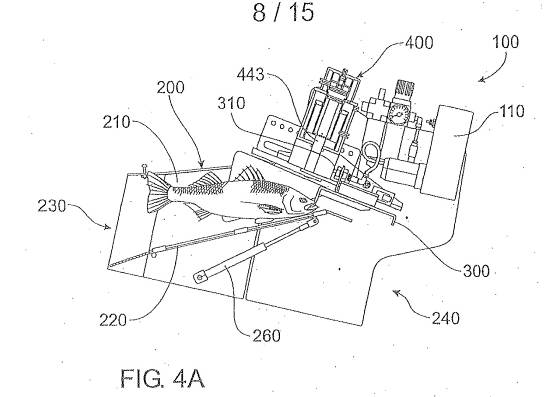
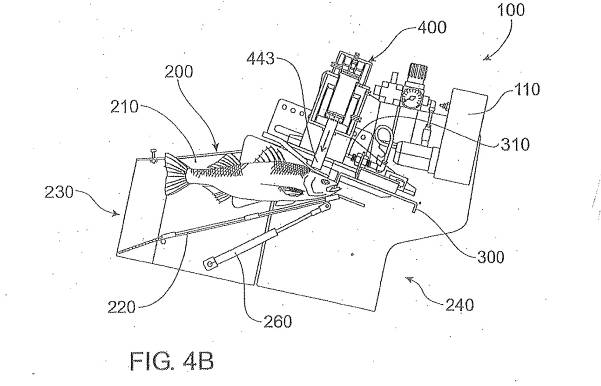
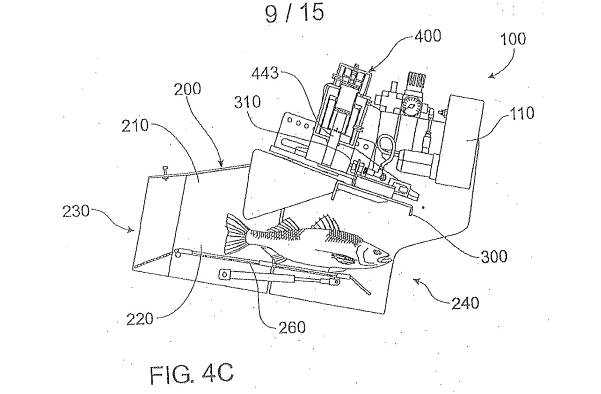
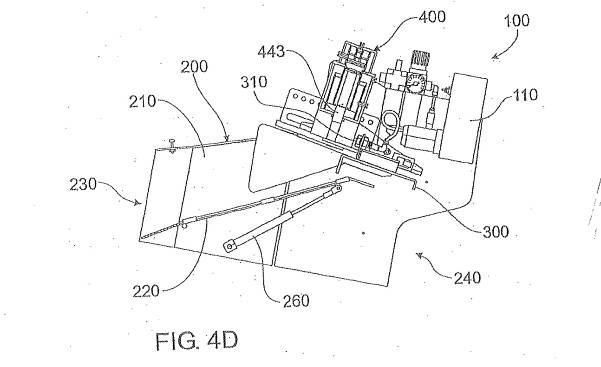
66 The summary of the invention describes integers of the invention in a disaggregated way by describing some of the integers at p 2, lns 7-18, followed by possible embodiments of the fish stunning device and striker integers, and then describes other essential elements of the fish guide integer at p 3, lns 6-13 followed by a possible embodiment of aspects of the fish guide. Although the summary of the invention at p 2, lns 7-18 does not describe the fish guide integer as comprising a pivotally movable floor moving from position 1 to position 2 to allow a fish to pass from the entrance to the exit, the description of the fish guide integer at p 3, lns 6-13 is a further description of essential components of that integer and thus an integer of the invention as described in the specification.
67 Claims 1 and 5 define an invention in these terms:
1. A fish stunning apparatus comprising:
a fish stunning device including a striker; said striker including a cylinder and a piston, said piston movable between a retracted position and an extended position;
a fish guide having an entrance and exit; said fish guide guiding a fish below the striker so that the piston contacts said fish when the piston is in the extended position;
a trigger to cause the piston to be moved from the retracted position to the extended position when the fish is passed through the fish guide;
wherein the fish guide includes a floor being pivotally movable between a first position and a second position, the floor moving from the first position to the second position to allow a fish to pass unidirectionally from the entrance to the exit.
5. A fish guide for guiding fish below a stunning device; said fish guide comprising:
an entrance for allowing fish to pass into the device;
an exit to allow fish to pass from the device;
a floor being pivotally movable between a first position and a second position;
wherein the floor is pivotally movable between the first position and the second position, the floor moving from the first position to the second position to allow a fish to pass unidirectionally from the entrance to the exit.
68 It follows that the notional addressee (see [78] and [79] of these reasons) would understand claim 1 as defining an invention comprised of the integers described in the specification at p 2, lns 7-18 and p 3, lns 6-13 and to that extent, in the context of the construction question, there is no discontinuity in my view between the description of the integers in the specification and the claims defining the monopoly. A patent specification must, of course, include a detailed description of the invention and the best method known to the inventor of performing that invention. It follows that the specification will usually contain a detailed description of at least one embodiment of the invention. Provided a claim is fairly based upon matters disclosed in the specification, a claim may define the invention as having fewer integers than those present in a particular embodiment. Equally, the claim may define an invention as having more features than those present in a particular embodiment. It always remains open to the patentee in defining the boundary of the monopoly to frame a claim in a way which introduces defined limitations into a claim. The claim, as framed, must be fairly based on matters disclosed in the specification.
69 The matters described in the specification at p 2, lns 7-18 and p 3, lns 6-13 are not mere embodiments of the invention. They reflect a description of integers adopted in the claims defining the invention.
70 As a matter of construction, an integer of claim 1 that must be present in any apparatus that infringes claim 1 of the First Innovation Patent, is a fish guide that incorporates a floor pivotally movable from position 1 to position 2, the floor moving to the second position to allow a fish to pass in one direction only from the entrance to the exit (integer 5, see [36] of the primary judgment). The respondents concede that the fish killing devices described as MT5 (Exhibit 4) and RB6 (Exhibit 5) manufactured and sold by Richard Bass Pty Ltd (“Bass”) incorporate a pivotally movable chin plate which moves from a first position to a second position. However, the point of departure from integer 5 of claim 1 is said to be that the pivotal movement of the floor in the Bass devices does not move to the second position “to allow the fish to pass unidirectionally from the entrance to the exit” because in both of the Bass devices a fish is “allowed” to exit the devices by four components moving in unison, not by the lowering of the chin plate to position 2.
71 The primary judge identifies at [41] the four components acting in unison as these: two cheek plates in MT5 and four cheek plates in RB6 which enclose the sides or cheeks of the fish and which fold back against the sides of the fish guide; a trigger plate which moves up and back from a descended position; and a chin plate or floor plate which folds down from position 1 to position 2.
72 The respondents say that all of these components must move in unison to allow a fish to exit their devices. The primary judge at [69] accepted “the evidence of the second respondent [Richard Bass] and also Mr Smart, that if only the chin plate were down the fish would not go through” although “on the whole of the evidence … the lowering of the chin plate is necessary to allow the fish to pass unidirectionally from the entrance to the exit” [emphasis added]: [76]. On the facts, the primary judge found at [77] that “on the whole of the evidence, however, I also accept that the lowering of the chin plate is not sufficient to allow the fish to pass unidirectionally from the entrance to the exit” [emphasis added].
73 Having made those findings, the primary judge’s analytical conclusions are set out in these paragraphs:
80 According to the Shorter Oxford Dictionary, “allow” in its transitive sense, means “to concede, permit (an action, etc)”; and in the Macquarie Dictionary, relevantly, “allow” means “to permit”.
81 In my opinion, in integer 5 of claim 1 of the First Innovation Patent, the movement of the floor from the first position to the second position is not said to “aid” or “assist” a fish to pass unidirectionally from entrance to exit, but is used in the sense of “permitting” a fish to pass unidirectionally from entrance to exit.
…
83 In my opinion, integer 5 of claim 1 claims a monopoly in which the movement of the floor from the first position to the second position allows, that is to say, permits, a fish to pass unidirectionally from entrance to exit within the device.
…
85 In my judgment, integer 5 is directed at a fish guide in which the movement of the floor from the first position to the second position permits the fish to move unidirectionally from the front to the exit of the guide. That movement, in the impugned devices, does not permit the fish to flow unidirectionally from the front to the exit of the device. The joint operation of the cheek plates and the top plate, as well as the chin plate, is necessary to allow or permit the fish to move unidirectionally from the front to the exit.
86 The connection or movement of those parts is not of the same substance or effect as the movement of a pivoting floor from first to second position, allowing or permitting the fish to move unidirectionally from the front to the exit of the device. Claims 1 and 5 of the First Innovation Patent teach that after the fish is stunned, the movement of the floor to the second position allows fish to move towards the exit. The movement of the floor acts like a gate, door or flap, operating to allow the fish to move towards the exit. In the respondents’ devices, after the fish is stunned, the passageway constituted by the chin plate, the two or four cheek plates, and the top plate, expands, sphincter like, to allow the fish to move towards the exit.
87 In the impugned devices, lowering of the chin plate, as a matter of language, does not allow or permit the fish to pass from the front to the exit of the device. The mechanism in the impugned devices for achieving that unidirectional flow of fish is a substantially new or different mechanism.
74 The primary judge accepted that the lowering of the chin plate (or bottom surfaces which the primary judge found to be, relevantly, a floor [89] and [90]) from a first position to a second position in Exhibits 4 and 5 is necessary to allow a fish to pass unidirectionally from the entrance to the exit of those devices. However, the introduction of the additional components constraining the fish within the devices and, more importantly, the joint functional operation of those additional components in unison with the pivotal movement of the chin plate operate “to allow or permit” the unidirectional movement of the fish to the exit. The primary judge concluded that integer 5 is not present in the impugned devices because the pivotal downward movement of the chin plate does not permit the fish to flow unidirectionally from the front to the exit of the device. That follows because the other components prevent the fish from so flowing unless all components are released in unison.
75 The respondents support the conclusions of the primary judge and contend that no error is demonstrated.
76 The contention of the respondents is not that integer 5 is present within the impugned devices but that the presence and operational function of the additional components renders the impugned devices non-infringing devices. The contention is that because the pivotal downward movement of the chin plate does not permit the fish to flow unidirectionally from the front to the exit of the devices, integer 5 is not satisfied and that result arises because each of the four components must act in unison “to allow” a fish to move unidirectionally from the front to the exit of the devices. The respondents say that, on this construction, the alleged infringing devices differ materially from an essential feature of the appellant’s claim and thus there can be no infringement: Rodi & Wienenberger A.G. v Henry Showell Ltd [1969] R.P.C. 367; Shave v H.V. McKay Massey Harris Pty Ltd (1935) 52 CLR 701; Commonwealth Industrial Gases Ltd v M.W.A. Holdings Pty Ltd (1970) 180 CLR 160 at 168.
77 If integer 5 is present within the impugned devices, the introduction into the devices by the respondents of other components will not render the devices non-infringing devices. At that point, there is no material differentiation in an essential integer of the claim but an adoption of the essential integer plus the addition of other features: see the discussion in Fresenius Medical Care Australia Pty Ltd v Gambro Pty Ltd (2005) 67 IPR 230 at [70] and [74]; Bitech Engineering v Garth Living Pty Ltd and Anor (2010) 86 IPR 468 at [30] and Arbitron v Telecontrol Aktiengesellschaft and Anor (2010) 86 IPR 110 at [257]. The question is whether the integer is present within the impugned devices, that is, does the pivotal movement of the chin plate from a first position to a second position so move to allow a fish to pass unidirectionally from the entrance to the exit?
78 The answer to that question turns on the meaning to be attributed to “to allow” in the context of the specification which serves the purpose of both describing and demarcating the invention and is addressed to a person skilled in the relevant art reading the specification with common general knowledge of the art, that is, the notional addressee. As Lord Hoffmann observed in Kirin-Amgen Inc v Hoechst Marion Roussel Ltd (2004) 64 IPR 444 at [32] the task of objective construction of a patent is not, “as is sometimes said ‘the meaning of the words the author used’, but rather what the notional addressee would have understood the author to mean by using those words” (Lord Hoffman’s emphasis) and also at [32]:
[t]he meaning of words is a matter of convention, governed by rules, which can be found in dictionaries and grammars. What the author would have been understood to mean by using those words is not simply a matter of rules. It is highly sensitive to the context of and background to the particular utterance.
79 What lies at the heart of purposive construction is the notion that the skilled addressee reads the specification on the assumption that its purpose in describing and demarcating the invention is to convey, in context, a practical idea of that which the patentee has had for a new product or process: Kirin-Amgen Inc v Hoechst Marion Roussel Ltd, Lord Hoffmann at [33]. However, the principles to be applied in determining the construction of the claims are those established by Welch Perrin & Co Pty Ltd v Worrel (1961) 106 CLR 588 at 610; H Lundbeck A/S & Anor v Alphapharm Pty Ltd & Anor (2009) 177 FCR 151 at [118] – [120]; Kimberly-Clark Australia Pty Ltd v Arico Trading International Pty Ltd (2001) 207 CLR 1 at [15] (as to infringement questions); Interlego AG v Toltoys Pty Ltd (1973) 130 CLR 461 at 479; and Sachtler GMBH and Co KG v RE Miller Pty Ltd (2005) 65 IPR 605. In the end, the principled approach to construction is to read the words of the claim through the eyes of the skilled addressee equipped with the common general knowledge in the art so as to determine, in an objective sense, what the notional addressee would have understood the author to mean by selecting and using the words of the claim recognising that it is necessary to read the specification as a whole even where there is no apparent ambiguity in the language of the claims. The specification should be approached in its entirety. This is particularly so in circumstances where difficulties of construction (reflected in the controversy before the Court) arise even though the words of the claim were intended to be given their ordinary meaning. The meaning to be attributed to the words may vary depending upon the context in which they are used having regard to the sense in which the notional addressee would have understood the author to have used those words. It must be remembered of course, that once a proper contextual approach has been adopted to construction, it is the claim that must be construed and it is not permissible to qualify the plain and unambiguous meaning of the words of the claim by reference to the body of the specification. More often however, the question will be one of construing the language of the claim in circumstances where there is some degree of ambiguity as to meaning even though it is apparent that the words of the claim were intended to be given their ordinary meaning. Every utterance ultimately has a context: see Interlego AG v Toltoys (supra) at 478.
80 Part of the context and background to integer 5 of the invention is the author’s recognition in the specification of the problem that in prior art apparatuses an operator had to push the fish forwardly through the guide and often backlogs arose which hindered or prevented the removal of the fish from the fish stunning apparatus. Part of the solution to that “difficulty” is a pivotally movable floor which moves from position 1 to position 2 to allow a fish to pass (through the apparatus) unidirectionally from entrance to exit.
81 The author’s choice of the words in integer 5 of “to allow” to describe the relationship between the movement of the floor from position 1 to position 2 and the transition of a fish to the exit point after stunning does not engage any question of construction of technical terms of art. The description in the specification of the fish stunning apparatus noted at [67] of these reasons demonstrates that the pivotally movable floor in the first position supports the head of the fish adjacent to the striker which moves to the extended position hitting the fish and stunning it. After the fish has been stunned the floor moves to the second position and gravity takes the stunned fish to the exit point. The floor then returns to the first position.
82 In that sense, the downward movement of the floor to the second position permits the fish to move to the exit point because the floor then presents no resistance to the natural forces that cause the fish to move to the exit point.
83 Whatever else may move in unison or otherwise in the impugned devices, without the movement of the chin plate to the second position, a fish cannot move to the exit point of the devices. It seems to me that “to allow” is used in the permissive sense of not preventing the transitional movement of the stunned fish to the exit point. This construction of “to allow” in the context of the specification is consistent with one of the meanings attributed to the transitive verb “allow” in both the Shorter Oxford Dictionary and the Oxford English Dictionary (Second Edition, 1989; Supplemented by the Online Revision of March 2011). The reference to “to allow” in integer 5 does not suggest a foreclosure of the scope of the invention to one where the sole mechanism or means by which a fish is allowed to pass unidirectionally from the entrance to the exit is the downward movement of the floor plate to position 2. The claim is not to be construed as introducing such a limitation.
84 A fish might pass unidirectionally through a device by reason of a combination of features. If one of those features involves the movement of the floor from position 1 to position 2 such that no resistance is then presented to the gravitational movement of the fish to the exit point of the device, integer 5 of claim 1 is satisfied. So too is claim 5. This construction is consistent with the well known observations, as a matter of principle, of Dixon CJ, Kitto and Windeyer JJ in Welch Perrin & Co Pty Ltd v Worrel (1961) 106 CLR 588 at 609-611 and particularly at 610.
85 Since the impugned devices contain integer 5 and no contention is raised as to the presence of the other integers, the Bass devices infringe claims 1 and 5 of the First Innovation Patent.
86 As to the remaining questions raised on the appeal, I agree with the reasons for judgment of Bennett J and the orders her Honour proposes.
I certify that the preceding thirty-seven (37) numbered paragraphs are a true copy of the Reasons for Judgment herein of the Honourable Justice Greenwood. |
Associate:
Dated: 30 June 2011


