FEDERAL COURT OF AUSTRALIA
JJ v Board of the Australian Crime Commission [2011] FCAFC 73
| IN THE FEDERAL COURT OF AUSTRALIA | |
| Appellant | |
| AND: | BOARD OF THE AUSTRALIAN CRIME COMMISSION First Respondent AUSTRALIAN CRIME COMMISSION Second Respondent JEFFREY PHILIP ANDERSON Third Respondent |
| DATE OF ORDER: | |
| WHERE MADE: |
THE COURT ORDERS THAT:
1. The appeal be dismissed; and
2. the appellant pay the respondents’ costs of the appeal.
Note: Settlement and entry of orders is dealt with in Order 36 of the Federal Court Rules. The text of entered orders can be located using Federal Law Search on the Court’s website.
| NEW SOUTH WALES DISTRICT REGISTRY | |
| GENERAL DIVISION | NSD 742 of 2010 |
| ON APPEAL FROM THE FEDERAL COURT OF AUSTRALIA |
| BETWEEN: | JJ Appellant |
| AND: | BOARD OF THE AUSTRALIAN CRIME COMMISSION First Respondent AUSTRALIAN CRIME COMMISSION Second Respondent JEFFREY PHILIP ANDERSON Third Respondent |
| JUDGES: | DOWSETT, COWDROY AND LOGAN JJ |
| DATE: | 2 JUNE 2011 |
| PLACE: | ADELAIDE |
REASONS FOR JUDGMENT
THE COURT:
BACKGROUND
1 The second respondent (the “Commission”) is established pursuant to s 7 of the Australian Crime Commission Act 2002 (Cth) (the “ACC Act”). It consists of the Chief Executive Officer (the “CEO”), the examiners and members of its staff. The first respondent (the “Board”) is constituted pursuant to s 7B of the ACC Act. Section 7B(2) provides:
The Board consists of the following members:
(a) the Commissioner of the Australian Federal Police;
(b) the Secretary of the Department;
(c) the Chief Executive Officer of Customs;
(d) the Chairperson of the Australian Securities and Investments Commission;
(e) the Director-General of Security holding office under the Australian Security Intelligence Organisation Act 1979;
(f) the Commissioner or head (however described) of the police force of each State and of the Northern Territory;
(g) the Chief Police Officer of the Australian Capital Territory;
(h) the CEO;
…
2 Section 7B(3) provides that the Commissioner of the Australian Federal Police is the Chair of the Board. The Board has certain supervisory functions in connection with the Commission. In Schedule 1 to these reasons, we set out other relevant provisions of the ACC Act concerning the Board’s functions and methods of operation. The third respondent (the “Examiner”) is an examiner appointed pursuant to s 46B of the ACC Act.
THE SPECIAL INVESTIGATION
3 In 2005 the Commission began investigating and gathering information concerning certain so-called “outlaw motor cycle gangs” (the “Investigation”). Pursuant to s 7C(3) of the ACC Act the Board determined that it be a “special investigation”. Such determination engaged s 24A of the ACC Act. We set out s 24A in Schedule 1. That section authorizes an examiner to conduct an examination of persons who may have knowledge relevant to a special investigation. Initially, the Investigation was to continue until 30 June 2006, but it was, on a number of occasions, extended. The last extension occurred in 2009 when it was extended until 30 June 2010. Such extension was purportedly authorized by an instrument described as an “Authorization and Determination” (the “Determination”) made pursuant to resolutions of the Board adopted on 30 April or 1 May 2009 (the “Resolutions”). At first instance the appellant challenged the validity of the extensions made in 2007, 2008 and 2009. However, on appeal, only the 2009 extension is challenged.
THE SUMMONS
4 We have previously referred to s 24A. Section 28 authorizes examiners to summon persons to give evidence at examinations conducted pursuant to s 24A and prescribes the procedure to be adopted. We set out s 28 in Schedule 1. On 4 May 2009 the Examiner, purporting to act pursuant to s 28, issued a summons (the “Summons”) directed to the appellant, requiring him to attend at 10.00 am on Friday 5 June 2009 for the purposes of the Investigation. We attach the Summons as Schedule 2. Pursuant to s 29A, the Examiner may include, in a summons, a prohibition on the disclosure of information concerning it, or any official matter connected with it. In the present case the Examiner exercised that discretion. We set out s 29A in Schedule 1. The Summons required the appellant to give evidence concerning matters which included his knowledge of persons involved in criminal activity as set out in Sch 1 Item 3 of the Determination. The Determination was attached to the Summons as required by s 28(2) of the ACC Act. Item 3 asserts that certain persons, acting in concert with one another or with others, had been, might have been, or might, in the future be engaged in a long list of criminal misconduct, including drug offences, official corruption, intimidation, firearms offences, fraud, conspiracy and many other forms of such conduct. We attach the Determination as Schedule 3.
APPLICATION FOR REVIEW
5 On 22 May 2009 the appellant commenced proceedings pursuant to the Administrative Decisions (Judicial Review) Act 1977 (Cth) (the “ADJR Act”) and under s 39B of the Judiciary Act 1903 (Cth) (the “Judiciary Act”), seeking review of the following:
the Board’s decision to make the Determination;
the Commission’s decision to seek the Determination;
the Commission’s decision to seek issue of the Summons by the Examiner;
the Examiner’s decision to issue the Summons; and
the conduct of the Examiner in issuing the Summons.
6 The appellant sought declarations that the Determination and the Summons were invalid and an order that the Summons be set aside. The primary Judge dismissed the application. This is an appeal from that decision. As we understand it, his Honour simultaneously heard numerous similar applications by other applicants, all of which were unsuccessful. However this appeal addresses only the appellant’s case.
THE APPEAL
7 The appellant challenges the validity of the Resolutions (pursuant to which the Determination was made) and therefore of the Determination and the Summons. In this regard the appeal focuses upon the procedure by which the Board adopted the Resolutions. The appellant also challenges the validity of the Summons upon grounds which address the process adopted by the Examiner in issuing it.
VALIDITY OF THE DETERMINATION
8 The notice of appeal, as it deals with the validity of the Determination, is somewhat uninformative. The appellant asserts that:
The learned trial Judge erred in finding (at [85] and [156]-[164]) that a valid resolution had been passed by the Board of the Australian Crime Commission adopting “the 2009 Determination” that was in compliance with the requirements of section 7J of the Australian Crime Commission Act 2001 [sic] (Cth) (the “Act”).
9 At [85] the primary Judge concluded that none of the attacks upon the validity of the Determination should succeed. At [156]-[164] his Honour recorded his findings of fact concerning the procedure by which the Determination was made and his conclusion that the Determination was valid. The appellant’s written submissions on appeal identify the ground of invalidity as being non-compliance with s 7J. Section 7J permits the Board to adopt a resolution without its being considered at a Board meeting. The section does not purport to prescribe alternative means of attending Board meetings. In this regard it is to be distinguished from the procedure contemplated by s 33B of the Acts Interpretation Act 1901 (Cth) (the “Acts Interpretation Act”). That provision authorizes members of bodies established under statute to attend meetings by telephone, closed circuit television or other means. Section 7H of the ACC Act may also empower the Board to permit members to attend meetings other than in person. In effect, s 7J dispenses with the need for any meeting. When the proposed resolution is that an investigation be a special investigation, s 7J(1)(b)(ii) provides special rules concerning the number and identities of members who must indicate support for the resolution in order that it be adopted pursuant to s 7J. These requirements are similar to those prescribed by s 7G(3) and (4) where such a resolution is proposed for adoption at a meeting.
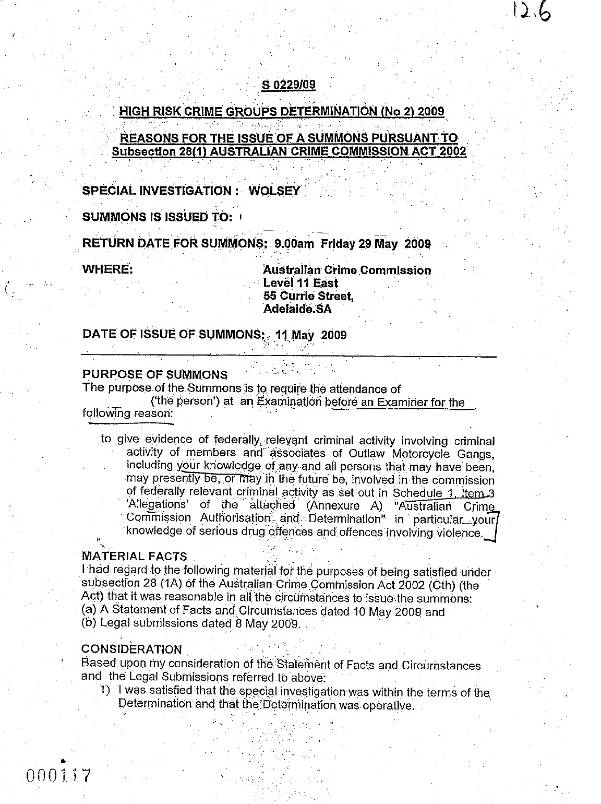
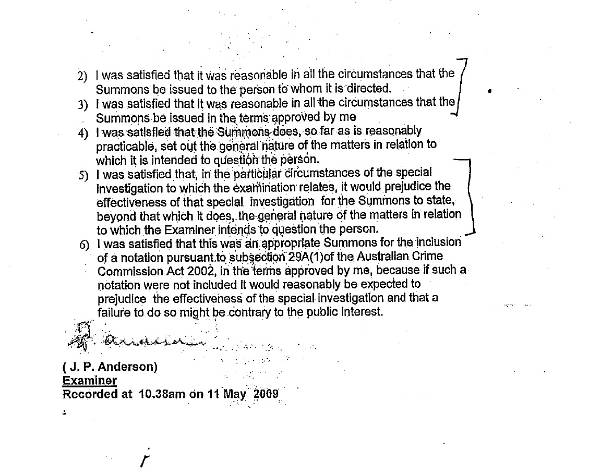
10 The appellant points out that in adopting the present Resolutions some Board members indicated their assent to the CEO or Ms Karla Louise Wass, a Commission employee, rather than to the Chair. He submits that s 7J does not permit a Board member to indicate his or her support for a proposed resolution in that way. The appellant also submits that the Determination is void because the purported resolutions were “adopted before one Board member had even received the Board papers”, and that at least one Board member voted in support of the resolution after it was said to have been carried. This point was put slightly differently in oral argument before us. It was submitted that “One can’t declare [a] resolution carried until [each member has] had ‘… [a] proper opportunity to vote’ ”. These submissions arise out of the fact that on 1 May 2009, the Chair decided that the Resolutions had been adopted at 4.13 pm on 30 April 2009, by which time, in his opinion, the requisite number of members had indicated their support. However two members had not voted at that time. Upon the basis of his decision, the Chair signed the Determination.
11 Both submissions depend upon implied, rather than express procedural requirements. Further, each submission could only lead to invalidity if, on the proper construction of the ACC Act, validity of the Determination depended upon compliance with the relevant implied procedural requirements. See Project Blue Sky Inc v Australian Broadcasting Authority (1998) 194 CLR 355 at [91], where McHugh, Gummow, Kirby and Hayne JJ observed:
An act done in breach of a condition regulating the exercise of a statutory power is not necessarily invalid and of no affect. Whether it is depends upon whether there can be discerned a legislative purpose to invalidate any act that fails to comply with the condition. The existence of the purpose is ascertained by reference to the language of the statute, its subject matter and objects, and the consequences for the parties of holding void every act done in breach of the condition.
12 At [93], their Honours observed:
A better test for determining the issue of validity is to ask whether it was a purpose of the legislation that an act done in breach of the provision should be invalid. … In determining the question of purpose, regard must be had to “the language of the relevant provision and the scope and object of the whole statute”.
13 The primary Judge carefully examined the evidence as to the processes followed by the Board in adopting the Resolutions, making certain findings of fact. Although the appellant disputes his Honour’s ultimate conclusions, he does not challenge his recording of the facts or his primary findings, as opposed to conclusions drawn from those findings. The process adopted by the Board included numerous discussions involving Board members and/or telephone or email communications between the CEO and Ms Wass and Board members. The process extended over some time. During that process some minor textual amendments were made to the Resolutions. At first instance, the appellant submitted that some of those amendments had not been assented to by the necessary number of Board members. The primary Judge found otherwise. We do not understand the appellant to raise any question on appeal concerning those textual amendments. At some stage Ms Wass made one other minor variation to the text of the Resolutions by including the word “the” at a point at which it had obviously been unintentionally omitted. At first instance no point was taken concerning this matter. We do not understand any such point to be taken on appeal.
BOARD PROCEDURE
14 We do not propose to replicate the close examination of the facts of the case undertaken by the primary Judge. We will rather rely upon his recording of the facts and his factual findings, save where we understand the appellant to challenge a particular inference from those facts.
15 In order to understand the process adopted by the Board one must understand the administrative arrangements which were in place for the purpose of facilitating communications between Board members and the Commission. The CEO was a member of the Board but, for present purposes, was not entitled to vote. The Commission employed Ms Wass as its “Manager, Board and Ministerial”. She provided secretarial services to the Board, ordinarily attended Board meetings, and took minutes. She also managed the Board’s records and communications between the Commission and Board members. Such communications were facilitated by use of an Intranet facility called the “Australian Law Enforcement Intelligence Net” (“ALEIN”). This was an electronic document storage system to which Board members had access. Each Board member had a Board Liaison Officer (“BLO”) who also had access to ALEIN. Each BLO was responsible for receiving and dealing with communications between the Commission and the relevant Board member.
16 Ms Wass and the CEO would communicate with individual Board members by uploading relevant communications to ALEIN and then sending emails to the BLOs, asking them to bring the particular correspondence to the attention of their Board members. The BLO was usually an identified person within the relevant Board member’s “home organization”. The primary Judge observed that this arrangement was designed to ensure that important confidential communications could be sent in the expectation that the BLOs would promptly draw such communications to the attention of their Board members. Where there is evidence of communication between the Commission and a Board member we infer that it occurred in this way, save where the context indicates to the contrary. This appears to have been the approach adopted at first instance.
17 On 28 April 2009 the Commission advised Board members that on 30 April there would be “out of session” consideration of proposed resolutions concerning a special investigation. It seems that for operational reasons, a determination had to be made in advance of “coordinated national action against outlaw motor cycle gangs”. On 29 April 2009 Ms Wass prepared two letters, each of which was signed by the CEO and uploaded to ALEIN for dissemination to the BLOs. Attached to the first letter was a statement setting out the basis for the request that the Investigation continue as a special investigation and proposed resolutions which were contained in four discrete paragraphs, (a), (b), (c) and (d). They are set out in the primary Judge’s reasons at [92]. The draft Determination was forwarded to BLOs under cover of the second letter of 29 April 2009. (One must keep in mind the distinction between the Resolutions and the Determination signed by the Chair pursuant to the Resolutions). By this time, pursuant to legal advice, a fifth paragraph (e) had been added to the proposed resolutions. They had also been amended in other minor ways. Attached to the second letter was a revised statement in support of the proposed Determination. The second letter concluded:
Arrangements have been made with most Board members for me to contact you personally to discuss your vote. My office will continue to finalize arrangements for those Board members for whom a teleconference is yet to be organized.
18 On or before 29 April 2009 the CEO informed Ms Wass that six members of the Board, including the Chair, the Commissioner of the Australian Federal Police (Mr Keelty), would be in Darwin on 30 April 2009, and that there was to be a telephone conference on that day between him (the CEO) and Ms Wass in Canberra and the Board members in Darwin. The conference was to commence at 8.45 am AEST. The telephone conference took place. Ms Wass made written notes of the conference and of subsequent events on that day. She also maintained an ongoing typed record of events. The Board members who were in Darwin were Mr Keelty, the Commissioner of the Northern Territory Police (Mr White), the Commissioner of the Queensland Police (Mr Atkinson), the Commissioner of the South Australian Police (Mr Hyde), the Commissioner of the New South Wales Police (Mr Scipione) and the Acting Commissioner of the Tasmanian Police (Mr Hine). After some introductory discussion the CEO informed the meeting that he was to speak to other Board members later in the day, seeking their support for the proposed resolutions. Their responses would be collated and communicated to the Chair on the morning of Friday, 1 May 2009, so that the proposed determination could be signed on that day. In the course of subsequent discussion Mr Atkinson suggested that the proposed resolutions be amended to make it clear that the Board had resolved that ordinary policing methods were unlikely to be effective in the Investigation. A typed record of the amendment was as follows:
It was noted that due to the sophistication of high risk crime groups, their methods of operation, understanding of police methodologies and use of technology these groups have been and are to be considered to continue to be in the future, resistant to ordinary policing methods.
19 The primary Judge concluded that all persons present at the meeting agreed to the proposed resolutions with that amendment. We should say that at first instance, the appellant challenged Mr Hine’s entitlement to vote, asserting that as an acting Commissioner, he was not a member of the Board. The appellant made the same submission concerning Mr Dawson, the acting Commissioner of the Western Australian Police. Mr Dawson was not in Darwin but later indicated his support for the proposed resolutions. In the end, his Honour decided that Mr Hine and Mr Dawson were, for present purposes, members of the Board. That finding is not challenged. It follows that at the meeting in Darwin, six members of the Board agreed to the proposed resolutions, including Mr Atkinson’s amendment.
20 Following the telephone conference Ms Wass sought legal advice from counsel concerning the proposed resolutions. That advice was received at 9.35 am AEST on 30 April 2009. At 9.52 am Ms Wass sent an email to Ms Ashley Milroy (the BLO for the Northern Territory Police Commissioner, Mr White) in which she set out the proposed resolutions which, as she understood it, had been approved by the Darwin group. She requested that the email be distributed to the members of that group. This draft varied from that which had been previously circulated in that a new paragraph (d) had been inserted recording a determination “… that ordinary police methods of investigation into the matters are unlikely to be effective …”, reflecting Mr Atkinson’s proposal. The paragraphs which were previously (d) and (e) became (e) and (f). Further, para (d) of the original draft (para (e) of the new draft) was amended so that instead of reading “… to authorize the ACC to investigate the matter, determined to be a special investigation …” it now read, “… to authorize the ACC to investigate the matter, determines it to be a special investigation …”. Curiously, there is no direct evidence indicating that the group in Darwin considered that final form. However there is no reason to believe that Ms Milroy did not forward Ms Wass’s email to them in accordance with her request.
21 At 10.07 am AEST the CEO and Ms Wass spoke to the Chief Police Officer of the Australian Capital Territory (Mr Phelan). The CEO referred to the material previously sent to Mr Phelan and drew his attention to the changes which had been made to the draft which had been previously circulated. The CEO said that he would send him a copy of the final version. Mr Phelan indicated his support for the proposed resolutions, saying that when he received them in final form he would confirm his support by email. At 10.32 am AEST Ms Wass sent an email to Ms Candice El-Asmar (Mr Phelan’s BLO) in which the precise text of the proposed resolutions was set out in the form sent to Ms Milroy. At 10.30 am Ms Wass sent to all BLOs (including Ms El Asmar) emails in the following form:
Dear Liaison Officers
As you are aware, the ACC is seeking votes today for an urgent out of session determination decision. After discussions with Commissioners Keelty, Scipione, Atkinson, White, Hyde and Acting Commissioner Hine in Darwin this morning, an additional resolution point (see d below) has been added. It would be appreciated if you could pass this information to your Board member. The CEO will bring the change to the attention of members in his discussion.
regards
Karla
22 The amended proposed resolutions were included in the email. At some later stage Ms Wass inserted the word “the” prior to the word “Board” in the third line of paragraph (e). As we have said no point is now taken on appeal concerning any of the textual changes.
23 At 10.48 am AEST the CEO and Ms Wass spoke to Mr Roger Wilkins AO (the Secretary of the Commonwealth Attorney General’s Department). The CEO explained the amendments to the draft resolutions which had previously been circulated, including the terms of the new paragraph (d) which reflected the discussions in Darwin. Mr Wilkins indicated to the CEO and Ms Wass that he supported the proposed resolutions in their revised form and confirmed that he would send an email recording his vote. At 10.56 am AEST the CEO and Ms Wass spoke by telephone with Acting Commissioner Dawson of the Western Australia Police Service. The content of the conversation was similar to that of the conversation with Mr Wilkins. Mr Dawson indicated his support for the proposed resolutions and said that he would confirm by email.
24 At 11.12 am AEST on 30 April 2009 the CEO and Ms Wass spoke to Mr Irvine (the Director General of the Australian Security Intelligence Organization). The conversation followed the same lines as the earlier conversations. Mr Irvine indicated his support and said that he would confirm in writing. At 12.17 pm AEST the CEO and Ms Wass spoke with Mr Carmody (the Chief Executive Officer of the Australian Customs and Border Protection Service). That conversation was also in similar terms to the earlier conversations. Mr Carmody said that he supported the proposed resolutions.
25 There was no telephone contact with Mr O’Callaghan (the Commissioner of the Western Australian Police Service), the Commissioner of the Tasmanian Police, Mr Overland (the Chief Commissioner of the Victorian Police) or Mr Tony D’Aloisio (the Chairman of the Australian Securities and Investments Commission). However the various communications concerning the proposed resolutions were sent to their BLOs.
26 Prior to 4.14 pm AEST on 30 April 2009 confirmatory emails had been received from Messrs Irvine, Phelan, Dawson, Hyde, Scipione, Carmody, White and Wilkins. At first instance the appellant submitted that some of the emails were in ambiguous terms. This point was not pursued on appeal. The primary Judge concluded at [145] that:
[T]he confirmatory emails all relate to the final version of the Board resolutions (that is to say, the six paragraph version sent out generally to BLOs at 10.34 am AEST on 30 April 2009).
27 At [146] his Honour summarized the position as follows:
At the conclusion of the teleconference with Mr Carmody on 30 April 2009 (ie by about 12.27 pm on 30 April 2009), a total of seven Board members had considered the proposed Board resolutions in their final form and indicated their support for those resolutions in that form to the ACC’s head office. These were Messrs Carmody, Hyde, Irvine, Phelan, Scipione, White and Wilkins. Two Acting Commissioners had also indicated support for the resolutions in that form (Mr Hine and Mr Dawson). Two Board members (Chief Commissioner Overland and Mr D’Aloisio) had not been spoken to by the close of business on 30 April 2009. Two other members (Commissioners Keelty and Atkinson) had approved a resolution in terms which did not include the tense change and other change in par [sic] (e) of the final set of resolutions. The permanent Commissioner of the Western Australia Police Service and the permanent Commissioner of the Tasmania Police had not been spoken to at all. Presumably this was because they were unavailable.
28 Thus, at this stage, nine members, including three eligible Commonwealth Board members, had indicated support for the proposed resolutions, apparently satisfying the express requirements of the ACC Act. This count excludes Mr Keelty and Mr Atkinson, although they had clearly indicated their support, save that there is no direct evidence that they had approved the minor textual changes about which no point is now taken.
Execution of the Determination
29 On 1 May 2009, at 8.02 am AEST, Mr Keelty arrived at the Commission’s head office in Canberra and met with the CEO and Ms Wass. Ms Wass gave him a document described as “Vote on ACC Board Out-of-Session Resolution”. Ms Wass had maintained this log of events as they occurred on 30 April 2009. She continued to maintain it throughout 1 May 2009 and eventually finalized it on 4 May 2009. In it she recorded in summary form the substance of the various telephone conferences and emails. She noted that Messrs Keelty, Atkinson, Carmody, Hyde, Irvine, Phelan, Scipione, White, Wilkins, Dawson and Hine had all indicated their support for the proposed resolutions in the form circulated by email to all BLOs at 10.34 am AEST on 30 April 2009. She told Commissioner Keelty that she had not counted the votes of the two acting Commissioners and had recorded the votes of Commissioners Scipione and Hyde only upon receipt of the confirmatory emails. Mr Wilkins was the last of the Board members, who had been contacted by telephone on 30 April 2009, to send in a confirmatory email. Ms Wass considered that the draft resolutions had been passed upon receipt of that email at 4.13 pm AEST. Mr Keelty apparently accepted that proposition. In the course of conversation the CEO told Mr Keelty that all Board members had supported the revised resolutions, with the exception of Mr Overland and Mr D’Aloisio who had not yet voted. He indicated that he was shortly to confer with Mr Overland. Mr Keelty signed the Determination in the presence of the CEO and Ms Wass. This instrument is relied upon as establishing the validity of the Investigation at the time at which the Summons was issued and the validity of the Summons itself. The primary Judge found that the Determination took effect on 1 May 2009 when Mr Keelty concluded that the requirements of s 7J had been met, and not on 30 April as Ms Wass and Mr Keelty had concluded. That matter is of no present relevance.
30 The CEO and Ms Wass then spoke to Mr Overland, explaining to him the events which had occurred. He said that he would look at the matter over the weekend and provide his response on the following Monday, 4 May 2009. At 9.42 am AEST on 1 May 2009 Mr D’Aloisio sent an email to Ms Wass in which he indicated his support for all six paragraphs of the Resolutions in their final form. At 4.47 pm AEST on 4 May 2009 Mr Overland informed Mr Lawler that he supported the Resolutions in their final form.
31 It is not clear when Mr Keelty and Mr Atkinson approved the proposed resolutions in their final form. Such approval might be implied from the fact that Ms Wass had asked Ms Milroy to forward the draft resolutions in their final form to the Board members in Darwin, and that neither had dissented. Mr Keelty obviously agreed to the amendments no later than at the point at which he signed the Determination. It is reasonable to infer that he was aware of Mr Atkinson’s position. In any event, there is now no challenge to the status of the acting Commissioners and no challenge based on the textual amendments. The question is of no importance.
SECTION 7J
32 As we have said, s 7J does not contemplate the holding of a meeting by telephone or by any other means. It rather speaks of a resolution being adopted without consideration at a meeting of the Board. In other words, s 7J dispenses with the need for a meeting. In order that a resolution be adopted pursuant to s 7J, it must be “referred” to all members of the Board. The Shorter Oxford English Dictionary (4th ed, Clarendon Press, 1993) gives as one meaning for the word “refer”:
Commit or hand over (a question, cause, or matter) to some authority for consideration, decision, execution, etc.
33 We adopt that meaning as the relevant meaning for the purposes of s 7J. The proposed resolution must be committed to the individual Board members for their consideration. The various documents circulated on 28 and 29 April 2009 were forwarded to all BLOs. The documents circulated on 30 April 2009 were similarly forwarded. That neither the CEO nor Ms Wass spoke to either Mr Overland or Mr D’Aloisio on 30 April does not mean that the proposed resolutions had not been referred to them as required by s 7J(1)(a). We do not understand the appellant to submit otherwise.
34 Because the Investigation was to be a special investigation, s 7J(1)(b)(ii) applied, so that at least nine members, not including the CEO, but including at least two eligible Commonwealth Board members, had to indicate, by telephone or other mode of communication to the Chair, that they were in favour of the proposed resolutions before they could become “valid and effectual” pursuant to s 7J(2). The plain meaning of s 7J(1)(b)(ii) and s 7J(2) is that upon the occurrence of such events, the resolution is to take effect as if it had been adopted at a Board meeting. Excluding the CEO, the Board consists of 14 people, of whom five are eligible Commonwealth Board members, namely the Commissioner of the Australian Federal Police, the Secretary of the Attorney-General’s Department, the Chief Executive Officer of the Australian Customs Service, the Chairperson of the Australian Securities and Investment Commission and the Director General of Security holding office under the Australian Security Intelligence Organization Act 1979 (Cth). Thus a high degree of unanimity is required in connection with such a resolution.
35 The appellant submits that the expression “indicate by telephone or other mode of communication to the Chair of the Board that they are in favour” requires direct communication between each relevant Board member and the Chair. Thus he submits that communication through either the CEO or Ms Wass did not satisfy the requirements of the section. It is also submitted that in the absence of such direct communication, a relevant member had not indicated that he or she was in favour of the resolutions as contemplated by s 7J.
36 In support of his submission the appellant submits that at a meeting, members would have the opportunity to exchange views, with the possible consequence that some might change their minds or modify their positions. He submits that s 7J should be construed as requiring that there be the opportunity for a similar exchange of views through the Chair. There is nothing in the ordinary meaning of the word “referred” which would support such a construction. The process would be very cumbersome. It is most unlikely to have been the mechanism intended by Parliament. All that the section requires to be “referred” to members of the Board is the resolution with the Chair being the only nominated addressee for their respective responses, if any. It is also said that at a meeting the Chair would be obliged to ascertain the views of the various persons participating and to ensure that he or she understood their positions. No doubt the Chair had to be satisfied that each member, who was counted as voting in favour of the Resolutions, had done so. Nonetheless the words “other mode of communication” must include modes other than face-to-face communication or direct telephone communication between each member and the Chair.
37 We see no basis for excluding other well-established means of communication, including means designed and adopted for the specific purposes of organizations such as the Board and the Commission. Further, while it may be accepted that s 7J contemplates that the decision in respect of a referred resolution will be made personally by a Board member, there is nothing in s 7J which requires that the decision of a Board member must be personally communicated by that Board member to the Chair. As a matter of language, “other mode of communication” readily embraces the communication of a Board member’s decision to the Chair via a nominated person.
38 The appellant seeks to draw an analogy between the s 7J process and the procedures followed at corporate meetings and meetings of creditors in insolvency. Reference is made to authorities relevant in those contexts. Such an approach poses three problems:
it assumes that there are implied procedural requirements in s 7J, which implied requirements are not necessary to give effect to the section;
it depends upon a construction of the section which renders compliance with such implied requirements essential to the validity of any resolution; and
it is inconsistent with the plain meaning of the section.
39 We see no basis for the appellant’s submission. There is no need to find implied procedural requirements in s 7J in order that it fulfil its purpose.
40 In the present case, the system clearly worked. Notification was sent to all Board members in accordance with the established procedure. In that way the proposed resolutions were referred to all Board members. It may be that Mr Overland and Mr D’Aloisio, for reasons unknown, were unable to deal with the matter in a timely way, but that is the price which the community pays for utilizing senior public officials in functions of this kind.
41 The appellant also submits that each member must have the opportunity to vote, and that in this case, the resolutions were effectively adopted before Mr Overland and Mr D’Aloisio had voted. We see no textual basis for that argument. Apart from the special requirements as to the number of votes and the requirement concerning eligible Commonwealth Board members, the only formal requirement is that the proposed resolution be referred to all members. The express language of s 7J(1)(b) defines exhaustively the basis upon which the Board may adopt a resolution other than at a meeting. We see no room for an implied requirement that there be “reasonable opportunity” for all members to vote.
42 The challenge to the validity of the Resolutions must fail. The Resolutions were valid as was the Determination.
VALIDITY OF THE SUMMONS
43 The appellant asserts that s 28(1A) establishes two conditions precedent to the validity of the Summons, namely:
that the Examiner was satisfied that it was reasonable in all the circumstances that the Summons be issued; and
that the Examiner recorded in writing the reasons for issuing the Summons.
44 At first instance the appellant submitted that in the present case, neither condition had been satisfied. The primary Judge found to the contrary.
45 Section 28(8) was inserted in 2007. The relevant explanatory memorandum stated:
This item adds a new subsection 28(8) to the ACC Act to provide that a failure to comply with the requirements set out in subsections 28(1A) – to the extent that the subsection relates to the making of a record – and 28(2) and section 29A of the ACC Act does not render a summons issued under subsection 28(1) invalid.
The purpose of this amendment is to ensure that ACC operations/investigations are not undermined by reason of an examiner’s failure to comply with these technical requirements.
This provision does not apply to substantive procedural obligations, such as the requirements under subsection 28(1A) that the examiner must be satisfied that it is reasonable in all the circumstances to issue the summons and under subsection 28(3) that the summons should, other than in limited circumstances, set out the general nature of the matters in relation to which the examiner intends to question the person.
46 Section 28(8) was again amended by the Crimes Legislation Amendment (Serious and Organised Crime) Act (No 2) 2010 (Cth) which came into operation on 20 February 2010. However that amendment is not relevant for present purposes.
47 The Examiner purported to record his reasons pursuant to s 28(1A). We set out those reasons in Schedule 4. The appellant submits that such “reasons” did not satisfy the requirements of s 28(1A). He also submits that in the absence of adequate reasons the Court should infer that the Examiner was, in fact, not satisfied that it was reasonable, in all the circumstances, to issue the summons. At some points in the appellant’s written outline of submissions (paras 14, 16, 19 and 21) he seems to assert a slightly different case, namely that the Examiner had no good reason for issuing the Summons.
48 Section 28(1) is the ultimate source of the Examiner’s authority to summon the appellant for examination. We consider that he could only have properly exercised the power if there were reason to believe that the appellant might be able to provide information relevant to the special investigation in question. However the requirement in s 28(1A) that he be satisfied that it would be reasonable to issue the summons did not simply address the reason for issuing the summons, namely to compel the attendance for examination of a person who might have relevant information. The word “reasonable” does not generally mean “having reasons”. The Shorter Oxford Dictionary (4th ed, Clarendon Press, 1993) gives the following meanings for the word:
Endowed with the faculty of reason, rational. In accordance with reason; not irrational or absurd. Proportionate. Having sound judgment; ready to listen to reason, sensible. Also, not asking for too much. Within the limits of reason; not greatly less or more than might be thought likely or appropriate; moderate, spec. in price. Of a fair, average, or considerable amount, size, etc. Articulate. Requiring the use of reason.
49 The reasonableness of the decision to issue the summons may depend upon numerous factors, including the degree of likelihood that the recipient has relevant information, its relative importance to the investigation and the inconvenience and other consequences for the relevant person of being compelled to attend and give evidence. In general, the Examiner had to be satisfied that his decision to issue the Summons was in accordance with reason, appropriate or proportionate.
50 It is not difficult to imagine the kind of information likely to be considered in connection with a decision to issue a summons. There will probably be information suggesting that the relevant person may be able to assist in the relevant investigation. There may also be personal information concerning his or her identity, address, employment and family circumstances. The reasons contemplated by s 28(1A) will therefore probably include a description of the circumstances which suggest that the person is able to give evidence bearing upon the special investigation. On one view of the section, such a description might, itself, be sufficient to satisfy the requirements of s 28(1A), at least in the absence of any reason to believe that there are considerations militating against summoning that person. Reasonableness might simply be inferred from the relevance of the information expected to be provided. As far as we know, in the present case there was no particular evidence of countervailing considerations such as significant inconvenience to the appellant or his family. One weakness of the appellant’s case is that there is simply no reason to doubt that the Examiner had adequate reasons for issuing the summons, and that it was reasonable so to do.
51 In considering the adequacy of the Examiner’s reasons, we must keep in mind the fact that the ACC Act does not require that reasons be given to the recipient of the summons. We infer that they are not prepared for any reason associated with the rules of procedural fairness, but rather as a mechanism for ensuring accountability in decision-making. See Barnes v Boulton (2004) 139 FCR 356 at [25]-[29]. To the extent that a decision under s 28 is reviewable pursuant to the ADJR Act, s 13 of that Act (concerning reasons) does not apply. See Sch 2, item (e). We should add that item (ea) may not apply to a special investigation (as opposed to a special operation) save to the extent that it falls within item (ea)(ii). However that is irrelevant for present purposes as item (e) clearly applies. In proceedings under the ADJR Act, or pursuant to s 39B of the Judiciary Act, the reasons produced pursuant to s 28(1A) may be discoverable, subject to questions of public interest immunity. Nonetheless they are not prepared in order to inform the person summoned as to the basis for the summons. Nor are they prepared to assist such person in deciding whether to seek review of the decision. Finally, they are not prepared to assist in judicial review of the decision.
52 In his reasons the Examiner set out the purpose of the Summons, as disclosed in that document. He then stated that, in “being satisfied under s 28(1A) … that it was reasonable in all the circumstances to issue the summons …”, he had regard to “A Statement of Facts and Circumstances” dated 10 May 2009 (the “Statement”) and “Legal submissions” dated 8 May 2009 (the “Submissions”). The Examiner then recorded that, on such basis:
1) I was satisfied that the special investigation was within the terms of the Determination and that the Determination was operative.
2) I was satisfied that it was reasonable in all the circumstances that the Summons be issued to the person to whom it is directed.
3) I was satisfied that it was reasonable in all the circumstances that the Summons be issued in the terms approved by me
4) I was satisfied that the Summons does, so far as is reasonably practicable, set out the general nature of the matters in relation to which it is intended to question the person.
5) I was satisfied that, in the particular circumstances of the special investigation to which the examination relates, it would prejudice the effectiveness of that special investigation for the Summons to state, beyond that which it does, the general nature of the matters in relation to which the Examiner intends to question the person.
6) I was satisfied that this was an appropriate Summons for the inclusion of a notation pursuant to subsection 29A(1) of the Australian Crime Commission Act 2002, In the terms approved by me, because if such a notation were not included it would reasonably be expected to prejudice the effectiveness of the special investigation and that a failure to do so might be contrary to the public interest.
53 We were told that in connection with these proceedings, the Statement and the Submissions were provided to the appellant in redacted forms, but that they were not tendered at first instance. Given the references to the two documents, it is impossible to avoid the inference that the Examiner concluded, on the basis of their content, that there was reason to believe that the appellant had information which was relevant to the Investigation. In those circumstances, we reject the assertion that the reasons document demonstrated no reasons. The appellant submits that the primary Judge so found, apparently referring to his Honour’s reasons at [177]. However his Honour observed at [178] that it was also necessary to look at the Statements and the Submissions which were not in evidence. The appellant seems to challenge the proposition that by his references to those documents, the Examiner effectively included them in his reasons. We consider that they were so included. Such documents would presumably be available to any person or authority having responsibility for supervising the Examiner’s work or the work of the Commission.
54 As we have said, the appellant had access to redacted versions of the documents and chose not to tender them. Had the redacted documents offered no support for the Examiner’s decision, then the appellant would probably have tendered them. Instead, he chose to adopt the quite artificial position that such documents were not effectively part of the Examiner’s reasons. The appellant’s argument implicitly seeks to place upon the respondents the onus of proving that the Examiner’s decision was taken in accordance with the ACC Act. He seeks to do so by pointing to the reasons document, excluding the Statement and the Submissions, and submitting that it was for the respondents to make good the alleged deficiencies in that document. However, in reality, the appellant, himself, created the hiatus in the evidence to which he points, by tendering what is, in fact, an incomplete version of the reasons. In the circumstances, no inference adverse to the validity of the Summons can be drawn from the incomplete reasons document. Further, to the extent that the appellant seeks to rely on the decision in Jones v Dunkel (1959) 101 CLR 298, he fails for the reasons given by Jagot J in SS v Australian Crime Commission (2009) 256 ALR 474 at [47]. In the absence of the Statement and the Submissions, there is no basis for concluding that the reasons were insufficient.
55 If, contrary to our views, the Examiner’s reasons were insufficient, then it would be necessary to decide whether such inadequacy led to invalidity of the summons. We have previously referred to the proposition established by the decision in Project Blue Sky to the effect that the consequence of non-compliance with a statutory procedural requirement is to be determined by reference to the proper construction of the statute. In the present case, even excluding the presence of s 28(8), we find it difficult to construe s 28 as making validity of the Summons dependent upon there being adequate reasons. Once it is accepted that the requirement for reasons is designed to facilitate accountability within the Commission and to those who supervise its operation, it follows that achievement of that objective will not be assisted by treating a summons as invalid simply because of inadequate reasons. However s 28(8) puts the matter beyond doubt. To the extent that s 28(1A) relates to the making of a record, failure to comply with that subsection does not affect the validity of the summons. Nothing in the explanatory memorandum detracts from the plain meaning of s 28(8).
56 Finally, we see no reason to infer that the Examiner did not consider whether it was reasonable to issue the summons. After all, the Examiner said that he had considered the question. If that assertion was manifestly untrue, one would have expected some argument which referred to the contents of the Statement and the Submissions. Instead, the appellant relies upon the assertion that examiners often resort to formulaic recitations of the statutory requirements.
R v LB [2011] NTCCA 4
57 At a time when these reasons were substantially ready for publication and without any related request by either party for the matter to be re-listed for further submissions, we were referred by the appellant to the decision of the Court of Criminal Appeal of the Northern Territory in the abovementioned case. That was an appeal from a decision of Southwood J in proceedings which are described in the Court of Criminal Appeal’s reasons as R v LB (2010) 26 NTLR 209. However we note that in that report, LB’s name is included. Nonetheless we will adopt the nomenclature adopted by the Court of Criminal Appeal, assuming that there must have been some reason for anonymity.
58 At first instance LB was charged with failing to take an oath or affirmation when required to do so in an examination pursuant to s 24A of the ACC Act, contrary to s 30(2)(a) of that Act. Such offence is an indictable offence. The Board had determined that there be a special intelligence operation addressing indigenous violence and child abuse. LB was summoned by an examiner (the same examiner as in the present case) to give evidence. LB appeared in answer to the summons but refused to be sworn or to affirm. He was charged accordingly.
59 Prior to the empanelment of the jury LB indicated that he wished to challenge the validity of the Board’s determination that there be a special intelligence operation on grounds which were broadly similar to those raised in the present case. He also sought to challenge the summons, again on grounds which were broadly similar to those in the present case. The matter was addressed by Southwood J in preliminary proceedings, apparently pursuant to s 26L of the Evidence Act (NT) which provided:
A court dealing with a matter on indictment may, if it thinks fit, hear and determine, before the jury is empanelled, any question relating to the admissibility of evidence and any question of law affecting the conduct of the trial.
60 Southwood J rejected the challenge to the validity of the determination but upheld the challenge to the validity of the summons. At [53] his Honour concluded that a summons could be issued only if three conditions were satisfied, namely:
1. There must be bona fide and rational reasons for the issue of a summons to a particular person in respect of a special ACC operation/investigation.
2. The examiner must record in writing the reasons for the issue of the summons to the person.
3. Before issuing the summons the examiner must be satisfied that it is reasonable in all the circumstances to do so.
61 At [55] and [56] his Honour said:
55 The third condition is not the same condition as the first condition. An examiner is required to record the reasons for the issue of the summons not the grounds on which he is satisfied that it is reasonable to do so. However, unless an examiner directs his mind to the nature of the relevant special ACC operation/investigation, and to the reasons for the issue of the summons including the nature of the matters about which the person who is to be summonsed is to be questioned, an examiner could not be satisfied that it was reasonable in all the circumstances to issue a summons to a witness. Unless there are bona fide and rational reasons for issuing the summons to a particular witness for the purpose of a special ACC operation/investigation an examiner could not be satisfied it was reasonable to issue the summons.
56 Both the first and third conditions are essential and indispensible requirement for the issue of a valid summons under the Act. If they are not fulfilled the summons issued by an examiner will be invalid and an examiner will not have jurisdiction to require a person who appears at an examination in response to the summons to take an oath and make an affirmation. If a person is not lawfully required to attend an examination, he cannot be required to take an oath or make an affirmation at the examination.
62 As in the present case the examiner recorded that he had regard to identified material for the purpose of being satisfied that it was reasonable to issue the summons. The material in question was a statement of facts and circumstances, legal submissions and “my general experience of the determination”. Unlike the present case it seems that the statement of facts and the legal submissions had not been provided to LB in the course of the proceedings, or at least there is no suggestion that they had been supplied.
63 The “purpose of the summons” was said to be:
to require the attendance of [LB] … before an examiner for the following reason: to give evidence of federally relevant criminal activity involving indigenous violence and child abuse and the lawful [sic] sale, supply, trafficking or possession of illegal drugs in indigenous communities.
64 At [59] Southwood J said:
Based upon his consideration of the “statement of facts and circumstances”, the “legal submissions” and his general experience of the determination of the board, Mr Anderson then goes on to record his satisfaction about various matters in the record of his decision to issue the summons. He does not state anywhere in the record of the examiners [sic] decision to issue the summons that he had regard to either the “statement of facts and circumstances” or the “legal submissions” for the purpose of considering the matters about which the accused may be questioned or how or why questioning the accused would further the purposes of the special operation. For example, Mr Anderson does not say the accused is a person who is likely to be able to provide information or intelligence about relevant criminal activity or who is able to identify persons involved in relevant criminal activity or that the accused is a person who may be engaged in relevant criminal activity. He does not do so in circumstances where the Act directs him to record the reasons for issuing the summons.
65 At [60] his Honour recorded his opinion that the examiner had failed to record the reasons for the issue of a summons. At [61] his Honour continued:
In the absence of Mr Anderson being called to give evidence about the reasons for issuing the summons to the accused, a reasonable inference based on his failure to record the reasons for issuing the summons is he failed to consider the reasons for issuing the summons to the accused. In the circumstances he could not have been satisfied that it was reasonable in all the circumstances to issue the summons.
66 At [64] his Honour continued:
It follows from the above that, on the evidence before the court, I am satisfied on the balance of probabilities that Mr Anderson could not have been satisfied that it was reasonable in all the circumstances to issue the summons to the accused. No one could be so satisfied without having had due regard to the reasons for issuing the summons and the matters about which the accused was to be questioned.
67 At [65] his Honour accepted that s 28(8) (in the form which it then took) provided that failure to record the reasons for the issue of the summons did not affect its validity. Thus it seems that Southwood J held that the summons was invalid because his Honour was satisfied, on the balance of probabilities, that the examiner “… could not have been satisfied that it was reasonable in all the circumstances to issue the summons …”. This conclusion was based upon the inference that the examiner had not “ … had due regard to the reasons for issuing the summons and the matters about which the accused was to be questioned.” This inference, in turn, was based upon the perceived inadequacy of the reasons. His Honour did not find that there was insufficient evidence to establish that it was reasonable to issue the summons. His Honour rather inferred, in the absence of adequate reasons, that the examiner had not considered the question.
68 The Crown appealed against the decision that the summons was invalid. The grounds argued on appeal were that:
(2) His Honour erred in finding invalid the summons issued pursuant to s 28 of the Australian Crime Commission Act 2002 (Cth) (the ‘Act’) by Australian Crime Commission Examiner Anderson to the respondent dated 12 February 2009 in so far as he concluded he was “[64 …satisfied on the balance of probabilities that Mr Anderson could not have been satisfied (within the meaning of s 28(1A) of the Act)] that it was reasonable in all the circumstances to issue the summons to the accused” in circumstances where:
a The Examiner’s reasons recited the required satisfaction under s 28(1A) of the Act and there was no suggestion that statement was made in bad faith;
b Section 28(1A) of the Act does not comprise a jurisdictional fact such that on a collateral challenge to the validity of the summons it is a matter for the court itself to be satisfied that the issue of the summons was “reasonable in all the circumstances”; and
c In the alternative, the Examiner’s reasons incorporated by reference “a statement of facts and circumstances” and “legal submissions” neither of which were obtained by the respondent from the Australian Crime Commission, nor tendered on the voir dire. Consequently his Honour Justice Southwood did not have the entirety of the reasons before him and thus mistook the facts or failed to take into account a material consideration in the House v R (1933) 48 CLR 565 sense, and was unable to conclude that the Examiner “could not have been satisfied”; and
(3) The proceedings leading to the judgment appealed from miscarried because the respondent did not identify to the Court, sufficiently or at all, that he was then arguing that an element of the offence charged was that there was a valid summons pursuant to which the respondent appeared before the Examiner; accordingly his Honour:
(a) Applied the wrong procedures;
(b) Denied the Appellant procedural fairness;
(c) Failed to rule on the issue said to have been raised by the respondent.”
69 As to Ground 2 the Court of Criminal Appeal concluded at [28] that “… section 28(1A) of the Act does not comprise a jurisdictional fact such that, on a collateral challenge to the validity of the summons, it is a matter for the Court itself to be satisfied that the issue of the summons was reasonable in all the circumstances”. At [29] the Court formulated the relevant question as being “… whether the examiner could have attained that satisfaction reasonably in the sense explained in numerous authorities …”. At [31] after reference to various High Court decisions, the Court observed:
If there is simply no evidence at all upon which the decision could have been formed by a reasonable person who correctly understood the law, then similarly the basis for the exercise of the power is absent.
70 At [32] the Court concluded that Southwood J had not treated compliance with s28(1A) as being a jurisdictional fact about which he had to be satisfied. The Court considered that his Honour had rather held that “… the record of reasons for the issue of the summons in this case was not a record of reasons at all”. At [34] the Court observed that:
His Honour’s approach was to consider the reasons and to decide whether those reasons showed that there were facts upon which the examiner could be satisfied that it was reasonable to issue the summons. That approach is in accordance with the relevant authorities.
71 The Court of Criminal Appeal then considered the submission that the statement of facts and legal submissions had been incorporated into the reasons by reference, referring to the decision of Foster J at first instance in the present case. The Court considered that although the reasons suggested that those documents provided facts which the examiner had considered, “… nowhere does the reasons document itself explain the relevance of any of that material, or set out any reasoning process by reference to that material.” The Court then suggested that in any event it was for the Crown to lead evidence of the content of those other documents, particularly as they had not been provided in answer to a subpoena for production of the reasons. The Court concluded that inferences could be drawn from the Crown’s failure to put the documents into evidence.
72 Finally, the Court dealt with a submission that the failure to provide reasons did not affect the validity of the summons because of the operation of s 28(8). This submission apparently reflected the view expressed by Jagot J in SS (supra) at [92] where her Honour said:
If the failure to make a record cannot affect the validity of the summons then it necessarily follows that the deficiency of such a record also cannot affect the validity of the summons. To conclude otherwise would be contrary to the express will of parliament embodied in s 28(8) of the ACC Act. Accordingly, in so far as SS’s submissions under these grounds related to the alleged deficiency of the reasons per se as a source of invalidity of the summons, the submissions must be rejected.
73 At [45] the Court of Criminal Appeal referred to the above passage and, at [46], observed:
The difficulty with this argument is that it would negate any power by the Court to consider whether in fact the examiner had considered the facts and the law correctly in accordance with the decisions of the High Court to which we have earlier referred. All that section 28(8) provides is that that the failure to properly record the reasons is not in itself sufficient to enable a finding to be made that the summons was invalid. But once the Court is called upon to find as a fact whether or not the examiner did have the relevant satisfaction, that is a different question. In the circumstances of this case, the accused did all that could be reasonably expected of him to put before the Court such material as disclosed the reasons of the examiner. Those reasons were defective and in those circumstances, it is our opinion that the learned Judge’s conclusion was correct. Furthermore, we reject the view of Jagot J that drawing a Jones v Dunkel inference would be converting mere “conjecture and suspicion into inference”.
74 Ground 3 is not strictly relevant to the matter with which we are presently concerned, but it explains the context in which the case was decided, both at first instance and on appeal. It seems that on appeal, the Crown submitted that the issues before Southwood J had been:
whether the attempt to compel LB to swear or affirm was unlawful given the alleged absence of a valid summons;
if so, then, whether there was a discretion to exclude evidence that LB had been required to swear or affirm and had refused so to do; and
whether the discretion should be exercised.
75 It seems that those issues were raised at first instance, but LB submitted that he had also asserted that existence of a valid summons was an element of the offence charged and therefore had to be proven. At [58] the Court of Criminal Appeal observed that a permanent stay was appropriate because “… it appears that the case is hopeless because the Crown cannot bring any evidence to prove its case”. Such absent evidence was as to the validity of the summons, the absence being the result of the conclusion that such evidence as there was pointed to invalidity rather than validity. Neither at first instance nor on appeal was the matter disposed of by way of an exercise of the discretion to exclude evidence.
76 It is no part of our duty to consider the correctness or otherwise of the ultimate decision reached by Southwood J or of that of the Court of Criminal Appeal. However, to the extent that the decision of the Court of Criminal Appeal informs the proper construction of s 28, we are obliged to pay due deference to it. In order to determine whether it informs such construction, we must understand the context in which the decision was made. No doubt at least partly because of our lack of understanding of criminal practice in the Northern Territory, it is a little difficult to understand that context. The reference to s 26L in the reasons of the Court of Criminal Appeal suggests that Southwood J considered either a question relating to the admissibility of evidence or a question of law affecting the conduct of the trial. An application for the exclusion of evidence might well be raised and determined pursuant to that section. That procedure would also be appropriate for consideration of a submission that on the available evidence, no jury, properly instructed, could be satisfied to the requisite standard as to a particular element of the offence. However Southwood J concluded that he was satisfied on the balance of probabilities that the examiner did not have the requisite degree of satisfaction as to the reasonableness of issuing the summons.
77 As we understand criminal practice, factual questions are for the jury, save where it is submitted that there is, as a matter of law, no evidence upon which the jury, properly directed, could be satisfied beyond all reasonable doubt as to an essential element of the offence charged. Consideration of that question does not require that the trial Judge be satisfied on the balance of probabilities as to anything. Questions of admissibility, including the exercise of a discretion to exclude evidence, may raise questions of fact to be determined by the trial judge on the civil standard of proof, but that seems not to have been the basis upon which LB was resolved, either at first instance or on appeal.
78 In any event, there are at least two clear differences between the context in which s 28 was considered in LB and that of the present case. First, the decision in LB concerning the validity of the summons arose in circumstances in which the Crown was obliged to prove such validity beyond reasonable doubt, assuming that the question was properly raised by the defence. In the present case, it was for the appellant to satisfy the primary Judge that the summons was invalid, necessarily assuming the onus of demonstrating that the examiner had not considered the question of reasonableness. The second, and associated difference is that in the present case, redacted versions of the Statement and the Submissions were provided to the appellant who chose not to put them into evidence. In LB the court drew inferences adverse to the Crown from its failure to tender similar documents. In this case, as the appellant bore the onus of proof and had access to those documents, inferences adverse to the appellant may be drawn from his failure to tender them.
79 We do not advance these differences as a merely colourable basis for distinguishing the decision in LB from the present case so as to avoid paying due deference to that decision. We accept that our decision, in some respects, is at odds with the decision in LB. The difference appears to arise substantially from our view that the reasons required by s 28(1A) are not for the purpose of informing either a court reviewing the decision to issue a summons or the person summoned. That view leads us to conclude that much less is required to satisfy the requirements of s 28 than was demanded by Southwood J and the Court of Criminal Appeal. We also have great difficulty in seeing how, in the present case, the reasons can be assessed without reference to the Statement and the Submissions. Further, we do not accept that one may infer, in this case, from any inadequacy of the reasons, that the Examiner did not consider the question of reasonableness. Finally, we respectfully adopt the general observations made by Jagot J in SS at [93]-[97].
80 Although little has been said about the subject, either in this case or in LB, we should say something about the presumption of regularity, if only because our having been referred to LB prompts us so to do. In The King v Brewer (1942) 66 CLR 535, a relevant issue in a criminal prosecution was whether or not one Ritchie had been appointed to a particular public office. Latham CJ and McTiernan J held, at 548, that:
Acting in a public office is evidence of due appointment to that office, not only in civil proceedings but also in a criminal case … . The presumption that his appointment was duly made is not met by any rebutting evidence … . The conclusion, therefore, is that Ritchie was appointed to serve in the Canteens Service and that his service therein was service under the Crown.
81 The presumption is not limited to conclusions about the holding of public office or the performance of public duties. See Wright v Bastin (No 2) [1979] VR 329 at 339. However the presumption of regularity is generally thought to have been limited in its operation by the decision of the Judicial Committee of the Privy Council in Dillon v The Queen [1982] AC 484. In that case a police officer was charged with the offence of negligently permitting prisoners to escape from lawful custody, a necessary element of the offence being that the prisoners were in a lawful custody. The Crown submitted that it did not have to prove that fact as it could rely upon the presumption of regularity. In other words, it argued that the fact that the prisoners were in custody founded a presumption that they were in lawful custody. Of this argument their Lordships said at 487:
Their Lordships are of the opinion that it was essential for the Crown to establish that the arrest and detention were lawful and that the omission to do so was fatal to the conviction of the defendant … . The lawfulness of the detention was a necessary precondition for the offence of permitting escape, and it is well establish that the courts will not presume the existence of facts which are central to an offence … .
…
On the other hand, there is not likely to be any difficulty for the Crown in proving the lawfulness of the detention, when it exists. Production of the warrant for arrest, or of a magistrate’s order for detention, or of a suitable certified copy, is normally all that is required, and it should be in the possession of the person in charge of the prison or lock-up.
82 Although the Judicial Committee was not willing to infer regularity from the fact of imprisonment, their Lordships did not hold that, in general, it was necessary to prove the validity of any instrument which authorized such detention. Thus the case was quite unlike that with which we are presently concerned. The presumption has been examined in a number of Victorian cases concerning breathalyser legislation, the most recent of which appears to be Impagnatiello v Campbell (2003) 6 VR 416. The offence required that the prosecution prove that a sample of breath furnished for examination by a breath analyzing instrument recorded, indicated or showed the presence of more than the prescribed concentration of alcohol in the blood. The term “breath analysing instrument” was defined in s 3 of the Act. The question was whether the instrument used for performing the analysis was authorized by the Act. The legislation provided numerous ways in which the prosecutor might have proven that fact, none of which had been adopted. It was submitted that, in conducting the breath test, the relevant police officer was performing a public duty, and that it could therefore be presumed that in so doing he had complied with all statutory conditions for such performance. At [25], Eames JA said:
In the present case, even assuming that the respondent was indeed performing a public duty, rather than exercising a mere discretion, there was nothing in the circumstances of the performance of that duty that would give rise to a presumption that he would comply with the condition that he used a machine which had the appropriate identification under s 3. This was not, therefore a situation such as Lush J described, where “the mind may be satisfied of the likelihood of correct observance of [the Act] and of the unlikelihood of the lack of observance of its conditions”.
83 At [26] his Honour continued:
As those cases demonstrate there can be a place for the operation of the presumption in a criminal case. In my opinion, however, there is direct authority against the operation of the presumption in proof of an element such as we are concerned with in this case … .
84 The decision in Dillon was referred to as supporting this position. Neither Dillon nor Impagnatiello necessarily supports the proposition that even in a criminal prosecution, the validity of a warrant or summons cannot be proven by reliance upon the presumption of regularity. Both cases seem to accept that an element of an offence may be proven by producing relevant documentary evidence and, presumably, assuming the regularity of its genesis. That is not to say that such regularity may not be put in issue. Whatever may have been the case in LB, we do not accept that the established facts in this case lead to the conclusion that the Examiner was not satisfied as to the reasonableness of issuing the summons.
ORDERS
85 The appeal is dismissed with costs.
| I certify that the preceding eighty-five (85) numbered paragraphs are a true copy of the Reasons for Judgment herein of the Honourable Justices Dowsett, Cowdroy and Logan. |
Associate:
SCHEDULE 1
7C Functions of the Board
(1) The Board has the following functions:
(a) to determine national criminal intelligence priorities;
(b) to provide strategic direction to the ACC and to determine the priorities of the ACC;
(c) to authorise, in writing, the ACC to undertake intelligence operations or to investigate matters relating to federally relevant criminal activity;
(d) to determine, in writing, whether such an operation is a special operation or whether such an investigation is a special investigation;
(e) to determine, in writing, the class or classes of persons to participate in such an operation or investigation;
(f) to establish task forces;
(g) to disseminate to law enforcement agencies or foreign law enforcement agencies, or to any other agency or body of the Commonwealth, a State or a Territory prescribed by the regulations, strategic criminal intelligence assessments provided to the Board by the ACC;
(h) to report to the Inter-Governmental Committee on the ACC’s performance;
(i) such other functions as are conferred on the Board by other provisions of this Act.
Special operations
(2) The Board may determine, in writing, that an intelligence operation is a special operation. Before doing so, it must consider whether methods of collecting the criminal information and intelligence that do not involve the use of powers in this Act have been effective.
Special investigations
(3) The Board may determine, in writing, that an investigation into matters relating to federally relevant criminal activity is a special investigation. Before doing so, it must consider whether ordinary police methods of investigation into the matters are likely to be effective.
Further details
(4) A determination under subsection (2) or (3) must:
(a) describe the general nature of the circumstances or allegations constituting the federally relevant criminal activity; and
(b) state that the relevant crime is, or the relevant crimes are or include, an offence or offences against a law of the Commonwealth, a law of a Territory or a law of a State but need not specify the particular offence or offences; and
(c) set out the purpose of the operation or investigation.
Informing the Inter-Governmental Committee
(5) The Chair of the Board must, within the period of 7 days beginning on the day a determination under subsection (2) or (3) is made, give a copy of the determination to the Inter-Governmental Committee.
When determination takes effect
(6) A determination under subsection (2) or (3) has effect immediately after it is made.
7D Board meetings
(1) The Chair of the Board may convene meetings of the Board.
(2) The Chair, in exercising his or her power to convene meetings, must ensure that meetings of the Board are scheduled to meet the following requirements:
(a) the first meeting of the Board must be within 2 months after the commencement of this section;
(b) there must be a minimum of 2 meetings each calendar year;
(c) the Board must meet in accordance with the schedule of Board meetings determined by the Board under this section.
(3) The Board, at its first meeting, must determine, in writing, a schedule of Board meetings.
7E Presiding at Board meetings
A meeting of the Board must be presided over by:
(a) if the Chair of the Board is present--the Chair; or
(b) otherwise--another eligible Commonwealth Board member who is present and who is nominated, in writing, by the Chair to preside.
7F Quorum at Board meetings
At a meeting of the Board a quorum is constituted by 7 Board members (not including the CEO).
7G Voting at Board meetings
(1) Subject to this section, a question arising at a meeting of the Board is to be determined by a majority of the votes of Board members present.
Person presiding has a casting vote
(2) The person presiding at a meeting has:
(a) a deliberative vote; and
(b) if necessary, also a casting vote.
CEO is not a voting member
(3) The CEO is not entitled to vote on any question arising at a meeting of the Board.
Voting for special ACC operations/investigations
(4) The Board cannot determine that an intelligence operation is a special operation, or that an investigation into matters relating to federally relevant criminal activity is a special investigation, unless at least 9 Board members (including at least 2 eligible Commonwealth Board members) vote in favour of making the determination.
7H Conduct of Board meetings
(1) The Board may regulate proceedings at its meetings as it considers appropriate.
Note: Section 33B of the Acts Interpretation Act 1901 provides for people to participate in meetings by various means of communication (e.g. telephone).
(2) The Board must ensure that minutes of its meetings are kept.
7J Resolutions outside of Board meetings
(1) This section applies to a resolution:
(a) which, without being considered at a meeting of the Board, is referred to all members of the Board; and
(b) of which:
(i) if subparagraph (ii) does not apply--a majority of those members (not including the CEO); or
(ii) if the resolution is that the Board determine that an intelligence operation is a special operation, or that an investigation into matters relating to federally relevant criminal activity is a special investigation--at least 9 Board members (not including the CEO but including at least 2 eligible Commonwealth Board members);
indicate by telephone or other mode of communication to the Chair of the Board that they are in favour.
(2) The resolution is as valid and effectual as if it had been passed at a meeting of the Board duly convened and held.
7K Board committees
(1) The Board may, with the unanimous agreement of all the members of the Board (not including the CEO), establish a committee or committees to assist in carrying out the functions of the Board.
(2) The Board may dissolve a committee at any time.
Functions
(3) The functions of a committee are as determined by the unanimous agreement of all the members of the Board (not including the CEO).
(4) However, the Board cannot determine that a committee has the function of determining whether an intelligence operation is a special operation or whether an investigation into matters relating to federally relevant criminal activity is a special investigation.
(5) In performing its functions, a committee must comply with any directions given to the committee by the Board.
Voting
(6) A question arising at a meeting of a committee is to be determined by a majority of the votes of committee members present.
(7) However, the CEO is not entitled to vote on any question arising at a meeting of a committee of which he or she is a member.
Informing other Board members of decisions
(8) A committee must inform the other members of the Board of its decisions.
Conduct of committee meetings
(9) A committee may regulate proceedings at its meetings as it considers appropriate.
(10) A committee must ensure that minutes of its meetings are kept.
Section 24A Examinations
An examiner may conduct an examination for the purposes of a special ACC operation/investigation.
Section 28 Power to summon witnesses and take evidence
(1) An examiner may summon a person to appear before an examiner at an examination to give evidence and to produce such documents or other things (if any) as are referred to in the summons.
(1A) Before issuing a summons under subsection (1), the examiner must be satisfied that it is reasonable in all the circumstances to do so. The examiner must also record in writing the reasons for the issue of the summons. The record is to be made:
(a) before the issue of the summons; or
(b) at the same time as the issue of the summons; or
(c) as soon as practicable after the issue of the summons.
(2) A summons under subsection (1) requiring a person to appear before an examiner at an examination must be accompanied by a copy of the determination of the Board that the intelligence operation is a special operation or that the investigation into matters relating to federally relevant criminal activity is a special investigation.
(3) A summons under subsection (1) requiring a person to appear before an examiner at an examination shall, unless the examiner issuing the summons is satisfied that, in the particular circumstances of the special ACC operation/investigation to which the examination relates, it would prejudice the effectiveness of the special ACC operation/investigation for the summons to do so, set out, so far as is reasonably practicable, the general nature of the matters in relation to which the person is to be questioned, but nothing in this subsection prevents an examiner from questioning the person in relation to any matter that relates to a special ACC operation/investigation.
(4) The examiner who is holding an examination may require a person appearing at the examination to produce a document or other thing.
(5) An examiner may, at an examination, take evidence on oath or affirmation and for that purpose:
(a) the examiner may require a person appearing at the examination to give evidence either to take an oath or to make an affirmation in a form approved by the examiner; and
(b) the examiner, or a person who is an authorised person in relation to the ACC, may administer an oath or affirmation to a person so appearing at the examination.
(6) In this section, a reference to a person who is an authorised person in relation to the ACC is a reference to a person authorised in writing, or a person included in a class of persons authorised in writing, for the purposes of this section by the CEO.
(7) The powers conferred by this section are not exercisable except for the purposes of a special ACC operation/investigation.
(8) A failure to comply with any of the following provisions does not affect the validity of a summons under subsection (1) of this section:
(a) subsection (1A) of this section, in so far as that subsection relates to the making of a record;
(b) subsection (2) of this section;
(c) section 29A, in so far as that section relates to a summons under subsection (1) of this section.
Section 29A Disclosure of summons or notice etc. may be prohibited
(1) The examiner issuing a summons under section 28 or a notice under section 29 must, or may, as provided in subsection (2), include in it a notation to the effect that disclosure of information about the summons or notice, or any official matter connected with it, is prohibited except in the circumstances, if any, specified in the notation.
(2) A notation must not be included in the summons or notice except as follows:
(a) the examiner must include the notation if satisfied that failure to do so would reasonably be expected to prejudice:
(i) the safety or reputation of a person; or
(ii) the fair trial of a person who has been or may be charged with an offence; or
(iii) the effectiveness of an operation or investigation;
(b) the examiner may include the notation if satisfied that failure to do so might prejudice:
(i) the safety or reputation of a person; or
(ii) the fair trial of a person who has been or may be charged with an offence; or
(iii) the effectiveness of an operation or investigation;
(c) the examiner may include the notation if satisfied that failure to do so might otherwise be contrary to the public interest.
(3) If a notation is included in the summons or notice, it must be accompanied by a written statement setting out the rights and obligations conferred or imposed by section 29B on the person who was served with, or otherwise given, the summons or notice.
(4) If, after the ACC has concluded the operation or investigation concerned:
(a) no evidence of an offence has been obtained as described in subsection 12(1); or
(b) evidence of an offence or offences has been assembled and given as required by subsection 12(1) and the CEO has been advised that no person will be prosecuted; or
(c) evidence of an offence or offences committed by only one person has been assembled and given as required by subsection 12(1) and criminal proceedings have begun against that person; or
(d) evidence of an offence or offences committed by 2 or more persons has been assembled and given as required by subsection 12(1) and:
(i) criminal proceedings have begun against all those persons; or
(ii) criminal proceedings have begun against one or more of those persons and the CEO has been advised that no other of those persons will be prosecuted;
all the notations that were included under this section in any summonses or notices relating to the operation or investigation are cancelled by this subsection.
(5) If a notation is cancelled by subsection (4), the CEO must serve a written notice of that fact on each person who was served with, or otherwise given, the summons or notice containing the notation.
(7) If:
(a) under this section, a notation in relation to the disclosure of information about:
(i) a summons issued under section 28; or
(ii) a notice issued under section 29; or
(iii) any official matter connected with the summons or notice;
has been made and not cancelled; and
(b) apart from this subsection, a credit reporting agency (within the meaning of section 11A of the Privacy Act 1988 ) would be required, under subsection 18K(5) of the Privacy Act 1988 , to make a note about the disclosure of the information;
such a note must not be made until the notation is cancelled.
(8) In this section:
official matter has the same meaning as in section 29B.
SCHEDULE 2
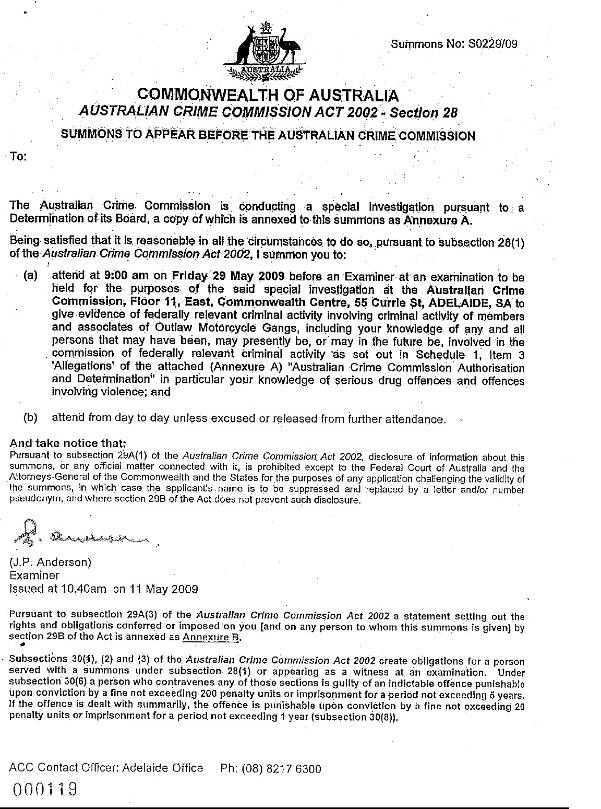
SCHEDULE 3
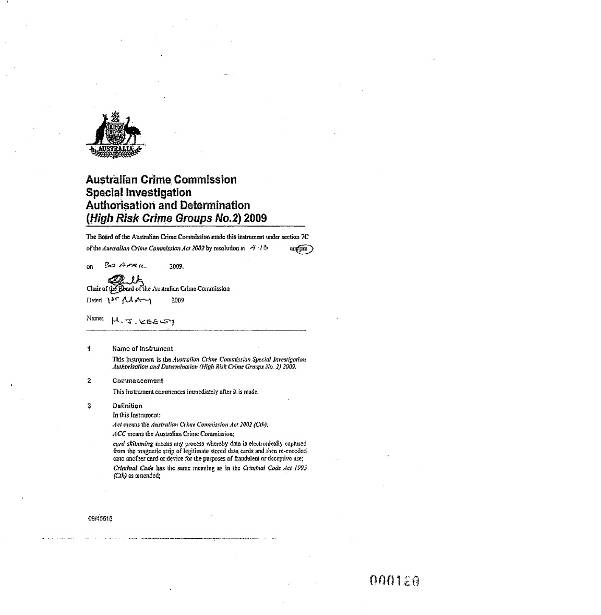
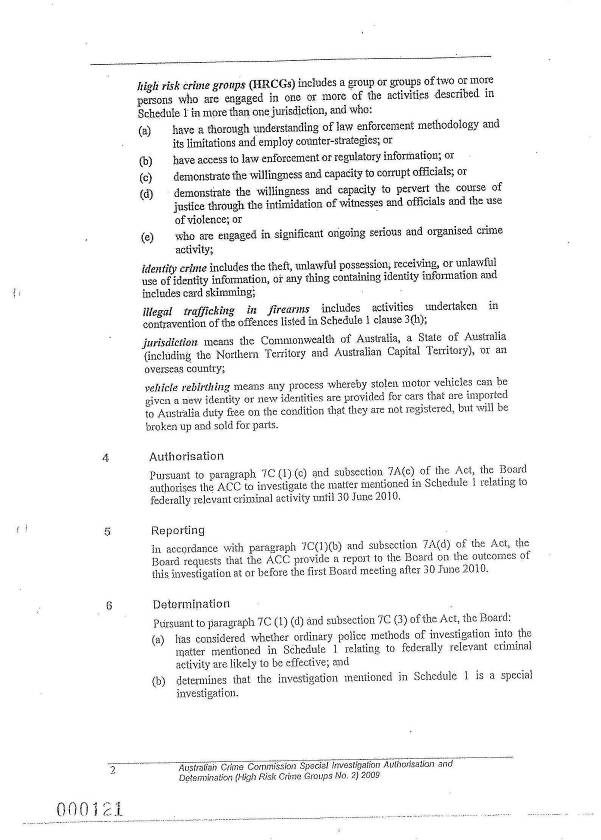
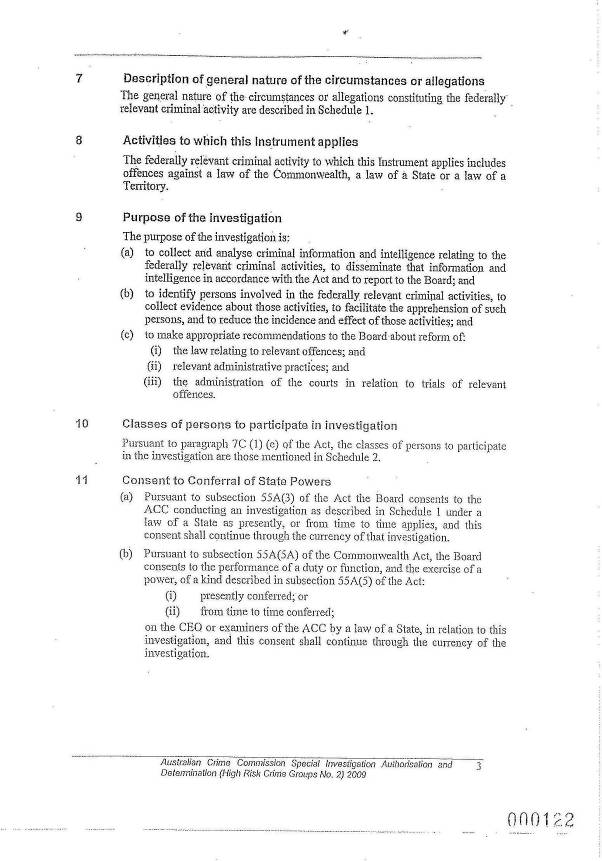
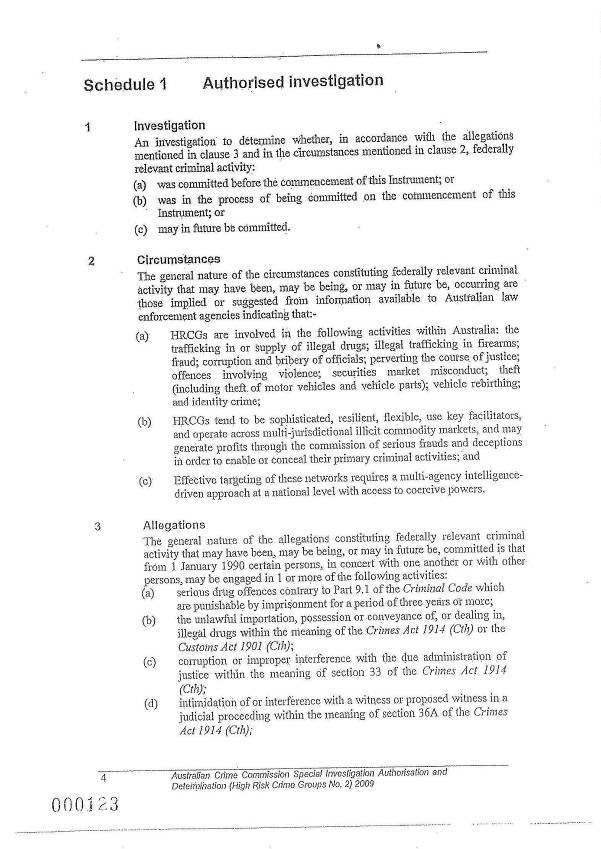
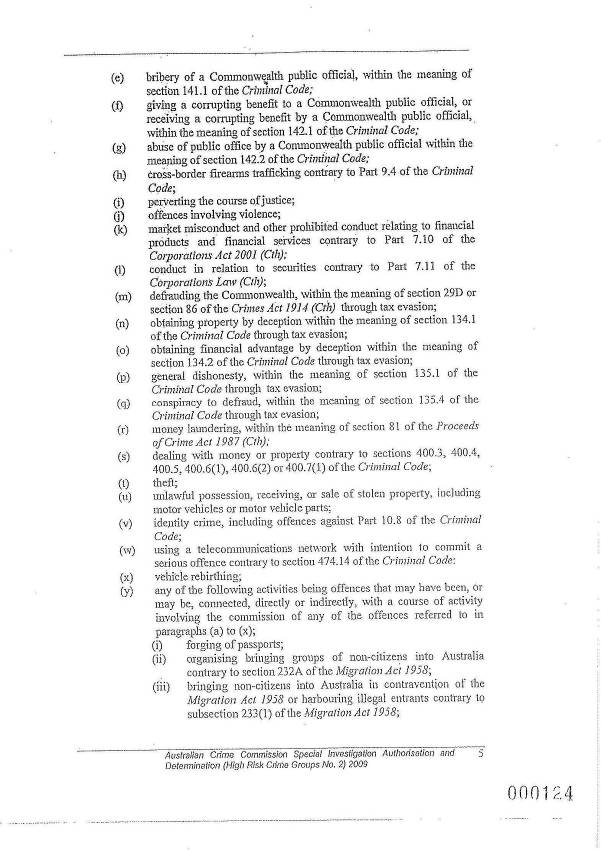
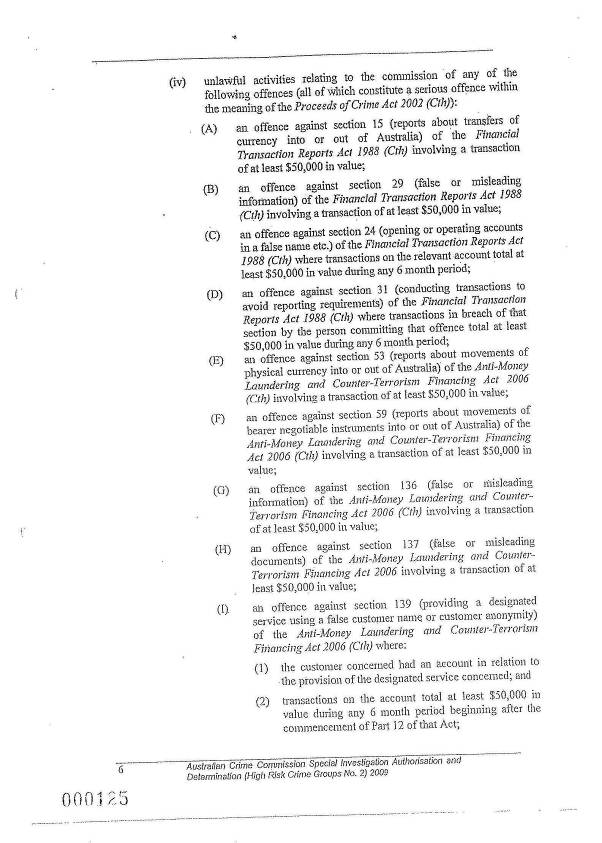
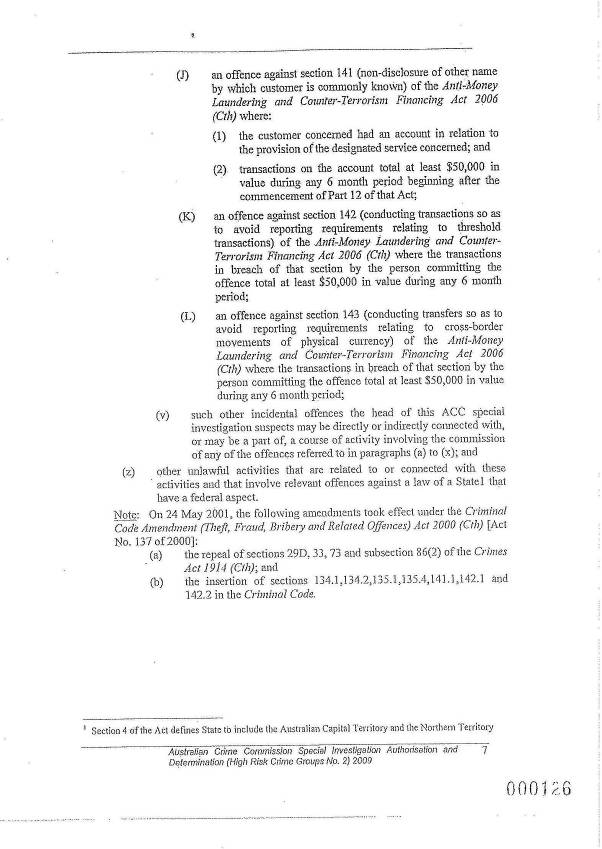
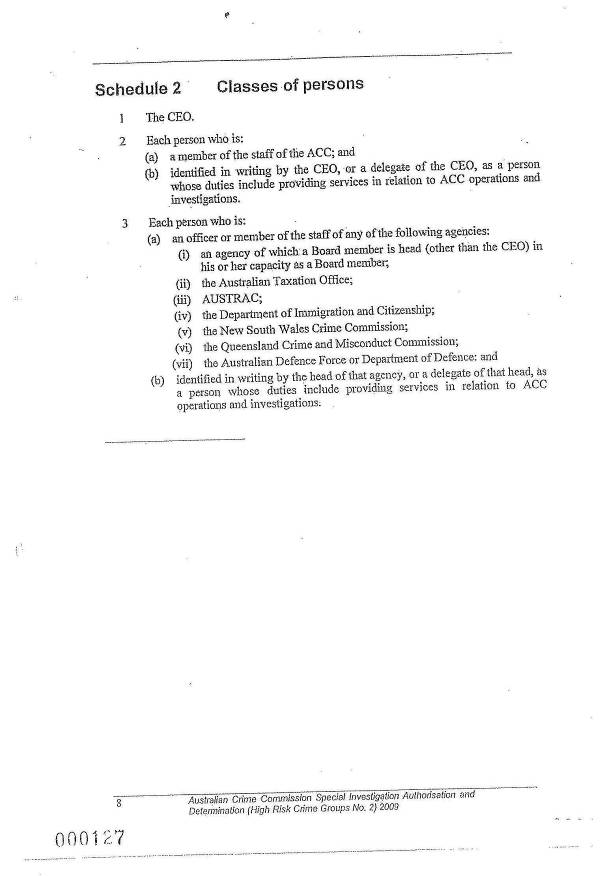
SCHEDULE 4