

FEDERAL COURT OF AUSTRALIA
Dynamic Hearing Pty Ltd v Polaris Communications Pty Ltd [2010] FCAFC 135
| IN THE FEDERAL COURT OF AUSTRALIA | |
| DYNAMIC HEARING PTY LTD (ACN 098 876 212) Appellant | |
| AND: | POLARIS COMMUNICATIONS PTY LTD (ACN 006 102 601) First Respondent PLANTRONICS PTY LTD (ACN 080 486 193) Second Respondent |
| DATE OF ORDER: | |
| WHERE MADE: |
THE COURT ORDERS THAT:
1. The Appellant be granted leave to appeal in so far as may be necessary.
2. The Appeal be dismissed.
3. The Appellant pay the First Respondent’s costs of the appeal.
4. There be no order as to the costs of the Appeal as between the Respondents.
Note: Settlement and entry of orders is dealt with in Order 36 of the Federal Court Rules. The text of entered orders can be located using Federal Law Search on the Court’s website.
| VICTORIA DISTRICT REGISTRY | |
| GENERAL DIVISION | VID 753 of 2009 |
| ON APPEAL FROM THE FEDERAL COURT OF AUSTRALIA |
| BETWEEN: | DYNAMIC HEARING PTY LTD (ACN 098 876 212) Appellant |
| AND: | POLARIS COMMUNICATIONS PTY LTD (ACN 006 102 601) First Respondent PLANTRONICS PTY LTD (ACN 080 486 193) Second Respondent |
| JUDGES: | MOORE, BESANKO AND GORDON JJ |
| DATE: | 19 NOVEMBER 2010 |
| PLACE: | MELBOURNE |
REASONS FOR JUDGMENT
MOORE J:
1 I have had the considerable benefit of reading the reasons for judgment of both Besanko J and Gordon J in a draft form. I agree with the qualifications Gordon J makes to the conclusions of Besanko J. I otherwise agree with Besanko J. Leave to appeal, if necessary, should be given and the appeal should be dismissed with costs. The appellant should pay the first respondent's costs of the appeal and otherwise there should be no order as to costs.
| I certify that the preceding one (1) numbered paragraph is a true copy of the Reasons for Judgment herein of the Honourable Justice Moore. |
Associate:
| IN THE FEDERAL COURT OF AUSTRALIA | |
| VICTORIA DISTRICT REGISTRY | |
| GENERAL DIVISION | VID 753 of 2009 |
| ON APPEAL FROM THE FEDERAL COURT OF AUSTRALIA |
| BETWEEN: | DYNAMIC HEARING PTY LTD (ACN 098 876 212) Appellant |
| AND: | POLARIS COMMUNICATIONS PTY LTD (ACN 006 102 601) First Respondent PLANTRONICS PTY LTD (ACN 080 486 193) Second Respondent |
| JUDGES: | MOORE, BESANKO AND GORDON JJ |
| DATE: | 19 NOVEMBER 2010 |
| PLACE: | MELBOURNE |
REASONS FOR JUDGMENT
BESANKO J:
INTRODUCTION
2 This is an appeal by Dynamic Hearing Pty Ltd from various orders made by a judge of this Court, including a declaration and an injunction. The primary judge’s orders do not dispose of the proceeding. The question of whether the first respondent is entitled to damages or compensation has not been determined. The appellant seeks leave to appeal and a grant of leave is not opposed by the first respondent. It is appropriate that, in so far as may be necessary, the appellant be granted leave to appeal from the primary judge’s orders.
3 The first respondent to the appeal is Polaris Communications Pty Ltd and it was the applicant in the proceeding before the primary judge. There were two respondents, being the present appellant and Plantronics Pty Ltd. Plantronics Pty Ltd has not appealed against the orders made by the primary judge, but it has been joined as a second respondent to the appeal. At the hearing of the appeal, it appeared by counsel and submitted that if Dynamic Hearing Pty Ltd was successful in its appeal and the orders of the primary judge against it were set aside, then those orders should also be set aside as against it. It referred to the power given to this Court in s 28(3) of the Federal Court of Australia Act 1976 (Cth).
4 The two principal orders made by the primary judge were a declaration and an injunction. The declaration was in the following terms:
The respondents have:
(a) engaged in conduct that is misleading or deceptive, or likely to mislead or deceive, in contravention of s 52 of the Trade Practices Act 1974 (Cth) and s 9 of the Fair Trading Act 1999 (Vic); and
(b) in connection with the supply or possible supply of goods or in connection with the promotion of the supply of such goods, made false or misleading representations with respect to the standard, quality or grade of such goods, in contravention of s 53(a) of the Trade Practices Act 1974 (Cth) and s 11 of the Fair Trading Act 1999 (Vic),
by publishing and distributing a report entitled “Comparisons of Acoustic Shock Protection Devices – Plantronics ADRO M15D versus the Polaris SoundShield” (“the comparison report”) which contains the following misrepresentations:
(i) that the applicant’s SoundShield device is unsuitable for use in call centres because of its poor intelligibility when background noise is present;
(ii) that the applicant’s SoundShield device fails to comply with the Telstra intelligibility requirement of 90% intelligibility in call centre environments with conversational chatter to 55dBA;
(iii) that the applicant’s SoundShield device is unsuitable for TT4 compliant operation so far as speech intelligibility is concerned; and
(iv) that the testing reported in the comparison report was a properly conducted scientific test.
5 The injunction was in the following terms:
The respondents, and each of them, whether by themselves, their servants or agents or howsoever otherwise, be forthwith permanently restrained from:
(a) further publishing, distributing, circulating or communicating the comparison report or the results of the testing reported therein;
(b) causing the comparison report or the results of the testing reported therein to be further published, distributed, circulated or communicated; or
(c) otherwise representing by reason of or by reference to the comparison report or the results of the testing reported therein that the applicant’s SoundShield device:
(i) is unsuitable for use in call centres because of its poor intelligibility when background noise is present;
(ii) does not comply with the Telstra intelligibility requirement of 90% intelligibility in call centre environments with conversational chatter to 55dBA; or
(iii) is not suitable for TT4 compliant operation so far as speech intelligibility is concerned.
6 In these reasons I will refer to Dynamic Hearing Pty Ltd as the appellant, Polaris Communications Pty Ltd as the respondent and Plantronics Pty Ltd as Plantronics.
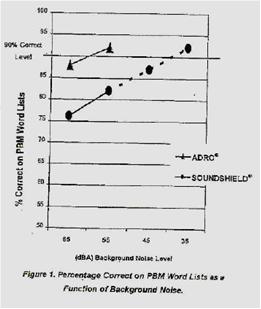
BACKGROUND
7 The case before the primary judge related to a comparison report concerning acoustic shock protection devices. These devices are amplifiers which are commonly used to limit the level of sounds heard by call centre workers and to reduce the risk of acoustic shock which the workers sometimes experience. The devices which were compared used digital signal processing.
8 Since 2001, the respondent has sold a limiting amplifier called SoundShield. That device is designed through the use of internal settable controls to be inter-operable with a wide range of host telephones and any type of headset. Since September 2006, Plantronics has sold a competing limiting amplifier called M15D, which is designed solely for use with equipment made by Plantronics.
9 The M15D was developed as a result of collaboration between Plantronics and the appellant which commenced in early 2005. The collaboration was called the “Tecate” project and it was designed to produce a limiting amplifier to compete with SoundShield and, in particular, to compete with SoundShield in relation to Telstra which was a major customer for limiting amplifiers. Telstra had its own requirements for limiting amplifiers and those requirements were set out in Telstra’s specification TP TT404B51 called, “Specification – Headset & Limiting Amplifier, Acoustic Protection” (“TT4”).
10 In early 2005, the respondent was a supplier of devices to Telstra and, in fact, it had been sole supplier to Telstra since December 2001. The arrangement was due to come to an end in December 2004, but in fact it continued until mid-2005.
11 In the course of the Tecate project, the digital signal processing software for the M15D was developed. That software was known as ADRO.
12 In mid-2005, the appellant distributed a report entitled “Comparisons of Acoustic Protection Devices – Plantronics ADRO® M15D versus the Polaris SoundShield®” (“comparison report”). The tests which were carried out for the purposes of the comparison report were performed in May 2005. The primary judge found as follows (at [75]):
On 10 May 2005 Dynamic undertook the speech intelligibility test the subject of the comparison report. The test used a Plantronics H51 TT3 headset with each of the devices set to the lowest limiting setting. Headset profile 1 was used in SoundShield. The combination of lowest limiting setting and headset profile 1 in SoundShield was its general market mode and not that used in Telstra call centres. Similarly, the lowest limiting setting of M15D was its proposed general market mode and not the proposed Telstra mode. The testing used the same input levels for each device. Before carrying out this test, Professor Blamey did a pre test for intelligibility with himself as the subject.
13 There is no challenge to these findings.
14 The tests were carried out by Ms Christi Wise. Ms Wise was not called as a witness at the hearing, although documents which she had completed in May 2005 (for example, test lists, score sheets) were tendered in evidence.
15 The authors of the comparison report were said to be Ms Wise, Mr Bonar Dickson, Ms Hayley Fiket and Professor Peter Blamey. Mr Dickson and Professor Blamey gave evidence before the primary judge; Ms Wise and Ms Fiket did not.
16 The comparison report under a section headed “Background” explains the need for superior sound processing in call centres and the problems caused by background noise in such centres. It then contains a section which refers to the ADRO or M15D in laudatory terms and which explains the comparison tests carried out.
The ADRO® processing scheme developed by Dynamic Hearing Pty Ltd is designed to deal with these difficult listening situations without degrading or distorting the sound. ADRO® was developed to meet specifications for acoustic shock protection whilst also providing superior sound quality and intelligibility in comparison to existing products. It uses a set of fuzzy logic rules to adjust gain so that the output signal is always within the comfortable and audible range of the listener. The system produces a high level of speech understanding, while also maintaining a comfortable loudness level and a high sound quality.
To demonstrate its superior abilities, ADRO® was compared with SOUNDSHIELD® in a simulated call centre environment. The SOUNDSHIELD® is a handset amplifier commonly used in Australian call centres to provide protection from acoustic shock. The Plantronics Supra Monaural H51 TT3 headset was used with both ADRO® and SOUNDSHIELD®. Both headset amplifiers were adjusted to the lowest limiting setting and the maximum volume setting, as is typically done by phone operators to provide maximum intelligibility in quiet and in noise. The receive signal level was the same for both devices.
17 The comparison report then refers to a test known as the Phonetically Balanced Monosyllable (“PBM”) word test which was carried out and draws conclusions as to the advantages of ADRO or M15D in terms of intelligibility.
The Phonetically Balanced Monosyllable (PBM) word test was presented in typical call centre background noise levels (55 66dBA) to eight adults with normal hearing who were asked to repeat all the words that they heard.
In low level ambient noise (55dBA), the error rate for SOUNDSHIELD® (18%) was double that of ADRO® (9%). In moderate level background noise (65dBA), the error rate for SOUNDSHIELD® increased to 26%, whilst the error rate for ADRO® only increased to 12%.
Extrapolation of the PBM results for different background noise levels are shown in Figure 1. To achieve an intelligibility score of 90% with the SOUNDSHIELD®, the background noise level of the call centres would have to be reduced to an unrealistic level of about 40dBA. ADRO® on the other hand, easily achieved 90% intelligibility with call centre background noise at a level of 55dBA.
18 Figure 1 in the comparison report is as follows:
19 The comparison report then refers to a test where the test subjects were asked to rate their impressions of the amplifiers in terms of loudness, sound quality and overall impression for two levels of background noise (that is, 55 and 65 dBA). Figure 2, which shows the results of the test, is as follows:
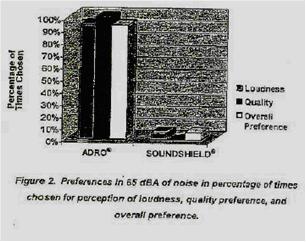
20 These results were said in the comparison report to be “highly statistically significant indicating that the sound quality differences were obvious to the listener”.
21 The report identifies certain advantages of being able to hear well under challenging conditions and then contains a statement that:
ADRO is G616 compliant and suitable for TT4 compliant operation.
22 The comparison report contains the following statement under the heading “Acknowledgments”:
The research that resulted in this report was conducted at Dynamic Hearing, Richmond, Australia. The work was covered by ethics approval from the Royal Victorian Eye and Ear Hospital Human Research and Ethics Committee (Project 03 529H).
23 There is then a list of publications under the heading of “References” and the report concludes with statements that ADRO is a registered trade mark of the appellant and SoundShield is a registered trade mark of the respondent.
24 In the middle of 2005 the appellant provided a copy of the comparison report to Telstra, which gave a copy of it to the respondent on a confidential basis. Plantronics provided a copy of the report to Siemens, which was then its exclusive distributor in Australia of acoustic shock protection devices and telephone headsets, for the purposes of distribution. Plantronics also gave a copy of the comparison report to Westpac. The comparison report was distributed in long and short form; it was only the report in short form (which I have summarised above) which was in issue in the proceeding before the primary judge.
25 At the time the comparison report was produced, SoundShield was the dominant acoustic protection device in the market. There had been many sales of SoundShield, a substantial proportion of which had been made to Telstra. At the time the comparison report was produced, Telstra was in the process of preparing a request for tender for the ongoing supply to it of acoustic protection devices. The tender was worth a considerable amount to the successful tenderer. The appellant and Plantronics proposed to put in tenders.
26 In May 2005, there were two types of call centres that were potential markets, being those conducted by Telstra and the general market conducted by entities other than Telstra. Telstra made up approximately one third of the market and the other entities made up approximately two thirds. TT4 contained a range of technical requirements which acoustic protection devices had to satisfy if they were to be purchased for use in Telstra’s call centres. The primary judge found that the stated intent of TT4 was to minimise the symptoms of acoustic shock whilst maintaining speech intelligibility of not less than 90 per cent with background voice chatter to 55 dBA and with acoustic treatment to provide 49 dB acoustic attenuation between adjacent workstations: clauses 3 and 5.2.2. The primary judge found that the intelligibility requirement in TT4 was operative in May 2005 and there is no challenge to that finding.
27 There are other guidelines or rules which should be mentioned. G616 is Australian Communications Industry Forum (“ACIF”) Guideline “Acoustic safety for telephone equipment”. It was published in 2004. It is a non-binding general Australian guideline for acoustic safety for telephone equipment. As a condition of a device being marketed as an acoustic shock protection device, it imposes an acoustic limit of 102 dBA SPL at DRP measured by the use of pulsed tones over a time interval of 125 milliseconds. SPL means Sound Pressure Level and DRP means (ear) Drum reference point. In May 2005 there was also an Australian Standard, S004, which was administered by the Australian Communications and Media Authority and which required the output of acoustic shock protection devices to be limited to 118 dB. It was a mandatory Standard, but it did not have an intelligibility requirement.
THE APPLICANT’S CASE
28 The case of the applicant in the Court below (respondent before this Court) was that by implication the comparison report made a number of representations which were misleading or deceptive. For the purposes of the appeal two categories of representations are relevant. First, there are the representations referred to as the test set up representations, being representations about how the tests were set up and carried out. Secondly, there are the representations referred to as the unsuitability representations, being representations about unsuitable features or qualities of SoundShield. The allegation that various representations constituting the test set up representations were made in the comparison report was admitted by the appellant. Although Plantronics did not admit the making of the representations before the primary judge, it has not appealed against the finding that they were made. The appellant denied that the alleged unsuitability representations were made in the comparison report.
29 The primary judge identified the class of persons who, having received the report, were likely to be influenced by it. The primary judge identified the class as managerial staff contemplating the purchase of acoustic shock protection devices for use in call centres. Such persons were likely to have a familiarity with call centre conditions and the way they operate. They would know the types of telephone calls their operators receive, and they would be aware of the phenomenon of acoustic shock and the practice of reducing the risk of that shock by the use of devices such as SoundShield. They were also likely to be aware that SoundShield was commonly used in Australian call centres. I will refer to a member of this class as the informed reader.
30 There was no challenge to the primary judge’s identification of the characteristics of the informed reader.
The Representations
31 The test set up representations were as follows:
the test on which [the comparison report] was based was a properly conducted scientific test designed and undertaken with an appropriate level of skill, independence and expertise for the purpose of a proper comparison of the two devices tested;
the test conditions were not biased to favour one device over the other, but instead were an accurate reflection of the conditions normally experienced in call centres;
both devices were appropriately set up for the test conditions; and
the results of the test were an accurate reflection of the relative performance of the two devices in call centres.
32 The respondent advanced a case to the primary judge that the test set up representations were misleading or deceptive by reason of one or more of nine circumstances, failures or deficiencies in the conduct of the tests. Those matters were as follows:
1. The tests were carried out with a 100 mV input signal. That was a high signal. The receive gain setting for the SoundShield device was MID when in fact it should have been a setting of HIGH;
2. The headset profile used in the tests should have been profile 18 not profile 1;
3. SoundShield had a proven record of acceptable performance in call centres;
4. The existence of a commercial arrangement between the appellant and Plantronics;
5. The results of a comparative test carried out by Plantronics in July 2005;
6. The appellant should have done a further test before publication in light of the widespread use of SoundShield and the results of the comparative test carried out by Plantronics in July 2005;
7. The comparison test did not contain a suitable control condition;
8. The appellant did not follow the randomisation table in its test protocol; and
9. The appellant failed to properly inform itself of the appropriate settings for SoundShield and did not use an appropriately trained installer to install or check the SoundShield device.
33 The unsuitability representations which were pleaded by the respondent were as follows:
1. SoundShield is unsuitable for use in call centres because of its poor intelligibility where background noise is present;
2. SoundShield does not comply with the Telstra intelligibility requirement; and
3. SoundShield is not suitable for TT4-compliant operation and is not G616 compliant.
THE PRIMARY JUDGE’S REASONS
34 The primary judge heard evidence from a number of witnesses. The key witnesses (as far as the appeal is concerned) are Professor Philip Newell, Mr Michael Fisher (witnesses called by the respondent) and Professor Blamey (a witness called by the appellant).
35 Professor Newell is an Emeritus Professor at the Speech, Hearing and Language Research Centre, which is part of the Linguistics Department at Macquarie University. He is a qualified audiologist with postgraduate degrees in biomechanics and audiology. The primary judge said:
…he has a detailed understanding of the different factors that affect speech, sound and signal quality generally, including the way devices such as hearing aids, amplifiers and telephone equipment operate to modify sounds and signals, and the effects of those modifications on human hearing and speech intelligibility generally.
36 The appellant did not challenge Professor Newell’s expertise, but did challenge his independence. The primary judge rejected the appellant’s challenge to Professor Newell’s independence in so far as it was based on his letter of instructions and the fact that he was one of the supervisors of Mr Fisher’s research for a PhD. He noted Mr Fisher’s involvement in setting up a test performed by Professor Newell and said that that was to be borne in mind in assessing the weight to be accorded to the results.
37 Mr Fisher is a senior research engineer employed by Australian Hearing at National Acoustic Laboratories (“NAL”). He has a broadcasting certificate, a broadcast operator’s certificate of proficiency and has a Bachelor of Communication Engineering degree from RMIT. In his thirteen years with NAL, he has undertaken research in audio signal processing, acoustics, digital signal processing, hearing, hearing impairment, psychoacoustics and speech analysis. Mr Fisher was the inventor of SoundShield and he receives a small distribution of the royalties paid to a company called Hearworks Pty Ltd by the respondent. He had also assisted the respondent with implementing the software in the SoundShield device. The primary judge did not doubt Mr Fisher’s expertise although he noted that Mr Fisher was anxious to prove that the results in the comparison report were wrong.
38 Professor Blamey was formerly Chief Technology Officer and a director of the appellant. He ceased to be a director in December 2007, although he remains an adviser to the appellant. Since 2002 he has been a Professorial Fellow in the Department of Otolaryngology at the University of Melbourne. Before then he had research appointments in that Department from 1979. His qualifications were in physics and his business interests were in the commercial application of digital signal processing for hearing aids, headsets and telephony products. The primary judge said that he was a witness of truth and that for the most part he accepted his evidence. It is clear that he did not accept all of his evidence. For example, he described Professor Blamey’s evidence about the confidential call centre’s settings as “confusing and unsatisfactory”.
39 It is convenient to set out a brief overview of the primary judge’s conclusions and then to examine in detail his conclusion in relation to each matter.
40 The primary judge found that the first, third and fourth of the test set up representations were misleading or deceptive by reason of the following matters:
1. The test upon which the comparison report was based did not contain a suitable control condition;
2. In conducting the test, the appellant did not follow the randomisation table in the test protocol; and
3. The appellant did not inform itself adequately of the appropriate settings for SoundShield in the test conditions, nor did it enlist the assistance of a person appropriately trained in the installation of SoundShield.
41 In grounds 1-11 inclusive of its Notice of Appeal, the appellant challenges each of these three conclusions. The respondent has filed an Amended Notice of Contention (amended without opposition from the appellant) and in it the respondent asks this Court to uphold the second and third conclusions on different grounds to those relied on by the primary judge.
42 The primary judge found that the first two unsuitability representations were made. As to the third representation he found that it was made in part in that it was represented that SoundShield was not suitable for TT4-compliant operation so far as speech intelligibility is concerned. The primary judge found that each representation was misleading or deceptive.
43 In ground 12(i) of its Notice of Appeal the appellant challenges the primary judge’s conclusion that the first unsuitability representation was made. It does not argue that, if made, the representation was not misleading or deceptive. By contrast, in the case of the second and third unsuitability representations, the appellant challenges both the finding that the representation was made and, assuming that it was made (that is, contrary to the appellant’s first argument) that it was misleading or deceptive (Grounds 12(ii) and (iii) – 19 of its Notice of Appeal).
44 In the result, the primary judge found that three of the four test set up representations and the three unsuitability representations (as modified by him) were misleading or deceptive, or likely to mislead or deceive within s 52 of the Trade Practices Act 1974 (Cth) (“TPA”) and s 9 of the Fair Trading Act 1999 (Vic) (“FTA”). For ease of reference, I will simply use the expression “misleading or deceptive”. The primary judge also found that the unsuitability representations were conduct in breach of s 53(a) of the TPA and s 12(a) of the FTA.
45 It should be noted that the primary judge’s declaration refers to all of the unsuitability representations, but only to part of the first of the test set up representations (that is, that the testing reported in the comparison report was a properly conducted scientific test) (see [4] above).
The test set up representations
The test upon which the comparison report was based did not contain a suitable control condition
46 The primary judge concluded that the test set up representations were misleading or deceptive because there was no suitable control condition, that is to say, no testing without the use of either the M15D device or the SoundShield device to determine whether there was a proper correlation between the use of the devices and the intelligibility responses of the people tested.
47 The primary judge referred to the evidence of witnesses called by the respondent (Professor Newell and Mr Fisher) to the effect that there was a need for a control condition. He referred to the evidence of Professor Blamey to the effect that the SoundShield device was itself the control condition. He referred to Mr Fisher’s response to the suggestion that SoundShield itself was the control condition to the effect that a test without any device was necessary in order to ensure that those conducting the test knew the source of any errors or flaws in their experimental set up.
48 The primary judge referred to the appellant’s protocol with the Ethics Committee which under the heading “Sound quality experiments” stated that “Experiments will include control conditions without the algorithm applied and experimental conditions with the algorithm applied”.
49 The primary judge concluded that while Professor Blamey’s statement may be consistent with the sentence in the Ethics Committee protocol he preferred the evidence of Professor Newell and Mr Fisher that a control condition was one which did not involve either of the devices under comparison. The primary judge said:
In my view it is not appropriate to use a device with a different algorithm as a control to test a particular algorithm. Accordingly, the comparison test was not a properly conducted scientific test, and the representation that it was such a test was misleading.
In conducting the test, the appellant did not follow the randomisation table in the test protocol
50 The primary judge noted that it was common ground that the appellant’s test protocol was not followed in that the results as recorded did not follow the randomisation table. He noted that there was a paucity of evidence as to the object of randomisation and the significance of departure from it and that that made it difficult to determine whether departure from the randomisation table meant that the test was not a properly conducted scientific test.
51 The appellant’s protocol referred to the randomisation of noise levels and starting conditions, the performance of the tests in random order, all noise levels and conditions being randomly varied and assigned to each participant and to samples being randomised. The primary judge did not find the protocol of “much help”. Nor was the randomisation table itself informative.
52 The primary judge concluded that randomisation was “an important part of the test” while at the same time recognising that the material available was “meagre”. The primary judge said that there must have been a significant reason for including randomisation in the protocol. He referred to the fact that the protocol states that all tests are performed in random order so as to test the systems’ capability of dealing with rapid change and said that the suggested failure to follow randomisation may affect the result of the comparison. He also referred to the fact that Professor Blamey had conceded that there had been a failure to follow the randomisation table, but had not asserted that the failure had no statistical or other significance to the end result.
The appellant did not inform itself adequately of the appropriate settings for SoundShield in the test conditions, nor did it enlist the assistance of a person appropriately trained in the installation of SoundShield
53 The primary judge concluded that the appellant and Plantronics did not know all the proper settings before they did the comparison test. Although they selected the correct headset profile, they selected the wrong receive gain setting for a 100 mV input signal. There was evidence from Professor Blamey, Mr Gherbaz and Mr McNeill (the latter two witnesses were called by Plantronics) that they did not know of the correct receive gain settings and yet the appellant carried out the test without either asking the respondent for the correct settings or doing another test on different settings. The primary judge expressed his conclusions as follows (at [198]):
… Having regard to its incomplete knowledge of the relevant settings, the test set up representations were misleading because the test was not a properly designed and conducted scientific test, SoundShield was not appropriately set up for the test conditions and the results of the test were not an accurate reflection of the relative performance of the two devices in call centres. ...
The unsuitability representations
SoundShield is unsuitable for use in call centres because of its poor intelligibility where background noise is present
54 The primary judge noted the following statement in the comparison report:
To achieve an intelligibility score of 90% with the SoundShield, the background noise level of the call centres would have to be reduced to an unrealistic level of about 40 dBA.
55 The primary judge referred to the fact that the test carried out for the purposes of the comparison report was one which used the PBM word test with typical call centre background noise levels. He referred to the difference between a word test and a sentence test. In the case of a sentence test, call centre operators resort to the context in which words are used and potential gaps are thereby filled. The opinion of the founder of the respondent (Mr Trevor Guest) that the comparison report suggested that there was a “one word in five” error rate in the case of SoundShield because of the statements set out in [17] above was proved incorrect by Professor Blamey’s evidence that an 80 per cent word score on a PBM word test meant that users would still be scoring close to 100 per cent on sentences in a typical call centre environment.
56 Despite that conclusion, the primary judge concluded that the statement set out in [54] above implied that SoundShield was unsuitable for use in call centres because of its poor intelligibility when background noise was present because the passage “transposes a word test based result into a call centre environment, and uses that result for the conclusion that for SoundShield to achieve 90 per cent intelligibility, the background noise level of the call centre would have to be reduced to an unrealistic level” (primary judge’s emphasis).
57 The primary judge rejected the appellant’s submission that he should not draw this conclusion because of the statement in the comparison report to the effect that SoundShield was a headset amplifier commonly used in Australian call centres to provide protection from acoustic shock.
58 Before the primary judge, the respondent also relied on the two figures in the comparison report, Figure 1 and Figure 2, to support its contention that the first unsuitability representation was made in the report. The primary judge referred to a dispute between the experts as to whether the linear extrapolation was appropriate. He said that he did not need to resolve that dispute because Figure 1 in the comparison report was a pictorial representation of the words set out in [54] above and the Figure and the sentence explain each other, and the sentence relied on carried the implication asserted by the respondent. The primary judge noted that by the end of the trial the respondent had abandoned any reliance on Figure 2.
59 As I have said, the appellant did not claim that this representation (if made) was not misleading or deceptive.
SoundShield did not comply with the Telstra intelligibility requirement
60 Clause 5.2.2 of TT4 required speech intelligibility of 90 per cent in call centre environments with conversational chatter to 55 dBA and with attenuation between workstations of at least 49 dB. I set out the relevant part of clause 5.2.2:
5.2.2 Intelligibility Requirements
• Intelligibility for incoming electrical speech signals which have a level of 15 +/12 dBm0 (3Σ spread)
Intelligibility (Speech Intelligibility of 90%) is required in call centre environments with conversational chatter to 55 dBA and with attenuation between workstations of at least 49 dB. The intelligibility must be also achieved in a test environment with 55 dBA Pseudo Call Centre Chatter (see definitions and main body text).
Intelligibility will be assessed to ITU-T Recommendations P80, P82, or equivalent.
61 The primary judge accepted evidence given by Professor Blamey that the comparison tests carried out by the appellant were not tests conducted to TT4 specifications.
62 The primary judge referred to the sentence in the comparison report set out in [54] above and the sentence which followed it:
Adro on the other hand, easily achieved 90% intelligibility with call centre background noise at a level of 55 dBA.
63 The primary judge said that the reader of the report, especially one with a Telstra affiliation, would recognise the 90 per cent at 55 dBA as Telstra’s speech intelligibility requirement and would take from the statements that SoundShield did not comply with Telstra’s speech intelligibility requirement. His Honour said:
The 90% at 55 dBA has only one reference point to anyone with knowledge of the specifications applicable in Australia, and that is TT4. Dynamic was promoting the report as being concerned with TT4 compliance. It contained the statement that M15D was suitable for TT4 compliance.
64 The appellant contended that even if the second unsuitability representation was made, the respondent had not established that it was misleading or deceptive. The primary judge concluded that SoundShield complied with Telstra’s intelligibility requirement based on a test conducted by Mr Fisher in July 2007 and a test conducted by Professor Newell in October 2007.
65 The primary judge rejected an argument that SoundShield did not comply with Telstra’s intelligibility requirement because it did not satisfy the requirements of Table 5.9 of TT4.
66 The primary judge referred to Table 5.9 of TT4 as a complicated document. It is part of clause 5.2.8 which provides, relevantly:
5.2.8 Levels at Input to Limiting Amplifier
The limiter/headset combination must accommodate the signal levels at the interface to a typical range of CPE.
…
It is essential that correct operation be achieved with the typical range of inputs from the various CPE as tabulated below.
The unit will perform within specification for the range of levels below. This may be achieved by the use of internally settable controls or by other means as determined by the manufacturer.
CPE stands for Customer Premises Equipment.
67 The primary judge set out part of Table 5.9 and a description of some of its features:
The table, part of which is rendered below, includes columns dealing with “Level at input to limiter”. Column 1 deals with CPE with low level output to limiter input. Column 2 deals with CPE with mid level output to limiter input. Column 3 deals with high level output to limiter input. The introductory column describes the material in the numbered columns:
| (Col 1) | (Col 2) | (Col 3) | |
| Long Term Max Active Speech … | 192mV RMS | 272mV RMS | 700mV RMS |
| Long Term Mean Active Speech … | 48mV RMS | 68mV RMS | 175mV RMS |
| Long Term Min Active Speech … | 12mV RMS | 17mV RMS | 44mV RMS |
The description of the table located at its foot is:
Table of amplifier input levels available at the headset or handset port of the typical range of CPE. CPE introduces a variable level between the input from the network and the port to which the amplifier is connected. To be able to function with a range of CPE the amplifier/headset combination must have a range of settings, which can accommodate the level and wire function requirements. The settings to accommodate the various CPE must be internal settings, which are not accessible in day to day operation … Note: Column 3 requirement may not be required. Check with Product Manager.
68 The primary judge said that he did not need to come to a conclusion about “this very controversial table” because he was satisfied that, if properly set up, SoundShield would achieve speech intelligibility of 90 per cent in call centres with voice chatter to 55 dBA. Properly set up meant set up by an appropriately trained person using the Manual and set at the appropriate level:
If the customer insisted on an input of 100 mV, the installer would select the HIGH setting in accordance with the instruction in the Manual …
69 The primary judge concluded that this matter and Telstra’s past and continuing custom for SoundShield and the fact there were very few complaints of intelligibility problems in relation to SoundShield’s set up by appropriately trained installers was sufficient to support the conclusion that SoundShield complies with Telstra’s intelligibility requirement.
SoundShield is not suitable for TT4-compliant operation and is not G616 compliant
70 The comparison report was concerned only with intelligibility for speech. G616 has no intelligibility requirement. The primary judge found that nothing in the comparison report gave rise to any implication about SoundShield’s compliance with G616.
71 The primary judge found that the comparison report did give rise to an implication that SoundShield was not suitable for TT4-compliant operation. The primary judge referred to the word “suitable” in the pleaded representation and said that he understood that to mean capable of meeting the intelligibility standard required by TT4, “as opposed to being TT4 compliant in the more general sense”.
72 The pleaded representation arose by implication from the comparison report because of the sentences in the report set out in [17] (third paragraph, second and third sentences) above. The primary judge said:
That is because, while speech intelligibility (90% at 55 dBA) is only one TT4 requirement, non-satisfaction with it results in a device’s non-compliance, even if all other requirements are satisfied.
73 The representation was misleading or deceptive because SoundShield was suitable for TT4-compliant operation so far as speech intelligibility was concerned. The primary judge reached that conclusion relying on the matters referred to in [69] above.
THE NATURE OF THE APPEAL
74 The jurisdiction of this Court to hear appeals from judgments of single judges of the Court is conferred by s 24(1)(a) of the Federal Court of Australia Act 1976 (Cth). The powers of the Court are contained in s 27 and s 28. The appeal to this Court is by way of rehearing and the review of the primary judge’s findings of fact is to be conducted in accordance with the principles stated in Warren v Coombes (1979) 142 CLR 531. The powers of the Court include the power to affirm, reverse or vary the judgment appealed from and to give such judgment, or make such order, as, in all the circumstances, it thinks fit, or refuse to make an order.
75 Each party made submissions about the error which must be shown before this Court will interfere with the decision and orders of the primary judge.
76 The appellant referred to the fact that the appeal was an appeal by way of rehearing (Astrazeneca Pty Limited v GlaxoSmithKline Australia Pty Limited [2006] ATPR 42-106; [2006] FCAFC 22). It also referred to the following passage in the reasons for judgment of Kirby J in CSR Ltd v Della Maddalena (2006) 224 ALR 1 at 7 [16]; [2006] HCA 1:
Requirements and limitations: The form of rehearing so provided “shapes the requirements, and limitations, of such an appeal”. The relevant “requirements” are that the appellate court is obliged to conduct a thorough examination of the record and a real rehearing. It is not confined to reconsideration of the record in order to correct errors of law, although that will certainly be encompassed in such an appeal. It is required to consider suggested errors of fact-finding. Experience teaches that many errors of this kind arise at first instance, more perhaps than errors of law. Having conducted a rehearing as so described, the appellate court is obliged to “give the judgment which in its opinion ought to have been given in the first instance”. This involves, where, as here, there is no jury, conducting a thorough review of the primary judge’s reasons and engaging in the tasks of “weighing conflicting evidence and drawing … inferences and conclusions”.
(Citations omitted.)
77 The appellant submitted that the appeal is a rehearing not a review and this Court is in as good a position as the primary judge in relation to matters of fact, inferences of fact, conclusions of fact and what it termed, matters of logic. The appellant submitted that the advantages a trial judge may enjoy over an appeal court, such as the ability to form impressions as to witnesses and the ability to engage in what Allsop J in Branir v Owston Nominees (No 2) Pty Ltd (2001) 117 FCR 424 (at 435 [24]) referred to as reflection and mature contemporaneous consideration and assessment are not relevant in this case having regard to the nature of the errors alleged by it.
78 The respondent referred to Vawdrey Australia Pty Ltd v Krueger Transport Equipment Pty Ltd (2009) 261 ALR 269, (“Vawdrey”), which addressed the role of an appeal court where the alleged error relates to matters of impression and degree. Moore and Bennett JJ said (at 280 [43]):
It is convenient, at this stage, to refer to our role as a Full Court. It was recently considered by another Full Court in a case which is substantially the same as the present: Metricon Homes Pty Ltd v Barrett Property Group Pty Ltd (2008) 248 ALR 364 ; 75 IPR 455 ; [2008] FCAFC 46. In a considered joint judgment the Full Court referred to a number of earlier Full Court authorities addressing this question, namely S & I Publishing Pty Ltd v Australia Surf Life Saver Pty Ltd (1998) 88 FCR 354 ; 168 ALR 396 ; 43 IPR 581; Branir Pty Ltd v Owston Nominees (No 2) Pty Ltd (2001) 117 FCR 424 ; [2001] FCA 1833 (Branir) and Poulet Frais Pty Ltd v Silver Fox Co Pty Ltd (2005) 220 ALR 211 ; [2005] FCAFC 131. After setting out a passage from the judgment of Allsop J in Branir (at [24]–[25]), the Full Court said at [20]:
The applicability of the observations of Allsop J in Branir to appeals of the present kind is confirmed by reference to the earlier Full Court decision in Eagle Homes Pty Ltd v Austec Homes Pty Ltd (1999) 87 FCR 415 ; 161 ALR 503 ; 43 IPR 1 ; [1999] FCA 138 and, in particular, the observations made by Weinberg J at [113]–[125]. At [114] Weinberg J, citing Biogen Inc v Medeva Plc (1996) 36 IPR 438 at 452–3 ; [1997] RPC 1 at 45, described the question of whether or not a particular drawing is sufficiently similar to another to amount to a reproduction of it, or a reproduction of a substantial part of it, as “a kind of jury question” so that a finding on the question “should be treated with appropriate respect by an appellate court”. At [119] his Honour characterised the questions of whether or not a particular drawing reproduces another drawing, or a substantial part of another drawing, as questions involving matters of impression and degree with the consequence that an appeal court would not depart from the finding of a primary judge without being persuaded that it was erroneous in principle, or plainly and obviously wrong: see also per Lindgren J, with whom Finkelstein J agreed, at [108].
In Vawdrey, Lindgren J said (at 286 [77]):
It is to be remembered that the task of the court on an appeal by way of rehearing on the evidence that was before the primary judge is the correction of error: see ss 24(1)(a) and 27 of the Federal Court Act 1976 (Cth) and Minister for Immigration and Multicultural Affairs v Jia (2001) 205 CLR 507 ; 178 ALR 421 ; 65 ALD 1 ; [2001] HCA 17 at [75]; Branir Pty Ltd v Owston Nominees (No 2) Pty Ltd (2001) 117 FCR 424 ; [2001] FCA 1833 at [22]–[25] per Allsop J, with whom Drummond and Mansfield JJ agreed; Fox v Percy (2003) 214 CLR 118 ; 197 ALR 201 ; 38 MVR 1 ; [2003] HCA 22 at [20]–[31]; CSR Ltd v Della Maddalena (2006) 224 ALR 1 ; [2006] HCA 1 at [16]–[24]. In Eagle Homes Pty Ltd v Austec Homes Pty Ltd (1999) 87 FCR 415 ; 161 ALR 503 ; 43 IPR 1 ; [1999] FCA 138 at [113]–[119], Weinberg J explained why a primary judge’s finding of fact on the issue of similarity should be accorded the utmost respect and not departed from unless the appellate court is persuaded that the finding was erroneous in principle or plainly and obviously wrong. His Honour’s observations were approved by a Full Court of this court in Metricon Homes Pty Ltd v Barrett Property Group Pty Ltd (2008) 248 ALR 364 ; 75 IPR 455 ; [2008] FCAFC 46 at [20].
79 Reference may also be made to S W Hart & Co Pty Ltd v Edwards Hot Water Systems (1985) 159 CLR 466 at 478 and Turbo Tek Enterprises Inc v Sperling Enterprises Pty Ltd (1989) 23 FCR 331 at 350.
80 The respondent submitted that it is not enough for the appellant to show that its argument on a particular matter is more logically attractive; it is necessary for the appellant to show that the primary judge was wrong.
81 The nature and limits on the appellate function were clearly stated by the High Court in Warren v Coombes (1979) 142 CLR 531 (“Warren v Coombes”) at 551 per Gibbs ACJ, Jacobs and Murphy J, and Fox v Percy (2003) 214 CLR 118 (“Fox v Percy”) at 124-129 [20]-[31] per Gleeson CJ, Gummow and Kirby JJ. In Fox v Percy Gleeson CJ, Gummow and Kirby JJ in their joint reasons identified the natural limitations on an appellate court (at 126 [23]):
These limitations include the disadvantage that the appellate court has when compared with the trial judge in respect of the evaluation of witnesses’ credibility and of the “feeling” of a case which an appellate court, reading the transcript, cannot always fully share. Furthermore, the appellate court does not typically get taken to, or read, all of the evidence taken at the trial. Commonly, the trial judge therefore has advantages that derive from the obligation at trial to receive and consider the entirety of the evidence and the opportunity, normally over a longer interval, to reflect upon that evidence and to draw conclusions from it, viewed as a whole.
82 Their Honours cited with approval (at 127 [25]) the following passage from the joint reasons of Gibbs ACJ, Jacobs and Murphy J in Warren v Coombes (at 551):
[I]n general an appellate court is in as good a position as the trial judge to decide on the proper inference to be drawn from facts which are undisputed or which, having been disputed, are established by the findings of the trial judge. In deciding what is the proper inference to be drawn, the appellate court will give respect and weight to the conclusion of the trial judge but, once having reached its own conclusion, will not shrink from giving effect to it.
83 This is not a case where the credit of witnesses played a significant role in the primary judge’s decision. He rejected certain opinions expressed by witnesses, but that was because he found the evidence confusing, insufficient or not sound in its reasoning. Nor is this a case where the resolution of the major issues turned to any significant extent on matters of impression.
84 The Court was told that the trial occupied 12 days. A good deal of the evidence was of a specialised and highly technical nature. The primary judge had the advantage of hearing the evidence, of reflecting upon it and of asking questions in order to clarify, where necessary, his understanding of the evidence. Those are considerable advantages which are not advantages enjoyed by this Court. Furthermore, this Court must bear in mind that it has not been taken to or read all of the evidence.
85 The weight to be given to the advantages enjoyed by the primary judge will depend on the nature of the alleged error under consideration. In this case, I am disposed to think that this Court is, for example, in as good a position, or nearly as good a position, to determine whether there was an absence of a suitable control condition. By contrast, more weight may properly be given to the advantages enjoyed by the primary judge in relation to the evidence given with respect to the proper interpretation and effect of Table 5.9 in TT4.
86 With these considerations in mind, I think this Court must consider the evidence relevant to each alleged error and decide for itself the proper conclusion. If it is a conclusion which differs from the primary judge, then the proper conclusion is that the primary judge has erred. It is not entirely clear to me whether the respondent went as far as to suggest that the proper approach is to ask whether there was evidence upon which the primary judge could have made his findings and to find error only if the answer to that question is in the negative, but if it did I would reject that submission.
87 I turn now to consider each issue raised on the appeal.
ISSUES ON THE APPEAL
The test set up representations
The absence of a suitable control condition
88 The appellant made two submissions.
89 First, the appellant submitted that there was no need for a control condition because the representation was that the test on which the comparison report was based was a properly conducted scientific test designed and undertaken with an appropriate level of skill, independence and expertise for the purpose of a proper comparison of the two devices tested. The appellant submitted that the words I have italicised are an important qualification on the representation and mean that there was no need for a control condition.
90 In my opinion, this submission must be rejected for the following reasons.
91 First, the evidence given by Professor Newell and Mr Fisher supported the conclusion that a control condition was necessary, and the appellant’s principal witness, Professor Blamey, seemed to accept that a control condition was necessary.
92 Secondly, the appellant’s application for ethical approval included, as part of what is described as experimental protocols, the following:
Experiments will include control conditions without the algorithm applied and experimental conditions with the algorithm applied.
93 The appellant submitted that the Ethics Committee approval related only to the testing of the M15D device not to the comparison testing of M15D and SoundShield. The difficulty with that submission is that it would mean that only one part of the research and work was covered by the Ethics Committee approval and it would suggest that the statement about the approval in the comparison report ([22] above) was wrong.
94 Thirdly, it appears that the submission that no control condition was necessary was not put by the appellant to the primary judge. The argument put by the appellant to the primary judge below was:
Dynamic’s position is that from a scientific methodology assessment, it had a control condition; the control condition being the SoundShield device.
95 Finally, in a call centre trial conducted by Plantronics it was recorded that call centre operators on occasions did not use shriek protection devices at all.
96 Secondly, and in the alternative, the appellant asked this Court to conclude that Professor Blamey was clearly right when he said that the SoundShield device was a control condition for the M15D and vice versa. Professor Blamey was cross-examined about the reference to a control condition in the appellant’s Ethics Committee application. He agreed in cross-examination that a different algorithm does not equate with no algorithm at all.
97 In oral submissions, the appellant submitted that the error made by the primary judge was what it called a simple error of logic. As I understood the submission it was that the purpose of the test was to compare two devices and there would be no point in including in the test an experiment involving the use of no devices. In other words, having regard to the purpose of the test, a no device control condition would serve no useful purpose.
98 It is true that the principal focus of the comparison report is a comparison between the M15D device and the SoundShield device. However, it would be unrealistic to suggest that nothing was said about the features in isolation of each device. It seems to me, particularly having regard to the evidence of Professor Newell on this topic, that it is correct to conclude that the absence of a control condition (other than the other device) meant that the comparison test was not a properly conducted scientific test.
The failure to follow randomisation table in the test protocol
99 It was common ground that in carrying out the tests there was a failure to follow the randomisation table. The issue appears to have been whether the departure was of such importance as to lead to the conclusion that the test was not a properly conducted scientific test. The primary judge found that randomisation was an important part of the test. The distinction between a mere failure to follow the table, a failure to follow the table in an important respect and a failure to follow the table in a respect which had an effect on the result in a way which can be identified should be borne in mind. The primary judge took the view that it was both necessary and sufficient that it be shown that randomisation was an important part of the test.
100 The primary judge did not set out the details of the respects in which the randomisation regime was not followed or the potential significance of the departures to the final result. That seems to have been because of the absence of evidence on the topic.
101 The primary judge said that Professor Blamey did not address the failure to follow the randomisation table and that he did not assert that the failure had “no statistical or other significance to the end result”. That appears to be an error. In the closing stages of Professor Blamey’s cross-examination counsel for the respondent put a series of propositions to him, one of which was as follows:
And that the results of the testing show how they were subject to significant error in recording, both as to transposition and errors in relation to the failure to perform the randomisation correctly? – Not significant errors, there were some errors, certainly.
102 However, the appellant submitted that other than the statement by Professor Blamey set out above, there was no evidence clearly identifying the departures from randomisation and their significance.
103 Paragraph A of the respondent’s Amended Notice of Contention is in the following terms:
A. To the extent, if at all, that the learned trial judge erred at [195] of the reasons for judgment dated 18 August 2009 (reasons) in finding:
(a) that Professor Blamey made no response to the failure of the Dynamic testing to follow the randomisation table set out in its test protocol; and
(b) that Professor Blamey did not assert that this failure had no statistical or other significance to the end result
the finding made by the learned trial judge that the departure from the randomisation table was of sufficient significance to result in the test (being the test referred to in the comparison report and described at [7]-[16] of the reasons) not being a properly conducted scientific test should be affirmed in the light of the following matters:-
1. that Ms Christi Wise who was, as the learned trial judge found at [7] of the reasons, the person who conducted the test, was not called to give evidence and there was no proper explanation given by Dynamic as to why she was not called;
2. that another employee of Dynamic and a co-author of the report was a test subject, was also not called to give evidence and there was no proper explanation given by Dynamic as to why this person was not called;
3. that Mr Anthony Shilton, who was the Chief Operating Officer of Dynamic at the time of the test and the report, and had by the time of the Court hearing been appointed as its Chief Executive Officer, was also not called to give evidence and there was no proper explanation given by Dynamic as to why he was not called.
4. that Professor Blamey was not present during the conduct of the test, and did not observe the way in which the test was actually conducted, and was unable to give evidence of any weight on whether the test was a properly conducted scientific test; and
5. that as a consequence of the above matters, there were Jones v Dunkel inferences available to the trial judge to warrant the conclusion that evidence of the witnesses referred to in paragraphs 13 above would have been unhelpful to Dynamic on issues concerning whether the test was a properly conducted scientific test, including the significance of Dynamic departing from the randomisation table, and that such evidence given on the conduct of the test by Professor Blamey was of no assistance to Dynamic.
6. Further, while the learned trial judge found at [195] of the reasons that it appeared that the testing did not follow the randomisation table, it was open to him to have found that there was in fact a significant departure from the randomisation table and thus the test protocol based on the following evidence:-
(i) the test results sheets that were in exhibit as part of MJAG-10 to the affidavit of Michael Fisher sworn 23 November 2007 at Court Book 3 pages 1137-1175, including the handwritten annotations thereon;
(ii) exhibit 19, being Ms Wise’s handwritten note of the test (see transcript page 728); and
(iii) the cross-examination of Professor Blamey as to this issue at transcript 720-729 and transcript 758.
such evidence giving further weight to the finding that this departure was of sufficient significance to result in the test not being a properly conducted scientific test.
104 I have read carefully the evidence and documents referred to in paragraph 6 of the Amended Notice of Contention. I would conclude that the departures from the randomisation table, which after all was part of the appellant’s own test protocol, were of sufficient significance to justify the conclusion reached by the primary judge. I am not dissuaded from reaching this conclusion by the very brief evidence given by Professor Blamey. I think it is appropriate to draw an inference at least as far as Ms Wise is concerned that her evidence would not have assisted the appellant’s case. She administered the test and could have given details of the departures from the randomisation table and their significance. She was not called and her absence from the witness box was not explained.
105 Although Professor Blamey said the “biases between lists and between positions” was shown in the later analysis to be insignificant in relation to the main result, the precise import of that was never explained and I would not be prepared to conclude from that piece of evidence from Professor Blamey that the failure to follow the randomisation table was insignificant.
106 In my opinion, the primary judge was correct to conclude that the departure from the table was of sufficient significance to result in the test not being a properly conducted scientific test.
The failure by the appellant to inform itself adequately of the appropriate settings for SoundShield in the test conditions, or to enlist the assistance of a person appropriately trained in the installation of SoundShield
107 The tests for the comparison report were done with a 100 mV input signal. The receive gain setting adjusts the level of amplification of the incoming signal, so that lower level signals are made louder and higher level signals are reduced. This is done in order to improve intelligibility. Two of the witnesses before the primary judge (Mr Fisher and Mr McNeil) likened receive gain setting to a motor vehicle’s gears, with SoundShield being a manual car with three gears (LOW, MID and HIGH) and M15D an automatic.
108 One of the grounds upon which the respondent contended before the primary judge that the test set up representations were misleading or deceptive involved the following elements. First, a 100 mV input signal was a high signal which was not typically used in Australian call centres. The primary judge made a finding to that effect. Secondly, with an input signal of 100 mV the appropriate setting on the SoundShield device was HIGH. The primary judge made a finding to that effect. Thirdly, the setting used for the SoundShield device during the tests carried out for the purposes of the comparison report was MID. There was no dispute about that fact. Finally, with an input signal of 100 mV and a setting of MID, the SoundShield device would be overdriven and would distort, “with a consequent deleterious effect on intelligibility” (primary judge at [160]). If all those elements were present, that would show (the respondent submitted) that the test set up representations were misleading and deceptive. The primary judge was against the respondent as to the final element. He said:
169. Based on Professor Blamey’s personal test carried out immediately before the comparison test with subjects, which is more persuasive than the Polaris evidence recorded at [166] [168] for the reasons there given, I have concluded that Polaris has not established that at a 100mV input on MID receive level SoundShield is overdriven and distorts. It was common ground that the relevance of distortion for present purposes lies in its adverse effect on speech intelligibility.
109 That particular of the misleading or deceptive nature of the test set up representations is not directly in issue on the appeal. However, it is relevant to a related particular which is in issue.
110 The respondent alleged that the test set up representations were misleading or deceptive because the appellant did not inform itself adequately of the appropriate settings for SoundShield in the test conditions, nor did it enlist the assistance of a person appropriately trained in the installation of SoundShield.
111 The primary judge found that this allegation was made out and was a reason for concluding that the test set up representations were misleading or deceptive. He said (at [198] and [200]):
198. I do not need to resolve the dispute because, quite apart from the emails, I am satisfied that the respondents did not know all the proper settings before they did the comparison test. In fact they selected the correct headset profile, but the wrong receive gain setting for the 100mV input signal. Professor Blamey agreed that he did not know the correct receive gain setting for that signal. Mr Gherbaz agreed that he did not know the receive gain setting used by the confidential call centre. Mr McNeill agreed that the respondents had no direct knowledge of the settings in April 2005. Nevertheless Dynamic carried out the test without either asking Polaris for the correct settings or doing another test on different settings. Having regard to its incomplete knowledge of the relevant settings, the test set up representations were misleading because the test was not a properly designed and conducted scientific test, SoundShield was not appropriately set up for the test conditions and the results of the test were not an accurate reflection of the relative performance of the two devices in call centres. As Mr McNeill said: “If you don’t know what the settings are, then you probably shouldn’t have done the test in the first place”.
…
200. This complaint is that the SoundShield device was neither installed nor checked by an appropriately trained person familiar with the Manual and the various SoundShield settings. What I have said at [198] is applicable here. Dynamic did not know all the correct settings and did not have a copy of the Manual that would have filled in the gaps in its knowledge. In those circumstances, to publish a report was misleading in the respects set out at [198].
112 The appellant submitted that there is an inconsistency between the finding in [169] and the finding in [198]. The test was one of speech intelligibility. The primary judge found that the respondent had not established that on a setting of MID and with an input signal of 100 mV, SoundShield was overdriven and distorts. The appellant submitted that it is inconsistent with that finding to conclude that incomplete knowledge of the relevant settings meant that the test was not a properly designed and conducted scientific test. The appellant contended that the submission is even stronger in the case of the primary judge’s conclusion that incomplete knowledge of the relevant settings meant that the results of the test were not an accurate reflection of the relative performance of the two devices in call centres.
113 Paragraph B of the respondent’s Amended Notice of Contention is relevant to this ground of appeal. It is in the following terms:
B. The finding at [235] in relation to the test set up representations in point 3 (finding 3) should be affirmed on the ground that it is not inconsistent with the finding at [169] because the pre-test conducted by Professor Blamey and referred to at [164] – [165] on which the finding at [169] is based did not constitute an adequate enquiry into the appropriate settings for SoundShield in the test conditions insofar as:
a. the pre-test was not proved as having been undertaken for the purpose of enquiring into the appropriate settings for SoundShield in the test conditions;
b. there was a significant difference in the perceived performance of the SoundShield and M15D devices in the comparison report test and the pre-test, as demonstrated by the difference between Professor Blamey’s perception of the relative loudness of the two devices and the perception of the test subjects of the relative loudness of the two devices as indicated at Fig 2 in the comparison report;
c. this disparity in the perception of loudness means that no inferences can be drawn from the pre-test in seeking to set aside finding 3; and
d. Professor Blamey’s pre-test results were not in evidence and could not be assessed against the results of the test subjects as reported in the comparison report.
(Original emphasis omitted.)
114 I think that, with respect, there is an error in the primary judge’s reasoning. The primary judge’s finding that the respondent had failed to prove that with an input signal of 100 mV and a setting of MID, SoundShield was overdriven and distorts seems to me to be inconsistent with one of the three conclusions reached by the primary judge in [198] of his reasons, namely, that the appellant’s incomplete knowledge of the relevant settings meant that the results of the test were not an accurate reflection of the relative performance of the two devices in call centres. The finding is not necessarily inconsistent with another of the conclusions reached by the primary judge in [198], namely, that the appellant’s incomplete knowledge of the relevant settings meant that the test was not a properly designed and conducted scientific test and, possibly, with the finding that SoundShield was not appropriately set up for the test conditions, but an issue might arise about whether it would be appropriate to make a declaration and grant an injunction on these grounds. That issue does not arise here because the primary judge’s findings about the control condition and the randomisation table stand and support the orders he made in relation to the test set up representations.
115 There was a challenge to the conclusion of the primary judge that 100 mV was a high signal and that the appropriate setting on SoundShield for such a signal was HIGH. Both those challenges must fail because the evidence to which this Court was referred supports the conclusions of the primary judge.
The Unsuitability Representations
SoundShield is unsuitable for use in call centres because of its poor intelligibility where background noise is present
116 The only issue in relation to this representation is whether the primary judge was correct to conclude that the representation was made in the comparison report.
117 The appellant submitted that the comparison report did not expressly state that the SoundShield had poor intelligibility. Nor did it state that the SoundShield was unsuitable for use in call centres. Both those submissions are correct and if the representation is made it is made by implication.
118 The appellant submitted that there was no direct evidence from a person within the class identified by the primary judge, that is, the informed reader, to the effect that he or she would read the statements in the comparison report as giving rise to the first unsuitability representation. That submission is correct, but it does not gainsay the fact that the primary judge was entitled to draw inferences on the balance of probabilities as to the knowledge of the informed reader and of his or her understanding of the comparison report. The primary judge’s conclusions about the knowledge to be attributed to the informed reader is not in dispute (see [29]-[30] above).
119 The appellant submitted that there was no evidence that the relevant person would equate an intelligibility score of under 90 per cent with “poor intelligibility”. It was submitted that in so far as there was evidence on the subject it was to the contrary because it was to the effect that an 80 per cent or above word score would mean that users would still be scoring close to 100 per cent on sentences in a typical call centre environment. As I have said, the primary judge accepted that evidence. Furthermore, the appellant submitted that the comparison report stated that the background noise level of a typical call centre was between 55-66 dBA and the graph in Figure 1 showed that at a background noise level of 55 dBA SoundShield recorded a score on the word based test of 82 per cent. The appellant submitted that there was no evidence that the informed reader would have concluded from such a score that SoundShield’s intelligibility was “poor”.
120 With respect, I think the primary judge’s reasoning on this issue is correct. The relevant statement (see [54]) transposes a word test based result into a call centre environment. It uses the word test based result to draw a conclusion that for SoundShield to achieve 90 per cent intelligibility, the background noise level of the call centre would have to be reduced to an unrealistic level. Furthermore, the informed reader would be aware of Telstra’s place in the market and of the 90 per cent intelligibility requirement in clause 5.2.2 of TT4. It is reasonable to infer that a failure to comply with the intelligibility requirement of a major entity in the market carried with it the inference that the device was unsuitable for use in call centres because of poor intelligibility.
121 In my opinion, the relevant statement in the comparison report impliedly represents that the SoundShield is unsuitable for use in call centres because of poor intelligibility where background noise is present and the appellant’s challenge to the primary judge’s conclusion to this effect must be rejected.
SoundShield fails to comply with the Telstra intelligibility requirement of 90 per cent intelligibility in call centre environments with conversational chatter to 55 dBA and is unsuitable for TT4-compliant operation as far as speech intelligibility is concerned
122 The second and third unsuitability representations are linked and I will deal with them together. As the primary judge found, a representation that SoundShield does not comply with the Telstra intelligibility requirement carries with it a representation that the SoundShield is not suitable for TT4-compliant operation as far as speech intelligibility is concerned. Furthermore, a finding that SoundShield complied with the Telstra intelligibility requirement carries with it a finding that SoundShield is suitable for TT4-compliant operation as far as speech intelligibility is concerned.
123 As to whether the second unsuitability representation was made, the appellant did not take issue with the characteristics of the informed reader as found by the primary judge, or with the primary judge’s finding:
The 90% at 55 dBA has only one reference point to anyone with knowledge of the specifications in Australia, and that is TT4.
124 The appellant submitted that the informed reader would not infer from the comparison report that SoundShield did not comply with Telstra’s intelligibility requirement for two principal reasons. First, nowhere in the comparison report is that expressly said. Secondly, the informed reader would know that the appellant’s test had not been carried out in accordance with TT4 and therefore would not infer that any statement was being made about compliance with the intelligibility requirement in TT4.
125 I reject both of those submissions. The primary judge found that the appellant chose to refer to an intelligibility score of 90 per cent by reference to the intelligibility requirement in TT4, that the 90 per cent statement has only one reference point to anyone with knowledge of the specifications in Australia and that the comparison report expressly said that the appellant’s product was suitable for TT4-compliant operation.
126 In oral submissions the appellant submitted that the informed reader would know from the statement in the comparison report that both headset amplifiers were adjusted to the lowest limiting setting and the maximum volume setting for the purpose of the test, that the test was not carried out in accordance with TT4. That submission is not dealt with by the primary judge and the extent to which it was pressed before him is unclear. It is not a submission articulated, or clearly articulated, in the appellant’s written summary of argument. In any event, I think that the respondent’s answer to the submission is correct, namely, that it cannot possibly be the case that the informed reader would know every attribute of TT4 “including the deep subtlety of what the lowest limiting setting as prescribed by TT4”.
127 The appellant submitted that even if the second and third unsuitability representations were made, the respondent had not established that they were misleading or deceptive. The submission was that the SoundShield only met the 90 per cent speech requirement if it also complied with the requirements of Table 5.9 of TT4. The submission was that the device would only meet the requirements of Table 5.9 if on every setting it could accommodate every signal referred to in Table 5.9. In the case of the SoundShield device, every setting of the device would mean the LOW, MID and HIGH settings. In the alternative, the SoundShield device should be able to accommodate a 192 mV input signal on LOW and a 272 mV input signal on MID. The primary judge referred to Professor Blamey’s opinion that the table “suggests that in every setting of the device which is designed to be used with typical telephones in call centres, the device … should be able to accept 100 mV input signal and achieve 90 per cent speech intelligibility with that input signal”.
128 The intelligibility requirements and clause 5.2.8 and Table 5.9 in TT4 are set out above (at [60], [66]-[67]). The primary judge took the view that as far as the 90 per cent intelligibility requirement in TT4 was concerned there was no link between it and Table 5.9. Bearing in mind the advantages he enjoyed in relation to this topic (see [84] and [85] above), I think his conclusion is correct. There is no reference in clause 5.2.2 to clause 5.2.8 or Table 5.9, nor do clause 5.2.8 or Table 5.9 refer back to clause 5.2.2. There is no reference to Table 5.9 in the comparison report, nor is there any suggestion that Table 5.9 influenced the way in which the test was set up. The comparison report conveys the representation that the appellant’s device complies with Telstra’s intelligibility requirement and yet it does not have a range of settings, at least not manual settings.
129 The primary judge said that he did not have to come to a conclusion about “this very controversial table”. There are certainly a number of puzzling features of the Table. There was evidence that the range of input signals referred to in the Table were well beyond the signals experienced in the typical call centre. That evidence came from Mr Fisher and also from Professor Blamey who, as the primary judge noted, agreed that the mean of the output translated from 100 mV to dBA was 84 dBA which was towards the upper end of the range. Secondly, it is not clear what is being conveyed by the Table when it refers to the fact that the Column 3 requirement may not be required. Finally, I do not understand there to be any evidence explaining the reasons all levels would have to be accommodated at all settings. These features of the Table may be acknowledged but, like the primary judge, I do not need to come to any conclusion about them.
130 In my opinion, the primary judge was correct in concluding that SoundShield complied with Telstra’s intelligibility requirement and was suitable for TT4-compliant operation so far as speech intelligibility is concerned.
CONCLUSIONS
131 I have held that the primary judge erred in one respect in connection with a particular of the respondent’s case that the test set up representations were misleading or deceptive. However, the error found does not justify any change to the primary judge’s orders with respect to the test set up representations. I reject the other grounds of appeal.
132 In the circumstances, the appeal must be dismissed. The appellant must pay the respondent’s costs of the appeal.
| I certify that the preceding one hundred and thirty-one (131) numbered paragraphs are a true copy of the Reasons for Judgment herein of the Honourable Justice Besanko. |
Associate:
Dated: 19 November 2010
| IN THE FEDERAL COURT OF AUSTRALIA | |
| VICTORIA DISTRICT REGISTRY | |
| GENERAL DIVISION | VID 753 of 2009 |
| ON APPEAL FROM THE FEDERAL COURT OF AUSTRALIA |
| BETWEEN: | DYNAMIC HEARING PTY LTD (ACN 098 876 212) Appellant |
| AND: | POLARIS COMMUNICATIONS PTY LTD (ACN 006 102 601) First Respondent PLANTRONICS PTY LTD (ACN 080 486 193) Second Respondent |
| JUDGES: | MOORE, BESANKO AND GORDON JJ |
| DATE: | 19 November 2010 |
| PLACE: | MELBOURNE |
REASONS FOR JUDGMENT
GORDON J:
133 I have had the benefit of reading the draft reasons for decision of Besanko J.
134 There were two categories of representations in issue: what were described as unsuitability representations and test set up representations. In relation to the two unsuitability representations, I agree that the appeal should be dismissed for the reasons given by Besanko J: see [116] to [130] of Besanko J’s reasons for judgment.
135 In relation to the three test set up representations, I agree that the primary judge was correct to conclude that the comparison report was misleading and deceptive because the appellant did not follow the randomisation table in the test protocol: the second test set up representation: see [99] to [106] of Besanko J’s reasons for judgment.
136 I also agree that the primary judge was correct to conclude that the comparison report was misleading and deceptive because the test, upon which the comparison report was based, did not contain a suitable control condition: see [88] to [98] of Besanko J’s reasons for judgment. However, I wish to add some brief observations of my own: see section (A) below.
137 In relation to the failure of the appellant to inform itself adequately of the appropriate settings for SoundShield in the test conditions or to enlist the assistance of a person appropriately trained in the installation of SoundShield, I have reached a different conclusion to Besanko J: see section (B) below.
138 I have adopted the defined terms and acronyms used in the reasons of Besanko J.
A. ABSENCE OF SUITABLE CONTROL CONDITION
139 The primary judge concluded that the comparison test was not a “properly conducted scientific test” because there was no suitable control condition: see [186]–[189] and [235] of the primary judge’s reasons for judgment. As noted by Besanko J, on appeal, the appellant submitted that there was no need for a control condition because the two devices were being compared for performance as against each other.
140 I agree with Besanko J that the appellant’s submission should be rejected. I would, however, reject the appellant’s submission solely on the third basis given by Besanko J. The submission that no control condition was necessary was not put at trial by the appellant and is a point which, if taken below, may have affected the evidence that was given.
141 On appeal, the appellant was asked to identify whether and, if necessary, where it had submitted to the primary judge that no control condition was necessary. The appellant pointed to the following part of the submissions of the second respondent (Plantronics) to the primary judge:
228. [Plantronics] relies on and refers to the evidence provided by the [appellant] in respect of the use or otherwise of a control condition, except that it says that the only point at which this issue was addressed substantially in evidence was in the cross-examination of Professor Blamey in relation to whether the testing should have included a condition where there was no algorithm at all.
229. Professor Blamey’s answers in relation to the use of a condition without the algorithm is consistent with the protocol to which he was referred. It is contextually clear that references in the document to ‘the algorithm’ are references to the [SoundShield] algorithm.
230. In any event, the Court has been left without any benchmark or objective evidence as to the significance, if any, of this specific matter as it was not the subject of any evidence by the [first respondent], despite it having witnesses who could have commented.
142 These passages do not assist the appellant. First, they are the submissions of Plantronics, not the appellant. Further, the passages only reinforce the conclusion that the submission that no control condition was necessary was not addressed before the primary judge. The appellant also referred to the evidence of Professor Blamey. That evidence does not assist the appellant. Although in cross-examination Professor Blamey did state that it was not “a requirement at all” to use a control condition without an algorithm, he went on to state shortly thereafter that “the condition without the algorithm was the SoundShield device” and that the “control condition in this experiment was the SoundShield device”.
143 It is well established that a party is bound by the conduct of its case: Metwally v University of Wollongong (No 2) (1985) 60 ALR 68 at 71. As the High Court observed in Coulton v Holcombe (1986) 162 CLR 1 at 7:
It is fundamental to the due administration of justice that the substantial issues between the parties are ordinarily settled at the trial. If it were not so the main arena for the settlement of disputes would move from the court of first instance to the appellant court, tending to reduce the proceedings in the former court to little more than a preliminary skirmish. The powers of an appellate court with respect to amendment are ordinarily to be exercised within the general framework of the issues so determined and not otherwise. In a case where, had the issue been raised in the court below, evidence could have been given which by any possibility could have prevented the point from succeeding, this Court has firmly maintained the principle that the point cannot be taken afterwards…
(Emphasis added.)
The appellant has not identified any fact or matter that would justify departure from these well established principles. Having made no submission before the primary judge that no control condition was necessary, the appellant cannot now raise the argument on appeal. On that basis, and for the reasons noted by Besanko J in respect of this aspect of the matter, the appellant’s submissions must be rejected.
B. FAILURE BY THE APPELLANT TO INFORM ITSELF ADEQUATELY OF THE APPROPRIATE SETTINGS FOR SOUNDSHIELD IN THE TEST CONDITIONS, OR TO ENLIST THE ASSISTANCE OF A PERSON APPROPRIATELY TRAINED IN THE INSTALLATION OF SOUNDSHIELD
144 The primary judge concluded that the appellant did not inform itself adequately of the appropriate setting for the SoundShield device in the test conditions, and did not enlist the assistance of a person appropriately trained in the installation of the SoundShield device. With respect, I do not agree with the conclusion of Besanko J that the primary judge erred in reaching those conclusions.
145 First, before the primary judge and on appeal the appellant admitted that there was a representation in the comparison report that the devices were “appropriately set up for test conditions” (emphasis added).
146 Secondly, the primary judge concluded that the appellant and Plantronics did not know all the proper settings before they did the comparison test: at [198]. As Besanko J records in paragraph [53] above:
… There was evidence from Professor Blamey, Mr Gherbaz and Mr McNeill (the latter two witnesses called by Plantronics) that they did not know of the correct receive gain settings and yet the appellant carried out the test without either asking the respondent for the correct settings or doing another test on different settings.
147 The primary judge expressed his conclusions in [198]:
… Having regard to its incomplete knowledge of the relevant settings, the test set up representations were misleading because the test was not a properly designed and conducted scientific test, Soundshield was not appropriately set up for the test conditions and the results of the test were not an accurate reflection of the relative performance of the two devices in call centres. As Mr McNeill said: “If you don’t know what the settings are, then you probably shouldn’t have done the test in the first place”.
148 Thirdly, the primary judge found, and it was not disputed, that for SoundShield the appropriate receive gain setting for a 100mV input signal was HIGH: see [159] of the primary judge’s reasons for judgment. Consequently, although the facts indicated that the appellant’s test set up using the MID level receive gain setting with a 100mV input signal did not have any adverse affect on the SoundShield results, the admitted representation was that it was the “appropriate setting” that was critical. Testing at 100mV input signal with a MID level receive gain setting was not the appropriate setting. The appropriate receive gain setting for a 100mV input signal was HIGH.
149 In light of the those three findings (incomplete knowledge, conducting a test which was not a properly designed and conducted scientific test and, finally, that the SoundShield device was not appropriately set up for test conditions), I do not consider that the appellant has demonstrated that the primary judge’s conclusion that the first, third and fourth test set up representations were misleading and deceptive was erroneous.
150 I agree that the appeal should be dismissed.
| I certify that the preceding eighteen (18) numbered paragraphs are a true copy of the Reasons for Judgment herein of the Honourable Justice Gordon. |
Associate:
Dated: 19 November 2010


