

FEDERAL COURT OF AUSTRALIA
Les Laboratoires Servier v Apotex Pty Limited [2010] FCAFC 131
| Citation: | Les Laboratoires Servier v Apotex Pty Limited [2010] FCAFC 131 |
| Appeal from: | Apotex Pty Limited v Les Laboratoires Servier (No 2) [2009] FCA 1019 |
| Parties: | |
| File number(s): | NSD 1036 of 2009 |
| Judges: | EMMETT, KENNY AND STONE JJ |
| Date of judgment: | 11 November 2010 |
| Catchwords: | PATENTS – amendment to claims under s 105 of the Patents Act 1990 (Cth) - whether claims fairly based on the matter in the body of the specification as required by s 102 of the Patents Act
PATENTS – judicial discretion to refuse leave to amend under s 105 of the Patents Act – whether primary judge’s discretion miscarried – disclosure of patentee’s reasons for seeking amendment – effect of patentee’s delay in seeking amendment under s 105 of the Patents Act |
| Legislation: | Federal Court Rules O 58 r 8 & O 58 r 10(4) Patents Act 1990 (Cth) ss 40, 102, 104, 105 & 112 |
| Cases cited: | Bristol Myers Company v Manon Freres Ltd [1973] RPC 836 Decor Corp Pty Ltd v Dart Industries Inc (1991) 33 FCR 397 House v The King (1936) 55 CLR 499 Hsiung’s Patent [1992] RPC 497 Kimberly-Clark Worldwide Inc v Procter & Gamble Ltd [2000] RPC 422 Lockwood Security Products Pty Limited v Doric Products Pty Limited (2004) 217 CLR 274 Mallet v Mallet (1984) 156 CLR 605 Matbro Ltd v Michigan (Great Britain) Ltd [1973] RPC 823 Norbis v Norbis (1986) 161 CLR 513 Novartis AG v Bausch & Lomb (Australia) Pty Ltd (2004) 62 IPR 71 Smith Kline & French Laboratories Limited v Evans Medical Limited [1989] 1 Fleet Street Reports 561 Vector Corp v Glatt Air Techniques Ltd [2007] RPC 255 Wimmera Industrial Minerals Pty Ltd v RGC Mineral Sands Ltd (No 2) (1997) 74 FCR 306 Wimmera Industrial Minerals Pty Ltd v RGC Mineral Sands Ltd (No 3) (1997) AIPC 91-366 |
|
| |
| Date of hearing: | 11-12 February 2010 |
| Place: | Sydney |
| Division: | GENERAL DIVISION |
| Category: | Catchwords |
| Number of paragraphs: | 103 |
| Counsel for the appellant: | B.N. Caine SC, A.J. Ryan SC & C.L. Cochrane |
| Solicitor for the appellant: | Allens Arthur Robinson |
| Counsel for the respondent: | D.K. Catterns QC & N.R. Murray |
| Solicitor for the respondent: | Freehills |
| IN THE FEDERAL COURT OF AUSTRALIA |
|
| NEW SOUTH WALES DISTRICT REGISTRY |
|
| GENERAL DIVISION | NSD 1036 of 2009 |
| ON APPEAL FROM THE FEDERAL COURT OF AUSTRALIA |
| LES LABORATOIRES SERVIER Appellant
| |
| AND: | APOTEX PTY LIMITED Respondent
|
| JUDGES: | |
| DATE OF ORDER: | 11 November 2010 |
| WHERE MADE: | SYDNEY |
THE COURT ORDERS THAT:
1. The appellant be granted leave to appeal.
2. The appeal be dismissed.
3. The appellant pay the respondent’s costs of the application for leave and of the appeal.
Note: Settlement and entry of orders is dealt with in Order 36 of the Federal Court Rules.
The text of entered orders can be located using Federal Law Search on the Court’s website.
| IN THE FEDERAL COURT OF AUSTRALIA |
|
| NEW SOUTH WALES DISTRICT REGISTRY |
|
| GENERAL DIVISION | NSD 1036 of 2009 |
| ON APPEAL FROM THE FEDERAL COURT OF AUSTRALIA |
| BETWEEN: | LES LABORATOIRES SERVIER Appellant
|
| AND: | APOTEX PTY LIMITED Respondent
|
| JUDGES: | EMMETT, KENNY AND STONE JJ |
| DATE: | 11 November 2010 |
| PLACE: | SYDNEY |
REASONS FOR JUDGMENT
emmett j:
INTRODUCTION
1 Les Laboratoires Servier (Servier) seeks leave to appeal from an order of the Court dismissing an application by Servier under s 105 of the Patents Act 1990 (Cth) (the Act). By the application, Servier claimed an order directing the amendment of Australian Patent No. 2001276418 (the Alpha Crystalline Patent). The application was made in a proceeding commenced by Apotex Pty Limited (Apotex) against Servier, in which Apotex sought a declaration that all claims of the Alpha Crystalline Patent are invalid as well as an order that they be revoked. The application under s 105 was heard and determined separately from and prior to the determination of any other issue in that proceeding.
2 Under s 105(1) of the Act, in any relevant proceeding in relation to a patent, the Court may, on the application of the patentee, direct the amendment of that patent. Relevant proceedings include court proceedings for infringement of the relevant patent, for revocation of the patent or in which the validity of the patent or a claim of the patent is in dispute. However, under s 105(4), the Court must not direct an amendment that is not allowable under s 102. So far as is presently relevant, s 102(2) provides that an amendment of a complete specification is not allowable after the specification has been accepted if, as a result of the amendment, the specification would not comply with s 40(3). Under s 40(3), the claims of a complete specification must be fairly based on the matter described in the specification.
3 Apotex contended that the amendments sought by Servier were not allowable under s 102. The primary judge rejected that contention. However, in the exercise of discretion, her Honour declined to direct amendment of the Alpha Crystalline Patent. Her Honour therefore ordered that Servier’s application be dismissed with costs. Servier applied for leave to appeal from those orders. Since the questions of the validity of the existing Claims and infringement have not yet been determined, the orders are interlocutory. Apotex foreshadowed notice of contention that the orders should be supported on the basis that Her Honour erred in rejecting the contention that the amendments were not allowable under s 102. The application for leave to appeal and the substance of the appeal, if leave is to be granted, have been heard by the Full Court together.
THE ALPHA CRYSTALLINE PATENT
4 According to the complete specification of the Alpha Crystalline Patent (the Specification), the claimed invention of the Alpha Crystalline Patent relates to a product consisting of a new alpha crystalline form of the perindopril tert-butylamine salt of the formula described in the Specification (Formula (I)). The claimed invention also relates to a process for the preparation of that salt and to pharmaceutical compositions containing it.
5 Perindopril and its pharmaceutically acceptable salts, and more especially its tert-butylamine salt, are said by the Specification to have valuable pharmacological properties. Their principal properties contribute to the beneficial effects of perindopril in cardiovascular diseases, more especially in arterial hypertension and heart failure.
6 The Specification says that, in view of the pharmaceutical value of perindopril, it has been of prime importance to obtain it with excellent purity. It has also been important to be able to synthesise it by means of a process that can readily be converted to the industrial scale, especially in a form that allows rapid filtration and drying. That form had to be perfectly reproducible, easily formulated and sufficiently stable to allow its storage for long periods. The Specification states that European Patent 0308341 of Servier (the Earlier Patent) describes an industrial synthesis process for perindopril, without specifying the conditions for obtaining perindopril in a form that exhibits those characteristics in a reproducible manner. The Specification then claims that Servier has found that the tert-butylamine salt of perindopril can be obtained in a well-defined perfectly reproducible crystalline form that especially exhibits valuable characteristics of filtration, drying and ease of formulation.
7 More specifically, the claimed invention of the Alpha Crystalline Patent is first said to relate to a product consisting of the alpha crystalline form of the compound of Formula (I), characterised by the powder X-ray diffraction diagram set out in the body of the Specification, measured by the means stated in the Specification and expressed in the terms stated in the Specification. Those means and terms are not presently relevant.
8 The claimed invention is said to relate also to a process for the preparation of the product. The process consists of heating a solution of the perindopril tert-butylamine salt in ethyl acetate at reflux and cooling the solution gradually until crystallisation is complete. Several variations in the embodiments of the process are given. Reference will be made to those variations below.
9 Finally, the invention is said to relate also to pharmaceutical compositions comprising the product as active ingredient, together with one or more appropriate inert non-toxic excipients. The Specification refers to pharmaceutical compositions that are suitable for oral parenteral (intravenous or subcutaneous) or nasal administration, tablets or dragëes, sublingual tablets, gelatine capsules, lozenges, suppositories, creams, ointments, dermal gels, injectable preparations and drinkable suspensions.
10 The Specification has eighteen Claims. Claim 1 is for a product consisting of the alpha crystalline form of the compound of Formula (I), characterised by the powder X-ray diffraction diagram set out in the body of the Specification, which is also set out in Claim 1. Claim 2 is for a process for the preparation of the alpha crystalline form of the compound of Formula (I) according to Claim 1, consisting of heating a solution of the salt in ethyl acetate at reflux and then cooling the solution gradually until crystallisation is complete. Claims 3 to 7 inclusive are for processes according to Claim 2 or any one of the other Claims within that group, but further narrowed. Claims 8 to 12 inclusive are for pharmaceutical compositions comprising the compound according to Claim 1 as active ingredient. Claim 13 is for a method of treatment of cardiovascular diseases comprising administering an efficacious amount of the compound of Formula (I) as defined in Claim 1 or a pharmaceutical composition as defined in any of Claims 8 to 12. Claims 14 to 18 are for uses of the compound of Formula (I) for treatment of cardiovascular diseases.
11 Existing Claims 1 to 18 are reproduced in Schedule 1 to these reasons.
THE AMENDMENTS
12 The proposed amendment to the Alpha Crystalline Patent entails the addition of proposed Claims 19 to 39. Claim 19 is identical to Claim 1, save for the further limitation that the compound is characterised by being in the form of individual needles. Claim 20 is for the same product, except that the individual needles are said to allow rapid and efficient filtration and drying of the compound. Claim 21 is for a process for the preparation of the alpha crystalline form of the compound of Formula (I) according to Claim 19 or Claim 20, consisting of heating a solution of the salt in ethyl acetate at reflux and then cooling the solution gradually until crystallisation is complete, corresponding with Claim 2. Claims 22, 23 and 24 correspond with Claims 4, 5 and 6. Claim 25 is for the compound of Formula (I) further narrowed to provide that the alpha crystalline form of compound of Formula (I) has been isolated in the form of individual needles. That is to say, Claim 25 is for the compound in the form of individual needles, even if the needles are destroyed in the subsequent process. Claim 26 is for the composition according to Claim 25, with the qualification that the individual needles allow rapid and efficient filtration and drying. The subsequent claims correspond generally with Claims 8 to 18.
13 The proposed additional Claims 19 to 39 are reproduced in Schedule 2 to these reasons.
WHETHER AMENDMENTS ALLOWABLE UNDER SECTION 102
14 The first question is whether the proposed amendments are allowable under s 102. The body of the Specification would not be changed by the proposed amendment. For the purposes of its foreshadowed notice of contention, Apotex relies only on the ground that the amendments are not allowable because the proposed additional Claims 19 to 39 are not fairly based on the matter in the body of the Specification that describes the claimed invention.
15 The invention is what the body of the Specification, read as a whole, discloses as the invention, and around which the Claims are drawn. There must be in the Specification, as it stands, a real and reasonably clear disclosure of the matter that constitutes the additional Claims. Loose or stray remarks in the body of the Specification do not determine the real disclosure (see Lockwood Security Products Pty Limited v Doric Products Pty Limited (2004) 217 CLR 274 at [69]).
16 It is necessary to say something more about the contents of the body of the Specification. As indicated above, the Specification first states some of the background to the claimed invention. In dealing specifically with the product invention, the Specification states that the claimed invention relates to the alpha crystalline form of the compound of Formula (I), characterised by the powder X-ray diffraction diagram then set out. It is significant that there is no mention of individual needles at that point.
17 In dealing with the process invention, the Specification begins by asserting that, in the crystallisation process according to the invention, it is possible to use the compound of Formula (I) obtained by any process. Advantageously, the Specification says, the preparation process described in the Earlier Patent is used. That limitation is found in Claim 3. The Specification then refers to the preferable concentration of the compound of Formula (I) in the ethyl acetate solution. That is the limitation added in Claim 4. Next, the Specification says that, advantageously, the solution of the compound in ethyl acetate at reflux is first cooled to a specified temperature at a specified rate and then to ambient temperature. That limitation is contained in Claims 2 and 6. Finally, the Specification says that the solution can be advantageously seeded during the cooling step at a specified temperature. That limitation is found in Claim 5.
18 The Specification then goes on to state that the “salt that is thereby obtained is in the form of individual needles about 0.2 mm long” (emphasis added). As a matter of construction, that refers to all of the processes disclosed by the material that precedes that statement. The Specification then refers to “that homogeneous distribution”, which must be a reference to the individual needles. The Specification asserts that “that homogenous distribution” has the advantage of allowing especially rapid and efficient filtration and drying as well as allowing the preparation of pharmaceutical formulations having a uniform and reproducible composition. The Specification says that that composition is especially advantageous when the formulations are intended for oral administration. Finally, the Specification says that the form thereby obtained is sufficiently stable to allow its storage for long periods without particular requirements for temperature, light, humidity or oxygen level. Clearly enough, as a matter of construction, those advantages are not described as the invention, or as part of the invention.
19 Servier contends that the assertion that “the form of individual needles has the advantage of allowing especially rapid and efficient filtration and drying” links back to the earlier references in the body of the Specification:
· to synthesisation of the compound by means of a process that can readily be converted to the industrial scale, “especially in a form that allows rapid filtration and drying”, and
· to the crystalline form as exhibiting “valuable characteristics of filtration, drying and ease of formulation”.
Accordingly, Servier says, the limitations relating to individual needles are disclosed by the material in the Body of the Specification. Apotex contends, on the other hand, that there is no real and reasonably clear disclosure of such limitations as part of the invention described in the body of the Specification. It says that the requirement for individual needles is not described in the body of the Specification as part of defining either the product invention or the process invention. A fortiori, it does not define the pharmaceutical composition invention.
20 The primary judge accepted Servier’s contention that there is a real and reasonably clear disclosure of the feature of individual needles in the Specification. Her Honour observed that that feature was specifically referred to in the body of the Specification in the context of the process invention. Her Honour accepted that the reference to “rapid and efficient filtration and drying”, which the Specification says results from the “homogeneous distribution” of individual needles of about 0.2 mm long, links back to the previous statement, in the body of the Specification, that it has been important to be able to synthesise the relevant compound by means of a process that can readily be converted to the industrial scale, especially in “a form that allows rapid filtration and drying”. Her Honour considered that that form was not simply the alpha crystalline form of the salt of the compound of Formula (I), but rather, the alpha crystalline compound in the form of individual needles. Her Honour concluded that the Specification provides that the alpha crystalline form of the salt of the compound of Formula (I), obtained by the process invention, is in the form of individual needles. Her Honour considered that the whole of the Specification indicated that the invention is the alpha crystalline form of the salt of the compound of Formula (I) that exists in the form of individual needles, characterised by the powder X-ray diffraction diagram and obtained through carrying out the process of the invention.
21 The primary judge also placed some weight on Claim 7, which refers to a process according to any one of Claims 2 to 6, characterised in that the salt of the relevant compound that is thereby obtained is in the form of “readily filterable individual needles”. Her Honour considered that that reference strengthened her conclusion that there was a real and reasonably clear disclosure of the feature of individual needles as part of the invention.
22 The body of the Specification states that the product invention is the alpha crystalline form, being the form defined by the powder X-ray diffraction diagram. The Specification then states the process invention. The reference in the description of the process invention to “a form that allows rapid filtration and drying” is not limited to any shape or habit of the crystals. The word form is used in the Specification to describe two entirely different things, namely:
· The product invention, being an alpha crystalline form, defined by the powder X-ray diffraction diagram and possessing various advantages; and
· An advantage of the process invention, namely, the habit, shape or form of individual needles.
23 The product invention is clearly stated to be the compound in the form defined by the powder X-ray diffraction diagram. That part of the Specification contains no reference to individual needles. Further, the reference to needles in the description of the process invention does not characterise the process. Rather, it does no more than refer to the form in which the salt is obtained from the process. In particular, it does not say whether each of the processes described, which correspond with Claims 2, 3, 4, 5 and 6, produces needles or whether they all do or whether just one or more of them does. The form that is thereby obtained, which is said to be sufficiently stable, is a result. That statement is not part of a description of the process.
24 If the needles were to be imported into the description of the product invention, the other aspects of the form, being the reference to needles 0.2 mm long, would also need to be imported. Servier says that since the reference to 0.2 mm appears in that part of the Specification that discusses a preferred embodiment of the inventive process, the skilled reader would readily assume that although a slight variation from the preferred embodiment might lead to different size needles, it would still be within the scope of the invention. However, if it is appropriate to link back that reference, so that the invention described is the compound of Formula (I) in the form of needles, the needles must also be in a homogeneous distribution and about 0.2 mm long. If the advantage of needles is to be imported into the description of the product of the invention, so too must the other aspects of the “form”. That is an additional reason why it is not appropriate, in construing the Specification, to link the reference to needles in the description of the result of the process back to the description of the product or to read the reference to needles in the description of the result of the process into the description of the product.
25 The proposed additional claims, incorporating the additional limitation of the product and the process, by reference to individual needles, are not fairly based on the matter contained in the body of the Specification. As a matter of construction of the Specification, the passage that follows the description of the various embodiments of the process invention should not be read back into the description of the product invention. The former does not, as Servier would have it and the primary judge held, link back to the latter. The proposed amendments are not allowable under s 102.
26 That is contrary to the conclusion reached by the primary judge. Nevertheless, her Honour disallowed the amendment on discretionary grounds. In the light of my conclusion concerning the application of s 102, it is not strictly necessary to deal with the question of discretion. However, since that was the basis upon which the primary judge dismissed Servier’s application for the amendment direction and since the question was fully argued, it is desirable to say something about the question of discretion. It is first necessary to say something about the events leading to the amendment application and the course of the application.
EVENTS LEADING TO THE AMENDMENT APPLICATION
27 The international filing date of the Alpha Crystalline Patent was 6 July 2001 and the application was published on 26 November 2001. The first report on the Alpha Crystalline Patent of 28 January 2004 rejected the original set of claims. Servier responded to that report on 24 January 2005 and sought to amend the application. On 4 February 2005, a second report rejected the amended claims but on 19 July 2005 the Commissioner accepted the amendment and the application. The acceptance was advertised on 28 July 2005.
28 On 1 August 2006, Servier initiated proceedings in the United Kingdom for infringement of the United Kingdom equivalent to the Alpha Crystalline Patent (the UK Patent). On 8 August 2006, an interlocutory order was granted in England restraining a related company of Apotex from selling a perindopril product. The question of the validity of the UK Patent was raised in that proceeding (the UK Proceeding). In particular, it was alleged that the Earlier Patent anticipated the UK Patent.
29 In December 2006, Servier instructed Allens Arthur Robinson (Allens) to act on its behalf in relation to perindopril. Between December 2006 and early February 2007, Mr Richard Hamer of Allens formed the view that the Specification disclosed matter that could be the basis for additional claims. On 13 and 14 February 2007, the parties in the UK Proceeding exchanged evidence in chief. Within several days, Mr Hamer received redacted copies of Servier’s evidence in the UK Proceeding. At about the same time, he appreciated that there was a risk that the UK Patent might be found invalid.
30 On 26 February 2007, Allens sent an email to Ms Sylvie Jaguelin-Guinamant of Servier attaching a draft of proposed additional claims for the Alpha Crystalline Patent. Allens requested Servier’s approval to lodge the amended claims under s 104 of the Act. Under s 104(1), an applicant for a patent or a patentee may, subject to certain qualifications, ask the Commissioner of Patents (the Commissioner) for leave to amend any filed document for any purpose. Section 104(2) requires the Commissioner to consider and deal with the request in accordance with the Regulations. Under s 104(5), the Commissioner must not allow an amendment that is not allowable under s 102. However, under s 112, while relevant proceedings in relation to a patent are pending, a complete specification relating to that patent must not be amended, except under s 105.
31 The email of 26 February 2007 stated that the amendments add specific claims “to the alpha crystalline needles (ie are readily filterable individual needles)”. The email explained the distinction between amendment under s 104 and amendment under s 105. The email also pointed out that in an application under s 105 the Court was required to consider discretionary issues as well as technical allowability and that it would require Servier to make full disclosure in relation to the amendment.
32 Mr Hamer discussed the proposed amendments in a telephone conversation with Ms Jaguelin-Guinamant, who requested removal from the draft of a reference to the specific length of needles. They discussed further the procedure under ss 104 and 105 of the Act and of the possibility that, after the procedure under s 104 was commenced, it might be necessary to move to the s 105 procedure. Mr Hamer said that it seemed to be critical that Servier had a patent that could be enforced against Apotex rather than have a patent quickly.
33 Ms Jaguelin-Guinamant subsequently sent an email to Mr Hamer, referring to their telephone discussion and confirming that the amendment application should be lodged in order to give Servier more chance in revocation and infringing actions, even if it might take more time to obtain the grant of the proposed patent. She said that she was pleased that the reference to the compound being isolated in the form of individual needles could be interpreted more favourably by an Australian court than by a court in the United Kingdom.
34 On 2 March 2007, after further discussions with officers of Servier, Allens filed a request on behalf of Servier to amend the application for the Alpha Crystalline Patent under s 104 of the Act. On 9 March 2007, Freehills, the solicitors acting on behalf of Apotex, filed a notice of opposition to the acceptance of the amendment application. The notice of opposition was accompanied by a request for an extension of time for lodging the notice of opposition, from 28 October 2005 to 28 March 2007.
35 On 2 April 2007, Ms Jaguelin-Guinamant asked Allens whether, in the light of a concession made by Apotex in relation to the UK Proceeding, the proposed amendments to the Alpha Crystalline Patent application were necessary. Allens responded on 4 April 2007, saying that the amendments were made in order to overcome potential invalidity, rather than infringement issues. They said that, while the agreement reached with Apotex in relation to the UK Proceeding would be useful in an Australian infringement case, the amendments are desirable in order to deal with validity issues raised in the UK Proceeding.
36 On 27 April 2007, the Commissioner informed Allens that a copy of the request to amend the Alpha Crystalline Patent had been sent to Apotex, together with an invitation to Apotex to submit comments regarding the amendment application. It appears that no comments were made by Apotex.
37 On 2 August 2007, the Commissioner granted leave to amend the Alpha Crystalline Patent application. Allowance of the proposed amendments was published on 16 August 2007. On 11 April 2008, the Commissioner dismissed the opposition to the amendments.
38 On 18 April 2008, Allens requested instructions from Servier as to whether they should ask the Commissioner to seal the Alpha Crystalline Patent immediately or should wait to find out whether Apotex would appeal from the decision of the Commissioner dismissing its opposition. On 22 April 2008, Apotex filed an application to the Administrative Appeals Tribunal for review of the decision dismissing its opposition. On the same day, Servier gave instructions to Allens to have the Alpha Crystalline Patent sealed immediately. On 1 May 2008, the Alpha Crystalline Patent was sealed without the proposed amendments. On 9 May 2008, Apotex commenced this proceeding seeking revocation of all Claims of the Alpha Crystalline Patent.
39 In the meantime, on 16 July 2007, the UK Patent was held invalid in the English High Court. An appeal by Servier from that decision was dismissed by the English Court of Appeal on 9 May 2008. Mr Hamer received a copy of that judgment on 14 May 2008.
40 On 15 May 2008, Servier gave notice to the Commissioner of its intention to seek amendment of the Alpha Crystalline Patent under s 105 of the Act. On 21 May 2008, the Commissioner recommended that, in view of the proposed application under s 105, the amendment application filed under s 104 should be withdrawn, since the amendments under both applications would be the same.
PROCEEDINGS IN RELATION TO AMENDMENT UNDER section 105
41 Under Order 58 rule 10 of the Federal Court Rules, an application for an order under s 105(1) of the Act may be made only after the applicant gives notice to the Commissioner of intention to apply. Under rule 10(4), the application may be instituted by filing a notice of motion in the relevant proceeding. A copy of the notice of motion, together with a copy of the complete specification showing the amendment sought, must be served on the Commissioner and each party to the proceeding. On the hearing of the motion, the Court may give any direction it thinks fit for the conduct of the proceeding, including a direction determining that the motion will be heard with the relevant proceeding or separately and, if separately, fixing the date for hearing the motion.
42 On 23 May 2008, Servier filed a notice of motion seeking an order by the Court directing amendment of the Alpha Crystalline Patent. The motion was served on Apotex on 26 May 2008 and on the Commissioner on 2 June 2008.
43 On 27 May 2008, Allens wrote to Freehills setting out a suggested timetable for the hearing of the motion on the first available hearing date after 9 July 2008. Freehills responded on 3 June 2008 drawing attention to Order 58 rule 10 and Servier’s disclosure obligations. Freehills queried the urgency of the matter and rejected the timetable proposed by Allens.
44 On 11 June 2008, Mr Hamer swore an affidavit in support of the motion. In paragraph 7, Mr Hamer said that, between December 2006 and early February 2007, following receipt of instructions from Servier, he reviewed the Alpha Crystalline Patent and formed the view that the Specification disclosed matter, “relating to the crystal habit and filterability of the crystals” described in the Specification, that could be the basis of additional claims. He said that proposed amendments were then drafted at his request by Dr Trevor Davies, a patent attorney of Allens.
45 After referring in the affidavit to the request to amend under s 104 and to the application by Apotex on 9 March 2007 for an extension of time to oppose the grant, Mr Hamer outlined the chronology of events leading to the filing of the motion. Mr Hamer made no reference to any internal decision making process of Servier and gave no further explanation of the circumstances leading to the decision to seek amendment of the Alpha Crystalline Patent. It is significant that Mr Hamer made no mention of avoidance of invalidity as a reason for seeking the amendment.
46 No other evidence was filed on behalf of Servier at that stage and on 13 June 2008, Allens wrote to Freehills saying that Mr Hamer’s affidavit of 11 June 2008 completed Servier’s evidence in relation to the motion. The letter said that the only other documents that Servier intended, at that time, to tender were certified copies of the Alpha Crystalline Patent as granted and the patent application as filed. The letter also said that Servier did not intend to file expert evidence, because the Specification and proposed amendments would speak for themselves.
47 At a directions hearing on 9 July 2008, counsel for Servier confirmed that Mr Hamer’s affidavit of 11 June 2008, said “what we want and why and so forth”. Senior counsel for Apotex said that, if Servier did not want to file a statement of its grounds for seeking the amendment, Apotex would rely on the absence of such a statement on the question of the Court’s discretion to refuse to direct amendment. He said that “if the only evidence they want to file is the… perfunctory grounds set out in the affidavit of Mr Hamer, that’s their problem and we’ll rely on that on discretion”. Later on, counsel for Servier confirmed that all of Servier’s evidence in support of the motion had been filed, subject to anything occurring “during this process that requires us to file anything further”.
48 On 18 July 2008, Apotex filed a statement of its grounds of opposition to the proposed amendments. An amended statement was filed on 1 August 2008. On the same day, Servier filed a statement of grounds in support of the amendment, by way of response to Apotex’s statement.
49 Apart from references to matters arising under s 102 of the Act, Apotex’s statement said that Apotex relied on the following matters as to why the Court should exercise its discretion not to allow the proposed amendments:
· Servier has not provided full disclosure of all matters relevant to the proposed amendments;
· Servier has unreasonably delayed the application to amend;
· Servier, at a time preceding the filing of its s 104 amendment application, sought to gain an advantage in Australia by using the broader scope of claims accepted by the Patents Office for the purpose of notifying third parties of its rights and by negotiating a settlement of opposition proceedings;
· Servier has sought to gain an advantage in Australia from having broader claims by using the broader claims to assert infringement against Apotex and other parties and to seek an interlocutory injunction;
· Servier’s evidence in support of its application to amend is perfunctory and the reasons advanced for the application to amend are inconsistent with submissions of its counsel on 28 August 2007.
The statement particularised the want of full disclosure by asserting that Servier had not disclosed documents that address, inter alia, the following matters:
· Servier’s reasons for seeking the amendments;
· whether the amendments are sought to overcome any invalidity risk for any of existing claims 1 to 18 and, if so, the nature of that risk;
· Servier’s reasons for not withdrawing or amending any of claims 1 to 18;
· Servier’s reasons for not seeking the amendments prior to March 2007;
· whether Servier has sought the same or similar amendments to any other related patents or patent applications in any other countries.
50 In its statement of grounds in support of 1 August 2008, Servier responded to the particulars of want of disclosure, saying that it had provided or will, during discovery, provide appropriate and full disclosure of the matters relevant to the proposed amendments. Servier specifically responded as follows:
· Servier disclosed the reason for seeking the amendments in Mr Hamer’s affidavit of 11 June 2008 at paragraph 7;
· The amendments sought by Servier cannot be properly characterised as validating amendments. Rather, the amendment application is by way of addition of new claims and no amendment has been sought to the existing claims;
· Servier has not withdrawn or amended any of Claims 1 to 18 as it continues to assert the validity of those claims;
· The amendments were first sought on 2 March 2007 and, apart from any concerns about delay, information about the timing of seeking the amendments is not relevant to the exercise of the Court’s discretion;
· Information about the same or similar amendments to related patents or patent applications in any other countries is not relevant to the exercise of discretion.
51 On 22 August 2008, Mr Hamer swore a second affidavit, which he said was being filed to set out the reasons for, and the factors influencing, Servier’s decision to apply for amendment of the Alpha Crystalline Patent. Mr Hamer said that he had regard to Apotex’s amended statement of grounds and had considered, for the purposes of the affidavit, how the matters mentioned in Apotex’s amended statement of grounds impacted on Servier’s application to amend the Alpha Crystalline Patent. Paragraph 4 of the affidavit was in the following terms:
4. It is, and has at all relevant times been, my understanding that the purpose of including narrower or dependent claims is to reduce invalidity risk. That is because the narrower or dependent claim may be valid even if a broader claim is invalid, for example on grounds such as lack of novelty or obviousness.
No further reference was made to any concern on the part of Servier about the validity of the Alpha Crystalline Patent. However, paragraph 13 of the affidavit said:
13. On 16 February 2007, I received copies of… Servier’s redacted evidence in the English High Court [p]roceedings… I also spoke to the UK lawyers for Servier… Subsequently, on 23 July 2007, I received the English first instance decision… and on 14 May 2008 I received the English Court of Appeal decision… Both of these decisions post dated the filing for s 104 amendments on 2 March 2007, although I did appreciate, as at 2 March 2007 that there was a risk that the UK equivalent might be held to be invalid. I received a full copy of the English evidence over the period of September 2007 to August 2008.
52 In the affidavit, Mr Hamer also enlarged on his reasoning process that led to the amendment proposal. After referring to an innovation patent application drafted in December 2006 by Dr Davies and which was filed on 22 December 2006, Mr Hamer went on to say as follows:
6. My review of the Innovation Patent caused me to consider the scope of the claims of the Alpha Crystalline Patent. I realised that subject matter was described in the Alpha Crystalline Patent, which was not the subject of relevant claims. In particular, the Alpha Crystalline Patent, at page 2 describes the fact that:
‘…the Applicant has now found that a particular salt of perindopril, the tert-butylamine salt, can be obtained in a well-defined, perfectly reproducible crystalline form that especially exhibits valuable characteristics of filtration, drying and ease of formulation.’
7. At page 3, lines 17 the specification for the Alpha Crystalline Patent states:
‘…the peridopril tert-butylamine salt that is thereby obtained is in the form of individual needles about 0.2mm long. That homogenous distribution has the disadvantage of allowing especially rapid and efficient filtration and drying…’
8. In that context, it appeared to me that there was basis to amend the Alpha Crystalline Patent to include claims directed to the needle crystal habit, which were not limited by the matters specified in claim 2. Because more than 3 months had passed since the patent application had been accepted, however, new claims would have to be within the scope of existing claims of the patent before amendment.
53 On 2 September 2008, Freehills wrote to Allens requiring Servier to provide, by way of discovery, further documents, including the following:
· any document relating or referring to the invalidity risk of the unamended claims of the Alpha Crystalline Patent referred to in paragraph 4 of Mr Hamer’s affidavit of 22 August 2008; and
· any document relating or referring to the risk that the UK Patent would be held invalid, as referred to in paragraph 13 of Mr Hamer’s affidavit of 22 August 2008.
54 On 5 September 2008, Allens responded to the letter of 2 September 2008. Amongst other things, they said that the fact that there was a risk that the UK Patent would be held to be invalid was not a matter that could be said to be genuinely in issue. The letter also said that the reference to invalidity risks in paragraph 4 of Mr Hamer’s affidavit of 22 August 2008 “is general and does not relate in particular to the Alpha Crystalline Patent”. Thus, Servier appeared to be eschewing reliance on avoidance of invalidity as a reason for seeking the amendment.
55 On 8 September 2008, Servier served a verified list of documents. On 10 September 2008 Servier provided Apotex with an unverified list of privileged documents. Ultimately, the communications between Freehills and Allens described above were produced to Apotex by way of discovery.
THE QUESTION OF DISCRETION
56 It is common ground that s 105 confers a discretion on the Court in relation to an application under that provision. That is to say, even if proposed amendments are otherwise allowable under s 102, the Court may nevertheless refuse to direct the amendments. In deciding whether to exercise the discretion in favour of an applicant, the Court must consider all relevant factors. While considerations referred to in other cases may be of assistance as guidelines, they should not be elevated to principles of fixed rules to be applied inexorably in every case (see Wimmera Industrial Minerals Pty Ltd v RGC Mineral Sands Ltd (No 3) (1997) AIPC 91-366 at 39,790).
57 It is against the public interest for invalid claims in a patent to be maintained. Where a patentee seeks to maintain an invalid claim, in circumstances where the patentee knows or ought to know that the claim is invalid, the patent system is abused. Failure to amend on the basis of invalidity arising from lack of novelty, even after the patentee becomes aware of that invalidity, is relevant to the exercise of the discretion to permit amendment when subsequently applied for. On the other hand, if the patentee did not know nor ought to have known of the relevance of prior art and did not attempt to obtain some unfair advantage, a delay in seeking amendment will not bar the exercise of the discretion, so long as there is no unreasonable delay after the prior art comes to the attention of the patentee.
58 If a patentee knows of prior art fatal to the patent and deliberately refuses to apply to amend over a long period, notwithstanding that the patentee knows that the claims must be invalid as they stand, amendment should be refused on the basis that the patentee has knowingly represented to the public that there is a valid claim that the patentee knows cannot be supported. It is in the public interest that patentees should not delay in seeking to amend to avoid invalidity. Amendment will not be permitted in cases where a patentee knows that amendments should be sought but fails to make an application for amendment for a substantial period of time. Of course, it is different where a patentee knows of prior art that the patentee genuinely, and quite properly in the circumstances, thinks is irrelevant. That situation is to be contrasted with the situation where the patentee learns of, or has been warned of, objections that are available against the patent as a result of prior art, yet takes no steps or knowingly persists in retaining the patent in the unamended form (see Smith Kline & French Laboratories Limited v Evans Medical Limited [1989] 1 Fleet Street Reports 561 at 566-568). Further, where an application for a direction to amend under s 105 is made, the onus is on the patentee to make full disclosure of all relevant matters to enable the Court to be satisfied, in the public interest, that an amendment is properly allowable (see Hsiung’s Patent [1992] RPC 497 at 512).
59 The underlying purpose of the power conferred by s 105 is to allow a patentee to validate what would otherwise be an invalid or partially invalid patent. It is a power conferred on the Court for the benefit of the patentee. However, the exercise of power in favour of the patentee is an indulgence. The rationale underlying the Court’s discretion to refuse permission to amend is that it is the duty of the Court to protect the public from abuse of the monopoly conferred by the grant of a patent. Where a patentee has claimed a monopoly over an area that is unjustifiably wide, research and experiment that might otherwise have been carried out might be deterred. That is against the public interest. On the other hand, where there has been no abuse of the monopoly, there would be no reason to refuse an amendment in order to protect a patentable invention that would otherwise be unprotected. It is in that context that the conduct of a patentee is relevant. If a patentee persists in defending or asserting claims that the patentee knows are unjustifiably wide, the implication is that the patentee is claiming to own something that really belongs to the public. By delaying too long in seeking to amend, the patentee may have effectively persisted in maintaining claims that the patentee knows are unjustifiably wide (see Vector Corp v Glatt Air Techniques Ltd [2007] RPC 255 at 279-280).
60 Section 104 provides that a patentee might ask the Commissioner for leave to amend for any purpose, including either or both of the following:
· Removing a lawful ground of objection to a request or a specification.
· Correcting a clerical error or an obvious mistake.
There is no reason to treat those specific reasons as limiting the power conferred on the Commissioner to amend for any purpose. There is certainly no limitation in s 105 on the purpose for which an amendment may be directed.
61 In the absence of disentitling conduct on the part of a patentee, it may be thought that an application under s 105 for an order directing amendment would ordinarily be granted. An application should not be refused by way of punishment of a patentee for immoral conduct, except to the extent that that conduct involved an abuse of the monopoly conferred by a patent. Thus, for example, mere delay of itself will not be disentitling conduct. On the other hand, knowing delay may give rise to an inference that the patentee has sought to obtain an improper advantage from the monopoly conferred by the patent by delaying the making of an application to amend so as to validate what would otherwise be invalid claims. Ordinarily, an amendment to validate a patent or claims of a patent would be by way of further limitation of the claims. To that extent, the present case is out of the ordinary.
62 That is to say, Servier presently maintains that all of the existing 18 Claims of the Alpha Crystalline Patent are valid. It seeks no amendment of those claims and seeks no amendment of the body of the Specification. Rather, it seeks only to add additional claims that, it says, are fairly based on material already in the body of the Specification. If the existing claims are held to be valid, it could not be said that, by seeking to maintain those claims, Servier has sought to enforce a monopoly that it knows or ought to know cannot be maintained. If it be the fact that the existing 18 claims are held to be valid, it could not be said that Servier has in any way abused the monopoly granted to it by maintaining those claims.
63 The primary judge concluded that Servier had ample opportunity to amend the Alpha Crystalline Patent application, if it was of the view that it contained additional claimable matter. Her Honour observed that Servier litigated the validity of the existing claims in the UK Proceeding and persisted in pursuing the grant of the Alpha Crystalline Patent in Australia without amendment. Her Honour found that Servier was aware of the decision at first instance in the UK Proceeding yet maintained the validity of the existing Claims of the Alpha Crystalline Patent in circumstances where litigation over its validity with Apotex was in clear prospect. Her Honour found that there was a lack of forthrightness on the part of Servier in providing its reasons to amend and that that lack of forthrightness disentitles it from amendment at this stage.
64 The primary judge found that Servier was clearly aware of the following matters:
· The contents of the Specification.
· The Earlier Patent, which, in the UK Proceeding, was held to anticipate the UK Patent.
· Reports by Professor Coqueral, named as the inventor of the invention of the Alpha Crystalline Patent, which suggest that crystallisation conditions impact in a substantial way on the “crystal habit”, impurity profile and crystalline form of a resulting product, which in turn impacts on the filterability of the crystals.
· The prior product of Servier based on the Earlier Patent.
Her Honour found it difficult to accept Servier’s submission that those matters formed no part of its reasons to pursue the amendments. Her Honour considered that Servier must have been aware of the issues surrounding needles, crystal size, filtration and drying for some time prior to the application to amend. Her Honour also considered that the time at which Mr Hamer became aware of those matters could not explain Servier’s delay in seeking the amendments.
65 The primary judge observed that Mr Hamer’s first affidavit did not clearly state that Servier was seeking to amend in order to address the validity issues raised in the UK Proceeding. The letter from Allens of 5 September 2008 stated that invalidity risks referred to in Mr Hamer’s second affidavit were general and did not relate particularly to the Alpha Crystalline Patent. Her Honour considered that that was inconsistent with the statement that the amendments were specifically designed to overcome potential validity issues raised in the UK Proceeding, as suggested in correspondence between Servier and Allens in 2007, in which Allens stated that the amendments were designed to overcome potential validity issues raised in the UK Proceeding.
66 The primary judge found that Servier, for its own reasons, declined to disclose all of the reasons for the proposed amendments at the time of making its application. Her Honour considered that it failed to do so until, in effect, it was compelled to do so some months after filing its notice of motion seeking a direction for amendment.
67 The primary judge considered that the purpose of the proposed amendments seemed to be to validate the claims in case none of the existing claims are held to be valid or infringed by Apotex. Her Honour considered that maintenance of the existing claims, if they are wider than the invention disclosed, together with the proposed narrowing claims, may give Servier an unfair advantage. Her Honour accepted that the mere commencement of infringement proceedings on the amended claims would not, of itself, disentitle Servier from obtaining the amendments. However, her Honour found that Servier was advancing the proposed additional claims as reflecting the invention, in the form of the compound of Formula (1) with individual needles, yet asserts that the existing, wider, claims are not limited to that form. Her Honour considered that, in those circumstances, Servier intended knowingly to take advantage of the wider claims, which do not reflect the invention described in the Alpha Crystalline Patent, while at the same time seeking amendment to defend its validity and establish infringement by Apotex. However, that question has not yet been litigated in this proceeding.
68 The primary judge did not accept that the reasons advanced by Mr Hamer for proposing amendments were those of Servier at the relevant time. Her Honour considered that the UK Proceeding exposed the arguments relied upon to establish invalidity of the Alpha Crystalline Patent. Her Honour accepted that Servier was entitled to seek to amend in order to strengthen, but was obliged to inform the Court of that reason. Her Honour found, in effect, that Servier put forward other reasons, or permitted other reasons to be advanced, and that it was only when it produced internal communications with Allens that it became apparent that the reasons for the application to amend were not limited or based upon those set out in Mr Hamer’s first affidavit but were intended to overcome the difficulties raised in the UK Proceedings. Her Honour considered that the internal communications between Servier and Allens, produced at that late stage, showed that invalidity concerns raised in the UK Proceedings were a reason for seeking amendment, a reason that was not disclosed in Mr Hamer’s first affidavit.
69 It seems clear enough that Servier was not entirely frank in the disclosure that it made to the Court of its reasons for seeking amendment at the time when it did. Whether that lack of frankness was contumelious such as to disentitle Servier to the amendment, however, may be a different question. It cannot be said, at this stage, that Servier has sought to maintain claims of a patent that it knows or ought to know are invalid. It continues to maintain the validity of the existing Claims and resists the cross-claim by Apotex for revocation of the existing Claims. The primary judge, of course, has expressed no view as to the validity of those claims because that issue has yet to be determined.
70 In the circumstances of this case, the preferable course may have been to defer dealing with the application under s 105 until the question of validity has been fully explored. That would enable a full exploration of the motives of Servier in seeking the amendment at the time when it first sought amendment. In any event, having regard to my conclusion that the proposed amendments are not allowable, it is unnecessary to determine whether, if the amendments had been allowable, they should nevertheless be refused in the exercise of the Court’s discretion.
CONCLUSION
71 The appropriate course is to grant leave to appeal and to dismiss the appeal on the ground raised by the foreshadowed notice of contention. Servier should pay Apotex’s costs of the application for leave and of the appeal.
| I certify that the preceding seventy-one (71) numbered paragraphs are a true copy of the Reasons for Judgment herein of the Honourable Justice Emmett. |
Associate:
Dated: 11 November 2010
| IN THE FEDERAL COURT OF AUSTRALIA |
|
| VICTORIA DISTRICT REGISTRY |
|
| GENERAL DIVISION | NSD 1036 of 2009 |
| ON APPEAL FROM THE FEDERAL COURT OF AUSTRALIA |
| BETWEEN: | LES LABORATOIRES SERVIER Appellant
|
| AND: | APOTEX PTY LTD ACN 096 916 148 Respondent
|
| JUDGES: | EMMETT, KENNY AND STONE JJ |
| DATE: | 11 NOVEMBER 2010 |
| PLACE: | MELBOURNE |
REASONS FOR JUDGMENT
KENNY AND STONE JJ:
72 We have had the opportunity to read in draft the reasons prepared by Emmett J, and we agree with the orders his Honour proposes. Having regard to the principles discussed in Decor Corp Pty Ltd v Dart Industries Inc (1991) 33 FCR 397 at 399 and regularly applied in this Court, we would grant the appellant, Les Laboratoires Servier (‘Servier’), leave to appeal. We would dismiss the appeal, however, on the ground that Servier has not established that the primary judge’s exercise of discretion under s 105 of the Patents Act 1990 (Cth) miscarried. We would therefore not reach the respondent’s notice of contention and the s 102 issues addressed in Emmett J’s reasons.
73 The relevant facts have been set forth in Emmett J’s reasons. In what follows, we repeat them only where necessary to explain our conclusion that the primary judge did not err in denying the appellant’s request for leave to amend under s 105.
74 Section 105 empowers the court to direct amendment of a patent in any “relevant proceedings” in relation to the patent, on the application of the patentee. Relevant proceedings are court proceedings for patent infringement, patent revocation, or in which the validity of the patent, or of a claim, is in dispute: see Patents Act, Schedule 1. The power conferred by s 105 is discretionary, save for s 105(4), which provides that the court must not direct an amendment that is not allowable under s 102. The court must, of course, exercise discretionary power judicially.
RELEVANT PRINCIPLES
75 The principles governing appeals against discretionary judgments at first instance are well known. These principles were stated in House v The King (1936) 55 CLR 499 at 504-505 as follows:
It is not enough that the judges composing the appellate court consider that, if they had been in the position of the primary judge, they would have taken a different course. It must appear that some error has been made in exercising the discretion. If the judge acts upon a wrong principle, if he allows extraneous or irrelevant matters to guide or affect him, if he mistakes the facts, if he does not take into account some material consideration, then his determination should be reviewed and the appellate court may exercise its own discretion in substitution for his if it has the materials for doing so. It may not appear how the primary judge has reached the result embodied in his order, but, if upon the facts it is unreasonable or plainly unjust, the appellate court may infer that in some way there has been a failure properly to exercise the discretion which the law reposes in the court of first instance. In such a case, although the nature of the error may not be discoverable, the exercise of the discretion is reviewed on the ground that a substantial wrong has in fact occurred.
See also, e.g., Norbis v Norbis (1986) 161 CLR 513 and Mallet v Mallet (1984) 156 CLR 605. The discretionary judgments to which the principles in House v The King apply “call for value judgments in respect of which there is room for reasonable differences of opinion, no particular opinion being uniquely right”: Norbis 161 CLR at 518. In Norbis, Mason and Deane JJ explained (161 CLR at 518-19):
If the questions involved lend themselves to differences of opinion which, within a given range, are legitimate and reasonable answers to the questions, it would be wrong to allow a court of appeal to set aside a judgment at first instance merely because there exists just such a difference of opinion between the judges on appeal and the judge at first instance. In conformity with the dictates of principled decision-making, it would be wrong to determine the parties’ rights by reference to a mere preference for a different result over that favoured by the judge at first instance, in the absence of error on his part. According to our conception of the appellate process, the existence of an error, whether of law or fact, on the part of the court at first instance is an indispensable condition of a successful appeal.
76 The discretion to grant or deny leave to amend under s 105 is, on the face of the statute (and save for s 105(4)), unfettered. However, various cases have set forth guidelines to assist judges in the exercise of this discretion: see Novartis AG v Bausch & Lomb (Australia) Pty Ltd (2004) 62 IPR 71 at 90 [67]-[68] and authorities cited therein, especially Smith Kline & French Laboratories Ltd v Evans Medical Ltd [1989] 1 FSR 561 (‘Smith Kline & French’). The guidelines provided in the latter case have often been relied on. In that case (at 569) Aldous J stated:
The discretion as to whether or not to allow amendment is a wide one and the cases illustrate some principles which are applicable to the present case. First, the onus to establish that amendment should be allowed is upon the patentee and full disclosure must be made of all relevant matters. If there is a failure to disclose all the relevant matters, amendment will be refused. Secondly, amendment will be allowed provided the amendments are permitted under the Act and no circumstances arise which would lead the court to refuse the amendment. Thirdly, it is in the public interest that amendment is sought promptly. Thus, in cases where a patentee delays for an unreasonable period before seeking amendment, it will not be allowed unless the patentee shows reasonable grounds for his delay. Such includes cases where a patentee believed that amendment was not necessary and had reasonable grounds for that belief. Fourthly, a patentee who seeks to obtain an unfair advantage from a patent, which he knows or should have known should be amended, will not be allowed to amend. Such a case is where a patentee threatens an infringer with his unamended patent after he knows or should have known of the need to amend. Fifthly, the court is concerned with the conduct of the patentee and not with the merit of the invention.
77 The primary judge summarized these guidelines at [87] of her reasons: see Apotex Pty Ltd v Les Laboratoires Servier (No 2) 83 IPR 42 at 57. Citing Bodkin, Patent Law in Australia (Lawbook Co, 2008) at [13510], the primary judge listed the following matters as relevant to the exercise of discretion under s 105:
• whether there has been a full disclosure of all relevant matters;
• whether the patentee has sought to obtain an unfair advantage from the unamended patent;
• whether there has been any unreasonable delay in seeking amendment; and
• whether any circumstances arise that would lead the Court to refuse the amendment.
Her Honour continued (83 IPR at 57 [88]):
The court does not approach the exercise of its discretion in a manner hostile or antipathetic to amendment. However, the onus is on the patentee to satisfy the court that the amendments should be allowed. The court is concerned with the conduct of the patentee and not with the merit of the invention: Smith Kline at 569. Bodkin, 2008, at [13520] and following conveniently summarises some of the matters that have been considered relevant. They include:
• Mere delay does not warrant refusal although the patentee must explain any delay, which should be reasonable.
• If a patentee becomes aware of the undue breadth of its claims, it must act to amend them without undue delay.
78 Both parties accepted the formulation of the guidelines in the primary judge’s reasons as correct. Both acknowledged also that they are merely guidelines and not fixed rules of law and that “[t]he discretion under s 105, like any other discretion, is to be exercised in the light of all relevant factors”: Wimmera Industrial Minerals Pty Ltd v RGC Mineral Sands Ltd (No 3) (1997) AIPC 91-366 at 39,790 per Sundberg J.
SERVIER’S SUBMISSIONS
79 Servier’s notice of appeal identifies nine alleged errors by reference to particular paragraphs of the primary judge’s reasons. Each is said to have materially affected her Honour’s exercise of discretion. Each is put forward as an error of fact, though in some cases Servier’s objections relate not to true findings of fact but to her Honour’s characterization of Servier’s conduct. The errors identified in Servier’s notice of appeal are as follows:
1. Her Honour erred at [113] “in assuming Servier to submit” that certain factors were not part of Servier’s reasons for seeking amendment.
2. Her Honour erred at [114] in finding that Servier delayed in seeking amendment.
3. Her Honour erred at [115] in considering that statements in the affidavits of Servier’s solicitor, Mr Richard Hamer, were inconsistent with correspondence between Servier and Allens Arthur Robinson (‘AAR’) in 2007 (and, in particular, a statement in an email dated 4 April 2007 from AAR to Servier).
4. Her Honour erred at [117] “in rejecting the contention that Mr Hamer’s first affidavit accurately states the reason for the amendments in general terms and his second affidavit elaborates on each of the relevant factors”.
5. Her Honour erred at [118] in finding (essentially) that Servier did not voluntarily disclose all of its reasons for seeking amendment.
6. Her Honour erred at [122] in (purportedly) finding “that the existing claims of the . . . [p]atent do not reflect the invention described in” the specification.
7. Her Honour erred at [124] in finding “that Servier did not say that the UK proceedings were a reason it sought the amendments”.
8. Her Honour erred at [126] in finding (again, essentially) that Servier did not voluntarily disclose all of its reasons for seeking amendment.
9. Her Honour erred at [128] “in assuming that Servier had abandoned the s 104 amendments in the Patent Office and in holding that Servier had not sufficiently explained why it took this course”.
80 We do not propose to deal with Servier’s appeal grounds individually, going through the challenged paragraphs of her Honour’s reasons on a line-by-line basis. Rather, following the parties’ submissions, Servier’s various grounds can be grouped into four main points. First, the grounds focussing on paragraphs [113], [115], [117], [118], [124] and [126] of the reasons all attack the primary judge’s overriding view that Servier advanced an explanation for amendment that was significantly less than a full and frank disclosure of its true reasons for amendment. Secondly, the challenge to paragraph [114] of the reasons contests her Honour’s assessment of Servier’s delay in seeking amendment. Thirdly, the objection to paragraph [128] of the reasons, although it overlaps with the first and second points, focuses on the primary judge’s characterization of Servier’s conduct in relation to the s 104 application, particularly its decision to seal the patent. Finally, in objecting to paragraph [122], Servier argues that the primary judge made an erroneous finding as to whether the existing claims of the patent were fairly based on the specification, as required by s 40 of the Patents Act. As to this last point, although the issue was not specifically raised in the notice of appeal, Servier asserted in its submissions that, in determining the interlocutory amendment application, the primary judge improperly made a final ruling on an issue for the trial.
CONSIDERATION
81 Underlying the primary judge’s decision to deny Servier leave to amend was her Honour’s conclusion regarding the company’s motivation in seeking amendment. The primary judge concluded that part of Servier’s reason for seeking amendment was a specific, identifiable risk that the unamended patent might be found invalid based on particular issues arising in the UK proceeding. This conclusion was plainly open to her Honour, particularly in light of the email communication of 4 April 2007 between Servier and AAR, tendered by Apotex below, in which AAR stated that the amendments were “desirable in order to deal with validity issues raised in the UK”.
82 The primary judge further found that Servier failed voluntarily to disclose this aspect of its reasons for seeking amendment to the Court “until, in effect, compelled to do so”. This is a reference to the fact that documents indicating that Servier was motivated by issues arising in the UK proceeding were disclosed to the Court only after the primary judge ordered that Servier give discovery to Apotex of solicitor-client communications relevant to its reasons for seeking amendment.
83 The primary judge considered that Servier’s voluntary disclosures of its reasons for amendment, made primarily via two affidavits sworn by the company’s solicitor, Mr Hamer, were not a full and frank disclosure of Servier’s reasons for amendment (as found by her Honour) in relation to the validity issues raised in the UK proceeding. On the appeal, counsel for Servier sought to have us characterize Mr Hamer’s affidavits differently. It was, however, plainly open to her Honour to assess Mr Hamer’s affidavits as she did. This was not simply a case of affidavits that in hindsight could have been drafted more clearly. Rather, it was plainly open to her Honour to characterize them as a less than forthright statement of Servier’s reasons to amend. While this obfuscation may have been attributable in part to a desire to avoid waiver of client legal privilege, that possibility does not affect the fact that it was open to the primary judge to conclude that Servier failed properly to disclose its reasons as regards the validity issues. The relevance of the validity issues could probably have been revealed to the Court without the waiving of client legal privilege. If, however, it was not possible for Servier to disclose the relevant facts without waiving privilege, this did not transform Servier’s obligation into something less than full and frank disclosure.
84 Further, Servier’s case is not assisted by references to individual statements which, taken in isolation, could be construed as including the issues raised in the UK proceeding as part of Servier’s reasons for seeking amendment. The primary judge’s assessment of Servier’s disclosures was clearly based on the whole of Servier’s conduct before her over a period of several months. Throughout most of the proceeding, including in its final written submissions, Servier was careful to avoid suggesting that its desire for amendment was influenced by any particular reasons for believing that the unamended patent might ultimately be found invalid. The most striking example of this is the statement in a letter dated 5 September 2008 from AAR to Apotex’s solicitors that “the reference to invalidity risks in paragraph 4 of Mr Hamer’s second affidavit is general and does not relate in particular to the Alpha Crystalline Patent”. Servier maintained that the amendment was inspired by Mr Hamer’s realization that the specification contained additional “claimable material”, which Servier decided to claim based only on the general principle that a narrower claim is less likely to be found invalid. The primary judge did not find this position credible; and it was evidently open to her Honour to so find.
85 In essence, the primary judge concluded that the particular validity concerns raised in the UK proceeding played a far larger role in Servier’s decision to seek amendment than Servier voluntarily revealed. Considering that the UK proceeding raised specific reasons to doubt the validity of the unamended patent, and that Servier must have been aware of these reasons, there is no justification to disturb her Honour’s conclusion in this regard on appeal. Once the primary judge had reached an assessment of Servier’s compliance with its disclosure obligations, which assessment was a relevant factor under s 105, her Honour did not err in placing significant weight on it. As the primary judge noted, the “failure to disclose was not of some minor, though strictly relevant, matter”: 83 IPR at 64 [126]. It is also worth stressing again that the primary judge’s evaluation of Servier’s forthrightness was based on her Honour’s first-hand impressions of Servier’s conduct over time as the matter unfolded before her. As an appellate court considering an exercise of discretion by the primary judge, this Court should keep this fact well in mind. We consider that the preceding discussion suffices to dispose of Servier’s appeal grounds in relation to paragraphs [113], [115], [117], [118], [124] and [126].
86 The primary judge’s discussion of the delay by Servier must be understood in the context of her conclusions regarding the contrast between Servier’s actual reasons for seeking amendment and the position Servier maintained before the Court. The primary judge clearly considered that the invalidity issues raised in the UK proceeding were of significant concern to Servier, and that Servier had good reason to doubt the validity of the unamended patent in this case on account of them. Her Honour also considered that those issues were apparent to Servier before it applied to the Court to amend (and before it applied to the Commissioner under s 104). Unless Servier could point to a new factor that changed the calculus on amendment, the delay between its awareness of the validity issues and its action in seeking amendment was unexplained. Servier’s position was that Mr Hamer’s identification of “claimable material” was the decisive factor, but the primary judge did not find this position credible as regards Servier’s motivation. The primary judge’s analysis of delay went hand-in-hand with her view of Servier’s disclosures. The question as regards delay was why Servier sought amendment when it did and not earlier, and, in the circumstances, the primary judge considered that Servier had not given the Court the full story.
87 The relationship between the various grounds for the primary judge’s decision can be seen in paragraphs [126]-[128] of her Honour’s reasons:
In my view, it is appropriate to exercise the discretion afforded by s 105 to refuse the proposed amendments. I do not accept that there was an “iterative process” in Servier’s reasons for amendment. It may well be that Mr Hamer had his own reasons for proposing amendment but I do not accept that those reasons were those of Servier[ ] at the relevant time. The UK proceedings exposed the arguments relied upon to establish invalidity of the AC Patent. Servier was entitled to seek to amend the Australian patent to strengthen it but was then obliged to inform the court of that reason. To the contrary, Servier put forward other reasons or permitted other reasons to be advanced. It was only when Servier produced documents pursuant to the court’s order of 14 October 2008 that the correspondence between Servier and its solicitors demonstrated that the reasons for the application to amend were not limited or based upon those set out in Mr Hamer’s first affidavit. Further, as noted above, the reference in Mr Hamer’s second affidavit to the reduction of invalidity risk was said by Servier to be a “general” statement, rather than being of particular relevance to the AC Patent. Servier failed voluntarily to disclose all relevant matters until they were exposed by Apotex. That failure to disclose was not of some minor, though strictly relevant, matter. It was a failure to disclose Servier’s reason for the amendments.
.… Servier should have given its reason for the amendments voluntarily and at the time it sought the amendments. It knew the grounds of Apotex’s opposition to the amendments and it knew of Apotex’s challenge to the validity of the corresponding patent in the UK and its defence to infringement. That clearly raised the scope of the claims and the reasons to amend them: Vector Corp v Glatt Air Techniques Ltd [2007] RPC 255.
Servier had ample opportunity to amend the AC Patent application if it was of the view that it contained additional claimable matter. It litigated the unamended patent in the UK and pursued the grant of the unamended patent in Australia, abandoning the s 104 amendments. Servier has not sufficiently explained why it took this course. At the time of abandoning the s 104 amendments, Servier was aware of the first instance decision in the UK. Servier’s conduct in relation to the amendments disentitles it from presently amending the AC Patent in circumstances where litigation over the validity of that patent with Apotex was in clear prospect and the contest over the patent had already commenced. The lack of forthrightness in providing Servier’s reasons to amend reinforces that conclusion.
88 It is convenient here to digress briefly to address Servier’s allegation of error based on the primary judge’s treatment of the circumstances surrounding the sealing of the patent. Servier objected to the characterization of its actions, in the paragraph quoted above, as “abandonment” of the s 104 amendment application. This argument can be disposed of briefly. While Servier may perceive a pejorative intent in the primary judge’s use of the term “abandoned”, her Honour’s description of Servier’s actions vis-À-vis the s 104 application is accurate. That is, after Apotex challenged the grant of leave to amend the patent by filing an application in the Administrative Appeals Tribunal (for review of the decision dismissing its opposition), Servier chose not to contest Apotex’s application and pursue amendment under s 104; instead, it requested that the patent be sealed unamended. The fact that the present proceeding was initiated shortly thereafter, with the result that leave could not have been granted under s 104 if the application were still pending, does not affect this conclusion. Further, the “abandonment” of the application was only one relatively minor fact mentioned in the course of the primary judge’s discussion of all the relevant factors. In context, the primary judge’s reference to a lack of explanation refers not just to the “abandonment” but also to Servier’s entire course of conduct and the delay in seeking amendment. The primary judge’s reasons for considering that delay weighed against granting leave to amend have already been noted.
89 In oral and written submissions, Servier made two points about the role of delay in the primary judge’s exercise of discretion. First, it argued that there was no delay because the possibility of amendment did not occur to Servier until Mr Hamer noticed the presence of additional “claimable material” in the specification. Her Honour rejected this position. As noted above, it was open to her Honour to do so; and this conclusion is not vulnerable to challenge on appeal.
90 Secondly, Servier argued that its delay was not relevant because it still maintained that the unamended claims were valid. Servier asserted that, in these circumstances, its delay was not an “abuse of the patent system” and therefore not “blameworthy” delay, which it argued was the only variety of delay relevant for s 105 purposes. Servier argued that its conduct could be distinguished from the conduct of a patentee who knows an unamended patent is invalid and nonetheless fails to seek amendment.
91 In support of this position, Servier took the Court to various cases containing statements to the effect that amendment should be denied where a patentee “knows” that existing claims are too wide but fails to promptly seek amendment. Servier referred to the authorities cited in Smith Kline & French 1 FSR at 566-569, and also to Vector Corp v Glatt Air Techniques Ltd [2007] R.P.C. 255 (‘Vector Corp’). In particular, Servier relied on the distinction referred to by Aldous J in Smith Kline & French between delay which constitutes an “abuse of the patent system” and delay which does not: 1 FSR at 568, citing Matbro Ltd v Michigan (Great Britain) Ltd [1973] R.P.C. 823 (‘Matbro’) at 834 and cases discussed therein; and on a passage from Vector Corp at 279-80, in which the Court, citing Kimberly-Clark Worldwide Inc v Procter & Gamble Ltd [2000] R.P.C. 422 at 436, stated that amendment should not be refused on “moral or quasi-moral grounds”, and that “[w]here . . . there has been no abuse of a monopoly, there would seem to be no reason to refuse an amendment in order to protect a patentable invention that would otherwise be unprotected”.
92 Servier’s argument does not justify overturning the primary judge’s exercise of discretion. The fact that delay has weighed against granting leave to amend in cases where patentees knew that unamended claims were invalid does not mean that is the only circumstance in which delay is relevant. Rather, the significance of any delay must be considered in the circumstances of each case. Here, although the primary judge did not find that Servier knew for certain that the unamended claims were invalid (nor did she reach a conclusion as to the validity of those claims: see below), her Honour considered that Servier knew of significant invalidity risks in light of the UK proceeding, yet delayed in seeking amendment. The argument that the primary judge could not take this delay into account under s 105 must be rejected, for several reasons. First, the practical outcome of accepting Servier’s position would be that a patentee who did not intend to concede the invalidity of existing claims would have no motivation to expeditiously seek amendment, even in circumstances where the patentee was aware of potentially substantial problems with the existing claims.
93 Secondly, Servier’s position is contrary to the guidelines propounded in the very cases upon which it relies. In Smith Kline & French, Aldous J, with reference to Bristol Myers Company v Manon Freres Ltd [1973] R.P.C. 836 (‘Bristol Myers’) at 857, said ([1989] 1 F.S.R. at 567):
. . . [T]he judge indicated that amendment will be refused if a patentee delays in amending, because the patentee is thereby representing to the public that he has a valid claim when he knows his claim cannot be supported. He allowed the amendment because there was no good reason why the patentees ought to have thought they should amend. I believe that the judge was indicating that it is in the public interest that patentees should not delay in seeking to amend and that amendment will not be permitted in cases where a patentee knows or ought to know that amendment should be sought and fails to do so for any substantial period of time.
94 Although the discussion of Bristol Myers was cast in terms of a patentee “knowing” that a claim is invalid, the proposition Aldous J derived from the case was broader. His Honour indicated that the relevant inquiry was whether the patentee knows “amendment should be sought”.
95 Aldous J made similar observations with reference Matbro, saying (1 FSR at 568):
. . . [T]he judge drew attention to the fact that there is a detriment to the general public by the maintenance in an unamended form of a patent which should be amended for a substantial period of time. He also drew a distinction between two categories of delay with knowledge. In the first category is a patentee who knows of the prior art and never thought or should have thought amendment was the right course. . . . In the second category is a patentee who becomes aware of an objection to a patent and takes no steps to amend. In both categories the patentee had knowledge of the prior art which prompted the request for amendment and failed to apply to amend for a substantial period of time. The difference between the two categories is the unreasonable conduct of the patentee, referred to as culpable by the judge, in not applying to amend when he knew or should have known that he should amend. In both categories, the failure to amend earlier is contrary to the public interest, but in the [first] category the patentee's conduct could be excused as he has acted reasonably and therefore not acted in a way which was an abuse of the patent system. Thus, in a case where a patentee who is aware of the facts and either decides not to amend or takes no action, but later changes his mind, the court will refuse to exercise its discretion in his favour unless there is a good and proper reason for his failure to seek amendment promptly. (Emphasis added; note “[first]” has been substituted for “second”, the latter apparently being in error.)
This passage too does not speak solely in terms of patentees who know that a patent is invalid and therefore must be amended. Rather, delay is distinguished as “culpable” where the patentee is aware of an “objection” in light of which amendment is “right course” and the patentee “should” amend. This plainly encompasses a situation where a patentee is aware that there is a significant risk of invalidity if he maintains the patent in its unamended form. That was essentially the situation in the present case on the facts as found by the primary judge.
96 Finally, in arguing that only particular, circumscribed categories of conduct derived from past cases can constitute relevant delay under s 105, Servier’s argument confused judicial expression of guidelines with inflexible rules. While references to “abuse of the patent system” and “culpable delay” may assist in some cases, these are general expressions not susceptible to any one legally correct definition. Whether a particular patentee’s delay is an “abuse” or “culpable” are questions open “to differences of opinion which, within a given range, are legitimate and reasonable answers”: see Norbis 161 CLR at 518.
97 Like the primary judge’s view of Servier’s forthrightness, her Honour’s view of the company’s delay followed from the conclusion that Servier was aware of invalidity risks prior to Mr Hamer’s realization regarding “claimable material”. In essence, Servier’s argument regarding delay amounted to a challenge to the primary judge’s view that Servier should have sought amendment earlier than it did (absent a credible explanation for the delay, which, on her Honour’s view, was not forthcoming). This view was reasonably open to the primary judge, and the unexplained delay was a relevant factor for her Honour to consider under s 105. We consider that the preceding discussion suffices to dispose of Servier’s allegations of error in relation to paragraphs [114] and [128] of her Honour’s reasons.
98 This leaves only Servier’s argument regarding paragraph [122] of the primary judge’s reasons, which is set forth below:
Servier commenced proceedings for infringement on the existing claims. It has moved with reasonable expedition to apply to amend the claims since the commencement of these proceedings. However, Servier says that the presence of the compound in the form of individual needles is part of the invention. Indeed, Servier’s analysis of the AC Patent makes it apparent that it is a necessary part of the invention. Yet Servier does not seek to amend the AC Patent by deleting those claims that do not possess this limiting integer. It wishes to maintain both the broad, unlimited claims and the new proposed limited claims. That of itself is not unusual — it is the way in which independent and dependent claims are often drafted. Further, it is not impermissible for a patentee to amend to attempt to “catch” an infringer or to remove a lawful ground of objection. The latter is specifically provided for in s 104(1) of the Act, so long as the amendment is allowable under s 102. However, maintenance of the existing claims that are wider than the invention together with the proposed narrowing claims that define the described invention may give to Servier an unfair advantage. One of the considerations that has been discussed is whether the patentee has knowingly taken advantage of wide claims. The issue is not whether Servier commenced proceedings on the unamended claims. That itself would not disentitle Servier from obtaining a grant of the proposed new claims. However, Servier advances the proposed new claims as reflecting the invention. That is, the invention is the form of the compound in individual needles, yet Servier maintains the existing, wider claims which are not limited by that form. In other words, Servier intends knowingly to take advantage of the wider claims which do not reflect the invention described in the AC Patent, while at the same time seeking amendment better to defend the validity of the AC Patent and prove infringement by Apotex.
According to Servier, this paragraph indicated that the primary judge had “prejudged” the issue of whether the existing claims were fairly based on the specification (see s 40 of the Patents Act) in a way that “infected her Honour’s reasons”.
99 We should start by noting that, as the primary judge stated, “[w]hether the patentee has sought to obtain an unfair advantage from the unamended patent” and “whether the patentee has knowingly taken advantage of wide claims” are factors relevant to the exercise of discretion under s 105. Servier does not dispute the relevance of these factors. The question whether the patentee has sought to gain advantage from unduly broad claims is one which necessarily involves some consideration of the validity of the claims of an unamended patent, for the simple reason that a claim cannot be considered unduly broad if it is valid. This is one reason why applications for amendment under s 105 are sometimes decided at the time of trial: compare Wimmera Industrial Minerals Pty Ltd v RGC Mineral Sands Ltd (1997) 74 FCR 306 at 309-10. Here, however, although the question whether Servier sought to obtain an unfair advantage by maintaining unduly broad claims was put in issue in Apotex’s statement of grounds in opposition to the amendment application, neither party questioned the appropriateness of the primary judge dealing with the application on an interlocutory basis until the time of this appeal.
100 In any event, although it must be granted that paragraph [122] is not entirely clear, it does not appear to us that the primary judge expressed any concluded view regarding the application of s 40 to the claims of the unamended patent. Rather, her Honour appears to have addressed, on an interlocutory basis, the potential consequences of an argument regarding the construction advanced by Servier. The primary judge’s analysis begins with a consideration of what “Servier says” and the results of “Servier’s analysis”. To the extent that Servier complains that the primary judge mischaracterized its submissions in paragraph [122], we note that it is clear at least that her Honour was concerned not just with describing Servier’s position precisely as the company put it but with considering the consequences that followed from that position. On her Honour’s view, Servier advanced an argument on s 102 that was potentially inconsistent with the company’s expressed view that the unamended claims were unproblematic. The primary judge’s view in this regard was not expressed in definitive terms: “. . . [M]aintenance of the existing claims that are wider than the invention together with the proposed narrowing claims that define the described invention may give to Servier an unfair advantage”.
101 The issues discussed in paragraph [122] were different from the issues arising out of the UK proceeding, which centred on anticipation by prior art. However, the potential disingenuousness which on the primary judge’s view arose from the matters discussed in paragraph [122] can be seen to fit in with the overall pattern of conduct underlying the primary judge’s analysis of forthrightness and delay. It is in this sense that we understand the discussion of “unfair advantage”, which the primary judge may have felt compelled to comment on due to its frequent inclusion in lists of relevant factors under s 105. That is, the discussion in paragraph [122] reinforced her Honour’s view that Servier had been less than candid in its representations to the Court regarding its reasons for amendment and its assessment of the likely validity of the unamended claims. This interpretation was open to her Honour.
102 Even if we are wrong in our understanding of the import of paragraph [122], it must be kept in mind that, whatever the primary judge intended, the considerations discussed in that paragraphs were clearly peripheral to the overriding reasons for her Honour’s decision, namely, considerations related to Servier’s delay and failure to disclose its reasons for seeking amendment. Her Honour did not err in finding that those considerations warranted denial of leave to amend.
CONCLUSION
103 For the reasons discussed, Servier has not established that the primary judge’s discretion miscarried. It follows that the Court should not interfere with her Honour’s exercise of discretion, and the appeal should be dismissed. We agree with Emmett J that Servier should pay Apotex’s costs of the application for leave and of the appeal.
| I certify that the preceding thirty-one (31) numbered paragraphs are a true copy of the Reasons for Judgment herein of the Honourable Justices Kenny and Stone. |
Associate:
Dated: 11 November 2010
SCHEDULE 1: EXISTING CLAIMS
1. a crystalline form of the compound of formula (I):
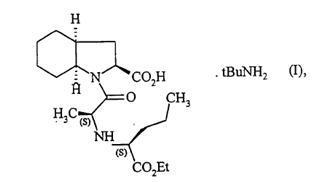
characterised by having the following powder X-ray diffraction diagram, measured using a diffractometer (copper anticathode) and expressed in terms of inter-planar distance d, Bragg's angle 2 theta, intensity and relative intensity (expressed as a percentage with respect to the most intense ray)
| Angle 2 theta (°) | Inter-planar distance d (Å) | Intensity | Relative intensity (%) |
| 7.680 | 11.50 | 390 | 8.8 |
| 8.144 | 10.85 | 230 | 5.2 |
| 9.037 | 9.78 | 4410 | 100 |
| 10.947 | 8.08 | 182 | 4.1 |
| 13.150 | 6.73 | 82 | 1.9 |
| 13.687 | 6.46 | 83 | 1.9 |
| 14.627 | 6.05 | 582 | 13.2 |
| 15.412 | 5.74 | 770 | 17.5 |
| 16.573 | 5.34 | 1115 | 25.3 |
| 17.357 | 5.10 | 340 | 7.7 |
| 18.109 | 4.89 | 193 | 4.4 |
| 19.922 | 4.45 | 306 | 6.9 |
| 20.609 | 4.31 | 375 | 8.5 |
| 21.412 | 4.15 | 226 | 5.1 |
| 21.832 | 4.07 | 217 | 4.9 |
| 22.158 | 4.01 | 483 | 11 |
| 22.588 | 3.93 | 386 | 8.8 |
| 23.323 | 3.81 | 107 | 2.4 |
| 24.200 | 3.67 | 448 | 10.2 |
| 24.727 | 3.60 | 137 | 3.1 |
| 25.957 | 3.43 | 125 | 2.8 |
| 26.932 | 3.31 | 75 | 1.7 |
| 27.836 | 3.20 | 197 | 4.5 |
| 28.966 | 3.08 | 129 | 2.9 |
| 29.213 | 3.05 | 117 | 2.7 |
2. Process for preparation of the a crystalline form of the compound of formula (I) according to claim 1, comprising in that a solution of perindopril tert-butylamine salt in ethyl acetate is heated at reflux and is then cooled gradually until crystallisation is complete, further characterised in that the solution at reflux is first cooled to a temperature of from 55 to 65°C at a rate of from 5 to 10°C/hour, and then to ambient temperature.
3. Process according to claim 2, characterised in that the compound of formula (I) obtained by the preparation process described in patent specification EP 0 308 341 is used.
4. Process according to either claim 2 or claim 3, characterised in that the concentration of the compound of formula (I) in the ethyl acetate is from 70 to 90 g/litre.
5. Process according to any one of claim 2 to 4, characterised in that the solution of the compound of formula (I) in ethyl acetate is seeded during the cooling step at a temperature of from 76 to 65°C.
6. Process according to any one of claims 2 to 4, characterised in that the solution of the compound of formula (I) in ethyl acetate at reflux is first cooled to a temperature of from 55 to 65°C at a rate of from 6 to 8°C/hour, and then to ambient temperature.
7. Process according to any one of claims 2 to 6, characterised in that the perindopril tert-butylamine salt that is thereby obtained is in the form of readily filterable individual needles.
8. Pharmaceutical composition comprising as active ingredient the compound according to claim 1, in combination with one or more pharmaceutically acceptable, inert, non-toxic carriers.
9. Pharmaceutical composition according to claim 8 for use in the manufacture of medicaments for use as inhibitors of angiotensin I converting enzyme.
10.Pharmaceutical composition according to claim 9 for use in the manufacture of medicaments for use in the treatment of cardiovascular diseases.
11.Pharmaceutical composition according to any one of claims 8 to 10, characterised in that it also comprises a diuretic.
12.Pharmaceutical composition according to claim 11, characterised in that the diuretic is indapamide.
13.A method of treatment of cardiovascular diseases comprising administering to a patient in need of such treatment an efficacious amount of compound of formula (I) as defined in claim 1 or a pharmaceutical composition as defined in any one of claims 8 to 12.
14.Use of compound of formula (I) as defined in claim 1 for the manufacture of medicaments for treatment of cardiovascular diseases.
15.The compound of formula (I) as defined in claim 1 substantially as hereinbefore described with reference to Example 1.
16.The pharmaceutical composition as defined in any one of claims 8 to 12 substantially as hereinbefore described with reference to Example 2.
17. The method of treatment as defined in claim 13 substantially as hereinbefore described.
18. The use as defined in claim 14 substantially as hereinbefore described.
SCHEDULE 2: PROPOSED ADDITIONAL CLAIMS
19.a crystalline form of the compound of formula (I):
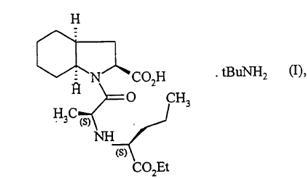
characterised by having the following powder X-ray diffraction diagram, measured using a diffractometer (copper anticathode) and expressed in terms of inter-planar distance d, Bragg's angle 2 theta, intensity and relative intensity (expressed as a percentage with respect to the most intense ray)
| Angle 2 theta (°) | Inter-planar distance d (Å) | Intensity | Relative intensity (%) |
| 7.680 | 11.50 | 390 | 8.8 |
| 8.144 | 10.85 | 230 | 5.2 |
| 9.037 | 9.78 | 4410 | 100 |
| 10.947 | 8.08 | 182 | 4.1 |
| 13.150 | 6.73 | 82 | 1.9 |
| 13.687 | 6.46 | 83 | 1.9 |
| 14.627 | 6.05 | 582 | 13.2 |
| 15.412 | 5.74 | 770 | 17.5 |
| 16.573 | 5.34 | 1115 | 25.3 |
| 17.357 | 5.10 | 340 | 7.7 |
| 18.109 | 4.89 | 193 | 4.4 |
| 19.922 | 4.45 | 306 | 6.9 |
| 20.609 | 4.31 | 375 | 8.5 |
| 21.412 | 4.15 | 226 | 5.1 |
| 21.832 | 4.07 | 217 | 4.9 |
| 22.158 | 4.01 | 483 | 11 |
| 22.588 | 3.93 | 386 | 8.8 |
| 23.323 | 3.81 | 107 | 2.4 |
| 24.200 | 3.67 | 448 | 10.2 |
| 24.727 | 3.60 | 137 | 3.1 |
| 25.957 | 3.43 | 125 | 2.8 |
| 26.932 | 3.31 | 75 | 1.7 |
| 27.836 | 3.20 | 197 | 4.5 |
| 28.966 | 3.08 | 129 | 2.9 |
| 29.213 | 3.05 | 117 | 2.7 |
and further characterized by being in the form of individual needles.
20.The a crystalline form of the compound according to claim 19, wherein the individual needles allow rapid and efficient filtration and drying of the compound.
21.A process for preparation of the a crystalline form of the compound of formula (I) according to claim 19 or 20, comprising heating a solution of perindopril tert-butylamine salt in ethyl acetate at reflux and gradually cooling the solution until crystallisation is complete forming individual needles, wherein the solution at reflux is first cooled to a temperature of from 55 to 65°C at a rate of from 5 to 10°C/hour, and then cooled to ambient temperature.
22.The process according to claim 21, wherein the concentration of the perindopril tert-butylamine salt in the ethyl acetate is from 70 to 90 g/litre.
23.The process according to claim 22, wherein the solution of perindopril tert-butylamine salt in ethyl acetate is seeded during the cooling step at a temperature of from 76 to 65°C.
24.The process according to claim 22 or 23, wherein the solution of the perindopril tert-butylamine salt in ethyl acetate at reflux is first cooled to a temperature of from 55 to 65°C at a rate of from 6 to 8°C/hour, and then to ambient temperature.
25.A pharmaceutical composition comprising, as active ingredient, a crystalline form of the compound of formula (I):
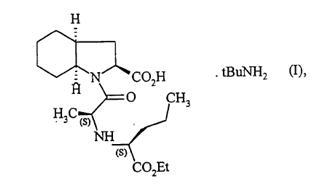
in combination with one or more pharmaceutically acceptable, inert, non-toxic carriers; wherein the a crystalline form of the compound of formula (I) being characterised by having the following powder X-ray diffraction diagram, measured using a diffractometer (copper anticathode) and expressed in terms of inter-planar distance d, Bragg's angle 2 theta, intensity and relative intensity (expressed as a percentage with respect to the most intense ray)
| Angle 2 theta (°) | Inter-planar distance d (Å) | Intensity | Relative intensity (%) |
| 7.680 | 11.50 | 390 | 8.8 |
| 8.144 | 10.85 | 230 | 5.2 |
| 9.037 | 9.78 | 4410 | 100 |
| 10.947 | 8.08 | 182 | 4.1 |
| 13.150 | 6.73 | 82 | 1.9 |
| 13.687 | 6.46 | 83 | 1.9 |
| 14.627 | 6.05 | 582 | 13.2 |
| 15.412 | 5.74 | 770 | 17.5 |
| 16.573 | 5.34 | 1115 | 25.3 |
| 17.357 | 5.10 | 340 | 7.7 |
| 18.109 | 4.89 | 193 | 4.4 |
| 19.922 | 4.45 | 306 | 6.9 |
| 20.609 | 4.31 | 375 | 8.5 |
| 21.412 | 4.15 | 226 | 5.1 |
| 21.832 | 4.07 | 217 | 4.9 |
| 22.158 | 4.01 | 483 | 11 |
| 22.588 | 3.93 | 386 | 8.8 |
| 23.323 | 3.81 | 107 | 2.4 |
| 24.200 | 3.67 | 448 | 10.2 |
| 24.727 | 3.60 | 137 | 3.1 |
| 25.957 | 3.43 | 125 | 2.8 |
| 26.932 | 3.31 | 75 | 1.7 |
| 27.836 | 3.20 | 197 | 4.5 |
| 28.966 | 3.08 | 129 | 2.9 |
| 29.213 | 3.05 | 117 | 2.7 |
and wherein the a crystalline form of compound of formula (I) has been isolated in the form of individual needles.
26. The pharmaceutical composition according to claim 25, wherein the individual needles allow rapid and efficient filtration and drying.
27.The pharmaceutical composition according to claim 25 or 26 in the form of tablets or dragÉes, sublingual tablets, gelatin capsules, lozenges, suppositories, creams, ointments, dermal gels, injectable preparations, or drinkable suspensions.
28.The pharmaceutical composition according to claim 27 in the form of a tablet.
29.The pharmaceutical composition according to any one of claims 25 to 28 comprising from 1 to 500 mg of the a crystalline form of the compound of formula (I).
30.The pharmaceutical composition according to claim 29 comprising 4 mg of the a crystalline form of the compound of formula (I).
31.The pharmaceutical composition according to any one of claims 25 to 30, further comprising a diuretic.
32.The pharmaceutical composition according to claim 31, wherein the diuretic is indapamide.
33.Use of the pharmaceutical composition according to any one of claims 25 to 32 as an inhibitor of angiotensin I converting enzyme.
34.The use according to claim 33 for treatment of cardiovascular disease.
35.A method of treatment of cardiovascular disease comprising administering to a patient in need of such treatment an efficacious amount of a crystalline form of the compound of formula (I):
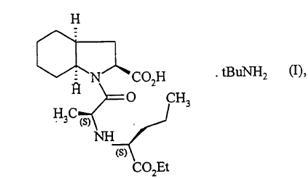
characterised by having the following powder X-ray diffraction diagram, measured using a diffractometer (copper anticathode) and expressed in terms of inter-planar distance d, Bragg's angle 2 theta, intensity and relative intensity (expressed as a percentage with respect to the most intense ray)
| Angle 2 theta (°) | Inter-planar distance d (Å) | Intensity | Relative intensity (%) |
| 7.680 | 11.50 | 390 | 8.8 |
| 8.144 | 10.85 | 230 | 5.2 |
| 9.037 | 9.78 | 4410 | 100 |
| 10.947 | 8.08 | 182 | 4.1 |
| 13.150 | 6.73 | 82 | 1.9 |
| 13.687 | 6.46 | 83 | 1.9 |
| 14.627 | 6.05 | 582 | 13.2 |
| 15.412 | 5.74 | 770 | 17.5 |
| 16.573 | 5.34 | 1115 | 25.3 |
| 17.357 | 5.10 | 340 | 7.7 |
| 18.109 | 4.89 | 193 | 4.4 |
| 19.922 | 4.45 | 306 | 6.9 |
| 20.609 | 4.31 | 375 | 8.5 |
| 21.412 | 4.15 | 226 | 5.1 |
| 21.832 | 4.07 | 217 | 4.9 |
| 22.158 | 4.01 | 483 | 11 |
| 22.588 | 3.93 | 386 | 8.8 |
| 23.323 | 3.81 | 107 | 2.4 |
| 24.200 | 3.67 | 448 | 10.2 |
| 24.727 | 3.60 | 137 | 3.1 |
| 25.957 | 3.43 | 125 | 2.8 |
| 26.932 | 3.31 | 75 | 1.7 |
| 27.836 | 3.20 | 197 | 4.5 |
| 28.966 | 3.08 | 129 | 2.9 |
| 29.213 | 3.05 | 117 | 2.7 |
wherein the a crystalline form of the compound of formula (I) has been isolated in the form of individual needles.
36.The method of treatment according to claim 35, wherein the individual needles allow rapid and efficient filtration and drying of the compound.
37.A method of treatment of cardiovascular disease comprising administering to a patient in need of such treatment an efficacious amount of a pharmaceutical composition according to any one of claims 25 to 32.
38.Use of the a crystalline form of the compound of formula (I):
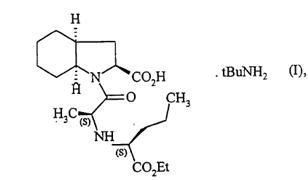
for the manufacture of a medicament for treatment of cardiovascular disease,
wherein the a crystalline form of the compound of formula (I) being characterised by having the following powder X-ray diffraction diagram, measured using a diffractometer (copper anticathode) and expressed in terms of inter-planar distance d, Bragg's angle 2 theta, intensity and relative intensity (expressed as a percentage with respect to the most intense ray)
| Angle 2 theta (°) | Inter-planar distance d (Å) | Intensity | Relative intensity (%) |
| 7.680 | 11.50 | 390 | 8.8 |
| 8.144 | 10.85 | 230 | 5.2 |
| 9.037 | 9.78 | 4410 | 100 |
| 10.947 | 8.08 | 182 | 4.1 |
| 13.150 | 6.73 | 82 | 1.9 |
| 13.687 | 6.46 | 83 | 1.9 |
| 14.627 | 6.05 | 582 | 13.2 |
| 15.412 | 5.74 | 770 | 17.5 |
| 16.573 | 5.34 | 1115 | 25.3 |
| 17.357 | 5.10 | 340 | 7.7 |
| 18.109 | 4.89 | 193 | 4.4 |
| 19.922 | 4.45 | 306 | 6.9 |
| 20.609 | 4.31 | 375 | 8.5 |
| 21.412 | 4.15 | 226 | 5.1 |
| 21.832 | 4.07 | 217 | 4.9 |
| 22.158 | 4.01 | 483 | 11 |
| 22.588 | 3.93 | 386 | 8.8 |
| 23.323 | 3.81 | 107 | 2.4 |
| 24.200 | 3.67 | 448 | 10.2 |
| 24.727 | 3.60 | 137 | 3.1 |
| 25.957 | 3.43 | 125 | 2.8 |
| 26.932 | 3.31 | 75 | 1.7 |
| 27.836 | 3.20 | 197 | 4.5 |
| 28.966 | 3.08 | 129 | 2.9 |
| 29.213 | 3.05 | 117 | 2.7 |
and wherein the a crystalline form of the compound of formula (I) has been isolated in the form of individual needles.
39.The use according to claim 38, wherein the individual needles allow rapid and efficient filtration and drying of the compound.


