

FEDERAL COURT OF AUSTRALIA
Commissioner of Taxation v American Express Wholesale Currency Services Pty Limited [2010] FCAFC 122
IN THE FEDERAL COURT OF AUSTRALIA | |
| Appellant | |
AND: | AMERICAN EXPRESS WHOLESALE CURRENCY SERVICES PTY LIMITED Respondent |
DATE OF ORDER: | |
WHERE MADE: |
THE COURT ORDERS THAT:
1. The appellant be granted leave to amend the notice of appeal dated and filed 10 July 2009 to include the additional grounds referred to in the affidavit of Marlene Binnekamp sworn on 11 November 2009.
2. The appeal be allowed.
3. The orders made by the Honourable Justice Emmett on 19 June 2009 be set aside and in lieu thereof order:
3.1 the appeal against the objection decision be allowed in part.
3.2 save as to the respondent’s objection to assessment to penalties pursuant to s 284-75(1) in Schedule 1 of the Taxation Administration Act 1953 (Cth) (‘additional tax’), the objection decision notified by letter dated 21 December 2006 (‘the objection decision’) be upheld.
3.3 by consent, that part of the objection decision disallowing the respondent’s objection to assessment to penalties, and the notice of assessment to penalties dated 27 April 2006, be set aside.
4. Within 10 days of the date of judgment the parties file and serve short submissions as to costs.
Note: Settlement and entry of orders is dealt with in Order 36 of the Federal Court Rules. The text of entered orders can be located using Federal Law Search on the Court’s website.
IN THE FEDERAL COURT OF AUSTRALIA | |
NEW SOUTH WALES DISTRICT REGISTRY | |
GENERAL DIVISION | NSD 699 of 2009 |
ON APPEAL FROM THE FEDERAL COURT OF AUSTRALIA |
BETWEEN: | COMMISSIONER OF TAXATION Appellant |
AND: | AMERICAN EXPRESS INTERNATIONAL INC Respondent |
JUDGES: | DOWSETT, KENNY AND MIDDLETON JJ |
DATE OF ORDER: | 17 SEPTEMBER 2010 |
WHERE MADE: | MELBOURNE (HEARD IN SYDNEY) |
THE COURT ORDERS THAT:
1. The appellant be granted leave to amend the notice of appeal dated and filed 10 July 2009 to include the additional grounds referred to in the affidavit of Marlene Binnekamp sworn on 11 November 2009.
2. The appeal be allowed.
3. The orders made by the Honourable Justice Emmett on 19 June 2009 be set aside and in lieu thereof order:
3.1 the appeal against the objection decision be dismissed.
3.2 the objection decision notified by letter dated 21 December 2006 (‘the objection decision’) be upheld.
4. Within 10 days of the date of judgment the parties file and serve short submissions as to costs.
Note: Settlement and entry of orders is dealt with in Order 36 of the Federal Court Rules. The text of entered orders can be located using Federal Law Search on the Court’s website.
NEW SOUTH WALES DISTRICT REGISTRY | |
GENERAL DIVISION | NSD 698 of 2009 |
ON APPEAL FROM THE FEDERAL COURT OF AUSTRALIA |
BETWEEN: | COMMISSIONER OF TAXATION Appellant
|
AND: | AMERICAN EXPRESS WHOLESALE CURRENCY SERVICES PTY LIMITED Respondent
|
IN THE FEDERAL COURT OF AUSTRALIA | |
NEW SOUTH WALES DISTRICT REGISTRY | |
GENERAL DIVISION | NSD 699 of 2009 |
ON APPEAL FROM THE FEDERAL COURT OF AUSTRALIA |
BETWEEN: | COMMISSIONER OF TAXATION Appellant
|
AND: | AMERICAN EXPRESS INTERNATIONAL INC Respondent
|
JUDGES: | DOWSETT, KENNY AND MIDDLETON JJ |
DATE: | 17 SEPTEMBER 2010 |
PLACE: | MELBOURNE (HEARD IN SYDNEY) |
REASONS FOR JUDGMENT
DOWSETT J:
INTRODUCTION
1 These appeals arise under the A New Tax System (Goods and Services Tax) Act 1999 (Cth) (the “GST Act”). I have had the benefit of reading the reasons prepared by Kenny and Middleton JJ (the “joint reasons”). I gratefully adopt their Honours’ summary of the facts of the case. It will not be necessary for me to set out, in full, the facts or the relevant legislative provisions and regulations. I shall refer to the respondents collectively as “American Express” and to the appellant in each matter as the “Commissioner”.
AMENDMENT
2 When the appeals were called on for argument on 26 November 2009 counsel for the Commissioner moved for leave to amend both notices of appeal. Notices of motion had been filed on 11 November 2009 and presumably served at about that time. They were supported by the affidavit of Marlene Binnekamp, filed on the same day. Attached to the affidavit were annexures A, B, C and D. Annexures A and B were the proposed amended notices of appeal. Annexures C and D were the parties’ submissions below. The question of leave to amend cannot be addressed without reference to the facts of the case.
INPUT TAX CREDITS AND INPUT TAXED SUPPLIES
3 A taxpayer will incur a liability to pay goods and services tax (“GST”) if, in carrying on an enterprise, it makes taxable supplies of goods and/or services. Most supplies for consideration are taxable supplies. The GST is calculated by reference to the amount of that consideration.
4 It is not uncommon for a taxpayer to make both taxable supplies and input taxed supplies. A taxpayer may also make GST free supplies. That category is not presently relevant. Input taxed supplies do not attract GST. Particular categories of supply are input taxed, presumably because it is more practicable that they be dealt with in that way. One such category is financial supply.
5 The amount of the GST payable by a taxpayer in connection with its own taxable supplies may be reduced by setting off against such amount the amount of any input tax credits. In carrying on its enterprise, the taxpayer will incur outgoings in acquiring goods and services. Included in those outgoings will be amounts representing GST payable by the suppliers. An input tax credit arises when the taxpayer, as a supplier of goods and services, acquires goods and services for a creditable purpose. Such acquisition is a creditable acquisition. A thing is acquired for a creditable purpose if the taxpayer acquires it in carrying on its enterprise, save to the extent that the acquisition relates to making supplies which will be input-taxed, or if it is of a private or domestic nature.
6 To the extent that an acquisition relates to input taxed supplies, no input tax credit is allowable. This is because input taxed supplies do not attract GST. The purpose of the input tax credit system is to avoid levying GST upon GST previously collected in the chain of supply. As input taxed supplies do not attract GST, it is not appropriate that there be input tax credits in connection with acquisitions attributable to such supplies. It is therefore necessary that the taxpayer apportion its input tax credits as between input taxed supplies and other supplies.
7 Sections 11-25 and 11-30 make provision for such apportionment. Section 11-30 prescribes a method of apportionment based substantially upon quantifying the extent of the creditable purpose as a percentage of the total purpose of acquisition and apportioning the input tax credits on a pro rata basis. However the apportionment process may be difficult. In order to facilitate that process, s 11-30(5) provides:
The Commissioner may determine, in writing, one or more ways in which to work out, for the purpose of subsection (3), the extent to which a creditable acquisition is for a creditable purpose.
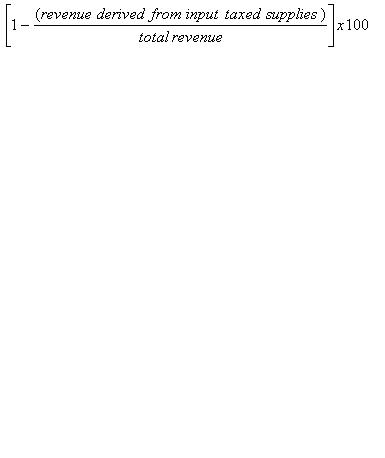
8 In the present case American Express proposed, and the Commissioner agreed that such apportionment should be calculated using the formula:

9 This calculation yields a percentage which is then used in apportioning the cost of creditable acquisitions as between input taxed and other supplies. The matter in dispute between American Express and the Commissioner is whether certain amounts received by American Express should be treated as revenue derived from input-taxed supplies for the purposes of the formula.
THE CASE
10 As is well known American Express issues cards for use by cardholders in acquiring goods and services without contemporaneous payment to suppliers. The two relevant card products are described as “credit cards” and “charge cards”. Under the terms upon which American Express provides such cards to cardholders, they must pay amounts charged to the cards within a fixed time, although the credit card also has a facility for further deferred payment of part of the amount due. That aspect is not presently relevant. The charge card conditions provide for payment of an identified amount as “liquidated damages” if payments to American Express are not made on time. The credit card conditions provide for a “late payment fee”. I will refer to both categories of payment as “Fee Payments”. Although it may previously have taken a different view, for the years from 1 July 2002 until 30 June 2004, American Express completed its Business Activity Statements upon the basis that Fee Payments were not to be included in the numerator of the formula. The Commissioner rejected this approach, re-assessed American Express’s GST liability and imposed penalties. American Express objected, but on 8 June 2006, the objections were disallowed.
11 In the Commissioner’s reasons for such disallowance, he asserted that the “supply of a charge card” was an input taxed supply, and that the Fee Payments were consideration for that supply. He made a similar assertion concerning late payment fees by credit card holders. The supply of both types of card and associated entitlements was said to comprise the supply of an interest under a debt, credit arrangement or right to credit, being one definition of the term “financial supply”, which is one category of input taxed supply. The Commissioner took the same approach in its appeal statement at first instance. Thus a significant issue below was whether the Fee Payments were consideration for the supply of the charge and credit cards and associated services. At first instance the Commissioner did not seek to justify his decision on the basis that revenue from input taxed supplies should be included in the numerator of the formula, even if that revenue was not received as consideration for such supplies. In other words, the case was conducted upon the basis that the word “revenue” in the formula meant “consideration”. The Commissioner asserted that the Fee Payments were consideration for financial supplies which were input taxed. American Express asserted that they were, in effect, damages for breach of contract, and not consideration. The primary Judge found that the Fee Payments were not consideration. The case which the Commissioner now wishes to advance is that the words “revenue derived from input taxed supplies” describe any moneys received from “the financial supply made by [American Express] to the cardholder under the charge or credit card arrangement”.
12 Although the formula was for use in apportioning the purpose for which American Express acquired goods and services, it did so by looking to the extent to which its supplies to others were input taxed. The word “revenue” has no particular meaning in the GST Act, at least for present purposes. The expression “input taxed supplies” is a statutory term. The word “consideration” is also defined in the GST Act. The definition is very broad. See s 9-15.
13 One must keep in mind the fact that the formula is not, itself, a statutory concept. As the formula addresses the extent of input taxed supplies, it will be convenient if I commence by seeking to determine whether American Express makes input taxed supplies pursuant to the arrangements concerning the charge card and credit card facilities. However, in the latter case, I will not consider that part of the credit card facility which permits further deferment of payment past the original due date. In what follows I use the term “American Express facility” as if it described a clearly identified entity. The term describes the services offered to cardholders of each type, but excluding the service provided to credit cardholders which permits the deferment of some payments to American Express past the original due date for payment. Implicit in the notion of a “facility” is the underpinning administrative arrangements which, as I infer, must exist. I also infer that they are quite complex.
FINANCIAL SUPPLIES
14 Section 40-5 identifies classes of supply which are input taxed. One such supply is a “financial supply”. That term has the meaning given by the regulations. The regulations are the A New Tax System (Goods and Services Tax) Regulations 1999 (Cth) (the “GST Regulations”). Central to the definition of “financial supply” is reg 40-5.02 which defines the term “interest” as “anything that is recognized at law or in equity as property in any form”. It is important to note that an “interest” is not an interest in legal or equitable property. Rather, an “interest” is legal or equitable property. Regulation 40-5.08 provides that for the purposes of s 40-5(2) of the GST Act a supply is a financial supply if it is a financial supply as defined in reg 40-5.09 or an incidental financial supply as defined in reg 40-5.10. Regulation 40-5.09 provides that:
(1) The provision, acquisition or disposal of an interest mentioned in sub-regulation (3) or (4) is a financial supply if:
(a) the provision acquisition or disposal is:
(i) for consideration; and
(ii) in the course or furtherance of an enterprise; and
(iii) connected with Australia; and
(b) the supplier is:
(i) registered or required to be registered; and
(ii) a financial supply provider in relation to supply of the interest.
(2) …
(3) For sub-regulation (1) the interest is an interest in or under the matter mentioned in an item in the following table … .
15 Item 2 in the table is “an interest in or under … (a) debt, credit arrangement or right to credit, including a letter of credit” (“Item 2 of the Table”).
16 Regulation 40-5.10 provides with respect to incidental financial supplies:
Despite regulation 40-5.12, if something is supplied by an entity to a recipient directly in connection with a financial supply to the recipient by the entity, the thing is an incidental financial supply if:
(a) it is incidental to the financial supply; and
(b) it and the financial supply are supplied, at or about the same time, but not for separate consideration; and
(c) it is the usual practice of the entity to supply the thing, or similar things, and the financial supply together in the ordinary course of the entity’s enterprise.
17 I do not understand reg 40-5.10 to be presently relevant.
18 A financial supply is, therefore:
the provision, acquisition or disposal of;
anything recognized at law or in equity as property in any form;
if such provision, acquisition or disposal is for consideration;
in the course or furtherance of an enterprise;
connected with Australia;
the supplier is registered or required to be registered as a financial supply provider; and
the legal or equitable property is “in or under” a matter listed in the Table in reg 40-5.9(3).
19 In argument on appeal, the focus seemed to be upon the words “credit arrangement or right to credit” in Item 2 of the Table. However a careful reading of the primary Judge’s reasons suggests that at first instance, the relevant interest was said to be “an interest in the cardholder’s debt”, meaning the debt owed by the cardholder to American Express consequent upon the former’s use of a card. See [42]-[43]. This matter may be of some importance in the resolution of this case.
20 Regulation 40-5.11 provides:
Something mentioned in a Part of Schedule 7 that relates to a financial supply mentioned in an item in the table in regulation 40-5.09, or to an incidental financial supply, is an example of the financial supply mentioned in the item or of the incidental financial supply.
21 There are then three notes to the regulation as follows:
Note 1: The examples are not to be taken as exhaustive.
Note 2: If an example in Schedule 7 is inconsistent with the description in this Division of the financial supply to which the example relates, the description prevails.
See section 15AD of the Acts Interpretation Act 1901.
Note 3: Something that is within the scope of an item in the table in regulation 40-5.09 will be a financial supply described in that item even if it is not mentioned as an example of the item set out in the Part of Schedule 7 relating to the item.
22 Section 15AD of the Acts Interpretation Act 1901 (Cth) (the “Acts Interpretation Act”) provides:
Where an Act includes an example of the operation of a provision:
(a) the example shall not be taken to be exhaustive; and
(b) if the example is inconsistent with the provision, the provision prevails.
23 As I understand it, the parties accept that s 15AD regulates the construction of the GST Regulations. In Part 2 of Schedule 7, examples of Item 2 of the Table include “Opening, keeping, operating, maintaining and closing charge and credit card facilities” (“Item 2 of the Schedule”) and “Supply of credit cards” (“Item 3 of the Schedule”).
24 Regulation 40.5.12 excludes certain supplies from the definition of “input taxed supply”. However I will consider that provision at a later stage.
25 In my view the parties have given insufficient attention to the identification of the relevant interest in or under Item 2 of the Table, the supply of which may be a financial supply. Associated with that problem is a failure to give sufficient attention to the requirement that an interest be legal or equitable property. It is not sufficient simply to assert that:
the American Express facilities might be described in terms of either Item 2 or Item 3 of the Schedule;
it is therefore a credit arrangement or right to credit; and
therefore there has been a financial supply.
The focus must be on identifying a supply of legal or equitable property.
PROPERTY
26 In the joint reasons their Honours refer to three cases concerning the meaning of the term “property”. In Jack v Smail (1905) 2 CLR 684 the High Court considered whether a grocer’s licence under licensing legislation passed to the licensee’s trustee in bankruptcy. Griffith CJ said at 705:
That being the quality of a grocer’s licence, what right can the trustees assert to it? It is not property; it is a personal right of the insolvent to carry on business in a particular place under conditions prescribed by law.
27 In Commissioner of Stamp Duties (NSW) v Yeend (1929) 43 CLR 235, the High Court considered the nature of a right to sell refreshments at a racing club. At 242, Knox CJ, Gavan Duffy, Rich and Dixon JJ drew a distinction between property and contractual rights and, at 246, Isaacs J said “(t)he distinction is clear between the personal right and the property right.”
28 These cases may not be definitive in resolving the present question. Each addresses particular statutory provisions. However there is much of relevance for present purposes in the decision of the High Court in Yanner v Eaton (1999) 201 CLR 351. In discussing property at [17]-[20], the majority (Gleeson CJ, Gaudron, Kirby and Hayne JJ) points out at [17] that the notion of property:
… is a description of a legal relationship with a thing. … Usually it is treated as a “bundle of rights”. … Considering whether, or to what extent, there can be property in knowledge or information or property in human tissue may illustrate some of the difficulties in deciding what is meant by “property” in a subject matter.
29 At [18] –[20] their Honours observe:
18. Nevertheless, as Professor Gray also says… “An extensive frame of reference is created by the notion that “property” consists primarily in control over access. Much of our false thinking about property stems from the residual perception that “property” is itself a thing or resource rather than a legally endorsed concentration of power over things and resources.
19. “Property” is a term that can be, and is, applied to many different kinds of relationship with a subject matter. …
20. Because “property” is a comprehensive term it can be used to describe all or any of very many different kinds of relationships between a person and a subject matter. … The statement that A has property in B will usually provoke further questions of classification. Is the interest real or personal? Is the item tangible or intangible? Is the interest legal or equitable?
30 Yanner is not in any sense inconsistent with the two earlier cases. It does not suggest that the distinction between property rights and personal rights has been abandoned. Clearly, the notion of property contains three elements:
The subject matter;
The property holder; and
The relationship between them.
31 For present purposes an interest must be legal or equitable property. It is therefore necessary to distinguish between legal or equitable property on the one hand and personal contractual rights on the other. The relationship between American Express and a cardholder no doubt involves substantial contractual rights, but contractual rights are not necessarily property.
32 In Meagher, Gummow and Lehane’s Equity, Doctrines and Remedies (4th ed) the learned authors observe at para 4-015:
Accordingly, and as a starting point, any system of proprietary interests may usefully be valued by reference to at least four criteria. These are: (a) the power to recover the property, the subject of the interest or the income thereof (that is, a “property right”) compared with the recovery of compensation from the defendant payable from no specific fund; (b) the power to transfer the benefit of the interest to another; (c) the persistence of remedies in respect of the interest against third parties who thus assume the burden thereof; and (d) the extent to which the interest may be displaced in favour of competing dealings by the grantor or others with interests in the subject matter (that is, priorities).
These characteristics are present in varying degrees in the hierarchy of equitable estates and interests and are to be considered when dealing with and evaluating the subject matter of this chapter. It is incorrect to assume that unless all these characteristics are present there cannot be “property”, … .
33 At para 4-140, the learned authors discuss a somewhat different approach taken by Lord Wilberforce in National Provincial Bank Ltd v Ainsworth [1965] AC 1175 where, at 1247-8, his Lordship observed
Before a right or an interest can be admitted into the category of property, or of a right affecting property, it must be definable, identifiable by third parties, capable in its nature of assumption by third parties, and have some degree of permanence or stability.
34 This approach was apparently approved in The Queen v Toohey; ex parte Meneling Station Pty Ltd (1982) 158 CLR 327, per Mason J at 342, Gibbs CJ and Brennan J concurring. In particular Mason J concluded that:
… the rights of the holder of a grazing licence created under the Crown Lands Act fall short in two respects of the concept of property or proprietary rights expressed by Lord Wilberforce. Regulation 71 (the Minister’s power to forfeit a grazing licence where the licensee fails to comply with a condition of the licence after having been given notice to do so) and reg. 71B (the right of a licensee to surrender his licence) are not inconsistent with the notion that a grazing licensee holds an interest in land. But reg. 71A represents a substantial obstacle to the applicants’ case. That regulation enables the Minister to cancel a licence, the only precondition being that he give three months’ notice in writing of his intention to do so. No default on the part of the licensee is necessary. The regulation suggests that the licensee has no interest in the land at all. The future of his right to graze stock is, by virtue of the Minister’s power to cancel, absolutely in the hands of the Minister and beyond his own control. A right terminable in the manner permitted by reg. 71A lacks that degree of permanence of which his Lordship spoke.
Assignability is not in all circumstances an essential characteristic of a right of property. By statute some forms of property are expressed to be inalienable. Nonetheless, it is generally correct to say, as Lord Wilberforce said, that a proprietary right must be “capable in its nature of assumption by third parties” …. .
35 Mason J also observed at 344 that even if the licence had conferred a right to exclusive possession of the relevant land, it would not have taken the applicants “very far” in establishing the existence of a proprietary right. Wilson J, with whom Murphy J agreed, also concluded that the licence did not confer an interest in land.
36 A somewhat different approach emerges from the decision of the High Court in Federal Commissioner of Taxation v Orica Ltd (1998) 194 CLR 500. In that case, the Court was concerned with the meaning of the term “asset” in the context of capital gains tax. The term was defined to mean “any form of property and includes … a chose in action … and any other form of incorporeal property”. Brennan CJ observed at [38] that if the definition stood alone, it would be necessary to distinguish between choses in action which were proprietary and those which were personal. At [90]-[91] the majority (Gaudron, McHugh, Kirby and Hayne JJ) concluded that the various interests in question (which were largely contractual) were assets. Their Honours pointed out that “alienability is not an indispensable attribute of a right of property according to the general sense which the word ‘property’ bears in the law”, affirming that statement by Kitto J in National Trustees Executors and Agency Co of Australasia Ltd v Federal Commissioner of Taxation (1954) 91 CLR 540 at 583. At [108]-[110], Gummow J also concluded that the choses in action were assets as defined. His Honour referred to the decision of Mason J in Toohey, suggesting that it should be read with the views of Kitto J in Trustees Executors and Agency Co. At [181]-[187] Callinan J concluded that the choses in action were assets, but also discussed the differences between personal and proprietary rights.
37 I do not understand the High Court to have abolished the distinction between proprietary and personal rights. I rather understand Orica to establish that where the term “asset” is defined to mean property including choses in action (which might be property or personal rights), the term “property” should be given a wider meaning. The decision in Yanner is inconsistent with abolition of the distinction.
38 Before considering the rights and obligations comprising the relationship between American Express and its cardholders, I should say something further about the reference in Yanner to control over access to resources as a general description of property rights. The choice of the word “resources” describes a wide range of “things” over which property rights may exist. The words “control over access” mean much more than “access”. Mere access to a resource is not sufficient. It is the degree of control over access by others which is relevant.
PROPERTY IN OR UNDER A DEBT, CREDIT ARRANGEMENT OR RIGHT TO CREDIT
39 The terms upon which American Express issues cards are identified in the joint reasons and in the primary Judge’s reasons. American Express provides the cardholder with a card. The cardholder is thereafter, in effect, able to pledge American Express’s credit with suppliers. The suppliers look to American Express for payment, and American Express requires cardholders to pay to it the amounts incurred for purchases, such payments to be made at fixed times. These rights and obligations seem generally to be personal rather than proprietary. Certainly, nothing supplied to the cardholder is capable of being assigned, and the relevant arrangements are determinable at will. The American Express facilities are no doubt quite complex. To the extent that they are capable of being “owned”, the owner is, presumably, American Express. A cardholder acquires no interest in them, but rather a contractual right to utilize their services. As I have said, the right is determinable by American Express at will and cannot be assigned. Such circumstances led the High Court in Toohey to conclude that the grazing licence did not comprise property. Whilst a cardholder has access to the facility, he or she does not control access to it.
40 A cardholder acquires possession, but not ownership of a card. No doubt the cardholder is a bailee. A bailee is said to have “special property” in the property bailed. Academic writers have asserted that a bailee’s rights are of a proprietary nature. See George W Paton’s Bailment in the Common Law (1952, Stevens & Sons Ltd, London) at 30. However, at 17-18, the author notes the decision in The Odesssa [1916] 1 AC 145 at 158-9, where Lord Mersey, in giving the advice of the Judicial Committee of the Privy Council, said:
But when the nature of the right of a pledgee to sell is examined it will be seen that the so-called “special” property which it is said to create is in truth no property at all. This has been recognized by many Judges who have used the expression “special interest” as a substitute for “special property” … .
41 Paton says at 17:
Special property seems to mean a possessary right available against even the true owner in certain conditions, e.g., where there is an artificer’s lien. Accurately, this is a mere right of possession not of property.
42 The author of Palmer on Bailment (3rd ed), at 1-106, asserts that:
A bailment gives rise to a form of property because it creates a division of interest in rem within the compass of a single chattel. The division is chronological rather than geographical; as in the case of leaseholds, a bailment divides the ownership of the res “on a plane of time”. The bailee obtains a legal interest in the form of possession, which is in many respects equivalent to an estate in land, and in the case of some bailments at least (such as pawns, liens and probably contracts of hire) this interest is preserved although the bailor disposes of his interest during the bailment to a third party. The bailor retains a reversionary interest in the form of his residual or eventual right to possession, which normally (but not necessarily) exists concurrently with his ownership of the goods; and here, again, this interest is generally preserved although the bailee disposes of the goods to a third party. In the terminology of the older authorities the bailor has the “general” and the bailee the “special” property in the subject chattel.
43 At 22-004 the author discusses special property again, this time in the context of pledges. He refers to the decision in The Odessa, suggesting that Lord Mersey was “inclined to disparage the significance of this interest, hinting that it was merely an inflated synonym for … ‘no property at all’.” The author refers in a footnote to the decision of the High Court in Palgo Holdings Pty Ltd v Gowans (2005) 221 CLR 249 at [17]. There McHugh, Gummow, Hayne and Heydon JJ said:
Commentators and the courts have long recognized that pawn or pledge is “a bailment of personal property, as a security for some debt or engagement”. They have identified such a transaction as distinct and different from mortgage where “the whole legal title passes conditionally to the mortgagee”. This distinction was sometimes expressed in terms of the difference between the “special property” of the pledgee and the “general property” which remained in the pledgor. The “special property” of the pledgee was described as the right to detain the goods for the pledgee’s security and “is in truth no property at all”. That “special property” depends upon delivery of possession, whereas in the case of a mortgage of personal property the right of property passes by the conveyance and possession is not essential to create or support the title.
44 In effect, the High Court adopted the view expressed in The Odessa that the special property of a bailee is “no property at all”. Although both The Odessa and Palgo concerned pledges, the notion of “special property” applies to all bailments as appears in the above extract from Palmer. Despite the views expressed in Paton and Palmer, it seems that in Australia, the special property of a bailee is not property. I should, however, refer to the decision in Xu v Council of the Law Society of New South Wales (2009) 236 FLR 480, a decision of the Court of Appeal of New South Wales. That case concerned the right of a solicitor to assert a lien over a client’s passport. At 490 Handley AJA, with whom Tobias JA agreed, appears to have treated a passport holder as having property in a passport, largely upon the basis that as a bailee, he or she has special property in it. However the Court seems not to have been referred to the decisions in The Odessa and Palgo. As with other aspects of the relationship between American Express and its cardholders, the card is, as I understand it, not transferable, and the right to possession may be revoked by American Express at will. All of this suggests that however one regards the arrangements in place between American Express and its cardholders, no proprietary rights are conferred in connection with possession of the cards.
45 If the rights of a bailee are property for the purposes of reg 40-5.02, then they might well be described as being in or under either of the American Express facilities. However one suspects that the supply of such “property” would not attract a significant proportion of American Express’s input tax credits. It seems likely that the cost of providing a card as a bare chattel would be very small.
46 As I have said, at first instance, the case was apparently disposed of upon the basis that the relevant interest was American Express’s interest in or under debts owed to it by cardholders. A debt may be described as property. See McCaughey v Commissioner of Stamp Duties (1945) 46 SR (NSW) 192 per Jordan CJ at 201; Mutual Pools & Staff Pty Ltd v The Commonwealth (1994) 179 CLR 155 per Brennan J at 176; and Orica, per Brennan CJ at 522. The tem “provision” of an interest includes “creation” of an interest (reg 40-5.03), and reg 40-5.06(2) provides that the acquirer of an interest is also a financial supply provider. It may be that American Express acquires an interest in or under a debt, created by either the cardholder’s use of the card or American Express’s payment to the supplier. Of course, such a debt is only payable upon the date fixed pursuant to the relevant conditions. I am inclined to the view that American Express’s acquisition of such a debt may be a financial supply, but the case on appeal seems not to have been conducted on that basis. See, for example, para 15 of the applicant’s further submissions dated 10 December 2009.
47 If there is no provision, acquisition or disposal of an interest (ie legal or equitable property) in or under any item in the Table in reg 40-5.09, then there can be no financial supply pursuant to that regulation. However the Commissioner submits that such an approach deprives Item 2 of the Table of any function and has a similar effect upon Items 2 and 3 of the Schedule. In my view s 15AD of the Acts Interpretation Act excludes the use of Sch 7 to expand the operation of Div 40. The section contemplates the possibility of a conflict between a substantive provision and examples of its operation. It directs that the substantive provision should prevail. The Commissioner seems to submit as follows:
Items 2 and 3 in the schedule are examples of a credit arrangement or right to credit for the purposes of reg 40-5.09;
the American Express charge and credit card facilities are capable of being described in the terms used in those items;
therefore the American Express charge and credit card systems are credit card arrangements or rights to credit; and
therefore, they are financial supplies.
48 This approach overlooks two aspects, namely:
the operation of s 15AD of the Acts Interpretation Act; and
the requirement that a financial supply be of an interest, ie legal or equitable property in or under a debt, credit arrangement or right to credit.
49 In looking to the examples for guidance as to whether there is a financial supply, the Commissioner fails to observe the requirement contained in s 15AD of the Acts Interpretation Act. That section requires that primacy be given to Div 40. Further, regs 40-5.02 and 40-5.09 require that there be a provision, acquisition or disposal of legal or equitable property. The American Express facility, however it may be named, does not satisfy that requirement. It is no answer to say that such an approach renders the examples otiose. That is the effect of s 15AD. In any event, there may be other credit card systems which involve the supply of interests in property. It seems that the regulation-maker contemplated such an arrangement. The proper question is whether the American Express facility falls within Item 2 in the Table. The question is not whether it is capable of being described in terms of Items 1 and 2 of the Schedule.
50 The Commissioner seems also to submit that the Table in reg 40-5.09, or at least Item 2 of the Table, will also be deprived of any function by the exclusion of the American Express facilities from its operation. I reject that submission. First, as I have said, I do not assume that arrangements which satisfy Items 2 and 3 in the Schedule will never give rise to the provision, acquisition or disposal of a relevant interest. However, save for the possible argument concerning a debt, the American Express facilities do not do so. Further, Items 2 and 3 of the Schedule do not exhaustively define Item 2 of the Table. There may well be other credit arrangements or rights to credit that involve such provision, acquisition or disposal. There is also the approach based on the acquisition of debts. As to the other items in the Table, it is not possible to consider, in a hypothetical way, the operation of Div 40 upon such classes of transaction.
51 As I have said, the primary Judge proceeded upon the basis that the relevant interests were American Express’s interests in debts owed to it by cardholders. I am unsure as to whether the Commissioner has on appeal, relied upon that approach. In view of my conclusions concerning the operation of reg 40-5.12, it is not necessary that I address questions arising out of such approach.
CREDIT
52 It is also unnecessary that I consider the way in which the primary Judge construed the term “credit”. However I am inclined to the view that his Honour’s approach was too narrow, primarily for the reasons given in the joint reasons. A cardholder is effectively authorized to pledge American Express’s “credit”. He or she is also effectively given “credit” by American Express at the time of each purchase. The cards in question are routinely described generically as “credit cards”. American Express, itself, uses that term to describe at least one of its products. The usage has become wide-spread. It is too late to adopt the limited meaning identified by the primary Judge.
CONSIDERATION
53 I should also say something about American Express’s submission that the Fee Payments were not consideration for financial supplies. The cardholder promised to pay American Express various amounts pursuant to the relevant conditions. Those promises must have been part of the consideration for the promises made by American Express, in effect, to allow each cardholder to participate as such. I consider that, to the extent that any relevant interest was supplied, the promise to pay liquidated damages or late payment fees was consideration for such supply. For present purposes there seems little justification for treating a promise to pay as consideration, but the actual payment as not being consideration.
A PAYMENT SYSTEM
54 Regulation 40-5.12 provides that the supply of an interest in or under a payment system is not a financial supply. I turn to the question of whether the American Express facilities are payment systems. The expression “payment system” is defined in the dictionary included in the GST Regulations as:
… a funds transfer system that facilitates the circulation of money, including any procedures that relate to the system.
55 The term “money” has the meaning attributed to it in Pt 6-3 of the Act as follows:
(a) currency (whether of Australia or of any other country); and
(b) promissory notes and bills of exchange; and
(c) any negotiable instrument used or circulated, or intended for use or circulation, as currency (whether of Australia or of any other country); and
(d) postal notes and money orders; and
(e) whatever is supplied as payment by way of:
(i) credit card or debit card; or
(ii) crediting or debiting an account; or
(iii) creation or transfer of a debt.
However it does not include:
(f) a collector’s piece; or
(g) an investment article; or
(h) an item of numismatic interest; or
(i) currency the market value of which exceeds its stated value as legal tender in the country of issue.
56 Regulation 40-5.13 provides that Sch 8 contains “examples” of supplies mentioned in the table in reg 40-5.12, but again with a note concerning the operation of s 15AD of the Acts Interpretation Act. Part 2 of Sch 8 provides examples of Item 4 (a payment system) in the Table in reg 40-5.12. Part 2 of Sch 8 is as follows:
Item | Example |
1 | Supply of services by a payment system operator to a participant in the system for which the following fees are charged by the operator: (a) membership fees; (b) processing frees; (c) service fees; (d) marketing fees; (e) risk management fees; (f) multi-currency fees |
2 | Access to a payment system, and supply of other related services by a participant in the system to a third party |
3 | Supply of a service by one participant in a payment system to another participant in the system in relation to charge, credit and debit card transactions
|
4 | Processing, settling, clearing and switching transactions of the following kinds: (a) direct credit and debit; (b) other debit and credit transactions; (c) charge, credit and debit card transactions; (d) cheque; (e) electronic funds transfer; (f) ATM; (g) B-pay; (h) Internet banking; (i) GiroPost; (j) SWIFT (Society for Worldwide Interbank Financial Telecommunciations) Payment Delivery System; (k) an approved RTGS (real time gross settlement) system; (i) Austraclear |
5 | Supply to a participant in a payment system by the operator of the system of the following services: (a) processing of account data; (b) electronic payment services |
57 The Commissioner submits that American Express did not, in its “pleadings” at first instance, raise any argument based on reg 14-5.12. It may be that the argument was not raised in American Express’s appeal statement, but it was dealt with by both sides in their submissions. The primary Judge decided the matter. It is too late for the Commissioner to complain that it was not raised at an earlier stage. It is true that there is little detail of American Express’s internal operations, but the matter was dealt with on the evidence as it was. The fundamental nature of the American Express facilities was explained in the evidence. At first instance American Express bore the onus of proving that the assessments were wrong, but on appeal, it is for the Commissioner to demonstrate that the primary Judge was wrong. He has not pointed to any fatal gaps in the evidence upon which his Honour’s conclusions were based.
58 It is, I think, sufficient to identify the alleged payment systems as being the two American Express facilities, including all dealings between cardholders, suppliers and American Express, as explained in the evidence, including the American Express documentation. His Honour dealt with this matter primarily by adopting the decision of Tamberlin J in Visa International Service Association & Anor v Reserve Bank of Australia (2003) 131 FCR 300. That case concerned applications to review decisions of the Reserve Bank of Australia (the “Reserve Bank”) to designate the Visa and Mastercard card systems pursuant to the Payment Systems (Regulation) Act 1998 (Cth) and the Payment Systems and Netting Act 1998 (Cth), (collectively, the “Payment Systems legislation”) and so subject them to regulation. These systems involved the use of cards in much the same way as do the American Express facilities. However the supplier (or “merchant”) submitted the relevant vouchers to its own bank, which bank eventually presented them to the cardholder’s bank. The last-mentioned bank was the issuer of the relevant card. This presentation was done using the Reserve Bank’s clearing system. The Visa and Mastercard service operators provided various “liaison” functions as between participating banks, and between them and the Reserve Bank. Thus there were four parties to each relevant transaction apart from the Visa or Mastercard operator and the Reserve Bank. Those parties were the supplier, the supplier’s bank, the cardholder and the cardholder’s bank. The systems appear in diagramatic form at [94] and [105]. The banks are there described as the “issuer” and the “acquirer”.
59 The difference between the Visa and Mastercard systems and the American Express system is that American Express performs all of the functions performed by the banks, the Visa and Mastercard operators and the Reserve Bank. The American Express system appears to be simpler than the Visa and Mastercard systems, at least partly because many of the functions identified in the diagrams at [94] and [105] in the Visa case are performed by American Express. Evidence of those internal procedures is not relevant for present purposes. Of course banks are generally involved in the American Express system to the extent that both cardholders and suppliers will usually operate bank accounts from which cardholders pay amounts due to American Express, and into which suppliers deposit payments received from American Express. Those matters are not presently relevant. I agree with the primary Judge that there appears to be no relevant difference between the Visa and Mastercard systems and the American Express system.
60 A question arising in the Visa case was whether the Visa and Mastercard arrangements were payment systems under the relevant legislation. Tamberlin J concluded that they were. The definition of “payment system” in the Payment Systems legislation was similar to that in the GST Regulations. I agree with the Commissioner that the decision in the Visa case does not necessarily determine the present case. However a different outcome is unlikely. The only difference identified by the Commissioner is the number of parties. As I have said, that seems to make no material difference. The Commissioner also submits that the decision in the Visa case concerned only the relationship involving the supplier (or merchant), the merchant’s bank and the issuing bank. That proposition reflects a misreading of the reasons. Visa and Mastercard had asserted that any payment system operated only at the level at which the Reserve Bank was involved in clearing transactions. Tamberlin J rejected that view. At [265] his Honour accepted that at the level of merchant and cardholder, there was no transfer of money. However he concluded that:
While there is some force in the proposition that some particular steps taken in isolation do not effect a transfer of money, when considered cumulatively from the authorisation step to final settlement at the RBA level, each of the schemes as designated amounts to a payment system within the definition.
61 Whilst the extent of the schemes “as designated” is not entirely clear, it presumably included the contents of the diagrams at [94] and [105]. Further, at [299], his Honour concluded that there was a relationship between the various parts of the systems in the diagrams, commencing with the presentation of the card and acceptance by the supplier (or merchant) after authorization. Obviously, only the cardholder could present the card. Finally, Tamberlin J concluded at [305]:
For these reasons I am persuaded that the instruments (credit cards, records and forms) and procedures at the issuer [bank], acquirer [bank] or merchant levels are within the definition “payment system” as a matter of interpretation.
62 Although his Honour did not, at this point, refer to the cardholders, he referred to the cards which, again, could only be used by the cardholders.
63 In any event, the question is not whether the American Express facilities are payment systems for the purposes of the Payment Systems legislation. The question is whether or not they are payment systems for the purposes of the GST Regulations. In other words, were the American Express facilities, as explained in the primary Judge’s reasons and in the evidence, funds transfer systems which facilitated the circulation of money, keeping in mind the very broad definition of “money” in the GST Act? The relevant item in that definition is:
(e) whatever is supplied as payment by way of:
(i) credit card or debit card; or
(ii) crediting or debiting an account; or
(iii) creation or a transfer of the debt.
64 Clearly, the distinction between a credit card and a charge card is not relevant for present purposes. One may safely assume that the expression “credit card or debit card” includes both the credit cards and charge cards with which this case is concerned. The definition of “money” as including whatever is supplied as payment by way of credit card or charge card strongly suggests that rights and obligations created and discharged when payment is made using such cards concern the circulation of money in the wider sense used in the definition. All consequential transactions would facilitate such circulation. Further, such transactions would involve the crediting or debiting of accounts.
65 A funds transfer system, I infer, is any system by which funds are transferred from one party to another. The American Express facilities involve the payment of moneys by American Express to merchants and the receipt by American Express of moneys paid by cardholders. No doubt American Express has its own substantial capital reserves with which it facilitates such transfers. The American Express facilities are funds transfer systems, involving American Express, the suppliers (or merchants) and the cardholders. Clearly, they facilitate the circulation of money as that term is defined.
66 I should add that a consideration in deciding whether a particular funds transfer system facilitates the circulation of money, might be the volume of funds transferred through it as compared to the amount of money in circulation. However neither party addressed this issue.
QUESTIONS FOR DETERMINATION
67 The Court is presently concerned to determine whether the Fee Payments were within the expression “revenue derived from input taxed supplies” in the formula. The first question is whether the Commissioner should be allowed to amend his notice of appeal in order to depart from the previously shared assertion that “revenue” in this context means “consideration”. As I have said, the Commissioner has not really explained why he has, until such a late stage, been willing to adopt that view of the formula, nor why he should now be allowed to depart from it. He asserts that American Express could not have rebutted such a case at first instance in any way which is not now open to it.
68 I again point out that the Commissioner’s reason for disallowing American Express’s objections to the assessments was that the relevant Fee Payments were by way of consideration for financial supplies. Thus, at p 13 of the reasons for each objection decision, the Commissioner said, concerning the charge card:
We consider that whichever way the amount paid as liquidated damages is described it will not alter its character as consideration for the supply of an interest in a debt, credit arrangement or right to credit. Even if the amount were to be viewed as a penalty and non-enforceable as against the cardmember, it would still be consideration. In this regard, the GST Act does not require that a supply must be lawful for it to be a supply for [the] purposes of section 9-10(3). Nor does it require that the consideration be enforceable for [the] purposes of section 9-15(2).
69 As to credit cards, the Commissioner said at p 14:
We consider that whichever way the fee is described and/or calculated and irrespective of the nature of the costs it is designed to cover, it is clearly charged in connection with the supply of an interest in a credit card and is further consideration for that supply. The supply of that interest is a supply of an interest in or under a debit, credit arrangement or right to credit under item 2 in regulation 40-5.09 in the GST Regulations which is an input taxed supply under section 40-5 of the GST Act.
70 At first instance American Express attacked these decisions, asserting that the Fee Payments were not received as consideration for financial supplies. The Commissioner did not mount an alternative argument that, in any event, the Fee Payments were revenue. The obligation imposed upon American Express by the GST Act was to pay the amount owing by way of GST, after deduction of the relevant input tax credits: see s 7-5. If the proportion of the input tax credits attributable to input taxed supplies was not to be calculated using the formula actually prescribed in s 11-30, then it had to be calculated upon a basis which either complied effectively with that section or was accepted by both the Commissioner and American Express as doing so. For so long as there was agreement as to a particular formula for calculation, no question arose as to whether that formula was appropriate for use in connection with the calculations prescribed by s 11-30.
71 The Commissioner continued to assert that the Fee Payments were consideration for the supply of financial services until 11 November 2009, shortly before the hearing of this appeal. Had the Commissioner, at or prior to the hearing below, sought to depart from that basis of calculation, it would have been necessary to consider whether he was entitled to do so and, if so, whether American Express was bound by the formula as construed by the Commissioner. The Commissioner and American Express were bound by the GST Act. It seems unlikely that the parties could have resolved any impasse by reference to the law of contract. Any “way” determined to be appropriate by the Commissioner would be a permissible method of calculation, but both the Commissioner and American Express were bound to comply with s 11-30 as a whole. The Commissioner was free to decide that a “way” was no longer appropriate. American Express was entitled to argue that any “way” approved by the Commissioner was not consistent with the GST Act.
72 American Express has given some indication of how it might have gone about challenging any decision by the Commissioner to calculate the input tax credits using his more recent view as to the meaning of the formula. It says in its further submissions dated 3 December 2009:
53 If the Commissioner had sought to take a different approach at trial by including amounts that fall within the broader expression “revenue” in the numerator of the formula referred to at paragraph [27] of the judgment of the learned primary judge, [American Express] would, in addition to the contentions advanced on the application, have sought to rely on alternative methodologies to calculate its extent of creditable purpose (“ECP”) on the basis that broadening the meaning of revenue so as to include the liquidated damages and late payment fees in the numerator would not produce a fair and reasonable calculation of ECP.
54 The first alternative methodology from which [American Express] would or is likely to have led the evidence on would be based on a model that:
(a) first allocates costs between the credit card portfolio and the charge card portfolio; and
(b) further allocates costs in respect of the credit card portfolio between transactors (ie cardholders who pay their bills in full every month) and revolvers (ie cardholders who only pay the minimum amount due on their bills every month), both of which are described in the affidavit of Mr Rayner.
55 The second alternative methodology which [American Express] would or is likely to have advanced would involve an input-based model that allocates, where possible, input tax credits to activities. That is, instead of determining an ECP by reference to revenues, the methodology would calculate [American Express’s] ECP by reference to the various taxable, “out of scope” and input taxed activities undertaken by [American Express] in carrying on its enterprise.
56 To the extent that input tax credits cannot be directly allocated to an activity, an ECP would then be calculated using the following formula:

57 This ECP would then be applied to the remaining unallocated input tax credits.
58 The further evidence that [American Express] would or is likely to have led in proceedings in support of the alternative methodologies shown above includes evidence from:
(a) an expert accountant who specializes in reviewing, preparing and developing apportionment methodologies for major financial institutions;
(b) an economist who has experience in the allocation of costs between different business activities (activity-based costing expertise);
(c) a representative of [American Express] (business modelling/finance) who would demonstrate how a greater proportion of the costs of the business relate to activities that involve the generation of income from taxable services (such as merchant services and travel-related services) as compared to activities that involve the generation of income from other areas (such as interest income); and
(d) a representative of [American Express] who would identify costs (such as rent), demonstrate how the business captures those costs (by describing systems and processes), describe how the costs are allocated to costs centres and the system of payment of invoices and expenses.
73 It may be that these assertions are relatively general. However, in comparison to the Commissioner’s explanation as to why he should be allowed to change his position at this late stage, they are substantial. I do not accept the Commissioner’s submission that American Express could not have taken steps to rebut his new approach, had this position been raised at first instance. American Express has identified courses which may have been open to it. The Commissioner has not really challenged them. He also submits that the apparent misunderstanding as to the meaning of the formula was brought about by the conduct of American Express. That is patently incorrect. As I have demonstrated, the whole basis of each of the objection decisions was that the Fee Payments constituted consideration for financial supplies. The Commissioner submits that to treat the American Express card facilities as not involving input taxed supplies would be inconsistent with the way in which American Express and he have treated supplies of card services, presumably as not attracting GST. That may be so, but if such treatment is not consistent with the GST Act and the GST Regulations, then the position should be re-considered.
ORDERS
74 In the circumstances, I would refuse leave to amend and dispose of the matter upon the basis ventilated at first instance. Given my view that any interest in or under either of the American Express facilities would be in or under a payment system, it follows that the appeals should be dismissed.
I certify that the preceding seventy-four (74) numbered paragraphs are a true copy of the Reasons for Judgment herein of the Honourable Justice Dowsett. |
Associate:
IN THE FEDERAL COURT OF AUSTRALIA | |
VICTORIA DISTRICT REGISTRY | |
GENERAL DIVISION | NSD 698 of 2009 |
ON APPEAL FROM THE FEDERAL COURT OF AUSTRALIA |
BETWEEN: | COMMISSIONER OF TAXATION Appellant
| |
AND: | AMERICAN EXPRESS WHOLESALE CURRENCY SERVICES PTY LIMITED Respondent | |
IN THE FEDERAL COURT OF AUSTRALIA | ||
VICTORIA DISTRICT REGISTRY | ||
GENERAL DIVISION | NSD 699 of 2009 | |
ON APPEAL FROM THE FEDERAL COURT OF AUSTRALIA |
BETWEEN: | COMMISSIONER OF TAXATION Appellant
|
AND: | AMERICAN EXPRESS INTERNATIONAL INC Respondent
|
JUDGES: | DOWSETT, KENNY & MIDDLETON JJ |
DATE: | 17 september 2010 |
PLACE: | MELBOURNE (heard in SYDNEY) |
REASONS FOR JUDGMENT
KENNY AND MIDDLETON JJ
INTRODUCTION
75 These appeals involve the determination of an entitlement to input tax credits under the A New Tax System (Goods and Services Tax) Act 1999 (Cth) (‘the GST Act’). Specifically, the appeals concern the treatment of payments to American Express International Inc (‘Amex Intl’), by the holders of charge cards and credit cards following the cardholders’ defaults. These payments are collectively referred to below as ‘the fee payments’.
76 It is unnecessary to differentiate between the respondents with regard to the treatment of the fee payments. The respondents are related companies whose position is relevantly the same in relation to the principal question of entitlement to input tax credits. It is sufficient to note that, although Amex Intl issued the cards and received the fee payments, American Express Wholesale Currency Services Pty Ltd (‘Amex Wholesale’) was the entity liable for GST for most of the relevant time period, pursuant to s 48-5 of the GST Act. Amex Intl was also liable for GST for a period of several months commencing 1 March 2002.
77 The respondents’ position is that they are entitled to an input tax credit for a proportion of the goods and services tax (‘GST’) said to be imbedded in the creditable acquisitions that they have made. Their dispute with the Commissioner of Taxation concerns the proper calculation of the “extent of creditable purpose” under s 11-30(3) of the GST Act – that is, the calculation to be applied in determining the entitlement to input tax credits with respect to certain acquisitions.
78 In brief, under the GST Act, taxpayers are entitled to input tax credits on “creditable acquisitions”, and an acquisition can be fully creditable, partly creditable, or not creditable, depending, among other things, on the purpose for which the taxpayer makes the acquisition. In order to have an input tax credit, the taxpayer must have a “creditable purpose” as defined. Although the GST Act uses language that is most appropriate for an analysis of individual acquisitions, an individual approach would be prohibitively inefficient for some taxpayers. For this reason, the Commissioner permits some taxpayers to analyse their acquisitions in the aggregate. No-one has suggested that the GST Act does not in fact permit an aggregate approach. The respondents adopted an aggregate approach here, using a formula which employed revenue figures to approximate the extent of creditable purpose. We discuss the formula further below.
79 In what follows, it is important to keep in mind that, although the dispute centres on the proper treatment of the fee payments, the fee payments themselves are not the source of the input tax credits at issue. Rather, the credits are for various other (creditable) acquisitions that have been made. There was no evidence of the precise nature of these acquisitions and nothing turns here on their nature. This is because the formula used to calculate the extent of creditable purpose for these acquisitions did not directly depend on the nature of the acquisitions themselves but used revenue as a proxy to calculate the extent of creditable purpose.
80 The parties agreed that the extent of creditable purpose, expressed as a percentage, could be calculated using the following formula (‘the formula’):
For “input taxed supplies”, see s 9-30(2) of the GST Act (discussed below).
81 At the outset, a few words must be said regarding the origin of the formula set out above. Although the formula does not mirror the language of the GST Act, the Commissioner accepted at first instance and on these appeals that the formula is in accordance with s 11-30(3) of the GST Act. The formula is an inversion of a formula approved in a ruling of the Commissioner, based in part on the efficiency concerns mentioned in paragraph [78] above: see GSTR 2000/22 at [62]. This particular ruling was later replaced by another ruling approving a formula essentially the same as the formula in the original ruling: see GSTR 2006/3 at [12], [109].
82 The central question is whether, in applying the formula, the fee payments should be considered “revenue derived from input taxed supplies” and therefore be included in the numerator of the fraction. Including fee payments in the numerator would reduce entitlement to input tax credits, which, of course, would increase the liability for GST. The Commissioner argued that the payments should be included in the numerator (as well as the denominator). The respondents argued that they should be included in the denominator but not in the numerator.
83 The case before the primary judge was conducted on the basis that, in the formula, the expression “revenue derived from input taxed supplies” was to be understood as having the same meaning as “consideration for input taxed supplies”, despite the apparent difference in meaning between “revenue” and “consideration”, upon the basis that the formula as thus understood provided a fair and reasonable method of apportionment. The only category of input taxed supply at issue was “financial supply”, a term subject to a complex definition in the GST legislation and regulations. We discuss this definition below, under the heading “Legislative Framework”.
84 Briefly stated, the primary judge concluded that the fee payments were not consideration in connection with financial supples. In the alternative, the primary judge concluded that supplies to charge card or credit cardholders were not financial supplies because they were supplies under a “payment system” which the relevant regulations exclude from the definition of financial supply. These matters are all discussed in greater detail below under the headings “Legislative Framework” and “Reasons of the Primary Judge”.
85 In the result, the primary judge upheld both of the taxation appeals, set aside the Commissioner’s objection decisions, and remitted the matters to the Commissioner. These appeals are from his Honour’s judgment in each case.
86 The Commissioner’s notices of appeal of 10 July 2009 assumed that, as both parties submitted below, the relevant issue was whether the fee payments were consideration in connection with financial supplies. Thus, the Commissioner’s grounds of appeal challenged: (1) the primary judge’s finding that Amex Intl did not make a financial supply by the provision or acquisition of an interest to or from the cardholder in or under a debt, credit arrangement or right to credit within the meaning of item 2 in the table in regulation 40-5.09(3) of the A New Tax System (Goods and Services Tax) Regulations 1999 (Cth) (‘the Regulations’); (2) the primary judge’s finding that the fee payments were not consideration in connection with the provision, acquisition or disposal by Amex Intl of an interest within the meaning of item 2 in the table in regulation 40-5.09(3) of the Regulations; (3) the primary judge’s alternative finding that the supply was not a financial supply because it was in the supply of, or an interest in or under, a payment system within the meaning of item 4 in the table in regulation 40-5.12 of the Regulations.
87 A notice of contention was also filed by Amex Wholesale to the effect that no additional tax by way of penalty was properly payable under s 284-75(1) in Schedule 1 of the Taxation Administration Act 1953 (Cth). It is unnecessary to discuss this notice of contention following the Commissioner’s concession not to seek penalties against Amex Wholesale under Division 284 of Schedule 1 to the Taxation Administration Act 1953 (Cth) in the event the relevant appeal is upheld.
88 Prior to the hearing of the appeals, however, the Commissioner applied to expand his case. On 11 November 2009, the Commissioner filed a motion for leave to amend the notices of appeal to add the following two grounds:
The Court should have found that amounts described as “liquidated damages” and the “late payment fees” received by [Amex Intl] should not be excluded in calculating, for the purposes of section 11-15(2)(a) of [the GST Act], the extent to which acquisitions by the Respondents, which would otherwise have been creditable acquisitions, were acquisitions which “related to making supplies that would be input taxed”.
The Court should have found that amounts described as “liquidated damages” and the “late payment fees” received by [Amex Intl] should be included in both the numerator and the denominator of the fraction adopted by the parties as the measure, for the purposes of section 11-15(2)(a) of [the GST Act], of the extent to which acquisitions by the Respondents, which would otherwise have been creditable acquisitions, were acquisitions which “related to making supplies that would be input taxed”.
89 The Commissioner sought to argue that the proper question was not whether the fee payments were consideration for the making of financial supplies, but simply whether they constituted revenue derived from the making of financial supplies. The Commissioner submitted that, notwithstanding that both parties had previously equated “revenue derived from input taxed supplies” with “consideration in connection with input taxed supplies”, and the primary judge had followed their lead, this interpretation of the formula was in fact erroneous. The Commissioner argued that the proposed amendment raised a purely legal issue – i.e., the proper interpretation of the formula – and no new factual evidence would be required to resolve it.
90 The respondents argued that the Commissioner’s proposed amendment raised a new factual basis for interpreting the formula. During oral submissions and in supplementary written submissions filed (with leave) after the hearing of the appeals, the respondents asserted that they would have made a different case, with different evidence, had the case below been framed in the terms of the proposed amendment. They maintained that permitting the Commissioner to reformulate the issue on appeal would unfairly prejudice them, and that leave to amend should be denied.
91 For the reasons that follow, we would grant the Commissioner’s motion to amend and allow the appeals.
FACTUAL BACKGROUND
92 The factual context relevant to the formula and the principal question can be briefly described, in the main by reference to the reasons for judgment of the primary judge.
93 Amex Intl issues charge cards and credit cards to customers who agree to be bound by the cards’ terms and conditions. (The parties agreed that the failure of the witnesses at trial to draw a distinction between related corporations led the primary judge erroneously to refer to both respondents as card issuers. The error is immaterial for the outcome below and on the appeals.) Cardholders use the cards to make purchases from merchants. Both varieties of cards function through three separate bilateral contracts: between Amex Intl and the cardholder; between Amex Intl and the merchant; and between the cardholder and the merchant.
94 The terms of the contract between Amex Intl and the cardholder are somewhat different for charge cards and credit cards. As summarized by the primary judge (see American Express International Inc v Federal Commissioner of Taxation (2009) 73 ATR 173 (‘American Express’) 177-8 at [12]), in the case of a charge card, the terms of the agreement between Amex Intl and the cardholder are:
• A card may be used at any merchant displaying the American Express card’s logo to pay for goods or services provided by the merchant: the card may also be used by mail, telephone order or through the internet.
• The cardholder pays an annual fee for the use of the card and the services provided by card issuer.
• The card holder is liable to the card issuer for all Charges on the card: a Charge is a transaction made with the card or charged to the cardholder’s account.
• The card issuer sends to the card holder once a month a statement for each period during which there is any activity or balance outstanding on the cardholder’s account and the cardholder must pay the card issuer the full amount of the closing balance shown in the monthly statement.
• If the card holder fails to pay the balance of the cardholder’s account when due, the cardholder is liable to pay [an amount described as] liquidated damages.
• No provision is made for the deferral of payment of any part of the balance of an account.
95 The primary judge summarized the difference in terms between charge cards and credit cards as follows (at 178 [15]):
The difference is that, under the Charge Card Facility, the card holder must pay in full the balance shown on the monthly statement upon receipt of the statement from the card issuer, or within a short time after receipt of the statement. However, under the Credit Card Facility, the card holder has the option of paying the amount of the minimum payment or such further amount as the card holder chooses. The card holder then becomes liable to pay to the card issuer interest on the balance of the account outstanding from time to time under and in accordance with the provisions of the Credit Card Terms and Conditions. So long as the card holder pays at least the minimum amount, there is no breach of the Credit Card Terms and Conditions.
An additional difference is that, in the case of a credit card, the amount for which a customer is liable if he or she fails to make a timely monthly payment is designated a “late payment fee” rather than “liquidated damages”.
96 The terms of the contract between Amex Intl and the merchant are similar for both kinds of cards. As summarised in the primary judge’s findings (at 177 [11]), those terms are:
• the card issuer agrees with the merchant to pay to the merchant the face amount of all purchases that cardholders make with a card, together with any amounts incidental to such purchase, such as GST, other taxes or duties, service or delivery charges and gratuities submitted by the merchant less specified amounts, such as a merchant service fee, taxes, credits an[d] amounts owing by the merchant to the card issuer;
• the card issuer will either make a direct payment to the merchant’s business bank account on the third business day after the card issuer receives a charge summary form from the merchant or will transmit payment direct to the merchant’s business bank account on the business day after the card issuer receives charges submitted electronically;
• a cardholder who acquires goods or services from the merchant will be treated by the merchant as having discharged the cardholder’s obligation to pay for those goods and services by producing the card to the merchant and signing a record of charge form evidencing the acceptance by the cardholder of the goods supplied or services provided by the merchant.
97 The terms of the contract between the merchant and the cardholder are also similar for both cards. As summarised in the primary judge’s findings (at 178 [13]), those terms are:
• the merchant agrees to supply goods or provide services to the cardholder for a price;
• the merchant agrees that the obligation to pay the price may be discharged by the production of the card and the signing of a record of charge form;
• the transaction between the merchant and the cardholder is complete at the time when the goods are supplied or the services are provided and the cardholder has no continuing liability or obligation to the merchant in respect of the price for the goods or services: see Re Charge Card Services Ltd [1989] 1 Ch 497.
LEGISLATIVE FRAMEWORK
98 In HP Mercantile Pty Ltd v Commissioner of Taxation (2005) 143 FCR 553 (‘HP Mercantile’), at 557 [13], Hill J (with whom Stone and Allsop JJ agreed) described the scheme that the GST Act supports in the following way:
The gen[i]us of a system of value added taxation, of which the GST is an example, is that while tax is generally payable at each stage of commercial dealings (supplies) with goods, services or other “things”, there is allowed to an entity which acquires those goods, services or other things as a result of taxable supply made to it, a credit for the tax borne by that entity by reference to the output tax payable as a result of the taxable supply. That credit, known as an input tax credit, will be available, generally speaking, so long as the acquirer and the supply to it (assuming it was a “taxable supply”) satisfied certain conditions, the most important of which, for present purposes, is that the acquirer make the acquisition in the course of carrying on an enterprise and thus, not as a consumer. The system of input tax credits thus ensures that while GST is a multi-stage tax, there will ordinarily be no cascading of tax. It ensures also that the tax will be payable, by each supplier in a chain, only upon the value added by the supplier.
Liability to pay GST – taxable supply
99 The GST is generally payable at each stage of a commercial “supply” of goods and services. A person must pay the GST payable on any taxable supply that the person makes: GST Act, ss 7-1(1) and 9-40. A person makes a “taxable supply” if, amongst other things, the person makes the supply for consideration and the supply is made in the course or furtherance of an enterprise that the person carries on: s 9-5. A “supply” is defined in s 9-10(1) of the GST Act as “any form of supply whatsoever”. Paragraph 9-10(2)(f) specifically provides that “supply” includes “a financial supply”.
100 In the present appeals, it may be helpful to note at this point that two categories of supplies are excluded from the definition of taxable supplies. They are: (1) GST-free supplies; and (2) input taxed supplies: see s 9-30. These appeals concern input taxed supplies. Further, although it may seem obvious, in these appeals, it is also worth emphasizing that the GST is not payable on income or consideration for a supply (although the amount of the tax payable on the taxable supply is referable to the consideration for the supply: s 9-75). As noted already, the GST is payable on a taxable supply.
Input tax credits
101 An entity that acquires goods and services as a result of a taxable supply may be allowed a credit, called an input tax credit, for the tax borne by that entity by reference to the output tax payable as a result of the taxable supply: ss 7-5 and 7-15. An entity is entitled to an input tax credit for any “creditable acquisition” that that entity makes: ss 7-1(2) and 11-20. The amount of the input tax credit for a creditable acquisition is an amount equal to the GST payable on the supply of the thing acquired, although the amount of the input tax credit is reduced if the acquisition is only partly creditable: s 11-25.
102 An acquisition is “any form of acquisition whatsoever”: s 11-10(1). These appeals concern acquisitions that relate to both input taxed supplies and other supplies: see s 11-30 below. A creditable acquisition is made in the circumstances set out in s 11-5 of the GST Act. Section 11-5 provides that:
You make a creditable acquisition if:
(a) you acquire anything solely or partly for a *creditable purpose; and
(b) the supply of the thing to you is a *taxable supply; and
(c) you provide, or are liable to provide, *consideration for the supply; and
(d) you are *registered, or *required to be registered.
(The * indicates defined terms as set out in s 195-1 of the GST Act.) Only the first element – creditable purpose – is in issue on these appeals.
Creditable purpose
103 Generally, a person acquires a thing for a creditable purpose to the extent that the person acquires it in carrying on the person’s enterprise: s 11-15(1). Relevantly, an enterprise is an activity, or series of activities, done in the form of a business (as defined): s 9-20. However, a person does not acquire the thing for a creditable purpose to the extent that “the acquisition relates to making supplies that would be input taxed”: s 11-15(2)(a). Section 11-15 relevantly reads:
(1) You acquire a thing for a creditable purpose to the extent that you acquire it in *carrying on your *enterprise.
(2) However, you do not acquire the thing for a creditable purpose to the extent that:
(a) the acquisition relates to making supplies that would be *input taxed . . . .
For an acquisition to “relate to” the making of input taxed supplies under the exclusionary provision of s 11-15(2), the relationship between the acquisition and the making of the supplies must be “real or substantial”: see HP Mercantile at [39] 563.
104 As the words “to the extent” in s 11-15 indicate, an acquisition may be (as in these appeals) only partly creditable. An acquisition that a person makes is partly creditable (and the input tax credit is correspondingly reduced: see [101] above) if it is a creditable acquisition within s 11-30(1), which provides:
An acquisition that you make is partly creditable if it is a *creditable acquisition to which one or both of the following apply:
(a) you make the acquisition only partly for a *creditable purpose;
(b) you provide, or are liable to provide, only part of the *consideration for the acquisition.
In these appeals, only paragraph (a) was the subject of argument.
105 Typically, where a corporation makes both input taxed and non-input taxed supplies, acquisitions in the nature of general expenses and overhead will be only partly creditable: see HP Mercantile at [37] 563. This is because such acquisitions have a real and substantial, though indirect, relationship to the corporation’s activities. A ruling of the Commissioner, titled Goods and services tax: determining the extent of creditable purpose for providers of financial supplies, describes this circumstance (GSTR 2006/3 at [50], [53]; see also GSTR 2000/22 at [27], [30]):
Certain acquisitions … relate to the carrying on of the enterprise as a whole and are not directly linked to the making of supplies but nonetheless they relate indirectly to all activities of the enterprise . . . . These may still be creditable acquisitions provided you made them in carrying on your enterprise. However, if you make input taxed supplies as well as taxable supplies or GST-free supplies, you will still need to establish the extent of creditable purpose relating to these acquisitions . . . .
These appeals concern acquisitions that were partly creditable because they were acquired in the carrying on of the respondents’ enterprise but were partly related to making input taxed supplies, and therefore only partly acquired for a creditable purpose.
106 Section 11-30(3) provides a formula for calculating the amount of input tax credit allowed on a partly creditable acquisition. This provision reads:
The amount of the input tax credit on an acquisition that you make that is *partly creditable is as follows:

where:
extent of consideration is the extent to which you provide, or are liable to provide, the *consideration for the acquisition, expressed as a percentage of the total consideration for the acquisition.
extent of creditable purpose is the extent to which the *creditable acquisition is for a *creditable purpose, expressed as a percentage of the total purpose of the acquisition.
full input tax credit is what would have been the amount of the input tax credit for the acquisition if it had been made solely for a creditable purpose and you had provided, or had been liable to provide, all of the consideration for the acquisition.
The only element in the above formula at issue in this case is the “extent of creditable purpose”.
107 Also, in this regard, it may help to keep in mind that “consideration” is defined in s 9-15(1) of the GST Act to include:
(a) any payment, or any act or forbearance, in connection with a supply of anything; and
(b) any payment, or any act or forbearance, in response to or for the inducement of a supply of anything.
108 As can be seen, determining the extent of creditable purpose under the GST Act requires an analysis of an acquisition’s relationship to the making of particular supplies, and consideration of whether those supplies would be “input taxed”. Rather than undertake this analysis individually for each of the acquisitions in question, the respondents used the formula based on revenue figures as a proxy for the relationship between their acquisitions (in the aggregate) and the making of particular supplies.
Input taxed supplies – financial supplies
109 As already noted, GST-free and input taxed supplies are excluded from the definition of taxable supply: s 9-5. Section 9-30 makes provision for supplies that are GST-free or input taxed. Division 40 sets out the types of supplies that are input taxed. Thus, s 9-30(2)(a) provides that “[a] supply is input taxed … if it is input taxed under Division 40 …”. A “financial supply” is input taxed under s 40-5(1) of Division 40. If a supply is input taxed, there is no entitlement to an input tax credit for the things that are acquired to make the supply: see s 11-15(2)(a).
110 The Regulations define what is (and what is not) a financial supply. Thus, under s 40-5(2), “[f]inancial supply has the meaning given by the regulations”. Regulation 40-5.08 provides that:
(1) For subsection 40-5(2) of the Act, a supply is a financial supply if the supply is mentioned as:
(a) a financial supply in regulation 40-5.09; or
(b) an incidental financial supply in regulation 40-5.10.
(2) However, if a supply is mentioned in regulations 40-5.09 and 40-5.12, the supply is not a financial supply.
Only regulation 40-5.09 is relevant for these appeals.
111 Regulation 40-5.09 relevantly provides that:
(1) The provision, acquisition or disposal of an interest mentioned in subregulation (3) or (4) is a financial supply if:
(a) the provision, acquisition or disposal is:
(i) for consideration; and
(ii) in the course or furtherance of an enterprise; and
(iii) connected with Australia; and
(b) the supplier is:
(i) registered or required to be registered; and
(ii) a financial supply provider in relation to the supply of the interest.
…
(3) For subregulation (1), the interest is an interest in or under the matter mentioned in an item in the following table:
Item An interest in or under …
______________________________________________________________
…
2 A debt, credit arrangement or right to credit, including a letter of credit
…
8 Credit under a hire purchase agreement in relation to goods, if:
(a) the credit for the goods is provided for a separate charge; and
(b) the charge is disclosed to the recipient of the goods
112 On the appeals, the issue under regulation 40-5.09 is whether the respondents have relevantly provided, acquired or disposed of an “interest” of a kind mentioned in regulation 40-5.09(3). Debate centres on item 2 in the table to regulation 40-5.09(3).
An interest
113 Regulation 40-5.02 defines an “interest” for present purposes. Regulation 40-5.02 provides that:
An interest is anything that is recognised at law or in equity as property in any form.
Examples of interests
1 A debt or a right to credit
…
Regulation 40-5.06(1) provides that:
An entity, in relation to the supply of an interest that was:
(a) immediately before the supply, the property of the entity; or
(b) created by the entity in making the supply;
is the financial supply provider of the interest.
114 Regulation 40-5.11 provides that “[s]omething mentioned in a Part of Schedule 7 that relates to a financial supply mentioned in an item in the table in regulation 40-5.09, or to an incidental financial supply, is an example of the financial supply mentioned in the item or of the incidental financial supply”. Part 2 of Schedule 7 lists “[o]pening, keeping, operating, maintaining and closing charge and credit card facilities” and “[s]upply of credit cards” as examples for item 2 (a debt, credit arrangement or right to credit) in regulation 40-5.09. The dictionary in the Regulations defines a “charge card” as “an article, commonly known as a charge card, for use in obtaining cash, goods or services by incurring a debt with the issuer of the card”. The dictionary also provides that a “credit card” means “an article commonly known as a credit card and any similar article for use in obtaining cash, goods or services on credit”; and includes “an article commonly issued by persons conducting business to their customers, or prospective customers, for use in obtaining goods or services from the business on credit”.
115 It is important to bear in mind the notes to regulation 40-5.11, reflecting ordinary principles of interpretation and stating that:
Note 1: The examples are not to be taken as exhaustive.
Note 2: If an example in Schedule 7 is inconsistent with the description in this Division of the financial supply to which the example relates, the description prevails.
See section 15AD of the Acts Interpretation Act 1901.
Note 3: Something that is within the scope of an item in the table in regulation 40-5.09 will be a financial supply described in that item even if it is not mentioned as an example of the item set out in the Part of Schedule 7 relating to the item.
Not a financial supply
116 As already noted, the Regulations also define what is not a financial supply. Thus, regulation 40-5.12 provides that certain supplies are not relevantly financial supplies. Regulation 40-5.12 relevantly reads:
For subsection 40-5(2) of the Act, the supply of something, or an interest in or under something, that is mentioned in an item in the following table is not a financial supply:
____________________________________________________________________
Item Supply of, or an interest in or under
____________________________________________________________________
…
4 A payment system
…
13 Debt collection services
…
117 Although the expression “debt collection services” is undefined, “payment system” is defined in the dictionary to the Regulations as “a funds transfer system that facilitates the circulation of money, including any procedures that relate to the system”. Debate in these appeals centres on the meaning of “payment system”; and, in particular, as to whether these appeals concerned supplies in or under a payment system.
118 Against this statutory background, we turn to the formula used by the respondents to calculate the extent of creditable purpose in order to determine their GST liability. As noted, the formula calculated the extent of creditable purpose based on revenue and was not derived directly from the text of the GST Act or the Regulations. The ultimate issue before the primary judge was the proper application of the formula used to calculate the extent of creditable purpose, and thus determine the respondents’ entitlement to input tax credits on relevant acquisitions.
The Formula
119 The formula is at the centre of these appeals and the somewhat unusual circumstances in which the Court finds itself with regard to the Commissioner’s proposed amendment. In submissions in support of the application to amend the notices of appeal, the Commissioner confirmed that there was no contest about the appropriateness of the formula. That is, at all relevant times, the Commissioner has accepted that the formula is a fair and reasonable application of s 11-30(3).
120 To calculate the extent of creditable purpose, the respondents adapted a formula approved in the Commissioner’s 2000 ruling on calculating the extent of creditable purpose for providers of financial supplies. This was ruling GSTR 2000/22. The formula used by the respondents was:
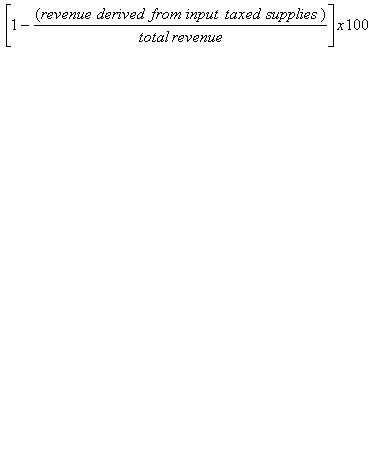
121 The formula essentially inverted the formula in the Commissioner’s GSTR 2000/22, which provided the following formula (at [132]):
Revenue (in relation to taxable and GST-free supplies)
_____________________________________________________ χ 100
Total revenue (including revenue relating to input taxed supplies)
122 The Commissioner withdrew GSTR 2000/22 in April 2006 (after the relevant time so far as concerns these appeals) and replaced it by a 2006 ruling, GSTR 2006/3. This expressed the same formula in slightly different terms (at [109]):
Revenue (other than revenue from input taxed supplies)
_____________________________________________________ χ 100
Total revenue (including revenue relating to input taxed supplies)
So long as there are only three components of “total revenue” (relating to taxable supplies, GST-free supplies, and input taxed supplies), there is no practical difference between any of the three versions of the formula.
123 In light of the parties’ dispute over the meaning of “revenue derived from input taxed supplies” in the respondents’ version of the formula, it is worth examining why the formula was expressed in terms of “revenue” in the first place. The most important thing to understand in this regard is that, in tying the extent of creditable purpose to sources of revenue, the formula departed from the text of the GST Act, under which the extent of creditable purpose of an acquisition is based on its relationship to the making of particular supplies, i.e., its use or intended use.
124 Revenue only enters the formula as a proxy for the relationship between acquisitions and the making of supplies. Though there is no dispute that it was appropriate for the respondents to use a revenue-based formula to calculate the extent of creditable purpose, it must be borne in mind that reliance on revenue is only an indirect method of approximating the extent of creditable purpose. As the ruling from which the respondents derived the formula explained, indirect methods “rely on variables that are not directly identifiable with the use of the particular acquisition”: see GSTR 2000/22 at [60]; see also GSTR 2006/3 at [102]. In GSTR 2000/22, the Commissioner recognised that the use of an indirect method “may be appropriate in circumstances such as where there are overhead expenses or a large number of small acquisitions or importations and it is not cost effective to try to measure the use to which each separate acquisition or importation is put”: see GSTR 2000/22 at [61]; see also GSTR 2006/3 at [103]. The Commissioner’s 2006 ruling explains that the formula relies on revenue based on the “expectation that the use of acquisitions . . . will be accurately reflected in the revenue flows (input taxed and non-input taxed) of the overall enterprise . . .”: GSTR 2006/3 at [105]; see also [110]. Although not stated as clearly in the Commissioner’s 2000 ruling, it is clear enough that this ruling also made the same assumption. For present purposes, there is no material difference between the 2000 and 2006 rulings.
125 As noted, the case below was conducted on the basis that the phrase “revenue derived from input taxed supplies” in the formula meant “consideration for input taxed supplies”. In light of the reasons for the formula’s reliance on revenue, it was evidently incorrect to equate revenue with consideration in this way.
126 The formula employs revenue as a proxy for the relationship between acquisitions and the making of supplies based on an underlying assumption that there is a roughly proportional relationship between: (a) the relative amount of revenue an entity derives from the making of particular supplies; and (b) the proportion of the total supplies made by entity represented by those particular supplies. Absent such an assumption, the formula is untethered from the text of GST Act. Although not directly stated in the Commissioner’s rulings, it seems clear that the foundation for the assumption is the expectation that a rational profit-driven corporation will, in general, only dedicate its resources (including, relevantly, its potentially creditable acquisitions) to making particular supplies to the extent that doing so maximizes revenue. There is no reason, however, to expect a similar relationship if one substitutes “consideration” for “revenue”; the amount of revenue a corporation earns will be the same whether or not a particular revenue stream satisfies a definition of “consideration”.
127 To put it in terms of the present case, the formula assumes that it is fair and reasonable to expect a roughly proportional relationship between: (a) the amount of revenue Amex Intl earns from making financial supplies relative to its total revenue; and (b) the extent to which Amex Intl’s acquisitions relate to making financial supplies, relative to the acquisitions’ relationship to its supplies overall. The correlation between revenue and the making of supplies will be the same whether or not a particular revenue source, i.e., the fee payments, satisfies a particular legal definition of consideration. To ask whether the fee payments fall within the definition of “consideration” under the GST Act (or any other definition of “consideration”) is in effect to pose a question unrelated to the actual relationship between the acquisitions and the making of supplies; and approximating that actual relationship is the only reason to consider revenue when calculating extent of creditable purpose.
128 As the above discussion indicates, the parties have conducted the proceedings thus far on the basis of an incorrect interpretation of the formula used to calculate the extent of creditable purpose. That interpretation appears to have been introduced by Amex at the objection stage and subsequently picked up by the Commissioner. Counsel for the Commissioner explained this by stating that the Commissioner had made a mistake in acceding to Amex’s position that “revenue” meant “consideration”. Unsurprisingly, in the absence of debate, Amex’s interpretation was accepted by the primary judge. The incorrect interpretation of the formula thus escaped examination along the way to these appeals. When the formula is considered, however, it is plain that the interpretation given it to date is wrong, although no explanation for its adoption has been provided. It is against this background that the Court must examine the motion to amend, should it become necessary to do so.
REASONS OF THE PRIMARY JUDGE
129 Since the factual and legislative framework has by now been outlined in some detail, it is appropriate to explain the reasons of the primary judge more fully than before.
130 As noted already, the primary judge concluded that the fee payments were not consideration in connection with financial supplies. First, the primary judge rejected the Commissioner’s contention that, under a charge card and a credit card, the cardholder is afforded credit merely because a cardholder is not required to make immediate payments for the goods or services supplied to him or her by the merchant. His Honour held that “[t]here will be no credit, in the relevant sense, arising under either the charge card facility or the credit card facility by reason only of the benefit derived by a cardholder in deferring, by use of a card, the time when the cardholder must part with money, in some form, in respect of the supply of goods or the provision of services by a merchant”: see American Express at 184 [51] (emphasis added). Accordingly, supplies to charge cardholders could not qualify as financial supplies on the basis of being supplies of an interest in a credit arrangement or right to credit because the charge card arrangements did not involve the deferral of a cardholder’s obligation to pay.
131 Whilst the primary judge accepted that, under a credit card, “[t]he interest on the balance of the account from time-to-time outstanding after the due date for payment of the minimum amount is clearly a payment in connection with [a] credit arrangement or right to credit” (184 [52]), his Honour concluded that fee payments by credit cardholders were not in connection with the supply of such a credit arrangement or right to credit. Nor were fee payments by charge card customers in connection with a supply of a debt. In both cases, so his Honour held, the obligation to make the fee payments only arose because the cardholder “failed to perform that cardholder’s obligations under the credit card terms and conditions or the charge card terms and conditions” and therefore could not properly be characterized as “consideration in connection with opening, keeping, operating, maintaining or closing the relevant facility” (185 [56]). Thus, the primary judge held that the fee payments by charge cardholders were not consideration in connection with the provision, acquisition or disposal of the debt created upon a charge being debited to the holder’s account but the result of the holder’s failure to perform the holder’s primary obligation to pay the debt when due (185 [57]). Similarly, his Honour held that the fee payments by credit cardholders were not consideration for the supply of a credit arrangement or right to credit because a credit cardholder’s liability to pay them arose from the holder’s breach of those arrangements (185-6 [58]). That is, in both cases, the fee payments by both charge card and credit cardholders were not, in his Honour’s judgment, to be characterized as consideration in connection with financial supplies because the default by the cardholder was a “novus actus interveniens” giving rise to the obligation to pay the fee (185-6 [57]-[58]). Since none of the fee payments constituted consideration in connection with the provision, acquisition or disposal by the respondents of an interest (as defined in the GST legislation: see above), then the fee payments were not consideration in connection with a financial supply. In the alternative, the primary judge concluded that supplies to charge card or credit cardholders were not financial supplies because they were a supplies under a “payment system”, which the Regulations exclude from the definition of financial supply: American Express at 188 [70].
132 Subject to the Commissioner’s application to amend the notices of appeal, these appeals largely revisit the case as it was put to the primary judge.
overview of issues and resolution
133 Putting to one side the motion to amend, the questions in this case concern the relationship between the fee payments and the making of supplies, and the proper classification of those supplies under the GST Act. It is useful at this point to identify precisely what is “supplied” in the supplies under consideration. The parties agreed that the relevant thing supplied, with regard to both charge cards and credit cards, is the cardholder’s right to present the card as payment to a merchant for goods and services without having to part with money until paying Amex Intl at a later date. Amex Intl supplies this right to cardholders when the cardholders agree to the relevant terms and conditions. The central question is whether such supplies are financial supplies under the GST Act.
134 The primary judge concluded that supplies to charge card and credit card customers were not financial supplies. Under the statutory and regulatory scheme set forth above (under “Legislative Framework”), several elements must be satisfied for supplies to charge card and credit card customers to constitute financial supplies. Three question arise here:
Is the right to present the card as payment (without having immediately to part with money) an “interest” as defined in the Regulations? That is, is the right something “recognised at law or in equity as property in any form”? (Regulation 40-5.02)
If so, is the interest of a kind mentioned in regulation 40-5.09(3)? Relevantly, in this case, is the interest an interest in or under a “credit arrangement or right to credit”?
Is the interest an interest in or under a payment system?
The supplies to charge card and credit card customers will constitute financial supplies if questions (1) and (2) are answered “yes” and question (3) is answered “no”.
135 For the sake of clarification, we note that one of the elements of a financial supply is that the supply must be provided for consideration. The question in this regard is whether Amex Intl receives consideration of any kind in return for supplying cardholders with the right to present cards as payment. There can be no dispute as to this element, as the respondent plainly receives consideration from cardholders for this supply. It is an altogether different question as to whether the fee payments are consideration
136 The primary judge did not directly answer question (1). His Honour answered “no” to question (2) and “yes” to question (3). For the reasons stated below, we conclude that primary judge should have answered “yes” to questions (1) and (2) and “no” to question (3).
137 These conclusions make it necessary to consider the motion to amend. For the reasons stated below, we conclude that the motion should be granted. It is thus unnecessary to examine the primary judge’s conclusion that the fee payments are not consideration. Based on the resolution of the previous issues, the fee payments are revenue derived from financial supplies, and, on the proper interpretation of the formula, should have been included in the numerator when calculating the extent of creditable purpose.
Consideration
Interest
138 Although the primary judge noted that the initial issue was whether the relevant respondent supplies cardholders with an “interest”, as defined in the Regulations, his Honour did not directly consider this issue. Instead, the primary judge proceeded to the question whether the interest, if any, was an interest in or under a credit arrangement or right to credit. Plainly enough, the issues are closely related; but they are distinct questions. We propose to discuss them separately. We therefore consider first whether the right to present a charge card or credit card as payment to a merchant for goods and services without immediately parting with money constitutes an interest in the relevant sense.
139 As noted, the Regulations define “interest” broadly as “anything recognised at law or in equity as property in any form”: see regulation 40-5.02. The respondents submitted that, in applying this definition, the Court should be guided by the description of property given by Lord Wilberforce in National Provincial Bank Ltd v Ainsworth [1965] AC 1175 at 1247-48, who said:
Before a right or an interest can be admitted into the category of property, or of a right affecting property, it must be definable, identifiable by third parties, capable in its nature of assumption by third parties, and have some degree of permanence or stability.
The respondents noted that, in R v Toohey; Ex parte Meneling Station Pty Ltd (1982) 158 CLR 327 at 342, Mason J relied on this description to unbundle the notion of property in that case. The respondents argued that, approaching the issue in this way, the right to present a card as payment is not property but “a merely personal right”. In this regard, the respondents cited two older decisions of the High Court, Jack v Smail (1905) 2 CLR 684 at 705 and Commissioner of Stamp Duties (NSW) v Yeend (1929) 43 CLR 235 (‘Yeend’) at 245-6.
140 In Jack v Smail, a case under the Insolvency Act 1890 (Vic), the Court held that a grocer’s license issued under the Licensing Act 1890 (Vic) was not property but “a personal right of the insolvent to carry on business in a particular place under conditions prescribed by law”: 2 CLR at 705 (Griffith CJ), 709 (Barton J) and 714 (O’Connor J). Accordingly, the license was not “goods and chattels” within the meaning of s 70 of the Insolvency Act and therefore not part of the insolvent’s estate: 2 CLR at 706-7, 715.
141 The issue in Yeend was whether an agreement between a caterer and a racing club, providing the caterer with the exclusive right to sell refreshments at the club, was a conveyance of property within the meaning of the Stamp Duties Act 1920-1924 (NSW): 43 CLR at 240. The Court concluded that the right to sell refreshments was a personal right and not in the nature of property: 43 CLR at 242 (Knox CJ, Gavan Duffy, Rich and Dixon JJ) and 246 (Isaacs J).
142 The Commissioner submitted that the authorities relied on by the respondents focussed on the question whether the rights at issue were capable of vesting from one party to another, and were thus inapplicable to the broad definition of “interest” under the Regulations. The Commissioner argued that the word “property” in the definition of “interest” in regulation 40-5.02 should be construed in light of the less formalistic discussion of the concept of “property” in Yanner v Eaton (1999) 201 CLR 351 (‘Yanner’).
143 In Yanner, the High Court considered the term “property” in s 7(1) of the Fauna Conservation Act 1974 (Q), which provided that, with certain exceptions, fauna was “the property of the Crown and under the control of the Fauna Authority”. In their joint judgment, Gleeson CJ, Gaudron, Kirby and Hayne JJ noted (at 365-66 [17]-[19]) that property is a rather broad and malleable concept, saying:
The word “property” is often used to refer to something that belongs to another. But in the Fauna Act, as elsewhere in the law, “property” does not refer to a thing; it is a description of a legal relationship with a thing. It refers to a degree of power that is recognised in law as power permissibly exercised over the thing. The concept of “property” may be elusive. Usually it is treated as a “bundle of rights”. But even this may have its limits as an analytical tool or accurate description ….
Nevertheless, as Professor Gray … says [in “Property in Thin Air”, Cambridge Law Journal, vol 50 (1991) 252, at p 299], “An extensive frame of reference is created by the notion that ‘property’ consists primarily in control over access. Much of our false thinking about property stems from the residual perception that ‘property’ is itself a thing or resource rather than a legally endorsed concentration of power over things and resources.”
“Property” is a term that can be, and is, applied to many different kinds of relationship with a subject matter. It is not “a monolithic notion of standard content and invariable intensity” …. (footnotes omitted)
The Honours continued (at 367 [26]):
Because “property” is a comprehensive term it can be used to describe all or any of very many different kinds of relationship between a person and a subject matter. To say that person A has property in item B invites the question what is the interest that A has in B? The statement that A has property in B will usually provoke further questions of classification. Is the interest real or personal? Is the item tangible or intangible? Is the interest legal or equitable?
The majority held (at 370-71 [30]-[31]) that “[t]he “property” which the Fauna Act … vested in the Crown was therefore no more than the aggregate of the various rights of control by the Executive that the legislation created” and that these rights were not inconsistent with native title rights and interests.
144 In a separate judgment, Gummow J noted (at 388-9 [85]):
Hohfeld identified the term “property” as a striking example of the inherent ambiguity and looseness in legal terminology. The risk of confusion is increased when, without further definition, statutory or constitutional rights and liabilities are so expressed as to turn upon the existence of “property”. The content of the term then becomes a question of statutory or constitutional interpretation. (footnote omitted)
145 Although the subject matter in Yanner is very different indeed from that in these appeals, the discussion about the concept of “property” is helpful in the present context. First, Yanner shows that the meaning of the word “property” can be fixed by relevant context, and the rather narrow meanings given in the authorities cited by the respondents will not apply in all contexts. Secondly, the word “property” can be applied to different kinds of relationships between a person and a subject matter, and can be understood as referring to the degree of power that is recognised in law as power permissibly exercised over the thing.
146 Considering the text of the GST Act (especially ss 9-10 and 11-10) and the Regulations, it is apparent that the term “interest” is referable to a very broad conception of property. The words “anything” and “in any form” in regulation in 40-5.02 highlight this extensive scope. Further, as the Commissioner submitted, the examples of financial supplies in the table in regulation 40-5.09(3) include a range of items that would not fit the narrower definition of property urged by the respondents. The same can be said of the “examples of interest” attached to regulation 40-5.02. These examples are illustrative of the proposition in the joint judgment in Yanner mentioned above.
147 The breadth of the conception of property under the GST scheme is also evident in other parts of the Act. In Saga Holidays Ltd v Commissioner of Taxation (2006) 156 FCR 256 at 266 [36], Stone J, with whom Gyles and Young JJ agreed, observed that the definition of “real property” in the GST Act includes purely personal rights that are not ordinarily considered proprietary at all. Although the present case does not concern real property, Stone J’s observations are nonetheless helpful, as the term “property” in the Regulations must be applied in light of the statutory scheme as a whole. Her Honour noted (at 266 [36]) that:
The definition of “real property” in the GST Act is … not confined to interests that would warrant that description under the general law. Indeed the definition goes well beyond even mere proprietary interests and encompasses interests that are purely contractual as well as personal interests which may or may not have arisen under contract[:] Sterling Guardian [Pty Ltd v Commissioner of Taxation (2005) 220 ALR 550] at [37]. For instance, s 195-1(c) includes as real property, “a licence to occupy land” or “any other contractual right exercisable over or in relation to land”. A licence to occupy land is not proprietary (Cowell v The Rosehill Racecourse Company Ltd (1937) 56 CLR 605) although it may be coupled with the grant of a proprietary interest in land (Australian Softwood Forests Pty Ltd v Attorney General (NSW) (1981) 148 CLR 121).
148 The Commissioner submitted that a cardholder’s rights under the card terms and conditions – (1) to possess the card during its currency; (2) to tender the card as payment; and (3) not to make payment to Amex Intl until the date of the statement – together constitute an interest under regulation 40-5.02, supplied to the cardholder. For the reasons stated, we accept this submission. Considering the breadth of the definition of “interest”, and the expansive notion of “property” apparent in the GST Act and the Regulations, Amex Intl supplies cardholders with an “interest” within the meaning of regulation 40-5.02 when cardholders agree to the cards’ terms and conditions. Cardholders agreeing to the terms gain a bundle of rights in relation to the card, the most important of which is the right to present the card as payment and incur a corresponding obligation to pay Amex Intl at a later date. This is sufficient to constitute an interest under the broad definition of “interest” in the Regulations.
Credit
149 The next issue is whether the interest supplied by Amex Intl is an interest in a credit arrangement or right to credit, as the Commissioner argued before the primary judge and on these appeals.
150 There is no dispute between the parties that the supply of credit cards involves a right to credit, as a cardholder may elect to pay less than the entire balance on the card and accrue interest as a result. The primary judge concluded that this constituted a credit arrangement or a right to credit, and the respondents conceded this point: American Express at 181 [37]. As noted above, the primary judge also concluded (at 184 [51]) that “[t]here will be no credit, in the relevant sense, arising under either the charge card facility or the credit card facility by reason only of the benefit derived by a cardholder in deferring, by use of a card, the time when the cardholder must part with money, in some form, in respect of the supply of goods or the provision of services by a merchant”. Although this holding did not affect the primary judge’s earlier conclusion that credit cards involved the supply of a right to credit or credit arrangement, it meant that charge cards could not be financial supplies.
151 In reaching this conclusion, the primary judge focussed on whether, in a technical sense, there was at any point a deferral of the obligation to pay between the individual parties to the three contracts comprising a credit charge transaction. The primary judge did so based on a definition of credit derived from the Oxford English Dictionary (‘OED’), saying (at 183-4 [44]-[48]):
In a commercial context, credit is trust or confidence in a buyer’s ability and intention to pay at some future time, exhibited by entrusting the buyer with goods or services without requiring present payment in return: see [OED], definition 9a. Similarly, a person may have a reputation of solvency and probity, such that a supplier of goods or provider of services might be prepared to trust that person with the goods or services without payment, in the expectation that payment will be made in the future. Alternatively, a person’s reputation of solvency and probity may be such that a person will be trusted with money in the expectation that the money will be repaid in the future: see [OED], definition 9b. Again, a sum of money placed at a person’s disposal in the books of another person, such as a banker, against which that person may draw to the extent of the amount might constitute a credit: [OED], definition 10a. Each of those cases might involve a credit arrangement or right to credit.
Thus, credit entails the giving of time to pay a financial obligation or forbearance in respect of payment of an obligation, or an arrangement under which money is payable where time to pay that money or some part of it has been deferred, the forbearance carrying interest or attracting a payment of consideration for that benefit from the debtor. …. On the other hand, a loan is not relevantly the giving of credit, even if it is obtained as an alternative to seeking deferment of the payment of the price of goods ….
Upon the supply of goods or provision of services by a merchant to a cardholder, by use of a charge card or credit card, the merchant accepts the obligation of the card issuer in full satisfaction of any obligation of the cardholder to pay the price. The cardholder becomes indebted to the card issuer, pursuant to credit card terms and conditions or the charge card terms and conditions, for the relevant amount shown in the monthly statement sent by the card issuer to the cardholder upon receipt of the monthly statement. The contract between the card issuer and the cardholder is not for the provision of credit by deferring the obligation of the cardholder to pay the card issuer.
The debt that is discharged by the payment made by the card issuer to the merchant is the debt of the card issuer. It is not a debt of the cardholder to the merchant, since the liability of the cardholder to the merchant to pay the price is extinguished when the merchant accepts the card and the signature of the record of charge form as the method of paying the price. The cardholder assumes a direct liability to the card issuer for the charges that appear on the monthly statement ….
…. [T]he obligation to pay is fixed by the contract between the cardholder and the card issuer. The terms of that contract give the cardholder a reasonable opportunity to make payment before the cardholder is in default and before the cardholder becomes liable to pay one or other of the fee payments. However, there is no forbearance by the card issuer to require payment of money owing. There is, from the outset, an agreement between the card issuer and the cardholder as to the time for payment. The card issuer does not exercise any forbearance. The contract between the card issuer and the cardholder is not one under which the obligation of the cardholder to pay an amount to the card issuer is deferred. Accordingly, there is no credit arrangement: see [American Express International Inc v Commissioner of State Revenue (2004) 10 VR 145] at 155 [18] and 156 [21] and Prime Wheat Association Ltd v Chief Commissioner of Stamp Duties (1997) 42 NSWLR 505 at 512. ….
152 The Commissioner contended that, in treating the absence of a deferred payment obligation as determinative, the primary judge departed from the terms of the Regulations and, further, that the authorities to which his Honour referred were inapplicable because they concerned definitions of credit and related concepts in different statutory contexts. The Commissioner submitted that “the ability to tender the card, and the later due payment of the presently incurred obligation to pay the amount charged to the card, comprise on the provision of the card to the cardholder the supply of a right to credit under a credit arrangement, and on the use of the card the supply of credit in respect of the presently incurred obligation”. The Commissioner continued that “[t]he right to credit, and the credit between purchase and payment, are ‘what is being supplied by [Amex Intl], not by someone else’”. The respondents contended, essentially, that the primary judge was correct to treat the deferral of payment as determinative.
153 In our view, the main difficulty with the primary judge’s analysis is that it relies on a dictionary definition of “credit” that is inconsistent with the text of the Regulations. Although the Regulations do not directly define “credit”, they do indicate the sense in which the word “credit” is used by providing examples of interests in “a credit arrangement or right to credit”. These examples appear in Part 2 of Schedule 7 to the Regulations, and include as item 2 “[o]pening, keeping, operating, and maintaining charge and credit card facilities”. The primary judge’s definition would exclude the charge card facilities included in this example. Notably, this is not the only instance in which the primary judge’s preferred definition is inconsistent with the text of the Regulations. If all credit and charge card transactions are, as the respondents effectively contend, excluded from “financial supplies” by the operation of regulation 40-5.12, there is also no scope for item 3 of Part 2 of Schedule 7. In accordance with well-accepted principle, a construction that renders part of the legislation otiose should be avoided where another construction is also reasonably open: see Project Blue Sky Inc v Australian Broadcasting Authority (1998) 194 CLR 355 [71] (‘Project Blue Sky’) at 382 (McHugh, Gummow, Kirby and Hayne JJ) citing The Commonwealth v Baume (1905) 2 CLR 405 at 414 (Griffith CJ) and 419 (O’Connor J) and Chu Kheng Lim v Minister for Immigration Local Government & Ethnic Affairs (1992) 176 CLR 1 at 12-13 (Mason CJ). Further, Dixon J made a comment in Deputy Federal Commissioner of Taxation (SA) v Ellis & Clark Ltd (1934) 52 CLR 85 at 89 (in connection with sales tax legislation) which is also apposite in the context of the Regulations under the GST Act. As his Honour there said:
… [T]he legislation depends in a remarkable degree upon the regulations made under the power which it confers on the Executive. Without the regulations, not only is it unworkable, but the expression of legislative policy is so inadequate as almost to be unintelligible.
Reading regulation 40-5.09 brings these observations to mind.
154 Under accepted principles of statutory construction, the construction of undefined terms in legislation “begins with the ordinary meaning of the words, considered according to their context and the legislative purpose”: see, e.g., Hart v Commissioner, Australian Federal Police (2002) 196 ALR 1 at 15 [64] per French, Sackville and R D Nicholson JJ, citing Project Blue Sky at 381. The precise application of this principle to a situation where, as here, a term is not defined directly but its meaning indicated by way of example is uncertain. The primary judge selected a particular definition of credit, derived from the ninth and tenth meanings given in the OED, without adverting to the possibility of other ordinary meanings of the word. There is a common understanding of the word “credit”, which is broader than this definition and encompasses the examples provided in Part 2 of Schedule 7. As Stone J observing in considering the Bankruptcy Act 1966 (Cth), in which “credit” is undefined, “[b]roadly speaking, the term [‘credit’] means the provision of funds either directly to the person obtaining the credit or to a third party provider of goods and services to that person subject to the obligation of the person obtaining credit to pay at a later time”: see Fitz-gibbon v Inspector General in Bankruptcy (2000) 180 ALR 475 at 479 [15]. This is the interest supplied by Amex Intl to charge card customers. Whilst, as the respondents say, one must focus on the “contractual arrangement”, the focus is on the entire contractual arrangement considered contextually and as a whole.
155 In sum, the primary judge applied a narrow definition of “credit” inconsistent with the language of the Regulations and ordinary meaning, considered contextually. For the reasons stated above, the supply of the right to use a charge card is a supply of an interest in or under a credit arrangement or right to credit within the meaning of regulation 40-5.09. As noted, it is not in dispute that the supply of the right to use a credit card is as well. Both supplies therefore meet the definition of financial supply.
156 The cases cited by the primary judge in paragraph [48] of his reasons do not change this conclusion. Both concerned different statutory schemes to the present case. In American Express International Inc v Commissioner of State Revenue (2004) 10 VR 145 – a case concerning the Financial Institutions Duty Act 1982 (Vic) – the Victorian Court of Appeal held that, by reason of s 18(3)(1) of that Act, there was no dutiable receipt of money. The Act in that case provided its own definitions of “credit”, “credit contract”, “continuing credit contract” and related terms. The Court held that there was no dutiable receipt because there was no “continuing credit agreement” as defined, because the card issuer did not satisfy any debt of the cardholder to the merchant; nor did it provide credit to the cardholder in respect of these amounts. Further, there were no repayments under a “credit contract” constituted by a “loan” as defined. None of these definitions finds their equivalent in the GST Act or the Regulations. Prime Wheat Association Ltd v Chief Commissioner of Stamp Duties did not concern the statutory use of the term “credit” at all; rather, the case addressed the definition of “loan” in the Stamp Duties Act 1920 (NSW).
157 UG Insurances Pty Ltd v Commissioner of Stamp Duties (NSW) (1973) 128 CLR 353 is also of little assistance. The High Court held that the loan agreement in that case was not a “credit arrangement” because the loan agreement did not fall within the statutory definition of “credit arrangement”. This definition is not found in the legislation with which these appeals are concerned. For the purposes of s 11-15 of the GST Act, the question here is whether there is a financial supply as defined in Division 40 of the Regulations, read as a whole. The advantages that Amex Intl confers on the cardholder by the supply of a charge card or a credit card are advantages that fall directly within the examples in Part 2 of Schedule 7.
Payment System
158 Although the supplies meet the definition of financial supply, they will be excluded from that definition by regulation 40.5-12 if they are supplies in or under a payment system. As noted earlier, the dictionary to the regulations defines “payment system” as “a funds transfer system that facilitates the circulation of money, including any procedures that relate to the system”. In concluding that supplies to charge card and credit card customers were supplies of an interest in or under a payment system, the primary judge relied exclusively on Visa International Service Association v Reserve Bank of Australia (2003) 131 FCR 300 (‘Visa’), in which Tamberlin J considered a similar definition of “payment system” under the Payment Systems (Regulation) Act 1998 (Cth) (‘PSR Act’).
159 The PSR Act defined “payment system” as “a funds transfer system that facilitates the circulation of money, and includes any instruments and procedures that relate to the system”. As can be seen, the only practical difference between the two definitions is that the PSR Act definition includes “instruments and procedures”, while the definition in the Regulations refers only to “procedures”. Relying on the similarity between these definitions, and the perception that there was “no material distinction” between Amex Intl’s operations and the systems considered in Visa, the primary judge concluded that Amex Intl operated a payment system within the meaning of the Regulations: American Express at 188 [70]. He concluded therefore that the supplies were not financial supplies.
The Visa Case
160 Considering the primary judge’s reliance on Visa, it is worth examining the case in some detail. Visa concerned the authority of the Reserve Bank of Australia (‘RBA’), through its Payment Systems Board (‘PSB’), to designate the four-party credit card schemes operated in Australia by Visa International Service Association (‘Visa’) and MasterCard International Incorporated (‘MasterCard’) as “payment systems”, and thus bring those schemes within the RBA’s regulatory power under the PSR Act. In considering the PSB’s authority to designate, Tamberlin J paid particular attention to the history of the legislation concerning the RBA’s regulatory power over payment systems; to the specifics of the card companies’ operations; and to the role of credit card arrangements in the Australian economy. In particular, Tamberlin J focussed on the economic considerations underlying the PSB’s conclusion that regulation of the “interchange fees” involved in the Visa and MasterCard schemes was necessary.
161 Interchange fees were at the heart of the issues in Visa. Tamberlin J described Visa’s and MasterCard’s credit card arrangements and the place of interchange fees in them as follows (at 320-21 [71]):
Visa and MasterCard provide services in what is typically described as a “four-party card scheme” or an “open loop credit card network” … because there are four main parties who are involved in the operation of the scheme: the cardholder, their financial institution (the issuer) which issues the card, the recipient of the funds (the merchant) and its financial institution (the acquirer). The cardholder uses the credit card issued by their financial institution to acquire goods and services. They agree to pay fees to the issuer of the credit card together with any interest when they take advantage of the revolving line of credit. In using their credit card, cardholders present their cards to merchants, to whom payment is ultimately made. The merchant’s financial institution, the acquirer, is reimbursed by the issuer for the value of goods or services and the acquirer in turn agrees to pay the issuer an interchange fee. The acquirer will pay to the merchant the full value of an authorised credit card transaction, less any relevant fee charged by the acquirer to the merchant. This amount, payable by the merchant, is known as the merchant service fee. It includes the interchange fee. The expression merchant services includes the acceptance of credit card transactions, collection of the value of transactions from the issuer and reimbursement of the merchant, the provision of electronic terminals, card imprinters, sales vouchers, signage and promotional material and the provision of a call processing centre for authorisation of transactions.
162 His Honour also noted the difference between such schemes and those operated by companies such as Amex Intl (at 321 [72]-[73]):
Four-party schemes are operated by system administrators. In the present case, Visa and MasterCard administer the credit card network and provide issuers and acquirers, who are members of the scheme, with network administration services, including, for example, the right to use intellectual property. In administering the credit card network, Visa and MasterCard also provide their members with authorisation and settlement services and facilitate the interchange transactions between those members. The payment process involves a flow of information and payment instructions between parties to ensure that payment is made by the cardholder to the merchant. In the case of the Visa scheme, payment processing is completed by using a system known as VisaNet. The MasterCard network uses a similar system knows as BankNet. In some instances in a four-party credit card transaction the issuer and the acquirer are the same entity. These are known as “on us” transactions and there is no interchange fee payable.
By contrast, closed loop card networks, which are also known as three-party card schemes, such as those provided by American Express and Diners Club, consist of a network under which a single entity performs all issuing and acquiring functions, in addition to administering the card network. These schemes involve three parties, namely cardholder, merchant and the scheme administrator, which issue cards to cardholders. Cardholders use the card to purchase goods and services, and will usually agree to pay their account in full by the end of the billing cycle if they are issued with a charge card, or interest and fees if they hold a credit card issued by three-party card schemes operators. A charge card does not usually provide for the extension of credit facilities. In a typical three-party card transaction, the merchant receives payment following authorisation of a transaction, with the acquiring function being completed by the same entity which issued the card, namely the scheme administrator, such as American Express or Diners Club. The merchant is bound to pay a service fee in return for the acquiring services provided. However, no interchange fee is paid as part of a three-party card network.
163 The Visa litigation resulted from the RBA’s decisions to regulate interchange rates. Tamberlin J noted that the RBA’s decisions “were not decisions made swiftly but rather at the end of a long detailed process” beginning with the adoption of the National Competition Policy by the State and Federal governments in 1995 (333 [123]), involving various commissions, studies and reports, and culminating in the passage in 1998 of a legislative package creating the PSB and expanding the RBA’s power over payment systems (335 [130]). Further studies and meetings of the PSB followed, resulting in the designation challenged by Visa and MasterCard (349 [202]). The RBA announced the formal designation of Visa’s and MasterCard’s credit card systems as “payment systems” in 2001, citing, among other things, a public interest in setting standards for interchange fees (349-50 [203]).
164 The RBA’s power to designate payment systems and regulate the systems so designated derives from s 11 of the PSR Act, which provides that “[t]he Reserve Bank may designate a payment system if it considers that designating the system is in the public interest”. Visa and MasterCard argued that the designation at issue was outside the RBA’s power because the companies’ operations were not within the statutory definition of payment system.
165 Visa argued that only the final step in the process triggered by a credit card purchase – that is, the ultimate exchange comprising “clearing”, “settlement” and transfer of funds – formed part of a payment system. The various exchanges of promises to pay at lower levels of the process did not, Visa contended, comprise part of a system for the transfer of funds (360-61 [245]). “Clearing” and “settlement” do not play a role in the respondents’ operations, but it is important to understand what is meant by these terms in order to follow Tamberlin J’s reasoning in Visa. His Honour described them as follows (325 [92]):
. . . .
(b) a clearing service . . . involves the collection of financial information about a transaction from an acquirer and the delivery of that data to the relevant issuer. The issuer is able to use the information to post the transaction to the cardholder’s account; and
(c) a settlement service . . . involves the calculation of the net financial position of each member for all transactions that are cleared within a particular time period.
166 Significantly for present purposes, Visa argued that there was “no transfer of funds which facilitates the circulation of money as between customer and merchant as a consequence of the use of a credit card”, and hence no payment system in operation at the point when a cardholder makes a purchaser (364 [258]). In support of this, Visa relied on the fact that the cardholder’s obligation to a merchant is discharged on acceptance of the card and there is no further promise by the cardholder to pay the merchant (364 [258]). Tamberlin J considered that this argument was “not inconsistent with the conclusion that the Visa card system is a payment system . . .” (365 [260]). His Honour explained (at 365 [260]):
This is because both the Visa and MasterCard systems provide payment instruments and procedures which operate from at least the authorisation stage. These instruments and procedures can be said to “relate” to a transfer of funds which facilitates the circulation of money and this circulation takes place at the final stage of settlement at the RBA level. It is therefore not necessary to decide the question whether there is a transfer of funds at the earlier stages. In my opinion, there is no transfer of funds at the merchant-cardholder stage, but the question is not so narrowly confined. Having regard to the breadth of the definition of payment system, in my view, the “lower level” relationships are within the broad description of instruments and procedures which relate to a funds transfer system which facilitates the circulation of money. The flaw in the approach proposed by Visa is that it segregates the concepts of payment and money as the central consideration and fails to give weight to the fact that the definition is framed as a comprehensive, composite expression.
Later, Tamberlin J observed (at 366 [265]) that “[w]hile there is some force in the proposition that some particular steps taken in isolation do not effect a transfer of money, when considered cumulatively from the authorisation step to final settlement at the RBA level, each of the schemes as designated amounts to a payment system within the definition”.
167 Turning to the definition, Tamberlin J observed that it “directs attention to the nature of the system”; his Honour noted (at 370 [294]) that:
[The system] must be a system which is directed to effecting a transfer of funds and that system must facilitate the circulation of money. It is important, therefore, to determine what is the system which produces that effect. This must be determined having regard to the inclusion in the definition of the words of extension referring to the inclusion of instruments or procedures which relate to the system.
168 The question therefore was “at each level of the transaction . . . whether the instrument used or procedure followed can be said to relate to a funds transfer system which facilitates the circulation of money” (371 [296]). Tamberlin J concluded (at 371 [297]) that:
… [T]he procedures and instruments concerning authorisation of the transaction, the guarantees by the credit card organisations and the payment obligations which are constituted and apply in relation to obligations between banks, between banks and merchants and between cardholders and issuers are “related” to and operate in conjunction with the later procedures . . . .
The relationship between these procedures and instruments and the higher level procedures consisted of four elements: first, the causal relationship between, on the one hand, presentation of the card, authorisation and acceptance by the merchant, and, on the other, the subsequent procedures; second, the fact that “the rules, regulations and procedures governing the applicants’ systems are an integrated whole”; third, and similar to the first element, the fact that the rest of the procedures “inexorably follow” from the initial merchant-cardholder transaction; and fourth, the artificiality of the distinction between higher and lower levels of procedures (371-72 [298]-[304]). Based on the elements, Tamberlin J concluded (at 372 [305]) that “the instruments (credit cards, record and forms) and procedures at the issuer, acquirer and merchant level are within the definition ‘payment system’ as a matter of interpretation”. His Honour considered that extrinsic material, which reflected a legislative intent that the RBA have the power to regulate interchange fees, reinforced his interpretation of “payment system” (372-78 [306]-[334]), as did evidence that Visa and other financial institutions considered Visa an operator of a payment system (378-85 [336]-[372]).
169 Tamberlin J’s interpretation of the PSR Act definition of “payment system”, as applied to the issues before him, was thorough and methodical. However, Tamberlin J emphasised (366 [266]) that resolution of those issues required “a detailed interpretation of the statutory requirements in the light of the language used, the legislative history, and the extrinsic materials and the framework in which the designation was made”. These words should serve as a caution against importing the analysis in Visa to other contexts without careful consideration. This is especially true considering Tamberlin J’s extensive discussion of eight years of legislative history and other studies related to the PSR dating back to 1995, and the unique context in which the issues in the case arose.
170 We have discussed Visa in detail to highlight these considerations. Despite the similarity between the definitions in the PSR Act and the Regulations under the GST Act, unlike the primary judge, we would not regard Tamberlin J’s analysis as determinative in the GST context. In Clyne v Deputy Commissioner of Taxation (1981) 150 CLR 1 (‘Clyne’), the High Court held that the same word in the same section had different meanings depending on context. In this regard, Gibbs CJ said (at 10):
It is … understandably argued that the same meaning should be attached to the word “due” where it appears elsewhere in the section. No doubt there is a presumption that where the same word is used on more than one occasion in a section it is intended to have the same meaning in each case, but this is not a presumption of very much weight; there is no rigid rule; it all depends on the context: see McGraw-Hinds (Aust) Pty Ltd v Smith [(1979) 144 CLR 633 at 643].
See also Clyne at 15-16 (Mason J). Here, of course, the definition of “payment system” is very similar in the two different legislative contexts. Whilst there may be a general presumption that the definition carries the same meaning in both places, the legislative context may operate to displace the presumption.
171 Before adopting the analysis in Visa here, it is necessary, so it seems to us, to give more consideration than the primary judge did to the present statutory context and the precise questions posed by the Regulations.
The issues under the GST legislation
172 At the hearing of the appeal, the parties’ attention was drawn to the absence of any evidence regarding the actual operation of the respondents’ credit card scheme, other than the card customer terms and conditions and merchant terms and conditions (titled “Terms and Conditions for American Express Card Acceptance”). This was contrasted with the wealth of detail regarding Visa’s and MasterCard’s systems considered by Tamberlin J, and it was suggested that there might be insufficient evidence to support a finding that Amex Intl operated a “system” within the meaning of the Regulations. On further reflection, however, we are prepared to assume without deciding that Amex Intl operates a system that could be described as a funds transfer system that facilitates the circulation of money (that is, a payment system). This is because, on careful examination, the relevant question is not simply whether Amex Intl operates a payment system. Rather, assuming that Amex Intl operates such a system, the Regulations require attention to the nature of the thing supplied by Amex Intl to cardholders, and whether that supply constitutes an “interest” in or under the payment system, if any. As the Commissioner submitted, the nature of the relationship between cardholders and the operations said to constitute a payment system is not such that Amex Intl can be considered to supply cardholders with an interest in or under a payment system.
173 Put differently, the question in Visa, as regards merchant-cardholder transactions (if it stretched so far), was whether such transactions involved instruments or procedures related to a funds transfer system which facilitated the circulation of money. The question here is whether Amex Intl supplies cardholders with a property interest, broadly conceived, in or under a funds transfer system which facilitates the circulation of money, including its related procedures. These two questions are not the same and, moreover, can only be analysed in their distinct statutory contexts.
174 As noted, the relevant thing supplied by Amex Intl to customers is the right to present a card as payment for goods or services and incur a corresponding obligation to pay Amex Intl at a later date. We have already concluded that this constitutes an interest, and that the interest is an interest in or under a credit arrangement or right to credit. This is because what a cardholder receives is the ability to access, by presenting a card, something that fits a common understanding of credit (as reflected in the Regulations’ illustrative examples). That is, a cardholder obtains the ability to initiate Amex Intl’s provision of payment to a third party (the merchant) in exchange for an obligation to pay Amex Intl at a later date. The GST scheme does not evidence an intention that such an interest count as an interest in a payment system.
175 Several considerations support this conclusion: first, the nature of the examples of interests in a payment system provided in the Regulations; second, the rule that statutes and regulations must be interpreted if possible so as not render any part of an enactment superfluous; and third, the consequences that would follow if the interest were treated as an interest in a payment system.
176 Part 2 of Schedule 8 lists examples of interest in a payment system. Those examples are:
____________________________________________________________________
Item Example
____________________________________________________________________
1 Supply of services by a payment system operator to a participant in the system for which the following fees are charged by the operator:
(a) membership fees;
(b) processing fees;
(c) service fees;
(d) marketing fees;
(e) risk management fees;
(f) multi-currency fees
2 Access to a payment system, and supply of other related services by a participant in the system to a third party
3 Supply of a service by one participant in a payment system to another participant in the system in relation to charge, credit and debit card transactions.
4 Processing, settling, clearing and switching transactions of the following kinds:
(a) direct credit and debit;
(b) other debit and credit transactions;
(c) charge, credit and debit card transactions;
(d) cheque;
(e) electronic funds transfer;
(f) ATM;
(g) B-pay;
(h) Internet banking;
(i) GiroPost;
(j) SWIFT (Society for Worldwide Interbank Financial Telecommunications) Payment Delivery System;
(k) an approved RTGS (real time gross settlement) system;
(i) Austraclear
5 Supply to a participant in a payment system by the operator of the system of the following services:
(a) processing of account data;
(b) electronic payment services.
177 Although the definition of payment system will prevail in the event of inconsistency between the definition and these examples, the examples are nonetheless indicative of the types of interest intended to be included within the category of interests in or under a payment system. All but one of the examples are explicitly phrased in terms of supplies either by or to “participants” in the system, as distinguished from “system operators” such as Amex Intl. The only example which cannot be so characterized involves “[p]rocessing, settling, clearing and switching”, activities which occur above the level of the merchant-cardholder and card issuer-cardholder relationships, and has little application to the type of interest under consideration here.
178 As discussed earlier, property may be thought of as “a degree of power that is recognised in law as power permissibly exercised over [a] thing” or as control over access to a thing: see Yanner at 366 [17]. That “thing” for present purposes is a funds transfer system (including related procedures) that facilitates the circulation of money. This, as Tamberlin J’s analysis in Visa indicates, is a rather nebulous concept. The question here is whether the supply by Amex Intl to cardholders provides them with a relationship to the “thing” sufficient to constitute a property interest. Considering that this question combines the amorphous notion of “payment system” with the vagaries of “property”, it is by no means straightforward.
179 It is in this context that the examples in Schedule 8 are especially helpful. They provide concrete examples of the kinds of relationships to a payment system that have the character of a property interest in or under the system. The examples indicate that, in general, the entities having such relationships will be those considered “participants” in the system. “Participant”, in the context of a payment system, is a defined term in the Regulations, although the definition is not particularly illuminating. The dictionary to the Regulations defines “participant, in a payment system” as “a person who is a participant in the system in accordance with the rules governing the operations of the system”. Other than the reference to “rules governing the operations of the system”, this definition is essentially circular. The relevant rules are by and large absent from evidence in this case, and what evidence there is throws little light on who is a “participant” in Amex Intl’s “system”. The only real guidance, then, is the examples.
180 A cardholder’s relationship to the system is of a different nature than the relationships contemplated by the examples. It is true that, as Tamberlin J observed, a cardholder’s presentation of card triggers the subsequent operation of the system provided the merchant accepts the card. A cardholder, however, has no involvement in the system beyond this. The cardholder’s interest is essentially in the nature of the receipt of credit from the card issuer. The cardholder has no interest, in the sense of a property interest broadly conceived, in or under the operation of the system that follows his or her purchase. The cardholder has no real involvement with the system and probably no knowledge of its operation. Moreover, the cardholder has no control over it.
181 It is useful when dealing with an abstract notion such as “interest” to attempt to put things in concrete terms. In the case of credit, this can easily be done: the cardholder has a relevant interest in a right to credit; that is, the cardholder has the ability to access the receipt of something in the nature of credit from Amex Intl. The cardholder has no similar interest in any payment system operated by Amex Intl, which is susceptible of being expressed in concrete terms. This can be contrasted with a merchant who can rightly be described as a participant in the system. A merchant who agrees with Amex Intl to accept its cards as payment from customers has a right to receive payment from Amex Intl in accordance with the procedures governing the system. It was not suggested that a cardholder has any legal right to enforce the procedures which ultimately result in payment to the merchant, and a cardholder would have no apparent interest in doing so. Once the cardholder has presented the card and the card has been accepted by the merchant, what happens next is not the cardholder’s concern. Even assuming Amex Intl operates a payment system, it does not seem to us that it supplies cardholders with an interest, enforceable at law or equity, in or under that system. Accordingly, regulation 40.5-12 does not exclude supplies to cardholders from the category of financial supplies.
182 This conclusion is reinforced by statutory context. Under regulation 40.5-09(3), the supply of an interest in or under a credit arrangement or right to credit is a type of financial supply. If section 40.5-12 were taken to apply to supplies to charge card and credit cardholders, there would be no room for the operation of this provision. It is a well-established rule of statutory interpretation “that such a sense is to be made upon the whole as that no clause, sentence, or word shall prove superfluous, void, or insignificant, if by any other construction they may all be made useful and pertinent”: Project Blue Sky at 382 [71] (McHugh, Gummow, Kirby and Hayne JJ), quoting The Commissioner v Baume (1905) 2 CLR 405 at 414 (Griffith CJ).
183 The respondents submitted that this principle did not apply in this case because regulation 40.5-08 provides that “if a supply is mentioned in regulations 40.5-09 and in 40.5-12, the supply is not a financial supply”. According to the respondents, this provision was meant to operate as a “tie-breaker” in the event of inconsistency between 40.5-09 and 40.5-12. This argument does not, however, address the essential point, which is that the reference to interests in or under a credit arrangement or right to credit in regulation 40.5-09 must be given significance if any reasonable construction that will do so is available. We accept that the clause referred to by Amex was intended as a “tie-breaker” provision. However, the fact that the Regulations include a “tie-breaker” provision to address potential inconsistencies does not mean that the Court should avoid resolving inconsistencies where possible or treat apparent inconsistencies as intentional. Rather, the sensible interpretation, and the one compelled by principles of statutory construction, is that both regulation 40.5-09 and 40.5-12 are to operate fully, and the “tie-breaker” provision is only intended to address unforeseen and irresolvable inconsistencies which might subsequently arise. The potential inconsistency here is avoided by an available construction under which the interests supplied by Amex Intl to cardholders fall within s 40.5-09 but not s 40.5-12.
184 Finally, if the supplies in question were not input taxed supplies, then they would be taxable supplies. If they were, then the respondents, and other credit card companies, would be required to pay GST on card member fees and similar payments received from cardholders. Such an outcome would drastically transform the administration of the tax system, and be inconsistent with the intent behind the GST regime.
185 For the foregoing reasons, we conclude that s 40.5-12 does not remove the relevant supplies from the category of financial supplies. Accordingly, they are financial supplies within the meaning of the Regulations.
Amendment
186 This conclusion brings us to the Commissioner’s motion to amend. There can be no real dispute that the fee payments are revenue. If they are not revenue, they do not belong in the formula at all, either in the numerator or denominator of the fraction, and none of the issues in this case arise. The payments plainly derive from the supplies Amex Intl makes to charge card and credit card customers: absent the supplies, Amex Intl would not receive the payments. Thus, the fee payments are revenue derived from input taxed supplies and, on the proper construction of the formula, should have been included in the numerator when calculating the extent of creditable purpose. It follows that if the amendment is allowed, the Commissioner will prevail. If the amendment is not allowed, the Court must consider the primary judge’s analysis of the consideration issue, notwithstanding the fact that this analysis apparently depends on the parties’ mistaken approach to the formula.
187 The relevant principles governing leave to amend on appeal were set out in the joint judgment in Water Board v Moustakas (1988) 180 CLR 491 at 497:
More than once it has been held by this Court that a point cannot be raised for the first time upon appeal when it could possibly have been met by calling evidence below. Where all the facts have been established beyond controversy or where the point is one of construction or of law, then a court of appeal may find it expedient and in the interests of justice to entertain the point, but otherwise the rule is strictly applied. (footnote omitted)
See further Commissioner of Taxation v Linter Textiles Australia Ltd (2005) 220 CLR 592 at 619 [80] citing Water Board v Moustakas in granting the Commissioner leave to amend the Commissioner’s notice of appeal from this Court. Of course, an appeal in this Court is an appeal by way of rehearing, but the fact that an appellate court may receive further evidence does not detract from the general principle that “[t]he powers of an appellate court with respect to amendment are ordinarily to be exercised within the general framework of the issues … determined” at the trial: see Coulton v Holcombe (1986) 162 CLR 1 at 7.
188 As noted already, the Commissioner conceded that, before the primary judge, he had mistakenly treated “revenue derived from input taxed supplies” as meaning “consideration in connection with input taxed supplies”, and that the construction of the formula the Commissioner now sought to press was not raised before the primary judge. In the circumstances, whether or not leave to amend should be given mainly depends on whether the proposed amendment raises a pure question of construction, or, as the respondents contended, one that could have been met by different evidence below.
189 The respondents did not argue that they would have introduced any additional evidence bearing on the proper construction of the formula. Indeed, it is difficult to see how they could have led any such evidence. As the discussion above (under the heading “The Formula”) makes clear, the issue is essentially one of statutory construction, albeit an unusual case of statutory construction one step removed. That is, it involves the interpretation of a non-statutory formula said to provide a fair and reasonable application of the formula in s 11-30(3) of the GST Act. At first instance, the only question regarding the application of the formula was whether the fee payments were properly included in the numerator. The essential factual evidence pertinent to this question was the terms and conditions which oblige cardholders to make the payments.
190 Instead of arguing for the relevance of additional evidence bearing on the formula, the respondents argued in written submissions filed with leave after the hearing that, if the Commissioner had raised the formula construction point below, they would have put forward “alternative methodologies” for calculating their GST liability. The respondents argued, in other words, that had the Commissioner advanced what now appears to be the correct interpretation of the formula (see above at [128]), they would have abandoned that formula and sought to rely on a different methodology. This is notwithstanding that the respondents chose to calculate their allowable input tax credits, both originally and in the proceeding that they initiated, on the basis of an apportionment using the fraction in which “revenue derived from input taxed supplies” was the critical variable.
191 There are several problems with the respondents’ submission. The first problem is that the respondents did not provide any reason that might have supported their putative entitlement to introduce alternative methodologies had the Commissioner argued for a different interpretation of the formula before the primary judge. The only basis for the introduction of new methodologies apparent in the respondents’ submission was that, if the Commissioner’s preferred interpretation (which we have concluded is correct) were adopted, the respondents would potentially face greater tax liability. Notably, the respondents did not assert that there were any problems with the original formula which would have justified the adoption of alternative methodologies.
192 Indeed, the Court might have considered any such argument on the respondents’ part disingenuous, since the respondents’ had clearly relied on the formula at the pre-litigation stage. It may be recalled that the respondents’ justification for adopting the formula in the first place was that less indirect methodologies (which the respondents’ alternative methodologies, though not clearly described, appear to be) would have been prohibitively inefficient. The ruling of the Commissioner on which the respondents relied in selecting the formula explains the principles a taxpayer must follow in adopting an apportionment method (see GSTR 2000/22 at [45]):
The issue of apportionment has been the subject of considerable income tax case law. The essential principles underlying that case law are summarised in the High Court decision of Ronpibon Tin NL v [Federal Commissioner of Taxation (1949) 78 CLR 47] where the Court referred to “some fair and reasonable assessment of the extent of the relation of the outlay to assessable income”. Following those principles, the apportionment methodology you choose must:
be appropriate and reasonable;
accurately reflect the planned use of that acquisition . . . and;
be well documented and justifiable.
The appropriateness of the formula as an apportionment method is not in contest. For these reasons alone, any attempt to introduce alternative formulas at first instance would have had little prospect of success.
193 Second, as the Commissioner argued, the respondents’ alternative methodologies are beyond the scope of their grounds of objection to the Commissioner’s assessments, which clearly assumed that the formula was the appropriate method of calculating the extent of creditable purpose. These appeals are governed by s 14ZZO of the Taxation Administration Act 1953 (Cth), which provides that “the appellant is, unless the Court orders otherwise, limited to the grounds stated in the taxation objection to which the decision relates”.
194 We observe that although the use of word “consideration” rather than “revenue” was evident at the objection stage, it was equally apparent that the reference to “consideration” was not intended to alter the operation of the formula and its revenue-orientation: compare paragraphs [5], [6], [7] and [9] of Amex Intl’s Notice of Objection dated 8 June 2006 (for the period March 2002-June 2002). In keeping with a revenue-orientation, in the appeal statement before the primary judge, the respondents said that they had used a revenue-based formula to determine the extent of creditable purpose “[a]t all material times”. It is plain enough from this statement that a revenue-based approach was identified by the respondents as being the basis for the formula. In submissions dated April 2009, which were before the primary judge, the respondents moved from a revenue-orientation to refer to “consideration”, without signifying that they attached to this change any intention to move away from a revenue-orientation.
195 In deciding whether to relieve an appellant of the limitation in s 14ZZO of the Taxation Administration Act, this Court and the Administrative Appeals Tribunal have a broad discretion (Lighthouse Philatelics Pty Ltd v Commissioner of Taxation (1991) 32 FCR 148 at 156), “but the taxpayer has no automatic right to such an order”: see Commissioner of Taxation v Jackson (1990) 27 FCR 1 at 18. Bearing in mind the matters already mentioned, had the respondents sought to introduce alternative methodologies, the interests of justice would apparently have required that leave to do so be denied. The respondents’ alternative methodologies would, in effect, have introduced an entirely new case without any appropriate justification. As the Commissioner noted in written submissions also filed with leave after the hearing of the appeal, “the proposed substitute grounds of objection do not go to the net amounts assessed, which are the subject of the objection and … the objection decision which is the ‘matter’ before the Court”.
196 The respondents opted to rely on the formula on the basis that it was a reasonable apportionment methodology and more direct approaches would be unavailing. They introduced an incorrect interpretation of the formula, which could, depending on the resolution of the consideration issue, result in them receiving greater input tax credits than they were entitled to. Had this error been noticed by the Commissioner earlier, the respondents would not have been justified in abandoning the formula simply because they would lose the opportunity to obtain an unwarranted tax advantage. Having carefully considered the respondents’ submissions, we are satisfied that there is no evidence that the respondents could have led at trial which could have met the Commissioner’s argument regarding the construction of the formula.
197 Having regard to the above considerations, it is both expedient and in the interests of justice to permit the amendment. There is no reason to perpetuate an error of construction that affects the proper application of the taxation law. There can be no prejudice to the respondents in allowing to the Commissioner to press an interpretation of a formula that the respondents selected, particularly where that interpretation follows the plain language of the formula, which can itself be seen to be a fair and reasonable application of s 11-30(3); and no sound consideration has been suggested that would favour the respondents’ alternative interpretation. Equating “consideration” with “revenue” in the formula was contrary to rationale behind the formula and the scheme behind the GST Act. As the Commissioner emphasized, these appeals concerned the construction of the formula adopted as the measure of the extent of creditable purpose for the respondents’ acquisitions for the purposes of s 11-30(3) of the GST Act; the appeals were not concerned with the respondents’ liability to tax on supplies quantified by reference to consideration. The interests of justice thus require that the Commissioner be granted leave to amend. As noted, considering the resolution of the prior issues, this means that the Commissioner will prevail on these appeals.
Disposition
198 For the above reasons, we conclude that the Commissioner’s motion for leave to amend should be granted and the appeals should be allowed. The parties should have an opportunity to make submissions as to costs on the appeal and before the primary judge.
I certify that the preceding one hundred and twenty-four (124) numbered paragraphs are a true copy of the Reasons for Judgment herein of the Honourable Justices Kenny & Middleton. |
Associate:
Dated: 17 September 2010


