

FEDERAL COURT OF AUSTRALIA
Sampi on behalf of the Bardi and Jawi People v State of Western Australia [2010] FCAFC 26
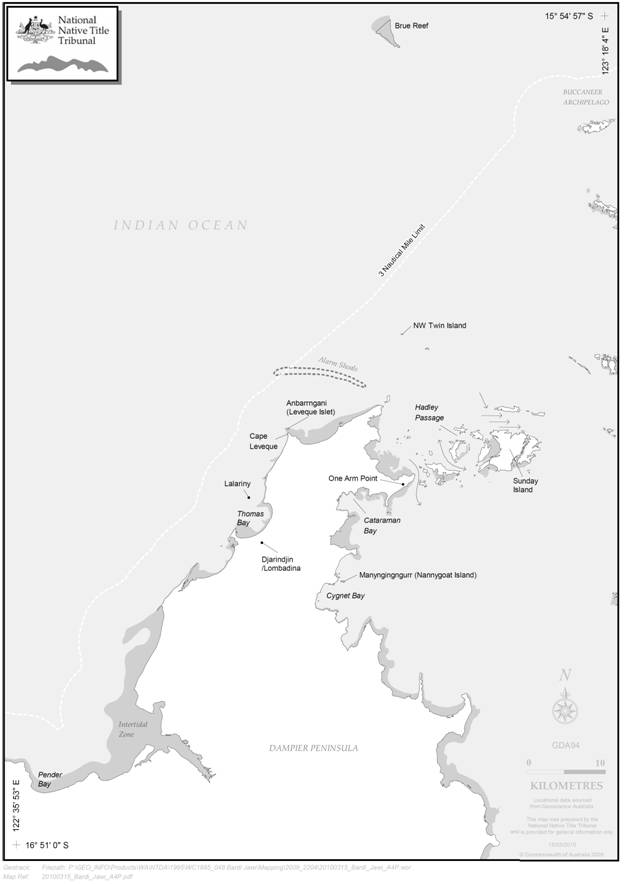
| Citation: | Sampi on behalf of the Bardi and Jawi People v State of Western Australia [2010] FCAFC 26 | |
| | | |
| Appeal from: | Sampi v State of Western Australia[2005] FCA 1716 | |
| | | |
| Parties: | PAUL SAMPI AND OTHERS ON BEHALF OF THE BARDI AND JAWI PEOPLEv STATE OF WESTERN AUSTRALIA and COMMONWEALTH OF AUSTRALIA and WESTERN AUSTRALIAN FISHING INDUSTRY COUNCIL and B & L BROWN AND BLUE SEAS PEARLING COMPANY | |
| | | |
| File number: | WAD 188 of 2006 | |
| | | |
| Judges: | NORTH & MANSFIELD JJ | |
| | | |
| Date of judgment: | 18 March 2010 | |
| | | |
| Catchwords: | NATIVE TITLE – native title determination application – recognition of native title – principles – Native Title Act 1993 (Cth) – native title claim group – whether one or two societies at sovereignty – whether there has been continuity and evolutionary change post-sovereignty – extent of rights and interests to land and water – offshore areas – intertidal zone – right to protect | |
| | | |
| Legislation: | Native Title Act 1993 (Cth) Federal Court of Australia Act 1976 (Cth) | |
| | | |
| Cases cited: | Alyawarr, Kaytetye, Warumungu, Wakay Native Title Claim Group v Northern Territory of Australia(2004) 207 ALR 539; [2004] FCA 472 Attorney General (NT) v Ward (2003) 134 FCR 16; [2003] FCAFC 283 Branir v Owston Nominees (No. 2) (2001) 117 FCR 424; [2001] FCA 1835 Brown v State of Western Australia [2001] FCA 1462 Daniel v State of Western Australia [2005] FCA 536 De Rose v State of South Australia (No 2) (2005) 145 FCR 290; [2005] FCAFC 110 Fox v Percy (2003) 214 CLR 118; [2003] HCA 22 Gawirrin Gumana v Northern Territory of Australia (No 2) [2005] FCA 1425 Gumana v Northern Territory (2005) 141 FCR 457; [2005] FCA 50 Gumana v Northern Territory of Australia (No 2) [2005] FCA 1425 Hayes v Northern Territory [2000] FCA 671 James v State of Western Australia [2002] FCA 1208 King v Northern Territory of Australia (2007) 162 FCR 89; [2007] FCA 944 The Lardil Peoples v State of Queensland [2004] FCA 298 Members of the Yorta Yorta Aboriginal Community v Victoria (2002) 214 CLR 422; [2002] HCA 58 Manas v State of Queensland [2006] FCA 412 Neowarra v State of Western Australia [2003] FCA 1402 Neowarra v State of Western Australia [2004] FCA 1092 The Ngalakan People v Northern Territory of Australia (O’Loughlin J, 7 February 2002) Ngalpil v State of Western Australia [2001] FCA 1140 Nangkiriny v State of Western Australia(2002) 117 FCR 6; [2002] FCA 660 Nona v State of Queensland [2005] FCA 1118 Northern Territory of Australia v Alyawarr, Kaytetye, Warumungu, Wakaya Native Title Claim Group (2005) 145 FCR 442; [2005] FCAFC 135 Sampi v State of Western Australia [2005] FCA 777 Sampi v State of Western Australia (2005) 224 ALR 358; [2005] FCA 1567 Sampi v State of Western Australia [2005] FCA 1716 Warren v Coombes (1979) 142 CLR 531; [1979] HCA 9 Warria v State of Queensland [2004] FCA 1572 Wandarang, Alawa, Marra & Ngalakan Peoples v Northern Territory of Australia [2000] FCA 923 Mary Yarmirr & Ors v The Northern Territory of Australia & Ors (1998) FCR 533; [1998] FCA 771 | |
|
|
| |
|
| WH Bird, “Some Remarks on the Grammatical Construction of the Chowie-Language as spoken by the Buccaneer Islanders, North-Western Australia”(1910) 5 Anthros 414 WH Bird, “Ethnographical Notes about the Buccaneer Islanders – North-Western Australia” (1911) 6 Anthros 174 AP Elkin, Totemism in North-Western Australia (1933) 3 Oceania (No. 3) 265 M Robinson Change and Adjustment Among the Bardi of Sunday Island, North-Western Australia (MA Thesis, University of Western Australia, 1973) N Tindale, Aboriginal Tribes of Australia (UCLA Press, 1974) N Verdon & P Jorion “The Hordes of Discord: Australian Aboriginal Social Organisation Reconsidered” (1981) 16 Man (No 1) 90 EA Worms, “Aboriginal Place Names in Kimberley, Western Australia”(1934) 8 Oceania 201 | |
|
|
| |
| Date of hearing: | 26-28 February 2007 | |
|
|
| |
| Date of last submissions: | 3 March 2009 | |
|
|
| |
| Place: | Melbourne (via videolink to Perth) | |
|
|
| |
| Division: | General | |
|
|
| |
| Category: | Catchwords | |
|
|
| |
| Number of paragraphs: | 162 | |
|
|
| |
| Counsel for the Appellants: | Mr R. Blowes SC & Mr T. Keely | ||
|
|
| |
| Solicitor for the Appellants: | Kimberly Land Council | |
|
|
| |
| Counsel for State of Western Australia: | Ms R. Webb QC & Mr T. Creewel |
|
|
|
| Solicitor for the State of Western Australia: | State Solicitor for Western Australia |
|
|
|
| Counsel for the Commonwealth: | Mr K. Pettit SC & Mr A. Rorrison |
|
|
|
| Solicitor for the Commonwealth: | Australian Government Solicitors Office |
|
|
|
| Counsel for the Western Australian Fishing Industry Council: | Mr M. McKenna & Ms M. Watts |
|
|
|
| Solicitor for the Western Australian Fishing Industry Council: | Hunt & Humphry |
| IN THE FEDERAL COURT OF AUSTRALIA |
|
| WESTERN AUSTRALIA DISTRICT REGISTRY |
|
| GENERAL DIVISION | WAD 188 of 2006 |
| ON APPEAL FROM THE FEDERAL COURT OF AUSTRALIA |
| BETWEEN: | PAUL SAMPI AND OTHERS ON BEHALF OF THE BARDI AND JAWI PEOPLE Appellant/First and Second Cross Respondent
|
| AND: | THE STATE OF WESTERN AUSTRALIA First Respondent/First Cross Appellant
COMMONWEALTH OF AUSTRALIA Second Respondent
WESTERN AUSTRALIAN FISHING INDUSTRY COUNCIL Third Respondent/Second Cross Appellant
B & L BROWN AND BLUE SEAS PEARLING COMPANY Fourth Respondent
|
| JUDGES: | NORTH AND MANSFIELD JJ |
| DATE OF ORDER: | 18 MARCH 2010 |
| WHERE MADE: | MELBOURNE (VIA VIDEOLINK TO PERTH) |
THE COURT DIRECTS THAT:
1. The parties, other than the fourth respondent, confer with each other in order to seek to agree on the form of orders and determination to be made by the Court to reflect the conclusions reached in these reasons for judgment.
2. Subject to paragraph 3, that by the 29th day of April 2010, the parties, other than the fourth respondent, file any form of orders and determination agreed to in accordance with paragraph 1.
3. In the event that the parties, other than the fourth respondent, are unable to reach agreement as to the form of orders and determination to be made by the Court, by the 29th day of April 2010 each party, other than the fourth respondent, file and serve its proposed form of orders and determination.
4. The further hearing is adjourned to a date to be fixed.
Note: Settlement and entry of orders is dealt with in Order 36 of the Federal Court Rules.
| IN THE FEDERAL COURT OF AUSTRALIA |
|
| WESTERN AUSTRALIA DISTRICT REGISTRY |
|
| GENERAL DIVISION | WAD 188 of 2006 |
| ON APPEAL FROM THE FEDERAL COURT OF AUSTRALIA |
| BETWEEN: | PAUL SAMPI AND OTHERS ON BEHALF OF THE BARDI AND JAWI PEOPLE Appellant/First and Second Cross Respondent
|
| AND: | THE STATE OF WESTERN AUSTRALIA First Respondent/First Cross Appellant
COMMONWEALTH OF AUSTRALIA Second Respondent
WESTERN AUSTRALIAN FISHING INDUSTRY COUNCIL Third Respondent/Second Cross Appellant
B & L BROWN AND BLUE SEAS PEARLING COMPANY Fourth Respondent
|
| JUDGES: | NORTH AND MANSFIELD JJ |
| DATE: | 18 MARCH 2010 |
| PLACE: | MELBOURNE (VIA VIDEOLINK TO PERTH) |
REASONS FOR JUDGMENT
introduction
1 Before the Court is an appeal by the Bardi and Jawi people and separate cross appeals by the State of Western Australia (the State) and the Western Australian Fishing Industry Council (WAFIC) from a determination of native title made by a judge of the Court (the primary judge) on 30 November 2005.
2 In 1995, the Bardi and Jawi people lodged an application with the National Native Title Tribunal for a native title determination over the Dampier Peninsula and islands in the Buccaneer Archipelago and surrounding offshore areas in Western Australia. The map below identifies the claim area and sites which are relevant to this proceeding.
3 In their native title application, the Bardi and Jawi people contended that, although they were distinct peoples, they have been bound by a common Law since sovereignty and formed one society for the purpose of holding native title rights and interests. In applying the requirements enunciated in Members of the Yorta Yorta Aboriginal Community v Victoria (2002) 214 CLR 422; [2002] HCA 58 (Yorta Yorta) the primary judge did not accept this contention. He found that the Bardi and Jawi people form a single society now, but did not accept that they had always been one society. He found that, if the Jawi people had formed a separate society at sovereignty, those people had now been subsumed in the Bardi society.
4 The determination was that native title rights and interests existed only in parts of the claim area. They were held by the Bardi and Jawi people as described in the determination. Broadly expressed, in respect of the mainland area of the claim area which had since sovereignty been occupied by the Bardi people, those native title rights and interests were exclusive, and in respect of the intertidal zone areas and on reefs and islets adjacent to it which were exposed or covered by no more than two metres of water at low tide those rights were non-exclusive. The determination was that there were no native title rights and interests over that part of the claim area which the Jawi people had occupied at settlement, or over the sea areas.
5 Whether the primary judge erred in his conclusions that the Bardi and Jawi people did not form a single society at sovereignty is the central issue in this appeal. That issue (the one society or two issue) will be addressed first. As a result of the view we take, the resolution of that issue also determines the cross appeal brought by the State, and the Notice of Contention filed by the Bardi and Jawi people which sought to uphold part of the determination made by the primary judge in their favour. After dealing with the one society or two issue, we will consider the balance of the appeal which includes the claim to rights and interests in offshore areas and several other issues. WAFIC’s cross appeal will then be considered.
THE ROLE OF AN APPELLATE COURT
6 The conclusions reached by the primary judge were largely drawn by inference from the facts found by him. The role of an appellate court in that situation was explained in Warren v Coombes (1979)142 CLR 531; [1979] HCA 9 at [18] (Warren v Coombes) thus:
In deciding what is the proper inference to be drawn, the appellate court will give respect and weight to the conclusion of the trial judge, but, once having reached its own conclusion, will not shrink from giving effect to it.
7 To give weight and respect to the conclusion of the trial judge means that an appeal court will not find error merely because it prefers an outcome different from that adopted by the trial judge where both were equally available or the matter was finely balanced. In Branir v Owston Nominees (No. 2) (2001) 117 FCR 424; [2001] FCA 1833 at [29] the Court explained circumstances in which an appeal court would intervene as follows:
The appeal court must come to the view that the trial judge was wrong in order to interfere. Even if the question is one of impression or judgment, a sufficiently clear difference of opinion may necessitate that conclusion.
8 Any determination of error by an appeal court must consider the advantage enjoyed by the trial judge in having seen and heard the witnesses directly: Warren v Coombes at [10]. An appeal court must bear in mind that it has neither seen nor heard the witnesses and should make due allowance in this respect: Fox v Percy (2003) 214 CLR 118; [2003] HCA 22 at [25]. In determining whether the primary judge erred in drawing inferences from the evidence, we are guided by these principles.
9 As a result of the unusual circumstances of the trial the primary judge did not have a significant advantage over this Court in evaluating the evidence. The original trial was conducted over 24 days before Beaumont J. He heard the evidence of the Aboriginal witnesses on country and the expert evidence from both the applicants and the respondents in Perth. When he became ill the case was transferred to the docket of the primary judge. The parties agreed that the primary judge could determine the case based on the transcript of evidence taken before Beaumont J. The primary judge heard a small amount of additional evidence over three days, mostly from the same Aboriginal witnesses who had given evidence in the first trial. The additional evidence was called to meet the developments in the law which had occurred between the end of the trial before Beaumont J and the hearing before the primary judge. Thus, as with this Court, the primary judge relied principally on the transcript of the evidence which he did not hear in person.
10 It is also convenient to note that, following the hearing of the appeal, the parties requested the Court to refrain from delivering judgment on the appeal whilst they explored a negotiated settlement of the issues raised on the appeal. The Court acquiesced in that request. Periodically thereafter, through a Registrar, the Court was informed that the parties were still negotiating and maintained their request that judgment on the appeal not be delivered. Subsequent to the retirement of Branson J (who was one of the members of the Court constituting the Full Court for the appeal), the parties consented to North and Mansfield JJ as the remaining judges constituting the Full Court, pursuant to s 14(2) and (3) of the Federal Court of Australia Act 1976 (Cth). The Court as so constituted was subsequently informed that the parties no longer anticipated a negotiated outcome. The Court then invited updated submissions from the parties, which it has considered along with the earlier written and oral submissions, leading to this judgment.
The one society or two issue
The Judgment of the Primary Judge
11 The primary judge delivered three separate judgments. The first judgment, Sampi v State of Western Australia [2005] FCA 777 (Sampi No 1) was delivered by the primary judge on 10 June 2005 and it resolved the substantive issues argued before him, including the issue of whether the Bardi and Jawi people were one society or two for the purposes of a determination of native title. A short judgment delivered on 4 November 2005, Sampi v State of Western Australia (2005) 224 ALR 358; [2005] FCA 1567 (Sampi No 2) addressed issues relating to the drafting of the determination to be made by the Court. The third judgment, Sampi v State of Western Australia [2005] FCA 1716 (Sampi No 3) was delivered by the Court on country on 30 November 2005 and contained the terms of the determination of native title. Unless otherwise specified, reference to the judgment in these reasons is a reference to the first judgment.
12 The judgment is detailed and lengthy. It can be seen as divided into a number of sections. In the first section ([1] – [48]) the judgment sets out a summary of the conclusions reached, a chronology of the procedural history of the proceeding, a description of the land and waters covered by the application and the native title rights claimed. Save where a particular issue arises in relation to these matters on the appeal and cross appeals, we rely on the primary judge’s exposition of those details and it is therefore unnecessary to outline these matters in any greater detail now.
13 The second section is the largest section of the judgment ([48] – [937]). It contains a summary of the evidence of the 37 Aboriginal witnesses, including gender restricted evidence ([48] – [641]) and the evidence of experts in history, archaeology and linguistics. Following that summary, the primary judge considered the admissibility of the anthropological evidence, and then summarised the anthropological evidence contained in the two reports of Mr Geoffrey Bagshaw. At various points throughout the summary of the evidence the primary judge recorded certain findings of fact and certain inferences which he drew from the facts. Aspects of this evidence will be referred to later in these reasons where they are relevant to the arguments on the appeal or cross appeals.
14 The primary judge then discussed at [938] – [964] the legal framework within which the case was to be determined. Central to his consideration was the definition of native title in s 223(1) of the Native Title Act 1993 (Cth) (the Act) which provides:
(1) The expression native titleor native title rights and interests means the communal, group or individual rights and interests of Aboriginal peoples or Torres Strait Islanders in relation to land or waters, where:
(a) the rights and interests are possessed under the traditional laws acknowledged, and the traditional customs observed, by the Aboriginal peoples or Torres Strait Islanders; and
(b) the Aboriginal peoples or Torres Strait Islanders, by those laws and customs, have a connection with the land or waters; and
(c) the rights and interests are recognised by the common law of Australia.
(2) Without limiting subsection (1), rights and interestsin that subsection includes hunting, gathering, or fishing, rights and interests.
15 The primary judge explained the construction of this section adopted by Gleeson CJ, Gummow and Hayne JJ in Yorta Yorta. The following requirements for the establishment of native title can be extracted from the primary judge’s review of that judgment:
1. The traditional laws and customs through which Indigenous rights and interests in relation to land or waters originate must have a normative content.
2. The rights and interests must originate in a normative system of traditional law and custom which existed at the time of the acquisition of sovereignty.
3. The relevant normative system must have had a continuous existence and vitality since sovereignty.
4. The laws and customs are inextricably linked with the society, being the group which acknowledges and adheres those laws and customs.
5. If the society ceases to exist so do the laws and customs which it acknowledges and observes.
6. When a society that existed at sovereignty ceases to exist and its laws and customs are adopted post sovereignty by some new society the rights and interests to which they give rise will not be rooted in pre-sovereignty laws and customs.
7. Rights and interests may be transmitted according to rules of transmission which existed at sovereignty.
8. Traditional law and custom may undergo significant adaptation but the only rights or interests which will be recognised after the assertion of sovereignty are those that find their origin in pre-sovereignty law and custom.
16 Drawing together his discussion of these considerations, the primary judge said at [963]:
What this means is that the relevant inquiry in relation to native title rights and interests under s 223 requires consideration of the relationship between traditional laws and customs now acknowledged and observed and those which were acknowledged and observed before sovereignty. It must be shown that the society under whose laws and customs the native title rights and interests are said to be possessed has continued to exist from sovereignty to the present date ‘... as a body united by its acknowledgment and observance of the laws and customs’.
17 Against this legal background, the primary judge considered the central issue in this case, namely, whether the Bardi and Jawi people comprise a society in whose favour a determination of native title could be made. The primary judge said at [967]:
To apply the criterion enunciated in the joint judgment in Yorta Yorta requires consideration of whether the members of the group are the members of a society which has existed from sovereignty to the present time as a body united by its acknowledgment of the laws and customs under which native title rights and interests claimed are said to be possessed.
And shortly afterwards the primary judge continued at [968]:
There are two enquiries required by the principal question. The first is whether there is a society of the requisite kind in existence today. The second is whether that society can be said to have existed since sovereignty.
18 Having established the requisite test for the existence of a society for the purposes of a native title determination, the primary judge set out the competing arguments put by the parties at trial.
19 The Bardi and Jawi people relied on a number of factors which indicated that there was one Bardi and Jawi society which existed continuously from sovereignty until the present day. Those factors included:
a) the belief by the Bardi and Jawi witnesses that the Bardi and Jawi people are united by one Law, by intermarriage, and by culture;
b) the belief that the Bardi and Jawi people have lived as one since creative beings first introduced their Law ceremonies;
c) evidence of Bardi and Jawi ceremonies in which the seating arrangements demonstrated the perpetual unity of the Bardi and Jawi people;
d) the description by the Bardi and Jawi witnesses of the claim area as one country;
e) the existence of shared land and sea country;
f) the existence of certain constraints on clan members to exclude from clan areas Bardi and Jawi people not from the clan;
g) common language; and
h) common cultures.
20 The State, the Commonwealth, and WAFIC denied the existence of a single continuous Bardi and Jawi society. With various different emphases and elaborations, they relied upon a number of factors to support this conclusion, including:
a) the use of the names Bardi and Jawi as internal and external group referents;
b) the existence of distinct territories for Bardi and Jawi under a regional tenure based on separate clan estates;
c) the territorial distinction – Jawi being islanders and Bardi being mainlanders;
d) the distinctions between the Bardi and Jawi languages; and
e) the fact that the overall cosmology and ceremonial links were shared not only between the Bardi and the Jawi people but also with other neighbouring groups.
21 The primary judge then examined the evidence given at the first trial by Jimmy Ejai, Aubrey Tigan, Khaki Stumpagee, Bernadette Angus, Paul Sampi, R Bin Sali, F Bin Sali, Khaki’s wife, D Davey Senior, H Angus, and some of the evidence given by these witnesses and several others at the second trial. He drew from this evidence extensive support for the unity of Bardi and Jawi people. He concluded at [1017]:
Their evidence, in my opinion, supports the view that the Bardi and Jawi people today see themselves essentially as one people united by common laws and customs.
22 Then, the primary judge said at [1017]:
That of course leaves open the critical question whether the Court can conclude that there has been one such society which can be traced back to the time of colonisation.
23 He said that the historical and archaeological evidence established that there had been continuous occupation of the claim area from well before sovereignty, but that this evidence did not assist in determining whether that occupation was by one society or two.
24 The primary judge regarded the linguistic evidence as of some importance to the question. From the evidence of the Aboriginal witnesses and the linguist, Dr Clendon, the primary judge inferred that the Bardi and Jawi spoke closely related languages and that the differences between the languages would be classified by linguists as at the level of dialect.
25 The primary judge then referred at [1025] to the ethnographic studies of Bird (1910), Elkin (1933), Worms (1934), Robinson (1973), and Tindale (1974) apparently for the purpose of demonstrating the view that the Bardi and Jawi occupied distinct territories from the early 20th Century, but also for the authors’ views on the similarities and differences between the Bardi people and the Jawi people. On this latter aspect the primary judge focused on the work of Michael Robinson who wrote a Masters thesis in 1973 entitled ‘Change and Adjustment Among the Bardi of Sunday Island, North-Western Australia’. He also drew heavily on the anthropological report of Mr Geoffrey Bagshaw. The primary judge outlined at [1034]-[1036] the views expressed by Mr Robinson as follows:
The Bardi and Jawi answered three of Elkin’s criteria for the definition of a tribe. They each occupied reasonably well-defined geographical regions, they each identified with a particular language and they each recognised a group name. In relation to the further criterion of distinct sets of customs, rites and beliefs there were enough similarities between the Bardi and Jawi to regard them as socially and culturally homogenous for most purposes.
Genealogies showed a number of early Bardi/Jawi marriages dating at least to the very early years of European settlement. Robinson saw the similarity between Bardi and Jawi culture as a matter of major relevance. Both shared a similar cosmology and ritual and an identical kinship system apart from minor differences of terminology. They also had a like method of local organisation into named patrilineal descent groups and a common maritime economy. He observed that even in the matter of language there were many common features although these were not sufficient for mutual intelligibility.
To speak of a tribal separation between Bardi and Jawi was to speak largely in a linguistic/territorial sense. He said that the term should be used as a conceptual aid rather than as an empirical descriptor. There was sufficient common ground between the groups to ensure reasonably harmonious adjustment when Bardi migrated to the mission at Sunday Island.
26 In relation to Mr Bagshaw’s views the primary judge said at [1040] and [1041]:
Mr Bagshaw’s evidence, which has already been reviewed in some detail, stated that Bardi and Jawi regarded themselves as ‘peoples with distinct social, territorial and linguistic identities’ but that they also viewed themselves as ‘being closely linked by an extensive range of socio-cultural, economic and historical factors many of which are regionally specific’. He referred to the decline of Jawi as a spoken language primarily attributable to the overwhelming numerical and social dominance of Bardi people within Jawi territory during the Sunday Island mission period. There are, as he said, emic or internal cultural bases upon which Bardi and Jawi respectively identify themselves as such.
The genealogical data, he suggested, and I accept, supported the conclusion that the Bardi and Jawi people constituted an often closely related community of kin. There is, and habitually there was, a high incidence of marriage between the two groups. He further contended that although there had been increased interaction between Bardi and Jawi post contact, the structural features of social organisation common to both were sufficiently fundamental that they might reasonably be assumed to have developed well before colonisation.
27 Drawing on this material, the primary judge concluded that the Bardi and Jawi people did not constitute a single society at sovereignty. He summarised his conclusions in the introductory paragraphs at [4] and [5] of the judgment as follows:
The probability is that they were two distinct although closely related societies which held their own traditional territories under very similar bodies of traditional Law and custom. With the passage of the years since colonisation and the numerical superiority of the Bardi, the movement of Bardi people into the island areas to the north of the mainland and a substantial degree of intermarriage between Bardi and Jawi people together with a sharing of cultural ceremonies, they have reached the point where today, at least as between Bardi and Jawi in the claim area, they regard themselves as one people. In reaching that conclusion I am satisfied that the traditional Bardi society which existed at the time of colonisation has maintained the continuity of its existence, albeit increasingly Jawi people have come to form part of it. This has been aided by intermarriage.
The practical consequence is that I am prepared to make a native title determination in relation to the traditional territory of the Bardi which I hold to be the mainland Dampier Peninsula south to the vicinity of Barrambar at Pender Bay in the west and Cunningham Point on the east. Given that I am of the view that all of the applicants form part of contemporary Bardi society I am prepared to make a determination in favour of all of them as to the whole of the area to which I have referred. This is less the parts which have been excluded because of extinguishment of native title rights and interests by the grant of other interests. I do not extend that determination to the islands to the immediate north of the mainland as I am not satisfied that they were part of traditional Bardi territory at sovereignty.
28 Thus, the primary judge concluded that there was a present day Bardi society which, at sovereignty, was able under its laws and customs to receive into membership, at least by intermarriage, people from the Jawi community. The present society could therefore be broadly described as a Bardi and Jawi society. However, only the land and waters in which the Bardi people held rights and interests at sovereignty could be the subject of a native title determination. The primary judge therefore made the determination in favour of the Bardi and Jawi applicants but only in relation to the lands and waters of the Bardi people. In so doing, the primary judge rejected the contention of the Bardi and Jawi people that an inference could be drawn from the evidence that they constituted one society at sovereignty. The reasoning which led to this conclusion will now be examined on the one society or two issue.
The Reasoning of the Primary Judge
29 The reasoning of the primary judge is brief ([1043]-[1046]), but as it raises the central issue of the appeal the passage should be set out in full as follows:
In this case, in my opinion, the inferences that can be drawn about the characterisation of Bardi and Jawi communities at the time that the Crown acquired sovereignty are limited. They were, I think, at all material times, as Mr Bagshaw stated, distinct but closely related groups. Their members identified themselves as either Bardi or Jawi. I am prepared to infer that intermarriage between the groups was extensive and dated back to the time of sovereignty. The pattern of intermarriage indicated by the genealogies supports this inference. There were similar cosmologies and similar laws and customs defining the rights and responsibilities of clans and families with respect to particular burus. There were similar patterns of exploitation of marine resources although I consider that the Jawi relied to a much greater extent than Bardi on resources beyond the intertidal and reef zones and used rafts to a much greater extent for that purpose. There were common ceremonies in relation to initiations.
I respect and accept the view of the Aboriginal witnesses who said that they are one people united by one law. I find that the contemporary practice of initiation ceremonies relies upon a common creation cosmology for both Bardi and Jawi which is reflected, inter alia, in the seating arrangements of those being initiated. But while I do not accept the State’s bald proposition of the ‘notoriously shallow’ memory associated with these oral traditions, I do not find that the oral evidence enables me to draw the inference which is sought on this issue. I am not persuaded that I can draw with confidence from the Aboriginal testimony the inference that there was one society of Bardi and Jawi at the time of colonisation. There is indeed sufficient in the evidence of some of the Aboriginal witnesses to which I have referred to indicate that the position of Jawi relative to Bardi has changed in living memory. There were differences and there was a distinct language even if for linguistic taxonomical purposes it could be called a dialect in recent times. The evidence of shared ceremonial is not, in my opinion, conclusive of the question. It is a consequence in part of geographical proximity and common mythologies which were not unusual in the region.
The two groups occupied for the most part different territories, one mainland, the other archipelagic. They were recognised by early ethnographers as having distinct territories. Although the Bardi people went to Sunday Island in post sovereignty times there was no real indication, in my opinion, of any historical perception of Sunday Island as part of the country of a single society. It was historical circumstance and in particular the arrival of the mission that had an important part to play in those movements.
The evidence does not allow me to infer that one society of Bardi and Jawi people occupied the claim area at sovereignty and were united by a single set of traditional laws and customs acknowledged and observed by that society today. Nor am I able to conclude that there was one such society which, in effect, communally held the land and waters of the claim area under such a body of law and custom, which was, in effect, the applicants’ case.
30 The reasoning of the primary judge, contained in paragraphs [1043] – [1046] of the judgment and set out in full above, begins with the characterisation of the Bardi and Jawi people as distinct but closely related groups. This characterisation is said to agree with the statement of Mr Bagshaw to that effect.
31 The process by which the primary judge reached this conclusion involved the evaluation of a range of different factors, some of which, he said, evidenced the distinctiveness of the Bardi and Jawi people, and others of which reflected their similarities.
32 The factors which the primary judge found evidenced a close relationship between the Bardi people and the Jawi people were:
(a) a pattern of intermarriage which dated back to sovereignty;
(b) common creation and otherwise similar cosmologies;
(c) similar laws and customs defining the rights and responsibilities of clans and families with respect to particular burus or estate areas;
(d) similar patterns of exploitation of marine resources; and
(e) common ceremonies in relation to initiations.
33 The factors which the primary judge said highlighted the distinct nature of each of the Bardi and Jawi peoples were:
(a) the members of each group identified themselves as either Bardi or Jawi;
(b) they spoke different languages; and
(c) they occupied separate territories.
34 In addition to these factors, the primary judge rejected several factors which might otherwise have shown further closeness between the groups. He said that the evidence of some of the Aboriginal witnesses indicated that the position of the Jawi relative to the Bardi had changed in living memory. Then he said that the presence of Bardi people on Sunday Island, which was in traditional Jawi territory, did not indicate that the two groups constituted a single society. The Bardi presence was not a product of shared territory but arose from the historical circumstance of the coming of the mission to Sunday Island and the desire of Bardi people to be involved in the mission. Finally, the primary judge said that shared ceremonies were not conclusive of the existence of a single society. They were partly a result of geographical proximity, and common mythologies were not unusual in the region.
35 These factors, he found, supported a finding that the Bardi and Jawi people were one society united by one law today. They did not, however, support a finding that this had been the case at sovereignty. Rather, the evidence supported a finding that the Bardi and Jawi people had formed two distinct yet closely related groups at sovereignty.
Submissions on Appeal
Bardi and Jawi People
36 On appeal, the Bardi and Jawi people contended that the primary judge was correct in finding that they constituted a single society now, but erred in failing to find that they constituted a single society at sovereignty. They argued that the primary judge should have found that they have been a single society continuously since sovereignty and that he should have made a determination in relation to all of the claim area, including the Jawi land, in favour of the Bardi and Jawi people.
37 The errors alleged by the Bardi and Jawi people concerned the primary judge’s approach to the requirement in Yorta Yorta that to constitute a society for the purposes of establishing native title the Bardi and Jawi people had to show that they were a group united by acknowledgement of traditional laws and observance of traditional customs. It was submitted that this enquiry involved attention only to the laws acknowledged and the customs observed by the group and not to a consideration of “a constellation of factors”, to which the primary judge had regard. The primary judge, it was argued, went beyond the proper scope of enquiry by examining factors such as differences in language, differences in territory and the use of separate self-referents. These factors do not concern laws and customs and, hence, were not properly taken into account in determining whether the Bardi and Jawi people constituted a society.
38 The Bardi and Jawi people further submitted that the primary judge failed to properly assess the significance of the differences between the Bardi people and the Jawi people. The only differences which were relevant to the question whether the Bardi and Jawi people constituted a single society were differences in laws and customs, not differences in language, territory, or self-referents. The primary judge did not distinguish between differences which involved separate bodies of law and custom, and those that did not.
39 It was also contended that the primary judge, having made findings that the Bardi people and the Jawi people had similar or the same beliefs and practices in a large number of matters, should have inferred from these findings that the Bardi and Jawi people were united in their acknowledgement of the same laws and the observance of the same customs since sovereignty. Those similar or common beliefs or practices were:
(a) similar cosmologies at sovereignty and the contemporary practice of initiation ceremonies which relies upon a common creation cosmology for both Bardi people and Jawi people, reflected, inter alia, in the seating arrangements of those being initiated;
(b) similar laws and customs defining the rights and responsibilities of clans and families with respect to particular burus, that is to say, estates in land;
(c) similar patterns of resource exploitation of marine resources although Jawi relied to a much greater extent than Bardi on resources beyond the intertidal and reef zones and used rafts to a much greater extent for that purpose; and
(d) common or shared ceremonies in relation to initiations.
40 The Bardi and Jawi people further submitted that the primary judge failed to properly assess the relevance of the similarities between the Bardi people and Jawi people. The written submissions of the Bardi and Jawi people listed the very extensive relevant similarities as follows:
(a) That generally the Bardi and Jawi people who have responsibility today for maintaining and communicating traditional laws and customs regard themselves as one people, united by one law;
(b) the basic units of local organisation among both Bardi and Jawi are exogamous patrifilial groups, each identified with a specific mythologically inscribed estate known as a ‘bur’ or ‘buru’. Rights in those estates are inherited by patrifiliation and such estate affiliates enjoy the greatest rights in a buru by virtue of their spiritual identification with it;
(c) individuals principally identify with their paternal estates and so also with their respective fathers’ broader socio-cultural identity as Bardi or Jawi;
(d) each of the patrifilial groups is associated with one of several loose-knit regional groupings or aggregates. In traditional Bardi territory, these include Ardiolon (the north people) and Inalabul (the islanders). In traditional Jawi territory they include Iwanyun (Sunday Island people);
(e) important individual rights are also recognised by Bardi and Jawi people in maternal estates known as ningarlm and spousal estates known as gurirriny and through other kin based connections to estates;
(f) there is considerable movement on the part of both Bardi and Jawi, particularly Bardi, between their respective territorial domains;
(g) according to Bardi and Jawi traditions their lands and seas and cultural forms and practices making up the body of their customary law were created and bequeathed via generations of human forebears by supernatural beings, inamunonjin, who had occupied and/or traversed the Dampier Peninsula-Buccaneer Archipelago region prior to direct human experience of the world. They shaped features of the physical environment and imbued them with their eternal numinal essence. They named sites and set the boundaries of traditional territories and introduced the religious resources such as songs, dances, designs, objects, myths and rituals through which their activities would continue to be celebrated and affirmed. They instituted the basic rules of customs regulating social order. Bardi and Jawi referred to the totality of these resources, rules and customs in Aboriginal English by the term ‘Law’;
(h) the travels of specific supernatural culture heroes are regarded by Bardi and Jawi as a basis for ritual relations;
(i) Bardi and Jawi recognise and participate in the same particular sequential ceremonies relating to male initiation;
(j) a number of men and women are recognised by Bardi and Jawi as senior ritual authorities, known as madja (singular) and madjamadjin (plural);
(k) all Bardi law men and Jawi law men are all responsible for all Bardi and Jawi law grounds. There are law grounds on Bardi territory and on Jawi territory;
(l) a jawul relationship is observed whereby an initiated man (madja) is charged with the care of a ritual novice (jawul);
(m) a ritual which is practised in one of the ceremonies where each new jawul sits with his own madja in a particular spatial grouping reflecting the relative geographical location of the madja’s country and regional aggregate is a powerful expression of traditional connection to country;
(n) a range of customary food taboos are observed by Bardi and Jawi;
(o) country is both the source and locus of personal spiritual identity in that Bardi and Jawi people believe that the offspring of Bardi and Jawi men inhabit the phenomenal world as incarnations of pre-existent spirit beings called ray or raya which live in specific locations throughout Bardi and Jawi territory including waterholes, springs, trees and rocks on the land or in the sea;
(p) there was ongoing responsibility for vacant burus or deceased estates by people from neighbouring burus and in particular by lawmen or madjamadjin in respect of law grounds which supported the view that estate rights fell within an overarching system of traditional law and custom defining the connection of the people to their land and waters;
(q) contemporary Bardi and Jawi people view the claim area as territory which by virtue of mythological inscription and kin-based inheritance, has been exclusively owned, occupied and exploited by them since ancient times;
(r) there are protocols and sanctions which to some extent continue to characterise and inform, relations among and between Bardi and Jawi peoples including that Bardi and Jawi consider that the right to be asked about country is a fundamental attribute and expression of territorial ownership;
(s) country, in Bardi and Jawi mythology is characterised as an active and potentially hostile agent;
(t) Ilma, a genre of songs, dances and designs, many of which pertain to the sea and associated features are widely known by Bardi and Jawi people and constitute an important expression of cultural attachment to the sea; and
(u) various personal attributes are interpreted by Bardi and Jawi as signs of relatedness to forebears and country.
41 Finally, it was contended that the primary judge erred in finding that the Jawi people had become subsumed in the Bardi society because he relied on changes in the Jawi society which were irrelevant to the concept of society as enunciated in Yorta Yorta. The changes upon which the primary judge relied were intermarriage between the Bardi people and the Jawi people, co-residence on Sunday Island, the decline of Jawi as a spoken language, and the views of early writers. But none of these changes were in relation to the acknowledgement of laws or the observance of customs.
42 On the other hand, the things which had not changed suggested the continuity of a single Bardi and Jawi society. Again, the submissions of the Bardi and Jawi people listed those things which had not changed as follows:
(a) Bardi and Jawi as distinct but closely related groups whose members identified themselves as either Bardi or Jawi;
(b) recognition of Bardi and Jawi languages or dialects as distinct;
(c) recognition of territory identified as distinctly Bardi or Jawi;
(d) a sustained pattern of intermarriage such that the Bardi and Jawi people constituted an often closely related community of kin;
(e) similar cosmologies;
(f) the presence of laws and customs of evolving content supports an inference of their longevity;
(g) similar laws and customs defining the rights and responsibilities of clans and families with respect to particular burus;
(h) similar patterns of exploitation of marine resources although Jawi relied to a much greater extent than Bardi on resources beyond the intertidal and reef zones;
(i) common ceremonies in relation to initiations;
(j) a common creation cosmology for both Bardi and Jawi which is reflected, inter alia, in the seating arrangements of those being initiated;
(k) the long-standing connection to country reflected in the detailed references in the languages to aspects of the environment;
(l) the people who occupied the claim area at colonisation were the cultural and biological ancestors of the people who occupy it now;
(m) a cultural continuity reflected inter alia in the continuing use and maintenance of fish traps, the informed use of marine resources, the use of seasonally related campsites and the construction of shelters;
(n) pre and post-contact economies of the Bardi and Jawi peoples that have consistently and primarily depended upon the exploitation of marine resources, of which dugong and turtle constitute a vital part;
(o) fishing, hunting and foraging and the distribution of food are still largely done according to customary practices and as such reflect a long term physical and cultural association with the country;
(p) a continuing comprehensive traditional knowledge on the part of the islanders and northern mainland people, of currents in the waters around the islands to the north of the peninsula and a detailed body of knowledge of the cultural geography of the claim area;
(q) continuing use of the open sea beyond the intertidal zone, more extensively to the north of the mainland in the region of the islands;
(r) the arrival of the missions in the 1890’s and exposure to the teachings of the missions did not generally lead to rejection of traditional law and custom; and
(s) Bardi society contained rules of membership which allowed it to become and broadly be described today as a Bardi and Jawi society.
The Commonwealth, the State and WAFIC
43 The Commonwealth argued that the appeal turned on whether, notwithstanding that the Bardi people and the Jawi people were separate peoples at sovereignty, they nonetheless had one normative system of laws and customs and constituted one society. The Commonwealth contended that the primary judge was correct to find that the Bardi people and the Jawi people did not constitute a single society at sovereignty.
44 The primary judge, it was argued, was right to have regard to a constellation of factors in order to determine whether the Bardi people and the Jawi people constituted a single society at sovereignty. That enquiry should not be confined only to a consideration of the laws acknowledged and the customs observed by the people.
45 A relevant factor among the constellation of factors to be considered in determining whether a group constitutes a society in the Yorta Yorta sense is the internal view of the members of the group – the emic view. The unity among members of the group required by Yorta Yorta means that they must identify as people together who are bound by the one set of laws and customs or normative system. The primary judge was correct to take into account the emic view of the Bardi people and Jawi people who saw themselves as distinct people, that is to say, two separate groups of people. Cultural parallelism, or the fact that two groups have similar laws and customs, does not constitute two groups as a single society. The groups do not adhere to the one system nor do they accept that they are together bound by the one law. The Commonwealth said the primary judge was right to take this view of the Bardi and Jawi people at sovereignty.
46 The Commonwealth contended that the constellation of factors relied upon by the primary judge supported his conclusion that the Bardi and Jawi people were not a single society at sovereignty. Those factors were:
a) the use of the self-referents Bardi and Jawi;
b) the assertion by some of the Aboriginal witnesses that they were either Bardi or Jawi and that they were not the other;
c) the awareness among the Bardi and Jawi people that they had distinct territories;
d) the fact that the Bardi and Jawi people recognised their languages as distinct from each other, and
e) certain dissimilarities in ritual, myth and technology practices.
47 The Commonwealth also relied upon several further differences to which the primary judge made passing reference at [990] in outlining the submissions of WAFIC, but which the primary judge did not expressly rely on for the purpose of determining that the Bardi people and Jawi people did not constitute a single society at sovereignty. These were matters identified by Mr Bagshaw in his supplementary report and included different Bardi and Jawi burial practices and differently named pre-initiation rituals. As to the latter matter, it is hardly surprising that the primary judge did no more than record the fact because Mr Bagshaw explained in cross examination that the primary initiation ceremony was common to both Bardi and Jawi and was a ritual in which Bardi and Jawi people participated together.
48 The Commonwealth argued that cultural similarities were a weak indicator of societal identity because cultural similarity among neighbouring Aboriginal people is well known. Further, there must be sameness rather than mere similarity, a few dissimilarities outweigh many similarities, and the search is for unity of culture not merely unity of particular cultural aspects. WAFIC adopted the submissions of the Commonwealth on this issue.
49 The State also supported the finding of the primary judge that there was no single Bardi and Jawi society at sovereignty. The arguments relied on by the State in this regard are encompassed in some of the arguments made by the Commonwealth, and there is no need to set them out separately. In one respect the arguments did not overlap. The State submitted that it was open to the primary judge to hold that there were separate Bardi and Jawi societies, each of which had existed continuously since sovereignty. The State would have accepted a determination of native title for the Bardi people in respect of their country, and a determination for the Jawi people in respect of their country. However, the State did not accept that a Bardi society as found by the primary judge which included Jawi people had the necessary continuity from sovereignty. The Bardi society as found by the primary judge, which included Jawi people, would not be entitled to native title because it was not a society which had continued to exist from sovereignty to the present as a body of people united in and by its acknowledgment of pre-sovereignty laws and customs. Instead it would be a new society with laws and customs which could not properly be described as the laws and customs of the traditional society or societies.
Consideration
50 In our view the primary judge erred in failing to draw the inference from the evidence that the Bardi and Jawi people formed a single society at sovereignty.
51 Central to the consideration of whether a group of people constitute a society in the sense used by the joint judgment in Yorta Yorta is whether the group acknowledged the same body of laws and customs relating to rights and interests in land and waters. The primary judge held that the Bardi people as a group acknowledged the same body of laws and customs relating to rights in land and waters, but he was not able to infer from the evidence that the Jawi people also acknowledged those laws and customs. He held that the Bardi and Jawi had similar laws and customs, but they did not have a common or shared system. In other words, there were two systems of laws and customs with similarities, rather than one system of laws and customs.
52 The primary judge described the system of laws and customs of the Bardi people and his fact finding on the subject at [1052]-[1055] as follows:
[1052] Bardi law and custom as described in the evidence and as summarised by Mr Bagshaw, relies upon the belief that Bardi lands and waters and the cultural forms and practices which make up the body of their customary law were created and bequeathed upon their ancestors by supernatural beings, the inamunonjin. These beings occupied and/or moved across the Dampier Peninsula region before direct human experience of the world. They shaped the physical environment and informed it with their spirits. They set the boundaries of traditional territories, named sites and introduced songs, dances, designs and objects together with myths and rituals. They set up the basic rules regulating the social order. The sum total of these rules, customs and resources is comprehended by the term ‘Law’. I accept that in this description Mr Bagshaw referred also to the Jawi people on the premise, which I do not accept, that they were one society from the time of sovereignty. [Emphasis added]
[1053] The Law so understood, in my opinion, embodied the fundamental principle that the Bardi people as a community hold the traditional territory which is defined by the Law and is to be used and enjoyed in accordance with its rules.
[1054] The Law, as explained in the evidence, supports a principle of communal ownership of the relevant land and waters. This is reinforced by the unifying role of the madjamadjin in relation to law grounds throughout the area. It is also reinforced by the common use of the Nimidiman or Pindan region [an area in the centre of the claim area on the mainland], the conventions allowing access, subject to permission or invitation to particular estate areas and the rights and interests which could be acquired in respect of any estate or buru not only by the primary rule of patrifiliation but also through marriage and matrifiliation.
[1055] The longevity of the traditional laws and customs and the inference of their continuity since the time of sovereignty is supported by their content together with the continuity of Aboriginal occupation of the area and the evidence of long term consistent forms of land use emerging from the archaeological evidence. I accept Mr Bagshaw’s observation that there is a ‘large and extremely rich corpus of site-specific and environment-focussed mythology’ embodied in the traditional law and custom. The density of named sites and natural features combined with the physical evidence of substantially consistent usage of marine resources going back to sovereignty in my opinion supports the inference that the laws and customs explained today by the Aboriginal witnesses whose evidence in this respect I have accepted, represents a body of law and custom which has continued substantially uninterrupted since that time.
53 Behind this description of the rights and interests in [1054] lies a wealth of detail of a highly complex system of land holding and social interaction which was explained by the Aboriginal witnesses and, at length, by Mr Bagshaw in his original and supplementary reports and in his oral evidence. It is useful to set out part of the evidence of Mr Bagshaw as summarised in the judgment of the primary judge at [854]-[862] to give an impression of the depth and detail of the legal code involved.
Bardi and Jawi primarily inherit country and associated rights in country by way of patrifiliation, a point which Mr Bagshaw said was consistently emphasised by all of his informants. This is brought out clearly in the oral evidence given by the Aboriginal witnesses. Through patrifiliation, whether the biological or social father is Bardi or Jawi, each individual becomes a member of an exogamic kin-aggregate or patrifilial group which is identified with, and responsible for a specific mythologically inscribed estate or buru and its associated religious resources. Bardi and Jawi frequently explain such identification in responsibility in terms of the belief that a man and his offspring are, in many cases at least, incarnations of estate-specific raya. Again, this is borne out by the oral evidence of the Aboriginal witnesses.
Individuals can become identified with, and responsible for, an estate through paternal adoption (andala) which amounts to an alternative culturally legitimated mode of patrifiliation. The offspring of the Bardi or Jawi woman and a non-Bardi or Jawi man may be raised by a Bardi or Jawi man thereby regarded as the child’s social father. Often the social father is the actual husband of the child’s mother. Elizabeth Puertollano is one example of paternal adoption. She was the daughter of the Bardi woman Wobijarr and the English beachcomber Harry Hunter. However, she was ‘grown up’ by Jarni, who was her mother’s Bardi husband. She considered herself and was regarded by others as a traditional owner of Jarni’s Jilirbur estate.
Most of the estates are owned by a single patrifilial group. Its adult members can readily trace their mutual genealogical connection. In some instance such as Mardnanbur, upper generational connections between individuals are uncertain or imputed. This is ultimately a consequence of time and the universe shallowness of genealogical memory and the comparative relational proximity of paternal forebears. Where relationships are uncertain, individual families identify with definite sites within the same buru while at the same time acknowledging the overall unity of the estate. In the case of Jayirribur two apparently unrelated patrifilial groups had members identifying different localities in the same buru.
Individual estate-affiliates are gamelid in respect of their estates. The term connotes intimate familiarity with country. A gamelid is a person who, together with his or her father, is from a particular country. It conveys the sense of an individual who is known to the country itself. So country, again consistently with the oral evidence of the Aboriginal witnesses, is conceived of as an active physical and metaphysical entity. Identification with a particular buru places the individuals so identified under particular obligations to ensure that their territory is not damaged, defiled or used in ways which are inconsistent with customary practice. This includes obtaining permission for proposed activities within the estate. If harmful activities occur there is a wide belief that physical harm or even death will befall estate-affiliates and perpetrators.
Nimalj rights refer to limited rights of access, residence and usufruct which estate-affiliates can grant in respect of their own buru to unrelated or distantly related persons. Mr Bagshaw interprets the word as meaning ‘authorised use’. So an individual may be granted nimalj to fish at a certain spot or to exploit particular fruit trees or ochre deposits. A person may also be given nimalj to reside in and/or exclude others who are not estate-affiliates from a particular locality within a buru. Unless voluntarily relinquished by the recipient nimalj rights are held on a permanent basis and may even be extended to bilateral descendents of the original holder.
Other derivative rights arise in relation to maternal estates, ningarlm and spousal estates, gurirriny. The holders of ningarlm and gurirriny rights are expected to defer to estate-affiliates who are identified with the estate through patrifiliation. They are expected to support them on estate related issues and to speak for and act on behalf of the estate’s physical and spiritual welfare. They may therefore assist in controlling access to and movement through a given buru. Matrifiliates will generally take precedence over spouses.
Discussing the differing scope and distribution of rights in country, Mr Bagshaw made the point, which was also well supported by the oral evidence of Aboriginal witnesses, that those who are estate-affiliates enjoy the greatest rights in a buru by virtue of their spiritual identification with estate-specific supernatural beings and other totemic entities. Persons related by means other than patrifiliation hold rights consonant with their culturally defined relational proximity to the estate-affiliates and to the religious resources of the estate itself. Mr Bagshaw advanced the proposition in this part of his report that it may reasonably be said that all persons with a recognised kin-base connection to an estate have at least some form of ownership interest in it. This underscores the inherently communal nature of Bardi and Jawi territorial ownership. A similar view was advanced by Verdon and Jorion in 1981 at a broader anthropological level identifying ‘ontological distance’ as a fundamental determinant of the ‘intensity’ of estate ownership. ‘Ontological’ distance refers to the relative degree of cultural and metaphysical identification with estate-specific supernatural beings and associated religious resources. It is a scale to measure a ‘gradient of rights of ownership’ stemming to a certain degree from occupancy and the use of the land surrounding the totems. Verdon and Jorion wrote:
‘[A]ll who exploit the land ‘own’ it, in the sense that they enjoy privileged access to it, but some own it more than others. Those who own it the most with respect to the criterion of occupancy are, at the same time, those ontologically closest to the [supernatural] ancestor[s] whose sites are located on that land, and who can therefore have claimed to occupy the land since its creation.’
Verdon N and Jorion P (1981) The Hordes of Discord: Australian Aboriginal Social Organisation Reconsidered Man (NS) 16(1) pp 90-107.
Mr Bagshaw considered the deceased estate or vacant buru. The membership of a particular local estate owning patrifilial group may become extinct. Factors leading to such extinctions are historically small populations, the failure of male patrifiliates to marry or produce offspring and/or the last surviving members of estate-owing groups being female. Specific examples of deceased estates are Jalanbur, Guljamanbur, Balangarnanbur and Lumardbur. Each is located within the Bardi territorial domain. Evidence which he had gathered, reflected in the oral evidence of the Aboriginal witnesses is that there are caretakers who exercise pro tem custodial responsibilities. These arrangements fall into the general category of ‘regencies’ or trusteeships exercising cultural oversight and control of territory formally belonging to deceased kin estates. Such regencies or trusteeships may be transitional stages along the path to estate succession proper. That is the incorporation of the deceased estate within the territory of a neighbouring buru. However, absent long-term reliable data, Mr Bagshaw was unable to make any more definitive statement on that matter.
In my opinion, the oral evidence of the Aboriginal witnesses clearly established on-going responsibility for vacant burus or deceased estates by people from neighbouring burus and in particular by lawmen or madjamadjin in respect of law grounds. It is not necessary for present purposes to determine whether those ongoing responsibilities foreshadowed some longer term process of incorporation into existing burus. The continuing responsibility, indicated by the oral evidence, exercised in respect of deceased or vacant burus supported the view that the estate rights fell within an overarching system of traditional law and custom defining the connection of the people to their land and waters.
54 We have reviewed the evidence given in both the first and second trials on the issue of the laws acknowledged and the customs observed by the Bardi and Jawi people. We have given particular attention to the evidence given by Aboriginal witnesses referred to by the primary judge at [995]–[1015] and to the reports and oral evidence of Mr Bagshaw. Although we have given weight and respect to the conclusions of the primary judge, we have formed the view from this evidence that the primary judge erred in failing to infer that the Bardi and Jawi people acknowledged and observed one system of laws and customs at sovereignty.
55 We do not agree with the view taken by the primary judge with respect to the evidence of Mr Bagshaw which is contained in the highlighted passage in [1052] of the judgment and is reproduced in [52] of these reasons. The primary judge recognised at [1052] that the description provided by Mr Bagshaw was of the system of laws and customs of both the Bardi and Jawi people together. However, the primary judge said that Mr Bagshaw’s description of the system as one system was based on the premise which the primary judge did not accept, namely that the Bardi and Jawi people constituted a single society.
56 We do not agree that Mr Bagshaw’s evidence was given on the premise that the Bardi and Jawi constituted one society. Rather, we read Mr Bagshaw’s report and oral evidence on the issue as descriptive of a system which, as a matter of fact, rather than assumption, both the Bardi and Jawi people shared. Thus, the system which the primary judge outlined at [1052] – [1055] which are reproduced in [52] of these reasons was equally the system of the Jawi people as it was of the Bardi people.
57 The picture which emerged from Mr Bagshaw’s reports about the unity of the Bardi and Jawi peoples’ system of belief was confirmed by the evidence given in both the first and second trials by the majority of Aboriginal witnesses who dealt with the subject. We agree with the primary judge’s view at [48] that this Aboriginal testimony is of the highest importance in a determination of the evidence of native title.
58 The evidence given by Aboriginal witnesses established that the Bardi and Jawi people shared one system of law at least as far back as the latter part of the 19th century. By way of example we set out some of the evidence which the primary judge selected on the issue at [996] – [1005] but from which he felt unable to draw the inference that the Bardi and Jawi people shared one system of law at sovereignty.
59 Aubrey Tigan is a senior Jawi man born in 1945. The following cross examination occurred at the first trial:
MR PETTIT: Again, when you were a young fellow, do you remember hearing from the old Jawi people whether there used to be a difference between Bardi and Jaw laws?
…
AUBREY TIGAN: Yes.
Mr PETTIT: Those old people, those old Jawi people, did they ever tell you that Jawi law was a little bit different from Bardi law?
AUBREY TIGAN: No, not really. The most law was the same, like being – in the marriage then, they follow the same system as well. Put two together.
60 And in examination in chief the following exchange occurred:
AUBREY TIGAN: And then, respect. Then when all the fellas what’s sitting here, the Bardi people, are giving the jawul – that’s bind the community together, Bardi and Jawi together ---
MR IRVING: Yes.
AUBREY TIGAN: --- because you do some – from Gularrgon, come into Baniol side, from Baniol go to Inalabul side, and that’s where the communication come in more strong in Bardi and Jawi.
MR IRVING: Yes.
AUBREY TIGAN: That’s why we are one.
MR IRVING: Yes. Alright.
AUBREY TIGAN: Because of the law.
61 Paul Sampi is a senior Bardi man born in 1932. The following cross examination occurred at the second trial:
MR QUINLAN: Now, in older times, were there more differences between Bardi people and Jawi people than there are today?
PAUL SAMPI:There were no differences. The law was the same from the very start, and it’s still the same.
62 Bernadette Angus is a Jawi woman born in 1952 who gave the following evidence at the second trial:
MR BELL: … Can you tell me whose country that is, please.
BERNADETTE ANGUS: That’s Bardi Jawi country.
MR BELL: Thank you. And how many countries is that?
BERNADETTE ANGUS: He’s a one big country.
MR BELL: Thank you. Whose country is that? Who belongs to that place?
BERNADETTE ANGUS: Bardi Jawi.
MR BELL: And are they one people, two people? How many?
BERNADETTE ANGUS: One big family of people.
MR BELL: Thank you. And what makes them one family of people?
BERNADETTE ANGUS: Our law. Our big law.
…
BERNADETTE ANGUS: I grew up knowing this from my father, my grandfather, my grandparents, and my mum.
MR BELL: Did they tell you these things, did they?
BERNADETTE ANGUS: Yes. And we still living – living today, like with all this as one, Jawi ---
MR BELL: What did the old people tell you?
BERNADETTE ANGUS: About what?
MR BELL: About these things, about country and people, and law?
BERNADETTE ANGUS: Well, old people tell me country’s, all different, you know, families, we all one.
MR BELL: Yes.
BERNADETTE ANGUS: With same – we have that one law, and we share everything together and we all living the same lifestyle today.
63 On the basis of this and like evidence the primary judge should have found that the Bardi and Jawi people acknowledged the same laws and observed the same customs concerning rights and interests held in land and waters at least from the present back until the time of these witnesses’ ‘old people’ or grandparents, namely, the latter part of the 19th century.
64 The question then arises whether the Court can infer the existence of that acknowledgement and observance from about the latter part of the 19th century back to sovereignty. Selway J addressed this issue in Gumana v Northern Territory (2005) 141 FCR 457; [2005] FCA 50 and said at [201] by reference to the history of the approach of the common law to the proof of custom:
…where there is a clear claim of the continuous existence of a custom or tradition that has existed at least since settlement supported by creditable evidence from persons who have observed that custom or tradition and evidence of a general reputation that the custom or tradition had ‘always’ been observed then, in the absence of evidence to the contrary, there is an inference that the tradition or custom has existed at least since the date of settlement.
65 In the present circumstances the constitutional status and elaborate nature of the rules in question make it improbable that the system arose in the relatively short period between sovereignty and the time of the witnesses’ ‘old people’. We accept the view expressed by Mr Bagshaw in his report (at page 18) that:
…the structural features (i.e. systems of kinship, social organization and local organization) common to both societies are, in my opinion, of a sufficiently fundamental order that they may be reasonably assumed to have developed among both peoples well before European contact.
66 From this evidence, the primary judge should have inferred that the Bardi and Jawi people are, and have since the time of sovereignty, been united by their acknowledgement of a common set of laws and their observance of a common set of customs.
67 It remains necessary to consider the matters which the primary judge viewed as indicating that the Bardi and Jawi people constituted separate, albeit similar, societies at sovereignty. These matters, referred to by the primary judge as a “constellation of factors”, include the existence of distinct languages, the use of the self-referents Bardi and Jawi, and the existence of separate territories. When viewed against the evidence that the Bardi and Jawi people at sovereignty shared a single belief system on the fundamental matters of the creation and existence of rights and interests in land and waters, these factors have little significance and are not inconsistent with the existence of a single society.
68 The difference in language was at the level of dialect. A person from Scotland is a member of the United Kingdom society even though she speaks a different dialect than a person from England or Wales. Indeed, the evidence in this case was that there were different speech styles within the Bardi community itself. Some spoke “heavy Bardi”, some spoke “light Bardi”, and some spoke “slow Bardi”. Although the styles were quite distinct it was not suggested that this distinction divided the Bardi people into separate societies. The difference in dialect, in the overall picture in this matter, does not tend to lead to the view that the traditional laws acknowledged and traditional customs observed by the Bardi and Jawi were not acknowledged and observed by them as one society or that they were not inextricably linked by those normative rules which existed at sovereignty.
69 There is also little significance for the present enquiry in the use of the self-referents Bardi and Jawi or in the linkage with the separate mainland and island territories. The existence of separate territories for people within a group who adhere to the same system of laws and customs, and the consequent reference to that linkage in identification is paralleled in many unified societies. By way of a coarse analogy, we call ourselves Victorians or Queenslanders or Western Australians because we have a residential linkage in those States. At the same time we are united in adherence to the law of Australia and we form part of the Australian society.
70 Indeed, the territorial delineation provides further evidence of a common set of laws and customs with respect to land. Mr Bagshaw indicated in his report (at page 28) that the Bardi and Jawi possession of particular territory is the result of a “supernaturally-authored territorial demarcation”. Such demarcation points to an overarching set of laws and customs derived from a common cosmology.
71 The circumstances of each native title application are different. They depend heavily on the facts concerning the beliefs, histories, and practices of the particular native title claim group. It is therefore not normally useful to compare the facts in one case to the facts in others. However, the Court has ruled on quite a large variety of circumstances of native title claim groups so that certain lines have emerged between the characteristics of those groups which fall within the requirements laid down in Yorta Yorta and those which do not. Whilst it is not possible to push the comparisons too far, it is noteworthy that the Court has found in a number of cases that a native title claim group which adhered to an overarching set of fundamental beliefs constituted a society notwithstanding that the group was composed of people from different language groups or groups linked to specific areas within the larger territory which was the subject of the application.
72 One example is Neowarra v State of Western Australia [2003] FCA 1402 (Neowarra) in which Sundberg J made a native title determination in favour of the Ngarinyin, Wunambal and Worror peoples, despite linguistic and estate (danbum) distinctions within the claimant group. His Honour found that the three sub-groups comprised a collective Wanjina-Wunggurr community, united by shared traditions and customs based in a common belief in Wanjina, a spirit ancestor and source of traditional law and custom. The evidence of shared customs and traditions disclosed “the existence of a community that transcends individual dambun or groups of danbum, and also individual language countries” (at [393]).
73 Another illustration is The Alyawarr, Kaytetye, Warumungu, Wakay Native Title Claim Group v Northern Territory of Australia(2004) 207 ALR 539; [2004] FCA 472, in which Mansfield J found at [3] a society for the purposes of a native title determination comprising four language groups and seven landholding groups, each landholding group associated with a particular part of the claim area. He found at [132] that, despite the linguistic and territorial distinctions, “the community as described lives under a common set of laws and customs” based on acknowledgement and observance of a common set of relationship rules, mourning customs, gender restriction rules, ceremonial practice, ceremonial and dreaming connections, and systems of land tenure. On appeal, the Full Court upheld the decision of Mansfield J, reaffirming at [112] that “the evidence of extensive connections across the seven groups supports his characterisation of them as one native title holding community”: Northern Territory of Australia v Alyawarr, Kaytetye, Warumunga, Wakaya Native Title Claim (2005) 145 FCR 442; [2005] FCAFC 135 (Alyawarr).
74 A similar set of circumstances can be found in the case of King v Northern Territory of Australia (2007) 162 FCR 89; [2007] FCA 944 in which Moore J made a determination in favour of a claimant group which comprised peoples from nine different estate groups and six neighbouring estate groups. All 15 of these estate groups were either Mudburra or Jingili or mixed Mudburra/Jingili. Mudburra and Jingili (the latter often pronounced Jingulu or Jingilu) are distinct languages associated with definable tracts of land. Many of the applicants spoke the Mudburra language fluently, whereas only a small number are fluent in Jingili. In this case the Northern Territory accepted, and the other respondents did not make submissions challenging the view that the applicants constituted a single native title holding community. His Honour found that the evidence supported a finding that they did.
75 Thus in our judgment the linguistic evidence, the evidence of distinct territories or the existence of self-referents was not sufficient to displace the inference from the wealth of other evidence that the Bardi and Jawi people were a single society at sovereignty.
76 It is unnecessary to decide whether the Bardi and Jawi people were correct in their submissions that the primary judge was not entitled to take into account the constellation of factors because even if those factors were taken into account, they did not counteract the evidence from which it should have been inferred that the Bardi and Jawi people formed a single society at sovereignty.
77 Were it necessary to decide whether the primary judge was entitled to take into account the factors which he described as a “constellation of factors” we would regard the argument of the Bardi and Jawi people as too widely stated. Whilst the ultimate fact to be proved by native title claimants is that they have been continuously united in their acknowledgement of laws and observance of customs, there are many subsidiary facts from which an inference may be drawn about that ultimate fact. It is too narrow to exclude from consideration factors which may bear on the existence of a normative system whilst not being direct evidence of the existence of that system. Indeed in the present case the array of factors relied upon by the Bardi and Jawi people themselves to demonstrate the existence of a single society at sovereignty highlights the point. They have not restricted themselves to factors which directly prove the existence of a normative system. For instance, the proof of the existence of songs about the sea is capable of showing that there were rules about the use of the sea even though the proof of the songs themselves is not proof of the law or custom. A particular point over which this debate was conducted in this proceeding concerned the question whether it was open to the primary judge to take account of the emic view. The Bardi and Jawi people said that the primary judge could not take the internal view into account whilst the Commonwealth, the State, and WAFIC argued that he should. The emic view is relevant to the determination whether the Bardi and Jawi people constituted a single society at sovereignty. However, contrary to the argument of the Commonwealth, the State, and WAFIC, the emic view in this matter does not show that the Bardi and Jawi people constituted two societies at sovereignty. As we have shown, the internal view of the Bardi and Jawi people was that they were united in the acknowledgement of one law. The internal view accepted that there were differences between the Bardi and Jawi people also. But, as we have explained, those differences did not mean that the Bardi and Jawi people failed to fulfil the requirements set out in Yorta Yorta for a people to constitute a single society.
78 The final matter which seems to have influenced the primary judge in holding that the Bardi and Jawi people were not one society at sovereignty was the evidence of change of the position of the Jawi people relative to the Bardi people in living memory. The evidence of change referred to is not identified, but we think it is a reference to the evidence of some Bardi people moving to Sunday Island when the mission was established there. The sharing of territory on Sunday Island was relied upon by the Bardi and Jawi people as evidence of a single society. The primary judge seems to have rejected the fact that the Bardi and Jawi people lived together on Sunday Island during the mission days as supportive of a single society. This factor was only one of a collection of indicators relied upon by the Bardi and Jawi people to establish that they constituted a single society at sovereignty. We are inclined to agree with the rejection of it by the primary judge as a factor of assistance to the case of the Bardi and Jawi people. However, as we have said earlier in these reasons, there was sufficient other evidence from which it should have been inferred that the Bardi and Jawi people constituted a single society at sovereignty.
Conclusion
79 It follows from these reasons that the primary judge should have inferred from the evidence that the Bardi and Jawi people constituted a single society from sovereignty until the present. The primary judge should not have excluded the country of the Jawi people from the determination. The determination should, subject to resolution of the remaining arguments, include the territory of both the Bardi and Jawi people. As a result of these findings, the cross-appeal by the State must fail.
80 The next section of this judgment deals with the balance of the issues in the appeal of the Bardi and Jawi people, and commences with a number of issues relating to offshore areas.
ISLANDS SOUTH WEST OF HADLEY PASSAGE
81 The Bardi and Jawi people submitted that the decision of the primary judge to exclude from the determination area the islands to the immediate north of the mainland was erroneous. As the primary judge’s reasons at [5] and [1104] indicate, that conclusion was based upon the premise that the islands to the north of the Dampier Peninsula were not part of Bardi country, even though they “may well have been” part of Jawi country. In fact, the primary judge said at [1082] that the traditional Jawi territory was to the east of Hadley Passage, so the geographical area the subject of this issue is in between Hadley Passage and the mainland. It would be surprising if it were not, at least, part of the Jawi territory.
82 As we have concluded that there was one Bardi and Jawi society at sovereignty, it is necessary to revisit that conclusion because it is based on a premise which is not appropriate.
83 There was, in our view, ample evidence to support the tentative view of the primary judge that the land and waters north and east of the Dampier Peninsula mainland to Hadley Passage were part of the Bardi and Jawi peoples’ land (the step of finding the one society at sovereignty having been taken). It was part of the submissions of the Commonwealth, based on Tindale’s map and a map by Dr Wace, that those areas were overwhelmingly Jawi territory. It was not really in issue, understandably having regard to the evidence overall including that of Sidney Hadley to the Roth Royal Commission in 1904 and of Elkin, and of a number of indigenous witnesses including Bernadette Angus, Aubrey Tigan, Khaki Stumpagee’s wife, Paul Sampi, F Bin Sali and the late T Ejai that that area was part of the Jawi peoples’ territory and indeed much of that evidence might have supported the conclusion that it was, or was also, Bardi country. The State, in its submissions, did not take a position on whether, in respect of the area under consideration, native title existed and, if so, whether it was Bardi country. WAFIC also made no submission on the issue.
84 In those circumstances, we are satisfied that the area under consideration was an area over which native title rights and interests exist. Having regard to our conclusion that there is, and was at sovereignty, one Bardi and Jawi society which possesses the native title rights and interests which existed and exist in the claim area, including the area presently under consideration, the determination of native title rights and interests should be amended to include this area.
Tidal movements and the existence of native title
85 In the judgment, the primary judge described the area in which non-exclusive native title rights and interests had been established at [10] as:
The intertidal zone together with reefs within and adjacent to that zone and offshore reefs otherwise exposed and traditionally used by the Bardi/Jawi people together with the waters in their immediate vicinity.
86 The parties were required to draft a determination to reflect this conclusion. There was disagreement as to the appropriate form of the provision and the primary judge resolved that issue in the reasons for judgment of 4 November 2005 (Sampi No 2).
87 In the argument which led to the later judgment, the Bardi and Jawi people proposed that tidal and offshore areas should be defined as the area between the two metre bathometric contour at lowest astronomical tide on the seaward side, and the mean high water mark on the landward side. The primary judge outlined the opposing argument of the Commonwealth at [61] and [62] of Sampi No 2 as follows:
In determining how to define areas seaward of the intertidal zone thus defined the Commonwealth said that it would be appropriate to adopt the line of the two metre bathometric contour as depicted on the Australian Nautical Charts as the seaward extent of the area the subject of native title rights. It was submitted that a depth of two metres is a generous interpretation of what constitutes those shallows which were and are traditionally accessed. It is a convenient boundary because it has been mapped and because waters to that depth include all those offshore reefs and waters referred to in the reasons for judgement.
The Commonwealth pointed out that, given the tidal range of 6 to 8 metres as found at [813] of the reasons for judgment, the Determination Area would, if the applicants’ position were accepted, include waters of the sea to a depth of 10 metres on the high tide and perhaps more on extreme tides. In the Commonwealth’s submission, this is contrary to the finding that the evidence was insufficient to support the existence of a native title right to access waters of the sea by water craft. The Commonwealth further submitted that a depth of 10 metres arguably puts those waters in the category of open sea where no rights under traditional law and custom were established. It was on this basis that it argued that the applicants’ fixed boundary proposal ought to be rejected. The area of the sea the subject of a determination that native title exists ought to be limited to the shallows whether the tide is in or out.
88 The primary judge determined the issue at [67] and [68] as follows:
Section 225 of the Act specifies the content of a determination of native title. It requires a determination ‘whether or not native title exists in relation to a particular area of land and waters’. The concept of a fluid seaward boundary is not necessarily incompatible with that requirement but does sit a little awkwardly with it. It does not necessarily involve the implication of some kind of intermittent extinguishment of native title rights and interests. The native title rights and interests defined in an area limited by a fluid seaward boundary as proposed by the Commonwealth could be qualified as defined by reference to the accessibility of the relevant reefs and shallows which will vary according to the tides. This, of course, would not preclude the use of boats to access those areas. But that use does not equate to a native title right or interest. On the other hand the fixed seaward boundary defines a more stable area in which non-exclusive native title rights exist.
Beyond the traditional intertidal zone defined by reference to mean high and low water marks, the native title rights and interests as found in the judgment, relate to such reefs as may be exposed at low tide. They also relate to ‘waters in the immediate vicinity’. In my opinion the difficulty raised by the Commonwealth can be addressed by an appropriate qualification in the definition of the native title rights and interests for offshore waters beyond the traditional intertidal zone. This can be achieved by a proviso to the effect that non-exclusive native title rights and interests are exercisable, seaward of the mean low water mark, on any reef exposed to low tide only when that reef is exposed or covered by water to a depth not more than 2 metres. I will determine by way of a proviso to be added to par 5 of the determination in the following terms:
‘Provided that, in respect of areas within that defined in Schedule 4, which are seaward of the mean low water mark the preceding native title rights and interests are limited to reefs within that area when they are exposed or covered by not more than 2 metres of water’.
89 On appeal, the Bardi and Jawi people characterised the proviso as a temporal limitation either on the existence or the exercise of the native title rights and interests. Those rights were of a very limited nature:
a) the right to access, move about in and on and enjoy those areas;
b) the right to hunt and gather including for dugong and turtle; and
c) the right to access, use and take any of the resources thereof (including water and ochre) for food, trapping fish, religious, spiritual, ceremonial and communal purposes.
90 The Bardi and Jawi people argued that the form of the proviso was not contemplated by the provisions of the Act. Their first argument addressed the case where the proviso was viewed as a temporal limitation on the existence of the native title rights and interests. The Bardi and Jawi people argued that s 223 of the Act defines native title rights and interests as rights and interests “in relation to land or waters”. Land and waters are terms which are defined to mean areas of three dimensional space. In that area rights and interests either exist or they do not. Section 225 of the Act defines a determination of native title as a determination whether or not native title exists “in relation to a particular area”. The Act, so it was argued, does not contemplate a temporal dimension to an area.
91 The alternative argument viewed the proviso as a limitation on the exercise of the rights and interests. Section 225 of the Act requires that the particular area to which the determination relates is identified and that the nature and extent of the native title rights and interests in relation to that area are specified. The section does not require the specification in the determination of any limitations on the ability of the native title holders to exercise those rights, whether such limitations flow from the content of the relevant traditional laws and customs or otherwise. Section 225 relates to the existence, as distinct from the exercise, of native title rights and interests.
92 The Commonwealth sought to answer these arguments, first, by contending that the proviso was a definition of the native title rights and interests rather than a temporal limitation on them. These submissions were adopted by WAFIC, and no separate submissions were made on this topic by the State. We do not accept this characterisation. In substance the limitation imposed by the proviso is a temporal limitation.
93 It has not been the practice to impose temporal limitations of this nature in native title determinations. Thus, for instance, in cases in which a right to hunt has been recognised in very hot regions of Australia, that right would not have been traditionally exercised in the heat of the day. Yet determinations have not specified that a right to hunt, for example, only exists when the sun is in a particular position relative to a determination area.
94 To require temporal limitations to be imposed in determinations of native title would give rise to the need for very detailed and complex enquiries relating to the times at which the particular rights were exercised. For instance, where native title applicants established a right to conduct ceremony on land the Court would need to investigate whether the ceremony was conducted on a regular basis, whether it was conducted yearly, monthly, or daily and at what time of the day or night. The right would then be limited to the times at which ceremony was traditionally conducted.
95 We agree with the submission of the Bardi and Jawi people that ss 223 and 225 of the Act do not contemplate the type of limitation which is contained in the proviso to [5] of the determination. As the Commonwealth, the State and WAFIC did not propose any alternative limitation to the proviso, and as we have rejected the proviso as an appropriate limitation, it is appropriate that the Court simply omit that proviso.
SEA AREAS – sEAWARD EXTENT OF EXISTENCE OF NATIVE TITLE
96 The seaward limit of the application area was the three nautical mile limit with two exceptions, not presently relevant, namely, Alarm Shoals which was partly, and Brue Reef which was wholly, outside the limit.
97 The rights claimed in waters, shoals and reefs seaward of the high water mark were:
(a) the right to access, move about in and on and use and enjoy the sea;
(b) the right to hunt and gather in and on the sea, including for dugong and turtle;
(c) the right to access, use and take any of the resources of the sea (including the water of the intertidal zone) and to manufacture any object or other thing from these resources; and
(d) the right to care for, maintain and protect the sea, including its places of spiritual or cultural importance.
98 The primary judge recognised these rights (apart from (d) which is discussed later in these reasons) in respect of the area between the high water mark and the mean low water mark, and in respect of reefs when exposed or covered by water to a depth of not more than two metres between the mean low water mark and the two metre bathometric contour at the lowest astronomical tide of the mainland coast of the Dampier Peninsular.
99 In relation to the claim area beyond the two metre bathometric contour at the lowest astronomical tide the critical finding of fact by the primary judge was at [1108]:
In my opinion, the evidence as to use of the open sea beyond the intertidal zone was limited to use. It did not establish definable rights under traditional law and custom in relation to that use.
100 In the next paragraph at [1109] the primary judge said:
I accept that there was evidence of the use of the rafts by Bardi people but the evidence of access to the sea on the western side of the claim area was scant. The evidence could support, in my opinion, more extensive use of waters to the north of the mainland in the region of the islands and knowledge of tidal currents. However given my findings about the position of the islands, I am not satisfied that the evidence is sufficient to support even there a finding of Bardi native title rights and interests in the waters beyond the low water mark and exposed reefs.
101 The reference by the primary judge to the position of the islands is a reference to his finding at [1104] as follows:
In my opinion the evidence does not allow me to infer that the islands to the immediate north of the mainland were Bardi country at the time of sovereignty. Indeed the degree of inconsistency in this respect suggest that they may well have been Jawi in earlier days. I will not include any of the islands to the north of the Dampier Peninsula in the determination.
The primary judge gave three reasons for rejecting the sea claim. The first reason was that the Bardi and Jawi people had not established that the use of the sea area was made under traditional law and custom. The second reason was that the evidence of use of the sea on the western side of the mainland was scant, and thus insufficient to establish any claimed right. The third reason was that, whilst there was more extensive use of the sea to the north of the mainland in the region of the islands by Bardi people, that area was not in Bardi country and hence their use of the sea in that territory could not give rise to rights or interests in the Bardi society.
102 This third reason depended on the primary judge’s view that the relevant rights and interests were held by the Bardi society. When the primary judge came to consider the sea claim he had determined that the Bardi society had had a continuous existence since sovereignty, but that the Jawi society had not. Consequently, the question he asked in respect of the sea areas was whether the evidence established native title rights and interests in the Bardi people. As we have explained earlier in these reasons, the relevant society which held any rights or interests established by the evidence was the Bardi and Jawi society. Thus, the proper enquiry was whether the Bardi and Jawi people had established native title rights or interests in the sea claim area. As the primary judge approached the issue on a different basis, this Court must determine for itself whether the evidence established that the Bardi and Jawi people have native title rights or interests in the sea claim area on the basis of the evidence led in the first and second trials. It is convenient to deal with that question in conjunction with the other challenge to the reasons of the primary judge for rejecting the sea claim.
103 The Bardi and Jawi people contended on the appeal that the primary judge erred in concluding that the evidence in relation to the sea claim was limited to use and did not establish definable rights under traditional law and custom in relation to that use. The Bardi and Jawi people argued that the primary judge failed to take into account the evidence of activities of mythological beings in the sea area, the existence of mythologically important places, the richness of knowledge about the sea and the features within, and the environmental characteristics of the sea. The Commonwealth, essentially supported by the State and WAFIC, submitted that evidence of belief in a myth or knowledge about a place did not establish native title rights and interests and generally argued that the primary judge was correct in holding that the evidence of use was insufficient to establish any native title rights and interests as claimed.
104 We now turn to the evidence before the primary judge concerning the claimed rights in the sea area. Many of the Aboriginal witnesses gave evidence of using or seeing Bardi and Jawi people using galwa or rafts made from mangrove timber. Galwa were used to hunt dugong, turtles, stingray and fish. They were also used to travel from place to place on the sea. Barrawar or dugout canoes were also used for hunting and fishing and for travelling. Many of the witnesses, some elderly, spoke of the use of galwa and barrawar stretching back to the time of their grandparents. The evidence to which we have had particular regard on this issue is the evidence of Aubrey Tigan [124], Bernadette Angus [220] and [234], Denis Davey [499], Jimmy Ejai [161], Paul Sampi [345] and [411], Rosie Bin Sali [363], Kevin George [531], Joe Davey [597], Vincent Angus [563], Marie Coomerang [271] and Laurel Angus [248]. The reference in brackets is to the paragraph in the judgment of the primary judge where he summarised the evidence of the particular witness on this subject. Seven of those witnesses, namely, Bernadette Angus, Paul Sampi, Rosie Bin Sali, Kevin George, Vincent Angus, Marie Coomerang and Laurel Angus, gave evidence of the use of galwa around Djarindjin on the west side of the mainland. The other witnesses gave evidence about the use of galwa on the east side of the mainland in the region of the islands, particularly Sunday Island. Some of the important themes which emerged in their evidence of the use of galwa are seen in the examination of Paul Sampi as follows:
MR BELL: What is a galwa?
PAUL SAMPI:It’s a – it’s a raft made out of mangrove wood.
MR BELL: Mm. Have you seen galwa?
PAUL SAMPI:As a – as a boy, growing up. There was – we had some – couple at Lombadina.
MR BELL: Yes?
PAUL SAMPI:And we used to hunt – I used to hunt with that.
MR BELL: And what did you hunt on a galwa for?
PAUL SAMPI:Turtle and dugong.
MR BELL: Mm. Who did that – who did that galwa belong to?
PAUL SAMPI:Old Mr Paddy had it.
MR BELL: Okay. Passed away?
PAUL SAMPI:Passed away, yes.
MR BELL: Did any other family have a galwa?
PAUL SAMPI:Yes, Jacky’s family had – had another galwa.
MR BELL: Mm. Did you ever see them use a galwa to go out hunting?
PAUL SAMPI:Yes.
MR BELL: What did you see them hunt ---
PAUL SAMPI:Turtle ---
MR BELL: --- for?
PAUL SAMPI:Turtle and dugong.
MR BELL: Mm. How do you – how do you catch dugong – how do you catch turtle on a galwa or in a boat?
PAUL SAMPI:Well, you – you spear it, and if you’re on a boat, you pull her on the boat. If you’re on a raft, makes no difference: you put it on the raft. And if it’s dugong, you – if it’s on – if you get a dugong on a raft, well, you either put it on or tow it behind. The same with – with a dinghy.
MR BELL: Mm. Can you catch a turtle with your hands?
PAUL SAMPI:Yes.
MR BELL: Yes?
PAUL SAMPI:The married turtles, which is in the summertime, when we call October November.
MR BELL: Yes. Are dugong hard to catch?
PAUL SAMPI:Yes.
MR BELL: Why is that?
PAUL SAMPI:Because very fast. You have to be very skilful to catch a dugong.
MR BELL: Yes. Mm. When you catch them, can you pull them onto the galwa?
PAUL SAMPI:Yes.
MR BELL: And the skin of a dugong, Paul: what can you do with that?
PAUL SAMPI:Well, in the old days you’d cook it up and let it hang to dry, and have it up in – during the summer, what we call.
MR BELL: Yes. How long have, do you know, Bardi Jawi have been catching dugong and turtle?
PAUL SAMPI:That’s – ever since Creation was – ever since Creation.
105 Part of the witness statement of Aubrey Tigan extracted by the primary judge at [1106] demonstrates the common characteristic of the evidence of these witnesses, namely, the highly specific recollection of who used galwa and where. Mr Tigan stated:
I have seen Bardi people using galwal or bielbiel. I’ve seen Sandy Paddy with bielbiel on the mainland, he had one at Djarindjin, I’ve seen him use it. He made it at Bulgin. When I was little and my grandfather and other old people were telling me stories, they told me that Baniol mob had beil beil. Old man George from Pender Bay, Kevin George’s nyami, he used to tell me the story of our history and he used to talk about turtle, then dugong and the sea, and about using beil beil all the time to get them. When I was small I remember asking my father why they called it Catamaran Bay, and he told me that it was the first time that gayar or white fella had seen an Aborigine on a beil beil. My old dad was a teacher so he had this knowledge.
106 Again, Mr Tigan identified places where galwa were used on both the west and the east sides of the mainland. Marie Coomerang gave the same evidence:
MR IRVING: Alright. Now, I can read most of what’s left [in your witness statement] to you, and I’m going to do that now starting with paragraph 13:
I’ve seen Bardi people using galwa or gaalu. Anna Jacky’s father, old man Jacky was the main person for gaalu all the time and Mr Paddy.
…
They were both using them right here in Djarindjin. Old man Jacky used to go right around from here to Miligun on the east coast, because his wife came from there. Sometimes they might be bringing the gaalu across the country from there with a donkey cart.
Would they – when they used that gaalu, where would they use it?
MARIE COOMERANG: In the sea.
MR IRVING: Yes, in the sea. Alright. Okay, I guessed that. Would they use it on the east side sea or west side sea, where?
MARIE COOMERANG: East and west, everywhere.
107 Other evidence further demonstrated that the use of the sea has been a traditional activity of the Bardi and Jawi people. Knowledge of the marine environment has been acquired over generations and handed down so that the knowledge of places, features, weather patterns, ocean conditions and dangers was deeper than could be acquired by an individual exercising random use of the sea. In his anthropological report Mr Bagshaw said (at page 72):
In my view, one of the most striking examples of Bardi and Jawi environmental knowledge can be found in their understanding and use of regional tidal currents. The offshore waters in the claim area – and particularly those of the Buccaneer Archipelago at the mouth of King Sound – are amongst the most treacherous coastal waters in Australia. Characterized by a diurnal tide variation typically ranging from 6-8 metres, tidal streams with velocities of up to 10 knots, and countless whirlpools and tidal overfalls, these waters present some of the most extreme hazards to navigation (see King [1827] cited in Hordern [1997:346] for a graphic early European account of such dangers). And yet, as a matter of course, the Bardi and Jawi traditionally traversed the region on light mangrove-log rafts (called galwa in Bardi and biel-biel in Jawi; see Appendix 4 for notes on these watercraft) and, indeed, continue to do so in what most Europeans would regard as grossly underpowered outboard dinghies. They were, and are, able to effect such voyages because of their intimate knowledge of the region’s numerous tidal currents.
Among other things, Bardi and Jawi adults (and men in particular) know the locations, sets and relative strengths of all principal regional tidal currents (lu), together with associated ‘backwater’ currents (alngarda). All of the major currents are, in fact, known by proper names (cf. Rouja 1998:71, 78,; see also below). Highly specific knowledge of this kind enables local mariners to exploit what are called numurr – a term Bardi and Jawi often gloss in English as “road in the sea”. As I understand it, this same term can, in fact, be used to refer to (a) the appropriate tidal conditions for sea travel (b) the locations at which such conditions are gauged and (c) the actual tidal current(s) used to effect safe travel. In this regard, it should be noted that the Bardi and Jawi travel along recognized sea-routes between islands and make use of specific onshore and offshore locations from which the appropriate conditions for sea-travel can be gauged. These locations include tidally-exposed rocks, reefs, beaches and submerged sea-weed patches. Specific onshore locations are also used to send smoke signals to the desired destinations in order to announce imminent departure and, by extension, expected time of arrival. Through setting out at the right time on the right tide (i.e. by using numurr), Bardi and Jawi can cover large distances with a minimum of effort by skilfully ‘riding’ a complex network of incoming and outgoing tidal currents (cf. Tindale 1974: 145, 147; Akerman n.d.). Clearly, local knowledge and use of these otherwise dangerous regional tidal currents are directly based on the cumulative observations and experiences of many generations. [Footnotes omitted]
108 This view was confirmed by the evidence of Aboriginal witnesses from which the primary judge made the following finding at [869] and [870]:
Bardi and Jawi adults, and men in particular, he [Mr Bagshaw] said, know the locations, sets and relative strengths of all principal regional tidal currents referred to as lu and associated backwater currents, referred to as alngarda. All major currents are known by proper names. The word numurr refers to appropriate tidal conditions for sea travel, the locations at which such conditions are gauged and the actual tidal currents used to effect safe travel. Again, the oral evidence of the Aboriginal witnesses, supported the inference of an extensive awareness of the tidal currents which would necessarily have to be acquired in order to enable safe and effective use of the waters in the claim area where such currents occur. In the course of the second trial, the Court travelled by boat through the Buccaneer Archipelago and observed directly the surface indications of powerful currents.
A map of various named currents was annexed to the report. A number of the currents shown were objected to by WAFIC. Those numbered 10 to 15 however were not objected to. These were currents in the vicinity of Poolngin, Allora, West Roe Island and between West Roe Island and Mid Rock. The named tidal currents not objected to, set out in Table 4 of the report, were Jirrawanj, Gurirr, Ilarr, Jingaljirrirri, Jurundanggun and Unburrgunbard. It is not necessary for present purposes to identify each and every one of the named currents or lu forming part of Bardi and Jawi environmental knowledge. It is sufficient that from the evidence given by the Aboriginal witnesses associated with the islands, I find a comprehensive traditional knowledge on the part of the Islanders and northern mainland people, of currents in the waters around the islands to the north of the peninsula. In so saying I accept that the knowledge and use of those currents may have diminished to some degree over time. However there is still a substantial body of traditional knowledge in that regard.
109 Customary use of the sea is reflected in the culture and observances of the Bardi and Jawi people. Thus, stories of the sea figured in the ilma. The primary judge explained at [839]:
The ilma is ‘a specific category of publicly performed songs which together with their associated dances and ritual emblems serve to emphasise Bardi and Jawi affinity with and connection to the physical environment’. The songs, dances and emblems are held to be of extraordinary or supernatural origin. Men are believed to obtain ilma in the course of dream visits to particular locations or to receive them from various supernatural beings who reveal the relevant details in dreams. Again, the evidence of the Aboriginal witnesses bears out this observation. Many ilma songs focus on aspects of the marine environment.
110 The four examples of the ilma given by Mr Bagshaw in his original report concerned whirlpools occurring in the sea and the consequent danger to navigation in the waters of the claim area.
111 In our view the evidence as a whole, and in particular the evidence just referred to, established that it is, and has been since sovereignty, customary for the Bardi and Jawi people to use the sea around the coast of the mainland of the Dampier Peninsula and among the islands for hunting, fishing and travelling. That evidence supports customary rights to access, move about in and on, and use and enjoy those areas, to hunt and gather including for dugong and turtle, and to access, use and take any of the resources of the sea for food and trapping fish. There was also evidence that resources from the ocean such as trochus shell were used for religious, spiritual, ceremonial and communal purposes. This evidence taken as part of the evidence as a whole supports a right to access, use and take the resources of the sea for those purposes as claimed by the Bardi and Jawi people. The primary judge erred in holding that the evidence did not establish these defined rights under the traditional law and custom of the Bardi and Jawi people. The State, the Commonwealth, and WAFIC did not contend that, in the event that they failed on the arguments on which they relied, the three nautical mile limit was an inappropriate outer boundary line to mark the extent of the rights and interests in the sea. The determination to be made by this Court should include that seaward boundary.
RIGHT TO PROTECT
112 The Bardi and Jawi people claimed a right to care for, maintain and protect the land or sea respectively, including their places of spiritual or cultural significance.
113 In relation to the claim to this right in respect of places on the land the primary judge said at [1073]:
I do not consider the claimed right to ‘care for, maintain and protect the land…’ defines with any useful precision the nature of the entitlement which it confers or the activities which it will authorise.
114 The primary judge did not address the claimed right in respect of the sea but did not include the right in the determination either in relation to the land or the sea areas.
115 Initially, the Bardi and Jawi people complained in the appeal that the primary judge had refused to include the claimed right in respect of the land areas. However, in the course of the exchange of written submissions, the Bardi and Jawi people accepted that the right recognised by the primary judge in respect of the land areas, namely the right of possession and occupation as against the whole world, necessarily included the right to care for, maintain and protect that area. Thus, this aspect of the complaint was not ultimately pressed by the Bardi and Jawi people.
116 The point was, however, pressed in respect of offshore areas in which the primary judge held that certain non-exclusive native title rights and interests were recognised. The Bardi and Jawi people contended that the primary judge must have rejected the claimed rights to care for, maintain and protect this area for the reason he had expressed in respect of the land areas, namely, that the rights did not define with any useful precision the nature of the entitlement which they confer or the activities which they would authorise. The Bardi and Jawi people argued that rights in similar terms had been recognised in a number of other cases, and that the evidence in this case supported the existence of the claimed right. It was thus necessary for the Bardi and Jawi people to establish both these propositions in order to secure the inclusion in the determination of a right to care for, maintain and protect the offshore areas.
117 In our view, the Bardi and Jawi people have not established the evidentiary basis for success on this ground. They relied on about 80 transcript references set out in footnote 386 in their written submissions dated 21 December 2006. Perhaps 15 of these references support the claimed right in respect of law grounds on the land in the claim area. Many of the other references are irrelevant to the issue. We could not find there any clear reference to the claimed right in relation to the offshore areas. Some rare passages may be viewed as oblique or passing references, but these are not sufficient to establish the evidentiary basis for the claimed right.
118 In view of this conclusion it is not necessary for us to determine whether the primary judge erred in the basis on which he rejected the claimed right to care for, maintain and protect the offshore areas. However, we should indicate that if there had been evidence to support the claimed right we would not have rejected the claim to such a right on the ground that it lacked sufficient precision. An example of such evidence which was given in relation to the land areas was from Kevin George who explained his rights thus:
MR BELL: What does your law tell you your rights are there?
KEVIN GEORGE: It’s to protect the country, my rights. Yes, to look after everything that’s in that country, for our clan group in that buru.
119 The Act provides for the recognition of rights and interests which arise under traditional laws and customs. In Yorta Yorta at [110] it was said:
The requirement in s 223(1)(c) of the Act is that the rights and interest claimed as native title be “recognised by the common law of Australia”. Native title owes its existence and incidents to traditional laws and customs, not to the common law. The role of the common law is limited to the recognition and protection of native title. That recognition and protection depends on native title not having been extinguished and its not having incidents that are repugnant to the common law. Thus, as was said in The Commonwealth v Yarmirr, s 223(1)(c) “requires examination of whether the common law is inconsistent with the continued existence of the rights and interests that owe their origin to Aboriginal law or custom”.
120 To require a greater precision than is expressed in the formulation of the rights or interests under the laws or customs of the Aboriginal people is to fail to recognise the rights or interests which arise under that law. Once the statutory requirements for the recognition of native title are established, there is no warrant for limiting the rights and interests by adding a gloss to the statutory requirements in the form of a stipulation for a particular level of precision in the articulation of the rights or interests.
121 Further, formulations of rights and interests of a similar type have been accepted in a number of cases. In Attorney-General (NT) v Ward (2003) 134 FCR 16; [2003] FCAFC 283 (Ward), Wilcox, North and Weinberg JJ made a determination which included a right to “have access to, maintain and protect” the sites of significance within the claim area, finding at [25] that such a right does not amount to a right to exclude, but may involve“physical activities on the site to prevent its destruction”.
122 In Neowarra,Sundberg J found at [484] that:
The evidence is that maintaining places of importance involves low impact activities such as visiting, checking for damage, smoking, speaking to the Wanjina [spirit ancestor] and repainting… Protection is directed to the prevention of damage to sites. This might involve Aboriginal presence when a busload of tourists visits a painting location, to ensure that the site is not damaged.
Consequently, his Honour included in the determination a right to visit places of importance and protect them from physical harm (Neowarra v State of Western Australia [2004] FCA 1092 Order 5(a)(ix)).
123 In Alyawarr, Wilcox, French and Weinberg JJ followed Ward, and rejected the argument that a right to protect necessarily involves a right to exclude. Rather, “[t]he right could include protecting places from environmental damage or degradation and seeking to prevent unwitting damage or disturbance by animals or people” (at [138]). The judgment upheld the view of the trial judge, who said at [322]:
I do not regard the use of the word “protect” as inappropriate. It contemplates conduct in relation to places and areas of importance which may fall well short of controlling access to those places in a way which is inconsistent with previously granted rights.
124 A non-exclusive right to protect was also recognised in Daniel v Western Australia [2005] FCA 536, where Nicholson J made a determination that included “a right to protect and care for sites and objects of significance… (including a right to impart traditional knowledge concerning the area, while on the area, and otherwise, to succeeding generations and others so as to perpetuate the benefits of the area and warn against behaviour which may result in harm, but not including a right to control access or use of the land by others)” (see Order 6(k) and 7(k)).
125 Similarly, in De Rose v State of South Australia (No. 2) (2005) 145 FCR 290 Wilcox, Sackville and Merkel JJ made a determination of native title which included “the right to maintain and protect sites and places of significance …under their traditional laws and customs on the determination area” (see Appendix A Draft Order 3(j)).
126 In the result, the primary judge was correct to exclude the claimed right to protect in the offshore areas generally. Particular arguments were however raised in relation to two areas, namely Alarm Shoals and Lalariny. We will deal with each of these matters in turn now.
Alarm Shoals
127 Alarm Shoals is an offshore area north of Cape Leveque largely within the three nautical mile limit from the mainland coast. It is an area of shallow water where the seabed is raised higher than the surrounding seabed.
128 The Bardi and Jawi people claimed the right to access, move about in and on, and use and enjoy the area for spiritual purposes, and the right to care for, maintain and protect the area as a place of spiritual significance.
129 The primary judge held that there were no native title rights or interests in Alarm Shoals. He recognised that the area had great significance for the Bardi and Jawi people but went on to say at [7]:
In the case of Alarm Shoals I conclude that the nature of the native title rights being asserted essentially involves a right to exclude people from entering that area. Such a right is not recognised by the common law in offshore areas.
Then later he said at [1112]-[1113]:
Restricted evidence was given about Alarm Shoals by Mr Paul Sampi. It was given at both the first and second trials. It is not necessary to say anything about the content of that evidence for present purposes save to make one observation. The evidence was directed to the spiritual significance of the area and the necessity to keep people away from it. The right to care for and protect it referred to in the claim, was underpinned by evidence that was entirely directed to a need to exclude people from visiting it. It is clear, however, that no right to exclude other people from visiting Alarm Shoals would be recognised by the common law. The broadly framed right to care for and protect the area does not convey, in my opinion, any other right cognisable by the common law.
On the evidence of Mr Sampi the non-exclusive right to go to the area and move about on it could only be incidental to a right to exclude or prevent others from crossing the area or visiting it. Given that the common law cannot recognise the true primary right being sought in this case, the ancillary right cannot be recognised.
130 Evidence about Alarm Shoals was given by Paul Sampi who is an elderly senior law man with a very wide and deep knowledge of the culture of his people. At the second trial a written statement made by him referred to Alarm Shoals as follows:
In the north-west area of Bardi and Jawi sea country is a place that karitya [white people] call Alarm Shoals. This is a very significant sacred site for the Bardi and Jawi. It is a very dangerous spiritual place. Under Bardi and Jawi law, nobody is allowed to go there. None of us go into that place, and nobody else can be allowed to go in there. The Bardi and Jawi bosses, the madjamadjin, are responsible for this place, and under our law we have to stop people from going in there.
There are strong reasons why people cannot be allowed to go in there, but I cannot say anything about that in public. That would break our law. All I can say is that under the law that was handed down to us by our old madjamadjin, we must be able to stop people going into that place. It is like one of the Ten Commandments for us. If we are allowed to give evidence in a restricted session, I will be able to say a little more about the reasons why this is so, but I cannot say anything more in public. [Emphasis added]
131 Mr Sampi also gave some gender restricted evidence at the second trial which is generally described in a public statement of that evidence prepared by the parties and placed before us. That evidence described how one of the creation beings placed sacred objects at Alarm Shoals. Those objects controlled the waves, currents, and tides of the area. The Bardi and Jawi people have songs and ceremony about the power which resides at that place. Mr Sampi explained that Alarm Shoals was a dangerous place. He said that harm could come to people if they went there. He said that neither Bardi and Jawi people nor other people must go there. He said that he had a responsibility to see that people did not go there.
132 We agree with the primary judge that the Bardi and Jawi people did not make out the claim for a right to access, move about in and on, and use and enjoy Alarm Shoals for spiritual purposes. The Law required that Bardi and Jawi people keep away from Alarm Shoals.
133 However, contrary to the view of the primary judge, the evidence does support the claimed right to care for, maintain and protect Alarm Shoals as a place of spiritual significance. In the emphasised paragraph in [130] above, Mr Sampi said that the law men had a responsibility for Alarm Shoals. In the context of the evidence of the nature and significance of the area we do not read this evidence as restricted to a responsibility to exclude from Alarm Shoals. It is true that the evidence on the issue is brief. This may be explained as a result of the need to refer to a large number of places in the Bardi and Jawi peoples’ case. It was not practical to give fulsome evidence about all of the numerous sites which were in issue. Further, the relative isolation and offshore location of Alarm Shoals meant that the evidence of the exercise of the right to care for, maintain and protect the area as a place of spiritual significance was necessarily limited. However, that does not inhibit recognition of the right or interest. Recognition of rights or interests must take into account not only current circumstances which call for the exercise of rights or interests but circumstances which may call for their exercise in the future. Thus, for example, Bardi and Jawi law men would be bound under Bardi and Jawi law to speak out against, say, a proposal to construct a natural gas platform at Alarm Shoals. The right to care for, maintain and protect the area as a place of spiritual significance recognises such responsibility and gives Bardi and Jawi people a legally sanctioned voiced in such circumstances. The responsibility spoken about by Mr Sampi for Alarm Shoals was thus wider than an obligation to keep people away from the place. The right to care for, maintain and protect Alarm Shoals as a place of spiritual significance should have been included in the determination. Expressed in those terms, such a right would not be one which the common law would not recognise.
Lalariny
134 Lalariny is a rock feature in the vicinity of Thomas Bay on the west coast of the Dampier Peninsula. The primary judge held at [6]:
As to the offshore areas I am satisfied that native title rights and interests subsist in the intertidal zone and associated reefs and nearby reefs which are exposed and were referred to in the evidence. I do not include among those the rock feature known as Lalariny.
135 In oral submissions, counsel for the Bardi and Jawi people accepted that the primary judge excluded Lalariny because the gender restricted evidence of Mr Sampi was to the effect that traditional law and custom requires the place to be avoided. This evidence, he found, was inconsistent with the rights claimed over the area.
136 On the appeal the Bardi and Jawi people contended that Lalariny should have been treated in the same way as the surrounding offshore and intertidal areas in which the primary judge found that non-exclusive native title rights and interests existed. The rights and interests claimed in this offshore area were the right to move about in and on, and use and enjoy the area, the right to hunt and gather including for dugong and turtle, the right to access, use and take any of the resources thereof for food, trapping fish, religious, spiritual, ceremonial and communal purposes and the right to care for, maintain and protect the area as a place of spiritual significance.
137 Lalariny is located within Paul Sampi’s estate Ngamagunbur. In unrestricted testimony, Mr Sampi referred in general terms of his responsibility regarding areas of significance within Ngamagunbur. He says:
PAUL SAMPI: Ngamagun is a sacred area.
MS WEBB: Yes.
PAUL SAMPI: Not only for my family, but for whole Bardi and Jawi people. And I protect that in every way I can, by keeping people away from there, and see that no - you got tourists running up and down, you know, sometimes tourists gallivanting around the countryside. And I like to protect those areas, best I can.
MS WEBB: Mm. And the areas you're talking about, Mr Sampi, that you're protecting, are they on Ngamagun buru?
PAUL SAMPI: Yes.
MS WEBB: Is it just on Ngamagun buru?
PAUL SAMPI: Well, I - I wouldn't be able to explain that to you now. I could explain that among the men.
MS WEBB: Yes. Yes. But without telling me any inside story or inside stuff, the - when you talk about the areas that you protect, the special areas, are they just special areas on Ngamagun buru?
PAUL SAMPI: They've got - yes. We've got very special ground there.
138 Specific evidence regarding Lalariny is restricted. The public statement of gender restricted evidence given by Mr Sampi with respect to Lalariny indicates that the area holds a particular cultural significance to the Bardi and Jawi people resulting from its close association with a particular spiritual being. He gave evidence to the effect that “nobody should go there” and that people who do may be afflicted by a form of physical discomfort.
139 We agree with the primary judge insofar as he found that, with respect to Lalariny, the evidence did not support the existence of a right to move about in and on, and use and enjoy the area, the right to hunt and gather including for dugong and turtle and the right to access, use and take any of the resources thereof for food, trapping fish, religious, spiritual, ceremonial and communal purposes. Those rights and interests could not exist in an area which traditional law required that people avoid.
140 However, as in the case of Alarm Shoals there is some specific evidence about the cultural significance of Lalariny and the responsibility of law men to protect the area. The fact that the evidence was given in restricted session is one indicator of the cultural importance of the area. Although the evidence in relation to Lalariny is not as cogent as the evidence in relation to Alarm Shoals, it is sufficient to justify the existence of the right to protect which the Bardi and Jawi people sought. The determination should have included the right to protect in relation to Lalariny.
Islets
141 In the determination made by the primary judge exclusive possession rights were recognised in the land area on the Dampier Peninsula. That land area was defined as the area above the high water mark of the mainland coast. Lesser native title rights were recognised in offshore areas between the high water mark and the two metre bathometric contour at the lowest astronomical tide of the mainland coast. However, within this offshore area there are a number of islets including Manynyingnurr (Nannygoat Island) and Anbarrngani (Leveque Islet) which include land above the high water mark.
142 The Bardi and Jawi people argued that the primary judge erred in failing to treat the land above the high water mark in this offshore area in the same way as the land on the Dampier Peninsula where exclusive possession rights were recognised.
143 The primary judge said at [1074]:
It is conceded that native title rights in relation to offshore areas including the intertidal zone are non-exclusive. The rights asserted by the applicants in their amended application are non-exclusive.
144 The Bardi and Jawi people contended that no such concession was made and that exclusive rights in respect of the islets were claimed in their amended application dated 27 February 2004. The State, the Commonwealth and WAFIC did not contradict this contention, and it is supported by the terms of the amended application.
145 Notwithstanding this misapprehension by the primary judge, the Commonwealth, supported by WAFIC, submitted that the Bardi and Jawi people had failed to establish on the evidence that they had exclusive rights to the land above the high water mark in the offshore areas. The Commonwealth accepted that Mercier and Bernadette Angus gave evidence of walking across to Manynyingnurr at low tide to go fishing and looking for turtle. Rosie Bin Sali and Vincent Angus both identified Anbarrngani and Vincent Angus described a sand bar exposed at low tide which provided access to the islet.
146 We agree with the submission of the Bardi and Jawi people that it was not necessary for them to identify every offshore site and lead evidence of the claim for exclusive possession specific to that site. The evidence in relation to Manynyingnurr and Anbarrngani shows how close these areas are to the mainland and how they were capable of being accessed at times as if they were part of the mainland. The primary judge found that the Bardi and Jawi people had exclusive rights on the mainland being an area above the high water mark. There is nothing significant in the evidence to which we have been directed which demonstrates that the land above the high water mark in the offshore area should be treated differently from such areas on the mainland. The determination should have recognised the same exclusive rights in respect of the islets as were recognised in respect of the mainland area.
ExCLUSIvity and “Use and enjoyment”
147 The Bardi and Jawi people claimed, in respect of the land area of the claim, the right of “possession, occupation, use and enjoyment as against the whole world” including a number of specified rights which are not presently relevant.
148 The primary judge accepted that the evidence established a right under traditional law and custom to possession and occupation against the whole world of the land on the Dampier Peninsula, and included as much in the determination. But the primary judge then said at [1072]:
The reference to ‘use and enjoyment’ in the context of exclusivity is, in my opinion, too widely stated and could pick up a variety of rights not contemplated by traditional law and custom. Use and enjoyment rights are, best defined more specifically. The right to possess and occupy as against the whole world carries with it the right to make decisions about access to and use of the land by others. The right to speak for land and to make decisions about its use and enjoyment by others is also subsumed in that global right of exclusive occupation.
149 Consequently, the primary judge did not include reference to a right of use and enjoyment in the determination in respect of the land area on the Dampier Peninsula.
150 On the appeal the Bardi and Jawi people contended that the determination should have included reference to use and enjoyment because the formula “possession, occupation, use and enjoyment” reflects the nature of exclusive rights analogous to fee-simple which has been recognised where the Court has made a finding of the type made by the primary judge.
151 Further, they argued that theformula has been used in most native title cases in those circumstances. They relied on the following contested cases: The Ngalakan People v Northern Territory of Australia (O’Loughlin J, 7 February 2002) (Order 9.1); Attorney-General (NT) v Ward (2003) 134 FCR 16; [2003] FCAFC 283 (Order 9); Neowarra v State of Western Australia [2004] FCA 1092 (Order 4); Gumana v Northern Territory of Australia (No 2)[2005] FCA 1425 (Order 4) and on the following consent determinations: Ngalpil v State of Western Australia [2001] FCA 1140 (Order 4(i)); Brown v State of Western Australia [2001] FCA 1462 (Order 4(1)); Nangkiriny v State of Western Australia (2002) 117 FCR 6; [2002] FCA 660 (Order 4(a)); James v State of Western Australia [2002] FCA 1208 (Order 5(a)); Warria v State of Queensland [2004] FCA 1572 (Order 3); Nona v State of Queensland [2005] FCA 1118 (Order 3); Nona v State of Queensland [2006] FCA 412 (Order 3).
152 These cases cited by the Bardi and Jawi people establish that it has become a usual practice of the Court to use the composite expression “possession, occupation, use and enjoyment” to express the nature of the native title rights flowing from a finding that Aboriginal people are entitled to exclusivity in relation to land.
153 We agree with the submission of the State that the words “use and enjoyment” do not add anything to the rights of possession and occupation. The right to use and enjoy the land is implicit in the right to possess and occupy the land. But that does not mean that the use of the expanded phrase is without a purpose. The additional words make explicit what is implicit. In so doing they serve to express the right without expanding its scope. This explains why the Court has in so many cases used this phrase as the usual description for such rights. There is a value in consistent usage in the cases to reflect the same rights. The primary judge, however, departed from the usual usage because he regarded the words “use and enjoyment” as potentially picking up a variety of rights not contemplated by traditional law and custom. Such rights were not identified and we are unable to determine what such rights might be. Consequently, the determination should describe the right to exclusive possession by including reference to “use and enjoyment”.
WAFIC cross appeal
Limitation of native title to fish to “non-commercial” purposes
154 WAFIC, supported by the Commonwealth, argued that the right to fish should be specifically limited to non-commercial purposes because the Bardi and Jawi people did not make any claim for commercial rights and, specifically did not make any claim for commercial fishing rights.
155 The determination of native title made by the primary judge in respect of certain intertidal and offshore areas included at [4]:
The right to access, use and take any of the resources thereof (including water and ochre) for food, trapping fish, religious, spiritual, ceremonial and communal purposes.
156 WAFIC argued before the primary judge that the communal purposes should be expressly limited to non-commercial activities. The primary judge rejected this argument in part on the basis that the purposive limitations were adequately reflected in the definition of the native title rights and interests themselves.
157 On the appeal WAFIC argued that in a number of cases in which non-commercial rights were recognised the Court had adopted an approach of expressly stating in the determination that the rights recognised were non-commercial: De Rose v State of South Australia (No 2) (2005) 145 FCR 290; [2005] FCAFC 110 (Order 4); Neowarra v State of Western Australia [2004] FCA 1092 (Order 5); Daniel v State of Western Australia [2005] FCA 536 (Order 4); Mary Yarmirr & Ors v The Northern Territory of Australia & Ors (1998) FCR 533; [1998] FCA 771 (Order 4); Gawirrin Gumana v Northern Territory of Australia (No 2) [2005] FCA 1425 (Order 7); The Lardil Peoples v State of Queensland [2004] FCA 298 (Order 7).
158 WAFIC argued that there was value, in the present case, in the Court adopting a consistent approach. However, WAFIC properly drew attention to a number of other cases in which non-commercial rights had been recognised in determinations but those rights had not been expressly designated as non-commercial: Northern Territory v Alyawarr, Kaytetye, Warumungu, Wakaya Native Title Claim Group (2005) FCR 442;[2005] FCAFC 135 (Order 3); Hayes v Northern Territory [2000] FCA 671 (Order 3); and Wandarang, Alawa, Marra & Ngalakan Peoples v Northern Territory of Australia [2000] FCA 923 (Order 5).
159 In these circumstances no settled practice has been established which would allow this Court to conclude that the primary judge erred in adopting the formulation which he adopted.
160 Then, WAFIC argued that by including reference to the non-commercial nature of the rights and interests, the determination would be given greater clarity. We agree with the primary judge for the reasons which he gave that the form of the determination sufficiently reflects the nature of the rights and interests in its current form.
CoNClUSION
161 It follows from these reasons that the appeal brought by the Bardi and Jawi people:
a) will be allowed on the issues of the one society or two, exclusivity and “use and enjoyment”, the islands south-west of Hadley Passage, tidal movements and the existence of native title, islets, and the seaward extent of native title;
b) will be allowed in part on the issue of Alarm Shoals and Lalariny;
c) subject to b), will be dismissed on the existence of a right to protect.
The cross appeals brought by the State and WAFIC will be dismissed.
162 In due course, the determination of the primary judge will be set aside. In the meantime, the Court will direct the parties, other than the fourth respondent, to confer with each other in order to arrive at an agreed form of orders and a determination to reflect the conclusions reached in these reasons. The Court will further direct that in the event that no agreement is reached, each party, other than the fourth respondent, will file a proposed draft of the orders and determination consistent with the conclusions reached in these reasons, and, the Court will fix a date to hear final submissions on the form of the determination.
| I certify that the preceding one hundred and sixty two (162) numbered paragraphs are a true copy of the Reasons for Judgment herein of the Honourable Justices North and Mansfield. |
Associate:
Dated: 18 March 2010


