

FEDERAL COURT OF AUSTRALIA
Austal Ships Sales Pty Ltd v Stena Rederi Aktiebolag [2008] FCAFC 121
Flexible Steel Lacing Company v Beltreco Ltd (2000) 49 IPR 331 cited
Kimberly-Clark Australia Pty Limited v Arico Trading International Pty Limited (2001) 207 CLR 1 cited
Leonardis v Sartas No 1 Pty Ltd (1996) 67 FCR 126 cited
Martin v Scribal Pty Ltd (1954) 92 CLR 17 cited
The Shorter Oxford English Dictionary (ed Brown L, 4th ed, Oxford University Press, 1993)
AUSTAL SHIPS SALES PTY LTD, AUSTAL SHIPS PTY LTD and AUSTAL LIMITED v STENA REDERI AKTIEBOLAG
NSD 1332 of 2007
HEEREY, FINN AND DOWSETT JJ
3 JULY 2008
MELBOURNE (HEARD IN SYDNEY)
|
IN THE FEDERAL COURT OF AUSTRALIA |
|
|
NEW SOUTH WALES DISTRICT REGISTRY |
NSD 1332 of 2007 |
|
ON APPEAL FROM A SINGLE JUDGE OF THE FEDERAL COURT OF AUSTRALIA |
|
BETWEEN: |
AUSTAL SHIPS SALES PTY LTD First Appellant
AUSTAL SHIPS PTY LTD Second Appellant
AUSTAL LIMITED Third Appellant
|
|
AND: |
STENA REDERI AKTIEBOLAG Respondent
|
|
HEEREY, FINN AND DOWSETT JJ |
|
|
DATE OF ORDER: |
3 JULY 2008 |
|
WHERE MADE: |
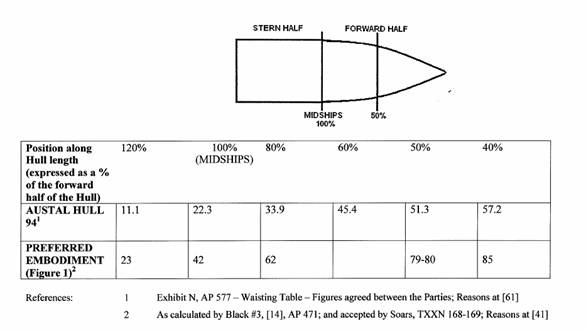
MELBOURNE (HEARD IN SYDNEY) |
THE COURT ORDERS THAT:
1. The appeal be dismissed with costs.
Note: Settlement and entry of orders is dealt with in Order 36 of the Federal Court Rules.
|
IN THE FEDERAL COURT OF AUSTRALIA |
|
|
NEW SOUTH WALES DISTRICT REGISTRY |
NSD 1332 of 2007 |
|
ON APPEAL FROM A SINGLE JUDGE OF THE FEDERAL COURT OF AUSTRALIA |
|
BETWEEN: |
AUSTAL SHIPS SALES PTY LTD First Appellant
AUSTAL SHIPS PTY LTD Second Appellant
AUSTAL LIMITED Third Appellant
|
|
AND: |
STENA REDERI AKTIEBOLAG Respondent
|
|
JUDGES: |
HEEREY, FINN AND DOWSETT JJ |
|
DATE: |
3 JULY 2008 |
|
PLACE: |
MELBOURNE (HEARD IN SYDNEY) |
REASONS FOR JUDGMENT
THE COURT:
AT FIRST INSTANCE
1 The respondent (“Stena”) holds Australian Patent No. 648634 (the “patent”) entitled “A Hull Structure for Multi-Hull Ships”. The appellants comprise a group of ship-building companies based in Western Australia. We will refer to them collectively as “Austal”. At first instance Stena alleged that Austal had infringed the patent and sought injunctive relief. In particular Stena alleged that three vessel designs manufactured, sold or promoted by Austal (“Austal 94”, “Austal 196” and “Austal 285”) infringed its patent. Austal, by cross-application, sought revocation of the patent on the grounds of lack of novelty, obviousness and/or failure to comply with the requirement in s 40 of the Patents Act 1990 (Cth) (the “Patents Act”) that the claims be clear. At first instance the primary Judge (Tamberlin J) found that the Austal 94 design infringed the patent and dismissed the cross-claim, holding that the patent was in all respects valid. Injunctive relief was granted against the second and third respondents. Austal appeals against the decision at first instance and against the dismissal of the cross-claim. The grounds of appeal will be more readily understood after we have said something about the facts of the case.
THE PATENT
2 The patent addresses the hull structure of multi-hull ships. As originally designed multi-hull ships of the catamaran type are prone to move vertically as a result of wave activity, producing undesirable effects upon both passengers and goods. However, if the hull has only a narrow cross-section at the waterline, a smaller lifting force is generated by waves acting on the hull. In such a hull that part located beneath the surface of the water is joined to the above-water part by quite narrow connections, often merely struts. However such a design results in reduced space for locating engines and stowing cargo. Multi-hull vessels having narrow “waists” at the waterline are described as “SWATH” vessels, “SWATH” being an abbreviation for “Small Waterplane Area Twin Hull”.
3 In the specification it is said that:
An object of the present invention is to provide a hull of favourable construction for multi-hull vessels. Thus, the objective of the invention is to provide a hull structure which
(a) has low tendency to upward lift under the influence of waves during movement of the vessel through the water,
(b) is highly efficient and will allow the vessel to be propelled at high speeds,
(c) will result in only a small reduction in speed in high seas,
(d) has a high load resistance and will enable the vessel to be powered by means of any desired power means, including water jet propulsion systems, and
(e) has a high stern stability so as to enable the vessel to be loaded and unloaded from the stern thereof.
4 It was suggested in the course of evidence that the patent taught a design which combined, at the front, the characteristics of a “SWATH” design and at the back, a “reasonably conventional” catamaran design. The purpose of the design was to maximize stability at the front by use of the “SWATH” characteristics whilst utilizing the engine- and load-carrying capacity of a conventional catamaran at the rear. On appeal and at first instance, the parties have focussed on claims 1 and 7 which are set out below. In claim 1, the figures in parenthesis from 1.1 to 1.6 have been inserted as means of reference to the various integers of the claim as identified in the judgment at first instance. Claims 1 and 7 are as follows (emphasis added):
1. A hull for multi-hull seagoing vessels capable of speeds greater than 30 knots (1.1), wherein:
in the case of the sternward half of the hull, located between the stern and midships of the hull, the vertical distance from the hull base line to the volumetric centre-of-gravity of that part of the respective half of the hull below a water line corresponding to a normally occurring hull draft is greater than 55% of the normally occurring draft (1.2);
in the case of the foreward half of the hull, located between the forebody of the hull and midships, said vertical distance is less than 55% of the draft (1.3);
at a position corresponding to 75% of the total length of the underwater body of the hull calculated from the stern of the hull, the distance between the base line and the centre-of-gravity of the frame area (as defined herein) below the water line, and at that position is less than 55% of the draft (1.4);
the width of the hull at the water line is substantially greater in the after body of the hull than in the foreward body of the hull and continually decreases in a forward direction (1.5), and wherein the cross-section or shape of the hull throughout a substantial portion of the forward half of the hull located between the bow and midships has a bulbous underwater part and a narrow waisted part which extends through the water line (1.6).
…
7. A hull according to any one of claims 1 to 5, wherein the width of the hull at the water line is substantially constant in the case of the sternward quarter part of the vessel and then narrows towards the prow of the vessel.
GROUNDS OF APPEAL
5 Austal submits that claim 1 lacks the clarity required by s 40 of the Patents Act. It further submits that the Austal 94 design did not infringe the patent. Other issues were ventilated at first instance but not on appeal.
CLARITY
6 Section 40 of the Patents Act provides:
(1) A provisional specification must describe the invention.
(2) A complete specification must:
(a) describe the invention fully, including the best method known to the applicant of performing the invention; and
(b) where it relates to an application for a standard patent—end with a claim or claims defining the invention; and
(c) where it relates to an application for an innovation patent—end with at least one and no more than 5 claims defining the invention.
(3) The claim or claims must be clear and succinct and fairly based on the matter described in the specification.
(4) The claim or claims must relate to one invention only.
7 The alleged lack of clarity arises out of integer 1.6 in claim 1 and, in particular, the words “substantial portion”, and “narrow waisted”. In his Honour’s reasons at [33] and [34] the learned primary judge summarised Austal’s argument on clarity as follows:
[33] Austal contends that, on the evidence, the compound and inherent uncertainty in the terms used in the claims cannot be resolved by a skilled addressee so as to provide a commonsense assessment or understanding of the claims. Austal accepts that, consistent with a proper understanding of the specification as a whole, the reference to “narrow waisted bulb” may be capable of referring to a circumstance where the bulb shape is present for the whole or almost all of the forward half of the hull. Austal refers to the fact that it will always be the case that the underwater forward extremity of the bulb is not waisted and therefore it cannot be said that the bulb occupies the entire forward half of the hull. At best, it could only occupy a substantial portion. Notwithstanding this conclusion, Austal contends that the claim lacks sufficient precision.
[34] Austal says that a critical question is whether a clear meaning can be given to the minimum longitudinal extent of the “narrow waisted” bulb and the extent of waisting which must exist before it can properly be said to be narrow waisted.
8 Concerning the words “substantial portion”, the primary Judge concluded at [38]:
In my view, the evidence indicates that it is not necessary to have numerical parameters to ascertain the meaning of “substantial portion”. Having regard to the proposed practical operation of the vessels, and read in the context of the specification as a whole, I prefer the construction of Mr Soars to that of Mr Quigley. The meaning of the expression can be more closely defined when assessing the circumstances and objectives of the particular design of a vessel in the particular conditions in which it is expected to operate. The specification allows for a range of forms which will differ according to these variables. Accordingly, I do not consider that the expression is obscure or uncertain or otherwise inappropriate, regardless of whether considered in isolation from or in context of the other requirements in the specification.
9 The words “narrow waisted” refer to the width of that part of the hull which connects the underwater hull to the above-water hull. His Honour concluded that narrow-waisting necessarily involved a “significant narrowing”. In the evidence the extent of waisting was measured by expressing the reduction in width as a percentage of the wider portion. Mr Soars, a naval architect called by Stena, considered that the requirement for narrow-waisting would be satisfied by a reduction which was a little in excess of 20%. Mr Quigley, a naval architect called by Austal, considered that the vessel would not be a “SWATH-style” vessel unless the waisting was at least 70%. He said that he had never seen such a vessel with only 20% waisting. He considered that significant waisting would involve at least a 50% narrowing of the maximum underwater hull width.
10 Tamberlin J concluded that Mr Quigley had failed to take account of, or give sufficient weight to, the “hybrid nature of the hull design issue”. In other words, he had failed to take account of the fact that the patent taught that the bulbous forward part of the underwater hull was to be joined to the more conventional catamaran shape at the rear. For this reason, his Honour preferred the evidence of Mr Soars on the waisting point, concluding that a narrowing of 20% would be waisting as taught in the claim. This conclusion may have been based upon a perception that the narrower the waist, the more difficult it would be to design the transitional section in which the bulbous forward section merges into the conventional catamaran shape at the rear.
11 We should set out some of the relevant authorities concerning clarity and construction of patents.
12 In Kimberly-Clark Australia Pty Limited v Arico Trading International Pty Limited (2001) 207 CLR 1 the majority of the High Court drew attention to the distinction between the “description” of the invention in s 40(2)(a) and the “definition” of a claim in s 40(2)(b). At [24]-[25], their Honours said:
[24] It is well settled that the complete specification is not to be read in the abstract; here it is to be construed in the light of the common general knowledge and the art before 2 July 1984, the priority date; the court is to place itself "in the position of some person acquainted with the surrounding circumstances as to the state of [the] art and manufacture at the time".
[25] Section 25(2)(h) of the Patents and Designs Act 1907 (UK) (the 1907 Act), as amended by s 3 of the Patents and Designs Act 1932 (UK), made it a ground of revocation that the complete specification did not "sufficiently and fairly describe and ascertain the nature of the invention and the manner in which the invention [was] to be performed". The resemblance to s 40(2)(a) of the 1990 Act will be apparent. Speaking of the 1907 Act… Romer LJ repeated par (h) of s 25(2) and continued:
“[I]n other words, [it is essential] that the patentee should disclose his invention sufficiently to enable those who are skilled in the relevant art to utilise the invention after the patentee's monopoly has come to an end. Such disclosure is, indeed, the consideration that the patentee gives for the grant to him of a monopoly during the period that the patent would run.
...
It is not necessary that he should describe in his specification the manner in which the invention is to be performed, with that wealth of detail with which the specification of the manufacturer of something is usually put before the workman who is engaged to manufacture it.”
The question is, will the disclosure enable the addressee of the specification to produce something within each claim without new inventions or additions or prolonged study of matters presenting initial difficulty?
(Footnotes omitted.)
13 In Flexible Steel Lacing Company v Beltreco Ltd (2000) 49 IPR 331, Hely J considered at length the approach to construction of a specification and, in particular, the circumstances in which uncertainty might lead to invalidity. At [71]-[78] his Honour identified the following principles:
· The monopoly must be defined in a way that is not reasonably capable of being misunderstood.
· In determining the nature and extent of the monopoly claimed, the specification must be read as a whole, but recognizing that the parts have different functions. The claims mark out the legal limits of monopoly. What is not claimed is disclaimed. The specification describes how to carry out the process and the best method known to the patentee of doing so.
· Although the claims are construed in the context of the specification as a whole, it is not legitimate to narrow or expand the boundaries of the monopoly as fixed by a claim by adding glosses drawn from other parts of the specification. If a claim is clear, it is not to be varied, qualified or made obscure by statements found elsewhere in the document.
· It is legitimate to refer to the rest of the specification to explain the background to the claims, to ascertain the meaning of technical terms and resolve ambiguities in the construction of the claims. When the language of the claims is obscure or doubtful such doubts may be resolved by reference to the specification.
· It is not necessary that the claims be construed without reference to the body of the specification in order to see whether there is any ambiguity. The document is construed as a whole. If the specification demonstrates an intention that words used elsewhere have a particular meaning, effect should be given to such a “dictionary”.
14 At [79]-[81] his Honour then continued:
[79] Once purely verbal or grammatical questions have been resolved according to ordinary principles of construction, there is no residual uncertainty as to the extent of the monopoly claimed. However, it is open to a court to conclude that the terms of a specification are so ambiguous that its proper construction must always remain a matter of doubt in which case the patent is invalid, subject, perhaps, to the possibility of amendment under s 105 of the 1990 Act…
[80] In Blanco White, Patents for Inventions (5th ed) at 4-701 the matter is put in this way:
Thus a claim is bad if no reasonably certain construction can be given to it, or it is fairly and equally open to diverse meanings. But the rule goes further than this. A court is not bound to find a meaning for a claim, nor to approach a claim with the “conviction that its language is capable of a reasonable construction when carefully examined” that is the due of an Act of Parliament. Thus a claim may be bad for uncertainty although the court could find its true meaning (and would do so if the words concerned appeared in a commercial contract) if it is so obscure that “its proper construction must always remain a matter of doubt”. On the other hand, what matters is not the grammar of the claim, but whether a reader would be left in doubt whether any given apparatus or method fell within the claim or not; the purpose of the rule is to enable the public to rely upon the words of the claim as defining the rights of the patentee. Accordingly, a mere grammatical ambiguity, not affecting the scope of the monopoly, will not invalidate.
Thus far, the rule is clear; but it is not an easy rule for the practitioner to apply. The difficulty lies in deciding just how much doubt as to the meaning of a claim will invalidate it; for the standard of clarity required by the courts changes markedly from time to time. In the past, the standard of clarity required has indeed been put as high as this, that there must be “no serious difficulty” in construing the claims, and that the claims must be capable of construction by rival manufacturers without the assistance of experienced counsel. Claims have, however, habitually been held valid, by all courts, that could not pass such a stringent test. Certainly a claim is not invalid merely because it might have been better drafted, nor merely because the patentee puts forward a construction that the court is not prepared to adopt; nor merely because it is capable of more than one construction, even though it be difficult to decide which is the right one.
[81] Other principles of construction which may be of assistance in the resolution of the present matter include:
· A patent specification should be given a purposive construction rather than a purely literal one…
· The hypothetical addressee of the patent specification is the non-inventive person skilled in the art before the priority date. The words used in a specification are to be given the meaning which the hypothetical addressee would attach to them, both in the light of his own general knowledge and in the light of what is disclosed in the body of the specification.
· There is a fine line between, on the one hand, reading down the words of a patent claim to reflect how a person skilled in the art would understand it in a practical and commonsense way, and, on the other hand, impermissibly limiting the clear words of a claim because a reader skilled in the art would be likely to apply those wide words only in a limited range of all the situations they describe.
· It is permissible for an invention to be described in a way which involves matters of degree. Lack of precise definition in claims is not fatal to their validity, so long as they provide a workable standard suitable to the intended use. The consideration is whether, on any reasonable view, the claim has meaning. In determining this, the expressions in question must be understood in a practical, commonsense manner. Absurd constructions should be avoided and mere technicalities should not defeat the grant of protection.
· As a general rule, the terms of a specification should be accorded their ordinary English meaning.
· Evidence can be given by experts on the meaning which those skilled in the art would give to technical or scientific terms and phrases and on unusual or special meanings given by such persons to words which might otherwise bear their ordinary meaning.
· However, the construction of the specification is for the court, not for the expert witness. In so far as a view expressed by an expert depends upon a reading of the patent, it cannot carry the day unless the court reads the patent in the same way.
· Section 116 of the 1990 Act provides that the court may, in interpreting a complete specification, refer to the specification without amendment. However, it is neither useful nor legitimate to do so where the amended specification is clear.
(Footnotes omitted.)
15 Finally, at [168]-[171] Hely J concluded that an appropriate expert may give evidence as to obviousness.
16 We have cited these authorities at some length because Austal’s argument, at first instance and on appeal, has focussed very much upon expert evidence from naval architects, the way in which the primary judge dealt with such evidence and its allegation that uncertainties arise out of such evidence. We are unclear as to the purpose for which the expert evidence was led. We do not understand such evidence to have established any technical meaning for the relevant terms. Nor did the evidence go to any inadequacy in the specification which might lead to a skilled addressee being unable to perform the invention. Some of the evidence may have been relevant to obviousness, but that is not presently relevant. Perhaps the evidence went to the capacity of an addressee to understand the limits of the claims, but as far as we can see, no expert expressly identified any such problem in evidence in chief, although Mr Soars was cross-examined on that basis.
17 The invention addresses an aspect of the design of a seagoing vessel. Whatever else such a vessel may do, it must float, it must be capable of withstanding conditions at sea and it must be capable of being propelled and controlled. These considerations are inherent in the concept of a “seagoing vessel”. The design of such a vessel is, no doubt, a complex business. As much appears from the evidence. The following extract from Mr Soars’ evidence in chief demonstrates the point:
It is a bit like sculpture I suppose in that you form in your mind what you want the hull to look like to achieve certain things.
So you start with a goal, do you, and then you need to form in your mind what shape you need to achieve the hull and this sort of indicates to people how you can achieve that shape or what you have to do or what the shape?---Then you have to get that shape on to paper and that is generally done with the lines plan itself, I mean that could be modelled in clay and now they just put it in a computer.
But what leads you to perform one sort of form than another to create one sort of form or another and another, is it just an instinct to try it out?---It is more an instinct, yes. You are tracing a concept, tracing, you basically have an idea…
Tracing a hypothesis almost?---Yes, you want to try and do something which…
You said, well maybe this shape will work?---You want to achieve this, yes, let’s try this and in fact that’s what we quite often do in tank testing.
I am just trying to understand the process and how this fits into the process, that’s all?---There’s no sort of textbook process. It is almost …
Trial and error?---Trial and error, artistic sort of process with calculations following on to back it all up.
18 In the affidavit of James Morrison Black, a naval architect employed by Austal, Mr Black said at para 3.17:
The varying requirements for improvements to hull forms, as stated above (ie speed, capacity, handling, seakeeping, propulsion, operability etc.) can often be conflicting and the client’s specific requirements are used to prioritise and optimise these improvements. For instance, a client may require a high speed craft to compete with an existing vessel on a semi-sheltered route. In this case, speed would be given a priority over seakeeping (and possibly handling) to ensure that the competitor’s vessel could be beaten.
19 The words “substantial portion” appear in a passage in claim 1 which seeks to describe the shape of cross-sections taken at various points along the forward part of a hull. A hull according to claim 1 will, throughout a substantial portion of its forward half, have cross-sections which have two characteristics:
· a bulbous underwater part; and
· a narrow waisted part which extends through the water line.
20 It is important to keep in mind that the integer focuses on the appearance of numerous cross-sections and not upon the outward appearance of the hull. The use of the word “bulbous” in integer 1.6 seems to differ from its use in the body of the specification on p 3A at ll 11-16. On p 3, however, the language of the claim appears at ll 17-19. At [32]-[34] in the reasons for judgment, his Honour appears also to have conflated the two characteristics, referring to a “narrow waisted” bulb. As we understand claim 1, the “bulbous” part is not narrow waisted. That description relates to the member which connects the underwater bulbous hull to the above-water hull. A similar conflation of the terms appears in Austal’s submissions. The intention of claim 1 is clear in this regard. The inconsistent use in the specification poses no problem in construing the specification or the claim. The conflations of the terms in the judgment and in the submissions are mere matters of terminology and do not affect the substance of the case.
21 Austal’s submission is that the expressions “substantial portion” and “narrow waisted” are incapable of being converted into mathematical terms and so, for the purposes of subs 40(3), the claim lacks clarity. Hely J demonstrated in Flexible Steel Lacing that use of such expressions does not necessarily lead to lack of clarity. As the Full Court said in Leonardis v Sartas No 1 Pty Ltd (1996) 67 FCR 126 at 134:
It is not inadmissible to use in a claim an imprecise word in an appropriate context, where it conveys the necessary meaning…
22 The Court then referred to various cases concerning expressions such as “relatively small”, “a minor amount of water … small in comparison with the total amount of other liquid constituents” and “substantial effect”, holding that the meaning of the words “substantially above” was sufficiently plain. The Court concluded that:
…the dictum of Taylor J in Martin v Scribal Pty Ltd (1954) 92 CLR 17 at 97 applies:
[I]t is right to construe a claim with an eye benevolent to the inventor and with a view to making the invention work – this is an application of the old doctrine ut res magis valeat quam pereat.
23 The facts of the present case bear some similarity to the facts in Martin. That case concerned a patent for a ballpoint pen. The relevant claim provided:
An instrument of the type specified, having the ink reservoir constituted by a vented tube of capillary size in which when charged with viscous ink a continuous liquid vein is maintained extending from the ball, and having a feed duct leading from the reservoir to the ball, the cross-sectional area of which duct, particularly that portion adjacent the ball, being less than that of the reservoir.
24 At first instance, Sholl J held that the claim was ambiguous, considering that “the words describing the cross-sectional area of the duct, especially the words ‘particularly that portion adjacent to the ball’, gave no sufficiently precise or certain understanding of the element of the claim manifested in or represented by the duct.” Dixon CJ observed at 58-59:
The considerations regarded as causing the ambiguity may be briefly summarized as follows. The claim does not indicate how the duct is differentiated from the tube or conduit, except that the portion adjacent to the ball must be of less diameter. It does not indicate how much of the duct must be of less diameter. It does not indicate whether the rest of the duct may be of the same diameter as the conduit or may be of greater diameter than the conduit or may be of less diameter than the conduit, although of greater diameter than the portion of the duct adjacent to the ball.
25 Concerning this argument, Dixon CJ said at 59:
These doubts or difficulties as to the intention of the patentee are said to make his claim ambiguous. If we were concerned only with a written instrument operating inter partes and not generally these difficulties would easily be overcome by construction. But the principles governing the definition of a monopoly operating over the public at large require a description which is not reasonably capable of misunderstanding. If an ambiguity is purposely introduced in order to produce a vagueness in the boundaries of a monopoly this purposeful introduction of an ambiguity destroys the patent, whether the ambiguity be great or small. Here there is no reason to suppose that there was any such design. The following passage, however, in the judgment of Lord Parker describes what is the duty of the court and provides the test of ambiguity:
Further, though it may be true that in construing an instrument inter partes the Court is bound to make up its mind as to the true meaning, this is far from being the case with a Specification. It is open to the Court to conclude that the terms of a Specification are so ambiguous that its proper construction must always remain a matter of doubt, and in such a case, even if the Specification had been prepared in perfect good faith, the duty of the Court would be to declare the Patent void. Once again, though the Court may consider that the meaning of the Specification is reasonably clear, yet if the Specification contain statements calculated to mislead the persons to whom it is addressed, and render it difficult for them without trial and experiment to comprehend in what manner the patentee intends his invention to be performed, these statements may avoid the Patent…
(Footnote omitted.)
26 We do not consider that there is anything misleading about the present specification.
27 At 59-60, Dixon CJ continued:
Notwithstanding the strictness and rigour with which these principles have repeatedly been applied, I find myself unable to concur with Sholl J in the conclusion that they destroy the patentee's first claim for ambiguity. To begin with I do not think on a fair reading of the specification as a whole a man at all familiar with the subject of ball-point fountain pens could suppose that any part of the duct might consistently with the claim be of greater diameter than the main conduit forming the reservoir. The whole invention is clearly described as requiring a tube of a capillary size with a reduction towards the ball. The complaint that there is no precise way of differentiating between the conduit forming the main reservoir and the duct appears to me to overlook the fact that the duct is only the terminal of the reservoir and strictness of definition is incompatible alike with its purpose and character. The specification conveys two ideas with respect to the duct, and they appear to me to suffice. One is that as the reservoir approaches the ball, it gives place to a different formation of tube, designated the duct. The other is that the formation must include a lessened diameter at and near the ball, though the lessened diameter may begin earlier. Each of these ideas involves a matter of degree and for that reason any distinction that is precise must be but an arbitrary restriction on the inherent variability of the feature which the specification describes as the duct. The difference in formation may lie simply in the lessening of the diameter or it may lie in the commencement of a new member of the construction. The drawings make it clear that in some embodiments there is a physical distinction in the members forming the tube or conduit and the duct. Doubtless a manufacturing advantage may be obtained by having a detachable portion which embraces the ball and the duct. But this advantage is no part of the claim. In the operation of the pen the length of the duct is not material. It is a matter which would be determined by convenience in manufacture.
28 Integer 1.6 describes the cross-sectional shape “throughout a substantial portion of the forward half of the hull”. The integer demands consideration of the cross-sectional shape of the vessel over a considerable part of its length. This is diagrammatically demonstrated in Figure 1 in the patent, but for a lay person, the figure may not be particularly instructive. The cross-sectional shape is said to have a bulbous underwater part and a narrow waisted part extending through the waterline. As the bulbous part is underwater, the narrow waisted part must be above it. In this context the word “bulbous” may be a little inappropriate. According to The Shorter Oxford English Dictionary (ed Brown L, 4th ed, Oxford University Press, 1993) the word means “of, pertaining to, or of the nature of a bulb … shaped like a bulb; rounded, swollen”. The word “bulb” is defined as “the globular underground organ of an onion, lily or similar plant which contains the following year’s bud and scale leaves that serve as food reserves… A spheroidal dilation of the end of an organ or other structure eg of the spinal cord… or of a hair root”.
29 The dominant characteristic of a thing which is bulbous is that it is “globular”, meaning, according to the same reference, “globe-shaped” or “spherical”. The botanical and physiological allusions may suggest that at least when used in describing nature, the shape may not be perfect. The use of the word “bulbous” to describe part of the cross-section of the hull is inappropriate because a spherical body is necessarily three-dimensional whereas a cross-section is two-dimensional. If one were to take a cross-sectional cut through a globe we imagine that it would appear to be circular. If the globe were a perfect sphere then the cross-section would be a perfect circle. It may be that the word “bulbous” was intended to convey the possibility that the cross-section would not necessarily be a perfect circle just as a plant bulb, such as an onion, is not a perfect sphere, and so a cross-section through it may not be a perfect circle. Sitting above the circle of the lower hull in the cross-section is the narrow waisted part extending through the water line. In our view the notion of “waisting” implies wider parts below and above a narrower part, the waist. In the present case the waist is situated between the lower, underwater hull and the upper, above-water, hull.
30 Although the bulbous underwater part and the narrow waisted part are identified discretely in integer 1.6 they are inter-related. In a cross-section the circumference of the circle representing the lower hull will be broken at its top where it joins the narrow waisted part. The narrower the waist the less will be the break. Conversely, the wider the waist, the greater the break. Thus the requirement for a bulbous underwater part and a narrow waisted part through the water line are inter-dependent. The more the circumference of the circle is disrupted the harder it will be accurately to describe it as “bulbous” or, as we understand that term in this context, “roughly circular”. This will be the result of the absence of a substantial part of the circumference which will deprive it of its appearance of circularity. Integer 1.6 requires that the relevant cross-sections demonstrate both the roughly circular nature of the lower hull and a narrow waist above it. Whether or not the waist can be accurately described as “narrow” will not only depend upon the degree of narrowing as between the underwater hull and the waisted part extending through the water line. It may also depend upon the difference between the waist and that part of the above-water hull which it joins.
31 The prescribed cross-sectional shape must be “throughout a substantial portion of the forward half of the hull located between the bow and midships”. It is important to keep in mind the overall shape and extent of the lower hull. Firstly, at least in some of the embodiments which appear in the evidence, the leading part of the lower hull projects forward of the point at which that hull joins the upper hull. That forward part of the lower hull could not comply with integer 1.6. Even if it be bulbous in cross-sectional shape, there would be no waist extending through the waterline. Secondly, at some point around the midships position, the “bulbous” forward shape of the hull will commence its transformation into the more conventional catamaran shape of the rear. This may involve a flattening of the lower hull so that its cross-sections would show progressive loss of circular shape. It may also involve the reduction, or perhaps elimination, of any apparent waisting. We take it to be self-evident that a naval architect, in designing such a vessel, would seek to avoid sudden changes in shape, so that the forward part of the lower hull would be changing shape throughout much, if not all, of its length. It is, we think, common knowledge that in designing an object to move through a fluid, whether it be water, air or otherwise, a degree of streamlining is sought in order to reduce the resistance to free passage of the object through the fluid. Mr Soars said as much at para 30 of his affidavit filed on 29 June 2006.
32 The extracts from the evidence of Mr Soars and Mr Black, which we have quoted above, demonstrate that a naval architect, seeking to design a vessel incorporating the teachings of the patent, would take such teachings into account along with other relevant design parameters, including the client’s requirements as to size, speed, draft and no doubt many other matters. They would include the design consequences of those requirements such as the need for buoyancy, stability, effective propulsion and good handling in contemplated sea conditions. No doubt the actual volume of the lower hull and its size and shape would, to some extent, be determined by reference to these various parameters. Claim 1, in effect, describes the anticipated effect of applying the teachings of the patent. A vessel designed, giving effect to such teachings, will have a lower hull, the forward half of which will have the cross-section identified in integer 1.6 over a “substantial portion” of its length, taking into account the fact that there may be a forward part, which is not directly connected to the hull, and a transitional part, about half-way along the length of the vessel, where it commences to change shape. It must be kept in mind that the patent teaches a design feature, not the incorporation of a pre-existing component part. Of the various definitions in The Shorter Oxford English Dictionary, the most appropriate definition of “substantial” is “[T]hat is such in the main; real or true for the most part”. That definition seems to support Mr Soars’ view which was, to some extent, accepted by Mr Quigley, that the “bulbous” quality should exist over most of the forward part of the lower hull.
33 The specification, at p 3A ll 11-13 and at p 3A ll 26-27 to p4 l 1, offers support for such an approach. Those passages contemplate the forward part of the hull having, in cross-section, the characteristics of a bulbous part and a narrow waist. The passages seem to address overall shape. Given the virtually continuous changing of such shape, we doubt whether any clearer meaning is necessary or possible.
34 As to the “narrow waisted part”, the expression should be construed as a whole. No doubt the patent assumes that a relevant addressee will have an understanding of the way in which narrowing at the waterline reduces wave effect and of design criteria affecting the width of the underwater hull. Claim 1 describes an underwater hull the cross-section of which narrows in shape as it approaches the point at which it connects to the above water hull. We consider that to be the intended meaning of the expression “narrow waisted part”. Again it is neither necessary nor possible to be any more precise. We expressly reject Mr Quigley’s reliance upon his observations of SWATH type vessels and the degree of waisting commonly found in such vessels. Although the witnesses described the forward part of a hull according to claim 1 as being “SWATH-like”, neither the claim nor the specification as a whole teaches that requirement. Certainly, the patent adopts the defining feature of a SWATH type hull. However, as Tamberlin J observed, the “hybrid nature” of the hull must be kept in mind.
35 In our view Austal’s argument fails to take account of the fact that, as in Martin, Stena’s invention involved an idea which “involves a matter of degree and for that reason any distinction that is precise must be but an arbitrary restriction on the inherent variability of the feature…”: Martin at 60.
36 The patent does not lack clarity.
INFRINGEMENT
37 The only live issue as to infringement concerns a hull designated Austal 94. Between June 1998 and June 1999 Austal manufactured and sold three vessels incorporating hulls in this form.
38 Relevantly for present purposes the Austal 94 had the following features:
· an expansion by 147 mm between the 100 per cent and 90 per cent frames in the sternward part of the hull; and
· the degree of waisting was less than that of the preferred embodiment, as is illustrated by the following diagram:
39 Austal contended before the primary judge and on appeal that the Austal 94 hull did not infringe because:
· its width did not “continually decrease in a forward direction” (integer 1.5), rather it increased in the sternward part;
· it was not “narrow waisted” (integer 1.6); and
· the width in the sternward quarter was not “substantially constant” (claim 7).
40 As to the width, his Honour held at [57] that the increase was insignificant and immaterial. This finding was based on the evidence of Stena’s expert Mr Soars, albeit, as acknowledged by his Honour, the deviation percentage was 1.6 per cent which exceeded Mr Soars’ suggested allowable maximum deviation of 1.5 per cent. This deviation his Honour thought “immaterial and insignificant or barely discernible”.
41 Claim 7 is an alternative to claim 1, insofar as the latter is limited by integer 1.5. It may be possible to hypothesise a hull which comes within both; a slight increase, or no increase, in the sternward quarter which is nevertheless consistent with the hull “continually decreas(ing)” overall. Nevertheless we think that integer 1.5 and claim 7 speak of different concepts. It is certainly harder to characterise something which increases, however slightly, as part of a continual decrease overall than it is to regard a minor departure from the parallel as “substantially constant”. The adverb in the latter expressly contemplates a minor departure. We think therefore that the Austal 94 is not within claim 1, although it is within claim 7.
42 On the “narrow waisted” issue his Honour found at [62] that almost the entire forward half of the Austal 94 exceeded 25 per cent narrowing. Although less than the preferred embodiment, as his Honour noted the latter “is indicative only and does not limit the range of narrowing which can be comprised within the claim”.
43 On the appeal Austal pointed to evidence by Mr Soars that a hull with the waisting of the Austal 94 would be “quite different” and would have “pronounced” or “noticeable” differences to the preferred embodiment in its ability to dampen the pitching or vertical motion of the vessel. However, if the infringing product comes within the claim it is no defence to show that it may have some different performance characteristics from the preferred embodiment. It is the claim which marks out the extent of the monopoly, not the preferred embodiment.
44 Nor does it matter that the Austal had a degree of waisting which was less than that “typical of SWATHs” (ie pre-patent SWATHs, which did not have the conventional stern configuration of the patent).
45 Austal argued that the narrow waisted part of the hull must display a degree of waisting which is “SWATH like that is, in the vicinity of 50 per cent waisting at or close to midships”. In our view, that would be to impose an impermissible gloss on the plain words of the claim.
46 For the purposes of claim 7 his Honour held at [59] that, notwithstanding the increase in width by 147 mm, the sternward quarter of the Austal 94 was “substantially constant”.
47 As already mentioned, the “substantially constant” of claim 7 and the “continually decreases” of integer 1.5 are true alternatives. Both sides’ experts, Mr Soars and Mr Quigley, read the patent in this way. There is no requirement of patent law that subsequent claims narrow the scope of earlier claims, even though, as a matter of practice, this is often the case.
48 The percentage variation in the water line width of the Austal 94 hull over the sternward quarter, expressed as a percentage of the average hull width in that quarter, was less than 1.5 per cent on each side of the hull. According to Mr Soars, this was “insignificant, and … barely discernible from the drawing”.
49 His Honour was in our view correct in finding infringement by the Austal 94.
|
I certify that the preceding forty-nine (49) numbered paragraphs are a true copy of the Reasons for Judgment herein of the Honourable Justices Heerey, Finn and Dowsett. |
Associate:
Dated: 3 July 2008
|
Counsel for the Appellants: |
B N Caine SC, R McCormack and L J Duncan |
|
|
|
|
Solicitors for the Appellants: |
Griffith Hack |
|
|
|
|
Counsel for the Respondent: |
J V Nicholas SC and C Dimitriadis |
|
|
|
|
Solicitors for the Respondent: |
Spruson & Ferguson Lawyers |
|
Date of Hearing: |
18 February 2008 |
|
|
|
|
Date of Judgment: |
3 July 2008 |


