

FEDERAL COURT OF AUSTRALIA
Ranbaxy Australia Pty Ltd (ACN 110 781 826) v Warner-Lambert Company LLC [2008] FCAFC 82
PATENTS – construction of patent – construction of specification – common general knowledge in relevant field of art – whether patent is restricted to the racemate of a claimed compound or extends to the enantiomers of the compounds individually and mixtures of the enantiomers
PATENTS – revocation of patent – whether patent obtained by false suggestion or misrepresentation – representation in specification – representation in correspondence with Commissioner’s delegate – whether claimed invention is a patentable invention – whether claimed invention is a manner of manufacture within the meaning of the Statute of Monopolies – whether claimed invention is useful
Patents Act 1952 (Cth)s 100
Patents Act 1990 (Cth)ss 3, 7, 18, 138
Statute of Monopolies (21 Jac. 1, c. 3)
Advanced Building Systems Pty Limited v Ramset Fasteners (Aust) Pty Limited (1998) 194 CLR 171 cited
Fawcett v Homan (1896) 13 RPC 398 cited
ICI Chemicals & Polymers Limited v The Lubrizol Corporation Inc (2000) 106 FCR 214 cited
IG Farbenindustrie AG’s Patents, Re (1930) 47 RPC 289 cited
Pfizer Overseas Pharmaceuticals v Ely Lilly & Co (2005) 225 ALR 416 cited
Prestige Group (Australia) Pty Limited v Dart Industries Inc (1990) 95 ALR 533 cited
Rehm Pty Limited v Webster’s Security Systems (International) Pty Limited (1981) 81 ALR 79 cited
Re IG Farbenindustrie AG’s Patents (1930) 47 RPC 289 at 322-3 cited
Synthetic Turf Development Pty Limited v Sports Technology International Pty Limited [2004] FCA 1179 cited
Welcome Real-Time SA v Catuity Inc (2001) 113 FCR 110 cited
WM Wrigley Jr Co v Cadbury Schweppes Pty Limited (2005) 66 IPR 298 cited
RANBAXY AUSTRALIA PTY LTD (ACN 110 871 826) v WARNER-LAMBERT COMPANY LLC
VID90 OF 2007
WARNER-LAMBERT COMPANY LLC v RANBAXY AUSTRALIA PTY LTD
(ACN 110 871 826)
VID93 OF 2007
EMMETT, WEINBERG & BENNETT JJ
28 MAY 2008
MELBOURNE
| IN THE FEDERAL COURT OF AUSTRALIA |
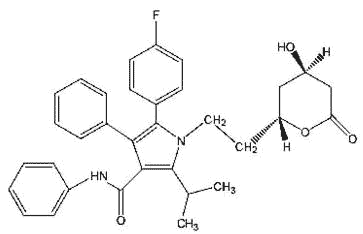
|
| VICTORIA DISTRICT REGISTRY | VID90 OF 2007 |
| ON APPEAL FROM A SINGLE JUDGE OF THE FEDERAL COURT OF AUSTRALIA |
| BETWEEN: | RANBAXY AUSTRALIA PTY LTD (ACN 110 871 826) Appellant
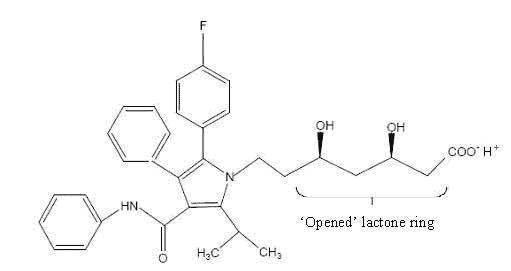
|
| AND: | WARNER-LAMBERT COMPANY LLC Respondent
|
| JUDGES: | EMMETT, WEINBERG & BENNETT JJ |
| DATE OF ORDER: | 28 MAY 2008 |
| WHERE MADE: | MELBOURNE |
THE COURT ORDERS THAT:
1. The appeal be dismissed.
Note: Settlement and entry of orders is dealt with in Order 36 of the Federal Court Rules.
| IN THE FEDERAL COURT OF AUSTRALIA |
|
| VICTORIA DISTRICT REGISTRY | VID93 OF 2007 |
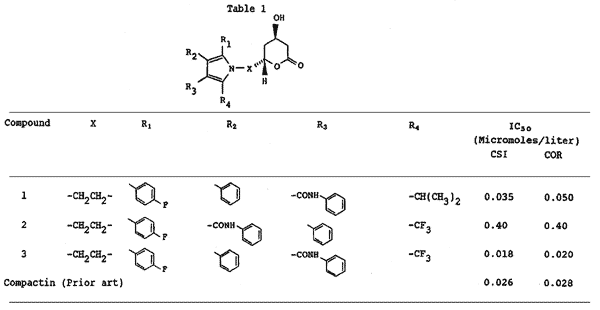
| ON APPEAL FROM A SINGLE JUDGE OF THE FEDERAL COURT OF AUSTRALIA |
| BETWEEN: | WARNER-LAMBERT COMPANY LLC Appellant
|
| AND: | RANBAXY AUSTRALIA PTY LTD (ACN 110 871 826) First Respondent
COMMISSIONER OF PATENTS Second Respondent
|
| JUDGES: | EMMETT, WEINBERG AND BENNETT JJ |
| DATE OF ORDER: | 28 MAY 2008 |
| WHERE MADE: | MELBOURNE |
THE COURT ORDERS THAT:
1. The appeal be dismissed.
Note: Settlement and entry of orders is dealt with in Order 36 of the Federal Court Rules.
TABLE OF CONTENTS
|
| |
| INTRODUCTION.......................................................................................................... | [1] |
| THE CHEMISTRY........................................................................................................ | [5] |
| TESTING FOR CHOLESTEROL SYNTHESIS INHIBITION................................. | [22] |
| ATORVASTATIN.......................................................................................................... | [26] |
| COMMON GENERAL KNOWLEDGE...................................................................... | [32] |
| THE WITNESSES.......................................................................................................... | [33] |
| THE BROADER PATENT............................................................................................ | [37] |
| THE ENANTIOMER PATENT.................................................................................... | [47] |
| THE ISSUES................................................................................................................... | [54] |
| THE CONSTRUCTION OF THE BROADER PATENT........................................... | [60] |
| THE VALIDITY OF THE ENANTIOMER PATENT................................................. | [78] |
| False Suggestion or Misrepresentation.................................................................... | [82] |
| False Suggestion or Misrepresentation in the Enantiomer Specification.......... | [85] |
| False Suggestion to the Commissioner................................................................. | [101] |
| Whether a Surprising and Unexpected effect....................................................... | [108] |
| Whether Enantiomer Patent Obtained On or By False Suggestion................... | [131] |
| Utility........................................................................................................................... | [141] |
| Manner of Manufacture............................................................................................. | [145] |
| CONCLUSION............................................................................................................... | [149] |
| IN THE FEDERAL COURT OF AUSTRALIA |
|
| VICTORIA DISTRICT REGISTRY |
|
| ON APPEAL FROM A SINGLE JUDGE OF THE FEDERAL COURT OF AUSTRALIA |
VID90 OF 2007
| BETWEEN: | RANBAXY AUSTRALIA PTY LTD (ACN 110 871 826) Appellant
|
| AND: | WARNER-LAMBERT COMPANY LLC Respondent
|
VID93 OF 2007
| BETWEEN: | WARNER-LAMBERT COMPANY LLC Appellant
|
| AND: | ranbaxy australia pty ltd (ACN 110 871 826) respondent |
| JUDGES: | EMMETT, WEINBERG & BENNETT JJ |
| DATE: | 28 MAY 2008 |
| PLACE: | MELBOURNE |
REASONS FOR JUDGMENT
THE COURT:
INTRODUCTION
1 Each of these two appeals is concerned with an Australian patent relating to atorvastatin calcium. Atorvastatin calcium is the active ingredient in a prescription medicine marketed in Australia under the product name “Lipitor”. Lipitor is prescribed to patients suffering from high levels of cholesterol in the blood in order to lower the level of cholesterol and thereby reduce the incidence of cardiovascular disease. It does that by inhibiting the activity of HMG-CoA reductase. HMG-CoA reductase is an enzyme that is instrumental in the natural synthesis of cholesterol in the body.
2 Warner-Lambert Company LLC (Warner-Lambert), the appellant in one appeal and the first respondent in the other appeal, is registered as the owner of two patents (the Patents). Patent Number 601981 (the Broader Patent) commenced on 18 May 1987 with a priority date of 30 May 1986. Patent Number 628198 (the Enantiomer Patent) commenced on 23 July 1990, with a priority date of 21 July 1989. The person named as inventor in each of the Patents is Dr Bruce David Roth.
3 In 2004, Ranbaxy Australia Pty Ltd (Ranbaxy) proposed to import into Australia for sale a product containing atorvastatin calcium. Warner-Lambert complained that the importation and sale of the product would constitute infringement of the Patents. Ranbaxy thereupon commenced a proceeding against Warner-Lambert and the Commissioner of Patents seeking, inter alia, an order revoking the Enantiomer Patent. Warner-Lambert filed a cross-claim in the proceeding claiming injunctions restraining Ranbaxy from infringing the Broader Patent and the Enantiomer Patent. In its defence to the cross-claim, which denied infringement of the Broader Patent, Ranbaxy reasserted its claim that the Enantiomer Patent is invalid and is liable to be revoked.
4 On 20 December 2006 a judge of the Court ordered that Ranbaxy be restrained from infringing the Broader Patent. However, his Honour also ordered that the Enantiomer Patent be revoked. By Notice of Appeal of 8 February 2007, Ranbaxy appealed from the order granting an injunction restraining infringement of the Broader Patent. By Notice of Appeal of 9 February 2007, Warner-Lambert appealed from the order revoking the Enantiomer Patent. The two appeals were heard together.
THE CHEMISTRY
5 Stereochemistry is the study of the three-dimensional structure of molecules. Isomers are molecules that have the same number and type of atoms, or the same chemical formula, but differ in the connection or arrangement of the atoms. Isomers that differ in the way the atoms are connected are known as structural isomers. Isomers that have atoms connected in the same way but have the atoms oriented differently are known as stereoisomers.
6 The three-dimensional structure of molecules can be represented pictorially using the following symbols to represent the orientation of the atoms in space:
—(dash) refers to a bond in the plane of the page;
 (wedge) refers to a bond coming directly out of the plane of the page; and
 or ---- (hashed line/broken line) refer to a bond that goes directly behind the plane of the page.
7 When a carbon atom bonds with four non-identical atoms or groups of atoms, a tetrahedral shape is formed. The shape can be arranged three-dimensionally in two different ways, which are non-superimposable mirror images of each other. A left hand and a right hand are non-superimposable mirror images of each other in the same way. Any physical object that exists in two such forms, which are mirror images of each other, is said to be chiral. In a molecule with such a tetrahedral shape, the carbon atom is said to be the chiral centre of the molecule.
8 Stereoisomers that are non-superimposable mirror images of each other are called enantiomers, as shown in Figure 1 below:
Figure 1
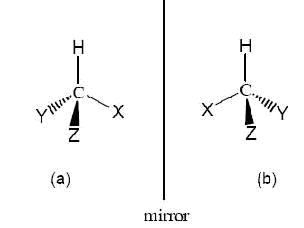
In Figure 1, (a) and (b) are enantiomers. In each enantiomer, the carbon atom is the chiral centre.
9 Pairs of enantiomers have many of the same chemical and physical properties, such as identical melting points and the same solubilities and colours. However, they can be differentiated from one another by the effect they have on the rotation of polarised light. When polarised light is passed through a solution containing only one enantiomer, the plane of polarised light is rotated either in a clockwise direction (right, denoted with a ‘(+)’ or ‘d-’) or in an anti-clockwise direction (left, denoted with a ‘(-)’ or ‘l-’). Because of their ability to rotate polarised light, enantiomers are said to be optically active and are sometimes referred to as optical isomers.
10 To distinguish between different enantiomers of the same compound, chemists assign absolute stereochemistry at the chiral centre according to priority rules, which require the atoms attached to the carbon centre to be ranked according to their atomic number: the higher the atomic number, the larger the atom in three-dimensional space, and therefore the higher the priority. That ranking will ultimately determine whether the chiral centre has an ‘R’ configuration, which has a clockwise arrangement of atoms from highest to lowest priority, or an ‘S’ configuration, which signifies an anti-clockwise arrangement of atoms.
11 In Figure 2 below,absolute stereochemistry has been assigned according to the priority rules, where atom ‘1’ has the highest priority and, therefore, the highest atomic number, and atom ‘4’ the lowest priority and, therefore, the lowest atomic number:
Figure 2
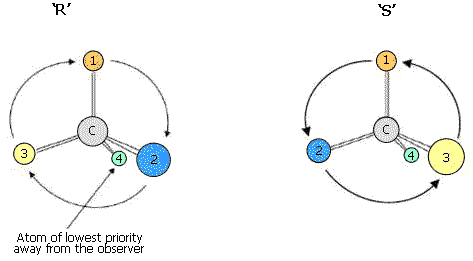
In Figure 2, the two enantiomers, ‘R’ and ‘S’, are distinguished by the spatial position of atoms ‘2’ and ‘3’.
12 An enantiomer with absolute stereochemistry or configuration of ‘R’ will not necessarily rotate polarised light in a clockwise direction. Likewise, an enantiomer with absolute stereochemistry or configuration of ‘S’ will not necessarily rotate polarised light in an anti-clockwise direction. The absolute stereochemistry can be determined from a pictorial representation of a molecule. By contrast, the designation of ‘(+)’ or ‘(-)’ must be determined through testing the enantiomer. There is no correlation between the absolute stereochemistry of an enantiomer and the ‘(+)’ or ‘(-)’ designations.
13 Synthesis of an enantiomeric compound in a laboratory normally produces a mixture of equal amounts of each enantiomer. Such an equal mixture of enantiomers is called a racemate or a racemic mixture, expressions that are synonymous. A racemate may be denoted by ‘(±)’, ‘dl’ or ‘(rac)’. The physical properties of a racemate will be very similar to the individual enantiomers that make it up but the biological properties can be quite different.
14 It is possible to obtain a product containing only one enantiomer by either chiral synthesis or achiral synthesis. In chiral synthesis, starting materials or reagents that are enatiomerically pure, in containing only one enantiomer, are used in the reaction to produce a product that contains predominantly one enantiomer. In achiral synthesis, a synthesis is undertaken without using such starting materials or reagents; the resultant racemate is then separated or resolved into its two enantiomers.
15 A racemate in a liquid state can be separated or resolved into its individual enantiomers by a laboratory technique known generally as column chromatography. Column chromatography is a technique whereby a vertical glass or metal column is filled with some form of solid support and the racemate solution to be separated or resolved is placed on top of the support. The rest of the column is filled with a solvent that, under the influence of gravity, moves the racemate solution through the column. The solid support causes the individual enantiomers to pass through the column at different speeds, or retains one enantiomer on the column while allowing the other enantiomer to pass through the column. In that way, the individual enantiomers can be isolated and separated from one another. By subsequently testing each solution for the rotation of polarised light, the enantiomers can be identified as either the (+) enantiomer or the (-) enantiomer.
16 The products obtained from chiral synthesis, or from the separation or resolution of racemate solutions, may not be enantiomerically pure, in that they may contain contamination by the other enantiomer. The level of impurity will vary depending on the synthesis method employed or the technical laboratory skills of the chemist.
17 Relative stereochemistry describes the position of substituents of a compound relative to each other. An arrangement where both the major substituents lie on the same side of the plane of reference is called a cis arrangement. An arrangement where the major substituents appear on the opposite sides of the plane is called a transarrangement. The distinction is explained in diagrammatic form in Figure 3 as follows:
Figure 3
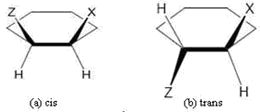
In Figure 3(a), groups ‘Z’ and ‘X’ are on the same side of the plane; in Figure 3(b) they are on opposite sides of the plane. A carbon ring containing two chiral centres, as in Figure 4 below, gives rise to four possible isomers. If the isomers are not mirror images of one another, then the isomers are called diastereoisomers (or diastereomers). The isomers depicted in Figure 3(a) and Figure 3(b) are diastereoisomers, that is, they are notmirror images of each other.
18 Where both chiral centres are mirror images of one another, the isomers form an enantiomeric pair, as described in Figure 4 below:
Figure 4
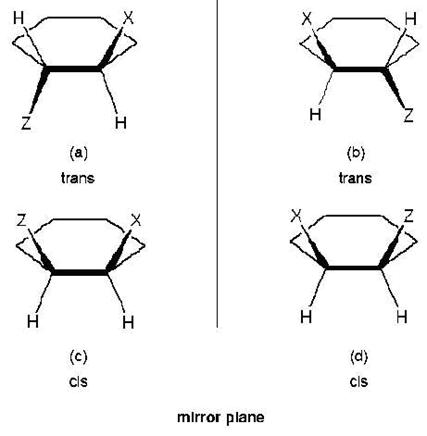
19 In Figure 4, (a) and (b) have the same relative stereochemistry, because both enantiomers are in the transform, but different absolute stereochemistry. Likewise, (c) and (d) have the same relative stereochemistry, because both enantiomers are in the cis form, but different absolute stereochemistry.
20 Many molecules in biological systems are chiral. An enzyme is an example. An enzyme is a protein that acts as a catalyst in specific biochemical reactions. That is to say, it assists the reaction but remains unchanged by it. Each enzyme has a very specific and complex molecular shape and, as a result, will generally only recognise the target with which it reacts. While an enantiomer shares many identical physical and chemical properties with its enantiomeric pair, each enantiomer may interact with other chiral molecules, such as enzymes, in very different ways. Enzymes, of which HMG-CoA reductase is an example, tend to display a preference for interacting with one enantiomer over the other.
21 As a consequence of that selective activity, one enantiomer of an enantiomeric pair may have all or most of the biological activity when interacting with an enzyme, while the other has little or, in some cases, no biological activity. In other cases, the less active or inactive enantiomer may have a very different type of biological activity altogether.
TESTING FOR CHOLESTEROL SYNTHESIS INHIBITION
22 One of the questions that arises in relation to the Enantiomer Patent is the effectiveness of a claimed compound of the invention of the Enantiomer Patent to inhibit the synthesis of cholesterol. Three methods for testing the effectiveness of a compound to inhibit the synthesis of cholesterol were the subject of evidence.
23 The first and most significant, because of the references to results of testing in the complete specifications of the Patents, is a CSI assay. CSI is an acronym for Cholesterol Synthesis Inhibition. A CSI assay is an in vitro test used to measure the ability of a compound to inhibit. A CSI assay measures the inhibition of cholesterol biosynthesis along the entire cholesterol biosynthesis pathway, without indicating the specific step in the cholesterol biosynthetic pathway that is being inhibited. It is not a test that is specific to HMG-CoA reductase. The results of a CSI assay are reported as an IC50 value, which refers to the concentration of a test compound that produces 50% inhibition of the conversion of [14C] acetate to radioactive cholesterol.
24 The second test is a COR assay, which is also conducted in vitro. COR is an acronym for CoA Reductase Inhibition. A COR assay measures the ability of a test compound to inhibit HMG-CoA reductase specifically.
ATORVASTATIN
26 Atorvastatin is a member of a class of drugs known by the generic term statin. Other members of the statin class include simvastatin, pravastatin, lovastatin and fluvastatin.
27 The drawing in Figure 6 below depicts the form of atorvastatin:
Figure 5
28 Figure 6 below depicts the structural formula of the compounds claimed in the Broader Patent (Structural Formula 1). Structural Formula 1 is set out diagrammatically in several places in the specification of the Broader Patent, including Claim 1.
Figure 6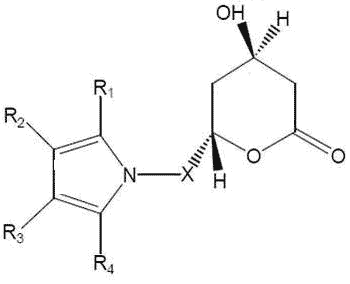
29 The molecule depicted in Structural Formula 1 consists of two structural parts: a heterocyclic moiety in the form of a pyrrole ring of five-members, on the left-hand side of the diagram in Figure 6, and a lactone ring of six-members, on the right-hand side of the diagram in Figure 6. A lactone ring is a ring of six-members, where one of the six members is oxygen. A pyrrole ring is a ring of five-members, where four of the members are carbon and one of the members is nitrogen. The two moieties are joined by a linkage group (shown as X).
30 The annotations “X”, “R1”, “R2”, “R3” and “R4” in the pyrrole ring denote positions on the ring where a range of substitutions may occur. The annotations R1, R2, etc have no relationship to the system of assigning absolute stereochemistry at a chiral centre. All the members of the lactone ring are carbon atoms, other than the oxygen atom denoted “O”. The lactone ring has two major substituents, a hydroxy group, the OH group shown at the top of the ring, and the linkage group, X, attached to the pyrrole ring. Those two major substituents are in a trans relationship; that is to say, the hydroxy group is above the plane of the lactone ring and the linkage group is below the plane of the lactone ring. Atorvastatin (Figure 5) is therefore a more specific form of the molecule in Figure 6, where different groups have been substituted at the R1, R2, etc positions.
31 Atorvastatin hydroxy acid is formed by opening the lactone ring by adding water. The opened structure is shown in Figure 7 below:
Figure 7: Atorvastatin hydroxy acid
COMMON GENERAL KNOWLEDGE
32 The trial judge found that, as at the priority date of the Broader Patent, the common general knowledge of the skilled addressee of the Broader Patent included, relevantly, the following:
· HMG-CoA reductase is the enzyme that determines how much cholesterol is produced in an organism and is a stereoisomer.
· In the decade up to the priority date, statins were under investigation as a class of drugs that were potent inhibitors of HMG-CoA reductase.
· Compactin is a natural HMG-CoA reductase inhibitor that exists as a single enantiomer.
· In 1980 another potent inhibitor of HMG-CoA reductase, named mevinolin, which later became known as lovastatin, was isolated: it was known that the structures of compactin and lovastatin were very similar.
· The absolute stereochemistries of compactin and of lovastatin are similar in that each has the R-trans configuration in the lactone.
· The ring-opened form of the upper lactone portion of those compounds is significantly more active in inhibiting HMG-CoA reductase than the lactone form.
· HMG-CoA reductase inhibitors are enantiomeric and one enantiomer is likely to be more active than the other.
· The biological activity of a racemate in a biological system can be quite different from that of a single enantiomer.
· The normal expectation is that there would be one enantiomer that is approximately twice as active as the racemate in terms of its operation in a target biological system.
· In the case of HMG-CoA reductase inhibitors, the R enantiomer was very likely to be the active, or more active, enantiomer and, conversely, the S enantiomer was more likely to be the inactive or less active enantiomer, although that could not be known with certainty without isolating and testing the enantiomers.
· Racemic mixtures can be separated or resolved into the individual enantiomers by well known methods of separation or resolution.
· Enantiomers can be obtained by chiral synthesis.
· It is feasible to use either achiral (resolution or separation) or chiral synthesis to obtain a single enantiomer.
· It was common practice amongst medicinal chemists and others working in the drug discovery field to use a single structural formula to represent each enantiomer individually and mixtures of them.
· The question whether, in any particular case, a diagram depicting the structural form for a molecule or class of molecules shows relative or absolute stereochemistry depends on the context in which the diagram appears.
· If a diagram of a single enantiomer was intended to depict a racemate, to the exclusion of the enantiomer, it was possible to add an additional descriptor, such as (±) or (‘rac’), which would make it clear that the structure represented only a racemate.
THE WITNESSES
33 Both parties called several experts and Warner-Lambert called the named inventor, Dr Roth. It is desirable to say something about the witnesses.
34 At all relevant times, Dr Roth was in charge of the drug discovery team at Warner-Lambert that developed Lipitor. One difference between his evidence and that given by other witnesses, is that he said he would not expect medicinal chemists in the field to be aware of particular information relating to HMG-CoA reductase inhibitors, including statins, without conducting a search and careful review of the relevant literature in that area.
35 Professor Christopher Easton gave evidence on behalf of Warner-Lambert. Professor Easton is a professor in the Research School of Chemistry, Institute of Advanced Studies, at the Australian National University (ANU). Warner-Lambert also called Professor Peter Scammells and Professor William Charman. Professor Scammells is Professor of Medicinal Chemistry in the Department of Medicinal Chemistry, Victorian College of Pharmacy, at Monash University and Professor Charman is Professor of Pharmaceutics also at the Victorian College of Pharmacy. The primary judge accepted that Professor Scammells has a detailed understanding of synthetic organic chemistry and the interaction of chemical compounds with biological systems. His Honour accepted that Professor Scammells was in a position to give evidence as to what was generally known by workers of ordinary skill in the field of synthetic organic chemistry concerned with drug identification and development as at the relevant priority dates. Professor Charman’s practical experience has been in the process side of drug development work, rather than in the design and synthesis of compounds with high biological activity.
36 Dr Terrence Scallen, who was called by Ranbaxy, was awarded a PhD in biochemistry and organic chemistry in 1965. He has devoted much of his career to cholesterol biosynthesis inhibition. The primary judge considered that Dr Scallen tended to identify the relevant field of art with which the Patents are concerned somewhat more precisely than the witnesses called by Warner-Lambert. Dr Scallen identified the field as synthetic organic chemistry as applicable to the discovery and development of drugs directed towards the regulation of the cholesterol biosynthesis pathway, including HMG-CoA reductase inhibitors. Dr Keith Watson, also called by Ranbaxy, is a Special Fellow at the Walter and Eliza Hall Institute of Medical Research in Victoria. From 1975 to 1991 he was involved with the application of synthetic organic chemistry to the preparation of small molecules with biological activity. Finally, Ranbaxy called Dr Ian Cunningham, who currently works as an independent consultant to the pharmaceutical and fine chemical industries. At the relevant priority dates, Dr Cunningham had industry experience, both as a medicinal chemist and as a process chemist.
THE BROADER PATENT
37 The Broader Patent discloses a class of compounds that have the ability to inhibit HMG-CoA reductase. The complete specification of the Broader Patent (the Broader Specification) describes the class of compounds as being certain trans–6–[2–(3–or 4–carboxamido-substituted pyrrol-1-yl)alkyl]-4-hydroxypyran–2–ones and corresponding ring-opened hydroxy acid derivatives, which are said to be potent inhibitors of HMG-CoA reductase, pharmaceutical compositions containing such compounds and a method of inhibiting the biosynthesis of cholesterol by employing such pharmaceutical compositions.
38 The Broader Specification commences with a discussion of the background of the invention. It says that the claimed invention is related to compounds and pharmaceutical compositions useful as hypocholesterolemic and hypolipidemic agents. The Broader Specification then adds that high levels of blood cholesterol and blood lipids are conditions involved in the onset of arteriosclerosis and that it is well known that inhibitors of HMG-CoA reductase are effective in lowering the level of blood plasma cholesterol, especially low density lipoprotein cholesterol, so as to afford protection from cardiovascular disease.
39 The Broader Specification describes certain known inhibitors of the biosynthesis of cholesterol, including mevalonic acid and the corresponding ring-closed lactone form, mevalonolactone, and a natural product, now called compactin. The Broader Specification describes compactin as having a complex structure which includes a mevalonolactone moiety.
40 Under the heading “Summary of the Invention”, the Broader Specification repeats that, in accordance with the claimed invention, identified compounds are provided that are said to be potent inhibitors of cholesterol biosynthesis by virtue of their ability to inhibit HMG-CoA reductase. In particular, in its broadest aspect the claimed invention is said to provide compounds of Structural Formula 1, the diagram of which is then set out. The Broader Specification adds that the hydroxy acids, and pharmaceutically acceptable salts thereof, derived from the opening of the lactone ring of the compounds of Structural Formula 1, are also contemplated as falling within the scope of the claimed invention.
41 The Broader Specification then turns to three other aspects of the invention. First, the Broader Specification describes a method of preparing the compounds of Structural Formula 1. Secondly, the Broader Specification says that the invention provides pharmaceutical compositions that are useful as hypolipidemic or hypocholesterolemic agents, comprising a hypolipidemic or hypocholesterolemic effective amount of a compound in accordance with the invention, in combination with a pharmaceutically acceptable carrier. The third aspect is that the invention provides a method of inhibiting cholesterol biosynthesis in a patient in need of such treatment, by administering an effective amount of the pharmaceutical composition.
42 The next section of the Broader Specification commences as follows:
The compounds of the present invention comprise a class of trans-6-[2-(3- or 4-carboxamidosubstituted pyrrol-1-yl)alkyl]-4-hydroxypyran-2-ones in which the pyran-2-one moiety is attached, through an alkyl chain, to the substituted pyrrole nucleus at the nitrogen, or 1-position, of the pyrrole. The alkyl group may be methylene, ethylene, propylene, or methylethylene. The preferred alkyl chain linking the substituted pyrrole nucleus and the 4-hydroxypyran-2-one ring is ethylene.
The compounds of structural formula 1 above possess two asymmetric carbon centers, one at the 4-hydroxy position of the pyran-2-one ring, and the other at the 6-position of the pyran-2-one ring where the alkylpyrrole group is attached. This asymmetry gives rise to four possible isomers, two of which are the R-cis- and S-cis-isomers and the other two of which are the R-trans- and S-trans- isomers. This invention contemplates only the trans- form of the compounds of formula I above.
In the compounds of the present invention, position 2 of the substituted pyrrole nucleus is substituted with 1-naphthyl; 2-naphthyl; cyclohexyl; norbornenyl; 2-, 3-, or 4-pyridinyl; phenyl, phenyl substituted with fluorine, chlorine, bromine, hydroxyl; trifluoromethyl; alkyl of from one to four carbon atoms, alkoxy of from one to four carbon atoms, or alkanoyloxy of from two to eight carbon atoms. Preferred substituent groups at the 2-position of the pyrrole nucleus are phenyl and substituted phenyl.
In the compounds of this invention, position 5 of the pyrrole nucleus is substituted with alkyl of from one to six carbon atoms; cyclopropyl; cyclobutyl; cyclopentyl; cyclohexyl; or trifluoromethyl. Preferred substituents are alkyl or trifluoromethyl with isopropyl being particularly preferred.
The Broader Specification then describes the preferred reaction sequence that is used to prepare compounds of the invention. Reaction sequence 1 and reaction sequence 2 are described diagrammatically.
43 The Broader Specification then turns to discuss the effectiveness of the compounds of the invention as inhibitors of the biosynthesis of cholesterol through inhibition of the HMG-CoA reductase enzyme. It says that the ability of compounds of the invention to inhibit the biosynthesis of cholesterol was measured by two methods, a CSI assay and a COR assay. The activity of several representative examples of compounds in accordance with the invention is set out in Table 1 and compared with the prior art compound, compactin. Table 1 provides as follows:
The lower the IC50 value in Table 1, the more effective the compound. According to Table 1, therefore, compound 3 was the most effective, followed by compactin, and then compound 1 and lastly compound 2.
44 The Broader Specification sets out four examples which are said to illustrate particular methods for preparing compounds in accordance with the invention. The Broader Specification states that the examples are illustrative and are not to be read as limiting the scope of the invention as it is defined by the Claims.
45 The Broader Specification contains ten Claims. Claim 1 is for a compound of Structural Formula 1 or a hydroxy acid or pharmaceutically acceptable salts thereof, derived from the opening of the lactone ring of the compounds of Structural Formula 1. Definitions are provided for ‘X’ and for ‘R1’, ‘R2’, ‘R3’ and ‘R4’. Claims 2 to 7 are dependent product claims. Claim 8 is for a pharmaceutical composition containing a compound of Claim 1 as its active ingredient. Claim 9 is for a method of inhibiting cholesterol biosynthesis by administering a pharmaceutical composition of Claim 8. Claim 10 is for a method of preparation of a compound having Structural Formula 1.
46 Claim 5, which is relied upon as an aid to the construction of Claim 1, provides as follows:
A compound as defined by Claim 1 having the name trans-(±)-5-(4-fluorophenyl)-2-(1-methylethyl)-N,4-diphenyl-1-[2-(tetrahydro-4-hydroxy-6-oxo-2H-pyran-2-yl)ethyl]-1H-pyrrole-3-carboxamide.
THE ENANTIOMER PATENT
47 The complete specification for the Enantiomer Patent (the Enantiomer Specification) begins by stating the background of the claimed invention and refers to the compounds of the Broader Patent as having usefulness as inhibitors of cholesterol biosynthesis. The compounds are described as including 4-Hydroxpyran-2-ones and the corresponding ring-opened acids derived therefrom. The Enantiomer Specification then states that it is now unexpectedly found that the enantiomer having the R form of the ring-opened acid provides surprising inhibition of the biosynthesis of cholesterol. The Enantiomer Specification asserts that an ordinarily skilled artisan may not predict “the unexpected and surprising inhibition of cholesterol biosynthesis of the present invention” [emphasis added].
48 The Enantiomer Specification then sets out a summary of the claimed invention. It asserts that the claimed invention provides for certain compounds, consisting of:
· [R-(R*R*)]-2-(4-fluorophenyl)-β,δ-dihydroxy-5-((1-methylethyl)-3-phenyl-4-[(phenylamino)carbonyl]-1H-pyrrole-1-heptanoic acid (Compound I);
· pharmaceutically acceptable salts of Compound I, and
· (2R-trans)-5-(4-fluorophenyl)-2-(1-methylethyl)-N,4-diphenyl-1-[2-(tetrahydro-4-hydroxy-6-oxo-2H-pyran-2-yl)ethyl]-1H-pyrrole-3-carboxamide (Compound II).
49 The Enantiomer Specification says that the claimed invention also:
· relates to a pharmaceutical composition, useful as a hypocholesterolemic agent, comprising a hypocholesterolemic effective amount of a named acid, its pharmaceutically acceptable salts or another named acid and a pharmaceutically acceptable carrier, and
· is a method of treating mammals, including humans, suffering from hypercholesterolemia, by administering to such mammal a dosage form of the pharmaceutical composition so described.
50 In a detailed description of the claimed invention, the Enantiomer Specification says that the pharmaceutically acceptable salts of the invention are those generally derived by dissolving the free acid or the lactone, preferably the lactone, in aqueous or aqueous alcohol solvent or other suitable solvents with an appropriate base and isolating the salt by evaporating the solution or by reacting with the free acid or lactone, preferably the lactone, and base in an organic solvent in which the salt separates directly or can be obtained by concentration of the solution. The Enantiomer Specification says that the most preferred embodiment of the claimed invention is a named acid, hemicalcium salt. It states that, generally, Compound I and Compound II can be prepared by resolving the racemate prepared by the processes described in the Broader Patent or synthesising the desired chiral form, beginning from starting materials that are known, using processes analogous to those that are known. The Enantiomer Specification then describes the process of resolving the racemate and chiral synthesis by diagrammatic representation.
51 The Enantiomer Specification then says that the compounds according to the claimed invention, and especially according to Compound I, inhibit the biosynthesis of cholesterol as found in the CSI assay that is disclosed in the Broader Patent. The Enantiomer Specification then sets out CSI data and asserts that, accordingly, the claimed invention is the pharmaceutical composition prepared from Compound I or Compound II or pharmaceutically acceptable salts thereof. It says that those compositions are prepared as described in the Broader Patent.
52 Claim 1 of the Enantiomer Patent is for Compound I, Compound II and pharmaceutically acceptable salts thereof. Claim 2 claims Compound I alone and Claim 3 claims Compound II alone. Claims 4, 5, 6, 7, 8 and 9 are for the monosodium, monopotassium, hemicalcium, N-methylglucamine, hemi-magnesium and hemi-zinc salts respectively of Compound I. Claim 10 is for a particular mixture with Compound I. Claim 11 is a pharmaceutical composition comprising an effective amount of a compound of Claim 1 and a pharmaceutically acceptable carrier. Claim 12 is a method of inhibiting cholesterol synthesis in a human, comprising administering a compound of Claim 1 in unit dosage form.
53 The Enantiomer Specification states that the most preferred embodiment of the invention is the hemicalcium salt of the heptonoic acid of the compounds of Claim 1. The term hemicalcium salt means that two molecules of atorvastatin are associated with each atom of calcium in the calcium salt.
THE ISSUES
54 There is no challenge to the validity of the Broader Patent. The question of infringement of the Broader Patent depends upon the proper construction of the complete specification for the Broader Patent. Ranbaxy contends that all Claims of the Broader Patent should be construed so as to be restricted to the racemate form of the compounds disclosed. Ranbaxy contends, therefore, that its product, which contains only the R enantiomer of atorvastatin calcium, will not infringe the Broader Patent. Warner-Lambert, on the other hand, contends that the Broader Patent extends to all forms of the compounds of the claimed invention.
55 The primary judge concluded that Structural Formula 1 refers to the following forms of the compounds disclosed, as well as to the racemate:
· the R-trans enantiomer, individually,
· the S-trans enantiomer, individually, and
· unequal mixtures of the R-trans enantiomer and the S-trans enantiomer.
Accordingly, his Honour concluded that Ranbaxy’s intended importation and sale of its product would infringe Claim 1 and certain other Claims of the Broader Patent. In its appeal, Ranbaxy contends that the primary judge erred in rejecting its contention that the Broader Patent was restricted to the trans-racemates of the compounds disclosed.
56 It is not disputed that Ranbaxy’s product, with its active ingredient of atorvastatin calcium, falls specifically within the scope of Claim 6 of the Enantiomer Patent, namely, the hemicalcium salt of Compound I. The only matters in dispute between the parties in relation to the Enantiomer Patent are as to its validity.
57 Ranbaxy’s challenge to the validity of the Enantiomer Patent is based on the following grounds:
· the alleged invention is not a patentable invention because it is not a manner of manufacture;
· the Enantiomer Patent was obtained by false suggestion or misrepresentation;
· the alleged invention of the Enantiomer Patent is not a patentable invention because it is not useful.
Other grounds were abandoned during the course of the hearing before the primary judge.
58 Ranbaxy contends that the claimed invention of the Enantiomer Patent was not a manner of manufacture but merely a new use of an old substance and that, accordingly, there was a lack of inventiveness manifest on the face of the Enantiomer Specification for the Enantiomer Patent. The primary judge rejected that contention. However, his Honour concluded that the Enantiomer Patent had been obtained by false suggestion and misrepresentation and also concluded that it disclosed no patentable invention, because the claimed invention is not useful.
59 In its appeal, Warner-Lambert contends that the primary judge erred in concluding that the Enantiomer Patent was obtained by false suggestion or misrepresentation and that the alleged invention was not useful. Ranbaxy filed notice of its contention that the primary judge erred in concluding that the alleged invention constituted a manner of manufacture.
THE CONSTRUCTION OF THE BROADER PATENT
60 In isolation from the Broader Specification, Structural Formula 1 could depict absolute stereochemistry or relative stereochemistry. If Structural Formula 1 were intended to depict absolute stereochemistry, it would depict the R-trans enantiomer of the class of compounds referred to in Structural Formula 1. However, it was common ground that Structural Formula 1 was intended to depict relative stereochemistry. However, if the Broader Specification, as a whole, only disclosed and claimed the racemate, the claim to the racemate would not extend to claim the enantiomers.
61 Ranbaxy contends that the compounds claimed in the Broader Patent are only in the racemic form and that the primary judge erred in concluding that the Broader Patent encompasses, in addition to the racemate, the S enantiomer, the R enantiomer and unequal mixtures of the R enantiomer and the S enantiomer (in trans-form). Ranbaxy points out that there are no specific claims to the individual enantiomers.
62 The summary of the invention in the Broader Specification describes four aspects as follows:
· Compounds of Structural Formula 1.
· A method of preparing the compounds of Structural Formula 1.
· Pharmaceutical compositions comprising an effective amount of the compounds of the invention.
· A method of inhibiting cholesterol biosynthesis in a patient by administering an effective amount of a pharmaceutical composition of the compounds of the invention.
Ranbaxy contends that it is consistent with all four of those aspects that the compounds of the invention include only the racemate.
63 Indeed, Ranbaxy says that those four aspects are inconsistent with the construction contended for by Warner-Lambert. First, the method of preparing the compounds described cannot produce anything other than a racemate. Secondly, the S enantiomers are not suitable pharmaceutical compositions for the inhibition of cholesterol biosynthesis because they have no practical utility as HMG-CoA reductase inhibitors. Accordingly, Ranbaxy says, the only possible interpretation of Structural Formula 1 that both has a consistent meaning throughout the Broader Specification and conforms with those four aspects is one that is limited to compounds in the racemic form.
64 Ranbaxy points to the fact that the Broader Specification describes only one method of obtaining the compounds disclosed and that method produces only racemates. The methods disclosed in the Broader Specification cannot produce the R enantiomer or the S enantiomer individually or an unequal mixture of the S enantiomer and the R enantiomer. The Broader Specification states that in an aspect of the invention “there is provided a method of preparing the compounds of Structural Formula 1”. The Broader Specification then sets out four steps. Those four steps are repeated in Claim 10 as a method of preparing a compound having Structural Formula 1. Those steps produce only racemates.
65 In order to obtain individual R enantiomers, S enantiomers or unequal mixtures of the two enantiomers, it would be necessary to separate the racemate into its individual enantiomers or to employ a process of chiral synthesis. Ranbaxy points out that there is no direction in the Broader Specification to pursue either course.
66 However, it was common knowledge as at the priority date of the Broader Patent that techniques of resolution or chiral synthesis could be applied to isolate individual enantiomers. The trial judge concluded that it was a matter of routine in the laboratory to resolve or obtain the enantiomers from the racemate. There was no need, for the purposes of the invention, to direct the resolution of the racemate into the two enantiomers or to describe any particular method of resolving the racemate in order to isolate the more active enantiomer. The primary judge considered that it was unnecessary for the Broader Specification to describe any process of separation or chiral synthesis. His Honour considered that the fact that a matter of routine chemistry was not spelt out in the Broader Specification was not decisive as to its construction. Ranbaxy did not assert that, if the enantiomers were claimed in the Broader Patent, there was insufficient description of the means of obtaining them.
67 Ranbaxy points out that Table 1 in the Broader Specification provides data on biological activity in relation to three compounds of the invention, when compared with compactin. All three compounds are racemates and the Broader Specification provides no biological activity data in relation to any individual enantiomer. Once again, however, the fact that the relevant skilled addressee would know of the benefit of obtaining the enantiomers and be able to produce the relevant enantiomer from the racemic mixture is an answer to Ranbaxy’s contention. It was known that enantiomers could have different biological properties and that it may be desirable to separate and remove the less active enantiomer. Accordingly there was good reason why the relevant skilled addressee would know that the Broader Patent was not confined to racemic mixtures.
68 Ranbaxy says that, in three of the five places where Structural Formula 1 appears in the Broader Specification, it could mean nothing other than the racemate and that there is no reason why there should be a departure from that usage in Claim 1: the Court should be slow to adopt a construction of the Broader Specification under which the same graphical representation meant different things in different parts.
69 However, the primary judge held that a structural formula depicting relative stereochemistry represented each enantiomer individually as well as in mixtures, including the racemic mixture and unequal mixtures. His Honour preferred evidence, in relation to that question, given by three of the witnesses called by Warner-Lambert over that of a witness called by Ranbaxy. It was open to his Honour to do so. Structural Formula 1, if it describes each enantiomer and mixtures of them, can be used to signify any one of the R enantiomer, the S enantiomer or the racemate. It does not follow, as Ranbaxy asserts, that such a usage results in the same graphical representation meaning different things in different parts of the Broader Specification.
70 The Broader Specification also contains three references that suggest, positively, that Structural Formula 1 included the two enantiomers separately and unequal mixtures of them, as well as the racemate.
71 First, both in the title and in the body of the Broader Specification, the class of compounds claimed is referred to by the chemical name “Trans…”. That term would denote relative stereochemistry to a person skilled in the art as at the priority date. There are two trans-enantiomers. The use of the term does not discriminate between them. Consequently, it tends to indicate that both enantiomers of any compound of the class defined by Structural Formula 1 are included within the scope of the Claims of the Broader Patent.
72 Ranbaxy contends that the term “trans” in the Broader Specification has a different meaning from its ordinary meaning. Ranbaxy say that, in the context of the Broader Patent, “trans” meant a trans racemate and refers to Claims 5, 6 and 7 as supporting that contention. While there was some disagreement amongst the witnesses, the primary judge accepted evidence that the terminology used in the Broader Specification indicates relative stereochemistry. Accordingly, the use of “trans” in the title and in the Broader Specification indicates that it was describing the compounds in terms of their relative stereochemistry and the term therefore included each enantiomer individually and mixtures of them.
73 Second, Claim 5 of the Broader Patent uses the sign ±, indicating that Claim 5 is confined to racemic mixtures. That sign does not appear in Claim 1 or any of the other claims. The use of the sign in Claim 5 therefore provides some indication that Claim 1 was not intended to be limited to racemic mixtures. It shows that the author of the Broader Specification was aware of the particular means by which claims could be limited to racemic mixtures, but did not do so in relation to Claim 1.
74 Third, after referring to the class of trans compounds comprising the invention and the two asymmetric carbon centres that the compounds of Structural Formula 1 possess, the complete Broader Specification says:
This asymmetry gives rise to four possible isomers, two of which are the R-cis and S-cis isomers and the other two of which are the R-trans and the S-trans isomers. This invention contemplates only the trans-form of the compounds of formula I above.
Thus, the passage specifically refers to the R-trans and S-trans isomers, distinguishing them from the R-cis and S-cis isomers. The passage draws that distinction in order to include the R-trans and S-trans isomers within the compounds of Structural Formula 1, while excluding the R-cis and S-cis isomers from the class of compounds of Structural Formula 1. In other words, when the last sentence of the passage refers to “the trans-form”, it is referring to the R-trans and S-trans isomers referred to in the previous sentence, both as individual enantiomers and as the compounds of a racemic mixture.
75 The passage does not refer in terms to trans racemates or cis racemates. It does not draw any distinction between trans racemates, on the one hand, and the R-trans and S-trans isomers, on the other. It would distort the plain meaning of the words used in the last sentence of the passage to read it as saying that the invention contemplates only trans racemates of the compounds of Structural Formula 1 and so excludes the R-trans and S-trans isomers individually, as well as the R-cis and S-cis isomers individually and in racemic mixture. The invention as described lay in the novel substitution of the pyrrole ring, not in the stereochemistry. There was no good reason propounded as to why, in those circumstances, elaboration of the stereochemistry, or specific claims to the enantiomers, would be expected.
76 It would make no sense to exclude patent protection for the more active enantiomer. To confine the subject of the Broader Patent to racemic mixtures would be to exclude the very thing, namely the active or more active enantiomer, that any person working in the field as at the priority date would know to be the key to the useful activity of the compounds disclosed. There was no reason why the skilled reader would construe the formula as meaning only the racemate, thereby excluding both the R enantiomer and the S enantiomer. In the absence of a clear indication to the contrary, it would offend common sense to construe Structural Formula 1 in that way.
77 The primary judge made no error in construing the Broader Specification. Ranbaxy’s appeal should be dismissed.
THE VALIDITY OF THE ENANTIOMER PATENT
78 Section 138 of the Patents Act 1990 (Cth) (the 1990 Act) provides that any person may apply to the Court for an order revoking a patent. After hearing the application, the Court may revoke the patent, either wholly or so far as it relates to a claim, on one or more of the grounds specified in s 138(3), but on no other ground. The relevant grounds for present purposes are:
(b) that the invention is not a patentable invention;
…
(d) that the patent was obtained by fraud, false suggestion or misrepresentation.
79 Section 18(1) provides, relevantly, that an invention is a patentable invention if the invention, so far as claimed in any claim:
(a) is a manner of manufacture within the meaning of s 6 of the Statute of Monopolies, and
…
(c) is useful.
Under s 3 of the 1990 Act, invention means any manner of new manufacture, the subject of letters patent and grant of privilege within s 6 of the Statute of Monopolies and includes an alleged invention.
80 However, a patent that was granted under the Patents Act 1952 (Cth) (the 1952 Act) is not invalid, so far as the invention is claimed in any claim, on any ground that would not have been available against the patent under the 1952 Act. Under s 100 of the 1952 Act, a patent could be revoked on, inter alia, the following grounds:
(d) that the invention, so far as claimed in any claim, is not an invention within the meaning of [the 1952 Act];
…
(h) that the invention, so far as claimed in any claim, is not useful; [and]
…
(j) that the patent was obtained on a false suggestion or representation.
Under s 6 of the 1952 Act, invention means any manner of new manufacture, the subject of letters patent and grant of privilege within s 6 of the Statute of Monopolies, and includes an alleged invention.
81 The definition of invention in the 1952 Act is not materially different from s 18(1) of the 1990 Act. Further, there has been no allegation of fraud, which is the only distinction of the 1990 Act from the 1952 Act. Accordingly, it is common ground that the grounds for revocation under the 1990 Act are not relevantly different from the grounds under the 1952 Act.
False Suggestion or Misrepresentation
82 If a representation that was false or misleading materially contributed to the Commissioner’s decision to grant a patent, even if other circumstances or causes also played a part in the making of that decision, it may be said that the patent was obtained by a false suggestion or misrepresentation (or on a false suggestion or representation, to use the language of the 1952 Act). It is sufficient if the representation materially contributed to the Commissioner’s decision to grant the patent or was a material, inducing factor, which led to the grant. However, it is not necessary to establish that the representation was material in the sense that, without it, the patent would not have proceeded to grant (Pfizer Overseas Pharmaceuticals v Ely Lilly & Co (2005) 225 ALR 416 at 495). It is not necessary to show that, but for the suggestion or representation, no grant would have been made (Prestige Group (Australia) Pty Limited v Dart Industries Inc (1990) 95 ALR 533 at 537-538).
83 Bearing in mind that the grant of a patent is a right in rem, the Commissioner could be expected to take a position if a misrepresentation did in fact play a part in the decision to grant a patent and it is a relevant factor that the Commissioner chooses not to give evidence (ICI Chemicals & Polymers Limited v The Lubrizol Corporation Inc (2000) 106 FCR 214 at 244-245). In the absence of such evidence, it is for the Court to make a finding, based on the evidence before it. In the absence of explicit evidence that the Commissioner, or the Commissioner’s delegate, was in fact misled, it may nevertheless be inferred that a representation in fact contributed to the decision to grant a patent, if the representation was objectively likely to contribute to such a decision and the patent was in fact granted (see Synthetic Turf Development Pty Limited v Sports Technology International Pty Limited [2004] FCA 1179at [2], and WM Wrigley Jr Co v Cadbury Schweppes Pty Limited (2005) 66 IPR 298 at 321).
84 In its Amended Particulars of Invalidity, Ranbaxy asserted that the Enantiomer Patent was obtained by false suggestion or misrepresentation. The particulars allege that false suggestions or misrepresentations were made:
· in the Enantiomer Specification, and
· to a delegate of the Commissioner in the course of the application.
As to the former, the false suggestions were alleged to have been made in the material in the Enantiomer Specification dealing with:
· the results of comparative testing of the R enantiomer, the S enantiomer and the racemate, and
· the extent of the inhibition of the biosynthesis of cholesterol provided by the R enantiomer as compared with the racemic mixtures of the Broader Patent.
False Suggestion or Misrepresentation in the Enantiomer Specification
85 After citing the US equivalent of the Broader Patent as disclosing compounds that have usefulness as inhibitors of cholesterol biosynthesis, the Enantiomer Specification makes the following statement:
It is now unexpectedly found that the enantiomer having the R form of [Structural Formula 1] provides surprising inhibition of the biosynthesis of cholesterol. [Emphasis added]
After referring to what was generally known in the field concerning the inhibition of cholesterol synthesis, the Enantiomer Specification then states:
However, an ordinarily skilled artisan may not predict the unexpected and surprising inhibition of cholesterol biosynthesis of the present invention in view of these disclosures. [Emphasis added]
Ranbaxy claimed that the alleged surprising inhibition of the biosynthesis of cholesterol provided by the R enantiomer, as compared to the racemic mixtures of the Broader Patent, constituted false suggestion or misrepresentation because the statement does not correctly represent the results of the tests that were carried out by Warner-Lambert, in the respects set out above.
86 Under the heading DETAILED DESCRIPTION OF THE INVENTION, the Enantiomer Specification also contains the following:
…The compounds according to present invention and especially according to the compound of the formula I inhibit the biosynthesis of cholesterol as found in the CSI screen that is disclosed in U.S. Patent No. 4,681,893 which is now also incorporated by reference therefor. The CSI data of the compound I, its enantiomer, the compound II[,] and the racemate of these two compounds are as follows:
|
| IC50 |
| Compound | (micromoles/liter) |
| [R–(R*R*)] isomer | 0.0044 |
| [S–(R*R*)] isomer | 0.44 |
| Racemate | 0.045 |
Accordingly, the present invention is the pharmaceutical composition prepared from the compound of the formula I or II or pharmaceutically acceptable salts thereof. …
87 Ranbaxy claimed that the data given in that table (the CSI Table) do not correctly represent the results of tests that were carried out by Warner-Lambert as at the date of the Enantiomer Specification. It claimed that other data available to Warner-Lambert as at the date of the Enantiomer Specification do not support the CSI data contained in the CSI Table. Rather, Ranbaxy claimed, the ACIS and COR data available to Warner-Lambert showed that the R enantiomer was only approximately twice as active as its racemate. In addition, Ranbaxy claimed that the CSI data in the CSI Table were selected by Warner-Lambert from a larger range of CSI data available to it and did not represent a correct reflection of the totality of CSI data produced by Warner-Lambert in the course of its experimentation. Ranbaxy said that, therefore, Warner-Lambert’s selective inclusion of the CSI data, whilst excluding relevant AICS and COR data available to it, was false or misleading.
88 Professor Easton said that he understood that the point of the CSI Table was to show the surprising activity of the R enantiomer over the racemate of atorvastatin. Dr Scallen said that he read the CSI Table as asserting that the R enantiomer was approximately ten times as active as the racemate and that the reason for including it was to lay some foundation for the claims of unexpected and surprising inhibition of cholesterol synthesis. He considered that the data and the associated description claiming unexpected and surprising inhibition were essential to identifying the alleged invention. Dr Watson also read the CSI Table as being to the effect that the R enantiomer was approximately ten times as active as the racemate.
89 The primary judge observed that the CSI Table contained the only data provided in the Enantiomer Specification that measured the comparative ability of the R enantiomer and the racemate to inhibit the biosynthesis of cholesterol. His Honour considered that those data would be of specific interest to the skilled addressee, who would read the CSI Table as data that demonstrated, or at least indicated, the level of increased activity that the R enantiomer achieved, in comparison to the racemate, in the inhibition of the biosynthesis of cholesterol. His Honour accepted the evidence given by Professor Easton and Dr Scallen and rejected Dr Roth’s evidence. His Honour considered that Dr Roth was disposed towards arguing Warner-Lambert’s case rather than giving detached and objective evidence.
90 Because of the variability of in vitro tests, Dr Scallen said that if a drug discovery team has both in vitro and in vivo data available for a compound, then it would consider both types of data and would not draw conclusions based on one type of data alone. Likewise, Dr Cunningham said that he always considered the results of any in vivo testing, as well as any in vitro testing, that was available to him. As a medicinal chemist, he said it was important to have regard to the totality of all data that is available on a new compound. Dr Scallen also said that if he had a good result from the first in vitro screen, he would mark that compound for repeat in vitro screening to confirm the initial result, and then repeat the in vitro screen at least twice over the course of several days. Warner-Lambert’s own internal reports show that it compared results from CSI, COR and in vivo assays.
91 The primary judge accepted that the skilled addressee would be aware of an intrinsic variability of CSI screen results and considered in detail the conclusions that the skilled addressee would draw from such data.
92 However, the CSI data, unqualified, were the only data provided in the Enantiomer Patent as part of the explanation by Warner-Lambert of the invention and in satisfaction of the obligation to provide sufficient description of the invention. The primary judge found that Warner-Lambert intended that the CSI Table would be read as suggesting a ten-fold increase in activity over the racemate. That conclusion is unsurprising in circumstances where a single set of data was included in the Enantiomer Specification and the arithmetic is quite straight-forward. The primary judge found that the statements about the CSI Table referred back to the statement that the applicant had unexpectedly found that the R enantiomer provided surprising inhibition of the biosynthesis of cholesterol.
93 The primary judge considered that the claims of surprising and unexpected inhibition of the biosynthesis of cholesterol, as demonstrated by the CSI Table, were central to the claimed invention of the Enantiomer Patent. His Honour concluded, therefore, that the skilled addressee of the Enantiomer Specification would read the CSI Table as a representation that the results in it fairly reflected all of the CSI data available to Warner-Lambert and that that data, as a whole, provided reasonable grounds for the findings set forth in the CSI Table. His Honour found that Warner-Lambert intended that the CSI Table should be read as suggesting a ten-fold increase in activity. His Honour found that the relevant skilled addressee would read the CSI Table as data that demonstrated, or at least indicated, the level of increased activity that the R enantiomer achieved in comparison to the racemate, in the inhibition of the biosynthesis of cholesterol.
94 The primary judge found that the Enantiomer Specification represented that:
· Warner-Lambert had found that the R enantiomer achieved surprising and unexpected inhibition of the biosynthesis of cholesterol in the order of a ten-fold increase above the activity levels of the racemate, and
· the results in the CSI table reflected all of the CSI data available to Warner-Lambert for the relevant compounds and that the data as a whole provided reasonable grounds for the findings set forth in the CSI table.
His Honour found that the representations in the Enantiomer Specification were first made when the Enantiomer Specification was lodged with the Patent Office on 23 July 1990 and continued to be made while the patent application was being prosecuted and until it was granted on 5 February 1993.
95 The representations that the primary judge found had been made in the Enantiomer Specification were not made expressly. Rather, his Honour concluded that Warner-Lambert made the representations by making the statements quoted above. His Honour placed considerable weight on the way in which the witnesses said they would understand or read the CSI Table.
96 It is for the Court to construe a specification, although the Court will do so in the light of evidence as to usage of language by the relevant skilled addressee of the specification, to the extent that language is used in a manner that is different from ordinary English usage. In order to do so, the Court must place itself in the position of a person skilled in the art as at the priority date. Thus, the Court would have regard to evidence of what a person skilled in the art would understand from the language, information or data in a specification or what such language, information or data would disclose to the relevant skilled addressee. Ultimately, of course, the question of what representations are made in a specification is a matter for the Court to determine.
97 In essence, the Enantiomer Patent claims that the compounds identified, and in particular the compounds in Claim 6, have a surprising and unexpectedly active effect on the inhibition of the synthesis of cholesterol. The CSI Table is put forward as supporting that claim.
98 However, there is no express statement in the Enantiomer Specification that the measure of the increase in activity is ten-fold. There is no representation that the CSI Table reflects all of the CSI data available to Warner-Lambert. In addition, there was evidence that the relevantly skilled addressee would understand the table as giving no more than a ranking of the respective activity found in relation to each of the compounds listed. And, the skilled addressee would understand that there may be results that, for various reasons, would be rejected.
99 On the other hand, the CSI Table contained the only data in the Enantiomer Specification; it was inserted by Warner-Lambert to support the assertion made. The CSI Table indicated that the surprising and unexpected effect was substantially greater than the expected increase of twice the activity. While an applicant for a patent is not under an obligation to include all available data, where specific material is included, that material, if unqualified, should be representative of the available data.
100 In those circumstances, in considering whether there was a false suggestion or misrepresentation, the questions are whether it was false or misleading or deceptive to say that the compounds of the Enantiomer Patent have a surprising and unexpected effect on the inhibition of the biosynthesis of cholesterol in comparison to the racemate, and whether the data in the CSI Table was reasonably supported by and representative of the relevant data available to Warner-Lambert.
False Suggestion to the Commissioner
101 On 14 October 1991, an examiner in the Commissioner’s office wrote to Warner-Lambert’s patent attorneys in response to their request for normal examination of the application for the Enantiomer Patent. The examiner said that the application had been examined and that it had been found that the invention, as defined by Claims 1 to 12, “was prior published and not novel”, in the light of the Broader Patent.
102 The examiner asserted that the Broader Patent disclosed the trans-isomeric compound of the claimed invention of the Enantiomer Patent. The examiner also said that, in the Enantiomer Patent, it appeared that the [R(R*R*)] isomer exactly depicts the trans-isomeric compound of the Broader Patent, with the appropriate stereo chemistry. The examiner noted that the S isomer had a different structural arrangement from the R isomer but that the former isomer was specifically excluded from the Broader Patent. The examiner’s statement that the S isomer was excluded from the Broader Patent was erroneous.
103 The examiner’s letter also said as follows:
[Warner-Lambert] is probably relying on the present application as a “selection patent” by providing the comparative results of the tests on the compound of the present invention over the prior art [set out in that part of the Enantiomer Specification that contains the CSI Table]. However, it is not clear what the “racemate” [in the CSI Table] refers to. If “the racemate of these two compounds” refers to a mixture containing the [R enantiomer], then it is not entirely clear if the comparative “CSI” data given [in the CSI Table] establishes any advantage of the present invention over the prior art because it appeared that the [Broader Patent] specifically excludes the [S enantiomer]. Therefore it is submitted that the present specification does not clearly establish any advantage of the present application over the compounds disclosed in [the Broader Patent].
104 Warner-Lambert’s patent attorneys, in a letter to the Commissioner of 26 June 1992, in response to the objection raised by the examiner, wrote that:
...the [Broader Patent] discloses a racemic trans-isomeric compound which exists as a mixture of enantiomers. Both the trans- and cis-geometric isomers in [the Broader Patent] are capable of having two optical isomers for each geometric isomer disclosed. However, although [the Broader Patent] states that the preferred diastereomer is the trans-isomer, [the Broader Patent] does not state nor indicate which particular R-trans or S-trans isomer is the more active. The present invention discloses a biologically and enantiomerically pure optically active trans-isomeric compound which is synthesised by resolution techniques and the compound and its method of preparation are not disclosed nor obvious from [the Broader Patent].
[Emphasis in original]
105 A patent application will overcome a prior publication, as a selection patent, if the following criteria are met:
· there must be some substantial advantage to be secured by the use of the selected members;
· the whole of the selected members must possess the advantage in question;
· the selection must be in respect of a quality of a special character, which can fairly be said to be peculiar to the group; and
· the advantage possessed by the selected members must be clearly disclosed in the specification.
(see Re IG Farbenindustrie AG’s Patents (1930) 47 RPC 289 at 322-3). The patent attorneys must be taken to have understood the examiner’s reference to a selection patent in that way.
106 In that context, the patent attorneys’ letter to the Commissioner of 26 June 1992 also said the following:
Furthermore, we draw the attention of the Examiner to the amoxicillin opposition (Beecham Group Limited’s Application (1980) 10 RPC 261) where it was held that Beecham’s claims to a particular epimer of amoxicillin was not prior published by its prior patent application of 1962 which disclosed the racemic or epimeric mixture p-hydroxy alpha-amino penicillanic acid capable of being in existence in both the D and the L form at the asymmetric carbon atom of the alpha-amino group. Not only was it held that it was not prior published they also found that it was not obvious even though the (-) epimer, amoxicillin, was only four times more active than the opposite epimer and only twice as active as the racemic or epimeric mixture. Reliance was made on the superior blood levels.
In relation to the second part of [the Examiner’s Letter], [Warner-Lambert] has found that the optically active R-trans isomer is 100 times more active that [sic; scilicet than] the optically active S-trans isomer and 10 times more active that [sic; scilicet than] its racemic mixture. Thus, we submit that the [the CSI Table] establishes a clear advantage of the optically active [R enantiomer] over the corresponding [S enantiomer].
In addition, we respectfully submit that there is no exclusion to [sic; scilicet of] the optically active S-trans isomer in [the Broader Patent]. Only the cis-isomer and thus the corresponding R and S optical isomers were excluded from [the Broader Patent].
We respectfully submit that the present invention is both novel and non obvious over [the Broader Patent].
Further consideration of the application is requested.
[Emphasis added]
Warner-Lambert contended that the letter should be characterised as making only a comparison between the activity of the R enantiomer and the activity of the S enantiomer and not a comparison of the R enantiomer with the racemate. That contention should be rejected: the comparison is not only between the R enantiomer and the S enantiomer but, importantly in the context of an alleged selection, is also between the R enantiomer and the racemate.
107 False suggestion is not limited to information in the claims of a specification. Ranbaxy claimed that the statement in the patent attorney’s letter, that the R enantiomer is ten times more active than its racemic mixture, was a false or misleading representation because, in fact, the R enantiomer is only approximately twice as active as its racemic mixture, which is the level of activity that would be expected of the active enantiomer as compared to the racemic mixture. Having found that the data available to Warner-Lambert established, on the balance of probabilities, that the R enantiomer had an activity level that is only approximately two times greater than the racemate, the primary judge found that that statement in the patent attorney’s letter was false and misleading.
Whether a Surprising and Unexpected effect
108 The primary judge found that the data available to Warner-Lambert, taken as a whole, established, on the balance of probabilities, that the R enantiomer had an activity level that is approximately two times greater than the racemate. His Honour also found that the CSI data, taken as a whole, were consistent with the view that the potency of the R enantiomer, being in the order of two times the potency of the racemate, is in accordance with normal expectations. Accordingly, his Honour was satisfied, on the balance of probabilities, that the potency of the R enantiomer is, in fact, in the order of two times the potency of the racemate.
109 The relevant skilled addressee would not have predicted, from the disclosures of the Broader Patent, a superior level of activity on the part of the R enantiomer as compared to other compounds used to inhibit the biosynthesis of cholesterol. The skilled addressee would have preferred other compounds over atorvastatin, because those other compounds were expected to have better activity. Thus, the R enantiomer of Compound I of the Broader Patent would be expected by the skilled addressee to have activity similar to that of compactin.
110 On the other hand, fluvastatin, lovastatin and simvastatin, which were regarded as the leading HMG-CoA reductase inhibitors, were described as being, and were thought to be, more active than compactin. Accordingly, as at 21 July 1989, the priority date of the Enantiomer Patent, the relevant skilled addressee would have expected the R enantiomer to be less active than fluvastatin, lovastatin and simvastatin. However, the R enantiomer is significantly more active than those compounds: it is two to three times as potent, dose for dose, as simvastatin, the best of those compounds.
111 The evidence concerning the activity of the respective compounds consisted of CSI, COR and AICS assays. Ranbaxy contended that all three forms of assay pointed to the conclusion that the level of activity was no more than what would be expected, namely, twice the racemate. Warner-Lambert, on the other hand, contended that the whole of the CSI data established that the R enantiomer has activity significantly greater than twice the activity of the racemate and that the primary judge was in error to conclude otherwise. Further, Warner-Lambert contended, the AICS and COR assays could not fairly be used to contradict the accuracy of the assertion that the R enantiomer has a surprising and unexpectedly greater activity than the racemate, being an activity that was more than two fold.
112 Warner-Lambert contended that in vivo assays, such as AICS, cannot validly be used as a measure of, or to contradict, the in vitro assays of activity of a compound, such as CSI assays: the purpose of an AICS assay is to determine whether the compounds could be absorbed in the body of a living organism. Warner-Lambert pointed to the evidence of Professor Scallen to the effect that there is no way to predict from animal testing, as in an AICS assay, the efficacy of a compound in humans.
113 There was no challenge to the evidence of Dr Scallen that there was tremendous variability between the various experiments conducted involving COR assays. Dr Scallen concluded that the variability was of such a kind that it was impossible to draw any scientifically valid conclusions when looking at the COR data as a whole. On the other hand, Dr Scallen considered that the COR data was entirely consistent with his expectation that the R enantiomer of atorvastatin would be approximately twice as active, in the inhibition of HMG-CoA reductase activity, as the racemate of atorvastatin. On that basis, Warner-Lambert contended that, on the balance of probabilities, the CSI data supported the proposition that, whether or not there was a ten fold increase in activity, the increase in activity was greater than two fold and was unexpected and surprising.
114 Warner-Lambert had available to it thirteen CSI assay results, being CSI 92, CSI 93, CSI 95, CSI 102, CSI 107, CSI 111, CSI 112, CSI 118, CSI 119, CSI 120, CSI 122, CSI 123 and CSI 124. In compiling the CSI table set out in the Enantiomer Specification, Warner-Lambert took into account only five of the CSI assay results, namely, CSI 92, CSI 93, CSI 95, CSI 102 and CSI 118. There was considerable debate in the proceeding as to the reliability of several of the results and the primary judge addressed considerable attention to contentions that some or other of the results should be excluded in considering the conclusions that were available from the CSI assays.
115 Various analyses of the CSI assays, which exclude one or more of them, demonstrate various potencies of the R enantiomer. The analyses relied on by Warner-Lambert demonstrate a potency of between four and eight times that of the racemate.
116 Dr Roth gave evidence explaining how he selected the five results that he utilised in compiling the CSI table in the Enantiomer Specification. He said that, since he did not have a head to head test as between the individual enantiomers and the racemate, he collected and averaged all of the available CSI data generated in relation to the sodium salt of racemic atorvastatin. He did that for the purpose of comparing the average activity of the sodium salt of the racemic mixture with the activity of sodium salts of each of the R enantiomer and the S enantiomer, as measured in the head to head comparison in CSI 120.
117 Dr Scallen considered that it was not legitimate to combine the values for the partly hydrolysed racemic lactones tested in CSI 92, CSI 93, CSI 95, and CSI 102 with the values for the chemically synthesised racemic sodium salts tested in CSI 118 in order to arrive at a value for the racemic sodium salts. Dr Scallen considered that the values for the lactones and the sodium salts were so different that it was clear that the lactones were never completely opened up in tests CSI 92, CSI 93, CSI 95 and CSI 102. He said that the procedure used by the technician in attempting to open the lactones to convert them to racemic sodium salts must have been unsuccessful.
118 It was accepted by all the witnesses that the best possible comparison would be a head to head comparison, in the same assay, of the same salt from the R enantiomer, the S enantiomer and the racemate. Such a comparison would minimise the variability that can occur in measuring the activity of test compounds in biological systems from day to day.
119 Warner-Lambert contended that CSI 118 provided the best available data concerning the relevant activity of the R enantiomer and racemate. However, Ranbaxy contended that there were manifest problems with the result in CSI 118, which invalidate CSI 118 as a reliable head to head comparison of the racemic mixture and the R enantiomer.
120 The primary judge found that the sodium salt prepared from the racemic lactone in CSI 92, CSI 93, CSI 95 and CSI 102 would be expected to have given substantially identical, or at least very similar, values to the racemic sodium salt that was separately prepared for CSI 118. His Honour considered that, independently of the possible problems with the lactones, the result of CSI 118 was open to question because the results for racemic sodium salt and racemic calcium salt should be fairly similar, whereas that is not the case for CSI 118. The results for the racemic sodium salt and the racemic calcium salt in CSI 118 differed by a factor greater than 25. The results for the R calcium salts in CSI 118, CSI 122 and CSI 123 show an approximately eight-fold variance. Dr Scallen said that was unacceptable. His Honour considered that the variance was due in large part to the substantially different result achieved for the R calcium salt in CSI 118.
121 His Honour accepted the evidence given by Dr Scallen, Dr Watson and others concerning the deficiencies in CSI 118. Warner Lambert sought to explain the large differences in CSI 118 between the result for the racemic sodium salt and the result for the racemic calcium salt by reason of the differences in the salt. However, the primary judge preferred to accept the evidence that one would not expect to find a significant difference between the results for sodium salt and calcium salt. His Honour concluded that the results in CSI 118 were not scientifically sound and could not be relied on to support a claim of surprising difference in activity between the R enantiomer and the racemate.
122 His Honour accepted Warner-Lambert’s submission that no account should be taken of CSI 111, which was repeated in CSI 112.
123 The racemic sodium salt showed a variance of approximately ten fold between CSI 118 and CSI 124. Dr Scallen described that variance as unacceptable. His Honour rejected Warner-Lambert’s contention that CSI 124 should be rejected as an “outlier” in so far as it differed greatly from the result for the racemic sodium salt in CSI 118. While Dr Watson agreed that the result in CSI 124 could be regarded as an outlier, he would not rule it out any more than some of the other results.
124 It was common ground that, if the results of CSI 107 were taken into account, the CSI table in the Enantiomer Specification would have shown only a two-fold increase in the activity compared to the racemate. Dr Roth disregarded the result of CSI 107 because the compounds were considered to be enantiomerically impure. Dr Roth considered that each enantiomer was contaminated by a small amount, approximately 3% or 4% of the opposite enantiomer. Dr Roth said that he knew that the presence of 3% or 4% of the R enantiomer in the S enantiomer would have a very significant effect on the activities of the S enantiomer. However, he did not know what effect 3% or 4% of the S enantiomer would exhibit in the R enantiomer.
125 On the other hand, Dr Roth said that the R enantiomer tested in CSI 120 was made in accordance with the procedures of examples 6 and 7 of the Enantiomer Specification and that the purity of the salt tested in CSI 120 was greater than 99%. The primary judge considered that Dr Roth’s evidence about examples 6 and 7 and the level of impurity of the salt in CSI 120 was shifting and unconvincing. The primary judge was satisfied that the small degree of contamination of the R enantiomer by the S enantiomer in CSI 107 did not justify Dr Roth’s decision to exclude CSI 107 from the CSI table.
126 His Honour concluded that, on the balance of probabilities, the CSI assays available to Warner-Lambert, taken as a whole, were consistent with the R enantiomer’s potency’s being in the order of two times the potency of the racemate and that that was in accordance with normal expectations, and not a surprising or unexpected result.
127 Warner-Lambert conducted in vivo AICS assays to test potential HMG-CoA reductase inhibitors. The primary judge rejected Warner-Lambert’s contention that the AICS assays should not be regarded as a reliable indication. His Honour found that they confirmed the normal expectation of a person skilled in the art of a two-fold increase in activity of the active R enantiomer over the racemate.
128 Warner-Lambert used the COR assay as a secondary assay to confirm that the compound was inhibiting the target HMG-CoA reductase enzyme. The primary judge concluded that there was no valid reason for excluding the COR assays from the field of relevant data when reporting on the activity of the R enantiomer in the Enantiomer Specification. His Honour found that the results from the COR assays, which showed a two-fold increase in the activity of the R enantiomer over the racemate, were consistent with the normal expectation of a person skilled in the art.
129 His Honour’s conclusions concerning the three series of assays were very much related to his Honour’s assessment of the witnesses. His Honour’s findings should not be disturbed in that regard. It follows that his Honour’s conclusions, that the activity of the R enantiomer, as against the racemate, was no more than two-fold and that that was what would be expected by the relevant addressee of the Enantiomer Specification, should not be disturbed.
130 The Enantiomer Specification stated that the R enantiomer, unexpectedly, provides a surprising inhibition of the biosynthesis of cholesterol. In the context of the Enantiomer Specification, and the data in it, together with the explanation in the patent attorneys’ letter, it is clear enough that Warner-Lambert represented that the inhibition provided by the R Enantiomer was surprising as compared with the racemate. In doing so, Warner-Lambert was not making a prediction or merely making a robust assertion of the merits or characteristics of the claimed invention. Rather, Warner-Lambert was making a statement as to a quantitative conclusion that was purportedly supported by data in the CSI Table. That statement was false or, at best, misleading.
Whether Enantiomer Patent Obtained On or By False Suggestion
131 The primary judge considered that the statements in the Enantiomer Specification and in the patent attorneys’ letter described above were false suggestions or misrepresentations. His Honour made no error in doing so. His Honour also considered that the statements were material to the grant of the Enantiomer Patent. His Honour concluded, therefore, that the Enantiomer Patent was obtained on or by those false suggestions or misrepresentations.
132 However, the primary judge did not explain the precise causal connection between the false suggestions or misrepresentations and the grant of the Enantiomer Patent. His Honour appears to have concluded that the false suggestions or misrepresentations contributed to or were partly the cause of the grant, but did not articulate precisely how they contributed to or caused the grant.
133 The reasoning may be explained by the conclusion that the primary judge reached in relation to the question of utility. In effect, his Honour found that, since the potency of the R enantiomer is only in the order of two times the potency of the racemate, the disclosure of the invention claimed was not useful because that would be in accordance with normal expectations. Thus, his Honour’s reasoning appears to be that, had there been no false suggestion or misrepresentation by Warner-Lambert that the R enantiomer was many times more potent and active than the racemate, the Commissioner may not have granted the Enantiomer Patent.
134 It may also be that his Honour was of the view that the statements, objectively considered, were such as were intended to induce a favourable decision concerning the grant of the Enantiomer Patent. However, such a proposition may not be self-evident. Having regard to the evidence as to how CSI measurements would be understood by the relevant expert addressee of the Enantiomer Specification, namely, as indicating a ranking and not an absolute score, it is possible that that is how the CSI Table was understood by the Commissioner or the Commissioner’s delegate. Accordingly, it does not necessarily follow that the contents of the CSI Table materially contributed to the Commissioner’s decision.
135 The ground of false suggestion or misrepresentation must involve some misleading or deception of the Commissioner or the Commissioner’s delegate, being the person who makes the grant. To establish the ground, there must be a finding that the Commissioner or the Commissioner’s delegate was in some way misled or deceived by the suggestion or representation in question and that being so misled or deceived contributed to or caused the decision to grant the patent.
136 The Commissioner was a party to the proceeding but took no substantive part in the proceeding. The Commissioner may have taken the view that Ranbaxy was prosecuting the alleged grounds of invalidity with sufficient vigour for the Commissioner not to be involved. Ranbaxy adduced no evidence as to the way in which the alleged false suggestions or misrepresentations operated on the decision making process of the Commissioner. Where it is alleged that a patent was obtained on or by false suggestion or misrepresentation, it is relevant, although not decisive, that the Commissioner has made no complaint about being misled or deceived.
137 In the absence of an allegation of fraud, which involves an examination of the state of mind of the patent applicant, it is not sufficient to make out the ground of false suggestion or misrepresentation to prove simply that a false or misleading statement was made and nothing else. That is to say, even if a suggestion or representation is shown to be false or misleading, that, of itself, is not sufficient reason to draw an inference that the suggestion or representation contributed to the decision to grant the patent.
138 In the present case, there was no explicit evidence to the effect that, if there had been no assertion that the effectiveness of the relevant compounds was surprising and unexpected, the Enantiomer Patent would not have been granted. While inferences can be drawn, in the absence of any evidence concerning the Commissioner’s decision making process, the inferences must be reasonably cogent.
139 Dr Roth said that the CSI Table demonstrated that the R enantiomer had an unexpectedly high level of cholesterol biosynthesis compared to the racemate. He conceded that the data suggests a ten-fold increase in activity and that it was included for that reason. The primary judge found, therefore, that Warner-Lambert intended that the CSI Table would be read as suggesting a ten-fold increase in activity. On the other hand, his Honour did not go so far as to conclude that Warner-Lambert intended that the Commissioner would be induced to grant a patent because the CSI table would be read in that way.
140 The Enantiomer Specification cites the Broader Patent as prior art. It was common general knowledge that, on resolution or synthesis to obtain the enantiomers, one of them would most likely have an activity of twice that of the racemate. In the ordinary course, that would make a patent claiming the enantiomer not novel or obvious. The Enantiomer Specification asserts a surprising result. It asserts, by statement and by supporting data, that the enantiomer has an unexpected and surprising level of activity of more than twice that of the racemate. That was a false representation. When the examiner questioned the patentability of a claim to an enantiomer where the racemate had been prior published, the representation was repeated and affirmed. The statements in the patent attorneys’ letter were made in response to the examiner’s objection, which if not overcome, would have led to rejection of the patent application. The statements sought to overcome the objection. Warner-Lambert succeeded in overcoming the objection based on want of novelty and the Enantiomer Patent was granted. The inference is clearly open, and should be drawn, that the grant of the Enantiomer Patent was made because the examiner accepted the truth of the representation. It follows that the Enantiomer Patent was obtained by false suggestion or misrepresentation. That is the conclusion reached by the primary judge.
Utility
142 The Enantiomer Specification asserted activity of the compounds of the claimed invention of an order significantly greater than twice that of the racemate. The compounds have not achieved, and are not capable of achieving, that result. Rather, the potency of the R enantiomer is in the order of twice the potency of the racemate, in accordance with normal expectations. The primary judge concluded that, in those circumstances, the claimed invention of the Enantiomer Patent is not useful within the meaning of s 18(1)(c). Ranbaxy sought to support his Honour’s conclusion in that regard.
143 On the other hand, there is no doubt that the compound of the claimed invention works, in the sense that it has a significant effect in inhibiting the synthesis of cholesterol. It has been shown to have an activity unexpectedly and surprisingly greater than certain other compounds (although not its racemate) that inhibit cholesterol biosynthesis.
144 In the light of the conclusion reached above concerning false suggestion and misrepresentation, it is unnecessary to express any final view on the question whether the claimed invention of the Enantiomer Patent is useful within the meaning of s 18(1)(c) of the 1990 Act.
Manner of Manufacture
145 Ranbaxy contended that the alleged invention of the Enantiomer Patent was no more than the R enantiomer of the known racemic atorvastatin, and salts, disclosed in the Broader Patent. Therefore, Ranbaxy said, the claimed invention did not constitute a manner of manufacture within s 6 of the Statute of Monopolies. That is to say, the compounds disclosed in the Broader Patent were known to be suitable as HMG-CoA reductase inhibitors and, accordingly, there was no invention disclosed in the Enantiomer Patent in merely claiming the R enantiomer of such known compounds and applying such compounds to a use for which they were already known to be suitable.
146 The primary judge found that the Enantiomer Patent was an invention within the meaning of the 1952 Act in that it was a manner of new manufacture within s 6 of the Statute of Monopolies. In particular, his Honour found that, while a wide class of compounds falls within the scope of Structural Formula 1 of the Broader Patent, the Enantiomer Patent claims a much narrower class of compounds, all of which are in the R enantiomeric form. His Honour considered that the evidence established numerous important choices and selections that would have to be made before a skilled addressee of the Broader Patent moved to the point of identifying, and then claiming, the compounds of the Enantiomer Patent. His Honour concluded that Ranbaxy had not established that the Enantiomer Patent claims nothing but a new use of an old substance or that any lack of invention is manifest on the face of the specification.
147 Ranbaxy abandoned, as grounds of invalidity, reliance on s 18(1)(b)(i) and s 18(1)(b)(ii) of the 1990 Act and the predecessors of those provisions in the 1952 Act. Section 18(1)(b) relevantly provides that an invention is a patentable invention if the invention, so far as claimed in any claim, when compared with the prior art base as it existed before the priority date of that claim, is novel and involves an inventive step. Under s 7(1) of the 1990 Act, an invention is to be taken to be novel, when compared with the prior art base, unless it is not novel in the light of certain kinds of information identified in that provision. Under s 7(2) an invention is to be taken to involve an inventive step, when compared with the prior art base, unless the invention would have been obvious to a person skilled in the relevant art in the light of the common general knowledge as it existed in the patent area before the priority date of the relevant claim.
148 Having regard to the conclusion expressed above concerning the construction of the Broader Patent, as including the R enantiomer, the S enantiomer and unequal mixtures of the R enantiomer and the S enantiomer, as well as the racemate, it may have been possible to argue that the invention of the Enantiomer Patent is not novel, in the light of the Broader Patent. That, however, was not at issue in this appeal and we express no view about it. A relevant issue for the Full Court is whether the so-called invention of the Enantiomer Patent constituted a manner of manufacture within s 6 of the Statute of Monopolies, however, in the light of the conclusion reached above concerning false suggestion and misrepresentation, it is unnecessary to determine whether the claimed invention of the Enantiomer Patent satisfies the requirement of the 1990 Act and the 1952 Act that it be a manner of manufacture within the meaning of the Statute of Monopolies.
CONCLUSION
149 It follows from the above conclusions that both appeals should be dismissed. Since each appeal appears to have involved much the same time and effort and both parties have had much the same degree of success and failure, there should be no order as to the costs of either of the appeals.
| I certify that the preceding one hundred and forty-nine (149) numbered paragraphs are a true copy of the Reasons for Judgment herein of the Honourable Justices Emmett, Weinberg & Bennett. |
Associate:
Dated: 28 May 2008
| Counsel for Ranbaxy: | Mr B N Caine SC with Ms L Duncan |
|
|
|
| Solicitor for Ranbaxy: | Norman Waterhouse Lawyers |
|
|
|
| Counsel for Warner-Lambert: | Mr A C Archibald QC with Mr A J Ryan and Ms K B Beattie |
|
|
|
| Solicitor for Warner-Lambert: | Allens Arthur Robinson |
|
|
|
| Date of Hearing: | 13, 14, 15 and 16 August 2007 |
|
|
|
| Date of Judgment: | 28 May 2008 |


