

FEDERAL COURT OF AUSTRALIA
Gamogab v Akiba [2007] FCAFC 74
NATIVE TITLE – joinder of respondent – where national of Papua New Guinea – refusal on discretionary grounds – nature and extent of discretion where interests may be affected by native title determination – whether exercise of discretion miscarried – where interests not recognised under Torres Strait Treaty – whether political question involved for court – whether claim justiciable – whether interest properly identified and shown to be affected – possible relevance of Torres Strait Act
PRACTICE AND PROCEDURE – appeal from the exercise of a discretion – nature and extent of discretion – discretion not at large – discretion miscarried
Federal Proceedings (Costs) Act 1981 (Cth)
Native Title Act 1993 (Cth) ss 66, 84, 85A, 223, 224, 225
Torres Strait Fisheries Act 1984 (Cth) ss 3, 8
Torres Strait Treaty (Miscellaneous Amendments) Act 1984 (Cth)
Treaty Between Australia and the Independent State of Papua New Guinea concerning Sovereignty and Maritime Boundaries in the area between the two Countries, including the area known as Torres Strait, and Related Matters, signed on 18 December 1978 (Sydney). (1978) Aust TS 1985 No 4. (entered into force 15 February 1985) Articles 2,3,4,10,11,12,13
Adam P Brown Male Fashions Pty Ltd v Philip Morris Inc (1981) 148 CLR 170 Cited
Akiba & Others on behalf of the Torres Strait Regional Seas Claim People v State of Queensland (No 2) (2006) 154 FCR 513 Reversed
Akiba & Others on behalf of the Torres Strait Regional Seas Claim People v State of Queensland (No 3)[2007] FCA 39 Cited
Bishop v Bridgelands Securities (1990) 25 FCR 311 Cited
Buttes Gas & Oil Co v Hammer (No 3) [1982] AC 888 Applied
Byron Environment Centre Inc v The Arakwal People (1997) 78 FCR 1 Cited
E I Du Pont De Nemours & Co v Commissioner of Patents (No5) (1989) 87 ALR 491 Cited
Gerhardy v Brown (1985) 159 CLR 70 Cited
Her Majesty’s Attorney-General in and for the United Kingdom v Heinemann Publishers Australia Proprietary Limited (1988) 165 CLR 30 Referred to
Kokatha Native Title Claim v South Australia & Others (2005) 143 FCR 544 Considered
Minister for Arts, Heritage and Environment v Peko-Wallsend Ltd (1987) 15 FCR 274 Cited
News Ltd v Australian Rugby Football League Ltd(1996) 64 FCR 410 Cited
Oetjen v Central Leather Co (1918) 246 US 297 Referred to
Petrotimor Companhia de Petroleos Sarl v Commonwealth of Australia (2003) 126 FCR 354Considered
Re Ditfort; Ex parte Deputy Commissioner of Taxation (1988) 83 ALR 265 Considered
The Queen v Carroll [2002] HCA 55 Cited
H. Burmester, The Torres Strait Treaty: Ocean Boundary Delimitation by Agreement’, American Journal of International Law, vol 76, no 321, 1982, pp 329-30
PENDE GAMOGAB v LEO AKIBA, GEORGE MYE, THE STATE OF QUEENSLAND AND COMMONWEALTH OF AUSTRALIA
QUD 361 OF 2006
KIEFEL, SUNDBERG, GYLES JJ
18 JULY 2007
BRISBANE
|
IN THE FEDERAL COURT OF AUSTRALIA |
|
|
QUEENSLAND DISTRICT REGISTRY |
QUD 361 OF 2006 |
|
ON APPEAL FROM A SINGLE JUDGE OF THE FEDERAL COURT OF AUSTRALIA |
|
BETWEEN: |
PENDE GAMOGAB Appellant
|
|
AND: |
LEO AKIBA First Respondent
GEORGE MYE Second Respondent
THE STATE OF QUEENSLAND Third Respondent
COMMONWEALTH OF AUSTRALIA Fourth Respondent
|
|
KIEFEL, SUNDBERG, GYLES JJ |
|
|
DATE OF ORDER: |
18 JULY 2007 |
|
WHERE MADE: |
BRISBANE |
THE COURT ORDERS THAT:
1. The appeal is allowed.
2. The order dismissing the application for joinder is set aside.
3. The matter is remitted to the primary Judge for determination as to whether terms should be imposed upon joinder of the appellant and, if so, what those terms should be.
Note: Settlement and entry of orders is dealt with in Order 36 of the Federal Court Rules.
|
IN THE FEDERAL COURT OF AUSTRALIA |
|
|
QUEENSLAND DISTRICT REGISTRY |
QUD 361 OF 2006 |
|
ON APPEAL FROM A SINGLE JUDGE OF THE FEDERAL COURT OF AUSTRALIA |
|
BETWEEN: |
PENDE GAMOGAB Appellant
|
|
AND: |
LEO AKIBA First Respondent GEORGE MYE Second Respondent THE STATE OF QUEENSLAND Third Respondent COMMONWEALTH OF AUSTRALIA Fourth Respondent
|
|
JUDGES: |
KIEFEL, SUNDBERG, GYLES JJ |
|
DATE: |
18 JULY 2007 |
|
PLACE: |
BRISBANE |
REASONS FOR JUDGMENT
KIEFEL J:
1 The first and second respondents are the surviving persons who applied for a native title determination on behalf of the Torres Strait Regional Sea Claim Group (‘the Claim Group’) which comprises communities of islanders in the Torres Strait. The appellant is a Papua New Guinea (‘PNG’) national and lives at Kupere Village in the South Fly District. He applied, unsuccessfully, to the Court for an order joining him as a respondent to the Torres Strait Regional Seas Claim (Akiba & Others on behalf of the Torres Strait Regional Seas Claim People v State of Queensland (No 2) (2006) 154 FCR 513). His application was said to have been made on behalf of the Dangaloub-Gizra group. The appellant claimed traditional rights and interests with respect to the Torres Strait Regional Claim Area.
2 The application for native title determination is brought under the Native Title Act 1993 (Cth) (‘the NTA’). The recognition given by the NTA to native title rights and interests is limited to those held by Aboriginal people or Torres Strait Islanders: see ss 223 and 224(1). Nevertheless, the appellant sought joinder to the proceedings in order to assert his group’s interests. Section 84(5) of the NTA, provides:
‘(5) The Federal Court may at any time join any person as a party to the proceedings, if the Court is satisfied that the person’s interests may be affected by a determination in the proceedings and it is in the interests of justice to do so.’
3 French J found that the appellant had a relevant interest, which may be affected by a determination in favour of the Claim Group, but declined to make an order for joinder, in the exercise of the discretion given by subs (5). The appellant had sought recognition of his group, as traditional inhabitants, from PNG and Australia in accordance with a Treaty entered into between those countries concerning the Torres Strait. His Honour was concerned with the appellant’s use of the proceedings in connexion with that recognition. In his Honour’s view that question was one for the governments of PNG and Australia.
THE TREATY
4 The Treaty in question is the Treaty Between Australia and the Independent State of Papua New Guinea concerning Sovereignty and Maritime Boundaries in the area between the two Countries, including the area known as Torres Strait, and Related Matters, signed on 18 December 1978 (Sydney). (1978) Aust TS 1985 No 4. (entered into force 15 February 1985) (‘the Treaty’). The application for native title determination appears to have been drafted by reference to areas of jurisdiction identified in the Treaty. The Treaty is therefore a convenient starting point. It provides a context for the matter before the Court although it is not determinative of it.
5 Article 4 of the Treaty deals with ‘Maritime jurisdiction’. The seabed jurisdiction involves sovereign rights over the continental shelf, including over low-tide elevations, in accordance with international law; and the fisheries jurisdiction refers to sovereign rights for the purpose of exploring and exploiting and conserving and managing fisheries resources, other than sedentary species. The Article gives map co-ordinates for a seabed jurisdiction line and a fisheries jurisdiction line. A review of the co-ordinates provided as Annexures to the Treaty suggests that, for the most part, the lines run together and form a single boundary. This appears to be borne out by a map accompanying the Treaty which is set out below, which refers to the ‘Seabed Jurisdiction line and the Fisheries Jurisdiction line’. The result is that in the area to the north of the boundary effected, PNG has sovereign rights, in the nature of both seabed and fisheries jurisdiction. Australia has those jurisdictions with respect to the area to the south of those lines. It is not necessary in this case to consider whether, and the extent to which, the ‘sovereign rights’ referred to are less than sovereignty.
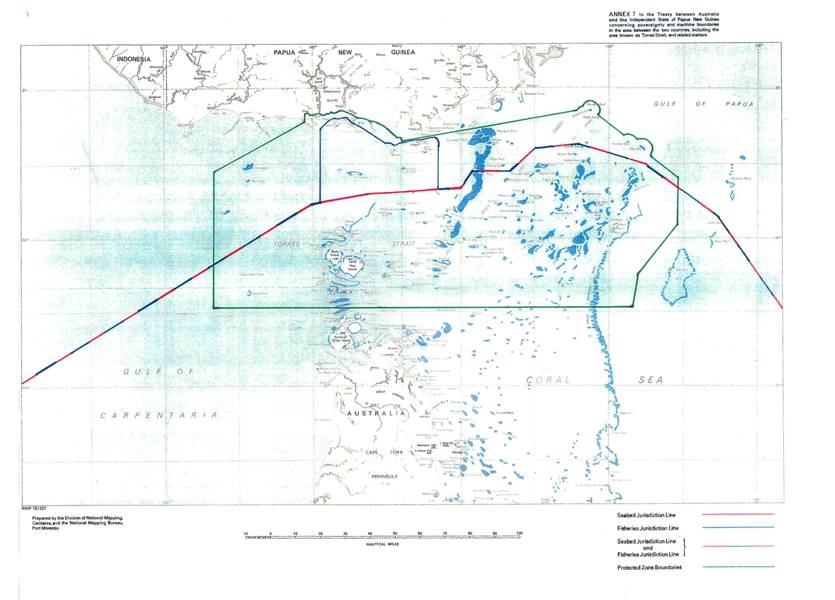
6 An exception to the common boundary, providing both jurisdictions to the one country, is the area to the north which encompasses Boigu, Saibai, Turnagain and other islands. This is referred to as the Top Hat area in the application for native title determination. In this area, the fisheries jurisdiction line runs north from the seabed jurisdiction line to create a discrete area. This may account for the distinction maintained in the text of the Treaty (and later in the Torres Strait Fisheries Act 1984 (Cth)) between the seabed and the fisheries jurisdiction lines. The result of the separation of the lines of jurisdiction in this area, without more being said, would appear to be that Australia’s fisheries jurisdiction is intended to co-exist with PNG’s seabed jurisdiction. Article 4.3 of the Treaty refers to this area as having a ‘residual jurisdiction’, which is not to be exercised without the concurrence of the other Treaty Party. It is not necessary to further refer to the definition of that jurisdiction, save to observe that it relates to rights other than those associated with the other two jurisdictions.
7 Article 2 deals with the recognition of the sovereignty of islands. Pursuant to Art 2.1, PNG recognises Australia’s sovereignty of certain named islands, including those in the Top Hat area, and of all islands lying between the mainlands of the two countries and south of the seabed jurisdiction line. Sovereignty over an island is said to include sovereignty over its territorial sea, the seabed beneath that sea and the subsoil of it, any island, rock or low-tide elevation within the territorial sea and the airspace above the island and that sea. Article 3 deals further with the territorial seas of islands.
8 Of particular importance on this appeal is the Protected Zone, which is established by Art 10 of the Treaty, and may be seen on the map above. It extends over a large part of the area of Australia’s and of PNG’s jurisdictions and includes the Top Hat area.
9 The background to the creation of the Protected Zone was referred to by Mr H Burmester in his article ‘The Torres Strait Treaty: Ocean Boundary Delimitation by Agreement’, American Journal of International Law, vol 76, no 321, 1982, pp 329-30:.
‘In the past, there was freedom of movement between the islands and the coast of Papua New Guinea. Traditional activities were pursued without concern for the niceties of international boundaries or customs and immigration formalities. During the negotiations, the islanders made very clear to the Australian Government their concern that traditional practices and freedom of movement be allowed to continue. The islanders insisted that ‘traditional boundaries’ in fact existed between their areas and areas belonging to the inhabitants of Papua New Guinea. These boundaries were similar to, but not identical with, the 1879 line referred to above. At the time of the negotiations, it was apparent that the use of the Strait by islanders and coastal Papuans involved considerable movement of both groups through the area. While not great in numbers, the islanders and coastal Papua New Guineans who lived in the Strait or its vicinity depended largely on its resources for their livelihood. Their traditional way of life was closely linked to the special features of the area.’
10 The stated principal purpose of the Treaty Parties, in establishing the Protected Zone, was said to be to ‘acknowledge and protect the traditional way of life and livelihood of the traditional inhabitants including their traditional fishing and free movement’. The term ‘traditional inhabitants’ was defined with respect to each country. In relation to PNG it was said to refer to persons who:
‘(i) live in the Protected Zone or the adjacent coastal area of Papua New Guinea,
(ii) are citizens of Papua New Guinea, and
(iii) maintain traditional customary associations with areas or features in or in the vicinity of the Protected Zone in relation to their subsistence or livelihood or social, cultural or religious activities.’
11 Article 11 provides, in part:
‘1. Subject to the other provisions of this Treaty, each Party shall continue to permit free movement and the performance of lawful traditional activities in and in the vicinity of the Protected Zone by the traditional inhabitants of the other Party.’
12 The heading of the Article identifies fishing as a traditional activity. The Article provides for some further restrictions and requirements with respect to fishing, not here relevant. Article 12 refers to the continuation of traditional customary rights in areas of land, seabed, seas and estuaries in or in the vicinity of the Protected Zone. Article 13 requires the parties to take legislative and other measures to preserve the marine environment.
THE NATIVE TITLE CLAIM
13 The land and waters the subject of the Torres Strait Regional Sea Claim comprise approximately 44 000 square kilometres in the Torres Strait and Coral Sea. They are divided into two parts, as shown on the maps accompanying the application. In general terms, Part A of the Claim Area covers much of that part of the Protection Zone which is within the fisheries jurisdiction and seabed jurisdiction lines and therefore within Australian jurisdiction. There is also included in Part A an area to the south and area east of Cape York which is not referred to in the Treaty map. It may be assumed that this also lies within Australia’s jurisdiction. Part B of the Claim Area is referrable to the Top Hat area, that discrete part of the Protected Zone the subject of Australia’s fisheries jurisdiction and shared residual jurisdiction.
14 The claim to the Part A area includes the land, waters, reefs, sandbanks, shoals, seabeds and subsoil on the seaward side of the high water mark and the outer limits of the territorial seas of various islands and cays. The claim with respect to Part B extends to the waters on the seaward side of the high-water mark, but does not extend to the seabed or subsoil and is exclusive of the territorial seas of those islands.
15 In the original claim for native title determination, the rights and interests claimed were said not to exclude the interests recognised under the Treaty, nor any other valid interests that may be held under Commonwealth laws. In the amended application, pars 12 and 13 of Sch E claimed exclusive possession of Part A of the Claim Area. The only exceptions were said to be one group of persons in the southern central area of Part A and certain public rights of navigation and fishing. The rights claimed in par 15 with respect to Part B are expressed to be those not inconsistent with certain public rights and extend by subpara (l) to the control of the access to and use of the enjoyment of land and waters and the taking of resources by others except any person exercising:
‘(iii) any right accorded by a law of the Commonwealth;
(iv) a right under the Treaty …’
(the Treaty in question).
THE EXCHANGE OF LETTERS
16 The appellant’s affidavit has annexed to it a copy of a document which is said to evidence an Exchange of Notes between Australia and PNG in the year 2000. The document, dated 26 July 2000, confirms an understanding reached between the governments of PNG and Australia, according to the Australia High Commission’s note of 221/00. The purpose of the Exchange of Notes was said to be to ‘formalise the full list of Treaty villages to benefit from the free movement provisions’ of the Treaty. It listed 13 villages which were said to be located ‘in the vicinity of’ the Protected Zone, in accordance with boundaries which had been agreed between the two governments. The Note observed that free movement from inhabitants of those villages had been acknowledged amongst traditional inhabitants in PNG and Australia and accepted by the governments of both countries. The Australian High Commission further proposed that the identification of these villages:
‘…should not exclude the application of free movement provisions to Traditional Inhabitants of additional villages, if at some point in the future their inclusion is deemed appropriate by the Traditional Inhabitants of Papua New Guinea and Australia, in consultation with the Governments of both countries, consistent with the provisions of the Torres Strait Treaty.’
17 It does not appear that this document was before his Honour. The matter has proceeded upon the basis that the appellant’s village has not been recognised under the Treaty.
THE APPLICATION
18 The appellant described himself as a subsistence farmer. His village is said to lie somewhat inland from the PNG coast and on the fringe of a lowland forest. The appellant gave some map references in his material which indicate that, apart from a reduction of the eastern and western boundaries, his claim is that his group’s interests are connected with the larger part of the Claim Area. He described his and the Dangaloub-Gizra group’s claims as follows:
‘2. I for DANGALOUB GIZRA have traditional inherent claim of right of recess to our kins, movement for traditional purposes, usage and ownership of resources in the Torres Strait Region or area now subject of Torres Strait Regional Sea claim to which we are not users now over which Australia has not recognized our rights for ages now.
3. We claim ourselves to be a party to true traditional inherent land and resource owners and users as original inhabitants of our customary land on the coast and in the sea together with our SIEPAM (TORRES STRAIT ISLANDER) and ABARSEN (MALIG and GUDANG ABORIGINES) relatives.
4. We seek recognition by Australia of our traditional inherent rights of access and movement for traditional purposes in the Torres Strait Region and for usage and ownership of our traditionally shared resources in the same or otherwise in the similar manner as it has done for our Torres Strait Islander and MALIG and GUDANG aboriginal relatives.’
19 In written submissions before his Honour the appellant said that one of the reasons he was seeking joinder in the proceedings was to assert a ‘right to be in the Torres Strait Treaty’. In his application for leave to appeal from his Honour’s decision, the appellant maintained that position.
20 The appellant’s material combines documents prepared for different purposes. They include a petition for recognition by the Treaty Parties of his group as traditional inhabitants and a submission for entitlements with respect to the PNG-Australia Gas Project. Much of the balance of the appellant’s material is concerned to establish the historical, mythical and cultural background of his group and their connexion to the land and sea in the Torres Strait area. He refers to three ethnic groups, including his group’s tribe, which shared the Myth of Origin. The myth predates the separation of Australia and PNG. The groups had similar language methods of cultivation and shared marine resources. The sea was seen as a garden and its use regulated by taboos and totems and subject to ritual. By this means the appellant sought to show that his group shared a common background with other peoples in the Torres Strait region. The inheritance of each group included an understanding of certain celestial beings and sea creatures who could be called upon, telepathically.
21 The appellant’s material clearly enough identifies his group’s traditional customary activities of fishing and the use of marine resources. To this end they had a role as custodians of the marine environment. Travel within the area was associated with these activities, although the material does not refer to particular routes. The only map provided refers to the travel of a mythical hero in the Myth of Origin. At another point the appellant speaks of the need to maintain the travel route of a creature who is the guardian of the sea. The appellant’s material contains indications of ritual, associated with fishing, and shrines. No more detail is provided. It may be that they are natural formations in the area. It is not said whether access to them is necessary for the performance of ritual.
22 The appellant also refers to visits that used to be made by his group within the Torres Strait area for the purpose of feasting and the practice of barter. Both practices are said to have been lost – the former as a result of settlers, the latter in the 1950s following upon changes to methods of travel which, it may be inferred, allowed people in the area to travel further and faster.
23 It is unclear, from the appellant’s material, whether his village continues to practise fishing and the collection of marine resources. The suggestion, in his affidavit set out above, is that those activities have also ceased. The Commonwealth, in its submissions, referred to the appellant’s group as having a cogent and rational connexion to the Claim Area, albeit an historical one. In one of his statements the appellant complains that his group was not consulted with respect to the Treaty and, as a result, they were excluded and their traditional rights including barter trade, rights of fishing, shared resources and use of the Torres Strait Seas for traditional purposes were banned. He does not say when this occurred, although he had said barter ceased some decades ago, as earlier mentioned. At another point in his material he refers to the denial of his group’s rights since 1978 and their attempts to gain recognition since 1998.
THE DECISION APPEALED FROM
24 His Honour considered that there were three elements to be considered under s 84(5):
1. Whether the person sought to be joined has an interest.
2. Whether the interest may be affected by a determination in the proceedings.
3. Whether, in any event, in the exercise of its discretion, the Court should join the person as a party.
25 His Honour was of the view that the appellant and his group may have an interest within the meaning of s 84(5). His Honour observed that an interest need not be proprietary or legal or equitable in nature, but must not be indirect, remote or lacking in substance. It will not include interests of an emotional, conscientious, ideological or intellectual kind: Byron Environment Centre Inc v The Arakwal People (1997) 78 FCR 1. His Honour also referred to the decision in Kokatha Native Title Claim v South Australia & Others (2005) 143 FCR 544, which involved Australian indigenous persons who were not themselves claimants, but who had traditional rights and interests in the area of the application for a determination of native title. Mansfield J said in that case (at [24]) that, whilst there could not be a determination of native title rights and interests of those seeking to be joined as parties:
‘… They may however lead to a more informed decision on the Kokatha claim as to whether the native title rights and interests should be granted as expressed in that application. That is, the assertion of those rights may result in the Kokatha claim being less successful than it may otherwise be. Where there may be a competing native title group who claim communal rights and interests which may be affected by a determination in the Kokatha claim, but there is no application by that group over the Claim Area, the members of that group should not be precluded from putting forward their claim in a defensive attempt to avoid the dilution of those interests.’
26 In the view of his Honour the primary Judge, it was not beyond the bounds of possibility that the common law could recognise the rights and interests of a PNG national living in PNG who is a traditional inhabitant in a Claim Area. The NTA itself however would not permit of a determination of native title with respect to those rights. His Honour went on:
‘35. … Nevertheless, the rights and interests of such persons might limit or qualify the native title rights and interests of Torres Strait Islanders. Such a limitation could arise as an element of the traditional laws acknowledged and the traditional customs observed by the Islanders themselves. This would be consistent with traditional concurrent use of areas of the Torres Strait within the Claim Area with people from PNG. In my opinion, on that basis, the interests asserted by Mr Gamogab, as a member of the relevant traditional community, would render him eligible for joinder as a party.’
27 His Honour then turned to the second question posed by s 84(5), whether that interest would be affected by a native title determination:
‘36 It cannot be said that the interests of traditional inhabitants of the Torres Strait regional Claim Area from PNG would be unaffected by a native title determination over the sea. A native title determination recognising native title rights and interests on the part of the applicants could render enforceable and protected at Australian law, rights and interests which accord no recognition to the rights and interests asserted by Mr Gamogab and his community. In so saying, I offer no opinion on the question whether Mr Gamogab’s asserted rights and interests as a traditional inhabitant do in truth exist in the Claim Area.’
28 The Claim Group opposed the joinder of the appellant to the proceedings. One of its contentions was that the appellant and his group did not have lawful rights of use which could be recognised by the Court. His Honour did not consider that it was necessary to rule upon that matter. His Honour however considered that the issues it raised informed the exercise of the discretion whether to join the appellant. It also appeared, from an earlier part of his Honour’s reasons and from what follows, that other PNG nationals had already been joined as respondents in the proceedings. His Honour went on:
‘47 The question whether a PNG village whose members are not treated as traditional inhabitants by the executive governments of PNG and Australia for the purposes of the Treaty should be so treated for the purpose of these proceedings, is a matter for those executive governments. These proceedings should not be used as a vehicle for advancing the case of particular PNG villages in that respect. It may be that a PNG group dissatisfied with its government’s failure to recognise its members as traditional inhabitants for the purposes of the Treaty could bring declaratory proceedings in the National Court of PNG.
48 There is a risk, in my opinion, that the joinder of Mr Gamogab will bring to bear on these proceedings debates between village communities in PNG about their respective interests in the Torres Region Seas Claim Area. These are matters best left to the Courts of PNG or to its executive government to resolve by agreement with the Australian government under the Treaty. As a matter of discretion I consider that the joinder of Mr Gamogab, notwithstanding his claimed interest, is undesirable. I consider that attention should also be given to the position of other PNG nationals who have been joined as parties.’
29 His Honour dismissed the appellant’s motion.
THE APPEAL
30 It may be inferred that the concern expressed by his Honour was that the case sought to be agitated by the appellant involved a political question, one not appropriate for a Court to determine. The appellant clearly sought the recognition of his group, by the executive governments of Australia and PNG for Treaty purposes and that recognition had been denied them.
31 Issues arising out of international relations have generally been regarded as non-justiciable: Minister for Arts, Heritage and Environment v Peko-Wallsend Ltd (1987) 15 FCR 274 at 307, referring to Buttes Gas & Oil Co v Hammer (No 3) [1982] AC 888; Gerhardy v Brown (1985) 159 CLR 70. In Buttes Gas & Oil [1982] AC 888Lord Wilberforce said that English courts may not examine ‘the validity, under international law, of an act or acts operating in the area of transactions between states’ (at 931). A number of reasons have been advanced to explain the requirement, referred to by Lord Wilberforce, for judicial restraint. Lord Wilberforce spoke of there being no judicial standard for the determination of such questions and, more relevant to this case, the potential for embarrassment to foreign relations. Other cases, such as Gerhardy v Brown 159 CLR 70, have referred to the Court assuming a function which is committed to another branch of government.
32 In Buttes Gas & Oil [1982] ACat 933Lord Wilberforce referred to Oetjen v Central Leather Co (1918) 246 US 297 at 304, where Fuller CJ spoke of the ‘amicable relations between governments being imperilled’ if the Court of one country re-examined or condemned the acts of another country. In Petrotimor Companhia de Petroleos Sarl v Commonwealth of Australia (2003) 126 FCR 354 at 370, Black CJ and Hill J considered that the principle stated in Buttes Gas & Oil [1982] AC 888, that courts should not adjudicate upon transactions of foreign sovereign States, was not surprising, given that international relations can be controversial and the outcome of a Court adjudication may well create embarrassment for the government. At issue in that case was the grant of a concession by Portugal and questions as to the meaning of an international treaty were raised. The Court’s involvement was regarded as raising the possibility of considerable embarrassment to the government of Australia (at 369, at [48]). Submissions, that Buttes Gas & Oil [1982] AC 888 had no application in the Australia constitutional framework and that the only issue was whether there was a ‘matter’ capable of being resolved by the exercise of judicial power, were rejected. The Full Court held that Buttes Gas & Oil [1982] AC 888 was not to be read down, as later English cases had suggested. The Court observed that the High Court in Her Majesty’s Attorney-General in and for the United Kingdom v Heinemann Publishers Australia Proprietary Limited (1988) 165 CLR 30 (the ‘Spycatcher’ case) had held that the principle in Buttes Gas & Oil [1982] AC 888 rested partly on international comity (at 370, at [50]).
33 The ‘political question’ doctrine has attracted considerable criticism, Gummow J observed in Re Ditfort; Ex parte Deputy Commissioner of Taxation (1988) 83 ALR 265 at 287, but it had been unnecessary to finally decide whether it exists in Australia (at 288). It was erroneous to suppose that every case which touches upon foreign relations lies beyond judicial cognisance, his Honour said (at 284). There might be questions for the courts concerning the power to conduct relations. His Honour did not however doubt that the propriety of dealings of governments was not a matter for the courts (at 285-286). His Honour suggested that an alternative method of dealing with such a case may be to emphasise the discretionary nature of equitable relief, such as declarations (at 287).
34 Opinions may differ as to the breadth of the principle as stated in Buttes Gas & Oil [1982] AC 888. Nevertheless, it has been approved in the Spycatcher 165 CLR 30 case and applied without limitation by two Full Courts of this Court: in Petrotimor 126 FCR 354and in Peko-Wallsend Ltd 15 FCR 274. It follows that negotiations and agreements between Australia and another country are not to be the subject of judicial determination for the reason that they might cause embarrassment and affect relations between the countries. Questions raised concerning those subjects are non-justiciable: Buttes Gas & Oil [1982] AC at 933; Petrotimor 126 FCR at 374, at [68].
35 This is an appeal from the exercise of a judicial discretion and is governed by well-settled principles. They were restated in The Queen v Carroll [2002] HCA 55 at [73]. They require error to be shown. It was not suggested that his Honour was wrong to have held that a determination as to Treaty recognition was a matter for the executive governments of PNG and Australia, not the Court. Nor was it submitted that s 84(5) left no discretion for the Court to exercise, where an applicant for joinder had shown that they had an interest which may be affected by a determination of native title with respect to land or sea. Rather, it was submitted that his Honour focussed upon the difficulties raised by the appellant’s claim to recognition and not upon the affect upon his group’s traditional rights, the question raised by s 84(5) and one which his Honour had answered in the appellant’s favour. His Honour had failed to understand that the case the appellant sought to advance had regard to the latter, it was submitted. As a result his Honour did not consider the alternative course, to outright refusal of joinder, one which would permit the appellant to participate in the proceedings, so long as questions relating to the Treaty were not raised by him.
36 The contention that his Honour failed to apprehend the nature of the case sought to be advanced by the appellant is clearly incorrect. His Honour considered the appellant’s material, in relation to the interest asserted by the appellant, and understood that it was said that that they thought that they may be affected by a determination of native title rights and interests in the proceedings. His Honour made findings as to the potential for affectation, upon an assumption that the interests asserted by the appellant might be recognised and therefore capable of being affected. The appellant clearly also sought to obtain something approaching recognition by the Court of his group’s traditional and customary rights, interests, which had not been forthcoming from the governments of PNG and Australia. His Honour was not in error as to his understanding of what the appellant sought. The appellant now seeks to resile from that stance, because of the problem identified by his Honour.
37 The proposal by the appellant, to limit his case and not seek a determination akin to recognition, may overcome one of his Honour’s expressed concerns. His Honour was clearly concerned that the conduct of the case then proposed by the appellant would be an abuse of the Court’s processes because it involved a purpose other than that to protect the appellant’s group’s rights. It would not appear to overcome the substantial problem identified by his Honour, as to the Court’s involvement in a political question.
38 The appellant’s argument on the appeal proceeds upon an assumption that if the position of the appellant and his group under the Treaty is not directly raised, and the Court is not asked to make orders as to the position of the appellant and his group under the Treaty, then the appellant’s case is justiciable. No question capable of creating embarrassment for the Australian government would arise. The contention supposes that embarrassment is avoided by no order, in the nature of relief, being made in terms of the Treaty. In the way it was put, the appellant would assert a purely defensive case, in the way referred to in Kokotha 143 FCR 544. He would simply put forward evidence to better inform the Court as to the true extent of the Claim Group’s customary and traditional rights and the extent to which they have been subject to the exercise of his group’s rights.
39 The latter contention suggests that the appellant’s role is as a witness, rather than a party. It overlooks the outcome which the appellant would no doubt continue to seek, namely the limitation of a determination in favour of the Claim Group, by reference to his group’s rights and interests. Any determination made by the Court, in the event that the appellant establishes the traditional rights and interests of his group, would necessarily refer to those interests and be couched in such a way as to protect them. In that process the Court would need to make findings as to the location of the appellant’s group, their history and the rights which they have traditionally and customarily exercised in the Claim Area. The findings would involve the matters which would characterise the appellant and his group as traditional inhabitants under the Treaty, even if a conclusion was not expressed in those terms. On the other hand the question determined by PNG and Australia may have regard to wider questions, including competition between villages for recognition, a matter to which his Honour referred. The Court’s findings would then stand in stark contrast to the refusal of the PNG and Australian governments to accept the appellant’s group. They might suggest that the further consideration, which the Exchange of Letters leaves open, should be given and what that conclusion should be. The prospect for embarrassment in international relations is real. It is not overcome by an omission of specific reference to the Treaty.
40 There is however one anomaly in this matter, if the refusal of joinder is upheld on the basis of there being a political question inherent in the appellant’s case which renders it non-justiciable. The Commonwealth now supports the appellant in his application for joinder, to an extent. This implies that it may not be considered that a determination will have an adverse effect upon foreign relations. The matter has not been directly addressed. Lord Wilberforce in Buttes Gas & Oil [1982] AC 888 did not consider that the reality of embarrassment determined whether a case was justiciable. The answer to the question depended in each case upon an appreciation of the nature and limits of the judicial function (at 436). In Petrotimor 126 FCR 354, evidence was tendered on the issue as to whether embarrassment was likely. It was considered unnecessary to refer to it as the question raised was capable of answer by reference to the contents of the Exchange of Notes (at 370, at [52]). Consequently the Court did not deal with the question. There seems no reason to doubt that this aspect of Buttes Gas & Oil [1982] AC 888 would not be applied. It holds that it is the nature of the question for the Court which renders it non-justiciable.
41 It follows that no error has been shown on his Honour’s part in refusing joinder and the appeal should be dismissed for that reason. However, for the reasons which follow, it seems to me to be necessary to say something about the basis upon which the appeal was conducted which has informed the reasoning to that conclusion.
42 The rights which the appellant asserted have been treated as of a similar nature to native title rights and such that the common law might recognise them. Questions as to the appellant’s interests, although adverted to by the Claim Group, do not appear to have been subject to detailed submissions before his Honour, the focus being upon the Treaty. In that regard the Commonwealth had initially expressed concerns about the appellant raising his claims in the proceedings. What appears to have been a preliminary view expressed by his Honour, with respect to the appellant’s interests and the potential for a native title determination to affect them, was accepted by the Commonwealth on the appeal. The Claim Group filed a Notice of Contention, which put in issue whether the interests of the appellant were such as to be recognisable by an Australian court. It resiled from that position on the appeal, preferring to focus upon its argument that there had been no error in the exercise of his Honour’s discretion. The appeal has therefore been argued, effectively, upon a concession that the appellant holds the requisite interests and that a determination of native title may affect them.
43 A Full Court in Byron Environment Centre Inc 78 FCR 1 held that the nature of the right or interest which may be affected by a native title determination, and therefore qualify for joinder, is very wide and is not required to be one which the Court may itself enforce. Even so, it held that the right or interest must be of such a character that it may be affected in a demonstrable way (at 7-8, 19, 37 and 42). In this case the appellant’s interests are not clearly identified nor is it explained how any such interests would be affected. Apart from those interests asserted by the appellant which are spiritual in nature, the appellant refers to customary rights of passage for the purpose of feast celebrations and for barter in the Torres Strait area, but his evidence suggest they ceased some time ago. That leaves the appellant’s marine interests, but even they may be inferred to have ceased, although it is not clear when and why that occurred. The Commonwealth refers to the appellant’s interests as largely ‘historical’. It is not said whether they are likely to be recommenced in the future.
44 If the appellant’s remaining interests are in traditional fishing, and they continue, it is not clear why they have not been associated with the Torres Strait Fisheries Act 1984 (Cth) (‘Torres Strait Act’), which was mentioned only in passing in written submissions. The Act provides for the regulation of fishing in an ‘area of Australian jurisdiction’, which is defined by s 3(1) in such a way as to include any area of water south of the fisheries jurisdiction line in the Treaty. Section 8 of that Act provides:
‘In the administration of this Act, regard shall be had to the rights and obligations conferred on Australia by the Torres Strait Treaty and in particular to the traditional way of life and livelihood of traditional inhabitants, including their rights in relation to traditional fishing.’
45 The ‘Torres Strait Treaty’ is identified in s 3 as the Treaty in question. The text of the Treaty and its Annexures, but not the maps, are scheduled to the Torres Strait Act. The term ‘traditional inhabitants’ is given the same meaning as in the Treaty, subject to s 3(3)(b). This provision permits the identification of an ‘adjacent coastal area of PNG’, where traditional inhabitants reside, by declaration of the Minister and publication in the Gazette. The Protected Zone is defined to mean that area identified in the Treaty and includes an area north of the seabed jurisdiction line which is the subject of declaration by PNG. No further identification of a ‘traditional inhabitant’ is provided by the Torres Strait Act. No declarations in that regard have apparently been made. No principle of statutory construction would however suggest that those administering the Act are to determine who is a ‘traditional inhabitant’ by reference to the Exchange of Letters.
46 If the appellant does qualify as a traditional inhabitant under the Torres StraitAct, his interest might be capable of determination by the Court without undertaking a political function. Any determination with respect to Part B of the Claim Area may not affect an interest under the Act, for the reason that the claim is expressed in such a way as to be subject to it. Regrettably the same recognition with respect to Part A was withdrawn. Had the initial, non-exclusive, claim for that area been maintained by reference to the Treaty, or more correctly Torres StraitAct interests, it may not have been necessary for persons in the appellant’s position to be joined to the proceedings.
47 If the appellant’s joinder were to be permitted, on terms, account may need to be taken in the management of the proceedings, to these unresolved issues.
CONCLUSION
48 In my view the appeal should be dismissed. Section 85A(1) of the NTA provides that, unless the Court orders otherwise, each party to a proceeding must bear his or her own costs. A circumstance predicted by subs (2) as one appropriate to an order for costs is where a party, by any unreasonable act or omission, has caused another party to incur costs in connexion with the conduct of the proceeding. I do not however understand the respondents to the appeal to seek costs and I would not expect the Commonwealth to do so.
|
I certify that the preceding forty-eight (48) numbered paragraphs are a true copy of the Reasons for Judgment herein of the Honourable Justice Kiefel. |
Associate:
Dated: 18 July 2007
|
IN THE FEDERAL COURT OF AUSTRALIA |
|
|
QUEENSLAND DISTRICT REGISTRY |
QUD 361 OF 2006 |
|
ON APPEAL FROM A SINGLE JUDGE OF THE FEDERAL COURT OF AUSTRALIA |
|
BETWEEN: |
PENDE GAMOGAB Appellant
|
|
AND: |
LEO AKIBA First Respondent
GEORGE MYE Second Respondent
THE STATE OF QUEENSLAND Third Respondent
COMMONWEALTH OF AUSTRALIA Fourth Respondent
|
|
JUDGES: |
KIEFEL, SUNDBERG, GYLES JJ |
|
DATE: |
18 JULY 2007 |
|
PLACE: |
BRISBANE |
REASONS FOR JUDGMENT
SUNDBERG J:
49 I would allow the appeal and remit the matter to the primary judge to consider whether terms should be imposed on the appellant’s joinder.
50 I agree with the reasons Gyles J has given for taking this course. There should be no order as to costs.
|
I certify that the preceding two (2) numbered paragraphs are a true copy of the Reasons for Judgment herein of the Honourable Justice Sundberg. |
Associate:
Dated: 18 July 2007
|
IN THE FEDERAL COURT OF AUSTRALIA |
|
|
QUEENSLAND DISTRICT REGISTRY |
QUD 361 OF 2006 |
|
ON APPEAL FROM A SINGLE JUDGE OF THE FEDERAL COURT OF AUSTRALIA |
|
BETWEEN: |
PENDE GAMOGAB Appellant
|
|
AND: |
LEO AKIBA First Respondent
GEORGE MYE Second Respondent
THE STATE OF QUEENSLAND Third Respondent
COMMONWEALTH OF AUSTRALIA Fourth Respondent
|
|
JUDGES: |
KIEFEL, SUNDBERG, GYLES JJ |
|
DATE: |
18 JULY 2007 |
|
PLACE: |
BRISBANE |
REASONS FOR JUDGMENT
GYLES J:
51 The appellant, Pende Gamogab, appeals against the refusal to join him as a party to an application made pursuant to the Native Title Act 1993 (Cth) (“the Act”) (Akiba and Ors on behalf of the Torres Strait Regional Seas Claim People v State of Queensland (No 2) (2006) 154 FCR 513) pursuant to leave granted on 31 January 2007 (Akiba and Ors on behalf of the Torres Strait Regional Seas Claim People v State of Queensland (No 3) [2007] FCA 39).
52 Application for joinder was made pursuant to s 84(5) of the Act which provides as follows:
“The Federal Court may at any time join any person as a party to the proceedings, if the Court is satisfied that the person’s interests may be affected by a determination in the proceedings and it is in the interests of justice to do so.”
53 The primary judge was satisfied that the appellant’s interests might be affected by a determination in the proceeding. In being so satisfied, the primary judge considered the evidence given by the appellant, examined the Treaty Between Australia and the Independent State of PNG Concerning Sovereignty and Maritime Boundaries in the area between the two Countries, including the area known as Torres Strait, and Related Matters – 1978 (“the Treaty”), and considered the Torres Strait Treaty (Miscellaneous Amendments) Act 1984 (Cth), the Torres Strait Fisheries Act 1984 (Cth) and a learned article on the history contents of the Treaty: Burmester H, “The Torres Strait Treaty: Ocean Boundary Delimitation by Agreement”, (1982) 76 American Journal of International Law at 321–349. His Honour also considered the effect of a determination pursuant to the Act and the decision of Mansfield J in Kokatha Native Title Claim v State of South Australia (2005) 143 FCR 544, particularly at [24] concerning what may be called defensive use of non-claimant interests. His Honour also took into account the decision of the Full Court in Byron Environment Centre Inc v The Arakwal People (1997) 78 FCR 1, particularly per Black CJ at 7–9 and Merkel J at 42–43 dealing with the concept of “interests” in a section of the Act relevantly indistinguishable from s 84.
54 That finding is uncontentious on this appeal. The first and second respondents (who are applicants in the principal proceeding) had initially filed notice of a contention as follows:
“The Appellant does not, for the purposes of s.84(5) of the Native Title Act 1993 (Cth), have an interest that may be affected by a determination of native title in the proceedings that renders him eligible for joinder as a party to the proceedings.”
However, that ground was abandoned at the hearing of the appeal. The Commonwealth’s submissions on the appeal support the primary judge’s decision as to the appellant’s interests.
55 The primary judge declined joinder in the exercise of discretion. The appellant is a citizen of, and resides in, Papua New Guinea. The reason advanced for exercising discretion against joinder was put by the primary judge as follows (Akiba 154 FCR 513 at [48]):
“There is a risk, in my opinion, that the joinder of Mr Gamogab will bring to bear on these proceedings debates between village communities in PNG about their respective interests in the Torres Region Seas Claim area. These are matters best left to the courts of PNG or to its executive government to resolve by agreement with the Australian government under the Treaty. As a matter of discretion I consider that the joinder of Mr Gamogab, notwithstanding his claimed interest, is undesirable. I consider that attention should also be given to the position of other PNG nationals who have been joined as parties.”
56 It is unnecessary for the purpose of these reasons to explain why the primary judge perceived the risk that he did that led him to refuse joinder. That is set out in his reasons (Akiba 154 FCR 513 particularly at [35]–[47]). Accepting that there was such a risk, in my respectful opinion, the exercise of discretion miscarried. Firstly, the primary judge appeared to consider that the discretion to join or not to join a party was, in effect, at large. In my opinion, that is wrong. Secondly, the risk perceived by the primary judge could have been dealt with by imposing appropriate terms upon joinder preventing the appellant from relying upon the matters that the primary judge regarded as inappropriate.
NATURE OF DISCRETION
57 Certain other parts of s 84 need to be taken into account in considering this question:
“(3) Another person is a party to the proceedings if:
(a) any of the following applies:
…
(iii) the person’s interest, in relation to land or waters, may be affected by a determination in the proceedings; and
(b) the person notifies the Federal Court, in writing, within the period specified in the notice under section 66, that the person wants to be a party to the proceeding.
…
(5A) If:
(a) a person wants to become a party to the proceedings; and
(b) the Federal Court is satisfied that the person’s interests may be affected by a determination in the proceedings merely because the person has a public right of access over, or use of, any of the area covered by the application;
the Court:
(c) may make appropriate orders to ensure that the person’s interests are properly represented in the proceedings; but
(d) need not allow more than one such person to become a party to the proceedings in relation to each area covered by such a public right of access or use.
…
(8) The Federal Court may at any time order that a person, other than the applicant, cease to be a party to the proceedings.
Court to consider dismissing parties
(9) The Federal Court is to consider making an order under subsection (8) in respect of a person who is a party to the proceedings if the Court is satisfied that:
(a) the following apply:
(i) the person’s interests may be affected by a determination in the proceedings merely because the person has a public right of access over, or use of, any of the area covered by the application; and
(ii) the person’s interests are properly represented in the proceedings by another party; or
(b) the person never had, or no longer has, interests that may be affected by a determination in the proceedings.”
58 Section 84(3) refers back to s 66, which deals with the giving of notice of a native title application. Section 66(3), so far as is relevant, provides:
“(3) Subject to this section, the Registrar must:
(a) give notice containing details of the application to the following persons or bodies (other than the applicant in relation to the application):
(i) any registered native title claimant in relation to any of the area covered by the application; and
(ii) any registered native title body corporate in relation to any of the area covered by the application; and
(iii) any representative Aboriginal/Torres Strait Islander body for any of the area covered by the application; and
(iv) subject to subsection (5), any person who, when the application was filed in the Federal Court, held a proprietary interest, in relation to any of the area covered by the application, that is registered in a public register of interests in relation to land or waters maintained by the Commonwealth, a State or Territory; and
(v) the Commonwealth Minister; and
(vi) any local government body for any of the area covered by the application; and
(vii) if the Registrar considers it appropriate in relation to the person—any person whose interests may be affected by a determination in relation to the application; and (Emphasis added.)
(b) give a copy of the notice to the Federal Court; and
(c) if any of the area covered by the application is within the jurisdictional limits of a State or Territory—give a copy of the notice to the State Minister or Territory Minister for the State or Territory; and
(d) notify the public in the determined way of the application. (Emphasis added.)
…
(7) The Registrar may apply to the Federal Court for an order as to:
(a) whether a particular person or class of persons must be given notice under paragraph (3)(a); or
(b) how such notice must be given.
Notice to specify day
(8) A notice under paragraph (3)(a) or (d) must specify a day as the notification day for the application. Each such notice in relation to the application must specify the same day. (Original emphasis.)
…
(10) A notice under paragraph (3)(a) or (d) must also include a statement to the effect that:
…
(b) in the case of any native title determination application—as there can be only one determination of native title for an area, if a person does not become a party in relation to the application, there may be no other opportunity for the Federal Court, in making its determination, to take into account the person’s native title rights and interests in relation to the area concerned; and
(c) in any case—a person who wants to be a party in relation to the application must notify the Federal Court, in writing, within the period of 3 months starting on the notification day (as defined in subsection (8)), or, after that period, get the leave of the Federal Court under subsection 84(5) to become a party.” (Emphasis added.)
59 It will be seen from the above that the appellant could have been joined as of right if he had applied in time. That would indicate that the principal issue which arises under s 84(5), assuming the threshold as to affectation of interests is reached, is to assess the prejudice occasioned to the other parties and the Court by the delay in applying to be joined. It would be odd in this day and age if delay in applying, in itself, were to radically prejudice a potential party. That view is consistent with the “in rem” nature of the proceeding (see s 225) – underlined by the statement which must be included in the notice pursuant to s 66(10)(b) (cf Finn J in Kokatha People v State of South Australia [2007] FCA 1057 at [9], [13], [24], [33], [41], [42], [50] and [52]).
60 It needs to be recalled that joinder of parties is a necessary aspect of the management of all litigation. There are always rules of court governing that topic (eg Federal Court Rules, O 6). It is fundamental that an order which directly affects a third person’s rights or liabilities should not be made unless the person is joined as a party (News Ltd v Australian Rugby Football League Ltd (1996) 64 FCR 410 at 523–527, particularly at 524–525).
61 Once the nature of the statutory discretion is understood, the risk referred to by the primary judge could hardly outweigh the evident statutory purpose of having all parties, whose interests may be affected, before the Court at the one time so that they can be covered by the same determination. No finding was made that there was any prejudice to any party by reason of the application for joinder being made late.
CONDITIONS OF JOINDER
62 The first and second respondents sought to rely upon the following notice of contention:
“The application made by the Appellant for joinder as a party to the proceedings is an abuse of process because it is made for the purpose of challenging an Exchange of Notes made between the governments of the Commonwealth of Australia and of Papua New Guinea in relation to the treaty between Australia and Papua New Guinea concerning sovereignty and maritime boundaries in the area between the two countries known as the Torres Strait Treaty and is not made for the purpose for which the process to join parties is designed.”
Rather than being a true contention, this appears to be another way of stating the point that the judge relied upon.
63 The appellant does not need to put any argument based upon the Treaty or the Exchange of Notes to establish his interests for the purposes of the case. The docket judge can control the proceeding to prevent truly irrelevant or inappropriate arguments or material being advanced by a party. Counsel for the Commonwealth indicated that there should be no problem if the case is approached along those lines. The Commonwealth should be in a good position to judge that situation. It should be noted in that connection that the Commonwealth does not accept any role of acting in the interests of the appellant or acting in the interests of any others like him in the case. An appropriate term could have been constructed imposing conditions upon a grant of leave to be joined (eg E I Du Pont De Nemours & Co v Commissioner of Patents (No5)(1989) 87 ALR 491 at 494–495; (1989) 96 FLR 129 at 131–132).
CONCLUSION
64 The limits upon appellate intervention in relation to the exercise of a judicial discretion on a matter of practice and procedure are well known (Adam P Brown Male Fashions Pty Ltd v Philip Morris Inc (1981) 148 CLR 170), although the decision to exclude a party is a particular kind of decision on a matter of practice and procedure. However, in my opinion, the primary judge misdirected himself as to the nature of the discretion that was being exercised and failed to give any or any proper consideration or weight to the statutory intention of having all parties whose interests may be affected before the Court at the one time to be dealt with by the one determination. Exercise of the discretion also miscarried because the primary judge did not give any consideration to imposition of terms which could cure the problem he identified.
65 The first and second respondents submitted that general case management considerations could justify excluding the appellant, particularly as other Papua New Guinea nationals had been joined. It was submitted that the sheer number of claims, if joinder was permitted, would impose undue burdens, citing Wilcox J in Bishop v Bridgelands Securities (1990) 25 FCR 311 at 314–315. The primary judge did not refuse joinder because of case management considerations. Indeed, in the usual case, that would not be a proper exercise of case management. It is not established that the other Papua New Guinea nationals could or would properly represent the appellant. Indeed, the judge threw out a broad hint that the decision to join the other Papua New Guinea nationals should be reconsidered with a view to dismissing them from the proceeding. The management of a large native title claim is difficult, one factor being the number of parties entitled to be joined. On the other hand, there is good reason for joinder – the interests of the parties may be affected by the determination. The width of the construction of “interests” by the Full Court in Byron Environment Centre Inc 78 FCR 1 has no doubt had a significant impact upon the management of native title cases. The remedy does not lie in excluding persons whose interests may be affected in the exercise of an unconstrained discretion by individual judges. The very width of the interests that may be affected by a determination indicates that every party is not to be treated in the same way in the management of the case. The docket judge must have considerable discretion as to the extent to which a party is permitted to participate in the process. The appellant on this appeal accepted that there would be limitations on what he could rely upon if joined.
66 The discretion having miscarried, it would be open to this Court to make an appropriate order as, in my opinion, it is clear that joinder should have been permitted. However, it is preferable that the docket judge consider whether terms should be imposed upon the joinder and, if so, what those terms ought to be. I would, therefore, allow the appeal, set aside the order made dismissing the application for joinder and remit the matter to the primary judge.
67 The appellant did not seek costs of the appeal. That is consistent with s 85A of the Act, which does not apply in terms to appeal, but does refer to proceedings in the Federal Court. That being so, there does not appear to be any scope for application of the Federal Proceedings (Costs) Act 1981 (Cth).
|
I certify that the preceding seventeen (17) numbered paragraphs are a true copy of the Reasons for Judgment herein of the Honourable Justice Gyles. |
Associate:
Dated: 18 July 2007
|
Counsel for the Appellant: |
Mr D P O’Gorman SC |
|
Counsel for the First Respondent: |
Mr S Glacken |
|
Solicitor for the First Respondent: |
Torres Strait Regional Authority |
|
For the Second and Third Respondents: |
No Appearance |
|
Counsel for the Fourth Respondent: |
Ms R J Webb QC |
|
Solicitor for the Fourth Respondent: |
Australian Government Solicitor |
|
Date of Hearing: |
11 May 2007 |
|
Date of Judgment: |
18 July 2007 |


