

FEDERAL COURT OF AUSTRALIA
Astrazeneca Pty Limited v GlaxoSmithKline Australia Pty Limited [2006] FCAFC 22
TRADE PRACTICES – whether conduct directed at a defined section of the community is misleading or deceptive or likely to mislead or deceive – drug company promotional material directed to general practitioners
Trade Practices Act 1974 (Cth) s 52(1)
Federal Court of Australia Act 1976 (Cth) s 24(1)
Medical Benefits Fund of Australia Limited v Cassidy (2004) 205 ALR 402
Fox v Percy (2003) 214 CLR 118
CSR Limited v Della Maddalena [2006] HCA 1
Minister for Immigration & Multicultural Affairs v Jia Legeng (2001) 205 CLR 507
Taco Company of Australia Inc v Taco Bell Pty Limited (1982) 42 ALR 177
Campomar Sociedad, Limitada v Nike International Limited (2000) 202 CLR 45
Annand & Thompson Pty Limited v Trade Practices Commission (1979) 25 ALR 91
Johnson Tiles Pty Limited v Esso Australia Limited (2000) 104 FCR 564
ASTRAZENECA PTY LIMITED v GLAXOSMITHKLINE AUSTRALIA PTY LIMITED
NSD 2426 OF 2005
WILCOX, BENNETT AND GRAHAM JJ
8 MARCH 2006
SYDNEY
|
IN THE FEDERAL COURT OF AUSTRALIA |
|
|
NEW SOUTH WALES DISTRICT REGISTRY |
NSD 2426 OF 2005 |
ON APPEAL FROM A SINGLE JUDGE OF THE FEDERAL COURT OF AUSTRALIA
|
BETWEEN: |
ASTRAZENECA PTY LIMITED ACN 009 682 311 APPELLANT
|
|
AND: |
GLAXOSMITHKLINE AUSTRALIA PTY LIMITED ACN 100 162 481 RESPONDENT
|
|
WILCOX, BENNETT AND GRAHAM JJ |
|
|
DATE OF ORDER: |
8 MARCH 2006 |
|
WHERE MADE: |
SYDNEY |
THE COURT ORDERS THAT:
1. The appeal be dismissed.
2. The Appellant pay the Respondent’s costs.
Note: Settlement and entry of orders is dealt with in Order 36 of the Federal Court Rules.
|
IN THE FEDERAL COURT OF AUSTRALIA |
|
|
NEW SOUTH WALES DISTRICT REGISTRY |
NSD 2426 OF 2005 |
ON APPEAL FROM A SINGLE JUDGE OF THE FEDERAL COURT OF AUSTRALIA
|
BETWEEN: |
ASTRAZENECA PTY LIMITED ACN 009 682 311 APPELLANT
|
|
AND: |
GLAXOSMITHKLINE AUSTRALIA PTY LIMITED ACN 100 162 481 RESPONDENT
|
|
JUDGES: |
WILCOX, BENNETT AND GRAHAM JJ |
|
DATE: |
8 MARCH 2006 |
|
PLACE: |
SYDNEY |
REASONS FOR JUDGMENT
THE COURT:
1 The central issue in this case is whether any or all of two flyers and two advertisements published in ‘Australian Doctor’ magazine were misleading or deceptive or likely to mislead or deceive in contravention of s 52(1) of Trade Practices Act 1974 (Cth) (‘the Act’).
2 The first flyer was sent by the Respondent to some 14,000 General Practitioners throughout Australia on or about 26 November 2004. The second flyer or brochure was published in or about February 2005 as a handout for medical detailers representing the respondent pharmaceutical company to provide to doctors and health professionals upon whom they called from time to time. The two advertisements were first published by the Respondent in the 20 March 2005 issue of ‘Australian Doctor’.
3 All of the documents seek to promote the prescription by doctors of the Respondent’s drug ‘Seretide’.
4 Seretide is a combination inhaler, incorporating fluticasone propionate and salmeterol xinafoate, which is used for the control of asthma. It is a medication which may only be used by patients on prescription.
5 The Appellant is another pharmaceutical company which takes exception to representations said to have been made by the Respondent in the flyers and advertisements.
6 The Respondent commenced selling Seretide in Australia in July 2000 and began advertising it in about August 2000 upon its listing under the Pharmaceutical Benefits Scheme.
7 The medication has been widely prescribed and used. For the first two and a half years during which the medication was on the market over 4 million units were sold. In the next year and a half another 4 million units were sold.
8 In or about July 2004 the American Journal of Respiratory and Critical Care Medicine published an article entitled ‘Can Guideline-defined Asthma Control Be Achieved?’ (Bateman, Boushey, Bousquet et al. vol 170, 2004, pp 836-844). The article reported on the findings of ‘The Gaining Optimal Asthma ControL Study’. That study as published has become known as the ‘GOAL’ Study. The synopsis of the article was expressed as follows:-
‘For most patients, asthma is not controlled as defined by guidelines; whether this is achievable has not been prospectively studied. A 1-year, randomized, stratified, double-blind, parallel-group study of 3,421 patients with uncontrolled asthma compared fluticasone propionate and salmeterol/fluticasone in achieving two rigorous, composite, guideline-based measures of control: totally and well-controlled asthma. Treatment was stepped-up until total control was achieved (or maximum 500 µg corticosteroid twice a day). Significantly more patients in each stratum (previously corticosteroid-free, low- and moderate-dose corticosteroid users) achieved control with salmeterol/fluticasone than fluticasone. Total control was achieved across all strata: 520 (31%) versus 326 (19%) patients after dose escalation (p <0.001) and 690 (41%) versus 468 (28%) at 1 year for salmeterol/fluticasone and fluticasone, respectively. Asthma became well controlled in 1,071 (63%) versus 846 (50%) after dose escalation (p <0.001) and 1,204 (71%) versus 988 (59%) at 1 year. Control was achieved more rapidly and at a lower corticosteroid dose with salmeterol/fluticasone versus fluticasone. Across all strata, 68% and 76% of the patients receiving salmeterol/fluticasone and fluticasone, respectively, were on the highest dose at the end of treatment. Exacerbation rates (0.07-0.27 per patient per year) and improvement in health status were significantly better with salmeterol/fluticasone. This study confirms that the goal of guideline-derived asthma control was achieved in a majority of the patients.’
9 The article concluded as follows:-
‘The recommendation that total control should be the aim of management for all patients with persistent asthma is based on the fact that, as demonstrated in this study, it is achievable in a considerable proportion of patients (41%; all strata) and that it is associated not only with the greatest improvement in usual asthma end points but also results in a majority of patients achieving health status that approaches complete freedom from the impact of asthma (asthmatic but without asthma). Additionally, asthma exacerbations are reduced to levels that are arguably as low as might be expected. As a treatment strategy, aiming at total control brings asthma management in line with approaches used in other chronic diseases, for example, sustained glycemic control in diabetes or ideal blood pressure in hypertension. This may serve to raise the expectations of patients and physicians and help to address the problem of the relatively poor level of care and of asthma control currently being experienced by patients with asthma worldwide (4-6).
In summary, this study has shown that guideline-defined control of asthma can be achieved in the majority of patients with uncontrolled asthma with combination salmeterol/fluticasone treatment. This approach should be the preferred treatment selection for patients whose asthma is uncontrolled, regardless of their previous inhaled corticosteroid regimen. Salmeterol/fluticasone achieves sustained control of asthma as defined by a composite of relevant clinical goals of treatment in more patients, more rapidly and at a lower dose of inhaled corticosteroids than fluticasone alone. In addition, the approach of aiming for total control and maintaining treatment resulted in the virtual elimination of exacerbations and near-normal quality of life in the majority of patients and brought substantial benefit even to those who failed to achieve this high level of control.’
10 Following the publication of the GOAL Study, the Respondent proceeded to publish the flyers and advertisements to which reference has been made.
11 The Appellant filed its application for injunctive, pecuniary and other relief flowing from the alleged representations on 6 May 2005. By its statement of claim it pleaded such representations as follows:-
‘5. In each of the Seretide Advertisements [the two flyers and the two advertisements referred to above], GlaxoSmithKline has made representations to the following effect:
(a) that all or virtually all asthma patients will achieve 100% control or total control of all asthma symptoms by using Seretide;
(b) alternatively, that a majority (ie greater than 50%) of all asthma patients will achieve 100% control or total control of all asthma symptoms by using Seretide;
(c) alternatively, that a sufficiently high proportion of all asthma patients will achieve 100% control or total control of all asthma symptoms by using Seretide to justify the use of the brand slogan “Seretide Total Control”;
(d) that 41% of all patients taking part in the study known as the “Gaining Optimal Asthma Control” study published in the American Journal of Respiratory & Critical Care Medicine in 2004 (GOAL Study) achieved 100% control of all asthma symptoms by using Seretide;
(e) alternatively, that 41% of all patients taking part in the GOAL Study achieved “total control” (as that term is defined in the Seretide Advertisements) of all asthma symptoms by using Seretide;
(f) that 71% of all patients taking part in the GOAL Study achieved “well controlled asthma” (as that term is defined in the Seretide Advertisements) of all asthma symptoms by using Seretide; and
(g) that the patient results of the GOAL Study identified in paragraphs 5(d), 5(e) and 5(f) and (sic) will be achieved or will be likely to be achieved in clinical practice.’
12 The primary judge dismissed the Appellant’s application with costs.
13 Copies of the two flyers and two advertisements were reproduced in His Honour’s reasons for judgment. Three of the documents were photographically reduced in size being figures 1, 3 and 4. Figure 2 was reproduced on a 1:1 basis. Needless to say it is not easy to read the full text of the documents by reference to the photographic reproductions. Acknowledging the limitations which photographic reproduction introduces we will, nevertheless, reproduce the four documents again as Figures 1, 2, 3 and 4 in these reasons for judgment. Each of the documents has been reduced in size from the original, especially Figures 3 and 4 which were originally printed on A3 sized paper.
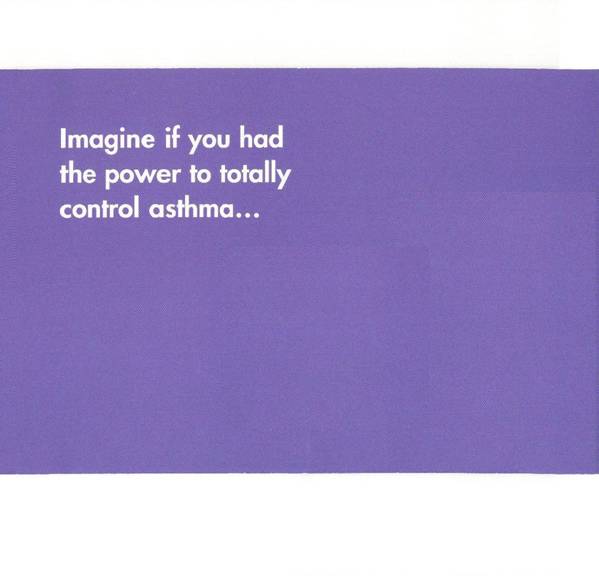

Figure 1, page 1


Figure 1, page 2
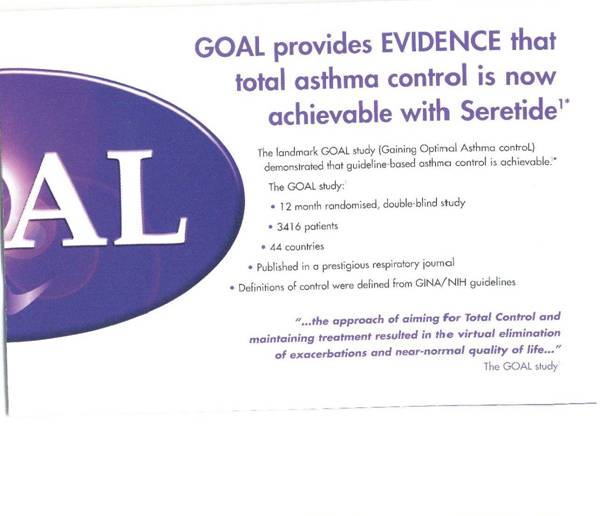

Figure 1, page 3
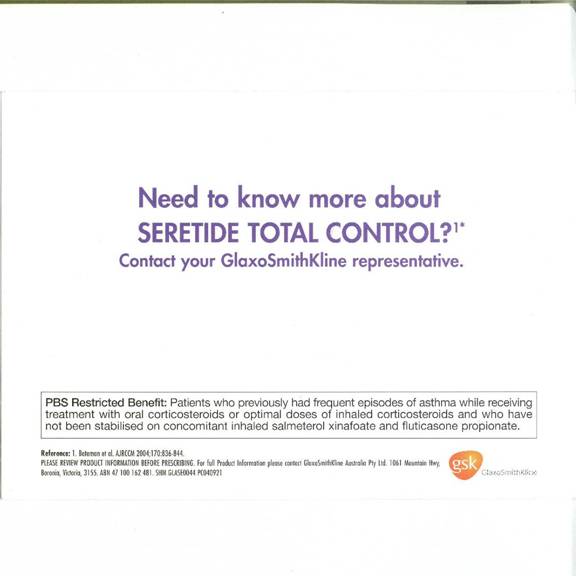
Figure 1, page 4
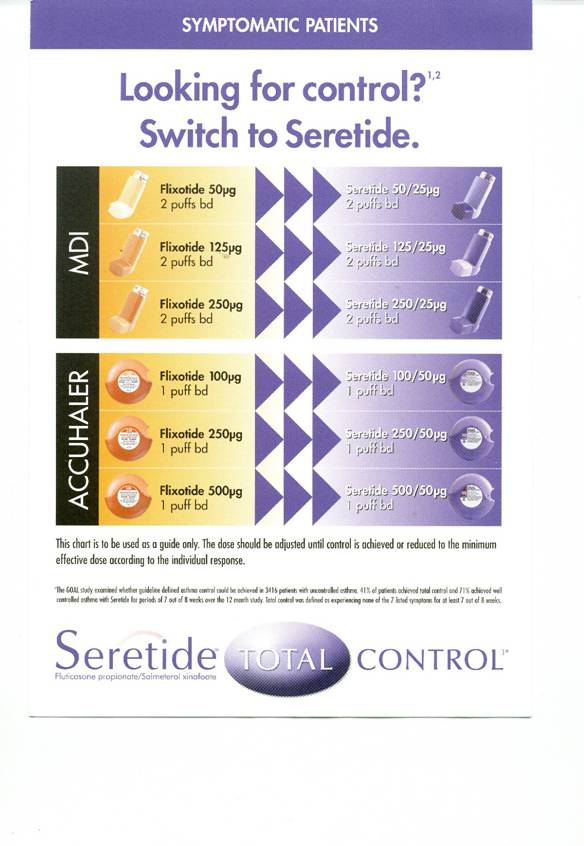
Figure 2, page 1
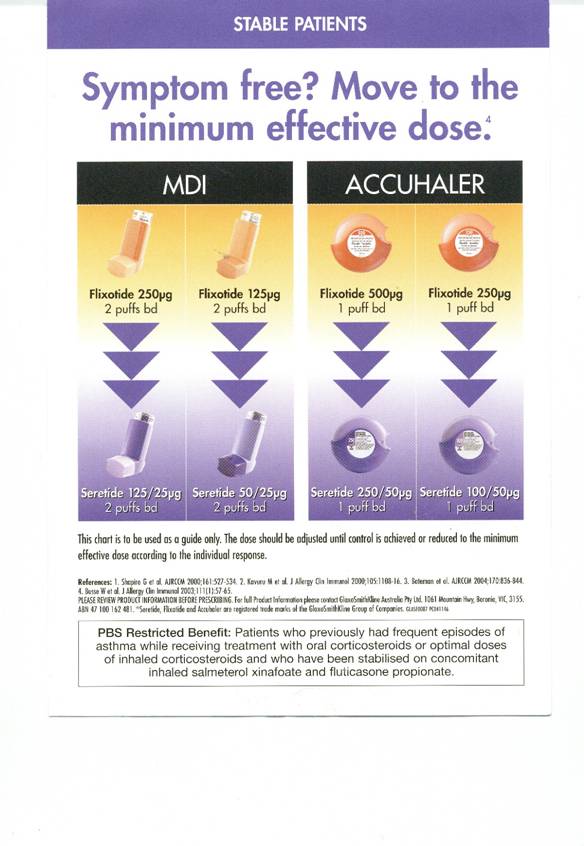
Figure 2, page 2
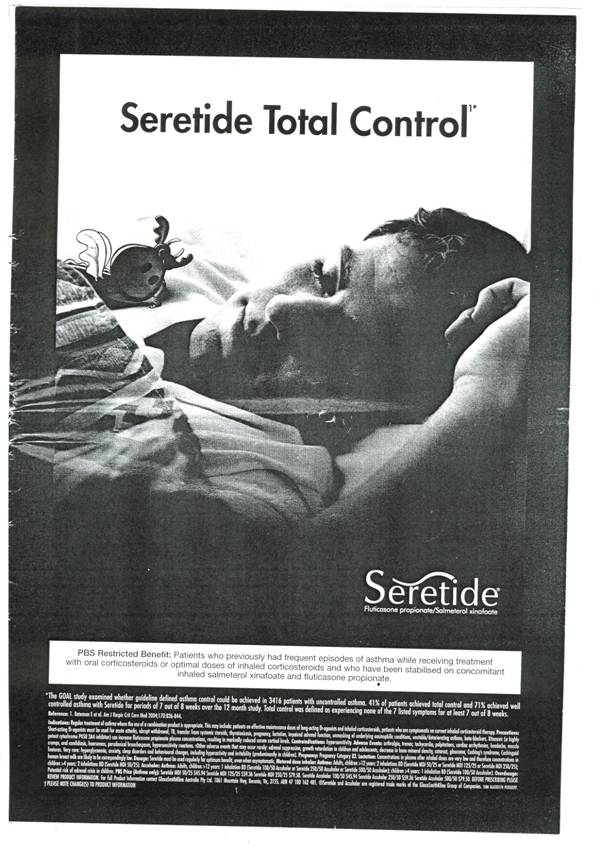
Figure 3

Figure 4
14 The other relevant facts are sufficiently set out in the primary judge’s reasons. It is unnecessary for us to record them again in these reasons.
15 In the first flyer Seretide is referred to both as ‘Seretide’ and as ‘SERETIDE TOTAL CONTROL’. In the second flyer or brochure Seretide has been referred to as ‘Seretide’ and also as ‘Seretide TOTAL CONTROL’, the word ‘TOTAL’ being printed in reverse print on an elliptical shaped background.
16 In one of the advertisements Seretide has been referred to as ‘Seretide Total Control’ and also as ‘Seretide’ with a stylised wave above the letters ‘ereti’.
17 In the other advertisement Seretide has been referred to as ‘Seretide’, as ‘SERETIDE TOTAL CONTROL’ and as ‘Seretide TOTAL CONTROL’, the word ‘TOTAL’ being again printed in reverse print on an elliptical shaped background.
18 Each of the flyers and advertisements referred to the article reporting on the GOAL study and published in the American Journal of Respiratory and Critical Care Medicine. The second flyer or brochure also referred to three other publications. Each of the flyers and advertisements also bore an endorsement in or to the following effect:
‘PLEASE REVIEW PRODUCT INFORMATION BEFORE PRESCRIBING.’
19 In each instance where the expression ‘Seretide Total Control’ has been used, in whatever form, in the flyers and advertisements an asterisk has been added directing the reader’s attention to a footnote, referred to in the submissions of Senior Counsel for the Appellant as a ‘disclaimer’ but perhaps more accurately described as an ‘elucidator’, summarising the GOAL study. In the first flyer the footnote read:
‘*The GOAL study examined whether guideline defined asthma control could be achieved in 3416 patients with uncontrolled asthma. 41% of patients achieved total control and 71% achieved well controlled asthma with Seretide for periods of 7 out of 8 weeks over the 12 month study.’
20 In the second flyer or brochure the footnote read as follows:-
‘The GOAL study examined whether guideline defined asthma control could be achieved in 3416 patients with uncontrolled asthma. 41% of patients achieved total control and 71% achieved well controlled asthma with Seretide for periods of 7 out of 8 weeks over the 12 month study. Total control was defined as experiencing none of the 7 listed symptoms for at least 7 out of 8 weeks.’
21 In one of the advertisements the footnote was in the same terms as on the second flyer and in the other advertisement the footnote read as follows:-
‘The GOAL study examined whether guideline defined asthma control could be achieved in 3416 patients with uncontrolled asthma. 41% of patients achieved total control and 71% achieved well controlled asthma with Seretide for periods of 7 out of 8 weeks over the 12 month study. Total control was defined as experiencing none of the 7 listed symptoms for at least 7 out of 8 weeks. Well controlled asthma was defined as achieving at least 2 of the

22 The significance of footnotes to which attention may be drawn by asterisks on documents such as those with which the Court is presently concerned will depend upon the material in question and the surrounding circumstances in each individual case. Having said that it is useful to refer to the observations of Stone J in Medical Benefits Fund of Australia Limited v Cassidy (2004) 205 ALR 402 at [36]-[37], with which Moore and Mansfield JJ agreed as follows:-
‘In … George Weston Foods Limited v Goodman Fielder Ltd (2000)49 IPR 553 (Wonder White case) … Moore J held that an asterisk can be sufficient to draw the attention of a consumer to a qualification of a representation. That case concerned, inter alia, the packaging of bread which declared in large typeface “Now Twice the Fibre*”. Moore J observed (at 571-2) that:
… the asterisk is prominent and would be taken to signify some qualification or explanation of the words used. One could expect a consumer interested in the fibre content to seek out the qualification or explanation. Not only is the explanation within 2 cm of the words used on the package (albeit in much smaller type) but it is repeated elsewhere on the packaging.
While the Wonder White Case is authority that an asterisk leading to a qualification of a representation may be effective to neutralise an otherwise misleading or deceptive advertisement, whether this is so is a matter for determination in the specific circumstances of any particular case. The qualifying material must be sufficiently prominent to prevent the primary statement being misleading and deceptive or likely to mislead or deceive: Australian Competition and Consumer Commission v Signature Security Group Pty Ltd (2003) ATPR 41-908 at [26]-[27].’
23 Of course an asterisk may draw attention to material which is not of a qualifying nature.
24 We have carefully considered each of the flyers and advertisements in their entirety, focusing our attention on their content and their presentation and also on the circumstances in which they were distributed and /or published. Without detracting from the generality of that exercise we would draw attention to the following in respect of the first flyer. It commenced on page 1 with the words:
‘Imagine if you had the power to totally control asthma …’.
On page 2 the message continued:
‘Now you can achieve that goal with SERETIDE TOTAL CONTROL1*’.
On page 3 the message continued:
‘GOAL provides EVIDENCE that total asthma control is now achievable with Seretide 1*’.
On page 4 that message concluded:
‘Need to know more about
SERETIDE TOTAL CONTROL? 1*
Contact your GlaxoSmithKline representative.’
25 On page 2 of the first flyer the question is asked ‘What is SERETIDE TOTAL CONTROL? 1*’ That question is answered by reference to the footnote as set out in [19] and in four bullet points coupled with a note as follows:-
‘●Freedom from asthma symptoms
●Freedom from exacerbations
●Freedom from night-time awakenings
●Freedom from reliever use’
(4 out of 7 criteria defining Total Control based on the GOAL study, sustained for 7 out of 8 weeks)’
26 On page 3 of the flyer the observation that ‘asthma control is achievable’ was repeated in the statement:
‘The landmark GOAL study (Gaining Optimal Asthma controL) demonstrated that guideline-based asthma control is achievable.1*’
27 The second flyer or brochure was primarily concerned with suggesting appropriate dosages for symptomatic patients and stable patients, contrasting Seretide with Flixotide in this regard. The only additional material on the page headed ‘SYMPTOMATIC PATIENTS’ was the message:
‘Looking for control?1, 2
Switch to Seretide.’
On the page headed ‘STABLE PATIENTS’ the message was
‘Symptom free? Move to the minimum effective dose.4’
The publications referred to by the numbers ‘1’, ‘2’ and ‘4’ were identified under the note ‘References’ (see Figure 2).
28 One of the advertisements used a depiction of a sleeping man to promote, with some subtlety, Seretide’s worth. At the bottom of the advertisement detailed technical information is provided against the headings ‘Indications’, ‘Precautions’, ‘Contraindications’, ‘Adverse Events’, ‘Pregnancy’, ‘Lactation’, ‘Metered dose inhaler: Asthma’, ‘Accuhaler: Asthma’, ‘Overdosage’ and ‘PBS Price (Asthma only)’, none of which seem to be of particular relevance for present purposes.
29 The other advertisement carried the message:
‘Could your
Flixotide patients
do with
an upgrade?’
This question was answered:
‘According to the recent Gaining Optimal Asthma controL (GOAL) study, more asthma patients were able to achieve totally or well controlled asthma using the combination inhaler Seretide, than by using Flixotide alone. So next time you’re reviewing your inhaled corticosteroid monotherapy patients consider introducing them to SERETIDE TOTAL CONTROL.1* ‘
At the bottom of this advertisement the same detailed technical information as was included in the ‘sleeping man’ advertisement was recorded.
30 In coming to a consideration of the flyers and advertisements on the hearing of the present appeal Senior Counsel for the Appellant urged the Court to have regard to the powers and functions of an appellate court as summarised in the joint judgment of Gleeson CJ, Gummow and Kirby JJ in Fox v Percy (‘Fox v Percy’) (2003) 214 CLR 118 at [20] – [31], which were referred to in the recent decision of the High Court in CSR Limited v Della Maddalena (‘Maddalena’) [2006] HCA 1.
31 We recognise that an appeal from a judgment of this Court constituted by a single judge under s 24(1) of the Federal Court of Australia Act 1976 (Cth) is an appeal by way of rehearing (per Gleeson CJ and Gummow J in Minister for Immigration & Multicultural Affairs v Jia Legeng (2001) 205 CLR 507 at [75] and per Hayne J at [176]).
32 In Maddalena Kirby J said at [16]:-
‘The form of rehearing … “shapes the requirements, and limitations, of such an appeal” [referring to Fox v Percy where the appeal was one to which s 75A(5), (6), (7), (8) and (10) of the Supreme Court Act 1970 (NSW) applied]. The relevant “requirements” are that the appellate court is obliged to conduct a thorough examination of the record and a real rehearing. It is not confined to reconsideration of the record in order to correct errors of law, although that will certainly be encompassed in such an appeal. It is required to consider suggested errors of fact-finding. Experience teaches that many errors of this kind arise at first instance, more perhaps than errors of law. Having conducted a rehearing as so described, the appellate court is obliged to “give the judgment which in its opinion ought to have been given in the first instance”. This involves, where, as here, there is no jury, conducting a thorough review of the primary judge’s reasons and engaging in the tasks of “weighing conflicting evidence and drawing … inferences and conclusions”.’
(footnotes omitted)
See also Fox v Percy at [25] and [29]
33 For s 52 of the Act to be enlivened it is sufficient that the conduct complained of, in all the circumstances, answers the statutory description, that is to say, that it is misleading or deceptive or is likely to mislead or deceive. It is unnecessary to go further and establish that any actual or potential consumer has taken or is likely to take any positive step in consequence of the misleading or deception. That is not to say that evidence of actual misleading or deception and of steps taken in consequence thereof is not likely to be both relevant and important on the question of whether the relevant conduct in fact answers the statutory description and as to the relief, if any, which should be granted (per Deane and Fitzgerald JJ in Taco Company of Australia Inc v Taco Bell Pty Limited (‘Taco Bell’)(1982) 42 ALR 177 at 199).
34 In order to determine whether there has been any contravention of s 52(1) of the Act it is necessary to determine whether or not the conduct complained of amounted to a representation which has or would be likely to lead to a misconception arising in the minds of that section of the public to whom the conduct (which may include refraining from doing an act) has been directed. Where the persons to whom the conduct has been directed are members of a class, it is necessary to isolate by some criterion a representative member of that class to determine whether a misconception is likely to arise from the conduct alleged (see the judgment of the Full Court of the High Court in Campomar Sociedad, Limitada v Nike International Limited (‘Campomar’)(2000) 202 CLR 45 at [98]-[103]).
35 In the instant case, such representations as may have been made by the Respondent in the flyers and the advertisements were not made to identified individuals, nor were they made to the public at large.
36 In Taco Bell at 200, Deane and Fitzgerald JJ emphasised that ‘no conduct can mislead or deceive unless the representee labours under some erroneous assumption’ (cited with approval in Campomar at [104]).
37 The task of the Court is to determine whether any misconceptions or deceptions alleged to arise or to be likely to arise from the conduct complained of are properly to be attributed to the ordinary or reasonable members of the section of the community towards whom the conduct has been directed. The Court may disregard assumptions drawn by persons to whom the conduct is directed, where those assumptions or their reactions are extreme or fanciful (see Campomar at [104]-[105]).
38 Conduct which produces or contributes to confusion or uncertainty may or may not be misleading or deceptive for the purposes of s 52. Ordinarily, a tendency to cause confusion or uncertainty will not suffice to establish conduct of the type described in s 52. The question whether particular conduct causes confusion or wonderment cannot be substituted for the question whether the conduct answers the statutory description contained in s 52 (per Deane and Fitzgerald JJ in Taco Bell at 201; see also Campomar at [106]).
39 The Appellant contends that the ‘key factual issue falling for determination is whether the advertisements [referring to the two flyers and the two advertisements] mislead or deceive general medical practitioners or are likely to do so’.
40 The Appellant submits that the primary judge did not approach the matter by undertaking any proper consideration and determination of the primary factual question of whether the advertisements were or were likely to be misleading and deceptive.
41 Given that this is a rehearing and that the central issue is whether any or all of the two flyers and two advertisements were misleading or deceptive or likely to mislead or deceive in contravention of s 52(1) of the Act, we find ourselves in the position where we are able to determine that issue without being concerned by the fact that we were unable to observe the demeanour the witnesses who were called to give evidence in the case.
42 Viewing each of the flyers and the advertisements as marketing documents directed by the Respondent to ordinary or reasonable members of the community of general practitioners throughout Australia in the context of the product and sales history indicated above, we are unable to find that any of them make the representations alleged in paragraphs 5(a), (b), (c) or (d) of the statement of claim as set out in [11] above.
43 In our opinion representations were not made in the terms alleged simply by the use of the words ‘Seretide Total Control’, however recorded. We are inclined to the view that ‘Seretide Total Control’ is in effect an alternative brand name adopted by the Respondent for its medication ‘Seretide’. In any event the footnotes to which one is directed and which appear in an easy to read type size on each of the original documents do not allow inferences to be drawn that representations were made to the effect alleged.
44 The first flyer which was sent to some 14,000 general practitioners throughout Australia represented that 41% of all patients taking part in the GOAL Study achieved ‘total control’ of all asthma symptoms by using Seretide, as that term was defined in the flyer, with the qualification that it only listed 4 out of 7 criteria defining Total Control based on the GOAL Study, sustained for 7 out of 8 weeks. The other flyer or brochure and the two advertisements contained a like representation by reference to the definition of ‘total control’ as included in those documents.
45 The problem for the Appellant with this particular representation is that the Appellant concedes that it is true.
46 Each of the flyers and the advertisements also represented that 71% of all patients taking part in the GOAL Study achieved ‘well controlled asthma by using Seretide for periods of 7 out of 8 weeks over the 12 month study’. Once again it was conceded by the Appellant that this representation was true.
47 Given the findings we have made, which are essentially matters of impression, bearing in mind the principles referred to above and the surrounding circumstances, the Appellant’s case alleging contraventions of s 52 of the Act as particularised in paragraphs 5(a)-(f) of the statement of claim, fails. This leaves for consideration the alleged representation referred to in paragraph 5(g) said to have been made in each of the flyers and the advertisements. In that paragraph the Appellant alleged that in each of the flyers and each of the advertisements the Respondent represented to ordinary or reasonable members of the community of general practitioners throughout Australia that ‘the patient results of the GOAL Study identified in … [relevantly paragraphs 5(e) and 5(f)]] … will be achieved or will be likely to be achieved in clinical practice’.
48 Whilst the Appellant conceded the truth of the matters represented by the flyers and the advertisements to which the 41% and 71% figures related it did so only in ‘an absolute statistical sense’. The Appellant argued that the references to the GOAL Study in each of the flyers and the advertisements were deficient in that they failed to point out that the GOAL Study did not include patients with significant concomitant diseases, smokers and patients under 12 years of age. It is quite correct to say that no mention was made of the fact that the GOAL Study did not include such patients. However, in our opinion, none of the flyers or advertisements represented that the GOAL Study patients were representative of the asthma suffering members of the community at large. The several footnotes clearly indicated that the study was based upon observations of ‘3416 patients with uncontrolled asthma’ and no more.
49 In our opinion none of the flyers or advertisements made a representation as alleged in paragraph 5(g) of the statement of claim nor did they make a representation to the effect that like results, in percentage terms, to those achieved in the GOAL Study would be achieved in the treatment of asthma patients for whom general practitioners may prescribe Seretide. What is more, no such representation was pleaded.
50 As the primary judge emphasised at [119] – [120] of his reasons, the first flyer makes a representation that asthma control is now achievable with Seretide.
51 In the circumstances the Appellant has failed to establish any contraventions of s 52 by the Respondent as alleged. As the case on appeal has been conducted solely on the basis of an alleged contravention of s 52, it is unnecessary for us to address the alternative case which was pleaded of an alleged contravention of s 53(c) of the Act.
52 Before concluding our reasons we should draw attention to the fact that the primary judge referred to the Appellant’s omission to lead evidence to the effect that general practitioners relied upon the representations said to have been made by the Respondent in prescribing medication for use by their asthma suffering patients. We would observe that the lack of such evidence would not be determinative of a case for alleged contravention of s 52 (see Annand & Thompson Pty Limited v Trade Practices Commission (1979) 25 ALR 91 to which His Honour referred indirectly through his quote from Johnson Tiles Pty Limited v Esso Australia Limited (2000) 104 FCR 564 where it was held that the section ‘does not require demonstration that anyone has actually been misled’).
53 In our opinion the appeal should be dismissed with costs.
|
I certify that the preceding fifty-three (53) numbered paragraphs are a true copy of the Reasons for Judgment herein of the Honourable Justices Wilcox, Bennett and Graham. |
Associate:
Dated: 8 March 2006
|
Counsel for the Appellant: |
T F Bathurst QC and M R Elliott |
|
|
|
|
Solicitor for the Appellant: |
Minter Ellison |
|
|
|
|
Counsel for the Respondent: |
R J Webb SC and C Dimitriadis |
|
|
|
|
Solicitor for the Respondent: |
Deacons |
|
|
|
|
Date of Hearing: |
16 February 2006 |
|
|
|
|
Date of Judgment: |
8 March 2006 |


