

FEDERAL COURT OF AUSTRALIA
Synthetic Turf Development Pty Limited v Sports Technology International Pty Limited [2005] FCAFC 270
INTELLECTUAL PROPERTY – patents – whether infringement of patent for a synthetic turf playing surface – construction of phrase ‘are crimped’ – whether claims fairly based on matter disclosed in the specification – novelty – whether appellate court should interfere with findings of primary judge – inventive step – whether open to primary judge to conclude that the invention would have been obvious to a person skilled in the relevant art.
Patents Act 1990 (Cth) ss 7, 18(1)(b), 40(3)
Elconnex Pty Ltd v Gerard Industries Pty Ltd (1992) 25 IPR 173 referred to
Firebelt Pty Ltd v Brambles Australia Ltd (2002) 188 ALR 280 cited
Fox v Percy (2003) 214 CLR 118 applied
Fresenius Medical Care Australia Pty Limited v Gambro Pty Limited [2005] FCAFC 220 cited
Kimberly-Clark Australia Pty Limited v Arico Trading International Pty Limited (2001) 207 CLR 1cited
Lockwood Security Products Pty Limited v Doric Products Pty Limited (2004) 217 CLR 274 cited
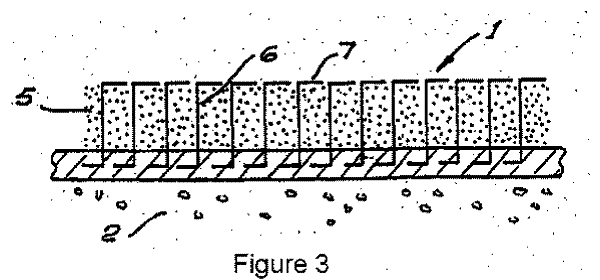
Mikasa (N.S.W.) Pty Limited v Festival Stores (1972) 127 CLR 617referred to
Minnesota Mining and Manufacturing Company v Beiersdorf (Australia) Limited (1980) 144 CLR 253 cited
Populin v HB Nominees Pty Ltd (1982) 41 ALR 471 cited
Sachtler GMBH & Co KG v RE Miller Pty Ltd (2005) 65 IPR 605referred to
SYNTHETIC TURF DEVELOPMENT PTY LIMITED v SPORTS TECHNOLOGY INTERNATIONAL PTY LIMITED
NSD 329 of 2005
BRANSON, STONE AND BENNETT JJ
23 DECEMBER 2005
SYDNEY
|
IN THE FEDERAL COURT OF AUSTRALIA |
|
|
NEW SOUTH WALES DISTRICT REGISTRY |
NSD 329 of 2005 |
ON APPEAL FROM A JUDGE OF THE FEDERAL COURT OF AUSTRALIA
|
BETWEEN: |
SYNTHETIC TURF DEVELOPMENT PTY LIMITED APPELLANT
|
|
AND: |
SPORTS TECHNOLOGY INTERNATIONAL PTY LIMITED RESPONDENT
|
|
BRANSON, STONE & BENNETT JJ |
|
|
DATE OF ORDER: |
23 DECEMBER 2005 |
|
WHERE MADE: |
SYDNEY |
THE COURT ORDERS THAT:
1. The appeal be dismissed.
2. The appellant pay the respondent’s costs.
|
IN THE FEDERAL COURT OF AUSTRALIA |
|
|
NEW SOUTH WALES DISTRICT REGISTRY |
NSD 329 of 2005 |
ON APPEAL FROM A JUDGE OF THE FEDERAL COURT OF AUSTRALIA
|
BETWEEN: |
SYNTHETIC TURF DEVELOPMENT PTY LIMITED APPELLANT
|
|
AND: |
SPORTS TECHNOLOGY INTERNATIONAL PTY LIMITED RESPONDENT
|
|
JUDGES: |
BRANSON, STONE & BENNETT JJ |
|
DATE: |
23 DECEMBER 2005 |
|
PLACE: |
SYDNEY |
REASONS FOR JUDGMENT
the court
INTRODUCTION
1 The appellant (‘Synthetic Turf’) is the patentee of Australian Standard Patent No 664427 (‘the Patent’). The Patent was assigned to Synthetic Turf by the inventor, Kingsford Ross Heylen (‘Mr Heylen’), pursuant to a deed dated 13 January 2003. It has a priority date of 10 May 1989.
2 The Patent is for an invention entitled ‘Synthetic Bowling Green’. The complete specification in final form is dated 16 March 2000. There are 24 claims in the complete specification. Some of the claims are product claims and some are method claims. The method claims have no present relevance except to the extent, if any, that they may bear on the question of the proper construction of the product claims.
3 Synthetic Turf instituted a proceeding against the respondent (‘Sports Technology’) alleging that it had infringed the Patent. Sports Technology denied infringement and cross‑claimed for declarations of invalidity in respect of nine of the product claims of the Patent.
4 By a judgment dated 11 February 2005 the primary judge dismissed the application made by Synthetic Turf and made an order revoking claims 1‑8 and 10 of the Patent on the grounds that they were not novel and did not involve an inventive step.
5 Synthetic Turf appealed from the whole of the judgment of the primary judge dated 11 February 2005. Sports Technology gave notice that it contended that the judgment of the primary judge should be affirmed on grounds other than those upon which his Honour relied.
6 This appeal was initially heard by Hill, Branson and Bennett JJ. Following the death of Hill J, the appeal was reargued before the Full Court as presently constituted. We have not found it necessary to give consideration to the notice of contention. For the reasons set out the appeal will be dismissed.
The patent
7 The complete specification reveals that the invention ‘relates to a synthetic playing surface for use in playing fields of the kind used for lawn bowls, croquet, and the like, and the preparation thereof’. The problem sought to be overcome by the invention is identified as follows:
‘… current synthetic artificial turf playing surfaces suffer from a number of inherent problems. In particular, they have been found to exhibit leading bias resistance due, in part, to the directional pile of the fibres comprising the turf and have therefore been found unsatisfactory for use as playing surfaces for lawn bowls.’
8 The specification contains a ‘consistory clause’ which outlines the principal product claim. The consistory clause is, subject to the small difference noted below, in identical terms to claim 1 of the claims defining the invention. Claim 1 reads as follows:
‘1. A playing surface comprising an artificial turf having a plurality of fibres extending generally upwardly from a backing material, said turf having particulate matter between the fibres such that each of the fibres has a buried stem and a free end protruding from the particulate matter and wherein at least 10% of the free ends are crimped at an angle to the stem so that they lie in different compass directions such that noticeable bias in any one direction is avoided.’ (emphasis added)
The words highlighted above are absent from the consistory clause.
9 For reasons which are explained below, the meaning of the phrase ‘at least 10% of the free ends are crimped’ (‘the critical phrase’) has assumed significance in this appeal. It is therefore appropriate to note the relevant Macquarie Dictionary definitions of ‘crimp’:
‘crimp
… verb (t)
1. to press into small regular folds; frill; corrugate; make wavy.
2. to curl (hair), especially with a hot iron …
3. to bend (leather) into shape …’
10 Neither party contended that the word ‘crimped’, in the context of the complete specification, involves the notion of a series of waves or bends; they were in agreement that a single fixed bend would come within the intended meaning of the word. The correctness of this approach is confirmed by a reading of the complete specification as a whole, and in particular, by reference to figure 3 in the specification which shows crimping of this nature:
11 The parties were also in agreement that the words ‘are crimped’ in the critical phrase constitute a past participle and are without temporal significance. That is, the phrase is not of itself to be understood as suggesting that the crimping is to be carried out after a particular time (cf Mikasa (N.S.W.) Pty Limited v Festival Stores (1972) 127 CLR 617 at 661 per Stephen J).
12 The main dispute between the parties as to the import of the critical phrase concerns whether, as the appellant contends, it reaches to fibres that are themselves crimped, with the result that their free ends which protrude from the particular matter are necessarily crimped. The alternative proposition, for which the respondent contends, is that the critical phrase reaches only to fibres the free ends only of which are crimped (ie the buried stems of which are not crimped).
13 In our view the contention of the respondent as to the meaning of the critical phrase should be accepted. Claims are to be read in the context of the specification, not merely when ambiguity exists in a claim. However, integers not present in the claims are not thereby added (Fresenius Medical Care Australia Pty Limited v Gambro Pty Limited [2005] FCAFC 220 at [44] (‘Fresenius’)). While the plain and unambiguous meaning of a claim cannot be varied or qualified by reference to the body of the specification, terms in the claim which are unclear may be defined or clarified by reference to the body of the specification (Kimberly‑Clark Australia Pty Limited v Arico Trading International Pty Limited (2001) 207 CLR 1 (‘Kimberley‑Clark’) at [15]). The question is what the person skilled in the art would have understood the patentee to be using the language of the claim to mean (see generally Sachtler GMBH & Co KG v RE Miller Pty Ltd (2005) 65 IPR 605 at [42]).
14 The specification as a whole confirms the natural meaning of claim 1 which is that the crimping of which the claim speaks is a crimping of the ‘free ends’ of the fibres which (otherwise) extend generally upwards from the backing material. It is the main (and by inference uncrimped) length of the fibres which constitutes the ‘stem’ at an angle to which at least 10% of the free ends are crimped.
15 Claim 1 relates to a product, that is, a playing surface comprising artificial turf of specified characteristics. The parties agreed that the Patent is directed to installers of the playing surface. If there were any doubt about or ambiguity in the meaning of the critical phrase, the installer (or other reader) would see that there is reference in the specification to the fact that the present invention is manufactured so that ‘ideally’ each fibre stands substantially vertically and the protruding free ends are crimped at an angle to the stem. The stem in that description is the vertical (ie uncrimped) fibre.
16 The specification also describes the invention as consisting of two aspects: the playing surface of claim 1 and the method of preparing the playing surface. That method refers to each fibre having ‘a buried stem and a free end protruding’ from a particulate layer. The turf is then pressed until ‘at least 10% of the protruding free ends are crimped at an angle to the stem’.
17 Additional confirmation of the above construction may be derived from a grammatical analysis of the critical phrase. As the above definition from the Macquarie Dictionary shows, ‘crimp’ is a transitive verb; it takes an object. The object of the crimping referred to in claim 1 is ‘the free end protruding from the particulate matter’. If the intended object of the crimping was the fibre, rather than the fibre’s free end, one would expect the relevant portion of the claim to read:
‘… such turf having particulate matter between the fibres such that each of the fibres has a buried stem and a free end protruding from the particulate matter and wherein at least 10% of the fibres are crimped such that the free ends lie at an angle to the stem in different compass directions.’
alleged infringement
18 Ground 1 of the notice of appeal alleges that the primary judge erred in finding that claim 1 of the Patent was not infringed by the synthetic playing surface (ie ‘Promaster’) produced by the respondent. The appellant claimed at first instance that Promaster infringed claims 1‑4, 7, 8 and 10 of the Patent. Each of these claims, other than claim 1, is ultimately dependent upon claim 1 in the sense that if Promaster does not infringe claim 1 it will equally not infringe the other claims.
19 The learned primary judge found that Promaster is manufactured from a fibre that is crimped (or ‘precrimped’) in an autoclave and thereafter tufted into a synthetic playing surface.
20 The respondent admitted on the pleadings that Promaster has ‘a plurality of fibres extending generally upwards from a backing material’. It also admitted that the fibres used in the manufacture of Promaster ‘are crimped’. However, it made no admission concerning ‘free ends’ or, more particularly, ‘free ends … crimped at an angle to the stem’.
21 There is no infringement if the wording of the claim makes it clear that the relevant area has been deliberately left outside the claim (Minnesota Mining and Manufacturing Company v Beiersdorf (Australia) Limited (1980) 144 CLR 253 at 286; Populin v HB Nominees Pty Ltd (1982) 41 ALR 471 at 476; Fresenius at [49]–[50]). In our view, on the proper construction of the complete specification, Promaster does not infringe claim 1 of the Patent nor any of the claims that are dependent on claim 1 of the Patent (ie claims 2‑4, 7, 8 and 10). None of claims 1‑4, 7, 8 or 10 includes a product made from fibres that are crimped over their entire length rather than at the fibres’ free ends.
22 Ground 1 of the notice of appeal must for this reason be dismissed.
fair basis
23 Ground 2 of the notice of appeal alleges that the primary judge erred in finding that, if claim 1 of the Patent was to be given a construction which included a product crimped during the manufacturing process, then claim 1 would not be fairly based on the matter disclosed in the specification.
24 On the view which we take of the proper construction of claim 1 (see [13] above), ground 2 of the notice of appeal does not need to be considered. It can, however, be dealt with in brief terms.
25 Section 40(3) of the Patents Act 1990 (Cth) (‘the Act’) provides:
‘The claim or claims must be clear and succinct and fairly based on the matter described in the specification.’
26 Fair basing for the purposes of s 40(3) of the Act requires a comparison between the matter described in the specification and the claim which defines the scope of the monopoly; the claim to a product must not travel beyond the matter disclosed in the specification (Kimberly-Clark at [15]; Lockwood Security Products Pty Limited v Doric Products Pty Limited (2004) 217 CLR 274 (‘Lockwood’) at [57]). Fair basis requires a real and reasonably clear disclosure of what is then claimed (Lockwood at [69]). The question is what the body of the specification read as a whole discloses as the invention (Lockwood at [99]).
27 The specification states that:
‘It is an object of this invention to provide a playing surface comprising an artificial turf and a method of preparing the playing surface which ameliorates at least some of these deficiencies of the prior art …
Any conventional artificial turf having a plurality of fibres tufted or woven to a backing material and extending generally upwardly therefrom is suitable for use in the present invention …
Ideally the artificial turf used in the practice of the present invention is manufactured so that each fibre stands substantially vertical.’ (references to figures omitted)
28 The reason why artificial turf used in the practice of the invention ideally has fibres that stand ‘substantially vertical’ is that the only method of crimping referred to in the specification is by rolling the playing surface after particulate matter has been placed between the fibres leaving free ends protruding above the particulate matter. The specification does not envisage or disclose a playing surface comprising an artificial turf made from pre‑crimped fibres.
29 If claim 1 is construed in the way which we consider appropriate (see [13] above) it does not travel beyond the matter disclosed in the specification. However, were it to be construed to include a playing surface comprising an artificial turf manufactured from pre‑crimped fibres, it would travel beyond the matter described in the specification. So construed the claim would not be fairly based on the matter disclosed in the specification.
novelty
30 Grounds 3 and 4 of the notice of appeal complain of the primary judge’s findings that the invention described in the Patent was not novel by reference to synthetic playing surfaces installed at two separate bowling clubs, namely Sydney City Bowling Club in New South Wales (‘City Bowling Club’) and Port Germein Bowling Club in South Australia (‘Port Germein’). In each case the ground asserts that the primary judge ought to have rejected oral evidence that his Honour in fact accepted.
31 In Fox v Percy (2003) 214 CLR 118 the High Court restated the principles that govern the exercise of the powers and functions of an appellate court conducting an appeal by way of rehearing. Gleeson CJ, Gummow and Kirby JJ at 127-128 identified the dichotomy between the obligations arising from the duty to conduct the appeal by way of rehearing and the restraints appropriate to be exercised by reason of the advantages of trial judges – especially where the credibility of witnesses is concerned. In subsequent paragraphs their Honours make it plain that an appellate court is not free to ignore its statutory duty to conduct a rehearing by ‘ritual incantation’ concerning witness credibility. Nonetheless their Honours gave no support to the notion that an appellate court should feel free readily to interfere with the findings of a trial judge based on his or her assessment of the respective credibility of witnesses. They spoke in terms of a trial finding being ‘glaringly improbable’ or ‘contrary to compelling inferences’ before appellate interference was justified. It is not necessary for a trial judge to make explicit reference in the reasons for judgment to every piece of evidence that might be thought to be inconsistent with the assessment of credibility made by the trial judge.
City Bowling Club
32 The respondent adduced evidence from John Kenneth Rooks (‘Mr Rooks’) about a synthetic playing field installed at the City Bowling Club before 10 May 1989 (ie the priority date). It is not in dispute that Mr Rooks was involved in the design and installation of this surface in 1987. The installation was undertaken by Supergrasse Pty Limited (‘Supergrasse’).
33 Mr Rooks swore his first affidavit before he was shown the Patent. In a later affidavit he said that he had not been aware of the nature or contents of the Patent when he swore his first affidavit. Mr Rooks’ first affidavit includes the following paragraphs:
‘28 In the case of the surface installed at the City Bowling Club and similar surfaces referred to below, this aim (non‑directionality) was achieved prior to 10 May 1989 by:
28.1 using straight pile product (that is, one in which the ribbons or fibres protruded essentially vertically from the backing material, in the product as supplied) with a pile height in the order of 25 mm;
28.2 filling the infill so as to leave a finished exposure, ready to roll, in the orders of about 3 to 5 mm;
28.3 choosing a relatively fine gauge (finer than that used for other sporting surfaces such as tennis and hockey); and
28.4 ensuring that the exposed pile was not biased in any one direction.
29. The feature in paragraph 28.4 above was achieved by rolling and grooming (brushing) the surface thoroughly on installation so as to flatten the exposed ribbons or fibres along the top of the infill. This required rolling in different directions, so that the ribbons or fibres were not all bent in the same direction. A standard ride‑on lawn bowls roller (as used on natural grass greens) was used for this purpose. It was necessary to roll and groom the surface daily for a period of approximately 3 months following installation in order to achieve this.
30. The end result of this rolling and grooming regime was that the exposed ends of the ribbons or fibres were essentially flattened horizontally along the top of the infill randomly or in differing directions. This achieved the aim of non‑directionality in the playing surface. It also locked in the infill underneath the flattened pile.’
34 Under cross‑examination it was put to Mr Rooks that at the City Bowling Club the sand infill was maintained at a very high level such that only about 1 mm of fibre tip was exposed above the sand. Mr Rooks disagreed. It was further put to him that to maintain a true and even draw on the green it was ensured that the fibre tips stood straight up. Mr Rooks expressed his total disagreement. He also disagreed with the suggestion that the fibre tips at the City Bowling Club sprang straight up after rolling. Mr Rooks further denied that crimping of fibres by rolling was not achievable before 10 May 1989 by simple rolling (ie without the application of heat).
35 William Alexander Victory West (‘Mr West’) was the Honorary Secretary of the City Bowling Club from 1983 to 1988. He gave evidence for the appellant. Mr West gave affidavit evidence that he was present when synthetic turf was installed at the City Bowling Club in late 1986. He said that the tips of the turf were supported by sand and were brushed to stand up straight. Under cross‑examination Mr West denied that the synthetic turf was rolled a lot; he said that it was rolled when parts of the green had been disturbed by heel marks and needed to be straightened. He further denied that the tips of the turf were flattened; he said that sand fill was used so that only about a millimetre of tip stood above the sand. He claimed that ‘non‑directionality’ was achieved by brushing rather than rolling.
36 The primary judge preferred the evidence of Mr Rooks to that of Mr West on critical issues. His Honour concluded that Mr Rooks was a careful witness who was doing his best to assist the Court. By contrast his Honour did not find Mr West to be a helpful witness. His Honour considered that during cross‑examination Mr West had a tendency to try to deflect questions by responding with his own questions. His Honour also noted what he described as a ‘serious discrepancy’ in Mr West’s recollection concerning whether the City Bowling Club green was rolled.
37 The appellant has pointed to certain evidence that tended to support Mr West’s evidence rather than Mr Rooks’ evidence. It placed particular reliance on the following evidence. First, the evidence of Mr Heylen, the inventor, who claimed to have visited the City Bowling Club three times in 1987. He said that the green was very sandy and that the sand seemed to have evened out the surface. However, the primary judge preferred the evidence of Mr Rooks to that of Mr Heylen. His Honour concluded that Mr Heylen’s evidence lacked candour and objectivity and was highly argumentative.
38 The appellant pointed to evidence given by Edward Ireneusz Kosior (‘Mr Kosior’), an expert called by the appellant. Mr Kosior expressed the opinion that the rolling of the synthetic turf at City Bowling Club would have had a minor effect since the fibres resist deformation and would have sprung back to their original direction after the roller had passed. While his Honour found that Mr Kosior had weighty qualifications, he concluded that his evidence was given in general terms and included acceptance of the proposition that, depending on the sort of material used, fibres could be crimped. His Honour’s conclusion concerning Mr Kosior’s evidence was plainly based on Mr Kosior’s cross‑examination during which he agreed that his opinion, as expressed in his report, was a generalisation and was not based on his own experience or observations.
39 The appellant also placed weight on the fact that, shortly after the installation of the synthetic turf at the City Bowling Club, Supergrasse applied for a patent for a synthetic turf surface adapted to the playing of sports. The invention the subject of the application was based on the discovery that if alternating rows (or groups of rows) of the pile are formed from yarn having opposite twist the tendency for the pile to lean in a particular direction is substantially reduced. The failure of the primary judge to place weight on this patent application is, in our view, understandable. Nothing in the complete specification for this invention is incompatible with Mr Rooks’ evidence concerning the surface installed at the City Bowling Club.
40 Additionally, the appellant placed reliance on a booklet provided by Supergrasse to its agents after the installation of the artificial turf at the City Bowling Club. It seems to us that this document is equivocal so far as the appellant’s case is concerned. The appellant relied on a passage under the heading ‘Sanding Procedures’ which contains a note as follows:
‘There is a minor pile lean which can be eliminated entirely by brushing in the sand against the direction of the lean. Leave the H1 sand down 5 mm from the top of the pile and spread 10 tonnes of green sand over the top leaving 3 mm of pile exposed at the top.’
41 However, the booklet also contains a diagram showing an ‘edge detail’. This diagram shows a flattened, or crimped, turf some distance back from the edge board of the playing field. Additionally it contains an instruction under the heading ‘Green Sand In Fill’:
‘Using brush mower and catcher shave off a layer of sand – re roll. Keep repeating until surface has a uniform appearance in colour and tips of turf are bent over.’ (emphasis added)
42 We do not accept that, having regard to the whole of the evidence before the primary judge, his Honour’s findings concerning the synthetic surface installed at the City Bowling Club in 1987 were ‘glaringly improbable’, ‘contrary to compelling inferences’ or for any other reason, findings with which this appellate Court should interfere.
Port Germein
43 The respondent adduced evidence from Brian Edward Williams (‘Mr Williams’) concerning the installation of a synthetic turf bowling green by A E Williams & Sons at Port Germein. Mr Williams was formerly a director of A E Williams & Sons, a family business that installed synthetic turf. Mr Williams’ affidavit evidence included the following paragraphs:
‘10. The first involvement I had with the construction and installation of a synthetic turf bowling green was when A E Williams installed an Evergreen synthetic turf surface at the Port Germein Bowling Club at First Street, Port Germein in South Australia in November 1988. I personally installed this surface at Port Germein …
12. The surface installed at the Port Germein Bowling Club had the following features:
12.1 The product used was a fibrillated polypropylene fibre product, consisting of fibres of polypropylene woven into a layer of backing material. It was a straight fibre product in that, prior to installation of the turf, the fibres were more or less straight and protruded more or less vertically from the backing material.
12.2 It had a pile height of 25 mm. That is, the height of the fibres above the backing material was 25 mm prior to installation.
12.3 It had a sand infill. That is, a layer of fine grade sand was spread across the surface, in between the fibres. The sand was filled to a depth of about 20 mm on installation, leaving about 5 mm of the pile exposed. This was referred to as an “exposure” of 5 mm in the industry.
12.4 Once the installation was complete, the exposed tips of the fibres were flattened horizontally on the top of the infill layer, and were oriented in different directions over the surface of the infill. This was achieved by rolling the surface thoroughly in the manner described below, after the spreading of the infill. One this was done, essentially all of the tips of the fibres were bent and flattened in a horizontal or nearly horizontal fashion, and oriented in different direction along the top of the infill …
16. This installation process was completed well prior to 10 May 1989 in the case of the surface at the Port Germein Bowling Club. I inspected the surface following the completion of the process, prior to 10 May 1989, and can confirm that it had the features set out in paragraph 12 above at that time. The surface was in use by members and patrons of the club at that time, and its features were able to be observed upon inspection by any person with a basic knowledge of synthetic turf. The surface received a degree of publicity as the first Evergreen surface installed for lawn bowls.’
44 The appellant contended that the weight of the evidence contradicted Mr Williams’ evidence that at Port Germein sand was spread in between the fibres of the synthetic turf leaving about 5 mm of the pile exposed. The appellant drew attention to evidence adduced from its witnesses which suggested that other synthetic turf bowling greens laid by Mr Williams’ business were filled with sand to a level close to the top of the fibre tips and that the tips were not bent by rolling. Further, the appellant placed weight on a document annexed to Mr Williams’ affidavit which was headed ‘Evergreen Village Green Bowling System Guidelines for Maintenance’. This document stated that the sand level should be ‘approx 1.5‑2 mm below the surface’. Mr Williams gave oral evidence that the reference in the document to ‘1.5‑2 mm’ was not relevant to a full size bowling green but only to a smaller retirement village bowling green. His Honour accepted that evidence.
45 We are not satisfied that his Honour erred in accepting Mr Williams’ evidence. The Patent itself implicitly asserts that a synthetic turf fibre can be bent by multi‑directional rolling with an unheated roller. The evidence suggested that the sand in‑fill of a synthetic turf surface would settle over time. We note also that the document that provided guidelines for maintenance of the Evergreen Village Green Bowling System contained a recommendation that during the settling down period of the green it be rolled ‘in all directions (including diagonal[ly]) for a period of up to 200 hours’.
46 We are also not satisfied that his Honour failed to consider when the Port Germein surface possessed the integers of the claims. It seems to us that his Honour was satisfied on the basis of Mr Williams’ evidence (see [43] above) that the Port Germein surface possessed the integers of the claims prior to 10 May 1989. The opposite conclusion is not, in our view, compelled by the absence of evidence that Mr Williams examined the turf ‘on his hands and knees’.
47 The findings made by the primary judge concerning the Port Germein synthetic turf bowling green were, in our view, reasonably open and, being significantly dependent on credibility findings, should not be interfered with on appeal.
48 The appellant submitted that the weight of the evidence was not sufficient to discharge the onus necessary to establish prior public use for the purposes of s 18(1)(b) and s 7(1) of the Act. That challenge was based upon his Honour’s acceptance of the evidence of Mr Rooks and Mr Williams. That attack fails.
49 In it supplementary submissions, filed prior to the reconvened hearing of this appeal, the appellant submitted that the primary judge had failed to make a finding that the result required of one of the integers, ‘the result of integer (4)’, of claim 1 was present in each of the City Bowling Club and Port Germein greens, namely that the particular configuration required of the playing surface had been achieved by the priority date.
50 At the first hearing of the appeal, the appellant conceded that, if Mr Rooks’ evidence was accepted by the primary judge, then it followed that claim 1 was anticipated. It is now said that this challenge does not depend upon the challenges to his Honour’s conclusions of fact. If that is the case, we do not see that this is a ground raised in grounds 3 or 4 of the notice of appeal, which challenge factual findings made by his Honour. His Honour said at [205] that his acceptance of the evidence of Mr Rooks and Mr Williams leads to the result that all of the integers of claim 1 were present, including ‘the result of integer (4)’. His Honour did not fail to make a finding that each of the integers was present.
Claim 3
51 The appellant specifically submitted that the primary judge erred in concluding that claim 3 was not novel. Claim 3 is, in effect, a playing surface according to claim 1 ‘wherein the free end protruding from the particulate matter is from five to seven millimetres long’.
52 As mentioned above, his Honour accepted Mr Rooks’ evidence that the finished exposure of the pile of the City Bowling Club surface was ‘about 3 to 5 mm’. Similarly, his Honour accepted Mr Williams’ evidence that ‘about 5 mm of the pile’ of the Port Germein surface was exposed. As mentioned above, it is not appropriate to interfere with these findings. They constitute findings that the lower end of the range of exposure or protrusion of free ends claimed in claim 3 is not new. For this reason claim 3 lacks novelty.
Conclusion
53 Grounds 3 and 4 of the notice of appeal also fail.
inventive step
54 Grounds 5 and 6 of the notice of appeal complain of the primary judge’s finding that the invention did not involve an inventive step.
55 To be a patentable invention, the invention as claimed must, when compared with the prior art base as it existed before the priority date of that claim, involve an inventive step (s 18(1)(b)(ii) of the Act). Section 7(2) of the Act provides as follows:
‘For the purposes of this Act, an invention is to be taken to involve an inventive step when compared with the prior art base unless the invention would have been obvious to a person skilled in the relevant art in the light of the common general knowledge as it existed in the patent area before the priority date of the relevant claim, whether that knowledge is considered separately or together with the information mentioned in subsection (3).’
56 The terms of s 7(2) of the Act reveal that the onus of establishing the absence of an inventive step rests on the party challenging validity (Firebelt Pty Ltd v Brambles Australia Ltd (2002) 188 ALR 280 (‘Firebelt’) at 287).
57 It was common ground on appeal that the type of ‘person skilled in the relevant art’ to whom the invention would have to be obvious for the purpose of determining whether the invention involved an inventive step was a non‑inventive skilled artificial turf installer.
58 We remind ourselves that as Sheppard J observed in Elconnex Pty Ltd v Gerard Industries Pty Ltd (1992) 25 IPR 173 at 193‑194:
‘Questions of obviousness are frequently difficult because it is very easy to fall into the trap of using hindsight. Once an innovation which is useful comes on to the market, there is an inclination not only for lawyers but also for those in the relevant industry to treat it as the norm and as something which might have been easily thought of by any reasonably competent worker in the industry.’
59 The respondent placed reliance, so far as obviousness is concerned, on the evidence of Messrs Heylen, Rooks and Williams. Mr Heylen was the inventor of the invention the subject of the Patent. He was thus not an independent witness. However, his claimed capacity to invent did not render his evidence concerning common general knowledge in the patent area inadmissible. In Firebelt at 292 the High Court approved the following observation made by the primary judge in that matter:
‘It is true that Mr Ahrens considers himself to be an inventor, but that of itself cannot disqualify him from giving evidence as to obviousness. To describe oneself as an inventor is merely to say something about one's capacity to identify and solve a problem. The line between a competent technician, able to solve problems on the basis of an established state of knowledge in his or her industry and an inventor will not always be easily discerned. Further, a person who is an inventor may well also perform non-inventive work.’
60 The primary judge in this case rightly concluded that if there were any inventiveness in the invention the subject of the Patent, it lay in the solution proposed to the problem of leading bias resistance in synthetic turf, not in the identification of the problem. His Honour thus turned to consider whether the idea of rolling synthetic turf to which particulate matter has been added in multiple directions to overcome leading bias resistance would have been obvious to a non‑inventive skilled worker as at the priority date.
61 His Honour concluded that the idea of rolling synthetic turf in multiple directions was apparent to Mr Heylen in 1987. His Honour did not accept Mr Heylen’s evidence that the rolling undertaken by him or at his direction in 1987 did not work. His Honour found that the body of the specification suggests otherwise. That alone, however, without further explanation does not establish obviousness of the invention as claimed in claim 1 and dependent claims.
62 The primary judge concluded that the solution of rolling synthetic turf to which sand had been added in multiple directions so as to ensure that the flattened pile did not all lie in one direction and that the surface played in a non‑directional manner was apparent to both Mr Rooks and Mr Williams before the priority date because they each gave evidence of rolling of that kind being undertaken ahead of the priority date. His Honour noted that three experienced bowlers gave evidence ‘to the same effect’. It seems that his Honour thereby meant that the three experienced bowlers gave evidence supportive of Mr Williams’ evidence that he (ie Mr Williams) had recommended multi‑directional rolling of artificial turf on bowling greens before the priority date.
63 Each of Messrs Heylen, Rooks and Williams was a person skilled in the art of artificial turf installation. His Honour’s findings support a conclusion that the idea of rolling in multiple directions synthetic turf to which sand has been added so as to leave approximately 3 to 5 mm of the fibres exposed to overcome leading bias resistance was known to each of them before the priority date.
64 It is not disputed by the parties that the matters set out in the part of the specification describing the background of the art and the asserted problem formed part of common general knowledge in Australia. The primary judge concluded that ‘the problem identified in the body of the specification, namely leading bias resistance due, in part, to directional pile, must be taken have been part of the common general knowledge as at 10 May 1989’. His Honour also cited the evidence of Mr Rooks and Mr Williams in support of the conclusion that the problem of directional pile was well known prior to 10 May 1989. That finding is not challenged.
65 His Honour did not go on to give explicit consideration to whether what Mr Rooks and Mr Williams had done had become part of the common general knowledge of synthetic turf installers in Australia before the priority date. Nor did his Honour give an explanation of how the action of rolling in different directions to achieve a surface that played in a non‑directional manner led to the conclusion that the invention as claimed in claim 1 (ie the combination of the specified essential integers) was obvious. Nonetheless we conclude that it was open to his Honour to infer from the whole of the evidence, and we conclude that he did so infer, that the solution of rolling synthetic turf in the way undertaken by Messrs Heylen, Rooks and Williams would have been obvious to a person skilled in the relevant art in the light of common general knowledge as it existed in the patent area before the priority date. Additionally, Mr Rooks gave evidence that the technique used to achieve the playing surface of the City Bowling Club was publicised to the agents of Supergrasse and had become ‘generally known to those working in the industry prior to 10 May 1989’.
66 For the above reasons we conclude that no error has been demonstrated in the conclusion of the primary judge that the invention as claimed by claim 1 did not involve an inventive step when compared with the prior art base as it existed before the priority date.
67 The same must necessarily be said of claim 3. Even if the City Bowling Club surface had ‘free ends’ that fell slightly below the range of 5 to 7 mm, the evidence did not support a finding that there was an inventive step in slightly increasing their length. Indeed, the inventive step relied upon by the appellant below was the realisation that free ends could be crimped by pressing them at elevated temperatures.
conclusion
68 The appeal will be dismissed with costs.
|
I certify that the preceding sixty-eight (68) numbered paragraphs are a true copy of the Reasons for Judgment herein of Branson, Stone and Bennett JJ. |
Associate:
Dated: 23 December 2005
|
Counsel for the Appellant: |
J M Ireland QC, S C G Burley and C L Cochrane |
|
|
|
|
Solicitor for the Appellant: |
Griffin Vincent and Truman Hoyle |
|
|
|
|
Counsel for the Respondent: |
J V Nicholas SC and C Dimitriadis |
|
|
|
|
Solicitor for the Respondent: |
Phillips Fox |
|
|
|
|
Date of Hearing: |
8 and 9 August and 2 November 2005 |
|
|
|
|
Date of Judgment: |
23 December 2005 |


