FEDERAL COURT OF AUSTRALIA
K-Aire Pty Ltd v Polyaire Pty Ltd [2003] FCAFC 310
INTELLECTUAL PROPERTY – designs – air conditioning outlet director part – validity – method or principle of construction – infringement – obvious imitation – fraudulent imitation – essential features of the design
DESIGNS – finding of fraudulent imitation where no finding of obvious imitation –relevance of findings of insubstantial differences in relation to obvious imitation when determining fraudulent imitation – insubstantial differences to disguise copying – disguise – deliberate copying – imitation – absence of novel features of the registered design in the allegedly infringing article
Designs Act 1906 (Cth) ss 4, 19, 20, 23, 25, 26, 27A, 30, 31, 32, 32B, 33, 39, 40I
Dart Industries Inc v Décor Corporation Pty Ltd (1989) 15 IPR 403 applied
Firmagroup Australia Pty Ltd v Byrne & Davidson Doors (Vic) Pty Ltd (1986) 11 FCR 415 applied
Koninklijke Philips Electronics NV v Remington Products Australia Pty Ltd (2000) 100 FCR 90 applied
L J Fisher & Company Ltd v Fabtile Industries Pty Ltd (1978) 1A IPR 565 applied
Lift Verkaufsgerate GmbH v Fischer Plastics Pty Ltd (1993) 27 IPR 187 applied
Malleys Limited v J W Tomlin Pty Limited (1961) 180 CLR 120 applied
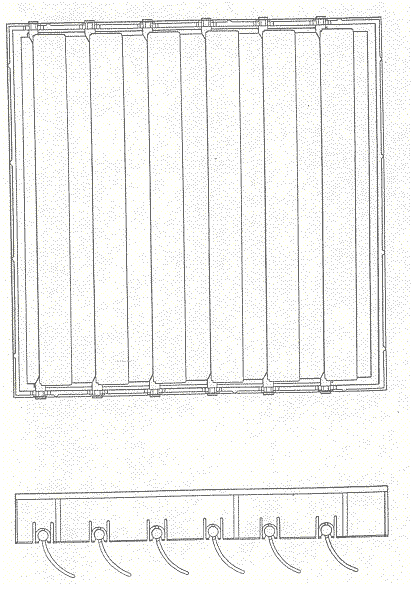
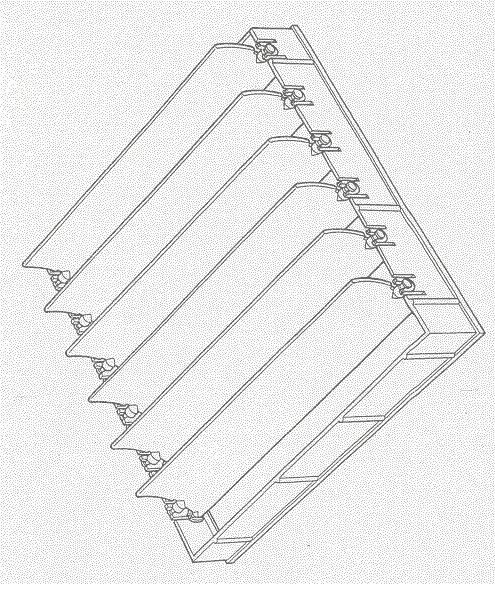
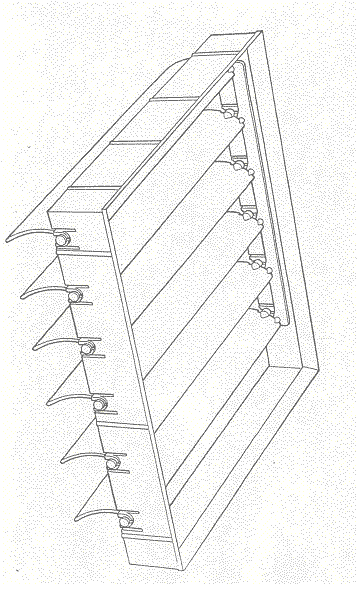
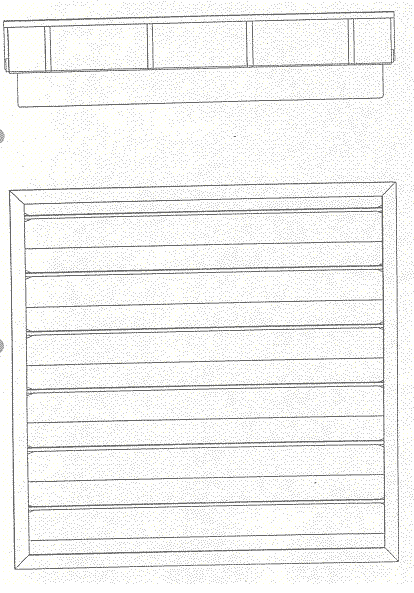
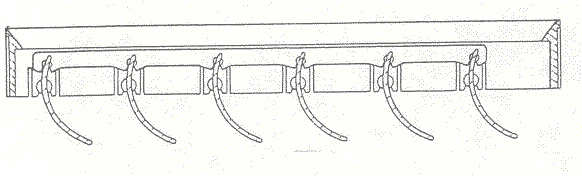
Rosedale Associated Manufacturers Ltd v Airfix Products Ltd [1956] RPC 360 cited
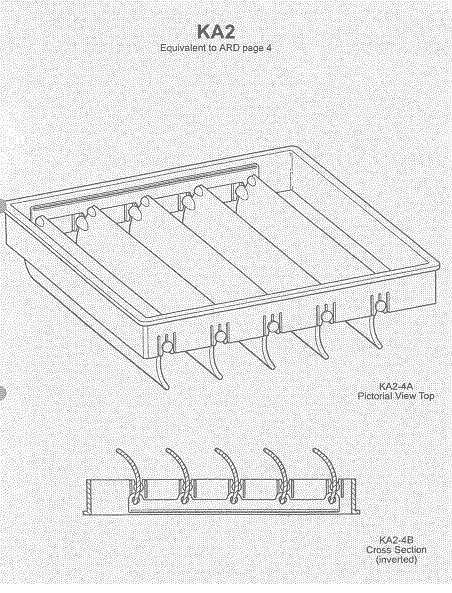
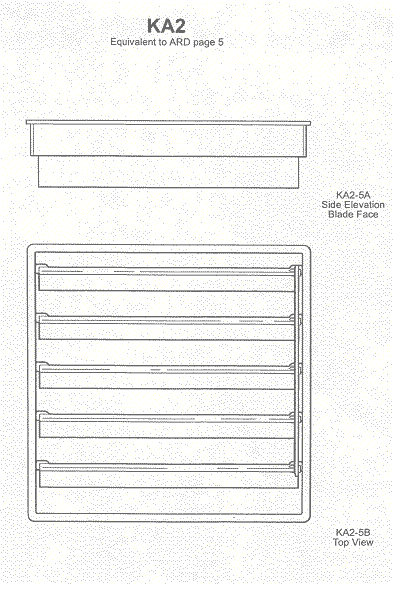
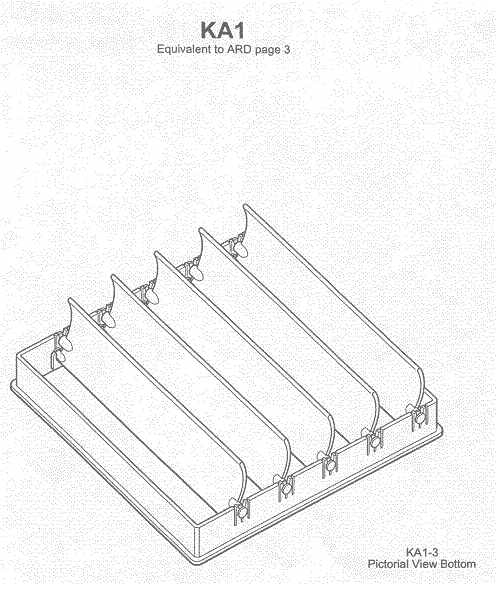
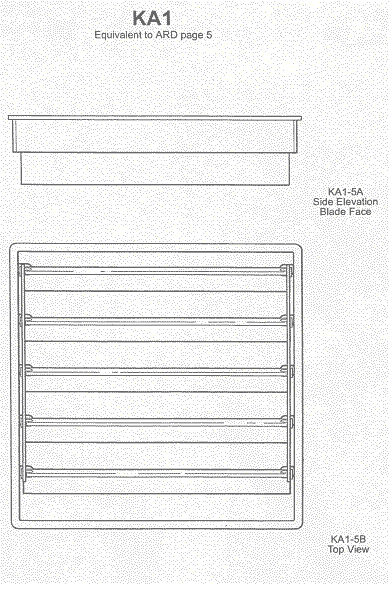
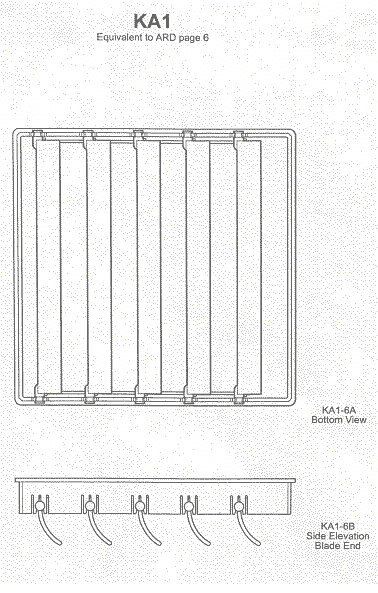
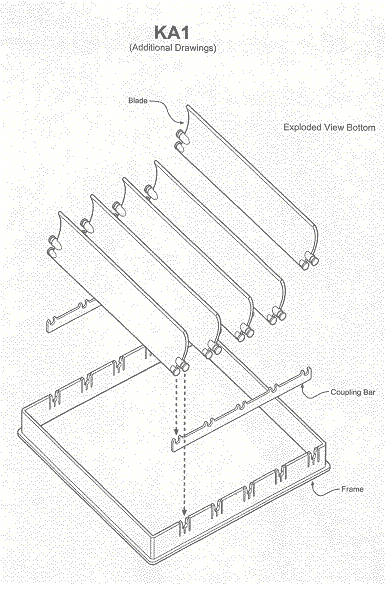
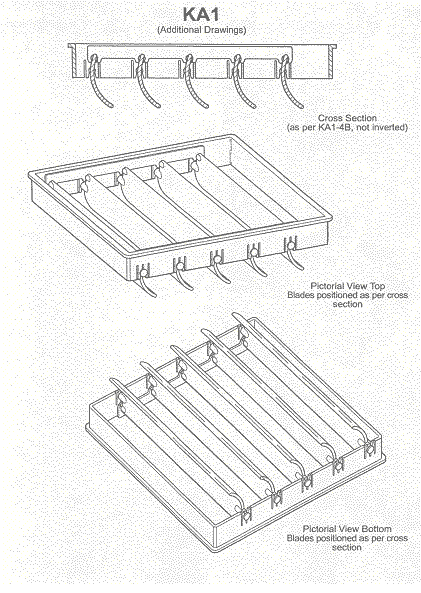
Turbo Tek Enterprises Inc v Sperling Enterprises Pty Ltd (1989) 23 FCR 331 referred to
Russell-Clarke, Copyright in Industrial Designs, Pitman, London, 1st edn, 1930
K-AIRE PTY LTD ACN 074 842 265, KEMALEX PTY LTD ACN 007 564 918,
RICHARD KEMPLEY COLEBATCH, BRUCE VICTOR BENFIELD,
K-AIRE SALES PTY LTD ACN 080 946 505, K-AIRE WHOLESALE PTY LTD
ACN 080 946 498, CONNECT AIRE PTY LTD ACN 079 795 789,
T & S MANUFACTURING PTY LTD ACN 079 795 814, ACN 079 795 814 PTY LTD V POLYAIRE PTY LTD
ACN 007 673 690
S403 OF 2003
MANSFIELD, EMMETT & BENNETT JJ
22 DECEMBER 2003
ADELAIDE
|
IN THE FEDERAL COURT OF AUSTRALIA |
|
|
SOUTH AUSTRALIA DISTRICT REGISTRY |
S403 OF 2003 |
|
BETWEEN: |
K-AIRE PTY LTD ACN 074 842 265 FIRST APPELLANT
KEMALEX PTY LTD ACN 007 564 918 SECOND APPELLANT
RICHARD KEMPLEY COLEBATCH THIRD APPELLANT
BRUCE VICTOR BENFIELD FOURTH APPELLANT
K-AIRE SALES PTY LTD ACN 080 946 505 FIFTH APPELLANT
K-AIRE WHOLESALE PTY LTD ACN 080 946 498 SIXTH APPELLANT
CONNECT AIRE PTY LTD ACN 079 795 789 SEVENTH APPELLANT
T & S MANUFACTURING PTY LTD ACN 079 795 814 EIGHTH APPELLANT
ACN 079 795 814 PTY LTD NINTH APPELLANT
|
|
AND: |
POLYAIRE PTY LTD ACN 007 673 690 RESPONDENT
|
|
JUDGES: |
MANSFIELD, EMMETT & BENNETT JJ |
|
DATE OF ORDER: |
22 DECEMBER 2003 |
|
WHERE MADE: |
ADELAIDE |
THE COURT ORDERS THAT:
1. the parties bring in short minutes of order to reflect the conclusions in the reasons for judgment.
Note: Settlement and entry of orders is dealt with in Order 36 of the Federal Court Rules.
|
IN THE FEDERAL COURT OF AUSTRALIA |
|
|
SOUTH AUSTRALIA DISTRICT REGISTRY |
S403 OF 2003 |
|
BETWEEN: |
K-AIRE PTY LTD ACN 074 842 265 FIRST APPELLANT
KEMALEX PTY LTD ACN 007 564 918 SECOND APPELLANT
RICHARD KEMPLEY COLEBATCH THIRD APPELLANT
BRUCE VICTOR BENFIELD FOURTH APPELLANT
K-AIRE SALES PTY LTD ACN 080 946 505 FIFTH APPELLANT
K-AIRE WHOLESALE PTY LTD ACN 080 946 498 SIXTH APPELLANT
CONNECT AIRE PTY LTD ACN 079 795 789 SEVENTH APPELLANT
T & S MANUFACTURING PTY LTD ACN 079 795 814 EIGHTH APPELLANT
NINTH APPELLANT
|
|
AND: |
POLYAIRE PTY LTD ACN 007 673 690 RESPONDENT
|
|
JUDGES: |
MANSFIELD, EMMETT & BENNETT JJ |
|
DATE: |
22 DECEMBER 2003 |
|
PLACE: |
ADELAIDE |
REASONS FOR JUDGMENT
1 This is an appeal from orders made by a judge of the Supreme Court of South Australia in a proceeding involving allegations of, inter alia, infringement of a design registered under the Designs Act 1906 (Cth) (‘the Act’). The respondent, Polyaire Pty Ltd (‘Polyaire’), is the owner of two registered designs under the Act, Number 84267 (‘RD1’), in respect of outlet director parts for air conditioning units, and Number 110628 (‘the Design’). The Design is also registered in respect of outlet director parts.
2 The first appellant, K-Aire Pty Ltd (‘K-Aire’), was formed to carry on the business of manufacturing and selling air conditioning ducts. The primary judge held that the Design had been infringed by the application of a fraudulent imitation of the Design to articles manufactured and sold by certain of the appellants. His Honour made orders restraining K-Aire and the other appellants, who are associated in business with K-Aire, from manufacturing or selling any article in the form of the infringing articles.
3 By counter claim filed in the proceeding, K-Aire and certain other appellants sought a declaration that the Design is invalid and an order that the register of designs kept under the Act (‘the Register’) be rectified by expunging the entry of registration of the Design. The primary judge ordered that the counter claims be dismissed. His Honour also made consequential orders for costs in relation to the proceeding.
4 His Honour did not determine Polyaire’s claims for damages or an account in respect of the infringement of the Design and, upon K-Aire and the other appellants giving undertakings to prosecute any appeal diligently, the primary judge stayed the operation of the injunctions pending the finalisation of any appeal. Since the orders made by the primary judge must be taken to be interlocutory, appeal lies only by leave. On 1 April 2003, von Doussa J made an order, by consent, that K-Aire and the other appellants have leave to appeal from the relevant orders of the primary judge.
STATUTORY FRAMEWORK
5 Section 19(1) of the Act provides that the author of a design is the owner of the design. Under s 20(1), the owner of a design is entitled to make application for the registration of that design. Section 20(4) provides that an application may be accompanied by a statement of monopoly in respect of the design to which the application relates. Under s 20(5)(a), the registrar of designs (‘the Registrar’) may request the applicant to furnish a statement of novelty. Under s 23(1), the Registrar must consider the application and, if satisfied that the design is one that may be registered under the Act and that the applicant is entitled to make the application, may register the design.
6 Under s 4(1) of the Act, the term ‘design’ means features of shape, configuration, pattern or ornamentation applicable to an article, being features that, in the finished article, can be judged by the eye. However, the term does not include a method or principle of construction. Under s 25 and s 4(1) of the Act, the owner of a registered design has a monopoly in the design, being the exclusive right to apply the registered design to an article in respect of which the design is so registered.
7 Under s 26(1), if the Registrar decides to register a design, there must be entered in the Register the prescribed particulars relating to the design and the Registrar must issue to the applicant a certificate of registration. Under s 27A(1), the registration of a design is deemed to have come into force on the date on which the application for registration was lodged. The registration is to cease to be in force on the expiration of a period of 12 months commencing on the date on which the registration was made in the Register, but provision is made for extension of the period of registration.
8 Under s 33(1), the Register is to be kept at the Designs Office and there are to be entered in the Register particulars of all registered designs, the names and addresses of their owners and the dates of registration and their expiry. Section 39(1) provides that, on the application of any person aggrieved, a prescribed court (which includes a Supreme Court of a State and the Federal Court of Australia) may order the rectification of the Register by the expunging or amendment of any entry wrongly made in or remaining on the Register.
9 Section 30 deals with the infringement of the monopoly in a registered design. Under s 30(2) if any person infringes the monopoly in a registered design, the owner of the design may bring an action or proceeding against him for the infringement. Section 30(1) specifies when a person is to be deemed to infringe the monopoly in a registered design. Relevantly for present purposes, a person infringes the monopoly in a design if, without the licence or authority of the owner of the design, the person applies the design, or any fraudulent or obvious imitation of it, to any article in respect of which the design is registered.
10 Under s 31, an action or proceeding for the infringement of the monopoly in a registered design may be instituted in a prescribed court. Under s 32, a defendant in an action or proceeding for infringement may apply, by way of counter claim in the action or proceeding, for the rectification of the Register by the expunging from the Register the entry of the registration of the design. Section 32B(1) provides that the relief that a court may grant in an action or proceeding for infringement includes an injunction and, at the option of the plaintiff, either damages or an account of profits. Under s 40I(1), an appeal lies to the Federal Court of Australia from a judgment or order of another prescribed court exercising jurisdiction under the Act.
THE DESIGN AND THE ACCUSED ARTICLES
11 The certificate of registration in respect of the Design specifies the following:
‘Article in respect of which the design is registered: An air conditioning outlet director part.
Statement of Monopoly: Monopoly is claimed in the shape and configuration of an air conditioning outlet director part as shown in the accompanying illustrations.
Statement of Novelty: Novelty resides in the arrangement of the end parts of the blades and a coupling bar interconnecting said ends at each side of a surrounding frame as illustrated in the representations.’
The accompanying illustrations that are attached to the certificate of registration are set out in Schedule 1 to these reasons.
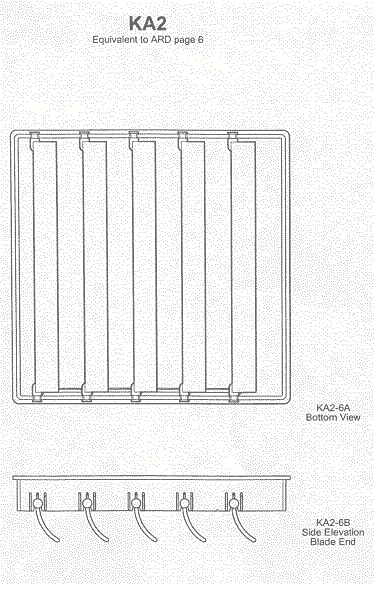
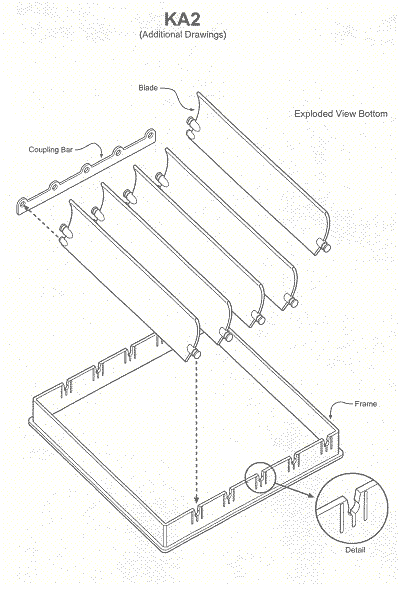
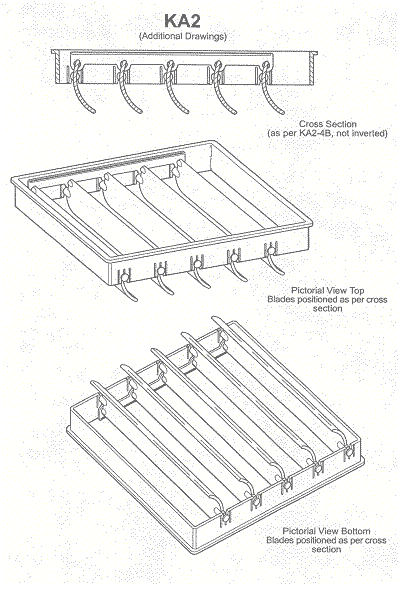
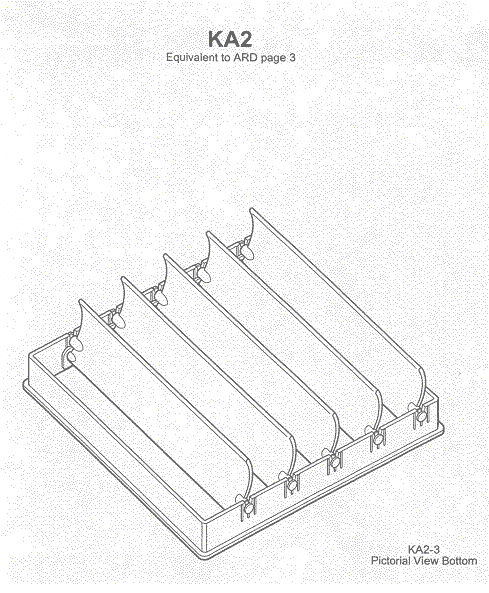
12 Each of the accused articles was an air conditioning outlet director part. Such articles are sometimes referred to as ‘grilles’. They are the part of an air conditioning unit that directs the flow of air into the space intended to be the subject of air conditioning. It was common ground that the accused articles, referred to by the primary judge as KA1 and KA2, were articles manufactured by K-Aire or another of the appellants. Accordingly, if the Design or a fraudulent or obvious imitation of the Design had been applied to KA1 or KA2, K-Aire or such other appellant is to be taken to have infringed Polyaire’s monopoly in the Design, since there was no question of licence or authority on the part of Polyaire as owner of the Design. Examples of KA1 and KA2 were exhibits in the proceeding. Representations of KA1 and KA2 are set out respectively in Schedules 2 and 3 to these reasons.
factual background
13 In early March 1996, the third appellant, Richard Kempley Colebatch (‘Mr Colebatch’), asked Mr Andrew Rogers, who is an industrial designer, if he would be interested in designing a new air conditioning outlet for the second appellant, Kenalex Pty Ltd (‘Kenalex’). In response to the enquiry, Mr Rogers told Mr Colebatch that, before accepting instructions, he would need to speak to an old client. Mr Rogers then spoke to the fourth appellant, Bruce Victor Benfield, for whom Mr Rogers had produced a design for an outlet director, known as ‘the China Outlet’, in the early 1990’s. Mr Benfield told Mr Rogers that he had no objection to Mr Rogers working for Kenalex on the development of an outlet director.
14 Mr Colebatch and Mr Rogers thereafter met and discussed the design for the proposed outlet director. Mr Rogers told Mr Colebatch about the China Outlet and asked Mr Colebatch whether Kenalex wanted to produce an outlet director to that design. However, Mr Colebatch specified certain requirements for the design of the proposed new outlet director as follows:
1. The incorporation of a cruciform or cross into the design to support the blade packs.
2. The modification of the blades so that they were of even thickness.
3. A change to the position of the pivot point of the blades in order that the blades protruded below the ceiling (the China Outlet design was more flush with the ceiling).
4. The addition of a second link bar to connect the blades.
15 Mr Rogers advised Mr Colebatch against a requirement that the blades be of even thickness. Mr Rogers also advised Mr Colebatch against a requirement that the blades protrude into the room more than they did in the China Outlet. Finally, Mr Rogers told Mr Colebatch that two control bars were unnecessary.
16 By 10 April 1996, a design concept was agreed and Kenalex gave Mr Rogers a purchase order to commence work on technical drawings. The tool that had been made for the manufacture of the China Outlet was provided to Kenalex without cost. Technical drawings for the new outlet director were completed by about 15 April 1996.
17 In preparing the technical drawings for the proposed new outlet director, Mr Rogers used the computer drawings that had been produced in relation to the China Outlet and adapted them to incorporate the requirements of Mr Colebatch for the proposed new outlet director. Mr Rogers provided a quotation referring to ‘[d]esign changes to large “D” tool’, ‘[r]edesign of “B” holder frame’and ‘[r]edesigning of “B” as required’. Those references are references to the frame and blades that ultimately became KA1. Some changes to the drawings were required and final drawings were completed and provided by 29 May 1996.
18 Mr Sharwan Mohanlal Somers was employed by Mr Rogers as an industrial designer from the middle of 1993. Mr Somers gave evidence about various design drawings that he worked on in 1994 in relation to an outlet director, including a register and duct adaptor, link bars, frames and blades. The design drawings were used in connection with the manufacture of tools, samples of ducts, frames, blades and links for the China Outlet. Mr Somers also had some involvement in design drawings for an air conditioning duct, frame, blade frame, blades, link bar and cross piece prepared in early 1996 but most of the work was done by Mr Woitek Nowokawski. According to Mr Somers, the design drawings prepared in 1996 had to be prepared ‘from scratch’.
19 His Honour found that, in March 1996, Mr Rogers had in his possession an outlet director part made according to the Design. He had either obtained the part previously or it was one of the outlet director parts that Mr Colebatch brought with him when he met Mr Rogers at that time. His Honour concluded that, in March 1996, Mr Colebatch gave instructions to Mr Rogers that:
(1) he wanted a design that would produce an outlet director part that would look similar to the other products in the market; and
(2) he had a number of specific requirements for the outlet director that he wanted Mr Rogers to design. Two of Mr Colebatch’s requirements, namely, the requirement of the blades protrude below the ceiling and the addition of a second control bar, are features of the Design.
20 After Polyaire notified K-Aire on 31 October 1996 that it believed the manufacture and sale of director parts in the form of KA1 infringed its monopoly in the Design, changes were made to the design for KA1, resulting in the design for KA2. One of the control bars was removed and other, more minor, changes were made to the control bar and spigots.
21 On the hearing of the appeal, K-Aire did not challenge the findings made by the primary judge, summarised above.
The RELEVANT LEGAL principles
22 The extent of the novelty of a design affects the degree of protection that is afforded to the features that are novel or original over the prior art (Dart Industries Inc v Décor Corporation Pty Ltd (1989) 15 IPR 403 (‘Dart’) at 410), not including merely functional features (Dart at 408). Once in the prior art, a design characteristic is ‘free to everybody to employ’ (Rosedale Associated Manufacturers Ltd v Airfix Products Ltd [1956] RPC 360 at 364 (approved in Dart at 409)).
23 In Malleys Limited v J W Tomlin Pty Limited (1961) 180 CLR 120 (‘Malleys’) at 127, the High Court set out the test for infringement of a registered design under s 30:
‘There is infringement in any one of three cases – that is, where the design that has been applied is:- (i) the registered design (ii) an obvious imitation of the registered design (i.e., not the same but a copy apparent to the eye notwithstanding slight differences) and (iii) a fraudulent imitation (i.e., a copy with differences which are both apparent and not so slight as to be insubstantial but which have been made merely to disguise the copying). Visual comparison will establish (i) or (ii) but a finding of fraudulent imitation must require something more because in such a case visual comparison is not of itself sufficient to establish imitation; otherwise it would be an obvious imitation.’
24 Thus, a distinction is drawn between ‘slight differences’, where visual comparison may establish obvious imitation, and ‘differences which are both apparent and not so slight as to be insubstantial’, where visual comparison is not sufficient. There may be fraudulent imitation where those not insubstantial differences may be disregarded if they have been made merely to disguise copying. A finding of fraudulent imitation requires a finding that there is imitation, notwithstanding that the design applied by the alleged infringer is not apparently an imitation, because the evidence showed that the design had been applied. One must be able finally to say that the product is an imitation visually recognisable as such (Firmagroup Australia Pty Ltd v Byrne & Davidson Doors (Vic) Pty Ltd (1986) 11 FCR 415 (‘Firmagroup’)at 417 per Fox J with whom Jenkinson J agreed).
25 A fraudulent imitation is a copy of a registered design with differences that are both apparent and not so slight as to be substantial but that have been made merely to disguise the copying (Malleys at 127). The essence of fraudulent imitation is that the design of an accused article has knowingly, consciously or deliberately been based on or derived from a registered design, although neither dishonest intent nor deliberate or conscious intention to copy is a necessary element (Dart at 411-412). Section 30 of the Act is intended to ensure that persons, other than those entitled to the benefit of a registered design, cannot produce or market articles that are derived by imitation, whether obvious or disguised, of the registered design and which are likely to be regarded by others who may acquire them as those of the registered design owner (Dart at 412). It is relevant, in determining fraudulent imitation, to establish that any differences were adopted for the purpose of disguising any fact of copying (Dart at 414).
26 A registered design can be simply applied. There can be obvious imitation, which involves slight differences. Fraudulent imitation is the test to be applied for ‘not insubstantial differences’. In considering fraudulent imitation the question is whether there is disguised copying, whether there is a dishonest concealment of the reality of copying in order to evade responsibility for it or whether the differences are not to conceal but, for example, involved a making over of a design to deal with technological problems. In the latter case there is no fraudulent imitation (Koninklijke Philips Electronics NV v Remington Products Australia Pty Ltd (2000) 100 FCR 90 at 114).
27 There can be fraudulent imitation, notwithstanding an honest belief that a different, non-infringing design is being produced. The special ingredient that is required is that the alleged infringer should be aware of the registration of the design in question and should make some use of it. This permits a greater degree of dissimilarity or differences that are greater in degree than required for obvious imitation (Firmagroup at 416 per Fox J).
28 There can be fraudulent imitation where the differences between the article and the design are obvious and recourse may be had to extrinsic evidence to establish the fact of deliberate copying. In such a case, the existence of comparatively unimportant differences from the design are sufficient to prevent the imitation being obvious are not sufficient to avoid fraudulent imitation (Russell-Clarke, Copyright in Industrial Designs, Pitman, London, 1st edn, 1930 (‘Russell-Clarke’) at 72-73 as cited by Fox J in Firmagroup at 418).
29 Copying is necessary for a finding of fraudulent imitation but is not sufficient; there must still be imitation. A different design embodying some of the features of a registered design, but with a different appearance, is not an infringement (Malleys at 127-128). The need to show that the alleged infringer has actually made an imitation is a minimum requirement (Lift Verkaufsgerate GmbH v Fischer Plastics Pty Ltd (1993) 27 IPR 187 at 195). It is then necessary to find that each difference was adopted merely to disguise the taking of the registered design. There is no fraudulent imitation if the shape that gave the registered design novelty over the prior art is not taken (L J Fisher & Company Ltd v Fabtile Industries Pty Ltd (1978) 1A IPR 565 at 580-581).
30 For fraud to be imputed, it must be shown that there is knowledge or a reason to suspect, that the article which is intended to be the subject of imitation is an embodiment of a registered design. A finding of fraudulent intention is not conclusive. There is no infringement if, despite fraudulent intention, the made article has a distinctly different shape or configuration from that in respect of which a design is registered, even if there are also substantial similarities. Then, the question is whether the differences, which are apparent and substantial are, nevertheless, mere disguises. These factors are each important because, even if every feature of the design were adopted solely in order to disguise copying, there must still be an imitation: ‘[e]ven if every conceivable element of fraud was present, the fraudulent and disguised copying must result in a copy’ (Turbo Tek Enterprises Inc v Sperling Enterprises Pty Ltd (1989) 23 FCR 331 (‘Turbo Tek’) at 348-350).
31 There must be evidence to support a finding that K-Aire knowingly, consciously or deliberately based the design of KA1 or KA2 upon the Design or that the design of KA1 and KA2 was derived from the Design so as to constitute fraudulent imitation (Dart at 414). A necessary finding is that there was an adoption of differences or changes in order to disguise the fact that there has been copying (Dart at 414). If K-Aire knew the design when making KA1 or KA2, the onus is on it to prove an absence of copying (Russell-Clarke at 73; Firmagroup at418 per Fox J).
the CONCLUSIONS of the primary judge
32 There were numerous issues decided by the primary judge in respect of which there is no appeal. The only determinations made by the primary judge relevant to the appeal concern the validity of the registration of, and infringement of the monopoly in, the Design. The appellants claimed that the Design is invalid because it was not a new and original design. The primary judge rejected that claim.
33 Polyaire did not contend that the appellants had applied the Design to KA1 or KA2. Rather, Polyaire contended that the appellants had applied a fraudulent or obvious imitation of the Design to those articles. His Honour concluded that neither KA1 nor KA2 was an obvious imitation of the Design. His Honour concluded, however, that each of them involved a fraudulent imitation of the Design.
34 The primary judge found that, in preparing the technical drawings, Mr Rogers used the computer drawings that had been produced in relation to the China Outlet and adapted them to incorporate the requirements of the proposed outlet (at [127]). While his Honour found Mr Rogers to be an unsatisfactory witness, that finding was not disputed on appeal.
35 His Honour identified (at [355]) the following differences in shape and configuration between the Design and RD1 and another prior art registered design, for the purposes of considering the novelty of RD1 and the Design:
- the shape and configuration of the end parts of the blades, and the shape and configuration of the receiving points in the outer frame and control bars;
- the chamfered inner lip or overhang on the top of the frame of the blade box;
· the vertical ribs on the outside of the blade box.
36 His Honour considered that the features just identified, particularly the first, gave the Design a distinctive shape and configuration compared with the relevant prior art. To his Honour’s mind, the first feature was the most eye catching on first examination of the Design in the light of the relevant prior art. His Honour considered that the differences from the prior art were substantial and were not differences in immaterial details. His Honour concluded, therefore, that the Design was a new and original design and was not invalid.
37 In considering obvious imitation of the Design by KA1, the primary judge (at [361]), identified the differences between them. These included the chamfered inner lip and the vertical ribs which, his Honour held, were more than slight differences. This precluded both KA1 and KA2 from being obvious imitations of the Design (see Malleys at 127).
38 In dealing with fraudulent imitation, his Honour found that, in designing KA1, Mr Rogers ‘knowingly, consciously and deliberately based his design on the plaintiff’s outlet director part which embodied [the Design]’. His Honour’s reasons for that conclusion (at [376]) included the facts that:
- Mr Rogers had an outlet director part that embodied the Design;
- Mr Colebatch’s instructions to Mr Rogers were to design a product that looked like other products in the market; and
- there were substantial similarities between the design produced by Mr Rogers and the Design.
39 His Honour then noted (at [378]) that the elements of fraudulent imitation were made out unless it could be said that KA1 ‘embodies a shape or configuration which is distinctly different from [the Design]’. His Honour then found that there were differences, ‘the most significant of which are the absence from KA 1 of the chamfered lip and the vertical ribs on the outside of the frame’ but held that the features that gave the Design ‘its distinctive appearance’ were the snap fit mechanism, the control bars and the blade ends including the spigots and that, despite small differences, these had been copied. This approach to the differences between KA1 and the Design was in contrast to his Honour’s finding (at [362]) that it was these same differences that were more than slight, so as to preclude obvious imitation and his Honour’s finding (at [355] and [356]) that these were 2 of the 3 features that gave the Design novelty over the prior art.
40 His Honour concluded that KA1 was a fraudulent imitation of the Design (at [379]). In considering whether KA2 was a fraudulent imitation of the Design, his Honour (at [380]), again applied a ‘distinctly different’ test to the resulting shape or configuration. He found no distinctive difference between KA2 and the Design and that there had been no significant change to the appearance of KA1. His Honour found that KA2 was a fraudulent imitation of the Design (at [381]).
THE CONTENTIONS
41 The contention of the appellants in relation to validity represented a fall back position. That is to say they contended that, if there were an infringement, it was because the Design was a method or principle of construction rather than merely features of shape, configuration, pattern or ornamentation applicable to an article. On the other hand, if there were no infringement by KA1 or KA2, there was no complaint about the validity of the Design. Accordingly, it is desirable to consider the question of infringement first. If there were no infringement, it is not necessary to deal with the arguments concerning validity.
42 The appellants’ primary submission is that the primary judge failed properly to apply the undisputed principles outlined above to the issue of fraudulent imitation. It is also necessary, in that regard, to consider obvious imitation.
43 The appellants contended that a finding of fraudulent imitation required findings of the following:
· differences that are not insubstantial;
· differences that were made to disguise copying;
· the difference that were not of a material kind and did not give rise to a different design, which embodied some of the features of the Design;
· the appellant took the Design, not the idea reflected in the Design;
44 A further contention was that it is not sufficient to find common features of construction. It must appear that the overall distinctive appearance of the Design has been taken. If the features that have been taken are not mere disguise, but are themselves salient features of the design of KA1 and KA2, which are novel and unique in that design, there is no imitation (per King J at first instanceas approved by Fox J in Firmagroup at 421).
45 The appellants contended that the primary judge erred in the application of the undisputed principles so that, not only did his Honour fail to make the necessary findings with respect to the differences that were not insubstantial, he also based his conclusion on differences that were slight and did not even lead to a conclusion of obvious imitation.
46 The primary submissions of the appellants can be simply put: once the primary judge found that two of the three features that gave the Design its novelty were absent from KA1 and KA2, there can be no infringement. The primary judge failed to consider the impact of the absence of those features when considering fraudulent imitation. For imitation giving rise to infringement to exist, the features that give a design novelty must exist in the allegedly infringing articles.
47 A design is not a minor type of patent and there is no monopoly over the ideas disclosed by a registered design. The Act expressly excludes a method or principle of construction. Thus, the idea of a director part with a snap fit mechanism and a control bar, whether one or two, is not protected by the registration of the Design. It is only the features of shape or configuration that can be judged by the eye in the finished article that will be protected by the Act. The essential features of a design that will be protected by the monopoly granted by the Act are limited by reference to the prior art. That is to say, it is only those features that are novel that will be protected. Imitation of features that are not novel, or copying of an idea, will not be an infringement of the monopoly in a registered design.
48 Further, the appellants say, once the primary judge found that neither KA1 nor KA2 was an obvious imitation of the Design, by reason of the finding that the differences were not insubstantial, there could be no finding of fraudulent imitation unless there were a finding that there was imitation and a finding that those differences were made merely to disguise copying. The error pointed to in his Honour’s reasoning is a failure to make the necessary findings.
49 The additional matters raised by the appellants can, compendiously, be summarised as follows:
· The primary judge failed to consider the provenance of the design of KA1 and KA2 and the differences between those articles and the Design.
· Since the monopoly conferred by registration of a design does not extend to merely functional features but is limited to a unique shape or configuration (Dart at 408), the primary judge erred in requiring the appellant to prove that differences between the design of KA1 and KA2 involved a mechanical or functional advantage over the Design. His Honour also failed to recognise that, if it is possible to get several different appearances which embody the same general features of a design, those features amount to a method or principle of construction.
· The primary judge based his conclusions on similarities of the features at the end of the blades, his Honour failed properly to consider the detail of those features, where there were differences, and the impact of those differences on a finding of obvious or fraudulent imitation.
· Having made a finding of deliberate copying in respect of KA1, his Honour wrongly shifted the onus onto the appellants to show that KA1 and KA2 were ‘distinctly different’ from the Design and, further, applied an incorrect legal test. Fraudulent imitation already assumes substantial differences; the correct test is based on a finding that the differences are ‘mere disguises’. His Honour failed to take account of the principle that it is permissible to ‘design around’ a design if the resulting product is distinctly different.
· Not only did the primary judge fail to consider the question of mere disguise, he also could not, on the facts, have made such a finding.
50 The appellants’ contention is that two of the three features of the Design, considered distinctive and substantial, were not present in KA1 or KA2. There was no finding that their omission was a disguise. Further, such a finding could not have been made. The reason that such a finding could not have been made is that, accepting the findings of fact made by his Honour, these features had always been absent from KA1 and KA2, prior to any copying of the Design. For example, the vertical ribs on the outside of the blade box in the Design were a moulding artefact of Polyaire’s process, a different process to that of the appellants.
51 Polyaire relied on the factual findings of the primary judge and his ability to draw inferences from the facts, as well as the appellants’ failure to call witnesses who could have given evidence. Polyaire pointed to the express findings that Mr Rogers had ‘knowingly, consciously and deliberately based his design’ on the Design.
52 Polyaire accepted that there was no explicit finding of changes or alterations made for the purpose of disguising copying, with the intention of achieving a design that is not an imitation of the Design. However, it asserted that such a finding was ‘implicit’ in the findings of fact that were made and that the evidence ‘inevitably led to the conclusion’ that the differences were there to disguise copying.
53 Polyaire relied upon the feature of the Design that his Honour described in his consideration of novelty over prior art designs (at [355]) as ‘the most eye-catching on first examination of [the Design] and the relevant prior art’ and the finding (at [378]), that this feature had been copied. However, counsel for Polyaire conceded that, in dealing with fraudulent imitation, the primary judge acknowledged the absence of the other two features that he had relied upon, for novelty purposes, albeit in a subsidiary capacity, to find the Design valid.
54 Polyaire submitted that the primary judge, being seized of the relevant legal principles, correctly applied them and did not incorrectly shift the onus. Reference was made to his Honour’s consideration (at [311] and [312]) of the two stage approach:
· first, whether features were adopted merely to disguise copying; and
· secondly, whether the article there in question, the Silentaire grille, was in fact an imitation. The Court is asked to extrapolate that consideration to the infringement of the Design by KA1 and KA2, to conclude that his Honour continued to apply the correct principles.
55 Polyaire gave a detailed response to each of the appellants’ assertions. Broadly speaking, they encompass:
· reliance on a reading of the primary judge’s reasons as a whole and the fact that repetition of principle, once made, was unnecessary when dealing with different products and different designs. Similarly, a finding of fact or an observation of fact, once made, did not require repetition when a different aspect was being considered;
· reliance on the facts as found and the importance of the primary judge’s impressions of the comparisons to be made. This, in turn, encompassed a submission that the primary judge was entitled primarily to rely upon the feature that impressed him as being the most significant in terms of novelty over the prior art which he found was present in the appellants’ products;
· the assertion that the primary judge’s findings of the facts and of fraudulent imitation were open to him on the evidence. It was said that the appellants are, in effect, seeking to relitigate factual matters expressly considered and determined against them;
· all necessary findings had been made, by inference if not explicitly.
REASONING ON APPEAL
56 The key points of application of principle to be decided are:
· whether, in a determination of fraudulent imitation, it is necessary to make an express finding not only of deliberate copying but also that the insubstantial differences were present, or absent, in order to disguise the copying;
· whether it is correct to make a finding of fraudulent imitation where differences that had been held to be not insubstantial for the purposes of obvious imitation were considered to be insignificant for the purposes of fraudulent imitation;
· whether it is correct to make a finding of imitation where differences that were the very features that were found to make the design distinctive over the prior art were absent in the allegedly infringing products;
57 His Honour made the finding of deliberate copying and noted the obvious similarities between the Design and KA1. He then (at [378]) properly considered whether KA1 embodied a shape or configuration distinctly different to the Design. He concluded that the shape and configuration were not distinctly different. In coming to that conclusion, however, he characterised as not distinctly different differences previously held (at [362]) to be not so slight as to be insubstantial for the purposes of obvious imitation and did not consider the effect of the omission of two of the three features held (at [355]) to give the Design its novelty, its distinctive shape or configuration over the prior art. His Honour did not consider the effect of these omissions on a finding of imitation. His Honour should have found that there was no imitation in the circumstances.
58 Mr Rogers was not examined or cross-examined in respect of his omission of the chamfered lip and vertical ribs or to suggest that he consciously omitted them. The appellants pointed to evidence that the vertical ribs were an artefact of Polyaire’s moulding process and that the appellants used a different process, which was not challenged. In any event, his Honour found that the production of KA1 did not involve the application of the Design or an obvious imitation of the Design. He made no finding that the two omissions were conscious or mere disguises. The evidence is to the contrary and such a finding would not be open. His Honour relied upon the similarities rather than the differences in making a finding that KA1 was a fraudulent imitation of the Design.
59 In circumstances where it was never put to Mr Rogers that the differences between KA1 and the Design were adopted in order to disguise the fact that KA1 was otherwise a copy of the Design and it is clear that the China Outlet was the starting point for the design of KA1, it was not open to find that the omission of the steeply chamfered inner lip and the vertical ribs was made in order to disguise the fact of copying. K-Aire satisfied the onus of proving an absence of copying.
60 There must be a copy (i.e. imitation) (dealt with at [378]), being a copy (i.e. imitation) that has differences that are both apparent and not so slight as to be insubstantial and therefore not an obvious imitation, as his Honour found (at [362]). But before there is fraudulent imitation, the differences must have been made ‘merely to disguise the copying’ (i.e. the imitation). In the absence of a finding as to the last, the pre-requisites for fraudulent imitation are not established. Fraudulent imitation requires something more than visual comparison. If visual comparison was, of itself, sufficient to establish imitation there would be obvious imitation, but his Honour found otherwise. At no point did his Honour give attention to the question of whether or not the differences that he had found, which were sufficient to avoid a conclusion of obvious copying of the Design, were made merely to disguise the imitation of the Design. Therein lay error.
61 In making a finding that KA2 was a fraudulent imitation of the Design, his Honour again disregarded the above matters and considered as a further matter only the changes that had been made to KA1 to yield KA2.
62 The primary judge correctly identified the relevant principles with regard to obvious and fraudulent imitation. The question is whether his Honour applied them correctly and consistently in considering whether KA1 and KA2 were fraudulent imitations of the Design. It is necessary to make each of the findings of an intention to copy, differences made in order to disguise the copying and a resulting product that is in fact a copy or imitation.
63 In the present case, taking into account the primary judge’s findings as to the differences between the design of KA1 and KA2 and the Design, the factors that gave the Design its distinctive appearance and the evidence in regard to those features, we do not consider that it can be said that his Honour explicitly or implicitly found that differences were omitted in order to disguise copying. The finding of fraudulent imitation therefore cannot stand.
CONCLUSION
64 There was no application of a fraudulent imitation of the Design to either KA1 or KA2.
65 The appeal should be upheld. Orders 1 to 8 and Order 11 made on 5 March 2003 should be set aside in so far as they relate to infringement. In lieu thereof, there should be orders dismissing the claim for infringement with costs. The respondent should pay the appellants’ costs of the appeal. The parties should be directed to bring in short minutes of order to reflect these conclusions.
|
I certify that the preceding sixty-five (65) numbered paragraphs are a true copy of the Reasons for Judgment herein of the Honourable Justices Mansfield, Emmett and Bennett. |
Associate:
Dated: 22 December 2003
|
Counsel for the Appellants: |
D K Catterns QC with S J Goddard |
|
|
|
|
Solicitor for the Appellants: |
Thomson Playford |
|
|
|
|
Counsel for the Respondent: |
D M Yates SC with B J Jenner |
|
|
|
|
Solicitor for the Respondent: |
Lynch Meyer |
|
|
|
|
Date of Hearing: |
19 & 20 August 2003 |
|
|
|
|
Date of Judgment: |
22 December 2003 |
schedule 1
schedule 2
SCHEDULE 3