

FEDERAL COURT OF AUSTRALIA
Bartlem Pty Ltd v Cox Industries (Australia) Pty Ltd [2002] FCAFC 224
APPEAL – nature of and approach to appeals in Federal Court – role of appellate court is correction of error at first instance – need for parties to clearly demonstrate error – advantages of trial Judge in hearing evidence
INTELLECTUAL PROPERTY – appeal to Full Court – patents – infringement – whether primary Judge erred in construction of essential integers in claim
Patents Act 1990 (Cth)
Azuko Pty Ltd v Old Digger Pty Ltd (2001) 52 IPR 75 cited
Biogen Inc. v Medeva plc (1997) RPC 1 applied
Branir Pty Ltd v Owston Nominees (No. 2) Pty Ltd [2001] FCA 183 applied
Catnic Components Ltd v Hill and Smith Ltd [1982] RPC 183 cited
Clarke v Adie (1875) LR 10 Ch App 667 cited
Doric Products Pty Ltd v Lockwood Security Products Pty Ltd [2001] FCA 1877 cited
Grove Hill Pty Ltd v Great Western Corporation Pty Ltd [2002] FCAFC 183 followed
Radiation Ltd v Galliers and Klaerr Pty Ltd (1938) 60 CLR 36 cited
Rehm Pty Ltd v Webster’s Security Systems (International) Pty Ltd (1988) 81 ALR 79 cited
S W Hart & Co Pty Ltd v Edwards Hot Water Systems (1985) 159 CLR 467 cited
Sydneywide Distributors Pty Ltd v Red Bull Australia Pty Ltd [2002] FCAFC 15 cited
Walker v Alemite Corporation (1933) 49 CLR 643 cited
BARTLEM PTY LIMITED V COX INDUSTRIES (AUSTRALIA) PTY LIMITED (FORMERLY RURAL PACIFIC MARKETING PTY LIMITED) AND COX MOWERS PTY LIMITED
NO. Q 201 OF 2001
BEAUMONT, FINN & SUNDBERG JJ
31 JULY 2002
SYDNEY (HEARD IN BRISBANE)
|
IN THE FEDERAL COURT OF AUSTRALIA |
|
ON APPEAL FROM A SINGLE JUDGE OF THE FEDERAL COURT OF AUSTRALIA
|
BETWEEN: |
BARTLEM PTY LIMITED APPELLANT
|
|
AND: |
COX INDUSTRIES (AUSTRALIA) PTY LIMITED (FORMERLY RURAL PACIFIC MARKETING PTY LIMITED) FIRST RESPONDENT
COX MOWERS PTY LIMITED SECOND RESPONDENT
|
|
DATE OF ORDER: |
|
|
WHERE MADE: |
THE COURT ORDERS THAT:
1. The appeal be dismissed, with costs.
Note: Settlement and entry of orders is dealt with in Order 36 of the Federal Court Rules.
|
IN THE FEDERAL COURT OF AUSTRALIA |
|
ON APPEAL FROM A SINGLE JUDGE OF THE FEDERAL COURT OF AUSTRALIA
|
BETWEEN: |
APPELLANT
|
|
AND: |
COX INDUSTRIES (AUSTRALIA) PTY LIMITED (FORMERLY RURAL PACIFIC MARKETING PTY LIMITED) FIRST RESPONDENT
COX MOWERS PTY LIMITED SECOND RESPONDENT
|
|
JUDGE: |
|
|
DATE: |
|
|
PLACE: |
THE COURT:
INDEX
THE RELEVANT CLAIMS IN RESPECT OF AP 664820, AS 692882 AND AS 698806
THE ISSUES AT TRIAL IN RESPECT OF AP 664820, AS 692882 AND AS 698806
BARTLEM’S CASE AT TRIAL IN RESPECT OF AP 664820, AS 692882 AND AS 698806
COX’S DEFENCE AT TRIAL IN RESPECT OF AP 664820, AS 692882 AND AS 698806
THE REASONING OF THE PRIMARY JUDGE IN RESPECT OF AP 664820, AS 692882 AND AS 698806
(a) Construction of the claims
(i) The alleged infringement of AP 664820
(ii) The alleged infringement of AS 692882
(iii) The alleged infringement of AS 698806
BARTLEM’S ARGUMENTS ON ITS APPEAL IN RESPECT OF AP 664820, AS 692882 AND AS 698806
CONCLUSIONS ON THE APPEAL IN RESPECT OF AP 664820, AS 692882 AND AS 698806
THE RELEVANT CLAIMS IN AP 723748
THE ISSUES AT TRIAL IN RESPECT OF AP 723748
MR CHASELING’S EVIDENCE AT TRIAL IN RESPECT OF AP 723748
THE PRIMARY JUDGE’S REASONS IN RESPECT OF AP 723748
Construction of the relevant claims in AP 723748
The alleged infringement of AP 723748
BARTLEM’S ARGUMENTS IN SUPPORT OF ITS APPEAL IN RESPECT OF AP 723748
CONCLUSIONS ON THE APPEAL IN RESPECT OF AP 723748
REASONS FOR JUDGMENT
THE COURT:
INTRODUCTION
1 The appellant, Bartlem Pty Limited (“Bartlem”), instituted proceedings in this Court claiming that the respondents, Cox Industries (Australia) Pty Limited (“Cox”) and Cox Mowers Pty Limited (“Cox Mowers”), had infringed a number of its patents. The inventions described in the patents were said to consist in the use of a differential drive and locking mechanism in the rear drive assembly of a chain-driven ride-on motor mower. Four related patents were said to be infringed, being –
(a) Australian Standard Patent No 692882 (“AS 692882”) in respect of an invention entitled “Improved Drive Mechanisms” for a term of twenty years commencing 1 May 1991;
(b) Australian Standard Patent No 698806 (“AS 698806”) in respect of an invention entitled “Improvements to Power Driven Mowers” for a term of twenty years commencing 18 June 1992;
(c) Australian Petty Patent No 664820 (“AP 664820”) in respect of an invention entitled “Improved Drive Mechanisms” for a term from 30 November 1995 until 1 May 1997;
(d) Australian Petty Patent No 723748 (“AP 723748”) in respect of an invention entitled “Improvements to Drive Mechanisms” for a term of one year commencing 7 September 2000.
2 The infringements were said to occur in the manufacture and sale by Cox of a “Stockman” range of ride-on motor mowers which incorporated a lockable differential drive assembly. The respondents denied infringement and cross-claimed for revocation of each of the patents in suit. A Judge of the Court (Cooper J) dismissed all of Bartlem’s claims of infringement, but also dismissed Cox’s cross-claim for revocation. Bartlem now appeals from the dismissal of its claims of infringement, but no appeal is brought from the dismissal of Cox’s cross-claim for revocation.
3 There are three issues raised in the appeal, each related solely to infringement, and raising questions of construction of the relevant claims, namely, whether the primary Judge erred in holding that Cox’s machine did not include –
(1) the “tubular portion” which is an essential integer of (a) claims 1 and 2 of AP 664820; and (b) claims 1, 7, 8 and 9 of AS 692882;
(2) the “tubular stub axle” which is an essential integer of claims 1, 5, 6, 7 and 8 of AS 698806; and
(3) “a selectively operable locking means for locking the transverse axle to the further wheel mount”, an essential integer of claim 1 of AP 723748.
4 It will be convenient to consider (1) and (2) above (i.e. AP 664820, AS 692882 and AS 698806) first.
the RELEVANT claims in RESPECT of AP 664820, AS 692882 and AS 698806
5 Relevantly, Bartlem alleged that the following claims had been infringed:
(a) Claims 1 and 2 of AP 664820:
“1. A ride-on mower including a chain driven reversible rear drive axle assembly of the type wherein: a differential gear case is mounted rotatably on and supported by a transverse axle which supports respective wheel hubs at opposite ends thereof and which is supported for rotation by spaced chassis mountings intermediate said wheel hubs and through which spaced chassis mountings the transverse axle is attached to the mower’s chassis; the gear case is mounted on the transverse axle between one wheel hub and the adjacent chassis mounting and said one wheel hub is rotatable about the transverse axle; a driven sprocket for the chain drive is attached to the gear case for driving the reversible rear drive axle assembly; the gear case includes a housing which extends co-axially of the transverse axle and which housing carries a pair of opposed planetary gears therein for orbital motion about the transverse axle; opposed sun gears are supported in axially spaced relationship on the transverse axle adjacent said one wheel hub and are differentially driven by the opposed planetary gears; the sun gear nearest said one wheel hub is rotatable about the transverse axle and is drivingly connected to said one wheel hub, and the other sun gear and the other wheel hub are locked for rotation with the transverse axle, and characterised in that:-
[a] the gear case includes fixed end walls at the opposite ends thereof which enclose the sun gears and planetary gears within the housing;
[b] the sun gear nearest said one wheel hub is drivingly connected to said one wheel hub by a tubular portion which passes rotatably through the fixed end wall interposed between said one wheel hub and the sun gear nearest said one wheel hub, and
[c] the transverse axle passes rotatably through the other end wall and said tubular portion.
[The relevant integer is emphasised.]
2. A ride-on mower including a chain driven reversible rear drive axle assembly as claimed in claim 1 and further characterised in that there is provided selectively engageable differential locking means operable and disposed externally of the gear case and at the side of said one wheel hub which is remote from the gear case for effecting locking of the gear case for rotation with said transverse axle and with said one wheel hub, whereby the respective wheel hubs are locked for rotation in unison with both said transverse axle and said gear case. ...” (Emphasis added)
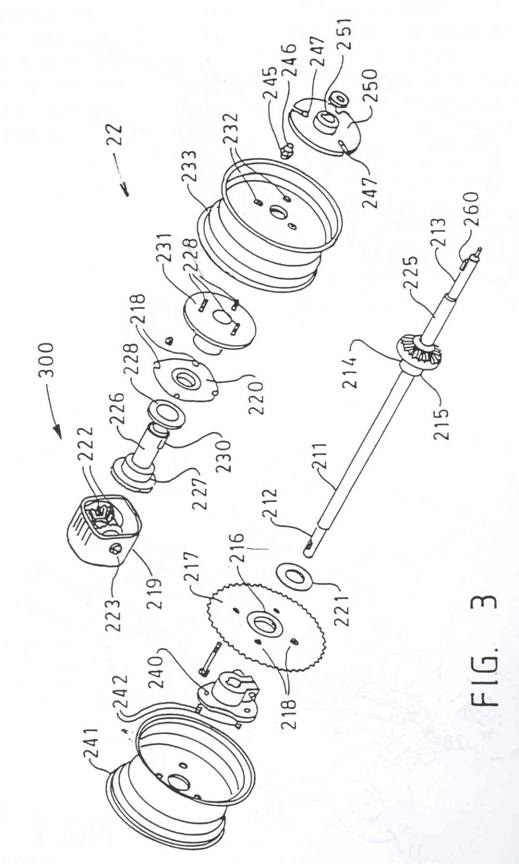
6 Figure 3 in this specification is:
(b) Claims 1, 7, 8 and 9 in AS 692882:
“1. [This claim is, with one presently immaterial exception, in the same terms as claim 1 of AP 664820.]
...
7. A ride-on mower including a chain driven reversible rear drive axle assembly as claimed in any one of claims 1 to 6 and further characterised in that there is provided selectively engageable differential locking means operable and disposed externally of the gear case and at the side of said one wheel hub which is remote from the gear case for effecting locking of the gear case assembly for rotation with said transverse axle and with said one wheel hub, whereby the respective wheel hubs are locked for rotation in unison with both said transverse axle and said gear case.
8. A ride-on mower as claimed in claim 7, wherein the differential locking means locks together any of the differential components which can otherwise rotate differentially.
9. A ride-on mower as claimed in claim 7 or claim 8, wherein the differential locking means includes an offset locking member which is supported by and extends from said one wheel hub offset from said transverse axle. …” (Emphasis added)
(c) Claims 1, 5, 6, 7 and 8 in AS 698806:
“1. A chain driven reversible rear drive axle assembly for a ride-on mower, including:-
a transverse axle supporting respective wheel hubs at opposite ends thereof one hub being freely rotatable about said transverse axle and the other hub being fixed to said transverse axle;
a differential gear case mounted rotatably on and supported by said transverse axle and forming a housing extending along the transverse axle;
a driven sprocket for the chain drive attached to the gear case;
a pair of opposed planetary gears supported by said housing for orbital motion about the transverse axle;
opposed sun gears supported in axially spaced relationship along and co-axially about the transverse axle and within said housing and meshed with said opposed planetary gears for differential rotation thereby;
a tubular stub axle rotatable about said transverse axle and drivingly connected to said one hub and the sun gear which is nearest said one hub, the other sun gear being locked for rotation with said transverse axle, and
an externally accessible locking member associated with said one hub and manually moveable to a locking position at which it locks said one hub for rotation with said gear case and said transverse axle.
[The relevant integer is emphasised.]
...
5. A chain driven reversible rear drive axle assembly as claimed in any one of the preceding claims, and including biassing means biassing said locking member into its locking position and latching means for maintaining said locking member disengaged against said biassing means.
6. A chain driven reversible rear drive axle assembly as claimed in any one of the preceding claims, wherein said housing encloses said sun gears and planetary gears and said tubular stub axle and said transverse axle pass sealably through opposed end walls of said housing.
7. A chain driven reversible rear drive axle assembly as claimed in any one of the preceding claims, wherein said gear case is mounted on the transverse axle closely adjacent said one wheel hub.
8. A chain driven reversible rear drive axle assembly as claimed in any one of the preceding claims, wherein said locking member is disposed at the side of said one wheel hub which is remote from the gear case. …” (Emphasis added)
7 (As mentioned, it will be convenient to consider the claim of infringement of AP 723748 later, as different issues arise.)
THE ISSUES AT TRIAL IN RESPECT OF AP 664820, AS 692882 AND AS 698806
8 Bartlem’s particulars of the infringement of claim 1 of AP 664820 and of claim 1 of AS 692882 were:
“The drive axle is chain driven.
The housing forms a differential gear case which is supported for rotation about the transverse axle. It rotates on cylindrical lands formed on outward extensions of the sun gears which are mounted on the axle.
A fixed wheel hub is fixed to the end of the axle and a hub is mounted rotatably through bush.
The axle is supported by bearings bolted to chassis mountings intermediate the hubs.
The gear case is mounted on the transverse axle between one wheel hub and the adjacent chassis mounting.
The one wheel hub is rotatable about the transverse axle on bushes.
The other wheel hub is fixed to the transverse axle.
The sprocket which is driven by the mower’s motor through a reversing mechanism is attached to the gear case by bolts which also secure the housing halves together. The sprocket rotates the gear case/housing which drives the axle through the differential mechanism.
The gear case is formed of two halves which are symmetrical about the axle and receive support from spaced locations along the axle, namely by the outward extensions or lands of the sun gears which are spaced along the axle.
The housing carries a pair of opposed planetary gears therein for orbital motion about the transverse axle. The gears are rotatable about the pins of a spider which is rotatable about the axle and engaged with the housing so as to orbit about the axle.
Opposed sun gears are supported in axially spaced relationship on the transverse axle at opposite sides of the spider hub and outward of the chassis mounting and adjacent said one wheel hub. The sun gear is bolted to the gear hub.
The planetary gears mesh with the sun gears to be differentially rotated thereby.
The sun gear nearest the wheel hub is rotatable about the transverse axle on the free wheeling sun gear bush and is drivingly connected to the wheel hub by the bolts.
The other sun gear is locked to the axle by a key for rotation with the transverse axle as is the other hub.
The gear case includes fixed end walls at the opposite ends thereof which extend inward to engage about the outward extensions of the gears. The walls also extend beyond the sun gears and are sealed by O-rings.
The sun gear nearest the wheel hub has a tubular outward extension to which the wheel hub is secured by bolts.
The tubular extensions extends through the open end wall which is disposed between the wheel and its hub and the sun gear.
The transverse axle passes through the other end wall which is located rotatably on the land which mounts the end wall on the axle.” (Emphasis added)
9 By their amended defence, in denying any infringement, Cox said that the drive axle assembly did not take the feature that the sun gear nearest said one wheel hub is drivingly connected to said one wheel hub by a tubular portion which passes rotatably through the fixed end wall interposed between said one wheel hub and the sun gear nearest said one wheel hub.
10 Bartlem’s particulars of the alleged infringement of claims 1, 6, 7 and 8 of AS 698806 were stated to be all of the above. Particulars of the infringement of claim 5 were (in addition):
“The Cox ‘Stockman’ ride-on mower includes in its drive axle assembly brassing means brassing a locking member into its locking position and latching means for maintaining the locking member disengaged against the brassing means.”
11 By their amended defence, Cox said:
(i) The drive axle assembly did not infringe claim 1 of AS 692882 in that it did not take the feature that the sun gear nearest the one wheel hub was drivingly connected to the one wheel hub by a tubular portion which passed through the fixed end wall interposed between the one wheel hub and the sun gear nearest the one wheel hub;
(ii) The drive axle did not infringe claim 7 in that:
(A) insofar as claim 7 was dependent upon claim 1, and as such included all of the essential features of claim 1, claim 7 was not infringed for the reasons already given, and further, the drive axle assembly when locked did not have a locking means remote from the gear case;
(B) further, or alternatively, insofar as claim 7 was dependent on claim 6, and as such included all of the essential features of claim 6, claim 7 was not infringed, because claim 6 was not infringed: claim 6 did not take the feature that the transverse axle passed rotatably through the other end wall and the tubular portion;
(iii) The drive axle assembly did not infringe claim 8 in that claim 8 was dependent on claims 1 and 7, and as such included all of the essential features of claims 1 and 7, neither of which was infringed for the above reasons;
(iv) The drive axle assembly did not infringe claim 9 in that claim 9 was dependent on claims 1, 7 and 8, and as such included all of the essential features of claims 1, 7 and 8;
(v) The drive axle did not infringe claim 1 of AS 698806 in that it did not take the feature of a tubular stub axle rotatable about the transverse axle and drivingly connected to the one wheel hub and the sun gear which was nearest the one wheel hub, and in that it did not take the feature of sun gears within the housing;
(vi) The drive axle assembly did not infringe claim 5 in that claim 5 was dependent on claim 1 which was not infringed;
(vii) The drive axle assembly did not infringe claim 6 in that:
(A) claim 6 was dependent on claim 1, which was not itself infringed;
(B) further or alternatively, claim 6 did not take the feature that the tubular stub axle passes sealably through opposed end walls of the housing, and in that it did not take the feature of a housing which enclosed the sun gears;
(viii) The drive axle assembly did not infringe claim 7, in that claim 7 was ultimately dependent on claim 1, which was not itself infringed;
(ix) The drive axle assembly did not infringe claim 8 in that:
(A) claim 8 was dependent on claim 1 which was not itself infringed;
(B) further or alternatively, claim 8 did not take the feature that the locking member was disposed at the side of the one wheel hub which was remote from the gear case.
BARTLEM’S CASE AT TRIAL IN RESPECT OF AP 664820, AS 692882 AND AS 698806
12 In the case propounded by Bartlem at trial, reliance was placed upon the expert opinion evidence of Arthur William Chaseling, a mechanical engineer. In his report, dated July 2000, Mr Chaseling expressed opinions to the following effect:
· A differential assembly comprises a pair of sun gears which mesh with one or more planetary gears. The planetary gears are mounted on shafts connected via a planetary carrier to the primary drive system, in this case a large sprocket wheel. Drive axles to the two wheels are connected to the two sun gears. The purpose of a differential is to allow the two wheels to rotate at different speeds while transmitting the same torque. The sun and planetary gears act as a dynamic balancing bar, allowing the two sun gears to rotate at different speeds when required by motion of the vehicle to which it is fitted. Vehicles which have no differentials are difficult to turn, as the two wheels must travel at different speeds while turning, or skid on the ground.
· Under conditions of limited traction, differential action can be undesirable, as it prevents one drive wheel transmitting power if the other is slipping. It is therefore common for off‑road vehicles to be fitted with a differential lock which forces the two wheels to turn at the same speed. The operation of a differential is governed by strict mathematical principles ‑ the average speed of the two wheels must be the same as that of the planetary carrier. Thus a differential lock placed so as to prevent relative rotation between any two of these three rotary elements forces all three elements to rotate at the same speed.
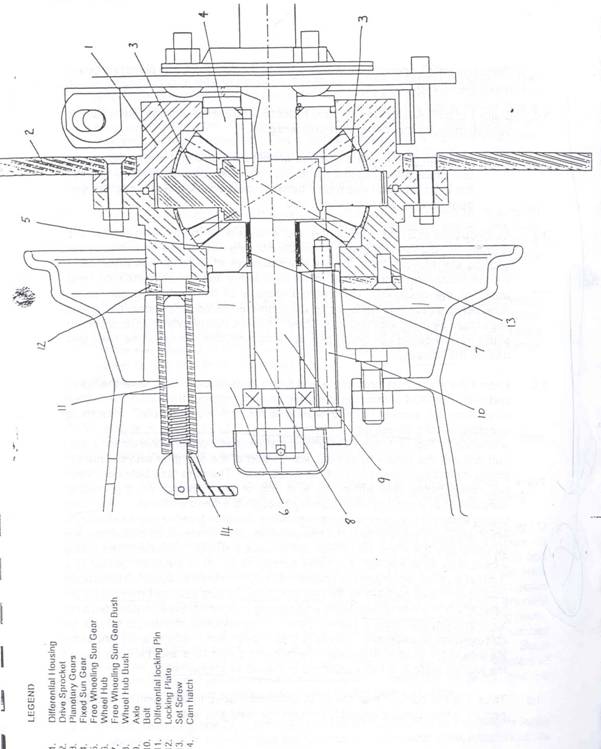
· A cross‑sectional view of the Cox mower differential is shown in Figure 1 (see below). The differential is located towards one end of the axle assembly, close to one of the wheels. The free‑wheeling sun gear (5), which drives the closer wheel, has a short cylindrical portion behind the gear portion, and a hollow centre into which a bearing bush (7) is pressed. This cylindrical portion abuts the inner end of the closer wheel hub (6) and is attached to it via three bolts (10). The mating end of the wheel hub (6) has a circular exterior and a circular passage through it, lined with a bearing bush (8) and a ball‑bearing.
· The fixed sun gear (4), which drives the further wheel, is keyed to an axle (9) which runs from the further wheel through the planetary carrier, the free‑wheeling sun gear (5), and the closer wheel hub (6). While it transmits drive torque between the fixed sun gear (4) and the further wheel, it also serves as a pivot shaft for the free‑wheeling sun gear (5) and the closer wheel hub (6).
· The Cox drive provides a differential lock in the form of a pin (11) attached to the wheel hub (6) and engageable with the differential housing (1). When engaged, this pin forces the closer wheel hub (6) and the housing (1) to rotate at the same speed. This also forces the drive to the further wheel to rotate at the same speed.
· Claim 1 of both AS 692882 and AP 664820 includes the following characterisation:-
“The sun gear nearest said one wheel hub is drivingly connected to said one wheel hub through a tubular portion, which passes rotatably through the fixed end wall interposed between said one wheel hub and the sun gear nearest said one wheel hub.”
· Even if the entire thickness of the end ring is considered to constitute the “fixed end wall”, the Cox differential still includes the feature described in claim 1. In engineering terms, the word “tubular” is used to describe a solid object with a central hole, usually prismatic in shape. With reference to Figure 1, the Cox differential transmits drive to the closer wheel hub through the hollow cylindrical rear portion of the sun gear and the mating hollow cylindrical rear portion of the wheel hub. The joint face between these two components falls within the end ring of the housing, so that neither component of itself “passes rotatably through the fixed end wall”. However, during assembly, these two components are clamped together by a set of bolts which preloads the joint face in a compressive state. Under such conditions, the sun gear and the wheel hub effectively become a single component comprising a gear at its inner end and a wheel-mounting flange at its outer end joined by a “tubular portion which passes rotatably through the fixed end wall”. This tubular portion is formed partially by the rear portion of the sun gear and partially by the inner end of the wheel hub. Many engineering components are constructed from sub-components bolted together, either for convenience of manufacture, or for convenience of assembly. The joint could have been made at any point along the axis of the assembly between the rear of the gear face and the outer face of the locking plate and have achieved the same functional result. (Emphasis added)
Figure 1.
· The Cox differential includes all of the integers which comprise claim 1.
· AP 698806 covers a differential of the type discussed above ...
· Claim 1 of this patent also includes the feature:‑
“A tubular stub axle”
· In engineering circles, the term “axle” is used for two types of component. It can be used todescribe the structural component to which a wheel is attached for rotation thereabout, or as a torsion member which applies torque to a wheel. In the front wheel hub assembly, the term “axle” is applied to a structural member on to which the wheel is mounted through bearings and about which it rotates. In the rear‑drive assembly, the term “axle” is applied to a drive shaft which does not support the wheel, but which supplies drive torque to it. The term “stub” is merely added where a component is relatively short compared with its other dimensions, and is used in connection with other elements such as gear teeth and screw threads.
· Thus the application of the terms “axle” or “stub axle” to a “tubular portion” which carries drive torque to a wheel is within normal engineering usage. The term is an appropriate one in terms of function, and it is irrelevant to the terminology whether this component contains internal bushings or the like to accommodate yet another shaft. (Emphasis added)
13 In summary, the report stated:
(1) The Cox differential includes the feature that “the gear case includes fixed end walls at the opposite ends thereof which enclose the sun gears and planetary gears within the housing”, as described in claim 1 of AP 664820 and AS 692882.
(2) The Cox differential includes the feature that “[t]he sun gear nearest said one wheel hub is drivingly connected to said one wheel hub through a tubular portion, which passes rotatably through the fixed end wall interposed between said one wheel hub and the sun gear nearest said one wheel hub”, as described in claim 1 of AP 664820 and AS 692882.
(3) Given (1) and (2) above, the Cox differential includes all of the essential integers of claim 1 of AP 664820 and AS 692882.
(4) The “tubular portion” can be described as an “axle”, or as a “stub axle” within normal engineering language usage.
14 In a supplementary report, dated 7 July 2000, Mr Chaseling expressed this opinion:
“… I consider the term ‘tubular stub axle’ to be an appropriate descriptive term for the element joining the sun gear to the wheel hub in the [Cox] differential. Whenever a novel design, such as the differential shown in the Bartlem patents, is put into production, the designer must develop suitable nomenclature for the components, and can, within reason, choose names arbitrarily. It is worthy of note that the term ‘tubular stub axle’ is used in … [AP] 664820 and … [AS] 692882 for Item 26 in the description of the preferred embodiment, and that Item 26 performs the same function in the preferred embodiment as in the [Cox] differential – it connects the sun gear drivingly to the wheel hub.” (Emphasis added)
15 In the course of his cross-examination, Mr Chaseling gave the following evidence:
“[With reference to the second specific ‘characteristic’ ([b]) of claim 1 of AP 664820 (see text, above)] The sun gear, nearest [said] one wheel hub is drivingly connected at two [said] one wheel hub by a tubular portion. That suggests, doesn’t it, that you have these separate items: a sun gear, a wheel hub and a tubular portion which connects the two, hence the use of the word ‘by’?‑‑‑Yes
And when you look at the Cox differential ‑ and you’ll see it in pieces in front of you ‑ if you could hold up the hub which has the lock on it and the sun gear to which it attaches---?‑‑‑Yes?
---what you have there is a sun gear which attaches directly to the wheel hub. It is not attached by a separate tubular portion, is it?‑‑‑I would disagree with that. Insofar as the sun gear – certain names like sun gear were given to this part and wheel hub to this part, purely for convenience; but, in terms of my interpretation of the patent, the sun gear is actually the tooth portion on that edge. The wheel hub is the flange which mounts to the wheel and, in between the two, I find that once you assemble it into a functional item, there is a substantial tubular portion joining the two. [Emphasis added]
Very well. When you say that, on your interpretation of the patent ‑ and let’s talk about the petty patent [i.e. AP 664820] at the moment ‑ the sun gear referred to in the specification is only the teeth and not the backing of it---?‑‑‑That’s correct.
---where do you find your support for that in the specification?---Well, basically it's the functional part of it ‑ that this would be a sun gear, whether it had nothing on the back or a very large proportion. The bit ‑ the piece that does the work is the teeth around here and, once you’ve bolted the two together, they become a single item. They’re only made separately for ease of manufacture and ‑ functionally, that is the gear. [Emphasis added]
People such as mechanics have to be able to read this specification, and rather than conduct an academic exercise they need to be able to understand it so that they can organise their affairs in such a way that, upon proper advice they can avoid infringement. Do you understand that?‑‑‑Yes.
And are you seriously suggesting the mechanic reading this specification would regard the sun gear as only its teeth, and not the back of it which holds the teeth, as well?‑‑‑The nomenclature used in the workshop is not necessarily the same as used, even in an engineering establishment, let [alone] a patent attorney’s interpretation.
So, the way to resolve that is to see what is used in the patent document itself?‑‑‑Yes
And if we go to figure 3 [of this specification – see earlier] we see item 214, and what I have done ‑ I have written in descriptions on my figure 3 which are taken directly from the specification. All right?‑‑‑Okay. Yes.
So 214 is referred to as a fixed sun gear?‑‑‑Yes.
The patent itself does not refer to the sun gear as being only the teeth; it refers to the sun gear as being the sun gear together with its ‑ the teeth together with the backing which makes up the gear?‑‑‑Well, that's a particularly ‑ particular embodiment of it.
Yes?‑‑‑My understanding is that if you can find functional definition in the claim it’s not necessary to go any further into the embodiments. I stand by my belief that the sun gear is the tooth part, and that functionally this could have been made with the joint at any part from the back of the teeth through to the back of the wheel hub, and it would still function, once it’s bolted together -‑ and it can’t function until it has been bolted together - there is a tubular portion joining the two. [Emphasis added]
But remembering it’s not an academic exercise, it is ‑ the addressees of this patent being able to properly construe it, the sun gear, if you look at 214, it’s not only referred to as sun gear, but the position is clarified in that the bit behind it, 215, is referred to as ‘the sun gear’s collar’. Correct?‑‑‑Yes.
And then we see 227, a further sun gear which itself has a collar?‑‑‑Yes.
And sun gears generally are formed that way because they will sit over an axle?‑‑‑Yes.
And they will be generally formed that way with a backing because of the way in which they are manufactured?‑‑‑They don’t have to be.
Well, do you think that a person reading this patent, being a person skilled in the art, would turn their mind to the possibility of a sun gear having only teeth and no backing?‑‑‑There’s no reason why not.
Why would they start thinking like that unless they were trying to find infringement?‑‑‑There is nothing in here either way in the claim which goes one way or the other towards that. It simply says a sun gear, a tubular portion and a wheel hub.
Well, one thing is plain, that in this preferred embodiment … in figure 3, and you would expect the preferred embodiment to be consistent with the body of the specification in terms of the use of the terms, wouldn’t you?‑‑‑Yes.
It clearly does not regard the backing and collar of the sun gears as tubular portions, does it, figure 3 doesn’t. It regards the entirety of those as a sun gear?‑‑‑Yes. [Emphasis added]
And likewise, when you look at the wheel hubs, items 231 and 240, do you seem them in figure 3?‑‑‑Yes.
It is clear that when the term wheel hub is used in this patent, at least in the preferred embodiment, it is referring not to part of what is depicted there in 231 and 240, but to the entirety of it?‑‑‑In the embodiment, yes.
Yes. And for a person reading the specification, when the claims refer to a wheel hub, the only guidance you get as to what is regarded as a wheel hub is what is depicted as 231 and 240, isn’t it?‑‑‑Well, it is mentioned in the claim as well.
Yes. There is no suggestion anywhere in this specification that the wheel hub is anything other than what is depicted in 231 or 240, namely that which bears the wheel?‑‑‑Yes. So hence when you read claim 1, particularly with reference to the word ‘by’ and you have already agreed to this, that contemplates that the wheel hub and the sun gear are connected by something separate therefrom, namely a tubular portion, that is correct isn’t it?---Yes. [Emphasis added]
And that is the way in which an addressee of this patent would read it, just as you have construed it, as you have just said?---Yes.”
16 The cross-examination continued:
“MR CROWE: Yes, Mr Chaseling, what you have in your left hand is the Cox wheel hub, isn’t it?---Yes.
And what you have in your right hand is the Cox sun gear?---Yes.
When the sun gear is bolted to the wheel hub there is no separate tubular portion by which they are connected, is there?---Well, again you are talking about the Cox definitions of these components. When I see these two by themselves, they are of no use to anybody. You must bolt them together before they become a useful component. And when, once they are bolted together it is a unit. So it is only made in two halves for convenience. Now once it is a unit and it must be to work at all, then I see a tubular portion connecting the functional end of this end, which is the sun gear, to the other functional end, which is a wheel hub. I don’t see that the – what Cox necessarily call their components necessarily has to conform with what the patent says. [Emphasis added]
Well, you would call what is in your left hand a wheel hub, because when you look at 240 in the patent specification, figure 3, you see the shape of it?---Yes.
It is referred to as a wheel hub?---Yes, in that particular embodiment.
Consistently with that, it would not be a strained way of looking at the patent specification to regard for comparison purposes the Cox wheel hub in our left hand as a wheel hub?---It would not be a strained way, but it would not necessarily be all inclusive. There can be other embodiments, such as this, which may [conform] to the claim without necessarily being shown in the diagrams.
One thing is clear, isn’t it, if you look at figure 3: that if you directly connected the sun gear, 227, to the wheel hub, 231, if you connected those two things directly, they are not being connected by a tubular portion as contemplated in claim 1?---Why?
If you took out 226 the tubular stub axle in figure 3, and you connected 227 directly to 231 by bolts, instead of that tubular stub axle, as it’s referred to, if you did that, you are not connecting those two things by a tubular portion, are you? You are connecting two things directly together, not by or via something else?---Well, I still see tubular portions on the back of the wheel hub and the back of the sun gear.
That’s not the point, though, is it, Mr Chaseling?---Well---
If I can explain. You have what claim 1 contemplates is the connection between a sun gear, which has a tubular portion on the back of it, which the spec calls a collar, and a hub which has a tubular portion on it but which is nevertheless regarded as part of the hub?---In that embodiment, yes.
Yes, and when you look at this specification sensibly to see whether you need a separate tubular portion by which a hub and a sun gear is connected, it teaches that there is a separate tubular portion which connects the two, doesn’t it?---In that embodiment, yes.” (Emphasis added)
17 Later in his cross-examination, Mr Chaseling gave the following evidence as to the meaning and use of the phrase “tubular stub axle”:
“A tubular portion is a wider description than a tubular stub axle. That is correct, isn’t it?---Yes.
In other words a tubular stub axle would be sub-set of what otherwise could be regarded as a tubular portion?---Yes. [Emphasis added]
And both a tubular portion and a tubular stub axle are each narrower definitions or terms than the term ‘connector means’?---Yes.
Could I take you to [AS] 698806, exhibit 3? If I could take you to page 9, line 19? Do you recall that in the petty patent the claim 1 refers to the wheel hub and the sun gear being connected by a tubular portion?---Yes.
The word ‘by’ is used. If you look at page 9 of this patent, line 19:
‘A tubular stub axle rotatable about said transverse axle and drivingly connected to said one hub and the sun gear which is nearest the said one hub.’
Which is a different form of language than in the petty patent because it’s talking about connecting something to something rather than connecting by?---Yes.
The use of the word ‘to’ would make it even clearer, wouldn’t it, that what is being connected are in effect three things, a tubular stub axle, a hub and a sun gear?---Yes. [Emphasis added]
...
The term, tubular stub axle, to a mechanic reading a patent which includes that term, it would be read as meaning a short tubular axle which bears the wheel or the wheel hub wouldn’t it?---Not necessarily. An axle is often described as a component which provides torque drive rather than supports a wheel.
...
But when you add the word ‘tubular’ to stub axle and you have a tubular stub axle in the context of this patent, it’s clearly referring to a sleeve isn’t it that fits over an axle and being a sleeve that bears the wheel hub?---No, not necessarily. There is nothing in the concept to say that - say in that particular axle that there couldn’t be a hole down the middle of it. In fact, there is a hole part-way down it, but there is nothing … to stop that from being a tubular axle which drives, but doesn’t support a wheel.
Could I take you to paragraph 6.6 of your first report where you talk about tubular stub axle and you say:
‘This feature was most important to the invention as it allows the adjacent wheel hub to be supported on an axle which passes through the centre of the tubular portion.’
?---Yes.
And the way in which you have read the specification and that description as to what is important about the tubular stub axle would be the way I assume that you would regard anyone else skilled in the art would read it?---Yes.
So it has the effect of allowing the rear axle to be supported on two bearings?---Yes.
And it allows the - more accurately the wheel hub to be supported on two bearings; it’s supported by the axle and by the tubular stub axle; that’s correct isn’t it?---No. Well, the tubular stub axle is intended as a driving component and the support for the wheel hub comes from the axle.”
18 (The axle of which Mr Chaseling is speaking in this last answer is the transverse axle, which passes through the tubular stub axle and which is rotatable around the transverse axle.)
19 Subsequently, Mr Chaseling gave this evidence with respect to Figure 3 of AP 664820:
“… Where is the outer key on the tubular portion? What does it key into?---The inside of the adjacent sun gear is my understanding.
Yes, I apologise; you’re quite right. So it needs to key into – sorry. Well, it keys into the hub, doesn’t it, 230?---Well, on page 4, line 20, it says that:
‘The integral sun gear, 227, is provided with an outer key, 230, so that the sun gear, 227, is drivingly connected to the wheel hub, 231.’
Yes, which would tend to indicate that that key locks inside the wheel hub. That’s how it drivingly connects?---Yes, that’s correct.
And there is no such key section in what you regard as the tubular portion on the Cox differential which locks it drivingly with the wheel hub, is there?---Well, two parts of what I described as a tubular portion are clamped together rigidly with three bolts, which performs the same function. Once they are clamped together they essentially become one rigid component.
It’s really the fact, isn’t it, that what you regard as the tubular portion on the Cox differential as being a mechanical equivalent to the tubular portion in the invention?---Mechanically, yes, it functions in exactly the same way, and I’m also persuaded by the description of it as basically extending from the sun gear to the wheel hub.
But it doesn’t operate in mechanically the same way, does it, because it is not a sleeve or a tubular stub axle that bears the wheel, which is what happens in the invention?---The wheel is ultimately borne on the rigid axle in both of them and---
It does not bear the hub that bears the wheel?---If I insert the axle into here, it engages with a ball bearing which is directly within the wheel hub, and to my way of thinking that then means that that wheel hub is directly supported on that axle.”
COX’S DEFENCE AT TRIAL IN RESPECT OF AP 664820, AS 692882 AND AS 698806
20 For its part, Cox relied upon the expert opinion evidence of Duncan Bartlett Gilmore, a mechanical engineer. In his report, dated 18 August 2000, Dr Gilmore said:
“The specifications refer to the provision of a differential in the drive train of a ride-on mower to provide an improvement over the standard single rigid transaxle connecting both rear drive wheels. The addition of a differential would allow sharp turns to be negotiated without damage to sensitive lawn areas. The addition of a means of locking the differential to enable the mower to be operated with the properties of a standard single rigid transaxle would offer better traction on sloped or slippery terrain.”
21 Dr Gilmore reviewed the features of the alleged infringements in turn, relevantly as follows:
“[AP] 664820
Claim 1.
a) ‘A ride-on mower including a chain driven reversible rear drive axle assembly of the type wherein … and the other sun gear and the other wheel hub are locked for rotation with the transverse axle’
I find these features in the Cox differential.
However when seeking further clarification, the specification, page 3C, lines 9 to 13, refers to an ‘enclosing gear case which is independent of the adjacent wheel hub’. I am unable to find this ‘independent’ feature in the Cox differential, given that the adjacent wheel hub rotates within the gear case, and the sun gear is bolted directly to the wheel hub.
b) …
c) ‘the sun gear nearest said one wheel hub is drivingly connected to said one wheel hub by a tubular portion, which passes rotatably through the fixed end wall interposed between said one wheel hub and the sun gear nearest said one wheel hub.’
I can identify a sun gear, a collar or sun gear hub, a collar or a hub on a wheel hub, and a wheel hub, in the Cox differential. I am unable to find a ‘tubular portion’ interposed between the wheel hub and the sun gear nearest the wheel hub. [Emphasis added]
d) ‘the transverse axle passes rotatably through the other end wall and side tubular portion.’
The transverse axle is welded to a plate forming part of the other end wall, preventing relative motion (see Figure 1 [below]). I am therefore unable to find the transverse axle passing rotatably through the other end wall. As previously discussed I am unable to find a tubular portion.
Claim 2
I am unable to find the features of Claim 1 in the Cox differential.
I can find selectively engageable external differential locking means as generally described.
[AS] 692882
Claim 1.
a) ‘A ride-on mower including a chain driven reversible rear drive axle assembly of the type wherein … and the other sun gear and the other wheel hub are locked for rotation with the transverse axle.’
I find these features in the Cox differential.
However when seeking further clarification, the specification, page 6, lines 24 to 28, refers to an ‘enclosing gear case which is independent of the adjacent wheel hub’. I am unable to find this ‘independent’ feature in the Cox differential, given that the adjacent wheel hub rotates within the gear case, and the sun gear is bolted directly to the wheel hub.
b) …
c) ‘the sun gear nearest said one wheel hub is drivingly connected to said one wheel hub by a tubular portion, which passes rotatably through the fixed end wall interposed between said one wheel hub and the sun gear nearest said one wheel hub’.
I can identify a sun gear, a collar or sun gear hub, a collar or a hub on a wheel hub, and a wheel hub, in the Cox differential. I am unable to find a ‘tubular portion’ interposed between the wheel hub and the sun gear nearest the wheel hub.
d) ‘the transverse axle passes rotatably through the other end wall and said tubular portion’.
The transverse axle is welded to a plate forming part of the other end wall, preventing relative motion (see Figure 1 …). I am therefore unable to find the transverse axle passing rotatably through the other end wall. As previously discussed, I am unable to find a tubular portion.
Claim 7.
I am unable to find the features of Claim 1 in the Cox differential.
I am unable to find selectively engageable external differential locking means as generally described.
Claim 8.
I am unable to find the features of Claim 8 in the Cox differential in that it does not contain the feature of Claim 1.
I am able to find a differential locking means which locks together any of the differential components which can otherwise rotate differentially.
Claim 9.
I am unable to find the features of Claim 9 in the Cox differential in that it does not contain the feature of Claim 1.
I am able to find a differential locking means including an offset locking member which is supported by and extends from said one wheel hub offset from said transverse axle.
[AS] 698806
Claim 1.
a) ‘a chain driven reversible rear drive axle assembly for a ride-on mower, including: a transverse axle … and within said housing and meshed with said opposed planetary gears for differential rotation thereby’
I find these features in the Cox differential.
b) ‘a tubular stub axle rotatable about said transverse axle and drivingly connected to said one hub and the sun gear which is nearest said one hub, the other sun gear being locked for rotation with said transverse axle’
I can identify a sun gear, a collar or sun gear hub, a collar or a hub on a wheel hub, and a wheel hub, in the Cox differential.
I am unable to find a ‘tubular stub axle’ drivingly connected to said one hub and sun gear. The Cox differential does not contain a tubular component or an axle, drivingly connected to said one hub and sun gear.
c) ‘an externally accessible locking member associated with said one hub and manually moveable to a locking position at which it locks said one hub for rotation with said gear case and said transverse axle’
I find these features in the Cox differential.
Claim 5.
I am unable to find the features of Claim 1 in the Cox differential.
…
Claim 6.
I am unable to find the features of Claim 1 in the Cox differential.
I am unable to find said housing enclosing said sun gears and planetary gears and said tubular stub axle and said transverse axle passing sealably through opposed end walls of said housing.
Claim 7.
I am unable to find the features of Claim 1 in the Cox differential.
I am unable to find a gear case described as forming a housing as in Claim 1, mounted on the transverse axle closely adjacent to said one wheel hub.
I am unable to find a gear case described as forming a housing enclosing said sun gears and planetary gears as in Claim 6, mounted on the transverse axle closely adjacent to said one wheel hub.
Claim 8.
I am unable to find the features of Claim 1 in the Cox differential.
I am able to find a locking member as described in Claim 1, disposed at the side of said one wheel hub which is remote from the gear case.
I am unable to find a locking member as described in Claims 2 and 3, disposed at the side of said one wheel hub which is remote from the gear case.”
22 In comparing the Cox Mark 2 differential assembly, Dr Gilmore said:
“… Cox have designed the sun gear nearest the wheel hub, such that the surface to which the wheel hub is attached (see Figure 1 …), is sufficiently large in diameter to accept appropriate bolts …. The bolts are used to link the wheel hub to the sun gear collar, to enable torque to be transmitted from the sun gear to the wheel hub. A thick tubular portion described in the Bartlem Patent Claims and illustrated in Figures 3 and 4 of [AP] 664820, would not allow sufficient metal in my opinion to allow a bolted joint using bolts of sufficient size to transmit the required loads.
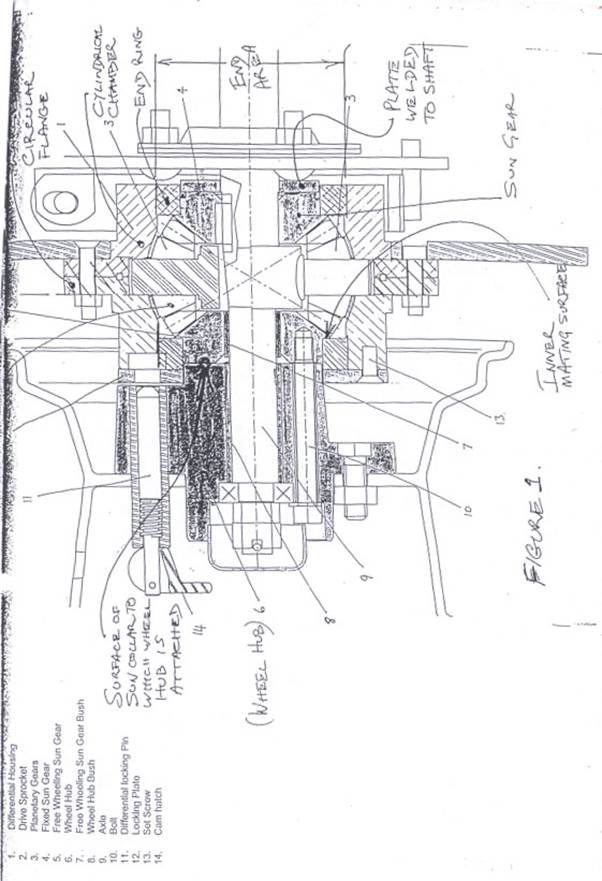
The external face of the sun gear collar in the Cox differential, nearest the wheel hub depicted in Exhibit LEH5, performs the function of mating directly with the wheel hub, and of allowing drive torque to be transmitted directly to that hub via friction created by bolts spaced circumferentially. This represents in my opinion, a distinct mechanical difference in the manner by which the ‘sun gear is drivingly connected to the wheel hub’ ie. a tubular portion or a ‘tubular stub axle’ is not used, but rather a planar joint relying on friction created by circumferential bolts is used. This ‘planar joint’ is denoted in the copy of Exhibit LEH5 attached to this report as the ‘surface of sun collar to which wheel hub is attached’. The circumferential bolts are denoted as item 10.” (Emphasis added)
23 Dr Gilmore added:
“The Cox design is restricted in the allowable placement position of the differential casing relative to the adjacent wheel. The differential described in the Claims of the Bartlem patents, allows attachment of a wider rubber tyre and wheel than does the Cox design, and allows more freedom in the placement of the differential case and chain drive sprocket. This is provided by the key tubular portion feature which allows the differential case and the wheel hub to be spaced some distance apart. A wider rubber tyre will allow for use on more delicate grassed areas which may be damaged by high tyre contact forces. Drive torque is transmitted through the ‘tubular portion’ which acts as a ‘torque tube’ or driveshaft. Tubular driveshafts or ‘torque tubes’ are a common component in mechanical engineering, used to transmit power from one location to a distant location. Tubular members are commonly used because of the physical properties endowed by a tubular shape ie. the working material is placed on the largest possible radius, thereby transmitting the largest torque or power for the minimum amount of material used, or weight incurred.” (Emphasis added)
24 Dr Gilmore made the following comments on Mr Chaseling’s report dated 3 July 2000:
“Mr Chaseling refers to the Cox differential drawing Exhibit LEH5, and states that ‘the free-wheeling sun gear (5) which drives the closer wheel, has a short cylindrical portion behind the gear portion, and a hollow centre …’. Mr Chaseling therefore defines the gear hub or collar as a ‘cylindrical portion’. In Section 3.6, Mr Chaseling states that when two ‘cylindrical portions’ are joined, they are able to be redefined as a ‘tubular portion’. In my opinion, the terminology should not and need not change. A tube has not been formed, and in particular the length to diameter ratio of the abutted parts is approximately 0.6, yielding a short cylindrical portion lacking tubular properties.
The sun gear teeth must have steel onto which they are securely attached and mated in order that the sun gear might be placed on a shaft or attached to another component ie. the sun gear teeth must have sufficient mass of material to allow them to form a viable sun gear. That necessary amount of steel is the cylindrical portion referred to by Mr Chaseling, or the hub or collar referred to in the Bartlem Patent drawings (see Item 215, Figure 3, [AP] 664820).
It is noted that Items 214 and 215 are designated as separate components in Figure 3, [AP] 664820, whilst Item 227 includes both a sun gear and a collar and they are jointly designated under the one identification number. It is clear that the Bartlem Patents regard the sun gear and collar as inseparable items, to be used simultaneously, and comprising a whole part. On this basis, the Cox sun gear and collar must be regarded as a single part.” (Emphasis added)
25 Dr Gilmore added:
“Claim 1 of both [AS] 692882 and [AP] 664820 includes:
‘The sun gear nearest said one wheel hub is drivingly connected to said one wheel hub through a tubular portion, which passes rotatably through the fixed end wall interposed between said one wheel hub and the sun gear nearest said one wheel hub.’
Mr Chaseling pursues two lines of thought, one with the ‘end walls’ being regarded as the inner mating surface of the ‘end rings’ alone (section 3.5), and the second with the ‘end walls’ being regarded as the entire thickness of the end ring (section 3.6). Interestingly, he states in section 3.5 that ‘The entire thickness of the end rings cannot be considered as the end walls, as …’, but immediately invites doubt to this statement in section 3.6 in stating ‘even if the entire thickness of the end ring is considered to constitute the fixed end wall, the …’.
In section 3.5, Mr Chaseling states that ‘the hollow cylindrical end portion of the free-wheeling sun gear does, in my opinion, pass through the fixed end wall of the housing’ ie. through the inner mating surface. In section 3.6, Mr Chaseling recognises that in the Cox differential, the sun gear mates directly to the wheel hub, using bolts.
Figure 3 of the Petty Patent [AP 664820] illustrates, and the text describes, a sun gear 227, a tubular stub axle or tubular portion 226, and a wheel hub 231. That is, three separate components are nominated, whereas the Cox differential contains only two ie. the sun gear and the wheel hub.
The illustration Figure 3 of the Petty Patent [AP 664820] shows sun gear 227 containing a protruding hub section of smaller diameter than the outer gear diameter, as does the Cox differential sun gear. Therefore, there is no difference in interpretation of what constitutes a sun gear between the two differentials. Further, the illustration Figure 3 of the Petty Patent shows wheel hub 231 containing a protruding hub section of smaller diameter than the outer hub diameter, as does the Cox differential sun gear. Therefore, in my opinion, there is no difference in interpretation of what constitutes a wheel hub component between the two differentials.
Therefore, it can be concluded that the Cox differential does not incorporate a ‘tubular portion’.
Section 3.5.
Mr Chaseling concludes that the hollow cylindrical end portion of the free wheeling sun gear does pass through the fixed end wall of the housing.
I would re-phrase this as the sun gear hub or collar passing partly into the flanges or end rings integral with the housing. The sun gear hub does not pass completely through the flanges.
Section 3.6.
Mr Chaseling states that in engineering terms, the word ‘tubular’ is used to describe a solid object with a central hole, usually prismatic in shape. Mr Chaseling does not include the requirement of an ‘elongated’ shape, which in my opinion, is an essential feature. On Mr Chaseling’s argument alone, a sealing ring (O’ring), a thin gasket, or a flat bolt washer would be termed tubular. In my opinion, engineering terminology would not regard such objects as tubular. A distinction needs to be drawn between a ring and a tube.
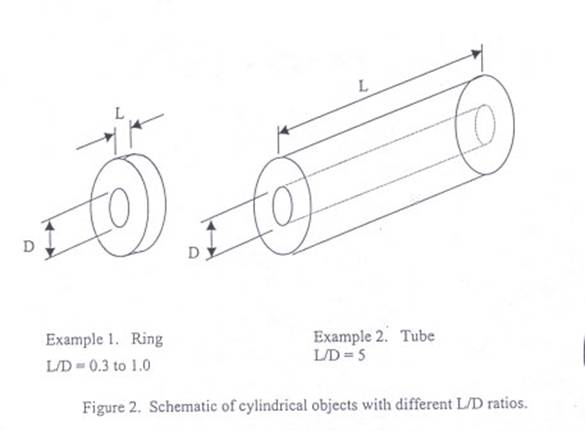
Elongation is exhibited by having a ratio of length to inner diameter which greatly exceeds unity. Tubular refers to being tube-like. A tube is used in engineering to convey fluids (ie. a pipe), or to provide structural members which are long and slender. Common examples are boiler tube, plastic tubing, welded tube, seamless tube, toothpaste tube. The term ‘bronchial tube’ refers to a long slender pipe which is perhaps 20 times longer than its internal diameter. A wedding ring is cut from a tube of gold, but it is not described as a ‘wedding tube’ when the length is perhaps 30% to 100% of the inner diameter. Rather, it is referred to as a ‘ring’ of gold.
The two descriptions are demonstrated in Figure 2 of this report [see below].
The length of the end ring through which the sun gear hub passes, when compared to the shaft diameter is approximately 0.6 based on the drawing LEH5 of the Cox differential (Figure 1) ie. less than 1.0. In contrast, the length of the separate tubular stub axle 226 from the Petty Patent [AP 664820] Figure 4, divided by the shaft diameter over which it is passed, is approximately 4.2.
In my opinion, the Cox differential does not contain a tubular component or portion. The Cox differential also uses fewer components and different technology to that disclosed in the Bartlem Patent Claims and Specifications. By doing so, the Cox differential possesses different physical engineering characteristics eg. large tyres are not as easily used without other disadvantages such as an extended track dimension (width between centreline of two rear tyres), the manufacturing processes for the differential housing are more labour intensive, the lubrication qualities of the lithium grease may be reduced compared to oil, and oil leaks cannot occur as oil is not used in the differential.
Sections 4.4, 4.5.
I note the two types of axles described ie. a stationary cantilevered axle about which a wheel rotates, and a rotating drive axle. The common feature not mentioned by Mr Chaseling is that bolt axle types occupy the centreline of rotation. A ‘tubular stub axle’ would be interpreted as a short hollow axle which occupies the centreline of rotation. Components which rotate about axles (such as the transaxle) are normally termed hubs or sleeves.
To a reader of the specification, the term ‘stub axle’ has a particular meaning in my opinion ie. a stationary but relatively short axle which might have a length to diameter ratio between approximately 1.0 and 5.0.
Given confusion in the patent claims about the meaning of the term as used, the specification and drawings should be used to clarify the meaning of ‘tubular stub axle’ as used in the patent documents.
I disagree with the statement in section 4.5 on this basis ie. the drawings show a tubular sleeve of length to diameter ratio approximately 4.0. In addition, [AS] 698806 does not refer to end walls through which the tubular member must pass. Therefore, by Mr Chaseling’s definition, the collar or hub on the sun gear alone must be regarded as the tubular stub axle. As discussed previously, this collar is neither tubular nor is it an axle.
Further, Mr Chaseling is incorrect in referring to a ‘tubular portion’ in relation to [AS] 698806. This patent does not use the term ‘tubular portion’ at all.” (Emphasis added)
26 Figure 1 was illustrated thus:
27 In his cross-examination, Dr Gilmore gave the following evidence:
“Functionally speaking the adaptor portion of the Cox wheel hub performs a similar function to the tubular portion described in the patents in this case. Do you agree with that?---The adaptor portion?
Yes?---Could you just point out which you mean by that?
I mean the inner portion of the physical device you’ve got in front of you, coming in from the circular flange on which the wheel is mounted, or the wheel rim or hub?---perhaps we’d better be specific, because are we … talking about the complete distance from the inner flange … to that bolted surface?
Yes, I am?---The complete distance?
Yes, I beg your pardon, and then I should add to it: when that is bolted to the collar on the back of the sun gear – so if you could imagine a bolt to gather it all---?---Yes.
…for the purpose of this…?---Yes.
---the combined piece of metal between the back of the sun gear and the inner face of the flange – the wheel flange, if I can call it that – performs the same function as the tubular portion in the patents that we’ve looked at?---Well, I’d disagree with that because I think you need to go to the patent, and I think you’ll find that the – the patents [in suit] that we were talking about have a – the wheel flange in fact has a – a collar, or hub as well---
Yes?--- which you’re omitting, I believe. I think you need to consider that as part of the wheel hub.
Well, what is the function of the tubular portion in the patents that you’ve looked at?---In the patents that I’ve looked at, it’s a discrete … portion with tubular characteristics as I’ve described in my report, which connects a sun gear which contains a collar or boss or hub, and a wheel hub which also contains a collar. So it’s a discrete piece which connects those two components together, and those two components are quite discretely identified in the patents by – on the drawings, in particular, by numbers, and in the specification by reference to those numbers.
Now, the claims don’t say that they are discrete; you get that from the body of the specification, don’t you?---That’s correct; yes.
And the discussion that you’ve just given of collars is something you get from the drawings and description, not the claims?---That’s correct. It’s … described – I think you need to go to the … specifications and the drawings to understand what is meant in … those particular patents by a wheel hub, or a sun gear.” (Emphasis added)
28 Later, Dr Gilmore was cross-examined about his comments in his report comparing (par [c] – see above) part of claim 1 of AP 664820 where he said that in the Cox differential, he could identify four things (a sun gear, a collar (or sun gear hub), a collar (or a hub on a wheel hub) and a wheel hub but not a “tubular portion” interposed between the wheel hub and the sun gear nearest the wheel hub. The cross-examination proceeded:
“Now, in (c), when you say you can identify the four things we see there, or the things we see there, you are looking at what I asked you to bolt together in your mind, a few minutes ago. Is that right?---I believe so.
And this is right, you see it has four functional parts, two physical parts?---In the Cox differential?
Yes?---Two physical parts and, yes, functional parts. But the functional parts are taken from the definitions given in the Bartlem [patents].
Yes?---Where those patents do describe those four functional parts.
You see in the … Bartlem patents, two physical parts, a sun gear with a collar and a tube, and that is one physical thing that you can hold in your hand?---I understand that is one piece, yes.
But you understand from looking at the pictures?---Yes.
And the other physical part is the wheel hub together with a little mounting bracket, if I can call it that, on the inside, or mounting portion, on the inside?---Just go back. I’m not sure – looking at the pictures, that tubular portion looks to be one part. I’m just not sure whether it is in practice.
I’m just talking about what you see from the drawings?---Yes, the drawing.
Forget the physical machine?---From the drawings they look to be one part.
I think the word ‘integral’ is used in describing it?---Yes.
So there are two physical parts in the patents; is that right?---Which are?
The sun gear with collar and tubular portion on the one hand, and wheel hub with sort of keyhole shaped mounting bracket, if I can call it that, on the other?---That’s correct.
And do you discern from that the four functional bits that we see here in (c)?--- Yes, that’s correct.
And the Cox diff also has those four functional bits made up of two discrete elements, physical elements?---Yes, that’s what I’m saying. I can identify a sun gear, a collar, or sun gear hub, collar or hub on a wheel hub, and a wheel hub in the Cox differential.
When they are bolted together in the Cox differential, they form a single physical unit, the different parts of which perform the four functions, respectively perform the four functions?---That’s correct.
Namely, the function of a sun gear, which is to be driven by a planetary gear and begin the process of imparting torque outwards?---That’s correct.
A collar or sun gear hub and a collar or hub on the wheel hub which together transmit the torque from the sun gear to the wheel hub?---Well, they perform two functions there. They certainly participate in transmitting the torque because they’re pieces of metal between the gears and the outward face, but they also perform sealing functions and---
Perhaps spacing functions too? Sorry to interrupt?---Yes, spacing functions and sealing functions, and bearing functions.
And then there’s the wheel hub in the physical Cox diff which performs the function of holding the wheel rotatively around the axle?---Yes, those two things have to bear on the axle and support the wheel hub – sorry – support the wheel.
And be driven by the sun gear via the route we have discussed?---That’s correct.
So there’s no doubt that the Cox wheel hub sun gear bolted together assembly performs the same function as the assembly of different parts described in the patents?---Well, the patents seem to have an extra – well, they do have an extra component, but torque is still transmitted from the sun gear teeth to the wheel, yes.
And the extra component is the tubular portion or stub axle, depending on which one you’re reading?---That’s correct.” (Emphasis added)
the REASONING OF THE PRIMARY JUDGE IN RESPECT OF AP 664820, AS 692882 AND AS 698806
29 The primary Judge commenced his analysis by referring to the general principles of interpretation in this area, noting (at [15]) that the claims and specification “are not to be read in the abstract”. The words used are to be given “the meaning which a normal person, having a knowledge of the art and the manufacture at the relevant time and in light of the then common general knowledge, would give to such words”. His Honour then turned to construe each of the material claims.
(a) Construction of the claims
(i) AP 664820
30 His Honour noted (at [19]) that the specification acknowledged that the invention “relates to improvements to ride-on mowers incorporating reversible belt drive mechanisms”, and identified the features ordinarily found in a ride-on motor mower incorporating reversible belt drive mechanisms, described as follows:
“Ride-on mowers often utilize reversible belt driven assemblies which transfer drive in the forward and reverse direction through a step down chain drive to the mower’s rear transverse drive axle. The drive is actuated by a rocking type pedal in which heel pressure is used to engage reverse drive and toe pressure is used to engage forward drive. For simplicity, light weight and ease of construction, ride-on mowers mostly utilise a transverse drive axle having respective wheel hubs fixed thereto at opposite ends thereof and intermediate spaced chassis mountings which are normally in the form of flangette bearings supporting the transverse axle for rotation. The transverse axle is directly chain driven to a sprocket mounted rigidly on the axle for rotating the driving wheels in unison.
As the width of such mowers is increased for added stability and better traction through wider wheels, the disadvantages of poor steering control inherent in such drive systems becomes more noticeable. Such disadvantages can be overcome to a large extent by the provision of a differential in the drive train to the rear wheels. Unfortunately the differentials available to date have not suited the simple drive trains which utilise a common driving axle as used in most mowers and additionally the available differentials have not had the ability to be selectively utilised or locked in a convenient manner.”
31 The primary Judge observed that the specification referred to the prior art base with respect to provision of differentials and differential locks, and identified the alleged deficiencies in their use and operation. The specification, his Honour noted, concluded thus:
“... Accordingly they are not suited for location outwardly of the chassis supports for coupling to the correspondingly located drive sprocket of the final chain drive.
Furthermore the housings for this type of differential have to be made exceedingly robust if they are to cope with the high loadings applied through such drives without misalignment of the respective drive shafts being induced through the applied loads and leading to premature failure.
The locking mechanisms proposed in the abovementioned patent specifications and conventional differential locking mechanisms are not satisfactory for use with ride-on mowers.”
32 The specification, the Judge mentioned, dealt with a turf aerating machine manufactured by OMC in the United States of America and described as the “OMC Greensaire Mk II” as part of the prior art base. The machine had a chain driven differential supported outwardly of simple axle bearing blocks at opposite sides of the vehicle chassis, which support a continuous exposed transverse axle. The arrangement was described in the specification, his Honour observed, as much in the manner as described above in relation to ride-on mowers.
33 His Honour noted that the differential housing of the OMC machine was open at one end in order to transmit drive from the rear one of a pair of differentially driven sun gears to the adjacent wheel hub. A resilient peripheral seal was used to close the gap between the adjacent wheel hub and the open end of the differential housing. The purpose of the seal was to retain lubricant in the geared differentials and to keep out water, dust or other particulate material. After stating the perceived deficiencies of the OMC arrangement, the Judge observed, the specification concluded:
“While it may be possible to make all the components of such a differentially driven transverse axle sufficiently robust to accommodate these wear factors the resultant assembly would be very heavy and expensive to produce. Such a differential would have a large flywheel effect and would place extreme loads on the rest of the drive train during rapid change from forward to reverse drive.”
34 The specification then identified, his Honour noted, the advantages which the invention seeks to achieve over the present art base, as disclosed in the specification as follows:
“The present invention aims to provide a ride-on mower including a reversible chain drive to a differentially driven rear drive axle assembly which is operable in harsh operating environments safely, reliable and efficiently and which may also be operated without leaking of lubricant from the differential and consequent damage to the differential and or grassed surfaces onto which lubricant may leak.
In a further aspect this invention aims to provide a ride-on mower including a reversible chain drive to a differentially driven rear drive axle assembly which can be selectively locked and unlocked in a convenient and safe manner remote from the differential assembly and/or chain and belt drive assemblies incorporated in the ride-on mower as well as the cutting blades.”
35 And in the preferred embodiment it was provided that:
“... selectively operable differential locking means operable and disposed externally of the gear case and at the side of said one wheel hub which is remote from the gear case for effecting locking of the gear case assembly for rotation with said transverse axle and with said one wheel hub, whereby the respective wheel hubs are locked for rotation in unison with both said transverse axle and said gear case.”
36 The Judge mentioned that, save for the (immaterial) substitution of the word “operable” in the first line quoted for “engageable”, this formulation was carried over into claim 2 of the claims.
37 The specification went on, his Honour noted, to describe by reference to the accompanying drawings, a typical embodiment of the invention.
38 The Judge concluded (at [28]):
“When the specification is read as a whole, it appears that the invention consists of a differentially driven rear axle assembly, capable of being selectively locked and unlocked from a convenient location remote from the differential assembly, adapted for use in a typical ride-on mower which utilises a reversible chain drive.”
39 His Honour held (at [29]) that the components of the combination claimed in claim 1 were a ride-on mower, including a chain driven reversible rear drive axle assembly of a type wherein:
(i) a differential gear case mounted rotatably on and supported by a transverse axle, which supports wheel hubs at opposite ends and which is supported for rotation by spaced chassis mountings intermediate the wheel hubs and through which spaced chassis mountings the transverse axle is attached to the mower’s chassis;
(ii) the gear case is mounted on the transverse axle between one wheel hub and the adjacent chassis mounting and that wheel hub is rotatable about the transverse axle;
(iii) a driven sprocket for the chain drive is attached to the gear case for driving the reversible rear drive axle assembly;
(iv) the gear case includes a housing, which extends co-axially of the transverse axle and which housing carries a pair of opposed planetary gears therein for orbital motion about the transverse axle;
(v) opposed sun gears are supported in axially spaced relationship on the transverse axle adjacent to the wheel hub and are differentially driven by the opposed planetary gears;
(vi) the sun gear nearest the wheel hub is rotatable about the transverse axle and is drivingly connected to the said wheel hub, and the other sun gear and the other wheel hub are locked for rotation with the transverse axle.
40 Cooper J further held (at [30]) that the decisive characteristics of the combination claimed in claim 1 were:
(i) the gear case includes fixed end walls at the opposite ends thereof which enclose the sun gears and planetary gears within the housing;
(ii) the sun gear nearest the wheel hub is drivingly connected to that wheel hub by a tubular portion, which passes rotatably through the fixed end wall interposed between the wheel hub and the sun gear nearest the wheel hub; [Emphasis added]
(iii) the transverse axle passes rotatably through the other end wall of the gear case and rotatably through the tubular portion. [Emphasis added]
(As will be seen (at [55], below), Cooper J, went on later in his reasons to construe the phrase “tubular portion” in this context.)
41 His Honour said (at [31]) that the components of the combination in claim 2 were the same as claim 1 (as thus characterised) with the following additional characteristics:
(i) there is provided a selectively operable differential locking means, operable and disposed externally of the gear case and at the side of the wheel hub which is remote from the gear case; and
(ii) the locking means is for effecting locking of the gear case for rotation with the transverse axle and with the wheel hub, whereby the respective wheel hubs are locked for rotation in unison with both the transverse axle and the gear case.
42 His Honour concluded (at [32]):
“For the purposes of claims 1 and 2 of AP 664820, the essential integers in terms of the issues raised between the parties are the characterising integers (i), (ii) and (iii) [quoted directly above] in respect of claim 1 with the additional integers (i) and (ii) in respect of claim 2.”
(ii) AS 692882
43 The primary Judge noted that claim 1 here was identical with claim 1 in AP 664820, save also for the “immaterial substitution” of the word “mounting” for “support” in line 11 of claim 1 of AP 664820; that claim 1 and claim 6 of AS 692882 were identical, save for the description of the gear set carried by the gear case housing; that in claim 6, the words were “...which housing carries a differential gear set having opposed differentially driven sun gears supported in axially spaced relationship on the transverse axle”; and that in claim 1, the words were “...which housing carries a pair of opposed planetary gears therein for orbital motion about the transverse axle; opposed sun gears are supported in axially spaced relationship on the transverse axle adjacent said one wheel hub and are differentially driven by the opposed planetary gears”. Each of claim 1 and claim 6, his Honour said, were characterised by the three essential characteristics which limit the claim made.
44 Claims 7, 8 and 9 of AS 692882, his Honour observed, each require, as a component of the claimed combination, a ride-on motor mower as claimed in claims 1 or 6, together with further characterising elements; and these elements all related to the differential locking means.
(iii) AS 698806
45 The primary Judge remarked that the claims in AS 698806 related to specific combinations of integers for differential locking of chain-driven reversible rear drive axle assemblies; and that the need sought to be satisfied by the claimed invention was identified in its specification as follows:
“Many domestic and ride-on mowers have driven rear wheels utilising a simple drive train to transmit power from the motor to the rear wheels. Typically the drive is transmitted by belts or chains to a transverse rear axle which supports the rear wheels. This system is generally satisfactory. However as the width of mowers increase the disadvantages inherent in such drive systems becomes more noticeable. Such disadvantages can be overcome to a large extent by the provision of a differential in the drive train to the rear wheels. The differentials available to date have not suited the simple drive trains which are utilised in most mowers and additionally such differentials have not had the ability to be selectively utilised or locked. Furthermore, the locking mechanisms for such differentials have been difficult and inefficient in use and/or increased the risk of damaging the drive mechanism and/or wheel mountings.
This invention aims to alleviate the abovementioned disadvantages and to provide a chain driven reversible rear drive axle assembly for a ride-on mower which will be reliable and efficient in use.”
46 His Honour said (at [36]) that the components which make up the chain-driven reversible rear axle assembly for a ride-on mower as claimed are:
(i) a transverse axle supporting respective wheel hubs at opposite ends thereof one hub being freely rotatable about said transverse axle and the other hub being fixed to said transverse axle;
(ii) a differential gear case mounted rotatably on and supported by said transverse axle and forming a housing extending along the transverse axle;
(iii) a driven sprocket for the chain drive attached to the gear case;
(iv) a pair of opposed planetary gears supported by said housing for orbital motion about the transverse axle;
(v) opposed sun gears supported in axially spaced relationship along and co-axially about the transverse axle and within said housing and meshed with said opposed planetary gears for differential rotation thereby;
(vi) a tubular stub axle rotatable about said transverse axle and drivingly connected to said one hub and the sun gear which is nearest said one hub, the other sun gear being locked for rotation with said transverse axle [emphasis added], and
(vii) an externally accessible locking member associated with said one hub and manually moveable to a locking position at which it locks said one hub for rotation with said gear case and said transverse axle.
47 (His Honour later (see [56] below) construed the phrase “tubular stub axle”.)
48 His Honour held (at [37]) that:
“The combination claim is for a substantially new thing, wherein the inventive step lies in the choice and management of the integers and therefore each of the integers claimed is an essential integer …”
49 He went on to say that claims 5, 6, 7 and 8 of AS 698806 all included, as an integer, a chain-driven reversible rear drive axle assembly as claimed in claim 1, with additional specific integers relating to the locking means (claims 5 and 8) or the gear case and housing (claims 6 and 7).
(iv) General
50 Turning then to claim 1 of AP 664820, the primary Judge observed that the only area of controversy on the proper construction of the claim lay in the clauses which characterise the combination claimed. However, in his Honour’s view, rejecting a submission put for Cox, there was no ambiguity in the wording of claims 1 and 2 of this patent (in the sense explained in the authorities which the Judge had earlier cited) which would permit or require features that appear in the preferred embodiment to be incorporated into the language of the claims (at [45]). (This conclusion was not challenged before us.)
51 The primary Judge noted (at [46]) that the integers of the combination commenced with a differential gear case mounted rotatably on, and supported by, a transverse axle. The gear case “... includes a housing which extends co-axially of the transverse axle and which housing carries a pair of opposed planetary gears therein for orbital motion about the transverse axle”. The planetary gears are within the housing and, by some means, supported within the housing; the housing co-axially rotates around the transverse axle with the orbital motion of the planetary gears. The planetary gears differentially drive opposed sun gears, which are supported in axially spaced relationship on the transverse axle adjacent to one wheel hub. Because the gear case housing extends co-axially of the transverse axle, the housing will, of necessity, have two opposed ends through which the transverse axle passes. The claim, his Honour observed, specifically provides for the integers present at each end of the housing by way of “fixed end walls”.
52 In his Honour’s opinion (at [47]), the phrase “the gear case includes fixed end walls” meant, in this context, that the fixed end walls were added and formed part of the gear case at the opposite ends of the housing: so much flowed, the Judge said, from the use of the word “includes” in its ordinary meaning in this context, namely “to add as part of something else” (citing Collins English Dictionary; Australian Edition (1979) at p 740). So understood, “fixed” meant fixed as part of the gear case. Save for the transverse axle and a tubular portion, which pass rotatably through the end walls, as provided in the language of the claim, the end walls were to perform the function of enclosing the sun and planetary gears within the housing; that is, the end walls were used to enclose all the gears within the housing of the gear case.
53 His Honour held (at [48]) that the words “enclose” and “within” bore their ordinary meaning in the claim; that is, the end walls which were fixed to the housing close off the ends of the housing to contain or hold the gears within the housing. The word “within” here means “in; inside; enclosed or enclosed by” (citing Collins English Dictionary at p 1165).
54 The words of the claim mean, the Judge said, that the gears were wholly encased by the housing and the fixed end walls at the opposite ends of the housing; such a construction was confirmed by reference to the body of the specification, wherein the claimed invention was distinguished from the OMC turf aerator. The feature identified in the OMC turf aerator which was regarded as a disadvantage, and which the claimed invention seeks to overcome, was the use of a resilient peripheral seal to close the peripheral gap between the adjacent wheel hub and the open end of the differential housing. The use of such a seal to prevent lubrication loss or the entry of water, dust and other particulate material, is claimed to be ineffective and liable to fail wholly or partially, over time. The invention in suit, his Honour observed, seeks to overcome such problems by the provision of a fixed end wall to the otherwise open end of the differential housing; although the claim was silent as to how the end wall was to be fixed to the casing, but nothing significant flows from this.
55 Noting (at [52]) the statement in the claim that the sun gear nearest to the wheel hub is drivingly connected to that hub “by a tubular portion which passes rotatably through the fixed end wall interposed between” the wheel hub and the sun gear, and having mentioned that the experts had not agreed upon the meaning of “tubular” in this connection, his Honour went on (at [55]) to refer to dictionary (Collins and Oxford Short) definitions of a tube as “a long hollow and typically cylindrical object used for the passage of fluids or as a container” and as “a hollow body, usu. cylindrical, and long in proportion to its diameter, of wood metal glass etc used to convey or contain a liquid, or for other purposes; a pipe …”; and a definition of “tubular” as “tube shaped; constituting or consisting of a tube; cylindrical, hollow and open at one or both ends”. In his Honour’s view, in the context of claim 1, “tubular” had the dictionary meaning as explained by Dr Gilmore in its application in engineering terminology. The extent of the elongation necessary is always, the Judge observed, a question of judgment and degree. However, there must be, he said, more than the existence of a hollow in an object before that object can be described as being a “tubular portion” within the meaning of claim 1.
56 Noting that the experts had also disagreed on the meaning of the term “tubular stub axle” as used in claim 1 of AS 698806, his Honour remarked (at [64]):
“The tubular stub axle specified in claim 1 has two defining features. Firstly, it is rotatable around the transverse axle. Secondly, it is drivingly connected to one wheel hub and the sun gear in the differential gear, which is nearest that wheel hub. The requirement that the other sun gear is locked for rotation with the transverse axle, indicates that the tubular stub axle is drivingly connected to the wheel hub, which is rotatable around the transverse axle. In the context of the claim, it is not an essential characteristic of the tubular stub axle that it support the wheel hub, as this is provided by the transverse axle, or that it occupy the centre line of rotation, as it is clear that the stub axle as claimed is rotated around the transverse axle. …”
57 His Honour noted that Dr Gilmore had said in his report:
“... As defined by Bartlem …, the ‘tubular stub axle’ provides a sleeve which transfers mechanical power from the differential to the wheel. If the ‘tubular stub axle’ was absent, the ride-on mower could not be driven or moved under its own power.”
58 Cooper J then stated (at [65]) that his earlier observations as to the meaning of “tubular portion” in respect of claim 1 of AP 664820 were also relevant to so much of the “tubular stub axle” as is constituted by a tubular portion of it.
(b) The alleged infringements
59 Turning first to the general principles to be applied in this area, the primary Judge referred to the frequently cited passage in Clarke v Adie (1875) LR 10 Ch App 667 (at 675) that it is “in every case a question of fact whether the alleged piracy is the same in substance and effect or is a substantially new or different combination”, added a reference to well-known dicta in the Australian authorities to the effect that “[a] person may not take the pith and substance of an invention unless the wording of the claims make it clear that the relevant area has been deliberately left outside the claim” and said (at [68] – [70]):
“The test to be applied was stated by Dixon J in Radiation Ltd v Galliers and Klaerr Pty Ltd (1938) 60 CLR 36 at 51:
“…On a question of infringement, the issue is not whether the words of the claim can be applied with verbal accuracy or felicity to the article or device alleged to infringe. It is whether the substantial idea disclosed by the specification and made the subject of a definite claim has been taken and embodied in the infringing thing.”
This test was adopted by a Full Federal Court in Populin v HB Nominees Pty Ltd (1982) 59 FLR 37 at 41.
Patent rights are not to be set at nought by subterfuge, by avoiding the literal meaning of a claim, by a modification so small as to be insignificant and to have no material effect upon the way the invention as claimed works: Commonwealth Industrial Gases Ltd v MWA Holdings Pty Ltd (1970) 180 CLR 160 at 167-168; Rehm Pty Ltd v Websters Security Systems (International) Pty Ltd (1988) 81 ALR 79 at 91-92. Nor by immaterial variations, for example, by dropping an inessential step or part and substituting another part or step as its equivalent: Marconi v British Radio, Telegraph & Telephone Co Ltd (1911) 28 RPC 181; Populin v HB Nominees Pty Ltd at 42.
However, it is important to emphasise that there is no principle of “non textual” infringement and the language of the claims cannot be ignored by resort to function. Clear and unambiguous wording in claims will be given due and limiting effect because the patentee, in words of its own choosing addressed to those skilled in the art, informs them what the patentee claims to be the essential features of the new product or process for which the letters patent grant the patentee a monopoly: Catnic Components Ltd v Hill and Smith Ltd [1982] RPC 183 at 243; Rehm at 92; Codex Corp v Racal-Milgo Limited [1983] RPC 369 at 381; Willemijn Houdstermaatschappij BV v Madge Networks Ltd [1992] RPC 386 at 388-9, 399; CCOM Pty Ltd v Jiejing Pty Ltd [No 2] (1993) 27 IPR 577 at 616.”
(i) The alleged infringement of AP 664820
60 His Honour held (at [71] – [72]) that the substantial idea disclosed by claim 1 was the use of a tubular portion rotating around a transverse axle, as the means by which drive is transmitted from the sun gears (enclosed within the gear case housing) to the wheel hub closest to the sun gears. This wheel hub itself rotates around the transverse axle. The means by which this was achieved is characterised by a tubular portion, which passed rotatably through the fixed end wall of the gear case interposed between the sun gear nearest the wheel hub and the wheel hub itself. The tubular portion was drivingly connected to the sun gear within the gear case housing; the sun gear was enclosed within the housing by the body of it, which extended co-axially along the transverse axle, and, the two fixed end walls. The tubular portion was drivingly connected to the wheel hub externally of the fixed end wall interposed between the wheel hub and the sun gear. But the drive assembly and gear case used on the Cox ride-on motor mowers did not infringe, because it did not include a tubular portion which can be characterised in the manner claimed in this claim.
61 Cooper J said (at [73] – [74]):
“The wheel hub used by [Cox] is moulded and incorporates a housing for the locking mechanism used to stop the differential action of the gears. The locking means adopted uses a spring loaded pin which, when engaged, passes into a flange attached to the end wall of the gear case housing and the end wall itself nearest to the wheel hub. When locked, the wheel hub is locked to the housing of the gear case and the attached flange. The wheel hub has an extension of approximately 80 mm in length and a diameter of approximately 580 mm. This extension, as has the wheel hub, has provision for the transverse axle to pass co-axially through it and provision for three bolts which also pass co-axially through the wheel hub and extension to bed into the collar of the sun gear nearest the wheel hub. The bolts when tightened enable the wheel hub to be driven by torque transmitted from the rear face of the sun gear bolted to the wheel hub extension.
The sun gear in the Cox gear box is not enclosed wholly within the gear box housing.”
62 Accepting the evidence of Dr Gilmore here, his Honour found (at [75]) that the collar of a sun gear was not “a separate and discrete” item different from the sun gear. Nor was the sun gear merely the face of the gear where the teeth were situated. The collar was an integral part of the sun gear and functionally necessary for its performance. Although the teeth of the sun gear were contained within the Cox housing, the collar of the sun gear penetrated the end wall of the housing almost to its full depth. The extension to the wheel hub was drivingly connected to the sun gear within the end wall and the flange attached to the end wall for use with the locking mechanism.
63 Having noted (at [76]) Bartlem’s contention that, because the cylindrical metal section of the single Cox component, when bolted together, is “generally tubular in shape”, and thus a “tubular portion” of the type characterised in claim 1, the primary Judge (at [77]) rejected this approach as seeking to apply an impermissible test of “functional equivalence”, which ignored the language of the claim. The wording of claim 1, his Honour held, required as a separate item a “tubular portion”, characterised in terms of the claim. Parts of other items, although functionally performing the same task as a separate tubular portion, did not become a discrete and separate item, simply because it was possible to discern a cylindrical or tubular shape. This was particularly so where the shape was only discernible by choosing two arbitrary extremities of the alleged cylindrical or tubular section. Such an approach, the primary Judge observed, ignored the extent to which any part of the metal section claimed to represent the tubular portion formed an integral part of the wheel hub or sun gear itself and was necessary for the proper function of the respective wheel hub and sun gear.
64 His Honour went on to say (at [78]) that the Cox “Stockman” drive mechanism used two components to transmit drive from the sun gear nearest the wheel hub to that wheel hub, in a way which did not infringe claim 1 of AP 664820; whereas claim 1 of AP 664820 used not less than three components to achieve that end.
65 Since claim 1 was an “integral” part of claim 2 of AP 664820, the primary Judge also held (at [79]) that the Cox “Stockman” drive mechanism did not infringe that claim.
(ii) The alleged infringement of AS 692882
66 The primary Judge held (at [80]), for the same reasons that the Cox “Stockman” drive mechanism did not infringe claims 1 and 2 of AP 664820; that it also did not infringe claims 1, 7, 8 or 9 of AS 692882.
(iii) The alleged infringement of AS 698806
67 His Honour held (at [81]) that in AS 698806, the combination required, as an “essential integer”, a tubular stub axle, which, in the context of claim 1, meant a tubular sleeve which transferred mechanical power from the differential to the wheel. The sleeve was characterised in two ways. First, it was rotatable about the transverse axle. Secondly, it was “drivingly connected” to the wheel hub and to the sun gear closest to the wheel hub. The primary Judge found that claim 1 of AS 698806 required that there be, as part of the combination claimed, a separate component, being a “tubular stub axle” as characterised.
68 His Honour said (at [82]):
“The approach taken by the expert evidence called by [Bartlem] was once more to attempt to characterise part of the Cox ‘Stockman’ drive mechanism when assembled as such a tubular stub axle. Again this was sought to be done on the basis of functional equivalence and the appearance of a cylindrical section of metal limited by the back face of the wheel hub at one end and the back of the face of the sun gear at the other. For the same reasons that I rejected such an approach to the infringement issue in respect of AP 664820 and AS 692882, I reject such an attempt in relation to this patent also. The Cox ‘Stockman’ drive mechanism does not have as a separate and essential component a tubular stub axle as characterised in claim 1 of AS 698806. Accordingly, it does not infringe that claim.”
69 The Judge went on to hold (at [83]) that claims 5, 6, 7 and 8 of AS 698806 all included, as an integer, a chain-driven reversible rear drive axle assembly as claimed in claim 1, with additional specific integers relating to locking means and gear case housing; and that, as a consequence, the Cox mechanism and gear case did not infringe the later, dependent claims.
BARTLEM’S ARGUMENTS ON ITS APPEAL IN RESPECT OF AP 664820, AS 692882 AND AS 698806
70 On this aspect of the appeal, the question for us, as previously noted, is whether Cooper J erred in deciding that the Cox drive assembly and gear case did not include –
(a) the “tubular portion” which is an essential integer of –
(i) claims 1 and 2 of AP 664820,
(ii) claims 1, 7, 8 and 9 of AS 692882; and
(b) the “tubular stub axle” which is an essential integer of claims 1, 5, 6, 7 and 8 of AS 698806.
71 The primary Judge held, Bartlem argues, that these integers were absent because the claims required “a discrete and separate item” (at [77]), or a “separate and essential component” (at [82]). His Honour further held that the relevant components of the Cox mower “functionally perform[ed] the same task” as the item claimed, but his Honour rejected Bartlem’s submission that they came within the words of the claim, characterising that submission as one which sought “to apply a test of functional equivalence which ignores the language of the claim” (at [77], [82]). Although, on behalf of Bartlem, it is accepted that “a test of functional equivalence which ignores the language of the claim” is contrary to the authorities, (cf. Reasons at [66] – [70]), Bartlem disputes his Honour’s characterisation of its approach in this way. Rather, it submits that “the substantial idea disclosed by the specification and made the subject of a definite claim has been taken and embodied in the infringing thing” (Bartlem is using here the language of Dixon J in Radiation Ltd v Galliers and Klaerr Pty Ltd (1938) 60 CLR 36 at 51). This is largely a question of construction of the claims.
72 As noted above, his Honour said (at [78]):
“The Cox ‘Stockman’ drive mechanism uses two components to transmit drive from the sun gear nearest the wheel hub to that wheel hub in a way which does not infringe claim 1 of AP 664820, whereas claim 1 of AP 664820 uses not less than three components to achieve that end.”
73 The two Cox components to which his Honour referred were the entirety of the sun gear and the entirety of the wheel hub. The three components of claim 1 of AP 664820 were the sun gear, a tubular portion and the wheel hub.
74 His Honour construed claim 1 as requiring a “discrete and separate” tubular portion. Apparently, Bartlem says, his Honour’s construction would not allow “any part of the metal section claimed to represent the tubular portion [to form] an integral part of the wheel hub or sun gear itself …” (at [77]). The authorities referred to by his Honour (at [12] – [16]) establish the proposition that the claim should not be read in isolation. But, even reading the claim in isolation, there is nothing in its words, according to Bartlem, which suggests that a separate item is required, for the following reasons:
(1) The claim first described a “type” of drive axle assembly. The “type” of assembly includes a gear case close to one wheel hub. The sun gear nearest the wheel hub is “drivingly connected’ to it. The invention is particularly defined in the Patents Act 1990 (Cth) (“the Act”) (as required by s 40(2)) or “characterised”, first, by fixed end walls which enclose the sun gears (inter alia). Secondly, the sun gear nearest the relevant wheel hub is “drivingly connected” to it. Because the sun gear is enclosed, there is a need for a connection between the sun gear and the wheel hub. Otherwise the gear cannot drive the wheel. The connection, Bartlem contends, is the tubular portion which passes out of the enclosure (“passes rotatably through the fixed end wall …”, claim 1, line 30).
(2) Nothing in these words, Bartlem submits, requires the “tubular portion” to be discrete and separate. To the contrary, when assembled so as to be operational, the “three components” of sun gear, tubular portion and wheel hub must be connected. Indeed, the wheel hub and sun gear are twice said to be “drivingly connected”, so that the sun gear can drive the wheel hub.
(3) The meaning of the word “portion”, according to Bartlem, tends to the opposite conclusion to that of his Honour. The first Macquarie definition is “a part of any whole, whether actually separated from it or not”. The present whole is the means by which the sun gear is drivingly connected to the wheel hub. “Drivingly connected” is a limitation by result which “characterises the construction of the thing claimed”: Interlego AG v Toltoys Pty Ltd (1973) 130 CLR 461 at 471; Rescare Ltd v Anaesthetic Supplies Pty Ltd (1992) 111 ALR 205 at 213 – 214.
(4) The body of the specification must be read to give the context of the claim, and may also be used to resolve ambiguity. Here, Bartlem submits, the description in the specification puts the matter beyond doubt, in particular (at lines 15 – 22):
“The transverse axle 211 is further provided with a bearing surface 225 on which a tubular stub axle 226, formed integrally with a further sun gear 227 adapted to mesh with the planetary gears 222, may rotate. A further shim 228 is provided for placement between the back face of the gear 227 and the end plate 220. The tubular stub axle 226 and integral sun gear 227 is also provided with an outer key 230 so that the sun gear 227 is drivingly connected to a wheel hub 231.”
(5) Thus the specification describes and depicts a case where the tubular stub axle is “formed integrally” with the sun gear. This, Bartlem says, is the antithesis of its being a “discrete and separate item”. It was not correct to hold, as his Honour did, that Bartlem’s approach “ignores the extent to which any part of the metal section claimed to represent the tubular portion forms an integral part of the wheel hub or sun gear itself” (at [77]) – such a physical construction is, Bartlem submits, what is described: the tubular portion forms an integral part of the sun gear.
(6) Similarly, the description and depiction in the specification does “use[ ] two components to transmit drive from the sun gear nearest the wheel hub to that wheel hub” (cf. Reasons at [78]) and the claim should, Bartlem says, be read as including such an approach.
75 As an alternative submission to its primary argument that the claims literally cover the Cox mower, Bartlem also argues:
(A) His Honour apparently intended to apply the passage (at 51) from the reasons of Dixon J in the Radiation Case, above, that on a question of infringement, the issue is not whether “the words of the claim can be applied with verbal accuracy or felicity to the article or device …”. Rather, it is whether “the substantial idea disclosed by the specification and made the subject of a definite claim has been taken and embodied …”. This passage was quoted by the primary Judge (at [68]). However, his Honour then elided from “the substantial idea disclosed by the specification and made the subject of a definite claim” to “the substantial idea disclosed by claim 1” (at [71]). His Honour then paraphrases the claim.
(B) The substantial idea disclosed by the specification is the provision in a mower of a lockable differential whose gears are enclosed, in contrast to the OMC machine referred to in the specification. His Honour considered this later, holding that the patents did involve an inventive step (at [115] – [118]). (As noted, there is no cross-appeal against the revocation claim.) As submitted earlier, the tubular portion or stub axle is needed to “drivingly connect” the sun gear inside the gear case with the adjacent wheel hub. It is, Bartlem argues, no part of the substantial idea here that the tubular portion necessarily be either separate or integral: what is to be achieved is the driving connection through the wall of the enclosing gear case. Cox’s device does this by joining together in the assembly process a tubular portion consisting of a cylindrical collar or extension of the sun gear and the cylindrical extension of the wheel hub. (Bartlem does not challenge his Honour’s finding (at [75] –[77]) that these are not separate from the sun gear and wheel hub, respectively).
(C) As his Honour held (at [77]), the relevant parts of the Cox mower “functionally perform[ ] … the same task as a separate tubular portion”. Accordingly, the passage from Commonwealth Industrial Gases Ltd v MWA Holdings Pty Ltd (1970) 180 CLR 160 at 167 – 168, in fact cited by his Honour (at [69]), is apposite:
“Patent rights are not to be set at nought by subterfuge, by avoiding the literal meaning of a claim, by a modification so small as to be insignificant and to have no material effect upon the way the invention as claimed works.”
(D) Although his Honour made no finding about it, there was no doubt that the final form of the Cox differential, including the modification which gives rise to the second issue on the appeal (see below), was arrived at with knowledge of the Bartlem patents, although such knowledge is not actually necessary to attract the principle stated in CIG, above.
76 Alternatively, Bartlem submits, the Court should apply the approach of “purposive” construction explained in Catnic Components Ltd v Hill and Smith Ltd [1982] RPC 183 at 243 – 244; that is to say, if, contrary to the previous submissions, the words of the claim, properly construed, might denote a separate and discrete tubular portion (or stub axle), then a skilled addressee would not understand that strict compliance with the phrase “tubular portion”, as construed by his Honour, was intended, such that the present “variant would fall outside the monopoly claimed, even though it could have no material effect on the way the invention worked” ([Catnic] at 243). (Bartlem relies upon observations to this effect in Azuko Pty Ltd v Old Digger Pty Ltd (2001) 52 IPR 75 at [39] – [45], [161] – [162]).
77 His Honour appears to accept (at [76]) the assertion that the “cylindrical metal section of the single component when bolted together is generally tubular in shape”, holding (at [77]) that “[p]arts of other items … functionally perform[ ] … the same task as a separate tubular portion”. The reason his Honour has held that the integer is absent, is that those parts “do not become a separate and distinct item simply because it is possible to discern a cylindrical or tubular shape” (at [77]). Accordingly, Bartlem submits, the first specific issue, as formulated above, is the only one which arises on appeal in relation to this integer; that is, the “cylindrical section of metal limited by the back face of the wheel hub at an end and the back of the face of the sun gear at the other” (at [82]), is undoubtedly tubular; but it is undoubtedly not a separate component. The question is whether a separate component is not only required, but indeed compulsory.
78 The foregoing submissions have referred specifically to claim 1 of AP 664820, but they are equally applicable to the other claims.
79 The passage in the specification referring to an integral tubular portion is repeated in AS 692882, and, mutatis mutandis, in AS 698806. This integer does not appear in AP 723748; only the second specific issue on the appeal (see below) relates to that patent. This is because the corresponding integer is expressed more broadly as “a connector means connecting the further wheel mount to the further sun gear” (claim 1, lines 15 – 16).
COX’S NOTICE OF CONTENTION
80 By its notice of contention, Cox contends that his Honour’s judgment should be affirmed on grounds in addition to those relied on by the Judge, namely:
1. There was no infringement of claim 1 of AP 664820 or of claim 1 of AP 692882 because:
(a) the gear case housing in Cox’s product does not incorporate fixed end walls which close off the ends of the gear case such as to fully enclose the sun gears within the housing;
(b) there is no tubular portion which passes through a fixed end wall interposed between the wheel hub and the sun gear nearest the wheel hub;
2. There was no infringement of claim 1 of AP 698806 because in Cox’s product, the sun gears are not within the gear case housing.
CONCLUSIONS ON THE APPEAL IN RESPECT OF AP 664820, AS 692882 AND AS 698806
81 It will first be necessary to explain further how issue on this aspect was joined in the argument on the appeal.
82 As we followed the parties’ respective arguments, there was little, if any, disagreement about the general principles to be applied by us.
83 In particular, it appears to be common ground that a purposive construction of a claim may be adopted (see, e.g. Azuko Pty Ltd v Old Digger Pty Ltd, above, at [31] – [36], [66] – [67], [100] – [101], [163] – [165] and the cases there cited (SLR by High Court on the ground of insufficient prospects of success on appeal (2002) 6 Leg Rep SL 3); see also Grove Hill Pty Ltd v Great Western Corporation Pty Ltd [2002] FCAFC 183 per Gyles J at [300] – [302]).
84 At the same time, as we followed their arguments, the parties would accept, as a correct statement of general principle, the observations of Dixon J in Walker v Alemite Corporation (1933) 49 CLR 643 at 657 as follows:
“The thing claimed is not the mechanical embodiment of a new principle. It is not a particular application of some inventive idea which may be applied to produce the same new result in other ways. It describes and claims an appliance of definite construction exhibiting specified features in combination. The claim to protection ex facie appears to be based upon the association of these features so as to produce the useful result. The question is not whether the differences of construction in the respondent’s nipple and in that of the appellant are material to the utility of the appliance or to the manner of performing its function or whether ingenuity is involved in the changes. The question is: How wide is the monopoly? Once it is determined that the discarded features are essential to the claim, the substitution of other means of performing the like function cannot amount to infringement by colourable variation, or by the use of a mere mechanical equivalent. The changes are not insubstantial variations in detail under colour of which the thing claimed is taken. They are not other mechanical embodiments of the inventive idea for which protection has been obtained. The claim itself makes them cardinal. The intention of the appellant to take advantage of the narrowness of the monopoly is, of course, immaterial.”
85 It seems also to be common ground that expert evidence can be admitted on the construction of the claims, so as to place the Court in the same position as the skilled addressee. However, as Gyles J noted in Grove Hill, above (at [306]), the use of such evidence upon an issue of infringement, at least in the case of a mechanical device (as here) does not go very much further, as it is primarily admitted to explain the features of the alleged infringing article, and how it works.
86 It further appears to be common ground that, in ascertaining the width of a particular claim, whilst it is not permissible to vary or qualify the plain and unambiguous meaning of the claim by reference to the body of the specification, yet if an expression in a claim is not clear, it is permissible to resort to the body of the specification to define or clarify the meaning of the words used in the claim (see Interlego, above, at 478 – 479; Rehm Pty Ltd v Webster’s Security Systems (International) Pty Ltd (1988) 81 ALR 79 per Gummow J at 91).
87 Another area of apparent common ground is the advantage enjoyed by a trial judge in this kind of litigation (see, e.g. S W Hart & Co Pty Ltd v Edwards Hot Water Systems (1985) 159 CLR 467 at 478, 491). As Gyles J observed in Azuko, above (at [152]), apart from seeing the witnesses, including the expert witnesses, the trial judge is educated in the issues, including the technical issues, in a comprehensive and orderly fashion which is difficult, if not impossible, to recreate on appeal, even where, as here, the question is, to a large extent, one of construction of the specification and the claims.
88 Moreover, as Lord Hoffman has observed, the need for appellate caution in reversing a judge’s evaluation of the facts arises because specific findings of fact, even by the most meticulous judge, “are inherently an incomplete statement of the impression which was made upon [the judge] by the primary evidence”; and the judge’s expressed findings “are always surrounded by a penumbra of imprecision as to emphasis, relative weight, minor qualification and nuance”, of which “time and language do not permit exact expression, but which may play an important part in the judge’s overall evaluation” (Biogen Inc. v Medeva plc (1997) RPC 1 at 45).
89 It is also common ground that the task of the Full Court on an appeal by way of re-hearing (as here) is the correction of error (see the comprehensive review of the authorities by Allsop J in Branir Pty Ltd v Owston Nominees (No. 2) Pty Ltd [2001] FCA 1833 at [22] (Drummond and Mansfield JJ concurring); see also Sydneywide Distributors Pty Ltd v Red Bull Australia Pty Ltd [2002] FCAFC 157 at [50] – [54]).
90 In Branir, Allsop J went on to observe (at [24]) that demonstration of error “may not be straight-forward” where the conclusions can be seen as being made with the advantage of hearing the evidence in its entirety, presented as it unfolded at the hearing with the opportunity over the course of the hearing and adjournments for reflection and mature contemporaneous consideration and assessment, in particular (as here) in a long and complex hearing.
91 Allsop J said (at [25]):
“This is not to elevate ordinary factual findings to the protected position of those based on credit, but it is to make clear, first, the advantages of the trial judge and, secondly, the need for demonstration of error. The inability to identify error may arise in part from the unwillingness of the appeal court to be persuaded that it is in as good a position as the trial judge to deal with the issues, because of the kinds of considerations referred to in [24] above. Or, it may be that the nature of the issue is one such that (though not a discretion) there cannot be said to be truly one correct answer. In such cases the availability of a different view, indeed even perhaps the preference of the appeal court for a different view, may not be alone sufficient: see Zuvela v Cosmarnan Concrete Pty Ltd (1996) 140 ALR 227 at 229-30. In circumstances where, by the nature of the fact or conclusion, only one view is (at least legally) possible (for example, the proper construction of a statute or a clause in a document, where, although, as often said, minds might differ about such matters of construction, there can be but one correct meaning: see generally Corporation of the City of Enfield v Development Assessment Commission (2000) 199 CLR 135, 151-56) the preference of the appeal court for one view would carry with it the conclusion of error. However, other findings and conclusions may be far more easily open to legitimate differences of opinion eg valuation questions, see Fenton Nominees Pty Ltd v Valuer-General (1981) 47 LGRA 71, 73-76.”
92 The issue of the proper construction of these patents was considerably refined in the course of argument. As mentioned, there was little controversy about the relevant principles and the real dispute before us rested in their application in the present circumstances.
93 It will be recalled that the trial Judge found, relevantly for present purposes (at [30], [32]), that the essential integers in issue in claim 1 of AP 664820 were these “characterising integers”:
(i) the gear case includes fixed end walls at the opposite ends thereof which enclose the sun gears and planetary gears within the housing;
(ii) the sun gear nearest the wheel hub is drivingly connected to that wheel hub by a tubular portion, which passes rotatably through the fixed end wall interposed between the wheel hub and the sun gear nearest the wheel hub; (Emphasis added)
(iii) the transverse axle passes rotatably through the other end wall of the gear case and rotatably through the tubular portion. [Emphasis added]
94 Bartlem, as mentioned, does not contest this characterisation.
95 His Honour, as we have noted, focussed attention on (ii) in rejecting Bartlem’s claim of infringement. (Cox, in its notice of contention, as has been seen, further contends that its product also does not include (i) and (iii).) Accordingly, for its part, Bartlem addressed only (ii) in its challenge to the judgment. It will be convenient, in the first instance at least, to consider this challenge on its own.
96 It will be recalled that Bartlem’s primary argument is that his Honour misconstrued (ii), above, by reading into claim 1 a requirement that the “tubular portion” be a “discrete and separate” item, when, to the contrary, upon assembly so as to be operational the three components (sun gear, tubular portion and wheel hub) must be connected, indeed drivingly so, in order that the sun gear can drive the wheel hub; and when also the specification provides that the tubular stub axle is formed integrally with the sun gear.
97 Cox seeks to meet Bartlem’s argument by submitting (Outline [4]) that the infringement issue was not simply whether the patent, when properly construed, requires the tubular portion to be a discrete and separate item or not. His Honour did not find, as Bartlem’s argument suggests, that there was a “tubular portion”, which otherwise answered the patent’s prescriptions, but that it was not “discrete and separate”. Rather, Cox submits, his Honour found (at [72]) that there is simply no tubular portion in its product which could be characterised in the manner claimed in the patent.
98 Cox further submits (Outline [5]) that his Honour has found (at [73]) that in its product, the sun gear is fastened directly to the wheel hub, by bolts which pass through each; so that, Cox argues, its design departs from the patent by dispensing with the need for (1) a member to connect the sun gear to the wheel hub (whether or not of tubular shape); (2) a member to impart drive from the sun gear to the wheel hub; and (3) a member to pass through the fixed end wall of the gear case housing in the course of connecting the sun gear to the wheel hub.
99 In Cox’s submission (Outline [6]) Bartlem is, in truth, contending that a conjunction of the rear (collar) of Cox’s sun gear with the inside of the wheel hub satisfies the patent’s “tubular portion” characteristic, in that, when bolted together (a) they have a tubular shape; and (b) they impart torque from the sun gear to the wheel hub; in other words, according to Cox, Bartlem really asks the Court “to notionally marry up” the back of the sun gear with the inside of the wheel hub in order to find that Cox’s product possessed such a portion.
100 Cox then submits (Outline [7]) that Bartlem’s argument fails to understand Cox’s product, which, according to Cox, is constructed so that the sun gear directly abuts the wheel hub, thereby doing away with the need for any interposed connecting member, of whatever shape, and whether or not “tubular”. According to Cox, in its product the sun gear transmits drive to the wheel hub directly, not through any intermediate member; and it was in this connection that Cooper J noted (at [78]) that Cox’s product uses only two components to transmit drive (i.e. sun gear and wheel hub), whereas the patent specifies three (i.e. sun gear, wheel hub and tubular portion); so that, Cox submits, its product departs completely from the patent’s claims.
101 Cox argues (Outline [8]) that an important foundation for this conclusion was his Honour’s findings (at [75]) (based upon his preference for Dr Gilmore’s opinion on the point) that the rear or collar of Cox’s sun gear is “an integral part” of the sun gear and is “functionally necessary” for its performance as a sun gear. It is, Cox submits, implicit in his Honour’s reasons (at [77]) that he likewise accepted that the inside of the wheel hub forms an integral part of the wheel hub, and is necessary for the proper function of the wheel hub. Since Bartlem does not challenge these findings, Cox says, it should be taken, for present purposes, that in Cox’s drive mechanism there is a sun gear and a wheel hub; and that there is not interposed any connecting member, whether tubular in shape or otherwise.
102 Cox seeks (Outline [9]) to characterise Bartlem’s argument as “artificial”, as inviting the Court to create a “tubular portion” out of an undivided part of the sun gear and an undivided part of the wheel hub. According to Cox, Bartlem’s argument attempts to attribute a function to each undivided part which, as his Honour held, it does not in truth perform; and, as Cooper J observed (at [77]), the “tubular” shape may be discerned only by an “arbitrary” choice of points on the sun gear and the wheel hub.
103 Cox points out (Outline [10]) that it was only in the context of addressing Bartlem’s argument (that a “tubular portion” does exist in the undivided parts of the sun gear and of the wheel hub) that his Honour observed (at [77]) that the wording of claim 1 requires, as a separate item, a tubular portion, characterised in terms of the claim. Cox submits that this conclusion was correct: the words of claim 1 speak of a sun gear, a wheel hub, and a tubular portion in a way that informs the reader that each is to have its own place, and its own function, in the drive mechanism. Contrary to Bartlem’s argument, his Honour’s reasoning does not merely address the question whether the tubular portion must be “physically separated” from the other components. In truth, the primary Judge was addressing the more fundamental question whether Cox’s product incorporates a tubular portion (having the characteristics described in the patent) at all.
104 From his Honour’s findings – (1) that the back or collar of the sun gear is an integral part of the sun gear, and functions as part of the sun gear; and (2) that the inside face of the wheel hub is an integral part of the wheel hub – it must follow, Cox says, that in (this part of) Cox’s drive mechanism, there is only a sun gear and a wheel hub. Yet the patent requires that there also be an interconnecting tubular portion (Outline [10]).
105 So far as concerns the “tubular stub axle” (AP 698806) the position, Cox submits, is relevantly the same, in principle, as for the “tubular portion” in the other patents.
106 With respect to Bartlem’s alternative arguments, Cox contends that they fail for the same reasons as Bartlem’s primary argument. These are combination patents, so that to establish infringement, each of the essential features, or integers, must be taken and the departure from an essential integer which his Honour found, namely, the absence of a “tubular portion” having the characteristics described in AP 664820 and AP 692882, cannot, Cox says, be described as an “immaterial” or “trifling” departure within the meaning of the “purposive” rule of patent construction.
107 In reply, Bartlem argues that Cox (Outline [4], above) has misinterpreted his Honour’s conclusions at [72] and [76] of his Reasons.
108 It will be convenient to set out here [71], [72] and [76] of those Reasons as follows:
“[71] The substantial idea disclosed by claim 1 is the use of a tubular portion rotating around a transverse axle as the means by which drive is transmitted from the sun gears, enclosed within the gear case housing, to the wheel hub closest to the sun gears. This wheel hub itself rotates around the transverse axle. The means by which this is achieved is characterised by a tubular portion, which passes [rotatably] through the fixed end wall of the gear case interposed between the sun gear nearest the wheel hub and the wheel hub itself. The tubular portion is drivingly connected to the sun gear within the gear case housing; the sun gear is enclosed within the housing by the body of it, which extends co-axially along the transverse axle, and, the two fixed end walls. The tubular portion is drivingly connected to the wheel hub externally of the fixed end wall interposed between the wheel hub and the sun gear.
[72] The drive assembly and gear case used on the Cox “Stockman” range of ride-on motor mowers does not infringe claim 1 of AP 664820 because it does not include a tubular portion which can be characterised in the manner claimed in claim 1 of AP 664820.
…
[76] The applicant submits that when the Cox gear box and drive is assembled the wheel hub and sun gear constitute one item of equipment wherein four functional parts may be identified by reference to the language of claim 1 of AP 664820. In particular, ignoring the housing for the locking mechanism on the Cox wheel hub, the witnesses called by the applicant contend that the metal section between the inner face of the wheel hub and the back of the teeth of the sun gear is cylindrical in shape and functionally drivingly connects the sun gear to the wheel hub and does so by passing through the fixed end wall of the gear case housing. As the cylindrical metal section of the single component when bolted together is generally tubular in shape, the applicant contends that it falls within the description of a tubular portion of the type characterised in claim 1.”
109 Bartlem submits the process of reasoning of his Honour here should be interpreted as follows. At [72], his Honour stated his conclusion on the absence of the tubular portion as an essential integer. His reasons then follow. But, Bartlem says, the primary Judge does not conclude that the composite “cylindrical metal section of the single component when bolted together” (at [76]) was not tubular; he held that it was not the tubular portion claimed.
110 In answer to Cox’s Outline [5], Bartlem contends that Cox has departed from the words of the claim by insisting upon a separate “member”, notwithstanding that the claim refers to a tubular “portion”, and that the body of the specification describes a “tubular stub axle” “formed integrally” with the sun gear.
111 It follows, Bartlem says, that the crux of the issue is whether a tubular portion exists in the Cox device by the combination of “undivided parts” (Cox Outline [9]) of the sun gear, and of the wheel hub, or whether a “discrete and separate item” (Reasons at [77], [81]) or “member” is required (Cox Outline [5]). There is no dispute about how Cox’s product works. As Cox’s Outline [10] describes it – (1) the back or collar of the sun gear is an integral part of the sun gear and functions as part of the gear; and (2) the inside face of the wheel hub is an integral part of the wheel hub, and functions as part of the hub. However, Bartlem submits, the “back or collar of the sun gear” and the “inside face of the wheel hub” are bolted together to form a tubular composite whole, and, as his Honour held, these parts “functionally perform the same task” as the “tubular portion” integer, in addition to the functions (1) and (2) mentioned immediately above.
112 Putting its reply another way, Bartlem submits that the question is whether the claim requires a separate and discrete “monofunction” item, or whether parts of other items can combine to provide the tubular portion. The claim and the description support, Bartlem says, the latter construction, in the absence of any suggestion that the same element, or parts of it, cannot perform two functions. Rather, Bartlem contends, what Cox seeks, impermissibly to do, is to add an “unexpressed proviso” to the patent, a step which Hely J refused to take in construing the patent in Doric Products Pty Ltd v Lockwood Security Products Pty Ltd [2001] FCA 1877 (at [39], [61]).
113 As has been seen, Bartlem’s argument that his Honour erred in this connection is put in several ways. But, upon analysis, we think that Bartlem’s argument may fairly be reduced to one proposition: that the primary Judge erred in characterising the patents’ “tubular portion” and “tubular stub axle” as “separate and discrete”.
114 It is true that those words (“separate” and “discrete”) do not appear in the language of the patent. But, in our view, it does not follow that his Honour erred in employing that language in the course of his process of reasoning towards his conclusion that there was no infringement here.
115 In this connection, it is important to recall how this question arose in the course of the proceedings. (It will be convenient to proceed upon the footing, for present purposes that the “tubular stub axle” raises, relevantly, the same questions as the “tubular portion”.)
116 In its particulars of infringement, Bartlem alleged that Cox’s sun gear nearest the wheel hub has “a tubular outward extension to which the wheel hub is secured by bolts” (emphasis added).
117 In his first report, Mr Chaseling expressed the opinion that “the sun gear and the wheel hub effectively become a single component comprising a gear at its inner end and a wheel-mounting flange at its outer end joined by a ‘tubular portion which passes rotatably through the fixed end wall’. This tubular portion is formed partially by the rear portion of the sun gear and partially by the inner end of the wheel hub …” (emphasis added).
118 In his supplementary report, (speaking of the “tubular stub axle”) Mr Chaseling opined: “[w]henever a novel design, such as the [Bartlem] differential …, is put into production, the designer must develop suitable nomenclature for the components, and can, within reason, choose names arbitrarily …” (emphasis added).
119 In the course of his cross-examination, Mr Chaseling was asked: “[C]laim 1 … contemplates that the wheel hub and the sun gear are connected by something separate therefrom, namely a tubular portion, that is correct isn’t it?” Mr Chaseling answered: “Yes”.
120 Dr Gilmore’s report proceeded to find, or not to find, in the Cox differential, as the case may be, “features” of the Bartlem patents. He opined:
“I am unable to find a ‘tubular portion’ interposed between the wheel hub and the sun gear nearest the wheel hub.”
121 In the course of his cross-examination, Dr Gilmore was asked: “[W]hat is the function of the tubular portion in the [Bartlem patents] …?” Dr Gilmore answered: “[I]t’s a discrete … portion with tubular characteristics … which connects a sun gear which contains a collar or boss or hub, and a wheel hub which also contains a collar. So it’s a discrete piece which connects those two components together, and those two components are quite discretely identified in the patents … on the drawings, in particular, by numbers, and in the specification by reference to those numbers” (emphasis added).
122 Thus, in the opinion of the experts, the “tubular portion” feature of the Bartlem patent (being a feature of an integer acknowledged by Bartlem to be essential in character) was seen by one expert (Mr Chaseling) as “separate”, and by the other expert (Dr Gilmore) as “discrete”.
123 Although opinion evidence of that kind could never be decisive of an infringement issue, this explanation of the dynamics of the trial process not only explains the origins of his Honour’s reference (at [77]) to the “tubular portion” as “a discrete and separate item”, but also, given the unanimity of the experts, meant that, so far as their opinions on this question were relevant, the evidence was all one way. Clearly, to the extent at least that this Honour accepted this, there was no error in the primary Judge’s reasoning.
124 Put differently, given the provision of this platform to underpin his Honour’s approach to the construction of these patents’ claims, the difficulty confronting Bartlem’s argument, in contending that the Judge erred by reading, gratuitously, something into the claims that was not there, becomes apparent. In truth, his Honour was merely picking up the unanimous opinion of the experts in his description of the material features of Bartlem’s invention. His Honour did this, plainly, as part of a process, first, of identifying those features, and secondly, of distinguishing them from those of the Cox device. Yet the error is said to lie, not so much in the latter aspect, but in the former, that is, in the construction of the claims. Given that state of the evidence, we can discern no error in the Judge’s approach to the construction of the claim.
125 Nor are we persuaded that his Honour erred in his identification of the points of distinction he identified between the relevant features of the Bartlem invention and those of the Cox device. True, it was here that the experts differed. On the one hand, Mr Chaseling, as we have seen, went so far as to suggest that, in the present context, nomenclature could even be applied “arbitrarily”. On the other hand, Dr Gilmore could perceive nothing “tubular” in the Cox device, and went on to point out some distinct mechanically operative features in the Bartlem invention not found in the Cox equipment.
126 Given the state of that evidence, we are not persuaded that the primary Judge erred in the reasoning towards the conclusion that, in his opinion, the “tubular” feature of the Bartlem patents was not present in Cox’s mower. It was in that particular context, that is, the process of identifying, and comparing, the respective features of the Bartlem patent and the Cox device, that his Honour picked up and used the language (which was basically identical) employed by both experts in their explanations of those features. It is not suggested that either of the experts erred in doing this.
127 Nor, in our view, could it be said that the primary Judge erred in using such a formula in his independent process of reasoning towards the conclusion that, in law, there was no infringement. As has been said, it is not suggested that his Honour misstated or misunderstood the general legal principles in this area. Bartlem’s complaint, rather, is that the Judge erred in his interpretation of the claims. But, upon analysis, the error is said to have occurred in areas which were essentially factual (in terms of understanding the features of the invention) and which were matters of impression for a trial Judge. In such areas, cogent reasons must be demonstrated if an appellate court is to reverse findings made in such a context. We are unable to identify any such reasons here.
128 For completeness, we would add that, in our view, Doric, above, was a case involving its own question of interpretation of the claims there in issue. It cannot illuminate the interpretation of the present claims.
129 It follows, in our view, that to this extent, the appeal must fail. That being so, we need not consider Cox’s contention that there were other departures.
THE RELEVANT ClAIMS IN AP 723748
130 Claims 1, 2 and 3 in AP 723748:
“1. A ride-on mower having a rear axle assembly including:-
a transverse axle
a fixed wheel mount at one end of the transverse axle;
a further wheel mount supported rotatably about the opposite end of the transverse axle;
a sun gear fixed on the transverse axle adjacent the further wheel mount;
a gear case assembly having planetary gears therein which engage with said fixed sun gear;
a mounting means for mounting the gear case rotatably about the transverse axle;
a chain drive for rotating the gear case about the transverse axle;
a further sun gear rotatable about said transverse axle and meshed with said planetary gears to form a differential drive;
a connector means for connecting the further wheel mount to the further sun gear; and
a selectively operable locking means for locking the transverse axle to the further wheel mount.
[The relevant integer is emphasised.]
2. A ride-on mower according to claim 1 wherein the locking means includes a manually operable lock member supported on the further wheel hub and accessible at the outside thereof.
3. A ride-on mower according to either claim 1 or claim 2 wherein the locking means is biased to its locking position and is associated with retention means for retaining the locking means in its unlocked position.” (Emphasis added)
THE ISSUES AT TRIAL IN RESPECT OF AP 723748
131 Bartlem’s particulars of the alleged infringement of claim 1 of AP 723748 were:
“The Cox ‘Stockman’ ride-on mower has a transverse axle.
There is a fixed wheel mount at one end of the transverse axle.
There is a further wheel mount at the opposite end of that transverse axle.
That further wheel mount is supported rotatably about that opposite end of the transverse axle.
The rear axle assembly includes a sun gear.
That sun gear is fixed onto the transverse axle adjacent to that further wheel mount.
The rear axle assembly includes a gear case assembly.
That gear case assembly has planetary gears contained within it.
Those planetary gears engage with that fixed sun gear.
The gear case has a mounting means by which the case is mounted rotatably about the transverse axle.
The rear axle assembly includes a chain drive for rotating the gear case about the transverse axle.
The rear axle assembly includes a further sun gear.
That further sun gear is rotatable about the transverse axle.
That further sun gear is also meshed with the planetary gears to form a differential drive.
The rear axle assembly also includes a connector means for connecting the further wheel mount to the further sun gear and that in particular the sun gear adjacent to that further wheel mount possesses a tubular outward extension which is connected by three bolts to an adjacent tubular section which is in turn connected to the further wheel mount.
The rear axle assembly includes a selectively operable means for locking the transverse axle to the further wheel mountin that the further wheel mount which is supported rotatably about the opposite end of the transverse axle carries a sliding pin which is held in a retracted position by a selectively operable cam member. When the cam member is released the pin extends into the gear case and locks the wheel hub mounted to that further wheel mount to the gear case …” (Emphasis added)
132 By their amended defence, Cox said that the drive axle assembly did not infringe claim 1 of AP 723748 in that it did not take the feature of a selectively operable locking means for locking the transverse axle to the further wheel mount.
MR CHASELING’S EVIDENCE AT TRIAL IN RESPECT OF AP 723748
133 Mr Chaseling gave this evidence in respect of AP 723748:
“… It includes within its claim 1 a selectively operable locking means for locking the transverse axle to the further wheel mount. The use of the word ‘to’ in that description contemplates, does it not, an actual physical connection between the transverse axle and the wheel mount or the hub to provide a locking?---Yes, a disconnectable---
Yes?---Yes.
Because you can either lock something to something, which would tend to suggest that there is a locking means which actively engages the two items you are referring to. Alternatively you could indirectly lock two items together and you would use the term ‘with’ rather than ‘to’?---Yes.
And hence if we go to the petty patent, exhibit 1 [AP 664820] and we see claim 2 which makes the claim for the locking device, we see there that it uses the term ‘with’ rather than ‘to; when talking about the items are locked together. Do you see the difference that I’m talking about?---Yes.”
134 The cross-examination continued:
“I was asking you before about the different use of the words ‘to’ and ‘with’ regarding locking devices. It is correct isn’t it that it could not be said that the Cox Locking System locks the transverse axle to the wheel nut? --- No. No, it doesn’t.
There’s an argument that it locks with indirectly? --- Yes.
By indirect means? --- Yes.”
THE PRIMARY JUDGE’S REASONS IN RESPECT OF AP 723748
Construction of the relevant claims in AP 723748
135 His Honour said (at [39]) that AP 723748, like AS 698806, was a claim for a combination, wherein it was claimed that the inventive step lies in the choice and management of the integers comprised in the rear axle assembly for a ride-on mower as claimed in claim 1, with a locking means as claimed in claim 2.
136 In his Honour’s analysis (at [40]), the essential integers of claim 1 of AP 723748 were:
(i) a transverse axle;
(ii) a fixed wheel mount at one end of the transverse axle;
(iii) a further wheel mount supported rotatably about the opposite end of the transverse axle;
(iv) a sun gear fixed on the transverse axle adjacent the further wheel mount;
(v) a gear case assembly having planetary gears therein which engage with said fixed sun gear;
(vi) a mounting means for mounting the gear case rotatably about the transverse axle;
(vii) a chain drive for rotating the gear case about the transverse axle;
(viii) a further sun gear rotatable about said transverse axle and meshed with said planetary gears to form a differential drive;
(ix) a connector means for connecting the further wheel mount to the further sun gear; and
(x) a selectively operable locking means for locking the transverse axle to the further wheel mount. [Emphasis added]
137 The additional integers required by claim 2, his Honour found (at [41]), were:
(i) the locking means includes a manually operable lock member supported on the further wheel hub;
(ii) which is accessible at the outside thereof.
The alleged infringement of AP 723748
138 The primary Judge said (at [84]) that since the claims had been drawn up on the basis that the inventive step lay in the choice and arrangements of the particular combination, as opposed to an improvement over the known collection of integers present in power-drive assemblies for ride-on mowers, it was necessary to prove the presence of all of the integers which make up the combination in order to establish an infringement.
139 The primary Judge noted (at [85]) that the integers claimed in claim 1 of AP 723748 included “a selectively operable locking means for locking the transverse axle to the further wheel mount”; and that Bartlem, in its particulars, contended that the locking means utilised in the Cox “Stockman” rear axle assembly, whereby a pin extends into the gear case and locks the wheel hub to the gear box case, satisfied this integer in claim 1.
140 His Honour observed (at [86] – [89]) that the formulation of this integer in claim 1 can be usefully compared with the locking means claimed in claim 2 of AP 664820. In the earlier patent, the claim was for a “selectively engageable differential locking means operable and disposed of externally of the gear case ... for effective locking of the gear case for rotation with said transverse axle and with said one wheel hub, whereby the respective wheel hubs are locked for rotation in unison with both said transverse axle and said gear case”. The distinction between the two claims as formulated lay, his Honour said, in the requirement in claim 1 of AP 723748 that the locking means locks the transverse axle to the further wheel mount, as opposed to the requirement in claim 2 of AP 664820 to lock the gear case for rotation with the transverse axle whereby the wheel hubs are locked for rotation in unison with the transverse axle. The distinction between locking the wheel hub to the transverse axle so that it rotated with the transverse axle and locking the wheel hub in some other way so that it rotated with the transverse axle, his Honour held, was one of substance. Noting that Bartlem’s expert, Mr Chaseling, agreed that the wording in claim 1 of AP 723748 required an actual physical connection between the transverse axle and the wheel mount or hub to provide a locking, the primary Judge said he was satisfied that this integer, as claimed in claim 1 of AP 723748, would lead an addressee skilled in the art to understand that the claim was in respect of a locking means, which locked the transverse axle to the further wheel mount as defined in claim 1; and that it did not include within the claim any other method or means, whereby the further wheel mount was locked indirectly so as to rotate in unison with the transverse axle.
141 Observing (at [90] – [91]) that the Cox rear axle assembly did not include the locking integer claimed in claim 1 of AP 723748, because the locking mechanism utilised does not directly lock the transverse axle to the wheel hub as required by claim 1, his Honour held that it followed that there was no infringement of claim 1 of AP 723748, or of the dependent claims 2 and 3 of that patent.
BARTLEM’S ARGUMENTS IN SUPPORT OF ITS APPEAL IN RESPECT OF AP 723748
142 Bartlem accepts also that “a selectively operable locking means for locking the transverse axle to the further wheel mount” is an essential integer of claim 1. This aspect of Bartlem’s appeal again raises questions of claim construction, and the proper application of the well-established principles of infringement.
143 His Honour, Bartlem notes, held (at [84] – [90] ) that the words, “a selectively operable locking means for locking the transverse axle to the further wheel mount”, required locking means which lock the transverse axle directly to the wheel mount. This, Bartlem’s argument runs, is purely a question of construction.
144 Bartlem argues that his Honour was not correct in basing his decision on evidence as to the meaning, in context, of “to” versus “with”. The latter word appears, by way of “distinction”, as his Honour said (at [86] – [87]), in claim 2 of AP 664820. But his Honour’s use of this distinction was not permissible. The question is the meaning of the integer of the present claim, viewed in its context, and not viewed by comparison with other documents. The integer is, again, a limitation by result. The construction of the locking means is not specified, other than that it must achieve the result that the transverse axle must be locked to the wheel mount. The specification explains the purpose of the locking means, namely, to prevent one wheel from spinning independently of the other. This is precisely the concept from which his Honour distinguishes the present integer, that is, to use the words of claim 2 of AP 664820, to achieve the result “whereby the respective wheel hubs are locked for rotation in unison”. The specification describes a particular embodiment of the locking means. In this embodiment, the wheel hub (233) is locked to the axle via the following elements: wheel nuts (245), wheel nut extensions (246), locking plate (250) with radial slots (247), locking plate (250) with hub (251), key (230).
145 In the Cox mower, the wheel hub is locked to the gear case. Because the wheel hub is drivingly connected to the adjacent sun gear, that sun gear cannot rotate relative to the gear case and, thus, to the other sun gear. Because the other sun gear is fixed on the axle and the first wheel hub, the wheels are thereby “locked for rotation in unison”. As described in the specification, the result is that the differential assembly is locked and neither wheel can spin independently of the other. Both will be driven through the differential assembly for simultaneous rotation. In terms of the integer in question, Bartlem’s submission goes, the transverse axle is locked “to the further wheel mount” via the first sun gear, planetary gears, further sun gear, gear case, and the selectively operable toggle and pin. Nothing in the ordinary meaning of the word “to” suggests that this combination of elements is not within the relationship claimed. The specification itself describes a mode of locking which involves intervening elements. The purpose or function is achieved. The use of the broad word “means” suggests that the claim is not limited to any particular combination of elements to perform the locking function.
146 Accordingly, Bartlem submits, the Cox mower comes within the literal words of this integer.
147 Bartlem, in the alternative, further argues that the Cox mower takes the substance of the claim, or, upon a purposive construction, the phrase “locking the transverse axle to the further wheel mount” includes doing so indirectly where, as here, that variation has no material effect on the way the invention works.
148 For its part, Cox, by its notice of contention, argues, by way of an additional reason for holding that there was no infringement of claim 1 of AP 723748, that Cox’s product did not include a connector means for connecting the further wheel mount to the sun gear nearest that wheel mount.
CONCLUSIONS ON THE APPEAL IN RESPECT OF AP 723748
149 Again, since there is no real disagreement about the general principles in this area, the argument on the appeal focused on the trial Judge’s method of construction of the relevant claim.
150 As has been noted (and this is not disputed), his Honour found that the essential integers of this claim included:
“(x) A selectively operable locking means for locking the transverse axle to the further wheel mount.”
151 On behalf of Cox, it is submitted that the locking means of its product locks the “wheel mount” to the gear case, not to the transverse axle. It is immaterial, Cox says, that the same functional result is achieved by forcing the wheel mount to turn in line with any movement in the transverse axle; and the differences between locking the wheel mount to the gear case, on the one hand, and locking the wheel mount to the gear case, on the other, cannot be described as “minor” or “trifling” or without mechanical significance. Cox relies upon the observations of Dixon J in Walker v Alemite at 657 (cited above) as support for its argument that the claims in the patent address one mechanical arrangement which achieves a particular result, but that those claims cannot preclude other mechanical arrangements, even if they achieve the same end result. Cox says, by requiring the wheel mount to spin with the axle, the same result is achieved, but by the different mechanical step of fastening the wheel mount to the gear case, as distinct from direct to the axle.
152 Cox submits that, having found that words used in the claims and specification were to be given the meaning which a skilled addressee would give, his Honour was correct in accepting the expert opinion evidence of Mr Chaseling that, to a skilled addressee, the integer would require locking by a physical connection between the transverse axle and the wheel mount, and would not understand the integer to include a method or means by which the wheel mount was indirectly locked so as to rotate in unison with the transverse axle.
153 Again, the question is whether Bartlem has shown an error in this conclusion.
154 Although the context is different, this issue has, in principle, some similarity with the first issue. Here also, the question is one of construction of the claim and, in essence, Bartlem’s complaint goes to the method used by his Honour in going about his task of ascertaining the integer’s intended meaning.
155 It is true that the subject integer uses the term “means” in the composite phrase “a selectively operable locking means”. However, the specific context for the application of the “means” is important: it is the “means for locking the transverse axle to the further wheel mount” (emphasis added).
156 The question of construction for his Honour was not merely a comparison of “to” versus “with” in the present connection. The Judge was, at bottom, presented with a choice between the two competing constructions, which, as has been seen, are both identified by Bartlem in its submissions.
157 One possible interpretation, advocated by Cox, and upheld by the primary Judge, was that the integer required the wheel mount to lock the transverse axle “directly” to the wheel mount.
158 The competing version, propounded by Bartlem, but rejected by his Honour, was, in essence, that the integer comprehended a locking of the wheel mount to the axle “indirectly”, that is, via the gear case (as the Cox device did).
159 In preferring the former, his Honour was assisted by Mr Chaseling’s expert opinion. Moreover, this interpretation reflected the ordinary meaning of the words used in integer (x).
160 Was there then anything in the context, or as a matter of logic, or experience, or commonsense that could be said to contradict the attribution of such a meaning and thus disclose an error? In our view, there is not. We think that, in their natural meaning, the words of the integer are more consistent with the notion of a mechanism that is “direct”, rather than one that is “indirect”. Because the latter is, necessarily, a vaguer concept and thus one that might cause uncertain and even inconvenient outcomes, it is less likely to have been the intended operation of the integer.
161 In short, we are not persuaded that his Honour erred in his interpretation of integer (x), again in an essentially factual and impressionistic context. It follows that the appeal here also fails.
DISPOSITION OF THE APPEAL
162 Accordingly, we order that the appeal be dismissed, with costs.
|
I certify that the preceding one hundred and sixty-two (162) numbered paragraphs are a true copy of the Reasons for Judgment herein of the Honourable Court. |
Associate:
Dated: 31 July 2002
|
Counsel for the Appellant: |
Mr D Catterns QC |
|
|
|
|
Solicitor for the Appellant: |
Bennett & Philip Solicitors |
|
|
|
|
Counsel for the Respondent: |
Mr B O’Donnell QC |
|
|
|
|
Solicitor for the Respondent: |
McCullough Robertson Lawyers |
|
|
|
|
Date of Hearing: |
18 – 19 February 2002 |
|
|
|
|
Date of Judgment: |
31 July 2002 |


