

FEDERAL COURT OF AUSTRALIA
Theta Developments Pty Ltd v Leonardis [2002] FCAFC 170
PATENTS – Infringement action – Building foundation formwork spacers – Three different products held to infringe patent – Construction of patent specification – Whether it is an essential integer of all claims that framework of spacer be elevated above supporting level surface – Adequacy of 14mm elevation – Purpose for which one spacer was manufactured and sold – Personal liability of two directors for any corporate infringement of patents.
Patents Act 1990: s 117
Radiation Ltd v Galliers & Klaerr Pty Ltd (1938) 60 CLR 36
Minnesota Mining and Manufacturing Co v Beiersdorft (Australia) Ltd (1980) 144 CLR 253
Olin Corporation v Super Cartridge Co Pty Ltd (1976-1977) 180 CLR 236
Sunbeam Corporation v Morphy-Richards (Aust) Pty Ltd (1961) 180 CLR 98
Leonardis v Sartis No. 1 Pty Ltd (1996) 67 FCR 126
Populin v H.B. Nominees Pty Ltd (1981-82) 41 ALR 471
Sartis (No 1) Pty Ltd v Koukourou & Partners Pty Ltd (1994) 30 IPR 479
THETA DEVELOPMENTS PTY LTD, THE REINFORCEMENT BAR SPACER CO PTY LTD, PODFIX PTY LTD, JOHN ST ALBAN, GRAHAM BEALES v NICOLA LEONARDIS and BEVERLY GRACE LEONARDIS
S55 OF 2001
WILCOX, FRENCH AND DOWSETT JJ
12 JUNE 2002
SYDNEY
|
IN THE FEDERAL COURT OF AUSTRALIA |
|
|
S55 OF 2001 |
On Appeal from a decision of Justice Williams of
the Supreme Court of South Australia
|
BETWEEN:
AND: |
THETA DEVELOPMENTS PTY LTD FIRST APPELLANT
THE REINFORCEMENT BAR SPACER CO PTY LTD SECOND APPELLANT
PODFIX PTY LTD THIRD APPELLANT
JOHN ST ALBAN FIRST CROSS RESPONDENT
GRAHAM BEALES SECOND CROSS RESPONDENT
NICOLA LEONARDIS FIRST RESPONDENT/CROSS APPELLANT
BEVERLY GRACE LEONARDIS SECOND RESPONDENT/CROSS APPELLANT
|
|
|
|
|
DATE OF ORDER: |
|
|
WHERE MADE: |
THE COURT ORDERS THAT:
1. The appeal be allowed in part and dismissed in part.
2. The orders made by Williams J of the Supreme Court of South Australia on 19 April 2001 be varied by:
(a) omitting from order 1 the words “Each of the spacers being exhibits P3, P4 and P5” and substituting the words “Exhibit P4”;
(b) omitting from order 2 the words “building foundation formwork spacers being exhibits P3, P4 and P5” and substituting the words “the building foundation formwork spacer being exhibit P4”;
(c) omitting from order 3 the words “building foundation formwork spacers identified in this action as exhibits P3, P4 and P5” and substituting the words “the building foundation formwork spacer identified in this action as exhibit P4”; and
(d) omitting order 6.
3. The cross appeal be dismissed.
4. The matter be remitted to the Supreme Court of South Australia for the making of:
(a) such order for costs of the proceedings in that Court as is appropriate having regard to the outcome of the appeal and cross-appeal;
(b) such further orders as are appropriate to resolve all issues between the parties.
5. The respondents/cross-appellants, Nicola Leonardis and Beverly Grace Leonardis, pay to the appellants/cross-respondents, Theta Developments Pty Ltd, The Reinforcement Bar Spacer Company Pty Ltd and Podfix Pty Ltd, 80% of the combined costs incurred by the appellants/cross-respondents in connection with the appeal and cross-appeal.
Note: Settlement and entry of orders is dealt with in Order 36 of the Federal Court Rules.
|
IN THE FEDERAL COURT OF AUSTRALIA |
|
|
S55 OF 2001 |
On Appeal from a decision of Justice Williams of the
Supreme Court of South Australia
|
BETWEEN: |
FIRST APPELLANT
THE REINFORCEMENT BAR SPACER CO PTY LTD SECOND APPELLANT
PODFIX PTY LTD THIRD APPELLANT
|
|
AND: |
FIRST CROSS RESPONDENT
GRAHAM BEALES SECOND CROSS RESPONDENT
NICOLA LEONARDIS FIRST RESPONDENT/CROSS APPELLANT
BEVERLY GRACE LEONARDIS SECOND RESPONDENT/CROSS APPELLANT |
|
JUDGE: |
|
|
DATE: |
|
|
PLACE: |
REASONS FOR JUDGMENT
WILCOX AND FRENCH JJ:
1 This is an appeal against orders made in a patent suit heard in the Supreme Court of South Australia. The learned trial judge, Williams J, held the present respondents, Nicola Leonardis and Beverly Grace Leonardis, were entitled to succeed in a claim that the three appellants, Theta Developments Pty Ltd (“Theta”), The Reinforcement Bar Spacer Company Pty Ltd (“RBS”) and Podfix Pty Ltd (“Podfix”) had infringed Australian Patent No 591816, (“the patent”). His Honour dismissed a claim that two directors of one or more of the appellants, John St Alban and Graham Beales, were personally liable for the infringements. Mr and Ms Leonardis cross-appeal against that order.
2 Mr Leonardis is the registered proprietor of the patent. He has issued a licence in favour of himself and Ms Leonardis, who carry on business under the name “Ezyline”.
3 In order to understand the issues in this appeal, it is necessary to know something about the nature of the Leonardis invention and the course of earlier litigation concerning the patent.
The Leonardis invention
(i) The previous art
4 The patent is entitled “Building Foundation Form Work Arrangement”. As that title suggests, the invention is concerned with building foundations. Prior to 1986, usual practice in relation to the provision of a stable building foundation involved excavation of trenches, placement of reinforcing rods and mesh in and over the trenches and the pouring of concrete. However, this method was labour intensive and expensive. Moreover, foundations so produced were susceptible to instability in expansive soils, such as the clay soils of Adelaide, which shrink and swell according to changes in their moisture content.
5 In 1986, an engineer, Peter Koukourou, applied for a patent for a kind of building foundation suitable for use in such soils. This was granted as standard patent No 584769.
6 Mr Koukourou's invention involved levelling the supporting ground and placing a number of hollow boxes in rows on the ground so that a grid of intersecting channels was formed between them. The boxes were usually made of stiff waterproof cardboard containing internal baffles for strength. An alternative proposal was for a rigid polymer foam, but in practice cardboard boxes have been used. Concrete blocks (“Celtex bricks”) would then be placed at intervals between the boxes to maintain their separation into rows. Reinforcing rods would be laid on the concrete blocks along the rows and would intersect at right angles with each other. Spacers for holding reinforcing bars would be placed on top of the boxes and a mesh of reinforcing rods rested on them. Concrete would then be poured over the whole assembly to cover it, and so form a foundation comprising a reinforced slab with intersecting reinforcing beams under it.
7 The idea of a slab of concrete with integral concrete beams in a grid formation on its underside, made by placing void formers of various types on a level supporting surface and pouring concrete over the top, has been well known since the beginning of the twentieth century. Such slabs, called waffle slabs, have commonly been used as floors in buildings. Mr Koukourou's invention involved their use as a raft for the footings for a building.
(ii) The nature of the Leonardis’ invention
8 The Leonardis invention involved an advance on the use of concrete blocks as spacers between the cardboard boxes. Spacers are necessary because concrete poured in a channel on one side of a cardboard box would press against, and deform, the box if there were no equivalent material on the opposite side. This lateral pressure might be aggravated by the vibration conventionally used in concrete pourers to ensure consistency of composition.
9 Mr Leonardis contended that concrete blocks are unnecessary; cardboard boxes can withstand the lateral pressures if held in place, near their corners, by a different type of spacer. The Leonardis spacer, like the concrete block, sits on the bottom of the channel defined by the cardboard boxes. It is, in essence, a framework which holds in place pairs of vertical plates set at right angles to each other. The plates fit over the corners of adjacent cardboard boxes and hold them in place relative to each other. The spacer is described thus in the complete specification:
"The invention … can be said to reside in a building foundation formwork arrangement in which a plurality of cardboard boxes are located on a supporting level surface, and are kept apart to leave channels between each side of each of the boxes by spacers within the channels between the boxes, at least one spacer engaging against both sides adjoining a corner of a first box, and at the same time against both sides adjoining a corner of a second box adjacent to the first box."
By engaging against both sides of a corner of a first box and at the same time against both sides of the corner of the second box adjacent to the first where the two boxes are defining a channel, the spacer is said to provide "substantive resistance to …distortional pressures".
10 The specification mentioned a particular problem encountered where a concrete block is located midway between the corners of the same box, and if the width of that block defines the channel width. In such a situation the use of the concrete block could result in a localised weakening at the interface of the foundation concrete and the block. Fracturing at the interface, although not necessarily structurally dangerous, could allow water to reach the steel reinforcing rods in the concrete by way of capillary action.
"This can be avoided by ensuring that concrete for the foundation extends to form an integral portion of concrete below the main body of any spacer. This is achieved by providing that each spacer, while having a substantially large outermost engaging surface to bear against the side of a box, nonetheless has frame members which have a lowermost edge which are [sic] substantially above a lowermost edge of such outermost engaging surface and as such above any supporting ground level surface. In this way, much concrete is allowed to flow and set below such frame members thereby maintaining as much as possible the structural integrity of the concrete."
11 The invention was illustrated in the patent specification by a series of figures. Figure 1 is a plan view showing a typical building foundation formwork arrangement incorporating the invention. Figure 3 is a spacer, as incorporated within channels at a crossing over location, and where four corners of adjacent boxes meet at a common location. These two figures are reproduced at the end of these reasons.
(iii) The claims in the specification
12 Claims 1 and 6 are the dominant claims in the patent specification. Williams J noted that counsel were content to argue the case by reference only to them. They were in the following terms:
"1. A building foundation form work arrangement in which a plurality of boxes are located on a supporting level surface and are kept apart to leave channels between each side of each of the boxes by spacers within the channels between the boxes, at least one spacer engaging against both sides adjoining a corner of a first box and at the same time against both sides adjoining a corner of a second box adjacent the first box, the arrangement being further characterised in that the spacer includes outermost planar surfaces engaging against the sides of respective adjacent boxes and frame members holding such outermost engaging surfaces which frame members have a lowermost edge which is substantially above the supporting level surface.
…
6. A spacer for a building foundation form work arrangement wherein a plurality of boxes are located in spaced apart relationship to define there between channels, the spacer including outermost engaging surfaces adapted to engage against both sides adjoining a corner of a first box, and at the same time against both sides adjoining a corner of at least a second box adjacent the first box, the spacer being characterised in that each of the outer most engaging surfaces is held by a frame member extending between at least one other of the outermost engaging surfaces each of the frame members having a lowermost surface which is substantially above a lowermost edge of each of the engaging surfaces such that concrete can extend continuously beneath each of the frame members."
13 Although he considered the point was not free from doubt, Williams J held that claim 1 should be regarded as a method (or process) claim and claim 6 as a product claim. He said:
“Claim 6 is with respect to a spacer. However, the spacer described in Claim 6 does not have the same necessary characteristics as that described in Claim 1.”
The appellants dispute the correctness of the second sentence in this statement.
The earlier litigation
14 Mr Leonardis was granted a petty patent for "improvements relating to foundation formwork" on 23 June 1987. The petty patent had a priority date of 23 October 1986 and expired on 23 October 1992. Mr Leonardis alleged the petty patent was infringed by Sartas No 1 Pty Ltd (“Sartas”), during its currency but after 30 April 1991. Mr Leonardis also alleged Sartas infringed his standard patent – that is No 591816, the subject of the present proceeding.
15 Sartas responded to those allegations by instituting an action, pursuant to s 128 of the Patents Act 1990, in which it claimed that Leonardis (and also Koukourou & Partners Pty Ltd) had made unjustified threats: see Sartas No 1 Pty Ltd v Koukourou & Partners Pty Ltd (1994) 30 IPR 479.
16 Insofar as it concerned the Koukourou patent, the proceeding was dismissed with no order as to costs. However, it continued as between Sartas and Leonardis. Sartas asserted that both the petty patent and the standard patent were invalid. Leonardis cross-claimed, asserting that Sartas had infringed both patents. The proceeding was heard by Gummow J. Sartas succeeded. Gummow J revoked the standard patent and declared the petty patent bad for obviousness. He held that a number of the claims (7 to 15) in the standard patent were not fairly based on the relevant provisional specifications, which were the first and second provisional specifications read together, and were invalid by reason of anticipation. Claims 1 to 6 inclusive, which were concerned with broadly claimed building formworks, and two method claims (16 and 17) were held invalid for obviousness.
17 Gummow J also found, in any event, that the Sartas spacer did not infringe the claims of the patent. It was an essential integer of the relevant claim (number 12) that the lower most surface of the components of the framework (“frame members”), holding the vertical plates or “engaging surfaces”, be so substantially above the engaging surface of the spacer as to enable concrete to flow continuously below the frame members. This feature was lacking in the Sartas spacer.
18 Mr Leonardis appealed against the orders made by Gummow J. The appeal was partially successful: see Leonardis v Sartas No 1 Pty Ltd (1996) 67 FCR 126. A Full Federal Court (Burchett, Hill and Tamberlin JJ) held the first and second provisional specifications did provide a fair basis for the claims in question. The Court rejected a notice of contention that the claims it found to be fairly based were invalid for obviousness. The Full Court did not interfere with the findings by Gummow J against claims 1 to 6 and 16 and 17, that they were invalid for obviousness.
19 The patent was subsequently amended. The surviving claims were re-numbered 1 to 13.
The present proceeding
20 The present proceeding was commenced in the Supreme Court of South Australia, on 3 March 1993, as an action for infringement of the patent. Initially the only defendants were Theta and RBS. However, three other defendants were subsequently added: Podfix, Mr St Alban and Mr Beales. Mr St Alban is a director of RBS and Podfix. Mr Beales is a director of Theta and Podfix. Mr St Alban and Mr Beales respectively control the day to day operations of RBS and Theta. They jointly control the day to day operations of Podfix. It was alleged that they authorised, or made themselves party to, the acts of infringement by virtue of their control over the activities of one or more of the corporate defendants.
21 The defendants in the South Australian proceeding pleaded, by way of defence, the invalidity of the Leonardis patent; but they initially made no cross-claim for revocation. The learned trial judge directed that certain questions going to liability should be determined before other issues. Mr and Ms Leonardis contended that three spacers infringed the patent. They were called, respectively “Podfix 1”, “Podfix 2” and “the Bottom Cover Spacer”. Williams J found all three products contained all the essential integers of the patent. He published reasons to that effect on 23 November 2000 but did not then enter judgment.
22 On 21 December 2000, the defendants obtained the primary judge’s leave to amend their counterclaim, so as to seek a declaration that the patent was invalid and an order that it be revoked. They accepted they were unable to obtain that relief before Williams J, in the light of the decision of the Full Federal Court in Sartas. However, they wished to reserve their right to pursue the question elsewhere.
23 Williams J considered what orders ought to be made. On 19 April 2001 he published additional reasons for judgment and made a number of orders and declarations. He declared that, by manufacture and sale of the spacers, each of the three present appellants had infringed the patent. He enjoined any further infringement and made an order for delivery up for destruction of certain material. He dismissed the plaintiff’s claims against Mr St Alban and Mr Beales. His Honour adjourned the plaintiffs’ application for damages or an account of profits. He entered judgment for the plaintiffs on the counterclaim.
24 Theta, RBS and Podfix appealed to this Court against these orders and declarations. Their Notice of Appeal contended that Williams J should have held the patent invalid and liable to be revoked and that he had erred in finding infringement. However, the claim of invalidity was not pressed before us.
25 Mr and Ms Leonardis filed a Notice of Cross Appeal and Notice of Contention in which they claimed Williams J erred in dismissing the claims against Mr St Alban and Mr Beales and also in respect of two rulings he had made contrary to their submissions.
The trial judge’s findings on infringement
26 In that section of his reasons for judgment in which Williams J described the three alleged infringing items he referred also to an Ezyline product called “Podlock”. This product was said to be an embodiment of the invention appearing in the patent drawings. That may or may not be so. However, as his Honour observed, “the relevant comparison is between the terms of the patent and the accused spacers”. In our view, no useful purpose was served by introducing Podlock into a discussion about similarities between the appellants’ spacers and the claims made in the patent. If Podlock is a faithful embodiment of the patent drawings, the reference to it was an unnecessary distraction. To the extent it may depart from the drawings, the reference was a potential source of error. However, comparisons with Podlock were introduced. There would be a danger of distorting his Honour’s views if we were entirely to eliminate them in quoting his findings.
27 Williams J dealt first with Podfix 2. He said at paras 27-31:
“Podfix 2 (Exhibit P3) has been in use since early 1993 and is still in use. There are two versions of Podfix 2. One has a circular centre and the other has a cruciform centre with a consequential difference in the way in which the protruding tabs or fins are developed. It is not suggested that this difference has any relevance to the issues in the case. The arguments can be applied to either arrangement.
The embodiment of the Leonardis’ invention as set out in the patent diagrams contains a concept without physical measurements. However, the general dimensions of the Leonardis’ Podlock spacer (Exhibit P2) on the one hand and Podfix 1 and Podfix 2 on the other hand are very similar. No doubt this is largely dictated by the common function in a standard building application which the products perform. For example, in the ordinary course, a spacer (to replace the Celtex brick) must fit into and maintain a formwork channel 110mm in width).
By way of introduction it is convenient to observe the general configuration of Podfix 2 alongside the plaintiffs' spacer as appears from Figure 3 of Appendix A. To the eye of a lay person each spacer appears to be constructed around a square frame having a pair of jaws set into the frame at each of the four corners of the square. (Neither the patent nor the engineering witnesses use these terms. The jaws are the ‘outmost planar surfaces’ or ‘outermost engaging surfaces’ described in the claims. The engineers describe as the ‘orthogonal members’ the components of the frame which I identify as forming a square). According to the patent the ‘engaging surfaces’ (of the jaws) are ‘of substantial cross sectional area each being preferably 55mm wide and 55mm high’. This description is generally consistent with Exhibit P2 and Exhibit P3. The jaws are held in position by two groups of small beams or frame members. The orthogonal members which I have already mentioned are to be distinguished from the diagonal members which traverse the structure at 45 degrees to the orthogonals. Whether the diagonals in Exhibit P3 should be regarded as creating two beams or four beams is at issue.
In the plaintiffs’ product Podlock (Exhibit P2) the lower faces of the orthogonal beams and the diagonal beams (‘frame elements’) are in fact elevated more than 20mm above the underlying surface when the spacer sits on that level surface or ‘deck’. (The largest stone aggregate commonly used in domestic footings is 20mm). However, the claim in the plaintiffs' patent makes no mention of the height of the beam (or frame member) above the deck as being critical in terms of any particular measurement. The patent speaks of the beams being raised ‘significantly’ or ‘substantially’ and explains this by reference to concrete flow so as to allow concrete to set below. With a knowledge of building practice (in terms of composition of concrete) it is not difficult to identify the advantage to be gained by elevating the beam sufficiently high to allow the largest particles of standard coarse aggregate to pass beneath a beam. The patent itself does not mention aggregate sizes. I make the observation that the clearance below the beams of Podlock (Exhibit P2) is approximately 35mm. To the extent that the beams in Podfix 2 (Exhibit P3) are elevated, the clearance is only 14mm or thereabouts.
The upper surface of the beams or frame elements in Podfix 2 are considerably below the level of the highest point of the jaws. In the patent diagram (Fig 3) and in Podlock, a characteristic can be observed which is described in the body of the patent specification as follows:
‘The respective frame members [marked 30 on the diagram] have an upper surface which lies flush with the upper surface [marked 32 on the diagram] of the surface typically at [24 on the diagram]’.
This characteristic (which I will refer to as ‘complete elevation of the upper surfaces of the beams’) is absent from Podfix 2.” (Original emphasis)
28 His Honour then embarked on a detailed statement of the differences and similarities between Podfix 2 and Podlock. He concluded at paras 33-35:
“After considering the evidence and arguments of counsel, I conclude that Podfix 2 will perform the same task as Podlock although Podfix 2 will be less efficient. It is argued for the defendants that the skirts and fins of Podfix 2 provide supplementary ground support for the beams which is not to be found in Podlock. However, whether Podlock has any unidentified structural weakness might depend upon how it is manufactured. I remind myself that I am required to compare Podfix 2 with the patent although an examination of Podlock (Exhibit P2) is helpful. It is not to be assumed that Podlock will always be manufactured with beams of the size or mass in Exhibit P2 or indeed with any particular specific dimension.
Podfix 2 is designed so that one standard product can be cut up ‘on the job’ to meet the design variations needed to fit the junctions of channels and channel ends as well as the standard intersection of channels. On the other hand Podlock provides separate articles for each of these applications. In this respect Podfix 2 claims an advantage (which the plaintiffs would treat as irrelevant to the issues in the case).
The points of particular importance are that Podfix 2 has skirts on the orthogonals and it has central fins or tabs extending to about 4 mm above the ground. These items will impede locally the free flow and continuity of concrete. The raised diagonal beams on Podfix 2 (with clearance below them of 14mm) will allow concrete matrix to extend continuously beneath the beams where raised although the presence of the beam (by reason of its limited height) will provide an obstruction to the passage of the larger pieces of coarse aggregate.”
29 It is convenient to say immediately that Dr A Bennett SC, who appeared with Mr S Burley and Mr M Darke of counsel for the appellants, did not dispute that Podfix 2 and Podlock perform the same task. She said the critical point is that mentioned in the final paragraph of the quoted passage: the effect of the design of Podfix 2 on the free flow and continuity of concrete.
30 Williams J described Podfix 1 in these terms:
“Podfix 1 (Exhibit P4) does not have skirts on its orthogonal members. In all other respects as now relevant it is the same as Podfix 2. The height (or ground clearance) of the lower surface of the raised frame members (orthogonal and diagonal) is common. Upon my examination I conclude that this clearance is approximately the same in Podfix 1 as it is in Podfix 2. Exhibit P4 has an x-shaped arrangement of tabs or fins at the bottom of its central turret so as to reproduce in this respect one version of Podfix 2 as abovementioned. In Exhibit P4 the elevation of the fin by about 4 mm is apparent. In this respect it is different from the side view of the spacer shown in Appendix C hereto; in that latter case the drawing shows the bottom of the fin as extending down to line up with the bottom of the spacer. However, a clearance of only 4 mm may not show up on such a drawing.”
Appendix C is a reproduction of a sheet in a sales brochure.
31 In relation to the bottom cover spacer, Williams J said at paras 37-42:
“This design in terms of diagrammatic representation is contained in Appendix B hereto. The representations respectively entitled top perspective view, the bottom perspective view, the side view and the bottom view are of particular interest. The design is incorporated into Exhibit P5.
In a sales brochure issued by the second defendant (RBS) there is an illustration of this item shown in the bottom perspective view.
The accompanying marketing documentation indicates that the spacer is intended for use in the Waffle Raft Footing System as patented by Koukourou and Partners Pty Ltd (Australian Patent No.584769). (The defendants argue against this construction of the marketing brochure).
In this application of the bottom cover spacer, the orthogonal and diagonal frame members are elevated. When so used the spacer is capable of holding the form work boxes apart and the clearance created under the frame by the elevation of the frame members (namely a clearance of 14mm or thereabouts) will allow concrete to pass without obstruction; ‘continuity’ in the concrete will then be achieved. The combined surface area of the "jaws" of the bottom cover spacer is only about two thirds the area proposed in the Leonardis patent so as to ‘grip’ the cardboard boxes. There is an argument as to the effect of this difference.
When the spacer is positioned as shown in the top perspective view (as abovementioned) then the relevant surface of all frame members (orthogonal and diagonal) will be flush with the underlying supporting ground surface. If one studies Appendix B (and Exhibit P5) each of the members there shown (whether orthogonal or diagonal) will impede concrete flow when the spacer is set up as in the top perspective view. For the purpose of this examination the ‘bottom perspective view’ should be treated as functionally relevant bearing in mind the application of the spacer in the manner shown in the advertising or sales brochure.
The plaintiffs complain that as shown on the sales brochure the bottom cover spacer infringes the Leonardis patent.” (Original emphasis)
32 As this passage indicates, there was (and is) an issue between the parties as to the intended use of the product described as “bottom cover spacer”. The appellants contended it was never intended to be used, and has never been marketed for use, in connection with building foundation work. Williams J did not resolve that issue.
33 Williams J drew on the engineering evidence in order to make findings about two matters. First, he found that an elevation of 14mm was sufficient to allow the flow of concrete beneath the frame members of the spacers, notwithstanding that not all aggregate used for concrete was less than 14mm in size. The evidence established that the usual maximum size of coarse aggregate used in foundation footings is 20mm. However, Williams J thought 14mm was sufficient to answer the requirement that the frame members be “substantially” elevated above the surface upon which the spacer stood. This conclusion is disputed by the present appellants.
34 Second, Williams J considered the meaning of the word “adjacent” in claims 1 and 6. He thought it extended to boxes placed diagonally to each other, as well as boxes in the same line. This construction of the claims was not challenged before us.
35 After stating the issues and dealing with the question whether claim 1 was a product or process claim, Williams J stated his findings on infringement. He did so in section 9 of his first reasons for judgment that he headed “Identification (in pith and marrow) of the essential integers of the patent claims in the accused spacers”.
“An essential integer of Claim 6 is that each of the frame members has a lowermost surface which is substantially above a lowermost edge of each of the engaging surfaces ... There is no dispute that the orthogonal members in Podfix 2 are ‘frame members’ and do not have the clearance necessary so that concrete can extend continuously beneath each of the frame members. Accordingly Podfix 2 lacks an essential integer of Claim 6.”
However, it is my view that Podfix 1 and also the bottom cover spacer (when used in the configuration shown in the sales brochure) contain all integers of Claim 6. The clearance below each of the frame members (both orthogonal and diagonal) is sufficient to allow the concrete to extend continuously beneath each of the frame members … even though the largest 20mm pieces of aggregate will not be able to pass (assuming that this size aggregate is used).
The outer most engaging surfaces (ie the faces of the jaws) in the case of the Bottom Cover Spacer are considerably smaller in area than the preferred specification mentioned in the patent (5.5 cms wide and 5.5 cms high). The jaws on the bottom cover spacer (Exhibit P5.) are about 30mm in height compared with a height of about 50mm in the case of Podfix 1. (The length of the jaws of Podfix are about the same as in the Bottom Cover Spacer ie approximately 68 mm). I do not consider that this matters. In my opinion the jaws of the bottom cover spacer would appear to have "engaging surfaces adopted to engage against both sides adjoining a corner" (of a box) and have characteristics corresponding to all integers of Claim 6 when the bottom cover spacer is used in the manner shown in the marketing brochure (Exhibit D10).
The use of Podfix 2 … in my opinion contains all the integers of the invention described in Claim 1. Unlike Claim 6, the spacer described in Claim 1 has ‘frame members holding such outermost engaging surfaces which frame members have a lowermost edge which is substantially above the supporting level surface’. It is sufficient for the purposes of Claim 1 that some frame members are elevated, whereas in Claim 6 each of the frame members is required to be elevated. I note that in its body the patent refers to the spacer as having ‘frame members’ as described in Claim 1 without any requirement for each or all the frame members to have this characteristic. The patent drawings show all the frame members (including the orthogonals) as substantially elevated. Being the ‘preferred embodiment’ it is not surprising that this is so because any obstruction would create an inefficiency. However, I consider that the change in language as between Claim 1 and Claim 6 (‘frame members’ as opposed to ‘each of the frame members’) is a deliberate choice so as to achieve a different outcome in each case in terms of the identification of the essential integers of the claims. …
…
Although Podfix 2 has orthogonal beams which by virtue of their skirts do not meet the criteria of Claim 1, its diagonal beams are sufficient to bring Podfix 2 within the integer because some of the frames of Podfix 2 are substantially elevated so that the concrete matrix may pass beneath the beams.
…
In the result the exploitation of each of the three accused spacers will infringe claims in the patent. Podfix 2 infringes only the method Claim 1. Podfix 1 and the Bottom Cover Spacer infringe the product Claim 6 as well as the method Claim 1.” (Our emphasis)
36 In section 10 of his first reasons for judgment, Williams J dealt with the conduct of the corporate defendants in relation to marketing the spacers. No challenge is made to that part of his Honour’s findings.
37 In section 11 of his reasons, Williams J considered whether s 117 of the Patents Act applied to the defendants’ distribution of Podfix 2. He concluded that, upon the evidence, a primary use of Podfix 2 was as a foundation formwork spacer, a use that would infringe claim 1 of the patent; accordingly, it was appropriate to grant an injunction quia timet notwithstanding there may be a non-infringing application for which it is suitable.
38 Williams J then turned to the liability of the personal defendants. He said:
“In my opinion the facts are insufficient upon the balance of probabilities to establish liability on the part of the personal defendants. As there is more than one person involved in the overall operation giving rise to the conduct pointing to infringement, it is not possible to sheet home an individual responsibility. To what extent the fourth and fifth defendants have each played a part is unclear particularly with regard to the production of the sales brochure. I am not satisfied that any particular individual personally directed the acts of infringement or by his conduct made himself party to such acts.
The personal defendants are not in partnership so as to be liable for torts of each other committed in the course of the partnership business.
They are individually directors of two separate companies and they are common directors of a third company (Podfix Ltd). Even if all corporate defendants have committed acts amounting to patent infringement (as I consider to be the case) it may be that one of the personal defendants left the detailed decision making (as now relevant) to the other or to some employed person. Beyond knowledge of the legal ability of the personal defendants to exercise control I know little else. In my view there is before me insufficient information as to the degree of individual personal involvement of the fourth and fifth defendants to establish upon the balance of probabilities that either of them was party to the infringement by the corporate defendants. It may be that one or other of them or someone else produced the brochure and conducted the marketing. The defendants together and to some extent individually were able to exercise control but the manner and extent to which they did so is unknown.
The links between the two personal defendants are strong as are their links with the corporate defendants. I note the position of Mr Beales as Sales Manager and I note the effect of the correspondence.
The personal defendants have not given evidence. Although this might make it easier to draw an inference the material is insufficient to establish liability. The claim against the personal defendants fails.”
39 Finally, the learned judge dealt with the dependent claims. He concluded that the relevant exploitation of Podfix 2 infringes claims 2 and 3 in addition to claim 1, that exploitation of Podfix 1 infringes claims 2 and 3, as well as 1; and 7, 8 and 9, as well as 6. He held the bottom cover spacer infringed only claims 1 and 6; not any of the dependent claims.
The Sartas case
40 In their submissions, counsel made extensive reference to Sartas. It is convenient, before going to the submissions directly concerned with each of the accused spacers, to note those references.
41 Counsel for the appellants emphasised the basis upon which the Sartas Full Court held the patent to be partially valid. In its reasons for judgment, at 130-131, the Full Court discussed the first provisional specification and commented:
“What the invention, so conceived, appears to achieve is a simple form of spacer that would grip rigidly the boxes at the four corners of an intersection of the beams to be poured, while allowing the concrete to flow without obstruction, because the flat sheet metal would be underneath the concrete while its upturned edges would be against the lower portions of the sides of the beams. In other words, the first provisional specification offers a solution to the problem of fixing the box elements in position, at the same time avoiding obstruction of the pouring of the concrete.” (Our emphasis)
42 The Full Court referred at 134 to the terms of then claims 7 and 12. They broadly correspond with present claims 1 and 6. Like the present claim 1, the previous claim 7 included the integer that “frame members have a lowermost edge which is substantially above the supporting level surface”. Like the present claim 6, the previous claim 1 required that the frame members have “a lowermost surface which is substantially above a lowermost edge of each of the engaging surfaces such that concrete can extend continuously beneath each of said frame members”.
43 The Full Court commented on the use, in these claims, of the word “substantially”. The Court said the concluding words in claim 12 “make it clear, in functional terms, how large the gap must be to meet the requirement conveyed by this word. It is not inadmissible to use in a claim an imprecise word, in an appropriate context, where it conveys the necessary meaning”.
44 At 135 the Court went on:
“The difficulty which proved fatal for the appellant, in the view of the learned trial judge, was the absence of language in the two provisional specifications corresponding with such expressions in the complete specification as that appearing at the end of claim 12, revealing a raising of the frame members of the spacer so that concrete can flow beneath them.”
45 However, on analysis of the two provisional specifications, the Court thought they did each indicate “the feature of a substantial raising of the frame of the spacer, sufficient to allow material, such as concrete, to pass beneath it”. On that basis, the Court overruled the conclusion of Gummow J that the complete specification was not fairly based on the provisional specifications.
46 Counsel for the appellants also pointed out it was the integer of a substantially raised frame that had caused Gummow J (at 503) to reject Sartas’ argument that the invention lacked novelty.
47 Counsel also pointed to the manner in which the Full Court dealt with the claim by Leonardis that Sartas had infringed his patent. The Court said at 147:
“Because claims 7 and 12, and the claims dependent upon them, are valid, it is necessary to consider the grounds of appeal that were argued in respect of the issues of infringement. A drawing of the spacer which was alleged to infringe these claims of the patent was annexed as Schedule 2 to the reasons of the learned trial Judge, and a copy of this schedule is also appended to these reasons. It can be seen at a glance that the respondent's spacer returns to the principle adopted in the first provisional specification, according to which the frame of the spacer was kept beneath the concrete beam to be cast, thus solving the problem of obstruction of concrete flow in a manner quite different from that adopted by the claims of the patent. Those claims, as has been said, describe a device which avoids obstruction of the concrete flow by being substantially above it. It is true that the respondent's spacer involves four upper frame members (the ones bearing the U-shaped receptacles to take reinforcing rods) which will necessarily be embedded in the concrete together with those rods. But the ‘lower most edge’ (in the language of claim 7) or ‘lower most surface’ (in the language of claim 12) of the lower frame members will inevitably be beneath the concrete and not in the position required by each of claims 7 and 12. This fact is fatal to the case for infringement.
Counsel emphasised the marked words.
48 In relation to Sartas, counsel submitted:
“There was no suggestion before Gummow J or before the Full Court that more than one type of spacer was part of the invention described and claimed. There was no suggestion that the spacer used in the building foundation formwork of claim 1 was different than or involved a different principle to the spacer of claim 6. Indeed, in the Sartas Decisions, the Courts’ construction of claims 1 and 6 assumed that they referred to the same principle (FFC at 147 E-F; Gummow J at 507, line 40).
49 Counsel for the respondents, Mr D K Catterns QC and Mr C Dimitriadis, dispute that, in Sartas, there was no suggestion “that more than one type of spacer was part of the invention described and claimed”. They said “there are as many such spacers as come within the words of the respective claims”. Counsel submitted:
“In the present case, the different wording of claims 1 and 6 is crucial on the question whether the Podfix 2 spacer, Ex P3, infringes. Given the design of the Sartas spacer, that difference was irrelevant in the Sartas case: none of its frame members had a lowermost edge above the supporting surface.”
50 Counsel for the respondents went on to point out that Gummow J (at 486) described claim 7 (corresponding to the present claim 1) as being “not directly in suit”. Although two dependent claims (the then claims 8 and 9) were in suit, the infringement action in respect of these claims failed on the issue of authorisation; consequently, said counsel, Gummow J “did not consider whether the Sartas spacer possessed the integers of the arrangement claims (now claims 1, 2 and 3).
51 Counsel asserted that the difference in wording between then claims 7 and 12 (now claims 1 and 6) played no part in the reasoning of either Gummow J or the Full Court.
Podfix 2
(i) Submissions
52 In paras 27 and 28 above, we set out the findings of Williams J in relation to Podfix 2. Counsel for the appellants summarised them as follows (references omitted):
“(a) the orthogonal frame members are not elevated at all, and block entirely the flow of concrete beneath the skirts and all orthogonal beams …
(b) the diagonal beams are elevated, but only by 14 mm …
(c) at the centre of the intersection of the line of the diagonals there are a series of base fins (or tabs). These were elevated by 4mm and will impede the free flow and continuity of concrete …
(d) … that the clearance … is sufficient to allow concrete to flow continuously as now relevant in the immediate vicinity of the spacer except as blocked by the skirt and fins …”
53 In submissions to us, counsel for the appellants pointed out that his Honour found that Podfix 2 possessed all the essential integers of claim 1, but not of claim 6. However they argued:
“The learned primary judge’s finding that the ‘frame members’ of claim 1 and claim 6 have different qualities is fundamentally inconsistent with a proper construction of the Patent and also with the findings of the courts in the Sartas Decisions”.
Counsel contended that Podfix 2 lacks an essential integer of claim 1: frame members having “a lowermost edge which is substantially above the supporting level surface”. They argued this feature was critical to the Full Court’s decision on fair basis; it meant there would be no obstruction to the free and continuous flow of concrete.
54 Counsel for the respondents accepted that Podfix 2 does not infringe claim 6, because it does not possess the integer that each of the frame members has a lowermost edge which is substantially above a lowermost edge of each of the engaging surfaces; so that concrete can extend continuously beneath each of the frame members. However, they argued claim 1 is not to be construed in this way. This claim relates to a building foundation formwork arrangement involving a spacer which includes frame members holding outermost engaging surfaces which “have a lowermost edge which is substantially above the supporting level surface”. It is enough, said counsel, that some frame members have a lowermost edge that is substantially above the supporting level surface; unlike the position in regard to claim 6, it is not necessary that all do so. This was, of course, the approach of Williams J, as appears from para 35 above.
55 Counsel for the respondent argued this reasoning is correct. They said Podfix 2 clearly includes frame members which have a lowermost edge which is substantially above the supporting surface; on his Honour’s undisputed finding, the diagonal frame members are elevated by 14mm. They pointed out that the claims make no express reference to absence of obstruction to the free and continuous flow of concrete; also figure 9 of the complete specification contemplates that the concrete will be poured from above.
(ii) Conclusions
56 As will be apparent, the issue between the parties in relation to Podfix 2 essentially concerns the proper construction of the patent specification, including claim 1. That is a matter for us. However, in undertaking that task, it is proper to take into account the view about construction reached by the Full Court in Sartas.
57 The appellants argue that, in Sartas, the Full Court upheld the validity of the patent only by holding it was fairly based on a provisional specification for a spacer “that would grip rigidly the boxes at the four corners of an intersection of the beams to be poured, while allowing the concrete to flow without obstruction”: see para 41 above.
58 It seems to us this contention is correct. In the passage from its decision quoted at para 41 above the Court was discussing both claims 7 and 12 – that is, the claims that correspond with the present claims 1 and 6 - without making any distinction between them. The Full Court construed those claims – that is, both of them – as describing “a device which avoids obstruction of the concrete flow by being substantially above it”. This was contrasted with the Sartas spacer, which has the frame beneath the concrete beam to be cast.
59 The earlier Full Court was correct in construing the specification in this way. The specification contains several indications of an intention that all frame members be substantially elevated. At para 10 above, we quoted the manner in which the specification proposed to eliminate the problem of water reaching the steel reinforcing rods. This was to be achieved by having frame members “which have a lowermost edge which are substantially above a lowermost edge of such outermost engaging surface and as such above any supporting ground level surface”. If this is to eliminate the water problem, the elevation must extend to all frame members. The specification goes on to say, in this way, “much concrete is allowed to flow and set below such frame members”. If only the diagonal frame members were elevated there would be little scope for concrete flow.
60 The specification states “(t)he invention will be better understood when referred to preferred embodiments” described with the assistance of drawings. All of the drawings that show the level of the orthogonal frame members indicate an elevation of those members above the supporting level surface: see figures 3, 4, 5, 6 and 10. These members are variously described as being “well above such ground support to allow for concrete to flow fully beneath” them; “well above the ground surface”; and “well above lowermost support level”.
61 The discussion of figure 3 is particularly significant. It includes the statement:
“The respective frame elements 30 each are raised significantly above the ground level and indeed have an upper surface which lies flush with the upper surface 32 of the engaging surface typically at 24.”
As will be apparent from the reproduction of figure 3 at the end of these reasons, the number 30 refers to the orthogonal frame members.
62 Later in the discussion, there is a reference to the diagonal frame members, in these terms:
“The diagonal frame members 31 provide of course cross bracing, and also because of their general thickness will provide substantial support for such reinforcing rods, once again however being raised so as to be significantly above any ground supporting level so as to allow firstly for concrete to pass fully beneath such frame members, and also to ensure an effectively continuous thickness which will effectively resist localised fracturing under stress conditions and therefore resist capillary water egress to the metallic reinforcing rods.” (Emphasis added)
63 Finally, figure 9 is “a perspective drawing illustrating the manner in which the formwork is used and illustrating the technique for pouring concrete in channels formed between the respective boxes and over the top of these”. The figure shows a worker directing concrete onto the top of boxes and allowing it to flow into and along the channels left between the boxes. This technique could not be used if the orthogonal frame members reached to the supporting surface and prevented flow into or out of the area occupied by the spacer.
64 In the face of all these indications of intention, it seems to us erroneous to interpret the words “frame members” in the concluding clause of claim 1 as referring to some only of the frame members that hold the outermost engaging surfaces.
65 The respondents’ argument gains no support from the word “includes”. That word is apt to make the point that one characteristic of the spacer, which is a component of the “arrangement” referred to in claim 1, is that it has outermost planar surfaces engaging against the sides of the boxes. There must necessarily be frame members to hold those planar surfaces in position. They include both the orthogonal and diagonal members. Those frame members are required to “have a lowermost edge which is substantially above the supporting level surface”. The reason, obviously, is to maximise concrete channel flow.
66 For the above reasons, we reject the respondents’ interpretation of claim 1. We respectfully disagree with the approach of Williams J. We think that, upon its proper construction, it is an essential integer of this claim that all frame members holding the outermost engaging surfaces are to be substantially elevated above the supporting level surface. As it is obvious – and common ground – that the orthogonal frame members in the Podfix 2 spacer are not elevated above the supporting level surface, it follows that Podfix 2 does not infringe claim 1 of the patent or, in consequence, any of the claims (2 to 5 inclusive) that are dependent on claim 1. We have already noted the respondents’ concession that Podfix 2 does not infringe claim 6. It follows, also, that it does not infringe any of the claims (claims 7 to 9 inclusive) that are dependent on claim 6. No reliance has been placed on any of claims 10 to 13.
67 In our opinion Podfix 2 does not infringe the patent.
Podfix 1
68 It is possible for us to deal briefly with Podfix 1.
69 As appears from the extract from the judgment of Williams J quoted at para 30 above, the difference between Podfix 1 and Podfix 2 is that Podfix 1 does not have skirts on its orthogonal members. All frame members (orthogonal and diagonal) are elevated not less than 14mm above the surface upon which the spacer is laid. Nonetheless, say counsel for the appellants, the frame members are not “substantially” above that surface. Their submission is, and was before the primary judge, that the word “substantially” is satisfied only if the elevation is sufficient to allow the coarsest aggregate that is used for concrete footings – on the evidence, up to 20mm diameter – to pass below the frame members.
70 Williams J rejected this submission. He said at para 119:
“I see nothing in these reasons which requires the patent to be interpreted so as to equate ‘substantially’ with ‘at least 21mm’. The drawing and the accompanying text (when examined by skilled person [sic] to whom they are addressed) disclose that the relevant integer which was there identified was the concrete extending continuously beneath each of the frame members. The judgment does not address a specific height for the clearance under the frame members. The topic is addressed by purpose. The evidence of Mr John … establishes what elevation of the frame will suffice to achieve the relevant purpose. The clearance must be such as to allow the sand/cement mixture to flow continuously and set under the elevated frame members so that the material which there gathers and sets is of similar strength to the general concrete. In order to achieve this outcome, it is not necessary that the course [sic] aggregate be enabled to pass beneath the frame members so long as the smaller particles of coarse aggregate can do so. In my opinion, having regard to the purpose of the invention, concrete passes ‘fully’ under the elevated frame members if the matrix has continuity and appropriate strength so as to blend into the general structure and ensure sufficient thickness of material to avoid localised fracturing and any entry point to capillary water.”
71 We agree with this approach. Counsel for the appellants submitted that “maintenance of the integrity of the concrete in the footings is part of the description of the invention”. It will be apparent from what we have said about Podfix 2 that we accept this submission. But it does not follow that the frame members must be elevated to such a degree as to give clearance to every piece of aggregate that may be used in the concrete mix. Even if a particular piece of aggregate comes up against a frame member, and is rendered immobile by it, that does not impede the general flow of concrete along the channel. Of course, a question of degree is involved. If the elevation were so little as to block a substantial proportion of the pieces of aggregate, so that the material ceased to be well-mixed and substantially homogenous concrete, it could not be said it permitted continuous flow of concrete. However, on the evidence, Williams J was entitled to find an elevation of 14 mm did not have that effect.
72 Counsel for the appellants also pointed to the presence, on Podfix 1, of a “blocking feature” in the fin at the base of the central turret on the spacer. His Honour found the fin was elevated only 4mm above the supporting surface. However, the turret area comprises a very small proportion of the area of the spacer. Moreover the fin is X-shaped, so there is unimpeded access to all sides of it by whatever material can flow under the orthogonal frame members. There is nothing in this point.
73 In our view the Podfix 1 spacer reproduces all the essential elements of claims 1 and 6 in the patent. We respectfully agree with Williams J that this article infringes the patent.
The bottom cover spacer
(i) The evidence
74 As previously indicated, there is a major issue between the parties as to whether the bottom cover spacer was manufactured and sold for use in building foundation formwork.
75 As appears from the extract of his judgment reproduced at para 31 above, the learned primary judge relied on a sales brochure published by RBS. This document effectively has two sections. The first section contains 18 numbered white pages. Each of these pages bears the full name, address and contact details of RBS. Those pages are clearly a presentation of products available from RBS, not Theta or Podfix. There is nothing on any of those pages that suggests any of the products it presents are intended for use in connection with building foundation formwork. Most of them are clearly not. Following page 18 there is a section comprised of four unnumbered pages printed on pink paper.
76 One of four items illustrated and described on page 12 – that is, in the white section of the document - is called “Bottom Cover Spacer, Mesh and Bar Spreader”. The accompanying sketch shows an article corresponding with exhibit P5 at the trial. However, the bottom cover spacer is sketched standing in such a way that the “U” shape gap in each of the outermost planar surfaces is facing downwards. This is what Williams J called “the bottom perspective view”. In that position, the article could not be used for supporting reinforcing rods. However, it might be used to stabilise (by preventing lateral movement) reinforcing rods held up in some other way.
77 The caption in the brochure reads:
“Ideal for those jobs where the minimising of on site labour is the prime consideration to effect maximum utilisation of formwork. Stability of the reinforcement steel is assured by the unique design, both during positioning of reinforcement, and while the concrete is being poured. Although extremely strong, the design permits minimum contact with the formwork, and is ideal for ‘off form’ finishes. When used in conjunction with our standard four leg plastic unit, plastic tipped wire spacer, or our wire mesh spacers with heavy duty plastic ferrules, they provide the ultimate in accurate placement of all reinforcing steel.”
78 During the course of cross-examination, Dr Bennett took David Combe, an engineer called to give evidence on behalf of the plaintiffs, to this item in the brochure. The evidence proceeded:
“Q. Can you tell me what off-form finishes are.
A. They are finishes which are used with a form ply, with a plywood, a form ply where the plywood is supported whilst the concrete is in its plastic condition and then removed when the concrete is set, so they are off-form.
Q. That wouldn’t apply to building foundation formworks, would it.
A. It would not.”
79 In answer to Williams J, Dr Bennett explained that “off-form” finish is “where you take the wooden formwork away afterwards, and that’s not what happens from the ground”. Dr Bennett invited Mr Combe to say if this was incorrect, but he did not correct her explanation. Dr Bennett then asked Dr Combe whether an example was an elevated slab. He replied: “Correct, and a suspended slab”. Mr Combe went on to explain that the bottom cover spacer would typically be used in conjunction with mesh on suspended or elevated slabs. The mesh would be on the bottom and the bottom cover spacer on the top, hooked in through the “U” shapes on the lateral surfaces.
80 The pink section of the brochure is introduced by a title page inscribed “Podfix Systems”. After stating the full name, address and contact details of Podfix (the appellant), it includes the words “Providing superior floor units to live and work on”.
81 The following (unnumbered) page includes a description of the “Podfix system”. It is described as “a revolutionary system of lost formwork used to produce concrete waffle floor structures of superior quality”. The text then refers to the “Podfix Cruciform spacer” –judging by a diagram, this is Podfix 2 – having “the highest load carrying capacity of any available waffle spacer”. No reference is made on this page to the bottom cover spacer. At the foot of the page, under the heading “Acknowledgments” are the following words:
“Mr. Peter Koukourou of Koukourou & Partners Pty. Ltd., Consulting Engineers and originators of the Waffle Raft Footing System, have written to us to confirm ‘These spacers are to be used in conjunction with the approved Waffle Pod footing system, as patented by Koukourou & Partners Pty. Ltd., the originators of the Waffle Raft Footing System. Australian Patent No 584769.”
82 The following page contains eight diagrams, none of which include the bottom cover spacer. The next page shows a cross-sectional view of the Podfix Cruciform in operation. Once again, there is no mention of the bottom cover spacer.
83 In the third paragraph of the extract from his judgment that we set out at para 31 above, Williams J was apparently referring to the acknowledgment quoted in para 81 above. However, we do not understand why his Honour understood that acknowledgment to be referring to the bottom cover spacer. It appears, clearly, to be referring to the Podfix Cruciform spacer – that is, Podfix 2 – which is inarguably intended for use in waffle raft foundation construction. The acknowledgment appears in a separate section of the document, the pink page section concerned with Podfix products, rather than the 18 white page section advertising RBS products.
84 During the course of cross-examination of Trevor John, an engineer called to give evidence on behalf of the defendants, Mr Catterns put to him that the bottom cover spacer “is capable of being used as a spacer in waffle pod construction”. Mr John replied that he would not approve it because “the planar surfaces are too small to guarantee that the boxes would not move during the pouring of the concrete”. The spacer would be “inadequate for a waffle pod footing”. There was no contrary evidence, not even from Mr Combe in reply to this evidence of Mr John.
(ii) The pleadings
85 Counsel for the respondents argue it is admitted on the pleadings that the bottom cover spread was manufactured and sold for use in building foundation formwork.
86 The first step in evaluating that argument is to identify the pleadings current at the date of trial. A Fifth Amended Statement of Claim was filed on 5 January 2001, but this was after delivery of the principal judgment on liability.
87 As at the date of trial, the most recent statement of the plaintiff’s case appears to have been the Fourth Amended Statement of Claim filed on 20 July 1998. Paragraph 9(a)(i) and (iv) of that document read:
“9. From a date or dates unknown to the Plaintiffs and subsequent to the date the complete specification of the Patent became open to public inspection and continuing, the First and/or Second and/or Third named Defendants have infringed and threaten to infringe the Patent by doing any one or more of the following acts in Australia, without the licence or authority of the Plaintiffs:
(a) manufacturing or arranging for the manufacture and/or keeping for disposal or otherwise and/or selling and/or offering for sale or supply or supplying and/or using spacers in connection with the construction of building foundations formwork and in particular for the purpose of holding cardboard boxes in fixed position relative to each other, such spacers being identified below:
(i) a spacer known as ‘bottom cover spacer’ of the type depicted on page 12 of a brochure produced by the secondnamed Defendant and a photocopy of which is annexed hereto;
…
(iv) a spacer, of the type depicted in Australia Registered Design No. 105053 lodged in the name of the Second Defendant and described as ‘Barchair’;”
It is agreed these two references are to the same article, being the bottom cover spacer referred to in para 31 above.
88 Paragraph 9A of the Fourth Amended Statement of Claim contained particulars that included the assertion that this spacer “infringes claims 1, 2, 6, 7 and 9 of the Patent”.
89 The defendants’ most recent response to the Fourth Amended Statement of Claim, as at the date of trial, appears to be a document dated 28 August 1998 called “More Explicit Defence of the Defendants to the Fourth Amended Statement of Claim”. Paragraph 4 of that document includes the following:
“4. As to the matters set out in paragraph 9 of the Fourth Amended Statement of Claim, the defendants say:-
4.1. the first defendant has not been commercially active since in or about the month of June 1993;
4.2. the third defendant has only commenced commercial activity since in or about the month of July 1993;
4.3. Claims 1 to 6 and 16 to 17 of the claims as opened to public inspection were, at all material times, invalid and/or of no force and effect;
PARTICULARS
Claims 1 to 6 and 16 to 17 as opened to public inspection were found to be invalid for lack of inventive step and were revoked (Gummow J (1994) 30 IPR 479) which was challenged by the plaintiffs on appeal.
4.4. The spacer known as the ‘bottom cover spacer’ as referred to in paragraph 9(a)(i) and 9(a)(iv) of the Fourth Amended Statement of Claim has not been manufactured or arranged for manufacture or kept for disposal or otherwise and/or offered for sale or supply and/or sold or supplied and/or used in connection with the construction of building foundations (sic) formwork and in particular for the purpose of holding cardboard boxes in fixed positions relative to each other, since about the month of August 1992;
…
Save as aforesaid, the defendants deny the allegations set out in paragraph 9 of the Fourth Amended Statement of Claim.”
90 Counsel for the respondents referred to rule 46.12 of the South Australian Civil Procedure Rules. That rule reads:
“46.12 A party in his or her defence or any subsequent pleading:
(1) Shall not plead a mere joinder of issue on any question of fact.
(2) Shall specifically admit or deny every allegation of fact (including particulars) in the pleading to which the defence or subsequent pleading relates, and allegations which are not specifically denied shall be deemed to be admitted.
(3) May state that the party does not know and therefore cannot admit a particular fact alleged, in which case the particular fact shall be deemed to be denied.
(4) Shall specifically plead any fact or matter which:
(a) might make any claim or defence of the opposing party not maintainable;
(ab) in an action to which Section 72 of the Development Act 1993 applies would but for the operation of Section 72 make any person who is not a party to the action jointly and severally liable for the amount claimed;
(b) if not specifically pleaded might take the opposing party by surprise;
(c) raises issues of fact or any mixed question of fact and law not arising out of the preceding pleading.”
91 Relying on sub-rule (2) of rule 46.12, counsel argued the appellants (as defendants below) “are deemed to have admitted that they manufactured and sold (etc) the Bottom Cover Spacer as alleged in para 9 of the Statement of Claim, ‘in connection with the construction of building foundations formwork and in particular for the purpose of holding cardboard boxes in fixed positions relative to each other’ up to ‘about the month of August 1992’.”
92 Counsel for the appellants replied that para 4.4 of the More Explicit Defence “cannot be construed as an admission as to what occurred before August 1992.” They referred to the general denial at the end of para 4 of the More Explicit Defence and argued that rule 46.12 “does not operate to render the ‘time honoured’ form of a denial of an allegation of fact invalid - Williams v Telecommunications Commissioner (1988) 52 SASR 215 at 217.2, 226.4.”
(iii) The primary judge’s conclusions
93 It is not clear to us whether those pleading arguments were put to Williams J. His Honour made no reference to them in either of his reasons for judgment. He dealt with the bottom cover spacer in a section of his first reasons for judgment that he entitled “identification (in pith and marrow) of the essential integers of the patent claims in the accused spacers”. This section concentrated on the bottom cover spacer’s physical characteristics: see para 35 above.
94 In the passage quoted in para 35, his Honour referred to Exhibit D10, the marketing brochure to which we referred at paras 75 to 82 above. As noted, the brochure said nothing about the bottom cover spacer being used for a waffle raft footing. However, upon the basis of that reasoning, his Honour concluded, at para 77 of his reasons, that the bottom cover spacer infringes both claim 6 and claim 1 of the patent.
(iii) Conclusions
95 Counsel for the respondents argue that, “if the bottom cover spacer possesses the integers of claim 6, there is infringement without resort to s 117 of the Patents Act 1990. The fact that other uses are possible is irrelevant.” They cite Martin Engineering Co v Nicaro Holdings Pty Ltd (1991) AIPC 90-799 at 37,582-37,583.
96 Section 117 of the Patents Act is in the following terms:
“(1) If the use of a product by a person would infringe a patent, the supply of that product by one person to another is an infringement of the patent by the supplier unless the supplier is the patentee or licensee of the patent.
(2) A reference in subsection (1) to the use of a product by a person is a reference to:
(a) if the product is capable of only one reasonable use, having regard to its nature or design – that use; or
(b) if the product is not a staple commercial product – any use of the product, if the supplier had reason to believe that the person would put it to that use; or
(c) in any case – the use of the product in accordance with any instructions for the use of the product, or any inducement to use the product, given to the person by the supplier or contained in an advertisement published by or with the authority of the supplier.”
97 In considering this submission, it is necessary to have regard to the situation that applies, on each possibility, according to the way the bottom cover spacer is placed on the supporting surface; that is, so that it shows the top perspective view or the bottom perspective view.
98 If the bottom cover spacer is so placed that the “U” indentations point upwards (that is, top perspective view), the difficulty, from the respondents’ point of view, is that the orthogonal and diagonal frame members all have skirts reaching to the supporting surface. There is no possibility of flow under any of the frame members. Consequently, the article does not reproduce all the integers of any of the claims. There is no frame member that has a lowermost edge which is substantially above the supporting level surface.
99 If the bottom cover spacer, is turned the other way up (that is, bottom perspective view), the orthogonal and diagonal frame members are all elevated 14mm above the supporting surface. On the view we take, this would be enough to satisfy the requirement of substantial elevation. The difficulty, however, from the respondents’ viewpoint, is that there is no finding – nor, so far as we are aware, any evidence – that the bottom cover spacer is capable of being used for foundation formwork. The only evidence on the topic appears to be that of Mr John, quoted at para 84 above. It will be recalled that he said he would not approve the use of the bottom cover spacer for a waffle pod footing; that is, foundation work.
100 Section 117 of the Patents Act seems not to improve the respondents’ position. In the light of Mr Combe’s evidence as to the suitability of the bottom cover spacer for use in elevated and suspended slabs, and Mr John’s evidence as to its unsuitability for foundation footings, it cannot be said the only reasonable use of the bottom cover spacer is for foundation footings: see s 117(2)(a). The product is a staple commercial product, so para (b) of s 117(2) does not apply. And, contrary to the view of Williams J, there is no basis in the evidence for the conclusion that use of the bottom cover spacer for foundation footings is a use in accordance with any instructions or inducement given, or contained in any advertisement published, by any of the appellants: see para (c) of s 117(2).
101 In our opinion, and respectfully differing from Williams J, there is no basis in the evidence for a determination that the manufacture and/or sale of the bottom cover spacer by the appellants, or any of them, constitutes an infringement of the patent.
102 In relation to the pleading argument, we have noted that Williams J made no ruling about this. Inclusion of the last sentence of para 4 of the defendants’ More Explicit Defence may have constituted a contravention of sub-rule (2) of rule 46.12 of the South Australian Civil Procedure Rules. In the absence of any comment by the South Australian judge, Williams J, we are reluctant to offer an opinion about that matter. However, whether or not the defendants acted properly, in including a general denial in para 4, the fact is they did so. Apparently there was no application to strike out the general denial; when the action went to trial, it was allowed to stand. That being so, it would not be correct for us to deem the appellants to have admitted at trial allegations in para 9 of the Fourth Amended Statement of Claim that were not answered specifically, but were denied in general terms.
103 In our view, insofar as it relies on the bottom cover spacer, the infringement claim fails.
The cross-appeal
104 The cross-appeal challenges the order of Williams J on the defendants’ counter claim. It is contended by the cross-appellants, Mr and Ms Leonardis, that his Honour erred in holding that, as there was “more than one person involved in the overall operation giving rise to the conduct pointing to infringement, it is not possible to sheet home an individual responsibility.”
105 The trial judge’s conclusions about the personal responsibility of Mr St Alban and Mr Beales are stated in the extract from his reasons quoted at para 38 above. Having regard to our views about infringement, the issue of personal responsibility arises only in connection with Podfix 1; neither Podfix 2 nor the bottom cover spacer infringes the patent. This factor appears substantially to reduce the significance of the dispute about personal responsibility. Theta, RBS and Podfix asserted in their pleadings that Podfix 1 had not been applied commercially since January 1993. Williams J did not make any finding about that matter, but it is clear from his reasons for judgment that Podfix 2 has been the big-seller in recent years.
106 In support of the cross-appeal, Mr Catterns took us to various letters written by Mr St Alban, on RBS letterhead, in late 1992. These letters demonstrate Mr St Alban’s interest in issues regarding the patent and a letter sent by Mr Leonardis’ solicitors to a Brisbane company that apparently had some commercial relationship with RBS in connection with spacers. However, the correspondence is very general; no particular spacer is identified.
107 In addition there is a letter dated 9 December 1992 from Mr Beales, on a Theta letterhead, to Mr St Alban concerning “the progress of our ‘Podfix’ field trials”. Having regard to the date, we surmise the reference was to trials of Podfix 2; but we have no way of being sure about that.
108 Even on the basis, as Williams J concluded, that all three spacers infringed the patent, we are of the opinion that his Honour was justified in concluding the evidence is insufficient to sheet home personal responsibility to either Mr St Alban or Mr Beales. The insufficiency of evidence is even more palpable once the issue is narrowed, to address only Podfix 1. It is simply impossible to determine to what extent Mr St Alban or Mr Beales was personally involved in any infringement of the patent by Podfix 1. The cross-appeal fails.
Disposition
109 In the result, the appeal succeeds inasmuch as it relates to Podfix 2 and the bottom cover spacer. To the extent that it relates to Podfix 1, it must be dismissed. The cross-appeal must be dismissed.
110 The appellants (Theta, RBS and Podfix) have been substantially successful, but not wholly so. The issue on which they failed, infringement of Podfix 1, occupied little additional hearing time. We think substantial justice would be done if Mr and Ms Leonardis were ordered to pay 80% of the combined costs of the appeal and cross-appeal incurred by Theta, RBS and Podfix. We will so order.
|
I certify that the preceding one hundred and ten (110) numbered paragraphs are a true copy of the Reasons for Judgment herein of the Honourable Justices Wilcox and French. |
Associate:
Dated: 12 June 2002
IN THE FEDERAL COURT OF AUSTRALIA |
|
|
SOUTH AUSTRALIA DISTRICT REGISTRY |
S 55 OF 2001 |
ON APPEAL FROM A DECISION OF A JUDGE OF THE SUPREME COURT OF SOUTH AUSTRALIA
|
BETWEEN: |
THETA DEVELOPMENTS PTY LTD FIRST APPELLANT
THE REINFORCEMENT BAR SPACER CO PTY LTD SECOND APPELLANT
PODFIX PTY LTD THIRD APPELLANT
|
|
AND: |
JOHN ST ALBAN FIRST CROSS RESPONDENT
GRAHAM BEALES SECOND CROSS RESPONDENT
NICOLA LEONARDIS FIRST RESPONDENT/CROSS APPELLANT
BEVERLY GRACE LEONARDIS SECOND RESPONDENT/CROSS APPELLANT
|
|
JUDGES: |
WILCOX, FRENCH AND DOWSETT JJ |
|
DATE: |
12 JUNE 2002 |
|
PLACE: |
HEARD IN SYDNEY |
REASONS FOR JUDGMENT
DOWSETT J:
111 I have had the opportunity of reading the reasons prepared by Wilcox and French JJ and am in substantial agreement with their Honours, save as to one issue. That is the question of whether or not the item described in their Honours’ judgment as “Podfix 2” infringes upon claim 1 of the patent.
112 Dixon J (as his Honour then was) observed in Radiation Ltd v Galliers & Klaerr Pty Ltd (1938) 60 CLR 36 at 51-52:
“But, on a question of infringement, the issue is not whether the words of the claim can be applied with verbal accuracy or felicity to the article or device alleged to infringe. It is whether the substantial idea disclosed by the specification and made the subject of a definite claim has been taken and embodied in the infringing thing. It is, no doubt, sometimes the case that an inventor explains in his specification steps or methods involving an idea, conception or principle of wider application or of deeper significance than that for which he claims. Sometimes a claim, particularly a claim for a combination, is expressly confined to a particular form of construction or the like, and in such a case it is useless for the patentee to complain that his idea of what he calls his principle has been applied in a different construction or has been expressed by means of a mechanical equivalent of some element which his claims make of the essence of his monopoly. … But the words of James L.J. in Clark v Adie [(1875) LR 10 Ch App 667 at 675] must not be forgotten: ‘The patent is for the entire combination, but there is, or may be, an essence or substance of the invention underlying the mere accident of form; and that invention, like every other invention, may be pirated by a theft in a disguised or mutilated form, and it will be in every case a question of fact whether the alleged piracy is the same in substance and effect, or is a substantially new or different combination’.”
113 In Minnesota Mining and Manufacturing Co v Beiersdorft (Australia) Ltd (1980) 144 CLR 253 at 286 Aickin J said:
“Notwithstanding the undoubted fact that the doctrine of Clarke v Adie concerning the taking of the pith and substance of an invention, but nonetheless staying outside the express words of the claim, is less often applicable at the present time than it was at the time of that decision, it remains the law that a defendant may not take the substance of an invention unless the wording of the claims makes it clear that the relevant area has been deliberately left outside the claim.”
114 In Olin Corporation v Super Cartridge Co Pty Ltd (1976-1977) 180 CLR 236 at 246 where Gibbs J (as his Honour then was) said:
“However, … the principle that there may be infringement by taking the ‘pith and marrow’ or the substance of an invention does not mean that there will be an infringement where the patentee has by the form of his claim left open that which the alleged infringer has done. And it does not affect the fundamental rule that there will be no infringement unless the alleged infringer has taken all of the essential features or integers of the patentee’s claim.”
115 See also Sunbeam Corporation v Morphy-Richards (Aust) Pty Ltd (1961) 180 CLR 98 at 109-10; Leonardis v Sartis No. 1 Pty Ltd (1996) 67 FCR 126 at 148 and Populin v H.B. Nominees Pty Ltd (1981-82) 41 ALR 471 at 476.
116 As I understand it, Wilcox and French JJ hold that Podfix 2 does not infringe upon claim 1 because that claim should be construed as requiring that all diagonal and orthogonal frame members have a lower-most edge which is substantially above the supporting level surface. In other words, the reference to “frame members holding such outermost engaging surfaces which frame members have a lowermost edge which is substantially above the supporting level surface” means that all such frame members must have that characteristic. If this is the proper construction of claim 1 then it demonstrates “that the relevant area has been deliberately left outside the claim”, to adopt the words of Aickin J referred to above. However the claim does not refer to “all frame members”. In this regard it differs from claim 6.
117 Obviously an aspect of the invention is the design of a spacer with raised lower edges, facilitating the flow of concrete. The preferred embodiment described in the patent certainly contemplates both diagonal and orthogonal members being so raised. However that does not necessarily imply that the claims are so limited. It is of some interest that in describing the invention (at p 4 l 26 to p 5 l 3) the patent discloses:
“This (access of water through capillary action) can be avoided by ensuring that concrete for the foundation extends to form an integral portion of concrete below the main body of any spacer. This is achieved by providing that each spacer while having a substantially large outermost engaging surface to bear against the side of a box, nonetheless has frame members which have a lowermost edge which are substantially above a lowermost edge of such outermost engaging surface and as such above any supporting ground level surface.
In this way, much concrete is allowed to flow and set below such frame members thereby maintaining as much as possible the structural integrity of the concrete.” (emphasis added)
118 In the passage “ensuring that concrete … extends to form an integral portion of concrete below the main body of any spacer”, the “integral portion” is that which is below the “main body”. There is no suggestion that such integrity should extend beyond that area to include the pour of concrete along each channel formed by the supported boxes. In the case of Podfix 2, only the space delineated in plan by the four orthogonal members and the planar surfaces could be described as the main body. The extension of the orthogonal members to the supporting surface would not result in loss of the integrity of the concrete below that main body. The statement that “… much concrete is allowed to flow and set below frame members thereby maintaining as much as possible the structural integrity of the concrete” implies a relative, rather than an absolute outcome. As is disclosed in the reasons of Wilcox and French JJ, not dissimilar questions of degree arise in considering the significance of the fins at the bottom of the turret.
119 The variations in wording between claims 1 and 6 cannot be overlooked. Claim 1 appears to be a process claim involving spacers. Claim 6 is a product claim for a spacer. It is not clear to me that claim 1 refers only to one configuration of spacer. Figures 1, 3, 4, 5 and 6 suggest that any foundation form work arrangement would involve a combination of various types of spacer. Common sense also suggests as much. It is not necessary to resolve this matter for present purposes. The point is simply that claim 6 expressly prescribes that “each of the frame members” is to have “a lowermost surface which is substantially above a lowermost edge of each of the engaging surfaces … .” Claim 1 lacks any indication that each member should have such a characteristic. I find myself unable to conclude that the patent should be construed as omitting from claim 1 a structure such as Podfix 2 simply because some of its members extend to ground level whilst others have been raised, no doubt to achieve the purpose taught by the patent.
120 I am not persuaded that this view conflicts with that expressed by the Full Court in Leonardis v Sartis (supra) or by Gummow J at first instance in that case (reported as Sartis (No 1) Pty Ltd v Koukourou & Partners Pty Ltd (1994) 30 IPR 479). The question did not there arise. As I understand it, Wilcox and French JJ have dealt with all other arguments as to infringement which concern Podfix 2.
121 I would uphold the finding by Williams J that Podfix 2 infringed against claim 1. I otherwise agree with Wilcox and French JJ as to the disposition of the appeal and cross-appeal, save as to the question of costs. I need not consider that question.
|
I certify that the preceding eleven (11) numbered paragraphs are a true copy of the Reasons for Judgment herein of the Honourable Justice Dowsett. |
Associate:
Dated: 12 June 2002
These are the figures referred to in paragraph 11 of the judgment
of Justices Wilcox and French.
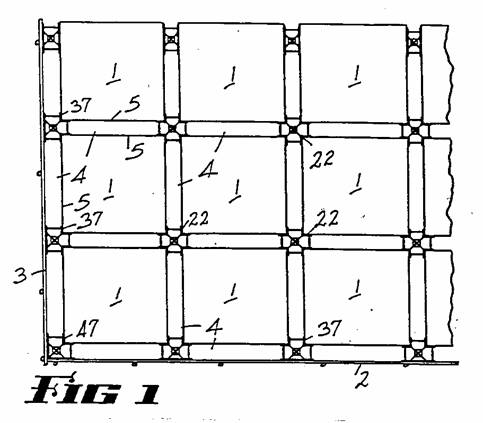
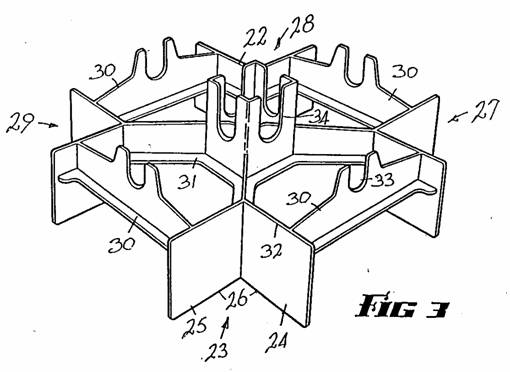
|
Counsel for the Appellants: |
A C Bennett SC, S C G Burley and M Darke |
|
|
|
|
Solicitor for the Appellants: |
David Black & Co |
|
|
|
|
Counsel for the Respondents: |
D K Catterns QC, C Dimitriadis |
|
|
|
|
Solicitor for the Respondents: |
Rowell Forrest & Co |
|
|
|
|
Date of Hearing: |
26-27 November 2001 |


