FEDERAL COURT OF AUSTRALIA
Sydneywide Distributors Pty Ltd v Red Bull Australia Pty Ltd [2002] FCAFC 157
APPEAL – nature of and approach to appeals in Federal Court - consideration of what constitutes ground of appeal - whether appropriate for parties to invite Court to re-hear matter ab initio - appeal is by way of re-hearing not trial de novo - task of appellate court is correction of error at first instance - need for parties to clearly demonstrate error - conclusions of trial judge given appropriate weight in determining whether error has been made
EVIDENCE – whether evidence is excludable where trial judge has taken it into consideration when objection not taken at first instance - expert evidence - admissibility of expert evidence - distinction between admissibility and ultimate weight - role of expert evidence in Federal Court hearings - whether marketing is considered an area of expertise - whether expert can give evidence on matters of common experience - where party failed to cross-examine expert witness on evidence and subsequently raised objection to it on appeal
TORT – passing off - characteristics of a valid cause of action - action designed to protect trader’s goodwill - whether requirement for actual, subjective intention to mislead - only likelihood of confusion of prospective purchaser need be proven - totality of the conduct of alleged deceiver to be considered - whether get-up distinctive of respondent’s product - whether appellant’s get-up would lead potential purchasers to believe appellant’s product was associated with the respondent - role of ‘gestalt’ in determining passing off - whether deliberate copying of rival’s get-up - whether get-up designed to “sail as close as possible to the wind” - where identical shades of blue, silver and red and diagonal thrust are features of both products’ get-up
TORT – joint tortfeasor - whether managing director procured or directed tort by corporation - where managing director not a ‘one man company’
TRADE PRACTICES – misleading and deceptive conduct - designed to protect consumers- whether conduct was misleading or deceptive or likely to mislead or deceive - whether managing director knowingly concerned in misleading and deceptive conduct of corporation when closely, as distinct from, remotely associated with conduct - whether injunctive relief can be sought against managing director of infringing corporation
Federal Court of Australia Act 1976 (Cth) ss 4, 24(1)(a)
Evidence Act 1995(Cth) ss 56, 57, 76, 79, 80, 135, 142
Evidence Act 1995 (NSW)
Trade Practices Act 1974 (Cth) ss 52, 53, 75B, 80, 82
Federal Court Rules O 52
Makita (Aust) Pty Ltd v Sprowles [2001] NSWCA 305 discussed
Quick v Stoland Pty Ltd (1998) 87 FCR 371 cited
HG v The Queen (1999) 197 CLR 414 cited
Paric v John Holland (Constructions) Pty Ltd (1985) 59 ALJR 844 cited
Australian Woollen Mills Ltd v F S Walton & Co Ltd (1937) 58 CLR 641 applied
Branir Pty Ltd v Owston Nominees (No 2) Pty Ltd [2001] FCA 1833 followed
Minister for Immigration, Local Government and Ethnic Affairs v Hamsher (1992) 35 FCR 359 considered
Cabal v United Mexican States (2001) 108 FCR 311 considered
Erven Warnink Besloten Vennootschap v J Townsend & Sons (Hull) Ltd [1979] AC 731 referred to
Conagra Inc v McCain Foods (Aust) Pty Ltd (1992) 33 FCR 302 referred to
Reddaway v Bentham Hemp-Spinning Company [1892] 2 QB 639 considered
Ford v Foster (1872) LR 7 Ch App 611 referred to
TGI Friday’s Australia Pty Ltd v TGI Friday’s Inc (1999) 45 IPR 43 considered
Campoma Sociedad, Limitada v Nike International Ltd (2000) 202 CLR 45 considered
BM Auto Sales Pty Ltd v Budget Rent A Car System Pty Ltd (1977) 51 ALJR 254 applied
Ocean Marine Mutual Insurance Association (Europe) OV v Jetopay Pty Ltd [2000] FCA 1463 referred to
C A Hensckhe & Co v Rosemount Estates Pty Ltd (2000) AIPC 91-640 referred to
Hornsby Building Information Centre Pty Ltd v Sydney Building Information Centre Ltd (1977 - 1978) 140 CLR 216 referred to
Newton-John v Scholl-Plough (Aust) Ltd (1985) 11 FCR 233 referred to
Hogan v Dunlop Pacific Ltd (1989) 83 ALR 403 considered
W D & H O Wills (Aust) Ltd v Philip Morris Ltd (1998) 39 IPR 356 referred to
De Cordova v Vick Chemical Co (1951) 68 RPC 103 referred to
Freeman Cosmetic Corporation v Jenola Trial Pty Ltd (t/a South Pacific Cosmetics) (1993) ATPR 41-270 considered
Twentieth Century Fox Film Corporation v The South Australian Brewery Co Ltd (1996) 66 FCR 451 considered
Fencott v Muller (1982 - 1983) 152 CLR 570 considered
Trade Practices Commission v Australian Meat Holdings Pty Ltd (1988) ATPR 40-876 considered
Microsoft Corporation v Auschina Polaris Pty Ltd (1996) 71 FCR 231 considered
Performing Right Society Ltd v Ciryl Theatrical Syndicate Ltd [1924] 1 KB 1 considered
Mentmore Manufacturing Co Ltd v National Merchandising Manufacturing Co Inc (1979) 89 DLR (3d) 195 referred to
C Evans & Sons Ltd v Spritebrand Ltd [1985] 1 WLR 317 referred to
Allen Manufacturing Co Pty Ltd v McCallum & Co Pty Ltd [2001] FCA 1838 considered
SYDNEYWIDE DISTRIBUTORS PTY LTD AND EMANUEL KLIMIS v RED BULL AUSTRALIA PTY LTD AND RED BULL GMBH
N 1340 OF 2001
BRANSON, WEINBERG & DOWSETT JJ
4 JUNE 2002
SYDNEY
| IN THE FEDERAL COURT OF AUSTRALIA |
|
| N 1340 OF 2001 |
ON APPEAL FROM A JUDGE OF THE FEDERAL COURT OF AUSTRALIA
| BETWEEN: | SYDNEYWIDE DISTRIBUTORS PTY LTD FIRST APPELLANT
EMANUEL KLIMIS SECOND APPELLANT
|
| AND: | RED BULL AUSTRALIA PTY LTD FIRST RESPONDENT
RED BULL GMBH SECOND RESPONDENT
|
| DATE OF ORDER: | |
| WHERE MADE: |
THE COURT ORDERS THAT:
1. The appeal be dismissed;
2. The cross-appeal be dismissed;
3. The appellants pay the respondents’ costs of the appeal; and
4. There be no order as to the costs of the cross-appeal.
Note: Settlement and entry of orders is dealt with in Order 36 of the Federal Court Rules.
| IN THE FEDERAL COURT OF AUSTRALIA |
|
| |
| NEW SOUTH WALES DISTRICT REGISTRY | N 1340 OF 2001 |
| |
|
ON APPEAL FROM A JUDGE OF THE FEDERAL COURT OF AUSTRALIA |
| ||
| BETWEEN: | SYDNEYWIDE DISTRIBUTORS PTY LTD FIRST APPELLANT
EMANUEL KLIMIS SECOND APPELLANT
|
| AND: | RED BULL AUSTRALIA PTY LTD FIRST RESPONDENT
RED BULL GMBH SECOND RESPONDENT
|
| JUDGES: | BRANSON, WEINBERG & DOWSETT JJ |
| DATE: | 4 JUNE 2002 |
| PLACE: | SYDNEY |
REASONS FOR JUDGMENT
BRANSON J
1 I have had the advantage of reading in draft the reasons for judgment of Weinberg and Dowsett JJ. I agree with the orders proposed by their Honours and generally with their Honours’ reasons. I wish, however, to add the following.
the notice of appeal
2 I agree with the criticisms made by Weinberg and Dowsett JJ of the notice of appeal both as filed and as revised at the request of the Court.
3 Section 24 (1)(a) of the Federal Court of Australia Act 1976 (Cth) (“the Federal Court Act”) provides that the Court has jurisdiction to hear and determine appeals from judgments of the Court constituted by a single judge. A judgment within the meaning of this provision is “a judgment, decree or order, whether final or interlocutory, or a sentence” (see s 4 of the Federal Court Act); it is not the reason for judgment of the primary judge. Order 52 of the Federal Court Rules governs the practice and procedure to be followed in the Court with respect to appeals. Order 52 r 1, as would be expected, defines “judgment” in terms which are for present purposes the same as the definition contained in s 4 of the Federal Court Act. Order 52 r 13(2)(b) requires a notice of appeal to state “briefly, but specifically, the grounds relied upon in support of the appeal”.
4 A ground of appeal is a basis upon which the appellant will contend that the judgment, or a part of the judgment, should be set aside or varied by the Court in the exercise of its appellate jurisdiction. Not every grievance entertained by a party, or its legal advisors, in respect of the factual findings or legal reasoning of the primary judge will constitute a ground of appeal. Findings as to subordinate or basic facts will rarely, if ever, found a ground of appeal. Even were the Full Court to be persuaded that different factual findings of this kind should have been made, this would not of itself lead to the judgment, or part of the judgment, being set aside or varied. This result would be achieved, if at all, only if the Full Court were persuaded that an ultimate fact in issue had been wrongly determined. The same applies with respect to steps in the primary judge’s process of legal reasoning. Although alleged errors with respect to findings as to subordinate or basic facts, and as to steps in a process of legal reasoning leading to an ultimate conclusion of law, may be relied upon to support a ground of appeal, they do not themselves constitute a ground of appeal.
5 A useful practical guide is that a notice of appeal which cannot be used to provide a sensible framework for the appellant’s submissions to the Full Court is almost certainly a notice of appeal which fails to comply with the requirements of O 52 r 13(2)(b). Neither the notice of appeal nor the document containing the revised grounds of appeal was, or could have been, so utilised in this case.
Dr beaton’s evidence
6 Although Dr Beaton’s evidence was received at trial without objection, the respondents argued before this Court that his evidence was either inadmissible or ought not to have been accorded weight. Reference was made in particular to the reasons for judgment of Heydon JA in Makita (Aust) Pty Ltd v Sprowles [2001] NSWCA 305. As Weinberg and Dowsett JJ identify at [86] below, in that case Heydon JA summarised his views with respect to evidence tendered as expert opinion evidence at [85] as follows:
“In short, if evidence tendered as expert opinion evidence is to be admissible, it must be agreed or demonstrated that there is a field of ‘specialised knowledge’; there must be an identified aspect of that field in which the witness demonstrates that by reason of specified training, study or experience, the witness has become an expert; the opinion proffered must be ‘wholly or substantially based on the witness's expert knowledge’; so far as the opinion is based on facts ‘observed’ by the expert, they must be identified and admissibly proved by the expert, and so far as the opinion is based on ‘assumed’ or ‘accepted’ facts, they must be identified and proved in some other way; it must be established that the facts on which the opinion is based form a proper foundation for it; and the opinion of an expert requires demonstration or examination of the scientific or other intellectual basis of the conclusions reached: that is, the expert's evidence must explain how the field of ‘specialised knowledge’ in which the witness is expert by reason of ‘training, study or experience’, and on which the opinion is ‘wholly or substantially based’, applies to the facts assumed or observed so as to produce the opinion propounded. If all these matters are not made explicit, it is not possible to be sure whether the opinion is based wholly or substantially on the expert's specialised knowledge. If the court cannot be sure of that, the evidence is strictly speaking not admissible, and, so far as it is admissible, of diminished weight. And an attempt to make the basis of the opinion explicit may reveal that it is not based on specialised expert knowledge, but, to use Gleeson CJ's characterisation of the evidence in HG v R (1999) 197 CLR 414, on ‘a combination of speculation, inference, personal and second-hand views as to the credibility of the complainant, and a process of reasoning which went well beyond the field of expertise’ (at [41]).” (emphasis added)
7 The approach of Heydon JA as set out above is, as it seems to me, to be understood as a counsel of perfection. As a reading of his Honour’s reasons for judgment as a whole reveals, his Honour recognised that in the context of an actual trial, the issue of the admissibility of evidence tendered as expert opinion evidence may not be able to be addressed in the way outlined in the above paragraph.
8 First, at least in a case where the parties are legally represented, where evidence is adduced from an expert without objection, the trial judge will ordinarily be entitled to assume that all matters crucial to the admissibility of the evidence are conceded by the opposing party, including the existence of a relevant field of specialised knowledge. Rarely, if ever, would a trial judge be expected to interfere with the basis upon which represented parties had chosen to conduct their litigation by challenging the basis of an implicit concession concerning admissibility. Apart from other considerations, to do so could impose a significant and unexpected costs burden on the parties.
9 Secondly, any ruling on the admissibility of evidence is ordinarily required to be made by the trial judge during the course of the trial rather than at its conclusion. In this regard the trial judge does not have the advantage enjoyed by a court of appeal of having before it the whole of the evidence adduced at the trial. The trial judge’s rulings will be based on the evidence and other relevant material, which may include assurance given by counsel, which are before the judge at the time that the ruling is required to be made. It is no longer common practice for a witness from whom expert opinion evidence is intended to be adduced to be examined by opposing counsel on the voire dire. This may be because, perhaps regrettably, the practice has come to be regarded as of little practical value where the judge, and not a jury, is the trier of facts. As a result the judge is likely to be asked to rule on the admissibility of the affidavit, report or oral evidence of a witness put forward as an expert before the witness is subject to any questioning by opposing counsel. For this reason, it may prove to be the case that evidence ruled admissible as expert opinion will later be found by the trial judge to be without weight for reasons that, strictly speaking, might be thought to go to the issue of admissibility (eg that the witness’s opinion is expressed with respect to a matter outside his or her area of expertise or is not wholly or substantially based on that expertise).
10 Thirdly, as I pointed out in Quick v Stoland Pty Ltd (1998) 87 FCR 371 at 373‑374, the common law rule that the admissibility of expert opinion evidence depends on proper disclosure of the factual basis of the opinion is not reflected as such in the Evidence Act 1995 (Cth) (“the Evidence Act”). The Australian Law Reform Commission recommended against such a precondition to the admissibility of expert opinion, expressing the view that the general discretion to refuse to admit evidence would be sufficient to deal with problems that might arise in respect of an expert opinion the basis of which was not disclosed (ALRC Report No 26, vol 1, par 750). That general discretion is to be found in s 135 of the Evidence Act.
11 Nonetheless, before any ruling may be made in the exercise of the general discretion to refuse to admit evidence, the court must, expressly or implicitly, reach a view as to the admissibility of the tendered evidence. Like all evidence, expert evidence is admissible only if it is relevant (s 56 of the Evidence Act). In addition, as expert evidence is admissible as an exception to the opinion rule (ss 76 and 79 of the Evidence Act), it is only admissible where it falls within the terms of the exception. Section 79 of the Evidence Act provides:
“If a person has specialised knowledge based on the person’s training, study or experience, the opinion rule does not apply to evidence of an opinion of that person that is wholly or substantially based on that knowledge.”
12 For the above reasons, evidence of an expert opinion will only be admissible where:
(a) it is relevant;
(b) the witness has specialised knowledge based on his or her training, study or experience; and
(c) the opinion is wholly or substantially based on that specialised knowledge.
13 As Gleeson CJ pointed out in HG v The Queen [1999] HCA 2; 197 CLR 414 at [39]:
“… the provisions of s 79 will often have the practical effect of emphasising the need for attention to requirements of form. By directing attention to whether an opinion is wholly or substantially based on specialised knowledge based on training, study or experience, the section requires that the opinion is presented in a form which makes it possible to answer that question.”
See also the Guidelines for Expert Witnesses in Proceeding in the Federal Court of Australia issued 15 September 1998.
14 However, if Heydon JA, in the paragraph set out in [6] above, intended to use the word “sure” in its usual sense of subjectively certain, I respectfully disagree with the view that when determining the admissibility of evidence of an expert opinion (perhaps more accurately, a purported expert opinion), it is necessary for the court to be “sure whether the opinion is based wholly or substantially on the expert’s specialised knowledge”. The test is whether the court is satisfied on the balance of probabilities that the opinion is based wholly or substantially on that knowledge (s 142 of the Evidence Act). However, as identified in [12] above, satisfaction of that test is not sufficient to render the evidence of the expert opinion admissible. To be admissible the evidence must also be relevant. It is the requirement of relevance, rather than the requirement that the opinion be based wholly or substantially on the expert’s specialist knowledge, that, as it seems to me, most immediately makes proof of the facts on which the opinion is based necessary. If those facts are not at the close of trial proved, or substantially proved (see Paric v John Holland (Constructions) Pty Ltd (1985) 59 ALJR 844 at 846), it is unlikely that the evidence, if accepted, could rationally affect the assessment of the probability of the existence of the fact in issue in the proceeding to which the evidence is directed.
15 A ruling on the admissibility of the evidence of the expert opinion is, however, likely to be required before the end of the trial. The possibility that a determination of relevance might need to be made before the court has made other relevant findings is recognised by s 57 of the Evidence Act. Section 57(1) provides:
“(1) If the determination of the question whether evidence adduced by a party is relevant depends on the court making another finding (including a finding that the evidence is what the party claims it to be), the court may find that the evidence is relevant:
(a) if it is reasonably open to make that finding; or
(b) subject to further evidence being admitted at a later stage of the proceeding that will make it reasonably open to make that finding.”
Section 57(1)(b) would appear to authorise the admission unconditionally of provisionally admitted evidence on a standard of proof concerning relevance (ie where it is reasonably open to make the finding) which is even lower than the balance of probabilities.
16 Further, the requirement that an expert opinion be wholly or substantially based on the witness’s specialised knowledge is not, in my view, intended to require a trial judge to give meticulous consideration, before ruling on the admissibility of the evidence of the opinion, to whether the facts on which the opinion is based form a proper (in the sense of logically or scientifically or intellectually proper) base for the opinion. Were the position otherwise the smooth running of trials involving expert evidence could be expected to be interrupted by the need to explore in detail, in the context of admissibility, matters more properly considered at the end of the trial in the context of the weight to be attributed to the evidence. It is sufficient for admissibility, in my view, that the trial judge is satisfied on the balance of probabilities on the evidence and other material then before the judge that the expert has drawn his or her opinion from known or assumed facts by reference wholly or substantially to his or her specialised knowledge. In many cases the relevant evidence and other material that will be before the judge at the time that the judge is required to rule on admissibility will extend little, if at all, beyond the purported expert’s affidavit or report or, where only oral evidence is intended to be adduced, the earlier oral evidence of the witness and the form of the question to which objection has been taken. In the Federal Court, the usual practice of requiring expert evidence to be reduced to writing, together with the Guidelines for Expert Witnesses referred to in [13] above, will generally ensure that there is sufficient material before the judge to enable the judge to form a view, on the balance of probabilities, (albeit, in the context of the trial as a whole, a provisional view) as to whether an opinion is wholly or substantially based on the witness’s specialised knowledge. In most other jurisdictions there are now comparable equivalent rules or guidelines.
17 Evidence later adduced, most likely in cross‑examination, might reveal that an opinion proffered in an affidavit or report is not wholly or substantially based on the witness’s specialised knowledge, or that the expert made an error (whether of logic, science or otherwise) in the process of reaching his or her opinion. While that evidence might be relevant to admissibility in a hypothetical sense, it would not, of itself, demonstrate error in the earlier ruling that the affidavit or report be received in evidence. The correctness of that ruling is to be judged by reference to the relevant evidence and other material before the judge at the time of the ruling. The evidence might, however, be of crucial importance with respect to the weight to be accorded the opinion at the end of the day.
18 For the above reasons, I agree with Weinberg and Dowsett JJ that the challenge to the admissibility of Dr Beaton’s evidence must fail. Dr Beaton’s evidence was received at trial without objection. I also agree with Weinberg and Dowsett JJ that the primary judge did not err in his use of Dr Beaton’s evidence. It is no longer a valid criticism of expert evidence that it is about “a fact in issue or an ultimate issue” (s 80 of the Evidence Act). The primary judge did not abdicate to Dr Beaton the determination of the ultimate issue required to be determined by the Court. The weight that his Honour gave to Dr Beaton’s opinions has not been shown to be inappropriate.
| I certify that the preceding eighteen (18) numbered paragraphs are a true copy of the Reasons for Judgment herein of the Honourable Justice Branson. |
Associate:
Dated: 4 June 2002
| IN THE FEDERAL COURT OF AUSTRALIA |
|
| N 1340 OF 2001 |
ON APPEAL FROM A JUDGE OF THE FEDERAL COURT OF AUSTRALIA
| BETWEEN: | SYDNEYWIDE DISTRIBUTORS PTY LTD FIRST APPELLANT
EMANUEL KLIMIS SECOND APPELLANT
|
| AND: | FIRST RESPONDENT
RED BULL GMBH SECOND RESPONDENT
|
| JUDGES: | |
| DATE: | |
| PLACE: |
REASONS FOR JUDGMENT
weinberg & dowsett jj:
Background
19 The first appellant (“Sydneywide”) is an importer and distributor of various kinds of non-alcoholic drinks. The second appellant (“Mr Klimis”) is the managing director of Sydneywide. He and his brother are equal shareholders in that company. The first respondent (“Red Bull Australia”) imports and supplies for sale in Australia a product known as “Red Bull” energy drink. The second respondent (“Red Bull GmbH”) manufactures that product in Austria and supplies it internationally. It is supplied in cans. Save where it is necessary to distinguish them, both respondents will hereafter be collectively described as “Red Bull”. In the course of its business, Sydneywide has, since at least February 2001, imported from New Zealand, advertised, distributed and sold in Australia an energy drink known as “LiveWire”. The product is supplied in cans and bottles. Red Bull asserts that the get-up of the LiveWire product is substantially identical with, and deceptively similar to that of the Red Bull product and that Sydneywide’s actions both contravened ss 52 and 53 of the Trade Practices Act 1974 (Cth) (the “Act”) and constituted passing off. It also claims that Mr Klimis has been knowingly concerned in the alleged breaches of ss 52 and 53 and is personally liable for the passing off.
20 At first instance Conti J upheld Red Bull’s claims that Sydneywide’s conduct in connection with the distribution of LiveWire in cans contravened s 52 of the Act and constituted passing off. His Honour dismissed the claims concerning the bottled product and found it unnecessary to deal with s 53 of the Act. His Honour also found that Mr Klimis was knowingly concerned in Sydneywide’s breach of s 52 but was not a party to the passing off. On 18 October 2001, his Honour ordered that:
“1. the First Respondent by itself its servants and agents be restrained from selling, offering or exposing for sale, distributing and/or marketing in Australia any energy drink in any can displaying the packaging get-up of the can depicted in the Annexure to these Orders or any get-up substantially identical with or deceptively similar thereto; and
2. the Second Respondent be restrained from being knowingly concerned in or party to directly or indirectly, any conduct prohibited by Order 1 above.”
21 The annexure to the order contained photographs of a LiveWire can. Both appellants appeal against the findings and consequential orders against them. Red Bull cross-appeals against his Honour’s decision concerning the bottled product and the finding that Mr Klimis was not a party to the passing off.
Findings
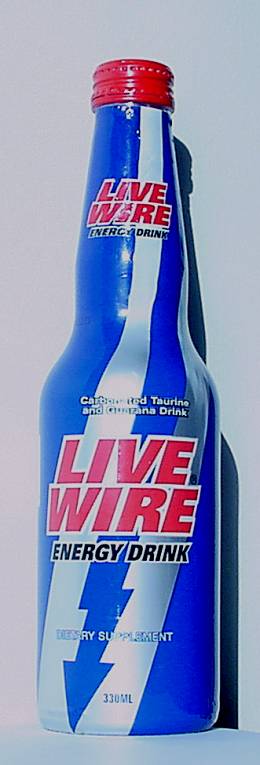
22 Conti J found that Red Bull had been marketing its product internationally since 1987 and that it commenced marketing it in Australia in 1997. The product was first offered for sale in Australia in about March 1999. It is sold in cylindrical cans having a capacity of 250 mls. “LiveWire” is supplied in cans of the same shape and size and in bottles having a 330 ml capacity. Annexed to this judgment are photographs of a Red Bull can, a LiveWire can and a LiveWire bottle. Unfortunately, the colours are quite faded as a result of technological limitations.
23 In the following passage, Conti J identified certain matters which were common ground, namely that:
“(i) Red Bull Australia, which is incorporated in Victoria, is a partially owned subsidiary of Red Bull GmbH;
(ii) The Red Bull Group of Companies is one of the largest energy drink manufacturers in the world;
(iii) The Red Bull product is manufactured in Austria;
(iv) The Red Bull product is imported from New Zealand for sale in Australia under the provisions of the Trans Tasman Mutual Recognition Agreement made between Australia and New Zealand;
(v) The Red Bull product is sold in Australia in a slim-line 250ml can incorporating the Red Bull get-up;
(vi) Private consumption of the Red Bull product is allowed under the provisions of the Imported Food Control Act 1992 (Cth);
(vii) The Red Bull companies are involved in the sponsorship of leading athletes;
(viii) The Red Bull product is sold in retail outlets which include supermarkets, convenience stores, service stations, cafes, restaurants, night clubs and bars;
(ix) The Red Bull product is sold in convenience stores and supermarkets and is presented thereby to consumers either unchilled on the shelf, or in refrigerators; and
(x) Red Bull provides fridges known as barrel fridges, and bar fridges incorporating the Red Bull get-up, to certain retail outlets.”
24 The significance of pars (iv) and (vi) is not clear. The agreementreferred to in par (iv) seems to have made it advantageous to import energy drinks from New Zealand rather than from Austria. The legislation referred to in par (vi) may explain the delay between promotion of the Red Bull product and sale thereof. These matters are of no great importance for present purposes.
25 The Red Bull product is described as a “carbonated taurine energy drink” which includes various ingredients. It is marketed in fifty-five countries including Australia. Identical packaging is used world-wide. Substantial amounts of money have been spent on promotional activities since 1997, and it is anticipated that this will continue. The marketing campaign focuses upon the slimline 250 ml can. This can has a smaller diameter than cans widely used for other kinds of soft drink. It is widely used for energy drinks. It is common for the drink to be consumed directly from the can, a practice which is encouraged by Red Bull promotions. Marketing strategy in Australia and world-wide has four core aspects, namely:
– media,
– event marketing,
– athletic sponsorship, and
– free sampling.
26 Mr P J Devereux, the corporate projects manager for Red Bull in Australia, described the marketing features of the product as follows:
“51. One of the most prominent and distinctive features of the front panel design of RED BULL can is a steep diagonal line that runs from top right to bottom left. This diagonal thrust is created by the positioning of trapezium shapes made up of alternating blocks of the colours blue and silver. This diagonal thrust is continued around the edge of the can to the rear panel where the detailed text is contained within a single trapezium area with a silver background.
52. The vertical thrust is counter-balanced by a horizontal line across the centre of the front panel, created partly by the edges of the blue and silver trapezoids in the background and partly by the placement of the brand name text RED BULL in large red letters. The first letter of each of these words is capitalised.
53. Also positioned in the centre of the can and immediately below the brand name is a graphic device depicting two red bulls charging each other in front of a small yellow circle or disc (the ‘bull device’). Immediately below the bull device are the words ‘energy drink’ in red capitals. This device further acts to disrupt the vertical thrust.
54. At the top of the front panel, appearing in very small silver font against the blue background of one of the trapezium shapes, is text describing the basic product, ‘Carbonated Taurine Drink with Caffeine. Serve Ice Cold’. I consider this text element to be relatively insignificant in terms of consumer recognition of the brand.
55. At the bottom of the front panel, a thin band of horizontal text appears inside two thin trapezoids. These trapezoids reverse the colour of those immediately above and below them, once again divided at the centre around the diagonal vertical thrust. The thin blue band on the left has silver text superimposed ‘With Taurine’. The thin silver band on the right has blue text superimposed ‘Vitalizes Body and Mind’. These text elements, although slightly larger than the text at the top of the front panel, remain, in my opinion, relatively unimportant in terms of consumer visual recognition of the brand. However, in my opinion, the claim ‘Vitalizes Body and Mind’ is likely to play a role in reinforcing the transformational associations indicated to consumers by the brand name RED BULL and the use of the bull device.
56. The rear panel is made up of a silver background, with a significant amount of small horizontal text detailing product claims, warnings, a nutrition table, ingredients list, source of manufacture and bar code. A section of the text is red and the rest is blue. As mentioned above, the rear panel primarily takes the form of a diagonal trapezoid. Given that products in this category are generally displayed for sale with single facings (ie the product is displayed on a shelf with the front panel facing the consumer) and given the very small font size of the text elements on the rear panel, I consider this entire element to be relatively insignificant in terms of consumer recognition of the brand.”
27 Conti J appears to have accepted the factual assertions contained in this extract. It is likely that his Honour also formed opinions similar to those expressed by Mr Devereux.
28 His Honour accepted that the Red Bull product is “… a leading brand in the energy drink category, indeed one of the two leading and major brands, the other being the ‘V’ brand.” Marketing is directed at six core groups, namely drivers, students, workers, athletes, evening drinkers, and clubbers. The distribution network can be divided into two categories: licensed premises on the one hand and unlicensed premises (described as “off-premises”) on the other. Included in the off-premises are “impulse channels”, which term includes service stations, convenience stores, takeaway stores, food bars, milk bars and general stores. Off-premises other than impulse channels are described as “grocery channels”. This term includes supermarkets and other large retail outlets, but not corner stores. LiveWire is sold primarily in convenience stores. It is presently unavailable in supermarkets. The Red Bull product, when distributed through convenience stores and supermarkets, is presented to potential customers, unchilled and “on the shelf” or in refrigerators. Refrigerators incorporating the Red Bull “get-up” and other Red Bull promotional material are placed in positions of prominence in stores and nightclubs.
29 Between twenty and twenty-five different energy drinks are currently sold in 250 ml cans in this country. A further ten such drinks are sold in other cans or bottles. Energy drinks are said to differ in their effects from “other function energy drinks” in that the latter products do not provide the same “energy” benefit as energy drinks. Included in the “other function energy drinks” are “sports drinks”, which are designed to replace lost body fluids, carbohydrates and electrolytes and “refreshment energy drinks”. Of those twenty to twenty-five energy drinks, only LiveWire has active ingredients identical to those of the Red Bull product.
30 Red Bull supplies its product to off-premises through sub-distributors. Sydneywide was such a distributor, commencing in that capacity in February 2000. It was provided with Red Bull promotional material and samples and received supplies on credit. Sydneywide personnel were briefed concerning Red Bull marketing methods, group background, advertising and other aspects of the brand. A matter of some importance concerned legal restrictions on sale of the product which were imposed because it was not manufactured in Australia. It was necessary that sub-distributors should understand that matter. Sydneywide continued to act as a sub-distributor until on or about 14 February 2001 when it placed its last order. In all, it had placed orders for in excess of 1,000,000 cans of the Red Bull product at an invoice value in excess of $1.7 million. However, from about mid-May 2000, Sydneywide’s sales of the Red Bull product had commenced to “plateau”. On or about 2 February 2001 Red Bull became aware that LiveWire was being sold in Sydney. By the week commencing 12 February 2001, it was being widely distributed throughout the Sydney central business district. At no time had Sydneywide given notice to Red Bull of its intention to launch this product. There was no evidence that Sydneywide had advertised the launch. By letter dated 14 February 2001, Red Bull asserted that Sydneywide’s conduct amounted to passing off and misleading and deceptive conduct. Sydneywide denied these assertions.
31 Conti J considered that Sydneywide’s trading history was of some significance. In late 1996, it had commenced to distribute beverages in the Sydney area. In 1997 it became particularly interested in energy drinks because they offered a higher margin to distributors than did other products. In that year Sydneywide commenced to market three brands of energy drink, namely “Jolt Cola”, “Colombian Cola” and “Feeling Seedy”. By 1998 it was distributing other energy drinks and subsequently, it distributed the Red Bull product. Since February 2001 it has distributed LiveWire. It claims to be one of the largest independent distributors of beverages in Sydney and to have been so since late 1998 or early 1999. It also distributes products in other states.
32 Mr Klimis said that Sydneywide first commenced planning the manufacture of its own energy drink in about November 1999, at which stage Red Bull’s marketing activities had been under way for nearly two years, and commercial distribution had been under way for about eight months. Because of the Trans-Tasman Mutual Recognition Agreement, energy drinks manufactured in New Zealand may be imported into Australia. In November 1999 Mr Klimis’s father, Mr Harry Klimis, went to New Zealand to investigate the possibility of importing an energy drink manufactured in that country. He subsequently wrote to Michael Erceg, the managing director of the relevant New Zealand company as follows:
“Re: Production of energy drinks
Firstly, I would like to sincerely thank you for your hospitality and tour of the factory and production facilities, we were very impressed with your operations.
This letter is to confirm my interest in you manufacturing a range of energy drinks for my company. I am interested in 250ml slimline cans and also preferably 355ml glass bottles.
The flavour profile I am requiring is similar to Vitalise and/or liquid B with guarana, taurine, caffeine, inositol and glucoronolactone added. Is it possible to send me samples of these, and if the samples are to my expectations, I will immediately proceed with an official order for you to commence production. In the meantime, I will proceed from my end, with designing of graphics. Please advise terms of payment you require also lead time from date of official order delivered to Sydney, Australia, as well the lead time for reorders.
Your earliest response in this matter would be sincerely appreciated and we look forward to a long and mutually beneficial business relationship.
Best regards
Harry Klimis
Harris Enterprises.”
33 This letter was written on letterhead styled “Harris Enterprises”. Mr Klimis said that his father had used that letterhead because they were concerned not to jeopardize their relationship with the suppliers of Black Stallion, another energy drink which Sydneywide was distributing. They did not wish to be seen to be producing a competing drink. He said that they were not concerned about Red Bull because their proposed product would only compete with products in a lower price range. Conti J did not accept that proposition, inferring that Sydneywide would have been more concerned to avoid offending Red Bull because of its stronger position in the marketplace and its substantial promotional and selling activities. On 14 March 2000 Sydneywide lodged a trademark application in relation to LiveWire. The mark was registered on 27 October 2000.
34 In February or March 2000 Mr Klimis met with a Mr Casey from the New Zealand manufacturer. The latter suggested that a Mr Frank Scarisbrook could design the graphics for the packaging of the Sydneywide product. The instructions given in this regard did not emerge clearly from the evidence. However, between that time and mid-November 2000 communications continued between Mr Klimis and Mr Scarisbrook concerning the matter. In early April 2000 Sydneywide and the manufacturer agreed upon the appropriate flavour for the product. The first shipment of LiveWire arrived in Sydney in late January 2001, and the first sales to the public occurred in early February. Sydneywide sent the following circular to “various customers”:
“LiveWire Energy Drinks
250ml slimline can and 330ml glass bottle.
As you are aware when we came to you originally with Black Stallion in 1999 who in Australia would believe what an impact beverages would have in Australia.
The proof is now clear that the market has developed and many new energy drinks have been introduced to the market place some with little success others dominant.
Sydneywide Distributors have developed Live Wire Energy Drink to take advantage of this still growing segment. The graphics on both pack sizes is striking in particular the 330ml bottle, which is sensational using the shrink sleeve and the long neck bottle to ensure fridge attraction.
Live Wire has been released with a long-term vision to compete with the market leaders and help to grow the energy drink category with a strong alternative brand.”
35 The circular must be read in the light of Red Bull’s strong position in the market place and Sydneywide’s position as a sub-distributor thereof. Since February 2001, LiveWire has been sold in convenience stores such as those in the 7-Eleven chain, service stations carrying the BP brand, takeaway outlets, milk bars and mixed business stores, outlets with which Sydneywide previously had well-established relations. The product is sold mainly from tall refrigerators with glass doors in which it is displayed alongside other drinks, usually energy drinks. Sydneywide claims to be selling about as many bottles as cans of the product, although no statistical material or other evidence was provided. It has undertaken some limited promotion. Mr Klimis asserted:
“In introducing LiveWire into the market, including choosing the packaging, the ingredients and distributing LiveWire, it has never been my intention or Sydneywide’s to associate LiveWire in any way with Red Bull. No directions have been given by me or the management of Sydneywide to anyone in the company or to anyone outside the company to suggest any association between the two companies or their products. As managing director, I have not received any reports from our customers or consumers that any such association has been represented or made.
…
Our direct competitors are ‘V’ and the other energy drinks in our general price range. The Red Bull product sells to consumers at between around $2.85 to $3.20 per can in the same market. In my view, Red Bull is sold as a premium product in the energy drink market. We do not aim to compete in that segment.”
36 His Honour did not accept this market distinction based on price. Conti J also noted that neither the second respondent’s father nor Philip Carter, the general manager of Sydneywide, nor any of the persons associated with the New Zealand company (Erceg, Casey and Scarisbrook) was called to give evidence.
37 Conti J concluded:
“… that Sydneywide intentionally adopted a get-up for the packaging of its LiveWire product for the purpose of appropriating part of the trade or reputation of the Red Bull Applicants, essentially by means of the design and colour scheme of the packaging which it progressively and ultimately adopted.”
38 His Honour also observed that:
“Put another way as sometimes echoed in the authorities, Sydneywide selected a get-up for its LiveWire product which would ‘sail as close to the wind’ as it thought to be expedient … in order to take advantage of the substantial market share for energy drinks in Australia which the Red Bull Applicants had already acquired … .”
39 His Honour noted that Sydneywide had been:
“… well placed to assess the very favourable impact in the marketplace which Red Bull Australia had been experiencing as a consequence of its advertising and promotional activities … .”
and that:
“Sydneywide’s financial outlays upon advertising and promotion of the LiveWire brand appear to have been minimal …”.
40 Both sides called expert evidence in the field of marketing. Red Bull called Dr G R Beaton, and Sydneywide called Ms L J Strachan. Their views differed. It is necessary at this stage only to record the conclusions which his Honour reached concerning their evidence. One area of disagreement involved the target market of the Red Bull promotional and marketing strategy. Dr Beaton identified that target as “people who need energy” whilst Ms Strachan identified the group as “sophisticated young drinkers”. Conti J considered the latter view to be too narrow, pointing out that the need for energy is by no means exclusive to the young. A second area of difference was as to the significance of price differentials. In the end his Honour preferred Dr Beaton’s view that price differences between the products were “of insignificant materiality, once account is taken of the circumstance that they are both sold in a wide range of outlets.” A third area of dispute was as to the significance of the colours used in the Red Bull and LiveWire get-ups. Each features similar shades of blue, silver and red. The Red Bull get-up includes a small amount of gold . The LiveWire get-up includes some black, and some white printing. Ms Strachan suggested that the common colours were generic to the energy drink market, or were at least widely used by other brands in that market. Dr Beaton suggested that none of the other brands had the “strong diagonal thrust” of the design on the Red Bull can. This is a matter to which we will return at a later stage. Conti J concluded that it was incorrect to suggest that the common colours were generic to the energy drink market. We should add at this point that the blue and red colours on the LiveWire bottle appear to us to be slightly different from those colours as used on the Red Bull and LiveWire cans. We can describe the difference only by saying that the colours on the bottle appear “brighter” and those on the cans, “flatter”. This matter seems not to have been ventilated at the trial. It is possible that the colours have changed slightly with the passage of time. The difference is probably of little importance.
41 Ms Strachan emphasised the presence on the respective cans of the Red Bull and LiveWire brand names as a basis of distinction between the two products and also upon other differences in design and layout. Dr Beaton focussed on what was described as the “gestalt” of the brand. According to the Shorter Oxford Dictionary this word means “An integrated perceptual structure or unity conceived, as functionally more than the sum of its parts”. Dr Beaton described the notion as “the overall identify of a brand as it relates to consumers”, including “not only the name, colour, physical properties and packaging but also associations with the brand and branding devices used to create associations, including its advertising and the ‘channels’ through which it is sold”. This passage is quoted in the judgment at [54], but the word “defects” appears instead of the word “devices”. The relevant passage in Dr Beaton’s affidavit at par 34 (AB 557) demonstrates that the word should be “devices”. He considered that many buyers of packaged goods recognize and differentiate between brands on the basis of the overall look and feel of the product and its total image, particularly where no single brand identity element is dominant, and where the whole is greater than the sum of the parts. Dr Beaton said that where the gestalts of two products are almost identical, then without more information about the ‘look alike’ products, some consumers are likely to perceive them as comprising the same brand and/or as derived from the same source.
42 Conti J summarized certain other aspects of Dr Beaton’s evidence concerning shopping methods and the role played by get-up in consumer decisions and concluded at [55] that:
“… recognition of the colour of a particular brand on products and product displays at point-of-sale may well be central to the promotion of that particular brand, and the likelihood of purchase by consumers; and
Apart from colour, (there is) authoritative research to the effect that physical properties such as shape and size, together with graphic elements such as symbols and label design, can be important in visually identifying a brand and creating brand associations … .”
43 His Honour also noted Dr Beaton’s view that, based on market research, Red Bull products “especially in the form of its get-up, has established … a strong degree of brand ‘equity’ with consumers, its get-up and its gestalt being the central and fundamental image which has been used in building consumer recognition and preference for the brand.” Dr Beaton asserted that the similarities in colouring and design on the two cans are such as to cause confusion. Ms Strachan argued that the differences, including in particular the different brand names, provide a distinctive contrast. Conti J concluded that Dr Beaton’s analysis and thesis were “more cogent” than were those of Ms Strachan, explaining in some detail his reasons for that conclusion.
44 His Honour appears also to have accepted the evidence of Ms Carswell that she found a LiveWire product in a Red Bull “barrel fridge” at a service station and inferred an association with Red Bull. There were some unsatisfactory aspects to her evidence which we will discuss when we come to consider the grounds of appeal.
45 Conti J found that Sydneywide’s conduct was in breach of s 52 of the Act and constituted passing off. One important basis for these conclusions was a finding that Sydneywide had deliberately appropriated aspects of the Red Bull get-up. In this regard, his Honour referred to the following passage from the reasons of Dixon and McTiernan JJ in Australian Woollen Mills Ltd v F S Walton & Co Ltd (1937) 58 CLR 641 at 657:
“The rule that if a mark or get-up for goods is adopted for the purpose of appropriating part of a trade or reputation of a rival, it should be presumed to be fitted for the purpose and therefore likely to deceive or confuse, no doubt, is as just in principle as it is wholesome in tendency. In a question how possible or prospective buyers will be impressed by a given picture, word or appearance, the instinct and judgment of traders is not to be lightly rejected, and when a dishonest trader fashions an implement or weapon for the purpose of misleading potential customers he at least provides a reliable and expert opinion on the question whether what he has done is in fact likely to deceive. … In the present case it has caused a prolonged and expensive inquiry into the states of mind, motives and intentions of three people whose combined judgment decided that the company should adopt the trade brand and description complained of. This in turn necessitated an investigation of the steps by which the picture was obtained, considered and adopted and what was said and done by a number of persons in relation to the subject … .”
46 Conti J, again adopting the words of Dixon and McTiernan JJ in Australian Woollen Mills at 659, observed that the question as to whether or not the packaging of LiveWire was deceptively similar to that of Red Bull:
“… depends on a combination of visual impression and judicial estimation of the effect likely to be produced in the course of the ordinary conduct of affairs.”
47 His Honour also noted the need to look at the “totality of the conduct of the alleged deceiver”. After considering other authorities, Conti J observed at [69]:
“I would infer that Sydneywide identified distinct advantages for the launch and establishment of LiveWire in a broadly dispersed marketplace for its manufactured energy drink, by causing to be designed … and to be made … a packaging get-up which would likely be of significant advantage in the retail market-place for a newly emerging product in the form of LiveWire …, without the need moreover for costly advertising and promotion, being an advantage available for exploitation as a consequence of the very substantial promotion and marketing activities which had been undertaken by Red Bull … . Sydneywide would have been able to readily identify the implications of such an advantage, particularly by reason of its substantial existing involvement in the energy drink trade as a distributor, and in particular as a major distributor of Red Bull … . Sydneywide would have appreciated the further advantage it held, as an already established distributor of the Red Bull product, to merchandise its LiveWire product in at least some of the places where it had been already distributing Red Bull. The temptation to market a product with packaging, which potential consumers would identify as similar in get-up presentation or ‘general characteristics’ … to the already heavily publicised Red Bull product, was something which I would infer was too great a temptation for Sydneywide to resist. Sydneywide would have doubtless perceived that from the normal or usual standing distance of potential retail customers of energy drink products from the shelves and refrigerated containers of retailers, there was scope for such customers to mistake the LiveWire product for the Red Bull product, particularly if no Red Bull product was also on display, or where both products were on display in circumstances where either or both brand names were not readily discernible. Even in the situation where both brand names were to be discernible at the point of sale to the potential customer, there would also be the ‘Ms Carswell’ kind of customer, who might think that both products emanated from the same manufacturing stable, for all sorts of reasons, logical or otherwise.”
THE NOTICE OF APPEAL
48 The notice of appeal as filed was discursive (to say the least) and argumentative. At our request, counsel have submitted further, more limited grounds. The appellants have abandoned paragraphs 10, 11, 12, 13, 14, 15, 16, 17, 18, 20, 21, 22, 27, 28, 31 and 32 of the notice of appeal. Unfortunately there are two paragraphs identified as 32, one at the foot of p 8 and top of p 9, and the other at the foot of p 9 and top of p 10. The former relates to his Honour’s reliance upon certain identified authorities; the latter relates to the order as to costs. It seems that both paragraphs are abandoned. The appellants continue to rely upon paragraphs 2, 3, 4, 5, 6, 7, 8, 9, 19, 23, 24, 25, 26, 29, 30, 33 and 34 of the notice of appeal and make a number of other assertions in the revised grounds, apparently in summary of their written and oral submissions.
49 Notwithstanding the appellants’ very welcome abandonment of at least some of the grounds contained in the notice of appeal, it remains very difficult to identify the discrete issues which arise for determination. The so-called grounds remain a confused mixture of challenges to ultimate findings of fact and to intermediate findings, arguments as to whether or not there is evidence to support particular findings and disputes about the weight allegedly attributed by his Honour to various aspects of the evidence. Some of the grounds of appeal purport to refer to findings which his Honour may or may not have made, using the formula “if his Honour did so find”. This approach to the drafting of a notice of appeal is quite unsatisfactory. It creates the impression that the appellants are, in reality, inviting the court to re-hear the matter ab initio. Indeed, much of what was said in oral argument suggested as much. It is unrealistic to expect an appellate court to revisit the evidence at large as is invited by the grounds of appeal, even in their ultimate, narrower form. These difficulties lead us to say something about the nature of an appeal to this Court.
Ambit of the Right of appeal
50 In the course of argument we drew counsels’ attention to the decision of this Court in Branir Pty Ltd v Owston Nominees (No 2) Pty Ltd [2001] FCA 1833 in which Allsop J (Drummond and Mansfield JJ concurring) discussed exhaustively the authorities concerning the nature of an appeal pursuant to the Federal Court of Australia Act 1976 (Cth). His Honour commenced by referring to the reasons of Beaumont and Lee JJ in Minister for Immigration, Local Government and Ethnic Affairs v Hamsher (1992) 35 FCR 359 at 369 where their Honours said:
“However, the hearing of an appeal in this Court is neither a trial de novo nor a trial of the case afresh on the record … and the court is not obliged to proceed to make new findings of fact on all relevant issues and discharge the judgment appealed from if those findings differ from those of the trial judge and do not support the judgment. The court must be satisfied that the judgment of the trial judge is erroneous and it may be so satisfied if it reaches the conclusion that the trial judge failed to draw inferences that should have been drawn from the facts established by the evidence. The court is unlikely to be so satisfied if all that is shown is that the trial judge made a choice between competing inferences, being a choice the court may not have been inclined to make but not a choice the trial judge should not have made. Where the majority judgment in Warren v Coombes … states that an appellate court must not shrink from giving effect to its own conclusion, it is speaking of a conclusion that the decision of the trial judge is wrong and that it should be corrected. …”
Allsop J referred to various occasions on which that decision has been followed and to subsequent decisions of the High Court. Having concluded that an appeal is by way of re-hearing, his Honour continued at [21]:
“However, this conclusion does not alter the need to show error on appeal. In Hamsher Beaumont J and Lee J identified the need for the demonstration of error in the trial judge’s findings or conclusions and they expressed the view that the statements in Warren v Coombes … (dealing with an appeal by way of rehearing) that an appellate court must not shrink from giving effect to its own conclusion were premised on a conclusion that the decision of the trial judge was wrong and should be corrected.”
51 His Honour then referred to numerous decisions including the decision of the Full Court in Cabal v United Mexican States (2001) 108 FCR 311 at [223] and [224] where the Court said:
“[223] … In general on an appeal by way of rehearing from a judge sitting without a jury an appellate court is in as good a position as the trial judge to decide on the proper inference to be drawn from facts which are undisputed or which, having been disputed, are established by the findings of the trial judge. In deciding what is the proper inference to be drawn, the appellate court will give respect and weight to the conclusion of the trial judge. However once having reached its own conclusion it will not shrink from giving effect to it.
[224] Notwithstanding the fact that the learned primary judge’s review was conducted on the papers, and without any opportunity to consider the demeanour of the witnesses, the weight to be accorded to the evidence of the experts was primarily a matter for his Honour to determine. This Court can consider whether he fell into appealable error in that regard but it will not approach that evidence as though this were a rehearing de novo in which his Honour’s views count for nought. If, after giving full weight to his Honour’s views, we are persuaded that the conclusions which he reached were erroneous we must set aside his finding of fact. We cannot however simply substitute for his Honour’s findings of fact those findings which we would have made had we been the judges on review who determined this matter at first instance.”
52 Allsop J then continued at [24]:
[24] What is error in any given case depends, of course, not only on the evidence, but also on the nature of the findings or conclusions made by the primary judge. The demonstration of error may not be straight-forward where findings or conclusions involve elements of fact, degree, opinion or judgment or when the findings or conclusions in question can be seen as made with the advantage of hearing the evidence in its entirety, presented as it unfolded at the hearing with the opportunity over the course of the hearing and adjournments for reflection and mature contemporaneous consideration and assessment, in particular in a long and complex hearing … .
[25] This is not to elevate ordinary factual findings to the protected position of those based on credit, but it is to make clear, first, the advantages of the trial judge and, secondly, the need for demonstration of error. The inability to identify error may arise in part from the unwillingness of the appeal court to be persuaded that it is in as good a position as the trial judge to deal with the issues, because of the kinds of considerations referred to in [24] above. Or, it may be that the nature of the issue is one such that (though not a discretion) there cannot be said to be truly one correct answer. In such cases the availability of a different view, indeed even perhaps the preference of the appeal court for a different view, may not be alone sufficient … .
53 Allsop J continued at [28] et seq:
“[28] … First, the appeal court must make up its own mind on the facts. Secondly, that task can only be done in the light of, and taking into account and weighing, the judgment appealed from. In this process, the advantages of the trial judge may reside in the credibility of witnesses, in which case departure is only justified in circumstances described in [various authorities]. The advantages of the trial judge may be more subtle and imprecise, yet real, not giving rise to a protection of the nature accorded credibility findings, but, nevertheless, being highly relevant to the assessment of the weight to be accorded the views of the trial judge. Thirdly, while the appeal court has a duty to make up its own mind, it does not deal with the case as if trying it at first instance. Rather, in its examination of the material, it accords proper weight to the trial judge’s views. Fourthly, in that process of considering the facts for itself and giving weight to the views of, and advantages held by, the trial judge, if a choice arises between conclusions equally open and finely balanced and where there is, or can be, no preponderance of view, the conclusion of error is not necessarily arrived at merely because of a preference of view of the appeal court for some fact or facts contrary to the view reached by the trial judge.
[29] The degree of tolerance for any such divergence in any particular case will often be a product of the perceived advantage enjoyed by the trial judge. Sometimes, where matters of impression and judgment are concerned, giving ‘full weight’ or ‘particular weight’ to the views of the trial judge might be seen to shade into a degree of tolerance of divergence of views … . In such cases the personal impression or conception of the trial judge may be one not fully able to be expressed or reasoned … . However, as Hill J said … ‘giving full weight’ to the view appealed from should not be taken too far. The appeal court must come to the view that the trial judge was wrong in order to interfere. Even if the question is one of impression or judgment, a sufficiently clear difference of opinion may necessitate that conclusion.
[30] From these principles of how the appeal court should undertake its task, the following can be said about the approach of those conducting an appeal. The proper approach is not to ask the court to survey all the evidence, directed by the otherwise unassailable findings on credit, and to ask it to arrive at its own conclusions, without ‘essaying the necessary task of positively demonstrating that the trial judge was wrong’: … . It is not appropriate to treat the appeal as though it were a new trial on the evidence and constrained merely by the unassailable factual findings. Error must be demonstrated. … The views and conclusions of the trial judge ultimately have to be shown to be wrong. They should not be laid to one side and a simple re-argument of the case take place.”
54 We gratefully adopt these observations. They will inform our approach to the resolution of this appeal.
The causes of action
55 Before turning to the grounds of appeal, it is appropriate that we identify the causes of action with which his Honour was concerned. As to passing off, Lord Diplock said in Erven Warnink Besloten Vennootschap v J Townsend & Sons (Hull) Ltd [1979] AC 731 at 742 that it is:
“… possible to identify five characteristics which must be present in order to create a valid cause of action for passing off: (1) a misrepresentation, (2) made by a trader in the course of trade, (3) to prospective customers of his or ultimate consumers of goods or services supplied by him, (4) which is calculated to injure the business or goodwill of another trader (in the sense that this is a reasonably foreseeable consequence) and (5) which causes actual damage to a business or goodwill of the trader by whom the action is brought or (in a quia timet action) will probably do so.”
56 In the same case, at 755 - 756, Lord Fraser of Tullybelton said:
It is essential for the plaintiff in a passing off action to show at least the following facts:- (1) that his business consists of, or includes, selling in England a class of goods to which the particular trade name applies; (2) that the class of goods is clearly defined, and that in the minds of the public, or a section of the public, in England, the trade name distinguishes that class from other similar goods; (3) that because of the reputation of the goods, there is goodwill attached to the name; (4) that he, the plaintiff, as a member of the class of those who sell the goods, is the owner of goodwill in England which is of substantial value; (5) that he has suffered, or is really likely to suffer, substantial damage to his property in the goodwill by reason of the defendants selling goods which are falsely described by the trade name to which the goodwill is attached. Provided these conditions are satisfied, as they are in the present case, I consider that the plaintiff is entitled to protect himself by a passing off action.
57 These approaches have not escaped criticism. See Conagra Inc v McCain Foods (Aust) Pty Ltd (1992) 33 FCR 302 at 355 - 356 (per Gummow J). In Reddaway v Bentham Hemp–Spinning Company [1892] 2 QB at 639 the plaintiff asserted that the description “camel-hair belting” was used in the trade to describe its product. The defendant sold a similar product as “The Bentham Camel-Hair Belting”. Lindley LJ, at 643, quoted with approval the following passage from Ford v Foster (1872) LR 7 Ch App 611 at 628 (per Mellish LJ):
“I think the test must be, whether the use of it by other persons is still calculated to deceive the public, whether it may still have the effect of inducing the public to buy goods not made by the original owner of the trade mark as if they were his goods. If the mark has come to be so public and in such universal use that nobody can be deceived by the use of it, and can be induced from the use of it to believe that he is buying the goods of the original trader, it appears to me, however hard to some extent it may appear on the trader, yet practically, as the right to a trade mark is simply a right to prevent the trader from being cheated by other person’s goods being sold as his goods through the fraudulent use of the trade mark, the right to the trade mark must be gone.”
58 At 644 of Reddaway, Lindley LJ continued:
“Cave, J., gave judgment for the defendants on the ground that the plaintiffs had not proved any instance in which a purchaser had been misled. If this action had been an action for damages only, Cave, J., would perhaps have been right. If there had been proof of an intent by the defendants to deceive and of a sale with that intent, deception in fact would be inferred, and the plaintiffs would have been entitled to judgment even at law although only for nominal damages … .”
59 Lopes LJ said at 646:
“If a person sells his goods with the intention of deceiving purchasers and of inducing them to believe that his goods are the goods of another, this is actionable, and entitles the latter to recover nominal damages even though no special damage is proved. If an article has acquired a distinctive meaning in the trade connecting it with a particular person’s manufacture, and another so advertises or describes or makes up his goods as to lead purchasers to believe, or to create a probability of their believing, that they are buying the goods of the former, when in fact they are buying the goods of the latter (and this though there is no intention to deceive and no special damage proved), a Court of Equity will grant relief by way of injunction.
The fraudulent intention is essential in the first case; it is unnecessary in the second.”
60 Gummow J explained much of the above in Conagra, but we need not deal further with those problems. In TGI Friday’s Australia Pty Ltd v TGI Friday’s Inc (1999) 45 IPR 43, the Full Court said at [25]:
“In Reckitt & Coleman Products Ltd v Borden Inc … Lord Oliver expressed a similar idea when he listed the three elements that have to be demonstrated in a passing off action:
(1) that the trader’s get-up, including any brand name, is recognized by the public as distinctive, specifically of the plaintiff’s goods; (2) that there has been a misrepresentation by the defendant to the public (whether or not intentional) leading or likely to lead the public to believe that the goods offered by the defendant are the plaintiff’s goods (whether the public is aware of the plaintiff’s identity as the manufacturer or supplier of the goods is immaterial, provided they are identified with a particular source, eg by means of a brand name which is in fact the plaintiff’s); (3) that the plaintiff suffers or, in a quia timet action is likely to suffer, damage by reason of the erroneous belief engendered by the defendant’s misrepresentation that the course [sic] of the defendant’s goods is the same as the source of those offered by the plaintiff.”
61 In Campoma Sociedad, Limitada v Nike International Ltd (2000) 202 CLR 45 at [109] the High Court said:
“The tort of passing off is but one of the greatly differing contexts in which the courts have been called on to define and identify the nature of goodwill. The injuries against which the goodwill is protected in a passing off suit are not limited to diversion of sales by any representations that the goods or services of the defendant are those of the plaintiff. … In more recent times there has been development both in the nature of the ‘goodwill’ involved in passing-off actions and in the range of conduct which will be restrained. In Mooregate Tobacco, Deane J spoke with evident approval of:
‘the adaptation of the traditional doctrine of passing off to meet new circumstances involving the deceptive or confusing use of names, descriptive terms or other indicia to persuade purchasers or customers to believe that goods or services have an association, quality or endorsement which belongs or would belong to goods or services of, or associated with, another or others.’”
62 Two important points emerge from these cases. Firstly, there is no requirement that there be an actual, subjective intention to mislead. See also BM Auto Sales Pty Ltd v Budget Rent A Car System Pty Ltd (1977) 51 ALJR 254 at 258 (per Gibbs J). Of course, that does not detract from the evidentiary value of deliberate borrowing as discussed in Australian Woollen Mills. Secondly, the misrepresentation need only be likely to lead the public to believe that the goods are those of the plaintiff. There is no requirement that actual deception be proven. This is inherent in the proposition that where the action is brought quia timet, the plaintiff need only show that damage is likely. We make these points because in some aspects of the submissions they appeared to be overlooked.
63 As to the s 52 claim, subs 52(1) of the Act provides:
“A corporation shall not, in trade or commerce, engage in conduct that is misleading or deceptive or is likely to mislead or deceive.”
64 Part VI of the Act provides for enforcement and remedies. Section 80 provides for injunctive relief, and s 82 provides for damages at the suit of an injured party. An injunction may be obtained pursuant to s 80, not only against a person who actually contravenes the Act but also against any person who “in any way, directly or indirectly, (is) knowingly concerned in, or party to, the contravention …”. Pursuant to s 82 damages may be recovered against anybody contravening the section or any person who is involved in such a contravention. Pursuant to s 75B a person is involved in a contravention if he or she “has been in any way, directly or indirectly, knowingly concerned in, or party to, the contravention …”.
65 The major issues at the trial appear to have been:
– whether the Red Bull get-up, (particularly the combination of colours and the “diagonal thrust”) was distinctive of the Red Bull product; and
– whether the LiveWire get-up would lead potential purchasers to believe that LiveWire was the Red Bull product or was produced by, or with the permission of Red Bull.
Grounds of appeal
66 We will deal with the grounds of appeal under the following headings:
– adequacy of the Red Bull pleading to raise the basis upon which the case was conducted and/or decided;
– the general approach to the case adopted by his Honour;
– Dr Beaton’s evidence, and his Honour’s use of it;
– the weight given by his Honour to the use of similar colours in the get-ups of other competing products;
– Ms Carswell’s evidence and his Honour’s use of it;
– his Honour’s findings concerning the intentions of both appellants;
– his Honour’s ultimate findings against both appellants; and
– other matters.
Pleading points
67 Two pleading points were taken on appeal. The first appears in par 5 of the notice of appeal, but it is necessary also to refer to par 4. Those paragraphs assert:
“4. His Honour erred in finding that similarities between the so-called “gestalts” of Red Bull and LIVE WIRE comprising:
“(i) the almost identical red, blue and silver colour scheme of the packaging of both products;
(ii) the similar ingredient platforms of both products;
(iii) the similar design and layout of the front panels for both products, each incorporating a diagonal thrust element counter-balanced by a horizontal lime element;
(iv) identical product container designs, being the distinctive 250 ml cylinder can; and
(v) an almost identical positioning of both products in the minds of the target market, each conveying associations of ‘youth, energy, vitality, strength and the like’, due to their colour, packaging and labelling”,
were relevant to and/or determinative of the inquiry into whether the first appellant made the necessary misrepresentation for the purpose of passing off, or engaged in conduct in breach of the provisions of section 52 of the Trade Practices Act (s 52), and in particular erred in finding that there was any relevance at all in the aforesaid considerations (ii), (iv), and (v).
5. In relying upon the aforesaid “gestalt” His Honour erred in going beyond the respondents’ pleaded case that the relevant misrepresentation was made because of alleged confusing or deceptive similarity between the LIVE WIRE get up, as pleaded, and the Red Bull get up, as pleaded.”
68 Paragraph 4 raises a ground of appeal unrelated to the pleading point raised in par 5. We will return to that ground at a later stage. However the point raised in par 5 can be understood only in the context of par 4. This is because the “aforesaid gestalt” is presumably that described in par 4. Paragraphs 5 - 11 of the amended statement of claim are as follows:
“5. The second applicant and its predecessors in title have since about 1987 manufactured energy drink products sold under and by reference to the name and trade mark RED BULL.
6. The first applicant is, and has been since in or about March 1999, the importer and supplier for sale in Australia of RED BULL energy drinks (“the applicants’ product”).
7. The applicants’ product has been extensively advertised, promoted and supplied:
(a) internationally since 1987; and
(b) in Australia since about March 1999.
8. The packaging of the applicants’ product includes the following elements:
– blue and silver background with a central element in red;
– a diagonal line slashed across the face of the can;
– large blue and silver rhomboid shapes; and
– a horizontal line across the centre of the can
(the “RED BULL get-up”).
Particulars
The RED BULL get-up appears on exhibit PD-4 to the affidavit of Paul Devereux sworn 6 April 2001 in these proceedings.
9. The RED BULL get-up is and has been visible and prominent:
(a) in the advertising and promotion carried out by the applicants in relation to the applicants’ product; and
(b) when the applicants’ product has been displayed for sale internationally and in Australia.
10. By reason of the matters set out in paragraphs 5 to 9 the applicants have established substantial goodwill and reputation in each of the elements of the RED BULL get-up and any combination of those elements.
11. By reason of the matters pleaded in paragraphs 5 to 9, the importation, advertising, promotion or sale in Australia of energy drink products incorporating the RED BULL get-up or a combination of its elements, signifies, or is likely to signify, to persons in Australia that such products are made by or with the licence or approval of the applicants.”
69 Sydneywide’s complaint appears to be that the concept of gestalt (as described in par 4 of the notice of appeal) goes beyond the features of the packaging of the Red Bull product referred to in par 8 of the statement of claim. The matters referred to in subpars 4(i) and (iii) of the notice of appeal clearly are within the case as there pleaded. Subparagraphs 4(ii), (iv) and (v) are the focus of this criticism. The various matters referred to in subpars 4(i) - 4(v) of the notice of appeal are extracted from the summary of Dr Beaton’s evidence which appears at [58] in the judgment. The appellants do not argue that the paragraph inaccurately reflects Dr Beaton’s evidence. Their criticism is that it does not reflect the case as pleaded. However no objection was taken at the trial to Dr Beaton’s evidence. We therefore infer that the trial was conducted upon the basis that these matters were in issue. In B M Auto Sales (supra) at 258, Gibbs J said:
“The evidence in the present case left no doubt that the appellants persisted in the use of the name with full knowledge that it had become distinctive of the respondent’s business and that the use of the name was calculated to deceive. Although this was not expressly alleged in the statement of claim, the respondent’s case on this issue was clearly made out by evidence to which the appellant did not object at the trial.”
70 Obviously, it is the second sentence which is presently relevant. If Dr Beaton’s evidence as to the concept of gestalt took the Red Bull case beyond the elements of get-up pleaded in the statement of claim, then such broadening was implicitly accepted by the appellants in light of their failure to object. In any event, we consider that this criticism reflects the appellants’ misunderstanding of Dr Beaton’s evidence and his Honour’s use of it. We will return to that matter at a later stage. There is no substance in this ground of appeal.
71 The second pleading point appears in subpar 4(g) of the appellants’ revised grounds of appeal as follows:
“His Honour erred in treating a case based on a half view or back view of the appellant’s product as open on the pleadings.”
72 This submission relates to certain references in his Honour’s reasons to the risk of confusion where the product name is not visible to a potential purchaser or is partially obscured. It is important to keep in mind that both products are supplied in cylindrical cans. Obviously enough, that shape makes it virtually impossible for an observer to see the whole of the curved surface of the can at any one time, at least in the absence of a mirror. Sydneywide, in its defence, drew attention to the presence of the Red Bull brand name, other aspects of the Red Bull get-up and to the distinctive aspects of its own get-up, including the brand name, clearly demonstrating an intention to rely upon these distinctions in answer to the Red Bull claims. The validity or otherwise of such a response could hardly be assessed other than by reference to the opportunity which a potential purchaser would have to observe those distinctions. For that reason alone, we would have thought that this ground of appeal is without merit.
73 However a consideration of the evidence led at the trial, again apparently without objection, puts the matter beyond doubt. There was obviously substantial evidence from the experts as to the way in which a customer would go about selecting a product of this kind and of the length of time likely to be consumed in so doing. Such evidence was relevant to the issue of opportunity to identify distinctions between one product and the other. Further, it was common ground that Red Bull supplied refrigerators to retailers, including one which is described as a “barrel fridge”. There are photographs of such a facility in the appeal book. It has the outer appearance of a Red Bull can but is, of course, much bigger. A brochure appears at AB 339. It gives the dimensions of the barrel fridge as 440 mm in diameter and 840 mm in height. Fairly clearly, the product must be removed from the top of such a refrigerator. Once again, it is most unlikely that a potential purchaser would be able to see the whole of any outside surface prior to doing so. One suspects that Red Bull would prefer that competing products were not stored in Red Bull refrigerators, but Ms Carswell’s evidence suggests that such a hope will not always be realized.
74 A realistic approach to the likelihood of confusion between the Red Bull product and LiveWire could not assume that a prospective purchaser would carefully examine the can before purchase. The expert evidence, experience and common sense suggest that relatively little attention would be given to the choice of the particular item for removal. We consider that his Honour, in considering the possibility of restricted visibility, was merely describing these aspects of the case in a conveniently abbreviated way. In so doing, his Honour was responding to the major issue raised by Sydneywide in its defence.
Trial Judge’s approach
75 Paragraph 30 of the notice of appeal is as follows:
“His Honour erred in approaching the determination of the passing off issue, as also the issue under s 52, by first determining an alleged likelihood of deception or confusion with reference to part only of the get up of the competing product (firstly with reference to the so-called “gestalt”, and secondly with reference to only two elements of get-up – the “steep line or thrust, which runs diagonally” and the “colour combinations”), and then, having found a likelihood of deception or confusion based upon only part of the get up, considering whether other important elements of the get up, and in particular the distinctive word and other trade marks present on the goods, disturb his finding of confusing or deceptive similarity.”
76 His Honour’s ultimate conclusions were primarily based upon:
– The similarity in appearance between the Red Bull and LiveWire cans, particularly the similarity in colouring and the diagonal thrust;
– That Sydneywide (having experience in the relevant market, particularly with energy drinks including Red Bull), deliberately adopted a get-up which included elements of the Red Bull get-up with the inferred intention of benefiting from the latter’s market position and marketing efforts;
– The circumstances surrounding the development and launch of the LiveWire product; and
– The evidence of Dr Beaton (and to some extent of Ms Strachan) as to the behaviour of consumers in the marketplace.
77 Obviously, the appellants depended heavily upon the prominent use on the cans of the different brand names and other not insubstantial differences in get-up. There can be no suggestion that his Honour overlooked these matters. Indeed, a substantial part of the judgment is concerned with them. The thrust of the appellants’ criticism appears to be that his Honour did not consider the overall effect of each get-up, including the brand name, in reaching his ultimate conclusions. It is suggested that he formed some preliminary view by reference to similarities in get-up and then considered whether the differences in get-up displaced the similarities. This is a curious submission in view of Dr Beaton’s evidence (accepted by Conti J) that the gestalt included the totality of the presentation of the product. As we understand it, his Honour first considered the circumstances surrounding the design of the LiveWire product, its get-up and its launch, drawing inferences as to how obvious similarities between the Red Bull and LiveWire get-ups had arisen. He then considered the expert evidence and, in light of that evidence, the overall effects created by the two cans. He did this in that part of his judgment which appears under the heading “Conclusion on expert evidence”. Paragraphs [60] and [61] of the judgment contain his Honour’s reasons for preferring the evidence of Dr Beaton to Ms Strachan, dealing particularly with the differences between the witnesses concerning gestalt and colour combination. Conti J then addressed Ms Strachan’s failure to refer to what was described as the “strong diagonal thrust design” which is a feature of both cans. We should say a little more about this aspect.
78 The Red Bull can, viewed from the front, bears four trapeziums which are abutting, two above and two below. The left-hand upper and right-hand lower trapeziums are blue, whilst the right-hand upper and left-hand lower trapeziums are silver. The diagonal thrust is created by the meeting of the blue and silver trapeziums in the upper register and the silver and blue trapeziums in the lower register. The LiveWire can, viewed from the front, appears to be blue with a diagonal silver stripe running from top right to bottom left. Along the middle of that stripe is a blue diagonal “arrow” or “lightning bolt” running generally parallel to the direction of the stripe but with a “kick” in it, a device often used to create the effect of a lightening bolt. At the bottom of the lightning bolt is an arrow head. The silver stripe and the blue arrow running along its middle together contribute to the diagonal effect. When the two cans are viewed together, it is clear that the angle of the diagonal thrust is the same in each case. That “thrust” is undoubtedly a prominent feature of the overall effect of each get-up. His Honour considered that Ms Strachan’s failure to mention or give weight to this feature was an error on her part and said of the two cans [61]:
“Particularly when one stands back from the Red Bull and LiveWire cans when placed together, such steep line or thrust, which runs diagonally from the top of the Red Bull can to the bottom thereof, provides a telling impression of similarity to the equally strong feature of the so-called lightening bolt of the LiveWire can, which comprises a similarly diagonal angle from the top to the bottom thereof. No matter how often one casually picks up the Red Bull and LiveWire cans contemporaneously, or places the same together on a horizontal plane in alternative positions, one is impressed with an instantaneous perception of the similarity of get-up of the two packagings. Colour and colour combinations, particularly of cans such as those of the 250 ml size here involved, tends to attract attention before brand names embossed thereon.”
79 It is true that his Honour did not, at that point, go on to consider the effect upon his perceptions of the prominent brand names. He first dealt with the very considerable body of authority concerning their significance. Having done so, his Honour returned to the fact that, as he had previously found, Sydneywide had set out to copy at least some aspects of the Red Bull get-up and the inference that it must have believed that it was in its best interests to do so. We take the metaphor of a trader “sailing close to the wind” as meaning that although a trader may copy aspects of a competitor’s get-up, the differences in get-up may still be such that the tort of passing off cannot be made out. However his Honour concluded that in the present case, Sydneywide had gone beyond that point.
80 Sydneywide’s criticism of his Honour’s approach appears to be that it involved fragmentation of the comparison of the two get-ups when a comparison of each overall effect was necessary. The criticism is not justified. His Honour merely sought to focus in his reasons upon that aspect of the case which was most prominent in Sydneywide’s case, namely the prominent brand names, and to do so in the context of the relevant authorities.
Dr Beaton’s evidence
81 The appellants submit that Dr Beaton’s evidence was inadmissible or of no weight because it went to the very issue which the learned trial Judge was obliged to determine and/or because it did not identify empirical material upon which opinions expressed therein may have been based. No objection was taken at the trial to the admissibility of Dr Beaton’s evidence. As the trial was conducted upon affidavit, the appellants had advance access to that evidence. They chose to respond to it, using Ms Strachan as their expert. She responded in detail to Dr Beaton’s affidavit, and he replied. The parties conducted the case upon the basis that such “expert” evidence was relevant and admissible. It would be curious indeed if either side could now successfully challenge his Honour’s reliance upon it. Some might say that such an outcome would demonstrate serious shortcomings in the legal process.
82 It cannot be seriously suggested that marketing (including the mechanics and effects of advertising) is not an area of expert study. The very large amounts of money notoriously spent on advertising make such a proposition unlikely. Dr Beaton’s curriculum vitae demonstrates that marketing is an organized area of study. In par 2 of his curriculum vitae (AB 576) he says:
“As part of my Masters of business administration at the University of Witwatersrand, I studied the subject organizational behaviour which subject is based on an understanding of how human beings behave in various settings. These settings include, for example, the underpinnings of marketing including an analysis of how consumers behave in response to the marketing stimuli of marketers and their competitors.”
83 He has had substantial experience in the commercial world with advertising, packaging and other marketing issues and has done research in the area. The evidence demonstrates an area of specialized knowledge and Dr Beaton’s training and experience in that area. The close relationship between such expertise and the matters in issue in this case is obvious. That is not to say that every question asked in this case was necessarily properly put, but that was a matter for objection at the time. That both parties led evidence of this kind strongly suggests agreement that the matter was appropriate for expert evidence. We see no reason to doubt that this was the case. If there was any point to be taken, it ought to have been taken at the trial. It cannot be said that it makes no difference that it is made now. It may well be that had it been asserted at the trial that this was not an area for expert evidence, further evidence could have been led from the witnesses or others, disclosing the full extent of study in this area. Of course, the ultimate factual issues were for the Court to determine by reference to the evidence.
84 As to the suggestion that Dr Beaton’s report was in some way inadmissible because of the alleged absence of empirical justification for some of the opinions, the appellants rely upon the following decisions:
– HG v The Queen (1999) 197 CLR 414 at [39] - [44];
– Quick v Stoland (1998 - 1999) 87 FCR 371 at 373 - 374, 379 and 382 - 383;
– Makita (Aust) Pty Ltd v Sprowles [2001] NSWCA 305 at 59 - 89;
– Ocean Marine Mutual Insurance Association (Europe) OV v Jetopay Pty Ltd [2000] FCA 1463 at [21] - [23]; and
– C A Henschke & Co v Rosemount Estates Pty Ltd (2000) AIPC 91-640 at 38,263.5.
85 We need make only brief reference to these cases. HG v The Queen was an appeal in a criminal case where the defence had sought to lead evidence from a psychologist concerning the reliability of a complainant’s account of sexual abuse by the appellant. The Crown had objected to the evidence at the trial. At [39] - [44], Gleeson CJ considered certain aspects of the requirements of the Evidence Act 1995 (NSW). We are unable to derive anything of assistance for present purposes from that passage. Quite apart from the fact that his Honour’s observations related directly to the facts of that case, the present appellants did not challenge the admissibility of the evidence at the trial. Thus the formal requirements of the Evidence Act were not addressed. Quick v Stoland was similarly an appeal against the receipt of evidence over objection.
86 In Makita each member of the Court of Appeal concluded that the evidence from a particular expert witness should not have been relied upon at first instance. Priestly JA considered that the evidence was inconsistent with other “uncontradictable facts”. Powell JA considered that it contained “internal inconsistencies and confusion such that (the witness’s) conclusions are of no real value”. Heydon JA undertook an examination of some of the cases in this area with a view to formulating general principles. At [85] his Honour said:
“In short, if evidence tendered as expert opinion evidence is to be admissible, it must be agreed or demonstrated that there is a field of ‘specialised knowledge’; there must be an identified aspect of that field in which the witness demonstrates that by reason of specified training, study or experience, the witness has become an expert; the opinion proffered must be ‘wholly or substantially based on the witness’s expert knowledge’; so far as the opinion is based on facts ‘observed’ by the expert, they must be identified and admissibly proved by the expert, and so far as the opinion is based on ‘assumed’ or ‘accepted’ facts, they must be identified and proved in some other way; it must be established that the facts on which the opinion is based form a proper foundation for it; and the opinion of an expert requires demonstration or examination of the scientific or other intellectual basis of the conclusions reached: that is, the expert’s evidence must explain how the field of ‘specialised knowledge’ in which the witness is expert by reason of ‘training, study or experience’, and on which the opinion is ‘wholly or substantially based’, applies to the facts assumed or observed so as to produce the opinion propounded. If all these matters are not made explicit, it is not possible to be sure whether the opinion is based wholly or substantially on the expert’s specialized knowledge. If the court cannot be sure of that, the evidence is strictly speaking not admissible, and, so far as it is admissible, of diminished weight.”
87 The use of the phrase “strictly speaking” in the last sentence should not be overlooked. It may well be correct to say that such evidence is not strictly admissible unless it is shown to have all of the qualities discussed by Heydon JA. However many of those qualities involve questions of degree, requiring the exercise of judgment. For this reason it would be very rare indeed for a court at first instance to reach a decision as to whether tendered expert evidence satisfied all of his Honour’s requirements before receiving it as evidence in the proceedings. More commonly, once the witness’s claim to expertise is made out and the relevance and admissibility of opinion evidence demonstrated, such evidence is received. The various qualities described by Heydon JA are then assessed in the course of determining the weight to be given to the evidence. There will be cases in which it would be technically correct to rule, at the end of the trial, that the evidence in question was not admissible because it lacked one or other of those qualities, but there would be little utility in so doing. It would probably lead to further difficulties in the appellate process.
88 We should add one rider to these observations. As Heydon JA pointed out in his reasons at [62], there are difficulties in cross-examining upon a report which does not provide detail as to the way in which particular opinions have been formed. Increasingly, courts seek to facilitate cross-examination by practice directions and other devices designed to ensure that expert evidence is presented in the most effective way, having regard to the purpose for which it is presented. However such procedures are not designed to avoid the testing of expert evidence in cross-examination, nor is it expected that they will obviate the need for evaluation of the evidence, having regard to qualities such as those discussed by Heydon JA. The decisions in Ocean Marine and Henschke take the matter no further.
89 In the present case, where no objection was taken to the form of Dr Beaton’s affidavit, it can only be assumed that the appellants felt that they were able to respond to it (by Ms Strachan’s affidavit) and to cross-examine at the trial, notwithstanding any apparent shortcomings. We hasten to add that we are by no means convinced that such shortcomings were demonstrated. Many of the observations made by Dr Beaton were supported by reference to authority, as his Honour pointed out in his reasons. Further, we do not accept the proposition inherent in much of what the appellants have said, that every opinion in an expert’s report must be supported by reference to an appropriate authority. Some propositions may be so fundamental in a particular discipline as to be treated as virtually axiomatic. That does not exclude the possibility of cross-examination upon such matters. There may be disagreements amongst experts as to what is axiomatic in their shared discipline. Further, from time to time conventional wisdom is subject to challenge. The extent to which an expert should seek to justify views, including opinions expressed in a report may well depend upon the matters which are really in issue between him or her and any expert called by the opposing parties. In most cases, as one would expect, reputable experts will agree on many, if not most of the preliminary steps and learning upon which an ultimate opinion is based. The areas of difference will emerge when opinions are exchanged. Differences will be further ventilated in the course of cross-examination. It cannot be sensibly suggested that an expert should offer chapter and verse in support of every opinion against the mere possibility that it may be challenged.
90 In any event, where the trial is by judge without a jury, the wrongful reception of evidence will usually only be relevant on appeal if it appears that inadmissible evidence may have affected the outcome. Thus it is not helpful to assert that aspects of Dr Beaton’s evidence may have been inadmissible unless it can be demonstrated that such an aspect has been relied upon by his Honour in reaching his decision.
91 The appellants make a number of specific assertions concerning Dr Beaton’s evidence and his Honour’s use of it. In subpar 4(h) of the revised grounds of appeal it was asserted that “his Honour erred in according any weight to Dr Beaton’s opinion”. Such a general assertion cannot be assessed other than by reference to other more specific criticisms. In pars 49 and 50 of the outline of submissions it was argued that Dr Beaton had said that: “In the side by side brand visible circumstance the other possible confusion was customers believing that the LiveWire product was closely related to or made by the manufacturer of Red Bull.” It was argued that the witness had not explained why a consumer would form such a view and that the general thrust of his evidence had been that the likely confusion lay in mistaking one product for the other. If this was a weakness in the witness’s evidence, it should have been pursued in cross-examination. Conti J could then have assessed the witness’s responses and formed a view about the reliability of the opinion. If the witness was not cross-examined on the opinion, one inference would be that it was not challenged. Dr Beaton summarized his views in par 86.2 of his first affidavit as follows:
“As a result of the almost identical gestalts, the Respondents’ LIVE WIRE energy drinks are likely to cause consumers already familiar with the RED BULL brand to become confused into believing that the LIVE WIRE products are one and the same as the RED BULL brand and/or a product from the makers of RED BULL. This is particularly so for first time buyers of RED BULL in supermarket and convenience store outlets.”
92 Virtually the whole of his affidavit was designed to justify that conclusion. The parties may argue about the extent to which the reasoning justifies the outcome, but it cannot be said that Dr Beaton failed to explain the reasons for his conclusions. In the appellants’ outline of submissions in reply, it was also asserted that Dr Beaton had not explained how consumers would be deceived when they saw the different names on the products. Similar comments apply to this assertion.
93 Because of the generally unfocused nature of the appellants’ attack on Dr Beaton’s evidence, it may be useful to identify those aspects of the evidence upon which his Honour relied. As far as we can see there was no reference to the expert evidence until [48] at which point his Honour compared the evidence of the two experts, noting that the question of deception is ultimately for the Court. At [49] , Conti J compared the evidence concerning the target market, treating that issue as being of little significance. He then turned to the price differentiation issue, concluding that this area was not of any ‘decisive assistance’. The appellants initially raised this matter on appeal but abandoned it.
94 In [52] Conti J dealt with “Ms Strachan’s further thesis” that having regard to the range of colours used in packaging in the energy drink market, it could not be suggested that the colours, red silver and blue constituted defining features of the Red Bull product. This thesis relied upon the assertion that brands other than Red Bull and LiveWire used similar colours. On appeal, the appellants asserted only that the Red Eye Power and Smart Drink brands did so. His Honour concluded that the presence of other products in the market did not detract from the capacity of the Red Bull colours to define the Red Bull product. This conclusion was based upon differences in appearance and market share. It is true that his Honour referred to Dr Beaton’s opinion in this regard but clearly, he considered the get-ups of the cans for himself. We have performed the same exercise with regard to the Red Eye Power and Smart Drink products. We deal with that matter at a later stage.
95 Conti J then referred to Ms Strachan’s focus upon the use of brand names or trademarks. His Honour compared this to Dr Beaton’s “predominant focus … upon what he described as the ‘gestalt’ of the Red Bull brand”. His Honour observed that Dr Beaton had “cited various writers of authority in support of this thesis, and in particular, the market studies they had undertaken.” The gestalt was said to include, in particular, the brand name, product shape, colours, label design and brand associations, being associations assisted by advertising and the channels through which the product is sold. We see very little difference between the theories advanced by Ms Strachan and Dr Beaton to this point. His Honour then referred to Dr Beaton’s evidence relating to consumer behaviour. As we have said, Dr Beaton’s qualifications equipped him to give this evidence. In any event many of his observations appear to be little more than common sense. Again, Dr Beaton had referred to what his Honour described as “authoritative research”. In [56] his Honour referred to confidential Red Bull market research. Dr Beaton had argued that the research indicated that Red Bull had developed a strong degree of brand “equity” as a result of promotion programmes which focussed upon its gestalt, including its get-up. In [57], his Honour referred to evidence from Dr Beaton as to “linkage” between certain aspects of the labelling of the Red Bull product and customers’ perceptions. At this point his Honour recorded Dr Beaton’s conclusion that the packaging of the products was confusingly similar for the five reasons which are identified in par 4 of the notice of appeal set out above, namely:
(i) the almost identical red, blue and silver colour scheme of the packaging of both products;
(ii) the similar ingredient platforms of both products;
(iii) the similar design and layout of the front panels for both products, each incorporating a diagonal thrust element counter-balanced by a horizontal line element;
(iv) identical product container designs, being the distinctive 250 ml cylinder can; and
(v) an almost identical positioning of both products in the minds of the target market, each conveying associations of “youth, energy, vitality, strength and the like”, due to their colour, packaging and labelling.
96 The validity of this opinion is the basis of a separate ground of appeal with which we will deal at a later stage. At [59] his Honour referred to Ms Strachan’s thesis that “the larger the size of the trademark the less likely it is that a consumer will pick up the product without noticing the brand” and other aspects of Ms Strachan’s opinion which we need not consider for present purposes. At [60] - [62] his Honour drew conclusions concerning the expert evidence. His Honour firstly concluded that the concept of gestalt did not extend “impermissibly beyond permissible limits of the traditional concept of get-up, as understood and referred to in the authorities.” This is probably a reference to the matters identified in par (v) above, namely the positioning of the product in the market and the association with “youth, energy, vitality, strength and the like”. Numerous passages in the cases suggest that words may carry more than their usual meaning. See for example Hornsby Building Information Centre Pty Ltd v Sydney Building Information Centre Ltd (1977 - 1978) 140 CLR 216 at 227 - 228 (per Stephen J); Newton-John v Scholl-Plough (Aust) Ltd (1985) 11 FCR 233 at 235 (per Burchett J), cited with apparent approval by Gummow J in Hogan v Pacific Dunlop Ltd (1988) 83 ALR 403 at 422; and W D & H O Wills (Aust) Ltd v Philip Morris Ltd (1997) 39 IPR 356 at 359, 361 (per Davies J). This seems to have been the point which his Honour was making. We will return to this matter at a later stage.
97 At [61] Conti J observed:
“My conclusion is that Dr Beaton’s analysis and thesis as to the colour, patterns and presentations which Dr Beaton described as a ‘very significant feature’ in [56(i)] above, and as to the otherwise ‘layout’ (to adopt Dr Beaton’s description in [56(vi) above), of the respective packagings of LiveWire and Red Bull, at least in so far as the former extend to the 250 ml cylinder can, and the potential impact of such packaging features upon consumers, as well as the scope of the target consumer market in terms of product pricing and age group attraction, are more cogent than the analysis and thesis of Ms Strachan.”
98 The references to [56(i)] and [56(vi)] are to earlier subparagraphs of the judgment. Each refers to the physical appearance of the products. The subsequent reference to “potential impact” is to the impact of the get-up of each. The reference to “the scope of the target consumer market in terms of product pricing and age group attraction” is to other aspects of the expert evidence, in which areas his Honour again preferred the evidence of Dr Beaton to that of Ms Strachan.
99 We turn then to the “Summary and decision” commencing at [63]. In [63] - [70], his Honour was primarily considering the deliberate borrowing issue. At [71] he referred to the evidence of Dr Beaton that a purchaser of energy drinks probably buys on impulse and to other aspects of the expert evidence concerning the conduct of purchasers. He concluded the paragraph by quoting an extract from the speech of Lord Radcliffe in De Cordova v Vick Chemical Co (1951) 68 RPC 103 at 106 as follows:
“[I]n most persons the eye is not accurate recorder of visual detail, and … marks are remembered rather by general impressions or by some significant detail than by any photographic recollection of the whole.”
100 The extract appropriately summarizes the point which Dr Beaton had been at pains to demonstrate. The expert evidence was designed to say something about the behaviour of potential purchasers and the role of get-up in influencing product choice. It was also designed to explain a phenomenon which is a common experience, namely that perception may depart from reality. His Honour used the evidence to inform his ultimate decision. No criticism can fairly be made of that process.
101 Two other matters should be dealt with before concluding our consideration of Dr Beaton’s evidence. The first is an alleged misunderstanding, either by Dr Beaton or by his Honour, of one aspect of the survey evidence. In par 39 of his first affidavit Dr Beaton referred to a market research study conducted on behalf of Red Bull. We were told in the course of argument that the survey was conducted by telephone. The appellants submitted that we should infer that any brand recognition disclosed by the survey was based upon familiarity with the name rather than the physical get-up. That may be one reasonable inference from such evidence, but that does not mean that Dr Beaton or Conti J misunderstood it. Dr Beaton commented upon it in an attachment to his affidavit (AB 735). He considered that the survey demonstrated “a healthy level of consumer brand awareness” and that as marketing had focussed on visual identification (as opposed to brand name identification) the survey probably underestimated brand awareness. This is presumably because Dr Beaton expected that more people would recognize the get-up than would recognize the brand name. One may challenge the logic of this assertion, but it is not of great importance for present purposes. The more important point is that Dr Beaton did not demonstrate any misunderstanding or misuse of the survey as was suggested by the appellants. There is also no reason to believe that his Honour misunderstood it.
102 The other remaining point (to which we have referred on numerous occasions) arises out of par 4 of the notice of appeal which is set out above. As we have said, it reproduces part of [58] of his Honour’s judgment. In effect the appellants submitted that his Honour erred in treating the gestalts of the two products as relevant to, and determinative of the inquiry into whether or not there had been misrepresentation for the purposes of passing off or conduct in breach of s 52. The paragraph identified five items as comprising the gestalt of each brand but the criticism focuses upon the matters referred to in subpars 4(ii), 4(iv) and 4(v). This ground overlaps with certain others in the notice of appeal. For example at par 9 it is asserted that “his Honour erred in finding that the size and shape of the Red Bull can was ‘distinctive’.” In par 23 it is asserted that “his Honour erred in finding that Dr Beaton’s ‘gestalt’ did not extend beyond permissible limits of the concept of get-up, as understood and referred to in the authorities, and erred in not rejecting as irrelevant Dr Beaton’s “gestalt”.” The point is also approached obliquely in par 4(c) of the revised grounds of appeal where it is alleged that:
“His Honour erred in finding (if his Honour did so find) a likelihood of deception that the products were the same:
(i) in the absence of evidence that Red Bull’s reputation lay in its get-up rather than its name;
(ii) in the face of the only empirical evidence which demonstrated that Red Bull’s reputation lay in its name rather than its get-up which his Honour erroneously treated as evidence of the converse proposition;
(iii) in the absence of evidence, the consumers likely to be deceived did not read brand names;
(iv) in the absence of evidence of deception or confusion.”
103 Finally, in par 4 of the appellants’ submissions in reply it is asserted that:
“To the extent that Dr Beaton’s approach suggests that the differences in the names is not an obstacle because they have similar connotations of ‘virility’ … , it conflicts with Cooper Engineering Co Pty Ltd v Sigmund Pumps Ltd (1952) 86 CLR 536 at 538. There the High Court dismissed as irrelevant to the question of deceptive similarity of registered trade marks that two different words conveyed similar laudatory associations (‘Rainmaster’ and ‘Rain King’).”
104 We consider that these submissions are all based upon the same misconception concerning the Red Bull case. As we have previously mentioned in considering the pleading point raised in par 5 of the notice of appeal, Red Bull pleaded as its distinctive get-up:
“» blue and silver background with a central element in red;
» a diagonal line slashed across the face of the can;
» large blue and silver rhomboid shapes; and
» a horizontal line across the centre of the can.”
Although there is mention of a can, there is no mention of a 250 ml slimline can, nor is there any mention of the brand name or of any connotations associated with it. There is also no mention of ingredients.
105 Clearly, Red Bull could not successfully seek to restrain the appellants from distributing LiveWire in 250 ml slimline cans. Quite apart from anything else, the evidence demonstrates that the use of such cans is wide-spread and by no means distinctive of the Red Bull product. Equally clearly, Red Bull could not restrain the use of the brand name “LiveWire” merely because it carries connotations similar to those associated with the name Red Bull. As much would follow from the decision of the High Court in Cooper Engineering to which the appellants have referred. As to the question of ingredients, it is not clear whether, in [58(ii)] of his reasons, Conti J was referring to the table of ingredients appearing on the can or to the ingredients themselves. It is clear that Red Bull could not complain of the manufacture and supply by the appellants of a product having the same ingredients as the Red Bull product, at least not by way of a passing off action or an application for relief pursuant to s 52 of the Trade Practices Act. It is also clear that the table of ingredients plays only a minimal role in the overall get-up of each product. That matter was treated as an area of distinction between the products, rather than a point of similarity.
106 In any event, Red Bull does not seek to restrain the appellants from continuing in any of this conduct. Sydneywide may supply LiveWire under that name in 250 ml slimline cans, but it cannot present that product in a way which passes it off as being the Red Bull product or a product otherwise associated with Red Bull. Red Bull bases its case, not upon any of these matters, but upon those aspects which it says are distinctive of its product in the marketplace, namely the elements referred to in the statement of claim and set out above. If it has succeeded in demonstrating such distinctiveness, and if it has also established the probability of deception, then it is entitled to appropriate relief, subject only to demonstrating damage or probable damage. Red Bull’s pleading does not claim that the size and shape of the can, the connotations associated with the Red Bull name or its table of ingredients is distinctive of its product.
107 It is nonetheless true that the respective names of the products and the prominence with which they are displayed on the cans are of considerable importance for present purposes. They create significant differences in appearance and therefore are highly relevant to the likelihood of deception. The appellants also submit that the prominence of the LiveWire brand name suggests that Sydneywide did not intend to create confusion between its product and the Red Bull product. As we understand it, the relevance of the similar connotations associated with the two names is that such similarities may tend to undermine what might otherwise be a basis for clear distinction in the mind of a potential purchaser. If he or she has in mind the connotations of the name Red Bull rather than the name itself then, as the evidence suggests, there may be some possibility that he or she will identify similar connotations associated with the brand name “LiveWire” and so not appreciate the distinction between the two. See TS 66 (AB 53) ll 16 - 28. Dr Beaton identified the Red Bull brand name as an important aspect of its brand equity, but he also attributed great importance to the colour combination and diagonal thrust. The relative importance of each in creating an overall effect was a major aspect of the ultimate decision as to capacity to deceive.
108 We should make some other observations concerning matters of marginal relevance. It is true that Dr Beaton’s thesis was, according to Conti J, that similarities between the gestalts, including the various aspects set out in par 4 of the notice of appeal, were confusing. However his Honour’s conclusions as to deceptiveness were clearly based upon physical similarities in get-up. The other aspects of gestalt may have had relevance for other purposes. The similarity in ingredients may have been a further basis for his Honour’s inference of deliberate copying (albeit of some aspect other than get-up) and may have reinforced his view as to that matter. As to the 250 ml slimline can, the outcome of the trial may have been different had the LiveWire product been supplied in some other vessel, but it is not necessary to speculate about that matter. Finally, target markets and brand associations may well have been relevant to demonstrate that the two products were in competition. This might have assisted Red Bull in establishing the probability of loss. It is not true to say, as the appellants did, that there was no evidence as to whether consumers read brand names. Dr Beaton’s evidence was designed to demonstrate the ways in which a consumer might recognize a product. That is the same point, although the approach to it may be a little indirect. Finally, the appellants cannot succeed merely because there is no evidence of actual deception. The cases demonstrate that likelihood of deception is sufficient. Of course, absence of such evidence may make it difficult to demonstrate that likelihood when the allegedly offending product has been in the marketplace for some time, but that is a question of fact.
109 Conti J was aware that he had to form his own view as to whether the LiveWire get-up was deceptively similar to the Red Bull get-up, with such assistance as he could derive from the expert evidence. He also appreciated that the prominent brand names could only detract from other similarities in get-up. We see no basis for criticizing either the reception of Dr Beaton’s evidence or his Honour’s use of it.
Generic colours and use of similar colours by competitors
110 In the amended grounds of appeal the appellants assert that Conti J erred in failing to pay any, or any sufficient regard to “the proximity in get-up” of the Red Eye and Smart Drink products. The argument appears to be either that the common colours of the Red Bull and LiveWire get-ups are generic to the energy drinks market or that use of such colours is so widespread that it is impossible to assert that they are distinctive of the Red Bull product to the exclusion of other products, in particular LiveWire. His Honour found that four of the products available in the marketplace contained all three colours: Red Bull, LiveWire, Smart Drink and Red Eye Power. A survey conducted in December 2000 demonstrated that Smart Drink and Red Eye Power enjoyed very limited market share compared to Red Bull and the other market leader, the “V” drinks. In those circumstances, it cannot be said that the combination of blue, silver and red is generic to products in the energy drinks market.
111 The existence of other minor players trading under similar colours might, however, reduce the likelihood that a potential purchaser would assume that such colour combination indicated the Red Bull product or a product from the same source. This is very much a question of fact. Once again, relative market share would be a relevant consideration, as would differences in the various get-ups. The Red Eye Power get-up is that of a silver can with red and blue markings. The Smart Drink can appears as a blue can with silver and red markings. On the other hand, the Red Bull product appears to be particoloured, by which we mean that the can appears to be coloured blue and silver rather than either blue or silver. Of course, the matter is complicated by the other markings. The LiveWire product is closer in appearance to the Smart Drink product than is the Red Bull product, in the sense that there is rather more blue and less silver on the LiveWire can than on the Red Bull can. However there is rather more silver on the LiveWire can than on the Smart Drink can. More importantly, the LiveWire product and the Red Bull product both display the right-to-left diagonal thrust upon which his Honour placed substantial weight. It does not appear on the Smart Drink can. There is an elongated, silver triangle on the front of that can, with one side of the triangle running from top to the bottom of the can and in a right-to-left direction. However the overall effect is of a triangle rather than of a diagonal thrust.
112 The appellants’ criticism is that his Honour did not have any, or any sufficient regard to these matters. Conti J was clearly aware of the existence of the Red Eye and Smart Drink brands and dealt with them (and other products) in his assessment of the evidence of the two experts at [52]. Ms Strachan considered that other brands and their get-ups undermined the assertion that the get-up of the Red Bull product was distinctive in the marketplace. Dr Beaton disagreed with this assertion. His Honour dealt with this difference of opinion and, as in other respects, preferred the views of Dr Beaton. However he also appears to have conducted his own comparison of the other get-ups. We suspect that the appellants’ real criticism is that his Honour did not again refer to the presence in the marketplace of these other brands in giving reasons for his ultimate findings. It is most unlikely that he overlooked the matter in view of his detailed consideration of it at an earlier stage. We see no merit in this criticism.
Ms Carswell’s evidence
113 Ms Carswell had met Mr Devereux, the Corporate Projects Manager for Red Bull, through a mutual friend and had formed the erroneous impression, based on discussions with him, that the Red Bull product was manufactured in New Zealand. She said that in 2001 she attended the Volume Plus Service Station on Windsor Road at Vineyard and noticed a Red Bull barrel fridge close to the counter at the front of the store. It was half-filled with energy drink cans and half-filled with energy drink bottles. She selected an energy drink bottle which was coloured blue and silver with a diagonal line across the face. There was red text in the centre with the words “LiveWire”. She concluded that the drink was made by, or associated with Red Bull because the colours and design were similar to the colours and design of the Red Bull can. She inferred that the different name had been used because the product was in a bottle, not a can. She read the label on the back of the bottle which informed her that LiveWire was made in New Zealand. This confirmed her view that it was associated with Red Bull. She passed this information on to the mutual friend who had introduced her to Mr Devereux. In her oral evidence she conceded that she had erred in identifying the outlet at which she had seen the bottle. There are apparently a number of service stations in close proximity in the relevant area. On the day in question Ms Carswell went to one establishment in order to use the toilet facilities but then had to go to another as the facilities at the first were not in operation. This led to confusion in identifying the relevant service station.
114 Conti J seems to have misapprehended two aspects of this evidence. Firstly, he thought that Ms Carswell had removed a LiveWire can (rather than a bottle) from the barrel fridge. Secondly, he understood her to have done so in the course of seeking to buy a can of the Red Bull product. It is not clear whether she had such an intention or whether she was merely interested in the Red Bull product as a result of her previous association with Mr Devereux. There is nothing in her affidavit to suggest that she noticed anything about the colour of the bottle before removing it from the refrigerator. We reject the appellants’ submission that her evidence implied that she had identified the brand name “LiveWire” before selecting the bottle. Of course, the refrigerator itself bore the Red Bull get-up. In cross-examination she appears to have conceded that this fact may also have contributed to her opinion that the product was associated with Red Bull.
115 The appellants submit that his Honour’s misunderstanding of the evidence itself undermines the ultimate conclusions reached in the case. It is, we think, relatively clear that Conti J did not place great weight upon Ms Carswell’s evidence, although he expressly declined to discount it entirely. At [62], after setting out his understanding of her evidence, his Honour observed that it was “of a somewhat peripheral kind”. He also referred to a passage in Australian Woollen Mills at658 where Dixon and McTiernan JJ said that, “… [e]vidence of an actual case of deception, if forthcoming, is of great weight …”. That reference suggests that his Honour saw Ms Carswell’s evidence as “evidence of an actual case of deception”. As we have previously pointed out, nothing in her evidence suggests that she had identified any physical characteristic of the bottle as being similar to the Red Bull product prior to removing it from the refrigerator. Rather, her evidence suggests that after removing the bottle, she formed the view that LiveWire was in some way associated with the Red Bull product, this view being based upon the similarity in get-up, the fact that the product was manufactured in New Zealand, and possibly the fact that it came from a Red Bull “barrel fridge”. We consider that her evidence was little more than a particular example of Dr Beaton’s evidence as to the conduct of purchasers of such items. In the light of certain aspects of get-up which suggested association with Red Bull, Ms Carswell was willing to infer such association notwithstanding the distinctive brand name and other differences in get-up. If anything, the fact that the product was in a bottle rather than in a can highlights the tendency to overlook differences in the face of similarities. His Honour’s use of Ms Carswell’s evidence does not seem to have gone any further. In particular, he did not rely upon it in forming the view that the LiveWire get-up was deceptive. We do not consider that his Honour’s errors in any way undermined the legitimacy of his limited use of the evidence or contaminated his ultimate decision.
116 We should add that we are unable to accept Red Bull’s implicit submission that the reference to Ms Carswell taking a “can” was merely a verbal slip. His Honour must have been of the view that Ms Carswell had taken a can. He would otherwise have referred to her evidence specifically in considering the case based upon the bottle.
The appellants’ intentions
117 Without wishing to labour the point unduly, we again point out that where a trader, having knowledge of a particular market, borrows aspects of a competitor’s get-up, it is a reasonable inference that he or she believes that there will be a market benefit in so doing. Often, the obvious benefit will be the attraction of custom which would otherwise have gone to the competitor. It is an available inference from those propositions that the trader, with knowledge of the market, considered that such borrowing was “fitted for the purpose and therefore likely to deceive or confuse …”. Of course, the trader may explain his or her conduct in such a way as to undermine the availability of that inference. Obviously, this reasoning will only apply where there are similarities in get-up which suggest borrowing.
118 In the present case the identical shades of blue, silver and red and the diagonal thrust are striking features of each get-up. Mr Klimis certainly had prior knowledge of the Red Bull get-up. It had been promoted in Australia since 1997 and had been on the market since 1999. Sydneywide had been involved in the energy drink market since 1997 and had acted as a sub-distributor for Red Bull from February 2000. The appellants submit that design of the LiveWire get-up had commenced before Sydneywide became a sub-distributor for Red Bull and that it could not then have had the relevant knowledge of the success of the Red Bull product. As we understand it, Conti J accepted that Mr Klimis first spoke to Mr Scarisbrook in February or March 2000, at about the same time as Sydneywide commenced as sub-distributor of the Red Bull product. Sydneywide staff had previously attended presentations concerning Red Bull and its product. The appellants’ submission is therefore factually incorrect. In any event, Sydneywide’s involvement in the market would have given it more than adequate opportunity to assess the impact of the Red Bull product.
119 Conti J considered Mr Klimis to be an unsatisfactory witness and, in particular, did not accept his evidence concerning development of the get-up. Such views would generally be treated by an appellate court as not readily open to challenge. Nothing which has been said in this appeal leads us to any different view. We see no basis upon which we could properly depart from his Honour’s view of Mr Klimis as a witness or his rejection of his explanation as to how Sydneywide came to adopt the LiveWire get-up. We also see no reason for departing from the inference that Sydneywide deliberately copied aspects of the Red Bull get-up. This conclusion disposes of many of the grounds of attack upon his Honour’s finding as to deliberate copying, but a few deserve specific comment.
120 In subpar 4(i) of the revised grounds of appeal it is asserted that his Honour:
“… erred in making adverse findings about the Second Appellant’s intention to deceive on the basis of alleged copying of only part of the Respondents get-up and on the basis of alleged copying of matters not alleged to be part of the Respondent’s distinctive get-up.”
121 This ground of appeal seeks to upset a finding of fact based upon observations of a relevant witness. However it is also based upon a misunderstanding of the relevance of the finding as to deliberate copying. Such copying may well be of only part of the competitor’s get-up, indeed it is likely that this will be the case. If the offending trader copied the whole of the get-up, there could be little argument about its capacity to deceive. The inference dealt with in Australian Woollen Mills goes to the question of whether or not, to the extent that there has been copying, it is likely to cause deception or confusion. Similarly, the assertion that his Honour’s finding was based upon copying of matters, some of which were not claimed as part of Red Bull’s distinctive get-up, is also not to the point. Such copying may well disclose the copier’s overall intention and therefore his or her belief as to the likely effect of it. It will then be for the Court to determine whether the copying of the distinctive aspects of the original get-up constitutes passing off.
122 In subpar 4(j) of the revised grounds of appeal it is alleged that his Honour erred:
“… in making adverse findings about the Second Appellant’s intention to deceive in the absence of evidence supporting the likelihood of the alleged deception”
123 This appears to mean that because nobody (perhaps other than Ms Carswell) gave evidence of having been deceived by the similarity in get-up, the finding of deliberate copying ought not to have been made. This ground again mistakes the nature of the inference discussed in Australian Woollen Mills. The inference is itself evidence as to the likelihood of deception. The absence of other evidence going to that matter will be a relevant consideration, but not conclusive of the matter.
124 Finally, in subpar 4(k) of the revised grounds of appeal it is asserted that his Honour
“erred in making adverse findings about the Second Appellant’s intention to deceive in the absence of the circumstances and nature of the alleged deception being put to him in cross examination.”
125 It is quite clear that Mr Klimis’ affidavit was drawn with the aim of demonstrating that there had been no deliberate copying. There could have been no other reason for the detailed history given in pars 25 - 46. He thus knew that such a case was being made against him. Clearly, his cross-examination was directed towards demonstrating copying. The following passage (to which his Honour referred in his judgment) appears at TS 1182 (AB 102) ll 19 - 25. It concerns conversations between Messrs Klimis and Casey and/or Scarisbrook.
“Did you say anything about colour? --- No, colour wasn’t an issue then, I don’t think colour was an issue.
Did you say you wanted it in blue, silver and red? --- No.
Did you mention Red Bull? --- Why I want to mention Red Bull in a conversation?
Did you mention Red Bull? --- I don’t think so. I mean, in what context would I mention Red Bull? To show that I was a distributor of Red Bull?”
126 At TS 120 (AB 104) ll 19 - 30, the following passage appears:
“But is it right to say, isn’t it, that from the very first version of the packaging of the LiveWire can, you have been aware of the fact that in addition to black the colours put forward have been the same colours as Red Bull? --- I was aware that that was the colour that Frank (Scarisbrook) was using in his designs, yes, but that was the colour that he started off with, right, and I allowed him to continue his designs with that colour.
I just want to ask you something, just see whether you agree with this, I just want to suggest to you that by then you had already said to Frank, ‘I want something in the colours of Red Bull’ or you had said to him, ‘I want predominantly blue and silver with some red writing on it’? --- No, I said to Frank, I want, I don’t like that design, I want you to elaborate on that design.”
127 At TS 121 (AB 105) ll 1 - 3, the following passage appears:
“I want to suggest that even before you got this design, you had said something to Frank about wanting it in red, blue and silver? --- I don’t think so, no.”
128 There was other similar cross-examination concerning the diagonal thrust and detailed cross-examination concerning similarities in the get-ups. Finally, at TS 138 (AB 122) ll 1 - 9 the following passage appears:
“But I suggest that you copied Red Bull’s colours, in that you have precisely the same colours, blue, red and silver? --- No.
You have copied the diagonal feature of Red Bull? --- No.
The process of development of the design that you and I have been through since the first design that Frank Scarisbrick [sic] drew, has been a process whereby your product design has got closer and closer to Red Bull? --- No, I believe that my design is an evolution of the sketch that I sent to Frank.
I suggest that you and your colleagues have decided that you would sail as close, or go as close as you could to Red Bull and get away with it? --- No.”
Clearly, Red Bull’s case was put to Mr Klimis in the course of cross-examination.
Ultimate findings
129 We use the term “ultimate findings” to describe the following:
· the finding that passing off was made out; and
· the finding that breach of s 52 of the Act was made out.
130 Critical issues at the trial were identification of the aspects of get-up which were distinctive of the Red Bull product and whether or not the LiveWire get-up was likely to mislead or deceive potential purchasers into mistaking the Sydneywide product for the Red Bull product or believing that the former product was made by, or with the licence or approval of Red Bull. The appellants’ primary argument was that the differences in get-up were such as to outweigh the similarities. The appellants submit that Conti J made no finding as to the likelihood of deception, but when one reads the judgment as a whole, particularly [69] and [70], it is quite clear that his Honour found that the LiveWire get-up was calculated to deceive. The following passage is of particular importance:
“Put another way, Sydneywide ‘went too far’, the description used by O’Loughlin J in Remy Martin … by seeking to ‘cash in’ on the reputation of Red Bull, and in so doing stepped over the lines of misrepresentation and deceit: see Twentieth Century Fox Film Corporation v The South Australian Brewery Co Ltd (1996) 66 FCR 451 at 467”.
131 Reference to the passage cited from the South Australian Brewery case (per Tamberlin J) demonstrates his Honour’s meaning. At 466 - 467 the following passage appears:
“The intention of the breweries is to persuade consumers to believe that there is a strong association between their product and “The Simpsons”. The breweries realised that they might be running a risk in promoting their can yet their intention was to obtain full benefit of “The Simpsons” association while at the same time attempting to distance the product from the series just sufficiently to avoid liability under the Act or at common law.
The research advice was that the association need not be spelt out in an ‘overt’ way, but that a sufficient association could be made by use of the name. In short, the breweries and their advisers intended to exploit the association between ‘The Simpsons’ series and the beer by attempting to use the least necessary degree of overt connection, while at the same time being able to rely on the force of that association in promoting their beer. In accordance with the advice received, they decided to rely on the ‘Duff’ name as sufficient alone to make the connection. Their intention was to ‘sail as close as possible to the wind’ in order to ‘cash in’ on the reputation of ‘The Simpsons’ without stepping over the line of passing off or deceit.
…
The breweries knew that they were able by use of the name ‘Duff’ alone to evoke the powerful association without using names or images. I do not think that the changes in can colour or the ‘tidying up’ of the way ‘Duff’ was written was effective to eliminate the association.
Accordingly, I consider this knowledge is important evidence to support the inference that the goal of creating and exploiting the powerful association with ‘The Simpsons’ had been achieved.”
132 Conti J found that the LiveWire product would probably deceive. To some extent, that finding was based upon his assessment of Mr Klimis as a witness and his preference for Dr Beaton’s evidence over Ms Strachan’s. These are not areas in which an appellate court will frequently interfere. Obviously, the finding was primarily based upon his Honour’s perceptions of the similarities and differences between the two get-ups. To that extent, this Court may be in as good a position to determine the matter as was the learned trial judge. However the ultimate decision was based upon a consideration of all of these matters. While the deliberate copying was a basis for an inference that the appellants considered that what they had done would be of benefit to them in the marketplace, Dr Beaton’s evidence suggested the mechanism by which that benefit might arise. Just as his Honour’s assessment of the two get-ups was informed by these considerations, so must be this Court’s assessment of his decision.
133 Minds may differ concerning the question of deception, but we come to the matter with the benefit and burden of extensive argument as to the similarities and differences between the two get-ups. His Honour was in the same position. That is not the position of a potential purchaser who, as the evidence suggests, is likely to make his or her decision in a relatively short period of time and in conditions which may vary from case to case. We must keep in mind the views of the trial Judge and the finding of deliberate copying. We say again that the appellants apparently considered that there was advantage in the marketplace in copying aspects of the Red Bull get-up. In those circumstances we find ourselves unable to say that his Honour erred in concluding that the LiveWire get-up constituted a misrepresentation of that product as one which either was the same as the Red Bull product or was produced by, or with the approval of Red Bull. The ultimate findings flowed inevitably from that conclusion.
Other matters
134 The appellants assert in par 8 of the notice of appeal:
“Having held that the LIVE WIRE bottle had, in common with the LIVE WIRE can, the colour scheme and ‘diagonal thrust’ element and accordingly the features of ‘get-up’ found by him to be similar, but did not make any relevant misrepresentations, His Honour erred in finding that the LIVE WIRE can made a relevant misrepresentation, and accordingly erred in finding that it was the size and shape of the LIVE WIRE can that resulted in such relevant misrepresentation.”
135 This ground of appeal appears to assume that if the LiveWire can is deceptive, then the bottle must also be deceptive. Conti J, at [72], dealt with the LiveWire bottle. His Honour apparently considered that the size and shape of the bottle were such as to distinguish it from the Red Bull product. He concluded that the LiveWire bottle was “sufficiently distinct from that which now represents the most common size and shape of energy drink bottle containers”. This presumably means that the LiveWire bottle is itself unique in the marketplace because of its size and shape. Such uniqueness might well detract from its capacity to deceive a potential purchaser into identifying it as the Red Bull product or as associated with Red Bull.
136 Quite apart from any suggested distinctiveness in the market place, the bottle’s size and shape offer a good basis for distinguishing it from the Red Bull can. The base of the bottle is slightly shorter than the slimline can, but slightly greater in diameter. It then tapers so as to become a neck which is, itself, tapered. The total height of the bottle is more than 50 per cent greater than that of the slimline can. It has a red cap. Because of the greater diameter, the view from the front of the bottle discloses rather more of the colouring on either side of the brand name where it appears on the body of the bottle than does a view of the can. The brand name is reproduced, in slightly smaller characters, mid-way up the neck of the bottle. The silver stripe with the arrow passing through it, where it appears on the body of the bottle, is apparently of the same width as that on the can. However, where the body commences to taper, the stripe narrows, creating the appearance of a “dog leg”. Further, the silver stripe reaches up to the cap of the bottle. The greater height of the bottle and the length of the silver stripe, together with the dog-leg, detract substantially from the diagonal thrust. Clearly, the bottle could not be mistaken for the Red Bull can. It might be mistaken for an associated product, but Conti J was not satisfied on that score. The differences in the effects of the get-ups are such that we are unable to say that his Honour must have found that the LiveWire can was not deceptive, having regard to his view as to the bottle. We will revisit this matter when we consider the cross-appeal.
137 In par 9 of the notice of appeal, it is asserted that Conti J erroneously found that the size and shape of the can were “distinctive”. We infer that the “error” is said to lie in the fact that, as the evidence discloses, such a can is widely used for energy drinks. We do not consider that his Honour made any such error. At [56(v)], in summarising the evidence of Dr Beaton, his Honour referred to certain comments made by that witness concerning the 250 ml slim-line cans. Those comments recognized that the can was different from “a typical aluminium can used for most soft drink cans”, but also recognized “that most other brands of carbonated energy drink in Australia (such as those cans used in associated with brands earlier identified) have utilised a similarly proportioned can…”. The words in parentheses at the end of [56(v)] are of some importance. They are as follows:
“I should interpolate to mention that Sydneywide submitted that it was part of Dr Beatons’ thesis that the 250ml can was distinctive to Red Bull, but I do not read Dr Beatons’ evidence as so asserting any such obvious inaccuracy …”.
138 At [72] his Honour noted:
“By far the majority of energy drink brands are in fact produced in 250ml cans.”
139 His Honour did not find that the size and shape of the Red Bull can was “distinctive”. Indeed, he expressly rejected such a proposition. There is nothing in the criticism contained in par 9 of the notice of appeal.
140 Paragraph 4(d) of the revised grounds of appeal asserts:
“His Honour erred in finding (if his Honour did so find) a likelihood of deception that the products were the same in circumstances where both brands were not sold in the same store:
(i) in the face of positive evidence that that had not occurred;
(ii) in the absence of any evidence that that had occurred or was likely to occur;
(iii) without paying any regard to the usual inference that the respondent’s failure to call such evidence warranted.”
141 This appears to be a reference to the last part of [66] in the judgment where his Honour referred to the following passage from the judgment of Jenkinson J in Freeman Cosmetic Corporation v Jenola Trial Pty Ltd (t/a South Pacific Cosmetics) (1993) ATPR 41-270 at 41,656 as follows:
“…the trade names do not attract the eye unless the parties’ bottles are viewed together. What attracts the eye, in the case of each of the parties’ bottles, are the general shape of the bottle (including its cap) the vivid fruit or floral label, as without careful inspection the representation appears to be, the clearly defined rectangular area superimposed on the top and the bottom of that representation and a clear, spare black print on white background within the rectangles.”
142 Conti J then continued:
“I have already referred at [61] above to the implications of competing packaging of different brands being present at the same point of sale. Burchett J mentioned that in the proceedings before him, the competing products would sometimes be sold together but not invariably so, and a similar circumstantial inference may also be drawn in the present case. I see no reason why the force of the observations of Jenkinson J in relation to competing brands not being offered for sale “together” should not equally apply in principle to circumstances where competing brands are present at the same point of sale but in circumstances where the retail shoppers’ views of the brand names in dispute are only partially visible or not visible at all to the shoppers, or at least to one or more of them.”
143 At [69] his Honour said:
“Sydneywide would have doubtless perceived that from the normal or usual standing distance of potential retail customers of energy drink products from the shelves and refrigerated containers of retailers, there was scope for such customers to mistake the LiveWire product for the Red Bull product, particularly if no Red Bull product was also on display, or where both products were on display in circumstances where either or both brand names were not readily discernible. Even in the situation where both brand names were to be discernible at the point of sale to the potential customer, there would also be the “Ms Carswell” kind of customer who might think that both products emanated from the same manufacturing stable, for all sorts of reasons, logical or otherwise.”
144 His Honour there clearly identified various situations which might well occur from time to time in any mass-marketing exercise. It may be that the Sydneywide product is sold through outlets which generally also handle the Red Bull product. That does not mean, however, that there will always be stocks of both products in any one store, or that even if stocks are held, they will necessarily be displayed side by side. His Honour merely identified a number of different situations which, commonsense dictates, may obtain from time to time. It is also of some importance that his Honour was not making a finding of fact, but rather drawing inferences as to Sydneywide’s perceptions. His Honour’s reasons suggest that he considered deception to be more likely where the products are not displayed side by side, but his finding as to probable deception is not limited to that situation. There is nothing in this point.
145 In par 4(f) of the revised grounds of appeal it is asserted that:
“His Honour (erred) in failing to hold that any confusion which his Honour may have held existed was merely transient and not entitling the respondent to a remedy.”
146 We see no basis for this assertion in the evidence, nor do we understand any substantial argument to have been advanced in the course of oral submissions. The appellants did not ask his Honour to make such a finding, nor were we directed to any evidence which might suggest that it was the case. There is no substance in this ground of appeal.
SUMMARY – PASSING OFF AND S 52
147 As was pointed out in Campoma (supra) at [108], s 52 of the Act is designed to protect consumers. A passing off action, on the other hand, is designed to protect a trader’s goodwill. However, once it was accepted that the Red Bull get-up as pleaded was distinctive of the Red bull product, the principal issue in the case was whether Sydneywide’s conduct was likely to deceive (for the purposes of the passing off action) or was misleading or deceptive, or likely to mislead or deceive (for the purposes of s 52). His Honour found that both causes of action were made out. We see no basis for upsetting those findings.
Mr Klimis
148 Paragraph 80(1)(a) of the Act authorizes the grant of an injunction against any person who has engaged in, or proposes to engage in conduct which constitutes, or would constitute “being in any way, directly or indirectly, knowingly concerned in, or party to, the contravention” of any provision of Part V, which contains s 52. In par 22 of the amended statement of claim it is alleged that Mr Klimis was so involved in Sydneywide’s alleged misconduct. In par 33 of the notice of appeal the appellants submit that:
“Having held that the evidence and findings as to the second appellant’s conduct were not sufficient to render him liable at common law as a joint tortfeasor, and having held that the first appellant was not ‘a one-man company’, and having failed to make any finding that the second appellant contravened the provisions of section 75B of the Trade Practices Act, His Honour erred in finding that relief should be granted by way of appropriate orders against each of the appellants, and erred in making orders against the second appellant.”
149 In par 4(l) of the revised grounds of appeal it is alleged that:
“His Honour erred in finding that the Second Appellant contravened section 75B having regard to his Honour’s erroneous findings as to the Second Appellant’s intentions.”
150 The references to s 75B of the Act are probably erroneous. That section defines the meaning of the expression “a person involved in a contravention” of various provisions of the Act. Some of the remedies prescribed in Part VI of the Act are available against such a person. Section 75B prescribes that the expression includes a person who “has been in any way, directly or indirectly, knowingly concerned in, or party to, the contravention”. However, as we have demonstrated, injunctive relief is available pursuant to s 80. Paragraph 80(1)(e) expressly authorizes injunctions against such a person. Thus recourse to s 75B is unnecessary where injunctive relief is sought. That is the only relief granted in this case, other than costs. We will treat the appellants’ references to s 75B as referring to par 80(1)(e).
151 Mr Klimis submits that the finding that he was knowingly concerned in Sydneywide’s breach of s 52 cannot stand with the dismissal of the claim that he was liable for Sydneywide’s passing off. He also submits that, for reasons previously discussed, Conti J should not have concluded that he intended to copy aspects of the Red Bull get-up. His Honour found at [70] that Mr Klimis had decided that it was desirable that Sydneywide adopt certain aspects of the Red Bull get-up and was active in designing the LiveWire get-up. Conti J found at [75] that:
“The evidence … and the findings … demonstrate that Mr Klimis, as the self-styled Managing Director, and, I would infer, the decision-maker or ultimate decision-maker of Sydneywide at all material times and in all material respects, was personally involved in such capacity in the process of design, and the ultimate choice of design, of the packaging for the LiveWire can, and that he had sufficient knowledge of the risks to which Sydneywide was exposed, if Sydneywide’s conduct subsequently complained of did in fact and reality ‘sail too close to the wind’.”
152 His Honour considered that Mr Klimis was “closely, as distinct from remotely, involved in Sydneywide’s contravention of s 52 … .” We cannot see that any other view was open on the evidence. Some insight into the conduct proscribed by par 80(1)(e) can be derived from the decision of the High Court in Fencott v Muller (1982 - 1983) 152 CLR 570. Gibbs CJ said at 583:
“Once it is conceded that it is within the power conferred by s 51(xx) of the Constitution for the Parliament to provide, as it has done by s 52, that a trading corporation shall not, in trade or commerce, engage in conduct that is misleading or deceptive or is likely to mislead or to deceive, it must follow that it is also within the power of the Parliament to adopt a means of enforcing compliance with the prohibition which it has directed to the corporations. … Since corporations must necessarily act through human agencies, it is open to the Parliament to provide for sanctions against natural persons whose conduct brings about the contravention of the law by the corporation.”
153 At 598 - 599, Mason, Murphy, Brennan and Deane JJ said:
“Once it is accepted, as it now is, that the corporations power extends to the regulation of the trading activities of trading corporations, it necessarily follows that, in some circumstances at least, the power must extend to the imposition of duties on natural persons. Two considerations combine to sustain this conclusion. The first is that corporations act through natural persons. The second – and it is a consequence of the first – is that, in order to be effective, a regulation of the activities of corporations calls for the imposition of duties on those natural persons who would, or might, in the ordinary course of events, participate in the corporate activities, the subject of the intended regulation. Accordingly, when in the legitimate exercise of the corporation’s power duties are imposed on corporations in relation to their trading activities, breach of which creates a civil liability, the power extends to the imposition of duties on natural persons, breach of which also creates a civil liability, not to engage in conduct which assists or facilitates a contravention by a corporation of duties thus imposed upon it. …
Another way of expressing this approach is to say that where a law prescribing the way in which corporations shall conduct their trading activities is supported by the corporations power, an ancillary provision reasonably adapted to deter other persons from facilitating a contravention of the law by a corporation is supported by the same power.”
154 These extracts deal with the constitutional power to impose liability upon a natural person as an incident of the corporations power. However their Honours’ reasons also indicate the likely ambit of operation of any such provision. At a practical level, the following passage from the judgment of Wilcox J in Trade Practices Commission v Australian Meat Holdings Pty Ltd (1988) ATPR 40-876 at 49,512 demonstrates the relevant considerations:
“The words ‘knowingly concerned’ are commonly found in statutory provisions creating criminal offences. In that context the word ‘concerned’ has been read as requiring facts connecting the accused with the commission of the relevant offence. … In Ashbury v Reid, the Full Court of the Supreme Court of Western Australia, after quoting the Oxford Dictionary definition of ‘concerned’, said at p 51:
‘The question which a court should ask itself in determining whether an act or omission on the part of an individual comes within the terms of s 54 is whether on the facts it can reasonably be said that the act or omission shown to have been done or neglected to be done by the defendant does in truth implicate or involve him in the offence, whether it does show a practical connexion between him and the offence.’
(R v Tannous) is an interesting case, in the present context. The appellant had agreed with two other persons that certain money owing to him could be used in the importation of cannabis, in the sale of which he was to become a participant. He took no other part in the enterprise. In fact his money was not used so that there was no causal relationship between the involvement of the appellant and the actual importation. Notwithstanding this, the Court held that there was evidence upon which he could be convicted of being knowingly concerned in the importation. At pp 308 – 309, Lee J said:
‘The ‘concern’ to which the section speaks is not a concern personal to the appellant in the sense of being in his mind, but it is a concern which can be demonstrated objectively by reference to his association, whatever it may be, with the importation. It must be shown that he is ‘concerned in’ not just ‘concerned about the importation’. A father, learning that his son had made arrangements to import narcotic drugs into this country, might well be anxious about, interested in or concerned about the fact and he might evince that anxiety, interest or concern to others. But he would not be guilty of the offence of being knowingly concerned merely from his knowledge of the importation and his state of mind arising therefrom. Before he could be convicted under the section he would have to do something to connect himself with or involve himself in the importation.’
The Borthwick respondents were more than concerned about the acquisition of Borthwick by AMH. They were concerned in that matter. They took active steps to bring it about. Part of that activity took place in Australia. It matters not that a part of the Australian conduct, the visit to Mr McComas, not only failed of its purpose but, as events turned out, proved to be unnecessary.”
155 Once it is accepted that Mr Klimis was active in bringing about Sydneywide’s adoption of the get-up and in the marketing of the product, it follows that he was knowingly concerned in the contravention. Whether that involvement was direct or indirect may be a matter for debate, but it does not matter for present purposes. This aspect of the appeal must also fail.
Cross-appeal
156 Red Bull cross-appeals on four grounds which are set out in pars 2 - 5 of its notice as follows:
“2. His Honour erred in failing to find a breach of the Trade Practices Act, and passing off, in relation to the LIVE WIRE bottle.
3. His Honour erred in finding that although the packaging of the LIVE WIRE bottle and can embodies some of the ‘matrix of memory hooks’ of the packaging of the RED BULL energy drink can, that factor alone was insufficient to support a finding in favour of the Respondents in relation to the LIVE WIRE can.
4. His Honour erred in finding, if his Honour so found, that because the size and shape of the LIVE WIRE bottle was sufficiently distinct from that which represents the most common size and shape of energy drink bottle containers, this was not sufficient to support a finding in favour of the Respondents in relation to the LIVE WIRE bottle.
5. His Honour erred in finding that Mr Klimis was not a joint tortfeasor at common law for the purposes of passing off.”
The bottle
157 In considering the appeal, we have described the shape of the bottle, its size and the effects which that shape and size have upon the impact of the get-up. We have concluded that there was not necessarily any inconsistency in the fact that Conti J was satisfied that supply of the LiveWire can constituted passing off but not satisfied that supply of the bottle did so. For similar reasons, we consider that the cross-appeal must fail. Conti J accepted that there were significant similarities in the get-ups of the Red Bull can and the LiveWire bottle. This is what his Honour meant by speaking of the bottle embodying “some of the matrix of memory hooks of the packaging of the Red Bull energy drink can”. However Conti J considered that such similarities were insufficient to demonstrate probable deception. Although he did not say so expressly, the reason was certainly the different appearance of the bottle as compared to that of the can. In other words, the similarities were negated by the differences in the shapes and sizes of the containers and other differences in get-up. His Honour also observed that “the size and shape of the LiveWire bottle is sufficiently distinct from that which now represents the most common size and shape of energy drink bottle containers.” In other words, the LiveWire bottle is also distinctly different from other bottles used for the supply of energy drinks. As we have previously observed, such distinctiveness is likely to further reduce the risk of deception because of the level of recognition enjoyed by the bottle in the marketplace. The matter is very much one of judgment. We are not persuaded that his Honour erred. This aspect of the cross-appeal must fail.
Passing off case against Mr Klimis
158 Red Bull also appeals against his Honour’s decision dismissing the claim for passing off as against Mr Klimis. The relevant factual findings appear in [75] of the reasons for judgment which paragraph is quoted above. Upon that factual basis, his Honour inferred that Mr Klimis was knowingly concerned in the breach of the Act but not that he was party to the passing off. As to passing off, his Honour observed:
“Though he was the decision-maker for Sydneywide … , Sydneywide appears to have been a family company involving Mr Klimis’ two brothers, and semble also his father, in varying capacities, as well as of course Mr Klimis. It was not a ‘one man company’ in the sense described by Lindgren J in Microsoft Corporation v Auschina Polaris Pty Ltd (1996) 71 FCR 231 at 246.”
159 Paragraph 5 of the notice of cross-appeal asserts that:
“His Honour erred in finding that Mr Klimis was not a joint tortfeasor at common law for the purposes of passing off.”
160 In dismissing this aspect of the case, Conti J referred to the decision of Lindgren J in Auschina Polaris. However that case did not concern joint tortfeasors. It was rather concerned with the circumstances in which a director of a corporation will be held liable for its tort. At 241 - 247, Lindgren J considered that question, identifying two lines of authority which, in his view, had established two conflicting “tests” for determining the question, namely:
– the “procured or directed” test, derived primarily from the decision of the Court of Appeal in Performing Right Society Ltd v Ciryl Theatrical Syndicate Ltd [1924] 1 KB 1; and
– the “making the tortious act his own” test, based primarily upon a Canadian decision, Mentmore Manufacturing Co Ltd v National Merchandising Manufacturing Co Inc (1978) 89 DLR (3d) 195; and a decision of the Court of Appeal, C Evans and Sons Ltd v Spritebrand Ltd [1985] 1 WLR 317.
161 Both tests require that the director should have procured or directed commission of the tort by the company, but the latter test requires some further involvement. As appears from Auschina Polaris and from the subsequent Full Court decision in Allen Manufacturing Co Pty Ltd v McCallum & Co Pty Ltd [2001] FCA 1838, there has been substantial debate in this Court concerning the appropriateness or otherwise of both tests. In Allen it was unnecessary to choose between the two tests because the relevant director’s involvement in the breach was sufficient to satisfy either test.
162 The pleadings do not clearly demonstrate the basis upon which Mr Klimis is said to be liable for passing off. The amended application seeks a declaration that “the respondents have passed off the (LiveWire products) as being those of (Red Bull) or as being associated with (Red Bull)”. This suggests that each respondent had so passed off the LiveWire product. Under the heading “Passing off” in the amended statement of claim, pars 23 - 25 allege:
“23. Further, the conduct of the respondents referred to in paragraphs 12 to 22 was carried out with the intention of appropriating and taking advantage of, and so as to appropriate and to take advantage of, the reputation and goodwill of the applicants.
24. By reason of the matters set out in paragraphs 12 to 16, and further or alternatively paragraph 23, the respondents and each of them:
(a) have and has passed off products as being products of the applicants or as being associated with the applicants or the applicants’ product, or having the endorsement, approval or sponsorship of the applicants when in fact they do not; and
(b) are and is jointly liable for such passing off.
25. Further, and by reason of the matters set out in paragraphs 12 to 16, and further or alternatively paragraph 23, the respondents and each of them:
(a) have and has passed themselves off as being associated with, or having the endorsement, approval or sponsorship of the applicants when in fact they do not; and
(b) are and is jointly liable for such passing off.”
163 Paragraphs 12 - 22 allege conduct by Sydneywide and that Mr Klimis was knowingly concerned in it. The amended statement of claim was filed pursuant to leave granted on 4 May 2001, but particulars had previously been sought of the earlier pleading. Paragraph 22 was particularized as follows:
“1. The second respondent is the manager of the first respondent and is involved in the day to day management of the first respondent.
2. The second respondent was the primary point of contact for any communication between the first applicant and the first respondent.
3. Further particulars will be provided after discovery.”
164 The particulars do not otherwise shed any light upon Mr Klimis’s alleged involvement in the passing off nor, as far as we know, have there been any further particulars. The evidence led at the trial demonstrates that he was significantly involved in the design and marketing of the LiveWire product. As we have observed, there can be little doubt that such evidence justified the inference that he was knowingly concerned in LiveWire’s breach of s 52. However, clearly enough, the distribution of LiveWire was undertaken by, and in the name of Sydneywide. We can see no basis for asserting that Mr Klimis himself passed off that product as being the Red Bull product or as being in any other way associated with Red Bull. Involvement in the design of the LiveWire product and in decision-making concerning its marketing would not, in our view, amount to passing off. Thus we cannot see how the case as pleaded against Mr Klimis (that he was a joint tortfeasor) can be made out on the evidence. As to the Auschina Polaris basis for liability, it was simply not pleaded. There is no allegation that Mr Klimis procured or directed the passing off by Sydneywide. We do not doubt that there is sufficient evidence from which his Honour could have inferred as much, but he did not do so. In the absence of any allegation in the pleadings or of any request for further findings from his Honour, we are unable to infer that the case was conducted in such a way as to justify our treating the claim as being of the kind contemplated in Auschina Polaris. In any event, the matter is of little significance given the nature of the substantive relief which was granted. We would dismiss the cross-appeal.
Costs
165 As to the appeal, costs should follow the event. The cross-appeal added virtually nothing to the duration of proceedings, and the parties’ submissions suggest that they spent little time in preparing for it. Unfortunately, we have spent much time in considering the Auschina Polaris question, but that is not to the point. There should be no order as to the costs of the cross-appeal.
Orders
166 We propose the following orders:
(a) That the appeal be dismissed;
(b) That the cross-appeal be dismissed;
(c) That the appellants pay the respondents’ costs of the appeal; and
(d) There be no order as to the costs of the cross-appeal.
| I certify that the preceding one hundred and forty-eight (148) numbered paragraphs are a true copy of the Reasons for Judgment herein of the Honourable Justices Weinberg and Dowsett. |
Associate:
Dated: 4 June 2002
| Counsel for the Appellants: | Mr A J L Bannon SC Mr J Hennesy |
|
|
|
| Solicitor for the Appellants: | Andresakis & Associates |
|
|
|
| Counsel for the Respondents: | Mr D K Catterns QC Mr R Cobden |
|
|
|
| Solicitor for the Respondents: | Baker & McKenzie |
|
|
|
| Date of Hearing: | 11 February 2002 |
|
|
|
| Date of Judgment: | 4 June 2002 |